Faculty leaders are urging officials to reassess oversight measures meant to safeguard the GW Police Department’s arming process after former officers’s reports of departmental gun safety hazards appeared to spark the chief’s resignation.
In the months following the Board of Trustees’ April 2023 decision to arm about 20 supervisory GWPD officers, officials unveiled two committees to bolster community engagement and oversight to the department and the arming rollout as students, faculty and staff opposed the decision through protests, letters and resolutions. But faculty in the groups said they have doubts about the scrupulousness of GWPD’s efforts to boost oversight and accountability related to arming as former officers’ concerns about the process went undisclosed to them and other members for almost a year.
Former GWPD officers told The Hatchet late last month that the department failed to register guns that the force’s top two officers carried on campus from Aug. 30, 2023, to Sept. 27, 2023, and lacked rigorous firearm training to prepare officers to respond to emergencies like an active shooter. Trustees cited growing national gun violence and shootings on college campuses as their primary rationale for arming officers.
The Hatchet’s reporting sparked the University to open an internal investigation into the allegations earlier this month, with GWPD Chief James Tate going on leave and
officials retaining a thirdparty firm to examine GWPD’s existing training protocols and safety measures during the arming process. Four days after the announcement, officials announced Tuesday that Tate had resigned from his role effective immediately.
Months before the allegations surfaced, officials formed the Independent Review Committee in August 2023 to review incidents where a GWPD officer used their gun on duty to assess if the dispatch was consistent with GW’s Use of Force Policy and produce an annual public report recommending any departmental policy or procedural changes.
The seven members of the committee — composed of two staff, three faculty and two students — did not return multiple requests for comment on
Wesley Thomas said every morning he serves as an ambassador for people experiencing homelessness who are seeking connection to housing and disability support services.
Thomas is an advocate and outreach worker for people with lived experience of homelessness and a guest advisory board member at Miriam’s Kitchen, the nonprofit organization that served him his first meal of two hard-boiled eggs and Kool Aid on his second day of homelessness in 1988. Thomas, who lived on the streets of D.C. for 29 years before moving to an apartment in Woodley Park, said he’s connected 43 people to District housing and support resources since he moved off of the street.
“The first day I moved in, I said because of the blessing and the opportunity I was given, I was going to pay it forward and get back help those sleeping on the street,” Thomas said.
There are currently about 5,600 unhoused people in D.C., according to the Metropolitan Washington Council of Governments’ 2024 Point-In-Time homelessness tracker. Thomas said he recognizes about half of all the unhoused people in the District and distributes resources to as many people as he can.
Miriam’s outreach team distributes essential supplies — like blankets, hats, socks, gloves and water — to nearly half of D.C., according to the organization’s website.
Thomas said he uses his lived experience of homelessness to direct the people he serves to resources he used, like a program that offers unhoused people discounted glasses and phones.
He added that he also uses his experiences with anxiety, depression and bipolar disorder to inform his advocacy with unhoused
if they or the committee were aware of former officers’s reports. It is unclear how many times the committee has met since its formation.
The University also formed the Campus Safety Advisory Committee in April 2024 to increase the GW community’s awareness of and engagement on campus safety. Officials established the committee — composed of five students, five staff members, five faculty, one community member and six officials, including Vice President for Safety and Operations Baxter Goodly, who oversees GWPD, and interim GWPD Chief Ian Greenlee — after they collected community feedback about concerns surrounding the arming implementation via an online form.
But the CSAC didn’t meet until July, almost 11 months after GWPD com-
populations and mental health.
More than 30 percent of single adults experiencing homelessness in the District suffer from a mental illness, according to a 2018 Washington Legal Clinic for the Homeless report.
“Misfortunes in life, and I survived,” Thomas said. “So I got something to tell somebody.”
Thomas said his volunteer work and early mornings can be difficult to manage, but his daily routine provides him with the structure he needs.
“A lot of people say, ‘Well, you did 29 years, that’s hard,’” Thomas said. “No, the seven years that I’m doing now is a lot harder than that 29 years. I have to stay focused, I have to stay out of trouble and I have to have something to do, so that’s why I do what I do.”
He said he grew up in a middle class family in Northeast D.C. and fell into the “wrong crowd,” using drugs and alcohol before losing “everything.” He first slept across the street from the White House in Lafayette Square and relocated to Foggy Bottom in 1994.
“I was frightened, homeless, penniless, only clothing on my back,” Thomas said. “Didn’t know where I was going to sleep or eat.”
Thomas said a few other people experiencing homelessness at the time showed him where to eat, locations to sleep and how to survive the cold winters, he said. He said he had an “epiphany” in 2016 after multiple of his friends died while living on the streets and decided to “take his life back” and connect with housing support resources.
Thomas called his present-day appearances at Miriam’s Kitchen a “full circle” moment. The organization’s offerings are much different than the hard-boiled eggs and Kool Aid he once received — the cafeterias now have coffee machines, large containers of juice and breakfast foods ranging from quiche and pancakes to French toast, Thomas said.
“It’s like a relaxed atmosphere, you know,” Thomas said. “It’s a safe haven.”
menced its first arming phase in late August 2023, and will meet for the second time Thursday. The committee’s first meeting was originally slated for April 25, coinciding with the first day of the proPalestinian encampment in University Yard.
The committee did not discuss arming in its first and only meeting so far, according to the July meeting minutes obtained by The Hatchet, despite officials announcing that the committee would review community members’s safety concerns as part of the University’s arming plan. The minutes state that members instead discussed their goals, including producing an annual CSAC report and possibly launching a community safety survey.
Goodly and Tate also both sat as nonvoting members on the Faculty Senate Standing Com-
mittee on Physical Facilities and Campus Safety, which is responsible for being available to the administration to “provide advice and counsel” on any matters surrounding physical facilities and campus safety, according to its website. In August 2023, as GW planned to roll out the first phase of the arming process, officials also said GWPD would make “additional efforts” to maintain campus relationships by “engaging” the Faculty Senate and Staff Council.
Goodly said officials are committed to “providing updates” and “engaging in dialogue” with the CSAC and the senate’s physical facilities committee but declined to comment on how officials have previously engaged the committees in discussions about arming.
See FACULTY Page 2
Staff needs unrecognized in strategic plan framework: Staff Council
BARRY YAO STAFF WRITER
LOUISA HANNOUCENE REPORTER
Staff members said Friday that officials aren’t prioritizing staff concerns about low compensation and limited opportunities for career advancement as they work to develop GW’s next strategic plan.
Officials in September announced the University’s strategic framework — which will guide officials in shaping their new strategic plan — and outlined the four pillars GW will focus on when building the plan, including advancing interdisciplinary research, bolstering students’ global perspectives, teaching skills for global excellence and prioritizing professional and skill development. Nicole Mintz, the chair of the Staff Council Staff Experience Committee, said at a meeting Friday that the committee reviewed the framework and concluded that officials didn’t recognize or incorporate staff perspectives into its outline.
Mintz said the lack of recognition is evident in the section of the plan that outlines skills development, which she said focuses solely on students and faculty. The section states that students choose GW for its “world-class faculty” and that the pillar hopes to explore how the University can teach students skills, like critical thinking, data literacy and problem-solving.
She said staff’s concerns about compensation, their career paths and a lack of inclusion in University initiatives aren’t being included the way officials are including student and faculty concerns.
“Our voice is not being recognized in a formidable way as others on this campus and University,” Mintz said.
Mintz said is “very hopeful” that officials can incorporate staff perspectives in the plan because it wouldn’t require officials to largely adjust the framework. She said staff members are in the process of drafting a letter about these concerns.
At Miriam’s Kitchen, Thomas discusses his personal experience at conferences and to news outlets like the Washington Post and CNN’s “Homelessness in America” segment, led by Jake Tapper. The Hatchet profiled Thomas in 2010 when he was still experiencing homelessness.
Thomas also speaks on behalf of Miriam’s Kitchen at GW’s Acapella Palooza event during Alumni and Family Weekend each year.
He said advocates’s work to combat homelessness isn’t finished when people get into housing if formerly unhoused people can’t adapt from living on the street to the structure of supportive housing.
“You have to have someone to show them how to change their life,” Thomas said.
Thomas said he joined Miriam’s Speaker’s Bureau in 2023, a panel of seven people with lived experience of homelessness. He
said the group worked on Miriam’s Kitchen strategic plan for the next five years — which outlines initiatives and values of the organization — and discusses topics like health, mental health and voter registration monthly. Thomas said he also uses his experience of living on the street, surviving winters and navigating D.C.’s shelter system to offer feedback to the Community Advisory Team, which is a local group that oversees the conversion of The Aston, a former GW residence hall, to an unhoused shelter. The shelter was originally slated to open more than 10 months ago, but most recently, a failed building inspection indefinitely delayed the building’s opening.
At the team’s October meeting, members voiced concerns about the approaching hypothermia season — which runs Nov. 1 to March 31, depending on the severity of the weather — amid de-
lays moving in the first 50 tenants, who were supposed to move in the week of Oct. 1. Thomas said he is frustrated by the delays in the shelter’s opening, adding that moving into The Aston while final building construction is being completed is better than people sleeping on benches or on the street.
“They shouldn’t have to wait and die when they have an opportunity coming their way,” Thomas said.
He said he plans to voice his concerns about the impending hypothermia season and The Aston’s delays at the team’s next meeting on Nov. 4.
“Y’all holding it up,” Thomas said of District officials. “You got the money. You got everything else. Okay, you got people waiting to move in. Let’s just move the first 50 in. You know, you can work on the building while people in there.”
ARWEN CLEMANS | ASSISTANT PHOTO EDITOR
Guillermo Orti, right, and Patricia Hernandez, left, react to discussion about former GW Police Department o cers’ reports of departmental disarray at a Faculty Senate meeting this month.
KAIDEN J. YU | ASSISTANT PHOTO EDITOR
Wesley Thomas, a guest advisory board member for Miriam’s Kitchen, poses for a photo in Foggy Bottom.
Earlier this month, Goodly declined to say if the University informed the Independent Review Committee about the issues former officers raised in human resources reports and to officials and what oversight measures University officials have in place for safety policy violations. Goodly also declined to say if he or Tate presented any concerns raised by former officers about GWPD to the Faculty Senate’s physical facilities committee.
Goodly said the students, faculty, staff and others who serve on these committees provide “important perspectives” and advice that inform safety practices and enhancements for the University.
“I look forward to upcoming meetings with both committees, including a meeting with CSAC next week, as we continue our discussions about all aspects of campus safety and address any questions or concerns our students, faculty, staff and other stakeholders may have,” Goodly said.
Dwayne Kwaysee Wright, a member of the CSAC and a professor of higher education administration, said that after The Hatchet published its investigation, community members asked him if he and other committee members knew about the allegations, which he said they didn’t.
Wright said based on officials’s conversations during the committee’s first meeting in July, he does not believe the group will play a role in department oversight or operations and will instead broadly advise officials on GW’s safety initiatives — a “deviation” from how officials initially advertised the committee, he added.
“There seems to be a bit of a discrepancy, I would say, between what the community thinks we’re doing and what the administration, or at least the administrators that were part of our first meeting, actually have us doing,” Wright said. “And that sort of needs to be reconciled at some point.”
Eli McCarthy — a CSAC member, Faculty Senate physical facilities committee member and a professor of peace studies — said officials never informed either committee of the former officers’s reports before they were made public, despite former officers saying they first reported the violations through HR reports, meetings and emails to officials more than a year
ago. McCarthy said officials should halt GWPD’s arming, which officials said the department completed last month, and remove guns from campus while the third-party investigation is underway. He said officials should allow the CSAC to assess the investigation’s results to determine if GW should continue to arm its officers because The Hatchet’s reporting revealed a “pattern” of unsafe behavior.
“If this agency is generating a toxic work environment, fails to ensure adequate training for use of a lethal weapon, violates the law using unregistered guns and claims transparency and honesty while failing to be transparent and honest about significant shortcomings, then why would we trust them and enable them to carry lethal weapons on our campus?” McCarthy said.
McCarthy said at a Faculty Senate meeting earlier this month that Granberg seemed to be unaware of the departmental issues before The Hatchet’s reporting, which made him question why officials hadn’t probed the influx in turnover within GWPD. About 10 supervisory officers left the 50-officer department between April to August.
“Was the administration asking questions when there was a pattern of police, sounds like leaders, leaving the agency in a pretty small period of time?” McCarthy said. “Were they looking into that? Were they concerned about that?”
Guillermo Orti, a faculty senator and a professor of biology, said
he is “satisfied” that officials have responded to former officers’s allegations by retaining a third-party firm to investigate the reports. Officials have “compartmentalized” GWPD’s issues, keeping all information inside the department and outside of the public’s knowledge, he said.
Orti and Patricia Hernandez, a faculty senator and professor of cellular and molecular biology, introduced a senate resolution earlier this month calling for a “thorough and independent investigation” into the quality and nature of GWPD officers, which would then be shared with the senate and trustees.
He said officials must make use of the University’s committees, which officials designed to protect campus safety. He said officials moving forward need to collaborate with the senate’s physical facilities committee to keep faculty informed about GWPD, which would allow faculty to advise officials on how to address any future issues.
He also said officials should also utilize the Independent Review Committee and CSAC for advice on campus safety concerns, given that they were intended to advise the department.
“They did nothing, then they formed this committee a year later, and it’s advisory and nobody knows anything and it’s all very nice and we’re all sitting around the table,” Orti said. “But zero information is flowing into this committee, so how can they provide advice or anything when a year later they know nothing?”
CRIME LOG
BLACKMAIL
Fulbright Hall
10/4/2024 – Unknown Time
Open Case
A female student reported being blackmailed via TikTok by an unknown subject who requested nude photos. Case open.
TRAFFIC ACCIDENT: HIT AND RUN
Public Property on Campus (800 Block of 22nd Street) 10/10/2024 – 6:05-7:30 p.m.
Open Case
A female student reported being the victim of a hit and run when her vehicle was parked near the Science and Engineering Hall. Case open.
THEFT II/FROM BUILDING
Shenkman Hall
Reported 10/13/2024 – Unknown Date and Time
Open Case
A female staff member reported her keys stolen from Shenkman Hall. Case open.
THEFT I/FROM BUILDING
Private Property on Campus
10/15/2024 – 9-10 p.m.
Closed Case
A male student reported his Microsoft package stolen after it was delivered to the front desk of The Statesman apartment building. No suspects or witnesses.
THEFT II/FROM BUILDING, CREDIT CARD FRAUD
Academic Center
10/16/2024 – 12:33 p.m.
Open Case
A male student reported their wallet stolen, which resulted in attempted unauthorized purchases on their credit card. Case open.
THEFT II/FROM BUILDING
Academic Center 10/16/2024 – 4:40-8:30 p.m.
Open Case
A female staff member reported a GW sign stolen. Case open.
—Compiled by Max Porter
DANIEL HEUER | ASSISTANT PHOTO EDITOR
The gun and holster of former GW Police Department Chief James Tate.
Political science department to launch data-focused master’s program
VICTORIA SMAJLAJ
The Department of Political Science will launch a master’s degree in quantitative social sciences next fall.
Faculty involved in the program said they aim to recruit 20 students for the first cohort of students for the two-year program, which may be modified or shortened in the future. Brandon Bartels, a professor of political science and the program’s director, said the high demand for knowledge and “cutting edge skills” in fields like data analytics, data science and quantitative data analysis was the onus for the new degree, which will prepare students for jobs in government, think tanks, academia, nonprofits and data science.
“We assume that some people will be coming straight from undergrad, perhaps some people might be coming from a current job,” Bartels said. “They’re going to bring with them an interest that they have already, and they can apply these tools for advancement and career success.”
Bartels said the program will train students to answer research questions and address relevant problems in the social science disciplines that impact policy, institutions, democracy, demography and economics. It will feature a partnership between the political science, economics, sociology and statistics departments to allow students to take classes across disciplines, he said.
“That involves engaging with
social science theories, like I said, the interdisciplinary exposure to how different disciplines like economics handles things differently than political science,” Bartels said. Michael Miller, a professor of political science and director of graduate studies for the department, said the Columbian College of Arts & Sciences officials introduced the idea and officials thought the political science department would be a good home for the program. He said himself, Bartels, Eric Lawrence — the chair
of the political science department — and Kimberly Gross, CCAS’ vice dean for programs and operations, worked closely to develop the program since the summer.
Bartels said the program will offer and require four new classes including a seminar in quantitative sciences, a data visualization course in synthesizing and presenting visualizations of information, a course in probability and statistical modeling and a capstone course to be taken in the last semester. He said the program will push
Destruction from Milton leaves students worried about hometowns
Junior John Parel said he was studying in his residence hall room when he received a call from his parents in Wellington, Florida — a village near West Palm Beach — about a tornado that had occurred in their town a few hours before Hurricane Milton made landfall.
Hurricane Milton made landfall on Oct. 9 in Siesta Key, a beach town on the west coast of Florida, as a Category 3 storm after downgrading from a Category 5 as it moved into the state just two weeks after Hurricane Helene. Milton’s high winds scattered debris along its path toward the Atlantic Ocean, toppling houses on stilts and ripping roofs off homes, generating tornados and killing more than 24 people as of Saturday.
“My parents told me, ‘Oh yeah we’re in the middle of a tornado,’” Parel said.
Parel said his hometown was not in the hurricane’s direct path, but it was hit by a sudden tornado a few hours before that caused large trash cans to collide with the roofs of houses and cars to crash into garages.
At least 41 tornadoes sparked by Hurricane Milton ripped through Florida during the storm’s landfall, causing at least five confirmed deaths. The cost of the damages from Milton could be as high as $34 billion, according to a research firm.
Parel said residents of Wellington were not expecting a tornado and received a text message warning about 30 minutes before the twister hit the town. He said in the wake of Milton’s destruction, peo-
ple with homes that didn’t experience severe damage should temporarily “adopt” families while their houses are being repaired, allowing them to sleep over and share meals with them during their time of need.
“Overall, it’s a big community effort just to help out one another, because you never know when you’re going to be in that position one day,” Parel said.
Sophomore Raquel Korff said she was scrolling through TikTok a few days before Milton hit when she saw several clips of a meteorologist urging Florida residents to evacuate certain areas, which made her realize how serious the storm was. Kroff, who is from the southern part of the state in Palm Beach County, said her town was not in Milton’s direct path, but it was lightly hit by a tornado after the initial storm came through.
Kroff said she felt “helpless” but also in awe of how “insane” nature can be. She added that she thought the tornado was a joke at first because they aren’t common in Florida until her father and friends in Wellington confirmed it was real.
Kroff said many residents in her area, particularly those who weren’t affected, had family or friends who were forced to evacuate, which can cause emotional distress for everyone involved because it’s a “scary thing” to hear happen to a loved one. “I think right now, it’s about showing support, spending time with those family members, remembering that each day is precious and becoming more and more prepared each and every time,” Kroff said.
Junior Lily Vanderlaan said her hometown of Fort Myers was still recovering from Hurricane Ian, a Cate-
gory 4 storm that struck the state in 2022, as the rebuilding process for business and housing in the area is still ongoing. She said she was anxious when she heard the news from a friend a week before Hurricane Milton made landfall because she worried it would delay the city’s recovery.
Vanderlaan said after news of Milton approaching, her parents chose to shelter with another friend in Fort Myers, installed hurricane shutters on windows and turned off their water pipes to prepare for the storm. She said her house is on a canal a few feet above sea level, making it susceptible to flooding because of the city’s close proximity to the coast, but her house emerged unscathed.
Vanderlaan said the text warnings from authorities urging residents to evacuate were not “comprehensive enough” since they came too late.
“People can’t just pack up and leave,” Vanderlaan said.
Senior Jordan Fields said her hometown of West Palm Beach was hit by at least six tornadoes when Milton made landfall. She added that the tornadoes toppled trees and “destroyed” her family’s yard, but her house remained intact.
Earlier this month, Fields said Hurricane Helene reminded her of evacuating her home as a child due to an incoming hurricane. Fields said she worried Milton would lead to more suffering after Helene because of damage from the back-to-back storms.
“We were all just kind of shocked that this is happening again,” Fields said. “This just happened, and now everyone’s going to have to deal with this again.”
institutionalize for students to see the application of those tools to certain contexts,” Bartels said. He said because major subjects in data science include causal inference — determining if two variables have a cause and effect relationship — surveys, experiments and machine learning, the program seeks to introduce students with probability, statistics and quantitative social science skills as well as data modeling methods like regression modeling and multilevel and longitudinal modeling.
The program will require students to employ statistical computing software widely used across industries like R, Python, Stata and SQL, Bartels said. He said the program may be a “stepping stone” for students who plan to seek a doctorate in political science or economics due to the importance of efficient data analytic tool use and problemsolving skills in these fields.
students to analyze data quantitatively and qualitatively, which are necessary skill sets for anyone considering pursuing a career or a doctorate degree in data analysis.
He added that the program, which consists of 30 credits total, will also require electives on topics like elections, public opinion and political violence, so the skills can be applied to “real-world scholarly topics” with “real-world implications.”
“You only have to take two courses in that, and that’s sort of to
He said the program is “a little more substantive” than other data science programs at GW — like CCAS’ data science program, the School of Engineering and Applied Science’s data analysis program and the School of Business’ programs revolving around analytics — due to it not being as computer science-focused as other programs and instead more geared toward social science research questions.
Miller said students are given the freedom to craft their “own adventure” through choosing specific tracks to individualize the education to fit a student’s desired career path.
“There’s so much demand in the D.C. area for good data analysis,” Miller said. “I think it is a huge advantage that we’re located in D.C.”
SGA to host inaugural women’s caucus meeting to uplift female voices
MOLLY
ASSISTANT NEWS EDITOR
Student Government Association Senate Pro Tempore Liz Stoddard will lead the inaugural meeting for the body’s women’s caucus this month, commencing her efforts to enact legislation for reproductive health care rights and expand on-campus resources for sexual assault survivors.
Stoddard said she wanted to continue former SGA Senate Pro Tempore Amy Cowley’s efforts in 2023 to create tangible policy items within the SGA “for women, by women” and address gender disparities within the body and on campus. She said hosting caucus meetings will give female SGA members a chance to foster conversations about issues, like campus access to medication abortion and amplify the voices of the SGA’s female leadership to encourage more women to run for positions.
“It’s really important to at least have a womandominated conversation on women’s issues, and it’s also a safe place where women can be honest and talk about their issues with the organization, one that has been exclusionary in previous years,” Stoddard said.
Cowley created the caucus in 2023 as a gender equity resource group within the SGA Senate’s Committee on Community, Advocacy and Inclusion. Stoddard said Cowley planned to have the caucus meet last semester, but the initiative didn’t get “off the ground” because of time constraints during the 2024 SGA election season.
“I want to make sure that
every part of it is following both her outlook, which was such a positive and inclusive and kind outlook, that that is all transferred over to the way that we run this caucus,” Stoddard said.
Stoddard said the number of women in the SGA Senate has increased by 15 percent this year, with 42 percent of senator positions — 18 of the total 42 filled seats — held by women.
Last year, female SGA members including Stoddard and former SGA President Arielle Geismar reported that other SGA members and the public often doubted their leadership capabilities and questioned their authority in the body, which has historically lacked female representation.
Stoddard said this year’s influx of female senators and leaders in the SGA, like Kaitlyn Moon, the legislative branch chief of staff, and Mimi DeRossett, the executive branch chief of staff, are “improvements” in representation, but there is still “so much more left to do” to ensure the SGA is truly representative of GW’s majority-female population.
Stoddard said the caucus will meet for the first time Oct. 26 and two additional times during the semester.
Stoddard said she hopes the women’s caucus will discuss implementing a transportation fund to help victims of sexual violence travel to hospitals where they can receive rape kits and medical attention. The GW Title IX website directs victims to the Washington Hospital Center to receive medical attention following a sexual assault.
Stoddard said she “can’t imagine” asking a rape victim to travel 30 minutes
to receive the medical care they need. She said she hopes the caucus can work together at meetings to develop tangible policies that will help pay for victims’ transportation costs and push GW to “make it easier” for students to obtain rape kits.
“I can think of nothing more painful than putting barriers between someone who’s experienced a traumatic and criminal act and put barriers to them seeking justice,” Stoddard said. She said she will invite “women-dominated organizations,” like Reproductive Autonomy and Gender Equity and GW Students Against Sexual Assault, to the November meeting to hear directly what female advocacy groups on campus want to see from the SGA and GW officials.
Stoddard added that meetings are open to all members of the SGA including the executive, judicial and legislative branches and she has advertised the caucus during full senate meetings and via email to ensure the entire body is aware of the first meeting.
SGA Sen. Samantha Knister (ESIA-U) said she plans to attend caucus meetings and hopes the group’s discussions can foster new ideas and strengthen existing ones that have been raised at previous SGA Senate meetings.
SGA Sen. Jorey Reyes (ESIA-U) said she is looking forward to the caucus’s “launch period” and the official start of meetings.
“You can’t erase a history of exclusion or a history of bad behavior, but it’s important that, as a woman in this organization, but also as a member of this organization, that we are better,” Reyes said.
LEXI CRITCHETT | ASSISTANT PHOTO EDITOR
The aftermath of numerous tornadoes created by Hurricane Milton in Wellington, Florida.
AMY PERKINS | PHOTOGRAPHER
The entrance of the political science department on the fourth floor of Monroe Hall.
ZAINAB RENTIA REPORTER
MARIN CHIN REPORTER
ST. CLAIR
RAPHAEL KELLNER | STAFF PHOTOGRAPHER
Tempore
Stoddard (CCAS-U) sits for a portrait.
Disciplinary referrals for liquor, drug violations drop in 2023
umented criminal offenses, liquor and drug law violations, violence against women and hate crimes.
Disciplinary referrals to the GW Police Department for liquor laws and drug law violations on campus plummeted from 2022 and 2023, according to GW’s Annual Security & Fire Safety Report. The report — which colleges that receive federal funding are required to publish each year under the Clery Act — shows that the number of liquor law violations referred by GWPD to the Office of Conflict Education & Student Accountability dropped 15 percent between 2022 and 2023 — from 271 to 230 violations on the Foggy Bottom Campus — and the number of drug law violations dropped 34 percent — from 59 to 39 violations on the Foggy Bottom Campus. Experts in crime data said they suspect the drop indicates that fewer students are reporting crimes on campus because the report only reflect incidents that people report to GWPD.
The report also states reports of sex crimes like rape, fondling and dating violence nearly halved between 2022 and 2023 on the Foggy Bottom Campus, dropping from 12 to seven, eight to two and eight to three, respectively. Reports of fires and the value of property damaged from the fires between 2022 to 2023 on the Foggy Bottom Campus dropped from an estimated $3,400 to $34,191 across nine fires to an estimated $200 to $2,097 across three fires.
Vice President for Safety and Operations Baxter Goodly said GWPD will continue working to support and protect the GW community. He declined to comment on why reports of liquor and drug violations, sex crimes and fires dropped in 2023 and whether officials think the fewer reported violations reflect a trend of fewer overall violations on campus.
“GWPD prioritizes the safety of our university community, and continues to employ all necessary resources to address issues as they arise,” Goodly said in an email. “The department will continue to strive to meet the evolving needs of the community and foster a safe campus environment for all.”
The Clery Act requires college campuses to collect and publish data on reported criminal offenses that occurred on campus each year, and data must include crimes reported by the GW Police Department and doc-
The decline in disciplinary referrals for liquor law and drug violations on the Foggy Bottom Campus from 2022 to 2023 followed a spike of 405 combined disciplinary referrals issued for liquor law and drug violations from 2021 and 2022, which experts last year attributed to increased activity on campus when campus returned to in-person learning following the COVID-19 pandemic.
Disciplinary referrals for liquor law violations at the Mount Vernon Campus dropped from eight to five reported cases between 2022 to 2023, while disciplinary referrals for drug violations dropped from 30 to six reported cases, according to the report.
GWPD officers made six arrests on Foggy Bottom for drug offences in 2022, and they made no arrests in 2023 on the Foggy Bottom and Mount Vernon campuses, the report states.
Reported sex crimes on the Foggy Bottom Campus dropped to its lowest since returning to campus following the University shutdown during the COVID-19 pandemic from March 2020 to January 2022, according to the report. Reports of rape decreased from 12 reported cases in 2022 to seven reported cases in 2023 on the Foggy Bottom campus, while reports of fondling dropped from eight reported cases in 2022 to two reported cases in 2023.
Reports of dating violence dropped from eight to three reported cases, and reports of stalking nearly halved, decreasing from 27 to 17 between 2022 and 2023 on both campuses. The number of documented reports of domestic violence in 2023 remained unchanged from 2022, with only one documented case for both years, per the report.
Laura Egan, the senior director of programs at the Clery Center, said the Clery Report provides a standard way for students and employees at colleges and universities to compare crime on their campus to national data.
“This provides consumers of higher education with a clearer picture of what violence looks like on that campus and what the campus is doing to both prevent and respond to it,” Egan said.
Georgetown University reported 64 disciplinary referrals for alcohol in 2023, in comparison to 60 reported the year prior. American University did not specifically list the number of disciplinary referrals for alcohol in 2022 and 2023.
SGA to implement finance trainings ahead of allocations shift
MOLLY ST. CLAIR ASSISTANT NEWS EDITOR
The Student Government Association announced a series of mandatory trainings for student organization leaders to learn about changes to the SGA allocations process as the body begins its transition to an event-based funding structure starting next fall.
The SGA passed the Financial Transparency Act last spring to restructure the current general allocations system, a semiannual process, to an event-based funding model where student organizations can request funding on a weekly basis for events throughout the year. Maya Renteria, the director of the SGA’s Legislative Budget Office, said the SGA and LBO will unveil a series of eight training sessions starting in January where student organization leaders can learn about the new structure and how to apply for funding under the change.
Renteria said the training series will be mandatory for at least one member of every organization that receives SGA funding to attend at least one of the sessions. She said the sessions will help students learn the difference between the new applications for event-based funding and what types of costs will fall under the new category of “operating costs,” like office items and longterm subscriptions like Canva. Both applications will be available for student organizations on the Engage platform.
“We know it’s a lot to adjust to, so we want to be able to provide as many opportunities for students, org leaders to come in and figure out what the switch is,” Renteria said.
The SGA’s current funding allocations structure includes a semiannual general allocations process that covers the majority of organization’s costs and a cosponsorship process where student organizations can request money on a weekly basis for additional costs. Renteria said the body’s transition to the event-based structure is “flipping” the amount of funding in
the two budgets to give the cosponsorship fund, which will be renamed to event-based funding, more money to allocate to organizations weekly.
“That’s probably the biggest confusion, is just realizing, ‘Okay, it is the same process that we’re used to, it’s just named different and the amount that each gets is flipped,’” Renteria said. “But I think the trainings will definitely help with those issues.”
Renteria also said she will offer extended weekly office hours next semester so student organization representatives can ask questions in a one-on-one format with LBO leaders about the changes to the allocation structure.
Renteria said there are no restrictions on the amount or frequency at which student organizations will be able to request funding under the new system, but the current SGA bylaws restrict the amount the SGA can fund for “per person” costs to $10 for funding under cosponsorships. These costs determine how much money the SGA allocates to organizations for costs like food and transportation for events and are based on how many students will attend the event.
She said the LBO is looking to increase the allotted food funding amount to $15 per person when the SGA implements the event-based structure in 2025 because of rising costs in the economy.
SGA Sen. Jonesy Strell, the chair of the SGA Finance Committee, said he has attended student organization meetings this semester including for the Organization of Latin American Students to begin discussing the changes with students and answer questions about the transition. Strell said the sessions are mandatory so organization leaders know how to apply for the funding they need, and any student organizations who do not attend at least one of the eight trainings will be ineligible for any SGA funding for that allocations period under the new structure.
Strell said the training ses-
sions will increase student organizations’ general knowledge of the changes to the SGA finance system, but he foresees an issue with ensuring those entering leadership roles for the first time during fall semester 2025 are made aware of the training that previous presidents and finance chairs will receive this January. He said because many organizations transition their leadership at the end of the year and over the summer, those entering the new positions might not be aware of the new system. He said he wants to find a solution to ensure new leaders are knowledgeable about how to request funding for their organizations.
“All of a sudden, not that the trainings were useless, but you just have a bunch of new finance people who don’t know about the new system,” Strell said. “So I don’t have a solution for that yet, but I am brainstorming ideas on how we can address that.”
Strell said the Finance Committee currently meets once a week to review and grant funding requests for the cosponsorship process, but he expects the number of requests to increase “significantly” under the eventbased funding structure because it will be the main way student organizations will receive funding.
Strell said the SGA will close general allocations requests Oct. 25 and will present the finalized allocations through a bill confirmed by the body’s senate Finance Committee at a full senate meeting in December.
SGA Vice President Ethan Lynne, who sponsored the Financial Transparency Act last year in his then-role as chair of the senate Finance Committee, said he noticed student organizations didn’t always use the entirety of their allotted general allocations budget but the cosponsorship fund “was always running out.”
“That’s where we kind of looked at, ‘Okay, how can we shift this if the cosponsorship is being much more utilized, can we put much more of our resources into the cosponsorship fund,’” Lynne said.
Faculty to identify, make recommendations for strategic plan development
TYLER IGLESIAS
ASSISTANT
A faculty committee will collect information on GW’s areas of improvement and develop recommendations for the University’s strategic plan over the next two months, officials announced earlier this month.
The 18 members of the Innovation Committee, appointed on Oct. 2, are tasked with collecting information from the GW community to identify opportunities for growth to include in the strategic plan and drafting a report summarizing their findings for officials by the end of fall 2024. Ethan Porter, an associate professor of media and public affairs and political science and a member of the committee, said he joined the strategic framework process because it is a “pivotal moment” for the University. Porter said the committee is at an “idea-gathering” stage and that members are actively brainstorming recommendations.
“Right now, the plan is for us to host multiple town halls later in the semester,” Porter said in an email.
The committee will research and review data for University “growth” areas and differentiation from peer institutions, gather input from the University community through town halls to ensure inclusivity and create recommendations that align with the framework’s four core themes — interdisciplinary research, improving student’s skills and perspectives, making students future leaders in the workforce and working with government and other organizations to enhance public policy — according to a letter from University President Ellen Granberg to the committee on Oct. 2.
After the Innovation Committee submits its recommendations to officials at the end of the semester, a Steering Committee — the members of which are still being appointed — will review and assess the Innovation Committee’s recommendations in the spring, according to the strategic framework website. Porter said he has no information yet on the Steering Committee.
He said faculty are the “long-term guardians” of the University and that their input is “essential” in the strategic framework.
“The Committee will generate ideas, and will canvass the community for their input, before turning things over to a Steering Committee,” Porter said.
Four faculty members on the committee declined to comment on what they wish to contribute to the committee and how they hope the committee guides the strategic framework. Eight other faculty members did not return a request for comment.
In September, Granberg announced the launch of the formulation of the strategic plan, which included updates for the development of a timeline and the four core themes the plan would center around.
Granberg announced the launch of the creation of a new strategic framework in February by holding a series of discussions with students, faculty, staff and alumni to inform the strategic plan. Provost Chris Bracey released a report of feedback in April from those conversations, which stated that community members recommended that the University should capitalize on its location in the District, develop a curriculum to address artificial intelligence and other workforce challenges, prepare students
with skills for the job market, increase affordability and access to classes and leverage its alumni base. The University has been without a strategic plan since 2020 when officials deemed former University President Thomas LeBlanc’s plan “obsolete” due to the COVID-19 pandemic and its lack of community input. The development of LeBlanc’s plan included appointing four
committees to develop the plan to present to the Board of Trustees in February 2020. LeBlanc announced in 2019 that as part of the plan, GW would attempt to have 30 percent of its undergraduate population pursuing STEM-related degrees in order to compete with other universities and that the University would decrease the number of undergraduate students by 20 percent
over five years after feedback received from the
Humanities and social science faculty voiced concern that the potential increase in STEM students could result in less funding for non-STEM
GW community.
ARWEN CLEMANS | ASSISTANT PHOTO EDITOR
University President Ellen Granberg observes a Faculty Senate meeting earlier this month.
DANIEL HEUER | ASSISTANT PHOTO EDITOR
Lynne speaks during a SGA meeting..
GW to lead cross-university climate change, health research center
JENNA
GW received a multimillion dollar grant from a government institute last month to lead a crossuniversity initiative to research the connections between climate change and public health.
The Research and Engagement for Action in Climate and Health Center received a three-year, $3.69 million grant from the National Institute of Environmental Health Sciences starting Sept. 1 to research ways to mitigate the public health effects of climate change. Gaige Kerr, an assistant research professor of environmental and occupational health and co-director of the administrative core of the center, said the links between climate change and public health are understudied, and the center hopes to raise awareness among policymakers of the health impacts certain climate phenomena, like increased greenhouse gas emissions, can have.
“We’re trying to build capacity within these often siloed or disparate communities, the climate community and then the health community,” Kerr said. “And not just building capacity, but doing novel research that advances our understanding of climate-sensitive health outcomes.”
Susan Anenberg, a professor and the chair of environmental and occupational health at the Milken Institute School of Public Health, serves as the director of the center, which operates in collaboration with Howard and George Mason universities and the Environmental Defense Fund — a nonprofit environmental advocacy group. The center is divided into administrative, developmental, community engagement and exposure assessment cores or sections, each tasked with overseeing different aspects
of the center’s activities, including the training of researchers, involvement of D.C. community members and management of data.
Kerr said the administrative core consists of the leadership of the organization, including Anenberg and Kerr, and the developmental core will focus on training researchers on how to research this issue and awarding grants and student fellowships to research teams. Throughout the three-year grant, the community engagement core will meet with climate change activists in the D.C. community to gain their input into the research, and the exposure assessment core will consolidate the climate and health data into an accessible and interpretable format for researchers.
Kerr said the exposure assessment core of the center will utilize the large amounts of climate data researchers receive from satellites and format it in a way that makes sense for health researchers to interpret and consolidate the data into a manageable size, so it can be easily studied.
“This core is hoping to take some of the pressure off of investigators who have to learn about a new data set, format it in a way that works for them,” Kerr said.
Kerr said the National Institute of Health classifies the center as an “exploratory center,” which means its main goal is to train researchers in the D.C. area to do interdisciplinary research that combines public health and climate change with the hopes that it will inspire future related work.
“We want to build up the resources and results needed to continue getting funding for this really important work through other types of centers,” Kerr said. “So we’re not just producing these research outputs and bringing people together. We’re also trying to build
capacity amongst our team so that we’re able to continue this work beyond this one brand.” The center will fund two internal projects throughout the threeyear grant. The first project will be directed by Kelvin Fong, an assistant professor of environmental and occupational health at GW, and will focus on assessing the benefits of congestion pricing, an increased fee or toll levied on certain roads in urban areas that aim to decrease traffic congestion, in D.C. The second project will be led by Katie Applebaum, an associate professor of environmental and occupational health, and will research how endstage kidney disease patients have
IFC recruitment dips as fraternities report council disorganization
Fraternity fall recruitment numbers declined this semester, which some members attributed to delayed programming schedules from Interfraternity Council leaders and a lack of communication between chapters and IFC leaders.
Out of the 51 students who participated in fall recruitment, 26 students accepted membership offers during the fraternities’s biannual recruitment process last month — roughly half the number of new members compared to last year. Leaders of some IFC chapters said the council was disorganized while booking campus spaces and scheduling events for potential new members, which thwarted smaller fraternities’s ability to recruit more new members.
Last year, 53 out of 98 students registered for recruitment accepted bids, more than double the amount from fall 2022 when numbers plummeted to 22 from 121 the previous year.
Officials said last year’s uptick in new members was a symptom of a return to prepandemic engagement after recruitment participation declined during COVID-19.
Assistant Dean of Student Life Brian Joyce said Alpha Epsilon Pi gained five new members and Beta Theta Pi, Delta Tau Delta and Sigma Chi each gained three. He said Kappa Sigma gained eight new members and Zeta Beta Tau gained four. Phi Gamma Delta, Sigma Alpha Epsilon and Tau Kappa Epsilon did not take on any new members, Joyce said.
Joyce said the decline in accepted bids is due to potential new members not completing requirements to receive a bid, like meeting a 2.0 GPA, attending mandatory recruitment events or registering for recruitment as a first-semester student.
Senior Chris Hoang, the recruitment chair of FIJI, said working with the IFC for recruitment has been “messy” because of consistent lack of communication between the council leaders and chapters, changing rooms for events “last minute” and unclear instructions on how to use Campus Director, a website that chapters use for recruitment.
IFC President Henry Lau and Jonny Thibodeau, the IFC’s vice president of recruitment, did not return requests for comment.
“Overall, I think it has been a pretty big mess with last-minute changes,” Hoang said. “I don’t really have anything to say about them that I think that really went well.”
Hoang said he doesn’t depend on the IFC and the formal recruitment schedules because there can be “chaotic changes” that can upend recruitment. He said his chapter has gained four new members throughout FIJI’s recruitment efforts this semester, though Joyce said the organization did not take on any new members.
Hoang said his chapter recruits year-round to allow students to join the fraternity outside of the formal recruitment periods, which provides more flexibility to work with students’s schedules. Hoang said FIJI expanded outreach by reaching out to students on
campus who may not be interested to encourage them to join recruitment. The chapter recruited no new members last fall.
“We’re not inflexible, we’re not stuck within that formal recruitment week,” Hoang said. “We like to recruit for the entire semester or the entire year, and we find more success in that than, rather than sticking to the formal recruitment schedule.”
FIJI, which is entering its third year on campus, is petitioning to receive their charter and become recognized within their national organization. The fraternity was supposed to attend the FIJI national convention this August but could not make it due to scheduling conflicts, Hoang said.
AEPi took on five new members last month, matching its numbers from last year’s recruitment.
AEPi President Aidan Rosenblum said smaller fraternities didn’t rely on the IFC for advertising fall recruitment because there were “minimal” promotions from the IFC like flyers and announcements for this semester’s process.
Rosenblum said the IFC waited too long to finalize recruitment plans like meeting times and locations, giving five days’ notice for chapter members, which caused scheduling conflicts for members of AEPi. He added that “a lot” of the potential new members already know which fraternities they want to join.
“It’s hard to rely on the IFC, when there’s little recruitment efforts being made throughout campus,” Rosenblum said.
been impacted by climate change, according to a University release. Fong said the project — which will span the three years of the grant — aims to monitor the changes of emissions of particles that often come from vehicles and that can be harmful to humans like nitrogen dioxide and ozone. He added that the project will be considering the effects that emissions have on lowincome communities.Zhengtian Xu, an assistant professor of civil and environmental engineering at GW and a researcher on Fong’s project, said the project will use a travel demand forecasting model, which provides estimates of traffic congestion in the D.C. area, to pre-
Biking Club
dict traffic patterns in certain areas around D.C. to determine where congestion pricing would be the most effective in reducing traffic. He said an environmental team will then assess how much greenhouse gas emissions will decrease based on traffic reductions.
“What we will do is we’re going to deploy this state-of-the-art traffic demand model that were developed by the D.C. transportation planning agencies and then we are going to change, for example, as per the policies that were identified,” Xu said. “So we’re going to change the price that were on the different road segments and then predict the traffic dynamics.”
collects data to advocate for safer streets for cyclists
CAITLIN JACOB REPORTER
A student organization is conducting a survey about cyclists in Foggy Bottom to advocate for bike-friendly initiatives, which they aim to complete before the end of the calendar year.
The GW Biking Club began their research to consistently quantify the amount of cyclists that pass through Foggy Bottom at the start of the semester, doing only one survey last school year and will merge their findings with existing data about cyclists in D.C. from organizations, like Capital Bikeshare and the Washington Area Bicyclist Association. Sophomore Matthew Volfson, the club’s president, said the group plans to present their findings to organizations, like the Foggy Bottom Association and the Advisory Neighborhood Commission to press for initiatives, like more bike lanes and bike traffic lights, which helps cyclists safely travel on busy streets.
“If this data collection is successful, and we convince people, based on actual statistics, to say, ‘Hey, Washington Circle needs a bike light or needs more bike lanes,’ then it’s going to make biking safer,” Volfson said. “More people are going to bike because it’s a safer form of transit.”
WABA launched a district-wide crash tracker submission form in March that allows respondents to report full and near crashes, dangerous locations and vehicles parked unsafely. Volfson said the start of the tracker inspired him to start
the survey to total an approximate number of how many cyclists come through Foggy Bottom daily in hopes of using that data to supplement WABA’s tracker to estimate how many bike crashes per capita occur in Foggy Bottom.
Volfson said the organization had already been in contact with WABA since they provided helmets for their group’s bike ride to the Capitol building last November, which about 15 students attended. The organization regularly hosts programming, like events with local officials, general body meetings and bike rides to different places in D.C., like the National Mall and the Georgetown neighborhood.
Volfson said the organization discusses the various times and locations of where they will collect data at their “advocacy general body meetings” that the group hosts once a month, which they promote on Engage and Instagram. He said at the meetings, members decide on a time and intersection to conduct the survey, which occurs about twice a month for about 30 minutes to an hour.
Volfson said the organization has about 20 active members and those present for surveying events stand on all sides of the intersections they survey, like New Hampshire Avenue and 23rd Street near Washington Circle, and tally the number of cyclists that cross through the intersection. He said they each tally a cyclist once and include those on electric scooters because they are “similar” to bikes.
“I preserve the data. I
take a picture and make sure we have enough database,” Volfson said. “Then we go another time, and we’ll collect the data. We discuss the data, and we figure out what we can do with it.”
Volfson said the group plans to complete their survey in the coming months and they hope to receive more crash data from WABA, compile both datasets and analyze their findings. He said he understands there may be limitations to their research and WABA’s crash tracker, like double counting people and unreported cycling accidents, respectively.
He said getting acclimated to biking in a city can add a layer of “trepidation” for students coming from suburban areas where the traffic is less congested and bikers usually can travel on sidewalks away from the street.
“We want to make sure biking is safer in D.C.,” Volfson said. “That’s our advocacy section, and we also want to get more people to bike.” Volfson said he met with Alyssa Siegel, the D.C. organizer for WABA, and Lester Wallace, who works for Capital Bikeshare, earlier this month who both were “very enthusiastic” about working with GW Biking Club on their project.“We want to bring a light to how many people are biking,” Volfson said. “Just in cities in general because a lot of the pushback from anti-biker organizations, which are hesitant about biking, they don’t really think that a lot of people bike in the community.”
DANIEL HEUER | ASSISTANT PHOTO EDITOR
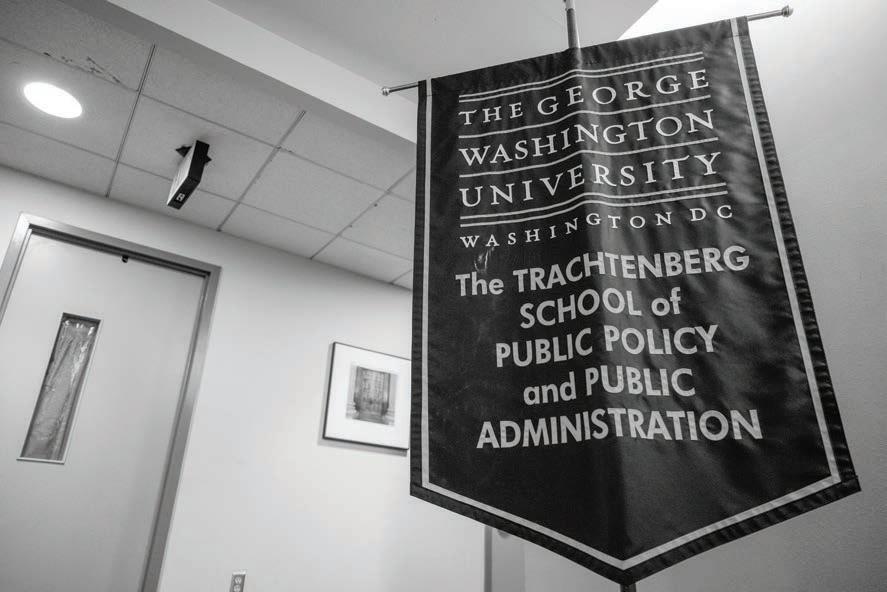
The pennant for the Trachtenberg School of Public Policy & Public Administration hangs in the school's o ce.
GRAPHIC BY JOSH HONG
NICHOLAS WARE | PHOTOGRAPHER
OPINIONS
“Take it from me when I say that this is exciting football, and now is the time to go out and cheer for the Commanders.”
—CARTER WILLIS on 10/17/24
When navigating new union efforts, GW should learn from past mistakes
GW and the Foggy Bottom area have seen a rise in unionization efforts in the past year, from graduate students and museum employees to School of Medicine & Health Sciences residents and fellows and GW Hospital workers. For some groups, the launch of union efforts isn’t novel — it’s a revival. We have watched attempts to unionize among resident advisers and graduate students in the past, unsuccessful in part due to officials’ unwillingness to bargain or offer recognition. When engaging with new or revived union efforts across campus, officials should take notes from GW’s past.
Unions in higher education, especially among graduate student workers, have soared across the country in the past decade, mostly because graduate students have brought up concerns about wages, benefits and working conditions. Graduate student unions have surged by 133 percent since 2012, with 38 percent of graduate students now unionized across the U.S. GW is experiencing these efforts firsthand.
In fall 2017, graduate student employees at GW started to push for a union due to concerns about low wages, poor health care benefits and issues with work schedules and hours. They argued that their working conditions were inextricably tied to the “learning conditions” of the undergraduate students they teach and help, noting that they can’t give their best when they’re “overworked and underpaid.” Graduate students were hopeful about the efforts because they came on the heels of a recent National Labor Relations Board ruling on Columbia University in 2016 that set a precedent of forming graduate student unions at private universities.
But in spring 2018, GW chose not to recognize the graduate stu-
ISTAFF EDITORIAL
dent union on campus, with officials saying it would “limit” the support they can offer students and “disrupt the mentoring opportunities” between faculty advisers and graduate students. GW initially declined to meet with students, saying that in place of unionization graduate students could have different “mechanisms” to flag their concerns to the University, though officials didn’t explicitly state those methods. When graduate students did eventually meet with officials, the meeting was unproductive, with no demands being addressed. Officials only met with students after they had held an hourlong sit-in at Rice Hall, following more than six months of attempts to unionize. But this resistance wasn’t new.
Unionization efforts among graduate students have always been met with opposition, especially at private universities where the NLRB would intervene and have the last say in the efforts. GW officials said they would “participate” in the process of unionization only if the graduate students got the NLRB involved — likely knowing the NLRB would oppose it because it wasn’t usually in favor of unions under a Republican administration. Graduate students became wary that if they continued pushing for the unions and got the NLRB involved, it might end up overturning its Columbia decision and set back private universities across the country, so they ceased their efforts. But earlier this month,
Voting through a noncitizen’s eyes
’ve lived in the United States as a green card holder for five years without the ability to vote. I live under a government I have no say in. All I wished was to be able to vote. This is why people choosing to abstain from voting in this upcoming presidential election for the series of excuses they make is completely incomprehensible to me.
When Roe v. Wade was overturned, I felt powerless without the right to vote, like there was nothing I could do. I had a similar issue with American immigration policy. Watching the growing humanitarian crisis and separation of families at the southern border has hit close to home. I feel fortunate enough that my family has been able to establish ourselves in the U.S., despite having our fair share of inhumane dealings with immigration agents. Because I can’t vote, I feel like spreading awareness about the horrible reality for other people at the southern border is the only thing I can do but that only addresses a certain extent of what needs to be done.
Many people don’t understand the gravity behind voting for policies and candidates and the power a person holds with one ballot. When people don’t vote, they risk allowing other voters to elect candidates with priorities that clash with the
ideals of the people. With the right to vote, people have the power to elect people who reflect their beliefs and values and will shape legislation in the coming years. It is a privilege many don’t understand unless they lose it or never receive it altogether.
There are millions of U.S. residents who can’t vote because they aren’t citizens. The people who can vote are the only ones who can represent us. This is exactly why you shouldn’t turn away from politics and why you should double down and demand more.
Right now, many states make voting very accessible, but that is slowly changing as southern states tighten access to absentee ballots, making it harder for out-ofstate voters or those with disabilities or illnesses to go out and vote — and potentially eliminating a whole demographic of both young generations and older voters.
And just because your home state may swing politically one way doesn’t mean your vote doesn’t count. People like me are the reason why your vote matters. When people say they won’t vote for a myriad of excuses, like not having enough time or their vote being inconsequential, it feels like they are saying they don’t care about this country and the people in it. No one says you have to understand everything going on in our government to vote. You just have to know what’s important to you and your community and then pick the person you think will best achieve those priorities. That’s the
cool thing about voting: it’s for everyone — well, almost everyone.
Presidential elections aren’t the only thing people should be voting in. Local elections are equally as vital because of their greater effect on smaller communities. These elections aren’t talked about as much and have a much lower voter turnout because they are more complicated and information-dense, but this year, many of these elections have state-specific ballot measures about reproductive rights and immigration issues that directly affect residents. States and individual districts can switch from red and blue from election to election, all based on our votes.
There are candidates I have developed my opinion on, and I have policies which I would like to vote for. Unfortunately, this means nothing. My family and I have to watch from the sidelines and leave our rights in the hands of eligible voters, who may or may not decide to turn out at the polls on Election Day. I have to trust that people will make their voices heard and choose the candidates and policies that will protect my reproductive rights and ensure the people at the border get a second chance.
I don’t have the power to make a change other than encouraging others to observe their duty in our participatory democracy. Vote for the people who don’t have a voice.
—Alexia Green, a first-year majoring in journalism, is an opinions writer.
Igraduate students at GW started up their efforts again, which had been dormant for about six years. Officials may not have recognized past unionization efforts among the student body, but that doesn’t mean they can’t do so now. Unionization demands often stem from a feeling of being unheard and unconsidered. Graduate students said in 2017 they wanted a voice. If they are reviving their attempts to unionize after the standstill they faced years ago, it means that the working conditions have not sufficiently changed. Earlier this month, some graduate students said they feel “under-respected” — echoing similar sentiments to those of graduate students from years past. So let’s reopen the discussion.
Unionization is a conversation, not an effort to overthrow GW’s leadership. Allowing your workers to unionize doesn’t mean everything will change overnight. And graduate students, who often contribute to immense amounts of research and scholarship, are the ones who help preserve GW’s status as a top research university — and probably helped the University land that cushy membership in the Association of American Universities, an invitation-only association for the top research universities, in 2023. This time around, GW should avoid repeating its past mistakes of allowing students’ demands to reach a boiling point and instead communicate openly with graduate students who want to unionize.
But campus history and GW’s current bargaining progress with other unions doesn’t make us optimistic. Last year, GW Textile Museum employees voted to unionize, requesting pay equity across the museum that matches the cost of living in D.C. But a year since the vote, employees are reporting slow bargaining with officials. Since SMHS residents and fellows voted to unionize last year, they’ve reported a lack of communication from the University — making progress on “noneconomic proposals,” like grievance procedure, childcare and inclusivity proposals — but not on the financial ones.
GW officials have made a step in the right direction by deciding to converse with union members, but this is the bare minimum. If GW wants to avoid protests and other forms of public activism for labor demands, they must show a concerted good-faith effort in hashing it out with groups who want to unionize. Officials shouldn’t be slow to respond to workers’ concerns or ignore them entirely as they’ve done in the past. Instead, offer employees a seat at the bargaining table.
What the Unitarian Universalist church helped me understand
grew up going to church but without all the “God” stuff.
That’s how I’ve always described my upbringing in the Unitarian Universalist church, that focuses on acceptance of people regardless of personal characteristics or religion.
My time there was essential for expanding my views of the world by showing me firsthand how people experience and interact with religion.
Religion was never an absolute fit in my world because my parents didn’t really believe in it. My mom’s side of the family had Jewish heritage — before the 1930s, our family name was “Goldberger” — but they hadn’t practiced for a generation, and we didn’t either.
I could never bring myself to believe in the idea of a God. As much as I like the peace that comes with the thought of a higher power, even a more amorphous one that comes with agnosticism, I find that I’m too political-sciencebrained with a need for hard evidence to ever buy into the unbelievable assumptions many religions compel.
But even though traditional, God-fearing religion wasn’t a major part of my childhood, for about six years when I was
growing up, it was a staple of my Sundays.
Looking back, those Sundays in rigid pews expanded my conceptions of the world beyond the semi-insular bubble in which I was raised. That’s the funny blend in Unitarian Universalism — it’s a very small, particular religion, made up of a lot of people who think in the exact same way, but it’s concerned with ensuring that everyone looks beyond those immediate perceptions with its focus on widespread acceptance.
The most lasting effect from my youthful fling with Unitarian Universalism is rooted in a Sunday school class that involved travel to different local houses of worship and sitting in on their services. I went to a red-brick, fireand-brimstone Catholic church in the suburbs that promised damnation for those even considering voting for Barack Obama and a downtown, Buddhist temple in a woman’s attic to learn about reincarnation. I spent a Saturday night in a synagogue during the High Holidays and a Sunday morning singing gospel music in a Black Southern Baptist church — or at least the closest equivalent New Haven, Connecticut, could conjure. It almost goes without saying that each experience was almost nothing like any of the others, but through them all, there was a through line of a group of people, all
with fairly similar values and ideas, who just really like spending time together in a house of worship each week. And when I was there, I, too, really liked spending time in those environments. When I thought of religion as less of a series of stories I didn’t really buy into and more as this broad series of community links in one space, I “got” religion more than I had before and became more open-minded in general. Religion is so intertwined with day-to-day life. There are religious symbols at every turn, controversies over religion in each Supreme Court docket and so forth. If I hadn’t spent my childhood bouncing around from Baptist church to synagogue to mosque, I’m not sure I ever could’ve quite understood why. I haven’t been to a Unitarian Universalist church in around a decade, but I’m glad I did when I did. I can understand, on a basic level, why one of my friends might go home earlier on a Saturday night to get up for church in time for Sunday, or why people vote according to how others of their same faith vote. There’s just something nice about the feel of community one gets from spending time in these places . My time in the church of 0.3 percent of the population filled in 100 percent of my understanding of religion.
—Nick Perkins, a senior majoring in political science, is the culture editor.
Nick Perkins Opinions Writer
CAROLINE MORRELLI | CARTOONIST
Alexia Green Opinions Writer
CULTURE
Faculty-in-Residence share mishaps, unlikely friendships in GW dwellings
students, which he hopes makes students more comfortable talking to other professors in their academic lives.
Last October, Daniele Podini was worried about a missing pumpkin.
Podini, an associate professor and chair of the Department of Forensic Sciences, was spending his second year living in Amsterdam Hall as a Faculty-in-Residence, along with his 7-year-old son Jack. Last Halloween, he and Jack painted a pumpkin to look like a minion from “Despicable Me” and placed it outside their residence hall room door — only to find it stolen.
Podini is now in his third year living in Amsterdam Hall as a member of the program, which houses faculty members in residence halls to host student programming, like dessert-filled extravaganzas and meet-and-greets with professors’ pets. He said after discovering the pumpkin’s abduction last year, he emailed all of the residence hall’s residents to tell them that Jack’s pumpkin was missing.
In response, students brought clusters of pumpkins and treats to make up for it at the door.
“Eventually a student found it and brought it back, it was really sweet and a lot of little trinkets and notes and treats for Jack,” Podini said.
Podini said he wound up in the residence hall since he was looking for a place to live and heard about openings in the program. He said he used his living situation to put himself out there and interact with
Podini said students come over to play FIFA with Jack — who attends an elementary school in Georgetown — after meeting him in the hallways. To decorate his GW dwellings, Podini said he brought his own furniture and artwork instead of using the gray plastic kitchen chairs that GW supplies to residents.
He said he hosts events, like cooking lessons with a handful of regulars, where he teaches students how to make dishes like homemade pizza, gnocchi and pasta in his own kitchen to make the residence hall experience feel like a home away from home for students.
Alex Dent, a professor of anthropology and international relations, said he lives with his wife, two sons of 14 and 16, respectively, and dog Oz on the 10th floor of District House. Dent said as a Facultyin-Residence, he tries to provide community and structure for students without being “too present” — at times taking a backseat and stepping in when students need his help.
He said he strikes this balance by holding optional events in the building, the most successful of which involve free food giveaways.
Dent said since his sons — who attend Jackson-Reed High School in Tenleytown — are more than 6 feet tall, they blend in with the rest of the students. Those students are often confused about his own presence in District House, he said.
Dent said he and his wife have hung artwork on the walls and
brought over their old furniture from their previous home in Columbia Heights, making the dorm feel like home. Their old house had started to break down, with the air conditioning not working and his sons sharing a room, prompting their move at the end of July, he said.
Deniece Dortch, an assistant professor of higher education administration, said she is spending her third year in Thurston Hall. She said part of her decision to become a Faculty-in-Residence had to do with the D.C. housing market, since she used to live in the “very, very expensive” Southwest Waterfront. She said she also wanted the position since it lets her combine academic and personal interests since her primary studies already surround the lives of college students.
Dortch said once, she was writing a paper with a colleague in her Thurston apartment when the scent of something burning filled the air. Dortch hadn’t accidentally left the oven on, and there wasn’t a barbecue taking place in a nearby backyard. Instead, a first-year student had put ramen into the microwave without any water in the shared kitchen of Dortch’s floor.
Dortch said she regularly hosts events, like Sugar Tuesdays on her Thurston floor’s lounge, where she provides students with “sweet treats” and introduces them to local and Black-owned businesses, like 5-12 Desserts, which often draws students from outside Thurston.
“Surprisingly, it’s more students who are not in the building who participate in that program than students actually in the building,” Dortch said.
GW Club Climb mounts rock walls, competes against local rivals
know one another,” Feger said.
While students ascend the stairs of Gelman Library during midterm season, members of GW Club Climbing are scaling rock walls.
Clad in cargo pants and glove-like grippy shoes, a cohort of GW students take the Metro’s Blue Line four times a week to mount the climbing walls of Crystal City’s Movement Gym.
Established in spring 2021, GWCC is composed of a competition team — whose six members this year practice thrice weekly — and a recreational team, whose around 50 consistent members make up the bulk of the group and practice at least twice a week.
During a typical recreational team practice, which occur Monday and Thursday nights and Friday and Saturday afternoons, members of GWCC scatter among the gym’s blue and gray slabs of climbing walls dotted with rainbows of plastic rocks.
GWCC President Cal Feger, a senior majoring in public health, said the group works to nurture amateur climbers by encouraging members to partner with others at their experience level during practices.
“We have built a climbing community but also a community beyond climbing where people can feel comfortable just getting to
The average climber has to pay Movement’s $112 monthly membership fee, but GWCC works with the gym and uses its Student Government Association funding to offer $56.54 a month subsidized memberships to 35 students each year and $96 a month memberships for the rest of the club.
Senior Reilly Stilwell, the organization’s co-social chair and an international affairs and environmental studies major, said there is often downtime between climbs as members take turns sharing the wall, so the sport is inherently social — which for her, has been the carabiner securing her in GWCC’s harness.
Stilwell said the GWCC community also extends beyond the rock wall, with the team hosting movie nights, potlucks and mixers with other club sports like GW Club Boxing and Brazilian Jiu-Jitsu.
GWCC Vice President Raya Davidson, a junior and political science student, said recreation team members get to showcase their skills at an annual D.C. region recreational competition with American and Georgetown universities hosted by GWCC at Movement in the spring.
With the competition split into beginner, intermediate and advanced divisions, Davidson said members of GWCC were
Trevor Noah talks new children’s book, conflict resolution
Two years after closing the curtains on his tenure as host of “The Daily Show,” Trevor Noah is charting the political landscape through a new gig: becoming an author for kids.
“confident enough” they would take home the first place trophy, which they had purchased from Amazon. But the team ended up coming in third with American University taking home the gold, she said.
Competition team member Hannah Hostalka, a first-year studying political science and environmental studies, said as the team’s first competition in November approaches in Richmond, Virginia, she plans on honing skills judges look for like dynamic movement, a method of using one’s momentum to propel oneself further up the wall.
Recreation team members like Lucas Scott, a senior majoring in philosophy, said the technical and collaborative skills he learned from GWCC have popped up in outdoor climbs unaffiliated with the team, from safety tips to preclimb small talk. Scott said his favorite solo climb was at Montserrat, a 4,000-foot grouping of stone pillars in Barcelona, Spain, which he took on when studying abroad last semester.
“People here, just that I met here, had gone outside with me, just sort of outside the club as friends, and they basically showed me the ropes of how to climb outside,” Scott said. “And then I was able to do that with a bunch of people from around the world.”
After the Oct. 8 release of his new picture book “Into the Uncut Grass,” which follows a boy and his stuffed bear leaving home and journeying into the “uncut grass,” Noah chatted with GW alum and NBC News journalist Zinhle Essamuah in the Smith Center on Saturday about how children’s books shaped his worldview and can inform kids’ approach to conflict resolution. The moderated conversation before an audience of students and parents was a twist on the Alumni and Families Weekend’s typical stand-up comedy event.
The Johannesburg-born entertainer began his career in South Africa through a series of hosting gigs before moving to the United States in 2011, where he went on to host “The Daily Show” from 2015 to 2022, four consecutive Grammy Awards ceremonies and the 2022 White House correspondents’ dinner. His debut book and memoir, released in 2016, “Born a Crime: Stories from a South African Childhood” was a New York Times No. 1 bestseller.
Chalk drawings adorned the sidewalks of
campus Saturday, directing families and alumni to the Smith Center where a line of about 25 people formed before the event’s 8 p.m. door opening time. More than an hour later, nearly every seat on the floor and in the bleachers of the arena was filled before Noah took the stage.
The comedian easily won over the Smith Center crowd with his political commentary with a sprinkling of sarcasm as he fielded questions from Essamuah and students. The pair kicked off with a discussion about how Noah’s favorite children’s books growing up inspired him to take a crack at writing one of his own.
Noah said he set out to write a book like the ones he read growing up, which contain messages that readers can appreciate into adulthood — like how Roald Dahl’s “Charlie and the Chocolate Factory” can also be read as a critique of greed and capitalism.
“I love the layers and the nuance that you can find in a children’s book,” Noah said.
Noah said his central inspiration for writing the book centered around past conflicts he had with his mother throughout his childhood. He said working through disagreements with parents is usually a child’s first exposure to conflict resolution, which he solidified as a central theme of “Into the Uncut Grass.”
Growing up as a biracial child in South Africa under apartheid and then living in the United States as an adult, Noah said he has found that the global Black community is not a “monolith” and is shaped by different nationalities but that all Black people can relate to the experience of facing systems of oppression. After Essamuah asked him about his perspective on how Americans have responded to the war in Gaza, specifically through the pro-Palestinian encampments on college campus, Noah said older people too often focus on “chastising” students for the manner in which they protest instead of addressing the conflict that is sparking protests in the first place. As the clock neared 11 p.m., Essamuah ran Noah through a list of rapid-fire questions, quizzing him on his preferred GW moniker — the Revolutionaries — and asking him to weigh in on the 2024 U.S. presidential election, to which Noah endorsed Vice President Kamala Harris after jokingly throwing his support to former President Donald Trump. When Essamuah asked what is giving Noah hope right now, he responded “young people.”
“What gives me hope is the idea that many times in history, people thought there would be no future, and yet here we are,” Noah said.
NORA FITZGERALD SENIOR STAFF WRITER
BROOKE
RACHEL KURLANDSKY | STAFF PHOTOGRAPHER
A GW Club Climbing member belays a teammate at Movement Climbing & Fitness in Crystal City.
COURTESY OF WILLIAM ATKINS
Trevor Noah speaks to a packed audience in the Smith Center.
TAYTUM WYMER | STAFF PHOTOGRAPHER
Daniele Podini poses for a picture in his room in Amsterdam Hall.
SPORTS
Women’s soccer loses 0-2 to Fordham on the road
CAMILLE PRATT-CHATMAN
REPORTER
Women’s soccer (4-9-3, 2-5-1 Atlantic 10) fell 0-2 to the Fordham Rams (10-4-3, 5-2-2 A-10) on Thursday in New York City. Their loss to the Rams marked their eighth loss of the season, placing them 12th out of 15 in the conference rankings, just below Duquesne and followed by George Mason, Richmond and St. Bonaventure. Senior goalkeeper Ainsley Lumpe came in with a recorded 39 shots saved so far in the season and had an additional four shots saved in Thursday’s match.
The Revs have been met with trouble on the road since midSeptember, losing their last three away games against La Salle (7-5-5, 2-4-3 A-10), Saint Louis (10-1-5, 6-02 A-10) and North Carolina State University (4-9-3, 1-5-2 Atlantic Coast) ahead of Thursday’s matchup. Since the beginning of the season, the team has only lost two of their seven home games. They fell to Massachusetts 2-4 on Oct. 3 and Binghamton University 2-3 on Aug. 18.
The Revolutionaries triumphed over the Richmond Spiders (4-9-2, 2-6 A-10) in their latest win 2-1 at home on Oct. 13, with goals from graduate forward Lauren Prentice and freshman defense Julia Bilal.
The first half started steadily, with each team exchanging fair shares of ball possession for the first eight minutes, until Rams freshman forward Liina Tervo took a shot at the goal. For the remaining 37 minutes of the half, the Rams pushed into the Revs’ territory, leading the Revs to take a more defensive stance
through the rest of the half, forcing three Rams corner kicks. Revs junior forward Isabel Kelly made GW’s only shot of the half, which missed out right of the goal.
The Rams collected a total of nine shots in the first half, three of which were on goal. Lumpe saved two of those on goal shots. Twenty-seven minutes into the half, Fordham’s graduate forward Abby Borchers, assisted by Tervo and junior midfielder Julia Holton, scored a goal for the Rams, putting them ahead 1-0.
The Revs re-entered the game in the second half with a more offensive approach. They advanced into Rams’ territory, creating an aggressive backand-forth between the two teams. By the end of the half, the Revs took five shots, two of which were on goal, taken by freshman midfielder Selah Koleth and senior defender Amelia Booth.
Despite the Revs’ renewed energy in the second half, the Rams maintained their momentum from the first half. They took an additional seven shots in the second half, three of which were on goal. Fifteen minutes into the half, Fordham’s freshman forward Julia Acosta, assisted by sophomore midfielder Ava Giudice, scored one shot to put them ahead 2-0.
The Revs have three games left in their 2024 regular season, prior to the start of A-10 Championship play on Nov. 1. By Thursday’s game, they held the eighth seed spot, and after losing Thursday’s game, the Revs sank to the 12th seed spot, increasing their risk of no postseason play.
Women’s soccer will face VCU (3-8-4, 2-2-4 A-10) at home on GW’s soccer field Thursday.
GAMES
Men’s soccer suffers 1-3 defeat to Fordham in season’s 10th loss
REPORTER
Men’s soccer (3-10-2, 1-41, Atlantic 10) bore a loss Saturday against Fordham (6-3-4, 3-1-2, A-10), ending the game 1-3.
The game wrapped up with a tough defeat for the Revolutionaries, marking GW’s 10th loss of the season and their fourth in the A-10 Conference. The Revs stand at 13th place in the A-10 out of 14 teams.
The Revs have the second–lowest save percentage in the A-10 so far, standing at .617, just above Loyola Chicago, who is wavering at a .596.
Both GW and Fordham entered Saturday’s match with conference wins, as the Revs defeated Saint Joseph’s 2-0 on Oct. 12, with graduate student midfielder William Turner scoring both goals.
The Revs struggled throughout the first half with their defense and offense, lacking control in the midfield. They attempted five shots on goal, two from freshman forward Louis Crofts. Sophomore midfielder Dan Dobrin gave the Revs their first corner kick opportunity as he dribbled down the right
flank and deflected the ball as he approached the goal.
While both teams failed to score any goals in the first half, the Rams’ offense held strong, as Rams junior forward Andre Insalaco dribbled past two Revs, and Rams graduate student forward Luke Pompliano almost shot on target, hitting the post 19 minutes into the game. The game picked up in the first three minutes after the break, when Rams junior midfielder Daniel D’lppolito was on the breakaway but was pulled down by Dobrin. Dobrin’s foul proved costly, earning him a red card three minutes and 18 seconds in and leaving the Revs down a player for the remainder of the game.
The Rams capitalized their opportunity on the set piece, when Rams graduate student midfielder Lukas Hackaa converted the free kick into the first goal of the game. After the Revs were down to 10 players, they changed their formation from three center backs to four, adding more stability in the defense as a response to the Rams’ constant threat down the flanks. The shift allowed the Revs to focus on attacking,
GW Athletics adopts official NIL collective, membership program
to receive direct compensation through supporter donations.
GW Athletics adopted an official collective to help student-athletes take advantage of their name, image and likeness earlier this month.
The FOG, or Friends of George, collective was first launched by supporters of GW Athletics in November 2022, a couple of weeks after the the NCAA adopted new permanent policies permitting the expanded use of athletes’ use of their name, image and likeness for profit. Following new NCAA policies in April that allow universities to adopt official NIL collectives, athletics officials this month rebranded the collective and announced new offerings to its supporters, including Zoom calls with athletics officials.
Legal use of NIL has allowed athletes to make brand deals and sponsorships with companies. Universities are not allowed to pay athletes directly, but many schools like GW have affiliated thirdparty collectives that ensure athletes receive compensation, albeit not straight from the university.
The FOG Collective adds on to financial opportunities for athletes, providing an opportunity
Other fundraising opportunities provide money to teams as a whole, like the Buff & Blue Fund, which raised more than $500,000 this September to support teams of donors’ choice.
The collective is alumni-led, but it’s run by a parent company called Blueprint Sports, which provides NIL services across the country. Blueprint Sports provides NIL services to Atlantic 10 rival Loyola Chicago and top basketball programs of University of Kansas and Gonzaga University.
“As the scholarship is really important, so are some of the other financial opportunities for studentathletes at this point,” women’s basketball Head Coach Caroline McCombs said.
In April 2024, the NCAA’s Division I Council announced new rules allowing universities to orchestrate NIL deals between its athletes and other parties but still prohibiting direct pay-to-play. Following the introduction of NIL, the NCAA has instituted a steady stream of rule adjustments to ensure fairness.
In this month’s announcement, officials named FOG as the “official” NIL collective for GW and rebranded its website with direct links on the GWSports homepage. Athletics
officials previously launched The GDUB NIL Exchange in December 2023, a registry of more than 300 student-athletes who are available to partner with businesses.
The collective’s new program allows fans to become “members” by paying subscription fees of $50 or $100 a month. The $50 monthly membership fee, or the “Buff” membership, includes invitations to quarterly Zoom calls with guest appearances and one ticket to a quarterly raffle of “exclusive memorabilia.” The $100 “Blue” membership includes two additional tickets to the drawings, as well as a post-game autograph session with student-athletes.
When making a onetime donation on the website, or joining as a member of the collective, fans have the option to direct their funds to either the women’s basketball team, men’s basketball team or the general fund.
The homepage features a video message from Athletic Director Michael Lipitz and pictures of basketball athletes and facilities.
“Friends of George is an important complement to our traditional fundraising efforts,” Lipitz said in the video.
“It directly supports our student-athletes and maximizes their opportunities to gain additional compensation.”
Lipitz said at his
as Turner dribbled through midfield and played a perfect through ball to Crofts, who slotted the ball into the bottom right corner. The maneuver gave the Revs their first and only goal with 30 minutes left in the game. In the last 10 minutes of the game, the Rams had a penalty, which Revs sophomore goalkeeper Tom Macauley saved. But the Rams were able to tap in the rebound and D’lppolito scored the third goal of the night, putting the Rams in the lead. The Rams took 21 shots compared to the Revs eight during the course of the game.
The Revs pushed up the pitch in the final minutes in an attempt to score but were unable to due to the Ram’s defense surrounding the goal. In the last four minutes, Crofts and graduate student midfielder Roee Tenne received yellow cards after being fouled. But the Revs’ efforts were fruitless, as Hackaa blasted the ball from 30 yards out into the top right corner, extending the Rams’ lead by two goals. The Revolutionaries will head to Missouri for their next game against Saint Louis on Saturday.
introductory press conference in August that as a “basketball school in a basketball conference” he understands that the success of GW’s basketball programs helps to drive financial performance of GW Athletics as a whole.
Men’s basketball Head Coach Chris Caputo said the collective is aiding the Revolutionaries to secure lucrative players.
“What college basketball has become, and what college sports have become, you have to have a robust collective to help procure players,” Caputo said. “Bottom line, with the settlement that’s coming, the A-10 is going to be a league that opts into some form of
revenue sharing, which will be important to give us opportunities to both retain, and attract really good players.”
A district court judge earlier this month granted preliminary approval for a proposed $2.8 billion settlement to provide college athletes who were denied compensation for using their name, image and likeness. McCombs said she is excited about the prospect of more financial opportunities for her players.
“It’s a great opportunity for our young women,” McCombs said. “Right now, I think things have changed across the country, and then for
our players to have an opportunity financially, I think we are well in our time.”
Senior women’s basketball forward Maxine Engel said she hasn’t had much personal interaction with the collective but is excited about the opportunities that the expansion of NIL will provide young players. Engel said she hasn’t participated in any NIL deals herself but some of her teammates have signed deals with clothing and food companies.
“I think it’s a great opportunity,” she said. “It’s another way for us to elevate the program, compete with other schools in the realm.”
SARAH HOCHSTEIN | STAFF PHOTOGRAPHER
The men’s basketball team puts their hands together during a practice earlier this week.
SRIYA MAMIDANNA
TOM RATH | STAFF PHOTOGRAPHER
Sophomore midfielder Ben Hissrich drives the ball down the field during a match against Duquesne last month.
RAPHAEL KELLNER | STAFF PHOTOGRAPHER
Senior defender Amelia Booth goes after the ball during a match against Drexel last month.