Protest negotiations at standstill as students leave campus
After a brief burst in protest in the two days following police’s Wednesday clearing of the proPalestinian encampment in University Yard, campus has fallen quiet.
Where U-Yard was once dotted with camping tents, canopies and camping chairs, the lawn is now empty, except for GW Police Department officers and facilities workers occasionally strolling by. Just days before on Wednesday, hundreds of local police had mobilized in U-Yard to clear the tent encampment that occupied the lawn for nearly two weeks to protest the war in Gaza, officers deploying pepper spray and arresting at least six students in the process.
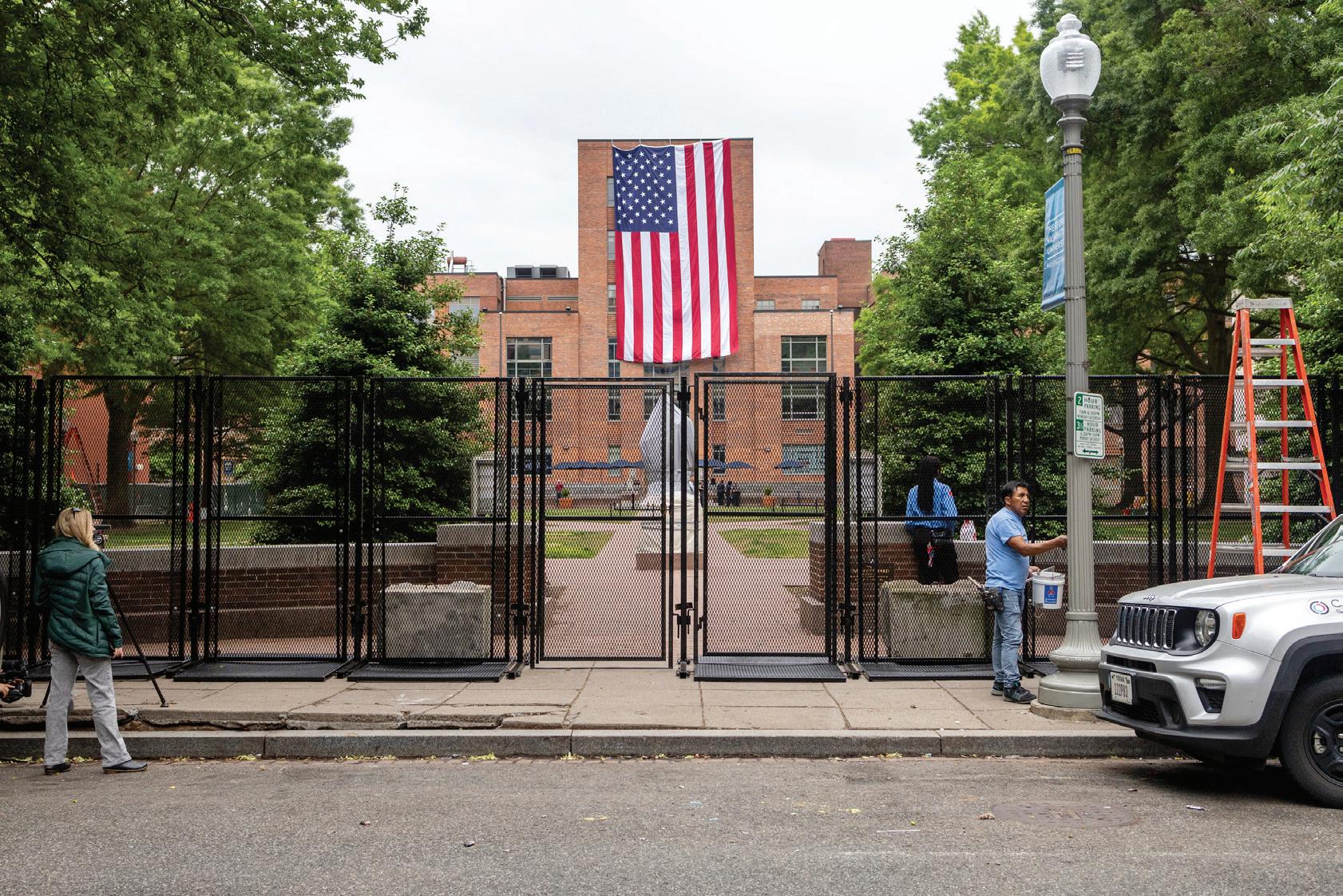
Officials blocked off most central campus spaces, including U-Yard, Kogan Plaza and Anniversary Park behind tall metal barricades as campus entered GWorld Safety Mode, restricting access to University spaces. GW staff also removed the giant American flag that workers hung over U-Yard for days before, an apparent response to demonstrators raising a Palestinian flag on the Lisner Hall flagpole during the protest.
Demonstrators set up an encampment in University Yard for 13 days to demand officials disclose all investments and academic partnerships, drop all charges against pro-Palestinian student organizations and divest from companies supplying arms to Israel. Metropolitan Police Department officers rejected officials’ request to clear the encampment on the second day of demonstrations and continued to decline requests for more than a week because they said the protest remained peaceful.
Just a week away from Commencement, officials brace for an influx of families visiting for graduation and maintain that ceremonies will proceed as normally scheduled — despite a tightening of guidelines prohibiting attendee items like sound devices, posters, banners and flyers. Some universities around the country canceled their graduation celebrations due to safety concerns
looming from ongoing campus demonstrations demanding their schools divest from companies aiding Israel’s war on Gaza.
Some campus demonstrations have continued, with hundreds of officers dispersing an impromptu encampment formed by protesters on F Street outside GW offices and University President Ellen Granberg’s on-campus residence Thursday. After a rapid police response of hundreds of officers who issued five warnings to disperse or face arrest, student protesters said they would fall back and “fight another day.” After the protesters dispersed from the police standoff, MPD officers arrested one demonstrator for alleged assault on an officer, but dropped the charges the next morning, according to an Instagram post from the coalition.
Granberg met with student demonstrators on Friday to discuss protesters’ demands, the first conversation with Granberg since protesters assembled the U-Yard encampment. Students live-streamed the sit-down on Instagram as three members tasked with negotiating the coalition’s demands spoke with Granberg and other officials for about an hour and a half.
Dean of Students Colette Coleman initially invited seven stu-
dent organizations to a 45-minute meeting at 1 p.m. on Friday with Granberg, Provost Chris Bracey and Chief Financial Officer Bruno Fernandes. She said in her invitation that GW wouldn’t consider changes to its endowment investment strategy, academic partnerships or student conduct processes. Organizers rescheduled the meeting to 5 p.m. and said the University showed a “concerning lack of genuine interest” in engaging with students by scheduling the meeting on short notice during Jummah, the obligatory Friday prayer for Muslims, as well as on the final day of exams.
The group also requested that officials exclude Bracey from the conversation because they said he has shown “no regard” for demonstrators’ “safety, wellbeing and dignity,” repeating their claim that he assaulted two students at the U-Yard encampment, including a member of the encampment’s negotiations team. Bracey was not present at the 5 p.m. meeting.
Granberg said during the meeting that officials won’t commit to financial disclosure or divest from companies selling technology and weapons to Israel, saying that divestment is not as straightforward as protestors believe it to be. She said she hopes
to continue conversations with demonstrators to see if there’s “something the institution can do.”
“I hear that from your standpoint, they should be very, very simple,” Granberg said. “They are not, that is not that easy.”
During the meeting, students reaffirmed that part of the intentions of their protests were to seek divestment from institutions with ties to Israel and for the University to disclose its investments.
“Eight students have been suspended, because they seek divestment, financial transparency and the protection of their communities,” an organizer said at the meeting.
The group was unsatisfied with the results and lack of action on their demands at the meeting, but the discussion concluded with the promise of another sit-down with officials Sunday through Zoom. Before the meeting with students Friday, Granberg said at a Faculty Senate meeting she is willing to continue conversations during the summer. Organizers said they’re not interested in “just having meetings” and want results from administrators.
As of Monday morning, there has been no indication that officials have met with student organizers for a second discussion.
Student groups back protesters in slew of statements
Over the last two weeks, more than 70 student groups have voiced support for free speech and condemned the punishment of students protesting at the proPalestinian encampment in University Yard that local police cleared Wednesday.
Two days after the encampment started, officials placed seven student protesters on interim suspension April 27 with nine counts of misconduct each, and May 8, the Metropolitan Police Department arrested at least six students for unlawful entry. In the wake of the disciplinary action, student organizations released an array of statements condemning the sanctions, each tailored to their group’s own mission.
Members of student organizations said although police cleared the encampment Wednesday — some officers deploying pepper spray and using physical force — the demonstrators will continue to stress their demands to administrators, including dropping charges against pro-Palestinian students and divest from companies funding Israel’s war on Gaza. Members of the GW coalition met with officials Friday after Dean of Students Colette Coleman invited representatives of Arab, Palestinian and Muslim student groups. In her invitation, she prefaced that the University said it is “not considering” meeting many of the organizers demands.
Student organization leaders said organizers asked some student groups to issue statements or posted statements on their own behalf condemning the suspension of students and encouraging officials to meet with protesters to discuss their demands.
A member of Reproductive Autonomy and Gender Equity, who requested to remain anonymous due to fear of doxxing, said the organization was inspired to issue a statement after the Residence Hall Association posted one condemning the University’s threats of suspension on the second day of the encampment.
Medical Faculty Associates Chief Executive Officer Barbara Bass will step down from her role to allow “full-time leadership” to helm the medical enterprise, according to a University release Friday.
Bill Elliott, the former chief operating officer of the University of Maryland Faculty Physicians, Inc., will take over for Bass on May 13 as interim CEO of the MFA, a nonprofit group of physicians from GW Hospital and the School of Medicine and Health Sciences. The release states that Elliott will direct day-to-day operations and instill “financial stability” into the MFA, which owes GW $200 million and has garnered more than $250 million in deficits since fiscal year 2020.
“I welcome the opportunity to implement the work that is already underway, the work that has been planned but not yet started and the work still needed to achieve the goals of the MFA,” Elliott said in the release. Bass, who also serves
as the dean of SMHS and the vice president for health affairs, will lead the University’s “academic clinical enterprise,” which includes education, research, patient care and community engagement, the release states. Bass has served as the MFA’s CEO since January 2020 and was the first physician CEO of the group since 1999. Bass said at the February Faculty Senate meeting that the MFA pays back the money that it owes to the University at a rate that “contributes substantially” to the University’s spendable revenue.
“The tasks of running a high-performing faculty physician practice to serve our patients requires intense and undivided attention,” said Ellen Zane, who chairs the MFA Board of Trustees. “Considering the needs of the future, the time is right to ensure that the MFA has full-time leadership.”
In September, the MFA brought in a Chief Financial Officer Robin Nichols after Lance Kaplan left the role in February 2023. Nichols previously served as CFO of Warbird Consulting Partners.
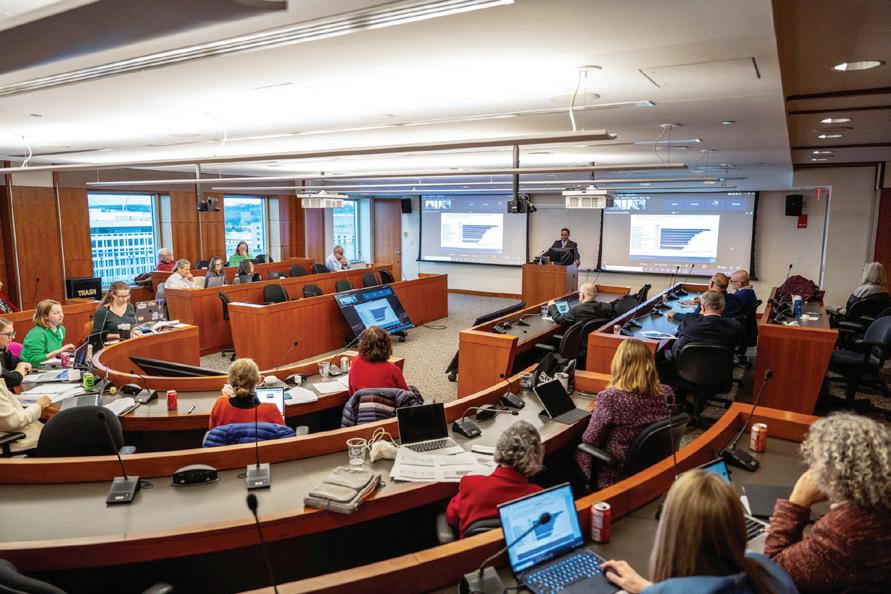
Faculty senators criticized officials’ lack of faculty involvement in their decision-making about GW’s pro-Palestinian encampment at a meeting Friday.
Senators said officials could better communicate with and use faculty as a resource for key decisions at a Faculty Senate meeting Friday, three days after local police cleared the pro-Palestinian encampment in University Yard and arrested more than 30 demonstrators. Senators said they could have advised the administration on their handling of the encampment given professors’ relationships with students and expertise in related fields of study like communications and conflict management.
Faculty Senate Executive Committee Chair Ilana Feldman said the committee convened for an emergency meeting on the first day of the encampment and sent a letter to University President Ellen Granberg and Provost Chris Bracey that urged for a “de-escalatory approach.”
She said the letter also states that senators were willing to help officials communicate with student protesters.
Sarah Wagner, a faculty senator and professor of anthropology, said communication from the administration has been “scant,” and she gets more texts from emergency alerts than emails from the offices of the provost or president. She said she imagined that “a lot” of faculty were also unaware of how officials were planning to respond to the encampment.
“That has to change as we move forward,” Wagner said.
In response to faculty’s questions, Granberg said she expected conversations with demonstrators to continue virtually throughout the summer to help foster dialogue around how the community can come together for the fall semester. She also claimed that “well over” half of people at the encampment were not GW students, so administrators did not consider the demonstration a student protest, which influenced their decisions about the encampment.
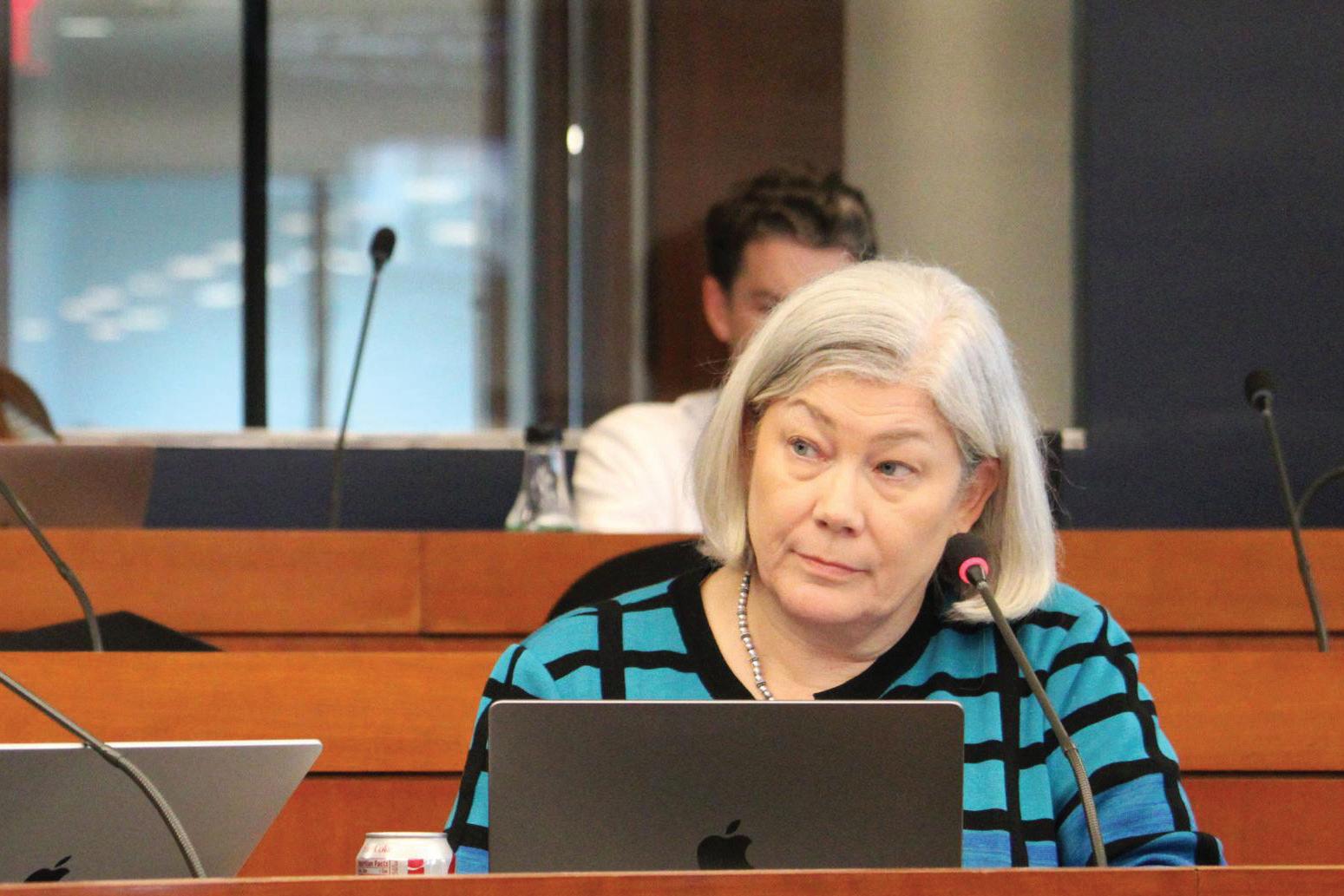
Jennifer Brinkerhoff, a faculty senator and a professor of public administration and international affairs, shared a written message from a faculty member in the Elliott School of International Affairs who said they were disappointed GW did not use the encampment as an opportunity to “create a space” for education and learning around “contentious and difficult” issues.
Brinkerhoff added that it was clear from the Elliott faculty meeting Friday morning that the community is “hurting,” given that there are faculty and students on different sides of a “very complex” international issue.
“As a University, as a place of higher learning, as a place that is trying to con- tribute to society, we have to model how we can hold that complexity and hold that compassion for all parties,” she said.
Discussions about strengthening shared governance — the participation of faculty, students and staff in decisionmaking — have dominated Faculty Senate conversations following the departure of former University President Thomas LeBlanc and have continued since after the University made the decision to arm some GWPD officers last April. Senators argued the decision was a violation of GW’s shared governance
principles, which state that all faculty have a role in “key decision making.”
Faculty senators also raised concerns about the large American flag that administrators draped over Lisner Hall last Friday after demonstrators removed a GW flag from the flagpole and replaced it with a Palestinian flag. Officials had taken down the flag by midday Sunday, but The Hatchet was unable to verify what time the flag was removed.
“I’m gonna echo my concern there because that feels like that was not responsive to students but to outside audiences,” Wagner said. “I just wonder if that was right in the moment. It feels like that may have been more escalatory than otherwise.”
David Rain, a faculty senator and a professor of geography and international affairs, said the timing of the University’s placement of the flag during a protest seemed “deliberately provocative.” Brinkerhoff said there “may be context” for the flag’s placement, but its presence has received national attention and become a “soundbite” that implies student protesters are anti-American.
“That sends such a horrible message, so I really would urge you to refly the flags where they belong,” Brinkerhoff said.
GW’s response
RORY QUEALY NEWS EDITOR
Faculty senators critique lack of input on
to student protests
JERRY LAI | PHOTOGRAPHER University President Ellen Granberg listens to faculty senators during a meeting Friday.
HANNAH MARR NEWS EDITOR SACHINI ADIKARI CONTRIBUTING NEWS EDITOR MFA CEO
to depart role
Gates
including the
Wednesday’s
MARR NEWS EDITOR NATALIE NOTE STAFF WRITER AUDEN YURMAN | STAFF PHOTOGRAPHER The Medical Faculty Associates building on Pennsylvania Avenue. BROOKE FORGETTE CONTRIBUTING NEWS EDITOR AN INDEPENDENT STUDENT NEWSPAPER • SERVING THE GW COMMUNITY SINCE 1904 • ONLINE AT GWHATCHET.COM May 13, 2024 HATCHET The GW Vol. 121 Iss. 1
SAGE RUSSELL | SENIOR PHOTO EDITOR
obscure University Yard from view,
plaza’s George Washington statue, which staff shrouded in a sheet after
encampment clearing. HANNAH
16 DAYS OF PROTEST NEWS
NEWS THE GW HATCHET May 13, 2024 • Page 2
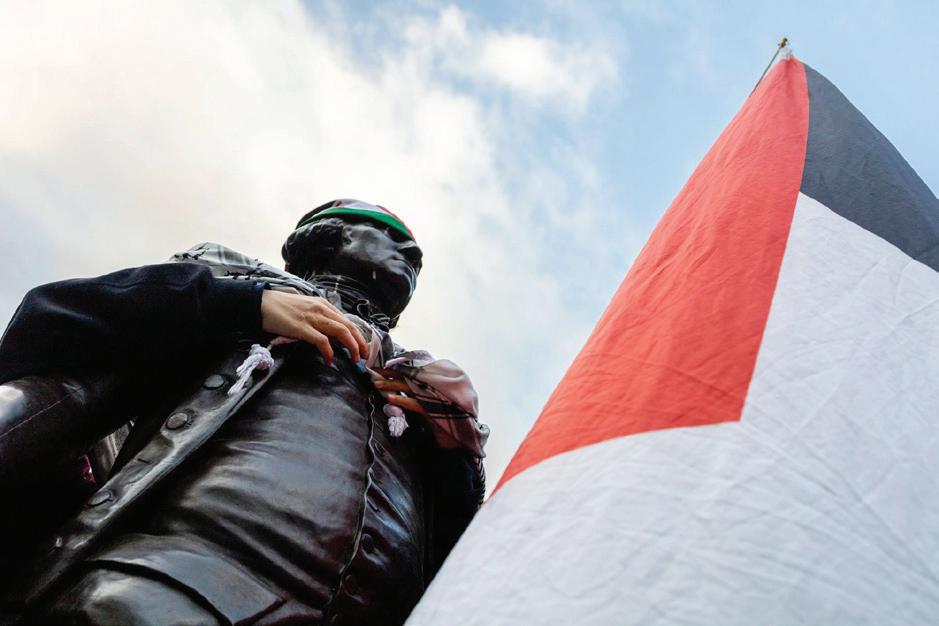
protester ties a keffiyeh
George Wash-
A
around the neck of the
ington statue in University Yard.
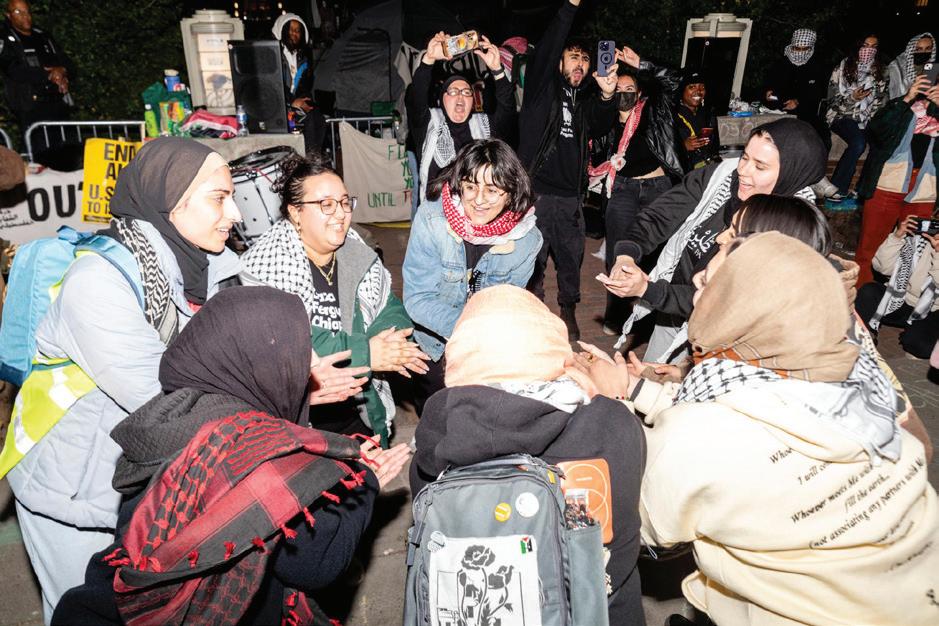
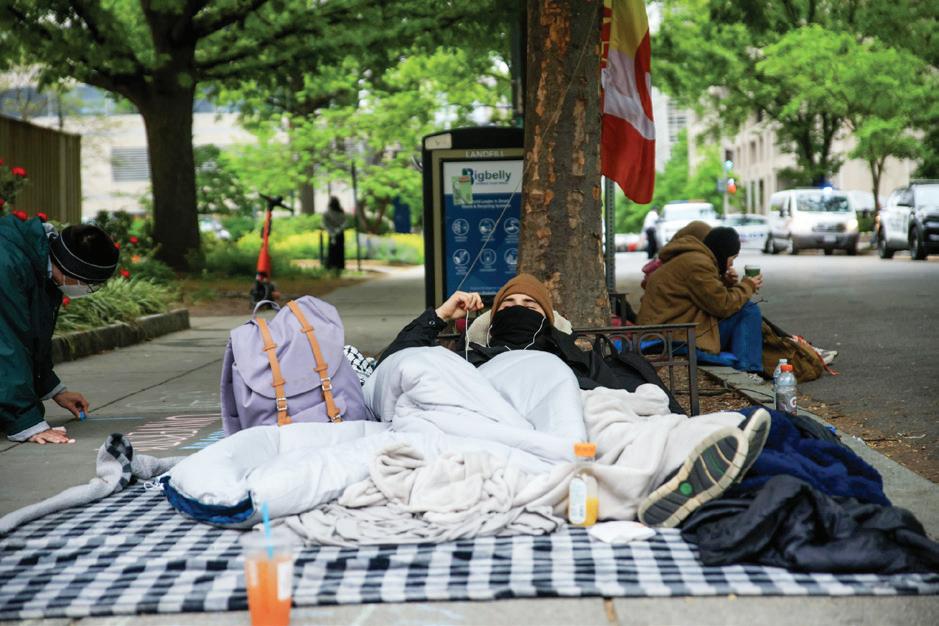
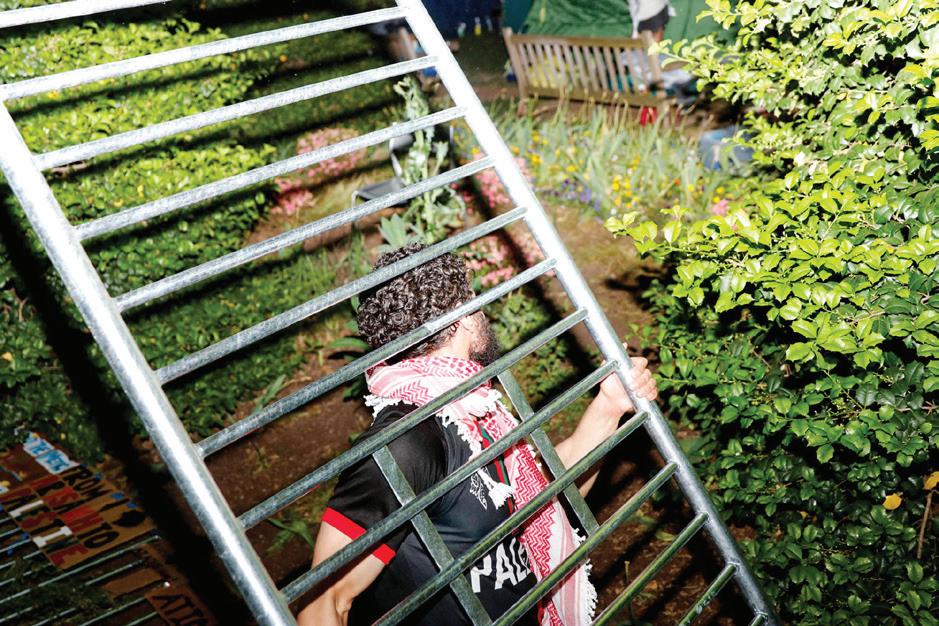
Day 1 SAGE RUSSELL Dozens of demonstrators danced on H Street before pitching additional tents in the road and spending the night. Day 2 SAGE RUSSELL A demonstrator wakes on H Street to begin another day in the encampment. Day 3
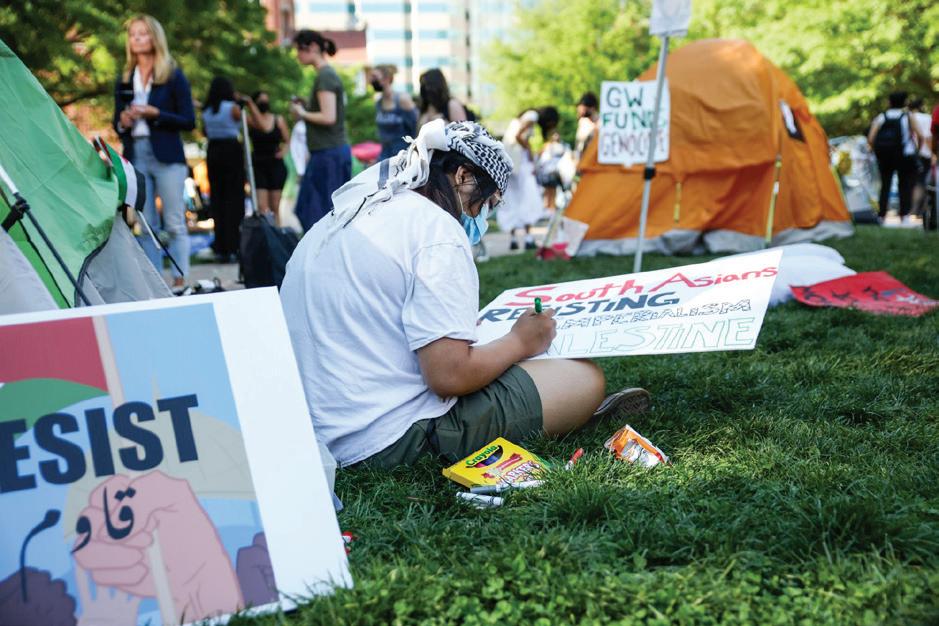
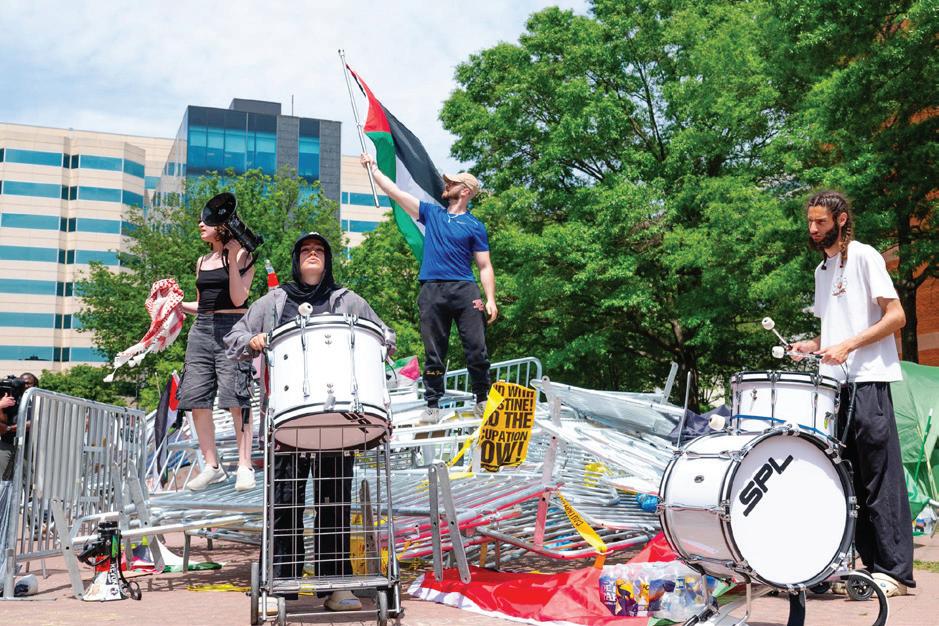
CRITCHETT A protester lifts a barricade as demonstrators overrun the fences securing the encampment. Day 4 RAPHAEL KELLNER After the retaking of U-Yard the previous night, protesters created more artwork to decorate the encampment. Day 5 LEXI CRITCHETT Organizers chant and beat drums while standing atop a pile of barricades that protesters threw in the middle of the plaza.. Day 6
LEXI
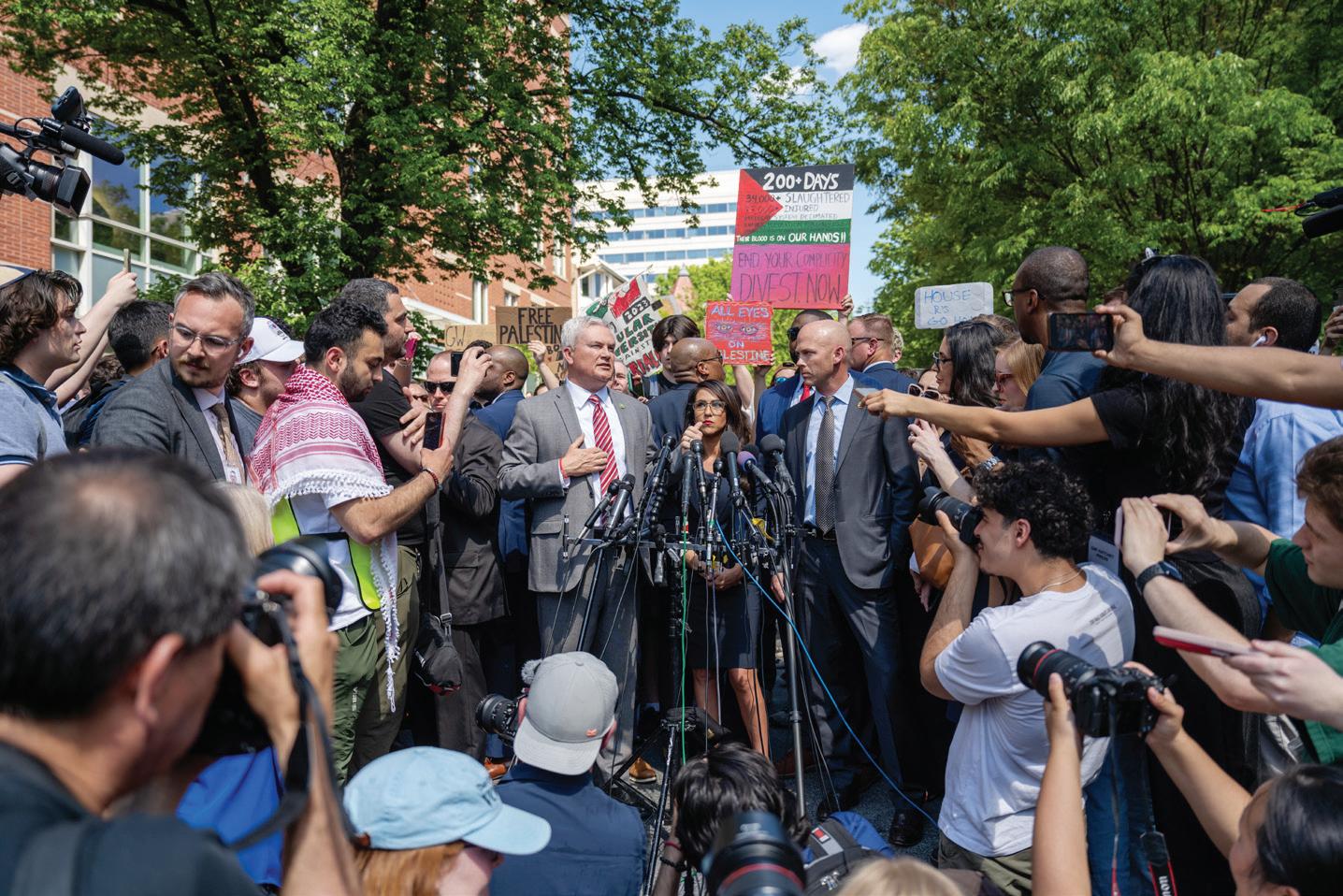
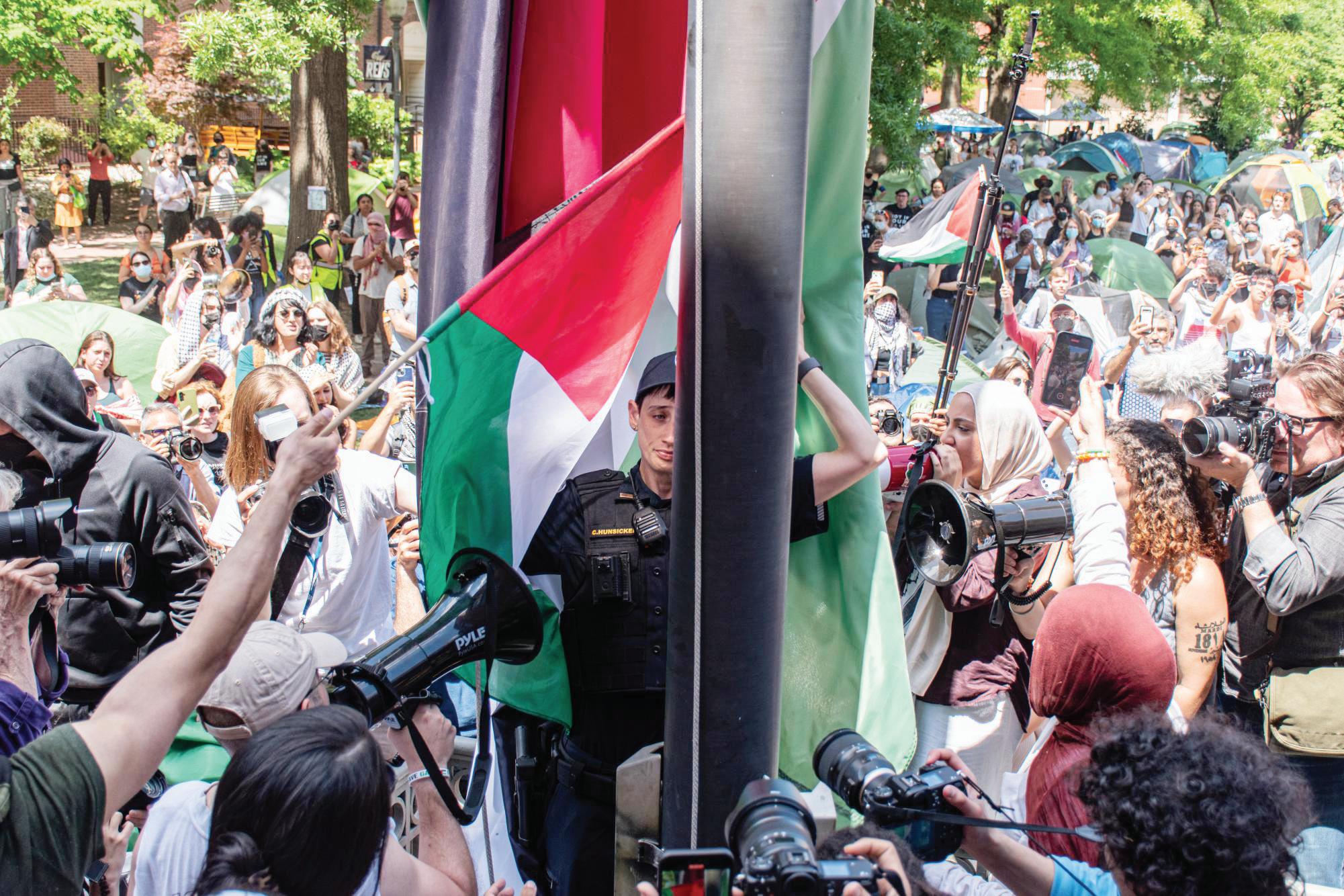
Republican members of the House Oversight Committee deliver a press conference after their visit to the University Yard encampment. Day 7 DANIEL HEUER A GW Police Department officer lowers a large Palestinian flag from outside Lisner Hall after students hoisted it up the flagpole. Day 8 KAIDEN J. YU GW
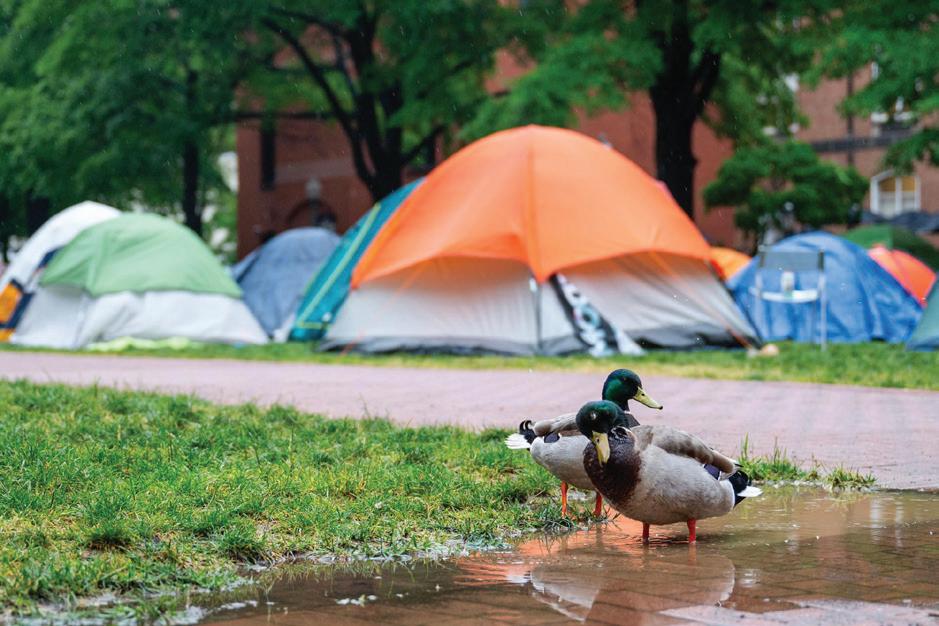
Day 9 LEXI CRITCHETT Two mallards bathe in a puddle after rain beat down on the encampment. Day 10 ARWEN CLEMANS Protesters deliver their third press conference since the start of the encampment. Day 11
ARWEN CLEMANS
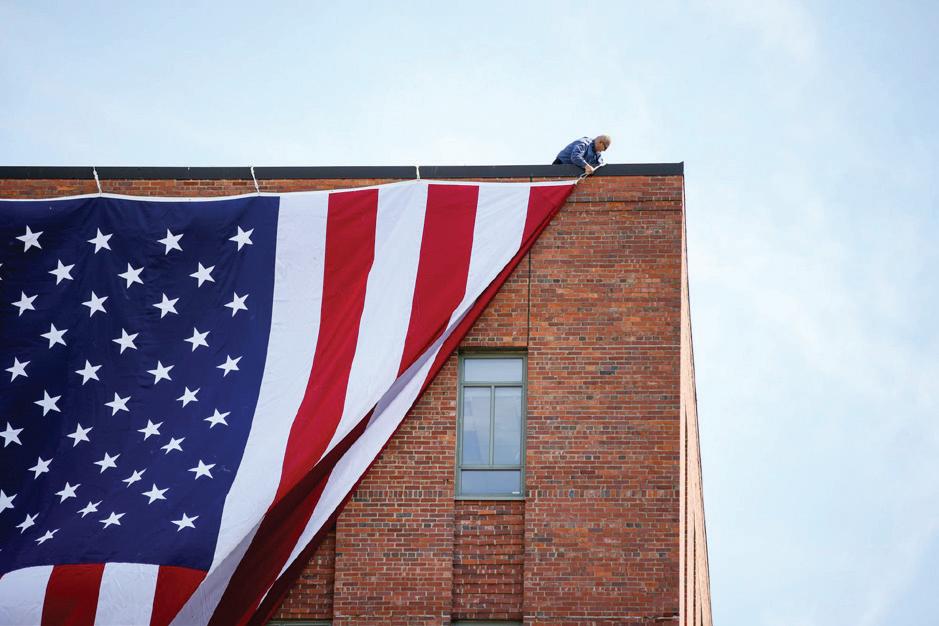
staff anchor an American flag to the roof of Lisner Hall.
SAGE RUSSELL
GW
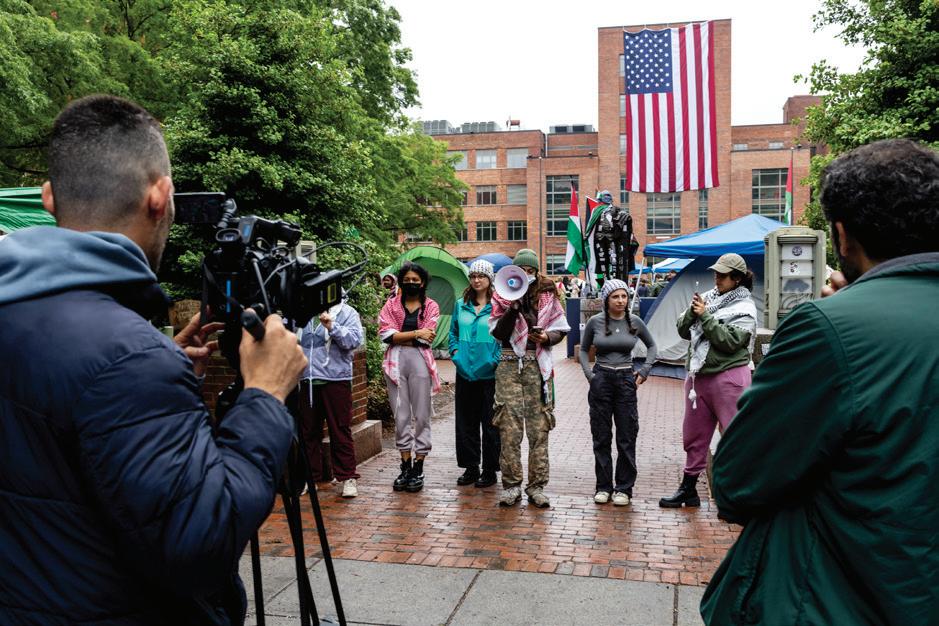
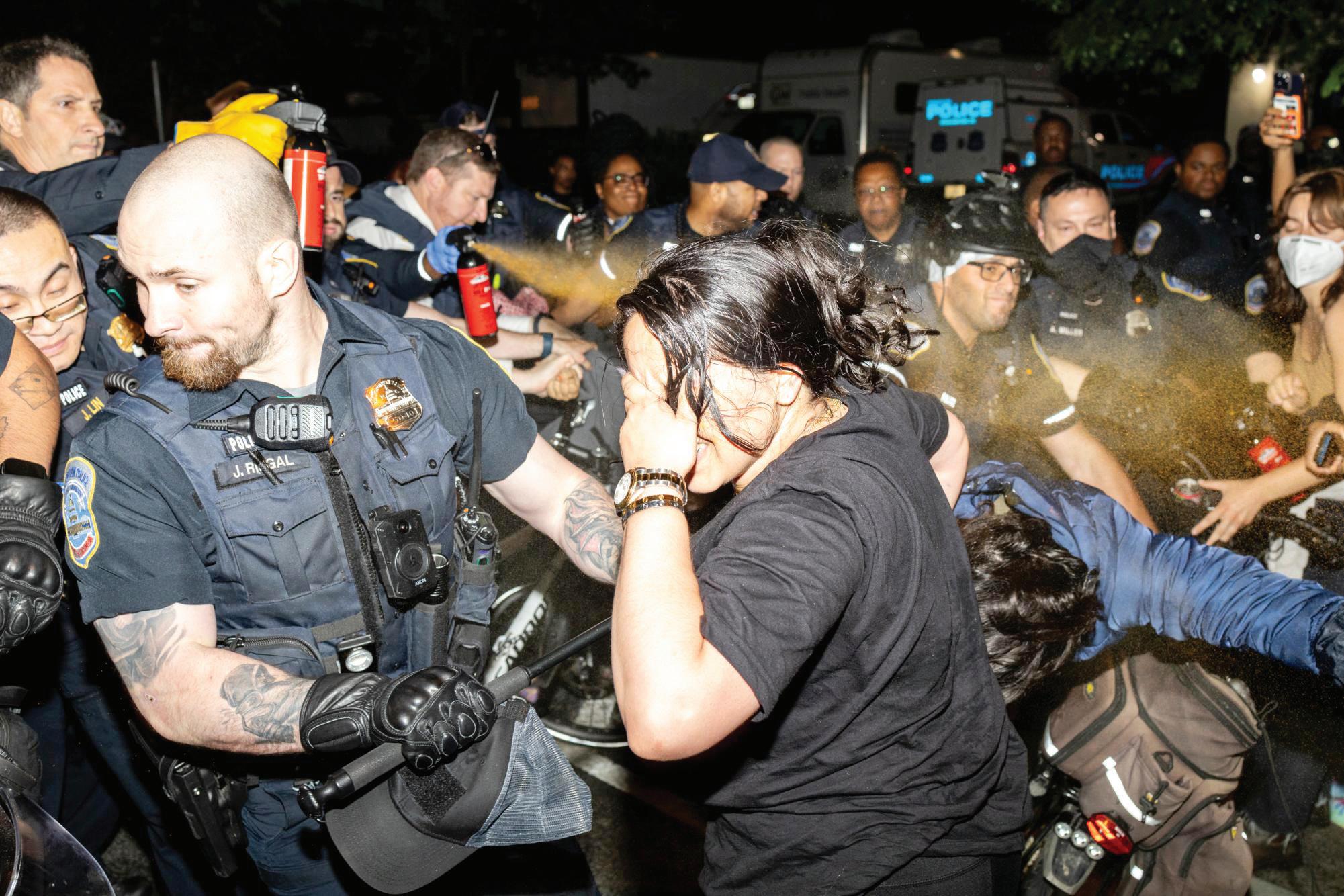
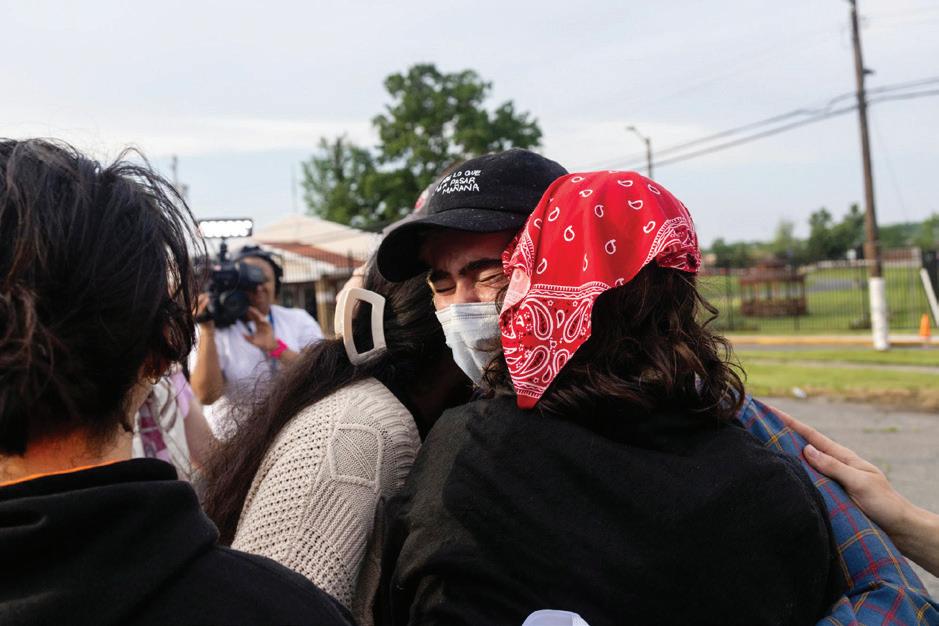
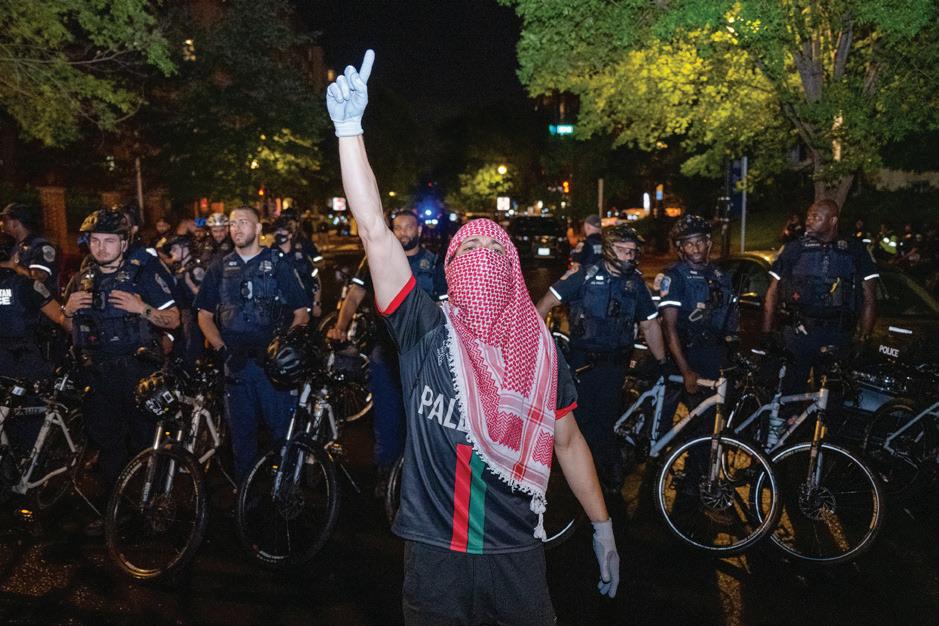
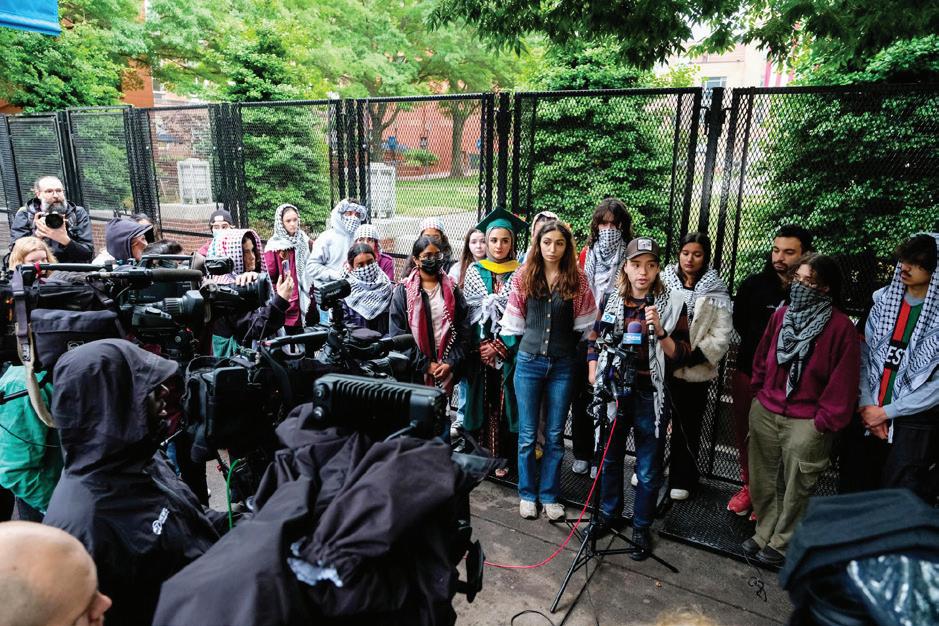
Day 12 LEXI CRITCHETT Metropolitan Police Department officers deploy pepper spray on a crowd of demonstrators at the barricades police erected during their sweep of the encampment. Day 13 SAGE RUSSELL Organizers embrace a protester released from custody after officers arrested more than 30 protesters. Day 14 SAGE RUSSELL A demonstrator stands before a line of local police after protesters set up an impromptu encampment on F Street. Day 15 DANIEL HEUER Organizers give a press conference about their first meeting with officials to discuss their demands in front of U-Yard. Day 16 MAX COLLINS
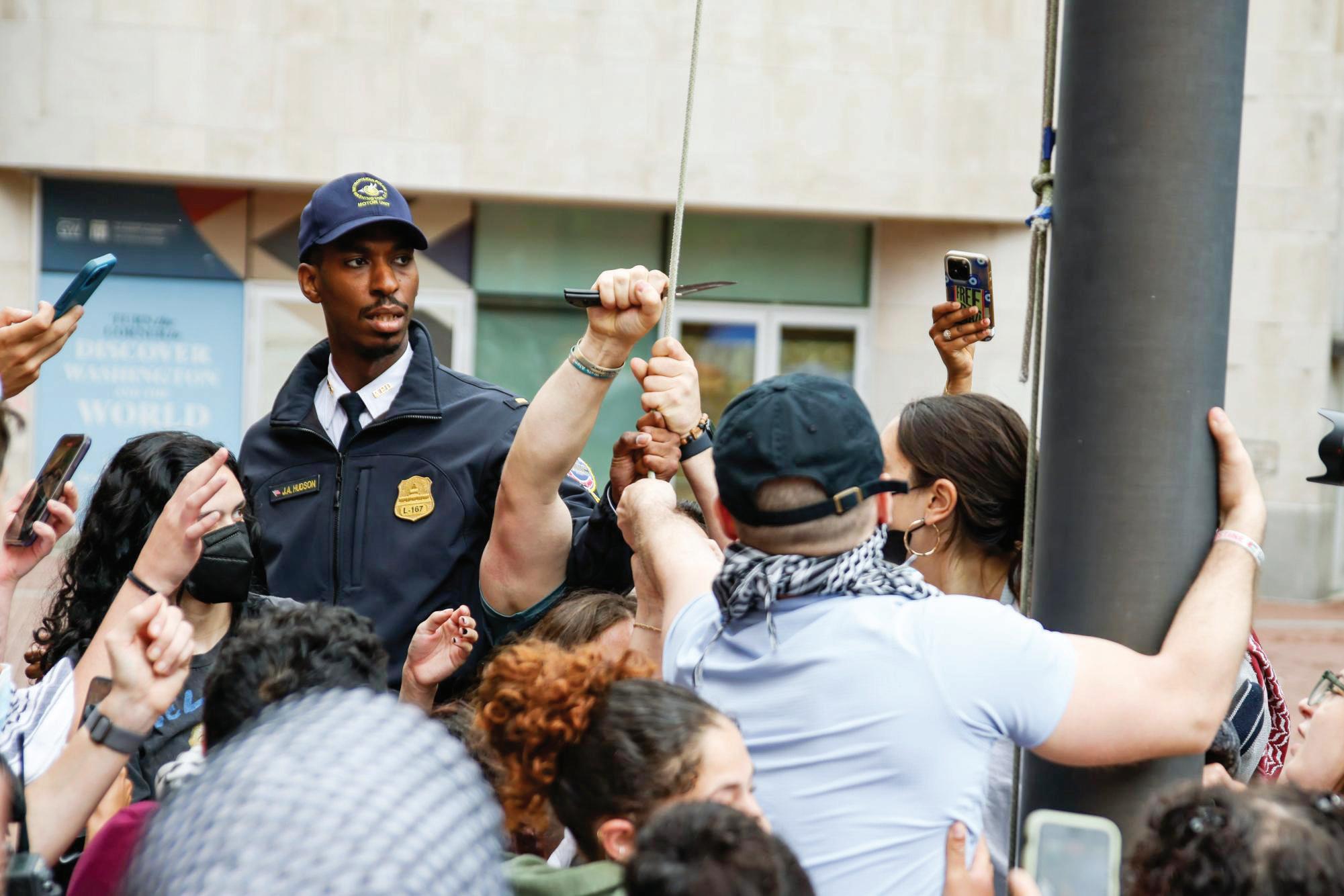
A
Police Department officer cuts the rope to the Lisner Hall flagpole after protesters attempt to re-hoist a large Palestinian flag.
Officials prohibit items, add policies for Commencement week
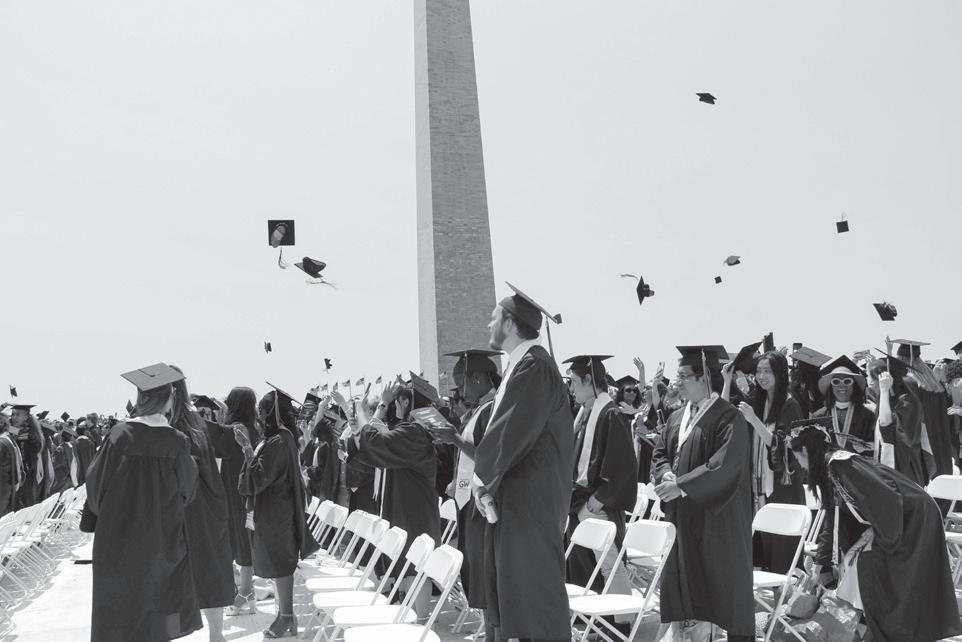
Officials updated guidelines for this year’s Commencement week to include additional prohibited items and outline the University’s free expression policy, which permits law enforcement to escort disruptive protesters out of ceremonies.
In an email sent to the Class of 2024 Friday evening, officials listed additional prohibited items and informed graduates that security personnel or the U.S. Park Police will escort protesters out of the ceremony if they continue to disrupt the event after an initial warning. Updates to the frequently asked questions tab on GW’s Commencement website come after weeks of pro-Palestinian demonstrations that led Metropolitan Police Department officers to clear the encampment on H Street and University Yard on Wednesday morning, arresting more than 30 protesters.
Since April, officials have added five additional topics to the Commencement FAQ section — alternate site plan, disruptions to Commencement week activities, emergency notifications, free expression and reasonable limitations, and traffic/ road closures — according to internet archives. Officials also added amplified sound devices and signage, including posters, banners and flyers, to the list of items prohibited at commencement events, which run from May 16 through May 19.
The disruptions to Commencement week activities tab states that an event representative will ask anyone who disrupts a commencement event or uses a prohibited item to stop, and that law enforcement will remove them if they refuse.
“This includes the use of visible displays (signs, balloons, banners, posters, flyers, or any item that could obstruct the view of guests or graduates) and/ or amplified sound items (noisemakers, bullhorns, megaphones, speakers),” the website states.
The free expression and reasonable limitations tab states that officials may regulate free expression when it is obscene, threatening or does not adhere to time, place manner restrictions.
“Speech may be regulated when it is obscene, involves true threats (serious or intentional threats of violence directed at specific individuals), incites violence, or involves illegal conduct,” the website states.
According to the alternative site plan tab, graduates and “platform party” members should report to the Smith Center if the ceremony needs to be relocated because officials are unable to “safely conduct the ceremony as planned.” The emergency notifications tab states that information will be communicated via GW Alerts, Campus Advisories, GW’s homepage and the University’s Twitter, Instagram and Facebook accounts.
Pro-Palestinian demonstrators have set up encampments at universities across the country to demand officials disclose investments and divest from companies supplying arms to Israel, which has led to thousands of arrests and detainments.
Columbia University and the University of Southern California canceled their main commencement ceremonies, with officials citing safety concerns due to encampments and demonstrations on campus. Pro-Palestinian protesters demonstrated at the University of Michigan’s commencement ceremony last Saturday.
Faculty engage with campus protests, defend student speech, safety
TYLER IGLESIAS ASSISTANT NEWS EDITOR
Faculty closed out the spring semester Friday in a finals season defined for many by campus protests.
Before and after local police’s clearing of the encampment on Wednesday after two weeks of protest against the war in Gaza, faculty were pronounced in the campus dialogue on student protests. At least four petitions containing signatures from faculty members have circulated online, in addition to discussions at a Faculty Senate meeting Friday about the encampment. Many professors joined the proPalestinian protest at University Yard as well as a “rally against antisemitism” blocks away. Others have shared their perspective on social media, and some have stayed silent.
On the first day of the pro-Palestinian encampment in U-Yard, GW Law relocated some of its final exams to buildings away from the demonstration to avoid distractions during tests. Some biology department faculty canceled exams on the 13th day of the protest and the fourth day of exams after Bell Hall closures, which borders U-Yard, due to campus safety lockdowns.
Faculty members from GW and across the D.C. region locked arms with one another, creating a barrier to protect students and their tents in case the police moved in to arrest demonstrators on the first day of the encampment. Professors also delivered speeches and interacted with demonstrators inside the encampment, including during some conversations with officials who appeared at the protest, as it progressed over the next two weeks.
“I’m here today, the same reason everybody else is because I’ve seen thousands of Palestinian children dead over the last six months, and it keeps on going, and I see my government funding it,” said Melani McAllister, a professor of American studies and international affairs, as she participated in the faculty demonstration.
Faculty members from across the DMV joined a rally to support Jewish students at the G Street Park on May 4. Lisa Schwartz, an associate professor of biomedical laboratory sciences at GW, held a sign that read, “Faculty against antisemitism” and said she came to the rally to show Jewish students the support of faculty.
“There are people that maybe haven’t been as vocal as those who recently have been on campus,” Schwartz said. “But we’re here, we care deeply about our students and we are hopeful that the crisis in the Middle East comes to a peaceful end.”
Faculty from local universities including GW released an open letter supporting student protesters April 26, the encampment’s second day. The open letter from “DMV Faculty for Academic Freedom” includes more than 512 signatures, 151 of which are from GW faculty as of Sunday and calls upon the Board of Trustees and the presidents and administrations of local universities to “recommit” to freedom of inquiry, expression and protest.
“As the mass killing of Palestinians and widespread destruction in Gaza continue, we also demand that you fulfill your responsibility to your campus communities to defend peaceful protesters, uphold academic freedom, and reject all pressures seeking to
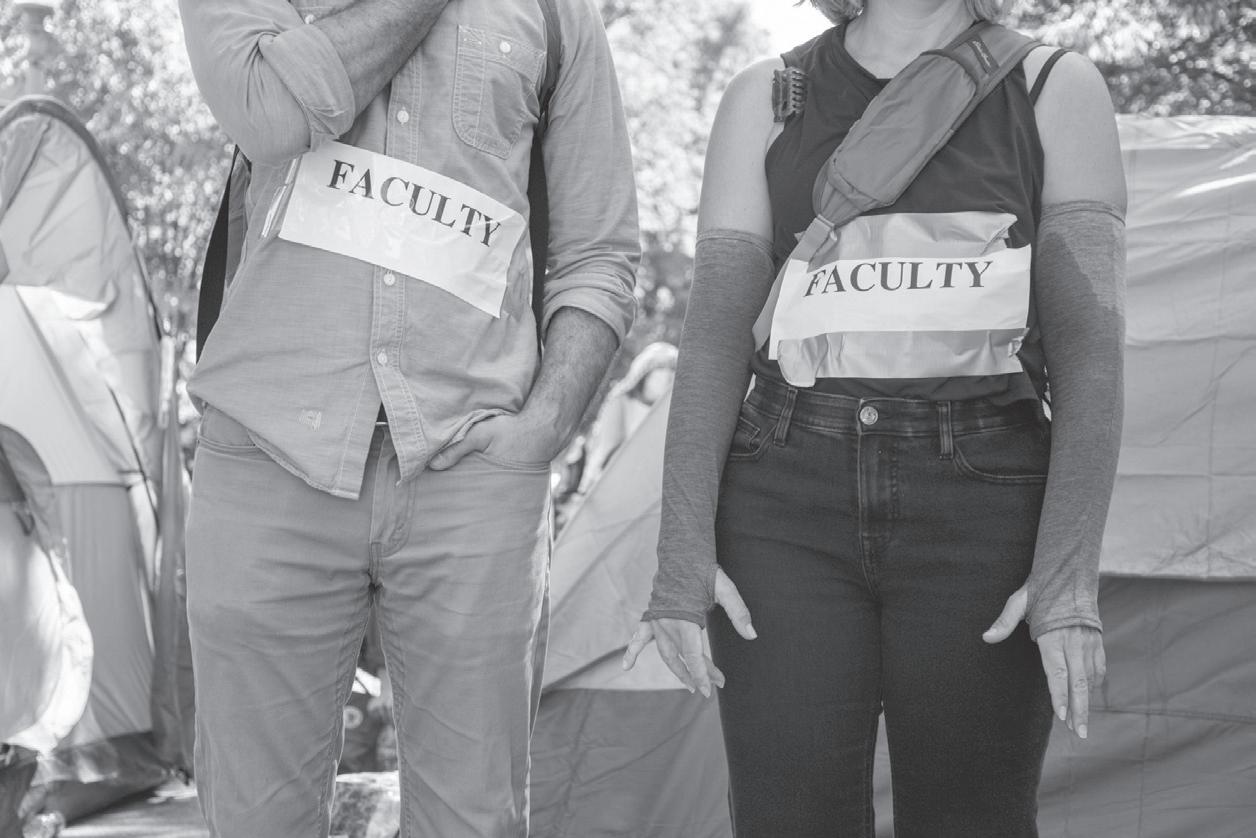
block access and criminalize peaceful encampments and demonstrations,” the April 26 letter reads.
Many prominent faculty members signed the letter, including Faculty Senate Executive Committee Chair Ilana Feldman, faculty senators Jennifer Brinkerhoff, Guillermo Orti and Gayle Wald, who served on the Presidential Search Committee in 2022.
William Burns, a professor of history and signatory of the open letter, said he signed the letter because he “broadly” supported what the students were advocating for. He said he believes a “repressive” police response doesn’t benefit the students or the University and that faculty must stand with students in the encampment.
More than 120 GW faculty members signed another petition from “DMV Faculty for Academic Freedom” on April 30, the encampment’s fourth day. The letter, also signed by Feldman, Orti, Brinkerhoff and Wald, urged the University to rescind suspensions and evictions of protesters in U-Yard, resist further assistance from local police and meet with student protesters to hear their demands. The petition came in response to organizers from the encampment saying the University had suspended seven demonstrators in the encampment days before.
About 113 faculty from local universities, including 43 from GW, responded to the April 26 open letter in their own statement drafted by Eric Arnesen, a professor of history, and Daniel Schwartz, a professor of history and Judaic studies on May 4. The letter took issue with the April 26 letter’s lack of mention of Hamas’ Oct. 7 attack on Israel, saying the faculty took a “one-sided view” on a complex issue. The May 4 letter said the other letter denounced claims of antisemitism at the protest as unsubstantiated and lacked consideration for the time and place of the protest while classes were in session and exams were taking place.
Schwartz said he probably would not have written the May 4 letter, despite his opinions on the encampment, had the April 26 faculty letter not included “outlandish” and “oversimplified” content.
After the police cleared the encampment in the early morning of May 8 — arresting at least six students and deploying pepper spray — faculty and staff released a petition addressed to University President Ellen Granberg and trustees that condemned the use of police force against students in
clearing the encampment. The petition demands the University drop all criminal charges against arrested students, not pursue disciplinary action against students engaging in “nonviolent acts of civil disobedience” and incorporate faculty in decisions regarding student protests.
Faculty senators at a meeting on Friday called on Granberg and other officials to be more communicative and consult faculty when making decisions like those made throughout the duration of the encampment, like calling for the aid of the Metropolitan Police Department, working with students and taking disciplinary action against protesters.
Feldman said it shouldn’t be “news” to the administration that faculty are interested in being involved in the decision-making process.
“People expressed a great deal of frustration, and I would say anger that faculty have not been involved, despite the many, many, many faculty who have previously expressed,” Feldman said.
Orti, the chair of the Biology Department, a faculty senator, said it was “disheartening” that Granberg and Provost Chris Bracey were not communicative with the Faculty Senate Executive Committee after the committee had sent a letter to the administration calling for a “de-escalatory” approach to handling the encampment.
Orti recognized Sara Matthiesen, a professor of history and women’s gender and sexuality studies, to give a statement during the senate meeting where she questioned why GW’s immediate response to a protest organized by students was to call the police. On April 25, the encampment’s first day, Granberg asked for MPD’s assistance to relocate the encampment.
“Given the reality of police violence in the United States, I am deeply disturbed that our administration would subject our students, many of whom are students of color, to the danger of a police force, a danger that we all know can often be lethal,” Matthiesen said.
Donald Parsons, a professor of economics, a faculty senator and signatory of the May 4 letter, said the encampment has caused a “major rupture” in the student body since the community is divided on the conflict in Gaza.
“I can not believe that it’s not going to make its way into dorms and other social events at this University,” Parsons said. “We’ll have to wait until the whole Gaza thing evolves, however it will, but at some point, we’re going to have to bring our students together.”
House Democrats rebuke GOP pressure to clear GW's encampment
RORY
SEJAL
Several Democrats on the House Committee on Oversight and Accountability said they woke up Wednesday morning ready for the committee’s hearing on D.C. officials’ reported refusal to clear the pro-Palestinian encampment erected at GW, only to find out the hearing had been canceled.
Early Wednesday morning, city officials authorized the clearing of the encampment, which was nearing its second week, prompting Oversight Committee Chair James Comer (R-KY) to cancel the hearing that day where D.C. Mayor Muriel Bowser and Metropolitan Police Department Chief Pamela Smith were set to testify. Rep. Cori Bush (D-MO) and Del. Eleanor Holmes Norton (D-D.C.) said the impending House testimony and surrounding media attention likely prompted local police’s clearing.
“They’ve been out there for 14 days and then all of a sudden just hours before the hearing, then all of a sudden now the encampment
is raided and in the middle of the night,” Rep. Cori Bush (D-MO) told a Hatchet reporter on the steps of the Capitol Wednesday evening.
The mayor’s office confirmed Bowser and Smith’s appearances at the hearing Tuesday morning — about 24 hours before the hearing — but Smith announced in a Wednesday press conference that D.C. officials made the decision to clear the encampment Monday, citing “indicators” that the encampment becoming “more volatile and less stable.” Smith said the hearing did not affect the decision to clear the encampment.
Six days before the sweep — where MPD officers used pepper spray and arrested more than 30 demonstrators early Wednesday morning — and the scheduled hearing with Bowser and Smith, GOP members of the oversight committee met with GW officials and toured the encampment. In a swarm of press and protesters singing, drumming and chanting phrases like “Hands off D.C.,” House members walked briefly through the encampment, many calling for the arrest of the demonstrators.
Rep. William Timmons (R-SC), a GW alum who was on the tour of the encampment with his GOP colleagues in the oversight
committee, said the publicity surrounding the tour “increased pressure” on D.C. officials to clear the encampment. Rep. Byron Donalds (R-FL) has posted nearly a dozen videos, photos and Fox News appearances relating to his tour of and commentary on the University Yard encampment, which have collectively amassed more than 60,000 likes.
“If we need to take additional steps for them to send in the MPD to restore order, we’re going to try and explore them,” Donalds said Tuesday, referencing the threat of further congressional action if D.C. officials did not clear the encampment.
Comer said in a statement Wednesday that he had talked to Bowser prior to canceling the hearing to thank her for clearing the encampment, adding that it was “unfortunate” that the situation at GW “forced” the oversight committee to act.
House Speaker Mike Johnson (R-LA) praised Comer for “delivering results” as a product of the pressure he placed on D.C. officials during the tour and in a letter he co-signed with Rep. Virginia Foxx (R-NC).
Timmons said he found out Wednesday morning that Comer had called off the hearing, but Bowser’s move did not necessarily catch him by surprise. He
told Fox News last Sunday that he’d be “shocked” if Bowser “didn’t do anything between now and Wednesday.” Del. Eleanor Holmes Norton (D-D.C.), who sits on the House Oversight Committee but cannot vote on bills being considered by the full House as a nonvoting delegate of D.C., said congressional intervention into the District’s local affairs “certainly” brings up her pro-statehood sentiments.
She said she has “the closest” working relationship with the mayor but had no prior knowledge of Bowser’s decision to clear the encampment, adding that she thinks impending congressional scrutiny prompted Bowser to authorize the clearing.
“These are matters that should be left to the city and to the city alone, not to members of Congress, even me,” Holmes Norton said. Bush said the hearing was a “sham” and that
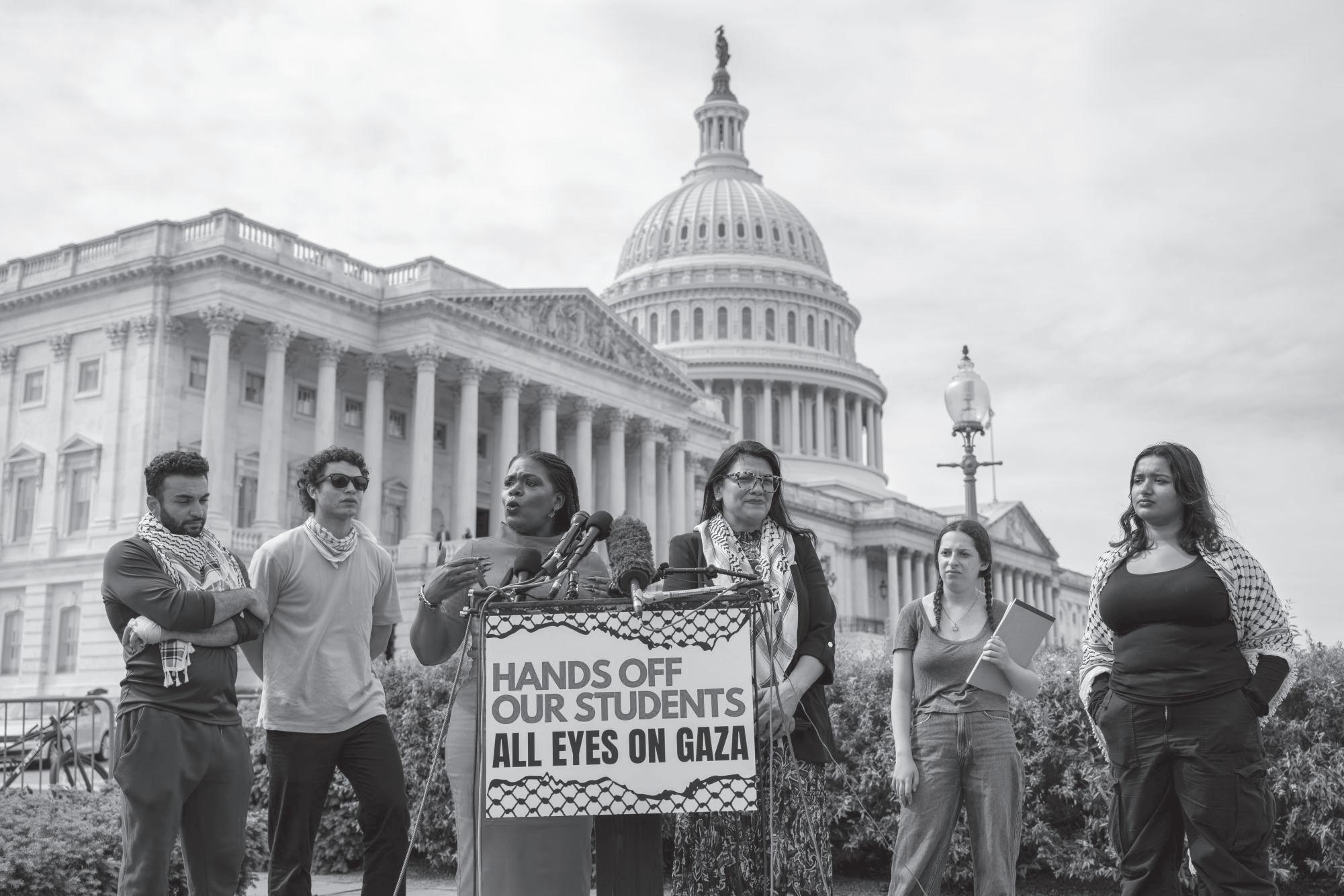
congressional Republicans strong-armed D.C. government officials to oppose the encampment. In response to the clearing and Comer’s subsequent cancellation, she and Rep. Rashida Tlaib (D-MI), the only Palestinian American member of Congress, held and invited six protesters to speak at a news conference at House Triangle on Wednesday afternoon, where the members and students denounced protesters’ arrests.
NEWS THE GW HATCHET May 13, 2024 • Page 3
KAIDEN J. YU | ASSISTANT PHOTO EDITOR
Faculty protesters attend the University Yard demonstration with signs.
NEWS
JENNIFER IGBONOBA
EDITOR
SENIOR STAFF WRITER
FIONA BORK
QUEALY NEWS EDITOR
STAFF WRITER
GOVINDARAO
DANIEL HEUER | ASSISTANT PHOTO EDITOR
Reps. Cori Bush (D-MO) and Rashida Tlaib (D-MI) host a press conference with demonstrators on Capitol Hill after police's clearing of University Yard.
HATCHET FILE PHOTO: AUDEN YURMAN Officials informed graduates that they will escort protesters out of the ceremony if they continue to disrupt the event after an initial warning
Students report damaged, missing Braille on building signage
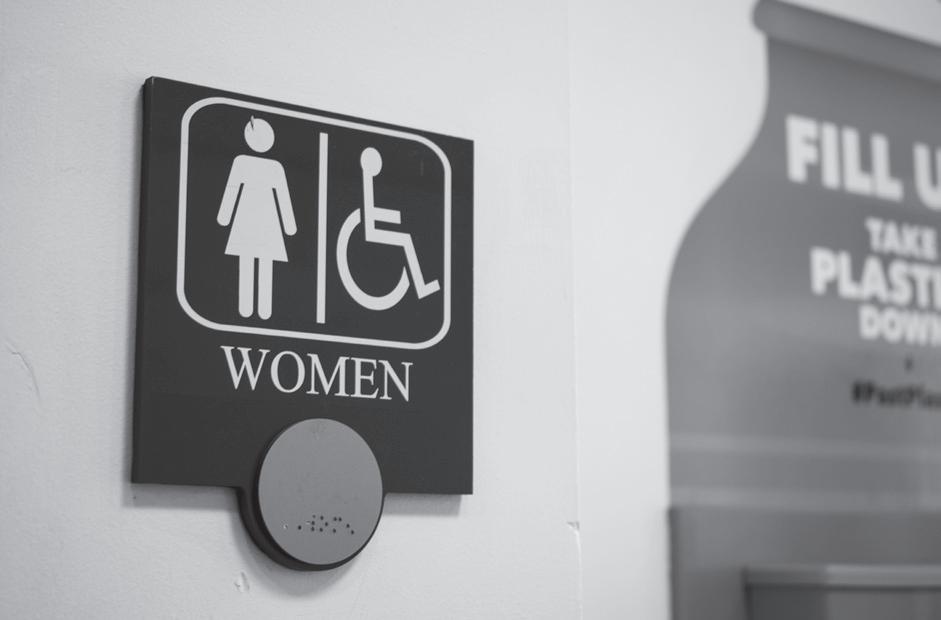
Students said they have struggled to navigate campus due to worn down Braille signage in Phillips, Tompkins and Shenkman halls.
The Hatchet surveyed 565 signs in Tompkins, Shenkman and Phillips halls from April 25 through May 9, finding that about 10 percent of signs with Braille were missing one or more raised dots. About 34 percent of signs in the three buildings did not include Braille at all.
About 40 percent of rooms in these three halls are not accessible to blind students because the room signs either have broken Braille dots or are missing them entirely, hindering their ability to locate classrooms and offices.
The three halls had 36 total signs with broken or missing dots: in Phillips Hall, 17 of the 143 signs are broken and 84 do not have Braille at all; in Shenkman Hall, 18 of the 222 signs with Braille are broken and 74 do not have Braille at all; in Tompkins Hall, one sign with Braille is broken and 34 signs do not have Braille at all.
The Americans with Disabilities Act prohibits discrimination against disabled people and outlines specific accessibility regulations for signage — like that tactile signage must be post-
ed on “interior and exterior signs identifying permanent rooms and spaces” — from the U.S. Access Board.
Temporary signs that are posted for seven days or less or those that provide building addresses, detailed directions for a destination or occupant names are exempt from these regulations, per the Access Board.
A University spokesperson said ensuring accessibility for the “entire community” is a “top priority,” and that the University updates signage during building renovations. The spokesperson said students experiencing difficulties with signage in University buildings should reach out to Disability Student Services directly.
“University signage is regularly updated to current code, including required Braille, when locations are renovated,” the spokesperson said. “If stu-
dents encounter difficulties at any location, reviews and upgrades may be made as appropriate.”
Tony Stephens, the director of communications for American Foundation for the Blind, said signage for rooms with permanent functions normally includes a direct translation, including the room’s name.
“The signage is normally an equal equivalent of whatever a sign would say,” Stephens said.
In Phillips Hall, the University labeled office spaces and classrooms by room numbers. The third floor restroom — which signs on other floors indicate is an ADA accessible restroom — says “women” and “men” in Braille. The seventh floor bathrooms of Phillips have a wheelchair accessible symbol and are labeled according to gender but also do not label the room as a bathroom.
Graduate assistants say new pay rates fall short of local living wage
TYLER IGLESIAS ASSISTANT NEWS EDITOR
Officials announced new compensation policies for graduate assistants last month, but some graduate assistants say the new changes do not go far enough to address compensation issues within the program, like cost of living.
The Office of Graduate Student Assistantships and Fellowships released new job titles and pay rates for graduate assistantships, specifying the roles and responsibilities of different types of graduate assistants and varying compensation rates depending on the new position title. Current graduate assistants say the pay increases are helpful, but the policies fall short in paying graduate assistants a livable wage in D.C., properly compensating overtime work and addressing a lack of communication with graduate workers.
Suresh Subramaniam, the vice provost for graduate and postdoctoral affairs, said OGSAF created the new policies, which will take effect during the 202425 academic year, to raise and “standardize” the minimum compensation for assistantship roles to improve standard of living for graduate assistants and remain competitive with other research institutions.
The new policies separate the current graduate teaching assistant role into
Officials to clear seven Foggy Bottom homeless encampment sites
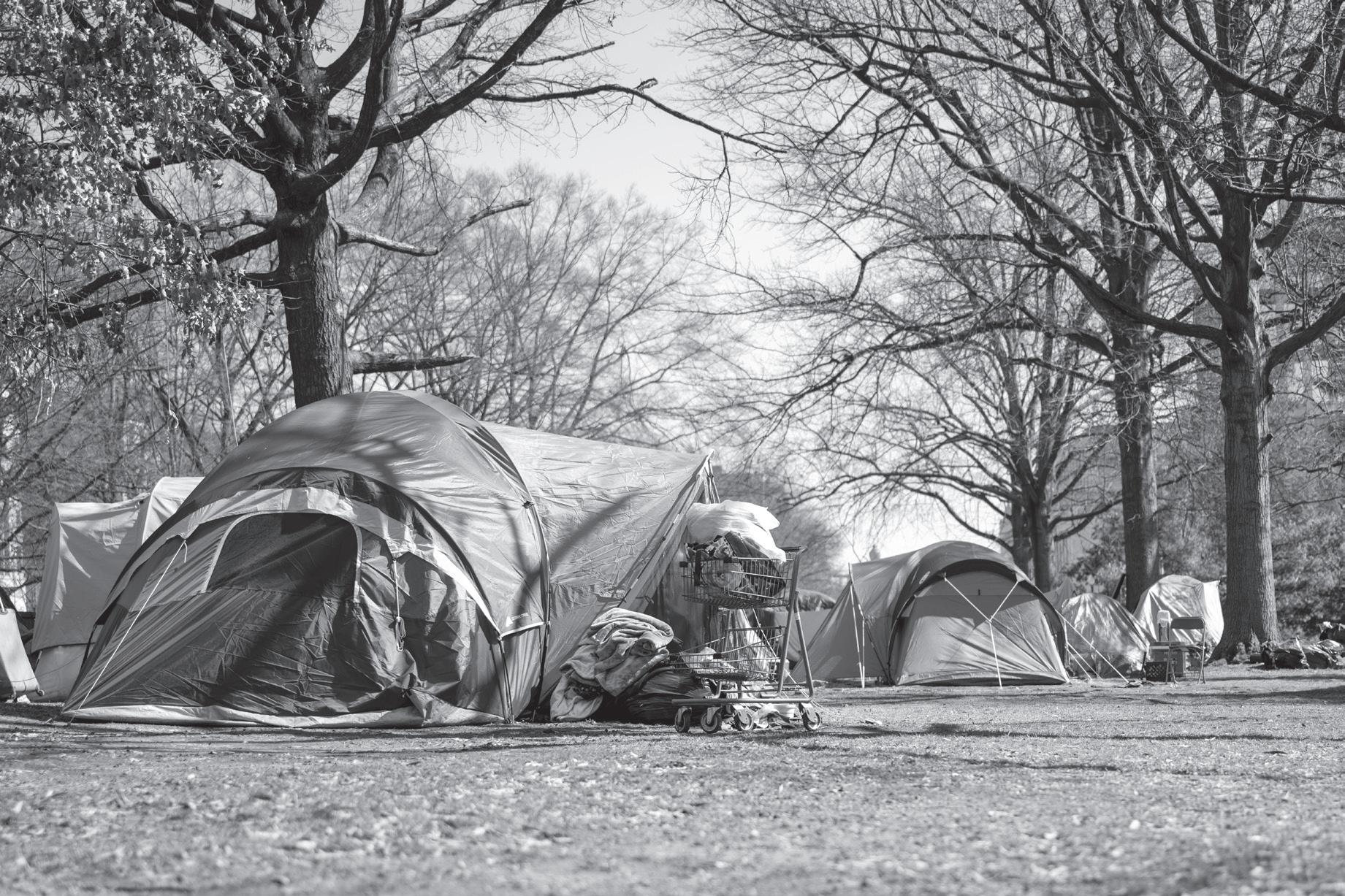
National Park Service and District officials will sweep seven homeless encampments in Foggy Bottom next week, slating evictions for about 70 residents.
D.C.’s encampment response team will clear residents and their belongings from Foggy Bottom locations between May 15 and May 20 to “protect residents” on District property from “dangerous circumstances” like fires, assaults, rodents and risk of traffic collisions, according to an Office of the Deputy Mayor for Health and Human Services spokesperson. The notice of impending clearings prompted homeless nonprofit organizations and shelters to organize a “week of action” last week, urging D.C. officials to stop encampment evictions and invest in solutions to end homelessness in the District like housing vouchers and emergency rental assistance.
The spokesperson said officials will clear four encampments on NPS land. Officials plan to evict residents at Triangle Park and Rawlings-Wittman Parks on May 15 and a park near Godey Lime Kiln, as well as 26th and L streets on May 20.
Officials will evict residents from three District sites. On May 15, officials will clear 20th-21st streets and E Street-Virginia Avenue, as well as 25th Street and Virginia Avenue. Officials will sweep 27th and K streets on May 20, the spokesperson said.
The DMHHS spokesperson said NPS officials make decisions to clear encampments on federal land, but D.C. officials work to provide shelter resources and other social services to residents in encampments that are evicted from these locations.
NPS did not return a request for
comment on why they decided to clear the encampments. A DMHHS spokesperson said officials post notices of encampment cleanups at least a month in advance.
“The District will continue our work to connect all unhoused residents in the city with human support services, including housing,” the spokesperson said in an email.
The Way Home Campaign — a coalition of nonprofits that housing rehabilitation organization Miriam’s Kitchen created to end chronic homelessness in the District — coordinated the week of action, which included protests and email campaigns arguing that encampment evictions will put the unhoused residents’ safety at risk and lessen their access to outreach services.
The group created an email script last week that community members can send to local and federal officials, calling on the D.C. government and NPS to halt the evictions. The list of email recipients includes Mayor Muriel Bowser, Deputy Mayor for Health and Human Services Wayne Turnage, Chair of the D.C. Committee on Health Christina Henderson, Chair of Judiciary and Public Safety Brooke Pinto and Secretary of the Interior Deb Haaland.
The Way Home Campaign leaders also organized a rally Thursday morning at the John A. Wilson Building, which houses D.C. Council hearings and offices, with more than 40 demonstrators who protested the cleanups and demanded the council fund solutions to homelessness like housing vouchers and emergency rental assistance.
Miriam’s Kitchen Advocacy Director Dana White, who attended the rally, said clearing encampments “further traumatizes” unhoused individuals by forcing them to find a
three separate roles — graduate instructional assistants, graduate teaching assistants and graduate student lecturers. The graduate instructional assistant consists of master’s students and some doctoral students, while graduate teaching assistants consists of solely doctoral students, with both roles grading assignments, leading labs and discussions and holding office hours.
Subramaniam said the “general” responsibilities of graduate instructional assistants and graduate teaching assistants are identical and are compensated the same, despite graduate teaching assistants wages being higher, according to the new policies. He said the new policies now create a minimum standard for stipends and tuition awards for the graduate teaching assistant role, while the graduate instructional assistant role can
receive additional financial support at the discretion of their department. Under the new policies, graduate instructional assistants make $9,500 per academic year, while graduate teaching assistants make $26,100 per academic year. Graduate assistants, who have a fully funded aid package, working hours cannot exceed 20 hours per week, according to guidelines from OGSAF. Liz Foshe, a doctoral student and graduate teaching assistant in the American Studies department, said she was excited to be a graduate assistant at GW because she would earn $10,000 more than her wage as a master’s graduate assistant at the University of Alabama. “I very quickly learned that I wasn’t going to be making as much money as I thought I would be making,” Foshe said.
Tuition dependence may harm GW's revenue diversity, experts say
IANNE SALVOSA MANAGING EDITOR HANNAH MARR NEWS EDITOR
GW’s diverse revenue streams helped the University weather financial losses and maintain top-rated finances over the last two years, according to credit rating agencies, which experts say are consistent with a growing use of revenue diversification in higher education.
largely comprised of GW’s “sizable” real estate portfolio and accounts for almost 40 percent of GW’s wealth — will increase with the $140 million purchase of the Residences on The Avenue, per the rating.
new place to live and instigates negative interactions between unhoused people and law enforcement.
“Evicting encampments doesn’t actually work,” White said. “It doesn’t actually house anyone.”
White said the groups are advocating to allow unhoused people to stay in encampments where they feel “safe and secure” while nonprofits like Miriam’s Kitchen work to find resources to house them. White said some people in the Foggy Bottom encampments set for clearings would be eligible to live in The Aston, a homeless shelter set to open in a former GW residence hall in August but that delays in the shelter’s opening due to construction have prevented encampment residents from moving in before the encampment evictions.
“There is the option to allow those folks to remain where they are in place until that shelter opens while providing them with the necessary services and resources to get them on track to housing,” White said.
Jesse Rabinowitz, the campaign and communications director at the National Homelessness Law Center and a former Miriam’s Kitchen staffer, said at the rally that encampments in Foggy Bottom are residents’ “last resort,” meaning clearings will force residents to reside in storefronts and drug-free zones.
“This will only harm our neighbors experiencing homelessness and make it harder for us to collectively solve homelessness,” Rabinowitz said.
Terrance — who did not provide his last name and said he “sometimes” lives in the park by Godey Lime Kilns — said he was frustrated that “everything” needs government permission
“What gives them a right to move someone off a property?” he said.
Moody’s Investors Service and Standard and Poor’s evaluated GW’s wealth, liquidity of assets and market profile this spring and affirmed their A1 and A+ ratings, respectively — the highest ratings possible. Moody’s report states that GW’s operating performance will remain “moderate” relative to other A-rated universities due to the “persistent weak performance,” of the Medical Faculty Associates — a group of physicians who teach at the School of Medicine and Health Sciences — which has lost almost $250 million since fiscal year 2020.
“A modest track record of operating performance is related to weak financial results of the Medical Faculty Associates (MFA) practice plan,” Moody’s rating states.
GW officials expanded their control of the MFA in 2018 and the MFA has largely operated at a deficit since FY 2016.
Standard and Poor’s said GW’s enterprise risk profile is “very strong” as a research university but states that the University is burdened with nearly $2.1 billion of debt compared to the $1.3 million median for Arated private universities’ debt.
Moody’s rating states that more than half of GW’s revenue in FY 2023 was produced from student tuition, which is projected to increase for FY 2024. Investment income — which is
Undergraduate tuition rose by 4.2 percent for the 2024-25 academic year, consistent with national private nonprofit university tuition increases, bringing the total cost of attendance to more than $80,000. The tuition hike marks the 20th year that officials have raised the cost of a GW education, ranging from 2.1 percent to 5 percent increases each year.
Chief Financial Officer Bruno Fernandes said revenue diversification — having numerous streams of income to reduce the potential impact of one source faltering — is a “universal strategy” in higher education and business, which GW does not intentionally utilize to mitigate the MFA’s losses. Higher education institutions across the nation have increasingly utilized revenue diversification as expenditures for running universities increase and leaders adopt a “business-like” approach to higher education.
He said the University’s revenues predominantly derive from student tuition, housing fees and patient service revenue, consistent with other universities that have a medical enterprise. He said the University has decreased its reliance on tuition revenue after tuition’s share of total revenue dropped by 4 percent over the past five fiscal years. Total enrollment has steadily declined from 28,172 students in 2018 to 25,568 in 2023, according to the enrollment dashboard.
“We would not characterize the degree of diversification achieved so far as a dependence on the other revenue streams,” Fernandes said in an email.
NEWS THE GW HATCHET May 13, 2024 • Page 4
MITCHELL CONTRIBUTING NEWS EDITOR
ELLA
RACHEL KURDLANSKY | STAFF PHOTOGRAPHER
A braille sign for a women's bathroom.
RORY QUEALY NEWS EDITOR
DANIEL HEUER | ASSISTANT PHOTO EDITOR
Tents sit in the E Street Triangle Park encampment.
last February's Faculty Senate meeting.
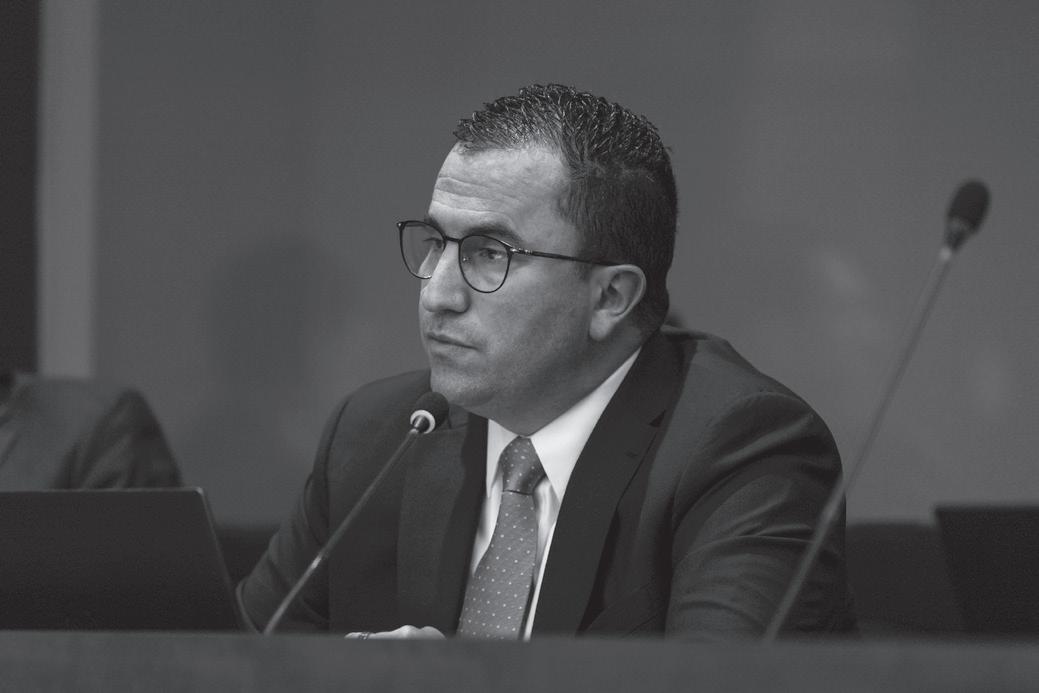
SAGE RUSSELL | SENIOR PHOTO EDITOR Chief Financial Officer Bruno Fernandes attends
TALAN MASKIVISH | PHOTOGRAPHER
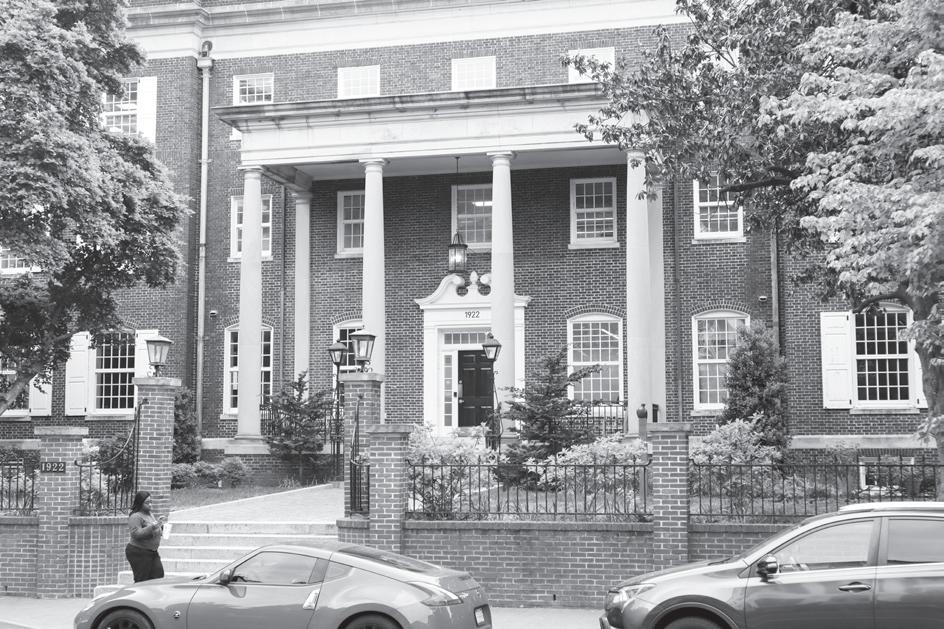
1922 F Street houses the offices for graduate student assistantships and fellowships.

SGA passes resolution to support free speech, condemn GW’s suspension of protesters
DIANA ANOS STAFF WRITER
MOLLY ST. CLAIR ASSISTANT NEWS EDITOR
The Student Government Association voted to pass a resolution and issue an Instagram statement to support students’ rights to free speech at the meeting Monday and released a second statement Friday following the arrests of more than 30 protesters.
SGA Sen. Claire Avalos (CCAS-U), who sponsored the bill at the Monday meeting, urged senators to condemn officials’ decision to discipline peaceful demonstrators and help unite the GW community amid pro-Palestinian protests on campus and across the country. She said it is “integral” that the SGA support the rights of students who set up an encampment in U-Yard and H Street for almost two weeks to protest the University’s financial ties to Israel and demand that officials disclose investments.
“Voting yes on this bill will not be a political statement,” Avalos said. “It will just be acknowledging that students have the right to free speech, peacefully protest and assemble.”
Senators discussed the resolution in an executive session and originally announced that it did not receive a twothirds majority after a vote by secret ballot, failing on first consideration. At the end of the meeting, SGA Vice President Ethan Lynne announced a mistake was made and that the resolution only needed a simple majority to pass. The resolution was formally reconsidered and Lynne conducted a second
vote by secret ballot, where the resolution passed with 20 senators voting in favor and 6 voting against.
“Due to the SGA’s responsibility in advocating for the interests of students, it is necessary that this senate comes together to fulfill the duty we were elected for,” Avalos said. “Students come to this body to seek acknowledgement and advocacy, not silence.”
The SGA Instagram account posted the statement early Tuesday morning, outlining their condemnation of hate speech on campus and officials’ decision to suspend protesters.
Officials suspended six student protesters who were participating in the U-Yard encampment on April 26. A Student Coalition for Palestine at GWU Instagram post stated that the suspended students faced eviction from their on-campus housing.
“Additionally, we condemn any university decision that leaves students participating in peaceful protests in compliance with the Student Code of Conducts at risk of homelessness and food insecurity,” the statement read.
The senate passed another resolution in a special senate meeting Friday night, condemning the administration’s calls for “excessive force” after MPD officers cleared the encampment Wednesday.
SGA Sen. Pro Tempore Liz Stoddard (CCAS-U) sponsored the resolution along with co-sponsor Sen. Anika Gupta (GWSB-U). The statement calls on the University to uphold free expression without the use of excessive force towards peaceful demonstrators.
Stoddard said she created the resolution after hundreds of MPD officers
Professor leads research for drones from cyberattacks
Virginia Community College.
cleared the encampment and arrested 33 protesters.
“As representative of the student body, it is our responsibility to safeguard the welfare of our peers. We recognize the significance of abiding by the student conduct guidelines to best promote an environment of safety, collaboration and productivity,” the statement read.
At the Monday meeting senators elected SGA Sen. Liz Stoddard (CCASU) to the role of pro-tempore of the senate. As pro tempore, Stoddard said she wants to expand the women’s caucus — a gender equity resource group created by previous Pro Tempore Amy Cowley. Stoddard said many women in the SGA feel “overlooked or marginalized” and that a designated time for them to work together would be a step towards empowerment.
“Many women often feel overlooked or marginalized and I propose expanding the women’s caucus where women from the executive, senate staff and senators can come together to discuss legislation, goals and simply connect in a secure private setting,” Stoddard said.
SGA President Ethan Fitzgerald said he is committed to advocating for “increased openness” regarding the University’s finances through conversations with administrators, ensuring due process for students and including students in campus conversations.
“Being in this position for just over a week now, I’ve continuously been talking to administration to further these goals and make sure action is taken and important conversations are happening,” Fitzgerald said.
CRIME
UNLAWFUL ENTRY
Lisner Hall
5/7/2024 – 2:36 p.m.
Closed case
During routine patrol, GW Police Department officers observed two male students in a restricted area. The students were escorted out of the building. Referred to the Division of Student Affairs.
THEFT II/FROM BUILDING
District House, Peet’s Coffee
5/7/2024 – 3:49 p.m.
Open case
GWPD officers made contact with a female complainant who stated that an unknown male subject had stolen money from the tip jar. Case open.
LIQUOR LAW VIOLATION
Cole Hall
5/8/2024 – 2:42 a.m.
Closed case
GWPD officers responded to a report of an intoxicated male student. Emergency Medical Response Group officials arrived on scene, and after medical evaluation, the student refused any further treatment. Referred to DSA.
HARASSING TELEPHONE CALLS
Academic Center Reported 5/8/2024 – Multiple dates and times Open case
A female GW staff member reported receiving multiple harassing phone calls from an unknown subject. Case open.
STALKING
Thurston Hall
5/8/2024 – Multiple dates and times
Open case
A female student reported being stalked by a male student, who is their ex-boyfriend. Case open.
CREDIT CARD FRAUD, THEFT II/OTHER
Duques Hall
5/8/2024 – Unknown time
Open case
A female student reported their credit card stolen and an attempted fraudulent transaction. Case open.
DRUG LAW VIOLATION
University Yard
5/9/2024 – 4 a.m.
Case closed
During GWPD officers’ inventory of property that was left in the U-Yard encampment, officers found drug paraphernalia in a male student’s backpack. Officers took the contraband to the Academic Center, where it was processed and inventoried. Referred to DSA.
—Compiled by Ella Mitchell
Officials launch advising system for student organizations
DYLAN EBS STAFF WRITER
A GW professor will launch a $6 million project in September to develop methods to protect autonomous aircrafts from cyberattacks.
Peng Wei, an associate professor of mechanical and aerospace engineering, will lead the three-year, NASA-funded project where students and faculty from multiple universities will work on protecting autonomous urban drones used to deliver commercial goods from cyberattacks. Wei said the security of artificial intelligence in the aviation sector is “critical” because hacks or malfunctions can lead to crashes or breaches of information.
“If the AI or machine learning component makes a mistake, there will be serious consequences,” Wei said.
Wei leads one of three teams from multiple universities that will receive a combined total of $18 million in funding from NASA over the next three years. Wei’s team will include faculty and engineering students from GW and seven partner universities that will work to secure aircraft autonomy and train engineering students in the field of cybersecurity.
The project will begin in September with a meeting at GW of all participating universities, including Vanderbilt, Purdue and Tennessee State universities, as well as the universities of CaliforniaIrvine, Texas at Austin, Collins Aerospace and Northern
Wei said the project will study smaller commercial vehicles used to ship goods and small, helicopter-like vehicles used to transport small numbers of people. He said the project is studying the algorithms on all the programming on these vehicles to ensure they can fly on the correct paths on their own and adjust themselves in case of emergency landings using AI.
“Humans have a certain cognitive limit,” Wei said. “So that’s why we need to rely on AI technology to make sure we can scale up to more operations and also to have safe operations.”
Wei said the project’s advisory board includes representatives from different government agencies and companies, like the Federal Aviation Administration and Boeing.
“We want to bring people together to ground our research to practical application,” Wei said. “We want to develop something that is useful to the industry, to its elements and also to train our students.”
The project team will include faculty and students. Wei said he will split up the team into blue and red teams, with one focusing on acting like the “bad guys” while the other works to solve those vulnerabilities.
“We bring people together and then we try to train students at different levels,” Wei said. “So from undergrad from community college to masters students to PhD to postdoc.”
Officials will launch an advising system to provide more targeted training and resources for student organizations next academic year.
Pathways, the Office of Student Life’s new advising system, will allow officials to place student organizations in one of four classifications or “paths” — red, blue, orange and silver — which resemble Metro lines, depending on their funding, travel and space needs. Assistant Dean of Student Life Brian Joyce said in an email that the classification system will shape the advising assignments to ensure that Office of Student Life staff are equipped to serve the needs of student organizations.
“In launching ‘Pathways,’ Student Involvement will be able to enhance the student experience by elevating student engagement and advisor involvement,” Joyce said in an email.
Officials announced the program in an email to leaders during the reregistration process in mid-March.
Most student organizations will be classified under the orange path, according to an informational handout, meaning organizations that are “fairly active with typical events throughout the year.” Organizations labeled under the silver path have a lower level of involvement on campus with “minimal” needs and fewer registration requirements.
Student organizations assigned to the blue path will receive specialized adviser support and additional training based on their activities, and those assigned to the red path have a higher level of funding and include an adviser as “part of their job description.” Organizations will receive their classification for the 2024-25 aca-
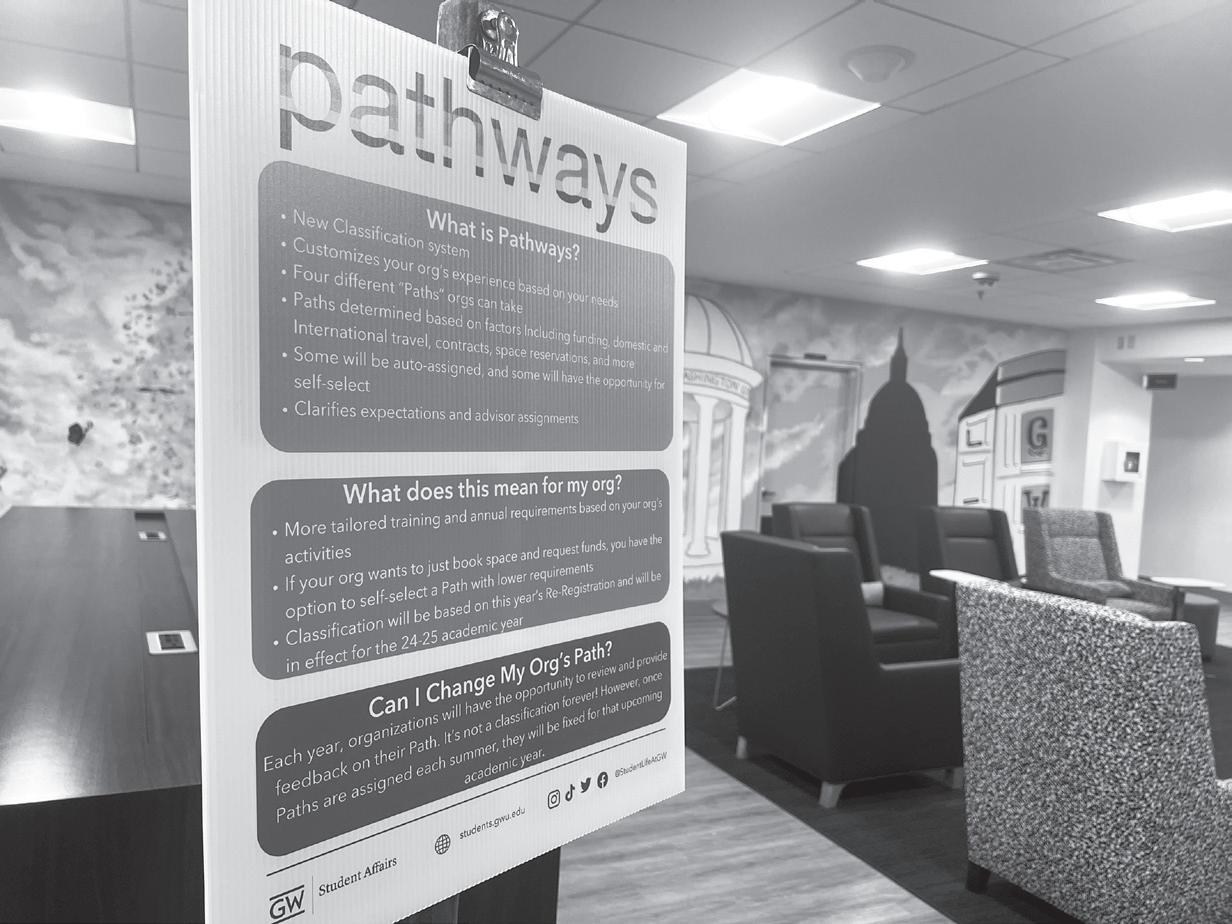
demic year in mid-July, according to an informational handout. The classification is fixed for the academic year until the reregistration process, but organizations can provide feedback on their assigned color path, the handout states.
Joyce said all student organizations will have access to advisers through Org Help, Excellence in Leadership sessions — required trainings for student leaders of organizations — and online guides.
“Establishing Pathways will allow the Student Involvement team to provide more targeted training to support the success and wellbeing of our student organizations based on their mission, activities, and logistical needs,” Joyce said.
Senior Tiffany-Chrissy Mbeng, the president of the GWU Pre-Dental Society, said she hopes the new system will help new organization lead-
ers easily find resources, like where to get funding. When she co-founded the Black Girl Pre-Health Collective her first year, Mbeng said she felt
“led astray” as she didn’t know where to go for resources like how to obtain funding, and hopes Pathways can help new student leaders and advisers learn about these steps.
“It’s going to be beneficial, especially for new orgs that don’t know how to ask for help or where to reach out,” Mbeng said.
Mbeng said she expects the PreDental Society will receive the silver classification, the least intensive assignment given to student organizations with lower needs.
“I knew how to direct this new org I was founding but just based on my experience in the past, I know a lot of students who wanted to found new organizations could suffer a little bit more,” Mbeng said.
LOG NEWS THE GW HATCHET May 13, 2024 • Page 5
DANIEL HEUER | ASSISTANT PHOTO EDITOR
Student Government Association Sen. Claire Avalos (CCAS-U) listens during the first SGA meeting of the 2024-25 year.
JORDYN BAILER | ASSISTANT PHOTO EDITOR
A Pathways sign stands on the fourth floor of the University Student Center.
JENNA LEE ASSISTANT NEWS EDITOR
OPINIONS
FROM GWHATCHET.COM/OPINIONS
“True leaders do not shy away from monumental challenges. They confront them. GW has not stepped up to the occasion.”
— SHAWN MCHALE on 5/2/24
After calls for police, GW must lead alone to heal campus
On April 26, local police denied GW officials’ request to clear a largely peaceful pro-Palestinian encampment in University Yard. Two weeks later, hundreds of officers swarmed U-Yard, arresting more than 30 demonstrators for charges related to their occupation of U-Yard and assaults on a police officer.
Since the encampment began more than two weeks ago, questions and commentary about the encampment, as well as those at colleges across the country, have been ceaseless. Students, staff and faculty alike have called for the financial and material divestment of the University from companies with ties to Israel and the protection of pro-Palestinian speech. Others have rallied to protect Jewish students from antisemitism in the wake of signs and chants that they deemed conveyed hateful speech.
While the community holds varying sentiments toward the protest, and even police intervention, no one wanted students getting hurt. Yet, when local police invaded campus on Wednesday, GW followed suit with universities that have ended encampments on their campuses with brute force.
From the first day of the encampment, University President Ellen Granberg requested the assistance of local police. After police rejected the request due to concerns of the “optics” of clearing a largely peaceful demonstration, Granberg released a community message last Sunday pleading for the District’s support in managing the encampment. In this case, “help” took the form of pepper spray, batons and Flex Cuffs on students, after monitoring campus for two
GW must
ASTAFF EDITORIAL
weeks. Protesters broke property laws by remaining in the encampment after repeated requests from officials to relocate, and the University outlined the policies the demonstration violated several times. Actions have consequences, but when officials call for police force against their own students, they fail the same people they’re supposed to serve.
As students awaited processing in a local jail, the University did not release a statement or address the clearing of the encampment until hours after, only to say it was a “orderly and safe”
follow
police operation. The University’s messaging about the clearing was out of touch, emblematic of their physical distance from the encampment protest where mostly officials from the Office of Student Life were seen occasionally speaking with demonstrators, The leader at the helm of the University, Granberg was one of the only officials who didn’t make an appearance at the encampment but welcomed House Republicans into a meeting before she had spoken with demonstrators about their demands. A student protester rightly stat-
other universities to maintain student trust
fter facing almost two weeks of student protest in a proPalestine encampment, GW had two choices: to sit down and negotiate with student protesters or to react with force. At 3:30 a.m. Wednesday, it chose the latter. By doing so, GW revealed the hollowness of its purported ideals of free speech and security, abrogating its responsibility to safeguard these key values.
GW could have followed many of its peer institutions’ nonviolent models in clearing the encampment. At Brown University, administrators struck a deal with student protest leaders, exchanging the removal of their encampments for a vote on divestment in October. At Northwestern University, administrators disclosed the university’s investment portfolio and allowed students to participate in trustee investment decisions. At Evergreen State College, administrators created an investment policy task force, appointing students to the committees. In contrast, GW followed the violent model set by Columbia and Emory universities, as well as the universities of Southern California and Texas, Austin where administrators have called
upon police to disperse students with force. When students protest again, will GW aim firearms at us like Ohio State University and Indiana University, Bloomington did? Will GW stand by as counterprotesters attack students in the encampment with weapons and ignited fireworks like at University of California, Los Angeles? Will they allow police to then fire into crowds at close range with rubber bullets?
Students have already returned to protest at GW, growing bolder with each return. They are fueled by the University’s failure to uphold the ideals that students still believe in, even if the administration does not.
While GW officials have finally started meeting with protesters, they have yet to show they are taking students seriously. Officials scheduled a 45-minute meeting at a time reserved for Muslims’ Friday prayer, giving students just two hours notice.
Before the meeting even began, administrators told student leaders that GW was unwilling to consider changes to its “endowment investment strategy,” academic partnerships or established Student Rights and Responsibilities processes. The University shut down dialogue before it had even begun, telling students that it is only willing to make superficial changes, not concrete ones. As such, GW has fundamentally misunderstood
the protesters’ goals: Students are not just demanding that their University protects Palestinian rights on campus, they are demanding that it stop financially supporting a war which has lead to the death, starvation, homelessness, torture, humiliation and disability of hundreds of thousands of innocent Palestinians at the hands of the Israeli army. These students are following a long tradition of GW student campaigns in solidarity with international liberation movements, including the movements to divest from Apartheid South Africa and to end the American War in Vietnam.
Students should be allowed to criticize political ideologies, Zionism included, without fear of disciplinary actions or police force. They have every right, as tuition payers and members of the community, to criticize University policies, including investment decisions.
By calling the police on their own students, administration has lost the trust of GW community members. This trust will be hard to regain, but the school should follow the lead of its peer institutions by sitting down with protest leaders for genuine, good-faith negotiations.
—Robert Hildebrandt is a doctoral candidate and a course instructor in the Department of Anthropology in the Columbian College of Arts & Sciences.
Ied, “It is shameful that the University is more willing to speak with Congress, to the mayor, to the police than to speak with us, as their own student body.” When officials played a game of hot potato with their leadership, how can officials expect students to believe that they hold student interests at the heart of their actions?
GW’s location in D.C., a territory without statehood, blurs the line of the federal government’s authority of D.C. residents. But with whatever power they have, GW shouldn’t let this happen. Rep. William Timmons
(R-SC), a GW alum who toured the encampment alongside fellow members Wednesday, said the publicity garnered from their visit would put “increased pressure” on D.C. officials to clear the encampment. During the congressional walk-through, which attracted a frenzy of press, some Republican lawmakers urged Bowser to call in the National Guard while others attempted to rip down a Palestinian flag, calling the protest “antisemitic.” If GW wants to wade into the choppy waters of adjudicating what student speech is or isn’t disruptive on campus, it should hold powerful political leaders to the same standard.
House Republicans were set to hold a hearing on Wednesday that would have called the D.C. mayor and MPD in D.C. officials to explain the rationale behind their refusal to clear the U-Yard encampment after GW officials requested an end to the demonstration. Fewer than 12 hours before the meeting, however, local police raided U-Yard around 3 a.m. The protest started in UYard, but the final say appeared to end well past the reach of the GW community. Following police’s clearing of the encampment, it remains unclear exactly what role the University, MPD and local officials played in the decision to forcefully sweep the demonstration. But in the midst of media coverage of parallel encampments on other campuses, the community must remember who dealt the first card in invoking the police at our University: the University itself. Until GW makes attempts to reckon with that fact, its messaging and efforts to heal our campus are obsolete.
In college dating scenes, women of color should remember their worth
n my first year at GW, I was excited about submerging myself into a new pool of people and had heard a lot about how “everyone” enters the college dating and hookup scenes. But the University turned out to be another place where racial biases made romance inaccessible to me and other people of color.
Nyla Moxley Opinions Writer
I have often felt that I have to compromise certain aspects of myself to be more “palatable” to my peers. For example, code switching, or alternating between my actions, dressing to “fit in” and generally shrinking myself and my opinions to not stand out around people.
My first month at GW was full of teary phone calls with my parents, which included a constant stream of complaints like, “People here are so condescending” and attempts to explain why I felt the need to dress “nicer” and do my hair and makeup every day.
People’s attitudes and rationale for their disrespectful treatment of women of color, specifically Black women, have a historical foundation in racist laws and ideologies. Racism has a sinister habit of reimagining itself, following me my entire life,
even in college — a place that’s supposed to be more progressive. Social media has also created a culture where casual racism is the unquestioned status quo. Micro and macroaggressions fly with ease. People unapologetically write online that they would “never date Black women,” use filters on TikTok to “rank nationalities” and demean women of color for their non-Eurocentric features in comment sections.
This translates into real life. I, along with other women of color, have raised my guard to shield myself from the pain that comes with hearing these attitudes. I have often felt as though I exist on the fringes of casual intimacy and the larger dating culture.
When men approach me, men often open by asking me about my racial background or by throwing out a compliment that blurs the lines between flattery and fetishization. Sometimes, they will go straight in with an incorrect guess: “You must be Middle Eastern” or “I know you’re Indian.”
Because of this, I’ve engaged in a phenomenon of “silent resignation.”
I don’t use dating apps. When I engage in nightlife, I typically expect no one will approach me romantically. I generally do not feel confident enough to approach people I’m attracted to — it’s not worth
the potential rejection and subsequent humiliation based solely on my race, which is exacerbated by attending a predominantly white institution. I am steadfast in my self-worth, but I won’t put myself in a degrading situation. I am not alone in this experience. I have seen many posts on social media along the lines of, “You’re not ugly, you just attended a PWI.” But I recognize the problematic nature of holding myself back in the name of protecting my self-esteem. When asked about my dating life, I often respond with, “It’s never been my prerogative to seek things out.” I want to get to a place of comfortable neutrality where I am unafraid to make the first move. I want to have a college experience that does not include the construction of shields because of who I am. My race is an intrinsic part of my being, and as such, it plays an undeniable role in how I operate in relationships and the dating world. As a young woman of color, it is paramount to remember that the way others treat you does not define your worth or desirability. I’m still working toward the practice of unconditional self love so that when I feel compelled, I can put myself out there without fear.
— Nyla Moxley, a first-year majoring in journalism and mass communication, is an opinions writer.
THE GW HATCHET May 13, 2024 • Page 6
eic@gwhatchet.com news@gwhatchet.com opinions@gwhatchet.com photo@gwhatchet.com sports@gwhatchet.com culture@gwhatchet.com copy@gwhatchet.com multimedia@gwhatchet.com 609 21st St. NW Washington, D.C. 20052 gwhatchet.com | @gwhatchet Submissions — Deadlines for submissions are Friday 5 p.m. for Monday issues. They must include the author’s name, title, year in school and phone number. The GW Hatchet does not guarantee publication and reserves the right to edit all submissions for space, grammar and clarity. Submit to opinions@gwhatchet.com Policy Statement — The GW Hatchet is produced by Hatchet Publications Inc., an independent, non-profit corporation. All comments should be addressed to the Board of Directors, which has sole authority for the content of this publication. Opinions expressed in signed columns are those of the authors and do not necessarily reflect the view of The GW Hatchet. All content of The GW Hatchet is copyrighted and may not be reproduced without written authorization from the editor in chief. Cost — Single copies free. Additional copies available for purchase upon request. Grace Chinowsky, editor in chief Hatchet The GW Faith Wardwell, managing editor Ianne Salvosa, managing editor Cristina Stassis, managing director Nikki Ghaemi, community relations director Fiona Riley, senior news editor Rachel Moon, senior news editor Hannah Marr, news editor Jennifer Igbonoba, news editor Rory Quealy, news editor Jenna Lee, assistant news editor Molly St. Clair, assistant news editor Tyler Iglesias, assistant news editor Brooke Forgette, contributing news editor Ella Mitchell, contributing news editor Sachini Adikari, contributing news editor Ryan J. Karlin, contributing news editor Andrea Mendoza-Melchor opinions editor Madie Turley contributing opinions editor Paige Baratta, editorials assistant Lindsay Larson, copy editor Shea Carlberg, copy editor Carly Cavanaugh, research assistant Dylan Ebs, research assistant Jackson Rickert, research assistant Fiona Bork, development assistant Lizzie Jensen, podcast host – news Max Porter, podcast host – news Abby Keenley, design editor Anusha Trivedi, design editor Mollie Weiner, contributing design editor An Ngo, graphics editor Ethan Valliath, social media director Max Gaffin, social media director Anaya Bhatt, contributing social media director Cade McAllister, business manager Sandra Koretz, sports editor Ben Spitalny, sports editor Syd Heise, sports columnist Ryan Jainchill, basketball editor Nick Perkins, culture editor* Caitlin Kitson, contributing culture editor Sage Russell, senior photo editor Daniel Heuer, assistant photo editor – news Lexi Critchett, assistant photo editor – news Jordyn Bailer, assistant photo editor – sports Jordan Tovin, assistant photo editor –culture Kaiden J. Yu, assistant photo editor –features Nicholas Aguirre Zafiro, video editor Ava Thompson, contributing video editor Eduardo Gonzalez del Valle, contributing video editor Anna Fatizzo, copy editor
Robert Hildebrandt Guest Contributor
DANIEL HEUER | ASSISTANT PHOTO EDITOR
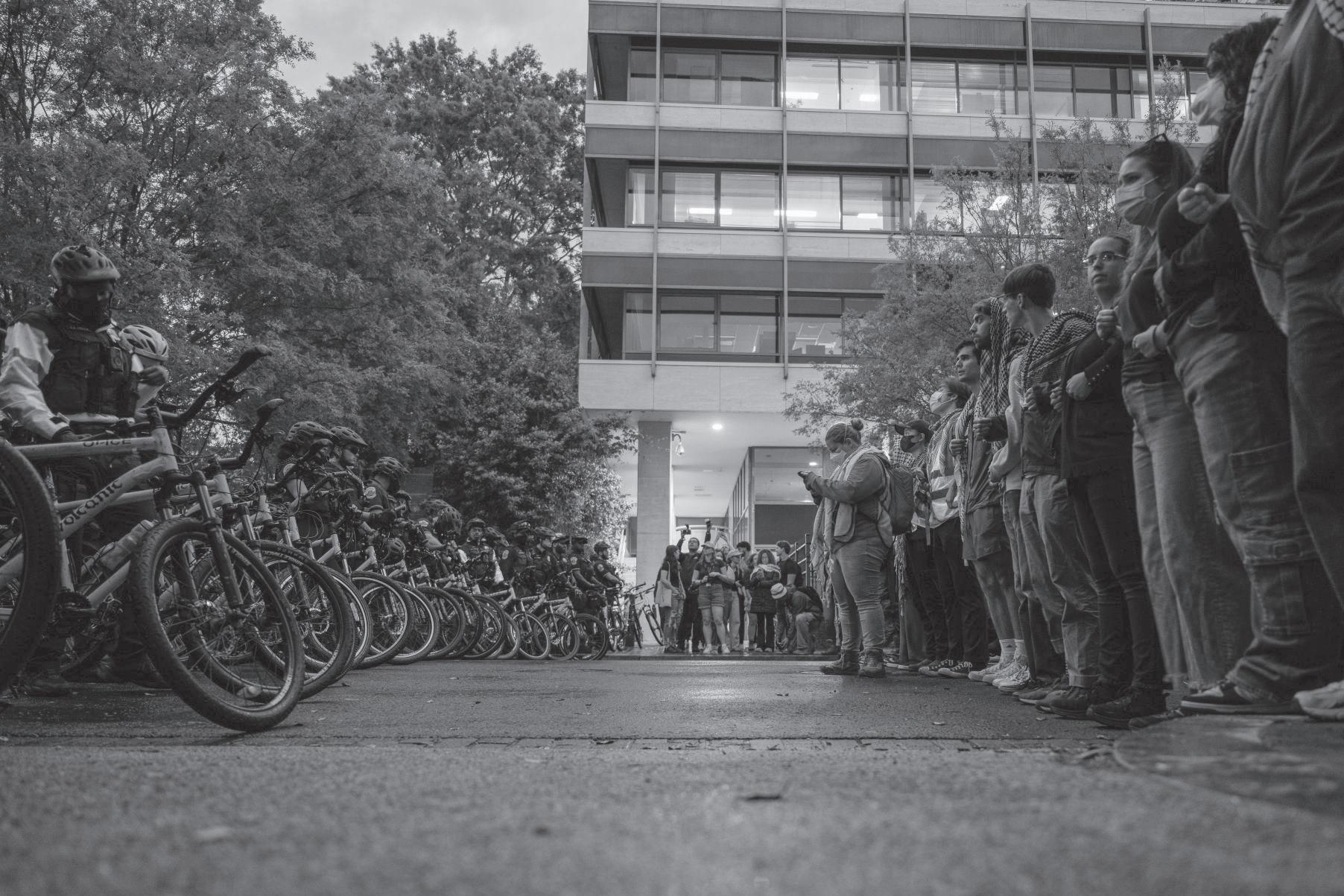
Demonstrators stood opposite Metropolitan Police Department officers on the 1900 block of F Street.
SPORTS
Swimming head coach resigns after championship season
BEN SPITALNY SPORTS EDITOR
Men’s and women’s swimming and diving Head Coach Brian Thomas resigned from his position at GW, Athletics Director Tanya Vogel announced Wednesday.
In his six years leading the program, Thomas coached the men’s team to win five Atlantic 10 Championships and the women’s team to four, including three consecutive wins for both teams from 2022 to 2024. Since his hire in 2018, Thomas has built GW’s winningest program and one of the most successful mid-major swimming teams.
“I’m grateful to Tanya, Andrew and the rest of our administration for entrusting me in leading the program and extremely proud of our student-athletes for the way they represented GW during my time in Foggy Bottom,” Thomas said in a statement, referring to Vogel and Associate Athletics Director Andrew Lundt. “I’ve been surrounded by excellent coaches and support staff at GW and I’m grateful for their commitment to our student-athletes.”
Thomas picked up his seventh and eighth A-10 Coach of the Year honors this season for his leadership of the men’s and women’s programs. It was his third-consecutive year winning the coaching award for both teams.
“I want to thank Brian for his commitment to excellence in the pool,” Vogel said in the statement. “He has recruited incredible people who value GW and are extremely dedicated to being their best in multiple areas of their life.”
At this year’s A-10 Championship, the teams broke 17 conference records and 27 program records. GW became the first A-10 program to win all 10 relay events, breaking conference records in seven of the 10 events. Sophomore Ava Topolewski, junior Ava Deangelis and men’s team senior Djurdje Matic all qualified for the NCAA Championships in March, where Matic placed 14th in the 100-yard butterfly, earning him All-American status. Both the men’s and women’s teams ranked within the top 35 teams in the country for the 2023-24 season. Athletics officials said in their statement that they
have begun a “national search” for the next head coach.
When entering his first season, Thomas said he was focused on building GW’s program to a national level and fostering a stronger team culture. He said he would create a year-round program for the team, having freshmen stay over the summer to build stronger connections.
Thomas said he wanted his coaching staff to focus on forming a “partnership” with swimmers to form a deeper understanding of how to succeed in the pool and instituted intense workout programs to improve the team’s physical fitness.
The announcement of his departure comes just a few weeks after officials abandoned plans to demolish the Smith Center pool to build practice facilities for the basketball teams, citing unforeseen additional work and costs. The team will continue to practice and host meets in the Smith Center, where the 25-meter pool is half of an Olympic-length swimming pool.
Vogel said that the Smith Center pool is “insufficient” for the swimming and diving teams in a March
Revs pick up Delaware transfer guard Drumgoole Jr.
RYAN JAINCHILL
BASKETBALL EDITOR
Men’s basketball landed Delaware transfer Gerald Drumgoole Jr., according to a post May 3 made on X, formerly known as Twitter, by Jeff Goodman.
The former Blue Hen guard averaged 13.9 points per game this past season, paired with 3.8 rebounds and 2.4 assists per game. Drumgoole’s transfer to the District comes after spending his graduate season at Delaware and undergraduate seasons at Pittsburgh from 2019 to 2021 and then Albany from 2021 to 2023.
Drumgoole’s commitment marks the fourth addition to Head Coach Chris Caputo’s roster for the 2024-25 season. He joins Cornell senior forward Sean Hansen and Providence redshirt sophomore forward Rafael Castro, who both committed earlier in the offseason, as well as William & Mary guard Trey Moss.
The Delaware Blue Hens finished 10-8 in Coastal Athletic Association play, good for sixth overall. During the season, Delaware would go 1914.
The 6’5″ guard started in 19 of the Blue Hens’ 33 games, including getting the nod from the jump in the team’s
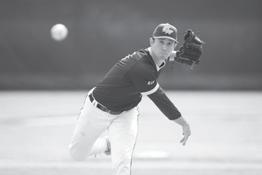
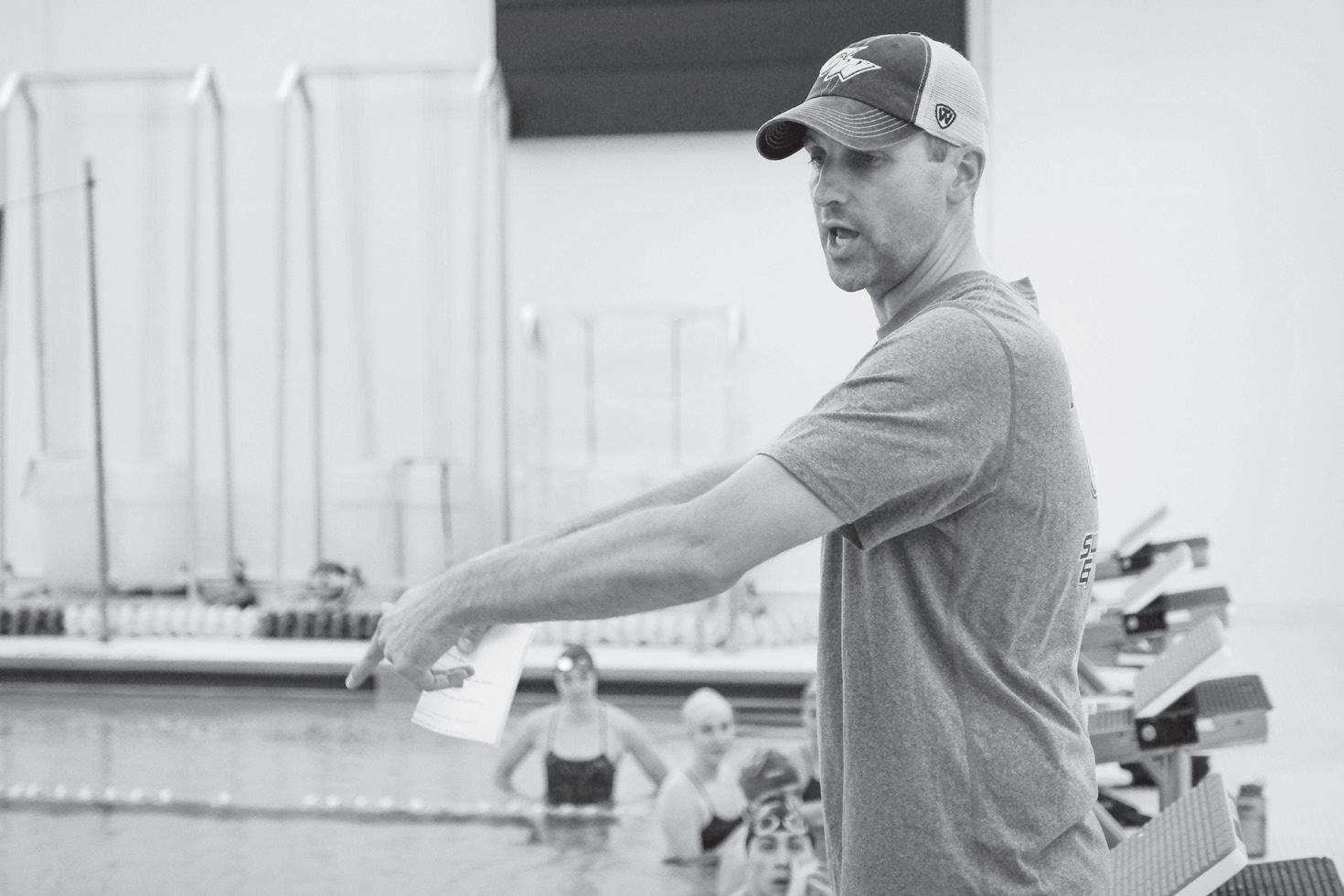
Advisory Neighborhood Commission meeting.
When the demolition plans were still in motion, six swimmers told The Hatchet they were disappointed with how the athletic department disregarded and ignored their needs. They said officials had not organized practice facilities and schedules quickly enough, with tentative schedules not providing enough time for classes and practice
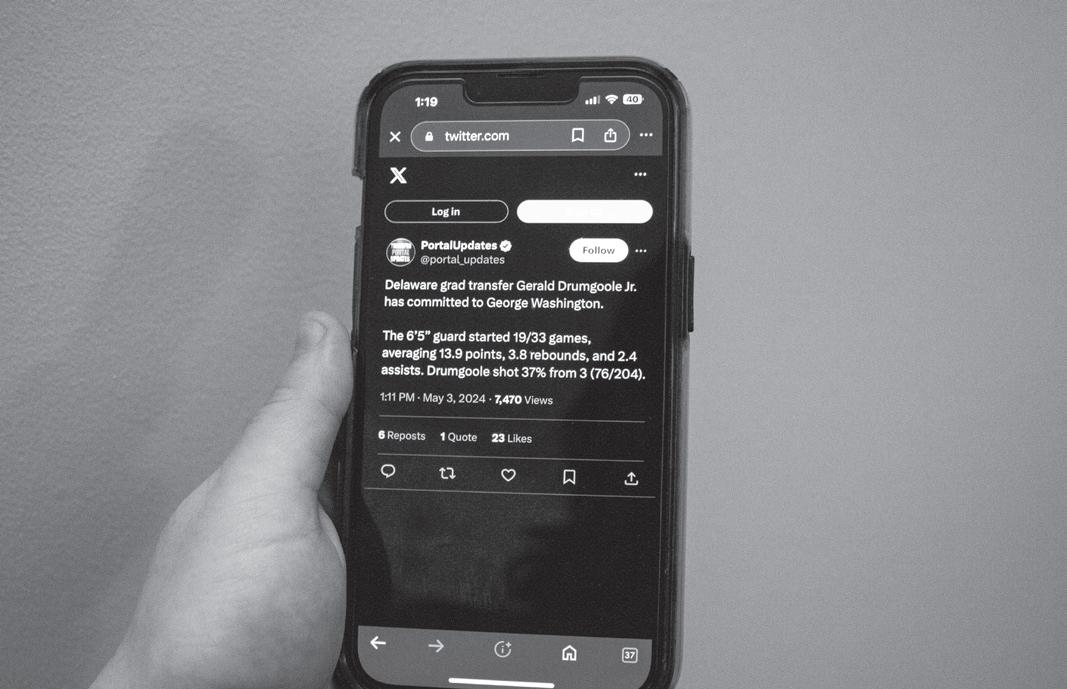
last 16 conference games.
Drumgoole’s best offensive showing of the season came in Delaware’s game Feb. 15 against Elon, where the Rochester, New York, native recorded 24 points on eight of 17 from the field, including six of a dozen from beyond the arc in the team’s 73-67 loss at the hands of the Phoenix.
In Delaware’s game against the Revs in the Bahamas on Nov. 26, Drumgoole tallied 12 points in 24 minutes off the bench in his team’s 81-71 loss.
Prior to attending Delaware, Drumgoole went to Pitt, appearing in 30 games over two seasons before transferring to Albany
before the 2021-22 season.
Drumgoole’s first campaign at Albany was cut short after one game when he suffered an injury, causing him to miss the remainder of the season. In his senior season at Albany, he averaged 15.7 points per game, leading him to be the Great Danes’ team leader in points, assists and steals.
Drumgoole’s shooting prowess should help to replace the production of departing guard Maximus Edwards, who averaged 12.4 points per game this past season. The Delaware transfer’s 458 points last season would have placed him second on the Revs, only trailing senior guard James Bishop IV.
Edwards transfers to Duquesne
RYAN JAINCHILL BASKETBALL EDITOR
Former men’s basketball guard Maximus Edwards committed to Duquesne University, he announced last week on X, formerly known as Twitter. Edwards departs the
District following two seasons under Head Coach Chris Caputo to suit up as a Duquesne Duke, marking his third school of his collegiate basketball career. Edwards joins the Dukes after their Atlantic 10 Championship victory this past season, defeating VCU 57-51 at the Barclays Center in

Brooklyn, New York, on March 17. The Revs played the Dukes this past season in March and Edwards shot 40 percent from the field and earned 12 out of 65 points, but the Revs narrowly lost 65-67. GW last beat Duquesne in a triple overtime matchup during the 2021-22 season, ultimately winning 9893 in the Smith Center. GW’s program record against the Dukes is 21-14.
Duquesne aims to enter a new era after promoting associate head coach Dru Joyce to head coach. He has coached the Dukes since May of 2022. After seven seasons, former Duquesne Head Coach Keith Dambrot, who coached LeBron James in high school, announced his retirement March 18, the day after the Dukes won the A-10 Tournament.
Edwards marks the sixth addition to Joyce’s 2024-25 roster and is the only incoming transfer from another
facilities in Virginia requiring too much commute time.
Swimmers said last month there were “double-digit” entrances into the transfer portal this offseason, compared to zero in years prior.
Swimmers entering their senior year said they can’t recall a swimmer transferring away during their time at GW.
Even after the reversal of the planned demolition
of the Smith Center pool, many swimmers chose to remain in the portal, due to a risk of a scholarship reduction if they returned. Swim blogging site SwimSwam reported that following Thomas’ departure, Topolewski and Deangelis entered the transfer portal. SwimSwam reported Thursday that Topolewski has decided to withdraw from the portal and remain at GW.
Softball finishes season seventh in A-10
GRANT PACERNICK STAFF WRITER
Softball (27-26, 12-14 A-10) capped off their season earlier this month with a .509 winning percentage, narrowly missing out on the conference tournament as a team, while seven athletes picked up A-10 postseason awards.
The team finished seventh in the conference, on par with their ranking in the preseason poll, after sweeping a three-game series against St. Bonaventure on May 4 and 5 and winning 12 of 26 A-10 contests during the season. The top six teams ahead of GW competed at the A-10 Championship in the Bronx, New York, on Saturday where topseed Dayton took home the crown for the second year in a row.
The Revolutionaries won the conference and regular season championships in 2021, repeating the regular season win in 2022 and ultimately earning silver at the A-10 Championship final. Despite A-10 season polls picking the Revolutionaries to finish seventh in the A-10 this season, they failed to gain momentum, going 12-14 in conference play and ultimately finished seventh out of 10 in the conference. Last season, the Revs finished ninth of 10, improving their ranking this season by several positions.
This year’s performance marks a slight rebound for the team, who finished the season with a winning percentage more than .500 after sweeping a three-game series against St. Bonaventure on May 4 and 5. They won the last three games with a combined score of 42-8.
The Revolutionaries had a turbulent season with several multigame losing streaks. Just before its defeat of the Bonnies, GW fell 2-1 to Georgetown on April 30, stranding a runner on third base to end the game. Days earlier, the Revs dropped all three games in a series against Massachusetts.
The highlight of their season
came in mid-March when they secured conference series victories against Dayton and Loyola Chicago, the two winningest teams in the conference. Dayton went on to clinch gold in the conference championship Saturday after beating out Loyola Chicago in the finals. Prior to this, the Revolutionaries had beat out Cornell University and universities of California Davis and Maryland Eastern Shore in the weeks prior.
This season, sophomore utility Rose Cano expanded on her breakout freshman year, helping the team’s production on both sides of the field and earning a first-team allconference nod. She wrapped up the season with a .337 batting average and 72 innings pitched.
The Revolutionaries young roster of talent provides further hope for the team, with a roster dominated by underclassmen. Four freshmen were placed on the A-10 all-rookie team: outfielder Paige Heyward, pitcher Sophia Torreso, infielder Mandy Lauth and utility pitcher Cece Smith.
Smith finished with 12 wins on the season, the fourth-most in the conference. Her ERA was also the lowest on the team in her freshman year, ending the season with a 2.59.
Senior utility and 2022 A-10 Player of the Year Alexa Williams netted 37 RBIs this year and finished the season with a .341 batting average. She made the all-conference second team this year as well as the all-academic team.
Graduate transfer catcher Allison Heffley was also named to the all-conference second team after joining the Revs from Harvard University this year. She finished second in the conference with 58 hits on the season, behind Dayton’s Emma Schutter with 59 hits.
Infield recruits Emi Todoroki and Kaylee Layfield will join the roster next year. The team will also return most of its production next year, with four graduating seniors and two graduate students departing the team.
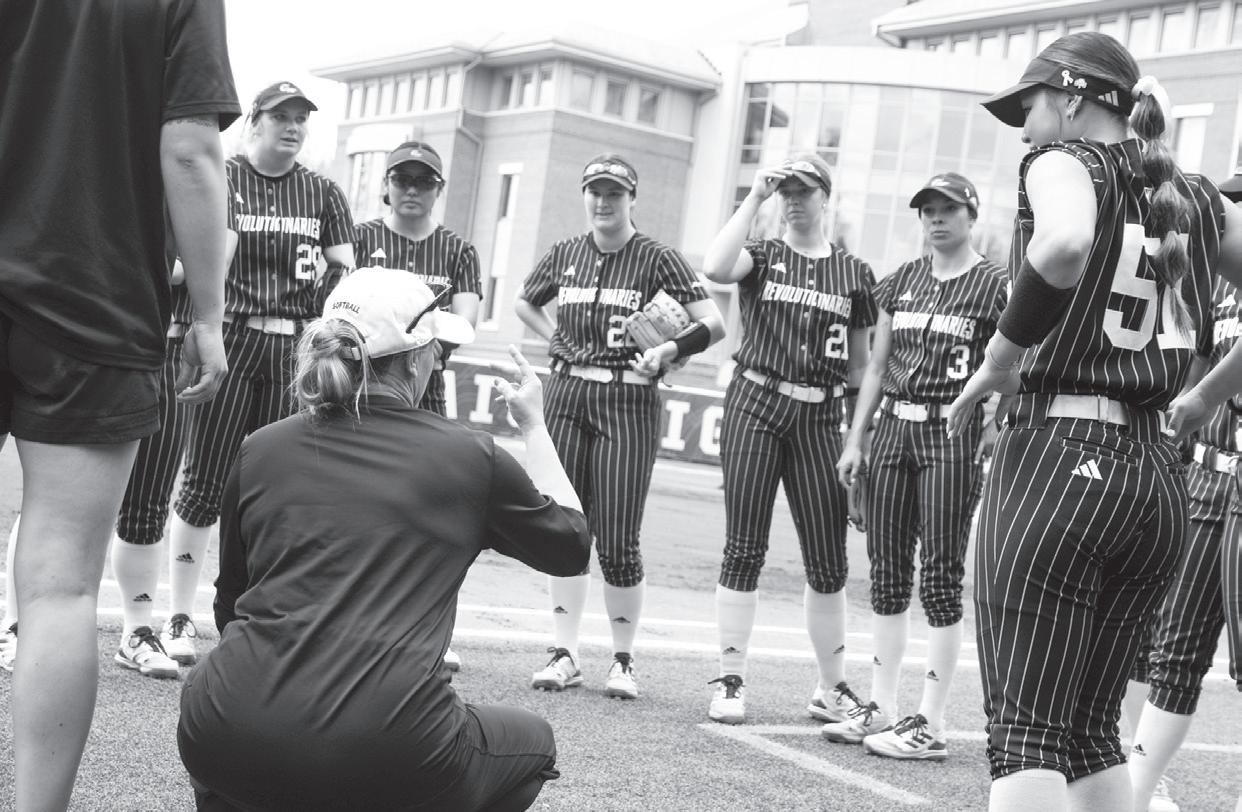
NUMBER
CRUNCH
7 GAMES OF THE WEEK THE GW HATCHET May 13, 2024 • Page 7
The number of softball student athletes who earned postseason Atlantic-10 awards.
BASEBALL vs. Saint Joseph’s Thursday | 3 p.m. Baseball faces Saint Joseph’s in Pennsylvania. ROWING Saturday Women’s rowing heads to New Jersey to defend the A10 Championship title.
HATCHET FILE PHOTO
Swim Coach Brian Thomas coaching players in 2018.
A-10 school.
ARWEN CLEMANS | STAFF PHOTOGRAPHER
Coach Chrissy Schoonmaker talks to players in a pregame huddle.
PHOTO ILLUSTRATION BY JORDYN BAILER | ASSISTANT PHOTO EDITOR
Delaware graduate Gerald Drumgoole Jr. transfers and commits to GW men’s basketball.
JAMES SCHAAP | STAFF PHOTOGRAPHER
Redshirt sophomore Max Edwards in a game against Rhode Island in February.
Student photographers talk grad shoots in wake of Lincoln construction
Alexandria Manousos had been looking forward to living and learning near monumental locales in D.C. and at GW since she first toured the school.
Manousos, who is now a senior studying psychological and brain sciences, said she started mentally planning out her grad photos at major D.C. and GW landmarks, like the National Mall and Kogan Plaza, as soon as she arrived on campus for her freshman year. But with ongoing construction at the Lincoln Memorial and GW’s administration’s decision to close central campus sites through graduation, Manousos’ photographed fantasies were seemingly not meant to be.
“I knew I wanted to go to iconic spots that I could go back and think of so many different memories,” she said.
The change hasn’t only affected graduates, the subject of photographs — student photographers who hustle from sunrise to sunset taking grad photos throughout the spring semester have had to find new commencement-worthy backdrops this year. Between finding new locations, rising at dawn for good shots and adapting to a surprising amount of champagne catastrophes, student photographers have to navigate the trials and tribulations of the 2024 grad season with the same precision they bring to their craft.
Kate Carpenter, a GW class of 2023 graduate pursuing her master’s degree in higher education leadership and policy at the University of Texas at Austin, said she started taking grad photos in high school and brought her business to GW in 2021. She said she decided to return to D.C. this year to take graduation photos because of her many close friends in the class of 2024.
“I’m so thankful for the people that I met during my undergraduate career, so I was really excited to come back and celebrate their monumental achievement through grad photos,” she said.
Carpenter said the tradition for GW students since she started taking photos has been to pose in front of the Lincoln Memorial with the reflecting pool behind them, with Kogan Plaza as a secondary option. She said graduates from GW also have a particular eagerness to pop champagne in their photos, but the National Mall isn’t always accom-
modating to such celebrations.
“You should not, cannot, never pop champagne on the monuments,” she said. “That is the number one thing because not only does it disrespect the monuments and the places that we’re taking photos, but it makes things sticky, makes things wet, it looks bad in photos, it smells horrible.”
She said this year, with both the Lincoln and Kogan closed, most of her clients have moved their National Mall photo shoots to the Jefferson Memorial, a 20 minute walk away. Carpenter said she decided to halt all on-campus photo shoots to avoid distracting from the ongoing demonstrations.
Carpenter said the Jefferson is less swarmed with other visitors compared to the reflecting pool populated by college grads and “thousands of high schoolers.” She said on one particularly busy day last May, it seemed as though every graduate in the D.C. area had decided to go to the Lincoln to take their photos, making posing almost impossible.
“It was really and truly a horror story for me because I had seven sessions booked in that one day,” she said.
Carpenter said situations like that, even if they’re less common this year with the Lincoln shut down, can make the student photography grind difficult, especially when rising at the crack of dawn to fit in studying for finals. But she said despite such challenges, it makes her happy to see how many intrepid young photographers are down at the mall day in and day out.
“I’m really proud of GW students I see around, really trying and taking great photos,” she said.
Joseph Decilos, a senior majoring in journalism and photojournalism, shares the rise-and-grind philosophy of student photography.
“I think it’s all about respect as photographers like we’re all up there at 6 a.m.,” he said. “I see classmates, they’re frequently doing the same thing that I’m doing.”
Decilos said not being able to take photos in front of the Lincoln’s columns with the “certain aesthetic” so many GW grads imagine has helped photographers’ professional development. He said while many graduates have just pivoted to using the Jefferson Memorial amid their disappointment, others have branched out to studios
or other D.C. sites like the Botanical Gardens.
Decilos said his work with graduates each May gives him a chance not just to get some cash but also to develop his portraiture craft. He said his clients have allowed him to get more creative with their photos and go beyond the copy-and-paste “Pinterest board” aesthetic of graduates fake candidly posing in front of Lincoln Memorial pillars that dominates the season.
“It’s really fun seeing how people are getting creative with it and sort of putting their own twist,” he said.
Nancy Kiner, a junior majoring in photojournalism and American Studies, said her first grad photoshoot went about as poorly as one could imagine. She said she was photographing soonto-be graduates at the University of Pittsburgh, where she attended as a freshman, with a bottle of champagne, but when the bottle popped, things went off the rails.
“The first time I ever did a grad shoot, the champagne broke my camera,” she said.
Kiner said this year, like other photographers, many of her National Mall photoshoots have pivoted to the Jefferson. She said some people have also moved their photo ops to the Capitol — both changes which have made the backdrops of the photos less busy. Kiner said the most important part of grad photos isn’t whether she likes the pictures, but whether her clients like the shots she captures of one of the most pivotal times in their lives.
“It’s a very important moment for a lot of people,” she said. “You want them to be happy with their stuff. It doesn’t even really matter if I’m happy with it.”
As a senior navigating the altered landscape of graduate photo shoots around Foggy Bottom, Manousos said she found a new spot to take her grad photos: Carvings, the late-night eatery on campus that fueled everything from her studying to her cry sessions. She said she still posed for some photos at the reflecting pool, but she liked perching in front of a camera on the Carvings couch with an iced vanilla latte because it was more authentic to her GW experience.
“No one really spends that much time at the Lincoln Memorial,” she said. “So that was important to me to be genuine in where I was taking my pictures.”

Graduating seniors highlight identities via Commencement outfits
NORAH WOODS REPORTER
Between vibrant floral patterns and homages to cultural traditions, seniors are marking the end of their undergraduate careers in style.
Members of the class of 2024 are putting their own twist on the traditional Commencement attire as they get ready to graduate on the National Mall later this month. Through selected fabrics, patterns and silhouettes, seniors are embroidering tributes to their cultural and LGBTQ+ identities into the outfits they plan to don for Commencement.
Riya Sharma, a graduating senior who majored in data science and political science, said she plans to accept her diploma wearing a lehenga, a traditional Indian garment made up of a blouse, a skirt and a scarf, called a dupatta, that can be draped around the shoulders, arms or hair.
Sharma said lehengas, an integral part of Indian and South Asian women’s wear,
tend to be colorful, especially in Hindu communities, and are worn for special occasions like parties or weddings.
Sharma said her lehenga is off-white with gold bordering the neckline and gold flowers embroidered throughout the outfit. She said that although wearing plain white is commonly seen as funeral attire and is uncommon for other formal events in Indian culture, she decided to wear a white lehenga for graduation to blend her heritage with traditional American graduation style.
“Most graduation dresses in the United States, the tradition is to have white and so I thought ‘Why not blend the two of those together?’” Sharma said. “I’ll wear the lehenga, I’ll still have something special on it with the gold embroidery, which in general is used super often as an accent of a primary focus of an outfit. I thought I would make it a little special rather than just having a plain white dress or a plain white lehenga.” She said growing up in an
Indian American household helped shape her identity today. She said her parents always provided unwavering support — whether it be fiscal or familial — for her academic achievements and professional pursuits.
“I wanted to do something not only as a nod to my Indian heritage but also to my parents because they are the reason why I’m able to graduate,” Sharma said.
Dina Grossman, a graduating senior who studied biological anthropology, said she will be sporting a dark blue jumpsuit on the National Mall later this week. She said her style evolved over the last four years, as she has branched out into her queer identity more through her clothing choices.
Grossman said a dress was “more feminine” than what she wanted to wear to graduation. She said she instead chose a look that would help her feel feminine but in a less traditional way — plus, she said she just always wanted to wear a jumpsuit to an upscale event.
“That’s not true that I didn’t
want to dress feminine, but I didn’t want to wear the classic dress,” Grossman said. “I wanted to do something a little different. I wanted to buy an item of clothing I haven’t worn before. I think this is my first jumpsuit purchase.”
Harmanjeet Kaur, a graduating senior who majored in information systems, said she plans to wear a traditional Punjabi suit which typically includes a tunic called a kameez, trouser style pants called sharara and a dupatta. She said she also will wear a graduation stole — the cloth draped around one’s neck which often features one’s class year — embroidered with phulkari, a floral design that is popular in Punjab. She said she wanted to emanate a traditional and elegant look for her formal suit so she chose white to aesthetically match the blue GW graduation gown. The suit was custom made in Ludhiana, Punjab, and her mother’s friend shipped it to her.
Kaur said that she did face some pushback within her
friend group for her graduation attire choices, with people asking why she didn’t wear a formal American-style dress. She said she wants to represent her culture through her Commencement fashion to celebrate the “biggest achievement” of her life so far.
“People have definitely questioned me,” Kaur said. “Because, you know, they’re like, ‘Why aren’t you just wearing you know, like a normal dress?’ And I’m like, ‘Look, this is normal for me.’”
Kaur said the inspiration behind her Commencement outfit are her strong ties to Punjab, where she was born. She said her parents immigrated to America from Punjab, and she is the first person in her family to be graduating from college.
“I’m very proud of where I come from,” Kaur said. “I just want to show that and I want to honor my parents because I feel like my parents are very traditional and they gave up everything just to give us these opportunities, and I wouldn’t be where I am without them and their sacrifices.”
THE GW HATCHET May 13, 2024 • Page 8
NICK PERKINS CULTURE EDITOR
2024 COMMENCEMENT GUIDE
JORDAN TOVIN | ASSISTANT PHOTO EDITOR
A student photographer takes a graduating student’s portrait at the Lincoln Memorial Reflecting Pool.
COURTESY OF JOSEPH DECILOSE
Grad photos at the Jefferson Memorial.
JORDYN BAILER | ASSISTANT PHOTO EDITOR
Alexandria Manousos poses for her grad photos at Carvings.
2024 COMMENCEMENT GUIDE
Grads share their long distance love stories
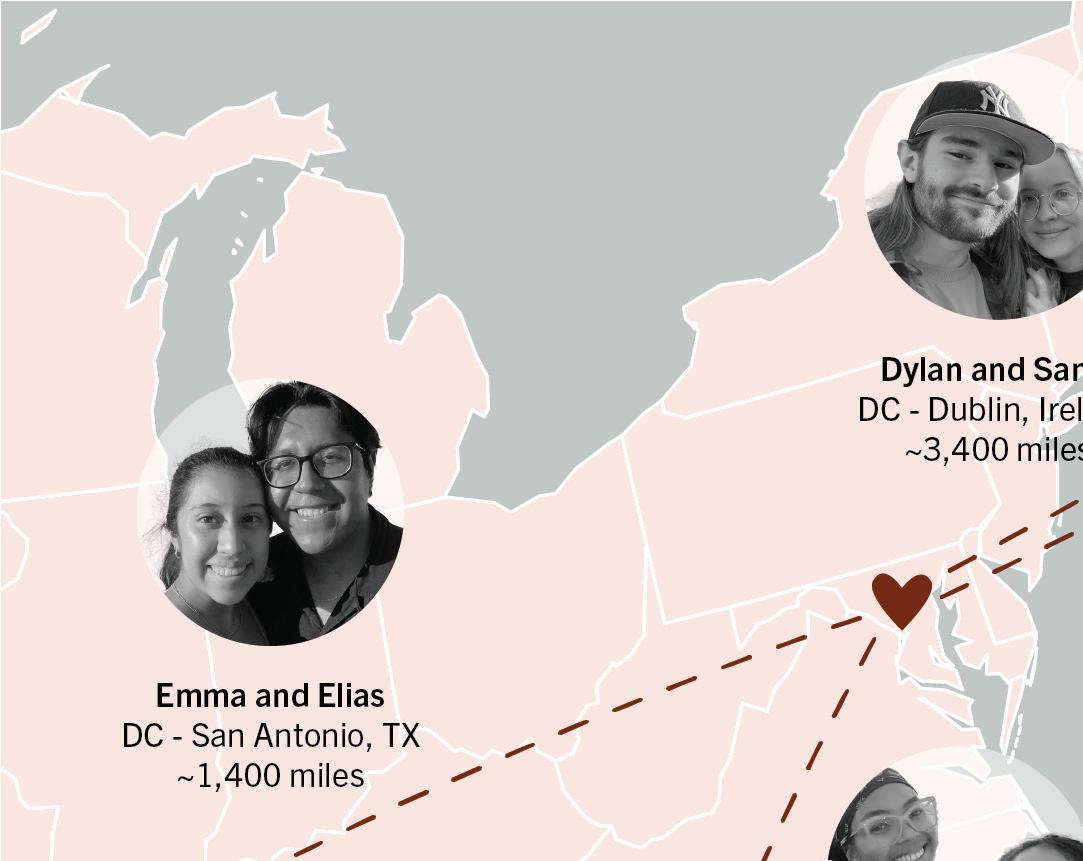

Introduce your family to DC history at these local sites
When families flock to the District for Commencement weekend, GW seniors don not just a cap and gown but also the hat of a D.C. tour guide.
While it’s all too easy to just take your family to the major historical sites around the District that exhibit American history, D.C. as a city has a rich past. To teach your family about the stories of the city where you’ve spent your college years — its local history and place in American politics — plan a visit to these stops:
Martin’s Tavern
Your journey begins in Georgetown. While the neighborhood may be full of Hoyas lurking the streets in polo button-ups and golf outfits, a gem of GW and D.C. history is on Wisconsin Avenue: Martin’s Tavern. Through the weathered, wooden doors of Martin’s Tavern is a bar and restaurant that emanates history. The Martin family has run the restaurant for four generations since founding the Tavern in 1933 as prohibition was coming to an end. The restaurant connects to the history of D.C. as the site of political drama beyond just its place as a historical local business. The Tavern was the meeting place of many politicians and government officials, witnessing many gatherings among the staff of the Office of Strategic Services, the CIA’s predecessor, in the Tavern’s backroom during World War II. John F. Kennedy also frequented the Tavern as his post-Mass breakfast joint when he briefly lived just a block away in the 1950s.
Dumbarton Oaks and Oak Hill
Cemetery
After you finish a hearty breakfast, walk off the calories on a stroll toward Dumbarton Oaks and Oak Hill Cemetery, about 15 minutes north from Martin’s Tavern.
Within the cemetery is the mausoleum where Abraham Lincoln’s son was temporarily interned after dying from typhoid fever in 1862, and Lincoln frequently visited the area when living in D.C. The mausoleum inspired George Saunders’ Booker Prize winning novel, “Lincoln in the Bardo,” as Saunders sought to capture the sheer grief the president must have felt.
The cemetery is also home to notable figures from the District’s
past including Katherine Graham, the longtime publisher of the Washington Post whose tenure at the paper’s helm from the 1963 to 1991 saw the publication cover the minute happenings of D.C. and the grand-scale political operas, like the Watergate scandal, that played out.
Dupont Little Flea Market
If you choose to lead your tour on a Sunday, bring your family and friends to the Dupont Circle Farmers Market and Little Flea Market, two markets which together cover most of the Dupont Circle neighborhood. The food-focused farmers market is open 8:30 a.m. to 1:30 p.m., while the flea market is open and full of tchotchkes from 10 a.m. to 3 p.m.
The Little Flea market is your best bet to bring family members who are fans of both history and thrifting, with art and antiques from around the world, letting one see how frequently D.C. intersects with international politics.
Ben’s Chili Bowl
Finally, wander 25 minutes from Dupont Circle to U Street, a historically Black neighborhood. The area has a vibrant jazz scene, denoted by sites for jazz legend and D.C. native Duke Ellington, spanning from his boyhood home in the neighborhood to jazz murals on the sides of parking garages. Grab dinner at Ben’s Chili Bowl, a vibrant diner known for its chili half-smoke, a pork and beef hot dog topped with spicy chili. The half-smoke is the closest thing D.C. has to a signature food item as the hot dog variation is one of the few dishes which emerged within the DMV and continues to populate the area, from the original Ben’s to DCA to Nationals Park, giving you a chance to introduce your family to the culinary culture of your soon-to-be alma mater.
Then-newlyweds Ben and Virginia Ali founded the diner in 1958 — and Virginia may even stop by your table to say hi as she still works at the restaurant. Photos from the March on Washington on the walls of Ben’s, where the Alis donated out their signature halfsmoke, show the restaurant has long been woven into D.C. politics. Over its six decades of existence, countless visitors have munched on hot dogs at Ben’s — from Barack Obama and Pope Francis to Kevin Hart and Chance the Rapper
BROOKE SHAPIRO STAFF WRITER
From scrounging for affordable plane tickets after class to placing late-night calls spanning time zones, maintaining a long-distance relationship while earning a degree can seem daunting.
But graduating GW seniors in long-distance relationships shared that they were able to keep their love alive from thousands of miles away.
Valentines since high school
Emma Ramos, who graduated last semester as an international affairs and Spanish double major, said she met her high school beau, Elias Muniz, in an orchestra rehearsal on Valentine’s Day in 2019. She said they were the only two violinists to complete a playing test, landing them next to each other in the ensemble. Whether this was a stroke of fate or a mere coincidence, the pair’s bond as music stand partners quickly blossomed into an over-five-years relationship.
In 2020, Ramos started her first year at GW remotely, taking classes online from her home in San Antonio, Texas, with Muniz attending a community college nearby. In 2021, in-person instruction at GW resumed and it was time for Ramos to move to the District, leaving Muniz more than 1,600 miles away.
With Ramos currently working full time in the District and Muniz attending law school at St. Mary’s University in Texas, the couple said they will stay long distance for the time being. But Ramos said she has
high hopes they can reunite to work in the same city. She said long distance was valuable because their love has preserved.
“If you think a long-distance relationship will make you happier in the end, then I think it’s worth it,” Ramos said. “It’s definitely doable.”
A study abroad love story
Despite the beautiful Chilean landscape that greeted San Larson during her summer 2022 study abroad program, the graduating senior said she met her nowgirlfriend, Nnanda Allick, in a dingy COVID quarantine room on her second day in the country. Isolated with each other for a week, Larson, who is graduating with a degree from the Milken Institute of Public Health, and Allick, who graduated from the University of West Florida in December, hit it off, fortunately for their own sanity. After jokingly agreeing it would be “homophobic” to not have girlfriends during Pride Month, they started dating.
The couple returned to their separate schools in fall 2022, and Allick said the pair made the six-state distance between Florida and D.C. more bearable by planning virtual dates with itineraries like face masks.
Sharing sunsets and shows Griff Evans, a senior who majored in international affairs and finance, said he would have “fumbled” if he did not ask Michelle Weber, a student at Heidelberg University, to be his girlfriend after a romantic Valentine’s Day date in London last year.
Evans said they met studying abroad last year at King’s College and knew they would have to savor every moment together before Evans returned home to the states and Weber moved back to her home in Germany. Since watching the sunset over the London skyline on their last night in England, Evans said their compatible “life philosophies” devoted to following their passions have made it easier to navigate the ocean that stands between them.
D.C., Dublin and beyond Dylan Weiss, a senior graduating with a degree in international affairs, said he met Sanni Autio, a history student at University College Dublin, in a Northern Irish History class during his exchange at UCD last year. After chatting with each other after class one day, Weiss said they became closer and closer as friends until officially becoming a couple in March, even though their time before Weiss had to return to the states was dwindling. When the semester came to an end, Autio said they both left with an air of uncertainty, unsure of the next step their relationship would take.
But more than a year later, Weiss said they have visited each other five times, flying between D.C. and Dublin. Weiss said he has wanted to move to Europe in adulthood since high school but has moved up his timeline since being with Autio.
“It went from within 20 years to like, ‘I want to go there as soon as possible,’” Weiss said.
How to handle Commencement as a graduate of divorce
corners of the mall. Maybe one parent is particularly fond of “Forrest Gump” and wants to be seated near the Reflecting Pool, while the other has always wanted to pose for that landmark photo they always wanted.
Commencement is a time to bring the whole family together — but for graduates with divorced parents, that might not be ideal.
On a day meant to celebrate your four years of grinding out papers and exams, the last thing any child of divorce wants is to be dragged into discussing the dynamics of your parent’s eventual split. Whether your parents have been bitterly divorced for decades or claim to be friends, here are some strategies to handle any potential awkwardness. Recent divorcées: Show up really early
The National Mall is big — 146 acres to be precise. GW’s Commencement ceremony takes up a relatively significant portion of that area, peppering large swaths of grass with blue caps and white tents. But if your parents just split up, things might be so awkward that you’ll wish the mall was 300 acres to keep them as far apart as possible. If that’s your predicament, the best move is to just show up extremely early to the 10:30 a.m. Commencement Ceremony in order to get seats in opposite
Long-time split up: Don’t let them ti , ri at a jazz club instead
The saying “time heals all wounds” is never guaranteed. Though the bulk of the tensions surrounding your parents’ split have hopefully dissipated, getting the band back together after years apart is a risky move. To smooth over any stilted pauses in the conversation, consider an outing to a jazz club.
It’s likely there’s plenty for your parents to catch up on after spending time apart, but chances are, the conversation can just as easily skid to a halt if old grievances or new romantic relationships enter the chatter. Luckily, the swelling of low notes on a saxophone and the interplay of basses and drums will cover any awkward silences.
Perhaps they’ll be able to take a moment and reminisce on their relationship in true “La La Land” fashion, pondering what might have been and being grateful for what truly is: their shared love for you.
Trying to get them back together: Take them to Roosevelt Island
It’s a tale as old as time: an

extremely attractive couple breaks up, then they suddenly find themselves together in a romantic island destination and rekindle their love. Or, at least, that’s what Hollywood would have you believe through films like the George Clooney-Julia Roberts reunion “Ticket to Paradise.”
If you’re trying to follow in the storied tradition of Glen Powell and Sydney Sweeney and get your parents back together, D.C. might not be the tropical paradise you’re envisioning for your ventures — there’s a massive, polluted river and plenty of concrete, and there aren’t a whole lot of tropical paradises within the city limits. Despite that, the District does boast one island within walking distance where you can bring your divorced parents to have a decade-late meet-cute: Roosevelt Island. The island is situated within the Potomac and is full of winding dirt paths, creaking trees and statues of Theodore Roosevelt posing. The myriad of dead-ends and mysterious twists and turns are sure to give your divorced parents plenty of chances to “accidentally” trip into each other’s arms yet again. And, even if they don’t rekindle their lost love, at least you’ll be close to a tribute to a president who knows a thing or two about seeing one’s trust get busted.

THE GW HATCHET May 13, 2024 • Page 9
JENNA BAER
SENIOR STAFF WRITER NICK PERKINS CULTURE EDITOR
GRAPHIC BY NICK PERKINS
Students can feel torn apart as their divorced parents attend Commencement together.
— so join the diner’s legendary crowd before your time at GW comes to an end.
JACKSON LANZER STAFF WRITER
GRAPHIC BY AN NGO
SAGE RUSSELL | SENIOR PHOTO EDITOR
Emma Ramos and Elias Muniz show their love over FaceTime.
2024 COMMENCEMENT
Faculty share uncertainties, achievements that define past ceremonies
On a Sunday in May 1995, a storm brewed above the heads of GW graduates and their families as they gathered on the Ellipse, just south of the White House, to begin the University’s annual Commencement ceremony.
Despite the University’s “rain or shine” policy, lightning strikes forced the Class of 1995 to move off The Ellipse, the area behind the White House lawn where Commencement was held until 2006, and officials to cancel the ceremony without a backup plan. Graduates and attendees filed into the Marvin Center — now named the University Student Center — to wait for directions from officials, who eventually delivered and broadcasted an abridged ceremony from Betts Theatre to the few hundred people who stuck around.
An announcement from University officials published in The Hatchet’s May 8, 1995 print edition stated that students and their guests should bring “umbrellas, rain gear and a sense of humor” if inclement weather arises. The cancellation the weekend after was the first in GW’s history at the time, according to a Washington Post report.
The scene of students and their family members swarming every restaurant in Foggy Bottom after officials canceled Commencement that year was “hilarious,” said Maida Withers, a professor of dance who is retiring this semester after teaching at GW for 58 years.
“There was no communication, nothing happened,” Withers said. “Everybody was trying to go to the
restaurants and eat — everything was packed with GW families.”
Robert Baker, an associate professor in the Corcoran School of the Arts and Design’s music program, said he was at the 1995 Commencement to assist with the musical performances, which he has consistently done since he first started at GW 33 years ago.
The storm of ’95 stands out among the memories of faculty who have collectively attended dozens of Commencement events. Professors recalled the same air of celebration among graduates as they reflect on the ceremonies they’ve witnessed throughout their tenure, punctuated by memorable spectacles like pulling pranks, rain showers and uncertainty during the COVID-19 pandemic.
David DeGrazia, the Elton Professor of Philosophy who has taught
at GW for 35 years, said one of his most fond graduation memories dates back to a Columbian College of Arts & Sciences ceremony early in his time at GW, one of the several school-specific events that occur before the main event Sunday.
While preparing for the procession, DeGrazia told the seniors of the Philosophy Department that he thought it would be funny to write down a philosopher’s name as the middle name of each student on the cards used to announce each graduate.
From Plato to Aristotle, the seniors put DeGrazia’s suggestion into action, crossing the Commencement stage to the sound of famed philosophers’ names echoing through the Student Center. He said the homage roused laughter from the audience as they caught on to the schtick.

Philosophy students received a warm reception for the bit, but when DeGrazia tried to replicate it with graduates the following year, the announcer refused and skipped over every middle name in the department’s roster.
“She didn’t have a sense of playfulness or creativity,” DeGrazia said.
DeGrazia said he sometimes reflects on his own graduation from the University of Chicago in 1983 and how “dizzying” it felt to complete his undergraduate education.
Denver Brunsman, an associate professor and the chair of the history department who has taught at GW since 2012, said the 2020 and 2021 virtual Commencement ceremonies due to the COVID-19 pandemic were among the most difficult changes he’s witnessed at University Commencement since
faculty were unable to send their students off in person. Watching his students graduate and meeting their families is one of the most rewarding experiences as a faculty member, he said.
Brunsman is far from the only professor who expressed their fondness for the in-person ceremonies he’s attended over the years — Baker, after 33 years at the University, said he often feels a particular sense of joy around campus at Commencement time. But he said there is a feeling of uncertainty on campus surrounding the status of this year’s Commencement due to officials’ response to the pro-Palestinian encampment in University Yard, harking back to the doubt surrounding graduations in 2020 and 2021.
Officials issued an update on guidelines and prohibited items for the Class of 2024 Commencement events Friday. The guidelines state that law enforcement officers can remove protesters who disrupt the proceedings after an initial warning, and amplified sound devices and signage like posters, banners and flyers are now prohibited items.
Baker said he hopes the University can carry forward with 2024 Commencement without curtailing student activists’ right to freedom of speech.
“My general feeling is I hope we can do both things,” Baker said. “I hope we can have a coherent celebratory commencement and also operate in the space that represents First Amendment rights and freedom of speech. In all circumstances, that’s the challenge of democracy, it is the challenge or responsibility of all of us to be able to do that.”
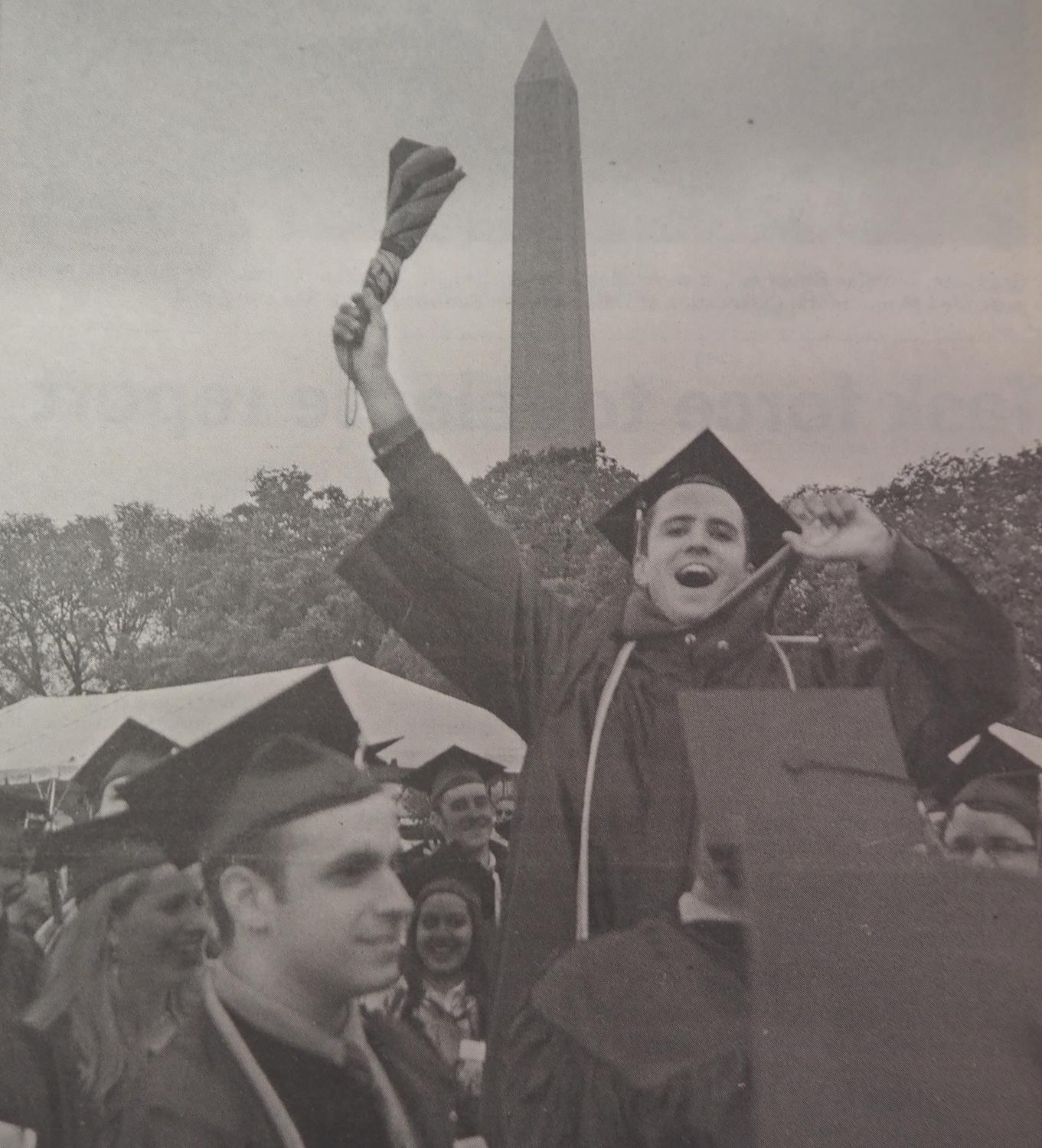
THE GW HATCHET May 13, 2024 • Page 10
GUIDE
virtual 2020 Commencement.
HATCHET
FILE PHOTO BY GRACE HROMIN The
CAITLIN KITSON CONTRIBUTING CULTURE EDITOR
CLAIRE DUGGAN
Facing a downpour, graduates gather to watch the weather report during Commencement in 1995.
ANDREW SNOW
Bad weather, no problem — students celebrate Commencement outside in 2003, umbrellas and all.
JEFFREY BAUM
Graduation caps of members of the Class of 2004 dot the horizon on the Ellipse.
VIA UNIVERSITY ARCHIVES
Despite his nickname of “Silent Cal,” the voice of former President Calvin Coolidge echoed through the room as he delivered the 1929 Commencement address
DAVE FINTZEN
Students take a fun spin on Commencement in 1996, bouncing a beach ball in the crowd.
