Coast to coast: Granberg sets off on national tour to attract alumni, donors
IANNE SALVOSA NEWS EDITOR
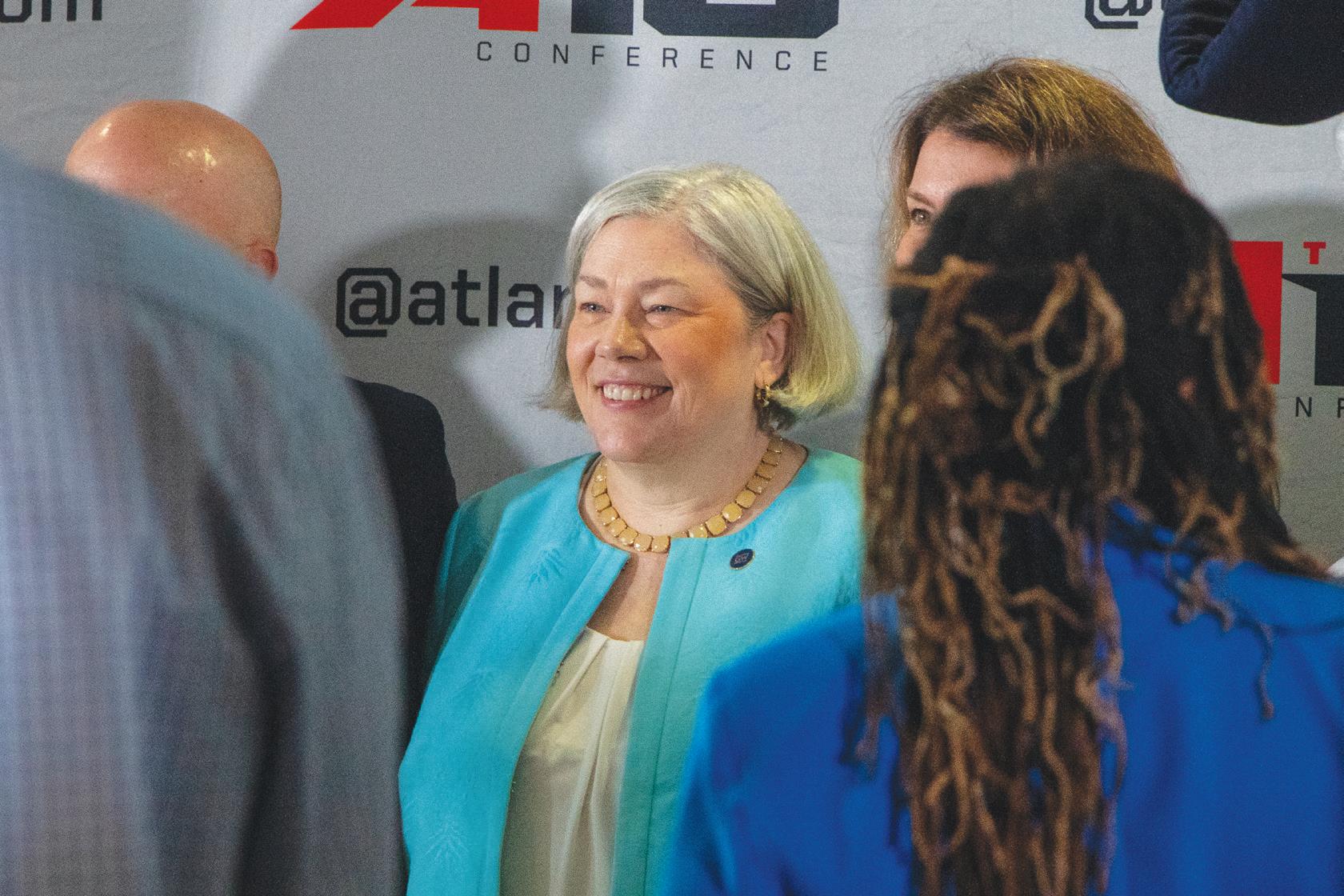
University President Ellen Granberg is embarking on a transcontinental tour to speak with alumni and donors three months into her tenure.
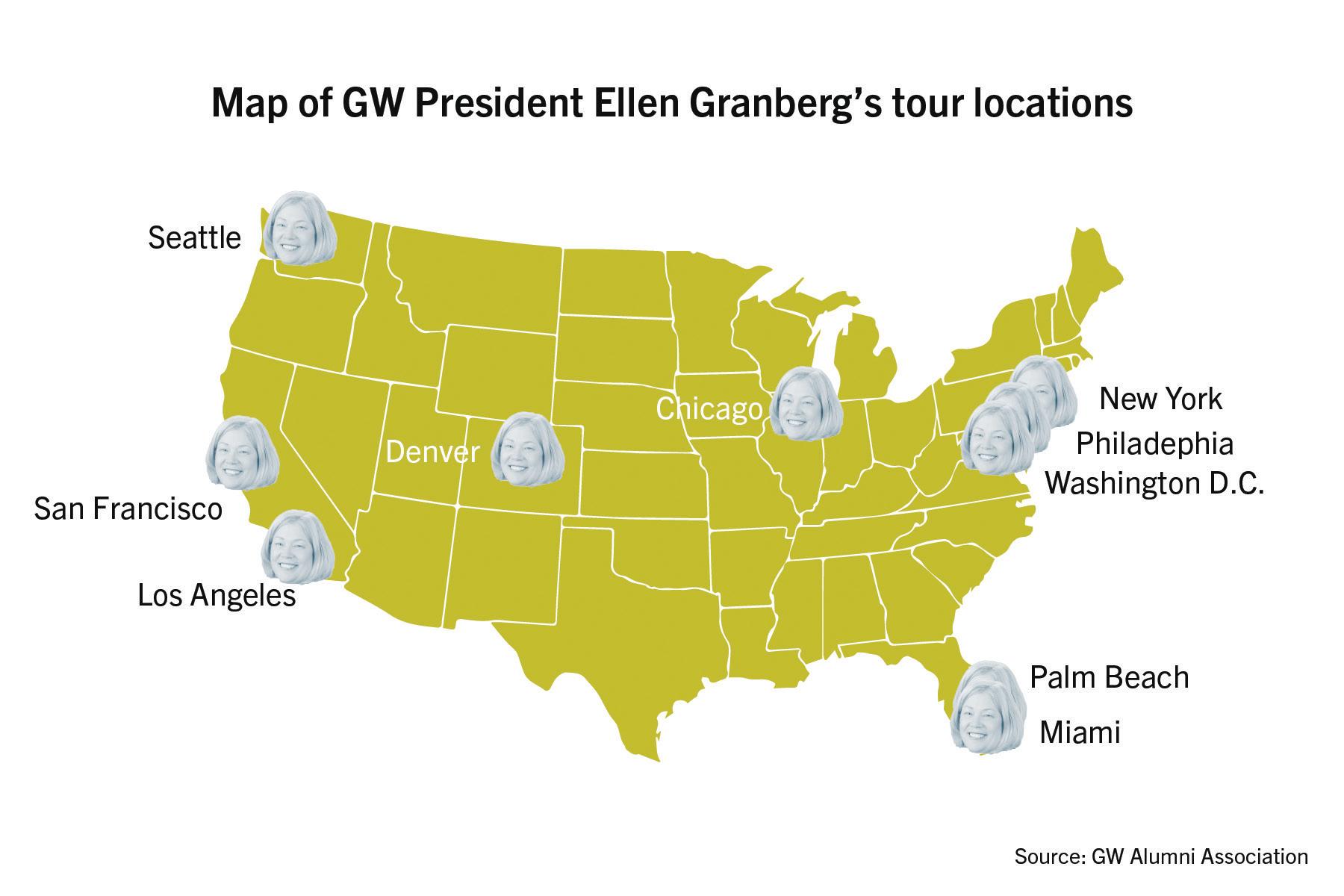
Starting this week, Granberg will visit 10 U.S. cities between September and March to meet with alumni and GW community members as part of GW Together, an initiative to leverage the GW community’s ideas for forming goals for the University’s future. University spokesperson Julia Metjian said GW Together is Granberg’s “listening campaign” so she can garner thoughts on the University’s strengths and challenges from alumni, students, faculty, staff and other “friends” of GW.
“All members of the GW community are encouraged to share their thoughts on the President’s website through photos or video, audio or written messages,” Metjian said in an email. “Input from our community will be valuable and important to informing the President’s approach to the future of GW.”
GW has lacked a strategic plan since 2020, when officials labeled former University President Thomas LeBlanc’s plan “obsolete” due to the COVID-19 pandemic. Critics of LeBlanc’s plan said it left out the wider GW community, accusing it of not adhering to principles of collaboration or shared governance. In the 2022 Presidential Profile, a document listing the
desired qualities of GW’s next president, officials said they are looking for someone who will collaborate with all constituencies to develop a strategic plan.
Granberg, who began her term July 1, will begin the tour in Philadelphia on Tuesday before visiting Denver; Chicago; New York City; Miami; Palm Beach, Florida; Los Angeles; San Francisco; and Seattle. She will also hold a “Presidential Conversation” in the University Student Center during Alumni
CCAS cuts travel funds for tenured faculty in FY23
Columbian College of Arts & Sciences officials eliminated reimbursements for tenured faculty academic travel for this fiscal year, leaving professors with doubts about GW’s research mission and connection to the academic world.

CCAS Dean Paul Wahlbeck said the college is experiencing “very modest” revenue increases this year because of decreased graduate student enrollment alongside a jump in expenses due to inflation and compensation, leading the college’s leadership to cut off reimbursements for tenured professors’ academic travel this fiscal year. But in a June 30 letter sent to University President Ellen Granberg, about 37 professors contested the elimination of reimbursement funding, stating that the lack of accessible academic travel threatens their research and limits their ability to interact with other academics.
“If GW aspires to be a top-tier research University, then it must at a bare minimum support faculty
Officials quiet on prep for future pandemic response
RORY QUEALY ASSISTANT NEWS EDITOR
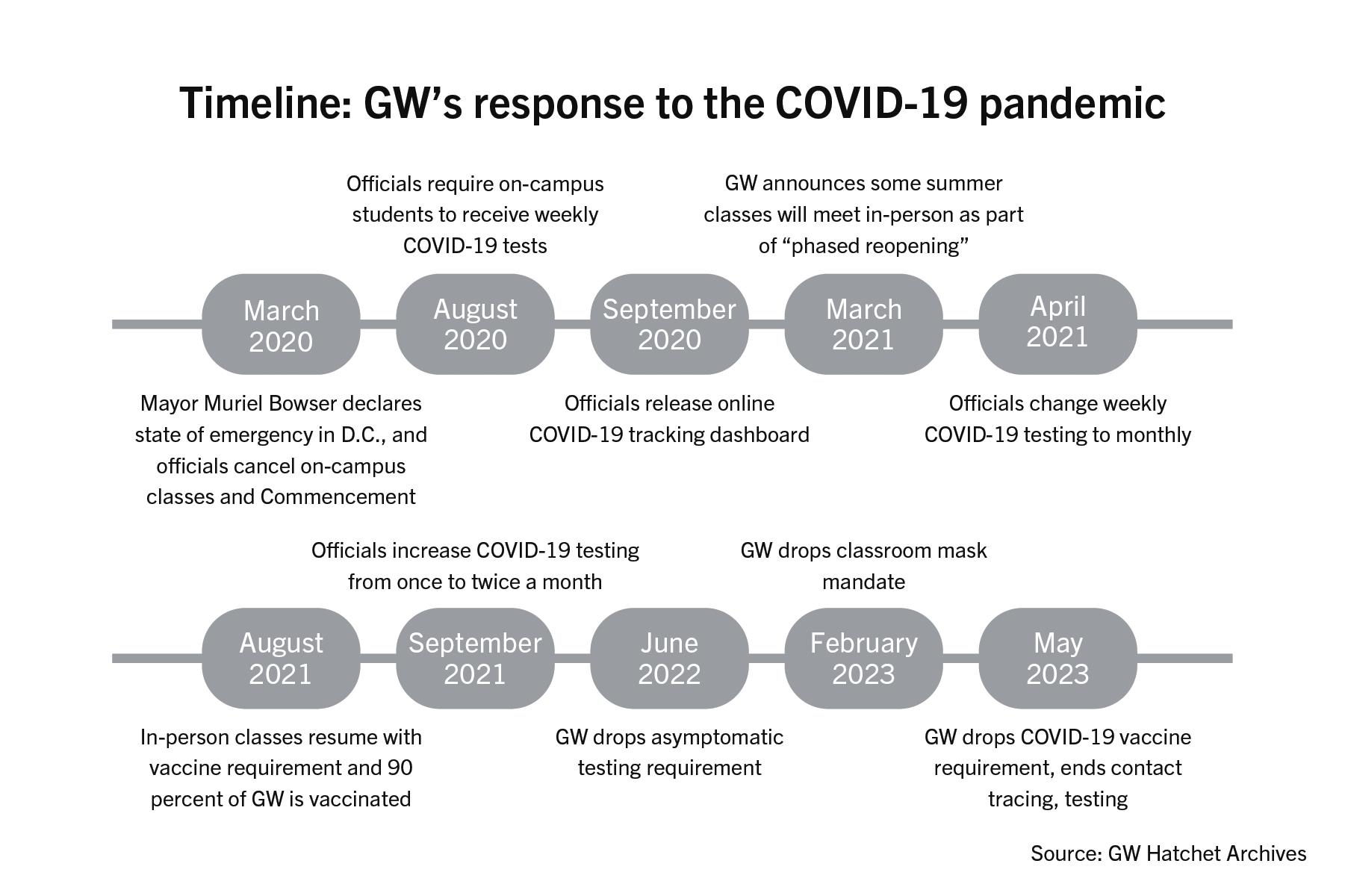
More than three years after GW first shut down campus during COVID-19, officials remain quiet on their preparations for responding to future pandemics — or a potential resurgence of COVID — after pulling back nearly all COVID-related policies last spring.
Officials announced the end of GW’s COVID-19 vaccine requirement, contact tracing and testing services in May following a Centers for Disease Control and Prevention announcement ending the federal public health emergency. While officials said they are continuing to monitor the state of COVID on campus and will adjust their policies when necessary, the University is an outlier in its rollback of COVID policies among its 12 peer schools — 10 of which continue to offer on-campus testing following the CDC’s announcement.
and Families Weekend on Sept. 30.
Metjian declined to comment on the cost of the trips.
Chairs of regional alumni networks said the trips, which are tailored toward committees of donors and alumni, will motivate attendees to engage with the University through “face time” with Granberg, leading to more donations and volunteering from alumni.
George Urch, a co-chair of the Los Angeles-Orange County alumni network, said he is
“very excited” that Granberg is visiting Los Angeles early next year because her appearance will continue strengthening alumni engagement as the network works to rebuild their activity to pre-pandemic levels. He said past University presidents, including Mark Wrighton, Steven Knapp and Stephen Joel Trachtenberg had visited Los Angeles during their tenures.
See ALUMNI Page 4
research at previous levels, even in fi nancially challenging times,” the letter states.
The letter states that travel restrictions can cause junior faculty members who contribute “significantly” to GW’s diversity in race, gender, sexual orientation and disability to leave GW over the possibility of officials cutting their funding, which could threaten the University’s diversity and inclusion commitments. The letter also states that cutting travel funds is “deeply inequitable” because some academic disciplines rely on travel to conduct field research while others do not. The letter didn’t specify which subjects would be most affected.
“We are convinced that this problem can only be resolved by decisions at the highest level,” the letter states. “GW needs to reconsider its budget model in the long term, and, more immediately, examine quite seriously how this shortterm savings will impact GW’s long-term reputation, as well as the morale of its faculty.”
See TRAVEL Page 4
A District House contraceptive vending machine sold out of 50 morningafter contraceptive pills in less than a week and a half earlier this month, which student leaders say proves the necessity of the program.
Officials restocked one of two new campus contraceptive vending machines Wednesday with 200 emergency contraceptive pills — four times as many as the initial stock that sold out.
Stephanie Spector, the copresident of GW Reproductive Autonomy and Gender Equity — a student orga-
nization that advocates for reproductive justice on campus — said although GW RAGE was initially unsure how quickly the emergency contraceptives would sell out, they were not surprised when they did because they knew that demand for emergency contraceptives on college campuses is “really high.”

Spector said the machine selling out quickly demonstrates how the new dispenser has improved since officials first installed one in the University Student Center in January.
Officials installed a new dispenser on the B2 level of District House and in West Hall on the Mount Vernon Campus late last month, moving the machine from the student center after stu-
This semester, the University “strongly recommends” — but does not require — GW community members be vaccinated against COVID and masking remains optional but may be required in some spaces, like some health care facilities, according to the University’s COVID-19 guidance. The guidance states that GW no longer offers COVID testing through the University and that community members can fi nd PCR tests at physicians’ offices and local pharmacies and antigen test kits at pharmacies and retail stores.
See PANDEMIC Page 4
LeBlanc, Diaz saw pay bumps before departures
IANNE SALVOSA NEWS EDITOR
Top officials’ salaries increased from 2020 to 2021, according to University tax forms.
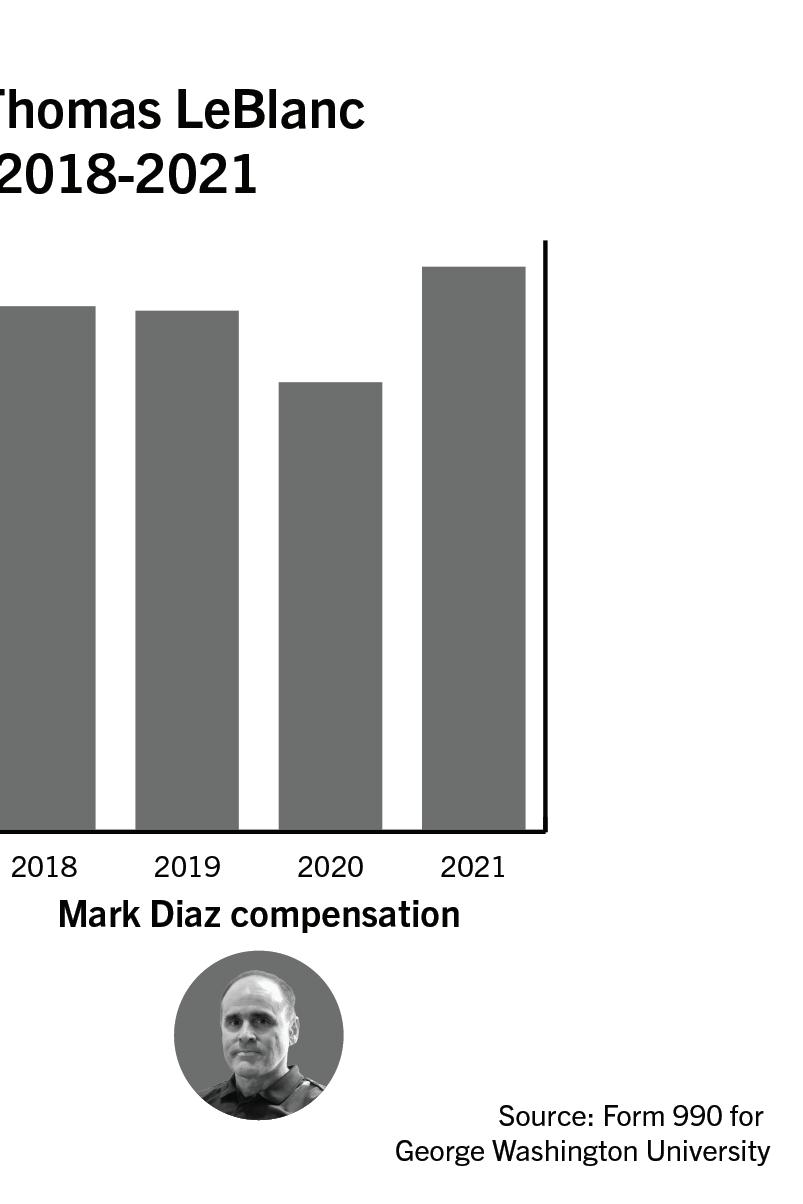
As a nonprofit institution, the University is required to report its revenues and expenses to the IRS via Form 990 each fiscal year, which begins July 1 and ends June 30, and the highest-paid employees’ compensations from the University and “related organizations” for each calendar year. The form reveals that former University President Thomas LeBlanc’s compensation grew from $1,246,803 in 2020 to $1,527,713 in 2021 — a $280,910 pay increase — prior to the end of his term in December 2021.
The documents show that former interim University President Mark Wrighton, who began his term Jan. 1, 2022, had no reportable compensation for 2021 because officials recorded their tax information under the calendar year, according to a University spokesperson. Prior to his tenure at GW, Wrighton served as the chancellor of Washington University in St. Louis until 2019 and was the seventh highest-paid private university president in the country, collecting more than $2.8 million in total compensation.
Former Executive Vice President and Chief Financial Officer Mark Diaz experienced a pay increase from $852,686 in 2020 to $1,318,578 in 2021 — a $456,892
dents said it was inaccessible during the night because the building is closed from midnight to 7 a.m.
“There are a lot of methods in place to get Plan B on campus and we really don’t have any concerns with the ability to stock it going forward,” Spector said. “The higher the demand is, that’s not going to cause any issues because that just shows that there was a lack of access previously.”
Spector said the company that operates the vending machine, Canteen, and members of GW RAGE will continue to “repeatedly” check on the vending machines to ensure they are properly stocked and functioning.
bump — before leaving his position in June 2022, according to the form.
Diaz began his GW tenure in August 2018 and oversaw facilities repairs and the consolidation of the IT department but left the University in June 2022 amid tension with faculty for his alleged involvement in a University project that monitored student, faculty and staff movement across campus.
LeBlanc’s pay dropped from $1,451,969 in 2018 — the 40th highest private university president compensation that year — to $1,362,178 in 2019. He took a slight pay cut due to the onset of COVID-19 in March 2020, taking

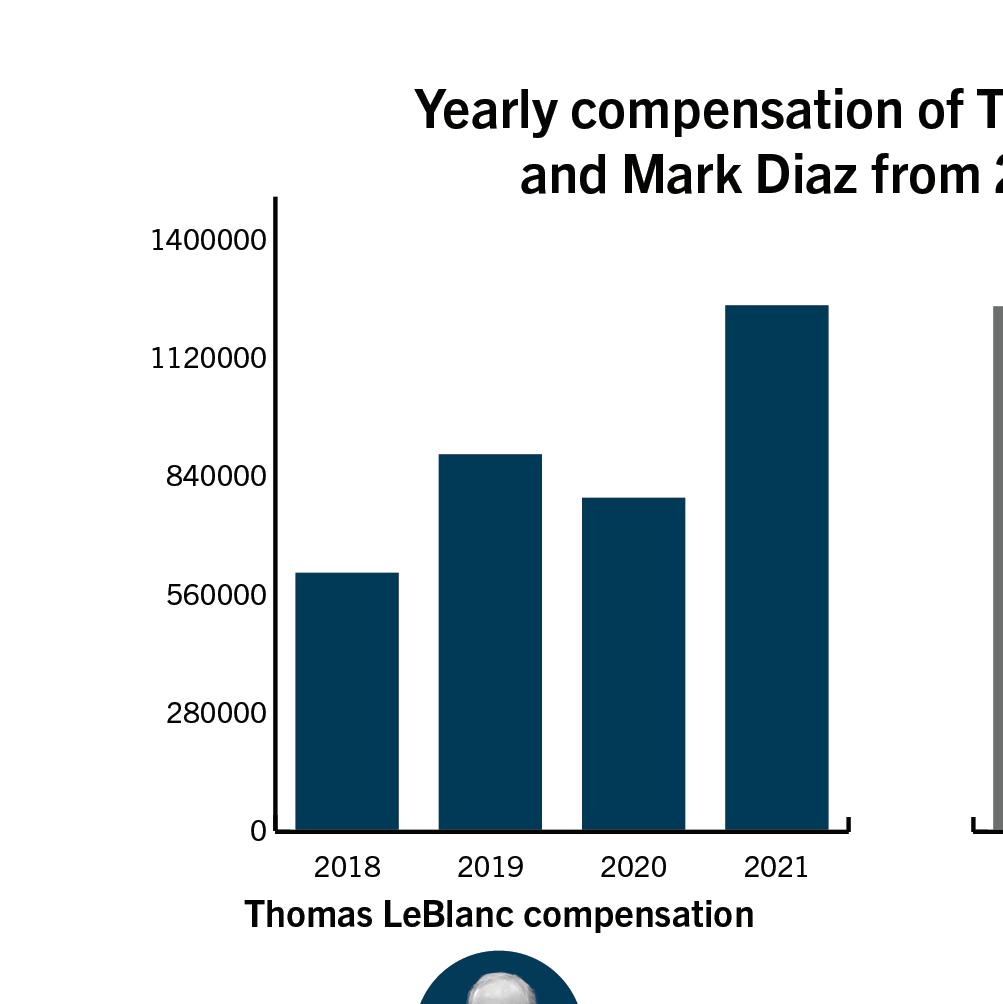
a $115,375 decrease from 2019 to 2020. Highly compensated employees also include Barbara Bass — the dean of the School of Medicine and Health Sciences and CEO of the Medical Faculty Associates, an independent group of D.C. doctors who teach students in the School of Medicine and Health Sciences — who received $1,324,917 in 2021, which is $81,358 more than her $1,243,559 compensation in 2020. Shahram Sarkani, a professor of engineering management and systems engineering and director of GW Online Engineering Programs, earned $1,214,539 in 2021 and $1,196,956 in 2020.
Petition calling for on-campus abortion pills hits 600 signatures: student group
FIONA BORK ASSISTANT NEWS EDITOR
More than 600 people have signed a petition calling on officials to offer abortion pills through the Student Health Center, the student organization that launched the form said.
GW Reproductive Autonomy and Gender Equity launched the petition Friday, asking officials to provide medication abortion — also called the abortion pill — on campus after “repeated requests” have garnered no results. The petition states that GW has a responsibility to offer abortion pills for its students and anyone else seeking abortion care because D.C. is one of the few remaining places where people
can receive abortions near the southern United States in the wake of the Dobbs v. Jackson Supreme Court decision, which overturned federal abortion protections in June 2022.
Though the petition’s number of signatures is not publicly available because GW RAGE launched the appeal via a Google Form, the organization’s leaders said the petition reached more than 500 signatures in its first 24 hours and has surpassed 600 signatories as of Sunday. D.C. legislation mandates that the District remains a “human rights sanctuary” for people seeking abortions from states with restricted access, like South Carolina, which bans abortion after six weeks, and West Virginia, where
abortion is completely banned with limited exceptions.
The petition asks respondents for their name, email, affiliation with GW and includes an optional field for signatories to elaborate on why they support abortion pills on campus.
The petition lists six “barriers” to accessing abortion after the Dobbs ruling, including finding legitimate health care providers, transportation to a clinic, a lack of private spaces, cost, wait times and the presence of protesters outside of clinics.
“Providing medication abortion on campus in the Student Health Center would reduce these barriers for students and would destigmatize abortion care,” the petition states.
INDEPENDENT STUDENT NEWSPAPER • SERVING THE GW COMMUNITY SINCE 1904 Monday, September 18, 2023 I Vol. 120 Iss. 5 WWW.GWHATCHET.COM What’s inside
FILE PHOTO BY AUDEN YURMAN | SENIOR PHOTO EDITOR
University President Ellen Granberg will visit 10 U.S. cities as part of GW Together, where she will garner thoughts on the GW’s strengths and challenges from alumni, students, faculty, sta and other “friends” of GW.
RACHEL
CONTRIBUTING NEWS
MOON
EDITOR
HANNAH MARR ASSISTANT NEWS
LYDIE LAKE STAFF WRITER See CONTRACEPTIVES Page 5 Culture Forget the fake ID and opt for these late-night activities for underage students. Page 7 Opinions The editorial board points out potential flaws in GW’s crisis response protocol. Page 6 Sports Volleyball split a pair of matches in a Virginia invitational this weekend. Page 8
Officials restock contraceptive vending machine, prepare for future sellouts
EDITOR
AN NGO | GRAPHICS EDITOR
Faculty bolster support for students amid national academic performance drops
DYLAN EBS STAFF WRITER FIONA RILEY ASSISTANT NEWS EDITOR
Officials released recommendations for monitoring students’ academic success amid a national drop in performance, a move faculty says will support to students adjusting to college.
The recommendations, which officials from each of GW’s schools sent faculty via email at the beginning of August, include faculty feedback forms submitted in the third week of the semester, proctored ALEKS math placement tests to ensure students are placed in the right class and more targeted support for students. Officials developed the tactics to combat slipping literacy and math comprehension skills among K-12 students as a result of lower national online learning retention rates during the pandemic and higher rates of mental illness through access to support resources.
In February, Provost Chris Bracey formed the Student Success and Retention Task Force to identify how to academically support students readjusting to university learning environments post-pandemic and developed the list of recommended strategies. Bracey formed the task force after the Education Policy and Technology Committee, a Faculty Senate standing committee, began asking the Office of Student Success, the College of Professional Studies and Disability Support Services if they noticed the effects of declining comprehension skills in K-12 education on college performance last fall.
Nine faculty said they are adjusting their teaching strategies and implementing the task force’s recommendations into their courses to help students struggling to adjust to college due to pandemic-related academic performance drops and social stressors resulting from the transition back to in-person learning.
Irene Foster — the EPT co-chair, director of inclusive excellence for the economics department and an economics professor — said the recommendations target first-year students because post-pandemic national data shows many are struggling to adjust to college academically, socially and mentally after COVID-19. Foster said when GW returned to inperson learning in fall 2021, she noticed more students in her first-year economics class struggling to keep up with the content and experiencing
Business professor researches root causes of racial disparities in NFL coaching
heightened levels of stress and anxiety.
“I had a higher number of students in DSS, more students having anxiety attacks during exams,” Foster said.
“I had never seen that before, and so just my own experience told me that something was different.”
Foster said earlier faculty feedback forms — which professors previously filled out closer to the midsemester mark and help to identify and monitor specific students struggling in class — and low-stakes assessments allow professors to identify students who are struggling early in the semester. She said the new form is more work for professors upfront but allows faculty to provide support resources and targeted attention to students before the midsemester point, when it’s often “already too late” to help a student who is behind.
The OSS reviews the faculty feedback forms and works to connect students identified as struggling with advisors, mentors, the Academic Commons and other resource offices.
“For faculty it’s more work, I mean I have a huge class, it’s almost 500 students, so just putting in the faculty feedback will take me a couple of hours,” Foster said. “But, on the other hand, the trade-off is that you could help so many students.”
Foster said EPT formed a subcommittee on student success and retention in August to continue asking faculty where students need more attention, monitor retention rates and make any additions or adjustments to the recommendations with the information they receive.
Foster said the economics department implemented proctored ALEKS placement
tests — an online test that STEM departments mandate students take in order to place them in appropriate starting course — because faculty noticed students performing worse on proctored exams compared to unsupervised tests with similar content.
Daniel Mackay, an associate professor of economics, said the OSS is working with him to help keep track of students who are falling behind in his Principles of Economics I class. He said he plans to submit a list of students who need extra support to the office Monday.
Mackay said many students aren’t yet eligible for his class because they are taking the prerequisite course due to a low ALEKS placement score, which could be due to students forgetting math learned during remote learning in high school.
“Students really struggle a lot more,” Mackay said. “The retention for that experience seems to have been terribly low.”
Tamara Henry, an associate professor in the Milken Institute School of Public Health, said she didn’t feel she had enough time to implement the recommendations given she didn’t receive them until August. She said the timeline for submitting faculty feedback is also “a little short” given that students are still moving around their schedules and would like to see it extended to closer to the midsemester mark.
“I’m gonna try and put forth the greatest effort to complete it,” Henry said. “Will I be able to do it for all five classes? I don’t know if that’s gonna happen.”
Henry said the recommendations did not include guidance from officials
on how to implement the recommendations, which would be “well appreciated” because she does not know how to efficiently complete the feedback forms given the large number of students she sees.
Daniel Sude, a visiting assistant professor of organizational sciences and communication who teaches the “Imagining Better Social Media” first-year dean’s seminar, said while these recommendations weren’t “revolutionary” because the University consistently looks to improve student success and retention by bolstering support resources, they make “clear” strategies faculty should use to help students coming in having retained varying levels of information from virtual classes.
“In the post-pandemic world, students are now more of a question mark, and I think these resources remind faculty members not to assume that they know what learning their students were able to do or not to do, what experiences they had or didn’t have, we can’t assume that anymore,” Sude said.
Forrest Maltzman, a professor of political science and the former provost, said the recommendations aim to make sure students “know where to go” to receive the support they need. He said the University provides students with resources like the University Writing Center and feedback mechanisms to help connect students to support systems.
“The real goal is to make sure that our students are taking advantage of the resources that we have to sort of help them stay on track and be successful,” Maltzman said.

Football season is ramping up, but there won’t be many coaches of color on the NFL sidelines. One GW professor’s study points out a major reason for the lack of diverse coaches: racial bias in lower-level promotions.
School of Business professor James Wade and three other authors found coaches of color were about half as likely as white coaches to be promoted to the coordinator level — a pool teams in the league typically draw from when making head coaching decisions — because of racial bias rooted in promotions from their initial positions, like positional or assistant coaches. The study concluded that coaches of color are more likely to be sorted into positions with less opportunity for advancement and thus four times less likely to attain head coaching positions than white candidates.
NFL teams typically have two top coordinators — one for the offense and one for defense — who act as the main assistants to the head coach. Teams hiring a new head coach typically choose from the pool of coordinators when making that decision.
“If you’re a minority, you’re less likely to get promoted,” Wade said. “You’re wasting talent because the larger pool that you can
recruit from for talent, the more likely you are to get someone really good.”
Wade said the NFL could theoretically close the racial disparity gap among staff if they equally place people of color and white coaches in positions with higher promotability, like quarterbacks coach, as roles with lower promotability, like running backs coach.
“That would be a structural change, and it would be not that hard to do if you determined that’s the problem,” Wade said. “But we control for all that. And we find that they still have a huge disadvantage in promotion prospects.”
Wade co-authored the study with Christopher I. Rider from the University of Michigan, Anand Swaminathan from Emory University and Andreas Schwab from Iowa State University. The researchers performed a regression analysis — a statistical method that shows the relationship between two variables — to determine racial disparity using information from the NFL fact book about coaches’ promotions in every year from 1985 to 2015, which the league publishes annually. He said the researchers controlled for variables like whether the coach was white or a person of color, and researchers found people of color were promoted at a lower rate.
ERIKA FILTER NEWS EDITOR
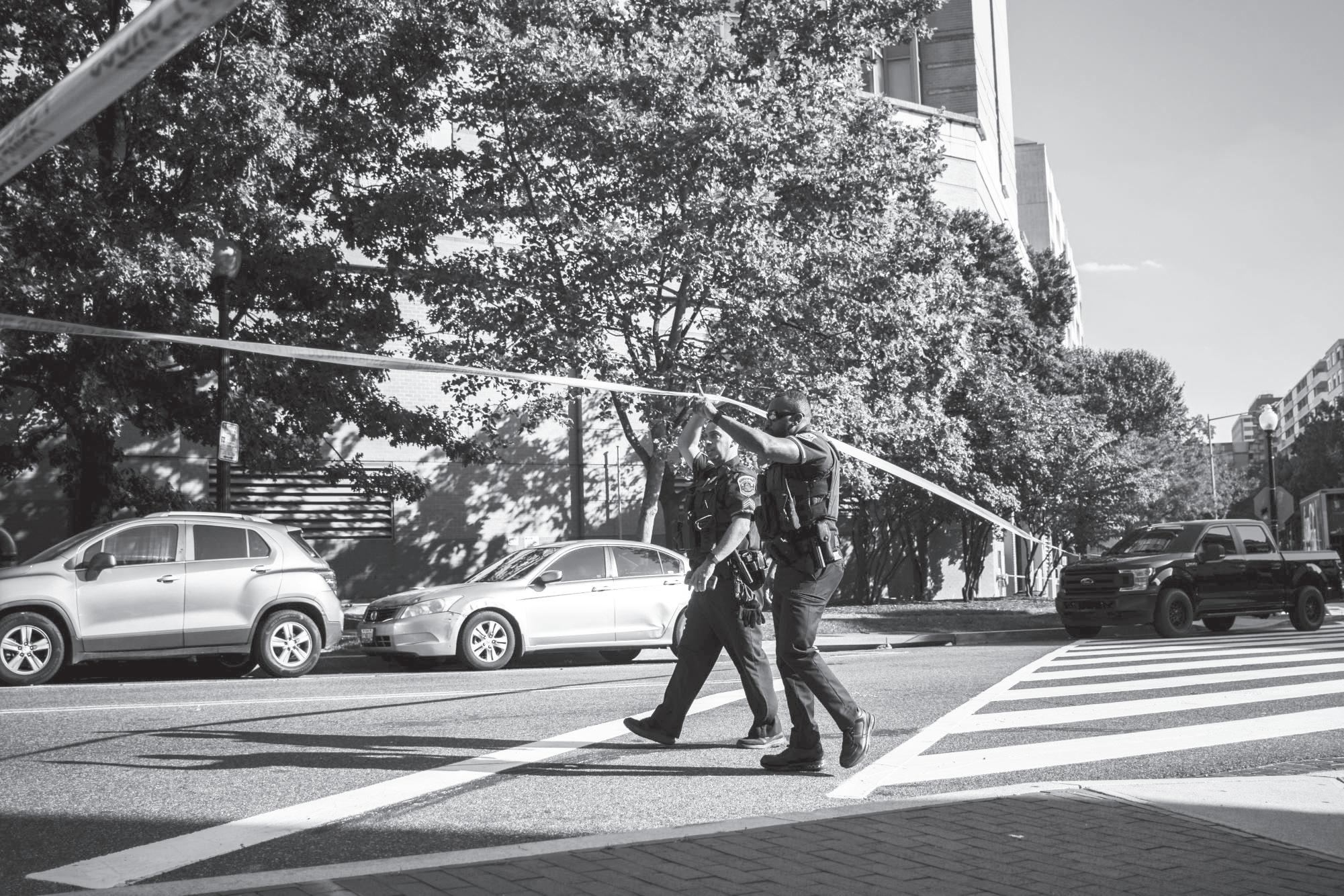
An adult man was found shot in Washington Circle early Sunday morning, according to a U.S. Park Police official.
U.S. Park Police Sergeant Twiname said police received a call at about 12:45 a.m. for an adult male suffering from a gunshot wound who was transported to a hospital for non-lifethreatening injuries. Twiname said he did not have information on the suspect.
A U.S. Park Police spokesperson said the agency is investigating the case but does not know if the individual was shot in Washington Circle.
University officials issued an alert at 1:16 a.m. for “urgent police activity,” telling community members to avoid the area. Officials issued an “all-clear” alert at 8:02 a.m.
NEWS THE GW HATCHET September 18, 2023 • Page 2 News THIS WEEK’S EVENTS AMERICAN GOVERNMENT IN THE 21ST CENTURY Tuesday, Sept. 19 | Noon | Elliott School of International Affairs Tune into an analysis of the latest polling concerning U.S. politics and democracy by political management professor Christopher Arterton and CEO of Stagwell Mark Penn. NORDIC FEMALE LEADERS: LESSONS FOR THE U.S. Thursday, Sept. 21 | 4 p.m. | Elliott School of International Affairs Join a discussion of the successes of female business leaders’ management practices and their transferability to U.S. industries.
THIS WEEK IN HISTORY Sept. 22, 1965
School of
theoretically close
racial
if
equally hire people of color and white
for positions with higher promotability.
Morris Pennington married Madison Hall residence counselor Rita Pennington and moved into the building, becoming the only man known to be residing in a women’s dormitory at the time.
COURTESY OF JAMES WADE
Business professor
James Wade said the NFL could
the
disparity gap among staff
they
coaches
CRISTINA STASSIS SENIOR STAFF WRITER
FILE PHOTO BY LILY SPEREDELOZZI | SENIOR STAFF PHOTOGRAPHER
Nine
GW faculty members said they are adjusting their teaching strategies and implementing the task force’s recommendations into their courses to help students struggling to adjust to college.
SNAPSHOT
JENNIFER IGBONOBA | STAFF PHOTOGRAPHER
The Organization of Latin American Students kicked off National Hispanic Heritage Month in Kogan Plaza on Saturday.
in Washington Circle
non-life-
Man found shot
with
threatening injuries
GWPD arming decision lacks community voice, staff councilmembers say
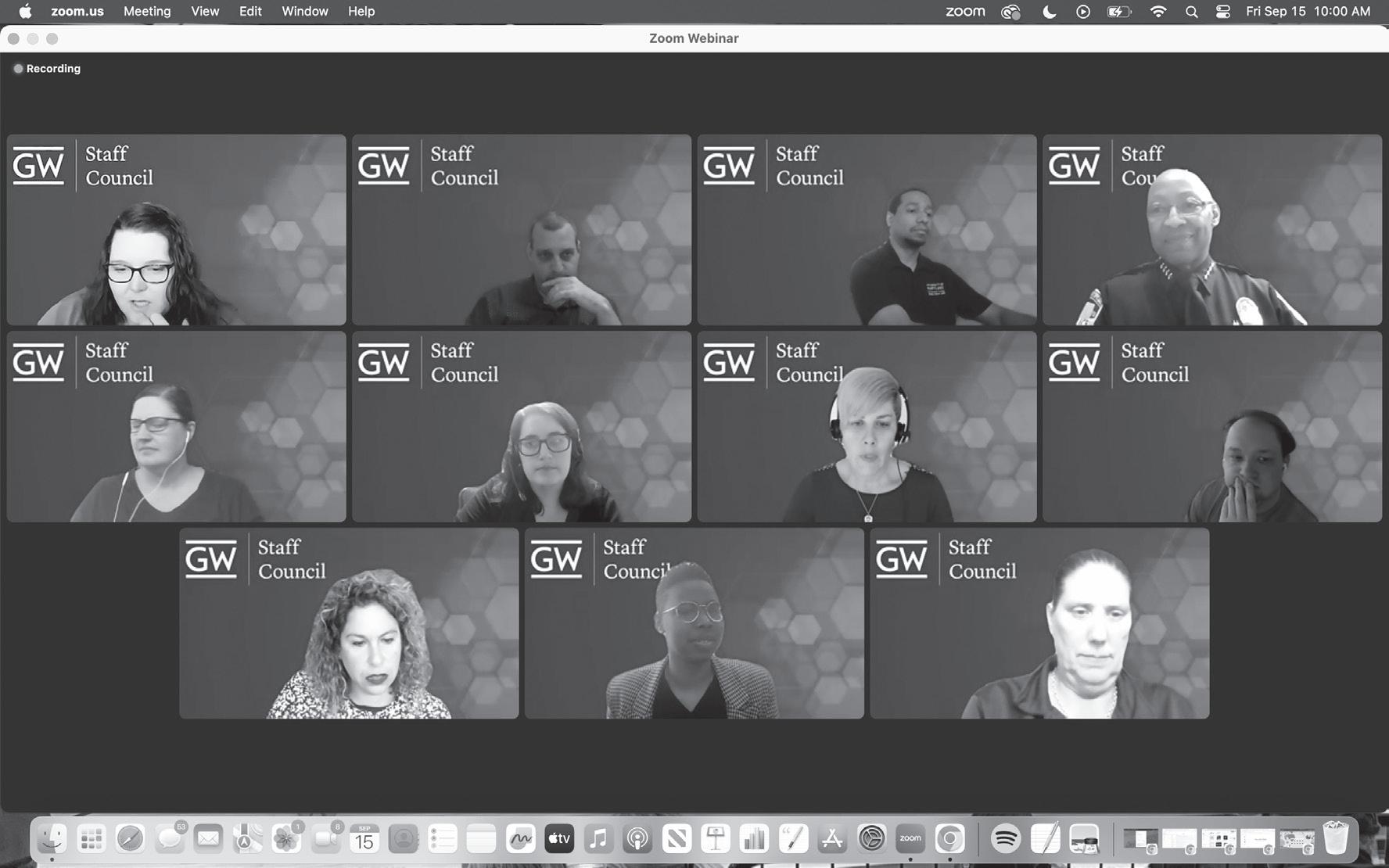
Staff councilmembers inquired about the lack of constituency involvement in the decision to arm GW Police Department at a Staff Council meeting Friday.
GWPD Chief James Tate, who delivered a presentation on the GWPD arming implementation plan at the meeting, said he will conduct several community engagement forums to make changes to the plan and is currently in the process of arming four lieutenants as phase two of the plan. Tate said armed GWPD supervisors receive de-escalation training once per month focused on lowering the “stress level” of disturbances before addressing the disturbance with force.
Tate also delivered the presentation at a Faculty Senate meeting this month and said officials received faculty feedback on phase one of the arming to clarify the department’s use of force policy, which outlines police conduct expectations in deescalation efforts and evidence bias training. He also delivered the presentation to the Student Association earlier this month, where he announced that arming GWPD officers will cost about $150,000. Tate said all officers are armed with “less lethal weapons” like pepper spray and batons. He said GWPD officers cannot respond to active shooter situations if they are unarmed.
“When the gunfire is happening, we should be responding to that with an effort to save lives, and so being unarmed we can’t respond to that,” Tate said at the meeting. Tate added that GWPD stationed a patrol car outside Ross Hall in response to community concerns about safety in the area.
“It is something that is top of
mind, and it’s something that we have to stay on top of,” Tate said at the meeting.
Michael Kern, a representative of GW Information Technology, said he appreciates the training GWPD officers receive but has noticed “a lot” of turnover in the department. He said the department could lose “familiarity” with the
GW community if it does not improve their staff retention.
“Training oftentimes is no match for experience,” Kern said.
Staff Council President Bridget Schwartz introduced SA President Arielle Geismar at the meeting.
Geismar said the SA added a gynecologist to the Student Health Center and is working on an app to cen-
tralize resources for students like information on student organizations and mental health resources.
“If there are opportunities that you all would like to work together, things that you’re working on that you think that we should be plugging into. I definitely love that,” Geismar said.
Councilmembers unanimously approved Jonathan Ragone, the executive director of student services, advising and records for the Office of Undergraduate Studies, as the new School of Engineering and Applied Sciences representative at the meeting.
Schwartz said University President Ellen Granberg invited her to be the Staff Council’s representative on the University Leadership Council. She added that she is working with Human Resources to have department leaders attend future Staff Council meetings.
Schwartz said that some council members will be serving on Faculty Senate standing committees: Sharon Testor, the enrollment and student success representative, will be on the Physical Facilities Committee; Parliamentarian Mindy Galván will be on the Appointment, Salary and Promotion Policies Committee; Heather Richards, a School of Medicine and Health Sciences representative, will be on the University and Urban Affairs Committee; and Tricia Greenstein, the Libraries and Academic Innovation and GW Museums representative, will be on the Libraries Committee.
Officials add breakfast meal time to Vern dining hall
HANNAH MARR ASSISTANT NEWS EDITOR
The dining hall on the Mount Vernon Campus is now offering breakfast after Vern residents advocated for better options for morning meals. The Eatery at Pelham Commons, the dining hall in the basement of West Hall, is now open Monday through Friday from 7:30 to 9 a.m. after it was previously closed for breakfast at the beginning of the school year. Vern residents said when Pelham was closed, they traveled to the Foggy Bottom campus for breakfast or ate at Buff & Brew — the Vern’s coffee shop on the meal plan — but desired more filling options closer to home.
SA Sen. Ethan Fitzgerald (CCAS-U) said he originally heard complaints in late August from first-year Vern residents about the lack of an on-campus breakfast option, which motivated him to give a public comment at the last SA meeting in late August. He said after the gathering, he spoke “briefly” to Dean of Students Colette Coleman about students’ concerns, and that
from there, she took action “pretty quickly.” Senators said SA Sen. Izzy Brophy (CCAS-U), Chair of the Special Committee on Dining, spearheaded this project, but Brophy did not return multiple requests for comment.
Fitzgerald, who lived on the Vern last year, said he believes food insecurity is an issue among Vern residents because they don’t have the option to go to nearby restaurants for breakfast, unlike Foggy Bottom residents, who live in close proximity to two dining halls and several restaurants.
“Just because they live on another campus, doesn’t mean that they shouldn’t have breakfast, especially because they have less options than we do on Foggy,” Fitzgerald said.
Fitzgerald said he believes the project is a “good example” of something that can get fixed quickly as long as students voice their concerns.
“If you elevate these concerns to someone, there can be action taken if you have a reasonable request,” Fitzgerald said. “If anyone has any in the future, make sure to raise them.”
Sophomore Keaton Dudley, who lived on the Vern last year, said although he enjoys Buff & Brew, it benefits students to have a dining option like Pelham that offers “heavier” and “more hearty” foods like sausage, eggs and potatoes.
“Whereas, at Buff & Brew, you can get a bagel or you can get a smoothie,” Dudley said. “It’s nice to have another option within the Vern.”
Connor Buscemi Nowka, a first year who lives in West Hall, said Pelham being closed for breakfast was “inconvenient.” He said he and many other students would revert to going to Buff & Brew for breakfast but said they are understaffed and don’t have many breakfast items.
He said he stopped at Buff & Brew one morning before class and staff members were so overwhelmed that they were asking students why they weren’t going to Pelham for breakfast.
“There were so many people there, they genuinely said why don’t you go to Pelham,” Buscemi Nowka said. “We were like, ‘Oh, we’re sorry, but it’s not open.’”
CLRE student workers to focus on community engagement, tackle conflicts
BROOKE FORGETTE STAFF WRITER
FIONA BORK ASSISTANT NEWS EDITOR
Campus Living and Residential Education officials added two paid student positions this year, focusing on conflict resolution and community building in residence halls.
Officials hired students for two new CLRE positions this fall — a community engagement adviser, or CEAd, who lives in first-year residence halls and a community engagement assistant, or CEA, who lives in upperclass residence halls — both of which develop programs and hold space for conflict resolution for residents. Kevin Stensberg, the assistant vice provost of student support and residential engagement, said the positions were part of a continued “evolution” of student residential services at GW.
The new roles will adopt some of the past responsibilities of community coordinators — full-time adult employees who are points of contact for each of the residence halls — like handling conflict between residents through weekly office hours. The roles will also include tasks of former programming assistants, a position that CLRE offered to students last year and discontinued to expand students’ responsibilities to support community coordinators, like planning monthly events for residents.
“We annually review our intentions, assess our impact,
benchmark with our peers doing similar work and engage in the global dialogue with our peers,” Stensberg said in an email.
Stensberg said CEAs are hourly paid student employees who support full-time community coordinators — staffers who live in residence halls and provide support to students in that residence hall — through programming, facilitating roommate agreements and mediating conversations between roommates.
He said CEAs receive training prior to the fall semester with guidance on how to resolve roommate conflicts and when to divert to the community coordinator. Student employees will receive continued training and support throughout the semester, Stensberg said.
“CEAs provide valuable peer-mentor insights for firstyear students,” Stensberg said in an email.
CEAds and CEAs work a minimum of 10 hours and a maximum of 15 per week and earn $17 an hour, according to the website. CEAds receive a $3,000 housing credit for the year.
The positions come after students in the resident adviser program said they struggled to support residents with the “complexity” of the responsibilities of the role. Officials canceled the program in February 2021 and transitioned all responsibilities to community coordinators thereafter.
Colton Nappier, a sophomore and CEA for 2109 F Street, was a programming assistant for CLRE last semester and said he was re-
sponsible for hosting two events, like movie nights and grab-and-go treats, per week, but now he is only expected to host one event per month and at least eight hours of office hours per week. He said CEAs came back to campus a week early in the fall for three eight-hour days of training where he learned where to direct students for particular problems including facilities, on-call administrators or the Title IX Office.
“I guess they felt like we weren’t really doing much in the roles, which is true,” Nappier said.
Joanna Perez, a junior and a CEA for The Dakota, said after working with CLRE last semester as a programming assistant, she thinks the new roles this year are more “structured.” She said she has a clearer understanding of her responsibilities with the pre-fall training and regular staff meetings, which they didn’t have last semester.
“I didn’t understand what was happening,” Perez said. “I would have to constantly be asking one of the CCs to keep on explaining it more for me, like I didn’t even know who was the second programming assistant.”
Abby Cain, a junior and a CEA for Munson Hall, said her roles include handling conflict between roommates and ensuring residents fill out the roommate agreement form, a “highly recommended” set of guidelines that roommates must agree upon, according to the Division for Student Affairs website.
“It’s just a way for us to be available in case someone needs anything, if there’s a
pressing issue that they say, ‘Hey, can I get your opinion on something?’ or, ‘What do you think I should do in this situation?’” Cain said. “We would find a quiet private space where we can talk.”
Cain said during training, she roleplayed potential scenarios of conflicts between roommates, like if a resident was upset by their roommate inviting their partner to their room during midterms, or roommates have differing sleep schedules.
“As CEAs, we are creating the opportunity for people to have those resources available to get to meet people more,” Cain said. Students said CEAs might be able to provide residents with better advice than a community coordinator since they are actively
experiencing or have experienced the same problems as residents, like roommate conflicts or facilities issues. However, they said they would be more likely to go to a community coordinator for a serious issue, like submitting a CARE report, because they think the community coordinator would be better equipped to find a solution.
Residents said they previously weren’t aware of the CEAs’ student-led office hours.
“They can just relate to us more and they’ve had more recent experiences, and I feel like you could connect to them more easily,” said Renata Macias, a first year majoring in interior architecture.
Gillian Shields, a sophomore majoring in computer
science, said she would not feel comfortable going to a student for major conflicts because she is worried about the possibility of the information finding its way back to her peers.
“I would rather go to an adult with really specific stuff because I’d be scared it would trace back to the social circles that I know if I talk to someone close to my age,” Shields said. “But I wouldn’t mind venting to someone my age about my roommate and get advice on how to solve problems like that.”
Eshan Reed, a sophomore majoring in computer science, said it would be beneficial to be able to go to students about conflicts that arise from activities that students could get in trouble for, like drinking.
NEWS September 18, 2023 • Page 3 THE GW HATCHET
IANNE SALVOSA NEWS EDITOR
send in the national guard to sweep foggy bottom with industrial pesticides imo
hemophiliac on 09/12/2023 TWEETED
knife-wielding
@NICKTAGLIAFERRO
IANNE SALVOSA | STAFF PHOTOGRAPHER
Staff councilmembers convened via Zoom on Friday to discuss the level of community engagement involved in the University’s decision to arm GW Police Department officers.
LEXI CRITCHETT | PHOTOGRAPHER
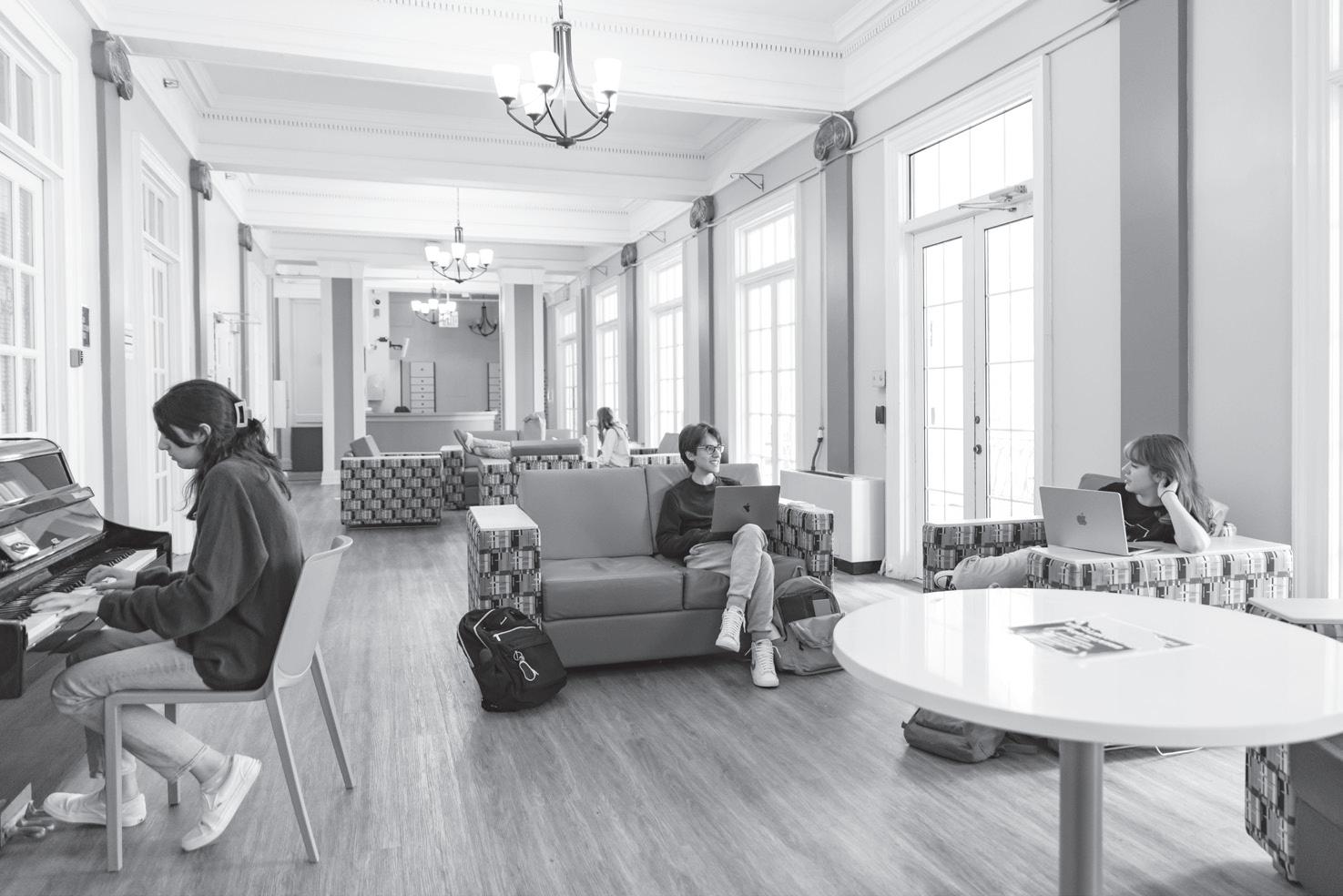
Students lounge in the Mitchell Hall lobby.
Residents vie for RHA hall council spots
Posters with your nextdoor neighbor’s headshot, self-promotional messages in your GroupMe and dressup debates in first-year residence halls: Welcome to the Residence Hall Association’s hall council elections.
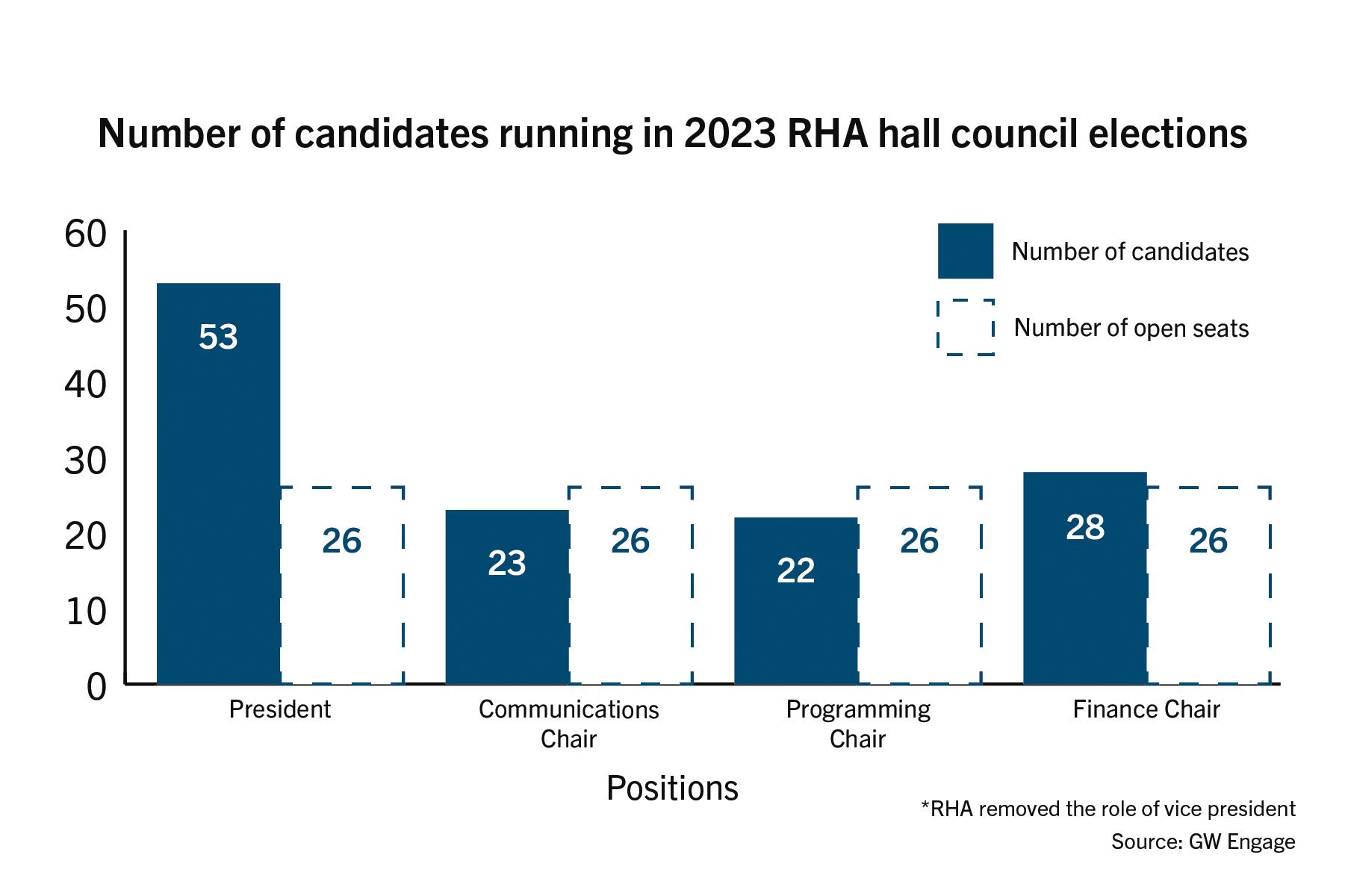
Last week, 126 students vied for 104 spots on their hall councils, a quasi-minigovernment under the umbrella of the RHA that oversees events and governance within each of GW’s 26 residence halls. The RHA will announce the election winners Monday. At least 34 races have no candidates this year, according to an email sent to residents Tuesday. Despite the expected vacancies, RHA President Vero Famadas said they are satisfied with the number of candidates running this year — 147 students ran for 130 seats last year — considering the changes the student organization made to councils, like removing the vice president role from
hall councils to limit redundancy in their work and allow each member to take a more active role.
“We’re really happy with the numbers because it’s on par with last year,” said Famadas.
Students are running to become hall council president, communications chair, programming chair and finance chair.
Famadas said the elected president of the hall council can nominate students to fill any vacant seats that do not garner write-in candidates. In elections where three or more candidates ran for a seat, students could rank candidates in order of preference.
“It’s still a great way to make sure people are involved,” Famadas said.
Famadas said the RHA was unable to hold its informational session for prospective candidates on the Foggy Bottom campus due to the shelter-in-place order last week, but RHA members have sent numerous emails and responded to questions
about campaigns over Instagram.
Famadas said upperclass students have shown “equal” enthusiasm for hall council positions as first-year counterparts this year — a departure from the norm, where first-year halls tend to show more enthusiasm. They said upperclass students have advocated for a broader sense of community in residence halls.
“There’s kind of a distance between neighbors,” Famadas said.
Clai Kastner, one of seven first-year students running to be the president of Somers Hall, said she has documented long lines of students waiting for the Vex, and she has to leave more than an hour before her class to make it on time. She said she hopes to advocate for the Mount Vernon Campus if elected president of Somers.
“My main motivation is just making sure that everyone feels heard and trying to push for improvements to live for people on the Vern,” Kastner said.
Granberg, sociologist celebrate research, community engagement at GW
CADE MCALLISTER EVENTS EDITOR
University President
Ellen Granberg discussed her sociology background at a celebration of the GW Department of Sociology Thursday.
Granberg, who earned a master’s and doctorate degree in sociology from Vanderbilt University and served as a professor of sociology at Clemson University from 2001 to 2018, said her previous research focused on the mental health of children and that accomplished faculty and dedicated
students, staff and alumni drive the University’s “robust” sociology department. Joya Misra, the incoming president of the American Sociological Association — a nonprofit organization dedicated to advancing sociology — delivered the keynote address at the event, which was hosted by the Department of Sociology at the Elliott School of International Affairs.
Granberg said much of her research concerned microsociology, the level of analysis in sociology based on faceto-face interactions. She
said she can be considered Misra’s “microsocial counterpart.”
“A lot of my focus over the years has been around the impact of microsocial phenomenon on the self image, the identity, the well-being and ultimately the mental health of all of us but particularly of children,” Granberg said. “And this was a very, very thrilling part of my career.”
Granberg said she is “inspired” by what the sociological discipline is capable of and that she is “excited” to see where the department can take
Kastner said about 40 people attended the debate in Somers Hall. “It was civil, the moderation went really well,” Kastner said. “There weren’t any problems between candidates, everyone performed well.”
it. Misra is a professor of sociology and public policy at the University of Massachusetts, Amherst. The ASA — whose first president, Lester Ward, was a GW alum — elected Misra to head their association in June 2022. Misra said GW’s sociology department is “small but mighty” in its impact on students and diversity as a whole. She said she aimed to inspire the audience about the potential of sociology and universities to “do good in the world” through her address.
More than 50 students crammed into the basement of Potomac House to attend its hall council presidential debate.
Kastner said that had the RHA kept the vice presidential role in hall councils, she likely would have run for
that position instead. She said the removal of the vice presidential role may have resulted in crowded presidential races.
Forty-two percent of the total candidates are running for president of their hall council.
Travel funding cuts threaten research: faculty
From Page 1
Wahlbeck said he and CCAS leadership have discussed funding challenges “repeatedly” with department chairs and program directors and that they will share updates when additional information is available. He added that in past fiscal years, CCAS was able to provide faculty with more research support as their “financial picture came into focus.”
“We understand the importance of faculty travel in advancing scholarship, research and the broader University mission, and we remain committed to finding additional ways to support faculty in this regard,” Wahlbeck said.
From Page 1
Trachtenberg embarked on a yearlong international tour at the end of his term in 2006 to say goodbye to alumni, gather ideas for the University’s future and collect financial contributions from donors in cities like Boston, San Diego and London. Trachtenberg also visited the Middle East and China during his term to cultivate relationships with university leaders around the world, recruit international students and fundraise. Knapp traveled internationally in 2017 to Mexico City and the Middle East to gather donations toward the University’s $1 billion fundraising campaign during his term.
Urch said he hopes that Granberg’s visit to Los Angeles will draw her attention to the prospective students in California who are interested in East Coast universities. He added that he hopes the Office of Undergraduate Admissions will put “more effort” into recruiting students and athletes from California because acceptance rates for West Coast universities, like the University of California-Los Angeles, are decreasing, and students are looking to attend out-of-state schools.
In 2022, 767 undergraduate students from California attended GW
— the fourth most common state of origin for undergraduate students behind New York, Virginia and New Jersey, according to GW’s enrollment dashboard.
He said uniting alumni at events like GW Together increases the chances of them donating to the University because reconnecting with their peers brings back “positive” memories of their time at GW. He added that alumni donations benefit GW’s prestige because university rankings like U.S. News & World Re-
Officials mum on pandemic preparations
From Page 1
Officials will continue to monitor “federal and local guidance, research and data and the incidence of COVID-19 on our campuses,” to best support community members’ health and safety, according to GW’s COVID-19 guidance. University spokesperson Julia Metjian did not specify how officials will track cases on campus after discontinuing contact tracing last spring.
Metjian added that
GW community members should follow the CDC’s COVID guidance for isolation, testing, masking, vaccination and symptom monitoring — especially after testing positive — but did not specify how officials will ensure students have access to tests after ending campus testing services. Metjian also declined to say what officials learned from the pandemic and how they will apply what they learned in the future. Of GW and its 12 peer schools, only three — GW, New York and
port take the percentage of alumni donors into account in their scores.
Urch said he hopes Granberg will have a long tenure at GW because of her “excellent credentials.” He said former University presidents like LeBlanc, who served for four years, did not have as long a tenure compared to past university presidents like Trachtenberg, who served for 19 years, and alumni were “disappointed” that their short tenure contributed to discontinuity in the University’s priorities.
Wake Forest universities — do not offer any type of on-campus COVID testing.
Five peer schools offer symptomatic PCR tests by appointment through their university health services. The Universities of Rochester and Southern California and Syracuse and Georgetown University offer free at-home test kits on their campuses.
Like GW, 11 of 12 peer schools do not require students to be vaccinated against COVID. The University of Pittsburgh is the only of GW’s peer schools to still require vaccination.
Faculty senators raised concerns about cutting CCAS academic travel funds for tenured faculty in a Faculty Senate meeting last week. In the meeting, Provost Chris Bracey said he is working to “identify additional funds” in his office to cover faculty’s academic travel expenses and that the deans of individual colleges made the decision to cut funding.
Bracey said faculty’s research was an essential part of GW being able to join the American Association of Universities, a prestigious national research organization, in June.
“It disturbs me to see that faculty are not able to do the research, or that graduate students are unable to support the research that has gotten us to the point where we’ve been invited to the AAU,” Bracey said during the meeting.
Faculty said they often use their travel reimbursements to attend academic conferences, which provide spaces for faculty to collaborate and communicate with other members of their field on research and curricula.
Katrin Schultheiss, an associate professor of history and a faculty senator,
said she first heard about the budget cut from her department chair when officials were finalizing the budget last spring. Schultheiss said in the past, faculty in the history department were able to request reimbursements for scholarly travel and would receive a partial or full refund depending on the amount of funding the department had at the time.
Schultheiss said she finds it “ironic” that officials restricted tenured faculty’s academic travel reimbursements the same year that GW joined the AAU because the decision “cut back” on faculty’s ability to interact with other scholars.
“It really needs to be restored by next year because travel to academic conferences and other kinds of academic scholarly travel are just essential to the research mission of the University,” Schultheiss said.
Joe Cordes, a professor of economics and a faculty senator, said the Office of the Provost asked colleges and GW administration to make budget cuts as a result of enrollment numbers being lower than projected for Fiscal Year 2023 and expenses being higher than projected. Cordes said GW will update and present its budget to professors at the October Faculty Senate meeting.
“I don’t think that’s a forever thing,” Cordes said. “I absolutely think the University will get a handle on it, and also the University overall is in perfectly fine financial shape.”
David Rain, an associate professor of geography and international affairs and a faculty senator, said individual colleges make payments to the Office of the Provost in order to help pay for University-wide costs. Rain said in recent years, the Office of the Provost has asked for larger amounts from colleges to cover these growing expenses, which has led to budget cuts within individual colleges.
NEWS THE GW HATCHET September 18, 2023 • Page 4
ERIKA FILTER NEWS EDITOR
Alumni leaders await Granberg’s arrival, encourage open conversation to shape GW’s future
AN NGO | GRAPHICS EDITOR AN NGO | GRAPHICS EDITOR AN NGO | GRAPHICS EDITOR
None of your ‘Fizz’ness: Anonymous users dish on new college social media app
AYAH MAHANA REPORTER JENNIFER IGBONOBA CONTRIBUTING NEWS EDITOR
Students are buzzing about an anonymous college-based social media app after similar apps lost popularity among users. Fizz allows students to anonymously post memes, GIFs and funny messages with their peers, requiring users to verify their account through their school email. Fizz users said the app has the potential to surpass the lifespans of comparable apps, like Jeti and Yik Yak, because of its competitive nature and community building through comedy.
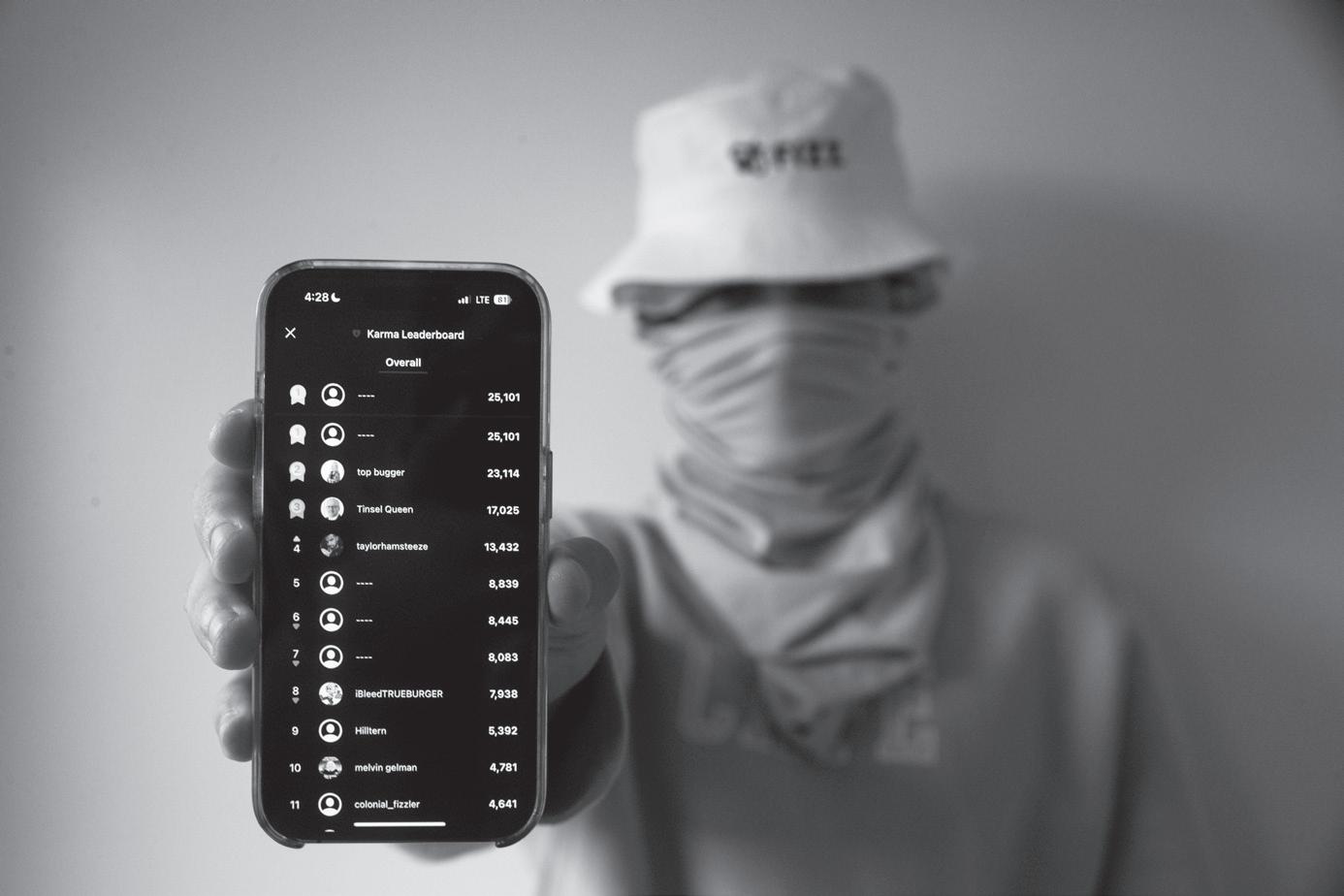
After opening the app, users are first greeted with three categories of posts: “New,” “Fizzin,” or trending posts, and “Top,” which displays the posts with the most upvotes. Users — which the app labels as anonymous unless the individual chooses a pseudonym to post under — can share content under 200 characters and include pre-uploaded memes and gifs as well as media from their camera roll in their posts. Users are also able to categorize their posts with handles like “Question” or “Crush.”
A junior who posts under the screen name
“Tinsel Queen” said as a first-year she used Jeti, an app based on location rather than school affiliation, and Yik Yak, which includes college-based and niche communities for all users to join. But she said the apps’ popularity fizzled away among students because they didn’t have the same “sense of community” as Fizz.
Tinsel Queen said the Fizz interface — specifically its ranking systems of top users and posts — filters the most popular content from less funny posts. She added that some content on former apps had “no structure”
and included sex-related spam. “What sets Fizz apart is partially that they pull out the funniest content from the day into the Fizzin’ category,” she said. “So that way you can see things that are funny and engaging versus Yik Yak and Jeti you might have to scroll through a lot of not-sogood content to get to the funny stuff.” She said the app’s use of upvotes encourages users to make content they believe others will like and makes the app more competitive than its predecessors.
“It’s how good jokes
Former Supreme Court justice talks Senate work, political division
Former Supreme Court Justice Stephen Breyer spoke about his experience working for Sen. Edward “Ted” Kennedy (D-MA) and navigating political division in Lisner Auditorium on Thursday.
are made,” Tinsel Queen said. “The best posts on Fizz get over 1,000 upvotes so even if it is inauthentic, it’s definitely engaging for the people.”
Tinsel Queen said she sees the app staying active until at least throughout the school year, given its count of more than 2,000 users. She said when news happens on campus, people talk about it on Fizz, including people who are less engaged on the app. She added that the app’s longevity depends on Fizz’s marketing team and how much they engage with the upcoming class of first-years.
Officials quadruple stock of contraceptives to prepare for vending machine sellout
From Page 1
GW RAGE co-President Maddy
Niziolek said the process to restock the vending machines with morning-after contraceptive pills takes “longer” than other products like tampons, condoms and pregnancy tests because GW must purchase contraceptives from an external company, which Canteen then buys and stocks. She said the University bought 200 doses of morning-after contraceptive pills for the restock as a preemptive measure.
Niziolek said students bought more doses in the first week and a half after the new vending machines’ installation than all of last semester from the first vending machine in the student center, likely because the machines are located in buildings open 24/7 and the contraceptives’ subsidized price.
“We didn’t know that it would be as much more popular as the other vending machines consider-
ing that it did sell so many doses so quickly,” Niziolek said. “We’re super excited that students are using it and are finding it more accessible.”
Niziolek said the restocking process will be “smoother” as the University becomes more adept with the procedure of ordering the morning-after pills and guaranteeing the machine is sufficiently stocked.
“We weren’t monitoring the supply after just a week because the vending machine company will be stocking other products pretty often, so they kind of assumed they would notice that it was going down,” Niziolek said. “Going forward, they’ll be able to notice that the supply is coming down and they need to order it ahead.”
Student Association President Arielle Geismar said she is committed to working with GW RAGE to keep the project funded and the machines stocked. Geismar allocated $1,000 of her executive bud-
get toward subsidizing the project in late August and said if her subsidization were to run out during this school year, she would help GW RAGE find funding elsewhere, like through the co-sponsorship fund, a supplemental funding pool that organizations can request from after the general allocations cycle.
“If worse comes to worst, I’m not letting this project go unfunded,” Geismar said. “This is going to continue, if I have to devote more money from my own budget, then I will.”
Sophomore Amanda Reed said the only reason her friends have used the new machines is to purchase contraceptives. She said restocking the morning-after pill in the machines is “necessary” because students are showing a high demand for the contraceptives and because vending machines allow students to buy the pills without interacting with another person to obtain it.
In his conversation with attorney Kenneth Feinberg, another former staffer for Kennedy, Breyer said his interest in the Kennedy family motivated him to leave his job as a Harvard Law professor to become a senate staffer. The event, hosted by GW Law and Associate Dean for Public Interest and Public Service Alan Morrison, was the third installment of a five-part series charting the path of Breyer’s career. “Our generation is the Kennedy generation,” Breyer said. “Every one of us knows where he was when Jack Kennedy was assassinated.”
Breyer said Kennedy hired him because of his extensive knowledge on the topic of airline deregulation and administrative law, which he had amassed during his time at Harvard. Breyer’s work on Kennedy’s staff contributed to disseminating the evidence that led to the abolishment of the Civil Aeronautics Board, a federal agency that regulated aviation services, making airtravel more financially accessible, according to Airlines for America.
Breyer said this achievement only came because he focused on a single issue rather than several.
“You start to accomplish something, I don’t care what it is, it’s gonna work for people and make them better off,” Breyer said. “And if you focus on one thing, and really understand the subject, you’re more likely to get somewhere.”
Breyer added that staying quiet in conversation was the key to his and Kennedy’s legislative success.
“Don’t do all the talk,” Breyer said. “You just say what you think and get them to talk as much as they will, and if they talk enough, you will find that sooner or later, they’ll say something you really agree with. And as soon as they say something you actually agree with you on this issue, you say ‘That’s pretty good, let’s see if we can work with you.’”
Breyer, who reprised his professorship at Harvard Law School in July 2022, said he encourages his students today to “listen” and work to come to a compromise, in a fashion similar to the Senate. He said the strategy is a “fairly good way of proceeding” in debate.

Breyer said Kennedy believed Republicans and Democrats are alike because they both want to help people. He said the divide between the parties should only go as far as political debate.
“Politics is one thing, and human relations is another,” Breyer said.

Breyer said a career in public service is worthwhile work and that he was never bothered by the low-paying jobs he worked for much of his career. He said working in his field of law is about the desire to help people, rather than financial reward.
“Everybody has a heart but not everybody has that determination to get through law school, and you have both,” Breyer said. “And when you have both, put those two things together, it’s a wonderful career.”
Breyer said the parties “have to work together” regardless of increased political polarization in the United States.
“We’re going to try to have a world where there is basic human rights protection, a rule of law, some free trade and working together with other countries,” Breyer said. “By doing that, we will create a world that is more desirable. That’s what we want.”
Students, community members gather to show solidarity for Iranian women
SHA) Act, which will impose further sanctions on regime figures including Supreme Leader Ali Khamenei and President Ebrahaim Raisi. She said she hopes more protests result in increased reforms.
Protesters gathered to demonstrate support for women’s rights in Iran and to remember the death of Mahsa Amini at Lafayette Park Saturday.
Nearly 300 protestors, including GW students, marched down 17th Street to protest the Iranian government’s repression of women’s rights and speech on the anniversary of the death of Mahsa Amini, an Iranian feminist activist. Students said they attended the demonstration, organized by the National Solidarity Group of Iran, to show support for Iranian women and urge action from the American public and government.
The event featured 10 speakers from various Iranian human rights advocacy backgrounds, including some who had spent time in Iranian prisons for their work. Demonstrators and speakers chanted slogans in support of the women’s rights movement, like “Women, Life, Freedom,” and in opposition to the Islamic Republic of Iran, including “Death to the Islamic Republic” — many waving the historic lion and sun flag of Iran, a symbol of opposition to the regime. Mahsa Amini was an IranianKurdish woman who was hospitalized and later died in Tehran after members of Iran’s religious morality police allegedly fatally beat Amini for not wearing a hijab, or religious headscarf, in public. Her death sparked an ongoing
movement in Iran for women’s rights, secularism and freedom of speech under the slogan “Woman, Life, Freedom.”
Sophomore Sophie Mansuri, a GW student studying journalism and mass communication, said she felt obligated to speak up for women in Iran through protesting. She also said she felt a “personal” connection to the issue because her whole family was exiled from Iran during the 1979 revolution and because she is similar in age to Amini.
“We’re not going to sit down or be quiet — we have the right here in the U.S. to speak up, protest and make some kind of change,” Mansuri said. “It’s a very personal cause for me, it is very emotional, especially since Masha Amini was twenty-two when she was killed and I am almost twenty.”
Sophomore Persia Zurita, a GW student studying international affairs, said she protested to demonstrate that GW and the wider D.C. community “stand with” the women of Iran. She said
Iranians need to know that human rights reform is possible.
“It’s really important that D.C. shows solidarity with the women of Iran,” Zurita said. “We’re all here to show to everyone in Iran that freedom can be attainable and we will do our best to make it attainable.”
Zurita also said repeated demonstrations in the U.S. over the past year have pressured the House of Representatives to pass the Mahsa Amini Human Rights and Security Accountability (MA-
“Because of these demonstrations we have had some response from Congress: the MASHA Act just passed the House this last week and we are hoping to get the Senate to pay attention to our voices,” Zuria said. “People in Iran should not be killed for trying to get basic rights.”
Rana Mansour, an IranianAmerican musician and a speaker at the demonstration, said increased cooperation and unity within the opposition is needed to push for change. She said “division” within the opposition has strengthened the regime and its longevity in the past.
“The only way the Islamic Republic has stayed in power for 44 years is to oppress and rule, to divide and rule,” Mansour said. “As long as we continue to be divided and they are united, they will stay in power.”
Aundia MehrRostami, an Iranian-American demonstrator, said she was protesting for the women of Iran but also for her family, including her father, who protested against the Iranian Revolution that established the current regime. She also said advancing women’s rights in Iran promotes human rights across the globe.
“This fight is an ongoing fight for the liberation of the Iranian people,” MehrRostami said. “We will not let Mahsa or any of the martyrs die in vain.”
NEWS THE GW HATCHET September 18, 2023 • Page 5
EASTON CROMER REPORTER NICOLAS CAMARGO REPORTER
JENNIFER IGBONOBA | STAFF PHOTOGRAPHER
Protesters at Lafayette Park on Saturday waved the historic lion and sun flag of Iran, a symbol of opposition to the Iranian regime.
SAGE RUSSELL | ASSISTANT PHOTO EDITOR
Fizz allows students to anonymously post memes, GIFs and funny messages with their peers.
AYAH MAHANA REPORTER
LEXI CRITCHETT | PHOTOGRAPHER Former Supreme Court Justice Stephen Breyer unpacked his time working for Sen. Edward “Ted” Kennedy (D-MA) during a discussion in Lisner Auditorium on Thursday.
Opinions
WHAT THE UNIVERSITY WON’T TALK ABOUT THIS WEEK
How officials will monitor for new COVID cases on campus p.
FROM GWHATCHET.COM/OPINIONS
“For a school that makes a point of including land acknowledgments on most syllabi, actual Native students are bizarrely underrepresented and ignored.”
—NOAH EDELMAN on 09/11/2023
What GW can learn from its shelter-in-place order
Three words — “shelter in place” — plunged Foggy Bottom not into crisis but confusion on Sept. 6. By email, over the phone and on social media, initial reports about a “dangerous individual” near campus gave way to urgent alerts and an hourslong, campuswide lockdown. Nearly two weeks later, there’s a lot the University can learn from its emergency response.
First, it’s worth noting that the alerts GW issued as the situation unfolded were as specific as they could have been. But communication in the moment is only one part of any institution’s response to a dangerous situation. If we view the shelter-in-place order as a stress test for future incidents, it’s clear the University needs to prepare more for the future and not just react if — or when — something happens.
There are three areas officials ought to review. First, how does GW define a “shelterin-place” order? Second, how does it share that information with students, faculty and staff? And third, how does it maintain the physical infrastructure to enforce such an order?
The University outlines its “shelter-inplace” procedure in its emergency response handbook: “Seek shelter indoors … avoid falling hazards … take cover against an interior wall.” That’s good advice for an earthquake or tornado but not as applicable in the event of a dangerous individual. Here’s another definition, also from GW: “Take immediate shelter indoors and isolate yourself away from the threat.”
So, which is it? Stay where you are or try to move somewhere safer? We faced a potentially dangerous individual, not a
tornado. Officials’ guidance is confusing at best and contradictory at worst. Part of the problem is that the University and the Metropolitan Police Department might not define “shelter in place” the same way or have a shared understanding of what incidents should trigger such an order — a shooting investigation near Washington Circle early Sunday morning prompted alerts from both MPD and GW to avoid the area, but not to shelter in place. This isn’t just semantics. If worse comes to worst, knowing what to do in an emer-
Why sexism is to blame for today’s teacher shortage
Ticonderoga No. 2 pencils, Lunchables, crying over math homework at the dining room table — it wasn’t so long ago that we left these things behind. We may have graduated, but the K-12 teachers who guided us to the ceremony still lack the respect their work deserves.
Katarina Engst Opinions Writer
The nation’s public education system is facing a crisis: Our apple-loving, knowledge-espousing teachers are overworked, underappreciated and underpaid. An educator shortage has been brewing in the United States for more than a decade — something the pandemic and a long history of sexism directed toward the profession have only exacerbated. At least 300,000 public school teachers and staff members left their jobs between February 2020 and May 2022. To make matters worse, fewer people are entering the field: Each year since 2017 has seen more education job openings than hires, and the gap is widening. As a result, the remaining teachers face poor and worsening conditions, and the roughly 49 million students enrolled in public schools in the United States bear the consequences of disrupted learning.
The root cause of this emergency is sexism. Since the mid-19th century, teaching has been inextricably associated with women and thus undervalued by American society.
Horace Mann, the “father of the Common School,” wrote, “natural sympathy, sagacity, [and] maternal instincts preeminently qualify her for this sphere of noble usefulness.” This rhetoric,
from 1843, ties women’s abilities as educators to motherhood, regurgitating stereotypes that question their professional competence. Echoes of this discourse are still prevalent today. Ever heard anyone refer to teachers as “glorified babysitters?”
Teaching was regarded as a lowly profession at its conception. It was transient — instruction usually only occurred for several months of the year — as well as informal and maledominated. As the country industrialized, schools unable to pay the increasing costs of retaining male teachers enlisted women into the profession out of necessity. Female teachers were paid about half as much as male teachers, and male principals were employed to handle the disciplinary problems that women were deemed ill suited to take on.
We are not so far removed from this past: Women dominated the education field by the 1900s, and they still dominate the education field despite being underrepresented in administrative roles today. In the 2020-21 school year, 77 percent of public school teachers were women, while women accounted for only 56 percent of public school principals.
Moreover, 89 percent of public elementary school teachers were female — compared to 64 percent at the secondary education level. Some 179 years after Mann, these figures indicate little has changed in society’s view of women as caretakers best suited for tending to young children.
It is no coincidence that the field is dominated by women and not adequately credited for its role in society.
As a woman studying political science, I am often asked every humanities student’s favorite question: “What will you do with your
degree? Become a teacher?”
The immediacy of my “No” flies out as if I were asked if I wanted to turn my summer job at an ice cream shop into a full-time career. Somewhere along the way, society conditioned me to view teaching as a “fallback” option, something beneath me that I should avoid taking up unless I had to.
But honestly, I think I would enjoy teaching. It has nothing to do with some innate calling to care for kids and all to do with my own love of learning and appreciation of the public school system. Teaching is an incredibly difficult profession with the ability to transform lives. The shortage of educators is not only alarming but also cause for introspection — our society undervalues teachers’ work because of its association with femininity. We can’t blame people for leaving the profession, but we can recognize our society’s sexist condescension of the work they do.
The most impactful people in my life have undoubtedly been my teachers, whom I have immense admiration for. I’ve had the privilege of learning from talented educators throughout my K-12 public school education, and I can confidently say that I would not be the person I am today without their relentless support.
My teachers have been mentors, friends and the biggest inspirations in my life. They fed my curiosity, developed my interests and armed me with the tools I use in everyday life. The sexism inherent in their job is not something my teachers should have faced, and it’s not something I or anyone else who decides to enter the field should face, either.
—Katarina Engst, a junior majoring in political science, is an opinions writer.
gency is a matter of life and death. Officials should take a page out of American University’s book, which distinguishes between a “shelter-in-place” order for weather-related incidents and a “campus lockdown” for when an active danger threatens the area. Whatever language officials decide on, every member of the University community needs a clear, concise emergency response: What’s going on, and how should we respond to it? In the flurry of alerts GW sent out that day, there wasn’t much guidance beyond exercising caution if you decided to
go outside — a message that left some students and faculty wondering if they really needed to shelter in place. When GW sends out an alert about an ongoing incident, there should be explicit instructions on what students, faculty, staff and other visitors to campus need to do.
Whether critical information and instructions reach their audience in an emergency is make or break. Don’t leave it up to the day. Students, staff and faculty need some degree of training or at least information about what they’re supposed to do in a variety of situations. To be clear, this needn’t mirror something like “active shooter training,” which imitates actual acts of gun violence. But whether through online modules or in-person events, GW can acknowledge the potential scenarios our campus faces and explain the best ways to address each of them.
Locking buildings and enforcing tap access seems like the best course of action in the case of a potential intruder, and that’s exactly what officials did. But tap access relies on the hundreds, if not thousands, of doors in residence halls, common spaces and academic buildings across campus being able to close and lock. As simple as it seems, that’s not something we can take for granted.
Much of what makes GW so attractive to those of us who call it home, like its open campus and proximity to national landmarks, also leaves it vulnerable. But by no means is the University or the Foggy Bottom area especially dangerous. Don’t be afraid of what might happen, but do be aware of what could occur — and how to respond to it.
Pregnant students deserve GW’s support
My body, my choice” is the rallying cry of advocates who argue that greater abortion access is necessary to uphold the right to privacy, autonomy and the freedom to make appropriate health decisions. But does that freedom extend to the choice of giving birth?
Megan Clancy Guest Contributor
Pregnant students have a myriad of options at their disposal — terminating their pregnancy is only one of them. But it seems to be a foregone conclusion at GW that the student will choose to do so. This should not be the case. Students deserve to have all their options acknowledged and provided for. Otherwise, they just have the illusion of choice.
GW’s policies and its broader campus culture support the assumption that students will inevitably choose abortion. GW provides the bare minimum for pregnant and parenting students: accommodations through the Title IX Office and D.C.-mandated lactation rooms. A student can receive a pregnancy test from the Student Health Center, and from there the only next step is a referral for “pregnancy care or termination.”
This lack of forthright support for pregnant and parenting students is coupled with the widespread provision of contraceptives. The SHC advertises an encyclopedic list of contraceptives available to students, and the Student Association now subsidizes several 24/7 Plan B vending machines on campus. These policies and provisions stigmatize pregnancy in a way that communicates that students should avoid it at all costs.
Our campus culture
Paige Baratta editorials assistant* Auden Yurman, senior photo editor Florence Shen, assistant photo editor –features Sage Russell, assistant photo editor news Jordan Tovin, assistant photo editor –culture Sandra Koretz, sports editor Ben Spitalny, contributing sports editor Nick Perkins, culture editor Jenna Baer, contributing culture editor* Nicholas Aguirre Zafiro, video editor Ava Thompson, assistant video editor Charlie Mark, assistant video editor Cristina Stassis, copy chief Faith Wardwell, publishing assistant Shea Carlberg, senior copy editor Lindsay Larson, assistant copy editor Anna Fattizzo, research assistant
exacerbates this by celebrating abortion under the guise of “choice.” The Plan B vending machines were secured in part through appeals to the student body. Student leaders from a wide range of GW clubs and organizations mobilized to protest the Supreme Court’s decision to overturn Roe v. Wade, and many petitioned GW to remove Supreme Court Justice Clarence Thomas from the faculty because of his opinion in the case. Just look around campus and you will see dozens of posters proclaiming, “We love abortion providers and patients.”
But this celebration of abortion and cry for everincreased access to it are not matched by appeals for GW to provide for students who may want to consider options besides abortion. Policies and rhetoric that are pro-abortion and antipregnancy discourage students from becoming parents and communicate to newly pregnant students that abortion is their only real option. They also exclude prospective students who are already parents.
GW’s shortcomings are further illuminated in comparison to other universities, like Georgetown University. Georgetown has a staff member whose specific role is to support these students and connect them with resources, including a childcare center on campus.
Georgetown’s commitment to helping student parents complete their education filters through to their student body — a student group on campus works to provide free babysitting services and baby care supplies.
These vital measures create a culture of support for current and potential student parents and make securing their degree
social media director* Anaya Bhatt, contributing social media director* Max Gaffin, contributing social media director * denotes member of editorial board Business Office Eddie Herzig, business manager
while parenting a tangible reality. They also allow students with an unplanned pregnancy to freely consider options besides abortion. Whether that student decides to personally parent the child or defer to another parenting option, each student needs real support both during and after pregnancy. If GW does not publicly acknowledge and substantially provide for those many options, then the decisions to have or raise a child are not truly viable. These students deserve a University that has made a place for them and is ready to support them during the entirety of their time at GW. A culture of support, comprehensive policies and practical resources would truly give students the freedom to choose — not a false dichotomy of choosing between their education and their child.
Without help from their University, student parents must try to balance classes, work and childcare on their own, often causing them to drop out. This trend disproportionately affects students of color, who are significantly more likely to be unable to complete their degrees due to parenting obligations and have higher rates of student debt.
Any student who receives a positive pregnancy test deserves to know that GW is ready to provide support no matter what decision they make. In the absence of comprehensive policies and the unequivocal communication of love and support to pregnant students, abortion remains the only choice that is viable. Our campus’ commitment to freedom of choice must extend to every choice, not just the termination of pregnancy. If not, there really is no choice at all.
—Megan Clancy is a junior majoring in philosophy.
STAFF EDITORIAL OPINIONS THE GW HATCHET September 18, 2023 • Page 6
FILE PHOTO BY TAYTUM WYMER | PHOTOGRAPHER
eic@gwhatchet.com news@gwhatchet.com opinions@gwhatchet.com photo@gwhatchet.com sports@gwhatchet.com culture@gwhatchet.com copy@gwhatchet.com multimedia@gwhatchet.com 609 21st St. NW Washington, D.C. 20052 gwhatchet.com | @gwhatchet Submissions — Deadlines for submissions are Friday 5 p.m. for Monday issues. They must include the author’s name, title, year in school and phone number. The GW Hatchet does not guarantee publication and reserves the right to edit all submissions for space, grammar and clarity. Submit to opinions@gwhatchet.com Policy Statement — The GW Hatchet is produced by Hatchet Publications Inc., an independent, non-profit corporation. All comments should be addressed to the Board of Directors, which has sole authority for the content of this publication. Opinions expressed in signed columns are those of the authors and do not necessarily reflect the view of The GW Hatchet. All content of The GW Hatchet is copyrighted and may not be reproduced without written authorization from the editor in chief. Cost — Single copies free. Additional copies available for purchase upon request. Zach Blackburn, editor in chief Hatchet The GW Nick Pasion, managing editor Jaden DiMauro, managing editor Grace Miller, managing director Nicholas Anastacio, community relations director Grace Chinowsky, senior news editor Erika Filter, news editor Ianne Salvosa, news editor Fiona Bork, assistant news editor Fiona Riley, assistant news editor Hannah Marr, assistant news editor Rory Quealy, assistant news editor Jennifer Igbonoba, contributing news editor Max Porter, contributing news editor Rachel Moon, contributing news editor Nikki Ghaemi, features editor Cade McAllister, events editor Ethan Benn opinions editor* Riley Goodfellow, contributing opinions editor* Brooke Forgette, research assistant Dylan Ebs, research assistant Annie O’Brien, podcast host – culture Lizzie Jensen, podcast host – news Isabella MacKinnon, design editor Maura Kelly-Yuoh, contributing design editor An Ngo, graphics editor Ishani Chettri, web developer Peyton Rollins, contributing web developer Ethan Valliath,
1
Strategic Crisis Simulations group puts students in center of war
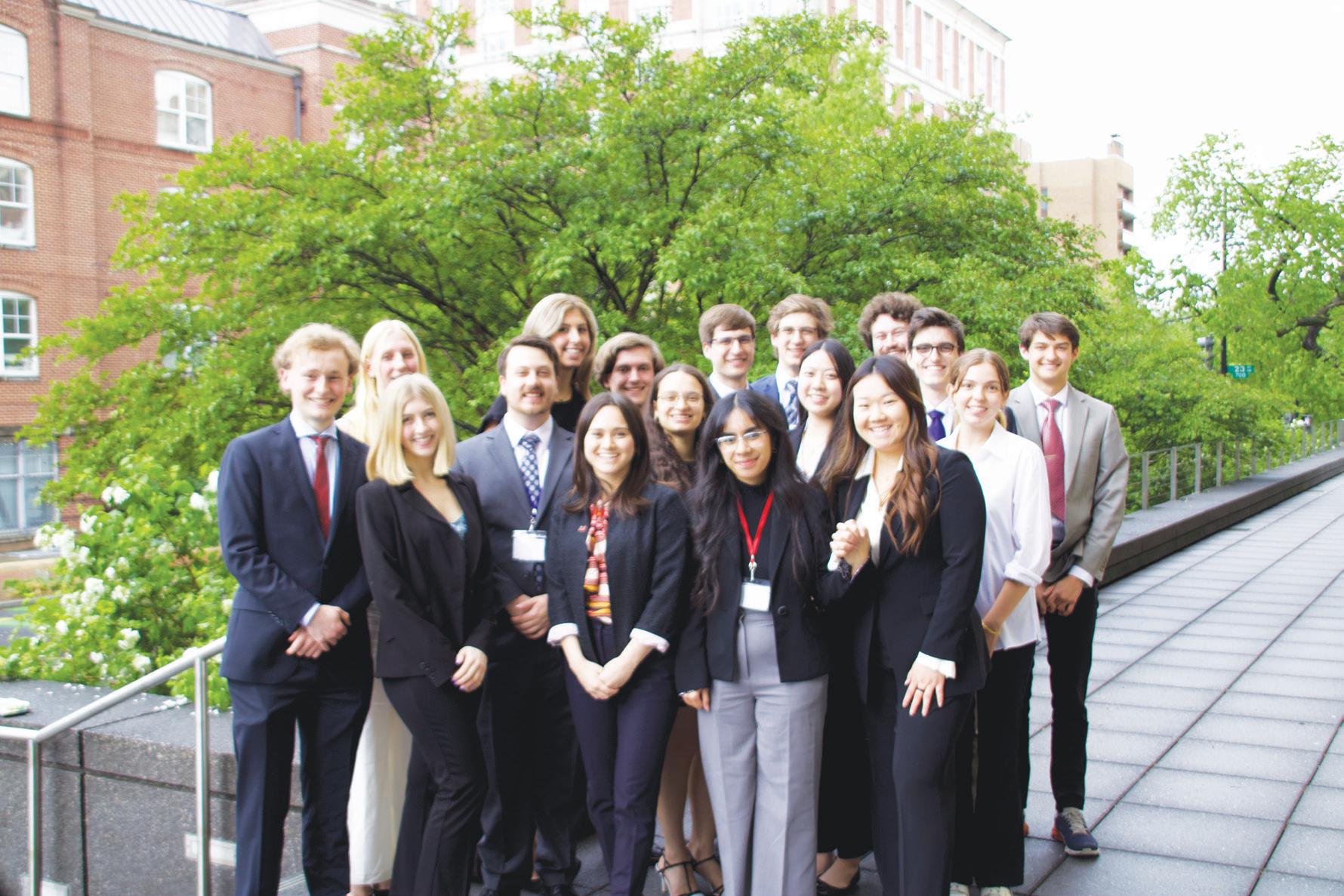 KATRINA HAUSER STAFF WRITER
Around a table in Monroe Hall last week, war brewed between ancient Greek cities.
But Thursday’s revival of bygone tensions was not part of a Greek history course or a reenactment of Percy Jackson. The imaginary clash was part of an experiential learning and crisis management training hosted by the Strategic Crisis Simulations, a student organization for wargame enthusiasts to meet and practice drills modeled after modern or historical geopolitical events.
“We don’t make up country tensions or country relations,” Vice President of Programming Caroline Gilmore said of the student organization, which is affiliated with the Elliott School of International Affairs. “The point is to teach students really: How does war policy work? How does diplomacy work? How does national security function?”
Last week’s drill, titled “In Xerxes’ Shadow,” was based on the Peloponnesian War, when the ancient city-states of Athens and Sparta and their respective allies, Corcyra and Corinth, fought for control of the region. Students were assigned to the four city-states and prepared for war by managing their ‘assets,’ including merchants and ships.
“A wargame is like a strategic exercise, is how I like to describe it,” Gilmore said. “We’re letting people take on the roles of different countries and different departments of government in order to learn about how the decisions are really made in government and policy is pursued.” aid SCS also holds formal, all-
day events involving more intense policymaking and negotiating, unlike last week’s fast-paced Greek drill. The group hosts simulations twice a semester and are open for anybody to attend. Students in the SCS said they also benefit from receiving feedback from the professors, alumni and industry professionals who attend the events.
“In Xerxes’ Shadow” was a kinetic drill, meaning the city-states were allowed to move their assets of ships and merchants across a map
of Ancient Greece. This is opposed to non-kinetic game-play, where events can only unfold by players making and negotiating policy.
The game occurred in eight turns, lasting about two hours, with the control team, a group of three executive board members at the front of the room, granting teams’ requests and updating the state of the game between each turn. They were also in charge of the map presented on the whiteboard and used dry erase markers to move ships
Artificial intelligence at the forefront of ‘next NEXT_’ student exhibition
JEREMY KOHLER REPORTER
A pink-colored variant of the pixelated fire found in Minecraft greets visitors to the Flagg Building as the flame lights up art from students around GW.
This is what viewers will find when they enter the “next NEXT_” art exhibit, featuring the work of seven student artists, in the Corcoran School’s flagship building across the street from The Ellipse. The exhibit, curated by junior MC Daubendiek, seeks to remind Corcoran students that their work has a place on the Flagg Building’s walls, while also demonstrating that the often empty and quiet building doesn’t always need to be that way.
“It’s kind of an uncanny valley activation of the space,” Daubendiek said. “I’m trying to remind you of what could be instead of what is.”
Daubendiek said a few different areas throughout the Flagg Building and especially in the student lounge often felt empty and “dead.” That was a key reason she decided to stage the exhibition in the cavernous, mostly empty student lounge.
Daubendiek said one of the most notable parts of the exhibition is that it prominently features artwork generated by artificial intelligence, like magazine covers of fake buildings. The decision to feature such art is not
without detractors: Critics have argued that AI draws from the styles and works of other artists and thus is a form of stealing and not a form of art.
Daubendiek said she disagrees with that characterization of the use of AI in modern works of art, saying that as long as human ingenuity is a part of the creation, it can help create new works.
Daubendiek said, however, that simply using AI to generate a “piece of wall art,” perhaps inputting a command for an AI art generator to make something pretty, was not a valid use of AI for artistic purposes, and AI should only be used to create art if there is a clear intention and justification for its use. She said that AI can be a powerful tool in the creation of art, as long as the artists who choose to use it are careful and know precisely what they hope to gain from its use.
“Like a child making a drawing is not making an artwork, but if someone were to go back and get their childhood drawings and hang them on the wall, there’s a certain amount of intention behind that,” Daubendiek said.
One work on display that utilizes AI is a series of magazine covers mounted on the wall next to one of the lounge’s artificially lit fireplaces, a piece created by junior Jared Semisch to
demonstrate how lifelike AI can be. Each magazine cover features a grandiose piece of architecture, like a marble rotunda or a picturesque villa, appearing to highlight wonders that would fit perfectly along the Mediterranean coast — but none of the buildings featured are real, and closer inspection reveals that the titles of each magazine are not written in any discernible language.
The exhibition also features numerous works that aren’t AI generated, including four paintings by sophomore Benjamin Cunningham exploring queer experiences throughout history.
Daubendiek said the artists didn’t necessarily intend to display their pieces in a show — and that was an important factor for her when deciding which works to include in the exhibit.
“The intention of the show was like, ‘Give me something that’s been sitting in your studio,’ so we get student work up on the walls,” Daubendiek said. “I wasn’t necessarily picky about the kind of work that was in the show, whether it was something I preferenced or not. I just wanted to find a way to make it easier for students to get their art displayed.”
The next NEXT_ exhibition is on display Monday through Friday from 9 a.m. to 5 p.m. until Oct. 2 in the student lounge of the Flagg Building.
and merchants around the model of Ancient Greece.
“The goal is not combat, the goal is not peace,” said Beckett Fordahl, a sophomore and another vice president of programming.
Players got a few moments to look over their player sheets, learn about the state of Ancient Greece in 431 B.C., figure out who their allies were and how many assets they had in their control.
In these packets, players learned that each city-state was associated
with their own God, and they could call upon the blessing of this God to help them during the game. They would put in a request to the control team, who would decide how best to grant it at their discretion. Players could also consult the ‘oracle’ to ask for advice, which they would receive from control team immersive actor sophomore Kate Beliveau.
About 25 players participated in the drill, moving back and forth across the room to meet with their allies and make requests to the control team. Between turns, the control team would grant teams’ requests to update the location of ships and merchants they had in the sea. Many stopped to look at the map displayed on screens throughout the room, assessing potential travel paths and battlegrounds.
As one team’s war efforts devolved into chaos, they began to make jokes, offering to host the next Olympic Games despite the various security threats facing the region. Another team received a blessing from their god, Pan, in the form of unfortunate weather plaguing the other teams. At the end of the drill, the control team announced which team had come out on top — Corcyra — and which had suffered the most difficulty — Corinth.
Fordhal put an effort into making sure the game was balanced and fun, which is a little bit easier to achieve in the SCS, where they do not usually name a winner.
“People can all decide a winner if they want, but people can change their goals a little bit as we go depending on how the game is working,” Fordahl said. “It’s basically just trying to solve the situation as best you can.”
Binge Bar
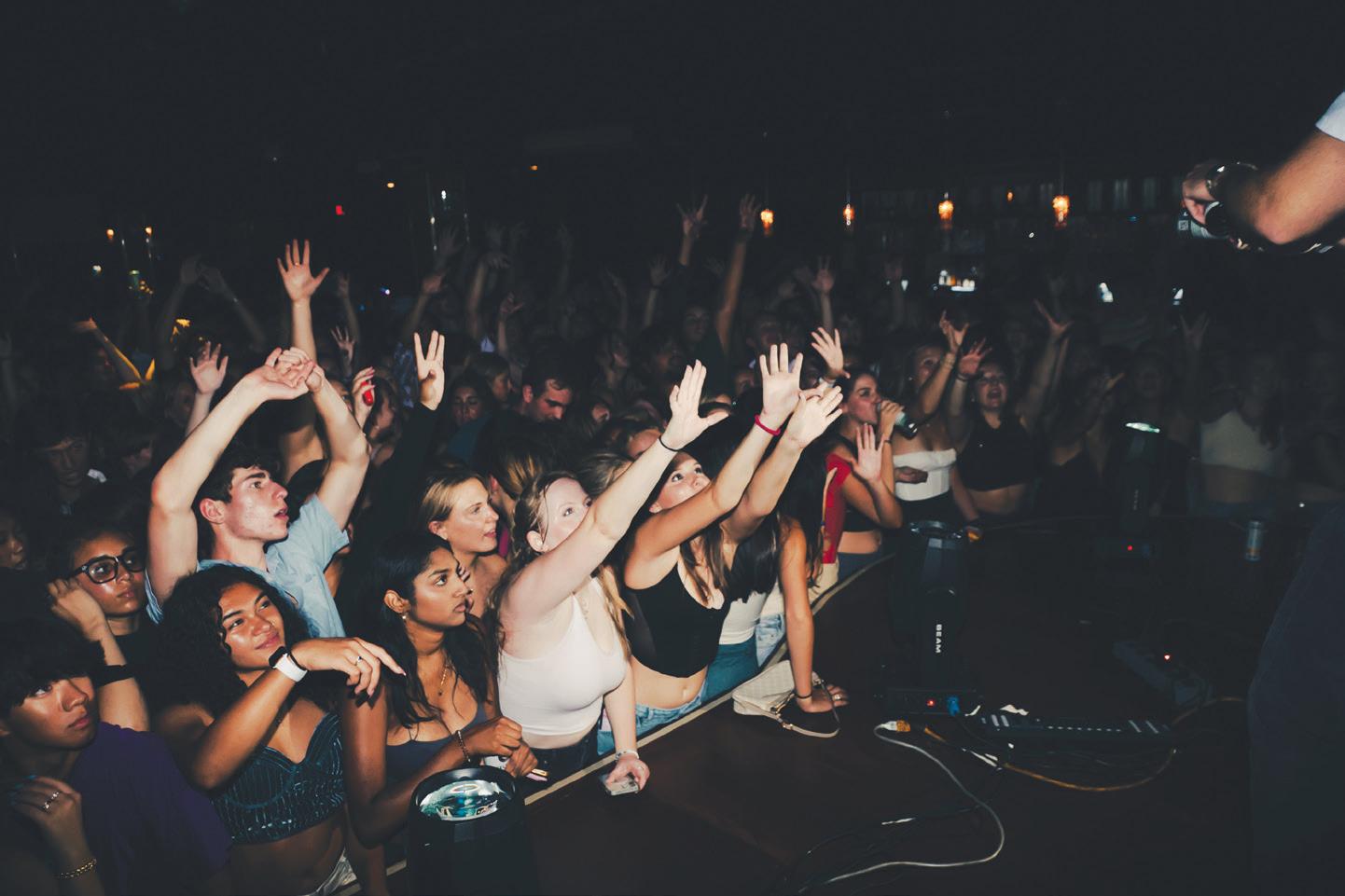
a starlit Georgetown waterfront.
After a long, tiring day filled with lectures that went on for far too long and breaks that were far too short, it’s only fair to reward yourself with a night out with your friends. But it can seem there’s nothing to do out in the District that doesn’t involve being over 21. Deciding what you and your friends should do on an average night can be challenging, especially when the status quo is bar hopping and clubbing. But D.C. is filled with plenty of exciting and affordable events to fill up your schedule, even if your ID lists a birthday from after 2002.
Franklin Delano Roosevelt Memorial
You can’t go to college in D.C. without visiting the National Mall at night. Everyone knows the Lincoln Memorial and Washington Monument, the over-visited “rites of passage” for firstyears. For a more secluded alternative, check out the Franklin Delano Roosevelt Memorial.
With fewer tourists, beautiful uplighting and the whoosh of rushing water from the four waterfalls, you can have a relaxed evening. FDR Memorial. 4305 9th St. NW.
If you and your friends want to experience a D.C. night on the town at a bar sans alcohol, there are a host of nonalcoholic bars throughout the district. In the busy H Street nightlife corridor, Binge Bar is a great place to start. By serving sober versions of classic cocktails and a lively and buzzing atmosphere, Binge Bar lets its customers have that bar-like experience without the alcohol. With a vast variety of alcohol-free beverage options, from beer and wine to mocktails and spirits, each drink ranges between $7 and $15, making this an inviting and budget-friendly place to spend your night.
Binge Bar. 506 H St. NE.
Open Wednesday to Friday from 4 to 10 p.m., Saturday from 2 to 11 p.m. and Sunday from noon to 8 p.m.
The Kennedy Center
Only a few blocks away from GW’s Foggy Bottom campus is the Kennedy Center, which hosts a plethora of musicals, dance recitals and concerts, from “Moulin Rouge” to the National Symphony Orchestra, yearround. Whether you are into heart-warming ballet performances, melodramatic operas or multicultural artisan films, you are guaranteed to find an event that piques your interest. Most events go late into the night, allowing you to emerge into
The Kennedy Center. 2700 F St. NW. Available Monday to Sunday, 10 a.m. to midnight. Get Spooked with a Ghost Tour
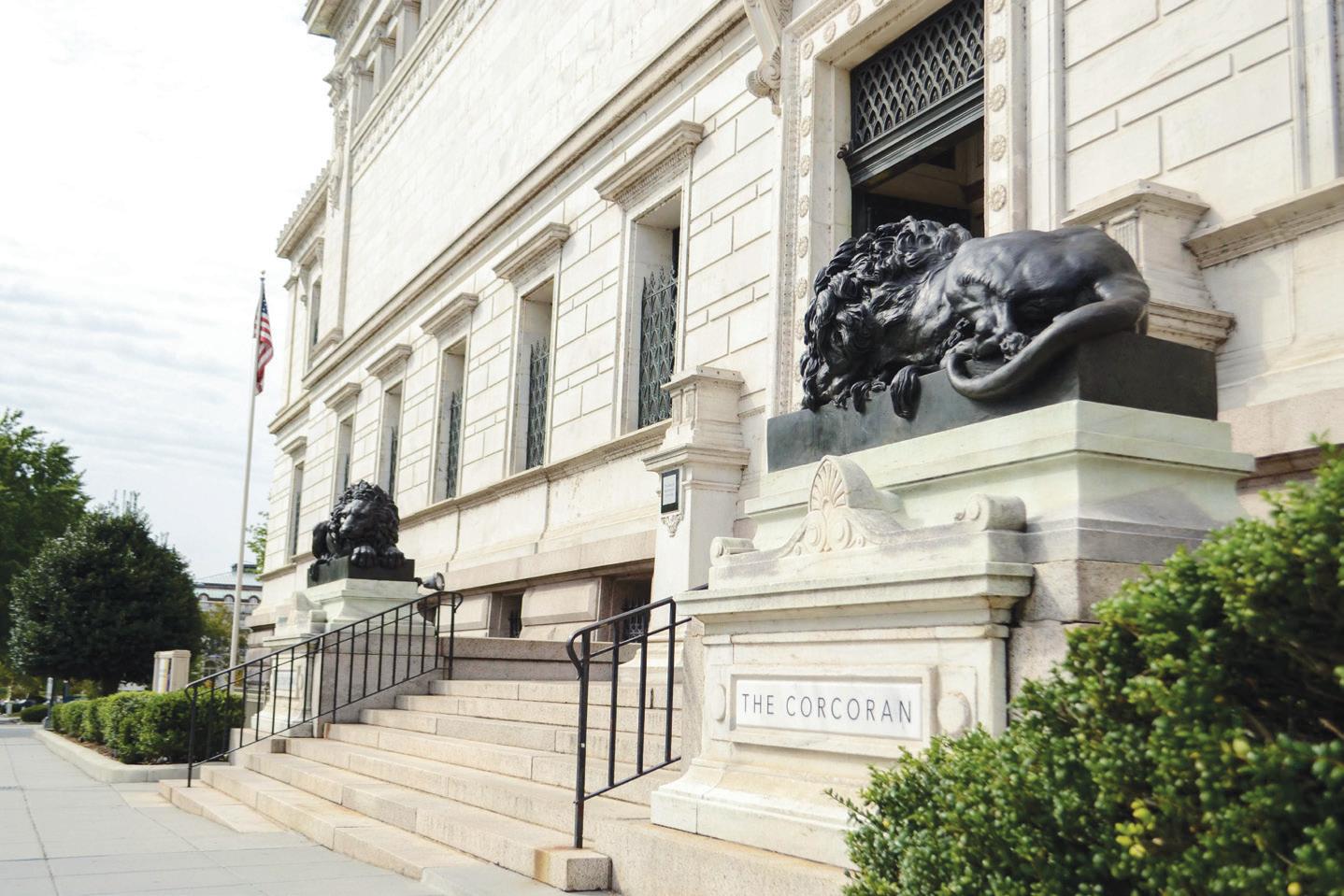
While the day’s exams may be scary enough, the District’s expansive history provides plenty of chances for after-hours horrors with a ghost tour. Vendors offer explorations of Georgetown, spinning tales about the Halcyon House, haunted by a recluse who hated electricity, and the Exorcist steps, the famous stairwell featured in the 1973 film.
Camp Wharf at the Firepit at The District Wharf
What can be better than curling up in front of a fire and roasting marshmallows? Thanks to Camp Wharf at the Firepit located in the District Wharf, you and your friends can make your own s’mores while sitting around the campfire.
The vintage blue and orange Airstream trailer provides everything you need to make the best s’mores — marshmallows, chocolate, graham crackers and roasting sticks, starting at $4.50 each.
CULTURE THE GW HATCHET September 18, 2023 • Page 7
101 District Square SW. Open Thursday from 6 to 10 p.m., Friday from 6 to 11 p.m., Saturday from 5 to 11 p.m. and Sunday from 5 to 10 p.m.
NEW ALBUM: “THE LAND IS INHOSPITABLE AND SO ARE WE” BY MITSKI THE SCENE RELEASED THIS WEEK: IT GIRL THRIFT POP UP Friday, Sept. 22 3207 M St. NW | Free Shop around this pop-up market for clothing inspired by iconic IT GIRLs, like Olivia Rodrigo. STAND-UP MAGIC VARIETY SHOW Thursday, Sept. 21 Tonic | $15 Enjoy a night of laughs and enchanting tricks at Foggy Bottom’s premier tater tot joint.
The District Wharf.
Culture
Under 21? Forget the fake and opt for these late-night activities
HATCHET
FILE PHOTO
Staged in the Flagg Building’s mostly empty student lounge, the “next NEXT_” exhibit features the work of seven student artists and aims to highlight the emptiness felt by many students in the home of the Corcoran School.
ARWEN CLEMANS | PHOTOGRAPHER
Audience members crowded the stage at DC’s Republiq Hall this past weekend.
EMILY PEREZ REPORTER
COURTESY OF JON BROWN
Strategic Crisis Simulations offers members an opportunity to meet and practice drills modeled after modern or historical geopolitical events.
Volleyball splits matches at Jefferson Cup Invitational in Virginia
JADEN DIMAURO MANAGING EDITOR
NICK PASION MANAGING EDITOR
The Revolutionaries traveled to Charlottesville, Virginia, Friday and Saturday to compete in the Jefferson Cup Invitational.
In their last weekend of matches before they plunge into Atlantic 10 play, GW split the two-game invitational with a 1-1 record. GW will now begin conference play, looking to improve on their (3-8) season record.
Match 1:
The Revs dropped their first match of the weekend 3-2 to the Wofford College Terriers (8-2) in their first bout of the weekend invitational. The five-set series was a nailbiter, with the Revs exchanging blows with the Terriers early on to earn a 2-1 set lead. But a late-match barrage of kills pushed the Terriers over to seal the contest.
Wofford started the match with spurts of dominance. They went up 3-1 after two quick kills assisted by senior setter Emily Hodsdon. GW tried to respond, but another scoring burst from Wofford put GW down 4-13.
GW tried to crawl their way out of the hole with four kills from senior opposite Liv Womble and three from junior opposite MC Daubendiek. Despite the offensive effort, the Revs were unable to close the gap, and Wofford won the first set 25-18.
GW came roaring back. After exchanging blows in the first half of the set, the Revs scored a quick 5 points to go ahead 16-9. GW held onto the lead following five
errors from Wofford and a tetrad of kills to win the second set 2518.
Quick outbursts of offense defined the third set, which GW won 25-22. A 5-point surge from the Revs was rebuked by a 13-9 run from the Terriers before the teams exchanged back-and-forth blows through the rest of the set. GW clinched the tight battle with another kill by Daubendiek. A back-and-forth battle brought the fourth set to a tie, 1717. The teams continued to score in flares with 19 points in the set resulting from errors. A tough Terrier offense was too much for GW to overcome, and the Revs lost the thriller, 30-28.
With the series tied 2-2, GW entered the final stretch hoping to come out on top. The Revs took a 5-3 lead, but the Terriers surged with two quick kills to tie the set 7-7. Freshman outside hitter Bri Mahoney notched two kills and an ace to put the Terriers up 9-7. GW never recovered. The Terriers rolled ahead to close out the set, 15-11, winning the match 3-2.
Womble led the team with 15 kills and tied the GW-best with three blocks. Graduate Kelsey Watkins also recorded three blocks and notched two aces. Sophomore setter Maeve Loughran led the team with 27 assists to go along with a hardfought 15 digs.
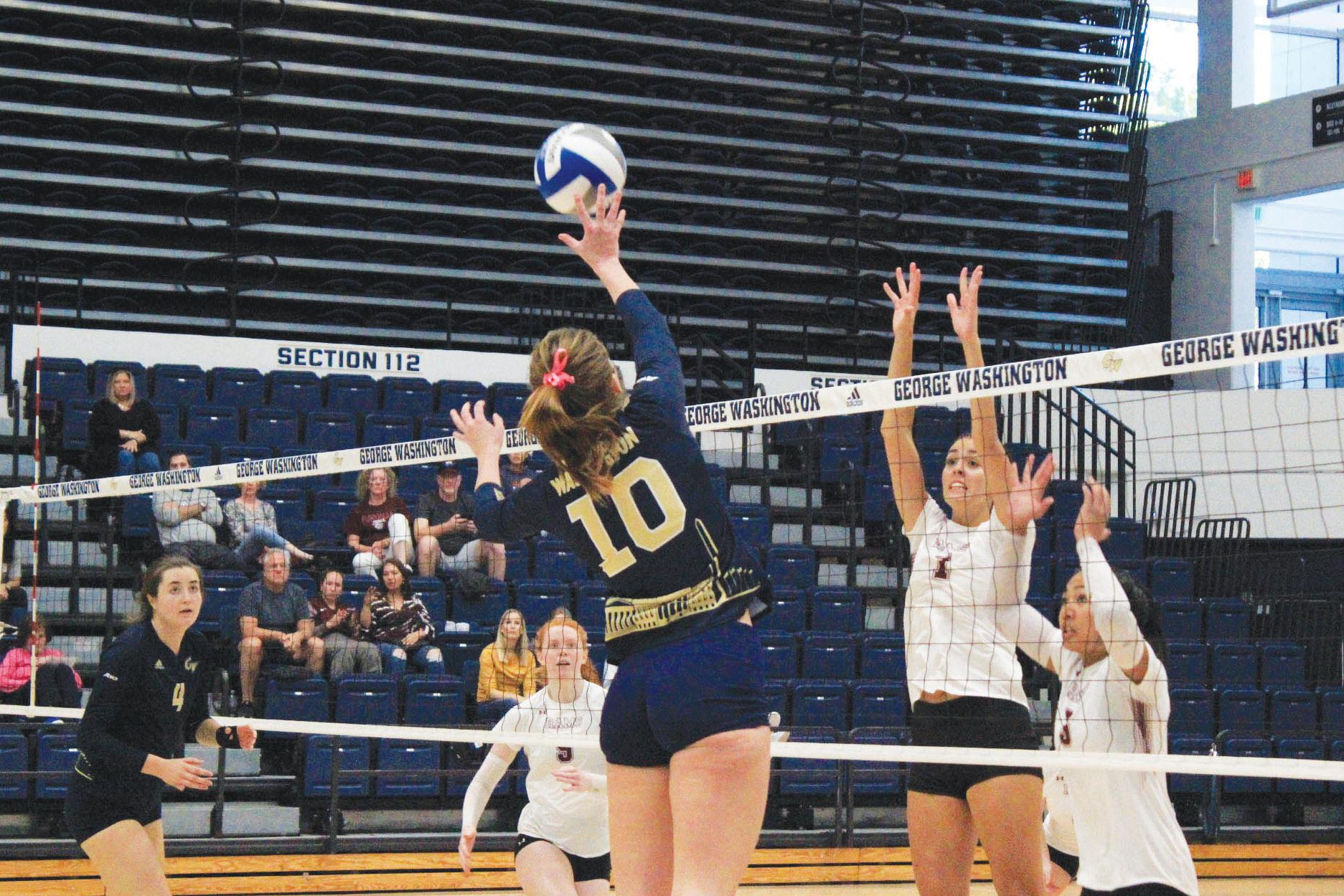
Match 2:
On the second day of the invitational, the Revolutionaries faced off against a struggling Norfolk State squad that came into the match having lost four of their last five games.
The Revs dropped the first set 22-25 but came roaring back to win the next three and take the match three sets to one while
outscoring the Spartans 72-59.
Junior outside hitter Brittany Myers, who was named to the All-Tournament Team, paced the Revs with a season-high 17 kills, seven of which came in the first set, along with a career-high .452 hitting percentage. In the second set, GW overcame a 12-18 deficit to win 25-21 and tie the match at 1-1. Myers played a pivotal role in the Revolutionaries’ comeback, scoring 5 of the Revs’ last 9 points. The Revs survived a furious 8-point Spartan run in the third set that tied it up at 20-20 to win the set 25-21. Junior outside hitter Salem Yohannes came alive,
scoring two of her 13 kills in the set. Yohannes finished the match with a double-double, tallying 13 kills to go along with 11 digs. It was her second of the season. Myers added four more kills to help GW win the set and pull ahead for the first time in the match. A litany of Spartan errors allowed GW to sprint out to a 12-3 lead in the fourth set. And the Revs never looked back, winning the set 25-15 to put the Spartans away for good.
Womble had three of her 11 kills in the fourth set to help win the set and match for the Revolutionaries. Womble, who
was named to the A-10 AllConference First Team last season, led GW with 39 total attempts en route to their match victory.
As a team, the Revolutionaries racked up 59 kills on 150 attempts, compared to the Spartans’ 47 on 135 attempts. On the defensive side, GW finished with seven blocks, three each from Daubediek and freshman Loukia Papadakos. The Revs will begin conference play Saturday, Sept. 23 and Sunday, Sept. 24 at Davidson. Saturday’s game is set to start at noon and Sunday’s match will kick off at 1 p.m.
Water polo collects two West Coast wins

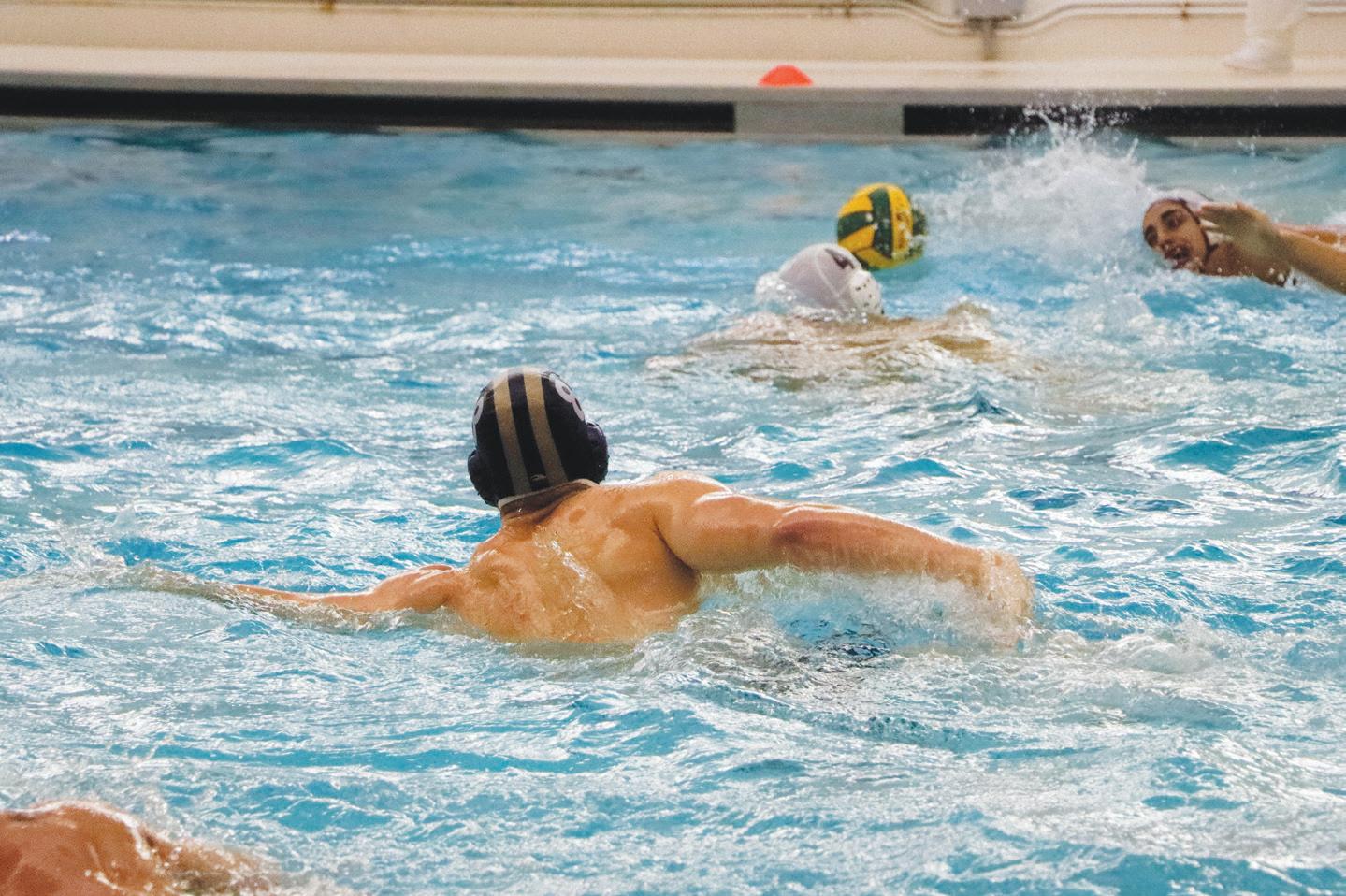 SANDRA KORETZ SPORTS EDITOR
Water polo (4-4) took home two wins against against La Verne (15-8) and Concordia University Irvine (17-15) and a loss against Loyola Marymount (7-9) in the La Verne Mini in Los Angeles this weekend.
The Revolutionaries continue their streak of playing West Coast teams after concluding the Princeton Invitational tournament with a win against Chapman (1310) Sept. 10. The Revs currently stand 4-4 after losses against powerhouses Princeton and Harvard.
utility Andrija Sekulic following closely behind with two goals. The Revolutionaries fought hard but ultimately were outgunned by the Lions’ offensive strength and lost by two goals, 7-9.
Golf places 20th out of 24 in
Gene Miranda Falcon Invitational
second in the tournament with 17 total.
As a team, the Revolutionaries finished last in total pars with 142 .
Golf placed 20th out of 24 teams in the Gene Miranda Falcon Invitational in Colorado Springs, hosted by the Air Force Academy earlier this week.
In their first tournament of the season, the Revolutionaries finished 34-over par, scoring 898.
They totaled 309 shots in their first round, highest for the starting round and second highest overall.
The tournament is a yearly, 54-hole affair in which the top four scores out of a five-player team are counted. The host course, Eisenhower Golf Course, is a 7,297-yard par 72 on the grounds of the Air Force Academy.
The team was led by fifth-year senior Jakub Hrinda, with him finishing third best in the tournament out of the 120-player field.
Hrinda was the only Rev golfer to finish under par, sitting at 10 under after his three rounds. His final score was aided by a 66 in his second round to go along with two 70s. For birdies, Hrinda finished
While Hrinda paced the field with an impressive score, the rest of the team was not able to replicate his success. GW’s highest scorer, Luke Lyu, had only one birdie, the lowest in the tournament. He finished with a total score of 242 — 26 over par — with rounds of 81, 83 and 78, respectively, tying him for 117th best out of a field of 120.
Lyu was not alone in his triple-digit placement, with teammates sophomore Manuel Barbachano and freshman Aksel Moe tying for 104th and 112th places, respectively.
After averaging 72.69 in his 2022-23 season, Barbachano finished with scores of 77, 79 and 77, a sizable increase compared to his previous performance. As a sophomore, he looks to build off a promising freshman season after being rated by Junior Golf Scoreboard as the sixthranked international player in his class.

Graduate student Hugo Riboud earned GW’s second-best score, finishing 11 over par at
227, behind scores of 81, 74 and 72. Despite improving each round until ending with a round shooting par, Riboud tied 80th overall in the invitational out of 120 players, well into the bottom half of the field.
The Revs welcomed back seven of their eight players from last year’s squad, adding freshman Moe, who finished 25th. Head Coach Chuck Scheinost also brought Riboud and sophomores Barbachano, Lyu, Jed Dy, and Leo Xu.
Xu and Dy both took part in individual play and scored 225 and 226, respectively.
Xu finished one of his rounds under par, shooting 71 first before rounds of 78 and 76. Dy shot 76, 75 and 75, a relatively consistent set of scores landing him 10 shots over par.
The Revs have an opportunity to get back on track with the VCU Shootout on deck for Sept. 18 and 19. Held at The Country Club of Virginia, the tournament will be hosted by their Atlantic 10 foe VCU.
Last year at the Shootout, GW set a program record with a 54hole score of 829, good for 35 under par.
Senior goalie Luca Castorina, a 2022 AllMAWPC Second Team selection, recorded 18 saves against Loyola Marymount. Castorina also scored his first collegiate goal after escaping the Lions’ goalie, making for an evasive shot across the pool in the third quarter. Castorina recorded 327 saves in 30 games his junior season playing for the Revs.
Senior center Viktor Jovanovic led the Revolutionaries with four goals against the Lions Friday with junior
After falling to the Lions, the Revs refocused their attention on their Saturday doubleheader against more crosscountry rivals. The Revs and the La Verne Leopards alternated finding the back of the net during the first half, with the Revs leading 6-4 by halftime and ultimately coming out on top, 15-8. The Revs continued to best the Leopards’ defensive abilities and concluded the third quarter 13-6 after securing seven goals in a span of eight minutes.
Jovanovic once again recorded four goals and freshman center Alec Posluszny netted two of his own, the first of his collegiate career. Sekulic, freshman attacker Kai De Orbeta, senior utility Kalan Smith and junior center Leo Lueddemann all also collected two goals apiece against the Leopards.
Game play continued later Saturday against the Concordia Eagles with the Revs beating them by
a two-goal margin. The Eagles and Revs battled it out in the pool with the Revs clinging on to a 6-5 advantage at the end of the first quarter. Prior to switching sides at halftime, the Revs finished 9-7. The Revs led the Eagles throughout the second half with a three-goal lead in the four quarter. The Eagles then fell to the Revs’ offensive lineup, leading the Buff and Blue to close out the game with a high-scoring 17-15 victory. Graduate student utility player Mateus Stellet led the Revs with seven goals. Stellet earned 62 points during his 2022 season with Revs, racking up 36 goals and 26 assists. Prior to joining the Revs, Stellet played on No. 5 ranked Cal Berkeley’s roster where he played all 26 games and helped lead the Golden Bears to a 2021 national title.
Jovanovic showed his offensive prowess again and registered four goals against the Eagles while Castorina successfully logged 17 saves.
The Revs return back to the district to begin MAWPC conference play against Bucknell on Saturday at 2 p.m. at home.
Sports NUMBER CRUNCH
30 WOMEN’S SWIM AND DIVE vs. Virginia Tech Saturday | 11 a.m. Watch women’s swim and dive compete at the
Center.
OF THE WEEK MEN’S SOCCER vs. Howard Wednesday | 3 p.m.
Shots by women’s soccer sophomore midfielder Aoi Kataoka, good for first in the A-10.
Smith
GAMES
Men’s soccer faces off against crosstown rival Howard on the Mount Vernon Campus.
FILE PHOTO BY TAMARA RUSHBY | PHOTOGRAPHER
SPORTS THE GW HATCHET September 18, 2023 • Page 8
Senior opposite Liv Womble sets up for a kill.
BEN SPITALNY CONTRIBUTING SPORTS EDITOR SANDRA KORETZ SPORTS EDITOR HATCHET FILE PHOTO In their first tournament of the season, the Revolutionaries finished 34 over par. FILE PHOTO BY TAMARA RUSHBY | PHOTOGRAPHER The Revs return to the District this week to begin conference play against Bucknell on Saturday at 2 p.m.
