

Fitzgerald squeezes by Harris to clinch SGA presidency
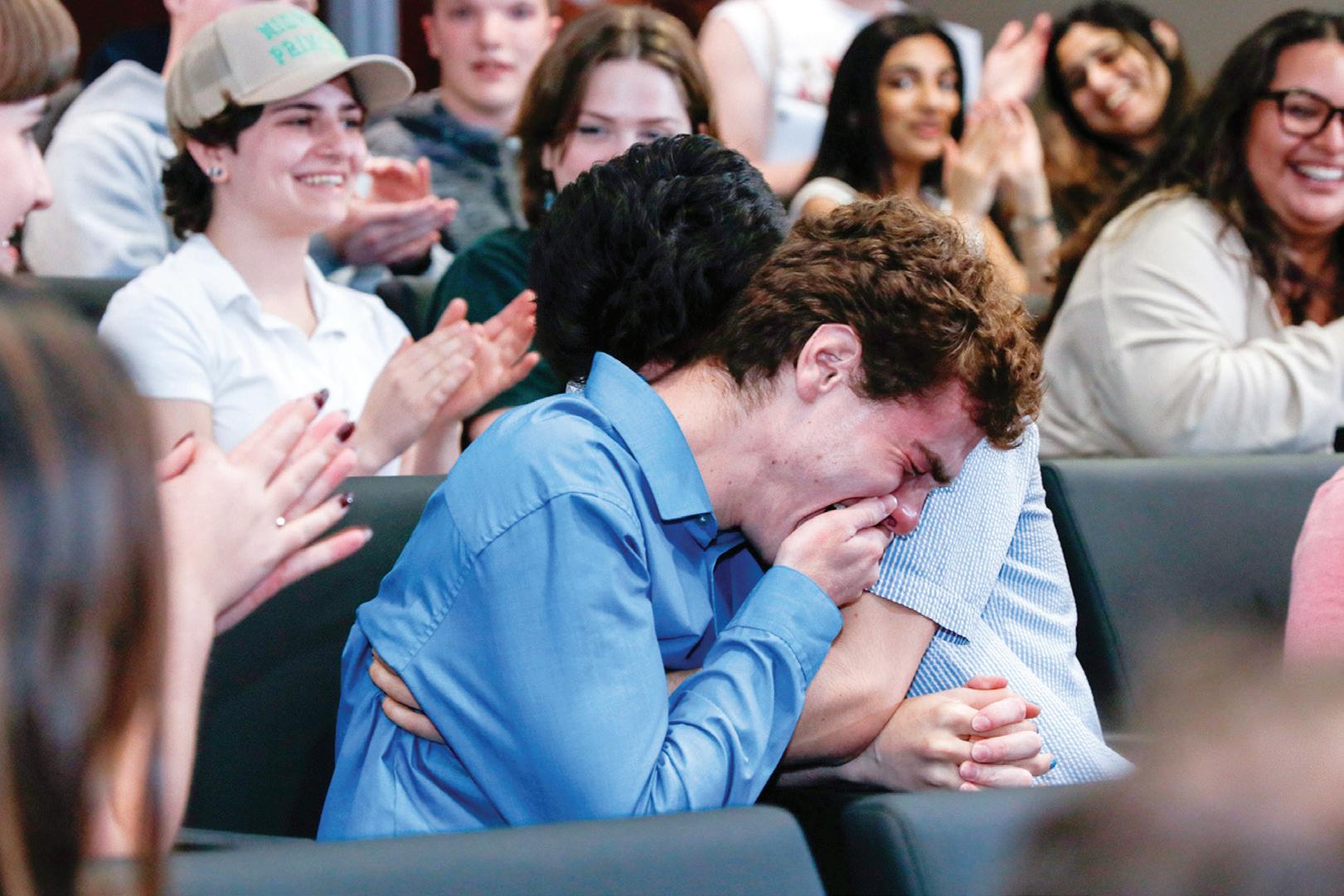
Students elected sophomore Ethan Fitzgerald president of the Student Government Association on Saturday, narrowly beating presidential contender junior Lauren K. Harris by 16 votes in the final round of ranked-choice voting.
Fitzgerald, an undergraduate senator for the Columbian College of Arts & Sciences, captured 37 percent of the vote in the first round of rankedchoice ballots before narrowly defeating Harris in the fourth round, according to the Joint Election Commission’s unverified election results. Voter turnout jumped to 12 percent this year after just 8 percent of eligible students voted in last year’s election.
Fitzgerald pledged to advocate for students’ physical, mental and reproductive health as president and said he will work to expand dining options and hours as well as work with the Board of Trustees to add the SGA president and vice president as voting student trustees.
“I will not let you down, I can’t wait to get to work and I have an amazing partner in Ethan Lynne that I can’t wait to work with,” Fitzgerald said.
SGA Sen. Ethan Lynne (CCAS-U) defeated Aly McCormick in the vice presidential race, securing 54 percent of votes in the first and only round of voting, per the unverified election results. Lynne said he will advocate to extend GW Dining’s hours of operation past 9 p.m. and conduct an audit of all campus spaces to expand available meeting ven-
ues for student organizations. “This is amazing,” Lynne said. “I am so thankful to everyone on my team. It has been the most long but incredible few weeks of my life, and I’m super excited to start doing some real stuff in the senate and start doing some real changes.”
Student voter turnout increased for the first time since 2019 with 3,150 students casting votes compared to 2,190 voters in last year’s election, according to the unverified election results. Roughly 12.3 percent of eligible students voted in this year’s election, compared to last years 8.5 percent voter turnout. Almost 85 percent of students voted “yes” on a referendum that gauges student opinions on adding the presi-
dent and vice president as voting members on the Board of Trustees. The Board originally rejected the referendum in November after the SGA brought the resolution to voting members.
The approval of the referendum will now act as data for SGA members to bring to the board to show student support for the addition of voting student members.
Harris said she felt “deeply saddened” by the election results and saw her loss as a reflection of the “racism and sexism” she has faced as a Black woman running for a position of power. She said she will continue to advocate for change in the D.C. area by potentially working in the mayor’s office next year and working with local entrepreneurs to organize
Facing falling enrollment, GSPM stakeholders push to hire director
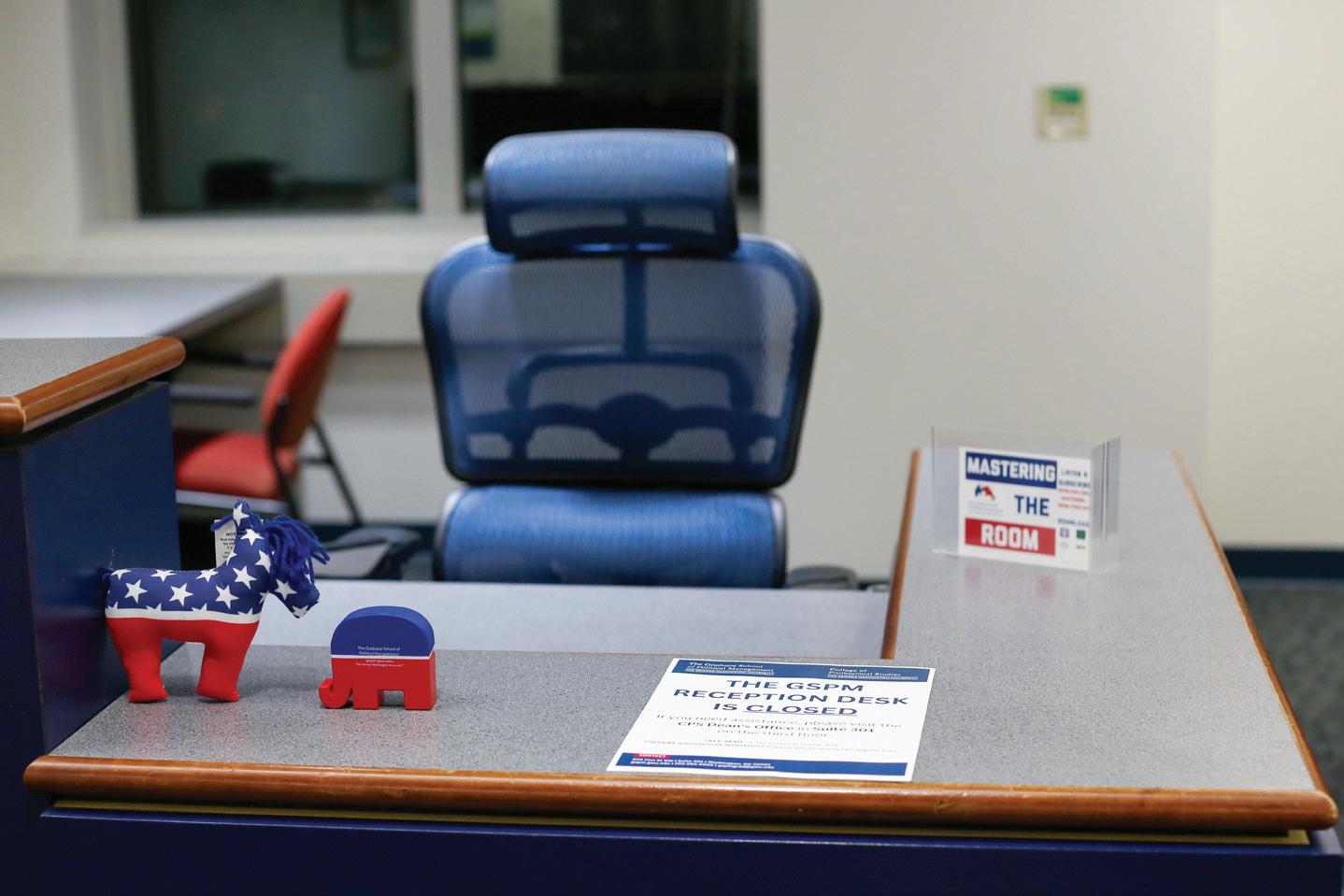
Since the director of the Graduate School of Political Management left in August 2022, faculty, students and other stakeholders have waited for officials to name a replacement.
Nearly two years later, the position remains vacant, and the GSPM’s Board of Advisors — a 20-person team that pays dues to the school and advocates on its behalf — is working to increase funding, recruitment and faculty hires after the school’s enrollment fell 24 percent between 2022 and 2023, marking six-consecutive years of declining enrollment.
College of Professional Studies Dean Liesl Riddle said the college, which houses GSPM, plans to hire a director through “continued strategic efforts and pending increased enrollment.”
for social justice. “I appreciate every vote for me, and I think that that showed that there was a desire for change, by coming in second shows there was a desire and a push for change happening,” Harris said.
McCormick said she hopes Lynne implements a survivors’ bill of rights, one of her campaign initiatives, and opens the Financial Services & Allocations Committee meetings to all students. She said she and Lynne had “very similar” initiatives on their platforms and that she believes Lynne will be “fantastic” as vice president. “Thank you, for all my people who voted for me and believed in me,” McCormick said. “I’m just a kid from a different school who tried her best, and I’m just happy I had fun.”
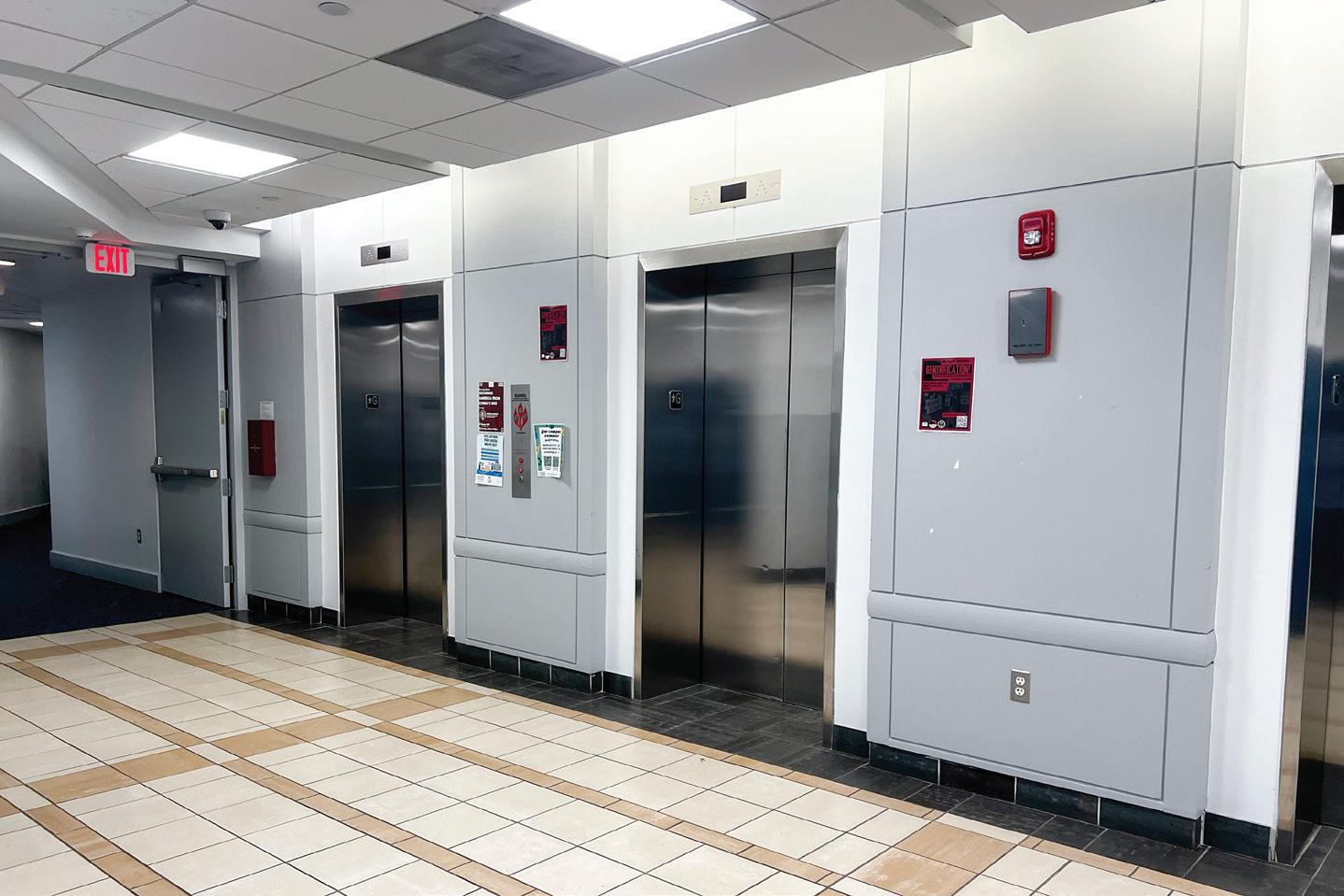
Sophomore Felix Aguto entered an elevator in late February with a dozen students. Having just finished his 9:35 a.m. accounting class in Duques Hall, he was ready for his next class — until the elevator fell six floors.
Dropping and catching itself every few floors, the elevator finally settled halfway below the first floor, trapping everyone. It appeared there was room enough to safely climb out if they could get the doors open. Aguto and a friend tried using their hands to pry open one of the elevator doors before pressing the alarm and emergency call buttons, but maintenance workers did not arrive to help for another 45 minutes.
“We could see the equipment underneath the shaft,” Aguto said. “We were at the bottom of the shaft.”
Aguto said facilities workers repaired the elevator after he left, so he did not submit a complaint or FixIt ticket but continues to use the elevator.
More than a dozen students said they have gotten stuck in elevators in campus buildings like the University Student Center and Duques, Munson, Mitchell and Shenkman halls within the last year for between two and 45 minutes. In the Faculty Senate Physical Facilities and Campus Safety Committee’s annual report last week, members recommended that officials address aging elevators as one of their six budget priorities.
University spokesperson Julia Metjian said GW consistently ensures campus elevators are in “safe, working condition” by performing monthly preventative elevator maintenance in addition to twice-yearly inspections by the D.C. Department of Buildings. “Student safety is a top priority for the University,” Metjian said. “We consistently ensure that all of our elevators are in safe, working condition.”
Enrollment drops in GSPM align with declining enrollment in CPS, which enrolled 624 students in 2023 compared to 1,051 in 2013. GSPM’s enrollment dropped from 386 students in 2013 to 188 in 2023, according to the enrollment dashboard. 171 students attended GSPM programs as of this spring, according to documents obtained by The Hatchet. “CPS is the very proud home of GSPM, and our students and faculty are some of the best and brightest working in the political arena today,” Riddle said in an email. “We plan to continue to collaborate closely with alumni networks, industry partners, and faculty members to amplify the reach of recruitment efforts and enhance the overall appeal of GSPM programs.” Riddle, who was named the dean of CPS in August 2022 after the college went almost two years without a permanent leader, declined to comment on when officials intend to fill the GSPM director position and if the plans have been communicated to staff, faculty and students.
person said since Riddle started her tenure, she expanded curriculum offerings in programs like strategic public relations and the master’s of professional studies degree in publishing management. The spokesperson said she also implemented a series of recruitment strategies to grow enrollment in CPS and GSPM, including partnerships with organizations like the National Association of Counties and the American Association of Political Consultants, to market the college.
To attract more applicants to GSPM, Riddle also launched digital advertising for all programs and created a commercial featuring the school’s Board of Advisers, the spokesperson said.
But GSPM community members said without a leader, the school is struggling to grow its visibility and distinguish itself from CPS. And though stakeholders have advocated for a new director, details on the hiring plan remain unclear, they said.
A University spokes-
to speak, and that’s important thing. When something happened, you suddenly start reflecting about why did this happen, and could we do things better.”
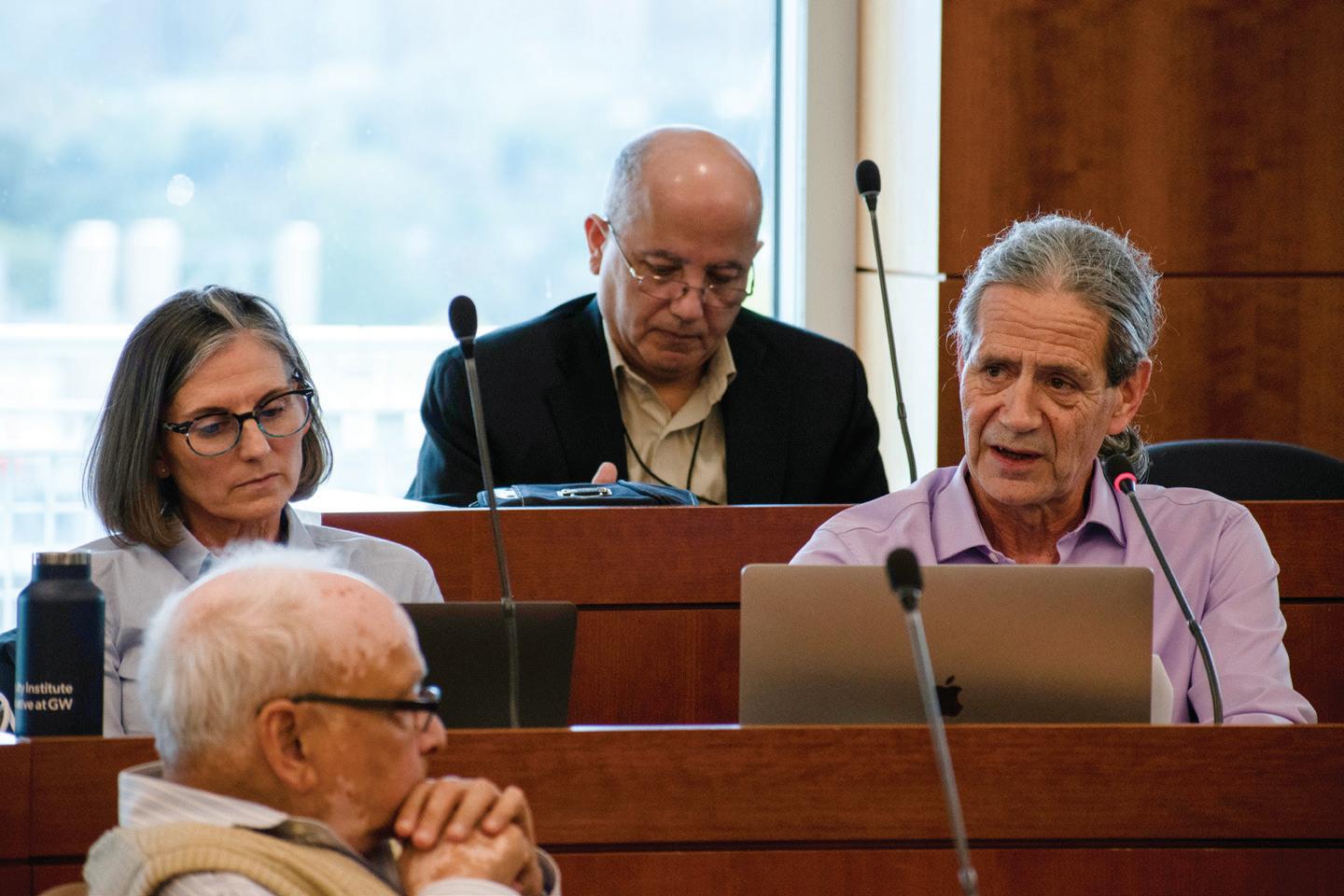
Faculty senators debated a report that proposed an overhaul to the body’s executive committee, a response to officials’ secret briefing of committee members last year on plans to arm GW Police Department officers.
The report outlined four recommendations to make the executive committee more representative of GW’s faculty breakdown — including electing a president of the Faculty Senate and altering who serves on the committee — efforts that some senators believe will improve shared governance within the senate’s highest body. But some senators pushed back against the report’s recommendations, arguing the committee’s restructuring will decrease the body’s efficiency if it is required to loop in all necessary stakeholders after every official debrief.
“This incident was just an unfortunate mistake,” Guillermo Orti, who penned the report, said after the meeting. “It triggered the conversation so
The report said the executive committee “exceeded its authority” when the committee did not consult those best informed on the issues like members of the Physical Facilities committee when former interim University President Mark Wrighton consulted the body last February on the Board’s plans to arm GW Police Department officers before informing the senate and GW community in April. The report states Wrighton asked the executive committee to keep the contents of the Board’s arming report a secret from the senate even though the plan was not considered an emergency, and allegedly denied shared governance to the senate by not allowing faculty a chance to provide input to trustees. The executive committee has the power to act on behalf of the senate in cases of emergency, per the report. Orti, the co-chair of the Professional Ethics and Academic Freedom Committee,
said the breach of shared governance caused the committee to compile the report to share with the senate.
The senate also passed a resolution in October calling on GWPD to halt the arming process until officials disclosed community feedback on the online form soliciting input on the decision, any changes to liability insurance and GWPD operational costs caused by the arming of officers. GWPD Chief James Tate said the resolution “wasn’t a factor” in pausing implementation, which officials slowed in the fall due to on-campus protests. Orti said while the senate is a “good representation” of faculty who teach undergraduates, the executive committee is primarily made up of graduate professors who are not fully informed on matters affecting undergraduates, like GW’s protest policies and the decision to arm GWPD. The report also states that Columbian College of Arts & Sciences faculty in humanities and social sciences departments are underrepresented in the executive committee.
INDEPENDENT STUDENT NEWSPAPER • SERVING THE GW COMMUNITY SINCE 1904 Monday, April 15, 2024 I Vol. 120 Iss. 24 WWW.GWHATCHET.COM What’s inside
Culture Celebrate Record Store Day at a variety of vinyl shops in the District. Page 7 Opinions The editorial board argues GW’s community deserves to know if their voices are heard. Page 6 Sports Softball fell to Saint Joseph’s in a weekend series against the Hawks. Page 8 SACHINI ADIKARI STAFF WRITER RACHEL KURDLANSKY | STAFF PHOTOGRAPHER Biological Sciences Department Chair Guillermo Orti presents a report at Friday’s Faculty Senate meeting.
FIONA RILEY ASSISTANT NEWS EDITOR JENNIFER IGBONOBA CONTRIBUTING NEWS EDITOR HANNAH MARR ASSISTANT NEWS EDITOR MOLLY ST. CLAIR STAFF WRITER See OFFICIALS Page 5 Faculty senators discuss changes to executive committee HANNAH MARR ASSISTANT NEWS EDITOR TYLER IGLESIAS REPORTER PHOTO ILLUSTRATION BY JENNIFER IGBONOBA | STAFF PHOTOGRAPHER The reception desk at the Graduate School of Political Management in the Media & Public A airs building stands empty. See ELEVATORS Page 5 RAPHAEL KELLNER | STAFF PHOTOGRAPHER Student
See SENATORS Page 5
Students report getting stuck in broken elevators
Government Association Sen. Ethan Fitzgerald (CCAS-U) reacts to his presidential win.
April 16, 1989
Pro-Palestinian students denounce UN ambassador in Elliott protest
More than 50 pro-Palestinian protesters condemned an event hosting the U.S. Ambassador to the United Nations at the Elliott School of International Affairs on Thursday.
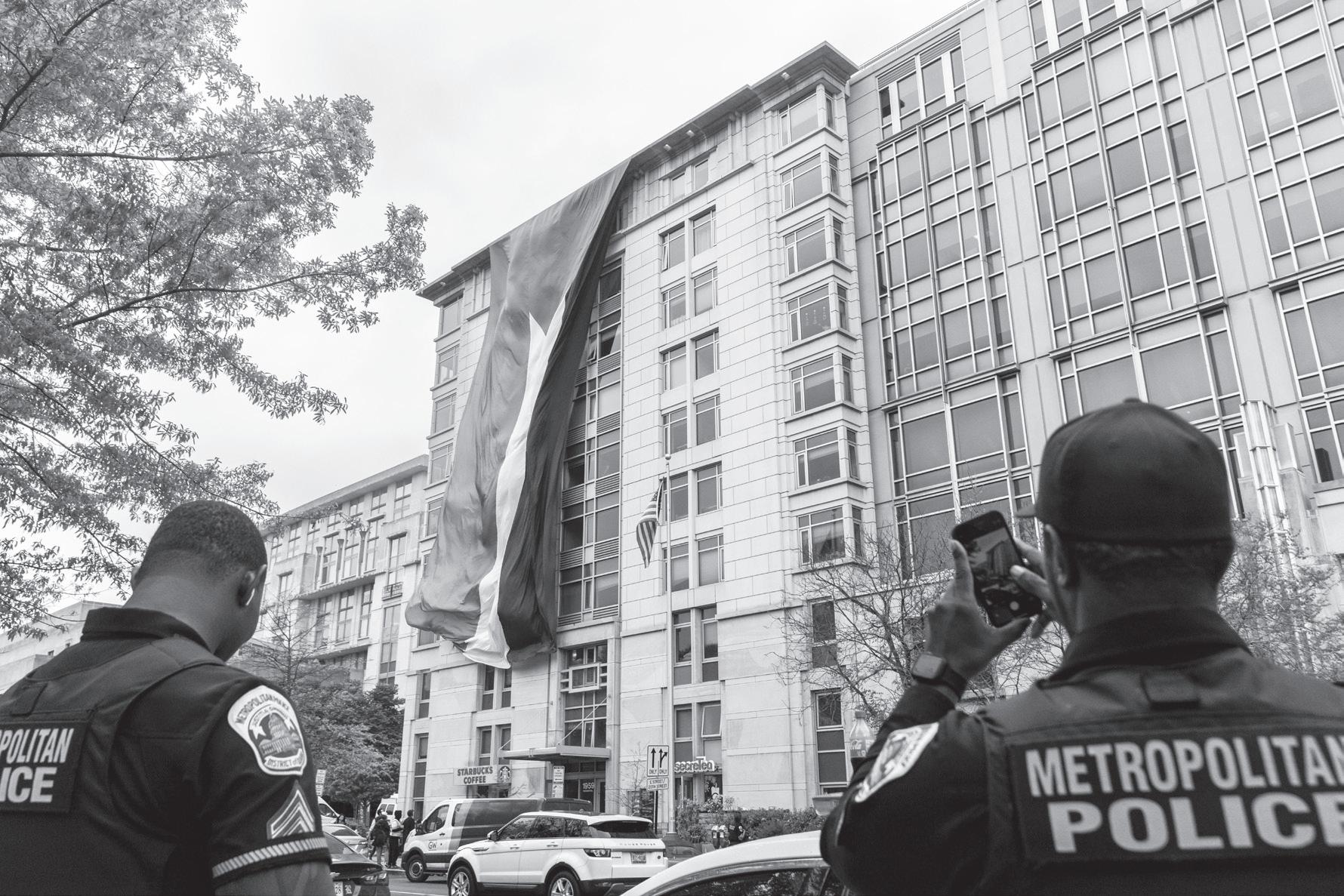
The Student Coalition for Palestine at GWU led the protest of U.N. Ambassador Linda ThomasGreenfield, who vetoed a series of resolutions demanding a cease-fire in Gaza and spoke Thursday at an event about diversity in international affairs. Shortly after Thomas-Greenfield began speaking, protesters outside hung a giant Palestinian flag from the roof of 1959 E Street — the residence hall next to the Elliott School — which stretched down seven stories of the building.
GW Police Department officers removed the flag after it sat draped for about five minutes.
Between October and February, Thomas-Greenfield vetoed three U.N. Security Council resolutions in support of a cease-fire in Gaza over concerns that a pause would allow Hamas to regroup, jeopardizing hostage negotiations. After Russia and China blocked a U.S.backed cease-fire resolution last month, she abstained from voting on a final cease-fire resolution days later, allowing the resolution to pass.
Protesters gathered along the sidewalk of the Elliott School chanting “Linda, Linda, you can’t hide, you signed off on genocide” and “Linda, Linda, raise your hand, you kill kids on stolen land.”
Protesters held signs that displayed statements like “Divest now, stop
killing Palestinians,” and, “Every 10 minutes one child dies in Gaza … how will you spend your next 10 minutes.”
At least 33,000 Palestinians have been killed and more than 76,000 injured since the war began, according to the Gaza Health Ministry, and civilians living in northern Gaza are now facing famine. University spokesperson Julia Metjian said the Palestinian flag violated the University’s poster policy, which prohibits students, faculty and staff from displaying any flags or banners on the outside of University property, so GWPD officers removed it. She said GW is committed to peaceful assembly if it does not impede access to University spaces, disrupt University
activities, incite violence or violate University policy.
“The University is investigating this incident and will take further action in accordance with University policies as warranted,” Metjian said in an email.
The event, seven floors above the calls from students outside, aimed to celebrate the Generations Dialogue Project, an Elliott initiative to promote diversity in international affairs.
Thomas-Greenfield began her remarks by saying it was “novel” to be the subject of the demonstration because when she was a student, she was part of the crowds protesting for civil rights.
“In most cases in my own life, I’ve been out there as a protester,”
MGC restructures leadership to reverse dwindling member interest
The Multicultural Greek Council restructured its executive board to a committee comprised of MGC’s chapters’ presidents due to fluctuating support from officials and dwindling interest from members to hold leadership positions.
Presidents of four out of the five of the MGC’s active chapters said they decided to rebuild their leadership system after a lack of interest from chapter members to join the executive board and adviser turnovers caused advisers from Fraternity and Sorority Life to not host elections for the incoming executive board last summer. Leaders of the MGC said they were not familiar with how the former executive board operated and hope the restructure will draw more visibility to the MGC by allowing them to better collaborate to put on more events.
Senior Samar Baig, a member of Sigma Psi Zeta Sorority, Inc. and former “member-at-large” for the MGC, said FSL advisers are responsible for hosting elections for the council in the summer. She added that FSL didn’t send out “notices” about the elections until late September, which resulted in the group not having a formally elected executive board.
“We work hard to keep our names out there and have memberships, keep our retention rates good and keep getting people to join our organization,” Baig said. “If we don’t have that umbrella of something that brings us all together, it’s really going to harm our overall efforts as individuals from frats or sororities that all come together and are multicultural.”
E’Quince Smith, an area coordinator for FSL, said in late September elections for the former council would be held in mid-October but later postponed the elections for the executive board until the spring semester because there are
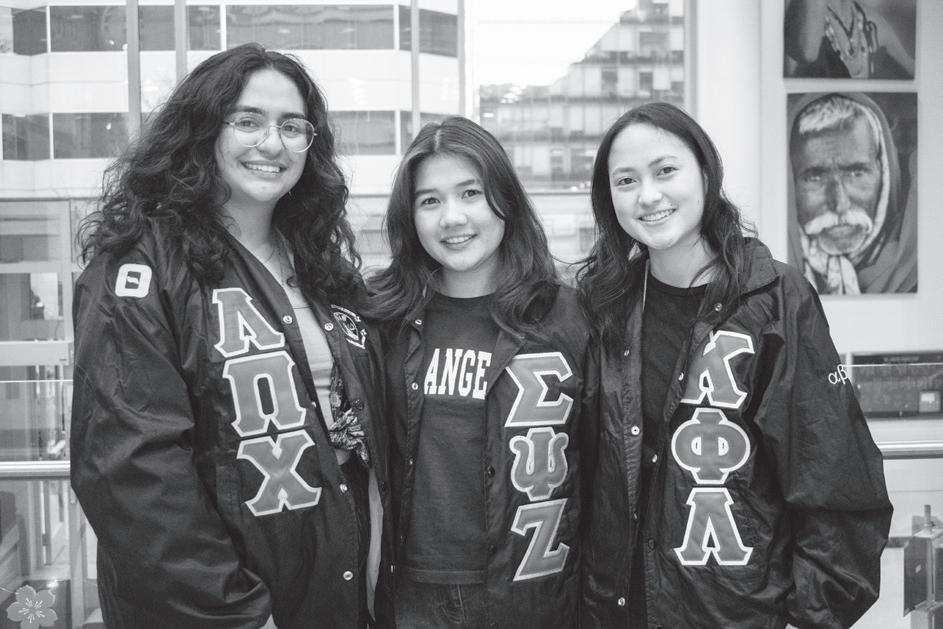
eight positions on the executive board, and only five chapter members expressed interest in leadership positions, according to emails sent to the MGC’s chapter members obtained by The Hatchet. Senior Olivia Poole, the president of Kappa Phi Lambda Sorority, Inc., said positions on the MGC’s former executive board like fundraising chair and community service chair were vacant last year because members of the MGC’s chapters did not want to hold positions. She added that there were “too many” positions on the old executive board because there was a small number of chapter members interested in holding leadership positions.
Poole said the council’s FSL adviser changed three times last semester, preventing the council from electing an executive board.
“Until this semester, where we got this new restructure since last semester, not much was happening because we had changing in advisers,” Poole said.
Poole said Roy Montgomery, the former director of student involvement and leadership, was supposed to be the council’s adviser for the academic year. Montgomery left the University early last semester, according to an Oct. 2 email sent by David Bonilla, the assistant director of student involvement, to the MGC’s
chapter members obtained by The Hatchet. Assistant Dean of Student Life Brian Joyce said advisers for the MGC are assigned each academic year. He said staffing changes are made “as needed” to support the MGC’s needs.
“As with all student groups, the University is committed to the success of the MGC,” Joyce said in an email.
Joyce declined to comment on whether the MGC’s adviser had changed three times since the summer, why advisers have changed and how officials communicated with chapter members about the turnovers. He also declined to comment on whether officials were looking to secure a permanent adviser for the MGC.
Poole said the MGC had low turnout at a sticker sale and study hours they hosted last year because only a few former members of the council were trying to coordinate programming for chapter members.
Poole said she hopes the restructured council can host events like fashion shows or a cultural cook-off to showcase all of the chapter’s cultural differences. The MGC hosted events like study hours and a donation drive last year, according to their Instagram.
“I think in terms of what we want to see, I think it’s more outward representation of showing MGC exists,” Poole said.
Thomas-Greenfield said.
Inside the lobby of the building, at least seven demonstrators with red-painted hands held a white banner inscribed with the names of Palestinians killed in the war in Gaza.
The students told pedestrians about “a war criminal on the seventh floor” while passing out pamphlets with information about Thomas-Greenfield and the coalition’s demands to the University, including protecting pro-Palestinian speech and ending all academic ties with Zionist institutions.
The pamphlet states that Black people have been affected by systems of oppression since the founding of the U.S. and that the country has always used Black
bodies as “puppets” to limit any resistance against the systems. It references historical examples like Black plantation overseers and Black FBI informants who infiltrated the Black Panther Party.
In an Instagram post advertising the protest Tuesday, the coalition listed about 18 organizations as cosponsors for the protest, including GW student and alumni groups and D.C.-wide chapters.
A student in the coalition, who requested anonymity due to safety concerns, said it is “shameful” and “disgusting” that GW invited Thomas-Greenfield to the event and said her vetoes blocked thousands of lives from being saved. The coalition member declined to comment on the specifics of the placement and removal of the Palestinian flag.
“We chose to essentially mobilize around it to demonstrate that the GW student body does not stand for hosting war criminals on our campus,” the coalition member said.
GWPD Chief James Tate, Assistant Dean of Student Life Brian Joyce and Director of Campus Living and Residential Education Dan Wright stood inside the first-floor entrance of the school. At least seven Metropolitan Police Department officers and four GWPD officers were scattered throughout E Street and inside the Elliott School.
Before reading audience-submitted questions, GDP undergraduate fellow Danielle Whyte — a junior international affairs student who moderated the Q&A portion of the event — asked Thomas-Greenfield if she believes marginalized people in power should be “dedicated to reducing marginalization systemically.”
“I think once you’re in a position of power, you’re no longer a marginalized person,” ThomasGreenfield said in response.
GWPD faces vacancies as police departments confront hiring struggles
SOFIA MOSCI REPORTER
NICOLE AKUMATEY REPORTER
The GW Police Department is struggling to fill police officer roles amid a regional and national trend of fewer applicants with less experience in the years following the killing of George Floyd in 2020.
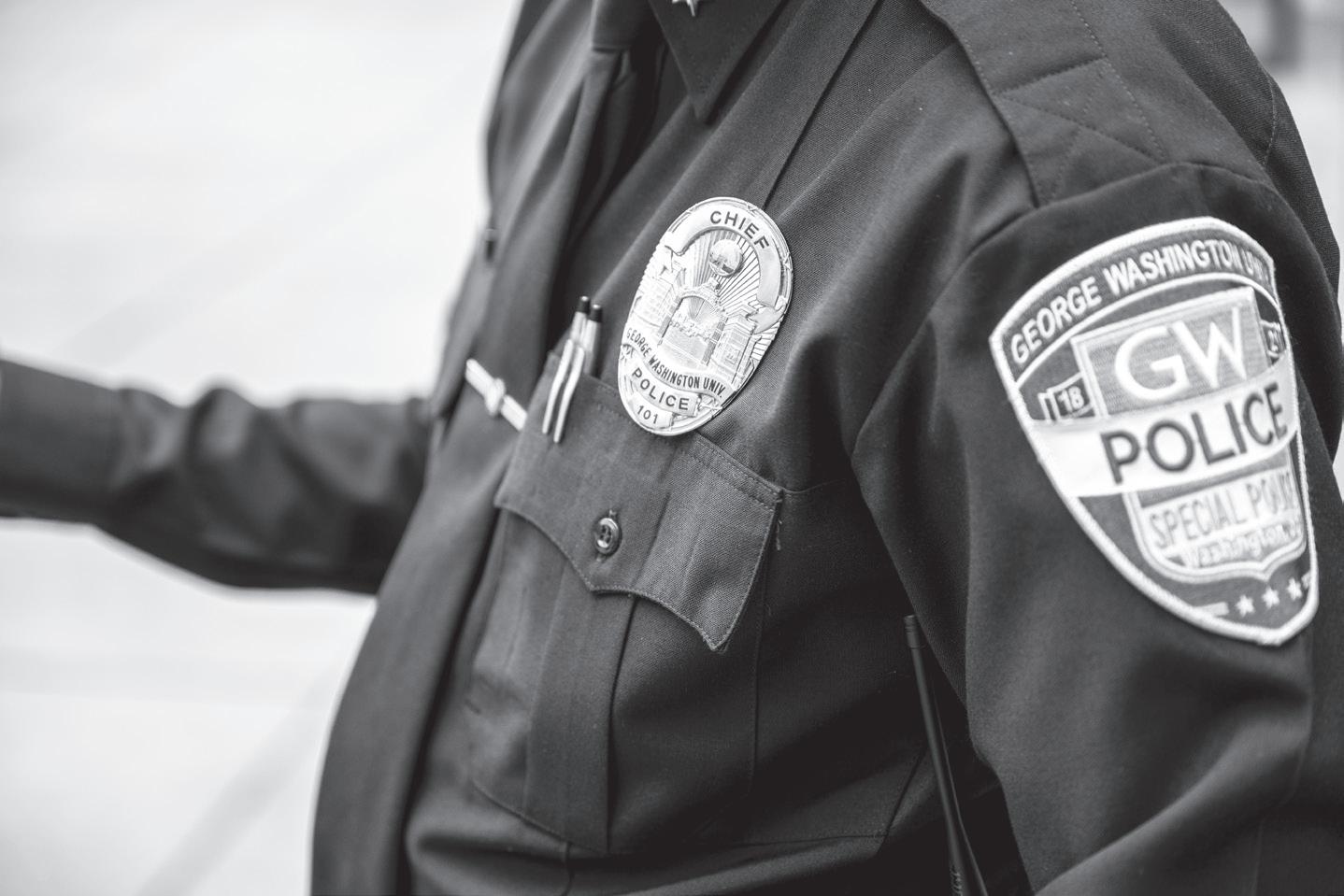
GWPD Chief James Tate said last week that his department plans to hire three supervisors in the coming weeks to fill officer vacancies. He said recruiting for the department is much more difficult today than it was in previous years, mainly because the caliber of applicant pools is diminishing as applicants’ education and experience levels decline.
“I can tell you that it’s something not felt by just us, it’s felt by police departments all over the country,” Tate said.
In 2023, the number of officers in the Metropolitan Police Department, which serves the D.C. area, shrank to a 50-year low. MPD’s attempts to
recruit new hires have reached as far as New York City, where MPD placed ads on buses and subways as early as 2022 to recruit local officers to join the D.C. force. Officer retirements also increased by 45 percent between 2020 and 2021, according to research on nearly 200 law enforcement agencies.
Tate said police chiefs are now more reluctant to hire from the applicant pool because they want to avoid adding officers who could pose a liability.
“We want to reduce any sort of risk of bringing someone on who has made some serious mistakes,” Tate said.
Current and former police from other agencies and schools said as public opinion toward law enforcement has declined, fewer people are applying for jobs in the field, leading to overall diminished candidate quality.
Daniel Dusseau, the retired chief of police and former director of public safety for Northern Virginia Community College, said public scrutiny on law enforcement of-
ficers and better pay rate offerings from other police department positions may turn away potential recruits from campus policing roles. On average, a campus police officer in D.C. makes approximately $79,648 per year. The annual salary for MPD officers starts at $66,419, increasing to $72,668 after 18 months and $88,327 after five years.
Dusseau said the 2020 killing of George Floyd increased scrutiny on law enforcement.
“It made it harder for people to want to stay when they felt like everything they did was being scrutinized no matter what decision they made,” Dusseau said.
Dusseau said D.C. campus police departments struggle to recruit officers because they have to compete with Districtarea departments to recruit the same limited pool of potential candidates.
“They’re looking for somebody with a service mentality, clean background, who’s a problem solver and empathetic,” Dusseau said.
NEWS THE GW HATCHET April 15, 2024 • Page 2 News THIS WEEK’S EVENTS CONFRONTING ANTI SEMITISM: HERE, THERE, AND EVERYWHERE Tuesday, April 16 | 5:30 p.m.| Science & Engineering Hall Attend a conversation on confronting antisemitism with visiting assistant professor Rachel Fish. A CONVERSATION WITH EU ECONOMY COMMISSIONER PAOLO GENTILONI Wednesday, April 17 | 2 p.m. | Elliott School The Institute for European, Russian, and Eurasian Studies hosts Paolo Gentiloni for a conversation.. Stephen Joel Trachtenberg was officially inaugurated in the Smith Center as GW’s 15th president. THIS WEEK IN HISTORY
BROOKE FORGETTE STAFF
WRITER
ELIJAH EDWARDS REPORTER JENNIFER IGBONOBA CONTRIBUTING NEWS EDITOR RYAN J. KARLIN STAFF WRITER SAGE RUSSELL | ASSISTANT PHOTO EDITOR A Metropolitan Police Department officer snaps a photo of a Palestinian flag unfurled from the 1959 E Street roof.
RACHEL KURDLANSKY | STAFF PHOTOGRAPHER From left to right, Multicultural Greek Council chapter presidents Estefania Hernandez, Kate Olid and Olivia Poole
DANIEL HEUER | STAFF PHOTOGRAPHER GW Police Department Chief James Tate’s badge and Special Police patch on his uniform
TRAiLS seeks permanent adviser after staff turnover, decline in programming
Officials seek to hire an adviser for an outdoor adventure student organization that has reduced its excursions to account for shuffles in its University points of contact throughout the year.
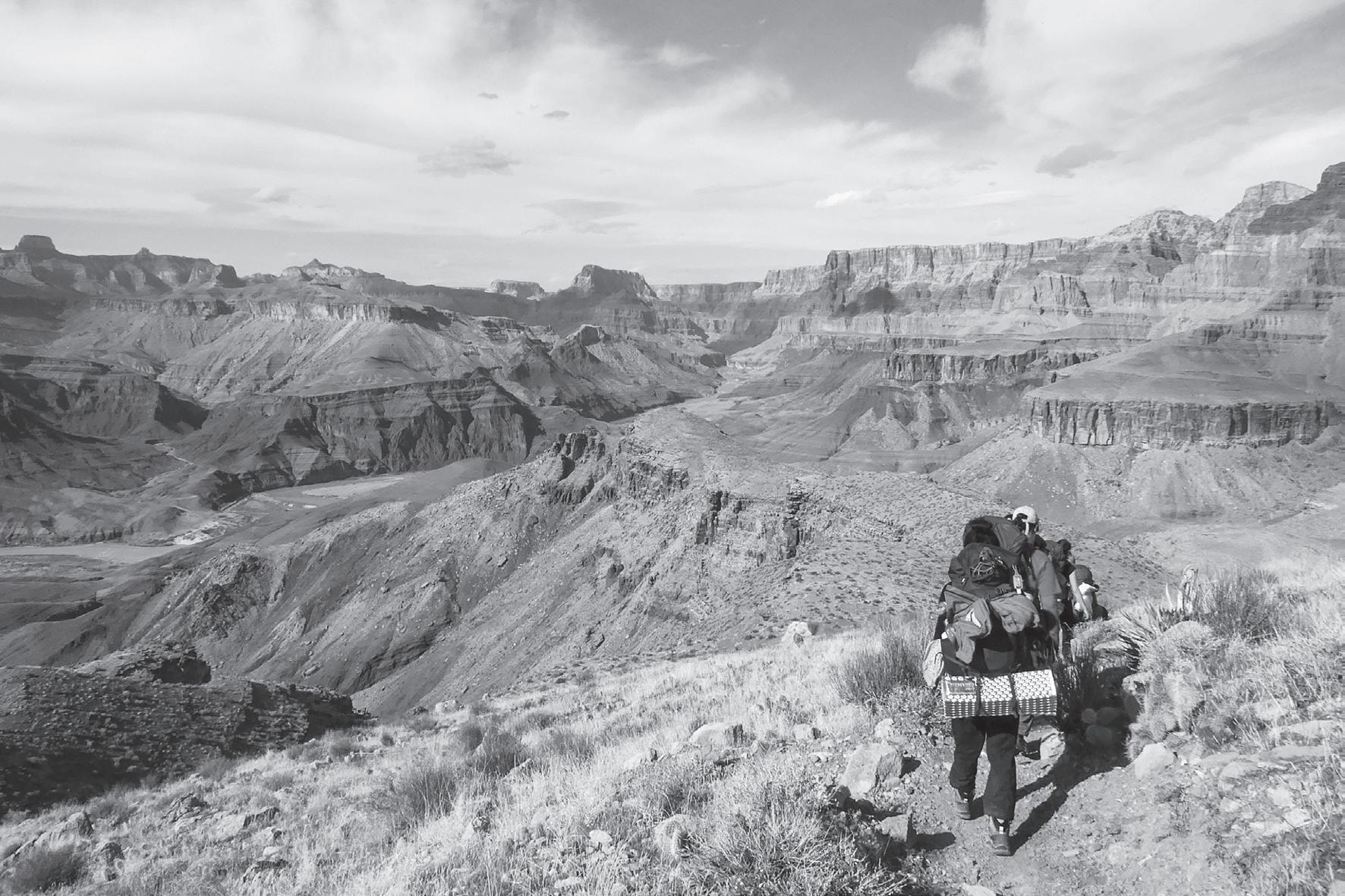
Since the organization’s last full-time adviser left in fall 2021, leaders of GW TRAiLS have cut the number of the group’s annual trips from 60 to 70 per semester to 40 while cycling through five different interim advisers, which members said haven’t had the necessary time or experience to help direct TRAiLS’ operations. Leaders of TRAiLS said the group needs a full-time adviser with expertise in outdoor education who can also serve as an on-call University liaison during the group’s regular overnight trips to meet student demand for weekly outdoor excursions.
Officials posted a job listing for a senior outdoor education coordinator in the Lerner Health and Wellness Center on Thursday, a position that would advise TRAiLS, according to the job description. The student organization’s leaders said they have encouraged officials to hire a new adviser since the beginning of the academic year because it would alleviate some pressure from guides — student volunteers that lead other students in hiking and backpacking trips over weekends and school breaks — and help bring back the organization’s typical operating capacity.
“We just need someone who is prepared fully to take on TRAiLS as part of their responsibilities,” TRAiLS’ President Liz Hartmetz
said. Hartmetz said the group — which has more than 1,000 members on Engage and operates multiple outdoor trips each weekend — needs an adviser who can devote a minimum of 20 hours a week to the group. She said the group’s last designated adviser handled the administrative responsibilities of organizing and booking transportation for weekly trips, including overnight stays, and coordinating with third-party outfitters for TRAiLS.
“It’s a very overwhelming job,” Hartmetz said. “I think the University is getting to that point where they’re understanding the breadth of what we do, because it’s easy to be like ‘Oh, this is like a student organization.'”
She said while TRAiLS’ recent advisers have worked to support the group, they haven’t had the time to take on the breadth of the work that the organization requires, which has pushed administrative tasks onto students.
“That just led to more of a shift in responsibility toward the leadership team, especially the interns, myself and the rest of leadership,” Hartmetz said.
University spokesperson Julia Metjian said TRAiLS operates within “University lines on risk management” and that the University approves all of TRAiLS’ activities for safety. She said the University provides guides with first-aid supplies, information about medical facilities nearest to the hiking trails and trains guides “extensively” in emergency safety procedures like Wilderness First Aid and CPR.
Metjian declined to comment on why TRAiLS has undergone five adviser changes since fall 2021.
“It is crucial that every member participating in TRAiLS feels fully
supported and safe at any location,” Metjian said in an email.
Senior Laurel Brodsky, a guide for TRAiLS, said the organization lost touch with the University after the last permanent adviser left and GW transitioned the group from the Office of Student Life to the Office of Campus Recreation in spring 2022. She said the interim advisers that the University assigned after the adviser’s departure had other responsibilities on top of TRAiLS while the last permanent adviser was primarily dedicated to the student organization.
“If someone had a concern, they were available to the broader
Researchers train relief organizations to curb gender-based violence
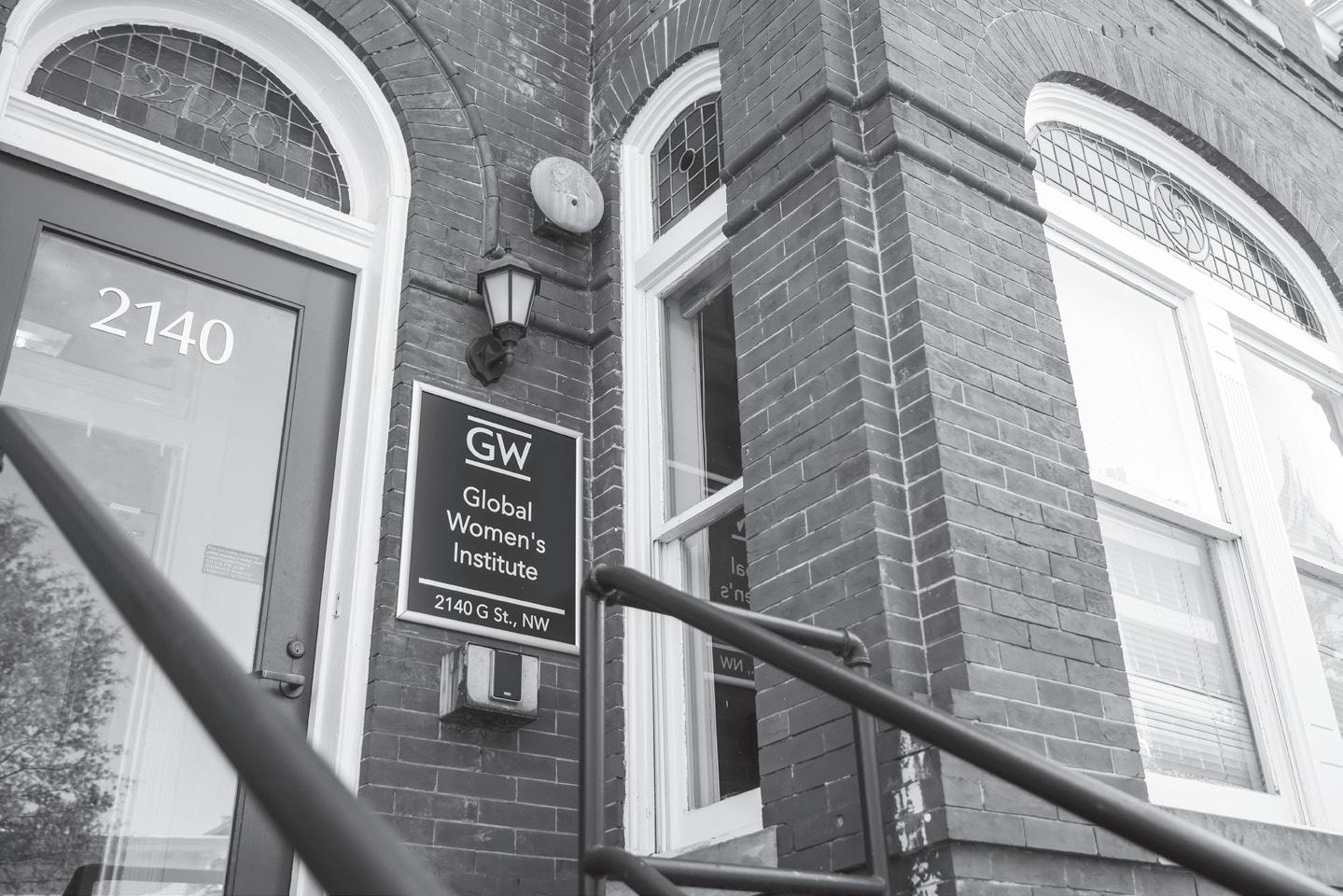
GW’s Global Women’s Institute is implementing a program to help international humanitarian organizations combat gender-based violence in developing countries.
Putting Survivors at the Center researchers are training humanitarian relief organizations in Iraq, South Sudan and the Democratic Republic of the Congo to confront instances of gender-based violence, which they will complete early 2025. Senior Researcher Gabriella Nassif said the program trains members of local humanitarian organizations on maintaining survivor confidentiality and referring to specialists because women regularly disclose instances of gender-based violence to the groups, but the organizations often don’t have the knowledge or tools to address the cases.
“Our program tries to cover that entire gamut of organizations to give them the tools that they would need to help a survivor get to that next step of specialized care, which that is the ultimate goal of all humanitarian actors who are working on gender-based violence,” Nassif said. “We want the survivor to get to the specialized services that they would need to start the healing process.”
The institute partnered with Women for Women International, an organization that supports female survivors of war, for the project. U.S.
Agency for International Development awarded both groups funding to conduct the three-phase program.
The program entered its second phase this academic year with pilot training programs in Iraq, South Sudan and the Democratic Republic of the Congo. In Iraq, domestic violence has long been rampant due to laws and masculine culture that often translate into violence against women, according to the United Nations. A humanitarian crisis in South Sudan resulting from ongoing political conflict has led to increased sexual violence against women. And the DRC has experienced increased reports of sexual assault by armed insurgent groups since March 2022.
Nassif said the institute implemented the pilot programs based on research conducted in the program’s first phase, a process based on group interviews with leaders of local humanitarian organizations in all three countries. She said the pilot programs differ in each country and range from a lack of awareness about available resources to a lack of confidentiality preventing access to support. In all three participating countries, researchers introduced referral programs where local organizations can assign women experiencing violence to specialists, she said. In Iraq, the programs focus on long-term solutions for survivors like
training organization leaders to give survivors psychological support, while in South Sudan and the DRC, the programs are focused on shortterm solutions like confidentiality in incidents of disclosure and referring women to specialists, according to the project’s website.
“We really want to see what works,” Nassif said. “People, what we’re calling frontline staff, who deal with women and girls, what they think is the most helpful, and we want to move from there.”
She said the goal of the pilot programs is to implement practices in the participating countries to test their success in easing access to support resources for survivors. Researchers will use that information in phase three of the project, where they will consolidate the most successful initiatives and create global guidelines for dealing with genderbased violence in 2025.
“One of the reasons this project is important is because we are trying to tell people that just because we have specialized actors who support survivors doesn’t mean that’s enough,” Nassif said. “And it doesn’t mean that survivors are actually getting to the specialized actors. They might only be able to get to this local women’s group that meets twice a month. So our goal is to try and expand survivors’ access to these specialized services.”
guide community to reach out to for developing new ideas,” Brodsky said. “They were really there and accessible. Now, under Campus Recreation, we do a lot more of that internally because we don’t have that support from the University.”
She said the last permanent adviser would attend weekly guide meetings and received a Wilderness First Responder Certification — which allows people to make critical medical and evacuation decisions while in remote locations — to answer safety questions about potential new trips that guides wanted to put on.
“It’s a little frustrating that
we’ve kind of lost this broad network of support,” Brodsky said. Senior Leo Kehagias, a guide, the former president of TRAiLS and a Hatchet reporter, said since the departure of the last permanent adviser, the interim University liaisons have done their best to support the group, but TRAiLS is an organization that demands full-time attention that their recent advisers have not been able to accommodate with their busy schedules and other commitments.
“They had a lot of other things on their plate, right? A lot of other assignments and we were kind of just shuffled in as an extra responsibility for them,” Kehagias said.
Students launch group to support sexual assault survivors
DYLAN EBS STAFF WRITER QUINN GIORDANO REPORTER
A student group dedicated to the prevention and awareness of sexual assault on college campuses launched last month.
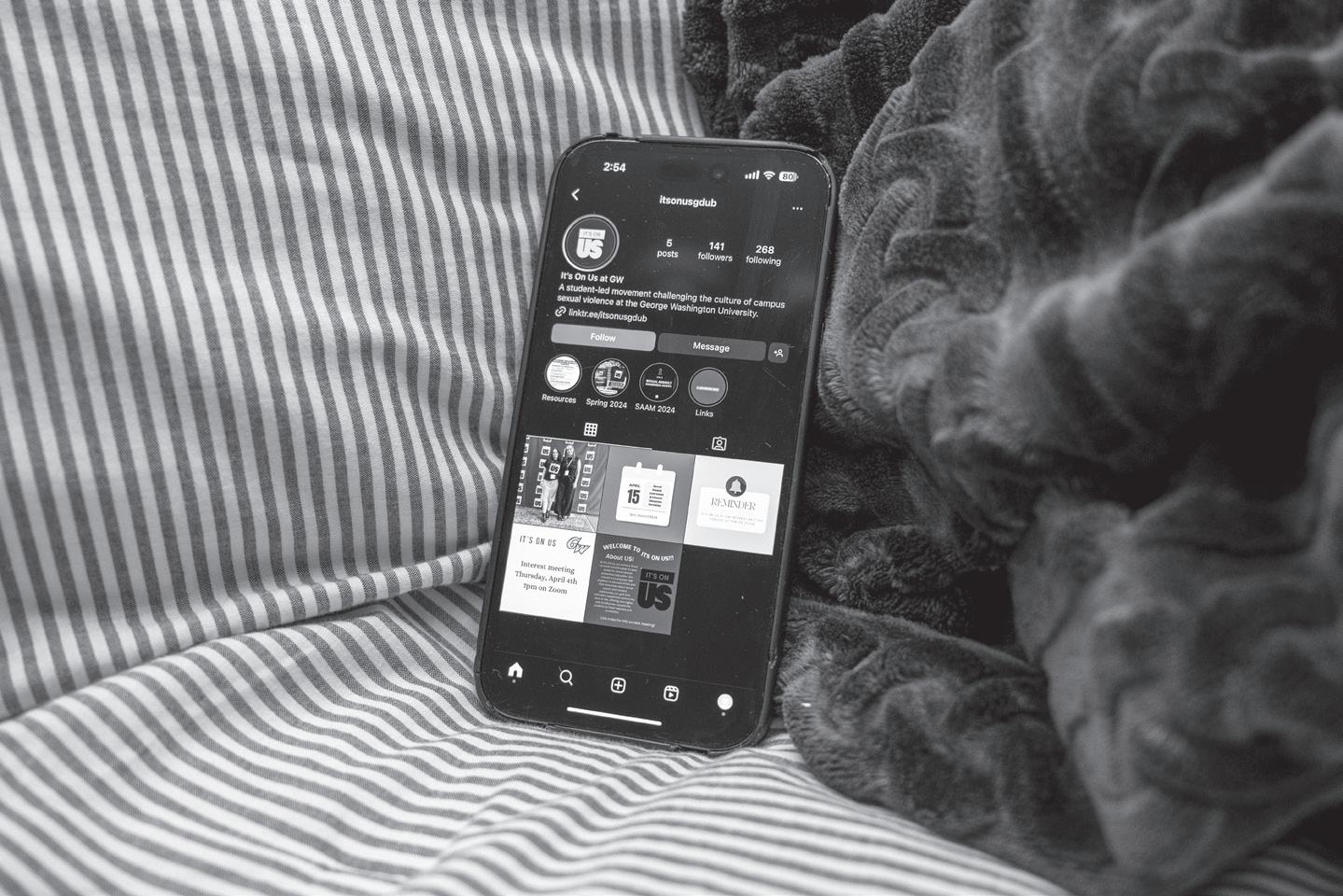
It’s On Us at GW — a chapter of the national organization — formed to promote grassroots awareness of on-campus sexual assault and implement optional educational assault prevention programs for all students. Members said the group focuses on building a peer-to-peer model for sexual assault education to empower and educate students through tools like bystander intervention training and support for survivors.
Students who experience sexual assault can go to the Title IX Office to file a formal complaint against the perpetrator, according to the Title IX Office website. If a student wants to remain anonymous, officials encourage them to reach out to the office to learn what their on- and off-campus resources are, including the GW-run Sexual Assault & Intimate Violence Helpline — a 24/7 service staffed by “clinically-trained professionals” — for assistance and connections to other resources, and the D.C. Rape Crisis Center.
GW’s branch of It’s On Us adds to the more than 500 chapters across the United States. In a recent Instagram post, the GW chapter stated that one of their goals is to cultivate a supportive community on campus through programming like
care nights and mindfulness sessions, where students can journal and create vision boards in the fall.
Sophomore Zoe Larkey, the founder of the chapter, said she hopes to create “survivor circles” where survivors of sexual violence can share their experiences in a protected environment.
Larkey said the resources already available at GW “failed” her because she felt like the Title IX Office employees were more focused on the “administrative process” instead of providing the support she needed after she was sexually assaulted in October of her freshman year. Larkey said she lived on the same floor as her perpetrator and was unable to change her housing situation.
From connecting with others about their struggles to find adequate resources, Larkey said she realized she was not alone.
“I just saw a really big need for resources and stuff on campus that just didn’t exist,” Larkey said. “I found that my story was not unique. There were a lot of people who had experiences really similar and faced a lot of difficulty getting resources and support that they needed.”
Larkey said the organization is expanding its presence on campus by posting on Instagram and informing peers across campus to bring in more members. She said some of her teammates on the women’s rowing team attended the organization’s virtual interest meeting earlier this month to support her.
“It is really hard, especially with the topic of sex-
ual violence. Not everyone wants to bring that up to their friends,” she said.
The organization is hosting its first in-person event in District House on Monday, which will focus on sexual assault awareness and consent education.
Larkey said she learned about It’s On Us after doing research last fall on different sexual violence prevention initiatives. She said the process of forming a chapter of It’s On Us was “very easy.” She said she filled out an online application and attended an onboarding meeting with leaders from the national organization to confirm her interest in starting a chapter at GW.
Larkey said she is open to working with GW Students Against Sexual Assault — an organization with similar objectives as It’s On Us at GW — for joint events and initiatives. She said what sets It’s On Us at GW apart from similar organizations is the network of other schools that also house It’s On Us chapters, including American University.
First-year Margaret Barker, a member of It’s On Us at GW, said she joined the organization earlier this month after hearing about it from Larkey. She said Larkey and her are both members of Alpha Phi Omega — a coeducational service fraternity — and Larkey’s service project conducted during the fraternity’s pledging process focused on sexual assault awareness at GW which encouraged Larkey to start the organization.
“This is something I care passionately about, so I just wanted to support her and join,” Barker said.
NEWS THE GW HATCHET April 15, 2024 • Page 3
EMMA KHODAVERDIAN REPORTER MILO ROSENZWEIG REPORTER
COURTESY OF LIZ HARTMETZ
Members of GW TRAiLS trek through the Grand Canyon during a trip over spring break this year.
PHOTOGRAPHER The Global Women's Institute’s townhouse at 2140 G St.
JENNA LEE STAFF WRITER LEXI CRITCHETT | STAFF
PHOTO ILLUSTRATION BY DANIEL HEUER | STAFF PHOTOGRAPHER The It's On Us at GW Instagram account
Officials launch artificial intelligence research initiative
Officials announced an interdisciplinary research initiative on artificial intelligence’s real-life applications earlier this month.
The Trustworthy AI initiative, a plan to engage GW researchers across multiple fields, aims to improve existing AI models and research strategies for AI’s societal applications to increase user trust. Zoe Szajnfarber, the director of strategic initiatives for GW Engineering and a faculty director for GW TAI, said GW TAI seeks to unite GW faculty who research AI under one initiative to create opportunities for research collaborations across disciplines.
Szajnfarber said many faculty members at GW have ongoing research projects related to AI as well as larger programs like the Institute for Trustworthy AI in Law and Society and the Co-Design of Trustworthy AI Systems. She said it can be difficult for faculty to find joint research opportunities because AI research at the University spans across numerous schools, and programs like GW TAI connecting AI researchers did not exist prior.
“The challenge is that the work is so diverse and distributed across many disciplines that it’s sometimes hard to keep up, let alone find whom to connect with relevant collaborators on any given project,” Szajnfarber said in an email.
Szajnfarber said GW TAI will serve as a means to facilitate research collaborations and joint projects across disciplines at
GW and to share AI-related events and opportunities in one place. “I see GW TAI as a platform to bring together researchers who want to contribute to this important problem space of TAI in systems and for society,” Szajnfarber said.
Faculty involved in the initiative said they hope to bolster current AI models and study the implications of AI use in areas like consumer behavior, social justice issues and medical decisions.
Erica Wortham — the director of the GW Innovation Center and a coprincipal investigator of Designing Trustworthy AI Systems, a program for doctoral students to conduct AI research — said she teaches a summer course for computer science and systems engineering doctoral students on designing AI solutions to solve real-world problems, like AI use for cashierless grocery stores. She said the partnership between students in two fields is an example of the Trustworthy AI initiative’s multidisciplinary approach and allows those designing AI to focus on addressing problems for those who use AI.
“You have the folks making the models and building the algorithms talking to folks that study technical systems in context,” Wortham said.
Douglas Crawford, an assistant professor of interior architecture and a GW TAI faculty member, said he hopes to collaborate with faculty members who create AI to develop architecture-specific models through the initiative.
He said architecture students utilize AI’s graphic design capabilities to cre-
ate “inspirational imagery” and to generate quick mock-ups for their designs. But, since graphic AI is not specifically tailored to architecture, AI outputs include “hallucinations” like staircases that lead to a wall without a doorway, he said.
“I’m excited to be included amongst that and be able to offer up the unique perspective of someone in the Corcoran School who is working the graphic AI side of things,” Crawford said.
Nils Olsen, an assistant professor of organizational sciences and a GW TAI faculty member, said he looks forward to further examining AI’s impacts on consumer decisions and its uses in the medical field, like determining diagnoses, as a researcher in the initiative.
“Certainly there are a lot of opportunities,” Olsen said. “My real value to add there would be on the cognitive underpinnings, how people make decisions, literally in their brain.”
Olsen said he’s been conducting consumer behavior research since 2019 using AI bots that were cartoon versions of people from various racial groups to analyze how consumers would negotiate with the different bots over Airbnb prices. He said researchers aimed to assess if consumers would have a different level of aggression when negotiating with a Black, Asian or white individual and found that consumers perceived the bot resembling a Black individual as the most competent, likable and human.
Olsen said researchers are now thinking about the implications of those findings, as AI bots could begin to facilitate negotiations and customer service more
frequently.
“They also understand where AI already is being implemented and where there could be opportunities for future kind of introductions of AI,” Olsen said.
Alexa Alice Joubin, the director of the Digital Humanities Institute and a professor of English, said she studies societal biases using AI because she found there are biases within AI algorithms through their responses that reflect various larger societal issues.
“My conclusion is that current AI is actually a social surveillance tool,” Joubin said. “Do you want to know about biases in society? Test it on AI. If you curate it correctly, what comes out actually reflects what the society collectively thinks.”
She said coders often think linearly about AI algorithms, and those in humanities often consider alternative approaches to AI use, which she said demonstrates the value of researchers in different fields collaborating as part of the initiative.
“It’s so that you don’t lose sight of what it is for, it’s for humans,” Joubin said. “That’s why humanities are here.”
Doug Evans, the founder of the Behavioral Research Insights and Digital Health Technology Institute and a professor of prevention and community health, said he hopes to explore how researchers can use AI to influence healthrelated behaviors through GW TAI.
“There may be developments or collaboration opportunities that arise that could benefit my work,” Evans said. “So I was very interested in that sort of thing.”
LIQUOR LAW VIOLATION
Amsterdam Hall 4/7/2024 – 4:34 a.m.
Closed Case GW Police Department officers responded to a report of an intoxicated female student. Emergency Medical Response Group responders arrived on scene, and after medical evaluation, transported her to the GW Hospital emergency room for further medical treatment. Referred to the Division for Student Affairs.
THEFT II/FROM BUILDING, CREDIT CARD FRAUD
Thurston Hall 4/7/2024 – 1 p.m.
Open Case A female student reported cash and a credit card stolen from her purse after she left it unattended. Case open.
UNLAWFUL ENTRY, DESTRUCTION OF PROPERTY/ VANDALISM
Private Property within Campus Bounds
4/7/2024 – 11:35 p.m.
Closed Case GWPD officers responded to a blue light emergency phone activation. Upon arrival, officers made contact with a nonGW affiliated female complainant who reported a female subject had broken into her residence on the 2100 Block of F Street. Officers apprehended the subject, and Metropolitan Police Department officers responded, arrested her and transferred her to Second District. Subject arrested.
THREATS TO DO BODILY HARM, HARASSING
TELEPHONE PHONE CALLS
Various Locations 4/8/2024 – Multiple Times
Open Case GWPD officers responded to a report by a female contractor who stated that her ex-female partner had threatened her and fled the scene in a vehicle. After fleeing the scene, the subject made harassing phone calls to the complainant. Officers canvassed the area with no findings of the subject. Case open.
THEFT II/FROM BUILDING
Gelman Library
Reported 4/9/2024 – 5 a.m. to 3:45 p.m.
Closed Case A male student reported his items stolen after leaving them unattended on the sixth floor of the library. No suspects or witnesses.
THEFT II/FROM BUILDING
Lerner Health and Wellness Center
Reported 4/10/2024 – Unknown Date
and Time
Open Case A male student reported his backpack stolen after leaving it unattended in the locker room. Case open.
UNLAWFUL ENTRY
District House
4/11/2024 – 5:20 a.m.
Closed Case GWPD officers responded to a report of a male subject asleep in the District House food court area. Officers issued the subject a bar notice and escorted him off GW property. Subject barred.
—Compiled by Ella Mitchell
Officials to modernize Banner system, streamline user interface
GW will expand its partnership with Virginia software company Ellucian to update digital systems for students and employees.
Officials launched the project last month and will use Ellucian’s Banner Software as a service platform to provide a “modern and intuitive user experience” for many of the University’s digital systems, according to an Ellucian release. The Banner system already supports 30 percent of GW’s infrastructure in addition to the University’s internal human resources administrative platform.
Deputy Chief Information Officer Anna Vakulick said the Banner SaaS platform will automate some human resources, payroll, enrollment, admissions, advising and financial functions to adapt to the University’s changing needs. She said implementation will include streamlining processes like exempting a student from a course and inputting grades for Banner and Blackboard. Vakulick added that the modernization of GW’s Banner systems will reduce 96 percent
of the software’s carbon footprint. She declined to comment on how much officials are paying for Ellucian services.
“Modernizing our student information and human resource system (GWeb) is a university-wide initiative offering significant advantages in efficiency while simplifying and transforming the faculty, staff, and student experience,” Vakulick said in an email.
Ellucian President and CEO Laura Ipsen said in a release that Ellucian will promote cross-department collaboration and help officials achieve University goals.
Mike Wulff, the chief product and technology officer for Ellucian, said GW has enlisted Ellucian’s services since the 1990s for Banner HR, Degree Works — also known within GW as DegreeMAP — and Banner Finance.
“We are extremely proud of our partnership with GW and look forward to supporting its students, faculty and staff long into the future,” Wulff said in an email.
An Ellucian spokesperson said Banner SaaS allows universities to create a “central hub” to oversee grades, admissions, fi-
nances and schedules. They said the software also consolidates financial budgeting, accounts payable and reporting into one hub and automates some processes for financial aid offices. The spokesperson said Banner SaaS’ consolidation and automation of University processes will decrease IT maintenance costs and allow more time for IT staff to focus on other tasks.
“Ellucian’s complete suite of SaaS solutions helps institutions manage the end-to-end student lifecycle — from recruiting and enrollment to student success to alumni advancement — integrating data across applications to ensure better insight and decision-making for all constituents while delivering a modern experience for students, faculty and staff,” the spokesperson said in an email. An 11-member “stakeholder committee” of administrators began holding a series of “campus engagement” events related to the expanded use of Banner in January, meeting with 14 groups on campus so far to explain the rollout, according to the GW Information Technology website. Groups included the GW Staff Council, the Faculty Affairs team, human resources
leadership, the Office of the Registrar and undergraduate advisers. The rollout is expected to take between 12 and 18 months, according to the GW IT website. A GW IT presentation in March stated the Banner expansion will address the need for a modernization of old digital systems, threats to digital security and user frustration with current digital interfaces. The expanded partnership will fa -
cilitate the creation of personalized dashboards for students, condensing information on classes, financial aid and advising, which normally appear throughout the GWeb system, according to the presentation. Faculty and staff dashboards will feature information on benefits and task lists. University community members can also view their dashboard in multiple languages, according to the presentation.
CRIME LOG NEWS THE GW HATCHET April 15, 2024 • Page 4
JULIET LANCEY REPORTER RORY QUEALY ASSISTANT NEWS EDITOR SAGE
|
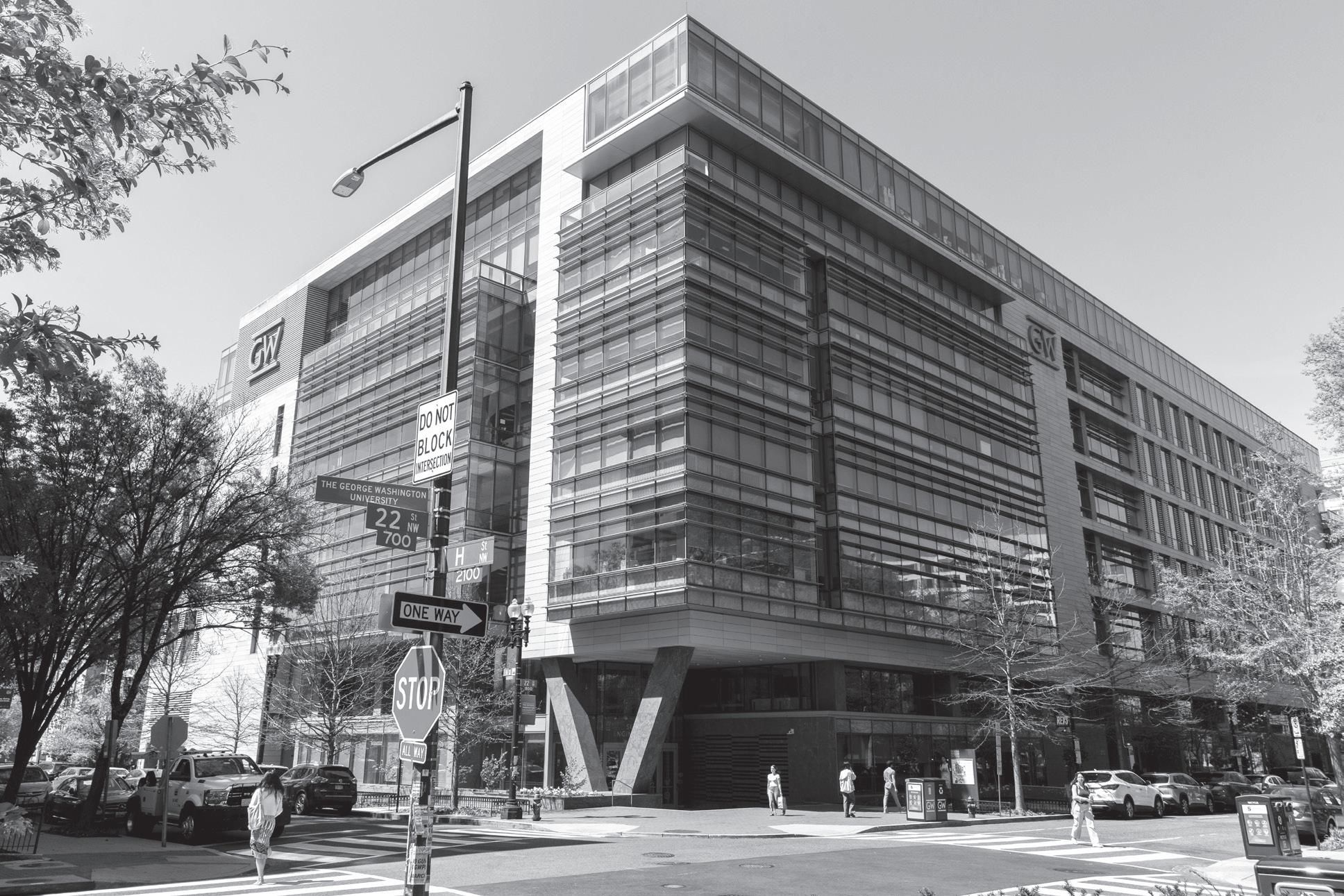
PHOTO EDITOR Pedestrians pass the
and Engineering
on a sunny day.
RUSSELL
ASSISTANT
Science
Hall
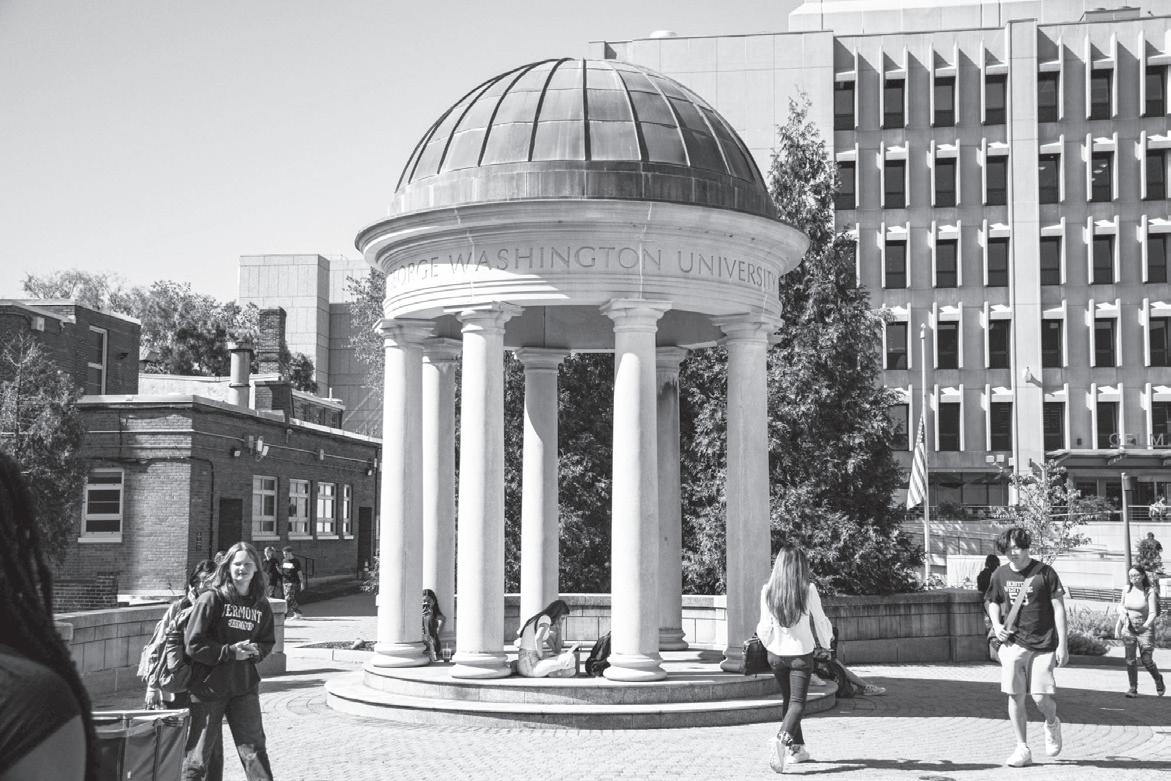
KELLEN HOARD REPORTER KAIDEN YU | STAFF PHOTOGRAPHER Students roam through Kogan Plaza.
English professor discusses brain injuries, memoir
An English professor discussed their recent memoir about their experience with traumatic brain injuries at the GW Textile Museum on Thursday.
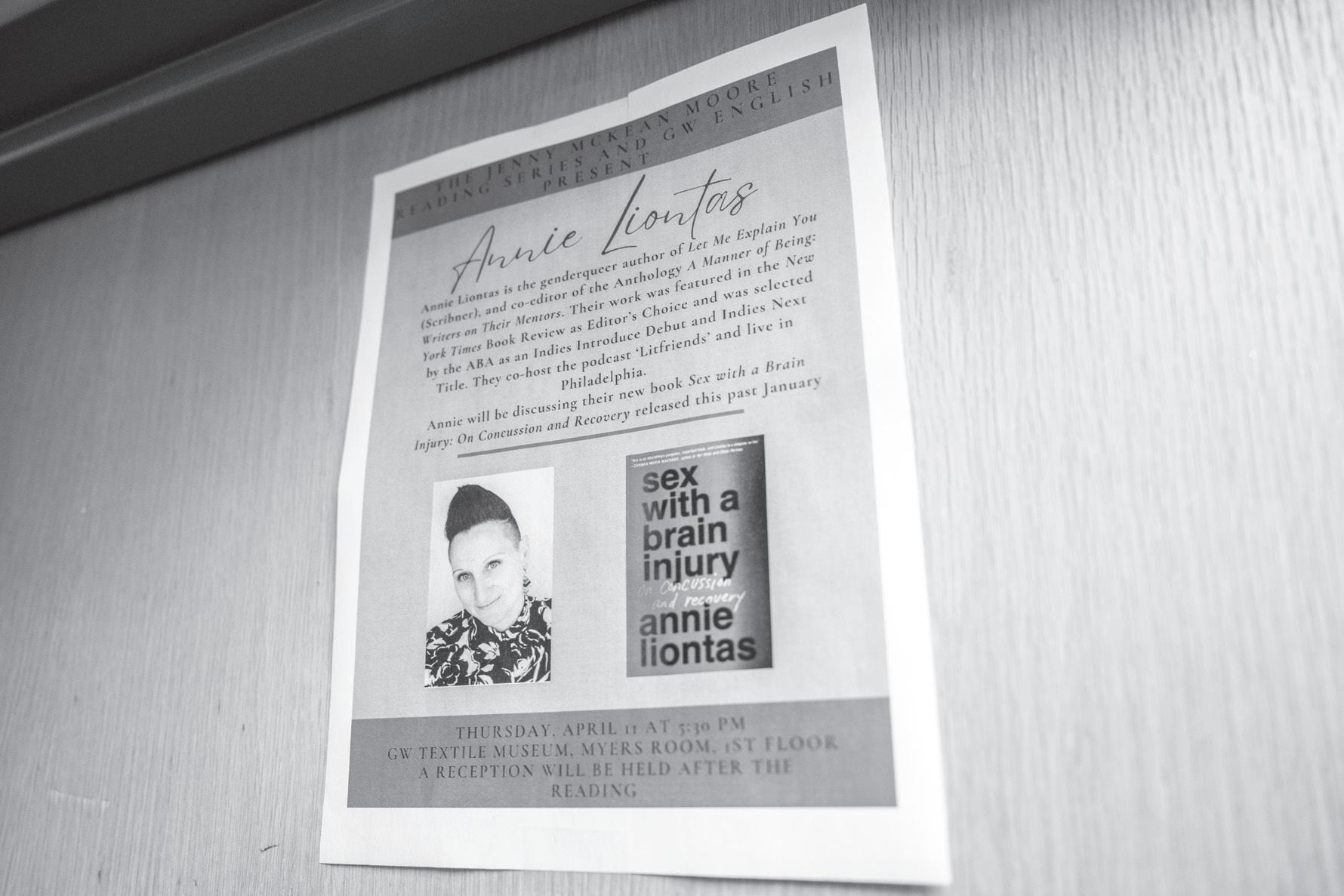
Annie Liontas, an assistant professor of English at GW and the author of “Sex with a Brain Injury: On Concussion and Recovery,” said the conditions associated with traumatic brain injuries, or TBI, can lead to disabilities that many people have yet to fully recognize. The GW English Department hosted the book talk as part of the Jenny McKean Moore Reading Series, a reading series named in honor of a former GW playwriting student who bestowed a fund for the English Department to encourage the study of creative writing.
Liontas said they were inspired to write the memoir after sustaining three head injuries — caused by a biking accident, a baby car seat falling on their head and a pot falling on them — in 2016. They, like most people with TBIs, were left with long-term side effects like head pain, light and sound sensitivity and memory issues that they still struggle with today.
“I had three head injuries in a year, and everything changed,” Liontas said. “My relationship to my body, my relationship to the world, to overhead lighting — everything became a different experience.”
Liontas said many historical figures, including Harriet Tubman and Abraham Lincoln, also strug-
gled with TBIs. They said their research found society has misunderstood the long-lasting effects of TBIs and the prevalence of the injuries in marginalized communities, including unhoused individuals and people who struggle with addiction.
“I learned that people who are incarcerated or in the criminal justice system are seven times more likely to have had a brain injury before they got there,” Liontas said.
Liontas polled attendees at the beginning of the event, asking if anyone knew people with a TBI. Liontas said the poll reflected their research discovery that while only 1 percent of people don’t know anyone with a brain injury, society still does not fully understand or accommodate people who struggle with the long-lasting conditions of TBIs.
Liontas said gender disparities, like the tendency to label women’s health complaints as fake or exaggerated, also contribute to the lack of understanding of TBIs, as women with TBIs often remain undiagnosed. They said the lack of recognition and isolation that people with a TBI face can have negative health effects, like worsening symptoms or the development of mental health conditions.
“I was doing research on an Olympian who tragically died by suicide after two concussions and her family was devastated and absolutely blamed her suicide on untreated concussions,” Liontas said.
Liontas said teaching at GW was the first job they had after sus-
taining their injuries that accommodated their needs, like finding classrooms without irritable lights and providing comfortable furniture. They said their memoir paid tribute to Connie Kibler, a former GW professor in the English department, who advocated for Liontas to receive accommodations for their TBI.
Liontas said they hope the book encourages people to take
risks because they took big risks in sharing their vulnerabilities and detailing how their brain injuries altered their entire personal life. They said the memoir details how their TBI nearly caused them and their wife to file for divorce, in addition to raising awareness of the silent epidemic of TBIs.
“I have a responsibility and want to share these things, and hopefully help shift the culture in a small way,” Liontas said.
Liontas said their publisher encouraged them to pick a new title to avoid the negative connotations associated with the word “sex” after the publisher’s mom saw and disliked the title of the memoir.
But, they said the title encapsulates the personal trauma they went through as the result of a TBI.
“Thanks, no thanks,” said Liontas. “I am keeping my title.”
Officials to fill GSPM director vacancy as stakeholders seek visibility
From Page 1
Christopher Arterton, the founding dean of GSPM which was established in 1987, said it is difficult to increase GSPM’s marketing and funding without a director. He said GSPM is technically a standalone school housed within CPS, but the lack of a permanent leader has led the college to envelop GSPM.
“Having somebody at the core running the school as a director is important to
give throw weight or a focal point to the school so that it’s all working together and advancing and having the pieces of the school reinforce each other,” Arterton said. Arterton said the Columbian College of Arts & Sciences acquired GSPM in 1996 after operating as an independent school since 1987. When he decided to bring the school into CPS in 2006, he said he had the ultimate goal of GSPM growing to the point where it would become an independent school like GW Law and the School of
Business.
He said GSPM students contributed to a large portion of enrollment for CPS, which makes the school a valuable asset to the college. In 2013, GSPM students accounted for 36.7 percent of total CPS enrollment and 30.1 percent of enrollments in 2023.
“I think that the powers that be, without ever saying, are going to not take the steps necessary to nurture the school,” Arterton said. “I think there was somewhat of a reluctance to figure out how that could ever take
Faulty elevators, sudden maintenance thwarts accessibility, students say
From Page 1
Junior Evangeline Sell said she got stuck in an elevator in Mitchell Hall in October 2022 and again in a Munson Hall elevator in late March. Sell said when she lived in Mitchell, she entered an elevator late at night with friends and got stuck for fewer than five minutes before the button started working again, the elevator opening on a random floor. “All of a sudden, it stopped in between the floors, and it started flashing random lights, and it wouldn’t move, and it wouldn’t open,” Sell said.
Sell said elevators in Munson and Mitchell halls are only fixed when both elevators in each residence hall are out of order. “I’ve lived in both halls, and it’s been a consistent problem,” Sell said.
In 2013, at least 71 students were trapped in residence hall elevators at GW over the course of the year.
Sophomore Sophia Lindsay, the president of
the Disabled Students Collective, said broken elevators can disrupt disabled students’ days because many rely on elevators to attend class and get to their residence hall rooms. She said GW often offers little to no notice on when elevators will undergo maintenance. “A lot of the times, if they do maintenance on an elevator, or if an elevator is down, they won’t tell us ahead of time at all,” Lindsay said. “They’ll just randomly say, ‘Oh, by the way, this elevator is gonna be out from like noon to 5 p.m.,’ and I’m like, ‘Okay, so I was going to need that ahead of time, so I could email my professors to say I won’t be in class today.’”
Lindsay said maintenance workers will shut down elevators for repairs, but students still regularly get trapped in malfunctioning elevators. She said maintenance workers are not always responsive to calls for service. Students can call an emergency line 24 hours per day and can submit
nonemergency repair requests through FixIt.
“A big issue is that if you call maintenance, they’re not responsive,” Lindsay said.
Lindsay said she hopes the student body starts to notice how accessibility issues affect disabled students every day. She said the University should prioritize accessibility because anyone can become disabled.
“This whole issue as a whole is about GW not putting its students first, which it very rarely does, especially the disabled ones,” Lindsay said.
Sophomore Jacob Khabie said he has gotten stuck in University elevators at least three times in the last year. He said in October, he got stuck in a Munson elevator with his community coordinator, who said she would report the incident.
“One of the times the elevators just wouldn’t go down from the eighth floor, one other time it got stuck on the sixth floor, one of the times the elevators just stopped,” Khabie said.
place in a way that wouldn’t damage the college significantly.”
Matt Chase, a board member and the executive director of the NAC, said members have kept their desire to hire a director “front and center.” He said advisers have talked with Riddle about the qualities they want in a director, like political career experience.
“We have not let this slip off the radar,” Chase said. “We are advisers, we’re not a board of directors. Once our advice is given, I can’t tell
you what is truly happening with that advice.”
Chase said in the long run, the school needs a director to oversee enrollment and hiring, but the board also has three subcommittees focused on enrollment and recruiting adjunct professors, updating the curriculum and building alliances with other universities and big employers to feed more students into GSPM.
“It’s a short-term fix,” Chase said. “I don’t think the majority of the board sees that as the long-term.”
Julius Hobson Jr., a GSPM adjunct professor and a board member, said the school needs to raise money for an endowed chair who can hire a director to serve as the “face of the school” and guide GSPM-specific initiatives, fundraising and recruitment.
“We need a prominent person to sit in a chair who can raise money and attract students, but we need money to pay them at a rate that’s reasonable, and that’s the problem that I see,” Hobson said.
Faculty senators talk arming of GWPD, presidential searches
From Page 1
The executive committee includes one senator from each of the University’s nine schools.
“The intent in some of the recommendations that we put together was to start paying attention on how we put together the FSEC representatives for each school and make sure that there is a fair representation of this expertise in the committee when we go speak to the Board,” Orti said. Philip Wirtz, a professor of decision sciences and psychological and brain sciences, served on the executive committee for “probably” more than 10 years and said he saw the difficult decisions the committee has to make. He said he agrees the committee made a mistake when they did not consult other senate committees on the Board’s plans to arm GWPD, but he “experienced firsthand” situations where the committee could not share information on sensitive matters.
Wirtz said some of the report’s language is “exceedingly strong,” including the statement that FSEC should be required to relay all information to relevant committees.
“There are situations where the executive committee really does need to be informed and really cannot pass that along,” Wirtz said. “I would not include the arming of police on campus as an example of that. That, in my opinion, was a mistake.” Through the rest of the meeting, faculty senators passed a resolution regarding representation in future presidential searches, heard reports from University officials and received updates
from the body’s standing committees.
The senate passed resolution 24-6 adding guidelines to the structure of the Faculty Consultative Committee — a group of faculty members from each of GW’s nine schools with senate representation who advise trustees on presidential searches — to allow the senate to add up to four additional members to increase representation on the committee based on discipline, rank, race and gender. The resolution also asked the Board to add all or some of the committee members to future iterations of the Presidential Search Committee, which is composed of trustees, faculty members, staff members and presidents of the Student Government Association and Alumni Association, and give the consultative committee an “active role” in the process.
“We hope that we don’t need a presidential search for the next 20 years or so, but it’s also still pretty good to have something in the books and be done with this,” said Orti, who introduced the resolution.
In 2016, the senate voted to add up to seven additional members to the committee and up to eight in 2021 to diversify the committee in demographic and academic traits. The senate added members to the 2017 committee after faculty complained that the committee was primarily composed of white men in the science, math, law and medical fields.
Also in the Faculty Senate meeting, University President Ellen Granberg said she concluded her GW Together listening tour last month after visiting Los Angeles, California; San Francisco, California; and Seattle, Washington. Granberg
said she was “impressed” by the GW community in each of the cities.
“This entire GW together tour has been very, very helpful for me to get to know our alumni, our families and our donors better and has produced a number of insights and really helpful conversations,” Granberg said. Granberg said officials began consolidating the budget for fiscal year 2025. She said the University plans to create a budget that invests in faculty and staff while targeting a “reasonable surplus.” Provost Chris Bracey said his office received and is reviewing the final report from the Diversity Program Review Team — a group of students, faculty and administrators who assess and provide recommendations on improving diversity at the University. The office was set to receive the recommended diversity action plan between summer and fall 2023, according to the timeline on the Office of the Provost’s website, meaning the team is over half a year late to submit the report.
Bracey also said the University will distribute a summary “in the very near future” detailing information officials collected from conversations with faculty, staff and students in late February and early March to develop a long-term strategic plan. He said the University will also open a form allowing community members to submit their thoughts on the report, which will help officials distill the information into a “set of themes” to be announced in the “near future” that will inform the University’s long-term strategic framework, which it has been without since the pandemic.
NEWS April 15, 2024 • Page 5
THE GW HATCHET SKYLAR BLUMENAUER REPORTER DANIEL HEUER | STAFF PHOTOGRAPHER A poster in Phillips Hall advertises Annie Liontas' talk about their book "Sex with a Brain Injury: On Concussion and Recovery."
JORDYN BAILER | ASSISTANT PHOTO EDITOR
The elevators on the ground floor of Shenkman Hall
Hanging out with friends doesn’t have to dent your wallet
Finding a time when your schedule lines up with friends’ can be as rare as last week’s solar eclipse — and just as exciting. But it’s even rarer to escape a hangout with friends without blowing cash. You shouldn’t have to spend money to maintain friendships.
Everyone deserves a “third place,” somewhere to socialize outside of an academic or living environment. But grabbing Gelbucks or getting lunch at Western Market can add up quickly, and even places with meal deals or discounts can be pricey. Money always seems like a prerequisite to spend time with someone.
During my first year at GW, I wanted to connect with people and familiarize myself with campus and the city. After all, GW brings people together from all over the world, including people of different financial means. I didn’t think that having friends would become expensive, but meeting new people meant I would inevitably spend money from my own pocket or dining dollars on GWorld. And like many students, I have tight pockets due to my financial situation, which could be awkward when I didn’t want to spend money.
When I opt for just water or a slightly smaller meal when I’m out
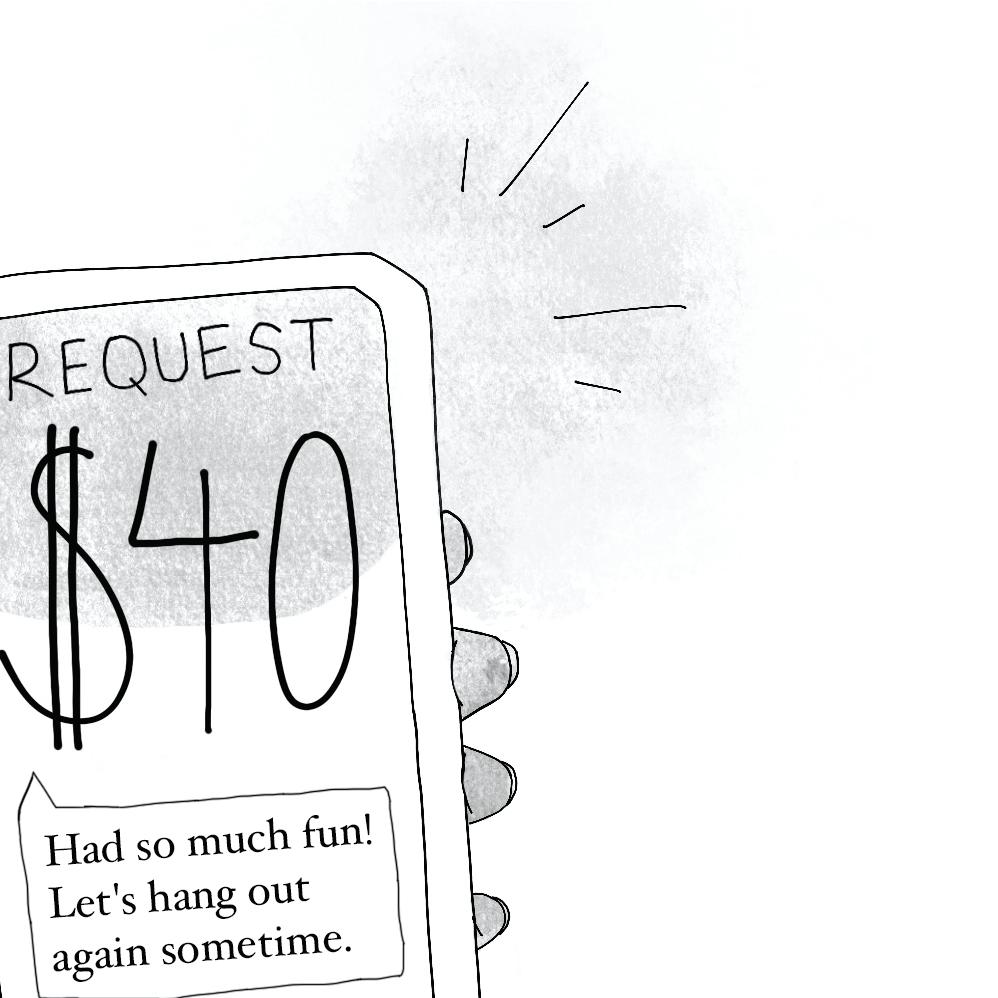
with my friends, they ask me, “Are you sure that’s all you want?” or “Do you need me to cover part of your meal for you?”. Usually, I give in and get a meal to avoid their questions. In other cases, I budget my day around going out to eat, not
buying food or snacks throughout the day to make up for the cash I spend with my friends.
Even if you follow through on not spending much, it is isolating to sit there with just a drink while the rest of your friends chow down
Students, faculty tried to stop the arming of GWPD. Now what?
The University is slowly but surely continuing to arm GW Police Department officers since former interim University President Mark Wrighton’s announcement last year. Barring a sudden change of heart by the Board of Trustees, some GWPD officers will continue to carry handguns. So, now what?
Stopping or slowing this process to address community members’ concerns is a tall order.
In October, the Faculty Senate passed a resolution asking officials to publicize data and feedback about arming the department and to pause the plan in the meantime. Earlier this month, the Student Government Association began assembling a group charged with reversing trustees’ decision.
It’s difficult to say what effect, if any, faculty and student advocacy have had or will have on this process. GWPD Chief James Tate said he paused between the first and second phases of the plan’s rollout last semester, but faculty senators’ resolution “certainly wasn’t a factor.” Officials just armed an additional five officers in February, after all. But if concerned members of GW’s community can’t stop this process outright, they at least deserve to know if their voices are being heard.
Wrighton said trustees were discussing arming officers before he stepped into his position in January 2022. And per faculty senators’ resolution, then-University President Steven Knapp considered arming cam-
pus police in 2009 but decided not to after consulting an outside firm.
While this timeline isn’t exactly clear, the potential for a mass shooting or violent incident on GW’s Foggy Bottom Campus was surely on trustees’ and officials’ minds last year (or however long these discussions took). But such incidents are relatively rare, and Wrighton said he couldn’t recall a single incident during his time at the University where it would be necessary for GWPD officers to use a firearm.
And yet, here we are. Students and faculty reacted to the Board’s decision with a mix of support, criticism and apathy, and those feelings don’t seem to have changed as the arming rollout continues. The trustees may not feel obliged to explain themselves, but we’d ask them — and officials — to clear the air.
Some members of the University community may never accept armed GWPD officers, an understandable position given past incidents on campus and this country’s history of police violence. But there is no harm in earnestly addressing the questions and concerns still roiling corners of the University.
GW’s trustees aren’t known for their transparency. They rarely, if ever, publicly discuss their reasoning. But the idea of arming officers was, and is, so fraught that it demands discussion. “Because I said so” rarely satisfies curious kids, and it’s not working on students and faculty. That’s why the Faculty

burgers. Friendships must be maintained with quality time, so it’s not like you can refuse to hang out with your peers. But not everyone can spend the same amount of money, especially when the price of dining out keeps ramping up.
SSenate and SGA have put so much emphasis on acquiring the data that backed and followed the decision.
Whether through these representative bodies or acts of protest, there’s a clear, consistent demand for outreach and oversight — a demand that the University hasn’t met yet. Granted, officials are establishing a “Campus Safety Advisory Committee” with faculty, staff and student members. But its self-admitted “broad” view on safety does little to address the longstanding concerns of those opposed to arming GWPD officers.
For his part, Tate has said how police misconduct and disproportionate killings of Black people cause “concern, anxiety and pain.” Some students have said Tate’s leadership meetings with student organizations before the trustees’ decision improved their perception of the department. Free Chick-fil-A and “Coffee with the Chief” events can only do so much, but they’re better than no engagement at all.
Keep scrutinizing GWPD, but understand that Tate isn’t implementing a policy he created — the Board did. If you have any qualms with armed officers, direct your attention to the trustees. They made their backroom decision, and they’ve yet to respond to requests they’ve received in a meaningful, public way.
Trustees can’t ignore the issues facing GW, but ignoring the University community won’t make anyone more ready to accept their decision.
While there’s not much we can do about the prices of coffee shops, bars or restaurants in the District, we can normalize cost-free plans with friends. Lately, my friends and I have walked on the National Mall to discuss our classes, families and summer plans. Between D.C.’s free Smithsonian museums and GW’s U-Pass program, my friends and I have spent great days out on the town without spending a cent.
Find a quiet corner of campus, whether it’s someone’s apartment, dorm room or even a communal campus space, where you can sit in comfort and gab about the latest episode of a show or a movie. Back at home, my friends and I hang out in my best friend’s backyard while catching up on our lives since we left for college.
GW and D.C. aren’t like high school, with its after-school activities or lunch periods that made socializing easy and inexpensive. But my friends and I can try to stay on the same page about where and how we plan to spend time together. So, instead, check in with your friends about the potential costs of a planned outing before going out.
There’s nothing wrong with spending money on outings with friends or treating yourself to special occasions. But there are plenty of ways to have fun with loved ones, and not all of them come with a price tag.
—Andrea Mendoza-Melchor, a sophomore majoring in journalism and mass communication, is an opinions writer.
Chronic period pain is real, and I deserve to be seen
ometimes, when I’m sitting down in the shower, legs bent and forehead pressed to my knees as I wait for the pain to subside, I think about those tampon commercials where women frolic about because periods are (apparently) so magnificent. Did my body get it wrong, or did society?
My period isn’t normal, and neither is the pain associated with it. Yet I’m constantly told by doctors, family and schoolmates it’s just a part of life I have to deal with. Suffering from chronic period pain that other people invalidate simply because of its association with periods, and in turn women, is exhausting. When I’m hurting, I don’t have the energy to explain how I’ve spent seven years coping with chronic period pain. On a “good” day in the middle of my cycle, I take Advil every four hours and spend the better part of my day in sweatpants. On a bad day, even prescription painkillers can’t get me out of bed. I’ve had debilitating periods since I was 13 years old, when I first started menstruating. When I was 14, I lost enough blood from my period to become medically anemic. But my doctor told me it was relatively normal; the school nurse told me I couldn’t keep missing class; my mom told me to track my pain for another six months and revisit the conversation. So I tried to hide my pain, tired of empty assurances. But when I was 16, I experienced one of my most painful periods. I excused myself from a school assembly to use the bathroom because it felt like a serrated melon baller was carving up my uterus. I had to beg my mom to stay
home from school the next day. She told me I was probably fine; what I was feeling was just normal cramping. People who don’t experience chronic period pain can quickly brush it aside instead of giving us the space to hurt.
I was relatively fine for the better half of that next morning. Then, I got up to use the bathroom, and a two-hour torrent of shooting, ripping, agonizing pain hit me once again.
I went back to school the next day. I didn’t tell my general practitioner about my pain until six months later because I was afraid of medical professionals delegitimizing my pain, as they had before. After all, the practitioner told me it takes “a while” from your first period for your cycle to regulate, so my experiences were probably normal. And because I wasn’t sexually active, the doctor told me I didn’t need to visit a gynecologist unless my pain was very severe.
With the people in my life ceaselessly dictating my level of personal pain, I no longer knew how to describe it to myself. I didn’t seek answers about my pain for the next couple years, embarrassed about appearing overdramatic and exhausted of explaining what I felt was different than mild period cramping.
When I was 18, though, I finally started seeing a gynecologist and began taking generic oral birth control before college to regulate my periods. I was also diagnosed with painful and heavy menstrual periods.
Granted, the pill shortened my cycle and lessened my bleeding. But I also developed premenstrual dysphoric disorder in response to my new fluctuating hormone levels. Like clockwork, 10 days before my period, I would become increasingly emotionally unstable. Three to four days before my period, I’d experience uncontrollable
anxiety, bouts of depression and intrusive thoughts. My physical pain was gone, but my emotional pain replaced it.
I decided to stop taking birth control after seven months, despite my gynecologists’ suggestion to try a different type. I am myself once again, in sound mind, but my body is still riddled with physical agony every period. I just live with it now. And I’m still seeking out a complete diagnosis.
I’ve been tested for endometriosis through an intravaginal ultrasound. After months of waiting for an appointment, a nurse practitioner almost didn’t conduct the internal ultrasound because she was worried about the discomfort the procedure might cause me. I explained that the entire reason I was sitting on an examination table, my feet in the stirrups like a jockey, was because I wanted answers about my pain. My results were inconclusive.
I’ve considered getting an IUD, since it’s typically supposed to lessen period pain while also serving as a contraceptive, but people tell horror stories about the pain, cramping and bleeding, especially if you have an existing menstrual or uterine condition. It’s a gamble I’m not sure I’m ready to take.
So I remain in pain, its root cause still a question mark. But period pain is still pain, even if society doesn’t take it seriously. And mine is debilitating.
The growing societal acceptance of menstruation is certainly a welcome shift from the past. But the way society understands periods falls flat and disregards the debilitating chronic pain some of us live with. You and I might still be searching for answers, but we owe no one an explanation for what we feel and how we feel it.
—Paige Baratta,
sophomore
political science,
a
studying
is the editorials assistant.
THE GW HATCHET April 15, 2024 • Page 6
Baratta Editorials Assistant GIA KALYANI | CARTOONIST
eic@gwhatchet.com news@gwhatchet.com opinions@gwhatchet.com photo@gwhatchet.com sports@gwhatchet.com culture@gwhatchet.com copy@gwhatchet.com multimedia@gwhatchet.com 609 21st St. NW Washington, D.C. 20052 gwhatchet.com | @gwhatchet Submissions — Deadlines for submissions are Friday 5 p.m. for Monday issues. They must include the author’s name, title, year in school and phone number. The GW Hatchet does not guarantee publication and reserves the right to edit all submissions for space, grammar and clarity. Submit to opinions@gwhatchet.com Policy Statement — The GW Hatchet is produced by Hatchet Publications Inc., an independent, non-profit corporation. All comments should be addressed to the Board of Directors, which has sole authority for the content of this publication. Opinions expressed in signed columns are those of the authors and do not necessarily reflect the view of The GW Hatchet. All content of The GW Hatchet is copyrighted and may not be reproduced without written authorization from the editor in chief. Cost — Single copies free. Additional copies available for purchase upon request. Zach Blackburn, editor in chief Hatchet The GW Nick Pasion, print managing editor Jaden DiMauro, digital managing editor Grace Miller, managing director Nicholas Anastacio, community relations director Grace Chinowsky, senior news editor Erika Filter, news editor Ianne Salvosa, news editor Fiona Bork, assistant news editor Fiona Riley, assistant news editor Hannah Marr, assistant news editor Rory Quealy, assistant news editor Jennifer Igbonoba, contributing news editor Max Porter, contributing news editor Rachel Moon, contributing news editor Cade McAllister, events editor Ethan Benn opinions editor* Riley Goodfellow contributing opinions editor* Paige Baratta, editorials assistant* Lizzie Jensen, podcast host – news Isabella MacKinnon, design editor Abby Keenley, contributing design editor Anusha Trivedi, contributing design editor An Ngo, graphics editor Ishani Chettri, web developer Peyton Rollins, contributing web developer Ethan Valliath, social media director* Anaya Bhatt, contributing social media director* Max Gaffin, contributing social media director * denotes member of editorial board Auden Yurman, senior photo editor Florence Shen, assistant photo editor –features Sage Russell, assistant photo editor – news Jordyn Bailer, assistant photo editor – sports Jordan Tovin, assistant photo editor –culture Sandra Koretz, sports editor Ben Spitalny, contributing sports editor Nick Perkins, culture editor Jenna Baer, contributing culture editor* Sophia Escobar, contributing video editor Cristina Stassis, copy chief Carly Cavanaugh, assistant copy editor Faith Wardwell, publishing assistant Anna Fattizzo, research assistant Brooke Forgette, research assistant Dylan Ebs, research assistant Annie O’Brien, podcast host – culture
Paige
Opinions
Writer WHAT THE UNIVERSITY WON’T TALK ABOUT THIS WEEK When o cials will hire a Graduate School of Political Management director p. 1
abroad may seem to be more bang for your buck in terms of traveling around the world, but that’s not always the case at GW.” —JAMIE GREENBERG on 4/11/24 FROM GWHATCHET.COM/OPINIONS
STAFF EDITORIAL Andrea Mendoza-Melchor Opinions
“Studying
There’s no feeling quite like dropping the needle of a turntable on the smooth vinyl of a record and embarking on a sonic journey with your favorite album.
Record Store Day, which falls on April 20 this year, is an annual celebration of independent record stores observed by hoards of vinyl collectors in search of RSD-exclusive editions by artists from Charlie Parker to Sabrina Carpenter. Participating stores select from a list of about 400 RSD-specific editions to sell for the holiday, some pairing highly sought-after records with giveaways and live performances.
Pioneered in 2007 by Baltimorebased record store owners, RSD aims to reignite the frenzy for vinyl at brick-and-mortar stores, especially after a decrease in vinyl sales in the ‘90s and early 2000s.
Record stores across the District are celebrating the holiday with exclusive performances and specialedition vinyls.
Som(body) who loves me
With bright orange walls and records pasted to the ceilings, Som Records in the U Street neighborhood boasts a large collection of records of every genre imaginable. From reggae to jazz to pop, shelves overflow with eclectic albums and new releases line the walls, including a $1 bin. Customers can jam out to a featured collection on the store’s turntable with attached headphones.
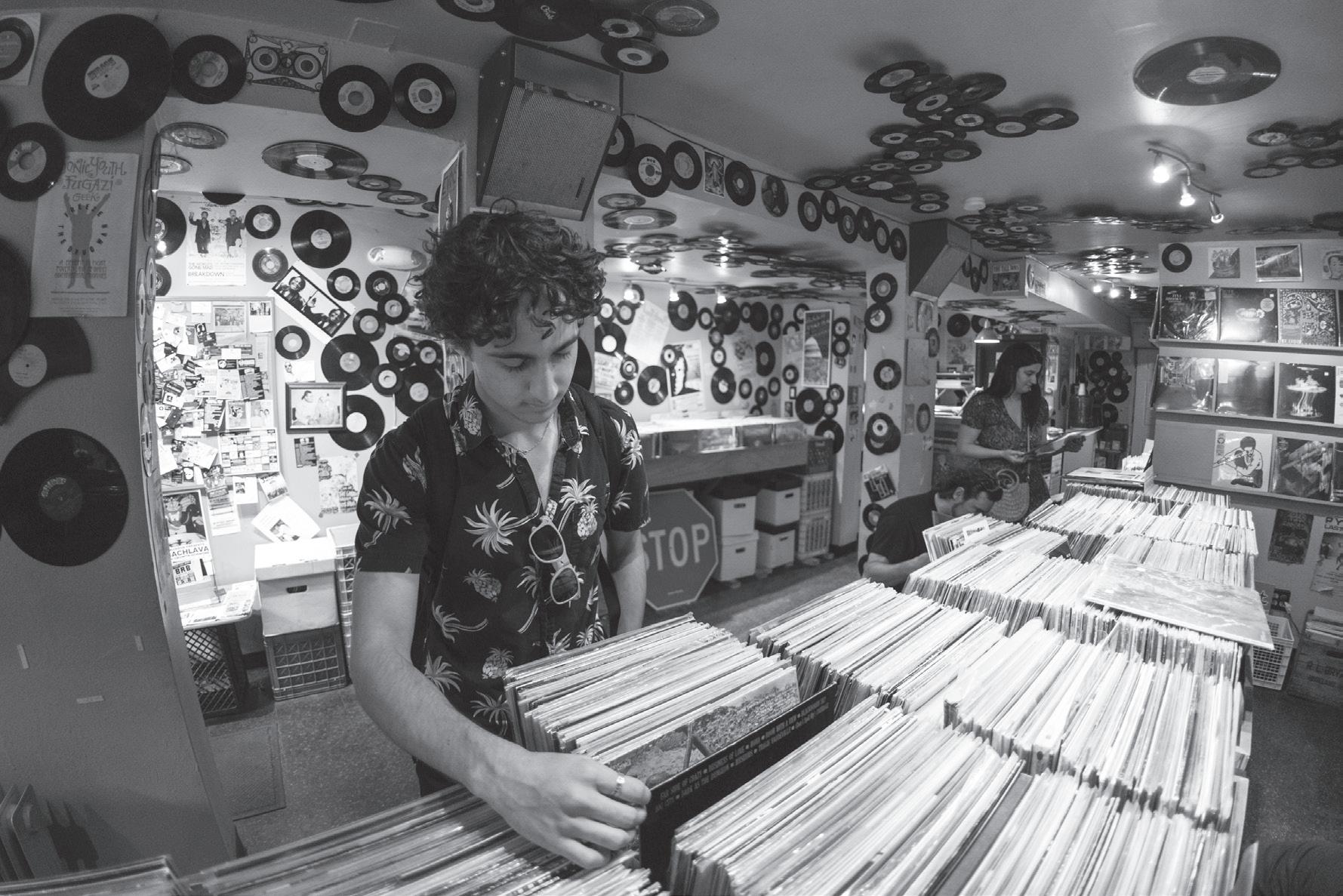
set will follow a reading at Politics and Prose of former Screaming Females band member Marissa Paternoster and owner of Don Giovanni Records, a record label, Joe Steinhardt’s graphic novel, “Merriment.”
Ben Powell, a NoMa resident, said browsing at Byrdland, his nearest record store, was his first order of business after his roommate purchased a turntable. Powell said he will be returning to the store to celebrate RSD.
“Records really let you stop and appreciate the music more than streaming,” Powell said.
1264 5th St. SE. Open Tuesday through Thursday noon to 8 p.m., Friday through Saturday 11 a.m. to 9 p.m. and Sunday 11 a.m. to 8 p.m.
Smashing competitive norms
Smash Records, a punk and indie haven in Adams Morgan, is stocked full of RSD-only vinyls to prepare for the expected swarm of customers next weekend. Matt Moffatt, the manager of Smash and an employee since 2002, said music lovers enjoy collecting the “physical artifact” of vinyls.
A little Byrdie told me to shop on Record Store Day
For Jonathan Druy, a buyer and manager at Byrdland Records in Union Market, RSD allows him to flex his taste-making muscles as he curates which special editions to stock in the store. Druy, who was a
Owner, founder and DJ Neal Becton said Som has participated in RSD since the store’s founding 15 years ago and the holiday is the busiest day of the year for the record store. Becton said music lovers can build community through browsing record stores, as they can shop together to discover new artists, records and genres. 1843 14th St. NW. Open Monday through Saturday noon to 7 p.m. and Sunday noon to 6 p.m.
Join ‘The Tortured Poets Department’ at these DC spots
This Friday is the culmination of pop girl spring.
After Beyoncé’s innovative country and pop blend on “Cowboy Carter” and Maggie Rogers’ groovy “Don’t Forget Me,” Taylor Swift is poised to end the season with her 11th studio album, “The Tortured Poets Department,” on Friday. Fans expect the record to be in the vein of “sad girl pop.”
For those looking for a reflective space to ride this emotional rollercoaster, here are several spots around the District we predict will fit the vibes of this album.
Say “So Long, London” while sitting alongside George in Kogan Plaza
Swift, in her thinly veiled quest to take down her ex-boyfriend and British actor Joe Alwyn, promises to say goodbye to a whole city in her song “So Long, London.” Fans will remember when Where better to
listen to some anti-British rhetoric than with one of the founding fathers responsible for kicking them out of the United States? Join George Washington on his bench in Kogan to contemplate Swift’s lyrics. There’s enough room for one to sit comfortably beside him. If the song gets too intense, you can lean on George’s arm for emotional support.
Spend some time with the tortured men of the National Portrait Gallery Swifties expect Alwyn to be the main topic of Swift’s upcoming album — especially because the record’s title shares an eerie similarity with a group chat Alwyn has with fellow actors Andrew Scott and Paul Mescal, “The Tortured Man Club.” If your poetry hasn’t advanced beyond a snappy haiku and you’d rather commiserate with three of our most underrated actors, you can always deluge yourself with tortured men in the National Portrait Gallery’s “America’s Presidents” exhibit. If Swift eviscerates Alwyn on this album, his career might be over before he becomes a true superstar.
William Henry Harrison,
Hatchet arts editor in the ’90s, said he personally selected a little over half of the available RSD releases to feature at Byrdland this year.
“There’s 400 titles, we can’t get all of them, but I kind of know what our customers want,” Druy said.
Druy added that he chose around 275 RSD specials to sell instore, a staunch increase from when Byrdland started participating in RSD in 2017.
As a self-proclaimed “music head,” Druy said browsing for vinyl is an unparalleled way to discover music that harks back to the days before algorithm-based music recommendations.
“The experience of browsing is
the ninth president, is no secret to such a situation, having died from pneumonia just one month into office.
If Mescal and other young hotshots are more your style, check out the John F. Kennedy portrait, painted in an uber-stylized streaky manner.
Put yourself in the shoes of “The Smallest Man Who Ever Lived” at the Big Chair sculpture
This track’s title is likely a callback to Alwyn’s discomfort with Swift’s stardom, which peaked at the beginning of her recordbreaking Eras Tour, just before they broke up. Fans have long suspected this secrecy stemmed from Alwyn’s insecurity of his lack of fame compared to Swift. For those who wish to emulate their unstable power dynamic, head over to Anacostia and bask in the glory of a 19.5-foot tall chair.
Once known as the largest chair in the world (a contentious battle within the United States, though Austria now houses the winner), this landmark could make even the biggest pop star in the world feel insignificant underneath its massive shadow.
definitely irreplaceable,” Druy said.
While Druy said Byrdland is the “place to go” for new hip-hop and R&B records, as the size of their collection trumps other stores in The District, the densely stocked store also sells genres ranging from jazz to classical to pop. The store also has over 400 records labeled “Played at Songbyrd,” like Laufey’s “Bewitched” and Little Simz’s “No Thank You,” denoting that the artist previously performed at Songbyrd — the venue and restaurant that Byrdland stemmed from in 2020. Byrdland will feature a DJ set by members of the former New Jersey-based rock band Screaming Females on Record Store Day. The
Moffatt said the first Record Store Day the store participated in was in 2009. Since then, he said the demand for RSD-only features has continually increased with the store ordering more and more titles each year.
Moffatt said the record-loving community extends between stores, with Smash building camaraderie with nearby stores like Joint Custody.
“If we are not already friends, we are friendly with each other,” Moffatt said. “It’s cooperation, not competition.”
2314 18th St. NW. Open Monday through Thursday noon to 8 p.m., Friday through Saturday noon to 9 p.m. and Sunday noon to 7 p.m.
By Auden Yurman and Isabella MacKinnon
THE GW HATCHET April 15, 2024 • Page 7 Culture NEW SONG: “GOOD LUCK, BABE!” BY CHAPPELL ROAN THE SCENE RELEASED THIS WEEK: THE GW TEXTILE MUSEUM GALA Friday, April 19 | GW Textile Museum | Free Enjoy an evening of cultural dance, art and free food and drinks. HEALTHY SEXUALITY CONFERENCE Wednesday, April 17 | University Student Center | Free Check out workshops, sex toys and more with the O ce of Advocacy and Support.
BROOKE SHAPIRO STAFF WRITER DIANA ANOS STAFF WRITER TANNER
|
PHOTOGRAPHER A patron flips through vinyl records at Som Records on 14th Street.
shops
DC
celebrate
CROSSWORD ACROSS 1. William ___, former attorney general 5. Smaller than a one-bedroom 7. Alternatively 8. Slang for no 10. L. Ron ___, founder of Scientology 12. Grandma, in Berlin 13. First-person contraction 14. 1-Across, 10-Across and 6-Down, vis-à-vis GW 17. Something to break DOWN 1. Home of the Terriers 2. CE 3. Singer Sawayama 4. Describin’ the 1920s 5. Manhattan’s Cast Iron Historic District 6. Margaret ___, daughter of the 33rd president 9. TV cable type 11. A Christian’s family name 15. Course taken by all GW first-years 16. Graduate degree, for one
NALLEY
STAFF
Vinyl
around
to
Record Store Day with exclusives
ANNIE O’BRIEN STAFF WRITER JENNA BAER CONTRIBUTING CULTURE EDITOR NICK PERKINS CULTURE EDITOR PHOTO ILLUSTRATION BY DANIEL HEUER | STAFF PHOTOGRAPHER Two students pose for a selfie with the George Washington statue in Kogan Plaza. ACROSS 1. Chair 6. Fraise 7. Bee 8. I can pay 10. One 11. Cherry 14. Herat DOWN 1. Creamer 2. Ha 3. Airport 4. Is 5. Redye 6. FEC 7. Birch 9. Any 12. He 13. RA CROSSWORD SOLUTIONS: April 1, 2024
Softball falls to Saint Joseph’s in weekend series
PACERNICK STAFF WRITER
Softball (20-20, 6-9 A-10) dropped two of three games against Saint Joseph’s (19-18, 12-3 A-10) on the Mount Vernon Campus this weekend.
The Revolutionaries faced tight competition against their conference counterparts throughout most of the series, taking the first game in walk-off fashion and losing the last two games of the series by a combined three runs. All three games in the series were decided by two runs or less.
Game 1: Trailing by two runs down to their final out of the seventh inning, the Revolutionaries came back to defeat the Hawks 4-3 in the first game of Saturday’s doubleheader.
The Hawks struck quickly, notching two runs in the first inning. The Revolutionaries struggled to gain a lead against Hawks senior pitcher Emily Siler, managing only two hits in the first five innings and finding themselves in a 3-0 deficit when they stepped to the plate in the penultimate inning.
They failed to get on the board early, stranding a runner in each of the first four innings. Graduate student Maggie Greco doubled in the third inning but was left on base.
However, the Revolutionaries started to turn things around in the bottom of the sixth thanks to a double from graduate student catcher Allison Heffley and an RBI single from senior utility Alexa Williams to bring the tally to 3-1. Finally on the board, the momentum continued into the final inning.
With just one out remaining and
runners on first and second, Greco stepped to the plate and hit an RBI double, tightening the game to 3-2. Next up at the plate, Heffley hit a single, which brought in two more runs, giving GW their first win of the series in walk-off fashion.
Game 2:
In a low-scoring game, the Revolutionaries fell to the Hawks 1-0, closing out Saturday’s doubleheader with a loss while only recording five total hits throughout the game. The teams battled each other for the first two innings with neither recording a hit. Freshman pitcher Sophia Torresso played the entirety of the game, grounding out two players in the first inning as well as obtaining a fly-out. Torresso, who has pitched 71.6 innings throughout the season and faced 300 batters, has only allowed for 56 runs.
The second inning cruised by for both teams with three players on each side unable to make it to first base.
The Hawks jumped into action in the third inning when a player’s single allowed for a runner to make it home, bringing the score to 0-1. Torresso collected three outs from the Hawks promptly at the top of the fourth inning. The Revs went out swinging but were only able to advance senior utility Sidney Torres to second base. The Revolutionaries had a more successful fifth inning with several runners making it on base. Freshman infielder Cadence Gilliland advanced to second after Ramirez’s single to right field. After junior utility Gabby Polsky replaced Gilliland to pinch run, Greco bunted, with Ramirez making it to second and Polsky to third.
As Torresso continued to ground out the Hawks, the Revs


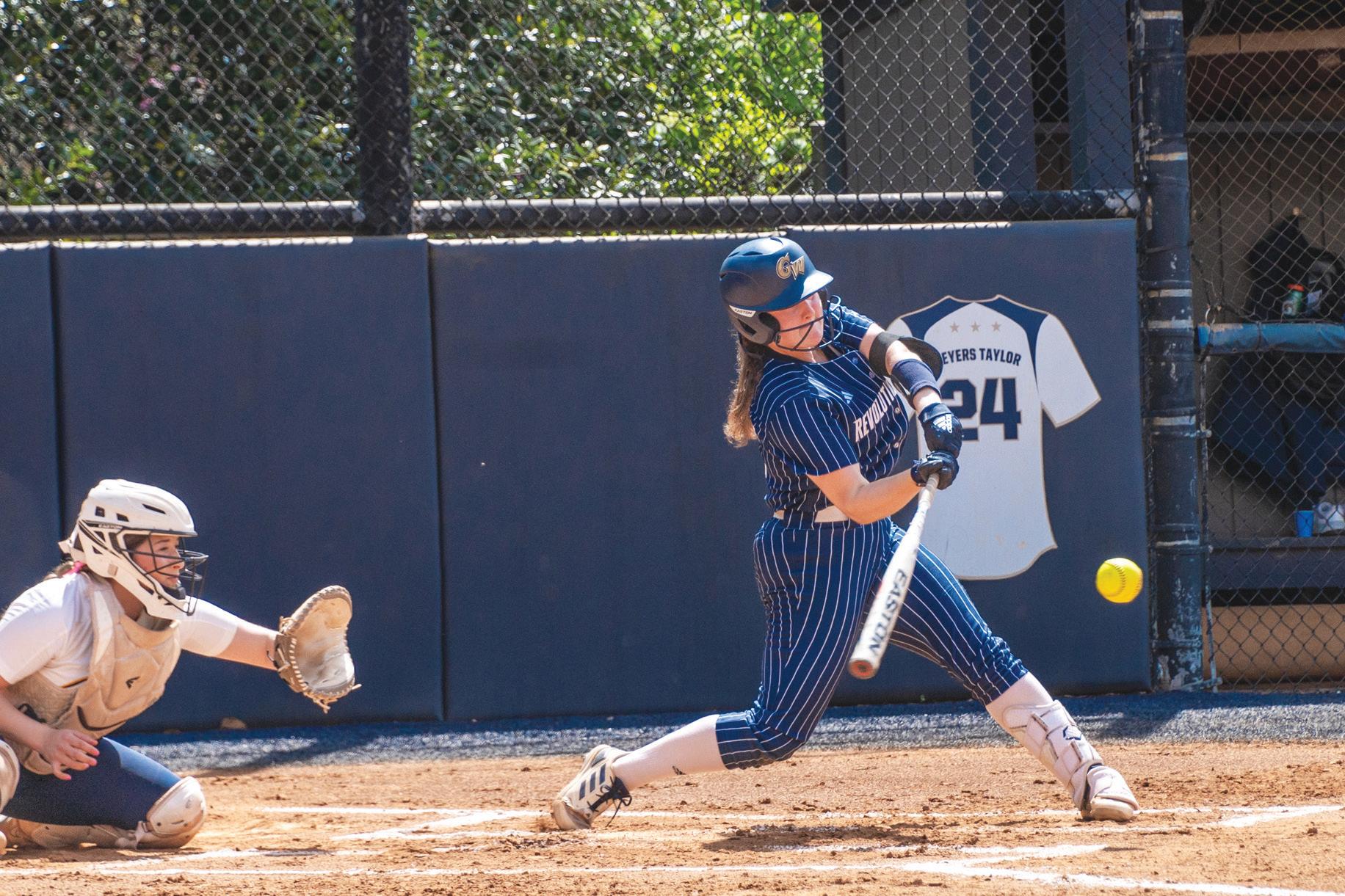
were still unable to tie the game. Sophomore outfielder Ashley Corpuz made it to first base and later stole second. Similarly in the seventh inning, Greco’s single up the middle allowed her to land on first base, and Heffley’s ground out gave the opportunity for Greco to advance to second.
The Revs ultimately ended the game 0-1, falling to the Hawks in their second game of the day.
Game 3:
The Hawks and Revolutionaries went into the last game of their series tied 1-1, but the Hawks took the last win 8-6, snagging the series.


The Hawks got off to an early 2-0 lead in the first inning. Sophomore outfielder Ashley Corpuz countered with a solo home-run to get the Revolutionaries within one run in the third inning. A Corpuz sacrifice fly during her next at-bat brought in another run to even out the contest at two runs each in the fourth inning.
The scoring settled with the game tied as neither team scored a run in the fifth or sixth inning. However, the Hawks posted a monster seventh inning, scoring six runs by way of six hits, including a grand slam and two Rev errors.
The Revolutionaries responded
in the final frame with a rally of their own thanks to Williams’ two-RBI double. Freshman outfielder Paige Hayward continued the comeback hitting a two-RBI double of her own and bringing the Revolutionaries within two runs. With the tying run at the plate, the Revolutionaries struck out, dropping the contest 6-8.
Freshmen Cece Smith and Toresso shared the pitching duties on the mound Sunday afternoon. Smith was dealt the loss (12-5) after giving up the grand slam in the last inning. The Revolutionaries will host George Mason for a doubleheader Tuesday.
Rowing wins most races as winds mar GW Invitational
times of 5:39.6 and 5:52.9, respectively.
Rowing defeated multiple competitors at the GW Invitational held on the Georgetown Waterfront this weekend, which included a total of eight teams.
The Revolutionaries took all but one race, with the first and second varsity eight boats going undefeated. The invitational returned to the Potomac River for the first time since the 2018-19 season after COVID-19 paused the University’s athletics competitions and the hiring of a new coaching staff. “I’m very pleased with how the season’s going for us and there’s more to look forward to and I think it just keeps getting better and better as we get more confident and keep doing what we have to do every day,” junior Mary Grace Konopka said in an interview.
The invite also hosted a men’s tournament where the men’s club rowing team competed. Their first and second varsity eight boats beat their competitor, University of North Carolina, twice, earning
The Revolutionaries’ varsity eight defeated North Carolina on Friday afternoon, rowing a time of 6:07.4 and earning first in the event. GW bested the Tar Heels by 7.3, maintaining their momentum Saturday morning to defeat Drexel by 4.1 seconds with a time of 6:19.25.
GW’s varsity eight boat was manned by graduate students
Alexa Nealy and Ezi Emenike; senior Flannery Dunn; juniors Konopka and Eliza Price; and sophomores Brianne Wieczorek, Kendall Dorn and Anna Golbus. Junior Caroline Crutsinger-Perry coxed the top varsity boat to success in the weekend invitational.
The second varsity eight boat also took home a pair of victories over Drexel and North Carolina with times of 6:26.1 and 6:15.6, respectively.
“If we can execute and believe that our best is going to be really hard to deal with for other crews, that’s gonna put us in a successful place,” Head Coach Paul Allbright said. “And win, lose or draw if we do that, that’s all you
can do in life is prepare the best you can, execute the best you can, and the results are going to take care of themselves and work out how they’re supposed to.”
The only GW loss of the weekend came from the third varsity eight boat who lost to UNC by 8.6 seconds, finishing with a time of 6:46.6.
Several women’s events were consolidated into a singular morning session Saturday, with others cut in anticipation of high winds on the waterfront in the afternoon. Wind gusts in D.C. topped 50 miles per hour Saturday afternoon. All fourperson events scheduled for later in the day were scrapped from the invite as a result.
Several Saint Joseph’s University boats filled with water due to the wind during their warmup, prompting the team to pull out of races on Saturday morning. The Revolutionaries were set to face the Hawks before they were forced to pull out from the race due to the wind and swamped boats. The squad will head to Fairfax, Virginia, later this week for the George Mason Invitational on April 21.

Sports NUMBER CRUNCH Graduate student infielder McGwire Tu y’s sacrifice bunts this season, the most in the Atlantic 10 5 GAMES OF THE WEEK THE GW HATCHET April 15, 2024 • Page 8 LACROSSE at UMass Saturday | 3 p.m. Lacrosse faces the Minutewomen on Saturday, in Amherst, Massachusetts. SOFTBALL vs. George Mason Tuesday | Noon and 2 p.m. Softball will compete against the Patriots at home in a double-header on Tuesday.
GRANT
ARWEN CLEMANS | STAFF PHOTOGRAPHER GW rowers coast across the Potomac River during the GW Invitational on Saturday morning.
GRANT PACERNICK STAFF WRITER
ARWEN CLEMANS | STAFF PHOTOGRAPHER
Senior right fielder Alexa Williams swings at a pitch in a game against Coppin State.
