

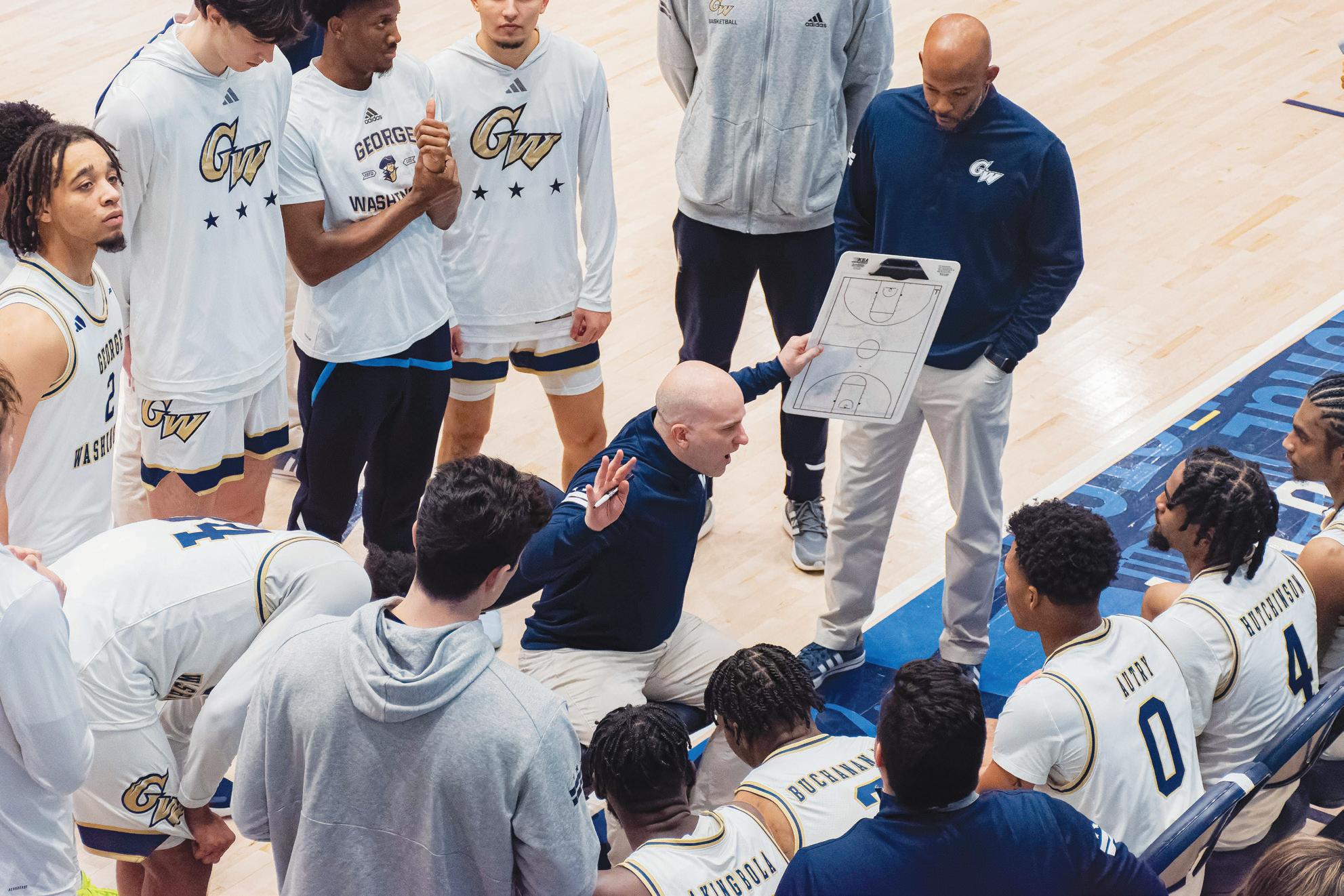
On Jan. 15, optimism surrounding men’s basketball was at a high.
The team had beaten rival George Mason 75-62, leading by double digits for most of the game to bring the team’s record to 14-3, 3-1 in the Atlantic 10, good for the team’s best start since the NIT-winning 2015-16 season.
The Revolutionaries have not won a game since.
The team (14-13, 3-11 A-10) lost this Saturday against Saint Louis (10-17, 3-11 A-10), marking their 10th-consecutive loss as they’ve tumbled down from the top five of the conference to last place in the A-10 over the past five weeks.
“I’ve tried it all,” Head Coach Chris Caputo said following a Feb. 10 loss against Loyola Chicago, at that point their sixth-straight loss. “So I don’t know. I mean, when I say change, it’s like spinning a wheel. And we’ll just spin the wheel and figure out we’ve tried it all.”
GW’s porous defense has been a disaster area for the team this season. The team ranks last in the A-10 in opponents’
points per game during conference play, allowing 85.1 per contest. That’s over 20 points more than 16th-ranked Dayton, whose conference-leading defense averages 63.6 points allowed. On the season, GW ranks 327th out of 351 in the NCAA in scoring defense with an opponents’ per-game average of 78.8. While much of this can be attributed to GW’s fast pace of play, listed as the 28th-highest tempo in the Kenpom ratings, GW’s inability to defend from 3-point territory has allowed shooters to hurt them from beyond the arc.
Despite a down year, senior guard James Bishop IV is still etching his name in the GW record books. His seasonhigh 34 points against the Billikens pushed him over 2,000 points in his GW career, making him one of only three players to reach the mark.
The Revs were able to make the game competitive late in the second half, with a late 10-1 run cutting the deficit to just 2 points. A layup from Bishop brought the score to 89-87 with just 48 seconds remaining.
Sophomore guard Benny Schroder was able to respond to four straight Saint Louis free throws with 4 points of his own, but the Billikens’ success from the line late proved too much to overcome for the Revs. Saint Louis was 9-10 from the line with less than one minute
remaining. The Revs were without two key contributors in the loss against Saint Louis: redshirt freshman forward Darren Buchanan Jr. and redshirt freshman guard Garrett Johnson. Both players have flourished in their first year at GW, but have been in and out of the lineup recently due to injuries. Buchanan, in particular, has come into his own as the team’s second option behind Bishop, following behind him in points per game with 15.2 on 55.3 percent shooting, tying for first in rebounding average with 6.7 and averaging the second most assists per game with 2.2. Their absences have not only created gaps in the starting lineup but have thinned GW’s rotation. Against Saint Louis, Bishop and freshman guard Jacoi Hutchinson both played more than 37 minutes.
The Revs’ losing streak marks the program’s longest since 2009, when the Karl Hobbs-coached squad dropped 11 straight. The team has four games left before heading to Brooklyn for the A-10 tournament. The Revs will welcome UMass (17-10, 8-7 A-10) for a matchup at the Smith Center on Tuesday at 7 p.m. An 81-67 loss at UMass marked the start of the Revs’ losing streak Jan. 20.
When students were faced with an opportunity last year to reform the Joint Elections Commission, they voted to terminate the body as it was known for more than 30 years. The referendum, approved by 59 percent of voters in April, aimed to expand the JEC’s independence from the Student Government Association by requesting the SGA pen a bill revising the body’s bylaws. But what the SGA seemingly didn’t realize is that the referendum completely eliminated the commission from GW’s student government.
On Feb. 5, the SGA passed a revision to reimplement the JEC and split the reformed body — a group of eight students who administer the SGA elections — into three governing branches: one to oversee the entirety of the JEC, one to implement rules and regulations and one to adjudicate disputes. The new structure will work to expand due process for candidates because, in previous years, the JEC was tasked with both passing rules about the election and enforcing them, which allegedly violated candidates’ rights to be protected from government interference.
But delays to reorganizing the commission will push the scheduling of the upcoming SGA elections into April for the second year in a row, JEC members suspect. At least five people involved in the creation of the JEC’s new
bylaws said the SGA’s Office of Senate Legal Counsel was unaware of the need to reform the bylaws until former JEC Counsel Adam Galland brought it to the office’s attention in December, months after the referendum’s passing. Michael Ubis, who was confirmed in July as the JEC’s vice commissioner, said the constitutional amendment on the referendum last year moved the JEC from being a “fourth branch of government” to an independent regulatory agency under the executive branch.
“Because it removed the JEC section part of the Constitution, the JEC was abolished and had to be reestablished,” Ubis said. Ubis said the restructuring halted regular operations of the JEC, leading to delays in scheduling the SGA election, which is supposed to be held at the end of March per JEC bylaws but will now be held in April.
Ubis said these delays present repercussions for the JEC’s ability to function during election season because the body “probably” would have set election dates had the JEC continued this year under past bylaws. Last year, the JEC asked the senate to extend the March election deadline to new dates of April 5 and April 6 due to delays in appointing JEC commissioners. After barring three candidates from the ballot because of issues verifying candidates’ signatures about a month later, the JEC pushed back the election again to the next week of April 13 and April 14.
Cherished English professor, British romanticism scholar dies at 40
Daniel DeWispelare, a tenured associate professor of English, died late last month after teaching at GW for 12 years. He was 40.
fessor of English who helped the department hire DeWispelare. “We will band together and figure it out, but the loss feels that profound. He was an indispensable part of the community.”
A walk down I Street in historic Foggy Bottom used to result in an affectionate interaction with Kitty Snows, the alley cat who lives in the area. Normally, Kitty would present herself to be petted, nuzzling into an outstretched hand, or would flop into a lounging position on the sidewalk to soak up sun.
Kitty Snows became a mini-celebrity of historic Foggy Bottom after she arrived in the neighborhood in 2021 as part of D.C.’s Blue Collar Cat program, which moves semi-feral cats into the city to help control the rat population. Admirers created an Instagram fan account for Kitty (the account is managed by a former Hatchet editor who lived in the area), and devotees to Kitty gave her food and water. But about two weeks ago, neighbors noticed that Kitty had disappeared. Fans desperate for answers put up posters seeking Kitty’s return and residents of the neighborhood spread awareness of the cat’s disappearance in emails and texts. Late last week, neighbors discovered Kitty had been taken. Local Barbara
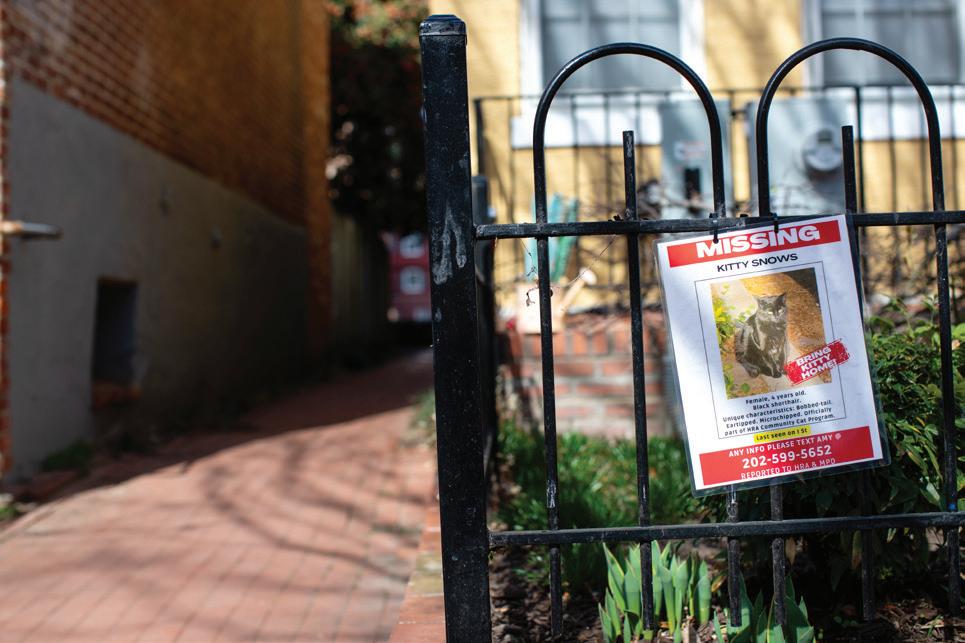
Rohde took her into her home in the Watergate complex last month, alleging in conversations with The Hatchet that the neighbors tasked with caring for Kitty through the Blue Collar program had underfed her and neglected to treat her scabbing nose. Neighbors said they had kept Kitty up to date on vaccinations, fed her and took her to veterinary appointments for a nose condition, adding that they hope to see her return to the neighborhood. Rohde said she and her dog walker took Kitty to her veterinarian after noticing scabbing on her nose for several months, resulting in a $300 bill. She said the veterinarian told her Kitty could not return to the streets.
“She had no water, she had no food,” Rohde said. “Without my dog walker, she would not be alive.”
Rohde said she is considering filing animal cruelty charges against the locals tasked with caring for Kitty, who she thinks violated the terms of her adoption.
“They’re very, very aggressive in saying how wrong we are, and I just wish they would’ve spent a tenth of the time taking care of this poor little cat,” Rohde said.
Blue Collar program participants must “provide daily food and clean water, shelter, and basic health care throughout the animal’s lifetime,” according to the Humane Rescue Alliance’s website. The Humane Rescue Alliance did
not immediately return a request for comment.
Community members said Kitty is well taken care of by neighbors.
Will Crane, a member of the Foggy Bottom Association, said he took Kitty to the vet in August, and the veterinarian said Kitty’s nose condition was a result of seasonal allergies, which resolved itself in the fall.
He added that she is friendly with passersby and neighbors, who have reported Kitty attending fraternity parties in the area.
“No joke, she’ll hang out at a frat party for a little bit, and like there’s 100 people in there, and she’ll just take off when she wants to,” Crane said. “She has a cat house, she has shelter, many people feed her, but she’s a working cat.”
Kitty has a hutch on I Street near 25th Street, which another Blue Collar cat, Sylvester, also uses. Crane said Kitty is still semi-feral and someone like Rohde looking for a personal pet should adopt instead.
“The cat is happy outside, the cat is healthy outside and the cat is very well protected and has several houses that she goes to,” Crane said.
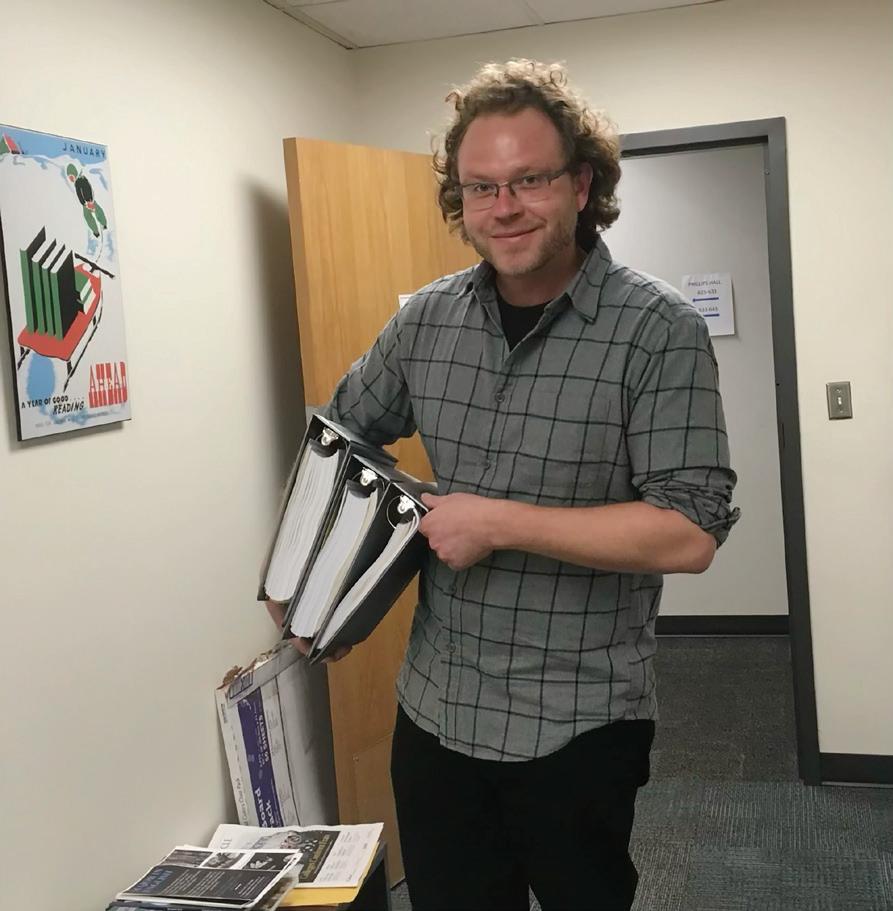
DeWispelare joined the English department in 2012, where he taught courses in British romanticism, literary and critical theory and the history of the English language. His colleagues and students remember him as a compassionate, brilliant and endlessly curious scholar who brought his passion for literature and travel to the classroom.
“Right now we all feel like we can’t function without him,” said Robert McRuer, a pro-
DeWispelare was born in Lakewood, Colorado, on July 15, 1983. He graduated summa cum laude from the University of Colorado at Boulder with a bachelor’s degree in English and history in 2005 and went on to earn a master’s and doctorate degree in comparative literature from the University of Pennsylvania in 2007 and 2011. He then taught at Bilkent University in Ankara, Turkey, for a year before coming to GW.
INDEPENDENT STUDENT NEWSPAPER • SERVING THE GW COMMUNITY SINCE 1904 Monday, Feb. 26, 2024 I Vol. 120 Iss. 20 WWW.GWHATCHET.COM What’s inside
Cat-astrophe: Neighbors quarrel after resident takes beloved alley cat Culture Intramural basketball referees discuss getting dunked on by players. Page 7 Opinions The editorial board argues that AI and academic integrity aren’t necessarily at odds. Page 6 Sports Both swimming and diving teams took home conference championships. Page 8 HANNAH MARR ASSISTANT NEWS EDITOR SAGE RUSSELL | ASSISTANT PHOTO EDITOR Posters decrying the disappearance of Kitty Snows were posted throughout the historic Foggy Bottom neighborhood earlier this month. See RESIDENTS Page 3 Men’s basketball loses 10th straight, now last in A-10 BEN SPITALNY CONTRIBUTING SPORTS EDITOR MARGOT DIAMOND STAFF WRITER
elections delayed
after elections
FILE PHOTO BY KAIDEN YU | STAFF PHOTOGRAPHER Head Coach Chris Caputo animatedly instructs his squad during a timeout. ERIKA FILTER NEWS EDITOR SACHINI ADIKARI STAFF WRITER FIONA RILEY ASSISTANT NEWS EDITOR See FACULTY Page 5 COURTESY OF ROBERT MCRUER Daniel DeWispelare, a tenured associate professor of English, smiles from a Phillips Hall o ce. INGLORIOUS REVOLUTION
SGA
to April
commission reform
ANC executive director to depart after decade in neighborhood government
In more than a decade of work in local government, Peter Sacco views his role in overseeing Advisory Neighborhood Commission meetings as ensuring the right people are in the right place at the right time.
“I approach every meeting as like, ‘This is my Super Bowl,’” Sacco said. “It’s just, a lot of work goes into those meetings, and there’s a big sense of accomplishment that comes out of successfully doing a meeting and finishing it.”
Sacco formally departed his role on Friday as the executive director of four local ANCs, including the Foggy Bottom ANC, but said he will continue to serve on a volunteer basis for all four commissions until they find a replacement. A GW alum, Sacco served as a commissioner for ANC 2A during his time at the University from 2012 to 2015 and has served as the executive director for the ANCs in Foggy Bottom, Dupont Circle, Georgetown and Kalorama Heights since 2016.
In the role, Sacco compiled agendas, communicated with neighborhood businesses for upcoming licensing applications and advised commissioners on ANC rules and procedures. Sacco will begin a new position as deputy director for finance and operations for Serve DC, the Mayor’s Office on Volunteerism and Partnerships, on Monday.
His foray into local government began during his first year at GW in 2011 when he saw an article advertising opportunities to run for city board positions. Sacco applied for the Commission for National and Community Service, and thenMayor Vincent Gray appointed him to the position.
“I was very civically minded at the time in terms of, I loved community service,” Sacco said. “I loved serving with a bunch of nonprofits in the city.”
In his sophomore year, Sacco
and two of his friends applied to run for seats on Foggy Bottom’s ANC. Sacco ran as a write-in candidate in a district almost entirely composed of students, encompassing Strong, South and Lafayette halls, then was reelected in 2014.
“I thought about it and decided, ‘I think I should do this,’” Sacco said. Sacco said one of his greatest accomplishments as a commissioner was work to reopen Thaddeus Stevens School on 21st and K streets.
In 2009, former Mayor Adrian Fenty attempted to convert the school — which former President Jimmy Carter’s daughter Amy attended from 1977-1979, the last time a sitting president’s child attended public school — into an apartment complex. After years of planning, the public school reopened in 2020 and now serves children from across the District through age 5.
“It was a great school, and it was a shame that the city had closed it,” Sacco said. “But the ANC advocated very strongly for a long period of time to reopen it as an elementary school, and we were very happy that DCPS did. So that was a big accomplishment for us.”
Jeri Epstein, a former chair of the ANC, said Sacco was smart and eager to learn, managing the personalities across all the ANCs he oversaw.
“He pays attention to the intricacies of city government and the infrastructure,” Epstein said in a text. “I think the mayor will be very happy to have him on staff.”
As commissioner, Sacco spoke with students and community members about a proposal to delegate GW Police Department officers to patrol the neighborhood in uniform and respond to off-campus complaints. The commission held
a special listening session to gather community perspectives, but the proposal did not move forward.
“It was a proposal that received fairly mixed emotions in the neighborhood, both from students and neighbors,” Sacco said.
In his second term, Sacco served as the Foggy Bottom ANC’s secretary. After he graduated from GW in 2015, he moved off campus, rendering him ineligible to run for reelection in the same single-member district. Sacco resigned from his post but agreed to stay on in a staffing role to continue the administrative work he had done as secretary.
Over roughly the next year, the ANCs in Dupont Circle, Georgetown and Kalorama Heights expressed a need for an executive director, and Sacco assumed the position for all four bodies. Sacco held jobs at St. Mary’s Court, a neighborhood retirement home,
Online education provider, GW partner faces financial decline
As one of GW’s leading online education providers sinks into nearly $900 million of long-term debt, experts say the company may declare bankruptcy, leaving partner universities to decide whether to stay on board.
GW enlists the service of edX, under the parent company 2U, Inc., for online degree programs and boot camps, which officials spent more than $33 million on in fiscal year 2022. But the company has lost more than $200 million in each of the past two years from operations, resulting in administrative restructuring and the termination of relationships with
SNAPSHOT
partner universities in an attempt to cut costs.
Officials have expanded course offerings with 2U over the past decade, starting with just three graduate programs for the Milken Institute School of Public Health and branching out to offer an online MicroMasters and Doctorate of Public Health degree through edX in 2022.
University spokesperson Julia Metjian said in January that officials are committed to online program offerings to ensure students around the world can access a GW education. Metjian declined to comment on how 2U’s debt and losses will impact their relationship with GW and why officials boosted spending on 2U services from
more than $18 million in FY 2021 to more than $33 million in FY 2022.
“GW’s partnership with 2U/edX meets the needs of an ever-changing marketplace by providing educational opportunities for online students in numerous programs,” Metjian said in the January email.
Officials said University President Ellen Granberg offers 2U feedback on their programs and enables Granberg to spot future online education opportunities for GW through her position on 2U’s advisory committee. Granberg serves on 2U/ edX’s University Leadership Council and was involved with the expansion of online program offerings in her former role
as provost of Rochester Institute of Technology.
2U acquired online education platform edX in 2021 to expand access to “affordable” online education.
A company spokesperson said 2U has “sufficient” liquidity and time to engage with its stakeholders and find a way to improve their finances.
“We will not speculate on potential outcomes beyond to say that we are focused on taking action that will ensure 2U is well positioned for long-term success,” the spokesperson said in an email.
Stephen Virostek, the senior vice president of investor relations at 2U, said during the company’s quarterly earnings call with investors this

and the Foggy Bottom Village, which assists local senior citizens, before departing in June 2020 to work solely as the executive director for the ANCs.
Sacco said his greatest challenge as executive director was the shift to hybrid meeting formats during the pandemic, directing citizens to phone-in and Zoom meeting attendance. In March 2020, the Foggy Bottom ANC was the first ANC to conduct its proceedings over Zoom, he said.
“We were, to my knowledge, the only commission that didn’t cancel our March 2020 meeting,” Sacco said.
He oversaw a total of 28 commissioners across the four ANCs as executive director, about 56,000 constituents.
“It really helps to have a good relationship with all of them,” Sacco said. “Commissioners have different priorities, they have different personalities, they may be looking for support in different ways, and it helps to have that relationship to be able to support them, however they need.”
Despite his work with commissions across Ward 2, the Foggy Bottom ANC was Sacco’s “home ANC,” he said.
“This is gonna be the hardest ANC to leave for me,” Sacco said at his last Foggy Bottom ANC meeting as executive director Wednesday. “It’s gonna be really tough. It’s been 11 years now.”
Commissioner Trupti Patel said Sacco was one of the first people who helped her onboard to the ANC when she joined in 2019.
“You are the institution, you are the heartbeat,” Patel told Sacco at the ANC’s Wednesday meeting.
GW alum and commissioner Yannik Omictin said Sacco laid the groundwork for student representation on the ANC.
“The legacy that you leave here is incredible for GW students who deserve representation on the ANC,” Omictin said. “You are like an encyclopedia of ANC knowledge.”
month that 2U leaders are trying to increase their earnings margin to boost cash flow and extend their debt maturities. He said he expects the programs launched in 2024 will generate up to $100 million in revenue after two-and-a-half to threeand-a-half years.
“The most important thing we want you to hear from us today is that we know we need to improve our performance and to do it quickly,” Virostek said on a recording of the call.
He added that they are exploring the addition of asynchronous online learning programs to increase the efficient use of resources.
“We’re embarking on a 12-quarter journey to reset and enhance our operation and we need your support in this journey,” Virostek said.
Phil Hill, an educational technology consultant, said 2U may have to declare bankruptcy within the first six months of 2024, but GW does not have to end its partnership with the company and can instead negotiate a more favorable contract. He added that officials can also pursue partnerships with other online education providers like Coursera or provide online programs “in house.”
He said 2U officials can remedy their debt by either selling a portion of the company to afford to refinance their debt or convincing their debt holders to refinance the company’s debt. Hill said 2U could also have to declare bankruptcy within the first six months of 2024.
“It seems to me, simple math, that in the year 2024 they will have to make a major change,” Hill said.
He said 2U laid off a large group of employees about a year and a half ago and ended school partnerships like the University
of Southern California, who announced in November that they would end their work with 2U. He said more schools could face partnership terminations since they have fewer employees to service the universities.
“I don’t think that’s impacting George Washington, but it is impacting other schools where there’s a lot of projects they’re just not doing anymore,” Hill said.
Marilyn Flynn, the former dean of the USC Suzanne Dworak-Peck School of Social Work, said the school partnered with 2U in 2010, which was “appealing” at the time because universities were starting to develop online programs. She said 2U strived to eliminate the difference between the quality of an in-person education and an online education.
She said she is not surprised that 2U is facing financial difficulties because the company faced increasing costs from competition from other online education providers and investments in many campuses. She added that online programs for fields like social work are difficult to maintain because faculty need to constantly update the curriculum to remain relevant.
“I can’t comment on what they are currently delivering, but I’m not surprised that there are challenges for them,” Flynn said. She said 2U added many “enhancements” to their online programs to remain competitive, which increased the costs for the company.
“Probably everybody in the universe now can produce a cheap online program,” Flynn said. “You need a camera, you need a faculty member, you need a place for that person to sit, you need a student.”
NEWS THE GW HATCHET Feb. 26, 2024 • Page 2 News THIS WEEK’S EVENTS CONVERSATION WITH JOSE W. FERNANDEZ Wednesday, Feb. 28 | 11 a.m. | Elliott School of International Affairs Attend a conversation with the Under Secretary for Economic Growth, Energy and the Environment about economic security. ELASTIC EMPIRE: REFASHIONING WAR THROUGH AID IN PALESTINE Thursday, Feb. 29 | 3 p.m. | Elliott School of International Affairs Join author Lisa Bhungalia for her book talk.
THIS WEEK IN HISTORY
GW forensics professor James Starrs led scientists to discover the remains of Western outlaw Jesse James, whose cause of death in 1882 and burial location remained unconfirmed for more than a century.
SALVOSA
IANNE
NEWS EDITOR
Feb. 29, 1996
DANIEL HEUER | STAFF PHOTOGRAPHER
Former President Donald Trump speaks at the Conservative Political Action Conference in National Harbor, Maryland.
ERIKA FILTER NEWS EDITOR
DANIEL HEUER | STAFF PHOTOGRAPHER
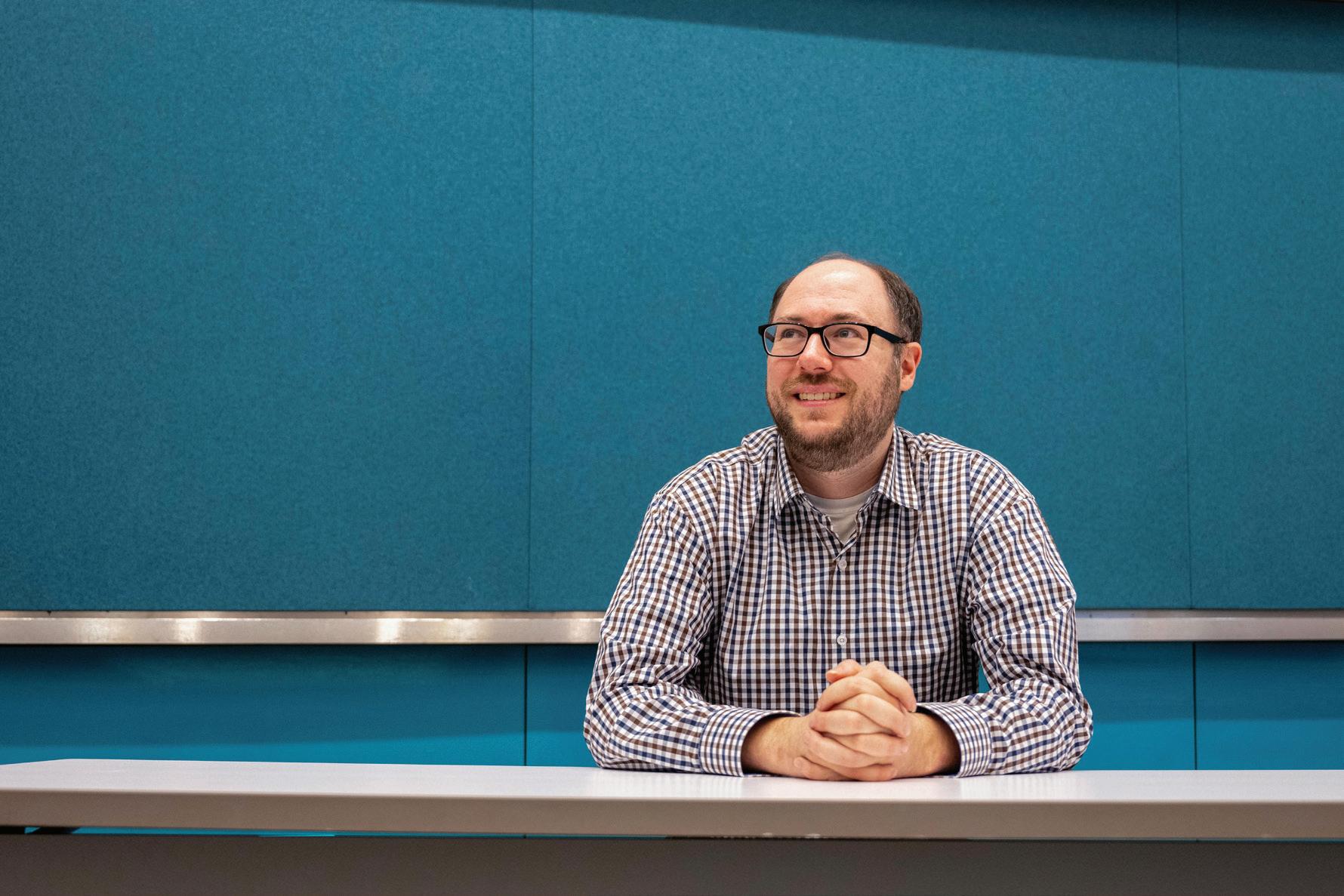
Peter Sacco, the executive director of four local Advisory Neighborhood Commissions, will temporarily remain in a volunteer capacity.
Officials to hold faculty, student discussion sessions to inform strategic plan
University President Ellen Granberg announced that officials will host a series of virtual discussions on GW’s future with students, faculty and staff to develop a new strategic plan in an email Friday. Officials will hold five one-hour sessions for faculty and two for students throughout late February and early March that focus on topics like the future of the workforce, education and knowledge to guide the creation of a long-term strategic plan, the announcement states. The announcement kicks off the beginning of a school-wide strategic plan, which GW has been without since 2020 when officials put a hold on former University President Thomas LeBlanc’s plan and delayed then later delayed creating one until the University selected a permanent president.
Over the five discussion sessions, there will be 50 seats open to registrants on a first come, first serve basis. Granberg said officials will make more sessions available in the future as needed. The Provost’s office is in charge of running these sessions.
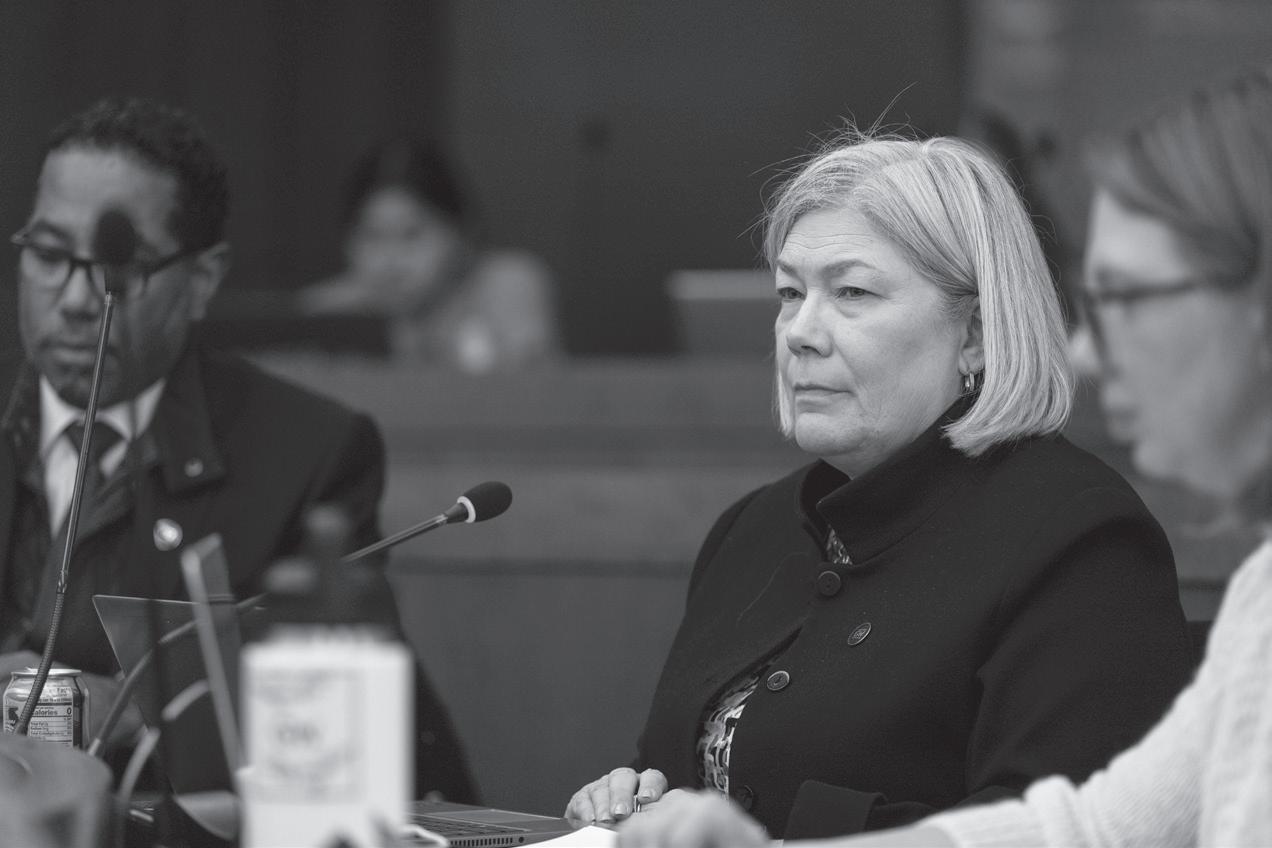
Officials will then create a report that will be shared with the GW community for feedback, Granberg said. Officials will present the findings to the Board of Trustees during its May meeting, which the Board will use to begin the development process of a formal strategic framework for fall 2024. Ahead of former interim University President Mark Wrighton’s tenure, faculty said in 2021 they hoped GW’s next president fo -
cused on including their opinions in major decision making before focusing on establishing a formal strategic plan. Faculty said last January they were “optimistic” about Granberg’s presidency because her background as the former provost of Rochester Institute of Technology makes her qualified to create a strategic plan that promotes shared governance, also known as the involvement of community members in large, school-wide decisions.
Foggy Bottom residents plan to file police report for nabbed rat-hunting cat
From Page 1
Sadie Cornelius, the communications chair for the FBA, said community members posted flyers and sent texts and emails alerting one another of Kitty’s absence. She said “a handful of neighbors” care for Kitty, ensuring she is up-to-date on her vaccinations and providing her with food and water.
Cornelius said the longer Kitty Snows is kept in captivity, the more she may lose her “street sense” as an outdoor cat that hunts for her own food.
Cornelius said FBA members plan to file a police report over Rohde’s alleged theft of Kitty. The
group also plans to deliver a letter to the Watergate complex front desk explaining Kitty’s role in the neighborhood, she said.
“We were on a like two-year waitlist to get Kitty, so it’s just really frustrating and makes it extra essential that we get her back,” Cornelius said.
Metropolitan Police Department Lieutenant Michael Howden said at a Foggy Bottom and West End Advisory Neighborhood Commission meeting Wednesday that he had spoken with neighborhood residents about Kitty’s disappearance. Howden said as of Wednesday there is not a police report on record, and the investigation is somewhat complicated as no individual owns Kitty
— she is a gift to the city, from the city.
“That is an ongoing investigation, so to speak,” Howden said. “I’ll use that term lightly, but at any rate, I’ve been working with them.”
Aydan Reimer, a junior who lives in Snows Court near 25th and I streets, said she noticed missing posters for Kitty last week.
“I immediately took a picture of it and circulated it to all of our friends,” Reimer said of the posters. Reimer said she always saw Kitty in the parking lot close to her house, rolling around and lying in the sun.
“There was one day, I don’t know what was happening, but we were all walking out of the house,
Milken researchers receive grant
Editor’s note: This article contains references to gender-based violence. If you or someone you know needs support, contact the Student Health Center at (202)994-5300 and ask to speak to a counselor or reach the National Domestic Violence Hotline at 1−800−799−SAFE(7233).
The Milken Institute School of Public Health announced earlier this month that it received a $300,000 grant to support prevention and response efforts to female genital mutilation/cutting, or FGM/C.
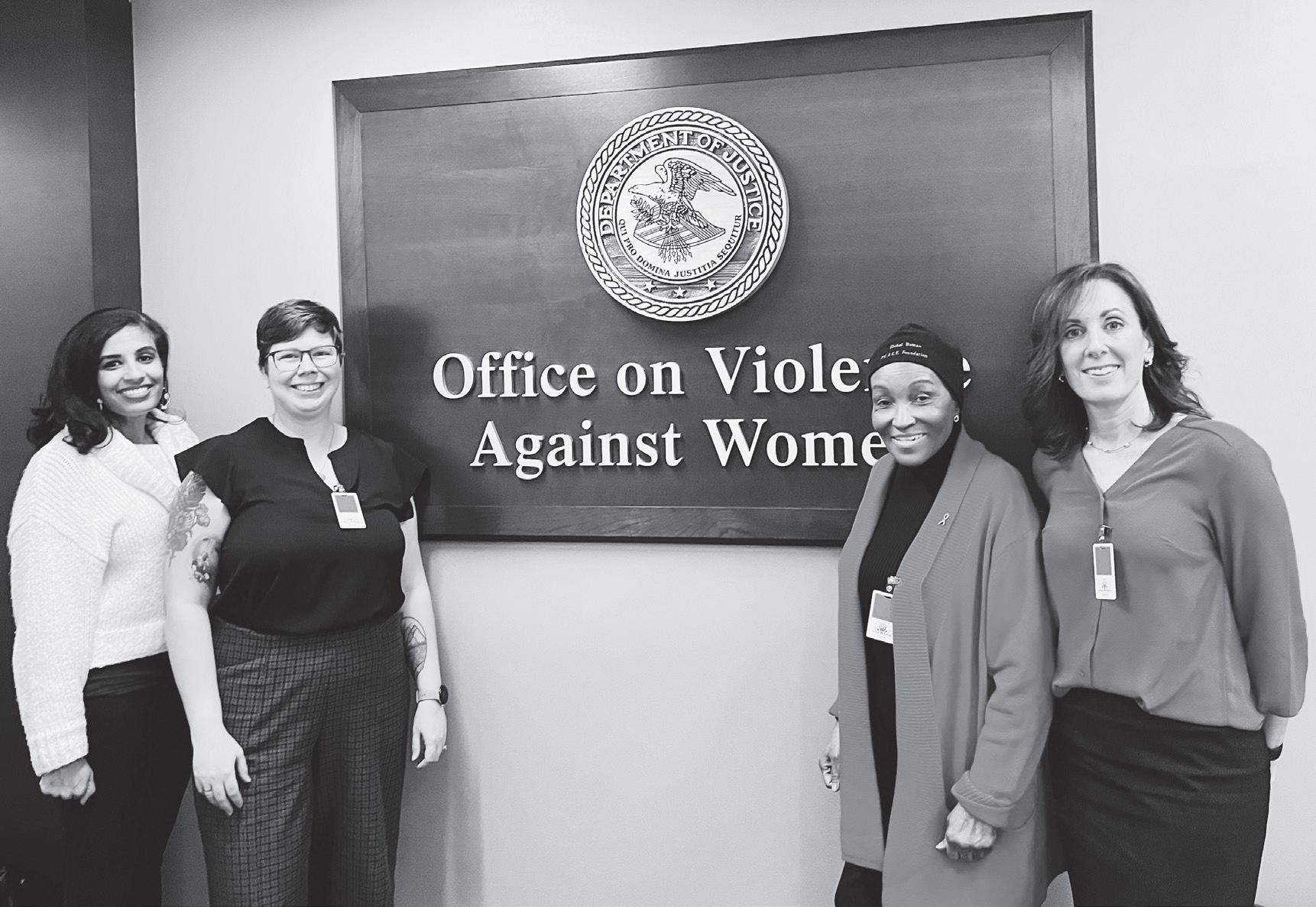
Researchers at Milken are working to reduce FGM/C in the U.S. and worldwide by confronting a lack of awareness of gender-based violence and underreported FGM/C rates. The Department of Justice’s Office on Violence Against Women will divide the grant equally among four organizations, and the money will go toward advocacy programs for the enforcement of laws prohibiting FGM/C and awareness projects like the FGM/C toolkit, support groups for survivors and the annual Walk To End FGM on the National Mall.
FGM/C is known to be practiced in at least 92 countries around the world — including the United States — for religious reasons and to control female sexuality. The practice is known to cause lifelong physical and mental harm, like serious infections and fertility issues. About 200 million women are survivors of FGM/C, and an additional 4 million girls are projected to have an FGM/C procedure each year around the world.
Milken is collaborating with U.S. End FGM/C Network, the Global Woman P.E.A.C.E. Foundation and Sahiyo U.S. to carry out prevention and support strategies.
Karen McDonnell, an associate professor of public health and the principal investigator on the project, said researchers aim to spread awareness of FGM/C as a form of gender-based violence.
CRIME LOG
CREDIT CARD FRAUD
Off Campus
2/16/2024 – Unknown Time
Open Case
A female student reported an attempted fraudulent purchase posted to her credit card after losing her wallet. Case open.
THEFT II/FROM BUILDING
Funger Hall
2/21/2024 – Unknown Time
Open Case A male faculty member reported his wallet stolen from his office.
Case open.
SHOPLIFTING
Private Property Within Campus Bounds
2/21/2024 – 12:15 p.m.
Closed Case
GW Police Department and Metropolitan Police Department officers responded to a report of a male subject shoplifting at a bookstore. Upon arrival, officers made contact with the subject and issued him a bar notice.
Subject barred.
THREATS TO DO BODILY HARM, HARASSMENT (VERBAL OR WRITTEN)
Off Campus Reported 2/21/2024 – Multiple Dates and Times
Open Case
A male student reported that a male subject threatened him on multiple occasions.
Case open.
THEFT II/OTHER
Public Property on Campus (500 Block of 19th Street NW)
Reported 2/21/2024 – Unknown Date and Time
and then we all just sat there and pet her for 30 minutes,” Reimer said. “She’s just a little love bug. She loves attention. She loves pets. She likes bumping up against you.”
Junior Cecilia Culver said after moving into the neighborhood in June, she met Kitty and immediately bought treats for her. She said before finding out Kitty’s name, she and her roommates had given her the name “Stubs” because of her bobbed tail.
Culver said her friend bought T-shirts emblazoned with Kitty’s photo for her and Reimer from the FBA website for Christmas.
“I just love cats, and she needs someone to be giving her treats,” Culver said.
Open Case
A male student reported his electric scooter stolen. Case open.
UNLAWFUL ENTRY
Academic Center
2/22/2024 – 6:35 p.m.
Closed Case GWPD officers responded to a report of a suspicious male subject walking around in the garage. Upon arrival, officers made contact with the subject and issued him a bar notice.
Subject barred.
for female genital mutilation
She said many people in the U.S. do not know or believe that FGM/C is happening.
“The challenges that we face are that: A) in the U.S. people don’t believe it’s happening, and B) that it’s shrouded in what we call the three S’s: secrecy, shame and stigma,” McDonnell said.
“It’s very difficult to get people to talk about what they’ve experienced, they’ve been told that they should not talk about it because bad things will happen if they do.”
She said there are two parts to their plan: FGM/C prevention, by ensuring that laws banning the practice are fully enforced, and raising awareness that FGM/C is a form of violence instead of a social norm. She said they will also work to support survivors, which can take many forms, from support groups to funding for restorative surgery. The collaboration also aims to more accurately count the victims of FGM/C in the U.S. and
around the world, she said. McDonnell said estimates of FGM/C rates in the U.S. are vastly underreported because FGM/C is not well documented.
“We have something called the uncounted, where those are persons in the U.S. who were born in the U.S. who have experienced FGM but may not have been counted, because we don’t ask about it here in the U.S., but we know that it is happening,” McDonnell said.
McDonnell said several groups in this team worked on reforming a law banning FGM/C to tighten up loopholes — like the defendant’s ability to use religion or culture as a legal defense — in 2020 as a result of a federal court case involving charges against a doctor that was performing FGM/C procedures in Michigan.
“We tightened up the law so that you can’t hide behind religion and culture. And there’s also a provision that I’m really
—Compiled by Max Porter
prevention
this is a common practice, survivors are often afraid of speaking out against FGM/C and telling their stories, she said. Taher said there is a history of backlash toward survivors and advocacy groups that support them, including people boycotting their businesses. She added that there is a history of FGM/C in the U.S., including among religious groups and immigrant communities with people from countries where it is more common.
“We’ve had stories from survivors that come from white fundamentalist Christian communities, that it’s occurring,“ Taher said. ”We also know that there is actually a history of clitoridectomy happening in the U.S. up until the 1960s, in some cases, 1970s. Which was done to treat women for what they said was hysteria, mental illness or lesbianism.”
Angela Peabody, the executive director of the Global Woman P.E.A.C.E. Foundation, said survivors are threatened into staying silent about their experiences with FGM/C, which makes them afraid to share their stories and seek out help.
excited about, and that is sort of public health approach,” said McDonnell. “And that was to make sure that there are reporting requirements by federal offices, about the effort that they are convening in to prevent and document FGM.”
Mariya Taher, a co-founder and director of Sahiyo U.S., an organization aiming to end FGM/C, said researchers must break through the normalization of FGM/C among communities where it is practiced in order to prevent it.
“Generally, in communities where it’s practiced, there are justifications and it’s a social norm, so it’s considered something that’s needed to happen,” Taher said. “So we’re trying to change that perception, it really helps highlight that this is a form of gender-based violence. And it is something that’s often happening to children, so to girls that are under 18.” In U.S. communities where
“When they cut the girls, they tell them this is a secret, they swear them to secrecy. You don’t tell anyone, if you tell somebody, you will die,” Peabody said. ”If you tell a 7-year-old or a 6-yearold that she will die if she discloses what just happened to her, of course, she won’t.”
She said FGM/C procedures are often shrouded in secrecy for the girls involved, who typically do not know what is about to happen to them. In many cases, parents will tell their daughters that they are going to visit family or go to a party.
Peabody said people must understand that FGM/C is genderbased violence capable of happening anywhere in the world.
“It doesn’t only happen in Africa, Southeast Asia and parts of the Middle East. It happens right here in the U.S.,” Peabody said. “It happens right here in Virginia, in Pennsylvania, everywhere, in every state in the U.S. it’s possible that FGM is happening.”
NEWS THE GW HATCHET Feb. 26, 2024 • Page 3
HANNAH MARR ASSISTANT NEWS EDITOR RACHEL MOON CONTRIBUTING NEWS EDITOR
FILE PHOTO BY SAGE RUSSELL | ASSISTANT PHOTO EDITOR
University President Ellen Granberg sits during a Faculty Senate meeting this semester.
FRIEBOLIN REPORTER COURTESY OF KAREN MCDONNELL Researchers stand in front of the Department of Justice’s Office on Violence Against Women.
AUGUST
Officials host annual Diversity Summit after postponement
The Office of Diversity, Equity and Community Engagement hosted more than 40 events on topics like inequalities in LGBTQ+ health care, Indigenous rights and combating white supremacy for GW’s ninth-annual Diversity Summit last week.
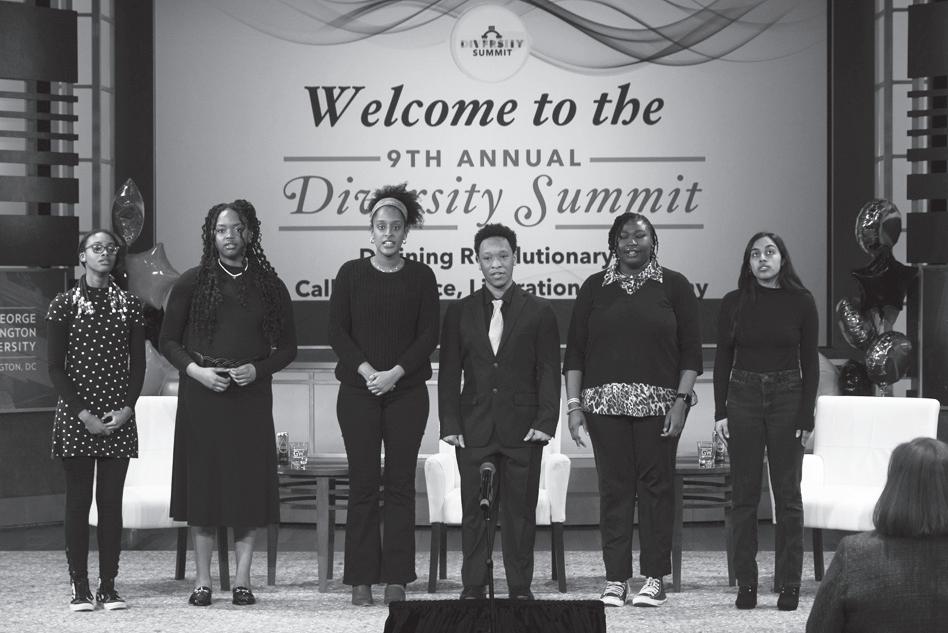
This year’s theme, “Defining Revolutionary: A Call for Justice, Liberation, and Empathy,” focused on navigating conflict, finding mutual humanity and combating “all forms of oppression,” according to the summit’s website. The summit was originally planned to be two parts — the first installment in October — but officials postponed the fall series and moved the programming entirely to last week in response to campus tensions following members of Students for Justice in Palestine’s anti-Israel projections onto Gelman Library.
The summit kicked off with a keynote session called “The Promise of Pluralism in Times of Tension” led by Rebecca Russo and Jenan Mohajir — officials from Interfaith America, an organization dedicated to preserving religious diversity. The panelists spoke from their experiences as Jewish and Muslim women about how college campuses can address religious and political tension among students after the outbreak of the Israel-Hamas war, including by being a place where people can listen to differing perspectives.
Students, faculty and community members collaborated to organize programming revolving around civil conversation, identity expression and social activism on the third floor of the University Student Center.
Miki Nishida Goerdt, an adjunct faculty member in the Graduate Art Therapy Program, organized an art exhibition Wednesday and Thursday called “Am I Welcome Here?” where international students showcased original art highlighting their experiences in finding a sense of belonging.
“We collectively acknowledge that there is a sense of invisibility and the feeling of not being heard and seen, especially through the cultural layers that they carry,” Goerdt said.
Senior Xinhang Xu featured her painting at the exhibition and said she was grateful to have a space for international students to display their struggles and experiences. She said her artwork served as a metaphor for her experience as an international student and the continued state of uneasiness while attempting to assimilate to peers, according to her artist statement.
“This is actually my first opportunity here as a fourth-year undergrad to show my works and show my thinking behind those to like such a large group of audience,” Xu said.
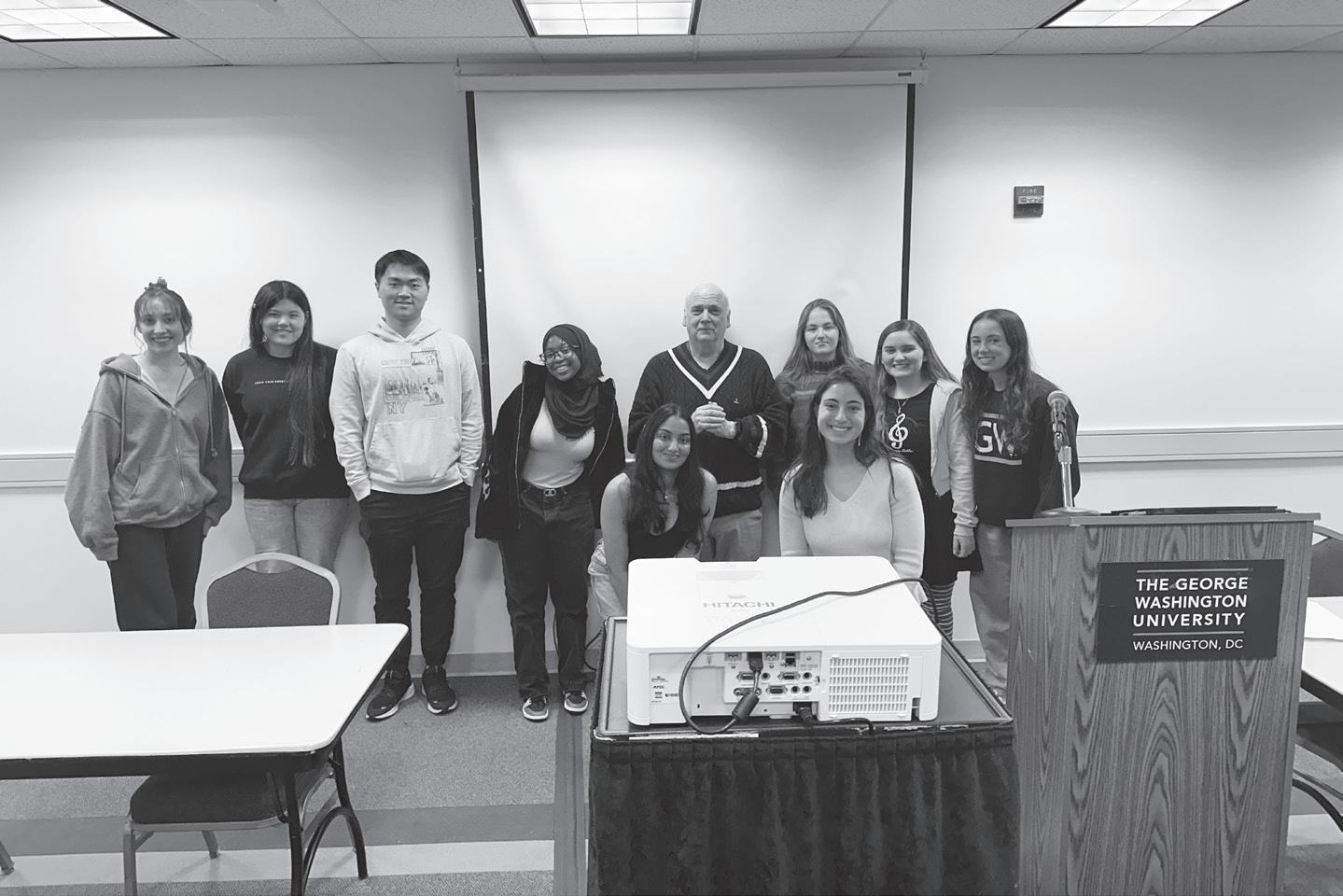
GlobeMed at GWU — an organization dedicated to reaching global health equity — hosted an “Engaging in Anti-Oppressive Advocacy and Community-Building” event Wednesday in the student center, which featured a panel of students from the organization. The panelists spoke about how the organization is working with their partner organization, Set Her Free — an organization in Uganda that supports young women facing sexual exploitation and child labor — to take more inclusive and equitable approaches to global health initiatives.
Senior and co-president
of GlobeMed at GW Sadhana Matheswaran said the organization participated in the summit for the first time this year because of the theme’s focus on revolution. She said the organization has been working to improve their practices, like actively recognizing their privilege and changing their mindsets on oppression based on their experiences with their international partners.
“Over the past two years, GW GlobeMed was definitely having some issues in terms of creating a more inclusive space where everyone can come together and be represented,” Matheswaran said. Junior Manasa Sharma, a part-
Student groups to host sickle cell screening event for Rare Disease Day
ANNALIESE PERSAUD
REPORTER
RYAN J. KARLIN STAFF WRITER
Student organizations will partner to host a sickle cell trait screening event in the University Student Center on the rarest day of the year, Feb. 29.
Genetic counselors will administer screenings to students from 70 available kits in the Continental Ballroom from 3 to 6 p.m. to check for the sickle cell trait that causes sickle cell disease — disorders that cause red blood cells to become misshapen and disrupt blood flow — when the gene is inherited from both parents. Leaders in GW Chronic Health Advocates asked Black student groups to help them put on the event for Rare Disease Day because the disease disproportionately affects Black people.
Many people who inherit just one sickle cell gene will never experience complications but should be aware of the condition for “family planning” purposes, according to the National Institutes of Health. About 100,000 Americans have SCD, affecting about one in 365 Black people in the United States, according to the Centers for Disease Control and Prevention.
Lisa Schwartz — an associate professor of biomedical laboratory sciences and a genetic counselor, health care professionals specializing in genetics and inheritable diseases — said she will administer screenings during the event. She said students will receive a finger prick where a blood sample will
be taken and transported to Howard University’s Center for Sickle Cell Disease. Researchers in the center will evaluate the hemoglobin — the protein affected by the sickle cell trait and disease.
“We are hoping that participants and others in the community gain a better understanding of Sickle Cell Disease and Trait, as well as rare diseases in general,” Schwartz said in an email.
Schwartz said participants identified to have SCD will be contacted by a genetic counselor about three weeks after the screening.
Sultanah Harper, a sophomore and the vice president of membership for CHA, said members will set up a three-station process in the student center’s Continental Ballroom for the event: One station will play an educational video about the disease, participants will complete medical forms and a survey at another and participants will receive a finger prick at the third. Harper said after the screening participants can take complimentary treats provided by Panera. Harper said a presentation hosted by Schwartz in September on genetic counseling inspired her to create the event. Harper said she hopes to use all 70 screening kits, educate community members about SCD and encourage people to complete genetic screening.
“I really hope there’s a lot of participation from this here GW community, and overall I hope genetic screenings and, specifically, sickle cell disease screenings become part of GW’s culture in a way and that we can see these types of events every
year,” Harper said. Barbara Harrison, the assistant director for community outreach and communication for Howard’s Center of Sickle Cell Disease and a genetic counselor at the event, said Black people are not the only group affected by sickle cell disease. She said it is imperative to acknowledge that “genes don’t know color.”
“To have a messaging out there that says that this is just a Black disease, it’s dangerous from a practical standpoint because it’s just simply not true,” Harrison said. “But also, that’s how it’s been characterized in this country and therefore has led to significant health disparities and discrepancies, and research funding.”
Jessica Johnson, a second-year graduate student and the president of the Black Public Health Student Network, said members of the group are marketing the event in the Milken Institute School of Public Health to encourage people to register or walk in.
Johnson said it is especially vital for the Black community to get tested because sickle cell disease can impact a person’s mood and ability to function in every day life, adding that the rate of inheriting the gene is higher among that population.
“It’d be good if somebody who doesn’t know if they have it and they find out that they have it now,” Johnson said. “This event will hopefully bring awareness to them on how they can get the help they need to combat some of those issues that they might have with sickle cell trait.”
ner liaison for GlobeMed at GW, attended the panel and said it allowed her to reflect on the privileges she has as a GW student and the experiences of students of color at the University.
“It’s definitely very important because, at the end of the day, GW is a predominantly white institution and when we create spaces for people of color, and people from different backgrounds, we have to ensure that these spaces are equitable, and we are culturally sensitive,” Sharma said. Dr. Maranda Ward, an assistant professor and director of equity in the Department of Clinical Research and Leadership in
the GW School of Medicine and Health Sciences, led the “‘Rest as Resistance’: Combating White Supremacy and Grind Culture via Restorative Yoga” session Wednesday where students were able to relax and stretch with Dr. Jameta Barlow, an assistant professor of writing in the University Writing and Women’s Leadership programs.
Ward said she and Barlow decided to use yoga in their session because they wanted to give people of color an opportunity to take a break from the burdens that they face, like educating others on oppression while also experiencing it.
Spring fraternity recruitment drops by a quarter
FIONA BORK ASSISTANT NEWS EDITOR QUINN GIORDANO REPORTER
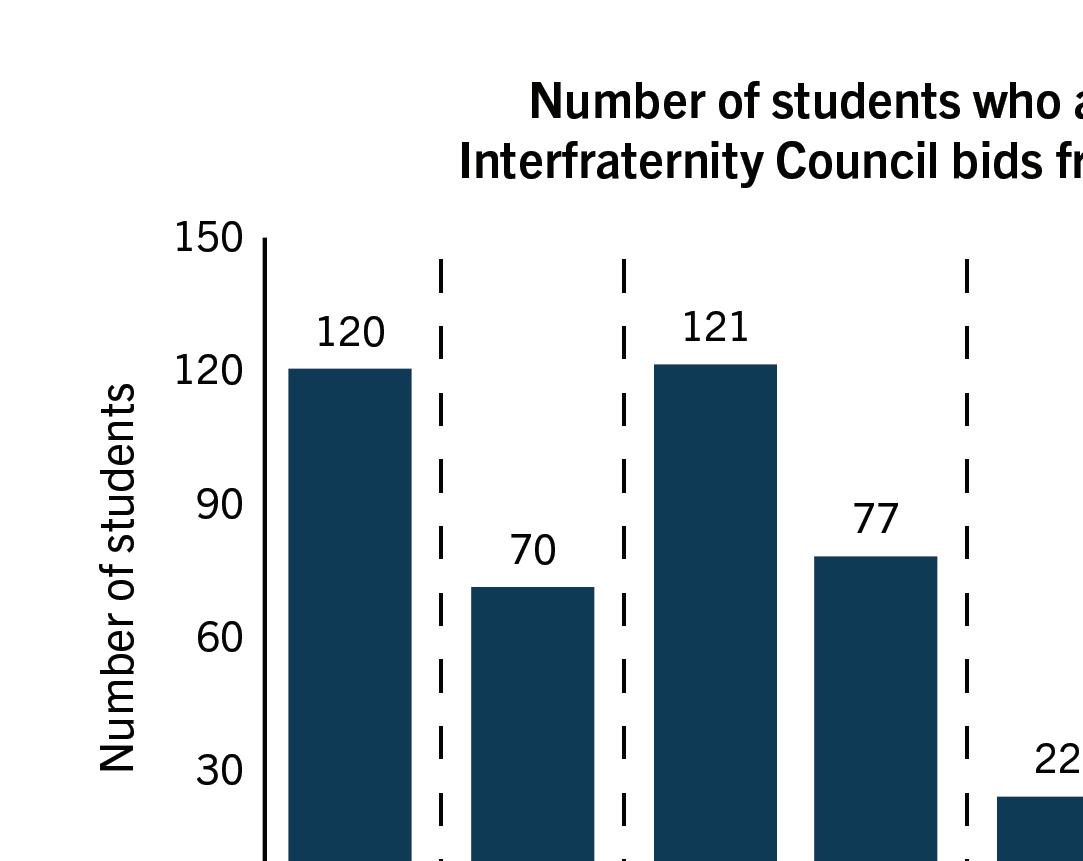
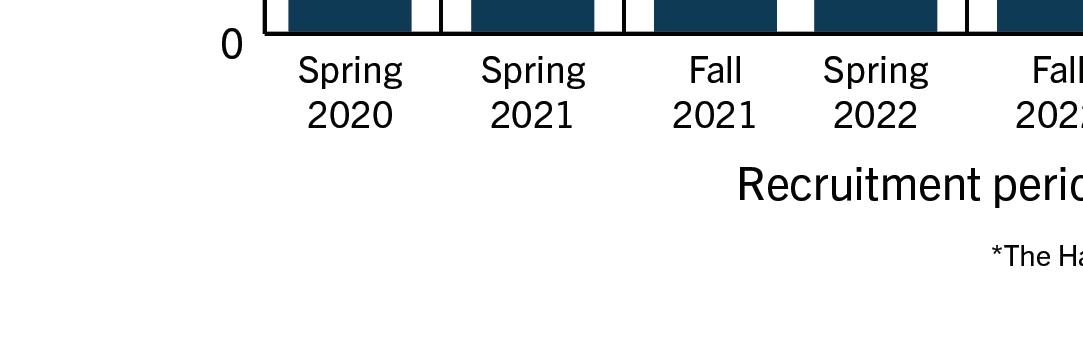
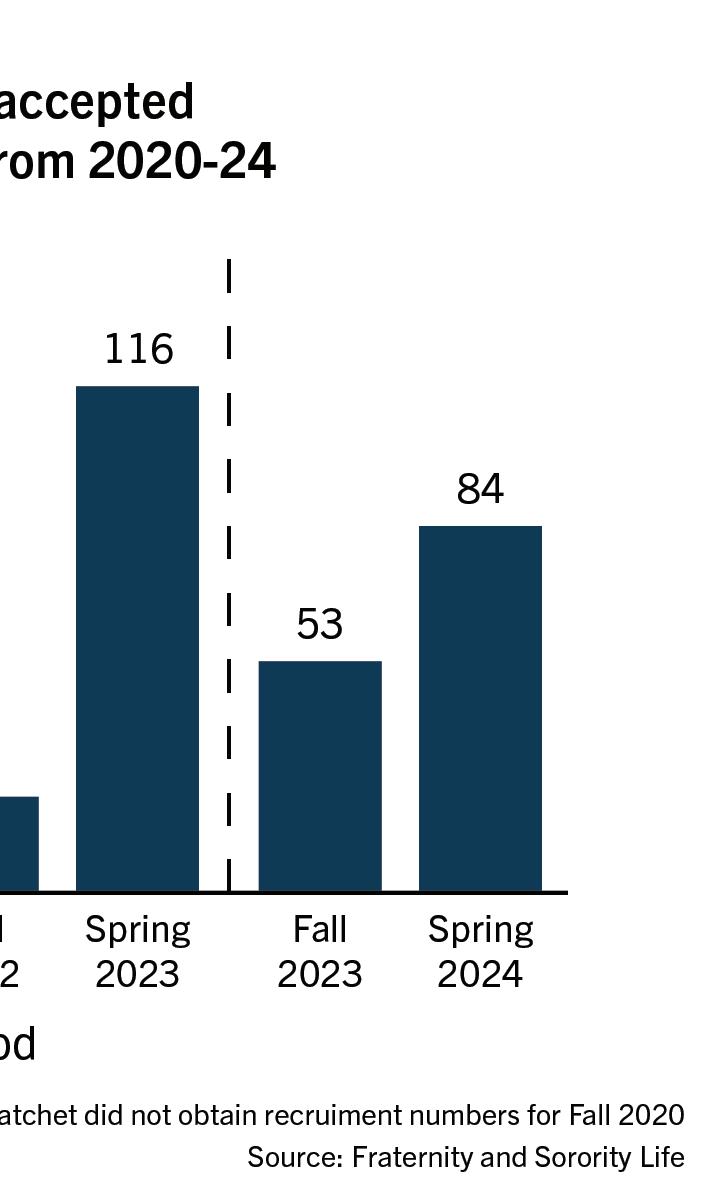
Interfraternity Council spring recruitment numbers dropped by a quarter this spring compared to last year, a dip some fraternity leaders attributed to a shift away from Greek life on campus. Assistant Dean of Student Life Brian Joyce said 144 students participated in spring IFC recruitment this year, with 84 students who accepted spots in fraternities out of 129 extended bids from fraternities this spring. The numbers mark a 27.5 percent decline in accepted bids compared to the 116 last spring, which IFC and chapter leaders said aligns with a drift from participation in fraternities and sororities at GW and nationwide.
“In an effort to increase recruitment numbers in the future, IFC is planning to bolster programming to create more visibility for potential new members and to showcase the values of the FSL community,” Joyce said in an email. Joyce said Delta Tau Delta extended 25 bids and accepted 20 new members, Kappa Sigma extended 20 bids and accepted 19 new members, Sigma Chi extended 20 bids and accepted 12 members, and Zeta Beta Tau extended 21 bids and accepted 11 members.
Tau Kappa Epsilon added seven members and extended 11 bids; Beta Theta Pi added five members and extended 14 bids; Alpha Epsilon Pi added five
members from six bids; Sigma Alpha Epsilon added four members from six bids; and Alpha Sigma Phi did not take on any new members after extending one bid, Joyce said.
IFC Vice President and senior William McClendon said despite “initial concern” due to low registration for spring recruitment, larger IFC chapters welcomed between 15 and 22 new members, which he said is on par with previous years. Fewer people signed up for recruitment because the number of people who registered for fall recruitment more than doubled compared to last year, McClendon said. There were 53 students who accepted bids from fraternities in the fall of 2023, compared to 22 who accepted bids in the fall of 2022 and 77 students who accepted bids in the spring of 2022.
“We think it was just a stabilizing effect that happened there with an increased number of signups in the fall, there was a decrease in signups in the spring,” McClendon said.
McClendon said IFC executive board members voted in the fall to change e-board position terms from turning over on the calendar year in December to the academic year when positions would turn over in May. He said IFC leaders made the adjustment to allow outgoing leaders to have the summer to prepare incoming board members for the recruitment cycle instead of three weeks at the beginning of the spring semester. The change will also allow seniors to hold e-board posi-
tions. He said IFC leaders are talking with Fraternity and Sorority Life leaders and chapter members about the benefit of condensing recruitment from the current two-week process into one in the future.
“It was all in the hopes of just making it more accessible to as many people as possible on campus, and then also just allowing for a greater reach,” McClendon said.
Alec Shafran, a sophomore and president of Beta Theta Pi, said this semester’s recruitment was “not the best” for Beta Theta Pi, but the chapter had success recruiting more members during the open bidding period after recruitment, which allows chapters to informally extend bids to students. Shafran said this semester’s lower numbers parallel a larger culture and perspective shift among men who feel there is “connotation” that the people in fraternities are “douchey,” “shallow” and only focused on the partying aspect of Greek life, which deters people from joining. Shafran said IFC leaders should give students a chance to view the holistic benefits of Greek life, like involvement in philanthropy events and intramural sports, instead of angling recruitment toward each chapter’s individual chapter values.
“It’s not as much of a wake-up call as it is proof in the fact that things are changing,” Shafran said. “The attitude toward Greek life is changing, and we have to adjust accordingly.”
NEWS THE GW HATCHET Feb. 26, 2024 • Page 4
LEE REPORTER
JENNA
ARWEN CLEMANS | PHOTOGRAPHER
The Voice Gospel Choir kicked o the Diversity Summit's keynote Tuesday.
COURTESY OF LAUREN MCCUTCHEON
Members of the GW Chronic Health Advocates hosted an event last semester with Gary Cunningham, a researcher from the Children's National Research Innovation Campus.
AN NGO | GRAPHICS EDITOR
Former US representative discusses civil rights legislation, court cases
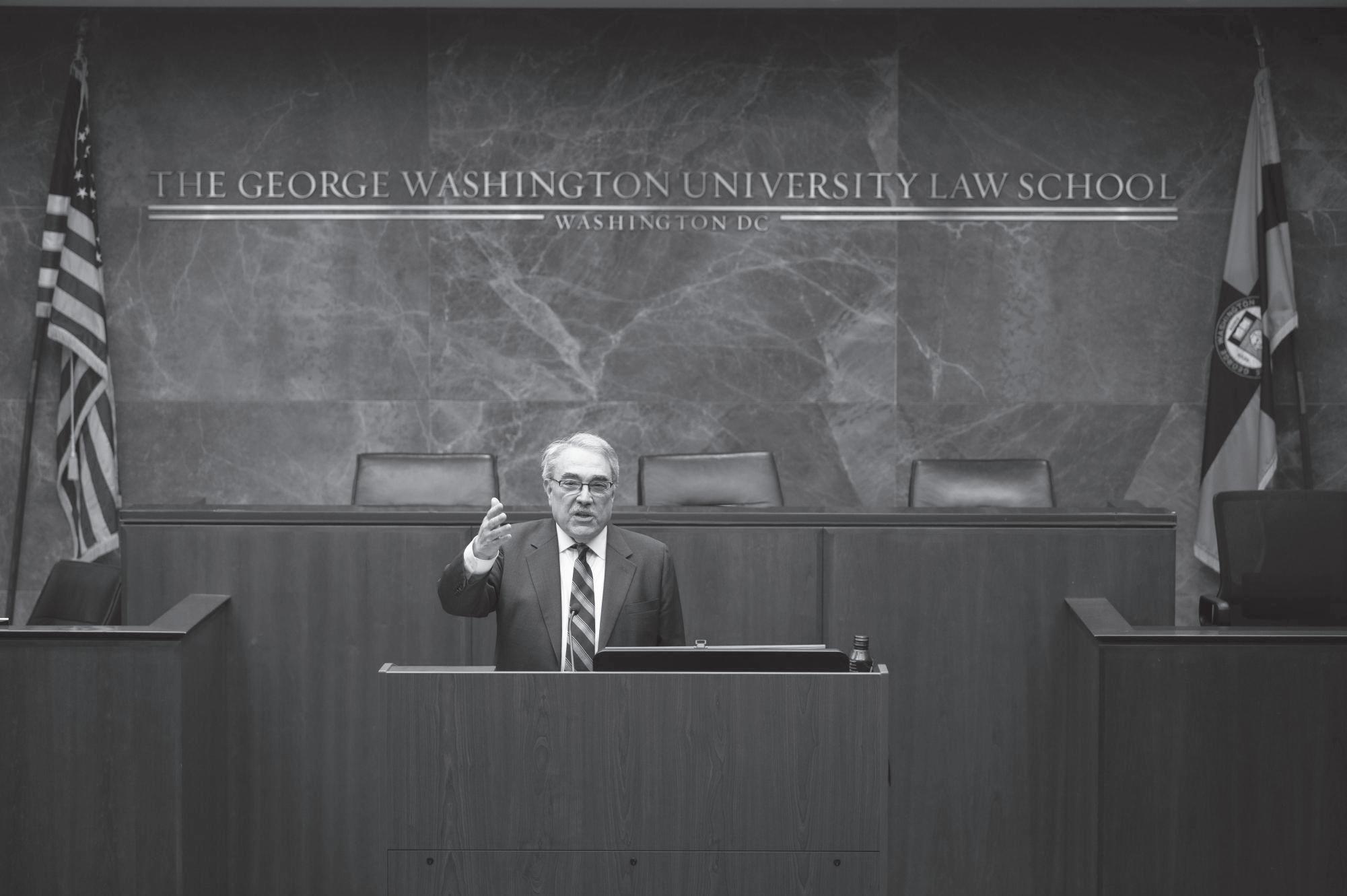
A former U.S. representative discussed landmark civil rights legislation and court cases at the GW Law Jacob Burns Moot Court Room on Tuesday.
G.K. Butterfield, who served as the representative for North Carolina’s first congressional district from 2004-22, discussed the activism that elicited the Civil Rights and Voting Rights acts and sparked legal debate leading up to Brown v. Board of Education. The conversation with GW Law Dean Dayna Bowen Matthew was hosted by the GW Black Law Students Association and GW Law Student Bar Association.
Butterfield said his father would go from door to door in his hometown of Wilson, North Carolina, every Saturday in the early 1930s to explain voting restrictions, such as literacy tests, to Black residents and prepare them to register to vote. Butterfield said his father stopped his efforts after individuals threatened his life if he did not discontinue his work.
Butterfield said his father halted his efforts to register Black voters, but returned to voting advocacy in the 1940s. He said, with the help of his father’s activism, the ratio of Black to white voters in Wilson’s Ward 3 had climbed from 5 percent Black and 95 percent white to a 50-50 split, which inspired Butterfield to pursue politics.
“Because of that, I developed an interest in politics, I developed an interest in law,” Butterfield said.
Butterfield received his law degree from North Carolina Central University in 1974 and
then practiced law throughout North Carolina, handling several voting rights lawsuits in the state. He served as Resident Superior Court judge in the first judicial division from 1989-2001 and then as an associate justice of the North Carolina Supreme Court from 2001-02.
Butterfield said through conversations with the late representative and civil rights activist John Lewis (D-GA), he learned the first-hand story of the push of activists to pass the Voting Rights Act, which outlawed discriminatory voting practices adopted in many southern states after the Civil War, and the Civil
Rights Act.
Butterfield said after the passage of the 1964 Civil Rights Act — which prohibited public discrimination, integrated schools and other public facilities and made employment discrimination illegal — President Lyndon Johnson invited Martin Luther King Jr. to the White House so he could formally thank King for his work. He said King thanked Johnson for his kind words and immediately pivoted to the Voting Rights Act, which Johnson said his Republican Senate colleagues opposed.
“Then Johnson said to Dr. King, ‘No, I don’t think you un -
derstand the predicament that I am in as president,’” Butterfield said. “‘None of the senators that I served within the Senate for years and years and years speak to me right now.’”
Butterfield said Johnson and King then engaged in an exchange where Johnson insisted he had to prioritize Medicare and Medicaid above the Voting Rights Act. He said, despite his initial pushback, Johnson privately supported the Voting Rights Act which he expressed as King left the Oval Office by winking at King and asking King to pressure him and the federal government to approve
Faculty, students mourn the loss of literary theory expert
From Page 1
McRuer, who chaired a search committee tasked with hiring an expert in British romanticism, said DeWispelare’s interview for the position revealed he was a “rising star” with a passion for teaching literature from a global perspective. He said all four committee members named DeWispelare as their first choice for the position at the end of the interview process because of the campus talk he delivered on “Frankenstein” by Mary Shelley.
“I have described it multiple times to people as everybody just was falling in love,” McRuer said.
McRuer said DeWispelare frequently checked in on his colleagues and students during COVID-19 and recalled how the professor had called him when he returned home from being stuck in another country due to pandemic border closures. DeWispelare was an “old soul” who cared deeply for his students, he said. “He was quirky in the most beautiful sense of the word,” McRuer said.
Kavita Daiya, a professor of English and women’s, gender and sexuality studies who co-organized a graduate student seminar on colonialism and globalization a few years ago with DeWispelare, said his knowledge of language, culture and literary
forms inspired students interested in different regions and periods of history.
DeWispelare studied language and literature in cities like Quebec, Hong Kong, Prague, Geneva, Dublin, Macao, the Hague, London and Jakarta, according to his obituary. He gained an appreciation for Islam and the Quran after spending time in Muslim countries like Turkey as well as global politics and translation, his obituary states.
“He was an expansive intellectual and always open to dialogue and connection in ways that built a very vibrant community,” Daiya said.
In 2017 DeWispelare published his book, “Multilingual Subjects: On Standard
English, Its Speakers, and Others in the Long Eighteenth Century,” which explores 18th-century English translation standardization, culture and dialect. He published additional journal articles on 18th- and 19th-century romanticism, fiction and theory and interpretation.
Victoria Barnett-Woods, DeWispelare’s first doctoral student who now teaches 18th-century literature and history at Washington College, said DeWispelare’s “emotional investment” in her career goals and dissertation had a “profound impact” on the way she mentors and educates her students.
“The books he advised me to read, I now advise my undergraduates to read,”
the Act with protests, like the 1965 Selma to Montgomery March that followed King’s meeting with Johnson.
Butterfield also said the Brown v. Board arguments in 1954 — which overturned the 1896 case Plessy v. Ferguson that permitted racial segregation in public facilities as long as they were “separate but equal” — spurred debate among legal scholars at the time regarding whether to enforce the separate but equal doctrine or to dismantle segregation entirely.
“That was a big debate among Black lawyers – whether or not we are just going to accept Plessy as being the law of the land and are we going to insist on equal accommodations, or are we going to try to dismantle it?”
Butterfield said. “And so, in the early years of Charles Hamilton Houston, they embraced the idea of enforcing separate people.”
Butterfield said the legal team that would represent the plaintiff in Brown v. Board, which included lead counsel Thurgood Marshall, found five desegregation cases across several Southern states concerning schools with inadequate learning conditions for Black students that all lost in their respective district courts. Butterfield said the team determined the case against the Board of Education of Topeka, Kansas, had the most evidence to ensure victory, and so they argued Brown v. Board before the Supreme Court.
“They won it 9-0, 9-0 in 1954, the court ruled that separate but equal is no longer the law of the land,” Butterfield said. “Because of Brown, there has been a gradual desegregation of public education all across the country.”
Barnett-Woods said in an email. “The theoretical approaches and the secondary source material Daniel pointed me to, I now point out to my own students.”
Holly Dugan, an associate professor of English, said DeWispelare created assignments that encouraged his students to explore the District, like through connecting art at Smithsonian museums to poetry and novels read for class. She said he reflected his passion for literature in the creativity of his assignments and investment in what his students gained from each course.
“I sometimes joked that he was exactly like an English professor in a movie,” Dugan said in an email. “He
Second-annual career fair sees growth in student participation
Student Government Association leaders collaborated with the Center for Career Services earlier this month to put on the secondannual Career Expo since the COVID-19 pandemic, which saw an uptick in student participation.
Kelley Bishop, the associate vice provost for career services, said 67 employers and roughly 1,100 students participated in this year’s Career Expo — which included seven events and spanned from Feb. 13 to Feb. 16 — marking a 34.4 percent growth rate in attendance from last year’s fair. Bishop said every employer said they had a positive experience at the event, while 75 percent of employers indicated they planned to interview at least one student they met at the fair, according to a survey the office distributed to employers after the fair.
Kelley also said 70 percent of employers said they intended to hire someone they met at the Expo. About 86 percent of surveyed students said they felt prepared for their conversations with employers, Kelley said.
“The 2024 Career Expo was incredibly successful, thanks to our collaboration with the Student Government Association,” Bishop said. This is the second career fair to take place since 2019, before the pandemic interrupted the fair’s regular operations. Last year, more than 70 employers and roughly 1,000 students attended the 10 events spanning two weeks.
Demetrius Apostolis, the executive director of the Career Expo, said the Expo planning process — which began in August — was more structured than last year’s “trial run” because the planning team learned from past mistakes. He said the team increased exposure for the Expo by ramping up Instagram advertisements and putting up posters and graphics around campus.
“Even people that aren’t really too familiar with the SGA are starting to really recognize this as an event that helps students,” Apostolis, who is also the SGA vice president, said.
Some of the employers at the event included the U.S. Department of State, Maryland Department of Transportation, the FBI and the Peace Corps, according to Handshake.
Apostolis said he is working to create a foundation that will allow the Expo to continue in the following years by ensuring there is a “consistent cycle” of funding and leaders interested in planning the event because there was no guarantee for the fair’s funds previously. He said he plans to introduce the Career Exploration Expo Longevity Act at the SGA Senate meeting Monday.
If passed, the measure will guarantee $4,000 in SGA funding for the Career Expo per year and give the team organizing the Expo independence from the SGA.
The Expo began with a Capitol Hill staffer panel Tuesday, followed by an international student job search event Wednesday and a STEM and intelligence panel Thursday. A highlighted event featuring Rep. Jared Moskowitz (D-FL), a GW alum, was initially going to take place Thursday evening but was canceled by the representative.
Students expressed concerns that the Expo, which spanned four hours Feb. 16, was too crowded, making it difficult to talk to employers at competitive enterprises.
Katelyn Karner, a junior majoring in history who attended the fair, said she was “pleasantly surprised” by the number of opportunities for humanities majors at the fair given the usual focus on international affairs and STEM major opportunities at career fairs. She said she brainstormed potential pathways of employment while exploring tables at the career fair despite already having a set path in mind of becom-
just had a way of inspiring students to engage with the challenge of great art.”
Maria Frawley, a professor of English, said DeWispelare was “genuinely interested” in his students as people and “deeply sympathetic” to challenges they faced during the pandemic. She said she remembers inviting DeWispelare to her house a few years ago to meet her friend, a visiting Franz Kafka translator, and the two talked about translation and Eastern European literature for several hours.
“Daniel was incredibly well-read for someone so young, but he wore his erudition lightly,” Frawley said. “It was a fun and relaxing day that I’ll never forget.”

ing a Park Ranger for the National Park Service.
“People don’t typically think history is a super employable major, but there were certainly plenty of opportunities and people I could talk to being a humanities student,” Karner said.
Karner said the venue was very crowded at the start of the event and there were times when attendees had to wait in line which was “semi-frustrating” and prevented her from talking one on one with employers. She said next year’s event planners could allot times for groups of students to peruse the fair to “keep the flow more steady.”
“It’s almost very competitive all of a sudden with the random person you were standing behind,” Karner said. “At the same time, it was good to see and exciting to see so many
people kind of getting out there.”
Giselle Sethi, a sophomore double majoring in political science and international affairs, said she attended the fair after receiving a notification about the event on Handshake and felt the event “exceeded my expectations.” She said the fair was STEM-heavy but that she found job opportunities that fit her interests after talking to recruiters about how their offerings might intersect with her passions.
“On a surface level, it didn’t seem like I would be able to find anything, but the opportunity that the Expo presented to talk to people who actually work there and ask them that question and have them be like ‘We have something that relates to that,’ that was helpful,” Sethi said.
Sethi said she appreciated the
fair’s representation of women among employers in typically “male-dominated” fields such as government and economy-related areas.
Marwa Medjahev, a first-year majoring in international affairs, said she attended the career fair to learn what skill sets are “applicable” to her degree and to narrow down potential career and internship opportunities within organizations. She said talking to recruiters from the FBI and CIA informed her of the flexibility of their internships which she was unaware of prior to the fair. “If I want to shoot for an internship for summer 2025, these are the types of things I should look out for and the skills I should improve in,” Medjahev said. “That was the biggest takeaway I got from the career fair.”
NEWS Feb. 26, 2024 • Page 5
ABBY RUGGLES REPORTER
DANIEL HEUER | STAFF PHOTOGRAPHER
THE GW HATCHET
Former Rep. G.K. Butterfield of North Carolina spoke at the Jacob Burns Moot Court Room on Tuesday.
SOPHIE LHERT REPORTER
COURTESY OF GW MARKETING AND CREATIVE SERVICES
Students mingle with employers during this year's GW Career Expo.
—MADIE TURLEY on 2/22/2024
Don’t only blame AI for soaring cheating cases
Which “AI” will win: artificial intelligence or academic integrity? That’s a question facing officials as cheating cases have soared at GW following the rise of generative artificial intelligence programs like ChatGPT and DALL-E.
The ability to brainstorm ideas, draft outlines and create images with only a few keystrokes has revolutionized higher education — so much for students’ independent, creative work. But AI and academic integrity aren’t necessarily opposed to each other.
Guidelines from the Office of the Provost released in April describe GAI tools as “an exciting addition to the learning process” and outline how professors might allow or restrict students from using them. From certifications to research programs to workshops, the University is exploring artificial intelligence and offering it to staff, faculty and students through software like Adobe Express.
For some students, that’s a shortcut. Putting aside the strange and frequently inaccurate results such programs can generate, GAI can write entire essays
STAFF EDITORIAL
with a single query. But such uses can violate GW’s Code of Academic Integrity: Submitting GAI-generated content without an instructor’s permission is technically cheating. And GAI-related infractions helped fuel what officials said was a 476 percent increase in cheating at GW in fall 2023 as compared to fall 2021 and 2022. All of this adds up to a strange situation. Officials want the University to be at the forefront of artificial intelligence, while faculty have the mission of ensuring students use these tools responsibly — if at all — in the classroom. Moreover, individual professors’ policies on GAI can range from entire homework assignments that incorporate artificial intelligence to complete
bans on any and all programs. For all the optimism about GAI’s future, there’s a deep uneasiness about its present.
But looking solely at academic integrity, the problem isn’t just artificial intelligence. Prompt-based text and image creators are just a means to an end, and the truth is students have cheated, are cheating and will likely continue to cheat. But why?
Prompt-based text and image creators are just a means to an end, and the truth is students have cheated, are cheating and will likely continue to cheat. But why?
The COVID-19 pandemic provides one answer. The number of academy integrity reports at GW and nationwide rose between 2020 and 2021. When students felt less accountable to remote courses and more stressed in a time of unprecedented crisis, they were more likely to consider cheating or plagia -
rizing. And as the pandemic waned in late 2022 and early 2023, GAI took off. For students who were exhausted, overwhelmed and performing below expectations, the sudden arrival of the programs created a perfect storm.
Some students lack the skills and knowledge they should already have, and they incorrectly believe artificial intelligence can paper over the cracks. This is an explanation for cheating, not an excuse. GAI can help students “think smarter, not harder,” but it’s up to them to maintain their academic integrity. So, while plans for faster, more flexible disciplinary hearings and further guidance on artificial intelligence don’t get to the heart of why cheating and GAI-related infractions have increased, they can help streamline GW’s handling of cases when they arise.
It’s difficult to predict the future of artificial intelligence, especially when its capabilities — and the implications of using it — continue to rapidly evolve. But for better and for worse, from formal research to last-minute assignments, these tools are here to stay. GWU, meet GAI.
I will not ‘Disagree Better’ about transphobia
Editor’s note: This post contains references to suicide. If you or someone you know has experienced suicidal ideation, call the 988 Suicide and Crisis Lifeline or reach the Student Health Center at (202)994-5300 and ask to speak to a counselor.
Being transgender is exhausting and scary.
As a nonbinary person, I advocate for my mere right to exist on a daily basis.
Riley Goodfellow Contributing Opinions Editor
Politicians are even trying to criminalize my existence by introducing over 496 anti-trans bills in 2024 alone. Transgender people are under attack, both with legislation and physical violence. Nex Benedict, a 16-year-old nonbinary student in Oklahoma, died this month after they were assaulted in their school’s bathroom.
At the core of transphobic discrimination is a basic yet dangerous misunderstanding of who transgender people are. False and violent rhetoric spread about the transgender community does not protect children — it kills them. And yet, GW invited an openly transphobic politician to speak on campus.
Utah Gov. Spencer Cox called gender-affirming health care “genital-mutilation surgeries” in a School of Media & Public Affairs event Wednesday. The event was titled “Disagree Better,” but I cannot disagree better with a person who openly denies transgender individuals the right to live.
Cox signed statewide bills last year that banned gender-affirming health care for minors and required transgender people to use the bathrooms that correspond with their sex assigned at birth. It is not a coincidence that Nex was brutally beaten in a bathroom in a state with identical anti-trans bathroom legislation.
Bathrooms are where I often face discrimination and harassment based on my identity. The idea that
bathrooms only exist for women and men is just one sliver of the messaging I receive every day telling me I don’t exist. Either GW did not do its research on Cox, or the University deliberately ignored his transphobia. I do not know which is worse, but I do know that GW does not see, care for, or protect me. That Cox equated gender-affirming care to genital mutilation proves how transphobia is rooted in incendiary fallacies. In 2022, 94 percent of transgender and nonbinary Americans reported being happier after they transitioned, and 30 of the leading medical associations in the United States support gender-affirming care. Cox also claimed that “no one” in Utah has died by suicide due to lack of access to gender-affirming care. But 61 percent of transgender students in Utah seriously considered suicide at some point in 2023.
Gender dysphoria is different for everybody. For me, it is an excruciating experience that weighs me down daily. My voice leaves my mouth and sounds like someone else’s. I feel forced to live in a shell that isn’t mine. And while I struggle with feeling detached from my body, I still wholeheartedly love my identity. It brings me such euphoria to shave my head and hear my they/them pronouns used. My life is richer and more fulfilling when I am embraced with the same love and affirmation for my identity as I hold for myself.
Gender affirmation is essential to my existence. Policies that ban genderaffirming care increase depression and suicidality among transgender and nonbinary youths. Rather than perpetuating the false narrative that transgender people are confused or coerced into irreversible body mutilations, understand that denying transgender people gender-affirming care denies them the chance to live a healthy, authentic and fulfilling life.
Gender-affirming care includes physical and mental resources that affirm one’s identity. A queer therapist saved me when I studied abroad and experienced
the worst transphobia I ever have. Whether it is top surgery or seeing a queer therapist, gender-affirming care is not the dangerous weapon transphobes pretend it is — it is life-saving care.
Cox deliberately lied about my community and gender-affirming care. Transgender people are not advocating for nor experiencing genital mutilation, but the binary construction of gender does lead to Intersex Genital Mutilation. 1.7 percent of the population is born intersex — a combination of male and female biological traits — yet they are often subjected to nonconsensual surgery that changes their external genitals to fit into either the category of male or female.
Gender, as socially constructed and upheld by Cox, forces people into an oppressive hierarchy in which women fall below men and gender-diverse individuals do not even exist. Transgender people always have and always will exist, no matter how hard politicians try to use a binary to eradicate us.
Even if politicians do not acknowledge my identity, I just want to feel safe existing as a transgender person. The University deliberately contributed to violence and discrimination against my community. GW must take responsibility for giving Cox a platform to endanger transgender students and address the harm his words caused.
I am constantly engulfed in rhetoric that not only denies my existence but actively tries to eradicate it. People like Cox continue to paint gender-affirming care and transgender people as dangerous, but I am simply asking for the right to live.
Members of my community are dying while politicians like Cox claim they “care deeply about these kids.” As I mourn the death of Nex, I implore University officials to recognize that transgender students are people worthy of love and in need of protection.
Nex deserved so much better. May they rest in power. —Riley Goodfellow, a senior majoring in political science, is the contributing opinions editor.
YAcknowledge how GW’s history intersects with genocide, erasure
ou are on Native land.
Yes, you.
Simply acknowledging this fact ends your personal complacency in generations of erasure of Native stories and homelands. Take a second and think about how the land beneath your feet was once home to vibrant communities for thousands of years. What you just did is something GW’s administration has never done.
Noah Edelman Opinions Writer
There are no land acknowledgments at the largest gatherings of GW students, like Convocation and Commencement ceremonies. Other schools across the country have implemented land acknowledgments at similar events, but they have remained a strange oversight at GW. What may seem like a formality to University officials and the Student Government Association carries a weight to Native students and the sense of community we feel at this school.
Knowing how history coincides with genocide and erasure is powerful. The administrative silence on this issue is an intentional declaration of opinion: specifically, a comment on whether or not my ancestors deserved to be displaced and killed. That’s not ridiculous to say and not something that Native peoples should have to argue with non-Native authority figures about. Our presence is eternal, and as much as administrators may characterize a push for acknowledgment as a political agenda, I wholeheartedly reject that notion. This is a point about existence — this is me.
The history of the displacement of Native peoples in D.C. is welldocumented. GW’s responsibility to its Native students extends beyond a short statement on a website. The words of land acknowledgments gain their power through being spoken. The pain of
generational trauma and cultural displacement is not dissipated digitally but in the fresh air, with open hearts and ears. The push for this acknowledgment is not new to GW. The campaign should be a collaborative effort between administration and students, not a yearslong campaign. The push is currently completely student-led, leaning on independent research and organizing efforts from Native student groups and other aligned student organizations.
Like any public proposed change, the process is lengthy and at times frustrating for those involved. This push has been going on for almost a year, and the students who initiated it have since graduated. Besides the intensive time commitment, the process is also increasingly bureaucratic the further it goes. Most meetings with administrative officials have been an attempt to convince, rather than to collaborate. We have been collecting instructions on how to “propose” this to boards, committees and top officials as if it were a business pitch.
An ideal statement would publicly acknowledge, at major University events, the Anacostan and Piscataway peoples who inhabited this land before colonization. It would also address the historic role GW played in displacing those peoples and the use of enslaved peoples’ labor to construct and operate the Columbian College. Any statement should be paired with resources like dedicated on-campus spaces and dedicated counseling and advising contacts for Native students and non-Native students. At Students for Indigenous and Native American Rights, we have been intentional about creating this statement. We have engaged with the Native communities surrounding D.C. and seek to bring them into the picture at GW, most recently in programming for Native American Heritage Month last November. SINAR has been operating in a highly colonial space (up until
last year, quite literally, by name), and this push comes from the heart and is for the benefit of everyone involved. The systems in which we have to make this change happen are inherently hostile to Native resistance, but our consistent and united efforts have shown that it’s not impossible to make tangible changes on campus. We were able to bring local Native dancers and community members into GW, and now the school needs to show us they are with us instead of just tolerating us.
The culture that governs this country has long seen Earth as a resource to be commodified and exploited for profit. This attitude has historically extended to Native peoples as well, as American history depicts us as a hurdle in the way of “manifest destiny.”
GW has an inherent capability and responsibility to redirect these narratives and help recontextualize Native peoples in this country’s history. A public, enthusiastic and well-researched land acknowledgment is a fantastic first step in that process. It may seem performative to some, but every step matters.
Decolonization is a long road, and the steps can be painfully slow. But our spirit will always be strong. No matter the opposition to these causes — officials have made it clear that it’s not a priority to them — we will stand together. The Native students on this campus (all 30 of them in 2023) are looking for something to hold on to, a piece of themselves in the world they left home for. GW has a chance to make its students feel more welcome and connected to the community, and it’s so easy. Native students feel invisible on campus. To those in positions of power willing to listen: Hear us, see us and acknowledge us. We’re not going anywhere, so help us feel at home.
—Noah Edelman, a sophomore majoring in journalism, is an opinions writer. He is the Co-Vice President of Students for Indigenous and Native American Rights.
OPINIONS THE GW HATCHET Feb. 26, 2024 • Page 6 Opinions eic@gwhatchet.com news@gwhatchet.com opinions@gwhatchet.com photo@gwhatchet.com sports@gwhatchet.com culture@gwhatchet.com copy@gwhatchet.com multimedia@gwhatchet.com 609 21st St. NW Washington, D.C. 20052 gwhatchet.com | @gwhatchet Submissions — Deadlines for submissions are Friday 5 p.m. for Monday issues. They must include the author’s name, title, year in school and phone number. The GW Hatchet does not guarantee publication and reserves the right to edit all submissions for space, grammar and clarity. Submit to opinions@gwhatchet.com Policy Statement — The GW Hatchet is produced by Hatchet Publications Inc., an independent, non-profit corporation. All comments should be addressed to the Board of Directors, which has sole authority for the content of this publication. Opinions expressed in signed columns are those of the authors and do not necessarily reflect the view of The GW Hatchet. All content of The GW Hatchet is copyrighted and may not be reproduced without written authorization from the editor in chief. Cost — Single copies free. Additional copies available for purchase upon request. Zach Blackburn, editor in chief Hatchet The GW Nick Pasion, print managing editor Jaden DiMauro, digital managing editor Grace Miller, managing director Nicholas Anastacio, community relations director Grace Chinowsky, senior news editor Erika Filter, news editor Ianne Salvosa, news editor Fiona Bork, assistant news editor Fiona Riley, assistant news editor Hannah Marr, assistant news editor Rory Quealy, assistant news editor Jennifer Igbonoba, contributing news editor Max Porter, contributing news editor Rachel Moon, contributing news editor Cade McAllister, events editor Ethan Benn opinions editor* Riley Goodfellow contributing opinions editor* Paige Baratta, editorials assistant* Dylan Ebs, research assistant Annie O’Brien, podcast host – culture Lizzie Jensen, podcast host – news Isabella MacKinnon, design editor Abby Keenley, contributing design editor Anusha Trivedi, contributing design editor An Ngo, graphics editor Ishani Chettri, web developer Peyton Rollins, contributing web developer Ethan Valliath, social media director* Anaya Bhatt, contributing social media director* Max Gaffin, contributing social media director * denotes member of editorial board Auden Yurman, senior photo editor Florence Shen, assistant photo editor –features Sage Russell, assistant photo editor – news Jordyn Bailer, assistant photo editor – sports Jordan Tovin, assistant photo editor –culture Sandra Koretz, sports editor Ben Spitalny, contributing sports editor Nick Perkins, culture editor Jenna Baer, contributing culture editor* Eduardo Gonzalez del Valle, contributing video editor Sophia Escobar, contributing video editor Cristina Stassis, copy chief Carly Cavanaugh, assistant copy editor Faith Wardwell, publishing assistant Anna Fattizzo, research assistant Brooke Forgette, research assistant
“While no one will ever truly know what’s going on behind the scenes, humans all hold the capability to judge each other with honesty and empathy.”
FROM GWHATCHET.COM/OPINIONS
F-bombs and free throws: Inside the world of intramural basketball refs
ELLA MITCHELL STAFF WRITER
NICOLA DEGREGORIO REPORTER
On the courts of the Lerner Health and Wellness Center, a player stopped and picked up the basketball, just before starting to dribble again.
A double dribble, a textbook violation — only there wasn’t a whistle issuing a foul after it. And the opposing players decided to give referee Declan McGrath a piece of their mind.
“F*ck you, f*ck this, you f*cking suck,” McGrath said the players yelled at him.
The situation eventually dissipated, with McGrath issuing technical fouls to the players, but these battles are an ordinary occurrence a mere block away from the Smith Center. Most weeknights, a series of fierce five-on-five matches are duked out as intramural basketball teams fight for victory, commemorative t-shirts and bragging rights. On the sidelines of these heated games are the smack talk’s scapegoats: the student referees.
There are dozens of student referees, largely unrecognized, who deal with the jeering, low pay and back-and-forth running to keep intramural sports alive at GW — all for the love of the game.
Junior Sebastian Zambrano, a referee coordinator for GW intramural sports, said glib comments from intramural basketball contestants are a mundane and common occurrence — but players aren’t afraid to get creative with how they heckle him.
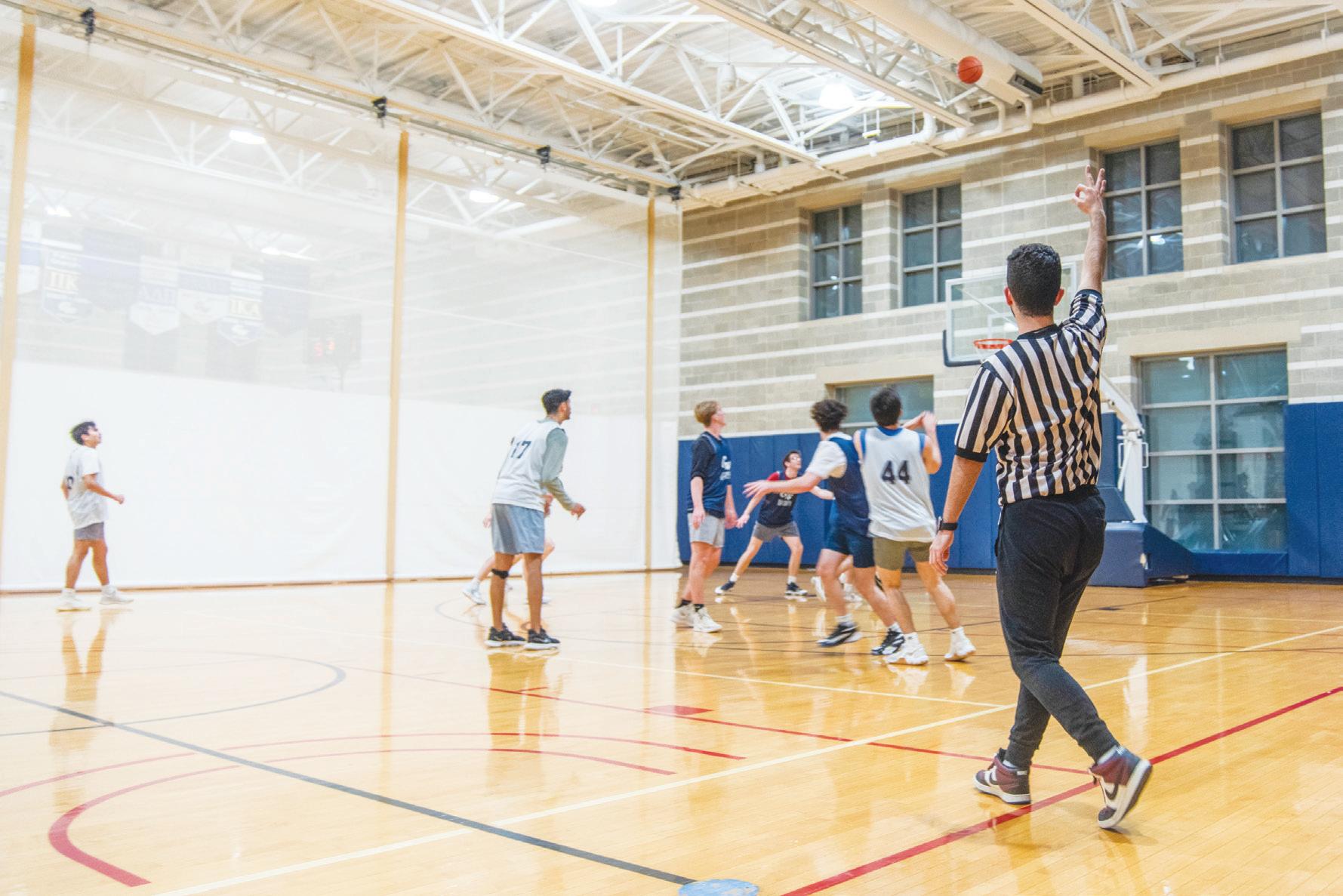
“Like, ‘Ref, pick up the phone, you missed the call,’ or like stuff like that,” he said as an example of comments players have thrown at him.
Zambrano said judging basketball, in addition to other sports like esports and volleyball, has given him some empathy for sideline officials.
Sophomore referee Ava Hurley, majoring in environmental and sustainability science, said she played soccer for 14 years growing
up and served as a youth soccer referee, something that drew her to this job. She said despite having experience both playing and officiating the sport, she doesn’t always feel respected by players.
“I do get undermined a lot because I’m a girl for sure,” she said. “They’ll yell at my other coworkers like they’ll say things they want to say to me to them because they don’t think that I’m going to understand.”
She said despite such disre-
A new bookshelf in West End Library will feature neighborhood history
ERIKA FILTER NEWS EDITOR
The storied rowhouses and alleyways of Foggy Bottom and West End will soon be featured in a library shelf about local history next month.
The Foggy Bottom Association History Project and the West End Library began collaborating in November to develop a new local history bookshelf for the library.
The shelf, which will be located toward the back of the library when it launches next month, will include titles on the District’s history, along with biographies of famous neighborhood residents like Ruth Bader Ginsburg and Duke Ellington.
Robert Schneider, the manager and supervising librarian at West End Library, said many of the titles that will move to the shelf were already in the D.C. Library’s collection, which houses books about locals in sporadic libraries around the District, normally at the locations the most recent borrowers returned them. He said the shelf is part of the library’s broader efforts to connect with the Foggy Bottom community.
“What we wanted to do was anchor some of those items in our collection so they’re readily available for folk coming from the community who want to know more about who we are as a neighborhood,” Schneider said.
Schneider said the display of books is a “retailtype” concept to draw attention to titles library visitors might otherwise overlook, like their current temporary display promoting houseplant-themed books. He said the shelf imitates the local interest section often found in libraries and bookstores in other cities and is intended to reach both residents and visitors to the neighborhood.
The shelf will feature more than a dozen titles, including both broader D.C. history and books that take a deep dive into Foggy Bottom and West End figures.
One book in the collection, “The Foggy Bottom Gang,” discusses organized crime in the neighborhood from the Prohibition era. Written by retired Department of Treasury official Leo Warring about his father and uncle, the book discusses the Warring brothers’ bootlegging and underground lottery business.
The collection also includes “The Watergate: Inside America’s Most Infamous Address.” The book provides anecdotes of the iconic building’s residents, like late Supreme Court Justice Ruth Bader Ginsburg, who lived in the Watergate for 40 years. After the presidential sex scandal made national headlines, Monica Lewinsky lived with her mother, who owned an apartment in the Watergate. Her neighbor was Bob Dole,
the Republican presidential nominee then-President Bill Clinton had defeated to take office.
“The Watergate: Inside America’s Most Infamous Address” also provides information on the building’s unique architecture: The Watergate architect hoped the building would resurrect the Baroque movement and assigned particular significance to the building, located at the origin of city designer Pierre L’Enfant’s early grid system.
Four titles on musical legend Duke Ellington also find a home on the shelf near Ellington’s one-time residence — he was born in West End and lived in the neighborhood before moving to Harlem in 1923.
Ginsburg and Ellington are no strangers to their home library — they are also displayed in a mural on the upper wall. Titled “Paragons of West End,” the mural depicts, in large, abstract letters, the names of luminaries who hailed from or lived in the neighborhood.
Schneider said the library is reviewing ways to find resources that may be out of print, but budget constraints may limit the expansion of the local history section in the short term.
“At this end, our goal is to try to keep after this for years to come and to grow the collection and give it a little more prominence and a little more depth and breadth,” Schneider said.

spect, there are still almost as many female referees as male referees.
“I love my job,” she said. McGrath, a junior majoring in public health and the referee heckled for a missed double dribble, began refereeing last year. McGrath said he was drawn to the intramural referee job listing last winter because it’s a “sporty job,” matching his interest in athletics. He said he loves the competitive drive of the game — even if he is not experiencing the competition firsthand.
“Basketball is definitely our most intense sport,” McGrath said.
To prepare for the referee role, McGrath said there are training sessions, including a class to cover rules, hand signals and calls; a trial run of the hand signals for practice; and an expedition game between two real teams to put everything into action.
He said one appeal of the job comes from the on-court environment — even with all the heckling. He said the intramural basketball finals are played in the Smith Center, and though the attendance didn’t match that of a GW basketball game, the more professional court made up for it.
“The atmosphere even though there weren’t many people in the stands, it was still cool to be down there and running back and forth,” McGrath said.
Ava Ahner, a senior majoring in international affairs, said in her two years as a referee for GW intramural sports, she has seen familiar faces, and teams often play a sport together each season. She said for many, the appeal of intramural sports is hanging out with friends and doing something relatively low stakes.
First-year Mark Achkar, a biology major, said the league is an accessible and fun way to get together with friends. While pandering to the officials can work in a team’s favor, he said being kind to the referees creates a positive atmosphere.
“Sometimes it works, sometimes it doesn’t,” he said. “It kind of depends on the day, but you always be nice to the refs and they’ll be nice to you.”
English professor details struggles in memoir ‘Sex with a Brain Injury’
Behind an eye-catching red-and-pink book cover, Annie Liontas grapples with an invisible disability.
In January, Liontas, an assistant professor of English, published “Sex with a Brain Injury,” a series of essays detailing their struggles after suffering three brain injuries in about a year. Liontas said their book seeks to inform readers about “disability justice,” a movement aiming to expand rights for those with disabilities.
Before arriving at GW in 2018, Liontas was a visiting writer at the University of California, Davis and the University of Massachusetts. They published their debut novel in 2015, “Let Me Explain You,” which explores the dynamics of a Greek-American family.
Liontas said they wrote “Sex with a Brain Injury” after experiencing three head injuries in 13 months in 2016 and 2017 from a bike accident, a car seat that fell on them at a store and a pot that fell on them while they were gardening. They said the injuries altered their perspective on how they led their life, from teaching to being in a relationship.
“It really affected my relationship to just living, to my work, to my teaching,” they said. “Inherently, it’s an invisible condition.”
They said all their injuries were nominally mild, but brain injuries can’t be meager. After struggling with injuries and going through recovery, Liontas said they began writing “Sex with a Brain Injury” in 2019, starting with the title essay and continuing to write more once it was published. The essay covers Liontas’ struggles with sex — something they “used to be good at” — after their accidents. They wrote that the intensity of sensation involved in intimacy made their head ache.
“How do I put this?” they wrote. “Orgasms make my head explode.”
Liontas said people usually don’t think about how intimacy relates to disability and wanted to fully encapsulate areas of life for those with disabilities that are often not acknowledged. As an LGBTQ+ person, they said it felt important to “claim” this part of themselves and offer a perspective to others, especially young people, through the book’s title.
Liontas first published the essay version of “Sex With a Brain Injury” in Gay Mag, an online cultural criticism outlet. They said they were inspired to continue expanding the piece since many layers of the experience hadn’t been detailed in the shorter-form article. For example, they said the
overlap between addiction and brain injury became a “big focus” in the book while it was absent from the initial article. They said people who suffer from addiction and those who have endured traumatic brain injuries have similar-looking brains.
Liontas said teaching was “demanding” at first, balancing health needs with instructing. They said part of the class focuses on curating an experience for the reader and concentrating on the audience, which requires authors to be vulnerable. They said they were pushed by students to be open and share their story.
“I had to really practice what I preach and take to heart, you know, getting this truer, authentic story on the page that maybe, in some ways would have been easier not to write,” they said. They also said though they sometimes can’t think of a particular word when lecturing due to their brain injuries, students will jump in to help. Liontas said they are appreciative to have a supportive department and students who provide understanding, and that despite the difficult recovery process, the experience has expanded their sense of compassion.
“It’s made me a better teacher and a better human and a better partner,” Liontas said.
CULTURE THE GW HATCHET Feb. 26, 2024 • Page 7
NEW TV SHOW: “AVATAR: THE LAST AIRBENDER” THE SCENE RELEASED THIS WEEK: FRIDAY EVENING TANGO CLASS Friday, March 1 | District House | Free Make new friends while learning the art of Argentine tango. OPEN MIC NIGHT Friday, March 1 | Lisner Downstage | Free Enjoy a night of student stand-up loaded with laughs.
Culture
ANN DUAN | PHOTOGRAPHER Readers lounge at tables in the West End Library.
TANNER NALLEY | STAFF PHOTOGRAPHER
A student referee signals a 3-point attempt during an intramural game in the Lerner Health and Wellness Center.
DIANA ANOS REPORTER
COURTESY OF ANNIE LIONTAS Assistant professor of English Annie Liontas
Sports
Swimming and diving dominate A-10; both teams place first for third-straight year
GRANT PACERNICK REPORTER
For the third-straight year, both the men’s and women’s swimming and diving won the Atlantic 10 Championship after a dominant performance at the Hampton Virginia Aquaplex this weekend.
The women scored 890 points, with the second-place team Richmond scoring just 470, while the men’s team dominated the competition with 844 points, while Massachusetts came in second with 455.5 points. The third-consecutive A-10 championship win makes the swimming and diving team the undisputed best athletics program at GW and places the men’s team 31st and women’s 32nd in the country.
The men have won seven of the last eight A-10 Championships and the women four of the last five. Combined, the teams set 17 new conference records over the four-day competition.
The Revolutionaries started off strong Wednesday, setting new A-10 records in the women’s 200-yard medley and both 800-meter freestyle relays. GW came in first in every relay in the competition.
The women swept the podium in the 500-yard freestyle, led by freshman Zoe Schneider who won the event in 4:44.37. Sophomores Ava Topolewski and Phoebe Wright completed the sweep.
Topolewski also swam to victory in the 1,650-yard
freestyle, setting a new conference record with a time of 16:08.48, and Wright won the 200-yard freestyle. The A-10 named Schneider the Most Outstanding Rookie of the Year at the conclusion of the competition. On top of winning the 500-yard freestyle, she placed second in the 1,650yard freestyle and the 400-yard individual medley.
Junior Connor Rodgers was named A-10 Co-Most Outstanding Men’s Performer of the Year, sharing the honor with Davidson Sophomore Dylan Felt.
Rodgers won the 200-yard butterfly in a conference recordsetting 1:44:36. He won the 200yard individual medley with a time of 1:44.74, coming within two-hundredths of a second of the current league record, and took home the crown in the 400-yard individual medley.
Sophomore Toni Dragoja bested Felt in the 200-yard freestyle final, shaving over three seconds off his time in the preliminary round to set a conference record with a time of 1:33.25. He set another conference record in the 100yard freestyle, beating the 43.01 record he set in the preliminaries with a 42.71 second swim in the finals.
Redshirt senior Djurdje Matic also set multiple individual conference records, winning the 100-yard butterfly in 45.14 seconds and the 50yard freestyle final in 19.54 seconds after tying Fordham graduate student Grooper

Guy in preliminaries. Matic represented Serbia at the World Aquatics Championships earlier this month, finishing 29th in the world in the 50-meter butterfly. Junior Ava DeAngelis broke one minute in the women’s final of the 100-yard breaststroke, setting a new conference record of 59.75. She placed second in the 200-yard breaststroke. Freshman Ralf Roose won the men’s 200-yard breaststroke
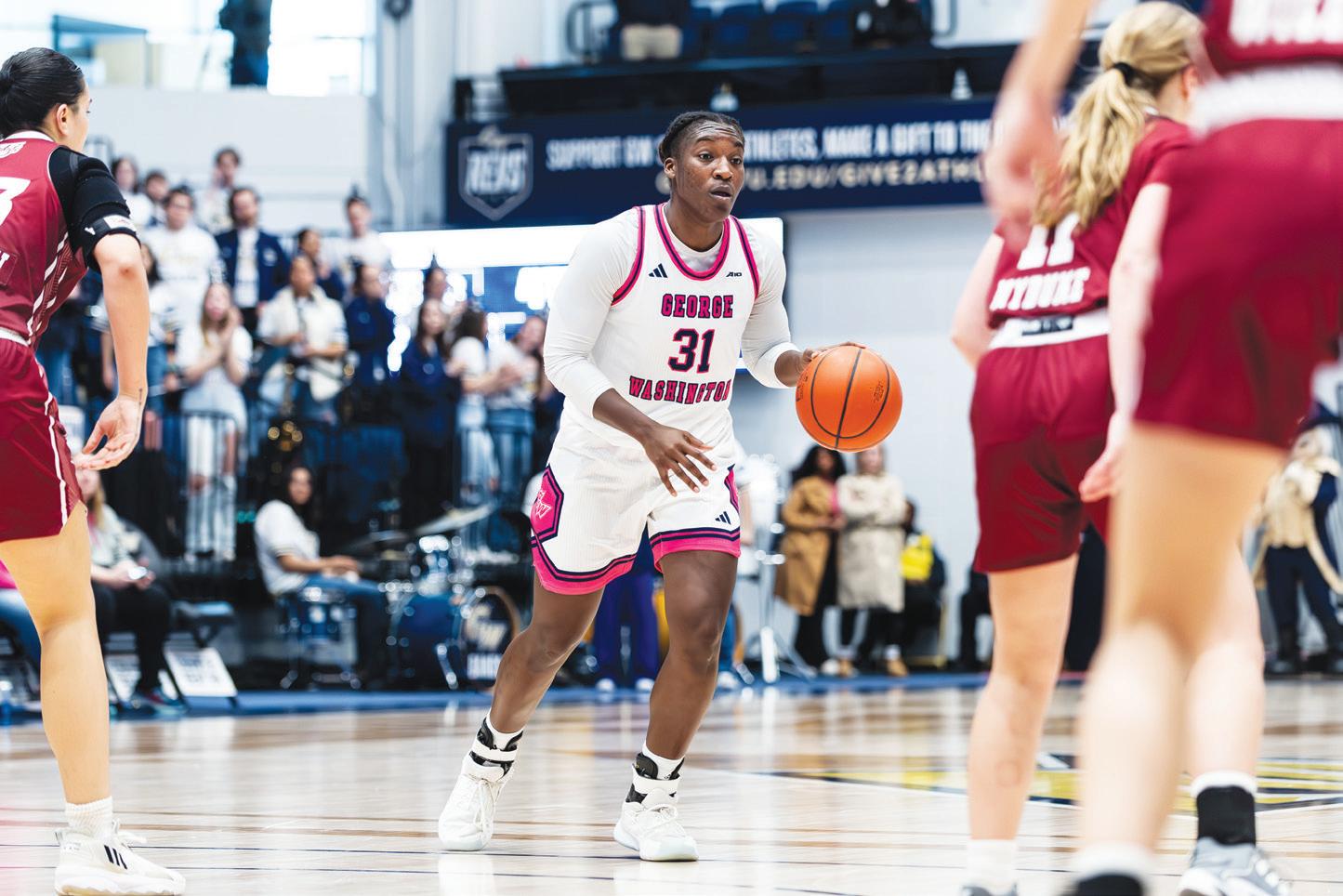
Women’s basketball beats UMass behind Taiwo’s career-high 20 boards
KRISTI WIDJAJA STAFF WRITER
Women’s basketball (1117, 4-12 A-10) took down UMass (3-26, 1-16 A-10) in a close 59-55 game Saturday at the Smith Center.
The Revolutionaries brought high energy to each end of the court, dominating on the defensive end in the last quarter, forcing the Minutewomen to shoot 23.1 percent from the field to seal the win. Graduate student forward Mayowa Taiwo had 8 points and 20 rebounds, her careerhigh, eclipsing a total of 1,000 rebounds in her Revs career, at her penultimate game in the Smith Center.
“It feels really good, and I was really wanting that last one because I knew it would give me a 20, but I didn’t know it was gonna put me over 1,000,” Taiwo said.
Freshman guard Kamari Sims led the team scoring on a career high of 16 points. She went five for 11 from the field during 19 minutes of playing time. Sophomore guard Nya Robertson collected 10 points on two for 11 shooting and notched three rebounds.
Taiwo played all 40 minutes of the game, playing a critical role in the last few minutes, grabbing crucial rebounds that helped the Revs win. Behind Taiwo’s effort,
which tied her for the eighth-most rebounds ever by a GW women’s player in a game, the Revs led with 41 rebounds compared to the Minutewomen’s 29. The Minutewomen had only four offensive rebounds throughout the game while the Revs had 13. This allowed the Revs to score 15 second-chance points, while the Minutewomen only tallied 2 points. The Revs’ bench contributed to the win, scoring all 13 of 13 points in the fourth quarter. They collectively scored 33 of the Revs’ total 59 points, helping the team’s offensive energy. In addition to Sims’ contribution off the bench, graduate student guard Madison Buford carried the Revs offense at the start of the fourth quarter. Buford scored 5 points in two minutes to help the Revs regain their lead to 51-46.
“Maddie is a spark for us off the bench,” Head Coach Caroline McCombs said. “I think she did the same thing at Duquesne. She comes in and as we see what we need, we need to put the ball in the basket a little bit more and she is able to do that and a couple of thought actions that we were looking at offensively.”
With 2:50 minutes remaining in the fourth quarter, Sims made a layup and was fouled on the way up to hit the free throw,
extending the previous lead of 2 points to 5 and pushing the score to 57-52.
Sims said she had been putting up more shots two to three times a week outside of practice with Coach Albert Lipscomb III, the team’s director of player development. She credited him with helping her build her games off the court, resulting in her playing more minutes.
“My teammates and my coaches trusted me to come in this late in the season to be able to get on the court to be able to produce,” Sims said. “I just felt like they gave me a lot of confidence about them to do what I do, but it’s also for the work off the court in practice.”
With two more games remaining in this season’s conference, Taiwo’s college basketball career with the Revs is coming to an end. McCombs said Taiwo has played a huge part on and off the court for the team and her.
“[Taiwo] is a tremendous. She’s a quiet leader,” McCombs said. “She lets her actions speak for yourself, just relentlessly on the glass of chasing down those rebounds, giving us extra possessions, she’s able to do that.”
The Revs will head to Davidson, North Carolina, their last road game of this season, to play against Davidson at 7 p.m. on Feb. 28.
and came in second in the 100yard breaststroke final. The conference named Head Swim Coach Brian Thomas men’s and women’s swimming Coach of the Year. Head Diving Coach Christopher Lane received the Women’s Diving Coach of the Year honor. Sophomore diver Olivia Paquette won the one-meter and three-meter boards, setting a new program record in the one-meter with a six-dive score
of 287.40. She broke the previous record of 279.23 set by Jamie Doak in 2021. Juniors Veronica Fyfe and Dara Reyblat placed fourth and third, respectively, in this year’s one-meter final. Freshman diver Ben Bradley placed second in the men’s three-meter dive final with a score of preliminary score of 323.30 and a final score of 362.40. Both teams now look to the NCAA championships.
Baseball wins home series against Bryant, knocks in 38 total runs
CARRIE MCGUINNESS REPORTER
SANDRA KORETZ SPORTS EDITOR
Baseball (2-4) collected two wins in their first home series of the season against Bryant (1-3) this weekend. After getting swept by Old Dominion in a threegame series Feb. 27 in Norfolk, Virginia, to start the season, the Revs turned on the bats to score 38 runs over three games and notch the series win against Bryant.
Game 1:
In their first game, the Revs fell short to the Bulldogs with a final score of 10-13.
The Revs and Bulldogs wasted no time on offense. To start the stanza, GW brought in two runs on an infield error and a sacrifice fly. Then, GW upperclassmen turned on their bats and knocked back-to-back home runs. Senior infielder Bryan Belo’s home run to left center brought in graduate student infielder McGwire Tuffy, who got on base with a single. Graduate student outfielder Ellis Schwartz also homered to left field. The first inning ended with the Revs leading 5-3. The Revs maintained their momentum in the second inning with the help of junior outfielder Sam Gates, giving GW their
third home run and a 6-3 lead against the Bulldogs. Despite the dominance on their home turf, the Bulldogs made their comeback with a home run of their own, knotting the score 6-6. By the end of the third inning, Bryant smacked a two-run home run to give the Bulldogs a two-run lead of 6-8. The fourth inning consisted of a scoring drought for both the Revs and Bulldogs. But during the fifth inning, Bryant scored three off two home runs and extended their lead by five runs, making the score 6-11. The Revs rallied in the sixth and seventh innings. The Revs secured two runs in the sixth inning, and Nicholson gave a sacrifice fly in the seventh inning bumping up the Revs to 10-11. The Bulldogs collected two runs in the eighth inning, securing the game with a 10-13 victory.
Game 2: The Revs came back in game two, outbatting the Bulldogs 12-4.
Bryant got ahead in the first half of the first inning with two runs. But graduate student infielder Robby Wacker hit a sacrifice fly to the Revs, allowing DiTomaso to score. The Revs earned two runs in the second inning, leading the Bulldogs 4-3. DiTomaso’s single up the
middle gave GW a one-run advantage and notched the first of his three RBIs, giving Gates and redshirt senior infielder Brett Young the opportunity to score.
After a third inning with a Bryant homer and an actionless fourth inning, the fifth inning concluded with five gained Revolutionary runs from Lavey, Wacker, Schwartz, Belo and Mullen, making the score 9-4. GW took advantage of their lead and continued to build it up, clinching eight more runs throughout the game to secure a 12-4 victory.
Game 3:
Revs brought home their second victory of the year, coasting over the Bulldogs to a 16-3 win.
RBIs from Lavey, Wacker and Belo brought GW to a quick 3-0 lead in the first inning.
The Bulldogs remained scoreless until the fourth inning. An RBI single put them into the scoring column, but the Revs responded with a three-run homer from Gates to end the inning with a 6-2 lead.
Dominant pitching and offense helped hold Bryant behind, and a seven-run seventh inning blew the game open to all but cement the game and series for GW.
With a run by the Bulldogs at the top of the ninth inning, the Revs secured another victory of 16-3.
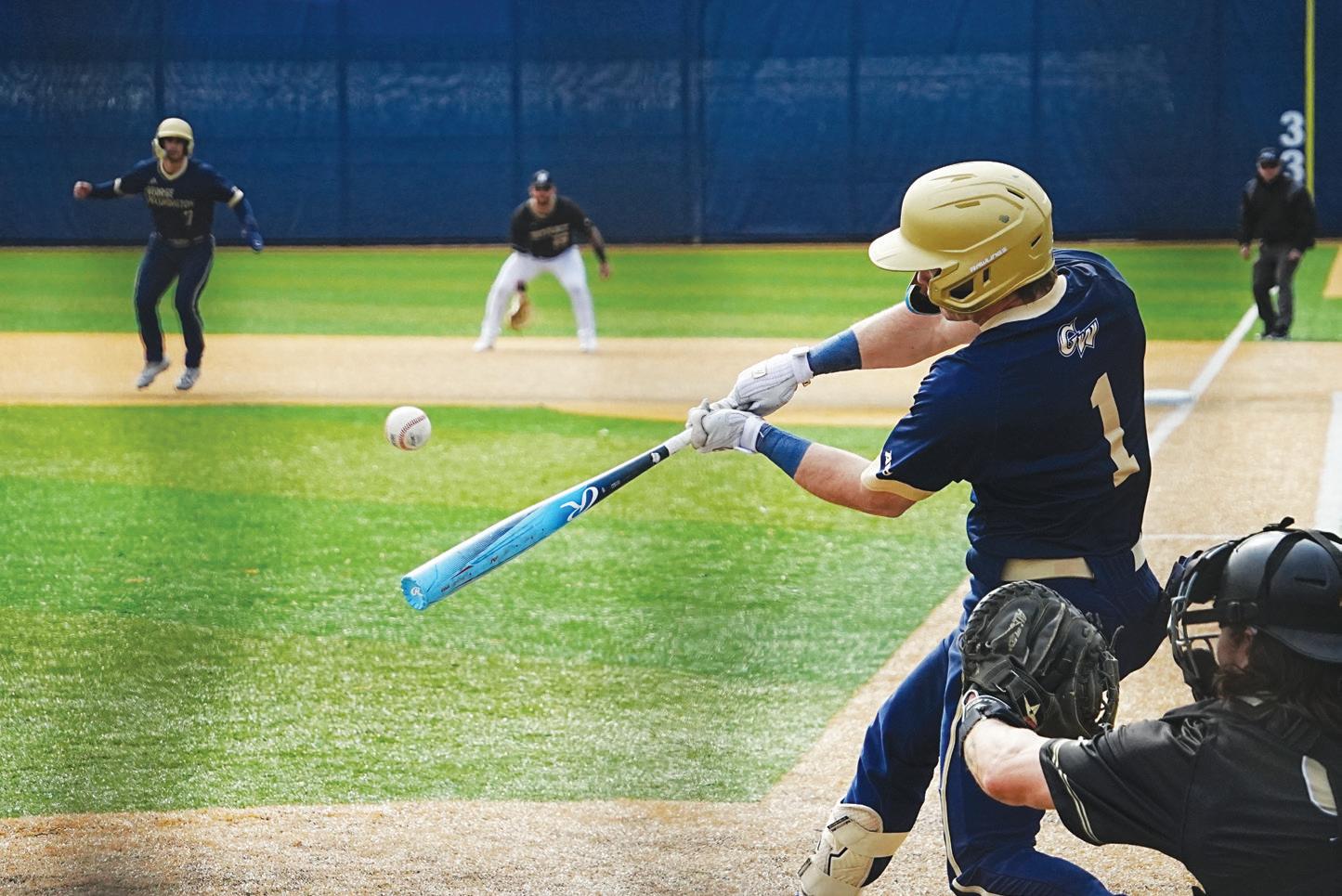
NUMBER CRUNCH
17 GAMES OF THE WEEK SPORTS THE GW HATCHET Feb. 26, 2024 • Page 8
The number of Atlantic 10 records set by men’s and women’s swimming and diving at this year’s conference championships
JAMES SCHAAP | STAFF PHOTOGRAPHER
Graduate student forward Mayowa Taiwo dribbles.
Saturday | 1 p.m. The Revolutionaries will play against the Colonials on Saturday at the Vern.
LACROSSE vs. Robert Morris
Cornell Saturday | Noon Softball hosts Cornell for a doubleheader Saturday at the Mount Vernon Campus.
SOFTBALL vs.
HATCHET
FILE PHOTO Swimmers cut through the water during a meet.
COLIN WAGNER | STAFF PHOTOGRAPHER Junior Sam Gates makes contact in a game against Bryant.
