
Racial diversity in SA leadership Ashley Le, the first Asian woman to be SA president and an adjunct professor of media and public affairs, said her election showed that students were open and willing to electing a female president of color. Both she and her opponent Imani Ross were set to become the first female president of color, if elected during the 2018-19 SA “Womenelection.arenot always elevated into positions of leadership,” sheLesaid.said the 2017-18 candidate pool provided representation for Black and Asian student communities, a significant achievement even if GW was, and is, predominantly white. The past three SA presidents have been Black men, dating back to Howie Brookins who was elected for the 2020-21 academic year. Before Brookins’ presidency, students had not elected a Black student as SA president in aShedecade.said her cabinet reached out to individual members of the Multicultural Student Services Center and student organizations, like the Interfaith Council, to encourage them to apply for the SA as part of recruitment efforts. Looking forward In 2018, the SA formed its diversity and inclusion assembly, a group of multicultural student leaders and SA Senators to share and respond to concerns on campus. The assembly has hosted town hall meetings in the wake of antisemitic and racist incidents on campus.SASen. Henry Deng, CCAS-U and the chair of the SA’s diversity and inclusion assembly, said the DIA should continue working to solve campus-wide issues, following the lead of the executive cabinet’s initiative last year to put menstrual products in University bathrooms.“Ihope we can use the platform of DIA to connect students with different backgrounds together,” he said. SA Sen. Lydia Miller, ESIA-U and the chair of the undergraduate student life committee, said the SA administration is improving upon its diversity in its new administration, which features international students and students of color, but the SA is not yet completely representative of the student body. COVID-19 cases: 119 Weekly positivity rate: 7.19% Change in cases since previous week: +100Tracking COVID-19August10-August17
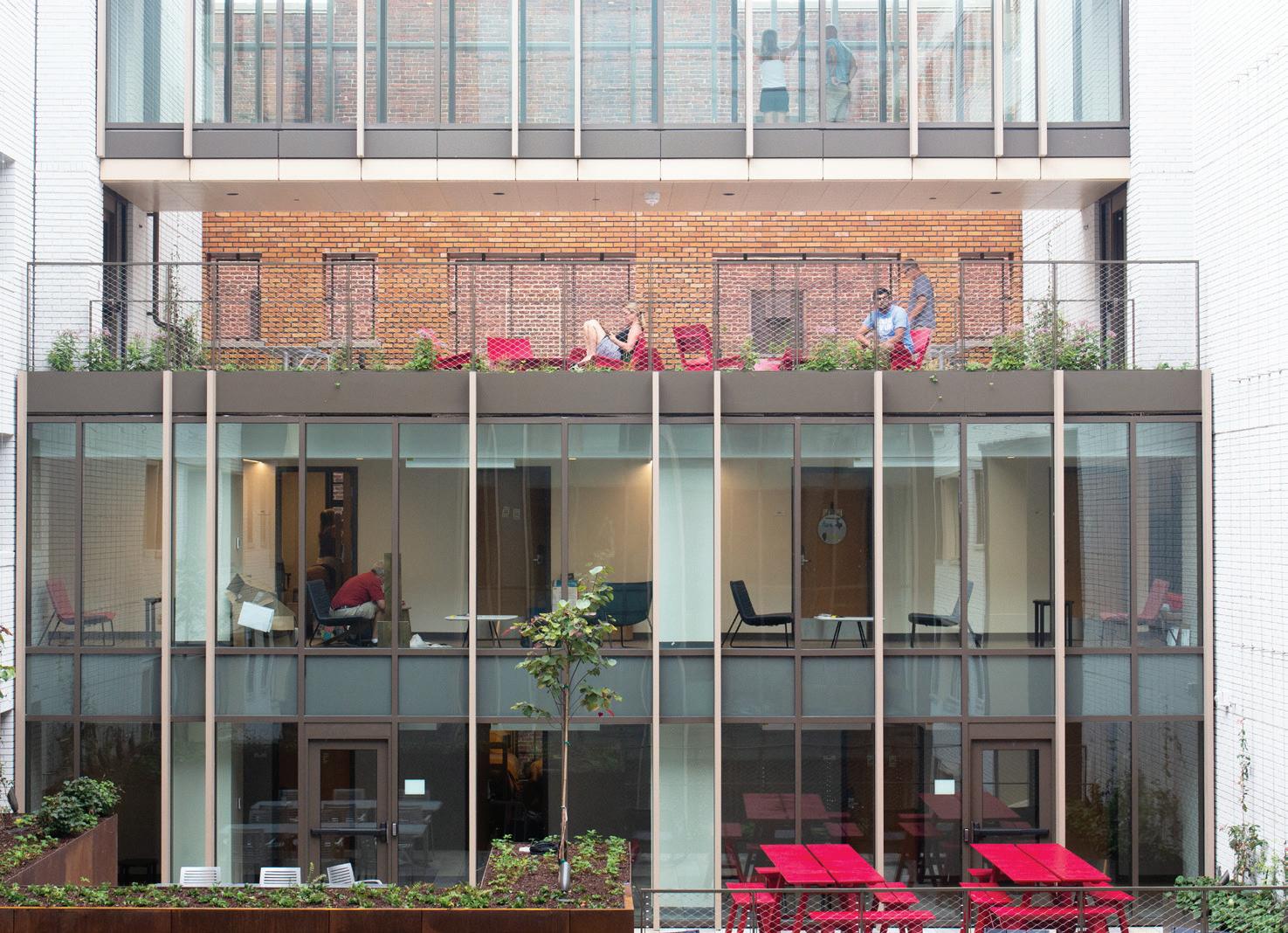
After more than five decades as GW’s black mold hub and two years as a construction project, Thurston Hall is entering its new era as one of the most state-ofthe-art residence halls on campus, welcoming students for the first time since 2019.A green courtyard area that sits directly behind the first-floor lobby greets students in a display of newly designed architecture, one of many renovations which also include additional study spaces, wider elevators and a dining hall set to be completed in September. Upgrades for Thurston had been discussed for decades after the building had become notorious for its disrepair, with upgrades announced in 2018 and formally beginning in May“Thurston2020. Hall will continue to provide a space for students to thrive, build lifelong connections and have a sense of belonging,” Associate Vice President for Business Services Seth Weinshel said in an email. “The new usable courtyard, multiple outdoor spaces and dozens of community spaces will allow students to connect with each other and build community.”Thurston – which previously housed about 1,100 students as the largest residence hall on campus – became a target of criticism from both students and administrators in recent years due to outdated facilities, mold and frequent leaks. In November 2019, a small fire and subsequent sprinkler damage displaced some students from the building. The renovated residence hall will hold 16 study lounges, 820 beds and the to-be-completed dining hall. When the renovations were announced in 2018, then-University President Thomas LeBlanc emphasized improving students’ living spaces as a reason for the Studentupgrades. Association President Christian Zidouemba said Thurston’s new look was “marvelous” when he first toured the residence hall earlier this month, and freshmen should be “excited” to move in. He said additions like larger elevators and more communal spaces make the building more accommodating than it had been prior to the “Therenovations.wayit’s been created is to give a sense of community, a sense of belonging to Thurston,” Zidouemba said.Zidouemba also said Thurston’s dining hall, which is set to be completed in September, will feature an automated system that enables facial recognition as an optional payment method. More than a dozen freshmen living in Thurston said they were impressed with Thurston’s new look and excited about the building’s organization with plenty of communal space to meet newMallorypeople. Viotto, a freshman majoring in biomedical engineering, said she appreciated how modern and clean the residence hall felt and how she was welcomed into the building. She said the green space on the first floor will help her connect with her friends and other freshmen.“Youcan really connect with your peers and I know a lot of the freshmen are going to be living here,” Viotto said. “It’s a really great way to bond with the freshman class.”
SA Senate remains mostly male despite increased diversity in top positions
Orientation Week will cap off Saturday evening with the University’s biggest event of the year – First Night. This whirlwind of a celebration features carnival games and free food from vendors like Dominos. Banks said she hopes freshmen walk away from orientation with a sense of belonging within the GW community.“Wewant to introduce students to everything that GW has,” Banks said. “And we hope that they come away with a vision of what their life at GW will look like.”
SHEA CARLBERG STAFF WRITER Events freshmen should attend to get the most out of Orientation Week
HENRY
INDEPENDENT STUDENT NEWSPAPER • SERVING THE GW COMMUNITY SINCE 1904Monday, August 22, 2022 I Vol. 119 Iss. 3 WWW.GWHATCHET.COM What’s inside Weekly
The Student Association’s leadership has become more diverse during the past decade, but the SA Senate remains a predominately male body that some senators say fails to accurately represent the studentPeoplepopulation.ofcolor have increasingly occupied the SA’s top leadership positions, where women have also maintained a consistent presence in the last 10 years. But gender diversity has lagged behind in the senate, where nine of this year’s 37 senators identify as female – a 24 percent composition compared to the entire University population that is 63 percent female, according to University enrollment data. SA senators said they plan to reach out to student organizations to encourage people from marginalized groups, including women and racial minorities, to run and recruit a broader spectrum of student viewpoints. Women in the SA Within the last decade, 10 of the last 20 SA presidents and executive vice presidents have identified as female. But in the senate, only two of the six committee chairs identify as female. The senate plans to hold re-elections for chairs to give the 12 senators who filled vacancies this summer –among them, female students, students of color and nontraditional students like part-time students – a chance to run. SA Sen. Linsi Goodin, CCASG and the only female member of the SA’s governance and nominations committee, said the committee prioritizes merit, selecting the most qualified candidates instead of filling diversity quotas. “We can talk about a diverse perspective as much as we want, but if people aren’t applying, then people just aren’t applying,” she said.When the senate initially confirmed this year’s committee chairs on May 2, graduating senator Chris Pino, CCAS-U, said this year’s senate has the lowest percentage of female chairs in the last decade, “if not longer or forever.”
Thurston reopens with new courtyard, dining hall after two-year revamp
HUVOS ASSISTANT NEWS EDITOR YUTONG JIANG STAFF WRITER ORIENTATION GUIDE Pages 6-7 RACHEL SCHWARTZ | ASSISTANT PHOTO EDITORRACHEL SCHWARTZ | ASSISTANT PHOTO FRESHMENEDITOR RETURN TO THURSTON HALL NICHOLAS ANASTACIO I GRAPHICS EDITOR
ERIKA FILTER ASSISTANT NEWS EDITOR It’s about that time again, when thousands of freshmen full of luggage piled in blue carts will make their way to campus for a week full of orientation events. This year’s Orientation Week spans from this past Saturday, Aug. 20 through next Sunday, Aug. 28 and is full of academic information sessions alongside recreational activities, like cookouts at the Mount Vernon Campus quad and monument walks, to introduce freshmen to campus life. New Student Orientation occurs annually right before classes start as a way for freshmen to feel more confident as they enter a new chapter of their academic and social lives – this year’s theme is presented as Empowering Community: Reflection & Resilience. Izzy Banks, a student coordinator who helped plan New Student Orientation programming, said the week of events is vital for freshmen to find their own community on campus. “Not only are they part of an amazing incoming class, but they are now members of the GW community,” Banks said. “And they have the support of their fellow community members throughout the week and throughout their time at GW.” The week of orientation events kicks off Monday morning with a welcome breakfast with GW Hillel. Tuesday is chock-full of events, including an optional campus tour with admissions guides and a movie night on the Mount Vernon CampusWednesdayquad. night, the entire Class of 2026 will file into the Smith Center, where interim University President Mark Wrighton will address students at the spirit-filled Buff and Blue Kickoff. Students will learn GW’s fight song at the assembly before the night turns into live music at the annual House Party, where students can dance with friends and take a stab at winning more prizes. Thursday morning will start with orientation events hosted by each undergraduate academic school. Later that night, kick back to the early 2000s with GW Late Night Committee’s firstever Throwback Thursday Takeover at 9 p.m. in the University Student Center. Students will be able to partake in trivia with a team of friends, watch a 2000s film and play video games. Friday ushers in some of the largest recreational events of the week. Soak up the final week of summer at the Mount Vernon Pool Party or embrace the District’s landmarks at the National Mall Kickback with lawn games and food before a late-night monument walk. On Saturday, the Welcome Day of Service – hosted by the Nashman Center for Civic Engagement and Public Service – will introduce freshmen to community service opportunities within the D.C. region.


Open GWPDCaseofficers responded to a report of theft. On arrival, officers made contact with a male contractor who reported that an unidentified subject broke into his vehicle and stole tools from it while the car was parked on the 2300 block of H Street NW. Case open.
SOPHIA GOEDERT ASSISTANT NEWS EDITOR RACHEL SCHWARTZ | ASSISTANT PHOTO EDITOR
MISDEMEANOR SEXUAL ABUSE 2400 Block of H Street NW 8/3/2022 – 12:20 p.m.
Officials installed a $10,000 clock in Kogan Plaza outside of Gelman Library, creating a new focal point of campus EVENTSWEEK’STHISWEEKIN
NEWS THE GW HATCHETAugust 22, 2022 • Page 2 News
Marble busts and tall stat ues have decorated Foggy Bottom for years, but the neighborhood’s newest me morial sticks out among the rest to honor a loss of life that devastated the local commu nity this summer. A white bicycle adorned wheel-to-wheel with flowers and pictures sits at the corner of 21st and I streets in memo ry of Shawn O’Donnell, who died last month after a con struction truck driver fatally struck her while she cycled to work. The intersection has been the site of calls for phys ical repairs dating back to 2018 during which students, activists, neighborhood of ficials and businesspeople have said the crossing was dangerous for pedestrians and cyclists alike. The installation of a new traffic signal – a light that lo cals said would have likely prevented the crash – was completed on July 29, nine days after the truck driver killed O’Donnell. Despite more than four years of con cerns from local leaders, the intersection remained large ly unchanged on the morn ing of O’Donnell’s death. As friends and fam ily mourn the death of O’Donnell, locals are de manding to know why the intersection remained un touched – an alleged inac tion from D.C. officials that allowed the tragedy that too many saw coming – despite widespread calls for change. A lost daughter On the night of July 19, Mary O’Donnell – a former rear admiral in the U.S. Navy who currently lives in Cali fornia – called her daughter Shawn on FaceTime, when the pair spoke about the farmers’ market and ways to keep strawberries fresh be fore saying goodnight. The next morning, O’Donnell opened her door to a po lice officer who told her that Shawn had been killed after the driver of a construction truck turned into her while she rode her bicycle along side to her job at the State De partment.O’Donnell said her daughter was a generous, one-of-a-kind person who traveled the world in an effort to make it a better place, like teaching English in Egypt and serving as a refugee of ficer in Thailand. O’Donnell said Shawn was preparing to leave for Amsterdam, where her next assignment would be, when the driver struck and killed her. “We were best friends,” O’Donnell said. “And now my best friend’s gone.” In 2018, nearly four years before the truck driver struck and killed O’Donnell, two local leaders and a building developer said the District Department of Transporta tion should add safety infra structure to the intersection of 21st and I streets to pro tect pedestrians and cyclists. When O’Donnell was killed, DDOT was in the process of installing a new traffic signal at that intersection, but locals said the changes didn’t come soonAenough.DDOT spokesperson said in an email that full op eration of the light didn’t start until July 29 – nine days after the July 20 death of Shawn O’Donnell.Marina Streznewski, the then-president of the Foggy Bottom Association, told The Hatchet in 2018 that the intersection needed a traffic signal “a long time ago.” “It was the same thing for years and years and years,” Streznewski said in an inter view last week. “You just had to be really careful crossing thatStreznewski,street.” who said she thinks the new traffic signal would have prevented the collision, said crossing 21st Street has been difficult since her time as a GW stu dent in the 1970s because drivers would need to use their own judgement to stop for pedestrians given the lack of a traffic signal or stop sign. The pair of intersections of 21st Street with Pennsyl vania Avenue and I Street were ranked by Greater Greater Washington in the top 10 most dangerous in tersections in the District, based on DDOT and Metro politan Police Department data. A total of 35 crashes took place at those intersec tions between 2015 and 2020 while locals made 13 safety requests to DDOT, according to GGWash.“Iwas very sad,” Streznewski said about learning of the death of O’Donnell. “But I was not the least bit surprised.”
The death of cyclist Shawn O’Donnell and the warning signs D.C. missed
HISTORY August 28,1991
The spokesperson said DDOT closed at least three requests for traffic safety in vestigations into the intersec tion since 2019 because of a previous rule requiring peo ple requesting investigations to fill a separate form called traffic calming applications. Boston Properties, the real estate firm that built the new 2100 Penn building, planned to pay for the new light in a deal with the Foggy Bottom and West End Ad visory Neighborhood Com mission to address the safety concerns following years of close calls at the intersection. In 2018, Jake Stroman –the executive vice president of Boston Properties – said he expected construction on the traffic light to begin in 2019 and finish in 2021 due to multiple phases of approval for the project. Calls for continueimprovementssafety
THIS
BIASED: UNCOVERING THE HIDDEN PREJUDICE THAT SHAPES WHAT WE SEE, THINK AND DO Friday, Aug. 26 | 2 p.m. EDT | Jack Morton Auditorium | Free Tune into a talk hosted by GW Law with Stanford Professor Jennifer Eberhardt on her book, “Biased: Uncovering the Hidden Prejudice That Shapes What We See, Think, and Do.”
AFTER THE KE-ASAT MORATORIUM: WHAT NEXT? Wednesday, Aug. 24 | 10 a.m. EDT | Elliott City View Room | Free Join a discussion on the international consequences of the U.S. decision to not conduct destructive, direct-ascent antisatellite missile tests.
— Compiled by Acacia Niyogi CRIME LOG
MISDEMEANOR SEXUAL ABUSE Ross Hall 8/3/2022 – 12:30 p.m.
Too little, too late A DDOT spokesperson said the traffic light’s instal lation was completed on July 19, the day before the fatal collision, but the signal en tered an at least weeklong “flashing operation” – as re quired by DDOT – in which the lights blinked but were not fully operational. The lights were blinking but not operational when the driver of the truck struck and killed O’Donnell on the morning of JulyThe20. spokesperson said construction on the traffic signal’s physical infrastruc ture began in the fall of 2021 and was completed this January, but the signal still required electrification from PEPCO. DDOT initially sent PEPCO an electrification re quest to turn on the power for the signal in August of 2021, but PEPCO did not complete the request until late this June, the spokesper sonTheysaid. said the timeline for the design and construction of this signal was “typical” for “projects of this type.”
RACHEL SCHWARTZ | ASSISTANT PHOTO EDITOR “We were best friends,” Shawn O’Donnell’s mom said. “And now my best friend’s gone.”
Open Case GW Police Department officers responded to a call from a female stu dent, who reported that an unknown male subject had touched her behind while she was walking on H Street. Case open.
Open GWPDCaseofficers responded to a call from another female student, who reported that the same unknown male subject had touched her behind while she was in the courtyard of Ross Hall. Case open.
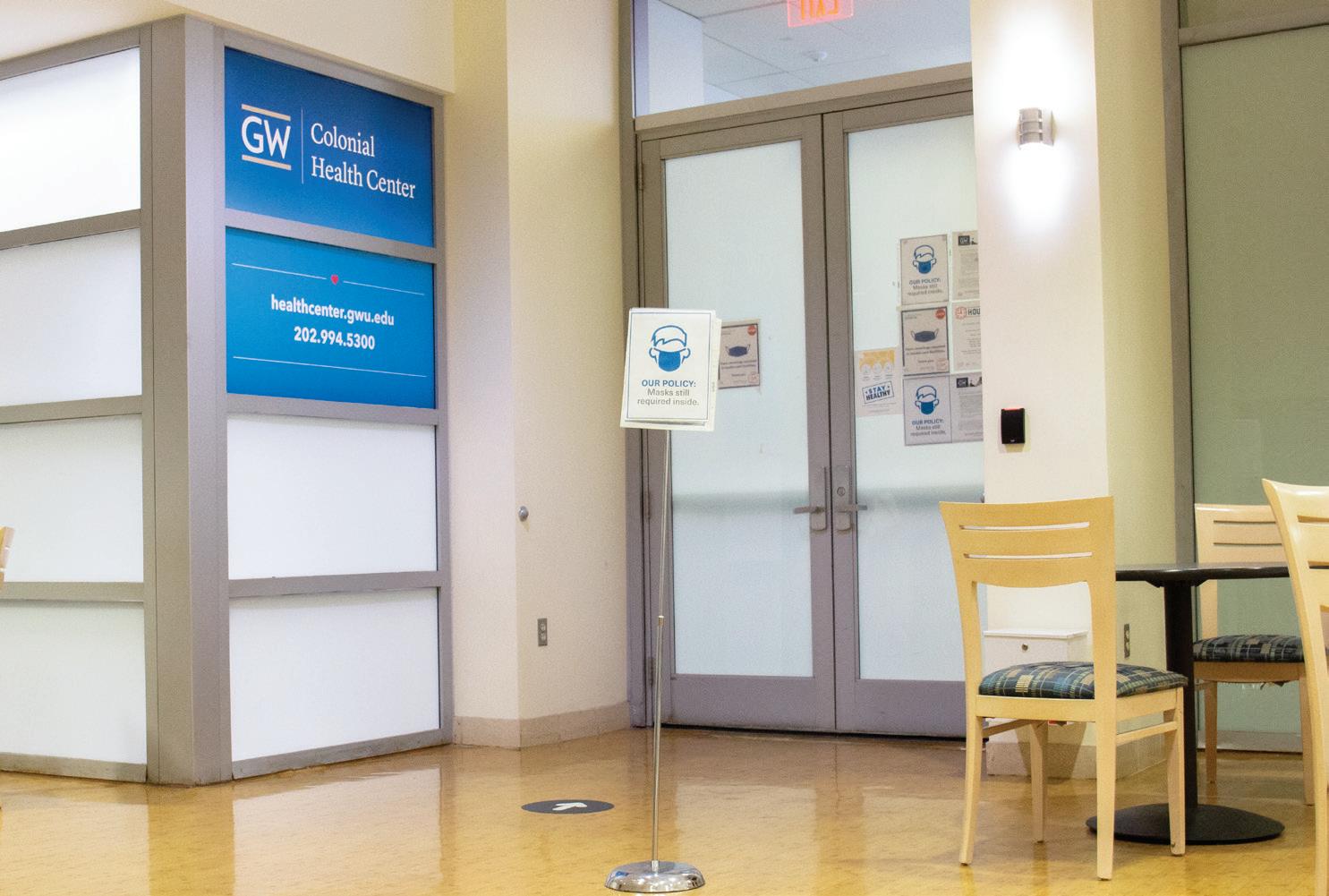
The Student Health Cen ter is treating patients for monkeypox on campus and educating GW community members about the spread of the disease after officials identified a “handful” of cases within the community. Rebekka Christie, the medical director of the Stu dent Health Center, said the SHC, formerly the Colonial Health Center, is assess ing and quickly diagnosing suspected positive cases through a partnership with the D.C. Department of Health to shore up treatment and awareness of the disease in the local area. She said of ficials are aiming to educate students through presenta tions about monkeypox and other communicable dis eases in an effort to prevent outbreaks on campus, but Christie declined to release the number of cases within the GW Christiecommunity.saidthe SHC’s medical services team has partnered with the health department to diagnose and treat the “handful” of cases within the GW community over the summer. Chris tie said each community member who contracted monkeypox recovered. Officials reported the first case of monkeypox within the GW community in lateChristieJune. said the SHC plans to assess presump tive cases through tele health appointments be fore bringing patients in for an in-person clinical evaluation.“Itisimportant to un derstand that monkeypox is an infection that every member of the GW com munity should be aware of because everyone is at risk for infection if exposed, regardless of sexual orien tation or gender identity,” Christie said in an email. Christie said the SHC refers patients with a high risk of exposure to the D.C. Department of Health for a vaccination and will pro vide access to the drug tecovirimat, whose brand name is Tpoxx, for mon keypox treatment to stu dents with severe symp toms.Monkeypox is spread through direct and in direct contact with skin lesions or through respi ratory droplets, most com monly through sexual in teractions.Christie said the SHC and the Capital Peers Sex ual Health Task Force – a group of peer health edu cators that produce educa tion and health promotion to the GW student body – will hold presentations and outreach programs about health and wellness in residence halls to raise awareness of monkeypox and other contagious dis eases. She said officials from GW and other universities in the area receive updates on monkeypox, its health impacts in the city and the status of protocols from D.C. government representatives. Officials earlier this month released their first public health update on monkeypox, saying the spread of the virus in the GW community remains “very low.”D.C. Health reported 350 positive cases and vaccinated more than 16,000 individuals for monkeypox in the District as of Aug. 16. The White House de clared monkeypox a public health emergency and an nounced new initiatives to increase access to care and resources in early August, a week after the World Health Organization declared mon keypox a public health emer gency of international con cern. D.C. Health offers mon keypox vaccines to adult residents, employees, col lege students and patients in D.C. who’ve had multiple sexual partners in the last two weeks, sex workers and staff at establishments where sexual activity occurs. Experts in infectious dis ease and epidemiology said universities should expect monkeypox cases to rise and make students and faculty aware of the risk the virus poses through accurate infor mation and education about symptoms and treatments associated with monkeypox. Amesh Adolja, a senior scholar at the Johns Hop kins Center for Health and an infectious disease physi cian, said monkeypox won’t be as “impactful” on college campuses as COVID-19, but colleges should be prepared to log cases and limit spread. He said most people who contract the virus don’t typi cally need supportive care, but some patients do respond to treatment from the antivi ral drug Tpoxx. “The key is just making sure that these [treatments] are available to people and that people are aware of the risk and that universities take proactive steps in the event that they do have a case or exposure on their campus,” Adolja said. Officials said the Student Health Center’s medical services team has partnered with the D.C. Department of Health to diagnose and treat the “handful” of cases within the GW community over the summer.
Omictin said in an inter view that DDOT has failed to be proactive for years in con structing protective infra structure, like traffic signals and stop signs because of insufficient staffing and poor management.“DDOTcan blame supply chain issues, they can blame PEPCO not being responsive to their requests to connect the power,” Omictin said. “But there are some places in D.C. that have waited years –there’s one place in Petworth that waited seven years for a four-way stop sign and some additional safety measures.” Omictin said it shouldn’t have taken nearly five years to install a traffic signal at the intersection, and man agement at DDOT, includ ing Mayor Muriel Bowser, should implement a plan to make the department’s pro cesses more efficient. “It is simply a failure of leadership at the highest level that we see projects that should happen in days, hap pen in years,” he said.
ZACH BLACKBURN SENIOR NEWS EDITOR
LIQUOR LAW VIOLATION, SIMPLE ASSAULT J. Burns Legal Clinic 8/8/2022 – 9:20 a.m.
Officials to provide monkeypox treatment after identifying ‘handful’ of cases during the summer
THEFT I/FROM MOTOR VEHICLE, UNLAWFUL ENTRY OF A MOTOR VEHICLE 2300 Block of H Street NW 8/8/2022 – 1:15-1:52 p.m.
Shawn O’Donnell was one of three cyclists to die on the streets of D.C. in July, sparking calls to the D.C. Council to implement re forms that could protect cyclists, like banning right turns on red lights. Yannik Omictin, an alumnus and commissioner on the Foggy Bottom and West End ANC, said he was shocked when he learned O’Donnell had died at that intersection, but not sur prised. Omictin said the in tersection of 21st and I streets had the “bare minimum” in terms of protections for pe destrians and cyclists. “We knew this was going to happen at this intersec tion,” Omictin said. “I think every unprotected intersec tion in D.C. is a place where someone can die.”
Closed Case GWPD officers came in contact with a previously-barred male subject who had been reported to be sleeping on the patio of the J. Burns Legal Clinic. Officers explained to the subject the parameters of his bar notice, and then escorted the subject off the property. Case closed.

“In making its assess ments, the committee obtains duringbeinghercalpensationofficialsEarlymationsalarysomecialstechnologytopforversitycer,andtors,onMarkUniversityficermerThomasmeryearpaymanyoveristratorsinemployees’factors”sitions,”sitiesfromthatsationaninformationcompensationpreparedbyindependentcompenconsultingfirmincludesmarketdatacomparableuniverforcomparablepohesaid.Grossmansaid“manycontributetoGWcompensationagivenyear.AseriesoftopadminhaveleftGWthelastfewyears,ofwhomsawtheirfallduringfiscal2021,includingforUniversityPresidentLeBlancandforChiefFinancialOfMarkDiaz.InterimPresidentWrightonbroughtfournewadministraincludinganewCFOhumanresourceoffiinJuly,buttheUniisstillsearchingastringofpermanentofficialslikeachiefofficer.Whileseveraltopoffisawtheirpaydrop,administratorsgotbumps.FormerChiefInforOfficerLorettawasoneoftheonlytoseehercomrisefromfisyear2020to2021withtotalcompensationaround$575,000the2020-21aca demic year, more than a $200,000 boost, even though she left the Uni versity in September 2020 – just months after the fis cal year began. Vice President for Health Affairs and Dean of the School of Medicine and Public Health Jeffrey Akman also saw his pay rise by more than a third, to more than $1.3 million, making him the highestpaid official listed in the disclosureGrossmandocuments.declined to comment on why Early and Akman’s total com pensationLeBlanc’srose.pay fell be tween the end of fiscal year 2020 in June 2020 to the end of fiscal year 2021 in June 2021 from more than $1.36 million to about $1.25 million, a cut of more than $115,000. LeBlanc officially de parted the University in December 2021 after an nouncing his retirement in June 2021. At the height of the COVID-19 pandemic, LeBlanc said he would take a roughly 20 percent pay cut, but his base sal ary actually fell by less than 14 percent, while his total compensation — which includes bonuses and other benefits — fell by about 8 percent, ac cording to the disclosure. LeBlanc was the 40th highest-paid private uni versity president in 2019 –before he took his pay cut in 2020 – according to a data report published by the Chronicle of Higher Education last week. Wrighton was the sev enth highest-paid private university president, col lecting more than $2.8 million in total compen sation from his position as chancellor of Washing ton University, St. Louis in 2019, according to the report. Wrighton also had the highest base salary of private university presi dents, according to the data. LeBlanc was also paid more than six of the pres idents of GW’s 12 peer schools, according to the report.Former Chief Finan cial Officer and Executive Vice President Mark Diaz took a similar pay reduc tion of more than $90,000 during the 2020-21 aca demic year, which totaled almost 10 percent of his pay.The most recent pub lic disclosure document is also the first year for mer Provost Brian Blake received a full-year sal ary, which totaled almost $750,000. Blake had re ceived about $180,000 the previous year, but he had only been in the role for about seven months when the public disclosure was written.Former University President Steven Knapp –who has received income from the University since he departed GW in 2017 –also saw his total pay fall from more than $460,000 to about $175,000, a more than 60 percent drop. Grossman declined to comment on why Knapp’s pay dropped significantly more than other officials.
NEWS THE GW HATCHETAugust 22, 2022 • Page 3
High-risk students apprehensive after officials lift COVID testing requirement
Most senior adminis trators saw their overall compensation fall during fiscal year 2021 compared to fiscal year 2020, ac cording to public disclo sure documents released by GW in June. The drop during the fiscal year 2021 – which starts in July of 2020 and ends in June of 2021 –came on the backdrop of a voluntary pay reduc tion of about five percent or more that several top leaders took in April 2020 at the height of the COV ID-19 pandemic. The data about officials’ compen sation come from GW’s annual Form 990, which the Internal Revenue Service requires all taxexempt organizations to make public, and shows that most top officials’ to tal compensation fell be tween four to 10 percent between the two fiscal years.University spokes person Josh Grossman declined to comment on whether senior adminis trators’ salaries would in crease or decrease during fiscal year 2022. He said the Board of Trustees’ Executive Committee de cides whether to change compensation for senior officials.
District House will re open its doors for student dining on Monday morn ing after a summer of reno vations, debuting five new meal vendors in the build ing’s basement food court. The new dining options will open for business on Monday at 11 a.m. and in clude DH Pizza & Pasta Co., Crisp, True Burger, The Halal Shack and D.C. Taco House – all of which are operated by Chart wells Higher Education, an on-campus food service provider. The new vendors will accept GWorld dining dollar payments and will operate seven days a week with varying hours de pending on the restaurant. In the newly remodeled food court, students can purchase their food at ki osks sprinkled throughout the basement, but return ing students will recog nize the same chair and ta ble setup in the basement, which officials seemingly did not Studentalter.
dropped last fiscal year amid leadership searches DANIEL GALGANOPATRICK ASSISTANT NEWS EDITOR
Association President Christian Zi douemba said District House’s new dining op tions offer a solution to the University’s long problem with campus food insecu rity, while fostering a more inclusive student body be cause District’s vending style simplifies budgeting for first-generation college students by allowing stu dents to purchase meals directly rather than rely ing on grocery shopping. “This new dining sys tem gives a lot of oppor tunities to our students to bond together, and also come together as a com munity and decrease the food insecurity that we’ve had for far too long on our campus,” Zidouemba said. Zidouemba said while he has had “concern” about District’s capacity in accommodating a high number of students with out the possibility of long lines, the new vendors provide students with an on-campus dining option that may cultivate more so cializing during mealtimes and a more diversified range of cuisines, like The Halal Shack and healthy options at Crisp. “This is an initiative we should praise, and thank the George Washington University for taking the steps necessary in assur ing the dining system encompasses the whole entire university and the diverse community we have on our campus,” Zi douembaOfficialssaid. announced plans last August to con vert the building’s base ment food court into one of three all-you-can-eat din ing halls on campus over this summer and remove or relocate the building’s previous vendors, Chickfil-a, GRK Fresh Greek, Sol Mexican Grill, Kin’s Sushi and Wiseguy Pizza. But in early April, of ficials announced that the all-you-can-eat dining hall in District House wouldn’t be ready to open in time for students in the fall and in June, they temporarily nixed plans to convert the basement food court and retain the previous layout of traditional vendor din ing.Associate Vice Presi dent for Business Services Seth Weinshel and Execu tive Director of GW Din ing Douglas Frazier an nounced in a July email that plans had also been put on hold for the other two all-you-can-eat din ing halls expected to open this fall – located in Shen kman and Thurston Halls – because of “global supply chainTheissues.”public will also be barred from the District House basement after the Advisory thefordablecreasepublicconcernedgyplan.underlicGWCommissionNeighborhoodapprovedarequesttoremovepubaccessfromthespacethenewdiningHowever,someFogBottomresidentswerethatthebannedaccesswoulddethenumberofafdiningoptionsinneighborhood.
With GW’s COVID-19 test ing requirement now lifted, students who face a high risk of serious infection are urg ing their peers to keep getting tested to protect those left even more vulnerable with looser case monitoring on campus. Officials ended the asymp tomatic testing requirement last month after enforcing the biweekly testing policy for two years during the pandem ic, but optional symptomatic and asymptomatic testing re main available. More than 10 students said they would no longer test biweekly and will instead turn to testing on an as-needed basis, but high-risk and disabled students are con cerned the lifted requirement will allow asymptomatic cases to goLaurenunnoticed.Wall, a second-year graduate student studying public health and the Disabled Student Collective’s communi cations director, said dropping the testing requirement is a “reckless” decision, and sev eral high-risk members of the DSC – including herself – will study remotely both on and off campus during the upcoming semester as they assess the risk of infection on campus. Wall said she and other high-risk students stuck with remote learning since in-person teaching resumed last year, but the lifted testing requirement was a factor in her decision to continue doing so this fall. “We can’t infer how things are going because not every one is going to be testing,” Wall said. “So there could be a huge influx of cases, and we wouldn’t know or be able to do further things to protect our selves.”Wall said she was surprised and disappointed to hear about the relaxation of the testing re quirement because the dropped policy could expose high-risk students to asymptomatic cases and increase the rate of case transmission across campus. “The community monitor ing and making sure everybody gets tested every two weeks helps weed out asymptomatic carriers, which can spread in the community,” she said. “If that’s not happening and peo ple don’t have a reason to get tested if they feel fine, they could still be spreading the vi rus to other people.” Madison Jennings – a firstyear graduate student studying public policy and the president of the Disabled Students Collec tive – said relaxing the testing policy could lead to an uptick in cases that could harm highrisk students, pushing some to ward remote learning and away from on-campus activities dur ing the upcoming semester. “If they’re wanting to push more in person, then disabled students are going to continue to be cut out of things, not nec essarily by their own doing but for the protection of their own health and safety,” Jennings said.Jennings said the DSC is currently advising high-risk students on how to navigate remote learning, where to find on-campus testing and how to advocate for their own needs to professors and peers. Shayna Druckman, a senior studying human services and social justice, said she was sur prised to hear officials dropped the testing requirement before students returned to campus this semester. She said as an immunocompromised student at risk for a serious COVID-19 infection, she still hopes of ficials provide consistent up dates of the current state of positive cases on campus. Druckman said she plans to continue studying in Universi ty spaces like the student center and Kogan Plaza while wearing her mask in public to keep her self“Isafe.figured usually GW errs on the side of caution, so I thought, ‘Maybe it’s a good thing and means we’re in a good place,’” Druckman said. Rayene Ait, a junior study ing business, said she would have preferred officials to re lax the mask mandate before easing the testing requirement so the University could have gauged the level of transmis sion without masks. She said she trusts that officials have consulted with doctors and ex perts to come to the decision to ease the testing requirement. “I guess I trust their judge ment,” Ait said. SCHWARTZ High-risk and disabled students said they're concerned that because the testing requirement has been lifted, more asymptomatic cases will go unnoticed.
NICHOLAS ANASTACIO I GRAPHICS EDITOR Early arrivals are moving into HallredevelopednewlyThurstonatGW! Interim President Mark Wrighton on 8/20/2022 TWEETED TWITTER/@PresWrightonGW
FAITH WARDWELL ASSISTANT NEWS EDITOR RACHEL
Officials’ salaries
GRACE CHINOWSKY CONTRIBUTING NEWS EDITOR
| ASSISTANT PHOTO EDITOR
Five new District House GWorld vendors will open their doors to students Monday


CCAS launches required First-Year Experience course
IANNE SALVOSA CONTRIBUTING NEWS EDITOR
Climate and Health Institute issues progress report after first year of operation SOPHIA GOEDERT ASSISTANT NEWS EDITOR
The Columbian Col lege of Arts and Sciences will require incoming freshmen to take a onecredit course to prepare for their academic and professional careers start ing this fall. Rachel Reidner, the associate dean of un dergraduate studies for CCAS, said students who take the weekly, 50-min ute First-Year Experience course will learn how to make “well-informed academic decisions” and meet with staff from vari ous GW offices, like the Center for Career Services and the CCAS Under graduate Advising Office. Students can register for 88 sections of the course this fall, a significant boost compared to the 11 sections last fall that re quired departmental ap proval to register, accord ing to the University’s course registration portal. “We believe this course will introduce first-year students to the breadth and depth of the liberal arts and introduce students to the resources that GW and CCAS has to support them in their aca demic journey,” Reidner said in an email. Reidner said CCAS pi loted the First-Year Expe rience course during the last academic year and de cided to make it a require ment this year as part of an effort to introduce new students to the GW com munity. She said she and CCAS advisers designed the course in line with the other GW schools’ re quired first-year courses, like the Elliott School of International Affairs’ First-Year Experience course that launched in fallCCAS2018. officials added the First-Year Experience course to the college’s general education re quirements, which make up the second tier of its general education cur riculum known as G-PAC, according to the CCAS Undergraduate Advising Office. Denver Brunsman, an associate professor of his tory who will teach a sec tion of the course this se mester, said students will draft a four-year schedule of the classes they plan to take to fulfill their poten tial major and G-PAC re quirements. He said they will also go over their four-year plans with their advisers, draft a resume and work in groups to create presentations about two GW offices, like the Office of Student Finan cial Assistance and the Office for Study Abroad. “That’s one of the things I really appreciate about the course because I think a lot of students don’t always know about the full-time staff and all the great resources at the University,” he said. Brunsman said al though the assignments for the course are stan dardized for all sections, the curriculum allows space for the “personal ity of the individual in structor.” He added his expertise in history is what encouraged him to share the letter of advice that George Washing ton wrote to his nephew, George Steptoe Washing ton, when he began col lege with his First-Year Experience students as a way to welcome them to the“There’scourse. certainly a lot of room to share our own insights, either in terms of our own academic jour ney or our experience at GW because one of the goals is that all freshmen will at least have a close connection to one person on campus this way,” he said. Brunsman said stu dents in the course will learn the basics of how to be a college student, like how to take advantage of professors’ office hours, and reflect on what they want to get out of their college experience. “I think sometimes students are so engaged in completing the re quired classes, moving on to a major and things like that, that they might not always stop to kind of think about the big pic ture and why they’re be ing asked to take different classes,” he said.
PHOTO EDITOR
The report shows re search by CHI members aimed at educating people about disciplines of climate change and human health research, like air pollution, social movements around climate change, infectious disease, sustainability, ex treme weather, food sys tems and nutrition, mental health and environmental justice. The CHI launched as a research institute com posed of professors con ducting policy-based re search and named Susan Anenberg as the director at the beginning of the 2021 fall semester. Officials will offer a climate and health con centration for Milken graduate students housed under the CHI this fall semester and will pre pare graduate students for careers in the climate field and teach students to assess climate changerelated health risks, like asthma.
NEWS THE GW HATCHETAugust 22, 2022 • Page 4
DANIELLE TOWERS | ASSISTANT PHOTO EDITOR
DANIELLEimprovement.TOWERS|ASSISTANT
Freshmen taking FirstYear Experience this se mester said they look forward to learning more about the University’s re sources and meeting oth er students.Holland Ley, a fresh man majoring in politi cal science, said he first heard about the course through his orientation group meetings before registration, and is look ing forward to learning more about what it is like to be a student at GW and meeting other freshmen. “I don’t know what the class is really about, but the name says it all, so I’m interested in know ing what it’s about and meeting other fresh men,” he said. Ley said the small, seminar style of the FirstYear Experience course will allow new students to feel more comfortable engaging with each oth er in class. “It just makes it more easy for you to get to con nect with other students than the other classes where, since there’s big ger size classes, you might struggle a little bit or just not feel as com fortable and feel a little shy,” he said. Roxie Parker, a fresh man double majoring in journalism and political science, said she did not originally register for the course but received an email from the Uni versity informing her that she was required to register for a section this semester.“Iliterally know nothing about it because I didn’t know it existed, but I guess I heard from other colleges I was look ing at,” she said. “I know these classes are com mon.” Parker said the edu cation that freshmen will receive on the aca demic and personal support available to them through GW is a “valuable aspect” of the course. “The whole point is to introduce you to the school and the city, so I’m sure we’ll be doing that, and I look forward to that,” she said.
CAITLIN KITSON ASSISTANT EDITOR FILE PHOTO BY ANTHONY PELTIER Officials added the First-Year Experience course to the Columbian College of Arts and Sciences' general education requirements, which make up the second tier of the school's general education curriculum.
After officials reimple mented the encouraged summer reading assign ment for incoming fresh men this year, orientation staff plan to use the recom mended book to teach a les son on normalizing regret. The New Student Ori entation staff announced a suggested “common read” of “The Power of Regret: How Looking Backward Moves Us Forward” by Daniel Pink in June to help freshmen students connect with the orientation theme of Empowering Communi ty: Reflection & Resilience.
Freshmen said the Uni versity sent them a com plimentary physical copy of the book, which was a “worthwhile” read on how to reincorporate regret into their life as a catalyst for improvement. Colette Coleman, the vice provost for student affairs and the dean of students, said students will discuss “The Power of Regret: How Looking Backward Moves Us For ward” during orientation and hear remarks from the author. She said she hopes incoming students will find commonalities in their discussions about the book and connect with each other through their discus sions. “We encourage our in coming first-year students to read the suggested works because they embody pow erful themes that our GW community holds dear: community empowerment, reflection and resilience,” Coleman said in an email. From 2006 to 2015, the University’s “First Chap ter” program encouraged incoming freshmen to read and engage with a sum mer reading assignment so that they would have material to bond over dur ing the beginning of their freshman year, but officials said involvement in the program started to decline in 2011. GW discontinued the required program due to continued low student participation in 2015. “The Power of Regret: How Looking Backward Moves Us Forward,” this year’s newly reimple mented reading, is based on a global public opinion survey that tallied about 21,000 individuals’ biggest regrets – like not making more connections through out life – to teach readers lessons about how to ana lyze mistakes and find a solution to move forward.
The report recaps the group's research, training, courses, webinars and examples of action taken to address problems associated with climate change.
Officials reimplement summer reading for incoming freshmen
Daniel Pink, the author of the book, will deliver a keynote speech during Ori entation Week Wednesday to discuss his book and the lessons he wishes he had learned before he entered college. Pink said GW is “awash” with opportuni ties, and freshmen should feel emboldened to connect with their peers as they kickstart their college ca reer because a common re gret from the book’s survey was not connecting more withHeothers.saidthat the survey found that some of the big gest regrets for college stu dents were not studying abroad during college and not taking enough risks in life like taking a course in college just because it sounds interesting. “People tend to regret what they didn’t do much more than what they did do, that’s what really sticks with people over time,” Pink said. He said regret is a mis understood emotion be cause people in their late teens and early 20s tend to “wallow” in their mistakes instead of using them as a sign to problem solve and prevent making the same mistake again in the future. He said dwelling on the past could prompt fresh men to engage in negative self-talk, but he recom mends that students try to speak to themselves with kindness to grow from their experience. He said he hopes freshmen who read his book will exam ine a past mistake in their life and make a change to avoid feeling that same re gret again. “It’s a normal part of the human experience,” Pink said. “What really matters is what we do with our re grets whether we use them, we don’t ignore them. We don’t get stuck in them. We use them as an engine for going forward.”
The GW Climate and Health Institute released its inaugural annual report for 2022, spotlighting the institute’s performance in its first year of operation. The report includes a recap of the institute’s re search, training, courses, webinars and examples of action taken to address problems associated with climate change, as well as encouraging a global re sponse to the threat from governments. The CHI is composed of faculty from 10 of the University’s school and leads courses in Milken Institute School of Public Health and the School of Medicine and Health Sciences, according to the report. “The Annual Report highlights the many ac complishments of the CHI and its affiliated faculty, staff and students during the 2021-22 academic year,” officials said in a tweet.
Izzy Banks, a student coordinator for orientation, said many freshmen are anxious about transition ing to college because they are seeking a flawless four years. She said “The Power of Regret” pushes readers to look at their possible fu ture mistakes in college as teachable“First-yearmoments.students of ten express having anxiety around creating the ‘per fect college experience,’ and I think this book will help students dispel that myth,” Banks said in an email. Freshman Anjana Murugan said “The Power of Regret” taught her to use feelings of remorse as a “tool” to fix issues in her life instead of dwelling on the past. She said the book included stories of Pink’s survey participants letting fear of the unknown stop them from taking action throughout their life. “I think that’s the mes sage I really took and I really hope in college at least, I’m just going to go for things kind of off the bat rather than waiting,” Murugan said. Freshman Julia McGil livray said the University implemented the reading during a convenient point in her life, since the lessons from the book brought learning back into her daily routine during the summer when most students aren’t consistently reading. She said “The Power of Regret” encouraged her to think about how she wants to move forward from past mistakes from high school throughout her college career. She said she didn’t get as involved on cam pus as she would have liked during her fresh man year of high school, which prevented her the opportunity to meet her close friends earlier – a mistake she plans to cor rect in her freshman year at GW.“I’m definitely going into freshman year al ready researching clubs and organizations I can join and places that I can go to meet people so I can make some good friends early on freshman year,” McGillivray said.
CHI hosted eight webi nars engaging nearly 600 participants about differ ent topics in the climate and health space during the 2021-22 academic year according to the report. The report highlights comments from CHI members to federal agen cies, public testimony to the D.C. Council’s Com mittee on Transportation and the Environment and D.C. Public School’s Committee on Education in the Performance Over sightAnenbergHearing. and Lynn Goldman, dean of the public health school, cosigned on an amicus brief – a legal document sup plied to a court of law containing information relating to a case from a person or organization not directly involved in the case – supporting the Environmental Protection Agency’s capability to regulate greenhouse gas ses to the U.S. Supreme Court. The Supreme Court later ruled against the EPA in that case, limiting the agency’s ability to regulate greenhouse gasses without congressional approval. “Training the next gen eration in addressing the health consequences of climate change, as well as providing continuing edu cation for professionals in the field, is at the forefront of the GW Climate and Health Institute’s mis sion,” officials said in the report.
NEWS
Freshmen said the University sent them a complimentary physical copy of the book, which was a “worth while” read on reincorporating regret into their life as a catalyst for


Cost — Single copies free. Additional copies available for purchase upon request.
Isha Trivedi, managing editor Lauren Sforza, managing director Abrigail Williams, community relationsdirector* Nick Pasion, senior news editor Zach Blackburn, senior news editor Caitlin Kitson, assistant news editor Daniel Patrick Galgano, assistant news editor Erika Filter, assistant news editor Faith Wardwell, assistant news editor Henry Huvos, assistant news editor Sophia Goedert, assistant news editor Grace Chinowsky, contributing news editor Ianne Salvosa, contributing news editorNikki Ghaemi, contributing news editorTalon Smith, contributing news editor Tara Suter, events editor Ethan Benn opinions editor* Ethan Valliath, podcast hostSarah Sachs, podcast host Sejal Govindarao, podcast host Grace Miller, design editor* Isabella MacKinnon, design editorMaura Kelly-Yuoh, design editorNicholas Anastacio, graphics editor Aaron Kovacs, web developerIshani Chettri, contributing web developer Abby Kennedy, social media director Ethan Valliath, contributing social media* director Julia Koscelnik, contributing social media
Business Office Zac Omar, sales representative Riley Goodfellow contributing opinions editor* Auden Yurman, senior photo editor Danielle Towers, assistant photo editor Jordyn Bailer, assistant photo editorKrishna Rajpara, assistant photo editorRachel Schwartzz, assistant photo editor Nuria Diaz, sports editor* Gabe Lopez, contributing sports editorClara Duhon, culture editor* Nora Fitzgerald, contributing culture editorAmanda Plocharski, video editor Thais Kolganov, video editor Jaden DiMauro, copy editor* Cristina Stassis, assistant copy editorShea Caarlberg, assistant copy editor Annie O’Brien, research assistant Diana Crompton, research assistant Luke Wienecke, research assistant Tyler Krambeer, research assistant Zac Bestwick, research assistant*
To combat political ignorance on campus, let’s get to know our enemies
every500allocated$1.7funds,semester$3studentsSA.paymentspolicy-makingaccountabilityadministrativeintheprocess.StudenttuitioncontributetotheForeverycreditmosttake,theypayandupto$45totalpertotheSA.Thesewhichsurpassedmillionlastyear,aretomorethanstudentorganizationsyear.Ifmoneytalks, then the SA’s finances give it a voice when working with officials. The SA will not always secure the result that students may want. But the SA’s advocacy is the best way to persuade those with administrative power to incorporate what students want from their University-wide policies. Last fall, after years of SA advocacy, GW enrolled in the U-Pass program that offers students unlimited Metro rides each semester. In November 2020, SA members helped negotiate full digital access to The New York Times, Washington Post and Wall Street Journal for students. The SA also secured 34 free laundry credits per semester for students and expanded residential tap access –thousandsspringimplementedimprovementsduringthe2020semester.TheSAhasdeliveredofdollarsworthofpoliciesthatenrichthestudentexperience,nottomentionitsyearlystudentorganizationallocations.Butthissummer’scrisis proves more needs to be done.To that end, the SA Senate has voted to streamline and simplify the SA’s governing documents and internal practices so it can focus on students instead of constitutional questions. After the events of last summer, SA members are coming toether to ensure students are put first. Last week, President Zidouemba and Vice President Xu posted their joint renovation tour of Thurston Hall and new diningInsteadhalls of criticizing the SA when it disappoints, I propose an alternative. Join it. Shake up the SA and improve it with your ideas. Unlike criticizing, joining the SA grants you a direct voice in influencing its processes. Even if the ideal government is unachievable, why not try to make it as helpful as possible?TheSA will never be perfect. Although it is easy to criticize the SA’s failures, students should not discount its many victories. The SA has successfully advocated for and implemented multiple policies that have improved the student experience at GW. May this defense of the SA catalyze a new generation of students who may prevent meaningless crises and advance meaningful changes. —Andrew Harding – a rising senior majoring in Asian studies, international affairs and political science – is a senior policy advisor in the Association.Student The Student Association isn’t perfect, but it’s here to support students
From 15-minute walks to the National Mall to an unconventional dining system embedded in the city, no other university is quite like GW. Whether you’ve only heard of #OnlyAtGW moments or already had your own, not every college boasts generations of powerful and prominent alumni from around the world, let alone a surprise visit from Kanye West. Where else can you see alumni like Sen. Elizabeth Warren or Olympic athlete Elana Meyers Taylor speak at Commencement? Where else can you grab lunch or find a study spot in the shadow of national monuments or world-class museums?Maybeit was the allure of living and learning in the nation’s capital, the potential of an internship on the Hill or our top-notch athletic and academic programs that led you to choose GW. But whatever the rea son, new and returning students have all fallen in love with the Uni versity that we all call home. Hold on to that love for GW as you face your own challenges this year –take time for yourself and prepare to meet new friends, seize exciting opportunities and make lasting memories at a one-of-a-kind univer sity for the next four years. Not every #OnlyAtGW mo ment will make you so proud – for every reason to love the University, many students will tell you it’s far from perfect. GW’s intense student culture and lacking sense of com munity can take a toll on new and returning students alike. GW’s re lationship to D.C. flows both ways – students jockey for internships in Congress, the White House and fed eral agencies, while politics seems to pervade every aspect of campus life. The results are high stakes and high expectations, and with a seri ous fear of failure to boot. Add that to an individualistic culture and lack of school spirit, and it’s no sur prise that some students feel burnt out and alone. The key to enjoying these op portunities instead of letting them overwhelm you isn’t to throw your self into the deep end academically, professionally and athletically –you don’t have to do it all. “Typical” GW students may be focused on politics, but you’re not obligated to follow in their footsteps. Study po litical science and journalism if you want, but don’t box yourself in.
gwhatchet.com
GW’s total number of monkeypox cases. p. 2 “To combat monkeypox, GW should use language that dismantles social stigmas and informs students that everyone is susceptible to this virus.”
It’s no secret that GW students are inseparable from politics. In Foggy Bottom and across the country, political polarization has split us into spiteful groups with little interest in our peers’ ideas. Instead of getting to know our enemies, we’ve resorted to stereotypes and assumptions meant to blunt challenges to our opinions. But even the most partisan students can start rebuilding a foundation for compromise andWecoexistence.don’t actually know who or what we’re disagreeing with, but we’re dead set on our own beliefs. Respondents in a 2015 poll of democrats, republicans and independents said they believed that 38 percent of republicans make more than $250,000 and that nearly a third of democrats were part of the LGBTQ+ community. The correct numbers for each statistic are two and six percent, respectively. You can’t argue with a madeup opponent. We’re totally ignorant about the people with whom we claim to disagree.Across the country and on campus, we tend to view the opposing group more like an enemy than an alternative because of that ignorance. A majority of democrats and republicans view members of the opposing party as a serious threat, and members of both parties have increasingly perceived one another as “immoral” since 2016. And half of Americans at least somewhat agree that a civil war will happen “in the next few years,” according to a separate study by the University of CaliforniaDavis’ Violence Prevention Research Program this summer.Sowhat is the source of all this ignorance? Political identity has taken on a life of its own as our personal identities and political preferences increasingly overlap. Whether they self-identify as democrats, independents, socialists, republicans or something else entirely, students can’t change how political parties operate. But we can and should acknowledge the merits of an argument beyond our opinion of its arguer.Instead of letting politics subsume our identity, we should explain what we believe and why we believe it based on our own experiences. Listening to others. even those with whom you disagree, can shift your own positions. A well-intentioned argument and a willingness to listen could make all the difference. We don’t have to consume all the same news sources or follow the same Twitter accounts, but we need to occupy a shared political reality – we need to know what other people think, especially those with whom we disagree. Instead of trying to change someone’s mind or disprove them in a viral moment, think of your argument as an addition to their understanding of politics. When you make an impression on their political conscience, they’ll be forced to consider your contentions every time they argue their own.If you’re already involved in politics on campus, it’s worth poking your head up and seeing what the other “side” is up to. Whether you represent a major party or a minor one, your student organization could invite guest speakers – those you agree with and those you don’t – to campus for the benefit of yourself and your peers.GW’s chapter of Bridge USA hosts discussions on pressing political issues that can help decrease polarization and lower the temperature of our rhetoric. When politics becomes less about blood sport and more about learning, everyone wins.Whether making groups in class, chatting in line at GW Deli or going out on the weekend, students on campus are eager to embrace their mutual diversity across the spectrum of beliefs and backgrounds. That shouldn’t stop when politics come into play. You don’t have to sacrifice your principles in pursuit of friendship, but we limit ourselves to only the most partisan perceptions of our peers when we fail to communicate our ideas with one another. —Matthew Donnell, a rising junior majoring in political communication and English, is an opinions writer.
When a crisis occurs, it can easily overshadow the mission and success of an organization. Despite its flaws, the Student Association advocates for student interests with officials and contributes to influential policies for the necessary purpose of improving students’ experiences at GW. On July 1, the SA’s executive cabinet voted to remove President Christian Zidouemba. The next day, Vice President Yan Xu and Communications Director Aiza Saeed withdrew their votes for removal and acknowledged Zidouemba as “the legitimate president.” The SA left students unsure if their elected student body president was kicked out of office during the summer break of all times. For many, this summer’s crisis validated the feeling that the SA focuses on “meaningless political theater” and is out of touch with students. The summer crisis is a low point, but students should not disregard the SA’s purpose and achievements. Even with flaws, the SA is a successful experiment in representative governance that grants students influence in the policymaking process that would be minimal without the SA. The SA effectively serves as an activist organization for student representation and
Andrew Harding Senior MAURA KELLY-YUOH |
HatchetTheGW
*directordenotes member of editorial board
WHAT THE UNIVERSITY WON’T TALK ABOUT THIS WEEK
Jarrod Wardwell, editor in chief
FROM GWHATCHET.COM/OPINIONS—RILEY GOODFELLOW on 8/12/22 Opinions
Submissions — Deadlines for submissions are Friday 5 p.m. for Monday issues. They must include the author’s name, title, year in school and phone number. The GW Hatchet does not guarantee publication and reserves the right to edit all submissions for space, grammar and clarity. Submit to opinions@gwhatchet.com Policy Statement — The GW Hatchet is produced by Hatchet Publications Inc., an independent, non-profit corporation. All comments should be addressed to the Board of Directors, which has sole authority for the content of this publication. Opinions expressed in signed columns are those of the authors and do not necessarily reflect the view of The GW Hatchet. All content of The GW Hatchet is copyrighted and may not be reproduced without written authorization from the editor in chief.
Thinking about majors and mi nors and calculating credit hours may seem like a daunting task. That’s okay. Discover what you love and really hone in on it. You might pick up a few classes about a topic you find interesting or a hobby you enjoy before fully committing to a degree. Outside the classroom, turn your interests and talents into a source of community, a reservoir that you can keep returning to when times seem tough. And yes, it won’t be easy when you’re racing to meet a deadline, cramming for an exam or sweat ing through an interview. There’s nothing wrong with taking a break and recovering your balance – stay ing grounded and taking space for yourself is an achievement on its own. Your worth isn’t based on the success you find at GW or if you pass or fail a single assignment. These small but potent strate gies don’t stand alone, though. Outlining and pacing what you do, when you do it and whom you do it with can help stave off burnout and allow you to recharge. Ask yourself if you’d rather spread your classes out over the week or have a threeor four-day weekend. And while it may seem obvious, making a con scious effort to eat healthy meals and get enough sleep can put you in better control of your own life. Set aside time and money to shop for groceries and reconsider taking that 8 a.m. Monday class. When you find time for yourself to catch up with friends or make new ones, bond over a shared extra curricular interest or take a breather from the hustle and bustle of college life, you’re bound to find your #On lyAtGW moment. You don’t need to meet a celebrity or witness history to truly experience GW – you just have to enjoy what you’re doing and run with it. High expectations can make attending GW a grueling experi ence, but there are still plenty of reasons to love it. Whether you plan to cruise through your classes or strive for straight As, make GW your home this year, not just where you go to school.
STAFF EDITORIAL OPINIONS THE GW HATCHETAugust 22, 2022 • Page 5 multimedia@gwhatchet.comcopy@gwhatchet.comculture@gwhatchet.comsports@gwhatchet.comphoto@gwhatchet.comopinions@gwhatchet.comnews@gwhatchet.comeic@gwhatchet.com 609
STAFF CARTOONIST Matthew Donnell Opinions Writer 21st St. Washington,NWD.C. 20052 | @gwhatchet
Dear freshmen, seize the opportunity and find your #OnlyAtGW moment

There are three grocery stores within walking distance from campus – Whole Foods Market on I Street, Trader Joe’s on 25th Street and Safeway on Wisconsin Avenue in Georgetown. Trader Joe’s provides the ideal intersection between cheap prices, proximity to campus and high-quality food but sadly does not accept GWorld. Go to Whole Foods or Safeway if you want to cover your groceries with dining dollars. Whole Foods is significantly more expensive than Safeway, but it is also much easier to access on campus. Students heading to Safeway opt for a longer trip where they lug their groceries onto the Circulator for a ride back to the outskirts of campus. If you want to both save money and save time, the best strategy is to go to Whole Foods for your smaller grocery trips and Safeway for larger grocery runs. PERKINS STAFF WRITER
2022 pack
Your GWorld card is your key to food at GW, acting like a debit card for meals, groceries and other purchases at about 80 participating vendors on and near campus. All freshmen receive $2,700 in dining dollars – your form of payment for food – this semester, and all other oncampus students get $1,670. While your allotted dining balance is meant to last you through each semester, students can add more dining dollars and colonial cash to their account via GW’s “GET” app if needed. Not every store on or near campus accepts GWorld, but you can find a map of participating dining locations online or use the “GET” app to find vendors that accept GWorld. On the upside, students can link their GWorld card to their Grubhub account, meaning you can buy delivery or pickup from any restaurant on Grubhub with GWorld. How does the new systemdiningwork? The University announced an “unlimited” dining system with all-you-caneat dining halls in August last year. The upgrades were set to take effect at the start of this semester, but those commitments have fallen through due to global supply chain issues. The University exchanged District House’s allyou-can-eat dining hall plan – which kicked out all of the hall’s basement vendors –for five new vendors that range from a salad storefront to a pizza and pasta eatery. A month later, officials delayed the dining hall openings in Thurston and Shenkman halls to mid-to-late September and spring 2023, respectively.The Thurston dining hall will feature nine dining concept stations for different diets, including a made-fromscratch bakery and allergen station. The Shenkman dining hall will offer seven such stations, including a teaching kitchen where students can learn to cook from trained chefs.The Thurston dining hall and The Eatery at Pelham Commons on the Mount Vernon Campus will offer all-you-can-eat buffets for $8 at breakfast, $10 at lunch and $12 at dinner this fall. The new vendors in District open Monday and offer meals consisting of an entree, side and drink for a price that equals the charge of entry at the all-you-can-eat campus dining halls, in addition to individual food items off theirFormenu.the spring semester, all freshmen living in on campus will choose one of three unlimited meal plans, which vary in price from $2,700 to $3,100.
Where are the best places to eat on GWorld? For a cheap breakfast or lunch, there are few better places than GW Deli, a bodega located on G Street. Be warned that though you may find the best bacon, egg and cheese sandwich near campus, it also offers some of the longest lines, often spilling onto the sidewalk in between classes. As far as cheap dinner options, Tonic at Quigley’s offers a cheeseburger, a choice of side – like their selfproclaimed famous tater tots – and a soft drink or iced tea all for $10 on Sunday nights between 5 and 10 p.m. If you aren’t looking for a sit-down restaurant – or if it’s after 10 p.m. – famed convenience store-deli combo Wawa and jumbo slice pizza locale Pizza Movers & Calzones are viable options. They’re both a longer walk from campus – Wawa is near downtown and Pizza Movers & Calzones is in Georgetown – but both are available for GrubhubWhendelivery.it comes time to splurge on dinner, no restaurant is more impressive than Duke’s Grocery, a burger-focused restaurant that offers numerous flavorful and acclaimed options to customers. Duke’s Grocery is located in restaurant conglomerate Western Market on Pennsylvania Avenue, making it a convenient dinner spot if showing your parents around campus. Where should I go to shop?grocery
Student orgs you should try based on your interests
YUTONG JIANG STAFF WRITER
NICK
ORIENTATION GUIDE The
Attending school in D.C. is already a hint about your potential interests in extracurriculars. If you were involved in Model United Nations and other debate-oriented activities in high school, GW is the perfect place to continue exploring that passion. The GW International Affairs Society keeps students up to date with events and recruitment information from international affairs organizations like GW Model UN, the George Washington University Program on International Education and The Globe – GW’s undergraduate international affairs journal. Organizations under the GW International Affairs Society invite speakers in the professional field, host debates or discussions about current events and hold social events that can help you meet other students. Need a break from campus and the city bustle? Sign up for a hiking trip with GW Trails, which offers student-led day, overnight and weeklong trips throughout the school year. A photography day excursion with DC Through A Lens can also turn into a slightly more urban outdoor adventure. Practice your photography skills or try out a modeling career. These opportunities provide a more relaxed, small-group setting with space and time to get to know other students and their interests on a closer, more personal level.
ORIENTATION GUIDE THE GW HATCHETAugust 22, 2022 • Page 6
staplesbackpack
Answering your FAQs about the changes to campus dining
Delayed dining halls and pending promises have set the tone for a new chapter of GW dining this academic year during a confusing process of growing pains and slow dents,raisestionstudentsamongall-too-familiarfortoyou-can-eatsetnewGW’sprogress.transformativediningsystemwastolaunchthreenewall-dininghallscombatfoodinsecuritycampusresidents–anchallengecurrentandformeralike–butdisrup-tothediningoverhaulquestionsforallstu-especiallynewcomers. While officials originally said all three dining halls were set to open this fall, GW scrubbed plans for the all-you-can-eat dining hall in District House this summer and the other two planned dining halls won’t be ready for the start of the school year.We’ve got answers to your questions about campus dining, so here’s what you need to know for the upcoming semester. How forGWorlddoesworkdining?
CONTRIBUTINGEDITORCULTURE NICHOLAS ANASTACIO I GRAPHICS EDITORNICHOLAS ANASTACIO I GRAPHICS EDITOR
Student organizations are a key part of college that can help students make friends and venture outside their comfort zone. But with more than 500 options, the perfect fit can be challenging to find. Student organizations like club sports, cultural organizations and pre-professional groups all utilize an online platform called Engage, which helps students navigate organizations and get frequent updates on University-wide events. Before you head to the latest org fair or find yourself scrolling through Engage, this match-making guide will help you narrow down your selections of who to join. These are the student organizations that we think will fit you most, based on your interests and passions:From sustainable gardening, volunteering or community outreach, there is no shortage of volunteering on GW’s campus. Located on H Street, fresh produce at the GroW Garden become food donations that GW community members bring to Miriam’s Kitchen, a nonprofit organization that supports the local unhoused community. For more information about the garden and its local partners, check out @thegrowgarden on Instagram. If you’re interested in on-campus blood drives, GW Red Cross is the place to try. Subscribe to the group’s newsletter for the latest volunteer opportunities. If you are interested in enhancing your skills in community outreach, Camp Kesem can do just that! For more information, email gw@campkasem.org.
RACHEL SCHWARTZ I ASSISTANT PHOTO EDITOR After recent delays to changes in GW’s dining system, o cials have temporarily ditched their original plans for an all-you-can-eat dining hall in District House. Hatchet’s these
If you like jazz music, check out the GW Jazz Orchestra for information about their latest performances and upcoming recruitment. GW Jazz usually hosts one public performance at Kogan Plaza and another at Jack Morton Auditorium each semester. If you are into indie music and would like to support student artists, Tiny Dorm Concerts provide an intimate and relaxed setting for just that, modeled off of NPR’s Tiny Desk Concert series. The student organization originated in a small dorm room in Francis Scott Key Hall, but since rising in popularity it has graduated to more popular venues, like the Elliott City View Room, which can fit more than 100 people with ease. If you are interested in fashion and thrifting, be sure to check out GW POP! on Instagram, which offers second-hand, affordable and fashionable clothing. Keep an eye out for their fashion shows and clothing swaps around campus. GW is also a hub for various multicultural organizations, specifically, multicultural dance groups. District K provides the opportunity to dance and learn more about Korean culture. If you’re a more competitive dancer, District K holds auditions every semester to be featured in their dance covers, which can be found in their Instagram @gwu_districtk. Another option is Argentine Tango, which has a low-stress yet educational environment as it strives to make Argentine Tango accessible to the GW community. Argentine Tango usually hosts practice on Friday at 7:30 p.m. or Saturday at 2:30 p.m. FITZGERALD
NORA


ORIENTATION GUIDE THE GW HATCHETAugust 22, 2022 • Page 7
Ace college with these pointers for classroom success
Your education at GW should be a priority, but college isn’t meaningful until it becomes your community too. Meeting new friends and exploring D.C. will help make campus feel like your home away from home. At GW, finding ways to condense the community is crucial. Familiarize yourself with students in your residence hall during orientation week, grab dinner with a big group or attend GWsponsored events to help the campus feel tighter-knit as you find your place among your own community. You never know which of those friendships will become lifelong.
openlyCommunicate A strong rapport with roommates is grounded in a smooth flow of communication. To get to know each other well, set time to discuss your study and sleep habits and how they compare or contrast. If your habits conflict, discuss possible means of mitigation, like using dim lights at late hours of the night or wearing headphones when someone else is studying. Talk about academic and recreational interests, hobbies for relaxation and entertainment, personal preferences and pet peeves. The more you learn, the more you will know about things you have in common and activities you can do together. You will gain much-needed insight into how to avoid drama and keep each other happy.
Get along with your roommates with these essential steps
TAs are also the ones most likely grading your exams or essays in a big introductory class, so meeting with them one-on-one means they can offer individualized advice based on your performance on previous assignments.Visitinga TA during office hours is also a great way to meet other students in your course. Falling behind in one or two classes is an inevitable part of the college experience, so having a few peers to fill in missing notes or form a study group can help save you later in the semester. You may not be a andsciencepoliticalmajor,that’sOK A lot of students enter GW with their major already decided in the field of politics and government, marked by the GW hallmark – the “Hillternship,” otherwise known as an internship on Capitol Hill. If this is not you, take the time to explore a wide array of courses that may pique your interest. Ask your academic adviser about the classes that students in your college liked best, or inquire through the registrar during your first two semesters. My advice is to pick one or two courses per semester that speak to you. You may find that your interests lead you in a particular direction.
SUNDHYA ALTER REPORTER
Diving into college classes can be distressing for college freshmen, but adjusting to a new school environment doesn’t have to be as daunting as it may seem. From getting to know your professor to finding your academic passion, developing habits to stay on track is key to educational success. To help ease this transition, we have compiled a list of academic tips to guide you through your first semester on campus.
LILY SPEREDELOZZI I PHOTOGRAPHER Depend on your TAs, find ways to build community and explore the wide variety of academic o erings GW provides during your time as an undergraduate.
DARIA NASTASIA REPORTER NICHOLAS ANASTACIO I GRAPHICS EDITOR NICHOLAS ANASTACIO I GRAPHICS EDITOR
ORIENTATION GUIDE The Hatchet’s 2022
Sharing a room with strangers makes for a sudden lifestyle shift at the start of your freshman year, but getting along with your roommate will make for a seamless transition and a healthy living environment. Whether you are in a rush for class in the morning or you need a quiet evening to prepare for a test, your roommate dynamic can be a make-or-break between success or added stress. A functional and communicative relationship with your roommates will be essential to sustainable living during the four years of college ahead. Here are some effective strategies for fostering a positive environment in your room on campus: diversityHonor You and your roommates may come from different families, regions of the United States or even parts of the world. You may have unfamiliar life circumstances from your upbringing, education, values and beliefs. But keep in mind that as you embark on your educational pursuits at GW, you share a love for learning, the excitement for this new opportunity and the hope for a bright future. If you learn from one another about the cultures, traditions and communities you represent, you will acquire a wealth of experience that will be useful for a lifetime. You have to come to appreciate – not just merely acknowledge – the growth that bridging differences can produce.
Professors can make or break a class Feeling overwhelmed in a sizable freshman lecture course is natural, but solidifying a relationship with your professors can reduce the intimidating nature of the workload. Getting to know your instructor can remove the stress that often keeps students from going to office hours and raising questions. Professors are there as mentors to their students – the more face time you have with a professor, the better they will understand how to help you succeed.Because each professor’s teaching style is different, approaching them with questions about course material will allow you to get familiar with their nuances. Picking up on lessons in the material and identifying topics that will appear on tests will become easier the more you meet with faculty. Touch base with your professor before you start studying for the first exam to develop an idea of the work you should focus on to succeed in the course. TAs are there for a reason The silent TA who sits in the front seat of the lecture hall is more useful than you might think. These TAs have most likely worked with the professor before and are familiar with the class material, which means they are there for you to use as resources. If you find yourself stuck on a reading or stressing over an upcoming exam, TAs – as fellow students –are often reachable when a professor isn’t. They can explain the material differently, which is sometimes all it takes to understand a concept that’s just not clicking.
Ranking D.C. Metro stops to explore In between orientation events, take advantage of GW’s first full year of the U-Pass program, which gives all students free access to the Metro and the many neighborhoods that lay beyond the quarters of campus.Whileit can be tempting to stay in the Foggy Bottom bubble during your first semester on campus, GW’s location provides an enticing opportunity for students to explore other neighborhoods in the District. The Metro offers sprawling access to a wide variety of the DMV’s attractions, easily accessible using the Orange, Blue and Silver Lines at the Foggy Bottom station.
JULIA KOSCELNIK CONTRIBUTING CULTURE EDITORS
schedulesCreate Another critical aspect of a positive relationship with roommates is deciding how to split responsibilities around your room. Having a schedule of bathroom or kitchen time for your morning and evening routines can help preserve a friendly and functional atmosphere. Determining tasks for chores like cleaning the floors or taking out the garbage each week will also help. You should also decide on the times of day that are appropriate for inviting a friend to the room or having a phone conversation out loud. You can find templates for schedules online or make your own. Keep a paper copy in a place visible for everyone in addition to an electronic version on a device for quick and easy access.
Building essentialcommunityyouris
boundariesRespect Healthy relationships are built on trust, which comes from respecting boundaries, like personal space and belongings. Make sure all your roommates understand that even if you become good friends, it is not acceptable to invade or clutter someone else’s part of the room or designated area. Agree upon how to divide the room fairly, and collaborate to ensure all roommates keep their end of the bargain. Ask for permission before borrowing an item, like food, clothing or kitchen utensils, and expect the same in return. It should not be acceptable for roommates to peek at someone else’s computer, phone texts or private property. Privacy is a basic human right and should completely apply to your room. Be ready compromiseto College life has its challenges, and living together with your peers in a small shared space is a major one. But your campus living experience will be fruitful if you’re ready to compromise. Successful residence hall life necessitates shared schedules and boundaries, but it also requires roommates to accommodate their mutual needs and be flexible about expectations. Roommate relationships will not always go according to plan, but with collaboration and compromise, you will get through any situation and finish the school year stronger than you entered it.


For the first time in three years, a former GW baseball player has been drafted to the MLB. The Philadelphia Phillies selected former graduate center fielder Cade Fergus during the 13th round of the MLB draft last month, signing him to a $125,000 deal after hitting .315 with a team-leading 13 home runs, 37 RBIs and 55 runs this spring. Former pitcher Harrison Cohen also signed a free-agent deal with the New York Yankees last week after tossing 14 wins with a 3.97 ERA through 186 innings during his career with the Fergus,Colonials.the 392nd overall pick in the 20-round draft, agreed to terms with Philadelphia and was assigned to the Phillies’ Single-A minor league affiliate Clearwater Threshers in Clearwater, Florida, Fergus’ home state. During his five seasons with GW, Fergus hit .280 with a .466 slugging percentage and 19 home runs.Baseball Head Coach Gregg Ritchie said he was thrilled to see Cade join five alumni in the MLB, a success for the coaching staff, which seeks to push their players to accomplish their dreams of playing in the major leagues.
GABE
WOMEN’S SOCCER vs. ThursdayTowson| 4:30 p.m. EDT GW looks to notch a home victory against the Tigers before they embark on a three-game road trip.
Sports
SPORTS EDITOR HATCHET FILE
CONTRIBUTING SPORTS EDITOR NURIA
LUKE WIENECKE STAFF WRITER NURIA DIAZ SPORTS EDITOR
FILE PHOTO BY SYDNEY WALSH Baseball Head Coach Gregg Ritchie said he was thrilled to see Cade Fergus join five alumni in the MLB.
Graduate infielder Arizona Ritchie represented Team Israel at the Softball European Championships in July, facing off against competition from around the world in Barcelona, Spain. Ritchie, who is joining softball as a transfer this fall, has represented Israel for the past two summers and helped the squad finish sixth out of the 21 participating teams with a 4–5 record in the six-day competition, according to GW Athletics release issued earlier this month. She started in all of the team’s nine games at shortstop, collecting five hits and four runs in the week-long competition with a .227 batting average. “It’s kind of a surreal feeling and emotional a lot of the time I think, knowing that I have ancestors and my family comes from Israel and just the really rich history and adversity that Jewish people and Israelis go through, went through and go through today,” Ritchie said in anRitchie’sinterview.top offensive showing came July 26 during a comeback victory against France, keeping Israel in contention for a medal with a top-six spot in the tournament. Ritchie laid down a masterful twoout bunt that scored two runs when she sent the ball bouncing into the outfield while advancing to second base. She scored later in the inning after stealing third base.
Transfer athlete competes at Softball European Championships for Team Israel
Standout baseball alumni sign MLB deals with Phillies, Yankees LOPEZ DIAZ PHOTO The Colonials averaged a .090 shooting average and 18 overall goals in the 2021 season, marking the third consecutive year the team has failed to qualify for the A-10 Championship.
where you kind of lose the fun a little bit because you’re trying to drive so hard,” Ritchie said. “He learned how to have that balance, and he brought it to the team. He brought in an air of tremendous excitement and atmosphere and joy.” Cohen, another fiveyear member of GW’s baseball program, set a 3.97 career ERA with the Colonials. He was named to the A-10 AllConference Second Team during his senior season, which he capped off with a 3.92 ERA and seven wins, four of which were in A-10Cohenplay.ranked in the conference Top-10 in the five different pitching categories, where he ranked first with his 87.1 innings pitched and second with his 93 strikeouts. He also ranked 18th in strikeouts with 201 and 19th in wins with 14 wins in program history.Ritchie said Cohen was the Friday night starter and longtime leader of the pitching staff who helped position players in center field and offensively.“Theultimate dream for a Cade Fergus, Harry Cohen or any of the other guys I mentioned is getting to the major leagues, but this is a big part of their dream,” Ritchie said. “And they’ve achieved part of that, a good part of it, so it’s a smile, it’s a real nice smile on your face, and it’s a moment of joy.”
SPORTS THE GW HATCHETAugust 22, 2022 • Page 8
GAMES OF THE WEEK MEN’S SOCCER vs. William and Mary Thursday | 1 p.m. EDT The Colonials take on the Tribe at home as they seek a victory in their first nonexhibition game.
NUMBERCRUNCH Women’s volleyball’s winning percentage under former Head Coach Sarah Bernson’s five-year tenure..292
NURIA DIAZ SPORTS EDITOR
Ritchie closed the tournament with two hits during Israel’s final game in a loss to The Netherlands, who went on to win the championship in late July. Ritchie said in the release that playing at the tournament was a “welcomed challenge” and taught her how more experienced players play the game.Ritchie has been a member of the Israeli team since her junior year when she obtained her dual citizenship to go compete at the international level. She said her past experience in the tournament prepared her for the increased demand of extended professional play instead of shorter weekend series in the “Honestly,NCAA.it’sa different type of toll on my body,” Ritchie said. “I felt more prepared for that after having played a year with them. I just trained how I usually do during the summer – I maybe started way earlier than I would if I wasn’t playing for Team Israel – but I really did the same thing.” Israel placed fourth in the championship during her first season with the team in 2021 when she hit .182 with four hits and six runs and a .966 fielding average. Ritchie said because most players live outside of Israel, the team can only practice together during winter break and the three days before the championship in June, leaving little time to develop team chemistry on the field. “I would say the most challenging part is that the team, Team Israel, we all live across the whole country, and some of us in Israel and lot of people are on the west coast,” Ritchie said. “So we really only practice and train for a week together during the winter, we have a training camp and then before the Euros, it’s maybe three days of Beforepractice.”joining GW as a graduate student this fall, Ritchie played for UVA where she recorded a .216 batting average with 52 runs and 45 RBIs and a .948 fielding percentage. As an infielder, she helped the Cavaliers set a program-hightying 13 ACC victories that earned them the top seed at the National Invitational Softball Championship in the 2022 season.
“It’s something that is always a very youexcellence,toofcommitmenttheFerguseachwithleadingcompetitionand“tremendousteam’shelpeddailyasconsistentthebeingsaid.adjustments,”moments,tobaseballsituationforthat’stheseasnamedfifth-yearhonorshisandstreakcareer-highwhichduringhomeA-10’sachieveoneyouridea“Forsaidaccomplishment,”fulfillingRitchieinaninterview.thepurposesofthethatyou’rehelping,goalistohelpeveryoftheseyoungmenadream.”Ferguswasamongthetop10leadersinruns,runsandRBIshisfinalseason,heendedwitha14-hitgamebetweenMarch13April3.HeearnedfirstAll-ConferenceofhiscareerasawhenhewastotheFirstTeamanoutfielder.Helearnedhowtodothings,andIthinkgoingtofarewellhiminafast-pacedofprofessional–hisabilityhandleadversities,changesandRitchie“Theexpectationofbetteratmasteringideaofbeingasaplayerandahumanbeingonabasis.”RitchiesaidFergusbalancetheenergywithexcitement”joythroughthewhiletheColonialshisperformanceseason.HesaidexemplifieddeterminationandheexpectsaGWstudent-athlete.“Whenyou’retryingachievegreatnessandsometimescangettothepoint
Women’s soccer nets first win following tie during first two games
Game 1 Time expired with the game knotted 1–1 as the Colonials (0-0-1) were unable to capitalize on shot opportunities to outscore the Retrievers (00-1). The NCAA eliminated overtime for soccer games in April, forcing regular season games with even scores to end with a tie with an exception for conference games, which will go into 10-minute gameNegretestudentarespondedgoalbox,feddefendertheirgame.asleveledthatbutRetrieversthroughduringwithMorganUMBCwhichCruzJuniortheMeghanleadingsixpossessionoffbackgamesUMBC8–4byRetrieverswhilethroughout10–5theand2021sinceColonials,goalscoredforwardGraduateovertime.studentRachelSorkennthefirstandonlyinthematchfortheherfirstgoal2019aftermissingtheseasonduetoaninjurythe2020seasonduetoCOVID-19pandemic.TheColonialsheldaadvantageinshotsthematchoutpacingtheinshotsontargetan8–1marginandanleadincornerkicks.hadlostitslastfouragainstGWdatingto2010.Thegamekickedwithback-and-forthwithinthefirstminutes,whenUMBC’sscorerforwardMcKyepickedupfirstgoalofthematch.midfielderElizabethfiredGW’sfirstshot,wasblockedbyseniorgoalkeeperMcGruder.Thematchcontinuedascoringdroughtthefirst21minutesanextendedpossession,aGWsubstitutionrotatedthreeplayerstheplayingfieldSorkennenteredtheTheColonialsnettedfirstgoalwhenjuniorMargaretRabbittapasstoSorkenninthewhoscoredthefirstofthematch.TheRetrieverswithagoaloffofcornerkickfromgraduatemidfielderLolatoMcKye,tyingthebeforetheconclusion of theThehalf. Colonials stuck with an offensive attack style that led to a collision near the center field at the 61st minute, where McKye picked up her first yellow card of the match after earning a foul for the collision. Game 2 The Colonials (0-1-1) outshot the Tribe (0-2-0) by a score of 1-0 after the William and Mary team failed to counter GW’s defense Sunday at the Mount Vernon Campus. Sorkenn netted her second goal of the season in as many games and led the Colonials to their first win of the regular season. The match began with a 16-minute scoring drought during which the Colonials struggled to penetrate the Tribe’s defense, with a missed shot from the top of the zone from redshirt sophomore midfielder Caitlin Cunningham in the seventh minute. Graduate midfielder Sammy Neyman was fouled, which gave GW possession after a corner kick from the Tribe and cleared the way for junior forward Lauren Prentice to assist Sorkenn in her first goal. The Tribe gained momentum with five shots on goal, but Crowe deflected three as William and Mary failed to score in everyTheattempt.game ended in a scoreless second half when neither team could outsmart their opponents’ defense as time expired on the Colonials’ first win of the season.
PHOTO COURTESY OF GREGG RITCHIE Arizona Ritchie has been a member of the Israeli team since her junior year when she obtained her dual citizenship to go compete at the international level.
Women’s soccer kicked off its season with a tie against UMBC Thursday and a win against William and Mary Sunday at the Mount Vernon Campus. The Colonials began the weekend with a 1–1 tie against the Retrievers after failing to outscore their opponents against a tightly-wound defense before gaining momentum Sunday, holding onto a 1–0 lead that ensured their first victory of the season. Freshman goalkeeper Grace Crowe kept the opposing teams at bay with airtight defense for GW, and graduate student forward Rachel Sorkenn accounted for both of the team’s goals to power the Colonials out of the gates of the regular season. The Colonials are off to a better start in 2022 than last season when they lost and tied during their first two games before completing a 3-12-3 record on the season, marking the third consecutive year they failed to qualify for the A-10 Championship.


