Opinions
A columnist discusses Student Association election voter turnout.

Page 6
Culture Professors share how they incorporate music into their classes.
Page 7

Opinions
A columnist discusses Student Association election voter turnout.
Page 6
Culture Professors share how they incorporate music into their classes.
Page 7
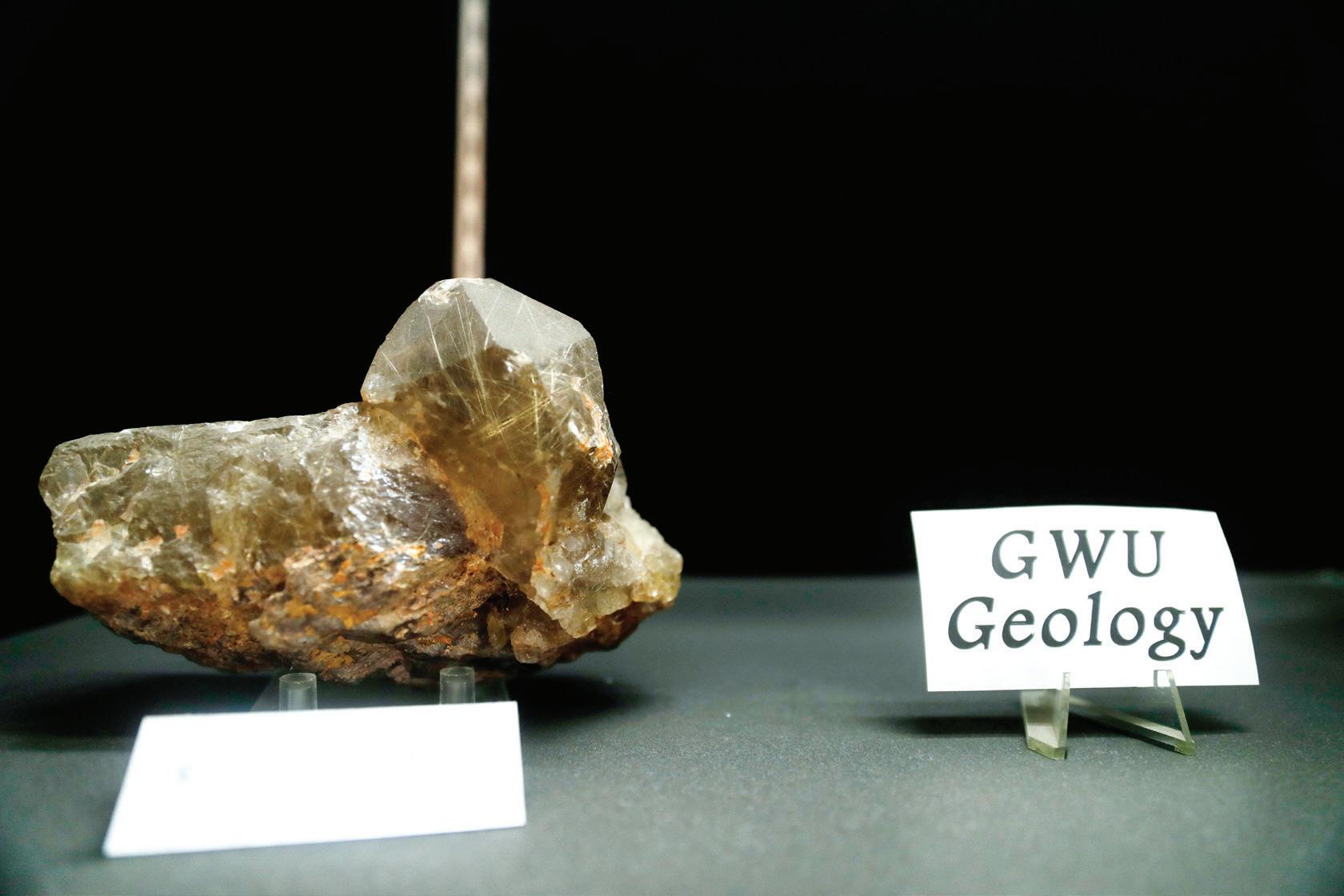
The outgoing director of GW’s geology program requested one year ago that the University hire a tenure-track professor in an effort to keep the program afloat.
Columbian College of Arts & Sciences officials denied the request, and the leader of the program says the program is now at risk of vanishing.
Catherine Forster, the director of the Geological Sciences Program and the only tenured geology professor, said her retirement this August will leave the program with no leadership if CCAS officials do not hire new tenure-track professors, potentially ending the major and minor programs at GW. She said officials denied her request last spring to hire a new tenure-track professor that would replace Richard Tollo, a nowretired professor of geosciences.
Forster said the program is searching for a new “special service faculty” member, who would teach a “heavy” course load of three classes per semester after CCAS officials approved her hiring request for a full-time faculty member last spring. She said officials did not provide an explanation as to why they denied her request for a new tenure-track professor who would replace Tollo beyond saying they have to “figure out” the future of the program.
“I fear that this is a financial decision, rather than an academic one,” Forster said. “That’s my fear. It’s just cheaper to let the program go and not hire anybody, and eliminate, essentially, everything but introductory geology courses at GW.”
Kim Gross, the CCAS vice dean for programs and operations, said CCAS officials formed a faculty task force this
Students in the geology program said they are creating a “plan of action” urging CCAS o cials to hire more tenured professors, create new geology-related minors and introduce
semester to find “the best path forward” for the geology program. She said CCAS is currently looking for a professor to fill the special service faculty position, “just not a tenured line.”
Gross declined to say why CCAS officials denied Forster’s request to hire a tenure-track professor last spring, if CCAS officials plan to end the geology program or incorporate it into a separate program, what instructions CCAS officials gave the task force members or when the faculty task force will complete its work. She also declined to say if officials will hire any new tenure-track geology professors or admit any students with a geology major in the future.
Gross said while the geology program has “very few majors,” the program offers “robust” course offerings that fulfill General Education Curriculum, or GPAC, requirements. She said
the number of students majoring in environmental and sustainability sciences has “increased,” and the degree could have “natural ties” to geology.
“CCAS considers geology an important component of a liberal arts education,” Gross said in an email. “The retirement of two tenured faculty members means this is an opportune time for us to examine the program to decide the best way to serve our students moving forward.”
Forster said officials formed the task force of CCAS faculty this semester to draft a report on the structure of the geology program going forward, which included Forster.
“If there’s no permanent faculty here, that is permanent faculty to run the program, to mentor students, to do projects with students, to teach upperlevel courses, there will be no upper-level courses, there will
be no major, there’ll be no minor,” Forster said. “And this is the worst-case scenario.”
Forster said there are 10 students majoring in geology and 12 students minoring, but that this number does not reflect the number of students who have declared a major or minor in geology over the past “two weeks.”
CCAS students must declare their major before they register for their fifth full-time semester, or the end of their sophomore year, according to the undergraduate academic advising website.

Forster said valuable equipment used for upper-level geology courses like rock saws and petrographic microscopes will not serve a purpose if CCAS officials end or downsize the program.
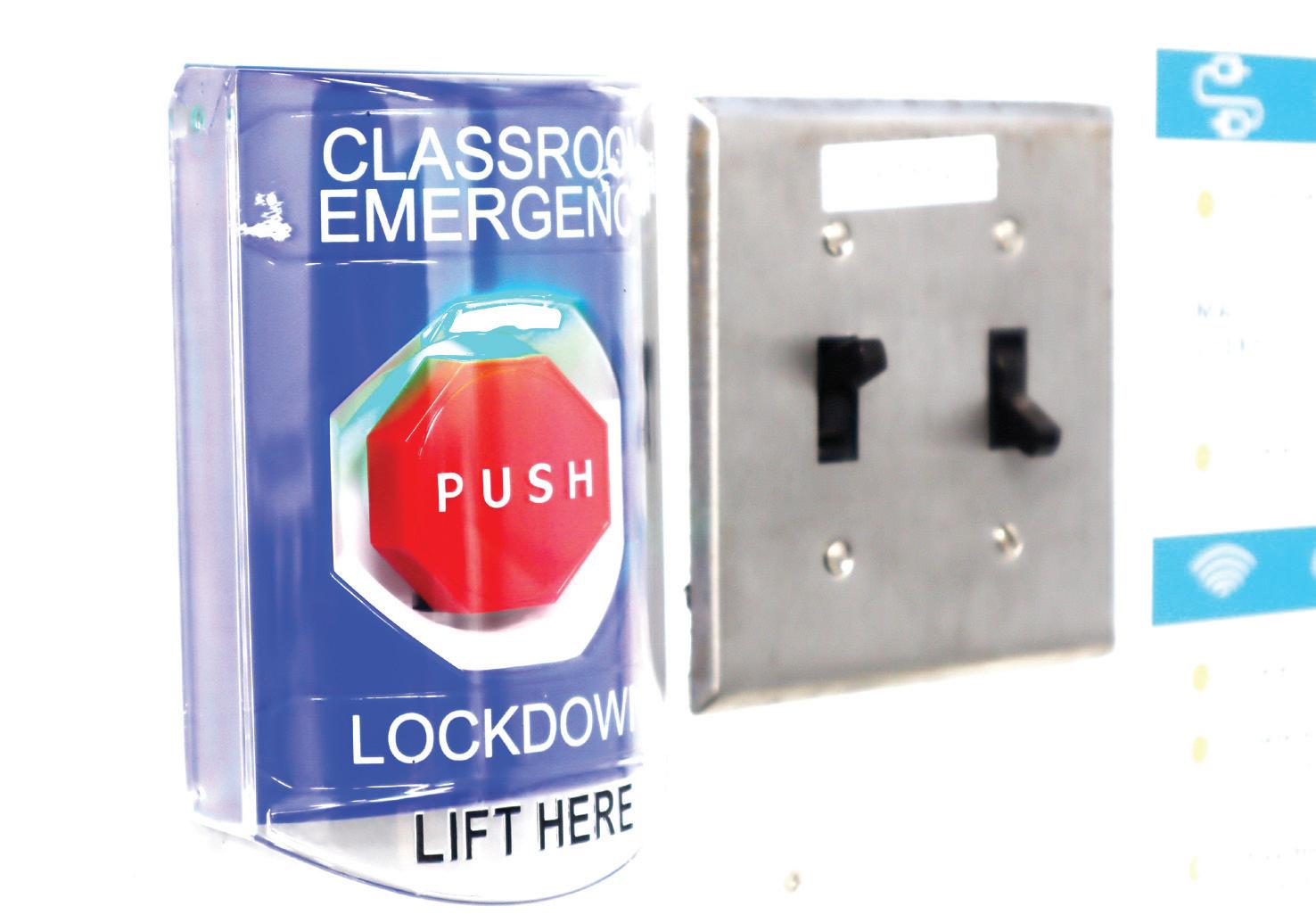
Faculty members say officials have provided little to no emergency preparedness training to professors which they say leaves them unprepared to handle emergency situations.
Ten professors reported receiving varying levels of emergency preparedness training while teaching at GW, ranging from no training to mandatory videos and virtual modules during faculty orientation upon joining the University, leaving some professors feeling uneducated about what they should do in the event of an armed intruder. Although some faculty said they would be willing to receive more emergency
preparedness training from officials, they reported feeling uncertainty about how additional training or University decisions like arming some GW Police Department officers next fall could reduce the risk of an active shooter situation on campus.
Heather Hoffman, a professor of biostatistics and bioinformatics, said University officials have never provided her with emergency preparedness training despite teaching at GW for more than a decade. She said she believes she could use emergency training to protect herself and her students in the event of an active shooter.
“I’ve been at GW for 17 years, since 2006, and I’ve never actually been through any type of official training,” Hoffman said. The University does
not require faculty to undergo any routine annual emergency preparedness training, but four professors reported viewing an emergency preparedness presentation during new faculty orientation in the fall, between 2017 and 2022. GW community members can request an hourlong active shooter training session from the Division of Safety and Facilities, according to the division’s website, the website’s request form is not currently accepting submissions.
University spokesperson Julia Metjian said officials are gathering input from the GW community through “reviews and discussions” about current emergency training and protocols for “enhancements” to a “holistic” public safety plan.
who helped organize the unionization effort, said the union will form a bargaining committee in the coming weeks representing residents’ departments like internal medicine, emergency medicine and obstetrics and gynecology.
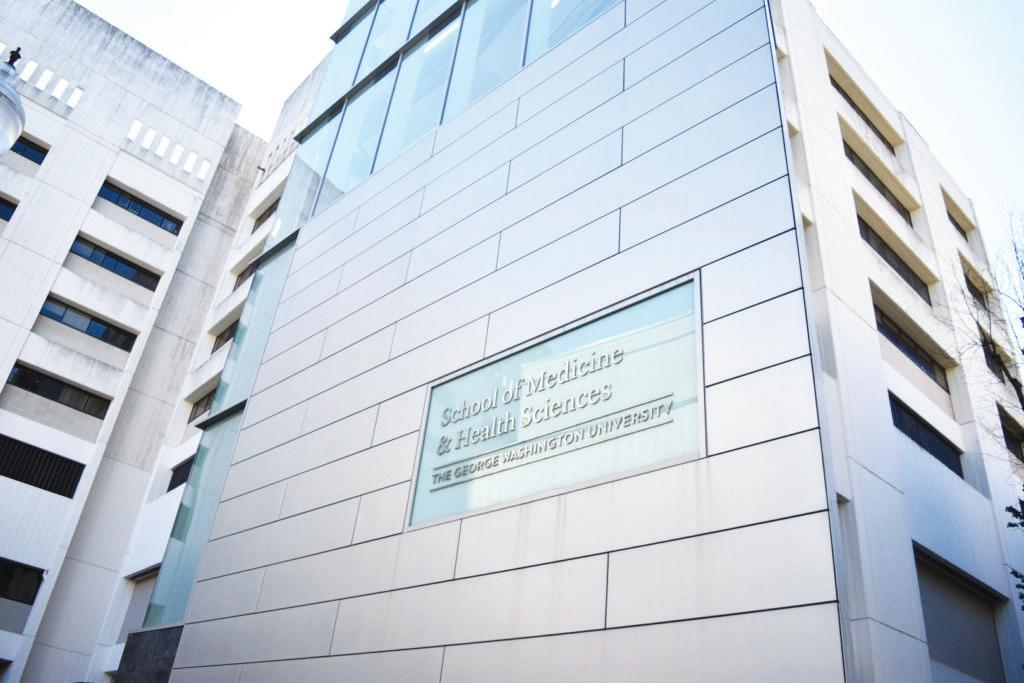
Miller, a first-year internal medicine resident physician, said the union will represent 455 residents and fellows employed by SMHS who work at GW Hospital.
“First and foremost, forming a union gives us a voice at the table,” Miller said. “That is something that is incredibly important to all of us because we are the physicians that are at the frontlines taking care of patients, so we have this unique window into knowing what is needed for patients and how to improve our medical training.”
She said GW residents and fellows have discussed unionizing since at least 2018, but the pandemic accelerated the efforts.
“The COVID pandemic really brought to light a lot of the exploitation in the medical field and a lot of its injustices and simply burnout,”
Sports Preview the men’s and women’s track and field trip to the A-10 Championship.
Page 8
Men’s basketball will welcome home D.C. native and redshirt freshman forward Darren Buchanan Jr., a major addition to the Colonial frontcourt.
Buchanan announced his decision to transfer from Virginia Tech in a video released on his Twitter Friday afternoon, featuring shots of him walking around campus and posing in the Buff and Blue uniform at the Smith Center. A graduate of Woodrow Wilson High School, now called Jackson Reed High School, Buchanan will provide muchneeded size as a forward with his 6’7” frame and will likely see the court early and often.
In his senior year at Woodrow Wilson, Gatorade named Buchanan the 2022 D.C. Player of the Year after averaging 17.5 points and 10.6 rebounds per game and leading his squad to the DCSAA Class AA tournament championship game, where they lost on a last-second put-back to Sidwell Friends School.
The two-time DCIAA Player of the Year had previously considered GW out of high school, ranking them in his top five along with Virginia Tech, Georgetown, Rutgers and George Mason, but ultimately passed up Foggy Bottom for Blacksburg, Virginia.
Buchanan redshirted in his lone year at Virginia Tech, leaving him a full four years of eligibility under NCAA rules.
Buchanan will join fellow transfers freshman Benny Schröder from the University of Oklahoma, former Princeton forward Garrett Johnson as well as returning star senior guard James Bishop on the Colonials squad.
Four Colonials players entered the transfer portal this offseason, including junior center Noel Brown and senior forward Hunter Dean. With key starters like graduate student guard Brendan Adams and senior forward Ricky Lindo Jr. set to graduate, GW will rely on mostly fresh faces in their fight to build on their best regular season finish since 2017.
With Brown and Lindo Jr. gone, the Colonials still lack a proven big man, but Buchanan, listed at 235 pounds, will help fill in the paint.
Miller said. “So with that, over the past several years, residents have been talking about it.”
University spokesperson Julia Metjian said the University “remains committed to supporting and training” residents and fellows regardless of the election outcome.
“The university values their daily contributions to our academic medical enterprise,” she said.
Miller said GW resident and fellow physicians first met with CIR in November 2022 to begin planning unionization. She said although individual physicians and departments have “unique needs,” many union members hope to improve resident salaries, health care benefits, medical leave and parental leave.
She said she regularly has to address administrative, “essentially nonphysician tasks,” taking time away from updating patients and the families at their bedside.
“I’m a firm believer that in order to better take care of patients, we have to be able to take care of ourselves,” Miller said. “Oftentimes, I personally find myself having to
choose between going the extra mile and providing my patients with the exceptional care I know they deserve and my own personal health and wellness.”
She said officials sent out union authorization cards in March, which a supermajority of SMHS fellows and residents signed. She said officials approached the University with the cards asking them to voluntarily recognize the union, but the University declined, forcing prospective union leaders to approach the National Labor Relations Board two days later for the official union vote.
Union leaders first submitted paperwork to NLRB March 3 to mail in ballots for a union election, but they resubmitted the paperwork March 22 to switch to in-person voting.
The salary for first-year residents at SMHS was about $64,038, according to the SMHS website. Medical students across American medical schools accrue roughly $200,000 of medical debt after graduating on average, according to the American Medical Association.
more fieldwork and networking opportunities.
Student organizations are organizing new antihazing training to comply with a Virginia law signed after a Virginia Commonwealth University freshman died while pledging a fraternity in 2021.
Brian Joyce, the assistant dean of student life, said the Office of Student Life began implementing Adam’s Law training in the fall for accepted but preinitiated members of student organizations and is currently hosting training sessions for active organization members. Joyce said the training sessions follow the law’s guidelines, which consist of “comprehensive” in-person hazing prevention education that outlines the dangers of hazing, alcohol intoxication, the legal implications of hazing and GW’s policies on hazing.
“We will also provide information explaining that the University’s disciplinary process is not to be considered a substitute for the criminal legal process,” Joyce said in an email.
Virginia Gov. Glenn Youngkin (R) signed the legislation into law last April following the death of Adam Oakes, who died from alcohol poisoning while pledging VCU’s Delta Chi fraternity. Joyce said GW student organizations with new members must comply with the law because of GW’s certification to offer degrees in Virginia through the University’s Virginia Science and Technology Campus in Ash-
burn. Joyce said the law requires all Greek life chapters to attend the training. He said the law applies to all student organizations with new members—or individuals who have been offered an invitation for student organization membership but have not yet been initiated—meaning some non-Greek Life student organizations are also subject to the training.
Joyce said required participants are “strongly encouraged” to attend the training but did not specify a fine or a particular form of enforcement.
The law requires Virginia universities to report hazing violations on institutions’ public websites and to report hazing incidents to the police, which lawmakers said was not the case prior to the signing of Adam’s Law.
IFC chapters Kappa Alpha—which the University suspended from campus in 2020 for hazing and alcohol violations— and Sigma Chi are the only two student organizations on GW’s campus with active hazing violations, according to the Division for Student Affairs’ list of student organizations with conduct violations.
Virginia state Sen. Jennifer Boysko (D-VA), who introduced the bill with Oakes’ family, said the law leaves the training implementation and hazing disciplinary process up to individual institutions because lawmakers recognize hazing looks different at every university.
“As you’re passing legislation, sometimes you let the institution make some of the decisions themselves instead of mandating that they do it in the exact same way,” Boysko said. “They have some different options on how they go about it.”
Boysko said Adam’s Law aims to equip students with knowledge about the danger of hazing, like alcohol poisoning, which Oakes experienced after consuming 40 ounces worth of whiskey while pledging Delta Chi. She said the law mandates training that makes students aware of student organizations’ prior history of hazing, allowing them to make informed decisions about joining groups.
Joyce did not specify whether GW’s training includes information about the history of hazing in GW chapters.
She said if Oakes had been aware of the VCU Delta Chi fraternity’s history of hazing, underage drinking and sexual assault that dates back more than a decade, he may have chosen not to pledge the chapter.
“The idea in all of this is education is power,” Boysko said. “If Adam had known this organization that he had wanted to join had been habitually in trouble for hazing and harming students, he could have made a different decision, but he didn’t understand that.”
GW currently has a “zero tolerance policy” for hazing and the DSA offers a Student Conduct Incident Reporting Form where GW community members can
Researchers at GW’s Public Health Lab are fundraising to develop free, at-home sexually transmitted infection tests for students.
Jack Villani, the laboratory’s manager, said at-home STI collection kits will allow GW students to privately collect swab samples of their throats, genitals and rectums and return them to the lab to test for STIs like chlamydia and gonorrhea. He said the lab — which currently processes COVID tests — will refer students with positive tests to the Student Health Center and hopes the system will reduce the social stigma surrounding sexual health.
Villani said the lab is currently seeking up to $500,000 in funding to cover the cost of supplies and labor to process the tests so officials can offer the tests to students.
Villani said the release date of the kits depends on when the lab receives funding and that the team is currently seeking out a “funding opportunity” from the Centers for Disease Control and Prevention, as well as other federal funding sources.
“We believe that this type of testing is of greatest benefit when there is no cost to the individual so, ideally, we would like to have this project be fully funded and not require any payment from the individual,” Villani said in an email.
A CVS-brand STI kit for gonorrhea, chlamydia and trichomoniasis costs $89.99, according to the CVS website.
GW would be the only one of its 12 peer schools to offer free, at-home STI test kits. John Hopkins University School of Medicine offers at-home STI test kits for no charge.
Villani said the lab’s STI collection kits will offer testing for chlamydia and gonorrhea, among others, in the throat and rectum, which will address a “public health concern” because STIs can spread asymptomatically
through those areas and the “standard” chlamydia and gonorrhea test only samples urogenital specimens. He said the DC Health and Wellness Center, which provides care and treatment for STIs in the District, only tests for chlamydia and gonorrhea using a urogenital sample, meaning the lab’s STI kits will expand access to sexual health services in D.C.
“These sites are considered neglected for screening for STIs but are believed to be commonly responsible for asymptomatic transmission,” Villani said. “With this in mind, we can design our kits to include these sites and help address this public health gap.”
Villani said college students experience STIs at a higher rate than the general population. He said the kits the lab is developing would help “capture” asymptomatic cases when people are unknowingly spreading an STI, since many asymptomatic cases go undetected.
D.C. has the 17th-highest STI incidence rate of all U.S. cities, with 1,393 cases per 100,000 people, according to a CDC report. One in four college students have an STI, and 80 percent of afflicted individuals are asymptomatic, according to a study by Washington and Lee University.
“It’s a major public health concern in D.C. and in any urban center and a passion project for me and a lot of other people here at GW,” Villani said.
The lab staff said on top of their STI research, the lab processes 300 COVID tests per week, a decline from about 3,000 tests per day last academic year. Villani said the decrease in COVID tests allowed the lab “more bandwidth” to begin developing the STI kits in summer 2022.
Jorge Sepulveda, the lab’s medical director, said the lab team is trying to “leverage experience” in creating other at-home test kits to adapt their lab infrastructure’s robotic pipetting — robots that measure and move liquids — for other forms of largescale disease testing, like STI screening. He said lab staff
report incidents of hazing, according to the Fraternity and Sorority Resources website. The DSA directs reports to members of the Fraternity and Sorority Life team and the Office of Student Rights and Responsibilities, who decide whether to proceed with disciplinary action, according to the website.
Officials updated the Code of Student Conduct last August to increase students’ access to the University’s drug and alcohol amnesty policy—which outlines when a student seeking medical attention for drug or alcohol intoxication is in violation of the code—in response to students who said they would benefit from more
information on the policies.
Officials also updated the code to grant community members immunity for recording a hazing incident to make it easier to report instances, which used to be a violation of the code.
Junior Jack Palaian, the president of the IFC, said he hopes the new Adam’s Law training will reinforce members’ current knowledge on hazing but does not believe the new training will be different from the current training new members entering IFC chapters must already complete. Current training for IFC members includes an AlcoholEdu training and hazing prevention course as part of the Office of Student Life’s new member
education sessions hosted once per semester, along with national chapters additional required training, according to Palaian.
Adam’s Law training, contrary to IFC’s new member training, requires current members to attend the training alongside new members.
“It’s nothing new,” Palaian said. “It’s just another training that we have to do.”
Palaian said although he does not anticipate the training to be useful compared to the training members already have to complete, he hopes it will bring more awareness to the consequences of hazing and support the IFC’s “very strict” policies on hazing.
hope more people will opt to get tested for STIs because at-home tests eliminate the need to see a physician unless they receive a positive test.
“That’s sometimes a big barrier to getting tested, and there’s a lot of asymptomatic infection,” Sepulveda said.
“If we can remove this barrier, it will hopefully have a positive impact.”
The CDC recommends anyone who engages in risky sexual behavior, sexually active women younger than 25 and men who have sex with men should be tested annually for gonorrhea and chlamydia. Men who have sex with men should also test for all STIs “more frequently” if they have multiple or anonymous partners, according to the CDC.
The CDC does not offer a recommendation for annual STI screening for men who have sex with women, citing “insufficient evidence” for regular testing among men at “low risk” for STIs.
DC Health provides free, confidential, at-home and in-lab STI tests for District residents ages 13 and up through Get Checked D.C., a program providing HIV and STI testing to D.C. residents, according to the agency’s website.
Maddy Niziolek — a copresident of GW Reproductive Autonomy and Gender Equity, a student organization for reproductive justice and sex positivity — said on-campus access to free, at-home tests would benefit students who don’t have time to visit the SHC, can’t afford a doctor’s appointment or feel a “stigma” from seeing a medical professional for STI testing. Niziolek said at-home STI tests would be helpful to students who previously experienced racism, ableism or misogyny in health care and would prefer waiting to consult a professional until they know if their test came back positive.
The SHC offers STI testing, screening, treatment and counseling by appointment as a primary care service, according to the center’s website.
Chief Justice Devin Eager swore in newly elected Student Association President Arielle Geismar and Vice President Demetrius Apostolis in an inauguration ceremony Friday.
More than 40 people attended the leaders’ inaugural addresses, where Geismar set forth plans to create a mental health task force and GWHub, a “one-stop shop” app where all of the online resources the University offers will be compiled into a singular app. Apostolis said in his address that he will work to expand U-Pass to include parttime graduate students and reform the academic advising system so students don’t have to wait “months” to meet with an adviser.
Geismar said in her address she plans to author an “annual accessibility report” to highlight policy solutions, including recommendations on how to address food
insecurity after Whole Foods stops accepting GWorld as a method of payment in June. She said she is excited to support the new District House market—which will open after Crisp closed in late April—to combat food insecurity on campus and partner with the Shenkman Hall Teaching Kitchen, where students can learn how to cook from trained chefs. She also said she will support women’s and gender-diverse health in the Student Health Center by “uplifting resources” and pushing the University to hire more diverse health professionals. Geismar said, like other students, she previously had skepticism about the SA being a “true vehicle of change” but realized she had the potential to create “meaningful change” and make a “lasting impact” as president.
“As a leader on campus, it’s my responsibility to have doubt in the status quo in the way that things have always been around here,” Geismar said. “It’s
one of the things I’m most excited to bring to the GW Student Association.”
Apostolis said in his address that he plans to improve and broaden the impact of the policies he created this year as senate chairperson pro tempore, like encouraging University administration to create a grocery store that accepts meal swipes.
Apostolis, who said he was the youngest senate chairperson pro tempore, said his time in the senate has taught him how to move past drama and infighting to better advocate for students that elected him.
“I know how the senate functions,” Apostolis said. “I know how legislation works. I know how senators function. Being able to be on the ground experiencing that has set me up so that I can hit the ground running tomorrow.”
Apostolis said he is looking forward to sitting down with students and senators so he can build a cabinet that can fulfill the needs of students.
hourly workout blocks at Lerner during the semester. Officials let 2,000 on-campus students in spring 2021 to work out at Lerner from 7 to 10 a.m. and 5 to 8 p.m. on weekdays.
Students said they want officials to expand the Lerner Health and Wellness Center hours after GW shortened the center’s operating hours in fall 2021 following the return to campus.
More than a dozen students said Lerner’s hours inhibit their ability to exercise at early morning or late night times after officials shortened the center’s operating hours by three hours on weekdays, five hours on Saturdays and four and a half hours on Sundays, according to the Lerner’s website archives. Officials said they shortened Lerner’s hours in the 2020-21 and 2021-22 academic years because of COVID-19 and hope to expand work-study options at the center.
Shane Dong, a third-year student in the School of Medicine and Health Sciences, said Lerner’s hours fail to accommodate his “rigid” academic schedule and that it would be “really nice” for Lerner to open earlier and close later. “Lerner’s hours could be a little bit more flexible,” Dong said.
Lerner is open from 7 a.m. to 9 p.m. on weekdays, 10 a.m. to 4 p.m. on Saturdays and noon to 8 p.m. on Sundays, according to the center’s website. Before in-person classes and events ceased due to the pandemic in March 2020, Lerner was open from 6:30 a.m. to 11:30 p.m. on weekdays, 9 a.m. to 8 p.m. on Saturdays and 11 a.m. to 11:30 p.m. on Sundays since at least spring 2014, according to the center’s website archives.
Officials allowed 500 on-campus students in fall 2020 to schedule
Andre Julien, the director of Lerner, said officials decreased the center’s hours between fall 2020 and spring 2022 to adhere to D.C. and University COVID-19 mitigation guidelines. He said officials observed the “schedules and habits” of students, faculty and staff without COVID-19 mitigation efforts in place via GWorld card swipes at the center after Lerner reopened in October following its closure in May 2022 for heating, ventilation and cooling system renovations.
“This semester, as we welcomed our faculty and staff back into the building for the first time since March 2020, we have continued to track the check-ins and check-outs to monitor peak and slow times for individual students, faculty and staff who come to work out,” Julien said in an email.
All of GW’s 12 peer schools have gyms with longer hours than Lerner, except one of the University of Southern California’s three gyms, which is open for a shorter time than GW’s on weekends.
Julien said there was a reduction in Lerner work-study options for students in previous academic years due to “changes” in the center’s hours. He said Lerner officials have offered more work-study options at the center this year and plan to continue offering more options in the future.
“This year, as Lerner began its transition to a more fully operational building, we have been able to start offering more hours for students to work and foresee that continuing,” Julien said.
More than a dozen students said Lerner’s current hours limit the number of available hours they have to exercise at the center before and after classes.
Nicholas Smaldone, a senior majoring in international environmental studies and English, said he doesn’t understand why Lerner is slower in fully reopening post-pandemic than other University buildings that have adjusted back to preCOVID hours. He said Lerner hasn’t been as “consistent” of a resource as he would have liked in college due to
its hours and renovations.
“I don’t know why we still haven’t gone back to pre-COVID hours when everything else on campus is at least adjusting or adapting,” Smaldone said. “The gym was also being renovated like all this year, and it wasn’t even open.”
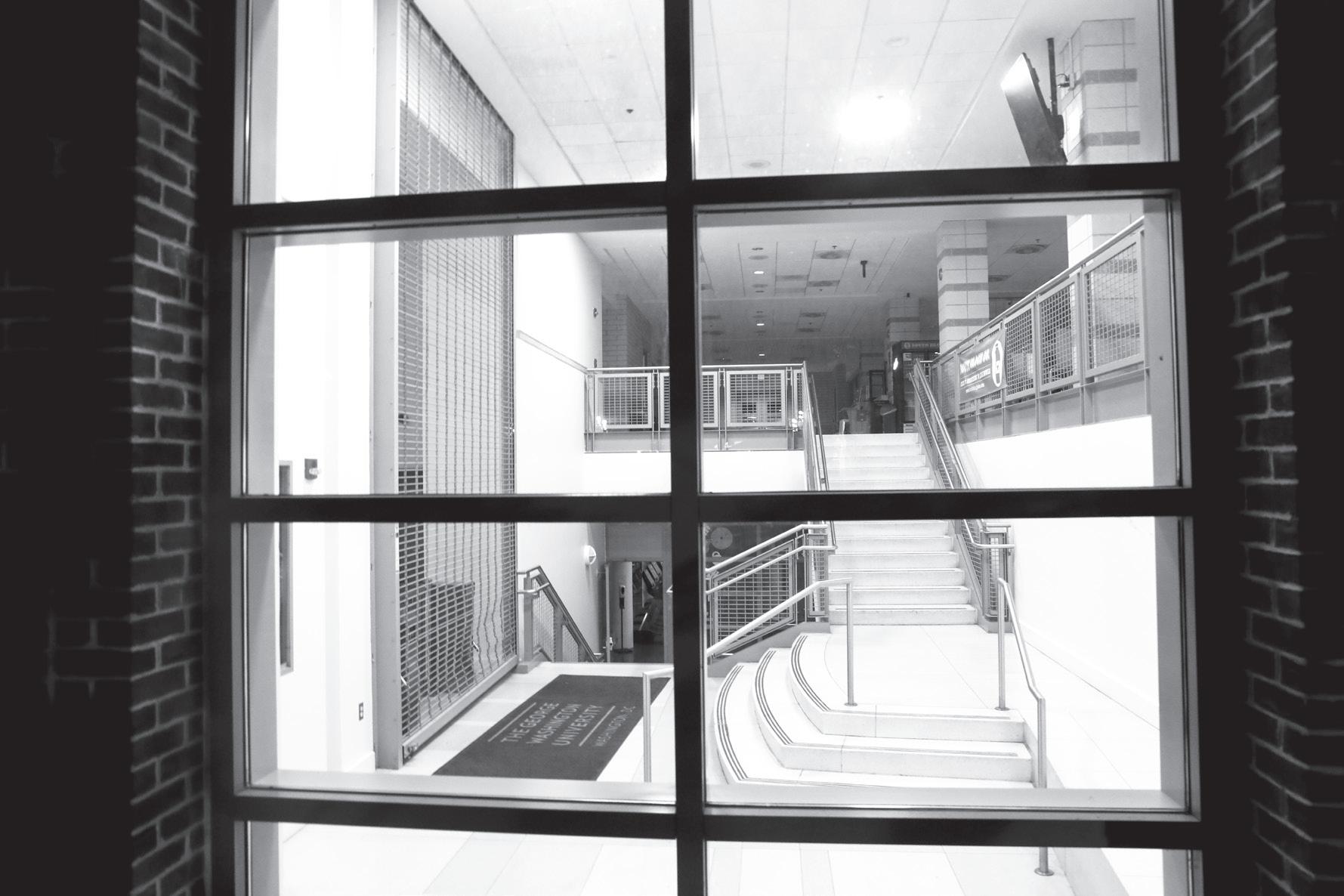
Nevan McNamara, a sophomore majoring in political science, said the center should be open until at least 10 p.m. if it cannot be open until midnight. He said Lerner’s hours, “tiny” space, hot temperatures and reportedly broken equipment that
takes “weeks to fix” indicate a lack of administrative attention toward the center.
“It seems like they just don’t really care about the gym in general,” McNamara said.
Sofia Khugaeva, a freshman majoring in biomedical engineering, said the center opening at 7 a.m. makes it hard to work out before her 8 a.m. classes, when she would prefer to work out.
“I really wanted to go to the gym before class, but that’s not possible,” Khugaeva said.
Capital Bikeshare announced Friday that the Mount Vernon Campus received a Capital Bikeshare docking station.
Capital Bikeshare, a bike-sharing network for the D.C. area, installed a bike-docking station on Whitehaven Parkway and Foxhall Road NW, next to the Vern’s entrance. The station has 19 docking spots for bicycles, according to the Capital Bikeshare system map.
The docking station is the first on the Vern, with the nearest station 0.3 miles away from campus on Macarthur Boulevard NW and U Street, according to the system map. There are over 700 docking stations in the D.C. area, according to Capital Bikeshare’s website.
Officials said they would provide more “short-term and long-term” bike parking stations on the Vern, thus “enhancing transportation accessibility” in the approved Mount Vernon Campus Plan for 2022-31.
There are four docking stations on the Foggy Bottom Campus, with stations outside Strong Hall, Duques Hall, GW Hospital and Western Market Foodhall, according to the system map. The map shows there are also docking stations outside Whole Foods Market, James Monroe Park and the American Red Cross Building.
Incoming executive board officers said they plan to incorporate a more diverse group of students in BSU, like freshmen and students with different majors, to increase student involvement.
Newly elected leaders of the Black Student Union plan to increase student involvement and forge relationships with other Black student organizations to enhance their presence within the GW community in the next academic year.
BSU co-presidents
Kelsey Baker and Bailey
Moore will take the helm of the organization in the 202324 academic year, running an executive board filled with mostly new members.
Incoming e-board officers said they plan to incorporate a more diverse group of students in BSU, like freshmen and students with different majors, to increase student involvement and hope to boost ties with other Black student groups on campus, like the African Student Association.
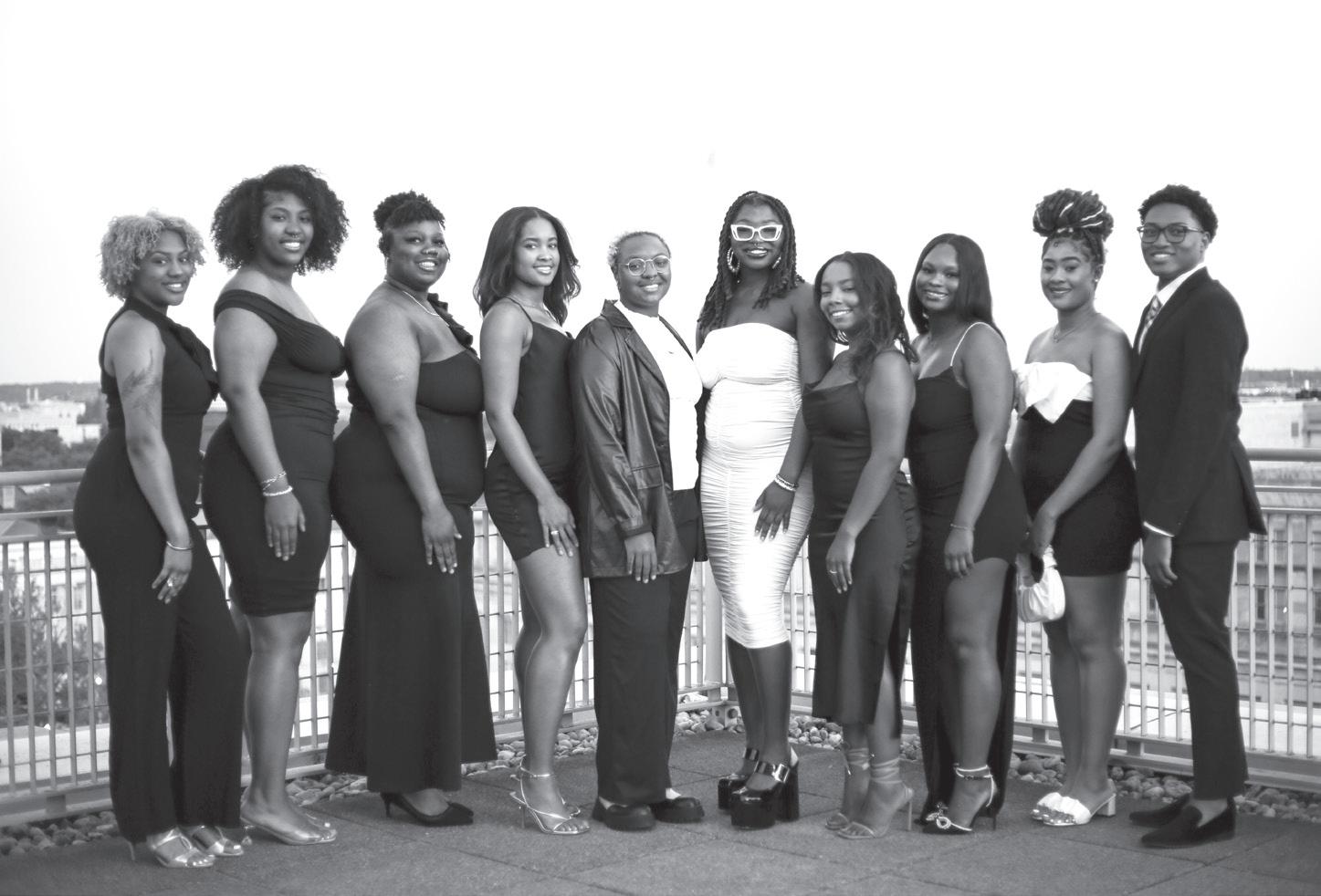
Moore, a junior majoring in public health and a co-president, said she served as BSU’s freshman representative her freshman year and admired the organizational skills of previous leaders like former president Gianna Cook, who inspired her to take on her new role. She said she plans to increase attendance at traditions former BSU leadership set like the Solidarity Conference, a discussion of topics like entrepreneurship, culture and media in the Black community, and the State of the Union Gala, an event held for the first time last year to commemorate the work of Black community members.
“If the organization is staying stagnant, then it’s
not doing its job,” Moore said. “It should be continuously growing, continuously building with each year. So when I say strengthen the foundation, I mean build off of the foundation that has been there.”
Moore said BSU elected two co-presidents for the next academic year, a change from years past, to better balance the heavy workload of the president. Moore said BSU is the umbrella organization for all Black student groups on campus and the decision to elect two presidents will better split up the responsibilities of the president, ensuring the organization runs “smoothly” and “efficiently.”
Moore said she hopes to strengthen connections with other organizations like the ASA to bring more events to campus catered toward the Black community.
“I want to try to unite the two communities, the African American community and the African community at GW because I do feel like there has been some divisiveness, but I know that there can be work done to bring that together,” Moore said.
Moore said she hopes to host more events on the Mount Vernon Campus to get freshmen more involved within BSU because the group has mainly held events in Foggy Bottom in years past. She said she plans to directly ask freshmen what they hope to see more of within BSU events to ensure they remain a member and motivate them to become more involved in future years.
“If we’re having events that no one actually wants to go to, then that’s point-
less,” Moore said. “Seeing what they want and seeing what they feel would keep them in BSU. Instead of guessing, just hear it directly from them.”
Kalah Neal, a freshman majoring in international affairs and the incoming BSU vice president, said her responsibilities include facilitating meetings with eboard members and ensuring they adhere to their duties within BSU. Neal said she plans to hold more consistent events and increase networking throughout the school year because events in the past have mainly fallen near the beginning and end of the semester.
Neal said she plans to host outdoor events between freshmen orientation week and before classes start, like cookouts and picnics, to recruit more freshmen into the group before classes begin.
“It’s keeping that same consistency and keeping the community engaged with community service, with games or just offering a little bit more study hours and allowing for our students to learn how to be studious Black teachers,” Neal said.
Olivia Justice, a freshman majoring in political communication and human services and social justice and the vice president of special events and programming, said her new role oversees the planning of major events like Kickball on the Mall, a joint kickball game with American University’s BSU held for the first time this past semester, as well as Finale, an annual celebration marking the end of Black History Month in February where community members connect with food and dancing.
The District will have received 700 next-generation e-bikes by Monday. The new bike model is the second Capital Bikeshare e-bike and can travel 20 miles per hour, with 60-mile batteries and enhanced safety features like LED lights and reflective paint. D.C. officials installed more than 45 miles of bike lanes since Mayor Muriel Bowser’s Vision Zero traffic safety program began in 2015. The program has “fallen short” of its goal to end traffic deaths by 2015, according to D.C. officials in an October report.
Vision Zero data shows that 10 cyclists died and 1,491 cyclist injuries were reported in D.C. between 2017 and 2021.
—Max Porter
and networking opportunities.
“We are running a full geology program,” Forster said. “We have all the instrumentation and equipment, so there’s been a big investment in geology already from CCAS or from former members of the department as well.”
Forster said she hopes the program can redesign and develop new courses that emphasize the intersection between geology and other subjects, like political science and environmental science. She said geology is “incredibly important” to sustainability because building solar panels and electric vehicles require geological materials.
“I think the vision is to kind of refocus the geology program itself,” Forster said. “We have some internal retooling to do and to find out how we can further provide courses that are useful to other majors and minors on campus.” There are 20 CCAS students majoring in environmental and sustainability science as of 2022, according to enrollment data.
Students in the geology program said they are creating a “plan of action” in response to the shrinking program, urging CCAS officials to hire more tenured professors, create new geology-related minors and introduce more fieldwork
Andrew Gibson, a junior majoring in geology who co-authored a Hatchet op-ed calling on officials to support the geology program, said students in the program created a task force to design the plan to pitch to Gross to keep the program running.
The plan of action includes creating interdisciplinary minors between geology and other programs, like economic geology, establishing connections between undergraduates and geology alumni and creating a geology preprofessional fraternity.
“Short term, we want to boost the department, advertise it more and keep it afloat for another couple of years,” Gibson said. “Long term, we want to convince the University to invest. It can give back more to the community than it does now.”
Gibson said ending the program would “screw over” students majoring in other sciences that require geology classes to fulfill major requirements. Degrees like bachelor’s of arts in environmental studies and bachelor’s of science in environmental and sustainability sciences programs require geology courses as a major requirement, according to the geography department’s website.
“We’re kind of shooting ourselves in the foot I think if we get rid of a lot of these classes,” Gibson said.
Cecelia Paparella, a sophomore majoring in geology, said she would likely “outsource” her geology education to another university with a larger geology program if CCAS officials were to end or downsize GW’s program. She said terminating the program would also reduce the remaining professors’ access to geological research opportunities.
“If we were to lose this program, or if it were to be absorbed into another department, I imagine we would lose a lot of our amazing professors and a lot of our opportunities like all the field opportunities that professors take on summers and different study abroad opportunities,” Paparella said.
Paparella said she knows at least four students have declared their geology major over the past month, a trend that she believes shows “hope” for increasing student interest in the program.
“We don’t have a whole lot of school spirit at the school, it’s kind of like our thing that no one cares, but within the geology program, we all care about the same thing and we all kind of want to do the same thing, and it’s just amazing,” Paparella said.
Officials have installed free menstrual product dispensers in at least 28 buildings as of Friday, more than quadruple the number of dispensers present in campus bathrooms in February.
The University installed dispensers for free pads and tampons in all 24 buildings with academic and dining space on Foggy Bottom and all four buildings on the Mount Vernon Campus The Hatchet checked Thursday and Friday after a Hatchet analysis in February found dispensers in just nine of 29 campus buildings inspected. The new menstrual product dispensers put GW in line with a year-old D.C. law that requires private, public and charter schools in the District to provide free menstrual product dispensers in female and gender-neutral bathrooms.
The Expanding Student Access to Period Products Emergency Act, which was proposed by Ward 2 Council member Brooke Pinto last January and codified by Congress last March, mandates universities to stock dispensers with “sufficient period products to meet the needs of students at all times throughout the calendar year.”
Dispensers were stocked with pads and tampons in 73 of 127 dispensers, while 54 were partially or completely lacking period products, with no pads in 19 dispensers and no tampons in 13, according to a Thursday and Friday Hatchet analysis of menstrual product dispensers on campus. A total of 22 dispensers did not have pads or tampons, including those in all five of the bathrooms in Corcoran Hall.
The Hatchet did not have GWorld tap access to enter Lisner Hall.
University spokesperson Julia Metjian said Friday that the Univer-
sity finished installing dispensers in all public all-use and women’s restrooms in buildings owned by GW by the end of March. She said GW Facilities staff workers check dispensers weekly and fill them “as needed.”
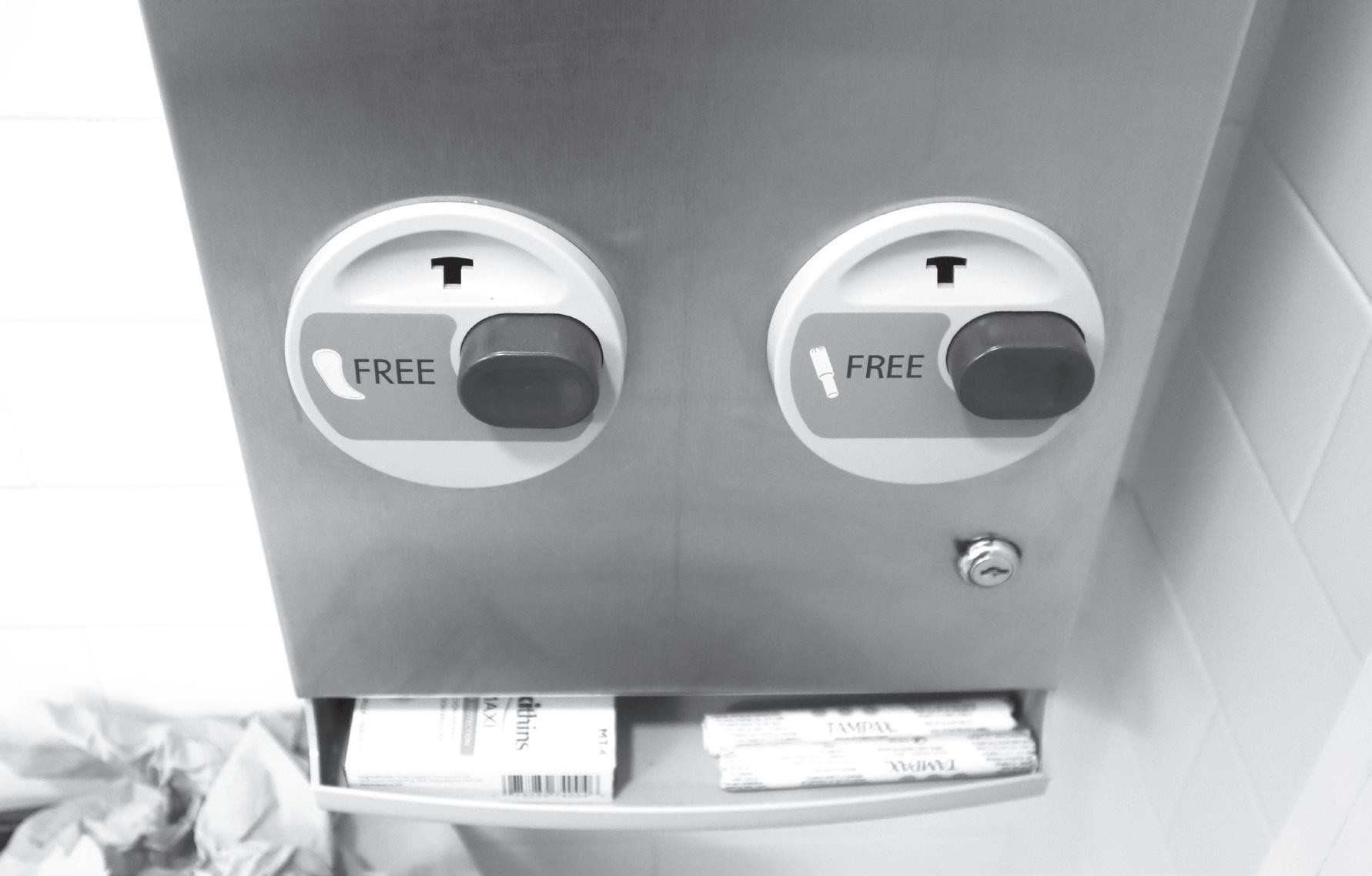
“All dispensers were installed by the end of March and were stocked no later than the middle of April,” Metjian said in an email. She said the University ordered the dispensers from HD Supply, an industrial distributor, to meet the Americans with Disabilities Act “standard” for the dispenser buttons, including raised buttons that are “easier” to use.
KC Costanzo, a GW Facilities customer engagement and service enhancement associate, said the University installed 366 dispensers across the Foggy Bottom, Mount Vernon and Virginia Science and Technology Campuses in a statement earlier this month. Metjian said the University ordered 400 dispensers in February and added Friday that officials have placed the remaining dispensers in storage for future use or to replace the current units.
More than half a dozen students said they noticed the dispensers were out of stock but that free period products help students who could not otherwise afford them.
Juli Camacho, a senior majoring in international affairs, said she tried to use a tampon from a dispenser once for class, but the dispenser was unstocked. She said the University’s installation of period dispensers was “good,” but officials should ensure dispensers are always filled with products for students to use.
“If you’re going to install something and not have it stocked, that doesn’t solve anything,” Camacho said.
Rindi Tobin—a junior majoring in cognitive neuroscience and the co-president of Clearminds, a student wellness organization—said the University’s implementation of
the dispensers was “overdue” but a push in the “right direction.” Tobin said she believes officials should display general information on the front side of the dispensers pertaining to using the period products stocked in the dispensers and information teaching students about toxic shock syndrome—a life-threatening bacterial infection sometimes caused by leaving tampons in too long.
Metjian said in February officials would install signage in University restrooms, but Costanzo said earlier this month that the University would not install signage because the requirement only pertains to D.C. public schools. Pinto’s bill requires the Office of the State Superintendent
of Education, which oversees K-12 schools in the District, to develop an 8.5 by 11-inch sign that includes medically accurate information on the safe use and disposal of menstrual products to display near the dispensers in consultation with the D.C. Department of Health.
“Sometimes, it’s just a helpful reminder, especially when it comes to tampons,” Tobin said.
Alex Lehrer, a freshman studying communications, said she has seen the dispensers “everywhere” on campus but noticed an initial delay in stocking them with products. She said free dispensers make products more accessible to students than coin-operated dispensers installed in some bathrooms on campus because many
The School of Medicine and Health Sciences will begin clinical trials to determine if a vaccine used to prevent mpox, formerly known as monkeypox, in adults is safe and effective for youth.
David Diemert, the clinical director of GW’s Vaccine Research Unit, said the unit will conduct a yearlong trial of the Jynneos mpox vaccine, assessing antibody responses in 12- to 17-yearolds, which the Food and Drug Administration will use to determine the vaccine’s safety and effectiveness before they approve the shot for adolescents. Diemert, a professor of medicine, said if approved, an effective vaccine would have a “huge impact” on stopping and preventing mpox outbreaks for adolescents in the United States and across the globe.
He said the National Institutes of Health chose GW as one of 18 sites across the country to perform clinical trials, which include universities, hospitals and clinics. Diemert said GW will monitor about 40 adolescent participants and the 18 sites will monitor a total of 315 adolescents and a comparison group of 135 adults aged
18 to 50.
“If the vaccine is approved for those under 18 years, it will mean that we’ll have an effective tool at our disposal to quickly and effectively stop future outbreaks of mpox,” Diemert said in an email.
He said there were only “a handful” of mpox cases among people under the age of 18 during the virus’ outbreak in the United States in 2022, but there are “frequent” child mpox cases in Africa, where the first human became infected with the virus.
Diemert said GW researchers will administer two injections of the vaccine to participants one month apart and follow participants for one year, looking at antibody responses that are “predictive” of protection against the disease. He said participants will complete a diary card to record symptoms, like injection site reactions and fatigue, for seven days following each injection.
He said GW is currently recruiting adolescent participants on social media and through local pediatricians,
teen health clinics, health departments, parent groups and former adult study participants who may have teenage children. He said NIH provides funding to the University for conducting the trials dependent on the number of people enrolled, which will cover “salary support” for the 15 researchers conducting the trials, supplies, participant compensation, pharmacy services and “recruitment activities,” but did not specify the exact amount of funding GW will receive.
At least nine of GW’s graduate academic programs rose in U.S. News & World Report’s national ranking of graduate schools this year.
The School of Nursing’s master’s degree program rose from No. 27 last year to No. 19 this year and the school’s doctorate program rose from No. 30 last year to No. 28 this year, tied with the University of California, San Francisco and the University of Virginia.
The schools corresponding to the nine graduate school categories, including law, business and education outlined in the report all remained within the top
100 placements of the list, according to the rankings released last week.
U.S. News & World Report uses surveys sent to experts in related fields to determine a program’s reputation and statistics that evaluate research, faculty and students’ success to determine graduate school rankings.
The report ranks GW Law as No. 25, consistent with last year, tied with the University of Alabama and the University of Notre Dame, with the law school’s intellectual property law program ranked No. 5 and its international law program tied for No. 10 with Stanford University. The School of Business
fell from No. 55 last year to No. 59 this year, while its international business program rose from No. 11 last year to No. 8 this year, tying with the University of Michigan.
The ranking lists GW’s public health program as No. 12, alongside Tulane University and the University of Minnesota, and the health care management program rose in ranking from No. 12 last year to tied for No. 8 with Cornell University and Ohio State University this year.
GW’s public affairs programs’ overall ranking rose from No. 12 last year to No. 10, tied with eight universities, including Georgetown University, New York University
and Princeton University this year, with six specialty programs making the top 10. The University’s health policy and management and public finance and budgeting programs ranked No. 10, tied with the University of Illinois, Chicago.
GW’s urban planning and policy program also ranked 10th, tied with Carnegie Mellon University, John Jay College of Criminal Justice and Portland State University. Public management and leadership ranked eighth and homeland security and emergency management ranked sixth along with international global policy and administration, tied with American University.
students do not carry change with them when using the bathroom.
“I don’t walk around with quarters on me, so it just like makes it more accessible,” Lehrer said.
Annika Vasagiri, a freshman majoring in international affairs, said she took a pad from the dispenser once “in case” she needed one in the future but has not used the pads. She said the dispensers are helpful for students who cannot otherwise afford period products and convenient for those who may forget to carry their own.
“I could definitely foresee a situation where I forgot or I didn’t bring my backpack with me somewhere,” Vasagiri said. “It could definitely happen in the future.”
THEFT II/FROM BUILDING, CREDIT CARD FRAUD
Academic Center 4/24/2023 – 12:10 p.m.
Open Case
A female staff member reported her wallet stolen after it was left unattended and that unauthorized purchases were made on her stolen debit card.
Case open.
THEFT II/FROM BUILDING
Thurston Hall 4/25/2023 – 7:00-10:00 p.m.
Open Case
A male student reported his portable speaker stolen after leaving it unattended.
Case open.
THREATS TO DO BODILY HARM
Thurston Hall 4/25/2023 – 5:50 p.m.
Open Case GW Police Department officers responded to a report of a dispute. Upon arrival, officers made contact with a female contractor who was involved in a verbal altercation with another female contractor who made threats to do bodily harm.
Case open.
THEFT II/FROM BUILDING
Mitchell Hall (7-Eleven Store)
4/26/2023 – 10:40 a.m.
Open Case GWPD officers responded to a report of theft. Upon arrival, officers made contact with a female employee who reported an unknown female subject stole two bags of candy. Case open.
SIMPLE ASSAULT,
Mitchell Hall (7-Eleven Store)
4/27/2023 – 12:45 a.m.
Open Case GWPD officers responded to a report of disorderly conduct. Upon arrival, a male employee reported an unknown female subject knocked over a display and attempted to spray him with pepper spray.
Case open.
Thurston Hall 4/28/2023 – 12:36 a.m.
Closed Case GWPD officers responded to a report of an intoxicated male student who had fallen off his bed. EMeRG responders arrived on scene and transported the student to the GW Hospital emergency room for further treatment. Referred to the Division for Student Affairs.
A freshman member of Congress talked about his TikTok success and adjusting to his new role at the Elliott School of International Affairs Thursday.
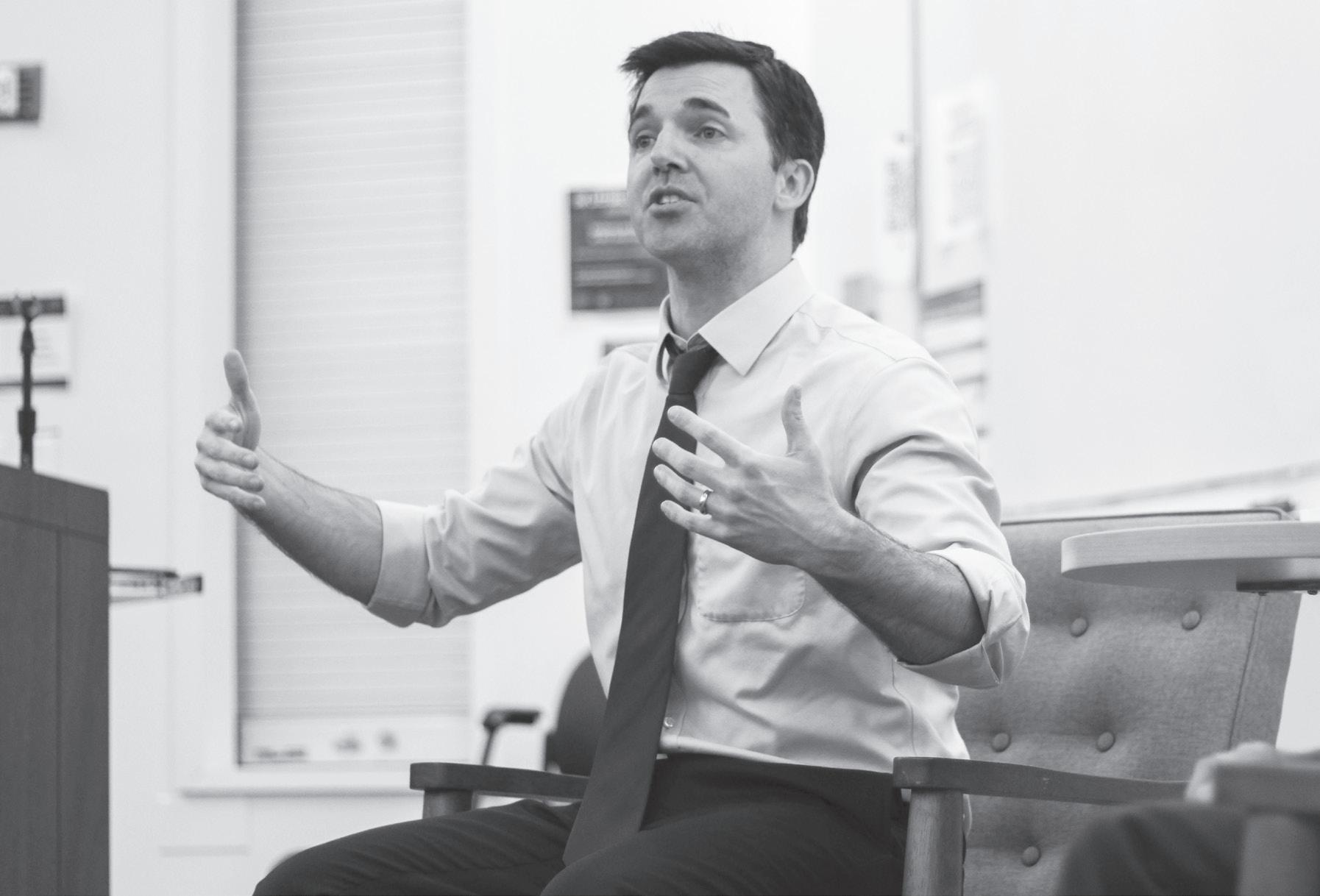
Rep. Jeff Jackson (D-NC) discussed using social media to address constituents and said there is a desire for politicians to be candid with the people they represent. GW College Democrats hosted the event as part of their yearly speaker event that was moderated by their president, Sebastian Hartley.
Jackson has gained national attention from his more than 1.8 million followers on TikTok, where he posts videos that give viewers an inside look at Congress, like the Congressional response to the Silicon Valley Bank collapse, his thoughts on the March hearing about TikTok and a response to the April federal court ruling limiting access to the mifepristone, a drug commonly used in medication abortions and to treat miscarriages.
Jackson said he self-produces his TikToks, which he said are filmed with a professional camera and recording equipment. He said his social media presence has inspired “a few” members of Congress to film similar videos.
“I think that’s great,” Jackson said. “I’ve had some members come up to me and say, ‘Hey, what kind of camera do you use?’ And I tell them, and they’re, like, ‘Okay, I’m gonna buy that kind of camera,’ and I’m like, there’s a lot more
to it than that but okay. All right.
Give it a shot.”
Jackson served in the North Carolina Senate for eight years before running for U.S. Congress in 2022. When he first entered the state legislature, Jackson said he met one-on-one with all 33 Republican state senators over “several” months to build rapport and that he could “trace back” every bill he passed to those conversations.
“The way I would make friends is I would walk around, and I would say, so tell me about the moon landing,” Jackson said. “It worked every time. I did that until some guy said, ‘This is the second time you’ve asked.’”
As a U.S. Rep., Jackson said he has been going door-to-door in the Longworth House Office Building and having conversations with congresspeople he hadn’t met yet. He said he started a friendship with Rep. John James (R-MI) by complimenting James for a political ad he ran during his 2022 race.
“I saw him on the House floor on my second day there, and I walked right over, and I said, ‘That was a really cool ad,’” Jackson said. “It was great, and now we’re friends.”
Jackson said he’s found a smaller community within Congress by finding similarities with other members. Jackson, who serves as trial counsel for the North Carolina Army National Guard, said the number of representatives currently serving in the military is low, so he decided to reach out to those members, like fellow freshman Rep. Zach Nunn (R-IA).
Jackson said talking to Nunn resulted in them introducing a bipartisan bill to expand parental leave in the military. The bill is the only bill Jackson has introduced since joining Congress in January.
“There aren’t a whole lot of people who are still serving, so I made a point to reach out to those people and say, hey, we have this in common,” Jackson said.
The Student Association Senate approved general allocations for student organizations in the upcoming fall semester during their meeting last week.
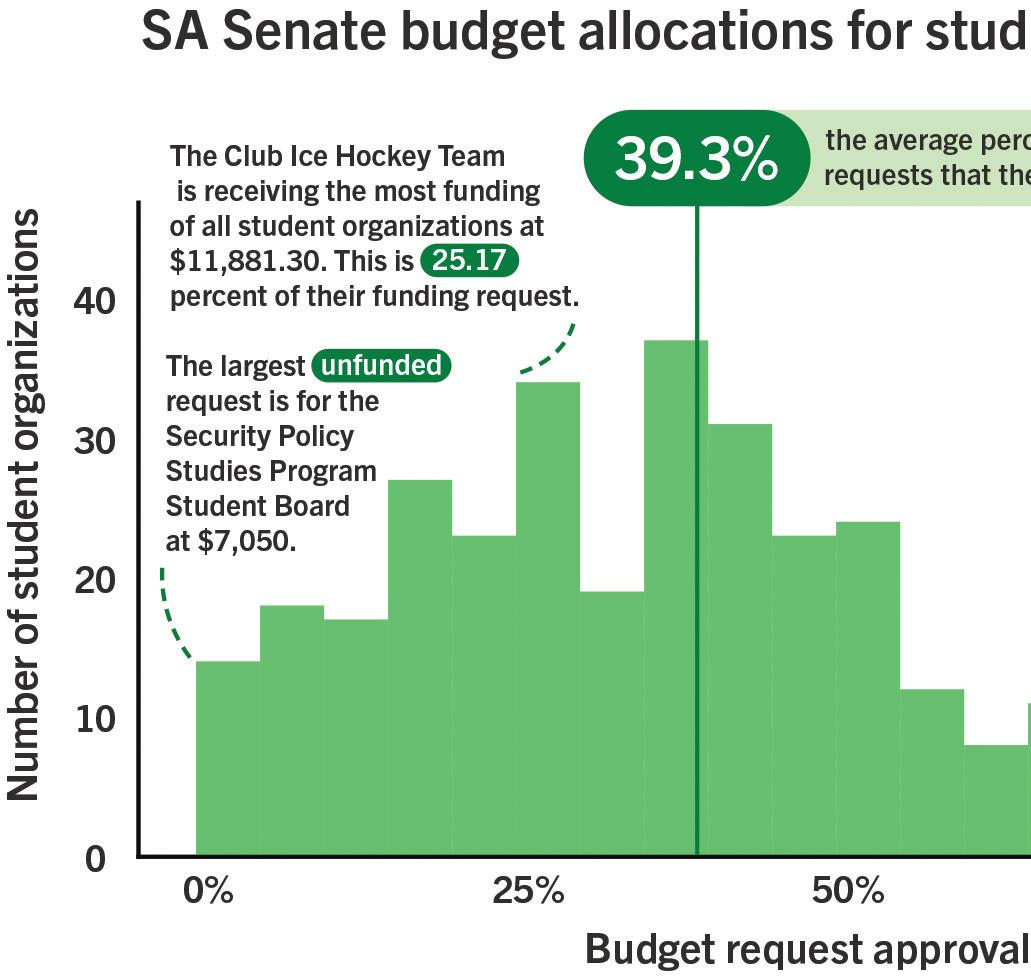
Senators unanimously passed a bill allocating about $265,000 to student organizations for the fall semester, an increase from the spring, when the senate distributed $240,000 to organizations.
Nathan Nguyen, the director of the Legislative Budget Office, said requests for funding from organizations totaled roughly $1.7 million dollars this term.
Nguyen said 280 student organizations applied for SA funding for the fall semester, a slight decrease from the 296 organizations to request funding in the spring. He said the drop may have been due to organizations not reregistering or forgetting to reapply for funding.
“The requests totaled about $1.7 million, and we had $459,000 available,” Nguyen said at the Monday meeting. “That includes everything with general allocations, immediate disbursement, appeals and it also includes the club sports budget.”
Nguyen said the senate changed the club sports budget to give allocation power to the Club Sports Council— a separate governing body consisting of a representative from each club sport—to allocate funds from the senate and decide how much money each sport will receive, pending final approval from the finance committee.
“We give them a bucket of money and then they’re free to deliberate and then the finance committee has oversight and approval on the final numbers,” Nguyen said.
Nguyen said unlike the senate—which allocated funds for solely the fall semester—the Club Sports Council decided to allocate funds to club sports for the entire 2023-24 academic year, contributing to the $1.2 million gap between the funds requested and the funds allocated.
“This number of what’s available is slightly inflated because they spent a majority of their budget as opposed to us,” he said.
Nguyen said the approval rate of requests granted to student organizations increased to 36 percent this cycle, a jump from the 29 percent approval rate from the previous cycle.
Newly elected SA President Arielle Geismar said during her campaign she plans on auditing the general allocations process and hosting training sessions to inform organizations on how the allocations process works.
EMeRG, which provides emergency transportation and responds to student distress calls, received the largest share of non-club sports funding with $9,500 in allocations—less than a third of their request for roughly $27,000. Eight student organizations did not receive any of their requested funds, including the Black Public Health Student Network, the Education Policy Student Association and the Organiza-
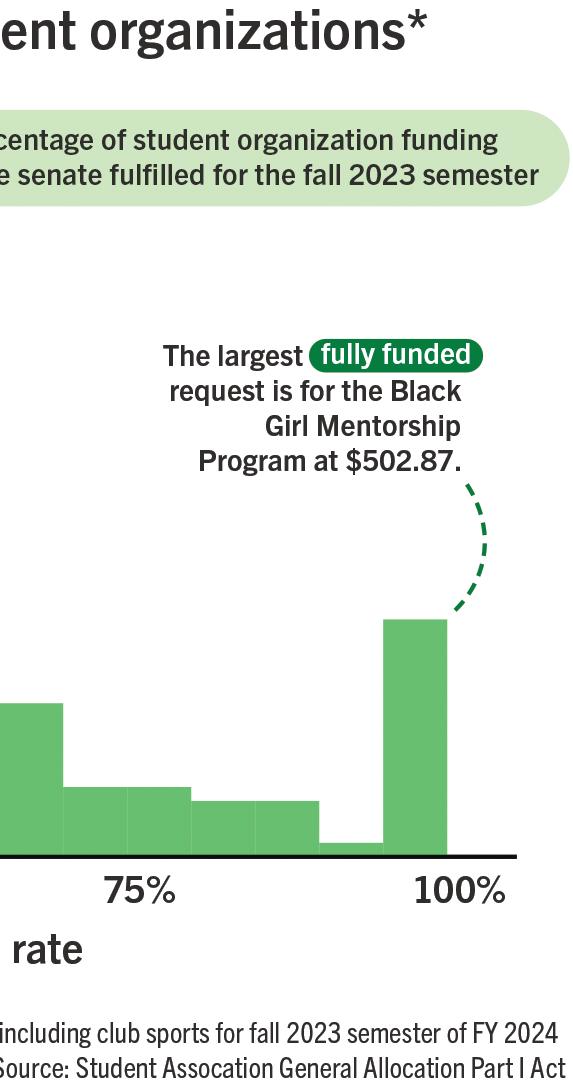
tion of Asian Studies. Leaders of two student organizations that received more than $3,000 in allocations said that while they are grateful for the funds they received, they feel that the general allocations process is unreliable.
The senate disbursed $3,620 to GW Bands after the group requested $12,114.77, according to the bill. Matthew Brooks, the president of GW Bands, said while the band received the “normal” amount of allocations this semester, the spring 2023 cycle was a “fluke” for the band as they received only $1,000 of the roughly $16,500 they requested. He said prior to the previous cycle, the band was “consistently” receiving around $3,000, and this semester went back to “normal” because they received more than $3,000.
Brooks said the majority of the money the band requests goes to repairing instruments because it is more “cost beneficial” to repair instruments as necessary instead letting them “deteriorate.” He said the band had to forgo many repairs because they did not receive enough money last cycle.
“We didn’t make as many instrument repairs as we needed,” Brooks said. “The thing about repairs is you can push them off, so we pushed them off because we don’t have the money to do it.”
Nzah Tajuddin, the treasurer of the GW Bands, said the bands typically receive between 10 to 25 percent of their requests, but they “always” appeal their application to try and receive more
There are 82 veterans in the U.S. House of Representatives, according to the House Committee on Veterans Affairs. Jackson said he enlisted after the September 11 attacks and served in the Kandahar Province during the Afghanistan War.
Jackson said one big difference between being a state senator and a member of Congress
money. Tajuddin said the band received an additional $300 in the appeals process after initially receiving just $700 for the spring semester. She said the band has a revenue account with money saved in case an instrument breaks, but the account balance is “constantly declining” because they have no extra income to put into the fund.
“We mainly rely on the SA to give us funds to repair these instruments,” Tajuddin said.
Tajuddin said she would prefer to have a pool of money that she could pull from if needed in the future. She said under the current process, the senate allocates funds to specific categories, like instrument repairs of durable goods, and the band is unable to use these funds unless their need falls under the category’s definition.
The senate allocated the entire amount of requested funding to 16 student organizations of the 280 that applied, including $100 for the GW Urban Studies Initiative, a student organization that works to educate and facilitate discussion about urbanism at the University.
Omkar Joshi, a sophomore majoring in political science and the organization’s president, said the initiative will use the funds to purchase office supplies, poster boards and stationery for events like organization fairs and tabling. The senate previously granted the organization $200 of the requested $400 for the spring 2023 semester, according to the spring allocations act.
is the amount of scheduling requests he gets. He said his office goes through “50 to 60” requests a week while as a state senator, Jackson said he had to “make things happen” to get invited to events.
“That’s a totally new part of my life,” Jackson said. “Doing stuff like this on a daily basis, and the number of people to meet with this is a totally new part of it.”
From Page 1
“We also acknowledge the importance of ensuring all GW community members are aware of the tools and technologies currently in place to support safety, including building electronic access, classroom emergency lockdown buttons, and emergency notifications,” Metjian said in an email. The University’s Emergency Response Handbook states individuals should call 911 and follow “Run, Hide, Fight” guidelines, which say people should evacuate, hide if fleeing is impossible and fight back as a last resort.
Ten of the University’s 12 peer schools follow the “Run, Hide, Fight” guidelines from the Department of Homeland Security and Federal Bureau of Investigation active shooter response recommendations. Seven of 12 peer schools also offer optional active shooter training in addition to “Run, Hide, Fight” guidelines to students, staff and faculty.
Professors raised concerns in a Faculty Senate meeting last month about the lack of active shooter preparedness training and resources provided to GW faculty after voicing feelings of exclusion from the Board of Trustees’ decision to arm some GWPD officers next fall.
Interim University President Mark Wrighton said at at the meeting last month that the Board informed the senate’s Executive Committee of the decision to arm GWPD officers April 11, two days before the news was announced to the University community, an action that senators said violates shared governance principles agreed upon by the senate and the Board in spring of 2022. The shared governance principles state faculty have a “meaningful role” in “key” decision-making processes.
Murli Gupta, a faculty senator and professor of mathematics, said during the meeting that he has received no active-shooter training during his almost45-year tenure at GW, and many senators
were unaware of emergency response resources like classroom emergency buttons located in academic buildings. The University in 2019 began installing emergency buttons in classrooms that shut down GWorld access to the room and notify GWPD officers of emergency situations when activated.
Harald Griesshammer, a faculty senator and professor of physics, said during the meeting that he polled 20 faculty members about their awareness of the emergency buttons and reported that none of them were aware the buttons existed.
“Apparently, there needs to be a ton more communication about this, in particular since the button is actually only useful if it’s used in the emergency, which means you have to be able to find it under stress and actually remember that it exists,” Griesshammer said during the meeting.
Abigail Agresta, an assistant professor of history, said the University provided emergency preparedness training during her faculty orientation in fall 2019 in the form of a video module detailing strategies and maneuvers to use in the case of an armed intruder. She said the video did not seem “particularly appropriate” to her because it felt like a “video game.”
Agresta said she does not feel prepared to “take on” an active shooter if one enters her classroom because of “inadequate” training that she does not remember in detail. She said she does not believe that responding to an active shooter should be a part of faculty’s job, and while she does not support the University’s decision to arm some GWPD officers, she believes the likelihood of an active shooter on campus presents an “issue” that is larger than GW and faculty’s emergency preparedness training.
“I do not feel that I receive training that would prepare me to sort of take charge in these situations, but also, that isn’t really the job I was hired to do,” Agresta said.
Whether officials plan to end the geology program p. 1
“Barbie reminds women to be our most unapologetic selves and to never be embarrassed for who we are or what we want.”
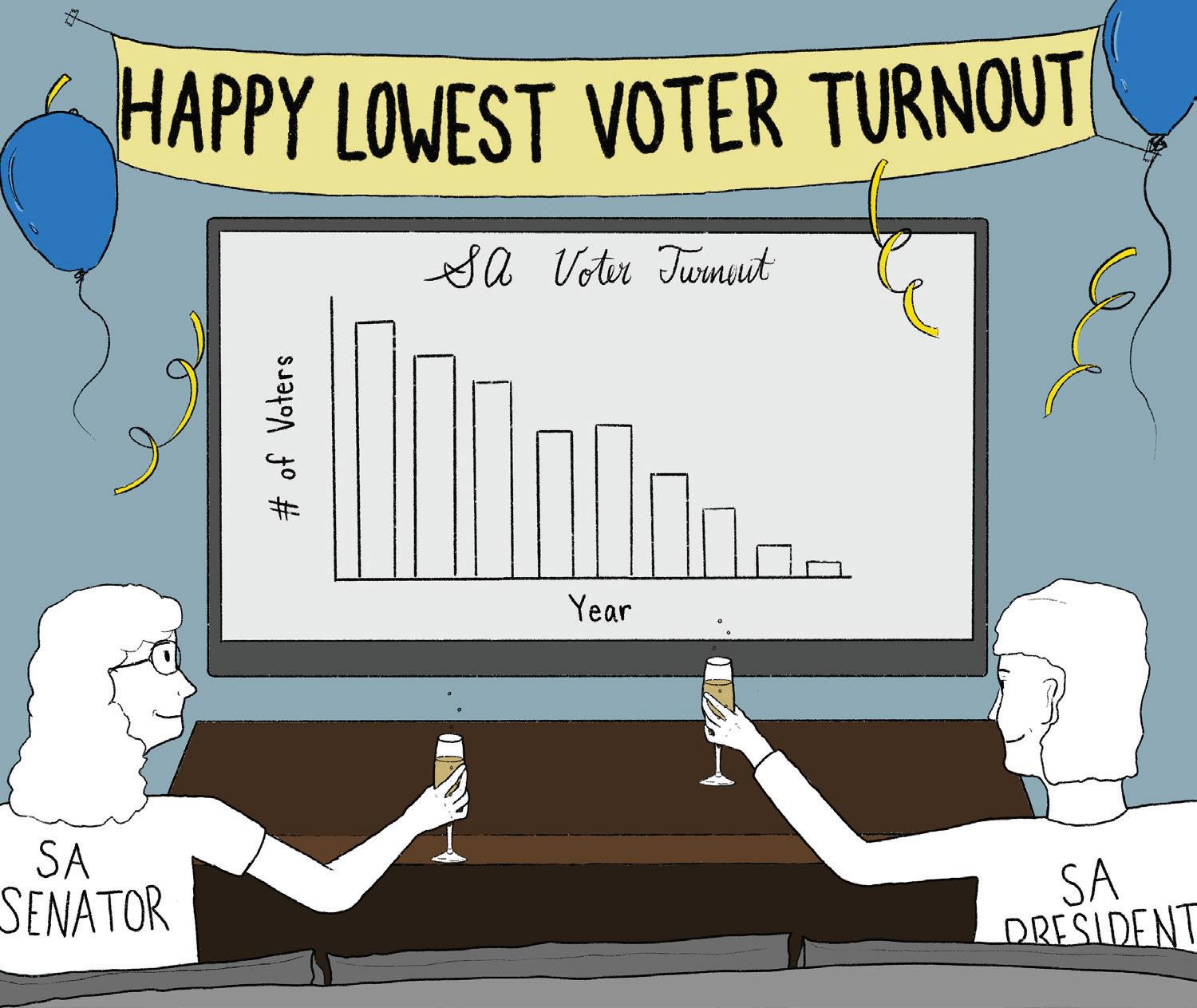
Agrand total of 2,190 students turned out to vote in last month’s Student Association election—a crowd that wouldn’t fill half the seats in the Smith Center. GW students take pride in being politically active, but we’ve fallen short of our responsibility to vote on the most direct form of representation we have at GW.
To increase voter turnout in SA elections, candidates for office need to promote election awareness and clean up the SA’s reputation, while students should create an organization dedicated to solving this issue. A small fraction of the student body shouldn’t decide next year’s election. If we want better representation in the SA, we need to vote for it.
Although GW’s student voter turnout in U.S. elections is above the national average for American higher education institutions and steadily climbing, voter turnout in SA elections continues to plummet. Last month’s election had GW’s lowest voter turnout in 10 years. If that statistic sounds familiar, it’s because we sunk to the same embarrassingly low mark in 2022. A whopping 8.5 percent of the roughly 25,000 eligible students voted in the 2023 SA elections, down from 10.4 percent turnout in 2022’s race.
If voter turnout’s downward spiral continues, the SA will lose a little more of its legitimacy with every year that passes. The Joint Elections Commission blamed the pandemic for low turnout in 2020 and 2021. Last year, the JEC heralded the return of “in-person campaigning” as the fix for GW’s voter turnout dilemma. But 2022’s election turned out even fewer students than 2021’s race did. Pandemic excuses for poor turnout didn’t work this year, and they won’t work in 2024, either. While students might be tempted to only focus on next year’s nationwide general elections, we should also make the 2024 SA election a political priority. Though their need-
less legislation and performative arguments might convince you otherwise, the SA’s chief purpose is promoting students’ interests.
The SA will have a $1.31 million budget for the next school year, and its members will be responsible for allocating about $900,000 in funding to GW’s more than 500 student organizations and club sports teams. And over the last decade, the SA worked with officials to extend fall break and bring a freshman forgiveness policy to GW, allowing students to retake one course from their first year if they received a D+ or lower.
The student body should know about
elections well before they take place, but candidates aren’t taking advantage of their inperson campaigning opportunities. Students once packed Kogan Plaza for the SA’s annual postering day, when candidates sprint to advertise their campaigns on the most visible walls and walkways on campus. Only two SA candidates showed up in 2022, though, and a total of six candidates participated in 2023’s postering day.
Candidates must commit to full-fledged, in-person campaigns in 2024 and beyond. If aspiring student leaders co-host their campaign events with club sports, Greek organi-
zations and every student group in between, election awareness could skyrocket.
Campaign staffs are historically a huge component of successful SA bids, but recently, some candidates have stopped treating elections as a team sport. GW is full of students who would give up a lot for a little campaign experience. By growing their campaign staffs, SA hopefuls will have the personnel to host large-scale events like intramural soccer tournaments and informal happy hours that create buzz for the election.
The rest of the student body should create a campus organization dedicated to promoting voter turnout in SA elections. When GW students outvoted our peers at other schools in 2020’s U.S. presidential election, we didn’t do it by ourselves. We had help from GW Votes, the Nashman Center for Civic Engagement and Public Service’s task force focused specifically on getting students to the ballot box. By working with candidates to plan debates, fundraisers and information sessions to encourage students to vote, the group can organize creative programming that mirrors GW Votes’ success.
When more than 90 percent of the student body fails to vote, though, we forfeit our representation, leaving the SA’s members with no check on their worst impulses.
Last summer, former SA President Christian Zidouemba suffered an attempted coup d’etat at the hands of his own cabinet. And if that didn’t convince students of the SA’s delusions, the JEC’s decision to disqualify three candidates from the ballot took care of any doubts. To earn students’ respect, SA members should stay out of The Hatchet’s headlines and start governing responsibly.
Remember that there are two elections to look out for next year. By running meaningful in-person campaigns, replicating GW Votes’ progress and repairing the SA’s relationship with students, we can boost turnout in SA elections one vote at a time.
—Matthew Donnell, a junior majoring in political communication and English, is an opinions columnist.
H Street is the backdrop for many #OnlyAtGW moments on our campus. For some students, that includes getting hit, or nearly hit, by a car.
Student Association candidates, local officials and student researchers have looked at ways to turn H Street between 21st and 22nd streets into a shared space for motor vehicles and people. While these renovations—assuming the University and the city agree to them—may take several years to implement, it’s worth imagining what H Street might look like in the future. Renovating H Street with pedestrians in mind could make it safer and create a new community space on campus.
This isn’t the first time the University community has considered the safety of H Street—with the city’s approval, GW installed a crosswalk between Kogan Plaza and District House in fall 2018. But that hasn’t assuaged safety concerns at this hotspot for vehicle collisions on campus. District data shows drivers have struck at least six people on the 2100 block of H Street since 2010. Two of those collisions occurred after officials installed the crosswalk in 2018, one in April 2019 and one in November 2019.
The flow of people crossing H Street, particularly at the two mid-block crossings outside District House and the University Student Center, doesn’t mix with motorized vehicle traffic. Other than the crosswalks, there’s no signal that drivers need to slow down as they travel the block—and without speed bumps or traffic lights, nothing’s forcing them to tap the brakes. So it’s pedal to the metal for drivers on long, straight, flat H Street. In 2020, The Hatchet reported more than 90 traffic collisions had occurred on the four blocks of H Street running through campus in the last decade, according to city data.
There’s no single solution to traffic safety, and officials have a sliding scale of options to pick from. Of course, they could do nothing. But ideally, they’ll consider pedestrianizing H Street, sharing the road between people and cars or closing the block to cars entirely, opening up every inch of asphalt to the community.
What might this new, shared H Street look like? Whichever route officials take, the overall goals are the same—slow down traffic, make it easier to cross the street and reduce the risk and severity
of collisions. To that end, we might see bollards, benches and bike racks to keep cars separate from pedestrians, while trees and planters could turn the straightaway of H Street into a curved, slalom-like course that would force drivers to slow down. It’d still be possible to drive and park on H Street—preserving access to the student center’s garage—just not as quickly or conveniently. But that’s a small price to pay for a better, safer street.
Renovating H Street may seem like a radical move, but pedestrian streets aren’t foreign to Foggy Bottom, let alone the rest of D.C. I Street is permanently closed to cars between 23rd and 24th streets, right by the Foggy Bottom Metro station.
The University has even closed off H Street before—officials restricted access to the street, Gelman Library, Kogan Plaza and parts of the student center during GW’s bicentennial celebrations in October 2021.
With seating, shade and the occasional food truck or community event, H Street could become a place to go to instead of a place to go through—think of the project as an expansion of Kogan Plaza.
The largest obstacle facing any renovation of H Street isn’t finding consensus—it’s putting whatever plans the University community, officials and Foggy Bottom residents agree to into action. The crosswalk between Kogan Plaza and District House had been a long time coming. It took officials 12 years to introduce final plans for the crosswalk between Kogan Plaza and District House since they initially proposed it in 2006.
To be clear, it’s not as if GW slowwalked the plan—it was always part of officials’ long-term vision for the University’s future. But any changes to H Street have to go through the city’s Office of Planning and the D.C. Department of Transportation, which rejected an earlier design of the crosswalk in 2016 because it was too wide.
Whether they’re accompanied by full presentations or just murmurs of something to come, any plan to pedestrianize or close H Street is preliminary at this point—and that’s precisely why it’s worth talking about. Even if it amounts to a few traffic cones or a metal barrier rather than the perfect pedestrian street, this is a chance for students to advocate for a transformational change on campus step by step.
Something extraordinary exists in the basement of the ever-charming and everaging Bell Hall. Students gather around icy-black lab tables with rock and mineral samples strewn about, communally deciphering the secrets they hold.
Geology students have dedicated countless hours to unraveling the arcane nature of our planet, and we speak for every geology student when we say there is nothing else we’d rather be doing. Geology is more than just dusty rocks in an old basement, the extravagance of a mineral display or deep time, the millions or billions of years it can take geological phenomena to unfold. GW geology is a strong community built from late nights scratching rocks and discussing river morphology. But the tight-knit community we geology students have fostered is now under threat from officials within the Columbian College of the Arts & Sciences.
Geology is a small program at GW, and instead of facing the cost of hiring a replacement for Professor Catherine Forster, the only tenured geology department faculty member and the program’s director, the University would rather kill the program and put an end to what it gives students—opportunities to lead independent research, become a lab instructor
or connect to major institutions like the U.S. Geological Survey or the Environmental Protection Agency.
If CCAS succeeds, every geology student would lose their education and their community. As part of this community, we know that many of our peers in the geology program are feminine or queer—ending the program would take away a vital space for some members of the University. Even students outside the program would feel the weight of the decision. Other subjects taught at GW build on or require students to take courses taught within the geology program for their majors and minors.
Eliminating the geology program would not just harm students. Professors within the program, many of whom are not full-time and lack tenure, have given their professional lives to teach geology and connect with passionate students. Forster has constantly encouraged and welcomed us geology students as an ambassador to the study of earth sciences. We cannot speak highly enough about what she’s done for the program. But Forster’s passion and enthusiasm is stretched far beyond just teaching—she now has to concern herself with the loss GW’s STEM community would suffer if officials axed the geology program.
Alumni and graduates from the program, many of whom still work and live in the D.C. area, would also feel the pain of this loss. Alumni and undergraduate students in the program have been working on setting up a networking forum to connect with each other this year, but this decision puts these efforts in danger. No student, past
or present, wants to see their legacy washed away. Interest in geology exists here at GW, and understanding earth systems is a priceless skill to have in today’s world. But the University hasn’t invested enough money to tap into that passion. We and our peers have created a tentative plan of action to propose to the decisionmakers within CCAS. Our plan entails restructuring the major, adding field schools and cross-listing more classes. We’re also planning on creating a student organization centered around the study of the earth sciences to drive interest and participation in the geology program. Eliminating the geology program could set a dangerous precedent. Officials could wipe out whatever small department or niche program they see fit to save money in the short term rather than invest money into programs they claim to care about. It could one day be you fighting for the future of your department or program— and your community.
We should be studying for exams, spending time with friends and enjoying the “best years of our lives,” but we can’t. The University has forced our hand to fight the administration for the simple right to learn what we want to learn.
The impersonal goliath of the administration does not create communities at GW—passionate students who attend class each day do. We want to improve the geology program and have the willpower to do so. Our success depends on whether CCAS listens to its students.
—Andrew Gibson is a junior majoring in geology. Sumi Suda is a senior majoring in geology.
— ANDREA MENDOZA-MELCHOR on 4/27/2023.
Let’s pave the way for a better, safer H Street
Every year during syllabus week, at least one of my professors will ask students to share a fun fact about themselves. My goto? That I am a two-for-one special.
“I’m a twin, and we both go here,” I say to my peers. Compared to the people who are forklift certified, have met John Mulaney or have double-jointed shoulder blades, I always consider my fact mundane, but students never fail to gasp at the shocking revelation.
Any viewer of Disney’s “Suite Life of Zack and Cody” is familiar with the concept of pitting twin against twin and the struggle to maintain one’s individuality when being constantly compared to each other, so it’s understandable people may view our situation as odd. It might sound corny, but my fraternal twin Gigi and I are each other’s best friends, so going to college together was a no-brainer, and we’re not alone at GW.
There are at least six sets of twins who chose to attend GW for a variety of reasons, some of whom were actively hoping to get away from each other. But, begrudgingly, several of these dynamic duos grew to appreciate their close relationships.
Sean and Patrick
Identical twins Sean and Patrick Tajanlangit, seniors majoring in public health, said they never entertained the possibility of separating for their pivotal college years as they both applied early decision to GW for its renowned Milken Institute of Public Health.
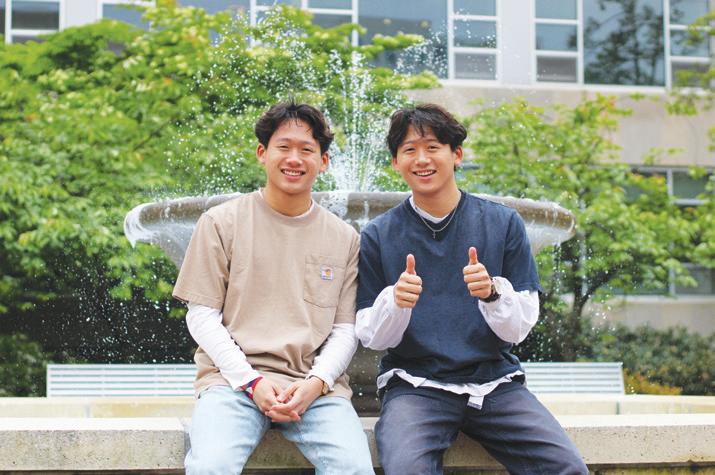
“It was assumed, really implied, that we would go to school together, and if we didn’t, it would be a pretty scary thing,” Sean said.
Beyond a genetic code and an obsession with playing FIFA video games, the pair both hope to become doctors. They
said they have helped each other through their rigorous premedical course loads but only through Academic Integrity Councilapproved means—so no switching places. The “Taj Twins” are even more focused on looking out for each other when their school work gets to be too much.
“He always checks in on me and what I’m doing in school because every once in a while, I fall apart, but it’s always nice having that support,” Sean said.
Frances and Peter
For freshmen fraternal twins Frances and Peter Laufer, going to GW together was an accident.
When they both accepted GW’s enrollment offers, neither was thrilled after they committed to GW separately but each felt it was their best option. Frances and Peter said they hardly spoke to each other for the first two weeks of school as they
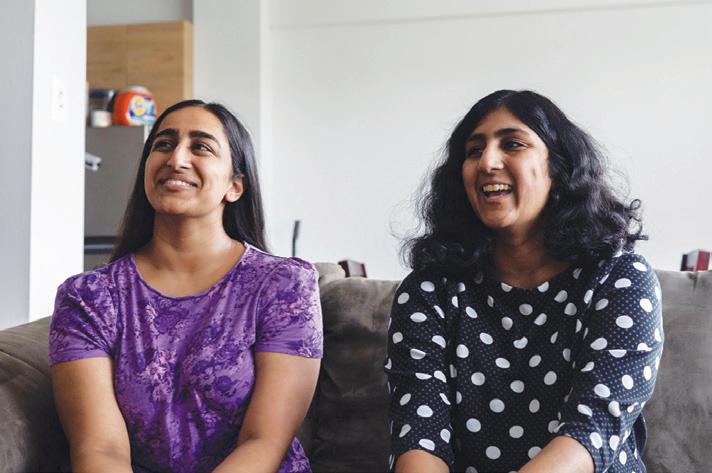
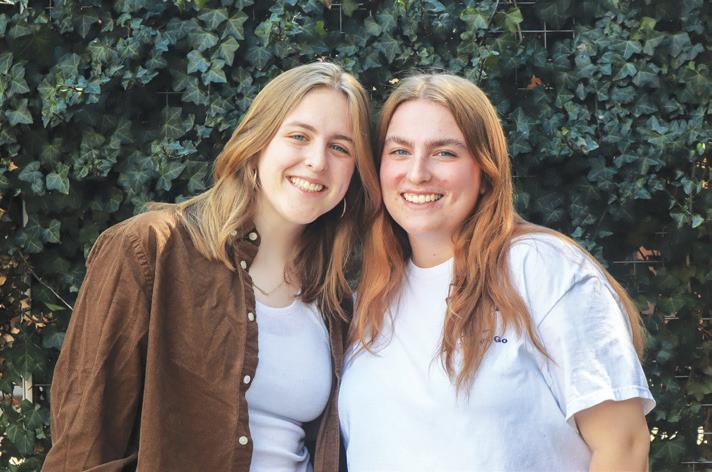
the tunes blasting over the lecture hall speakers by projecting the music videos onto the boards in her classrooms.
settled into college. But after they got into the rhythm of GW life, they began meeting for meals and working out at the Lerner Health and Wellness Center together, growing closer as the year continued.
Frances said Peter is a major supporter of her creative activities—a fixture in the audience for her GW Balance dance recitals and GW Comedy Nights stand-up performances while she attends his on-campus squash games.
“It’s nice to have one person that you know you can count on,” Peter said.
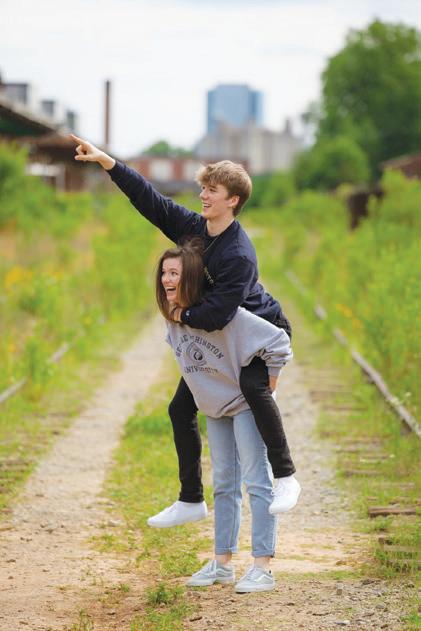
Pallavi and Pavani
Pallavi Dev, a senior majoring in cognitive neuroscience, almost ended up attending college on the other side of the country from her twin sister. She said she originally wanted to go to the University of California San Diego because it offers a wider variety of majors. But after touring GW’s campus, her parents convinced Pallavi to compromise and attend GW with her fraternal twin sister Pavani because they thought highly of the medicine program, and it would be more convenient for them to visit the pair.
“Our parents really wanted us to stay together despite what we wanted, and so I didn’t actually really want to go here, but she did,” Pallavi said.
The two are best of friends now, living in an off-campus apartment with mutual friends together. They frequently text each other the equivalent of a diary each day, filling the other in on everything from run-ins with mutual friends to debating their favorite moments from the show “Grey’s Anatomy.”
“It’s just nice knowing she’s here because if I want to rant about something or ask about something I can just ask her,” Pavani said.
Reese and Sophie
Reese Holtzman, a sophomore majoring in psychology, said she and her fraternal twin sister Sophie originally hoped to finally branch out of their high school bubble of shared friends and activities by going to different colleges. But they said after receiving their acceptance letters and walking around GW’s urban campus, they fell in love with the idea of going to school in D.C.
Sophie and Reese said they were pleasantly surprised by the independence they found in their distinct majors and subsequent diverging interests in student organizations.
“I feel like it’s been nice to have each other here,” Sophie said. “Like in the off chance that we do need someone from home for something or just the feeling of home.”
a lot of local resources,” Rivadeneira said.
For co-founder of GW Sustainable Fashion Ari Rivadeneira, fashion is an art, but the fast-paced industry process has corrupted this powerful form of expression.
A total of 19 student models walked the Sustainable Fashion Show runway wearing bright scarves, fashionable sunglasses and flashy pearl belts in GW Sustainable Fashion’s event at the GWU Textile Museum Friday. Rivadeneira said the event’s mission was to spread awareness about alternatives to the fast fashion brands whose unsustainable production practices harm the environment.
With planning for the show beginning in January, Rivadeneira said the event focused on promoting sustainable outfitting through upcycling, a form of purchasing secondhand items and hand-making clothing. Rivadeneira said the broad theme of the collection, spring season, allowed them to find pieces with a variety of silhouettes, styles and colors — clothes that “you would wear on a sunny day” like bright skirts and chic sunglasses.
Rivadeneira said. “I think it’s beautiful.” Rivadeneira condemned microtrends and the tendency of people to purchase clothing that is momentarily the rage before it becomes outlandishly outdated, causing people to stop wearing the clothes and throw them away.
The sounds in most GW classrooms consist of clicking keyboards and professor droning on during lectures — but in some classes, the halls are instead filled by the soaring guitar riffs of 1980s rock.
Professors from all corners of GW said their motivation for incorporating tunes ranges from using fast-flowing hip-hop lyrics to encourage students to pay close attention to a lecture to playing the hard-pounding drums of heavy metal to push pupils to give a punching bag one extra hit. Music plays a role in GW classes beyond lessons structured around music theory, with professors teaching subjects from cardio kickboxing to American cultural history playing music as a crucial part of their teaching style.
Gayle Wald, a professor of American studies and English who teaches about modern American cultural history, said she plays music as her students are settling into class, both to set a comfortable mood for the class ahead and to put the themes of that week’s lecture in the minds of students. Wald also encourages students to pay attention to the visual and narrative aspects like the video and reception of
“I am teaching from the perspective of a cultural historian, so while I ask students to listen to music
I am also very interested in extra-musical elements of listening: to video, the settings of musical consumption, fan culture, the function of memory, the role of the body/dance,” Wald said in an email.
Wald said she plays some classic songs all her students know, and while many enjoy just hearing music already at the top of their Spotify playlists, she also takes advantage of the opportunity to introduce students to activist artists, like Asian American musician No-No Boy who writes songs about Japanese internment camps.
“It’s hard to keep up with new things, especially as you get older and your ears get more stuck in their ways,” she said.
Roy Grinker, a professor of cultural anthropology who specializes in courses on African culture, said he typically gets to class early and starts playing music like the high-energy Mexican band Grupo Frontera so students will feel comfortable coming up to him to ask questions about assignments, even if the music bears no relation to those assignments. Shy students are
nervous to ask questions in front of the entire class, but Grinker said background noise gives students confidence, knowing that their classmates will not hear them.
“A silent classroom does not encourage students to approach me, or perhaps even talk with each other before a lecture begins,” Grinker said.
Brian Stamps, a lifestyle, sport and physical activity professor who teaches cardio kickboxing classes, said he uses music to motivate his students to get through another minute of push-ups in his classes. He said he tries to find songs with more than 120 beats per minute, a high tempo, like many classic rock songs because studies have shown these types of songs loosen the burdens of intense exercise.
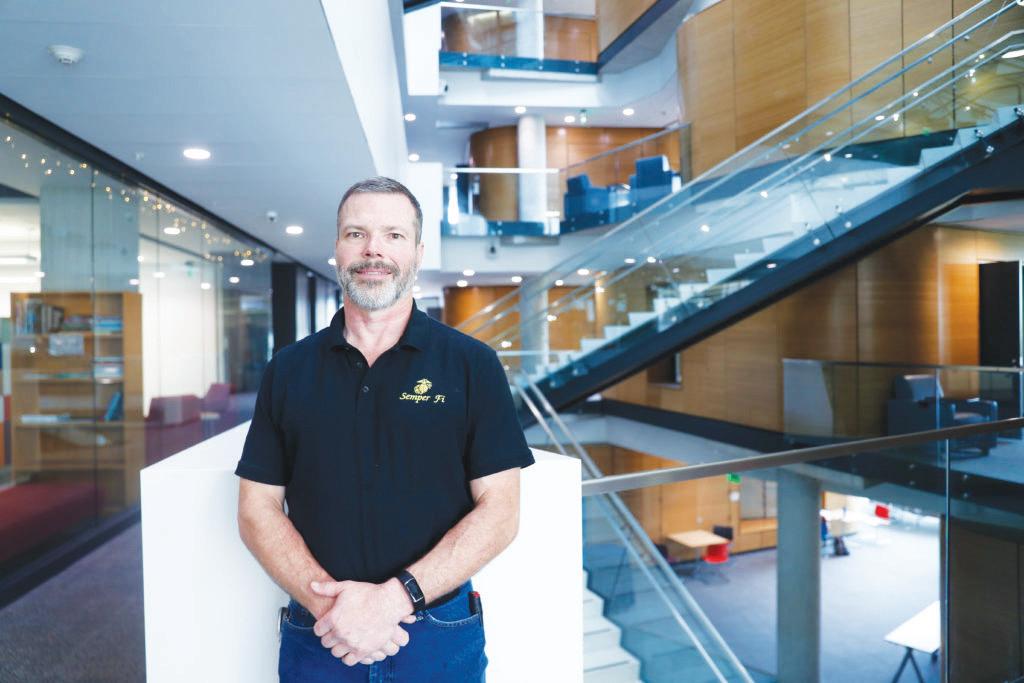
“Do you ever try working out listening to nothing but what’s going on around you?” Stamps said. “It becomes very boring very quickly.”
Stamps said he also plays music during the class workouts he leads to introduce students to classic tracks they may not have heard before. He said he often starts his lessons with 1980s rock songs like Van Halen and AC/DC since that’s what he jammed to growing up, before moving into more contemporary pop and rock, but sometimes his students view these songs as retro hits.
“We only have one world and we can’t exploit it anymore,” Rivadeneira, a junior studying environmental science and sustainability, said. “I don’t really think there’s a need for fast fashion at all. We want to keep this world and respect it and have it for future generations.”
The club borrowed the models’ clothing from local clothing shops in the D.C. area, including Tribute Collective, Happy Flores Shop and Slowdown Market and took clothes from the closet of student designer London Skye Roberson, a co-founder of GW Sustainable Fashion.
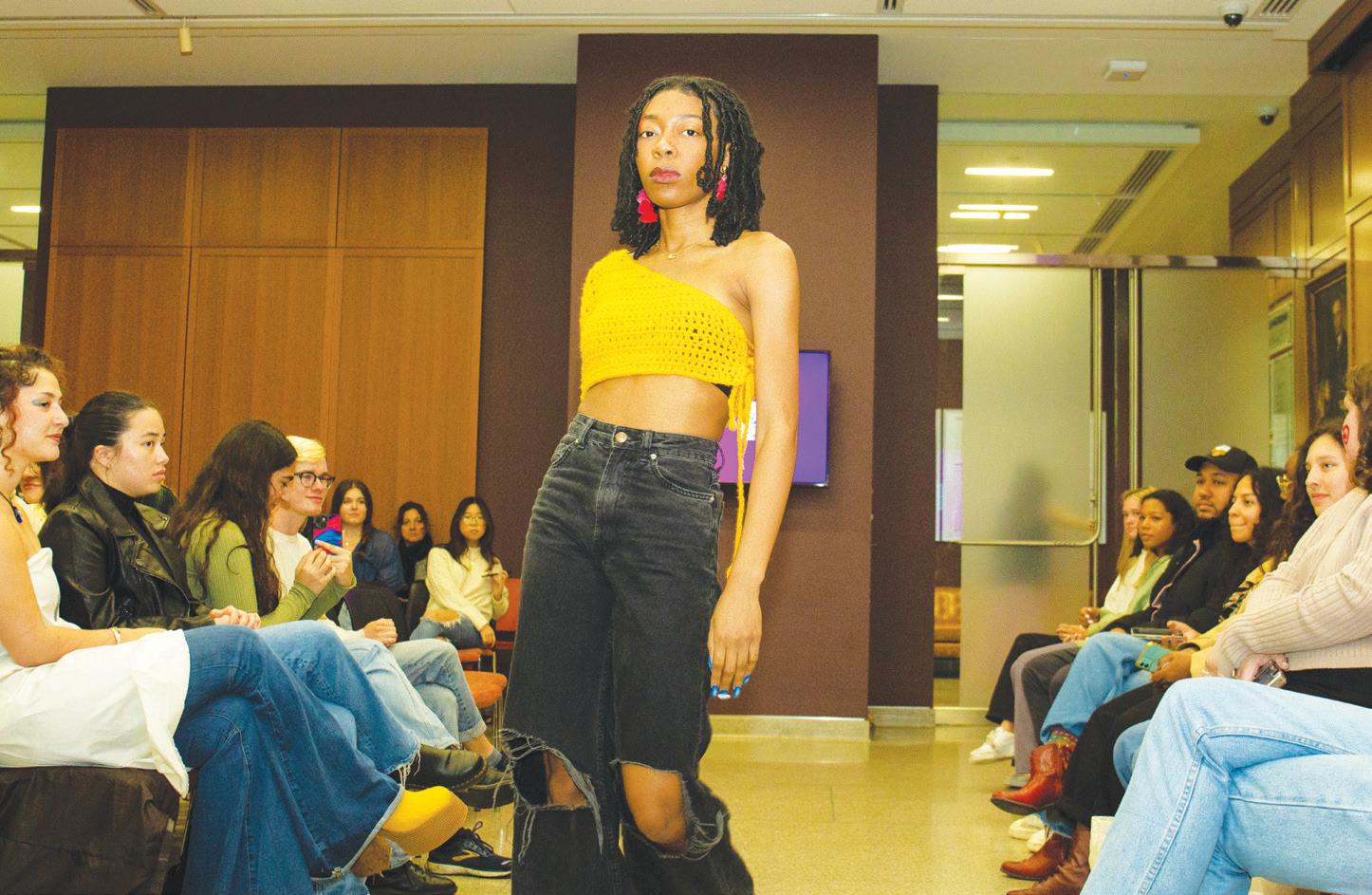
“The point was to kind of show people that there’s
On a rectangular runway surrounded by chairs, models showcased several pieces of handmade clothing on the corners of the stage, including a vibrant lime-green knit matching crop top and mini skirt set courtesy of Roberson. Another model sported a pair of gradient yellow and red pants hand-painted with blue abstract scribbles.
Several models dressed in secondhand and vintage items including accessories like sunglasses and platform shoes. Rivadeneira said aside from the stylistic benefits of wearing vintage clothing, buying secondhand ensures clothes are able to live a longer life outside of a landfill.
“Getting secondhand items, it’s like you’re taking a piece from a different decade that has a different story and putting it into your narrative and stuff,”
The models were all students who auditioned and were selected to walk the runway — Rivadeneira said they wanted to accept everyone interested in modeling. Ruth Holliday, a member of Sustainable Fashion’s programming board, said the models were given creative freedom to pick out their own outfits, with hand-painted springcolored pants and old shorts lined with eye-catching lace all through the event space.
Reva Dalmia, a freshman majoring in international business, said she was excited to exercise her confidence on the runway and loved the feeling of “commanding the stage.” She said she is concerned with how fast trend cycles cause so many pieces of clothing to end up in landfills and she said it is important to raise awareness about various sustainable initiatives.
“More people are starting to realize that fashion, being one of the biggest contributors to environmental waste and those kinds of issues, it’s something that we really have to pay attention to,” Dalmia said.
Softball bested University of Massachusetts, Amherst 2-1 in a three-game series this weekend, winning the final two games with big showings on offense after surrendering a walk-off home run in the opener.
The Colonials (17-25, 7-16 A-10) showed their resilience in a pair of wins against the Minutewomen (15-31, 6-16 A-10), and despite struggling at the plate in Friday’s first game, GW dominated in the final contests to outscore UMass 15-9 in the three-game series. The series win should provide a morale boost for the Colonials, who have had a disappointing season after years of success in the A-10. Game 1
The Colonials dropped the series’ first game against UMass 2-0, with Minutewomen freshman catcher Olivia Packard drilling a two-run home run in the bottom of the ninth to break the scoreless tie in extra innings.
UMass senior pitcher Jessie DiPasquale went all nine innings, earning five strikeouts and allowing eight batters on base.
On the GW side, freshman pitcher Rose Cano went 8.2 innings scoreless until Olivia Packard’s crushing walk off. She struck out four and allowed seven hits and two walks.
Senior infielder Maggie Greco hit a double in the first inning, an early burst of power the Colonials struggled to build on.
Moving into extra innings, the pitching duel between DiPasquale and Cano continued, with both
sides remaining scoreless through the eighth. But with UMass up to bat at the bottom of the ninth, junior infielder Abby Packard knocked a single with one out, putting the game-winning run on base for the Minutewomen. Cano then struck out Bradley, and Olivia Packard came up to bat with two outs, hitting her first career home run to win the game for UMass.
Game 2
In the second leg of their Friday doubleheader, the Colonials won 8-5, thanks to a five-run seventh inning to put the game away.
Pitching for GW was freshman Emma Fales, who went a full seven innings, pushing through UMass scoring bursts in the first and fourth and allowing just three earned runs on 10 hits with one strikeout.
The Minutewomen lead stood at 2-0 until the bottom of the fourth inning. With the bases loaded and two outs on the board, Whittier hit a single to right field, batting in Whelan and junior outfielder Jordyn Graime who pinch ran for Olivia Packard, extending the UMass lead to 4-0.
In the sixth the tide started to turn, as singles from Greco and graduate student infielder Arizona Ritchie knocked in three runners— freshman catcher Reese Fales, Greco and Reese Torres, bringing the score to 3-4.
Singles by junior utility player Abby Schaub and freshman outfielder Ashley Corpuz brought in one run each, giving GW a one-run lead with one out in the seventh. But Greco blew the game open, hitting a three-run bomb to score her, Torres and Lew to extend the lead to four.
Despite UMass infielder Abby Packard batting in one run in the bottom of the seventh, the Colonial lead proved too much for the Minutewomen to overcome, and the two teams split Friday’s doubleheader.
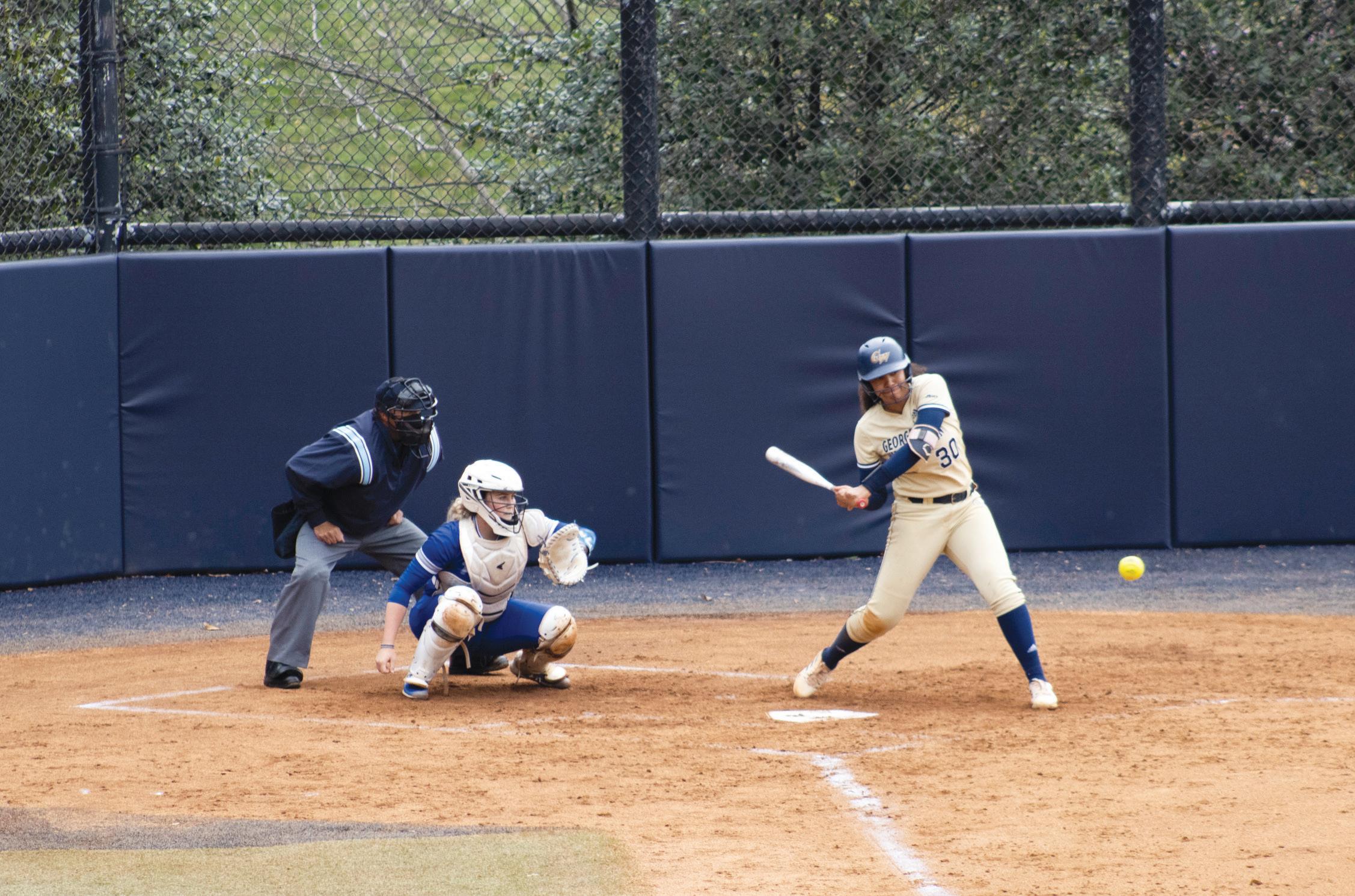
Game 3
In Saturday’s third game, GW bats came out late once again, with a four-run seventh inning cementing a 7-2 Colonial victory and a muchneeded series win.
After a season of breaking both school and personal records, GW men’s and women’s track and field have their sights set high for the A-10 Championships Saturday and Sunday in Amherst, Massachusetts.
The Colonials look to dominate the tournament with a squad led by senior Ryan Fowkes, the A-10 champion for the 1500-meter last season, as well as A-10 all-rookie team freshman Sarah Mitchell, who posted the best mile time of any freshman in the conference during the indoor season. The men’s and women’s track and field teams hope to improve their performances from last season, where they placed 10th and 11th place respectively out of the 13 teams competing in the A-10 Championships.
“Championship season, especially, isn’t so much about time and more so about place,” Assistant Coach Samantha Nadel said. “Can we score points at the conference meet, which is top eight? Can we get on the podium, which is the top three in the A-10?”
The men’s track and field team freshman Michael Bohlke, freshman Jacob Heredia, senior Pat Castellano and senior Fowkes shattered the GW record at the distance medley relay—a race split by 1200-meter, 400-meter,
800-meter and 1600-meter legs— with a time of 9:44.48 at the Penn Relays in Philadelphia Friday. Fowkes anchored the 1600-meter leg in 4:01.43, bringing GW up from ninth to fourth place out of 18 teams.
“I’m really looking forward to taking my season longer this year and qualifying for the NCAA regional meet and then eventually, hopefully, the national meet as well,” Fowkes said. ”
Fowkes, who held the GW record in the 800-meter and 1500-meter outdoor track events coming into this season, broke both again this season. His 1500-meter time of 3:43.14 was more than half a second better than his previous best of 3:45.56, and his 800-meter time of 1:51.38 was more than a second better than his record-breaking 1:52.51 time last season.
Fowkes said he was aiming to compete in February’s A-10 indoor winter championships, where he hoped to break the 4-minute mile time, but because of an injury, he spent most of the winter in the pool cross-training.

Senior Thomas Sand placed second in the 5000-meter with his 14:14.41 time, a school record that outpaced the previous record by nearly seven seconds.
Sand’s record-breaking season continued when he finished the 10,000-meter in 30:08.96 at the Virginia Challenge April 21, topping the previous Colonial mark that had stood for four
years by just 52 seconds.
The women’s track and field season has featured impressive performances by freshmen runners, including a schoolrecord 4:15.96 in the 4 x 400-meter time from an all-freshmen lineup of Emma Benzinger, Marcella Mancini, Rita Mazumder and Sarah Mitchell in the Towson meet April 1.
Graduate student Yukino Parle rounded out the squad’s wins at Towson with victories in the 800-meter and 1500-meter events, crossing the finish line with times of 2:16.73 and 4:41.98, respectively. Graduate student Lexi Seifert finished less than a second behind Parle in the 1500-meter with a 4:42.76, placing her in second in the race.
As the team heads into the final stretch of competition, Mitchell said the training regiment has shifted from medium-intensity workouts with longer mileage to shorter workouts with higher intensity.
Benzinger and senior Miles Grant toppled the women’s and men’s records at the Hopkins Loyola Invitational in the 100-meter dash, sprinting to finishes of 12.94 and 11.34, respectively.
Nadel said the team is looking to peak in their high-stakes, late-season performances.
“You know, we’re obviously looking at the A-10s as a big meet for us, but we always want to go as far as we can,” Nadel said.
After Greco’s score brought the score to 2-1 in the third, the Colonials never looked back. Ritchie batted in Torres in the fifth with a single, pushing the lead to 3-1.
Following a scoreless sixth, GW came out swinging in the seventh. After Lew walked on the first atbat, Greco reached first on an error at second base, and the fumble also allowed Lew to reach third. Ritchie recorded her second RBI when she batted in Lew on a fielder’s choice, setting up Greco at
third base. Sophomore utility player Gabby Polsky faced the mound with runner’s on first and third and singled on a fielder’s choice, but the Minutewomen threw Greco out at home for the second out of the inning.
Junior infielder Alena Ramirez walked on the next at-bat, loading the bases for Corpuz. The freshman delivered with a single, scoring in Polsky, Ritchie and Ramirez off a UMass error at second base, extending the GW lead to 7-2.
In his third season with the Colonials, junior pitcher Chris Kahler has hit his stride, grabbing personal accolades and helping even his squad’s Atlantic 10 record.
Kahler’s ERA has dramatically improved from his freshman and sophomore marks of 5.17 and 6.62, respectively, and he now sits at third in the A-10 with a 3.21 ERA, helping him earn back-to-back conference Pitcher of the Week awards last month. After pitching primarily as a reliever in his first two years on the team, Kahler’s starter status has allowed him to pitch three complete games and notch four wins this season, tied for best on the squad.
“I told myself there were three things I wanted to do,” Kahler said. “One, be A-10 Pitcher of the Week. Two, win A-10 Pitcher of the Year. And three, lead the team in virtually every category I possibly can.”

Kahler pitched a complete game against Fordham April 16 to clinch the series, earning the Colonials their second series win of the season and his first Pitcher of the Week title April 17. Kahler struck out 10 batters in 127
pitches throughout the game while giving up just two runs and two walks.
He said as the season has progressed, he has adjusted the types of pitches he relies on, specifically his fastball and slider. Kahler said while he’s not an “overpowering” arm zipping his fastball between 88 and 90 MPH, he credits most of his strikeouts to his heater.
During his sophomore season, Kahler pitched, mostly as a reliever, going for 35.1 innings and maintaining a 6.62 ERA. He attributes his success and improvements this year to his new mental approach.
“I’m very hard on myself, and any person who knows me at this school, especially on the baseball aspect, knows how hard I am on myself when it comes to baseball,” Kahler said.
Kahler earned the top accolade a second week in a row April 24 after pitching another complete game against VCU, striking out ten total batters before giving up a walk, leading to a series win. He also surrendered two runs off four hits.
Kahler said despite the teams’ initial struggles, with lopsided series losses against both East Carolina and Fairfield in February, he
hopes his teammates continue to bond and keep up their momentum as they battle through the A-10 slate.
In GW’s Saturday win over Davidson, Kahler headed to the mound as a reliever in the top of the sixth with two runners on and two outs. He closed the inning and kept the score even at 1-1, striking out senior shortstop Jacob Hinderleider looking.
In the seventh, Kahler allowed two singles, but two groundouts and a flyout stranded both the runners. In the top of the next eighth with the game still knotted up at 1-1, the junior tacked on two more strikeouts, keeping the Wildcats off the board.
After a single from sophomore outfielder Sam Gates scored in graduate student catcher Anthony Frechette, GW took the lead going into the top of the ninth. Kahler slammed the door on Davidson in the top of the frame, throwing his fourth and fifth strikeouts before securing the victory on a popup to first base.
“The team goal is not just to make the playoffs, but I want to win the A-10 Championship,” Kahler said. “I don’t want to get there and just have to sit there.”