Opinions
The editorial board condemns the University’s decision to arm GWPD. Page 6
Limited ingredient labeling in dining halls poses risk to students with dietary restrictions
 PRAVINA KHADKA REPORTER
SHEA CARLBERG STAFF WRITER
PRAVINA KHADKA REPORTER
SHEA CARLBERG STAFF WRITER
Bianca Rose, a freshman and member of the rowing team with celiac disease, said dining hall food potentially crosscontaminated with gluten has made her sick to her stomach, causing her to miss practice one evening.
She said she still runs the risk of ingesting gluten-contaminated food prepared in the gluten-free station at Shenkman Hall labeled with a sign that reads “avoiding gluten,” despite lacking any supervisory staff. The counter is separate from Pure Eats, a station in Thurston and Shenkman hall’s dining halls that offers options without the nine most common food allergens including milk, eggs, nuts, fish, crustaceans, shellfish, wheat, soy and sesame.
She said she has seen students using waffle batter containing gluten in the waffle maker at the counter, contaminating the station and posing a “risk” to students who can’t eat gluten.
“It’s just terrible,” Rose said. “It affects my academics, it affects my athletics, it affects my mood. It’s my whole day that’s kind of ruined.”
Rose is one of more than 20 students with dietary restrictions, like food allergies, eating disorders and religious provisions, who said the labeling of food items in dining halls did not clearly correspond to each dish and did not disclose all its ingredients, causing students to risk ingesting food to which they are intolerant.
The University completed its transition to a dining hall-centric system earlier this semester, moving away from the previous model of dining where students had to spend declining GWorld balances at partnering restaurants and grocery stores.
Rose said she purchases food outside of dining halls because Pure Eats staff serve “repetitive” and “boring” options with the same chicken, beef and vegetable options each week. She said she wants to see officials add glutenfree options to the dessert section, where the dining halls currently only serve gluten-based options.
Officials will require all on-campus students
to spend dining funds at District House, Shenkman and Thurston dining halls or The Eatery at Pelham Commons on the Mount Vernon Campus starting in the fall under any one of a series of unlimited or block meal swipe plans – which respectively offer students infinite balances of meal swipes and balances split between swipes and dining dollars.
The University will discontinue the legacy plan for upperclassmen, which allowed them to spend dining dollars at partnered vendors.
A disclaimer on the GW Dining website states dining hall staff attempt to provide complete nutrition and ingredient information but recommends guests with food allergies or other dietary concerns speak with a manager for “individualized” assistance.
“Products may change without our knowledge, and menu items are prepared in close proximity to other ingredients that may result in cross-contact with ingredients not listed, including allergens,” the website states.
University spokesperson Julia Metjian said the Pure Eats section of the dining halls in Thurston and Shenkman are “food-inclusive” areas that operate separately from the rest of the food facility. She said workers serving food at the Pure Eats stations do not work in other parts of the dining hall kitchen to avoid cross-contamination and receive training on food allergies and “safety.”
Metjian said officials will convert the Teaching Kitchen – where students learn cooking skills from dining pro-
fessionals – in Shenkman Hall to a glutenfree station in response to student feedback. She declined to say whether officials have received complaints over unclear labeling of menu items or whether students with dietary restrictions would be able to secure exemptions to mealswipe plans next fall.
“We seek feedback from our students so that our dining program continues to meet the needs of all students,”
Metjian said in an email.
“We have started a student advisory group and will continue to assess the dining program on a regular basis.”
Freshman Sai Charan Chodavarapu, who is allergic to eggs, tree nuts, avocados and peaches, said he visited GW Hospital twice after two separate allergic reactions to onion rings and a grilled cheese sandwich served in the Thurston dining hall in February.
Chodavarapu said he administered his EpiPen both times before checking himself into the hospital, where staff treated him for an anaphylactic reaction.
He said the University failed to indicate if the onion rings and grilled cheese were exposed to eggs in the ingredient list posted by the Thurston Hall meal station, sparking the reaction.
“I’m scared to eat here every once in a while now just because it’s gotten really bad,” Chodavarapu said.
The listed menu item for onion rings on the GW Dining website describes the dish’s ingredients as “battered onion rings,” stating they are vegetarian and “may contain” eggs or dairy.
The dining facility in Thurston Hall opened
last October, and the cafeteria in Shenkman Hall opened at the beginning of this spring semester.
Chodavarapu, a Hindu vegetarian, said earlier this semester, he accidentally ate macaroni and cheese with bits of pork mixed in because the label on the designated screen above the station did not specify the meal contained pork.
“You don’t really know what you’re eating until you bite into it,” Chodavarapu said.
Kyle Reinheimer, a freshman studying international affairs with tree nut and shellfish allergies, said trying to determine which meals are safe to consume at dining halls feels like a “shot in the dark” because ingredient lists posted on screens above menu items and online are not “comprehensive” and include only one or two main ingredients in dishes instead of all of them.
“I grabbed one of those desserts up there, and I was like, ‘Fingers crossed it didn’t have nuts in it,’” Reinheimer said.
One student recovering from an eating disorder, who asked to remain anonymous, said the prominent calorie labeling in food items on the screens at dining halls and online can trigger students trying to overcome a fixation on how many calories they consume.
“If you go on the website right now, calorie count there is also displayed very prominently and in the actual halls,” the student said. “And so for students who might be experiencing an eating disorder as I am, it’s difficult because that’s a triggering thing.”
Culture An inside look at D.C.’s storied underground rock venues. Page 7
Sports Look back on tennis’ regular season as they prepare for the A-10 Championships. Page 8
Student opposition mounts against Board’s decision to arm
GWPD officers
ERIKA FILTER ASSISTANT NEWS EDITOR
FIONA BORK STAFF WRITER
Students have pushed back against the University’s plans to arm GW Police Department officers in the days following its announcement with demands for the Board of Trustees to reverse a decision they say will endanger campus and lacked sufficient community input.

The announcement that GWPD will arm about 20 officers with handguns next fall has raised concerns among students that the move will increase the rate of violent encounters at the hands of GWPD officers, especially toward Black and brown students. GWPD Chief James Tate said he discussed the decision with the Student Association, the Black Student Union and Fraternity and Sorority Life leaders before the announcement, and while some students he consulted said the move can expedite the police response to shootings on campus, nearly 750 people have signed a petition as of Sunday night claiming the move will “escalate conflicts.”
Last Monday, more than 150 students marched from Kogan Plaza to F Street House, interim University President Mark Wrighton’s oncampus residence, to protest the decision. In interviews, half a dozen students said arming officers will equip GWPD officers to respond to incidents involving firearms around campus and improve local security, but 30 students said the officers will pose serious risks to campus safety.
BSU President Gianna Cook and Executive Vice President Drew Dodd said Tate sought their input on Black students’ potential reaction to arming GWPD officers while the Board was deliberating the decision. Cook said Black students have “mixed” views on the announcement depending on their interactions with officers on and off campus.
“We basically let him know the nuance that this is not at all going to be a black-and-white situation,” she said.
Cook said after she was elected to her first of two terms as BSU president in 2021, she spoke with Tate about “rumblings” of potentially arming officers in the future, and Tate sought her and Dodd’s opinion
on the matter this semester once the Board started considering the move.
Cook said before Tate assumed his role as chief in early 2020, GWPD officers were “over-policing” campus and stationed in residence halls, which caused “fear” in the Black community at GW and made her hesitant about arming officers when Tate first mentioned the idea.
After joining the department, Tate implemented a series of reforms centered around community relations and transparency, rolling out body-worn cameras and bias and de-escalation training in August 2020 and introducing community outreach events starting last fall, like monthly “Coffee with the Chief” meetings with students.

Cook said increased criminal activity on campus and nationwide school shootings became the “key definer” behind her support for the decision to arm officers.
Wrighton said the Board decided to arm GWPD officers in response to a rise in nationwide gun violence, including mass shootings on college campuses like those at the University of Virginia in November and Michigan State University in February. The shooting at UVA killed three students and injured two, and the MSU shooting killed three students and injured five.
“I didn’t want it to be said that we waited until it was too late to arm our officers,” Cook said. “I didn’t want a student to be harmed or anyone on our campus to be harmed.”
Cook said unarmed officers cannot respond to on-campus crimes because officers’ de-escalation tactics are “vastly limited” when individuals have firearms. She said students who are troubled with the decision are rightful to feel that way and should discuss their reactions further with GWPD.
“We can wait, wait, wait all we want, but there’s always going to be some hesitancy, some uneasiness with this idea because you would never want to think you’re unsafe,” she said.
She said Tate should hold a public forum with students to share more about the policy before officials implement it in the fall.
“I’m hoping that there are no barriers in place when students want to have that dialogue,” she said.
See TATE Page 5
Summer course tuition ranks third-most expensive among peer schools
GW’s undergraduate summer course tuition is the third most expensive among its 12 peer schools.


Undergraduate students who enroll in online and in-person summer courses pay $2,080 per credit hour this summer – at least $400 per credit hour more than the average summer tuition at 10 of its 12 peer universities. GW’s summer tuition per credit hour this year is a slight uptick from last summer’s price of $1,995 per credit hour and comes after the University raised tuition for the upcoming academic year from $62,110 to $64,700.

Boston University charges students $775 per credit hour for summer courses –the cheapest summer tuition rate out of all 12 peer schools – while Georgetown Univer-
sity trails GW with a tuition rate of $1,910 per credit hour. The two peer schools that charge more for summer courses than GW are the University of Miami, which charges $2,310 per credit hour and the University of Southern California, which charges $2,137 per credit hour.
Experts in higher education finance said higher summer course tuition rates can help a university avert revenue loss caused by students opting to take summer courses instead of classes during the academic year.
Richard Vedder, a distinguished professor of economics emeritus at Ohio University, said some universities like Ohio University charge the same amount for summer terms as they do for the fall and spring semesters because the quality of education remains the same. He said cutting summer tuition prices might increase summer enrollment
and deter enrollment during the academic year, a figure officials want to remain high to continue collecting steady revenue in the fall and spring.
“We don’t give bargain basement rates for summer, and because if we did so, students would start taking lots of summer school courses,” Vedder said. “Some of them would try to even graduate, maybe in three years or whatnot, and it would in effect, cut out tuition that would normally be paid during the academic year.”
GW’s current $62,110 tuition for the 2022-23 academic year covers 18 credit hours per semester at a rate of $1,725.28 per credit hour – $354.72 lower than the University’s summer course tuition rate. University spokesperson Julia Metjian declined to comment on which factors contribute to the summer course tuition rate and how many students

have enrolled in summer courses each year, deferring to a release about 2023-24 academic year tuition rates. Vedder said other universities decrease the cost of
tuition per credit in the summer to attract students to enroll so they can charge residents for room and board in campus buildings that would otherwise be vacant
during the summer. He said universities can make additional revenue from summer course
that
might not be
to make
the academic year. INDEPENDENT STUDENT NEWSPAPER • SERVING THE GW COMMUNITY SINCE 1904 Monday, April 24, 2023 I Vol. 119 Iss. 27 WWW.GWHATCHET.COM What’s inside
tuition
they
able
during
FILE PHOTO BY CHUCKIE COPELAND | STAFF PHOTOGRAPHER
More than 20 students said it is hard to tell which foods contain ingredients like shellfish, gluten, nuts and meat because o cials do not display a detailed ingredient list for each menu item.
JACKSON RICKERT REPORTER
LAUREN SIMON REPORTER
LILY SPEREDELOZZI | ASSISTANT PHOTO EDITOR
Last Monday, more than 150 students marched from Kogan Plaza to F Street House, interim University President Mark Wrighton’s on-campus residence, to protest the decision to arm some GWPD o cers.
NICHOLAS ANASTACIO | GRAPHICS EDITOR
BSU pushes for community ties, anti-discriminatory reforms over past year
ANNA FATTIZZO STAFF WRITER
Under a framework of placing the creative spirit of Black students at the center of programming, Black Student Union leaders said their celebration of cultural art and history and pushes for administrative reform have defined a year of progress on campus.

BSU leaders said the umbrella student organization climbed to new levels of student turnout at its events this past year, especially at the Black Heritage Celebration’s Finale in February, while honoring Black artistic expression through its annual theme, “The Black Renaissance: Innovation Continued.” They said BSU also kickstarted conversations with officials about implementing stronger rules to ensure faculty respect students’ diversity in response to continued acts of racism in the classroom.
They said they hope the students elected earlier this month to lead BSU for the next year will work with the administration under incoming University President Ellen Granberg to continue building off the last year of progress.
BSU President Gianna Cook said a spike in turnout at Black Heritage Celebration events marked a major success for BSU this past school year, attributing the strong attendance to increased marketing and advertisements from BHC’s planning committee and support from students at nearby schools, like
Howard and George Mason universities. She said attendance at BHC’s annual Finale event – a formal celebration that took place at The Gathering Spot restaurant in Downtown in late February, culminating the month’s heritage programming – jumped to 600 people this year from roughly 320 last year.

“That was amazing to see so many people dressed in their best attire, and we’re just coming together celebrating the month that’s with us,” Cook said. “It was definitely a size I don’t think I’ve ever seen in my four years of GW – a Finale that large with a great space and a great venue.”
Cook said student leaders launched their demands for administrators to respond to a series of reports of faculty racism through 2022 during a protest in Kogan Plaza in December with more than 50 students. She said students gathered to share their own experiences with microaggressions and racism in the classroom.
Cook said BSU leaders released a letter shortly before the protest pushing the University to introduce mandatory bias training for faculty, implement disciplinary measures for tenured professors who use harmful language and increase faculty diversity. The letter also calls on the SA to expand its representation of Black students within the student government.
Students at the December rally protested acts of racism that have been built into classroom environments on campus, including when
professor Marie Matta’s denied a Black student’s service dog from class last January, professor Alicia Bitler’s used the N-word in a GWTeach course that same month and professor Michael Stoil defended his racist comments in a class in September.
“The reason we did the protest was that we didn’t want to wait for another student to be harmed for action to happen,” Cook said.
Cook said shortly following the protest, BSU leaders met with administrators before the end of the fall semester to discuss implementing their demands to halt further acts of discrimination against students of color in the classroom, but BSU leaders don’t yet see a specific timeline. Cook said she hopes to see discussions continue between BSU leaders and the future administration under Granberg.
“It’s definitely been a conversation they’re open to having,” Cook said.
Drew Dodd, the vice president of BSU, said leading BSU’s Black Solidarity Conference in April, a conference discussing topics like social activism and Black knowledge, was a “full circle moment” after he helped to organize its first year of programming in 2022. He said although he won’t be returning to BSU’s leadership next year, he hopes the incoming BSU leaders for the upcoming academic year will continue traditions that he has worked to establish, like the conference, which invited current members and alumni of BSU to speak on themes
like entrepreneurship and heritage.
“While we were doing the introduction of the actual event, we said ‘Welcome to our second annual Black solidarity conference event,’ and that was really a moment for all of us,” Dodd said.
Dodd said it was “difficult” seeing handfuls of students come forward at the December protest to share stories of their own experiences with racism and microaggressions they encountered in the classroom during their time at GW.
“It wasn’t planned for us to have a section of talking about personal discussions, but I said my piece, and then multiple other students came up and said their piece,” Dodd said. “It’s unfortunate,
but it’s valuable to see commonalities amongst us.”
Dodd said while BSU leaders’ communication with administrators following the protest was “positive,” pushing officials to implement all of the demands within the past semester has been difficult.
“It wasn’t necessarily something that we could change within a semester,” Dodd said. “It’s definitely something that I want to look at to try and build on next year and the years that follow.”
University spokesperson Julia Metjian said officials met with BSU leaders in the fall for a “productive discussion” about GW’s response to racism and discrimination from faculty through plans
like reviewing the faculty tenure process and recognizing the importance of racial identity in a classroom environment.
She said harassment and discrimination training is mandatory for all part- and full-time faculty members. She said the University’s faculty performance management system now tracks training completion as a prerequisite for “merit considerations.” She said all new faculty and University leaders receive in-person bias training and practices for Title IX and “anti-discrimination matters.”
“The University will continue to review policies and programs to ensure they best support our community,” Metjian said in an email.
CRISTINA STASSIS STAFF WRITER
An engineering student organization designed a water management project to expand water access in a small village in northern India by June.
Local contractors will install a percolation pond – a pond that captures and stores runoff rainwater – that GW Engineers Without Borders designed to refill groundwater and village irrigation wells during the mid-June to mid-September monsoon season in a village in Bhutiya, India because residents face water insecurity from droughts during their dry season of December through March.
Senior Maura Kane-Seitz, a co-lead of the project alongside freshman Isabella Perusse, said the pond will improve inadequate water management systems during dry seasons and mitigate the effect of climate change on droughts in Bhutiya, where residents rely on agriculture for their income.
Kane-Seitz, who is studying civil and environmental engineering, said the percolation pond will increase water access to 15 wells in Bhutiya. She said about 400 people live in Bhutiya, and many residents’ livelihoods revolves around agriculture, which requires a significant amount of water for cultivation.
“The goal is for it to be a long process that’s restarted naturally every year with monsoon season again,” Kane-Seitz said. “It’s increasing the amount of water that’s available in this area by capturing it as opposed to it continuing to run off in different directions.”
Kane-Seitz said the project began six years ago, but COVID surges in
the Uttar Pradesh region of northern India paused the project because Bhutiya community members stopped communicating with EWB-GW at the time. She said the team completed the designs for the percolation pond in February 2023 and is currently waiting for EWBUSA, the national group representing EWB-GW, to approve the designs so the team can partner with local contractors to build the pond, aiming to wrap up construction by June.
Kane-Seitz said the village’s region contains rivers that run only during the monsoon season and dry up completely during the dry season, which helped EWB select a pond where the riv- ers flow to maximize the amount of accrued runoff. She said EWB members worked with GW engineering professors to create the pond design and shared them with Jagran Jan Vikas Samiti, a nongovernmental organization for rural and tribal populations EWB is collaborating with to bridge language barriers and conduct outreach to local contractors in Bhutiya.
She said donations will cover the total project cost of about $12,000, which accounts for the excavation of the percolation ponds, construction workers’ compensation and direct oversight of the project.
Kane-Seitz said GW EWB members traveled to Bhutiya in 2019 and 2020 to meet with the head community leader of the Bhutiya community, form a Community Water Board and choose the location for the percolation pond. She said the board is made up of 10 Bhutiya community members, who will be in charge of maintaining the percolation pond and communicating with JJVS
if there are any issues with its performance, like low pond water levels, to ensure its success.
“It’s us encouraging the community that having a set group of people who are constantly aware of analyzing the impact will help with the project,” Kane-Seitz said.
Kane-Seitz said the village’s lack of dam and trench infrastructure and old, worn-down wells result in inadequate community water management systems. She said water insecurity is a global problem, and in Bhutiya, community members have little access to water. India is among the most “water-stressed” countries, hosting 18 percent of the world’s population but holding only 4 percent of the world’s water resources, according to a 2023 report by the World Bank.
Kane-Seitz said a member of the Bhutiya village told her three years ago that they don’t have enough water to make tea – a regional social custom to drink when welcoming guests and during every meal.
“When we did our initial assessment and asked the community members what they need, almost every single one of them said that we need water,” Kane-Seitz said. “So it showed that it is something that they think about every single day and causes a lot of issues within the community because of how little access they have.”
Experts in environmental engineering and water accessibility said failing infrastructure like wells with low-quality construction materials can contribute to water scarcity. They said community members in Bhutiya must welcome the project’s responsibilities, like keeping up the pond, for it to succeed.
NEWS THE GW HATCHET April 24, 2023 • Page 2 News
THIS WEEK’S EVENTS THIS WEEK IN HISTORY April 26, 1993 COMMERCIAL ENGAGEMENT WITH AFRICA Monday, April 24 | 5 p.m. | Elliott School of International Affairs Join the Elliott School’s Institute for African Studies for a discussion about U.S. commercial engagement in sub-Saharan Africa. VIETNAM: A 50 YEAR RETROSPECTIVE Saturday, April 29 | 9 a.m. | School of Media and Public Affairs Tune into a conference exploring the Vietnam War and its consequences for American life.
GW students joined at least 800,000 protesters on the National Mall for the first-annual March on Washington to celebrate “homosexual and bisexual” rights.
SNAPSHOT JORDAN TOVIN | STAFF PHOTOGRAPHER
Members of District K, GW’s only K-pop dance group, place their hands on their waists during the first routine of the K-Universe Dance Showcase in Betts Theatre Sunday.
Engineering student organization designs pond to expand water access in northern India village
Fundraising for mosaic of first Black alumna nears halfway point with $170,000
RICHARDS CONTRIBUTOR
Leah Brock McCartney was a woman of firsts.
Amid nationwide racial turmoil in schools in 1954, she became the first Black woman to graduate from GW, was the first woman municipal judge of record in Missouri and in 1977 became the first African American to serve on the Missouri Public Service Commission. GW is slated to memorialize the national legacy of McCartney in a 17-by-34-foot mosaic that will line the eastern wall of Gelman Library and face Kogan Plaza with the help of the mosaic’s organizers and alumni Naseem Haamid and Owen Manning, who aim to fundraise $400,000 for the project.
Haamid and Manning said the Leah Brock McCartney project has raised more than $170,000 of its $400,000 goal as of this month. With the 42 percent of the funds needed to make the mosaic a reality, Haamid and Manning are calling on the GW community to push the project across the finish line.
“Something I want to highlight on the record is 2021 to 2022 academic school year, there were 26,457 students at GW – approximately 12,000 undergraduate students and approximately 15,000 graduate students,” Haamid said. “If you do the math, if each person in that pool was to donate $20 today, we would have a grand total of $529,000. This a call to action upon every single student once this story is released that if everyone donates $20 in the next six months, we will reach this goal.”
Haamid and Manning, who
graduated in 2021, kickstarted the mosaic project after taking Black Feminist Theory –Lemons into Lemonade: Black Women in the U.S. in fall 2019 with Jordan West, the associate vice provost of diversity, equity and community engagement. The class required students to create a social action project that memorializes the legacy of a Black woman.
“We did research, and we figured out that there is a building named after the first white woman to graduate from GW, Mabel Thurston,” Haamid said.

“So we said ‘boom, let’s figure out the first Black woman to graduate from GW.’ We did research and found out that the first Black woman to graduate from GW was Judge Leah Brock McCartney.”
McCartney enrolled as a student at National University in 1951 to pursue a bachelor of laws degree, the primary law degree in the United States at the time.
National University desegregated and merged with GW in 1954, forming what became known as the National Law Center at The George Washington University, where McCartney graduated with the highest GPA of her class despite working full time. In 1968, GW presented McCartney with a Juris Doctor degree in exchange for her bachelor of laws degree, which was phased out as the nation’s primary law practicing degree in the early 1960s.
McCartney was a trailblazer for a generation of Black GW students during a time when thenPresident Cloyd Heck Marvin reinforced segregation, and GW prohibited Black people from living in dormitories until the 1960s.
The mosaic project stalled fol-
lowing the onset of the COVID-19 pandemic in 2020, but as the pandemic-related restrictions began to subside last year, Manning and Haamid renewed their memorialization efforts.
Manning said Black history plays a major role in ensuring that change happens.
“In order to drive change at the university level and even society at large, we need to understand where we come from and where we’re going, as a people, as a community,” he said.
To back up their project pro -
Students to propose closing H Street to motor vehicles, adding green space
about getting hit by cars on the street in two focus groups of about 10 students that fellows organized in the fall.
An undergraduate research group has petitioned University officials this semester to close H Street between 21st and 22nd streets to motorized vehicle traffic, which would open up what they call a “dangerous” road to pedestrians.

The GW Undergraduate Sustainability Research Fellows, a group of five students from “diverse academic disciplines” conducting a yearlong sustainability research project with guidance from the Office of Sustainability, have advocated that the University close the portion of H Street between Kogan Plaza and the University Student Center to limit the risk of vehicle collisions with pedestrians. The students said they observed motor vehicle and pedestrian behavior on H Street and reviewed non-final results of a survey they released earlier this month to gather evidence that the street is unsafe before presenting their proposal for a redesigned H Street to the Board of Trustees in May.
Preliminary results of the survey show about 70 percent of respondents said they have “been hit or nearly been hit by a car” on H Street between 21st and 22nd streets. The survey also asks respondents to rate four proposed street redesigns with greenery and study space on the street on a scale of 1 to 10 from “unappealing” to “appealing.”
Mia Rosenblatt, one of the sustainability fellows and a senior majoring in environmental studies, said students raised concerns
“The responses were overwhelmingly ‘Yeah, I always feel like I’m going to get hit by a car,’ or ‘I’ve seen someone else get hit by a car,’” Rosenblatt said.
Rosenblatt declined to state how many respondents took the survey.
University spokesperson Julia Metjian declined to comment on what the University is doing to address H Street safety concerns and if University officials would consider requesting a permit to block the street off to motor traffic.
Alia Jamil, one of the sustainability fellows and a sophomore majoring in public health, said the group observed traffic behaviors and collected data on the street during a period of about four hours on a day in February. During the period, the group saw vehicles “almost hit” 30 pedestrians, one-third of students jaywalk while crossing the street and multiple cars fail to stop at the street’s two crosswalks.
“They were just doing a rolling stop and nearly hit people as they were doing it,” Jamil said. “We just noticed it was a really unsafe area.”
There have been 13 traffic deaths in the District this year as of Friday, which matches last year’s number of fatalities in the same period. A pair of crashes on the outskirts of campus killed a cyclist in July and a pedestrian in August.
Hagan Leeds Richman, one of the sustainability fellows and a senior major-
ing in international affairs, said the group presented their idea to close and renovate H Street in December to the Office of Sustainability and Facilities Planning, Construction and Management, where officials can coordinate with the D.C. Office of Planning for permits to close off roads to motor vehicles and redesign them for more pedestrian use.
Richman said the fellows want the Board to approve about $4 million in funding to close and renovate the street. He said he hopes the survey, alongside support for the project from students, will demonstrate that people want to close H Street to motor traffic and redesign it before they present it to the Board.
The Office of Planning did not return multiple requests for comment. The District Department of Transportation did not return multiple requests for comment.
Yannik Omictin, the member of the Advisory Neighborhood Commission who represents 1959 E Street and Thurston and Mitchell halls, said vehicular access on H Street between 21st and 22nd streets doesn’t make sense because the street is so “heavily trafficked” by pedestrians. He said it’s possible to close the street to motor traffic without significantly affecting traffic circulation in Foggy Bottom, noting the District permanently closed I Street between 23rd and 24th streets to motor traffic in 1980 without a “huge” impact on traffic.
“It requires serious thought and a serious redesign over time,” Omictin said. “We know we can do this in other parts of D.C.”
posal for administrators, including former University President Thomas LeBlanc, who requested certification that McCartney was the first Black alumna, Haamid and Manning worked with University archivists to find evidence in October 2020.
The group found a letter written by McCartney’s husband, Victor A. McCartney, to thenUniversity president of GW Lloyd Hartman Elliot in 1983. He attached a Missouri State Senate resolution with clauses that affirmed McCartney’s role as the
first woman municipal judge in the state of Missouri and the first Black member to serve with the Missouri Public Service Commission.
“Most people who are the first don’t get to tell their own story publicly or put themselves in books, especially Black women,” West said in an email. “The amount of accomplishments Judge McCartney was able to achieve and doing so in such a humble and selfless way demonstrates and exemplifies so much about Black women.”
Students tutor incarcerated youth in D.C. after relaunching GW chapter
ELLIE VASKO REPORTER MAX JACKSON REPORTER
A student organization that visits local detention centers and alternative schools to tutor formerly and currently incarcerated individuals is working to boost its membership after reestablishing its organization on campus this semester. Students at the GW chapter of the national Petey Greene Program – which trains and sends students and community volunteers into alternative schools and juvenile service centers to tutor students in high school equivalency programs – relaunched as a student organization this semester after pausing its program due to the pandemic. GW is one of the three universities with a chapter that partners with the regional PGP branch, along with Howard University and the University of Maryland, College Park, and tutors students so they can obtain a high school diploma or equivalent and prepare for postsecondary education.
GW PGP tutors can teach students at the Youth Services Center near Gallaudet University, where they work with 50 to 60 students, or at the D.C. Jail near Barney Circle. Students said they tutor students in math, English, social studies, science and GED and college preparation, and they work with students in individual and group settings.
Norma Dhanaraj, the regional manager of the D.C. branch of PGP, asked Maggie McQuillan, a sophomore majoring in criminal justice, to restart the GW chapter at
the start of the school year after she tutored students through the PGP program last year with two other GW students. McQuillan said she worked to register PGP as a student organization this semester and grow its campus presence through training and tabling events.
“Our role here on campus is to recruit tutors and educate the greater GW community about our mission and how they can get involved and help that very specific community,” McQuillan said.
The national PGP was founded in 2008 and named after the late Ralph Waldo “Petey” Greene – a D.C. radio host who brought awareness to the structural barriers incarcerated people face when trying to matriculate back into society, like submitting job applications. The organization currently offers programs in eight states and D.C.

McQuillan said she remains an active tutor herself by going to the Youth Services Center once a week. She said she stumbled upon the PGP website her freshman year and thought it would be a good opportunity to see how the American criminal justice system operates.
“We sometimes take for granted how lucky we are to be able to go to a school like GW,” McQuillan said. “For a lot of us, it is kind of the expectation that we go to college, and that is not a reality for a lot of people.”
Owen Hagstrom, the vice president of GW PGP, said he focused on expanding GW PGP’s student outreach efforts on campus through fundraising events like a lemonade sale for the national organization in Kogan Plaza last week. He said he has maintained com-
munication with Howard University’s PGP chapter to sustain off-campus outreach efforts.
“It’s just such an opportunity to help those who need it and help people in need,” Hagstrom said. “Incarcerated people, as I mentioned earlier, are disproportionately affected in terms of education, and to have the opportunity to try to help that in some way is amazing.”
Formerly incarcerated people are nearly twice as likely to not have a high school education or equivalent degree than the general public and even less likely to obtain a college degree, according to the Prison Policy Initiative.
Nick Lochrie, a senior majoring in international affairs, said he tutors students in English and history at the Youth Services Center through the D.C. chapter of PGP. Lochrie said tutors provide students with a holistic education beyond core subjects, including lessons on financial literacy, driver’s license registration and college applications because government programs do not ensure students from different socioeconomic backgrounds have access to those resources.
“There seems to be a disconnect between the supportive policies and what’s happening in our communities,” Lochrie said.
Jamie Taglang, the treasurer of PGP, said the organization raised more than $300 from their lemonade fundraiser last week, which will go toward school supplies for incarcerated youth and transportation for tutors.
“The more tutors, the better, the more awareness, the better,” Taglang said.
NEWS THE GW HATCHET April 24, 2023 • Page 3
CHARLENE
Preliminary results of the group's survey show 70 percent of respondents said they have “been hit or nearly been hit by a car” on H Street between 21st and 22nd streets.
RAPHEL KELLNER | STAFF
PHOTOGRAPHER
RACHEL SCHWARTZ | ASSISTANT PHOTO EDITOR
The 17-by-34-foot mosaic designed by artist Chanel Compton will line the eastern wall of Gelman Library and face Kogan Plaza.
PHOTO ILLUSTRATION BY JENNIFER IGBONOBA | STAFF PHOTOGRAPHER GW PGP tutors can teach students at the Youth Services Center near Gallaudet University, where they work with 50 to 60 students, or at the D.C. Jail near Barney Circle.
DUC THAN STAFF WRITER MOKSHA AKIL STAFF WRITER
Former religion professor, celebrated Hinduism specialist dies at 80
CAITLIN KITSON ASSISTANT NEWS EDITOR
RACHEL MOON STAFF WRITER
Alfred “Alf” Hiltebeitel, a professor emeritus of religion, history and human sciences, died in Cali, Colombia last month. He was 80.
Hiltebeitel served as the director of the human sciences program, chair of the religion department and the former chairman of the South India Term Abroad Program during his 49 years at GW. His colleagues and friends remember him as one of the world’s leading Hinduism experts and an accomplished-yet-humble scholar who brought his enthusiasm for religious studies to the GW.
Hiltebeitel was born in New York City April 10, 1942. He grew up in Weston, Connecticut and graduated from Haverford College with a major in religion in 1963. He earned his doctorate degree in history of religions from the University of Chicago in 1973.
Throughout his life, Hiltebeitel published more than a dozen books, edited at least three books, wrote dozens of academic articles on Hinduism and received numerous awards throughout his career, like his 1981 Guggenheim Fellowship, which is granted to individuals who have demonstrated “productive scholarship” in the arts.

Hiltebeitel came to GW’s religion department as a Hinduism specialist in 1968 with expertise in Hindu Sanskrit epics, specifically the Mahabharata – one of the two central Sanskrit epic poems on ancient India and the development of Hinduism. Hiltebeitel retired from the University in 2017 after 49 years of teaching.
Hiltebeitel was also a “dedicated” Red Sox and Celtics fan and enjoyed playing basketball with friends in the D.C. area Thursday
CRIME LOG
SIMPLE ASSAULT
Mitchell Hall (7-Eleven Store)
4/16/2023 – 11:38 p.m.
nights from the early 1970s to the 2010s, according to The Washington Post.
Norman Girardot, a distinguished professor emeritus at Lehigh University and Hiltebeitel’s friend, said he and Hiltebeitel first met while they were graduate students studying religion at the University of Chicago. Girardot said they were both drawn to study religion in the 1960s when the study of non-Western religions was expanding in popularity in the United States. Girardot said Hiltebeitel was a “friend you could trust” and always willing to help in both academic and personal situations.
“We always kept in touch and we were always able to have a laugh together and to smile at the strangeness of the universe,” Girardot said.
Girardot said Hiltebeitel was “mischievous,” had an “incredible” sense of humor and liked to play jokes. He said he remembers hanging “made-up” and “bizarre” signs in the hallways as a joke with Hiltebeitel when they would attend academic conferences together.
“We were both sort of tricksters,” Girardot said. “We would do things that amused us but didn’t always amuse everyone else, but they were good for the soul.”
Faculty members who worked alongside Hiltebeitel described him as a devoted colleague who left an academic imprint on the field of religious studies and a personal impact on GW through his kindness.
Robert Eisen, a professor of religion, said Hiltebeitel was “widely regarded” as one of the leading scholars on Hinduism in the world. He said Hiltebeitel taught “thousands” of undergraduates during his tenure at GW and that it wasn’t unusual for Hiltebeitel to have published a book and five to seven journal articles in one year.
“I always felt like such an idiot
Closed Case GWPD officers responded to a blue light activation. Upon arrival, officers made contact with a male student who reported he was kicked by an unknown male subject after bumping into him while leaving the 7-Eleven Store.
Subject barred.
THEFT II/FROM BUILDING
Mitchell Hall (7-Eleven Store)
4/17/2023 – 1:15 p.m.
Closed Case GWPD officers responded to a report of theft. Upon arrival, officers made contact with a female clerk who reported an unknown male subject stole a beverage. Officers canvassed the area and were unable to locate the subject. Subject barred.
SIMPLE ASSAULT
Mitchell Hall (7-Eleven Store)
4/17/2023 – 3:56 p.m.
Closed Case
GWPD officers responded to a report of an assault. Upon arrival, officers made contact with a male clerk who was assaulted by an unknown male subject. Officers later received a tip regarding the subject and arrested him, the same individual suspected of stealing a beverage at the location two hours before.
Subject arrested.
THEFT II/BICYCLES
University Yard (Breezeway)
4/17/2023 – 2:00-5:00 p.m.
Open Case
A female student reported her bicycle stolen. Case open.
THREATS TO DO BODILY HARM
Thurston Hall
4/18/2023 – 10:30 a.m.
Open Case GWPD officers responded to a report of a dispute. Upon arrival, officers made contact with a female contractor who was threatened by another female contractor. Case open.
PUBLIC DRUNKENNESS
District House
4/20/2023 – 1:18 p.m.
Closed Case
GWPD officers responded to a report of an intoxicated contractor in District House Dining. Upon arrival, officers made contact with the male subject who admitted to consuming an alcoholic beverage. EMeRG officials responded and the male subject refused treatment. Officers escorted him out of the building and issued a bar notice. Subject barred.
—Compiled by Peyton Gallant
having to write my comments assessing Alf’s performance and giving advice about where he could improve,” he said in an email. “On one occasion, I simply wrote, ‘My advice is that Alf should publish less next year so that he can give the rest of us a chance to catch up.’”
Eisen added that despite all of Hiltebeitel’s achievements, he never had “even a hint of arrogance” in his interactions with his colleagues. Eisen said he will be “sorely missed.”
“With all his accomplishments, Alf was a humble person who never made the rest of us in the Religion Department feel inadequate because we had accomplished so much less than he had,” Eisen said.
Mohammad Faghfoory, a professor of Islamic studies and the di-
rector of the Islamic studies graduate program, said Hiltebeitel was a supportive and kind colleague who treated every coworker with the same respect despite his seniority.
“He treated every single person, colleagues, staff, students, as equal, as a friend,” Faghfoory said.
Faghfoory said Hiltebeitel’s legacy lives on through his students, who he inspired to pursue careers in religion studies and scholarship, and his many pieces of scholarly writing on Hinduism.
“He was extremely humble,” Faghfoory said.
Irene Oh, chair of the department of religion and an associate professor, said Hiltebeitel would have “loved nothing more” than to see Hinduism studies “flourish” at GW. She said the department will
miss him “tremendously.”
“GW was incredibly fortunate to have among its faculty Alf Hiltebeitel, who was a world-renowned scholar in the field of Hinduism,” Oh said in an email. “His enthusiasm, depth and breadth of knowledge, and prolific scholarship were unmatched.”
Paul Duff, a professor of religion, said Hiltebeitel was a “brilliant” scholar but also a “warm and generous” person who cared about his students and his colleagues.
Hiltebeitel is survived by his wife Elena, sons Adam and Simon, his stepchildren Santiago, Harold, Enrique and Alejandro Eder and his grandchildren Lucille, Alice and Liam. He was buried at Iglesia Santa Filomena Cali in Cali, Colombia last month.
GW hires student marketing specialists to boost alumni donations via social media, email

Officials said the Division of Development and Alumni Relations hired a team of students this semester to create personalized video messages in emails and social media posts in hopes of bolstering alumni donations.
Patty Carocci, the associate vice president of alumni relations and annual giving, said Development and Alumni Relations officials employed 10 student marketing and communications specialists at the beginning of the semester to create videos for social media and emails pushing community members to donate to GW. Experts in alumni relations said GW is among the first universities in the country to have students create video content to garner alumni donations.
“Very few universities have an engagement center that has a video-first strategy, and we are excited to see where the program goes,” Carocci said in an email.
Carocci said student marketing and communications specialists worked up to 20 hours per week to film “hundreds” of videos for Giving Day earlier this month. She said the student employees film videos on the GW programs they are “passionate” about and post them for potential donors on the University’s social media platforms and in targeted messages sent to “relevant” alumni email lists.
Carocci said alumni responses to the studentmade videos were “positive,” and the strategy makes Development and Alumni Relations “excited” for the future of the
TWEETED
Kansas
program. She said the center’s first “big” project was centered around Giving Day, a 24-hour period between April 4 to April 5 where officials encourage GW community members to donate to the University. The student employees filmed and posted about 10 roughly 30-second videos on Twitter of themselves around campus, talking about how donors can choose where their money goes. The most-viewed tweet received more than 6,000 views.
Officials racked up more than $1.2 million dollars in Giving Day donations, about $400,000 below last year’s donation total. A record-high 3,193 donors gave this year, nearly 700 more donors than last year.
Carocci said after Giving Day, the center will continue to contact alumni through phone calls, emails and texts and will serve as ambassadors of the University at alumni events.
“All alumni were at one point students, so by connecting alumni more with
Jon Rothstein on 4/23/2023
current student life, we’re hoping that they can feel more connected to GW and engage further in more meaningful ways,” she said.
Daniel Burgner, the executive director of annual giving in the Office of Alumni Relations, said the initial job posting in December for the 10 available student positions received more than 100 applicants. He said officials hired students from a variety of programs to reflect the University’s academic “diversity.”
“Students are the heart of GW, and we wanted to better capture their voices to share with alumni,” Burgner said in an email.
Experts in higher education alumni engagement said student-run alumni giving campaigns will generate more donations than traditional forms of outreach like cold calling because it allows alumni to directly see the students, programs and initiatives their money is benefiting.
Lori Hurvitz, the associate vice president of alumni relations at Tulane University, said letting students take control of alumni giving campaigns is “innovative” in the higher education industry, where many universities have yet to employ similar strategies. She said universities nationwide stick to traditional fundraising methods, like cold calling, which no longer work because alumni are less receptive to phone calls.
“Now that people are becoming less tied to home and less tied to phones,
putting content out in other mediums is a great way to connect with alumni when the old systems aren’t working,” Hurvitz said.
She said alumni “love” hearing about the student experience, and the giving campaign emphasizes that their relationships with the University do not end when they graduate. She said she hopes all students will learn that they should donate once they graduate.
“I think this educates students about the importance of alumni engagement and giving, and so when they graduate, they become better ambassadors for that,” Hurvitz said.
Dave Schueler, the senior vice president for alumni engagement at the University of Michigan, said GW’s strategy of employing students is effective because it establishes a “direct” connection between alumni and the University.
Schueler said universities, including the University of Michigan and GW, have programs that connect students with alumni for career support. GW’s Industry Career Network connects students with alumni based on areas of interest like finance and healthcare.
“There’s so many alumni that are looking for ways to stay connected or give back in some capacity,” Schueler said. “We’ve seen interest on the part of alumni participating in those programs because they just feel there’s a direct connection back to campus.”
NEWS THE GW HATCHET April 24, 2023 • Page 4
DYLAN EBS REPORTER LAUREN SIMON REPORTER
JENNIFER IGBONOBA | STAFF PHOTOGRAPHER
Patty Carocci, the associate vice president of alumni relations and annual giving, said students worked up to 20 hours per week to film “hundreds” of videos for Giving Day earlier this month.
State transfer Ismael Massoud tells me that he will visit GW this week.
COURTESY OF ADAM HILTEBEITEL
Alfred “Alf” Hiltebeitel, a professor emeritus of religion, history and human sciences, died in Cali, Colombia last month.
Students, local organizations launch zero-waste event with sheep on campus
JENNIFER IGBONOBA STAFF WRITER
Students attended a zerowaste sustainability event Thursday to celebrate Earth Day and educate students on implementing sustainable practices in their daily lives. More than 400 students attended Eco-Bash, an event including campus and local environmental organizations in the University Yard which featured a petting zoo of sheep, rock-climbing wall, planter-making workshop and vegan treats to teach students zero-waste principles. Eco-Reps, a collection of Sustainable GW student leaders who encourage sustainable lifestyle practices and put on the event, said the event’s efforts align with the United Nations Sustainable Development Goals, 17 global objectives, like eliminating hunger, poverty and clean water, to improve quality of life worldwide while preserving the planet.
Off-campus partners like the D.C. Department of Energy and FRESHFARM Markets, University offices like GW Dining and GW Campus Recreation and student organizations like GW Birds and GW TRAiLS offered activities to engage and inform students about the steps they can take to enhance the sustainability of the Earth.
Sophomore Sofie Lindberg, the director of programs for Eco-Reps, said she hopes to attract all students regardless of their current knowledge of sustainability because there is always something more to learn. She said the event aimed to show students the “intersection” of implementing sustainable practices and enjoyable experiences.
“We wanted this to be not only an educational experience, but we wanted something that was fun, that people could come to no matter where they are in sustainability,” Lindberg said. Lindberg said participating groups were told not to use single-use plastics to ac-
complish the event’s goal of producing as little waste as possible to set an example for students to limit their own waste production. She said Eco-Reps used recycled cardboard from residence halls for the organization’s sign at the event to demonstrate to students that it’s possible to throw an event like Eco-Bash without producing much waste.
“At least for me, and for our Eco-reps, a lot of what our mission is is showing people that ‘Hey, even the small things like having an event at GW that are zero waste helps actually offset that environmental impact’ and says what we’re really trying to create a culture of here,” Lindberg said.

The GroW Garden brought one of the largest student attractions to the event – a mini petting zoo with at least eight sheep, including two lambs. GroW Garden managers, junior Liana Friedman, majoring in political science and organizational sciences, and senior Nick Smaldone, majoring in
international environmental studies and English, said they brought the sheep to demonstrate to students what composting looks like first hand as sheep droppings act as a natural fertilizer.
“It’s one thing to just compost the weeds that we pick from the garden and send them out to be composted, and it’s another thing to have them be fast version composted by the sheep, and then allow us to use the minerals and things from the weeds to get into our own soil and feed our own plants,” Friedman said.
GW TRAiLS, an outdoor adventure and leadership program committed to connecting students to nature, taught students about different types of knots and told them about the actions the organization takes to promote sustainability, like their “Leave No Trace” initiative – a program which seeks to end littering and foster respect for the Earth – at their booth.
“We are an outdoor or-
ganization, so we want the earth to be as clean and sustainable as possible,” freshman Kalea Wilson, a member of GW TRAiLS, said. “By promoting ideas and events where we focus on things that are green and help sustain the earth’s health, it helps us do our job, because then we can take people out into that beautiful Earth.”
Mandy Long, a senior majoring in mechanical engineering, manned a booth for the LeBlanc Lab – which pursues research on developing environmentally-friendly ways to harvest energy – and said the lab centers on implementing infrastructure for renewable resources in a way that does not harm the environment.
The University currently harvests its energy using both renewable and nonrenewable energy sources including its own heat and power plant in Ross Hall and solar panels on various buildings on the Foggy Bottom campus including the Smith Center. Long said she hopes the University will
switch completely to sustainable energy sources within the next 15 to 20 years because GW’s urban campus provides more opportunity for electrification than rural areas. “We have a lot of infrastructure already in place, and then as we’re going through, we can look into city planning and say, where do we see infrastructure that needs to be replaced? And then when we go to replace it, we replace it with better options,” Long said.
Freshman Fayrouz Enany, majoring in public health, said she attended the event after finishing class and learned about how to “save the planet.” Enany said the event encouraged her to implement sustainable practices into her daily life, including using more reusable straws.
“It’s definitely extremely important because not only does global warming and environmental change have really bad effects on our health, but it has really bad effects on the planet and the future,” Enany said.
Congresswoman discusses civic career as female Jewish politician
EASTON CROMER REPORTER
A congresswoman discussed Jewish values, the national rise of antisemitism and youth engagement in politics at the GW Hillel building Wednesday.
has made annual proclamations recognizing JAHM, according to the National Archives.
Liesl Riddle said she will implement programs like “Semester in Washington” and “Professional Access Roundtables” to connect students to local professionals.
CPS dean nears end of first year, looks to bolster industry connections
With her first year as the dean of the College of Professional Studies approaching an end, Liesl Riddle said she is proud of the college’s commitment to interdisciplinary studies and hopes to increase industry opportunities for students in the coming years.

After taking the helm of CPS in August, Riddle said she developed a strategic plan that launched earlier this month to grow community and industry engagement in the college and a paralegal studies program that will kick off this fall. She said CPS attracts students with a wide range of career-oriented learning goals, which requires the school to focus on preparing them for entering industries through professional connections.
Riddle said she will implement other programs like “Semester in Washington,” which gives undergraduates exposure to political careers and “Professional Access Roundtables,” which connect students to local professionals working in fields they are considering joining.
“I really believe that passion for the special students that are attracted, the faculty, the staff that are attracted to this really special unique place right here in the heart of Washington, D.C. and everything in its history that
we stand for, is something that I’m really very passionate about,” Riddle said.
Riddle first joined GW as an assistant professor of international business and international affairs in 2001. She later moved to administrative roles in the School of Business, where she became the associate dean of graduate programs in 2018 and the vice dean for strategy in 2021.
Riddle transitioned into her current role as CPS dean in August 2022 after Melissa Feuer, the former associate dean for student and academic affairs in CPS who served as the interim dean after Christopher Deering, left in August 2020. Riddle said her transition was “incredibly smooth” because CPS students’ specialized goals and desire for flexibility are similar to those in the business school and added that Feuer provided support in the process.
She said The Graduate School of Political Management, housed within CPS, will debut “Semester in Washington” in the summer of 2024, which will connect undergraduate students to D.C. political professionals to explore potential careers over eight weeks. Riddle said she wants to give undergraduate students from all over the country this “special experience” and connect them with CPS.
“It’s going to be experiential learning,” Riddle said.
CPS is also launching the “Professional Access Roundtables” program in the next academic year, which consists of virtual on-campus forums for students to connect with professionals in their field of interest, primarily alumni. Riddle said there are a lot of parallels between this program and the “Industry Roundtables” program she helped design for the business school as vice dean of strategy because both prioritize students capitalizing on access to faculty who are experienced in professions like homeland security, technology and paralegal studies.
Riddle said CPS faculty play a vital role in advancing the school’s interdisciplinary focus because many bring perspectives on current industries to the classroom as working professionals in their field. She said 95 percent of the faculty are employed full time in fields like political science, technology and security, while CPS students are, on average, in their early 30s and attend college to receive their bachelors degrees, complete masters programs and transition into specific careers.
“I really appreciate the fact that we have faculty here that think very similarly and they’re very creative, interdisciplinary and multidisciplinary, in some cases, thinkers, so it’s great to be in,” Riddle said.
Rep. Debbie Wasserman Schultz, D-FL, the first Jewish woman to represent Florida in Congress, said her Jewish upbringing instilled in her a “responsibility” to positively impact her community through public service. The event was hosted by GW Hillel, a Jewish student educational and social organization, and moderated by Adena Kirstein, the executive director of the organization.
Wasserman Schultz, who represents Florida’s 25th congressional district, said looking at policies through the lens of Jewish values like “tikkun olam,” which she defined as the responsibility to “make a difference in the world” shaped her decision-making as a lawmaker. She said the need for public recognition of the historical persecution of Jewish people and their contributions to the “American success story” led her to introduce a resolution in 2006 to name May as Jewish American Heritage Month in the United States, which then-President George W. Bush adopted.
Every succeeding president since George W. Bush
Wasserman Schultz said she is the “most proud” of being the first Jewish woman to represent Florida in the U.S. Congress and that she didn’t realize her election presented the milestone until her predecessor, former Rep. Peter Deutsch, D-FL, told her while she was running.
“It really gave me pause when I learned that because there is a sense of responsibilities that came with that distinction,” Wasserman Schultz said. “It heightens the responsibility I have held to what I have always done.”
Wasserman Schultz said her inspiration to pursue a career in national politics stems from political involvement in college as president of the University of Florida’s Student Senate. Florida voters elected Wasserman Schultz to the state’s House of Representatives in 1992 and the Florida Senate in 2000 prior to her election to the U.S. House of Representatives in 2004.
Wasserman Schultz also served as chairwoman of the Democratic National Committee from 2011 to 2016. She said she faced a higher level of scrutiny in the position than previous chairs who were male when asked about the double standards women face in politics.
“The things that I went through just in the normal course of running the DNC, the decisions I would make, I would get scrutinized or called out by the media or by other people who had say-so in the work that we were doing,” Wasserman Schultz said. “You know, they never questioned my male predecessors.”
As head of the DNC, Wasserman Schultz faced controversy for her statements in leaked emails written during the 2016 election primaries that favored then-presidential candidate Hillary Clinton over fellow Democratic candidate Sen. Bernie Sanders, I-VT, including one where she said Sanders would never become president. She stepped down from the role one day before the annual DNC convention in 2016 amid backlash from DNC insiders and Sanders supporters. Wasserman Schultz said she is concerned about the rise in antisemitism across the country, especially in her home state of Florida. Florida had the fourth-highest number of antisemitic incidents across all 50 states in 2022, falling behind only New York, California and New Jersey, according to a report by the Anti-Defamation League Florida. The ADL recorded 269 total antisemitic incidents in Florida in 2022, a 42 percent increase from 2021 and an all-time high for the state.
Tate met with SA in December about arming GWPD officers: committee chair
From Page 1
SA Sen. Lydia Miller, ESIA-U and the chair of the Undergraduate Student Life Committee, said she first spoke to Tate about arming GWPD officers in a discussion with SA President Christian Zidouemba and other SA members in December and met with him one-on-one in late February to discuss instituting a potential task force or town hall to confer about the decision with students. She said she supports the decision to arm some officers because reports of shootings
on other college campuses made her question her safety in Foggy
Bottom and GWPD officers are trained in firearm use.
Tate said many of the officers who would receive firearms have already been certified to carry firearms from previous positions at other police departments and agencies. He said officers receiving firearms will undergo training on de-escalation, use of force and firearm usage.
“I am confident that GWPD is acting in our best interest,” Miller said in an email. “The GWPD officers are trained professionals in ad-
dition to being individually picked; they’re trained to use weapons only in the most dire of scenarios in the defense of those they serve.”
Incoming SA President Arielle Geismar protested the arming decision last Monday, saying it endangers students of color, especially Black and brown students.
“My years of experience in gun violence prevention informs me that guns do not make people safer,” she said at the protest. “It is incredibly important to me that we keep guns off of GW’s campus.” The executive board of GW College Republicans sent a statement
to The Hatchet Tuesday backing the University’s decision because of the expected acceleration of GWPD officers’ response time in potential active-shooter situations to be “as immediate as possible.”
“The backlash against the decision primarily comes from the idea that arming police officers and securing the University from external threats makes students more unsafe, when it does quite the opposite,” the executive board said in a statement. Senior Victoria Freire said when GWPD officers appeared to push her down the front steps of
the F Street House during a Sunrise GW protest in February 2020, there were “rumors” GWPD was considering arming its officers. She said after the incident at the February protest, she and her family met with GWPD to discuss the incident, where she requested Tate not arm officers. She said Tate reassured her and her family he would not. She said “countless” students and alumni reached out to her with their own stories of GWPD reportedly causing physical altercations with them or racially profiling them.
NEWS THE GW HATCHET April 24, 2023 • Page 5
FIONA BORK STAFF WRITER
SAGE RUSSELL | STAFF PHOTOGRAPHER
FIONA RILEY STAFF WRITER
CHUCKIE COPELAND | STAFF PHOTGRAPHER
Rep. Debbie Wasserman Schultz, D-FL, said she is the “most proud” of being the first Jewish woman to represent Florida in the U.S. Congress.
Opinions
Whether officials will consider blocking H Street between 21st and 22nd streets to motor vehicles
“Whether they have guns or not, GW Police Department officers will not protect the students, faculty or staff at GW.” — CHRISTINE YARED on 4/20/2023.
Arming GWPD isn’t the answer to gun violence
The call to “do something” is an all-too-familiar part of the cycle of grief and outrage that follows mass shootings in this country. From Capitol Hill to our own community at GW, what can we do to stop gun violence?
Arming GWPD officers demonstrates officials’ commitment to “doing something,” but it would endanger the University community – not protect it.
The simple truth is that when universities equip their police departments with firearms, their officers may use those weapons on the very people they’re meant to protect – us. There’s also the chance a GWPD officer could injure or kill a passerby with no ties to the University while engaging in routine patrols and stops.
The sense of fear and unease that could taint interactions between GWPD officers and the community they serve, let alone the chances for a fatal encounter, should have given the Board of Trustees pause as they were planning this decision. Instead, officials said the Board arrived at its decision to arm GWPD officers in a little under a year and in what was practically utter secrecy. Save for a few faculty senators and student leaders, officials skipped deliberation –think town halls, feedback forms and special committees – over their plans in favor of forcefully implementing them.
After deadly shootings at the University of Virginia in November and Michigan State University in February, we encouraged officials to better publicize GW’s discussionbased active shooter training and stock buildings with kits that contain tourniquets,
bandages and other medical equipment to treat traumatic injuries, like a gunshot wound, so the University would be ready to respond to a crisis.
If officials are concerned that a member of the GW community could inflict violence on their peers, there are other ways they can pursue a safer, more secure University that avoids the risks inherent in arming any campus police force. Two such meas-
GW should not embrace guns as the only cure for gun violence
As a professor here at GW, I am truly blessed to teach some of the brightest students in the world. One of the most complicated concepts my students engage in are “wicked problems” – problems that are difficult, if not impossible, to solve because of incomplete, contradictory and sometimes changing constraints and conditions.
As a microcosm of our society, college campuses are places where we engage with many of our country’s wicked problems, especially how to keep our communities safe and secure from an epidemic of gun violence. To that end, interim University President Mark Wrighton announced last Thursday that the University will arm about 20 “specially trained” GWPD supervisory officers. Wrighton’s short tenure here at GW has gone a long way to reestablish community trust in the administration and improve cooperation between administration and faculty, which underlines why I am disappointed that he would support such a decision.
Wrighton was the chancellor and CEO of Washington University in St. Louis when police officer Darren Wilson shot and killed an 18-year-old, unarmed Black man, Michael Brown, in Ferguson, Missouri on Aug. 9, 2014. You would think that an academic leader who has the benefit of such an experience would counsel his university’s Board of Trustees to move with caution and prudence when deciding to arm campus police in a city like D.C., which already has a large and armed police force. Yet Wrighton announced the Board’s decision to arm some officers – a decision taken with little to no faculty or student consultation.
Why wasn’t the Faculty Senate’s Committee on University and Urban Affairs, at the very least, informed and consulted prior to the Board’s decision?
I share the frustrations of other faculty troubled by the lack of transparency around officials’ decision to arm GWPD. Are we really making strides toward true shared governance at GW if a limited group of folks continues to make the most impactful “governance” decisions? The process behind the decision to arm GWPD mimics the same draconian, paternalistic practices that poisoned the heart of the GW community during the administration of former University President Thomas LeBlanc.
Why wasn’t this change announced before this year’s Student Association elections took place on April 13 and 14? Such a move could have permitted the candidates to weigh in on the proposed policy change and permitted the student body to allocate their votes accordingly. Our Board seems to have chosen to employ a top-down, neoliberal, corporate-ish process to decide a
community issue rather than favor student democracy and collective input.
Where is the money for these shiny new weapons and the special training for the officers who will carry them? As the administration forces colleges and units around GW to consider devastating if not debilitating budget cuts, it is particularly frustrating that the Board decided to fund tools of destruction instead of methods of academic inquiry. Yet it seems we have the money to hire yet another consulting group, this time to guide the plan to arm officers.
Where on campus and in D.C. are the academic centers, like those at Johns Hopkins and Rutgers universities, that dedicate themselves to researching the causes of and solutions to gun violence? And why wasn’t this announcement coupled with an effort to research and strengthen our safety practices and those on campuses throughout the nation?
A silver lining in all of this is that Chief James Tate, one of the few Black male leaders on campus, currently leads GWPD and will oversee the implementation of this hasty adjustment to campus policy. I have come to know Tate and am sure he has a great understanding of the many complexities within this policy debate and will do his duty to the best of his ability.

But I will remind readers that in January five armed Black police officers in Memphis – a city whose chief of police, Cerelyn Davis, is also Black – punched, kicked and bludgeoned Tyre Nichols, a 29-year-old unarmed Black man. Nichols later died from the injuries the officers inflicted on him. Systemic gun violence – much of which occurs at the hands of police – also disproportionately impacts Black and brown people. We must be careful to remember that anti-Black policies, even when Black faces in high places implement and oversee them, remain anti-Black policies.
Just over a month since we observed the third anniversary of the death of Breonna Taylor, we mourned yet another tragedy two weekends ago in Missouri when 16-yearold Ralph Yarl was shot in the head when he rang the wrong doorbell after mistaking a friend’s address when he went to pick up his siblings. I have been struggling to figure out how more guns, rather than fewer, could have prevented that tragedy. With its decision, the Board seems to have embraced the illogical, empirically flawed strategy that the only thing that stops a bad guy with a gun is a good guy with a gun.
Whatever trustees have in store, my hope is simply that they start listening to others besides themselves and stop embracing the disease of guns as the only cure for gun violence.
—Dr. Dwayne Kwaysee Wright is an assistant professor of higher education administration and the director of diversity, equity and inclusion initiatives at the Graduate School of Education and Human Development.
ures could include increasing the number of staff involved in mental health resources like those at Counseling and Psychological Services – which currently employs 10 staff clinicians and one staff psychologist – and ensuring staff respond to CARE reports quickly.
And if officials fear a more external threat, like armed criminals committing robberies and assaults around Foggy Bot-
tom, they can put GW’s research and financial capabilities to use. The University joined 20 colleges and universities in the D.C. area last year to explore how best to address gun violence – it can take those lessons and work with city and community leaders to apply them to D.C.
Granted, some of these measures are more reactive than proactive. But unlike giving GWPD officers guns, there’s no chance testing the University’s blue light system or more strictly enforcing tap access – solutions that could make GW’s campus safer –end in the death of an innocent person.
In the aftermath of the shooting at UVA that killed three and injured two students, we wrote that it was OK to feel afraid, angry or numb. And in our collective sorrow, it can be all too easy to grasp for a simple solution – fight gunfire with gunfire. A previous staff editorial even called on GWPD to “hire and arm” experienced officers amid a period of turnover at the department in 2019, a stance the following editorial board rescinded in 2020 during nationwide protests over police brutality. Arming GWPD wouldn’t have made our campus safer in 2019, and it won’t make it safer this fall.
We need a holistic approach to campus safety, not one born of desperation and resignation over mass shootings. Twenty-odd 9 mm handguns send a message that officials know there’s a problem, but arming GWPD is no solution to gun violence. These weapons and the officers who will wield them won’t “do something” unless they’re used to stop a crisis – or to start one.
GW must do better to provide accessible reproductive health care
As the primary reproductive justice student organization at GW, GW RAGE has been at the forefront of campus advocacy since the Supreme Court overturned Roe v. Wade last year, stripping millions of Americans of the right to access abortion. But the University’s only response to the greatest rollback of civil rights in our generation was to install a Plan B vending machine in the University Student Center in January.
Laila Salaam RAGE Co-President
We are petitioning GW to make the vending machine accessible 24/7, reduce the cost of its Plan B from $30 to $7 and include student organizations in the development of campus initiatives that are relevant to their missions. You can sign the petition at tinyurl. com/gwplanb and follow along @gw.rage. GW can and must do better to provide reproductive health care on campus, and more than 500 students, 20 professors and 39 student organizations who have signed our petition agree.
Maddy Niziolek RAGE Co-President
At $30, the Plan B in the vending machine is the same price as the generic Plan B at the CVS across the street. Other universities have been able to provide Plan B for a significantly reduced cost – Northeastern University sells Plan B for $7 and Boston University sells Plan B for $7.25 in their respective contraceptive vending machines. GW’s vending machine is not even available when the student center is closed from midnight to 7 a.m., a time when students may need to urgently access Plan B. The Mount Vernon Campus has no vending machine, meaning
the closest option for Vern residents is an off-campus, non-24/7 CVS about half a mile away.
Other methods for students to get affordable, accessible Plan B on campus have already been in place for years. The student-led reproductive health care advocacy organization Foggy Bottom Plan B, one of our partner groups, already provides free Plan B to students through confidential peer-to-peer delivery. Founded by GW students in 2019, FBPB runs completely on donations and works with Carafem, an abortion and reproductive health care clinic, to get Plan B at a reduced cost that allows FBPB to distribute more pills for free.
Students can get free Plan B confidentially from FBPB via a Google Form at fbplanb. com, and more than 50 students have requested Plan B from FBPB through that form since officials installed the vending machine.
Students shouldn’t have to fund their own reproductive health care at one of the most expensive universities in the country with a $2.4 billion endowment. Students also shouldn’t have to risk their safety to provide basic reproductive health care to their peers. FBPB’s confidential hand-off system requires distributors to meet with strangers – both students and other people in Foggy Bottom – with unknown intentions on and off campus at any time of the day. This routine becomes increasingly dangerous as abortion providers and abortion-rights supporters face a rise in violence for providing reproductive health care.
The University has rejected FBPB’s attempts to become a student organization in both 2019 and 2023, citing liability concerns about students distributing over-the-counter medication. But FBPB distributors require each recipient of Plan B to sign a liability waiver upon receipt of the medication.
Recognized student organization status would give FBPB a secure presence on campus and funding, two things it needs to ensure there is always accessible Plan B on campus if GW cannot commit to improving the vending machine.
Plan B is also available for free at the Student Health Center for students who are on GW’s Student Health Insurance Plan, but a majority of students at GW are not enrolled on SHIP. Obtaining Plan B through SHIP also requires students to get an appointment, which undermines the effectiveness of Plan B – it works best if taken as soon as possible after unprotected sex. And students who get Plan B through their parents’ insurance risk their parents finding out about their sexual activity.
GW has made it abundantly clear it has no interest in funding the reproductive health care students deserve. Do they consider access to health care too controversial for the University to fund?
To be clear, there are also ways for GW to provide Plan B at a lower cost without subsidizing it. The same brand of emergency contraception in the vending machine is available to purchase on Amazon for $19.95.
Officials have not met with GW RAGE despite multiple requests since we sent them our petition last month, and they have repeatedly ignored our calls for change.
GW RAGE remains undeterred, and we will continue fighting for access to all reproductive health care on campus as we have done since 2009. We encourage you to join us.
—Laila Salaam is a senior majoring in international affairs and Maddy Niziolek is a first-year Master of Public Administration student with a focus in health and gender policy. Salaam and Niziolek are co-presidents of GW Reproductive Autonomy and Gender Equity.
WHAT THE UNIVERSITY WON’T TALK ABOUT THIS WEEK
p. 3
STAFF EDITORIAL OPINIONS THE GW HATCHET April 24, 2023 • Page 6 FROM GWHATCHET.COM/OPINIONS eic@gwhatchet.com news@gwhatchet.com opinions@gwhatchet.com photo@gwhatchet.com sports@gwhatchet.com culture@gwhatchet.com copy@gwhatchet.com multimedia@gwhatchet.com 609 21st St. NW Washington, D.C. 20052 gwhatchet.com | @gwhatchet Submissions — Deadlines for submissions are Friday 5 p.m. for Monday issues. They must include the author’s name, title, year in school and phone number. The GW Hatchet does not guarantee publication and reserves the right to edit all submissions for space, grammar and clarity. Submit to opinions@gwhatchet.com Policy Statement — The GW Hatchet is produced by Hatchet Publications Inc., an independent, non-profit corporation. All comments should be addressed to the Board of Directors, which has sole authority for the content of this publication. Opinions expressed in signed columns are those of the authors and do not necessarily reflect the view of The GW Hatchet. All content of The GW Hatchet is copyrighted and may not be reproduced without written authorization from the editor in chief. Cost — Single copies free. Additional copies available for purchase upon request. Jarrod Wardwell, editor in chief Hatchet The GW Jaden DiMauro, managing editor* Abby Kennedy, managing director Nick Pasion, senior news editor Zach Blackburn, senior news editor Caitlin Kitson, assistant news editor Erika Filter, assistant news editor Faith Wardwell, assistant news editor Grace Chinowsky, assistant news editor Sophia Goedert, assistant news editor Eóighan Noonan, contributing news editor Ianne Salvosa, contributing news editor Nikki Ghaemi, contributing news editor Tara Suter, events editor Ethan Benn opinions editor* Julia Koscelnik, contributing opinions editor* Auden Yurman, senior photo editor Danielle Towers, assistant photo editor Jordyn Bailer, assistant photo editor Lily Speredelozzi, assistant photo editor Isabella MacKinnon, design editor Maura Kelly-Yuoh, contributing design
editor Nicholas Anastacio, graphics editor Ishani Chettri, web developer Ethan Valliath, contributing social media director* James Pomian, contributing social media director Max Gaffin, contributing social media director * denotes member of editorial board Business Office Eddie Herzig, business manager Rachel Schwartz, assistant photo editor Nuria Diaz, sports editor* Luke Wienecke, contributing sports editor Clara Duhon, culture editor* Julia Koscelnik, contributing culture editor - entertainment* Nora Fitzgerald, contributing culture editor Amanda Plocharski, video editor Cristina Stassis, copy chief Shea Carlberg, senior copy editor Lindsay Larson, assistant copy editor Annie O’Brien, research assistant Lydie Lake, research assistant Rory Quealy. research assistant Zac Bestwick, research assistant Sarah Sachs, podcast host Sejal Govindarao, podcast host Max Porter, podcast host Grace Miller, design editor*
Dwayne Kwaysee Wright Assistant Professor
FILE PHOTO BY JENNIFER IGBONOBA | STAFF PHOTOGRAPHER
Culture
Cringeworthy connections: Students dish on bizarre LinkedIn encounters
good things can be found in the least places and when we least expect,” the email states.
While most use LinkedIn to secure that ever-elusive summer internship, several GW students have had some shockingly unprofessional encounters on the employment-centered platform. Students might know LinkedIn as the app where their Elliott classmates flex their internships, but others have had run-ins that stretch the bounds of the networking site. From disturbing declarations of love to sketchy sponsorship deals, we spoke to students about their wildest stories on the app known for braggadocious employment updates.
Businessman by day, nauseating poet by night
Victoria Robertson, a senior majoring in international affairs, said a man in his mid-30s viewed her LinkedIn page and proceeded to ask her out on a date through her GW email account which she unknowingly had included in her profile.
“I do believe everything is possible if we put our mind and heart together, just like I believe that
In the email, the man said multiple times he realized it was unprofessional to message her through the site, breaching the unwritten business-only rules of LinkedIn.
“The fact that he starts off with ‘I know that this is an invasion of your privacy,’ it felt like he felt as though he was entitled to talking to me, even though he knew it was wrong,” she said.
Robertson blocked him on LinkedIn immediately after seeing the email. She said the encounter, along with the fake humility people present in their profiles, cemented LinkedIn as the worst social media platform in her eyes.
“It was just another reminder that as a woman, the internet is just a cesspool no matter where you are and that people even presenting themselves professionally can still behave inappropriately,” she said.
Separation between church and LinkedIn
Kate Carpenter, a senior majoring in political communication, had a similar off-putting experience with an older man while using LinkedIn. When she was a junior in high
school, Carpenter said she was playing tennis with a group of friends and noticed a man by himself on the court, so she asked him to join. Carpenter invited the man to go to church with her after the game, and they exchanged email addresses to discuss their thoughts on religion.
His messages about faith slowly turned into expressions of romantic interest in her. Naturally, Carpenter found this email “horrifying” and ignored it, only for him to follow up a week later.
Three years later, after searching to find his current whereabouts on LinkedIn, she found he had moved from Oklahoma to London.
“I was wondering ‘What is this guy up to – is he okay?’” Carpenter said. “Did I drive him to move away, or have I caused mass destruction in his life – let me check in on him.”
As an active user of LinkedIn, Carpenter sent him a request without thinking too deeply about their history. After he accepted and sent a message asking if she wanted a romantic relationship with him, she immediately disconnected with him on the platform.

LinkedIn and chill
A junior majoring in political communication described herself
The best ‘hidden gem’ menu items of Foggy Bottom restaurants
GW HATCHET STAFF
While most restaurants have a “specialty” item of sorts, sometimes digging a little deeper into the menu can produce the reward of an unexpected tasty treat.
Hidden-gem dishes riddle the menus of nearby eateries, and introducing just one to your takeout rotation can help combat the blandness of on-campus offerings. We’re here to help you find the dishes you never knew you needed to try – or might not have even known were offered – from your favorite GW dining spots.
Here are The Hatchet staff’s top hidden-gem dishes at GW’s staple restaurants:
Iced chai latte, Carvings
Jenna Baer | Staff Writer
As one of the only Foggy Bottom restaurants open past midnight Friday and Saturday, Carvings is typically where students end their day with a burger or tater tots to help sober up after a night of clubbing. But aside from their classic American dining options, Carvings brews drinks with the caffeinated kick you need to cut through a hangover or jolt you awake for that pesky 8:30 a.m. class.
A blink-and-you-couldmiss-it option hidden underneath the specialty drinks tab on their website, the iced chai latte ($4) is a sweet refresher. Boasting notes of vanilla and cinnamon, this spice-packed beverage is more than just a quick shot of caffeine to get you through the day – it’s a reward for your hard work.
Before long, Carvings will become your go-to spot for its reasonably priced, sugary iced chai to beat the warming weather.

French toast bagel,
GW Deli
Julia Koscelnik | Contributing Culture Editor – Entertainment
GW Deli’s everything bagel with bacon, egg and cheese is all but a rite of passage for students. But the GW Deli menu also boasts a scrumptious, virtually unknown option that is soon to become your routine order –the French toast bagel ($1.55).
The delicious flavor is listed at the bottom of the long list of bagel options at the counter, a catalog that most GW Deli regulars don’t give a second glance. But the sweeter take on a breakfast bagel is a must-try, despite its obscurity. While the item has the texture, consistency and appearance of a classic bagel, its sweet notes of cinnamon make it taste like a combination of French toast and a standard bagel.
Customers can choose from any of GW Deli’s five cream cheese options to pair with this breakfast treat, but the strawberry cream cheese combination – $5.25 for the bagel and cream cheese together – takes the cake. The cinnamon and sweet fruit flavors blend together to create what is soon to be your top choice for breakfast.
Banana pudding, GCDC Grilled Cheese
Bar Nicholas Anastacio | Graphics
Editor
Though this restaurant’s specialty is obvious from the name, the real treasure of GCDC Grilled Cheese Bar can be found on the back of the menu – and it doesn’t even have cheese.
GCDC’s banana pudding, one of the restaurant’s four $5 dessert cup options, is a delicious take on a Southern classic, even without the
typical banana slices. From its smooth texture to its soft, pastel-yellow appearance, the pudding serves you its fluffiness at just the right cool temperature. For that extra touch of sweetness, the pudding comes paired with whipped cream and soft Nilla wafers to create a melt-in-yourmouth sensation as the spoon hits your lips. Make sure to try this lunchtime treat before 3 p.m. Mondays through Thursdays and 8 p.m. Fridays and Saturday if you’re looking for your next sweet obsession.
Mochatella,
Point Chaud
Zach Blackburn | Senior News
Editor
Point Chaud, the cafe and crêpes joint snuggled into a nook of Funger Hall, isn’t afraid to throw Nutella into a menu item – the restaurant slathers the chocolatey hazelnut spread into 12 of their signature crêpes. But the cafe’s most innovative use of Nutella is in the mochatella, a sweet take on the mocha.
The mochatella ($4.75) is the perfect drink for those who want a caffeine boost without suffering the bitter harshness of most other coffees. The Point Chaud team mixes Nutella and steamed milk with espresso and tops the drink with sweet whipped cream. Instead of a regular mocha, which can be overwhelmingly chocolatey, the hints of hazelnut in the mochatella help you pretend to yourself that you’re drinking something suitable for 9 a.m. rather than just chocolate coffee.
Pair the drink with a Nutella and banana crêpe for a breakfast with enough Nutella to power through a tough day of final exams.
as a casual LinkedIn user, but her relationship with the app entered a new level of intimacy when she accepted a Bumble hookup’s connection request while they were naked in bed together in 2021.
“I just jokingly asked ‘Oh, what’s your LinkedIn?’” she said, laughing. “And then he actually pulled out his phone.”
She said the hookup was a data analyst who flexed his career in his
From sticky floors to untamed moshing, small venues have created a vibrant underground rock community in D.C. based on comradery and inclusion for decades.
Hardcore and punk rock music emerged in the late 1970s as a rebellion against elites and economic inequality to create a colorful counter-cultural scene in the District and cities nationwide. While local venues around the city are known to host a wide variety of music genres like R&B, hip-hop and go-go, the owners and employees of these spots have continued to promote local rock artists to keep the scene alive across a series of small venues, including The Pocket, Songbyrd and DC9 Nightclub.
The hardcore and punk community thrived off the do-it-yourself and anticonformity ethic, working with whatever instruments, equipment and performing space artists had. Hardcore punk in D.C. developed with help from the District’s small rock venues that have uplifted amateur artists. These venues, defined by their confined physical space and rugged atmosphere, have lived on through an intimate community of rockers.
We spoke to owners and staff members of these local venues about the evolution, culture and community of D.C.’s rock scene.
The Pocket Miles Ryan started 7DrumCity, a local center for musicians to perform together, when he began offering drumming lessons out of his living room in 2010. Today, the community cen-
Instagram bio, where he dubbed himself “NPR referenced.” Despite acknowledging the pair had no romantic future, she still connected with him on LinkedIn to gain exposure to a wider network of connections.
“I’ve overheard many people in the city say even if a date goes poorly, you can still add them on LinkedIn, and you’re growing your network,” she said.
ter has grown from a oneman show to an entire staff residing in Truxton Circle. Its current building houses The Pocket, an intimate 70-person venue lit up with multi-colored lights and black sound-dampening panels lining the walls.
Amanda Dove, 7DrumCity’s director of marketing and community development, said The Pocket hosts open mic nights for artists, masterclasses taught by local “rockstars” and FLASHBAND, a program that matches solo artists together to form bands. She said the events 7DrumCity hosts throughout the year create a learning environment that helps strengthen the District’s rock community.
“We definitely want to be a champion for our local bands,” Dove said. “So much of 7DrumCity and The Pocket ethos is about supporting the local music community. Everyone’s so ambitious and supportive. I think that’s like the coolest thing about 7DrumCity. It definitely feels like a family atmosphere.”
Songbyrd Music House

Owners of Songbyrd Music House Joe Lapan and Alisha Edmonson relocated Songbyrd from Adams Morgan to Union Market District in 2021, opening the new space with a cleaner sound system, wider stage, large floor space and 17-foot-high ceiling teeming with string lights. The newly renovated venue still has a warehouse feel, which lends itself well to the experimental nature of punk and hardcore concerts.
Lapan said the venue’s capacity of 250 people allows him and Edmunson to draw in crowds with tour-
ing musicians while also booking local artists to build the performers’ prominence. Edmonson said D.C.’s rock scene has a sense of inclusivity, staying true to the origins of the punk scene and encouraging people to get involved at any age.
“This is the only city I’ve ever lived in where it’s all ages all the time, and I think that started from the punk scene,” Edmonson said.
DC9 Nightclub
In 2004, Bill Spieler cofounded DC9, a three-level music venue, bar and restaurant in the same building where he DJed rock music in past venues like Asylum and Club Hollywood during the 1980s and 1990s.
Today, the first floor and roof deck serve as a bar area, but most of the action happens on the red-andblack-painted second level featuring a corner stage. The floor’s dark ambience, proximity to the musicians on the low stage and surrounding speakers make it the perfect place to throw your hair around and stomp your Dr. Martens.
As an owner, Spieler said it’s a balancing act when booking artists. He said he wants to uplift local bands but also get enough people in the door to keep the venue alive. He said many times they’ll “take chances” on local bands’ ability to draw an audience, which usually pays off.
He said the rock scene in D.C. has become incredibly vibrant, noting that the District’s close-knit rock community makes it distinctive from other cities.
“It’s kind of the benefit of being a quote-unquote small town,” Spieler said. “People get along with each other quite well.”
CULTURE THE GW HATCHET April 24, 2023 • Page 7
THE SCENE RELEASED THIS WEEK: UNDERGROUND STAND-UP SHOW Friday, April 28 | Hotbed Comedy Club | Free Listen to a lineup of hilarious local comedians to destress as final exam season approaches. THE 6TH DC CHOCOLATE FESTIVAL Saturday, April 29 | Embassy of France | $24 Indulge your sweet tooth and head to the DC Chocolate Festival at the Embassy of France.
NEW SONG: "THE DUMB SONG" BY AJR
JENNA BAER STAFF WRITER
LANA KHALAF REPORTER
PHOTO ILLUSTRATION BY LILY SPEREDELOZZI | ASSISTANT PHOTO EDITOR
Students might know LinkedIn as the app where their classmates flex their internships and student organization titles, but others have had run-ins that stretch the bounds of the networking site.
PHOTOGRAPHER The
a
itself to the experimental
RAPHAEL KELLNER | STAFF
newly renovated venue of the Songbyrd Music House still has
warehouse feel, which lends
nature of punk and hardcore concerts.
MAXIMUS VOGT STAFF WRITER
A look into D.C.’s underground rock venues sustaining a storied genre
JENNA BAER | PHOTOGRAPHER AND JULIA KOSCELNIK | STAFF PHOTOGRAPHER
Introducing hidden gems to your takeout rotation, like GW Deli's unconventional French toast bagel and Carving's spiced chai, can help combat the blandness of on-campus offerings.
Tennis heads to Florida for A-10 Championships after up-and-down season
Tennis will enter the Atlantic 10 Championships Wednesday, relying on their season of experience under first-year Head Coach George Rodriguez to close out the year on a positive note.
The Colonials’ record has fallen from 11-10 last year – when they advanced to the third round of the A-10 tournament – to 8-10-1 this season which has been marked by inconsistency before a strong finish this month. The team is riding momentum from a trio of wins over conference rivals Dayton, Rhode Island and Saint Joseph’s in April – success they are hoping to carry into the postseason.
“The mindset for this last stretch is to leave it all on the court,” Rodriguez said. “Give it all you have, no matter what the score is, no matter what’s going on, we want to play with no regrets.”
To begin their regular season, the Colonials dropped three straight matches in early March, coming up short in battles with VCU, Georgetown and Delaware. The team snapped their losing streak on March 14 with a resounding 4-1 win over George Mason, defeating the Patriots in all three doubles matches to secure the first point.
Since then, the squad has gone a 4-3 run in conference play. The Colonials started off hot in April with a 4-2 win over Rhode Island, disposing of the Rams without the need for any doubles play and winning four of six singles matches to close out the A-10 victory.
Rodriguez has pushed the team late in the season to improve their
doubles play as a “morale booster.”
“I tried focusing a little bit more on doubles these last couple weeks to try to get us the doubles point, just as a morale booster for us,” Rodriguez said.
Juniors Stella Wiesemann and Gabriela Giraldo have partnered at the No. 1 doubles flight all season and have been assets to GW’s overall performance on the season. Giraldo said positive communication throughout their matches and complementary styles of play have factored into the team’s late-season momentum.
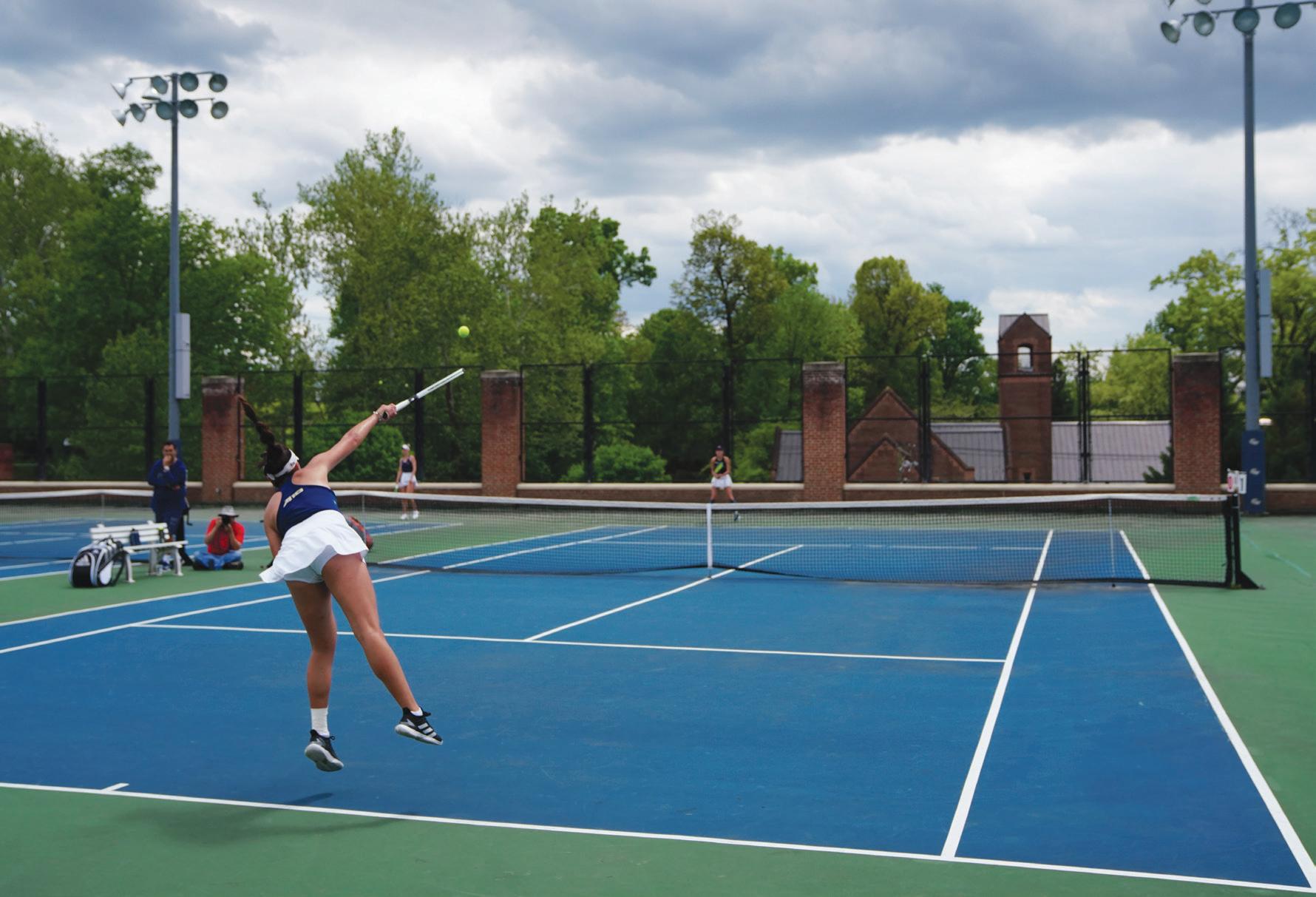
“We complement each other really well on and off the court,” Giraldo said. “We have really good chemistry that definitely carries over to our games and our type of play.”
Both Wiesemann and Giraldo captured wins in their singles matches in the team’s 4-3 win over Dayton April 15. To secure the winning singles point, senior captain Sarah Bodewes defeated the Flyer’s Laura Greb in three sets, scoring the winning point for the team after dropping the first set 4-6.
“That match, she started off a little slow,” Rodriguez said. “We talked some things over, and she really picked it up when we needed it. And she adjusted her game according to the opponent in that match.”
Bodewes, along with fellow senior Lara McNaughten, both graduate this May, leaving them with one final tournament to wrap up their four-year GW careers.
“The biggest piece of advice I’ve given them is to enjoy the process,” Rodriguez said. “Enjoy the journey.
Cherish every moment and finish
as strong as you can because this is the last few matches for them.”
Rodriguez joined the program in September after former Head Coach Torrie Browning departed following the Colonials’ 1110 finish. In his first season, he has focused on individual player development and tactical adjustments mid-match. He uses a player-by-player philosophy to bring out the best in each athlete, individualizing his approach to best suit different playing styles.
Softball sputters at the plate after losing big bats from past years of A-10 dominance
After finishing the past two seasons with the best record in the Atlantic 10, softball has fallen to tenth in the conference with seven games left in the regular season.
The team has mustered a 15-24 overall record while going 5-15 in conference play since losing a pair of sluggers in alumni utility player Alessandra Ponce and pitcher Sierra Lange, who hit a respective .363 and .333 last year. But stellar individual performances from two-way freshman pitcher and designated hitter Rose Cano and graduate infielder Arizona Ritchie, who have led the team’s offensive output in hits, have Head Coach Chrissy Schoonmaker hoping for a lateseason surge.
“We’re going to play our game, and we talk about playing the best brand of GW softball, which is playing defense, attacking on offense and executing on the mound,” Schoonmaker said. “And if we put all three of those things together, we are in a very good position to win.”
The Colonials are hitting .252 as a team this season –down from a sizzling .293 from the year prior and placing them fifth in the conference in the stat category. But that doesn’t mean their competitive edge has worn off – the team has dropped nine
games by just a single run.
“It’s coming down to fighting for an inch here or there, potentially cleaning up a runner in scoring position, putting a stop on defense, whatever it may be, but we’ve been right there in so many games this season,” Schoonmaker said.
Since the end of March, GW has suffered several losing streaks, dropping five in a row twice. The Colonials snapped their most recent skid with a season sweep of Morgan State University last week.
On Saturday, GW dropped another one-run loss to St. Bonaventure University. After holding a 3-0 lead for the first six innings, the Colonials gave up four runs in the seventh and final frame.
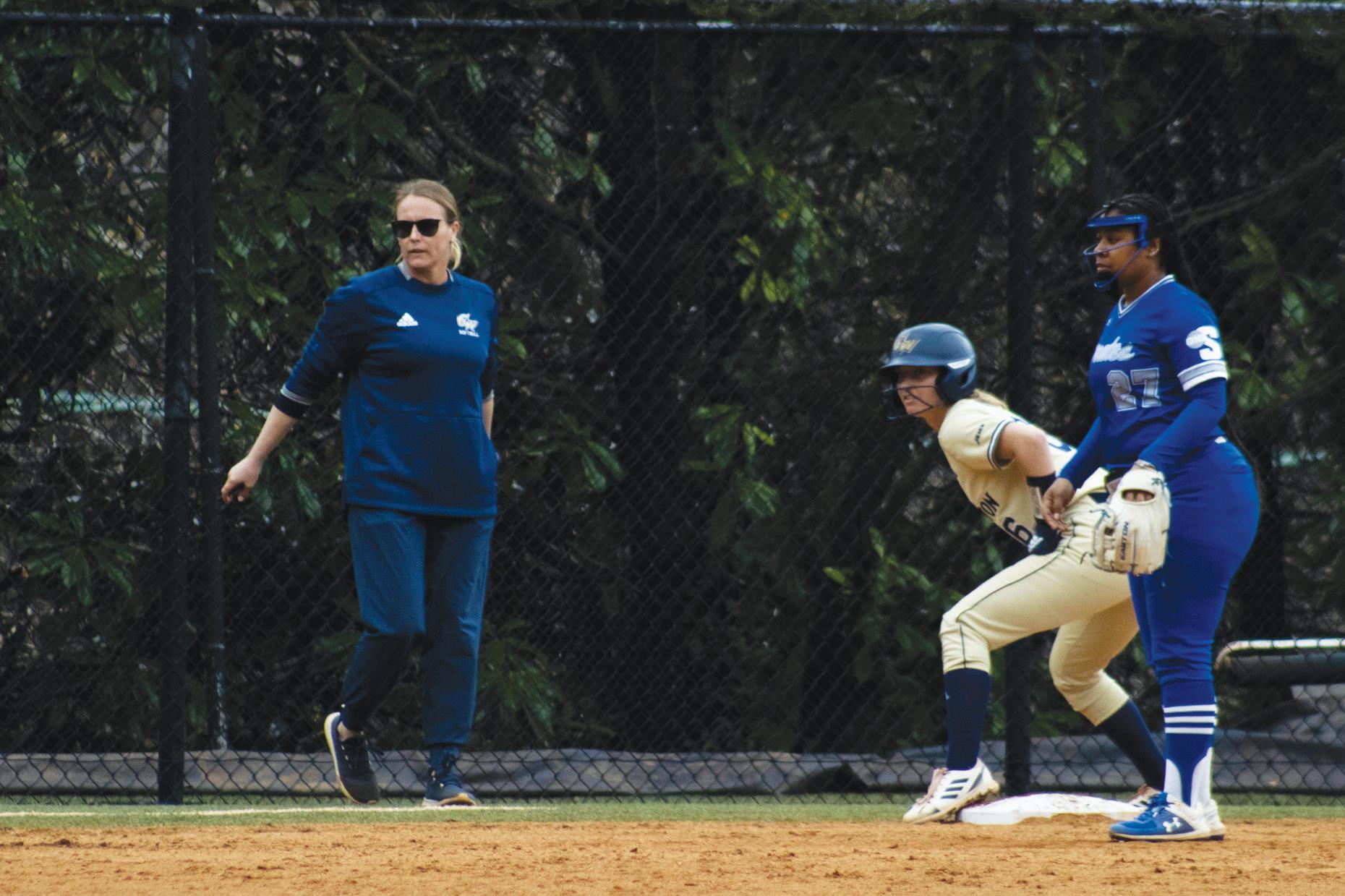
Schoonmaker has emphasized patience at the plate and working the count for the team, which sits fourth in the conference in onbase percentage and sixth in strikeouts at the plate. The team ranks third in the A-10 in both walks and hit-by-pitches, with 119 and 24, respectively.
“On-base percentage, to me, it’s just a matter of, the more you’re on base, the more opportunities you have to score,” Schoonmaker said.
She credited Ritchie’s ability to get on base with hits, walks and even hit-by-pitches as an example the team has looked to follow throughout the season. Ritchie, who joined
the team after four years at the University of Virginia and is the daughter of baseball Head Coach Gregg Ritchie, leads the team in batting average, hitting .325 from her lead off spot with an on-base percentage of .394.
“She’s doing a great job of finding herself on base whether it be a base hit, reaching on an error or working counts to get a walk,” Schoonmaker said.
On the pitching side, Cano holds the lowest-earned run average on the team with an impressive 2.93 figure, with 166 innings pitched. The team as a whole holds a 3.77 ERA.
In her first year with the Buff and Blue, Cano has turned heads, firing 10 strikeouts in a March game against Mount St. Mary’s University. In 13 of the Colonial’s 15 victories, Cano picked up the win. She has also batted .287 with 29 hits on the season, including six doubles.
“She’s just been doing a great job for us which has been really fun to see,” Schoonmaker said. “She’s a competitor. She competes at a really high level. ”
With seven games to play, the team looks to put their best foot forward and remain true to the aggressive style of play that won them the A-10 Championships in 2019 and 2021. The Colonials will welcome cross-town rivals Howard University for a game at the GW softball field Wednesday at 2 p.m.
“Each person comes with a different coaching style,” Rodriguez said. “They were taught differently, coached differently. Each person has a different personality. So I work really hard at really trying to individualize my approach for each person.”
On Saturday, GW suffered a disappointing 4-0 loss to Fordham but rebounded on Sunday with a 6-1 takedown of St. Joseph’s, bumping the conference record to 5-4.
The conference tournament, played in Orlando, Florida, begins Wednesday and wraps up with the final championship match Sunday. Despite the losing record, Rodriguez holds high hopes for the final competition, emphasizing the higher energy levels and buzz around the season’s culmination.
“Making sure that we finish off as strong and on a positive note and with a lot of energy, that’s why I love the A-10’s at the end,” Rodriguez said.
Baseball takes down VCU in fourth A-10 series
SANDRA KORETZ REPORTER
Baseball secured a 2-1 series home win against VCU this weekend, improving their A-10 record to 6-6.

Following a loss to Maryland, GW (1526, 6-6 A-10) opened the series with a 9-2 victory Friday. On Saturday, VCU gave the GW pitching staff headaches, crossing the plate seven times between the sixth and seventh innings before inclement weather cut the game short, resulting in a 11-4 Rams win. The Colonials captured the series Sunday with a narrow 3-2 victory, propelled by home runs from junior utility player Eddie Micheletti and senior infielder Robby Wacker.
Game 1:
The Colonials ran away with game one off the bat, scoring five runs in the first two innings and tacking on two more in the fourth to gain a 7-1 advantage.
In the bottom of the first, senior utility player Steve DiTomaso hit a laser down the right field line, advancing to third from his second batter position. The next at-bat, Micheletti, grounded out to first but batted in DiTomaso to give GW a one-run
advantage and notch the first of his three RBIs in the afternoon.
Graduate student utility player Michael Kohn cracked the Colonials lone home run during the second inning, batting in graduate student infielder Noah Levin to put GW up 3-0. Sophomore outfielder Sam Gates hit a single past second base to bat in Wacker from third, pushing the Colonial lead to four runs.
On the defensive side, redshirt junior pitcher Logan Koester pitched a full eight innings, throwing one strikeout, contributing to his total of 36 through the season. Koester allowed eight hits off 32 at-bats while trusting his defense to throw out 13 ground balls.
Senior pitcher Max Haug relieved Koester after the starter gave up a home run to Rams redshirt junior Nic Ericsson in the top of the ninth. Haug closed the game in 16 pitches against four batters, sealing the 9-2 victory for the Colonials.
Game 2:
In game two of the series, the Colonials struggled on defense, cycling through five pitchers and ultimately giving up 11 runs before officials suspended the game in the seventh
inning due to inclement weather.
When play briefly resumed, the Colonials successfully scored a run in the bottom of the seventh but were unable to make up the deficit before weather officially ended the game. The Colonials’ pitching staff struggled against the Rams’ hitters, running through five pitchers out of the bullpen. Sophomore pitcher Teddy Brennan pitched for the first five innings where he faced 25 batters, allowing five walks and four runs.
Game 3:
On Sunday, the Colonials clinched the series with a narrow 3-2 win that nearly slipped away in the eighth inning. The team maintained steady scoring, earning a run during the fourth, fifth and sixth innings. Micheletti led off the Colonials in the fourth inning by nabbing his second home run of the weekend and fifth of the season.
Junior Chris Kahler, the reigning A-10 Pitcher of the Week, pitched a complete game, tying his career best of ten strikeouts. The Colonials will take on William & Mary in Williamsburg, Virginia Tuesday at 6 p.m.
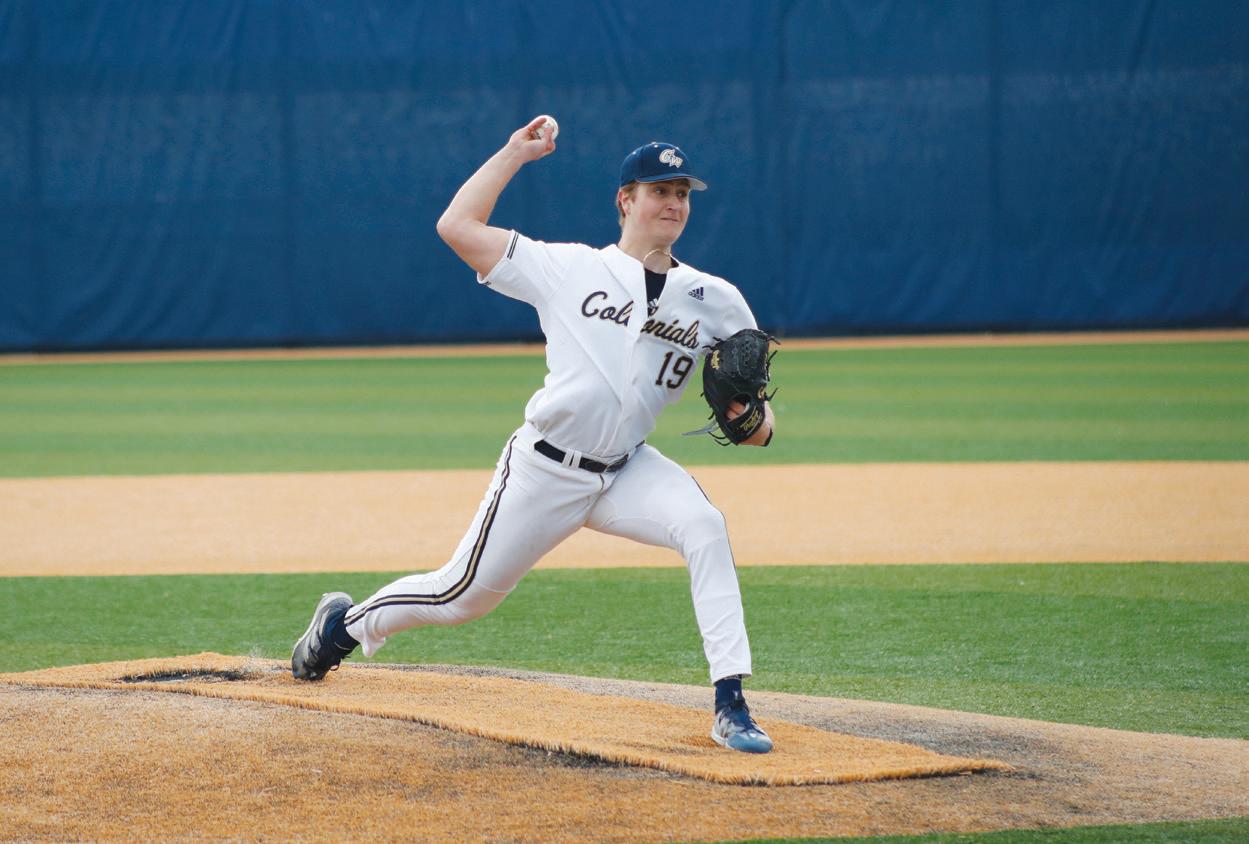
Sports
NUMBER CRUNCH
.456 BASEBALL vs. William & Mary Tuesday | 6 p.m. GW will head to Williamsburg, Virginia to take on the Tribe. GAMES OF THE WEEK WOMEN’S TENNIS Wednesday to Sunday | 9 a.m. | Final round coverage on ESPN+ The Colonials look to the A-10 Championships after finishing 5-4 in conference play.
Junior utility player Eddie Michletti’s on-base percentage this season
LUKE WIENECKE CONTRIBUTING SPORTS
EDITOR
LUCAS CABRERA HACHÉ | PHOTOGRAPHER
The team is riding momentum from a trio of wins over conference rivals Dayton, Rhode Island and Saint Joseph’s in April – success they are hoping to carry into the postseason.
BEN SPITALNY REPORTER
FILE PHOTO BY JORDYN BAILER | ASSISTANT PHOTO EDITOR
SPORTS THE GW HATCHET April 24, 2023 • Page 8
Head Coach Chrissy Schoonmaker has emphasized patience at the plate as a key offensive approach for the team, which sits fourth in the conference in on-base percentage and sixth in strikeouts at the plate.
FILE
PHOTO SAGE RUSSELL | STAFF PHOTOGRAPHER
Redshirt junior pitcher Logan Koester pitched a full eight innings and threw one strikeout.
