Opinions
The editorial board commends plans to institute live-in adviser positions in freshman residence halls. Page 6


The editorial board commends plans to institute live-in adviser positions in freshman residence halls. Page 6
Before campaign season could even begin, disputes and disorganization have marred this year’s Student Association elections.
Within the last week, the Joint Elections Commission – the group of five students who manage the SA elections, independent of the governing body – have disqualified two presidential candidates, including incumbent SA President Christian Zidouemba, and one senate candidate from the ballot because of invalid petition signatures needed to qualify for the respective races. After the trio of students appealed the decisions with their own complaints in the Student Court, the SA Senate approved a one-week delay to the election to allow the court the time to hear the cases before voting can commence.
The candidate fallout came about a month after the SA finished filling the JEC’s five positions, roughly two months later than their bylaws require. The campaign period is now set to begin Monday, leading up to the new election dates of April 13 and April 14. The JEC scheduled its annual debate for candidates to take place Tuesday, and the Student Court will hold two hearings Saturday, including a session for Zidouemba’s case.
We’ve laid out a timeline of the SA’s rocky path to the elections. Here’s what has happened:
SA appoints JEC two months late
The SA Senate confirmed
JEC Commissioner Fatima Konte and two other JEC members, freshman Michael Ubis and senior Catalina Desouza, in January. The SA bylaws state the president should appoint the JEC commissioner before the end of the spring semester of the academic year before the SA elections – in this case, May 2022. If the president fails to appoint a commissioner, the senate should confirm one by Oct. 1, according to the bylaws.
The JEC scheduled the election for April 5 and April 6 during the commission’s
Feb. 17 meeting, later than the March deadline outlined in the SA’s bylaws. The senate amended the bylaws 10 days later to allow the delay.
Candidates register as Zidouemba wa es on reelection bid
Zidouemba told the senate at a meeting in early March that he would not run for reelection. In an apparent change of heart the next day, he posted an Instagram poll asking followers if he should launch a bid for reelection.
Junior Edy Koenigs, Zidouemba’s former senior policy adviser, became the first to run for the SA presidency March 8. Her boyfriend and former SA assistant transportation secretary Nathan Orner announced his own campaign within a day of hers.
Roughly two weeks later, SA Sen. Rami Hanash Jr., GWSB-U, sprung his presidential campaign into action, and GW Entrepreneurship Club leader Mohamed Redzuan Bin Mohamed Raffe followed two days later.
Zidouemba said in an interview the next day that he would run for reelection after students advised him to do so. Residence Hall Association President Arielle Geismar announced her campaign for SA president on the same day.
Zidouemba’s Chief of Staff Keanu Rowe officially announced a presidential run that Saturday.
The JEC disqualifies three candidates from ballot JEC Chief Investigator Tyla Evans recommended March 22 that the JEC disqualify Zidouemba from the election, alleging he violated SA election bylaws by “wrongfully collecting signatures” for himself while purporting to do so for the campaigns of Rowe and Raffe.
The JEC disqualified Zidouemba from the SA elections at a March 27 hearing after Raffe and 2022 SA writein presidential candidate Andrew An testified that Zidouemba did not label his petition sheet with his name, and two of his sheets had crossed-out letters in the line for the candidate’s name.
Zidouemba has denied the allegations of impersonating other candidates’ campaigns multiple times.
Former SA Finance Committee Chair Ian Ching said in written testimony that he took one of Zidouemba’s petition sheets and added Rowe’s name as a “harmless prank.” Zidouemba said “one or two” of his petition sheets were not labeled with his name while collecting signatures.
The next morning, the JEC disqualified Raffe from the presidential ballot because 14 students who signed his petition omitted their GWIDs, which the JEC required to verify signatures. After the JEC struck down the 14 signatures, Raffe did not meet the 385-signature requirement to
appear on the ballot.
Culture Learn about a new Afrofuturism exhibit at the National Museum of African American History and Culture. Page 7
Sports Check in on the golf team as they near the end of their season and prepare for the A-10 Championship. Page 8
Administrators and School of Nursing faculty have remained tightlipped on what prompted former Dean Mei Fu’s premature resignation in February, leaving the future of the school’s leadership hanging in uncertainty.
JEC delays elections as Student Court cases ensue
In a meeting for verified SA candidates March 28, Konte announced the JEC would delay the elections and the campaign period to a “tentative date” after Zidouemba’s and Raffe appealed their disqualifications. The campaign period originally would have begun March 29.
The next day, the JEC proposed the election be rescheduled to April 13 and 14 in an advisory opinion. The senate confirmed the dates Friday. Student Court hears arguments from appealing candidates
Zidouemba and Raffe each appealed their removal from the ballot to the Student Court between Tuesday and Wednesday.
Zidouemba’s complaint argues Evans did not prove all three of her charges – that he impersonated Rowe and Raffe – and An’s testimony was not supported by physical evidence.
Raffe withdrew his case in the Student Court Friday after settling with the JEC. Raffe and the JEC did not publicize the terms of the settlement.
The Student Court scheduled hearings for Zidouemba’s case for Saturday. The fate of their candidacies are yet to be determined as the SA lumbers toward an uncertain election.
Since late February, 61 faculty members in the nursing school declined to or did not return multiple requests for comment on Fu’s less than twomonth tenure or why she resigned. University spokesperson Julia Metjian declined to comment on why Fu resigned and how her exit will affect the nursing school’s operations, deferring to remarks Provost Chris Bracey made about Fu’s resignation at the Faculty Senate meeting in March in which he said he selected Forrest Maltzman, a professor of political science and GW’s former provost, to assist him in the search for an interim dean.
“Faculty are not communicating anything regarding this matter, including me,” one nursing school faculty member said in an email in response to a Hatchet inquiry about Fu’s resignation.

The nursing school has remained leaderless for four weeks now with no clear timeline for the selection of an interim or permanent dean.
Bracey said at the March senate meeting that Maltzman will oversee the school as Bracey’s “senior adviser” and will help select its next interim dean while officials search for a permanent replacement.
Fu, who will continue to act as a tenured professor in the nursing school, did not return two requests for comment.
“I am grateful to the dedicated faculty and staff whom I have closely
worked with during my short time as the Dean of SON,” Fu said in a late February email to nursing school community members.
When Fu started the job in January, she became the nursing school’s third dean since July 2021, and her resignation continues a period of upheaval in the school’s administration.
Pamela Slaven-Lee, the nursing school’s senior associate dean for academic affairs, served a year-and-a-half-long stint as interim dean of the school from July 2021 to December 2022. SlavenLee replaced former dean Pamela Jeffries, who resigned in July 2021 to lead the nursing school at Vanderbilt University after heading GW’s nursing school from 2015 to 2021.
Bracey said Maltzman, then the political science department chair, “worked closely” with Jeffries and Jean Johnson, the founding dean of the nursing school, to reestablish the school in 2010 – nearly 80 years after the first GW nursing school shut down due to the Great Depression.
University spokesperson Julia Metjian declined to say how Maltzman will oversee the school during the search for an interim dean and whether officials plan to appoint an interim dean from within the school. She also declined to share officials’ timeline for finding an interim or permanent dean. Four universities have employed Fu in the last four years. She worked as a professor at New York University’s Rory Meyers College of Nursing from 2003 to 2019 and then as a professor at Boston College’s William F. Connell School of Nursing from 2019 to 2021. She then relocated to Rutgers University School of Nursing to serve as a senior associate dean for research in 2021 until she joined GW in January 2023 to assume her shortest-lived role to date as the dean of the School of Nursing.


Mesmerizing an audience of hundreds with every energetic step, eight collegiate bhangra teams from around the country gathered in Lisner Auditorium Saturday night to compete and perform at this year’s Bhangra Blowout before hundreds of spectators.

Collegiate teams at the competition perform a selfchoreographed bhangra routine, a traditional folk dance originating in the Punjab region in Pakistan and India, complete with vigorous kicks, leaps and bends of the body and colorful traditional Indian attire. Mallika Saksena, the co-director of Bhangra Blowout, said the GW South Asian Society hosted the first Blowout in 1993, and it has since grown into one of the largest intercollegiate South Asian dance competitions in North America.
Saksena said the organizers sold nearly 1,200 tickets, ranging from $20 to $30, for the performance. Competing teams from the universities of Virginia, Maryland and Michigan, Purdue, Cornell and Carnegie Mellon universities and the Georgia Institute of Technology and Virginia Tech performed to an eager and invigorated audience of students, parents and alumni. She said GW alum Gau-
tam Gulati founded the Blowout to bring bhangra from Punjab, India to the United States and allow dancers to pass the tradition down from generation to generation. Saksensa said bhangra connects her to ageold traditions surrounding the dance and its practice in South Asian history that she feels bring her closer to her heritage.
“Being a child of immigrants – and I know that a lot of people who were at the competition yesterday are also – we want to be able to
keep our parents’ tradition and our family’s traditions close to our heart so that we can pass that down as well,” Saksena said.
Virginia Tech placed first, the University of Maryland placed second and the University of Michigan placed third. Virginia Tech’s performance followed a classroom theme and was set in front of a whiteboard that read “Bhangra 101.”
Saksena said to give back to the community, Blowout donated all ticket proceeds to Saahas For Cause, a non-
profit organization that aims to provide mental health resources and education to South Asian immigrants. After the competitive teams performed, three exhibition teams took the stage, followed by the Blowout’s headliner, Fateh Singh, known by his stage name Fateh DOE. Singh is a Toronto-based Canadian rapper, singer and songwriter of Indian descent, known for original songs that fuse modern hip-hop and traditional Punjabi music. He was also a bhangra dancer in col-
lege, and Saksensa said the Blowout organizing team was excited to bring the artist to the South Asian community in D.C.
Ria Gupta, the president of GW Naach, the University’s Bollywood fusion dance team which performed as an exhibition team after the competition, said she feels honored to be a part of such a
loud and proud South Asian community on campus.
“To just be able to sit in the audience with teams from other schools and to see so many people show up from all different parts of America to be able to perform at our college and to be able to watch us perform was a surreal experience,” Gupta said.
THIS WEEK IN HISTORY
April 8, 1999
students from criticizing the Israeli government on campus.
Program Board announces GW student bands will headline Spring Fling for the first time in its decade-long history.
The international controversy surrounding a standardized definition of antisemitism has reached Foggy Bottom’s doorstep, but experts in Jewish studies and the Israeli-Palestinian conflict are split on whether GW should join other universities in adopting the definition.
At least 11 universities in the past five years, including GW peer school New York University, have adopted the International Holocaust Remembrance Alliance’s definition of antisemitism, which refers to antisemitism as a perception of or expressed hatred toward “Jewish or non-Jewish individuals and/or their property, toward Jewish community institutions and religious facilities.”
Half a dozen experts said adopting the definition could help confront antisemitism on college campuses, but some said the definition could unfairly conflate criticisms of the Israeli government with antisemitism, undermining free speech.
Laurel Leff, a professor of journalism and the associate director of the Jewish Studies Program at Northeastern University, said the IHRA’s definition should serve as a framework for education on deep-rooted antisemitic stereotypes as opposed to a basis for administering penalties to students who are critical of the Israeli government. The IHRA’s website states the definition acts as a non-legally binding tool to “address” hate and discrimination around the world, but it doesn’t detail a disciplinary system or enforced penalties once institutions identify an antisemitic case.
“It has to be done very carefully so as education, not as punishment necessarily, as a way of saying, ‘Here’s the ways in which these discussions can veer into antisemitism,’” Leff said.
Leff said the IHRA’s 11 examples accompanying the definition of antisemitism – which range from the justification of harming Jewish people to the act of holding all Jewish people responsible for the actions of the state of Israel – can and should ensure individuals understand why their speech may be harmful to Jews as many Americans are unaware of the connotations of the stereotypes.
The pro-Israel nonprofit StandWithUs called on the University to adopt the IHRA’s definition in January when the organization filed a federal civil rights complaint, claiming assistant professor of clinical psychology Lara Sheehi was antisemitic toward Jewish and Israeli students. In the complaint, StandWithUs urged the University to adopt the definition to target future acts of antisemitism.
A third-party investigation found the allegations against Sheehi to be “inaccurate” and “decontextualized,” according to a statement from interim University President Mark Wrighton last week.
Palestinian rights group Palestine Legal opposed the definition in a separate complaint filed against the University last month alleging a “yearslong, hostile environment of anti-Palestinian racism” on campus. Palestine Legal cited the IHRA’s definition and argued it could allow administrators to label the speech as antisemitic and prohibit
University spokesperson Julia Metjian said the University is “deeply concerned” about antisemitic incidents and any acts of hate committed on GW’s campus and across the globe. She said the University has “strong mechanisms” in place to address acts of discrimination, including on the basis of religion.
Metjian declined to say whether the University would implement the definition.
An IHRA spokesperson said the definition helps recognize and track antisemitism on an international scale, but the organization does not monitor the implementation of the definition at the state, local or university level.
“The IHRA’s nonlegally binding working definition of antisemitism is a practical educational and awareness-raising tool that has helped sensitize people and institutions to the existence of antisemitism,” they said in an email.
Tamir Sorek, a professor of Middle Eastern history at Penn State University, said the IHRA’s definition is a “problematic” attempt at defining discrimination that blurs the line between political opposition to the Israeli government and antisemitism.
The IHRA’s website states the definition aims to identify manifestations of antisemitism that may “target the state of Israel, conceived as a Jewish collectivity.” The definition outlines that criticism of Israel “similar to that leveled against any other country” cannot be labeled as antisemitic.
“There is much motivation behind it to protect Israel more than to fight antisemitism,” Sorek said.
Sorek said chapters of Students for Justice in Palestine at universities across the country face dangers of censorship or retaliation for protests against the Israeli government that may be labeled as antisemitic under the IHRA’s definition.
GW Students for Justice in Palestine faced disciplinary charges from the University in November after students led a postering campaign in October outside of GW Hillel before a speaker event with Doron Tenne, a former Israel Defense Forces intelligence officer. Some of SJP’s posters read “Zionists F*ck Off” and “Decolonize Palestine.”
SRR charged SJP President Lance Lokas and the student organization with disciplinary misconduct for alleged damage caused to concrete benches outside of the Hillel building, but the University cleared SJP and Lokas of the charges in December.
“This is extremely problematic and also extremely concerning because it hurts their freedom of speech, and it has a chilling effect,” Sorek said.
Steven Katz, a professor of Jewish and Holocaust studies at Boston University, said antisemitism is a major problem plaguing college campuses across the country and adopting the definition is the first step to address cases of antisemitism at universities. A 2021 Anti-Defamation League report revealed about one-third of Jewish students had personally experienced antisemitism on campus, and 79 percent of the group said it happened to them more than once.
International student enrollment among incoming students is on a three-year upswing after dropping by 52.3 percent in 2020 when the pandemic halted overseas travel, according to the Annual Core Indicators of Academic Excellence report last month.
International enrollment for newly admitted students rose from 770 in fall 2020 to 1,260 in fall 2022, a 63.6 percent jump as new enrollment approaches pre-pandemic enrollment levels – last set at 1,614 new international students in 2019. Experts said GW’s increase in international student enrollment is on par with other United States universities because the U.S. has remained a “number one” choice for students globally throughout travel regulation shifts during the pandemic.
Provost Chris Bracey said the rising number of new international students at GW after the onset of the pandemic reflected the school’s “global academic reputation.” He said officials prioritize efforts to recruit students from a large range of countries through a “broader global outreach” strategy that seeks students beyond well-represented countries at GW.
“The number of students studying at GW from India, South Korea, Saudi Arabia, Azerbaijan, Egypt, Brazil
and Nigeria has increased due, in part, to progress in our global recruitment efforts,” Bracey said in an email.
Total international student enrollment from India nearly doubled from 227 in 2020 to 444 in 2022 at GW, enrollment from South Korea rose from 185 in 2020 to 217 in 2022 and enrollment from Azerbaijan grew from 31 to 107 in 2022, according to institutional enrollment data. But international student enrollment from China dropped from 1,557 in 2020 to 1,100 in 2022, the data shows.
Jay Goff, the vice provost of student enrollment and student success, said at a Faculty Senate meeting in 2021 that officials increased the University’s enrollment management team in size that year and created “microtrend” committees that track changes in international student markets to rebuild international student enrollment.
Bracey said officials will continue to implement international student recruitment strategies to adapt to the loosening COVID restrictions on international travel policies in China.
“As the rules and regulations change for travel to and from countries across the globe, we will adjust our engagement strategies,” Bracey said.
Total international student enrollment at American universities fell from 1,075,496 students in the 2019-20 school year to 948,519 students in the 2021-
22 school year, according to data from Open Doors, an international exchange organization affiliated with the U.S. Department of State. New international student enrollment in the U.S. rose by 7 percent from the 202122 school year to the current school year.
Total international student enrollment at GW dropped from 4,170 students in the 2019-20 school year to 3,342 students in the 2022-23 school year.
Experts in international student enrollment said restrictive travel policies banning outbound travel have lowered international student enrollment from China, but “top universities” like GW can rebuild their international student population.
Philip Altbach, a research professor at the Center for International Higher Education at Boston College, said international enrollment numbers at these top institutions are increasing following initial pandemic-related declines. He said “name brands” like GW attract students from overseas who are seeking a strong education.
Altbach said the number of international students coming from China to the United States continues to decrease because Chinese students have access to similar opportunities to attend “high-quality” universities in their home country.
Altbach said as interest in American universities from students in China decreases, university officials are seeking students from countries in Africa to “diversify” their
international student population. He said applications to U.S. universities from African countries are increasing nationwide.
Total international student enrollment from Nigeria rose from 36 students in the 2020-21 school year to 45 in the 2022-23 school year, and enrollment from Egypt rose from 13 students in the 2020-21 school year to 17 in the 2022-23 school year.
International student applications from the Middle East and North Africa to U.S. graduate programs increased by 35 percent from 2020 to 2021, according to ICEF, an international education organization.
“Africa is going to be a big player in the international student market going forward,” Altbach said.
In 2018, officials introduced the #YouAreWelcomeHere scholarship, which covers 50 percent of tuition for two international students each academic year to attract more international student applicants, who often have to pay full tuition to attend GW because they cannot receive federal aid as non-U.S. citizens.
Altbach said despite international student enrollment beginning to stabilize after the onset of the pandemic, competitive educational opportunities in countries that provide post-study abroad work visas, which appeal to students that want to settle and work outside of the U.S. in countries like New Zealand and Canada, are reducing demand for American education.
not relate back to the University’s namesake, George Washington, because he never served as an ambassador.
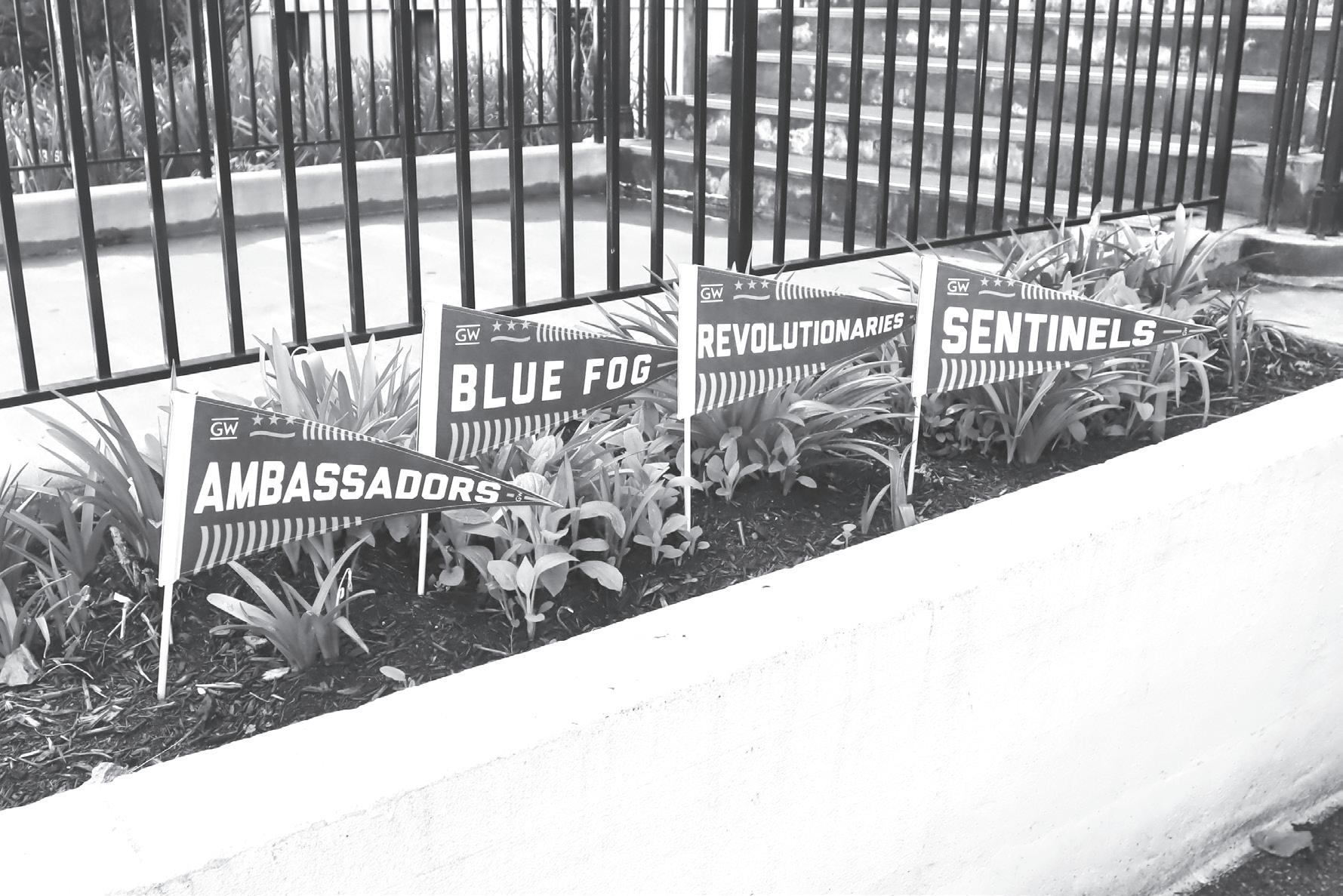
From military might to marine mist, the branding of the University’s future remains split between a quartet of GW-inspired monikers.
Officials selected Ambassadors, Blue Fog, Revolutionaries and Sentinels as the four finalists for GW’s next moniker last month as they narrow down a University-wide brainstorm to replace the now-retired and controversial Colonials moniker. While Revolutionaries and Sentinels harken back to the Continental Army and the University’s namesake, George Washington, Blue Fog and Ambassadors would forge ties to the Foggy Bottom Campus and GW’s international affairs prestige. While University spokesperson Julia Metjian declined to comment on the history behind each of the moniker finalists, The Hatchet explored the history and GW-inspired identities of each of the final picks through interviews with two American history professors.
Ambassadors
Denver Brunsman, a professor of history, said Ambassadors fits the University because of GW’s proximity to foreign embassies, as well as the role of the Elliott School of International Affairs as a “training ground” for future ambassadors. The Mexican, Icelandic, Saudi Arabian and Spanish embassies are all within blocks of the Foggy Bottom Campus.
At least 86 GW alumni have served as ambassadors of countries including China, the Dominican Republic and Norway, according to a Hatchet analysis of notable GW alumni.
He said Ambassadors does
“[Washington] was never officially a diplomat, he was never an ambassador, he actually never traveled overseas,” Brunsman said.
Blue Fog Olivia Curran – a senior majoring in English and criminal justice who came up with the idea for the Fog moniker, which officials adapted to Blue Fog when they narrowed the list of potential new monikers to 10 in February – said the Fog’s strength lies in its allusion to Foggy Bottom and its historical connection to the Battle of Long Island in 1776. During the battle, a cloud of fog rolled in to protect the Continental Army, led by George Washington, as they rowed to safety across the East River from Brooklyn to Manhattan to escape the British army.
“As soon as I mentioned the Fog and George Washington, one of my friends piped in, he’s like, ‘Oh, my gosh, you know, there was a battle where the Fog actually saved the Revolutionary Army,’” she said. “So then we jumped on to that and said, ‘Oh, my gosh, the Fog really is friends with George.’ There’s a historical precedent for how it’s been involved with our University namesake.”
Curran said she doesn’t know why officials added “blue” to the Fog moniker option, but thinks Blue Fog is a worthy choice because it’s inclusive, while other monikers, like Sentinels or Revolutionaries, could be harmful due to their militaristic connotations.
David Silverman, a professor of history, said while Blue Fog is an entertaining moniker option, it does not have much historical significance to the University besides its references to the GW’s colors,
buff and blue, and its location in Foggy Bottom.
Revolutionaries
Brunsman said Revolutionaries has the closest connection to George Washington out of the final four moniker options because of George Washington’s role in the American Revolutionary War. He said Revolutionaries could serve as a “compromise” for GW community members who disagreed with the University’s decision to retire the Colonials moniker because it still draws a clear connection to George Washington.
“In some ways, choosing that name would honor Washington’s
Officials are altering fundraising strategies for GW’s third-annual Giving Day this week in hopes of generating more than $1 million in donations for the secondstraight year.
Alumni Association
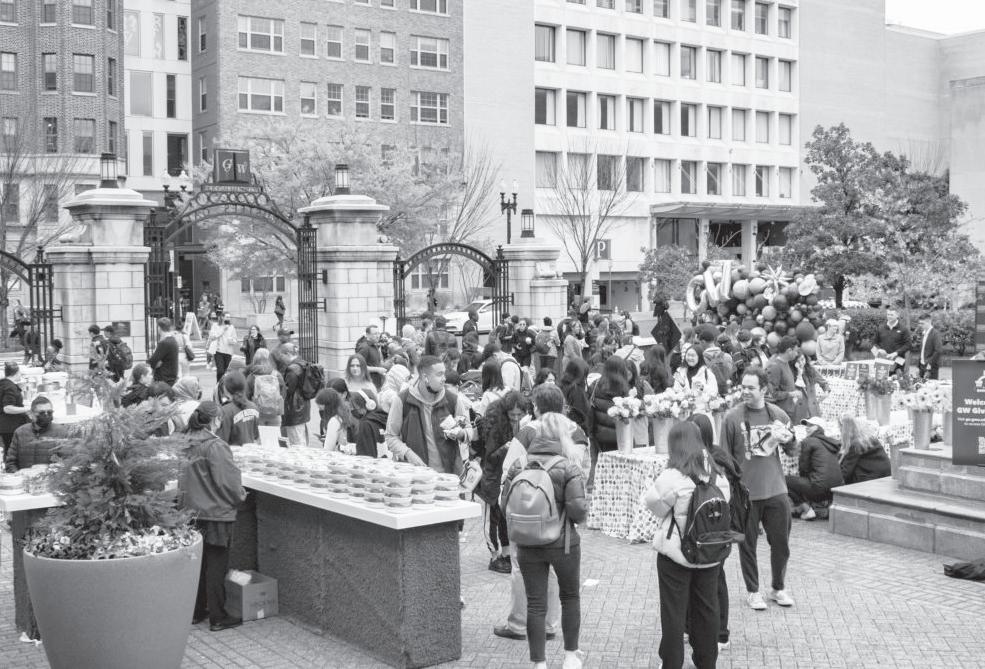
President Will Alexander said at a Board of Trustees meeting in February that Giving Day – a 24-hour period for officials to raise as much money as possible –will shift from a single, 24hour day to a 24-hour event spread across two days this year, running from noon Tuesday to Wednesday. He said the switch is meant to make giving easier during lunchtime hours as the University taps into student callers to reach “engaged” donors and maximize fundraising potential.
Donors can give a minimum of $5 on Giving Day or can make a contribution before the 24-hour event.
Alexander said officials are gearing Giving Day outreach toward “loyal” donors who have given to GW in the past to request they renew their donations. He said the amount of alumni donors has fallen “behind” officials’ donation goals this year, and he is focused on reaching 2,750 donors on Giving Day.
Among GW’s peer schools of similar size about 4,000 students above the University’s student population, Syracuse University accrued 5,577 donors this year on their annual day of giving and Tufts University
compiled 8,355 donors on their Giving Tuesday event in November.
“It’s a lot more focused on trying to reach out to your contemporaries, to people in your network, your sphere, to get them to start developing that habit and seeing how they can grow that participation and support,” Alexander said.
GW surpassed its $1 million goal by about $600,000 last year and collected donations from about 2,500 people. Officials said they directed part of the proceeds toward a “focused initiative” in 2021 to increase aid for Pell Grant recipients, adding about $2 million to the University’s financial aid budget each year.
The University’s Giving Day earnings ranked sixth among GW’s nine peer schools in 2022.
Daniel Burgner, the executive director of annual giving in the Division of Development and Alumni Relations, said this year’s goal of 2,750 donors marks a 10 percent increase from last year’s goal – an intentional uptick to encourage more community members around the world to make a contribution.
He said some donations may go toward matching contributions from GW families or administrators, like School of Medicine and Health Sciences Dean Barbara Bass, who is matching donations up to $50 for SMHS scholarship funds. Donors may also choose the destination of their contribution, including athletic teams, student organizations and school-specific scholarships like the Elliott Equity Fund, which provides financial
aid to students in the Elliott School of International Affairs who are from historically marginalized groups.
Donors have the option to make a recurring donation on a monthly or yearly basis.
He added that community members can sign up to be Giving Day Advocates – donation promoters that have the chance to earn prizes and compete to win a grant that funds an area of their choosing.
Patrick Realiza, who graduated in 2011 with a degree in political science from the Columbian College of Arts and Sciences and chairs the GW Asian and Pacific Islander Alumni Network, said he has selected his personal donations in prior years to go toward CCAS, his alma mater.
Realiza said he tries to “reconnect” with students through University events like the Philippine Cultural Society’s career development event where he spoke on a panel in January about his job as the head of digital communications for the D.C. Commission on the Arts and Humanities.
Sophomore Claire Moore, one of 10 student marketing and communications specialists for Development and Alumni Relations, said she and her colleagues send alumni and donors videos and emails to help them keep in touch with the University and encourage them to donate.
“We’ll send a video thank you to a donor if they send money and just connect with them instead of just cold calling and being like ‘Hi, give us money,’” Moore said.
legacy and also the views of a lot of alumni and also current students,” Brunsman said.
Silverman said Revolutionaries is “hands down” the most relevant moniker option because George Washington was the commander in chief of the Continental Army during the American Revolutionary War.
“I think Revolutionaries both speaks to George Washington’s legacy and is something that the University can slogan the hell out of,” Silverman said. “They’ll say, ‘Have a revolutionary experience at George Washington University, revolutionize your career, revolutionize your lives.’”
DYLAN EBS REPORTER LAUREN SIMON REPORTEROfficials have reported GW’s freshman retention rate has remained below its current 94 percent goal for more than a decade amid efforts to raise that figure to new heights via diversity and affordability programs.
Provost Chris Bracey said at a Faculty Senate meeting last month that the number reached its lowest point in the past 13 years with an 89.6 percent rate for the current school year, but the tally is still on par with the “top 50” universities’ retention rate, according to the Annual Core Indicators Report. He said GW’s nearly 90 percent retention rate is outperforming both the 81 percent national retention rate average for private, four year universities and the 76 percent average national retention rate for all universities in the United States.
He said a recent U.S. News & World Report comparison of the average freshmen retention rate places GW in the top 5 percent of the 1,452 U.S. colleges and universities included in their rankings. Bracey said GW will work to strengthen its freshmen retention rate going forward with newly implemented diversity and affordability efforts like “Open Doors: The Centuries Initiative for Scholarships and Fellowships,” launched in 2021 to increase financial aid for Pell Grant recipients by about $2 million annually because officials “aspire” to continu-
Sentinels
Brunsman said while Sentinels, soldiers who keep guard, existed during the time of George Washington, who would “recognize” the term Sentinel, he was never a sentinel himself.
He said Sentinels would most be an “attempt” to connect the moniker to the 18th-century military where Washington served.
“So Generals would make more sense, the Continentals would make more sense,” Brunsman said. “But both of those are taken by other schools, as are a lot of other choices.”
ously improve the retention rate.
“The University aspires for continual improvement for all of our students and our programs,” Bracey said in an email last month. “This is reflected in our high goals and planning efforts. The University’s focus on academic excellence, diversity and affordability has led to a number of new and expanded student support programs.”
Bracey declined to comment on why the retention rate has stayed below the 94 percent goal since 2014. The Class of 2013’s freshmen retention rate of 93.1 percent is the highest reported retention rate in the past 13 years.
Experts in higher education said in-person courses that encourage tighter bonds with faculty will compensate for the loss of in-person interaction during the early stages of the pandemic and help retain freshmen students looking for a more personal education than their virtual experiences in high school.
Sylvia Hurtado, a professor of higher education at the University of California, Los Angeles, said GW can meet the goal of 94 percent retention if they work to improve the freshmen experience by strengthening faculty-student relationships, introducing students to campus life and providing them with academic support.
“Certainly, if students don’t return, that’s certainly a problem,” Hurtado said. She said universities should offer more advising directed toward first-generation college students to improve
retention rates because they depend on the university for resources that they may not be able to get from their families. She added that some low-income students who try to hold multiple jobs and take classes become overwhelmed and drop out of school, so universities should try to offer federal work-study positions that allow low-income students to have a job that applies to their field of study.
Columbian College of Arts and Sciences officials launched a first-year experience class in August in an effort to prepare for their academic and professional careers.
“I would emphasize that to really improve your range you need to really target the students who have an extremely high promise but also may have more challenges than other students,” Hurtado said. Students who transferred from GW after their freshmen year said they chose to leave the University in search of a more “traditional” campus and degree programs applicable to their interests.
Akshey Mulpuri, a sophomore industrial and labor relations major at Cornell University who transferred after his freshman year at GW, said he was interested in GW because of its close proximity to politics “I don’t regret going to GW,” Mulpuri said. “I made some great memories and met some great people, but I realized I don’t know if this is the place where I want to study something for four years.”
Retention rate remains below 94 percent goal, officials say
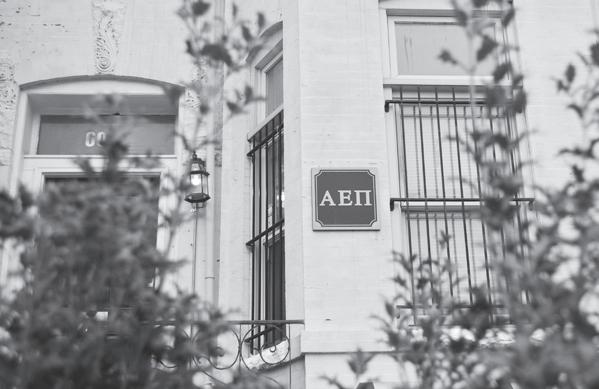
A Jewish fraternity will rejoin GW’s Interfraternity Council this month, making its return to campus nearly a decade after the chapter surrendered its charter in 2014 due to hazing and alcohol violations.
Alpha Epsilon Pi, a Jewish social fraternity, inducted 19 founding members on campus in late February to reintroduce its GW chapter, adding to more than 170 campus chapters across six countries since 1913, according to the national chapter’s website. Students in the GW chapter said the fraternity – which IFC will initiate in late April – will uplift members’ Jewish identities, contribute to Jewish and Israeli philanthropy charities like the Israel Cancer Research Fund and support members’ well-being with chaptermandated health and safety modules.
University and AEPi officials shut down the fraternity’s previous GW chapter, revoked its campus housing and launched investigations into all members in 2014 after the chapter accumulated 17 counts of hazing, alcohol and drug violations. They disbanded the chapter after finding it “in violation of multiple risk management violations,” according to a letter from GW’s former director of Greek Life.
Fraternity leaders said the chapter is returning to campus to restore AEPi’s values of Jewish brotherhood to Foggy Bottom, now with a strengthened focus on members’ health and wellness
through training modules and an executive board role responsible for member safety.
Aidan Cullers, a freshman and the president of AEPi, said for IFC to formally recognize AEPi, the founding group of students must host five events that offer a space for philanthropy, Jewish heritage, brotherhood, social connections and collaboration in partnership with a nearby AEPi chapter.
He said members have already hosted three events and are still planning two more of the required events. He said AEPi hosted events for Jewish heritage, brotherhood and philanthropy this past semester with a chapter kickball game on the National Mall, a Shabbat dinner in early March and a “Pie a Pi” philanthropy event in Kogan Plaza Friday to raise money for Israeli medic nonprofit United Hatzalah.
“We’re really optimistic about where we’re going to be next year and then four years down the line,” Cullers said.
Cullers said AEPi hopes to acquire a townhouse for the chapter in the future but will first plan to host events in campus spaces like the University Student Center for the next few semesters as AEPi grows its membership and begins conversations with officials to claim a campus space.
“I hope our fathers and our future brothers are able to really create the bonds of brotherhood,” he said.
Ethan Fitzgerald, a freshman and the vice president of AEPi, said while he values members’ connections to the fraternity, AEPi will also encourage members to
THEFT II/FROM BUILDING
Academic Center
3/27/2023 – 3:10-3:25 p.m.
Open Case
A female student reported stolen AirPods after leaving them unattended in a classroom. Case open.
THREATS TO DO BODILY
HARM
Public Property on Campus (2200 Block of I Street NW)
3/28/2023 – 4:03 a.m.
Open Case
GW Police Department and Metropolitan Police Department officers made contact with a male student who reported an unknown male subject followed him from the 7-Eleven and made threats to do bodily harm. Upon arrival, officers could not locate the subject. Case open.
HARASSMENT, VERBAL OR WRITTEN
University Student Center
3/28/2023 – Multiple
Open Case
A female contractor reported that a male staff member verbally harassed her. Case open.
SEXUAL ASSAULT
Ross Hall (Courtyard)
3/28/2023 – 4:28 p.m.
Open Case
GWPD officers responded to a report of sexual assault. Upon arrival, officers made contact with a female staff member who reported that an unknown male subject touched her breasts and buttocks during a fire alarm evacuation. Case open.
Strong Hall
3/29/2023 – 3:06 a.m.
Closed Case
GWPD officers responded to a report of an unknown male subject sleeping in the lobby. Officers issued a bar notice and escorted the subject off University property. Subject barred.
FRAUD
Lerner Health and Wellness Center
3/29/2023 – Unknown
Open Case
A male student reported his wallet stolen while he was at the Lerner Health and Wellness center. Case open.
THEFT I/FROM BUILDING
Building JJ
3/29/2023 – Unknown
Open Case
A male student reported his jacket stolen from a residence hall. Case open.
THEFT I/FROM BUILDING
University Yard
3/29/2023 – 4:00-7:10 p.m.
Open Case
A male student reported his bicycle stolen after leaving it unattended. Case open.
register to vote to demonstrate civic engagement and join other student organizations – like GW for Israel and Model UN, where members are currently involved.
Fitzgerald said Morgan Mattler, the director of expansion at AEPi’s international headquarters, reached out to prospective founding members last fall to conduct preliminary interviews and gauge their interest in the chapter.
“I’m very confident with the group we have going that it’s go-
ing to continue into rush next year,” Fitzgerald said.
David Friedland, a sophomore and the health and safety officer of AEPi, said the fraternity requires members to complete two mandatory health and safety modules covering topics like alcohol education and mental health awareness before attending fraternity events for the semester.
Friedland said each member will complete an individual module that takes about two hours,
covering topics like what to do if someone at a party needs medical attention. He said he is working with Jewish organizations to get each AEPi member CPR certified and trained with automated external defibrillators and Narcan, a nasal spray used to reverse opioid overdoses, as an additional precaution.
“It emphasizes precaution above all else, like, ‘Screw social norms, call the ambulance for God’s sake,’” Friedland said.
The first of a trio of Student Court cases has reached its close after a prospective Student Association presidential candidate reached an out-of-court settlement with the Joint Elections Commission.
Mohamed Redzuan Bin Mohamed Raffe voluntarily withdrew his case from the Student Court, which alleged the elections commission treated him unfairly by striking down 14 of his 394 collected candidate petition signatures for lacking GWIDs. Senate Legal Counsel Juan Carlos Mora – acting individually, not in his role as senate legal counsel – and former legislator general Adam Galland, representing the JEC, said the JEC would enforce policies ensuring it treats write-in candidates fairly.
The terms of the settlement are unclear. Raffe, Mora and Galland declined to comment further on the specific terms of the settlement. Raffe said he looks forward to running
a write-in campaign for the presidency.
Raffe said he was “glad” they settled the case and was proud of his representation, junior Peyton Fillman and senior Yahya Aliyu.
“I hope this is reflecting on my commitment to
be drama free and to also show that I’m capable of settling things in a proper and respectful manner,” he said.
The court docket shows Raffe withdrew his case, and the court dismissed the case without prejudice. The court canceled
the hearing for Raffe’s case, initially scheduled for Saturday. Mora and Galland said in a statement that disqualifications like Raffe’s are “unfortunate,” but the JEC must uphold the SA bylaws. They said “the JEC offers its sympathy to” Raffe.
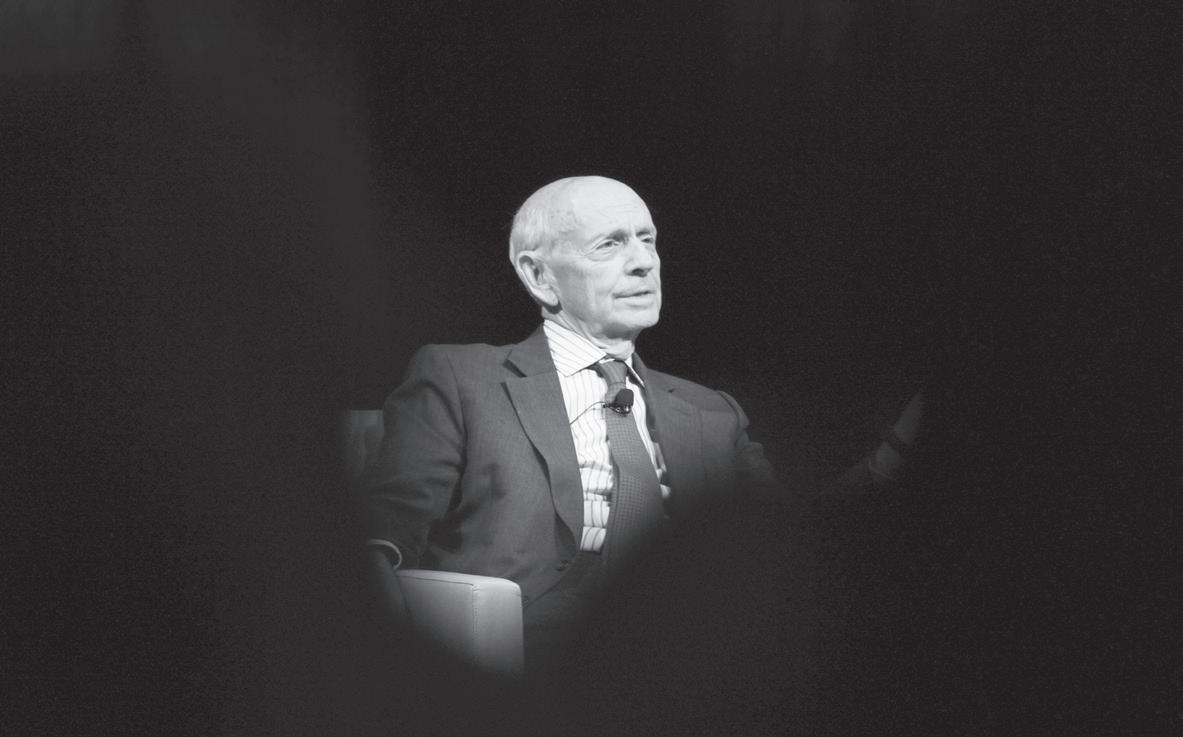
Former Supreme Court Justice Stephen Breyer spoke about his early life at Lisner Auditorium Wednesday.
The retired justice and his brother, Charles Breyer, a senior district judge for the Northern District of California, said their experiences growing up in San Francisco together and in college introduced them to a diverse range of places and people from different backgrounds, which later shaped their outlook on life. GW Law hosted the event, which was moderated by Alan Morrison, associate dean for Public Interest and Public Service at GW Law, and was the first installment of a five-part series hosted by GW Law chronicling the arc of Justice Breyer’s career. Justice Breyer said while living in San Francisco, being a part of the large and diverse city
community influenced his upbringing.
“It is not conceivable to me that you could live your life without being a part of several communities that are trying to live together in a reasonable way,” Justice Breyer said.
Charles Breyer said their parents encouraged political awareness from a young age, detailing a story where his father would lift him up as a child so that he could operate the voting machine.
“Steve and I were raised in a family that was extraordinarily positive in the sense of participation in government,” Breyer said. Breyer said his worldview shifted when he left San Francisco for college and became more exposed to the events of the world around him, like the assassination of President John F. Kennedy and the Kent State massacre, which he described as a “dose of reality.”
“All of this opti-
mism that we had as children was tempered by the reality,” Breyer said.
Justice Breyer said there is a significant degree of luck in being appointed for positions like a federal judge because several candidates are qualified enough to receive the presidential appointment for each position.
“I say being appointed a federal judge is like lightning striking,” Breyer said. “And being
appointed to the Supreme Court is like lightning striking twice in the same place.”
Breyer said when he talks to college students, they often ask him for advice on what to study to become a lawyer. He said college allows students to broaden their horizons by studying an array of topics that interest them rather than simply studying what they believe will make them good candidates for
law school and other careers.
“You start learning a foreign language, you start reading some literature, you start really learning a little bit of history, and so forth, your eyes will open to experiences that go beyond your own life,” Breyer said. The next installment of the fivepart series, focusing on Justice Breyer’s experience at Harvard Law School, is scheduled for May 16.
Student organization aims to unite Afghan community, fundraise for refugees
Steam from a dish of kabuli pulao, the national Afghan dish consisting of rice with raisins, carrots and meat, wafted through Duquès Hall 451 at the Afghan Student Union’s inaugural interest meeting last Monday.
More than 20 students attended the event virtually and in person, where the three-person executive board discussed plans to spend their first month since registering as a student organization in February partnering with local charity-based nonprofits to fundraise for Afghan refugees in need of financial support. Student leaders said the student union intends to serve as a unifying force among Afghan refugees in D.C., Maryland and Virginia and students on GW’s campus as they develop into an established community presence in Foggy Bottom.
Freshman and co-president Shugoofa Agha said ASU will work to recruit more members this semester by promoting meetings and events through social media and reaching out to friends to expand their exec-
utive board. To kick off their launch on campus, members said they plan to incorporate traditions from Ramadan, an Islamic holy month of fasting and reflection observed between March 22 and April 20 this year, into the student organization’s programming for members who celebrate.
Oranus Yaqubi, another co-president and a freshman studying biology, said one of the group’s priorities is to collect donations for Afghan refugees with the help of nonprofits after about 6,000 Afghan refugees arrived in the DMV after the Taliban’s 2021 takeover of Afghanistan.
Yaqubi said she became interested in donating to Afghan refugees transitioning to life in D.C. after she volunteered at a local refugee camp in Virginia through the Afghanistan Youth Relief Foundation between August and December 2021.
“We’re so far away from their homes and also Afghans in Afghanistan right now who are going through trouble,” she said.
Yaqubi said she wants to host cultural events to get the Afghan community and other interested peers involved in the student organization and expand the events to col-
laborate with George Mason University’s Afghan Student Union, which hosted a cultural event called Majlesi that featured dancers, henna art and traditional clothing early last month, and bring a similar event to GW.

Yaqubi said she found out about the former Afghan Student Association in 2016 when she saw them host a fundraiser at the Afghan mosque she grew up attending in Alexandria, Virginia.
Bahar Agha – a member studying nursing as part of a 1.5-year accelerated bachelor’s degree program – said she wants to build relationships with Afghan students at GW through the student union after growing up in Arlington alongside her sister, Shugoofa Agha, with little exposure to fellow Afghans her own age.
“It’s just nice, now being a University student, to be able to connect with other students who are also Afghan, relate to them and share in our struggles,” she said.
Sophomore Hajera Hayat, a member of the student organization studying public health, said she heard about the group through a mutual friend and became interested in joining because few people shared her Afghan ethnicity
COURTESY OF AFGHAN STUDENT UNIONin Fairfax, Virginia.
“I’m excited to do it outside of that, especially since the club is just starting but with Ramadan and everything like volunteer opportunities, just being involved, I’m just excited to be here,” Hayat said.
during their first year at GW. “I have more hope for these people because they just got to GW,” Rassoly said. “If they are able to create this type of event, hopefully they could do something more or organize bigger events and support more Afghan people in Afghanistan and in Virginia or all over the place.”
organization studying information technology, said he considered starting an Afghan student organization in his first two years at GW but held back because he could not find enough Afghan students on campus to join. He said he is “proud” of the freshmen for creating this space for Afghan students NEWS THE GW HATCHET April 3, 2023 • Page 5
Bacteria in grocery-store meat causes half a million UTIs annually: study

in patients to grocery-story meat products to find E. coli causes more than half a million UTIs.
“We wanted to estimate the fraction of human urinary tract infections that were being caused by foodborne E. coli,” Price said.
UTIs cause more than eight million doctor visits in the U.S. each year, and about two in five women and three in 25 men are diagnosed with UTIs during their lifetime, according to the Urology Care Foundation.
Price said UTIs can be life-threatening since the bladder is a gateway to the bloodstream and kidneys, meaning infections from the bladder can travel to vital organs of the circulatory system.
partner with the food animal industry or the USDA or people at vet schools and say, ‘Alright, let’s target these really aggressive strains for vaccination in the animals,’” Price said. Experts in food science and microbiology said while individual precautions are useful to prevent UTIs, researchers should track infections back to the animals themselves to find the origin of the bacteria, like the study did through genome sequencing.
Nearly 30 protesters rallied for Palestinian rights in Kogan Plaza on Friday afternoon, the finale of Students for Justice in Palestine’s Israeli Apartheid Week amplifying political education and cultural celebration surrounding Palestinian resistance.
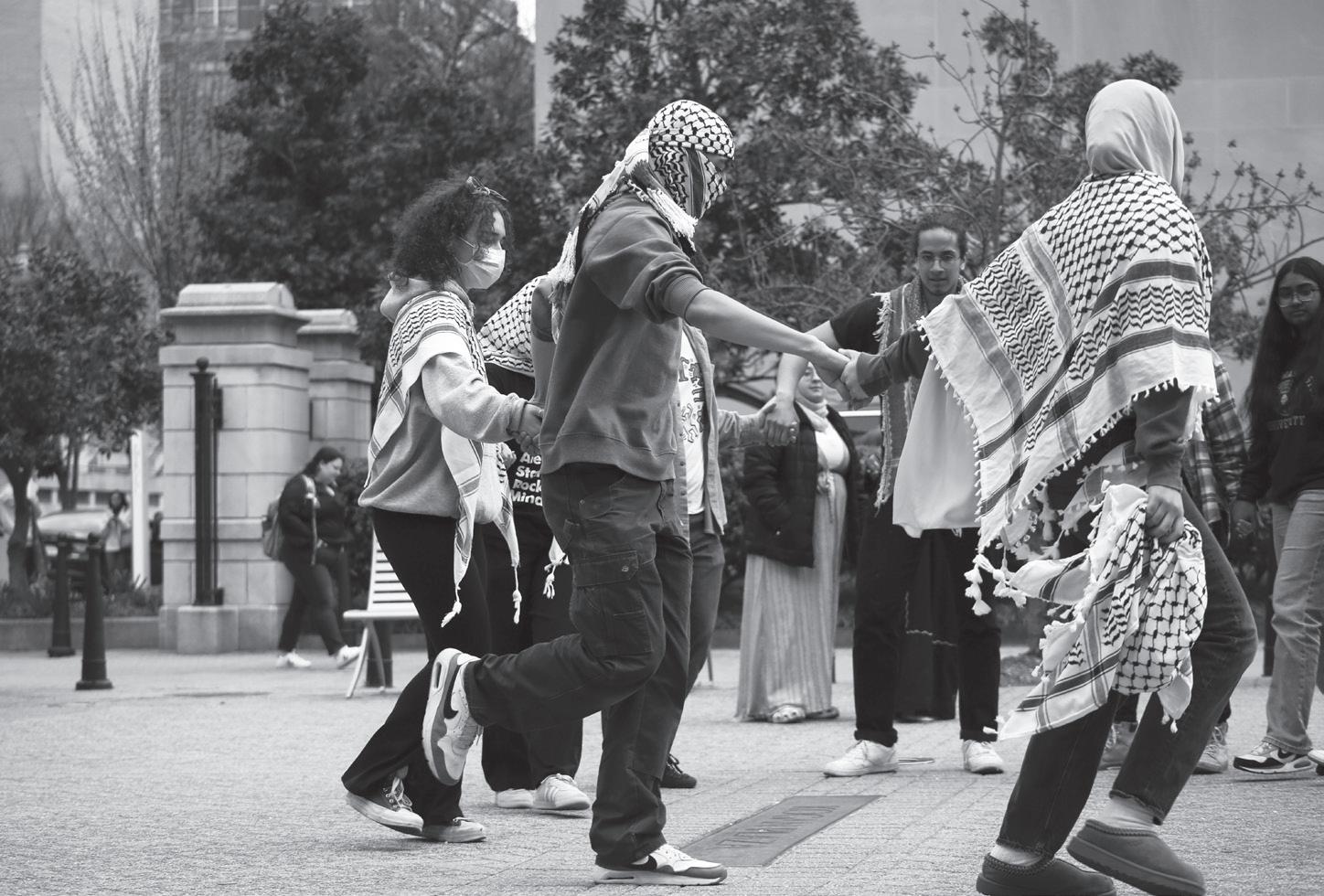
Student organizations like Black Defiance, Jewish Voice for Peace, and Students Against Imperialism joined Students for Justice in Palestine at the rally, the culmination of a week of panels and workshops focusing on Palestinian culture and education on the Israel-Palestine conflict. A student organizer for Students for Justice in Palestine, who requested anonymity because Palestinian protesters are often targeted, said SJP has committed the past year toward organizing for Palestine in the face of “Zionist repression and discrimination.”
SJP faced disciplinary charges from GW in November after student protesters led a postering campaign in October outside of GW Hillel prior to a speaker event hosted by Doron Tenne, a former Israel Defense Forces intelligence officer. The Student Rights & Responsibilities office charged SJP and its president Lance Lokas with disciplinary misconduct for alleged damage caused to concrete benches outside of the Hillel building from wheatpasting, but officials cleared SJP and Lokas of the charges in December.
“Today, it was really a cap, a way to tie all of the events this week together to say that, ‘Look, we are active, we are not going to back down to intimidation tactics, we are here and we’re not going,” the organizer said.
The student organizer said SJP hosted psychology professor Lara Sheehi as a guest speaker on a panel about academic suppression of Palestinian voices alongside GW Associate Professor of Media and Public Affairs William Youmans and Palestine Legal staff attorney Dylan Saba. He said Sheehi spoke about her experience facing “discrimination and repression” for her work regarding Palestine, like through her role on the advisory board for the USA-Palestine Mental Health Network and her experience defending herself against allegations of antisemitism.
Jewish and pro-Israel advocacy group StandWithUs filed a civil rights complaint in January alleging Sheehi created a “hostile environment” for Jewish and Israeli students in a graduatelevel psychology course. A third-party investigation found the allegations to be “inaccurate” and “decontextualized,” according to a statement from interim University President Mark Wrighton last week.
“It was really nice to be able to celebrate that victory with her and just talk about her experiences, being an Arab woman in academia, facing discrimination and repression for her work around Palestine but also talking about successful ways that her and her comrades have organized against it,” the student organizer said.
The student organizer said some people took photos of SJP members while they were sitting at their table in Kogan Plaza during Israel Apartheid Week in an effort to identify them because of their political beliefs. He said some people were yelling at SJP members while they tabled in Kogan during Israeli Apartheid Week, arguing with SJP members on Palestinian issues.
“We had groups coming today to our rallies and other places spreading misinformation about the language that we use around Palestinian Liberation, but we have remained active in spite of all of it,” the student organizer said.
Lead researchers Lance Price and Cindy Liu, both professors of environmental and occupational health, managed a team that found extraintestinal E. coli strains – bacteria from outside of the intestines commonly originating from meat –cause between 480,000 and 640,000 UTIs annually in the United States. Price, a professor of environmental and occupational health, said the study raises awareness about people who are prone to UTIs, like women, to take extra precautions when preparing meat like avoiding cross-contamination, cooking meat thoroughly and avoiding the consumption of raw meat.
Rodney Moxley, a professor of veterinary medicine and biomedical sciences at the University of Nebraska-Lincoln, said meat grows the E. coli quicker than other food because of the amount of nutrient-rich ingredients like iron, which allows the bacteria to survive and grow. He said animals transported to meat-processing facilities can host E. coli, but industrial commercial facilities are often equipped with the cleaning infrastructure to control the bacteria.
Sophomore Jovanna Walker, the vice president of Black Defiance, said the organization participated in the rally as an act of solidarity with other “radical” student movements on campus. She said Black Defiance collaborated with SJP to host a teach-in event about Black-Palestinian solidarity, discussing the history of Black-Palestinian “joint revolutionary organizing” on Friday.
“I feel like this was really our time to learn, take that and then have conversations with each other to then have more programming with SJP, with Jewish Voice for Peace and things like that,” she said.
Walker said Israel Apartheid Week events had a “revolutionary” tone and that she felt a similar spirit in these events to Black Defiance’s cause, which focuses on amplifying Black feminist theories. She said even though she isn’t Palestinian, she felt “very inspired” by their dedication and noticed similarities with her own “Black liberation struggle.”
“Even those that don’t look like me, we’re all struggling, like I was saying, under the same structures of violence,” she said. “So we have to have more love in our hearts for ourselves and everybody around us than hate for our enemies.”
Pada Schaffner, a junior and a hub coordinator for Sunrise GW, said the struggle for climate justice and the fight for Palestinian rights share commonalities with activists for both causes experiencing persecution for their beliefs and enduring labels of “terrorists” for their advocacy.
Price said the researchers used genome-tracking methods to find that E. coli from meat causes 8 percent of UTIs annually in the U.S. He said research before 2012 on a possible connection between E. coli and UTIs generated interest in reaching further findings in the field.
Price said researchers spent the first year of the study collecting E. coli samples from grocery stores in Flagstaff, Arizona because the city didn’t have industrial-scale meat processing facilities. He said the researchers spent the next eight or nine years sequencing the genomes from the E. coli samples and “struggling” to analyze the meaning of the complex data collected. Price said researchers ultimately traced the origins of E. coli
Meat, along with raw vegetables, is one of the primary carriers of E. coli strains that cause infections like UTIs, according to the Centers for Disease Control and Prevention. While E. coli strains are normal in food, strains that can cause intestinal problems are most often found in raw or undercooked food, and health officials recommend using a meat thermometer to see if meat is cooked thoroughly, which kills UTI-causing bacteria in the meat, according to the CDC.
Price said preventing transmission of foodborne E. coli strains that cause UTIs is not only an individual responsibility but also a public health obligation to prevent infected meat from reaching the grocery store. He said vaccinating animals against extraintestinal E. coli strains would inhibit the spread of the bacteria before the meat reaches the grocery store. Price said researchers should partner with the U.S. Department of Agriculture or institutions relating to veterinary research to target manufacture vaccines.
“I think we should
Francisco Diez-Gonzalez, a professor in the department of food science and technology and the director of the Center for Food Safety at the University of Georgia, said the study acts as a warning for people who are prone to UTIs so they can become aware of safety precautions like the proper cooking temperatures to prevent UTIs. He said the link between E. coli and UTIs isn’t surprising because humans consume many microorganisms daily, which can come from animal products.
“So make sure that you minimize your risk of what you’re consuming by cooking meat well, all the poultry, beef, pork, making sure that you cook them well, and when you handle, the other thing is using good hygienic practices in the kitchen,” Diez-Gonzalez said.
FAITH WARDWELL ASSISTANT NEWS EDITOR NIKKI GHAEMI CONTRIBUTING NEWS EDITOR JENNIFER IGBONOBA | STAFF PHOTOGRAPHER A student organizer for Students for Justice in Palestine said SJP has committed the past year toward organizing for Palestine in the face of “Zionist repression and discrimination." RACHEL SCHWARTZ | ASSISTANT PHOTO EDITOR Experts in food science and microbiology said while individual precautions are useful to prevent UTIs, researchers should track infections back to the animals to find the origin of the bacteria.
The history of GW’s four moniker finalists p. 3
“You can see where Vision Zero failed in roadside memorials. And you can hear its unfulfilled promise in the wailing of sirens in the night.”
—ETHAN BENN on 3/30/2023Thanks to a new plan from Campus Living and Residential Education, freshmen should have extra help navigating their transition to residential college life starting this fall.
CLRE is searching to hire students who will live in GW’s 14 freshman residence halls to organize community events, settle disputes between roommates and design lobbies and bulletin boards for the next academic year. Though likely fewer in number than the resident adviser program the University eliminated in 2021, the new community engagement adviser and assistant positions can connect freshmen to upperclassmen as the University markets its residence halls as community hubs.
The live-in adviser position and the more support-focused assistant position are supposed to aid community coordinators. But those of us who remember the days of RAs before the COVID-19 pandemic know community coordinators haven’t always connected with students as much as their fellow peers did.
Other than being a few years apart, a freshman resident and an RA would likely have a lot in common – they’re both GW students, for one. With RAs, students could go to a peer on their floor who might have experienced the same pangs of homesickness, an unfriendly professor or an oddball roommate just a year before. From one student to another, they were a wealth of advice, expertise and knowledge ready to support campus residents navigate the transition to a more independent adulthood.
Community coordinators can feel more like an email address or a sign on a door
than part of residents’ day-to-day lives. And that makes it harder, albeit not impossible, to foster connections with students.
To community coordinators’ credit, being the first point of contact to address the needs of hundreds of student residents at
Editor’s note: This post contains references to suicide and mental health issues. If you or someone you know has experienced suicidal ideation, call the 988 Suicide and Crisis Lifeline or reach the Student Health Center at 202-994-5300 and ask to speak to a counselor. You can also call the Trans Lifeline at 877-565-8860 for trans peer support, and LGBTQ+ youth can get support from the Trevor Project by calling 866-4887386. If you have any questions about the reporting behind the story, please contact the editor at eic@gwhatchet.com.
Iwas relieved when my then 17-year-old sibling, Sky, came out to me last summer as transgender and nonbinary – after years of feeling uncertain about their gender expression, Sky finally felt like themself.
Assigned female at birth, Sky told me they knew on some level that they weren’t a woman since the fourth grade – they just didn’t have the words to describe their emotions. Now, they know that feeling is called gender dysphoria, an unease caused by a misalignment between someone’s biological sex and gender identity.
When they started questioning their sexuality last summer, they also questioned their gender presentation. A couple of months after coming out as bisexual, Sky embraced their nonbinary identity – they no longer identify as a woman just because society more readily accepts cisgender people. “I just exist as a person, not necessarily a woman,” Sky told me over FaceTime.
As Sky’s older sister and a human being, I have been outraged by the deluge of transphobic laws across the nation and the demonization of transgender people in right-wing media. I am afraid and frustrated at the
thought of Sky growing into adulthood with a social climate fighting against who they are. Since this past summer, at least 11 states have enacted laws limiting or banning gender-affirming care for minors, according to Axios.
In Kentucky, the state’s Republicandominated legislature voted Wednesday to override Democratic Gov. Andy Beshear’s veto of Senate Bill 150, a bill that restricts what bathrooms transgender youth can freely use in public schools and bars class discussions of sexual orientation and gender identity. The bill also prevents the Kentucky Board of Education or the Kentucky Department of Education from requiring or recommending teachers to use their students’ preferred pronouns, names and identities. My high school in West Chester, Pennsylvania was the first public place my sibling started going by gender-neutral pronouns, and Sky has said that their teachers’ compassion helped ease their transition.
Unless organizations like the American Civil Liberties Union successfully sue to stop the law, Kentucky will join at least 10 other states in denying or restricting transgender minors’ access to gender-affirming health care like surgery, puberty blockers and hormone therapy.
When I called Sky earlier this week about the risk of denying people gender-affirming health care, they looked at me and said one word, “suicide.”
In Kentucky, 59 percent of transgender and nonbinary youth seriously considered suicide, and 24 percent of transgender and nonbinary youth attempted suicide between 2021 and 2022, according to The Trevor Project, a nonprofit organization focused on preventing suicide among LGBTQ+ youth.
Right-wing media smear
campaigns and moral panics against transgender people have only worsened the life-and-death issues facing trans youth. Conservative personalities and politicians have pushed their transphobic agendas in response to the shooting at The Covenant School in Nashville, Tennessee last Monday, where a shooter who police said identifies as transgender killed six people including three children.
And other rhetoric about transgender and nonbinary people has been downright genocidal, threatening the very idea that their identities deserve to exist.
Our politicians and media are failing to stand alongside transgender people. “I just want to exist as myself,” Sky told me. Preventing transgender people, especially teenagers, from receiving gender-affirming medical care allows the anxiety, depression and suicide stemming from unaddressed gender dysphoria to continue unabated. This isn’t simply a matter of trans youth being accepted – it’s a matter of them being alive.
Trans and nonbinary youth aren’t confused children or a springboard to push a political agenda. They are part of this generation’s future, and they need protection. They will never be given a chance to become the “future” if politicians and the media refuse to let them be who they are and paint targets on their backs. Trans people deserve to be themselves in private and in public.
I have never seen Sky feel more comfortable in their own skin than when they realized their identity as a nonbinary, trans person – they smile more and visibly appear confident in themselves. Simply put, they’re happy. And that means everything.
—Paige Baratta, a freshman majoring in political science, is an opinions writer.
any hour of the day is no easy task. And GW’s pandemic-era policies constrained the limits of their jobs, restricting students to one guest from their residence hall per room and barring guests from other University residential buildings altogether. All the
same, donut and ice cream socials can only go so far to make students feel like they belong at the University, especially freshmen who are away from home and likely sharing their living space for the first time.
But the burdens student employees faced, which also led RAs to push for a labor union in 2016, is partly why officials discontinued the RA position in favor of community coordinators. RAs had to face uncomfortable, upsetting and even dangerous situations in the course of counseling residents and dealing with noise complaints, sexual assault cases or intoxicated students, then-Vice President of Student Affairs and Dean of Students Cissy Petty said in 2021.
CLRE’s new community engagement advisers and assistants capture the essence of what made the RA program work. Physical proximity to an older, trusted peer could help make freshmen residence halls and GW as a whole more welcoming. And over the past year, it’s been easier than ever to eat, sleep, study and meet with friends all from the comfort of your own home at GW. Officials have tried to redefine the residential experience this school year with new all-you-can-eat dining halls in Shenkman and Thurston halls and extensive renovations to Thurston. And while the crowds of students that patronize and live in these residence halls show how popular they are, a crowd isn’t necessarily a community.
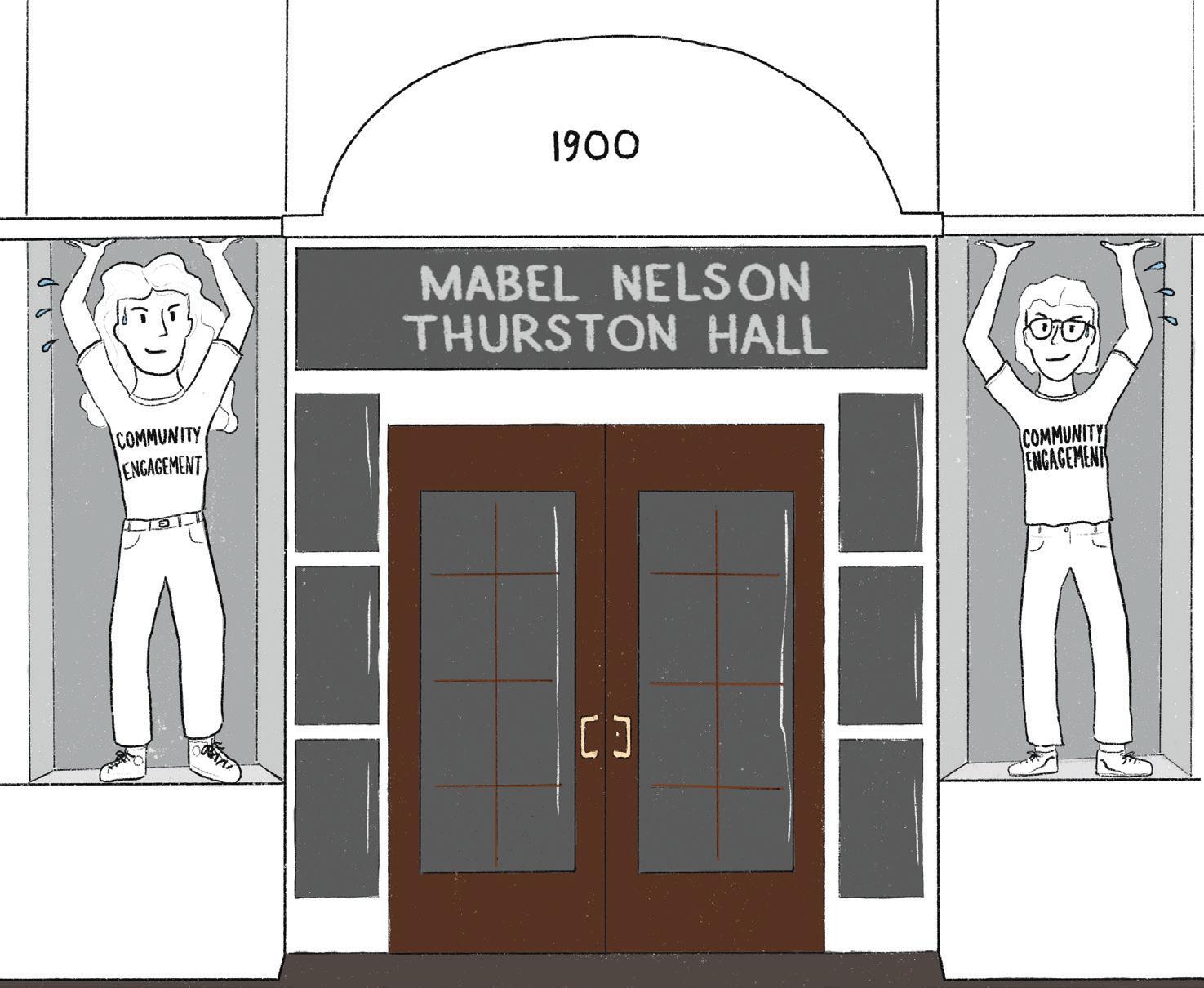
So starting this fall, community engagement advisers and assistants will face the challenge of drawing freshmen out of their rooms – and their cliques – to learn about their peers and GW. With any luck, they’ll be raising high in no time.
Apresident running for reelection was indicted last week, and it’s not who you’re thinking.
The Joint Elections Commission that governs the Student Association’s yearly elections charged and convicted SA President Christian Zidouemba with one count of impersonating another candidate to collect signatures for a candidacy petition last Monday. The JEC’s decision disqualifies Zidouemba from running for president for what would have been the fourth consecutive time and bars him from taking office if elected.
Zidouemba has appealed to the Student Court, asking them to reverse the JEC’s decision, vacate his conviction and reinstate his name on the ballot. We – the chief counselor to the SA Senate and former legislator general – are going to make sure that Zidouemba’s efforts fail.
After the JEC retained us last Wednesday to represent them in three lawsuits – one of which has been settled out of Student Court – related to candidate disqualifications, including Zidouemba’s, and after the past year working with and for him, it has become abundantly clear to us that he is wholly unfit to serve as our SA president.
We know this because we’ve spent the past 10 months cleaning up his messes and ensuring that his antics do not compromise the structural integrity of the SA. But they have – with every impulsive and illogical decision Zidouemba has made, he’s desecrated the vision for responsible
student government the Board of Trustees set out in the SA’s charter. Take for instance last November when he overspent money allocated to him for internal executive branch affairs on a catered SA retreat for members. The splurge caused the SA to run a historic executive deficit surpassing $1,000, which cut into funding allocated for events.
And who could forget last May when he thought it would be a good idea to appoint two people to serve as executive chief of staff, which the SA’s constitution prohibits. The move resulted in one of those illegitimate appointees participating in a coup d’etat to oust him, leading to months of SA turmoil that reaffirmed many students’ lack of faith in the SA. We represented him last August when his former chief of staff sued him over this crisis, and we won the case for him. But we’re done defending and excusing Zidouemba’s blatant disrespect of the rule of law and the responsibilities GW students have vested in him.
Zidouemba’s disqualification from the election ballot for SA president is further proof of this reality. His uncertainty over running for reelection put him in an understandably tight spot when he decided to run a matter of days before he needed to submit 385 required signatures to appear on the ballot. But while his predicament was not enviable, he barreled ahead without any care for the potential consequences.
Zidouemba bears ultimate responsibility for the instability that is engulfing this year’s elections. The SA bylaws make clear that holding an election is a serious process that requires hard work over a long period of time. That’s why the sitting president is required to appoint a JEC chair nearly a year in advance of an election
and appoint the rest of the commission before the end of the school year’s fall semester.
But Zidouemba chose not to do that – the senate did not confirm all members of the JEC until February, a month before elections were set to commence. And when Zidouemba did fill the commission, it was only after months of reminders from the SA’s vice president, the counselors of the senate and Zidouemba’s own staff.
Zidouemba’s actions haven’t just hurt his reelection campaign – they hinder the campaigns of every single law-abiding candidate for SA office with unnecessary dither and delay. Let us be crystal clear: Zidouemba is not a victim of the system – our system is a victim of him.
So while we fight in the Student Court to maintain the rule of law and the stability of the student government, we urge you to do your part. Vote for whom you believe represents the values and principles that matter to you. Vote for someone who proves themselves empathetic and worthy of stewarding SA advocacy. But above all else, just vote. Leaders like Zidouemba are elected when people don’t participate – his election in 2022 had the lowest turnout rate in a decade.
The students of GW deserve a new SA president who fights for us and our values and respects the rule of law. Together, let’s honor the traditions of student government and allow Zidouemba’s presidency to drift into distant memory.
—Juan Carlos Mora and Adam Galland are representing the Joint Elections Commission in two lawsuits before the Student Court, including one brought by Student Association President Chrisitan Zidouemba. Mora is also the chief counselor to the SA Senate and Galland is the SA’s former legislator general and an opinions writer for The Hatchet.
The SA’s president is unfit for a second termMAURA KELLY-YUOH | STAFF CARTOONIST
The National Museum of African American History and Culture’s newest exhibit visually immerses visitors through more than 100 artifacts highlighting the futuristic, cultural and science fiction contributions of the African diaspora, a genre known for its empowerment of the Black community.

The exhibition, “Afrofuturism: A History of Black Futures,” which opened late last month, chronicles the evolution of Afrofuturism – an artistic, scientific and historical genre that blends science fiction with the Black experience and empowers the African diaspora in a global setting that has seen us as inferior since the start. As the gleaming gem of the exhibit, the iconic Panther Habit suit from “Black Panther” worn by the late actor Chadwick Boseman, represented one of the many examples of Black people reshaping stereotypical depictions, allowing us to imagine ourselves outside of current societal constraints.
“We hope that visitors learn more about this topic by seeing the various ways that Afrofuturism connects with and influences our popular culture and gain a broader understanding of Afrofuturism, not simply as a subgenre of science fiction and fantasy, but as part of a larger tradition of Black intellectual history,” curator Kevin Strait said in a press release last month announcing the exhibit’s opening.
The most expansive part of the exhibit was the “Music and Afrofuturism” section featuring two large screens rotating
between live and music video performances of artists characterized as Afrofuturist, like Janelle Monáe and Prince. Album covers from artists who produce Afrofuturist-inspired content adorned the walls, including the covers of Thundercat’s 2020 album “It is What it Is.”
American history artist Stephen Towns’ painting “An Offering” reclaims the Black identity lost during the transAtlantic slave trade. The top half depicts an enslaved person, beautiful and full of life, in front of a golden background with a surrounding sprinkle of butterflies. The bottom half showed hand silhouettes holding candles, which the painting’s caption referred to as offerings to the ancestors, paying
tribute to those forgotten during the Middle Passage. The exhibit also featured an area representing Black people’s scientific involvement, with everything from scientific breakthroughs to sci-fi TV shows. A key display included the flight suit worn by the late Trayvon Martin – a 17-year-old boy whom police killed in 2012 – at Experience Aviation, a program to teach young teens about STEM. Framed photos of the seven “hidden figures,” who contributed to the technological advancements of NASA during the Space Race, line the walls.
“Building Black Worlds” pays homage to the “Black Panther,” the first mainstream Black superhero in the Marvel Cinematic Universe, to cap off

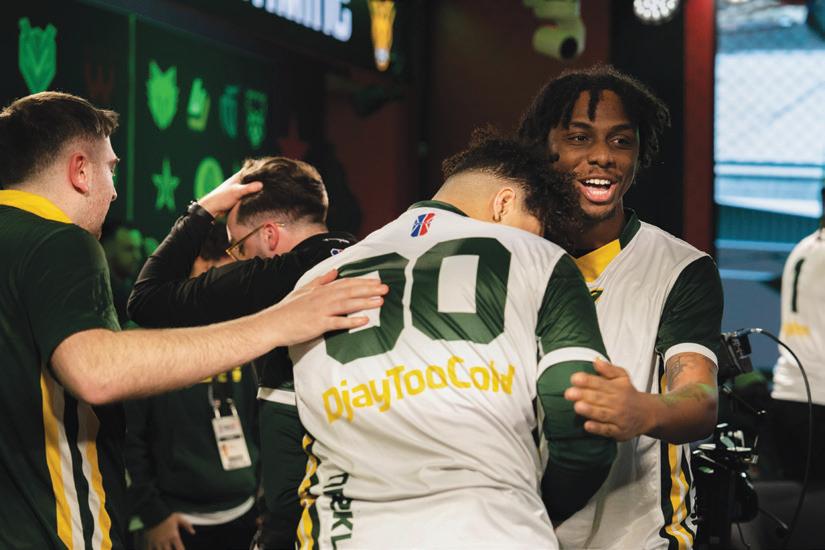
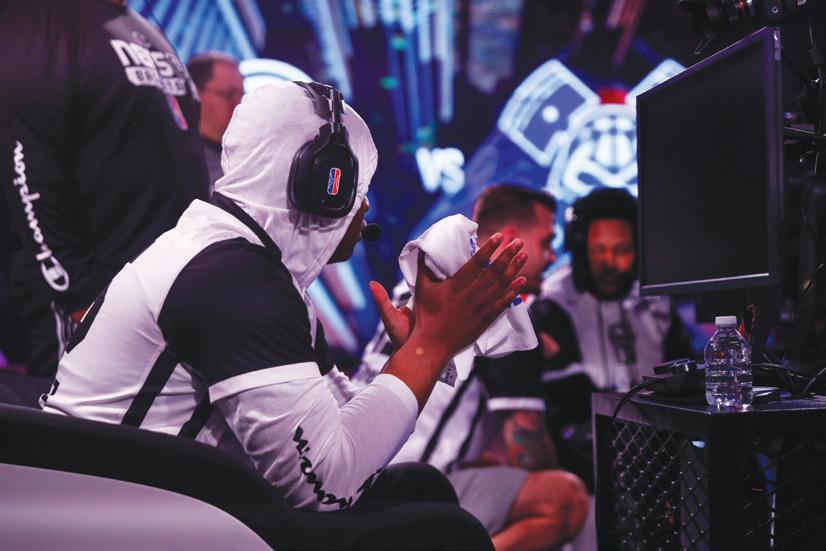
the exhibit. As the film’s Oscarnominated song “All the Stars” played in the background, the scene was perfectly set for the grand display – Boseman’s high-tech, vibranium-infused suit. Museum-goers stood in awe of its aura as they took pictures while doing the iconic Wakanda salute.
The entire Afrofuturism exhibit places Black people at the center of all things futuristic, ranging from science fiction comics to music innovations. With so many representations of Afrofuturism to fit into this story, the museum provides an out-of-this-world experience and, especially as a Black American, a personal and spiritual journey.
The exhibit will remain open until March 24, 2024.
Even if your March Madness bracket has been busted since the round of 64 or you’re grieving the ninthstraight year with GW men’s basketball out of the tournament, you should still make the most of the NCAA men’s championship game Monday night. As this year’s men’s tournament comes to a close, the championship game serves as a way to start your work week off on a fun note and take advantage of the game-day deals and exciting atmospheres at restaurants and bars around the District. Before tip-off at 9:20 p.m., head over to one of these five spots to tune into the game while grubbing on bar appetizers and discounted drinks.
Union Pub
Union Pub – a bar and restaurant in Capitol Hill – has featured game-day specials on discounted 10 Barrell Brewing IPA cans ($5),
Devils Backbone drafts ($6) and “Madness Shots” ($3) throughout the tournament. The dinner menu is stacked with fried goods and the restaurant’s famous totchos. The spacious, covered outdoor patio is the ideal spot for enjoying the warm spring weather while watching the game.
201 Massachusetts Ave NE. Open Monday 4 p.m. to 2 a.m. Cleveland Park Bar and Grill Cleveland Park Bar and Grill, just a block from the Cleveland Park Metro station, is a great spot to tune into the game. Its 40-plus big-screen TVs line the walls of the narrow main floor, composed of a full dining room with booth seating along the walls and a 12-seat bar. They will continue to feature their March Madness discounted drinks for the championship game, like Clutch Vodka shots and drinks, both for $7 each, as well as their usual food menu of burgers, pizza
and pasta. Head to the rooftop deck, offering an additional bar and outdoor seating, for a more spacious option.
3421 Connecticut Ave NW. Open Monday 5 p.m. to 2 a.m.
Duke’s Grocery
If you’re looking to stay close to campus to watch the game, Duke’s Grocery is the place for you. The joint is popular among sports fans for its lively atmosphere and elevated bar food. The restaurant’s Foggy Bottom and Navy Yard locations have been offering a buy five, get one free game day special on drinks throughout the tournament for any combination of Narragansett, New Amsterdam, Jameson, Fuller’s London Pride, Pimm’s and High Noon beverages. They will also run a Monday special for half-off bottles of wine from 7 p.m. until closing time. Bust out your GWorld to try their Proper Burger, rated one of the best burgers in D.C. The Foggy Bottom and Navy Yard
locations will be playing the championship game on their TVs around the bar area.
2000 Pennsylvania Ave NW. Open Monday 11:30 a.m. to 10 p.m.
Public Bar Live
For those who care about the game day atmosphere just as much as the actual game itself, head to Public Bar Live, a three-story sports bar and concert venue that makes for a high-energy environment fit for a national championship. Public Bar has 40 TVs across five bars plus a 14-foot HD projector screen. They offer special meals during sports events for groups of two ($100), four ($150) and eight ($225) that come with various amounts of wings, tenders, fries and drinks. Don’t miss the business’ specials featuring $8 tequilas and halfpriced wings all night.
Snag a seat at one of the restaurant’s long booths or head to the bar to camp out with your food and root for your team.
1214 18th St NW.
Open Monday 5 p.m. to 2 a.m.
The Town Tavern Assemble a group of friends and reserve a table ahead of time at The Town Tavern in Adams Morgan. Customers who book a reservation for a game-watching party of 10 or more people receive their first Bud Light pitcher for free. During the game, The Town Tavern will also offer specials including $15 Bud Light pitchers. Meal options include classics like burgers ($12-16), chicken tender baskets ($13) and wings ($14). The Town Tavern plans to play the championship game on its 15 flatscreen TVs with live satellite feed and surround sound. With a large group of friends you can have the game day experience to emulate watching the live final at the NRG Stadium in Houston, Texas Monday night. 2323 18th St NW.
Open Monday 6 p.m. to 1:30 a.m. Find more infor-
NUMBER CRUNCH
8.04
Baseball’s earned run average, up from its five-year average of 4.712
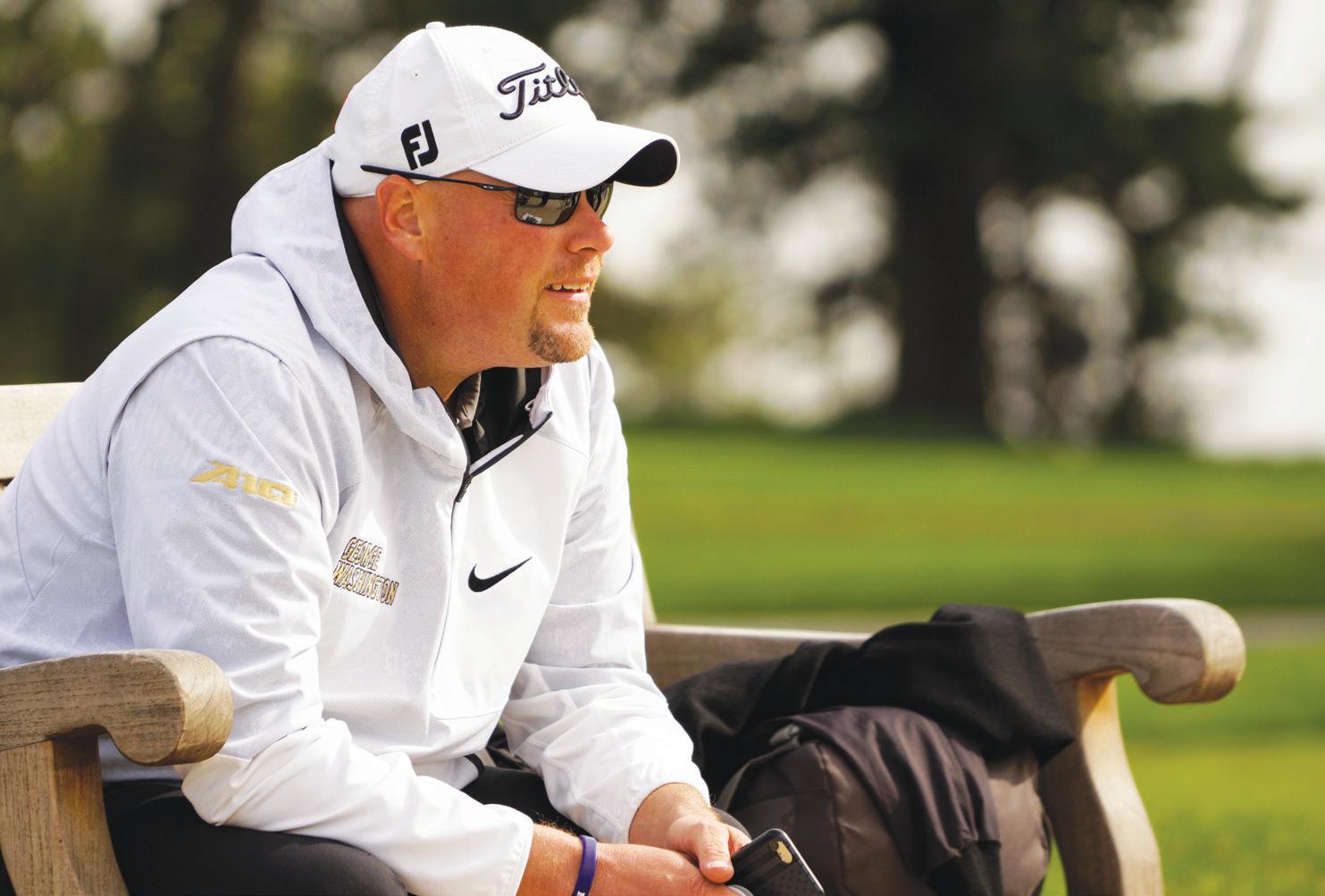
After three-straight top-three finishes in their spring slate of tournaments and two individual wins, golf is gearing up for a run at the Atlantic 10 title and looking ahead to a new era of Colonials golf.
The five-man team has hit their stride in the last month and a half, notching a pair of third-place finishes at the Savannah Intercollegiate and the Ross Collegiate Classic in a field of 18 and 15 teams, respectively, and coming up two strokes short of victory last week at the Golden Horseshoe Invitational. Senior Jakub Hrinda and freshman Manuel Barbachano have both captured solo victories, the senior’s in the Ross Collegiate and the freshman’s in the Savannah Intercollegiate.
The Colonials have leaned on a mixture of fresh faces and veteran leadership for their success this season, and with every player – including two seniors – returning for another
go around the block next year, Head Coach Chuck Scheinost has his eye on a multi-year stretch of highly competitive play.
“We’ve come a long way, and we don’t look at it as just this year,” Scheinost said.
The “really good kid” is Aksel Moe, the reigning division 3A Florida High School State Champion who signed a National Letter of Intent with GW in November. Moe, who consistently ranked within the top 60 in the 2023 class, will bolster an alreadyskilled and youthful roster even further.
Also returning is Hrinda, who won’t admit it but has assumed a “humble” leadership position among the team. He has pushed the crop of young freshmen to practice more frequently and has given tips to his teammates, like visualizing the course of the upcoming tournament as they practice on the range.
Hrinda’s attitude toward the freshmen golfers, along with fellow senior Hugo Riboud’s, has paid dividends on the
course. At the Savannah Intercollegiate, Barbachano shot a seven-under 209 and fellow freshman Rodrigo Barahona came in second for the Colonials with a fiveover 221.
The closest finish of the spring slate thus far came last week at the Golden Horseshoe Invitational in Southern Pines, North Carolina, where the Colonials walked to the clubhouse just two team strokes behind firstplace Villanova. But due to a virtual scoreboard malfunction, the team was unaware of their proximity to the lead going into the final stretch of the closing round, robbing them of momentum.
Barbachano said the team finished just two strokes behind Villanova but thought they were in third place heading into the final holes, despite their second-place positioning.
“We were frustrated,” Hrinda said. “I think everybody on the team performed really well, and they’ve known where they stand and finish really
GW men’s and women’s swimming and diving teams both continued their dominance of the Atlantic 10 Championships this year, marking the third year in a row that the men’s team won the A-10 Championship and the second year in a row where the women’s team won the conference title.
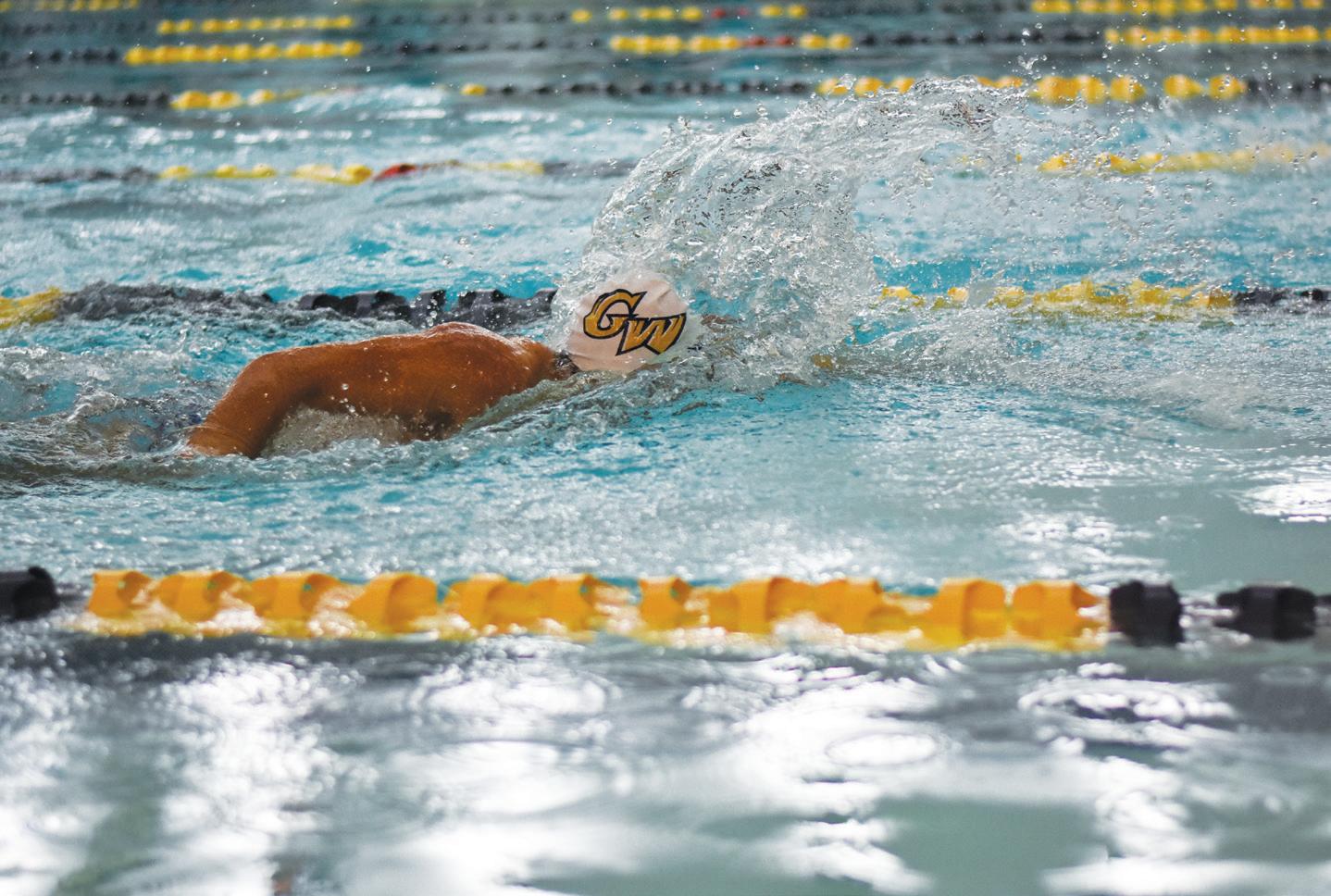
The men’s team set three A-10 records and 21 program records in their A-10 Championship appearance while the women’s team broke 14 school records across 19 events. Topping the list of specific event performances, men’s swimmers junior Karol Mlynarczyk, freshman Preston Lin, redshirt junior Djurdje Matic and freshman Ganesh Sivaramakrishnan smashed the A-10 record in the 200-yard freestyle medley relay for a gold medal with 1:25.69.
On the women’s side, freshman Phoebe Wright won the meet’s Most Outstanding Rookie Performer award after
receiving a gold medal in the 200-yard freestyle while freshman Ava Topolewski broke the A-10 1650-yard freestyle record and beat GW’s record for the event with a time of 16:27.78.
To start the postseason, sophomore Julia Knox became the first women’s swimmer to represent the Colonials at the NCAA Championship since GW Hall of Famer Meghan Mitchell qualified in 1995.
Overseeing both programs is Head Coach Brian Thomas who has led the men’s and women’s programs since 2018 and was named A-10 Coach of the Year for the fourth time in his career February.
Thomas emphasized that keeping a steady training schedule and eliminating distractions has been a major key to the team’s recent success.
“I think every team has distractions throughout the year and especially being in school in the middle of Washington, D.C., there’s plenty of avenues for that,” Thomas said. “But this team was able to put that
aside and did a pretty good job of maintaining their consistency and the high level of training that they’ve established.”
Junior Dylan Koo said at the start of every season, both the men’s and women’s teams outline the goals they have for that season, helping them envision a step-bystep process toward the endof-season competition. Koo said even though a lot of these goals, such as making the NCAAs, aren’t achieved by the end of the season, the very process of inching closer to them is what helps the team continuously improve and achieve high levels of performance.
Multiple swimmers praised Thomas’ personal skills and attention to detail, two aspects that undoubtedly improved the team’s performance and helped Thomas win A-10 Coach of the Year for the second-consecutive season and the third time in four years. Sophomore Molly Smyers said when she was being recruited, she wanted to be somewhere where she could have an open door .
strongly.”
GW will compete in two more tournaments before the season culminates in the conference championship, played this year at Reunion Resort and Golf Club in Orlando, Florida. The Colonials will travel across
the country next week to DuPont, Washington to compete in the Seattle Red Hawk Invitational at Chambers Bay golf course, the site of the 2015 U.S. Open. In their final stop before the conference tournament, the team will
head to Pittsburgh for the Redhawk Intercollegiate April 16.
“At the end of the day, we were talking about how I would define the season as a success,” Scheinost said. “Well, we’ve long exceeded success for this season. .”
Fueled by senior players’ last chance at an Atlantic 10 Championship run, baseball’s 2023 season kicked off with a disappointing regular season record.
The Colonials (9-20) recorded their worst preseason performance since the 2016 season, where they lost 18 games and won only eight after facing national baseball contenders like Yale and No. 11 East Carolina universities. Players said the team needs to work on maintaining momentum and their confidence to bounce back when their opponent’s offense sets in a run.
“We’ve kind of been punched in the mouth a little bit in the first half of the year, and we seem to just keep going at it,” junior right-handed pitcher Chris Kahler said in an interview. “This team doesn’t seem to have any quit in it, and a lot of guys just want to keep
going, keep pushing.”
Through the first dozen games of the 2023 season, GW recorded an 8.04 earned run average and 4.07 walks per game. In this stretch, the Colonials have batted 174 runs with a .433 slugging percentage and an onbase percentage of .367.
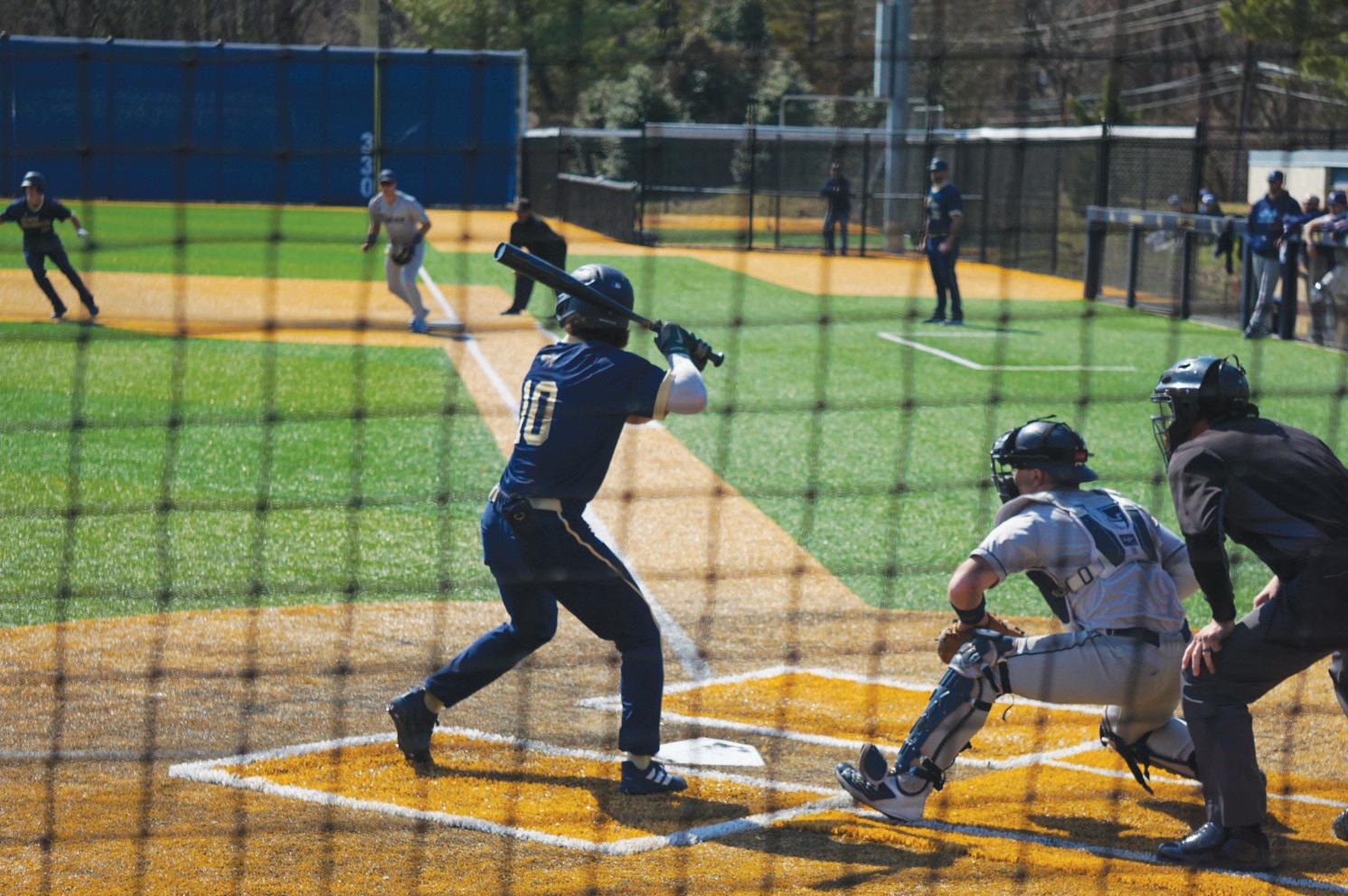
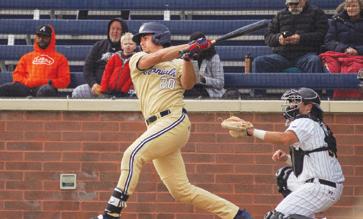
Last season the Colonials held a 22-30 overall record where they fell short of qualifying for the A-10 Championships, marking the fifthconsecutive year the team did not make playoffs. GW recorded a .413 slugging percentage and an overall 5.50 ERA, showcasing a struggling pitching staff that hit a seven-game losing streak toward the end of their slate.
A revamped roster with 18 new players has left the Colonials in a transitional period where Kahler said the team is still getting used to playing together but hopes to stay on course for the A-10 slate. He said the games in the preseason slate helped the team’s
pitching staff figure out where the bullpen needs to be cleaned up and what’s working for the regular season.
After their game against James Madison University, graduate student catcher Anthony Frechette said the team has been able to point out negatives in their defensive performance in the final innings. He said the team needs to continue working on solidifying a starting pitcher to put themselves in a good position to win the game early on as it alleviates pressure from the offense.
“For most of the game, really just takes a lot of pressure off your offense just to play free and keep having the right approach every at bat,” Frechette said.
Frechette said this preseason saw the team play at their worst, but as they enter A-10 play, they have started to hit their stride due to their confidence build that has helped them expect every outcome.
President Joe Biden appointed alumna Elana Meyers Taylor late last month to the President’s Council on Sports, Fitness & Nutrition where she will help advise White House officials to support nutrition and exercise in the country, according to a White House release.
The release states
Meyers Taylor – a five-time Olympic bobsled medalist in silver and bronze
and the most decorated Black athlete in Winter Olympics history – will work alongside 26 other newly appointed members consisting of current and former professional athletes, sports physicians and nutritionists to encourage accessibility in athletics and promote youth participation in sports. Biden issued an executive order to reinstate the council in 2021 until September 2023 after the White House office went inactive during the second
half of former President Donald Trump’s term in office. Other individuals named to the council include physician Maribel Campos Rivera, whose research focuses on community action projects to encourage healthy habits for children, superstar NBA point guard Stephen Curry and his wife, renowned chef Ayesha Curry. Biden appointed famed Spanish Chef José Andrés, who has previously taught at GW and owns on-campus
restaurant Beefsteak, and WNBA star Elena Delle Donne to serve as co-chairs of the council.
Meyers Taylor played on the softball team during her time at GW and won team MVP every season as a dual threat on the hill and at the plate. She studied exercise science and sports management as an undergraduate before graduating in 2007.
GW selected Meyers Taylor last year as the 2022 commencement speaker, and she delivered remarks
on the National Mall before the first class to gather for a spring in-person graduation ceremony in three years due to COVID-19.
Her career in bobsledding began in 2007 with a visit to Lake Placid, New York, the home of the U.S National Bobsled Team, a year after she graduated from GW.
Meyers Taylor has worked to promote equality in women’s sports with the Women’s Sports Foundation, and
she served as the president of the foundation in 2019, traveling the United States speaking with other female athletes and promoting gender equality in athletics.
Meyers Taylor was elected last August to be an athlete representative on the Board of Directors for the U.S. Olympic and Paralympic Committee and serves on the Georgia Council for Developmental Disabilities, which works to facilitate inclusive environments to those with developmental disabilities.