GW awarded $50M to research diabetes’ link to Alzheimer’s
MAGGIE O’NEILL REPORTER SOPHIA GOEDERT ASSISTANT NEWS EDITOR
GW’s Biostatistics Center is advancing a nearly 30-year study on the connection between diabetes and Alzheimer’s with more than $51 million from the National Institutes of Health for the research.
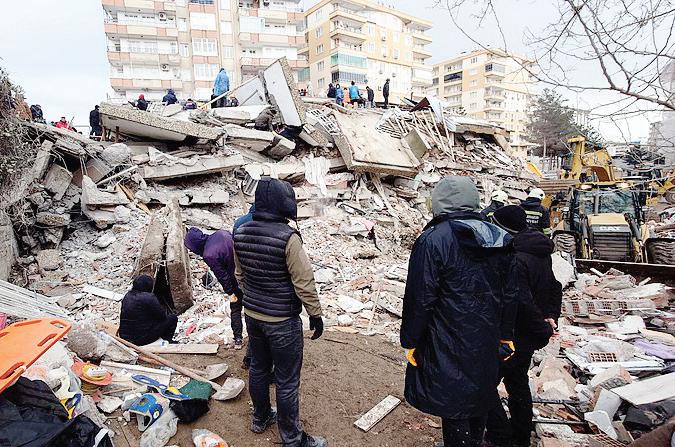
Students mobilize relief efforts to support earthquake survivors in Turkey, Syria
clothes to citizens harmed by the earthquake.
us from Venmo and we will separate donations,” Gorgen said.
Student leaders are supporting victims of an earthquake that struck a border region of Turkey and Syria last week through fundraisers like clothing drives to mobilize GW community members around the issue.
The catastrophic 7.8 magnitude earthquake that shook Turkey, Syria and neighboring countries like Iraq and Jordan last Monday killed at least 34,000 people as of Sunday. This number continues to climb as rescue teams continue to dig through the rubble to locate survivors. Student organizations like the Turkish Student Association, Students for Justice in Palestine and the International Student Association have shared links to earthquake relief funds, accepted donations and collected items like over-the-counter medicines and tents to ship to displaced civilians in Turkey and Syria.
Berk Gorgen, a junior and the president of TSA, said the student organization sprang into action after hearing news of the earthquake last Monday morning, launching relief efforts by advertising fundraisers in Kogan Plaza and offering ways for people to contribute money on the group’s Instagram page. He said the organization has raised about $1,000 as of Friday across three days of tabling in Kogan, which will be donated to funds like Bridge to Turkiye and Turkish Philanthropy to provide hot meals and warm
“They’re still living under the debris of the buildings, which is amazing, without food, without water or anything, and people are trying to save them still,” Gorgen said. “So even the little amount of money would help them.”
Gorgen said his family members living in Adana, a city in southern Turkey impacted by the earthquake, survived the earthquake and are safe, but he wants to help other families in the country who remain displaced or separated from loved ones.
“There are people who could not save their families, which is sad,” Gorgen said.
Gorgen said other student organizations, like the Azerbaijani Student Association, helped TSA promote their fundraising efforts in Kogan Plaza and the state of rescue efforts in Turkey and Syria via Instagram. He said various Turkish professors across the University have also supported the fundraising efforts.
“Mostly right now, we are trying to raise awareness to the situation because I think many people are still not really sure how big of a deal this is,” he said.
Gorgen said in addition to accepting contributions through Venmo, TSA is circulating links on Instagram to a selection of funds providing aid for civilians in Turkey and Syria impacted by the earthquake, allowing students to access reputable relief efforts.
“We are providing links to different funds as well as to Syrian ones as well, so people can choose what fund they want to donate or just contact
Lance Lokas, a sophomore and coordinating committee member of Students for Justice in Palestine, said SJP has collected more than $1,000 since Friday for Molham, a volunteer humanitarian organization based in northwest Syria, after sharing the group’s Venmo on Instagram and tabling in Kogan Plaza. He said SJP recognized the need for donations toward parts of Syria that “aid typically can’t get to,” which spurred their fundraising efforts for Molham.
“Obviously these conditions are exacerbated by U.S. sanctions on Syria right now,” he said. “But we hope that the donations we’re collecting and the work we’re doing will provide at least some semblance of relief for these people.”
The Treasury’s Office of Foreign Assets Control announced Thursday that it would exempt earthquake relief aid sent to Syria from economic sanctions that the U.S. government has imposed. Some have criticized the U.S. placement of sanctions on the country following the 2011 Syrian Revolution for allegedly causing disproportionate amounts of harm to people living in Syria.
Lokas said the situation is particularly dire since it is winter and the weather creates especially harsh conditions for those who have been displaced.
“There’s so many people who need help right now,” he said. “Any small bit counts.”
Sophomore Sare Arpaci, the president of the Interna-
tional Student Association, said she was with fellow ISA members when she received “shocking” news of the earthquake. She said members have leaned on each other for support and decided to start collecting relief funds.
She said the organization has collected about $200 for a fundraising campaign to support victims in Turkey and Syria, with proceeds going to the official emergency relief government institution in Turkey and the Syrian American Medical Society.
Arpaci, who is originally from Istanbul, said some of ISA’s members are from Turkey, Syria and neighboring countries, but members and their families are safe.
“It was a shock hearing from others about something that happened in your own country, but also it felt like there was support since I was with the members of my org,” Arpaci said.
Arpaci said ISA is planning to host a professor panel in the coming weeks to discuss the importance of access to media during natural disasters and international crises in light of Turkey’s Twitter restriction shortly after the earthquake, which has since been restored. She said she hopes students recognize the natural disaster as a humanitarian crisis and give what they can to support survivors.
“I think what we would want people to know is that this is a crisis for humans and it’s not related to anything political, or it’s not related to an idea,” Arpaci said. “And right now, what people need is support so that they can find shelter.”
Marinella Temprosa, the principal investigator of the study and an associate research professor in the Milken Institute School of Public Health, said 25 clinics across the country will evaluate potential signs of Alzheimer’s disease in participants with diabetes or prediabetes in hopes of stopping, preventing and reversing the disease. People with Type 2 diabetes, which affects more than 30 million Americans, have a higher risk of developing Alzheimer’s, but the connection between cognitive decline and diabetes is still unknown, according to the Alzheimer’s Association.
Temprosa said the research is a continuation of the Diabetes Prevention Program Outcomes Study that began in 1994, which observed how lifestyle interventions like diet changes, increased exercise and treatment with the diabetes drug metformin can delay the disease in people who have a higher risk of contracting it. She said in the new study, which will take about four years to complete, researchers from the 25 clinics will observe the original 1,976 participants of the DPPOS study and
see if they are showing signs of Alzheimer’s.
“The main goal is really to understand what are the determinants of Alzheimer’s disease and Alzheimer’s disease-related dementias in prediabetes and diabetes,” Temprosa said in an interview.
She said the application process for the grant from the NIH –which was fi nalized in September 2022 – took two years, and the funding will last until 2027, adding up to almost $89 million. GW received $51 million of the grant, and the rest was split up between the 25 clinics.
Temprosa said the study employs about 200 researchers nationwide who will evaluate the participants while the Biostatistics Center – housed under Milken and based in Rockville, Maryland – acts as the study’s coordinating center, a facility for managing and storing data for the study.
Pamela Norris, GW’s vice provost for research, said in an email that the grant is the largest NIH-funded grant that the University has received “to date.”

Temprosa said the research team is currently enrolling willing participants from the fi rst study and assessing their memory, language, brain and metabolic health. She said they expect about 15 to 30 percent of the original cohort to have mild cognitive impairment and about 10 percent to have dementia, which Alzheimer’s could have caused, based on national estimates.
See STUDY Page 2
in participants with diabetes or prediabetes in hopes of stopping, preventing and reversing Alzheimer’s.
Professor receives backlash for commentary bashing US pandemic response
SOPHIA GOEDERT ASSISTANT NEWS EDITOR
Milken Institute School of Public Health professor Leana Wen holds a coveted seat as a CNN medical analyst and contributing Washington Post columnist, but her views on COVID have generated backlash from public health experts throughout the pandemic.

Wen – a research professor of health policy and management – has argued that U.S. hospitals are overcounting COVID deaths, claimed masks can cause speech development delays among children and prioritized individual responsibility, despite backlash from public health professionals, while providing expert commentary on the pandemic. Experts in medicine and public health said Wen supports an “individualistic” approach to the pandemic as an alternative to community health policy and “abandons” immunocompromised people
in her columns, but some medical professionals call Wen’s individualism a “refreshing” point of view.
Wen did not return a request for comment.
Wen said in a column last month that the United States is overcounting COVID hospitalizations and deaths by adding patients to the respective tallies if they are positive for COVID, despite being treated for other reasons. Public health researchers argue that COVID deaths are undercounted because they can be misclassified as other causes.
Wen, the former health commissioner of Baltimore from 2014 to 2018, was scheduled to speak at the American Public Health Association’s annual meeting last November about receiving backlash while in the public eye, but she stepped down before the speech due to fears for her personal safety. A petition to remove Wen as a speaker at the
meeting started circulating last August and amassed 629 signatures from public health professionals.
The petition demanded the organization publicly condemn “rhetoric of inevitable mass infection” after Wen allegedly promoted “unscientific, unsafe, ableist, fatphobic and unethical practices” on her platform and diminished the work of APHA members.
The Wall Street Journal’s editorial board defended Wen last August against backlash for withdrawing support for the “left’s overreaching policies,” like mask mandates. The editorial board said Wen is “enduring the wrath” of public health professionals for suggesting that Americans need to learn to live with COVID.
Dabney Evans, an associate professor at Emory University’s Rollins School of Public Health, said she signed the petition last August to remove Wen as a speaker at the

ity placed on an individual, a policy approach that public professionals have widely rebuked.
APHA meeting because Wen characterized COVID measures as a responsibil-
INDEPENDENT STUDENT NEWSPAPER • SERVING THE GW COMMUNITY SINCE 1904 Monday, February 13, 2023 I Vol. 119 Iss. 20 WWW.GWHATCHET.COM What’s inside PHOTO ILLUSTRATION BY AUDEN YURMAN | SENIOR PHOTO EDITOR Experts said Leana Wen’s opinions on COVID policies don’t acknowledge individuals who are at high risk of contracting the coronavirus, while others said the media needs more voices that represent the views of the general population. Culture Get to know these three current and former student bands rocking out around D.C. Page 7 Opinions With the MFA raking in $200 million in loans, the editorial board questions GW’s financial priorities. Page 6 Sports Tennis hopes a victory over Bucknell will be a sign of things to come this season. Page 8 FAITH WARDWELL ASSISTANT NEWS EDITOR NIKKI GHAEMI CONTRIBUTING NEWS EDITOR
COURTESY OF MARINELLA TEMPROSA Marinella Temprosa, the principal investigator of the study, said 25 clinics will evaluate potential signs of Alzheimer’s disease
COURTESY OF VOA UNDER WIKIMEDIA COMMONS PUBLIC DOMAIN
Onlookers gaze upon a mound of rubble, the result of a 7.8-magnitude earthquake that devastated Turkey Monday, killing more than 34,000 to date.
See PROFESSOR Page 5
CRIME LOG
DESTRUCTION OF PROPERTY/VANDALISM
Shenkman Hall
2/6/2023 – 4:24 p.m.
Open Case
A female contractor reported a dispute with a male contractor that involved a chair being thrown and damaged. Case open.
DESTRUCTION OF PROPERTY/VANDALISM
Eckles Library
2/7/2023 – Unknown
Closed Case
A female staff member reported her laptop stolen from Eckles Library on Mount Vernon Campus. No suspects or witnesses.
PUBLIC DRUNKENNESS
District House
2/8/2023 – 3:59 p.m.
Closed Case GW Police Department officers responded to a report of an intoxicated male contractor who was asleep. The contractor denied treatment after EMeRG officials responded and was issued a bar notice.
Subject barred.
THEFT II/BICYCLES
University Yard
Pilot admissions program enrolls first group of students deferred to spring semester
RILEY REPORTER
IANNE SALVOSA ASSISTANT NEWS EDITOR
This spring marks the first semester for a group of 80 freshmen attending GW due to a deferred enrollment program that GW launched last year.
Officials said they initiated the program during the previous admissions cycle, deferring the 80 students –who were part of the class of regular decision applicants –from the fall to spring semester to create new paths for “academically talented” and “diverse” students. Experts in higher education admissions said universities offer spring deferral programs to enroll applicants when space opens up in residence halls and courses because of students who leave campus to study abroad or unenroll.
Provost Chris Bracey said students are willing to wait until after the fall semester to matriculate into GW. He said officials will offer the “full benefits” of a GW education to students who enroll in the spring, adding that they participated in an orientation that included panel discussions, academic briefings and a resource fair after arriving on campus last month.
“We are pleased GW remains a University of choice for many and are confident that we will be able to offer the full benefits of a GW education to all students, regardless of which semester they begin their academic journey,” Bracey said in an email. New York and Tulane universities, both peer schools of GW, advertise that they accept students for the spring semester whom they could not accommodate in the fall. Syracuse University allows students to apply to enroll in the spring semester.
Tatum Tatch, a freshman student studying international affairs who enrolled this spring, said she spent a “productive” fall semester
in Madrid, Spain, where she participated in a Spanish immersion program and took virtual community college courses like anthropology and economics. She said taking online courses that fulfill course requirements for her major facilitated her academic transition to GW.
She said studying abroad and adjusting to life outside her home state of California prepared her to attend college in an entirely new D.C. environment.
“The experience of getting thrown into a country where you don’t know anyone prepared me for college in general,” Tatch said. “I don’t feel nervous or anything coming in here as far as moving away from home.”
Tatch said after receiving her acceptance email from GW last spring, she connected with a friend from her hometown at GW and contacted other spring-admitted students via Instagram, which eased her social transition to campus life in 2023.
She said she was worried about falling behind on coursework during the semester off in the fall and considered enrolling in an-
other university, but she was “drawn” to GW due to the international affairs program and its location in a major city. She said she is happy about her decision to enroll at GW in the spring because she was able to study abroad in the fall, which the University encourages for international affairs majors.
“I wouldn’t have the opportunity to travel abroad or heal a lot of burnout I had from high school or just take time to reflect on the stuff I wanted to do like in college,” Tatch said. “I don’t really feel behind.”
Experts in higher education admissions said study abroad and attrition, when students leave before completing their degree, create open space on campus that spring entry programs can fill.
Kristin Guidry – a coordinator for Tulane University’s Spring Scholars program for freshmen to start in the spring – said students in the program often spent the fall working, traveling or volunteering, which helps prepare them for living independently and taking on new responsibilities.
“Many students are asking for the opportunity to delay the start of their college career until January to ensure they are prepared to be successful at the university level,” Guidry said.
Guidry said spring admission provides new opportunities for universities to admit students who are qualified and passionate about the institution but cannot start in the fall due to a lack of space on campus.
“For us, our challenges are centered around housing, as our students live on campus for at least their first two years, and classroom space,” Guidry said.
Guidry said Tulane provides spring-enrolled students with the same orientation program as those who started in the fall and guarantees them on-campus housing. She said delayed sorority and fraternity recruitment in the spring semester, like GW’s, also ensures they have the same social opportunities.
“I see spring admits becoming more normalized in the coming years as more schools are hearing from their students that this is
2/8/2023 – 9:56 a.m.-5:00 p.m.
Closed Case
A female student reported her bike stolen from a bike rack. No identifiable suspect.
THEFT II/OTHER
University Yard
2/8/2023 – Unknown
Open Case
A male student reported his scooter stolen from a bike rack. Case open.
THEFT II/FROM BUILDING
1957 E Street
2/8/2023 – 9:30-9:45 p.m.
Open Case
A female student reported leaving her ring in a basement restroom and being unable to find it when she returned. Case open.
UNLAWFUL ENTRY
District House
2/10/2023 – 4:53 a.m.
Closed Case GWPD officers responded to a report of a suspicious person inside the building. Officers made contact with the male subject and issued a bar notice.
Subject barred.
the experience they want,”
Guidry said.
Anna Lee Buehn, an assistant director of admission for Southern Methodist University, said more competitive higher education institutions across the country have implemented spring admissions programs in response to an increasingly large applicant pool over the past decade.
Officials said they received a record number of freshman applicants for the 2022-23 academic year. College applications across the United States rose 21.3 percent from the 2019-20 academic year to the 2021-22 academic year, according to a Common App report last year.
Bracey said at a Faculty Senate meeting earlier this
month that 97.7 percent of freshmen enrolled in the fall semester stayed at GW for the spring semester this academic year.
“For those who did not make that fall freshman class, we truly hold a very special place on this campus,” Buehn said. Buehn said SMU does not offer virtual courses, restricting enrollment to in-person spots, and students have a two-year residency requirement on campus, which limits the number of spots available in classrooms and campus housing in the fall semester.
“We want the best and the brightest,” Buehn said. “We want the students who are going to make the most of the opportunities that exist in this campus.”
Alzheimer’s study to focus on biological warning signs within diabetes patients
From Page 1
Alzheimer’s is a neurodegenerative disease characterized by the progressive erosion of memory and other cognitive functions, according to the Alzheimer’s Association. More than six million senior citizens are living with Alzheimer’s, according to the Alzheimer’s Association.
Temprosa said the study will focus on identifying biomarkers – a biological molecule found in the body that signals a condition or disease – to identify Alzheimer’s before it manifests.
She said the study will be the first to focus on the origins of diabetes-related Alzheimer’s, and the identification of the biomarkers will help future researchers potentially de-
velop a treatment or cure for the disease.
Experts in Alzheimer’s studies said research that examines the association between Alzheimer’s and diabetes will be critical in treating cognitive decline in older populations because the connection between the two diseases is unknown.
Mark Espeland, a professor of gerontology at Wake
Forest University, said the multimillion dollar grant for Temprosa is a “major grant for a wonderful researcher” that will hopefully help fill in some of the gaps in diabetes and Alzheimer’s research. He said GW has been critical in advancing the diabetes field as a leading research institution in diabetes because of research like the GRADE study, which found two
drugs effective in decreasing glucose levels last October.
Allison Reiss, an associate professor of medicine at New York University’s Long Island School of Medicine, said researchers have known about the connection between diabetes and Alzheimer’s for more than 20 years, but finding ways to halt and prevent Alzheimer’s is still unknown. She said a
cure for Alzheimer’s doesn’t exist currently, but typically expensive drugs, like Namenda and cholinesterase inhibitors drugs, give some relief from memory loss symptoms to the patient.
She said diabetes can lead to a higher blood pressure, which can hinder blood flow to the brain and can potentially lead to dementia or Alzheimer’s.
NEWS THE GW HATCHET February 13, 2023 • Page 2 News
THIS WEEK’S EVENTS THIS WEEK IN HISTORY Feb. 18, 2003 MARKETS OF CIVILIZATION: ISLAM AND RACIAL CAPITALISM IN ALGERIA Thursday, Feb. 16 | 2:15 p.m. EDT | Elliott School of International Affairs Join a book talk with a focus on how French colonialism in Algeria connects with racial capitalism. THE DETERMINANTS OF ASSISTANCE TO UKRAINIAN AND SYRIAN REFUGEES Thursday, Feb. 16 | 4 p.m. EDT | Elliott School of International Affairs Tune into a discussion about the difference in assistance provided to refugees from Ukraine and Syria SNAPSHOT KYLE ANDERSON | STAFF PHOTOGRAPHER
Officials closed GW due to severe weather conditions after a blizzard blanketed the District.
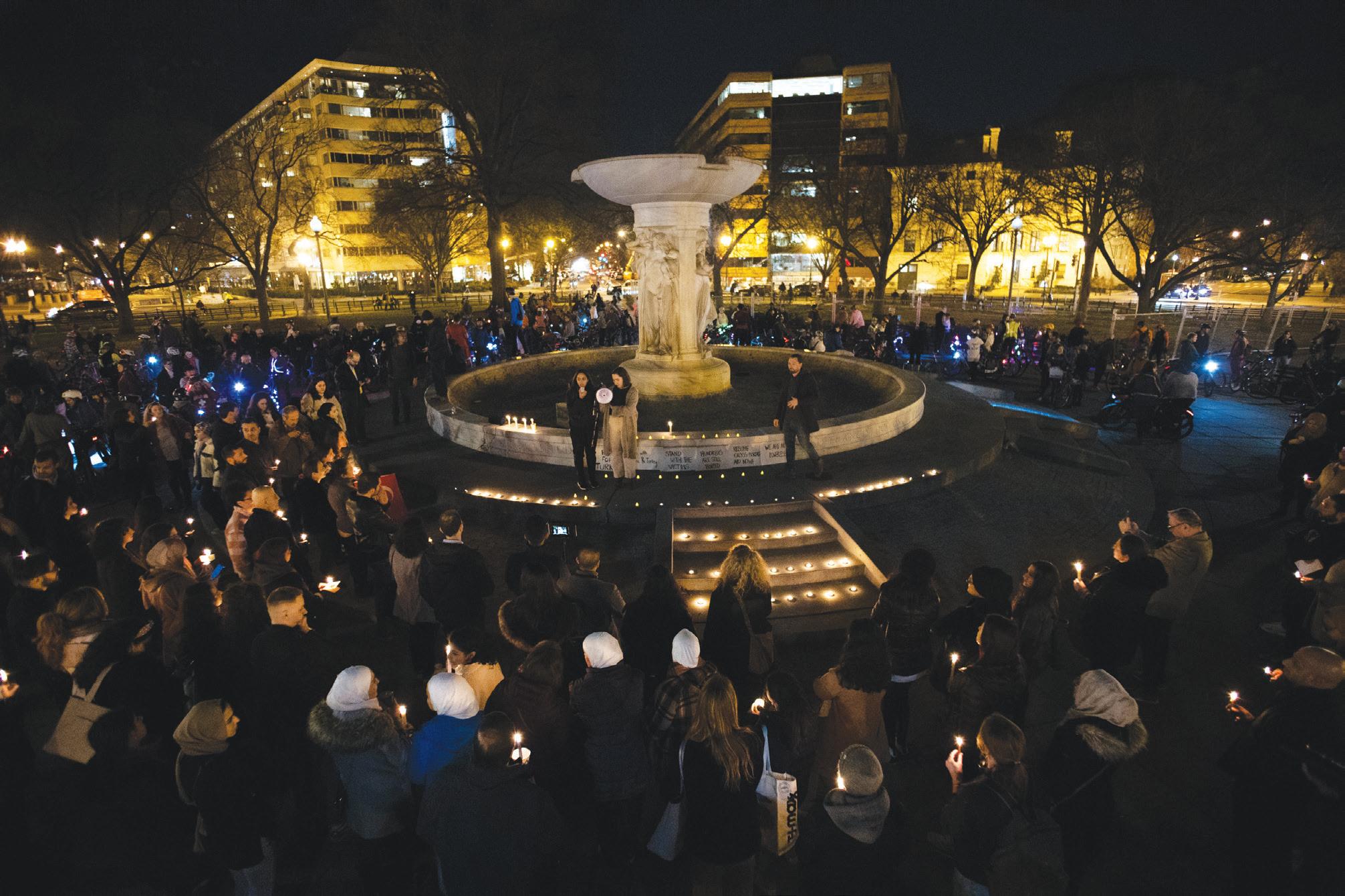
Locals gathered at a vigil in Dupont Circle Wednesday night for the victims of the 7.8-magnitude earthquake that struck southern Turkey and northern Syria. The death toll stands at more than 34,000 as of Monday.
FIONA
— Compiled by Peyton Gallant
HATCHET FILE PHOTO
Experts in higher education admissions said universities offer spring deferral programs when space opens up in residence halls and courses because of students who leave campus to study abroad or unenroll.
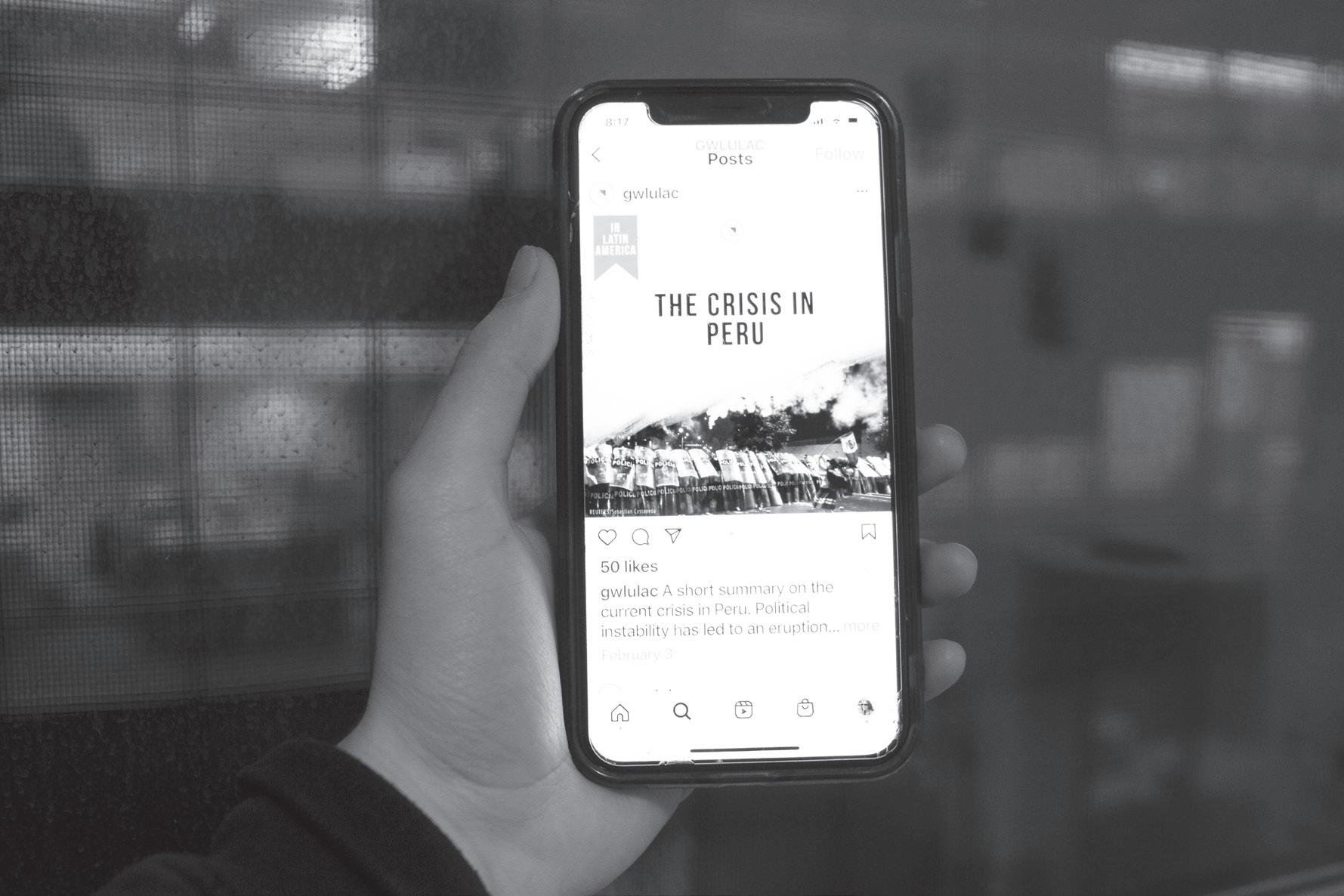
Student activists raise awareness, fundraise in response to civil unrest in Peru
GW community to donate and support Peruvian protesters’ fight for democratic freedom.
When junior Julian Abeledo saw news of a violent police raid at San Marcos University in Lima, Peru in late January, he was reminded of his grandfather.
Police in 1966 assaulted and exiled Abeledo’s grandfather, a former professor at the University of Buenos Aires, during La Noche de los Bastones Largos, a police raid displacing students and professors who opposed the government’s revocation of academic freedom. More than 50 years later, Peruvian authorities detained more than 200 anti-government protesters at San Marcos University in the January raid, mirroring the turmoil Abeledo’s grandfather endured. Drawing inspiration from his grandfather’s story, Abeledo is now leading efforts to mobilize GW students to support protesters who have confronted military forces in response to political turmoil in Peru. Peruvian President Pedro Castillo was impeached in December after he attempted to dissolve the country’s Congress, sparking civil unrest in the months since with more than 50 civilian deaths.
“Seeing that happen in Peru, I really felt it personally,” Abeledo said. “These people are going through the same types of things that we see happen tragically time and time again in the history of our continent.”
Student activists with the GW League of United Latin American Citizens and the GW Organization of Latin American Students said they’re leading fundraising efforts and hosting events to raise awareness about the crisis, aiming to spark political action among the
Abeledo – the director of outreach for GW’s chapter of the League of United Latin American Citizens – said the organization, in collaboration with the GW Organization of Latin American Students, assembled a student delegation of five to attend a vigil in front of the White House last Saturday for the victims of the Peruvian crisis.
Abeledo spoke at the vigil to a crowd of about 50, a majority of whom he said were of the Peruvian diaspora, to express support for those resisting military force in Peru and call for the restoration of democratic freedom in the country.
Abeledo said the vigil’s location at the White House was an attempt to apply pressure on the U.S. government to halt security aid to Peru, which he said is funding military efforts repressing protesters.
Abeledo said though his fellow LULAC members are from various parts of the Latin American diaspora, they each have a responsibility as Latin Americans to support Peruvians. He said the student organization has collected about $100 in donations for medical aid and legal support for costs like submitting habeas corpus petitions to review the validity of convictions for individuals detained for protesting in Peru.
He said LULAC is organizing an event series titled “Latinos en Lucha,” meaning “Latinos struggling,” to highlight the work of local activists who have called for a government response to issues impacting the Latino community, like the D.C. Domestic Worker Bill of Rights, which offers employment protections to more than 9,000 domestic workers.
Felipe Casas, a freshman at George Mason University and a
member of Abeledo’s student delegation that attended the White House vigil, said he attended a protest in Lima in January to join in widespread calls for a focus on human rights protections. He said he marched from Centro Histórico, a neighborhood in central Lima, and along the Avenida Arequipa, a main avenue in the capital.
Denise Romàn, a sophomore and the event coordinator for GW OLAS, said she helped coordinate a speaker event Thursday with LULAC featuring the deputy director for the Andes Region at the Center for Justice in International Law, a nonprofit dedicated to protecting
Dozens of employers recruit students at first GW career fair since 2019
ERIKA FILTER ASSISTANT NEWS EDITOR THARUNIKA GOVINDASAMY REPORTER
For the first time since before the start of the pandemic, a University-wide career fair came to campus last week.
More than 70 DMVbased employers in education, health care, engineering and government attended the largest of the fair’s recruitment events Friday, drawing roughly 1,000 students to tables across the Continental and Grand ballrooms on the third floor of the University Student Center. Student Association Senate chairperson pro tempore Demetrius Apostolis, CCAS-U, the executive director of the EXPO’s planning committee, said the SA and the Center for Career Services hosted the GW Career Exploration EXPO, a two-week program of 10 events featuring panels, virtual and in-person recruitment and an alumni brunch on campus.
GW has not hosted a career fair since January 2019, according to the University calendar. The fair brought in more than 100 employers that year and occurred each spring prior. The career center hosted a fair restricted to local startups in February 2020. Apostolis said a 12-person committee including Apostolis and SA Vice President Yan Xu, met with career center staff weekly over the last four months to organize the event. He said the SA recruited students to
attend, while the career center contacted employers.

“It was actually an idea that I had when I was running for Student Association Senate last May,” Apostolis said. “Coming out of the post-COVID world, the inperson career events and allowing students to connect with employers was something that I thought GW was missing.”
The EXPO began Jan. 30 with a virtual resume workshop with the career center. Later in the week, employers and students participated in a virtual recruitment event over Handshake Thursday and an in-person recruitment event Friday spanning the entire third floor of the University Student Center.
The EXPO ended with a brunch between alumni and students Saturday.
Apostolis said the planning committee released a survey and tabled in Kogan Plaza earlier this week to seek student input prior to the fair.
Apostolis said the career center covered food and setup costs for employers who attended. The SA allocated $4,000 for the event in September, which went toward promotional materials and the alumni brunch Saturday. He said the SA would reallocate unspent money back to the senate’s operating budget, which funds the operations of the legislative body.
Apostolis said about 70 students attended a panel held last week for international students, where author Dan Beaudry spoke about available pathways to employment.
“Honestly, it’s been even
a learning experience for members of the planning board, just getting to see how everything works and how they can get jobs as well and preparing students to make sure that they’re all equipped for this process,” he said.
More than 25 students who attended the fair said they were able to connect with employers local to the area and relevant to their fields of study. Students said in-person interactions helped them gauge the atmospheres of companies and helped them build more direct connections.
Hae Joo Yoon, a senior majoring in international affairs, said she hoped to get a better idea of the types of people working at various companies.
Gigi Tsastulga, a junior studying finance and data science, said she hoped to find a job that sponsored her as an international student. To work in the U.S., international students must receive sponsorship from an employer to obtain a work visa.
Tsastulga said many companies state they do not sponsor international students on their website or Handshake profile. She said the remaining companies weren’t currently offering positions relevant to her major, meaning she was likely ineligible for a job.
Tsastulga said attending the international student panel with Beaudry, the author of “Power Ties: The International Student’s Guide to Finding a Job in the United States,” provided helpful advice for international students aiming to work in the U.S. after graduating.
human rights in the Americas.
Romàn said after noticing a lack of coverage concerning Latin American politics in U.S. media, she wanted to do what she could to stay informed and encourage the GW community to do the same by following updates from Latin American student organizations and attending upcoming events hosting discussions about the crisis.
The Elliott School of International Affairs is hosting a discussion Wednesday to discuss the future of the crisis in Peru and “ways forward,” featuring former Peruvian president Francisco Sagasti.
Junior Kevin Bernabe, the vice
president of GW LULAC, said upon first learning about the crisis in Peru in December, he immediately wanted to coordinate programming that would bring awareness to the situation, so he assisted in organizing Thursday’s speaker event.
“We’re just trying to show them like, ‘Hey, be aware, be knowledgeable about what’s going on, be informed right now with what’s going on in the world,’” Bernabe said. “There’s a lot going on in our own country, but there are people that need the same attention, they may need the same resources that you may have, that you might find in your soul or heart.”
Virtual recruitment to remain a vital part of enrollment strategy: officials
Office of Undergraduate Admissions has provided virtual information sessions, and officials expanded those events to include prospective transfer students in spring 2021.
After turning to remote meetings to reach prospective students during the pandemic, officials said online recruitment is here to stay.
Dean of Admissions
Benjamin Toll said admissions officers plan to continue the student-led virtual tours and information sessions that they introduced when the pandemic began in 2020 to market the University to students who could not visit campus in person. Experts in higher education admissions said multiple universities have adopted virtual information sessions, but virtual recruitment has lost traction among prospective students suffering from “Zoom fatigue” after in-person tours and programming resumed in fall 2021.
Toll said GW plans to continue to “experiment” with a mix of in-person tours and virtual programming, which will include more specific information about the Mount Vernon Campus, transfer student admissions and degree programs than GW’s in-person sessions.
“Statistically, students are more likely to apply if they do both an in-person visit and a virtual opportunity,” Toll said in an email.
Officials said freshman applicants increased by 1.7 percent from 2020 to 2021, when they received 27,141 applications while recruitment remained entirely remote. Since fall 2020, the
The Office of Undergraduate Admissions ran a podcast series called GW Unfiltered on topics like dining and politics at GW from August 2020 to March 2021 to provide information to prospective students. The Office of Student Life also launched a student-led video blog series called “Connect to Campus,” which ran from September to December 2020, to engage with prospective students when most of GW’s operations were virtual.
Undergraduate enrollment dropped 7.7 percent from the 2019-20 academic year to the 2020-21 academic year after the pandemic began in March 2020.
Toll said although enrollment has started to climb since the pandemic, “Zoom fatigue” has reduced engagement in live remote programming. But he said virtual live information sessions were still a very “effective” method to connect with students and communicate with parents because it supplements inperson Inside GW sessions.
The University paused Inside GW, an eight-day tour and information session program for admitted students and their families when the pandemic hit before resuming it last April.
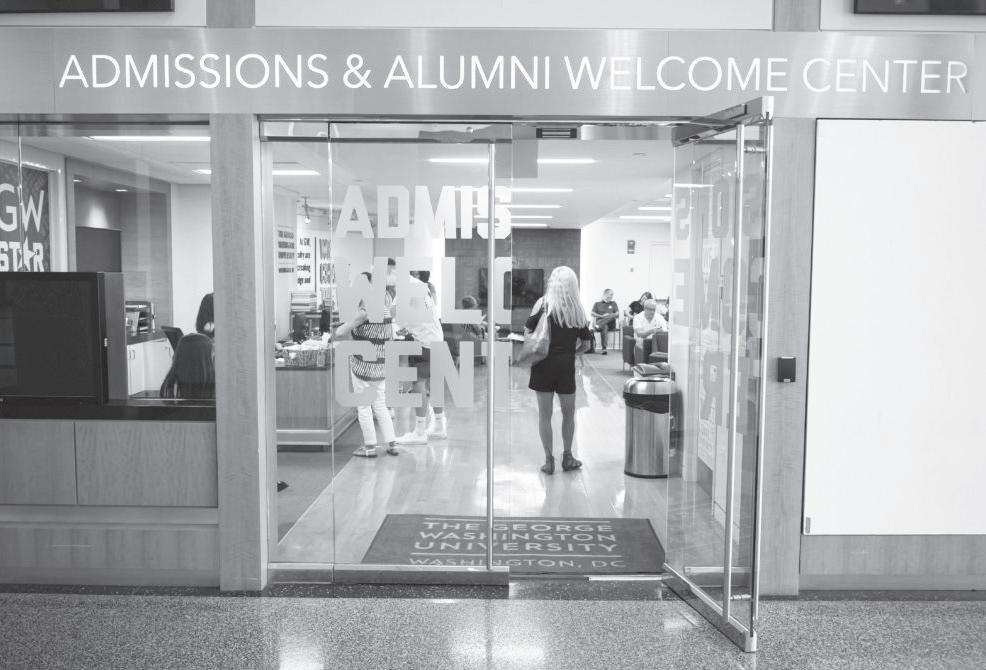
“Virtual programming will remain a part of the admissions process moving forward, but we will continue to experiment with formats and types of programming to best meet
the needs of each cohort of future students,” Toll said.
Jason Zara, the faculty director of undergraduate admissions, said he has led “Discover Engineering and Computer Science at SEAS” since fall 2020, a virtual information session about the School of Engineering and Applied Sciences where prospective students can participate in a Q&A session.
He said SEAS will continue to host virtual events as the school expands inperson tours.
Experts said online recruitment efforts have made higher education more accessible to prospective international students who may struggle traveling abroad to tour a college campus. They said colleges and universities can curate virtual information sessions to students based on their program or degree of interest and make programming schedules more flexible through prerecorded content.
John Thelin, a professor emeritus at the University of Kentucky, said admissions staff have always hesitated to organize virtual recruitment events in fear of disrupting their “historic” and “established” institutional image with modern technology.
He said even after higher education institutions developed their virtual recruitment technology, the quality of recruitment content tends to suffer due to lag and poor design from adults who don’t have as much technological experience.
“Nothing is more boring than tired, weary technology that is not well done,” Thelin said in an email.
NEWS THE GW HATCHET February 13, 2023 • Page 3
AYAH MAHANA REPORTER SEJAL GOVINDARAO STAFF WRITER JENNIFER IGBONOBA | STAFF PHOTOGRAPHER The Student Association and the Center for Career Services collaborated to host the GW Career Exploration EXPO, a two-week
program featuring panels, virtual and in-person recruitment sessions and an alumni brunch in the University Student Center.
PHOTO ILLUSTRATION BY RACHEL SCHWARTZ | ASSISTANT PHOTO EDITOR
Student activists with the GW League of United Latin American Citizens and the GW Organization of Latin American Students said they’re leading fundraising efforts and hosting events to raise awareness about the crisis.
LIAM ROSENBERG REPORTER NICOLE SANDRIK-ARZADI REPORTER
HATCHET FILE PHOTO
Dean of Admissions Ben Toll said although enrollment has started to climb since the onset of the pandemic, “Zoom fatigue” has reduced engagement in live, remote programming.
Online programs rise in U.S. News & World Report rankings
GW offers some of the country’s most prestigious online degree programs, according to updated rankings that U.S. News & World Report released last month.
The site ranked GW No. 15 out of 359 universities in online bachelor’s programs, No. 8 in online bachelor’s programs for veterans and No. 4 in online master’s programs in nursing administration following a survey of more than 1,800 university programs across the country. Experts in online higher education said universities are expanding online curricula to diversify student enrollment, generate revenue and showcase their strongest programs like public health and business administration at GW.
Last month’s report signals an improvement from a 2021 U.S. News & World Report ranking that listed GW as No. 19 among online bachelor’s programs and No. 11 in online bachelor’s programs for veterans. The University’s rise in the rankings comes after officials added online programs in fields like computer science during the pandemic.
Provost Christopher Bracey said in a release in February 2023 that he is committed to enhancing the profile of online programs – a “continued focus” that delivers highranking online education to students at different stages in their educational careers.
“As we continue to relentlessly pursue excellence in teaching and research, online education will remain an essential element of our academic programming,” Bracey said in the release.
The Columbian College
of Arts and Sciences leads the University with 156 master’s and bachelor’s degree programs, followed by the School of Medicine and Health Sciences with 48, the Milken Institute of Public Health with 35, the School of Business with 32 and the Graduate School of Education and Human Development with 31. After GSEHD comes the College of Professional Studies with 25 online programs, trailed by the School of Engineering and Applied Sciences with 22 and the Elliott School of International Affairs, the School of Nursing and GW Law with 13 courses each, according to the University’s enrollment dashboard. In 2022, graduate students accounted for 87.7 percent of students enrolled in online programs at GW, totaling 5,664. Milken, GWSB and SEAS contained the majority of online graduate students, according to the data. 570 online undergraduate students were enrolled in online programs last year, accounting for 8.8 percent of all online students. More than half of those undergraduates studied in SMHS.
Milken granted 1,069 online master’s degrees in public health, accounting for 21.9 percent of all online master’s degrees awarded last year. Online master’s degrees in business administration accounted for 9.7 percent of all degrees with a total of 474. Master of Science in Systems Engineering degrees reached 214, or 4.4 percent of all degrees, according to the Office of Institutional Research and Planning.
The U.S. News & World Report assessment is based on categories weighing how programs can administer “affordable degrees” in a “reasonable” amount of time. Academic officials evaluate student participation in courses, diversity of online learning technolo-
gies and faculty academic credentials to account for “intangible factors” influencing programs, according to the U.S. News & World Report methodology page.
Dan Hillman, the associate director of instructional design at Boston University, said universities continue to emphasize online learning programs post-pandemic to increase student enrollment and retention and generate revenue.
He said constraints like limited classroom seating and travel costs associated with in-person learning encourage some students to opt for online learning, allowing universities to rake in more money through larger courses.
The University enrolled 6,462 students online in 2022, a 138 percent rise from 2012 when it enrolled 2,701 students, according to enrollment data.
An online Master of Public Health degree at GW consists of 45 credits at $1,800 per credit, totaling an estimated $81,000 in tuition. Beginning in the fall of 2020, officials increased the cost per credit of an online master’s degree in business administration from $2,025 to $2,285, amounting to $106,252.50 in tuition for the 46.5 credits required for the degree. One online credit hour for a master’s degree costs $1,395 per credit hour in the School of Nursing, between $1,050 and $1,075 in SEAS, $920 to $1,170 in the Graduate School of Education and Human Development and $1,075 to $1,780 in the College of Professional Studies.
Ten online master’s degrees at Boston University charge $955 per credit hour, while Georgetown University College of Arts and Sciences charges $2,538. The University of Miami charges $2,310 per credit hour for an online business master’s degree.
Student organization to promote autism awareness, research
A student organization will work to increase awareness of autism and advocate for further research about the disorder this spring.
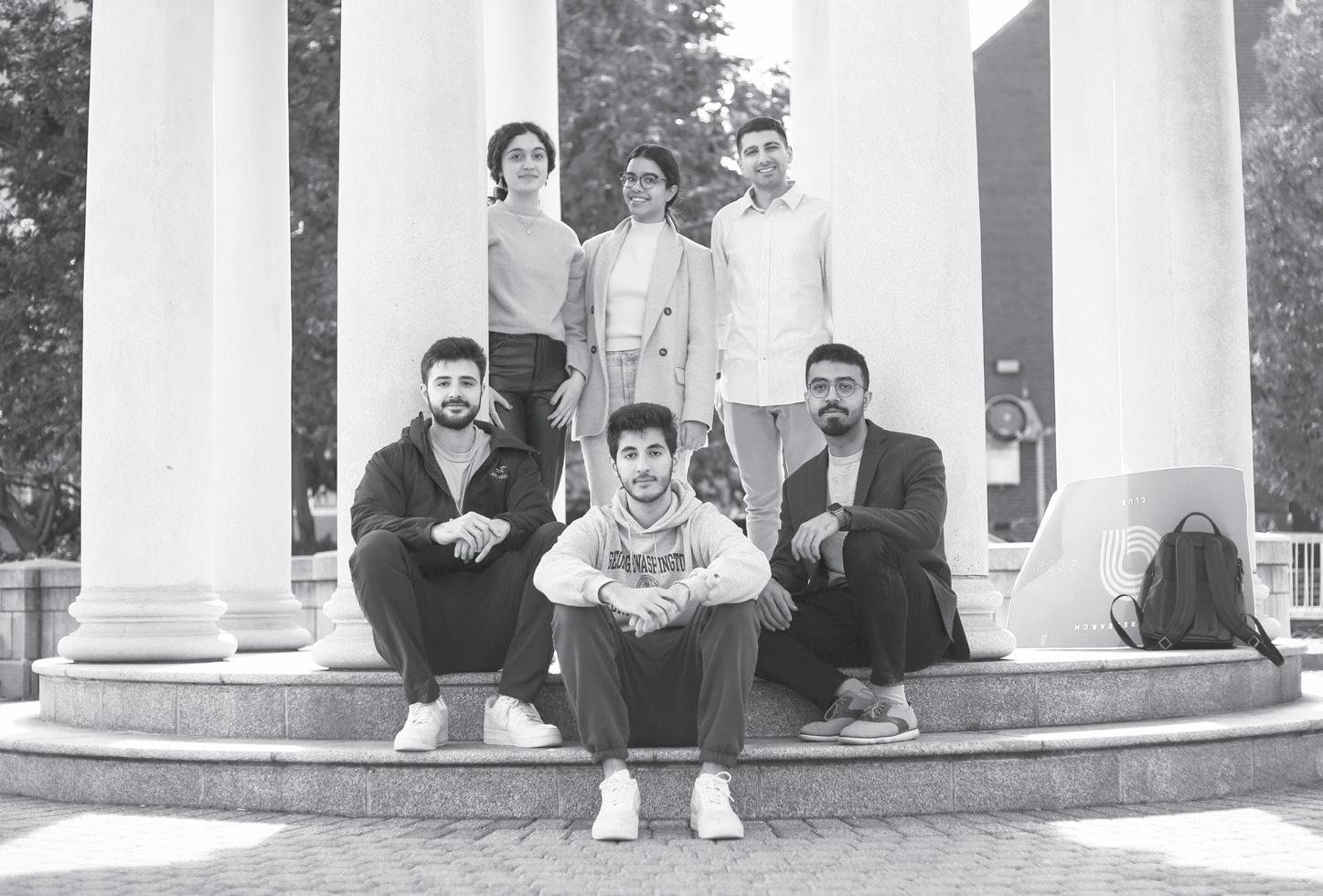
Autism Research Club student leaders said they plan to start hosting speaker events with professors specializing in autism research and organizing fundraisers for organizations like Autism Self Advocacy Network during their first full semester as a registered student organization this spring. They said 15 students have signed up as members since Student Involvement and Leadership approved the student organization in November, and they hope the events will help destigmatize autism on campus.
Mohammed Almarkhan, a senior and the president and co-founder of ARC, said he was inspired to pursue neuroscience and further autism research because his sister has autism. He said he conducts research with Gregory Wallace, an associate professor of speech, language and hearing sciences, to investigate the risk of dementia in adults with autism.
“Autism research will not only benefit people with autism but also help assure their family and their loved ones,” he said.
Almarkhan said the process of creating the student organization was “daunting” because he was unsure whether the group would grow and become successful. He said he sought advice on how to structure the club from professors in the speech, language and hearing department, like Gregory Wallace, Francys Subiaul and Ashley Darcy-Mahoney, the director of infant research at the Autism & Neurodevelopmental Disorders Institute.
“They were very ex-
cited,” Almarkhan said. “They gave me recommendations, and they told me they were there to help.”
Almarkhan said he plans to invite the three professors to general body meetings where they can share their knowledge and discuss the common misconceptions about autism, like people falsely attributing autism to vaccinations.
“Autism is often presented as a disease or something to get rid of, but the autistic community usually discusses it as an identity and part of them,” he said. “They don’t want to ‘treat’ it but rather invest in accommodations and understanding their perspective.”
ARC Vice President Waleed Qaddumi, a senior majoring in neuroscience who co-founded the student organization, said he hopes conversations among members and information from professionals can answer unresolved questions about the disorder, like how to identify and diagnose autism in early childhood and how to find effective treatments.
“At ARC, we hope to be able to support research groups that can bring us one step closer to closing the gaps in scientific knowledge and do our part to help others through real-world applications,” he said.
Qaddumi said he is taking the speech, language and hearing department’s Autism course with Wallace, and he is trying to recruit classmates to join ARC. He said members have put up flyers in Kogan Plaza and Gelman Library earlier this semester to try to spread the word about the student organization.
Qaddumi said ARC plans to host its first general body meeting later this month. He added that members are all “supportive” due to their respective personal connections to people with autism, and they are “motivated” to
learn how to fundraise and contribute to the cause.
“At the Org Fair, there are a lot of people who say that they want to join this club because they have a family member or friend who has autism,” Qaddumi said.
Farris Alqalam, a senior majoring in biomedical engineering and the secretary of ARC, said he has a family member who has autism who has made him more understanding of the experience of living with the condition. Alqalam said the student organization has been relying heavily on “word of mouth” to recruit new members and encourage participation.
“It’s a place where you can come and we have a good group of people,” he said.
Alqalam said he is committed to combating the misconception that autism is a disease with a potential cure instead of a lifelong neurodevelopmental disorder. He said people tend to think of autism on the spectrum as either “severe” or “mild” but, it affects everyone differently and presents separate sets of behavioral challenges for each individual.
“Autism is a spectrum condition, meaning that each person is affected differently,” Alqalam said. “Each person may have a specific set of behavioral and developmental challenges that can impact that person’s communication or social or play skills differently.”
Dasha Ordynat, a senior majoring in neuroscience and a member of ARC, said she is eager to expand her knowledge of disorders like autism as she wraps up her pre-med track education as an undergraduate.
“I think this org is the beginning of people at GW being able to talk about autism and be aware that it is around them,” Ordynat said.
Students offer sexual wellness kits, advocate for destigmatizing sex education
OLIVIA EMERSON REPORTER
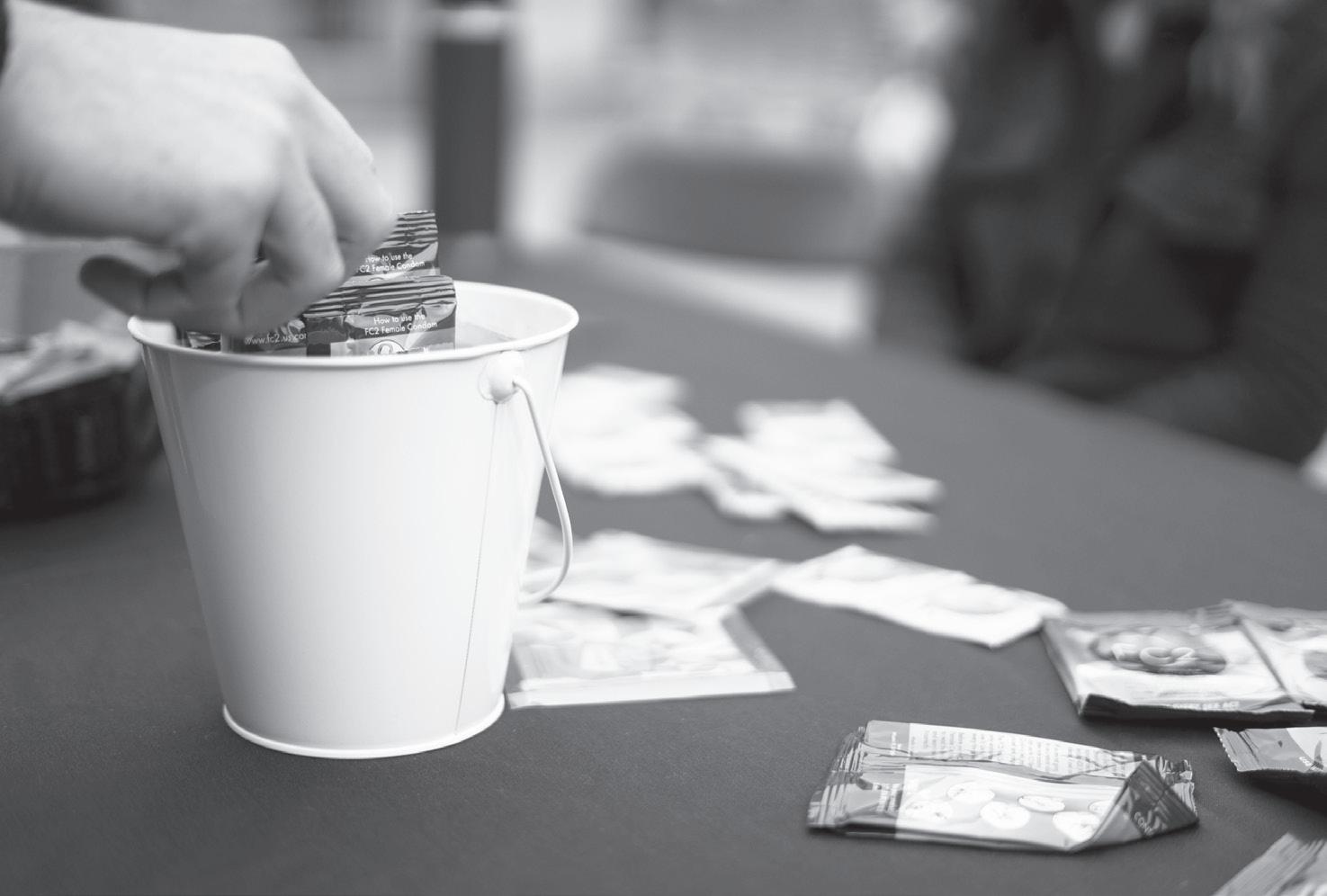
Student organizations like the Residence Hall Association and GW Reproductive Autonomy and Gender Equity distributed sexual wellness kits in Kogan Plaza Thursday that included free condoms, pregnancy tests and menstruation products.
Six campus organizations and University departments, including the Office of Advocacy and Support, the Disabled Students Collective, Clearminds and the Student Health Center, gave out free sexual wellness goodie bags in Kogan Thursday to help promote safe sex and create an accessible and safe space for students to acquire these materials. Organizers said they hope the event will help destigmatize sex among students and eliminate sexual health product cost barriers.
Organizations offered resources like stress balls, informational pamphlets on Plan B and consent, pain relief patches, ice packs and lubricant.
Junior Arielle Geismar, the president of RHA, said one of the organization’s objectives is to promote sexual health for students on campus and supply resources in residence halls in addition to Thursday’s event.
“I hope that as students walk through Kogan with their friends that they see topics like these as less taboo and more okay to talk about,” Geismar said, “I’m also hoping that students walk away knowing more about their sexual health and education.”
Geismar estimated that hundreds of students visited their six tables within the first hour they had set up in Kogan, and she heard positive feedback from many students appreciating how the organizations were giving out these products for free as they passed through.
“I think it’s really cool to just see students take what they need,” Geismar said.
“Very rarely do we see all of these resources available in one spot at the same time, so I’m really excited that RHA is providing that.”
Madison Jennings, a firstyear graduate student studying public policy and the president of DSC, handed out pain relief patches and ice packs for sexual aftercare.
Jennings said in addition to raising awareness for sexual wellness from the perspective of the disabled community, the event gave students access to sexual health products despite price and accessibility barriers students may face when attempting to buy
them in stores.
“I am less knowledgeable in that area because I live off campus,” Jennings said. “I sometimes feel that I’m less connected to the resources and less knowledgeable. As an off-campus student, there’s a little bit of a gap there.”
Freshman Maddy Niziolek, the co-president of GW RAGE, said the organization handed out free condoms that the group acquired from donations by the D.C.-based nonprofit Advocates for Youth’s Condom Collective.
“It’s an open thing that we can talk about, that makes everyone safer and it shouldn’t be something that’s stigmatized,” Niziolek said. “It’s to raise awareness for a bunch of different orgs who do this work and also decrease stigma on campus and provide students with the resources they need and might not otherwise be able to afford.”
Niziolek said that GW RAGE hopes the event will help students who may not be able to afford these sexual wellness items and increase accessibility for students.
She said RAGE also hopes the Plan B vending machine launched in the University Student Center last month will eventually offer emer-
gency contraceptives for low-
er prices than the $30 they are selling it for currently.
“For some students buying condoms or buying Plan B would mean the difference between not eating or not being able to afford their rent or something else.” Niziolek said. “At RAGE, we believe that it is a right for people to have these products and be able to practice safe sex and to be able to control their
own reproduction in the way that they want.”
Anissa Tanksley, a prevention specialist at the Office of Advocacy and Support and a Student Bar Association senator, said OAS provided informational pamphlets about their office services and information about consent and healthy relationships. Tanksley said OAS’s goal was to inform students about their services
for community members, like being a confidential resource for sexual violence victims.
“Our personal goal is to make sure that as many students on campus as possible know who we are, have our number, and know that we are a resource that is confidential to students who’ve experienced any type of intimate partner violence or sexual violence,” Tanksley said.
NEWS THE GW HATCHET February 13, 2023 • Page 4
EÓIGHAN NOONAN CONTRIBUTING NEWS EDITOR LAUREN SIMON REPORTER
HANNAH MARR REPORTER
JORDAN TOVIN | PHOTGRAPHER
Student organizations offered resources like stress balls, informational pamphlets on Plan B and consent, pain relief patches, ice packs and lubricant.
JENNIFER IGBONOBA | STAFF PHOTOGRAPHER
Autism Research Club student leaders said they currently have 15 registered members and plan to organize fundraisers and host speaker events with professors specializing in autism research.
FILE PHOTO BY COLIN BOHULA | STAFF PHOTGRAPHER
The U.S. News & World Report assessment is based on categories weighing how programs can administer “affordable degrees” in a “reasonable” amount of time.
String of phishing emails, cyberattacks target GW community members
clicking links, attachments or files from unknown emails.

Officials said a “malicious intruder” accessed the GW Directory last week and launched a “phishing attack” on users in GW’s web portal, the latest in a string of scam emails targeting GW students, faculty and staff since mid-December.
An email sent by GWIT on Feb. 1 said the intruder obtained first and last names, department and positions, GW email addresses, office phone numbers and campus addresses of students, faculty, staff and alumni. Officials said a series of phishing emails over the last several months masquerading as GW community members have promoted false employment opportunities, payroll updates for faculty and enrollment for 2023 insurance benefits. The intruder did not compromise any personal information and GWIT promptly blocked the unauthorized access, according to the email from GWIT.
“We apologize for the impact this cybersecurity incident may have on you,” the email states. “An investigation is underway, and GW Information Security continues to actively monitor for any suspicious activity.”
Officials said in the email they have contacted the users who received phishing emails in. Students are only hired for GW student jobs through official channels like GW Career Services at gwcareercenter@ gwu.edu, and students, faculty and staff should ignore any requests for information and report suspicious activity to the University, according to GWIT.
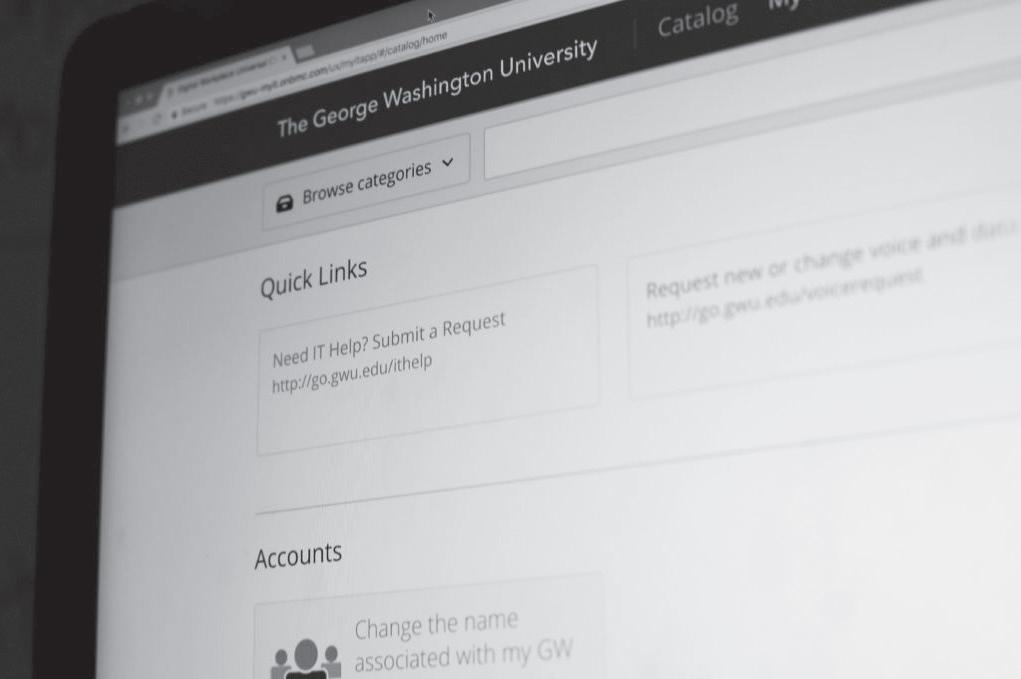
In response to the phishing emails, GWIT has sent at least four email alerts to all GW email addresses since December 16th urging students and faculty to “ignore” any messages requesting personal information, report any electronic communications promising unexpected money or rewards and avoid
Geneva Henry, the vice provost for libraries and information technology, said phishing attacks are increasing and becoming more sophisticated worldwide as technology users and cybercriminals become more “sophisticated.” She said GW’s email system filters out over 100,000 “suspicious” emails set to be delivered to GW email addresses each week to protect community members.
Henry declined to comment on how many reports of phishing attempts have been made to the University and how many community members have been affected by cybersecurity attacks.
In September 2020, GW Hospital doctors and nurses resorted to paper documentation methods following a suspected ransomware attack that temporarily disrupted clinical and financial operations at the hospital.
Henry said “cybercriminals” accessing inactive email accounts that had not set up two-step authentication resulted in the recent attacks on GW systems. She said through these accounts, hackers could access the GW directory and send deceitful emails to University community members.
“At no time did the cybercriminals have back-end access to any systems nor could they see or download any sensitive information,” she said in an email. “The email accounts were hacked, but GW’s systems were not.”
In May 2021, a hacker infiltrated the University’s commencement attire vendor Herff Jones databases, hacked student payment information and made unauthorized purchases on their credit cards. The breach leaked payment information belonging to students from multiple universities using the company.
Henry said a team of staff members in GWIT enforce several layers of security procedures, like email filters, two-step authentication and
blocking malicious actors to asses cyber risk and ensure the security of University community members’ personal information. She said the GW community should be “cyber aware” and educate themselves about phishing scams through resources provided by the Federal Trade Commission and GWIT. She said any suspicious emails should be forwarded to abuse@gwu.edu. Students, faculty and staff should contact the GW Privacy office at privacy@gwu.edu with any questions or concerns, she added.
“Ultimately we rely on your vigilance to keep our community safe,” she said. “Please remain mindful of who you give your personal information to.”
In December 2021, GW Law students and faculty experienced a cyber attack on “MyLaw,” a platform which provides law students with access to class notes and assignments. The attack compromised GWIDs, course schedules, fac -
House votes to overturn D.C. voting bill, revised criminal code
GRACE CHINOWSKY ASSISTANT NEWS EDITOR
The U.S. House of Representatives voted to nullify two D.C. Council bills Thursday, marking the first time in eight years the chamber has moved to throw out a D.C. bill.
The body passed resolutions disapproving two of the Council’s bills, including the revised criminal code which passed 250-173 and a bill allowing noncitizens to vote in D.C. elections, 260-162. The votes throwing out the bills received bipartisan support, with 31 and 42 Democrats joining Republicans in voting to reject the criminal code and voting bill, respectively.
The disapproval resolutions now move to the Senate floor, where Democrats hold a 51-seat majority, and will go to President Biden’s desk if the disapprovals pass.
IN BRIEF
“We have two acts from the Washington, D.C., council that will dilute the vote of American citizens and endanger city residents and businesses,” House Speaker Kevin McCarthy, R-C.A., said Thursday.
The House voted to repeal D.C. Council’s revised criminal code, which the Council passed in November to update “outdated” criminal laws that went unchanged for more than a century, but officials have been working on updating the code for more than a decade. The revised code includes the retirement of all mandatory minimum sentences, expansion of jury trials for misdemeanor convictions and inmates’ ability to petition for a reduced sentence to a judge.
The Council overrode D.C. Mayor Muriel Bowser’s veto of the
code in January with a 12-1 vote amid Bowser’s qualms about gun access in the District and the code’s ability to keep the community “safe.”
The D.C. Council passed the Local Voting Rights Amendment Act in November, which allows non-U.S. citizens the right to vote in D.C. local elections. Congressional Republicans said this puts the integrity of the American election system “at risk” at a Monday meeting.
Eleanor Holmes Norton, D.C.’s non-voting delegate in the House, said there is “never” justification for the House’s interference in D.C.’s local government in her remarks on the House floor Thursday.
“There is only one question before the House,” Norton said in a Thursday release, “The question is: do you believe in democracy?”
Fetterman discharged from GW Hospital after MRI results show no signs of stroke
Sen. John Fetterman, D-PA, was discharged from GW Hospital Friday after being admitted to the facility two days earlier because he felt “lightheaded” Wednesday, according to a statement from his office.
Joe Calvello, Fetterman’s communication director, said in a tweet that Fetterman tested negative for a stroke but doctors kept him in the hospital to monitor him for signs of a potential seizure, which they ruled out Thursday. Fetterman suffered a stroke days before Pennsylvania’s Democratic primary in May.
“John is looking forward to returning to the Senate on Monday,” Calvello said in the tweet.
Fetterman started feeling “lightheaded” during Wednesday’s Senate Democratic retreat at the Library of Congress and called his team, who drove him to the hospital, according to a Wednesday release.
Fetterman is still recovering from auditory processing challenges from a stroke he suffered in May, and Senate officials installed a special screen on his chamber desk that shows captions for comments inside the chamber.
A GW Hospital spokesperson did not immediately return a request for comment.
—Sophia Goedert
ulty office locations, phone numbers and some students’ final exams were lost.
In another December 2021 incident, the University’s online time reporting system, Kronos, was attacked as first and last names, GWIDs, Net IDs, GW email addresses, office phone numbers and campus addresses were compromised.
Experts in cybersecurity and technology said cyberattack concerns are common for large institutions like universities, especially after the COVID-19 pandemic increased reliance on technology. They said educating the community on how to recognize scams and raise awareness of similar incidents can reduce the threat of phishing and scamming.
Daniel Votipka, an assistant professor of computer science at Tufts University, said to prevent these attacks, a university should inform its community of any unusual activity and encourage students to remain cautious when viewing emails.
“It’s on the university to present some controls to help,” he said. “One change that we’ve done here is mark messages and emails that are coming from outside of the department or outside the school,” Votipka said.
GW automatically labels all e-mails coming from an email address not affiliated with the University as “external.”
Votipka said cyberattacks are prevalent among universities and large organizations, but major social changes like the pandemic often lead to a rise in cybercrimes similar to those that GW experienced.
Cybercrimes shifted from individuals to large-scale corporations and infrastructures with the onset of the pandemic, according to the International Criminal Police Organization. As organizations began employing remote systems of work to support work-from-home staff criminals took advantage of “security vulnerabilities” to steal information, according to the organization.
Milken professor neglects individuals at high risk for severe COVID, experts say
From Page 1
She said classifying COVID response as an individual responsibility neglects immunocompromised people who may not have the same access to resources.
Lynn Goldman, the dean of the Milken Institute School of Public Health, replied to a tweet from Wen in February 2022 about the Centers for Disease Control and Prevention’s guidance on mask mandates and learning to live with COVID. Wen said in her tweet she was “glad” to see revised mask guidance after the CDC loosened federal mask guidelines.
“No Leana. CDC decides on the basis of public health science and protecting of all of us and not political pressure,” Goldman said in the tweet.
Washington Post spokesperson Phil Zimmerman de-
clined to comment on Wen’s controversies.
Experts said Wen’s opinions on COVID policies don’t acknowledge individuals who are at high risk of contracting the coronavirus, while other professionals in the medical field said the media needs more voices that represent the views of the general population who oppose federal regulations like mask mandates.
Eric Widera – a professor of medicine and a physician at the University of California, San Francisco – said Wen’s ability to “reevaluate” her stance on COVID protocols makes her a quality science communicator because the population needs medical voices who share their opinions even in the face of backlash. He said individuals who don’t agree with Wen are “absolutists” who will never change their opinions on COVID protocols because of
the politics attached to them rather than the science.
Supporters of Wen have said her opinions on COVID are vested in “rational facts” about the pandemic.
Wen said in a Washington Post column last August that mask mandates harmed her son’s “language development” and acknowledged her kids would likely contract COVID during the school year.
Aislinn Black, an assistant professor of emergency medicine at Rutgers University, said Wen’s opinions on COVID are associated with mainstream political views, like returning back to a prepandemic world, instead of science. She said Wen conflates personal experiences with her public health policy recommendations, noting when she said her son had delayed speech development due the mask mandates in schools.
NEWS THE GW HATCHET February 13, 2023 • Page 5
EÓIGHAN NOONAN CONTRIBUTING NEWS EDITOR
REPORTER
JACKSON RICKERT
HATCHET FILE PHOTO Officials
a series of phishing emails over the last several months masquerading as GW community
have promoted false employment opportunities, payroll updates for faculty and enrollment for 2023 insurance benefits.
said
members
Opinions
WHAT THE UNIVERSITY WON’T TALK ABOUT THIS WEEK
The number of GW community members affected by recent cybersecurity attacks p. 5
“For many first-generation and low-income students, a college education is one of the first steps we have taken toward success and financial security.”
–ANDREA MENDOZA-MELCHOR on 2/9/2023
GW’s generosity toward the MFA should extend to campus issues
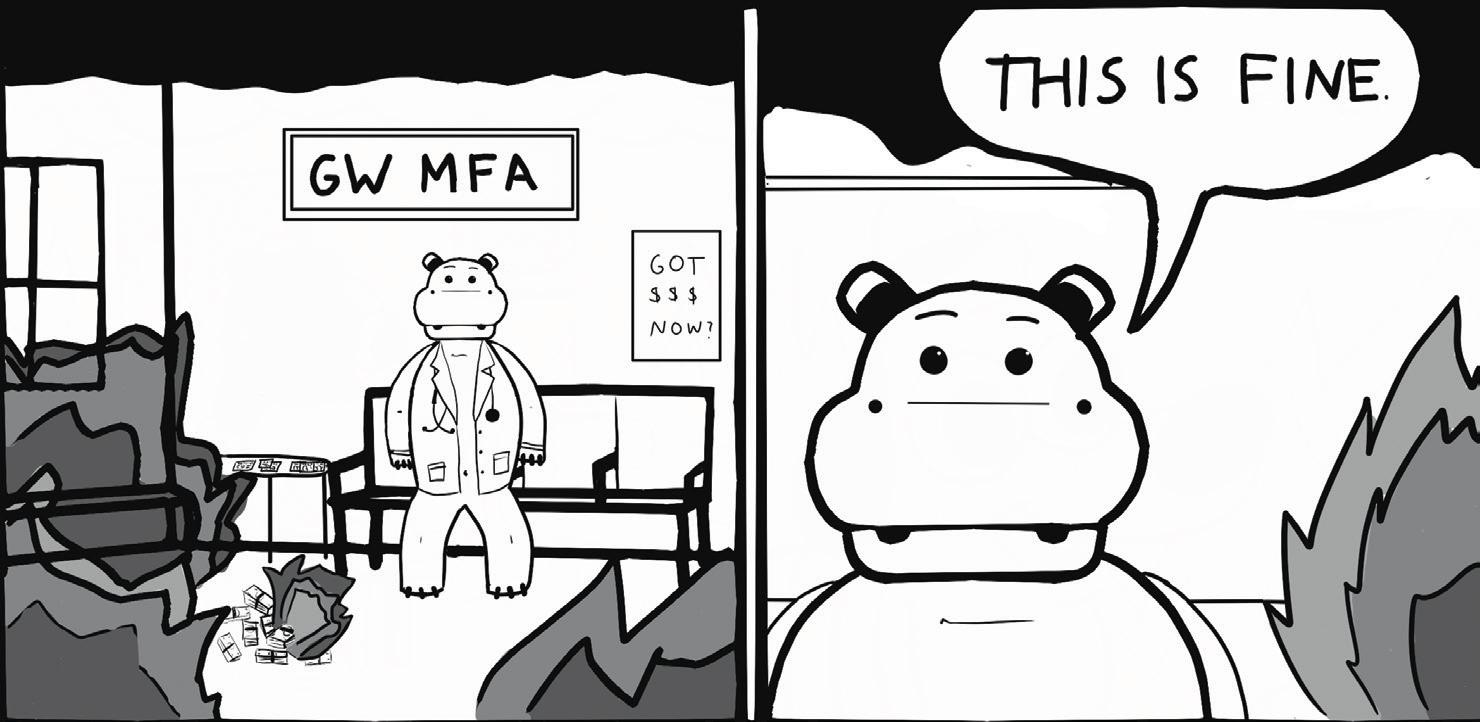
Though the Medical Faculty Associates can get lost in the mix of University-related enterprises, its network of doctors from obstetricians and gynecologists in Maryland to podiatrists in Dupont Circle tends to patients across the D.C. region. But as the MFA serves the health care needs of the DMV, its own financial health – with a staggering $200 million in debt to GW – is in critical condition.
Yes, you heard that right. In the past two years, GW has doled out $200 million in loans to the MFA, which is financially independent of the University, to keep the physician practice afloat as its revenue fell further and further during the COVID-19 pandemic. But as officials worked to bail out the MFA, they simultaneously enforced a period of austerity on students, faculty and staff. If GW was willing to cover the MFA’s tab, why couldn’t it instead allocate the same amount of funds to smaller projects that would yield greater improvements to everyday life within its own community?
To be clear, the MFA is vital to Foggy Bottom, the District and the DMV with or without its financial problems. MFA doctors provide regular treatment at the GW Hospital with routine appointments and emergency care for patients, including a senator’s hospitalization last week. The network’s members teach at the School of Medicine and Health Sciences, preparing students for careers in the medical and health care fields.
Beyond the GW Hospital, the MFA’s more than 2,150 employees provide health care services at 112 locations around the DMV. The MFA will also help run the Cedar Hill Urgent Care, the first urgent care clinic in Ward 8, and the larger Cedar Hill Medical Center hos-
pital complex once it opens in 2024.
Still, the MFA’s benefits can’t change the reality of its financial situation. The MFA’s net assets have fallen by $91.1 million since 2019, and its losses this fiscal year will range between $55 million to $65 million . To keep the floundering health care network afloat, GW loaned it $50 million in March 2021 before extending it to $140 million in October that year. In December 2022, the MFA received a $15 million loan from the University, and officials approved yet another $45 million loan in January. Even with measures to restructure the MFA’s financial relationship with GW Hospital owner Universal Health Services to cut costs and raise revenue, it’s unclear what impact these measures have had on the MFA’s finances.
It doesn’t take a few classes in Funger or
Enrich your time in Foggy Bottom and dive into its deep history
Many of you decided to enroll at GW in part because of its location in the nation’s capital, but D.C. is more than monuments and politics – it is a city of neighborhoods, each with its own rich history.
We started the Foggy Bottom Association History Project in January 2021 to create a comprehensive resource center for all who are interested in this neighborhood and to protect its historic character. From the beginning we have sought to partner with GW students, faculty, officials and alumni to uncover, document, collect and communicate the shared history of the University and the neighborhood.
The Foggy Bottom Association History Project offers students the opportunity to enrich their experience in D.C. by learning about – and protecting – our shared community history. After all, GW is a University within and of a community, not a self-isolated urban island of education. As students, you can continue to have an impact on Foggy Bottom. The neighborhood’s history begins with the Piscataway and Anacostan peoples who occupied the area thousands of years ago. A period of plantations and the town of Hamburg, or Funkstown, founded by German immigrant Jacob Funk, defined Foggy Bottom’s history in the 18th century. The development of industry in the 19th century, including breweries, lime kilns, a glass factory and
gasworks – plus natural fog from the Potomac – gave Foggy Bottom its nickname. The Irish and German immigrants who occupied the narrow brick row houses of the Foggy Bottom Historic District from the 1880s to the 1910s shifted to a Black majority in the 1920s.
Foggy Bottom’s history continues through the 1950s with federal and international organization office construction, urban renewal, high-rise development, highway construction and the expansion of GW’s Foggy Bottom Campus. These shifts resulted in the demolition of historic row houses and familyowned businesses in the area and the displacement of the Black community from the neighborhood. Gentrification, affordable housing and highways slicing through neighborhoods reflect trends that resonate today both within D.C. and across the country.
The GW community can participate in the project in many ways – and your participation will help create a more dynamic Foggy Bottom Association History Project.
To learn more about Foggy Bottom’s history, you can check out our website, read our blog and review our presentations about the neighborhood’s history. Follow our in-person and online walking tours of the Foggy Bottom Historic District – which preserved some of the historic rowhouses – or local murals and sculptures that decorate the neighborhood.
You can learn about GW’s history on the website, including the GW/Old West End Historic District and how the University and the neighborhood have impacted each other. Take advantage of our free guide to historical records and a variety of local libraries, including Gelman Library, as well
as online and published resources to support your academic research. Our past experiences working with students on class papers and video projects have been mutually beneficial. Be a house detective and research a few Foggy Bottom row houses and publish your findings about former residents and their lives on our new House History Map, which will launch this spring. The site profiles residents from oyster sellers in 1885 to the seven lodgers who lived in one small house in 1950 to GW students today. Record oral histories. Our website contains transcripts of interviews with long-term Foggy Bottom residents and a video of Washington Post columnist Colbert King recalling his childhood years in what was then a majority Black neighborhood in the 1940s. We can help identify current and former neighborhood residents as candidates for additional interviews.
Learn about and advance historical preservation both on and off campus. Join us in urging the University to adopt a “preservation through documentation” policy, which would require officials to record the history of buildings destined for destruction under the 2007 Foggy Bottom Campus Plan, like the recently demolished Waggaman House and Staughton Hall. Gelman will permanently maintain your research, photography and documentation of such buildings. Take advantage of this opportunity to discover, document and communicate our shared neighborhood history and your part in it. Given your choice of an urban campus in D.C., graduating with a better understanding of its history is extra credit.
—Denise Vogt and Frank Leone are the co-chairs of the Foggy Bottom Association History Project.
Duquès halls – let alone a degree – to recognize that the MFA’s finances have been in serious trouble and are putting a strain on GW. So allow us to put that $200 million worth of loans from the University into perspective.
Aside from variations in GW’s cost of tuition, $200 million would give 805 undergraduate students a free, four-year education at the University. For fans of the newly renovated Thurston Hall, $200 million would cover the estimated cost of its renovations 2.5 times over. And if you can’t get enough of the Thurston or Shenkman dining halls, $200 million equals three semesters of free unlimited dining for GW’s current student population.
GW continued to throw money at the MFA despite reeling from its own estimated $180 million budget shortfall during the pandemic. Officials responded to that shortfall by
suspending most capital projects and hirings, freezing salaries and laying off staff. The University saved $32 million doing the latter but cost 339 people in IT offices, the career center and event departments their jobs in 2020.
For better or for worse, GW hasn’t exercised that tough-love decision making when it comes to the MFA. As much as it’s critical to the health and well-being of the region and GW’s mission, the MFA has gotten – and continues to receive – special treatment. While massive layoffs aren’t necessarily the answer, officials’ only solution to the MFA’s problems seems to be pouring more money into a failing enterprise. Perhaps officials’ math adds up on paper, but after failing to meet its initial target of breaking even by this June, how will the MFA make up so much money in so little time to recover its losses by the end of the next fiscal year per officials’ plans?
Whether every dollar the MFA receives from GW represents an act of accounting wizardry or a direct cut somewhere else on campus, it certainly can feel like the latter when the University’s day-to-day operations are marred with maintenance and facilities issues. Just ask the students without hot water in their residence hall, the student organizations calling for more affordable access to Plan B in GW’s new contraceptive vending machine or overworked facilities and IT staff triaging crisis after crisis what they’d do with $200 million.
GW may not be slashing its own budget to spot the MFA a few million dollars, but if it can raise enormous sums of money to keep the organization limping along through years of deficits and debts, the University can surely spare some change for its own community.
The opinions writer who authored this essay asked not to be identified by her full name because of safety concerns.
Hearing “Woman, Life, Freedom” chanted at protests nationwide as a rallying cry for women’s rights in Iran over the past months has been a jarring experience for me. I came to GW for the location and opportunities, including the ability to protest for my country –whether it’s at the foot of the Lincoln Memorial or in front of the State Department.
But my excitement quickly turned to disappointment as I pitched the idea to my parents. They advised me not to go –attending could jeopardize the safety of our relatives in Iran.
As a second-generation Iranian-American, it was encouraging to see so many of my classmates take part in the worldwide protests. They erupted after Iran’s notorious morality police beat 22-year-old Mahsa Amini to death in September for not wearing the required hijab properly with women leading the uproar to change the country’s strict hijab laws.
D.C. activists have organized protests every Saturday, and, as a student living in the District where the makers of our foreign policy work, I had the perfect opportunity to get involved in a cause that was personal to me. So many of my relatives have stories about the morality police, and I’ve seen this violence toward women while visiting my home country over the years. I felt like I was not authentically Iranian because I didn’t take action along with the others, constantly telling everyone I
couldn’t protest for the safety of my family. Here was an opportunity to advocate for my parents’ home country –the culture that shaped who I am today – and yet I was scared that my family would be threatened.
Losing the chance to protest just as quickly as the opportunity arose was almost worse than not being able to protest at all. I envied my classmates as I watched their Instagram stories and saw them attend protests every week since Amini’s killing. They had never been to Iran and had all their family in the United States, safely removed from the political unrest.
Yet Western awareness of the Iranian regime’s violence against women has had many real effects, like the removal of Iran from the UN Commission on the Status of Women in December. I was glad people were recognizing the oppression women face in Iran and the Middle East, but why did it take such brutality for Western countries to become educated on the matter? I laughed when one friend asked whether I thought there would be a revolution. Little did they know, my family and I had spent years hoping for change – only for the government to continue its religious and social oppression
At such a politically active university, hearing people talk about the treatment of Iranian women in a much more educated and active manner than my majority-white high school in Orange County, California was definitely a refreshing experience. High school back home wasn’t the best place to grow up connected to my culture.
I returned to California for winter break and decided to attend a small local protest in Irvine with some friends on the condition that we had to cover our faces, not post on social media and avoid being photographed.
Protesting helped me
take a smaller step toward making change, and I returned to D.C. determined to make a difference through the GW and local communities such as the Iranian Student Association on campus and protests that I’m now resolved to attend. After protesting at home, I realized it was possible to protect my identity while also being involved in the movement, and the feeling of solidarity I experienced at the march made it clear that taking action was worth it.
As we approach the sixmonth mark of the protests in mid-March, I’m ashamed I let myself go this long without protesting as the Iranian people have put their lives in consistent danger for this cause. Joining the IRSA, meeting so many secondgeneration Iranians with the same experience and organizing together made me feel more involved. The government continues to silence protesters, from average Iranian citizens to famed actresses, with unjust murders and executions. Iranian protesters face the fear of the torture and rape committed in Iranian prisons every time they step outside – yet they still rally. This movement is personal for me. My friend who moved from Iran in elementary school saw the morality police beat a woman for wearing a hijab that was slightly loose, and one of my parent’s friends was detained in prison for protesting. Such stories have inspired me to take action from my place of relative safety in the United States, and they are a reminder of the strength and endurance of the people of Iran.
As I prepare to join the protests within the next month, I would like to thank Iranians and non-Iranians alike who have protested ceaselessly every week. I hope that 2023 brings better things to the country and community..
—Ava E. is an opinions writer.
After sitting out, I’m joining the protests against Iran’s regime
CAMELLIA GENOVESE | CARTOONIST
STAFF EDITORIAL OPINIONS THE GW HATCHET February 13, 2023 • Page 6 FROM GWHATCHET.COM/OPINIONS
Ava E. Opinions Writer
Frank Leone History Project Co-Chair
eic@gwhatchet.com news@gwhatchet.com opinions@gwhatchet.com photo@gwhatchet.com sports@gwhatchet.com culture@gwhatchet.com copy@gwhatchet.com multimedia@gwhatchet.com 609 21st St. NW Washington, D.C. 20052 gwhatchet.com | @gwhatchet Submissions — Deadlines for submissions are Friday 5 p.m. for Monday issues. They must include the author’s name, title, year in school and phone number. The GW Hatchet does not guarantee publication and reserves the right to edit all submissions for space, grammar and clarity. Submit to opinions@gwhatchet.com Policy Statement — The GW Hatchet is produced by Hatchet Publications Inc., an independent, non-profit corporation. All comments should be addressed to the Board of Directors, which has sole authority for the content of this publication. Opinions expressed in signed columns are those of the authors and do not necessarily reflect the view of The GW Hatchet. All content of The GW Hatchet is copyrighted and may not be reproduced without written authorization from the editor in chief. Cost — Single copies free. Additional copies available for purchase upon request. Jarrod Wardwell, editor in chief Hatchet The GW Jaden DiMauro, managing editor* Abby Kennedy, managing director Nick Pasion, senior news editor Zach Blackburn, senior news editor Caitlin Kitson, assistant news editor Erika Filter, assistant news editor Faith Wardwell, assistant news editor Grace Chinowsky, assistant news editor Sophia Goedert, assistant news editor Eóighan Noonan, contributing news editor Ianne Salvosa, contributing news editor Nikki Ghaemi, contributing news editor Tara Suter, events editor Ethan Benn opinions editor* Julia Koscelnik contributing opinions editor* Auden Yurman, senior photo editor Danielle Towers, assistant photo editor Jordyn Bailer, assistant photo editor Lily Speredelozzi, assistant photo editor Maura Kelly-Yuoh, contributing design editor Nicholas Anastacio, graphics editor Ishani Chettri, web developer Ethan Valliath, contributing social media director* Max Gaffin, contributing social media director * denotes member of editorial board Business Office Eddie Herzig, business manager Rachel Schwartz, assistant photo editor Nuria Diaz, sports editor* Luke Wienecke, contributing sports editor Clara Duhon, culture editor* Julia Koscelnik, contributing culture editor - entertainment* Nora Fitzgerald, contributing culture editor Amanda Plocharski, video editor Cristina Stassis, copy chief Shea Carlberg, senior copy editor Lindsay Larson, assistant copy editor Annie O’Brien, research assistant Rory Quealy. research assistant Zac Bestwick, research assistant* Sarah Sachs, podcast host Sejal Govindarao, podcast host Max Porter, podcast host Grace Miller, design editor* Isabella MacKinnon, design editor
Denise Vogt History Project Co-Chair
Sports
Men’s basketball gets blown out at Saint Joseph’s, falling down A-10 standings
NURIA DIAZ SPORTS EDITOR
Men’s basketball lost their third consecutive road game 81-69 against Saint Joseph’s Saturday, dropping to eighth place in the Atlantic 10.
The Colonials (12-13, 6-6 A-10) fell behind 16-1 within the first four minutes of the game, while the Hawks (13-12, 7-6 A-10) took advantage from the field, shooting an impressive 43.1 percent. Saint Joseph built an early lead and never lost their momentum as they continued their dominant A-10 run, only ever allowing the Colonials within eight.
GW lagged behind throughout the game, only shooting 38.3 percent from the field and 25 percent from beyond the arc compared to the Hawks’ 43.1 and 34.8 percent, respectively. The Colonials were called for a seasonhigh number of fouls – 27 fouls on the day and 14 in the first half alone – with six of their eight available scholarship players racking up at least two fouls before halftime.
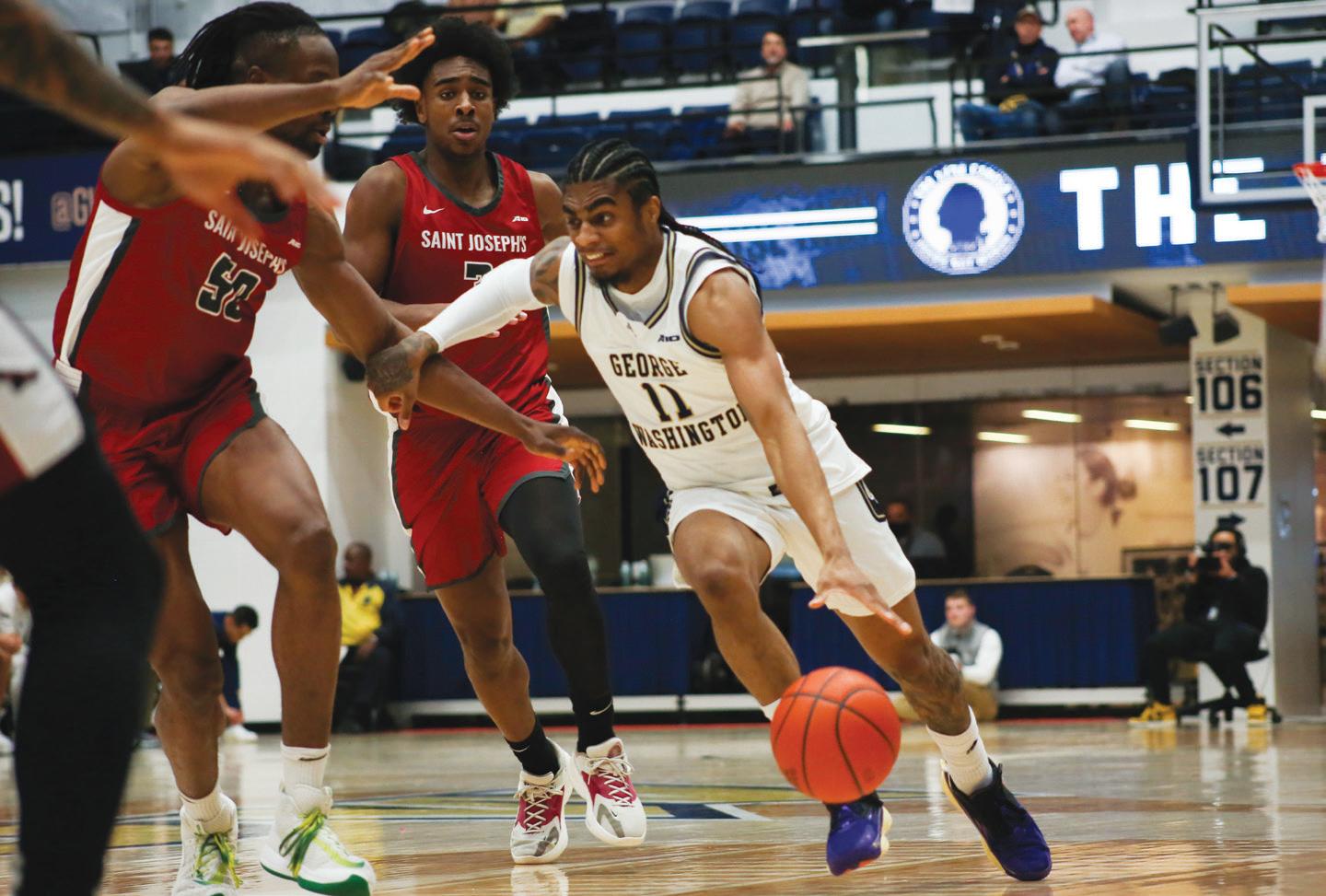
The Colonials have six games left to end their regular season slate, and they sit just a game behind seventh-place St. Bonaventure and sixthplace Saint Joseph’s in the A-10 standings.
Graduate student guard Brendan Adams led the Colonial offense with 15
points and four assists. Senior forward Ricky Lindo Jr. and senior guard James Bishop followed with 13 points each.
The Colonials shot 35.7 percent from the field in the first half while going 4-12 from behind the 3-point line and hitting 66.7 percent of their free throws.
A 3-pointer by Hawks sophomore guard Erik Reynolds II got the scoring started for Saint Joseph’s, who sent the Colonials scrambling on defense through the first five minutes of the half.
The Colonials wouldn’t muster more than a point until the fifth minute when a foul by Reynolds gave a second scoring opportunity to the Colonials, which they capitalized on courtesy of two free throws by Bishop.
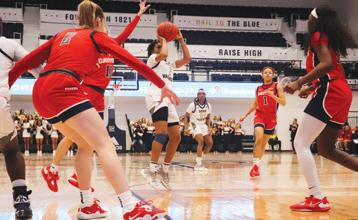
A quick 30-second timeout gave the Colonials breathing room, with Bishop hitting a jumper six minutes into the first half, followed by a steal from redshirt freshman guard Max Edwards that turned into a fast-break floater in the paint for Bishop to bring the score to 20-7 with 13 minutes left in the first half.
But a dunk by junior center Noel Brown led to a two-minute-long scoring drought for both teams. A free throw by Hawks freshman guard Christian Winborne broke the scoreless slump with nine minutes left, which Lindo countered with a layup on
the other end.
With just two minutes left in the half, Edwards netted a fast-break jumper in the paint, which was followed by a jumper by Bishop and a dunk by Edwards to close out the first half 27-47.
The Colonials could not hamper the Hawks’ shooting, as they shot 51.6 percent from the field and approximately 41.7 percent from the 3-point line, with Reynolds totaling 11 points in the first half.
The Colonials started the second half with a pair of early substitutions, with senior forward Samuels Qwanzi coming in for Brown and Lindo for Dean, as Caputo looked to revive the team’s offense with a roster change. A fast-break jumper by Bishop put the Colonials on the board in just the first minute of the game. Adams started to catch fire as the half began, scoring 8 points in four minutes, including back-toback 3-pointers to make the score 53-37.
The Colonials were ultimately unable to complete the comeback, as the Hawks were able to extend their lead back out to 13 points. percent from behind the 3-point line and 70.6 percent from the free-throw line.
The Colonials hope to get back in the win column against George Mason at the Smith Center Wednesday.
Women’s basketball drops secondstraight A-10 matchup to Saint Louis
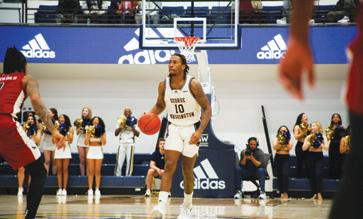
Women’s basketball’s loss to Saint Louis Saturday was a tale of two offenses –one that kept firing from the SLU perimeter to no avail and another that pounded through the GW interior to power the Billikens to a 7664 victory.
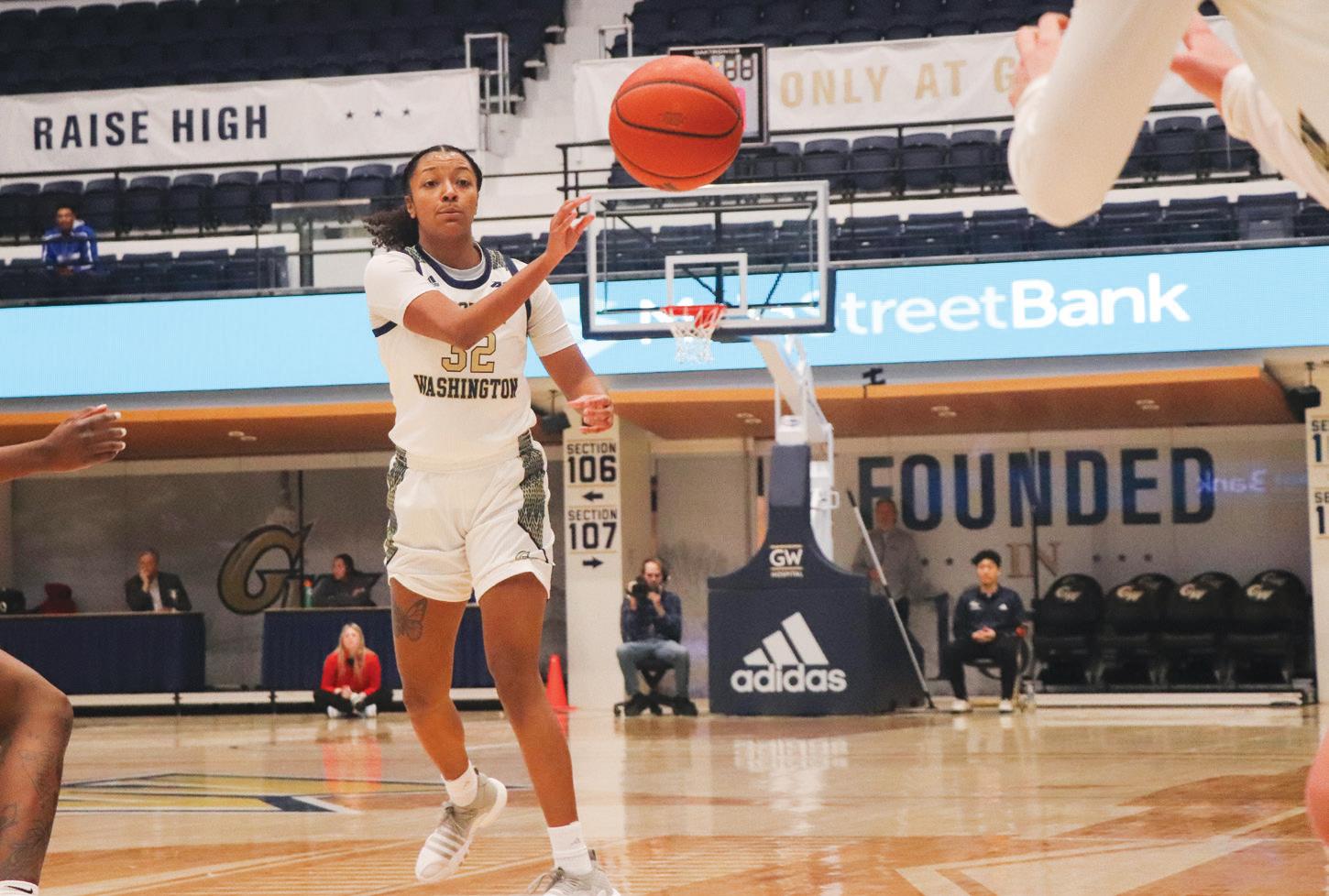
The Colonials (16-10, 8-5 A-10) missed 32 of a staggering 40 shots from 3-point range, nearly double their season average of 23.9 attempts from deep, as they fell 76-64 to the Billikens (11-16, 7-5). SLU launched a much more conservative 7-16 from beyond the arc and picked up most of their points from inside.
Though SLU’s 22 turnovers and lax defensive rebounding kept the game within reach, they seemed content to let GW fire 3 after 3, and the Colonials obliged despite their own inefficiency. GW hung on to fourth place in the Atlantic 10 despite the loss, but Saint Joseph’s follows one game behind.
SLU jumped off to a quick start with three straight unanswered baskets in the first two minutes to make it 6-0. Lok dropped 18 points on 6-12 shooting from the field and an efficient 3-6 from behind the arc, leading GW in both field goal and 3-point percentage.
SLU pushed their lead to 14-5 at midquarter when junior forward Peyton
Kennedy knocked down a triple. Lok quickly brought it back to a one-possession game with two back-to-back 3s of her own, making it 1411.
The Billikens continued their consistent offensive attack, scoring steadily to close the quarter up 20-17. The more sporadic GW offense ended the quarter with nine more field goal attempts than St. Louis but one less make.
Freshman guard Nya Robertson opened the second quarter for GW with a pair of free throws to cut the lead down to one. Robertson nailed a 3 on the next possession to give the Colonials their first lead of the evening with nine to go in the second quarter.
As the quarter winded down, GW’s narrow lead turned into a deadlock at 34, until a last-possession 3 from SLU senior guard Kyla McMakin closed the half at 37-34.
The Colonials stayed competitive with their hustle, winning the rebounding battle 22-18 and scoring 10 second-chance points.
The first half of quarter No. 3 featured a 12-4 Billiken run that put GW down nine, 49-40. Ten of the 12 points in this run came from inside scores, contributing to SLU’s success on the interior, with 38 points coming from the painted area on the night.
With 3:30 to play in the third, the Colonials capitalized on consecutive
turnovers as junior guard Asjah Inniss scored backto-back midrange jumpers to pull the Colonials back within a possession, 47-46. Just a minute into the fourth quarter, senior forward Mayowa Taiwo nabbed a steal and ran coast to coast to catch and score inside off a pinpoint pass from sophomore guard Maxine Engel, bringing the deficit back down to 6. Both sides traded baskets as the Colonials tried to pull it back within striking distance, and a 3 by Inniss with just under two minutes to go did just that, putting the score at 68-64. But the Billikens’ efficiency from the free throw line closed it out late-game as they used the clock to their advantage and went a perfect 7-7 in the fourth quarter, with 6 coming in the last two minutes.
Six GW players attempted a 3 on the night, but only Lok managed to shoot better than 25 percent. GW’s reliance on the 3 for offensive production was atypical, and the lack of success, shooting .200 percent compared to a season average of .332 percent, made it a questionable decision to keep firing from beyond the arc at all.
The loss marked GW’s second in the A-10 last week, but their two-game road trip has come to an end. GW returns to the Smith Center to face Loyola Chicago at 1:30 p.m. Saturday.
Fresh tennis leadership doubles down on strategic mental game as season heats up
and cross shots on the court.
After reaching the Atlantic 10 semifinals last season, new leadership in the tennis program aims to inch the Colonials closer to a conference title.
The Colonials (1-1-2) got off to a slow start this season last month but hope their resounding 6-1 victory over Bucknell Friday will be a sign of things to come through the rest of the regular spring season. Head Coach George Rodriguez took the helm of the program in September in place of predecessor Torrie Browning, who exited her post last spring, and he now looks to make the GW team a more aggressive force on the court while establishing healthy and strategic
mindsets for the players on and off the court.
“I think the goal is to keep developing as a person and as a player to see those results at the end of the year, to look back and be able to say ‘Look where we started, look where we ended up at as a player development side of it,’” Rodriguez said.
Rodriguez spent the last two seasons as the head coach of the women’s and men’s tennis teams at Fresno Pacific, where he led the women’s team to a 16-10 championship win in the 2021-22 season, the best regular season record in program history. Rodriguez said he’s worked with players to extend their game to both doubles and singles to enhance the team’s depth while refining their top spin
In the Friday match against Bucknell, GW picked up the full 3 points in doubles and notched five singles wins, keeping Bison in the middle of the court while blasting hits and volleys by them near the baselines. GW currently holds a .235 winning percentage for singles and a .222 winning percentage in doubles, dipping below last year’s .371 doubles and .442 singles winning percentage.
“We need to keep developing ourselves into a multidimensional player, not just a one-dimension style of game,” Rodriguez said. Rodriguez said the mental game behind the sport has been a major focus with his new team of players, pushing them to tap into their
competitive drive with every serve instead of dwelling on mistakes.
“We need to keep working on ourselves, the mental part of it as much as our physical part of it and just seeing that we’re there with these teams, even when you know on paper they can be better than us, but competing hard and making it competitive, giving us a chance to win and making it close,” Rodriguez said.
Junior Charlotte Bell said the win against Bucknell adds confidence for the rest of the season. She said one of GW’s major adjustments has been in the doubles category, where the Colonials have become more aggressive with cross-court balls and wider angles to keep their opponents confined to the
middle of the court.
“Yeah, so I definitely have a different approach to doubles especially in the past like now that I’m becoming a more aggressive singles player, it’s getting more similar, but in doubles, you have to be aggressive,” Bell said. “You have to coach, you have to move with a net. You have to keep the ball really cross court and really wide and hit better angles.”
Bell said the team has been using an app called Peak Brain Training, which the players can use to see different visualizations and reflections to boost their cognitive skills when strategizing before the match.
“Being uncomfortable is a big takeaway so far this semester, and I’m normally
a player that hangs on the baseline,” Bell said. “So I stay back behind the baseline, and currently now I’m making myself uncomfortable by trying to move in and take balls on the rise more, moving into the court and being more aggressive.”
Junior Stella Wiesemann, who finished last season with an impressive 9-1 record while making the A-10 All-Conference First Team, said she looks to do her part picking up wins and pushing the team toward a national rank and A-10 Championship victory.
“I think just staying focused like sometimes for wins it’s easy to not really take away anything because when you lose, you know what you have to work on,” Wiesemann said.
Athletes in action: Inside a midseason women’s basketball practice
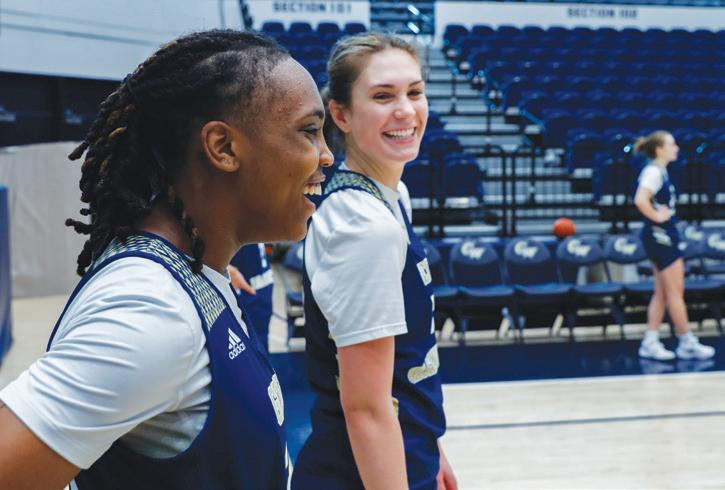
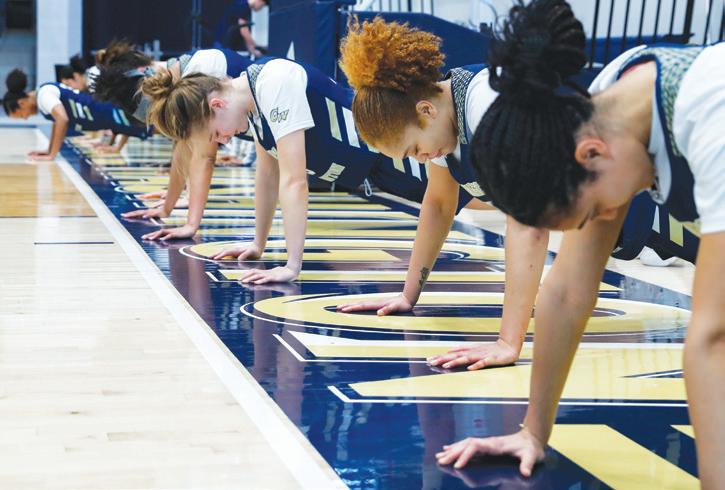
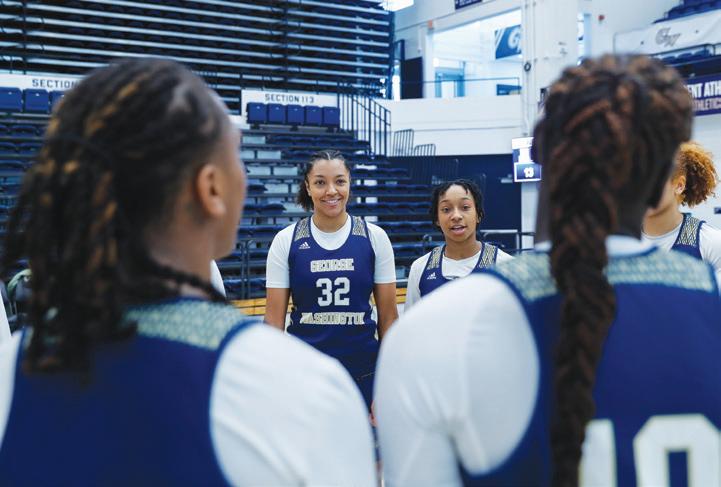
NUMBER CRUNCH
213 WOMEN’S BASKETBALL vs. Loyola Chicago Saturday | 1:30 p.m. EDT GW returns to the Smith Center after a two-game road trip that saw their A-10 record drop from 8-3 to 8-5. GAMES OF THE WEEK MEN’S BASKETBALL vs. George Mason Wednesday | 7 p.m. EDT The Colonials look to reboot their A-10 chances after losing four out of their last five conference matchups.
Women’s basketball’s made 3-pointers this year, the most in program history
JENNIFER IGBONOBA | STAFF PHOTOGRAPHER
The loss marked the Colonials’ second in the conference last week, but their two-game road trip has come to an end.
LUKE WIENECKE CONTRIBUTING SPORTS EDITOR
MAYA NAIR | STAFF PHOTOGRAPHER
SPORTS THE GW HATCHET February 13, 2023 • Page 8
The Colonials were called for a season-high number of fouls with 27 on the day and 14 in the first half alone.
SUNIT CHAKRABORTY STAFF WRITER
SAGE RUSSELL | STAFF PHOTOGRAPHER
