Total enrollment
CAITLIN KITSON ASSISTANT NEWS EDITOR
The number of students enrolled at GW has continued to fall this school year as part of a four-year decline, a report the Faculty Senate revealed Friday.
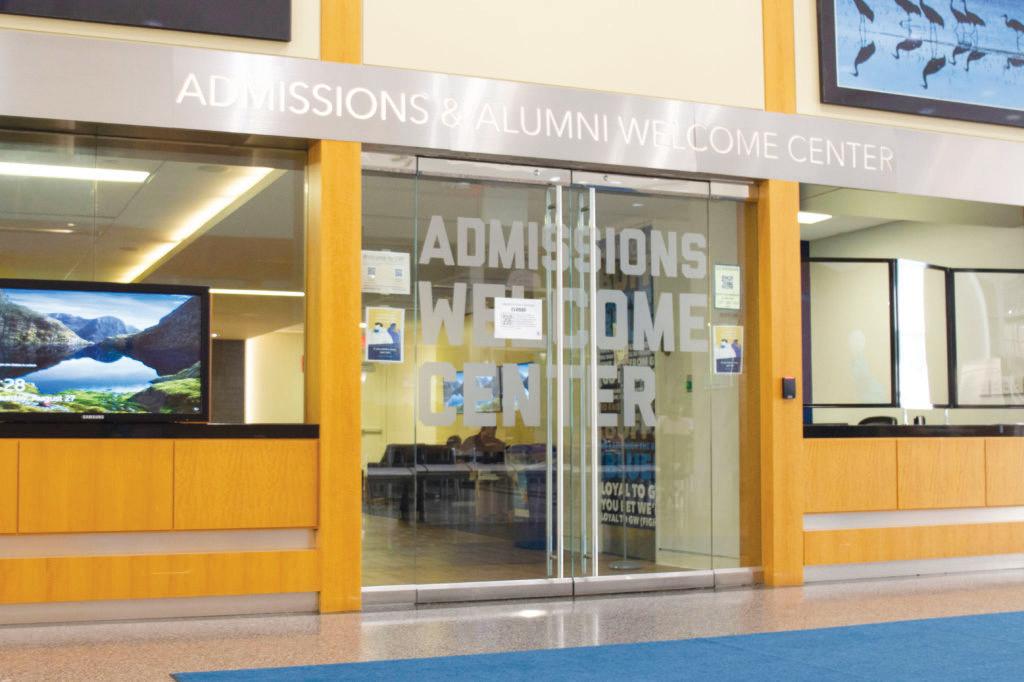
Jay Goff, the vice provost for enrollment and student success, said 25,939 total undergraduate and graduate students are enrolled this semester, a roughly two percent decrease from last fall when officials tallied 26,457 students. Goff said the dip comes as officials enlisted the largest class of new students since 2018, with 2,985 freshmen and transfer students.
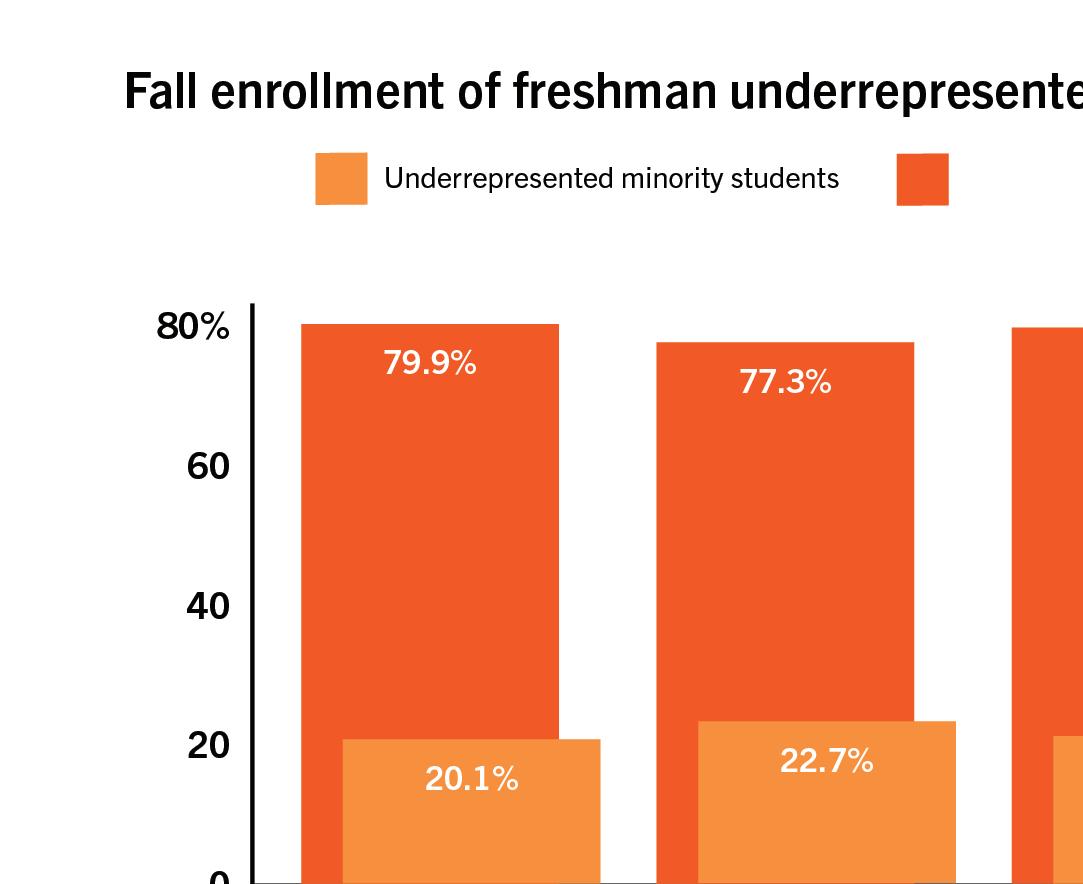
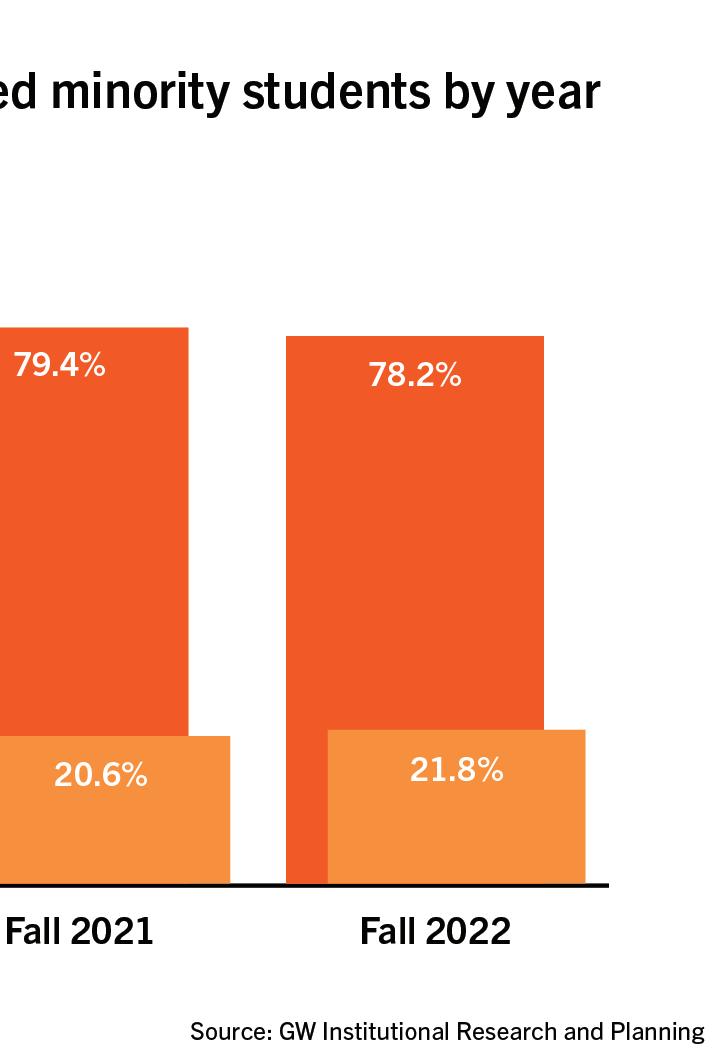
Goff said the number of underrepresented minority freshmen who identify as Black, Latino and Indigenous rose from 530 last fall to 642 this semester, while the number of first-generation and Pell Grant recipients rose during the same span by more than 50 and 60 students, respectively. He said while international freshman enrollment is on the rise, officials are still working to elevate international enrollment levels after they faltered under the impact of the COVID-19 pandemic, with 150 fewer international freshmen enrolled than in fall 2019.
“We’ve attracted one of the largest, most talented and
diverse first-year classes in GW’s history,” Goff said.
Goff said 2,985 new students – including 2,941 freshmen and 44 transfer students – enrolled this semester, exceeding last fall’s new student enrollment by about 10 percent and surpassing officials’ goal by about five percent. He said officials aimed to enroll a larger number of students this academic year to offset the pandemic-related dip in GW’s enrollment numbers.

The University’s acceptance rate rose from 43 percent to 49 percent between the 2020-21 and 2021-22 academic years, which officials
said was the result of a decision to no longer shy away from admitting “higher-caliber applicants” out of the fear they might not enroll upon acceptance.
“The new undergraduate class has 2,985 students and slightly exceeded targets that were set this year,” he said. “This increase also helps us position the potential undergraduate class closer to new student intake levels.”
Goff said total University enrollment currently sits at 25,939 students – a two percent decrease from fall 2021 and about an eight percent decrease from fall 2018. He said the decrease is primarily
the result of the pandemic’s negative financial impact on working adults, who are often the students enrolled in part-time degree programs.
Goff said officials plan to recruit more diverse and academically gifted students and improve the University’s affordability through ongoing scholarship initiatives for the 2023-24 academic year. He added that officials plan to revive enrollment levels among student populations that decreased during the pandemic, like working adults who enroll in parttime programs, and ensure their recruitment efforts fall in line with GW’s capacity.
Officials may require Title IX training for all employees
DANIEL PATRICK GALGANO ASSISTANT NEWS EDITOR LINDSEY LEARY REPORTER


Officials said GW is preparing to offer mandatory Title IX training to faculty and staff pending the approval of proposed federal regulations from the Department of Education.
President Joe Biden’s administration’s proposed changes would mandate all faculty and staff attend Title IX training instead of just Title IX Office employees, broaden the legal definition of sexual harassment and discrimination at colleges and universities to include protections for LGBTQ+ students and bar discrimination against pregnant students and employees. Charles Bendit, the chair of the Board of Trustees Audit and Compliance Committee, called a 20-percent faculty participation in voluntary Title IX training at GW “unacceptable” during the Board’s meeting in May.
While ED has not published a timeline for the implementation of the final Title IX changes, updates to federal Title IX regulations under the administration of former President Donald Trump took the department about a year and a half to implement after introducing them because of public comment and ED revision.
Caroline LaguerreBrown, the vice provost for diversity, equity and engagement at GW, said the federal government only requires that Title IX Office personnel receive training on how to deal with accusations of discrimination and sexual harassment, but under the new rules, all University employees will be required to complete training on sex-based discrimination under Title IX regulations.
“In the coming weeks, the provost’s office will work with our deans to reinforce and ensure full participation in preventing harassment and discrimination, which includes all the necessary
timeline content for faculty and staff,” she said.
Five of GW’s 12 peer schools – the University of Miami and Boston, New York, Tufts and Syracuse universities – already have mandatory training for their faculty and staff. Officials required incoming GW students to complete both virtual and in-person Title IX training courses and an online sexual assault prevention module this fall.
Laguerre-Brown said the Title IX Office will be able to respond more broadly to different types of gender discrimination under the Biden administration’s proposed Title IX changes. Under the potential updates, the definition of sexual discrimination would now include acts of sex discrimination on the basis of sex stereotypes, sex characteristics, pregnancy or related conditions, sexual orientation and gender identity, according to ED’s website.
“All of these additional protections are currently covered under the University’s broad anti-discrimination policy, but not currently under the Title IX policy,” Laguerre-Brown said at the Faculty Senate meeting Friday.
Biden’s Title IX policy would reverse the Trump administration’s efforts to reduce Title IX protections, which narrowed the definition of sexual harassment to be any form of unwelcome conduct that is “serious, pervasive and objectively offensive.” Trump’s Title IX policy also required post-secondary institutions to hold live hearings for sexual misconduct cases, where witnesses were allowed to be crossexamined.
She said officials formed a Title IX regulations task force in July to review the changes to federal Title IX policy the White House proposed in June and receive feedback from the community on how best to implement it.
She said the task force will hold an online forum with community members in the coming weeks to receive feedback about the rule changes.
ANASTACIO | GRAPHICS EDITOR
GWPD ramps up community outreach efforts with series of fall campus events
HENRY HUVOS ASSISTANT NEWS EDITOR MOKSHA AKIL REPORTER
The GW Police Department has introduced a pair of trademark events this fall to bolster student outreach efforts as part of GWPD Chief James Tate’s push to establish a culture of community policing in Foggy Bottom.
GWPD kicked off the school year in September with Raise High with GWPD, an event in University Yard where officers handed students food like free Chick-fil-A and pamphlets about the department, before unveiling Coffee with the Chief, where students can discuss campus issues monthly one-onone with Tate via Webex. More than 10 students said the department’s elevated community engagement efforts have signaled increased transparency from the department, drawing stark differences from a period of limited trust between GWPD and students before Tate arrived at the department in 2020.
“The way to determine if outreach efforts are ef-
fective is by listening to students,” Tate said in an email. “We have to connect with students and listen to their feedback. So far, the feedback we have received has been positive. Students have shared that what we are doing is ‘refreshing’ and ‘new.’”
Tate said community outreach has been a “priority” for the department to reform GWPD image on campus since he assumed leadership at the start of 2020 of a department whose leadership had previously hung in question amid fractured student relations. Four months after arriving at GW, Tate called the department’s officer training “woefully inadequate” with minimal deescalation preparation for officers.
BSU published a letter in June 2020 with eight other student organizations to pressure GWPD to restore trust with the GW community through no-tolerance policies for racial bias cases and a lower presence on campus in light of heightened criticism against policing following the Black Lives Matter protests.
Tate said officers have listened to students through discussion opportunities
and events as part of their outreach. He said more students have engaged with GWPD events and approached the department to file incident reports than during previous years – an “encouraging” sign of comfort and familiarity with the department.
Gianna Cook – a senior majoring in English and the president of BSU, who was also a member of the administration that sent the letter condemning GWPD in 2020 – said GWPD has significantly “evolved” in the past two years. She said prior to Tate’s arrival on campus, GWPD wasn’t helpful to community members because of their lack of familiarity with students, but now she said officers are going out of their way to greet students, attend organization events and offer opportunities for students to talk with them about policy.
“I think it helps with the representation aspect of knowing that our voices matter,” Cook said. “I would hope that in the next couple of months and just even years after that, that partnership is still the mindset instead of the us-vs.-them mindset it might have been in the past.”
Faculty senators vote in support of residence hall in empty campus lot
GRACE CHINOWSKY CONTRIBUTING NEWS EDITOR SOPHIA GOEDERT ASSISTANT NEWS EDITOR
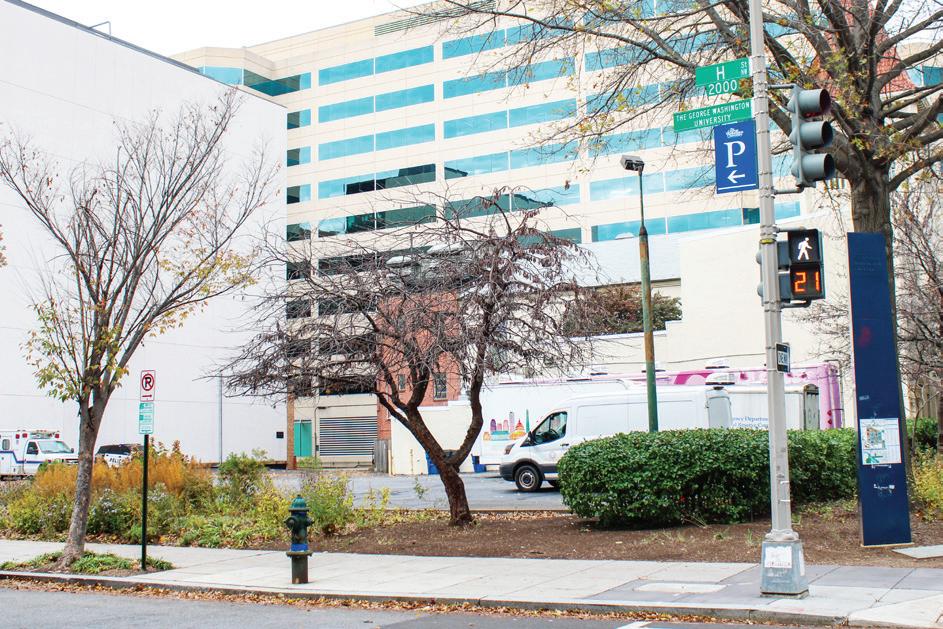
Faculty senators passed a resolution in support of building a new 320-bed residence hall at the abandoned lot on the corner of 20th and H streets during a Faculty Senate meeting Friday.
The resolution endorses previous plans to construct a residence hall that officials paused during the COVID-19 pandemic, urges the administration to resume planning with “deliberate speed” and recommends the project be placed near or at the top of the University’s spending budget. With 22 yes votes, four no votes and one abstention, the resolution states the new residence hall is critical to attracting new students after the recent renovations of Thurston Hall, which removed 280 beds from the building and “substantially reduced” undergraduate housing.
Officials announced plans to build a new residence hall in December 2018 with hopes of finishing construction this fall,
but COVID-19 suspended their plans. The 2018 blueprint for the 10-story building feature loft-style common rooms, community kitchens and retail space.
A COVID-19 testing trailer occupied the lot across from University Yard during the previous academic year before officials reassigned three locations on the Foggy Bottom Campus as new testing sites.
Eric Grynaviski, the chair of the Faculty Senate’s Educational Policy and Technology Committee and co-chair of the senate’s Physical Facilities Commit-
tee, presented the resolution to the faculty senators and said the new residence hall is necessary to provide flexibility for GW’s undergraduate enrollment targets. He also said the new residence hall can provide extra beds for students who may be moved around during any major renovations of other residence halls.
Grynaviski, an associate professor of political science, said there’s a “necessity for anchoring” the H Street lot to campus, providing dining options and improving the student experience for graduate students.
INDEPENDENT STUDENT NEWSPAPER • SERVING THE GW COMMUNITY SINCE 1904 Monday, November 14, 2022 I Vol. 119 Iss. 13 WWW.GWHATCHET.COM What’s inside
FILE PHOTO BY RACHEL SCHWARTZ | ASSISTANT PHOTO EDITOR
O cials said their decision to increase GW’s acceptance rate and no longer shy away from admitting “higher-caliber applicants” out of the fear those applicants might not enroll once accepted led to the larger freshman class.
Page
Opinions Amid legal battles over affirmative action, the editorial board argues GW should recommit to diversity.
6
Culture Learn about the history of the roller skating community in the District.
Page 7 Sports
Check out the newly created collective that allows studentathletes to benefit from their name, image and likeness.
Page 8
See TRAINING Page 5
KRISHNA RAJPARA I ASSISTANT PHOTO EDITOR
A COVID-19 testing trailer occupied the lot across from University Yard during the previous academic year before o cials reassigned three locations on the Foggy Bottom Campus as new testing sites.
NICHOLAS
continues four-year decline, despite more diverse freshman class: report
Nonunderrepresented
students
EIC DESK: Our apology for an insensitive, harmful debate question
JARROD WARDWELL EDITOR IN CHIEF
At The Hatchet, our mission is to serve every member of the GW community not only with fairness, but also with sensitivity and awareness through our coverage. Whenever we fail in that mission, it is our job to address our shortcomings, own up to any harm or negative impact on the community, hold ourselves accountable and commit to bet terment. Last week, The Hatchet asked a question at a public debate on campus that was inappropri ate and harmful. We sincerely apologize for the question and the harm it created. We want to share our plan to educate ourselves and ensure that our coverage both re flects this mission and does not harm community members mov ing forward.
The Hatchet moderated a de bate last week between GW Col lege Democrats and GW College Republicans for both organiza tions to share and counter their views on various national issues at stake in the midterm elec tions. Before the event, two of The Hatchet’s news podcast hosts who conducted the debate agreed on four categories of questions – the economy, immigration, crime and education – with the debaters.
The night before the debate, I met with the hosts who would be moderating to review and edit their questions for about three
hours. While discussing educa tion, I suggested a question about how Republican leaders have sup ported restrictions against trans gender athletes in women’s sports. We planned for the question to hold one side accountable for these restrictions that many have denounced as discriminatory on the basis of gender identity. But the question we wrote, directed at Republicans, was poorly worded: “Why do conservatives equate the inclusion of transgender female athletes as an attack on women’s athletics?” Though not our intent, the question was phrased in a way that invited the opportunity for transphobic rhetoric to be the topic of conversation in a debate, when we know for a fact that trans women are women, and that fact is not up for debate. I shouldn’t have let the question make it into the debate, and I sincerely apolo gize for that mistake.
Our intention was not – and never is – to create any harm through our work, but after the moderators updated the context of the script for the question the next day as planned, that angle shifted without my knowledge to hone in on the relation between these restrictions and the physiology of an individual, former Univer sity of Pennsylvania swimmer Lia Thomas. The inappropriate use of Thomas’ identity to frame the question created an opportunity to also harm members of our com munity who identify as transgen der, nonbinary and queer.
Even worse, our moderator in troduced the question by saying, “For our last question on educa tion, we’re going to step on anoth er political landmine.” We were taken aback and disappointed by this insensitive comment. It was uncalled for, placed a satirical fil ter over such a serious, sensitive topic and heightened the harm of an already-inappropriate ques tion.
There was no acknowledg ment of these mistakes from our moderators in the moment as there should have been, and no re alization of their impact until on line criticism caught our attention Wednesday. I was made aware that some students approached our moderators with concerns about a mention of Lia Thomas after the debate, but because the question we planned had no fo cus on individual athletes, I didn’t assume she had become the sole basis of the question until seeing the social media criticism and go ing through the event’s recording. Only then, did we on The Hatch et’s management team learn about what happened and start discuss ing the situation. Our response to this question at the debate should have been immediate, not reac tionary, and that says a lot about where we need to improve and learn.
I would like to once again sin cerely apologize for the series of mistakes that led up to this ques tion at the debate and the harm it created for those in our GW com
munity. We understand the impact of our publication as a community newspaper on a college campus, and the last thing we ever want to do is to contribute to the hate and discrimination that marginalized groups experience every day. We regret our mistake and will active ly work to learn from it to better ourselves, the content we publish and our role in the GW commu nity as a whole.
It is important that I am clear here as well. Identity should not be a topic we shy away from. As a student newspaper, it is our re sponsibility to represent, serve and tell the stories of all members of the GW community while hold ing parties in power accountable. So while our question under the topic of transgender identity was without a doubt framed inappro priately and worded poorly, we will stay committed to discussing gender identity and discrimina tion against transgender, gender nonconforming and queer indi viduals through respectful and accurate reporting and commu nity relations.
I met with Dr. Jordan West, the associate vice provost for di versity, equity and community engagement, to discuss the chain of events that played out at the debate and understand how The Hatchet needs to own and make amends for the harm done. I ar rived at a two-step process – apol ogize and educate. To act on the second of these two steps, The Hatchet will cover Transgender
Awareness Week in the coming days with a focus on student or ganization programming with the permission and support of stu dent leaders planning the events. We will also educate our team on Transgender Day of Remem brance, taking place Nov. 20. Ad ditionally, we are currently in the middle of a three-part series of mandatory diversity, equity and inclusion workshops for our staff focusing on workplace environ ment, reporting on the GW and D.C. community and inclusive recruitment efforts. We plan to hold another meeting between Dr. West and the members of our pod cast team to reflect on what went wrong at the debate. The work we have to do is urgent and ongoing.
We are committed to repre senting the diversity of our Uni versity community with nothing short of respect and inclusivity through our coverage and report ing, and learning from our mis takes is the bare minimum as a student newspaper. As part of my platform this volume, our push to improve how diversity is reflected among our staff and through our engagement with the community is central to our work. We hope to apply this priority to mending the harm we’ve incurred from last week’s debate among all other aspects of our mission as a news paper. Please reach out to me at jwardwell@gwhatchet.com with any questions, concerns or gen eral thoughts about these efforts. We’re always willing to listen.
CADE MCALLISTER REPORTER EDEN PARKER REPORTER
The Lerner Health and Wellness Center’s reno vations stopped short of the equipment upgrades and physical reconfigu rations that officials first advertised before shutting down the facility for five months in May.
Officials reopened Le rner last week with an updated heating, venti lation and air condition ing system, but officials announced in May that the renovations may also include “equipment up grades” and a redesigned layout with more ver satile spaces. Many stu dents said they struggled to identify any physical changes in the space postrenovations after finding rundown equipment and “cramped” spaces to be lingering issues upon the facility’s reopening.
“The closure is neces sary to safely perform extensive HVAC work throughout the entire building,” Andre Julien, the director of the Lerner Health and Wellness Cen ter said in an email in May. “It is also an opportunity to use the downtime for equipment upgrades and to reconfigure the build ing to offer more flexible and collaborative spaces.”
University spokesper son Josh Grossman did not return a request for comment on the specific nature of all the renova tions completed in Lerner and whether equipment upgrades were completed during the closure.
Students said while Lerner was closed, they improvised in-dorm exer cises or paid for member ships at off-campus gyms, opting out of the free gym access on the third-floor room of the University Student Center and the West Hall gym on the Mount Vernon campus.
Lerner offers a threelane lap pool on its lower level and free weights, weight machines and cardio machines on the ground floor. The building also has six squash suites, four courts for basketball, volleyball and badminton and a gymnasium with a suspended track on the third and fourth floors.
More than 25 students said they have used Le
rner since its reopening and recommended offi cials replace older, run down weight and cardio equipment that is missing safety features with newer models. Students also said they wanted to see officials reconfigure the space, not ing the “cramped” layout of the center that leaves little wiggle room dur ing high-traffic periods, especially when popular equipment like weight benches frequently have lines of students waiting to use them during busy hours.
Seven students said they saw minimal change in Lerner post-renovations and noted the lack of new equipment given officials’ previous messaging and the length of the closure.
Senior Ennosen Yen, who studies interior archi tecture, said she thought officials would upgrade equipment during the clo sure and recommended they install more machines on the building’s third and fourth floors to spread out students and address the lack of space.
Other than the track and multi-purpose courts, Lerner’s third and fourth floors lack free weights and only feature various cardio equipment on the top floor.
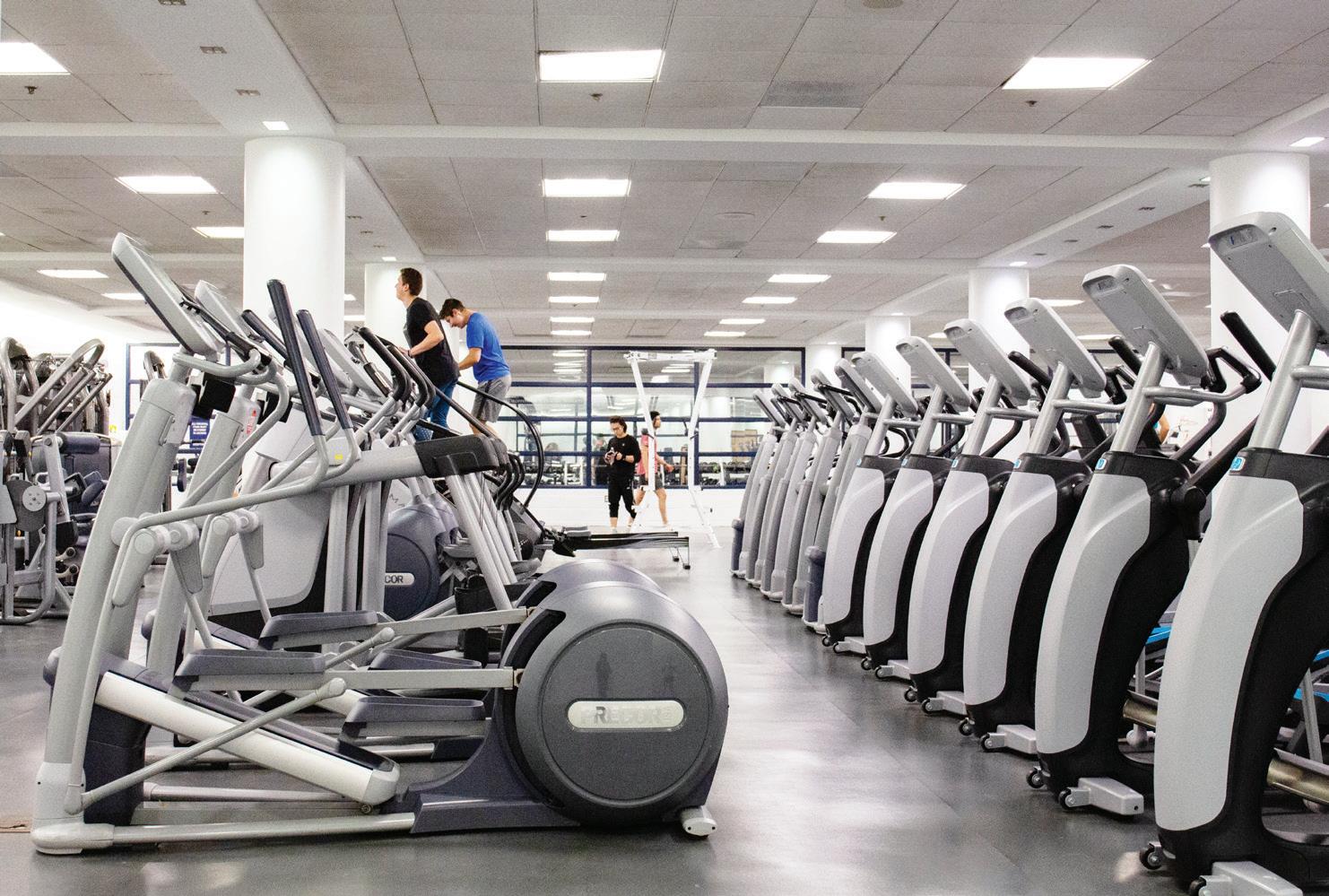
“This is like a four- or five-floor building, and I don’t think it’s being used to the potential that it could be being used at,” Yen said. “So, more ma chines, more weightlift ing, more utilizing activi ties on each floor.”
Freshman Erica Kong said there are a few popu lar exercise machines, like weighted squat machines, which frequently have lineups of students wait ing to use them. She said she has had to wait at least twice for multiple students to use the machines before she can go.
“The leg machines like the hip abductors and the weighted squats one, those are really popular, but it’s kind of one at a time be cause there’s only one of each,” Kong said.
Freshman Rohan Singh said some exercise ma chines seem rundown and require maintenance or replacement because they lack safety measures like grips, making them pain ful or unsafe to use.
“Machines don’t have grips on them anymore,” Singh said. “It’s just like
ripping your hands on bare metal, and they’re just quite old machines, like 15 years old.”
Sophomore Asli Ber eketoglu said the weight room is “small” and has dated equipment that ap pears to not have been updated since before the closure. She said officials should update or better maintain the exercise ma chines, pointing to the car dio equipment that creaks when in motion.
Exercise machines generally have a lifespan of about 10 years includ ing ongoing maintenance checks, according to a 2016 report by Allianz Risk Consulting.
“I feel like the equip ment is so old,” Bereke toglu said. “They have to change the equipment because the equipment makes so much noise when you use it.”
Students said there is a lack of space in Lerner’s cardio and weights section even after officials had stated that they planned to reconfigure the space to be more “flexible.”
Freshman Eugenia Wincey said the lack of space in those sections
makes the space feel “cramped.” She said the space isn’t large enough to accommodate all the students using the facility during its most crowded periods in the afternoon.
“I think that the space where there’s the walkers and the weights is a bit small for the magnitude of
the student population,” Wincey said.
Junior Nicky Danilich said the only improvement he noticed upon reopening was freshly painted white walls in the lobby and the fitness center. He said the gym’s closure wasn’t “worth” it for him because he had to find an alterna

Lack of Lerner upgrades disappoints students after officials ditch lofty goals SNAPSHOT
tive gym off-campus and didn’t notice any major physical renovations upon the center’s reopening.
“I don’t know if that was something they had to do, but it was kind of annoying having to go to Gold’s Gym in Rosslyn in stead while it was closed,” Danilich said.
NEWS THE GW HATCHET November 14, 2022 • Page 2 News
THIS WEEK’S EVENTS
GW rejected the U.S. government’s request to use the Smith Center as the international press headquarters during meetings between Mikhail Gorbachev and Ronald Reagan.
PUSHING THE FRONTIERS OF SCIENCE WITH BLACK
Wednesday, Nov.
| 1
EDT |
School of International Affairs
“LEADERSHIP CHALLENGES IN MY CAREER JOURNEY” WITH KAREN DONFRIED Monday, Nov. 14 | Noon EDT | Elliott School of International Affairs
THIS WEEK IN HISTORY Nov. 16, 1987
HOLES
16
p.m.
Elliott
Join Feryal Özel, a professor of physics at Georgia Tech, as she discusses recent photos of black holes.
Attend
an event featuring the assistant secretary of state for the Bureau of European and Eurasian Affairs.
RACHEL SCHWARTZ I ASSISTANT PHOTO EDITOR Students said they wanted to see officials reconfigure Lerner, noting the “cramped” layout of the center that leaves little wiggle room during high-traffic periods.
ALLISON ROBBERT | PHOTOGRAPHER
President Joe Biden’s expressions shift from jovial to contemplative at a press conference reflecting on the midterm election results in the East Room of the White House
Wednesday. Democrats exceeded expectations, securing control of the U.S. Senate Saturday.
National Park Service closes part of Rock Creek Park to vehicles after facing pressure from locals, faculty
IANNE SALVOSA CONTRIBUTING NEWS EDITOR LILAH DONNELLY REPORTER
National Park Service of ficials permanently closed more than five miles of roadway in Rock Creek Park earlier this month after local residents and faculty identi fied traffic as a safety threat to wildlife and pedestrians.
The northern 5.05 miles of Beach Drive, which lies between the Hawthorne and Shepherd Park neigh borhoods, will be closed year-round to motorized ve hicular traffic in an effort to clear space for recreational activities like walking and biking, according to an NPS release. A group of 18 faculty signed the letter in August in support of the closure, echoing the calls of 2,400 public comments on the NPS website that pushed the agency to isolate exercise space for individu als from lower socioeco nomic classes and prevent traffic deaths caused by congestion and high speed vehicles on NPS land.
NPS has kept the area closed during weekdays for recreational purposes since April 2020, a pandemic lock down allowing park visitors to use the space to bike and walk while remaining so cially distanced. The agency also shut down upper Beach Drive to vehicles during the weekends in the 1960s.
The letter – signed by faculty in the Climate and Health Institute, Sumner M. Redstone Global Center for Prevention & Wellness, Milken Institute School of Public Health, Columbian College of Arts and Sciences and the School of Medicine and Health Sciences – states Rock Creek Park contains the “most abundant” green space in D.C., and park visitors should have “un restricted” access to the upper Beach Drive area in the northern portion of the park. Access to free space to exercise can boost the health of residents of lower socioeconomic classes and can reduce the risk of chron ic illnesses like type 2 diabe tes, according to the letter.
“This is an inconsequen tial distance for cars but is a significant distance when traveling on foot,” the letter states.
In July, NPS proposed to close upper Beach Drive from Memorial Day week end to Labor Day each year in the Upper Beach Drive
Management Plan, which guides the use of upper Beach Drive and nearby roadways, opening up a vir tual forum for public com ments about the proposal and holding a public Zoom meeting to gather commu nity feedback.
NPS did not return a re quest for comment.
The closure of upper Beach Drive will increase the amount of accessible space to visitors with dis abilities, who cannot access other parts of the park with out accessible pathways, ac cording to the NPS release. The release states that upper Beach Drive has a “small” amount of traffic, but NPS will work with the District Department of Transporta tion to install a traffic signal to improve pedestrian safe ty in the areas surrounding Rock Creek Park.
NPS will create a “visi tor use plan” to prevent park visitors from “cutting” through the forest like they did during the previous weekend closure of up per Beach Drive in 2020, harming plants and animal habitats, according to the release.
“Opening this sec tion of Beach Drive to pe destrians and cyclists has provided our community with increased opportuni ties for healthy recreation, greater access to nature and outdoor enjoyment,” Julia Washburn, the Rock Creek Park superintendent, said in the release. “We hope to continue seeing you all on Beach Drive and ask for your help as we work to protect sensitive habitat sur
rounding the road.”
Liz Borkowski, a se nior research scientist for the department of health policy and management in the Milken Institute School of Public Health and a sig natory of the faculty letter, said the space for physical activity and fresh air in up per Beach Drive can provide public health benefits for the D.C. community. Borkowski said fewer vehicles in the area will allow more park visitors to walk and bike in Rock Creek Park.
Borkowski said the bio diverse drive is home to a variety of plants and ani mals, and more trees and greenery can help counter the urban heat island ef fect, which occurs in large cities when natural land is replaced with asphalt, buildings and concrete that absorb and retain heat. Rock Creek Park has cooler tem peratures than other parts of the District, according to the National Oceanic and Atmospheric Administra tion.
“The letter points out spaces with a lot of trees are cooler in the summer,” Borkowski said. “So that is particularly important as we see our temperatures go ing up.”
Borkowski said instead of adding a bike lane to in corporate different ways for park visitors to use the road, closing upper Beach Drive to vehicles will increase safety more effectively, cit ing some bike lanes in D.C. that lack barriers which protect them from traffic. She said she rides an electric scooter to campus and does
not feel safe in bike lanes that do not have physical barriers.
Last year, cars hit and killed two pedestrians on NPS land, according to the faculty letter. Traffic-related deaths in D.C. doubled from 2012 to 2021 with 40 record ed traffic fatalities in 2021, according to data from the Metropolitan Police Depart ment.
Mayor Muriel Bowser rolled out Vision Zero, a plan to eliminate trafficrelated deaths and serious injuries by 2024, which Dis trict officials said has “fallen short” of its goal.
“There is definitely an issue that D.C. needs to keep putting resources into and making changes to get down to their vision of hav ing zero pedestrian deaths,” Borkowski said.
Peter LaPuma, a profes sor of environmental and occupational health and a signatory of the faculty letter, said the benefits of closing upper Beach Drive, like decreasing pollutants from cars, outweigh the dis advantages, like redirect ing commuters who drive through upper Beach Drive.
“I think most people value green space and it will push them to try to try to save it to try to keep as much of it as we can,” LaPu ma said.
LaPuma said Rock Creek Park boosts mental health for those who use it because it is a “quieter” space in the city.

“If you have cars going through there that kind of ruins the natural environ ment,” LaPuma said.
LEWD, INDECENT OR OBSCENE ACTS
2200 Block of G Street 11/5/2022 – 11:55 p.m.
Closed Case
GW Police Department officers re sponded to a report of an unknown male subject engaged in lewd acts.
Upon arrival, officers made contact with the subject and issued a bar no tice.
Subject barred.
DISORDERLY CONDUCT
800 Block of 21st Street 11/5/2022 – 11:01 p.m.
Closed Case
GWPD officers responded to a report of an unknown male subject acting dis orderly toward a female student. The subject then voluntarily sought medi cal attention, and EMeRG responders transported him to the GW Hospital Emergency Room. GWPD officers later issued a bar notice to the subject. Subject barred.
LIQUOR LAW VIOLATION
Lafayette Hall 11/6/2022 – 1:06 a.m.
Closed Case
GWPD officers and an on-call Campus, Living and Residential Education offi cial responded to a report of an intoxi cated male student. EMeRG responders conducted a medical evaluation and cleared the student, who declined further medical treatment. Alcoholic beverages observed in plain view were disposed of on scene.
Referred to the Division for Student Affairs.
LEWD, INDECENT OR OBSCENE ACTS
Mitchell Hall (7-Eleven Store) 11/8/2022 – 7:29 a.m.
Closed Case
GWPD officers responded to a report of a male unknown subject who was indecently exposed. Upon arrival, offic ers made contact with the subject and issued him a bar notice. Subject barred.
THEFT II/OTHER
University Yard (Breezeway) 11/8/2022 – 11 a.m.-5:50 p.m. Open Case A male student reported their electric scooter stolen. Cases open.
LIQUOR LAW VIOLATION
Mount Vernon Campus 11/10/2022 – 11:15 p.m.
Closed Case
GWPD responded to a report of two in toxicated female students outside Ames Hall. D.C. Fire and Emergency Medical Services responded and transported one student to the GW Hospital ER and the other student to Georgetown University Hospital after performing medical evaluations. Cases open.
Law professor and intellectual property law scholar dies at 45
CAITLIN KITSON ASSISTANT NEWS EDITOR
Dmitry Karshtedt, a law professor and a celebrated scholar in the intellectual property law community, died late last month. He was 45.
The cause of death is currently unknown, ac cording to the Office of the Chief Medical Examiner.
Karshtedt joined the GW Law faculty in 2015, where he taught courses in intel lectual property law, like Patent Law, while his ar ticles were published in le gal journals, like Vanderbilt Law Review and Harvard Journal of Law and Technol ogy. His colleagues remem ber him as an intelligent, funny and kind member of the GW community who went out of his way to sup port his students and fellow faculty members.
Karshtedt graduated from Stanford Law School in 2011, where he served as the organizer for the Stan ford Law Review’s sympo sium on the future of patent law. After earning his law degree, Karshtedt became an attorney for the Patent Counseling and Innova tion Group at the Palo Alto law firm Wilson Sonsini Goodrich and Rosati from 2011 to 2012 and worked as a clerk for Judge Kimberly Moore, the chief judge of the U.S. Court of Appeals for the Federal Circuit from 2012 to 2014.
Prior to becoming a law professor at GW, Karshtedt was also a fellow at Stan ford Law School’s Center for Law and the Biosciences from August 2014 to July
2015. He went on to earn awards for his work in in tellectual property law, like a fellowship from the An tonin Scalia Law School’s Center for the Protection of Intellectual Property at George Mason University. He also served as a visiting scholar at the University of Copenhagen Faculty of Law’s Centre for Advanced Studies in Biomedical Inno vation Law in fall 2021.
Karshtedt received a bachelor’s degree in chem istry and graduated summa cum laude from Harvard College in 1999 before earn ing a doctorate in chemis try from the University of California, Berkeley in 2005 ahead of his entry into the law field.
He furthered his career in chemistry through his roles as a staff chemist at Kovio, Inc. – a semiconduc tor materials startup – and a scientific consultant at Siluria, Inc. – a chemical catalysis startup from 2006 to 2008. Karshtedt was the co-inventor of 12 U.S. pat ents, including a patent for natural gas processing and systems, and the co-author of five scientific journal ar ticles.
After joining GW Law’s faculty in 2015, Karshtedt went on to work on five of the law school’s commit tees, including the Aca demic Integrity Committee, and serve as a peer reviewer for The George Washington University Law Review.

Law school faculty said they will remember Karsht edt for his thoughtful ap proach to his teaching and scholarship and the humor and support he brought to
the school’s community.
Robert Brauneis, the codirector of the law school’s Intellectual Property Law program, said Karshtedt will be remembered for his humble and kind nature and his commitment to the program and the law school.
“We have lost a brilliant scholar, a cherished teacher, a devoted colleague and a kindhearted, caring man, not at the end of a long life but in the midst of a suc cessful career with the promise of much more to come, a promise that is now tragically cut short,” he said in an email to intellectual property law professors at GW.
Brauneis said he sat in on Karshtedt’s courses and was “amazed” by how he encouraged student interac tion to make his courses en gaging. He said Karshtedt co-authored the program’s strategic planning docu ment and often reviewed his colleagues’ article drafts to contribute to the Intellec tual Property Law program.
“He was committed to our IP program and to the law school, and he backed up that commitment with time and attention – he leaned in, never away,” he said. “Although John Whea lan and I had the responsi bility of drafting a strate gic planning document for the IP program back in the spring of 2021, Dmitry be came an enthusiastic joint author, contributing as much as we did.”
Brauneis said Karsht edt enjoyed academic and social interactions with his colleagues and planned to
promote socializing among the law school’s faculty through activities, like Fri day afternoon drinks and ping-pong sessions at the law school.
“He felt very warmly welcomed there, and he reveled in the mingling of academic and social interac tion,” he said.
Barbara Lauriat, a visit ing associate professor of law, said Karshtedt was a “generous and energetic colleague” whose humor, intelligence and sincerity defined his personality. She said Karshtedt often took time out of his schedule to advise other faculty mem bers in the law school on their career and academic pursuits.
“Even with all of his
work and travel, he was al ways thinking of ways to help and support me in my career and scholarship, and I know that it wasn’t just me – he did the same for so many others,” she said in an email. “His death is a tragic loss for his family and his friends, for GW and for the intellectual property law community around the world.”
F. Scott Kieff, the Fred C. Stevenson Research Profes sor of Law, said Karshtedt was an “absolute treat” to have among the law school’s faculty.
“He was a great schol ar, teacher and all around member of our communi ty,” he said in an email. “I hope that his family is com forted to know how many
of us there are who learned so much from their son’s work and who so enjoyed their son’s camaraderie.”
Karshtedt is survived by his parents, Tatiana and Ilya Karshtedt. His family and members of the law school community gathered for his memorial service ear lier this month at St. Mary’s Orthodox Church in Falls Church, Virginia.
Karshtedt’s fam ily requested that instead of sending flowers, people make donations to his scholarship fund.
Editor’s Note: If any family members, friends or colleagues of Professor Dmitry Karshtedt would like to provide further comment for the story, email The Hatchet at sne@gwhatch et.com.
NEWS THE GW HATCHET November 14, 2022 • Page 3
PHOTO ILLUSTRATION BY AUDEN YURMAN | SENIOR PHOTO EDITOR
Karshtedt's colleagues remember him as an intelligent, funny and kind member of the GW community who went out of his way to support his students and fellow faculty members.
DANIELLE TOWERS | ASSISTANT PHOTO EDITOR
The closure of upper Beach Drive will increase the amount of accessible space to visitors with disabilities, who cannot access other parts of the park without accessible pathways, according to the NPS release.
CRIME LOG
— Complied by Peyton Gallant
COVID limited number of health care providers in abortion services: study
LYDIE LAKE REPORTER
RORY QUEALY REPORTER
A professor at the Milken Institute School of Public Health released a study earlier this month that found the COVID-19 pandemic limited available labor within the abortion and contraceptive services workforce.
Julia Strasser, the lead author of the study, said the research found the number of physicians working on abortion and contraceptive services declined from 2019 to 2021 while the number of clinicians, like nurse practitioners and physician assistants, took an “encour aging” rise. Strasser said her team found the num ber of procedural abortions decreased but medication abortions increased during the pandemic because of pa tients’ fear of catching CO VID in medical offices.
Strasser, an assistant re search professor of health policy and management and the director of the Ja cobs Institute of Women’s Health in Milken, said the study examined how health workers continued caring for patients while facing public health challenges associated with COVID-19 and legal restrictions with the Supreme Court’s over turn of Roe v. Wade. The re searchers started collecting data on abortion and contra ceptive services from Janu ary of 2019 to December of 2021 and analyzed the col lected data from this June to July, according to the study.
The study found little overlap between clinicians who provide care for preg nancy loss management, like miscarriages, and clini
cians who provide abortion services. A larger overlap would indicate a larger number of abortion provid ers and suggest abortion care providers would be easier to find, according to the study.
The study found clini cians who provide care for pregnancy loss manage ment rarely performed abortion services, which effectively limited the avail ability of abortion care from 2019 to 2021.
“The more that we can understand the workforce providing contraception care and abortion care as it’s changing in response to these major events, the better of an understanding that we can get about how people who need contracep tion and need abortion ser vices can have access to the providers that can provide them,” Strasser said.
Strasser said contracep tive services were in high demand from March to May of 2020 while their availabil ity declined when provid ers’ offices first shut down due to the onset of the pan demic, but access returned to pre-COVID levels in 2021. She said the increase in ser vices in 2021 reflected a col lective demand for services after a period of time where access was low.
Strasser said providers in states with abortion re strictions are “afraid” to pro vide abortion and medica tion for individuals dealing with a miscarriage because the term “abortion” encom passes medical procedures managing miscarriages or unintentional pregnancy loss in those states.
“The fewer people who can provide abortion care as a result of the Dobbs de cision, the harder it is to ac cess care that is needed in
a timely manner,” Strasser said.
Experts in the field of public health and obstetrics and gynecology said the findings of the study sug gest the reduction of health care workers during the pandemic and restrictions that the Dobbs decision trig gered will force patients to travel to states with looser abortion laws for adequate care.
Leslie Kantor, a profes sor and chair of the depart ment of urban global public health at the Rutgers School of Public Health, said the continued operation of abortion clinics during the start of the pandemic stirred debate about whether abor tion care is essential health care.
Kantor, the former vice president of education at the Planned Parenthood Federation of America, said obstetrics and gynecology practitioners in reproduc tive care clinics are facing disruptions, including clo sures, in states where abor tion laws are restrictive be cause of the Dobbs decision.

The reversal of Roe v. Wade triggered strict abor tion laws to go into effect in 14 states, and courts have blocked trigger laws in seven states. At least 21 million people of childbear ing age have lost access to safe abortions because of the implementation of these laws, according to the Cen ters for Disease Control and Prevention.
“We are living in two Americas,” Kantor said. “Access to comprehensive reproductive health care, including abortion, is ex panding and getting more protected in a set of states, but then for about half the country, we’ve gone the oth er direction. ”
Organization to empower women, nonbinary students in cybersecurity
BARRY YAO REPORTER
HANNAH MARR REPORTER
A student organization has been working to em power women and nonbi nary students in the field of cybersecurity by facilitating professional opportunities this fall.
Student leaders of Women in Cybersecurity, or WiCyS, the GW chapter of a global organization, said they aim to help un dergraduate and graduate students find cybersecurity internships and prepare for careers in cybersecurity. WiCyS leaders said 71 stu dents are registered as members and plan to con tinue hosting weekly meet ings this year to expand membership, in addition to having a table in the Uni versity Student Center for September’s Women’s Org Fair and spreading the word about the club verbally among peers.
Darika Shaibekova, a graduate student studying computer science and the co-president of WiCyS, said she decided to help establish the organization, which was approved in March, after noticing a lack of resources for women and nonbinary people to find internships in related fields. She said their main goal is to help students, particularly un dergraduates, to enter the cybersecurity field by as sisting them in kick-starting their careers.
“We just didn’t know who to reach out to, and that’s why we started this organization on campus, to help students get internship positions, teaching them about cybersecurity 101,” she said.

According to GW enroll ment data, 117 women were enrolled in computer sci ence Master’s and Bachelor’s programs in 2021. Women make up 24 percent of the cybersecurity workforce.
Shaibekova said WiCyS is planning on hosting events with companies who sponsor the organization for members for networking.
“We are recruiting and providing resources like getting internship positions and networking,” she said. “We have also been help ing them apply for scholar ships to attend conferences as well, so they can expand their network.”
Lena Rose, a graduate student studying security policies and the other copresident of the organiza tion, said WiCyS strives to “empower” women and nonbinary people in the field of cybersecurity. Rose said the organization dis cusses ways to overcome the potential “imposter syn drome” and self-doubt that women and nonbinary peo ple experience as a results of the lack of representation they face in the field and en courage members to contin ue pursuing opportunities.
“Being a part of this community is really a con fidence boost for a lot of people,” Rose said. “We are letting people know that we are here to make an impact in the cybersecurity field. This is a recurring theme in this club.”
Rose said she has been in contact with American University’s WiCyS chap ter president and hopes to host a joint event. There are 150 WiCyS student chapters throughout the world and presidents of student chap ters are guaranteed scholar ships to attend the annual WiCyS conference, where
they can connect with other chapters.
“I think that combin ing the two clubs would definitely strengthen the presence of women in cy bersecurity within the D.C. region,” she said.
Carmela Gonzales, a sec ond-year graduate student and the strategy chair of WiCyS, said her responsibil ities involve handling part nerships with collaborating organizations and sponsors. She said her goal is to help others grow professionally at events like study groups and weekly general body meetings, where the organi zation’s leaders host discus sions about technical topics like cyberattacks and pol icy-based issues like how China’s rise as a technology superpower is shaping the future of the cyber industry.
“I really hope that stu dents can grow into their own personal, career and academic identities,” Gon zalez said. “I care about them figuring out the nar rative for themselves and providing opportunities if that’s the path they want.”
Senior Emily Zimmer mann, majoring in interna tional affairs with a concen tration in Asia and Chinese and a member of WiCyS, said she has attended the weekly meetings and study sessions, and that leaders have been very “welcom ing” and “kind.”
She said the organiza tion’s events have given her an opportunity to meet other women in a maledominated field.
“Carmela has been help ing me out a lot with job ap plications,” she said. “I’ve been able to meet really cool people at her company that have been really helpful for understanding what I want to do.”
Student team wins grand prize for a D.C. public health case challenge
MAGGIE O'NEILL REPORTER
MAX PORTER REPORTER
A team of students from across the University won a contest last month that chal lenged participants to formu late a strategy to prevent inti mate partner violence among D.C. adolescents.
The team – which con sisted of six dean-selected graduate students from the Milken Institute School of Public Health, GW Law, the School of Nursing and the School of Medicine and Health Sciences – won $3,000 in prize money to be divided between the team after beat ing out six participating universities in the D.C. area and presented their plan to a panel of expert judges. The team’s solution to youth intimate partner violence implements community and policy-based changes to sup port survivors with stable housing with a hypothetical $1 million budget over a fiveyear timeline, according to a tweet from Milken’s Twitter account.
Laura Santacrose, the team’s student leader and a second-year doctoral stu dent studying public health, said the team named their winning strategy “Voices to Interrupt and Prevent Vio lence.” She said the plan out lines a youth advisory board that would help Advisory Neighborhood Commissions in D.C. identify solutions to
local issues and a youth-led educational program named the D.C. Avengers that would teach students about recog nizing the signs of intimate partner violence.
“We really wanted to engage youth in creating these resilient communities,” Santacrose said. “We thought that the earlier we could intervene, the better. That was one of the reasons that pointed us to the upstream approach of starting with middle school rather than high school or even college.”
Intimate partner vio lence is classified as physi cal violence, sexual violence, stalking and psychological aggression, according to the Centers for Disease Control and Prevention. About 41 percent of women and 26 percent of men have reported experiencing both physical and sexual violence or stalk ing from their partner in the U.S.
Santacrose said the team’s plan focused in Wards 7 and 8 where more than 21 percent and 23 percent of families live below the poverty line, respectively, compared to the D.C.-wide average of 10.5 per cent. Both wards also exceed the overall D.C. average in unemployment and the pro portion of population older than 25 without a high school diploma.
She said the team also implemented a two-pronged approach to intimate partner violence involving advocacy for more affordable housing and a website that explains
resources like legal support housing, available to people experiencing intimate part ner violence. Santacrose said people trying to leave abu sive relationships could face housing insecurity and tem porary homelessness, which makes it harder to leave those situations.
“Our team tried to pro pose solutions at multiple levels, while other teams went really deep focused on just the interpersonal level or went really deep trying to create an educational pro gram,” Santacrose said. “I think part of why our team was so successful and why we ultimately won was that we were really trying to look at it through a public health lens.”
Gene Migliaccio, one of the team’s faculty advi sors and the associate dean of applied public health at Milken, said the collabora tion between several of GW’s schools is part of what made the challenge a success.
Migliaccio said the team is currently working on pub lishing their work, which they plan to release early next year.
“Everyone touches it from their own vantage point, and that’s how solutions are de veloped,” Migliaccio said.
Kayla Authelet, a mem ber of the team and a fourthyear graduate student at SMHS, did background re search on successful school intervention programs that influenced the GW team’s final proposal to help formu
late the D.C. Avengers plan. She said she studied Expect Respect in Austin, Texas, a program that offers educa tional theater classes in mid dle and high schools to pro mote learning about healthy relationships and preventing bullying.
Prabha Raghavan, a sec ond-year master’s of public health student specializing in global health program de sign, monitoring and evalu ation and a member of the team, said Wendy Ellis, a GW professor and the direc tor of the Center for Com munity Resilience at Milken, influenced their award-
winning solution. Ellis cre ated the “Pair of ACEs” tree model, which the team used to narrow down the aspects of violence to focus on like discrimination, poverty and adverse childhood experi ences and intimate partner violence and homelessness.
“It was very nice for us to see that one of the strongest evidences guiding our proj ect came from the work of a GW professor,” Raghavan said.
Jennifer Skillicorn – an other faculty adviser for the study, the director of the Of fice of Applied Public Health and the director of the Doc
tor of Public Health program at Milken – said the issue of intimate partner violence is complex with many different root causes. She said poverty, adverse childhood experi ences and trauma can con tribute to intimate partner violence and the difficulty the team had addressing them because the roots of the problems are “systemic.”
“Those are challeng ing things,” Skillicorn said. “They’re so systemic that it can be challenging to ad dress those, especially with a pretty small pot of money that was allocated through this case challenge.”
NEWS THE GW HATCHET November 14, 2022 • Page 4
RACHEL SCHWARTZ | ASSISTANT PHOTO EDITOR
Julia Strasser, the lead author of the study said the outcome of the Dobbs decision threatens access to both abortion care and forces a “time-sensitive” procedure.
PHOTO ILLUSTRATION BY DANIELLE TOWERS | ASSISTANT PHOTO EDITOR
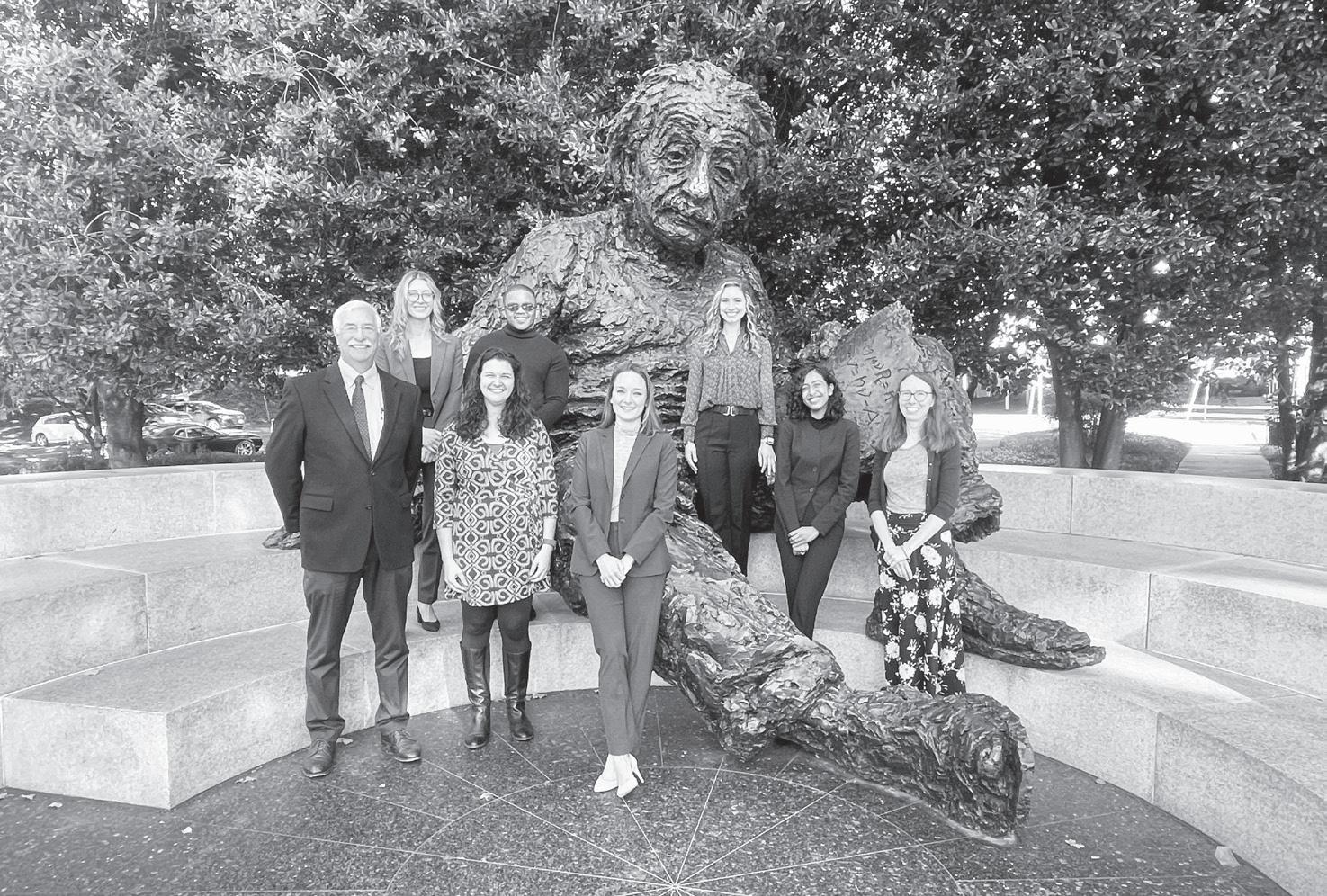
WiCyS leaders said 71 students are registered as members and plan to continue hosting weekly meetings this year to expand membership.
COURTESY OF GENE MIGLIACCIO
The team’s solution to youth intimate partner violence implements community and policy-based changes to support survivors with stable housing.
GW asks appeals court whether COVID droplets can cause building damage
The University filed a motion last Friday asking the D.C. Court of Appeals to rule that the presence of COVID-19 droplets can cause “physical loss or damage” after a judge dis missed a lawsuit GW filed last year seeking insurance compensation for pandemic losses.
GW sued Factory Mu tual last year to require the insurance company to cover hundreds of millions of dollars in coronavirusrelated losses, saying CO VID-19 droplets “damaged” buildings, making them unusable and falling under the physical damages in surance policy GW bought from the company. In Sep tember, District Court Judge Dabney Friedrich dis missed the lawsuit, saying the COVID droplets did not constitute enough damage to be considered “tangible alterations” to GW prop erty for insurance purposes because virus droplets can
be cleaned off of surfaces, delivering a win to Factory Mutual.
GW’s motion asks the Court of Appeals to hear arguments on whether the COVID droplets could be considered damage under insurance definitions. A win for GW in this motion, which would allow the Court of Appeals to deter mine whether the droplets could be considered physi cal damage, could give Uni versity officials an opportu nity to save the case from being dismissed.
In last year’s lawsuit, of ficials said financial strains caused by the pandemic cost the University “hun dreds of millions” of dollars and officials separately said the pandemic led to a $180 million budget gap during the 2021 fiscal year.
The motion states there is undetermined D.C. law on the question of whether or not COVID droplets present “physical loss and damages,” referencing sim ilar cases being considered in other state courts like
Maryland and Vermont, some of which have decid ed the issue in the insured’s favor.
“This Court should like wise certify the question above to the D.C. Court of Appeals rather than at tempt to predict District of Columbia law on this im portant question,” the doc ument states.
Friedrich said in Sep tember’s dismissal that while D.C. courts have not considered whether CO VID-19 can cause physical loss and damages to prop erty, the “overwhelming majority” of other courts – like those in Maryland, New Jersey and Washing ton state – that have ex amined the question have ruled that the virus does not meet the definition.
Officials said Fried rich, in his dismissal, lim ited the company’s all-risks policy to cover only broken property, rather than any property rendered unsafe or unusable by a “noxious substance” like COVID-19, which they said should be
covered. Friedrich said the COVID-19 droplets did not present a tangible alteration of property in the dismiss al, calling the argument “unpersuasive.”
“GW’s allegations are consistent with decades of case law holding that physi cal risks such as carbon monoxide, wildfire smoke, asbestos, and foul odors
CNN
DYLAN EBS REPORTER
Three CNN journalists dis cussed the implications of No vember’s midterm election results at the School of Media and Public Affairs Thursday.
The panelists broke down sev eral notable races and discussed how President Joe Biden’s admin istration is reacting to the results. The event, held at the Jack Morton Auditorium, marked the year’s final CITIZEN by CNN panel at GW, a series of discussions about current political events led by CNN journalists.

National political reporter Dan Merica led the conversation, joined by Daniella Diaz, CNN’s Capitol Hill reporter and Jeff Zeleny, CNN’s chief national af fairs correspondent.
The panel started the conversa tion with a look into the upcoming runoff for Georgia’s Senate race. Incumbent Sen. Raphael War nock, D-Ga., leads former football player Herschel Walker, R, but fell short of the necessary 50 percent needed to avoid a runoff.
“The question is, can Herschel Walker grow as a candidate?” Zeleny said. “Can his campaign organization strengthen? They didn’t have much of a ground op eration. They were sort of relying on Brian Kemp, the governor’s op
eration.”
Democrats flipped Pennsylva nia’s open Senate seat after a con tentious race between Pennsyl vania Lieutenant Governor John Fetterman, D-Pa., and Republican television personality Dr. Mehmet Oz. Merica said Fetterman’s cam paign struggled with responding to a stroke that Fetterman suf fered over the summer.
“When his team decided that it was time to come into his room and leave their boiler room, which is where they’re watching all the data come in, his campaign man ager came up to him and said ‘John, you may not get the blue checkmark from the AP and news outlets tonight, but you’re going to be the next senator from Penn sylvania,’” Merica said. “And at that moment, one outlet called the race. Apparently the room went crazy and Fetterman smiled and broke down and wept.”
Control of the House is still up for grabs, according to CNN, though Diaz said Republicans are likely to flip and control the chamber. She said a GOP House majority will likely be narrow.
“If you asked me a week ago whether I expected there to be a huge margin with Republicans taking the majority of the House, I would’ve said yes, probably like 20 seats” Diaz said. “Now we ex pect less than ten.”
The panel also discussed for mer President Donald Trump’s role in the Republican Party. Zeleny said many Republicans are blaming Trump for the party’s un derperformance on Tuesday.
“He emerged in a new way at the end of this race to take a pre mature victory lap, essentially,” Zeleny said. “I was at a rally he had last Thursday night in Sioux City, Iowa, and it was mainly about him and election griev ances. He thrust himself in the middle of this conversation. He went to Florida, he went to Penn sylvania, he went to Ohio. Mehm et Oz did not want him to come to Pennsylvania on the eve of the election.”
Zeleny said the Biden adminis tration is prepared for a series of investigations into the president and his family if Republicans take the House. CNN recently reported such probes are a top priority for the House GOP.
“It doesn’t matter the size of the majority, because even if it’s a one-seat majority, there will still be a Chairman of the Over sight Committee,” Zeleny said. “The investigations will sting just as much to the White House if there’s a one-seat majority versus a 30-seat majority, so the reality is the second half of the president’s first term is going to be totally dif ferent.”
Experts in higher educa tion Title IX policy said Ti tle IX training helps faculty and staff navigate how to respond to sexual harass ment and gender discrimi nation complaints. They said the low number of employees who have par ticipated in the training at GW could pose a “danger” to students, who may not be able to get the assistance they need without trained staff.
Adrienne Lyles, the ex ecutive director and Title IX coordinator in the Of fice for Gender Equity and Inclusion at the University of Cincinnati, said GW’s nonrequired training and low rate of faculty comple tion is typical for univer sities because of the dif ficulties in coordinating voluntary training for hun dreds of employees. The current federal policy only requires staff in the Title IX office to be trained, not all other faculty and staff.
“I do not think it’s just Title IX,” she said. “Faculty, like everyone, they’re tired. They feel overwhelmed. And, if whatever training it is isn’t created with their participation and buy-in, it’s hard to get them to want to do it. And that’s not a Title IX thing, that’s a training thing. And it is nationwide.”
Christina Percoski, a training specialist at Syra cuse University, said Syra cuse registered 100 percent
may cause ‘physical loss or damage’ that triggers insur ance coverage because they prevent an insured from using their property as in tended,” the motion states.
participation among its em ployees as part of manda tory Title IX training dur ing the previous academic year. She said New York requires annual sexual ha rassment prevention train ing for employers with a staff larger than 15 people.
The District does not require colleges and uni versities to conduct Title IX training for faculty and staff, but other local insti tutions – like American, Catholic and Gallaudet universities – require their employees to receive train ing once hired.
Percoski said increas ing participation numbers for voluntary Title IX train ing can be “difficult” with faculty balancing heavy workloads and conflict ing obligations. She said mandatory Title IX train ing gives all employees the same level of knowledge on how to deal with sexual as sault and gender discrimi nation complaints.
“I think the danger there is that a student might not get information that they might need to make the decision that is right for them in that situation,” she said. “The first person that a victim of sexual violence connects with makes such an impact on how that per son gets help.”
All faculty members at GW are designated re porters, meaning they are required to report accusa tions of sexual harassment, assault and domestic vio lence to GW’s Title IX co ordinator, according to the Title IX Office website.
Officials establish regional medical campus at Baltimore hospital
DANIEL PATRICK GALGANO ASSISTANT NEWS EDITOR
The School of Medicine and Health Sciences will establish a regional medical campus at Sinai Hospital in Baltimore, ac cording to a release.
GW and LifeBridge Health –a Maryland-based company that manages Sinai Hospital – signed an agreement that will allow a cohort 30 third and fourth-year students to study at the hospi tal, starting in the Spring. SMHS Dean and CEO of the Medical Faculty Associates Barbara Bass said GW medical students have been studying at Sinai Hospital as a clinical rotation sites for
several years and officials hope some students will continue their studies there.
“This is an exciting new chapter for the GW SMHS MD program – and we are thrilled to partner with LifeBridge Health to expand our presence outside of D.C. and to establish guaran teed access for clinical training of a cohort of our students in an environment that is differ ent than the main campus ex perience and complementary to the clinical public health focus of the SMHS curriculum,” Bass said in a release.
LifeBridge also has similar agreements with other insti tutions like the University of
Maryland, Georgetown and Johns Hopkins universities, as Maryland tries to attract young er medical professionals to the state where almost half of the ac tive physicians are over the age of 55, according to a 2018 study by the Robert Graham Center.
Bass said the new regional campus will give GW students access to medical technology and community health pro grams that are not necessarily available in Foggy Bottom.
“The new RMC will estab lish a long-term relationship between GW and LifeBridge Health and we hope will foster additional strategic partner ships, research collaborations,
and training opportunities for other GW learners,” she said.
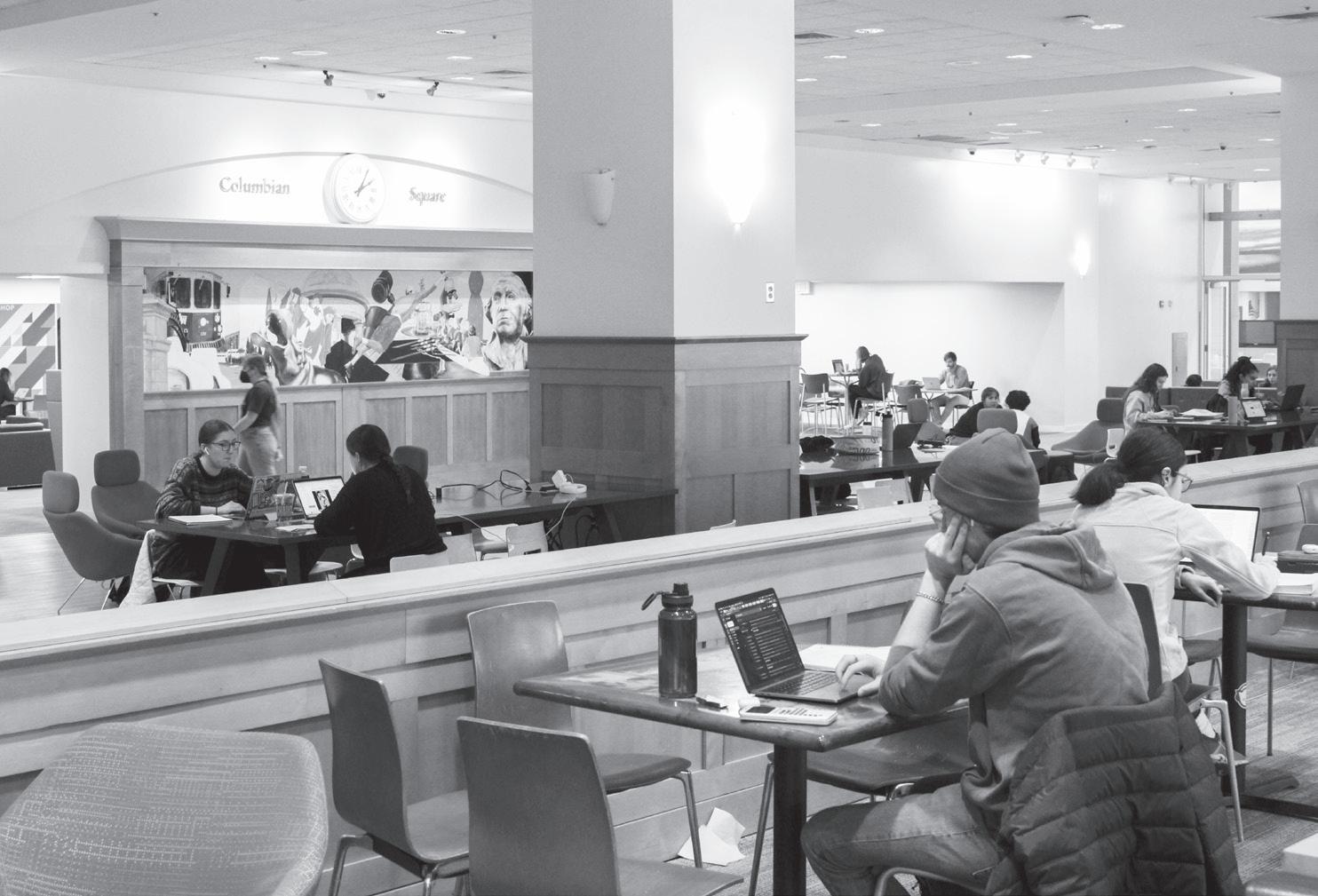
Students enrolled in the pro gram will need to spend two years of instruction on SMHS’s Foggy Bottom campus before be ing allowed to complete a oneyear clerkship and speciality elective courses at Sinai Hospi tal, according to the release. The new campus will be accredited by the Liaison Committee on Medical Education through the already-existing Marlyland pro grams and faculty at the new campus will also receive ap pointments at SMHS, according to the release.
Niel Meltzer, LifeBridge Health’s president and CEO,
said the partnership will allow students and faculty to partici pate in medical research that will benefit the local Baltimore community.
“At LifeBridge Health, these medical students will be able to take advantage of cutting-edge innovation and unique learn ing experiences that we can of fer within our multi-faceted, community-focused health sys tem,” he said. “We look forward to welcoming the first cohort of GW students to LifeBridge Health and broadening the re lationship that we have with the George Washington University School of Medicine and Health Sciences.”
NEWS THE GW HATCHET Novemver 14, 2022 • Page 5
KRISHNA RAJPARA I ASSISTANT PHOTO EDITOR
GW sued Factory Mutual last year to require the insurance company to cover hundreds of millions of dollars in COVID-related losses
GRACE CHINOWSKY CONTRIBUTING NEWS EDITOR
Title IX training aids survivors: experts
Page 1 I spend 95% of my day thinking about @GW_MBB Kate Carpenter on 11/12/2022 TWEETED TWITTER/@KATENOELLE12
Required
From
journalists talk
2022 midterm election results, Georgia Senate runoff
MAYA NAIR | PHOTOGRAPHER
The conversation started with a look into the upcoming runoff for Georgia’s Senate race. Incumbent Sen. Raphael Warnock, D-Ga, leads former football player Herschel Walker, R.
Opinions
GW must promote its Spanish language study abroad programs beyond Spain
Since the seventh grade, I’ve listened to American-born, native English-speaking Span ish teachers describe their meta morphosis after traveling abroad to Spain for their junior or senior year of college. While studying in Spain can be its own reward, I want an equal opportunity to study all the dialects of Spanish in Hispanic countries in the Americas, not just Castilian Spanish, the dialect spe cific to Spain that has occupied the forefront of my Spanish education.
Paige Baratta Opinions Writer
The dialects in Spanish-speak ing countries in the Americas have their own rich grammar and vocab ulary that differs from that of Cas tilian Spanish, and studying abroad in these places is truly the only way to fully master these accents and their nuanced grammar. But GW’s inconsistent and at times patroniz ing advertisement of study abroad programs in Spanish-speaking countries in the Americas denies its students the opportunity to enrich themselves through study abroad programs in these countries.
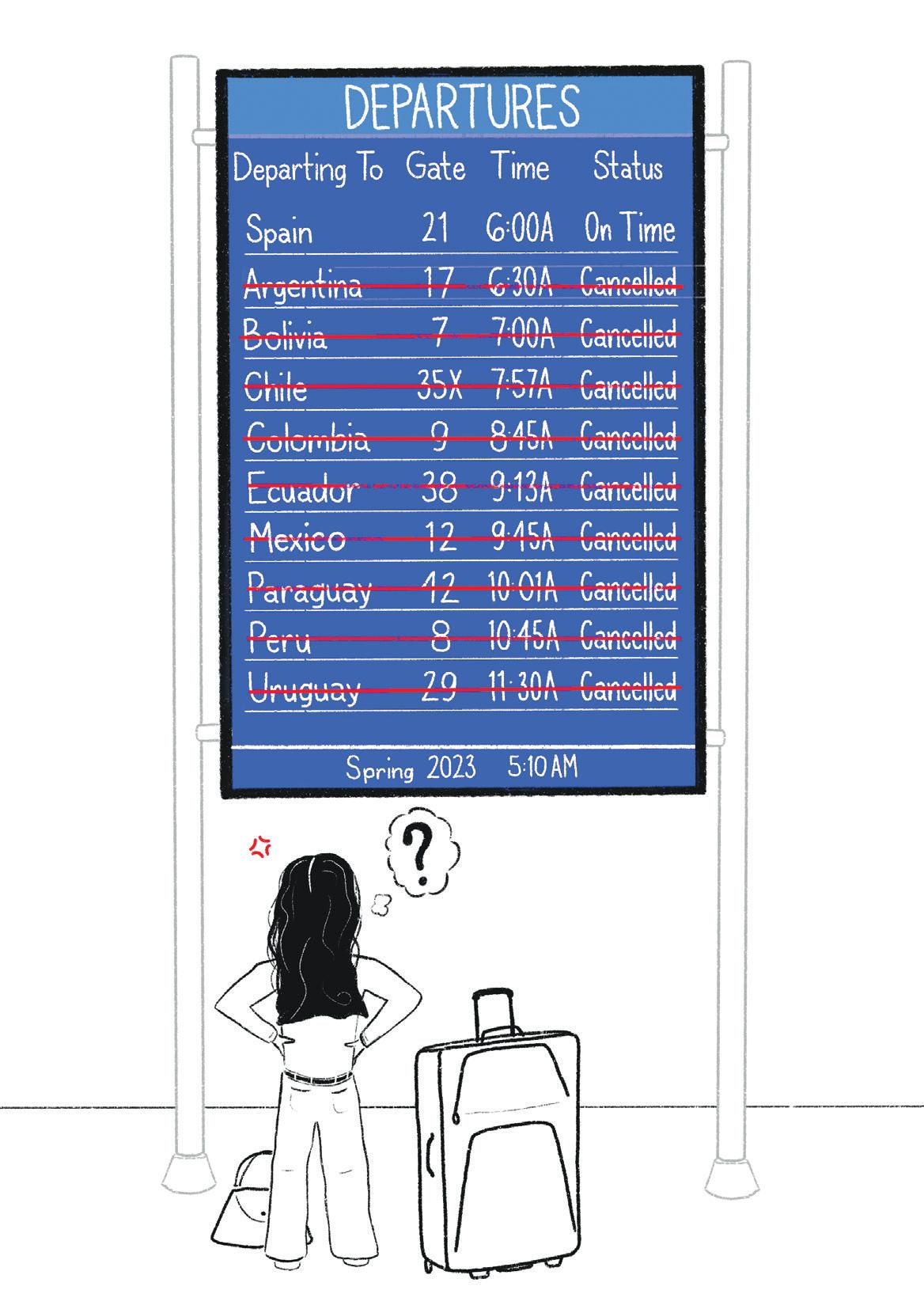
GW continues to promote its study abroad programs throughout all of Spain, but it neglects to give its Spanish study abroad programs in the Americas the same attention.
The Office for Study Abroad, or OSA, has a duty to ensure that all of its programs are equally enriching and fairly advertised. If GW truly wishes to provide vast cultural and language learning opportunities to its students, OSA must expand its offerings in Spanish-speaking countries in the Americas and stop perpetuating stereotypes about these countries through its adver tising strategies.
Excluding medical and gradu ate programs, GW offers six longterm study abroad programs in
MAURA KELLY-YUOH | STAFF CARTOONIST
Spain and a combined 12 study abroad programs throughout His panic countries in the Americas. But GW’s study abroad programs in Spain commonly overshadow the rest in the Western Hemisphere. During GW’s virtual study abroad fair this September, OSA held infor mation sessions on programs in Se ville, Madrid, Barcelona and Pam
plona – all cities located in Spain. For Spanish-speaking countries in the Americas, OSA only held virtu al information sessions for one pro gram in Chile and one in Colombia, leaving 10 other programs unmen tioned. Accessibility to information about Spanish study abroad pro grams and equal representation of the various abroad opportunities
Amid lawsuits over affirmative action, GW should recommit to diversity
The U.S. Supreme Court’s conservative majority’s skepticism about race-conscious admissions could upturn how GW and other universities evaluate prospective students. Students for Fair Admissions, an organization led by antiaffirmative action activist Edward Blum, alleges that Harvard University’s and the University of North Carolina’s admissions policies unfairly reject Asian and white applicants because of their race.
But demanding that universities ignore the backgrounds of their applicants in the name of “race-blind” admissions misunderstands the role of diversity in higher education.
“Diversity encourages students to question their own assumptions, to test received truths and to appreciate the complexity of the modern world,” the brief GW and 15 other institutions filed in support of Harvard in the affirmative action lawsuit in 2018 states. And with or without affirmative action as we know it, such diversity is worth defending.
Affirmative action pushed public universities like UNC and private universities that receive federal funding like Harvard to actively enroll students of color after decades of discriminatory admissions.
GW, with its own sordid history of segregation, is no exception. In 1938, then-President Cloyd Heck
Marvin wrote that “students of any race or color perform their best” when they are in a “homogenous group, and the University, in its tradition and social environment, has long preserved this policy.” GW officially accepted all students regardless of race in 1954 despite Marvin’s opposition. It was the last D.C. area university to desegregate its admissions process.
GW is still a predominantly white University – 47.1 percent of all students enrolled in 2021 were white. But from 2012 to 2021, the percentage of Hispanic, Black and Asian students enrolled at GW has respectively increased from 5.9 to 10.2 percent, 8.7 to 10.7 percent and 8.6 to 11.5 percent for Asian students, according to the University’s enrollment dashboard.
Living and learning alongside people whose experiences, identities and perspectives differ from each other is critical to the mission of any university. And while officials at GW and other institutions could certainly do better to clarify their “holistic” admissions process, those who cry foul over affirmative action or bemoan “reverse discrimination” should know that no U.S. college admits or denies prospective students solely because of their race. Raceconscious admissions treat an applicant’s race as one of many factors, like academic performance or extracurricular interests, rather than a decisive
one. Doing so expands minority students’ access to historically segregated institutions of higher education.
Affirmative action isn’t the problem – an already exclusive higher education industry that favors wealthier, whiter legacy applicants over others is. In 2011, The Hatchet reported that applicants with a parent who attended GW are 1.5 times more likely to be accepted into the University. So instead of litigating who among thousands of applicants deserves each and every crumb, the solution is to make the metaphorical pie bigger and admit more students of all backgrounds.
Still, the Supreme Court’s conservative majority stands poised to toss affirmative action into the dustbin of history.
The University should seize this opportunity to explain how it evaluates an applicant’s race in its admissions process, recognize the members of its student body and put this anti-affirmative action hysteria to bed. The future of GW’s admissions policy is an early and urgent test of the University’s values.
Desegregation marked the beginning of the end of one GW, but creating a diverse student body is a work in progress. Whatever the fate of affirmative action, wiping out prejudice – and acknowledging every facet of students’ identities – will always remain relevant at GW.
in Spanish-speaking countries is critical to where students decide to travel and the learning experiences they receive.
The difference between how the OSA describes programs in Spain and those in the Americas is even more jarring. While both Madrid and Chile are part of GW’s featured study abroad programs, GW’s Madrid program summary discusses the academic curriculum and its partnership with Madrid’s “premier national university.” But the summary for Chile’s study abroad program references how the country is “beginning to play an important role” globally and provides an opportunity to expe rience both “political and cultural challenges.” While OSA praises the distinguished academic experience offered in Madrid, it depicts Chile through a distant lens, encourag ing potential learners to treat them and their country as fundamentally different from GW and its students. This distinction is both unfair and untrue.
The limited opportunities for students to study Spanish in South America likely stems from the widespread but incorrect belief that the region is unsafe. This mis conception can push GW students away from Spanish-speaking coun tries in the Americas and further compound the OSA’s imbalance between abroad programs in Spain and those in the Americas. The U.S. State Department issues travel advi sories for countries on a scale from 1 to 4, with 1 signifying that travel ers should take normal precautions and 4 meaning U.S. citizens should not travel there. Every country in South America where a GW Study Abroad program is based is ranked as a 1 or 2. European countries like Germany, France, Spain, Italy and the United Kingdom currently sit at the same level 2 threat advisory for travel. Not to mention, D.C. has higher crime rates than the cities of
By widely advertising and glori fying its study abroad programs in Spain through OSA, GW’s Spanish language curriculum pushes stu dents down one particular path of Spanish-language education and Castilian Spanish, the Spanish dia lect spoken in Spain. The dialect is commonly regarded as the “pur est” form of the language. The Real Academia Española, the authority on Spanish language and grammar, advertises its dictionaries as “pro viding the linguistic norms” of the language in accordance with Cas tilian Spanish. The Real Academia Española promotes a Eurocentric view of the Spanish language as a whole, sidestepping the cultural enrichment of dialectal differences in Spanish speaking countries in the Americas. The more GW ad vertises abroad programs in Spain, the more students favor learning the Castilian Spanish dialect and embody that Eurocentric perspec tive of the Spanish language. The Spanish language does not belong solely to Spain, and GW needs to help promote this understanding through an equal advertisement of its Spanish language exchange pro grams.
GW’s Office for Study Abroad must commit itself to a multicul tural perspective and promote all study abroad opportunities on an equal footing. Its current bias in favor of Spain and subsequent pa tronizing attitude toward dialects of Spanish in the Americas and culture are unacceptable. After dis regarding them for so long, the of fice needs to review its approach to advertising study abroad programs in Central and South America and more widely promote the opportu nities students have to study abroad in these countries.
—Paige Baratta, a freshman studying political science, is an opinions writer.
Editor’s note: This post contains references to sexual assault. If you have been affected by sexual assault, contact the National Sexual Assault Hotline at 800-656-4673 for free, confidential support 24/7 or visit online.rainn.org. If you have any questions about this column, please contact the editor at eic@gwhatchet. com
My mandatory training as part of New Student Orientation informed me about quick tips on campus, like where to get the best latte – and that I’d need to travel across D.C. if I ever needed a rape kit. Neither the GW Hospital nor Student Health Center offers rape kits. If I find myself a survivor of sexual assault, it will be my responsibility to go to MedStar Washington Hospital Center, the only D.C. hospital that provides medical forensic exams, just for the collection of evidence to seek justice.
Terra Pilch-Bisson Opinions Writer
This is the reality for all survivors of sexual assault and violence at GW and in D.C. The University has a responsibility to leverage its connections with the GW Hospital to ensure oncampus resources for sexual assault survivors, including the provision of rape kits.
Ambulance services like EMeRG can quickly transport survivors of sexual assault to receive medical services at the GW Hospital, which is owned by Universal Health Services. But because the hospital doesn’t provide rape kits, which are ideally
administered between 24 to 48 hours after an assault takes place, patients can’t seek justice after their initial injuries are treated there.
The MedStar hospital receives funding to provide medical forensic exams through the national Sexual Assault Nurse Examiner program, or SANE, which trains and organizes personnel to administer them. Without SANE, which D.C. originally began at Howard University Hospital in 2000, hospitals lack the required expertise to properly administer exams with care and respect to patients.
When Howard University Hospital withdrew from SANE in 2008, Denise Snyder, the director of the D.C. Rape Crisis Center, contacted all major hospitals in the city and received little to no interest in hosting SANE, according to the Washington City Paper. The GW Hospital was “historically resistant to providing [sexual assault] services outside the University community” according to minutes from a SANE meeting on the issue. The GW Hospital’s reluctance to provide rape kits risks the health of those within and far beyond Foggy Bottom – if MedStar chose to discontinue its SANE program, the entire city would be left without access to rape kits.
GW Hospital’s administration and University officials, whose Student Health Center does not provide rape kits either, have repeatedly turned a blind eye to this gaping hole in sexual assault policy.
Considering that 13 percent of all college students experience sexual assault during their academic career, it’s bizarrely unjust that the most accessible and publicized medical facilities on GW’s campus are so wholly unequipped to provide support for survivors of sexual assault. And the manner in which the University informs students about the lack of rape kits during orientation leaves sexual assault survivors on campus in a deeply emotionally and physically draining situation with both financial and practical barriers to receiving treatment at MedStar.
Rape kits are no solution to addressing the root causes of sexual assault and violence, but they are a necessary form of quantifiable evidence with which survivors support their cases in court. Barriers to accessing them make an already-imperfect system worse for survivors.
The GW Hospital must support students and its surrounding neighborhoods by providing easily accessible rape kits. A “not our problem” liability statement during orientation can’t replace comprehensive support for survivors, and it certainly doesn’t cultivate an environment of safety and comfort for students. Students have been demanding rape kits on campus for more than a decade – it’s time to do something about it.
—Terra Pilch-Bisson, a freshman majoring in American Studies, is an opinions writer.
Thais
Shea
Annie
Diana
WHAT THE UNIVERSITY WON’T TALK ABOUT THIS WEEK What equipment upgrades and space reconfigurations officials made to Lerner. p. 2
“As a queer person with a uterus, my anxiety was at an all-time high thinking that people could ever vote against my existence as a human.”
– RILEY GOODFELLOW on 11/10/2022
Medellín and Cartagena in Colom bia and Santiago, Chile.
After years of inaction, students need on-campus sexual assault resources
OPINIONS THE GW HATCHET November 14, 2022 • Page 6
609
St. NW
D.C. 20052
|
Submissions — Deadlines for submissions are Friday 5 p.m. for Monday issues. They must include the author’s name, title, year in school and phone number. The GW Hatchet does not guarantee publication and reserves the right to edit all submissions for space, grammar and clarity. Submit to opinions@gwhatchet.com Policy Statement — The GW Hatchet is produced by Hatchet Publications Inc., an independent, non-profit corporation. All comments should be addressed to the Board of Directors, which has sole authority for the content of this publication. Opinions expressed in signed columns are those of the authors and do not necessarily reflect the view of The GW Hatchet. All content of The GW Hatchet is copyrighted and may not be reproduced without written authorization from the editor in chief. Cost — Single copies free. Additional copies available for purchase upon request.
STAFF EDITORIAL
eic@gwhatchet.com news@gwhatchet.com opinions@gwhatchet.com photo@gwhatchet.com sports@gwhatchet.com culture@gwhatchet.com copy@gwhatchet.com multimedia@gwhatchet.com
21st
Washington,
gwhatchet.com
@gwhatchet
Hatchet The GW Isha Trivedi, managing editor Lauren Sforza, managing director Abrigail Williams, community relations director Nick Pasion, senior news editor Zach Blackburn, senior news editor Caitlin Kitson, assistant news editor Daniel Patrick Galgano, assistant news editor Erika Filter, assistant news editor Faith Wardwell, assistant news editor Henry Huvos, assistant news editor Sophia Goedert, assistant news editor Grace Chinowsky, contributing news editor Ianne Salvosa, contributing news editor Nikki Ghaemi, contributing news editor Tara Suter, events editor Ethan Benn opinions editor* Riley Goodfellow contributing opinions editor* Auden Yurman, senior photo editor
Jarrod Wardwell, editor in chief
Maura
Nicholas
Sarah
Sachs, podcast host Sejal Govindarao, podcast host Grace Miller, design editor* Isabella MacKinnon, design editor
Kelly-Yuoh, design editor
Anastacio, graphics
editor
Aaron Kovacs, web developer Ishani Chettri, contributing web developer Abby Kennedy, social media director Ethan Valliath, contributing social media* director * denotes member of editorial board
Business Office
Eddie Herzig, business manager Zac Omar, sales representative
Danielle Towers, assistant photo editor Jordyn Bailer, assistant photo editor Krishna Rajpara, assistant photo editor
Rachel Schwartzz, assistant photo editor
Nuria Diaz, sports editor*
Gabe Lopez, contributing sports editor
Clara Duhon, culture editor*
Julia Koscelnik, contributing culture editor Nora Fitzgerald, contributing culture editor Amanda Plocharski, video editor
Kolganov, video editor Jaden DiMauro, copy editor* Cristina Stassis, assistant copy editor
Carlberg, assistant copy editor
O’Brien, research assistant
FROM GWHATCHET.COM/OPINIONS
Crompton, research assistant Luke Wienecke, research assistant Tyler Krambeer, research assistant Zac Bestwick, research assistant*
A glimpse into the history and culture of D.C.’s rollerskating community
To avid skater Saletta Coleman, roller skating in D.C. is a “frac tured” scene.
The District has lacked a co hesive roller-skating space for the last 30 years since two of its most popular skating sites shut down, and as roller rinks disappear while large-scale grocery stores with high-end housing pop-up, room for this long-beloved hobby in D.C. remains dependent on the commu nity that carves it out. So Coleman has taken it upon herself to turn venues like The Anthem at The Wharf into roller rinks to engage and cultivate the roller skating community in the city.
Coleman – the founder of GetY ourSk8on, an organization that showcases skating events in several cities including D.C. and provides online resources to help skaters find and travel to events – said she plans skating events wherever she can find space in D.C. Whether at fashion events, galas, skate lessons or her Legends Heels, Hats and Wheels skate party at The Anthem last month, she has drawn skaters both regional and international to share in this common D.C. pastime.
“Anybody can roller skate, and that’s kind of what makes it so awesome,” Coleman said. “You gather with friends from around the country a few times a year, and it’s like a big family reunion. When you’re all together, you’re under a groove.”
Nearly 19 years ago she cre
ated GetYourSk8On, a website providing skaters with a calendar of events in D.C., a skating news source and videos of fellow skaters.
The history of roller skating in D.C. among the Black community goes back not only to the disco, rhinestone-sequin clad rollers of the 1970’s, but rather finds itself in tandem with the initial national rise of roller skating in the 1880’s.
Coleman said Black Americans at the time found themselves unable to access public rinks due to racial segregation, and this fight for equal access to recreational space drove activism for racial justice into the the 20th century. Even after rinks integrated, this ongoing struggle for space existed throughout the history of roller skating in D.C., as the Black community faced rink
closures throughout the latter part of the 20th century due to gentrifi cation and subsequent urban rede velopment.
“When African Americans started roller skating or got into roller skating, they had to skate outside,” Coleman said. “So we’re used to being pushed outside.”
D.C. was previously home to some of the largest rinks in the na
tion, including the multi-purpose sports arena Riverside Stadium, which was demolished to make way for the Kennedy Center, which was built in 1964, and the National Arena in Adams Morgan that closed in 1984 and later trans formed into a Harris Teeter grocery store and adjoined apartments in 2013.
Coleman said the predomi nantly Black community of local roller skaters refer to the DMV area as Snap City, a name adopted after the act of “snappin” – a one-footed skating move that involves the rap id transition of frontward motion to backward.
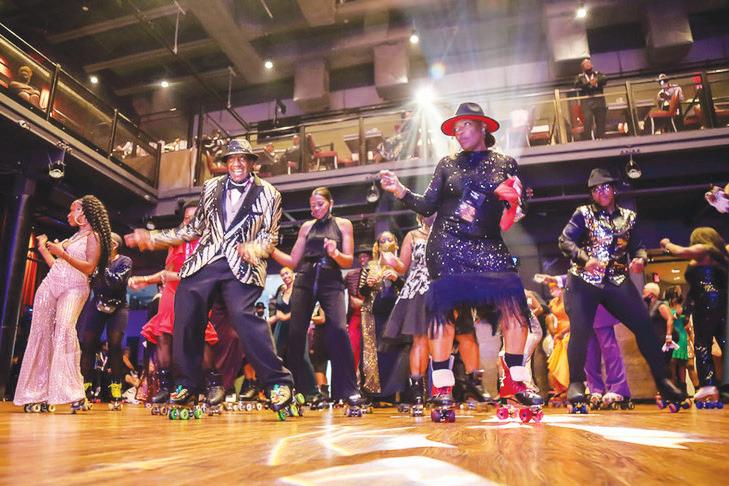
Invigorated by the same pas sion Coleman harnessed to orga nize skaters nearly two decades ago, skating aficionados Darren W. Jackson II and Pejay Camacho founded TheLinkUpDC early last year, which hosts pop-up skating events and skating lessons, show casing style skaters from across the DMV.
Their Instagram account has garnered more than 37,000 follow ers, and they credit much of their success to the talent of D.C. skaters showcased on the page. Jackson and Camacho take pride that Snap City is relatively small and feel pro tective of its identity and the love that surrounds it.
Jackson and Camacho said after relocating to D.C. for their careers, the two quickly started going to the rinks almost every day early last year to skate in Snap City and connect with the community that composes it.
Meet the bike rider who glides through campus to feel-good jams
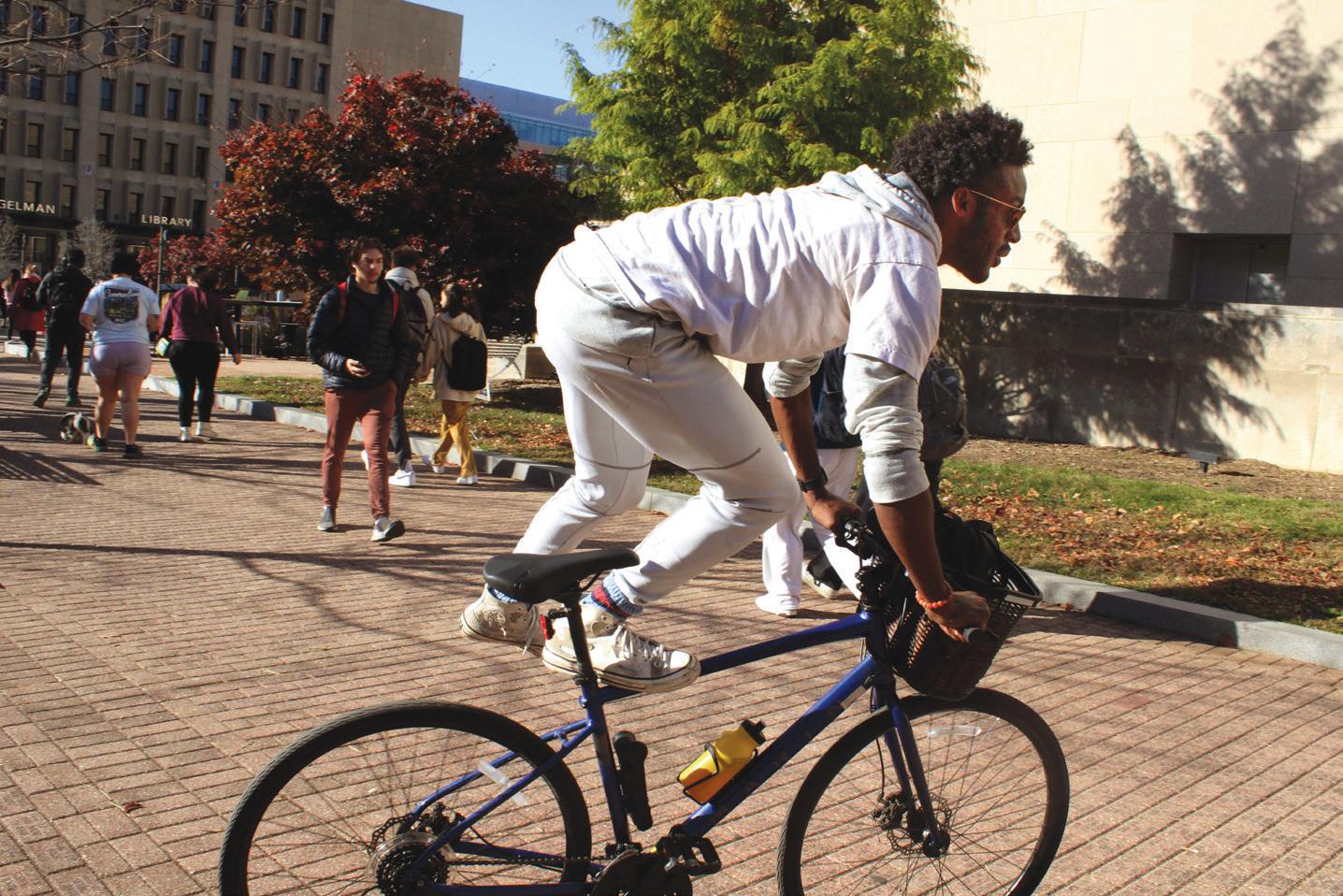 CLARA DUHON CULTURE EDITOR
While walking around campus, a familiar face singing along to the likes of Stevie Wonder and An derson .Paak while whiz zing by on a bike may have caught your attention more than once.
Alumnus Dylan Mitchell, who graduated from GW last spring, has emerged as a recognizable bike rider in the neighbor hood over the past year for his fast speeds, ample tricks and groovy music exuding from a speaker on his bike. Rain or shine, Mitchell hits the streets with his bike on the daily, riding anywhere from his home near Colum bia Heights to his old place in NoMa, the National Mall or down the canal path in Georgetown.
As he dove into biking as a sophomore, he glided through campus to catch up with his friends wher ever they might pop on his routes, like a roommate who frequented Duques Hall or buddies who would honk their horns at him from their cars. But Mitch ell said he also enjoys the influx of new interactions he’s shared since he began biking around campus as people approach him to chat about his music selec tion, tricks or whatever’s on their mind.
“There’s people that have come up to me and have talked to me, and I recognize them, and stop me every time,” he said. “I always stop, have a conver sation.”
Mitchell’s strong love of riding materialized after his family gifted him a bike to ride to school when he lived in NoMa in early 2020.
He quickly began at tempting tricks like stand ing up and jumping on his bike, particularly while cycling up and down the Reflecting Pool. His assort ment of tricks developed as he learned how to jump and swerve around on his bike.
Mitchell – who rides be tween three and six hours each day, averaging about 20 miles – enjoys biking on sunny days when he can feel the heat on his face and appreciate an unexpected breeze. The open-ended ness and independence of his rides, especially on the canal path in Georgetown, keep him coming back day after day.
On his rides, Mitchell appreciates connecting with members of the local community. He said when he plays old R&B like Lu ther Vandross, older gen erations of Black passersby recognize the music and start singing along and dancing to it.
From his run-in with the Secret Service to accounts of D.C. political drama from strangers who come up to chat, Mitchell said he has encountered sev eral “crazy,” “one-chance encounters” on his rides. Once when he was down by the National Mall, an old man flagged him down, ex tended a $5 bill and asked Mitchell to perform some tricks. Last week during a ride on campus, an onlook
er affectionately told him “you’re my drug!”
Mitchell said he enjoys riding his bike around cam pus but has faced a range of blows in the area, from “at least” three popped tires to vehicular accidents.
He said he got into two accidents at the intersection of 21st and H streets two days in a row last week, consisting of a slam into the front of an oncoming car on the first day and a flip caused by a loose chain after that. He came away from the latter with a busted lip and a scraped-up knee and right forearm.
And not many students can say one of their #Only AtGW moments involves the Secret Service check ing to see if they are alright after wiping out in front of them on 17th Street, but Mitchell can.
When he isn’t swerving through the streets of D.C., Mitchell job hunts and dab bles in creative endeavors like sketching, gardening and cooking. He’s on his second sketchbook, filling the pages with drawings of architecture and moments he’s shared with friends.
At his home near Co lumbia Heights, he tackles various projects like creat ing an irrigation system for his growing collection of plants that envelop his space, but he sometimes finds himself disinterested in the day-to-day activities. The only exception? Biking.
“I do get bored easily, so that’s why I like biking,” he said. “I’ll never get bored of biking. There’s always something different to see.”
talks book detailing substance addiction
RAJPARA STAFF WRITER
star
Actor and TV star Mathew Perry received a standing ovation at the start of his live tell-all and dug deeper into his childhood, critical success and chal lenges of coping with his addiction in promotion of his newly released memoir.

Perry said his goal to finish writing “Friends, Lovers, and the Big Terrible Thing,” was to ensure that his sobriety would remain “safe,” while also providing hope to help other people struggling with the serious nature of addiction. The live interview marked the third out of four stops on Perry’s book tour and was led by New York Times journalist Lulu Garcia-Navarro last week at Warner Theatre downtown.
Perry rose to stardom playing the sarcastic but sweet role of Chandler Bing in the hit sitcom “Friends,” but performed on camera as early as 1991 during a guest appearance in the original “90210.”
“I knew how I wanted to start it, which was this horrible night in my life,” Perry said of the start of his book. “I almost died. I wanted to tell that story and how I came out of that and how my resiliency and my strength that I didn’t really know was there came out and I was able to get better enough to be here.”
Before embarking deeper into the conversa tion about “the big, terrible thing,” Perry touched on growing up in the shadow
of his accomplished parents – actor John Bennett and for mer press secretary of Cana dian Prime Minister Pierre Trudeau Suzanne Perry – and his struggle growing up with divorced parents, who separated when he was only a year old.
Continuing the con versation on his complex filial relationships, Perry said his affinity for com edy stemmed from a desire for parental attention, even when it came to basic needs.
“I became funny as a re sult of my mother not giving me proper attention, some times crying, not feeding me,” Perry said.
Perry and Garcia-Navar ro shifted the discussion to Perry’s first encounter with alcohol and drugs and his subsequent descent into the “linear” nature of addiction, which he describes as only worsening as it continues. Perry said he felt all his problems drift away when he drank an entire bottle of wine as his first taste of alcohol at the age of 14 – a feeling he thought “normal people” experienced often.
“Nothing was wrong, fighting with my mother, being, feeling alone, none of that stuff,” Perry said. “I was just looking at the clouds, and it all went away and I felt wonderful.”
Perry said his experience early in his career as a young actor struggling to make it in L.A. further normalized the drinking culture and party life of the 1980’s, refer encing his association with actor Hank Azaria and the Brat Pack – a friend group of famous actors – in his
book. As his addiction con tinued, Perry said he always knew that “something was wrong,” as he continued to drink heavily even during the high points of his life, which pushed him to keep his struggles a “secret.”
“In that, my greatest mo ments, I would, in the back of my head, I’d go ‘why,’ and I say that in the book, ‘Why? Why can’t I stop drink ing? Julia Roberts is your girlfriend! Why can’t I stop drinking? What’s the mat ter?’” Perry said. “It wasn’t until years later that I found out what was going on.”
Perry said he had to “lock” himself up by check ing into rehab a total of 14 times when he felt fear take over. The actor, who has not had a drink since 2005, said he felt a desire for life and wanted to experience as much of humanity as pos sible, which sustained his perseverance.
“I got scared, and I thought, if I keep this up, I’m going to die,” Perry said. “And I don’t want to die because I haven’t learned everything there is on this land yet. And I want to learn. I want love. I want to have a child.”
As Perry neared the end of his tell-all, he shared some words of wisdom with the audience that reiterated his message of relentless perseverance for anyone struggling with “the big, terrible thing.”
“You can get as far down on the scale and you can still come back from it,” Perry said. “Don’t give up. It’s not a death sentence unless you let it be.”
CULTURE THE GW HATCHET November 14, 2022 • Page 7
Culture
THE SCENE
NEW EP: "EVERYTHING TO EVERYONE" BY RENEÉ RAPP
JUST FOR US Wednesday, Nov. 16 | Woolly
Theatre | Tickets
RELEASED THIS WEEK:
Mammoth
starting at $5 Attend a poignant play directed by Adam Brace featuring Alex Edelman's third solo show.
A WINDOW SUDDENLY OPENS: CONTEMPORARY PHOTOGRAPHY IN CHINA Daily | Hirshhorn Museum & Sculpture Garden | Free admission Enrich your knowledge of art history by learning about multigenerational Chinese photographers.
KRISHNA
Mitchell, who averages about 20 miles biked per day, particularly enjoys
on
days when
can feel the heat on his face and appreciate an unexpected breeze.
LILY SPEREDELOZZI I STAFF PHOTOGRAPHER
riding
sunny
he
‘Friends’
Matthew Perry
PHOTO ILLUSTRATION BY KRISHNA RAJPARA | ASSISTANT PHOTO EDITOR
Perry said his experience early in his career as a young actor struggling to make it in Los Angeles further normalized the drinking culture and party life of the 1980’s.
MAXIMUS VOGT REPORTER
COURTESY OF MELISSA ROBINSON
The predominantly Black community of local roller skaters refer to the DMV area as Snap City, a name adopted after the act of “snappin ” – a one-footed skating move that involves the rapid transition of frontward motion to backward.
Men’s basketball secures victory against crosstown rival Howard
JADEN DIMAURO STAFF WRITER
Men’s basketball secured their second consecutive victory in an electric performance at home, taking down their crosstown rival Howard.
After years of lackluster attendance and fan engagement, Head Coach Chris Caputo and men’s basketball had the Smith Center rocking again with their 85-75 win over Howard Friday night. Senior forward Ricky Lindo Jr. and freshman guard Maximus Edwards combined for 37 points and 17 rebounds on the way to a Colonials victory.
“I’m almost speechless about how good the students have been,” Caputo said in a post-game interview. “In particular in this building, how loud it gets, it’s perfect for a college basketball environment like we have it. It’s not cookie-cutter, it’s a unique building. I just think it’s awesome.”
The game got off to a highflying, helter-skelter start, with 8 of the Colonials’ first 10 points coming from dunks, the first of which, a monstrous put-back from senior forward Ricky Lindo Jr., sent the already-buzzing crowd into a state of pandemonium.
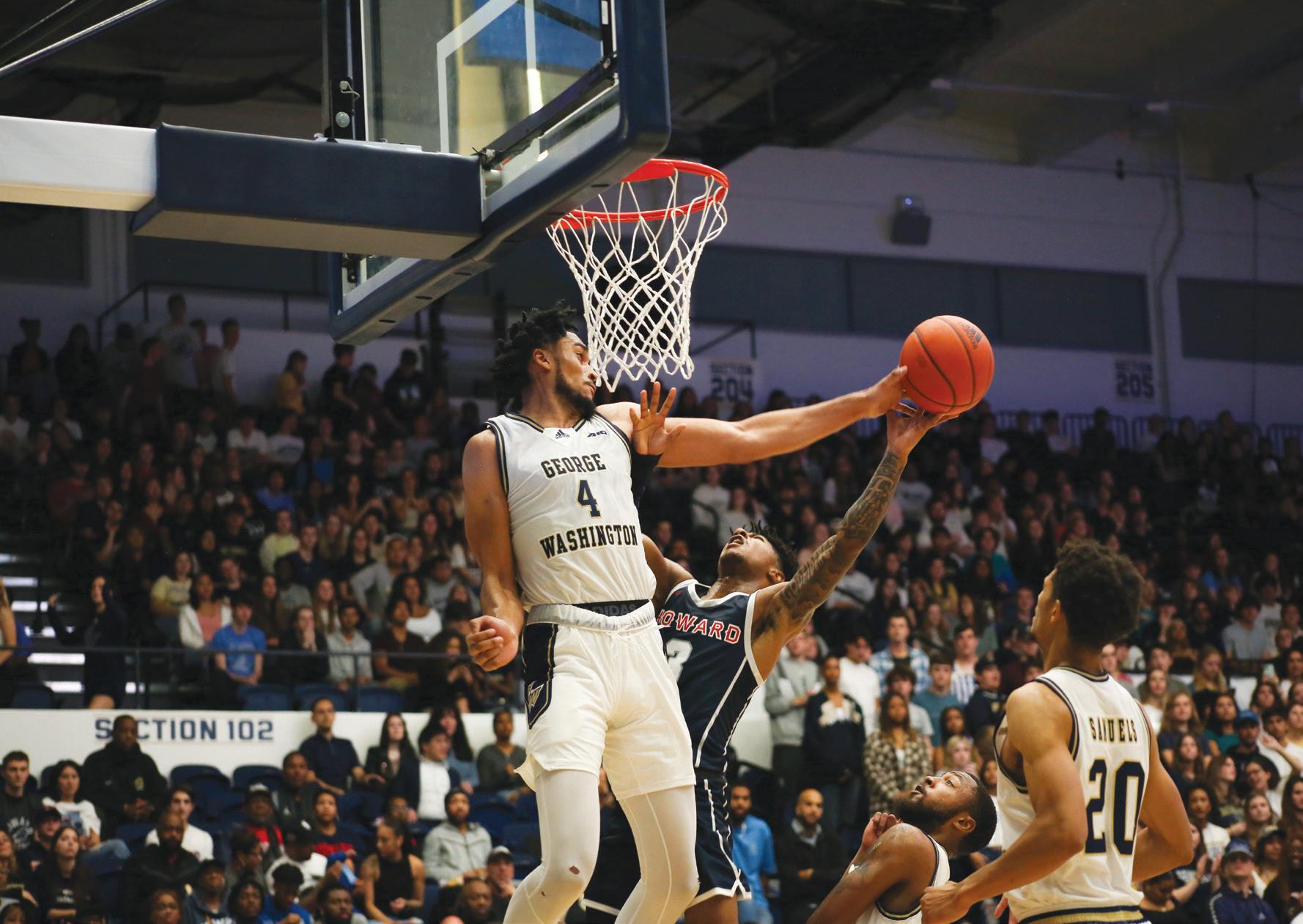
Lindo led GW on both ends of the court all night, scoring a gamehigh 19 points and pulling down nine boards and swatting four Bison shots.
“I took what the defense gave me,” Lindo Jr. said. “Put-backs, rebounds, threes, just getting into a good 3-point position.”
After a back-and-forth start kept the score knotted at 8 points after
six minutes of play, the Colonials began to pull away. Graduate student guard Brendan Adams brought the GW offense under his control and drilled a 3-pointer to punctuate an 8-0 GW run that put the Colonials up 16-8 nearly halfway through the first half.
But the Bison weren’t ready to back down just yet. A dunk from sophomore guard Bryce Harris off a back cut and a fast-break finish by junior forward Jordan Wood forced GW to call timeout in an attempt to stop the bleeding. Led by Harris, who finished the night with a teamhigh 19 points, Howard stormed back to within 1 with 4:17 to go in the half.
After the timeout, neither team was able to gain a clear advantage, and the Colonials went into halftime clinging to a 36-32 lead.
Howard came out of the gate firing after the break, despite Edwards hitting a three for GW’s first shot of the half. Harris was particularly aggressive, scoring the first points of the half for the Bison off another backdoor cut and pulling down a huge offensive rebound before dishing the ball to junior forward Steve Settle, III, who laid it in to tie the game at 41 points a piece.
But from that point on, GW hit the gas and never looked back. Edwards, who only scored 6 points in the first half, was the star of the second, finishing the game with 18 points while shooting a scorchinghot 60 percent from the field.
“He’s a talented young player,” Caputo said. “He’s got some dexterity and proprioception, knowing where you are in space, he has a really good feeling, he’s got
it.”
Senior forward Hunter Dean also came up big for the Colonials in the second half, with 10 of his 14 points coming after the break. Dean, who was one of the five GW players on the court to start the second half despite originally coming off the bench, said he wasn’t aware of the change to the starting lineup ahead of time.
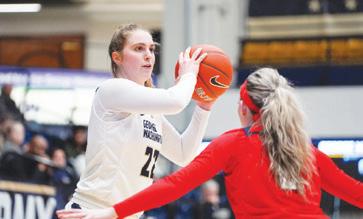
“I had no idea,” Dean said.
Women’s basketball records first win of season over Maryland Eastern Shore
OWEN AVERILL REPORTER
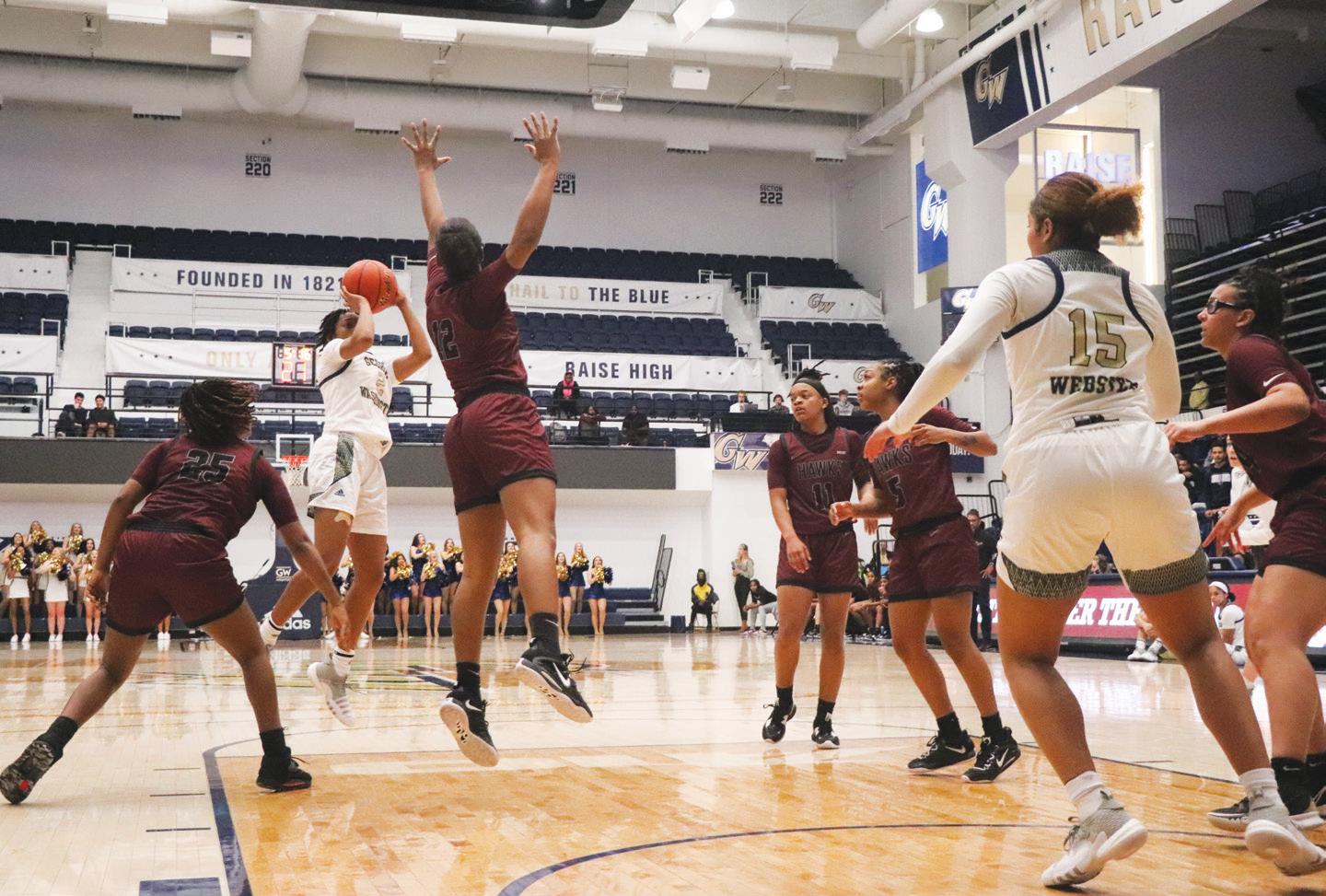
Women’s basketball won their first game of the season against Maryland Eastern Shore Thursday, soundly defeating the Hawks 65-50 in a show of dominance behind the 3-point line, spurred by precise ball movement and lockdown defense.
The Colonials (1-1), made quick work of the struggling Hawks (0-2), maintaining a double-digit lead for much of the game thanks to efficient work from behind the arc from their guards senior Essence Brown and junior Taylor Webster, who combined for 21 points. The Hawks failed to connect offensively, shooting just 1-17 from deep while the Colonials forced 15 turnovers.
Junior Zamara Haynes kept the Hawks offense afloat for much of the game with a stellar performance, scoring 19 points and grabbing seven rebounds, the highest of any Hawks player on the night. But Haynes alone could not make up for the rest of the team’s shooting struggles as the Hawks shot for 29 percent on the night.
Brown led GW’s offense with 12 points and five assists, a team high in both categories. GW’s offensive prowess stood out, and the team’s bench outscored Maryland Eastern Shore 2914 with four players scoring at least 10 points.
“I think we have players that can consistently score around 10 points, so I really like the balance that we have on this team,” Head Coach Caroline McCombs said after the game. “So if somebody’s open, we do want them to take that shot, and we feel like they can knock it down.”
Redshirt senior forward Mayowa Taiwo, who collected her 500th career rebound for the Colonials against the Hawks, was instrumental in helping the Colonials retain the ball, recording a game-high nine boards.
“She makes amazing plays for us defensively, and so I’m proud of her,” McCombs said of Taiwo. “I’m happy for her for that accomplishment. She puts in the work and she deserves it.”
GW managed to outscore Maryland Eastern Shore in the paint, recording 22 points to the Hawks’ 20. The Hawks’ shooting deficiencies behind the 3-point line with just one deep ball made the difference as GW drained 10 3-pointers.
“We play kind of like a position-less style of basketball, and we share the ball a lot with each other,” redshirt senior Mayowa Taiwo said after the game. “So I think that showed upstairs today in the fact that multiple people were able to score over five points.”
The Colonials charged
out to an early lead in the first quarter as Brown worked in and out of the paint, draining a 3-pointer, then following it with a jumper in the paint to push the Colonials up seven. The 3-pointers didn’t stop there as graduate student guards Mia Lakstigala and Jayla Thornton connected for early triples of their own.
“Over the off-season we were just able to get a lot of shots up,” Brown said. “We did a Curry Club thing that we do to get a lot of 3s up, so I’ve been just working on my shot a lot.”
Senior forward Faith Blethen closed out the quarter strong for the Colonials, scoring an inside layup before knocking down two free throws to give GW a 9-point lead at the first buzzer.
Lakstigala went back and forth with the Hawks’ Haynes, sandwiching a Haynes layup with two 3-pointers. Shooting three for five from deep in the second quarter, the Colonials never again saw their lead drop below 10.
By the end of the third the Colonials were up 18, their biggest lead to end a quarter.
After extending their lead early in the quarter, GW’s advantage collapsed down to 15 after relentless drives from the Hawks but clung onto the lead until the final buzzer.
GW looks to continue its winning ways at 7 p.m. against Howard Monday.
“When they call my number, I just make sure I’m ready to go.”
In addition to scoring, Dean pulled down nine big rebounds and sunk all four of his free throws.
Getting to the line was key to GW’s success, as 23 of their 85 points came from the charity stripe. Lindo led the Colonials in the category, making all eight of his tries.
“No matter what happens, if
we get fouled, we’ve got to hit our free throws,” Lindo said. “They’re the easiest points besides a layup, dunks too.”
Thanks in part to Lindo and Dean, the Colonials dominated the glass all night, pulling down nine offensive boards and outrebounding the Bison 39-22 overall.
The Colonials will travel to Long Island, New York Monday to face Hofstra. Tip-off is at 7 p.m.
Alumni collective initiates NIL partnership with GW Athletics
GABE LOPEZ CONTRIBUTING SPORTS EDITOR
An alumni-created collective is helping GW student-athletes connect with businesses and fans to benefit off the popularity of their name, image and likeness, officials announced Friday.
Friends of George, a collective funded by alumni and fans and not affiliated with the University, was created to foster opportunities for GW student-athletes to benefit from NIL regulations through tiered fan subscriptions or single contributions, according to a release issued Friday which introduced the group.
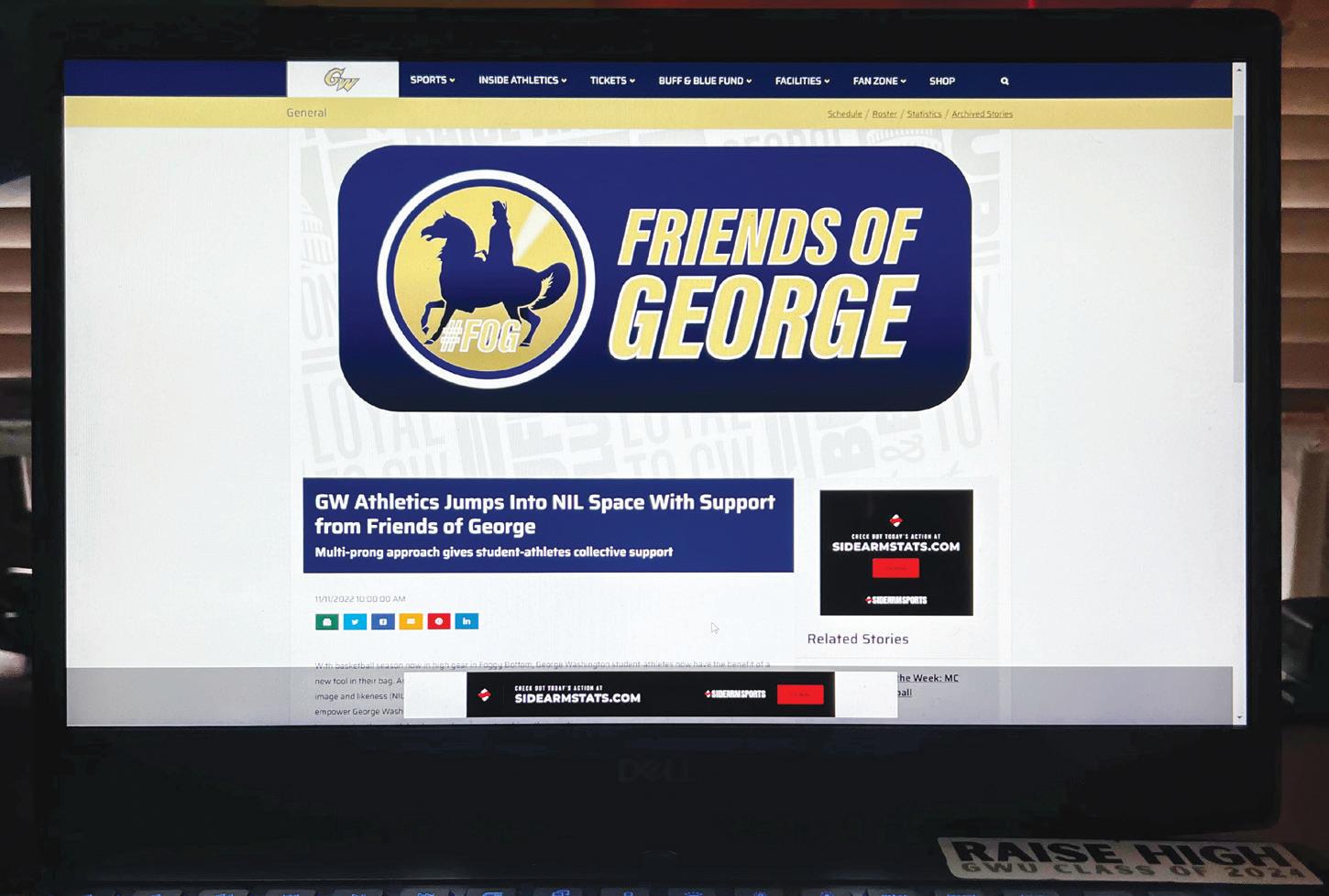
Student-athletes will be able to benefit through autograph signings, social media promotions and even offering personal coaching and training, and they will keep 85 to 90 percent of contributions that are made to Friends of George, according to their website.
In Oct. 2019, the NCAA Board of Governors unanimously voted to allow student-athletes to make money off their name, image and likeness, reversing their of policy requiring student-athletes to be uncompensated amateurs. This policy went into full effect by July 2021.
The release said that the collective has no role in recruitment, nor does it offer
benefits “based on playing time or performance” of participating studentathletes.
“Rather, the concept is for GW fans to collectively resource funds together in a common pool that pays out for legitimate opportunities for student-athletes to perform duties based on the popularity of their name, image and likeness,” the release said.
When asked about the collective in a post-game interview, head men’s basketball Coach Chris Caputo said that it will give GW “an NIL presence” to help them accomplish their competitive goals.
“And the good thing about it is we have an incredible institution for it, an incredible location for it and certainly there are going to be opportunities through that for student engagement as well,” Caputo said.
Those who wish to contribute can purchase a subscription ranging from $10 to $500 per month, or they can pay with a onetime contribution, according to the Friends of George website. Contributors can donate to specific sports, or they can enter into nonexclusive contracts with specific student-athletes, if they choose.
According to the Friends of George website, GW student-athletes will also be allowed to issue nonfungible tokens, also known as NFTs, for sponsors and brands,
and participating studentathletes will receive their rewards on a monthly basis.
The $10 monthly plan gives contributors exclusive interviews and content with studentathletes, access to supporter events and student meet and greet sessions and a raffle for autographed memorabilia. The $25, $50 and $100 monthly plans include all those benefits but add Friends of George apparel, an autographed poster and custom studentathlete video shoutouts, respectively.
The $250 monthly plan includes all previous benefits but adds exclusive studentathlete NFTs, autographed memorabilia and virtual training with studentathletes. The $500 monthly plan allows contributors to have in-person training with student-athletes, in addition to all previous benefits.
Alumnus Aahil Shermohammed, an NBA agent and former manager of the GW men’s basketball team, serves as CEO of Friends of George. NIL collectives were being created across the country, the NCAA announced in a May press release that collectives are allowed under its regulations only if they are considered a booster – a third-party group that helps to promote an athletics program and assists in providing benefits to recruits, student-athletes or their family members.
Sports
NUMBER CRUNCH
.875 MEN’S BASKETBALL vs. Maryland Eastern Shore Friday | 7 p.m. EDT
GAMES OF THE WEEK WOMEN’S BASKETBALL at Howard Monday
Men’s water polo’s conference winning percentage this season, good for second place in the conference standings.
The Colonials
look
for their third straight victory as they welcome the Hawks to the Smith Center.
|
7 p.m. EDT GW heads across the District to take on the Bison as the Colonials look for their second consecutive victory.
JENNIFER IGBONOBA | PHOTOGRAPHER
Eight of the Colonials’ first 10 points came from dunks, the first of which, a monstrous put-back from senior forward Ricky Lindo Jr., sent the already-buzzing crowd into a state of pandemonium.
PHOTO ILLUSTRATION BY JORDYN BAILER | ASSISTANT PHOTO EDITOR
In October 2019, the NCAA Board of Governors unanimously voted to allow student-athletes to make money off their name, image and likeness.
MAYA NAIR | PHOTOGRAPHER
GW drained 10 3-pointers. SPORTS THE GW HATCHET November 14, 2022 • Page 8
The Hawks’ shooting deficiencies behind the 3-point line, with just one deep ball, made the difference as
