Halloween Guide 2022


Through remodeled dining venues and demolished buildings, the structural landscape of Foggy Bottom has transformed during the last five years, a sign of the neighborhood’s synchronous relationship with GW.
Aston, which mainly housed upperclassmen and is valued at $38 million, according to the D.C. Office of Tax and Revenue.
Faculty senators are doubtful officials will follow through on their plans for the Medical Faculty Associates to break even by next June with $200 million of debt mounting on the health care provider network.


Officials restructured the MFA in August to improve its financial standing through yearly payments from Universal Health Services to GW, “trademark royalties” and a “fair market rent repayment” on GW property, according to a report on the MFA delivered at last Friday’s Faculty Senate meeting. MFA CEO Barbara Bass said at the meeting that the sale of GW’s 20 percent minority stake in the GW Hospital will help redirect clinical revenue to the MFA, which partially staffed the hospital.
She said the MFA’s “hands were bound” by the District Hospital Partners, the agreement between the University and UHS to operate the GW Hospital, which made it “impossible” for the MFA to become a profitable institution. The former financial relationship between the MFA, UHS and the GW Hospital was unclear from Bass’ statements at the meeting.
Bass said the drop in MFA revenue, which she attributed to the pandemic, pushed officials to restructure the MFA’s relationship with DHP. She said GW’s sale of the minority stake in the hospital will make the MFA profitable, claiming it created a “modern funds flow arrangement,” but
she did not explain how it would do so.
“There was no forward position for the MFA as a clinical enterprise without a reset of the relationship with Universal Health Services,” Bass said.
The report did not detail how the MFA would execute the terms of its new agreements, which, in combination with the MFA’s dramatic financial losses, stirred frustration among faculty senators at the meeting.
The MFA lost nearly $80 million in fiscal year 2021 –which spans from July 2020 through June 2021 – plummeting 200 percent from its FY 2016 levels. The report states the MFA’s net profits have fallen each fiscal year since 2019, with $43 and $48.1 million in losses in FY 2020 and FY 2021, respectively.

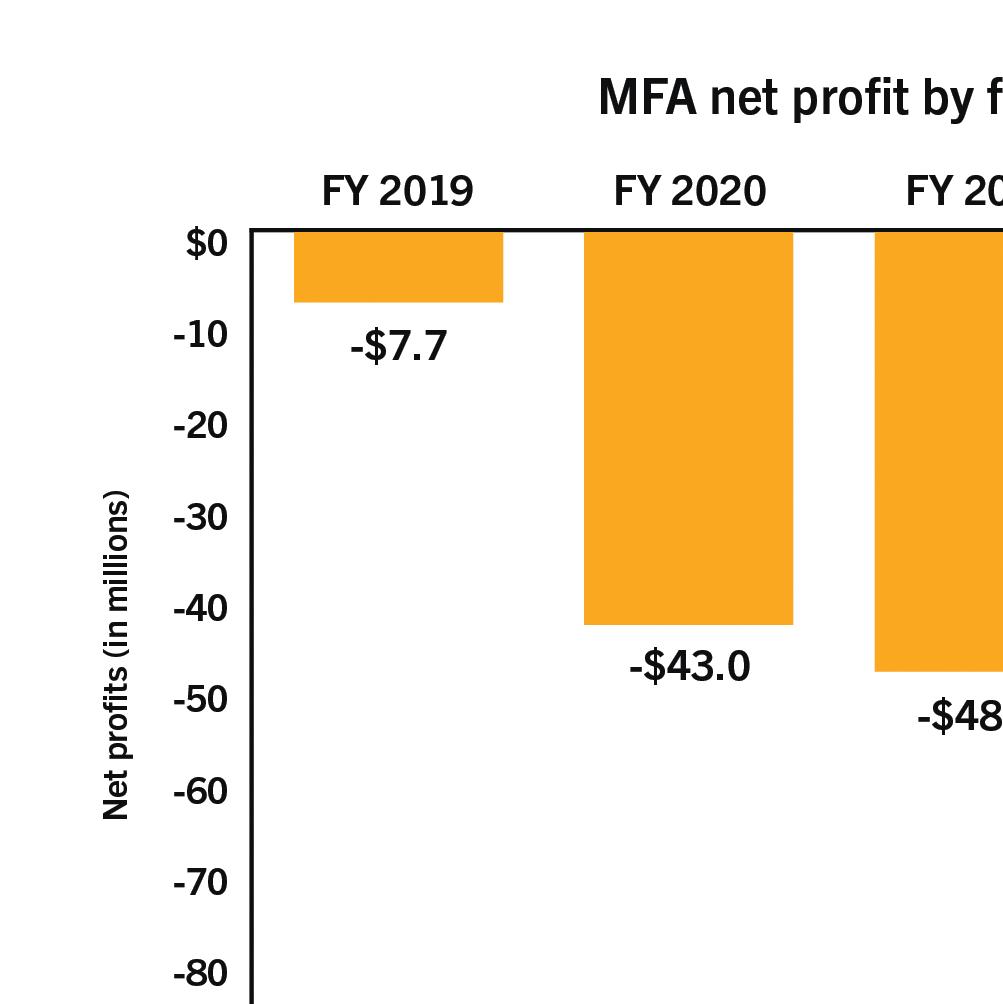
Officials plan to increase the MFA’s revenue by more than $60 million and decrease its expenses by $2 million to break even in FY
2023 – which ends June 30, according to the report.
Bass’ appearance at last week’s meeting marks the first time she has publicly taken questions about the MFA and its finances since the MFA became a topic of discussion at any Faculty Senate meeting in recent memory.

Faculty senators said schools like the Columbian College of Arts and Sciences, which they said has “inadequate” financial support, would be better suited to serve its students and support its faculty if the University directed the funds they are currently loaning to the MFA to the academic schools instead. They said they don’t believe the MFA will break even next year because, without clear communication, officials’ financial projections don’t “make sense.”
Sarah Wagner, a professor of anthropology and a faculty senator, said officials’ efforts to direct funds to the medical enterprise
“stings” because CCAS faculty have struggled to hire student researchers and conduct research projects. “When will we see equal prioritization of the fundamental services and support systems for the units in this university that are currently carrying the MFA on their backs?” she said at the meeting.
Susan Kulp, a faculty senator and co-chair of the senate’s fiscal planning and budgeting committee, said quarterly check-ins about the MFA’s financial statements to the senate would allow senators to gauge how the MFA is moving forward.
She said she “scratched [her] head” to the MFA’s financial plan to break even for FY 2023 because she didn’t see a strategic or quarterly plan for how the MFA will reach its goal.

“It’s just about having access to transparent information and answers, and not an opinion of what we should do,” Kulp said.
Since 2017, GW’s property investments have ranged from total demolition to dramatic renovations through multi-million dollar building sales, remodeled dining venues and legal agreements with the surrounding neighborhood and D.C. government. Local residents have reacted to the neighborhood’s evolution with mixed feelings, welcoming GW’s communication about the physical developments but resisting change that fails to include them in the decisionmaking process.
The changes have delivered Foggy Bottom new restaurants, office spaces and hotel deals likely to bring revenue to the area. But local critics of the changes have disagreed with GW’s demolition of campus buildings they associate with the neighborhood’s history and closures that have stripped dining options from the area.
“GW has a long history of working alongside our local partners and elected in seeking solutions to improve and enhance our city,” University spokesperson Daniel Parra said in an email.
“These include contributions to educational, physical and environmental facilities and programs.”


Occupying Foggy Bottom since 1912, GW has long been near-synonymous with the surrounding neighborhood, playing a direct role in many of its changes over the century. Here are some of the most major shifts the two have undergone over the past few years:
GW to reel in millions from hotel sales
GW has initiated the sales of two of its West End properties in the last year, as University planning has shifted toward a more centralized Foggy Bottom approach.
GW has owned One Washington Circle Hotel as an investment property since 2001, but opened the building for residential housing, taking in 282 students to compensate for lost capacity during Thurston Hall’s renovation. GW announced plans to sell the property months later, while officials stressed it was not central to the University’s future real estate plans.
GW sold the property to real estate firm Electra America for about $12 million in May of 2022. That same month, GW announced plans to sell The

Four dining venues have hung in the balance of Foggy Bottom’s remodeled dining scene in the past two years. Ten private dining vendors have opened since last fall in Western Market – a food hall housed inside the GWowned complex at 2000 Pennsylvania Avenue.
At a Foggy Bottom and West End Advisory Neighborhood Commission meeting last month, Commissioner Yannik Omictin said Western Market has become increasingly popular among residents, tourists and students amid a “massive” expansion in vendors and employees.
GW closed public access to the food court in District House’s basement earlier this year because of safety concerns while converting the site into an all-you-caneat dining hall as part of a revamped, unlimited dining system.
GW has demolished a pair of aged buildings on campus, each torn down less than a year apart in 2021 and 2022.
The University razed the Waggaman House, which formerly housed the Nashman Center for Civic Engagement and Public Service, in October of last year, replacing the structure with a spread of green space at the corner of I and 22nd streets.
Eight months later, GW also tore down Staughton Hall, a building that the University used as a women’s residence hall and a naval research center on 22nd Street for more than 100 years. As of October, officials have said GW does not have any plans for a new building to go in the place of Staughton, but officials said in January that the space is “well-occupied” for green space until any possible redevelopment takes place.
“There are currently no plans to redevelop the site formerly occupied by Staughton Hall,” a University spokesperson said in an email.
GW’s ongoing 2007 Foggy Bottom Campus Plan, which the University has used as a “framework for development” over the last 15 years, marks the lots that held Staughton Hall and the Waggaman House as potential sites for academic development.
seven million Venezuelan migrants are seeking asylum worldwide, and about half of Venezuela’s citizens are currently living below the poverty line.
A student organization that will fundraise for Venezuelan migrants in D.C. and lead discussions on issues impacting Venezuela relaunched its chapter on campus this semester after a two-year hiatus.

Venezuelan Perspectives will advocate and collect emergency aid for migrants attempting to flee Venezuela’s political and economic crises, including those sent in buses to Union Station from the Texas border during this academic year. Student leaders said members, many of whom are first-generation immigrants, will pull from personal experiences with violence and poverty in Venezuela to inspire their activism and support migrants recovering from the hyperinflation and resource shortages in the country.
Venezuelan migrants continue to arrive in D.C.’s Union Station this fall after Gov. Greg Abbott, R-TX, started transporting asylum-seekers in buses to the District from Texas in late August to protest President Joe Biden’s move to prohibit the expulsion of migrants from the U.S.
Senior Francisco Lara – the president of Venezuelan Perspectives, which was founded in 2016 and was reapproved as a student organization this fall – said he lived in Venezuela until he was 15 before moving to the U.S. with his parents during the peak of Venezuela’s economic crisis when basic necessities were “scarce” and violence was “rampant.”
“It was out of my control, and that really frustrated me,” Lara said. “The reason why I decided to study what I study and come to D.C. was because of that. That’s what’s motivating me to do what I do.”
Venezuela began experiencing an economic collapse in 2014 when the country’s gross domestic product dropped by 3.9 percent, causing 9.3 million Venezuelans to descend into food insecurity.
He said members of the organization plan to meet migrants at Union Station in November to provide food and medical supplies through a volunteer event hosted by the Embassy of Venezuela.
Senior Natalie Chevrel, the vice president of Venezuelan Perspectives, said the organization aims to unite Venezuelan students on a campus where connecting with other Venezuelan students can be challenging among a predominantly white student body.
“We also obviously wanted to help our country in some way,” Chevrel said. “Just because everyone who leaves Venezuela is always thinking of ways to try to help from afar because we love our country, and it’s just really horrible – everything that’s happening.”
Chevrel said the organization plans to host student events this
semester, including a screening of a documentary about the current state of the Amazon Rainforest and a speaker panel of Venezuelan immigrants who will discuss their adjustment to life in the United States. She said this programming
will aim to spread awareness to the GW community about the return of the organization and recruit new members.
“We are the Venezuelan people, and so we want to help in any way we can,” Chevrel said.

Officials will increase employee’s contributions to medical, dental and vi sion coverage in January, according to an annual employee benefits report released earlier this month.
The report states the University will raise em ployee medical coverage contributions by a “nomi nal” 1.3 percent, while den tal and vision coverage con tributions will increase by 1.4 percent and 1.5 percent, respectively. Experts in academic human resources said the rise in contribu tions – percentages taken away from employee’s salaries to fund healthcare services – is similar to in creases at other universities and are minimal consider ing the impact of inflation on the costs of healthcare services.
Officials increased med ical coverage contributions by 1 percent, but decreased dental coverage contribu tions by 1.5 percent in last year’s updates.
University spokesper son Kathleen Fackelmann said the increases to medi cal, dental and vision cover age contributions are based on the annual increase in the cost of healthcare ser vices and GW employees’ “overall utilization” of the healthcare services the Uni versity offers.
“Each year, GW works with its vendor partners to review utilization of health and welfare benefits programs with the goal of providing the most com prehensive benefits offer ings, at the most reasonable costs,” she said in an email. “The GW benefits pack age is designed to attract and retain faculty and staff and support the health and well-being goals for partici pants.”
The report states that 80 percent of full-time participants in the Univer sity’s medical plan will see an average increase of less than $5 per month in their medical contributions, compared to the 90 percent who experienced the same average monthly increases in their contributions last year. The report states month ly increases will range from less than $1 to about $11 for employee medical con tributions, according to an employee’s plan, salary band and coverage level. Increases to employee med ical contributions ranged from $1 to $8 last year.
Monthly employee den tal contributions will in crease by less than $2, and monthly employee vision contributions will increase by less than $1 for all plans and coverage tiers, accord ing to the report.
Officials will launch a new enrollment system for employee insurance benefits, which has “single sign-on capability” that al lows employees to not sign in to the system if they are already logged into their GW account on their GW computer, in January. The new system will operate through bswift, an online benefits enrollment and ad ministration system.

Experts in academic hu man resources said higher education institutions, like GW, must ensure that em ployees are able to afford the increases in their con tributions and should pri oritize benefits to improve mental health and wellbe ing.
Robert Roop, a professor and chief human resource officer at Webster Univer sity, said a minute growth in employee contributions to insurance benefits are in line with increases at other universities.
“No one likes their ben efit cost increase, let’s ac cept facts,” Roop said. “But a 1.5 to 2 percent increase in this market is really ex cellent and should be well received.”
Roop, a member of Webster University’s Panel of Experts on Human Re sources, said higher educa tion institutions may seek to improve their employee benefits by lowering em ployee contributions to out perform peer institutions, like Georgetown Univer
sity.
He said decreases in em ployee contributions must reflect the institution’s abil ity to pay for those benefits and increases must reflect the ability of employees to pay.
“It’s called cost sharing, and you can only pass the increase back to the em ployees to a percentage that they can afford,” Roop said. “So the improvement really comes back to cost manage ment.”
Roop said employee welfare beyond medical insurance is becoming a serious concern, and high er education institutions like GW must prioritize benefits that improve em ployee wellbeing to secure the health and happiness of their employees.
“The idea of employee wellbeing is becoming a very, very leading issue in benefit discussions,” Roop said. “So as they try to im prove, they should focus more globally on the total benefit, not just the medi cal.”
Fred Foulkes, the di rector of the Human Re sources Policy Institute at Boston University, said the increases in employee con tributions are “reasonable” in regards to the impact inflation has had on health care costs.
The annual U.S. national health expenditure by 2027 is likely to be $370 billion higher than projections of annual expenditures made prior to the COVID-19 pan demic because of the im pact of inflation, according to an estimate from McKin sey & Company – a global management consulting firm.
“The costs are going up
because of inflation, and then if you look at what’s happened to salaries of nurses and a lot of new drugs, which are very ex pensive,” he said. “So it’s easy to understand why the cost is going up, so I guess the question is how should they be shared between the employer and the employ ee?”
Foulkes said it is in creasingly necessary for employee healthcare ben efits to include resources for mental health because of the impact the COVID-19 pandemic had on people’s mental well-being.
The Chronicle of Higher Education reported that a majority of surveyed high er education faculty mem bers in October 2020 expe rienced increased levels of “frustration, anxiety and stress” due to the impact of the COVID-19 pandemic.
The report states that the University offers em ployees who are eligible for the benefits and members of their households five free counseling sessions through the GW Employee Assistance Program – a program that assists GW employees with work-life balance concerns, like deal ing with mental health is sues.
Employees who are eli gible for the University’s benefits and their depen dents, who are 13 years or older, can also receive five weeks of free chat therapy through Talkspace, a text therapy app, according to the report.
“There’s the big need to have good benefits with re spect to mental health,” he said. “That’s really become much more significant dur ing COVID.”
Mitchell Hall 10/7/2022 – 6:17 a.m.
Closed Case
A staff member reported that a student discharged a fire extinguisher in a Mitchell Hall hallway.
Referred to the Division for Student Affairs.
Hillel Center
10/7/2022 – 8:30 a.m.
Closed Case Staff reported vandalism caused by leftover adhesive from posters glued to structures outside the Hillel Center.
Statements like “Zionists f*** off” and “Free Palestine” were on the posters.
Referred to the Metropolitan Police Department.
Various Locations 10/6/2022 – Unknown Closed Case
Staff reported vandalism caused by leftover adhesive from posters glued to the structures across campus like light poles and electric boxes.
Referred to MPD.
Mitchell Hall 10/8/2022 – 8:30 p.m.
Closed Case
A male student damaged his residence hall room’s entry door while attempt ing to gain access to his suite. The student forced the door open after the door’s GWorld scanner wasn’t work ing.
Referred to DSA.
Madison Hall 10/9/2022 – 2:30 a.m.
Open Case A male student reported being the victim of an assault with a dangerous weapon by another male student. The complainant decided to press criminal charges.
Referred to MPD.
Madison Hall 10/9/2022 – Multiple Closed Case
A male student said that they were the victim of a simple assault and threats to do bodily harm by their male room mate, the same individual reported for assault with a dangerous weapon. Referred to DSA.
Public Property On Campus (600 Block of 23rd Street) 10/11/2022 – 3:10 p.m.
Open Case GW Police Department and MPD officers responded to a report of an at tempted robbery. Upon arrival, GWPD officers made contact with a female student who reported an unknown male subject attempted to take her wallet after she declined their request for money. GWPD and MPD officers canvassed the area but were unable to locate the subject. Case open.
1900 Block of F Street 10/12/2022 – Unknown
Open Case A male student reported their electric scooter stolen. Case open.
Duques Hall 10/12/2022 – 10:51 a.m.
Closed Case GWPD officers responded to reports of an unknown male subject who made threatening remarks about bombs potentially being inside University buildings. The subject left the area and was later stopped by MPD officers. GWPD officers responded and after learned the subject had a recent bar notice banning them from GW prop erty, and issued an updated bar notice to the subject. Subject barred.
“On behalf of our cus tomers and the City of Alex andria, we apologize for this inconvenience,”
Commuter students are bracing for extended travel times and long lines on the Metro in Northern Virginia after the Washington Metro politan Area Transit Author ity delayed the reopening of six stations until early No vember.
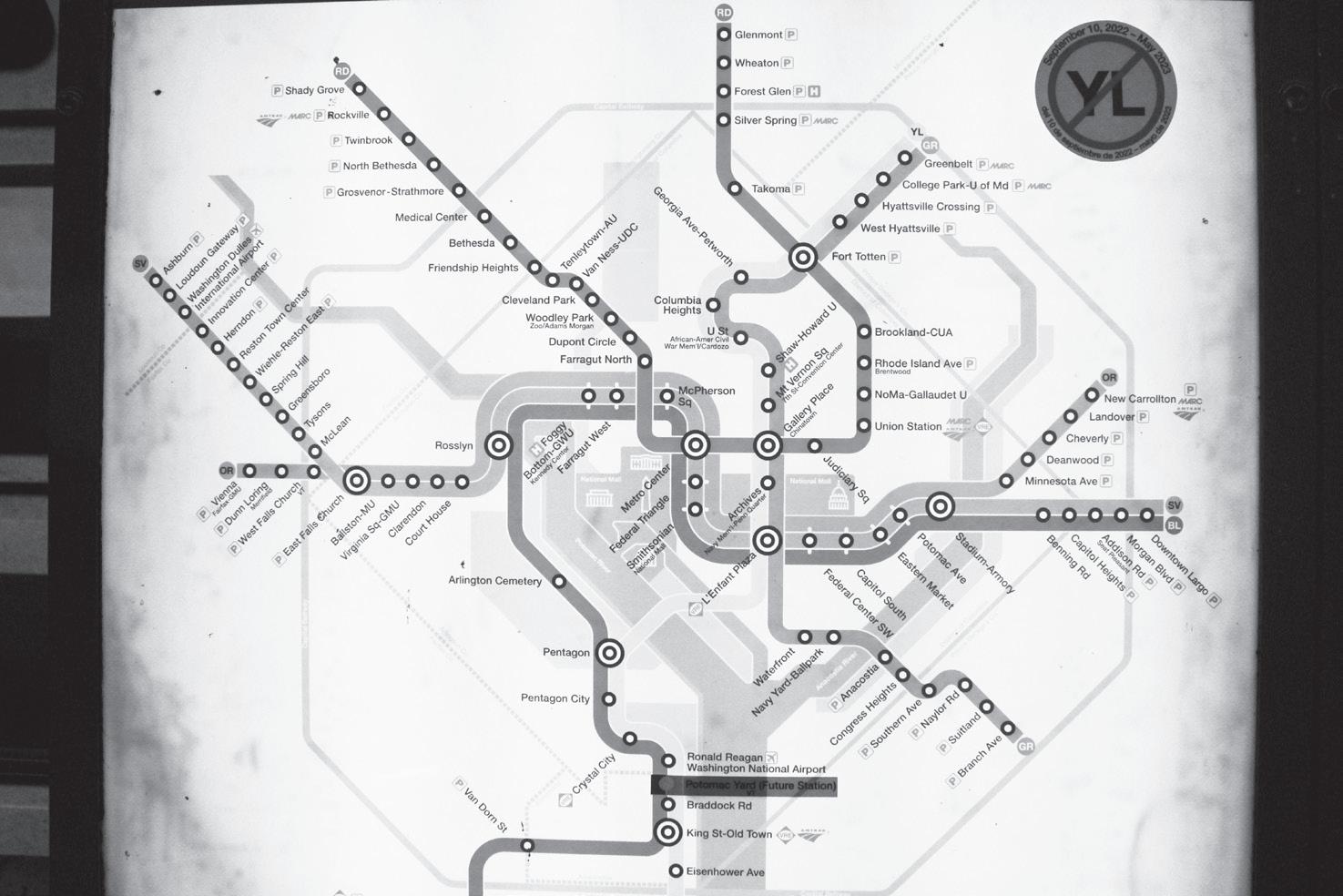
In a release issued late last month, WMATA an nounced it pushed back the reopening of six Blue and Yellow line stations south of Reagan National Airport from Oct. 23 to Nov. 6 to reinforce the ground un der the tracks at the newly constructed Potomac Yard station after encountering stability issues last month. WMATA began offering free shuttle service between all six stops during the closures, but student com muters said they must now account for shuttle delays of about 15 minutes with di verted riders building up at open stations.
Andy Off, WMATA’s executive vice president of capital delivery, said in a release. “We will continue to work as quickly as possible to deliver a highquality station, and we are doing everything within our power to move the proj ect forward in a safe and re sponsible way.”
The release states that free Blue Line Local shuttles run between the stations every 10 to 20 minutes dur ing all Metrorail operating hours, while the Blue Line Express shuttles come ev ery six minutes between the Franconia-Springfield to Pentagon stations during rush hours – 4:30 to 9:30 a.m. and 3:30 to 7:00 p.m. Dur ing all other hours, the Blue Line Express operates from 4:30 to 9:00 p.m. on week days and 7:30 to 9:00 p.m. on weekends with arrivals spaced out by every 15 min utes.
Enzer Khurshid, a soph omore living in Arlington, said she was “disappointed”
to hear about the stop clo sures, which she said length ened her commute time by 15 to 20 minutes because of the shuttles’ “unpredict able” arrival times. She said even if she plans her com mute ahead of time, she still risks being late to campus.
Khurshid said she now takes the express shuttle bus from Franconia-Spring field to Pentagon station, where she gets on the Blue line to Foggy Bottom. She said the buses have arrived late twice this semester and caused her to miss the next Blue Line train from Penta gon station, which adds sev en to 10 minutes to her trip.
“Normally, it would have taken me less than 30 minutes to get to Foggy Bottom, but now to get to campus, it takes me around 45 minutes, sometimes even 50, depending on how long I’d have to wait for the bus and then the actual Metro train,” Khurshid said.
Alexandra Drotter, a ju nior living about 10 minutes away from the FranconiaSpringfield station, said her normal commute has
lengthened from 55 minutes to 65 minutes since the clo sure of the stops because of long lines of riders waiting for shuttles.
“It’s hard to time your self because the bus takes a couple of minutes to fill,
so I don’t really know what exactly their schedule is,” Drotter said.
Izaz Ahmad, a freshman living an hour away from campus, said his commute to GW has grown by 20 min utes because of the closures.
He said he now drives 30 minutes from his home in Woodbridge to reach the Franconia-Springfield sta tion.
“It adds 20 minutes to my ride and getting to campus,” Ahmad said.
After downsizing the executive cabinet this spring, the Student As sociation has lost more than half its freshmen membership and plans to redouble its recruitment efforts to revive its younger base.
Student Association President Christian Zidouemba said the number of freshmen on the SA has dropped from about 20 freshmen on the executive branch last term to six this term. He said he did not open applications for executive positions to the entire University, instead opting to encourage fresh men who interacted with the SA at events, like the SA’s orientation event and the student organization fair, to apply.
“I think me being able to have efficiency is key,” he said. “Often times, you have a lot of people, you
don’t know how to manage all of them.”
He said about 10 people ap plied for positions on the executive branch earlier this school year.
Zidouemba said he publicized position openings on the SA’s Ins tagram and his personal page. He said he focuses on delegating tasks to freshmen, giving them opportu nities to prove themselves.
“Those are the students that you have, people who are motivated, people who do their research, peo ple who are willing to do the work,” he said.
Freshmen who joined the SA’s executive branch said they hope to connect with the entire student body and provide resources for mental health.
Freshman Adam Galland – the SA’s acting director of inventory who helps disburse the SA’s budget to student organizations – said he wants to make the allocations pro cess more efficient as a response to this year’s decreased budget. The
SA’s budget dropped by $300,000 from its previous term after losing funding for student organizations to the University-Wide Program Fund earlier this year.
“Managing that type of money for students isn’t just a civic respon sibility,” he said. “It’s a fiduciary one.”
Galland said he and his fellow freshmen on the executive branch are prioritizing outreach to other freshmen and planning a variety of events for the coming months on both the Foggy Bottom and Mount Vernon campuses to spread infor mation about the SA’s ongoing work and “mental health initiatives.”
The SA Senate is set to vote on Galland’s nomination Monday night.
Ethan Fitzgerald, a project as sistant in the executive branch, said mental health and school spirit are his top focuses for his position. He said he wants to make sure fresh men are aware of the resources offered for mental health and feel
More than 100 protest ers gathered in front of the World Bank Friday after noon alongside GW stu dent groups to denounce the World Bank and Inter national Monetary Fund’s stakes in the fossil fuel in dustry and demand climate action from its top officials.
The For People, For Plan et protest – organized by na tional organizations like Big Shift Global and Debt for Climate – gathered in Ed ward R. Murrow Park Fri day morning before march ing across Pennsylvania Avenue and through cam pus, chanting against al leged climate inaction from top government officials like World Bank President David Malpass. GW stu dent groups like Students Against Imperialism, Sun rise GW and GW Dissent ers participated in the joint calls for action following a week of organized teach-ins to educate students about the IMF and World Bank’s alleged hand in the climate crisis and art-builds to pre pare signs and banners for Friday’s protest.
The World Bank and the IMF, both headquar tered in Foggy Bottom, are organizations dedicated to eradicating poverty globally through economic policies and financial assistance.
The week’s actions aimed to draw government officials’ attention during last week’s 2022 Annual Meetings of the IMF and the World Bank held in Foggy Bottom, which brought together in ternational officials to dis cuss global issues like pov erty eradication, economic development and global aid.
The week of action fol lows calls to acknowledge Malpass as a “climate de nier” after he refused to comment on his beliefs re garding human impact on
greenhouse gas emissions, saying “I’m not a scientist.”
Big Shift Global also report ed earlier this month that the World Bank has provid ed nearly $15 billion to fossil fuel projects following the 2015 Paris Agreement af ter promising to withdraw funding from oil and gas extraction projects in 2017.
Rachel Lin, a junior and the co-chair of GW Students Against Imperialism, said she worked as a part of the For People, For Planet coali tion’s as part of the logistics crew organizing food dona tions and securing permits for the week’s actions.
She said SAI also hosted teach-ins to educate stu dents on the histories of the World Bank and the IMF and art-builds, which of fered a space for students to create banner and signs for the week’s actions.

“I think many GW stu dents want to attend pro tests and other political ac tions but worry about going alone, so at the most basic level, our teach-in and artbuild provided a safe group that students could join,” Lin said in an email.
Pada Schaffner, a junior and a hub coordinator for Sunrise GW, said he joined Friday’s protest to call for an end to financial institu tions like the World Bank continuously funding fossil fuel projects and policies,
which he says put Indig enous communities at risk.
“Major financial institu tions like the IMF and the World Bank have a lot of power backed by currency,” Schaffner said. “As such, they have a role to play in fighting the climate crisis.”
Jelina Liu, a senior and a co-founder of the antiwar student movement GW Dissenters, said she par ticipated in a bike blockade Wednesday night outside a World Bank and IMF din ner that stopped traffic on 23rd Street and a noise dem onstration on Thursday to interrupt the G-20 finance ministers press conference with cowbells and musical instruments.
“We’re just letting the world know that we’re not going to go down without a fight,” Liu said.
Liu said she hopes World Bank and IMF of ficials cancel the debt of developing countries in the Global South who have ac cepted loans in exchange for adopting regulations benefiting the fossil fuel in dustry through fossil fuel subsidies.
“So hopefully, people get more involved actually on the streets and actually pressuring people in power instead of thinking that if they get a position of power that they’re going to be able to use that for good,” said.
comfortable using them.

“Coming out of COVID, as a lot of people went through more dif ficult times than usual, we have a really great opportunity to destig matize the issue,” he said.
Jenna Do, the director of firstyear outreach, said she hopes to create a lounge for commuter stu dents to help build community, and she hopes to create a “mentorship program” between upperclassmen and freshmen. She said she plans to reach out to student organiza tions that focus on mental health to recruit people to participate in the program.
Do said the SA is planning to collaborate with the Residence Hall Association to hold events designed to connect freshmen with the SA and the larger campus community. She said the executive branch is considering distributing food near the Mount Vernon Express stop during midterms to provide stress relief for students on the Vern.
Do said she has plenty of sup
port from senior SA executive branch members to guide her in her position.
Special Adviser to the President Sinan Kassim said he works di rectly with Zidouemba to promote inclusivity and engagement with the SA. He said promoting a culture of respect will help unify the body.
“I believe that representation will go a long way in creating that same environment within all of the students here at GW,” he said.
Kassim said he is optimistic that his experiences in the SA will foster his development as a leader. He said he hopes to hold “round table discussions,” which would bring together administrators and students to have “honest conversa tions” about inclusivity and unity on campus.
“That’s something that I’ve di rectly been working on to help con nect first-year students and all stu dents to our administration to talk about ideas and what we can do better here,” he said.
A club dedicated to sharing German culture and language kicked off its semester of events on cam pus with an Oktoberfest cel ebration Sunday.
Student leaders said GW German Club, also known as GW Deutscher Kulturverein, has accumu lated more than 70 mem bers since its first meeting last month and plans to hold events for students to engage with German cul ture and meet other stu dents who are interested in the culture throughout the year. They said profes sors in the German depart ment approached students studying the language in the spring to revive the Ger man Club after it dissolved in recent years.
They said more than 40 students attended the club’s first meeting, and members plan on hosting events this semester like a German language night, where stu dents can speak to one an other in German, a German trivia night and more gen eral body meetings.
Junior Walker Heard, the president of the German Club, said the student orga nization’s goals include of fering a tour of the German embassy and hosting a joint meeting with American University’s German club. He said the German depart ment encouraging students to join helped with recruit ment, and the turnout for their first meeting was “way more” than what he was ex pecting.
“I hope they see the Ger man club as a place where everyone, no matter if you’re German or not, can come in and have fun,” he said.
Heard said the annual autumnal celebration of Ok toberfest in Potomac Square Sunday was an “ambitious” program and will help the club gain visibility among the student body.
“Right now it’s midterm season,” he said. “I really wanted to provide a way to be able to just take a break and relax and have a good time.”
More than 50 students attended Oktoberfest, where the German Club served traditional Ger man food like bratwurst and pretzels, catered by European restaurant Old Europe. Student groups who performed at the event included a cappella group GW Vibes, Balance Dance Group and the GW Jazz Or chestra. Student organiza tions also like Archery Club and Chess Club hosted tables at the event.
Senior Ziming Wang, the events organizer of the German Club, said stu dent organizations like the Student Association, the Armenian Student Associa tion and the Hawaii Club co-sponsored the event with funding and sent club representatives to attend Oktoberfest. He said the cosponsors also played a role in promoting Oktoberfest to their members.
Junior Eugenie Pflieger volunteered at Oktoberfest after attending the first German Club meeting and helped arrange the tables and catering at the event.
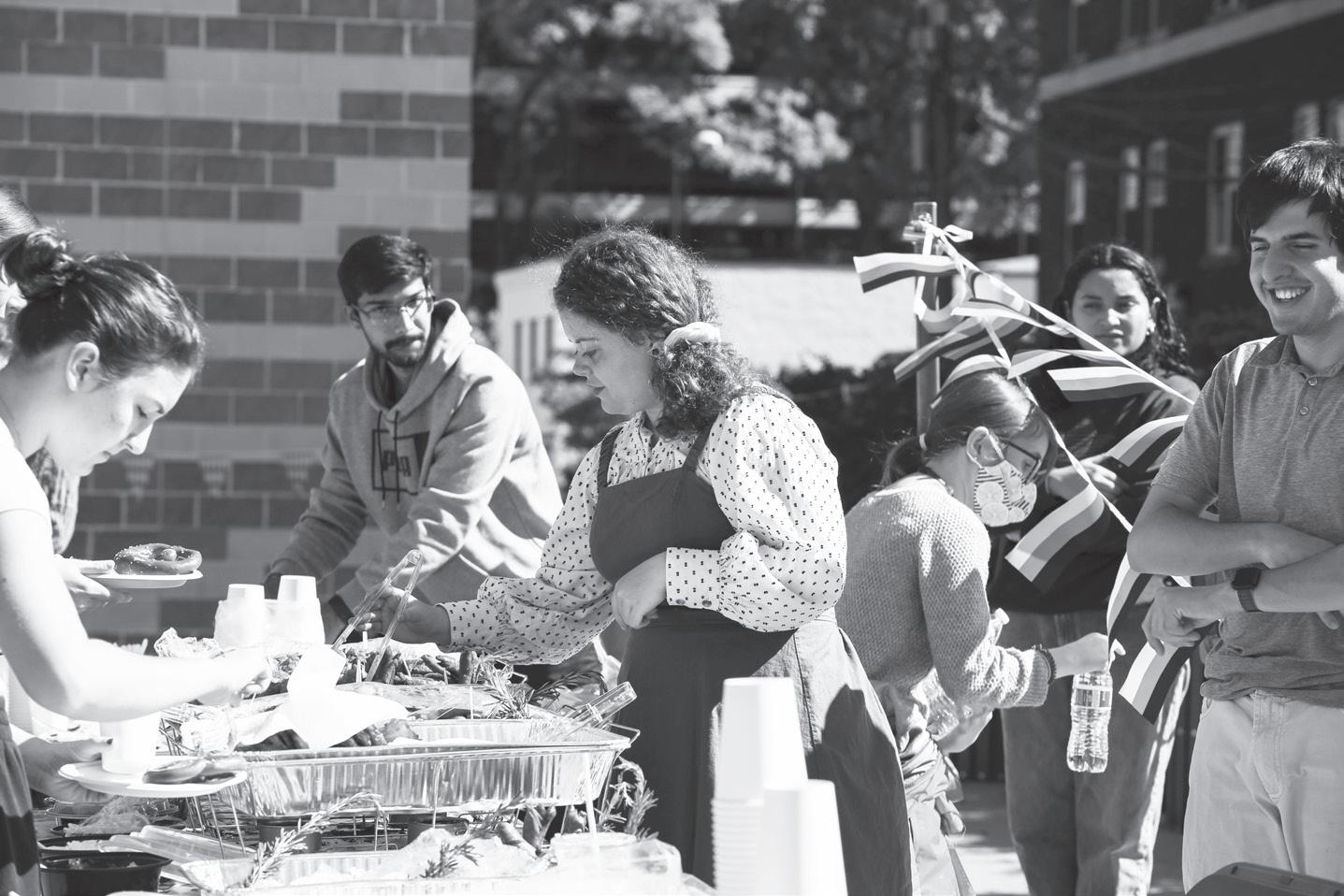
“I think Oktoberfest is important because, like ev ery culture, they have a big celebration where it brings people together,” she said. “And Oktoberfest brings people together.”
Senior Shannon Suther land, the vice president of
the German Club, said she was one of the members who founded the club last spring, and the Oktoberfest event marked a restoration of a GW tradition in Foggy Bottom – the first was held in 2010. She said student leaders spoke with the pre vious German Club presi dent for advice on running a cultural club, and they donated supplies for events like German flags, tape and other decorations.
“They’ve been really helpful for us, people that were involved in the former club, even though I couldn’t exactly tell you how similar we are to what they were doing at the time,” she said.
Sutherland said the club hosted a fundraiser selling spaghettieis, a German ice cream sundae, in Kogan Plaza earlier this month to raise money for Oktoberfest. She said they have spent the past month reaching out to food vendors and recruiting students to help volunteer for the event.
“I think one of our goals is to just make a really good impression on the student body and have everybody have a really good time and just enjoy themselves, enjoy the food,” she said.
Freshman Mark Rap paport, the first-year rep resentative of the club and a sports reporter for The Hatchet, said his fam ily carries German heritage, which pushed him to at tend the first meeting. He said his biggest responsibil ity on the executive board is to publicize events, like the Oktoberfest celebration, on the club’s Instagram page.
“I want to enjoy the club, make friends,” he said. “I think that’s the main point of clubs. And that definitely goes for our club as well.”
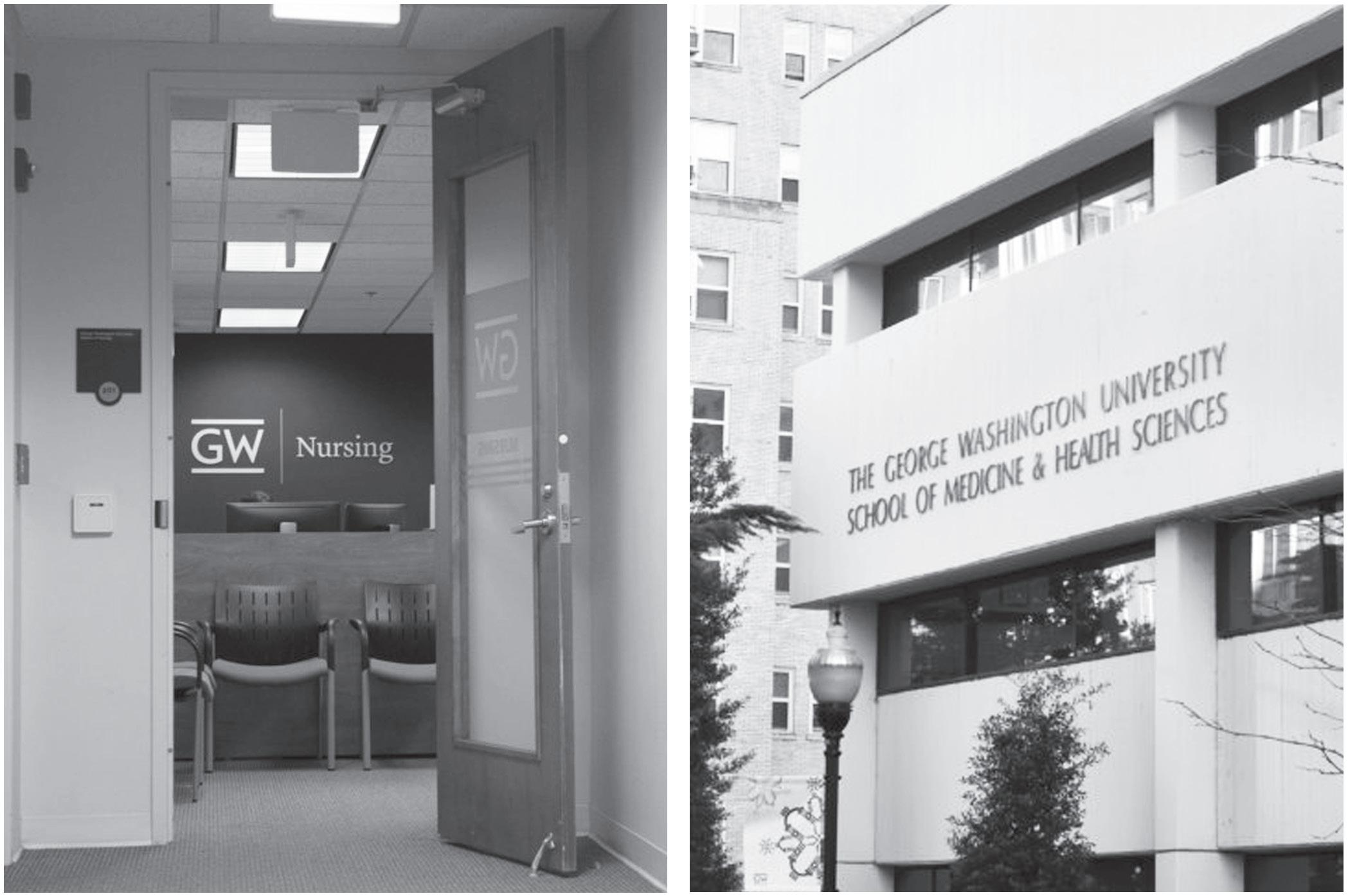
The School of Nursing and the School of Medicine and Health Sciences are offering dual enrollment courses this fall to Alexan dria high school students who want to enter the nurs ing field.
The Governor’s Health Sciences Academy, now in its second year, allows high school students in Alexan dria City Public Schools to take dual enrollment nurs ing courses with GW and attain a Clinical Nursing Assistant certification in Virginia after completing 18 college credit hours through the program. Coordinators within the two GW schools said they developed the nursing aide program to in crease diversity in Virginia’s nursing field and encourage students to become nurses to address the nationwide staffing shortage in hospi tals due to national popula tion increases.
Jennifer Walsh, a clinical assistant professor of nurs ing and the academy course director of the nurse aide program, said officials de veloped the dual enrollment courses to help high school students practice clinical skills of nursing like check ing vital signs. She said after the students graduate from the program and pass the certified nursing assistants licensure exam, they are qualified to work as nursing assistants out of high school and can earn about $20 per hour.
She said the program is open to high school juniors and seniors from Min
nie Howard High School and Alexandria City High School who will take Nurse Aide I and Nurse Aide II at Alexandria City High School. She said ACHS stu dents could take nurse aide courses at ACHS prior to the partnership with GW, but they struggled with the clinical, hands-on compo nents of the classes like put ting on personal protective equipment.
Walsh said University officials merged the medical school’s Governor’s Health Sciences Academy – a pro gram for high school stu dents to earn college credit in “career and technical education” – with the ACPS nursing courses to offer col lege credit for the classes.
“We identify some of the challenges students may have,” Walsh said. “We definitely want to make the course developmentally ap propriate.”
Walsh said about 80 to 90 percent of students who have graduated from the program indicated in an exit survey that they wanted to continue in the health sci ence field after they finished the program.
“We basically have a great partnership in order to identify those high school students’ needs and to make the best courses that they can add to a good foun dational nursing course,” Walsh said.
Karen Dawn, an assis tant professor of nursing and one of the coordinators of the program, said she and Walsh designed the dual en rollment courses to address the nationwide nursing shortages, especially as their demand increases with an aging American population. Dawn said an increasing
workload, stagnant incomes and long work hours have led to nursing shortages across the country.
In 2021, about one per cent of people in Virginia are registered nurses, but 1.2 million new registered nurses by 2030 could solve the nationwide shortage, according to a study by the University of St. Augustine for Health Sciences.
“We need to recruit more nurses,” Dawn said. “How do you do that? One way is to develop this type of part nership with people who are young and thinking about what career they may want to go and get into.”
Dawn said students in the program toured the Virginia Science and Tech nology Campus and spent a day in the School of Nurs ing’s simulation center, an area in the nursing school where students can simulate patient interactions using real equipment, like EKG monitors in a surgical room. Dawn said she wishes the students could visit GW’s campus again, but due to a bus driver shortage and a lack of funding from the University for transporta tion, they are unable to bring the students back to campus and are keeping courses at ACPS.
Dawn said students who take dual enrollment cours es in the nurse aide program will be able to earn a college degree with less schooling after high school and have firsthand experience in nursing before entering the workforce.
“This is an opportunity for them to actually see what nursing is like at a young age, which is really founda tional for these adolescents,” Dawn said.
GW professors are col laborating on a research project about the impact of energy grids on wildfires to improve wildfire resiliency in Alaska and the Arctic re gions.
Foundations for Improv ing Resilience in the Energy Sector against Wildfires on Alaskan Lands, known as FIREWALL, is a four-year School of Engineering and Applied Sciences project aiming to mitigate the ef fects of Alaskan and Arc tic wildfires caused by the energy sector. The project’s researchers will conduct in terviews in Alaskan commu nities to research potential infrastructure projects that can build resilience to the in creasing number of wildfires in heavily forested areas in Alaska and around the Arc tic that leave the regions.
Robert Orttung, the di rector of research for Sus tainable GW and a research professor of international affairs, said he is a collabora tor on FIREWALL, and his expertise in social sciences will connect the project’s results to ordinary people and policymakers who can use the energy research in their day-to-day lives. He said FIREWALL researchers will interview community members to gauge their un derstanding of wildfire pre vention and if the engineer ing solutions are applicable
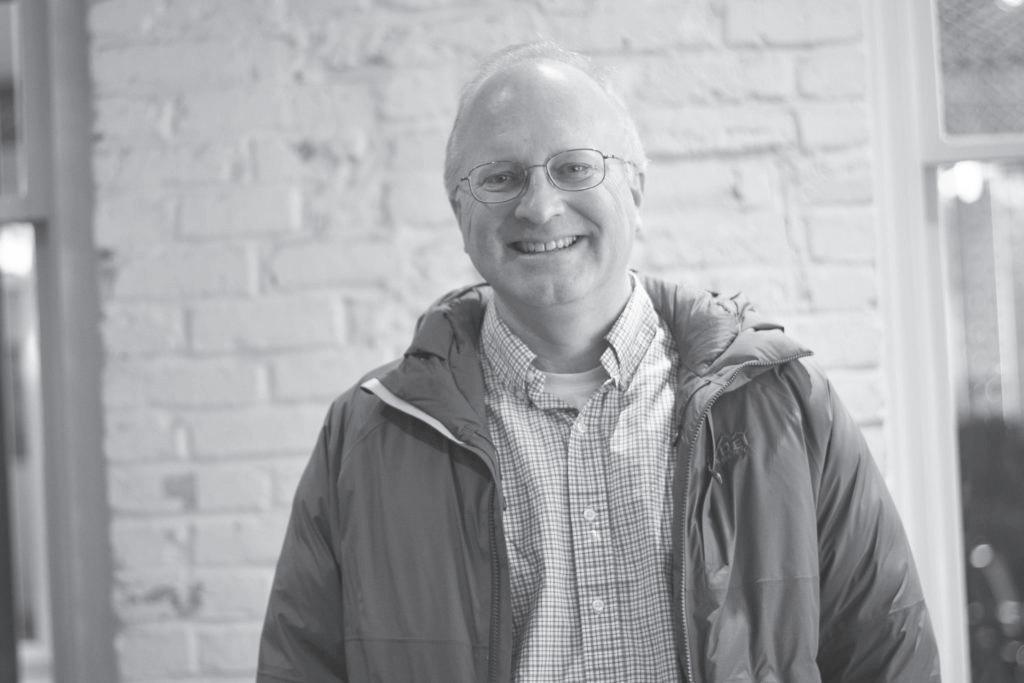
to their specific community.
He said professors in the School of Engineering and Applied Sciences are work ing to create electrical wire infrastructure that will turn off electricity before falling wires hits the ground to re duce sparks that can start wildfires.
“That would be a pretty impressive piece of technol ogy, and that kind of un derstanding of the signals and how to respond to them across the wire that technol ogy could be used anywhere in the world,” Orttung said. “And wouldn’t just be spe cific to Alaska.”
Orttung said the project received a nearly $3 million grant from the National Sci ence Foundation in early October to bring experts from a slew of fields, like researchers from GW Law and the School of Business, to ensure the project is a multidisciplinary effort. He said opening the project to different disciplines makes it more effective because it cre ates discussion about policy, business and profit implica tions.
“There’s a lot of other partners outside of GW too that have direct experience in fighting fires, so it’s bring ing together a lot of different kinds of knowledge and that experience,” he said.
Sebastian Neumayer, an assistant professor of com puter science at the Univer sity of Alaska at Anchor age and collaborator on the FIREWALL project, said FIREWALL examines the so cial, natural and physical en
vironments unique to Arctic regions.
“The great thing about this FIREWALL project is just how relevant it is to Alaska,” Neumayer said. “It’s great that we now have the ability to go and address some of the fundamental is sues that wildfires are caus ing in the energy sector.”
Neumayer said FIRE WALL researchers will con tinually make their findings available through the project for Alaskan communities to build increased awareness and preparation for wild fires.
Experts in fire manage ment and advising said wellmanaged forests, through prescribed burning in areas with lots of dry fuel like shrubs and dead logs, can decrease the chance for wild fires.
John Bailey, a professor of civil culture and fire man agement at Oregon State Uni versity’s College of Forestry, said climate change worsens the frequency of forest fires because the increased tem perature has made fire fuel “crispier” and more flam mable. He said involvement from people, like “careless” homeowners who use grills irresponsibly during fire sea son, plays a large role in the number of wildfires.
Humans cause 85 percent of all wildfires in the United States by leaving campfires unattended, burning debris, equipment use and malfunc tion, discarded cigarettes and intentional arson.
“We have climate, and then we have more humans
out there in the wildland and urban interface,” Bailey said.
He said his expertise lies in forest fires, focus ing on natural kindling like human-made structures. He said several power compa nies are being blamed for causing fires in the 2020 Lib erty Fires in his home state of Oregon.
Bailey said working with utility companies to bury power infrastructure is the “ultimate solution” for elimi nating wildfires caused by the energy sector. He said after the Santa Rosa fires in California, the power com pany PG&E plans to bury more than a thousand miles
of power lines to reduce the risk of wildfires.
“You will ultimately come to the issue that it’s filled with the powerlines spark that is fuel underneath of them,” Bailey said. “So the ultimate solution in my opinion is burying.”
Luca Carmignani, an assistant fire adviser at the University of California Co operative Extension, said his work looks to provide science-based solutions to communities and local agen cies to improve urban inter faces and wildfire resilience.
He said moving home power systems to individual grids can help limit fires during high risk seasons so that
power can be shut off on a smaller scale rather than large power outages. He said building longterm solutions around wild fires lies in equipping com munities with prevention methods, like fuel reduction awareness about prescribed burns and energy use, and that it is key to consider peo ple at the helm of the issue.
“I mean most of the time we see the destructive aspect of fires, but in order to pre vent that, we need to change our attitude towards fire and consider it as part of the landscape, part of our life,” Carmignani said. “Especial ly the Western United States that is fire prone.”
From studio apartments in Dupont Circle to townhouses in Columbia Heights, students have plenty of options to find off-campus housing in the District – so long as they’ve done their time on campus. Between D.C. law and GW’s own policies, freshmen, sophomores and juniors must live in residence halls unless they meet six specific criteria, ranging from their marital status to their religious beliefs, that will garner exemptions from GW.
But neither students nor officials are above bending the University’s rules to transfer campus residents to off-campus housing. GW’s ir regularly enforced housing require ment isn’t fostering community in Foggy Bottom. Caught in between deceptions and exemptions, it’s hardly a rule at all.
D.C. law requires the University to house all freshmen and sopho mores on campus except those who are permanent residents, veterans, married, disabled or whose reli gious beliefs can’t be accommodat ed in an on-campus residence hall. That changed when GW instituted a three-year residency requirement in 2014 to “further support students’ academic and campus experiences” and assuage residents’ concerns over their noisy and disrespectful Foggy Bottom neighbors.
GW’s three-year residency re quirement comes with exemptions of its own, as juniors can submit re quests for an exemption to Campus Living and Residential Education on a first-come, first-served basis. But that policy has also changed because of the COVID-19 pan demic. Regulations for on-campus housing for the 2020-21 academic year meant that there were 1,500 undergraduate students living on campus compared to about 2,300 undergraduates living off campus in spring 2021. Even as officials planned to reopen campus during the last academic year, they granted exemptions to rising sophomores and juniors with long-term leases.
But after students flocked back to campus, GW appeared to be short on housing. To clear a waitlist of about 250 students for this school
year, officials waived the three-year requirement and offered to reduce students’ price of housing by thou sands of dollars if they accepted an other roommate. But if the require ment was such a cornerstone of the University’s academic and campus culture, then why would officials waive it so often in the first place?
MAURA KELLY-YUOH | STAFF CARTOONIST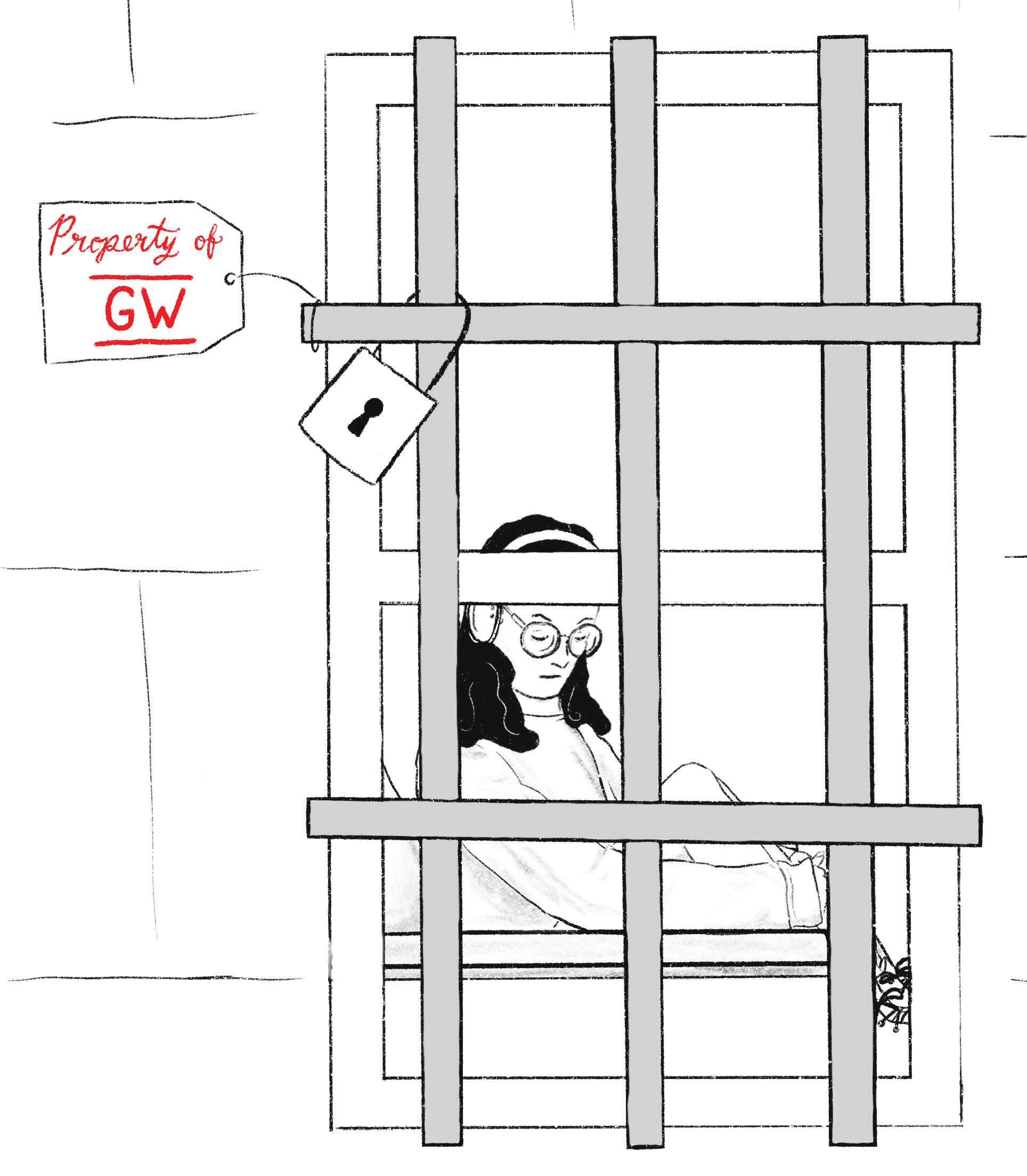
On- and off-campus housing is a balancing act – it’s in GW’s financial interest to charge as many students as possible for room and board, but the reality is that there are only so many empty beds on campus.
Even as GW has shown it’s will ing to waive the three-year housing requirement, students have broken
Students who are getting ready to go home for fall, Thanksgiving and winter break this semester may find themselves returning to states that no longer guarantee their reproductive rights after the U.S. Supreme Court overturned Roe v. Wade in June. GW currently offers minimal aid to students in need of reproductive care, but it should provide the abortion pill through the Student Health Center and implement emergency contraceptive vending machines on campus.
Grace Erwin Opinions WriterGW students who reside permanently in states with anti-abortion laws could face time in prison if they attempt to get an abortion there or face serious mental and physical injury if legally required to carry a pregnancy to term. Thirteen states have currently banned abortion with little to no exceptions since June, and five states have banned it within various time constraints ranging from six to 14 weeks of pregnancy. More than 4,000 students in 2021 came from states where abortion is now banned to some extent, according to GW’s enrollment data.
Both officials and
students need to do everything they can to ensure the safety of their community. But the Student Health Center can only prescribe birth control, offer “contraception counseling” and help students obtain emergency contraception if they have the Student Health Insurance Plan. Since not all students enroll in GW’s insurance plan, access to contraceptives through the SHC isn’t available to everyone.
Higher education institutions like Boston University and Barnard College are miles ahead of GW in terms of reproductive health resources. In March, Boston University joined several other colleges and universities in installing vending machines stocked with morning-after pills. Sold for $7.25 in BU’s vending machines, the pills are much more affordable than pharmaceutical prices nationwide. And next fall, the Barnard College Primary Care Health Service will begin providing the abortion pill next fall, which individuals can take within 10 weeks of pregnancy to abort a fetus. Being forced to carry an unwanted pregnancy to term could jeopardize students’ education, so GW should give them accessible options to maintain their reproductive health.
GW has shared a series of
articles and Q and A’s about what the overturn of Roe v. Wade means for anyone who can get pregnant. But these articles had no links to resources or clinics around D.C. where students could turn to if need be.
Students enrolled in the Student Health Insurance Plan can access emergency contraceptives through the SHC and utilize clinics around D.C., including ones close to campus like The Dupont Clinic or Washington Surgi-Clinic on F Street. But in a city like D.C. where abortion is still readily available, GW needs to provide reproductive care to protect students’ rights and their ability to access higher education.
The time is now for GW to implement emergency contraception vending machines and offer the abortion pill through the SHC. The thousands of students who come from states that have outlawed abortion are relying on GW as a safe haven for reproductive rights. As students begin to return home for Fall Break and the holidays that follow, the University must make reproductive care accessible – especially when their home state will not.
—Grace Erwin, a sophomore majoring in journalism and mass communication, is an opinions writer.
the rules entirely. To circumvent the residency requirement, fresh men and sophomores have submit ted false addresses, lied about their faith and doctored utility bills. That determination flies in the face of the Code of Student Conduct, but it should be a wake-up call for of ficials – in the scramble to house
students, all parties are ignoring the third-year requirement.
With or without the University’s approval, students are going to seek alternatives to GW’s motley collec tion of residence halls. Off-campus apartments can offer more space and better amenities at a lower cost than residence halls, and some like The Avenue and The President next to the I Street Whole Foods, are clos er to the heart of GW’s Foggy Bot tom Campus than buildings along the outskirts, like 1959 E Street.
Eight years after its implementa tion, the housing requirement is a paradox – its exemptions are crucial to the University’s operation and students’ comfort, but they call the requirement’s very purpose into question. What’s ostensibly a hard and fast rule shifts with GW’s avail able housing stock before the start of the academic year.
The three-year housing require ment is long overdue for a reassess ment and perhaps a replacement that GW, students and our Foggy Bottom neighbors can agree upon. The selectively enforced require ment simply isn’t working. It’s no guarantee against students’ bad behavior in the neighborhood. It arbitrarily restricts or permits them from looking for off-campus hous ing. And it forces the University to search for more space to house stu dents on campus.
Ending the three-year require ment would nearly certainly repre sent a financial loss for the Univer sity, which must account for annual room and board costs in addition to “megadorm” renovation pro jects, like those at District House and Thurston Hall. But we feel GW serves us best as an institution of higher learning, not a landlord –we know our housing needs and financial limits better than Campus Living and Residential Education. And if extracting room and board from students is truly key to GW’s financial solvency, officials have a bigger problem than who can live off campus. Students can make GW their home, but they don’t need to live there to do so.
In theory, public transportation is for everyone, regardless of income. But while GW students mindlessly tap in and out of Metro stations and buses with U-Pass, some low-income residents face the heavy burden of transit costs, racial profiling and, later this fall, fare evasion fines. These fines represent a turn away from a truly public transportation system. The D.C. Council must address Metro’s shortcomings and pass transit legislation that protects all D.C. residents’ right to use the city’s public transit.
Paige Baratta Opinions WriterThe Metro Transit Police Department will actively fine fare evaders $50 in D.C. and $100 in Maryland and Virginia starting in November to curb the rise in pandemic-era fare evasion and Metro revenue loss. D.C. decriminalized fare evasion in 2018 after transit police officers disproportionately targeted Black Metro riders, who accounted for 91 percent of criminal citations from 2016 to 2018. While Metro and MTPD loosely enforced those fines for the past three years, a full reinstitution of formal ticketing could lead to similar racial discrimination.
Low-income riders who avoid Metro fares will struggle to bear the burden of the reinstituted fare evasion fine. Yearly fare evasion costs the agency $40 million, or two percent of its projected $2.4 billion operating budget in 2023.
The agency is facing a funding gap of $185 million in the next fiscal year, but it shouldn’t fill it by doling out tickets when low-income riders already struggle to pay the current $2 to $6 Metro fare.
Getting around the city by foot, bike or car may be an option for low-income residents who cannot afford the daily transit costs, but it can be particularly unsafe – Wards 7 and 8 comprise nearly 43 percent of total traffic fatalities in D.C. since 2011. GW students need to be conscious of the privilege of how unlimited transit, in the form of our U-Pass cards, impacts our way of life.
WMATA’s should first eliminate fare evasion fines as a whole, but if the agency fails to do so, then the D.C. Council should supplement Metro’s faults with new transit legislation.
Improving public transit access for everyone is key to combating poverty in the city, and placing additional fines on top of public transit costs only exacerbates this issue. Adding an option in D.C. for individuals below the poverty line to use the
Metro at a reduced rate could help alleviate some of the noticeable wealth disparities in this city.
Late last month, D.C’s Committee on Transportation and the Environment unanimously voted to advance the Metro for D.C. Act, which would grant $100 subsidies to most D.C. residents for the city’s Metrobus and Metrorail system and send a clear message about how public transit should operate in the DMV – with the public in mind. With the bill set to go before the Council as early as this month, city lawmakers should expedite the legislative process as much as possible and vote for the act when the time comes. And to make sure that the legislation becomes reality, students should coldcall Council members to ensure their support.
WMATA’s aims to “provide safe, equitable, reliable and cost-effective public transit.” This reinstitution of fare evasion fines is not only a violation of their intended aim, but a rebuff of their commitment to D.C.’s public. If Metro won’t acknowledge the inhumanity of burying lowincome riders struggling to pay the current fare under even further costs, then the D.C. Council must.
—Paige Baratta, a freshman studying political science, is an opinions writer.
who
Metro’s job is to transport people, not discriminate with unfair fines


Searching for Halloween costume inspiration?
Look no further than Foggy Bottom.
These GW-themed getups are light on the budget and easy to assemble, so you’re ready to celebrate Halloween in no time.
From happy hippos to the dreaded devil’s advocate, check out some costume ideas that scream Buff and Blue.

What’ll you need: A black sheet, white collared shirt and tie Student Association President Christian Zidouemba is in, and former acting Chief of Staff Cordelia Scales is out after this month’s Student Court decision. But ribbing GW’s wannabe politicians is always in style. The Student Court’s seven berobed justices are inexplicably the best-dressed judicial bench this side of Capitol Hill. If you’re more into planning group costumes than pondering constitutional questions, then this courtroominspired look is for you.
To match the justices’ style, wear a white collared shirt and tie and fasten a black or dark-colored sheet over your ensemble with bobby pins or tape to capture that classic look of self-importance. Accessorize with a gavel, or use your WEPA account to print the full 33 pages of the court’s decision for that extra touch of authenticity.
What you’ll need: A collared shirt, dress shoes, a suit and tie and a dress or skirt.
For a couple’s costume that celebrates GW’s cutest pairing since George and Martha Washington, dress up as interim University President Mark Wrighton and his wife, Risa Zwerling Wrighton. Grab a collared shirt, dress shoes and a suit and tie – ideally blue or gold to show some school spirit – for President Wrighton. For Risa Zwerling Wrighton, go with a floral top and white skirt combo.
To go all out in a group costume, go as the Wrightons’ furry friends, Spike the dog and Maestro –who Wrighton nicknamed Purrfessor – the cat. A black or white shaggy sweater will match Spike’s fur, but a t-shirt can do in a pinch. Tan, brown and even leopard print can match Purrfessor’s tabby coat.
What you’ll need: A collared shirt, dress shoes, a suit and tie and a dress or skirt
From the Elliott School of International Affairs to the School of Media and Public Affairs, the devil’s advocate is always ready to grind your 8 a.m. class to a halt with scorchingly bad hot takes. Whether you know them, you hate them or you are one, put that Hillternship outfit to good use with this costume idea.
Print out some hot takes of your own and tape them to your outfit. A backpack or briefcase will help sell the look, and if you really want to accessorize, splurge on
a pair of devil’s horns or a plastic pitchfork.
What you’ll need: Gray shirt, gray shorts or pants, gray shoes and headband
GW’s relationship with the hippopotamus began when former University President Stephen Joel Trachtenberg donated the hippo statue outside Lisner Auditorium to the Class of 2000, and our collective love for this magnificent mammal is still going strong. So why not pay homage to GW’s unofficial mascot?
Grab some gray clothes to match that hippo hide, and spice up your groutfit by turning any old headband into ears. Alternatively, opt for a hippo onesie that will serve as a comfortable piece of loungewear attire long after Halloween concludes.
What you’ll need: A name tag
GW’s next president is still undecided, so why not throw your hat into the presidential search ring?
Channel your inner administrator and chart the course of the University’s future in a low-effort costume with a name tag declaring your candidacy. Stick it to your shirt and voilà. Go formal for a little more flair or stay casual with some GWbranded clothes that’ll let you show off your school spirit. If you’d rather abandon the outlook on GW’s future, go old school as a throwback to the University’s 19th-century presidents with a puffy lace collar or some buckled shoes.
Halloween is rapidly approaching, and with it comes fall parties, gettogethers and the familiar scramble to find a delectable accessory for the Halloweekend festivities before they commence.


If you’re in a bind, never fear – we’ve laid out the best cocktails and treats for all of your last-minute potluck needs. Use our tips to be sure to wow your guests or host – and don’t forget your costume on your way out.
Here are our top picks for the best homemade drinks and treats to make this spooky season:
Spiked Mulled Cider Mulled apple cider is a timeless staple when it comes to fall drinks. Although making your own pot takes one to two hours, the time it spends simmering will pay off in the taste –and your kitchen will smell amazing for the rest of the day as an added bonus.
Ingredients: – Store-bought apple cider – One lemon, sliced – Two teaspoons honey – Four cinnamon sticks – One teaspoon each of nutmeg, cloves and star anise – Mugs or other heat-safe cups
Instructions: Combine apple cider, spices, lemon slices and honey in a large pot or slow cooker. Cook on low for roughly an hour on the stove or two hours if using
a slow cooker. Serve hot in mugs with a stick of cinnamon and a slice of lemon for garnish. If you’re hosting, keep rum or bourbon on hand for guests who want to spike their mugs. This beverage can also be prepared in advance to have on hand for an upcoming Halloween party – just refrigerate and reheat the cider when needed.
e Nurse Ratched For a spookier vibe, try this drink to add some freaky fun to your night.
With its fizzy base, splash of color and mild horror factor created by fake blood, the Nurse Ratched cocktail is the perfect mixture of corny, creepy and interactive.
Ingredients: – A clear alcoholic drink, like vodka tonic or hard seltzer
– Alternatively, swap for a clear soda like 7-Up or Sprite – A dark, red-colored juice, like cranberry, pomegranate or cherry – Plastic syringes (can be found at most pharmacies)
– Ice – Tall cocktail glasses
Instructions:
First, add ice to your tall cocktail glass before pouring your clear drink of choice, like vodka with tonic water or a clear soda. Maintain a generous amount of space at the top of the glass for the frightening star of the show. Next, draw the red juice into a syringe and place the object into the glasses without depressing the plunger. The
syringe should rest against the rim of the glass with the plunger side up. Serve immediately, allowing your guests to squeeze the bloodred juice into the drink to add a burst of color and creepiness to their drinks.
These simple, fun witch hat treats may be more cute than chilling, but they will make for an equally adorable and appetizing choice for your next Halloween get-together. Just melt some chocolate, add some frosting and you’ll be ready to grab your broom and leave for a night out in Salem.
– Oreos – Strawberries
– Melting chocolate or candy wafers in brown, black or color of choice – Frosting in colors like purple, green and orange – Parchment paper
Begin by melting chocolate in the microwave, heating in 30-second intervals until smooth. Next, dip the Oreos into melted chocolate, coating evenly. Place the chocolate-covered Oreos on parchment paper. Cut tops from strawberries to form cone shapes and dip the strawberries in melted chocolate. After the berries are coated, place one on top of each Oreo with the pointed ends up. Once the chocolate has dried, add frosting to create a ribbon around the base of the cone and a buckle to replicate a witch hat.

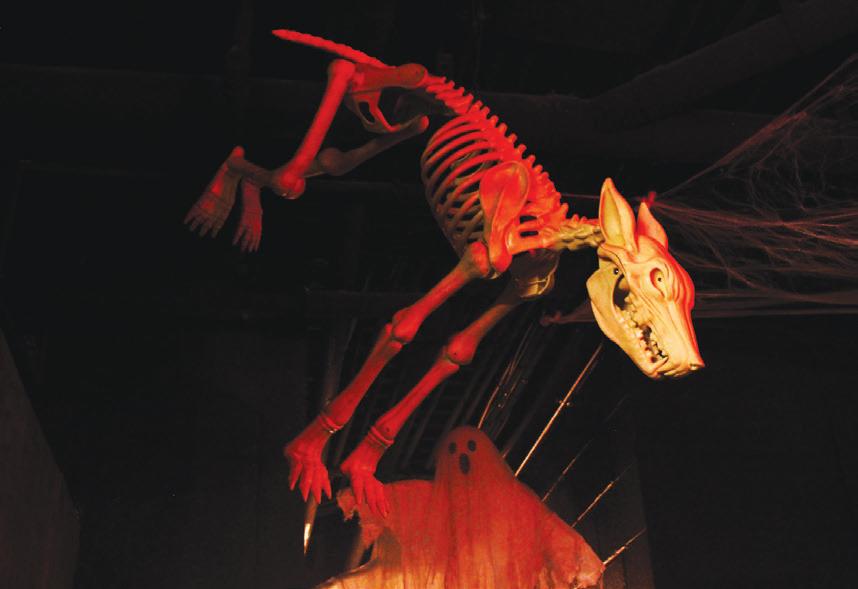

As Halloween approaches, establishments are starting to set up their spooky season decorations with the wish to wow their customers.
With its elaborate decor and distinct ambiance, Urban Roast is an establishment to keep your eyes on this fall season. The family-owned restaurant in the heart of downtown D.C. is committed to bringing the Halloween season to the District with autumnal decor and sinister props covering every inch of its interior design.
Urban Roast was founded in 2020 in the midst of the COVID-19 pandemic to provide the city with a complete seasonal experience aimed

to keep patrons coming back for all their other holidaythemed adornments. The restaurant in Penn Quarter delivers an immersive experience tailored to each holiday season, this Halloween being the most transcendent to date.
As I entered the establishment, I immediately took note of the red neon lights that ominously read “She Used to Be the Sweetest Girl Ever” surrounded by skeleton thrones, tombstones and a witch around the corner. Statues of jesters, clowns and goblins enhanced every crevice of the restaurant, and spiderwebs and skeletons coated the walls of the dimly lit dining room.
In the dining room, mirrors adorned the walls to
reflect smiles, frowns and everything in between for that essential Halloween-themed selfie. A long and narrow hallway with green leaves on one side and white rose petals on the other led to a section of the dining room featuring tables suited for two complemented with low, neon pink lighting and white roses.
Given the restaurant’s multitude of sections, guests can experience a different atmosphere in each area of the restaurant, from a first date to a large dinner party to a lively bar scene.
Through all the splendor that Urban Roast has to offer, the bar might be the most visually appealing. Globe pendant lights and black umbrellas hang from the ceiling while pumpkins and
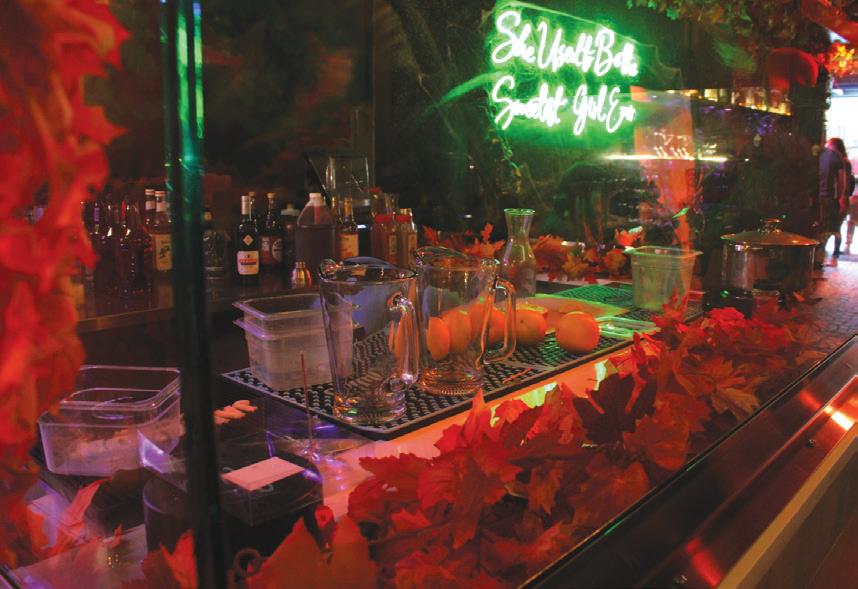
leaves lay along the countertop, complemented by purple lights glowing over the guests’ specialty craft cocktails. Autumn foliage lines the walls and cobwebs and crows hang from the ceiling, making the environment truly feel like Halloween night.

Beyond the elaborate decorations, Urban Roast adds a spooky spin to its dishes, cocktails and other beverages like coffee to coordinate with the upcoming holiday. The extensive menu consists of about 30 options from charcuterie spreads, main entrees, small plates, sandwiches, salads, cocktails and coffee. The seasonal cocktails take the cake with enticing options like the Fall Margarita Flight with pear, apple and cranberry flavored margaritas served
in small round glasses on a standing flight carrier.
I ordered three tapas-style dishes, beginning with the Skirt Steak Tacos topped with pico de gallo, cheese and tomatillo sauce. The tacos were delectable, and each flavor made its presence known thanks to the equally proportioned ingredients, which made for non-messy bites.
I continued with the Shrimp Ceviche served in an orange bowl and marinated with onions, cilantro and lemon juice.
Plantain chips were served on the side to dip into the ceviche mixture. The salty, crunchy chips paired seamlessly with the citrusy, chewy shrimp. For dessert, I tried the delectable Red Velvet Cake with cream on top, gelato on the side and
chocolate sprinkled overtop. The rich and dense cake exquisitely complemented the lighter cream frosting and gelato.
The Pumpkin Spice Hershey’s Mocha, the menu’s newest coffee option, exceeded my expectations. Served in a pumpkin mug, the coffee is poured over a Hershey’s bar and topped with whipped cream and cocoa powder.
Urban Roast’s creativity and ambience sets its apart from any other D.C. restaurant of its kind. Make no mistake – this is no Michelinstar dining experience. But if you are in search of a spot to grab a bite and an elaborate seasonal drink in an ambient setting this Halloween, head to Urban Roast for an experience like no other.

While a scary movie is always a safe bet to embrace the Halloween spirit, don’t forget about some classic holiday episodes from some of your old TV favorites.
From beloved comedies like “Community” to dramatic teen soaps like “Pretty Little Liars,” these top picks will bring laughter, music and fright into your Halloween season. So grab some candy corn, caramel apples or just plain popcorn, and relive these iconic television moments.
“Brooklyn 99,” Season 1, Episode 6: “Halloween”
In this Halloween-themed episode, Brooklyn 99 brings the trick to trick-or-treat and the comedy to the workplace when a prank war erupts between characters. Dubbed the Halloween Heist, the conspiring precinct officers navigate Halloween parties full of Brooklyn hipsters and young trick-or-treaters to gain access to their boss’s office, where they hope to steal the medal of valor. But that’s not before they sneak through vents and crash through ceilings on their journey. This is the ideal episode for anyone looking for a marathon of easy laughter, perhaps with a side of candy.


“Pretty Little Liars,” Season 3, Episode 13: “ is is a Dark Ride”

All aboard the “A” Train for a spooky ride like no other. Based on the book series by Sara Shephard, “Pretty Little Liars” boasts consistent spooks with creepy dolls and suspenseful, if not ridiculous, storylines that heighten the stakes during the annual Halloween episode. The third season’s fall holiday installment goes big with fear, opening at a
sanatorium and culminating when Aria, one of the Little Liars, wakes up in a wooden crate with a dead body for company. Full of jump scares, coffins, ghosts and corpses, grab your blanket and friend with a hand to hold during the scream-producing moments – you will need it!
“Glee,” Season 2, Episode 5: “ e Rocky Horror Glee Show”
In its Halloween episode, the members of the show’s titular Glee Club perform the eerie 1975 musical “The Rocky Horror Picture Show.”
Though the club doesn’t perform for a full audience due to the show’s inappropriate nature for a school musical, the music makes this episode a must-watch as the cast revives classic songs like “Time Warp” and “Dammit Janet” with enthusiastic, modern voices. Take the opportune time to watch this episode in preparation for Forbidden
Planet Production’s annual production of “Rocky Horror” on campus this fall.
“ e Haunting of Hill House,”
Season 1, Episode 8: “Witness Marks”
This gory, suspenseful story follows a six-person, nuclear family living in a haunted isolated mansion during the 1990s. Half ghost story and half psychological thriller, I would recommend watching the whole 10-episode series in the days leading up to Halloween to embrace the spooky spirit through the show’s reliance on ghosts, crunchy leaves and thunderstorms. This episode includes the most major reveal of the limited series – viewers leave knowing the true identity of the Bent Neck Lady, a threatening presence who haunts the children’s nightmares! Get ready for a 10-hour commitment, terrific for a dark and stormy night.
“Community,”


Season 3, Episode 5: “Horror Fiction in Seven Spooky Steps”
What happens when you find out a close friend of yours qualifies as a psychopath? In the third-year Halloween episode of the sitcom that follows the comedic community college study group, one student named Britta administers a personality test to each group member to uncover potential homicidal tendencies as part of a class assignment. She discovers that one psychopath test turns back positive. The friends tell their most horrific stories to find the outlier. Whoever tells the most haunting story is clearly the psychopath. The show’s take on Halloween appeals to viewers who seek a nontraditional Halloween fright. Unlike the other shows on this list, which create a spine-chilling aura with jump scares and spooky motifs, this episode dives into the unhinged side of human behavior.

There is something comforting and ritualistic about cozying up on your couch with a pumpkin-scented candle and your favorite fall drink to watch a classic, spooky Halloween movie like the 90’s classic “Hocus Pocus.”
When Disney announced a sequel featuring the original Sanderson sisters (Sarah Jessica Parker, Bette Midler and Kathy Najimy) in December 2020, it immediately rose to the top of my spooky season watchlist. But the highly anticipated sequel that premiered on Disney+ on Sept. 28 played into a younger audience, evident in the film’s watered-down plot, which strayed away from more serious themes like death and less malicious magic, in addition to the uncharacteristic humanization of the Sanderson sisters.
Fan-favorite follow-up films often struggle to strike the right balance between the new and the old while living up to their predecessor’s success. While films like “Toy Story 2” and “Kung Fu Panda 2” exceeded audiences’ expectations, “Hocus Pocus 2” fails in its attempts to maintain the same oldschool, 1990’s nostalgia while appealing to a newer, younger audience with relatable, more modern jokes.
“Hocus Pocus 2,” directed by Anne Fletcher, follows two
21st-century Salem teenagers, Becca and Izzy (Whitney Peak and Belissa Escobedo), who are tricked into bringing the Sanderson sisters back to life after 29 years on Halloween night. The two teenagers work to stop the newly revived Sanderson sisters from kidnapping the affable mayor and casting an immortality
nocent ways, as if catering to a younger audience, possibly due to the new kid-friendly regulations of Disney+. The film in its entirety appears to be less frightening, with the signature Halloween eeriness that is recognizable in the original almost nonexistent, most evident in the depiction of the iconic Sanderson
too long, like when the Sanderson sisters used household objects as flying broomsticks. But above all, the most confusing and admittedly controversial aspect of the movie was the humanization of the Sanderson sisters at the very end of the film.
Viewers first meet the Sanderson sisters as clear-cut villains, hungry and anxious for unlimited power. But in Fletcher’s confusing sequel, the sisters lose their evil, wicked touch, ending the film with a heartwarming scene filled with the power of sisterhood.

spell, making Winifred the most powerful witch in the world. The teens also make amends with their former best friend Cassie (Lilia Buckingham), the mayor’s daughter, after her new relationship caused them to drift apart.
While entertaining for the younger, modern youth audience, “Hocus Pocus 2” seems to be missing what the older viewers were eagerly awaiting – the nostalgic, effortless and indescribable magic of the original. The darker themes that are prevalent in “Hocus Pocus,” like the unfortunate death of Emily Binx, are now depicted in more lighthearted and in-
sisters.
Although the younger, more diverse cast performed brilliantly, the backstories of each character was either nonexistent or severely lacking, like the rarely mentioned friendship between the three girls. The dialogue is short and choppy, and the overwhelming multitude of musical numbers – like the Sanderson sisters’ performance of “The Witches Are Back” –begs the question of whether “Hocus Pocus” warrants any future musical adaptations.
The humor of the film was also a bit off-putting, with seemingly comedic scenes that stretched on far
The conclusion would appear to be a classic Disney movie ending if it did not contradict the sarcastic and evil Sanderson sisters that viewers have grown to know and love, replacing them with kinder, soft-hearted sisters, not witches. This plot hole is especially odd since the Sanderson sisters never even hinted at a sensitive side until the very end of “Hocus Pocus 2.”
Despite the disappointing plot, lackluster humor, missing nostalgia and attempts to modernize the classic 90’s film, it was comforting for many die-hard fans to see all three Sanderson sisters reprising their original roles. Although “Hocus Pocus 2” is bound to have audiences young and old tuned in this Halloween season, its predecessor will remain the true Halloween classic.





ven though classics like “Monster Mash” and “Thriller” will do the job to set the spooky season mood, sift through some less popularized but equally creepy songs ahead of Halloween.

We curated a selection of unsettling melodies and haunting lyrics from both old school and new-era songs suitable for a Halloween party or a simply autumnal walk around campus. From the Arctic Monkeys to girl in red to Andrew Lloyd Webber, immerse yourself in a broad repertoire of sinister-sounding tunes.


Rising alt-pop artist Isaac Dunbar combines a strong, catchy backing with eerie lyrics for a spooky product that will be on repeat as you take a trip to the dance floor. Telling the story of someone close deceiving you, this song dishes heartfelt lines like “Gouging out my eyes / You made them burn and now you’ll pay the price.” Dunbar masterfully cracked the code for a Halloween pop bop with this short and sweet single.
Throughout the Arctic Monkeys’ entire discography, frontman Alex Turner’s enchanting voice sounds like it was made purposefully to voice a seductive spirit. The off-kilter sound of the band reaches a new level of psychedelic pop on this song’s album, “Tranquility Base Hotel & Casino.” “Four Out Of Five” dives into the space-themed narrative of the album, and the ominous lyrical repetition toward the end of the song sets it apart as one of the band’s spookiest-sounding tunes.
“Somebody’s Watching Me” by Rockwell
“But why do I always feel like I’m in the Twilight Zone?” Take a trip back to 1984 and unlock the doors to the Twilight Zone as you listen to this classic R&B piece, which topped charts internationally and went viral on TikTok last year just ahead of Halloween. The song is complete with keyboards, synthesizers and stellar guest vocals from King of Pop Michael Jackson.
The queen of autumnal pop – known for soft indie hits like “we fell in love in october” – reaches new levels of angst in this physically chilling tune. Similarly to the majority of girl in red’s 2021 album “if i could make it go quiet,” the song contains heavy lyrics exploring her struggles with mental health, like “I’ve been chasing everything that makes me feel cold.” The lyrics are reflected through a creepy melody on the keyboard that begs listeners to crank up this unsettling song.
As the Halloween anthem from our peak Disney Channel years, McClain, who starred in the early 2010s sitcom A.N.T. Farm, brought the thunder with this release. The electropop sensation topped Radio Disney’s Top 30 at the time, and McClain and her sisters’ band, “Thriii,” re-recorded the song last year in time for its 10year anniversary. Spooky and catchy, with just the right amount of nostalgia-inducing auto-tune, McClain’s song ushers in the Halloween season like no other.
Featuring obsessively devoted lyrics and sounds sent straight out of a psychological thriller, “I’ll Never Smile Again” evokes a palpable air of creepiness.
Singing “I’ll never smile again / Until I smile at you,” Dorsey and Sinatra’s leisurely melody backed up by a spooky-sounding chorus situates this oldie as an especially sinister choice for the selection. Even while listening on Spotify, the 1940 song sounds like you’re hearing it straight off an old-timey record player.
“Cannibal” by Tally Hall
Likely at the top of Armie Hammer’s Halloween playlist, “Cannibal” details the wounds that a romantic partner has left through the metaphor of cannibalism.
Sparing no gory imagery, the band sings “She rips out my bones just like I’m an animal / And right when I’m feeling like my blood is drained / She calls it a game.”
Although the song carries a surprisingly cheery and upbeat tune, the vivid lyrics up the bone-chilling feels of this piece.
“ e Phantom of the Opera” by SierraBoggess and Ramin Karimloo Andrew Lloyd Webber’s imaginative score of his triumph of the musical “The Phantom of the Opera” seamlessly blends opera and rock to craft melodies that sound as creepy as the show’s sinister plot – especially true for the titular song. As an ode to the imminent closure of Broadway’s longest-running show, the stunning vocals and blazing electric guitar on this iconic tune round out the end of the playlist.
‘Hocus Pocus 2’ fails to live up to its predecessor with plot holes, poor humor
Sailing has continued to hang with top-level national competition in its second year as a club team after the University cut the program as a varsity sport earlier during the pandemic.

Club sailing has cracked the list of the top 20 sailing teams in the nation after placing in the top half of its in-conference competition in four of its six fleet races last month. The squad is eying its second straight bid at the Inter-Collegiate Sailing Association’s National Championships in the spring, currently ranked as the 19th-best sailing program in the United States by World Sailing, the governing body for the sport.
The team has competed in five showcases, regional and cross-regional races this month, where the team has placed above 39 percent of its competition on average. As the club’s supply of former varsity athletes diminishes each year without University oversight, members are working to maintain their continued national success through recruitment efforts of their own.

Club sailing President Ruby Gordon, who will graduate this spring, said the team has enlisted nine freshmen to the team as part of its heightened efforts to recruit freshmen and prospective high school talent.
“The sophomores and freshmen are all brought onto the team by us,” Gordon said. “We have two recruiting chairs, and they’re amazing. It’s just Owen and Abby Chips, and they work together to reach out to high school students, answer high school students, also other existing members of the GW community we just want to walk on.”
Last season, sailing qualified for the Inter-Collegiate Sailing Association’s National Championships after placing fifth out of 18 at the American Trophy Regatta – the regional tournament of the Middle Atlantic Intercollegiate Sailing Association, a division within the ICSA. GW also held the highest ICSA ranking of any club in the country, ranking 12th among the nation’s college athletic teams.
The team will continue competing every weekend from September until late October and has focused on bolstering their team’s chemistry and mental endurance to prepare for championship competition. Gordon said the team has made strong showings in events with one-person vessels, like a thirdplace ranking in the Middle Atlantic Intercollegiate Sailing Association Top 9/Susan Rogers ’75 Memorial Regatta.
Gordon said the team lacks the budget to pay a coach, but alumni have volunteered to coach the team when it races at locations near their hometowns, and they monitor a team spreadsheet with all their practices and competitions.
“They don’t have the financial resources to buy this fleet of boats or whatever, but they can give their time. And it’s not just their time, it’s their wisdom,” Gordon said.
Gordon said the team aims to record a top-five ranking in the MAISA championships this spring and increase their number of walk-on sailors during the spring semester. She said she hopes the team can grow and engage in more community service to “not just be the kids on boats.”
Senior captain Owen Timms said as a captain and one of the leading figures of the club, he has worked to rally the club team’s drive to take on fully funded varsity programs with multiple coaches. He said the
team is focusing on its speed and boat-handling skills for fleet races, where only two sailors are allowed in each boat.
“Short-term goal, we want to stay as competitive as we can,” Timm said. “I think for this fall, a great goal would be our conference championships. We won our conference championships last fall. We had a huge senior class that was quite deep, and I think a great goal for us too would be to – I’m not going to say a specific result because I don’t really believe in specific number of goals – but I think to do as well as past squads.”
Timms said the team’s longterm goal should be to set up a sustainable system that can continue to reel in students and carry the team into the future after he graduates.
Volleyball split a series with Fordham this weekend, capturing the first match 3-0 and falling 3-1 in the second after four sets.
The Colonials (12-10, 6-3 A-10) had a strong offensive showing in the first match but could not keep their momentum going from the first match as the Rams (911, 3-6 A-10) managed to win the second, third and fourth sets of the first match with a bolstered offense. The Rams snapped a sixgame Colonials win streak, grabbing their third A-10 victory of the season.
The two matches were drastically different, with GW firing on all cylinders on offense in the first and outpacing Fordham in kills 48-32 before the script flipped in the second match.
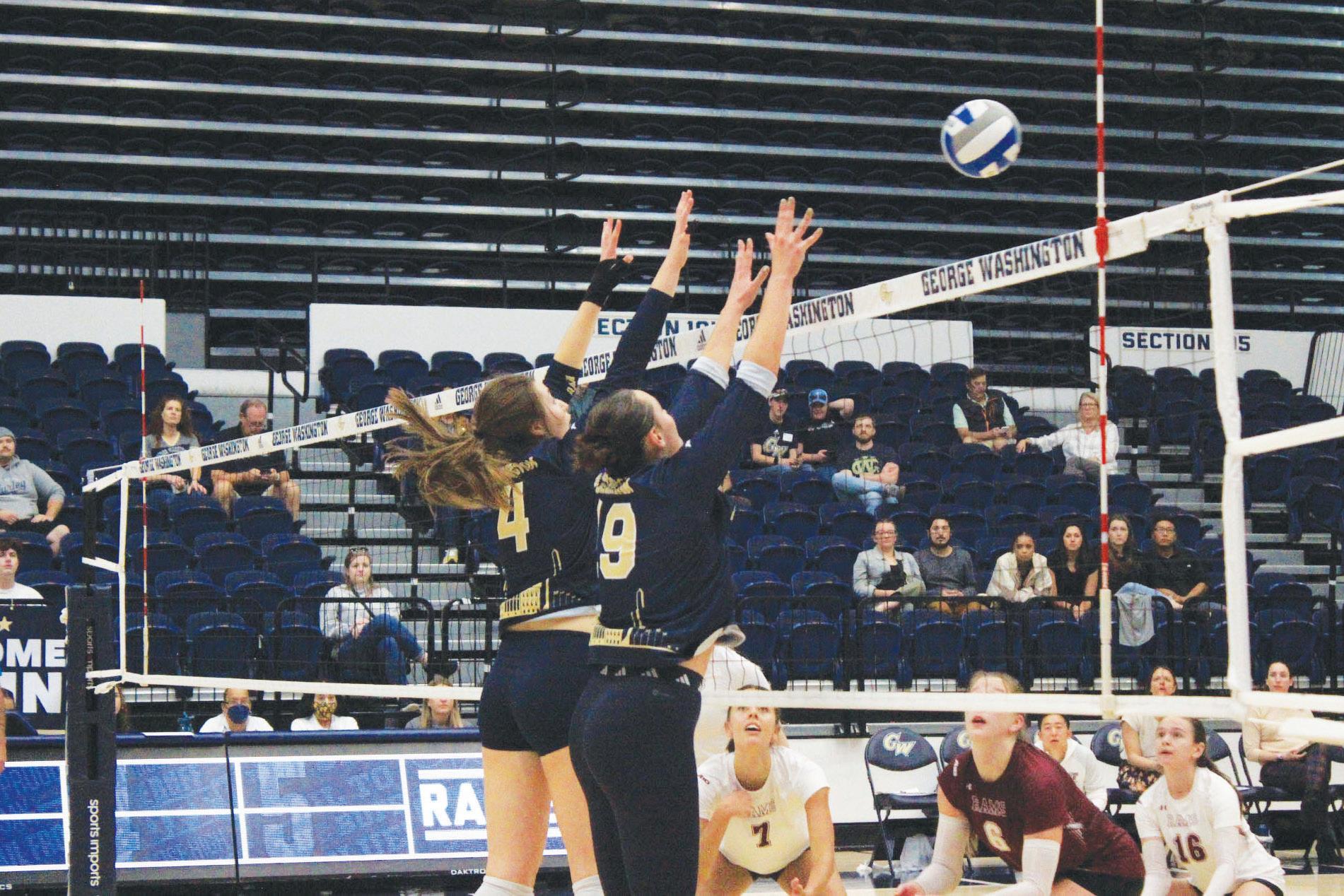
Match 1:
GW jumped to an early 5-0 lead in the first set of the first match, with sophomore outside hitter Salem Yohannes serving to start off the game. Fordham managed to fight back and tie the set at 13, just before a
4-point GW run.
The Colonials kept the set under control from there, registering a matchhigh 17 kills as a squad and closing the set out 25-22.
The second set got off to a similar start, with GW jumping to an early 5-2 lead off of two kills from junior opposite Liv Womble. Womble, the season leader in kills for the Colonials, would go on to score 18 kills in just three sets, threatening her career high of 20 that came across a fiveset span The Colonials kept Fordham at an arm’s length in the second set, holding a lead of at least 4 until the Rams went on a 7-3 run to tie it at 23. GW exercised their second timeout of the set to regroup, then closed it out with two straight scores, extending their match lead to 2-0.
Graduate middle blocker Tierra Porter scored the second and third points of the set, stuffing Fordham at the net and launching a cross-court spike to put GW up 3-0.
The Rams evened up the set at 7 before GW went on a 10-4 offensive run of to establish a 17-11 lead. Tierra
Porter closed out the third set and the match for the Colonials with a powerful spike to make it 25-21.
Match 2:
The first set of the second match proved to be the most lopsided of the series, with the Colonials leading by as many as 13 points. The Colonials notched a .290 hitting percent compared to the Rams’ .194 percent, while also marking an increase from the Colonials’ game average of .184.
The second set featured the first lead of the entire series for Fordham, as they jumped to an early 10–5 advantage. The Rams extended their edge all the way to ten, commanding the set at 22-12.
Early in the third set, Fordham junior outside hitter Whitley Moody spiked the ball to the middle with force to tie it at 7-7. The Rams went on a 7-0 run to take control of the set, leading 14-7.
Early in the fourth set, the lead changed often and reached a deadlock at 16 after a Fordham timeout.
GW will face A-10 rival Dayton in a two-game road series on Oct. 21 and 22.
“We are constantly tackling and hurdling obstacles to get where we need to go, it’s a very ‘Do it yourself’ kind of deal, especially in the leadership positions, in my opinion,” Timms said. “Like Ruby, Emma and I are constantly adapting. I think that’s the biggest thing personally –getting used to working on this every day and knowing that it’s going to be constantly changing and adapting those changes with personnel, teammates, scheduling conflicts, stuff like that.”
Senior captain Emma Aubuchon said the captains have concentrated on creating a solid foundation for the freshman with constant practices to familiarize them with the team to ensure a quicker speed and higher strength to manage the boats.
She said her goal for the year is to make everyone on the team feel included and able to pursue progress.
She said younger talent has been able to sail and adjust to collegiate competition more this fall than last spring, when the then-seniors on the team accounted for a majority of the team’s roster.
“And then a goal for the year is making sure that everyone on the team feels included and that everyone pursues the path of progression that they want,” Aubuchon said. “Not everyone wants to be the top sailor on the team, or the top person or can even commit that much time to it. But I think like having everyone feel like included, welcome and feeling like they’re helping the team is really important.”
Men’s soccer lost 1-0 against Saint Louis Saturday, dropping to 11th in the Atlantic 10.
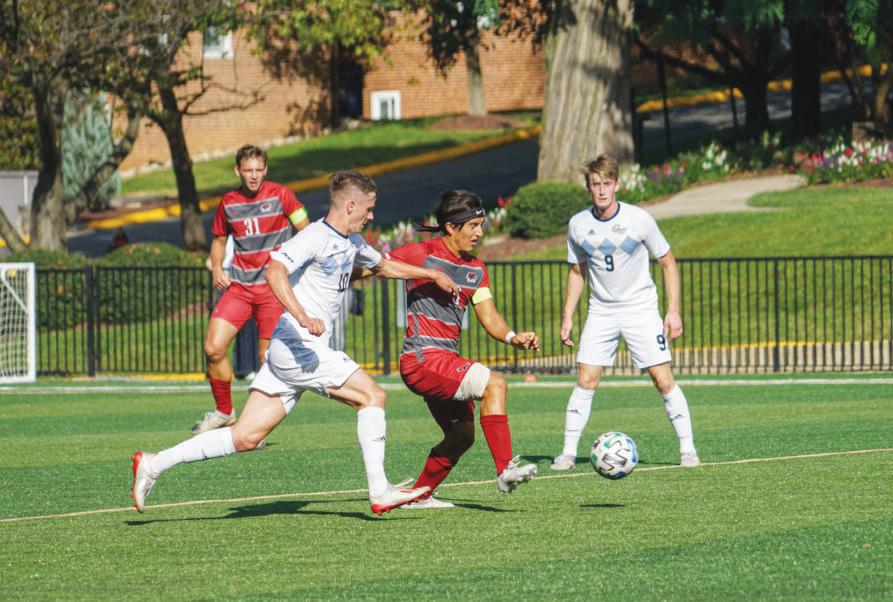
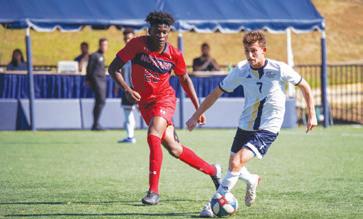
The Colonials (6-6-2) outshot SLU (8-4-1) 10-9 but failed to get six shots on goal past SLU senior goalkeeper Carlos Tofern. The match remained scoreless through the first half until the Billikens’ goal in the second handed them the victory.
GW’s fourth conference loss places them outside of the A-10’s 10-team playoff picture with four conference games left before the championship next month.
The first half kicked off with three unsuccessful corner kicks from GW, and the Billikens responded with two shots from the bottom center and bottom left that GW senior goalkeeper Justin Grady blocked.
In the 22nd minute, senior midfielder Elias Norris sought to score from the bottom right but was unable to outsmart Tofern. Junior defender
Lucas Matuszewski took possession and shot from out of left but missed.
The Colonials had two more scoring opportunities in the 44th minute with senior attack player Tom Cooklin and junior midfielder Tim Neumann shooting from out from the right but ultimately failing to net the ball.
A lack of offensive momentum dominated the first half as both teams settled into a defensive stride and ultimately failed to score.
The second half got underway with a curling shot from Cooklin that SLU goalkeeper Tofern punched away and deflected toward GW junior defender Aaron Kronenberg. Kronenberg shot from out left but failed to connect, nulling the Colonials’ best chance to score.
SLU went on to increase its possession and continue drilling the net for the game’s winning goal. A foul by GW’s Cameron in the 69th minute paused play to allow freshman midfielder Mads Stisrup
Petersen to score off a set piece driven into the lower right corner of the net, putting SLU on the board.
The Colonials entered a shooting frenzy in hopes of equalizing the score but could not penetrate the Billikens’ defense. Cooklin fired two consecutive shots from the top left and bottom center that the Billikens goalkeeper stifled.
Matuszewski took the last shot for the Colonials in the 89th minute from the bottom right, but Tofern stopped GW’s fleeting hopes to tie the game.
The Billikens collected four yellow cards through the game, outnumbering GW’s two.
The Colonials sank two places in the A-10 standings with the loss. GW will look to hit its stride in the last four games to make their bid at an A-10 playoff run.
The Colonials wrap up a 3-game road street on Tuesday at Durham, North Carolina where they will face No. 3 Duke. Kickoff is set for 7 p.m. and the game will be available on ESPN+.
Men’s soccer fails to connect on offense as conference woes continue