Students protest misconduct charge against SJP president during SRR hearing on postering damage
FAITH WARDWELL ASSISTANT NEWS EDITOR NIKKI GHAEMI CONTRIBUTING NEWS EDITOR
Students protested a University hearing on misconduct allegations against Students for Justice in Palestine and its president Friday for damaging benches outside the GW Hillel building as part of a postering campaign in support of Palestinian rights in early October.
About 40 students gathered in Kogan Plaza for the protest across from the University Student Center, where the Office of Student Rights and Responsibilities organized the hearing to decide on potential disciplinary probation sanctions against the student organization and its President Lance Lokas. SRR charged Lokas and SJP with disciplinary misconduct for the damage caused by wheatpasting, a process of hanging posters with a mixture of starch and water, on the benches outside of the GW Hillel building.
SJP led a postering campaign in October with signs reading “Zionists F*** Off” and “Decolonize Palestine”

leading up to a speaker event that GW for Israel and GW Mishelanu hosted with Doron Tenne, a former Israel Defense Forces intelligence officer, at the GW Hillel building. Student leaders with SJP, Jewish Voice for Peace and other student organizations gathered in Kogan, where they denounced the student conduct proceedings and yelled chants like “GW shame on you” and “from GW to Palestine, occupation is a crime.”
In a speech after the hearing, Lokas told the crowd of protesters that he denounced alleged racism and antiPalestinian discrimination within GW’s administration in a statement at the hearing. Lokas said Kirstein testified during the hearing and accused SJP of spreading antisemitism and violating the safety of students who view GW Hillel as a home.
“An organization that claims to be a home does not invite a war criminal on campus to speak to students,” Lokas said. “An organization that claims to be a home does not sanction the genocide of indigenous Palestinian people.”
Lokas said he expects


SRR to release a decision on the case next week.
In a statement Wednesday, University spokesperson Julia Metjian said when the University receives reports of student activity that may violate GW policy, officials respond in accordance with the Code of Student Conduct and applicable University policies and procedures. She declined to comment on the disciplinary proceedings of the case.
“The University continues to support the right of all members of the University community to engage in debate and discussion, as well as protest, in accordance with University policies,” Metjian said in an email.

Adena Kirstein, the executive director of GW Hillel, said in an email to the GW Hillel community Friday that the posters caused between $1,200 and $4,500 in damage to benches outside of the building. The protesters’ lawyer is disputing these claims, alleging the wheatpasting poster technique did not cause any damage.
In a statement Kirstein said she read during the hearings alleged that Lokas used a “heavy-duty paste”
that left damage on the cement benches outside the Hillel building requiring them to be polished, with price estimates ranging in the thousands of dollars.
The statement admonished Lokas for the “vandalism” of Hillel benches after the posters were “very difficult” to remove.
Students postering must “only” use masking or painters tape, pushpins or staples while hanging up posters on University property, according to the Student Organization Handbook.
Kirstein said the group “attacked” Jewish students at GW with the posters on Hillel’s property, making them feel unsafe.
“Your actions didn’t make any Palestinian lives better,” she said. “But your actions did hurt Jewish students at GW, who felt targeted and attacked.”
Danielle Katz, a member of Jewish Voice for Peace GW, said JVP participated in wheatpasting around campus as part of the postering campaign and other political events with SJP, but their organization received “little to no” disciplinary investigation.
CCAS cycled through 23 advisers since 2018, undermining students
YAO REPORTER PHILLIP CASTRO REPORTER
Twenty-three advisers have left the Columbian College and Arts and Sciences’ undergraduate advising office during the past four years, which experts said will impede students’ ability to create relationships with their advisers.
Of the 11 advisers working in CCAS’ pod system in May 2018, only two still work at GW, according to a Hatchet analysis of earlier and current pages of the office’s website. Experts in academic advising in higher education said a high turnover of advisers prevents students from building a relationship with an adviser throughout their college career and ultimately lose trust in the effectiveness of the advising process, undermining their GW experience.
University spokesperson Josh Grossman declined to say how many advisers left and joined the University in the past five years and why there has been a high turnover rate among advisers.
“The University continues to value our advisers’ critical commitment to their roles and the important contributions they make to enhancing the student experience,” he said.
Since 2018, at least five former advisers have moved on to American University.
The number of advisers in CCAS’ advising office fluctuated between about 10 to 14 per academic year, according to earlier versions of the office’s website.
Jeff Elliott, the executive director of University Undergraduate Academic Advising at Purdue University, said a high turnover of advisers actively undermines their relationships with students, preventing them from developing trust with advising staff.
“The perfect experience, honestly, is a student who comes in their first year and meets an individual who demonstrates that they care about that student’s identity and care about the student’s welfare and well-being,” Elliott said.
Ann Minnick, the director of academic programs and advising at Macalester College, said “The Great Resignation” –an ongoing trend in which employees are voluntarily resigning en masse in the wake of the COVID-19 pandemic – is impacting staff retention rates at workplaces across the country as many employees reconsider their career options.
More than 600,000 campus workers left universities in 2020 due to resignations and layoffs, according to the National Association of Student Personnel Administrators.
“For the past several years, post-pandemic or during the pandemic, people are wondering, ‘Is this the right thing for me?’” Minnick said.


CCAS undergraduate students said advisers often appear to lack knowledge of less common degrees within CCAS, like arts programs.
Jaclyn Nathanson, a freshman majoring in fine arts, said an adviser told her that taking 17 credits during the first semester of her freshman year would be “manageable,” but Nathanson later discovered the workload to be overburdensome. She said CCAS advisers do not give helpful advice to students who are not studying a popular major at GW, like political science, and are not well-informed on the college’s arts majors.
“If they could do anything it would just be for each adviser to have a more broad understanding of every major we have,” she said. “Because I think every single adviser I’ve met with, when I tell them I’m an art major, their first words are, ‘Oh I don’t really know much about that.’”
AVRIL SILVA REPORTER SOPHIA GOEDERT ASSISTANT NEWS EDITOR
The Title IX Office released its first annual report late last month, detailing a year of reporting rates that the office’s director said took a “notable increase” last academic year.

The Title IX Office registered 380 reports of sexual harassment, sexual assault, stalking, dating violence, pregnancy and parental support and domestic violence in the 2021-22 academic year, the majority of which were filed by designated reporters and impacted undergraduate students, according to the report. Asha Reynolds, the director and coordinator of the Title IX Office, said the report – which also highlights victim resources – reveals a rise in overall reports and an increase in community engagement with the office’s reporting mechanisms during the past academic year.
Designated reporters – faculty and staff required to report potential sexual assault or harassment incidents involving students to the Title IX Office – filed 217 of the
academic year’s reports, while students filed 107 reports on their own behalf and 34 reports on the behalf of other students and non-GW affiliates filed eight reports.
Reynolds said the office provides academic support, exam rescheduling assistance, deadline extensions, class and work schedule changes, housing assignment switches and mutual nocontact orders. She said the Title IX Office provides prevention and educational programs about sexual harassment that create a safe and inclusive environment on campus by responding fairly to Title IX reports.
“We believe greater transparency and a better understanding of the Title IX Office’s processes, resources and services will make community members feel more comfortable accessing and utilizing our services,” Reynolds said in an email.
Of the 380 reports that officials recorded during the previous academic year, 246 were cases of sexual harassment, 126 were sexual assault and 77 were stalking, according to the report. An additional 29 reports were for reports of dating vio-
lence, while there were 22 filed requests for pregnancy and parental services, the Title IX Office data reveals.
The Title IX Office handled 144 reports with supportive measures, or nondisciplinary services or accommodations, and did not require additional action.
Bella Sayegh, the copresident of Students Against Sexual Assault, said the release of the annual number of Title IX reports shows transparency from the Title IX Office, and she hopes the report will spark discussion about decreasing incidents of sexual violence.
She said the report increases students’ awareness about the supportive resources the Title IX Office provides that doesn’t require starting a formal investigative process.
Sayegh said the report is a “little overdue” but provides a starting point for students who aren’t sure where to turn for help after an incident.
“We think it’s really important, obviously, to make sure that everyone has access to the same resources because there are so many options whether it be at GW specifically or in our greater D.C. community,” Sayegh said.
ANNA FATTIZZO REPORTER
JACKSON LANZER STAFF WRITER
While junior Hayden Moussa visited a senior citizen they regularly assist just before Thanksgiving, she told Moussa the holiday season can feel particularly lonely, but she’s glad to have them “just a phone call away.”
Through their volunteer work with GW service fraternity Alpha Phi Omega, Moussa said they serve with Foggy Bottom West End Village, a nonprofit organization which pairs volunteers with a senior Foggy Bottom resident to provide companionship through completing errands together, talking with them over the phone and visiting them in person to discuss current events and life in general. They said senior citizens can experience an especially isolated holiday season if they’re far away from their families, but acts of service like letter writing or shared quality time can bring them meaningful support.
“That particularly spoke to me,” Moussa said. “I was like, ‘Wow, this is significant. This means a lot to me.’ That really reminded me that the work I’m doing, it’s really impacting someone.”
Students said they’re incorporating the holiday spirit into clothing and toy drives,
festive activities with D.C. Public School students and workshops for local families as part of their everyday community service through GW-affiliated service organizations and offices this holiday season. Students said setting aside time to serve others during the giving season forges strong connections between them and members of the D.C. community at a time of year when volunteering demand reaches its highest level.
Senior Reed Risinger, the team leader for ArtReach GW – a program that hosts afterschool art workshops and art therapy classes for families living in Ward 7 and 8 – said the organization will host a holiday art workshop that will display students’ work through-
out the semester. She said the workshop, which will take place in an exhibition space in Southeast from Thursday to Jan. 27, allows children to make holiday crafts and gifts for their family with students’ help.
Junior Vicky Wang said as a student leader for SMARTDC, a program tutoring kindergarten through eighth grade DCPS students in reading and math, her favorite holiday volunteering memory has been organizing a Christmas scavenger hunt for her students over Zoom earlier during the pandemic.
She said volunteers handed students a list of Christmas and winter-themed items to collect from their homes before participating in a show-and-tell to reveal their findings.
INDEPENDENT STUDENT NEWSPAPER • SERVING THE GW COMMUNITY SINCE 1904 Monday, December 5, 2022 I Vol. 119 Iss. 15 WWW.GWHATCHET.COM What’s inside
BARRY
JENNIFER IGBONOBA | PHOTOGRAPHER
Student leaders with Students for Justice in Palestine, Jewish Voice for Peace and other student organizations gathered in Kogan Plaza Friday, yelling chants like “GW shame on you” and “From GW to Palestine, occupation is a crime.”
Inaugural Title IX report shows rising reporting rates: director
LILY SPEREDELOZZI | ASSISTANT PHOTO EDITOR Hayden Moussa said the programs they support with APO year-round hone in on the giving season leading up to the holidays through outings like clothing drives.
warm, lasting
service
Students share
impacts of holiday season community
FROM: TheGW Hatchet Pages 6-8 Holiday Guide
Transfer student enrollment reached eight-year low, enrollment data shows
 FIONA RILEY REPORTER MARAM BAIDER REPORTER
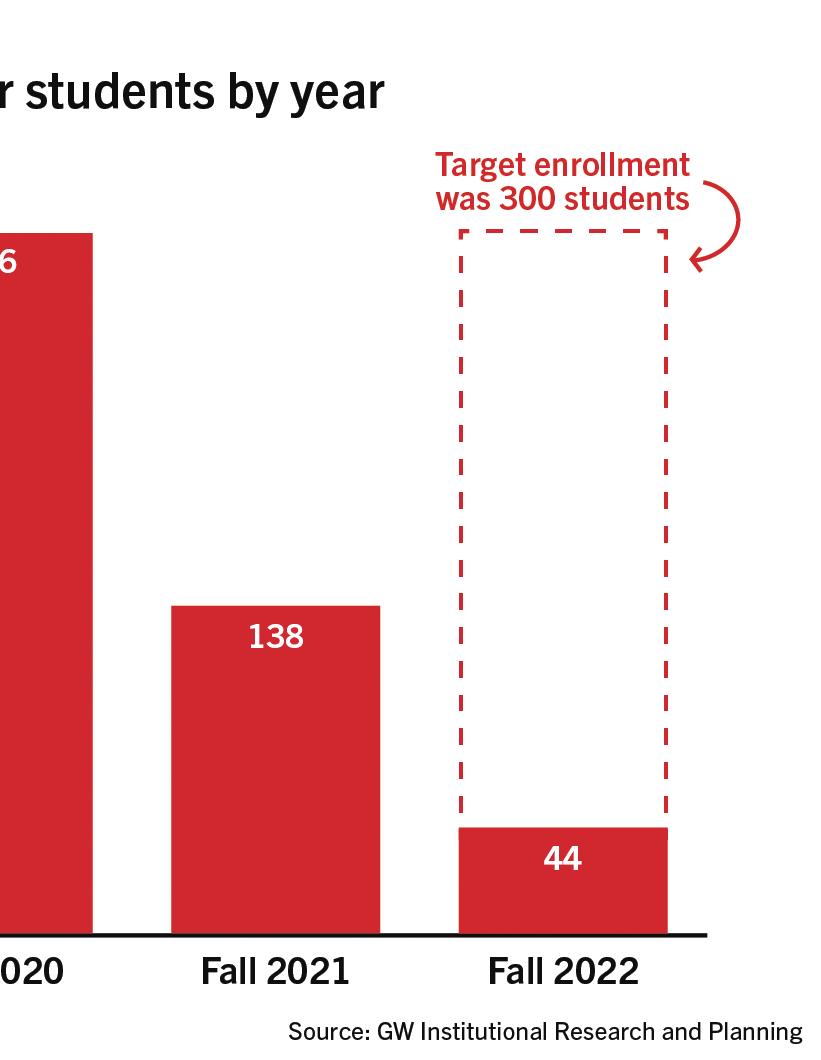
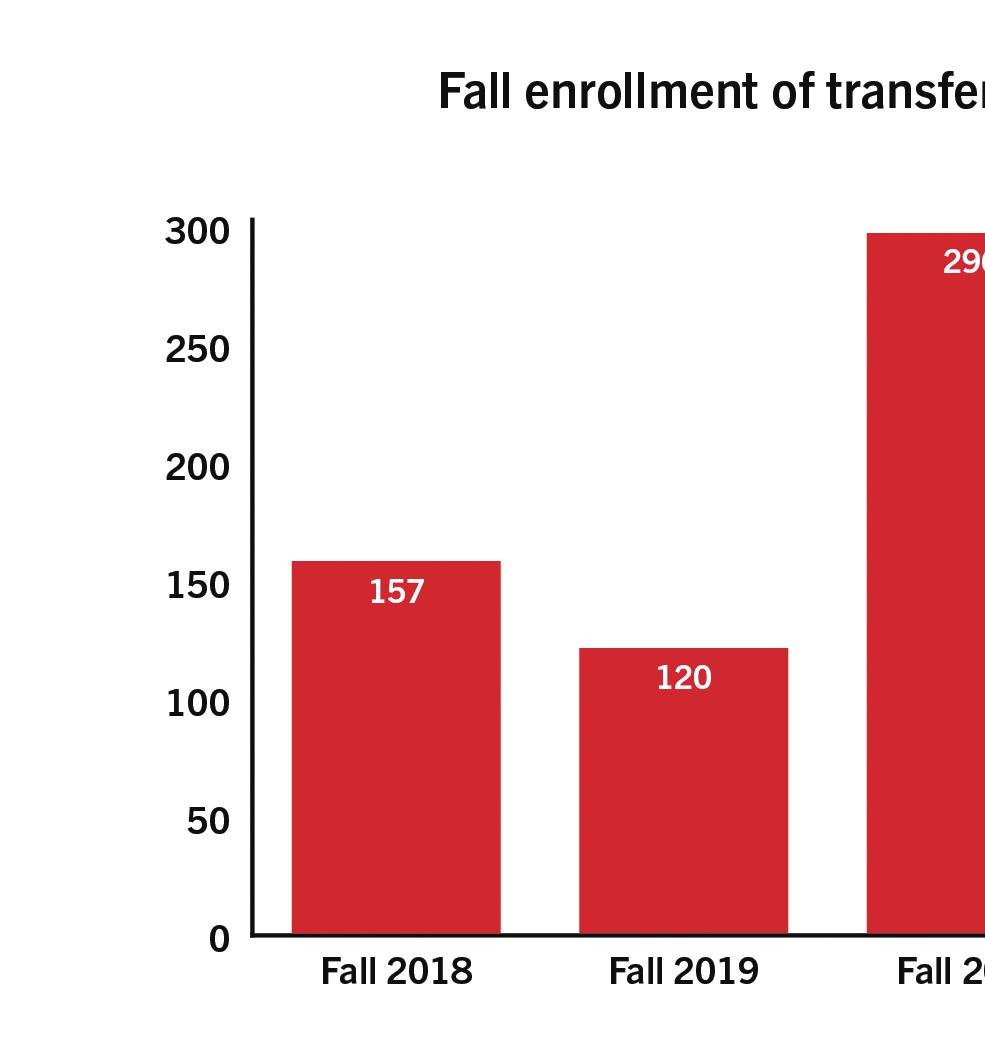
Transfer student enrollment at GW has dropped by about 85 percent since 2020 to its lowest point in eight years, according to student enrollment data released last month.
The number of undergraduate transfer students plummeted from 138 last fall to 44 this semester, now making up 1.4 percent of the new residential undergraduates this semester, according to the data. Experts in higher education and admission said universities across the country experienced similar drops in residential transfer student enrollment because of national declines in high school graduate numbers and increased enrollment in online programs.
Jay Goff, the vice provost of enrollment of student success, said officials “scaled back” transfer student numbers while accepting one of the larger freshman classes in recent years. He said officials are considering accepting a “slightly smaller” freshman class next academic year, which could provide more space for transfer students.
He said officials have filled all available spaces on campus for students this fall and will need to consider the University’s ability to house accepted students in the fu-
ture.
ANASTACIO I GRAPHICS EDITOR
“When we think about the undergraduate numbers, obviously we need to align our undergraduate headcount available capacity and our student service capacity,” Goff said.
GW’s 85 percent decline in transfer student enrollment since 2020 eclipses a 13.5 percent national average decline in transfer student enrollment in the same period, according to a transfer enrollment study by the National Student Clearinghouse Research Center.
Experts said a decline in high school graduates and community college enrollment have together decreased the pool of potential transfer applicants.
Kasandra Urquidez, the
dean of admissions at Arizona State University, said a decline in the number of students attending community colleges is likely contributing to drops in transfer student enrollment for four-year universities because a large proportion of transfer students matriculate from community colleges.
“The number of students just in general going to college and finding value in a college education has declined, so that has an impact across both two-year and four-year schools,” Urquidez said.
She said ASU, along with many other universities, began expanding their online programs during the pandemic to accommodate an increased number of students
looking for virtual learning opportunities, which attract transfer students who study part-time and have a job.
Robert Bennett, the senior associate director of admissions at Clemson University, said Clemson has shrunk available spots for transfer students because of an increase in academically qualified freshman applicants.
GW received 27,277 applications last fall, surpassing the University’s previous record for application numbers set at 26,987 in the fall of 2017. Bennett said he expects freshman application numbers to “slow down” in the coming years because of a national decline in collegeage students, which could free up spots for more transfer students.
Investors service reaffirms GW’s ‘solid’ financial stability rating
FIONA BORK REPORTER IANNE SALVOSA ASSISTANT NEWS EDITOR
Credit rating company
Moody’s Investors Service reaffirmed GW’s A1 rating from 2020, signaling the institution’s financial stability with a sustained operating budget about two years after the onset of the pandemic.
The A1 rating, affirmed in October, is the highest rating possible and indicates stable sources of revenue, a large cash-to-debt ratio and a “stable outlook” for the University’s next fiscal year, according to a Moody’s release. Experts in finance said the rating shows “effective” use of the University’s financial resources, including the support of the Medical Faculty Associates’ “substantial” $200
million debt.
Moody’s Investors Service evaluates institutions like universities through a six-step process in which an assembled analytical team assigns a rating and rationale based on an institution’s debt, cash and investments, federal aid and endowment. GW earned an A1 rating in 2020, which officials said indicated “financial strength and sustainability” amid the financial woes of the pandemic.
“Affirmation of George Washington University’s A1 issuer rating reflects its very good brand and strategic positioning as a large, comprehensive urban University, with a $1.7 billion scope of operations and over 20,000 students, leveraging on its location in the District of Columbia (D.C.),” the Moody’s release announcing this year’s ratings states.
CFO Bruno Fernandes said the report states the University has the potential for “improved” financial performance with its health care partner, Universal Health Services, which funds educational programs and works with the MFA to staff the GW Hospital.
Officials said at a Faculty Senate meeting last month that officials negotiated a “modern funds flow arrangement” between UHS, the hospital and the MFA.
“The University’s leadership and financial experts work diligently to carefully manage the University’s resources in support of GW’s mission of teaching, research, patient care and service,” Fernandes said in an email.
Joe Cordes, the co-chair of the Faculty Senate’s fiscal planning and budgeting committee, said Moody’s A1
rating evaluated the financial health of the University and the MFA – two nonprofit organizations – as a consolidated entity because the University is the sole member of MFA nonprofit. He said the credit rating agency is not concerned about the MFA’s financial “shocks” because the University’s strong financial performance, with $2.8 billion in cash and investments currently in possession, can compensate for the MFA’s financial deficits.
He said Moody’s previous credit rating in 2020 states GW’s partnership with UHS could financially boost the MFA into a “sustainable” entity. But Cordes said the MFA runs the risk of hitting a higher deficit, and the competitive and established D.C. health care market could potentially challenge its ability to gain revenue to cover its debt.
CRIME LOG
SIMPLE ASSAULT
Public Property On Campus (1900 Block of E Street NW)
11/24/2022 – 6:45 a.m.
Open Case
GW Police Department officers responded to a report of a male faculty member who was spat at and verbally attacked by an unknown male subject. Case open.
THEFT II/OTHER
Public Property On Campus (2200 Block of F Street NW)
11/28/2022 – 3:28 p.m.
Closed Case
GWPD officers responded to a report of a theft. Upon arrival, officers made contact with a female contractor who reported that her cell phone had been stolen by her boyfriend, who fled the area in a vehicle.
Referred to the Metropolitan Police Department.
ATTEMPTED THEFT, DESTRUCTION OF PROPERTY/VANDALISM
University Yard (Breezeway) 11/28/2022 – 5:00 p.m.
Open Case
A female student reported the theft of their electric scooter, which resulted in damage to an attached lockbox.
Case open.
DESTRUCTION OF PROPERTY/VANDALISM
Francis Scott Key Hall
11/30/2022 – Unknown Closed Case GWPD officers responded to a report of destruction of property. Upon arrival, officers observed damages from a discharged fire extinguisher. No subjects or witnesses present. Case closed.
THEFT I/FROM BUILDING
Francis Scott Key Hall 12/1/2022 – Unknown
Open Case
A female staff member reported an automated external defibrillator device stolen from the lobby of FSK Hall. Case open.
THEFT II/FROM BUILDING
Mitchell Hall (7-Eleven Store) 12/1/2022 – 8:27 p.m.
Closed Case GWPD officers responded to a female employee’s report that a male subject had stolen a pack of cigarettes. Upon arrival on scene, officers canvassed the area and were unable to find the subject. No identifiable subject.
LIQUOR LAW VIOLATION
West Hall (Mount Vernon Campus) 12/2/2022 – 12:31 a.m.
Closed Case
GWPD officers responded to a report of a fire alarm in West Hall. Upon arrival to the room where the alarm was activated from, officers made contact with male residents and observed alcoholic beverages in plain view. Shortly after, the students admitted to underage drinking.
Referred to the Division for Student Affairs.
NEWS THE GW HATCHET December 5, 2022 • Page 2 News
THIS WEEK’S EVENTS THIS WEEK
1947 DEFENDING PRESS FREEDOM: PROTECTING JOURNALISTS AROUND THE WORLD Tuesday, Dec. 6 | 5:30 p.m. EDT | Science & Engineering Hall Tune into a lecture with Jodie Ginsberg, the president of the Committee to Protect Journalists. GENDER EQUITY FOR KURDISH WOMEN IN STEM EDUCATION: OPPORTUNITIES AND CHALLENGES FOR KURDISTAN AND IRAQ Monday, Dec. 5 | 3 p.m. EDT | Elliott School of International A airs Join a seminar with a focus on the status of women in STEM in Kurdistan and Iraq.
The combined Glee Clubs of the University planned to present their traditional Christmas Sing in Lisner Auditorium Dec. 15.
IN HISTORY Dec. 9,
— Compiled by Peyton Gallant
SNAPSHOT
FLORENCE SHEN | PHOTOGRAPHER
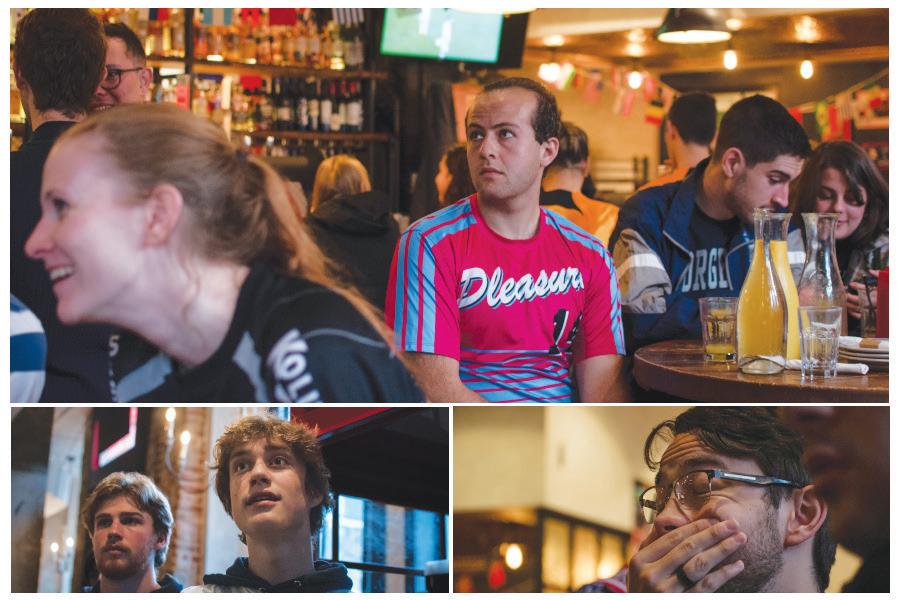
The
of
watching the
run in the World Cup come to an end with a 3-1 loss to the Netherlands.
eyes
soccer fans locked onto the TV monitors at Duke’s Grocery Saturday,
United States’
mess around and buy
Crocs
Pierce on 12/3/2022 TWEETED TWITTER/@TPIERCE2
Might
a pair of
today. Tim
NICHOLAS
Three alumni land spots on Forbes’ 30 Under 30 List for 2023
 ANNA FATTIZZO REPORTER
Three alumni cracked the Forbes’ 30 Under 30 List for 2023.
The annual Forbes list, which the magazine pub lished Tuesday, recognizes about 600 young profes sionals under the age of 30 for their accomplishments across 20 career fields. The alumni included in the 2023 list were honored for their achievements in education, media, retail and e-com merce.
Eight alumni landed a spot on the list for 2022, in categories spanning con sumer technology, enter tainment, finance, market ing, media and sports. Three alumni claimed spots on the 2020 list for media, games and health care.
NBC senior producer Yara Bishara, political econ omist Chinemelu Okafor and entrepreneur Gabriella Tegen made the 2023 list. Here’s how their careers have taken off since their time at GW:
Yara Bishara
Bishara graduated from GW in 2015 with a bachelor’s degree in political science, and she currently serves as a senior producer for NBCU niversal, where she oversees a team of video journalists and produces 30-minute documentaries. Among her recent work at NBC, Bishara filmed a documen tary that examined social media’s impact on the trial between Johnny Depp and Amber Heard and “Dear Noah: Pages From A Family Diary,” a November docu mentary on a Texas family and the decisions they make for their transgender son’s safety.
Before NBC, Bishara was a part of the New Yorker’s video team producing docu mentaries and docu-series, later contributing to the magazine’s most popular news videos, drawing 19 million views on YouTube and helping to double its YouTube subscriber base in two years.
Before graduating from GW, Bishara worked on The Hatchet’s video team from 2010 to 2015, serving as a senior staff videographer in 2014. Bishara said her work on The Hatchet was the first
time she had the opportuni ty to work with a video cam era or use editing software like Final Cut Pro.
“The hands-on experi ence at The Hatchet allowed me to experiment, fail and iterate so I can apply those skills and teachings at my various internships while also giving me space to bet ter understand the role I wanted to play in media,” she said in an email.
After graduating from GW, Bishara worked at the New York Times for more than a year as a video jour nalist on the breaking news team.
After immigrating to the U.S. from Palestine at 10 years old, she said her earn ing a spot on the Forbes 30 under 30 list represents and validates her and her fam ily’s hard work and sacrifice starting “from scratch.”
“As someone who immi grated to this country when I was 10 years old and hardly knew any English, my fami ly and I have worked incred ibly hard to make something for ourselves here,” Bishara said. “As a Palestinian, I was acutely aware of the lack of representation in leadership roles in media.”
Bishara said she had al ways wanted to attend GW after watching her father receive his master’s degree from the University when she was three years old in the nation’s capital, a desti nation she saw as unparal leled and advantageous.
“As a student, GWU’s faculty, coursework, extra curriculars and location equipped me with all the right skills, knowledge and opportunity to explore my interests and passions,” she said. “The proximity to the White House and Capitol Hill opened a door of op portunity and experience I wouldn’t otherwise have gotten elsewhere.”

Bishara is currently pur suing a master’s degree in business administration at New York University.
Chinemelu Okafor
Okafor graduated from GW with a master’s degree in applied economics in 2018. As a political econo mist, Okafor founded the nonprofit organization Re search in Color Foundation in 2019, which provides as piring economic scholars of
color with a mentor who car ries a Ph.D. in economics or an economics-adjacent disci pline to partner on an eightmonthlong research project.
Before coming to GW, Okafor received a bachelor’s degree in economics and international studies at Uni versity of Michigan. She is currently a doctoral candi date at Harvard University and serves as the president of the foundation.
Okafor did not return re quests for comment.
Gabriella Tegen
Tegen graduated from the University with a bach elor’s degree in international business and marketing in 2016. She is currently the CEO of Smartrr, a subscrip tion platform that partners with a diverse group of com panies to make the customer memberships and subscrip tions more user-friendly.
During her time on cam pus, Tegen was a member of GW’s chapter of the Alpha Phi sorority.
Smartrr offers compa nies a platform to allow their consumers to easily up date product subscriptions month to month through options like item swaps and delivery delays. Tegen said the gross merchandise value of Smartrr’s clients has in creased by a 318 percent av erage after 60 days of switch ing to Smartrr.
She said Smartrr has built relationships with other brands, like actress Cameron Diaz’s wine com pany Avaline and skin care company Starface, to include them in their subscription service and attract more cus tomers.
“In business, the rela tionships you have, the net work you create – those are incredibly important and often are critical,” Tegen said in an email. “Choose who you surround yourself with wisely and remember, good people build good products and successful companies.”
Tegen said she encour ages all students, especially those interested in a busi ness career, to build a net work and take advantage of professional connections because of the advantages it can offer a resume.
“Your network will prove significant for your career, regardless of your ca reer path,” Tegen said.
Grocery pickup program to alleviate food insecurity for disabled students
FAITH WARDWELL ASSISTANT NEWS EDITOR
The Store and the Dis abled Students Collective are teaming up to initiate a student-run grocery pickup program in District House this semester to combat food insecurity among disabled students.
The collaborative pro gram will supply free prebagged groceries for stu dents who fill out an online request form in an effort to address accessibility issues that DSC members identi fied within The Store earlier this fall, like narrow shelv ing aisles and heavy doors. Student leaders with DSC and organizers from The Store said they hope the program – which opened for pickup orders in Octo ber and is waiting to receive requests – takes strides in making the campus more accessible they hope the pro gram.
Lauren Anne Wall – the communications director for the Disabled Students Collective – said she helped propose the accessibil ity program after a member visited The Store in Septem berand noticed areas that would be inaccessible to students with disabilities. She said the student noticed
that narrow aisles could pose mobility difficulties for people with wheelchairs or crutches, who would also need to pass through a heavy door at the main en trance that lacks any auto mated door button.
Wall said students of ten claim supplies at The Store following its weekly restocks, but many dis abled students combat gen eral fatigue and unexpected symptom flare-ups that may prevent them from access ing The Store before sup plies deplete. She said the program can help disabled students receive equal ac cess to The Store’s offerings through the online request form, which can be submit ted days in advance of pickup.
“If somebody has a re ally hard time in the morn ings, or on that particular week they’re having more of a flare, that means that even if they could get into the room, they’re not going to be able to get there in a timely fashion,” Wall said.
Wall said the program aims to resemble the design of a personal shopper pro gram, like services offered by companies like Instacart, in which an organizer at The Store pre-packs requested groceries to be picked up at
a later time. She said people with disabilities often dispropor tionately face food insecuri ty because of lower average income levels and mobility challenges. The Department of Agriculture reported that disabled Americans faced food insecurity at more than double the rate of individu als without disabilities in 2020.
“I think that it doesn’t get talked about enough, and it often gets overlooked, especially at GW because it’s such a nice, fancy school,” Wall said. “But just be cause it costs a lot of money doesn’t mean that the people who go here all have a lot of money.”
Sua Cho Jung, the copresident of The Store, said The Store is still in the pro cess of finalizing details of the program like the lo gistics behind the physical handoff of the groceries and general interest among stu dents.
“We’re in the process of determining with the DSC how many members of the DSC would like to pickup food offered by the Store and what the most conve nient locations/times/dates would work for those in dividuals,” she said in an email.
D.C. officials to study nonvehicular transit, connectivity in Foggy Bottom
GRACE CHINOWSKY ASSISTANT NEWS EDITOR
MOKSHA AKIL REPORTER
D.C. officials will study travel patterns in Foggy Bot tom this spring to consider better connecting Foggy Bottom to the Georgetown Waterfront and Rock Creek Park through improved traf fic infrastructure.
Ron Barron, a communi ty planner for the D.C. Office of Planning, said the study will work to decide whether city planners can create new pedestrian and cyclist ac cess between Foggy Bottom, the Georgetown Waterfront and Rock Creek Park to get around the Potomac River freeway network, which slices through the neighbor hoods. Barron said officials will study how nondrivers travel through the Foggy Bottom Historic District and the Georgetown Waterfront area to recommend changes in neighborhood freeway and transportation layouts by fall 2023.
Barron said the data will compile pedestrians’ transit experiences along Foggy Bottom corridors with heavy vehicle, bicycle and pedestrian traffic – like G Street and Virginia, Penn sylvania and New Hamp shire avenues – through man-on-the-street polling this spring.
But members of the Foggy Bottom and West End Advisory Neighbor hood Commission said the study’s focus on pedestrian movement overlooks ve hicular traffic patterns in the area. They said they were “confused” about the timing of the study, coming after District Department of Transportation officials in stalled protected bike lanes on Virginia Avenue last year to connect Rock Creek Park to the National Mall.
Barron said Foggy Bot tom is a “good candidate” for nonvehicular observa tion because DDOT officials installed three sets of pro tected bike lanes in Foggy Bottom within the last two years. DDOT implemented a bike lane along G Street in Foggy Bottom in 2020, added another lane run ning through 20th and 21st streets in 2021 and installed the most recent set along Virginia Avenue from Rock Creek Trail to Constitution Avenue last year.
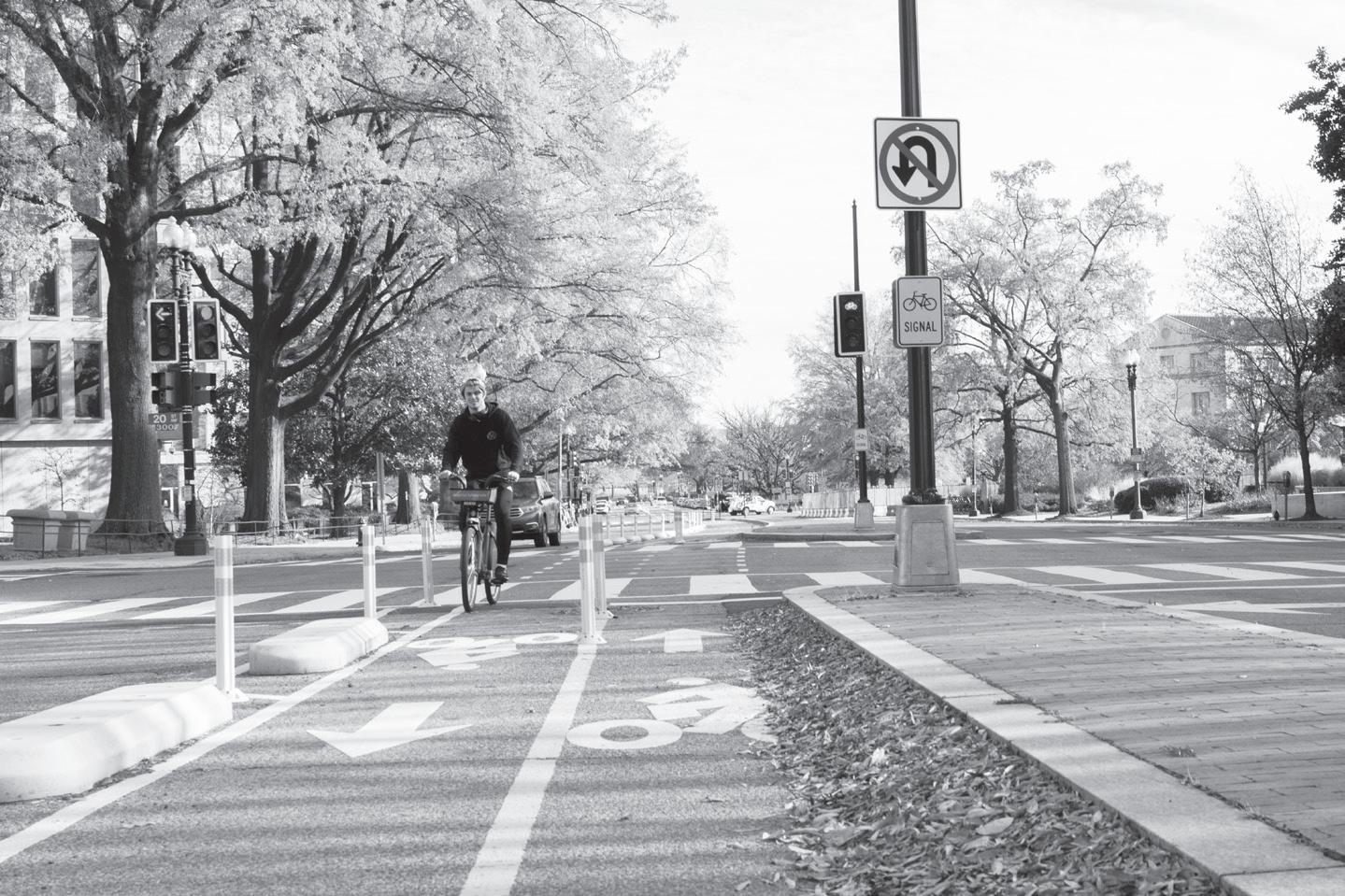
“There’s been a lot of work there, so we think this is a good opportunity for us to collect some very good data on how, with all the im provements, are people ex periencing the connections that exist,” Baron said.
Barron said the connec tion between the Foggy Bot tom Historic District, which includes most of the north east corner of the neighbor hood, has been a “massive” area of constituent concern for years. Local leaders said the Potomac River Freeway – an east-west leg of Inter state 66 crossing between D.C. and Virginia – forms a dividing line of traffic between the District and Georgetown and stifles un interrupted, nonvehicle ac cess between the areas.
The Office of Planning’s Comprehensive Plan, a guide for long-term urban planning in D.C., recom mended a neighborhood study last year to investigate the “feasibility” of reconfig uring highways in Foggy Bottom and improving non vehicular connections to Georgetown.
The freeway cuts un derneath Virginia Avenue and includes an interchange with the Rock Creek and Potomac Parkway and two ramps leading to either Georgetown via the White hurst Freeway or L Street. Barron said Foggy Bottom pedestrians and cyclists had
“more access” to Rock Creek Park before the freeway’s installation in 1961, which displaced more than 270 families during the road de molition process.
He said the Office of Planning’s study will weigh various options to revive this pedestrian connection, like adding a “linear park” – a skinny stretch of green space – to the Whitehurst Freeway, removing I-66 entirely, installing a pedes trian bridge or “capping it over” with a deck bridge built on top of the roadway, which are commonly used to house new parks or build ings in urban areas.
“We’re specifically look ing at the connections be tween the residential areas and the amenities,” Barron said.
He said there has been a gap in collected data on nonvehicular Foggy Bot tom traffic since DDOT of ficials surveyed pedestrians and formed a master plan in 2009, where constituents recommended expanding bike lanes and pedestrian safety programs.
“We are continuing to work with them as this proj ect progresses,” Barron said. Barron said he doesn’t know why DDOT installed the Virginia Avenue bike lane without the Office of Planning’s study before hand. He said DDOT and Vision Zero studies have usually been vehicle and safety-focused instead of emphasizing residents’ transit experiences.
“That isn’t to say that DDOT is not doing out reach, that they’re putting in bike lanes without do ing any kinds of studies,” Barron said. “I don’t know if they’re specifically doing this type of study, but there’s a process for planning that every department has to fol low, and that includes col lecting data, doing public outreach.”
NEWS THE GW HATCHET December 5, 2022 • Page 3
RACHEL SCHWARTZ | ASSISTANT PHOTO EDITOR Ron Barron said officials will study how nondrivers travel through the Foggy Bottom Historic District and the Georgetown Waterfront area to recommend changes in neighborhood freeway and transportation layouts by fall 2023.
PHOTO ILLUSTRATION BY AUDEN YURMAN I SENIOR PHOTO EDITOR
The alumni included in the 2023 list were recognized for their achievements in education, media and retail and e-commerce.
Opinions
Budget cuts are damaging key programs at Eckles Library, Writing Center
While scaling back spending kept the University financially sol vent amid the pandemic, lingering budget cuts to the Columbian Col lege of Arts and Sciences and GW Libraries have slashed hours and staff at the Writing Center and Eck les Library over the last year. These oft-overlooked services form the backbone of students’ academic ex perience and deserve officials’ sup port to remain fully operational.
Housing and tuition revenues dropped during the peak of the pandemic while expenses tied to financial aid and COVID infra structure, like testing and isolation housing, shot up. The result was a $180 million gap in the University’s budget for fiscal year 2021, which runs from July 2020 through June 2021. Officials suspended most capital projects and froze hiring new employees in March 2020 be fore taking pay cuts and freezing all salaries in May. In August, they laid off hundreds of staff in IT of fices, the career center, facilities and event departments.
Now, budget cuts for GW Li braries and CCAS have strained these services further.
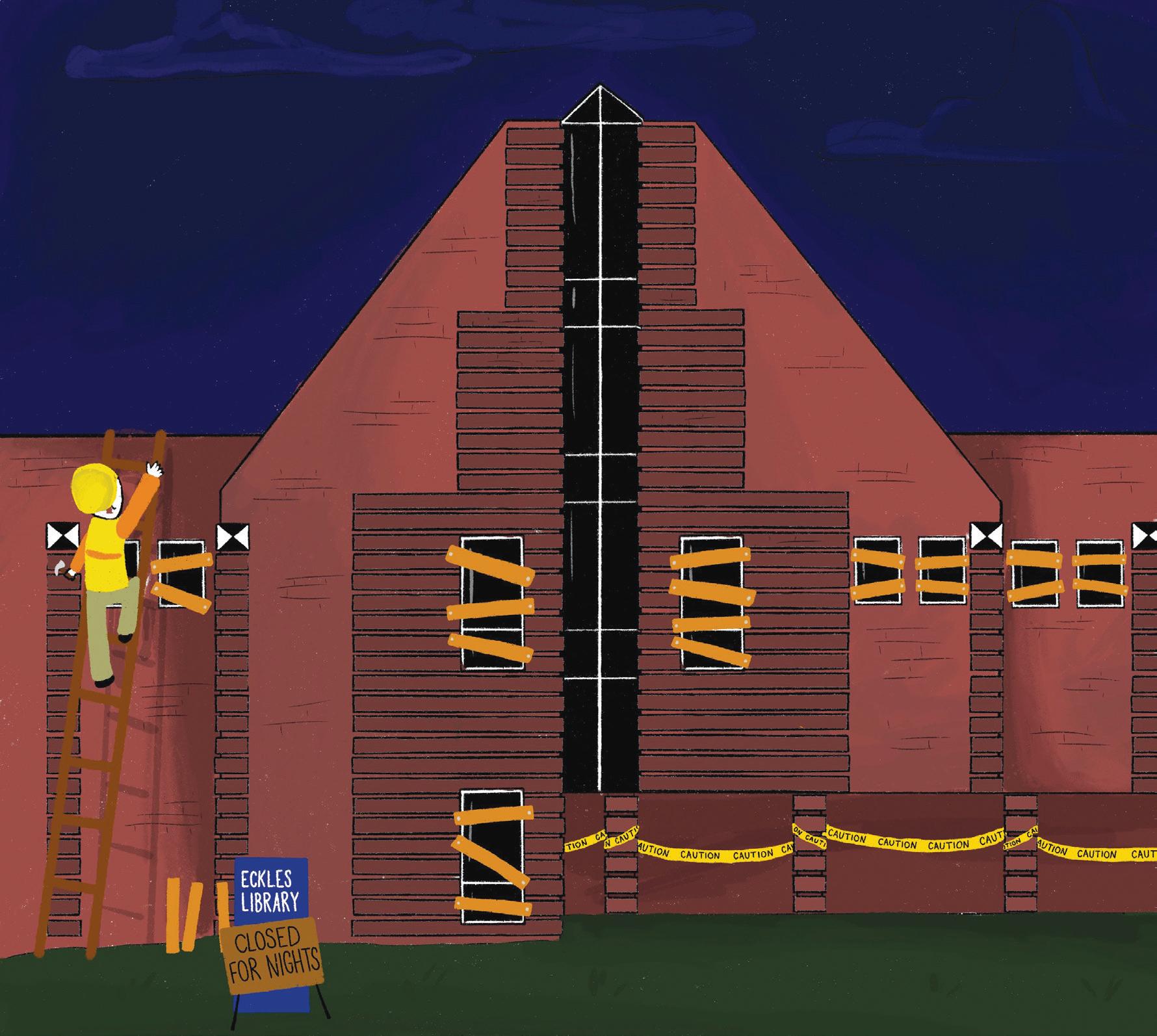
Eckles hasn’t opened before noon on any day of the week since last fall when it reopened for the first time since March 2020. And ever since, it has been shutting its doors by midnight Sunday through Thursday and 6 p.m. on Friday and Saturday. Before the pandem ic, Eckles’ study spaces, reading rooms and computer labs opened at 8 a.m. during the week and 10 a.m. on the weekend, closing at 3 a.m. Monday through Thursday and on Sundays and midnight on Friday and Saturday. But because each of GW’s libraries receive fund ing from the same budget, officials reduced hours at Eckles to keep Gelman open for 24 hours a day.
From GW-themed affirmations like
“‘Foggy Bottom’ is not an embarrassing name” to stories about where to get “free stuff” on campus, the @gwuaffirmations Instagram account had a grip on me before I even applied to college last December. And judging by the thousands of people who follow @gwuaffirmations and other student-run accounts about GW, these personal, yet glamorously popular, forums can have an intoxicating effect on students.
Terra Pilch-Bisson Opinions Writer
Social media is an easy, quick and detached way to socialize in what can otherwise feel like a disconnected student body, and @gwuaffirmations’ blend of anonymous, quirky humor with an insider student perspective is an indispensable form of connection between students. Dozens of these community-centric accounts exist within student social media circles – @gwubirds, @gwurats and @gwucats post pictures of cute animals on campus, and others like @gwstudent37 and @ pitbullatgw post satirical made-up roommate stories and edited photos of Pitbull around Foggy Bottom, respectively.
But there’s a dark side to these anonymous accounts. @gwu.shaderoom, which emerged at the start of this semester, posts unfiltered
The Writing Center – a pro gram entirely funded by CCAS that offers free writing assistance to students – has neared its limits between slashed operating ex penses and this year’s large fresh men class, thinning appointments that could provide help on an essay
anonymous screenshots of submissions to a Google Form that poses rotating prompts like “what’s on your mind?” and “anonymously spill the tea.” The posts range from silly –“who brought their toddler to pelham brunch” – to crude – “Madison 7th floor boys are virgins.”
The more you scroll through @gwu.shaderoom, the more racist, homophobic and misogynistic their posts become, as does the comments section. A horrific number of the posts include bigoted and/or sexual remarks referring to other students by name and residence hall. The account proves that this type of content is popular – in just three short months, it’s garnered more than 2,200 followers.
As a woman, the personal and sexual comments on the account make me uncomfortable on campus. Any stranger on the street could be the one behind the post. The anonymous aspect of these posts simply encourages hate and creates an unsafe campus for marginalized students.
It has become second nature to vent our frustrations through online spaces without regard for how doing so can hurt others – overexposure to social media content during the pandemic has blurred our sense of morality online. It’s no fun anymore when we’re afraid to even laugh too loudly in public for fear of a nasty @gwu.shaderoom post referring to us by name.
Rather than wait for
or any other writing assignment. CCAS, which assigns its staffing at the Writing Center based on a total share of hours instead of dollars, cut its hours allocated to employ ees at Gelman by seven percent for this school year and added a lunch hour closing the space from noon
officials to discipline students for individual reports of harassment, we must change our own behavior, hold ourselves accountable and think critically about how we engage with social media.
Account administrators and their followers need to exercise personal responsibility. The value of these accounts is their ability to gather the honest opinions of students. But constructive honesty about campus culture – professors, teachers, opinions on campus issues – is not the same as cruelty, targeting people based on their identities.
Our generation has enough knowledge about social media algorithms to understand the power of our every online interaction. All that’s required for a shift in behavior is that we hold ourselves and our social circles accountable for not spreading hate –unfollow accounts you no longer agree with, or call out hateful posts when you see them.
Positive social media engagement at GW is more than possible. Allowing @gwu.shaderoom to dismantle the entire web of good-natured accounts into an anarchic cesspool for hate is a disservice to our community.
Students can and should choose to continue to create community and advance positivity rather than tear it down with a tap of a screen.
—Terra Pilch-Bisson, a freshman majoring in American Studies, is an opinions writer.
to 1 p.m. And to reduce costs and protect employees’ hours, officials avoided hiring new staff for the Writing Center this year and shut down its operation at Eckles and Himmelfarb Libraries and the Mul ticultural Student Services Center.
Resources that students actually
want to use are withering under a period of austerity. Between check ing out a book or getting guidance on an assignment, both Eckles and the Writing Center provide stu dents with essential services. And these programs are especially use ful for freshmen, most of whom live on the Mount Vernon Campus and all of whom must take GW’s man datory University Writing course.
So while officials may not have the cash on hand to fully fund Eckles or the Writing Center, they can find ways to continue support ing both, the staff who run them and the students who use them. Staff with GW Libraries have al ready created virtual tutoring and academic programs, and they can digitize some of Eckles’ collection or create other virtual resources to ensure students can access the ser vices they need while keeping costs down.
And while Writing Center fund ing falls to CCAS, students in every school can use its services too. Splitting funding for the program between GW’s schools on a pro portional basis instead of placing the burden on CCAS alone could provide a more flexible source of funding for the program and dem onstrate its value to the entire Uni versity community. Maintaining a library and tutoring center isn’t exactly a high bar for a university to clear, but these are resources that students shouldn’t take for granted.
The fiscal cliff facing the Uni versity in 2020 called for difficult decisions, but a cascading series of budget cuts that led CCAS and GW Libraries to scale back valuable programs has come perilously close to the bone. As the University’s fi nancial health slowly recovers, the lifeblood of the student experience – the search for and acquisition of knowledge – can’t be left behind.
Sharon Springs Community Building in Cumming, Georgia may be closer to baseball diamonds and football fields than museums or monuments, but it’s as much a part of American democracy as anything on Capitol Hill. This unassuming structure is my polling place, and I voted there on a breezy afternoon Friday for the fourth time in two years. My vote at Sharon Springs will help determine the future of U.S. politics – again.
Ethan Benn Opinions Editor
Georgia’s elections have been on my mind this whole year. In October, I synchronized my fall break to come home to vote early in the November general election. But when incumbent Sen. Raphael Warnock, D-GA, received only 49.4 percent of the vote, just shy of a majority, he advanced to the runoff election on Dec. 6 with Republican and former NFL star Herschel Walker.
Whom Georgians elect might be the decisive vote for or against federal policy ranging from the right for LGBTQ+ people to marry to organized labor. Democrats will gain an additional seat in the Senate if Warnock wins, while a political touchdown by Walker would continue its 50-50 deadlock.
Nor is this the first time that the Peach State’s mustn’t-be-too-hasty
electoral process has taken on national importance. After neither the Republican nor Democratic candidates won a majority in the November 2020 Senate race, Georgians elected Jon Ossoff, D-GA, and Warnock to the Senate in a January 2021 runoff election, handing Democrats the very majority they now hope to expand by reelecting Warnock. And Georgia’s 16 electoral votes that same year helped push President Biden over the finish line and into the White House.
I voted in the 2020 general election. And the 2021 runoff. And the 2022 general election. And on Friday, I hopped on a morning plane to Georgia – it was back to Sharon Springs again.
I’ll be the first to admit that this was a pretty ludicrous and expensive decision, but I’d rather not leave my ballot’s fate up to the mail and my search for stamps. So, I waited in line to vote for 40 minutes –which is hardly unusual in Georgia – to make sure my vote counted.
A bevy of slick ads, pleading emails and passionate mailers have sure made it feel like the future of democracy rests on my shoulders. My spam folder is a who’s who of Democratic headliners. Won’t I help support Sen. Chuck Schumer, D-NY, expand his majority? Do I want a signed poster from Joe Biden? This election will be a squeaker – we can’t take our foot off the gas now!
I and pretty much every Georgia voter have been
deployed again and again to run up the margins. There have been six elections in two years in Georgia if you include primary races in 2020 and 2022. And after my last time at Sharon Springs, I’m feeling that the constant “battle for the soul of the nation” is taking its toll.
Don’t get me wrong – I’m happy to have helped make history in Georgia not once but twice. But there’s only so much time and money you can donate to a campaign, and in my case, there are only so many flights to and from Hartsfield-Jackson Atlanta International Airport. So when, if ever, can we take our foot off the gas?
I think the idea that this is “the most important election in our lifetime” is tripe, cliché, hackneyed or whatever you want to call it. But it’s true that there likely won’t be an election that most people, whether in Georgia or other states, can just tune out of in the near future. Schlepping back and forth to Sharon Springs every few months is my civic duty. What would happen if I didn’t fulfill it?
So long as Georgia has an outsized influence over U.S. politics, I’ll weave my way through a parking lot, fill out some paperwork and enter the voting booth. It may just be a polling place, but Sharon Springs Community Building is where I’ve seen democracy in action time and time again.
—Ethan Benn, a junior majoring in journalism and mass communication, is the opinions editor.
WHAT THE UNIVERSITY WON’T TALK ABOUT THIS WEEK Disciplinary
p. 1
proceedings involving the president of Students for Justice in Palestine.
“While no internship is guaranteed to be perfect, don’t settle for one at an organization whose philosophy stands at odds with your personal values.”
– ETHAN BENN on 12/01/2022
I took a morning plane to Georgia to decide the Senate majority margin
MAURA KELLY-YUOH | STAFF CARTOONIST
OPINIONS THE GW HATCHET December 5, 2022 • Page 4 eic@gwhatchet.com news@gwhatchet.com opinions@gwhatchet.com photo@gwhatchet.com sports@gwhatchet.com culture@gwhatchet.com copy@gwhatchet.com multimedia@gwhatchet.com 609 21st St. NW Washington, D.C. 20052 gwhatchet.com | @gwhatchet Submissions — Deadlines for submissions are Friday 5 p.m. for Monday issues. They must include the author’s name, title, year in school and phone number. The GW Hatchet does not guarantee publication and reserves the right to edit all submissions for space, grammar and clarity. Submit to opinions@gwhatchet.com Policy Statement — The GW Hatchet is produced by Hatchet Publications Inc., an independent, non-profit corporation. All comments should be addressed to the Board of Directors, which has sole authority for the content of this publication. Opinions expressed in signed columns are those of the authors and do not necessarily reflect the view of The GW Hatchet. All content of The GW Hatchet is copyrighted and may not be reproduced without written authorization from the editor in chief. Cost — Single copies free. Additional copies available for purchase upon request.
Hatchet The GW Jaden DiMauro, managing editor* Abby Kennedy, managing director Abrigail Williams, community relations director Nick Pasion, senior news editor Zach
senior news
Caitlin
news
Erika Filter,
news
Ianne Salvosa,
news editor Faith
assistant news editor Sophia Goedert,
news editor Grace Chinowsky, contributing news editor Nikki Ghaemi, contributing news editor Eóighan Noonan, contributing news editor Tara Suter, events editor Ethan Benn
opinions editor* Julia Koscelnik contributing opinions
Auden
senior
editor Danielle Towers, assistant
editor
Jarrod Wardwell, editor in chief
Blackburn,
editor
Kitson, assistant
editor
assistant
editor
assistant
Wardwell,
assistant
,
editor*
Yurman,
photo
photo
Sejal
Sarah
Sachs, podcast host
Govindarao, podcast host
Grace
Miller, design editor* Isabella MacKinnon, design editor
Maura Kelly-Yuoh, contributing design editor
Nicholas Anastacio, graphics editor
Ishani Chettri, web developer Ethan Valliath, contributing social media director*
James Pomian, contributing social media director Max Gaffin, contributing social media director
* denotes member of editorial board
Business Office
Eddie Herzig, business manager Zac Omar, sales representative
Jordyn Bailer, assistant photo editor
Lily Speredelozzi, assistant photo editor
Rachel Schwartz, assistant photo editor
Nuria Diaz, sports editor*
Gabe Lopez, contributing sports editor
Clara Duhon, culture editor*
Nora Fitzgerald contributing culture editor
Julia Koscelnik entertainment editor*
Amanda Plocharski, video editor Thais Kolganov, video editor Cristina Stassis, copy chief Shea Carlberg, senior copy editor Salmoncain Smith-Shomade, assistant copy editor
FROM GWHATCHET.COM/OPINIONS STAFF EDITORIAL
Annie O’Brien, research assistant Diana Crompton, research assistant Luke Wienecke, research assistant Zac Bestwick, research assistant* Max Porter, podcast host
Engage with social media responsibly to keep GW’s community positive
Women’s basketball takes down Ohio despite short-handed roster
JADEN DIMAURO MANAGING EDITOR
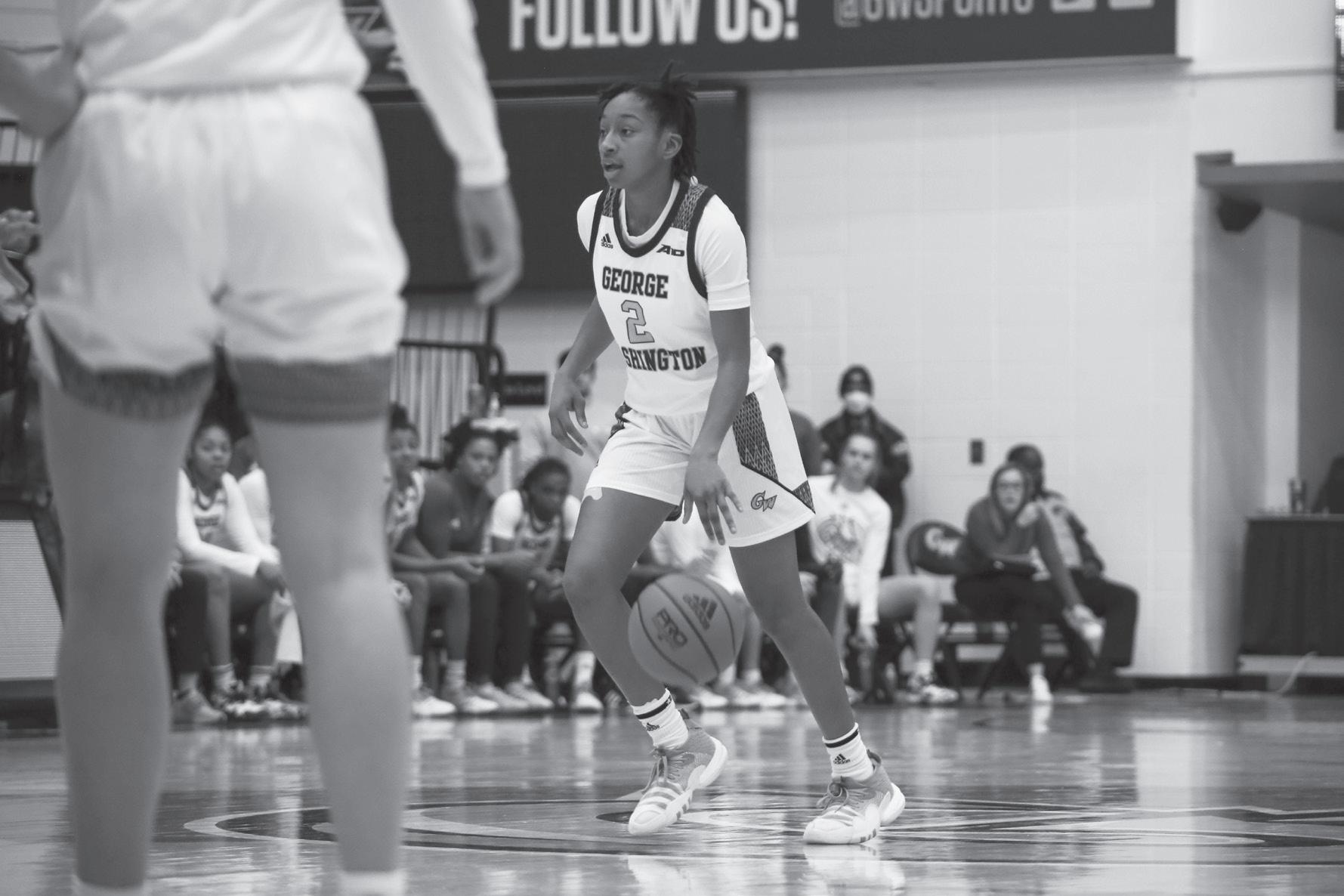
After a flu outbreak – which first hit the squad at the UNLV Thanksgiving Tournament –knocked two starters out of the lineup, women’s basketball rallied to grind out a win against Ohio as they picked up their fifth win on the season, improving to 5-4.
Season-high scoring efforts from graduate student guard Jayla Thornton and freshman guard Nya Robertson powered the short-handed Colonial offense, while senior forward Mayowa Taiwo anchored the defense, pulling down 17 boards in addition to 10 points, good for a double-double. While the Bobcats went on a few runs throughout the game, the GW lead was never in any real danger, as the shorthanded squad coasted to a 74-57 win.
“Everyone’s just trying to get healthy,” Head Coach Caroline McCombs said in a post-game interview. “But you know, people have illnesses, and that illness bug hit us in Vegas and is still lingering. So we’re trying to get healthy, and I thought today was a really good opportunity for some other players to step up and show what they can do.”
In her first start of the season, Thornton kickstarted the game with a spark, hitting her first two threes to give the Colonials an early 6-1 lead.
“I’ve been focused on, really, lately, just having my feet set and just staying locked in,” Thornton
said. “So knowing we were down in numbers, I know I have to be as accurate as possible, we all felt that way, just trying to focus on my shot was the main focus.”
She didn’t cool down for the rest of the quarter, finishing the first quarter with four triples and 14 points. Thanks in large part to Thornton’s hot hand, GW closed out the first quarter with a 23-17 lead.
The Colonials began to extend their lead in the second quarter, as a 3-pointer from Thornton with 3:09 to go sparked a 7-2 GW run that carried them into the half with a 10-point cushion 3828.
Right out of the gate in the second half, Robertson erupted. The fiery freshman scored the last 15 points of the third quarter for the Colonials, including three 3-pointers.
“It felt great just having the home atmosphere, so I had to go crazy for them,” Robertson said.
After Robertson’s huge quarter, GW’s lead grew to 14 as they led 59-45 going into the final quarter.
And the Colonials never looked back. Robertson scored 7 more points to give her a careerhigh 24 on the night as GW coasted to a 74-57 victory.
The Colonials’ 3-point shooting – a point of emphasis for the team over the off-season – was a bright spot on the night, as the team finished with 12 total.
“Since we touched down in the summer, we’ve kind of revamped our offense,” Thornton, who hit seven of her 13 3-point attempts,
said. “We have a lot of guards, and definitely a lot of people that can shoot the ball and I feel like our offense helps us do that.”
While the explosion of scoring from Thornton and Robertson captured so much attention, McCombs also stressed Taiwo’s presence for the Colonials on both ends of the floor as a contributing factor in the win.
“Tonight she was
GW Athletics’ budget outpaces D.C.area schools for 2020-21 fiscal year
NURIA DIAZ SPORTS EDITOR
With the fifth-largest 2020-21 budget in the Atlantic 10 with $27 million allocated to the Athletic Department in the 202021 fiscal year, GW saw a $123,000 increase of the disparity of its funds between the salaries in men’s and women’s programs, according to the Equity in Athletics Data Analysis, a U.S. Department of Education database released November.
There was a $4 million decrease in the Athletic Departments’ budget from 2019 to 2021 with the 2019-20 fiscal year facing a $281,327 decrease as the COVID-19 pandemic affected collegiate sports leading to the removal of seven programs due to budget cuts. GW’s Athletic Department had a budget deficit of $7 million as they were only able to garner $20 million in revenue during the pandemic.
During early August 2020, the Athletic Department announced the removal of seven programs at the conclusion of the 202021 season due to “growing financial concerns” brought by the pandemic. Men’s rowing, sailing, men’s and women’s squash, men’s indoor track, men’s tennis and women’s water polo were eliminated, cutting 118 student-athletes.
GW’s recruiting budget faced a $63,861 decrease from the 2018-19 to 2019-20
fiscal year and a $281,327 decrease from the 201920 and 2020-21 fiscal year, marking a decline within the recruiting budget in the past two fiscal years. In the 2020-21 fiscal year, GW’s recruiting budget for men’s and women’s athletics totals $69,943, outpacing other D.C.-area schools like Georgetown, Howard and American universities who spent $58,859, $27,000 and $27,065, respectively.
GW also held a strong lead compared to other D.C. schools in student aid or scholarships for female athletes, distributing $6,939,316, more than $2 million more than the next D.C. schools like American, Georgetown and Howard. Male athletes had five million dollars distributed to their financial aid, marking a $1,928,672 difference between financial aid given to male and female athletes.
The department’s men’s total operating expenses were $649,518 compared to women’s operating expenses of $571,353, marking an $1,590,641 decrease from the 2019-20 fiscal year.
Basketball was GW’s most expensive sport with $428,232 in operating expenses allocated for the year, making up more than a third of the total athletic budget.
GW’s recruiting budget between men’s and women’s teams was more equitable than its A-10 peers, with only a difference of $78,183. The budget totals a spending
average of $649,518 for the men’s teams and about $571,335 for women’s teams. These expenses include transportation, lodging and meals for prospective recruits, according to the NCAA.
GW’s most profitable and highest-funded team was men’s basketball, which generated $3,302,485 in revenue on a total gameday operating budget of about $428,232. Women’s basketball followed behind with about $2,919,494 in revenue on about the same $428,232 game-day operating budget.
Of the 449 studentathletes rostered across GW’s 18 teams, 54 percent are female and 45 percent are male. Women’s teams received a total operating budget of $1,019,199 compared to men’s teams’ $826,830. Female studentathletes were allocated $6,939,316 in aid, while male student-athletes received $5,010,644.
In 2018 when Athletic Director Tanya Voguel took her current position, she said she intended to spread financial resources to all teams.
The average pay gap between men’s and women’s teams head coaching salaries across the A-10 was $123,000, but GW’s average gap stood at $41,073, an increase from the $8,000 gap reported in the 2018-19 budget.
Athletic Department spokesperson Brian Sereno declined to comment.
tremendous,” McCombs said. “She was a great presence out there on the floor today getting good rebounds, even being like a safety for us on offense. I’m really proud.”
McCombs added that fan engagement would be key to the team’s success going forward.
“We want to try to have an atmosphere where it’s exciting and our players are excited to
play,” McCombs said. “And the fans are enjoying the style of play that we’re putting out there, so really excited to kind of continue to build on our home crowd and that home-court advantage that we want to have.”
The Colonials look to take home their second consecutive win in a matchup with TCU in Fort Worth, Texas, Monday at 6 p.m.
Men’s water polo eliminated from playoffs in conference semifinals
 SANDRA KORETZ REPORTER
The Colonials lost to Bucknell 5-7 in the semifinal on Nov. 19 after facing a mostly scoreless third quarter that gave Bison the 3-point lead they needed to ensure the win, but held onto their No. 20 rank in the Mid-Atlantic Water Polo Conference’s regular season that ended on Nov. 5.
The team also had a 15-game winning streak, which they previously achieved in 2019 after averaging 449 goals overall with a .489 attacking percentage that led them to dominate their opponents.
Graduate student center Theodoros Pateros said the regular season’s winning streak contributed to good morale and efforts through the season that continued to push players in the pool and feel as if they were creating a legacy for their season.
“I think our biggest achievement as a team was that 15-game winning streak that we had, in a sense, wrote history for the program,” Pateros said in an interview Friday. “We did something that has never been done before, so I think that 15-game winning streak is far more important than any other individual records or awards that I might have received.”
Pateros said championship play is more difficult than the regular season since the stakes are higher and the team is forced to rely on group skill rather
than individual talent since championship play requires a more complex degree of play. He said Bucknell scouted GW’s offensive skills and were able to adjust to the Colonials’ playing style for the championship.
Pateros was named to the MAWPC first team and junior goalie Luca Castorina and utility player and graduate student Nick Schroeder were named to the MAWPC second team last month. Castorina’s save percentage through the season averaged a .505 percent and contributed with 26 assists, compared to Bucknell’s Adrien Touzot with a save percentage of .541 percent. Schroeder collected 55 assists through the season, the highest among his teammates, alongside 50 goals this season.
Pateros led the team with 120 goals throughout the season, 51 exclusions or penalties drawn and the highest shot percentage of .566 percent on the team.
“There’s a handful of players that get to be on the first team so to be recognized by the other coaches, it means a lot,” Pateros said. “I’ve been working hard for the past few years to be able to be in a position when I can receive an award and help my team as much as I can, so it’s nice to see that your efforts are rewarded.”
Pateros who was also named to the Cutino Award Watch List, an award that recognizes the best player
in men’s and women’s water polo, also said he is looking forward for underclassmen to step up to fill the roles of the three departing team members and for rising seniors to lead the team and mentor a younger squad for the next season.
“It’s going to be very interesting because our team had a lot of seniors and graduate students that are departing this team,” Pateros said. “So it’s going to be a very big opportunity for all those younger players to come in and show what they can bring to the team, and I have confidence in them.”
Junior center Viktor Jovanovic, who contributed with 42 goals this season and drew 23 exclusions against opponents, said he hopes to instill confidence in younger teammates’ abilities next year as a senior as the team will no longer have as many graduate students to step up like past years.
“Something that I hope to implement is just being more of a leader,” Jovanovic said. “We’ve had a lot of grad students and seniors in the past couple years, and I haven’t really been able to step up as a leader. “
Jovanovic, who held the third-best shooting percentage on the team at .519, said the team needs to continue to practice through the off-season and to bond as a team in order to be successful next season by improving their swimming to maintain a competitive edge.
Sports
NUMBER CRUNCH
MEN’S BASKETBALL
GAMES OF THE WEEK WOMEN’S BASKETBALL vs. Manhattan Friday | 6
EDT
Men’s basketball’s home winning percentage this season, up from their five-year average of .497.
.834
vs. American
Saturday
| 4 p.m. EDT GW looks to collect their thirdconsecutive home victory as they take on the Eagles in a cross-town clash.
p.m.
The
Colonials begin the first of a threegame home stint as they take on the Jaspers at the Smith Center.
FILE PHOTO BY JENNIFER IGBONOBA | PHOTOGRAPHER
Right out of the gate in the second half, Robertson erupted. The fiery freshman scored the last 15 points of the third quarter for the Colonials, including three 3-pointers.
FILE PHOTO BY GRACE HROMIN
There was a $4 million decrease in the athletic department’s budget from 2019 to 2021 with the 2019-20
SPORTS THE GW HATCHET December 5, 2022 • Page 5
fiscal year facing a $281,327 decrease.
FILE PHOTO BY KIMBERLY COURTNEY | PHOTOGRAPHER
Graduate student center Theodoros Pateros led the team with 120 goals throughout the season, 51 exclusions or penalties drawn and the highest shot percentage of .566 percent on the team.
The GW Hatchet's
National Cathedral returns to in-person celebrations
NICK PERKINS STAFF WRITER FROM:

The orchestral performances, red ribbons and fresh evergreen pine trees are back out to celebrate Christmas at the Washington National Cathedral after two years of online concerts and sermons.
The Cathedral – located in the upper Northwest, aptly named Cathedral Heights neighborhood – embraces the holiday spirit through a number of orchestral Christmasthemed concerts, services and festive decorations that cover the entire building. After the Cathedral’s doors remained shut from March 2020 to July 2021 and temporarily closed during a COVID surge late last year, people across the District will finally be able to return to take in its signature floor-to-ceiling Christmas decorations for the first time since 2019.
“There are very few places in the entire country where you can get a Christmas service that’s quite like this, so we’re praying and lighting candles that the COVID numbers don’t turn south like they did last year,” Kevin Eckstrom, the chief communications officer at the Washington National Cathedral, said.
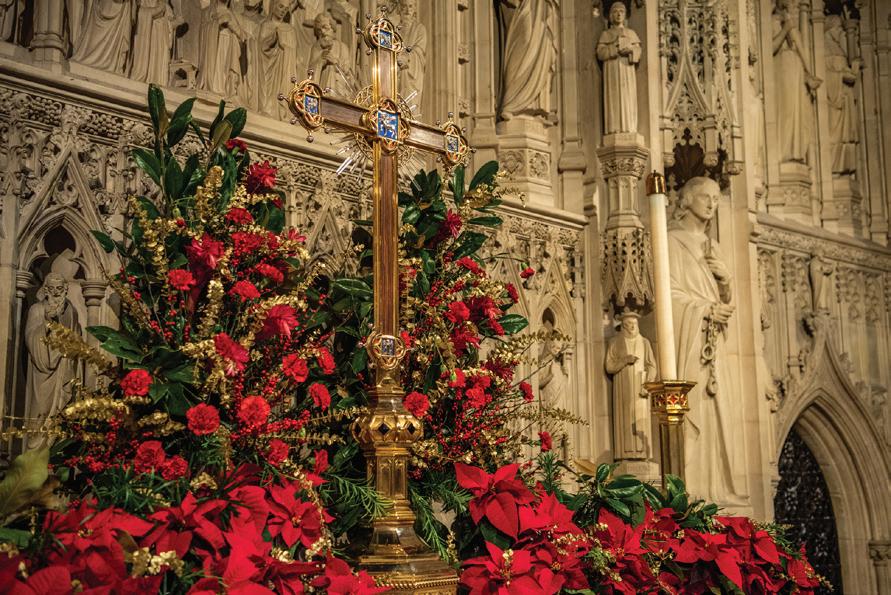
Eckstrom said starting the week before Christmas, the entire Cathedral is covered in bright red flowers, greens and Christmas wreaths – a tradition that persisted through COVID while services and concerts remained strictly streamed.
“There’s something about a big, sparse, empty cathedral that’s not super warm and inviting,” Eckstrom said. “And so they loved being able to see the flowers and the decorations, even if they were just watching it on TV.”
He said the Cathedral was gearing up for an complete in-person Christmas celebration last year, but after a few events dur-
ing the week leading up to Christmas, the episcopal bishop of D.C. ordered their doors to close after the omicron variant sent COVID cases soaring.
“They decided to cancel because they didn’t want anybody getting sick at Christmas because they came to the Cathedral,” Eckstrom said.
Eckstrom said the Cathedral pivoted back to online programming after the surge in cases, turning to socially distanced concerts that streamed online for a wider audience ranging from 3,000 to 5,000 people from six continents.
“Because it was online, anybody could come,” he said. “You didn’t have to be in D.C. to go to the Joy of Christmas, you could watch it from California if you wanted. So now we have online options to all of these services.”

Eckstrom said the Cathedral will continue livestreaming services this Christmas.
“The silver lining of this pandemic is we’re more of a National Cathedral than we’ve ever been before,” Eckstron said. “And COVID caused all of that to happen.”
Eckstrom said he expects the full capacity of 2000 to show up to the Cathedral in person for Christmas.
“People don’t want to give up Christmas,” he said. “It’s a different experience, to watch something


at home on your sofa as opposed to being in the room with 2,000 other people. So we are expecting that our Christmas services will be full.”
In the week leading up to Christmas, the Cathedral will focus on biblical music. Eckstrom said the Cathedral will host Lessons & Carols – a recitation of Bible readings and music that tell the story of Christmas by candlelight on Dec. 22 and 24, typically drawing more than 2,000 Cathedral regulars and other D.C. locals.
He said the final events of the Christmas season take place on Christmas Day with Christmas mass in the morning featuring scriptures and hymns that celebrate the holiday. He said in the afternoon, two organ concerts on the Cathedral’s famed Grand Organ will play Christmas music in honor of the day.
Eckstrom said the Cathedral’s full slate of Christmas events provides a chance for District natives and tourists alike to experience a one of a kind holiday performance.
“You’ve got people who have family in from out of town, and they want to show them D.C. at its finest,” Eckstrom said. “So they come for Christmas. This is when we throw open the doors as wide as we can. And it’s really an offering to the city and the area.”
Holiday Guide
ARTECHOUSE exhibit evokes holiday joy
As the holidays draw near, ARTECHOUSE captures the joyful elements of the season and brings them to life through a new exhibit this winter.
ARTECHOUSE, an immersive digital art center based in Southwest, takes visitors on a personal journey through a multiverse presentation of a toy factory as part of its immersive holiday exhibit known as “Spectacular Factory,” which runs through Jan. 8. The exhibit delivers nostalgic aspects of the holiday season, from a snowy city to an elaborate nutcracker toy factory in the new exhibit, through advanced technology that generates stunning visuals.
Josh Feldman, the senior manager of sales and marketing at ARTECHOUSE, said the space inspires patrons to take in the audiovisual experience of the exhibit while connecting with the works of art through motion sensing technology and interactive virtual puzzles.
“We’re giving visitors a chance to explore the sights and sounds of the holiday season we’re all very much familiar with,” Feldman said.
He said ARTECHOUSE focuses on creat-


ing memories with loved ones to give patrons the opportunity to express a child-like vulnerability as they immerse themselves in elements of the season they’ve celebrated from childhood. Feldman said ARTECHOUSE’s team is “pushing the limits” to create “ephemeral” experiences that situate each visitor in the center of the exhibit’s storyline.
The first festive element to catch your eye when you walk into the main showroom is a seasonally decorated Extended Reality bar, serving specialty holiday cocktails and mocktails.
In the main room, around five 3D projectors display stunning, crisp visuals that detect and adjust to surrounding light in order to create a responsive projection, creating a satisfying sense of coherence.
Illustrations ranging from toys, wreaths and nutcrackers decorate the surrounding walls and floor, complemented by a slow, instrumental aural harmony emitted from highquality, surround-sound speakers.
The sound inspires a feeling of nostalgia mixed with a dream-like undertone, reminding you of fond holiday memories. The visuals place you as the main character in the








middle of a story – you’ll catch familiar elements of the season like snowcovered trees as you travel through a factory manned by nutcrackers and a city covered in snow.
Fluid displays of nutcrackers dance in line and pass by while candy canes and gingerbread cookies approach on a path toward the toy factory as you reach the gates. The gates open to a massive toy factory surrounded by trees and coated with wreaths. Inside, machines produce wrapped presents and deposit them onto multiple conveyor belts.

As you walk on a motion-sensing platform, a wrapped present emerges and moves alongside as you head down the hallway before meeting the rest of the presents and falling into another web of interconnected conveyor belts. After the gifts find their way to a virtual display case, you’ll select one to reveal a surprise ranging from a toy airplane to a little dog.
Spectacular Factory offered an incredibly memorable experience brought to life through innovation. Especially during the holiday season, this exhibit creates a space to share in feelings of intrigue and a festive sentimentality alongside your loved ones.
Holiday events to visit if you’re in D.C. over winter break
DORÉ REPORTER FROM:
Despite the holiday cheer seeping through campus leading up to winter break, GW can start to feel lonely come Dec. 20 when the majority of students leave the District for the holidays.
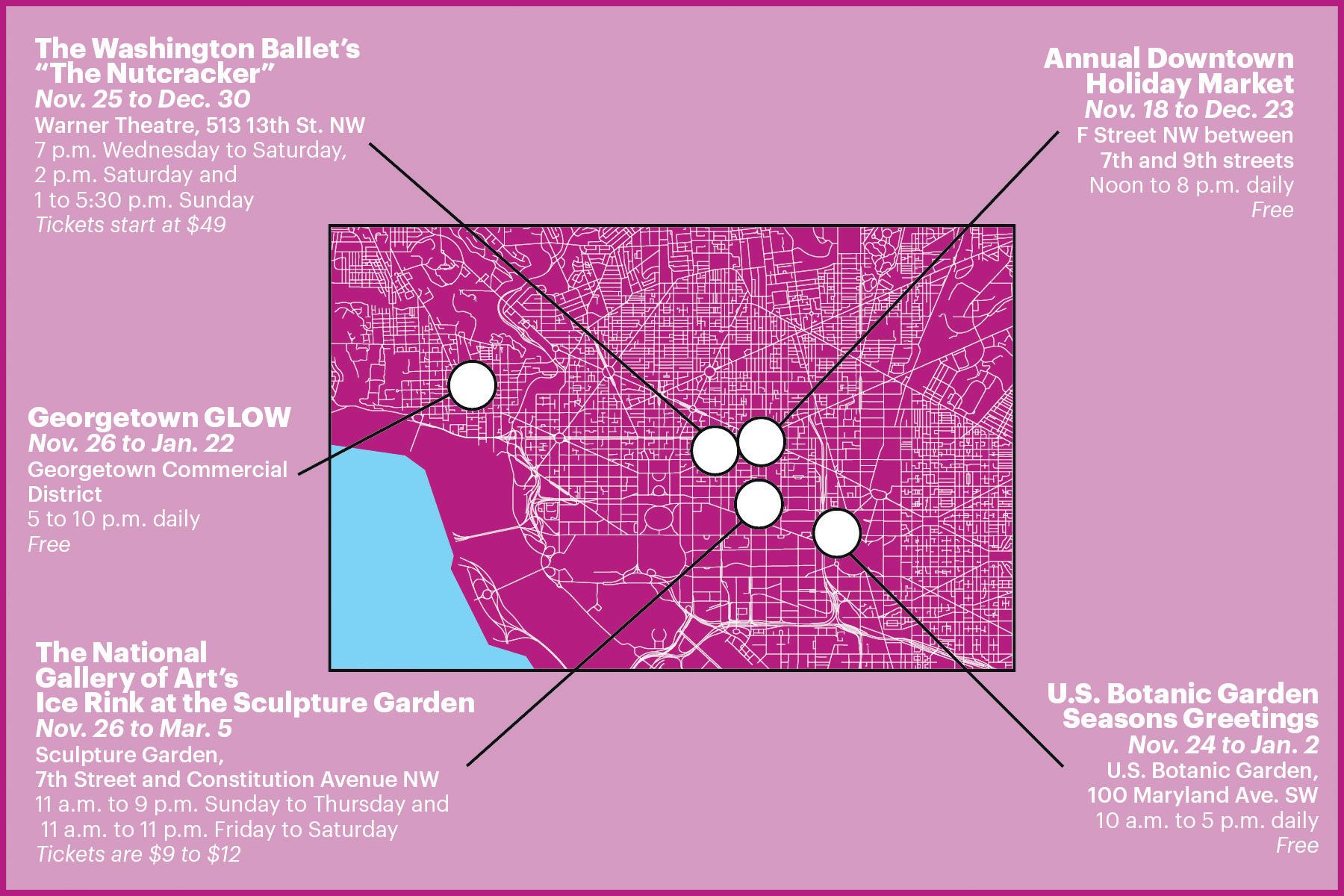
But if you’re staying on campus through winter break and searching for events to keep yourself occupied in the holiday spirit, look no further. We’ve compiled a list of enticing holiday events taking place around D.C. over winter break so you don’t have to:
The Washington Ballet’s “The Nutcracker” – Nov. 25 to Dec. 30.

This classic Christmas story, told this year with exciting D.C. tidbits at the historic Warner Theatre, takes you through a magical adventure you don’t want to miss. From a family holiday party to a sparkling snow scene to the Sugar Plum Fairy’s Land of the Sweets, “The Nutcracker” is absolutely dazzling from beginning to end. Performed by students and trainees of The Washington Ballet, this production will be sure to entrance the audience, leaving them humming the iconic Tchaikovsky score the whole way home.
Georgetown GLOW –Nov. 26 to Jan. 22.
The annual Georgetown GLOW expands throughout
each street and storefront of Georgetown’s Commercial District, making the installation an absolute must-see this holiday season. With light installations produced by five national and international artists and more than 30 walking tours, Georgetown GLOW sends you to another world. This highly anticipated display’s long-running status begs you to pay a visit if you have yet to witness its holiday magic in its past seven installations. Between the silent disco, glow-inthe-dark Pilates and yoga classes
and a one-night-only shopping event, there is no shortage of holiday cheer throughout this classic neighborhood-turned-winter wonderland.
Annual Downtown Holiday Market – Nov. 18 to Dec. 23.
Lining the Smithsonian American Art Museum, D.C.’s Annual Downtown Holiday Market boasts more than 70 vendors selling an assortment of clothing and eccentric holiday
gifts. The market offers a host of fresh food, coffee, hot chocolate and winter treats that are certain to inspire holiday cheer. Support small local businesses and do some last-minute shopping for friends and family while showing off your holiday spirit in the heart of the District.
U.S. Botanic Garden Seasons Greetings – Nov. 24 to Jan 2.
The extraordinary light display at the U.S. Botanic Garden
includes fluorescent florals, remarkable holiday decor and D.C. landmark replications, like the U.S. Capitol Building and the Washington Monument, amid the greenery and nature that draws visitors all year long. As an added bonus, G-gauge model trains are available to ride throughout the gated outdoor gardens, navigating numerous agricultural displays from all over the world, ranging from California’s Artichoke Farm to Spain’s Olive Grove. The Season’s Greetings holiday display is a gorgeous excuse to enjoy nature during the holidays surrounded by one-of-a-kind shimmering scenery filled with stunning plants like Poinsettias that are sure to put you in the holiday spirit.
The National Gallery of Art’s Ice Rink at the Sculpture Garden – Nov. 26 to Mar. 5. Each holiday season, a magical ice rink becomes the centerpiece of D.C.’s National Sculpture Garden, brought to life with large-scale sculptures from world-renowned artists Alexander Calder, Louise Bourgeois and Roy Lichtenstein. Skaters made up of residents from all over the DMV can take advantage of group or private lessons and season passes to get the most out of this once-a-year skating experience in the District. Lace up your skates and get out onto the ice over winter break. And don’t forget to warm up with some hot cocoa after.
COURTESY OF DANIELLE E. THOMAS/WASHINGTON NATIONAL CATHEDRAL
Starting the week before Christmas, the entire Cathedral is covered in bright red flowers, greens and Christmas wreaths.
LILY SPEREDELOZZI | ASSISTANT PHOTO EDITOR
Fluid displays of nutcrackers dancing in line, candy canes and gingerbread cookies approach you on the path toward the toy factory.
NICHOLAS ANASTACIO I GRAPHICS EDITOR
DIEGO HART REPORTER FROM:
ALICE
Holiday Guide The GW Hatchet's

The Hatchet staff ’s favorite classic holiday episodes to revisit over break
Although classic holiday films may be the first form of media you rush to this winter break, don’t skip out on a myriad of holiday TV episodes from your favorite series across all genres.
From “Downton Abbey” to “Gossip Girl” to “Modern Family,” nearly every classic series has tried its hand at a holiday episode or two throughout its run. Here are our staff’s top picks for the best holiday episodes to stream as soon as the season approaches:
“Gossip Girl”
Season 1 Episode 11: “Roman Holiday”
The aptly named “Roman Holiday” is undeniably among the best episodes of Season 1, chock-full of the show’s top-tier plot points.
Blair learns that her estranged father Harold is coming into town for the holidays for the first time after her parents’ separation with a surprise guest – his boyfriend, Roman. In true Blair fashion, she causes a rift between her father and Roman by inviting Roman’s ex to an annual Christmas party.
“Roman Holiday” includes heaps of the drama “Gossip Girl” fans know and love, but it ends on a sentimental note, unlike most episodes of the series. Blair, Eleanor, Harold and Roman get past the initial tension and open their gifts together on Christmas morning in a heartwarming scene. But make no mistake, “Gossip Girl” will always end on an addicting cliffhanger – this one being the fanfavorite Season 1 love triangle between Blair, her boyfriend Nate and his best friend Chuck. XOXO.
“30 Rock” Season 3 Episode 6: “Christmas Special”
A satirical sitcom from the mid-2000s, Tina Fey’s “30 Rock” tackles everything from network

television, New England and, in this episode, the holidays. After NBC and General Electric executive Jack Donaghy accidentally hits his old, badtempered mother with his car while she visits him in Florida, they have to travel back to the Big Apple to nurse her back to recovery.
Desperate to spend as little time with his belligerent mother as possible, Jack forces NBC’s writers and actors to stay on Christmas Eve to produce a holiday special, complete with fake snow, holiday music and a live studio audience. To his mother’s horror, he leaves her in his apartment, but they confront each other at the holiday special. Are Christmas carols and painted frost on fake window panes on a television set enough to heal their mother-son relationship?
This episode is a festival of laughs, perfect for anyone who needs to relieve holiday stress after spending too much time with their family.
“Community” Season 2 Episode 11: “Abed’s Uncontrollable Christmas”
Dan Harmon’s classic sitcom “Community” has a wealth of Christmas episodes to choose from, but “Abed’s Uncontrollable Christmas” is an instant
classic. In this divergence from typical live-action sitcom antics, the episode commits to the vibrant, claymation style of early Christmas films from Rankin/Bass Animated Entertainment classics like “Rudolph, the RedNosed Reindeer.”
Despite the constant quipping and gags, the episode retains its heart and consistently returns to the found-family theme at the show’s core.
“Downton Abbey” Season 2 Episode 9: “Christmas at Downton Abbey”
Julian Fellowes’ “Downton Abbey” is perfect for viewers looking to invest in a new show over winter break, especially this famous special that wraps up the second season with plenty of holiday drama. The cult classic follows the aristocratic Crawley family and the household staff that runs Downton Abbey while they struggle maintaining a favorable social standing.
The episode is a spectacle in itself, with scenes of extravagant Christmas decorations decking out the abbey and an enormous Christmas tree in the center of the main hall, covered entirely with tinsel, lights and shiny ornaments. But this is also an episode highlighting characters’ soli-


darity regardless of social standing – a reminder that’s sure to get viewers in the holiday spirit.
“Modern Family” Season 3 Episode 10: “Express Christmas” Unlike other shows whose specials deviate from the typical plot of a show, “Modern Family” holiday specials stay true to the storyline, soul and humor of the show. Season 3’s iconic Christmas episode plays into the inevitable chaos the holiday season brings.

Upon learning the extended family can’t spend Christmas day together, the Dunphy family patriarch Phil invents “Express Christmas” – a rushed attempt to expedite the holiday festivities before each family unit goes their separate ways. The audience follows the family as they split up into teams to buy presents, a Christmas tree and groceries. But true to the show’s comedic script, everything falls apart.
As the episode seems to close on a defeated family reeling from their failed Express Christmas, Jay creates a surprise winter wonderland for the kids to save the holiday spirit. The writers underscore the true importance of the holiday season –spending quality time with family.
Show up best-dressed to holiday parties with this outfit inspiration
WILLIAMS STAFF WRITER
The holiday season is prime time for parties, family gatherings and going out, but finding the most stylish outfits to wear can be as stressful as searching for the perfect holiday presents.
However, there’s a variety of cute and stylish outfits you can put together ranging from elegant formal attire to casual family gatheringwear and everything in between. If you feel like the invites are piling up but are still at a loss for what to wear, here are a few outfit ideas that will be worth your while.

Cocktail Party Scored an invite to a holiday formal but struggling to find an outfit that stands out from the crowd? Consider wearing a shimmery or satin cocktail dress. These glitzy fabrics can be both classic and chic, making them the ideal option for a formal event. If you typically reach for the uniform blacks and blues when dressing up but
are looking to up your game, try opting for a bit of color like some autumnal greens, oranges and deep purples.











Silvers, lavenders and golds can be toned-down alternatives but are just as stylish during the winter season. You can also rock a shimmery jumpsuit or match a pair of dressy pants with a sleek turtleneck or satin button down if dresses aren’t your thing.
Family Gathering
If you’re attending a family gathering and looking for an outfit comfortable enough to
wear around the house but cute enough for the off-guard picture your mom posts to Facebook without warning, here are a few easy pieces you can put together.
Pair your most comfortable jeans with a patterned or colorful statement sweater. You can also go for neutrals like a white, knit turtleneck, mid-wash jeans, and beige booties or moccasins – I recommend the uber-popular Ugg Tasmans. If you want to try a more upscale but equally comfortable look, style a pair of black pleather jeans with a turtleneck or off-the-shoulder top of
your choosing. Dark colors like deep red or forest green would look great with this look. Complete the look with strappy heels or black booties
Dorm Holiday Party with Friends Show off your style at that post-finals holiday dorm party with a monochrome look that turns heads. If you’ve already invested in that “I’ll wear this for the rest of my life” leather jacket, try wearing a black mini dress or sleeveless top and mini skirt combo under the coat. Pair it off with sheer stockings and black booties. You can also substitute the leather jacket for a patterned oversized blazer, and style accordingly. Complete the look with a pop of color with a shoulder bag or purse. You can also rock the monochrome aesthetic with a pair of patterned pants and a matching top. Try matching the accents of the pants with your top; for instance if the pants have beige accents, wear a solid brown or white top and matching shoes.
Queue up these Hanukkah hits for the holidays

The festival of lights is often underappreciated musically, but songs from the likes of Adam Sandler and Idina Menzel elicit catchy rhythms and comforting lyrics that recount the themes of freedom and celebration associated with the eight nights of Hanukkah.
From updated renditions of classics like “Oh Hanukkah” to rock songs from Barenaked Ladies, check out this broad assortment of songs we have assembled for your Hanukkah celebration. Whether you are hosting a Hanukkah party or looking for some holiday tunes while you study for finals, this playlist has it all.

“The Chanukah Song” – Adam Sandler
Created in response to the lack of Hanukkah songs in mainstream media, famed actor and comedian Adam Sandler’s song has emerged as a Hanukkah staple since first premiering on Saturday Night Live in 1994. On the Weekend Update set, Sandler sang the song while strumming the guitar in hand. Sandler lists the names of Jewish celebrities and characters like actress Goldie Hawn and Happy Days fictional stud Arthur Fonzarelli. Sandler has since released three updated versions of the song, like the most recent 2015 rendition which includes nods to rapper Drake and Frozen actor Josh Gad.
“8 Days (Of Hanukkah)” – Sharon Jones & The Dap-Kings
American funk band Sharon Jones & The DapKings has brought the soul to the festival of lights since rising to prominence in 2014 as part of a revival of 1960s-style R&B. The band’s brass instruments like offer an uplifting funk element you won’t hear in most songs about the holiday, creating a stand-out choice in this playlist. While listing off activities for each day like frying latkes and cooking brisket, the groovy rhythm and Jones’ phenomenal vocals position the song as a superior Hanukkah anthem.
“Oh Hanukkah” – The Maccabeats
“Let’s have a party and all dance the horah!” You can’t put on a Hanukkah celebration without the Maccabeats, a Jewish a cappella group formed at Yeshiva University, an Orthodox Jewish school, in 2007. Their upbeat cover of traditional “Oh Hanukkah,” is a masterful modern take on a classic Hanukkah song. The festive number celebrates the miracle of light, when the Jews were able to keep the candles in their temple lit for eight nights despite only possessing enough oil for one. The Maccabeats use the power of their voices and beatboxing in place of instruments to emulate the spirit of the festival of lights.
“If It Will Be Your Will” – Haim


If you’re looking for a more solemn holiday song, Haim – an alternative rock band composed of sisters Danielle, Este and Alana – delivers a stunning cover of singer-songwriter Leonard Cohen’s 1984 classic “If It Be Your Will.” Danielle Haim’s ethereal vocals in combination with the smooth synth-guitar instrumentals evoke a prayer of hope that things will work out if they are meant to be – “If it be your will/To make us well.”
“Ocho Kandelikas” – Idina Menzel
Renowned Broadway performer Idina Menzel gorgeously sings “Ocho Kandelikas” (Eight Candles), a traditional song written in Ladino, an older form of the Spanish language. Bosnian-American Jewish musician Flory Jagoda originally wrote the song in 1982 with many other Ladino ballads to her name. Menzel’s cover is performed in both Ladino and English, describing the childhood joy of counting the candles on the menorah. Menzel’s incredible vocals take the song to new heights, and the upbeat arrangement of the melody makes the song feel like a tropical club hit.
“Hanukkah Blessings” – Barenaked Ladies
Against a steady guitar rhythm, Barenaked Ladies sings about the meaning of Hanukkah and how it can sometimes get lost “With the jingle bells and the toys/And the TV shows and noise.” The piece grew from a desire of Steven Page, the band’s former lead singer and main songwriter, to sing about “someone who celebrates Hanukkah in a society where everyone else celebrates Christmas.” The band explores the resilience of the community, recounting the freedom the Maccabees fought for against the Greeks in the second century. “Hanukkah Blessings” feels like a warm holiday greeting to the tune of ’90s alternative rock.
NICHOLAS ANASTACIO I GRAPHICS EDITOR
FLORENCE SHEN I PHOTOGRAPHER
Shimmery and satin cocktail dresses can be both classic and chic, making them the ideal option for a formal event.
GW HATCHET STAFF FROM:
ABRIGAIL
FROM:
ANASTACIO I GRAPHICS
LAUREN SIMON REPORTER FROM: NICHOLAS
EDITOR
How to throw your holiday party with festive charm and cheer
PATRICK REPORTER FROM:





As the year draws to a close, the winter season will undoubtedly bring the traditions of red ribbons, pine trees, ornaments and the pressure of throwing a properly festive holiday party.
When it comes to party activities, seasonal snacks and festive finishing touches, enhancing a holiday function doesn’t need to be as daunting for a host as it may seem. For exciting and easy ways to spice up your next celebration, here are our top five tips to add a little magic to your event without adding too much effort to your workload.
Focus on the food
The nostalgic flavors of the holidays are an essential part of any snowy soiree, and no holiday party is complete without seasonal favorites like gingerbread, peppermint, cinnamon and eggnog. Bake a batch of decorated Christmas cookies, plan a gingerbread housebuilding contest or craft a signature cocktail with peppermint liqueur to pay homage to the classic treats of winter’s past. If you plan on serving a meal at your party, consider inviting guests to bring along their favorite holiday dish to facilitate a potluck. Encourage an inclusion of multicultural cuisines to enhance your pitch-in, assigning each guest a new recipe to try. Or stick to a selection of redor green-colored dishes for a
Christmas theme with an extra challenge.
Deck the halls
Putting up holiday decorations doesn’t have to be reminiscent of the extravagance seen in “National Lampoon’s Christmas Vacation,” complete with a giant tree, gaudy roof decorations and enough Christmas lights to cause a power outage. You don’t have to go over the top to prepare your home for
your holiday party – a little can go a long way. Creating paperring garlands, topping your table with wrapping paper as a runner or hanging up a storebought or DIY wreath on your door will be more than enough to spice up your space. Even with Christmas tree alternatives, the options are endless. Miniature plastic models and smaller plants like a rosemary shrub can replicate that classic evergreen look, while life-size
The District’s most festive holiday cocktail offerings
 CLARA DUHON CULTURE EDITOR JULIA KOSCELNIK ENTERTAINMENT EDITOR
Rock the night away with a dazzling selection of holiday cocktails from around the District that are sure to welcome in the joyful season.
Take a break from finals to mix and a-mingle at nearby bars, restaurants and pop-ups with a festive drink in hand. From Adams Morgan to 14th Street to Dupont Circle, discover some of the most merry and bright seasonal cocktails, like a festive take on a Cosmopolitan and spiked hot cocoa, to finish the semester on a celebratory – and boozy – note.
Urban Roast’s “White Peppermint Espresso Martini”
This wintery martini ($17) will tastefully hit the spot with an added kick. Crafted with vodka, kahlua and espresso, the cocktail packs decent strength and a bitter coffee taste, both balanced out by the sweet white chocolate and peppermint syrup. The martini doesn’t err on the side of too sweet, and the hint of peppermint won’t overshadow the smooth
espresso flavor central to the drink.
Urban Roast, a Penn Quarter restaurant and bar specializing in seasonal offerings year-round, boasts an extensive collection of 13 holiday drinks this season. Sip on this chilly and elegant martini as you admire the restaurant’s extensive holiday decor – complete with colorful lighting, presents hanging from the ceiling at the bar and a snowy wonderland in a dining room.
916 G St. NW. Seasonal cocktails offered for a limited time.
Death Punch’s “Elfing Around”
You’ll find strings of Christmas lights, festive balloons, nutcrackers and a classic Christmas movie playing on the TV at Adams Morgan sushi bar Death Punch’s holiday pop-up, “Miracle.”
Complemented with bitters, the “Elfing Around” cocktail's ($16) mulled wine reduction elicits the crisp chill of a cold winter’s night. A slight bubble from the prosecco adds an enticing layer to the drink, but the gorgeously spiced and fruity flavor from the reduction masks most of the alcoholic kick from the sparkly wine and gin.
Even for those who don’t celebrate Christmas, usher in the merriment and jolliness of the season with this chilly cocktail.
2321 18th St. NW. Popup runs through Dec. 31. Open daily from noon to 2 or 3 a.m.
Garden District’s “Santa’s Little Helper”


Garden District is one of 14th Street’s many beer gardens, but its unassuming-yet-appealing outdoor holiday decorations like light-up Santa statues, candy canes and garlands set it apart from its competitors. Customers can order cozy, warm beverages from the limited-time holiday menu.
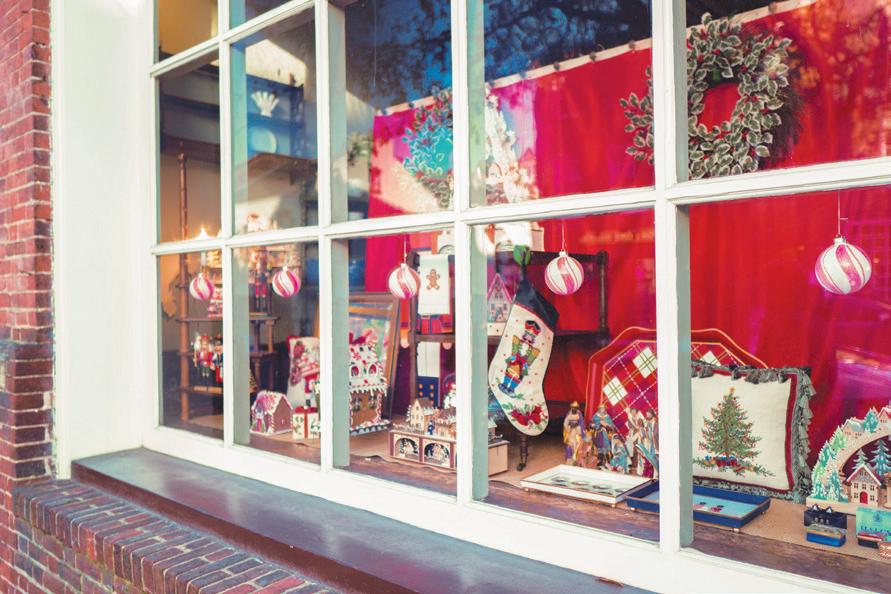
Garden District’s “Santa’s Little Helper” ($12) is a simple-yet-delicious take on spiked hot cocoa, mixed with peppermint schnapps for a minty and boozy kick. The two heaping marshmallows sitting atop of the drink are roasted to perfection, adding a necessary sweetness when dipped into the strong drink. If you’re in search of a no-nonsense seasonal beverage to put you in the holiday spirit without all the bells and whistles, this drink is for you.
1801 14th St. NW. Seasonal cocktails offered for a limited time.
wall decals keep up the festive spirit without sacrificing the floor space.
Incorporate inclusivity



The winter season encompasses a variety of diverse religious, regional and cultural holidays – the weeks from December to January include celebrations like Hanukkah, Kwanzaa, Christmas, Bodhi Day, Yaldā Night, Yule and many others. If your guests celebrate
different holidays, consider organizing a conversation with your group before the event to brainstorm how all guests can incorporate their own traditions. Celebrating multiple religious and cultural traditions instead of one will make your holiday party more inclusive of all beliefs and practices. Your party should be enjoyable for all of your guests without making anyone feel excluded or uncomfortable.
Embrace the spirit of the season
For a cheerful and charitable activity to share with your guests, plan a collaborative craft to support a charity during your party. Many local organizations would appreciate extra support during the holiday season, including resource programs, food pantries, soup kitchens and hospitals.
House of Ruth’s annual Gifts for Families program – which collects holiday gifts for women, children and families healing from trauma, abuse and homelessness – is just one of many causes to get behind during the holiday season.
Set up a table to write holiday cards for hospitalized children around the nation, make fleece tie blankets for those in need, build care kits for the unhoused community or coordinate a small supply drive for a food pantry. This season is all about giving, so consider donating some of your time to the charities that need it the most.
Go-to gi s for every personality on your list




Unless gift-giving is your love language, the holidays can be a tricky time to pick the perfect purchase for your loved ones.
Finding a flawless gift during the holidays can sometimes feel impossible, especially when dealing with a gift exchange with coworkers or buying a courtesy present for your great aunt who you hardly know. We’ve put together a comprehensive gift guide for the mix of interests and personalities piling up on your shopping list this holiday season, from the traveler to the kitchen connoisseur.

The music lover: When finding gifts for a music lover, start by identifying their favorite band or artist. Books about their most loved instrumentalist, producer or rapper would make the optimal tabletop decoration for their room on campus or back home. Look no further than a turntable or record player for someone who enjoys listening to music at home and will appreciate an antique look over a modern Bluetooth speaker. If your music-loving friend is already an avid vinyl collector, vinyl covers to frame and display all-time favorite records would also make the perfect gift.
The sports fanatic: A favorite team’s jersey or T-shirt can seem like the obvious choice as a gift for die-hard sports fans, but there is no need to limit your options there when prices can easily soar into triple digits. These custom candles inspired by the scents of Major League Baseball stadiums around the country, like the distinct smell of milkshakes and churros at Yankee Stadium and the aroma of
fresh ivy, grass and lemonade at Fenway Park, are sure to please the baseball fan in your life. For a fan of NASCAR, race car LEGO models double as a toy for a younger fan and a bookshelf decoration once completed.
The creative fashionista:
Shopping for fashion and beauty-related items can be overwhelming because of the sheer amount of makeup, clothing and beauty options, but a much-needed staple for a wintery fit goes a long way. These trendy Aerie flared leggings, which you can find all over campus, are a safe bet for those who love a relaxed and comfortable style. Pair them with a thick sweater and winter coat to stay warm and cozy during the winter months. For homebodies, these smiley-face slippers will certainly suffice. A trendy recycled tote bag is the quintessential choice for running errands and carrying daily trinkets, so gifting one would be perfect for someone who’s always on the go.

Your partner’s parent: If you’re traveling over break to meet your partner’s family – perhaps for the first time – you may be at a loss for a foolproof
gift for their parents that will leave a lasting impression. A custom stamp maker is a timeless gift and will come in handy over the holiday season to address thank-you-note stationary. These beautiful home state mugs make for a personal-yet-tasteful and understated gift. For a universal option, a nice candle set is your best bet, especially if you do not know their parents’ personal tastes very well. Gift shopping for a partner’s parents can seem tricky and intimidating, but simple and practical is ultimately the way to go.
The travel lover: When searching for a gift for a travel aficionado, avoid a tacky, impractical or gimmicky gift in favor of usable or sentimental items. An exceptional toiletry or makeup bag is essential when packing for a trip, particularly one that’s waterproof to keep belongings safe from accidental spills or splashes. For your friend or roommate preparing to embark on a study abroad journey next semester, a travel journal is a creative and personal way for them to document their new adventures overseas. A custom map print can also commemorate a homeland or destination that your global traveler can’t stop talking about.
KIMBERLY COURTNEY | PHOTOGRAPHER
Finding a flawless gift during the holidays can sometimes feel impossible, especially when dealing with a gift exchange with coworkers.
Guide The GW Hatchet's
MAURA KELLY-YUOH I CONTRIBUTING DESIGN EDITOR
Holiday
LAUREN
FROM:
SANDRA KORETZ REPORTER
FROM:
NICHOLAS ANASTACIO I GRAPHICS EDITOR
