The Guardsman
“Amplifying Sanctuary Voices” Exhibit Gives Power to Migrant Voices
By Beth Lederer bethlyn2020@gmail.com
Amplifying Sanctuary Voices
(ASV) is a community based oral history project that promotes empathy, healing and justice through storytelling. The “Amplifying Sanctuary Voices” exhibit is showcased at the Rosenberg Library, Ocean Campus at City College for the entire Spring 2023 semester. The exhibit offers a humanitarian and empathetic look at the migration problem plaguing the world today.
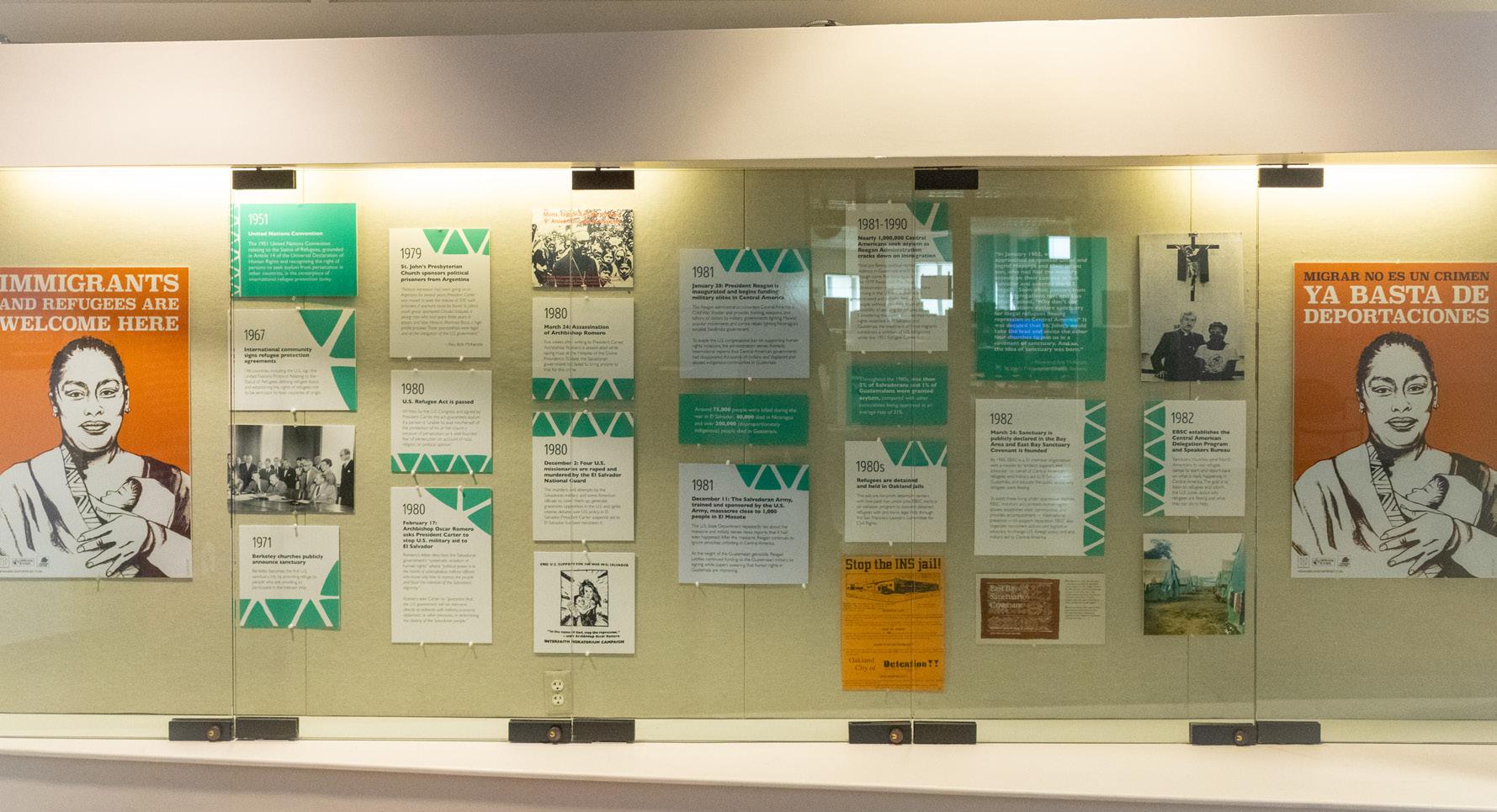
This multimedia exhibit offers historical facts paired with beautiful artwork, posters, collages, and a looping video series showcasing migration stories. There are also posters amplifying the refugees’ voices, telling their unique stories.
Librarian Michele Mckenzie and English Professor Steven Mayers emphasized the importance of students knowing there is a City College Amplifying Sanctuary Voices
exhibition research guide https:// library.ccsf.edu/asv/home which is an integral part of the exhibit.

The resource guide is an online educational tool that offers vital information about the organizations involved in the exhibition’s creation. With links to numerous books, videos and topics like the sanctuary movement, Voice Of Witness (VOW) oral history series, migrant stories and climate change affecting world populations, the guide is a valuable resource for anyone seeking to learn more.
According to Mayers, putting together the research guide was an extensive project and a collaboration of many different organizations including East Bay Sanctuary Covenant (EBSC), ASV, Voice of Witness (VOW), Voices UnMuted, and Mayers himself. A video presentation, “INTO THE LIGHT (Stories and Lived Experiences of Immigration)” is showcased at the exhibit and can also be accessed through the library’s
Mission Campus
Entry level ESL classes attract up to 70 students per class
website. In this video, there are short presentations from the authors bringing power to their personal stories.
Youth UnMuted, one of the collaborators in the exhibit, who seeks to elevate displaced youth voices through creative storytelling and art workshops, presented “Now You Hear Us Podcast - Episode 1Pavie’s story.”
The co-founders are Daphne Morgen and Hannah Burnbaum who founded the program in response to the lack of programming for refugee youth in Greece. Morgen also participated in the opening day exhibit by bringing her middle school students from Brightworks SF.
In Pavie’s story, the video showed a 16-year-old girl originally from Afghanistan appearing to be underwater blowing bubbles. In her podcast, she talked about the depth of her tragedy: “I want to find some
Exhibit continued on page 2
By Ellen Yoshitsugu egiese@mail.ccsf.edu
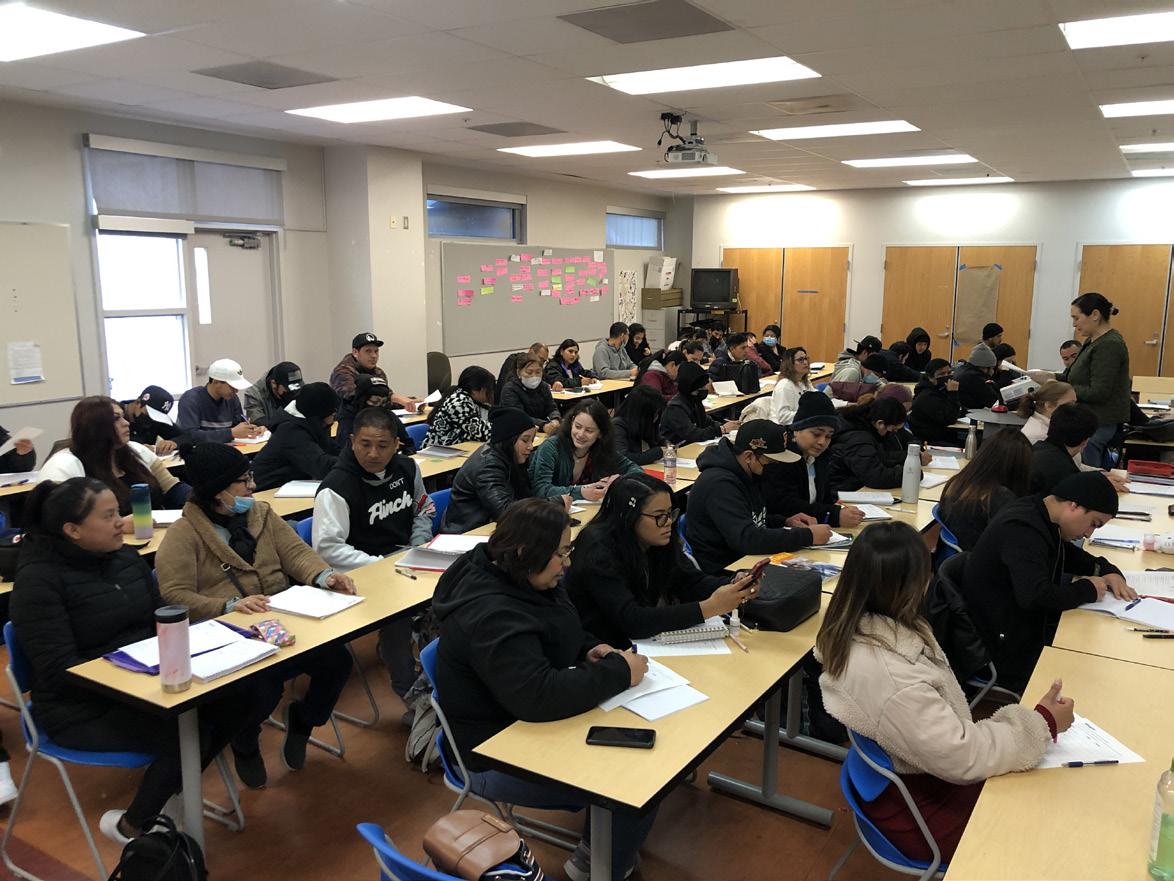
Many beginning noncredit ESL classes at City College’s Mission campus are packed with students, from 40 to 70 students per class, making teaching and learning difficult. City College's mission to provide ESL instruction to San Franciscans who need it has been undermined by the college’s limited budgets in recent years.
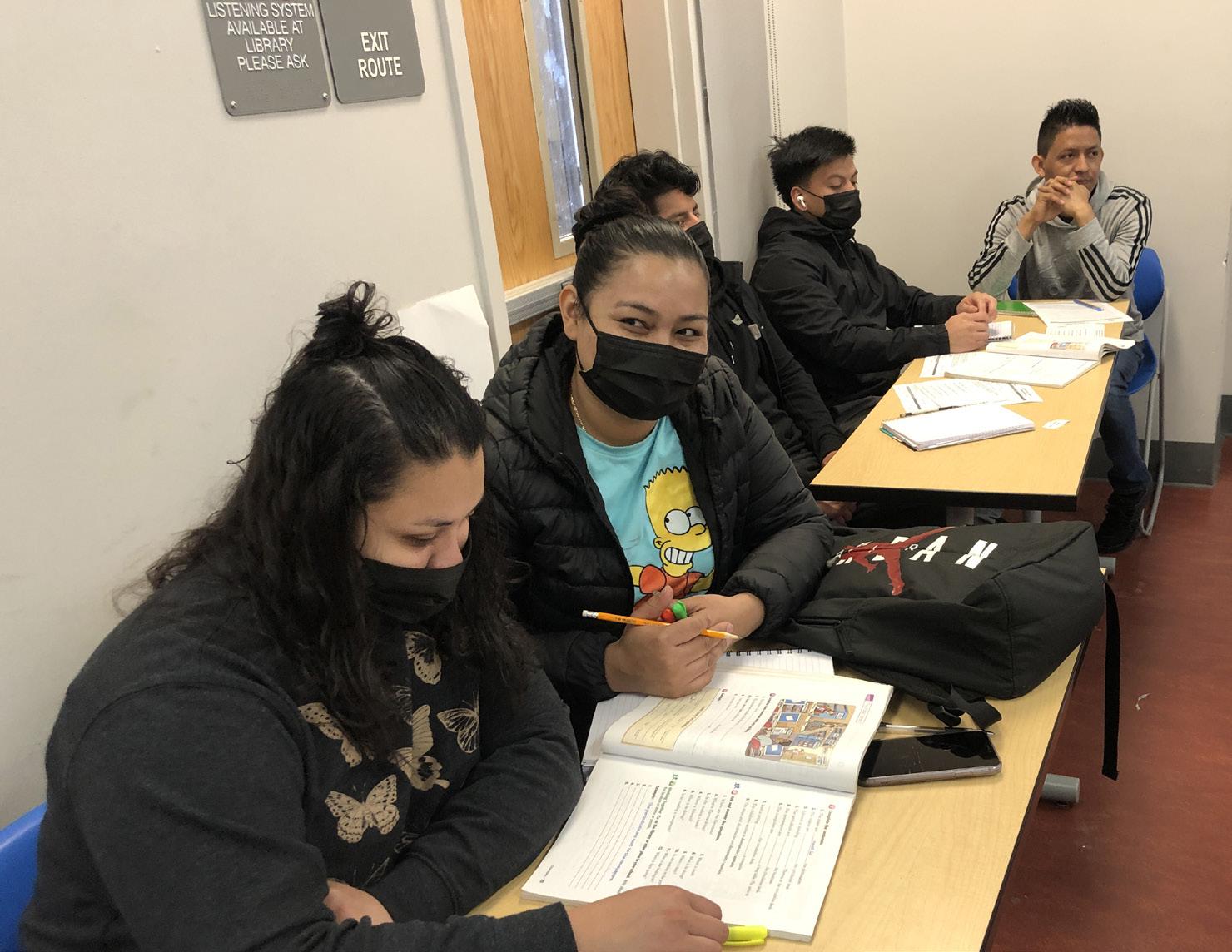
Morning classes in Room 106 at the Mission campus are packed every day. Teachers Patty Gallagher and Lori Admokom single-handedly each lead 50, 60, even 70 students in call and response rote lessons. Students share battered textbooks. It is the same in some, but not all, other Mission ESL classes.
ESL department chair Jessica Buchsbaum said, “There is very strong enrollment and very strong attendance” at Mission campus, adding that at all the ESL program locations that remain open — Chinatown, Downtown and Ocean
— attendance is also strong, ranging from 20 to 50 per class. Online classes are also extremely impacted, some with 70 students on Zoom.
“The English language is a lifeline to a new future, to help their families,” said Admokom. The lowest level ESL classes are seeing particularly high numbers of students who have just arrived in the Bay Area.
Not Fair to Students
Twenty to 25 students would be the optimal class size, said Buchsbaum. Beginning students should have frequent one to one interactions with the teacher but in large classes this is impossible. Admokom estimated that students will take twice as long to advance because they are “just repeating back, parroting, but that's not real life language use.”
She said that the large classes are only doable because the students are great and want to learn, but that “this should not be the norm for education for anybody.” The students get it but “they don't like it.”
ESL Continued on page 2
Faculty and Students Struggle to Recover from Last Year’s Layoffs
Renée Bartlett-Webber rbartle8@mail.ccsf.edu
City College’s Broadcast Electronic Media Arts (BEMA) is one of the 18 departments that had layoffs last year and its faculty are struggling to sustain certificate offerings. This challenge is not unique to BEMA but the department illustrates the extensive repercussions from the loss of educators.
BEMA department Chair Dana Jae Labrecque voiced concerns about her ability to even continue the program in the Jan. 26th board meeting. Since then, she gained the bare minimum
requirements that will help push her programs forward, but her work is far from over.

The Board of Trustees approved layoffs of 50 full-time equivalent faculty in February 2022 that would take effect in May the same year. Before members voted, they discussed potential ramifications with Chancellor David Martin. “I do not believe that any of these layoffs
would directly impact the ability of any of our students to obtain or achieve their academic goals or certificates,” he said. He also said that there would be options to bring back faculty if there was an unforeseen windfall after the decision.
Labrecque, like many other educators, continued scheduling her classes as budgeted. “But on the last day of school in spring 2022,” she said, “ the chancellor called an emergency meeting where he said that you will not be able to bring back your full-time faculty for 39 months.” She said that the chancellor formed this rule to avoid lawsuits
from laid-off faculty, as advised by his lawyer. “It’s like burning your house down to prevent thievery!”

Labrecque is advocating that the board have a chance to vote on this 39-month hiring limitation.
Chancellor Martin did not respond to The Guardsman’s request for comment before the deadline of this publication.
With only four of eight faculty members remaining in her department, Labrecque “spent the whole summer” cutting her course offerings, slashing the certificate requirements, and petitioning the administration for more faculty
hours and teachers. Only one beginner studio class remains this semester and the studio is overcrowded with 1.5 times the ideal capacity. “I never thought I’d be sitting here cutting the programs I’ve been developing for 22 years.”
BEMA student Casey Hudson had quit their job to start the live sound certificate program and they need the beginner livesound class as part of the requirement. “[Labrecque] taught it in spring of 2022 but I didn't have the prereqs yet. And then she's not able to teach it again until spring of 2024. Continued on page 2
Vol. 175, Issue 3 | Mar. 1 - Mar. 15 | City College of San Francisco | Since 1935 | FREE | www.theguardsman.com Sports Calendar Page 7 IDST Poetry Page 4 Heating Costs Page 6
Instructor Patty Gallagher leads a group lesson in her 8:30 a.m. ESL Beginning Low 1 class at City College’s Mission campus. Photo by Ellen Yoshitsugu/The Guardsman.
"I'm really stuck helping people for free for a long time"
Amplifying Sanctuary Voices, an exhibit at City College Rosenberg Library. A storytelling initiative led by East Bay Sanctuary Covenant (EBSC). Image of exhibit case featuring details about significant historical events in a timeline. 1951-1982. February, 7 2023. Photo by D. Eric Bean/The Guardsman.
ESL Continued from page 1
Student Sandra Lopez said she wants to learn English to get a better job and Ricardo Miranda said that City College's support for the Latin community is very important.
“As long as there are seats we don’t turn them away,” said Admokom.
But actually the Mission campus has had to close enrollment in some classes when they reached the enrollment cap of 100 students, according to Buchsbaum. The cap is set very high because in non credit classes with open enrollment, not all students attend class every day.
ESL Department Funds are Limited
Classes are huge because no more sections can be opened. Buchsbaum explained that they are allocated a certain amount of money by the City College Office of Instruction with which to offer classes while balancing the needs of different communities. This is the case for all City College departments.
In previous years, when demand for ESL grew, the college opened new sections until they ran out of classrooms, sometimes even holding classes in the cafeteria, said Carolyn Cox, a 42 year veteran ESL teacher. She said currently there are empty classrooms and recently laid off teachers ready to teach.
Buchsbaum said they have added some sections at Mission this semester, but it's still very full. “When the college was doing better financially they had the flexibility to augment the budget for a particular program.”
“So how are we going to increase our enrollment if we don't actually increase the number of class sections?” Buchsbaum asked.
and College Preparation (CDCP).
There is also extra funding through a California Adult Education Project (CAEP) grant. Cox said that the students are tested twice in the semester and the school gets money based on their improved scores.
This year the Comprehensive Adult Student Assessment System (CASAS) test was completely online for the first time. Some students were never tested because with the large classes there were not enough computers at Mission campus to test them all.
Need for Local Programs
Only about 20 of the 120 regularly attending students from the abruptly closed John Adams ESL program are now attending at Mission, according to Kevin Cross, a teacher newly reassigned to Mission.
it really has to be close to them,” she continued.
“Mission demand is Mission demand,” said Buchsbaum.
Cross and colleague Diane Wallis have experienced two ESL program closures, first the Civic Center location in 2015, and then the John Adams program in December. They and some of their students have protested, made public comments, and met with Chancellor David Martin, Trustee Alan Wong, and Supervisor Dean Preston, arguing for the re-opening of the John Adams ESL program.
Trustee Solomon Responds

“We need to get the data. We need to present the data to show that it's in fact true that students who would be taking classes are being turned away. And students who would be going to John Adams are now not showing up,” said Trustee Susan Solomon.
Layoffs continued from page 1
Without experience I don't feel like I can really get a live sound job. So, I'm really stuck helping people for free for a long time.”
“We could sign up for our classes like normal, and then over the summer, all of a sudden most of my classes were dropped,” said student Maura Cotter. Some courses were added back after she sent a letter to the board, but she had to stay an extra semester to finish her certificate.
Labrecque has fought for concessions on
Additional Funding
California funds City College’s non credit programs based mainly on student attendance.
There is extra funding for some noncredit ESL classes designated Career Development
Student Thanh Nguyen and her husband used to walk 30 minutes to their ESL classes at John Adams; now they have an hour-long bus ride to reach the Mission campus.
Immigrants usually work two to three jobs and sometimes can’t afford transportation, said Admokom. “So if they're going to take a class,
Lost students mean lost revenue for the college, she continued, “which creates the potential for a downward spiral.”

“What happened to those students who were in school? [Did] they find another place to go to school or did they simply stop trying?” said Solomon.
behalf of her program and as of Feb. 17, the BEMA department had granted her minimum request of three additional weekly teaching hours. But this is only the first of many administrative steps required to bring back the classes she believes her students need. “I do see a little light at the end of the tunnel because I got the minimum I asked for. Now I have to figure out how to step down as chair.”
BEMA is one example of a department that has had to severely cut class offerings and as a result, left students struggling to complete their certificates. Hudson said that whoever is making the decisions at the college “doesn't realize what an asset they have in the BEMA department and Dana. She has made this incredible program and it wouldn't be that program without her, but they're burning her out!”
"So how are we going to increase our enrollment if we don't actually increase the number of class sections?"
NEWS | 2 Vol. 175, Issue 3 | Mar. 1 - Mar. 15 Staff Editor-in-Chief Visuals Editor Opinion Editor Illustration Editor Social Media Editor Design Editors Ellen Yoshitsugu egiese@mail.ccsf.edu Fran Smith franchon.smith. theguardsman@gmail.com Renee Bartlett-Webber
Fran
Derek
Cindy
News Editor Culture Editor Sports Editor Layout Editor Ann Galvan agalvan1@mail.ccsf.edu Emma Pratt espratt8@mail.ccsf.edu Onyx Hunter onyxhunter@gmail.com Sebastien
rbartle8@mail.ccsf.edu
Smith franchon.smith. theguardsman@gmail.com
Chartrand Wallace dwalla30@mail.ccsf.edu
Chan Linda Liu Sebastien Thugnet
Thugnet sthugnet@mail.ccsf.edu G
Students share workbooks in Instructor Lori Admokom’s 10:30 a.m. ESL Beginning Low 2 class at City College’s Mission campus. Photo by Ellen Yoshitsugu/The Guardsman.
"If I step down, I’ll be able to bring the audio classes I need to next fall."
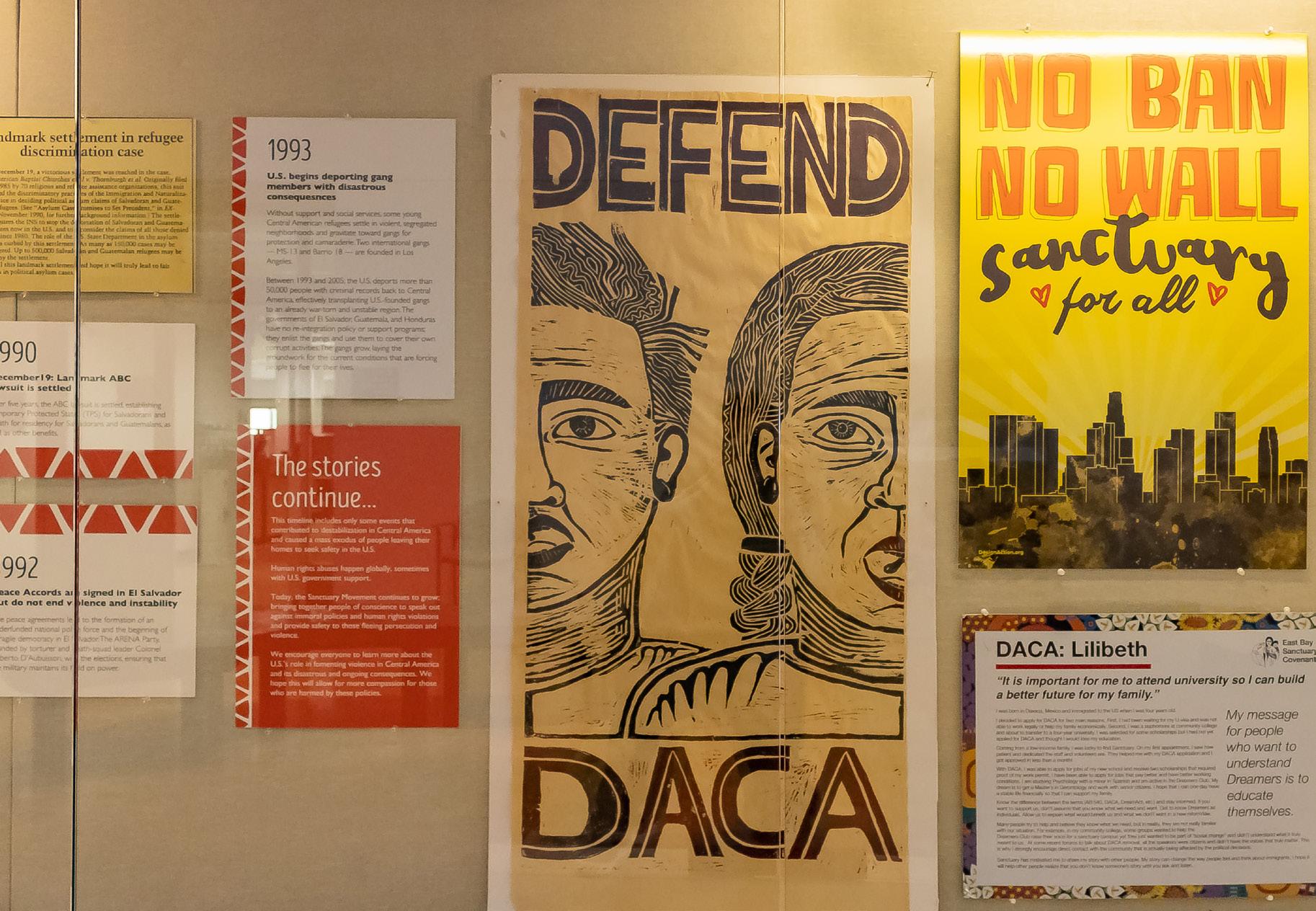
Amplifying Sanctuary Voices, an exhibit at City College Rosenberg Library. A storytelling initiative led by East Bay Sanctuary Covenant (EBSC). Image of exhibit case featuring Defend DACA and NO BAN NO WALL posters. February, 7 2023.
Photo by D. Eric Bean/ The Guardsman.
Amplifying Sanctuary Voices, an exhibit at City College Rosenberg Library. A storytelling initiative led by East Bay Sanctuary Covenant (EBSC). Image of exhibit case featuring "White Supremacy is Killing Me" poster with art above. February, 7 2023.
Photo by D. Eric Bean/The Guardsman.
Lauren Muller: An Honored Faculty and True Champion for Social Justice
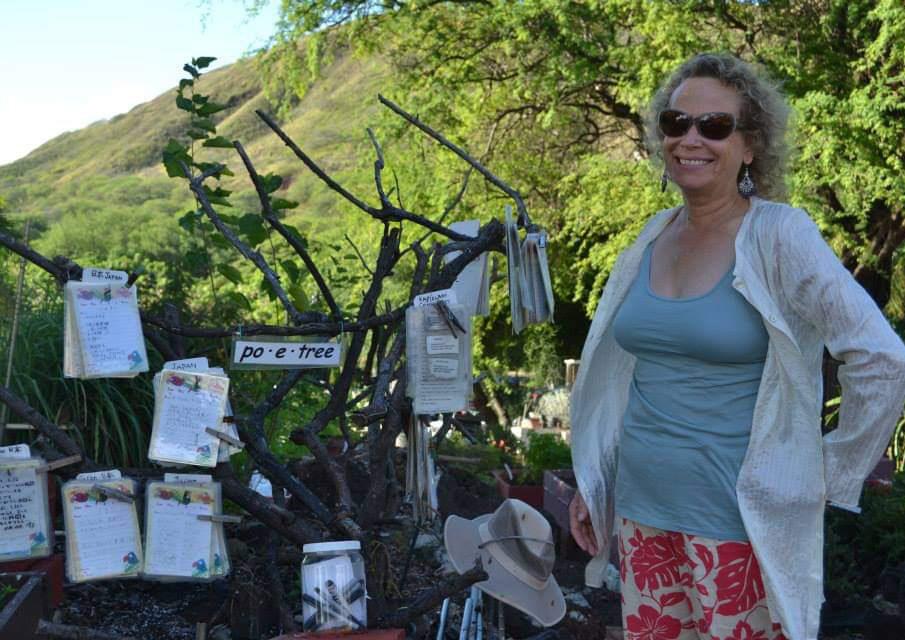 By Leslie Simon lsimon@ccsf.edu
“She took a sleepy department and built it into something magnificent.” That was what Don Griffin, former City College of San Francisco chancellor, said about Lauren Muller. He knew what he was talking about.
Initially hired in 2000 to teach “Poetry for the People,” a course instituted at City College in the 70s, Lauren became department chair of Interdisciplinary Studies in 2002. She proceeded to foster new courses and then entire programs–in Critical Middle East Studies/SWANA, Critical Pacific Islands and Oceania Studies, and Trauma Prevention and Recovery. She transformed the department into an incubator for innovative, cutting edge multicultural and social justice classes. Along the way she mentored faculty and helped them realize their dreams.
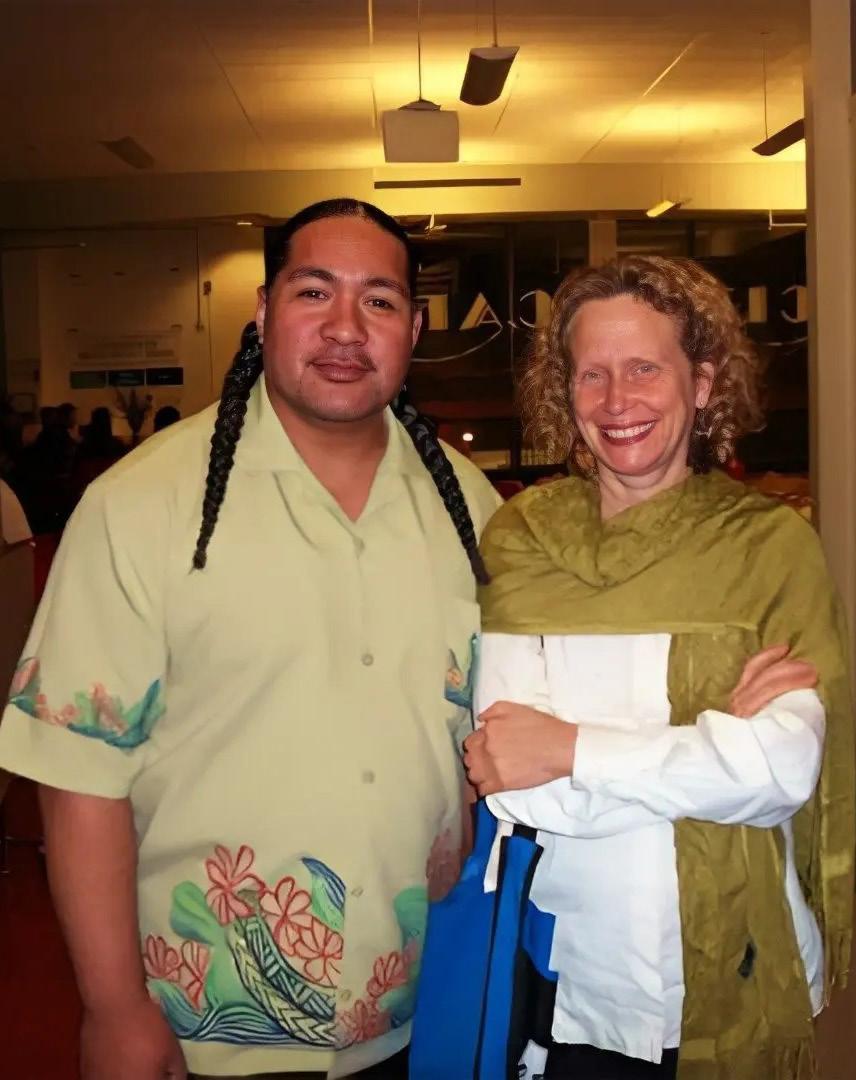
Lauren took the cluster of introductory anti-oppression courses and turned them into the Diversity and Social Justice Certificate. She did the same for the Design Collaborative Certificate, and she sheltered Groundswell, the college’s architectural literacy program. With other faculty, Lauren worked to bring college classes to the local jail so that incarcerated people could find focus, along with hope for a productive life after serving time. She initially taught Museum Studies and then facilitated its success when she passed it on to colleagues. Always generous with her time, her knowledge, and her vast resources, she led interdepartmental Ethnic Studies and Social Justice meetings with compassion and humor.
Lauren loved working with students to create celebratory poetry readings at the end of each semester, and during Domestic Violence Awareness Month, she inspired survivors to craft powerful poems for the annual “Speak to Me” reading.
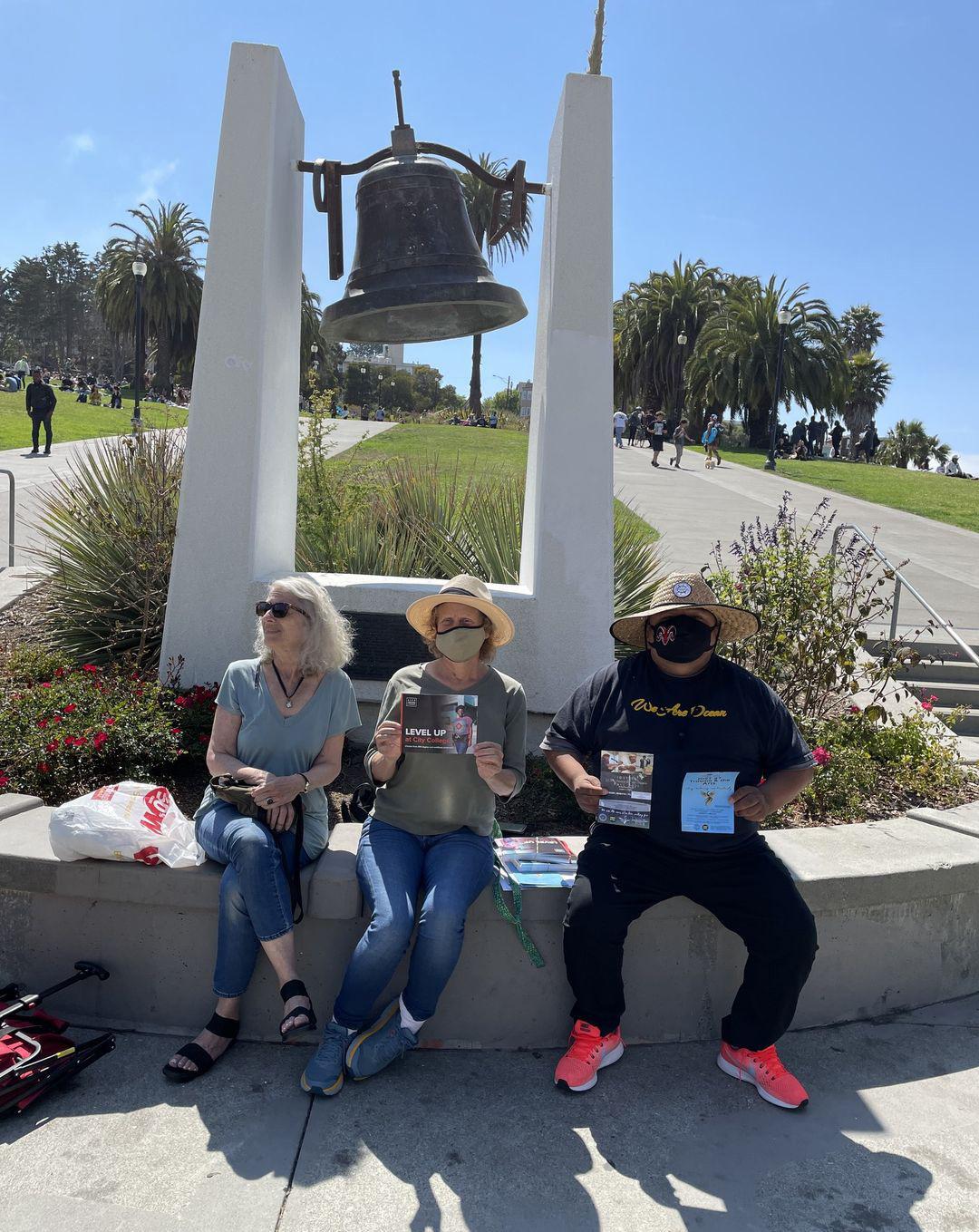
One of her favorite, though deeply challenging, courses to teach, “Trauma and the Arts,” stirred students to heal from their own wounds through the lens of contemporary art and literature. Her gentle and brave approach to analysis of works of art motivated by grief and loss prepared students for careers in violence prevention and intervention. She encouraged her students to move forward as wounded and grounded healers.
Fearless, Lauren stood up to the occasional unfriendly administrator. Gracious, she forged collegial friendships with administrators who supported her visionary approach to teaching and learning.
Lauren’s legacy at City College is immeasurable. It will continue to grow in classrooms and the larger City College community to which she was devoted.
Exhibit continued from page 1 pieces of my existence in this way, the lost pieces that I have left in different lands.” She continued, “I want to talk about unattainable dreams, of small and big dreams that suffocate, burn in the fire, their blood spilling on the roads.”
Listening to these individual stories, Mayers said, “is the heart of the exhibit; when you hear people's stories, then you really care.”
At City College, Mayers is an English Professor as well as co-coordinator of City College’s Puente Program at Mission Campus. The Puente Program utilizes a three-pronged approach of writing instruction, counseling, and mentoring to support underserved students in transferring to a four year university. The two Puente classes were present for the opening day of the ASV exhibit on Jan. 25.
Mayers got involved in the ASV project through an oral history project he did with VOW. Mayers writes and conducts oral history research. He had co-written a book in 2019 with Pulitzer Prize Author Jonathan Freedman called “Solito, Solita: Crossing Borders with Youth Refugees from Central America.”
“Solito, Solita” is part of the VOW book series on human rights.
City Dream is another sponsor of the exhibit at City College. City Dream works with undocumented students at City College. The students from City Dream will be conducting an oral storytelling workshop at the exhibit in March.


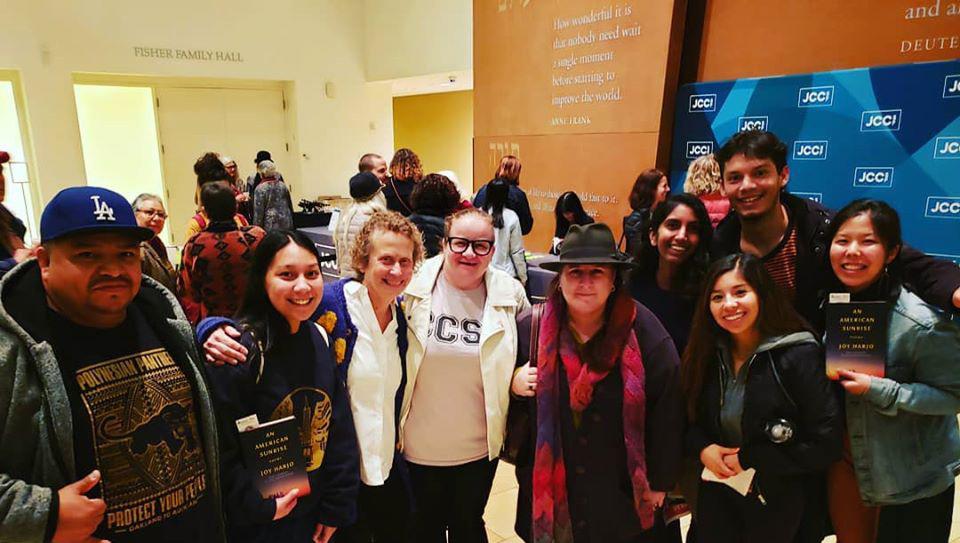
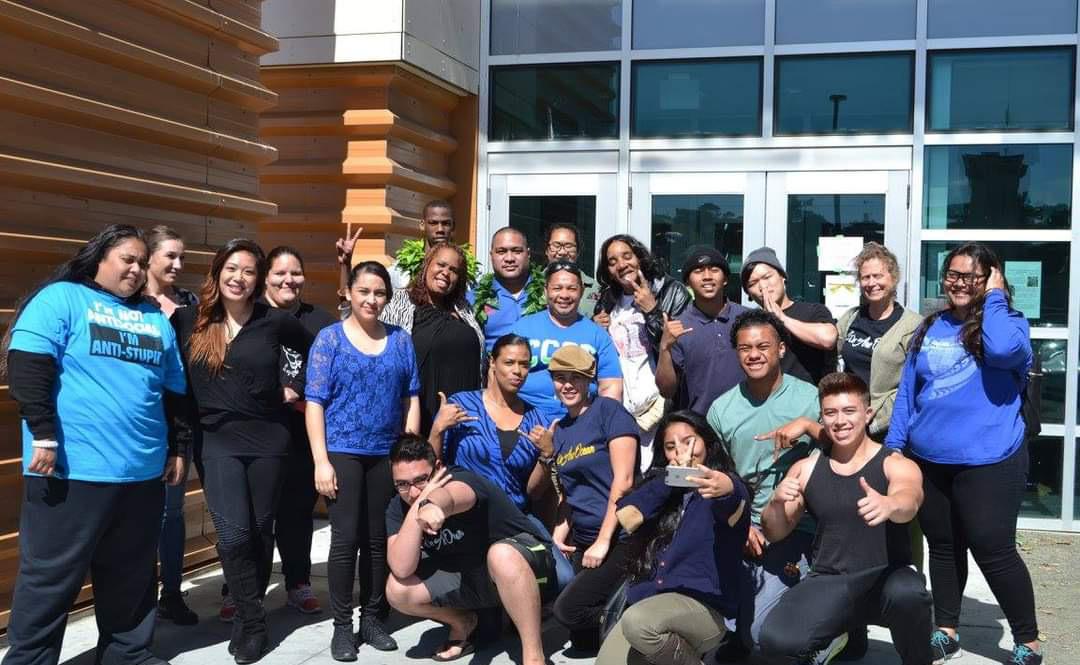
The ASV exhibit invites the viewer to open their hearts to the artform of these authors who are brave enough to tell their stories. In the author’s own words they tell their story of the migration process, feelings of loss combined with feelings of hope once they gained Amnesty, Citizenship, Temporary Permanent Status (TPS) or Deferred Action for Childhood Arrivals (DACA).
A metamorphosis is witnessed once when they can legally participate in the United States wholeheartedly, leaving the shadows of a country that has always not welcomed them.
NEWS | 3 Vol. 175, Issue 3 | Mar. 1 - Mar. 15
Photos Courtesy of Dr. David (Vika) Palaita
Amplifying Sanctuary Voices, an exhibit at City College Rosenberg Library. A storytelling initiative led by East Bay Sanctuary Covenant (EBSC). Image of exhibit case featuring details pertaining to specific countries and specific historical immigration policies and events. Haiti, Puerto Rico, Pakistan, Chile, Syria, etc... February, 7 2023.
Photo by D. Eric Bean/ The Guardsman.
Contact Us / Follow Us Adverstise the Guardsman.com Mailing Address Twitter/Facebook Instagram Youtube info @ theguardsman.com (415) 239-3446 50 Frida Kahlo Way, Box V-67 San Francisco, CA 94112 Bungalow 615 @theguardsman @CCSFjournalism theguardsmanonline
Lit Night is Back, Read Your Literature for a Live Audience
The Creative Writing department encourages students to participate.
By Emma Pratt espratt8@mail.ccsf.edu
City College’s Creative Writing program hosted its first semester-long monthly Lit Night on Feb. 13. Readers and listeners alike gathered at the Ocean Ale House to sip on brews and enjoy poetry, fiction, and nonfiction literature, delivered verbally from author to audience.
“It’s a lowkey event, close to campus, anybody can come and read. There’s food and drink, and it’s a way to kind of extend what we do in the classroom in a very kind of non-structured, loose way, so that’s what it’s about for us,” said John Isles, an instructor in the English department.
The night saw 10 readers take the stage. Some came with printed scripts and others decided on the spot to handle the mic.
“I’ve read here before, usually something very carefully prepared, although I’m always somewhat spontaneous because I think that’s the only way you develop a report with your audience. I think it’s important they think about what you’re saying,” said Lyman Dave Roberts, a former City College film student.

No readers at the event were City College students, however, creative writing instructors encourage students to participate in future Spring 2023 Lit Night’s.
“This was the first reading of the semester. Usually, the first readings are a little quieter than later ones because we have to build up some steam. Honestly, I was hoping for more creative writing classes to show up tonight and so we’re going to really push to have more of the students come for next time,” said Isles.
In the past, Lit Night has been themed - Rreaders were expected to explore topics such as guilt, redemption, and betrayal. This semester, things are different. “In the past we have had themes but we decided to begin not to have themes just because we wanted to get the ball rolling and see what happens. We don’t have plans yet to have themes,” said Isles. “That could change depending on what people really want to do.”
If you don’t want to be tied down to a theme, this semester is the time to read. Plus, “It’s a really easy crowd to read for,” said Susana Ferrer, a regular at Ocean Ale House.
Lit Night will be hosted every second Monday of the month during the Spring 2023 semester from 7-8:30 pm. Ocean Ale House opens its doors especially for the event and it's only a seven-minute walk from campus.

For more details, email English department member Chanté McCormick , or explore the Lit Night website at litnight.org.
Interdisciplinary Studies Poetry for the People Increasing Enrollment in College
City College’s Poetry for the People class of the Interdisciplinary Studies department reaps civic engagement through nightstand of poetry inspired by “Little Free Libraries.”
By Lolie Mahe Mahelolie@gmail.com
City College’s Poetry for the People course has found its spotlight in the bustling city of San Francisco encouraging residents to enroll and begin writing poetry.
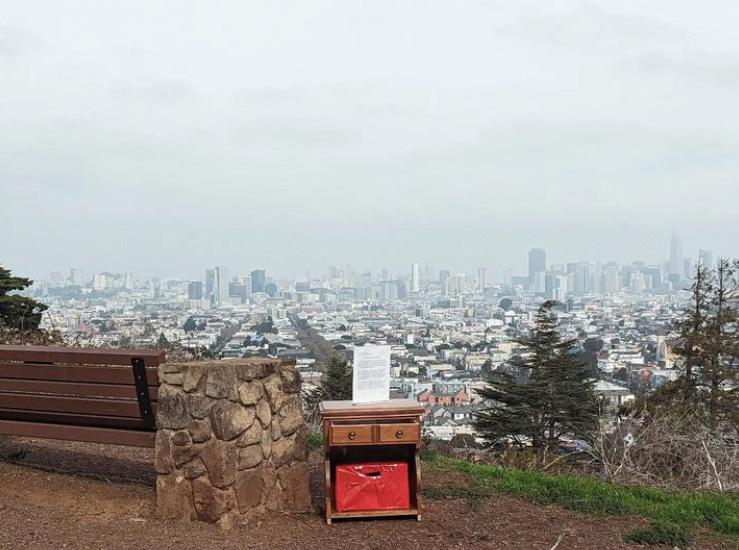
Amanda Barrows, a student of Poetry for the People, placed a nightstand in parks of San Francisco intended for bringing poetry to the community in a creative way, as mentioned by Sydney Page of the Washington Post. The nightstand consists of a drawer full of poems on one side and blank pieces of paper and pens on the other, with the written instructions, “Take a poem, leave a poem.”
The Poetry for the People course is available under the Interdisciplinary Studies Department at City College because of Lauren Muller, treasured Poetry for the People instructor and IDST chair of department who CCSF lost to cancer this past month.
The idea of Poetry for the People came from one of Muller’s best friends, Leslie Simon, who in 1974 drew inspiration after visiting Mexico and seeing “Art for the People.” Simon wrote an article and decided to deliver “Poetry for the People” to Bay Area colleges, “But we didn’t get enough people for the class. We needed like 25 people, maybe 15 or something like that.”, said Simon. Glenn Nance, who is the chair of African American Studies, wound up with the article on his desk which he liked a lot and he and some students pushed it through; as Nance was on the curriculum committee.
“So we offered two sections one day and one night, long story short, we got 28 people, we got plenty of people, and it was a great success.”
However, City College had only offered the course from 1975 to 1984. It was not until 15 years later that the IDST department chair at the time, Abdul Jabbar, asked Simon about Poetry for the People, as UC Berkeley began offering the same course meaning CCSF would be able to offer UC/CSU transferable credits with Poetry for the People.
Simon was employed in the Interdisciplinary Studies Department while doing part-time in English until she went on to become full-time in Women’s Gender Studies as chair.
Muller and Simon first connected in the Spring of 1990 at the English department of UC Berkeley where they became friends. Because of Simon’s workload as
chair of the Women’s and Gender Studies, Simon asked Muller to teach one class of Poetry for the People.
“ She joked about it because she said, ‘Beware of Leslie Simon. She’ll say, you just have to teach us one class… And the next thing, you’re living at City College.’
"...we got 28 people, we got plenty of people, and it was a great success.”
Muller began teaching in 2000 before becoming the department chair in 2002. “Over 20 years, she chaired the department, and she grew it.”
The IDST department of City College offers, African American Studies, Latin American Studies, Asian American Studies, Labor Studies courses on racism, classism, sexism, transphobia, ageism, design, trauma prevention and recovery, Pacific Islands and Oceania Studies, Middle East Studies, all very committed to civic engagement.”
Simon mentions how there is a whole series of diversity in the IDST department, with a number of certificates available, “which Lauren was very instrumental in getting launched.”“In the ethics, science, and social justice classes, we have a lot of community oriented classes. For example, in Women’s and Gender Studies, I founded Project Survive It’s a sexual violence prevention program where students get trained to help end sexual violence.”
“These are all housed in Interdisciplinary Studies to kind of incubate programs that are not big enough to be their own department yet; it’s kind of an incubator, innovator.”
Poetry for the People of City College can be found on Instagram @ccsf_p4p.
4 | CULTURE Vol. 175, Issue 3 | Mar. 1 - Mar. 15
Banner from litnight.org. Special credit to the visual media design department.
Amanda Barrows leaves nightstands in SF park, giving community members the opportunity to write poetry. The field project by Barrows is from Poetry for the People of City College.
City College of San Francisco Guardsman Newspaper and Etc. Magazine are looking for skilled designers, artists, illustrators, photographers and graphic designers. The opportunity is to work with a talented team of writers and designers in the field of journalism and magazine production. Contact faculty advisor Juan Gonzales for more information at accionjg@aol.com or 415-517-4426.
Spy Balloon - Illustration by Edudardo Morales/The Guardsman
“Take a poem, leave a poem.”
CCSF Hosts Annual Mexika New Year
The 16th Annual CCSF Mexika New Year Festival takes place on Sunday, Mar. 12 from 11 a.m. to 7 p.m. There will be a ceremonial Aztek dance at 12 noon in front of the CCSF Mission Campus on 1125 Valencia Street. The campus displays a replica of a 27-foot Aztec calendar that hovers over the entrance. The day includes speakers, music, poetry, food, craft vendors and community service tables. For more information, call Mazatzin Aztekayolokalli at 415-756-5589.

Vol. 175, Issue 3 | Mar. 1 - Mar. 15 CULTURE | 5
Photo courtesy of CCSF Mission Campus
It’s Cold, But I Refuse To Turn On The Heat
By Renée Bartlett-Webber rbartle8@mail.ccsf.edu

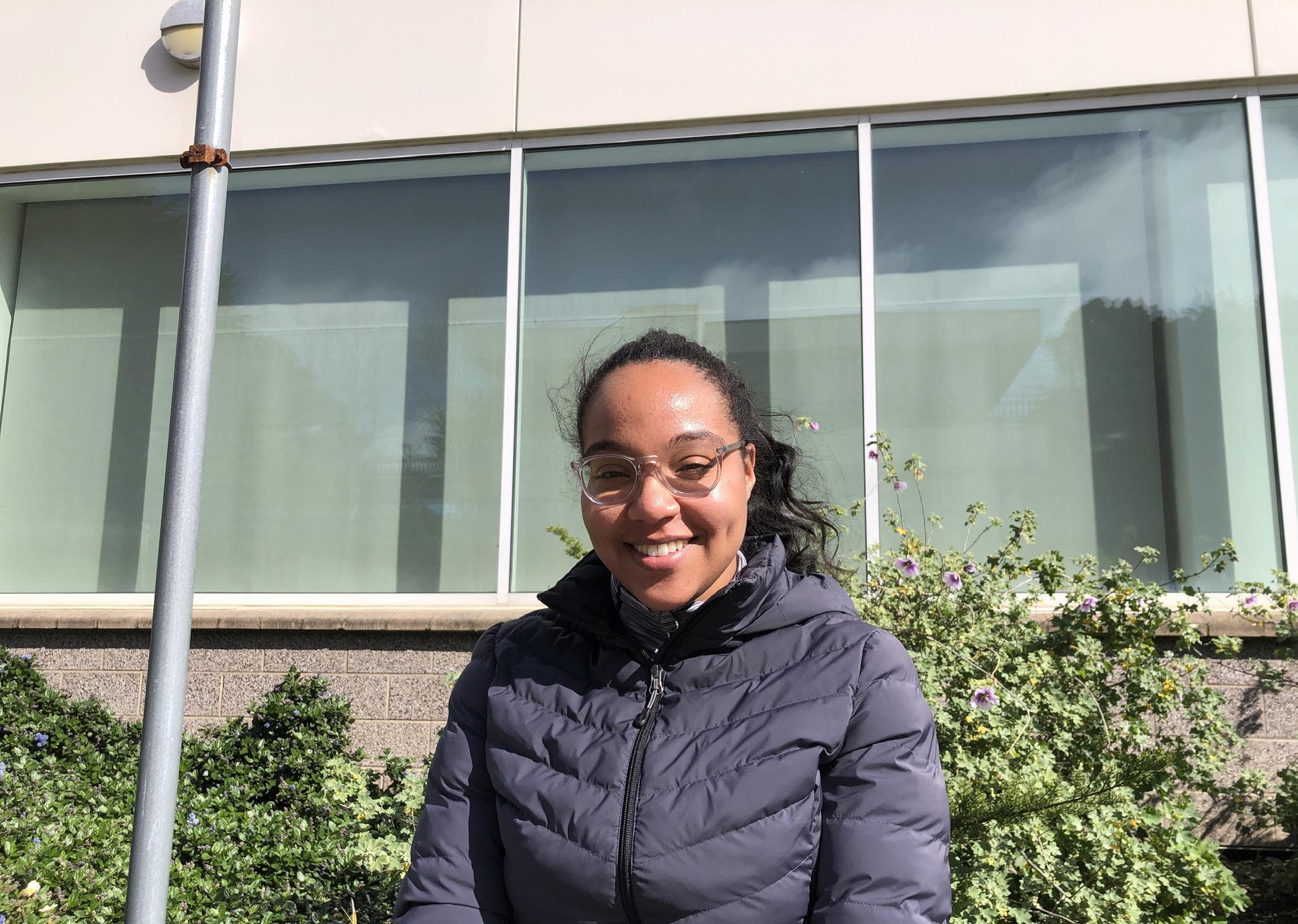
I sat at my dining room table, researching labor laws, higher education funding and gentrification of the Mission to shape an editorial that would be most relevant for our San Francisco community. In the midst of my furious googling, I took breaks to warm my hands, put on another sweater, and add socks to my already slippered feet – anything to avoid turning on the heat. My utility bill has more than doubled since January 2022, partly due to this year’s harsh winter, but also because our cost per “therm” (the unit used to measure gas usage) has increased by $0.61 (22%.)

“As required by law in California,” Pacific Gas & Electric (PG&E) charges a higher rate for customers who use more energy. This supposedly encourages people to use less energy, but often ends up hurting the customers who can’t afford to replace their old equipment with new, energy-efficient appliances. Additionally, the cost of procurement is passed on to the customer so when demand goes up, so does the cost. To make matters worse, the California Public Utility Commission (CPUC) approved increases for 2023 that will result in an 18% bill increase for “residential customers with average gas and electricity consumption.”
PG&E has submitted an additional rate increase petition to the CPUC to cover its “cost of capital” that will be decided on in the fall. So, when the weather drops to abnormal low 40s (with a side of hail) as it has this winter, we are paying a double or even triple whammy bill.
PG&E is an investor-owned utility (IOU) which is a private corporation “regulated” and protected by the state’s public utility commission. It’s a “monopoly utility,” because there is no competition for their guaranteed customer base in each territory. Our rates are determined by the utility commission and the private entity “based on the cost of operating, maintaining, and financing the infrastructure used to run the utility; and on the cost of its procured fuel and power,” as stated by the CPUC. The private corporation is technically not allowed to make a profit off its services, but only from its assets and stocks. However, the relationship between the utility provider and its state regulator “has come under intense scrutiny, undermining public trust” as reported by KQED in their 2015 article “10 Emails
That Detail PG&E’s Cozy Relationship With Regulators.”
With the complex finances and powerful resources of state “regulated” private entities, it’s shocking that these monopolies continue to exist. PG&E has a history of negligence throughout its more than a century-long existence. It has been accused of rigging meters to increase rates, tax dodging and lobbying, colluding with the CPUC, falsifying documents, and shutting off residential power to reduce liability. Some of PG&E's most alarming atrocities resulted in their convictions for the 2010 San Bruno pipeline explosion that killed eight people, and for 84 counts of involuntary manslaughter after their equipment caused massive wildfires in 2019.
Despite the rising costs of utilities, the corporation made $16.92 billion in gross profit for the 12 months ending Sept. 30, 2022, a 22% increase since 2018. In 2021, CEO Patricia K. Poppe collected a salary and bonuses of $9.43 million (not including the $41.1 million in equity,) just two years after the company declared bankruptcy protection due to its liability in multiple wildfires. This makes us wonder, are the million dollars in salaries for top executives baked into our monthly rates?
I admit that when it gets unbearably cold in my house, I turn on the heat, but many families have had to choose between heat and food this winter. With additional increases on the horizon, “monopoly utilities” cannot be sustained.
Have Your Say What Are the Pros and Cons of Your Housing Situation?
By Ellen Yoshitsugu egiese@mail.ccsf.edu
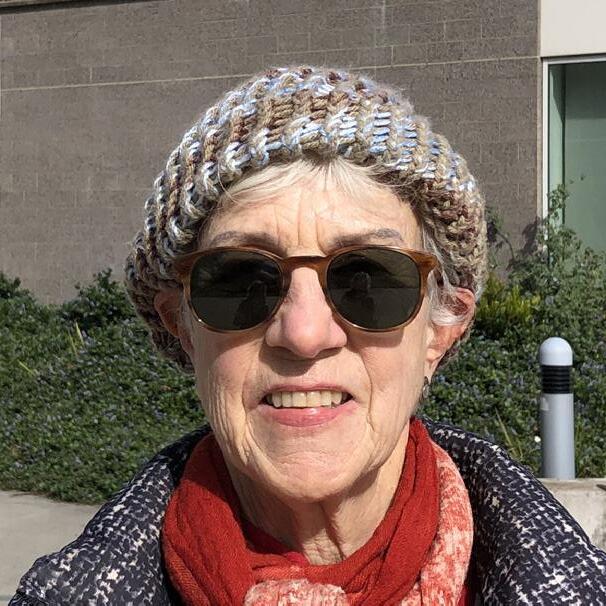
I live in a wonderful neighborhood; I can walk to City College. A pro is that I was actually able to buy something in San Francisco more than 30 years ago. I’m probably paying less on a mortgage than people pay for rent. I feel very lucky and privileged. We have neighbors and we talk to each other and do things together and help each other out. It feels like an old-fashioned neighborhood. The cons are the fog. And one con that’s happening all over San Francisco is the homelessness. That’s a concern of mine in general. And I’ve almost been killed many times walking to City College at the corner of
My particular housing situation is I’m at this institution called Job Corps centered at Treasure Island and if you’re in a particular income bracket then they allow you to live there for free. Everything is pretty much free; there’s no rent. There’s free room and board, free uniforms for any trades you might go into. Breakfast, lunch and dinner is provided for you. I’m doing relatively well. I’m very grateful for the housing situation I’m at. I can’t think of anything I don’t like about it right at the moment.
The pro is that we are a multi-generational household which allows us to live in the Bay Area and makes living in the Bay Area affordable. Unfortunately the con is that most of us do not earn a living wage, and therefore it is difficult for us not only to afford housing inside the cities that we work in, like San Francisco, but that means it also requires us to move outside of the area into neighboring counties, which not only increases our commute but it is also wear and tear on our bodies and our minds. It makes it harder for students to focus because they're managing a commute from sometimes an hour or two away, in order to get here for class or work. And I myself have at least an hour and a half commute in the morning. I've got two, three hours on the way home. Just to afford to live.
- Cece Jones
I have to say that it's pretty difficult right now. I'm in a housing program and I'm trying to find a place to live. I had a housing assessment. And I'm trying to call them and try to see the updates and no one answers. I know I'm not the only one that has a situation going on, but it's still not okay, because it's a very serious situation that should be taken seriously. It was a very hard year. I graduated on time, still got my high school diploma, you know, but it was still very difficult when it came to food, clothes and toiletries. I'm in a housing program, it's just a horrible place. I wouldn't recommend it. Drinking and partying and the workers don't care. I’m taking 18 - 20 units and trying to get ahead.
- Aiyana Perez
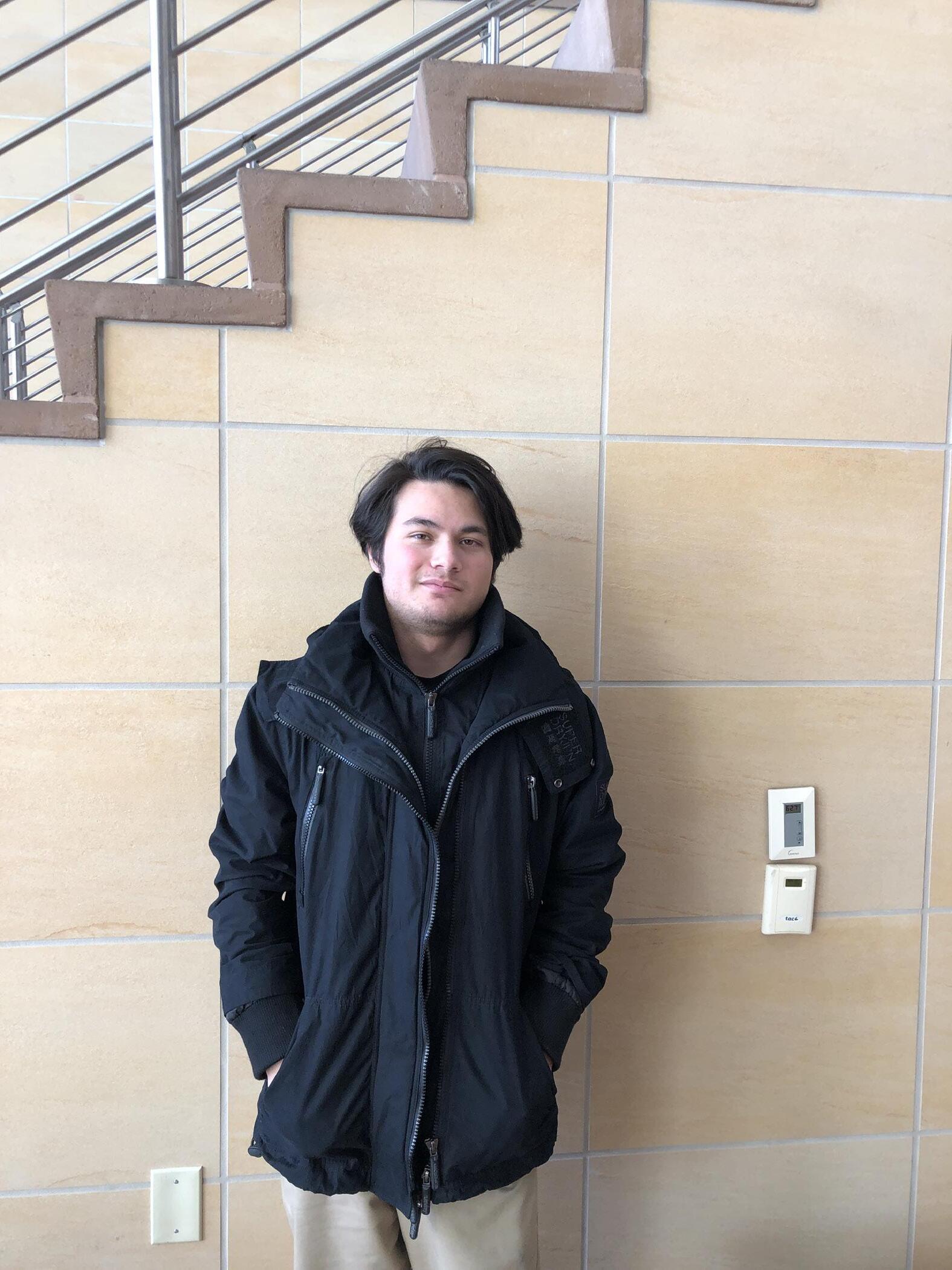
My housing situation is pretty nice. I live with my parents so I don’t have rent. It’s close to school. Yeah it’s pretty good. The cons, well, it’s always cold. And the transportation is always late.
 - Nicolette
6 | OPINION Vol. 175, Issue 3 | Mar. 1 - Mar. 15
Trying to stay warm during winter storms in San Francisco without turning on the heat. Photograph by Renée BartlettWebber/The Guardsman.
City Rams One Win Away in Defense of CCCAA State Championship Title
By Gracia Hernandez Rovelo ghern140@mail.ccsf.edu
They included:
Coach of the Year: Justin Labagh
Most Valuable Player: Mezziah Oakman
SPRING ATHLETICS CALENDAR
C
ity College's men's baskeball team slammed trounced the Butte College Roadrunners at home with a 99-69 win on Saturday, Feb. 25 in a second-round playoff game.
Rams outlasted Butte with a 16-point lead during the first period, maintaining game superiority throughout the first half and increasing to a 30-point lead onto the game final.
Mezziah Oakman (34) was CCSF's point leader scoring 22 points, followed by CJ Hardy (0) with 16 points and Te’Jon Sawyer (32) with 14 points that sparked a spirited reaction among the home crowd.



The Rams teamwork put out a solid defensive and offensive game play, combined with a series of slam dunks and 3-pointers from Oakman, Hardy and Sawyer that made the victory look easy.
The win propels the Rams record to 26-3 and keeps their points per game at 98.2.
No. 1 seeded Rams will host No. 8 Columbia College Claim Jumpers for Round 3 on Saturday March 4, at 7 p.m.
The Rams captured its 12th consecutive Coast Conference North Division championship with a 13-1 record. The Rams entered the postseason with an impressive 25-3 overall mark and are 11-1 at home this season.
One more win against Columbia College in the Northern California Regional Finals sends the Rams to the State Championships in defense of last year's title. The championship series runs from March 9 through 12 at West Hills College Lemoore in Lemoore.
In other CCSF hoop-news, the Rams captured conference honors. The team totaled eight All-Coast Conference North Division postseason awards.
Rams Continue Title Quest
First-Team:
Te'Jon Sawyer
EJ Neal
Jamir Thomas
All-Defensive Team MVP: EJ Neal
Mezziah Oakman
All-Freshman Team CJ Hardy
Rams Rout Lassen College 88-67 to Advance to NorCal Finals
 By Onyx Hunter onyxhunter@gmail.com
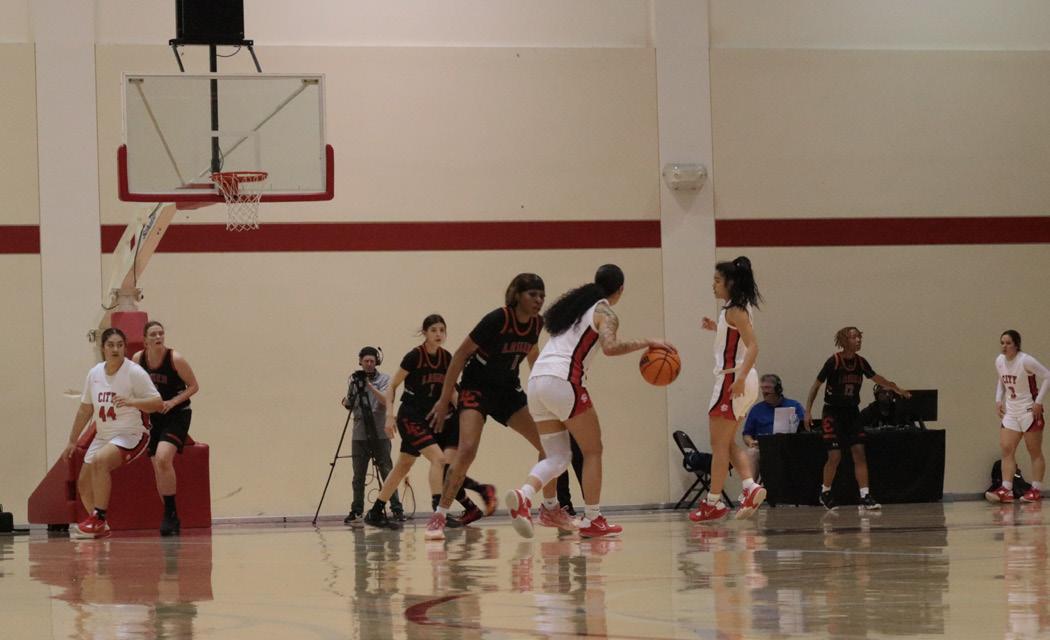
Carving out one more win, the CCSF Women’s basketball team would make it to the NorCal Finals. On Feb. 25, the No. 6 seeded Rams never religuished their lead and walked away with an 84-57 rout of the Lassen Community College Cougars. But in the first quarter the game was closer than the Rams would’ve liked.
After two successful Cougar free throws, the Rams ended the period with just a two point lead, 19-17.
The Rams the extended lead with a firece 42-point scoring attack in the second quarter resulting in a 61-28 blowout at the end of the quarter.
The rest of the game wasn’t exactly smooth sailing as Lassen offered a strong defense, scoring more points than the Rams in the fourth quarter. But it was never enough to challenge the Rams’ lead.
All-State forward Talo Li-Uperesa (23) again led the Rams on offense, scoring 22 points and 8 rebounds. Amira Lama (30) added to the scoring punch with with 17 points and 12 rebounds.


Stacy Angel-Haro (20) and Teuila Tuiasosopo (35) also made major contributions off the bench. Angel-Haro scored 14 points, while Tuiasosopo added 11 points and 7 rebounds.
The CCSF women's team continues its quest for the first-ever state championship. the team looks to return to the state tournament for the first time since 2017. The Rams were state championship runner up in 2011 and have reached the state tournament Final Four in 2010, 2011, 2016, and 2017.

Vs Columbia NorCal Regional Final @ City College (home game) Men's CCCAA State Championships March 9-12 03/04 7:30 Saturday 03/09-12 | TBA Men's Basketball Women's Basketball Vs College of the Sequioas NorCal Regional FinalS @ Sequioas Women's CCCAA State Championships 03/04 5:30 Saturday 03/09-12 | TBA Vs Cabrillo College Home Game @ Mission vs Monterery Peninsula Home Game | TBA VS West Valley Home Game @SFSU 03/07 2:00 Tuesday 03/09 | 2:00 Thursday 03/18 | Noon Saturday Baseball Women's Swimming & Diving College of Marin Invitational All Day vs Cabrillo, Ohlone & West Valley @ Hartnell 03/10 2:00 Friday 03/17 | 2:00 Friday
Logo by Azxtaxelli Xela Vargas for the Guardsman
Rams freshman Corey Yerger (#2 ) goes in for the shot against Butte College on Feb. 25, 2023 at the Brad Duggan Gym at Ocean Campus. Photo by Eric Sun/The Guardsman.
Rams freshman Dante Sawyer (# 23 ) takes a shot against Butte College on February 25, 2023 at the Brad Duggan gym at Ocean campus. Photo by Eric Sun/The Guardsman.
"Teuila Tuiasosopo-35 coming in for a Field Goal alone."
Photo by Onyx Hunter/Guardsman.
"Mosh Pit" Photo by Onyx Hunter/Guardsman.
"Stacy Angel-Haro-20 carefully constructing an offence with her team" Photo by Onyx Hunter/The Guardsman.
"Rianna Lee making an uncontested Field Goal" Photo by Onyx Hunter/The Guardsman.
Mezziah Oakman (#34) dunks one in for the Rams against Butte College on Feb. 25, 2023 at the Brad Duggan Gym at Ocean Campus.
Vol. 175, Issue 3 | Mar. 1 - Mar. 15 SPORTS | 7
Photo by Eric Sun/The Guardsman.
