Vol 178, Issue 7, The Guardsman, City College of San Francisco
The Guardsman
Free City Funding Chopped in Half: Students Left to Question Their Fate Under Lurie’s Reign
By John R. Adkins jradproduction@gmail.com
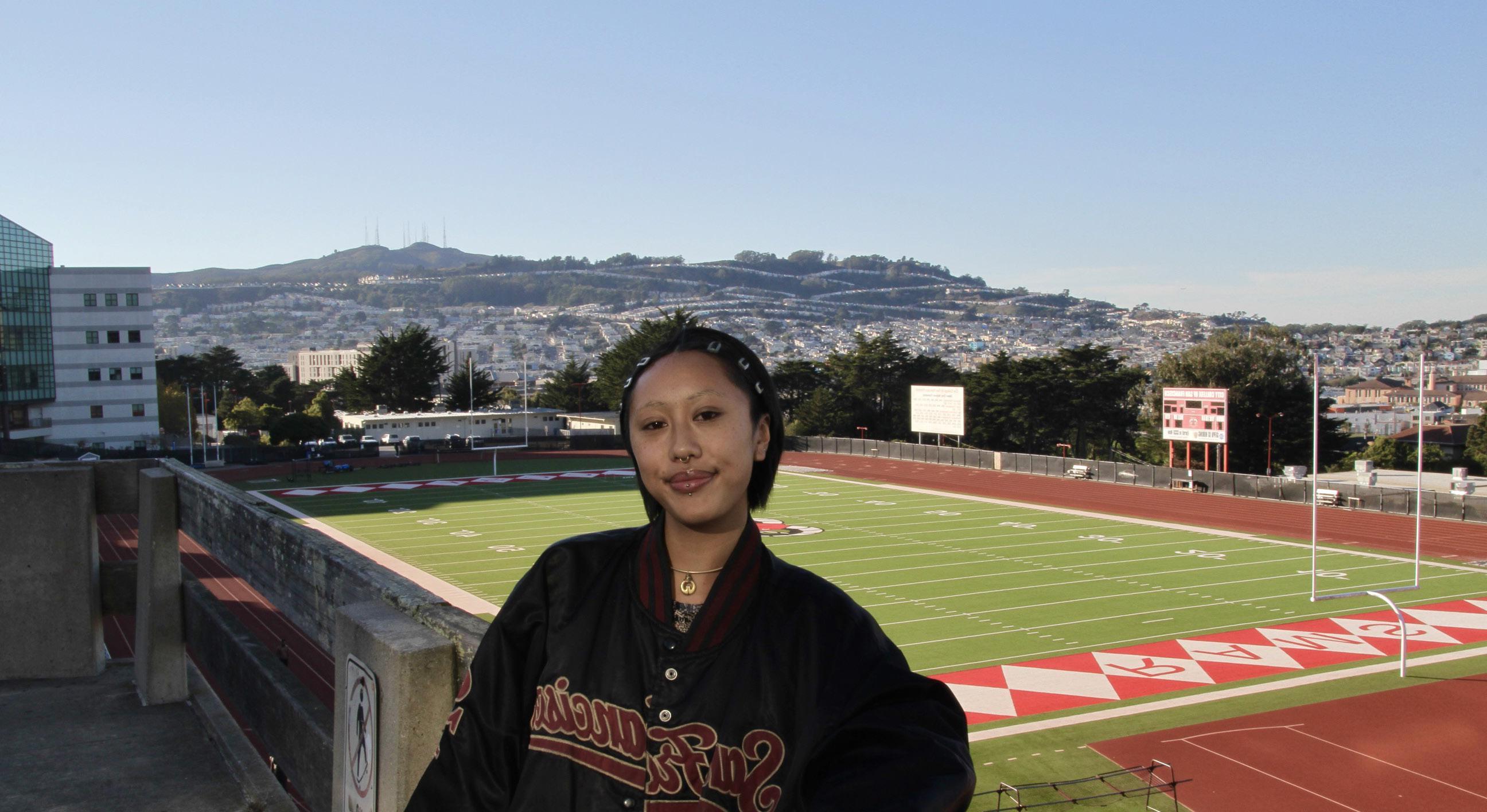
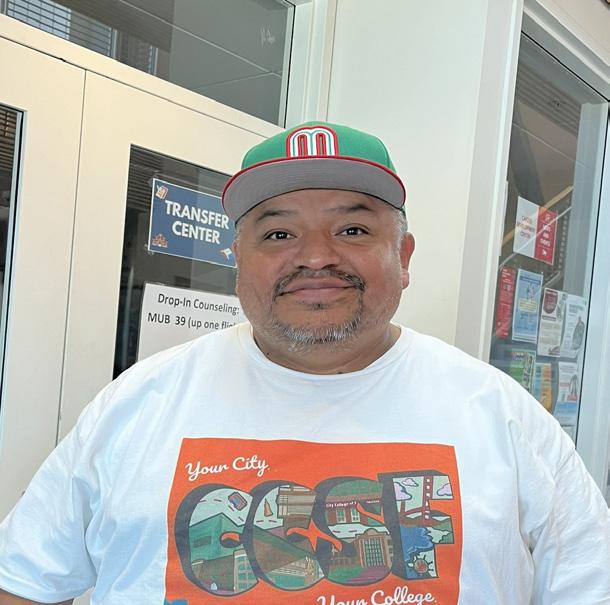
Malaya Redondiez, a 20-year-old student at City College, says she would not be here without Free City.
Redondiez is in her third year at the college, where she volunteers as a peer educator for Project Survive, teaching a curriculum in domestic violence and abuse prevention.
“City College reaches so many places in this country
Lead Contamination Found in Child Development Center on Ocean Campus
By Maxime Leonard mapleleonard3@gmail.com
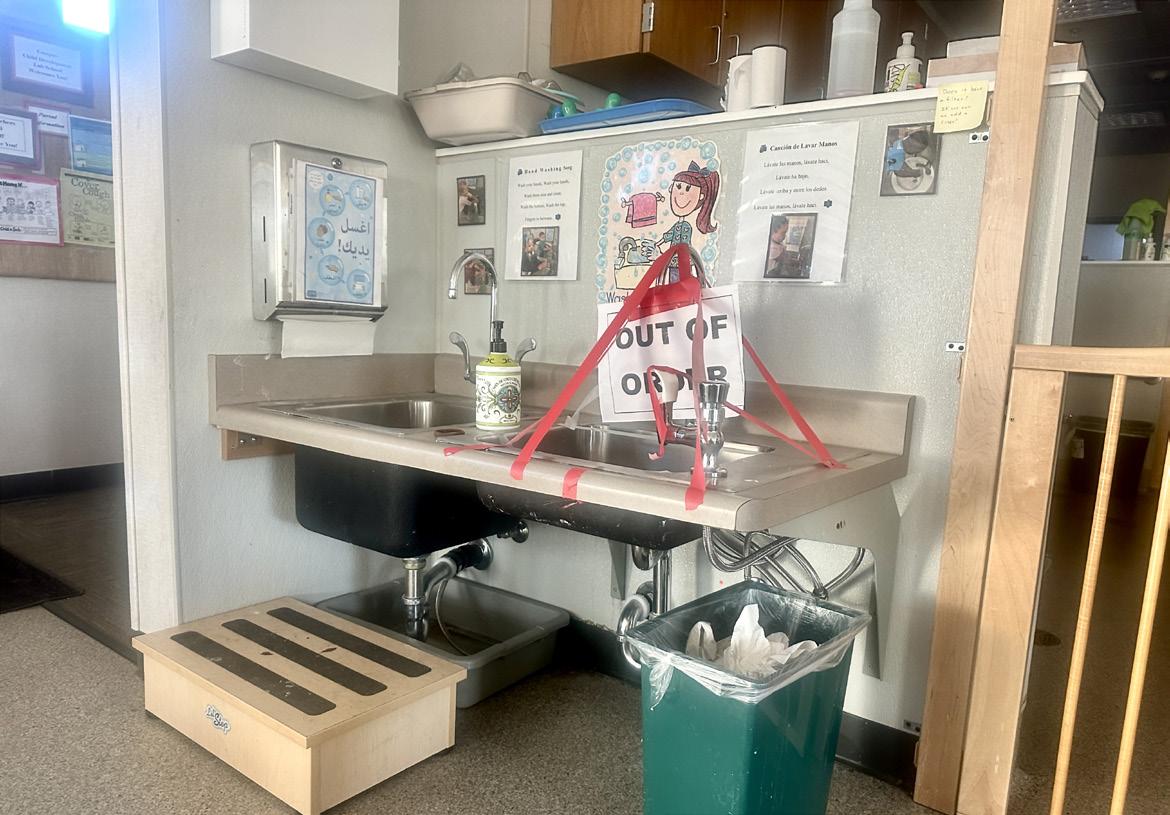
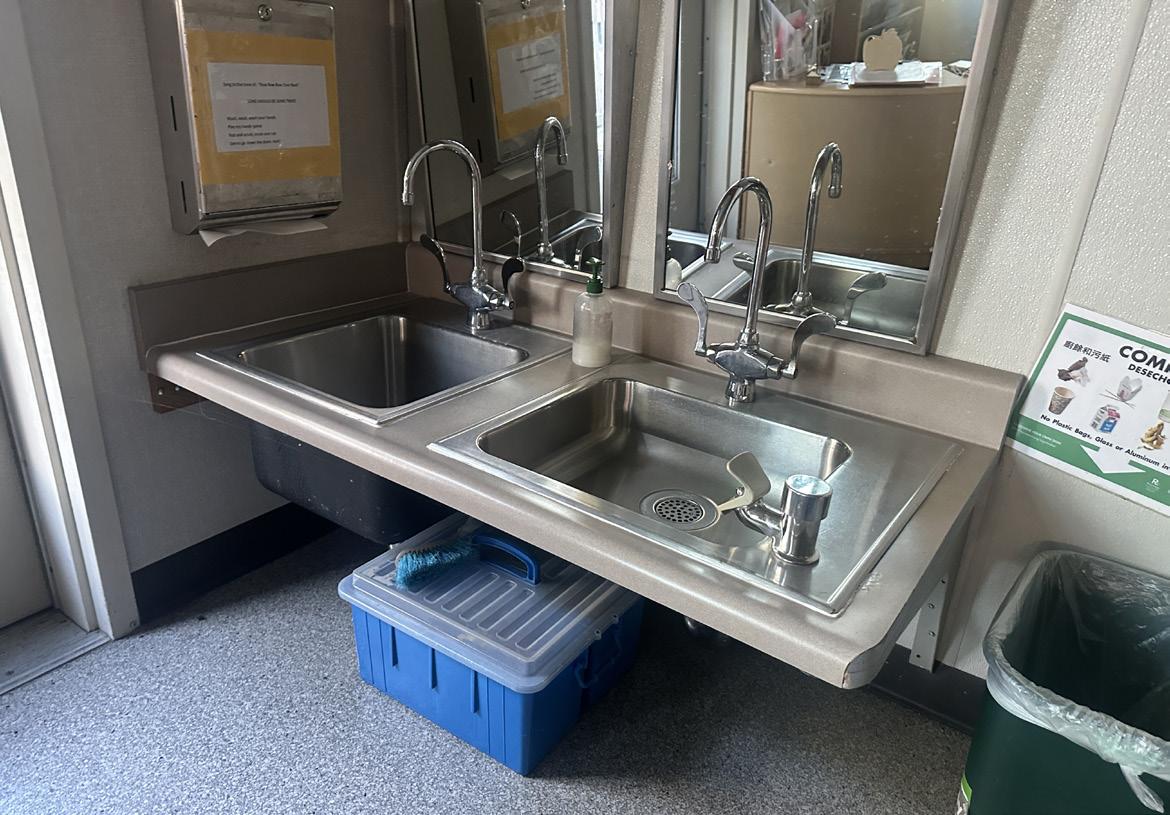
Two sinks tested positive for lead in the City College Child Development Center on Ocean Campus.
Sinks in the child care center were tested without warning by the state of California.
The topic was brought up in the Facilities Committee meeting on October 28 by Maria Salazar-Colón, claiming that while parents of children were notified, employees were not. “No one notified the workers that there was lead found in the water, that’s inappropriate,” Salazar-Colón said in the meeting. “It puts the workers in danger [and] it puts the children in danger.”
The realization of the state’s inconspicuous presence also raised concerns at the Facilities Committee Meeting about unauthorized individuals being able to enter the childcare center.
The sinks were tested on August 19, although there were originally no plans to test the sinks considering the current bungalows the childcare center resides in were built after 2010.
The sinks were tested as a precaution, and two sinks had lead levels higher than the standard, according to Akiyo Mineo-Aldis, the head caretaker in the child development center.
The bungalows in which the child development center resides were originally built with 200 bungalows but later moved to where the soccer field currently resides before its current location behind the library and next to the football field. Nathan Garcia told Mineo-Aldis that bungalows 215 and 216 were built in 2016 or 2017 meaning they did not need to be tested.
Child Development Department chair Rosario Villasana and Facilities Committee Chair Alberto Vasquez did not respond to requests for comment
on the results of the tests.
As soon as lead contamination was confirmed, parents were swiftly notified, and both sinks had their water supply turned off and taped off to prevent them from being used until they could be replaced. A bright yellow pamphlet was handed out to parents warning of the dangers of lead around children, and parents were encouraged to get testing done at the doctor's office. The pamphlet was two-sided, with one side written in English and the other in Mandarin.
At the time of publication, both sinks in question have already been replaced. After they were replaced, staff in the childcare center were instructed to run both taps for 30 seconds, four times a day, for three weeks.
As of Dec. 9, the childcare center is in its final week of running the faucets before a secondary lead test can be conducted to ensure the problem has been resolved.
While Mineo-Aldis was concerned about the kids, she was not concerned about getting tested herself. Parents who tested their children for lead all reported back clean results.
Mineo-Aldis also noted that these tests and procedures are standard preventative maintenance and should not be indicative of the quality of facilities in the child development center.
As of 2018, California has had an amendment to a health and safety code around lead exposure in childcare centers stating that “A licensed child day care center… that is located in a building that was constructed before January 1, 2010, shall have its drinking water tested for lead contamination levels on or after January 1, 2020, but no later than January 1, 2023, and every five years after the date of the initial test.”
City College Fights to Revive Adult Education Amid Surging Demand
By Rebeca Becerra Soto rebecabecerra13@gmail.com
City College grapples with increasing demands for adult education and the administration is now considering how to reinstate and expand these programs despite significant challenges related to funding, staffing, and logistics.
The demand for adult education has reportedly grown as more working adults seek opportunities for career advancement and personal development. The American Federation of Teachers Local 2121 has raised concerns they had regarding the needs of English-learning adults specifically.
Students and advocates are particularly interested in courses that offer career-oriented training, foundational skills like English and math, and pathways to higher education. Professor Alisa Messer, who teaches an English 1A class, noted in June 2024 that her waiting list was as large as a full-sized class.
English 1A is a gateway course required for students pursuing advanced courses, and Messer is not the only professor dealing with long waitlists. More than 200 students are currently on waitlists for the English 1A class, aiming to use this course as a stepping stone to further their careers.
Historically, City College used to offer a wide selection of adult education courses, serving thousands of students annually. However, reductions in recent years due to budget cuts and declining enrollment during the pandemic have significantly scaled the program back.
The pandemic caused a sharp drop in adult education enrollment as students faced financial and personal challenges, a trend that has persisted even after the return to in-person classes. This continued decline has further strained the college, which was already grappling with reduced funding and staffing.
Six people in the English department were laid off in spring 2022. This
Free city funding continued on page 3
Adult education continued on page 2
One of two sinks in the Ocean Campus child development center that tested positive for lead. As of November 15 it had not yet been replaced and remained taped off to ensure its dormancy. San Francisco, Calif. November 15, 2024. Photo by John Adkins /The Guardsman.
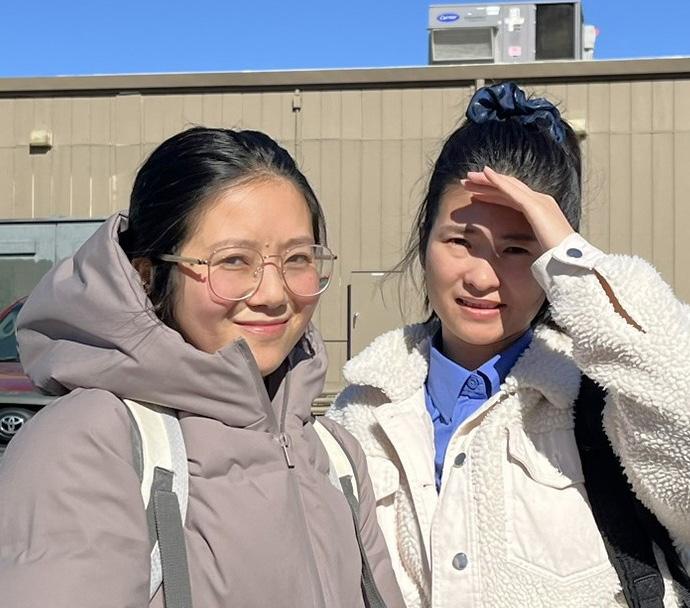
“I came to City College because first and foremost I love learning, and I love learning without the pressure of having to take these courses that I don't even care about to fill in my major. I'm actually able to take classes that support what I want to do right now,” Malaya Redondiez said. Redondiez is one of many students who would not be able to call City College home without the help of Free City. San Francisco, Calif. December 2, 2024. Photo by John Adkins/ The Guardsman.
The sink on the right had recently been replaced after testing positive for lead. This was one of two sinks in the Ocean Campus child development center that needed to be replaced. San Francisco, Calif. November 15, 2024. Photo by John Adkins /The Guardsman.
Staff
Co-Editor-in-Chief
Gracia Hernandez-Rovelo
Elena Chiaruttini
News Editor
John Adkins
Feature Editor
Julia Chong
Op-Ed Editor
Issac Ortiz Dominguez
Sports Editor
Cooper McDonald
Social Media Editor
Juliana Parente
Photo Editor
Bob Kinoshita
Illustrator Editor
Cindy Chan
Copy Editor
Ellen Yoshitsuga
Gabrielle Chagniot
JT Wildfeuer
Writers
China Young
Rae Daniels-Henderson
Max Leonard
Kyra Young
Photographers
Nick Mueller
Tiffany Sainz
Videographer
Rachel Church
Illustrators
Isis Cordova
David Thomas
Production
Linda Liu
Sebastien Thugnet
Xiaoyi Yu
Advisor
Juan Gonzales jagonzal@ccsf.edu
TheGuardsman.com
info@theguardsman.com (415) 239-3446
50 Frida Kahlo Way, Box V-67
San Francisco, CA 94112 Bungalow 615
Adult education continued from page 1 resulted in a shortage of teachers for required English courses. The Board of Trustees chose to rehire several of the dismissed professors after faculty members protested the layoffs, but gaps remained.
High demand also exists for non-credit Career Technical Education programs in Child Development, Culinary Basic Skills, Custodial Training, and Construction Administrative Assistant. These programs are popular among students seeking skills in high-demand fields.
Employers actively seek graduates from these programs, highlighting their importance in meeting workforce needs. Expanding these resources and access to them could benefit both students and local industries.
Despite these challenges, City College is exploring solutions to meet the demand for adult education. In 2022, the college introduced the San Francisco Adult Education Consortium Three-Year Plan to tackle barriers like language, technology access, and basic needs that could be preventing adults from accessing a high-quality education.
A lot of adults are in non-credit classes, and more resources have become available for non-credit students. Tutoring, peer-lab aids, and academic and retention counseling have all become available for non-credit students, along with extraezra support to the Mission Family Resource Center, which offers direct assistance to student parents, including childcare.
The college’s three-year plan is working on enhancing collaborations with other initiatives and organizations, such as Reimagining the Student Experience Strong Workforce Program, and Student Equity and Achievement Program, to maximize impact and ensure alignment with broader educational and workforce strategies.
Many adult students have a hard time navigating the school system as they are in the process of learning English. With the help of Language Line Services, Inc., City College has been able to provide on-demand interpretation services, being audio or video, at all student service desks.
In addition to language barriers, there has been a positive correlation between many adult students who are English learners and students who face financial instability. The college has been working on improving and
expanding programs made to train students in careers that result in employment at a liveable wage.
While City College has made progress, the path forward remains challenging. Meeting the diverse needs of adult learners will require sustained funding, innovative solutions, and ongoing collaboration with community partners. City College’s efforts highlight its commitment to supporting adult learners. However, significant work remains to ensure that every student has the resources they need to succeed.
Two Firms, No Team: City College Faces a Marketing Gap
By Juliana Parente parente.juliana@gmail.com
City College finds itself at a crossroads. With no internal marketing team, the college has enlisted the help of two external firms — ASIR Visual Marketing for enrollment campaigns and Voler Strategic Advisors for public relations and storytelling. While this arrangement provides some coverage, the broader implications of this patchwork strategy highlight both opportunities and systemic challenges.
“Currently, the College engages a marketing firm, but there are no internal staff resources exclusively assigned to marketing efforts,” Interim Chancellor Mitchell Bailey explained. “We’ve been working with ASIR for a few semesters to focus on enrollment campaigns, while Voler assists with media relations and storytelling. Their roles are distinct, but both are critical in supporting our goals”
A Two-Pronged Attack
Data from the college’s Strategic Enrollment Management Plan (SEMP) shows yearly enrollment increases from 2022-23 for both credit and noncredit courses. For 2023-24, the college recorded a headcount of 27,315 for credit students and 13,314 for non-credit students, a modest but positive growth trend from pandemic lows
“Since working with ASIR, we’ve seen enrollment increases every semester. While it’s not the only reason, it’s clear their work contributes positively,” said Dr. Lisa Cooper-Wilkins, Vice Chancellor for Student Affairs. While ASIR has contributed to this growth through targeted campaigns, the college still grapples with fundamental issues. The SEMP identifies high school students, justice-impacted individuals, and older adults as key populations for outreach. However, the lack of internal marketing capacity limits the college's ability to implement long-term strategies
Voler, on the other hand, seeks to reshape public perceptions by highlighting success stories and key events. Recent initiatives include promoting the Free City program, which provides free tuition for San Francisco residents, and preparing for the college’s 90th-anniversary celebrations
Home-Team Advantage
The college's reliance on external firms underscores deeper issues. A 2023 task force recommended creating an internal marketing department to provide consistent messaging and more efficient coordination. However, budget constraints have delayed action.
“We’re exploring what that might look like,” the Chancellor said. “It’s about figuring out the scope of the role, its sustainability, and the resources required. These conversations take time,” the Chancellor said. “We still need to figure out what a marketing director role would look like and whether it’s financially sustainable.”
The SEMP also highlights external pressures, such as rising costs and the expiration of state funding provisions, which create an uncertain fiscal environment. These factors exacerbate the college’s challenge of balancing immediate needs, such as enrollment campaigns, with long-term strategic planning
The college currently has an open position for a Director of Public Affairs. According to the chancellor, the role will serve as the College’s public information officer (PIO) and be the main point of contact for media relations, government relations and community relations.
However, there are some concerns about the college’s budgetary priorities.
“For some areas, we don’t need more marketing—we need more teachers to teach more classes,” said Robin Pugh, vice president of the American Federation of Teachers (AFT) 2121. The union’s analysis identified bottlenecks in critical pipeline classes, including English 1A and Chemistry 32, and noted a 1,000-student waitlist for non-credit ESL courses
The union also raised concerns about the reliance on external firms. “If we can get real stories from students and alumni out there, the college will speak for itself. But this requires careful and consistent effort, which is harder to achieve without internal staff,” Pugh said.
Where Paths Intertwine
The college’s SEMP outlines a vision for more integrated marketing and enrollment strategies. Proposed initiatives include developing a multiyear strategic marketing plan and issuing a Request for Proposals (RFP) for long-term marketing support. The plan also calls for better alignment between external marketing campaigns and internal communication to ensure consistency across audiences
Moreover, it needs to be aligned with the college’s broader needs, according to the vice president of AFT 2121. “Marketing can’t be isolated from the realities on the ground,” Pugh said.
“The value of marketing is in its consistency,” Dr. Cooper-Wilkins said. “We need sustained efforts, not just one-off campaigns. It’s about building awareness and trust over time.”
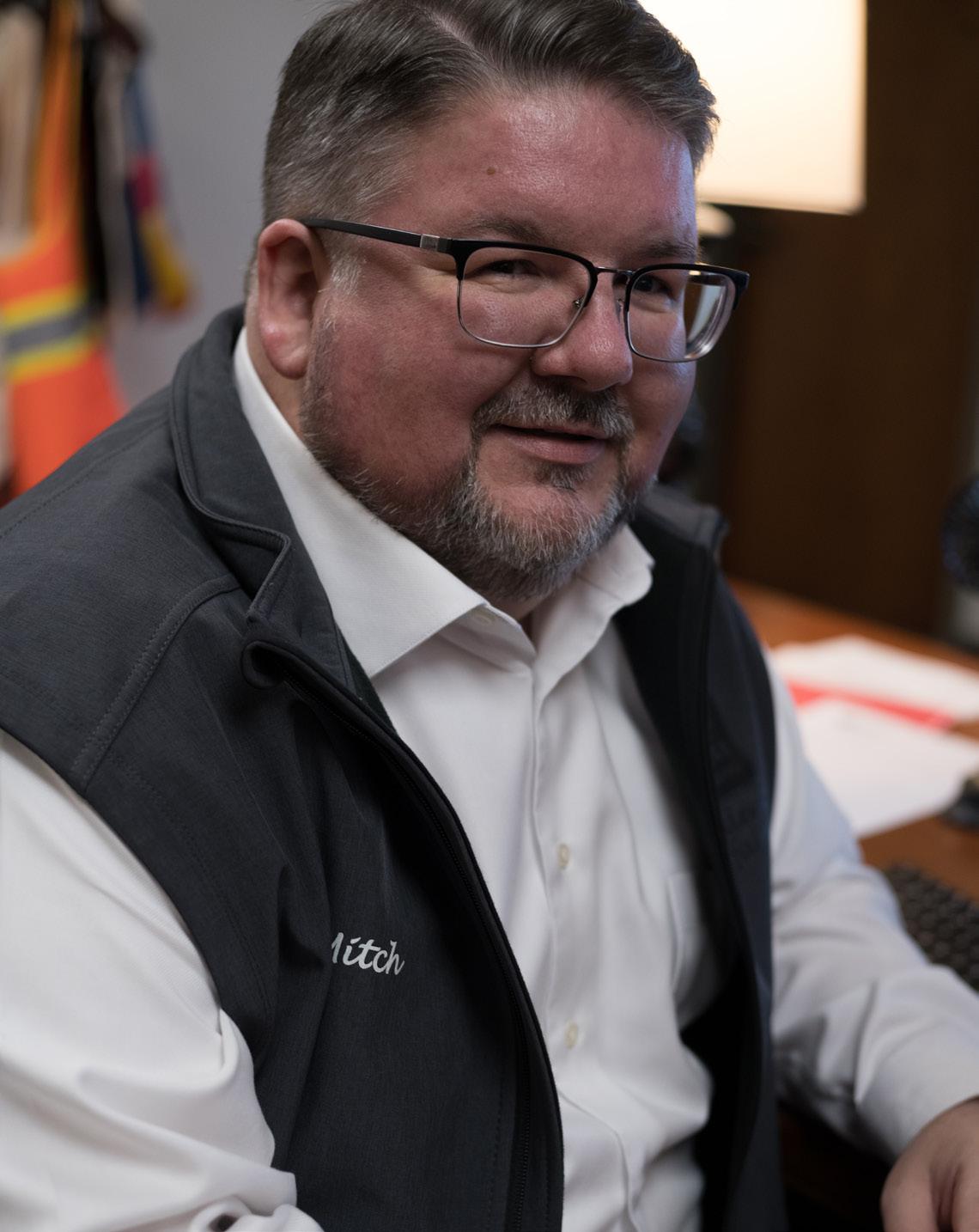
Interim Chancellor Mitchell Bailey sits at his desk and explains the college's relationship to it's marketing contractors. San Francisco, Calif. November 25, 2024. Photo by Juliana Parente/ The Guardsman.
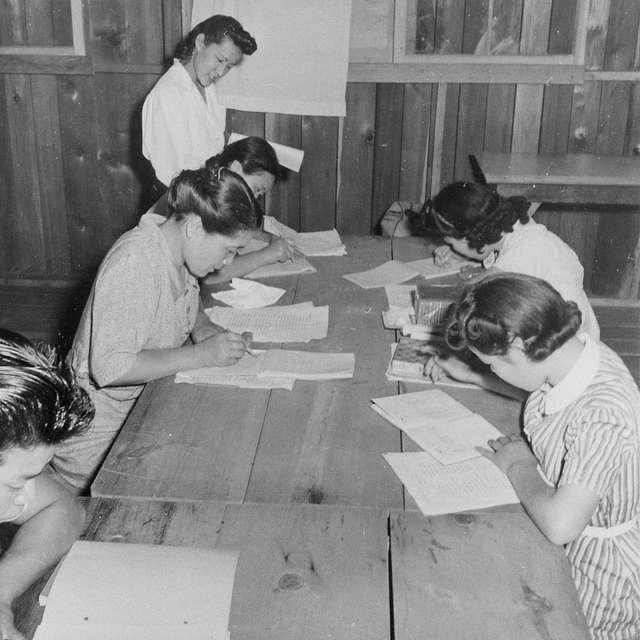
Adult Education class. Courtesy of National Parks Gallery.
Free city funding continued from page 1
… A blow to City College is an overall blow to the education system here in America,” Redondiez said.
Mayor London Breed’s latest budget proposal threatens to remove funding for Free City for an unknown percentage of City College students.
Most of the city’s previously agreed-upon funding for the Free City program is being appropriated into other areas to address the $789 million deficit.
During his campaign, mayor-elect Daniel Lurie expressed a desire to increase the college’s enrollment and advocate for additional funding. However, he has provided little in the way of a direct response to the reduction of Free City funding.
“You will not find any other college in this city where the majority of students are working-class, low-income or migrant students. I've talked to many students from the Philippines who say they specifically immigrated here for the Free City program,” Redondiez said.
Redondiez, the daughter of Filipino immigrants, grew up next door to the City College main campus in the Excelsior neighborhood. Redondiez's mother immigrated to America at age 11 to escape the martial law implemented in the Philippines in the 1970s and went on to work in the Board of Supervisors office for District 11.
“Is my education not worth funding just because I'm not on a specific educational track?” Redondiez asked.
When Board of Trustees president Alan Wong sat down at Mayor London Breed’s desk with the newly appointed Interim Chancellor Mitchell Bailey, they were there for what they thought would be a straightforward meeting to introduce the new chancellor. It was a calm, clear day in June after the spring semester had ended, and it was sprung on the college representatives that the mayor’s office intended to drastically reduce contributions to the Free City program.
The $18.9 million the program had received the previous year? That has been cut in half. The second year out, it would be reduced even more. Alan Wong, a former City College student who personally drafted the Free City legislation while working as an aide to Supervisor Gordon Mar, was in shock.
“I thought the program was untouchable. We had a 10-year contract that we had signed that specifies how much funding the program should get,” recalled Wong.
The Memorandum of Understanding (MOU) secured $15 million for the program for 2019-20, with gradual annual increases based on inflation until 2029. Financing is provided by the city’s real estate tax on property transfers north of $5 million. San Francisco, the city with a history of having the highest income per capita, had pulled off the first tuition-free community college program in the nation.
“Why would you want to do this? This is an agreement we had, and you guys signed off on it,” Wong pressed, informing the mayor’s office the college community would not be happy. The response he was dished out at the time was that the situation had changed, and if the college disagreed, then they could have a “public conversation” about the merits of the program.
The reasoning behind the proposed cuts to the program has two components: The college was informed that it had been overfunded, leaving tens of millions of dollars in free tuition funds untouched over the last five years.
“What the city was doing, in essence, was recalibrating based upon prior spending,” Bailey said. “Luckily, we still have access to two years of unspent funds, so even though our allocation this year is $9.3 million, we still have access to over $10 million of unspent funds from prior years, so if we need those monies, we’re going to tap into them, and there's still a reserve we can tap into should that need arise,” he added.
The second component, as outlined in the city’s new budget, is that as early as 2025, “only certain courses will be eligible for free enrollment, including those that contribute to the fulfillment of student educational plans.”
“They didn't provide specifics on that component. I'm not even sure they know what they want to pose. To be honest, I think they just have this idea in their head that we shouldn't cover all the classes and that we'll figure it out,” Wong said.
Who Gets to Take Classes?
“Oftentimes students who complete educational programs do so until their bodies and mental health are completely beat down for a promise of a future and a better life with their community,” Redondiez explained.
“One of the reasons I came to City College was to start the first Anakbyan chapter at this school. I'm organizing groups, and I'm working in the Queer Resource Center. I’m already making contributions to my community,” Redondiez said.
The theories being floated around campus are that the progressive tuition waivers would either be reduced to exclusively cover specific degree programs, or they would only go to students who financially need it most. Either way it would be up to the college to decide how to implement a selection process. A system that would divide the student body into two camps: those who are supported, and those who aren’t.
“Imagine adding this additional layer of only certain kinds of programs or services being eligible based on an education plan,” said Lisa Cooper Wilkins, vice chancellor of student affairs and member of the Free City Oversight Committee.
“It would administratively be a challenge to implement in a really short amount of time. It could cost a lot of money and a lot of energy,” Wilkins said.
Alisa Messer, an English professor at City College and active member of the teacher’s union American Federation of Teachers 2121, also spoke to the complicated nature of filtering students by eligibility. Through her activism in the teacher’s union over the years, she became deeply involved in the inception of the Free City program.
“You might have someone who could afford to go to college, but thinks, maybe it's not going to work out, so they don’t take the risk. Or you might have somebody who can't afford to go to college but is worried about doing all that paperwork. So by taking all that away with a universal program, we're making it much more accessible.”
Messer is also a member of the oversight committee, which is managed by the Department of Children, Youth and Families.
“That's all bureaucracy that needs to be paid for. So it costs money to take money back from people, to save the city money,” she explained.
Leaving Money On the Table
Over the past three years, the average amount spent on covering student tuition was approximately $8 million—less than half of the $18.9 million previously provided by the real estate tax. However, Wong explained that the city knew from the get-go that the allotted funding for student enrollment costs was a surplus. The philosophy being that Free City would attract more students and account for a burgeoning enrollment. That was until the Covid-19 pandemic struck the following year. Across the first two years of the pandemic, colleges nationwide saw a loss of nearly half a million new undergraduates.
To base funding for the college on post-covid enrollment numbers and the recent spell of unstable leadership, at a time when the Ocean campus facilities and Ingleside community are in the early stages of a renaissance, appears to representatives at the college to be at best a short-sighted band-aid to address the city's more significant issues.
In 2023, City College received an independent financial audit without any negative findings for the first time since 1997. Construction of the new state-of-the-art resource centers and education facilities is nearing completion. An affordable housing project in the Balboa Reservoir will soon bring more than 1,000 new residents within a stone's throw of these new facilities on Ocean campus. Next to come is a Performing Arts Center with the potential to showcase a vast array of concerts, plays, and art shows to the local community.
Despite this and the recent uptick in enrollment, accreditors have warned the college of the fiscal challenges to come, including a revenue freeze in the 2025-26 fiscal year that will remain until the college can significantly increase enrollment.
“Cutting the Free City program now would disrupt the good progress we have made and destabilize the college,” Wong said.
Breed’s budget proposal stated that the program's funding would be reduced to $7.15 million by 2025-26.
“In that second year, there's clearly not enough to even meet what's been the average level of support,” Wilkins said.
“I would hope the reasonable, ordinary person would understand that if we had access to multiples of millions of dollars that we can use at our own discretion to help support our students, why wouldn't we have done that? There’s strings attached…”
Roadmap For the Future
Representatives from the Free City Oversight Committee say the money left on the table represents a laundry list of missed opportunities to continue to improve enrollment.
Before the Free City Oversight Committee can utilize any leftover funds, it must be approved by the mayor’s office and the Board of Supervisors. Just last year, they pulled this off for the first time after advocating for the city to allow them to use some of the funds to eliminate tuition debt and fees for more than 13,000 students.
Many of these students owed money to the college because they dropped their classes too late in the semester and were prevented from re-enrolling because they owed money to the college for what had previously been covered by the tuition grants.
“I would say there's a lot of red tape and bureaucracy. We have to go through a process of approval from the mayor, all of which takes time,” Student Trustee Heather Brandt said.
Faced with this entanglement of red tape, the oversight committee has been discussing the desire to change the structure of Free City so that they do not have to continuously undergo an approval process.
Wong discussed many of the basic needs students require, from technology to transit.
“In a study that Student Trustee Brandt shared with me a while back, it added up to a little over $1,000 a year for our students to cover their transit costs. Instead of the city taking that money, I would like to see them authorize us to use it to benefit students.”
City College students face a diverse set of financial barriers to continuing their education and could benefit from childcare stipends or support with housing.
“It's really hard when Free City Oversight Committee is in one place, where we want to do these things to open up education and be more inclusive, and then we have these top-down decisions landing on us where it looks like the money is not going to afford us the ability to expand in the creative ways we wanted to,” explained Brandt.
Alan Wong discussed the need for a cohesive plan that outlines specific examples of use, such as transit costs, to propose to the city as an alternative means of addressing the unspent funds. He commended the oversight committee for already initiating those conversations.
“The City hasn’t authorized us to use it for other things. So when they're saying that's extra money, I don't take it that way. They signed a 10-year agreement. That money should be going towards City College students,” Wong said.
Put the ‘Community’ Back in City College City officials wasted no time reacting to the proposed cuts to the Free City program.
On June 27, the Board of Trustees discussed the adoption of a “Resolution Supporting the Preservation of Free City College and the Memorandum of Understanding Between the City and County of San Francisco and the San Francisco Community College District.”
Then, at the Board of Supervisors meeting on July 16, Myrna Melgar introduced a resolution “Urging the Department of Children, Youth, and Their Families to Expeditiously Negotiate an Updated MOU for the Free City College Program.”
The Board officially adopted the resolution on July 23. Supervisors Melgar, Chan, Ronen, Peskin, Safaí, Preston, Stefani, and Walton were all listed as sponsors.
On Oct. 24, CCSF HEAT (Higher Education Action Team) organized a protest outside the Multi-Use Building. Former mayoral candidates Aaron Peskin and Ahsha Safaí both made appearances to share their views on the city’s reduction to the program.
“We wanted to reinvigorate the enrollment at City College so that it could get back on its feet,” said Aaron Peskin, president of the Board of Supervisors.
“The people of San Francisco said yes, by voting for Prop A back in those days and giving this institution the capital dollars that it needed. We then responded as the Board of Supervisors and did something that is fantastic public policy, which is making it free for San Francisco to go to City College.”
Fellow board member Ahsha Safaí expressed his own concerns to the college community:
“When I was on the Board of Supervisors in my first year, we made sure that by the mandate of the voters, City College would be free. And it was only in this budget, for the first time, that the mayor reneged on a deal that was made with the board,” Safaí said.
As the dust begins to settle after election day, the fate of the Free City program remains to be seen. City College is still waiting to hear back about a proposal from the mayor’s office on how to proceed.
When Mayor-elect Daniel Lurie was asked during the SF NAACP Youth Mayoral forum if he would fully commit to returning funding for the Free City College program to the 2023 level, Lurie replied, “We need Free City College.”
However, after praising the training programs that create a pipeline for living-wage jobs and claiming his family’s involvement with training at City College, Lurie quickly pivoted the focal point of his response to the need for a pathway for early childhood educators. He took time to boast his family’s history of funding early childhood education centers throughout the Bay Area while making no attempt to specifically address the need for restored funding levels to Free City.
At the time of publishing this article, Lurie’s office has not yet responded to the Guardsman’s request for comment on the issue of Free City budget cuts.
“Now they're trying to take our money, even though there are all these news articles that we're seeing that City College has a budget problem. It's kind of ironic that they're taking away our money to deal with theirs,” Wong said.
Students like Redondiez hope that for now, they can continue to contribute to their community through free and inclusive access to City College.
“We have to make sure that we're fighting to meet the needs and demands of the people, that includes immigrants and working class, because that's what a community is, and what a community college is supposed to be for,” Redondiez said.
DECEMBER EVENT CALENDAR
Job Search Strategies
All Students are invited to connect with SparkPoint CCSF Basic Needs Center’s Employment Specialist.
11 a.m. - 12 p.m. | Virtual or Ocean Campus, Science Hall 127 | RSVP at bit.ly/FA24WW
Partner Resource Days
Meet with partner representatives, EOPS, WuYee, Student Health, and Student Employment, and learn how they can support your personal and educational needs as a student.
1 p.m. - 2 p.m. | Ocean Campus, Science Hall 127
CCSF 2nd Annual Academic Contest: MUB Space Transformation
Join City College’s 2nd Annual Academic Contest to explore and evaluate MUB space designs by three final cross-functional student teams in Architecture, Interior Design, and Construction.
3 p.m. - 5:30 p.m. | Ocean Campus, Multi-Use Building 140 | RSVP at ccsf.edu/events
Prioritizing Your Mental Health: HAKU & Hep B Under the Mango Tree
The last workshop of the Mental Health Awareness Series, hosted by the Office of Student Equity, Student Health Services, and the Asian American, Native Hawaiian, and Pacific Islander (AANHPI) Student Achievement Program, is intended to aid students in achieving better mental health.
Learn best practices for creating resumes and cover letters. The workshop will go over formatting, guiding questions, and any questions students may have.
11 a.m. – 12 p.m. | Virtual or Ocean Campus, Science Hall
127 | RSVP at bit.ly/FA24WWs
Handshake & LinkedIn
Learn more about job-seeking platforms, Handshake and LinkedIn. Attendees will learn how to best navigate these sites, as well as open accounts.
11 a.m. – 12 p.m. | Virtual or Ocean Campus, Science Hall
127 | RSVP at bit.ly/FA24WW
Festival of the Moving Image
Support media work by City College’s Broadcast Electronic Media Arts and Cinema students at the one-day Festival of the Moving Image! 12:30 p.m. - 2:30 p.m. | Roxie Theater
Biotech in Action: Speaker Series
For the last event of City College’s Fall 2024 Biotech in Action Speaker Series, Genentech scientists will share their career journeys and highlight Genentech’s internship program for community college students.
4 p.m. - 5:30 p.m. | Ocean Campus, Multi-Use Building 140 | RSVP at ccsf.edu/events
CCSF Information Session
Learn more about the various academic opportunities available at City College.
Need to prepare for your next interview? Join the next Interviewing Strategies Workshop to learn essential tips, answer common questions, and hone your skills to set yourself up for success. Come ready to practice in a mock interview.
11 a.m. – 12 p.m. | Virtual or Ocean Campus, S-127 | RSVP at bit.ly/FA24WW
CCSF: A Decade Showcasing San Francisco's Multicultural Diversity
By Young, Cassandra cyoun140@mail.ccsf.edu
Imagine walking through the bustling halls of City College of San Francisco (CCSF), where every face tells a different story. Students greet each other in a blend of languages, their voices echoing the city’s multicultural heartbeat. From the vivid murals that adorn campus walls to the shared tables in the student union, CCSF is more than a college—it’s a living mosaic of San Francisco’s diverse communities.
Yet, beneath this vibrant surface lies a tale of resilience and adaptation. Over the past decade, CCSF has weathered shifting enrollment trends, a global pandemic, and evolving student needs. But one constant remains: its role as a vital bridge for students of color seeking education, opportunity, and a sense of belonging.
City College of San Francisco has upheld a diverse student body over the past decade, reflecting the city’s multicultural identity. Despite enrollment challenges—intensified during the COVID-19 pandemic—CCSF remains a vital institution for students of color.
Enrollment data from 2019–2020 shows a strong representation of Asian (37.4% noncredit, 26% credit) and Latino (29.1% noncredit, 29.2% credit) students. These figures highlight CCSF’s role in serving a wide spectrum of the city’s population, particularly its Asian and Latino communities. “Who We Are.” ccsf.edu, 2 Aug. 2024, www.ccsf.edu/about-ccsf/ administration/academic-institutional-affairs/institutionaladvancement-and-effectiveness/office-research-planning/ research#:~:text=This%20annual%20report%20contains%20 disaggregated,level%2C%20and%20location%20of%20coursework.Accessed 2 Aug. 2024.
The pandemic caused a steep decline in enrollment, with credit and noncredit enrollments dropping from 54,804 in 2019–2020 to 40,629 in 2023–2024. While these figures indicate a partial recovery, they also underscore the need for sustained efforts to rebuild enrollment.
Beyond numbers, questions about equity and representation persist. Are resources adequately supporting students from underserved communities? Do faculty demographics align with those of the student body? These issues are central to CCSF’s mission of fostering inclusivity.
The pandemic exposed additional challenges, such as the digital divide and access gaps for students from marginalized backgrounds. Addressing these disparities will be critical as CCSF works to attract and retain students in the coming years.
To strengthen its impact, CCSF must focus on innovative strategies that enhance access and support for all students. By prioritizing equity and listening to community feedback, CCSF can continue to thrive as a cornerstone of education in San Francisco.
Furthermore, CCSF needs to rethink its role in promoting fairness and inclusion to increase enrollment if it hopes to maintain its position as a shining example of opportunity in San Francisco. The college's future influence will depend on its capacity to adjust to shifting student demographics and meet their changing demands.
The experiences of CCSF's diverse student body and their tenacity are a potent reminder of the school's significance to the community as it works through these difficulties. As we continue to explore how CCSF intends to influence its next phase while continuing to be a cornerstone of education and opportunity for all, stay tuned.
Take a Hike To Laguna Honda
By Joan Walsh jwalsh14@mail.ccsf.edu
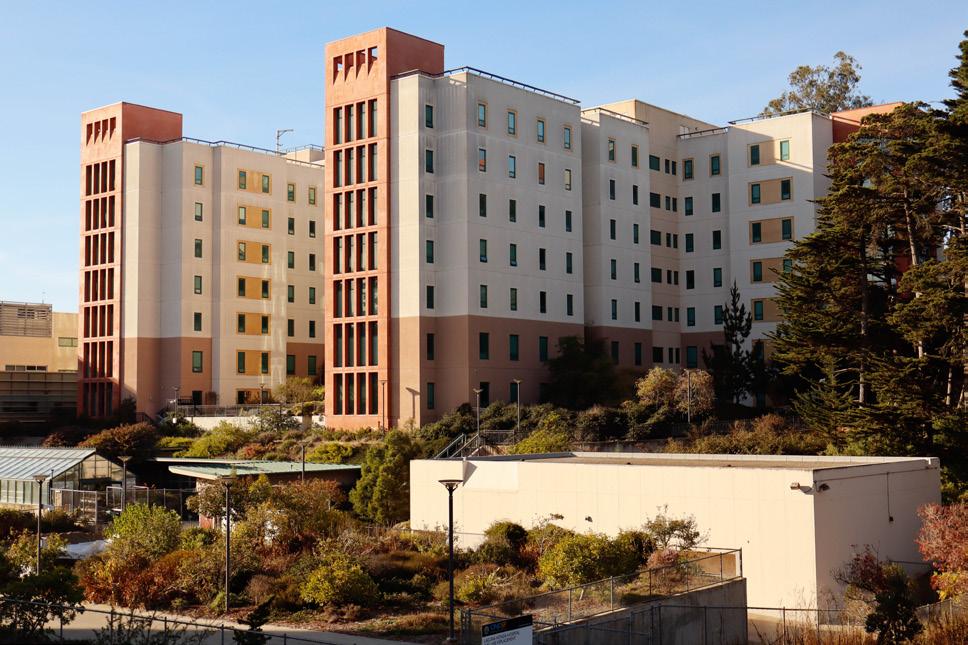
For a weekend activity or something to do after class, consider hiking through Laguna Honda Hospital Community Trails, a network of approximately 2 miles of trails located on the campus of Laguna Honda Hospital and Rehabilitation Center. This long-term acute care facility, established in 1866, houses 780 beds on a 62-acre campus. The hospital grounds offer public access to these trails, which remain relatively unknown to many people.
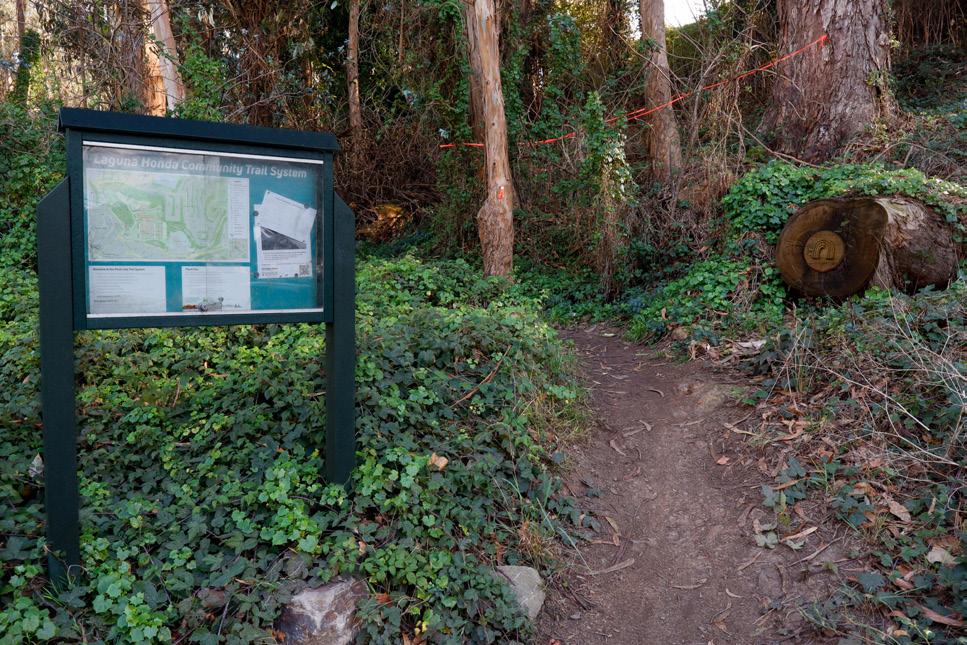
The location is around 2.5 miles from City College, which is a 10-minute drive or about a half hour on the 43-bus line which conveniently goes door to door from City College to the front of Laguna Honda Hospital. It’s also right across the street from the Forest Hill Muni Station. On Google Maps, the entrance is listed as Laguna Honda Trailhead kiosk.
Start at the arched entrance and take the stairs up, then veer left onto Victory Trail. The trail meanders up the hill through forested shade to sunny stretches. Start at the arched entrance, take the stairs up then veering left at Victory Trail. The trail meanders up the hill through forested shade to sunny stretches. The hum of traffic on Laguna Honda Boulevard can be heard as well as views of stylish hillside houses in the Forrest Hill neighborhood. In the spring lots of wildflowers sprinkle this trail.
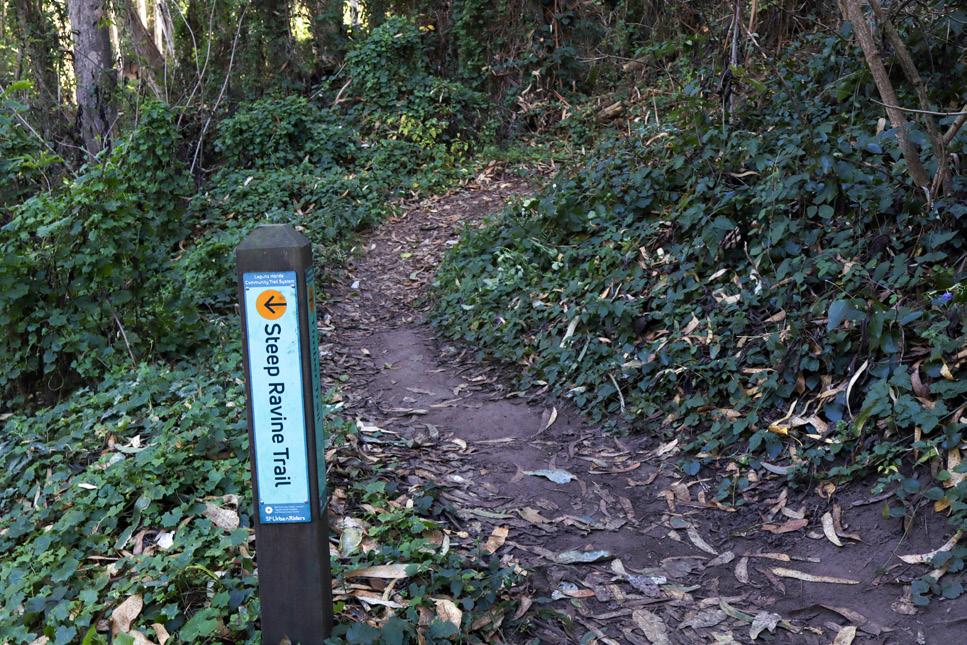
The trail continues up a hill and intersects with the Steep Ravine Trail, which also leads
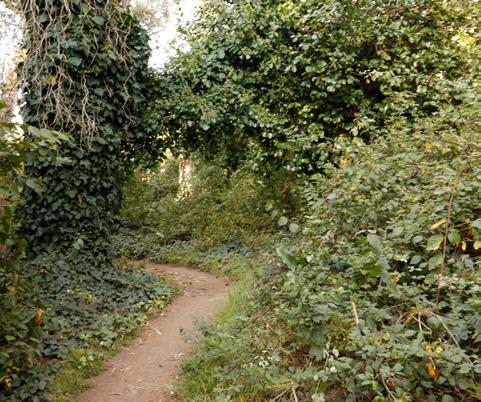
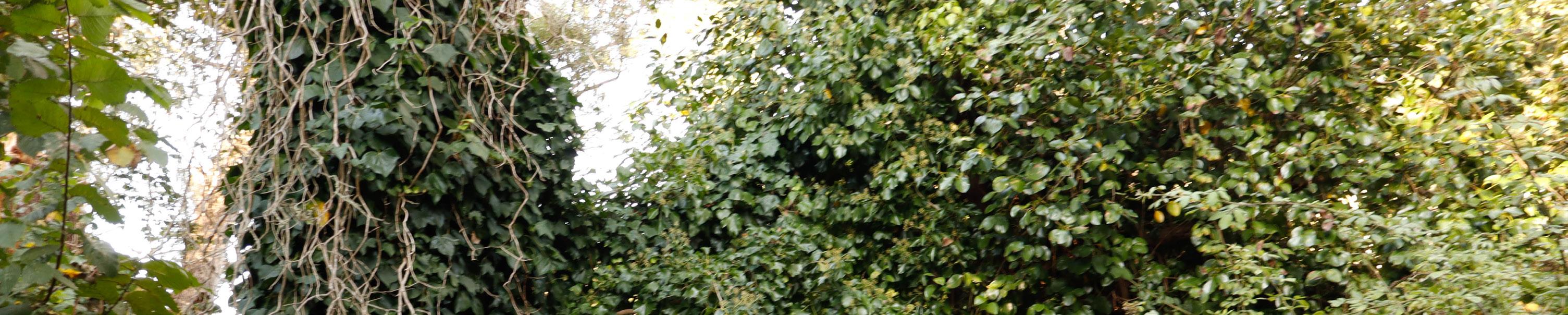
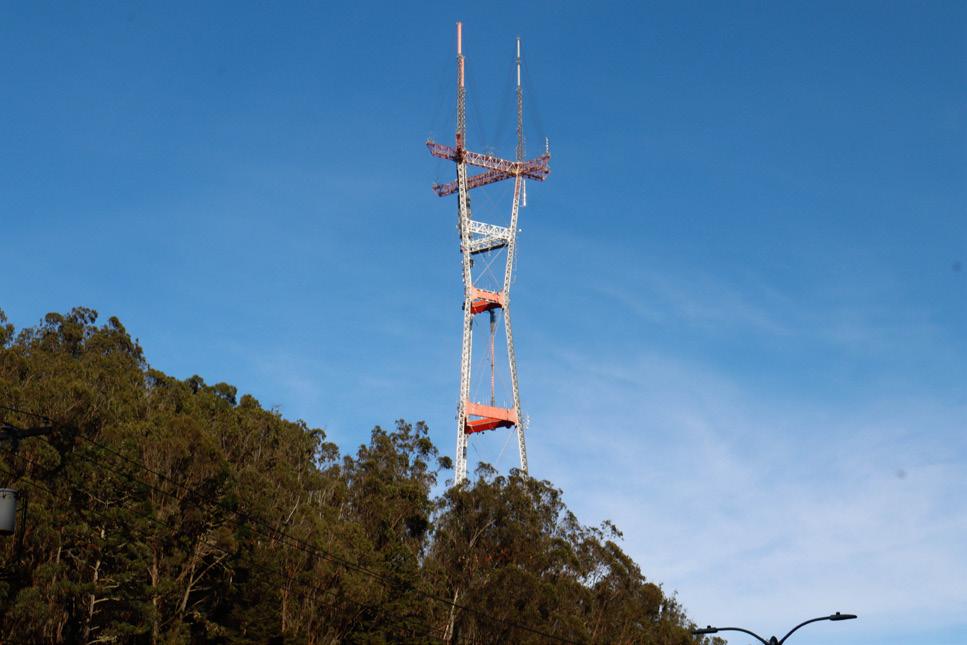
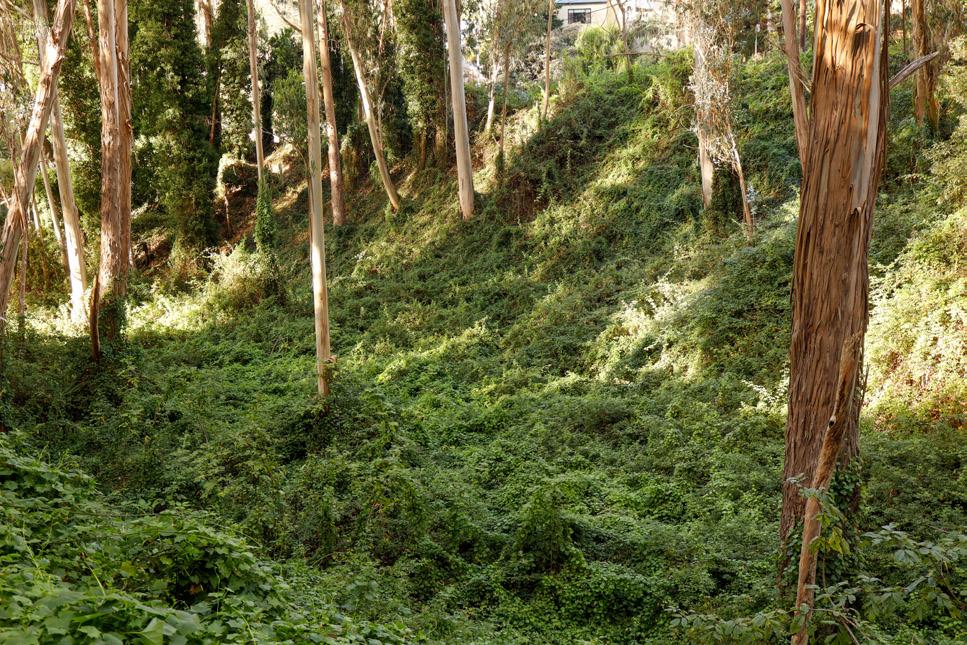
out to Clarendon Avenue, serving as an alternative entrance. The Steep Ravine Trail is where it gets very forested. The foliage is dense and thick with ivy engulfing most of the trees. One might feel as if walking in a different city, not in the middle of a sprawling metropolis like San Francisco. This section is very quiet and serene, with only the sounds of birds breaking the silence. The path meanders through thick vegetation for about half a mile with views of Sutro Tower in the near distance. This trail goes behind the hospital and then comes to a clearing where the hospital has a garden and some benches for patients to use.
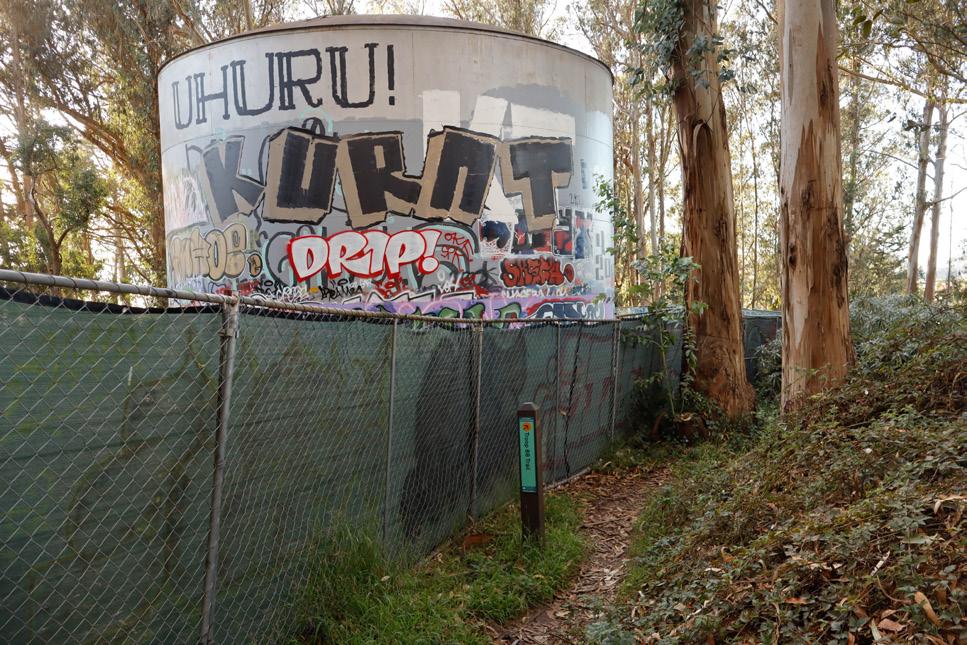
The Steep Ravine Trail ends in a parking lot where the Troop 88 trail starts. This trail was implemented by the Troop 88 Boy Scouts and winds by a water tower before ending at Panorama Dr. From this point, you can either return the way you came or use city streets to complete a loop.
The trails are very popular with mountain bikers and have had much support from SF Urban Riders, who were the pioneers of working with Laguna Honda Hospital to develop the existing trails. According to their website, their goal is to “build a city-wide network of trails where people of all ages and abilities can ride bikes for fun and as a way to experience the outdoors in an urban environment.”
The SF Urban Riders host volunteer workdays on the second Saturday of every month, where volunteers help maintain the trails.
The Steep Ravine trail looks out to a canopy of green. November 2024. Photo by Joan Walsh/ The Guardsman.
Sutro Tower in the distance. November 2024. Photo by Joan Walsh/The Guardsman.
The entrance to Steep Ravine Trail at Laguna Honda Community Trails. November 2024. Photo by Joan Walsh/The Guardsman.
Troop 88 trail goes by a water tower. November 2024. Photo by Joan Walsh/The Guardsman.
Laguna Honda Hospital and Rehabilitation Center. November 2024. Photo by Joan Walsh/ The Guardsman.
Steep Ravine Trail marker entrance. November 2024. Photo by Joan Walsh/The Guardsman.
CCSF Continues Tradition of Being Truly Community Based
By Hannah Clark-Nixon hannahclarknixon@gmail.com
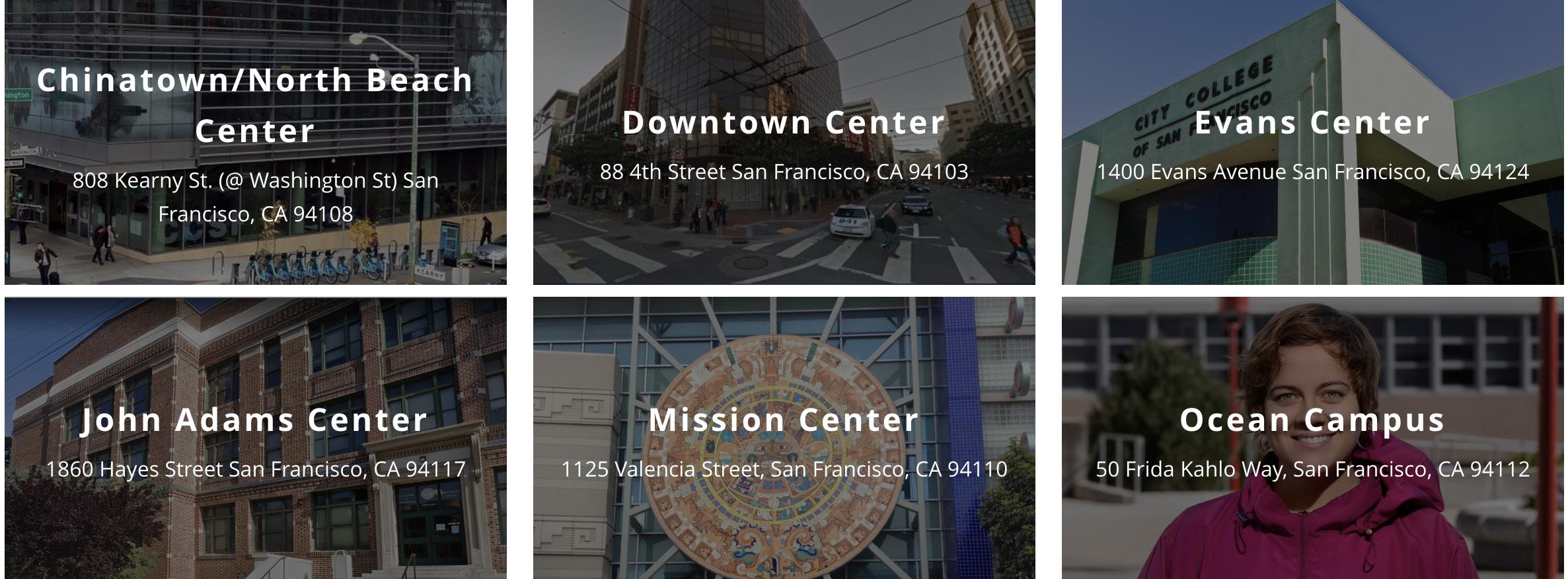
City College of San Francisco offers six unique campuses throughout its community and has continued to serve the Bay Area since 1935.
CCSF currently offers courses at the following locations: Downtown Center, Chinatown/North Beach Center, Ocean Campus, Evans Center and Mission Center. Prior to 2023, there were eight original locations, including the addition of the Southeast Center and Fort Mason Center. As of 2024, there are a total of six CCSF satellite campuses, so what happened to the two left behind?
In 2023 the SFPUC (San Francisco Public Utilities Commission) ordered the entire Southeast campus and staff to be removed from the site with one day’s notice. According to the PUC notice, the building required seismic upgrades and ventilation repairs totaling more than the value of the building and is likely to be demolished. City College opened this campus in the early 90’s and offered as many as 25 classes annually according to Chancellor David Martin.
During the campus sweep, ITS and facility departments were on site to salvage computer and network hardware. This was a devastating loss to the historically Black neighborhood within the Bayview region of San Francisco. Although there was still discussion of ways to refurbish the space, questions of funding and ownership were still at play. Fast forward to 2024, and a brand-new Southeast Community Center has opened nearby at 1550 Evans
Ave, built by SFPUC. San Francisco voters approved bond measures in 2005 and 2020 to fund the construction and upgrading of City College campuses.
Fort Mason, settled in San Francisco's affluent Marina district, is home to stunning views of the Golden Gate Bridge nestled by the shore. In 2020, CCSF trustees approved a controversial decision to close down CCSF's 40-year run at the Fort Mason Art Center. The decision was spurred by a need to close a $12.8 million projected deficit for the 2020 academic year and an estimated $27 million decrease in state funds due to COVID-19. Established political science teacher, Rick Baum, states the trustees are “Either incompetent or purposefully trying to discourage people from taking classes”.
The decision to close the arts center was not perceived well by the community and there were a multitude of questions as to why this had to happen. The new economic crisis of COVID-19 was a perpetual component of the decline of income for CCSF, specifically the Fort Mason campus and leading to its closure.
Board member Ivy Lee states that “Fort Mason is an incredibly unique location, and the college has a long history there. But we have campuses that we own and don’t need to rent to use as learning space.” The moving and construction of the center would run about $245,000, to relocate the kilns and other art equipment at the Fort Mason Center. It was in the city’s best interest, economically and financially, to close the center entirely.
Although City College has suffered two extreme losses over the last 5 years, the remaining six campuses are running up to speed. Let’s break them down.
As of 2024, San Francisco residents receive free tuition at any CCSF campus. Free City is a partnership between City College of San Francisco and the City and County of San Francisco, funded by the voters of San Francisco. This initiative enables San Francisco resident’s free enrollment to CCSF. California residents are charged $46 per unit. For a full-time student taking at least 11 credits, their tuition would come out to roughly $506.00.
Location offerings:
The Ocean campus is CCSF’s main location and houses the majority of its student body. With all major public transportation and amenities, such as a full rec center, cafeteria, library and more, it is where most students go to navigate the next steps in their education.
Established in 1979, The Downtown location offers nine floors including the basement where the culinary classes are held with a full-scale kitchen. Students are drawn to the central location and easily accessible through multiple forms of public transportation.
The John Adams location houses the School of Health & Public Safety. John Adams collaborates with health care and social service institutions to ensure that, upon completion of the study, students are prepared to respond to the current community needs.
Chinatown/North Beach Center is located in the heart of San Francisco's Chinatown, sharing the border of the Financial District and North Beach. This location serves a large range of demographics and is near San Francisco’s new, T Line, transportation entity.
The Evans Center houses the City Build Program, a construction program that works in conjunction with the City and County Mayor’s office. It provides training and job placement services to San Francisco residents interested in pursuing a career in the construction industry.
CCSF Mission Center offers college-level general education classes, career and vocational training, ESL, transitional studies, and programs for working adults. In the heart of the Mission District, this location serves a vast majority of San Francisco Hispanic population.
Each of these centers serves their communities with purpose, whether regarding its location and proximity, or the affordability of tuition for San Francisco residents. As many know, the cost of living in San Francisco is no small feat. With a housing crisis in constant battle with its residents, maintaining affordable education for students was a necessary proposition. The city continuously works to bring accessible education to its residents today and years to come.
Engineering Student Jena Mixon Reaches for the Stars with NASA Program
By Diane Ayerdi dayerdi@mail.ccsf.edu
JenaMixon, an engineering student at City College of San Francisco (CCSF), is reaching for the stars through her recent participation in the online NASA Community College Aerospace Scholars (NCAS) program, which inspires students to pursue careers in science, technology, engineering and mathematics (STEM).
Her journey began with Mission 1: Discover, a five-week online course where students read materials on NASA and wrote reflection papers. There was also “a final project that was infographic and kind of artistic. Once all of your assignments were graded, if you received 80% then you moved on to Mission 2,” Mixon said.
Michael McGlone, NASA education project manager for the National Community Colleges Aerospace Scholars (NCAS), said, “NCAS is an entry-level program for community college students who have an interest in STEM, but also an interest in the space industry, to learn about NASA, the jobs we do, investigate if this is the type of work they want to pursue, get a foot in the door or understand what the space industry is like.”
Mixon shared her insights on the purpose of the NCAS program, “The program is meant to familiarize people with NASA and make them better picture themselves as a NASA employee. It is such a lofty goal that community college students feel is out of their reach.”
After successfully completing the first phase of the program (Mission 1), Mixon then advanced to Mission 2: Career Simulation which took place completely online, from October 23-30, 2024.
McGlone explained, “Mission 2 is a six-day intensive team assignment where the participants have to design a mission to send some rovers to the moon in preparation for a later human mission. They take on career roles in doing that. It is a simulation of a week of working at NASA.”
Reflecting on her experience with Mission 2, Mixon shared, “This part was more technical and very intense. I learned a lot of skills about working as a team, doing things under a lot of pressure and there was a big project to do in six days. This particular mission dealt with designing a moon rover and an entire mission to go with the moon. I designed the rover and the shelters. I was building shelters to protect future astronauts
from radiation on the moon.” She added, “I also got to do a video chat and meet some astronauts who were on an international space station. So that was super cool.”
Mixon is now considered NCAS alumni after successfully completing Mission 1 and 2, which allows her to participate in internships with NASA and future potential employment. Her participation in Mission 3, the last phase of the program, is currently pending.
Mission 3 is a more competitive part of the program, accepting 40 participants. It is a hybrid experience consisting of a two-week online experience with the third week being held onsite at one of the 10 NASA centers nationwide. During the third week, “participants work as a team, work with NASA personnel and get a tour of the facility,” McGlone said.
Mixon’s future academic and career goals include pursuing a master’s degree in engineering at San Francisco State University. She is currently studying mechanical engineering, but is also interested in chemical engineering. Ultimately, she hopes to become a design engineer and is particularly interested in water resource management, with the possibility of doing water research at the NASA Ames Research Center in Silicon Valley.
Mitch Bailey, interim chancellor at City College of San Francisco, applauded Mixon’s achievements, stating, “This is wonderful news! To be selected to participate in this national program brings great honor to Jena and our college. As an institution- and a society-we need more pathways for females in STEM fields. This doesn’t mean just ensuring there are opportunities for entry, but fostering organizational and discipline cultures that are welcoming, inviting and supportive. It is a joy to see students couple their classroom learning with additional educational experiences. Leveraging knowledge and applying it to scholastic and practical means is a great outcome for students! This is an exciting opportunity! Leading by example is a gift. Jena’s participation is a pathway for others to follow, and we hope that other students will do just that.”
McGlone also praised Mixon’s achievements by adding, “I did not get a chance to meet Jena. I know from her mentors that she worked hard. She has a family and is juggling school, home and
employment. She is one of those classic community college students who has a hundred things going on, but still made time for this program and was successful.”
The NCAS program is currently recruiting students for its next program, which will begin in January 2025. The application deadline was November 25, 2024, but for more information about future opportunities, students can visit https://go.nasa.gov/ncas.
Mixon’s participation in the NCAS program demonstrates the potential for students to pursue careers in engineering and space exploration. “I say for people not to be shy about applying for the program. Don’t count yourself out for anything. Anything you want, go for it. Never hold back thinking you’re not qualified because you might surprise yourself,” Mixon said.
Illustration by Cindy Chan
CCSF website lists information on the various satellite campuses.
Interactive Online Art Tour Creates a Walkable Art Route Around CCSF Campuses
By Emily Thorsen ethorsen@mail.ccsf.edu
The CCSF Art Tour, created by the Works of Art Committee, lists art five of the 11 City College campuses offer, many of which came from the Golden Gate International Exposition (GGIE) or on loan from the San Francisco Arts Commission (SFAC).
The Tour catalogs 45 works of art spread across five campuses, with 27 of these works residing on the Ocean campus. The Tour also indicates which works are in storage, a considerable amount due to ongoing construction.
One of these works is Diego Rivera's Pan American Unity. The mural, completed in 1940 but stored since the 1960s, is planned to be displayed in the new Performing Arts Center.
Architect Timothy Pfleuger was commissioned to design the college’s first library to house the piece but died before its construction. He also designed the Science Hall, Men’s and Women’s Gymnasia, and the Athletic Field.
Other works are in storage off campus, but will also be displayed in new buildings. The Ram, a redwood carving by Dudley Carter, will be displayed inside the new Student Success Center.
Sentinels, a bronze sculpture by Aristides Demetrios, is outdoors in front of the Student Success Center, on permanent loan from the SFAC. El Rey, San Lorenzo #1, a stone sculpture by Ignacio Perez Solano, will be moved from the Frida Kahlo Garden to the new Diego Rivera Theatre on Frida Kahlo Way.
The college started collecting art in 1940 following the Golden Gate International Exposition (GGIE), which was similar to a World’s Fair held on Treasure Island.
The Exposition was supposed to display Masterworks from Europe, including artists like Monet, Manet, and Van Gogh. However, when World War II broke out, there was no way for these pieces to be transported from Europe.
Instead, Pfleuger came up with “Act in Action”, where visitors could watch works such as Pan American Unity by Diego River and The Ram by Dudley Carter being created before their very eyes.
“A lot of what was left over came to CCSF. That's how we got the Diego Rivera mural; although it wasn't displayed right away”, Works of Art Committee Chair Dr. Barbara Lass said.
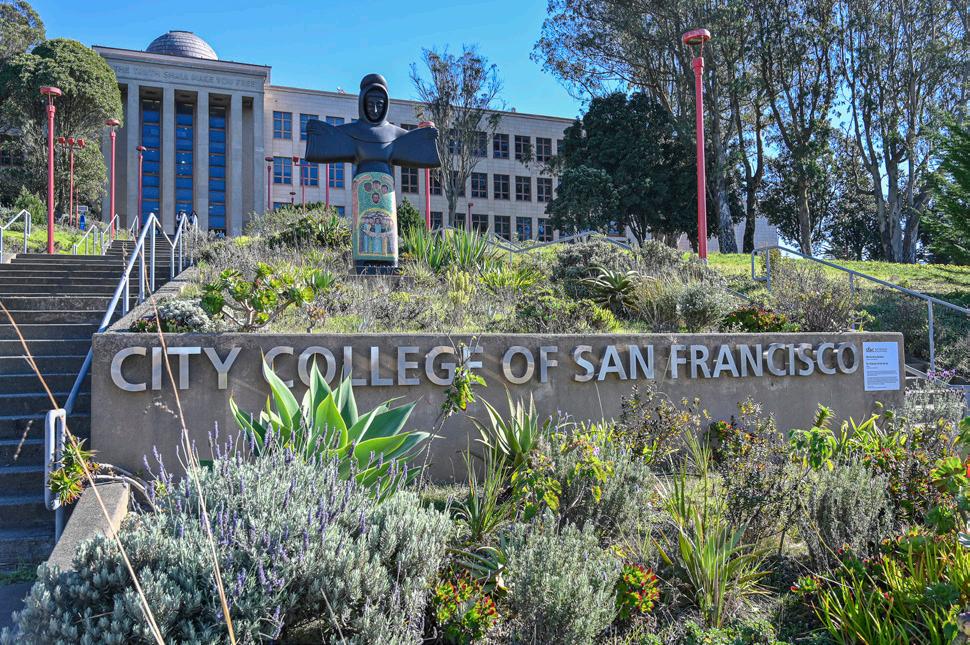
The price the college paid to acquire the art varies on the piece. Works such as St. Francis of the Guns, outside Science Hall, are on long-term borrowing from the SFAC.
Director of Facilities & Planning Alberto Vasquez said, “For the relocation of artwork related to our new buildings, we are required to get approval from the Division of State Architect (DSA). They make sure the attachment or mounting of artwork is safe and secure.”
Another work like this is The San Francisco Scale Model, designed by Pfleuger and built by 300 artisans employed during the Works Progress Administration (WPA) in the 1930s. Completed in 1940, it is the size of an apartment and represents every structure and space in the city at the time.
Currently, in a Richmond warehouse, students and members of the San Francisco Scale Model Initiative Team envision it housed in the Student Union’s Upper-Level Lounge.
“The model will be visible from the outside and the display will be lit up,” said the San Francisco Scale Model Initiative Team’s own Leslie Simon.
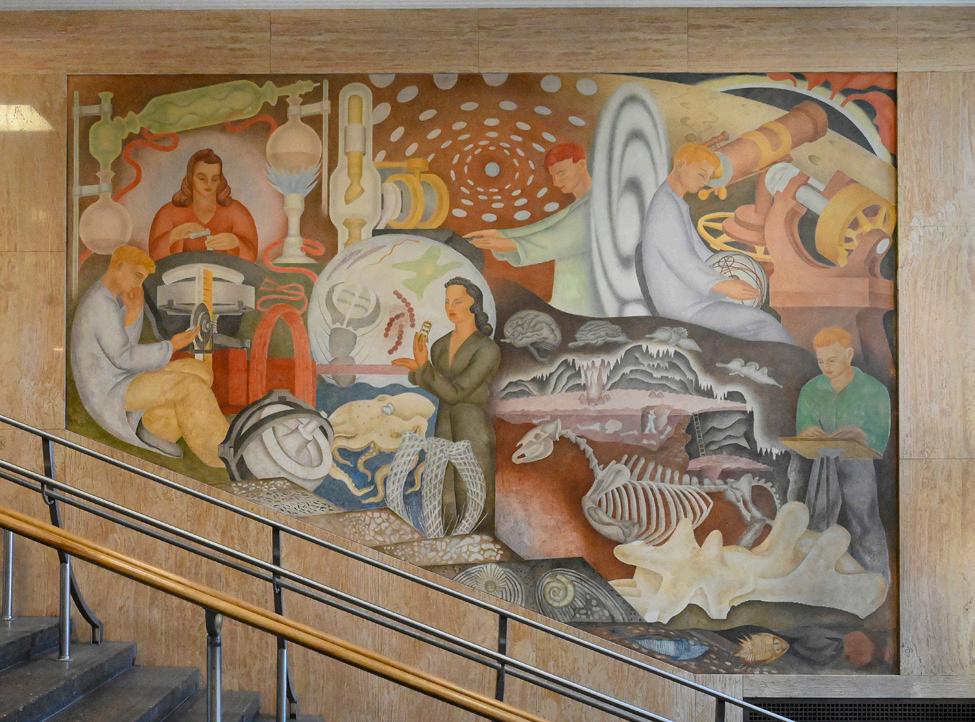
Besides Diego Rivera, a multitude of other famous artists have art displayed here on CCSF campuses. Olmsted’s Theory and Science, inside the entrance to the Science Hall, and Carter’s The Ram, just to name a few. You may already be familiar with Olmsted’s work from his Coit Tower murals.
Even with all the art CCSF has to offer, Pfleuger’s mission would be in vain if not noticed by students and other passersby.
Alexa Ellis, Studio Arts said, “I started to care about the art because of the Diego Rivera mural.”
“I notice the statue heads, but not much more art. I do care!”, said Moxie Morrow, Diversity and Social Justice.
Selamawit Menghistaeb, Undecided said, “To be honest, sometimes [I notice] but since I am mostly just going to and
from the bus I am mostly not really focusing on it. But maybe if I was looking closer!”
“I am not paying extreme attention to it but I do find it nice that there is a multitude of self-expression here”, said Le’ila Chambers, Diagnostic Medical Imaging.
CCSF Art Tour
1. St. Francis of the Guns by Beniamino Bufano - sculpture
2. Wyoming Coup by William Wareham - sculpture
3. Science Hall by Timothy Pfleuger
4. The Story of Life and Time - parts produced in-house, others donated by the California Academy of Sciences - exhibit
5. Theory and Science by Frederick Olmsted - mural
6. Organic and Inorganic Science, North Portico by Herman Volz - mosaic
7. Thomas Alva Edison by Frederick Olmsted - sculpture
8. Leonardo da Vinci by Frederick Olmsted - sculpture
9. Cloud Hall Reading Garden - a collaboration of Women’s Studies, Metal Arts, Sculpture, Environmental Horticulture, and Interdisciplinary Students of CCSF
10. Project SURVIVE Tree designed by Diana Won, Emerge Studios - painting
11. Hijas de Los Nopales by G. Billie Quijano - mixed media
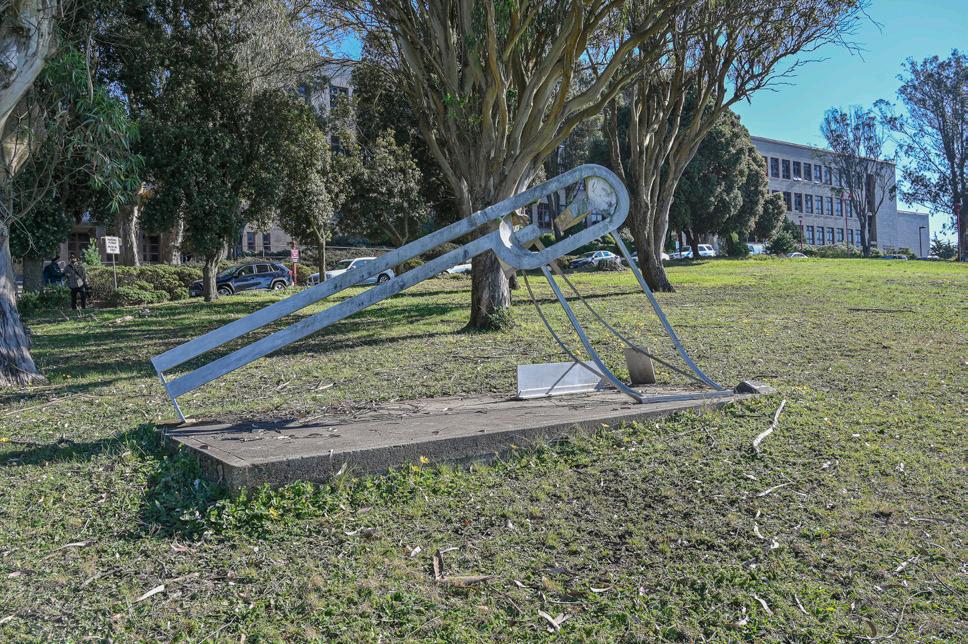
12. Sundial by August Tiesselinck
13. Organic and Inorganic Science, South Portico by Herman Volz - mosaic
14. Sentinels by Aristides Demetrios - sculpture
15. Bighorn Mountain Ram by Dudley Carter - carving
16. The Beast by Dudley Carter - carving
17. Roger Baird Gallery, previously in Conlan Hall
18. Song of the Spirit - designed by Susan Cervantes of Precita Eyes Mural Arts and painted by CCSF students - painting
19. Constellation by Ann Carter - glass spheres
20. Atrium Benches by Kent Roberts - sculpture
21. Rosenberg Library Exhibits
22. Pageant of the Pacific by Miguel Covarrubios - paintings
23. Faces by Alan Brooks - plaster molds
24. Sculpture Deck by Jacques Overhoff - sculpture
25. Bicentennial Wings by Jacques Overhoff - sculpture
26. Uptight by Jacques Overhoff - sculpture
27. The City Arts Gallery
28. Gallery Obscura
29. El Rey, San Lorenzo #1 by Ignacio Perez Solano - sculpture
30. Pacifica by Ralph Stackpole - sculpture
31. Pan-American Unity by Diego Rivera - mural
32. Honoring Japanese-American Students of WWII by Sansei Japanese-American City College faculty artistsmixed media
33. Aztec Calendar by Carols Valenzuela and Alex Garza - mural
34. Mission Center cases
35. El Futuro es Nuestro by Emanuel Paniagua - painting
36. Educate to Liberate: Lessons in Community by Miranda Bergman, Jane Norling, Susan Cervantes, and many volunteers - mural
37. Building Our Dreams by Carole Fitzgerald and students - painting
38. John Adams Center Library Exhibitions
39. Lijiang River by Michael Kenna - photographs
40. Chinese girl and poem by Arnold Genthe, Han Yu, and Mak Ming Chan - photograph, poetry, and calligraphy
41. Scholars’ Rocks - naturally occurring rocks
42. Chinatown/North Beach Center Library Exhibitions
43. Our Work Life by Oscar Melara, Kate Connell, and the Labor Archive and Research Center at San Francisco State University - mural
44. Working Iron by Joe Blum - photographs
45. Pacific Island Tapa Cloth - tapa cloth
BART Champions Sustainability with Creative Paper Ticket Farewell
By Cassandra Young cyoun140@mail.ccsf.edu
Ina creative and environmentally friendly manner, Bay Area Rapid Transit (BART) has said goodbye to its recognizable paper tickets. Local fashion students were given the task of upcycling used tickets into gorgeous, wearable outfits as part of Project Donewa, an innovative project that combines art and environmental awareness. This innovative effort highlighted the significance of rethinking garbage in a sustainable future while also paying tribute to the area's transit history.
The objective was straightforward but profound: transform used paper tickets into stylish clothing that represents both environmental concern and transit history. Waste may be turned into beauty, as seen by the participants' designs, which ranged from elaborate gowns to daring, avant-garde streetwear.
Project Doneway culminated with a lively runway display at Rockridge Station, where models of all ages presented these creative works to the general public. This groundbreaking event featured talent from schools including the Academy of Art University and the Oakland School of the Arts, proving that high fashion and sustainability can coexist.
The conversation regarding sustainability was furthered when the designs were displayed at BART headquarters after the runway presentation. The occasion highlighted the value of waste reduction while showcasing the imaginative possibilities of recycled materials. Project Doneway made a strong statement about repurposing throwaway objects into enduring declarations of creativity and environmental responsibility by giving paper tickets a second chance at life.
Along with introducing a new fleet of environmentally friendly vehicles, the effort represented an important milestone for BART as it moves toward a paperless Next Generation Clipper system. BART reaffirmed its dedication to a greener future by showcasing sustainability-focused art to commemorate its history.
Project Doneway served as a call to action in addition to being an artistic farewell to paper tickets. It gave the Bay Area a fresh perspective on common garbage, demonstrating that even modest, well-considered improvements can have a significant, long-lasting effect on the environment.
St. Francis of the Guns. Photo by Bob Kinoshita/ The Guardsman.
Theory and Science. Photo by Bob Kinoshita/ The Guardsman.
Theory and Science. Photo by Bob Kinoshita/ The Guardsman.
Wyoming Coup. Photo by Bob Kinoshita/ The Guardsman.
Have Your Say: Ocean campus students face some parking problems, but most don’t
By Ellen Yoshitsugu ellenyoshi@gmail.com
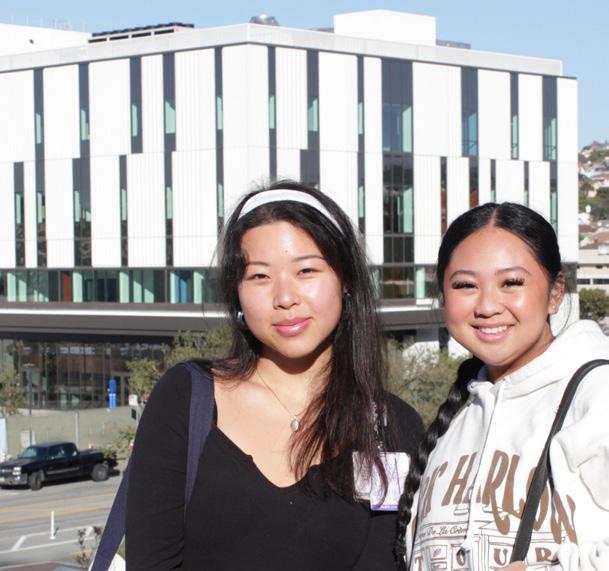
My name is Carmen. I want to be a preschool teacher. I don’t really have problems parking but sometimes when I come here late, I find the parking difficult. Carmen (left)
So right now, I haven't decided what I am interested in yet. I just want to improve my English. I haven't had this kind of situation because maybe I come early, but usually, like when I come here this morning there's still some space left on this side, but I'm not quite sure about the other side. Tuesday and Thursday we park here, and Monday and Wednesday, we park over there, because I have a different classroom. Faye (right)
I think sometimes, because we're nursing students, we get here really early in the morning, most of the time, or sometimes, and then it's like empty. Fridays it’s mostly empty. Oh, I believe I come, like, 30 minutes early before class. I never use the lower lot, it's too expensive.
Jennalyn and Elsie,
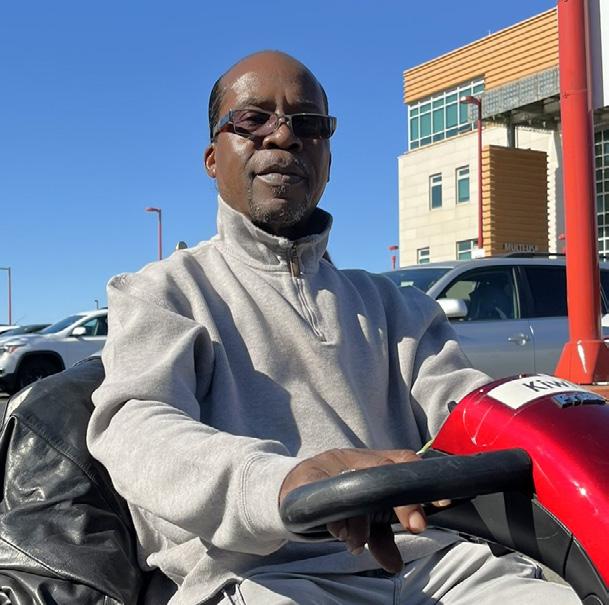
I usually park in the handicap spots. There's always one available, and then I try to just be mindful of the various spots. And I don't really see a lot of people that require the handicap as much, so it's always available.
Jack, Engineering
I'm getting a BS in health science. The EV pumps here on our campus are pretty slow as they are, and some of them are inoperable, whereas it's difficult for us to get parking. For example, you got to get here at like seven o'clock in the morning. Sometimes I can't get here til eight and class is at nine. And the pumps are taken and are either down or they're running too slow where you know it's really problematic when you're driving in. Sometimes I park in handicap zones, but I have to get a charge. I've complained about it. They took one out of service over there, and I did explain that this is a problem for other students. At least tag it out if it's not working, because people think, well, it's working, yeah, you're sitting there for hours trying to get someone to respond to you, and then the classes are going on, you're late and professors are not going for that.
They have EV stations where you can get the high power, the closest one is here at the Whole Foods, right down in the tunnel there. Yeah, they're not working. They haven't been working the whole semester. I'm like, wow, that's really a slap in my face. Yeah, all that money.
Darryl Evans
So at the moment, I'm getting my prerequisites for the nursing program. I had chemistry class today. I park outside of school, I'll be honest, not at the parking lot. Street parking outside up there. Sometimes I do have trouble finding parking. Sometimes it's still full and you have to park maybe further. Sometimes it does make me late, late and stressed, because you feel like you're not gonna make it to class on time.
Maria
So what I hear from students is that they have difficulty getting parking spots throughout different times of the day. One thing that I have heard from students, just standing here in this particular spot, is when they've tried to purchase a parking spot from the bursar’s office, the bursar’s office has told them, we're not no longer selling parking passes, because we're at capacity.
And so now that we are losing parking spaces, and it all started with losing the public parking here on Frida Kahlo. They're having to park at different parts of the community. I have heard of students trying to park at the commercial businesses that we have here, but also risking the possibility of getting towed, whether it be McDonalds or Whole Foods. Once we get to start building Rivera theater or the performance theater, we're gonna have less spaces as well. When we have commencement, where are people gonna park, right? So it's all leading to less parking spots, more student frustration. Students then take that lateness into classrooms. And that's unfortunate. Even with public transit, we at City College don't have an avenue to have free transport either. The reduced transfer that we do have is not through the college, but through a program, whether it be Muni, whether it be Bart, or whether it be any of our other agencies, maybe something for local income folks.
We see them circling and circling, not having parking spots, and being here at this door, we get students that are saying, Hey, can we park here? And we have to tell them this is a faculty parking site. Then the student is put in a place. Do I take a chance of getting a citation? Do I get a chance of getting towed at the commercial buildings? Or do I not make it to class?
on the steps up from Frida Kahlo into the old Science building
Student Chancellor Malinalli Villalobos (at the MUB main entrance info desk)
The Rams Women’s Soccer Team Charges Ahead in the Playoffs After a Lights-Out Victory Against The College of the Sequoias Giants
By John R. Adkins jradproduction@gmail.com
Coming fresh off their second straight 2024 Coast Conference North Division championship, the Rams women’s soccer team ignited their 14th straight finals appearance with a 2-0 shutout of the College of the Sequoias on Saturday, Nov. 24.
The team defensively held back the College of the Sequoias, with the midfielders maintaining control over the game and both goals coming from more than twenty yards out.
It was the second round of the Northern California regional playoffs, with the Rams entering with a No. 4 seed. As a top-eight seed, they received an opening-round bye.
This was the first face-off between the Rams and the Giants this season. The Sequoia Giants placed third in the Central Valley Conference and plowed through the first round of the playoffs by defeating the Canada Colts 1-0 after going 9-6-4 during the regular season.
The sun broke through the previous week's storm surge for a cool yet dry afternoon on the field. The stands were lined with fans wrapped in jackets and blankets while the Rams' footwork ran hot on the turf. The Rams started off the first half by almost indefinitely holding the ball on the offensive side. Each pass knifed the ball easily through the pattern of well-positioned players, and they rarely let up.
Early on, Nadia Barron Santiago passed towards the net, where Ashley Rabara was already waiting to strike the first shot on goal. Carmen Hinton held back at the apex of the midfielders' formation as a dominant force that kept the ball held down in the Giants' territory throughout most of the game.
Sydney Grundland Lanuza's header sent the ball right back towards the net but was caught by the goalie. The Giants players tried to pass the ball back up the green, but the wall of defenders stopped them short.
“Our middle worked together really well, defensively we held the shutout through the game, and that's always a good thing,” explained Arpan Bahia.
Chelsea Sandoval made two back-to-back long-range kicks, placing the ball right in front of the net both times. This allowed Angelina St. Denis to make a swift pass to Catherine Cordova Bobadilla before the ball was snagged again by the Giants goalie.
The Rams refused to ease off the pressure. Anahi Gomez made a powerful shot toward the goal that landed on top of the net. A City College fan could be heard yelling, “Way to fight for it!” from the sidelines.
Lanuza struck the ball from midfield range, which traveled through the air with a misleading arc and slipped right past the goalie and into the net for the first goal of the game.
Paige Pineda-Aliamus then stole the ball right back from under the Giant’s feet at the center line and sent it straight back into enemy territory.
Rhiana Gardon landed a hard strike from a ways back, which ricocheted off the crossbar.
Bahia took charge from midfield range, passing the ball back to her players to hold the attack before intercepting another pass with a header. The Rams managed another shot before halftime, once again leaving the ball on top of their opponent's goalnet.
The College of the Sequoias started the second half with a swift kick into Rams territory, but Rams goalie, Bailey Perales, was there to send it straight back out.
It wasn't long before the Rams once again warmed up to find their groove. Rabara stole the ball in top gear and fired off a clean shot on goal that didn’t quite make it in.
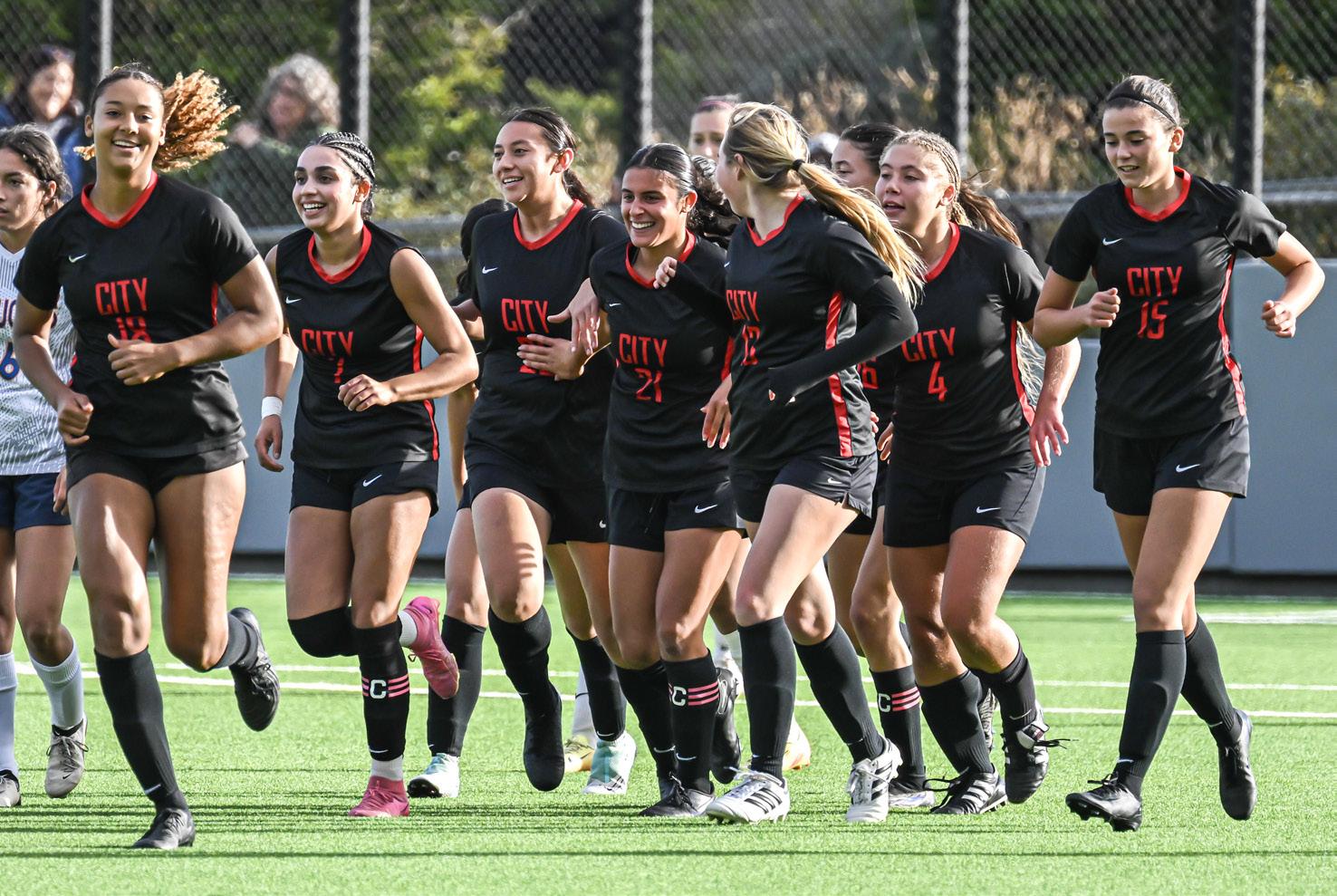
Mid-fielder Nare Avetian regained control from behind the penalty area and shot the ball, which quickly sailed over the other players and arced down straight into the right-hand corner of the goal, just out of reach of the goalie's hands.
“Our midfield is fantastic,” Assistant Coach Nasser Abdulkariem said. “I mean, they controlled the game, obviously, with both goals coming from our mids. They executed by keeping that ball low on a tough keeper. So they clearly were the women of the match.”
Even when the ball went out of bounds and the Rams lost possession, they quickly regained control and continued to command the green, making interceptions and juggling the ball between the players.
“We just kept attacking and attacking. We didn't really give up, and one of the things we knew that this team did well was counterattack. I thought we went back on defense because we knew we had to, so I think that saved us at some moments,” Avetian said.
The Giants remained determined not to go down so easily, and their center midfielder helped keep the Rams on their toes with multiple interceptions at the center line in the second half.
Lanuza passed the ball to Avetian down the sideline before getting it to Rabara, who managed to knock the ball off toward the goal under pressure before it was picked up by the Giants' goalie.
With less than 15 minutes left in the game, the defenders temporarily locked up the Rams, and the Giants kicked the ball from the half-line, only to land straight in the arms of the goalie.
“We need to be more clinical in front of the goal, especially in the final third to make that last run,” Abdulkariem said.
In the final moments of the game, the ball was kicked straight to the corner of the field before being returned to Lanuza, who fired off one more shot on goal, closing out the game with eight shots on goal for the imposing team.
“Anytime you get to the playoffs, you're always going to play really talented teams, and I thought we did a good job matching up,” said Head Coach Jeff Wilson. “I think the fact that we could play so many of our players and we all seemed cohesive was very important. It didn't matter who was on the field; everybody bought into working hard and doing what they could for the rest of their teammates on the field.”
Avetian said, “This win was a good win. We played well, played strong, so we have a good mentality going into the next game.”
The team moves on to the third round of the finals, where it will face top-ranked Fresno City College in a tough match-up.
“Fresno was, I think, number two in the state most of the season until they stumbled a little bit. We tied in the last game, and then they lost a game, so they fell right behind us in the standings. Thank God we don't have to drive to Fresno,” Abdulkariem said.
Despite this being their 14th straight finals appearance, the Rams women’s soccer team has not made it to the state championships since 2013. They suffered a loss in the third round of the playoffs last season, which sent them packing up their athletic bags for the semester.
The team is set to face Fresno City College with their home-field advantage on Tuesday, Nov. 26.
Rams Nare Avetian (21), (4th from the left), celebrates with teammates after scoring a goal in the second half against the College of the Sequoias in Round 2 of the playoffs in San Francisco, Saturday, Nov. 23, 2024.
Photo by Bob Kinoshita/The Guardsman.
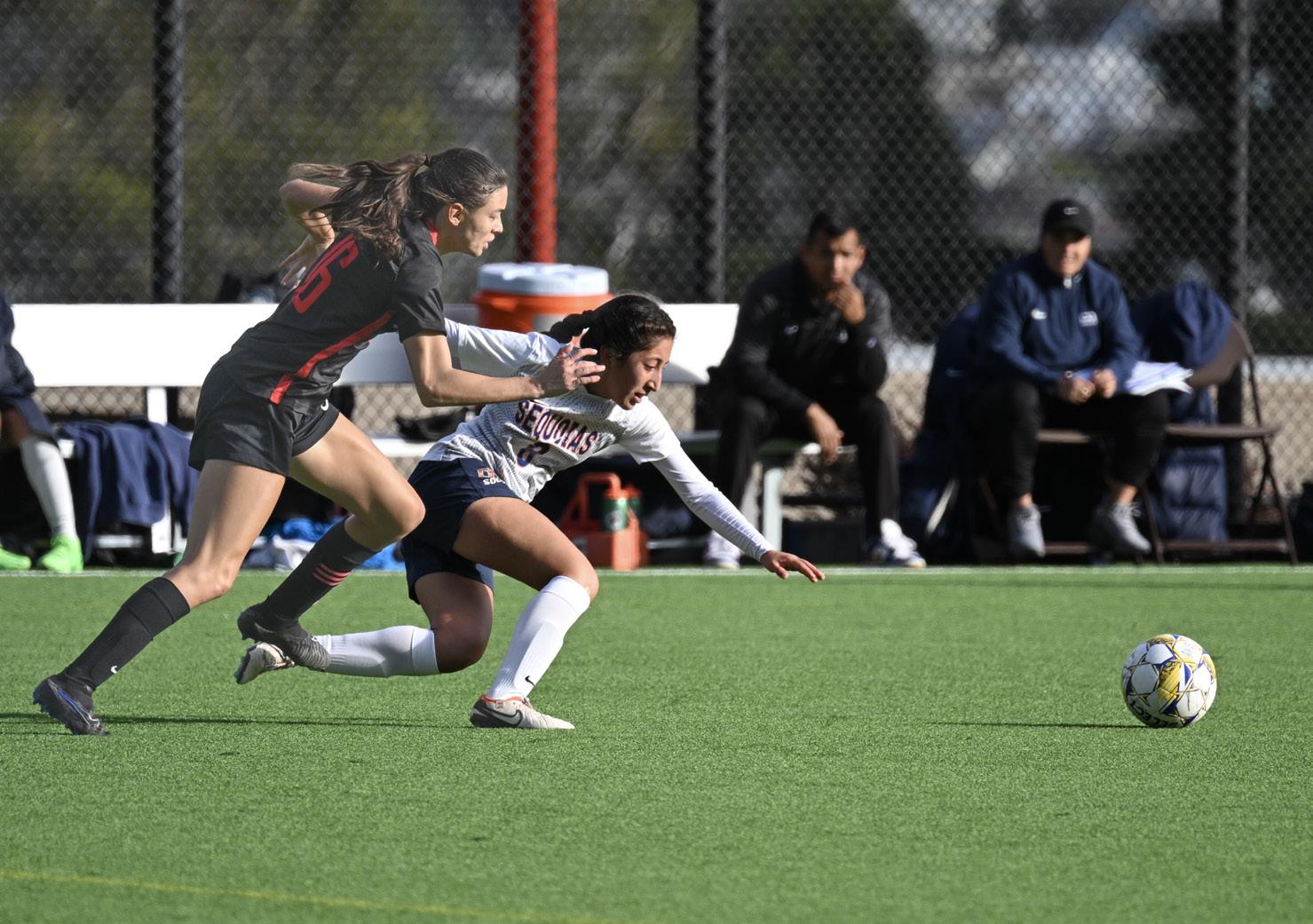
Rams Paige Pineda-Aliamus (16) battles College of the Sequoias defender for the ball in Round 2 of the playoffs in San Francisco, Saturday, Nov. 23, 2024.
Photo by Bob Kinoshita/The Guardsman.
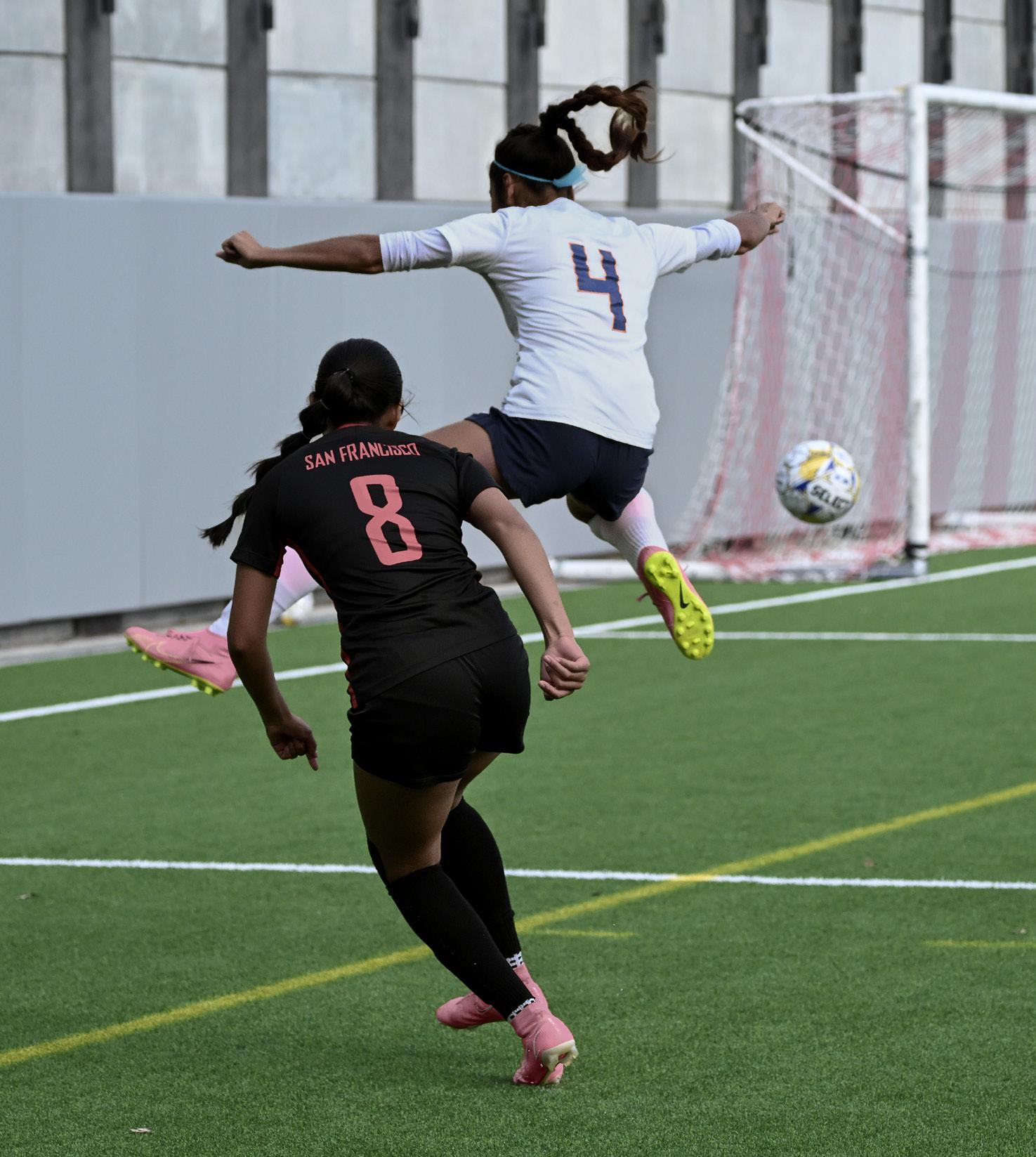
Rams Catherine Cordova Bobadilla (8) takes a shot on goal against the College of the Sequoias in Round 2 of the playoffs in San Francisco, Saturday, Nov. 23, 2024. Photo by Bob Kinoshita/The Guardsman.
Rams Make The Playoffs
By Bob Kinoshita rkino@hotmail.com
With a 2-0 win over Chabot College, the City College men’s soccer team entered the playoffs as the 12th seed and faced No. 21 Cabrillo College on Wednesday, Nov. 20. The defense held strong, with goalie Calvin Deng making four saves, while Jose Magallon, assisted by Alexander Alvarez-Madrid, scored the game’s only goal in the final minutes. The 1-0 victory over Cabrillo advanced City College of San Francisco to the second round of the 3C2A Northern California Regional Playoffs.
In the second round, they faced No. 5-seed Cañada College in Redwood City. The game went into overtime, where Cañada scored to secure a 2-1 win.
The City College of San Francisco men’s soccer team ended the season with an overall record of 13-7-1, including a 7-5-1 conference record. Over 21 games, the team scored 36 goals and posted a 6-2-1 home record.
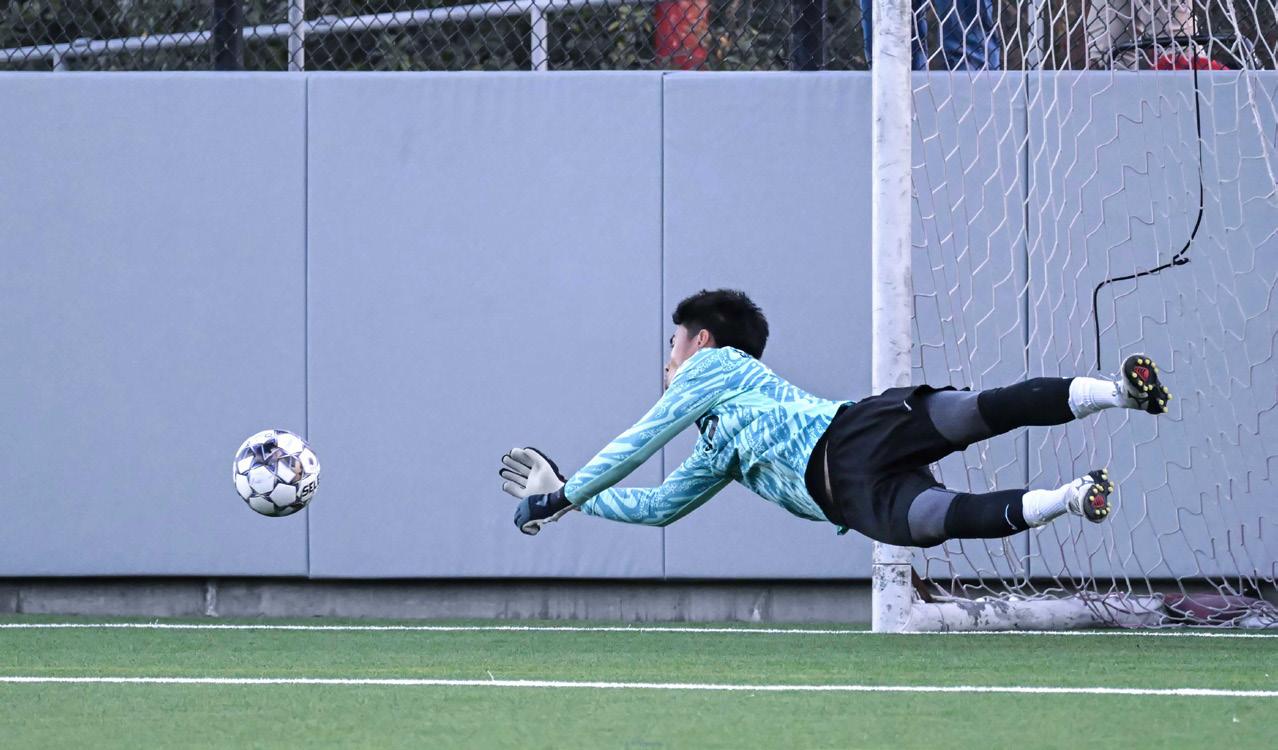
Rams goalkeeper Calvin Dang (1) makes a save on goal against Chabot College in San Francisco, Friday, Nov. 15, 2024. Calvin had two saves on goal and shut out the Chabot College Gladiators.
by Bob Kinoshita/The Guardsman.
CCSF Students Score Free Access to Rams Football Games Rams Players Confirm Free Entry for CCSF Students at Home Games
By Young, Cassandra cyoun140@ccsf.mail.edu.
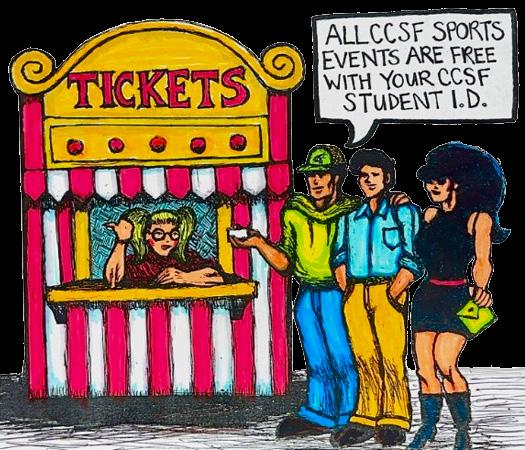
There’s good news for City College of San Francisco (CCSF) students who want to catch a Rams game without emptying their wallets. While general admission is $12, CCSF students can get in for free — that is if they remember to bring their student ID.
CCSF sports coaches were contacted for an official comment, but no response was provided. In search of further information, a few football players were approached as they headed to practice.
The players confirmed that CCSF students are still eligible for free admission to games. One player noted, “Just bring your ID, and you’re good,” while others briefly acknowledged the policy before continuing on their way.
For CCSF students juggling classes, jobs, and tight budgets, the news couldn’t be more welcome. Alex Williams, a CCSF student and self-professed Rams fan, shared, “I love that we can go for free. I mean, it just makes it easy to support the team without, you know, having to spend extra. I’ll be there this season.”
With home games held at George M. Rush Stadium, the policy gives students a front-row seat to the excitement, from hard-hitting plays to lively halftime shows. Beyond the fun, the free admission is part of CCSF’s ongoing commitment to engaging students and encouraging school spirit without adding to financial stress.
So, if you’re a student wanting to escape the library and catch a Rams game, remember: just bring your ID, and you’re in. Go Rams!
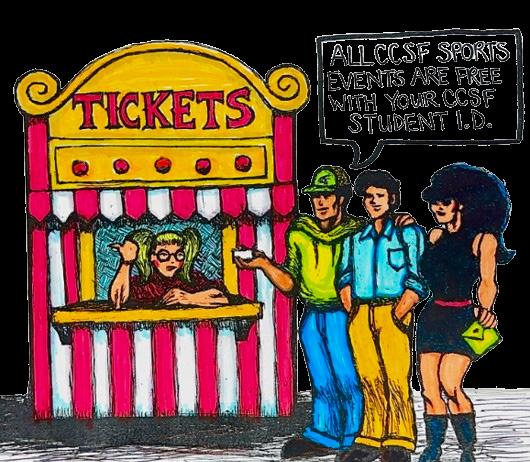
"All CCSF sports events are free with your CCSF student I.D." Illustration by David Thomas/The Guardsman.
Rams forward Xavier Alexander Elder (13) gets by Chabot College defensemen during the game in San Francisco, Friday, Nov. 15, 2024. Xavier scored a goal in the second half making the final score 2-0. Photo by Bob Kinoshita/The Guardsman.
Photo
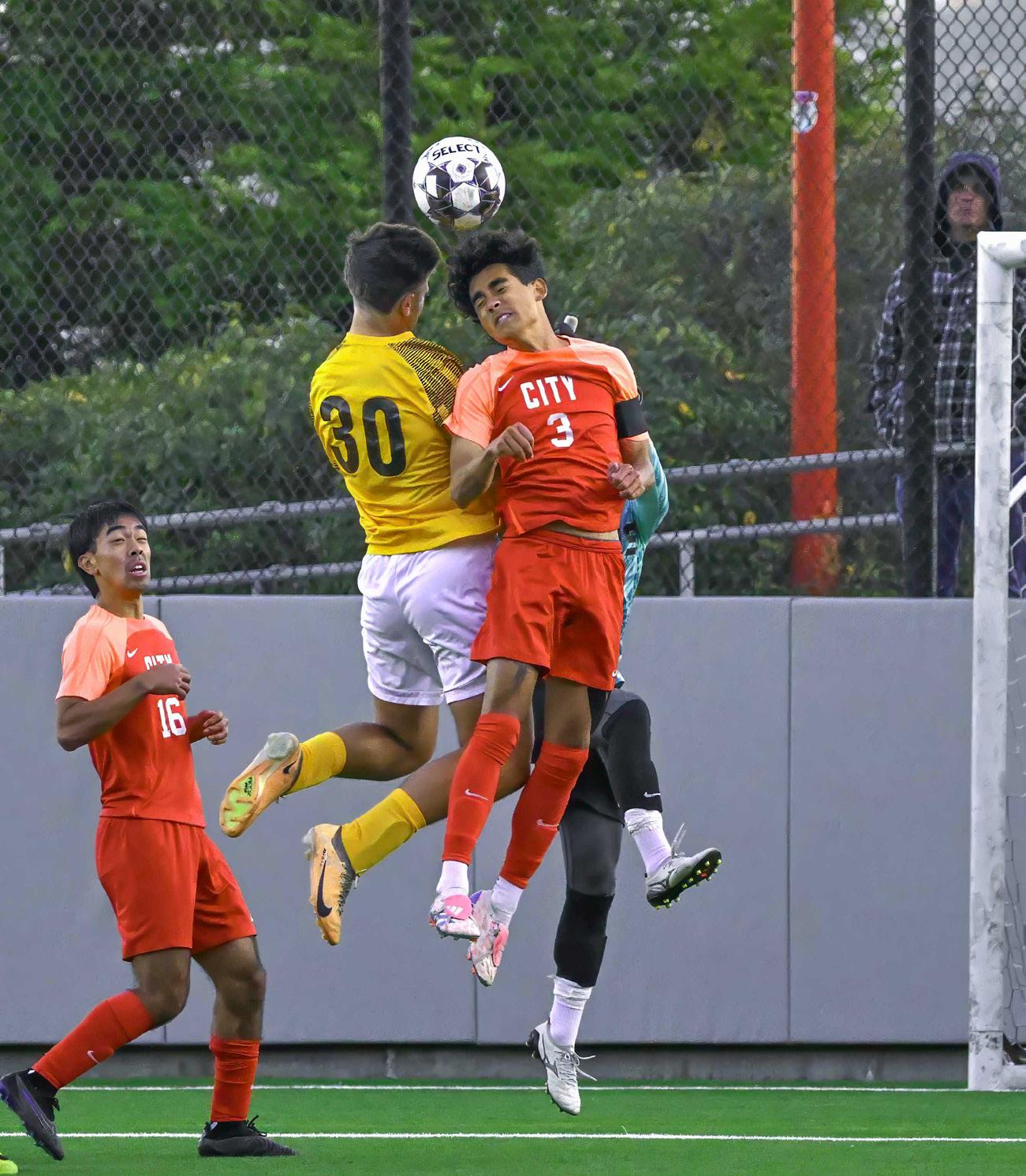
Rams defenseman Isaac Borrayo (3) blocks a shot during the game against Chabot College in San Francisco, Friday, Nov. 15, 2024. Photo by Bob Kinoshita/The Guardsman.
Rams middleman Allan Villegas Torres (20) passes the ball against the Chabot College Gladiators in San Francisco, Friday, Nov. 15, 2024. Photo by Bob Kinoshita/The Guardsman.
City College of San Francisco Journalism Classes | Spring 2025
JOUR 19: Contemporary News Media
Recommended Prep: Readiness for college-level English or ESL 188. 31193 831 Onl Asynchronous 01/13-05/21 Online
Instructor: Alex Mullaney
This class is part of CityOnline and is 17.5 weeks. JOUR 19-Sec 831 has no scheduled in-person meetings and requires the use of Canvas. All coursework is completed on Canvas using an internet enabled device. For course details, students must check the instructor’s website (https://sites.google.com/mail.ccsf. edu/mullaney). This course meets the requirement for the AA and AA-T degree in journalism and the Certificate of Achievement in Data Journalism. For more information about CityOnline, please visit the CityOnline website (https:// www.ccsf.edu/academics/online-learning/cityonline). CSU/UC/CAN
JOUR 21: News Reporting and Writing
Recommended Prep: Readiness for college-level English or ESL 188. 35385 001 Lec TR 09:40-10:55AM 01/14-05/21 CLOU 230 Ocean
Instructor: Juan Gonzales
This course meets the requirement for the AA & AA-T degree in journalism. It is also required for the Certificate of Achievement in Data Journalism, Editorial Management & Design, and Entrepreneurship & Innovation in Journalism. CSU/CAN & CSU. The course training also includes an opportunity to produced stories for publications like The Guardsman and neighborhood newspapers.
JOUR 23: Copy Editing
PREREQ: JOUR 21.
35901 501 Lec R 06:10-09:25PM 01/30-05/21 MIC 217 Mission
Instructor: Molly Oleson
This is a late start in-person course at the Mission Center. For more information, please contact the instructor Molly Oleson at moleson@ccsf.edu
This course is responsible for producing the campus newspaper The Guardsman. This course meets on the Ocean campus in Bungalow 615. Contact the instructor at jagonzal@ccsf.edu prior to the start of the semester for added instructions. This course meets the requirement for an AA degree in journalism and the Certificate of Achievement in Editorial Management & Design. CSU
JOUR 31: Internship Experience
PREREQ: Approval of the Journalism Department Recommended Prep: JOUR 24.
33770 W02 Work Hours Arr 01/13-05/21 Ocean
Instructor: Juan Gonzales
This course requires placement in a media setting with the consultation of the instructor. Contact the instructor at jagonzal@ccsf.edu prior to the start of the semester. CSU
JOUR 35: Data and Multimedia Journalism
Recommended Prep: JOUR 21.
33692 501 Lec T 06:10-09:00PM 01/14-05/21 MIC 217 Mission
Instructor: Molly Oleson
This course meets the requirement for an AA degree in journalism. It is also required for the Certificate of Achievement in Data Journalism and Entrepreneurship & Innovation in Journalism. You are advised to contact the instructor at moleson@ccsf.edu prior to the start of the semester for any last minute instructions . CSU
JOUR 37: Introduction to Photojournalism
Recommended Prep: PHOT 51 or demonstration of equivalent knowledge. 34149 501 Lec W 06:10-09:00PM 01/15-05/21 MIC 217 Mission
Instructor: Jessica Lifland
This course meets at the Mission Center in Room 217. You are encouraged to contact the instructor at jlifland@ccsf.edu prior to the start of the semester. This course meets the requirement for an AA & AA-T degree in journalism. It is also required for a Certificate in Data Journalism, Editorial Management & Design, and Entrepreneurship & Innovation in Journalism. CSU