The Guardsman, Vol 177, Issue 2, City College of San Francisco
SFMTA Not Swayed by City College Strong Objections; Controversial Plan Along Frida Kahlo Way Gets Greenlight
By Jacob Silverman jacob@telltaleservices.com
Despite strong objections from City College students, faculty and trustees, the San Francisco Municipal Transportation Agency (SFMTSA) is moving forward with the controversial bikeway project along Frida Kahlo Way.
The SFMTA Board of Directors approved the Frida Kahlo Way Quick Build Project on May 7 following months of opposition from the City College community. The approval comes after numerous revisions to the plan following meetings with the City College Board of Trustees and feedback from the wider City College community.
City College’s Board of Trustees unanimously passed a motion on Feb. 23 opposing the San SFMTA’s plan for a Quick Build Project on Frida Kahlo Way. In a media alert released on Feb. 27, the Board of Trustees announced their opposition to the plan, “unless and until there are amendments to the plan that resolve the concerns raised by members of the CCSF community.”
Trustees cited community concern over “the safety of proposed protected bicycle lanes, blue zones, loading zones, drop-off zones, the revised bus stop, and loss of parking spaces” in their motion.
The initial plan would remove 33 parking spaces that are primarily used by students at City College.
“The loss of parking will reduce educational opportunity for hundreds of CCSF students,” the City College Higher Education Action Team said. “Many need their cars to get to class and other destinations on time.”
“It was very strange to us that the Board of Trustees took action on this without having us there in the room to talk about their concerns,” SFMTA Director Jeffery Tumlin said.
The approved proposal is based on nearly a year of public outreach and with input from City College organizations and community members.
“We know that most City College students have complex lives and for many of them that means the only reasonable way to get to City
College is to drive,” Tumlin said.
Simultaneously, Tumlin cited City College’s recent adoption of a Green New Deal Plan as reason to decarbonize transportation, with a particular focus on walking, biking, and MUNI.
“We have been able, I think, to address every single one of the concerns that we’ve heard from the community,” Tumlin said.
“I think with one exception, and that is the project does remove 33 unregulated parking spaces,” he added. “We were able to reduce the number of parking spaces removed by 15.”
The Board of Trustees was at least the seventh group to publicly oppose the Quick Build plan, in addition to a petition opposing the project that had almost 150 signatures as
of Feb. 27.
SFMTA presented to the City College Board of Trustees on Mar. 28 to outline the current plan for the Quick Build Project as well as the project’s future.
“Our board does not just overstep staff recommendations,” Tumlin said.
SFMTA responded to student backlash in an Op-Ed written by Director Tumlin, reiterating SFMTA’s commitment to safety and accommodating all parties impacted by the changes.
Construction began the week of May 20 with plans to complete the majority of the project during the City College summer recess according to SFMTA on their website.
The project, according to the SFMTA, will
include a new two-way protected bike lane on the east side of Frida Kahlo Way that will extend to the south side of Judson Avenue for two blocks to Forester Street. Two new transit boarding islands that will serve passengers on the 43 Masonic is also planned. The project also calls for removing the mid-block 43 Masonic transit stops at the bottom of the staircase of City College due to low ridership.
Temporary construction parking restrictions were implemented alongside the temporary relocation of affected bus stops during the week of May 27.
SFMTA’s project timeline expects implementation to occur throughout the summer with evaluations and adjustments set to take place during late 2024 and into mid 2025.
City College Makes Good on Its Promise to Create a Long Needed Native American Studies Program
By Gabrielle Chagniot gchagniot@theguardsman.com
City College is finally making some headway in serving the educational needs of Native American students.
The recent approval of a Native American studies course titled NAIS 38 “Introduction to Native American Studies” is scheduled to be taught during the Spring semester in 2025. Future plans also include the creation of other courses to be taught by Native American professors, as well as a certificate and a transfer degree in Native American Studies by the 20252026 semester.
Presently, the college curriculum harbors three courses, including Anthropology 12 “Indigenous People of North America,” History 15A “History of the American Indian: Eastern Tribes,” and History 15B “History of the American Indian: Western Tribes,” but the latter two are inactive.
The college begins every public meeting with a land acknowledgment recognizing the Ramaytush Ohlone people as the proprietors of the land the college currently occupies, making this development especially fitting.
According to the college’s 2022 fact sheet on student demographics, Native American students comprise 1% of the 25,349 campus population. As far as direct services to Native American
students, none currently exist.
Nationally, only 24% of Native Americans ages 18-24 are enrolled in college, compared to 41% percent of the overall U.S. population, according to a 2021 Postsecondary National Policy Institute. Additionally, undergrad enrollment among Native Americans in that same age group decreased from 128,600 in 2016-17 to 13,400 in 2019-20.
There are many obstacles that stand in the way of Native Americans who are seeking higher education. According to the U.S. Census Bureau, poverty is one of the biggest impediments for Native Americans earning a college degree. More than 27% of Native American Studies continued on page 2
St. Francis of the Guns overlooks Frida Kahlo Way and the Upper Reservoir parking lot on May 16, 2024. Photo by Seamus Geoghegan/ The Guardsman.
50 Frida Kahlo Way, Box V-67 San Francisco, CA 94112 Bungalow 615
Native American Studies continued from page 1 the American Indian and Alaskan Native population were living in poverty in 2022. That is the highest rate of any group, compared to 12.4% of the nation as a whole according to a new 2022 data from the U.S. Census. This is an increase from 7.4% in 2021.
Locally, the American Indian Culture District of San Francisco (AICD) is particularly concerned about City College’s efforts to meet the higher educational needs of Native Americans. Founded on Mar. 31, 2020, the AICD is the first established cultural district of its size in the U.S. dedicated to recognizing, honoring, and celebrating the American Indian legacy, people, and contributions Native Americans have made.
A brainstorming session hosted by AICD on Nov. 29, 2023, at Sanchez Elementary School in San Francisco’s Mission District covered issues in higher education for Native Americans. The 100 attendees from throughout the Bay Area were able to raise their concerns and come up with ideas to tackle and work around problems.
Those in attendance included Anita Martinez, Vice President of the City College Board of Trustees, and Leslie Simon, a member of the Interdisciplinary Studies faculty, who agreed that getting Native American students to seek higher education needs to start early with the help of advocates.
Other conclusions from the meeting were that parents need to be kept informed about educational opportunities for their children and that specific mentors for Native American students are needed to inspire and guide them toward enrolling in college courses.
“The first step in making City College accountable to the Native American community is getting final course approval for an introduction to Native American Studies, and then offering it,” said Martinez.
Simon shared Martinez’s reaction. “An introduction to a Native American Studies course will be the start to a Native American Studies certificate and major.”
Simon also wanted to acknowledge the role of Lauren Muller who recently passed away.
“As beloved long-time chair of the Interdisciplinary Studies Department which houses the 'Introduction to Ethnic Studies' course, and as a scholar of Native American Studies herself, Muller headed up the team that worked to develop NAIS 38.” Simon continued to say, “After she passed, the other members of the team carried on in her memory, knowing how devoted she was to the establishment of the course and a certificate and program in Native American and Indigenous Studies.”
In 2007 the San Francisco Human Rights Commission published a report entitled “Discrimination by Omission: Issues of Concern for Native Americans in San Francisco." Among its findings, the Commission found that “the curriculum at CCSF regarding Native American cultural recognition, cultural history, and factual accuracy needs improvement.” It recommended that the college create a Native American Studies Department.
“When you don’t feel you belong, it’s hard to succeed.” said Adolfo Velasquez, a former City College EOPS counselor/chair. Velasquez also noted that “the Native American community oftentimes feels left out of meetings, which impacts their future.”
“By creating a Native American Studies program at City, it will give a sense of
belonging, pride, and hope to Native American students,” Velasquez said. “There are higher rates of poverty, alcoholism, and hopelessness. Ethnic Studies fulfills the demand for relevant education.”
In the 1960’s a student strike at San Francisco State University (SFSU) led to the creation of the College of Ethnic Studies, and the first Native American Studies Department.
"Fifty-five years after the creation of the College of Ethnic Studies and the first American Indian Studies program at SFSU, and 17 years after the San Francisco Human Rights Commission report on Native Americans (‘"Discrimination By Omission”) it has been an honor to have worked with a team of dedicated faculty at CCSF to launch the beginning of a Native American Indigenous Studies (NAIS) program,” Velasquez said. “It’s a program long overdue with the hope of bringing pride to the San Francisco Bay Area Native American community."
One important figure who influenced Native American studies was Richard Oakes. He was a Mohawk Native American activist and an SFSU student who successfully introduced Native American studies into university curricula with the help of one of the professors, Dr. Beatrice Medicine. He also encouraged Native American students to enroll in SFSU.
Elsewhere, San Diego City College (SDCC) will offer Native American and Indigenous Studies courses for the first time in its nearly 110-year history.
Intro to Native American and Indigenous Studies, Federal Indian Law, and Indigenous Spirituality are among the courses being developed, which are intended to fulfill the undergraduate requirements for an associate's degree in Native American Studies, with which a student can then transfer to a four-year college.
SDCC has plans to launch the Native American and Indigenous Studies department and intro courses in the fall of 2025. Both are pending formal approval from the Board of Trustees.
Safety Concerns Shuts Down City College’s Palestine Support Encampment
By Patrina Harrison
Nearly four-days after a three-tent encampment was erected on City College’s Ocean campus, student protestors in negotiation with campus police agreed to vacate the lawn of Cloud hall on May 16.
The dismantling of the encampment, according to Student Trustee Heather Brandt, was in consultation with campus police due to “safety concerns.”
Students erected their encampment May 13 on the lawn behind Cloud Hall that faces George M. Rush Stadium. Demonstrators called for a ceasefire, and urged City College to stop providing funds to companies that send money to Israel.
During the protest, students could be seen sitting in lawn chairs surrounded by a table filled with food, snacks and refreshments.
By noon, campus police had blocked access to the stairs leading to the tent encampment.
Campus police met with demonstrators in the Associated Students office, with the protestors agreeing to leave. Tents remained up on the lawn until the following day.
Illustration by Eduardo Morales
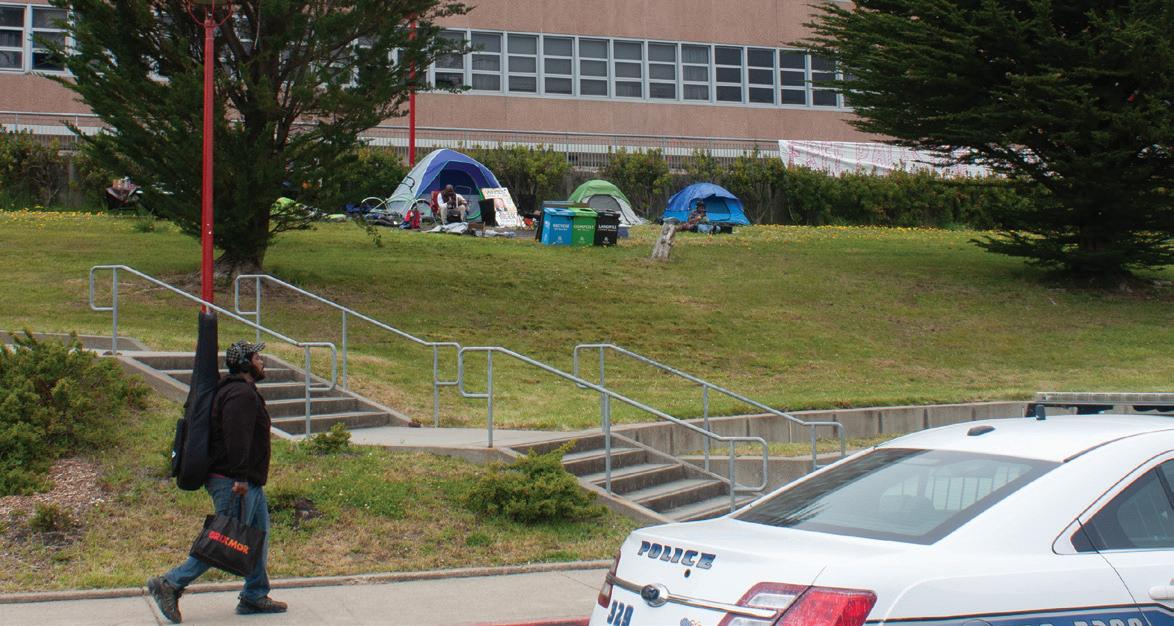
"Wanted…Bloody Biden,” reads a sign on the lawn of City College’s Cloud hall. Students have set up a small encampment on Ocean campus in support of Palestine on May 15, 2024. Photo by Seamus Geoghegan/The Guardsman.
A small encampment for Palestine on City College's Ocean campus sits under the fog on May 15, 2024. The next day, campus police removed the demonstrators. Photo by Seamus Geoghegan/ The Guardsman.
Future Students Explore CCSF Offerings
By Jeremy Zhu jzhu267@mail.ccsf.edu
CCSF Connect 2024 Open House and Resource Fair took place at City College’s Ocean Campus in Multi-Use Building (MUB) Room 140 on April 27.
City College’s Workforce Development Office and Outreach Department hosted this year’s fair. The event, running from 11 a.m. to 3 p.m., intended to increase student enrollment for the Fall 2024 semester by demonstrating the opportunities and services City College offers to the San Francisco community.
Outside of MUB 140, five booths showcased student services and resources: Financial Aid, Administration and Records/
Registration, Disabled Student Program Services, Completion Center/Counseling Services, and Assessment Center.
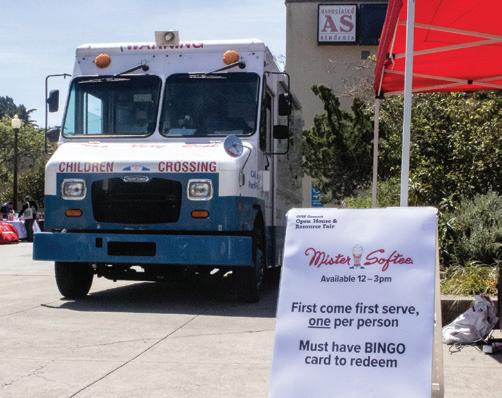
Inside the room, 27 booths represented various departments, arranged in rows with a contact list sign-up sheet and departmental pamphlets. Some booths offered stamps for the Bingo card of the event.
Red, black, and white balloons adorned the walls, with a spiraling tower of balloons stood outside the conference room.
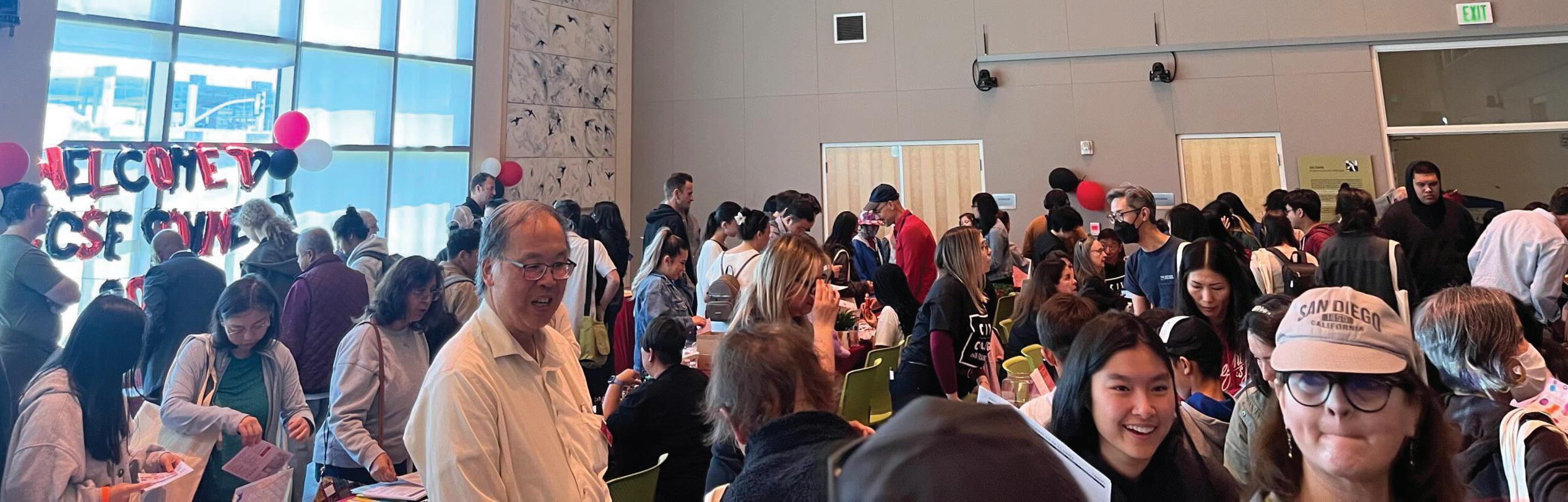
By 11 a.m., the hallway booths were crowded, with attendees nearly shoulderto-shoulder.
Tina Wong from Disabled Students Programs and Services mentioned that their department provides counseling,
accommodations, and classes for students with disabilities.
At the Financial Aid booth, Miguel Niramontes explained that their office assists students in need with aid for rent, food, tuition, and supplies, ensuring that financial worries don’t hinder their education.
Jenny Chach from Registration highlighted their role in assisting with class registration, tuition fee payment, and deadline reminders.
Attendees like Jose Hernandez and Diego Sanchez expressed positive experiences and intentions to enroll in the Fall.
Several booths were creatively decorated, such as the Registered Nursing booth with a bowl of chocolate kisses, the Theatre booth with a mask, the Environmental Horticulture/
Floristry booth with several plastic plants, and the Journalism with a large photo frame.
“It’s been a pleasant experience. People here are kind, and informative, which led me in a better direction.” said Christian Timothy, who added they will be enrolled in the Fall. Bingo cards distributed at the event were redeemable for a meal at Ocean Campus’ Cafeteria, prompting many attendees to head across the street for lunch.
Overall, attendees like Junko Cheng and Stephanie Arata found the event informative and enjoyable, praising the variety of offerings and engagement opportunities provided.
The event concluded with raffle winners being drawn for backpack prizes, with the crowd gradually dispersing by late afternoon.
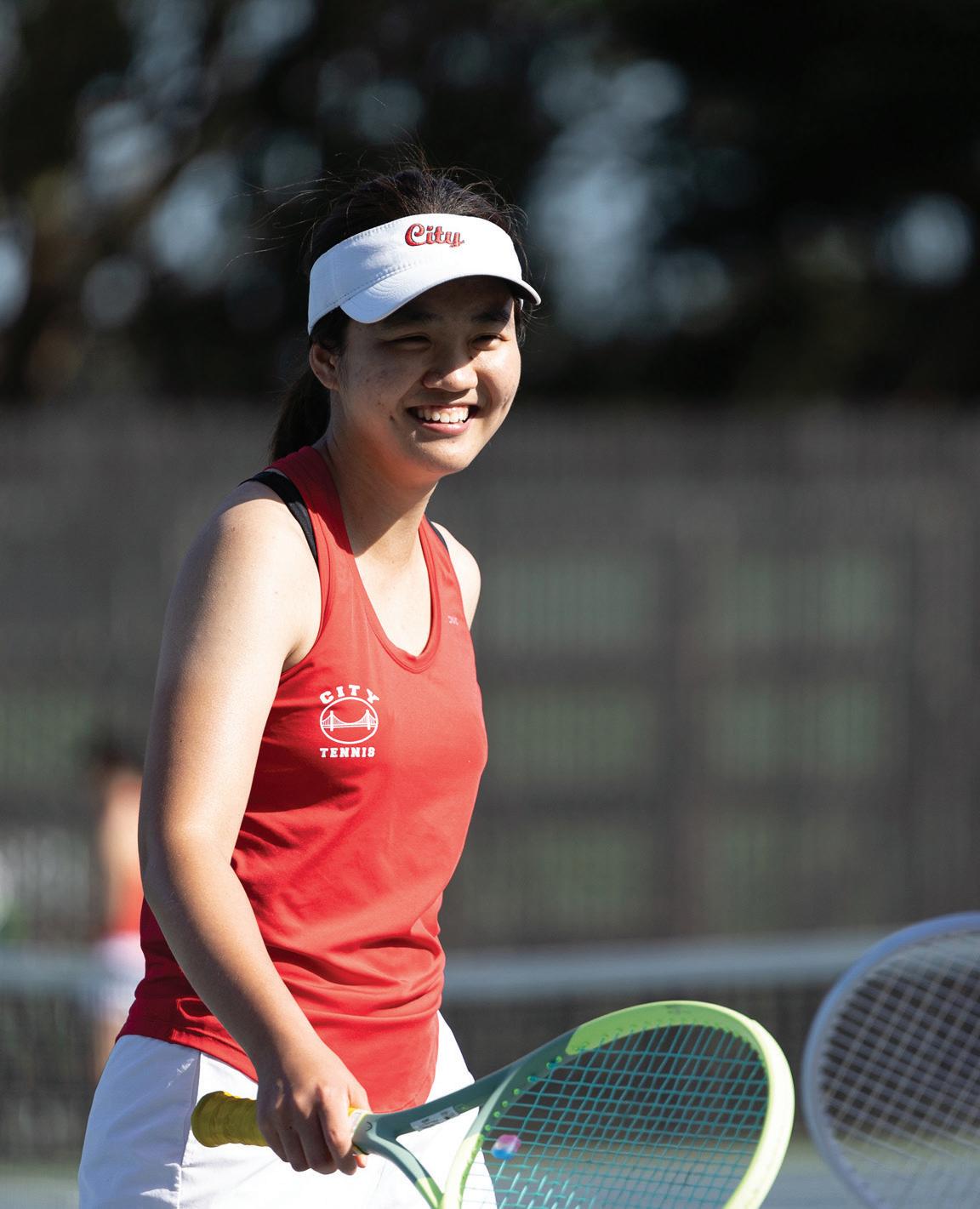
Star Tennis Player Ariel Xu Demonstrates Growth On and Off the Court
By Kyra Young
Itwas a blustery Tuesday afternoon at City College’s tennis courts where Ariel Xu could be found working on her approaching stroke. Xu’s ponytail whipped in the wind with each swing of her racket, responding quickly to head coach Mary Graber’s consistent, underhand serves.
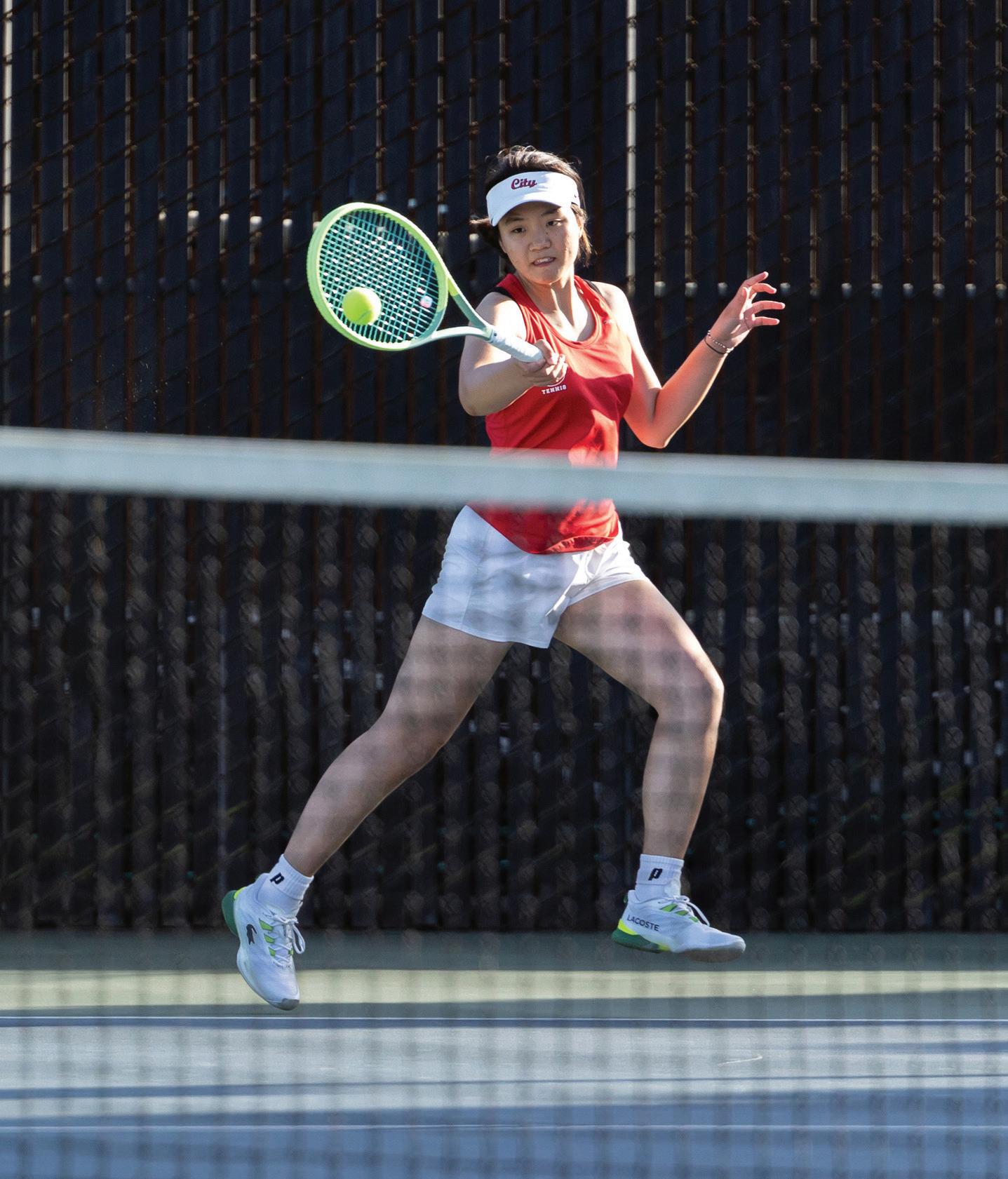
Graber challenged Xu off the baseline, but Xu’s hustle did not miss a beat. With a swift forehand swing, Xu sent a final rocket of a cross-court shot out of Graber’s reach, ending the session on a strong note.
The next morning, City College would be sending Xu along with teammates Christina Ling, Michelle Lee, and Pam Dineva to Ojai, Calif. for the CCCAA State Championships.
With tennis balls collected and players bundling up from the wind, Xu’s eager energy continued to radiate from sideline to sideline.
“Hey Mary, will the gates be open tomorrow morning? Could I get here early and work on my serves before we leave?” Xu asked.
Graber laughed. “What? But we’re leaving early tomorrow morning!”
“I know but… I just want to practice a bit more. I could come in really early,” Xu assured, a smile on her face as Graber shook her head in amusement.
On the bench, Ling and former teammate Alanna Hale smiled at the conversation as they packed up their bags.
“She’s there for every practice or game… she hasn’t really missed anything, really,” said Ling in regards to Xu. “Just goes as a testament to Ariel’s work ethic to be the best player and compete at her best ability. She always shows up.”
Cross-Court, Cross-Sea, Cross-Country Ariel Xu, a five-foot-seven returning sophomore for the Rams, continued to cement herself throughout this past season as a standout tennis player in the NorCal region for the CCCAA.
But her success and growth over the past two years at CCSF reach far beyond the boundaries of the tennis court. One might even argue it spans an entire ocean.
In the late summer of 2022, at 18 years old, Xu arrived in San Francisco to meet the only connection her family had in the United States on a one-way ticket from her hometown of Guangzhou, China. Alongside her came two suitcases and a tennis racket.
In Xu’s near-two years living in San Francisco, she has adjusted to a different country, city, culture, language, and a newfound sense of independence at the current age of 19. She is in her second and final year of enrollment at City College, studying data science and statistics, volunteering and working according to her visa, all the while holding a reputation as a tenacious player for the Rams women’s tennis team and the grander NorCal region.
“She is fantastic,” said Graber, who spares no words in honor of Xu’s character. “I’m more-- having raised 3 adults myself-- amazed with what she’s accomplished this season. With English as a second language, and a whole new city and culture to adjust to…Ariel’s remarkable, and I’m not even talking about tennis.”
Tennis came into Xu’s life around the age of six when she began playing for her father, who began coaching youth tennis in Guangzhou after jump-starting a small tennis club with Xu’s grandfather. Xu’s father
Attendee’s visit booths during City College’s annual Open House and Resource fair. April 27, 2024. Photo by Jeremy Zhu/The Guardsman.
Ariel Xu smiles between sets on March 8, 2024. Photo by Don Collier/The Guardsman.
served as her coach for a majority of her career until her move to San Francisco.
Growing up, her game was primarily focused on singles; playing doubles did not come until Xu played for Graber.
“I didn’t really know how much I actually liked tennis until I started playing for Mary,” Xu said. “Back in China, I didn’t really resonate with the game. I was not sure who or what exactly I was playing for. It was more private and focused on individual play, not so much for a league.”
A majority of Xu’s high school experience was interrupted by the COVID-19 pandemic, with a longer enforced quarantine in comparison to other parts of the world.
“My time playing was more informal,” Xu said, who attended Joy Academy, a Christian school in Guangzhou. “There were no tournaments or a game schedule. It was mostly pickup and fitness training with other people and coaches.”
Upon graduating from Joy Academy in the spring of 2022, Xu’s parents gifted her with a oneway ticket to San Francisco for her birthday. She would be turning 18 that July.
“My family was fairly unfamiliar with the city before I came here,” Xu said, who added that it was her idea to move to the U.S. on a student visa for her education, but her parents pushed for her to live in San Francisco specifically. Xu’s father had a friend living in the city’s Mission District, which was the family’s only connection in the United States.
That August, Xu left her parents and younger sister for a flight to California on a student visa, traveling some 6,000 miles across the Pacific. Xu then enrolled herself in courses at City College for the approaching fall semester.
Unfamiliar Places
With Familiar Spaces
Despite the sudden sense of independence, Xu’s father pushed her to continue playing tennis.
“He told me, ‘I might be far away, but you’ve still gotta play! You can’t give up exercising!’ He pushed
“But tennis is a universal language, it’s a comfort and her connection to home. Ariel is exemplary of growth and admiration, with the courage to do anything … I’ve been lucky to watch her expand these qualities within herself.”
For Graber, Xu’s best performance came with her hard-fought win against No. 1 ranked Nahreen Cheam with Northern California’s top-ranked American River College (ARC) back in March.
“She played talented and thoughtful tennis against American River’s number one, and came out with a 10-7 win,” Graber recalled. Xu’s match was the lone victory in an otherwise tough loss for the Rams, from which Xu moved up to secure the No. 1 seed.
“It’s remarkable to have such a high level player be so modest. She shows up for everyone, and hasn’t missed a practice once. With her talent, she stepped into a leadership role of sorts this season,” Graber said, who added that the 2024 team was composed of five returning players (including Xu) and seven new.
me to find a tennis team within the school,” Xu recalled, and laughed at the memory. After her first week of classes at City College, Xu passed a flier for the women’s tennis team on a bulletin board containing Graber’s email.
“I sent Mary an email asking if I could attend a practice, and she invited me to come and try out,” Xu said.“It was my first experience playing for a team, with a team. Suddenly, I am playing not only for my teammates, but also a school, a community. Playing for Mary, I’ve experienced how supportive that can be. It’s nice to represent something.”
Graber returned as head coach of the women’s tennis team in 2022, a full circle in her coaching career since her start at City College in 1989, where she held the head coach position for 15 seasons. Over the past two years, she has watched Xu grow into herself, and then some.
“She came into her first year shy, with so many barriers,” Graber said.
Xu humbly admitted that she, too, was proud of her performance in the match versus Cheam. “She’s a very talented player - definitely the best in the NorCal division this year. I was very impressed with her stats coming into the season, and I knew that game was going to be challenging. I had to turn it on.”
Assistant coach Lance Johnson would second such words in regards to Xu’s fighting spirit. “When it gets tough, she’s the one that digs and fights,” Johnson said. “Ariel is tenacious. Fearless.”
Christina Ling, a returning sophomore for the Rams and an exceptional athlete in her own right, has played alongside Xu both years. Both she and Xu advanced in their overall athleticism, as well as their doubles game.
“This year, Ariel was very driven to come in at her best level to play a great season. She’s always there, every week with our trainers Emerald, Sara, Eduardo and Alex - and that’s off the court,” Ling said. “Tennis is a very mental game, and she has one
of the strongest mental resiliences out there. She’s got such a fire in her and rises to every challenge, sure to give her best effort until she absolutely can’t.”
Both traditionally singles players, Ling and Xu favor playing the baseline. But when they played together in doubles for the Coast Conference Individuals last year, they came out with a smooth victory.
“When we play together, it’s very smooth - I know she has my back, and we’ve built a good sense of understanding each other’s movements on the court together,” Ling recalled.
“We were both able to speak to each other in Chinese on the court in that tournament, which was good practice for me, and it was fun to communicate like that on the court,” Ling said, smiling at the memory. “But it’s been really cool watching her improve her English-speaking abilities with the team.”
Coming-of-Age,
On And Off the Court
Aside from her own anxieties about living far from family in a new country, Xu said the prominence of Asian culture in San Francisco made for a much smoother transition. The city’s large presence of a Cantonesespeaking population in particular, similar to Guangzhou, assisted in Xu’s adjustment a great deal.
“San Francisco is known for their Asian community,” said Xu. “It can make integrating a lot easier in that way. There’s a large Cantonesespeaking population here, which I speak along with Mandarin, but I would still consider English my second language.”
Aside from a newfound independence living away from family, navigating the culture of self-sufficiency in the U.S. has proven to be a challenge for Xu.
“You really have to take care of yourself. There’s no one to tell you what to do – which can be very freeing and flexible, but I have to be in charge of myself,” Xu said. Building a self-directed sense of time management and depending on public transportation are just two of the obstacles she has grappled with since
settling in.
“There’s a lot more independence here in general. I would say it’s a Western culture thing. In Eastern culture, there’s a big emphasis on the connection between parents and their children, and supporting the elders. But it’s important for the children to pursue a good education and job,” Xu said.
Looking toward the future, Xu is in the process of exploring the numerous colleges throughout the state, with her eyes on UC Davis or UC San Diego. Xu added that she would like to stay in America after graduating on a working visa, and noted she would consider playing tennis at the university she transfers to.
Following the Coast Conference Championships, the Rams sent four players to southern California for the CCCAA State Championships, including singles qualifiers Xu and Ling, who would also compete as a doubles team together, as well as the freshmen doubles duo of Pam Dineva and Michelle Lee.
After an opening-round bye, Xu went on to win her second-round match versus Anya Villanueva of San Diego City College, and her thirdround singles match versus Yesugen Ganbaatar of Santa Monica College. Xu finished the State Championships after a loss to Mane Sargsyan of Glendale Community College in her fourth-round singles match.
In the Intercollegiate Tennis Association’s (ITA) final wrap up of the season, Xu was ranked at No. 8 in the CCCAA National Ranking for the Top 75 Singles Players.
On April 23, the ITA announced the 2024 ITA JUCO Women’s Regional Award recipients, in which they recognize coaches and players for excellence on the court and within their communities. In the closing of her 2024 season, Xu was awarded as ITA Sophomore Player of the Year for Region I.
“Ariel was truly the standout of the season,” said Graber. “That award is huge – a recognition of sportsmanship, leadership, and one’s student-athlete career. It’s a very strong reflection of her.”
“It’s remarkable to have such a high level player be so modest. She shows up for everyone, and hasn’t missed a practice once. With her talent, she stepped into a leadership role of sorts this season,” Head Coach Mary Graber regarding Xu. Photo by Don Collier/The Guardsman.
Ariel Xu returns the ball in a singles match against Foothill on March 8, 2024. Photo by Don Collier/The Guardsman.