The Guardsman

CCSF's Gap in Transparency page 2

His Sisters' Love Letter
5
Swim Team Wins
7
CCSF's Gap in Transparency page 2
His Sisters' Love Letter
5
Swim Team Wins
7
Student workers say their wages and limited hours make it difficult to afford living in San Francisco


Student workers at City College are struggling to afford living expenses in the city.
Prices are rising, and so is the student worker movement, forming a student workers union to demand higher wages, more hours and better working conditions.
The campaign was organized by Students for Justice, a student club advocating for Free City and other student rights issues.
DOWNTOWN PROTEST
The first community college student workers union, at Gavilan College, has inspired City College's core committee to form a union and stand in solidarity with other unions who are expressing the need for change and fairness on an administrative level, said Madison Raasch, one of the student workers union's founders.
The union aspires to achieve a similar goal so that student employees can afford personal expenses. UAW 4811, the student workers union for the University of California, was able to advocate for UC student workers to receive $28 to $32 per hour.
City College student workers, under the federal work program, are paid $19.18 an hour and may work a maximum of 15 hours per week, according to the college's Office of On-Campus Student Employment. At that rate and hour cap, a student worker can earn about $1,151 over four weeks before taxes.
Prices in the San Francisco-OaklandHayward area rose 1.5% from June 2024 to June 2025, according to the U.S. Bureau of Labor Statistics. Food prices rose 2.8% and grocery prices rose 3.5%.
STUDENT WORKERS continued on page 3

The San Francisco Department of Public Health plans to strip nearly $300,000 in funding from three career training programs at City College in 2027. The programs, which train students to work in addiction and recovery, would be reduced to one cohort per year.
The three programs include Addiction and Recovery Counseling (ARC), the Community Mental Health Certificate (CMHC) and Medi-Cal Peer Support Specialist training.
Students and faculty say the cuts will set back the Bay Area's recovery community.
“If you've seen the Bay Area, we're kind of on the upswing in regards to rehabilitation from addiction,” said Wilson Ferro, a student in the ARC program.
After being paroled from his prison sentence, Ferro started working at HealthRIGHT 360, assisting with patient intake. There, his supervisor suggested he become a substance use disorder counselor. The program teaches students like Ferro how to incorporate new methods to meet the needs of the community. “There are a lot of people that have been through various trauma (whether it be) systemic, family or cultural. They don't have the ability to get there, but once they do make it and get fully certified, they pay it forward,” he said. “All the great counselors, all the great therapists we have now came through here.”
Olina Pau came to EMT work through the ARC instructional trainings. She described watching patients with untreated, open wounds enter clinics and being met with judgment from staff.
PROGRAMS FUNDING continued on page 3
Opponents say the decision was made without community input and will drive away enrollment the college can't afford to lose

M ore than 100 students and faculty demonstrated outside City College's Downtown Center in April, pushing back against the administration's decision to stop holding classes at the Fourth and Mission streets location after this semester.
The protest, organized by the center's Associated Student Council, drew mostly ESL students and faculty, along with a few alumni and student leaders.
Malinalli Villalobos, Associated Student Council Executive Committee Vice Chancellor, led the protesters in a short but spirited march from the center to Market Street, where the group crossed Fourth Street, turned midblock down Yerba Buena Lane and returned
to the Downtown Center.
With drums, whistles and hand-painted signs, the protesters attracted the attention of pedestrians and passing motorists, many of whom honked their horns in solidarity.
Sarah Albarakani, along with her friend Sarah Alsamemi, voiced hope and enthusiasm for keeping the Downtown Center open.
“I want it open every day,” Albarakani said. “I want to speak English very well.”
A Downward Spiral
Many opposed to the closure expressed chagrin at what they consider a vicious spiral of lower enrollment spurred by fewer course offerings. Emmie Reed, a community health worker continuing her education by taking classes at the Ocean Campus, said she heard about the protest in her poetry class and, after reading about the closure in The Guardsman,
Staff
Editor-in-Chief
John Adkins
Managing Editor
Abby Sigler
News Editor
Marrion Cruz
Culture Editor
Karla Lopes
Op-Ed Editor
Lev Farris Goldenberg
Sports Editor
Henry Crowell
Social Media Editor
Evelyn Sassus
Visuals Editor
Karim Farahat
Design Editor
Tiffany Lam
Copyeditor
Gabrielle Chagniot
Writers
Ahmad Aimaq
Alejandra Cardenas
Daniela Villegas Jovel
Diana Chuong
Ellen Yoshitsugu
Jocelyn Wong
Kiyoka Valdes
Patricia Baldwin
Qi Mai
Tom Whitehead
Photographers
Alejandra Cardenas
Franchon Smith
Isaac Ortiz
Teresa Madrigal
Illustrators
Cindy Chan
Emily Yee
Graphic Designers
Cindy Chan
Sebastien Thugnet
Freelancers
Bob Kinoshita
Faith Gabrielle Zapata
Joan Walsh
Advisor
Juan Gonzales jagonzal@ccsf.edu
Contact us
info@theguardsman.com 415-239-3446
Mailing Address
50 Frida Kahlo Way, Box V-67
San Francisco, CA 94112
Bungalow 615
Follow us

@TheGuardsmanCCSF

@TheGuardsmanCCSF

@TheGuardsman

@TheGuardsman
For even more articles, stay up to date at www.theguardsman.com


Ellen Yoshitsugu Staff Writer
City College of San Francisco's use of broad closed-session agenda language and a delayed public records response have raised questions about whether the college is giving the public enough notice and access under state transparency laws.
Some public meeting agendas have not given advance public notice of items to be discussed, as required by law. The college has ignored public record requests. The website for said requests is misleading and uncorrected.
In February, the chancellor made the surprise announcement that the college was ending classes at the Downtown Center. What was going to happen with the building after the classes ended?
The Guardsman staff planned a series of articles on the center. It was hard to get anyone to answer questions — not the dean, the chancellor or the facilities department.
“Potential Real Estate” appeared on several recent Board of Trustees “closed session” agendas. Were they discussing the future of the Downtown Center? It seemed possible.
Transparency laws do allow for some things to be discussed in closed session, such as real estate negotiations, along with lawsuits, labor, personnel and discipline issues.
But a particular bit of state law, Government Code 54956.8, says
continued from page 1
felt she had to join the protesters.
“Why not offer a diverse group of classes?” said Reed. “Most of the students [at City College] don't know about [the Downtown Center] because there are no classes offered.” She noted that the Downtown Center is close to BART and very convenient for many students who find it difficult to get to the Ocean Campus.
Convenience and proximity to the population served by the center are frequently cited by those who want it to remain open. That population, they say, is largely drawn from the Tenderloin, SoMa and other neighborhoods to the south of Market, and is a distinct “world” population, different from the neighborhoods now served by the Chinatown/North Beach Center.
Opponents of the move say that the administration's plans to move Downtown students to the Chinatown center will result in a loss of enrollment overall.
ESL instructor Sophie Manukova, who has taught ESL at City College for 30 years, was at a table at the center's entrance, handing out literature to passersby. “If we have to, we will move,” she said. “But we prefer to keep the campus open. It's very convenient to the students.”
Villalobos said closing the center “means closing the doors on thousands of students, not only students right now, but students

that before the closed session, they must publicly identify “its negotiators, the real property or real properties which the negotiations may concern, and the person or persons with whom its negotiators may negotiate.” The agendas did not provide these details.
Amy McClellan, the college's new general counsel, wrote, “That entry is a standard placeholder used to preserve the Board's ability to confer with its real property negotiators if a qualifying matter were to arise. It does not indicate that a discussion will occur at any given meeting.” She also said that, in fact, no real estate matters had been discussed at those meetings.
The First Amendment Coalition, when asked, said the use of “placeholder” blank agenda items like that does not give the public enough advance notice of what might be discussed to meet the legal requirements.
“There's a reason that they come to this location.”
— Heather Brandt, ASC Chancellor and Executive Committee Chair
of the future.” He said the funding formula was not a sufficient reason. “What we need to do is make sure that we find funding to make sure that these doors remain open, thinking outside that box.”
Opponents of the decision to close the center also complain that the administration has not involved the City College community in the decision-making process. Christa Lewis, the ESL coordinator, noted that alternative ideas for maintaining the center have never been aired, including involving the SF Unified School District in integrating high school students from Galileo and other high schools into college-level courses. Since online courses have historically been credited to the Ocean Campus for purposes of counting full-time equivalent student enrollment (FTES), administrators believe that the state would not allow those online classes to be re-allocated to the Downtown Center. But Lewis said that FTES from hybrid classes with an in-person component could be counted toward Downtown Center enrollment. She also suggested that Galileo or other high schools in the
From the preambles of California open meeting and public record laws:
“The people of this State do not yield their sovereignty to the agencies which serve them. The people, in delegating authority, do not give their public servants the right to decide what is good for the people to know and what is good for them not to know. The people insist on remaining informed so that they may retain control over the instruments they have created.”
McClellan didn't respond to follow-up questions about this.
The issue comes as this newspaper has also sought records related to construction-related student parking losses on Ocean Campus.
What has been the impact of reduced student parking?
The Guardsman made a formal public records request for parkingrelated records.
The law requires a response within 10 days, but it took almost two months to get the info.
“For media inquiries and CPRA requests, please email ccsfmediarelations@ccsf.edu,” according to the college's website. We discovered that no one actually answers this email.
Chancellor Kimberlee Messina and her assistants made promises. It was punted to Police Chief Mario Vasquez. He said he'd look into it.
Finally, McClellan sent the requested documents and data. She
— Ralph M. Brown Act, regarding public meetings, 1953
“The Legislature, mindful of the right of individuals to privacy, finds and declares that access to information concerning the conduct of the people's business is a fundamental and necessary right of every person in this state.”
— California Public Records Act, modeled on the federal Freedom of Information Act, 1968
said she is now the person to whom public records should be sent. The media relations website has not been updated at publication time. The future of the Downtown Center remains unclear.
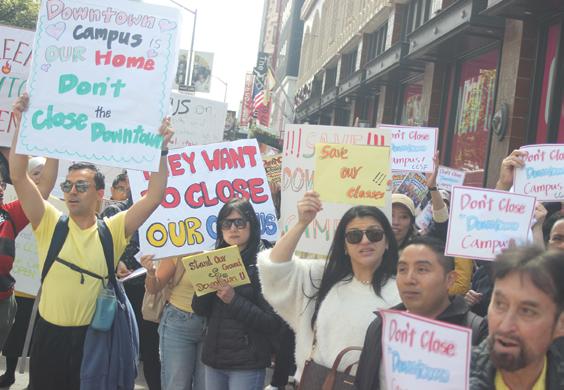
Protesters gather at the corner of Fourth and Market streets on a march to protest the proposed closure of City College's Downtown Center. April 9, 2026 (Tom Whitehead/ The Guardsman)
SF Unified District could be a source of enrollment if the college were to expand its high school outreach.
Luisangelo Marcano, a former student council president who attended a town hall at the center on Jan. 28, said students were misled about the administration's intentions. “They didn't say ‘don't worry we're not going to close it,’ they said ‘don't worry, you're not going to lose your classes,’” Marcano said. When the closure was announced five weeks later, many students were taken by surprise.
Heather Brandt, Associated Student Council chancellor and executive committee chair, said the pattern is familiar. “We do not regain those students,” she said. “It's really nice to think that our students will go to another location,
but there's a reason that they come to this location.”
Brandt added that the underlying problems leading to the closure have been brewing for a long time, and that students and faculty did not hear specific plans about it until the last minute. “We should have been hearing about this for much longer and should have been trying to tackle the issue a long time ago,” she said.
For its part, the administration has framed the closure as a temporary measure and suggested that the building may be leased to outside programs to generate revenue, although no specific options have been proposed.

Originally built for LEED certification, the rooftop garden has gone without necessary maintenance for years
Among the forgotten corners of the Ocean Campus is a 20,000-square-foot living roof atop the Harry Britt Building.
In 2010, the college was seeking Platinum LEED certification for the former Joint Use Building, later christened the Multi-Use Building and now the HBB. Along with other innovations, including an array of geothermal wells and automated electronic systems to reduce heating and cooling costs, the living roof was conceived as a way to reduce stormwater runoff while insulating the roof from the sun's rays.
It also helped the college comply with the City of San Francisco's Better Roofs ordinance, which required owners of new commercial buildings to install either solar panels or a living roof.
The living roof was installed over a standard waterproof membrane. On top of this membrane, squares of Sedum Tiles were placed. The Sedum Tiles are two inches thick and made from fibrous material that absorbs moisture and acts as the planting medium.
continued from page 1
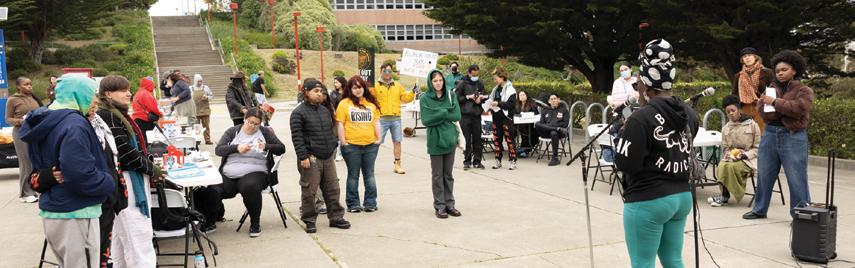
Organizers said the 15-hour cap keeps student workers from earning enough to live in San Francisco, even when they take on more responsibility.
Brianna Smith, who splits her 15 hours a week between the Peer and Women's Resource centers, is taking on more responsibility in her position. “It's still simply not enough to survive this city,” she said of the current wages.
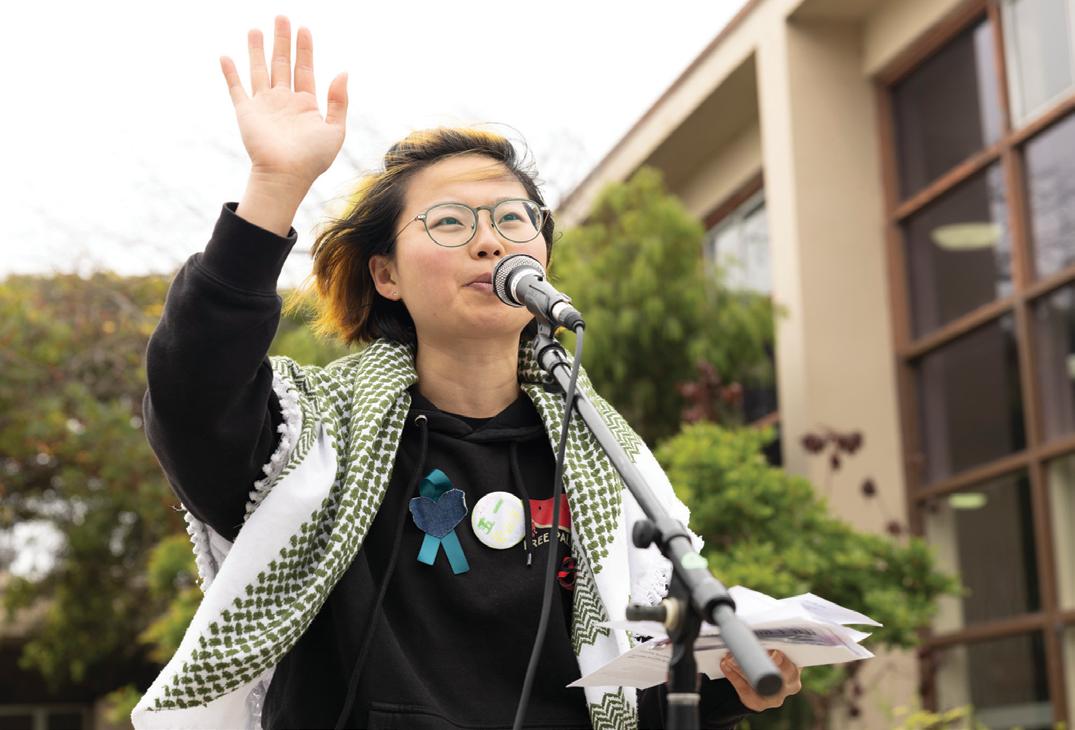
Smith recited “I Must Become A Menace To My Enemies” by African American poet and activist June Jordan, eliciting cheers from the crowd during May Day for Sanctuary CCSF, an event held by Students for Justice.
She said she “loves the turnout [of the event] and knows there would've been more [supporters] out here if it wasn't so cold.”
Smith relies on two student worker jobs and a full-time offcampus job to support her 9-year-old daughter as a single parent.
Organizers also circulated a poll asking student workers to identify
The tiles were delivered to the site already planted with four species of sedum, a low-lying succulent that requires a minimal amount of water, along with California poppy, lupine, beach grass and sand strawberry. These native plants are adapted to the local climate and require minimal water.
A drip system was installed over the tiles to help keep the plants moist during dry periods and prevent them from blowing away in the wind.
The drip system is still in place, but hasn't been maintained, so it is not known whether it is still operable, according to Ryan Schneider, Chief Engineer for the college. Except for the building engineers, who have to periodically check other equipment mounted on the roof, no one goes up on the roof.
Cecil Hilario, one of the engineers who has been on the roof multiple times over the years, said he has found drones, toy rockets, soccer balls and other items up there. He wasn't sure when the plants started dying, but the original planted species are now nearly all gone.
One reason the living roof has been forgotten is that it was never
meant to be accessible to the public, and it is difficult to see it from Science Hall or the STEAM building. One person who has not forgotten it is Steven Brown, chairman of the horticulture department.
“Living roofs need to be maintained,” Brown said. “I worked for almost a year to get bids,” he recalled, with a touch of frustration in his voice.
According to Brown, the college entered into a one-year maintenance contract for $800 per month, plus the cost of plant replacement as needed. “The Board of Trustees didn't do their part to keep it up,” said Brown, noting that the Board didn't renew the maintenance contract.
The roof couldn't be maintained in-house, Brown said, because workers going onto the roof would need to be trained and certified to work on the roof while wearing a safety harness, and the college didn't want to go through that. So there was no alternative but to hire a contractor to perform maintenance.
On a recent visit to the roof, The Guardsman observed that the tiles are still in place. Although they show some evidence of shrinkage due to desiccation, none seem to be missing. Invasive grasses and a
few weeds, mostly brown from lack of water, sprout from many of the tiles. There was no evidence of the original beach grasses. A close inspection revealed scattered locations where the original sedum has survived. In the southwest corner of the roof are a few bright clusters of orange poppies.
According to Brown, restoring the roof would be costly, and he doubted that the college could find the funds to do it.
The cost to install a living roof like the original one would probably exceed half a million dollars, based on published estimates of about $20 to $30 per square foot. Had the college continued to maintain it, and assuming the maintenance cost remained equivalent to the $800 a month of the original one-year contract over the years, the total cost up to now would have been a little over $200,000 in today's dollars.
So, the nearly dead living roof continues to cover the HBB. It isn't beautiful, but even without plants, it continues to function as originally intended.
their most serious workplace concerns at City College. The most common concerns were low wages and limited hours, which were selected by 70% of respondents.
Forty percent also cited a lack of advancement opportunities.
The poll also found that half of the respondents had worked at the college for at least six months.
Seventeen percent of students have been at the college for more than three years, and 7% have been at the college between two and three years.
“It gives us the absolute lowest weekly earning potential of all the community colleges in California,”
Raasch said.
Jing Shi, a core committee member of the forming student workers union, stood with Student Trustee Heather Brandt and Evangela Brewster, co-president of the Black Student Union. All three wore blackand-red sweats and sweaters reading “Change,” designed by Lorenzo Castaneda, an organizer running for student trustee in the fall.
Marisela Mares, lead organizer at San Francisco Rising, was at the event stapling posters commissioned for protest purposes and free for anyone to take. She said hyperlocal organizing, such as voting and neighborhood coalitions,
“Addiction becomes physiological. For them to imagine going without their substance of choice really impedes the desire to want to go,” Pau said. “Alternatively, they function and continue going and continue self-medicating.”
She called the program “a huge re-route” for its students and “a pivotal point in rebirth for a lot of people.”
Lorenzo Castaneda, another student in the ARC program with a history of incarceration, will soon attain his associate's degree in sociology with a 3.9 GPA. “This program has given us the opportunity to get out of the ghettos and the barrios. We're able to succeed while helping our people at the same time,” he said. Castaneda was also critical of the funding decision. “It's messed up on an inhumane level. They're cutting all this funding, yet they still manage to pay the directors $300,000 to $400,000 a year. The inequity of the marginalized community is stretched even further.”
Eric Lewis is the program manager for the ARC program and is referred to as “the man behind the curtain.” When students meet him, they can tell he's walked a similar path.
“A lot of my students have fought through a broken-home life, homelessness and addiction. They've been consumers of all of these services; they know how it works. And now they want to give back and help people.” If the cuts go through, Lewis would no longer be at City College, as his title is funded by the SFDPH.
“It's devastating,” he said. “People want to do this work. They're in treatment, they're in a step-up program and they want to do this work. It's hope for them.”
Diana can be reached at dchuong@mail.ccsf.edu
student workers. Chung said that rather than adding a handwritten letter to the stack addressed to the mayor, they would call him directly in support of the campaign.
It would be more impactful, they said.
can be effective as long as there's ongoing education.
Mares said one of the student leaders, Ayanna Williams, a political science major, choir member and student worker, will be teaching a civic organization class at the college starting in the fall. Williams said civic engagement is not widely taught, even though understanding government and political systems helps explain why conditions exist.
“There's a reason for everything,” Williams said, and the new generation needs to have resources to learn.
Trustee Vick Chung joined the event in support of the college's
Chung was a student trustee in 2020 and was previously a student worker, which is why they said they understand both sides of the conversation. They said they are working with current Student Trustee Angelica Campos and Chancellor Kimberlee Messina in legitimizing the union.
“It may feel like there's nothing being done, but we're working on it in the back end,” Chung said, adding that until something is on the agenda, the trustees cannot openly talk about it during the meeting, according to the Brown Act.
“It's hard out here,” Smith said about living in San Francisco. She looked around at the crowd of more than 30 students and supporters. “But we're deep out here.”
The inaugural event celebrated student parents and gave their kids a taste of college life

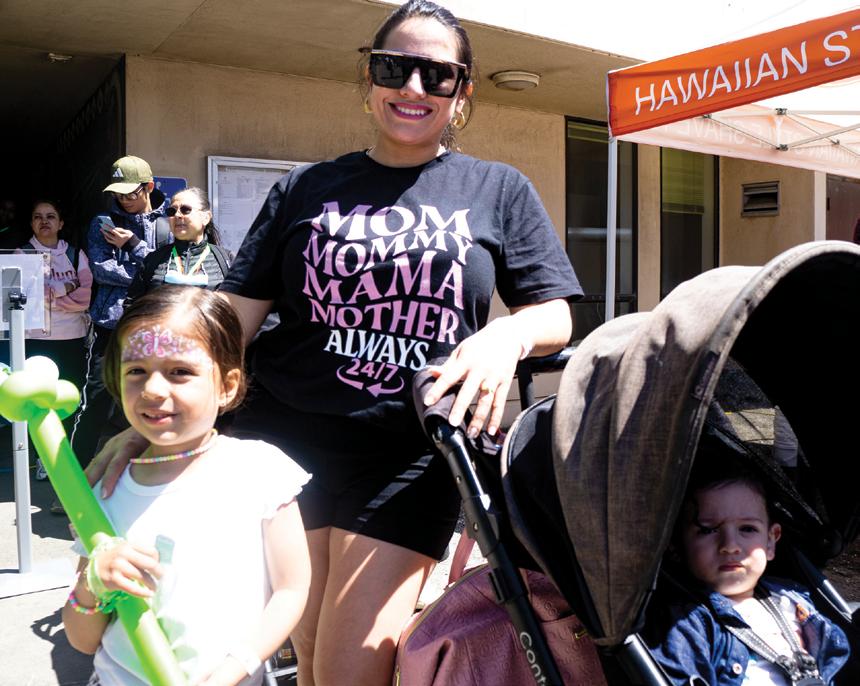
T his spring, City College hosted its first “Bring Your Kids to College Day,” collaborating with a statewide initiative to welcome parenting students and their children into the college environment while raising awareness about the challenges they face every day.
“About 20% of college students are parenting students, and they face unique challenges,” said Tracey Faulkner, Family Resource Center coordinator. “We are trying to bring recognition to an invisible population and the challenges they face.”
Parenting students often experience what Faulkner described as “time poverty,” balancing school, work and caregiving responsibilities.
Many complete their coursework late at night after caring for their children, only to wake up early and repeat the cycle.
The Family Resource Center provides a wide range of services to support these students, including referrals for housing, food and childcare, as well as basic necessities like diapers and hygiene products. The center also offers a children's space and even laundry access for students in need.
“We don't ask about income if someone needs help; we help them,” Faulkner said.
The event was open to students, families and the public and was funded by a variety of university programs and community partners.
For Heather Brandt, Student Chancellor and a mother of three, the event is both professional and deeply personal. “As a parenting student myself, I know how isolating higher education can feel when you are trying to balance school, work and family,” Brandt said. “Pregnant and parenting students deserve to feel included and celebrated.”
Brandt played a key role in organizing the event, working with campus programs and advocating for resources to support student families.
“About 20% of college students are parenting students.”
— Tracey Faulkner, Family Resource Center Coordinator
“The main goal is to create a welcoming and inclusive campus environment where students can bring their children and feel proud of their educational journey,” she said. Beyond visibility, the event also aimed to inspire the next generation.
“I hope children see that college is a place where they belong,” Brandt said. “I want them to feel inspired by watching their parents pursue their goals.”
Families could enjoy the afternoon with shaved ice, face painting, crafts and games. Students were also able to bring their kids to their classrooms.
City College student Shirit Eshed brought her little daughter to class and had the chance to enjoy the event as well. “This is a really fun event,” Eshed shared. “I usually don't bring her to campus with me, so it's been a special treat for her and for me,” Eshed added.
“This is a wonderful and fun event that I am glad my kids will have the chance to remember,” said student N'Dea Monasterio. Monasterio was excited that her kids had the chance to be exposed to college academic life.
“I've been having a lot of fun,” said one of the kids present. “My favorite activity was making the glitter jar.”
Both Faulkner and Brandt emphasized that the event is only one step in a larger effort to improve support
for student parents at City College.
“There has been progress, but more needs to be done,” Brandt said. “Institutions need to move beyond acknowledgment and invest in real structural support.”
Faulkner agreed, noting that increased awareness can lead to meaningful change. “Everything we do to shine a light on this population increases the chance the college will make meaningful changes,” she said.
Ultimately, “Bring Your Kids to College Day” is about more than a single event; it is about reshaping campus culture.
“This is more than just an event,” Brandt said. “It is about visibility, inclusion and building a college where student parents and their families feel welcomed and supported.”
aimaq2050@gmail.com

The satirical two-night production explored what happens when strangers collide amid a world-changing event

and Social Media Editor
Aweekend on the Las Vegas Strip takes a dark turn in “Good, Better, Best, Bested,” staged by the City College Theater Arts Department at the Taube Atrium Theater.
The play, performed April 25 and 26, was written by Tony Award winner Jonathan Spector and directed by Patricia Miller, a City College Theater Arts instructor.
Set during Super Bowl weekend,
the story brings together people from all walks of life: partiers on a bachelorette trip, street performers, tourists and those seeking care for a broken heart.
Through ambient blue and violet stage lighting and quick set changes, the audience learns more about the characters. The satirical writing makes it easy to dislike them. The maid of honor loses a mutual friend's service puppy with no remorse. Another character's boyfriend wants to hook up with the bride-to-be, Sue.
A 17-year-old poker player serves as the breadwinner of his family, only for his father, Walter, to gamble it all away.
Their weekend is disrupted when

a catastrophic event is broadcast on news channels across the Strip. As a bad weekend becomes even worse, strangers are forced together to face a life-changing moment. The play reflects that, regardless of our background, if the world were to end, people would still rely
on the kindness of others and on human connection.

“I wish the production would run longer because we're having so much fun,” said theater arts student Allie Riley, who played Charlotte, Bikini Girl and Daniella. “If I had one wish, it would be that CCSF theater would receive more funding so we could do more work.”
“I thought it was really entertaining and funny,” said audience member Katie Deschutter. “Eerily topical … the cast did a great job.”
Before ashley and Michelle's brother became a public name, he was ‘Tucan’
M
ichelle and Ashley Monterrosa stood outside San Francisco Fire Station 32, trying to visualize themselves beneath a commemorative sign for their brother.
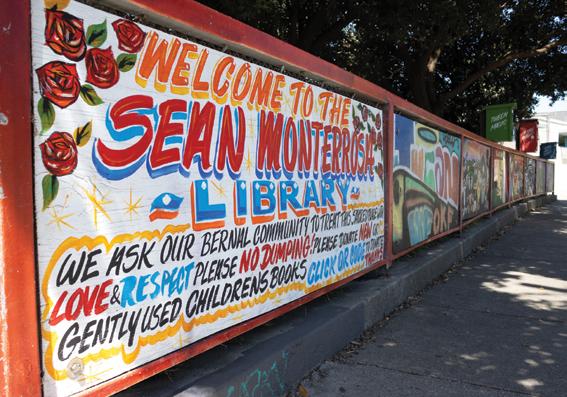
The station was across the street from their former elementary school, alongside another tribute to Sean — a community library.
Then, a smirk on Ashley's face when a firetruck pulled in: “Groceries,” she said, after mentioning she receives a new pair of shoes from Michelle's fiancé every year. She watched firefighters exit the truck with grocery bags in hand, just as predicted.
She knew this since the family had lived in Bernal Heights for decades, and it felt like there were always groceries in their hands after a ride up Park Street.
“Do you think they have backup cameras?” Ashley asked about the firetrucks.
“Just bars,” Michelle said, shrugging. She didn't flinch at the rapid change of topic. Neither did her sister when, for a few minutes, they both turned towards the street sign that read Sean's name.
Sean was 22 when he was killed in June 2020.
The Monterrosa sisters spent the past six years spreading Sean's legacy around San Francisco; on street signs, scholarships, billboards, even a day named for him — hoping he'll remain alive for longer than 22 years, and still between them, under the same temporal sky.
But before his name belonged to public memory, Sean Israel Monterrosa belonged to them.
An American Nightmare
Sean, the second — and only brother — of three Monterrosa siblings, was shot and killed by Vallejo police officer Jarret Tonn on June 2, 2020.
Officers said they mistook a hammer for a gun. The California Department of Justice later declined to file criminal charges against the officer, and Vallejo reached an $8.5 million civil-rights settlement with the family in 2026.
Ashley said that when people talk about those killed by police, they too often begin and end with the moment of death. She's tired of the question that still follows their brother's name — What was he doing there that night?
“It doesn't matter,” Ashley said. What matters is who Sean was before he became a public argument.
Michelle agrees. She's pursuing her master's degree in ethnic studies while her younger sister works in mental health. They both hope to use their policy work to highlight systemic issues and critique institutions that, according to Michelle, led to their brother's death. Through this, they've co-founded The Sean Monterrosa Project, a nonprofit advocacy group aiming to change community policing.
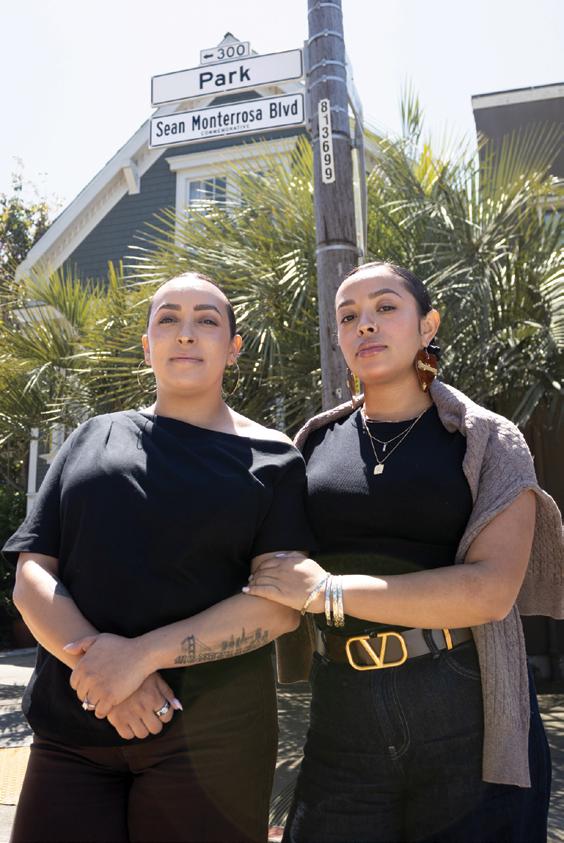
Michelle (left) and Ashley Monterrosa in front of the street sign that honors the passing of their brother. April 29, 2026 (Kyra Young/The Guardsman)
Ashley shared that while growing up, love in their household looked like Cartoon Network on Saturday mornings and Sundays at church, their mother tucking the three siblings in together and reading the Bible. It looked like their father coming home from three jobs, after which his three children leaned into whatever time they had with him.
It was a familiarity that both sisters agree is felt within a lot of immigrant households in the Bay Area. They both credit love as service. Ashley said her parents modeled “servant leadership” by serving people with love.
That service now echoes through the scholarship bearing Sean's name.
“My parents came to the U.S. for the American dream and then boom, American nightmare — (their) son
is killed at the hands of the state,” she said.
“A lot of folks think we're a monolith, like immigration is our (only) issue,” Ashley continued. “It's public safety. It's mental health. It's so many things.”
“Our (immigrant) story is familiar (to other immigrant families) until it isn't,” she added.
A San Francisco Board of Supervisors resolution added the commemorative name “Sean Monterrosa Boulevard” to Park Street, recognizing his “contribution and legacy to San Francisco as a local figure,” a first for someone killed by law enforcement.
City College also recognized him through a resolution calling on the chancellor to work with the college's foundation to establish a scholarship fund in his honor,

“A lot of folks think we're a monolith, like immigration is our (only) issue. It's public safety. It's mental health. It's so many things.”
—
Ashley Monterrosa, Sean Monterrosa's younger sister
aimed at addressing financial barriers and increasing opportunities for underrepresented students.
The first recipients, Tabari Morris and Yenia Jimenez, were recognized during the Board of Trustees meeting on April 23. Like prophecy, Sean's birthday was the following day.
Ashley was only 19 when Sean was killed. She turned 20 the very next day.
The years after that, she said, became a force of being in a “train going 1,000 miles,” instantly pulled into grief, organizing and the sole identity of being “Sean's sister.”
“There was no space to just be me,” Ashley said, “I felt like… I had to show up with sadness, and if I wasn't sad, I wasn't honoring my brother.”
She had to unlearn that, doing “so much work to understand that grief is also love,” Ashley said. “I don't have to love him through sadness.”
When asked about the type of relationship she had with Sean, Ashley said, “He was Batman, I was Robin,” to which Michelle chuckled in agreement.
And on the type of sister she was, “Baby sister, co-conspirator, enabler,” Ashley listed. Loyal, too — “Me and Sean always said: right or wrong, forever right. It don't matter (because) I love you.”
Sean teased the way older brothers do, too, Ashley said, for almost nothing — being double-jointed, her forehead, she remembers.
Depending on the day, she would side with Sean or Michelle, though. Someone was always outnumbered, she laughed, remembering it was always two against one.
“I've always been the second mom, as the oldest, I'm the enforcer,” Michelle admits.
When asked what still belongs only to the family, Ashley did not hesitate. “Food!” She said that now
she loves being on the grill because of her brother.
“My mom cooked us her empanadas and (we sat) together at the table… a good churrasco — an Argentinian steak — with chimichurri sauce, her own Argentinian shepherd's pie — called pastel de papa,” Michelle said, “Sean really valued being at the table together as a family, so every time we have those meals, I always remember (him).”
She said she will always see Sean in every part of the city, like Bernal Heights library, Billy Goat Hill, through Mission Street, and every time she sees a lowrider. Their family would hike in the Bernal hills, barbecue while listening to oldies and go to baseball games together before 2020.
This year, on what should've been Sean's 28th birthday, Michelle went to a Giants game. It was another way of saying, “hey brother, we love you,” she said, feeling him at the stadium.
“Sean's still here,” Michelle said when she stopped and nodded at a butterfly flying by their brother's commemorative library. Ashley turned.
Both sisters paused before agreeing that, although they hope Sean is proud of them for the work they have done to honor his name, they could still imagine his disbelief at the scale and length they would go for him.
“He would've been like ‘Wow, y'all did all of that for me?’” Ashley said about honoring their brother's life, and spending six years saying his name in public places, at board meetings, in murals, beneath street signs, before scholarship recipients.
The butterfly flew past letters spelling “Mr. Tucan,” around the yard where a young Sean once played. The youngest Monterrosa sibling watched it go and said, “I know Sean's proud of us.”
Andrew Ciscel, Derrick Williams and Madi Allen Link Center Program Manager and Students
W
e are City College of San Francisco students, staff and faculty, writing to urge Mayor Lurie and the Board of Supervisors to reinstate funding for the following programs: Addiction & Recovery Counseling (ARC) certificate, Community Mental Health (CMH) certificate, and Medi-Cal Peer Support Specialist (MCPSS) certificate.
These career training programs provide the essential workforce that support the mental health and substance abuse recovery of San Francisco's most vulnerable residents. At a time when our city is already facing a critical shortage of trained public health professionals, this proposed $800k budget cut will further debilitate a workforce pipeline that is crucial to addressing our existing mental health, homelessness, and substance use crises.
These funding cuts will eliminate the CMH and MCPSS programs, along with severely reducing course offerings for the ARC, eliminating supportive services in all programs that are essential for student educational success, and result in plummeting graduation rates. As the only free educational programs that train a significant portion of San Francisco's frontline providers, these programs impact lives across the city every single day.
Beyond the services provided to residents, these programs have changed the lives of students who complete this education, as we are often members of the same communities we serve: most of us are students of color, low-income students, formerly justice-involved students, LGBTQ+ students, immigrant students and/or students in substance use recovery. We bring invaluable lived experience that, when matched with the training these certificate programs offer, results in the talented case managers, counselors, peer support specialists, substance use disorder counselors and other direct-service providers that San Francisco relies on. These cuts would severely restrict our continued access to educational attainment and professional development.
While we understand that the city faces a significant budget deficit, this specific cut is counterproductive to our city's recovery. We ask that Mayor Lurie and the Board prioritize the workforce needed to protect San Francisco's most vulnerable populations.



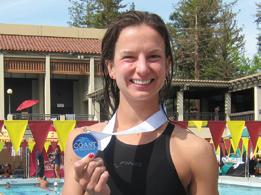
The Rams' Swim Team took third-place honors at the 2026 Swimming Coast Conference Championships, staying the course on what has been a solid slate of meets for City College.
This season's third-place finish on April 18 marked the ninth time the swim program has placed in the top three at conference championships over its 15-season history (excluding the canceled 2020 season and COVID-shortened 2021 season).
The team shared many highlights throughout the weekend. However, none may have been as monumental as Maria Hyrc's freestyle time.
With a time of 19:51.76, Hyrc broke the school record in the 1650 freestyle, previously held by Cathryn Gibson (20:22.70) in 2011. Hyrc attributed her success to the support of her teammates and the coaching staff.
“Preparation-wise, we have a great coaching team, a lot of resources here, so like all the coaches. Mike Lee was a volunteer coach who was helping me a lot with the distance-freestyle stuff, and then obviously Coach Phong and Coach Mike Tyler, and then our weights coach, Jeannette,

all work really hard to give us good training,” Hyrc said.
“What was going through my head throughout the race was just trying to push myself, like I didn't want to finish the race and feel like I could've gone harder once it was over.
My teammates were cheering for me really hard the entire time, which is a
lot for a 20-minute race, so that was really beautiful to see.”
Sophomore Samantha Ng placed third in all three of her individual events: the 100 backstroke, 100 fly and 200 backstroke. She also commended the coaching staff for their commitment to the team.
“They're always here, no matter
if there's one person in the pool, two people at practice.” Ng said, “No matter how many people [are there], they're still here to support us. [They] come in during spring break, on their day off.”
“I'm super happy with the way my career is ending with swimming and how our team performed this
year. All of our performances were so good; everybody dropped time at the end of the season… It's very hard in swimming because [every millisecond] is a lot,” Ng added.
Reflecting on the season, assistant coach Michael Tyler said, “Our team rose to the occasion. We experienced consistent improvement throughout the season, and our final events at the Coast Conference Championship really reflected the work and effort our team has been putting in these last several months.”
“I'm very proud of everything our team has accomplished, and I believe our team represented our school very well, and we're always looking to grow as a team and as individuals,” Tyler said.
The Rams' third-place finish capped off another successful season, and one in which the group of many fresh faces surpassed expectations. Fans can expect the Rams to be back in competition at next spring's annual San Francisco Invitational, training hard in the meantime. Swimmers interested in joining the water polo or swim team next season can contact Head Coach Phong Pham at ppham@ccsf.edu.
Jocelyn can be reached at jwong@theguardsman.com
after taking early exits in the Ojai Tennis Tournament, Rams tennis looks to build on a spectacular regular season

Daniela
The City College women's tennis team wrapped up an impressive 2026 season, finishing 10-2 overall and establishing itself as one of the strongest teams in the Coast Conference.
Although the Rams fell short in the final, their season was marked by consistent success and strong performances in both singles and doubles play, culminating in tournament appearances in both categories and a Round of 16 finish for freshman Odessa Peinado. The team showed depth and resilience throughout the season.
From the beginning, City College set the tone with dominant victories, including a 7-0 victory over Cañada and a 9-0 win against West Valley. In tighter matches, such as their 5-4 wins over Cabrillo and Chabot, the Rams showed their ability to stay composed under pressure.
Sophomores Rita Williams, Vanessa Chi and Erin ShawMeadows led the team, contributing heavily in both singles and doubles matches. Their leadership helped the Rams maintain a strong presence at home and on the road, finishing 5-1 in both.
Head coach Peter Bartlett emphasized how the team's success was the result of both performance and commitment to shared goals.
“This season we really did a great job meeting our goals,” Bartlett said.
“Prior to the season, we set goals to win the conference title and to get people into the state championship. We accomplished both those goals.”
“We also had goals on the team to try and create a connectedness amongst the team members through teamwork and accountability. As the coach, I was very proud of the way in which the ladies stepped up this year. Their schedules were very complicated and they did a really great job committing, especially towards the end of the season to be able to win the conference title. It's a great first step to building a top-level program.”
Beyond their performance on the court, the Rams were also recognized for their character and impact off the court. The team earned the ITA Community Service Award, while Peinado received the ITA Arthur Ashe Sportsmanship Award.
The season was one of growth and development, both in the physical and mental departments for the team, as freshman Sierra Belandres explained.
“One thing I'm proud of that fans might not have noticed is how
much I've grown mentally this season,” Belandres said. “I used to have a lot of anxiety when playing matches, but this season I started feeling more confident on the court and was able to play more freely.”
Belandres also noted how team chemistry improved over the course of the season.
“In the beginning, I was still adjusting and putting pressure on myself, but as the season went on, I became more comfortable, more confident, and more connected to the team,” Belandres said. “It made competing feel less stressful and more fun.”
“I've grown as a player and as a person. I learned how to handle pressure better and enjoy competing instead of letting anxiety take over,” Belandres added.
Looking ahead, the program is focused on maintaining its success. Williams expressed confidence in the team's future.
“It is a new chapter for the tennis program, and it's great that the new coach will be returning along with these two strong players,” Williams said. “Now that we have established ourselves as dominant in the Coast Conference, we have to maintain that. Go Rams!” Daniela

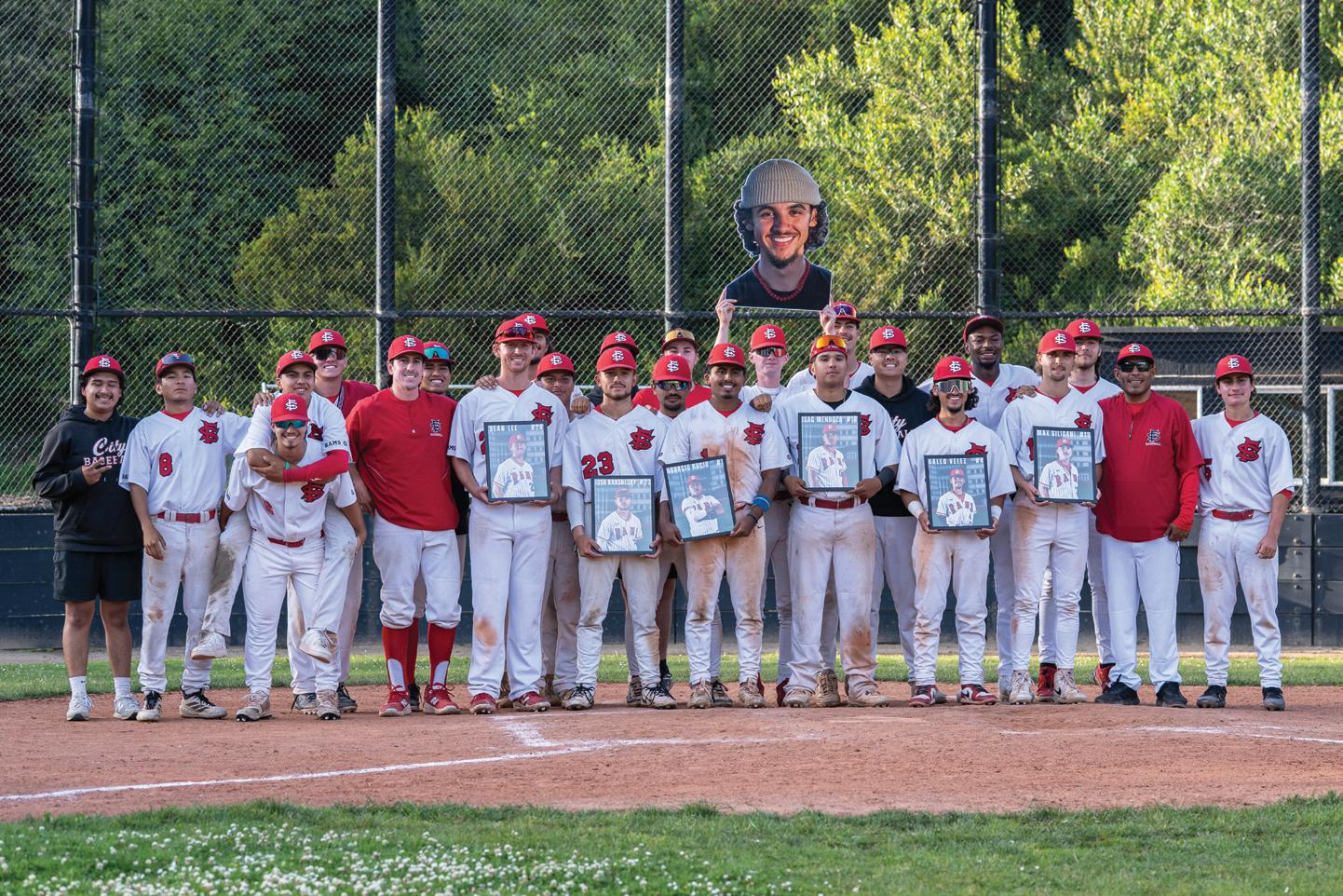
In their final game of the season, the City College nine were unable to surmount an offensive onslaught from the De anza Lions

TCrowell
Sports Editor
he Rams bowed out in their penultimate game of the season, falling to De Anza College 17-4. The April 23 drubbing gave them a final record of 1-38 on the year and 0-20 in conference games.
Despite the result, the Rams ended the day on a happy note with their sophomore night, celebrating players graduating from the program.
Isac Mendoza Jr., the Rams' cornerstone first baseman, was one of the six sophomores honored after the game, and he delivered in his final game with the team. He started
his day with a single in the bottom of the first inning, coming around to score after a fielder's choice. He followed that up with a walk in the bottom of the third.
That free pass brought his total to 29, good for second among 127 players to take an at-bat in the Coast-North Conference and added to his .438 on-base percentage, which was also among the best in the conference, ranking 19th among qualified hitters.
The game itself was representative of Mendoza's season overall. “They tried to challenge me with fastballs, and I got a hit, so they stopped, and started throwing me more changeups… so I've just been looking to
change up the other way and staying inside the ball,” Mendoza said.
The Rams scattered 13 hits across the game to the Lions' 16, a solid hitting performance despite the eventual result.
Sean Lee, another of the sophomores honored after the game and the ace for the Rams, was on the mound in the final game of the season, pitching 4.1 innings and surrendering 10 runs on 10 hits, with six walks and a strikeout. He turned in a valiant effort on the day that
exemplified the resilience and poise Lee and the team displayed throughout the year.
The pitching staff and the team, with multiple players penciled into the starting lineup at the beginning of the year, lost to season-ending injuries.
“We didn't prepare them, they had to do it on the fly.”
— Mario Mendoza, Head Baseball Coach
“It devastated us, to be honest,” said Head Coach Mario Mendoza. “Our top three pitchers were out, our top three hitters were out. Three guys were ineligible… [because of that] a lot of these guys are out of position, and we didn't prepare them [for
that], they had to do it on the fly.” Lee said that in the face of adversity, the team has held its own. “It asked a lot of people to step up, both myself and the whole team … [Everyone] would come in and just do their job, throw strikes. I think the people who were asked did a very good job.”
While he did give himself some time to revel in the post-game celebration, Coach Mendoza is already gearing up for another year of baseball. “I can't wait until next year, until we start all over again.” Mendoza said, “It's going to come quick. I'm gonna miss these guys.”
Henry can be reached at hcrowell@theguardsman.com
Introduction to
on the
of the
of the credibility of the media and an examination of the media's impact on daily life from a variety of perspectives. The course teaches students news literacy tools for critically navigating the sea of information directed at the public daily.
JOUR 21: Newswriting T Th 9:40-10:55 a.m.
Ocean Oleson
The course focuses on the techniques of news reporting, developing and writing a news story, training in information gathering, and interviewing sources. It also examines career opportunities in the industry.
JOUR 22: Feature Writing T 6:10-9 p.m. Ocean Oleson
Fundamentals in feature writing for magazines and newspapers with special emphasis on profile and interpretive news features. This course provides practical experience in interview and in-depth research techniques. Training in how to write a freelance story for publication.
JOUR 24ABCD: News Lab I-IV MWF 12:10-1 p.m. Ocean Mullaney Beginner to advanced news production course focused on the publication of the college news outlet The Guardsman. Requires news gathering, interviewing, photography, videography, note-taking, and newswriting in collaboration with other students.
JOUR 31: Internship Experience TBD Ocean Mullaney Supervised on-campus or off-campus employment in the journalism field that is adaptable to the student. This could include experiences such as working on community based newspapers, publishing on the Internet, or improving the journalism-publishing program at CCSF. One unit of credit is earned for 54 hours of unpaid or paid work.
JOUR 35: Data & Multimedia Journalism W 6:10-9 p.m. Ocean Lifland The course gives hands-on training on spreadsheet, database, and visualization skills with special emphasis on new trends in the delivery of news.