The Guardsman




A newly-submitted city budget document proposes cutting Free City funding to $6.8 million as the program's 10-year funding agreement continues to unravel.
By Daniela Villegas Jovel dvilleg4@mail.ccsf.edu
Budget cuts to the Free City program are set to deepen, with a newly proposed city budget allocating $6.8 million to the program, less than half the funding it received two years ago.
During the groundbreaking of the Diego Rivera Performing Arts Center, Madison Raasch, a political science student and staff member at the college's Women's Resource Center, disrupted Mayor Daniel Lurie's speech to bring the cuts to center stage.
“No major news outlets are talking about these massive cuts, and the time we have to ensure full funding is coming to a close this summer,” Raasch said.
She received a written warning for the disruption.
On Feb. 23, the Department of Children, Youth, and Families submitted its proposed budget to the mayor's office, allocating $6.8 million to Free City for FY 2026-27 — a cut made, the document states, “per the Mayor's GFS cut instructions.” The FY 2027-28 projection offers little relief, with the same amount set aside.
Those numbers represent a collapse from the program's recent funding peak. In FY 2023-24, the city contributed $18.9 million to Free City. This was above the baseline set by a 2019 Memorandum of Understanding between former Mayor London Breed and Supervisor Gordon Mar, which committed the city to $15 million annually through 2029.

By Patricia Baldwin and Marrion Cruz
byebyebaldwin@gmail.com, mcruz88@mail.ccsf.edu
F or many City College students, food, transportation and time remain barriers, and on-campus EBT card payments for CalFresh-
eligible purchases access may reduce one of them.
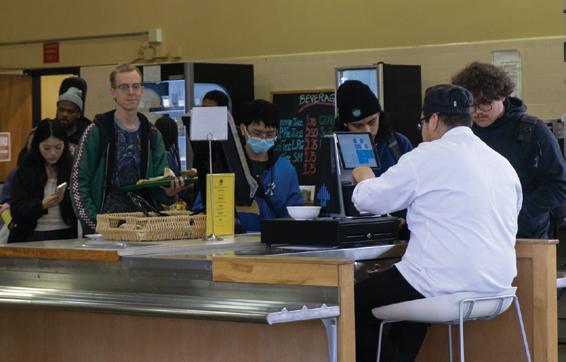
The Office of the Vice Chancellor announced in January that students who receive CalFresh, California's version of the federal Supplemental Nutrition Assistance Program (SNAP), will be able to use their EBT cards to purchase eligible food items at campus cafeterias
beginning in March, pending final approvals and operational readiness.
Beneficiaries of public assistance programs in California receive benefits through an Electronic Benefits Transfer (EBT) card.
The change comes as colleges across California face sustained student hunger and uneven participation in CalFresh. Statewide,
“around 276,000 students attending a California community college use CalFresh,” according to the California Policy Lab, as cited by KQED. But multiple studies and policy briefs have found that many foodinsecure college students still don't use benefits, often because they
By Marrion Cruz
City College's Information Technology Department, long described as under-staffed, now says it is operating with a fuller roster as it pushes forward on multiple modernization projects, including a planned overhaul of the student-facing RAM Portal.
The department's IT staff now totals almost 40 employees, according to the department's org chart.
One major effort is underway at the Mission Center, where the department is launching a Smart Classroom initiative aimed at upgrading classroom technology with new audio-visual equipment and teaching tools.
Patrick Ekoue-Totou, the college's chief technology officer, is heading the college's IT projects.
As colleges nationwide rethink student-facing systems, some have adopted third-party “engagement hub” platforms meant to consolidate campus services into a single digital entry point.
Pathify, one vendor in that space, argues that “disconnected systems make for disconnected experiences,” a problem it says unified portals are designed to reduce.
In a 2023 webinar, Pathify also described centralized access “makes it easier for students to stay on track and succeed.”
Southwest Mississippi Community College, which announced it selected Pathify to modernize student-facing systems, described the goal as simplifying navigation for students.

Staff
Editor-in-Chief
John Adkins
Managing Editor
Abby Sigler
News Editor
Marrion Cruz
Culture Editor
Karla Lopes
Op-Ed Editor
Lev Farris Goldenberg
Sports Editor
Henry Crowell
Social Media Editor
Evelyn Sassus
Visuals Editor
Karim Farahat
Graphic Design Editor
Tiffany Lam
Copyeditor
Gabrielle Chagniot
Writers Ahmad Aimaq
Alejandra Cardenas
Daniela Villegas Jovel
Diana Chuong
Ellen Yoshitsugu
Jocelyn Wong
Kiyoka Valdes
Patricia Baldwin
Qi Mai
Tom Whitehead
Photographers
Alejandra Cardenas
Franchon Smith
Isaac Ortiz
Teresa Madrigal
Illustrators
Cindy Chan
Emily Yee
Graphic Designers
Cindy Chan
Sebastien Thugnet
Freelancers
Bob Kinoshita
Faith Gabrielle Zapata
Joan Walsh
Advisor
Juan Gonzales
jagonzal@ccsf.edu
Contact us
info@theguardsman.com
415-239-3446
Mailing Address
50 Frida Kahlo Way, Box V-67
San Francisco, CA 94112
Bungalow 615
Follow us



SB 747 passed the Senate and moves to the Assembly, with supporters calling it an accountability measure and opponents warning of litigation and legal challenges.
By Marrion Cruz mcruz88@mail.ccsf.edu
Senate Bill 747, a California measure that would create a new state-law pathway for people to seek damages for alleged constitutional violations by federal officers, passed the state Senate on a 30-10 vote and now moves to the Assembly.
Supporters say the bill is meant to address a legal gap that often makes it harder to sue federal officers than state or local law enforcement in civil rights cases. Opponents, including Republican lawmakers and law enforcement groups, argue the bill could expand litigation risk and faces a likely federal court challenge.
“Section 1983 only applies against state or local officials,”
Robert Weisberg, a Stanford law professor, said during a Q&A for Stanford's legal blog. He said suits against federal officers are harder because plaintiffs must rely on Bivens, a judge-made cause of action that has been narrowed significantly in recent years.
Authored by Sens. Scott Wiener (D-San Francisco) and Aisha Wahab (D-Hayward) and dubbed the “No Kings Act,” SB 747 would create a civil remedy under California law for alleged violations of federal constitutional rights, including First, Fourth and Fifth Amendment claims, according to the bill text and legislative records.
Other states have advanced similar proposals, like Colorado's SB26-005, whose residents have sparked action as a response.
“This bill is based on a very basic concept that no one is above the law,” Sen. Wiener said.
Sen. Wahab, a co-author of the bill, said during a Senate Floor meeting that it's intended to close what she described as a gap between the limits placed on local and state police and the authority federal agents exercise during immigration operations, including cases involving due process,
continued from page 1
believe they're ineligible, don't know how to apply, or lack access to the application process.
The timeline depends on both federal and operational steps. There's still “a federal application that needs submitting” before the gift of grub is presented to students, Jen Rudd, program chair of the Culinary Arts and Hospitality department, said.
Even once EBT is accepted at college cafeterias, access won't be automatic.
Students must still apply for CalFresh and be approved, and college student eligibility can be complicated. A California Budget & Policy Center explainer notes that “over 50% of eligible students do not participate in SNAP,” pointing to the complexity of stu-

abuse in custody, and children separated from families.
“ICE agents are certainly subject to Fourth Amendment restrictions,” Weisberg said.
Republican lawmakers and law enforcement organizations opposed the bill, arguing it could increase litigation and duplicate existing remedies. Opponents have pointed to California's Bane Act, a civil rights law that allows lawsuits when someone interferes with a person's rights through “threats, intimidation, or coercion.”
Sen. Shannon Grove (R-Bakersfield) argued that sanctuary policies erode cooperation between local and federal authorities. Sen. Grove was among the 10 Republican senators who voted against the bill.
Senate Judiciary Committee staff wrote that the measure is “very
likely” to face a federal challenge if signed into law, analysis by KQED and LAIst reported. For colleges and other public institutions, the bill arrives amid heightened attention to immigration-enforcement policy on campus.
“If the law is enacted and upheld in the courts, it could empower CCSF students by creating a pathway to sue federal agents for violations of constitutional rights,” Megan Sweeney, a political science professor, said.
City College already maintains a public immigration-enforcement response protocol that directs employees to contact District Police and states that only the chancellor is authorized to accept warrants or legal documents from immigration officers.
City College's guidance also says the community should be
wait
line
pay
dent-specific rules as a major factor in low participation.
A UCLA Center for Health Policy Research report similarly found that among food-insecure students who had heard of CalFresh
but never used it, the most common reasons were believing they were ineligible, not knowing how to apply and not having time to apply.
Although EBT-eligible students will be able to use their benefits at
notified through RAVE alerts when immigration enforcement presence is confirmed on district property, in compliance with SB 98.
Campus police also sent a campuswide information bulletin on how to respond if ICE or other federal agents enter the college's open campus, Police Chief Mario Vasquez said during a Feb. 23 facilities meeting. ICE-response posters were circulated by district police shortly after.
SB 747 is one of several California proposals tied to immigration-enforcement accountability. KQED reported that lawmakers previously set aside $25 million for legal nonprofits defending residents facing detention or deportation, and that a separate California law restricting mask use by law enforcement on duty is already facing a federal legal challenge.
the cafeterias, this is not automatic access. Students will still need to apply to the CalFresh program.
The college has expanded food access in recent years through multiple channels, including food shelves and the RAM Food Market.
On its RAM Resources page, the college says it has “relaunched our snack shelves at various locations around campus and centers with nutritious ready-to-eat snacks,” with limits of “up to 2 items per day,” checked in through the myCCSF app or a sign-in sheet.
The cafeteria EBT rollout is different from snack shelves and food distribution: it turns existing benefits into on-campus purchasing power, which matters for students who are on campus for long stretches and need food during the school day, not only take-home groceries.
Bay Area students showed up to query the candidate for Nancy Pelosi’s House seat on local and national issues.
By Lev Farris Goldenberg lfarrisg@mail.ccsf.edu
As the race to represent San Francisco in the U.S. House of Representatives heats up, Saikat Chakrabarti is trying to separate himself from the field by reaching out to San Francisco's young people.
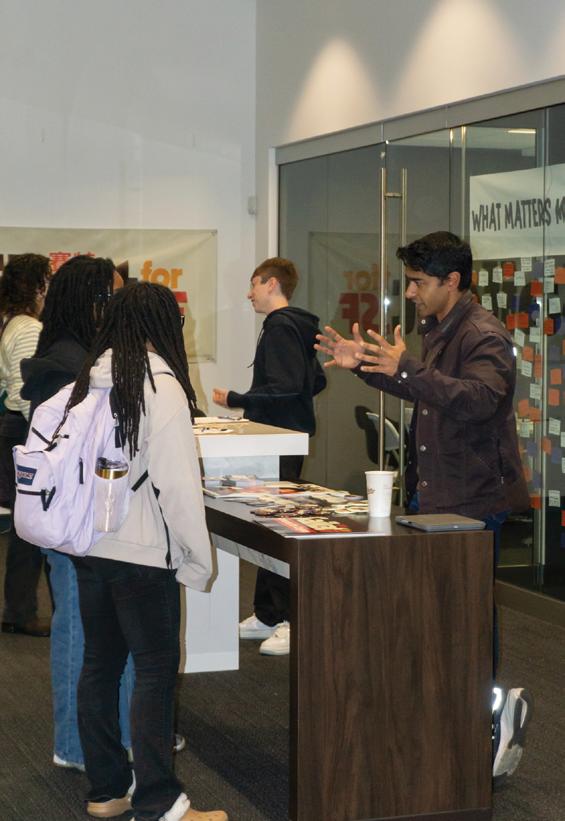
On Feb. 24, Chakrabarti hosted an open house for college students at his campaign headquarters on Irving Street and Ninth Avenue, where the candidate fielded questions and discussed issues of importance to young people.
Chakrabarti, who worked for Bernie Sanders' 2016 presidential campaign, touted his support of free higher education while promising to fight for the Free City College tuition program. Sanders famously celebrated the launch of the Free City tuition program at City College in 2017, calling it “a model for the U.S.”
“I would push Mayor (Daniel) Lurie to fully fund it,” Chakrabarti told The Guardsman. “But more than that, I would try to actually legislate at the Congressional level to get federal funding for the Free City programs, because I think when it comes to tuition free public colleges and community colleges and trade schools, it is difficult for cities on their own to support them, and that's a big reason why I'm running for Congress.”
The event attracted around 30 college students hungry for change with overtures of free pizza, discussion of Chakrabarti's “time with AOC and Bernie” and a robust policy platform.
Attendance was split between undergraduates from San Francisco State and the University of San Francisco, with a handful from San Jose State and City College.
“We're not trying to run a campaign just about being against

The Breed administration then cut that figure roughly in half for FY 2024-25, without negotiation. The currency fiscal year budget stands at $9.3 million. The newly submitted figure of $6.8 million would bring the total cuts to roughly 66% below the FY 2023-24 level.
The cuts would affect over 28,000 eligible students, representing about 71% of enrolled credit students at the college, according to the Free City annual report for 2024-2025.
“Not only should this program not see any cuts, it should be expanded,” Raasch said.
The Free City Oversight Committee is “doing everything possible” to bring their recommendations to a newly envisioned memorandum, said committee member and student trustee Angelica Campos.
Like other students who benefit from Free City, Campos said she wouldn't have finished her degree if it weren't for the program.
Donald Trump,” Chakrabarti told his audience. “We're in the middle of an authoritarian coup right now, I want to be clear about that … But ultimately what we're trying to do with this campaign is we actually want to present a vision for what the future should be.”
The candidate, who is running to fill Speaker Emerita Nancy Pelosi's seat, discussed his support for healthcare for all, affordable public housing, a wealth tax and ending genocide.
Then, Chakrabarti directed the first question of the evening back at his audience. He wanted to know: “What are you worried about, and what are you hopeful for?”
The students shared concerns and asked Chakrabarti about his plan to tackle the cost of living crisis, ICE violence, the threat of AI, skyhigh drug prices, Israel's war crimes in Gaza, queer and trans rights under attack and homelessness.
Many of Chakrabarti's responses drew applause from the audience, as well as a few chuckles at his relatably millenial Star Trek references.
He labeled AI an “existential threat to society,” promised to challenge the current Democratic establishment, and declared that “when ICE shows up to a neighborhood, lawmakers should show up too.”
“I find it interesting,” City College student Maya Mason said of her reason for attending. “My favorite part about engaging in politics is getting to interact with other people and get other people's perspectives.”
Chakrabarti supports the College for All Act, introduced by Sens. Sanders (I-Vt.) and Pramila Jayapal (D-Wash.) in May of 2025, which would make public colleges
and universities tuition-free for 95% of American students.
At the local scale, Mayor Lurie's proposed 2026 city budget would slash funding to the Free City program, threatening the college's ability to provide free tuition to all San Franciscans.
Yet Chakrabarti — who prioritizes cost-of-living issues — has largely avoided criticism of Lurie, saying the mayor “has been okay” at a Working Families Party Congressional forum in early February. Lurie recently came out against the proposed “overpaid CEO tax” ballot measure and state wealth tax on billionaires initiative.
Chakrabarti has said his campaign “is going to carry out the largest grassroots canvassing effort for Congress that San Francisco has ever seen.”
After State Sen. Scott Weiner received a coveted endorsement from the California Democratic Party, and District 1 Supervisor Connie Chan drew over 200 people at her Chinatown kickoff event, Chakrabarti may need such a massive groundswell if he stands a chance in the upcoming June primary.
“I went to the first debate (between the candidates), and I was like ‘Okay, I just want to hear more from everybody,’” said Mason, a fifth-semester sociology major. “I feel like it was hard to find a distinction between the three for the most part.”
After the Q&A, Chakrabarti pitched students on volunteering for the campaign, saying, “It's actually really fun to canvass.” He claimed more than 3,000 people had already signed up.
“It's [a student's] first opportunity to get an education they may not have ever thought was accessible to them.”
Angelica Campos, Student Trustee
“It's [a student's] first opportunity to get an education they may not have ever thought was accessible to them,” Campos said.
“I feel like the commitment and the care that Free City represents is more than just free tuition or help to go to college; it has touched so many people's hearts,” said former president of the AFT local 2121 teacher union Alisa Messer.

By The Guardsman
Araccoon was spotted outside the Student Success Center early Monday morning. A call to San Francisco Animal Care and Control was attempted while it was still closed.
Police Chief Mario Vasquez recalled the call about “a raccoon foaming at the mouth,” but was not the officer to respond on Feb. 23. Campus police received a call at 9 a.m. and proceeded to contact San Francisco Animal Care and Control on Bryant Street. It cannot be confirmed if SF Animal Control responded to the call. Standard protocol includes calling animal control, Chief Vasquez said.
Students should leave “critters” alone, Chief Vasquez said, suggesting not to interact with the animals they encounter on campus.
SF Animal Control is open from 8:30 a.m. to 5 p.m. They usually respond to public calls after 6 a.m. but were unavailable during the call from the college.
City College's historic planetarium welcomed visitors for a guided exploration of the stars.
By Bryné Hadnott bahadnott@gmail.com
Twenty-one astronomy enthusiasts gathered on Feb.18 in the historical planetarium on the fourth floor of Science Hall for “Apparent Motions,” a guided tour of the stars narrated by former California Academy of Sciences presenter Blue Polansky.
The planetarium is maintained by student volunteers from “Astronomy Outreachers,” a service learning program started by Professor Claia Bryja in 2022.
During the semester, students host telescope-viewing nights on the roof and catalog historical log notes on astronomical observations.
“The Navy requisitioned the original telescope in the dome for World War II, wanting to use it for the war effort,” said Bryja.
Today, the dome houses a 55-year-old mechanical planetarium projector atop a pillar that descends to the entrance of Science Hall.
“In the 1970s, the astronomy faculty bought a top-of-the-line planetarium projector from Spitz, a company that did planetarium

Neighborhood Lens
In his solo photo exhibit, Zackery Ormonde uses photography to document the people and culture of San Francisco's Chinatown.
By Kiyoka Valdes kvaldes3@mail.ccsf.edu
Z
ackery Ormonde is displaying his solo photography exhibit at City College's Chinatown campus. “Outsider” is a compilation of photographs that convey a deep appreciation for San Francisco's Chinatown. Ormonde, 28, is a photographer and a student at City College. He grew up in Lathrop, California, and said that spending over 20 years there limited his exposure to new experiences.
As life took its course, so did Ormonde. He was offered a job testing new self-driving Waymo vehicles, which are used around San Francisco as an alternative transportation method. Because of this position, Ormonde was able to tour the city and explore its neighborhoods.
Many areas of San Francisco caught his interest, but Chinatown stood out. “The main part of the city that interested me the most was Chinatown,” Ormonde said. “It's the closest thing I've gotten to being out of the country.”
Ormonde reflected on what aspects of the neighborhood caught his attention. “Just the people, the food, the colors compared to what I was used to … completely different,” he said. “I still find it interesting. That's why I'm still coming here almost twice, three times a month.”
His appreciation for Chinatown inspired him to create a project influenced by the culture and way of life in the neighborhood.
“Originally, I started this because when I was taking my documentary class, I was already taking a lot of pictures of Chinatown,” Ormonde said. “I was like, ‘Oh, I'll make a project on Chinatown,’ and at first, that seemed very self-centered. Then eventually, I started to change it.”
Ormonde connected with photography director Erika Gentry, who encouraged him to dig deeper into his intentions as he worked on the
shows,” said Bryja. “To our knowledge, there is only one other functioning planetarium projector like this one somewhere in Indiana.”
Polansky lowered the lights, and specks of white stars came into view. She pointed out the Big Dipper and the two stars that pointed to Polaris, the North Star and the tip of the Little Dipper's handle.
Then, Polansky circled Orion's Belt with her laser pointer, tracing along Orion's arms to the shield he carries to fight off Taurus, the bull constellation. Polansky flicked a switch, and the Spitz projector whirred into motion, spinning the stars around the dome.
“Imagine that we were bad astronomers and we fell asleep for five hours when we were supposed to be observing,” Polansky said to chuckles from the audience.
Orion traced an east-west path across the sky, the same journey that the sun follows throughout the day. Now, instead of low in the east, Orion was high in the western sky.
Polansky flicked another switch, and a bold white line appeared across the dome. This line was the ecliptic, the path that Earth follows as it makes its yearly journey around the sun. The Spitz projector clicked on, showing only the stars that drift over the course of a year. These
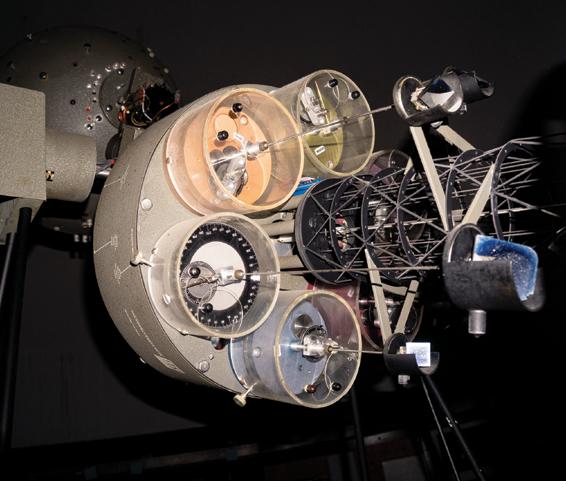
wandering stars, or planets, paced back and forth, sometimes from west to east in a motion called retrograde.
“On Earth, we have a unique perspective from anywhere else in the universe,” Polansky said. “We see things differently and come to different conclusions. That's what makes observation and sharing those observations over time so important, to better understand what is going on.”
As the stars faded away and the lights gradually turned back on, the audience whooped and applauded.
Several students crowded at the bottom of the fourth-floor staircase to discuss Polansky's show.
“The complete darkness I was in, and the little stars everywhere, made me feel really relaxed,” said City College student Thamarai Jones.
“I felt like a kid camping again.”
“I'm taking astronomy this
semester, and it was really useful to see that in person,” said City College student Nan Ingin. “I didn't even know we had a planetarium here until I saw the flyer. I hope they have more shows.”
Currently, Polansky is studying at City College for an associate's degree in physics. In her free time, she makes space-inspired audio art and writes planetarium shows for astronomy outreach events hosted by San Francisco State University and City College. She hopes to become involved in the search for life on Jupiter's icy moon Europa and planets outside of our solar system called exoplanets.
“Being in a planetarium is a way for people in the city to connect to the night sky,” said Polansky. “And City College is the most cool, chill, laid-back way to tell our own stories about the stars.”
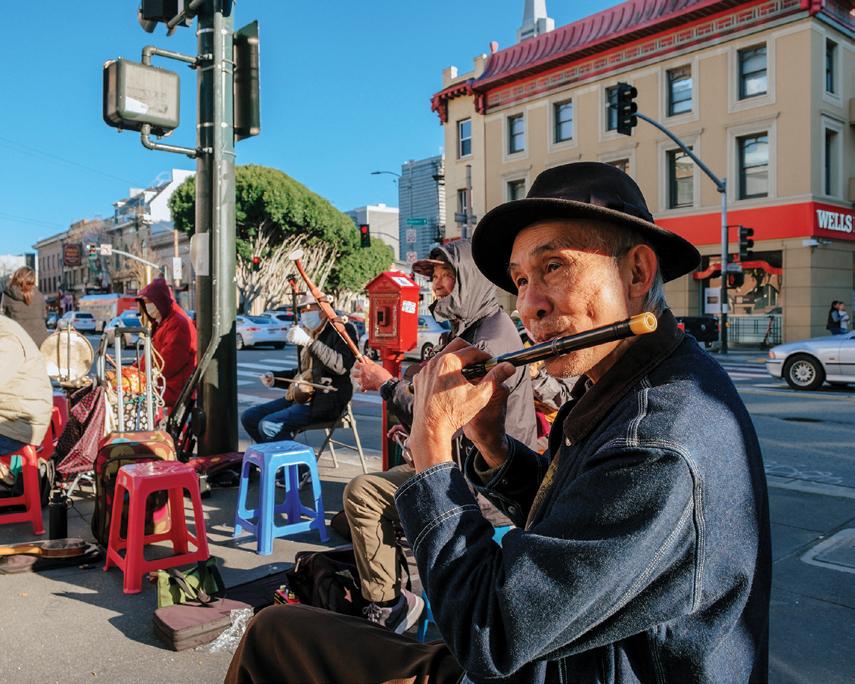
project. The more Ormonde became aware of the streets and the interactions he had with the community, the more he wanted to highlight the neighborhood's uniqueness and originality.
“There's many of them in the country,” Ormonde said, referring to Chinatowns. “This is one of the staple ones — probably the staple one. Chinatown in this city is very important. It's a very big population, and at this point I want to do
justice by using this project to highlight Chinatown and show it in its best light.”
The title of the exhibit reflects Ormonde's personal experience.
“I chose ‘Outsider’ because that's how I feel when I'm walking around here,” he said.
Ormonde also recognizes the depth and history of Chinatown and believes the project is still evolving.
“I don't feel like the project is complete yet until I get more personal
stories of the people around here,” he said, “to make it more personal and not as much outside looking in.”
Like many who are drawn to the community and structure of Chinatown, Ormonde seeks to capture the heart of the neighborhood and its people, believing that it is the people, not the place, who make a community.
The exhibition will remain on display in the Chinatown/North Beach Center until March 18.
Three French musicians transformed 12 early silent films into an evening of experimental sound and theatrical wonder at San Francisco's Marina Theater.
By Karla Lopes kcarval7@mail.ccsf.edu
“Right in the Eye,” created by French composer and musician Jean-François Alcoléa, captivated the audience with an intimate and theatrical environment, filled with immersive sounds.
The multimedia movie-concert featured 12 films by the pioneering French filmmaker and illusionist George Méliès, including the famous “Le Cauchemar” (A Nightmare) and “Voyage à travers l'impossible” (The Impossible Voyage).
Each movie is reimagined through a multi-layered musical performance on stage by three skilled musicians. Alcoléa, together with Fabrice Favriou and Thomas Desmartis, performed on a variety of classical instruments, such as piano and strings, while also incorporating unexpected everyday objects, like crystal glass and spoons, into their music.
“It is a whole experience,” Alcoléa said, mentioning that his idea was to share the mixing of both images and music on stage with light design. “I wanted to bring something very old from a contemporary way, creating a magical and fantastic journey, giving each film a specific identity.”
This year marked the ninth U.S. tour of “Right in the Eye,” and the

movie-concert continues to captivate enthusiastic fans. Cindy O'Donnel, a San Francisco resident for over 30 years, shared that this was her second time experiencing the show.
“It is magical,” O'Donnel said, showing great excitement before the beginning of the performance.
Last year, O'Donnel got the chance to attend the show in Santa Cruz, California, and shared that her brother is also a fan.
The Feb. 21 presentation at the Marina Theater was offered in two showtimes, drawing dozens of attendees. As the audience entered
audience was then met with the fantastical scenes of moons, stars, magical creatures and stage-like illusions created by the filmmaker.
As soon as the first scene appeared on screen, the richly textured and playful sounds began, transporting the viewers to the beginning of an immersive journey. The trio worked harmoniously among themselves and with the movies, playing a variety of rhythms and sound effects that evoke different feelings and reactions in the crowd.
The performance was built with small narratives, displaying comic moments, as well as tension and suspense. After almost two hours, the show ended with a long, loud applause.
Audience members were overall impressed with the show. “It was good,” Ben Carter said, sharing that this was the most unique show he's ever been to. Carter also highlighted the richness of sound effects.
Dani Gellis said she would definitely recommend the movie-concert to others. “It was interesting to see how they built the sound, I really enjoyed it,” she added. Nicholas Sinclair did not expect the show's experimental nature. “The experimental music matches Méliès experimental film,” Sinclair said. “Right in the Eye” will be on tour in the U.S. until May 4, 2026. Project SafeWeb: Cyber Trafficking & Digital Safety
the theater, they were met with an intimate, theatrical atmosphere: dim lights, instruments placed in the corners of the stage and a large movie screen in the middle.
The show started with a documentary about Méliès' life and work based on archival materials. The
Math Contest and ProblemSolving Workshops Workshop 4:30 - 5:30 p.m. | Batmale 711
- 4 p.m. | HHB 140 Book Event: This unruly Witness: June Jordan's legacy 3:10 - 4:15 p.m. | STEAM 102 CCSF Baseball vs. San Mateo 2:30 p.m. | San Francisco State University
Reboot
a.m. - 1 p.m. | HBB 140
Resumé Writing Workshop 1 - 2:30 p.m. | HBB 39
a.m. - 2 p.m. | Ram Plaza, Ocean Campus
of San Francisco (uSF) at CCSF 9 - 11:30 a.m. | SSC 1079
Women's Tennis vs. Mission 1 p.m. | Ocean Campus Tennis Courts CCSF Baseball vs. San Mateo 2:30 p.m. | San Francisco State University
The Box SF artistica Creators Fest (March 14-15) 11 a.m. | The Box SF San Francisco's 175th annual St. Patrick's Day Parade & Festival 11 a.m. | Market Street
Free Reggae in the Park 2026 “Crucial Sundays” 4:30 p.m. | Spreckels Temple of Music (Golden Gate Park Bandshell)
loretta Ross on Calling In: how To Start Making Change with Those You'd Rather Cancel 1 - 2:30 p.m. | HBB 140
MON office of Student Equity Film Series: lingua Franca (Registration Required) 2 - 4 p.m. | HBB 140
Wellness and healing: Sound Bath 12 - 1 p.m. | HHB 140 MARCH
Women's Tennis vs. Chabot 2 p.m. | Ocean Campus Tennis Courts
And they're more affordable, more raucous and more inclusive than men's sports.
By Jocelyn Wong jwong@theguardsman.com
In the Bay Area, the past decade and a half has been defined by success in men's sports. Until recently, women have been notably absent from the local professional sporting scene. Finally, that is changing.
The most-hyped team in the Bay Area in 2025 might have been the first-year Golden State Valkyries of the Women's National Basketball Association. Everywhere you looked, Valks violet kept popping up. Every game became must-see TV. Or ideally, must-watch in person, as the squad sold out every regularseason tilt.
In a profession long dominated by men, women are finally having their moment.
I attended multiple Valkyries games last year, including the first preseason game. The house may not have been full, but the energy was palpable — I could tell the fans were hungry for a new women's sports team.
As an Asian-American, sportsobsessed kid who grew up in the Bay, I loved seeing my community represented on the biggest stages. In 2014, after Travis Ishikawa's walkoff home run sent the Giants to the World Series, ABC 7 News interviewed me about what Ishikawa's home run meant to me.
“It makes me proud,” little 12-year-old me said. “It makes me inspired. It … motivates me.”
Representation like that still

by Cindy Chan/The Guardsman inspires me, as it does many young Asian-American women around the Bay. Twelve years after Ishikawa's heroics, that pride bubbled up again watching Valkyries rookie guard Kaitlyn Chen and first-year WNBA head coach Natalie Nakase thrive on the national stage.
Chen became the first TaiwaneseAmerican player to score a basket in the WNBA and evolved into an important role player as the season went on, while Nakase won WNBA Coach of the Year in her first year leading the Valks.
The two loudest Chase Center games I attended in 2025 were the Warriors Game 5 win against the
Houston Rockets and the Valkyries playoff-clinching win against Paige Bueckers and the Dallas Wings.
But the Valks game was something different. Fans donned purple costumes, Norse-inspired attire, and “Everybody Watches Women's Sports” t-shirts. The energy — palpable in the preseason — was now raucous.
Valks games are also more affordable than Dubs games. The Warriors ticket costs upwards of $200 for an upper-level seat, while the Valkyries ticket costs less than $100 to sit in the lower bowl.
Neither my friend nor I had ever sat in the lower bowl for a Dubs game,
but we had an incredible time cheering on the Valkyries from up close, and without breaking the bank.
Franchises That Endure
Women's sports are not new to the Bay Area, but teams and leagues built to last have been scarce.
Before Bay FC was founded in 2023, FC Gold Pride played in the now-defunct Women's Professional Soccer league, the top-level women's league in the U.S. before the National Women's Soccer League.
In Bay FC, San José got its women's football side to complement the Earthquakes, who also play at PayPal Park. Former Stanford stars Maya Doms and Kiki Pickett — the latter scoring the game-winning penalty kick in Stanford's 2019 College Cup win over the University of North Carolina — both played for Bay FC in its inaugural season. There is a strong pipeline from Stanford and other Bay Area universities to the local professional team.
Last year, Bay FC broke the NWSL's attendance record when they played the Washington Spirit in August at Oracle Park. More than 40,000 fans attended the record-breaking event, including myself and four friends. We had an incredible view of the game from the midfield line-up in the top level of the ballpark.
There is something thrilling about cheering on brand new teams just starting to define their identities, especially when contrasted with a Warriors team on the tail end of a dynastic run.
Halfway through the season, Violet was introduced as the Valkyries' mascot. In-game host Ari Chambers would help guide Vi through the crowd and on the court. Fans donned Valkyries Vi shirts and would throw peace signs up when Chambers would encourage the crowd to throw their “V's up!”
Perhaps the thriving Valkyries and Bay FC will lead to increased awareness of other women's sports options in the Bay. The Golden Gate Women's Soccer League and Women's Premier Soccer League — the longest-running league of its kind in North America — boast strong competition and host free games for fans.
The San Francisco Nighthawks, founded in 1995, are one of the WPSL's founding teams. Curious fans can catch home games at the historic Kezar Stadium, where the Hawks once hosted the Chinese women's national team in a scrimmage — for free!
The Hawks aim to provide an anti-pay-to-play experience in order to provide all players with an opportunity to compete regardless of socioeconomic status. This helps build a more diverse, joyful team — one of the Nighthawks' mottos is “Joy not job!”
Bay Area sports fans have long been blessed with great franchises. For too long, the primary options were men's sports. Now, women's teams are drawing new fans and people from all walks of life. So go catch a game — you'll be glad you did.
By Ellen Yoshitsugu ellenyoshi@gmail.com

“It's not luck that I keep getting really, really good professors. … I think it's a combination of people being passionate and really caring about the students and being proficient at what they do.
“I do computers, and because of (my professors), now I'm reading Langston Hughes, and I just read the Book of Disquiet, and they inspired me to understand that literature allows you to tackle issues that you can't in nonfiction … That's helped me in the real world, because now I'm doing something I've never considered, which opens up a whole different world and whole different perspectives.”
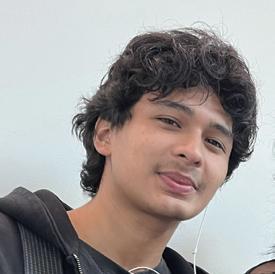


“I'm not completely set on a goal just yet, but I really enjoy all the resources and the classes that there are. I think just by being here and like trying out new things, you're opening up new windows and new opportunities for yourself.
“(I'm considering) maybe the arts. I like a lot of art. Or if not (that), like, electrician. So I'm just trying to see what's going on right here before I go to the long run.”
“I think (City College) has a very wide variety of things to choose from. So I think that's how it helps me choose or help me with my career. I think the counseling is also very helpful there. It's kind of difficult to get to them, but you know, they're so helpful. I was thinking about IT, like technology or computer science.”
“City College has helped me a lot with all the resources that it has, like (Extended Opportunity Programs and Services), the Writing Success Project, Metro Center… All of these programs have helped me pass my classes, get tutoring, or find resources for low-income students, especially for first-gen, as I am one of them. They have also provided me with scholarship funds in order to help me financially while I'm trying to save up money before I transfer to UC. If I (hadn't) gotten the support, I feel like I wouldn't be here.”

“One way I'm definitely being hindered by City College is the refusal to allow student workers to work the 20 hours that CalFresh is telling me that I need to work to maintain my benefits. Because of that refusal to allow me to work 20 hours at City College — despite there being over a million dollars allocated to pay lab aids every single year, with hundreds of thousands of dollars left unspent — I have to look for outside contract work. That takes away from my ability to finish my studies, because I have to prioritize hitting those benchmarks or (lose) my ability to eat.”
City College swam well, placing high in multiple categories.
By Jocelyn Wong jwong@theguardsman.com
The Rams swim team had a strong showing at the San Francisco Invitational on Friday, Feb. 6, and Saturday, Feb. 7, at the Wellness Center pool.
At the meet on Friday, sophomore Brisa Serrano Diaz said, “I think [the meet is] going pretty [well]. There's a lot of people here, a lot of energy, good swimmers, so
By Henry Crowell hcrowell@theguardsman.com
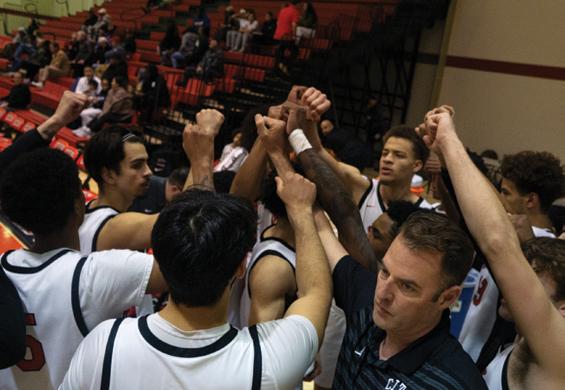
Women's and men's basketball have both made the 3C2A playoffs, capturing the seventh and first seed in their respective brackets.
Their entrance into the postseason caps off another great season for Rams basketball. The men's team went 27-1 this year, cementing their 15th straight conference championship and sustaining the success that has been synonymous with Coach Labagh and the Rams for nearly 25 years. For the women's program, this marks their 10th straight playoff berth, with a record of 22-5 for the season.
Both teams took a bye in the first round and joined the fray on Feb. 28. The women's team took on College of San Mateo, routing the Bulldogs in a 66-40 win, while the men's team decimated Foothill College in an 85-52 victory.
With these wins, they both advance to the NorCal Regional Finals on March 7, where they will compete for the chance to advance to their respective state championships.
it's good to sit down and watch other people swim and learn from them.”
Sarah Tanabe added, “We did the 200 medley relay and 200 freestyle. It went [well]. We dropped time in our 200 medley relay.” The 200 medley team swam a time of 2:30.90.
Second-year swimmer Samantha Ng performed especially well, with times of 2:11.58 in the 200 freestyle, 2:31.62 in the 200 IM and 1:04.78 in the 100 butterfly — good for second place in that race. Serrano Diaz also
put up a solid performance, with a first-place time of 30.25 in the 50 butterfly, as well as 1:13.47 in the 100 IM, 32.83 in the 50 backstroke and 1:09.20 in the 100 butterfly. On the first day of the meet, Assistant Coach Michael Tyler said, “We're still working some kinks out, but we're making a lot of progress and getting into the flow of our season. Overall, I think we can be very proud of our accomplishments so far.”

He didn't pick up a basketball seriously until high school. Now he's the first junior college player to sweep the North Coast Conference's top honors.
By Jocelyn Wong jwong@theguardsman.com
Kenyon DeMuynck erases opponents' shots on the court with his 6-foot-9 frame and his 7-foot-3 wingspan. His long arms and impeccable timing have enabled him to lead the state in blocks, averaging more than 3.7 per game. DeMuynck, an Oakland native, attributes his success to his strong work ethic and his teammates' communication on the court.
Coach Justin Labagh's help defense has been a big part of that success. If his teammate shouts “baseline” to him, DeMuynck knows to slide over and contest the opponent's shot at the rim. Communication like that has helped make DeMuynck the first junior college player to win Rookie of the Year, Defensive Player of the Year and co-MVP of the North Coast Conference.
Late Start, Fast Rise
Fans might be surprised to learn that DeMuynck did not start playing basketball for a team, or, as he puts it, “taking it seriously,” until high school. The East Bay native grew up playing at local parks in Oakland, where his parents are from.
Head Coach Labagh said of DeMuynck: “He's still learning how to play basketball, but he's got an open mind, and he plays really hard. He's been a pleasure to coach, so with
him, it's my job — because I only have him for this little part of time — to just pivot him in a direction.”
“Hopefully, he picks up some good habits here and carries that on… and it helps him when he's getting through adversity,” Labagh said.
DeMuynck recalls feeling sluggish until he worked on his footwork, becoming the agile player he is today. “I worked on my feet... I feel like anyone can do it if they put the work in,” he said.
When asked about the roots of his player's defensive prowess, Labagh explained: “[DeMuynck's] an anomaly. He has impeccable timing, and I think that's his biggest [strength], and he goes for everything.”
“Half of [blocking shots] is just making the decision like, ‘I'm going to go for it and try to alter the shot.’ You add in his length and his ability to jump and his timing, and you have an elite shot blocker. That's a big part of our defense,” Labagh said.
Regarding the Rams' suffocating press, DeMuynck explained that he had never pressed as he does with Labagh's squad. “I like that Coach [Labagh] is so serious about our press. I've never pressed the whole game before, so it's a whole new aspect.”
“And it's fun — teams don't
know what to do because we're playing hard. And if we get tired, [a] new five [comes] in, [does] the same thing, and [we] repeat,” he added.
DeMuynck can also elevate with the best of them, using his exceptional wingspan and “hops” to throw down thunderous dunks. He hopes to become a consistent scorer at all three levels: the paint, midrange and beyond the arc.
Labagh cites DeMuynck's effort as the main reason for his player's emergence as a defensive force. The coach recently celebrated his 600th career win Feb. 13 against Chabot, a milestone DeMuynck's shot-blocking presence has helped fuel.
Labagh said that Kenyon is a ray of sunshine off the court as well: “He's great — everyone loves him, his teachers love him. The nice thing is that I get a lot of compliments from people who don't know him personally, but they do just say, ‘Hey, this guy is a nice guy — he says hi to everybody. He has a big smile on his face all the time…’ Those are the kids you want to coach.”
Despite DeMuynck's lack of basketball experience relative to his peers, Labagh believes the sky is the limit for the defensive stopper. “He's definitely Division 1 [material]. I think that if he can kind of transform his body — he has to gain a lot

of weight — and guys develop late… It's hard to project them because his best basketball is definitely a couple of years ahead of him.”
DeMuynck credits his support system for allowing him to blossom into the player he is today.
“Shoutout to my trainer [David Moore aka “DMo” and] my brother. My family [is] always pushing me not just to do one side of the floor, but to value both sides.”
He also thanks his mom and brother for their support at the
games: “My mom's always there recording… that helps a lot, always getting film to send out to coaches. She's always screaming — I even hear it in the videos… I got videos of my brother skipping around when I get a dunk.”
Fans can expect many more dunks and blocks in DeMuynck's future. The high-flying player is determined to give everything he has towards the playoffs, keeping in mind that defense and focused effort win championships.
City College is the only community college in the state without a permanent field for its baseball team, and it doesn’t look like that's changing any time soon.
By Henry Crowell hcrowell@theguardsman.com
W
ithout a home ballpark, the Rams have had to fit in wherever they can, whether that be a field miles away from campus or their opponent's home grounds.
For players and coaches alike, this presents problems that run deeper than just on-field play.
“It was embarrassing to say that you get ready, you're wearing your home jerseys, and you're showing up to the other team's field,” said Kaleo Velez, sophomore infielder. “It's not as satisfying as having the team show up to your house and be there an hour early and have it be your facilities and your baseballs… You feel like you're still away.”
Mario Mendoza has been around City Baseball for over 20 years, first as a player starting in 2004, then as an assistant coach in 2011, and
later taking over the head coaching job in 2018. He feels like not much has changed.
“The hardest part about our school is that it really hasn't evolved, since I was playing here. Whether we're on the road, or practicing at random fields, or we don't have a batting cage,” said Mendoza. “We still don't have a lot of facilities [we need] to get better, to be successful.”
It doesn't seem like much will change in the immediate future.
Men's Athletic Director Adam Lucarelli said that funding is the main obstacle to constructing a field. “City College has been financially strapped, and it's not going to get better. We had to lay off a lot of faculty members, we had to drop sports. We used to have thriving track and field and cross country programs, and we had to drop that sport, which is tragic.”
In the 91 year history of City
College, the baseball team has never had its own field. After playing at a number of different SF Rec and Parks fields around the city, they settled on Balboa Park's main field in 1954, playing there until 2010.
The next year, they began to call Fairmont Field “home,” a diamond some 7 miles south of Ocean Campus in Pacifica. While the playing surface was significantly better than Balboa Park's, the distance from the college posed an issue that the team struggled to work around.
On top of that, St. Ignatius Prep owns the field and uses it for its baseball, softball and field hockey teams, which has caused numerous scheduling problems for City College over the years.
Unsurprisingly, the program's shortcomings in this area affect the recruitment of new players. Mendoza said, “If you're a parent, why would you want your son to

play at City? A lot of these kids are used to nice things. So when I recruit, and I say, ‘we only get the field for two hours, and you have to leave school, come to the field, then come back to campus after,’ they look at me like I'm crazy.”
So will City Baseball ever have a field of its own? While the future is murky, Lucarelli said that over the years, there's been “chatter” about a collaboration between SF Rec and Parks and the college to renovate Balboa Park, turning it into a field
suitable for this level. The construction of a field on the Balboa Reservoir site was also considered before the site was finalized for what is now the Harry Britt Building.
For now, at least, there's a stopgap in place. The cavernous Maloney Field, former home of the SF State Gators, will play host to the Rams for the next two years, and the players are glad to have some stability. “It's exciting to have our own place to call home for a set amount of games,” Velez said.
After a disappointing end to last season, City College badminton will look to rebound this year.
By Patricia Baldwin byebyebaldwin@gmail.com
I
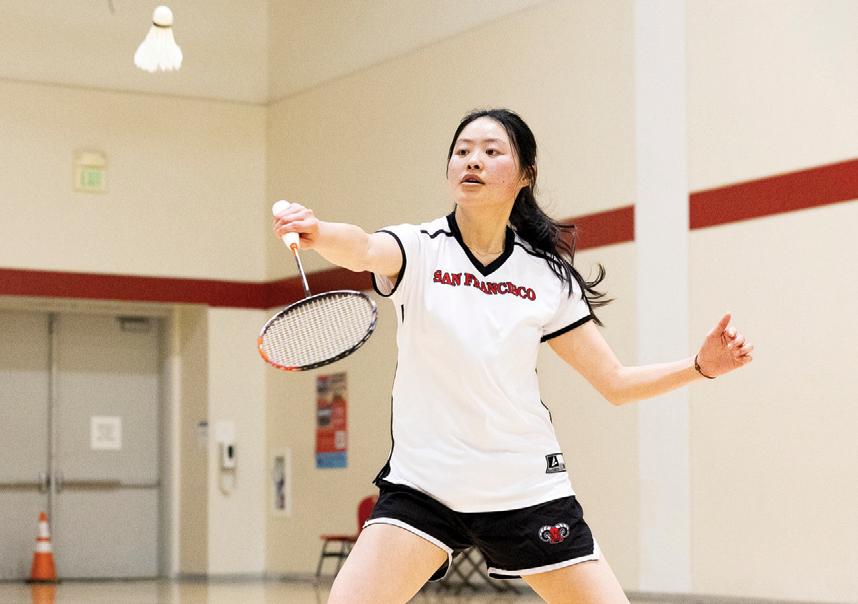
n preparation for the new season, City College's women's badminton team is finding strength in community despite a shrinking California badminton landscape.
“Badminton is addictive,” said second-year player Yoyo Tam. “You want to play, play, play, and get better, learning skills and picking up tricks.”
Head Coach Tiffany Mariano had the team hard at work on Tuesday, Feb. 10, in the middle of the preseason ramp-up that included drills to improve on footwork, strokes and endurance.
Second-year player Joey Chen is excited about getting better this season, focusing particularly on footwork and clearing. A clear is a high, deep shot aimed towards the opponent's back baseline. It is used both offensively and defensively.
Coach Mariano credits the players with “building a strong sense of team [chemistry],” especially since the 2024 season, when City College's badminton team won the state championship.
First-year player Mylen Cruzado is also focused on improving her footwork, which is foundational to the game.
Another goal Cruzado has this season is to build endurance.
“[I've been] working on the cardio side to get faster,” said Cruzado, “Improving [my] footwork to cover the court to be faster.”
Chen wants to help the first-year players like second-year players helped her last season.
“The second-year players would play the first-year players for fun,
offering feedback and tips from their personal experience,” said Chen.
Most players came to the team more experienced with doubles matches, according to Coach Mariano. During practices, players will get opportunities to work with their doubles partner in order to build chemistry.
Tam, who often partners with Chen, said she “enjoys playing doubles because of the teamwork and encouraging each other.” Tam continued: “We communicate a lot. We talk after each game to identify any problems and focus on that going forward.”
Despite the players' enthusiasm, the number of women's teams statewide is dwindling. The California Community College Athletic Association has lost four teams. One of those was from the Coast Conference that City College competes in.
That translates to two fewer games against a different opponent. Now, the players face teams three times, giving opponents more opportunities to learn Rams players' tendencies and go-to moves, according to Coach Mariano.
City College will travel to Fresno City College to open its season on March 8 at 3 p.m. Their first home game is also against Fresno City College on March 24 at 5 p.m.
Coach Mariano is calling all City College students to come out and support their women's badminton team. “Badminton is a great sport to watch,” according to Coach Mariano.
“Badminton involves more skill and strategy than most people realize. The matches are fast-paced. Badminton games are faster than they look,” she added.