


Union members cited rising health costs, staffing shortages and district spending priorities as drivers of the strike.


Above: Frank Lara, UESF's executive vice president, took the stage at the educator's strike with his son on his shoulders. San Francisco, Calif. Feb. 9, 2026 (Kyra Young/The Guardsman)
Left: Assistant Principal Eric Cuneo (Ida B. Wells High School) partakes in a sympathy strike. (Teresa Madrigal/ The Guardsman)
Right: Thousands of San Francisco educators took to the picket lines for the first time in 47 years on Monday, Feb. 9, demanding better pay and classroom conditions. (Kyra Young/The Guardsman)

The program's relocation to the Harry Britt Building launched Black History Month with renewed institutional backing and mixed reactions.
By Karla Lopes kcarval7@mail.ccsf.edu
Aribbon-cutting ceremony marked the grand opening of UMOJA/African American Scholastic Programs' new room on Feb. 4, welcoming dozens of guests. Kicking off Black History Month, students and faculty packed
the lobby of the Harry Britt Building alongside Tony Mayfield's vibrant drumming at Room 101.
“Today marks a really important moment of transition, growth and renewed commitment to our students,” said Vice Chancellor of Student Affairs Dr. Lisa Cooper Wilkins during the event. Dr. Cooper Wilkins noted the impact and “deep
contribution to City College's mission of student achievement and lifelong learning” of AASP Founder Dr. Henry Louis Augustine Jr.
“It is so good to be here, while you open up a brighter and new space,” said Eric Mayes. Mayes, chief executive officer of the UMOJA Foundation, emphasized the importance of UMOJA/AASP
as a powerhouse partnership to provide holistic support to City College students.
Chancellor Kimberlee Messina ended her brief statement expressing her gratitude “to have the opportunity to support our Black students in community, success and equity.”
By Tom Whitehead
twhiteh9@mail.ccsf.edu
Trustees
revisited a dispute between SEIU Local 1021 leader Maria Salazar-Colon and City College instructor Abigail Bornstein at the Feb. 12 Board of Trustees meeting, as speakers urged the board not to reopen an internal investigation into the matter.
The conflict stems from a May 29 board meeting during which Salazar-Colon directed personal remarks at Bornstein following Bornstein's comments about union wage negotiations. Bornstein later reported the exchange and a subsequent hostile email to the college's Human Resources Department and Campus Police, alleging that the language directed at her was antisemitic and that she feared for her safety.
Salazar-Colon filed a countercomplaint against Bornstein. The matter was investigated by college officials, and a report was prepared that exonerated Bornstein. Salazar-Colon later requested that the case be reopened.
During the Feb. 12 meeting, Board President Aliya Chisti reiterated the Board's decorum policy, reminding participants that no disturbances would be tolerated.
Although the public comment period at last night's board meeting focused on reopening the case, it also gave supporters an opportunity to speak on behalf of the parties in the dispute. At least 10 commenters, both in person and online, spoke against reopening the matter. Bornstein, commenting remotely, described the May 29 exchange as “deeply disturbing” and “deeply dehumanizing.” She added, “Antisemitism is a real and ongoing problem at the college.”
Andre Spearman, a field representative for SEIU Local 1021, commented that the issue should have remained in closed session and objected to holding the hearing in public. “Salazar didn't request it,” he said.
Public comment concluded at 5:31 p.m., after which trustees entered a closed session. The board returned at 8:03 p.m., and Chisti reported that there were no reportable actions.
Staff
Editor-in-Chief
John Adkins
Managing Editor
Abby Sigler
News Editor
Marrion Cruz
Culture Editor
Karla Lopes
Op-Ed Editor
Lev Farris Goldenberg
Sports Editor
Henry Crowell
Social Media Editor
Evelyn Sassus
Visuals Editor
Karim Farahat
Graphic Design Editor
Tiffany Lam
Writers
Ahmad Aimaq
Alejandra Cardenas
Daniela Villegas Jovel
Diana Chuong
Ellen Yoshitsugu
Jocelyn Wong
Kiyoka Valdes
Patricia Baldwin
Qi Mai
Tom Whitehead
Photographers
Alejandra Cardenas
Isaac Ortiz
Teresa Madrigal
Illustrator
Cindy Chan
Graphic Designers
Cindy Chan
Sebastien Thugnet
Freelancers
Bob Kinoshita
Faith Gabrielle Zapata
Joan Walsh
Advisor
Juan Gonzales jagonzal@ccsf.edu
Contact us
TheGuardsman.com info@theguardsman.com 415-239-3446
Mailing Address
50 Frida Kahlo Way, Box V-67 San Francisco, CA 94112 Bungalow 615
Follow us


For even more articles, stay up to date at www.theguardsman.com

City College and SFUSD staff reviewed system updates and advising gaps as thousands of students prepare to apply.
By Qi Mai qmai10@mail.ccsf.edu
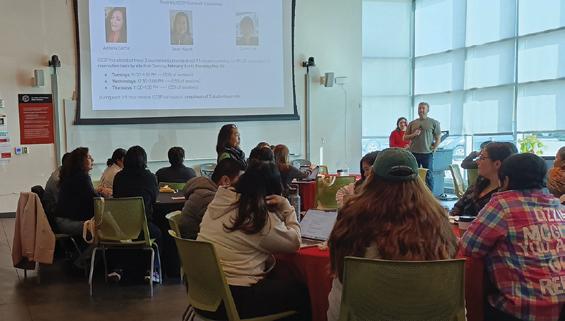
City College and the San Francisco Unified School District (SFUSD) held their annual meet-and-greet on Jan. 30 at HBB 140. The event was organized by the City College Outreach and Recruitment Office.
More than 80 SFUSD counselors, teachers and staff joined City College specialists from Admissions and Records, Financial Aid, Multicultural Retention Programs and more to review the City College enrollment system.
They also prepared to help about 5,500 seniors from 15 high schools enroll at City College starting Feb. 2. The effort will guide students through the full matriculation process, including applying to City College and completing all enrollment steps.
Lauren Marshman, SFUSD head counselor for the AVID (Advancement Via Individual Determination) program, said 45 teachers and 1,800 students participate in AVID. She works closely with AVID teachers to ensure students are supported. “In AVID classes, teachers walk students through the City College application and the financial aid process,” Marshman said.
Marshman worked as a counselor at Galileo High School for 20 years and is very familiar with
continued from page 1
“At first, I was on the fence with it — the room moving,” said Jaamar Nelson, a UMOJA student worker, who understands the former room's ties with Dr. Augustine's legacy.
Carlos Webster, UMOJA/AASP coordinator, hoped that students will be able to make good use of the space for community, study, counseling and other resources.
Last semester, a number of students signed a petition expressing disapproval of the move from what Black Student Union Co-President Evangela Brewster noted as “the best resource on campus.”
“When you go to UMOJA/ AASP in the library, all of these things — books, tutors and computers — are at your fingertips,” Brewster added. Webster pointed to Dr. Augustine's primary legacy, highlighting African American students as scholars first.
Lana Goines makes use of UMOJA/ASSP resources and preferred the new space. The previous location was “a lot darker” and wasn't in a central space within the library.
The preferential debate didn't go unnoticed.
“Moving from a familiar space, one that is rooted in deep memories,
City College's enrollment system. “Both teams are trying hard to make things as simple as possible. Every year, there are small changes to make it better for students. I think this year will be even better than last year,” she said.
This year, the enrollment system includes an important update for new students: they may be dropped for non-payment. Fees are due at the time of registration and can be paid through a Nelnet payment plan.
Max Gardner, supervisor of City College partnerships in SFUSD's College and Career Readiness Department, said the event helps school staff stay on the same page. He noted that 98% of SFUSD counselors returned for this year's training. “They learn about anything new, review the steps, and are reminded of the support available from City College and from us. The training and workshop arrangements were excellent,” he added.
Gardner said communication between City College and SFUSD has become stronger. “If problems come up, we tell them to fix them quickly, instead of leaving students to figure things out alone,” he said.
Gardner noted that while the enrollment system has improved, some challenges remain, especially technology issues and a shortage of counselors.
Last year, some high school students did not receive responses after
applying. Others got stuck in the application process and could not get quick help from City College or virtual counselors.
Some students told The Guardsman that virtual counseling sometimes redirected them without answering their questions. Others waited up to two weeks for counseling appointments, which caused stress during enrollment.
Gardner said City College faces a bottleneck: many students need help, but there are not enough counselors. Most counseling for high school students is done virtually, and SFUSD counselors help students connect to those sessions.
“About 95% of the process works virtually,” Gardner said. “But when students get stuck, it often becomes a tech support issue. Only a few City
College staff members can fix those problems.”
He added that many students are unsure whether they will attend City College, so they wait until April, near FRISCO Day, when they can officially enroll in classes and meet with counselors to create an education plan. This causes a rush later in the semester.
To address this, City College introduced a new appointment system. Students can now schedule counseling meetings in advance, so they know exactly when they will meet with a counselor to create their education plan.
“If students go to drop-in sessions and can't get help, they feel discouraged,” Gardner said. “Scheduled appointments should make the process smoother.”

relationships, historical significance and legacy can be really hard,” said Dr. Cooper Wilkins in her speech, hoping for deeper collaboration and greater impact with the move.
Although there were challenges, Webster stressed that the proximity to the Student Success Center, though, is a benefit of the move.
“Sometimes you have to get inconvenience with the convenience,” Webster said.
He added that UMOJA/AASP will continue building its legacy, providing students with the best resources, “and we will get more of the community and care.”
The scholastic program was created in the early 1990s to support and advocate for the academic development of African American students, becoming City College's first retention program.
The program was located in a
bungalow under the Student Union before Dr. Augustine started to negotiate some space for AASP in the newly-built Rosenberg Library. Since 2017, the partnership between AASP and the UMOJA Foundation has flourished in Room 209.
Note: Although initially designed to assist African American students, today UMOJA/AASP assists a diverse group of people.
By Ellen Yoshitsugu egiese@mail.ccsf.edu
Atentative contract agreement between the San Francisco Unified District and its educators ended a weeklong strike early Friday morning, Feb. 13.
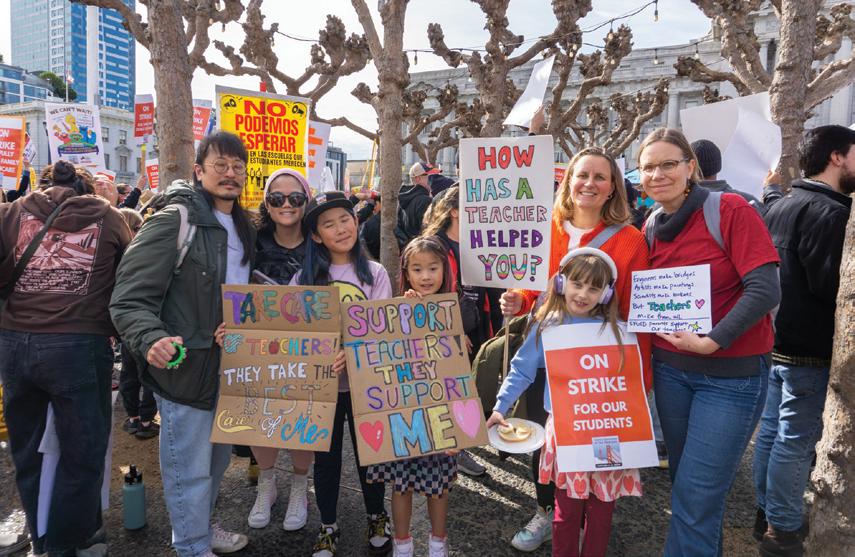
For the first time in almost 50 years, unionized educators went on strike over stalled contract negotiations, resulting in thousands of educators walking out starting on Feb. 9. Picket lines were heard across the city throughout the week, leaving more than 50,000 district students without schools.
Other SFUSD employees showed solidarity by participating in “sympathy strikes” staged at various locations across the city.
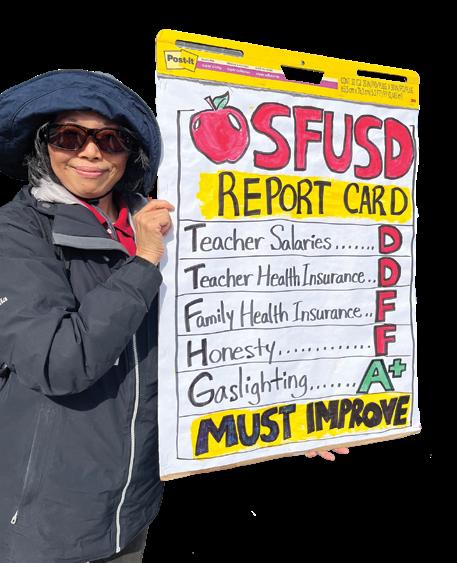
In two languages, Yi-Kwan Lee's
handmade picket sign depicted disappointment at the district, in the form of a “failing report card.”
“The negotiation has been really exhausting, [it's] going nowhere,” Lee, a Mandarin immersion teacher at Aptos Middle School, said during one of Monday's rallies.
More than 80% of UESF members twice voted to authorize the strike.
Educators insisted on pay raises, improved working conditions for special education paraprofessionals, and increased district contributions to employees' dependents' health insurance.
“I don't think that's just.” Lee said she had many co-workers who “can't afford groceries” and “have to take multiple jobs in order to take care of their children.” Lee herself has $1,500 deducted to cover her two children's insurance.
On the Job
Josh Davidson, the district's chef and former head of the SEIU's SFUSD chapter, pointed out that asking for a solidarity strike shouldn't have been feasible for a lot of his coworkers because of low wages.
“Not getting paid for several days of work is a real hardship for them,” Davidson said. “We made the ask, and they
Eric Cuneo hoped for better compensation so educators “can live in the city they serve.” Cuneo is
the assistant principal at Ida B. Wells High School and carried a picket sign over his shoulder.
“San Francisco espouses values of education, and we need to live our values,” Cuneo added.
The principals have a “me too” agreement whereby they will receive the same raises that the teachers get.
“I'm just here to support my teachers,” said Vanessa Pimental at Monday's Civic Center rally. “I've seen a lot of my teachers from when I was in high school back in 2017.”
Pimental's brother went “through schools being underfunded and not giving him the right resources to actually survive and get his high school diploma,” she said.
High caseloads for special
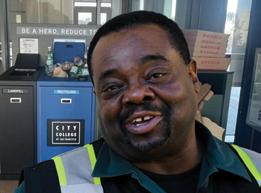
For more than two decades, Tim Harper has sorted City College's recycling by hand, teaching students along the way and taking pride in keeping the campus clean.
By Danielle Flores dflore67@mail.ccsf.edu
Across from Bungalow 609, Tim Harper, one of only three workers in the recycling department at Ocean Campus, takes his chain of keys and unlocks the blue recycling bin door to begin sorting the recycling.
He is wearing blue latex gloves, a black mask and a black apron, which he said he wears on top of his clothes “to keep clean.” He moves quickly, hand-sorting items that were mistakenly placed in the wrong bins. He pulls out a napkin from the recycling bin with his prongs and drops it in the compost.
“I do this now so when I go to the dock, I don't have to separate, I just pour it where it belongs,” he said, pulling out a plastic bag and paper plate from the recycling bin and putting them into the landfill bin.
“This goes to the recycling, compost or landfill. I don't touch the landfill. The custodians usually do the landfill,” Harper adds. He pulls out plastic packaging with a black tray inside. “This is tricky.
Actually, this goes into the waste,” Harper said, referring to the outer plastic packaging as he places it into the landfill bin. He drops the remaining black tray into the recycling.
“I go real fast,” Harper said, smiling behind his mask and laughing.
“Sometimes. I have to watch out for the rodents in here. It scares me a lot, I don't want to get bit,” Harper said.
Harper has been working at City College for over 22 years. Before working in the recycling department, he worked at the culinary arts and hospitality studies department for 12 years. He then applied for the institute utility worker position.
In addition to his work in both departments, Harper has also completed coursework as a student at City College.
He has received a certificate in custodial training and taken classes in construction safety, blueprint reading, business and real estate. Harper took evening classes and balanced working at the college with working event security at the Moscone Center.
When asked what has kept him working at City College for so
long, he said it's the environment. He likes people and enjoys engaging with students. “Because if they weren't here, I wouldn't have a job,” Harper said.
Harper describes his day-today interaction with the students, including his outreach work where he educates students to ensure they “put stuff in the right can.” He describes watching the students first and seeing how they will sort their items.
“You know, I tell them to watch the signs, ‘look at the signs,’ and read the material that's on the actual unit,” Harper said.
Harper's outreach initiative is an example of the Recycling Center's goal to “implement sustainable practices to support the CCSF community” through action and education, according to the recycling center's online page.
Harper often attributes his success in his work to the leadership and recycling education he's received under Carlita Martinez, City College's Recycling/Waste Reduction Coordinator.
“It's wonderful working here.
education teachers contribute to staff turnover and make schools less stable. The district has proposed a joint committee to study the problem as of Feb. 11.
“The district must continue to reduce its reliance on outside consultants and thus reallocate the contracting out funds to programs that directly benefit their employees,” the mandated committee reported.
The district has insisted that these demands must be met by cutting elsewhere to stay within budget, such as reducing teacher compensation in other ways and raising class sizes.
The union said the district can
spend some of its extensive reserves on current needs. They also want stronger sanctuary language and to formalize the district's “Stay Over” program, which shelters unhoused families overnight.
“There's a need for the district to wake up and understand that they haven't been meeting the needs of their staff for years now, and they can't hide behind their own incompetence forever,” Davidson said.
“It's hard for me to trust an administration who has spent three years not taking care of making sure that their educators get paid on time,” said Brandee Marckmann, a parent activist running for the SF Board of Education in June, referring to the scrapped $40 million payroll software.
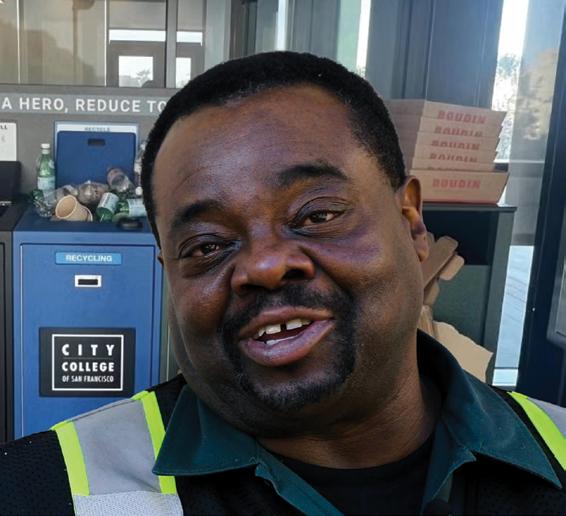
You have your freedom but you have to do the work and it's hard work. There's incredible people here who are pretty smart. I didn't think I'd have a job like this. [I want to] thank Carlita for everything she's done and teaching me what to do,” Harper said.
An interview tried to be conducted with Martinez, however we were unable to connect.
Harper often works with student workers and continues to share his recycling knowledge and education with them. Last semester, he was working with two student workers, one of whom wants to become a classified worker at the college.
Antonio Quilici, another of the three recycling workers at Ocean Campus, said that Harper is a great mentor.
“He's very dedicated to his job and has a lot of pride in CCSF. He'll go and support local sporting events,” Quilici said.
“I like academics first, but sports I really love,” Harper said.
Harper plans to retire in two years, when he turns 67. When asked about his retirement plans and whether he would go back to school, Harper said he's focused on investing more. He wants to buy more shares and currently has some land in Arkansas.
Founded by Khalid El-Hakim, the traveling exhibit offers a wide-ranging look at Black life, culture and resistance.
By Qi Mai qmai10@mail.ccsf.edu
On Feb. 11 and 12, the Black History 101 Mobile Museum set up shop in the Student Success Center. Created by Khalid El-Hakim, the award-winning collection comprises more than 15,000 artifacts documenting Black history from the transatlantic slave trade to modern hip-hop culture.
Instead of residing in one building, the museum travels across the United States to schools, colleges, churches, corporations and community events. It has visited 44 states and more than 1,000 institutions, reaching thousands of viewers.

The mobile museum was initially viewed by Associate Dean of Equity Tessa Brown during the National Conference on Race and Ethnicity in Higher Education in New York City in June of last year.
“I realized that my share-back plan with the college would be to bring Dr. Khalid El-Hakim's Black History 101 Mobile Museum's living exhibition to CCSF. I wanted to share this exhibition with our students and the college community because it's powerful, compelling, and transformational,” Brown said.
El-Hakim grew up in Detroit and was influenced by hip-hop culture. What began as a hobby — collecting baseball cards and music at a young age — slowly grew into a large collection of Black historical materials.
“I wanted to learn more about Black history because I felt it was not fully taught in schools,” he said. He collected items from antique shops, bookstores, flea markets, garage sales and auctions.
After 31 years, his collection grew to about 15,000 items, including photographs, written works, postcards and pins that offer insight into the cultural influence of Black Americans. The exhibit
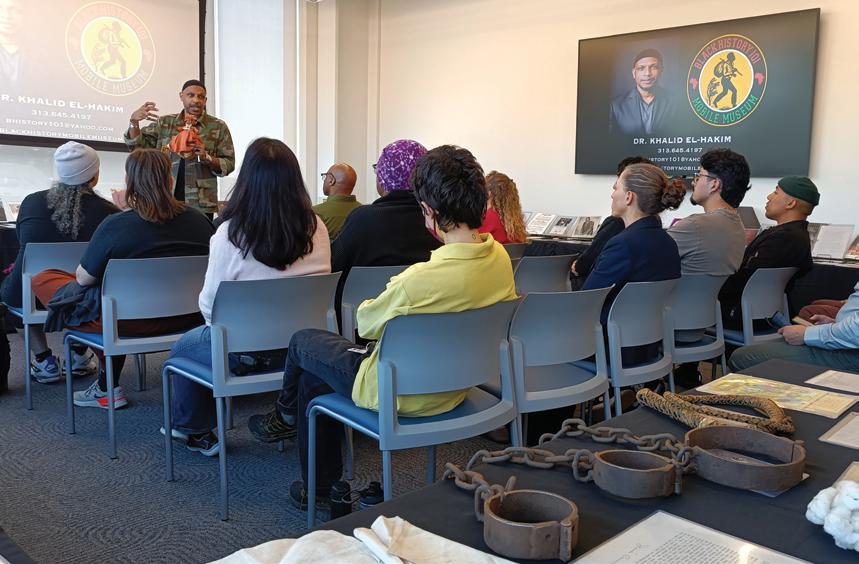
includes information about leaders such as W.E.B. Du Bois, Booker T. Washington, and Carter G. Woodson, who helped start Black History Month. It features pioneers like Jackie Robinson, the first Black Major League Baseball player in the modern era.
The museum covers music and culture, including Aretha Franklin, James Brown, Sly and the Family Stone, and Tupac Shakur. It also includes materials from the Black Panther Party and items related to events such as the Million Man March.
Visitors to the museum see examples of racism, harmful stereotypes and discrimination, as well. In his presentation, El-Hakim used many examples to explain and analyze how Black people, including former President Barack Obama and his wife, have experienced racism throughout history across the
City College Art Department Chair's solo exhibition, “Natural Selection,” is on display at the Marrow Gallery.
By Karim Farahat karim.farahat0823@gmail.com
Stephanie Robison's sculptures juxtapose the smooth, handrefined surface of stone with the soft fuzziness of wool. The works range from small, palm-sized objects to larger wall-mounted pieces, each exploring the tension between hardness and warmth in her new solo exhibition.
A significant portion of the collection was completed during Robison's residency at the Helene Wurlitzer Foundation in Taos, New Mexico. She notes that the environment plays a crucial role in her artistic practice.
“I believe that where you live deeply influences your artistic practice,” she said.
That influence is visible in both color and title. “El Corazon” — Spanish for “heart” — features a sandy palette reminiscent of the desert hues of Taos.
What stands out in Robison's work is the blend of technical mastery and intuitive experimentation.
Her process of chiseling, sanding and refining stone requires years of patience and discipline. Yet she pairs that rigor with a willingness to let the material evolve organically.
“I am drawn to art and design that challenge conventional ways of seeing,” Robsion said.
“When I experiment with materials, my goal is to arrive at something that surprises and excites me,” she added. “I find this tension especially in the juxtaposition of hard and soft elements… Developing them simultaneously enables them to merge in a way that feels organic and cohesive.”
While viewers may admire the elegant combination of polished stone and wool, few realize the time and labor required to achieve that softness.
“At the beginning, I was determined to make the material reflect exactly the image I had in mind,” Robison said.
She shared that the process was naturally frustrating due to her lack of experience — some pieces took her over 10 years before she
developed the skills necessary to fully realize them.
“Once I reached that technical level, I realized that the true pleasure of working with stone lies in the process itself. I felt much more fulfilled when I allowed myself to experiment and let the form emerge gradually,” Robison said.
Gallery director Marissa Pattan emphasized the hidden labor behind the work.
“Stephanie has done it for many years, and she makes it look easy,” Pattan said. “She makes the stone have a softness that people don't realize takes hours and hours and hours of work.”
For Robison, experimentation remains central to her practice.
“I love working with materials in all their forms, and I love learning new things — which is also why I teach,” she said. “Experimenting with different materials keeps my curiosity alive.”
Robison's solo exhibition will be on display at the Marrow Gallery in the Inner Sunset neighborhood until Feb. 28.
country and around the world. At the same time, visitors learn about strength, achievement and resilience.
El-Hakim believes Black history is central to American history. He says students need to feel seen, supported and represented in school. When students learn about people who look like them and share similar experiences, they feel more confident and successful.
Today, the museum is his full-time work. His wife and five daughters support him and travel with him, making it a family mission. His goal is to inspire others to start mobile museums and community archives so that Black history can continue to be preserved and shared for future generations.
Andrew King, Interim Dean of Social Sciences, Behavioral Sciences, Ethnic Studies, and Social Justice,


described the Black History 101 Mobile Museum as an engaging and accessible way to experience Black history. He found the exhibit deeply enlightening and said the artifacts “brought a fresh and relevant meaning to the impact of Black culture in American life.”
Neche Okeke, a computer science major, said visiting the museum was very eye-opening. He learned many things about his history that he had never been taught before. He was grateful that the exhibit was on campus because it helped him better understand himself and his background.
Student LaMonte Harrism, a cinema, music, and Black American studies major, said the gallery is a great gift during Black History Month.
Over the two days, about 200 students, faculty and staff visited the exhibition.


An exclusive look into the innovative sculpture art exhibit displaying works by local artist Danny Rosales.
By Faith Gabrielle Zapata faithzapata23@gmail.com
Concrete, steel and glass — these materials make up the floors we walk on, the doors we open, the windows we look through and more. At first glance, they might seem ordinary, but local sculpture artist Danny Rosales sees them as anything but.
To him, they serve a greater purpose: one of pure artistry, and he desires to instill a new perspective of the mundane in viewers of his artwork.
Currently on full display at the City College Art Gallery is “In Flux,” Rosales' innovative sculpture art exhibition. Merging the practice of art viewings with performance art, Rosales creates a unique experience for his audience by devotedly returning to the gallery each week to move pieces around, transforming his art in real time.
“This is me taking advantage of this space,” Rosales said.
The City College Art Gallery, located inside Ocean Campus' STEAM Building, consists of a singular room whose empty, white walls serve as a blank canvas for selected artists to work around.
A true innovator of his craft, Rosales has always strived to do what hasn't been done before. And as a result, the concept of his sculpture exhibit, constantly being ‘in flux,’ was born.
“It's a learning process, you know — it's a school,” he said. “I want to learn something, too. I want everyone to learn something. I might make it better, I might screw it up, but I won't know unless I do it. And this is a good place to do that.”
Over a year and a half ago, Rosales was invited by City College Art Gallery director and faculty member Nancy Elliott to visit the gallery beforehand to create pieces specifically for the space where they would live for the duration of the exhibit.
Elliott spoke of Rosales' art practice, noting the beautiful contrast between the hard, rigid materials he uses and how he employs them within his work.
“He's dealing with these very hard materials in a very airy, light way. They seem dangerous, but they also seem elegant. I liked that contrast. I think being able to see that level of craft, besides the ingenuity of the materials, is what I thought students would like,” Elliott said.
Rosales blends his experience in the building trades with his creative output by using materials he knows well, which is where concrete, steel and glass come in. Growing up, he was always interested in art, but didn't discover his niche within these specific materials in tandem with sculpture until later on.
Elliott also stated that she wants students and viewers to
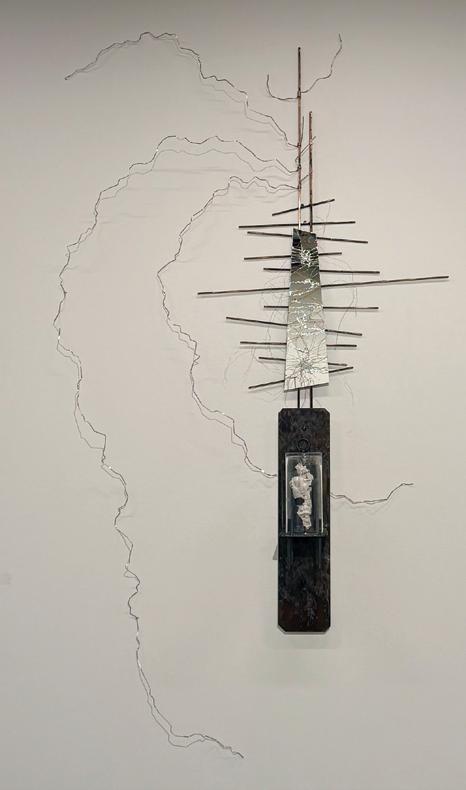
“Parts #64,” a work in progress. What started as a simple dark grey rectangle has been gradually added onto each week for more complexity. The project will continue to be developed until Feb. 26. Feb. 6, 2026 (Faith Zapata/The Guardsman)
understand that there are many different paths that one can take when it comes to being an artist. She mentions Rosales' background in construction and engineering, saying that the exact quality that makes his art stand out is the ways in which all of his skills and life experience, art-related or not, still have a direct impact on the art he creates.
During the reception held on Feb. 11, many students and
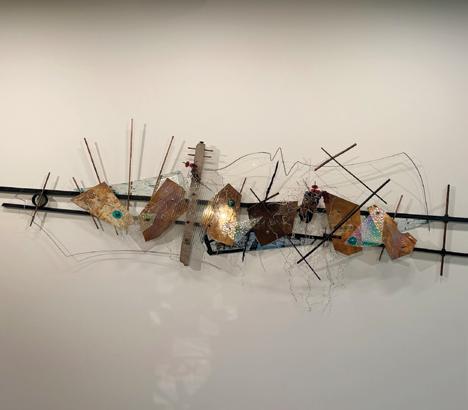
viewers arrived and celebrated the opening of Rosales' exhibit.
Eric Rasmussen, studio arts major, observed that Rosales' piece “If Ten Thousand Things Weren't Enough” (2025) deems itself a “retro” yet “futuristic” work which showcases Rosales' ability to bridge gaps between mediums, materials and time itself.
Another studio arts major in attendance, Ariel Liu, had actually seen the exhibit a week or so prior to the reception. She noted how the ever-changing aspect of “In Flux” had posed an interactive memory challenge for viewers.
“What's different, or not here?” she recalls asking herself, upon seeing Rosales' updates. “I don't know — this is novel to me,” Liu said.
When asked what he hopes audience members will take away from experiencing the exhibit, Rosales replied: “Maybe I can evoke a certain freshness to the viewers, to open one's mind a bit.”
It's apparent that he has accomplished exactly that. At the time of publication, “In Flux” is still available to view by the public until Feb. 26. Until then, Rosales will return to the gallery every Thursday at noon to change the work in real time.
“It's always in flux. I have no idea where it's going, and that's okay. If I knew where it was going, it probably wouldn't excite me,” Rosales said. “I just want to see things from a different perspective.”
Saturday, Feb. 21
Women's Tennis vs. american River
12 p.m. | Ocean Campus Tennis Courts
lunar New year Celebration
12 p.m. - 3 p.m. | Thrive City
Sunday, Feb. 22
836M Fest - one-Day-only Mini Documentary
12 p.m. - 4 p.m. | The Roxie, 3117 16th St.
Tuesday, Feb. 24
Ram's baseball vs. hartnell
2 p.m. | San Francisco State University
Film Screening - Sarah's oil
2 p.m. - 4 p.m. | SSC 2122
lunar New year Celebration
11:30 a.m. - 1 p.m. | Chinatown/North Beach Center
Mission Center open house
9:30 a.m. - 12:30 p.m. | Misison Center Room 109
Tuesday, Feb. 24
Mission Cuentistas - Short Story Writers at City College
6 p.m. - 7:30 p.m. | Mission Center Room 109
Wednesday, Feb. 25
Men's basketball Round 1 Regional Playoffs TBA | Wellness Center, Ocean Campus
Thursday, Feb. 26
Student Voices with Dean Cahill
12 p.m. - 1 p.m. | Mission Center Room 108
Spring Virtual Career Fair
3 p.m. - 4:30 p.m. | Zoom
Friday, Feb. 27
Ram's baseball vs. ohlone
2 p.m. | San Francisco State University
Women's Tennis vs. Cabrillo
2 p.m. | Ocean Campus Tennis Courts
Discover uC Davis
8:30 a.m. - 3 p.m. | Mondavi Center, UC Davis Campus
Saturday, Feb. 28
Men's basketball Round 2 Regional Playoffs TBA | Wellness Center, Ocean Campus
2026 Free Dental health Fair for Kids
9 a.m. | 155 5th St.
Sunday, March 1
Castro art Mart mini block Party on Noe Street
11 a.m. - 5 p.m. | Market and Castro
Monday, March 2
Rare “blood Moon” Total lunar Eclipse 11:59 p.m.
Tuesday, March 3
Women's Tennis vs. Foothill
2 p.m. | Ocean Campus Tennis Courts
Wednesday, March 4
Flex Day | No Classes
SF Zoo Free admission Day
10 a.m. | San Francisco Zoo
Are the student strikes and economic boycotts effective against ICE?
By Ellen Yoshitsugu egiese@mail.ccsf.edu
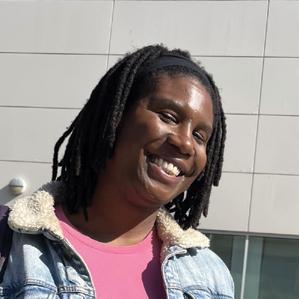
Audrey Davis, Nursing
Yes and no. I think it depends on the stores that are shutting down. I feel like if we're giving more to the Latin and BIPOC community, to the stores that are open, it's more effective. But everybody is just shutting down… Yes, it does stop the corporate dollar and everything, but it doesn't do much in the face of what's going on right now, with people being taken away from their families and homes and everything.
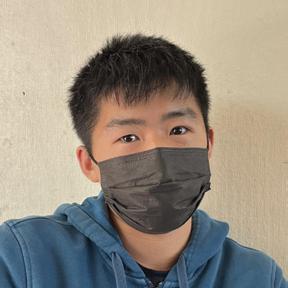
Danny, Engineering
It's effective because it gets their attention.
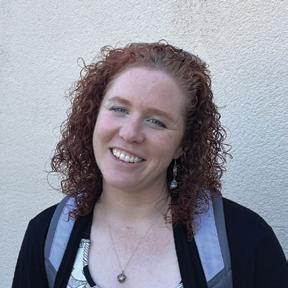
Rachel Nannini,
Counselor with DSPS
I'd have to look at how successful we were at actually getting people to participate and not pay for things, because I know there were also people that were, instead of doing your economic strike entirely, were supporting only local and people-of-color businesses that couldn't afford to take the time (to close). So I thought that was really cool.
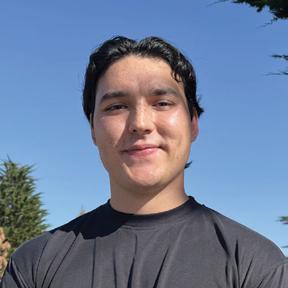
Tyler Powers, Business Administration
I definitely think it is effective. I think the economic boycott is definitely more effective than maybe the protests. Not that the protests aren't effective, but in terms of what the current administration views as problematic, the stock market and how the economy is doing. So if we're boycotting big tech and choosing to opt out, and it's affecting their stock prices, then they're definitely going to start listening.

There is no compromising with fascists.
By Lev Farris Goldenberg lfarrisg@mail.ccsf.edu
OnJan. 30, tens of thousands of Bay Area residents walked out of work and school and rallied in Dolores Park to demand “ICE OUT” of their communities. The massive movement, which joined 300-plus protests around the country, came in response to the cruel immigration policies of the Trump administration and the killings of Renee Good and Alex Pretti in Minneapolis.
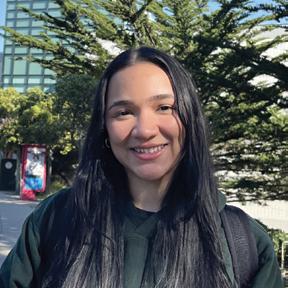
Rhenangely Matos, Registered Nursing
In my opinion, [they're] not effective at all. I think it's pretty sad what is happening right now regarding ICE and everything else. I'm 100% against it. I don't think you should be fighting like animals like that. I think you should be fighting with love.
Last week, as Congress negotiated funding for the Department of Homeland Security, House Democratic leader Hakeem Jeffries and Senate Democratic leader Chuck Schumer laid out 10 demands for reforming ICE.
Among them: the unmasking of agents, body cameras, stronger requirements for judicial warrants and a code of conduct for use of force.
But there is no reforming a fascist agency. Abolishing ICE is the only moral position.
ICE has detained hundreds of children and used fear tactics designed to terrorize immigrants and their loved ones. They have detained
protestors for pro-Palestinian speech. They have detained, deported and killed American citizens. These are not the actions of an agency that can be reformed.
And this is nothing new. Under President Obama, ICE deportation levels reached an all-time high, and ICE has historically received bipartisan support.
The reforms now being called for by Democrats in Congress cannot undo the damage inflicted on immigrant communities.
Then there is the caveat that Democrats' proposed reforms would likely have little effect on ICE, which last year became the most wellfunded law enforcement agency in U.S. history. And clearly, from its oppressive and fearmongering practices in Minnesota, ICE has shown no incentive to play by the rules.
Why should we give them an inch when they will take a yard by force?
At Dolores Park, the rising tide of anger over Trump's immigration policies was voiced by Bay Area residents. Many of those voices were students who have seen the first-hand effects of fear tactics on
their communities.
“I shouldn't have to worry if my friends are going to be taken away from me or their families,” a high school student from Bayview told the crowd at Dolores Park. “We shouldn't be hearing about people being killed every single day over ICE.”
While Renee Good and Alex Pretti garnered most of the media attention, the full picture is much darker — at least six other people have died in dealings with ICE this year. In 2025, at least 32 people died in ICE custody.
As Democrats in Congress negotiate for piecemeal compromises, communities around the country — including here in the Bay — are showing that they will not stand for ICE terror.
“I am exhausted from fighting year after year for our rights that were given to us,” another student from Balboa High School told the crowd. “Our people are being murdered in the streets, and they're lying and trying to justify it. There is nothing right about coldblooded murder.”
Half-measures will not do. Abolish ICE.


Wet weather was a factor at Maloney Field in the Rams' loss.
By Henry Crowell hcrowell@theguardsman.com
The Rams were on the losing end of a nail-biter on Tuesday, Feb. 10, falling to the Laney College Eagles 4-3 in City College's proverbial Battle of the Bay.
City College had to contend not just with the opposing team but also with an on-and-off downpour that threatened the game throughout.
Second-year player Kaleo Velez slotted in at third base in Tuesday's game and launched a double over the left fielder's head in the bottom of the second. He said that the wet weather and field incentivized what some might call “small ball.”
“You can't get it in the air, so you have to use your wet field to your advantage. [In this situation] I just try to stay on top of the ball
and hit stuff hard into the ground,” Velez said.
Rams Head Coach Mario Mendoza said that while weather conditions were less than optimal, he didn't want it to make a difference in how his team took to the field. “Whatever we have to play in, they have to play in, too. So we can make excuses, or we can use this to our advantage.”
Despite notching their second straight in the loss column, the Rams have a lot of positives to take away from this matchup. No one was more aware of this than Coach Mendoza.
He explained that while things could have played out better, he was happy with the team's performance: “Sean Lee and Randy Lopez did a great job pitching today; they gave us a chance. I thought both
As the regular season comes to a close, the Rams must raise their level of play.
By Jocelyn Wong jwong@theguardsman.com
The Rams fell to San José City College 69-60 on Feb. 6. San José defended in a 2-3 zone for the entire game, which made scoring more difficult for City College.
When the Rams had success, they moved the ball with crisp passes to find easy layups. Forward Stephanie Salazar and center June Lumumba cashed in as a result, scoring nine and 11 points, respectively.
Sophomore guard Alexis Cornejo also knocked down a couple shots from behind the arc, scoring 10 in the loss.
After the first quarter, the score was all tied up at 14-14. Cornejo pump-faked and sunk a floater, and the Rams' good ball movement led to a jumper. Unfortunately, being in the bonus cost the Rams some free throws. Thus, they were down 32-36 at the half.
The San José lead ballooned to 51-30 at one point, but with 2:45 to go, the Rams had trimmed the San José lead to just 3 — 59-56. However, San José pulled away in the final minutes for the non-conference win.
“I definitely think we can improve on getting back,” Cornejo said. “When it comes to the games, I think we just get flustered, and we have to work on our communication.”
Freshman guard Caelan De Vera echoed that focus. “I think we can work on making the extra pass,” she said.
Despite the loss, players pointed to progress. “Our ball movement definitely got a lot better… it's just a matter of closing and finishing and being consistent throughout the
whole game,” Cornejo said. De Vera added that the team's energy fueled its comeback. “I think we kept our energy coming back from a 22-point deficit — the bench was hyped, the players were loud. I think that really helped our momentum on the court.”
Freshman guard Jessie Chau highlighted the team's interior play. “I think we did [a good job] of getting the ball to the middle and touching the key and then kicking it back out,” she said.
To sum it up, Cornejo said: “We definitely need to improve at just getting the little details right.”
Head Coach Derek Lau was direct in his assessment. “Obviously, we lost. We didn't put together a consistent game. We have a lot of young players, but that's no excuse. They have to know that they've got to bring energy every game, and they walked in and weren't ready right off the bat.”
He cited execution as the central issue. “We have to knock down shots… we were kind of turning the ball over — some of our passes were at people's feet and things like that, but we have to be accountable for those things. That's on us to play better and push that ball in transition. We [have] to get better at executing [against] a 2-3 zone.”
“We have to be ready to go and be consistent for four quarters and have the same energy for four quarters,” Lau said. “It's the only way we're going to turn the tables on this. We're still in good shape.”
The Rams are currently 18-5 and 4-1 in conference play. Their final home game of the regular season is against Foothill College on Friday, Feb. 20, at 5 p.m.
teams played really good baseball.”
The loss puts City College at 1-7, tied for the worst in the Coast-North conference with De Anza College and Chabot College. They have given up a staggering 102 runs over those eight games, while offensively they've scored 36 runs, resulting in a -66 run differential.
While City College has improved with the bat in their hands this season, their performance on the bump has left something to be desired. “Every walk, every error, is going to be a run eventually,” Mendoza said. “[It isn't] the reason why we lost, but it's the little things here and there, little things that might have made the difference.”
The Rams' pitching staff has a 9.13 ERA so far and has surrendered 118 hits. Both are good marks for 81st out of 88 community college

teams in
said this game was a return to form for the team after the 18-3 pummeling they received at the hands of the Mendincino Eagles, which he said he was disappointed by. “I'm a lot happier with our performance today, but we have to get back at it. At the end
of the day, no one's going to feel sorry for us.”
Rams will play at home twice before the end of February. They face Hartnell College on Feb. 24, followed by a bout with the Ohlone College Renegades on Feb. 27. Both games will start at 2 p.m. at Maloney Field on SF State's campus.

This women's basketball player is stuffing the stat sheet despite still getting acclimated to life in the United States.
By Jocelyn Wong jwong@theguardsman.com
On the court, June Lumumba dismantles defenses with ease. In a recent win against the College of San Mateo, she scored a seasonhigh 24 points on 11-of-15 shooting. Off the court, the Kenyan international student athlete explained that acclimating to life in San Francisco is not as easy as making buckets on the hardwood.
For one, the weather in San Francisco differs from that in Lumumba's hometown of Nairobi, Kenya. She describes Nairobi as warm, whereas “it's very cold out here and windy” in the city. “Living in San Francisco is not easy for me because of the weather… I'm not going to say it's a challenge, because it's a choice,” she said.
“Another difference is definitely the culture — how people talk.” Lumumba explained that the accents can make understanding each other harder. “Sometimes you talk, and someone is like ‘pardon, pardon?’ all the time,” she said.
Lumumba also mentioned the differences in resources and motivation between San Francisco and Nairobi. “My coaches are very motivating. They do everything in their power to … make sure we are taking the right classes that align with our basketball schedule.” In Kenya, she said, a player would have to do all of this themselves.
“When I came here, I immediately joined the basketball program. I've been receiving support and help from different people, my coaches, and this is so important to me [because of] the fact that I'm an immigrant… I'm not going to say it's not easy, but it's different,” Lumumba said.
“When I talk about resources, too, I've seen a very huge difference when it comes to … the tech. It's my first time being on a team where we have the same shoes,” she continued.
Lumumba also described the differences in facilities, explaining that City College has a Wellness Center with basketball courts, locker rooms, a fitness center and more, all in one place.


In addition to being a star on the team, Lumumba shines in the classroom. The computer science major made the Dean's List last semester.
“I love basketball, and I also love my major,” she said.
A professional player that Lumumba looks up to is fourtime WNBA MVP A'ja Wilson. Wilson is a three-time WNBA champion, three-time WNBA Defensive Player of the Year, two-time Finals MVP and six-time All-Star for the Las Vegas Aces at just 29 years old. Wilson makes her presence known on both the offensive and defensive sides of the ball; thus, she is a worthy role model, according to Lumumba.
Despite feeling out of place when she first arrived, Lumumba's teammates welcomed her with open arms. “I love my teammates. They understand me; I understand them.”
As for the rest of the season, she looks forward to continued success on the court. “I'm excited about going into the playoffs with my team because they are so determined,” Lumumba said.