


San Francisco joins nationwide strike calling for an economic blackout in protest of ICE.
By Lev Farris Goldenberg lfarrisg@mail.ccsf.edu
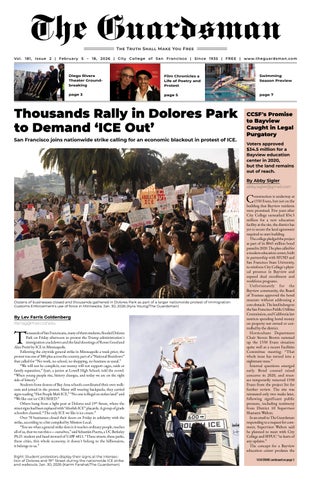
Thousands of San Franciscans, many of them students, flooded Dolores Park on Friday afternoon to protest the Trump administration's immigration crackdown and the fatal shootings of Renee Good and Alex Pretti by ICE in Minneapolis.
Following the citywide general strike in Minneapolis a week prior, the protest was one of 300-plus across the country, part of a “National Shutdown” that called for “No work, no school, no shopping, no business as usual.”
“We will not be complicit, our money will not support cages, raids or family separation,” Iyari, a junior at Lowell High School, told the crowd. “When young people rise, history changes, and today we are on the right side of history.”
Students from dozens of Bay Area schools coordinated their own walkouts and joined in the protest. Many still wearing backpacks, they carried signs reading “Hot People Melt ICE,” “No one is illegal on stolen land” and “We like our ice CRUSHED.”
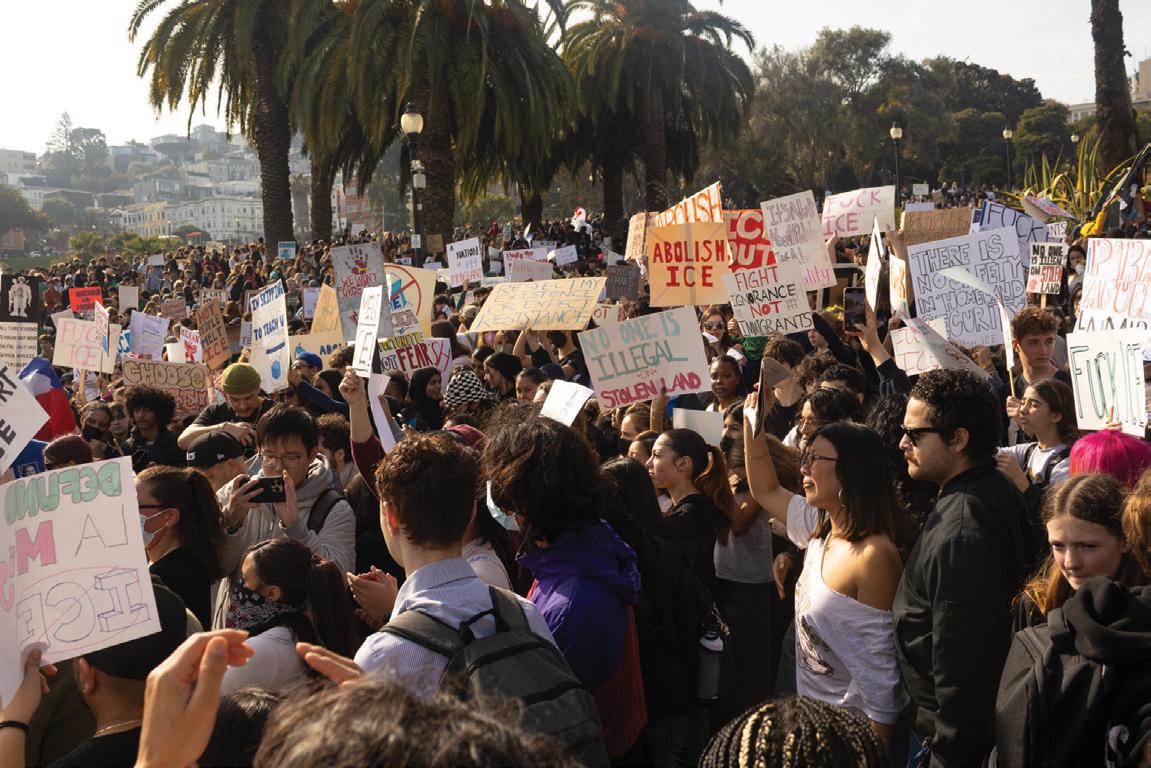
Others hung from a light post at Dolores and 19th Street, where the street signs had been replaced with “Abolish ICE” placards. A group of grade schoolers chanted, “The only ICE we like is ice cream.”
Over 70 businesses closed their doors on Friday in solidarity with the strike, according to a list compiled by Mission Local.
“You see what a general strike does is it teaches ordinary people, teaches all of us, that we run this s— ourselves,” said Sebastián Puerta, a UC Berkeley Ph.D. student and head steward of UAW 4811. “These streets, these parks, these cities, this whole economy, it doesn't belong to the billionaires, it belongs to us.”
Voters approved $34.5 million for a Bayview education center in 2020, but the land remains out of reach.
By Abby Sigler
Construction is underway at 1550 Evans, but not on the building that Bayview residents were promised. Five years after City College earmarked $34.5 million for a new education facility at the site, the district has yet to secure the land agreement required to start building.
The college pledged the project as part of its $845 million bond passed in 2020. The plan called for a modern education center, built in partnership with SFUSD and San Francisco State University, to reinforce City College's physical presence in Bayview and expand dual enrollment and workforce programs.
Unfortunately for the Bayview community, the Board of Trustees approved the bond measure without addressing a core obstacle. The land belongs to the San Francisco Public Utilities Commission, and California law restricts spending bond money on property not owned or controlled by the district.
Horticulture Department Chair Steven Brown summed up the 1550 Evans situation quite well at a recent Facilities Committee meeting: “That whole issue has turned into a nightmare mess.”
Internal questions emerged early. Bond counsel raised concerns in 2020, and trustees temporarily removed 1550 Evans from the project list for further review. The site was reinstated only two weeks later, following significant public pressure, including testimony from District 10 Supervisor Shamann Walton.
In an email to The Guardsman responding to a request for comment, Supervisor Walton said he planned to meet with City College and SFPUC “to learn of any updates.”
The concept for a Bayview education center predates the
Staff
Editor-in-Chief
John Adkins
Managing Editor
Abby Sigler
News Editor
Marrion Cruz
Culture Editor
Karla Lopes
Op-Ed Editor
Lev Farris Goldenberg
Sports Editor
Henry Crowell
Social Media Editor
Evelyn Sassus
Visuals Editor
Karim Farahat
Graphic Design Editor
Tiffany Lam
Writers
Ahmad Aimaq
Alejandra Cardenas
Daniela Villegas Jovel
Danielle Flores
Diana Chuong
Ellen Yoshitsugu
Jocelyn Wong
Kiyoka Valdes
Patricia Baldwin
Qi Mai
Tom Whitehead
Photographers
Alejandra Cardenas
Isaac Ortiz
Teresa Madrigal
Illustrator
Cindy Chan
Graphic Designers
Cindy Chan
Sebastien Thugnet
Freelancers
Bob Kinoshita
Faith Zapata
Joan Walsh
Advisor
Juan Gonzales jagonzal@ccsf.edu
Contact us
TheGuardsman.com info@theguardsman.com 415-239-3446
Mailing Address
50 Frida Kahlo Way, Box V-67
San Francisco, CA 94112
Bungalow 615
Follow us


@TheGuardsmanCCSF
@TheGuardsmanCCSF


@TheGuardsman
@TheGuardsman
For even more articles, stay up to date at www.theguardsman.com

City College administration is actively working on setting up an off-campus parking lot with shuttle service to address the declining parking spaces for students.
By Kiyoka Valdes and Ellen Yoshitsugu kvaldes3@mail.ccsf.edu, ellenyoshi@gmail.com
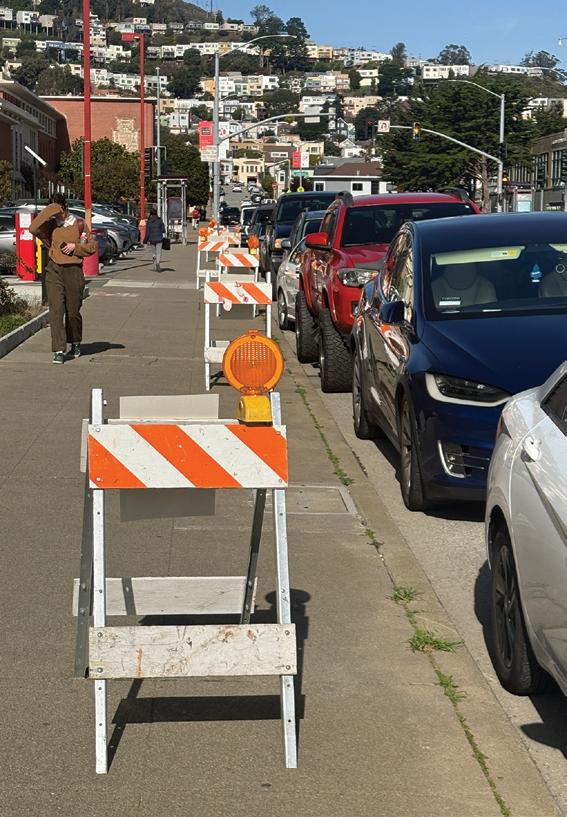
Approximately 200 student parking spaces have been eliminated this semester due to major construction projects on Ocean Campus.
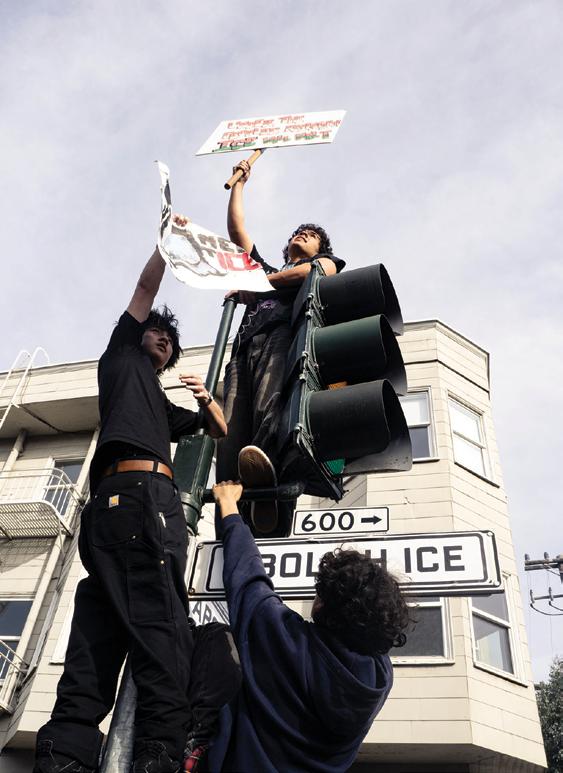
Parking for City College students and staff has been disappearing over the last decade and may continue to decline as the Balboa Reservoir housing development and the Diego Rivera Performing Arts Center are completed.
At the Academic Senate meeting on Dec. 15, 2025, Chancellor Kimberlee Messina confirmed a tentative plan to rent an off-campus parking lot with shuttle service, with the intent to provide some relief from the main campus' evaporating parking spaces, as well as potential strain on Ingleside's surrounding street parking.
According to Chancellor Messina, the college is still finalizing its contract with the site parking lot. “As soon as that happens, we will share our information regarding shuttle hours and parking location,” she said.
Alberto Vasquez, associate vice chancellor of facilities, shared an update on this at the Facilities Committee meeting on Jan. 26, 2026. They are currently evaluating two lots. One is the large Alemany Farmers Market parking lot on Alemany Boulevard. The other lot under consideration is apparently a smaller church parking lot at San Jose and Ocean avenues.
“In terms of the number of parking spots, Alemany could be a really ideal space,” said Student Trustee Angelica Campos, a Facilities Committee member.
The Facilities Committee is working to align the shuttle schedule with weekday morning and evening class demand, and the shuttles would likely run every half hour.
At this time, it is still unclear how much it will cost to park there, how the college will finance it, when it will begin, and how long it will be available.
For years, the “lower reservoir” provided abundant, cheap parking, about 1000 spaces. But after the reservoir was sold to developers in 2021, the parking rate was raised to $5 per day, which is more than most students can afford. Some community members anticipated these problems, concerned that the lack of parking could affect enrollment, but their concerns were largely overlooked by the planners.
A parking garage is planned for the space just north of the STEAM building, but it is in the planning stages and will not be completed in the foreseeable future.
Once completed, the new buildings will likely increase traffic in the area: shoppers at the new retail stores, clients of the new childcare center
The San Francisco Department of Public Health issued a health advisory after identifying three active cases and 50 latent cases of tuberculosis at Archbishop Riordan High School. City College released a statement on Feb. 4 stating that Student Health Services has “a close partnership” with the Department of Public Health and that the risk to City College students is low, despite its main campus being across the street from the high school. Classes at the high school will remain suspended until Feb. 9, with hybrid learning in place until Feb. 20.
Doula Certificate Comes To CCSF
Community and Public Health Department faculty member Beth Freedman successfully launched an initiative to create a three-unit doula course at City College. A statement released from the college described the course as expanding “equitable access to
and residents of the new housing. Although there will be parking beneath the buildings, it will be limited to one parking spot per housing unit, with a small number of additional public parking spots.
Whether it is public transportation or the ability to commute by car, students from across the Bay Area need reliable transportation. Lack of parking can be a major hurdle for students trying to attend classes.
Some students are risking fines. About 14% of the cars parked in the S and D lots below the football field had citations tucked under the windshield wipers, according to an informal survey by The Guardsman on Monday, Jan. 26, 2026. About 40% appeared to be parked without current permits or payment.
“The City College parking situation has affected me in the way of multiple parking tickets,” said Nicole Levin, a student at City College.
Students resort to parking in non-student parking when the lots are at capacity. There are just not enough spaces. If more students park in restricted areas out of desperation to find a spot and make it to class, faculty parking may be impacted as well.
Some students have raised concerns about off-site safety in parking lots farther from campus. “I don't feel safe on campus as it is when it's really dark,” Campos said. “Our parking lots are really dark.”
Check your student email for more parking details sent in the Jan. 5, 2026, email blast from Chief of Police Mario Vasquez.

pregnancy, labor, and postpartum support while increasing workforce development opportunities for Black community members.” The college's latest course offering was made possible through a partnership with SisterWeb, a local doula organization, and will be the first of its kind in the Bay Area.
Gov. Gavin Newsom's Budget Proposal
According to the governor's latest state budget proposal, California
community colleges and public schools will see an increase of $22 billion under Prop. 98. The increase in revenue is paid for by tax receipts from revenue from AI companies. The funding includes $120.7 million in one-time funds to address deferred maintenance needs, $100 million in one-time funds for the K-12 dual enrollment initiative and
$100 million in one-time funds for an additional Student Support Block Grant. “AI has been a driver of what we've seen in our revenues, and we know from the history of the markets, there may be a downturn, but it's impossible to predict when that will actually happen, so we just need to prepare and be ready for that,” said Department of Finance Director Joe Stephenshaw during a press conference.
A student-led petition has been created to grant City College students access to courses-gone-by in Canvas. “Your notes, your quizzes, your instructor's feedback — GONE,” the petition reads. The petition, created by student activist Lydia Hernandez, was presented at the Associated Students Executive Council meeting on Friday, Jan. 23, and cites the need to study for state licensure exams and to refresh prerequisite coursework as the basis for the demands.
City officials and college leaders come together to celebrate the commencement of the $180 million performing arts center.
By Qi Mai qmai10@mail.ccsf.edu
City College finally broke ground on the Diego Rivera Performing Arts Center, a $181 million project that will install Rivera's famous mural, “Pan American Unity,” in the new theatre's lobby behind tall glass windows.
Chancellor Kimberlee Messina joined more than 100 community members, students, faculty and city leaders to mark this historic event on Jan. 22.
Madeline Mueller, chair of the music and theatre department, was present at the event.
When Mueller began working at City College in the '60s, she recalled that the college was best known at the time for being home to the mural, originally titled “The Marriage of the Artistic Expression of the North and of the South on This Continent.”
She described the groundbreaking as the culmination of decades of planning.
Mueller announced that progress became possible only when faculty, staff, students, community members and elected officials worked together to secure land, a plan, funding and long-term commitment.
She invited the public to share their stories and support the friends of the Diego Rivera Performing Arts Center.
William Maynez, a former City College faculty member and mural historian, has been the mural's selfappointed steward for 25 years. He walked from his Mission District home five days a week for three years,
continued from page 1
bond by several years. In 2017 and 2018, then-Chancellor Mark Rocha promoted a partnership between City College, SFUSD and SFSU to respond to an SFPUC request for an institution willing to “finance, construct, own and operate” an education center at 1550 Evans.
City College and its partner institutions were the only respondents to SFPUC's request. In their 2018 submission obtained by The Guardsman, City College described itself as financially capable of developing and operating the facility and proposed two funding paths: a public-private partnership or a future bond measure.
During board discussions, some trustees questioned the plan. Former Trustee John Rizzo directly asked why the college would invest bond dollars into land it did not control. “I do not see why we would not build on our own property instead,” Rizzo said in 2018.
The college already operates the Evans Center, an active City College campus located half a block from 1550 Evans.
just to be near it when it was on display at SFMOMA from 2021-24.
Maynez reflected on the many people who contributed to the mural's preservation, including Julia Bergman, who died in 2017.
“There is a pool of good. No matter where you put in your drop, the whole pool rises,” Maynez said.
Mayor Daniel Lurie called the groundbreaking a milestone for City College. He emphasized that San Franciscans believe in City College.
“We made City College history,” he said.
Mayor Lurie said that the new arts center will serve as a hub for students, artists and the surrounding community. It will offer professional training for future performers while providing new opportunities for performances, exhibitions and cultural events.
He also praised the Free City program for providing free tuition to many San Francisco residents.
Other speakers included Marco A. Mena, Consul General of Mexico in San Francisco; Rafael Mandelman, president of the San Francisco Board of Supervisors; Myrna Melgar; Joaquin Torres, assessorrecorder of San Francisco; Michael Medina-Snider; and leaders from the California Community Colleges.
Cultural Centerpiece
Vice Chancellor David Yee shared that the new arts center will help increase student enrollment and expand access to City College's high-quality education. He said the Enrollment Management Commission is developing long-term strategies to attract more students and strengthen the

college's sustainable development.
Protecting “Pan American Unity” also supports education and future development. Jerry Dear, information strategist at the San Francisco Public Library and former City College librarian, encouraged scholars and students to explore Rivera resources, including the City College Diego Rivera online portal and the special Rivera Collection in the Rosenberg Library Room 510.
Lisa Velarde, a librarian and former mural docent, said she was thrilled to see construction begin. She noted that the Diego Rivera Archive, which includes photos, documents and books about the
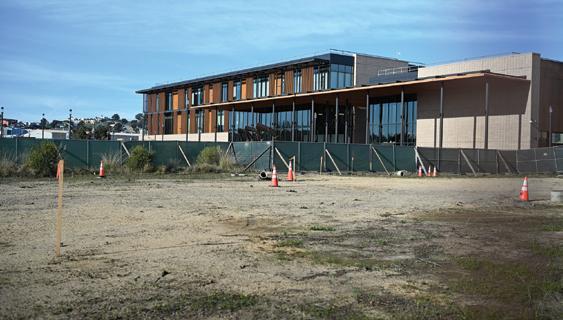
Despite these concerns, the proposal remained. By the time the voters approved the bond, the college still lacked the legal authority to build on the property.
The stakes for Bayview are tied to a history of environmental injustice. In the 1970s and '80s, the SFPUC expanded its Southeast wastewater treatment plant, ignoring community opposition. The original Southeast Community Facility at 1800 Oakdale was built in the mid-1980s as partial mitigation. City College taught classes there since its opening until the SFPUC kicked
them out of the building in 2023.
A larger education center aligned with decades of community activism and outreach. Music instructor Harry Bernstein has been following the project for years, saying it has the potential to restore a long-term commitment to the neighborhood.
“I can't think of a community that's been more harmed relentlessly over the years,” he said of Bayview. Bernstein also supported the idea of coordinated public education across institutions. “Just imagine if there were a cooperative venture that involved all the levels of public
mural, will finally have a proper home in the building. Velarde is a member of the Academic Senate Works of Art Committee.
Michael Adams, a music student, said the mural inspired him to design a ceremonial shovel for the groundbreaking.
Marvin Segismundo, an aerospace engineering student, plans to take art classes once the center opens. He said the environment will be inspiring for everyone.
The 74-foot-wide, 22-foottall mural weighs 30 tons. First displayed at Treasure Island after Sept. 29, 1939, it was later installed in the lobby of the now-closed
education in San Francisco,” he said.
But concerns persisted about whether the SFPUC would influence the academic programming at this shared facility. In a 2021 Board of Trustees meeting, Bernstein warned that the SFPUC had a “known history of trying to micromanage class offerings to suit the needs of the utility and its future employees.”
On the original request that City College responded to, the first criterion on their list was a “commitment to offering academic programs aligned with water/wastewater industry needs.” Bernstein's concerns in this area remain unresolved.
Meanwhile, the SFPUC has moved forward with its own plans. The sleek new Southeast Community Center opened in 2022, and in September 2025, construction began on an interim outdoor space on the parcel of land reserved for the instructional building. The project will create a flexible public space for farmers' markets and other outdoor events, while the timeline for the education center still remains unclear.
Inside the college, the project has drifted through years of leadership turnover. City College has had four
Diego Rivera Theater. When the new building opens, the mural will be mounted in the front lobby. Designed by LMN Architects, a Seattle-based firm, the center will include a 600-seat multipurpose performance hall, 150-seat studio theater, 100-seat recital hall, classrooms, practice rooms and offices. Despite challenges — including recessions, COVID-19 and financial constraints — the project survived. The building was scaled down from 100,000 to 77,000 square feet, with a $181 million budget funded by a 2020 bond measure. Construction is expected to finish in 2028.
chancellors since 2020, and negotiations with the SFPUC have stalled each time. At Facilities Committee meetings, administrators regularly report no progress.
Vice Chancellor of Facilities Alberto Vasquez has been candid about the barriers. The SFPUC has not agreed to a 30-year lease, which the bond lawyers say is the minimum needed for the district to legally invest bond funds. “Without that, we can't take a step forward,” Vasquez said.
Even if the ownership issue were resolved, questions remain about whether the project still fits the college's needs. Enrollment is low, and the budget is ever-tightening with the college's existing footprint.
Still, some faculty believe the original vision remains worth pursuing. “I would like them to negotiate a fitting agreement that is honest and maybe start over,” Bernstein said. “With the best possible outcome, it could bring people together.”
For now, the only construction happening at 1550 Evans is the project SFPUC chose to build in the interim. City College's $34.5 million commitment remains fenced off and out of reach.
Speech and debate team provides opportunities beyond the classroom.
By Lev Farris Goldenberg lfarrisg@mail.ccsf.edu
Charlie Garcia-Spiegel had to take a required public speaking course, but he didn't think he really needed it. Then, his professor recommended he check out an intramural speech and debate tournament run by the City College Forensics team.
“I signed up for the team and I fell in love with it very quickly, and I've been here ever since,” Garcia-Spiegel said.
Now, in his fourth semester with speech and debate, GarciaSpiegel is a Forensics co-captain and plans to double major in communication studies and studio art.
“It's pretty magical what we do,” said Coach Alexis Litzky, “and I can never fully describe it to other people; they have to see it and feel it before it makes all the sense.”
On a pleasant afternoon on the second floor of Cloud Hall, sunlight streamed through the windows as the speech and debaters practiced their magic.
In one classroom, the students perform speeches. There is no podium, and the whiteboard serves as their stage — they move like actors and enunciate like poets.
Garcia-Spiegel reads an excerpt from “On Venus, Have We Got a Rabbi!,” a 1974 science fiction satire about Jewish aliens and humor as a community response to trauma.
Destiny Riley, in her second semester on the team,
practices an oral interpretation — a 10-minute speech interweaving Emmett Till's eulogy, “Stand Up” by Cynthia Erivo, and “Say Their Names” (a list of Black victims of police violence), among other sources.
Litzky's co-coach, Nathan Steele, looks on and gives feedback when necessary. Steele, who has coached the team since 2010, woke up at 5 a.m. that morning for a flight from New York to SFO, and took BART straight to City College to be at the team's practice.
In the other room, Litzky and the students debate the question: “Is empathy a shared experience?”
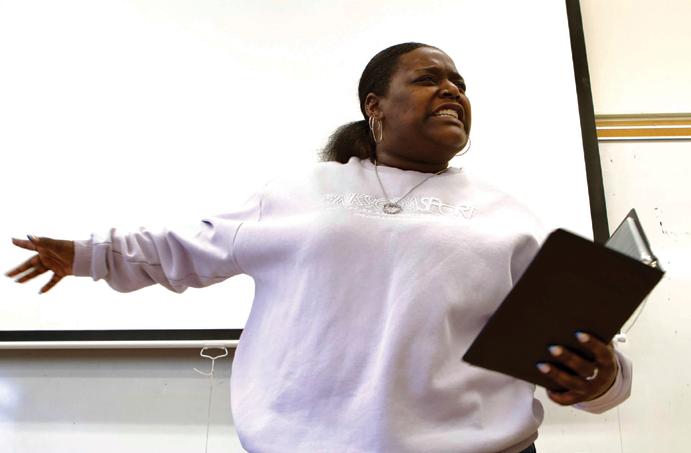
Riley performs an oral interpretation reading at the Speech and Debate team's practice on Nov. 18, 2025. (Lev
No topic is off limits — one debater, Aiken A., invokes Gaza to back up his argument. After the mock debate is over, he apologizes to his interlocutor, Ayit Altintas, for using a potentially sensitive subject.
“I appreciate your gesture, it's really meaningful,” Altintas says. “Now we understand each other much better because we had this shared experience.”
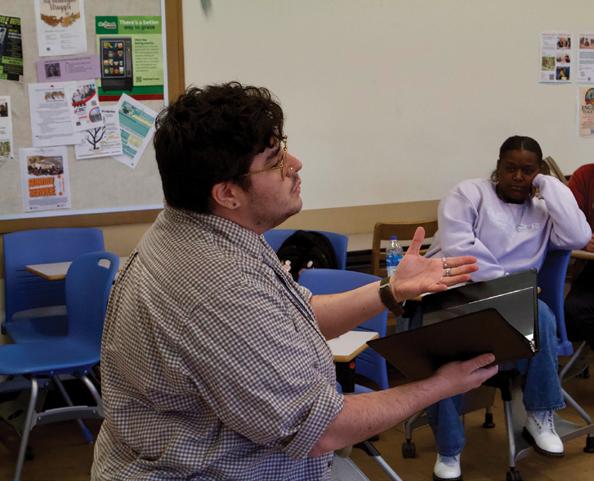
Speech and Debate team co-captain Charlie Garcia-Spiegel performs a reading of “On Venus, Have We Got a Rabbi!” (Lev Farris Goldenberg/The Guardsman)
This is the magic Litzky referred to — not just the willingness to think and talk about everything, but to attend to each other's emotions after the debate.
“That's a profound moment,” Litzky said. “In a world where ‘who's taking a debate class?’ In the semester where Charlie Kirk was murdered, there is such an inflamed political context. I feel so lucky to get to work with students who are showing up to think, to speak, to be empathetic, but also to have fun and perform the magic.”
Olivia Fife, the debate team lead and Garcia-Spiegel's co-captain, is out with a health issue — the team all signed a card for her.
“I really feel that absence, because her energy is infectious,” Litzky said.
The students were preparing for the Bernacchi Invitational, a yearly tournament hosted at Diablo Valley College. The City College team travels to local and national events to compete against other two-year and four-year colleges, and hosts the Golden Gate
By Alejandra Cardenas acarde25@mail.ccsf.edu
City College students and faculty are invited to experience commercial and visual photographs created by Kirkman Amyx. The exhibition showcases four decades' worth of his work.
Each section in the exhibition is organized to display his precise attention to detail. “They all have different stories behind them, different purposes,” Amyx said. “Photography can mean so many things, and have different purposes.”
“10,000 Dice CMY” is one of the series on display, using cyan, magenta and yellow dice as part of his data visualization projects.
In this collection of photos, Amyx is rolling 10,000 color dice, capturing the dice rolls with the camera pointed straight down.
The images are then composited together to create a new photograph using Photoshop. The results of the photographs create a different perspective for the viewer using color and shape.
Amyx has worked independently with advertising agencies, design firms, local corporations and local brands like Anchor Brewing, Ghirardelli Chocolate Company and Old Potrero Whiskey.
When he initially started working with Anchor Brewing, Amyx collaborated with the company's designer. Shortly after, the marketing manager entrusted him with full creative control over the projects.
Amyx's high school photography teacher sparked his
interest in the art medium and suggested the ArtCenter College of Design in Pasadena, California. However, the price to attend was too expensive. Instead, his photography education started at City College.
City College was pivotal in making his decision to pursue a career in photography. The affordability and accessibility of City College at the time were perfect for him.
“I looked around the Bay Area to find the best program for photography, and City College stood out by far the most vibrant with a lot of depth,” Amyx said.
He received a Photography Pathway Certificate from City College in 1980, and in the following year, Amyx received a Photo and General Pathway Certificate at Cuesta College in San Luis Obispo, California.
It was in 1985 that the opportunity to study at the ArtCenter College of Design came to Amyx. Through a scholarship, he earned a Bachelor of Fine Arts with distinction in photography.
After many years working professionally, he returned to school in 2006 to earn a Master of Fine Arts in photography from San Jose State University. Currently, Amyx serves as chair of the Photography Department at Sierra Community College in Rocklin, California.
Sarah Christianson, faculty and photo curator of the gallery, believes it's important to bring people like Amyx to City College for students to hear and see a direct and sustainable career in photography.
“By presenting a retrospective of Amyx's work, we're able to show our students the trajectory of his career and how he has operated within the commercial and fine art worlds of photography,” Christianson said.
Forensics Collective with San Francisco State, a twice-yearly tournament open to all communication studies majors.
Forensics is open to all students, and the class itself (CMST 38: Forensics Competition) fulfills a major requirement for anyone in Humanities.
Speech and debate provide opportunities beyond checking a box. According to Litzky, students often transfer to compete at other colleges and receive scholarships to do so. And when transferring to a large school, it helps to have an in with the campus speech and debate community.
The benefits extend to non-communication studies students. Litzky says the class often appeals to English language learners, nurses and engineers.
Litzky knows the opportunities forensics can provide — she started competing in 2003 while an undergraduate at San Francisco State, and the calling soon became a career. She served as the Director of Forensics at SF State and restarted the Forensics team at USF before coming to City College.
“I'm one of these students who experienced the value [of speech and debate],” Litzky said. “It gave me a through-line to both finish my own collegiate career, and it inspired me to think about what I would do with my own voice and my own life.”
At least one of Litzky's students is following in her footsteps. After securing a master's in communication studies, GarciaSpiegel hopes to return to City College as a teacher.
“I figured out pretty early on that I want to go into coaching,” Garcia-Spiegel said. “I want to be doing what Nathan and Alexis are doing for the rest of my life.”
Note: The Forensics team's season runs from the Fall to Spring semesters. To learn more, contact forensics@ccsf.edu.

Food and beverage photographs shot by Kirkman Amyx. Jan. 21, 2026 (Alejandra Cardenas/ The Guardsman)
“We hope this exhibit will show students some of the pathways available to them, as they figure out how to navigate and build their own creative careers,” she added.
As of press time, the photography department is expected to host Kirkman Amyx for an opening reception on Thursday, Feb. 5, from 4 -7 p.m. His exhibition has been on display in VARTS 160, at Ocean Campus, since Jan. 19 and runs through March 16, 2026.

A new short film captures San Francisco poet laureate's journey amidst a timeless portrayal of the Mission District.
By Diana Chuong dchuong@mail.ccsf.edu
Slightly tucked away in the Inner Mission, at the end of the tree tunnel on 24th Street stands the vibrant Brava Theater with its beautifully designed and colorful mural scape.
The performing arts center welcomed viewers on a peaceful Saturday evening, Jan. 24, for the film premiere of “Keeper of the Fire,” directed by award-winning photographer Louis F. Dematteis, and Emmy award-winning director David L. Brown.
The 28-minute documentary shares the story of Alejandro Murguía, San Francisco's poet laureate, and his long-life activism for social justice and freedom from the streets of the Mission District to Nicaragua.
This will be Dematteis and Murguía's second film project together.
“The Other Barrio,” their first production, is a short story by Murguía which chronicles the merciless fires caused by greedy landlords in the Mission during the 1970s. Their goal was to push out tenants in order to sell the property for a bigger profit. “Fire was being used as a means for gentrification” explains Dematteis.
In “Keeper of the Fire,” the panoramic shots of the neighborhood's archival footage captivated the audience as their eyes could not have been taken off the screen. It wasn't a viewing of a film premiere, but rather old home-videos of the Mission.
“Only the memories remain. That's how I would explain it,” said Lottie Pacheco-Lobatos, San Francisco native.
“The portrayal of the Mission in their film was timeless,” said Pacheco-Lobatos. “I saw familiar faces of artists, poets, and business owners along the community I grew up with.”
Pacheco-Lobattos called the changes bittersweet, reflecting on the families who were displaced and the neighborhoods that no longer exist.
The scene was further heightened as the audiences' beaming expressions turned to looks of judgement and disappointment. “Silicon City,” a poem by Murguía, was voiced over by himself over footage of the city's current lonesome state.
Huracan Gomez, a San Francisco resident since 1970, held a poignant reaction to the film.
“I felt the movie connected the Mission in a poetic way,” Gomez said. “I was reminded of the building fires specifically on 16th Street and Valencia. Lives were lost.”
Gomez also highlighted that gentrification has changed the Mission District, “The mood of the people was joyous, now we are terrorized.”
Fire as a Metaphor
“‘Keeper of the Fire’ is sort of metaphoric,” Murguía said. “I have tried to keep the energy, the fire going of our community, of our arts, of our poetry, of our murals, and resistance.”
Another important perspective presented by Dematteis is that the element of fire relates to the idea of oral traditional story telling.
“In many Indigenous societies, it is the storyteller, the keeper of the fire, who remembers the stories of the group and passes it on,” Dematteis said.
The film also discussed the poet's role in society, bringing the connection between Murguía's poetry to his life-long social activism. Footage shows Murguía participating in protests, and being a community organizer in the Mission streets, as well as fighting in Nicaragua's civil war in the 1980s.
“One of the prominent roles of both writers and poets is to use language accurately and precisely,” Murguía said.
He added on highlighting the importance of language itself and how it is being distorted in our present day. “Language is being used to distort reality, history and factual evidence.”
“It's not just my movie, but also the story of the Mission District, and the story of poetry and its role in society.”
Murguía believes that poetry especially is the voice of the community.
“If you want to understand the Latino community, read the Latino poets and they will tell you what it's like to be a Latino in this environment.”
Sat, February 7
Women's Swimming vs. San Francisco Invitational
10:00 a.m. | Wellness Center, Ocean Campus
SF's 2026 big Game Days - last Day
2:00 p.m. - 4:00 p.m. | Union Square
SF's Vietnamese New year Tet Festival
10:00 a.m. - 4:00 p.m. | Larkin Street
lunar New year x black History Month
11:00 a.m. | Oakland Asian Cultural Center Sun, February 8
Super Magnolia blooms at Golden Gate Park
7:30 a.m. - 5:00 p.m. | SF Botanical Garden
Swing Dance Party at Golden Gate Park
11:00 a.m. - 2:00 p.m. | JFK Drive Lindy Hop Spot
anime and Manga Club
2:00 p.m. - 3:30 p.m. | Park Branch Library at 1833 Page St.
Super bowl Sunday 3:30 p.m.
Mon, February 9
Cyberpunk Cinema Night at Mission
6:30 p.m. - 9:00 p.m. | The Knockout at 3223 Mission St.
Sew your own Handwarmer Workshop 1:00 p.m. - 2:30 p.m. | Rosenberg Library 403
Tue, February 10
umoja/aaSP Porch Talk
1:00 p.m. - 2:00 p.m. | Harry Britt Building 101
black History is a living archive!
1:00 p.m. - 4:00 p.m. | Harry Britt Building 101
CCSF baseball vs. laney
2:00 p.m. | San Francisco State University
Wed, February 11
black History 101 Mobile Museum
10 a.m. - 3:00 p.m. | Student Success Center 2122
Japanese Tea Garden Free admission Hour
9:00 a.m. - 10:00 a.m. | Japanese Tea Garden
Danny Rosales In Flux Exhibition Reception
5:30 p.m. - 7:30 p.m. | Steam Building 103
Thu, February 12
black History 101 Mobile Museum
10 a.m. - 3:00 p.m. | Student Success Center 2122
Dr. Khalid el-Hakim lecture Workshop
11:30 a.m. - 12:30 p.m. | Student Success Center 2122
Performance | o-o-H Child: In the Disentangling, We are Found
6:00 p.m. | 685 Mission St.
Fri, February 13
Women's basketball vs. Chabot
5 p.m. | Wellness Center, Ocean Campus
Men's basketball vs. Chabot
7:00 p.m. | Wellness Center, Ocean Campus
Tax Prep at bayview
1:00 p.m. - 4:00 p.m. | Bayview Branch Library at 5075 3rd St.
Sat, February 14
black History Month Parade and block Party! bayview SF 11:00 a.m. - 4:00 p.m. | Southeast Community Center at 1550 Evans Ave.
SF's 5th annual “lovers lane” Valentine's block Party
10:00 a.m. - 6:00 p.m. | Mission and 24th Street
Sun, February 15
San Francisco's Chinese New year Flower Market Fair
9:00 a.m. - 6:00 p.m. | Washington and Grant Streets
Is City College's administration paying attention to the growing number of food-insecure students?
By Patricia Baldwin fightinghunger@ccsf.edu
S
ince its unveiling last August, the long-awaited Student Success Center gleams at all who pass City College on Ocean Avenue. External signs on every side trumpet “Student Success.” During the first week of the Fall semester, it was the busiest place on campus, with students flowing in and out.
But under the bustle of campus lay a hard truth — that a majority of the student body suffers from limited or uncertain access to food.
According to a 2025 report from the UCLA Center for Health Policy Research, 70% of California community college students reported experiencing food insecurity.
This is not a new problem, only a more acute phase of an ongoing crisis. A 2017 survey of students enrolled in English courses at City College found that at least 41% were food-insecure. In response to this demonstrated need, the City College Food Pantry Work Group — composed of students, staff, faculty and community members — created programs to get food to students. (Disclosure: This reporter is the former chair of the City College Food Pantry Work Group.) Despite increased need, the college now seems to be abandoning these programs.
When I visited the Student Success building for the first time, I was looking for where the administration planned to host the weekly farmers' market. In 2018, the Food Pantry Work Group facilitated a partnership between City College and the San Francisco/Marin Food Bank to provide weekly, farmer'smarket-style fresh food distribution to CalFresh-eligible students.
Over time, the market disappeared, another lifeline denied to students in need. Last spring, word around campus was that it would be restarted once the Student Success Center opened. Vice Chancellor Lisa Cooper-Wilkins recently reported to the Associated Students Executive Council that she was talking with the food bank about restarting the market. But the timeline remains unclear.
As I enjoyed the second-floor lounge in the Student Success building, I saw several students visiting resource centers to ask for snacks from the Snack Shelves. The Snack Shelves program — a 2018 partnership between then-Dean of Students Andrew King and the Food Pantry Work Group — was piloted as one prong of a comprehensive re-envisioning of efforts to feed students.
When it started, the Snack Shelves provided free, nutritious snacks at five locations across
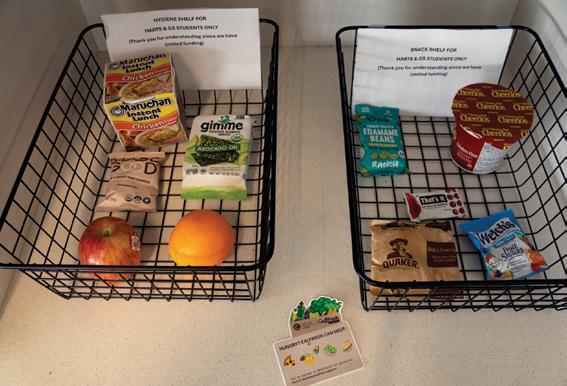
campus. Thankfully, the Office of Student Equity has since expanded the Snack Shelves program, providing free snacks at all City College campuses and at multiple locations on Ocean Campus.
However, with many of the resource centers having moved into the Student Success building, the Snack Shelves are being consolidated into one building, creating snack deserts across campus.
To make matters worse, the Office of Student Equity has considered discontinuing the Snack Shelves program. This Fall, SparkPoint CCSF Basic Needs Center stopped participating in the Snack Shelves program, and the Office of Student Equity stopped funding Snack Shelves in the Women's Resource Center. City Dream has started restricting access to its Snack Shelf to its students only.
If the Office of Student Equity were to discontinue funding for the Snack Shelves, the resource centers would need to pull from their own budgets to make up the difference. According to Tyler Powers,
Afghan women's deprivation of education and its dire human and global consequences
By Ahmad S. Aimaq aimaq2050@gmail.com
While students in San Francisco start a new year and a new semester, girls in my home country of Afghanistan are deprived of their basic human right to education. Afghanistan is the only country in the world that officially bans secondary and higher education for women and girls. This policy — a decision made by the Taliban in 2021 after seizing power — has catastrophically stifled the lives of millions of young women, and put the political, social and economic future of the country on the path of gradual collapse.
The reality of life for women in Afghanistan is a wound that I cannot let go of. It torments me, the unfairness of the situation. This attack on women's education had no justification — neither religious, scientific nor political. Every human, regardless of gender, deserves the right to an education.
When the Taliban took over in 2021, Afghanistan lost not only its government but also the hope of a bright future.
The Taliban quickly imposed severe restrictions on women and various educated segments of society. The first decision was to prevent
girls from attending secondary school. Next, they closed universities to women. The Taliban also excluded women from many sectors of the workforce.
What was initially billed as a temporary measure has now become a permanent level of control enforced upon Afghan women.
Education is not simply an individual right but rather the main building block of progress and development in every society. Countries that invest in women's education prove more successful in health, economic growth, social stability and poverty reduction. In contrast, the complete elimination of women from schools and their resulting non-participation in society equates to the elimination of half the intellectual and human capacity of a society.
The exclusion of women from education has social and human consequences. The closure of schools leads to early marriages. Poverty spreads, women's economic dependence on men intensifies, and domestic violence increases.
Many families, having lost hope, force their daughters into early marriages to avoid being forced into marriage by the Taliban. Mental
health issues skyrocket, with numerous reports of increasing depression and feelings of worthlessness among teenage girls.
A generation of women confined to their homes and with no access to education is doomed to a bleak future.
The international community often expresses concern about the dire situation for Afghan women, but little action has been taken. Statements and empty words cannot effect change. Afghans need hope, and we cannot be optimistic about change until we see effective pressure on the Taliban to fully restore women's right to education. Until that happens, it is the women and girls of our country who pay the price every day.
We cannot expect stability, security and development in a society where half of the population is deprived of the right to education. Every day that the international community delays and compromises with the Taliban furthers the destruction of a generation's future.
what the Food Pantry Work Group was able to accomplish. What about all the other wonderful ideas members of the campus community have suggested to support food-insecure students?
In tackling food insecurity at City College — a real, tangible problem — the administration needs to expand beyond the baseline of these two programs. How about a fully stocked food pantry in the Student Success Center, open every day, with nutritious food for students to take home?
Vice President of Finance for the Associated Students Council of Ocean Campus, the Queer Resource Center had already spent $5,000 on snacks and drinks for students as of November, when the Office of Student Equity closed nearby Snack Shelf locations.
For students who come to campus hungry, their options are dwindling. Snack Shelves should be expanded across campus, not contracted. Or does the administration want 70% of the student body descending on the Queer Resource Center's Snack Shelf? If the Snack Shelves program loses its funding, those options will be even slimmer.
The impact on students at other campuses may be even more dire than at Ocean Campus. Research suggests that rates of food insecurity are higher among English language learners, immigrant populations and students in adult education programs, which make up a higher percentage of programs at City College's other campuses.
The Food Shelves and the weekly fresh food market represent only
Partnerships with community organizations could be another option. San Francisco-based Food Runners picks up excess food from businesses and delivers it to neighborhood food programs. The school also lacks a community garden, despite our amazing horticulture program.
City College does not have a representative on the Food Security Task Force, an advisory body to the board of supervisors that develops a citywide plan to address food security.
With new leadership at City College and a new building that trumpets “Student Success,” food insecurity needs to be treated as the crisis it is. How does Chancellor Messina plan to address significant levels of food insecurity among her institution's student body? Why have we not heard about how she and her leadership team will confront this crisis?
Supporting student success is much more complex than putting that phrase on a building — it requires time, money and planning. So far, I am not convinced that the administration has a credible plan for addressing the level of food insecurity faced by City College students.

Despite all the Taliban's control and restrictions on women, they were unable to completely prevent
women from getting an education. Girls in Afghanistan have found alternative ways to learn — through homeschooling, online education and communitybased literacy educators. Their proud efforts to continue learning in the face of oppression
demonstrate that the pursuit of education cannot ever be fully eliminated. Education is an essential right, not simply a privilege, and this resistance will never be extinguished.

With a full slate of meets ahead, the Rams swim team has put in the work to continue the standard set in previous years.
By Jocelyn Wong jwong410@mail.ccsf.edu
Downat the Wellness Center, with fresh faces among both coaches and swimmers, Head Coach Phong Pham and the Rams swimming team are gearing up for a new season.
Sarah Tanabe, a biology major in her second season, explained that the team has more coaching help this year and shared an optimistic outlook for the season. “I'm hopeful. We got a new volunteer coach [Mike Lee] who comes in every now and then, and he's great. He's super experienced with coaching, and he's really good at individually helping us,” she said.
Tanabe was a 2024 California Community College Athletic Association All-American and academic All-American in the 400 free relay and 400 medley relay. She redshirted last year, so her presence on the team this year makes the Rams poised for another successful season. “California has the most number of community colleges and has the most number of athletic teams, so [CCCAA allAmerican] status has its own merit,” Coach Pham explained.
Samantha Ng, a dental hygiene major, expressed that while the team is less experienced, the season will be a successful one. “Last season, we definitely had a lot more experienced girls… this year is a lot more beginner-friendly. We placed at states for two relays, which was really exciting. I hope that this season will go just as great.” She explained that the team will focus on more individual rather than relay just because what we did at states last year was kind of hard to replicate.”
Ng shared that she feels fortunate to have Tanabe as a training partner. “Since high school, it was backstroke and freestyle, but this season it seems like butterfly is coming in. Sarah is a really good training partner, and I never really had… someone that was willing to train butterfly constantly and constantly with
me, so I think that has really pushed me… we're focusing on fly this season.”
Tanabe and Ng shared that in addition to Coach Pham, the team has help from Assistant Coach Michael Tyler, as well as volunteer assistant coach Mike and former Rams swimmer Sophia Tran. Tran broke the school record for the 100 individual medley at the Hawk Invitational last year.
“I'm hopeful. We got a new volunteer coach [Mike lee] who comes in every now and then, and he's great. He's super experienced with coaching, and he's really good at individually helping us.”
Sarah Tanabe, Rams swim team member
“If the newcomers continue to work hard and keep improving throughout the season, they can make a significant impact for us,” said Pham. “We have several returning swimmers who were very consistent in their fall training, and they have continued to elevate their technique, physical conditioning, and race preparation. Altogether, this group has the foundation to grow into a strong, competitive team.”
The team, comprised of sixteen swimmers, will start their season against the College of San Mateo on Friday, Jan. 30, at the Rams' home pool in the Wellness Center. Their next and final home meet is the San Francisco Invitational the following weekend, from Feb. 6-7.

By Tom Whitehead twhiteh9@mail.ccsf.edu
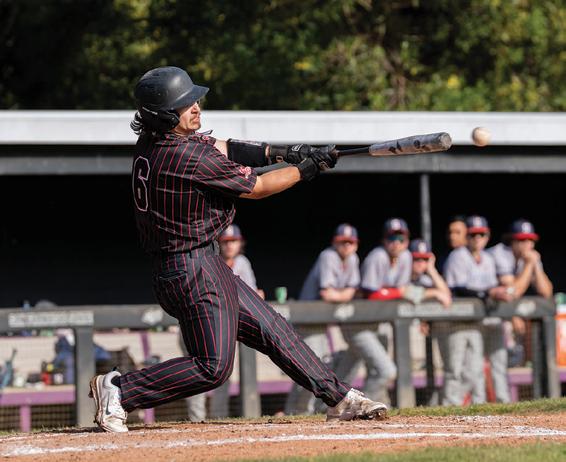
It was one of those rare, sunny, springlike days that make San Franciscans love January, and the ten fans on the bleachers at Maloney Field weren't regretting their decision to come out to see the game.
Then something happened at the top of the seventh inning in the Rams' second at-home game of the season, as the Rams took the field just one run behind the Siskiyou Eagles. It wasn't any one thing, but the Rams' defense came apart just long enough, and suddenly the Eagles had scored six runs before the Rams regained their composure. Something similar had happened in the previous day's game against Napa.
The Rams should have had the home-field advantage, of course, “home field” hardly describes a place that you never get to practice on. The Rams' practice field, Fairmont Field in Pacifica, has an all-turf playing surface, while they play their games at SF State's Maloney Field, a natural grass field that has affectionately (or unaffectionally, depending on who you ask) been known as “The Swamp,” and not just for the Gator connection.
“It's never fun losing,” said Assistant Coach Drew Healy after the game, which ended with the Eagles 17 to the Rams' 7. Healy has spent two seasons with the Rams while running his own youth sports program, US Prime Peninsula. “We had a lot of opportunities. They got in some timely hitting. We made a couple of mistakes. But we've got good camaraderie here,” said Healy, focusing on the bright side.
And indeed, despite the loss, the Rams' morale is high. Myles McCabe, the left-handed pitcher/righthanded hitter who is playing his first season for the
Rams, spent nine weeks recovering from a labrum tear in his pitching arm, the same injury that cut short the 2024 season of Giants outfielder Jung Hoo Lee, and was upbeat. “I'm very happy,” said McCabe after the game in which he played center field. “We have talent here. I'm just going to enjoy the season and enjoy playing,” he said, and added, “The field is refreshing, with actual walls.” Kaden Healy, the team's captain and catcher, is one of the few veterans on the team. He is focusing on the future. “This field is faster, with lots of room,” he said, comparing Maloney Field to Fairmont Field. “We need to learn how to play on our own field.”
“I have more hope this year,” he said. Asked what he sees as the places to focus, he said, “We need to figure out how to play together. Attacking the strike zone. Our pitchers are giving us a chance. We need to work on situational hitting and defense.”
The coaching staff has its work cut out for it. There's no clubhouse at the field. No bullpens. The SFSU field is an improvement, but far from ideal. It takes about two hours on each end of a home game to mobilize equipment and personnel and groom the infield. The players have to find their own transportation to the game and practices. It's harder to recruit players when you don't have the facilities.
Coach Mendoza noted, “Right now, we're a little short-handed. A couple of pitchers are coming off injuries.” Making no excuses, he said, “We competed for seven innings. We need to learn to play nine innings.” Still, he sees a few pluses. “This is the first season where we have 18 games on our home field.” Then he added, “It's hard to get guys to come to City when they have other options,” he said, “but I tell them — they'll have an instant chance to play.” That's what this team wants most.

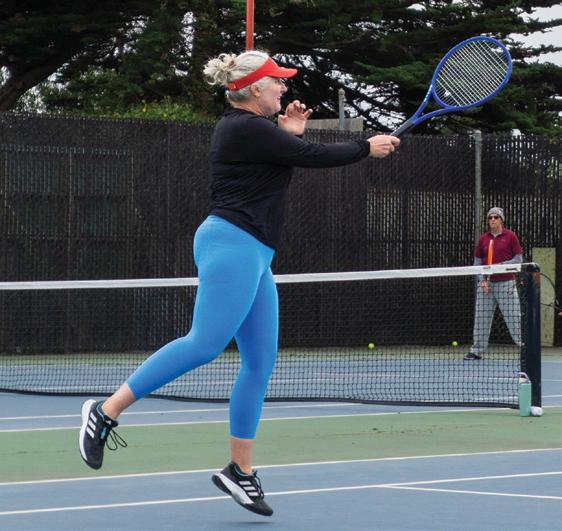
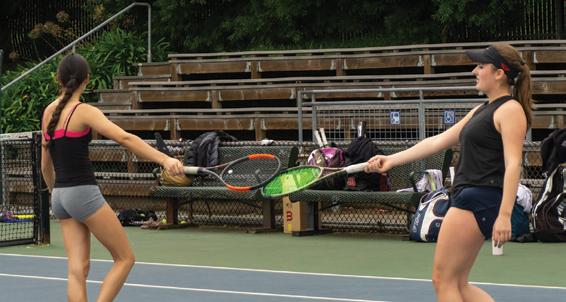
The Rams have been hitting the court this past fall, preparing for the season ahead.
By Daniela Villegas dvilleg4@mail.ccsf.edu
The end of last season was bittersweet for Rams tennis.
The team said goodbye to Mary Graber, the beloved coach who had led City tennis for the past three and a half decades, they were riding the high of two straight conference championships.
While they're adjusting, the team remains positive with a new campaign on the horizon and a new coach at the helm.
After 35 years behind the baseline, Graber passed the torch on to Peter Bartlett, the longtime coach of both men's and women's tennis at the University of San Francisco. After his own nearly 30-year stretch for the Dons and an ever-changing list of duties, Bartlett is looking to keep up the winning culture for City College.
“Although the season is just starting, the team has rallied together and had each other's back, always staying positive,” said Rachel Yim, a second-year redshirt for the Rams. “We are not a traditional tennis team since we are so diverse in our age, but everyone brings a different perspective, and we know we can lean on each other.”
Yim originally joined the team because of Graber, but now, with Bartlett leading the team, she said she is excited to absorb Bartlett's knowledge on the sport and get more technical with her playing.
Coach Bartlett was asked by Graber herself to take over the program, and she had told him she couldn't think of anyone better to hand off her team to. “Although it was a part-time job, I took it because I'm very committed to this team and carrying on their legacy,” Bartlett said.
He emphasized that incoming freshmen will be a valuable addition to the team, bringing greater structure and organization. Members of the team are feeling very confident and excited to learn.
The Rams have been working hard in the offseason to prepare for the season ahead. “We have been developing important skill sets, creating a supportive team culture, and we've spent a lot of time on doubles' strategy,” said Rita Williams, a second-year tennis player working toward her personal training certificate. She emphasized how fun practice has been with new freshmen coming in, and that it helps them have a wide range, not only in age but also in skill.
“... Everyone brings a different perspective, and we know we can lean on each other.”
Rachel
Yim, Rams tennis team member
“We practice together, we laugh together, we play together, tennis is something that brings us together,” Williams said.
Bartlett had a storied career with the Dons, leading the singles and doubles teams to No. 11 and No. 10 national rankings, respectively. He took the men's tennis head coaching job in 1997 after two years as an assistant. In addition, he became Director of Tennis in 2010 and, in 2013, head coach of the women's team. He kept this unique post until 2017, when he shifted his focus solely to coaching the women's team, remaining in that role until the entire USF tennis program was shuttered in 2024. Williams said that they are still looking for more players, and anyone interested should contact Head Coach Peter Bartlett at pbartlett@ccsf.edu