
By Lev Farris Goldenberg lfarrisg@mail.ccsf.edu
Current and former City College community members turned out in droves on Thursday, Aug. 28, to celebrate the ribbon cutting of the new “gateway” to campus at the corner of Ocean Avenue and Frida Kahlo Way.
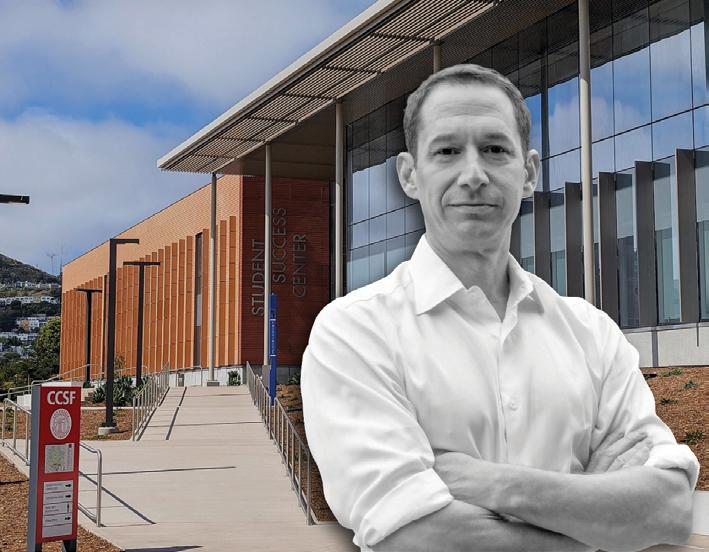
The $140 million Student Success Center concentrates 30 student development programs under one roof, including academic counseling, tutoring, career center and transfer center.
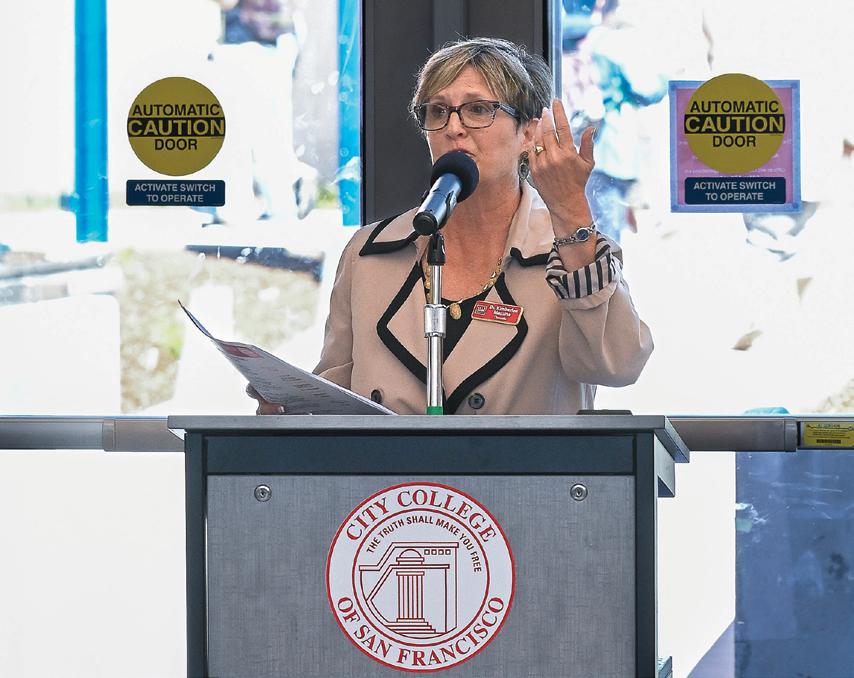
“Today is not just about cutting a ribbon,” said Chancellor Kimberlee Messina. “It is about opening doors for our students, their families and for the future of San Francisco.”
After two years of construction, the two-story, 72,000 square foot building is open for business. According to Vice Chancellor Lisa Cooper-Wilkins, 700 students walked in for services on the first day of the fall semester.
On Thursday, students, faculty and local leaders filled the bright atrium, where black and red ribbons and balloons adorned the second-floor railing like bunting on opening day.
Just before the speakers took to the podium, the entire football team filed in, sporting Ram red.
Behind the dais, the newly refurbished 16-ton black granite statue, “The Whales” — created by Robert B. Howard for the 1939 World Fair on Treasure Island — shone through the windows.
Trustees past and present heralded the Success Center's arrival, including District 1 Supervisor Connie Chan, who once worked in Conlan Hall, the location's previous, wilting occupant. Chan drew raucous applause when she mentioned another gateway to campus, the Free City program.
District 8 Supervisor Rafael Mandelman, a former City College Trustee, reflected on the journey it took to get here.
By Karla Lopes kcarval7@mail.ccsf.edu
City College students are facing significant course changes this fall, including the implementation of the new Common Course Numbering (CCN) system, as well as class cancellations and schedule adjustments.
The CCN is a new studentfacing system implemented by the California Community Colleges system, wherein colleges must adopt a common course number for all general education and transfer pathway courses by July 1, 2027. The change is required by Education Code Sections 66725-66725.5, through Assembly Bill No. 1111.
The goal is to standardize comparable courses across all California Community Colleges by assigning the same course number. The new CCN system also aims to
promote student success, simplify the transfer process to four-year universities and other community colleges, reduce unnecessary credit accumulation, and enhance equitable transfer opportunities by improving credit mobility.
Following a three-phase implementation plan, City College began the first phase this fall semester.
Additional CCN courses for Phase II (A) will be available by fall 2026, with Phases II (B) and III adopted by fall 2027.
The first six new courses with their updated identifiers for Phase I are shown in the included graphic.
While it may be too early to fully assess the long-term impact of the CCN transition, some people, like faculty member Jennifer Levinson from the English Department, report a smooth adaptation. “The transition to the new numbering system has felt pretty smooth,” Levinson
explained. “In my opinion, the CCN outline for C1000 and our CCSF English 1A course outline are fairly similar. This is why I think I haven't experienced much of a difference.”
Levinson has been teaching English at City College since 2005, including the ENGL 1A classes, which, with the CCN, will now be entitled ENGL C1000.
Students who have completed the pre-CCN courses in previous semesters will not need to retake them under the new numbering system, as those credits will continue to be recognized.
Students interested in enrolling in any of the six CCN courses can access the myRam portal for class registration or review the classes through the searchable online schedule using their new CCN entitlement. The Admissions and Registration offices can also assist students with this process; both of which are now located on the first floor of the new Student Success Center, room 1124.
Alongside the transition to the new CCN system, students and faculty report class cancellations and schedule changes that could continue to impact their degree pathway. The Guardsman contacted Admissions and Registration for more clarification on the issue, but received no response by press time.
By Tabari Morris tmorri47@mail.ccsf.edu
According to Erwin Chemerinski, Dean of the UC Berkeley School of Law, the Trump administration had acted illegally when it halted nearly $900 million in research grants to University of California campuses. Judges agreed, saying the decision targeted projects that mentioned “diversity” and bypassed procedures required under federal law.
The administration argued the funding cuts were meant to address antisemitism at UCLA. But the court found that officials ignored safeguards under Title VI of the Civil Rights Act of 1964, including requirements to notify universities and hold hearings before cutting funds.
According to court filings, the government also tied university agreements to controversial policy demands, such as ending gender-affirming care. Critics said those conditions raised concerns about political interference in academic institutions.
Other universities, including Harvard, have successfully challenged similar federal actions in court. UC instead chose to negotiate settlements, a move that drew criticism from faculty members and advocates. They said compromise could encourage further federal pressure, weaken academic freedom and potentially cost UC millions of dollars that would otherwise support students and research.
Many UC faculty members and students oppose the settlement. They argue university leaders should defend academic values and push back against what they call government overreach.
The ruling has broader implications for community colleges. If federal agencies can withdraw funding without following legal protocols, City College programs such as student support services, workforce training and diversity initiatives could be threatened.
Protecting UC's funding, advocates say, is critical to ensuring that City College students also maintain access to the resources and opportunities that shape campus life.
Staff
Editor-in-Chief
John Adkins
News Editor
Tabari Morris
Feature Editor
Abby Sigler
Op-Ed Editor
Henry Crowell
Sports Editor
Lloyd Cobb
Social Media Editor
Abby Sigler
Photo Editor
Isaac Ortiz
Copy Editors
Gracia Hernandez-Rovel
Elena Chiaruttini
Ellen Yoshitsugu
Writers
Ahmad Aimag
Cain Gibson
Cooper McDonald
Finbar LaBelle
Karla Lopes
Lev Farris Goldenberg
Marrion Cruz
Qi Mai
Raeghan Green
Victoria Capree
Photographers
Karim Farahat
Tiffany Sainz
Illustrators
Cindy Chan
David Thomas
Graphic Designers
Cindy Chan
Sebastien Thugnet
Tiffany Lam
Advisor Juan Gonzales jagonzal@ccsf.edu
Contact us
TheGuardsman.com info@theguardsman.com (415) 239-3446
Mailing Address
50 Frida Kahlo Way, Box V-67 San Francisco, CA 94112 Bungalow 615
Follow us

@TheGuardsmanCCSF

@TheGuardsmanCCSF


@TheGuardsman
@TheGuardsman
For even more articles, stay up to date at www.theguardsman.com

Join The Guardsman!
Contact Juan Gonzales at 415-517-4426.
By Marrion Cruz mcruz88@mail.ccsf.edu
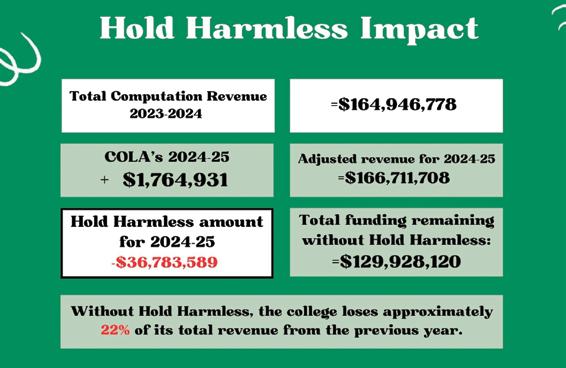
With enrollment still far below pre-pandemic levels, City College is bracing for the end of a $30 million safety net in 2026, money that has kept the campus afloat as California prepares to shift how it funds community colleges. After 2026, that money disappears.
This significant cut is the loss of the post-pandemic safety net for struggling colleges, known as Hold Harmless. Last school year, Hold Harmless accounted for $36.78 million of the college's operational budget of $166.71 million.
Since 2018, California community colleges were guaranteed no less than the same budget they got in 2017 to 2018, with cost-of-living adjustments (COLA). COLAs are increases in state funding designed to offset the rise in operational expenses due to inflation. While the state establishes the new “funding floor” to reflect what revenue the college received in 2025-26, districts like San Francisco whose funding levels are still protected by the “floor,” will no longer be eligible to receive COLAs.
However, the City College budget is guaranteed a 3% adjustment growth for cost-of-living, even with the loss of Hold Harmless and implementation of the new funding formula, according to Interim
Vice Chancellor of Finance and Administration Yulian Ligioso.
Another budget adjustment is the possible loss of $8 million in sitebased funding because of insufficient enrollment, according to the findings of the Peer Review Team Follow-Up Report in July of this year.
During the Enrollment Management Committee meeting at the end of last semester, administrators discussed marketing plans. However Vice Chancellor of Student Affairs Dr. Lisa CooperWilkins said there's no specific plan in place for how to structure the marketing department as of May 2024, but that former Chancellor Bailey was working on the hiring for that department.
In addition to losing Hold Harmless, the way the state calculates funding for the college will also change in 2026. The varying factors for calculating state funding include enrollment, vulnerable student services, and the number of students who graduate, transfer or earn certificates.
Prior to the pandemic, the college had an enrollment number of 62,891 credit and noncredit students. Even with the recent growth in enrollment after the pandemic, there were still less than 43,000 students enrolled by 2024.
The college will do a routine reevaluation report in October for a
more accurate calculation of metrics for the college's funding according to the formula, says Ligioso. Although the formula will determine the College's funding going forward, this formula was implemented at the beginning of the school year in 2018.
However, Ligioso stressed that while the operational budget from the state has been reduced, there is no impact to the student-support services available to students.
Ligioso urges students to discover the available grant opportunities like CalGrants, Chafee Grants, Foster Youth, EOPS, and, for San Francisco residents, free tuition through the Free City program. There were 45% of City College students receiving Pell Grants in the years 2023 to 2024.

Have a News Tip?
Have you overheard something happening in your community that you wish would get coverage by the press?
The Guardsman welcomes any story ideas or tips, especially those that communicate a clear issue or problem. Evidence of the claim is encouraged. Send news tips to editor@theguardsman.com
By Qi Mai qmai10@mail.ccsf.edu
Federal Student Aid (FSA) is one of the most critical tools colleges use to attract and support students.
Guillermo Villanueva, Dean of Financial Aid and Special Programs, knows this firsthand. “I am a former financial aid student,” he said, recalling how grants and scholarships helped him escape poverty. “Pursuing a college education is a big challenge when your parents do not speak English and earn minimum wage.”
Villanueva's parents fled the Nicaraguan Civil War when he was 13 years old. He later attended Skyline College, relying heavily on financial aid, before transferring to San Francisco State University for a bachelor's in kinesiology and later earning a master's in counseling from the University of La Verne. Looking
back, he said, “Without financial aid, I would not be in this great situation, with a career where I am able to mentor others.”
He also pointed out that the Free Application for Federal Student Aid (FAFSA) itself has become more accessible over the years. Once more than 100 questions long, it has been reduced to 38, a relatively short form that still carries the potential to change a student's life.
At City College, about 60% of students receive financial aid. Of those, nearly half complete an associate degree or certificate, and about a quarter transfer to a fouryear university.
To help boost those numbers, the Financial Aid Office hosts events throughout the year. Their most prominent event is “Cashchella,” a play on Coachella designed to
make the topic less intimidating.
The annual Ocean Campus event promotes federal, state and local financial aid programs while guiding students through completing their FAFSA or CADAA.
Financial aid staff also organize smaller events at City College's six centers, hold monthly classroom presentations and provide targeted support within retention programs such as City DREAM, Veterans Services, and Athletics.
For many students, the programs mean the difference between continuing school and dropping out. “I don't have parents,” said computer science major John Benston, who works evenings as a busboy. “FAFSA keeps me studying and life moving forward. This is my third semester, and I'm planning to transfer to the State University.”

Students studying Child Development, many of whom have disabilities, credited FAFSA along with EOPS and CARE for providing tutoring, textbooks and accommodations that keep them on track academically.
City College officials stress that aid is distributed equitably. “Almost every full-time student applies for financial aid, and almost every student receives some form of assistance,” said Financial Aid Specialist Lira Robles. She added that eligibility is based on income, course load, and identification, but not race: “When a student applies for FAFSA, it does not require them to answer the race question. Race-based scholarships are not part of our system.” Scholarships at City College are funded by corporations, foundations, individual donors, and retention programs, including EOPS, City DREAM, SparkPoint and Umoja.
Priscilla Gutierrez, administrative clerk for EOPS, CARE and NextUp, echoed Robles' point: “EOPS is a state-funded program that has been running at City College for over fifty years. I've worked here for seven years, and to my knowledge, I have never encountered racebased scholarships. The criteria focus on income, family situation and academic needs.”
For undocumented students, the California Dream Act provides a powerful alternative to FAFSA, available to those who qualify under AB 540 in-state tuition rules.
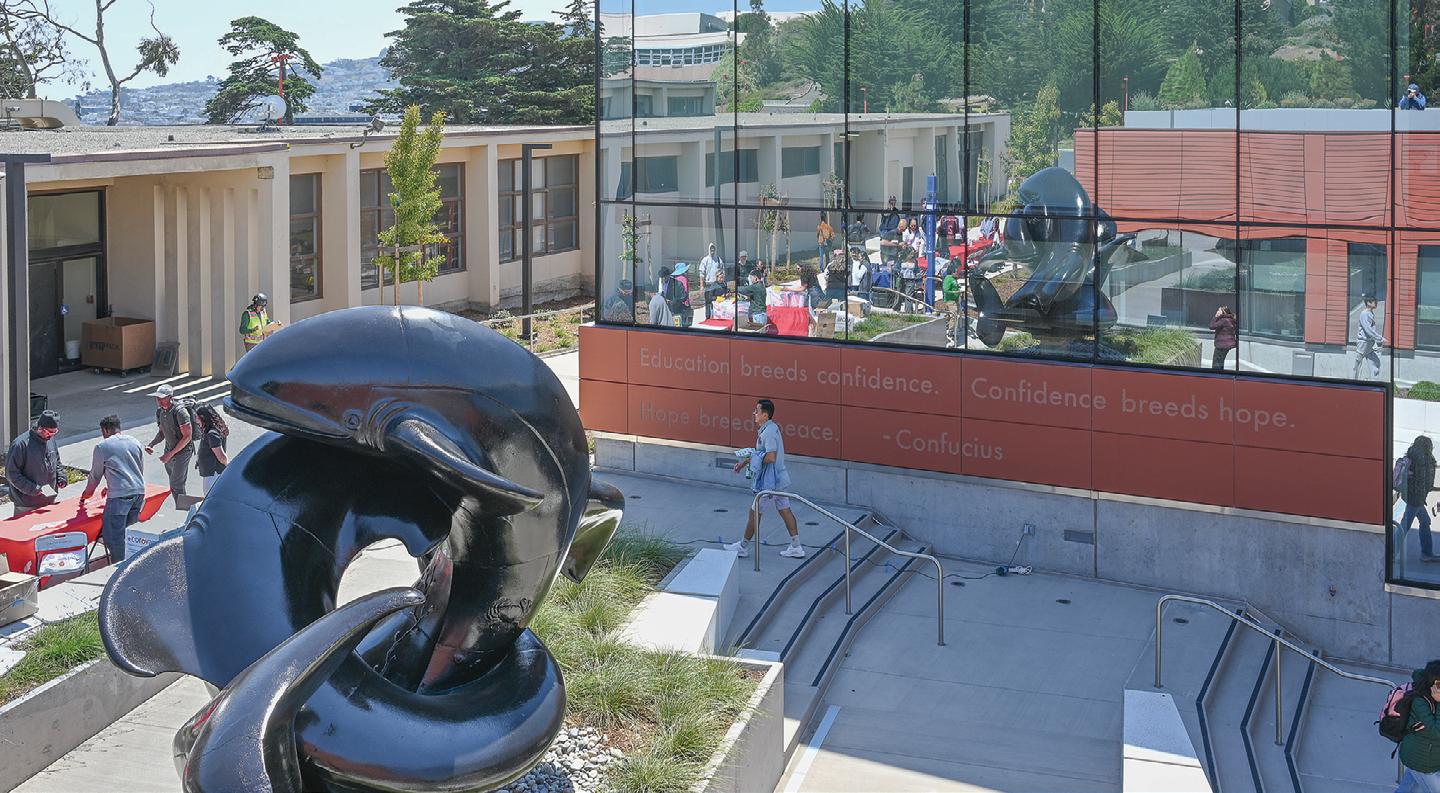
“I don't imagine … that 13 years ago, as we were surveying what was going on (with the accreditation crisis), we would have imagined we'd be back here now with this amazing building,” Mandelman said.
Former Board of Trustees president Shanell Williams, one of many former City College alumni in attendance, echoed Mandelman's sentiment.
“This has been a long, hard journey to get to this place and to see this building … It makes me feel so happy, so thrilled, so delighted that we're giving this beautiful gift to our students
and our community. We are building on the promise that we made a long time ago to San Francisco.”
In 2020, San Francisco voters passed Prop. A, a bond measure directing $845 million to City College for repairs, earthquake retrofitting, energy sustainability and new facilities.
In the past year, students and faculty have begun to reap the fruits of the bond. In December, the college unveiled the STEAM Building on the west side of Frida Kahlo Way, a multi-story facility for science, technology, engineering, arts and math
(STEAM) disciplines.
Another major addition to the campus may be coming soon — The Diego Rivera Theater, a new center for the performing arts.
After the ribbon cutting, students, staff and faculty milled about, taking advantage of the building's light-filled atrium. Ari Veloro, a third-year digital art major, was sitting with a friend under the main staircase.
“I've been here all week,” Veloro said. “It's good that they have a lot of the stuff in the same area… it's more accessible this way.”
By Tabari Morris
tmorri47@mail.ccsf.edu
On Aug. 8, 2025, the California Federation of Teachers (CFT) joined a national group of school districts and teachers unions as a plaintiff in the lawsuit “Anchorage School District et al. v. Department of Education et al.,” challenging the Trump-Vance administration's effort to prevent nearly “$6 billion in federal education funding” for the 2025-26 school year.
The cuts the administration tried to make would have been disastrous for America's students and teachers, particularly in the most vulnerable communities. Those funds — set to be distributed on July 1 — are vital for keeping employees on the payroll, operating key programs and addressing students' academic and social needs.
CFT President Jeff Freitas denounced this newest effort to dismantle public education, saying:
“California educators are proud to join our fellow educators around the country in standing up for our
public education system and democracy against political assaults that do nothing but harm our next generation of leaders. While Secretary McMahon and Trump's other billionaire buddies are busy lining their own pockets, kids throughout the country will lose out on the quality public education that has helped prepare generations of students to be our country's future leaders. These unlawful funding cuts will hurt our students, their teachers, our communities, and will jeopardize our nation's future success.
The educators and classified professionals who are the lifeblood of our public education system will keep fighting to make sure every child in this nation has access to a quality public education.”
The lawsuit was a success —
“The Trump administration has agreed to release the $6 billion in withheld funding.” The ruling puts an end to over a month of confusion and upheaval for schools, which
were left wondering if they'd have the funding to continue employing staff, maintaining academic programs and offering enrichment activities essential to student growth.
This victory is proof that “collective action works.” The broad pressure campaign by unions, districts and education activists forced the administration to back down from attempting to defund public schools.
The CFT and its allies are celebrating this win even as they remain vigilant. The fight to save public education is far from over, and ongoing activism will be necessary to beat back future attempts to privatize or undermine America's schools.
“This result demonstrates the strength of educators and community when we unite,” said Freitas. “We will persist in our efforts with our labor and community allies to guarantee each child — regardless of their zip code — has access to a quality, well-funded public education.”
Veloro's week consisted of a counseling appointment, a job interview and time spent at the Queer Resource Center. She never even had to leave the building.
Student Trustee Angelica Campos mentioned the building's AC functionality could be improved, though she acknowledged the heat could have been due to the packed house.
The campus community already gravitates to the Success Center.
As speakers gave their remarks, students seeking resources attempted to enter through the locked doors
immediately behind the lectern — with the building's reflective windows, they could not see the event happening inside.
The scene highlighted the building's immediate impact. The college could not even take two hours for a celebration without students flocking in for resources.
After the remarks concluded and the ribbon was cut, attendees gathered for drinks and refreshment.
“You've been through a lot, folks,” Mandelman said earlier, addressing the crowd. “You deserve a party.”


By Raeghan Green greenraeb@gmail.com
The price of printed novels has risen by $2 to $4 since 2022. Internet bills average around $80, and access to knowledge and entertainment is increasingly expensive — unless you have a library card.
Student Erika Rivas, 21, a biology major at City College, got her first library card at 14, hoping to check out books and rent movies. But over the years, she discovered just how much that small plastic card could offer.
“I still use their Wi-Fi now,” Rivas said. “I used to rely on their computers when I didn't have my own. I still check out books, but now I also use my library card to borrow books on my Kindle.”
A library card unlocks far more than shelves of books, free printing and speedy Wi-Fi. With a card from the San Francisco Public Library (SFPL), you gain access to free events, museum passes, student services and even seeds to plant at home.
“I've been using my library card multiple times a week. I live right by one, so I go to print my assignments for class there. I'm also an English
tutor here on campus, so I go to the public library to brush up on my work,” said student Ella Ohaion, 22, a communications major.
Through SFPL's “Discover & Go” program, cardholders can reserve free passes to local museums and cultural institutions, including the California Academy of Sciences. Attractions change by calendar date, so staying alert can increase your chances of attending one you've had your eye on.
“I didn't know you could get museum access with a library card at first,” Rivas said. “I would have gone sooner.”
Along with museums and events, the California State Library Parks Pass allows cardholders to visit any participating state park. After checking out the pass, you can hike to the peak of Mt. Diablo or marvel at the Big Basin Redwoods free of charge. Also, the pass isn't limited to one stop — you can visit multiple parks in a single day.
Library staff also offers support for job seekers, including workshops on job searching strategies, interview prep and career coaching. Cardholders can also attend
hobby-based classes, like watercolor painting, line dancing and knitting.
The library also supports handson community learning. The seed lending library allows users to borrow California native seeds, grow them and return seeds from their harvests.
“The seed lending library is very much in tune with the library's mission, which is to help people grow and learn, find new hobbies and discover new things about themselves,” said library spokesperson Michelle Wong in a KTVU interview.
“I think this is the coolest thing to me,” Ohaion said. “I'm a big plant person, so anything to increase the amount of plants I have the better.”
And for those looking to give back, the SFPL website lists volunteer opportunities from reading with children to supporting shelters.
So, how can you apply? Visit sfpl.org and click “Get a Library Card.” You'll find online and printable applications. Submit or bring a completed form and a photo ID to your nearest branch, and you're in. It's that simple.
September 14
Golden Gate Park's 44th Annual Comedy Day
12:00 p.m. - 5:00 p.m. | Robin Williams Meadow
September 16
CCSF Men's Soccer vs. San Joaquin Delta
1:30 p.m. | Soccer Field, Ocean Campus
CCSF Women's Soccer vs. Cosumnes River
4:00 p.m. | Soccer Field, Ocean Campus
September 17
Equity Talks: Dr. Alejandra Rincon
10:00 a.m. - 11:30 a.m. | Harry Britt Bldg, Rm 140
Gallery Reception for Jennifer Banzaca's Vivid Visions
5:30 p.m. - 7:30 p.m. | STEAM Building, Rm 103

September 19
CCSF Women's Soccer vs. Santa Rosa
3:00 p.m. | Soccer Field, Ocean Campus
September 20
CCSF Football vs. Fresno
2:00 p.m. | George M. Rush Stadium
September 23
Fall Open House at CCSF Mission Center
9:30 a.m. - 1:00 p.m. | Mission Campus, Rm 109
Listen & Learn Series: Make Your Money Work
12:00 p.m. - 1:00 p.m. | Zoom
CCSF Men's Soccer vs. American River 4:00 p.m. | Soccer Field, Ocean Campus
September 24
CCSF Women's Volleyball vs. Las Positas 2:00 p.m. | Wellness Center, Ocean Campus
CCSF Women's Volleyball vs. Columbia
6:00 p.m. | Wellness Center, Ocean Campus
September 26
CCSF Women's Soccer vs. Yuba 4:00 p.m. | Soccer Field, Ocean Campus
September 27
CCSF Football vs. Sierra 1:00 p.m. | George M. Rush Stadium
By Joan Walsh jwalsh14@mail.ccsf.edu
Getting off the bus on California and 32nd, there is a magnificent staircase to behold.
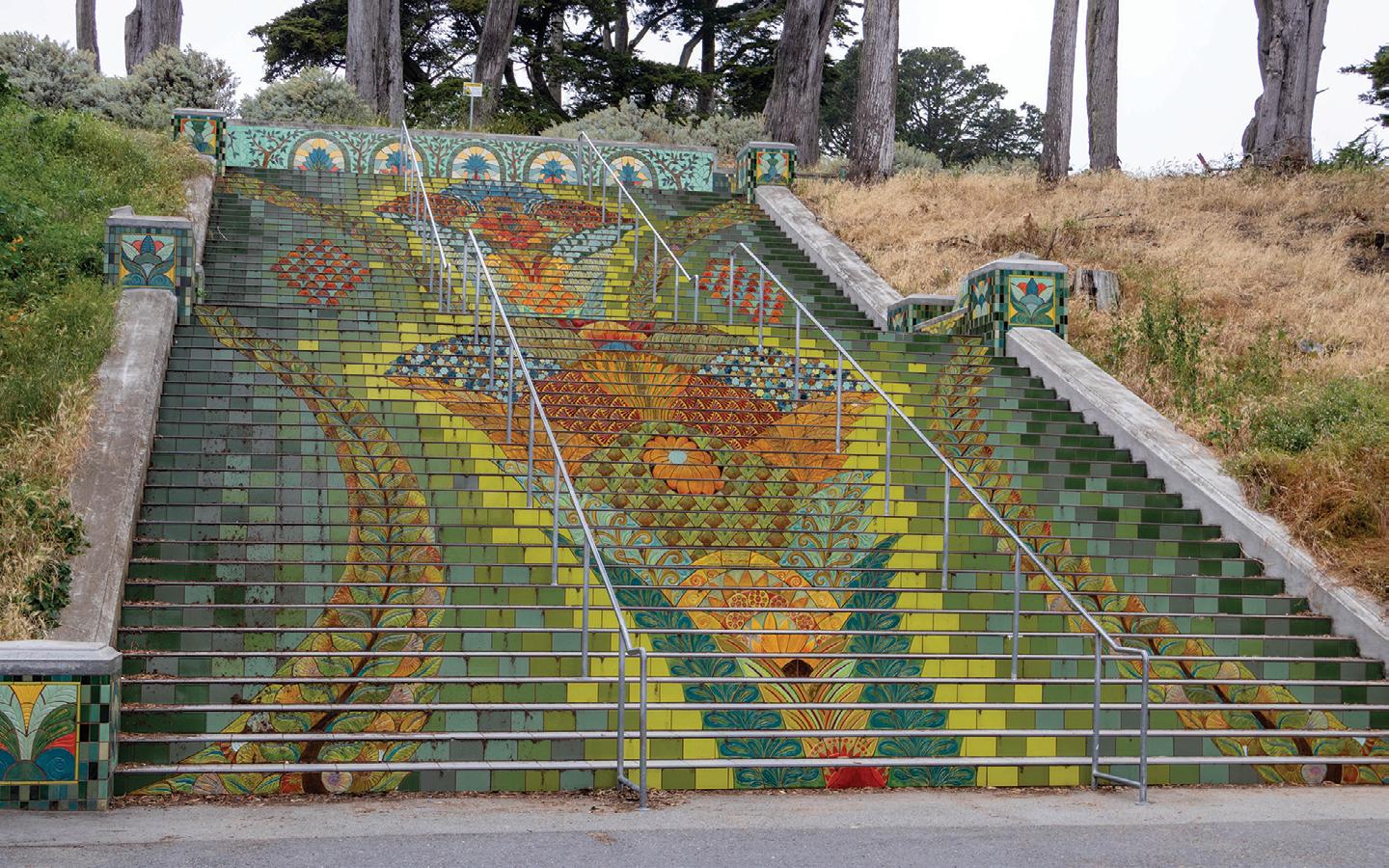
Next to the Katherine Delmar Burke School lie the Lincoln Park Steps, a mosaic staircase with 52 tiled steps at the base of the Lincoln Park Golf Course. Two benches, one on each side, sit along the stairs, and at the top is a long bench with its own intricate mosaic design. From there, you can see far down California Street and a sliver of the San Francisco skyline.
The stairs weren't always this extravagant. Built back in the 1900s, they had weathered years of use and had started to deteriorate.
The idea to revamp the staircase came from The Friends of Lincoln Park, a group founded by Anna Yatroussis and Meg Autry. Working with the school to brainstorm a project for their 100-year anniversary, they wanted to give back to the community. Yatroussis, an alumna and parent at Burke's, worried the worn stairs had become unsafe and an eyesore. An art project was decided on to make the stairs more appealing. With community support and fiscal sponsorship from the San Francisco Parks Alliance, the new stairs began to take shape.
The mosaic tiles were designed by Aileen Barr, the artist behind the Instagram-famous 16th Avenue Tiled Steps in the Inner Sunset. The new design was unveiled in 2015, following a seven-year-long project. The tiles' Beaux-Arts style, influenced by ancient Greek and Renaissance motifs, was chosen to honor the popular trend that was in style when the stairs were first built in the early 1900s.



By Lev Farris Goldenberg lfarrisg@mail.ccsf.edu
John R. Adkins jradproduction@gmail.com
Dignitaries from the State Senate, City Hall, Consulate of Ireland, and the entire City College football team all showed up to celebrate the opening of the $140 million Student Success Center on Thursday, but publicity-hungry Mayor Daniel Lurie was nowhere to be seen.
The mayor's public schedule, released earlier that morning, announced that Lurie would be occupied with “internal meetings.”
Charles Kretchmer Lutvak, the mayor's media representative, stated that Lurie “had a conflict at that time so was not able to attend.” Lurie's office did not send a representative in his stead.
The Guardsman obtained a copy of the mayor's schedule for the day of the ribbon-cutting. Lurie had a 15-minute meeting at SFPD headquarters at 2 p.m. and a staff meeting via phone from 2:30-2:50. His schedule was clear for the rest of the day.
Those who did not have scheduling conflicts that day included Supervisors Connie Chan and Rafael Mandelman, Elizabeth Creely, a cultural officer from the Consulate General of Ireland, Ralph Remington, director of Cultural Affairs for the San Francisco Arts Commission, and a representative from State Senator Scott Weiner's office, who presented Chancellor Kimberlee Messina with a certificate.
Since taking office, Lurie has prioritized appearances in the community and a strong presence on social media and has spent big on his public image. One of the wealthiest mayors in San Francisco history, Lurie has attempted to lay down the track record of accessibility and local awareness.
And yet, he was absent from the opening of the Student Success Center. Due to the mayor's anticipated presence, the no-show signals a disregard for the state-of-the-art construction project voted on and paid for by the city's taxpayers.
In 2020, San Francisco voters passed Proposition A, an $845 million bond measure to fund extensive campus improvement projects at City College, including the buildout of the Student Success Center and the $155 million STEAM Center, which opened in December of last year.
Mayor Lurie's commitment to City College has not been established, nor has his commitment to continuing to fund the Free City College program.
During his campaign, Lurie was asked about Free City on a mayoral forum, to which
he replied, “We need Free City College.” But since taking office, he has not reinforced that sentiment.
The Success Center, which Chancellor Messina says enables easier access to college resources, will serve the almost 19,000 City College students who benefit from Free City each year. According to AFT 2121, Free City has served over 120,000 San Francisco residents since its inception in 2017.
District 1 Supervisor Connie Chan got one of the loudest cheers of the afternoon when she led the crowd in a “Free City” chant.
“What makes San Francisco so unique … is two words: Free City,” Chan said. “Let's make sure that Free City will be here to stay and thrive, and expand. We are not okay with Free City the way it is now.”
However, Mayor Lurie's budget may be the biggest obstacle to ensuring Free City's future.
The city budget, passed in July, maintained the funding that allows the Free City program to operate for the 2025-26 fiscal year. However, his proposed budget for next year would cut funding by $2.15 million, necessitating difficult decisions for the college.
“It's not entirely clear to us that he understands the importance of this program just yet, or that he understands how urgent it is that this funding is kept stable for it in the continuing years,” said Anya Worley-Ziegmann, the coordinator of the People's Budget Coalition.
Advocates from the People's Budget and the student group Protect Free City said it was a struggle to even maintain the program's funding level this year.
In a recent editorial piece, The Guardsman called for the mayor to support Free City. Amidst the uncertain future of Free City's funding, the lack of visibility at City College looks increasingly like an attempt to dodge questions regarding his commitment to the college.
The day after the Student Success Center celebration, the mayor continued his campaign of visibility throughout San Francisco by visiting the M Stop Deli and Dream Team SF, both just a five-minute drive away from the Student Success Center.
This was Mayor Lurie's chance to show his support in person, as he so often does. There will be more opportunities to do so, as it is the college's 90th anniversary, and the new home of the priceless Diego Rivera mural is expected to break ground soon. Budget decisions made in the years to come will speak for themselves.
For now, the campus community is left to wonder: Does Lurie recognize the value of City College?
By Ellen Yoshitsugu ellenyoshi@gmail.com
The Guardsman asked students: How is your start to the new semester?
Bainivalu, Environmental Science




For me personally, coming back from a year of not schooling, it's pretty hard to get back into the motion of getting to classes and homework and just having more discipline. But I'm grateful for this space here called S Cubed, the Students Supporting Students Center. It's a student resource center that I stumbled upon that has helped me.
[They] have guided me to counselors and helped me set up my classes. They directed me to SparkPoint, which is another big assistance center. I've also got in contact with the Financial Aid department and they've helped get me free money, which is always a nice thing. And I heard about Free City, and now I get that too, which is helping a lot.
The community here, the resource spaces at City, are so beneficial for me on my educational journey. And I'm inspired seeing all the students that transferred from this center to top schools like UCLA and Berkeley, it inspires me to be committed and stay the course.
Dari, Biology
It was pretty easy, actually, to get my classes and register. I was on the waitlist for one of the classes, but I got off it the first day so that was relieving. For now, everything is pretty good.
Rick, Social Work
Not only am I a full-time student and able to use my GI Bill benefits to help pay for my tuition, but I was also hired to be a student worker here in the Veterans' Resource Center. It helps me pay for my cost of living, and then the convenience of being able to work and go to school in the same location just streamlines my educational process. And I take a gym class here on campus. Every morning, I come to campus early and work out in the gym. And all the resource centers are moving here to this location. Everything is brand new, the building, the technology. The energy is great! It helps me, and it helps me help others because everything is so close by.
Jessica, Fashion Design and Personal Styling
For me, it's been 20 years since I last went to college, so that's a long time. So, if anything, my nerves are getting to me a little bit, starting over. However, I'm really grateful for the Student Success Center and the resources that they provide. It really is helpful. It's a great center. And I love City College for that, and I love San Francisco for that.
Marrion, Journalism
It's my first semester here at The Guardsman, and I think that all the communication between the editors and the writers has been really helpful for me. I'm currently working as a news reporter focusing on data, and the first thing I have been working on is calendaring every meeting and trying to go to them and then report it to Tabari, the news editor.
The bus to get here has been difficult. I take the 8 bus, and it's always full. It's expensive too. Maybe City College can work on one of those free Clipper cards like SFUSD has.

By Lloyd Cobb lcobb10@mail.ccsf.edu
City College came within a yard of victory, but a high snap and a blocked field goal in overtime sealed a 41-38 loss to Santa Rosa Junior College on Aug. 30 at George M. Rush Stadium.
The Rams piled up 427 yards of offense but were undone by penalties, two blocked kicks and one mistake at the goal line.
Freshman quarterback Darius Clark-James threw for 400 yards and three touchdowns and added a short rushing score. Receiver Jeremiah Nash torched the Bear Cubs for 209 yards and three touchdowns on just seven catches, including gains of 47, 31 and 42 yards. He also hauled in the overtime pass that set up firstand-goal. Clark-James connected


with Matthew Eleweke for a 64-yard strike as the Rams built a 35-21 lead before Khai Dukes answered with a 100-yard kickoff return.
Defensive back Kalique Cheeves said the Rams “stopped the run game” but needed sharper “mentality and technique.” The defense held Santa Rosa to 45 rushing yards, with Elijah Hughes adding a 47-yard interception return.
Special teams collapsed in key moments. Two field goals were blocked. “Timing the snap and picking up overload pressure is one of the toughest parts of football,” lineman Franky Petuia said.
Head coach Eduardo Yagües Nuño told his players to trust their quarterback. “The QB plays well. Good plays came when they were needed,” he said. When the Rams trailed 28-21, he urged them to “keep doing what you are doing,” crediting
their late two-minute drive as proof of preparation.
The Finish Santa Rosa took a 38-35 lead late in the fourth, but Clark-James answered with a composed march capped by Ryan Rodas' 22-yard field goal to force overtime.
In the extra period, Santa Rosa made a 33-yarder. The Rams answered as Nash pulled in a pass to set up first-and-goal. But the snap sailed high, pushing them back to the 18. Rodas' 35-yard attempt was blocked, ending the game.
Rams fan Derrick Watson praised the Rams' “high energy” and JT Foreman's spark in the backfield but admitted, “the penalties killed momentum.” Another fan, Terry Griffey, called it “a thrilling game” but wished City College had finished the job.


By Lloyd Cobb lcobb10@mail.ccsf.edu
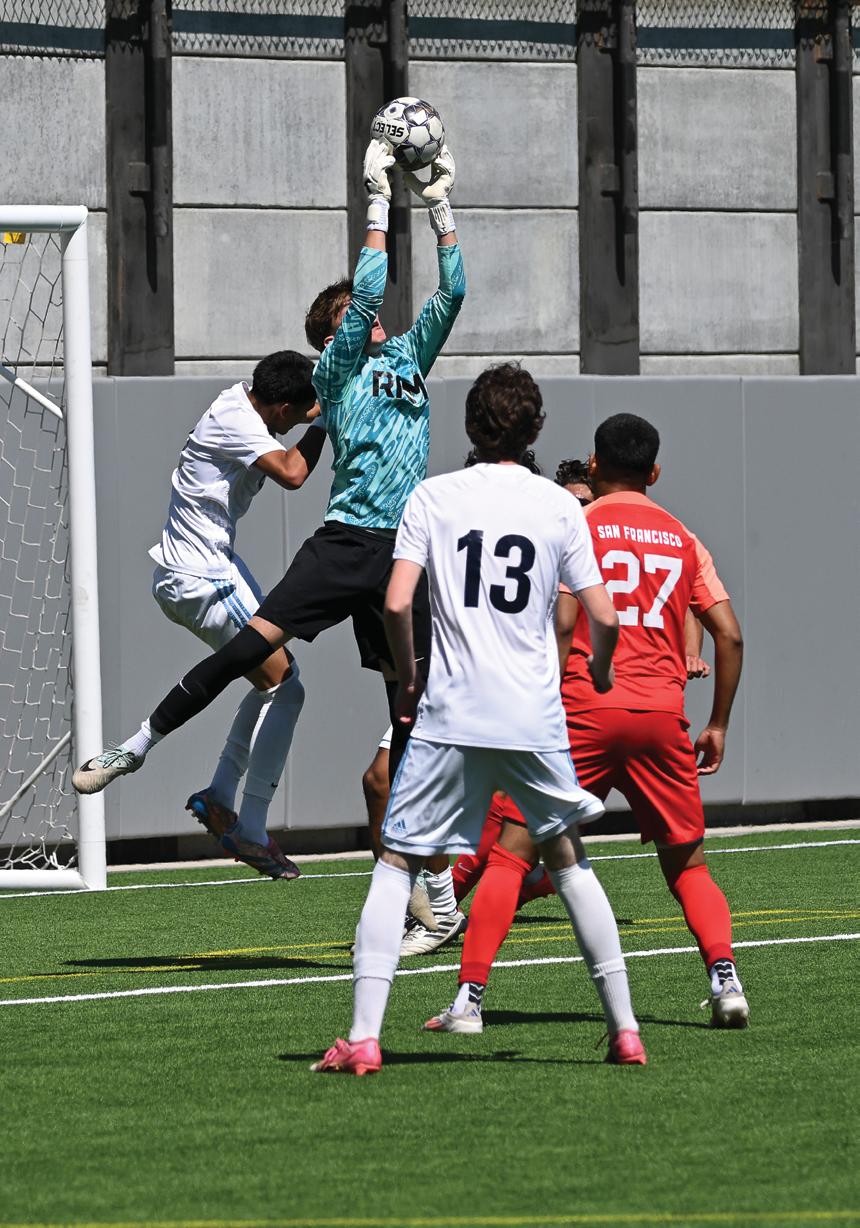
City College ended its preseason with a scrimmage that felt like a league match, swarming Contra Costa College for a 4-2 win at George M. Rush Stadium on Aug. 29.
The Rams pressed high from the opening whistle and forced mistakes. Antonin Lesperance opened the scoring in the 24th minute. Abel Reid made it 2-0 in the 43rd, but Contra Costa responded just before halftime to cut the lead to 2-1.
The second half belonged to sophomore midfielder Cristopher Jackson. He restored the two-goal cushion and sealed the result towards the close of the match, finishing with two goals and an assist.
Asked how he maintains his intensity, Jackson kept it short: “Everyone is not meant for it.”
Freshman Diego Martinez described the team's mindset: “Each scrimmage is a mindset or else we fail.”
That mentality showed on the field. Even when Contra Costa trailed by one point, the Rams stayed composed and quickly hit back through Jackson.
Depth powered the attack. Michael Soto recorded two assists, while Lesperance added one to go with his opening goal. In goal, Jesper Skoglund made five saves to steady the defense.
From the stands, a spectator named Luis offered the shorthand verdict: “Contra Costa built up nicely, but they just got outworked.”
Though the match will not appear in the standings, the Rams checked the right boxes. The press created chances, the midfield dictated tempo, and the back line held firm.
On Sept. 5, City College tied Napa Valley for a 1-1 draw. Their next home game will take place on Tuesday, Sept. 16, against the San Joaquin Delta Mustangs.