The Gryphon 25/26 - Issue #1

Page 1


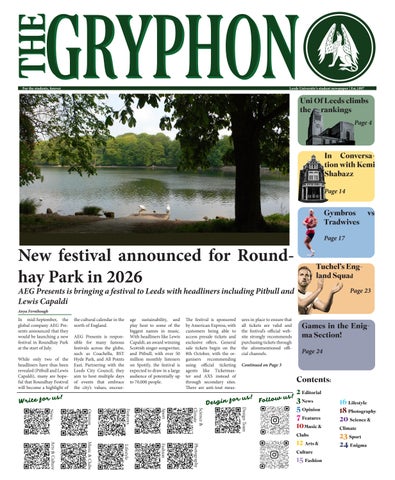
New festival announced for Roundhay Park in 2026

In mid-September, the global company AEG Presents announced that they would be launching a new festival in Roundhay Park at the start of July.

While only two of the headliners have thus been revealed (Pitbull and Lewis Capaldi), many are hopeful that Roundhay Festival will become a highlight of the cultural calendar in the north of England.

AEG Presents is responsible for many famous festivals across the globe, such as Coachella, BST Hyde Park, and All Points East. Partnering with the Leeds City Council, they aim to host multiple days of events that embrace the city’s values, encour-

age sustainability, and play host to some of the biggest names in music. With headliners like Lewis Capaldi, an award winning Scottish singer-songwriter, and Pitbull, with over 50 million monthly listeners on Spotify, the festival is expected to draw in a large audience of potentially up to 70,000 people.

The festival is sponsored by American Express, with customers being able to access presale tickets and exclusive offers. General sale tickets begin on the 8th October, with the organisers recommending using official ticketing agents like Ticketmaster and AXS instead of through secondary sites. There are anti-tout meas-

ures in place to ensure that all tickets are valid and the festival’s official website strongly recommends purchasing tickets through the aforementioned official channels.

on Page 3

The Team

Editor-in-Chief

Gabriel Morrissey-Limb

Newspaper Associate Editors

Lana Conway

Momnah Shahnaz

Emma Wilkinson

Shakeal Zaman

ITM Associate Editors

Jess Cooper

Bethany Dunn

Arabella Wright

News Editors

Aliza-Kayan Ahmed

Mishika Gupta

Zara Lake

Emma Wilkinson

Opinion & Features Editors

Sarah Al-Battat

Hannah Chohan

Maja Wasielewski

Shakeal Zaman

Sport Editors

Mrinalini Pretish

Science & Climate Editors

Cassia Bennett

Lucile Harvey

Ruby Smith

Longoae Tembwa

Music & Clubs Editors

Daniel Brown

Millie Cain

Francesca Lynes

Arabella Wright

Arts & Culture Editors

Bethany Dunn

Sophie Fowler

Jessica Hill

Rosie Nowosielski

Momnah Shahnaz

Fashion Editors

Christelle Al Abbasi

Jess Cooper

Amba Tilney

Lifestyle & Blogs Editors

Romilly Anderson

Jacqueline Wong

Heads of Photography

Jiayi Du

Jack Norris

Head of Social Media

Isabella Elie

Heads of Design

Erin Gascoigne-Jones

Phoebe Andre-Watson

Dear readers,

E d i t o r ’ s L e t t e r

Mistakes are fun aren’t they! As I’m sure our keen readers will have seen, the last issue featured far too many mistakes due to my hubris about being able to go over every single section’s pages in 8 hours! Ah well, consider this brief paragraph my apology.

Now then! A lot of ground to cover, firstly - what do you think of our lovely new logo and front page? We love it! It was certainly time to overhaul it and now we have!

I was in Knaresborough recently, at Mother Shipton’s cave, seeing the leaves as shades of scarlet, amber and orange got me thinking about a specific book: Peter Pan in Scarlet. For those not in the know, it is the official sequel to the classic play and abridged novel in which the Lost Boys are forced, alongside Mary, to return to Neverland, only to discover that Autumn has arrived and Peter has grown older. In many ways I can relate, I find myself having returned to this place (University) with the leaves changing, and older, now responsible for a newspaper and its members, being forced to act differently and coming to terms with the fact that unfortunately; you do grow older.

Much like Peter and the rest of the characters in the book, it is something you have to learn to accept and cherish those memories of younger days.

I suppose that I’ve been thinking about that because it’s now already the second issue of The Gryphon and my time, much like sand in an hourglass, is running out as your Editor-in-Chief for the year - let’s make the most of it!

Onto a more monthly focused idea - I went to the one and only Belgrave to see a screening of the, you could now argue, classic horror film Cabin in the Woods - an interesting dissection of Fandom, particularly in the horror sphere, and its misogynistic undertones! A fantastic film to analyse, especially as someone who spent countless hours in the library analysing a certain US Politicians’ Tweets and fandom. As you can see, adult life is incredibly interesting.

This issue is, as always, jam packed with the best content that our very talented writers and editors have been able to conjure up! News has covered multiple protests, a clarification has been put out (oops!) and the University has risen in rankings, over in Music & Clubs there’s a feature on up & coming band GEESE, Science has a very interesting article about AI in the NHS, and there’s so much more!

Now, I’ve got a costume to plan for halloween (if you see a really really cool looking Ben 10 come say hi), and you’ve got lectures to catch up on! I’ll see you in the next issue!

Continued from page one

There is also a focus on sustainability and accessibility. The festival will have accessible viewing platforms and BSL interpretation for all Main Stage acts. Efforts will also be made to minimise the environmental impact, signalling a sustainable future for live music. As well as this, a partnership with Roundhay School will help to get kids involved in the in dustry and event management, setting them

many free activities that are open to all – from arts and culture to wellbeing and acting. The hopes are that this festival becomes a highly profitable annual event, attracting large audiences and highlighting the culture that Leeds has to offer.

ter the event.”

The park itself is over 700 acres, with the potential to have the capacity of 70,000 people.

While organisers have promoted the use of public transport to get to and from the festival, it is unclear how congested the roads around the area will be. When Ed Sheeran performed at the park in 2019, there were reports of gridlocked roads and long queues for shuttle buses, despite the council enforcing road closures and parking restrictions. The park has a legacy as a stage for many famous artists who have performed there throughout the years, from Madonna and the Rolling Stones to Michael Jackson and U2. Leeds itself is also no stranger to large audiences for live music events, hosting the annual Leeds Festival in Bramham Park.

With this past experience, locals hope that the council will be able to plan accordingly to prevent major disruption to the residential area.

The festival is predicted to greatly benefit the local area. The increased economic activity will help boost Leed’s economy through the engagement with local vendors, suppliers, and staff, whilst also highlighting the importance of community and raising the profile of the city. Throughout the

Fresh calls for lighting in Hyde Park following Assaults

Gabriel Morrissey-Limb

Students are once again calling for lighting to be placed within Woodhouse Moor, commonly referred to as Hyde Park, following three sexual assaults that took place recently.

Leeds University Union Wellbeing Officer Eden Morris appeared on BBC Radio Leeds alongside Chloe Schneider, the co-founder of Students against Sexual Harrassment and Assault (SASHA) to call for lighting and safety measures to be introduced.

Speaking to Rima Ahmed on the programme Eden Morris said: “for decades students have been campaigning for funding to light Woodhouse Moor... but also for extra police presence”.

Campus Watch

This semester at the University of Edinburgh began amid industrial action, as University and College Union (UCU) staff went on strike for five days during Welcome Week. The union condemned the university for the planned £140m financial cuts, £90m of which is anticipated to be staff cuts.

A geography course titled Queer Geographies: Spatialising Sexuality and Gender was cancelled just one week into the semester due to low enrolment, sparking concern among students about the impact of budget cuts on course availability. Moreover, the student-led Edinburgh Reform Society was formed in July; it has since been barred from cross-party debates and events by other University of Edinburgh political groups.

Another newly created society at the university, the Edinburgh Union, has begun hosting fortnightly debates as an apolitical debating society, aiming to become a hub of discussion for students across Scotland. So far, motions have tackled Scottish independence and assisted dying, both with panels featuring Scottish politicians and leading experts across the disciplines.

In the Scottish Government’s inaugural proof of concept fund, the University of Edinburgh has been assigned over £400,000 to fund three research projects, including the development of an anti-cancer drug. Meanwhile, Edinburgh alumnus Sir Chris Hoy has launched a scholarship at the university to support 20 high-performing student athletes during this academic year.

Glasgow

Ameilia McGlynn, Arts and Culture Writer, Gaudie

The 2025/26 academic year has been off to a busy start at the University of Aberdeen. It seems to be the season of change, with multiple reshuffles across our Senior Management Team, within student politics, and University Court Leadership. Our principal, George Boyne, is set to retire in December, so the search is on for a new school leader. The previous few weeks have seen our new Rector, Scottish folk singer/ songwriter Iona Fyfe, be installed via a classic ceremony held in King’s College Chapel. Iona was paraded around campus on a fake bull carried by students, in line with the traditions that have sworn in the line of Rectors before her. This follows a busy summer of reporting for The Gaudie, after the Tall Ships Festival brought a weekend of crowds, live music and tourism to the city.

Times of unrest continue to afflict Aberdeen, as protests against asylum seekers crop up with alarming frequency. Fortunately, the city’s unified community of anti-racists consistently remain at the forefront of action, peacefully protesting for everyone’s right to safety.

The Gaudie has welcomed its two new Editors-in-Chief, Nour and Oliver, to the fold, and we are all excited for the year of reporting ahead.

Newscastle

Newcastle has been busy welcoming the newest cohort of students to our campus and across the city. We released our Welcome Edition of the newspaper, offering freshers a one-stop guide to all things The Toon. While celebrations across the city welcomed our students, multiple demonstrations occurred too. The rise of the flag debacle meant anti-racism folks were about in full force, as were the Tommy Robinson followers. Notably, Bonnie Blue also made her guest appearance, with her Bang Bus - but did not hang around for too long. Now the freshers period is settling, our Students Union is gearing up to celebrate 100 years of the NUSU building. Now that’s a celebration everyone can get behind!

Forge Press

As the freshers settle, and returning students get swamped with work even in the first week it can be hard to keep up with what’s happening in and around campus but at the University of Sheffield plenty is going on.

Between the 21st and 23rd of October there is the annual autumn careers fair! With over 150 employers setting up stalls in the Octagon centre, this is an amazing opportunity for undergraduate and post grad students to get a kick start in the world of networking!

Off the shelf festival is back! Between the 11th Oct and 11 Nov get your literature fix with Sheffields own literary festival. In collaboration with the University of Sheffield this festival will hold talks and workshops involving national, international and local authors.

Leeds Univeristy Union issues statement on Winter tent

Leeds University Union have now issued a statement on the winter tent: “Like many of our students, we are disappointed that the Winter Tent will not be operated this year. Although funding from the University was not available to erect the structure, we are still planning a programme of events, activities, and themed food and drink in the LUU building this December to ensure there’s still a Winter hub and celebration space on campus. Keep an eye on the LUU website and social channels for updates.”

Exec Updates

Curious about what your student exec are up to? This column answers that! In this issue of The Gryphon we have your education officer Shivani Gug!

Hey everyone! It’s so exciting to be writing for the Exec column (I feel like an agony aunt).

Here are some things I’ve been up to recently!

Bringing students and societies together: We started the term with a meeting that brought together the presidents of LUU’s academic societies, school reps and faculty officers. We had a full turnout in function and some really valuable discussions were had as to how we can bring academic reps and academic societies closer together in years to come. Could we have an academic rep position on society committees potentially? If you have any thoughts about how we can develop this student voice further contact me at S.Gug@luu.ac.uk – I’d love to hear your ideas!

National advocacy: I’ve been working with the Russell Group Student Union (RGSU) network and the National Union of Students (NUS) to influence the Autumn budget. We’re lobbying for fairer higher education funding and a more equitable student loan repayment system.

Sharing updates online: I’ve also been posting away on my LUU Education Officer Instagram account! Have a look at some of the work I’ve been doing on @luu_education

That’s all from me! See you next time!

New project may remove the need for traditional rail tickets in Yorkshire

Rail passengers in Yorkshire are being invited to take part in a new trial that removes the need to buy traditional train tickets. The project, known as Digital Pay-As-You-Go (DPAYG), is being run by Northern Trains in partnership with the Department for Transport and Technology provider, Tracsis. It is designed to modernise the way passengers pay for rail travel by allowing them to check in and out of journeys using their smartphones.

The trial is taking place on Northern services between Leeds and Harrogate, with plans to expand to Sheffield-Doncaster on 27 October and Sheffield-Barnsley on 24 November.

The system works through a mobile app that uses GPS technology to track journeys. Before travelling, passengers open the app and tap ‘Start Journey’ at their departure station. While travelling, a unique QR code appears in the app, which can be shown to conductors or scanned at ticket barriers. When the passenger reaches their destination, they tap ‘End Journey’, and the system calculates the fare automatically. The appguarantees that travellers will be charged the lowest possible fare,

applying daily and weekly fare caps to ensure value for money.

The Leeds - Harrogate route was chosen because it crosses between two different combined authorities, offering a useful test of how the system handles multiple transport jurisdictions. The technology is similar to the contactless pay-as-you-go systems already used in cities, such as London, but instead of tapping a card at barriers, passengers check in and out using their phones.

Officials say the trial is part of a wider effort to simplify ticketing and bring rail travel into the digital age. Northern’s commercial and customer director, Alex Hornby, said in front of the BBC that the goal is to make travel easier by “taking the barriers away from buying a ticket.” The Department for Transport described the scheme as a step towards a fully integrated, multimodal pay-asyou-go transport system across the UK.

Passengers’ fares are calculated automatically after each journey, and users receive a message confirming the amount charged. However, the system relies on travellers correct-

University of Leeds raised nine places in The Guardian’s University Guide

The University of Leeds has come joint twenty eighth with the University of Chichester in The Guardian’s University Guide 2026. This is a rise of nine places, from the university’s previous ranking of thirty-seven the previous year.

The Guardian University guide is the broadsheet newspaper’s annual ranking of the UK’s top further educational institutions in the country. It is often considered as an important influence in prospective students’ decision making, along with the Complete University Guide and The Times Good University Guide, where the university rose two and three places respectively in each guide.

ly checking in and out and keeping location services active. If a journey is not properly recorded, the passenger may be charged an incomplete fare, though there is a process to dispute errors through the app.

Certain ticket types, such as advance fares or group discounts, are not currently available through DPAYG during the trial period.

A similar pilot is already running in the East Midlands, covering services between Leicester, Derby and Nottingham, and early results have been described as successful.

The government says these trials will help shape future national ticketing reforms and support its plan to make rail travel simpler and more efficient.

The DPAYG trial aims to reduce queues, eliminate confusion over ticket types, and ensure passengers always pay a fair price for the journeys they actually take. If successful, it could pave the way for a nationwide pay-as-you-go system that integrates trains, trams and buses into a single, seamless network.

The Guardian takes a number of factors into consideration such as student satisfaction, staff levels, funding and career progression post-graduation.

Leeds scored sixty-two out of one hundred points overall and saw 85.4% of students say they were satisfied with the quality of teaching they received and 74.4% of students satisfied with the level of feedback.

In addition, the guide found 84% of students were in either high level employment or further study after fifteen months from graduation and 94.7% of undergraduates continued after their first year of study.

The guide provides an individual league table for each subject, where eighteen of the University’s courses ranked within

forms. The Deputy Vice-Chancellor, Professor Hai-Sui Yu has stressed the importance of league tables to the university’s reputation and how “a higher position helps us attract the best to study here.”

He was keen to congratulate the university’s staff saying that “The improvements we are seeing now show the value of this collective effort [to enhance education] and the difference it is already making to our students and our reputation.” Given that student’s perception of both quality of teaching and feedback is an important factor in how The Guardian determines the university’s score, I spoke to some students about how they feel about the teaching and feedback they receive.

One final year student in the School of History said that overall, he found that many of the teachers were “incredible world-class experts who are genuinely passionate about history.” However, he did note that he was “disappointed about the vagueness of feedback, lack of contact hours and the inability to create a highly quality student-tutor relationship.”

Tom, a third year Politics student, said that he found the lectures in his subject “engaging and interesting”, saying he would recommend Politics at Leeds to a friend. Tom also said that he thought that the feedback “could be more detailed.”

Another student, also comments on how she found the teaching in her subject, English, at a very high standard but that the “feedback on essays was often limited and non-spe-

Raya Boycheva

A digital-first age is coming: it is time for the UK to embrace Digital ID

Twenty years ago, a debate was raging in Britain around ID cards. Civil liberties activists, concerned about

digital concert tickets, could easily prove validity.

Prime Minister is spot on. In this digital-first age, it is time to embrace technological advancements and improve our everyday lives for the better.

The introduction of a Digital ID system would simplify government and make huge advancements to cut the bureaucratic state. Opponents would find it hard to argue against a centralised identification system in which citizens could prove their identity, access services, claim welfare and get a job without having to reach for endless paperwork such as a utility bill, purely to prove their address.

Physical ID cards were always tainted with the credible argument that they were open to fraud. It would only be a matter of time until criminals could easily produce replicas of the plastic cards to commit identity fraud. The digital element removes this concern, as a unique code, much like used on

ing who exactly you are.

Britain has also become an outlier with its closest neighbours, with 26 out of the 27 EU countries currently piloting some form of digital identification scheme of their own.

The never-ending issue of migration, both legal and illegal, causes a seemingly perpetual headache for governments of all colours. Whilst a Digital ID system would admittedly not be the answer to all these problems, they would produce an extra barrier to prevent people with no right to reside or work in the UK from being able to do so.

For students such as myself, the countless times I have left the house for a night out without my driving licence have been a source of great irritation. A Digital ID system, coupled with

the godsend of Apple Pay, would mean I would simply only require my phone to leave the house, removing the all too real possibility of me losing my wallet and allowing someone access to my bank cards and other personal items.

The public mood has also shifted significantly. In 2006, public opinion was wholeheartedly against any form of identity cards. Twenty years on and research from YouGov showed that whilst public opposition was still at 45%, support was only slightly behind at 42%, with 14% undecided.

The fight the Government will have to face on this issue will be fierce, a rainbow coalition of opposition parties in the commons, coupled with Starmer’s own MPs and the civil liberties campaigners will not make this easy for the Government. Starmer must be brave and show the public, and his opponents, the real benefits of such a scheme.

By far the biggest shortcoming of this government has been its communications, consistently failing to deliver a convincing message to voters and a vision of what a ‘Starmer Britain’ looks like. To succeed on Digital ID, the Government must communicate to voters the acute benefits to them as citizens and not solely rely on solving bigger picture issues such as tackling immigration to gain the public's consent on this.

Image credit: HM Government
Image Credit: Matthew Howard, Getty Images
James Childs

Single, not ready to mingle

When Rapunzel looked out of her window and wondered when her life would begin, was she longing to build a life for herself beyond her tower, or for a man to appear whom she could threat en with a frying pan, before falling hopelessly in love with him? Growing up, we were fed different variations of the same story: a young person takes their first steps into the adult world and their success in doing so is measured by their ability to fall in love. Why does the topic of being single make us so uncomfortable and why is it treated as a transitory phase that must end in order to move forward in life?

Societal Lie no. 1: Being single is synonymous with being a loser. If I were to confess to my younger, high school self that I have been single for well over a year and a half now, she would cringe and ask if I was sad and lonely. I would probably respond by asking her how her broken friend group was doing and which

toxic girlfriend/situationship she was dating now. The truth is, I have never felt the same level of self-confidence and freedom as when I am not actively pursuing a relationship. Sure, being in a relationship feels good, and there are times I long a girlfriend, but since taking the pressure off myself to constantly be chasing my ‘one true love’ (whoever she may be), I have actively grown into myself, and possibly become a cooler version of myself as a result. Dressing in styles that appeal to me, attending the events I want to go to, developing my own hobbies- all of these things have created a comfort in my own skin. If Mrs Right were to come along, I would probably be able to offer her a far more self-assured, warm, and fun person to be around than if I was recovering from a broken relationship, and dealing with identi-

ty crisis no. 20 of the day.

Societal Lie no. 2: Happiness, in its purest form, will only be reached once you find true love. It’s cliché, but university has been some of the best years of my life so far. Yet, other than a few bad Hinge dates, I haven’t really thought about romantic love. Instead, I have been full to the brim with platonic love. Every week, my housemates and I religiously organise plans to get dressed up, go out to weird and wonderful social events, and make core memories together. It would almost be insulting to them, to myself, and to the fun we have if I was to wish that away in exchange for a romantic relationship of some kind. That isn’t to say that romance should be time-consuming to the point of being unable to have fun with friends. But sometimes I wonder if I want or need a romantic relationship when I have my friends- whose company I love, and who I love as people- to go on fun and inventive dates with every week. Those friendships also don’t come with the pressure of wondering where you are ‘at’ with someone, worrying that your relationship might someday be over, or that eventually one of you might decide to get down on one knee.

Societal Lie no. 3: Being single should be treated as a transitory stage before your next romantic relationship. As I have established, being single provides you with the opportunity to discover new interests, different quirks that make you YOU, and invest in long-term, fulfilling friendships. So instead of wondering when your life will begin and whether a romantic partner is on the horizon, enjoy all the perks of being alive, well, and single now! And the next time a relative gives you a sympathetic look in response to your singleness, give them one back, because deep down they probably wish they had some of the freedoms you do.

War in Ukraine: Why peace seems so distant

Last night another deadly Russian drone and missile attack took place in Lviv and Zaporizhzhia, killing five people and leaving tens of thousands without power. More than three years into the full-scale invasion, calls for the carnage to end have only grown louder, especially since Donald Trump’s return to the White House earlier this year. Yet peace remains frustratingly distant. Why? Because of three major roadblocks: Russia’s pattern of aggression over the years, the Trump administration’s failure to adequately hold Vladimir Putin accountable, and deep disagreements over sovereignty in eastern Ukraine.

Trump’s Ukraine Strategy

As one of his election promises, President Trump was emphatic that he would end the war in Ukraine “within 24 hours”. He also made threats of “taxes, tariffs, and sanctions” on Russia if the war did not stop. Since then, Trump has repeatedly failed to live up to his words. In May, when Putin rejected a 30-day ceasefire, and the Istanbul peace talks led to nothing, a promised American package of sanctions failed to materialise. His August 8th deadline for Putin to agree to a ceasefire was not followed up on, and instead invited him to Alaska. The “severe consequences” he warned of if a deal was not reached in Alaska came to pass.

This has emboldened Putin to press on with his war in Ukraine along with further es calatory actions like the breaching of NATO airspace in Poland, Romania, and Estonia over the last few weeks. Emboldened, Putin can more confi dently continue his deadly attacks on Ukraine without much fear of the reac tion from the US: arguably the most powerful and influential country in the world. Credible and reliable US

support for Ukraine could be a major factor in establishing peace in Ukraine under terms that Ukraine can agree to as this would leave less room for Putin to further test the waters militarily in Ukraine and nearby NATO states.

Russia’s Pattern of Aggression

This lack of meaningful US pressure now brings me to Russia’s broader pattern of unchecked aggression: a pattern stretchback nearly a decade. Russia has invaded Ukraine the last eight years with the 2014 invasion of Crimea (which saw an underwhelming response from the Obama administration) and the current full-scale invasion in 2022.

With that in mind, a key question begins to reveal itself: how can Ukraine be

sure that Russia won’t invade again? President Zelenskyy has already suggested a peace plan including full NATO membership for Ukraine as a security guarantee, which Putin has repeatedly insisted that he would not accept. Putin has also recently dismissed the idea of Western peacekeeping troops in what PM Keir Starmer called the “coalition of the willing” to enforce a ceasefire as part of a deal to eventually end the conflict. Here we can see that Putin seems only to prefer a peace deal in which Ukraine is virtually defenceless which would not provide Ukraine with enough certainty that Russia won’t invade again. Disagreements Over Sovereignty in the East

Eastern Ukraine has seen the most intense fighting, with Russia currently occupying much of the five eastern regions, while Ukraine remains determined to gain it back as reflected in current public sentiment. Seventy-five percent of Ukrainians object to ceding land in exchange for peace according to the Kyiv International Institute for Sociology. This reluctance is echoed by President Zelenskyy who said that this would “open a bridgehead for the Russians to prepare an offensive.” Given Russia’s use of Crimea as a springboard for its 2022 invasion, Ukraine’s caution is understandable.

This brings us back to Russia’s previously mentioned unwillingness to accept adequate protections for Ukraine. Without these protections, ceding territory in the East would leave Ukraine vulnerable to future aggression, effectively making any peace deal fragile at best. In demanding this outcome, Putin wants to have his cake and eat it. Overcoming this dispute over post-war control of the East is paramount to securing lasting peace

Ultimately, lasting peace in Ukraine can only be achieved when its sovereignty is fully respected and its security is firmly guaranteed. Without this, the cycle of violence will persist and the path to peace will remain frustratingly out of reach.

Hakeem Kabia
Image Credit: BBC
Image Credit: Tinder
Image Credit: Hinge

Raze the colours, the kids are alright Kimmel, Trump, and the Asphyxiation of American Free Speech

From where I’m sat in my cold and drafty front room in an upstairs flat in the western boondocks of Leeds, my peripheral vision is almost entirely consumed by flags.

Proudly displayed in the upper left corner of my eye are the three stylised chain-links of the Black Country, stark against their well-meaning but somewhat fascist-coded background of white, black, and red. I’m sure at least one of those stands for battered chips in lieu of racial purity. It’s the pride and joy of my Walsall native housemate, whose daily meanderings are replete equally with complaints and praise for (in his words) the post-industrial hinterland between Stafford and Birmingham.

In the corner, straddling the awkward space where no furniture quite fits, is the striking tricolour of the Spanish Republic. Its royal purple grossly misrepresents what the shortlived nation stood for, and its position gives the living room the flair of a Hemingwayan flophouse. It would make drinking wine in the daytime feel more romantic, should I ever spiral beyond the Earl Grey that’s getting cold on the coffee table.

Flags, by definition, mean something more than the colours and figures which immediately meet the eye. Beyond the nation states and cultural regions which they represent, colours arranged in a particular order re call the values, sights, sounds, and smells of whichever corner of the world put them together. However, despite my aesthetic appreciation of flags of all kinds, my walls are noticeably free of any representation of the land of my birth.

In case any readers have been living under a rock, the union flag and cross of St George have been somewhat controversial recently. In August 2025 a group of right-wing keyboard warriors took it upon themselves to convince a certain section of the UK populace that, in the immortal words of Stewart Lee, “these days, saying you’re English will get you locked up and thrown in jail”. As a result, a small and poorly organised army of part-time patriots heeded the call and zip-tied Amazon-bought, Chinese-made English and Union Flags to lampposts, roundabouts, and railway bridges up and down the country.

This is perhaps the best explanation for why my extensive collection of both flags is stashed in the same place in my parents’ house where I kept my weed when I was 16. The battered duf-

fel bag they’re kept in has the same ominous aura of criminality, and the amorphous bundle of red, white, and blue feels just as illicit to be in my possession. The ragged edges of the red crosses and white saltires are testament to the fact that they did not come into my hands through traditional means.

As part of the death throes of my adolescent idealism, I spent a white-knuckled evening over the summer clinging onto the overhead handles of my friend’s Vauxhall Corsa as she rounded the hairpin bends of East Surrey’s cul-de-sacs pursuing reports that a series of flags had been hung on lampposts around a hotel believed to be housing recently arrived refugees. Despite having quit gymnastics when she was 14, the way she shimmied up the lampposts put my frantic jumping and grabbing to shame, and by midnight we had accumulated enough spoils of war to furnish a jubilee street party.

Now, having rejoined mainstream society, I am faced with a conundrum. A bundle of symbols with nothing to symbolise is a big bag of nothing at all. Despite no longer serving to intimidate anyone, they remind me of a happily misspent youth now passed, and that makes the daily barrage of emails and Teams meetings that little bit more difficult to bear. My eyes drift to the scenes unfolding beyond my dusty windowpane. A group of local kids have worked out that the mattress shop is closing and are staging homemade WWE matches on the filthy bedding that has gone unsold. How I relate to the feeling of having nothing but time, nothing to fill it with, and the nagging ache of purposelessness when you feel that the word should be yours for the taking.

So, take this as a disclaimer. If you see a grotty first floor student flat that looks ready to host a Reform rally, fear not. The flags are there to inspire the true heart of this country, which doesn’t lie in the institutions of its state or the delirious pining for a non-existent halcyon past. The gobbiness and audacity of our children is perhaps one of the only areas in which the UK still excels, so a jagged old flag being torn by shaking cold hands into sinews and rags can’t possibly be a bad thing. Anyway, I highly doubt they were going to grow up to be shipbuilders.

Frequently hurling abuse at major outlets for any form of criticism, Donald Trump is known for his hostility towards the press. He used the term “fake news” as many as 2000 times during his first presidency. The president has cultivated a belligerent environment at the heart of American journalism. During his 2024 campaign, he threatened to jail reporters and strip networks of licences for coverage he did not like, such as that of his connections to Jeffrey Epstein, and between 1 September and 24 October, he insulted, attacked, or threatened the media at least 108 times in public speeches, while promising to bring free speech back to America.

Jimmy Kimmel began hosting Jimmy Kimmel Live! in 2003, and has criticised Trump since his first term. After the killing of Charlie Kirk on 10 September, Trump and other conservatives incited violence and pressured employers to fire those critical of Kirk and his political views, Kimmel commented: “Many in ‘MAGA land’ are working very hard to capitalize on the murder of Charlie Kirk.” Kimmel also mocked Trump’s response to the death: “Yes, he’s at the fourth stage of grief: construction. This is not how an adult grieves the murder of someone he called a friend.” FCC chairman Brendan Carr, who has increasingly acted as Trump’s “attack dog”, threatened ABC to take action against Kimmel, capitalising on the simmering MAGA uproar. He called upon local broadcasters to stop broadcasting the show, warning that those who continued could face fines or lose licenses. Dozens vowed to stop broadcasting the show, likely

effectuating the suspension. On 17 September, Disney, parent company of ABC, halted production to “avoid escalating tensions during an ‘emotional moment for our country’”. Kimmel expressed his unwillingness to apologise, but planned to clarify his comments and denounce the misconstruing of his remarks by Trump supporters. California saw protests, and hundreds of Hollywood celebrities signed a letter backing Kimmel with many consumers also ending subscriptions to Disney’s streaming services. The incident follows the cancellation of The Late Show with Stephen Colbert, which some suspect to have been politically motivated due to Colbert’s outspoken criticism of Trump.On 22 September, the suspension was lifted. Kimmel echoed the importance of free speech: “that’s something I’m embarrassed to say I took for granted until they pulled my friend Stephen off the air and tried to coerce the affiliates who run our show in the cities that you live in to take my show off the air. That’s not legal, that’s not American, that is un-American. And it’s so dangerous...”.

Early media suppression signals a well-trodden path of dictatorial consolidation. Stalin created an alternate reality through the media, rewriting history and exaggerating economic achievements. Franco weaponised catholicism to justify censorship and manipulate religious devotion into political loyalty. Hitler famously controlled all media through Joseph

and the Reich Ministry of Enlightenment and Propaganda. In modern history, authoritarian rulers adhere to a playbook, exhibiting many similar trends regarding attitudes towards the media. These include: banning opposition media, criminalising criticism, establishing state-controlled media and a monopoly on ‘truth’, cultivating a cult of personality, expelling foreign journalists, and restricting access to information.

Trump barred the Associated Press from accessing the White House earlier this year due to its continued use of the term “Gulf of Mexico.” Trump has not criminalised dissent, but is invariably hostile and has threatened to change libel laws to make it easier to sue journalists. He has repeatedly induced Americans to distrust all media except for his preferred sources. He has cultivated a cult of personality through rallies, merchandise, and slogans, as well as framing himself as superior: “I alone can fix it”. Finally, he has attacked and sidelined scientific agencies, particulary during the pandemic, and restricted or manipulated information and data, especially relating to the pandemic, climate, and immigration.

Goebbels
Will Garrood
Daniel Spencer
Image Credit: ABC

Bonnie Blue’s Bang Bus: Business or Pleasure?

Whilst I spent the two weeks leading up to uni working, catching up with friends and panicking about my final year, 26-year-old Bonnie Blue was on a nationwide university sex road trip. Bonnie Blue initially rose to fame on adult content subscription service, OnlyFans. She then gained mainstream exposure on social media earlier this year when she allegedly had sex with over 1000 men in one day. Once again, she has gone viral, this time for touring university cities, Leeds included, across the country in her ‘Bang Bus’. The Bang Bus turns out to be a minivan; the exterior is covered with her name and QR codes to her website, whilst the dashboard has been carefully decorated with condoms. She spent the two week trip attending club nights, handing out t-shirts and claims to have slept with around 70 ‘barely legal’ freshers.

When I took on this article, I hadn’t fully decided my take on the situation. I certainly didn’t think of it as a positive one, but also, I’m not one to jump on the woman shaming train without being properly informed. The logical decision was to do my research – no, not that kind of research - and make a pros and cons list. I soon found that despite there being counterarguments to the cons, there weren’t exactly any pros.

Despite this outcome, I certainly do not condone the disgusting comments, body shaming, and physical attacks she has received.

With very few exceptions, university students are legally adults and can have sex with any other adults. Students have willingly volunteered to have sex with Bonnie and be associated with her brand. So, what’s the issue? Well, I fear these points are just examples of Bonnie meeting the bare legal minimum of consensual sex. Are we really going to congratulate and encourage her for not breaking the law?

There is so much more to being an adult than age. Living 200 miles away from home was a scary move for me, but I was so excited to be in a big city and to meet new people. I spent my freshers’ week going clubbing, getting to know my flatmates and exploring Leeds. I felt so grown up. But we joke about freshers being babies for a reason; they are fresh out of the womb that is home into the new reality of adulthood. What do I have for dinner? What do I do when Circuit Laundry traps my washing? What are silverfish and why is there one on my chair? I miss home. You suddenly have this independence that you’re not quite sure how to deal with. It’s this state of uncertain freedom that makes freshers

extremely impressionable and vulnerable. Suddenly having to be independent can cause a lot of pressure: pressure from family, pressure from friends and pressure from yourself. On a night out, there might be pressure to drink, pressure to follow the lead of others and

hindsight, you didn’t really want to do. That’s where Bonnie Blue comes in, using her fame to lure you in, advertised as a rare opportunity to experiment and offer you a mind-blowing experience. It’s obviously a convincing offer for some.

Men who haven’t had sex yet may feel even more pressure as the concept of virginity is so stigmatised. People get competitive and judgemental about whether they are having sex. Students should feel comfortable doing things at their own pace in the right place; however,

unfortunately, when presented with an easy opportunity, it might be tempting for some just for the sake of losing the stigma. Bonnie Blue promotes her content and experiences as educational because they are safe, consensual and with an experienced sex worker. I understand that school sex education is lacking, but I really don’t think Bonnie Blue’s ‘barely legal’ campaign is the answer. The fact that she is deliberately preying on vulnerable men straight out of school is disturbing. Freshers are only a few months away from being immature 17-year-olds doing their A-levels and relying on their parents. These men have only just graduated boyhood.

The only thing Bonnie Blue is teaching is an extremely unrealistic, artificial, damaging expectation of what sex should be like. She is enforcing harmful stereotypes of what a woman should look like, what they should be able to do and how they are expected to act. Whilst her OnlyFans and 1000 men stunt might also be seen as harmful –that’s a whole other conversation - they do not deliberately target a vulnerable demographic, and she is not as conveniently available. It is her intentionally making herself physically available to exploit and influence 18-year-olds across the country that I believe is extremely problematic. Bonnie Blue does not

care about your sex education or your emotional wellbeing. There is no aftercare; she is already thinking about her next fresher – her next business opportunity. To her, you are content and another statistic to tally up.

It’s bad enough that she is exploiting freshers for financial gain, but it’s even worse that she is aware of how morally risky she is being. She has built her latest campaign from the phrase ‘barely legal’, poking fun at the fact that she’s sleeping with almost children all under the guise of it being educational. Bonnie Blue knows how controversial she is; she’s not clueless. In fact, her Bang Bus tour shows that she is a clever businesswoman. The Bang Bus is her latest strategy to increase engagement and create these controversial conversations. She’s gained a lot of love, but a whole lot of hate too. Creating discourse about her, positive or not, gains her major exposure. However, in trying so hard to parade her business up and down the country, she has completely disregarded the emotional impact she leaves behind. Bonnie Blue has put business over pleasure, and she has no shame.

Across the North Sea, a home as close as it is far

The concept of going on a ‘study abroad’ is probably not unbeknownst to most of you reading this article. Neither is it to me, being a Dutch exchange student myself. Though I have only been here in Leeds for about three weeks as I write this, I have already noticed that international students, especially exchange students, form somewhat of their own subculture within the bustling and thriving student scene of Leeds. From tipsy conversations about how to pronounce odd-sounding Swedish phrases, to trying my flatmate’s homemade Venezuelan dish: getting immersed in the international community of Leeds has unquestionably been a great pleasure so far. However, it has not been my Australian friend saying “howdy”unironically that has thrown me off most in these past few weeks. Rather, it has been the slightly unexpected shock towards British culture itself that has managed to surprise me most so far. Let me elaborate.

Being able to travel to my study abroad destination by train on a mere five(-ish) hour journey had initially led me to fall into an obvious but dangerous trap: the first couple of days here, I felt like I never quite left home. Stepping foot into a new country with my life packed up into two (way too heavy) suitcases felt like an enormous new adventure on one

hand, of course. On the other hand, however, the thought that England was relatively close to home both in physical distance and in culture took away a large chunk of my nerves. As my friends from home spread out all over the world for their semesters abroad, from the United States to Hong Kong and from Peru to Finland, I was assured that crossing the North Sea could not change that much for me. I had years of experience speaking the language, and had always figured that the English and the Dutch were two peoples largely cut from the same cloth. Right? Or so I thought.

Well, what I firstly underestimated was the impact that small alterations and differences can make in the bigger picture of one’s daily life. It was all of the specific little quirks, the ones which make the United Kingdom so different from almost all of mainland Europe, that confused me. This confusion manifested, for example, in the form of almost getting run over at least seven times in the first few days of trying to cross the road here. And don’t even get me started on figuring out your roundabouts and randomly appearing and disappearing bike-lanes. As my Google Maps suddenly changed from kilometres to miles, and my bank account got empty a lot quicker with the use of pounds, I realised that I may

have slightly overestimated the twin-like similarity between our countries. What I found somewhat more impactful though, were not the logistical switches I had to make, but rather the cultural differences to adapt to. Even this close to home. Naturally, I am still in the midst of discovering all of the unspoken societal rules and norms that lie beneaththe surface of each and every interaction I have here. What I have found so far, though, is that people in England are much, much more considerate than at home.

As the proud owner of absolutely zero sense of direction, I have stopped in the street many a time looking a bit (or more than a bit) lost. Where people in the Netherlands would probably not even have looked up, here, multiple people would ask me whether I was okay or needed help. I noticed this not only on the streets though, people are nicer everywhere. The doors always being held open, no matter how awkward the little run becomes when you were just slightly too far away to catch it, and the cashiers and bartenders calling anyone and everyone ‘darling’ or ‘love’… The atmosphere here in Leeds is just so much more sympathetic and welcoming.

One thing I find it a bit harder to get behind, though, is the food. I won’t lie, Dutch food

will probably never show up on some ‘best national cuisine’ list either, but the British obsession with peas is something I will never fully understand. Moreover, eating beans for breakfast also has not quite snuck into my new routine yet, but who knows what the future has to bring,right?

Why does all of this matter, though? Well to be quite honest, on some personal level my choice to study abroad in the UK was a secure bet, a promise of adventure with a safety net.

‘If anything is wrong, I can always go home...’, was the argument dedicated to fighting off any worries or nerves in my head. This subconscious self-protection also made me feel a bit like an imposter, though. As if I was doing exchange ‘wrong’ by going away to a place that was essentially the same as home. In reality, what I’ve learned during these first few weeks on exchange here, is that being geographically close to home is not remotely equal to feeling close to home. But also, that that doesn’t matter. Wherever you go and whatever journey you choose to embark on: as long as you can find a way to step out of the safe little bubble that you call home for a while, you will be in for an adventure you will never forget.

Amelia Whatley
Esmee Huizinga

ITM

Issue #1 20/10/25

A HURRICANE IN A BOTTLE: GETTING KILLED REVIEW GEESE

Geese are profoundly anti-cliche. Their avant-garde antics and general arch nature of unconformity have always been telltale signs, but artists are always at the whims of their unforgiving industry. When frontman Cameron Winter released his debut solo album Heavy Metal (2024) at the tail-end of last year, its cult success could’ve so easily left Geese’s previous work a pariah, the jealous expartner forlorn in the wake of Winter’s newfound prosperity. Fortunately for the ever-waning innovation of the indie-rock scene, Geese didn’t falter at the hurdle many might have expected them to. Citing Winter’s solo voyage as a key point of inspiration, Geese have spread their wings and produced a stunning album which is terribly captivating and offensively fresh. Getting Killed (2025) arrives as the New York four-piece’s third full-length LP, a honking masterpiece that truly only they could have made.

of vehicular explosion? Other notable lyrical absurdities include, but are not limited to, requesting to wash a partner’s feet forever, references to crucifixion as a means of tax enforcement and “100 horses dancing”. Whilst these word-choices can be construed as raving madness, it always serves a purpose in Winter’s musical approach, often taking the lyrical road least (if ever) travelled, to dig up emotions the listener didn’t even know they had. There’s always method to the madness, forever outlandish yet never nonsensical.

Getting Killed (2025) feels more contained in its scale yet stranger in its style. For a band who are hailed as the “most exciting band in guitar music” every other Tuesday, with a frontman regularly being placed in conversations that see him brushing shoulders with the songwriting elite of earth, jumping the gun would have been an easy but costly mistake. Geese have avoided dialling their eccentricities to eleven for the sake of a statement, instead opting for a sonically assured voyage into their esoteric anthems, which tames the unkept beastliness of their earlier sound. The departure of guitarist Foster Hudson since their sophomore album 3D Country (2023) draws back the wild and savage guitar slashes that occupied many a Geese track of the past, making way for the now four-piece to craft poised, tricky and magnetic soundscapes on which the idiosyncrasies of Cameron Winter can flourish.

(2025), highlighting the band’s maturation through his restraint.

Bassin’s drumming truly excels on closing song ‘Long Island City Here I Come’, a marathon of tight percussion that occasionally divulges into these alternative sections with swaggering basslines. The instrumentation of this track, much like on ‘100 Horses’ and title track ‘Getting Killed’, are chugging crawls that lay beneath Winter’s enigmatic drawl. The passion with which these young artists play is brimming at the surface of these pieces, and it regularly feels as though, should they be allowed to, they’d jam out on them until their fingers fall off.

Winter’s solo work, whilst its own separate entity, has been transformative, and Heavy Metal (2024) feels as though it has given the flock a redefined sense of purpose. An unwavering bravado of determinism lurks beneath his famed mutterings on many of the band’s newest offerings. ‘Half Real’ and ‘Au Pays du Cocaine’ are Cameron Winter classics fitted with all the pomp and frills of the full Geese outfit, whilst ‘Islands of Men’ is laserfocused on its emotional intention as opposed to the verbal chacha Geese songs often dance. Where much of their previous work beats around the proverbial bush with oddball and satirical lyricism, ‘Islands of Men’ is deeply devoted to hammering home its accusatory point via an unrelenting guitar riff and rigorously repeated phrases: “You can’t keep running away”.

Geese’s songwriting has always been bountiful with wackiness, whimsy and wonder- so to hear of this evolved altruism may have long-time Geese geeks quaking. Fortunately, come the end of the three-minute opener ‘Trinidad’, Winter has yelled “There’s a bomb in my car!” a staggering 15 timesI mean, what truly says whimsy better than the threat

This change displays new dimensions of the wickedly talented instrumentalists that make up Geese. Guitarist Emily Green seems to possess otherworldly knowledge of how to communicate with her six-stringed axe, producing intimate yet enthralling guitar lines. Dominic DiGesu anchors these performances with rigid basslines that keep the larger-than-life lunacies of his bandmates bound to this dimension, whilst Cameron Winter is wise beyond his years as ever, bringing with him the candour and distinctive vocals of his solo work. Lastly, simply calling drummer Max Bassin talented is a disservice to both him and the English language. The early-twenties, skin-slapping prodigy is incredibly deft for a man whose job it is to bash pads with sticks to create a racket. Some might consider his abilities to be stifled by the more reserved and contained approach the band have taken to this new record, and whilst I did sometimes find myself yearning for his gutbusting runs that 3D Country (2023) was littered with, his musicianship is arguably challenged all the more on Getting Killed

Considering their taste for the bizarre, Geese have a flair for the catchy. ‘Cobra’ is a swaying waltz that toes the lines between the desire for the eternity of love and the shame in yearning for another, expressing the guilt in finding the self to be insufficient. Its bouncing tenderness softens the abrasive edges of Winter’s voice to tremendous avail. Lead single ‘Taxes’ is similarly made of that tumultuous concoction of enticing melody and tragic lyricism. “I should burn in hell”, Winter excruciatingly exclaims. Ultimately though, when considering the standout track of this album, I keep returning to ‘Bow Down’. A wailing and heavy track layered with quaking guitars that run in tandem with Winters’ piercing words. Complete with a classic Zeppelin-esque breakdown and religious imagery, ‘Bow Down’ is reminiscent of iconic and stylistic classic-rock. It is a force to be reckoned with that truly encapsulates the buzz around the Brooklyn four-piece; a vehement statement of the power Geese possesses.

The New Yorkers have captured a hurricane in a bottle with their third LP. I realise the expression is usually ‘lightning in a bottle’, but the palpable shaking and auditory whiplash you experience from listening to it are much more akin to that of a violent tornado. It’s an ever-shifting kaleidoscope of purposeful syncopations and sweet racket, which Cameron Winter ultimately holds up to your ear and wails his wildest musings down. Following Winter’s recent solo success, questions of Geese’s future had become embroiled in discussions of the young prodigy’s potential. However, those murmurs have died a swift death following the arrival of Getting Killed (2025) and Geese once more stand tall as THE rock band to be or beat in 2025.

Words by Daniel Brown

DOGS IN HEAVEN

When I looked them up beforehand, Silver Gore’s online presence was mysterious: no music released on streaming, and generally little information available about the band. So I was going in blind when I saw them earlier this year at Project House, opening for the (always excellent) Mount Kimbie. But I immediately knew that I loved their sound: celestial synthpop with a playfully off-kilter energy, and clear talent in both vocals and production.

Silver Gore is the new project of Ethan P. Flynn – an established producer who has worked with big names including FKA twigs and David Byrne – and Ava Gore, a classically trained singer-drummer. They’re a real and on stage they complement each other well: Flynn is a stolid presence in a heavy coat, hardly moving, has an almost aggressive energy, throwing herself around the stage with a determined intensity.

It’s immensely satisfying to re-listen to songs that you’ve only ever heard live. So I was counting down the days when Silver Gore announced , which came out on September 12. There’s another dimension of polish, without losing the raw energy of a live performance, especially in the vocals. Gore has impressive control over her voice, hitting achingly high notes, and songs such as the titular ‘Dogs in Heaven’ really showcase her range. But I appreciate the fact that, while evidently very competent at what they do, these musicians aren’t afraid to have some fun.

‘All the Good Men’, probably the most ‘pop’ song on the EP, is equal parts sunny and caustic. The cheerful refrain ‘I just keep trying ’cause I’m confident’ feels anthemic and life-affirming, yet when followed by ‘All the good men died on the continent’ it takes on a more wry, cynical tone. Apparently this song is about the Sisyphean horrors of online dating. Yes, possibly there are no good men left on the planet, or at least not on Hinge.

It’s a shame that the opening track, ‘A Scar’s Length’, was probably my least favourite – the twinkly, chipper synth and jangly guitar feel a little out of character compared to the intense, reverberating choruses of other tracks such as ‘Forever’. But there’s still something intriguingly obscure about the lyrics. ‘I haven’t listened to a song since 2021’ – what does this cheerfully opaque declaration mean? A monk-like abstinence from music? A rough patch with songmaking? Perhaps her Spotify subscription went up and she couldn’t justify renewing it?

Elsewhere, ‘elephant’ becomes ‘ele-phone’ as Gore playfully rhymes with ‘on my own’. It’s possible that some might find this grating, but to me it comes across as pleasingly tongue-in-cheek. The more downtempo ‘Celestial Intervention’, which has an almost lullaby-like quality, is about some kind of disastrous meteorite heading for Earth. There’s a delightful mix between bizarre and sensitive songwriting on this EP, and I can see Silver Gore sitting comfortably alongside other ‘weird’ pop such as that from Wet Leg or CMAT.

The final track, ‘25 Metres’ was one that I’d found especially entrancing live – a song about standing on the edge of a swimming pool, afraid to dive in, which becomes a powerful rumination on the support of loved ones in the face of uncertainty. Flynn rarely sings on this EP, but his deep, resonant voice feels enveloping at the end of the song, sonically, this feels like a moment where everything is coming together.

Dogs in Heaven feels fleeting at only six songs, half of which are under three minutes long. But it doesn’t overstay its welcome. welcome.

RHIANNON HOPE

If there’s one Leeds artist (or artist in general) that you should be listening to this month, it’s Rhiannon Hope. Liverpool-born folk and jazz-inspired singer, Hope flits across and beyond genres to compliment her honest lyricism. Hope’s live performances offer connection and communication with the audience, mirroring her equally human and pensive songwriting. Hope is part of Private Regcords alongside other Leeds-based talent such as Bathing Suits, Kiosk, and Private Reg (of the label’s founder, James Vardy). As she told me in a recent interview, Hope ‘admires weird women’ like Lianne La Havas or Clarissa Connolly - two artists she cites as influences. This element of admirable strangeness comes through in Hope’s self-assured passion. She plays the accordion, she handstitches all her artwork, and chooses to stay seated for live performing. Hope is a musician in control of her creativity, displaying an artistic maturity, confidence and playfulness that usually appears after several albums in the industry, let alone fresh off the release of her first EP, All Things Rising and Returning (2025). touring as support for Gal Go (of King Krule), Hope has begun her own tour. Keep up to date with Hope’s music news (gigs and the like) on Instagram @rhiannonh0pe. Words by Francesca Lynes.

The next big thing in Leeds perhaps? I couldn’t put it better myself. Twinsize are our most promising act sweeping through Leeds’ venues, and now headed to cult independant venue Oporto on the 31st. To miss it would be idiotic! Do you fancy yourself a complete their spiralling run of shows over summer, Park Cellars, to now being featured absolutely stellar Live of Leeds lineup this November, their progression, not just in popularity, but sonically is only growing. Playing with bands such as Clitspit,Until Joy, and Hylur.

Their debut single ‘Something That Bites’ to the shoegaze genre, and is a true lesson yearning genre. Let’s say it swam laps in the pools of mind “I guess I’ll never learn”, whether it’s on the topic of love (naturally) or in having our ears on Leeds’ noisy grassroots ground,

Twinsize have a knack for hitting you right in the heart, or the teeth, or smack bang in the chest when you see them live and you’re quite simply stuck down. Keep an eye on their socials, stalk their lives & live sessions, buy their tickets, hear their single, get involved in all the works, you’ll see them coming regardless. Words by Millie Cain.

Words by Rowan Morrow

Ilkley Literature Festival: Over 50 Years of Great Authors and Bold Ideas

With yet another loop around the sun, Ilkley Literature Festival has made its return. Established in 1973, the long-running event brings together an eclectic mix of authors, poets, historians and thinkers to nearby Ilkley, only a half hour by train from Leeds station. The event, which started October 3rd, is set to run on until the 19th, leaving ample time to indulge in the festival.

Ilkley Literature Festival was founded in 1973 by Michael Dawson and Peter Harland, inspired by a visit to Cheltenham’s own festival, with the inaugural festival opened by W. H. Auden, a British-American poet best known for his works on love, such as the poem Funeral Blues, as well as political, cultural and psychological themes - establishing Ilkley Literature from the outset as a place to celebrate a diverse collection of topics.

This variety is maintained to this day, with 2025’s programme including all manner of topics, ranging from politics and history, to travel writing and poetry. Events largely consist of talks from authors and poets, but scattered amongst them are workshops and group reading sessions, building a sense of community around a love of literature in all forms - something that the festival celebrates with pride.

What to look out for Simon Armitage: An Evening with the Poet Laureate

This engaging talk takes place from 19:30 to 20:30, Friday 10th Octo ber, and is a great chance to hear from one of the most influential contemporary British poets, and having recently published two new books of poetry, Dwell and New Cemetery, you’ll be sure to enjoy the veritable pleasure of readings from the poet himself. Armitage’s poetry is known for its accessibility, so if you’ve not dug yourself deep into the poetry rabbit-hole, fear not! Concessionary prices for students are £14.50, and £17.50 for general admittance.

Stan Erraught: Rebel Notes

With the illegal occupation of Palestine by Israel dominating global conversations, as well as the rise of Ireland based group ‘Kneecap’, there has never been a more fitting time to turn to the history of the music of the Irish people as well as those in oppressed states around the world as a form of rebellion, and Stan Erraught, lecturer at the University of Leeds, guides us through this vital aspect of culture on Saturday 11th October,

from 14:30-15:30, offering us insight into how music has long served as a powerful voice against oppression. Prices for students are £9, and £12 for general admittance, so be sure not to miss out.

Mike Berners-Lee: A Climate of Truth

An authority on sustainability, Mike Berners-Lee is set to speak on Friday 17th October, 18:30-19:30, about integrity and honesty in politics, and the future of humanity as we head towards climate catastrophe. Having published his book A Climate of Truth: Why We Need It and How To Get It only this March, look forward to a discussion on one of the most pressing issues of our time, but with a focus not the problems climate change will cause, but instead on wider society’s failure to acknowledge those problems - offering criticism towards world leaders, businesses and media, a pleasant turn away from the greenwashing that runs rampant on the part of corporations and politicians that should seek to bury their complicity. Prices for students are £14.50, and £17.50 for general entry.

Poet’s Corner Reading Group

If you love poetry, or even display a minor interest in being a wordsmith then this is the place to start. With its welcoming atmosphere, join two poets: Jamie Field and Rachel Curzon as they guide you through group discussion on one of the best methods of self expression available, with snacks and drinks to keep you company. This particular event highlights the sense of community that only a literature festival can provide, united with strangers or friends with a joint love of the written word. Running on Saturday 18th October, tickets are free, but booking is required.

Image Credit: Sophie Fowler

Turner Sails North: The Turner Prize at Cartwright Hall

The artists nominated for the Turner Prize 2025 - Rene Matić, Mohammed Sami, Nnena Kalu, and Zadie Xa - have been employed in the art of creating their own worlds. Their exhibitions, housed in individual gallery spaces, present pockets of their own existence, lenses through which visitors can see the world.

The Turner Prize celebrates recent developments in visual art, platforms artists in the midst of their breakthrough, and prides itself in shaping debate and encouraging public interest in contemporary art. British-born and British-based artists are nominated for individual exhibitions or presentations within a wider collection displayed within the past twelve months. The winner, to be announced in December, will receive £25,000 with the rest of the nominees given £10,000. The Turner Prize Exhibition is Tate Britain’s largest arts event, hosting it every other year and sponsoring its display when it is displayed in other British venues in the alternate years. This year, Bradford is hosting the artists’ work as part of its City of Culture 2025 celebrations.

The Turner Prize Exhibition is an artistic retreat. Sequestered in Cartwright Hall, it embraces visitors into the warmth of the gallery, offering a haven from the blustery Lister Park, named after industrialist Samuel Cunliffe Lister. The chosen setting perfectly reflects Bradford’s history. The titanic city of textiles has nurtured some of the country’s most beloved artists and writers; David Hockney, the Brontës, and J.B. Priestley. It feels only just that Bradford has been given the opportunity to host this generation’s best artworks, even if it’s just for five months.

“Everything feels a little bit bleak, but I thrive in that”. Rene Matić offers their version of Britain, where exclusivity is fought with determined attempts to create community. Born in Peterborough to a mixed-race couple, Matić has attested that their whiteness and blackness has felt at war in their body. They have struggled to feel understood by themself and those around them and often, anger and disappointment has replaced understanding. Their exhibition is a manifestation of their questioning of identity, belonging, and society. It opens with a miniscule photograph of a St. George’s Flag and notice saying ‘private party’, and closes at the back of the space with photographs of representations of inclusivity - Palestinian and Jamaican flags seen at protests and memorials, socialising with friends in their living room, dancing with strangers and kissing partners in a club. But these moments have been fought for, which Matić hasn’t forgotten. Their presentation includes photographs of protest graffiti (‘black lives matter’, ‘unite or perish’), placards, one

saying ‘pissed off tr*nnies’, and layered expressions of identity, best represented by a trans flag kippah. Recordings of parties and protests play from the room’s speakers, giving the presentation strong cohesion. Even though the challenges the world faces are primary in the exhibition, manifested in the ‘No Place For Violence’ banner, I left Matić’s gallery with a sense of hope and feelings of joy and pride. Their Britain has found ways to express themselves and love each other in spite of the noise.

Mohammed Sami’s world is gorgeously apocalyptic. His exhibition ‘After the Storm’ consists of grandiose canvases personally prepared which depict landscapes and still-life. Cartwright Hall’s description read visitors’ minds - Sami’s works are characterised as “fragmented and distorted memories”, “familiar yet unplaceable”. Sami delights in forcing audiences to imagine and question; he views the best artwork as reflecting the viewer’s memory and perceptions. This is what makes paintings timeless, which is exactly what Sami’s works are. Reborn’s layered black paint creates a charred effect on the canvas, making it resemble a burned photograph of a once-worshipped dictator. The prominent golden medals and figure of a faceless general remind viewers that authoritarianism is not limited to a single person or period in time - it is always threatening. Destruction is ever-present in Sami’s gallery. The deep, treacherous oranges of Hunter’s Return set against luminous green lasers makes for an unsettling, anxiety-inducing work of art. I could feel the destruction and annihilation. This armageddon feels futuristic, whereas the devastation displayed in White Flash/Dark Materials is strictly eighteenth century. During a storm at sea, a treasured collection of china is smashed and lost while a flock of birds caught in the wind frantically try to flee. However, I didn’t leave Sami’s exhibition sucker-punched with grief. I have Hiroshima Mon Amour to thank. While the clothing draped on nobody is reminiscent of the famous Hiroshima shadows, the marine, tranquil blues and placing of the bodies at the bottom of the canvas, possibly underwater, makes the painting ultimately beautiful and surreal.

which the Turner Prize jury greatly appreciated, applauding her “highly attuned responses to architectural space”, and echoes her sculptures with her drawings. The constantness and spherical shape of all of Kanu’s pieces make for such a strong, encompassing collection when housed together in a single room. Yet, Kanu’s work is fundamentally built on juxtaposition. She greatly experiments with form, supplies, and colour, but her creations’ foundations lie with repetition. Her multicoloured pen, pastel, chalk, and paint sketches are playful yet tormented. Even though Kalu has replicated her world and presented such vulnerability, she feels unknowable and intangible.

Nnena Kalu’s presentation is an explosion of materials and colour. Oblong, amorphous yet nearly quadruped sculptures hang from the ceilings while twins and triplets of vortical drawings on coloured card adorn the walls. Kalu’s vibrant, enigmatic world stimulates imagination. While one young boy saw snakes and dragons in Kalu’s creations, I saw llamas and alpacas. Kalu’s sculptures begin with a loop or tube around which she wraps, folds, and knots coloured rope, tape, cling film, paper, and VHS tape. Kalu’s need to layer, build, and repeat imbues her work with rhythm. She then finishes her work on sight,

When I was told to either take off or cover my shoes “to protect the reflective flooring” before entering Zadie Xa’s gallery, I knew I was about to witness an experience, not just an exhibition. Her collection of oil paintings, textiles, sculptures, and sound is intensely spiritual, having been inspired by Korean shamanism, interspecies communication, cultural traditions, and ghosts. But ever-present is ocean life, inspired by Xa’s childhood on the Pacific North West Coast. Engraved bells cascade from the ceiling in a seashell shape, nearly landing on a silver base with a Fibonacci etching. Distinct blocks of colour accumulate into large, swirling shells. In La Danse Macabre and Expulsion of Evil, whales, dolphins, and seals swim around dancing women. Giant strands of coral provide a stage backdrop to marching, trumpet-playing skeletons. The open clam central to La Danse Macabre acts as both a passage to another world and a reference to Botticelli’s Birth of Venus. Xa’s presentation is overwhelmingly hypnotic and psychedelic. The rich colours, sounds of birds, waves, and wooden flutes, and golden, mirrored floor transported me into a trance. The influence of shamanism is tangible; the indigo painting of an all-knowing eye with an attached mantlepiece resembles a shrine, the summoning of different species in her paintings gives an air of clairvoyance and mysticism. Xa blurs worlds - marine, animal, human, spiritual, and eternal. Xa gave her audience an escape; she took them on a trip.

There being only one winner of the Turner Prize feels harsh. Wishing for one artist over another feels unfair. The true beauty of this year’s Turner Prize is that all are likely and worthy winners. Matić’s exhibition is pertinent to 2025, Sami’s work feels untouchable and timeless, Kanu’s work is undoubtedly unique, and Xa’s collection envelopes its visitors into a better world. The deciding jury has an unenviable decision to make.

Words and images by Rosie Nowosielski

In Conversation with Kemi Shabazz

Hyde Park Picture House celebrates Black History Month with ‘Rebel Generation’, a collection of workshops and screenings of the work of late Black British filmmaking pioneer, director

Menelik Shabazz. We sat down with his daughter Khemi to speak about the season. Sophie: Thank you so much for speaking with me today, I was just wondering if you could talk us through the programme you’ve organised here at Hyde Park Picture House?

Khemi: Yeah, so we’ve put together a collection of Menelik Shabazz’s films, set specifically around the late 70s to the late 80s. It’s kind of a pivotal time in history, so we’ve got Lovers Rock coming in, we’ve got huge riots and sort of racial tensions that kind of reach a boiling point at that point… the films that we’re showing at the moment really struck me as someone who was, although I’d learned a lot through Dad, just anecdotally, it kind of gave me a real look at, okay this is what life was really like from the people who were experiencing it at the time, young people... So yeah, it was important for me to get that out, because it had an impact on me, so I wanted to make sure as many people could see the films and learn, explore as I was able to.

S: What was the process like in terms of curating which of the films [to show], because there’s such a fantastic selection, how did you narrow it down?

K: So it was having that time frame, I think made it a lot easier because these kind of fit neatly into a box and they kind of all relate to each other in some way. And we’ve started off with Burning an Illusion. Burning an Illusion has in some way kind of elements of some of the things that you’ll see through the documentaries. You kind of see things around the social climate, unemployment, you see things around just the dances and relationships and what people were going through on that side and also the relationship with the police as well. So that was kind of my thinking and dad luckily had previously done programmes that were similar. So the triple bill that we’ve organised and featuring Breaking Point, Step Forward Youth and Blood Ah Go Run. He’s kind of programmed that before as kind of a young rebel Black season so we were kind of like ‘okay, this model

works, these kind of work together as a set day screening and then we can kind of work around those’.

S: What have been your main motivations for organising the programme as a whole?

K: Just making sure the films reach new audiences, I’ve kind of inherited a legacy and I am quite passionate about doing something with it. It feels a shame, because he’s done so much to put these histories on film, to have them die down or not be seen by a new generation would be such a shame because they are enlightening. They are pieces of our history, British history, you know, as a whole. Especially the workshops as well, I’m working in education at the moment and I’m starting to see how great it is to take inspiration from artists who have gone before you to find ways to tell new stories. My dad was quite a big nurture in that way, getting people to develop skills.

S: And it’s such an amazing venue, I was just wondering what is it Leeds specifically that you choose to showcase these works?

K: Because I’m a Leeds person now. I’ve lived here for six years. So yeah, it’s become my home and the great thing about Leeds is it’s very easy to make things happen, it’s just a very fertile place for connecting with people and making things happen. I had a random conversation with Mosa … about how do I manage royalties and licensing of films... I had a friend who’s a poet who comes here for screenings and various things who had just met Mosa… so she gave me the nudge and from there Mosa was telling about some of the work she’s doing around heirs and how other people are carrying on their parents legacy and she was like ‘if you want to do a season, let’s do it.’

S: It’s been such a fantastic screening of Burning and Illusion, we’ve got so many more to come of your father’s works. I just wanted to pivot a bit and ask what it was like growing up with your dad - was it a particularly artistic family?

K: Yeah, my dad was like the pushy

parent of creativity, which is hilarious. You get people for, you know, becoming lawyers and scientists or whatever, but he was like, ‘no you need to tap into that’ and so I’ve become a creative person because of that. There was never anything that I felt like I couldn’t try out.

S: Would you consider him a mentor for your creativity growing up?

K: Yeah, almost intimidatingly, because he would have so many ideas all the time, by the time he’d finished Burning an Illusion I’m sure he was on to about three other projects waiting for them to get greenlit. He was always going and giving me ideas like, ‘Khemi, why don’t you just start playing some reggae oboe? Just get on the street, just do it, you know there’s a market for it.’

S: What is your favourite of the films he directed?

K: This was a tricky one, and someone’s asked me this before and it changes depending on when I’m asked. As a musician, I should say the story of Lovers Rock, I’m gonna pick that one for now.

S: And is there anything significant about this year that led you to choose it for the exhibition of the films?

K: So to be honest, what I was planning to do was sort of like a five-year anniversary, so 2026 was going to be the year to kind of do something big. I’d had the conversation with Mosa about two years ago now and just because of life stuff it got delayed and you just never know who’s going to be around if someone’s greenlit a season, you need to kind of just work as quickly as possible.

S: Do you think there’s an additional importance to celebrating Black History in the creative sphere given the current political climate?

K: Absolutely. The great thing about this season, if people are able to watch, it gives so much context and it kind of reminds us that we haven’t come as far as we think. I was think-

ing the other day about the crosses going up and talking to people who don’t understand what that means for people when they see them and why people are like ‘why are you overreacting to this?’. Well, if you knew what that meant for people growing up in the 70s and 80s and what it means next. There’s a lineage to this, there’s a reason why people see it as: this is confrontational, this means you don’t want us here and we’ve seen where this goes. We’ve seen, I mean, Burning an Illusion. This is fiction, but these are things that come out of real experiences, people being attacked, followed down the street. Stephen Lawrence was only 1993, that’s not a long time ago. So yeah, it’s really alarming and this is exactly why people need to know and understand and not from, you know, just the news perspective, from people who are actually living it.

S: Absolutely, I think it’s more important now than ever. I just have one final question, as we are a student publication, do you have any words of advice for our Black students in Leeds who are wanting to follow a creative path?

K: Yeah, just get out and do it. There’s an audience for what you’re doing, don’t let anyone tell you otherwise… Just get out there and do your own stuff, especially if you’re in Leeds. It’s fertile ground for just making your own stuff happen. I look at Issa Rae and even Dad, actually. The story of Lovers Rock – he had to pull some of that funding himself. It was a period of time where he’d come back after just being like ‘I’m not getting any funding from anywhere, I’m fed up with this’. He’d gone and started a magazine, this was his first return because he was like ‘okay, people are just making things on their phones, people are just crowdfunding. People are doing this themselves.’ So yeah, you’ve just got to get out and do it yourself.

Menelik Shabazz: Rebel Generation concludes with a screening of The Story of Lovers Rock on Saturday 25th October.

Words and image by Sophie Fowler

Their Milkshake Brought All The Boys To The Store

How KATSEYE helped GAP win the denim war of 2025.

“Sydney Sweeney has great jeans.” Five words that made the internet explode into uproar. In an American Eagle - a US brand known famously for their denim - campaign that released this summer, the white actress with blonde hair and blue eyes, who is renowned for having a look to hear that appeals directly to the male gaze, lies seductively on a studio floor.

Enter GAP. GAP has been somewhat culturally irrelevant this decade, especially here in the UK. In late 2021, GAP closed all 81 of their stores in the UK and Ireland and continued to struggle in North America. GAP was a relic of late 2000’s style, an era that has yet to fully come back into circulation. The denim brand has long suffered with over-saturation of the market, with brands like Levi’s, Calvin Klein, Good American and yes, American Eagle, all providing to be strong competitors in the current retail climate. GAP clearly saw the virality of Sydney Sweeney’s campaign and decided to go in the direct opposite direction. Instead of casting the typical white woman beauty standard, the brand needed to step out of the box if they wanted to humiliate American Eagle. Going for a DEI hire would perhaps start a bigger fire and lead them to come across as disingenuous, but copying American Eagle would have the exact same impact. But what if there was a celebrity, or celebrities in fact, that the brand could collaborate with that were a diverse, relevant girl group whose

formation rested solely on creating international representation? Oh, and what if they could dance too?

When GAP launched the ‘Better in Denim’ campaign video, soundtracked to Kelis’s Milkshake, it created an earned media value of $1.7 million and the video performed over 100 times better Gap’s normal engagement rates this year. Featuring up-and-coming global girl group KATSEYE, it sparked a viral TikTok dance, gained billions of impressions online and cemented the group as ones to watch. The campaign, which is only 90 seconds long, features the six members decked out in effortlessly styled denim, performing a intricate dance routine to the noughties classic track. Daniela Avanzini, the proclaimed ‘lead dancer’ of the group, stuns as the centre for most of the routine, whilst Lara Raj’s feature in the advert resulted in high praise for spotlighting darker skinned Indian women. Manon Bannerman, Megan Skiendiel, Yoonchae Jeung and Sophia Laforteza all get their respective moment to shine too, and the campaign never feels like it’s telling the story of one woman. Much like KATSEYE’s origin story, GAP’s ‘Better in Denim’ advert is welcoming women of every race, nationality, size and type to join the GAP world.

KATSEYE was created by Hybe and Geffen to be a global girl group, inspired by the K-Pop training methodology. Twenty girls from all across the world competed in a survival show ‘Dream Academy’ to

join the group, with six of them debuting. Their members all have varying ethnicities from Swiss-Ghanian, Indian, Chinese-Singaporean, Filipino, Korean and Cuban-Venezuelan, and represent true diversity and inclusion within the music industry. The group’s formation was subject of a successful Netflix documentary; they’ve released two EPs; they have been in campaigns with Fendi and Pandora and most recently won a VMA for Best Push Performance.

There is no better weapon that GAP could’ve used than KATSEYE. Simply just their ethos blows everything about the American Eagle ad out of the water. They cannot be a diversity hire if the group’s whole premise to show international diversity. They are insanely talented and to be honest, KATSEYE are the zeitgeist right now. Whoever decided to hire KATSEYE deserves a lifetime bonus, as the ‘Better in Denim’ campaign pulled GAP out of the trenches. The campaign sparked copycats from Primark, H&M and even caused Levi’s to re-run and push heavier promotion on their Beyonce campaign. American Eagle’s campaign pales in comparison, dated to what will become an obscure meme forgotten in years to come. But GAP have managed to create a cultural moment, one that will hopefully bless them with longevity and relevance.

Cooper

Giorgio Armani – The Life and Legacy of the Italian Designer

Remembering a Fashion Legend: The Enduring Elegance and Legacy of Giorgio Armani

Legendary Fashion designer Giorgio Armani passed away at the age of 91 on September 4th, 2025. Armani, who founded the luxury fashion house, was widely regarded as one of the most influential and prestigious fashion designers in contemporary fashion. His death has been met with tributes from the fashion world, with Donatella Versace paying tribute on her Instagram saying: “The world lost a giant today. He made history and will be remembered forever”.

Armani’s career drifted, in 1956 he began a degree in Medicine at the University of Milan but left after three years to join the army. Tiring of military life, Armani found a job as a window dresser in department store La Rinascente. He then worked for Nino Cerutti, founder of Cerutti 1881, before launching his own company in 1975.

Armani’s style and designs brought radical changes to the fashion industry and the way people dressed. Armani reinvented the style of suit tailoring, making it diverse for women and sophisticated for men. Armani took away the constrictions of the suit and modernised it to empower women within the workplace, redefin-

ing masculine and female elegance in contemporary fashion. Armani suits became a symbol, giving a sense of class and sophistication, characters such as Mr. Big in Sex and the City wore Armani suits often symbolic of the cultural impact of the iconic Armani suit style.

Over the years, Armani designed countless outfits for celebrities including Lady Gaga and Zendaya. He also designed many costumes for films such as The Wolf of Wall Street and American Gigolo. Within a decade, Armani has established himself as one of the biggest European designers, expanding his brand to Armani Jeans and Emporio Armani. He eventually introduced sportswear, cosmetics, glasses and accessories, further expanding his esteemed empire for all fashion moguls.

Having done countless fashion weeks with ready-towear and haute couture collections, Armani displayed its final Giorgio Armani Spring/Summer 2026 collection, a collection the Italian designer worked on before his death. Originally celebrating 50 years of the fashion house, the collection became a tribute to the designer.

The collection featured classic Armani dresses adorned with glitter and sculpting silhouettes, use of neutrals, with blue and purples paying homage to the late designers’ hometown. The show was followed by a visit to the Giorgio Armani: Milano, per amore exhibition, which showcased iconic outfits, including Gere’s suit from American Gigolo. The collection closed with a blue long-sleeve, glittering gown worn by model Agnes Zogla, featuring an image of Armani’s face. Effectively bringing Milan Fashion Week to a close.

Armani’s legacy is cemented within fashion as timeless and elegant, redefining minimalism and conquering the red carpet with his iconic shape and silhouettes

Cerys Blunt

Crossroads: the Excitement of Arriving at University v.s. the Anxiety of Being Away from Home

Crossroads are a key aspect of everyday life, something inevitable that we will always encounter and have to struggle with. Entering university is the goal we have been working towards our entire life for many of us. We spent countless hours slaving over revisions in order to meet the grades needed to get into university. Everyone I spoke to before coming to university would tell me how it was the best years of their life, and how much I was going to enjoy it. What a lot of people fail to mention is that while down one road there is all the excitement of meeting new people, exploring a new city and getting ridiculously drunk to the point of not remembering anything the next day, there is also another road, full of homesickness and anxiety.

To some of us, university is our first time being away from home for an extended period of time, and while it is full of excitement, it is also incredibly daunting, and sometimes we have no idea what is going on. Personally, it has been the biggest change I have ever experienced, and the first time I have had to deal with it without having my parents by my side. There have been days when I have met people who could potentially be my new best friends and simultaneously called my mum to cry about how lonely everything feels, making figuring out my emotions that much more confusing. Starting university might be the most emotionally confusing experience I have ever had, and my mind is stuck at a massive crossroad of whether I am loving or hating every day (and most of the time I feel both). However, in the two weeks I have been here, I have already learnt how to navigate this crossroad.

Everyone is in the same boat

You might’ve heard of this, but it is undeniably true. I have had many chats with my flatmate about homesickness and how tough some days are, but we both know we aren’t alone in how we are feeling. Knowing everyone is in the same boat can also be encouraging, especially when it comes to making friends. You shouldn’t be afraid to put yourself out there, as everyone is looking to make friends and will feel similarly anxious. If you don’t feel comfortable with your flatmates or are struggling to reach out to people, there are plenty of resources at the University. You can always contact Student Information Services for support and someone to talk to, and academic personal tutors are also available if you need some advice.

Get out of your room!

When you are feeling lonely or still recovering from freshers’ flu, it is very easy to want to skip out on going to socials or lectures, or simply put off the food shop for another day. However, it truly makes a difference to have something planned for your day. It might just be a quick chat outside of a lecture with a course mate, but there are small bits of hope in every part of your day that you just need to look out for, like getting your washing done or cooking a nice meal for yourself. Each day doesn’t need to be the most productive day ever, and you should feel proud of yourself for small achievements.

Call home! Plan a visit

Before I came to university, I overestimated how well I would handle it, telling my parents I might not even come back for reading week. I have quickly realised that I miss home way more than I anticipated and am planning on going home for a weekend soon. This is not admitting defeat. For some, a weekend with your family might be just the fuel you need to keep going. For others, it might be wiser to ask your family simply to come visit you if you are really struggling; you might not want to come back once you have been home. It takes time for things to get better, but it is important to stick it out.

Even though some days are tough, I do find comfort in knowing that everyone around me is on the same journey, and even if we are handling our homesickness in different ways, None of us is alone in this crossroad. No one gets used to university instantly; many of us will have moments where we crash and want to throw the towel in, but it will take time for all of us to settle in, build friendships and find a routine, and once we have, it will all become easier.

Crossroads: a Time to Pause?

“Oh gosh, I can’t do this anymore,” I said this closing my laptop violently, and couldn’t be bothered to look at the time. Got changed, grabbed my keys, and left home in five minutes. I decided to go to Meanwood Park to take a breather.

I didn’t know how much time I spent walking, but the path ahead split into two, and I stopped. I didn’t know where to go, but I also realised how rarely I allow myself to stop at all, given that it was the first time in the week (it was already Saturday) that I finally stood still without purpose.

We spend so much of life walking forward, always onto the next thing, planning ahead, trying to feel safe. Yet, if life were one straight path, would there be any fun left to explore? If there are no pauses in life, when do we get to enjoy its beauty? Crossroads aren’t necessarily confusing, but could be seen as a place where we grant ourselves permission to pause and listen to the crunch of the leaves.

If you ever feel stuck, maybe you’re just in the middle of a crossroad in life. Instead of rushing to move forward, how about slowing down? Allow the stillness to tell you what the next step might be, or whether it even needs to be taken yet.

Katie Coffin
Jacqueline Wong

Gym Bro vs Tradwife: The Backwards Fantasy of Gender Extremes

Social media has seen a recent boom in fitness and lifestyle influencers who promote dangerous hypermasculine and hyperfeminine ideals. The extremes of these influencers are “gym bros” and “tradwives”. Gym bro is the Urban Dictionary term for someone whose personality and lifestyle are hugely influenced by the gym. In the world of online influencing, the gym bro is a male influencer who posts fitness videos, working out for hours at a time. Meanwhile, “tradwife” is the choice term for women who, typically, create content about motherhood and homemaking. Gym bro and tradwife content don’t just exist as simplistic lifestyle videos. With such alarming portrayals of traditional gender extremes, it’s hard not to find this content uncomfortable.

Gym bro culture has grown at a rapid rate on social media platforms, with the hashtag having almost 3 million videos on TikTok. Gym culture, on its own, is relatively harmless – using TikTok to find workout inspiration is in no way a dangerous use of social media. The issue arises, however, when gym culture is made to seem intrinsically connected to extreme portrayals of masculinity.

Something that I have noticed in recent years is the normalisation of toxic diet-culture among young men. Women, in my experience, have always been exposed to criticism about what they eat and how much of it and, in recent years, men have be come victims of the same problem. I would like to think that extreme bulking and cutting cul ture, if relabelled, would be alarming to most people. Yet when this method of mus cle-building and weight-loss is utilised by young men, it is widely accepted, and even praised, as part of the gym bro mindset.

The content surrounding the gym bro lifestyle doesn’t stop at workout videos and protein powder recommendations. Gym bro culture sits at the top of the um brella of hypermasculinity, with hustle culture, financial freedom and an un healthy work-life balance falling under it. The idolisation of figures like Patrick Bateman (despite the director’s satir ical intentions) only serve to emphasise these unrealistic standards of masculinity.

Even those who don’t engage with this kind of content are targeted. With figures like Andrew Tate claiming that women are not attracted to “losers” and perpetuating the ideal of an alpha-male, young men are growing up to believe that muscularity signifies masculinity.

Men aren’t the only ones regressing to these restrictive and binary perceptions of gender. With the TikTok algorithm’s penchant for showing controversial videos that are bound to spark debate, the recent “tradwife” movement has amassed a dangerous level of engagement. Of course, there isn’t inherently an issue with videos of women showcasing their domestic affairs and relationship to motherhood – parents are free to decide whether they stay at home with their children or go out into the workforce. The controversy of this movement, however, is the complete rejection of feminism it entails.

When women like @Ballerinafarm (Hannah Neeleman), Nara Smith and Estee Williams film and edit content about their domestic lifestyles, making them look incredibly glamorous and stress-free, there becomes an expectation for women to cook, clean and parent in stylish clothes without a worry in the world. Although not all of these women are self-proclaimed tradwives, they exhibit the same values: cooking every meal from scratch, always having a perfect appearance, and portraying

diences. One comment on a video posted by @ ballerinafarm says: “Unpopular opinion… this is what most girls like”. Comments like this one are upsetting because they suggest that some people believe women and girls should aspire to have the life that tradwives are showing online. It is equally upsetting because viewers are actively being lied to. If tradwives reject their freedom as women to work, then how exactly do they define their social media presence? If they are being paid to create and upload content, do they not, as women, have a career?

The fuel for both the gym bro and the tradwife is performance. The gym bros of TikTok are not spending 24/7 in the gym and always working, and tradwives cannot afford to live to their standards without any income. In Jordan Theresa’s YouTube video entitled ‘Nara Smith, Food as Status Symbol, & the Performative Fantasy of the Tradwife’, she suggests that “fantasy is integral to the success of the tradwife”. Both lifestyles require a lot of money and a lot of privilege. Jordan Theresa describes their “stripped back lifestyle” as “the greatest signifier of wealth”. Videos of the domestic housewife and her breadwinner husband are simply a fantasy being pedalled by wealthy influencers.

This content is, frankly, a slap in the face to all that feminism has achieved in the modern world whilst also obtusely ignorant of women who have no but to live a life of servitude. Most portantly, the life of the gym and tradwife is absolutely nothing to aspire to, and it must be kept in mind that these videos are mostly made with the hope of garnering views and inciting arguments. One can only hope that the gym bro and tradwife will eventually cease to be relevant and that, maybe, the next trendy set of influencer archetypes will be

Image Credit: Joey Swoll / X

A Look Back on Summer

I spent my summer between the rainbow sprinkles of the ice cream parlour, neon lights of Tokyo and the comforting yellow hue of European cities at night. When I wasn’t asking “cup or cone?” in my job at the ice cream shop, I got swept up in sounds and smells of Tokyo. My Dad and I navigated the city like characters in a videogame finding a strange sense of peace in the middle of the Shibuya crossing. Budva was a series of vibrant beaches, homemade sandwiches and desperate tan lines. We learnt to drive a boat and that sea sickness is real, not a myth. Wondering around The Old Town with the scent of sunscreen and overly sweet cocktails lingering, we scoured clubs and bars asking the staff to play ‘Starships’ by Nikki Minaj (an honoured tradition). Back in North London, I took breaks standing in the walk-in freezer when the scoops got too much. It was there that I realised that nothing bonds people more than a hospitality job with a shared appreciation for blue roll.

Jiayi (Laurence) Du:

During my summer break, I had an amazing internship experience. After a 12-hour flight back to my hometown, Shanghai, I joined a gathering of white-collar professionals in the CBD the very next morning. It was quite interesting to apply the knowledge I'd gained to actual work. Every time I encountered an issue, the theories I had learned from my lecturers weren't always helpful. It was my responsibility to generate my own ways to solve problems with the tools at hand. Sitting in an office is completely different from life on campus. Undoubtedly, the duplicated work could feel boring compared to the lively and energetic campus life, but I gained valuable skills by dealing with all the new challenges. Though I felt a bit regretful not traveling anywhere, this precious experience gave me an insight into how the industry works and provided me with valuable thoughts about my future career path.

Connor Kidd:

Too often, I think, we get lost in the urban sprawl of the city. With never-ending distractions, mountains of work, and winter encroaching, it is easy to forget about the sheer amount of natural beauty lying right on our doorstep and confine ourselves to our rooms. We seem to forget that we come from nature, are still a part of it, and we live in a modern world that’s actually quite alien to us. Sometimes, when you feel down, trapped by endless deadlines, concrete walls and highways that never sleep, getting out into nature can be all you need. I find climbing a literal mountain can help me to forget, if only briefly, about the mountains of work that I have been losing sleep over. Then when you get home, after being on top of the world, the work doesn’t seem half as overwhelming!

Aidan Goddard:

The beauty of photography: A summer behind the lens:

At the beginning of this year, I vowed to become pretty serious with my photography, and as the summer rolled round, my sole objective was clear- take good photos.

The chase commenced. If I just nail my camera settings, get lighting down and visit a load of scenic locations, I’ll have a load of great photos.

Why though?

Upon first reflection, it may seem trivial that I spend such effort in attempt to make my summer appear good, than actually enjoying it.

But that’s when I noticed a pattern.

The traveller does not seek iconic vistas merely for the photo. That already exists on the digital realm, accessible at any time. They go because the experience is inherently beautiful. As such, when I go out in search of a beautiful capture, I invariably find myself in a beautiful place.

Not just physically, but mentally.

As American painter Robert Henri puts it:

‘The object isn’t to make art, it’s to be in that wonderful state which makes art inevitable’. As such, some of my favourite photos from the summer appeared in the fleeting moments, devoid of the complexity I assumed I had needed for a good photo.

Jiayi (Laurence) Du
Charlotte Sollars
Connor Kidd
Jiayi (Laurence) Du
Aidan Goddard

A bridge to build: the vast ravine that is the gender health gap

It has been centuries since Hippocrates, the father of medicine, popularised the practice of healing; it has been just as long that the understanding of women’s health has been disregarded. Many aspects of women’s health have remained enigmatic throughout history, with little to no empathy for ailments and an expectation to carry on with life. However, many couldn’t, and so a new term was adopted: hysterical.

Medicine has made incredible leaps and bounds even in the last century: Fleming discovered penicillin in 1928, the World Health Organisation declared smallpox eradicated in 1980, and midway through the 20th century chainsaws stopped being used during childbirth. However, in a more modern context, healthcare systems such as the NHS continue to let women down. The government’s 2022 call for evidence from the Department of Health and Social Care found that 84% of women believed they were not being listened to when speaking to healthcare professionals, or that their symptoms were dismissed.

Another issue concerning the matter of women’s health is the lack of understanding and research into conditions which leave millions of sufferers in the dark. For example, endometriosis is a condition which affects roughly 1 in 10 women in the UK yet any research into its cause or treatment has, historically, been crudely underfunded. It can cause heavy menstrual bleeding, pain in

numerous parts of the body, infertility, and nausea, among other unpleasantries. Despite these symptoms, it takes an average of 7 to 8 years for most endurers to receive a diagnosis.

to expect combined with only sourcing answers once the menopause had begun meant that, of the 829 women surveyed, 62.7% described the experience as “awful” or a “nightmare”. It also has women in the UK

what is to come is crucial for managing the menopause.

The Xavier University School of Medicine reports that, as of 2025, 80% of people living with diagnosed autoimmune diseases are women. The European Society of Cardiology has stated that women are more likely to suffer adverse effects after a heart attack due to presenting different symptoms to men, late diagnosis and, as a result, delayed treatment. This is just the tip of the iceberg.

Fmenopausal women were not taught about the menopause. This lack of knowledge of what

to menopausal

this may remain the case for a number of unfortunate women, better education and awareness of

In today’s world, there are a lot of items on the priority list; women’s healthcare needs to be higher. That is the demand of thousands of women taking to social media to share their horror stories about how the healthcare system has failed them. As a result, more and more people are becoming educated on these conditions and the misogynistic bias which still resides in the industry. The attention being brought to the matter also opens doors; in August of this year, the Gates Foundation announced a $2.5billion investment to 2030 focusing solely on the research of women’s health. Additionally, the charity Wellbeing of Women announced in February that they would be funding eighteen projects (many of which are taking place at UK universities) covering a number of different women’s health conditions. It’s a start,

but there is still a long way to go. Maybe, in a centuries’ time, there will be more answers.

Can freshers fairs become more sustainable?The waste that comes with with freshers week

rom tote bags to keyrings to Dominos pizza voucherswe all know what it’s like to come home from Freshers Fair with our rucksacks rammed full of promotional items. But let’s be honest, how much of this do we actually use when we return back to our student homes? I think we can all agree the majority goes straight from bag to bin.

Surely there are more sustainable, environmentally friendly ways for businesses, societies and charities to entice students and get their message across. Although flyers, leaflets and bags of little sweets are easy and quick to use, the waste that will come from this is a bad example of risk for reward.

The clothing brand Hollister were giving away free matcha to students to gain attention- all however were handed out in plastic takeaway cups. Before you knew it, the LUU bins were full of this single-use plastic.

Dominos, a Freshers Fair staple, was present on campus every day with members of its team handing out paper bags to every student passing, regardless of if you already had one! There

must be a better way for students to access pizza vouchers than through meaningless waste.

The Union affairs and communications officer, Amara Relf, commented: “Freshers Fair is a brilliant opportunity for students to find their people and explore over 350 clubs and societies, but it shouldn’t come at the cost of the planet.”

“Too often, stalls can rely on leaflets, flyers, and single-use plastic freebies that end up as litter or overflow campus bins. Leeds University Union has a sustainability policy and guidance in place encouraging QR codes, eco-friendly giveaways, and digital displays instead of paper handouts. We know societies want to be more sustainable, but funding can be a barrier. That’s why we’re committed to strengthening our sustainability guidelines for Welcome Fairs and supporting student groups to adopt greener practices going forward.”

As students we should take accountability and try to avoid stalls who use single use, non-recyclable promotional items and encourage the use of QR code and digital promotional

with less environmental impacts.

So next Freshers Fair, ask yourself- Do I really need another tote bag or Dominos voucher?

Tell us your opniion on freshers fair sustainability! Scan the QR code below to get your response featured!

Katie Morris
Image credit: Unsplash, Accuracy

AI in the NHS: Navigating Challenges and Opportunities

The National Health Service (NHS) has been undergoing something along the lines of an Artificial Intelligence (AI) revolution, which underpins huge promises to transform health in the UK from cancer diagnosis to better patient waiting times. The first major investment came under Rishi Sunak’s premiership with a £21 million AI Diagnostic Fund which was first introduced in 2023 and is already helping 50% of the hospital trusts to deploy AI. The fruits of this investment was seen in Leeds, in which a pilot project as part of the Yorkshire Imaging Collaborative is using AI to help doctors interpret chest X-rays more quickly and accurately which is a huge boon to the trust which performs over 135,000 such scans annually.

A new “ambient voice” technology that listens to consultations and automati cally writes clinical notes is currently being trialled to reduce the immense administrative burden on doctors, giving them more time to focus on pa tients. The goal is to free up clinicians from time consuming administrative tasks. Despite the myriad of pilots going on, a recent study found that 90% of AI tools remain stuck in pilot phases due to over reliance on temporary

IT setups in each NHS trust. To alleviate this problem a new AI research screening platform dubbed AIR-SP is being built by NHS England to enable trusts across the country to join trials of AI in screening to help speed up diagnosis. The new NHS cloud will hold multiple AI tools in a single environment and offer secure access to all NHS trusts.

Wes Streeting, Secretary of State for Health and qualities. To ensure that AI is used safely and ethically a new National Commission composed of experts from Google, Microsoft as well leading clinicians, researchers and patient advocates has been formed to rewrite the regulatory rulebook which is set to be published next year.

The push for AI within the NHS is more than a technological upgrade, it’s a test of its founding principles. The ideal future is one where the technology empowers clinicians and delivers faster and more precise care to patients. However, this future is not guaranteed and it is being actively threatened by practical failures and more critically the moral failure of deploying biased algorithms that could corrupt the NHS’s commitment

Kemi Badenoch wants the Climate Change Act gone - but why?

Just over a week ago the Conservative party pledged to remove the Climate Change Act environmentalists, Labour MPs and even Conservative former prime minister Theresa May spoke out against this decision.

The Climate Change Act, passed in 2008, had the backing of all major political parties. It set targets to reduce greenhouse gas emissions, granted ministers powers to help meet these targets and created an advisory committee entitled ‘Com mittee on Climate

Ini

tially, the overall target was an 80% reduction in emissions by

2050. At the time, both Conservatives and Liberal Democrats pushed for more frequent goals and tighter regulations on emissions . The target was officially increased in 2019, under Theresa May’s premiership, to a complete eradication of greenhouse gas emissions or full ‘net zero’ status.

The Act was the first of its kind and is hailed as a landmark piece of legislation in handling climate change.

The 2024 Conservative Manifesto reaffirms this ambitious goal, stating “[we] remain committed to delivering net zero by 2050” and champions half of the UK’s electricity coming from renewables “while growing our economy by 80%”.

So, why does Tory leader Kemi Badenoch want it repealed?

For today’s Conservatives, it all boils down to energy. At the Conservative Party Conference, shadow minister Claire Coutinho spoke about the importance of energy and how “energy is prosperity”. She states that the highest levels of growth occurred when energy was reliable, cheap and abundant, arguing: “There is not a single country on earth which has high growth, and low energy.”

Coutinho also cites high energy cost as the reason for industries leaving the UK: Wigan’s fiberglass factory, Grangemouth’s refinery, Vauxhall in Luton and the oil industries in the North Sea. The minister argues that newer industries,

such as Artificial Intelligence, will establish their industries not in the UK, but where the energy is cheap.

The Conservatives claim that by removing the “red tape” surrounding our energy laws, they will prioritise economic growth through cheaper energy. Though Kemi Badenoch does not deny the reality of climate change, she does not offer any alternative protections for our environment.

The plan has been met with criticism from across the political and scientific spectrum. Businesses have stated that removing the Act will put jobs at risk, especially in the North East. Ed Miliband, Labour’s energy secretary, stated the change would be a “disaster” and called the policy “desperate”.

Thomas Tuchel’s England: World Cup heir apparents or pretenders?

Since coming into the role of England manager, Thomas tuchel has constantly been a point of conversation. Many disagreed with a German manager managing an England squad based on outdated, arguably xenophobic, ideals alongside those that thought that there were better choices such

their heads. Despite the fact that Tuchel insisted on their ex perience as squad leaders, people pointed out that the likes of Kane and Pickford could fulfill these roles. This of course lead to his critics insisting that the likes of Howe or Carsley should have taken the mantle on, and results initially did not help, a dull game against a weak Andorra side and a shock loss to Senegal had the more reactionary fans calling for his head.

Since the loss to Senegal however, England has not lost or even conceded a goal with dominant displays against teams such as Serbia and Albania restoring many peo ple’s faith in Tuchel and his managerial style. The most recent 5-0 win against Latvia furthered this, and Eng land now look every bit as dangerous and confi the 2020 Euros Southgate, so people still that Tuchel not deliver land to the promised lands of World Cup glory?

There are a few reasons for this, number one of course being nothing to do with Tuchel himself. Simply that England have a history of choking when it matters. Kane’s penalty miss against France in the 2022 World Cup, the penalties of the 2020 Euros final against Italy, the 2024 Euros final against Spain, the failure to qualify for the 1994 World Cup and so on. Failure seems to be a trend. There is also the fact that Tuchel was sacked by Bayern Munich following strange tactical choices that ultimately cost them the Bundesliga title that season, it is not an unreasonable

fear that Tuchel’s seemingly odd squad selections come back

Finally, there is the fact that we haven’t faced any of the ‘big’ teams since our loss to Spain in 2024, yes a 5-0 win no matter what is impressive, but against Latvia it should be expected, not to mention the fact that one goal was an own goal and another a penalty, we don’t know if Tuchel’s tactics will hold up against the likes of Germany, France, Argentina and so on. The young players selected also don’t have much experience in senior international tournaments, it’s unknown how the likes of Anderson, Wharton, Gordon and more

With this in mind, Tuchel was selected for a reason, he won the Bundesliga, won the Champions League and boldly stated that he was here to win the World Cup. With the results and way we play, Latvia as the most recent example, it feels as though England has its bite back, and with Tuchel being unafraid to bench players and find his best XI, not what clueless fans and media pundits think he should do, it’s hard to not buy into his words. Only time will tell but as fans we need to be less pessimistic.

Leeds, Leeds... Aren’t falling apart again?

With a total of 100 points amassed over the season, a squad that many deemed ready for England’s top league, and the Championship title to boot, Leeds were confirmed to be headed back to the league that they had once seen glory in decades ago. For more than a decade; Leeds were a staple in the Premier lEAGUE

Of course, we’d seen this story before; in 2020 Leeds con firmed promotion only to find themselves back down in the championship two seasons later, where they were stuck for 3 seasons, losing out on significant revenue and signing possi bilities. Many, myself included, were (and still are) skeptical of Leeds’ chances of staying up this season, especially if the previous two seasons are any indication, with all six pro moted teams going straight back down, and Southampton nearly breaking the dreaded derby record of least amount of points claimed in a single season in the prem. It didn’t seem as though Farke’s side, whose signings hadn’t exactly set the world on fire, stood a chance in the Premier League.

To have any hope of staying up, Leeds will need average roughly one point per game—a benchmark that has historically offered clubs a fighting chance to avoid the drop. So far, they’re ahead of that trajectory, with eight points from their opening seven fixtures. While not exactly dazzling, it’s a solid foundation, especially considering the opposition they’ve faced and the thin margins that have denied them an even stronger start.

In fact, it’s not a stretch to say they should’ve had more. Late heartbreak has been something of a theme so far, costly moments that have turned what could’ve been wins into draws, or draws into gut-wrenching defeats. The clash against Bournemouth springs to mind: leading with just minutes to go before a lapse in concentration saw them punished,

as an extra time goal for Fulham loss in a game that should have those losses, there’s will roll over. They’re not they’re not pressure we’ve seen steeliness that this be back but one grow-

ing pains, of course. Some of the summer signings, though not headline grabbers, have taken time to gel, and questions still linger about whether the squad has the depth to navigate a grueling winter schedule. Injuries could very well derail this upward trajectory, particularly in midfield, where Leeds remain one or two absences away from being painfully exposed. But compare this to the starts made by last season’s promoted sides, Leicester, Ipswich and Southhampton, each of whom struggled to achieve any points, Leeds already look sharper, better organized, and more cohesive than those squads did at the same stage.

The next few fixtures will be telling. With matches against mid-table sides and fellow relegation battlers on the horizon, Leeds have a genuine opportunity to pull clear of the bottom three before the chaos of the festive schedule. Take points off direct rivals, and suddenly survival doesn’t just look possible it looks probable, especially when clubs like Nottingham Forest, Wolves and Brentford are struggling for form and consistency, particularly Forest with rumours swirling of new manager Ange Postecoglou already being replaced by Sean Dyche. Of course, it’s early days. Seasons are long, and form can vanish in a blink. But if Farke can keep the belief high, the injuries low, and nick a few wins in tight contests, Leeds might just buck the trend. It’s been far too long since Elland Road was a permanent Premier League fixture. Maybe, just maybe, this time, they’re here to stay.

many scratching

The Gryphon Leeds Crossword

Aquarius - 20.01 - 18.02

Chill out, you don't need to be someone you're not!

Pisces - 19.02 - 20.03

A shift in responsibilities is needed, do your readings!

Aries - 21.03 - 19.04

Expand your horizons, find somewhere new to do your uni work.

Taurus - 20.04 - 20.05

Look to your hobbies, might be time to join that society you've been putting off.

Gemini - 21.05 - 21.06

Ignore your feelings of nostalgia, Full Fat is still a great night, even if it's in Headrow now.

Cancer - 22.06 - 22.07

You've worked hard so far, keep it up!

Leo - 23.07 - 22.08

Go home no-one cares about your MF DOOM ring.

and

17 On it’s own street, home of Boogaloo

18 LS6, also known as Woodhouse

Riddles Three

1. I am an odd number. Take away a letter and I become even. What number am I?

2. A tree doubled in height each year until it reached its maximum height over the course of ten years. How many years did it take for the tree to reach half its maximum height?

3. I have a neck, but no head. I have two arms, but no hands. What am I?

Virgo - 23.08 - 22.09

Your positive eenergy will encourage others, speak in your seminars!

Libra - 23.09 - 23.10

Break away from the same old pub trips, try going for coffee somewhere.

Scorpio - 24.10 - 21.11

Delete the apps there is nothing for you.

Sagittarius - 22.11 - 21.12

Install the apps there is so much for you there!

Capricorn - 22.12 - 19.01

Visit your friends from home soon, they miss you!

Turn static files into dynamic content formats.

Create a flipbook