Issue #3 17.11.2025

Page 1


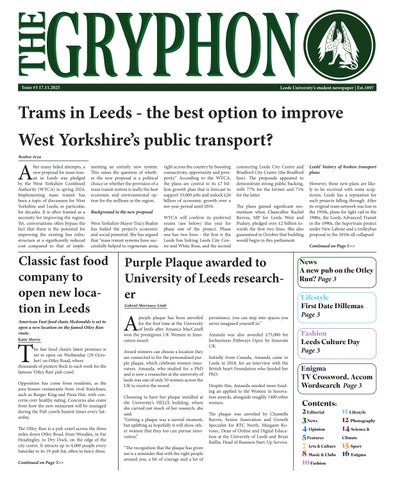
THE GRYPHON Trams in Leeds - the best option to improve West Yorkshire’s public transport?

After many failed attempts, a new proposal for mass transit in Leeds was pledged by the West Yorkshire Combined Authority (WYCA) in spring 2024. Implementing mass transit has been a topic of discussion for West Yorkshire and Leeds, in particular, for decades. It is often framed as a necessity for improving the region. Yet, conversations often bypass the fact that there is the potential for improving the existing bus infrastructure at a significantly reduced cost compared to that of imple-

menting an entirely new system. This raises the question of whether the new proposal is a political choice or whether the provision of a mass transit system is really the best economic and environmental option for the millions in the region.

Background to the new proposal

West Yorkshire Mayor Tracy Brabin has hailed the project’s economic and social potential. She has argued that “mass transit systems have successfully helped to regenerate areas

Classic fast food company to open new location in Leeds

American Fast-food chain Mcdonalds is set to open a new location on the famed Otley Run route.

The fast food chain’s latest premises is set to open on Wednesday (29 October) on Otley Road, where thousands of punters flock to each week for the famous ‘Otley Run’ pub crawl.

Opposition has come from residents, as the area houses restaurants from rival franchises, such as Burger King and Pizza Hut, with concerns over healthy eating. Concerns also come from how the new restaurant will be managed during the Pub crawls busiest times every Saturday.

The Otley Run is a pub crawl across the three miles down Otley Road, from Woodies, in Far Headingley, to Dry Dock, on the edge of the city centre. It attracts up to 4,000 people every Saturday to its 19-pub list, often in fancy dress.

Continued on Page 3>>

right across the country by boosting connectivity, opportunity and prosperity.” According to the WYCA, the plans are central to its £7 billion growth plan that is forecast to support 33,000 jobs and unlock £26 billion of economic growth over a ten-year period until 2034.

WYCA will confirm its preferred routes (see below) this year for phase one of the project. Phase one has two lines - the first is the Leeds line linking Leeds City Centre and White Rose, and the second

connecting Leeds City Centre and Bradford City Centre (the Bradford line). The proposals appeared to demonstrate strong public backing, with 77% for the former and 71% for the latter.

The plans gained significant momentum when Chancellor Rachel Reeves, MP for Leeds West and Pudsey, pledged over £2 billion towards the first two lines. She also guaranteed in October that building would begin in this parliament.

Purple Plaque awarded to University of Leeds researcher

Gabriel Morrissey-Limb

Apurple plaque has been unveiled for the first time at the University of leeds after Amanca MacCanell won the prestigious UK Women in Innovation award.

Award winners can choose a location they are connected to for the personalised purple plaque, which celebrate women innovators. Amanda, who studied for a PhD and is now a researcher at the university of leeds was one of only 50 women across the UK to receive the award.

Choosing to have her plaque installed at the University’s HELIX building, where she carried out much of her research, she said:

“Getting a plaque was a surreal moment, but uplifting as hopefully it will show other women that they too can pursue innovation,”

“The recognition that the plaque has given me is a reminder that with the right people around you, a bit of courage and a lot of

persistence, you can step into spaces you never imagined yourself in.”

Amanda was also awarded £75,000 for herbusiness Pathways Open by Innovate UK.

Initially from Canada, Amanda came to Leeds in 2018, for an interview with the British heart Foundation who funded her PhD.

Despite this, Amanda needed more funding an applied to the Women in Innovation awards, alongside roughly 1400 other women.

The plaque was unveiled by Chantelle Reeves, Senior Innovation and Growth Specialist for RTC North, Margaret Korosec, Dean of Online and Digital Education at the University of Leeds and Brian Baillie, Head of Business Start-Up Service.

Leeds’ history of broken transport plans

However, these new plans are likely to be received with some scepticism. Leeds has a reputation for such projects falling through. After its original tram network was lost in the 1950s, plans for light rail in the 1980s, the Leeds Advanced Transit in the 1990s, the Supertram project under New Labour and a trolleybus proposal in the 2010s all collapsed

Continued on Page 5>>

Reuben Arya

The Team

Editor-in-Chief

Gabriel Morrissey-Limb

Newspaper Associate Editors

Lana Conway

Momnah Shahnaz

Emma Wilkinson

Shakeal Zaman

ITM Associate Editors

Jess Cooper

Bethany Dunn

Arabella Wright

News Editors

Aliza-Kayan Ahmed

Raya Boycheva

Mishika Gupta

Zara Lake

Charlotte Prescott

Emma Wilkinson

Opinion & Features Editors

Sarah Al-Battat

Hannah Chohan

James Kendrick

Hattie Murdoch

Em O’Reily

Maja Wasielewski

Amelia Whatley

Shakeal Zaman

Sport Editors

Jake Crapper

Mina Jigau

James Morgan

Mrinalini Pretish

Science & Climate Editors

Cassia Bennett

Lucile Harvey

Anna Jackson

Rory O’Dwyer

Ruby Smith

Longoae Tembwa

Music & Clubs Editors

Daniel Brown

Millie Cain

Francesca Lynes

Arabella Wright

Arts & Culture Editors

Oleksandra Buryma

Bethany Dunn

Sophie Fowler

Jessica Hill

Jude Mcann

Rosie Nowosielski

Momnah Shahnaz

Scarlet Sheehan

Fashion Editors

Christelle Al Abbasi

Jess Cooper

Sofia Garapetian

Selma Lingemann

Amba Tilney

Lifestyle & Blogs Editors

Romilly Anderson

Alaina Charles

Raechel Duddle

Jacqueline Wong

Heads of Photography

Jiayi Du

Aidan Goddard

Charlotte Solaire

Jack Norris

Heads of Design

Erin Gascoigne-Jones

Phoebe Andre-Watson

Dear readers,

The ceaseless march of printing continues.

E d i t o r ’ s L e t t e r

Hello everyone and welcome to issue #3 of the 2025/26 run of The Gryphon! I’ve actually been away, I met my girlfriend’s parents in London of all places, I also got to see the musical adaptation of Back To The Future and the stage show of My Neighbour Totoro, which was actually a lovely graduation gift from the aforementioned girlfriend (did I mention I have one of those?)

I was also by the sea, watching the waves crashing and then slipping away really heals you. It’s a real shame it was november and the sea was freezing, but ah well, much like when I make a mistake in print; there’s always next time.

A longer issue for you this time to help battle those deadline blues; we’ve got exciting updates to our public transport, the debut of our new lifestyle column, opinions on heists, the ever green Strictly, a couple reviews and more!

I hope you enjoy this issue as much as we have!

Your always, Gabe

McDonalds opening on ‘Otley Run’ route

<<Continued from page 1

There were increased calls for Otley Run safety as counter terror police investigated the crossbow Incident that happened in April, earlier this year.

Backlash has come from MP’s and Councillors as well as residents.

When referring to the Otley Run, the Leeds Centre and Headingley MP, Alex Sobel, wrote on his website:

Wetherspoons applies for removal of Otley Run ban

JD Wetherspoons has sparked controversy over its recent application to lift the ban on serving customers on the Otley Run at the Golden Beam in Headingley.

The condition to not serve anyone on the famous pub crawl was first put into place when the pub opened in 2021, following consultation between local councillors and the chain.

The application could affect many students taking part in the Otley Run, as well as other pubgoers and residents around Headingley.

Following the temporary licences given to the chain, which gave the Golden Beam permission to serve pub crawlers on the Otley Run for five consecutive Saturdays in September and early October this year, JD Wetherspoons applied for the condition stopping it from serving Otley Run customers to be removed earlier this week.

It has denied timing this temporary permission with the start of the university year.

In response to criticism of the application, a JD Wetherspoons spokesperson said:

‘It is hoped that allowing well-behaved Otley Run participants to use the Golden Beam facilities will improve, rather than detract from, anti-social behaviour in the area.’

‘We know how disruptive this issue can be. There’s no quick fixbut progress is being made.’

Mr Sobel also said:

‘McDonald’s has a reputation for antisocial behaviour and fights, particularly during late opening hours, with many having to employ door staff. Whilst the application currently states that the restaurant will close at 11pm, the specific drinking culture would provide fertile ground for this behaviour much earlier in the day.’

In a post to Facebook in June, Councillors Abdul Hannan and

The chain previously applied to have the Otley Run ban lifted in 2024 after a similar stint of temporary permission provided for last November, however decided against it due to local backlash.

Leeds City Council stated at the time that venues may apply for up to 15 event notices per year.

As was the case last year, locals’ concern over the application, largely on the back of wider concern over anti-social behaviour tied to the Otley Run, has persisted.

One student at the University of Leeds commented on the issue, saying:

‘The Golden Beam is a large Wetherspoons pub that could easily fit many Otley Runners. However, while the space has potential for Otley Runners, it is also a popular spot for a relaxed drink and is even used by students as a study spot on weekends.’

Secondly, another student said:

‘The Wetherspoons pub would be a great addition for the Otley Run as it offers cheap drinks which contrasts the steep Saturday prices along the pub crawl. However, because of the cheap alcohol, I think the pub would become very popular and potentially overrun on a Saturday.’

Headingley and Hyde Park councillor Abdul Hannan told BBC Radio Leeds about his concerns:

‘Wetherspoons is a community pub, we hoped they would continue with that, but it looks like they are going to undo everything they promised us in 2020.’

Hannan went on to say that, ‘residents have reported assaults, fights and sexual harassment,’ and that he believed the chain used the trial runs to ‘test the waters’ on serving Otley Runners.

Hannan and fellow councillor Jonathan Pryor have also asked the local community for feedback on the application.

The councillors noted that they had received fewer than five local complaints during the five Saturdays that the Golden Beam opened to the Otley Run, but also ‘no contact from

Jonathan Pryor said:

‘The nearest residential property is only around 25 metres away, so it cannot be right that this becomes a focal point for the gathering of people post Otley Run into the early hours of the morning.’

Speaking to The Gryphon, one student said:

‘I love McDonalds and I think it’s good that one is opening in Headingley because the Kirkstall one is further away for me, but I would never go to the new one on a Saturday as I know it would be full of Otley Runners.’

When approached for a comment, a McDonald’s spokesperson said:

‘We are excited about the opportunity to open a new restaurant in Headingley, bringing significant investment and new jobs to the local area. At McDonald’s we strive to be a good neighbour in the communities in which we operate, and we look forward to working together with the local community and stakeholders to address any concerns they may have.’ w

people in support.’

Last year, Pryor said that the trial runs were timed ‘on key dates when big events are on’, and had mooted that he’d ‘imagine Wetherspoons would save one for freshers week.’

One of the concerns, however, raised at the time was that some were frequenting the pub because it was one of the few in the area that did not participate in the Otley Run.

A JD Wetherspoons spokesperson has stated that the Golden Beam has introduced measures to maintain good behaviour, claiming that the pub had CCTV throughout the premises, no music, plenty of seating and toilet facilities for increased footfall, and food available until 10pm or 11pm all week.

They added that ‘the measures used to encourage good behaviour have been included in the variation application and will form conditions on the licence if it is granted,’ and that they would ‘work with neighbours and other local stakeholders during the application’s consultation period to answer any questions they may have.’

The chain had previously been praised by councillor Jonathan Pryor for running an open public meeting in June 2024 on its plans.

There have been wider calls for more policing and control over the Otley Run, which now stretches across 19 pubs from Far Headingley through Hyde Park into the edge of Leeds city centre, in recent months.

In particular, locals’ hesitancy towards the Otley Run have grown following the arrest of a man after he attacked two other people in a crossbow attack last April.

A consultation on JD Wetherspoons’ proposal is open until Friday 21 November, meaning that students still have time to have their say on the proposal.

Image Credit: Katie Morris
Harry Ray
Image Credit: Wikimedia Commons

A new Chick-fil-A opens in Leeds

American fast food chain Chick-fil-A recently opened its first restaurant in Leeds.

Chick-fil-A opened its first restaurant in Leeds on Thursday October 23rd.

Well known for its iconic Chick-fil-A Chicken Sandwich, the chain brings a new kind of fast-food experience to Leeds. It’s all about freshly-prepared food, with their boneless chicken breasts being hand-breaded throughout the day, avoiding frozen and pre-packaged food.

Additionally, they offer their freshly squeezed lemonade, brewed ice tea and hand-spun milkshakes - all focused around providing quality and fresh ingredients.

The chain, founded in 1967 by the Cathy family, now has over 3000 restaurants across the globe, and before opening its store in Leeds it had a couple of motorway service station locations in the UK. The chain has tried to break into the UK market before, with a pop up store in Reading in 2019.

The controversy around the company entering the UK market was due to comments the then-CEO made in 2012 against same sex marriage, and apparently donationed millions of dollars to several anti-LGBTQ Christian organisations.

homophobia in a number of their chains across the US.

The company is still run by the Cathy family, but has seemingly changed course.

They have changed the focus of their donations after appointing a head of diversity in 2020.

With queues down the street for multiple days of its opening week, it seems this store might be off to a stronger start than its predecessors.

Student who have visited the new branch have said,

“The new branch offers signature chicken sandwiches and freshly squeezed lemonade. It is great to see that Leeds has been picked as the first branch in the UK for such a large brand”.

However, other Students have expressed concerns about the companies anti-LGBTQ allegations,

“Despite the company claiming to have changed its course on their LGBTQ discrimination, it is hard to completely forgive and forget the company who have caused such controversy and upset.”

However, the store shut down after 6 months following campaigns of protests and boycotts of the chain.

Reports have also found that the employees have experienced

Roger Stevens voted best city building

University landmark has been voted the city’s favourite building in the People’s

University of Leeds landmark, Roger-Stevens, has been voted the city’s favourite building in the People’s Choice Award, part of the Leeds Architecture Awards 2025.

Roger Steven is found in the heart of the campus and is home to 25 lecture theatres.

The building is well known for its busy corridors, maze-like interior and constant stream of students, with students tending to have a love it or hate attitude towards the building.

Chosen by the public from a shortlist of 10 nominations, including other landmarks in Leeds like Victoria Gate and Bridgeware Place, Roger Stevens was top of the list.

The University celebrated the news on its Facebook page writing, “Our very own concrete machine of glass slats, angles, pipes and towers is a rightful winner in our eyes.”

They highlighted its “unforgettable Brutalist quarter” designed by architects Chamberlin, Powell and Bon. Inspired by their work on the London’s Barbican Centre.

In previous research conducted by The Tab, a poll of 1,000 students showed that 26 per cent of the students said Roger

Stevens was “pretty”, compared to 64 percent who disagreed.

Students at Leeds commented on the buildings award, saying “I am surprised to hear that Roger Stevens has won best city building, but I guess it really is a unique building that stands out from other architecture around Leeds.”

Another student said:

“It wouldn’t be my favourite building in Leeds however Roger Stevens gets a lot of bad rap, however I think it has been very cleverly engineered and actually works quite well when you understand it.”

Martin Hamilton, from Leeds Civic Trust commented that the

Choice Award

building had an “elegance and sculptural quality” to it, setting it apart from other buildings throughout the city.

The University describes the building as a fusion of “1950s architectural design with contemporary infrastructure”. Hamilton also mentioned that “The building is somewhere that if you know about, you can’t fail to recognise”. A statement that many students can relate to.

Roger Stevens is named after a British academic, diplomat and civil servant, as well as vice-chancellor of the University between 1963 and 1970. The People’s Choice Award was introduced to mark the civic’s trust’s 60th anniversary and to celebrate “excellence in design” across the city.

Jennifer Wilson, Director of Campus Innovation: Masterplanning, Asset Management and Sustainability at the University, said: “The Roger Stevens Building is the centrepiece of the Chamberlin, Powell and Bon Brutalist architecture that we’re so proud of on campus, and it’s great to know it’s also cherished by the wider city community.

“We have an important role to play as custodians, and this award follows extensive restoration of the concrete on this group of listed buildings, enhancing and protecting them for the future.

“Contractors are also in the process of putting the finishing touches to the refurbished main entrance of Roger Stevens as part of our Campus Improvement Programme.”

More information on the architectural history can be found in the University’s archives.

Connor Kidd
Image credit: Connor Kidd
Image credit: University of Leeds
Zara Lake

>> Continued from Page 1

With a litany of failed projects in the city, caused by costing issues and a dearth of central support, Leeds remains the largest city in Western Europe without a mass transit system.

Dubiousness toward this proposal is likely to be compounded by the cancellation of the HS2 Northern leg, which would have connected Leeds more efficiently to other major cities across the North of England. The substitute proposal of Northern Powerhouse Rail has also suffered significant delays. The BBC reported that some Bradford residents questioned whether the plans would actually come to frui-

tion, citing these failures as a cause for concern.

Bus investment: the cheaper, greener alternative?

Some have brought into question whether a new transport system is necessary. With the road infrastructure already in place, investing in the existing bus network through expanding routes and the quantity of buses could be a more cost-efficient way of providing public transport across the region. Whilst the WYCA recognises the importance of investing in buses, with a £100 million investment recently approved for a new fleet of franchised electric buses, a

scaling up in funding would drive drastic improvements in efficiency, reliability and spatial reach. Consequently, it would tackle inequalities in access to buses and potentially provide a more affordable system if the WYCA increased the number of bus operations under public control.

The positives of a transport system centred around buses are aggregated by the environmental benefits. Transport is the largest contributing sector to greenhouse gas emissions in West Yorkshire. Consequently, investing in public transport is key to tackling this. As the WYCA hopes to make buses across all operators emission-free

by 2038, mass investment could hasten the process, at what would be a significantly reduced cost compared to investing into the tram lines. Additionally, it would avert the high upfront carbon footprint that the tram system would require.

However, once in operation trams are significantly more energy efficient than electric buses and have a greater life span of around 30 years, in comparison to electric buses of around seven years. Yet, the replacement costs for trams stand at significantly more than for electric buses. It could be argued that a tram service would be more effective than investing in buses, as

they operate on dedicated tracks, isolated from traffic, therefore providing a more reliable and punctual service that could be more attractive in shifting people away from cars.

Therefore, this brings into question whether the answer for West Yorkshire is an either/or, or a both/and. Is investment into a new mode of transport in the region merely a political choice, or does it centre on the needs of the population? With the risk of huge amounts of money being wasted and a pressing need for tackling emissions, is it worth investing in existing infrastructure and expanding buses instead?

There has to be a better option, why the left calls to university students

“Oh, so you’re poor”. These were words said to me before laughter was thrown in my face when I was at a flat mixer in my first year of university in Edinburgh in 2021 after I revealed that I was from Birmingham. It was like something out of Saltburn. I genuinely could not believe it. My time there would be short lived due to a multitude of problems; my degree, my mental health and perhaps most of all my sense of belonging, or lack of it. As someone who grew up with a single mother, 3 siblings and near the city centre I had never really experienced classism, as everyone around me was in the same boat or didn’t care about my background.

For him, it was a funny joke, for me, it was my first experience with classism. It still sits with me, it lives within my bones and I often find myself thinking about it. Why didn’t I say something? Why did I allow that condescending laugh to ring in my ears, why at the very least did I not walk away?

Instead I tried to laugh and awkwardly said “I guess?” as though that would get me into this circle that had formed around me. Of course it didn’t and I often felt like I was separate from my fellow academic colleagues during my stint in Scotland.

It wouldn’t be long until I was back on the proverbial wagon and this time in Leeds. I felt more prepared this year, Leeds, it was the North people here were different surely; 3 of my flatmates had gone to a private school, and I was shocked by the amount of people there from wealthy backgrounds baffled me, I was followed around a shop, and listened to countless people moaning about how I got max student loan and how unfair it was, despite the fact that during my first year my family was not in a financial situation to support me. My mother is a tax inspector for goodness sake.

I’d always considered myself a leftist, someone that fights for equality in any form, as white-saviour-y as that sounds. It’s what I believed in, I came to university thinking that I already knew everything there was to know and was very eager to get involved with groups that could expand this. My politics have cooled down somewhat since then, however I am very firmly on the left and large parts of that is due to my time at university. During my degree I watched a former friend of mine gradually slip further and further down the alt-right pipeline, refusing for help whilst clearly being desperate for it, he eventually came to the university and by then was strolling around in a

MAGA hat; mak ing himself somewhat of a topic of dis cussion on campus. I think that had he come to university when I did itent story.

That isn’t the point though, the rise in figures like Zack Polanski is .gue that universities are aing groundan, left

ist ideals that can never be achieved. The idea of blue- haired, non-bina ry people forcing transitions on chil dren is something that I’ve seen par rotted around. I know

that’s not the case however; it is not brainwashing by lecturers or peer pressure. It’s lived experience.

The flatmates that I mentioned were shocked at the pricing of accommodation, housing and food shops, the amount of people I knew that complained about houses that were literally falling apart, I developed a skin issue from the mould in my 3rd year house, I saw the rising prices of food and drinks in my student union, a supposed affordable haven for students. University students are drawn to the left because it’s often the first time that they have been made aware, or really experienced the reality that so many people live in, beans on toast or jacket potatoes being the only source of sustenance because you can’t afford anything else due to your landlord taking 75% of your student loan, and the rest is being spent of pints that are rapidly approaching the £6 mark. Meanwhile the rich are seemingly getting richer with more tax cuts and loopholes being exploited that either Conservatives create, or a centrist labour upkeeps. And nothing changes.

People are not being brainwashed, they are seeing the real world for the first time, and that our current politicians are not willing to change. From that perspective leftism is a very attractive prospect, wealth inequality being solved making things more affordable, landlords being held to fairer standards, and not having our money sapped away by greedy shareholders is a very attractive prospect when you’re sat there in your cold house with your 3rd beans on toast dinner of the week.

Figures like Zack Polanski aren’t attracting young people due to supposed ‘brainwashing’, rather they’re aware of the fact that things have to get better instead of worse, and that ultimately appeals to young people.

Gabriel Morrissey-Limb

Sacre Bleu! The truth behind the Louvre heist

It has become something of a cliche to say that the media is filled with nothing but bad news. Over the years there have been several explanations for this, ranging from analytics on what people are most likely to click on, to the fact that “everything is fine” isn’t really a news story. We could also look at the fact that things in general aren’t exactly in the best shape they’ve ever been, with every week bringing a new “unprecedented” development in the managed decline of the Western world. It’s exhausting to say the least. What a relief it has been, then, to have something grace our headlines that seems to harken back to simpler times when the information action ratio wasn’t plunging our society into a self-sustaining emotional crisis. It’s time to talk about whether the Louvre Robbery was what we, and maybe the Louvre, needed after all.

It is not nice to steal jewels, or anything for that matter. I don’t think that that’s a controversial statement, but I’m willing to debate anyone who thinks otherwise. All I’m saying is that out of all possible crimes it is A: the most cartoonish and B: the most impressive. Hear me out.

On the first point re: cartoonishness- what could capture the imagination more than a group of plucky outsiders taking on societal elites through deception, wit, and a hefty helping of luck? Seven of the thieves’ identi-

ties are known to police, with one reportedly still at large. The imagination runs wild. My theory is a jaded countess from a deposed noble family, growing tired of the tedium and humiliation of fading generational wealth, taking it upon herself to dive back into the belly of the beast for one last big score. Jacques, the disguise expert, lair filled with high-vis jackets and fake moustaches. Marcel with his forklift qualification and driving skills (he used to be the president’s chauffeur). The possibilities are endless. The very mention of jewel thievery is inseparable from catsuits, rooms filled with criss-crossed lasers, glasscutters, femmes fatales, and life-weary detectives gazing at rainsoaked monochrome streets through the slits in their blinds. Anything even approaching this realm of mystery and intrigue is simply fun to think about.

Then we come to the known facts of the crime itself. The Louvre robbery on the 19th of October took approximately 8 minutes, with only four of them spent inside the museum itself. Marcel wouldn’t have had time to listen to “All Too Well (Taylor’s version)” before kicking into gear and tearing untraceably back through the city to his hideout in the Loire Valley.

Or at least that’s what I imagine he did. Maybe he’s more of a Sabrina guy but that’s exactly my point- there is so much we don’t know. All we do know is that his scooter left the scene loaded with nine artifacts from the Louvre’s 16th-century Galerie d’Apollon, with one of them, the 1855 Crown of Empress Eugénie, rolling into the gutter before the escape.

Discussion of any crime should of course focus more on the victim than the perpetrator, especially when it’s as high profile as this one. The Louvre is arguably the world’s most revered and respected museum, and that apparently came with a significant degree of complacence with regards to whether anyone would be able to just walk in and fill their boots with whatever they fancied. The French union group “Union syndicale Solidaires” warned in the wake of the robbery that there had been a severe lack of security on duty at the building. This, in addition to long-standing concerns about the building itself’s porous security arrangements, suggests that there was a degree of negligence which made the

None of this is to say that the loss of such a priceless collection is the

Tales from a Student Cyclist

Last summer, independent GAP insurance provider ALA analysed the safest cities to cycle around in the UK, with Bristol topping the list. Having recently moved to Leeds, I have already had to repair my bike four times in the past three weeks. Most of that has been fixing punctured inner tubes - the result of glass scattered along the route into town from Headingley, not to mention the countless potholes that mark roads where cycle lanes simply seem to vanish.

Local resident Jamie Hood (41), who cycles daily from Headingley to his conservation job at the Royal Armouries, shares my frustrations.

“Broken glass is an absolute issue in Leeds,” he said. “You see more of it in the cycle paths after the weekend - it’s probably related to council funding and maintenance.” Hood pointed out that while the new cycle lane being installed along Otley Road is a welcome improvement, “it sometimes feels like it’s not necessarily thought through from a cyclist’s point of view, like they’ve just shoehorned it in.”

Upon moving, I was excited to see a raised bike lane being installed on Otley Road. However, this quickly

turned to disappointment when I discovered its completion date is projected to be Summer 2026. Even so, it’s a step in the right direction, a small sign that Leeds is at least trying to make cycling safer. This is quite apparent considering Leeds was deemed the “worst city in the UK for cyclists” in a study by Idealo in 2023. But my first impression is that Leeds is far behind other UK cities when it comes to bike safety, despite positive initiatives like the Bike Hub offered by the University of Leeds and Leeds Beckett, run by friendly volunteers and cycling enthusiasts.

Hood, who has also lived and cycled in London, agrees that Leeds has some catching up to do: “In London, the traffic is slower and there’s a kind of safety in numbers. The cycle network is more widespread and better thought through. In Leeds, the traffic is faster, the lanes are intermittent, and they just disappear. You can see they’re doing their best; they’re working with what they have.”

My undergraduate days were spent in Nottingham — fourth on ALA’s list — and while I generally felt safe cycling there, it often came down

to my own confidence rather than the infrastructure. Dangerous driving was a daily sight. I’d frequently see drivers shoot through red lights near the university, or pedestrians too absorbed in their phones to notice a bike heading straight towards them. Unlike in Germany, where I spent a year abroad and where bike lanes are well-maintained and treated with respect, in the UK, I’ve often felt very unseen and unsafe, even with bright bike lights, wearing eclectically coloured neon backpacks on Nottingham’s dedicated cycle lanes. Many people will simply walk in the centre of bike lanes here, with no regard for their own or anyone else’s safety.

When the lanes disappear, cyclists are forced onto the roads, where things become far more precarious. The potholes in Leeds alone are enough to keep you tense, but it’s the cars that really make you question your safety. Hood has noticed this too: “Drivers here tend to get much closer - sometimes only twenty centimetres away. You can basically reach out and touch them. That gust of wind when a car passes at speed can really affect how your bike handles.”

fault of the Louvre, and it was undoubtedly devastating to those with an interest in the late Ancien Regime and Napoleonic period of French history. However, there is historical precedent to spark cause for optimism. By far the most visited item in the Louvre’s collection is the Mona Lisa. Da Vinci’s masterpiece brings in, according to the museum, an estimated 7-8 million visitors annually. However, this was not always the case. Before 1911, the painting was mainly known only to experts, and was by no means viewed as a masterpiece in the same way as today. It was only in August that year, when former Louvre worker Vincenzo Peruggia walked out of the building with the painting slung after his arm, that it became so globally renowned. When it was finally recovered two years later, thousands queued to see the painting returned to its rightful place.

The Louvre might not have that much to worry about. It could very well be the case that they have inadvertently traded some of their less- famous items for an intrigue that will bring even more tourists flocking to their doors. The sharply dressed detectives, mysterious criminals, and speedy getaways make a far more compelling story for the items’ presence than their donation and inheritance. Perhaps there’s a lesson here for British institutions, but then again their collections have all been stolen once already. Image credit: Benh Lieu Song

Hood believes this isn’t malice but a lack of understanding. “I’ve always wondered if, as part of the driving test, people should have to spend ten minutes on a bike - even a simulation. It’s not that people are being malicious; they just don’t know what it feels like.”

Yet, cyclists are often expected to bear the burden of safety themselves - wear a helmet, high-vis, obey the rules. These are things both Hood and I already abide by, with him especially wanting to encourage safe cycling for his children. Admittedly, “It doesn’t help when cyclists run reds or act unpredictably,” he admits. “I’m not perfect either, but everyone should be considerate. We’ve got to set a good example.” However, this tends to be just a fraction of the cycling population; thus, I propose that, on top of the bike-friendly infrastructure that is slowly increasing, with help from local government investment, there needs to be a cultural shift in tone. The sense of responsibility for cyclists seems even more prominent in a city like Leeds, where car culture dominates. “People use cars more here,” Hood observes, and “road maintenance isn’t great either

- potholes can be a real danger to cyclists.”

So, the question remains: how do we make cycling safer, and more appealing in Leeds? Understanding the vulnerability of a cyclist from firsthand experience could change the tone of how we share the roads.

According to a government survey from 2019–2023, an average of two cyclists died and 80 were seriously injured each week on UK roads, with nearly half of those deaths involving a car. It’s a sobering reminder that while cycling brings freedom, fitness and joy, safety shouldn’t have to rely on luck or fluorescent clothing. On a positive note, whilst Leeds may not be the most ideal city to cycle in currently, there are plans to transition to “the Best City in the UK” by 2030. The intent is to increase the cycle network and subsequently the number of cyclists across all ages. I have faith that the council can achieve that title if it continues to prioritise pedals and pedestrians over petrol and exhausts.

What’s Happening in Sudan?

The crisis in Sudan continues to escalate, with rising levels of starvation, illness and mass violence posing serious risks to the population. It is an incredibly complex situation that requires urgent international attention and support with the conflict almost reaching three years of constant disagreements and brutality. The conflict is a violent power struggle between two military groups: the Sudanese Armed Forces (SAF) and the Rapid Support Forces (RSF). It has led to the exacerbation of the country’s ever-present political instability and humanitarian crises.

How did it start and why is the military in charge?

After decades of oppressive rule under President Omar al-Bashir (who faced accusations of numerous crimes against humanity and extensive corruption), Sudan saw a significant shift in 2019 when he was overthrown in a military coup after months of widespread civil unrest and protests. His removal then led to agreements of a transitional government, a coalition between civilian leaders and the military, to stabilize the nation and make way for democracy.

the unwillingness of the SAF and RSF to compromise and reach agreement on a ceasefire despite numerous attempts to propose measures to end the war even now. Alongside this, the European Union has applied sanctions against two companies- Alkhaleej Bank and Red Rock Mining Company- linked with the Sudan conflict in hopes of utilising its diplomatic tools to apply pressure to bodies involved.

The threat of famine and disease increases by the day, exacerbated by the total collapse of healthcare services and clean water supplies. As a result, preventable diseases such as cholera, malaria, and measles are spreading rapidly, especially in overcrowded displacement camps. Doctors and aid workers have been targeted in the attacks and the blockade of supplies has left millions in dire need of essential medicines and food supplies.

However, this coalition was incredibly short lived, with tensions escalating over the proposed integration of the RSF into the SAF - a key step in the planned transition to civilian governance. The leaders of the military groups- General Abdel Fattah al-Burhan (SAF) and General Mohamed Hamdan Dagalo, known as Hemedti (RAF) - both sought to leverage the nation’s vulnerability for their own power ambitions, leading Sudan into further chaos.

The RSF was originally founded by Bashir in effort to suppress “Southern Sudanese rebels and, most notably, to fight in the Darfur War” where the paramilitary group committed horrific attacks, ranging from sexual violence to ethnic cleansing of the non-Arab population who resided in the southern region. This then led to the division of the country and resultantly the formation of the Republic of South Sudan in 2011.

The conflict between the RSF and SAF most significantly escalated in April 2023 when members of the RSF were relocated to various parts of the country, which the military perceived as a direct threat to its authority and thus violence ensued- although it is unclear who started. The situation has since spiralled out of control with “more than 20,000 people killed and over 33,000 injured.” However, an accurate figure is hard to produce due to limited official documentation.

At Present

Since then, conflict between the military groups has continued, resulting in widespread devastation, including thousands of deaths, countless injuries and “one of the world’s largest displacement crises.” More than 12.3 million people have been forced from their homes, with many seeking refuge in neighbouring countries like Egypt, South Sudan and Libya. Others remain trapped in overcrowded and under-resourced refugee camps where conditions worsen by the day with limited medical aid and food shortages. The restricted flow of humanitarian aid into Sudan due to road blocks and security threats have added to the growing concern of food scarcity and starvation.

International organisations and diplomatic intermediaries have made some attempts to broker peace and encourage effective conflict resolution. However, these have largely failed with the Treaty of Jeddah 2023, facilitated by Saudi Arabia and the United States, unable to take shape due to

Image credit: Reuters

In February 2025, the SAF was able to make progress in the capital, Khartoum, which had been dominated by the RSF since the outbreak of conflict. After weeks of fighting, the SAF successfully gained control of Khartoum International Airport and the presidential palace in March. Many viewed this as a key turning point in the war for the SAF and potentially a sign of the nearing end of the conflict. Yet, only last week was the airport targeted in a drone attack with officials pointing this act of violence to the RSF who are retaliating against the re-opening of the airport after its restoration. This has seriously impeded movement in and out of the country as well as damaging critical infrastructure such as electricity and dams, worsening conditions for all citizens.

Alongside this, the RSF has also seized control of el-Fasher only just this week which was the “Sudanese army’s last stronghold in the vast western region of Darfur.” This comes months after continuous violent siege on the town, stripping its inhabitants of access to food, water or medical care. The RSF allegedly believe this strategic military success will solidify its position to fight for the separation of Darfur from the rest of the land. This will prove a severe impediment to the free movement of civilians with many trapped due to the perpetual fighting and now the massacring of thousands.

Humanitarian impacts

The humanitarian crisis in Sudan has reached catastrophic levels, with millions caught in the crossfire of a brutal conflict where both main parties involved cannot claim innocence, being accused of committing a series of horrific atrocities. Civilians, particularly women and children, have been subject to mass killings and sexual violence. “Organisations including UNICEF, Save the Children, Amnesty International and Human Rights Watch have recorded cases of sexual violence, with victims between 1 and 75 years.” This has sadly forced some women - in fear of their safety - to turn to committing mass suicides as a form of protection; rape in Sudan has been used as weapon of war to further suppress any resistance from civilians as the militias battle to dominate key geographical locations within the region.

Despite international condemnation and desperate appeals for intervention, both the SAF and RSF continue their battle of egos over the survival of civilians, pushing Sudan deeper into a humanitarian catastrophe with no clear end in sight.

Can it be termed a genocide?

Under the 1948 UN Genocide Convention, genocide is defined as the deliberate destruction of any specific racial, ethnic or religious groups. Some debate that the civil war in Sudan can be termed a genocide as in Darfur (specifically West Darfur) numerous reports point to ethnically targeted violence against non-Arab communities like the Masalit. In June 2023, the ICC’s chief prosecutor, Karim Khan, began a new investigation into the current violence in Darfur, citing “credible allegations of crimes that may amount to war crimes, crimes against humanity and genocide.”

However, genocide has not yet been officially declared by international bodies (such as the UN or ICC) in relation to the 2023 - 2025 Sudan conflict and is just widely referred to as a civil war in spite of the fact that this term in no way acknowledges the full of scope of civilian persecution and the involvement of influencing global powers within this. Although US Secretary of State, Antony Blinken, concluded that the recent events did evidence a case of genocide whilst days before he also dismissed the narrative that there is a genocide simultaneously occuring in Gaza.

Is there an end in sight?

It is difficult to say whether this atrocity will come to a close at the current moment with broader implications for peace remaining uncertain as evident with the ongoing fighting affecting civilian populations and the RSF’s unyielding dominance in other regions of Sudan. What further complicates this conflict is the fact that any attempts to de-escalate and reach some form of ceasefire continue to be undermined by both the militias unwillingness to compromise but also the pervasive involvement of certain states in aiding and abetting the RSF’s growth to power. Global actors who are backing the paramilitary group are seeking to exploit Sudan’s rich supply of gold mines, vast agricultural land that could be used for farming as compared to other African countries and most importantly Sudan’s key trade routes. It would also allow them to broaden their geopolitical influence should the RSF continue to dominate and eventually rule over Sudan. This has been seen in previous instances with cases such as Yemen where the UAE supported local militias and influenced regional politics.

This makes it of paramount importance to end the current international complicity by raising awareness of the horrific events occurring currently in Sudan and demand action to allow for humanitarian access as well as effective progression towards a ceasefire, particularly in a situation that is more fitting of being termed a proxy war.

The Transatlantic Tug of War: What Strictly Come Dancing tells us about US-UK relations

Like many my age on the famed social media hellholesorry, platform- of TikTok, I’ve been somewhat following the weekly highlights and dumpings on Dancing with the Stars - and no, not just because of Robert Irwin. Possibly more embarrassing, I was a fangirl of the major cultural phenomenon known as ‘The Secret Lives of Mormon Wives’. I’m not the only one following the goings-on in the ballroom - my housemate watches videos of the dances while eating dinner, shouting out her own scores as if they can somehow be received through a screen. But the cultural pre-eminence of the ballroom dancing show got me thinking about our humble British Counterpart- Strictly Come Dancing. I have such cosy core memories of seven-year-old me’s only concern on a Saturday being home in time to see what dresses the pretty ladies would be wearing. But I haven’t been tuning in these past few years. I don’t recognize the celebrities and frankly have better things to do on a Saturday night. This does make me a little sad; nostalgia is a vice. But the disparity between two iterations of the same concept, separated only by an ocean, is to me emblematic of a bigger issue.

The world is obsessed with America. Politically, I get it-it’s hard to look away from a trainwreck, and we should be aware of the goings-on of arguably the global superpower. Elections are closely followed, and more Brits know more about the occupants of the White House than those in charge of the EU. I mean, do you know who the president of the European Commission is? But culturally, this obsession may be less warranted. America seems to always be a step up from our tiny island. This is in no way me disparaging British media- we have some of the best musical artists in the world, and I personally believe that British comedy is second to none. A call to my mum back in London is almost always accompanied by the faint sounds of Downton Abbey on the TV in the background. But let’s turn back to the ballroom- a dancing show has managed to retain relevance in America in a way that has evaded us over here. Just a few weeks ago, iconic longtime presenters Tess Daly and Claudia Winkleman announced their departure from the show. Of course, careers shift and grow and this should in no way be so shocking to me, but its particularly striking when I think about Claudia’s success on The Traitors, a show with a global fanbase. Dancing with the Stars is bigger than ever, though, with social media star Alix Earle and Fifth Harmony singer Lauren Jaregui amongst this years contestants.

the British Royal Family. As their highly publicised conflict made clear, a significant factor for this departure was friction of traditional upper-class British rules clashing with Markle, a Black woman with a career in the public eye.

The obsession goes further than that, though. Many Brits view and discuss the United States as a monolith, this massive cultural entity that wears a cowboy hat, voted for Trump, and goes nowhere without an AK47 strapped to its side. One of my housemates visited Florida over the summer, and she brings it up often. They way Americans do this and have that. Earlier today, she mentioned how Amer- icans have a

makes me sad- how can it truly be justified to reduce a country to its darkest moments and most cartoonish stereotypes in order to make a comparison more favourable. How can a land of 240 million residents be simplified to the key characteristics of obesity and gun violence?

It’s all very well analysing this phenomenon with the academic rigor I should be putting into my Modern Literature assessment, but I arrive now at a crossroads. I worry that campaigning for a return to British culture comes off the wrong way when I see the headlines telling people to go back where they came from. The more pressing issue is that our idea of culture, identity, and nationhood has been totally eroded as America becomes a global nation. Due to the investment in and quality of American media, it simply has a wider reach than that of other countries and as such is perfectly poised to transmit idealised suburbanite fantasies of the USA globally. We grew up with the images of basketball hoops in driveways and hanging out under the bleachers- thanks to Taylor Swift for that one. And don’t even get me started on the quintessential American college experience- I find myself mindlessly dreaming of rushing Alpha Beta Phi (made-up name, don’t sue me) on a grey Tuesday morning while I watch a drug deal go wrong from my Hyde Park bedroom window.

tool for breaking up ground meet in a pan, and I had to wonder if that truly was something that only existed in America. Another friend, after holidaying in Cancun, wouldn’t stop complaining about the number of Americans there- ‘They’re just all so obese and rude! You know how Americans are!’.

Yes, I do know how Americans are.

There is a historic tradition of celebrities, despite making their debuts in the British indie scene, turning to the US once their career prospects have expanded. Daniel Kaluuya, despite being from Camden, an area I would tentatively and hopefully unpretentiously refer to as a cultural hotspot, relocated to LA for greater opportunities following the commercial success that was Get Out. Or there’s James Corden, who captured hearts as the loveable goof Smithy in Gavin and Stacey, but unlike his co-stars from the cult show, rarely makes an appearance on our screens anymore. This career move is interesting to me as his entire brand seems so specifically suited to a British audience. His humour, style, and aesthetic sensibilities scream England in a way that reminds me of the early 2000s sitcoms I grew up with. He couldn’t be a Hollywood heartthrob but would fit right in an episode of Outnumbered. Perhaps most culturally significant, Prince Harry and Meghan Marke moved to California after leaving

I suppose I should admit that I have a funny sort of soft spot for the states- I spent two summers as a camp counsellor on Long Island and as such some of my best friends currently live in America. This makes me a little protective of the world I got to be a part of briefly- a world of CVS runs and nights on the beach and frozen yoghurt trips on a Friday night. And yes of course you could say that this is another symptom of consumerism, and I wouldn’t really know what to say in response. It’s a fraught time right now- globally, nationally, and regionally. I wonder if we turn to comparison to make ourselves feel better in the most fragile times. The grass really is always greener. Americans also serve as a bit of a laughing

stock- references to their crises with obesity and gun violence are a bit too commonplace in our ‘humour’. But then that just

The obsession becomes more understandable though, and the cause is culture. When American popular culture has been transmitted so globally and so intensely over the last century or so, it loses its position as a nation and instead becomes a cultural monolith, with its individual states, regions, and subgroups losing their agency to be seen only as a tiny component of the corporate consumerist colossus. The cure is then culture, as well. In order to break free of this incessant comparison, we need to prioritise our local, communal culture. Watching movies and reading books set in smaller towns, focusing on real issues and real people, will always be more culturally enriching than a Hollywood blockbuster. More than that, you get to learn something as well. This is in no way me saying we need to Back the British, just that we need to be more selective in the media consume as it’s not just about entertainment anymore.

I suppose when I say I miss Strictly, what I’m really missing is the simplicity of being seven years old and believing culture was something shared on a Saturday night, that it was people I might have seen in Sainsbury’s that weekend talking about their rise to fame on Eastenders. As an only child of immigrants, there was a lot of cultural exposure I feel like I just skipped out on- my Croatian mum saw no merit in a child watching Eastenders or the X-Factor, but Strictly was something we could all watch together. It was something I could talk about in school on Monday and finally feel part of the conversation. The world is bigger, more interconnected, and harder to define as an adult. I have access to almost infinite media and it is overwhelming- I return to Friday Night Dinner on my laptop while I study and rereading the books I adored as a child. Maybe next week I’ll watch Strictly then.

Only if I have nothing better to do.

Image credit: WikiMedia Commons

Issue #3 - 17/11/2025

LIFF is back:

there’s something with your boss? Something… off?

Following last year’s Kinds of Kindness, Yorgos Lanthimos’ latest fever dream, Bugonia, caron his streak of certing and idiosynties. Jesse Plemons stars as Teddy Gatz, an un- hinged conspiracy theory fanatic who seemingly bears the burden of saving the world from aliens. His solution? Kidnapping and interrogating pharmaceutical CEO (and suspected extra-terrestrial) Michelle Fuller, played by an ever excellent Emma Stone. An English-language remake of the comically absurd South Korean genre-mashup ‘Save the Green Planet’, Bugonia closely follows its source material in terms of plot and structure, but rightfully justifies its existence through its unsettling approach, thanks to the masterful cinematography and the explosive performances of Plemons and Stone.

Lanthimos's clinical visual style works perfectly with the absurd premise to convey tension and unease. Cinematographer Robbie Ryan largely captures the psychological warfare between Stone and Plemons’ characters through uncomfortably tight close-ups, creating an intimate, unnerving atmosphere. Camera movements feel deliberate and purposeful, relying on tracking shots to create a detached feel. Scenes like the instigating kidnapping have a chaotic energy while still feeling visually clinical, creating the uncanny feeling that Lanthimos very much excels at. Largely captured on VistaVision (a resurging format recently used on One Battle After Another), Bugonia is truly gorgeous to look at, with evocative and powerful imagery to boot.

Plemons gives a career-best performance as beekeeper Teddy Gatz. In a script full of nonsensical, conspiracy-filled remarks, Plemons delivers each line with heavy conviction and sincerity. To his susceptible cousin Don (played by newcomer Aidan Delbis), he confides in a soothing and reassuring tone, akin to a washed-up cult leader. To Michelle, he charges with determination and misguided persistence. Plemons embodies fanatic urgency incredibly well, radiating the same unpredictable energy from his role in 2024’s Civil War. Stone shines opposite Plemons as the cold and clinical Fuller, holding her own in a battle of wits. During her time as CEO, each line and action feels premeditated and engineered to be as put-together as possible. When the film descends into chaos after she is kidnapped, however, watching Stone balance between fright and maintaining her professional front as a form of survival is fascinating.

Gone are the wacky, Looney Tunes-esque elements of Save the Green Planet. Instead, screenwriter Will Tracy focuses on the uneasy tone of the

premise and fleshing out its characters. Teddy clearly has the short end of the stick, having been misled after searching for the right path in life (he remarks that he has done his own research, bouncing from forum to forum and from one political extreme to another, eventually focusing on the existence of aliens). His companion Don - his only friend - doesn’t seem to have the same vigour for world-saving as he does - yet Don complies with his deranged requests (after all, it wouldn’t be a Lanthimos film without an exploration of power dynamics and social manipulation). Opposing them, Michelle comes off as an alien, although not in a traditional sense; she’s out of touch with her employees, cold and calculating, with her eyes only set on success and nothing else. She’s smart, cunning, and above all, witty enough to hold her own after being kidnapped. In line with his previous works, Lanthimos doesn’t shy away from discomfort when exploring power dynamics; a scene in which Michelle gets experimented on with electricity is distressing, focusing on Michelle’s off-screen, blood-curdling screams. At times, the film feels hopeless, nihilistic, and hard to watch, especially during a specific montage. Lanthimos’ pessimistic view of humanity and his unflinching depictions of suffering can be hit-or-miss for many. In this case, Michelle’s resilience and perseverance are enough to keep the audience hooked.

Bugonia shines at its brightest when it serves as a thriller, intertwining psychological warfare with its gorgeous, clinical visuals. Lanthimos’ style and sensibilities thrive on the absurd premise, and while it doesn’t match the sheer emotional breadth of its source material, it doesn’t try to for the benefit of itself. Still, Bugonia is a worthy remake of Save the Green Planet, and if you have the time, I highly recommend both.

‘La Grazia’: a commentary on the limitless bounds of love and grief

La Grazia tenderly captures the price that we pay for love through a series of ennui-stricken short scenes strung together through the underlying themes of grief, regret and acceptance. I was initially expecting a commentary on Italian politics with a side of stand ard familial discourse at the hands of the inability to decide on passing a euthanasia bill; though this biopic style film instead discusses the duality of humanity, the tragedy of the fragility of life and the ever philosophi cal question of ‘Who owns our days?’.

Mariano De Santis carries along the weight of griev ing his late wife Aurora whilst simultaneously grappling with the intensity of Italian Presidency. The tumultuous nature of leading a country, passing controversial leg islation and pardoning convicted criminals all in the least-biased, most-fulfilling possible way proves both challenging and rewarding. Whilst De Santis struggles with physical manifestations of becoming a widowerflashbacks, poor sleep and a lack of appetite to name a few - he manages to find peace and grace through his grief and ultimately reconciles somewhat turbulent relationships with both of his children.

The portrayal of grief in this film is truly beautiful - it delicately captures the never-ending cycle of loss and regret. Mariano experiences frequent flashbacks of the same, tranquil scene of Aurora walking along the horizon through the fog, surrounded by trees through out the entirety of the film, though this most frequently occurs during his sole cigarette of the day. The reflec tions of life after experiencing death are both accu rate and extremely interesting when considering the length that has passed since Aurora has died. Mari ano’s inability to sign over the euthanaisa bill before understanding the freeing nature of death - both for the dead and sometimes the living - importantly aids the understanding that by the close of the film, he has come to a level of somewhat acceptance of one of the meanings of arguably the most multifaceted concept we experience: death. Some may view Mariano keeping Elvis - his horse - alive to die from natural causes, rather than putting him down despite his clear suffering, as selfish. Though it seems that this instead stimu-

specifically with Isa Rocca and Cristiano Arpa’s cases - of the moral questioning of euthanasia in a slightly different context. Both of these characters choose to murder their partners to ‘end their suffering’ and find themselves imprisoned as a result, though understanding and differentiating the two separate situations is imperative when understanding why Mariano chose to pardon Rocca but not Arpa. Isa Rocca faced con-

sistent, daily abuse at the hands of her husband; Isa Rocca seemed to believe that the only way to free him from this disease was death which in turn also freed her, coming back to this idea that death can in some cases be freeing for the living. Mariano later discusses his choice to pardon her crime to his children who cannot quite grasp her decisions.This truly presents to the audience the deep understanding that Mariano has come to have on the connection between love, death, grief and freedom on all fronts.

The link between sleep and death is also further explored throughout - Mariano hasn’t had a single dream since the death of Aurora and has difficulty sleeping. Both of these are real experiences following the death of a loved one and the exploration of this further continues to humanise Mariano De Santis as a struggling, grieving man rather than a cold-hearted, stern political figure. Personally, I see this humanisation as both powerful and necessary as death does make us hyper-aware of our own mortality. The continuation of his physical detriments and his inability to ‘let go’ of information, belongings and beliefs about his late wife forty years after her death truly resonates with an audience who have likely experienced loss. Regardless of the time that has passed, grief lingers.

La Grazia was not at all what I was expecting, though I am grateful for this. I am grateful to have witnessed the waves of grief through Mariano’s eyes and watch his character develop from an irritable, indecisive and sleuthy politician trying to find the truth behind his wife’s affair to a softer, warmer figure capable of choosing to help end some people’s suffering through death despite experiencing his own trauma of loss and grief.

lates his understanding of true agony and despair and

Some of my favourite music (I hate to admit it) I stole from my parents. Growing up, I would longingly stare at their CD collection, plotting which ones I would steal and take with me when I eventually went away to university. For anyone wondering, I was largely unsuccessful in my plan, coming away with maybe 5 of the original 40 I had had my eye on. One of the CDs that my parents wouldn’t part with was Dodgy’s 1996 album Free Peace Sweet. They had played it for me maybe once or twice when I was younger and although I hadn’t heard it enough to make a good argument for why I should have it (believe me, I did try), it was an album that I was curious about and thought would be a perfect addition to my own collection. So, when I found it in a charity shop during my first month of uni, I was overjoyed and quickly brought it home. Dodgy are a Britpop band from London who have been releasing music since the 1990s, with some of their most popular songs being ‘Good Enough’ from Free Peace Sweet (1996) and ‘Staying Out For The Summer’. In September of this year, they released a new single titled ‘Hello Beautiful’, marking their first new music in nearly 10 years. After all this time away, the band returned with a UK tour ahead of their new album release in May 2026. Their Leeds show was at the Wardrobe, which is another venue that I have now ticked off my list. I’m a sucker for a disco ball, so I was easily won over by the space. Unlike most gig venues where the standing area is just that - a standing area - the Wardrobe has steps down into the pit where you can fully immerse yourself in the music. There are also some seated areas around the sides that still offer a great view of the stage. I have to admit, the average age of the audience was a bit older, but that’s not to say that people weren’t giving it their all, dancing and having the best time. It was really lovely, at some points throughout the gig, to just stand back and watch people relive their youth and sing their hearts out. Another positive of an older crowd is their gig etiquette. I find that it’s becoming increasingly

rare for people at concerts to respect your personal space and/or not chuck their pints all down your back (not my fondest of gig memories). Either that, or I’m just becoming the kind of gig snob that I would have rolled my eyes at when I was 16. Anyway, as I was at this show by myself, I was grateful for the more relaxed ambience. Walking on stage to ‘Bella Ciao’, Dodgy invited the audience to sing, laugh and dance with them. Throughout their set, they showcased their beautiful musicianship and curated sound. Their multipart harmonies sounded as if they came naturally to them, and the music geek and retired trumpet player in me was particularly excited when I caught a glimpse of a trombone. Personally, I love it when bands use instruments outside of the classic drums-bassguitar-combo; I find it really refreshing and it makes the music so much more interesting. I could feel myself grinning when a harmonica appeared out of nowhere for one of the songs. The setlist was a wonderful mix of their ‘90s classics as well as some material from their new album, which is due for release next May. Some songs to mention were ‘Hello Beautiful’ and ‘Summer Forever’ - I will be looking out for them next summer! The band’s banter with the audience was also worth noting. Having been in the business for as long as they have, you could tell how comfortable they were on stage, casually cracking jokes and making small talk with the crowd while waiting for technical issues to be fixed. Throughout the show, I got a real sense of nostalgia and togetherness. While I may not have been listening to Dodgy during their popularity in the ‘90s, the love and support for them radiating from the people around me was undeniable. It makes me smile to think that there may have been some people there who attended Dodgy’s first few shows, and now here they are again, listening to the same (and new!) music that they have loved since they were my age. I look forward to their album release next summer and seeing how they have evolved and grown over the years.

HARD LIFE? NOT TONIGHT

““Leedsss! We are so. Fucking. Back!” Hard Life frontman Murray Matravers screamed into the mic as he ran onto stage last week at their first Onion (2025) album tour show in Leeds. This band is back and arguably bigger than ever before. From public lawsuits to name changes to personal losses, they’ve had an undeniably tough year, but their show at O2 Academy proved that they are ready to be back under the limelight. Honestly I’m not sure who’s more excited about it - the band themselves, or their devoted fans.

This show was nothing short of incredible. The room was filled with an understanding between the band members and the crowd as a community of people who had all pulled away from reality to enjoy a few hours of feel-good music together. Matravers set a tone of spontaneity after the first few songs: “We have had the craziest day. We’ve been listening to our favourite songs, we’ve been getting gassed, we’ve been getting fucked up... and now we’re out here!”, closely followed by “I’m drunk as shit, I hope that’s okay”. He certainly mirrored the energy of the crowd, who also seemed to be equally as happy, tipsy and ready to step into the magic of Hard Life’s melodies for a while. The constant appreciation for their fans echoed the room between each song. “We thought about quitting over and over again, but we couldn’t because you guys are so out there, and I see you and I love you!”

The array of excitement and appreciation didn’t stop there, as it ran through the entire concert and produced an atmosphere of love (sorry to sound cheesy, but it’s true). Their opening act Woody set a perfect tone of groovy rhythm for Hard Life before they had even begun. The singer emphasised their newfound appreciation for upcoming artists, and it’s clear that they don’t need to chase the big lights: “When we first started, it was about who could put bums on seats and who could sell tickets, but with Woody, I just love Woody so much I think he is incredible”. They stuck to their roots and have continued their love for brand

new sounds with their supporting artist, but also within their new album Onion (2025). The sound of their new record has proven to stay true to their original sound, fusing together elements of Kendrick Lamar’s honest lyrics alongside the likes of the dreamy melodies of Frank Ocean.

Halfway through the set, the singer toned it down a little to play a more stripped-back song with just him and his piano: “My voice is fucked and I’m way too drunk to play the piano but we’re gonna do it anyway!” Despite the frontman’s honesty, his voice was nowhere near “fucked”, and the song ‘Y3llow Bike’ gained an appreciative roar from the crowd. Although the song had a much slower feel, it was nice to sit back and relax for a few minutes amidst the chaos of the other songs in the set. There were a few technical difficulties with the piano to begin with, but it did not take away from the atmosphere of the room, and if anything, helped to shed light on his love for his crew. “We haven’t played a show in three years, a lot of shit has happened in that time. This band and our crew are like a big, happy, dysfunctional family. To be back doing this means the world to us, so thank you so much”.

Following up from this intimate moment, the band used it as a raw emotional moment to highlight their charity donation stand for LOROS Hospice that they had set up next to the merch stall. The band’s guitarist, Lewis Alexander Berry, was revealed to have suffered the loss of his father the week before their show to a 30-year-long battle with

cancer, and the band spoke out about their support of their friend and bandmate. They managed to fill the room with a sense of hope despite the sad news, and it created a new understanding between them and us in the crowd. It made the show feel that bit more special, as Berry had turned up for his fans even with his situation. The drummer, Oliver Cassidy, explained, “The fact that Lew is right here on stage is why the fuck we’re family. He’s doing this for his dad”, and that pretty much sums up the band’s message of coming together through tough times.

After a heartfelt connection with the crowd, they brought back the energy with one of their most well-known songs ‘Skeletons’. “Open it up bigger, bigger!” Matravers yelled as the dance floor erupted into a mosh pit pulsing with sweat, sound, and pure release. “It’s been a long time coming. When the beat drops, look after each other, but also enjoy yourselves.” As if this moment couldn’t get any more spectacular, the drummer launched himself into the audience and crowd-surfed across the sea of fans. The singer joined in on the famous Yorkshire chant and declared, “No where does it like Yorkshire, let me tell ya!” The night concluded with their iconic and most memorable song ‘Nightmares’, before surprising everyone with a separate final verse from a song that wasn’t even on the setlist as a beautiful surprise. It was a raw, unscripted farewell that left the crowd buzzing as the lights dimmed and they departed with a simple peace sign. After three years of silence, Hard Life’s return wasn’t just a comeback; it was a celebration of survival, love, and the unbreakable bond between the band and their fans. I have no doubt that their future shows will encapsulate the same thrilling experience.

Words by Katie Hawkins
Photography by Janis Law

A Review of Vogue World Hollywood – A Cinematic Celebration of Fashion

Vogue World is back! This time in sunny Hollywood, Los An geles. Vogue World: Hollywood celebrates the rich relationship between fashion and film, exploring the most inspiring characters in cinema history. The show was a beautiful homage to Hol lywood’s iconic films and actors, featuring archival pieces and movie costumes in the backdrop of the fa mous Paramount Stu dios lot, which served as a backdrop for films such as Break fast at Tiffany’s and The Godfather.

As models and A-listers dressed in couture, cus tom looks and costumes min gled with antic ipation, Vogue World kicked off with Mou lin Rouge star Nicole Kidman with a show-stopping rendition of “Put the Blame on Mame” from the 1946 Rita Hayworth film Gilda. Kidman strutted down the studio lot runway in a custom black draped bustier dress by Chanel’ Matthieu Blazy, a tribute to Hayworth’s original look. Supermodel Kendall Jenner followed suit as the showgirl, wearing Kidman’s original Moulin Rouge costume from 2001 adorned with diamonds and tassels.

egades, featuring Gabbriette in Schiaparelli, Kodi Smith-McPhee as the Mad Hatter, and Anok Yai as Edward Scissorhands. Remodelled by Colleen Atwood, Yai embodied the character from the 1990 film by Tim Burton, even giving Gabbriette a makeshift haircut. The look was then followed by Louisa Jacobson who took on a particular mantle in custom Mc Queen by Seán McGirr, including many of the straps, buckles and shredded textures of the original.

Make way for act three, Ju lia Garner dazzles as Kristen Dunst’s Marie Antoinette from the Sofia Coppola cult classic. Running down the catwalk to Joan Jett’s Bad Reputa tion, the garment by Milena Canonero paid tribute to one of the 60 plus costumes from the 2006 film. Followed by an array of pastries, actors LaKeith Stanfield and Gre ta Lee elegantly followed in

tioning to “That’s so True”. Accompanying the singer, model Cara Delevingne in custom Snake Print Marc Jacobs, and many models sporting costumes inspired from films such as Once Upon a Time in Hollywood, Atonement, Walk the Line, Grease and A Complete Unknown. Alex Consani in Valentino closed act four with a couture look, made up of cream blouse and bloomers with an oversize ruff col-

A star-studded cast paved the way for Afrofuturism. Danai Gurira and Teyana Taylor opened as Black Panther’s women warriors Dora Milaje. Surrounded by vibrant music and colour, the collection was a beautiful celebration; from Damson Idris in Dries Van Noten, Yahya Abdul-Mateen II in an original zoot suit from Malcolm X; with Angela Bassett exuding majestic power as Queen Ramonda.

Cue act two full of smoke machines and ren-

There was an emotional tribute to Annie Hall, following the industry’s recent loss of Diane Keaton. Model Betsy Gaghan nodded to one of the most favoured looks from the 1977 rom-com Annie Hall, in full Ralph Lauren, as Keaton’s voice travelled the catwalk, singing Carmen Lombardo and John Jacob Loeb’s “Seems like old times”. Numerous film characters such as Clueless’ Cher and Dionne walk past Gaghan in the heartfelt moment.

Our first performance of the night came from none other than Gracie Abrams. The musician kicked off act four with a rendition of Carole King’s “I Feel the Earth Move” before transi-

The grand finale featured a gorgeous rendition of costumes from Dune, including Jessica Furguson’s hooded dress, worn by Bianca Balti, which her character wears upon arrival to the desert planet Arrakis. Then arrived the glamorous Doja Cat with a performance of her hit single “gorgeous”, spawning a custom chainmail mini dress by costume designer Michael Schmidt, drawing inspiration from Tina Turner 1985 Mad Max Beyond Thunderdome.

Vogue World 2025 was more than a fashion spectacle; it was a tribute to Hollywood’s cultural legacy. The show was a beautiful, diverse showcase celebrating not only fashion’s elite, but also the rich tapestry of identities that

Image Credit: Wikimedia Commons

Leeds Culture Day 2025: Embracing Diversity, Fashion and Identity

O

n 24 October 2025, I had the honour of attending the official Leeds Culture Day event, hosted by Leeds ACS (African-Caribbean Society), Leeds Law Society, and various other student organisations. The day was a true celebration of cultural richness, highlighting the diversity within the student body and the wider Leeds community. Through locally sourced Jamaican food, an eclectic mix of music from around the world, and a powerful talk on Caribbean culture, the event was a testament to the beauty of multiculturalism.

However, the standout moment of the day was the fashion show, where attendees showcased their vibrant, culturally significant attire. Those who wore cultural dress had the chance to walk the halls of Liberty, celebrating their heritage and proudly representing their nations. The overwhelming support for cultural expression was a moving reminder of the living, breathing nature of multiculturalism in the UK.

While the focus on cultural fashion was a highlight, the event also sparked a critical conversation about the complexities surrounding cultural attire in the modern world. Specifically, the question arose: How does one balance the pejorative views of their culture with their identity as a person of colour?

The Challenges of Cultural Clothing

A recurring theme throughout the event was the tension many individuals face when it comes to wearing cultural clothing. In many societies, especially in the West, cultural attire is often viewed through a lens of exoticism and performance, reserved for special occasions or events like Culture Day, rather than seen as an everyday form of self-expression. Our own students delved into this issue, reflecting on how they navigate the delicate balance between embracing their cultural clothing and confronting the often-skewed portrayal of their culture in the media. Media plays a crucial role in shaping public perception, and for many, television and film are their primary means of exposure to cultures that are different from their own.

ibbean people and their traditions have been on the rise, distorting the rich, diverse heritage that these garments represent. These inaccuracies in media portrayal not only misrepresent the culture but also undermine its deep-rooted significance.

The Power of Fashion as a Form of Protest

The event also explored the difficult but important conversations around how cultural clothing is often seen as a form of protest against the pressures to conform to Western norms. Several participants, like Rogesha and Rihanna, expressed how cultural attire serves as a powerful symbol of defiance

The Rebranding of South Asian Clothing Zara, another participant in the event, discussed how South Asian clothing, once thought of as cumbersome or “uncomfortable” by mainstream society, is being rebranded as a symbol of empowerment. “For so long, our clothing was associated with discomfort and submission. But now, it’s becoming something that represents femininity, strength, and self-expression,” Zara noted. She spoke to the growing recognition of South Asian fashion in global trends, praising the shift toward celebrating its intricate designs and empowering narratives.

Somali Fashion: An Overlooked Heritage Nafisa also took the stage, speaking about the role Somali clothing plays in modern fashion. One student described the traditional elements of Somali attire, noting that, while Somali culture has contributed greatly to global fashion trends, it is often underappreciated and overshadowed in contemporary fashion discussions. “Somali clothing is not just about style; it’s about identity and history,” they said. It’s an incredible disservice that a culture that has shaped so many fashion innovations is not given its due credit.

A Personal Reflection on Cultural Clothing

Sana, President of the ACS, shared her personal views on the significance of cultural dress in the media. She discussed the oversexualisation of Caribbean attire, particularly from her home country of Barbados. “I think in Media sometimes when people look specifically at Caribbean culture it can be oversexualised”, she said. “When people show up even in t-shirts and flags, it shows a different perspective on cultural attire.”Caribbean culture, in particular, has often been subjected to pejoration in the UK. Stereotypes and fetishisation of Car-

against the narrative that asks people of colour to “tone down” their identity to fit into a mainstream, homogenous view of beauty and modesty. For example, Ibrahim highlighted how societal pressure often forces people of colour to downplay their culture and heritage. “There’s this expectation to be less, to blend in,” he said, reflecting on how this pressure to assimilate can sometimes be internalised. “But now, there’s a rise in more positive portrayals of diverse cultures, especially in the media, and that’s something to celebrate.”

However, Ibrahim also stressed the importance of avoiding the trap of superficial, one-dimensional portrayals of culture. “There’s a need for more individualised representation,” he said, referencing the complex, varied experiences of people from countries like Bangladesh. “It’s kind of like wearing your heart on your sleeve, it shows pride… it shows you’re ready for more complex conversations about culture to take place.”

A self-interview and reflection of my identity and its link to cultural clothing revealed a lot for me. The truth is, I used to feel like I was doing too much. I felt too loud in my Kente print, almost as if I had to be smaller to fit in. Cultural clothing used to give me pride, and I used to wear it with confidence. But as I grew older, I began to feel almost ashamed, like I had to shrink to avoid being perceived as ‘too fresh’ or ‘too much.’ But Culture Day had a liberating effect on me, as it did for many others. Culture is loud, big, and beautiful. There is space for us to march the streets in attire that makes us feel strong and connected to our nations and communities. And even if there isn’t space, we can make space.

A Moving Conclusion

Leeds Culture Day 2025 was a powerful reminder of the importance of embracing and celebrating our cultural identities, both individually and collectively. It highlighted the diverse ways in which students are redefining what it means to be proud of their heritage, to express themselves through their clothing, and to challenge societal norms. The event demonstrated that cultural attire is not just for special occasions but is a vital part of how we express who we are, where we come from, and where we’re going.

Words by Abena Assiah
Image Credit: Pixabay

Settling the Age-Old Etiquette

Question: Who Should Pay on the First Date?

Picture this: you’re at a candle-lit dinner date and things are going really well. There’s flirting, laughing, and the eye-contact is lingering just a little bit too long. Half of you is sad the date is nearly over, and the other half is just glad they weren’t an axe-murderer-in-disguise on a dating app.

Then, the waiter comes over with the cheque. Suddenly, the curious, playful eye contact becomes confused as you both fuss over who should cover the bill. If this has ever been you, you’ve come to the right place. Let’s settle this once and for all.

Firstly, it’s important to reflect on why this debate matters at all. For some, it’s simply nothing to read into, and for others, it’s hard not to over-analyse the early establishment of a power dynamic. When one person pays for the date, it can create a strings-attached kind of transaction where the payer expects something in return.

On the other hand, how the bill is settled on the first date can also be an evaluation of its success as the person who is paying is showing their commitment to the other person.

With all this in mind, what is the right answer?

Split the bill

This is a great option for anyone who doesn’t want to feel indebted to somebody or is confident in their independence. It creates an even playing field where nobody feels taken advantage of and everyone feels mutually respected. That said, it is also a nice, fair way to call it a day if you don’t envision any more outings with this person; after all, there’s nothing worse than being denied a second date and having to pick up the entire bill!

The initiator pays

According to the eti- quette guide of Emily Post, “for a first date at least, the person who asks should pay unless both parties agree in advance to share expenses.” This approach works well when you aren’t sure of the other person’s income, or they propose and insist upon a date far beyond your budget.

Offer anyway

If the person you’re with simply won’t let you chip in and you’re comfortable with letting them pay, then that’s completely allowed! It doesn’t make you a bad feminist or a gold digger, just the recipient of a kind gesture. However, there is a golden rule: only accept if you are certain that you want another date

with the person and if so, it will be your turn to cover the next one.

Ultimately, these are the most viable options that apply to a range of relationships, despite the usual heterosexual focus of this debate. Although men would historically pay for the woman they were courting, this was only because women were not allowed an income of their own and had no choice but to rely on the man to pay. Considering this, how does ‘letting the man pay’ translate into the modern age when dating apps and less rigid gender norms mean that anyone can ask someone out?

So, to put an end to this long-contested question, who should pay on the first date? Well, always show up to a date prepared to pay your fair share rather than assuming the other person will cover the entire expense. If someone is persisting to pay anyway, let them after double, triple, quadruple checking. However, it’s important that you insist on paying for the next one to make your interest clear and show that you aren’t taking advantage. Crucially, the date should be more about the experience than the financing, but for those who really cannot shake off the overthinking...

rock, paper, scissors!

Main Character Syndrome: Are You really Having Fun?

Haven’t we all thought at some point that we’re giving “main character energy”? Maybe you were on the table dancing at the club, or sat on a bench reading a book alone, seeing it as an aesthetically cinematic moment. Main Character Syndrome describes a person who sees these moments and immediately deems them “main character moments” in the film of their own life.

Now, there’s nothing wrong with romanticising the moments of your life – finding appreciation in the small things is a way of making life more special. Yet, what are the effects of viewing yourself as the protagonist in every scene? Does thinking of yourself like this rob you of genuine experiences?

comparison. If we were to see somebody else having their spotlight, would we, as the Main Character, be able to feel the joy from simply sharing that experience? Or would we attempt to lead it back to us?

Also, people might present a false front, trying to sell the film that is their life. If someone wants to be the main character, this idea alone obscures any fun they are to have. If the goal is to successfully project the perfected character, do we not become obsessed with the aesthetics rather than the experience? Through this addictive lens of attempting to live more freely, we might find ourselves acting as voyeurs instead of living in the current experience.

If we are to name ourselves the Main Character, then the people around us can shrink into merely supporting characters who appear in our own narrative. Though we may not truly think that our friends and family are just expendable scenery, centring ourselves in this way can illuminate a desire for

Ultimately, as long as the main character energy you put into your life is focused on pushing yourself out of your comfort zone and doing activities with your friends on a whim, it can’t be all that bad. As long as you value everyone else’s narrative as much as your own, a bit of romanticising could give you your moment. The key is to make sure you’re actually having fun, and not performing.

Stick a Fork in It!

The Lifestyle Food Column

Your Guide to Hosting a Dinner Party

Even though I’m hardly new to living out of home, I’m still occasionally struck by the novelty of it all. When I’m food shopping or taking myself to a doctor’s appointment, I’m hit with the realisation that I’m properly adulting.

Most of all, I feel this when I host a dinner party. That feeling of “playing house”, not too dissimilar from the games we play as kids. Shaped by a generation of late 90s to early 00s rom-coms, I still see dinner parties as the epitome of adult sophistication.

It feels hard to get it right as a student on a tight budget in a damp Hyde Park house that doesn’t exactly scream London townhouse à la Richard Curtis film. So, here are some top tips for throwing the perfect dinner party without hitting your overdraft:

Decorations

Having spent my second year in a particularly ugly house, I’ve learnt how to make space a bit less, well, bleak. Revive Reuse on Kirkstall Road is

the go-to spot for your bric-a-brac: pick up a vase and some candle holders, then pop to Aldi nearby and grab a bunch of baby’s breath (conveniently both cheap and last forever). For candles, I love the rainbow of colour options at Sostrene Greene in the Trinity Centre. The only other essential for me is semi-nice glasses, which I accumulate randomly from charity shops. Wine out of a mug has its charms, but less so when you’re 21, not 18…

Music

I pick relaxed, no-skip albums so I don’t have to actively think about it. Some of my favourites for background noise you can tune in and out of are: Charm by Clairo, Mordechai by Khruangbin, Sin Miedo by Kali Uchis, and Kind of Blue by Miles Davis, if it’s more of a fancy, red wine and jazz kind of evening.

Food

Avoid overcomplicating the cooking, so you can actually be present and not a flustered mess. A big dish that can be prepared in advance is

crucial. Some favourites include spanakopita, the vegetarian crowd pleaser: a heavily buttered spiral log of filo filled with a spinach and feta mixture. It’s a centrepiece, and I’m yet to meet anyone who doesn’t like it. Lasagne is an obvious pick, but one with endless ways to switch it up. Try a lasagne verde or Guardian writer Rachel Roddy’s mushroom and taleggio version for a different spin.

Ask for a favour!

The cardinal rule of throwing a dinner party is to outsource! I never make the pudding and ask my friends to supply. Maybe you’ll get lucky with friends who bring you elaborate cakes and cheesecakes. However, if you have less trust in your mates’ culinary ability, I do have it on good authority (my own) that the Aldi £2.75 tiramisu is actually amazing and will save a lot of money on the ingredients. Don’t judge by the plastic tray, it tastes a lot less mass-produced than it looks!

From Pot Noodle to Pro:

How I Learnt to Cook at Uni

Whilst pasta and noodles are students’ first friends at university, this carb-based diet can get a tad repetitive! By no means am I Gordon Ramsay, yet I would say my meals have developed beyond adding hot water to instant noodles. I will therefore share some tips to help you transform from Pot Noodle to Pro (although I would still recommend having it stored as an emergency supply!)

I am sure most students have experienced their fair share of rubbish meals when budgets are tight. For example, I have witnessed unusual meals of broccoli with hoisin sauce alongside two lonesome Yorkshire puddings. I am a survivor of my own disasters in the kitchen as I once melted my spatula into my carbonara, resulting in a yummy meal of microplastics! Ultimately, cooking is a fairly new skill for 18-year-olds, and I am sure Gordon started off somewhere small.

The internet has become a useful tool for learning to cook. Through a quick internet search, millions of easy recipes appear. Since I am not one to improvise with the random ingredients I have in my fridge (an onion, a cup of yoghurt and some mouldy ham), it is a lot more beneficial to search for recipes and note down the ingredients before your food shop. There is

nothing worse than strolling the aisles of Aldi and coming home with just potatoes. Despite looking like a grandma, pulling out my paper list full of all my ingredients for the week has become a lifesaver, and savagely crossing through items makes my day!

A few easy dinner ideas include chilli con carne, spaghetti bolognese, chicken wraps, and curries, which can be adapted for any dietary requirement. Even if these meals go on rotation for weeks, it does not matter as long as they satisfy your rumbling stomach. You do not want your belly crying out in a lecture! Batch-cooking is efficient for students. Nothing beats the feeling of microwaving a meal in less than 5 minutes after a long day.

Remember, practice makes perfect! Although cliche, it is through the mistakes that we can learn and grow as cooks. For example, my friend melted her kettle on her stove by accident (a rather dangerous one)! 18 year-old me would be fascinated that my future consists of spicy tacos and chicken gyros, and not just pesto pasta. Whilst I will not be opening a restaurant any time soon, it is safe to say my meals have transformed from edible to enjoyable!

Credits: Canva

Imogen Farmer
Image

Bomb-Fire Night?

My housemates and I decided to wander through Hyde Park, as we do most days on our way to campus. Only this time, it was Bonfire Night.

Through the thick, smoky air and under a pitch-black sky, students starred in their own, more unhinged remake of Katy Perry’s music video ‘Firework’.

What’s typically a wholesome celebration at the local cricket club, with kids clutching toffee apples bigger than their heads and parents armed with tea flasks and wellies, had been reinvented by thrill-seeking students.

Standing on the concrete where the park’s paths converge, we watched a display of colours take over the sky, consuming the eyes of students like moths to a light.

Once the clock struck 10 p.m., the chaos had fully bloomed. We saw several people chasing each other with live fireworks (do not try this at home). We took this as our cue to leave, perhaps a slightly cowardly decision, but the view from the safety of my bedroom window was far more tempting.

Fireworks in Hyde Park are nothing out of the ordinary but every year the same question resurfaces, are fireworks too dangerous for anyone (above the age of 18) to purchase, or should this right be reserved for those with a licence? An online government petition (which received 87,528 signatures to “limit the sale and use of Fireworks”) was closed in May 2025 after a parliamentary debate the previous December. The discussion continues to burn: are we prioritising spectacle over safety?

Despite the madness, there was something so comforting and human about the sense of community formed, pressures and deadlines overshadowed by laughter. Perhaps that’s where the true magic of Bonfire Night lies in its contradiction, finding beauty in the chaos, even if you’re dodging fireworks all evening.

Connor Kidd
Jiaya (Laurence) Du
Jiaya (Laurence) Du
Aidan Goddard

Waste not want not

Blue Marble, the local Leeds mission to change the story on food waste

Approximately one-third of all the food that is produced globally is wasted, often ending up in landfills where it produces methane. In the UK alone there are 8.4 million people experiencing food poverty, whilst each year we waste 9.52 million tonnes of food (according to the Waste and Resources Action Programme).

That’s enough to feed over 30 million people, enough to feed those 8.4 million peo ple, more than three times over, considering 67% of food wasted in the UK is edible. Two more tough pills to swallow: the majority of our food waste comes from households and nationally, our food waste contributes 25 million tonnes of greenhouse gas emissions every year.

Food waste is a big problem for many reasons. It’s one of the world’s largest greenhouse gas contributors, demands more agricultural deforestation than our consumption of food would other wise demand and it exacerbates water scarcity due to the high volume of water re quired to produce and process food.

is that once we’ve put something in the bin, it ceases to exist to us…What we don’t see are the processes of recycling,

Our waste becomes someone else’s lem

which can easily be bought online. We have a beginner’s composting guide (also available via Instagram) which contains all the information you need to start your own Bokashi composting system. Or if you can’t or don’t want to access your own Bokashi bran, you could take your food waste to the Rainbow Junktion garden, who use an alternative system that doesn’t require special stuff, just food waste chopped into tiny bits.”

The project, however, is more than just about utilising every scrap of our food, it is also about building and nurturing community in a cultural climate that often makes us feel divided, isolated and voiceless. One organiser states:

“We want to demonstrate to people that a more cooperative way of life is possible, where we work with each other and with nature. Encouraging community composting is a small start, but we want to find more ways to get people chatting with their neighbours.”

This is why Blue Marble have already organised fun, welcoming fundraiser events filled with good food, music and merriment. They’re currently planning a fundraiser for Palestine in the very near future so if you want to find out more about that follow their Instagram page @leedsbluemarble.

be in a landfill

er side of the world polluting the environments of

But it doesn’t have to be like this, and some of our very own bright young minds here in Leeds have begun working on a solution and it’s called a Bokashi Composting System. “Part of the current problem with our attitudes to food waste

mans that live around it or being burned and releasing more carbon into the atmosphere.”

This is a quote from one of the members of Blue Marble on part of what they see as the problem with our current attitudes towards food and waste. But these lot weren’t satisfied with simply accepting the problem as inherent or unchangeable, they pooled their knowledge and resources together to start making a difference.

“This is one of the reasons composting feels important to us. Because we stay with our (food) waste... it creates a closed system, because our waste then is transformed and is not waste but very valuable, in improving our soil and allowing us to grow more food.”

What they created was a solution that not only prevented more waste ending up in landfills, but would also give back to the food system, and importantly, back to the local community. Put simply, the idea is that you dispose of your food waste in little bits into a Bokashi bin, which has a tap at the bottom to drain waste juice, in even layers and with Bokashi bran to begin the pickling process. Once this bucket is full it is ready to be tightly sealed and undisturbed for two weeks, after which point it can be added to a composter in the community. What makes this system even better is that it’s odour free and doesn’t attract vermin.

Via the @leedsbluemarble Instagram you can join the mailing list and fill out a form to get involved in a composting community. Alternatively, you also have the power to do it yourself. “All you need are two big buckets and some Bokashi bran,

Blue Marble would additionally like to thank and highlight the wonderful organisations, Rainbow Junktion, Kirkstall Valley Farm and Woodhouse Community Centre for making this project possible and would furthermore encourage us all to utilise all the wonderful knowledge and skills they have to share .

CRISPR: What is it and why is it important?

Since its hazy origins in the 1960s, and most important medical advancements of the twenty-first century. Scientists have wrenched its claws into a number of non-communicable diseases, such as cystic fibrosis, sickle cell anaemia, heart disease and even what

wasn’t until 2012, after scientific researchers

Gene thera

py is a scientific method which entails the changing of one’s genes in order to combat faulty genes which can cause health disorders such as those mentioned above. Effectively, certain parts of the affected genes can be “turned on” or “turned off” in accordance with the patient’s genetic health.

enzymes to change the DNA in resistant to these viruses.

CRISPR is one of the fastest-growing medical advancements today, and investments into its possibilities are ever-growing, with a reported estimate of the global CRISPR market expected to reach $33 billion by 2033. However, as is the case with scientific developments concerning life forms, there are ethical concerns surrounding CRISPR; is it right to “correct” the human genome, or even to adapt it at all?

Such questions are interesting to consider, but for now the spotlight is on CRISPR, and the pertinent query; what will we do with it next?

nicalities aside, the question is presented: why is CRISPR such an important tool for the future of gene editing

One of the most up-and-coming gene therapy treatments is Clustered Interspaced Short Palindromic Repeats, known more simply as CRISPR. This is a mechanism first discov ered in microbes in 1987 by Yoshizumi Ishi no, a molecular biologist from Japan, whose team didn’t truly understand its potential. It

similarity to function of the hu- man immune system. When it comes to communicable diseases, the human immune system will, among other things, send white blood cells to recognise and remember the makeup of the offender so an immune response can be initiated more quickly and effectively upon a second infection.

quick to set up in comparison to other gene editing techniques, but it is also highly accurate. In June of 2025, the first personalised CRISPR treatment was administered to a premature infant patient -

bolic disease which forced him to spend his first few months under the watchful eye of the staff of the Children’s Hospital of Philadelphia. Now, post-treatment, the patient is healthy and developing well; he is only the beginning. CRISPR treatments for sickle cell anaemia and transfusion-dependent beta thalassemia have also been approved this year, and trials focusing on heart disease have so far been successful. Additionally, tests involving CRISPR treatment on mice have found an increase in survival for various forms of cancer, with breast cancer being survived 80% of the time and ovarian

Chelsea and Forest show signs of strain as England go undefeated in Europe

Football fans were treated to a vintage display of European football this week, as 36 games took place over Tues- day, Wednesay and Thursday across EUFA’s three club competitions. 9 English teams were involved in the mid week affair, none of whom saw defeat home or away.

Action continued on Wednesday with Newcastle and Manchester City both securing three points, 2-0 against Athletic Club and 4-1 against Dortmund respectively. However, a trip to Azerbaijan spelled disaster for Chelsea’s young defender Jorrel Hato, criticised for his involvement in two Qarabağ goals that left Chelsea 2-1 down at half time.

Substitue Garnacho salvaged a point for the Blues in the second half, however the uninspired result spells trouble for Mares

past Dutch side AZ Alkmaar. Despite a penalty miss from usually unflappable striker Jean-Phillipe Mateta, Palace always looked the better side, justified by a Lacroix volley in the 22nd minute. Spoiled only slightly by a Smit goal early in the second half, Ismael Sarr’s brace helped Palace to a 3-1 win, placing them in 9th place as the only English side in the competition.

In the Champi- ons League, Arsenal continued a dominant campaign with a 3-0 away win against Slavia Prague, serviced by a Bukayo Saka penalty and a second half brace from Mikel Merino. At home, Liverpool spoiled Trent Alexander-Arnold’s return to Anfield with an unexpected but convincing display against Real Madrid, a headed goal from Alexis Mac Allister sealing the 1-0 victory. However, stealing the show on Tuesday was Spurs’ 4-0 thumping of Copenhagen, which among goals from Johnson, Odobert and Palhinha, saw an early goal of the season contender from centre-half Mickey van de Ven, who went goal-to-goal past the enitre Copenhagen team to slot the ball into the bottom corner.

Maccabi Tel Aviv ended 2-0, featuring goals from Maatsen and Malen, and an injury-struck Nottingham Forest struggled to find a goal against Austria’s Sturm Graz. Despite a dominant affair that involved a saved penalty and a goal-line draw.

Finally, down in the Conference League, Crystal Palace put three

Nate Diaz steps in for rematch to save Paul’s cancelled bout

Jake Paul is now set to face MMA legend Nate Diaz in a rematch of their 2023 boxing match, after his planned fight against Gervonta “Tank” Davis was cancelled due to legal troubles.

Back in August, it was announced that the YouTuber-turned-boxing star would take on WBA lightweight world champion Gervonta Davis in an exhibtion bout that was to take place in Miami on November 14th. This was to undoubtedly be Paul’s toughest test as a boxer yet, having previously faced criticism for purposely picking weaker opponents. Notably, he took on retired heavyweight legend Mike Tyson last year, who was 58 at the time of their match. However, the fight against Davis was not meant to be, at least for the time being.

Davis is no stranger to legal trouble, having been arrested in July on account of a domestic violence charge.

While this case was dropped two months ago, a new civil case was filed against the boxer two weeks ago, which ESPN report accuses Davis of battery, aggravated battery, false imprisonment, kidnapping and intentional infliction of emotional distress against ex-girlfriend Courtney Rossel.

After news of the case broke, the fight was rightly cancelled, leaving Paul without an opponent. TalkSport report that in an attempt to keep the event on for Novemeber, MVP,

Paul’s promotional company, approached former UFC heavyweight champion Francis Ngannou and boxers Andre Ward and Ryan Garcia, all of whom refused. Nate Diaz, however, accepted an offer to take on the fight in mid-December, presumably hoping to right the inital exhbition between the two fighters,

which saw Paul win by unanimous decision.

As of now, Paul has a professional boxing record of 12-1-0, his only loss coming to Tommy Fury in a split decision in 2023. Whatever, the outcome of the new fight, however, those wishing to see him garner another loss will have to hold on just a little while longer yet.

Image credits: Wikimedia Commons
Jake Crapper
Image credits: Wikimedia Commons Image

The Gryphon TV Crossword

Across

7 Fantasy series based on books, last season was famously horrendous, has a prequel starring 9 Down (13)

10 Time travel series, started in the 1960s, has an ever changing lead actor (9)

11 Animated show set in the future, made by Matt Groaning (8)

12 Netflix original finally about to have it’s last season (14)

13 Main character of the sitcom Community, a lawyer with a fake degree (10)

14 The name of the elementary school that Janine Teagues works in (6)

15 Superhero tv show starring John Cena, the character was also in The Suicide Squad (10)

16 Who lives in a pineapple under the sea? (9)

18 Star of The Last of Us, The Mandalorian, Fantastic Four (11)

19 Series where cowboy robots start to malfunction and all hell breaks loose (9)

20 Famous Mob Series, follows a man named Tony (11)

Down

1 Drama following a chef rebuilding the restaurant he was left by his brother (7)

2 What we do in the ________ (7)

3 Breaking Bad star’s last name, Brian ______ (8)

4 Medical drama comedy, a modern retelling of Sherlock Holmes (5)

5 90s show that redefined the sitcom genre, stars Courtney Cox (7)

6 Show about the cutthroat world of advertising set in the 1960s (6)

8 Comedy series about the Bluth family, features a young Micheal Cera (19)

9 Has played the lead role in 10 Across, also the star of the prequel show of 7 aAcross (9)

17 Sci-fi show starring Gillian Anderson, explores the stars (6)

21 Classic British series about teenagers doing their a-levels whilst abusing substances, cheating and more, launched the careers of several famous actors (5)

22 Animated comedy series about a terrible spy (6)

Aquarius - 20.01 - 18.02

Focus on your balance, especially financially, that student loan isn’t infinite!

Pisces - 19.02 - 20.03

Have fun this week, a visit to Fruity may be in order!

Aries - 21.03 - 19.04

Don’t get too bogged down in your point when it comes to your essay, take a step back, and re-evaluate.

Taurus - 20.04 - 20.05

You might feel out of your depth this week, thanks to your flexibile nature you can adapt, don’t worry too much.

Gemini - 21.05 - 21.06

You’ve almost reached the finish line, don’t give up. Just breathe, you’ve got this!

Cancer - 22.06 - 22.07

It’s important for you to have faith in yourself this week, be pracitcal, but also allow your emotional imagination to run free.

Leo - 23.07 - 22.08

You may find suppport in suprising places this week, apply for that extension if you need it.

Virgo - 23.08 - 22.09

It may be hard to keep focused this week, do try the rewards will reap themselves Libra - 23.09 - 23.10

A refreshed vigor is working its way inside of you, nurture it! Scorpio - 24.10 - 21.11

Your body may send signals of tiredness this week, prioritise your wellbeing.

- 22.11 - 21.12

Your head is in another dimension, check your references again.

- 22.12 - 19.01

Turn static files into dynamic content formats.

Create a flipbook