SEPTEMBER 2026
CELEBRATING 147 YEARS AS CANADA’S PREMIER HORTICULTURAL PUBLICATION
THEGROWER.ORG
FOOD HUB IN THE CITY
Ontario Food Terminal: a model hub for Canada’s food security
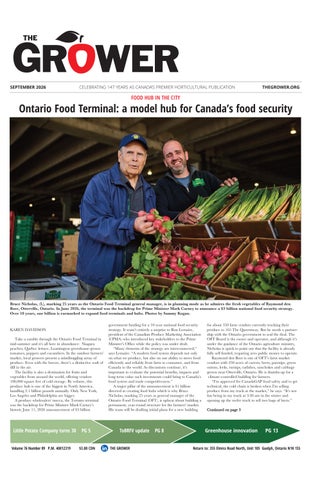
Bruce Nicholas, (L), marking 25 years as the Ontario Food Terminal general manager, is in planning mode as he admires the fresh vegetables of Raymond den Boer, Otterville, Ontario. In June 2026, the terminal was the backdrop for Prime Minister Mark Carney to announce a $3 billion national food security strategy. Over 10 years, one billion is earmarked to expand food terminals and hubs. Photos by Sammy Kogan.
KAREN DAVIDSON Take a ramble through the Ontario Food Terminal in mid-summer and it’s all here in abundance: Niagara peaches, Québec lettuce, Leamington greenhouse-grown tomatoes, peppers and cucumbers. In the outdoor farmers’ market, local growers present a mindboggling array of produce. Even with the breeze, there’s a distinctive waft of dill in the air. The facility is also a destination for fruits and vegetables from around the world, offering vendors 100,000 square feet of cold storage. By volume, this produce hub is one of the biggest in North America, handling 2.1 billion pounds annually. Only New York, Los Angeles and Philadelphia are bigger. A produce wholesalers’ mecca, the Toronto terminal was the backdrop for Prime Minister Mark Carney’s historic June 11, 2026 announcement of $3 billion
Little Potato Company turns 30
PG 5
Volume 76 Number 09 P.M. 40012319
$3.00 CDN
government funding for a 10-year national food security strategy. It wasn’t entirely a surprise to Ron Lemaire, president of the Canadian Produce Marketing Association (CPMA) who introduced key stakeholders to the Prime Minister’s Office while the policy was under draft. “Many elements of the strategy are interconnected,” says Lemaire. “A modern food system depends not only on what we produce, but also on our ability to move food efficiently and reliably from farm to consumer, and from Canada to the world. As discussions continue, it’s important to evaluate the potential benefits, impacts and long-term value such investments could bring to Canada’s food system and trade competitiveness.” A major pillar of the announcement is $1 billion directed at creating food hubs which is why Bruce Nicholas, marking 25 years as general manager of the Ontario Food Terminal (OFT), is upbeat about building a permanent, year-round structure for the farmers’ market. His team will be drafting initial plans for a new building
ToBRFV update THE GROWER
PG 8
for about 350 farm vendors currently trucking their produce to 165 The Queensway. But he needs a partnership with the Ontario government to seal the deal. The OFT Board is the owner and operator, and although it’s under the guidance of the Ontario agriculture ministry, Nicholas is quick to point out that the facility is already fully self-funded, requiring zero public money to operate. Raymond den Boer is one of OFT’s farm market vendors with 250 acres of carrots, beets, parsnips, green onions, leeks, turnips, radishes, sunchokes and cabbage grown near Otterville, Ontario. He is thumbs-up for a climate-controlled building for farmers. “I’m approved for CanadaGAP food safety and to get technical, the cold chain is broken when I’m selling produce from my truck at the market,” he says. “It’s not fun being in my truck at 3:30 am in the winter and opening up the reefer truck to sell two bags of beets.” Continued on page 3
Greenhouse innovation
PG 13
Return to: 355 Elmira Road North, Unit 105 Guelph, Ontario N1K 1S5
PAGE 2 –– SEPTEMBER 2026 THE GROWER
AT PRESS TIME… Peach, grape crops lost in Okanagan wildfires
KATHY MICHAELS Thousands of pounds of fruit are going to waste in Summerland, British Columbia as farms on the frontlines of a firefight sit empty just as the window for harvest opens, offering a devastating blow in what has already been a difficult year. “It’s almost as though being a farmer has become a hostile experience,” said Adrian Arts, executive director of the BC Fruit Growers’ Association, adding that growers have been hit by heat, drought and now wildfire this year alone. Peaches that were to be harvested last week (week of Aug 3) will likely rot on the tree and the remaining fruits that aren’t quite ready for harvest will likely be ruined by ash, Arts said. Earlyseason Sunrise apples were also supposed to be harvested last Saturday. “They don’t have a long
window, so I’m guessing a lot of that crop is going to be abandoned along with the peaches, plums, and all the rest of the stuff that was immediately coming ripening in Summerland this week,” he said. Arts said the repeated crises aren’t just devastating farmers in the Okanagan. They’re also exposing weaknesses in existing government support programs that are no longer meeting their needs. “We’ve been in crisis now for five, six years,” he said. Financial supports are often based on five- to 10-year averages of profits. Arts said that after years of repeated losses, the formula is no longer working for farmers. He said governments need to move beyond discussions and provide concrete support, along with a more holistic approach to managing and protecting the agricultural industry. Among other things, local governments have been seeking updated funding programs for agricultural water infrastructure,
while there are more than $300 million in projects ready to proceed between Oliver, Summerland, Kelowna, Lake Country and Vernon, he said. Arts also wants governments to invest heavily in wildfire mitigation, saying that would better serve farmers and residents in agricultural zones than many other endeavours. In addition to tree fruit farmers, the wildfire is threatening Summerland’s wine industry at the height of the tourism season. Ron Kubek, owner of Lightning Rock Winery, said there will be no red wine this year because of concerns about smoke exposure. Sparkling wines are also likely to not make the cut. Other wineries may take a different approach, he said, with many awaiting laboratory analysis to determine the extent of smoke exposure and which grapes can safely be used. Kubek said winemakers have options for dealing with smokeaffected grapes, but those processes can be costly. He’s spoken to some who used reverse osmosis following the 2021 wildfire season to save their grape crop, though the process is costly and not entirely as effective as one might hope. Ultimately, however, Kubek said the priority is making sure staff are safe and, if possible, protecting the vines so they can produce again in the years to come. “We’ve been through this before and we will come out the
Customer Service order@norseco.com 514 332-2275 | TFN 800 561-9693
450 682-4959
Sales Representatives
LUCEX Very early variety with persistent white curd. Produces good quality heads in warm summer conditions. Adapted to a wide range of conditions. 60 days to maturity.
Ontario Warren Peacock warren.peacock@norseco.com 519 427-7239
North Shore of Montreal Isabelle Dubé, Agr. isabelle.dube@norseco.com 514 295-7202
Greenhouse sector Keyur Patel keyur.patel@norseco.com 437 419-5337
Central and Eastern Quebec Stéphanie Gosselin, Agr. stephanie.gosselin@norseco.com 418 254-1469
MB, SK, AB & BC Ben Yurkiw ben.yurkiw@norseco.com 604 354-1830
Central & Eastern Québec Yves Thibault, Agr. yves.thibault@norseco.com 418 660-1498
Eastern Montérégie & Maritime Provinces Marie-Pierre Grimard, P. Tech marie-pierre.grimard@norseco.com 450 261-7468
Organic & Small-Scale Farms Katherine Jouvet, Agr. katherine.jouvet@norseco.com 514 386-0277
Western Montérégie Marie-Hélène Monchamp marie-helene.monchamp@norseco.com 514 968-2906
norseco.com
Proud of our roots since 1928 norseco_of昀ciel
other side,” he said. That resolve has been bolstered by an outpouring of support. Arts said the agricultural community has similarly been buoyed by the generosity and support of people around the region who have rallied around those affected by the fires. “It’s been beautiful,” Arts said. He said people have offered places for animals, storage and accommodation for agricultural workers displaced by the evacuations. Going forward, once the crisis has abated, Arts said he hopes the public support translates into pressure on elected officials at all levels of government. “We’re heading into local
government elections. We are seeing some local governments that are actively difficult with agriculture and others that are very supportive in agricultural communities,” he said. “Residents need to tell politicians that agriculture is worth protecting.” He urged residents to be vocal and become allies of the agricultural sector. Kubek said in the days, weeks and months ahead, consumers can support producers hit by this fire by buying local products, including wine, cider, beer and distilled products. Source: Castanet August 13, 2026 reprinted with permission
NEWSMAKERS The Ontario Processing Vegetable Growers has hired Mark MacPhail as general manager, following the retirement of Keith Robbins. With 30-plus years of agrifood experience, most recently as vice-president, Agriculture for Cavendish Farms Inc., he will be advocating for the $161 million sector that cans, freezes or pickles fresh vegetables.
Mark MacPhail
The British Columbia Potato and Vegetable Growers’ Association, has hired a new general manager. Clayton Botkin, a former agrologist with 20 years of experience in agriculture and business risk management, will be working for about 100 members. He follows outgoing general manager Jennifer Winning. On August 7, 2026, Grape Growers of Ontario announced that an agreement has been reached between the Growers (Grape Growers of Ontario) and the Processors (Wine Growers of Ontario and Ontario Craft Wineries).The parties agreed to a two-year pricing agreement as follows: • Year 1: 4.3% overall increase • Year 2: 2.7% overall increase The 60th anniversary of the Seasonal Agricultural Worker Program was celebrated at Strawberry Tyme Farms, Simcoe, Ontario. Jamaica’s minister of labour Pearnel Charles Jr. cited Hector Delanghe for his leadership in developing the Temporary Hector Delanghe, speaking, is Foreign Workers Program in flanked on his left by Pearnel the 1960s. Charles Jr., Althea Riley, Jamaican Liaison Service, and Sincere condolences to the on his right by Marsha Coore family and friends of Glen Lobban, Jamaica’s high Gilvesy, 65, who passed commissioner. unexpectedly on August 7, 2026. He was a director on the board of Ontario Fruit and Vegetable Growers’ Association representing the ginseng sector since 2019. He was the owner and operator of Otter Creek Farms Limited in Tillsonburg, where his family has grown North American ginseng for more than 20 years. He was the current chair of the Ontario Ginseng Growers’ Association. In memoriam: Fred Steele, 80, a past-president of the British Columbia Fruit Growers’ Association passed on August 4, 2026. Born in Glace Bay, Nova Scotia, he carried his Maritime roots to British Columbia through poetry, storytelling and music. He retired from his Kelowna orchard and leadership duties at the association in 2017, leaving a legacy of 10 years of advocacy.
SEPTEMBER 2026–– PAGE 3 THE GROWER
COVER STORY
Ontario Food Terminal: a model hub for Canada’s food security Continued from page 1 Build infrastructure Den Boer agrees with the prime minister’s comment that farmers need more places to sell their products. The strategy highlights that to compete with big retailers, smaller independent grocers need more places to source product for their stores. Critics may say the food hub announcement is the government’s admission that it can’t do much about retail consolidation in Canada by five major grocers that control 75 to 80 per cent of food sales. But perhaps it can do something to give the independents a leg up. From den Boer’s perspective, the large chains have become too powerful, controlling what consumers can buy on store shelves. He points to his specialty item of watermelon radishes, as an example. Granted, radishes won’t feed the world but they highlight the type of choice that green grocers and restaurateurs can offer their clients. “I think if we had more hubs and better facilities that more farmers would produce for those hubs where independent grocers could source their produce,” he says. He suggests Ontario cities such as Windsor, London, Ottawa and Thunder Bay. He’s also vocal about the Québec-grown produce that receives a subsidy if it’s marketed outside the province. He offers the example of spring onions being sold at $7 per case under the OFT going price. “I’m not here as a fundraiser,” he complains. “These lower prices are often not passed through to the consumer.” Patchwork provincial subsidies are an underbelly of the market that most outsiders don’t fully appreciate, maybe even the Canadian government. But as Lemaire readily points out, “The strategy is a platform to build out the details and exactly how this might work.” Link to the east coast The scope of OFT’s role is expanded when talking to Frank Pingatore, Super Select Produce Buyers. They are a wholesale aggregator that trucks fresh produce not only to nearby communities such as FoodShare
An early-morning drone shot of the Ontario Food Terminal shows the scale of the 40-acre distribution hub in Toronto. An expansion would see the farmers’ market come under a permanent, climate-controlled structure. Toronto, but also to clients in the Maritimes and on to Newfoundland. At the height of the growing season, he’s sending a transport once a day to North Sydney, Nova Scotia where the five-to-seven-hour ferry heads to Port aux Basques, Newfoundland. From there, it’s a nine-hour haul to St. John’s, home to half of Newfoundland’s population. Canada is a vast country. No wonder food distribution is a laborious and expensive endeavor. What’s in a typical Super Select mid-summer load? Sweet corn, strawberries and rhubarb, seen out in the farmers’ market, are now piled high on a pallet on the loading dock, steady ready for the long road trip. Whether or not a food hub on the east coast would have a positive impact is a question best directed at Maritime farmers. Its answer lies in growing enough local produce to make the venture profitable. What’s not in doubt, though, is that costs climb the more times food is handled up the chain. The government’s national food security strategy is attracting interest from all quarters, including New Brunswick’s agriculture minister Pat
By mid-summer, Frank Pingatore, Super Select Produce Buyers, is assembling loads of fresh produce to be trucked five times a week to the Maritimes and Newfoundland & Labrador. Finnegan. “I also think that the east coast is ready to play a greater part in opening the world to our vast food basket,” he stated on LinkedIn. “The ports (ice-free year-round) of Saint John, Belledune and Halifax are ramping up investments to do just that.” Food for thought For almost a century,
Canadian geneticists have distinguished themselves for breeding expertise, whether in wheat, canola, apples, tree fruit or dairy. To leverage that legacy, agriculture today demands that Canadian engineers meet the challenge of designing new infrastructure to store and move food, safely and securely. And that depends on innovative postharvest storage, inventory control, optical sorting and grading, and
food waste systems. There’s little to be gained by improving access to food that’s not in pristine condition. Recent statistics point to Canadian farmers growing more, and better food. If Canadians invest in a domestic framework that distributes food more efficiently and sustainably, then opportunities will open to the rest of the world.
How J.E. Russell Produce Ltd reduces food waste The discussion about food hubs should also consider how to best handle inevitable food waste. J.E. Russell Produce Ltd is a tenant at the Ontario Food Terminal (OFT) whose family-owned wholesale business is to supply premium produce to independent retailers, grocery chains, specialty retailers and foodservice customers across Ontario and east to the Maritimes. Because highly
perishable products move through the business every day, reducing food loss and waste is directly connected in inventory management, forecasting and customer service. One of its most time-sensitive product categories is packaged salads. Rather than continuing to move shortdated packaged salads though progressively lower-value commercial channels, the
company established a clear operational decision point. Once packaged salads reach six days of remaining shelf life, they are removed from commercial sale and redirected to Second Harvest while they still have usable life for families and community organizations. This approach, says Hutch Morton, senior vice-president, delivers benefits well
beyond food recovery. By creating a consistent operating process, category ºmanagers gain greater visibility into shrink, inventory decisions become more disciplined and forecasting improves over time. The case study can be accessed at the Canadian Produce Marketing Association under cpma.ca/sustainability/food-losswaste/food-loss-and-waste-use-cases/
PAGE 4 –– SEPTEMBER 2026 THE GROWER
CROSS COUNTRY DIGEST BRITISH COLUMBIA
BCFGA celebrates 60 years of a true Canada–Jamaica agricultural partnership The British Columbia Fruit Growers’ Association (BCFGA) welcomed the Hon. Pearnel Charles Jr., Jamaica’s minister of labour and social security and a senior Jamaican delegation to the Okanagan on July 28 and 29 to celebrate the 60th anniversary of the JamaicanCanadian Seasonal Agricultural Worker Program (SAWP). The two-day visit recognized the mutually beneficial partnership that has developed between Jamaican workers, Canadian farm employers, communities and governments over six decades. The Okanagan program included farm visits and direct conversations with workers and employers, culminating in an Employer and Worker Recognition Reception hosted by the BCFGA in Kelowna on July 28. Minister Charles was joined by the Honourable Lana Popham, BC’s minister of agriculture and food, regional MLAs Gavin Dew, Kristina Loewen and Donegal Wilson, Kelowna Mayor Tom Dyas and several members of City Council; senior staff from the offices of MPs Fuhr and Anderson; and representatives from the governments of Canada and
Jamaica, the Jamaican Liaison Service and British Columbia’s agriculture sector. Jamaican workers with 20 or more years of service and Canadian employers with at least 15 years of partnership with Jamaica were recognized for their sustained contributions to the program. “Governments sign agreements, officials draft policies and institutions build frameworks, but it is people who give a partnership its heart,” said Minister Charles. “This programme has lasted because workers chose excellence even when no one was watching, employers chose fairness season after season and liaison officers chose service.” The Seasonal Agricultural Worker Program provides significant benefits to both countries. Experienced Jamaican workers help British Columbia growers produce and harvest crops at critical points in the agricultural season, supporting farm viability, food production and rural communities.
BRITISH COLUMBIA
BC fruit growers support West Coast Corridor Resiliency Partnership The British Columbia Fruit Growers’ Association (BCFGA), has written Prime Minister Mark Carney expressing support for the West Coast Corridor Resiliency Partnership (WCCRP). The letter was signed by Deep Brar, president, BCFGA. Here is his letter in entirety. “The WCCRP is a coordinated, multi-municipality initiative dedicated to strengthening Canada’s economy and protecting interprovincial and international trade through critical resiliency infrastructure investments. The municipalities along this corridor— including Abbotsford, Chilliwack, Hope, Merritt, and Princeton—form a critical link in Canada’s national infrastructure system and support three essential pillars of the economy: transportation, energy, and food security.
This corridor enables the movement of goods to domestic and global markets, the distribution of energy across provinces and beyond, and the continuity of agricultural production and food supply chains that Canadians depend on. For British Columbia’s tree fruit sector, reliable transportation infrastructure is essential. Apples, cherries, pears, peaches, and other horticultural crops are highly perishable and must move efficiently between farms, packing facilities, cold storage, domestic retailers, and export markets. Growers also depend on this corridor for the timely delivery of agricultural inputs, equipment, packaging materials, and other supplies necessary to maintain production. The 2021 and 2025 flooding events exposed critical vulnerabilities within this
system, and engineering projections indicate these risks will continue to increase. Failures affecting highways, rail lines, pipelines, and agricultural lands did not remain localized. They disrupted national supply chains, restricted access to Canada’s gateway to Indo-Pacific trade, and created cascading impacts across the Canadian economy. These events demonstrated that without coordinated, long-term infrastructure investment, future disruptions are not a question of if, but when. Agricultural producers and rural communities are particularly vulnerable to these disruptions because delays can result in immediate crop losses, higher production costs, lost market opportunities, and lasting damage to Canada’s domestic food-producing capacity.
The WCCRP represents a proactive, regionally coordinated response to a national economic challenge. By advancing strategic infrastructure investments, this initiative will strengthen transportation networks, maintain access to energy corridors, protect agricultural land and food systems, and reduce systemic risks to Canada’s economy. BCFGA supports the WCCRP and its efforts to secure federal investment in resiliency infrastructure that protects communities, safeguards Canada’s transportation, energy, and food security systems, and maintains reliable access to domestic and global markets.
Source: British Columbia Fruit Growers’ Association July 24, 2026 newsletter
MANITOBA
Exploring sustainable solutions in Lake Winnipeg Basin In July 2026, Potato Sustainability Alliance (PSA) members and partners
participated in the Lake Winnipeg Basin Project Tour, an immersive day of learning that
highlighted the important connection between sustainable potato production and watershed health. The tour brought together growers, researchers, agronomists, government representatives, and conservation organizations to explore innovative practices that improve water quality while supporting productive agriculture. Participants visited several sites
across southern Manitoba, including the Stephenfield Lake Reservoir, irrigation infrastructure, Blumengart Colony, and WJ Siemens Farming Company. Discussions focused on phosphorus management, irrigation, manure management, shelterbelts, precision agriculture, yield monitoring, and nutrient removal
through biomass harvesting. The tour showcased the collaborative efforts underway to protect the Lake Winnipeg watershed while advancing practical, sciencebased solutions for potato production.
Source: Potato Sustainability Alliance July 2026 newsletter
SEPTEMBER 2026–– PAGE 5 THE GROWER
CROSS COUNTRY DIGEST ALBERTA
Little Potato Company shares building blocks for its 30th anniversary KAREN DAVIDSON Thanks to Little Potato Company and its team, I toured two farms in southern Alberta as well as the plant in Nisku, Alberta in early August. Coincidentally, the company is celebrating its 30th anniversary this month. Here are a few highlights through the years. Q. What’s the background story of founding of Little Potato Company by Angela Santiago and her dad Jacob van der Schaaf? What need did they identify and why did they think there was a market for little potatoes? A. The idea for little potatoes came from Jacob, who grew up eating them in The Netherlands. After moving to Canada, he still remembered those deliciously small and tender potatoes but was unable to find any here. In 1996 he teamed up with his daughter Angela with a specific mission in mind – to grow better potatoes. They rented out a one-acre plot of land, grew and washed them by hand and started selling them at local farmers’ markets. Local
chefs, consumers and retailers slowly started discovering these potatoes and loved them so much that the company began to grow. Q. Describe key milestones in the last 30 years. A. • 1996 – Jacob and Angela rent out a plot of land just outside Edmonton and begin growing and selling little potatoes at the farmers’ market. • 1998 – The Little Potato Company is born. It’s the first company in North America to exclusively grow and sell little potatoes. • 2000 – moved into the first 15,000 sq ft plant in Edmonton • 2002 – moved again to a facility that comprises 32,000 sq ft • 2010 – expanded to the U.S. and launched Microwave Ready Kits • 2013 – launched Oven & Grill Ready Kits and moved into a 95,000 sq ft plant • 2016 – celebrated 20th anniversary with a new U.S. plant in DeForest, Wisconsin • 2023 – moved to current facility in Nisku that spans 240,000 sq ft. and started shipping products to Mexico.
• 2026 – celebrated 30th anniversary with official launch of LPC Foodservice Solutions. Q. Is there still a Saskatchewan link with a farm that trials new genetics? A. Yes. Along with a breeding program in Chile and the Netherlands, the little potato breeding program is the largest in the world Q. Any plans to expand the plant in DeForest, Wisconsin? A. Yes, construction is currently underway. Q. Are you at full capacity with your new plant in Nisku? Or any future plans of further expansion? Future products? A. We are always looking forward to consumer trends to see how else we can bring healthy, easy meals to busy families, and our current plant in Nisku allows us to grow with the changing demands of the market.
Father-and-daughter duo, Jacob van der Schaaf and Angela Santiago, are the founders of the Little Potato Company.
Q. The Little Potatoes brand is known widely. Can you share the
A. As families’ lives have become busier, we’ve recognized that great food also has to fit the way people actually live. Our purpose—Feed the World, Better -- reflects our commitment to making healthy, whole food more
accessible, while all our marketing is focused on creating little moments of happiness for busy families. We focus on not just the benefits of little potatoes, but rather how little potatoes can help families with easy, convenient, healthy food so that they can spend more time with what matters to them.
for longer-lasting crates, but he reached out to community youth to build stronger rural connections. Scandinavian wood— specifically slow-grown Northern European spruce and pine—is
valued for potato storage because cold northern climates produce dense timber with tight growth rings. This dense wood naturally resists moisture, rot, and mold, while still “breathing” to regulate humidity without letting
condensation drip onto the potatoes. In addition to crates, he’s invested in systems to carefully monitor air quality and temperature of potatoes going in and out of storage.
thinking behind the brand’s development and marketing?
Insight from two growers
Niek Lamberts
Todd Bergen-Henengouwen
Niek Lamberts, Little Lake Farm, Burdett, Alberta and his brother Ton are participants in the Potato Sustainability Alliance. The Lamberts family has produced creamer potatoes for the Little Potato Co. since 2014, a partnership that began with 132 acres. “When we started out, there wasn’t much opportunity in the area to grow specialty crops,” says Niek Lamberts. “We were one of the first operations to grow creamer potatoes in southern Alberta.” Their family emigrated from the Netherlands in 2004. Little Lake Farm was also one of the first in the area to plant potatoes with closer row spacing. Growing a smaller potato allows them to push planting populations and maximize every acre of growing space. “We are quality-focused,” Lamberts says. “That’s important for any potato producer, but
especially with creamers because skin finish, scabbing and silver scurf are critical quality checks that impact production.” Today, the family farm has established a cycle of sustainability with initiativetaking water conservation, cover cropping and nutrient management practices. In storage Todd Bergen-Henengouwen, co-owner, Diamond Butte Potato, Picture Butte, Alberta is a seed grower who came on board with Little Potato Company in 2025. “Opportunity is missed by most people because it is dressed in overalls and looks like work,” quips Bergen-Henengouwen on his LinkedIn account. He imported storage crates from Europe and hired local students to build them. Not only did he invest in Scandinavian hardwood
PAGE 6 –– SEPTEMBER 2026 THE GROWER
GREENHOUSE GROWER
Greenhouse innovation must include safety Innovation is helping Ontario’s greenhouse sector work smarter. New equipment, mechanized processes, and evolving production practices can improve operations, but they can also introduce new hazards or change the level of risk to workers. That is why innovation and safety need to move forward together. As greenhouse operations adopt new tools and technologies, employers need to assess not only what those changes will improve, but also what new exposures they could create for workers, supervisors, and employers themselves. Inspections reinforce shared responsibility This focus on hazard recognition is especially timely as the Ontario Ministry of Labour, Immigration, Training and Skills Development continues its inspection campaign in the farming and agriculture sector. Since April 1, inspectors have been visiting farms, greenhouses, and agriculture services to increase compliance with the Occupational Health and Safety Act and related regulations. Along with checking for key hazards, the campaign highlights
the shared responsibility of employers, supervisors and workers to understand and carry out their duties. Inspectors are looking at hazards familiar across agriculture: machinery and vehicle incidents, falls, material handling, and musculoskeletal disorders. But in greenhouse operations, innovation can add another layer. New machinery or new uses of existing equipment may create hazards that are not always obvious. “Operating vehicles and machinery are a common activity that puts workers at risk if not done properly,” says Kristin Hoffman, senior sector specialist, Agriculture with Workplace Safety & Prevention Services (WSPS). “Whether it’s a tractor out in the field or a lift truck in a greenhouse, being crushed or struck by equipment or material is a top hazard in the agriculture sector.” When innovation creates hazards Serious incidents in greenhouse operations can involve scissor carts, vine-pulling and vine-shredding machines. “We’ve heard some growers take the
scissor cart off of the heating pipe rails and use it as a platform for maintenance work. This is not what it was intended for,” says Jay Remsik, health and safety consultant with WSPS. Vinepulling machines also create serious risks because they involve rotating shafts and exposed augers. “If a worker were to troubleshoot running equipment without locking it out, they could lose a finger, hand, arm, or worse,” he says. As greenhouse operations evolve, new technologies and changing workflows can alter the pace and physical demands of work. When workers are learning unfamiliar tools or processes, the risk of awkward postures, repetitive tasks, and musculoskeletal injuries can also rise over time. Building controls that keep pace For employers, that makes hazard assessment essential. New equipment should never be introduced without reviewing how the task will be performed, what could go wrong, and what controls are needed to protect workers. Safe work procedures, maintenance, supervision, and
training all need to keep pace with operational change. Hoffman reinforces that point when it comes to machinery safeguards. “Lockout/tagout is crucial. Ensuring the hazardous energy is safely controlled and locked out will prevent the machine from starting up unexpectedly,” she says. Looking ahead to sector solutions To help the sector better understand these emerging risks, WSPS will launch a Risk Assessment Root Cause Analysis project in the greenhouse sector in fall of 2026/winter of 2027. By
engaging front-line workers, supervisors, and employers, the project will identify top risks and support the development of practical, real-world solutions to create meaningful improvements in health and safety. Reach out to rarca@wsps.ca to get involved. Innovation and safety are not competing priorities, they are partners. When new ideas are paired with thoughtful risk management, the result is a stronger, more resilient greenhouse sector. Workplace Safety & Prevention Services offer practical resources to help greenhouse operators strengthen safety and prepare for inspections.
Built to Beat ToBRFV HREZ e昀ectively reduces the ToBRFV viral load at both plant and root levels, supporting a healthier growing environment when paired with disciplined hygiene practices. Designed to deliver lasting protection and consistent crop performance.
Stay ahead of ToBRFV
SEPTEMBER 2026–– PAGE 7 THE GROWER
GREENHOUSE GROWER
Greenhouse Critical Technology Forum 2026 debuts September 10 The Greenhouse Critical Technology Forum 2026, hosted by Vineland Research and Innovation Centre on September 10, brings together greenhouse growers, technology developers, investors, and industry stakeholders to explore how innovation can strengthen the competitiveness of Canada’s greenhouse sector. The event is designed to address a pressing industry challenge: how to accelerate the adoption of technologies that improve productivity, profitability, sustainability, and resilience in commercial greenhouse operations. The forum emerged from discussions among industry and government partners who recognized a need in Canada’s rapidly expanding greenhouse sector and the availability of domestically developed technologies. While greenhouse production has experienced significant growth over the past several decades, much of the technology used by Canadian growers continues to be sourced from outside the country. The forum was created to help bridge this gap by connecting growers directly with technology companies,
researchers, investors, and developing solutions for controlled environment agriculture. Although innovation has been a recurring topic at industry events, a distinguishing feature is the inclusion of “Grower Reverse Pitches,” where greenhouse operators will outline the challenges they face and the business considerations
that influence adoption decisions. The program will also feature grower case studies, a keynote presentation by Michael Cardy of Red Hat Canada, and a Technology Zone, showcasing innovations in automation, robotics, climate management, crop protection, data analytics, and sustainable production systems. At its core, the forum is intended to
accelerate commercialization of new technologies and build collaborations that will help shape the future of controlled environment agriculture in Canada. For more information about registration, link here: Greenhouse Critical Technology Forum 2026.
Québec leads the way in both field and greenhouse-grown lettuce Statistics Canada is spotlighting lettuce production, showing that Québec leads the way in growing both field and greenhouse. Marketed production of fresh lettuce totaled 84,343 tons in 2025, up for the second year in a row according to Statistics Canada. This was the highest haul since 2019, when production totaled 84, 896 tons. However, it was down considerably from 96 085 tons in 1997, the highest level on record since the current data series began in 1996. Production is trending upward due to growing conditions and at least in part due to the seeded area. The 4, 201 hectares planted in 2025 is the largest area planted since 2010 (4,677) and considerably more than what was planted in 1997 (3 331), which marked a record haul.
Most of the lettuce planted (88.1%) and produced (89.0%) in 2025 was in Québec, which typically produces most of the nationwide haul in any given year. The rest of it was produced mostly in Ontario and British Columbia. Greenhouse lettuce production five times higher than in 2011 Provincially, Québec farm operators also led greenhouse-grown lettuce in 2025, producing almost three-fifths (58.5%) of the 24.6 million kilograms (kg) harvested from 414,073 square meters in greenhouses nationwide. Greenhouse production of fresh lettuce in Canada has risen steadily over the years and was five times higher in 2025 (+401.4%) than it was in 2011, the
year the Canadian Government started tracking lettuce production data in tons.
Source: Government of Canada July 21, 2026 news release
PAGE 8 –– SEPTEMBER 2026 THE GROWER
GREENHOUSE GROWER
Ongoing effects of Tomato Brown Rugose Fruit Virus JONATHAN GRIFFITHS AND AIMING WANG Two recent articles in the CBC and the New York Times describe rapidly soaring prices of tomatoes, with increases of more than 40 per cent compared to the previous year. Both articles attribute the steep rise in costs to tariffs, transportation costs, and bad weather. Surprisingly absent from these reports is the role played by tomato brown rugose fruit virus (ToBRFV), a devastating viral pathogen that emerged in ~2014 in the Levant region and quickly spread worldwide. The virus was first detected in Canadian greenhouses in 2019, and it has now proved to be a persistent problem resulting in significant shifts to production and ongoing losses to tomato growers. In Ontario alone, ToBRFV has been estimated to cause more than $100 million in losses annually. Understanding the extent of this problem can be difficult, but greenhouse tomato growers continue to see frequent ToBRFV outbreaks and have to pull many acres of tomato early each year due to this virus.
Seed companies have responded through screening wild relatives of tomatoes and breeding new resistance or tolerance traits into commercial cultivars. But this has resulted in changes in fruit development qualities and production practices, which can also affect labour costs and yields. These issues will likely be improved in time as breeders continue to develop elite cultivars. But what is most important is the source of resistance, and how well these new resistance genes work against ToBRFV. ToBRFV is such a major issue because it initially managed to escape the Tm-22 resistance gene, which had protected tomatoes from similar viruses for ~60 years. In response to this, seed companies have returned to an older resistance gene, Tm-1. While Tm-1 can suppresses ToBRFV within a relative short period, it does not seem to be as durable as Tm-22. Resistance-breaking isolates of this virus have already been identified, and resistance mediated by this gene can break down in temperatures over 31°C. So, Tm-1 can slow the virus down, but it already has weaknesses. Other new resistance
genes have also been identified and are being used in commercial cultivars. So far, none of the newly identified resistance genes can stop ToBRFV alone, but maybe combinations of different genes could work better and for longer. There is still hope for new resistance genes, but most of the low-hanging fruit in this area of research has already been plucked. ToBRFV can enter a greenhouse through many different ways. The seed pathway can be difficult to control, as only one contaminated seed out of millions could lead to a new outbreak. Once established, ToBRFV can be difficult to eradicate since it is extremely stable and able to survive for months and even years in contaminated materials and plant debris. Higher incidence of this virus means the chances of re-contaminating new crops also increases. Ongoing monitoring and decontamination techniques are also increasing costs for growers. All indications are that ToBRFV will continue to be a major problem in the sector. It is important for growers to maintain vigilance against ToBRFV and eradicate it quickly. It’s best not to grow
susceptible cultivars in the same greenhouse as resistant ones. Growing tomatoes with any resistance can help slow the virus or reduce symptoms, but more research is required to understand the genetic resistance mechanisms we have already, and to identify new sources of resistance to help reduce the impacts of this devastating virus. Agriculture and Agri-Food Canada researchers continue to attempt to identify new sources of resistance, and we are exploring other approaches to
mitigating the effects of ToBRFV including attenuated viral strains that show reduced symptoms. Given the ongoing issues caused by ToBRFV, all available tools must be considered including genetic resistance, biotechnology approaches, and ongoing monitoring and elimination. Jonathan Griffiths and Aiming Wang are research scientists, Agriculture and Agri-Food Canada.
What’s happening at the Canadian Greenhouse Conference This year’s edition of the Canadian Greenhouse Conference will be held October 7-8 at the Niagara Falls Convention Centre. For all
details, link here: https://www.canadiangreenhouseconference.com/ On October 7, consider the following sessions:
IPM Bits and Bites: Spores & Equipment 9:30am - 11am Practical IPM session for greenhouse vegetable and
floriculture growers covering fogging equipment, microbial insecticide and fungicide applications, and spore trapper use. Topics include equipment selection, troubleshooting, application best practices, and real-world tips to improve pest and disease management success. Little Plants, Big Profits Fruit & Vegetable Propagation 9:30am - 11am This session will focus on strawberry propagation and the use of lighting technologies to improve both fruit and vegetable propagation success under certain lighting systems. Designed for propagators and greenhouse growers, the discussion will cover practical insights and experience with lighting strategies, environmental management, and production techniques that support healthy, efficient propagation Sanitation in Practice 2:00pm - 3:30pm Learn practical sanitation and cleaning techniques, in-house water testing procedures, and greenhouse water management strategies. This session showcases how minimal sanitation combined with microbial inoculation can shape the water microbiome, supporting plant health and improving tolerance to pathogens such as Fusarium, Pythium, and Phytophthora in vegetable crops.
On October 8, consider the following sessions: Invaders Among Us 9:30am - 11am Learn about the latest strategies for managing emerging greenhouse pests, including Thrips parvispinus, Nesidiocoris tenuis, and new mite species in Ontario. This session will cover pest identification, monitoring, prevention, and integrated management approaches to help growers protect crop quality and reduce pest pressure. Bus tour to Leamington and Kingsville The 2026 Bus Tour will explore greenhouse operations throughout the Leamington and Kingsville region. The tour will depart from the Marriott on the Falls on the afternoon of Monday, October 5, with an overnight stay in Windsor. On Tuesday, October 6, participants will enjoy the day visiting a variety of greenhouse facilities and gaining firsthand insight into the area's diverse horticultural operations. Following the final tour stop, the group will return to Niagara.
SEPTEMBER 2026–– PAGE 9 THE GROWER
CROSSING THE BORDER
Representative sample: the key to reliable inspections Under the Fruit and Vegetable Dispute Resolution Corporation (DRC) Good Inspection Guidelines, unless otherwise agreed, DRC members who receive product in a deteriorated condition must request a third-party quality inspection, preferably a government inspection, to demonstrate that the product fails to meet the agreed-upon quality standard (specs) or the DRC Good Arrival Guidelines. While there are many elements to consider when requesting an inspection, one of the most important factors for a receiver is ensuring that a representative sample of the load is available when the inspector arrives. How is a representative sample determined? For DRC purposes, unless otherwise agreed, a useful rule of thumb comes from the Canadian Food Inspection Agency’s “appeal inspection” requirements. To qualify for an appeal inspection, more than 75% of the load must be available for inspection. Otherwise, if less than 75% of the load remains, an
appeal inspection cannot be conducted because the remaining product is not considered a representative sample. Additionally, the percentage of the product not available for inspection is normally considered to be in sound condition. What if less than 75% of the load is available for inspection? If less than 75% of the shipment remains available for inspection, contact the shipper or seller immediately and let them know the reasons why you are unable to have the full load available for inspection. The parties should discuss whether the quantity remaining can still be considered representative of the full load. Another option is for the receiver to pay in full for the percentage of the product that is not available for inspection and offer to claim damages on the percentage of the load remaining, provided the inspection shows that the product fails to meet the agreed-upon quality standard (specs) or DRC Good Arrival Guidelines.
Handling product before an inspection Receivers should exercise caution when moving, reselling, or otherwise handling produce before an inspection takes place. If part of a shipment has already been sold to customers and those customers later reject the product, obtaining an inspection after the product is returned may not preserve the receiver’s rights against the shipper or seller. Even if the full quantity is recovered, the product may be considered “handled,” and it may be argued that the shipment has lost its identity after leaving the receiver’s control and being returned. For this reason, receivers should arrange for an inspection as soon as a quality problem is discovered and before significant portions of the shipment are sold, moved, or otherwise handled. Key takeaway When quality concerns arise, a timely inspection is critical. Equally important is ensuring that enough of the shipment remains available to constitute a
representative sample. Without one, a receiver may face significant challenges in proving a claim and recovering losses from the shipper or seller. If you have any questions about the article and would like to learn more, our team at the
DRC is here to assist you. We value your inquiries and are eager to provide support. Source: Dispute Resolution Corporation August 11, 2026 newsletter
PAGE 10 –– SEPTEMBER 2026 THE GROWER
COMMITTEE CHAIR’S PERSPECTIVE
Good data will help us make the case for horticulture
CHRIS HEDGES Canadian agriculture is at a pivotal point. Food security and national security are more closely connected than they have been in decades. Global trade relationships are shifting, geopolitical uncertainty continues and extreme weather is putting increasing pressure on food production around the world. We’ve seen wildfires and other extreme weather events disrupt agriculture across North America, while excessive heat and drought are challenging farmers in Europe and elsewhere. Here at home, growers continue to manage unpredictable weather alongside
rising costs, labour challenges, market pressures and growing competition from imports as well as support programs for growers in the U.S. Against that backdrop, governments are paying more attention to the importance of domestic food production. Earlier this summer, the federal government launched its National Food Security Strategy, with a focus on producing and processing more food in Canada, strengthening our food system and reducing our vulnerability to disruptions beyond our borders. At the same time, federal, provincial and territorial agriculture ministers are working toward the next agricultural policy framework, which will replace the Sustainable Canadian Agricultural Partnership in 2028. In July 2026, ministers released the Halifax Statement outlining their vision and priorities for that framework. Competitiveness and economic growth, trade, research and innovation, and resilience are all central themes, including a commitment to continue improving Business Risk
Management programs. For fruit and vegetable growers, these are encouraging signals, but they also make the next couple of years particularly important for advocacy. Decisions are going to be made about where governments invest, how programs are designed and what role agriculture will play in Canada’s broader economic and food security priorities. We need to make sure horticulture is part of those conversations and that decision makers understand what our sector needs to remain competitive and continue producing food. To do that effectively, we need more than good arguments – we also need good data. That’s why the Ontario Fruit and Vegetable Growers’ Association (OFVGA) will be shortly undertaking a new research project that will strengthen our understanding of the economic realities facing Ontario fruit and vegetable growers. Reliable economic information is one of the most important tools we can bring to government discussions. We need to be able to
clearly demonstrate what is happening with production costs, farm returns and competitiveness, and how those trends affect growers’ ability to invest in their businesses. Good data also help us move the conversation beyond individual examples. We all know growers who are questioning whether to expand, replace aging infrastructure or equipment, or even continue producing certain crops. Those experiences matter, but when we sit down with government officials to advocate for changes to programs or policies, we also need credible information that shows whether those experiences reflect broader trends across the sector. That is particularly important for our Safety Nets committee. Business Risk Management programs are designed to help farmers manage risks beyond their control. To make the case for improvements, we need to understand whether existing programs are responding to the risks growers actually face and where the gaps are. The same applies to broader
discussions about competitiveness. If governments want Canada to produce more of its own food, we need to understand what it will take for growers to make the investments needed to do that. This research will help give OFVGA a stronger evidence base for those discussions. There is a lot happening in agriculture policy right now, and there is a growing recognition that domestic food production matters not just to farmers, but to Canada’s economy, resilience and security. That creates opportunity, but it also means we have work to do. Strong advocacy starts with knowing what we need, being able to explain why it matters and having credible evidence to back it up. As governments make decisions that will shape agriculture for years to come, making sure horticulture has that evidence will be an important part of securing our sector’s future. Chris Hedges is an apple grower at Vanessa, Ontario and chair of the Ontario Fruit and Vegetable Growers’ Association safety nets committee.
WEATHER VANE
This worker at the Ontario Food Terminal wears his heart on his sleeve….er T-shirt. Photo by Sammy Kogan. STAFF Publisher: Ontario Fruit and Vegetable Growers’ Association Editor: Karen Davidson, 416-557-6413, editor@thegrower.org Advertising: Carlie Melara 519-763-8728, advertising@thegrower.org
The Grower reserves the right to refuse any advertising. Any errors that are the direct result of The Grower will be compensated at our discretion with a correction notice in the next issue. No compensation will be given after the first running of the ad. Client signature is required before insertion. The Ontario Fruit and Vegetable Growers’ Association is the sole owner of The Grower. All editorials and opinions expressed in The Grower are those of the newspaper’s editorial staff and/or contributor, and do not necessarily reflect the view of the association. All rights reserved. The contents of this publication may not be reproduced either whole or in part without the prior written consent of the publisher.
OFFICE 355 Elmira Road North, Unit 105 Guelph, Ontario N1K 1S5 CANADA Tel. 519-763-8728 • Fax 519-763-6604 The Grower is printed 12 times a year and sent to all members of the Ontario Fruit and Vegetable Growers’ Association who have paid $30.00 (plus G.S.T.) per year for the paper through their commodity group or container fees. Others may subscribe as follows by writing to the office:
$30.00 (+ HST) /year in Canada $40.00/year International Subscribers must submit a claim for missing issues within four months. If the issue is claimed within four months, but not available, The Grower will extend the subscription by one month. No refunds on subscriptions. P.M. 40012319
ONTARIO FRUIT AND VEGETABLE GROWERS’ ASSOCIATION BOARD OF DIRECTORS 2025 EXECUTIVE COMMITTEE Chair Vice-chair Potatoes Fresh Veg Muck
Mike Chromczak, Brownsville Matthias Oppenlaender, NOTL Shawn Brenn Quinton Woods, Cookstown
BOARD OF DIRECTORS Apples Fresh Veg other Tender Fruit Asparagus Grape Fresh Veg muck Potato Small Fruit/Berries Ginseng Greenhouse Greenhouse Processing Vegetables
Chris Hedges, Vanessa Joann Chechalk, St Anns Dave Enns, Niagara-on-the-Lake Mike Chromczak, Brownsville Matthias Oppenlaender Quinton Woods, Cookstown Shawn Brenn, Waterdown Morris Gervais, Springwater Glen Gilvesy, Tillsonburg Jan VanderHout, Dundas Steve Peters, St. Thomas Tracy Gubbels, Mount Brydges
OFVGA POLICY COMMITTEE CHAIRS Crop Protection Environment and Conservation Labour Safety Nets Property, Infrastructure, Energy and Food Safety
Matt Sheppard Jan VanderHout Bill George Chris Hedges Brian Gilroy
SEPTEMBER 2026–– PAGE 11 THE GROWER
URBAN COWBOY
Is there a better story than controlled environment agriculture?
OWEN ROBERTS
Controlled environment agriculture is on the upswing. Sales of produce raised indoors is rising, acreage is climbing, and the sector is rallying to deal with emerging challenges and opportunities – most lately, by launching a new trade show specifically serving the controlled environment agriculture (CEA) community. The show, GreenTech North America 2026, opens its doors later this month in Philadelphia. At press time, 90 exhibitors and more than 1,000 attendees from around the world are expected. Organizers see the show as a chance to establish a presence in the U.S. and Canada for what they call “GreenTech’s promise as the worldwide connector of sustainable food and flower production,” with emphasis on high-value crops such as vegetables, soft fruits, ornamentals, leafy greens and medicinal plants. Good reason for confidence New trade shows are a barometer for an industry’s health and a measure of its optimism . . . which might make some observers wonder about GreenTech 2026’s timing. However, even though trade talks are going sideways and the agri-food sector is exposed to Washington’s political whims, controlled environment growers and industry reps are part of a buoyant group that defies the headlines and continues to grow. Industry veteran Tom Stenzel, executive director of the Controlled Environment Agriculture Alliance which will be participating in GreenTech 2026, says integration has been an allimportant driver in this sector. “Most companies grow in Canada, the U.S. and Mexico to meet seasonal demand,” he says. “We count on our valued suppliers to share technologies and new business practices that can help the entire industry grow. Growers and our business service suppliers work together in all the alliance’s committees and working groups, and industry trade shows are where we can all see new opportunities for future growth.”
Statistically, there’s good reason to feel confident about agriculture in controlled environments. In its 2025 annual greenhouse, sod and nursery survey, Statistics Canada reported that sales at greenhouse, nursery, field-grown cut flower and sod operations increased 7.5 per cent to $6.5 billion, marking a fifth consecutive annual increase. Greenhouse growers accounted for just over four-fifths of total sales, at $5.5 billion, driven by increased production of greenhouse fruits and vegetables and by higher prices. Nationally, total greenhouse area increased by 1.4 per cent to 35.9 million square metres. Ontario accounted for almost 65 per cent of total greenhouse area, followed by British Columbia (17.4 per cent) and Québec (10.4 per cent). Commodity wise, the survey showed greenhouse harvested area dedicated to strawberry production grew at the fastest pace in 2025, rising 45.5 per cent to 1.2 million square metres. Harvested area dedicated to lettuce (up 8.1 per cent), fine herbs (up 11.2 per cent) and Chinese vegetables (up 23 per cent) were the other major movers. Tomatoes and cucumbers were the leading greenhouse export commodities from Canada to the United States in 2025. Cucumber exports increased 12.7 per cent to 290 million kilograms while tomato exports crept forward 0.5 per cent 231.7 million kilograms. Stenzel believes indoor farming is well positioned to continue growth, in commodities such as tomatoes, leafy greens, strawberries and mushrooms. Today, most tomatoes at retail are already greenhouse grown. Packaged salads are up in the U.S. about eight per cent, with some 20 per cent market share in the northeast. Indoor strawberries are starting to emerge, and most modern mushroom farms are high-tech CEA facilities.
management controls. And he says players in the sector will keep working together, looking towards a political scene that ultimately complements and mirrors the sector’s upswing. The United States is Canada’s primary export market, accounting for about 99 per cent of Canada’s
greenhouse export market. The sector needs to keep nurturing that relationship, while simultaneously exploring new markets. But all things considered, controlled environment agriculture is still one of the best farm and food stories anywhere.
Owen Roberts is a Guelph-based agricultural journalist and a pastpresident of the International Federation of Agricultural Journalists. Photo by Dax Melmer
DECADES OF RELIABLE RODENT CONTROL CONSISTENT • INNOVATIVE • VERSATILE • PROBLEM SOLVER These words aren’t applied to just any rodent control bait. They are applied to Ground Force, the rodent control bait that has been helping protect your range & cropland for many years. Ground Force Paraffinized Pellets* is labeled for the control of Voles, Ground Squirrels, Rats & Mice
LEARN MORE
Risks arise despite progress Despite all this progress, risk – other than political headbutting – is on the doorstep of every facility. Stenzel says challenges, such as the Tomato Brown Rugose Fruit Virus (ToBRFV) never go away. “Zero risk is a myth and it’s really tough to prepare for something like an unexpected virus we haven’t seen before,” says Stenzel. For ToBRFV, the industry picked up the gauntlet. Today, most seed companies have bred varieties resistant to ToBRFV and are continuing to research emerging threats. Greenhouse growers can manage ToBRFV risk through strong
PROTECTING YOUR ORCHARD
Distributed by:
For Nearest Dealer: 905.563.8261 • bartlett.ca
For Technical/Label Questions:
liphatech.ca • 888.331.7900
*Commercial Product Only: Only to be used by certified pest control operators, farmers and persons authorized in government pest control programs.
PAGE 12 –– SEPTEMBER 2026 THE GROWER
BITS AND BITES
Niagara growers seek government support after recent flood events
Over the past few weeks, the Niagara Region has experienced numerous unprecedented rainfall events. The severity of these storms has affected many growers, residents, and businesses. Niagara’s farmers are an integral part of the community, contributing to the identity of the region. Niagara is home to Canada’s largest production of tender fruit, Canada’s largest greenhouse flower-producing region, and Canada’s largest
production of grape and wine. These sectors contribute significantly to local employment, tourism, culture, and the economic prosperity of the region. Like many others that call Niagara home, these sectors have been heavily impacted by the recent floods. Recovery efforts are underway, but uncertainty and challenges remain for the agricultural community, especially for those dealing with
disease pressures, lost plants, and unharvested crops. Growers have shown remarkable resilience, but resilience alone will not provide the long-term stability needed for recovery and future planning. The road to recovery will not be a short one, with the full extent of damage yet to be determined. Farmers will need responsive policy to help them recover from the impacts felt today, while positioning them to resume their growth trajectory for the future. With the continued support of our partners at all levels of government, these key sectors will build back stronger and return to their status as an economic driver for Niagara’s communities, and the province of Ontario. We appreciate the responses from the Town of Lincoln, Niagara-on-the-Lake, and the Government of Ontario. We also recognize and thank the Premier of Ontario and Ontario’s Minister of Agriculture, Food and Agribusiness, Trevor Jones, for
Canada’s apple growers unite under the new “Apples Canada” banner we can build a stronger industry, better support consumers, and ensure a sustainable future for apple production across the country.” 2026 Canadian production highlights industry strength
Representatives of apple grower organizations from British Columbia, Ontario, Québec, New Brunswick and Nova Scotia have agreed to strengthen their collaboration under a new name: Apples Canada / Pommes Canada. The announcement was made during the annual mid-summer meeting of the Apple Working Group of the Fruit and Vegetable Growers of Canada (FVGC), held this year in Moncton, New Brunswick. Under the new name, Apples Canada will continue to operate in partnership and under FVGC serving as a collaborative platform for provincial apple organizations to work together on issues affecting Canada's apple industry, including production, sustainability, market development, research, promotion, and public policy. “Canada's apple growers face many common opportunities and challenges,” says Charles Stevens, chair of Apples Canada. “By working more closely together,
During the meeting, provincial organizations also finalized the 2026 Canadian Apple Crop Estimate, providing an early outlook for the upcoming harvest and helping industry stakeholders prepare for the marketing season. The estimate suggests that Canada will once again produce a substantial apple crop, with regional conditions varying across the country. Canada's apple crop is estimated at approximately 18.9 million bushels, slightly below last year's level but broadly consistent with historical production trends. The main four varieties grown in Canada are Gala, Honeycrisp, Ambrosia, and McIntosh. The formation of Apples Canada also provides an opportunity to reaffirm the importance of maintaining consumer access to locally grown apples in every region of the country. Apples Canada believes that a healthy domestic apple sector requires collaboration throughout the value chain. Growers, packers, processors, retailers, governments and consumers all play an important role in ensuring Canadian apples remain available and visible throughout
the year. A strong domestic apple industry contributes to Canada's food security during times of market volatility, global trade uncertainties, and climate-related challenges. Ensuring that locally grown apples maintain a prominent place in retail stores across the country helps support rural communities, strengthens domestic food production, and provides consumers with the quality and freshness they expect. “Consumers value local food, and Canadian apples are an important part of that connection,” Stevens adds. “Making locally grown apples accessible across Canada is a responsibility shared by everyone involved in bringing food from our orchards to consumers’ tables.” Apples Canada brings together Les Producteurs de pommes du Québec, Ontario Apple Growers, British Columbia Fruit Growers' Association, Nova Scotia Fruit Growers’ Association, and Apple Growers of New Brunswick collectively representing more than 900 Canadian apple growers. Working collaboratively, the organization promotes a strong, sustainable and competitive Canadian apple industry while supporting consumer access to locally grown apples and advancing issues of common interest across the sector. Source: Apples Canada August 10, 2026 news release
their willingness to help. Challenges and opportunities for government support • Provincial support for changes to the vine and tree mortality coverage with crop insurance to ensure it is responsive to this emergency situation and longer-term impacts, including replanting • Provincial and federal support for the immediate expansion of fungicide labels to permit drone application, enabling growers who cannot access flooded
vineyards and orchards to protect their crops from disease and pest pressures • Provide flexibility on deadlines for temporary foreign worker housing inspections to provide time for appropriate repair and remediation • Support use of AgriRecovery to further assist farms in rebuilding and recovering Source: Grape Growers of Ontario/Ontario Tender Fruit Growers August 11, 2026 news release
COMING EVENTS 2026 Sept 10
What’s Growin’ On Open House, Vineland Research & Innovation Centre, Vineland Station, ON
Sept 10
Greenhouse Critical Technology Forum, Vineland Research & Innovation Centre, Vineland Station, ON
Sept 10-11 Great Lakes Tex Flex, Michigan State University Southwest Research and Extension Center, Benton Harbour, MI Sept 12
Ontario Hazelnut Association Farm Tour, Dalton White Farms, Delhi, ON
Sept 15
Berry Growers of Ontario Twilight Meeting, Willowtree Farm, Port Perry, ON
Sept 16
Grape Growers of Ontario 41st Celebrity Luncheon, Roma Club, St. Catharines, ON
Sept 23
Ontario Produce Marketing Association Golf Tournament, Lionhead Golf and Country Club, Brampton, ON
Sept 23-24 GreenTech North America, Philadelphia Convention Center, Philadelphia, PA Sept 23-24 CPMA Food Safety Conference, Sheraton Vancouver Airport Hotel, Vancouver, BC Sept 26
Farm & Food Care Ontario’s Breakfast on the Farm, River Valley Cattle Co, Newburgh, ON
Sept 26
Ontario Hazelnut Association Natures Grow, St. Catharines, ON
Sept 28-Oct 1
Tri-National Agricultural Accord, Calgary, AB
Oct 6-7
Canadian Agri-Food Policy Institute, Exchange Conference, National Arts Centre, Ottawa, ON
Oct 6-7
Public Trust Summit, Westin Toronto Airport Hotel, Toronto, ON
Oct 6-8
Fruit Attraction, IFEMA Trade Fair Centre, Madrid
Oct 7-8
Canadian Greenhouse Conference, Niagara Falls Convention Centre, Niagara Falls, ON
Oct 14-16
International Fresh Produce Association Convention, Orange County Convention Center, Orlando, FL
Oct 20-22
International Forum for Agricultural Robotics (FIRA), State Fair Park, Yakima, Washington State
Oct 26-30
World Potato Congress, Naivasha, Kenya
SEPTEMBER 2026–– PAGE 13 THE GROWER
FOCUS: GREENHOUSE INNOVATION
Let us adopt AI . . . cautiously KAREN DAVIDSON Haven Greens is a state-of-the-art greenhouse which launched its leafy greens business in King City, Ontario in February 2025. The five-acre facility uses the latest technology in seeding, lighting, water and nutrient management. And now artificial intelligence (AI). “We are in the early stages of an AI rollout, leveraging as many tools as we can,” shares Dominick DiMucci, director of cultivation, Haven Greens. The company is looking at what gains there might be on the business side, moving beyond Excel spreadsheets. With a second five-acre phase under construction, CEO Jay Willmot has hired a business analyst with strong background in supply chain and logistics management in the consumer packaged goods industry to provide AI expertise. An enterprise cloud roll-out is underway to streamline production plans, sales orders and logistics for delivery. “There are so many moving parts to handling a biological plant from seeding through to the finished product,” explains DiMucci. “AI and its algorithms do well at the simple things, so we’re starting with business processes, improving work flows on the floor, lowering labour costs.” The next step will be to fully integrate AI with procurement of inputs and the
efficient use of storage space. In the growing environment itself, DiMucci points out the many variables from macro temperatures, relative humidity, light and irrigation to substrate composition, carbon dioxide and amount of oxygen in the water. “For me personally, it’s all about the ability to analyze substantial amounts of crop input data,” says DiMucci. “I’m still approaching AI with some skepticism. For every grower, it’s about getting to a reliable predictive yield forecast.” A key focus for Haven Greens will be energy consumption. That means finding the right lighting and carbon dioxide balance. There needs to be efficiencies from a business perspective. And this question will be answered in different ways from operation to operation according to the capital available. Haven Greens provides each of its employees with a professional development budget. A few have taken AI courses at the University of Guelph to keep on the leading edge. These investments in human intelligence along with enterprise subscription fees provide a strong base of shared AI experience. AI is a hot topic right now in the greenhouse sector. Technological changes are coming fast and furious. But DiMucci is encouraging his peers to avoid the hype and build a business case for its usage. Go forward at your own pace. Don’t feel you
Dominick DiMucci showcases some of the Green Automation technology. Photo by Paul Novosad. are behind. “A lot of people are trying to solve greenhouse problems, but where I get concerned is that it’s difficult to know who’s real and what’s worth implementing,” says DiMucci. “To be honest, there are very expensive tools on the market. Adding a widget here and a new dashboard there may not equal a step forward. It comes down to this: is the juice worth the squeeze?” Editor’s note: Hosted at the Niagara Falls Convention Centre on October 7-8, 2026, the Canadian Greenhouse Conference is organizing
a program called “AI in action” on Thursday, October 8 from 9:30 am to 11 am. Explore how artificial intelligence is being applied in business and greenhouse operations. This session will highlight emerging AI opportunities, key risks and real-world grower experiences using AI tools and agents to improve efficiency and decisionmaking. The grower panel is titled “How to deploy agents for their business, shared experiences with the use of AI.” Dominick DiMucci, Haven Greens is on the panel along with Matt Tyhurst, Twin Creeks Greenhouse. For more information, link to: www.canadiangreenhouseconference.com/ day-2-program
OGVG commits to innovation and excellence in data management
Ontario Greenhouse Vegetable Growers (OGVG) has appointed Aron Kavanagh as its new junior data integrity analyst. In this role, he will support the collection, validation, analysis, and reporting of industry data that helps inform decision-making across the greenhouse vegetable sector and supports OGVG’s members, stakeholders, and government partners. He joins OGVG with a strong background in data analysis, financial modelling, market research, process optimization, and data visualization. He recently completed his MBA at the University of Windsor and has gained valuable experience developing analytical tools, evaluating complex datasets, automating workflows, and communicating insights to
support strategic decision-making. As part of the OGVG team, Kavanagh will work closely with staff and industry partners to maintain the high standards of data integrity and reporting that have become a cornerstone of the organization’s value to growers and stakeholders. His work will focus on ensuring accurate, timely, and meaningful industry information that supports advocacy, planning, and sector growth. “Reliable data is critical to the success of Ontario’s greenhouse vegetable sector,” said Richard Lee, executive director of OGVG. “Aron brings a unique combination of analytical expertise, technical capability, and curiosity that will strengthen our ability to collect, interpret, and communicate information that matters to our members. We are excited to welcome him to the team.” Lee noted that the organization continues to invest in building internal capacity and ensuring that knowledge, expertise, and data-driven decision-making remain central to OGVG’s long-term success. “As our sector continues to evolve, it is important that OGVG continues to develop talent and create opportunities for the next generation of professionals to contribute to our mission,” Lee added. “Aron’s role reflects our commitment to continuous improvement,
organizational resilience, and the thoughtful development of capabilities that will support our members well into the future.” Kavanagh’s appointment reflects OGVG’s ongoing
commitment to innovation and excellence in data management. Working alongside experienced staff, he will help advance the systems and processes that enable OGVG to provide accurate
industry intelligence and valuable insights to its members and partners. Source: OGVG August 14, 2026 news release
PAGE 14 –– SEPTEMBER 2026 THE GROWER
FOCUS: GREENHOUSE INNOVATION
Creature feature: Nesi — the green bug that’s not always good news JULIA DUBEAU, ROSE LABBÉ, CARA McCREARY For this Creature Feature, we’re meeting Nesidiocoris tenuis, commonly known as Nesi, green bug, or tomato bug. At first glance, Nesi might not look too scary. It is small, green, and easy to mistake for something helpful. But this is one of those “don’t judge a bug by its colour” situations — not every green bug in the crop is a good bug! Nesi is an omnivorous mirid, meaning it can feed on both insects and plant tissue. In some regions around the world, it has been used as a beneficial insect, but in Ontario greenhouse vegetable production it is considered a pest because of the plant damage it can cause.
Nesi is a small green mirid bug that has become a concern for Ontario greenhouse vegetable growers – specifically greenhouse tomatoes and greenhouse cucumbers but greenhouse peppers are also a potential host.
Nesidiocoris tenuis (Nesi), a pest mirid of concern in Ontario greenhouse vegetables.
Dicyphus hesperus, a beneficial mirid used in greenhouse biocontrol programs.
Feeding damage on tomato fruit can appear as small punctures, scars, or stippling on the fruit surface.
Nesi feeding can cause necrotic lesions and rings forming on stems and young plant tissue.
Nesi bugs on new tomato growth near the top of the plant, close to young leaves and stems.
• Punctures on fruit • Stippling on stems and fruit This feeding damage can affect plant health, fruit quality and marketability. It can also be easy to miss at first, especially when populations are low or damage is limited to certain areas of the crop. risk tends to increase when there is low prey availability, a higher Nesi population and warmer temperatures. Nesi is frequently observed causing a lot of plant damage in summer conditions even when prey
• Pedicels
What it looks like
In tomatoes, pay particular attention to growing points, suckers and fruit (check suckers and fruit especially after topping). In cucumbers and peppers, look for punctures and stippling on leaves, stems, flowers, and fruit. Nesi populations can build quickly in greenhouses during summer conditions and damage is often associated with warmer temperatures.
Nesi adults are small green mirid bugs, about 5–10 mm long. Key features to look for include: • Green body • Dark brown eyes • Black band at the base of the head • Black “knees” • Black first and second antennal segments • Black spots on the wings
Friend or foe? For Ontario greenhouse vegetable growers, Nesi is a foe. This can be confusing because Nesi has a mixed reputation. While it can feed on other insects, it also feeds directly on plants. In Ontario, the concern is that populations can build quickly in greenhouses during summer conditions and the resulting plant feeding damage can become an economic issue. Nesi can also be confused with other mirid bugs, such as Dicyphus hesperus, which is a beneficial mirid used as a biocontrol agent. Because these insects can look similar, it is important to confirm the ID before deciding whether action is needed. For more information on distinguishing between common mirid species, see the Mirid Identification Resources and Printable Scouting Sheets. Why growers care Growers should care about Nesi because both nymphs and adults can feed on plant tissue. All stages can be damaging, although 5th instar nymphs and adults are considered the most damaging. The type of damage depends on the crop. Greenhouse tomatoes • Necrotic lesions and rings on stems and young plant tissue • Damage on leaf petioles • Damage on inflorescences • Punctures, scars or stippling on fruit Greenhouse cucumbers • Punctures in new or emerging leaves • Necrosis on pedicels and inflorescences • Punctures on fruit • Stippling in leaves and fruit Greenhouse peppers • Punctures in pedicels • Damage on leaf petioles
populations are high. (Maybe this heat makes them grumpy!) Where to look When scouting for Nesi, focus on newer growth and areas where the bugs may hide or feed. Good places to check include: • Under leaves • Around stems • Newer growth • Suckers • Flowers • Fruit and fruit clusters • Petioles
Continued on next page
SEPTEMBER 2026–– PAGE 15 THE GROWER
FOCUS: GREENHOUSE INNOVATION
Creature feature: Nesi — the green bug that’s not always good news Continued from page 14 Nymphs are smaller than adults and do not have fully developed wings. Because Nesi can look similar to other mirids, colour alone is not enough for identification. A green mirid could be a pest or a beneficial insect, so it is important to look for the distinguishing features.
• Track whether the population is localized or spreading • Use Nesi scouting sheets for tomatoes, cucumbers, and peppers • Use mirid identification resources to help separate Nesi from beneficial mirids • Check Dicyphus hesperus banker plants carefully, as Nesi may establish where miridfriendly habitat or prey sources are present
Monitoring Management The first management step is proper identification. Since Nesi can be confused with beneficial mirids, growers and scouts should confirm what they are seeing before deciding what action is needed. Useful monitoring steps include: • Scout regularly for both insects and damage • Check under leaves, around stems, and on newer growth • Look closely at suckers and fruit, especially in tomatoes after topping • Watch for punctures, stippling, necrotic lesions, and flower or inflorescence damage • Record where insects and damage are found
Management should focus on reducing the chance of Nesi populations building and spreading in the greenhouse. Cultural and physical management strategies include: • Remove plant debris and weeds that may harbour Nesi eggs or nymphs • Remove suckers from the greenhouse after pruning – they likely contain eggs and may increase the chance of reinfestation • Install insect exclusion screening on vents where appropriate (maximum of 0.8 x 0.8 mm) • Use large dry sticky cards or tape to help monitor or trap
Adult Nesi showing key identification features.
Small green Nesi on a tomato plant stem.
adults • Continue checking Dicyphus hesperus banker plants and nearby crop areas for possible Nesi establishment There is also an emergency use registration for Pyganic insecticide for management of Nesi on greenhouse-grown tomatoes and cucumbers in Ontario. The registration allows use in Ontario from April 17, 2026 to April 16, 2029. This should be treated as a registration notice, not a product
If you find a green mirid in the crop, do not assume it is beneficial. Confirm the ID, check for damage, and keep track of whether the population is spreading.
recommendation. If chemical control is being considered, always check the current label before use. Pyganic can be toxic to bees and other beneficial arthropods, including predatory and parasitic insects, spiders, and mites, which is an important consideration in greenhouse IPM programs. For more information on this registration, see the PYGANIC® emergency use registration notice or visit the PMRA label site for a copy of the minor use label.
Source: Julia Dubeaur, research assistant, OMAFA; Dr. Rose Labbé, research scientist, greenhouse entomology, AAFC; and Cara McCreary, greenhouse vegetable IPM specialist, OMAFA.
TAKE BACK CONTROL PROVEN BIOINSECTICIDE • Broad-spectrum control of greenhouse pests including mites, aphids, thrips, and whiteflies, with no known risks of resistance. • Excellent rotational compatibility in IPM programs and with biological control agents. • Minimal risk of resistance due to multiple modes of action.
For more information, scan the QR code, or call Toll-Free: 1-888-236-7378
PAGE 16 –– SEPTEMBER 2026 THE GROWER Mature crops: June-bearing strawberries generally require 75-90 kg N/ha annually, largely split between renovation (i.e., 50 kg N/ha in late June or July) and late summer (i.e., 25-40 kg N/ha in mid-August). Mature highbush blueberries (6+ years) may require increased amounts each year until it reaches 36–48 g of actual nitrogen per bush.
The 4Rs of nutrient management in berry crops
Raspberries: Nitrogen rate slightly increased to 40-60 kg N/ha in year 2, and 50-75 kg N/ha in year three and the subsequent years. Right time
DR. TEJENDRA CHAPAGAIN Nitrogen (N) is one of the primary limiting elements in most Ontario soils. However, nitrogen use efficiency (NUE) is low, with only about 40-65 per cent of the total applied fertilizer N utilized by the crop. Therefore, effective N management provides opportunities for enhancing nitrogen use efficiency and for reducing the environmental footprint of crop production, which minimizes fertilizer requirements and saves input costs. This is possible by using 4R nutrient stewardship. The 4Rs are all about making the right decisions on fertilizer products (right sources) along with the right timing, right placement, and right rates of application. And high fertilizer nitrogen prices are providing an incentive to manage N as efficiently as possible. Because berry crops have shallow root systems and high moisture demands, precise nitrogen (N) management is critical to balance crop growth with the need to prevent nitrate leaching from the root zone by excessive spring rains or irrigation. Over application also reduces yield and delays fruit maturity. The following provides suggested 4R Nutrient Stewardship guidelines for Ontario berry production: Right source Selecting the proper form of
nitrogen depends heavily on the specific berry crop, soil type, and soil pH. • Blueberries: Always choose an ammonium-based source such as ammonium sulphate (if soil pH is above 5.0) or urea (if soil pH is below 5.0). Blueberries cannot efficiently process nitrate forms of nitrogen, and muriate of potash must be avoided due to chloride toxicity. • Strawberries and raspberries: Nitrate or balanced ammonium-nitrate forms work best. However, avoid excessive ammonium forms of nitrogen if anthracnose fruit rot or angular leaf spot are active in your strawberry fields, as it can worsen disease pressure. • Organic amendments: Soil organic matter is the driving force in making N management decisions. In general, each one per cent organic matter content in the soil releases about 10-15 pounds of nitrogen per year. Therefore, a soil with four to six per cent organic matter may release a significant amount of nitrogen from the soil and can often tolerate reduced synthetic fertilizer rates. Use well-composted manure but it must be factored into the overall nitrogen budget to prevent late-season release. Also, account for nitrogen credit if a large amount of mulch is incorporated during renovation. Be cautious with high carbon-tonitrogen mulches such as sawdust, straw, or wood chips. These can induce temporary nitrogen deficiency by tying up available
soil nitrogen as they decompose. • Enhanced nitrogen fertilizers: Blueberries also respond well to slow-release nitrogen fertilizer which allows for less frequent fertilizer applications. In fact, some types can be applied just once a year. The price per pound is expensive, but labour costs are greatly reduced. More Ontario specific research is required on the use of slow-release fertilizers, controlled release fertilizers and those containing nitrification or urease inhibitors to minimize N losses and improve crop nitrogen use efficiency in berry crops. Right rate The target rate must balance crop removal against existing soil nutrients to avoid soft fruit, excessive canopy growth, and disease. Establishment year: Strawberries: Apply 50 kg of actual nitrogen per hectare just prior to or two to three weeks after planting. Blueberries: A total of 12-18 g of actual nitrogen per bush in a split application. They are often killed by over-fertilization with nitrogen or the use of the wrong type of fertilizer since they are a salt-sensitive plant. This is especially true under nonirrigated conditions. Raspberries: 30–40 kg/ha of actual nitrogen as a side dressing two to three weeks after planting (i.e., once the soil has settled). Do not apply nitrogen before planting.
Timing applications with high crop uptake minimizes environmental losses though leaching, volatilization and nitrous oxide emission. • Strawberries (Junebearing): Do not apply nitrogen in early spring to established fields, as it causes soft fruit and dense, disease-prone canopies. Instead, apply the largest portion at renovation immediately after harvest, followed by a smaller application in late August to feed developing fruit buds for the next year. The day-neutral varieties, however, are fertilized in the spring when leaves first appear, and again in the summer when berries begin to grow. • Blueberries: Apply just prior to budbreak in the spring. On typical Ontario sandy soils, split this into two-thirds at budbreak and the remaining one-third at petal fall to increase nitrogen-use efficiency. • Raspberries: For established plantings, apply about half of the total annual nitrogen early in the spring (late March to early April) to support budbreak and early leafy growth, and the remaining half roughly four to six weeks later (i.e., late May to June). Fall restriction: Never apply nitrogen fertilizer late in the fall to prevent leaching or late-season plant growth that is highly susceptible to Ontario’s winterkill. Also, Ontario’s autumn rains easily leach late-season nitrogen out of the shallow root zone before or after the plants go dormant. Right place Placement ensures shallow berry roots can access nutrients
before they volatilize or wash away. • Fertigation: For day-neutral strawberries and crops grown on plastic mulch, deliver nitrogen in small, weekly increments through drip irrigation. This places water-soluble N directly into the active root zone. • Banding and side-dressing: For matted-row system strawberries, bush berries and raspberries, place granular fertilizer in a narrow band roughly 30 cm out from the base of the plant or around the drip line of the bush. Avoid broad broadcasting into the alleyways, which only feeds weeds and wastes money. The nitrogen in urea can be lost as ammonia gas if it is applied to the soil surface and not incorporated. The ammonia can cause strawberry leaves to blacken. Incorporation or banding of urea prevents this problem. • Setbacks: Maintain mandatory environmental setback distances from any open surface water or tile drainage inlets according to Ontario nutrient management regulations. Variable Rate Technology (VRT) VRT is a tool that allows farmers to apply fertilizers, water, chemicals, and seed at different rates across a field. There are two types of VRT: map-based and sensor-based. Map-based VRT adjusts product application based on a pre-generated map of the field. However, sensor-based VRT uses mounted sensors that measure soil properties or crop characteristics in real-time. Diagnostic tools Optimum N rates vary significantly by crop type. The most accurate application plans rely on annual leaf tissue analysis (late June to early August) paired with an accredited OMAFA soil test taken to a depth of 30 cm for nitrate tracking. Investing in soil testing every three years and plant tissue testing annually will provide an accurate assessment of nutrient needs and ensure you apply the right rate at the right time and match application to production improving your bottom line. Dr. Tejendra Chapagain is soil fertility specialist with Ontario Ministry of Agriculture, Food and Agribusiness (OMAFA) based in Guelph.
THE GROWER’S
complimentary editorial with 1/4 page ad purchase
start-ups & smart technology focus October 2026 BOOK AD SPACE SEPTEMBER 16, 2026 advertising@thegrower.org
SEPTEMBER 2026–– PAGE 17 THE GROWER
BITS AND BITES
Licences for romaine imported from U.S. required as of September 24
Effective September 24, 2026, the Canadian Food Inspection Agency (CFIA) will renew the
temporary conditions to Fresh Fruit and Vegetable import licences. These conditions apply
to romaine lettuce products imported from the United States. Importers of romaine lettuce products originating from the four specified counties in California’s Salinas Valley (Monterey, San Benito, Santa Clara and Santa Cruz) must either obtain a Certificate of Analysis demonstrating that the product has been sampled and tested prior to importation into Canada or as a new option for the 2026 season, must obtain evidence that their supplier is a California Leafy Greens Marketing Agreement (LGMA) member participating in the Romaine Test & Learn (T&L)
Program. Importers of romaine lettuce originating from outside these four counties must obtain and retain a valid Proof of Origin to demonstrate compliance with the temporary import requirements. This documentation must be provided to the CFIA upon request. The temporary conditions will be required from September 24 to December 17, 2026. Complete details on the Safe Food for Canadians licence conditions and other existing import requirements are outlined here: • Notice to Industry: Temporary Safe Food for Canadians licence
conditions for importing romaine lettuce and salad mixes containing romaine lettuce from the United States to mitigate the risk of E. coli O157:H7 • Temporary import requirements for romaine lettuce from the United States
Source: Dispute Resolution Corporation August 11, 2026 newsletter
American Farm Bureau reports fresh fruit and vegetable imports up 70 per cent since 2010 or season. • Growing dependence on foreign production can create food security risks. As U.S. production declines, more of the nation’s fresh produce supply becomes exposed to political instability, extreme weather, food-safety disruptions and regulatory decisions governed by other countries. Trade will remain essential, but a resilient food system requires U.S. farmers to be able to profitably grow fruits and vegetables here at home. Fresh produce markets run on strict timing. Fruits and vegetables are highly perishable, harvest windows are often short, and growers generally cannot store a crop while waiting for prices to improve. A few weeks of excess supply can determine whether a season ends in profit or loss. Imports are an essential part of this system. They fill seasonal production gaps, support yearround consumer demand, and strengthen integrated supply
chains. Yet the rapid growth of foreign supply, and its increasing overlap with active U.S. harvest periods, has created legitimate concerns about downward price pressure during the narrow windows when domestic growers must sell their crops. Those pressures are particularly difficult for U.S. growers facing rising labour, regulatory, input and compliance costs that are often difficult to pass on to buyers. These competitive challenges do not diminish the broader value of agricultural trade. Rather, it highlights the need for a trade environment that preserves reliable consumer access while ensuring U.S. growers have a viable opportunity to compete. For the full report, link here: https://www.fb.org/intel/markets/ competing-across-the-calendarthe-growing-squeeze-on-u-sproduce Source: American Farm Bureau August 13, 2026 posting
Daniel Munch, an economist with the American Farm Bureau, has published a report that shows growing competition is not confined to a single crop, region or season. Key take-aways: • Labour, input and regulatory expenses have climbed sharply, making it harder for domestic produce growers to recover costs, invest in their operations, and
keep up with consumer demand. Since 2010, U.S. fruit production has declined 32% and vegetable production has fallen 10%, while fresh fruit and vegetable imports have each increased about 70%. • Foreign supply still fills important seasonal gaps and supports year-round consumer demand, but imports are arriving in greater volumes during active domestic seasons, adding lowercost competition when growers
must market highly perishable crops. • Import pressure extends across a range of fresh produce markets. The pattern varies by commodity, from higher year-round import volumes for lettuce and cabbage to sharper overlap during important blueberry, strawberry and tomato harvest windows. Together, these examples show that growing competition is not confined to a single crop, region
2 3 2 2 3 2
# 4 5 # 4 5
1+
" # # +
$ %& ' * )&
,-
!
.
$ %& ' * )&
/
$ %& ' ( )&
0
PAGE 18 –– SEPTEMBER 2026 THE GROWER
CROP PROTECTION
What are those white specks on Japanese beetles? Meet the Winsome fly. GRACE VARRASSO Japanese beetle (JB) flight is well underway this season as populations of these distinct copper and green-coloured beetles tend to peak in early July through to mid-August in southern Ontario and will persist into early October. Their presence in berry crops can be quite damaging as they aggregate and feed, causing skeletonized and defoliated leaves, and damage to flowers and fruit. JB can be challenging to manage and strategies mostly rely on early season biological or chemical treatments to target the soil-dwelling grubs in the spring and/or fall. Chemical controls to manage adult JB on berries however, are more challenging and limited. But an unassuming fly is rising to the challenge and could prove helpful in long-term management of this invasive pest. Have you ever seen a Japanese beetle with one or multiple small white specks behind its head? This small white speck is the egg of a Winsome fly, Istocheta aldrichi, a parasitoid fly of the adult Japanese beetle. The Winsome fly is native to Japan, where it is a natural predator of Japanese beetles, but it was found in New Jersey, U.S. in 1916. Planned releases of the fly as a biological control in northeastern and some midwestern states started back in 1922 and continued until 1950. There were no known planned releases in Ontario, however, populations of JB parasitized by I. aldrichi were first found in Granby, Québec in 2009 and in the Ottawa region of Ontario in 2013. It’s considered established in Ontario and Québec, but there is a lack of data on abundance and distribution in the province, and the parasitoid fly has gone largely unnoticed. More recently in 2023, small populations of the parasitoid were released in Port Coquitlam, British Columbia by Agriculture and Agri-Food Canada to support Japanese beetle eradication plans. Biology of the Winsome fly A female Winsome fly will lay an egg on the pronotum (first
Japanese beetle mating and feeding on a raspberry leaf. (OMAFA)
Superparasitized Japanese beetle adult (OMAFA)
segment of thorax, directly behind head) of the JB adult. The parasitoid has super-parasitic capabilities, meaning multiple eggs can be laid on a singular beetle, but only one parasitoid can develop per host. The eggs resemble small sesame seeds and often are laid on female JB but can be laid on males also. A larva will hatch from the egg, chew into the JB exoskeleton, and slowly consume the contents of the thorax and abdomen, ultimately causing death of the host. While still alive, the parasitized JB will burrow beneath the soil to die, where the Winsome fly will overwinter in the beetle cadaver until the following spring. Research suggests that fly emergence peaks about three weeks before adult JB emergence, meaning the highest rates of parasitism are seen in the earliest emerging JB adults.
consistently traps the highest number of JB out of all traps with just under 7500 beetles captured between June 8 and July 27, 2026. Parasitism rates at this site have varied between 0.6% to 1.8% from the week of July 6 through to the week of July 20, with the highest rate occurring on the week of July 13.
Tracking parasitism rates in Ontario In 2024 and 2025, nursery growers in Ontario began noticing signs of parasitized beetles in Japanese beetle pheromone traps. This year, OMAFA’s nursery and landscape
specialist, Cassie Russell and summer research assistant, Grace Varrasso put together a small pilot study to determine what proportion of beetles recovered in JB pheromone traps were parasitized by Istocheta aldrichi. We set up nine Japanese beetle-trapping sites this summer located between Uxbridge, Niagara, Simcoe, Guelph, and Grand Bend. The traps are collected and counted weekly, and each adult JB is checked for signs of parasitism. Parasitism rates for the season reached their peak in late June to mid July. Here are some preliminary findings from our 2026 trapping data: • We saw the highest rates of parasitism at our trap in Uxbridge, Ontario with an average of 6% parasitism between the weeks of July 6 and July 27. The highest rate of parasitism at this site was during the week of July 13, with 11% parasitism. Interestingly, the Uxbridge trap captures the least number of JB out of all our traps, yet has the highest rates of parasitism. • Another notable location is Vineland, Ontario which
• The week of July 13 had the highest overall rates of parasitism at all trap sites, with 5 out of 9 sites displaying parasitism. The parasitism rate of the combined 9 sites was 1.6%. The collected data provides a small glimpse into the lifecycle and distribution of the Winsome fly in southern Ontario. Now that we know the Winsome fly is present in our environment, it sparks a growing list of questions and hope for future impact. Next steps Their presence and persistence in the environment are positive indicators that, with time, natural controls might be able to grow and, in turn, reduce populations of JB in the landscape and mitigate damage to crops. As of now, parasitism rates are still relatively low and do not
have the capacity to effectively control JB populations. Longterm population dynamics studies of the Winsome fly in the context of Ontario’s climate and environment are needed to better understand the parasitoid’s lifecycle. There should be continued monitoring of the parasitoid across Ontario to determine if parasitism rates are rising and track its distribution. Our trapping data this year suggests that some sites have more successful rates of parasitism than others. It is not clear what factors are driving the difference in parasitism rates between sites. In the future, continued monitoring, population dynamics studies, and planned releases of the parasitoid in the region could have the potential to lower populations of Japanese beetles over time. For now, keep an eye out for those small white specks on any JB you come across in the future! Their impact is far greater than their size. Grace Varrasso is summer research assistant, nursery crops for the Ontario Ministry of Agriculture, Food and Agribusiness.
SEPTEMBER 2026–– PAGE 19 THE GROWER
CROP PROTECTION
Shuttle insecticide to help manage two-spotted spider mites in greenhouse-grown strawberries
JOSH MOSIONDZ The Pesticides Regulatory Directorate (PRD), formerly known as the Pest Management Regulatory Agency (PMRA), recently approved a minor use label expansion for Shuttle insecticide for management of two-spotted spider mites on greenhouse grown strawberries in Canada. Shuttle insecticide was already labelled for management
of insects on a wide range of crops in Canada. This minor use proposal was submitted by Agriculture and AgriFood Canada’s Pest Management Centre (AAFC-PMC) as a result of minor use priorities established by growers and extension personnel across Canada. The following is provided as an abbreviated, general outline only. Users should be making insect management decisions
Crop(s)
Target
Greenhouse grown strawberries
Control of Two Spotted Spider Mites
within a robust integrated insect management program and should consult the complete label before using Shuttle insecticide. Follow all other precautions, restrictions, and directions for use on the Shuttle insecticide label.
Rate (L product per 500L of water) 0.21 - 0.46 (0.07 – 0.15 g ai/L of solution)
Application Information For control of two-spotted spider mite (Tetranychus urticae) mix Shuttle Miticide in 500 litres of water and apply as a full coverage spray to the foliage. Thorough coverage is essential for effective control of Two spotted spider mite. Actual spray volume will vary depending on the size of plants being sprayed. Application should be made as soon as the mite population reaches economic infestation levels. Apply the higher concentration for heavy pest infestations. Allow a minimum of 21 days between applications of Shuttle 15 SC MITICIDE. Do not apply more than 150 g a.i./ha per crop cycle.
For a copy of the new minor use label contact your local crops specialist, local regional supply outlet, or visit the PRD label site http://www.hc-sc.gc.ca/cpsspc/pest/registrant-titulaire/ tools-outils/label-etiq-eng.php
PHI (days) 1
Josh Mosiondz is minor use coordinator for the Ontario Ministry of Agriculture, Food and Agribusiness based in Guelph, Ontario.
Orondis Ultra fungicide label expanded to manage downy mildew on quinoa Crop(s)
Target
Quinoa grown in Quebec, Ontario, and Saskatchewan
Control of Downy Mildew
Rate (L of product / ha) 0.4 – 0.6
Application Information Begin applications prior to disease development. Apply in a minimum of 100L of water per hectare. Apply up to 2 applications per year with a minimum re-treatment interval of 7-10 days. Do not enter or allow worker entry into treated areas during the restricted-entry interval of 12 hours. DO NOT graze, cut or feed treated crops to livestock. DO NOT apply by air.
Downy mildew on quinoa shows up as yellow, pink, or light green spots on top of the leaves.
JOSH MOSIONDZ The Pesticides Regulatory Directorate (PRD), formerly known as the Pest Management Regulatory Agency (PMRA), recently approved an Emergency Use Registration request effective June 4, 2026, until June 3, 2027, for control of downy mildew on quinoa grown in Québec, Ontario, and Saskatchewan. Orondis Ultra fungicide was already labeled for disease control on a wide range of crops in Canada. This Emergency Use Registration request was submitted by the Ministère de l’Agriculture, des Pêcheries et de l’Alimentation as a result of minor use priorities established by growers and extension personnel and the urgent need for a management product for this disease. A temporary MRL of up to 0.5 ppm, and 3.2 ppm for
oxathiapiprolin and mandipropamid respectively, has been established on quinoa in Canada. Any growers exporting grain out of country should ensure a tolerance is established in the destination country before considering applications in their production systems. This EUR was led by Québec in conjunction with other participating province’s provincial Ministries of Agriculture and their local growers’ associations. The following is provided as an abbreviated, general outline only. Users should be making disease management decisions within a robust integrated disease management program and should consult the complete label before using Orondis Ultra fungicide. Follow all other precautions, restrictions, and directions for use on the Orondis Ultra fungicide label carefully. For a copy of the emergency
use label, Ontario growers may contact Josh Mosiondz, provincial minor use coordinator, OMAFA, Guelph (226) 971-3407, Melanie Filotas, horticulture IPM specialist, OMAFA, Simcoe (519) 426-4434, or Katie Goldenhar, horticulture pathologist, OMAFA, Guelph (519) 835-5792. Non-Ontario growers from participating provinces may contact their local provincial minor use coordinator or provincial crop specialist(s). Alternatively, you may contact your regional supply outlet, Syngenta Canada Inc. (Orondis Ultra) representatives, or visit the PMRA label site Josh Mosiondz is minor use coordinator for the Ontario Ministry of Agriculture, Food and Agribusiness based in Guelph, Ontario.
SCENE ON LINKEDIN
PHI (days) 14
SEPTEMBER 2026–– PAGE 20 THE GROWER
MARKETPLACE REFRIGERATION
advertising@thegrower.org 866-898-8488 x 221
WORKS
SEED & ROOTSTOCK
GROW TRAYS
Providing quality apple trees for 50 years. • Bench graft • 9 month bench • KNIP tree • Call to enquire about the new variety Wild Pink.
TRIED & TESTED PUT THE LATEST INNOVATION IN HORTICULTURE TO WORK FOR YOU.
Hortiblock® Trays have Sealed Surface TechnologyTM (SST). The result? Improved plant growth, higher yields and a long service life.
Call sooner and get what you want with better savings . . . contract work available.
BRIAN VAN BRENK 31760 Erin Line Fingal ON, N0L 1K0 5199026353 www.vanbrenk.ca brian@vanbrenk.ca
CLASSIFIED ADS
Order online at CONTAINERS & STORAGE
6/2/26 3:17 PM
0726TG_1:8 page print.indd 1
Plywood 18 bushel apple bins. Newer condition. Kept inside. $50 each. 905-807-9419. Binbrook. For sale: 30 acre cranberry farm in Western Newfoundland. 709634-6456 Hobby Farm for sale: Devils Creek Berry Farm. 35 years in business. 52 acres. 2.4 km of water frontage on Devils Lake/Libau Marsh, Manitoba. 20 km North of Selkirk. Adj. to 59 hwy. Two acres of Titiana black current. Three acres veg. land. 204-766-2669, 204-4831387. Evenings best. View on Google Earth. Used Apple Bins and Orchard Equipment available. Location Clarksburg Ontario Call or text Tim Robertson at 705-441-5309
Classified Ads
519-763-6160 X 221
advertising@thegrower.org
ROWN BIN & PALLET INC.
TAKING ORDERS FOR BINS AND BIN PARTS FOR 2026. OUR WEBSITE HAS CURRENT PRICING, CROWNBINANDPALLET.CA
PRODUCE AUCTION Wholesale Produce Auction BUY OR SELL Local Produce & Flowers 733 Kairshea Ave. Holyrood, ON New Growers Welcome! The produce auction runs year-round.
Please, do not hesitate to contact us! Office: 519-599-1224 Mike’s cell: 519-270-1145 mike@crownbin.ca
Summer sales are every Monday, Wednesday and Friday at 3:00 pm ~ May ‘til Thanksgiving
Sell your used farm equipment here. e-newsletter sign up
519-763-6160 X 221 advertising@thegrower.org