Broccoli may look muscular but it’s deceivingly fragile. Once sliced from its thick stalk and sheltering leaves, its days are numbered. The florets are prone to yellowing after just five days and the trunk has a propensity to turn limp.
Traditionally, harvested broccoli has been packed with a cap of ice to provide shelf life of up to 10 days. But that practice of shipping ice over miles – and days – is becoming increasingly unsustainable.
Verdant Technologies, an American agtech company headquartered in Centennial, Colorado, estimates that status-quo methods for transporting broccoli can demand up to 3,500 gallons of ice per trailer load to keep it forestgreen fresh. That amounts to 13,230 litres of water, an increasingly precious resource in North America.
Factor in the energy required to freeze that water, weighting half the cargo load with ice rather than
produce, as well as safety issues from ice melt while in transit from field to distribution centre to the grocery store, and the conclusion becomes clear. Delivering fresh, iced broccoli is a pain point for growers.
In the lab
Researchers at Verdant Technologies are proving they can do better based on a novel use of 1-methylcyclopropene (1-MCP), an off-patent, synthetic plant growth regulator that’s been used for decades in long-term apple storage. 1-MCP slows down ripening of fresh produce by blocking the binding of ethylene, a naturally-occurring growth hormone.
“Our proprietary, HarvestHold Fresh technology works,” confirms Matt Aronson, chief revenue officer, Verdant Technologies, adding that the innovative science was in developing a process to incorporate 1-MCP into an easy-to-apply sheet which then gradually releases the right amount of active ingredient during shipping. HarvestHold
Fresh sheets, currently designed as an in-field application, can be positioned quickly in the bottom of the packing carton.
Following extensive U.S. trials with Sobeys proving that the technology works - from field to fork – Verdant Technologies obtained registration for HarvestHold Fresh with Canada’s Pest Management Regulatory Agency in April 2024. In just three short months, it has been put to practical use in Canada.
In the field
“Our family has been growing broccoli for 50 years,” says Jocelyn Gibouleau, Les Productions Margiric, Laval, Québec. In total, the family grows a thousand acres, supplying clients as far away as Surrey, British Columbia. “Broccoli is different from any other commodity,” he explains. “Broccoli is very sensitive.”
Continued on page 3
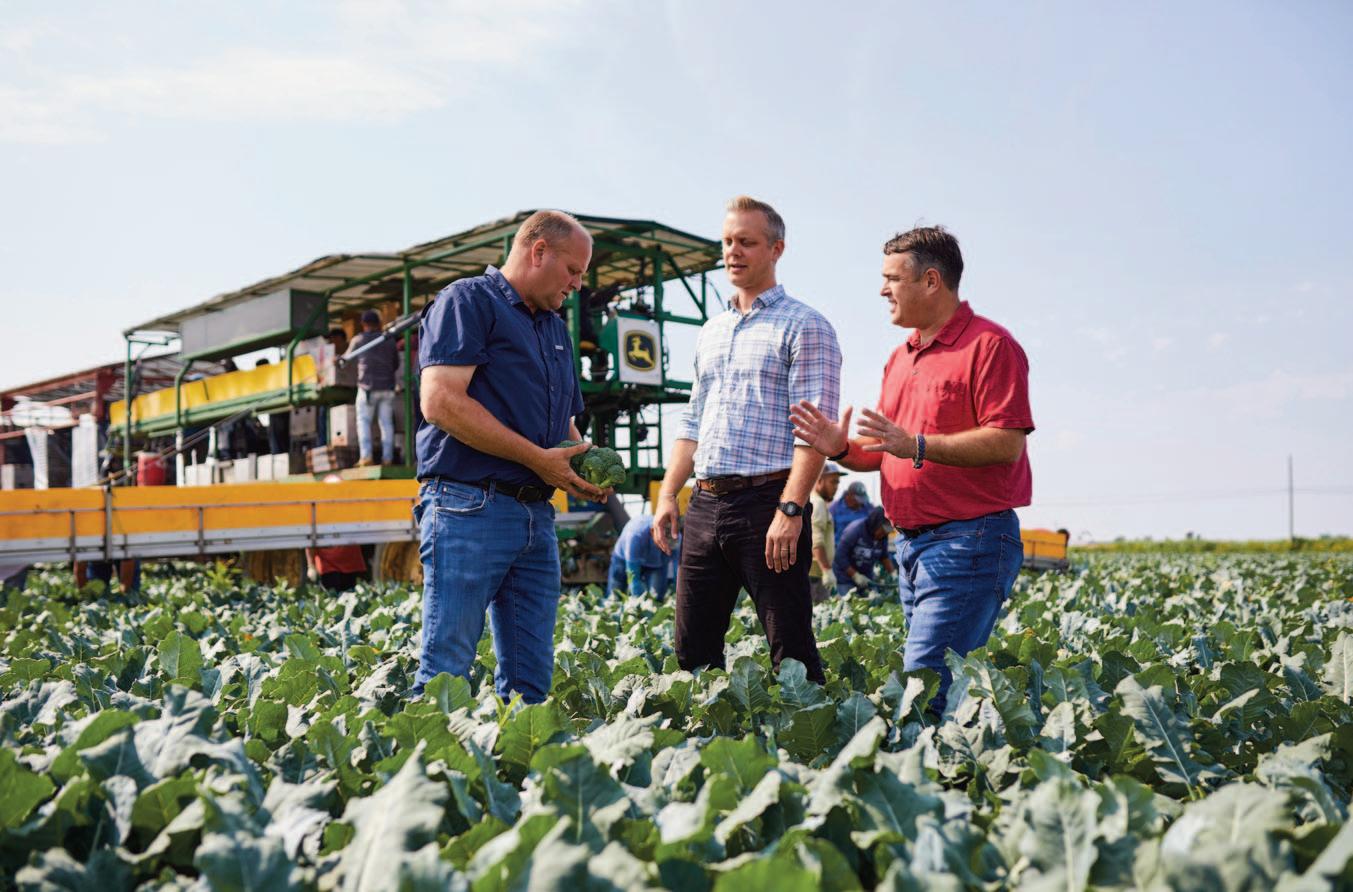
For decades, iced broccoli has been the status quo to keep it fresh from field to fork. Today, early adopter Jocelyn Gibouleau (L), Les Productions Margiric, is testing the innovation of Verdant Technologies. It’s a transparent sheet packed at the bottom of each box to slow down the respiration rate as soon as broccoli is harvested in the field. Here, Matt Aronson, (middle), Verdant Technologies and Tom Pierce, Sobeys, visit the field in Laval, Québec. They are tracking the broccoli from the field to the Sobeys distribution centre in Boucherville to a Sobeys IGA store in Montréal to see how the broccoli stacks up in shelf life. Photos by Michael Abril.
AT PRESS TIME…
New protections spell positive change for Ontario’s seasonal and temporary farm workers
The last wave of seasonal agricultural workers will shortly be arriving in Ontario for the start of fall harvest, particularly apples. As employers and communities prepare to welcome these workers, Ontario farmers point to how much positive change has taken place in recent years around the Seasonal Agricultural Worker Program (SAWP) and the Temporary Foreign Worker (TFW) program’s agricultural stream.
“Many critics still use outdated and misleading language when discussing these programs, ignoring the significant new protections and safeguards that have been added to the program in recent years to address legitimate concerns.” says Bill George, grape grower and chair of the Ontario Fruit & Vegetable Growers’ Association (OFVGA) Labour Committee. “A latest case is the UN Special Rapporteur on Contemporary Forms of Slavery, whose extreme language to describe the TFW program is particularly troubling to farmers.”
Among the biggest changes has been a provision of open work permits for vulnerable workers that started in 2019 and lets those workers freely seek employment with any other government-approved TFW employer. This complements existing mobility for workers,
including their ability to apply for a new work permit while they are already working in the province. Workers in SAWP can also request to be transferred to a different approved employer by their country’s liaison office without having to go through the process of applying for a new work permit.
Starting in 2024, Ontario is also changing how it compensates injured workers through the Workplace Safety and Insurance Board, and new federal rules introduced in 2022 provide additional protections from retribution and reprisals for workers who come forward regarding unsatisfactory working conditions. Workers have a variety of mechanisms to reach out for assistance, including a toll-free 24-hour federal government hotline that was introduced in 2021 and in the case of SAWP employees, liaison officers from their home countries who can provide assistance.
Earlier this year, the Senate Committee on Social Affairs, Science and Technology released a report that included six recommendations it believes could improve Canada’s TFW programs, many of which farm employers have also been calling for to strengthen and streamline the program for workers and employers.
“These recent changes are in direct response to challenges identified with these programs and employers working with government and worker advocacy organizations,” adds George. “Seasonal and temporary foreign
workers are an essential part of local fruit and vegetable production in Ontario, and while we recognize that there is always more than can be done to ensure workers have a safe and positive experience working here, we are proud of the many positive changes that have already been made as well as efforts that remain ongoing.”
Every year, Ontario fruit and vegetable growers employ approximately 20,000 seasonal and temporary foreign workers who come to Canada legally through the government regulated Seasonal Agricultural Worker Program (SAWP) and the Temporary Foreign Worker (TFW) program’s agricultural stream.
Through its More than a Migrant Worker initiative, the OFVGA has been empowering seasonal and temporary farm workers in Ontario who take pride in the work they do here by giving them a platform to tell their stories in their own words. At the same time, the initiative draws attention to the critical role that legal international farm workers play in the Canadian food system and efforts by farmers and government in recent years to invest in worker safety, protection and well-being.
Source: Ontario Fruit & Vegetable Growers’ Association August 13, 2024 news release
NEWSMAKERS
Hearty congratulations to Dr. Eugenia Banks, bestowed with the award of Honorary Life Member of the Potato Association of America. Born and raised in Chile, she admired her father who was promoted to head of extension for the Department of Agriculture of Chile. After completing her BSc in agriculture in Chile, she earned MSc and PhD degrees in plant pathology at the University of Guelph. In 1990, she was hired as a potato pest management specialist, eventually becoming the overall potato specialist for the Ontario ag ministry. In 2015, she became the potato specialist for the Ontario Potato Board. She dedicated the award to her potato growers over the last 35 years.
Anju Gill, executive director of the 600-member BC Blueberry Council, is leaving after several years, to join the BC Greenhouse Vegetable Growers as executive director, effective September 2024. She brings years of experience in government and public relations. Linda Della Santi will remain on staff, focusing on liaison with the Fruit and Vegetable Growers of Canada.
The 12th World Potato Congress was held in Adelaide, Australia from June 23-26. Prince Edward Islander John Griffin (third from left) was congratulated for his outstanding contributions to the ongoing success of the World Potato Congress. L-R: Dr. Nigel Crump, Dr. Peter VanderZaag and Greg Donald
British Columbia Grapegrowers’ Association recognized the contributions of Richard Cleave with a Lifetime Achievement Award at its August 7 Grower Day. He’s been a pioneer of growing grapes in the Okanagan for 38 years.He planted and has managed the site of the One Faith Vineyard since 1992, while also managing his own vineyard. He has grown grapes for leading wineries, lending his in-depth knowledge of the terroirs.
Congratulations to Geena Luckett, Wallbrook, Nova Scotia. She’s been named the Outstanding Young Farmer for 2024 at the Atlantic regional event. She is the co-owner and general manager of Luckett’s Vineyards, a 130-acre operation. The national event will be held in Lethbridge, Alberta in late November.
Perennia Food & Agriculture Corporation has welcomed Katarina Vucic as its new viticulturist. She participated in the Grape Growers Association of Nova Scotia summer vineyard tour in mid-August.
The U.S. Apple Association (USApple) has named a new chair to lead its Board of Directors. New York marketer and shipper, Brett Baker, president of United Apple Sales, will serve the 2024-25 term. Joining him are: Vice Chair: Steve Smith, VP, Marketing, Washington Fruit; WA. Secretary: Philip Glaize, III, Head of Operations / Sales, Glaize Apples, VA. Treasurer: Kaari Stannard, President & CEO, New York Apple Sales; NY. Immediate Past Chair: Steve Clement, CEO, PNW Tree Fruit.
Dr. Eugenia Banks
Anju Gill
Richard Cleave
Geena Luckett
Broccoli, straight up. No ice!
The status quo method: a forklift operator removes a stack of broccoli boxes from the ice machine that Jocelyn Gibouleau calls the “Margaritaville.” The stack will be stored at 34°F but even so, melting begins and a slushy sheen can be seen on the floor. That’s a safety hazard.
Continued from page 1
In-field harvesting doesn’t change very much as one worker tears off a HarvestHold Fresh perforated sheet –like a paper towel roll -- and places it in the bottom of every corrugated box or RPC. The benefits become lifesized once the broccoli is transported from the field to the packing line. Compare and contrast the simplicity of the sheet with the energy-intensive ice-making and ice-packing process.
“Innovation is always hard in the transition because you have all this capital invested in ice-making equipment – I call it Margaritaville. But when you understand all the problems that can happen to your product once it leaves your farm, you have to help with a solution for the entire chain,” says Gibouleau.
“We need something to protect our produce through to the consumer,” he continues. “If the produce is of good quality, then our retail customers will buy more.” Gibouleau points out that 30 per cent of the family’s broccoli business is now shrink- wrapped broccoli crowns. However, the iceless broccoli is more environmentally sustainable in several ways: no plastic wrap, energy savings, worker safety on dry floors and no waxed corrugated cartons.
Jocelyn Gibouleau shows his storage room with iced broccoli. Estimating 20 pounds of ice for each waxed corrugated box, he says that in the future, a HarvestHold Fresh liner in each box means that double the load of produce can be shipped.
“If this technology works, then all the chain stores should switch,” he predicts.
At the distribution centre
Thus far, the team at the Sobeys distribution centre (DC) in Boucherville, on Montréal’s south shore, gives HarvestHold Fresh a thumbs up. Richard Lagacé, national director of quality control, and Enrico Charest, national produce sourcing manager, are integrating HarvestHold Fresh into the centre’s routine.
“Everyone in the chain has to change their muscle memory,” says Lagacé. “It’s sometimes as simple as the grower remembering to have enough HarvestHold Fresh sheets on hand. Taking out the ice is a big thing for us. This new technology is extending shelf life by five to seven days, depending on the variety.”
Once the iceless broccoli arrives at the DC, it’s probed for temperature, measured for size and evaluated for any defects. The load is then placed in cold storage at an optimal temperature for overnight/next morning distribution to Sobeys stores. Another advantage is that iceless broccoli doesn’t need to be isolated from other commodities. Current food safety practice dictates that iced broccoli must be stored separately to prevent potential cross-contamination from leaking water.
“I was skeptical of this pilot at first,” admits Lagacé. “But there’s no noise on the line with iceless broccoli.” In DC parlance, his comment translates to fewer complaints and returns.
The driving force behind this Sobeys’ initiative is Tom Pierce, national director of supplier development and direct store delivery. Sobeys’ one-team, one-dream approach has resulted in buy-in from top executives through to DC staff, from individual growers through to produce managers at store level. With an imminent chainwide rollout of HarvestHold Fresh broccoli, he’s keen to monitor the impact, listen to chain response and tweak where necessary.
“We’re now testing how different broccoli varieties respond with HarvestHold Fresh throughout the growing season,” says Pierce. “When broccoli is arriving from the U.S., the varieties change over the season.”
At the grocery store
At the Sobeys’ store level, produce manager Maxime Beaurdgard is equally enthusiastic. Iceless broccoli is having a positive impact beyond shelf life at the front of store.
Continued on page 4
A worker tears off a perforated sheet from the HarvestHold Fresh roll and places it in the bottom of the corrugated box or RPC.
The in-field harvest team packs broccoli on a moving wagon, with some going into corrugated boxes to the left and RPCs on the right.
COVER STORY
Broccoli, straight up. No ice!
At the Sobeys distribution centre in Boucherville, Enrico Charest (L) is joined by Richard Lagacé and Souhail Moukhtar, quality control manager, to inspect a load of broccoli with HarvestHold Fresh sheets. They stand behind an inspection table where a probe took a temperature reading, the broccoli head was measured for size and evaluated for any defects.
Continued from page 3
Behind the broad swinging doors at the back of store, Beaurdgard highlights the significance of no leaking water on the stock room floor. In fact, improved employee health by reducing the risk of slipping on wet floors may prove to be the most visible impact on the store level from iceless broccoli. But of course, reducing the physical demands of removing 20 pounds of ice per 40-pound box is also a plus.
For his part, Guillaume Durocher, Sobeys lead for strategy and innovation, fruits and vegetables, is pleased with the consumer acceptance. “The broccoli is still crispy,” he says. “That’s what you want for broccoli – firm and no yellowing!”
To date, the initiative with iceless
CROSS COUNTRY DIGEST
BRITISH COLUMBIA
broccoli has gone so well that Tom Pierce anticipates a roll-out to all Sobeys growers in November 2024. “Real world testing is so important to success,” says Pierce.
What’s next?
Verdant Technologies is keeping further product developments close to the chest. But it would be no surprise to hear of ongoing research with climacteric fruits and vegetables -- melons, stone fruits, tomatoes – that experience a rise in ethylene and continue to ripen postharvest. It would certainly be of benefit for the entire supply chain to manage that process more precisely.
But ask the Sobeys team assembled in the distribution centre what they would like to see next. The reply is instant, and
At a Sobeys corporate IGA store in north Montréal, produce manager Maxime Beaurdgard (left) reviews the broccoli shipment with
for strategy and innovation for fruits and vegetables,
unanimous: “Do berries!” Innovative applications of 1-MCP technology hold promise for horticulture beyond feel-good, sound bites about sustainability. The practical benefits are here today and on the ground: reduced input costs for growers, improved worker safety and extended shelf life.
The Grower is “Digging Deeper” with Matt Aronson, chief revenue officer for Verdant Technologies and Tom Pierce, national director of supplier development and direct store delivery, Sobeys. Together, they describe the opportunity for the supply chain to switch to iceless broccoli. This podcast was recorded at Sobeys offices in Montréal after visiting the broccoli field at Les Productions Margiric,
Laval, the Sobeys distribution centre in Boucherville and a Sobeys corporate IGA store in Montréal. This podcast is sponsored by Cohort Wholesale.
Shuttered BC Tree Fruits Cooperative strands 300 grower members in apple harvest
KAREN DAVIDSON
Growers in the Okanagan Valley have suffered another blow with the July 26 news that the venerable BC Tree Fruits Cooperative has shuttered its headquarters in Kelowna and more significantly, its modernized packing
plant in Oliver and several controlled-atmosphere (CA) storage facilities. The timing couldn’t be worse as growers grapple with where to pack, sell and store their 2024 apple crop, with early varieties maturing in August.
“We will lose family farms this year,” predicts Sukhdeep Brar, vice-president, BC Fruit Growers’ Association (BCFGA).” There are 80,000 to 85,000 bins of BC apples looking for a home. If this year’s crop isn’t packed and sold by December, there isn’t enough CA capacity to store them.”
Until this summer, the cooperative had quite a number of storage facilities dotted throughout the Okanagan Valley – Keremeos, Creston, Summerland, Lake Country to name a few. But now, brokers can’t handle desperate requests from individual growers to handle 12 bins of McIntosh, 15 bins of Ambrosia and 30 bins of Gala, to give an example. The logistics are too cumbersome and, in fact, impossible, because these growers are no longer covered under the cooperative’s CanadaGAP food safety program. There’s not enough time to have dozens of growers re-audited.
What happened?
BC Tree Fruits Cooperative communicated to its 300
grower members that a storm of events led to the sudden closure: several years of extreme weather, competition from Washington state and finally estimates of a 50 per cent drop in apple volumes for the 2024 harvest. These factors came on top of declining revenues -- $55.7 million in 2023, down from $67.5 million in 2021.
Within days, the Canadian Imperial Bank of Canada served notice that the cooperative was non-compliant in servicing debt of $51.7 million. More money is owed to creditors including packaging suppliers and growers. The cascading events of recent weeks have led to the British Columbia Supreme Court granting creditor protection to the cooperative that’s served growers since 1936.
Political pressure on the BC government has been intense from Opposition MLAs. BC premier David Eby and his ag minister Pam Alexis responded by meeting growers in Penticton on August 13. While lobbying for the federal government to do its part in the crisis, they announced three changes:
• British Columbia is raising the AgriStability compensation rate to 90 per cent and doubling the compensation cap for all farmers for the 2024 program year.
Continued on next page
Guillaume Durocher, lead
Sobeys, Québec.
The state-of-the-art packing facility in Oliver, British Columbia is now closed.
CROSS COUNTRY DIGEST
BRITISH COLUMBIA
Shuttered BC Tree Fruits Cooperative strands 300 grower members in apple harvest
Continued from page 4
This will provide an estimated $15 million in immediate relief to farmers in need. This enhancement will help stabilize farm income and help farmers manage the increasing risk due to extreme weather. Late enrolment will also be available for producers not enrolled in the AgriStability program.
• The new Tree Fruit Climate Resiliency program will provide $5 million to help tree-fruit farmers buy equipment and pursue projects that were not eligible under previous programs. This will strengthen farm resilience and preparedness for extreme weather.
• The province is also temporarily exempting farmers from an Agricultural Land Reserve rule requiring that fruit processed on a property must also be produced there.
The BC Ministry of Agriculture and Food is consulting with the industry about options for a one-time fund
with an emphasis on smaller producers.
These announcements, while appreciated, will not keep some cash-starved farmers in business.
Some growers are still owed payments from the 2023 apple crop and the 2024 cherry crop. As the cooperative winds its way through the courts, the bank will be paid first and the growers will be paid last.
The ripple effects continue. In an August 16 newsletter, BCFGA executive director Melissa Tesche, reported that she’s been working with provincial ag ministry staff on an Emergency Table to reduce the impact of the cooperative closure on growers. Four major areas are the focus:
• Producer Impacts: connecting with growers and other industry stakeholders to understand the effects of the cooperative closure
• Finances: what can be done about the cashflow challenges this fall
• Food Safety: what can be done to facilitate BCTF growers getting individual certifications in time for this harvest, since their group certification has been cancelled
• Harvest Logistics: what can be done to help get as many apples as possible harvested, stored, and sold
Some background
Over the last few years, the cooperative has been mired in controversy with a high turnover of CEOs, four in the last decade. Since 2019, Warren Sarafinchan took the reins, attempting to steer a turnaround with the sale of key land assets in Kelowna. Rather than build a facility in Kelowna, the board of directors pivoted to Oliver, to modernize a packing house in the southern reaches of the Okanagan valley. Millions of dollars were committed to the refit that included a state-of-theart MAF-RODA packing line.
While Sarafinchan’s contract was extended for five years in April 2021, he took an extended leave of absence just two years later, as extreme weather events continued to take their toll on apple volumes. Midst low returns, grower members were vocal in their displeasure and were divided in the path forward. Interim CEO and CFO Doug Pankiw has
FREE MENTAL HEALTH SUPPORT FOR ONTARIO FARMERS, FARM WORKERS AND THEIR FAMILIES
been at the helm since.
In its heyday, the BC Tree Fruits Cooperative handled 300,000 bins (80%) of the Okanagan’s apple harvest under the well-known leaf logo. All apples glowed in the slipstream of that brand. Last year’s volume was a third of that.
What’s next?
The cooperative succeeded in obtaining a stay of all proceedings until August 23, 2024, when a
“Comeback Hearing” will be held. The court-appointed officer is Alvarez & Marsal Canada Inc. 2024 will be remembered as a catastrophic year for Okanagan growers, whether they grew apples, stone fruit or grapes. The trauma is keenly felt by multiple parties with the effects still to be documented throughout the sector. The crisis is playing out against the backdrop of a provincial election slated for October 19.
Premier David Eby meets with Penticton-area orchardists.
GREENHOUSE GROWER
Keep your greenhouse booming with a healthy workforce Know the top hazards putting worker safety at risk
The Ontario greenhouse industry is booming. With increased production of fruits, vegetables, flowers, and plants, greenhouse growers have been expanding by a steady five per cent each year.
“Without a doubt, the greenhouse sector has seen significant growth in recent years,” says Kristin Hoffman, health and safety consultant with Workplace Safety & Prevention Services (WSPS). “It also has one of the highest rates of lost-time injuries in the agriculture sector.”
When looking at Ontario’s agriculture sector, Workplace Safety and Insurance Board (WSIB) statistics show* that those who work in crop production, which includes greenhouse workers, experienced the most injuries over the past four years. The good news is that, although these workers have been experiencing a high number of injuries, that number has been
declining.
Between 2020 and 2023, exposure to noxious substances was the top cause of injury. “We know most of these were related to COVID infections,” says Hoffman. “So, when we remove those instances, that enormous number goes down dramatically. And then we see that falls, overexertion, and getting struck by objects or equipment have been the top causes of injury in greenhouses.”
Tackle these top hazards
To prevent workers from getting hurt, first recognize and assess the hazards in your workplace. Then implement and evaluate how you are controlling workers’ exposure to the hazards.
Break down each task done in your workplace to determine which hazards are present and then implement effective controls through:
• elimination (removing the hazard)
• engineering (modify processes and equipment to reduce hazards)
• procedures, and
• training your staff.
Provide the training in the language workers will understand. “Many greenhouse workers are temporary foreign agriculture workers. You may need to translate training material and other information,” says Hoffman. She offers some tips on how to control the top hazards that are putting greenhouse workers at risk.
1) Slips, trips, and falls Water, soil, hoses, and cords are common culprits in greenhouses that lead to slips and trips. Good housekeeping practices can prevent injuries from happening. When something spills, clean it up right away.
“Different types of flooring is also a common cause of trips and falls in greenhouses,” says Kristin. Moving from a concrete floor to a dirt floor or a fabric-covered floor can be tricky, especially if the dirt is uneven or the fabric has been torn. “Pay particular attention to the transitions from one flooring to another to make sure they are even.”
2) Overexertion—When workers are pushing, pulling, or lifting heavy carts or trays, they can experience overexertion, which is a musculoskeletal disorder (or
MSD). MSDs describe a number of different aches and pains affecting the musculoskeletal system (your muscles, tendons, and nerves). Common MSDs include back pain, carpal tunnel syndrome, and tendonitis. “Job rotation can help minimize the risk of overexertion,” says Hoffman. “Changing from one task to another, gives your body a bit of a rest while still being productive. It’s also important to train workers on proper lifting techniques.
3) Struck by objects or equipment—Greenhouses have a lot of moving parts and equipment, from forklifts and tractors to carts and conveyors. While these are very helpful tools, they also pose a significant risk to workers when not managed properly. “Training and design are key to minimizing risk from these types of hazards,” says Hoffman. Equipment operators must complete proper training and evaluation of their performance before driving a forklift, tractor, or any other vehicle. Those who work near this type of equipment also need training so that they understand blind spots, signals, and the importance of eye contact. Designate pedestrian pathways to keep workers and mobile equipment separate. When it comes to design, organize work areas so employees are not placing or grabbing things from above their head (e.g., tall shelves or racks). “This will reduce the risk of something falling on them,” explains Hoffman.
Prepare for the future
As we look into the future of greenhouses in Ontario, we have to consider rising temperatures and heat stress. “As the climate changes, it is going to impact all parts of our world, including workplaces that are already hot, such as greenhouses,” says Hoffman. “The way that greenhouse operators have been managing heat stress may need to be reviewed and updated to account for even warmer workplaces.”
Hoffman is optimistic that new technologies, such as artificial intelligence, will be able to help find better methods for controlling hazards. “For example, in the case of heat, automated equipment that eliminates the physical exertion of manual material handling may help workers keep their body temperatures lower,” she says. In the meantime, she recommends scheduling cooling breaks, rest periods, and ensuring workers are adequately hydrated to manage heat.
All signs point to continued growth for Ontario’s greenhouse industry; however, growth does not happen without a skilled, reliable workforce. Invest in your workers, help them stay safe and healthy, and position your operation to leverage future innovations.
Source: Workplace Safety & Prevention Services
*According to the WSIB EIW Database, data pulled as of July 2024.
BASF/Nunhems collaborate with Plant Products
BASF’s vegetable seeds business, operating in the market under the Nunhems brand, has announced its collaboration with Plant Products to bring seeds to the Controlled Environment Agriculture (CEA) market.
Effective August 19, 2024, Plant Products will distribute Nunhems tomato and cucumber seeds for indoor growing in the United States and Canada.
This new collaboration between BASF | Nunhems and Plant Products marks an important milestone in expanding access to high quality vegetable seeds for CEA growers.
Scott Hodgins, general manager at Plant Products states,
“The entire Plant Products team is honoured that BASF | Nunhems has trusted us to bring their vegetable seeds to our shared greenhouse customers.
Plant Products and BASF have a longstanding partnership in both
Canada and the U.S. and we are looking forward to building on that strong foundation through our technical expertise and direct customer relationships.”
For more than 80 years, Plant Products has delivered focused technical support and consumable goods to the specialty horticulture industries in Canada and the U.S. As a leading distributor, Plant Products offers a wide range of products including fertilizers, synthetic and biological pesticides, biological controls, substrates, seeds, and other innovative solutions.
Additionally, Plant Products is a distributor for BASF fungicides, insecticides, herbicides, and beneficial nematodes.
Source: BASF/Nunhems and Plant Products August 19, 2024 news release
GREENHOUSE GROWER
Ontario Greenhouse Vegetable Growers’ campaign recognized with the GOLD Marketing Award
Ontario Greenhouse Vegetable Growers, (OGVG), North America’s largest exporter of greenhouse-grown produce, is proud to be recognized with a Gold Hermes Award for the Greenhouse Goodness Digital campaign.
The Qssociation launched Greenhouse Goodness as an education campaign in top U.S. markets to highlight the many benefits of making greenhouse-grown peppers, cucumbers and tomatoes the preferred choice for healthy, convenient, delicious and always fresh. The campaign, “This is Greenhouse Goodness,” features bright, fresh, and healthy choices that leave the consumer with just that . . . “feeling good.”
The plan developed in collaboration with Douglas Marketing Group, (DMG), is one component of a multi-level strategy the association is rolling out across the Atlantic United States through a staged approach that includes social media influencers, online advertising, retail education, and point of sale.
The digital campaign and key messaging focused on Greenhouse Goodness delivering on the promise to
bring nutritious, fresh, and sustainable produce to the tables of consumers. With greenhouse-grown produce, consumers can expect consistent quality, flavourful peppers, tomatoes, and cucumber varieties every time.
“The Greenhouse Goodness campaign highlights the high standards and innovative practices that go into every step of the processes of our growers,” said Richard Lee, executive director, OGVG.
“We are dedicated to continuing our efforts in educating consumers and promoting the advantages of greenhousegrown produce while reinforcing our position as an industry leader.”
Kay Douglas, DMG president shares, “An impactful campaign was developed working with the values and mission of Ontario Greenhouse Vegetable Growers. The Greenhouse Goodness campaign is positioned to showcase the key benefits of greenhouse-grown vegetables aimed to educate and create industry awareness.
The Association has a great mandate, members, and an exceptional product that North America can be proud of, as well as a strong message and nutritious produce to
deliver to consumers.”
To view the award-winning campaign visit experiencedmg.com/portfolio/ogvg/
All aboard for Canadian Greenhouse Conference bus tour on October 8
The Canadian Greenhouse Conference (CGC) bus tour will be held in southwestern Ontario on October 8 in the Leamington/Kingsville area, including fruit, vegetable and flower greenhouses. Lunch is confirmed at Colasanti’s Tropical Gardens.
According to the CGC website, “Changing crop conditions make it somewhat difficult to establish tour sites far in advance. It is expected that the
site selections will be confirmed in late August.”
Dr. Fadi Al-Daoud, OMAFA greenhouse specialist, adds, “We can also safely say that we will be including Ontario Plants Propagation’s new facility in Glencoe as part of the tour.”
A bus will be departing Niagara Falls on Monday, October 7 at 2 pm, with registrants overnighting at Caesars Windsor Hotel. Cost is $375. A local Leamington bus
will join the tour on the day of the event. Cost is $255. Pre-registration is required by September 6. Book early to avoid disappointment. Go to www.canadiangreenhouse conference.com to register. Click on Attendees.
EXECUTIVE DIRECTOR PERSPECTIVE
Code of conduct a good first step, but more work needed for meaningful change
It’s been almost four years since the Ontario Fruit & Vegetable Growers’ Association first began raising alarm bells about the practices of large grocery retailers. This included unilaterally imposing additional fees on suppliers, which was in addition to reports from growers of existing marketing fees, extended payment terms, late delivery penalties, truck unloading charges and unilaterally changing the price paid for product after delivery.
This helped, in part, to lead to a process that brought all stakeholders to the table to develop a Grocery Sector Code of Conduct. Several years in development, the voluntary Code passed a milestone earlier this year with the announcement that all major Canadian grocery retailers have agreed to sign on and support it.
For growers, this marks a good first step in what we see as the right direction to provide contractual certainty. The retail sector is very concentrated in Canada, often leaving growers feeling like they have limited options when it comes to marketing their produce.
In the short term, the perishability of fruits and vegetables makes it almost impossible to pivot from lastminute changes, charges and rejections and for longer-term changes, the search for new buyers can be complex and challenging because of the small number of buyers in the market.
In simple terms, the Code will make things more transparent so
that growers will know what to expect. It includes provisions for fair and ethical dealing, commercial agreements and a variety of other topics such as payment terms, fees and how to handle the process of delisting a product, for example.
A new Office of the Adjudicator will be set up where both sides will be able to bring disputes for resolution if they can’t reach an agreement on their own – and rules have been added to protect growers against retribution or punitive measures by retailers should they exercise their rights to adjudication.
The Code represents the opportunity for a major culture change in the supplier-customer relationship and it will take some time to evolve and for everyone to understand and become comfortable with the new framework. And there is no doubt that there will be some growing pains as both sides look for interpretation of some of the rules by the Office of the Adjudicator.
What the Code in its current
form does not do is address specific long-held grower concerns, such as providing reimbursement for truck waiting times or dropping various fees.
The Office of the Adjudicator will help make rulings in individual cases, but broader spectrum change is not part of the Code at this time. There is ongoing frustration in the grower community about what seems like never-ending increases in retailer fees and buyer and government policy changes that result in higher costs for growers but without a mechanism to recover those costs from the marketplace.
As retailers struggle to respond to consumer anger about high food prices, we hear from growers that many are being pressured to accept prices that are the same or in some cases even lower than they received in the previous years.
Unfortunately, this creates an unsustainable environment for growers – and along with higher production costs, there are also other expectations and demands
on growers by consumers and government, which all also cost money.
Long term, this imbalance threatens the very future of our domestic fruit and vegetable production. Simply put, growers need to stay profitable to stay in business – and without growers, the rest of our domestic food supply system is at significant risk. It’s a risk we can’t afford to take. Recent global events have shown us how precarious it can be to rely on others to feed us and with global weather becoming more volatile and extreme, those other regions may also be dealing with supply challenges. That’s why it is important that all of us in the grocery retail supply chain work together in good faith and while we appreciate the first step the Code represents, there is more work to be done to extend its mandate and offer greater fairness and transparency.
Alison Robertson is the executive director of the Ontario Fruit & Vegetable Growers’ Association.
Veraison – pronounced “verr-ray-zohn” -- is underway in Ontario’s vineyards. The Grape Growers of Ontario has negotiated a one-year wine grape (Classes 5-10g) price agreement with Ontario Craft Wineries and Wine Growers Ontario. Under these challenging circumstances, the overall price increased by 1.67% over 2023 prices. Photo by Glenn Lowson.
ALISON ROBERTSON
Produce president: Import labour, or import food
Farm labour, food production and immigration are inextricably joined, maybe more than ever. The North American agricultural sector is keenly aware of the critical, chronic labour shortage it’s facing. It’s making the problem as clear as possible to elected officials, along with an ultimatum: import labour, or import food.
Among the most frustrated with the situation, especially in the U.S., is the Washington-based International Fresh Produce Association, an advocacy group for fruit, vegetable and floral growers.
The association says Congress there has failed for nearly four decades to address agriculture’s
labour crisis. It estimates producers have 20 per cent less labour than they need, resulting in a food supply chain that increasingly relies on foreign workers and foreign-grown food to meet Americans’ needs.
Those are hot buttons in the U.S., especially this year with a federal election just a couple of months away. Politicians have tied immigration to crime, and food shortages are seen as a threat to national security.
On top of all this, a huge fight has ensued over how much America’s one million hired farm workers should be paid.
Workers’ wages are a struggle everywhere. In the U.S., the matter could be addressed in part by the multi-billion-dollar U.S. Farm Bill. However, it’s been mired in political wrangling for more than a year, and it’s unlikely to be moved along before ballots are cast in November. The produce association put together a list of 100-plus recommendations to lawmakers for the likes of research, crop insurance and labour.
But politicians won’t budge.
Given this backdrop, it’s no wonder produce association president Cathy Burns is grumpy.
In a recent interview with Agri-
Pulse Communications, she said obstacles are limiting the sector’s growth potential and that Congress needs to help. Failing to act jeopardizes more than the farm sector – inadequate labour and an unwillingness to address it means crops could rot in the fields and deprive families of badly needed nutritional benefits, she says.
“Decisions that have not been made are putting us at risk of living in a country where we can’t feed ourselves,” she says.
Playing the family and health card could well resonate with disgruntled and desperate U.S. voters. Burns, the mother of two Gen Z children, points out that members of the current generation could enter adulthood as the first ones in U.S. history who are not as healthy as their parents. Despite efforts to get them to eat better, it’s a generation that suffers from poor nutrition and refuses to consume fresh fruit and vegetables beyond the country’s school lunch program…which, incidentally, is funded through the same Farm Bill that warring politicians have sluffed off.
Burns says the lid’s about to blow. Only one in 10 Americans eat enough fruit and vegetables,
“We
she claims, adding that 80 per cent of the U.S. health care dollar is spent treating disease, not preventing it.
“More people are walking around metabolically sick than healthy,” she told Agri-Pulse. “We’re going to be a sicker country.”
To address this problem, she’s advocating for produce prescription programs. These are initiatives in which qualified professionals can write prescriptions for produce that is proven to prevent or treat an illness.
So instead of pharmaceuticals, you could get a prescription for farm products – like the produce that Burns’ association represents. That’s a potential goldmine for producers. The benefits of consuming fruit and vegetables,
as well as the perils of avoiding them, are well documented by credible researchers and institutions.
“[Producers] provide the most nutritious products in the world,” says Burns. “We need to remove barriers.”
Labour is key to providing those products. Support for product visibility campaigns is fine, but if producers don’t have the labour to get crops planted, cared for and harvested, the outlook is bleak for not only agriculture, but for an ailing society that needs help now.
Owen Roberts is a past-president of the International Federation of Agricultural Journalists and a communications instructor at the University of Illinois
OWEN ROBERTS
U.S. 2024-25 apple production will reach nearly 260 million bushels
After record-breaking production in 2023, apple growers expect another highperforming year with a large crop, according to a new report released by the U.S. Apple Association (USApple) at the organization’s 129th annual Outlook Conference in Chicago.
USApple’s Industry Outlook 2024* provides the most up-todate data and analysis on U.S. and global apple production, utilization and trade. Authored by USApple vice president of insights and analytics, Chris Gerlach, the report takes an in-depth look at the trends and forces – from political headwinds to weather events – that shape the U.S. apple industry.
*The Outlook Report is based on recently released United States Department of Agriculture (USDA) estimates. After the presentation of those numbers, USApple members meet inperson to discuss current growing conditions to formulate a more up-to-date production estimate. The final USApple 2024/25 crop year forecast is an adjustment of the USDA numbers based on those conversations.
U.S. Production
According to USApple’s analysis, total U.S. apple production for the 2024/25 crop year (CY) will be 259,517,252 million bushels. This represents a 10.1% decrease compared to last year’s final production figure.
“Growers from across the U.S. are reporting the crop quality is excellent,” said Gerlach.
These figures are more comprehensive than USDA data, which only look at the top seven apple-producing states. USApple analyzes the production from states outside of the top seven and adds that back into USDA’s figure. It also incorporates feedback from growers based on what they’re seeing in the field every day.
Varietal Mix
At the varietal level, Gala is expected to retain the top spot with more than 48 million bushels produced, accounting for around 17 per cent of the U.S. apple market. After Gala, rounding out the top five are Red Delicious (12.3%), Granny Smith (10%), Honeycrsip (9.8%) and Fuji (9.4%).
In general, the varieties on the rise include Honeycrisp, Pink Lady/Cripps Pink and Cosmic Crisp. Fuji, Rome and “other” varieties have remained relatively consistent compared to 2019/20 production volumes. Varieties on the decline include Gala and Red Delicious.
“We still see strong Honeycrisp production, but it’s tempered this year,” said Gerlach. “With volumes aligning more closely with Gala and Red Delicious, we may see production levels stabilize rather than increase dramatically in the future.”
Trade
According to USDA trade data, fresh apple exports totaled 46.4 million bushels in the 2023/24 CY (July to June). This is around 14 million bushels higher than 2022/23 export levels – an astonishing 44 per cent year-overyear increase.
During the same period, fresh apple imports dropped by around one million bushels, a 15 per cent decline. The joint effects of increasing exports and decreasing imports caused the already net positive fresh apple trade balance
Could industry third-party oversight of Canada’s fresh fruit and vegetable grade standards become a reality?
Industry oversight of Canada’s Fresh Fruit and Vegetable (FFV) grade standards could become a reality. The Canadian Food Inspection Agency’s (CFIA) public consultation to identify a new approach for developing and maintaining Canadian FFV grade standards provides an opportunity for industry influence in its future role.
Industry has a long-standing interest in taking on an active role in ensuring these standards are relevant and responsive. As far back as the mid-2000s, industry collaborated to develop amendments. In 2008, Fruit and Vegetable Growers of Canada (FVGC) proposed more than 700 changes to CFIA. The majority remained unaddressed due to the requirements to implement regulatory changes despite the Incorporation by Reference (IBR) provision. Since 2017, the Dispute Resolution Corporation (DRC) has led a follow-up initiative to revisit those proposed changes and consider additional amendments.
To develop options for a new model, CFIA engaged industry, Agriculture and Agri-Food Canada and key international trading partners and stakeholders to:
• gain a better understanding of the role of FFV grades in the
modern marketplace
• identify opportunities to reduce burden on industry and support competitiveness • be informed on how different approaches for developing and maintaining FFV grades may affect stakeholders The feedback informed development of options and on July 22, 2024 CFIA launched a public consultation on the future of Canada’s grade standards. Three options are presented:
Option 1: Retain the FFV grades in the SFCR and give ownership of the IBR document for FFV grade standards to an industry body
Option 2: Expand the mandate of the Fruit and Vegetable Dispute Resolution Corporation (DRC) to include the development and maintenance of most FFV grades
Option 3: CFIA maintains FFV grades in the SFCR and applies a risk-based approach to develop outcome-based grades
Industry analysis suggests Option 1 as the preferred Option whereby an industry body, such as the Dispute Resolution Corporation (DRC), could take on ownership. DRC has expressed an interest to do so.
to grow to more than 42 million bushels.
The surge in fresh apple exports is largely attributed to the abundant domestic supply, competitive pricing abroad, and favourable positive trade policies.
“Thanks to the removal of previously imposed tariffs on our apples, exports to India are up nearly 4,000 per cent year over year. We are optimistic that this critical market will continue to grow in volume and value,” said Gerlach.
Global Production
According to United Nations (UN) data, worldwide apple production surpassed 5 billion bushels for the first time in 2022 (the latest available datapoint). In 2022, China alone was responsible for producing 2.5 billion bushels, around half of the world’s total supply. In 2021, Turkey overtook the U.S. to become the world’s second largest apple producer and maintained
Final US Apple Production Forecast, including states
Production levels measured in 42pound bushels
that spot in 2022, even widening the gap between us (with 253 million bushels, 5% of world production). The U.S., in the third spot, was credited with 232 million bushels and 4.6 per cent of world production. Rounding out the top five were Poland (4.4%) and India (2.7%).
Source: US Apple Association August 16, 2024 news release
COMING EVENTS 2024
Sept 4-6 Asia Fruit Logistica, Hong Kong
Sept 10 Berry Growers of Ontario Twilight Meeting, Brooks Farms, Mount Albert, ON
Sept 10-12 Canada’s Outdoor Farm Show, Woodstock, ON
Sept 18 Grape Growers of Ontario Annual Celebrity Luncheon, St. Catharines, ON
CFIA already uses versions of third-party ownership for other IBR documents and has a similar arrangement with the Canadian Beef Grading Agency (CBGA).
Option 2 is not a viable option as it would create two membership classes and involve DRC in compliance actions if grade standards are not followed as required. Option 3 is essentially the status quo, which is not practical.
When the DRC was formed in 1999, a greater role and leadership in the future of standards was a component of the long-term vision. The Safe Food for Canadians Regulations IBR provision, DRC’s experience and role in leading current modernization efforts and the public consultation align to suggest this is the ideal timing for such a move.
For additional information contact DRC’s Anne Fowlie (afowlie@fvdrc.com / 613 270 9001). CFIA’s Discussion Paper and online comment submission are available at inspection. canada.ca/en/about-cfia/ transparency/consultations-andengagement/canadian-fresh-fruitand-vegetable-grade-standards
The submission deadline is October 20, 2024.
Sept 19-21 Quebec Produce Marketing Association 77th Convention, Fairmont Tremblant, Tremblant, QC
Sept 28 St. George Hazelnut Tour, Brant, ON
Oct 1-5 International Plowing Match & Rural Expo, Lindsay, ON
Oct 8-10 Fruit Attraction, Madrid, Spain
Oct 9-10 Canadian Greenhouse Conference, Niagara Falls Convention Centre, Niagara Falls, ON
Oct 17-19 Global Produce & Floral Show, Atlanta, Georgia
Oct 22-24 Forum of Agricultural Robotics, Woodland, Sacramento, CA
Nov 1-10 Royal Agricultural Winter Fair, Toronto, ON
Nov 17-19 Advancing Women Conference, Sheraton Fallsview, Niagara Falls, ON
Nov 18-20 Fall Harvest Advocacy Event, Parliament Hill, Ottawa, ON
Nov 19-21 Alberta Potato Conference and Trade Show, Grey Eagle Resort & Casino, Calgary, AB
Nov 26-27 Ontario Federation of Agriculture Annual General Meeting, Delta Toronto Airport Hotel & Conference Centre, Toronto, ON
Nov 27-Dec 1 Canada’s Outstanding Young Farmer National Event, Sandman Signature Lethbridge Lodge, Lethbridge, AB
Nov 28 Ontario Harvest Gala, Delta Hotel, Guelph, ON
RETAIL
On the ground, building up relationships with produce managers
Selling into retail chains is complicated. Your key point of contact is a category manager or buyer. In addition to developing that relationship, you should invest in knowing employees in other parts of the business. Produce managers are a good example. While they are not ultimate decision-makers, they can impact the relationship you have with the retailer. That’s because they have insights with consumers and how produce flows from the back of store to front of store.
Produce managers have a challenging job. They have different priorities than the merchants working in the office. At store level, it is much more about driving sales that day or week, productivity, reducing shrink, training employees and managing other controllable expenses.
If you plan to invest time and resources with people in stores, make sure you understand them. An employee working in the produce department of a discount retailer has a very different job than someone working in a conventional store or specialty store. For example, it is a waste of time to demonstrate to employees in a discount store how they can educate consumers on the six different uses of an apple. They have limited labour and they are there to keep stock full and turning. They would be more interested in the fastest way to empty a case of apples without bruising them.
Considerations when talking to employees at the stores
Priorities at store level are different. They are trying to meet or exceed the weekly sales target and do this within the work schedule. Labour is the largest controllable expense in retail and it is a constant battle to deliver the sales, quality, service and assortment within timelines.
The turnover of employees is a constant challenge. Produce managers are usually working with people who do not come with a lot of produce knowledge. Do they know the difference between an artichoke and okra?
Not likely. It always sounds good to build solid programs to train new employees, but these initiatives get cut and often department managers are left to train on the fly.
If your product is sold in the produce department of a conventional store you are one of 350 SKUs. People in the stores can be great allies, but they are not there to build your brand or be your spokesperson.
10 ideas to build relationships with employees at stores
1) Visit stores before you invest a lot of time and resources. Understand what they need and what they are trying to do every week. Get a sense of the level of understanding they have for your products and categories. Be realistic about the focus they can put on your products or category. Once you have figured out what you want to do, make sure you keep the category manager informed.
2) Many people working in produce have very little experience and the full- time people do not have the hours to train them properly. Start with the basics for part time people and perhaps something more advanced for the full-time employees that have been around longer. Do not assume they know how to do things right for your product. Merchandising standards such as keeping kiwi away from ethylene-heavy bananas are
not as well-known as they used to be.
3) Offer to do a session at the next produce manager’s meeting. Retailers will bring these people together occasionally and it is a great audience to speak to. Sponsor a break so they want to include you on the agenda and make sure the content is helpful to a produce manager, not an infomercial about your product. Provide them with something to take back to their employees or even some swag. They do not get much.
4) Add relevant information to your master case. These are such great opportunities to communicate with people at store level. Print on the inside or include an insert. If possible, change it up to keep things fresh and avoid becoming wallpaper they do not notice.
5) Offer content to your category manager to be shared in communication to produce managers. Many have regular correspondence and if you can provide relevant content that saves them time (and makes them look good) you will build
relationships at the office and the stores.
6) Thank them! As we said earlier, working in retail is tough. If these people did not take your products out of the back room and display them, you would deliver zero sales. Yes, it is their job but letting people know they are appreciated can go a long way. A simple note in your cases for a month will deliver the message.
7) When you visit stores, find something you can leave behind that is helpful to them. Perhaps you are trying to help them understand the importance of trimming the butt on your lettuce properly. A good produce knife with your logo will be there long after you leave. Make sure your category manager and the operations team are ok with you providing these.
8) Ask their opinion! These people are working with your products every day. They also interact with consumers every day. They can be such a great resource in terms of how your product is performing and what people think about it. Take the time to
ask them what they think and acknowledge the information they share.
9) Consider a retail program like a consumer campaign. Determine different themes such as how to use/consume the product, how to treat it in a produce department, how to reduce waste on the item in the store, how to treat it at home, when it is in peak season, how to determine if it is ripe, complementary products etc. Repetition is important – but within reason.
10) Share your outreach activities and the results with your key contacts in category management and operations. Include photos in your presentations and illustrate the sales growth or improvements in sell through. Illustrate the benefits to their stores and their business.
Peter Chapman is a retail consultant, professional speaker and the author of A la Cart-a suppliers’ guide to retailer’s priorities. Peter is based in Halifax, N.S. where he is the principal at SKUFood. Peter works with producers and processors to help them get their products on the shelf and into the shopping cart.
PETER CHAPMAN
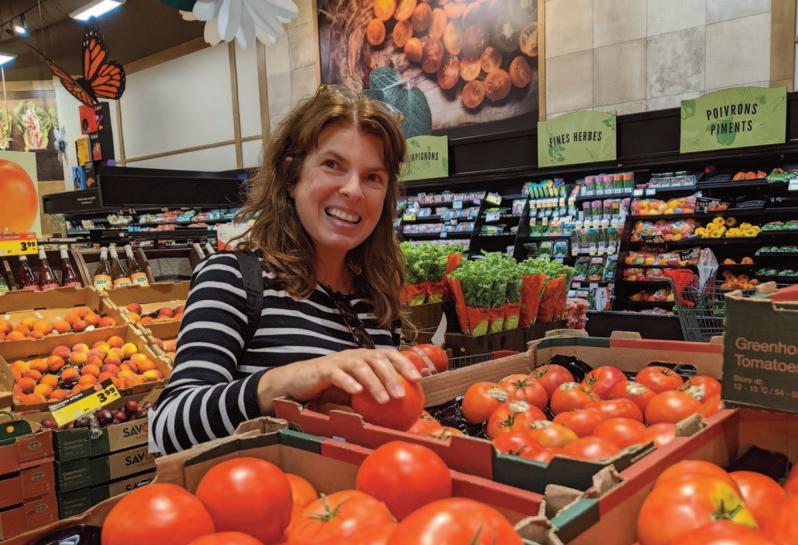
Consumer in Sobeys IGA store, Montreal, Québec
FOCUS: GREENHOUSE INNOVATION
Managing nighttime greenhouse light emissions
DR. FADI AL-DAOUD
After the autumn harvest in Canada, fruit and vegetable field production ends in anticipation of the next growing season. But visit the Windsor-Essex region in southwestern Ontario, home to North America’s largest concentration of greenhouses, and fruit and vegetable production continues year-round.
The impressive growth of Ontario’s fruit and vegetable greenhouse sector in the last 20 years has been partly fueled by increasing demand for fresh local produce during the traditional off-seasons. To grow crops yearround in our northern latitudes, greenhouse producers use the latest lighting technology to supplement the naturally low sunlight levels in autumn and winter.
But with this increase in greenhouse lighting comes an increase in nighttime greenhouse light emissions. Producers use light abatement curtains to reduce light emissions at night, but the curtains act like blankets and trap heat and humidity that can alter the greenhouse growing environment and negatively affect crops.
A gap in our understanding of how to best use light abatement curtains in Ontario was identified, and in 2020 the Ontario Ministry of Agriculture, Food and Agribusiness (OMAFA) launched a multi-year project, co-funded by Ontario Greenhouse Vegetable Growers (OGVG), to study the
effect of light abatement curtains on the greenhouse environment and crops. The research was conducted at Agriculture and Agri-Food Canada’s Harrow Research and Development Centre (Harrow, ON), the University of Guelph (Guelph, ON), and commercial greenhouse partners in the province.
As a result of this project, OMAFA published two factsheets in 2022 and 2023 and is currently working on a best management practices (BMP) document to be published in the near future. You can find the 2022 and 2023 factsheets in Greenhouse Canada magazine, ONGreenhouseVegetables.ca, ONfloriculture.com, and Ontario.ca (search these websites for “light abatement”). You can also learn more about this project
at the Canadian Greenhouse Conference (CGC) in October 2024 when I will be presenting on this topic. More details about the CGC’s speaker program are available on its website.
This article provides a summary of the factsheets and the upcoming BMP.
Recommendations based on research results
Light abatement curtains are beneficial for reducing nighttime light emissions when supplemental lighting is used in greenhouses. They also have the added benefit of increasing energy efficiency by reducing heat loss to the outside environment. Alongside the benefits of light abatement curtains, there may be some negative impacts on the growing
environment, such as fluctuations in temperature and humidity which can affect crop physiology. These impacts can be managed by:
1) Gapping ceiling light abatement curtains to ventilate the greenhouse and maintain ideal growing conditions. This is the most common way producers manage the increase in temperature and humidity observed in some greenhouses by allowing the heat and water vapour to escape. This strategy, however, also reduces energy efficiency by allowing other elements of the growing environment to escape. Research showed that fully-closed ceiling light abatement curtains resulted in an increase in air and plant temperature and changes in relative humidity levels, and that gapping ceiling light abatement curtains up to 10 per cent may not cause significant increases in light emissions or skyglow.
2) Employing a longphotoperiod, low-intensity lighting strategy to reduce fluctuations in the growing environment under light abatement curtains. By using lower-intensity lighting and longer photoperiods, producers can reduce the temperature and humidity fluctuations allowing for easier management of the greenhouse environment under light abatement curtains. Researchers found that although there were fluctuations in air temperature when using either a longphotoperiod, low-intensity lighting recipe (24 hours) or a traditional 16-hour lighting recipe, the air temperature fluctuations were less pronounced under the long-photoperiod, low-intensity lighting recipe. Not to mention the savings that producers can realize by not having to invest in as many light fixtures for the lower-intensity, longer-photoperiod growing strategy.
3) Lighting before sunrise (2:00 a.m. to 6:00 p.m.) rather than after sunset (8:00 a.m. to
midnight) to reduce the amount of time light abatement curtains are used and allow producers to manage the greenhouse environment more easily. Producers can take advantage of changes in sunrise and sunset times in autumn and winter months to reduce the amount of time that light abatement curtains are used. Data showed that using supplemental lighting before sunrise rather than after sunset reduced the amount of time that light abatement curtains would be used in each month.
The biggest difference was observed in December when using supplemental lighting before sunrise resulted in light abatement curtains being closed one hour and 25 minutes less than if supplemental lighting was used after sunset. This also allows the producer to manage the greenhouse environment more easily, because temperatures outside the greenhouse are lower before sunrise than after sunset.
Conclusions and future direction
Gapping ceiling light abatement curtains is necessary to reduce the negative effects of fully-closed curtains on greenhouse production, but there are other practices that producers can adopt to minimize these effects, such as using different lighting recipes and lighting times. More details on the results of this research can be found in the above-mentioned 2022 and 2023 OMAFA factsheets and the upcoming BMP. Current research is focused on studying the effects of different fan technologies and how they can be used to further alleviate the negative effects of fully-closed ceiling light abatement curtains on greenhouse production.
Dr. Fadi Al-Daoud is greenhouse vegetable specialist, Ontario Ministry of Agriculture, Food, and Agribusiness (OMAFA), email: fadi.aldaoud@ontario.ca, phone: (519) 551-6703
Nighttime light emissions from a research greenhouse with no light abatement curtains. (Photo credit, Benjamin Snow, University of Guelph).
Gapped ceiling light abatement curtains in a lit pepper greenhouse. (Photo credit, Gene Ingratta, Allegro Acres).
FOCUS: GREENHOUSE INNOVATION
flower is detected, the robotic arm equipped with a vibrating end-effector gently vibrates the flower, triggering the release of pollen and facilitating pollination.
This automated, AI-driven approach to pollination promises to enhance crop yields, reduce labor costs, and minimize human exposure to environmental hazards in greenhouse operations.
The integration of advanced robotics, computer vision, and deep learning algorithms enables a scalable and adaptive solution for sustainable greenhouse management. Further research will focus on optimizing pollination accuracy, enhancing system autonomy, and expanding the solution to diverse greenhouse
Rose Labbé, Agriculture &
Growing strawberries in protected environments in Canada entails unique pest management challenges and opportunities.
This talk will detail outcomes of two sets of protected strawberry IPM trials we’ve recently conducted. Our first experiments assessed the efficacy of native
Canadian syrphid fly, Eupeodes amercanus on management of aphids on vertically farmed strawberry crops, which overall showed promising results. Next, we detail outcomes of a collaborative trial between the Centre for Horticultural Innovation, Sollum, OMAFRA, Koppert and AAFC that compared how three distinct lighting regiments affected pest pressure and biocontrol agent establishment on greenhouse everbearing strawberry. Together, this work sets the stage for development of reliable IPM tools and best practices for protected strawberry production.
Now we can grow! With high resistance against ToBRFV
We’ve developed high resistance tomato varieties against ToBRFV –strong and uncompromised in quality. Together with the right sanitary measures, we’re creating a brighter future for all. We’ve made it now we can grow!
Experience HREZ
FOCUS: GREENHOUSE INNOVATION
These automation solutions have proven ROI
KAREN DAVIDSON
Labour disruptions, like the one caused by COVID, incentivized Armand Vander Meulen to continue his investment plans for automation. He was in the midst of modernizing his greenhouse pepper packing plant when normal world shipments of equipment came to a standstill. The forced time-out was actually time well spent.
“It’s a necessary decision with labour disruptions that growers adopt the low-hanging fruit when it comes to packinghouse automation,” says Vander Meulen. He operated 47 acres of bell peppers over two locations in
Macro bins of peppers are dumped onto the grading line with Dutch-made Burg Machinery. This system eliminates the need for a forklift operator. As many as 12 bins can be graded within 20 minutes.
Abbotsford, British Columbia before selling the older 15acre facility in 2022. His peppers are marketed through Star Produce, finding their way to not only BC stores but Alberta as well as the entire western U.S.
Before COVID turned the world upside down, Vander Meulen had decided to replace his 2008 grading line. He thought it would be a smoother transition to build a new warehouse first, starting that project in 2019. But when the equipment got stuck on a boat, all timelines were shattered. The containers arrived in spring 2020. No problem – his old line, at the 15-acre greenhouse, was still performing.
One of the components was a Dutch-made TAKS
The Greefa CombiSort grading line operates on six lines. Fruit can be handled up to 120 mm and 500 grams.
handling system that palletizes cartons. Fortunately, the technicians who were already in North America when COVID hit, could still move within the continent. They were able to set up the equipment in the winter of 2021. Then everyone had to wait for the commissioning. Once up and running, the new system requires only four people rather than 10.
“This kind of equipment has a payback in five to six years,” says Vander Meulen. “It’s been very reliable, requiring only basic maintenance.”
Here is a walk-through of the plant.
In the gatekeeper area, correct box sizes are assembled for the client order.
TAKS equipment is able to handle three different SKUs for palletizing. The uniformity of stacks is a subtle but important point. The location of the label is precise. “I believe correctly or incorrectly that a perfect pallet is received by the client’s distribution centre in a positive way and gets better treatment,” says Vander Meulen. “If there’s less mechanical damage, then there’s also less damage to the fruit.”
A Spanish company named Reisopack provides the corner boards and strapping for pallets during transport. It can strap up to four pallets in succession. All of this automation replaces people, but also improves ergonomics for the people who remain.
Armand Vander Meulen (L) and son James view the entire facility from the center of the action.
FOCUS: GREENHOUSE INNOVATION
Leamington-centred lab is fielding emergency requests and looking to the horizon
KAREN DAVIDSON
Emergency! Is there a doctor in the house?
The symptoms of a greenhouse pepper wilt look like Fusarium but is that the correct diagnosis or another threat altogether?
Ontario greenhouse pepper growers aren’t sure after pulling out 200 acres since April 2024. The disease is characterized by plant growth stunting, sudden wilting and crop collapse with the onset of seasonal heat. With so many pepper crops being pulled, the season will end at least a month early this fall. With 1,400 acres of Ontario pepper production in total, the loss of almost 15 per cent of the crop can be counted in the millions of dollars.
If there’s a silver lining, a R & D lab in Leamington, Ontario is diligently tackling the mystery. Owned by South Essex Fabricating (SEF), the molecular genetics lab has received funding from the Ontario Greenhouse Vegetable Growers for metagenomic DNA sequencing. The objective is to spend the next six months analyzing samples, digging deep into the microbiome of their substrates, varieties, lighting and environmental conditions.
“Everybody has an opinion on what the root cause is,” says Matt Korpan, executive director, R & D operations, SEF. “But it could easily be a secondary infection.”
“So far, we have accurately identified three major pathogen species involved in affected samples,” added Jorik Visser, director of laboratory operations. “Essentially, we are trying to connect the dots and establish a trend line to determine the primary cause. Once we understand the pathogenicity, we can focus our attention on a solution.”
For the last three years, growers in Holland and Belgium have described similar experiences in pepper greenhouses. So now, a discussion is underway to collaborate on the matter. A SEF lab team will be visiting Europe in September 2024 to brainstorm with their counterparts.
The location of the lab in Leamington, the heart of North America’s greenhouse sector, is a major boon to local growers. Not only are the diagnostics staff and state-of-the-art equipment pursuing answers to disease problems in peppers, they are building a reputation for high-quality, time-sensitive confirmations of other problems: tomato brown rugose fruit virus, green mottle mosaic virus in cucumbers and Neopestalotiopsis in
strawberries. SEF has broadened the diagnostics lab expertise by hiring an experienced, multidisciplinary team and bringing cutting-edge biotech to the greenhouse industry.
Another endeavor is ramping up rapidly – a tissue culture lab that is establishing a clean plant program. The need for pathogen-free plant tissue is crucial to support the research into greenhouse production of strawberries, raspberries, blackberries and blueberries. This is an adjunct to the mainstream research that SEF is conducting into the greenhouse berry segment. (See The Grower, September 2023 cover story.)
Beyond that, a newly established food science lab is researching the nutritional contents of fruits and vegetables using near infrared technology in a way that may boost their qualities.
“We don’t want to be shipping water,” explains Korpan. “We want to be shipping nutrientdense foods that can add value to diets. We’re looking at how genetics and light can affect these characteristics. And perhaps one day, we can develop a greenhouse-grown spinach that contains more iron.”
Sounds like an Olympian effort.
Besides the best brains in this R & D centre, Korpan explains that new equipment and vision technology are helping with the heavy lifting. Germination percentages with baby leaf lettuces, for example, may be 90 per cent with the naked eye. But that statistic actually leaves 10 per cent lost yield on the table. Cameras with machine learning are now being used to quantify germination in a way that allows growers to manage the crop better and predict yields more accurately.
Advances in automation
Automated insect management may be a huge disruptor to the practice of hanging sticky card traps in the greenhouse. PATS-C is an automated scanner that monitors airborne insects above the crop. The LED module illuminates nocturnal insects with infrared, filming and tracking the insects in 3D. The images are sent to the cloud, analysed and presented on a dashboard. The grower can view how many flights the insect has taken and just as importantly, during which hours of the day. With the placement of one PATS-C per hectare, a grower can sample 1.000 m² of the greenhouse and take action before the early wave of thrips or whiteflies get out of control.
Next, says Korpan, is the
ability to identify moths and weevils. A more advanced PATS is a drone that can kill these bugs with its propellers.
“If this technology is successful, we’ll be inviting growers to our demonstration space.”
The SEF R & D centre is highly motivated to work with partners. The University of Guelph, for example, is testing its robotic tomato harvester on the
premises. In another project with 3M, researchers are testing films that can filter light or reflect light as the need may be. How these films react with leafy greens is of major interest since these tender vegetables are so light-sensitive.
All of these developments seem to be moving at the speed of light.
No surprise, then, that SEF is planning to build a space in the next two years that will bring all
of these departments together, provide a viable platform for their work and amplify their impact.
“We have a lot of partners who want to be involved,” says Korpan. “Seed companies and suppliers want to be a part of this venture.”
Look for more groundbreaking announcements, in the literal sense, in the months to come.
Empowering growers to optimize plant health and productivity.
Plant Products specializes in serving the horticulture sector by offering a wide range of inputs for greenhouse crops.
With our integrated pest management (IPM) solutions, supported by knowledgeable technical representatives, we provide expert guidance growers are looking for.
Matt Korpan is executive director, R & D operations, SEF, Leamington, Ontario.
Jorik Visser, director of laboratory operations.
BITS & BITES
CFIA consults on potato wart “viability confirmation” status
The Canadian Food Inspection Agency (CFIA) is leading a public consultation to seek feedback on the proposed introduction of a potato wart “viability confirmation” status as well as a proposed new “field of concern” classification (referred to as a “suspect field” in the draft National Potato Wart Response Plan). This consultation document also includes information that clarifies the CFIA's required threshold for potato wart detections.
Input received through this consultation will be considered to finalize a new national-level potato wart response plan that will replace the existing Potato Wart Domestic Long Term Management Plan.
How to participate:
• Review the following document: Clarification of detection threshold and draft proposals for introduction of “viability confirmation” status of index fields and “field of concern” field classification
• Send an email with your feedback and include “Potato wart consultation” in the subject line to: cfia.potatosection-sectiondespommesdeterre.acia@ inspection.gc.ca
The CFIA welcomes comments from:
• potato farmers
• potato packers and processors
• horticultural, agricultural, and other industry
associations
• seed potato industry
• producer groups
• commodity/value chain associations
• consumers and interested public parties
• other government departments/agencies, including provincial/territorial and municipal
• trading partners
• other special interest groups
• other government organizations
Source: Canadian Food Inspection Agency August 8, 2024 web posting
CanadaGAP launches pollinator health addendum for 2025
The CanadaGAP Program has announced a new venture: the CanadaGAP Addendum for Pollinator Health (IPM). This addendum will be available for CanadaGAP program participants beginning April 1, 2025. The addendum has been approved by the IPM Institute of North America as meeting Walmart requirements for protection of pollinator heath.
The addendum is optional and will be available to program participants who need it to meet their customer requirements. It will be delivered by all CanadaGAP certification bodies, as an add-on checklist provided in conjunction with CanadaGAP on-site audits for certification options C and E.
MARKETPLACE
More information will be available to all stakeholders in the coming months, as efforts continue to develop the processes necessary to offer this addendum and to ensure that Certification Bodies and auditors are trained and well-prepared in their roles.
The CanadaGAP website will be updated as more details become available, please visit www.canadagap.ca/audit-chceklist/pollinator-health for the latest news. Additionally, CanadaGAP remains available to answer stakeholder questions at info@canadagap.ca, or by calling 613-829-4711.
Source: CanadaGAP August 16, 2024 news release
Fresh News from The Grower reaches 3K readers every Tuesday, 7 am.
Subscribe now!
Photo by Jeff Tribe
MARKETPLACE WORKS
advertising@thegrower.org 866-898-8488 x 221
BIN TRAILERS – EASTERN MANUFACTURING & DESIGN 4/5 bin trailers $13,500 - In stock.
BRAVO RATE CONTROLLERS – WITH FULL TECH SUPPORT Effectively manage and enhance the application of pesticides and fertilizers with rate controllers and optional tree sensing systems. Contact us for more information and achieve savings of over 20% on your spraying costs.
MOWERS - SEPPI
Seppi SMO 200 Flail Mower. $12,500
Trade-In Welcome! Parts and Service Available! CALIBRATION FOR 2025 - GET YOUR SPRAYER CERTIFIED!!!
16’ X 80’. Like New Condition. Four bedrooms, two bath. Gas Furnace/Stove. Fridge. Electric Washer & Dryer Call: 905-541-2781
well pump. 220 volt. 30m wire to pump. $225. 905-5125683.
Aphid management in strawberries
REILLY SMITH & ERICA PATE
Strawberry aphid, Chaetosiphon fragaefolii, is a main vector of many strawberry viruses in northeastern Canada such as strawberry mottle, strawberry vein banding, strawberry mild yellow edge and strawberry crinkle virus. Although virus control has improved, viruses are still present. Due to this, these aphids are a major pest which routinely require control to eliminate the potential for economic losses. If you don’t have a plan for managing the strawberry aphid, your fields will continue to decline year after year from virus diseases.
Some common virus management strategies include:
• Reduce inoculum – remove older strawberry fields that are infested with viruses. These fields are probably low in vigour and patchy in appearance.
• Start new fields with clean plants from an accredited plant grower, and isolate new fields from sources of virus such as older fields, and wild strawberries.
• Monitor for vectors –aphids, whiteflies.
• Control surrounding weeds as they can harbour aphids in both summer and winter.
• Control strawberry aphids during their flight period. It’s also important to manage aphids in new fields to prevent the introduction of viruses. What’s your plan to monitor and control strawberry aphids?
When to spray for aphids and how to monitor
Aphid eggs can be found overwintering on the lower leaf surface of strawberry leaves and begin to hatch in early May. If the aphids are easy to find, they should be controlled after all the eggs have hatched but before they begin to take flight and travel to new places in the field.
To continue monitoring once they have hatched, scout on the underside of new, folded leaves. Scouting should be done weekly throughout the season. Control is required season long.
To get an idea of the population abundance, collect 60 new, folded or partially unfolded leaves from strawberry plants throughout the field, and determine the number of aphids per leaf. Economic thresholds have not been determined. However, because aphid populations can build quickly, try to keep populations below 15 aphids/60 leaves. This is especially important in new plantings!
Insecticide options for strawberry aphid control
Cygon 480-Ag, Lagon 480E, Diamante 4 (dimethoate, Group 1B): These systemic insecticides are very toxic to bees and should not be used when buds or bloom is present. These products are economical and effective, and good options for non-bearing plantings. Use of Cygon 480-Ag, /Lagon 480E/ Diamante during the pre-bloom period will also
control tarnished plant bug adults. These broad-spectrum insecticides will probably have some activity on leafhoppers, leafrollers and clipper weevils.
Admire 240 F (imidacloprid, group 4A): This systemic insecticide is highly toxic to bees. Follow recent re-evaluations, Admire can only be applied as a foliar spray. Do not apply pre-bloom or during bloom or when bees are actively foraging. Apply post-bloom only. Admire will also suppress leafhoppers.
Assail 70 WP and Aceta 70 WP (acetamiprid, group 4A): These locally systemic insecticides are moderately toxic to bees. They are also labelled for tarnished plant bug (at the high labelled rate) and leafhoppers, so it is a good choice when these pests are also a concern. Note a maximum of two applications of products from group 4A per season.
Cormoran (acetamiprid + novaluron, group 4A, 15): This product is labelled for control of aphids, leafhoppers, clipper weevil and tarnished plant bug (at a higher rate). Do not apply when bees and beneficial insects are active. Note a maximum of two applications of products from group 4A per season.
Sivanto Prime (flupyradifurone, group 4D): Sivanto is considered safer to beneficial insects and bees than most group 4 insecticides, although it should not be sprayed when bees are working. It can be used in rotation with other group
Robot tested for picking blackberries
The labour-intensive work of harvesting delicate blackberries by hand is a must, but the development of advanced technologies by Mississippi State scientists could help automate the tedious process.
Many agricultural crops are picked quickly by machines, and MSU Assistant Professor Xin Zhang, of the Department of Agricultural and Biological Engineering, is working with a university team to do the same for ripe blackberries—taking this high-value specialty crop from special handling to robotic harvesting.
Zhang and her team are
developing a blackberry detection and localization system, the “eyes” and “brain” of a robotic harvester system powered by an innovative, artificial intelligencedriven deep learning approach.
Zhang is co-principal investigator on a $1 million multi-institutional effort funded by the USDA National Institute of Food and Agriculture National Robotics Initiative 3.0 (NRI-3.0) program in collaboration with the National Science Foundation.
As the MSU team develops this critical component of the automated harvester, partners at Georgia Institute of Technology are working on a soft-touch
4 insecticides if there is no other option. It may also have some activity on leafhoppers. This is a good option to use in rotation with Beleaf.
Exirel (cyantraniliprole, group 28): This insecticide is very toxic to bees exposed to direct treatment or residues on blooming crops and weeds. It’s best to use this product at a high rate and short intervals between applications under high pest pressure. Use an adjuvant, where permitted, for optimum control -see label, and Adjuvants Used in Fruit Crops, for more information. Don’t tank-mix or make sequential applications with Group 11 fungicides, copper fungicides, Captan, Maestro, Folpan, Bravo or Echo. See product label for numerous other tank-mix restrictions.
Beleaf 50 SG (flonicamid, group 9): This product provides good control of aphids, is safe to bees and beneficials, and will also suppress tarnished plant bug (at the high labelled rate). Although aphids apparently stop feeding within hours of being treated, they might take a few days to die. This is a great product to use in rotation with Sivanto Prime.
SuffOil-X (80% mineral oil) and Vegol Crop Oil (canola oil): SuffOil-X deters aphid feeding only! Apply in a high-volume spray to ensure thorough coverage and use when populations start to build but before winged stages develop. The tolerance has not been
determined for all varieties, test a small area first. Do not apply oil within 48 hours of freezing temperatures, when temperatures are high (above 30ºC), prior to rain or to heat- or moisturestressed crop. Do not use within 14 days of Captan, Maestro or copper and 30 days of sulphur and do not apply to wet foliage.
Malathion, Mako, Decis, Matador, Rimon: These products do not control aphids in strawberries! The monitoring and control of strawberry aphids is an important part of a strawberry pest management program. Weekly scouting and three to five insecticide applications a year are important for virus management in strawberries. as potential virus vectors, regulator monitoring for aphids and management is important.
This is an update of an article originally posted in 2016.
Berry Growers of Ontario Twilight Meeting
The BGO Twilight Meeting will be on September 10, 2024, 4:00-8:00 pm, hosted by Brooks Farms, 1122 Ashworth Road, Mt. Albert. Registration requiredemail info@ontarioberries.com to register.
Reilly Smith is a summer research assistant, OMAFA and Erica Pate is fruit specialist, OMAFA.
robotic arm and gripper and a bipedal mobile platform to work hand-in-glove with the MSUtrained perception system. The prototype gripper is equipped with sensors located at the ends— like tiny fingertips—allowing it to grasp and pick the berry without squeezing and damaging it.
University of Arkansas scientists are focused on post-harvesting fruit analysis.
The perception system designed by Zhang and her team is powered by YOLOv8 (You Only Look Once, version 8), a vision-based object detection model that identifies and locates objects of interest—in this case,
ripe blackberries—quickly and accurately. This kind of technology is powerful enough to support robots, surveillance
systems and self-driving cars.
Source: Mississippi State University August 1, 2024 news release
Thrips under the lens: identification is key
Thrips species can differ in their behaviours, biology, and pesticide susceptibility, all of which can affect control measures.
ASHLEY SUMMERFIELD & SARAH JANDRICIC
Vineland is on a mission to teach growers how to identify thrips. While every grower has encountered this pest at some point, due to their small size (less than 2mm long) most identifications don’t get more specific than “thrips”. But there are dozens of thrips species around the world that are notable crop pests. Until recently, we assumed that the problem thrips found in greenhouse crops were mostly western flower thrips, Frankliniella occidentalis. In response to worsening outbreaks, Sarah Jandricic (OMAFA) began collecting specimens in 2016 to find out which species were causing problems in ornamentals. This research has since been
expanded in collaboration with the OMAFA Greenhouse Vegetable IPM specialist, Cara McCreary, Vineland Research and Innovation Centre, and the University of Guelph to include greenhouse vegetables, strawberries, and cannabis.
While western flower thrips are still the dominant species overall, onion thrips, Thrips tabaci, account for a large proportion across a variety of crops. An increasing number of non-native thrips species have also been popping up on imported plant material. Most notably, Thrips parvispinus, has been causing problems for growers of tropical plants and peppers crops around the world, including in Canada and the United States.
As we learn more about these different species, it has become apparent that there isn’t a one-
size-fits-all solution that works for all thrips. Species can differ in their behaviours, biology, and pesticide susceptibility, all of which can affect control measures. As with any challenging pest, early detection and accurate species identification is critical for successful control. The small size of thrips makes species identification a major barrier to determining the best course of action. Growers can always submit samples to the National Identification Service in Ottawa, but this process can take time that growers may not have. On-farm identification helps growers and consultants get an immediate answer so they can take appropriate action without delay.
Unfortunately, traditional scientific thrips identification keys did not meet the needs of growers
due to their complexity. In 2018, we created a simplified identification key designed specifically for greenhouse growers in Canada. Over the years, we have updated the key to include new species that we have encountered. In 2023, Vineland Research and Innovation Centre (Rose Buitenhuis & Ashley Summerfield) teamed up with OMAFA (Sarah Jandricic & Cara McCreary) and AAFC (Rose Labbé) to develop more resources to help growers and IPM practitioners develop their identification skills, including workshops, videos, and online resources. You can find the identification key and other resources at onfloriculture.com/ simple-thrips-id-key/. What should you do if you think you have an unusual thrips in your crop? If you have a
Finish strong! Mobilize your calcium for improved colour, harvest and storage quality
microscope, you can try your hand at identification yourself. The key is designed for beginners and bug nerds alike, so don’t be intimidated even if you’ve never tried to ID an insect before! You can also reach out to your OMAFA specialist for help with both identification and formulating a management plan. Many IPM consultants in Ontario have now taken the thrips identification workshop, so your biocontrol consultant (or someone on their team) may also be able to help you.
Ashley Summerfield is senior research technician with Vineland Research & Innovation Centre. Sarah Jandricic is greenhouse floriculture IPM specialist with Ontario Ministry of Agriculture, Food and Agri-business.
Figure 1. Average thrips species proportions found in different greenhouse crops in Ontario. Data collection by OMAFA and Vineland Research and Innovation Centre.
Figure 2. Western flower thrips (left) and onion thrips (right) are the most common species found in greenhouses. They closely resemble each other and require a microscope to see their identifying features. (Photo credit: A. Summerfield, Vineland Research and Innovation Centre)
Figure 3. The “Simple key to important thrips pests of Canadian greenhouses” features easy to understand diagrams and language.