OCTOBER 2026
CANADA’S TRUSTED SOURCE FOR HORTICULTURAL NEWS
THEGROWER.ORG
FRONT ROW
Still early days (and long nights) for field robotics
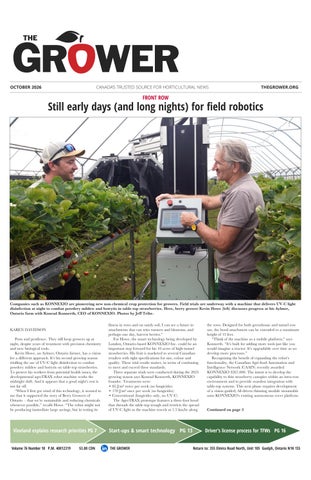
Companies such as KONNEXIO are pioneering new non-chemical crop protection for growers. Field trials are underway with a machine that delivers UV-C light disinfection at night to combat powdery mildew and botrytis in table-top strawberries. Here, berry grower Kevin Howe (left) discusses progress at his Aylmer, Ontario farm with Konrad Konnerth, CEO of KONNEXIO. Photos by Jeff Tribe. fitness in rows and on sandy soil, I can see a future in attachments that can trim runners and blossoms, and perhaps one day, harvest berries.” For Howe, the smart technology being developed by London, Ontario-based KONNEXIO Inc. could be an important step forward for his 10 acres of high-tunnel strawberries. His fruit is marketed to several Canadian retailers with tight specifications for size, colour and quality. These trial results matter, in terms of continuing to meet and exceed these standards. Three separate trials were conducted during the 2025 growing season says Konrad Konnerth, KONNEXIO founder. Treatments were: • 85 J/m² twice per week (no fungicides) • 170 J/m² once per week (no fungicides) • Conventional (fungicides only, no UV-C) The AgroTRAX prototype features a three-foot hood that shrouds the table-top trough and restricts the spread of UV-C light as the machine travels at 1.5 km/hr along
the rows. Designed for both greenhouse and tunnel row use, the hood attachment can be extended to a maximum height of 15 feet. “Think of the machine as a mobile platform,” says Konnerth. “It’s built for adding more tools just like you would imagine a tractor. It’s upgradable over time as we develop more processes.” Recognizing the benefit of expanding the robot’s functionality, the Canadian Agri-food Automation and Intelligence Network (CAAIN) recently awarded KONNEXIO $267,000. The intent is to develop the capability to thin strawberry canopies within an intra-row environment and to provide seamless integration with table-top systems. This next phase requires development of a vision-guided, AI-driven thinning module mountable onto KONNEXIO’s existing autonomous rover platform.
Vineland explains research priorities PG 7
Start-ups & smart technology PG 13
Driver’s license process for TFWs PG 16
Volume 76 Number 10 P.M. 40012319
THE GROWER
KAREN DAVIDSON Pests and pestilence. They still keep growers up at night, despite years of treatment with precision chemistry and new biological tools. Kevin Howe, an Aylmer, Ontario farmer, has a vision for a different approach. It’s his second growing season trialling the use of UV-C light disinfection to combat powdery mildew and botrytis on table-top strawberries. To protect his workers from potential health issues, the developmental agroTRAX robot machine works the midnight shift. And it appears that a good night’s rest is not far off. “When I first got wind of this technology, it seemed to me that it supported the story of Berry Growers of Ontario – that we’re sustainable and reducing chemicals whenever possible,” recalls Howe. “The robot might not be producing immediate large savings, but in testing its
$3.00 CDN
Continued on page 3
Return to: 355 Elmira Road North, Unit 105 Guelph, Ontario N1K 1S5
PAGE 2 –– OCTOBER 2026 THE GROWER
AT PRESS TIME… Farm Credit Canada announces $1 billion Agri-food Project Finance Fund
on opportunities in the agri-food and agri-tech sectors across the value chain that are positioned to help strengthen Canada’s food system. Together, FCC and Velocity are accelerating commercialization, expanding processing capacity, diversifying supply chains, and building international pathways that strengthen resilience and competitiveness across Canada’s food system. “Canada’s agri-food sector is strategically important to our global brand and our trading relationships,” says Arlene Dickinson, general partner, Velocity Agri-Capital Partners. “The world needs what we grow and produce and it’s time for us to build on our strength in commodities and into higher-value add products. Velocity Capital is in
Congratulations to Sam Oosterhoff (Niagara West), who is Ontario’s new minister of agriculture, food and agribusiness. At 29, he is the youngest agriculture minister since 1867. He was formerly the associate minister of energy. Trevor Jones (ChathamKent-Leamington), in the role since March 2025, becomes minister of labour, immigration, training and skills development. Best wishes to John Kelly, who is retiring October 9th from the Ontario Ministry of Agriculture, Food and Agribusiness, after six years in the role of deputy minister. He’s held many positions in Ontario agriculture including chief innovation officer at Bioenterprise Corporation, DNAstack Inc. and as executive director of the Ontario Fruit and Vegetable Growers’ Association.
An aerial view of the Ontario Food Terminal, Toronto, Ontario. Canada’s ag minister Heath MacDonald has announced the launch of Farm Credit Canada’s (FCC) $1 billion Agri food Project Finance Fund, and $150 million to Velocity Agri-Capital Partners through FCC Capital’s $2 billion investment commitment. The $1 billion Agri-food Project Finance Fund, created and delivered by FCC, is a key commitment under the National Food Security Strategy (NFSS) and will help finance mid-market, agri food infrastructure projects across the country. The fund will help address financing gaps, support the development of critical infrastructure and technology needed to grow Canada’s value added food sector, and increase domestic processing capacity. Velocity Agri-Capital Partners will receive $150 million to focus
NEWSMAKERS
discussions with Canadian and international investors regarding additional capital commitments of up to $350 million. The fund will help move Canada up the value chain, and into active capital deployment with Canadian companies ready to export to Southeast Asia and attract foreign investment from Southeast Asian companies looking to domicile and build jobs here.” The first phase of expression of interest was launched September 14, 2026 and has a 60-day window. Those wishing to learn more or participate in are encouraged to visit FCC’s website. Source: Agriculture and Agri-Food Canada/Farm Credit Canada September 14, 2026 news releases
Ontario’s ginseng sector has appointed Joe Arva, Brant, to be its representative on the board of the Ontario Fruit and Vegetable Growers’ Association. Stephen Heckbert joined the Fruit and Vegetable Growers of Canada as its new executive director, effective Sept. 8. He brings more than 25 years of experience as a bilingual enterprise and communications leader, having most recently served as CEO of the Canadian Pork Council.
Sam Oosterhoff
Dr. John Kelly at Vineland Critical Technology Greenhouse Forum.
Stephen Heckbert
Joining him is Matthew Perry as manager, policy and communications, effective Sept. 14. In this role, he will work closely with FVGC’s four Advocacy Working Groups -- Trade & Competitiveness, Crop Protection, Labour and Business Risk Management -- in collaboration with Working Group Chairs. He brings extensive communications and stakeholder relations experience from roles in government. The British Columbia Fruit Growers’ Association has hired Pegah Behroozi as the regional labour coordinator. She’s to advance labour strategy, workforce planning, housing and policy priorities for tree fruit and wine growers. It’s a joint project with the BC Cherry Association, BC Wine Grape Council and BC Grapegrowers’ Association. Cleanfarms has appointed Davin Johnson, director of Western Canada. He has extensive experience in agricultural recycling, stewardship programs and farm sustainability programs that help farmers responsibly manage agricultural waste.
Customer Service order@norseco.com 514 332-2275 | TFN 800 561-9693
450 682-4959
Sales Representatives
NAVEDO F1 Imperator genetic mixed with Berlicum blood, leading to a uniform crop of long, straight, smooth roots, well-昀lled to the bottom, for a higher yield.
Ontario Warren Peacock warren.peacock@norseco.com 519 427-7239
North Shore of Montreal Isabelle Dubé, Agr. isabelle.dube@norseco.com 514 295-7202
Greenhouse sector Keyur Patel keyur.patel@norseco.com 437 419-5337
Central and Eastern Quebec Stéphanie Gosselin, Agr. stephanie.gosselin@norseco.com 418 254-1469
MB, SK, AB & BC Ben Yurkiw ben.yurkiw@norseco.com 604 354-1830
Central & Eastern Québec Yves Thibault, Agr. yves.thibault@norseco.com 418 660-1498
Eastern Montérégie & Maritime Provinces Marie-Pierre Grimard, P. Tech marie-pierre.grimard@norseco.com 450 261-7468
Organic & Small-Scale Farms Katherine Jouvet, Agr. katherine.jouvet@norseco.com 514 386-0277
Western Montérégie Marie-Hélène Monchamp marie-helene.monchamp@norseco.com 514 968-2906
Proud of our roots since 1928 norseco_of昀ciel
norseco.com
Congratulations to Steve Pohorly, named 2026 Grape King. The second-generation grower operates Riverbend Farms Inc. alongside his parents, Frank and Susan, who established the family farm in 1971. Today, 50 acres of Niagara-on-theLake farmland includes 30 acres of premium wine grapes including Vidal, Cabernet Franc, Merlot, Steve Pohorl Shiraz, and Sauvignon Blanc, He also grows cherries, peaches, plums, and apples. As a grower partner for Arterra Wines Canada since the early Brights Wines days, Riverbend proudly supplies celebrated local wineries Inniskillin and Jackson-Triggs. The Canadian Farm Writers’ Federation presented its 2026 awards in London, Ontario on September 19. The Grower’s editor Karen Davidson won silver in two categories: Technical Reporting for “AI weeds in the blink of an eye” and Current Affairs Feature for “Trump’s tariffs: a hot potato for Canadian growers.” The Production Photograph silver award went to The Grower’s freelance photographer Glenn Lowson for “Greenhouse workers.” The People Photograph bronze award went to The Grower’s freelance photographer Paul Novosad for Shane Singh and family.
OCTOBER 2026–– PAGE 3 THE GROWER
COVER STORY
Still early days (and long nights) for field robotics
“
Think of the machine as a mobile platform. It’s built for adding more tools just like you would imagine a tractor. It’s upgradable over time. ~ KONRAD KONNERTH
Continued from page 1
Commencing 2027, the project will incorporate the use of RGBD cameras and artificial intelligence to control servodriven micro-cutters and lasers to precisely target removal of runners, excessive trusses, and dying foliage. Mirroring best agronomic practice, the goal is to improve fruit-load management and increase marketable yield through scheduled multi-pass, light-touch thinning. Additionally, best estimates suggest that switching to robotic thinning may reduce ongoing seasonal trimming labour expenses by 30 per cent or more annually. Assisting in such precommercialization development is well suited to CAAIN’s goals says Darryl Petras, CEO. “This activity directly supports CAAIN’s priorities in automation, robotics, and data-driven decision-making,” says Petras. “By delivering a validated autonomous thinning tool ready for pre-commercial deployment, the project strengthens the resilience and competitiveness of Canadian berry producers.” All eyes are on the outcome here in Canada, as well as globally. With the 2026 Ontario growing season winding up, robotics aficionados will be following the Forum International de la Robotique Agricole (FIRA) being held in Yakima, Washington for the first time. The October 20-22 event will be closely watched for any technology that’s reaching the commercialization stage. Luna is one such example. The robot uses UV-C light and bug vacuums to target not only
pests but fungi as well, destroying their DNA so they can’t reproduce. TRIC Robotics, the manufacturer, partners with growers to deliver Robot-as-aService solutions that work night after night across California’s matted row, strawberry fields. The company says pesticide usage can be reduced by up to 70 per cent. As tech start-ups all over the world roll out test products, it’s noteworthy that FIRA USA has launched its first Grower-Led Innovation of the Year award for 2026. The intent is to recognize an individual grower or a farming business that’s demonstrated outstanding engagement with agricultural innovation. “The award celebrates growers who identify real-world farming challenges and take meaningful action to address them, whether by testing an emerging technology, contributing to its development, collaborating with research institutions or technology providers, or investing in and successfully adopting a solution on their farm. The technology does not need to be fully commercialized or already purchased, provided that the grower has made a significant contribution to its evaluation or advancement,” says FIRA. The award is clearly meant to recognize and acknowledge the vital role growers play in the global agri-innovation process – tinker, deliberate, sweat details, then repeat. For growers such as Kevin Howe, he’s not participating in trials for the awards or the cheers at the finish line. What he really wants is a more efficient operation and the story-telling rights.
The autonomous AgroTRAX robot operates at night to keep operators safe. It’s a platform that is being tweaked for other tasks such as trimming strawberry runners and blossoms. Photo supplied.
While fertigating and hand-picking strawberries at table-top level is much easier than in fields, management is still required for diseases such as powdery mildew and botrytis. The fungal disease causes soft brown lesions in berries.
What’s ahead The CAAIN project will follow a structured research and validation pathway: 1. Data Collection & Model Development: Acquisition and annotation of 4,000–5,000 tabletop strawberry images from Howe Family Farm to train and validate real-time detection models for runners and excess trusses under practical farm conditions. 2. Prototype Engineering & Bench Testing: Fabrication of a two full-scale hooded thinning module equipped with stereo cameras, controlled lighting, and four to six mechanical microcutters and laser. Bench testing will verify cutting accuracy, operational throughput, safety interlocks, and power efficiency.
3. Field Trials on 10 Acres of Commercial Tabletop Production: Full-season validation of agronomic performance, including labour substitution, cutting precision, plant health, marketable yield, fruit size distribution, and maintenance requirements. Independent agronomic oversight will be provided by the Ontario Ministry of Agriculture, Food and Agribusiness (OMAFA). 4. Economic Evaluation and Commercialization Readiness: Quantification of labour savings, yield impacts, and operational costs to produce a validated return-on-investment model. Outcomes will inform final mechanical refinements and commercialization readiness.
The elegant architecture of a strawberry truss is important. The king bloom, pictured at the top, will produce the biggest strawberry. When the AgroTRAX machine passes over the strawberry gutter, the flower petals tend to fall off – a benefit because stuck flower petals tend to increase risk of botrytis below the calyx. One day, the goal is to remove tertiary blossoms which typically result in small unsaleable fruit.
PAGE 4 –– OCTOBER 2026 THE GROWER
CROSS COUNTRY DIGEST BRITISH COLUMBIA
KPU researchers identify sustainable solution for Okanagan vineyard pest A pest is threatening B.C. vineyards, but researchers have found a sustainable solution — a mix of parasitoid wasps, nematodes and fungi. Climbing cutworm is the larval, or caterpillar, stage of various moth species. True to their name, the pests are known to climb grapevine plants to feed on new and developing buds, causing damage and reducing fruit quality and quantity. According to the BC Wine Grape Council, there are currently 18 known species of this pest in the Okanagan Valley, which is B.C.’s largest grape growing region. “Currently, there are no registered biopesticides available to organic wine and grape growers in B.C.,” says Kwantlen Polytechnic University (KPU) researcher Dr. Sepideh Tahriri Adabi. “Growers have been dependent on chemical pesticides, but there are concerns about their impact to the environment and beneficial organisms, as well as pesticide resistance.” A three-year study led by KPU’s Institute for Sustainable Horticulture and Andermatt Canada, a leader in microbial biopesticides, tested four biological tools — entomopathogenic fungi, insect-specific baculoviruses, entomopathogenic
nematodes and parasitoid wasps. Each was assessed for its efficacy in controlling the pest through controlled laboratory studies and field trials in commercial vineyards across the Okanagan Valley. Several KPU students were also part of the research team, gaining hands-on experience within the laboratory and field, and developing skills related to data analysis and scientific communication. The researchers found that there wasn’t just one individual solution. Instead, three of the natural organisms were found to be effective in targeting the cutworm at different stages of its growth. Parasitoid wasps were found to be effective from mid-August to midSeptember, targeting cutworm eggs before they have hatched. From early-September to early-October, if any surviving eggs had hatched, nematodes and fungal pathogens were able to eliminate the young larvae. “Sustainable pest management isn’t about replacing one product with another. It’s about understanding how pests interact with climate, how biological tools perform under different conditions and how a proactive, timing-based approach can help growers intervene early before any damage occurs,” says Adabi.
Dr. Sepideh Tahriri Adabi is helping B.C. growers protect their vineyards against climbing cutworm. The study lays the foundation for an integrated pest management strategy, and may aid in the future registration and commercialization of new microbial biopesticides which could help expand the toolbox available to Canadian growers and reduce reliance on environmentally harmful chemicals. “There’s a growing demand for sustainable, environmentally responsible
food production, which is driving rapid growth in biological pest control technologies. Biopesticides are now part of a multi-billion-dollar global industry,” says Adabi. Source: Kwantlen Polytechnic University September 1, 2026 news release
BRITISH COLUMBIA
New resources on the way for BC farms pressured by pests and diseases British Columbia is home to a prolific fruit and vegetable production sector, satisfying local consumers and exporting $1.2 billion in products to markets around the world. However, the last few years have seen climatedriven shifts in plant production, as well as the proliferation of pathogens and pest species. Three new Genome British Columbia (Genome BC) funded research projects are developing tools to help farmers protect British Columbia’s valuable crops. These projects share a common goal: to improve precise detection and early intervention, allowing the agricultural industry to better manage threats.
Two projects counter pests: the first improves tests for identifying parasitic nematodes that attack plant root systems. The second is developing an environmentally safe biopesticide that uses yeast to reign in wireworms that affect many of BC’s major agricultural crops. The third project involves producing diagnostic tools to more quickly identify pathogens that cause substantial economic losses in multiple types of fruit crops. Keeping parasite detection services up to date Plant-parasitic nematodes
(PPNs) are translucent, microscopic worms that feed on plant roots and tissues, causing stunted growth, decreases in yield and higher susceptibility to disease and other parasites. In British Columbia, a number of potentially damaging PPN species can be found in vegetable and berry fields, vineyards and orchards, posing risks to both the agriculture and horticulture sectors. The province currently lacks diagnostic services for PPNs as current methods are costly, labour-intensive and require deep expertise for species-specific identification. To overcome this challenge, Dr. Paul Adams (Kwantlen Polytechnic University), Dr. Paul de la Bastide (BC Ministry of Agriculture and Food (BC MAF)) and Dr. Thomas Forge (Agriculture and Agri-Food Canada (AAFC)) are leading a project to create diagnostic qPCR tests to detect and quantify eight economically significant PPN species in BC. These novel tests will ultimately allow the BC Ministry of Agriculture and Food’s Plant Health Laboratory to provide a nematode diagnostic service that is crucial to crop producers. Novel, environmentally friendly pest management Wireworms are a known pest to potato, corn and cereal growers in British Columbia. These insects are click beetle larvae that cause extensive crop
damage — an annual average of over $11 million in Western Canada — by feeding on roots, seeds, stems and tubers. Dr. John Husnik and his team at Renaissance Bioscience are developing a targeted, natural solution to protect crops from these pests using yeast and RNA interference (RNAi). This is a biopesticide contained in a biodegradable yeast cell used as bait. The treatment method degrades naturally, making it an environmentally safer option than chemical pesticides. Having validated trials on Colorado potato beetles, the team is confident that a solution is within reach for BC growers. “A field-ready, omics-based biopesticide will empower farmers with a sustainable solution, while also positioning BC as a global leader in agricultural innovation,” Dr. Husnik says. Stronger pathogen detection tools for fruit crops A project led by Dr. ShaunaLee Chai (AAFC) and Dr. Pragyan Burlakoti (BC MAF) aims to strengthen disease control for fruit crops by developing tests that can more effectively identify a pair of major pathogens. The BC Ministry of Agriculture and Food’s Plant Health Lab has identified Pseudomonas syringae complex and Phytophthora spp. as two pathogens that are particularly challenging to the management of the province’s berry and tree fruit plants. Phytophthora spp. (the
Soil samples are being collected from across the province, screened for plant-parasitic nematode species and then used to validate the accuracy and sensitivity of the different qPCR tests.
name literally means ‘plant destroyer’) has accounted for approximately 30 per cent yield loss in BC raspberries alone over the past 35 years. Currently, not enough is known about the various strains of these pathogens and how they affect different types of fruit. Source: Genome BC July 20, 2026 news release
OCTOBER 2026–– PAGE 5 THE GROWER
CROSS COUNTRY DIGEST ALBERTA
EarthFresh and Kamper Farms launch packing company in southern Alberta EarthFresh and Kamper Farms have created a joint partnership, Wild Rose Packing Inc., to pack potatoes and onions in southern Alberta. “We’re very excited about our partnership with Kamper Farms and look forward to building a long and successful relationship together,” said Tom Hughes, CEO of EarthFresh. “Establishing a strong presence in Western Canada is an important part of EarthFresh’s strategy to better serve both our existing and future customers across North America. Together, we’ll have the ability to offer a broad range of highquality potatoes, including specialty varieties, multiple colours and sizes, and a wide variety of pack formats. Kamper Farms shares our commitment to quality, service and innovation, and we believe this partnership positions us extremely well for continued growth in the Western Canadian market.” Through Wild Rose Packing Inc.,
EarthFresh and Kamper Farms will jointly manage regional packing and distribution for retail and food service customers throughout Western Canada, extending a footprint that already spans the country. The new facility will have the ability to pack baby potatoes, specialty products, variety programs as well as high-quality russets, colours and organics, in all pack sizes and formats. “Our family is excited to begin the new partnership with Earthfresh,” said Henk Kamper, manager/partner of Kamper Farms. “We believe that this collaboration will allow us to bring our products to market more efficiently by leveraging Earthfresh’s proven marketing expertise. Our organizations share commitment to delivering high-quality, sustainably grown products to customers, and we believe this alignment of values will serve consumers exceptionally well. We look forward to building a long-term partnership that
strengthens our joint ability to provide the market with sustainably grown produce.” EarthFresh is vertically integrated across the entire potato supply chain, encompassing exclusive variety seed breeding, a diverse network of growers, packing facilities, in-house logistics, strategic category management, dedicated customer support, targeted marketing, and national distribution. With operations in Colorado, Idaho, Texas, and Canada, EarthFresh offers a 52-week supply model. Kamper Farms is a family-owned potato farm located between Taber and Vauxhall, Alberta. The Kamper family farmed for generations in the Netherlands before establishing operations in southern Alberta in 2009, growing on irrigated land near Vauxhall, Hays, and Burdett. Potatoes are their primary crop, alongside onions, sugar beets, beans, seed canola, grain corn, and wheat. Source: EarthFresh September 3, 2026 news
ALBERTA
RDAR boosts applied irrigation research with $500,000 grant security and keep Alberta’s ag sector competitive for years to come.” RDAR CEO Dr. Mark Redmond commented: “Water is one of the defining issues for Alberta’s future, and applied irrigation research is essential to helping producers make decisions that improve water use, protect productivity, and support longterm resilience on their farms. Dr. Appels’ research connects science to the practical decisions
producers and irrigation partners face every day, and RDAR is pleased to support her work as Alberta prepares for the water challenges and opportunities ahead.” Dr. Appels said: “I’m thrilled to be starting this exciting new chapter in establishing a leading centre for irrigation innovation in Alberta. MIRG is uniquely positioned to work on issues at the field, farm, and district scale, thanks to our strong industry and
Book Early. Grow with Con昀dence.
Dr. Michael Kehoe, research scientist, and Dr. Willemijn Appels, are pictured at the research farm in Lethbridge, Alberta. Results Driven Agricultural Research (RDAR) is contributing $500,000 to support Dr. Willemijn Appels, RDAR research chair and senior research chair of the Mueller Irrigation Research Group at Lethbridge Polytechnic, as she leads efforts to establish a provincial and national hub for applied irrigation research. The investment is funded by the Government of Canada and the Government of Alberta under the Sustainable Canadian Agricultural Partnership (Sustainable CAP). Alberta reports about 1.8 million irrigated acres. As the province’s agriculture sector expands, producers and irrigation partners will need practical tools, sound data, and applied expertise to improve water management, protect productivity, and make informed decisions under changing water conditions. This investment will help Dr. Appels and the Mueller Irrigation Research Group (MIRG) build on their nationally recognized
work in controlled trials, technology validation, and industry-engaged research, establishing MIRG as a hub for applied irrigation science. With continued engagement from producers, commodity groups, irrigation districts, and industry partners, the work will focus on real-world challenges, including next-generation irrigation decision-support tools, the economic and regional impacts of irrigation choices, and sustainable crop production. Alberta Minister of Agriculture and Irrigation, the Honourable Tara Sawyer, said: “Alberta’s irrigation sector is a major driver of agricultural productivity, rural jobs and economic growth. As we continue to modernize irrigation infrastructure, improve water use, and strengthen our producers’ resilience, applied research plays an important role in helping Alberta make the most of every drop. This investment supports practical innovation that will help producers adapt to changing growing conditions, protect water
government partnerships. I’m looking forward to working with RDAR on delivering meaningful outcomes for producers.” Dr. Willemijn Appels is a hydrologist and soil physicist with 20 years of experience in agricultural water management, focusing on water-use efficiency, innovative management strategies, and the interaction between water management and agronomic practices.
W NE
Laurentian
Medusa
Switchback
Mans昀eld
Early-maturing long-day yellow onion producing medium to large bulbs with small necks and medium brown skin. Its deep root systems o昀ers strong potential in challenging conditions.
High-yielding long-day onion with a strong root system and vigorous plant habit. Performs well under stressful conditions, including high temperatures.
Medium size onion with beautiful light-medium, yellow colored skin. Good for transplants. Short term storage potential.
A late onion delivering exceptional size potential. Tops are impressively strong and very upright, supporting easy harvest and overall plant health. O昀ers medium-long storage.
Seed Experts From Coast to Coast:
Paul Banks (ON) 905-688-4300
Alexandre Bisson (QC) 438-334-1996
Rob Hovius (ON) 519-580-3231
Marc André Laberge (QC) 514-984-4589
John Hart (BC) 778-908-0201 Darcy Leiter (AB, MB, SK) 306-491-6485
1-800-263-7233 │ www.stokeseeds.com
John Hattingh (ON) 289-257-1245 Amélie Lepage (QC) 514-984-0662
Ed Hovius (NB, NL, NS, PE) 902-314-2210 Emily Robins (ON) 905-308-4396
Follow us:
PAGE 6 –– OCTOBER 2026 THE GROWER
GREENHOUSE GROWER
Beneficial bacteria support tomato growth and suppress disease Bacterial canker, a vascular infection, can wreak havoc on tomato plants, with symptoms ranging from wilted leaves to the collapse of an entire plant. Clavibacter michiganensis, the seedborne pathogen that causes the disease, can be challenging to treat because it spreads easily. “This pathogen is really problematic, especially in greenhouses,” said microbiologist Eric Déziel, Ph.D, at the Institut national de la recherche scientifique (INRS) in Québec. One treatment strategy may come from other bacteria. For a study published in Applied and Environmental Microbiology,he and his collaborators identified bacterial strains that offer a twofold benefit to tomato plants. These strains both treat tomato bacterial canker— some by delaying the onset of infection up to a week—and promote the growth of the plant. Most studies, Déziel said, focus on either the treatment or the boost. “We were able to do both,” he said. For about 20 years, researchers in Déziel’s lab have focused on identifying biological solutions for agricultural problems. A few years ago, during the COVID-19 pandemic, tomato growers alerted them to the problem of tomato canker in greenhouses. Déziel had never heard of it. He and his research team began at
home, testing 500 strains in the lab’s collection for those that would antagonize C. michiganensis. They tested strains collected from strawberries, lettuce, apples and other foods, taken from leaves, roots and other parts of the plant. Notably, “none of them had been previously isolated from bacteria-infected plants or fruits,” Déziel said. “We were hoping that some of them would have some activity against the pathogen.” Once they’d identified a few dozen promising strains, they narrowed the field by limiting their search to those that promoted plant growth, in addition to antagonizing C. michiganensis. They first tested those strains in bacterial cultures, then in living plants infected with bacterial canker. The experiments yielded three bacterial strains that demonstrated a dual benefit for tomato plants. One of those, Pantoea agglomerans SO16PY, originally isolated from a healthy tomato plant leaf, delayed the onset of canker in infected plants by up to a week and reduced the disease severity. The other two, both strains of Pseudomonas marginalis bacteria, similarly restricted the development and severity of the disease. Bacterial canker, Déziel said, can be a significant problem for organic farmers. Although they can buy seeds guaranteed to be free of the pathogen, it may still find its
way into a greenhouse. “It will typically start in one part, and then the workers will spread it by working on the actual plants,” he said. Today’s treatment solutions are limited, Déziel added, and said the few commercial options available show poor efficacy. The three beneficial bacteria might be useful in the future, Déziel said, but the delivery method would require further research and development before the
microbes could be harnessed for commercial use. “We need to find a way to stabilize the bacteria so that their shelf life is long enough to be actually used in a greenhouse,” he said. But if they could do that, he said, they offer a sustainable, environmentally friendly way to improve plant health in agriculture. Source: ASM September 1, 2026 news release
Built to Beat ToBRFV HREZ e昀ectively reduces the ToBRFV viral load at both plant and root levels, supporting a healthier growing environment when paired with disciplined hygiene practices. Designed to deliver lasting protection and consistent crop performance.
Stay ahead of ToBRFV
OCTOBER 2026–– PAGE 7 THE GROWER
GREENHOUSE GROWER
Vineland reports on three-year research priority setting KAREN DAVIDSON Vineland Research and Innovation Centre (Vineland) has completed a three-year process to support a transition from annual updates to a more strategic threeyear planning cycle. Dr. Amy Bowen, director of consumer, sensory and market insights, detailed the process at the recent Greenhouse Critical Technology Forum, September 10. The objective was to strengthen how research priorities are identified across Ontario’s highly diverse horticultural sector which counts more than 120 commodities from apples to zucchini. Vineland also wanted to improve the usability of results from reseachers and funders. In her overview slide, Dr. Bowen said that consensus is around six major topic areas: pest and disease management, agronomy, sustainability, technology, variety evaluation and development, consumer and market research. The process included 16 commodity groups to reflect horticultural needs and moved away from a one-size-fits-all model. Sector differences were encouraged to be reflected. Next, the groups were asked to rank the themes from the highest (1) to the lowest (6). What’s interesting is that within the greenhouse community, the vegetable and floral growers have different priorities. Greenhouse vegetable growers view risk management and market outcomes as their priority whereas floral growers list optimization of production. Biology remains the anchor. Even as technology grows, both
sectors prioritize crop health, pest pressure and product performance. Technology is an enabler. Technology ranks fourth in both sectors and is framed as a tool for labour, detection, lighting and crop work. Sustainability is operational. The priorities connect sustainability to water, energy, nutrients, waste and environmentally viable implementation. Value differs by market. The vegetable market prioritizes quality, shelf life and business support. The floral market emphasizes demand timing, assortment and presentation. Cross-sector trials have leverage. Shared needs create room for common platforms in sensing, IPM, water, lighting, automation and commercially validated adoption. For cross-commodity collaboration, a searchable horticulture expert directory has been developed with 196 contacts. For the entire report, link to: https://vinelandresearch.com/ sector-priority-setting/
Overview of the process to set the 2026-2029 Ontario Horticultural Research Priorities for the 16 commodity groups that represent horticulture.
PAGE 8 –– OCTOBER 2026 THE GROWER
VINEYARD VIEW
Federal funds for machine learning technology to improve disease detection in vineyards Agriculture and Agri-Food Canada is investing up to $1,693,412 for Vivid Machines Inc. (VMI) through the AgriScience Program – Projects Component under the Sustainable Canadian Agricultural Partnership. This funding will support the development of cutting-edge computer vision and machine learning technology to help grape growers improve harvests and detect crop diseases early. Through this project, VMI will adapt and expand the use of its current Vivid XV technology from apple orchards to grape vineyards. The company will upgrade their XV camera technology and train new computer vision models to spot crop diseases early, track fruit quality and predict yields on a per-vine, row and block basis. This technology will provide
growers with real-time insights to protect their crops, reduce chemical use and support the resilience of Canada’s grape and wine sector. “This $1.69M investment from the Government of Canada through the AgriScience Program is a vote of confidence in Canadian-made innovation,” says Jenny Lemieux, co-founder and CEO, Vivid Machines Inc. “It allows us to take the computer vision technology we’ve built for apple growers and adapt it to tackle some of the toughest challenges facing grape growers such as crop load estimation, and early disease detection. It also means we can keep growing our team right here in Toronto, building the kind of high-skilled agtech jobs that keep Ontario at the forefront of precision agriculture." Vivid Machines is a Canadian
agri-tech start-up that develops automated, plant-level imaging tools to help fruit growers optimize yields and manage crop health.The Vivid XV System is an AI camera that mounts onto farm equipment such as tractors and sprayers, to scan plants in real time, gathering data on plant health, fruit development, and early disease risks. Computer vision is artificial intelligence technology that lets computers “see” by capturing and interpreting images and videos. Machine learning is a type of artificial intelligence that trains computers to learn from data and spot patterns over time, allowing them to make smart predictions on their own without being given instructions from a human. Source: Agriculture and Agri-Food Canada September 10, 2026 news release
CCOVI celebrates 30 years of grape industry impact Brock University’s Cool Climate Oenology and Viticulture Institute (CCOVI) has aged like fine wine. The premier grape and wine science institute has only improved with time, growing its reputation as an invaluable industry partner over the past 30 years. The Institute marked its milestone anniversary on Wednesday, Sept. 2 with a celebration on campus that reflected on its humble beginnings and promising future. “For 30 years, CCOVI has been an important part of Brock University’s identity and a flagship example of the impact a university can have when it brings together education, research and industry,” said Lesley Rigg, President and Vice-Chancellor. “CCOVI has helped establish Brock as a leader in oenology and viticulture education and research
while creating meaningful connections between the University and the grape and wine sector.” CCOVI was established in 1996 through an agreement between Brock, the Grape Growers of Ontario and what was then the Wine Council of Ontario (now Ontario Craft Wineries and Wine Growers Ontario). Its research, expertise and skilled learners have since contributed to the growth and resilience of Canada’s grape and wine industry, supporting producers and industry partners across the country as they respond to changing growing conditions, emerging threats and new opportunities. “When I look back through the years, there are so many milestones that we have accomplished together in partnership with industry and government, both provincially and federally. It’s
2 3 2 2 3 2
# 4 5 # 4 5
1+
" # # +
$ %& ' * )&
,-
!
.
$ %& ' * )&
/
$ %& ' ( )&
0
quite remarkable,” said CCOVI Director Debbie Inglis. The latest in the long lineup of achievements is the planting of the first grapevines at the Brock University Norris W. Walker Research Farm, which took place earlier this summer. “The creation of the research vineyard marks a pivotal moment in CCOVI’s history,” Inglis said. “In addition to supporting other research, the site will be a key part of expanding Brock’s Clean Plant Program, which is critical to supporting Canada’s $11.6-billion grape and wine industry.” Working alongside the Canadian Food Inspection Agency and Canadian Grapevine Certification Network (CGCN), among other partners, Brock is one of only two facilities in the country to house a germplasm collection of certified virus-tested grapevines and the only testing provider to CGCN for their clean plant program. CCOVI’s growth through the years would not have been possible without the initial Canada Foundation for Innovation grant in 1997 and successful capital campaign led by Canadian wine icons Donald Ziraldo and John Howard that supported the Institute’s inception. “I am thankful every day I walk around and see the donor plaques throughout the Institute that helped us get to where we are today,” Inglis said. Reflecting on CCOVI’s early days, Ziraldo, the co-founder of Inniskillin Wines, expressed pride in the decision to help implement its creation so many years ago. "Every great wine region all over the world has institutes of higher learning, and 30 years ago we had the fortitude to start
Brock University Cool Climate Oenology and Viticulture Institute (CCOVI) director Debbie Inglis (left) competes in a celebratory grape stomp against Augusta Van Muyen, vineyard manager at Tawse Winery and Niagara’s reigning Grape King for 2025-26, during CCOVI’s 30th anniversary event on Wednesday, Sept. 2. CCOVI,” he said. In addition to its research and service contributions, CCOVI’s presence in the industry remains strong through the many students who’ve found their passion in Brock’s Applied Grape and Wine Science program — the only one of its kind in Canada — as well as professionals who’ve continued their education and enhanced their skills at all stages of their careers. “It is hard to believe it has been 30 years since I first learned about CCOVI and found myself enrolled one year later,” said Brock graduate Shiraz Mottiar (BSc ‘00), who is now Malivoire Wine Company’s Team Principal, General Manager and
Winegrowing Director, as well as the Chair of CCOVI’s Advisory Council. “CCOVI was my launch pad to the most dynamic career I could have imagined; it’s always evolving. Staying connected to the research and outreach that CCOVI provides us in the Ontario wine industry has been instrumental to our success.” The anniversary celebration also included a focus on Brock’s graduates, who are now celebrated winemakers. More than 150 award-winning VQA wines made by Brock alumni from across Canada were donated to be poured for guests at the event. Source: CCOVI September 2, 2026 news release
OCTOBER 2026–– PAGE 9 THE GROWER
INDUSTRY NEWS
Syngenta launches the Canadian Seedcare & Biologicals Institute Syngenta Canada launched The Canadian Seedcare & Biologicals Institute (SCBI) on September 16 at its Honeywood Research Facility in Plattsville, Ontario, marking 10 years since the site opened as The Canadian Seedcare Institute. The new name reflects the expansion of the Institute’s mandate, which now includes biological innovations and expertise alongside its established seed treatment function. “We’re proud to celebrate the Institute’s successful first decade and its advancement of seed treatment technology and knowledge to help growers maximize crop potential in Canada’s unique growing conditions,” says Shaun Vey, president, Syngenta Canada. “By expanding the Institute’s mandate to include biologicals, we are further investing in Canadian agricultural research to support our customers and contribute to a more productive, competitive, and resilient sector.” The SCBI is part of a global network led by Syngenta, comprised of more than 120 specialists in 22 centres of excellence worldwide. At the Canadian site, team members connect science with the practical needs of growers, retailers, seed companies, and commercial treaters. Their work supports key Canadian crops including canola, cereals, corn, potatoes, pulses, and soybeans, helping ensure solutions can be applied effectively in the local conditions.
“Biologicals are becoming an increasingly important part of the grower toolbox,” says Scott Ewert, head, Seedcare and Biologicals, Canada. Biologicals include biostimulants, biocontrols, and nitrogen use efficiency products that are designed to complement traditional crop inputs. “The SCBI will test formulations and application practices, while also serving as a training platform to help customers apply these technologies to maximize their impact on farm.” The Institute’s operations are organized around three integrated service pillars: agronomy, application, and assurance. This holistic approach combines crop and field insights, guidance on how technologies are applied, and a focus on
product performance from lab to field. “Canadian growers deserve the best possible experience with our products under Canadian conditions,” says Michelle Wall, head, Canadian Seedcare & Biologicals Institute and Seedcare technical lead for Eastern Canada. “Our role is to put solutions through the right testing and bring practical expertise to every product under Canadian conditions, so growers and our value-chain partners can make decisions with confidence.” The Honeywood Research Facility has been home to agricultural research since 1975, when a Syngenta Canada legacy company established operations on the property. The 100-acre farm dates back to the 1890s and takes its name from the
Honeywood silt loam soil found on the site. Today, the facility brings together expertise in pathology, Seedcare, biology, formulation and application technology to support product development, testing and technical support for Canadian growers. The global headquarters for The Seedcare & Biological Institute are in Stein, Switzerland. Other Institutes are in Argentina, Australia, Brazil, China, France, Germany, India, Italy, Japan, Kazakhstan, Mexico, Russia, South Africa, Turkey, Ukraine, the USA, and Zambia. Source: Syngenta Canada September 16, 2026 news release
PAGE 10 –– OCTOBER 2026 THE GROWER
CHAIR’S PERSPECTIVE
This municipal election, make sure agriculture is heard
MIKE CHROMCZAK When we think about government policy that affects our farms, our attention often goes first to Queen’s Park or Ottawa. But many of the decisions that have the most direct impact on our businesses are actually made much closer to home: by our local municipal councils. Municipal councils make decisions about property taxes, land use, zoning, development charges, building permits, roads, drainage and local infrastructure. For fruit and vegetable growers, municipal decisions can also
affect issues such as worker housing, farm business expansion and access to energy. All of those things can influence what it costs to operate a farm, whether we can expand and invest in our businesses, and how easily we can get things done. Ontario’s municipal election is coming up on October 26, and it’s an important opportunity for growers to make sure agriculture is part of the conversation. I know fall is a busy time, but I encourage you to pay attention to this election. Find out who is running locally, attend an all-candidates meeting, talk to candidates at your door or at events and ask where they stand on issues that affect your business. And if they don’t know or aren’t familiar with fruit or vegetable production, take the opportunity to make a connection and give them some insight into our sector. You don’t have to be an expert in municipal policy; just tell candidates about your business and ask practical questions about the issues you deal with every day. Worker housing is a good example. Many fruit and
vegetable farms depend on seasonal agricultural workers, and growers are responsible for providing safe, quality housing. Municipal zoning, building requirements and permitting processes directly affect our ability to build, expand or improve that housing. A housing survey by the Ontario Fruit and Vegetable Growers’ Association (OFVGA) found that delays in building permit approvals are the biggest municipal challenge growers face with worker housing. Ask candidates what they would do to make those processes timelier and more predictable. The same goes for other farm infrastructure. A grower looking to build or expand a greenhouse, packing facility or other agricultural building can face development charges, permitting delays and zoning bylaws that don’t always reflect the realities of modern horticulture. Land use is another issue where municipal decisions matter. Our communities are growing and changing, but as a society, we also need to value our farmland and what it means to
our ability to feed ourselves. That means using a lens of food and economics when making decisions around the use of that land – and candidates should be able to explain how they will make sure agriculture has a voice when official plans and zoning bylaws are reviewed. And don’t overlook infrastructure. Roads, bridges and traffic circles need to accommodate farm equipment safely. Drainage and water availability matter to farm operations. For greenhouse growers in particular, reliable access to natural gas and electricity can have a major impact on investment and expansion decisions. The Ontario Federation of Agriculture has developed a municipal election kit with questions farmers can use when speaking with candidates, covering land use, taxation, infrastructure, energy, drainage and other local issues. OFVGA has supplemented that with questions specifically focused on fruit and vegetable production. They’re useful tools and I encourage you to check them out
on the OFVGA website, but the most important thing is simply to get involved. Our sector includes more than 3,500 farm businesses growing more than 125 different crops. In 2025, Ontario fruit and vegetable farms generated $4.2 billion in farm cash receipts and directly employed more than 30,000 people. That makes horticulture an important part of the economy in communities across Ontario, and candidates need to understand what our businesses need to remain successful. So between now and October 26, ask questions. Tell candidates about your farm and the municipal issues that affect it. Find out where they stand. And most importantly, make sure you vote. The decisions made around the municipal council table may be local, but their impact on our farms can be significant. Mike Chromczak is an asparagus and watermelon grower near Tillsonburg and chair of the Ontario Fruit and Vegetable Growers’ Association.
WEATHER VANE
Pick Ontario Apples. It’s a timely pitch to Ontario consumers. Here, Craig Van Ymeren showcases an orchard of Gala apples in mid-September near Alymer, Ontario. Happy Thanksgiving! Photo by Jeff Tribe. STAFF Publisher: Ontario Fruit and Vegetable Growers’ Association Editor: Karen Davidson, 416-557-6413, editor@thegrower.org Advertising: Carlie Melara 519-763-8728, advertising@thegrower.org The Grower reserves the right to refuse any advertising. Any errors that are the direct result of The Grower will be compensated at our discretion with a correction notice in the next issue. No compensation will be given after the first running of the ad. Client signature is required before insertion. The Ontario Fruit and Vegetable Growers’ Association is the sole owner of The Grower. All editorials and opinions expressed in The Grower are those of the newspaper’s editorial staff and/or contributor, and do not necessarily reflect the view of the association. All rights reserved. The contents of this publication may not be reproduced either whole or in part without the prior written consent of the publisher.
OFFICE 355 Elmira Road North, Unit 105 Guelph, Ontario N1K 1S5 CANADA Tel. 519-763-8728 • Fax 519-763-6604 The Grower is printed 12 times a year and sent to all members of the Ontario Fruit and Vegetable Growers’ Association who have paid $30.00 (plus G.S.T.) per year for the paper through their commodity group or container fees. Others may subscribe as follows by writing to the office:
$30.00 (+ HST) /year in Canada $40.00/year International
Subscribers must submit a claim for missing issues within four months. If the issue is claimed within four months, but not available, The Grower will extend the subscription by one month. No refunds on subscriptions. P.M. 40012319
ONTARIO FRUIT AND VEGETABLE GROWERS’ ASSOCIATION BOARD OF DIRECTORS 2025 EXECUTIVE COMMITTEE Chair Vice-chair Potatoes Fresh Veg Muck
Mike Chromczak, Brownsville Matthias Oppenlaender, NOTL Shawn Brenn Quinton Woods, Cookstown
BOARD OF DIRECTORS
Apples Fresh Veg other Tender Fruit Asparagus Grape Fresh Veg muck Potato Small Fruit/Berries Ginseng Greenhouse Greenhouse Processing Vegetables
Chris Hedges, Vanessa Joann Chechalk, St Anns Dave Enns, Niagara-on-the-Lake Mike Chromczak, Brownsville Matthias Oppenlaender Quinton Woods, Cookstown Shawn Brenn, Waterdown Morris Gervais, Springwater Joe Arva, Brant Jan VanderHout, Dundas Steve Peters, St. Thomas Tracy Gubbels, Mount Brydges
OFVGA POLICY COMMITTEE CHAIRS Crop Protection Environment and Conservation Labour Safety Nets Property, Infrastructure, Energy and Food Safety
Matt Sheppard Jan VanderHout Bill George Chris Hedges Brian Gilroy
OCTOBER 2026–– PAGE 11 THE GROWER
URBAN COWBOY
Technology roadmaps help growers get “robot ready”
OWEN ROBERTS Concerns over automation and new technology have skyrocketed this fall, since a high-profile AI researcher warned that artificial intelligence is on the brink of causing widespread harm. Some pundits called the doomsday warning alarmist, but few dismissed it…including such luminaries as former U.S. president Barack Obama, who’s joined those wanting an AI slowdown and tighter guardrails on such technology. The full effect of the anti-AI movement remains to be seen. But it’s bound to put the technology-friendly agriculture and sector food under the microscope. Here’s why. Growers and suppliers are already active in incorporating AI technology and AI-generated information into some of their operations and management plans, for efficiency. Food production from field to table has always relied on technology, even though the public perceives farming as a very traditional, downhome pursuit. That stoic image has made farmers among society’s most trusted individuals. And that trust is why agri-food may be the ideal example for how AI, robotics and other new technologies used in practical ways complement conventional wisdom, rather than threaten it. This convergence offers a road map for growers and the public alike. Later this month in Yakima, Washington, the industry will come together for a unique look at hi-tech, practical field applications at the fifth International Forum for Agricultural Robotics. Organizers call this year’s forum a “travelling tailored event” and promote it as “Where Ag Tech and Robotics Meet Growers.” Among the items of interest at the forum include what the industry calls technology road maps. In Washington, a two-year apple technology roadmap will be highlighted at the field level, by the Washington Tree Fruit Research Commission and the Washington State University Smart Orchard. Dr. Ines Hanrahan, the commission’s executive director and a key presenter at the forum,
The agri-food sector comes together later this month in Washington, for a unique look at hi-tech, practical field applications like this autonomous sprayer at the fifth International Forum for Agricultural Robotics.
Key forum speaker Dr. Ines Hanrahan: “Having the event in the Pacific Northwest makes it ideal for Canadians to participate...you can expect [to hear] a lot of questions that are pertinent to Canadian growers.”
says the apple technology road map shows new technology methodically and practically fits into a well-defined management system, while providing a return on investment. The apple technology road map is informed by three priority areas, with different times to impact: irrigation in the near term, crop load management as the season progresses, and finally by harvest automation as a long-term goal. Within each area, the existing technology landscape is described, and three-year strategies and activities are identified and prioritized for focus and action. The strategies all involve new technology, in an integrated way. For example, for irrigation, a local evidence base is being developed to determine how technology can be used to optimize sensing the soil-plantatmosphere continuum. Researchers are also looking into technology to support climate modeling-driven decisions, and for practically operating automated line control to improve fruit yield and quality. For crop load management, a strategy is being pursued to advance the availability and effectiveness of production modeling tools, with special emphasis on early-season prediction. The end goal is to give producers access to high-quality data around crop load management as early in the season as possible. And for harvest labour, the technology road map is helping apple growers get what organizers call “robot ready” by lowering the costs of developing commercially viable mechanical and autonomous apple harvesting solutions. All this knowledge is adding up, and will ultimately be available to extension personnel working with farmers and others. Hanrahan believes that in three to five years, sensor technology
conservation will be an increasing priority for producers and consumers, regardless of where they farm or live. Hanrahan invites Canadian growers interested in new technology to join this year’s forum. “Having the event in the Pacific Northwest makes it ideal
coming out of the Smart Farm will support what she calls individual “prescriptions” for managing and maintaining orchard trees. Research in Washington has enabled irrigation water uptake to decrease by 50 per cent. And as weather extremes grow, water
for Canadians to participate,” she says. “You can expect [to hear] a lot of questions that are pertinent to Canadian growers.” Owen Roberts is a Guelph-based agricultural journalist and a pastpresident of the International Federation of Agricultural Journalists.
GROUND FORCE Build your legacy with the legendary Ground ForceTM/MC. Brought to you by Liphatech Ag, your Most Valuable Partner for effective rodent control.
905.563.8261
WE HAVE YOUR BACKS, BARNS AND BOTTOM LINES.
Commercial Product Only: Only to be used by certified pest control operators, farmers and persons authorized in government pest control programs.
PAGE 12 –– OCTOBER 2026 THE GROWER
BITS AND BITES
Ontario Apple Growers launch new consumer campaign
Ontario Apple Growers is launching a new consumer campaign with a straightforward objective: give shoppers more reasons to Pick Ontario Apples. Running from mid-September 2026 through March 2027, Pick Ontario Apples will use digital grocery flyers, social media, YouTube and lifestyle influencers to reach consumers as they plan meals, look for inspiration and make grocery decisions. At the centre of the campaign is a simple, easy-to-recognize identity and a clear call to action: Pick Ontario Apples. Pick Ontario Apples connects Ontario-grown apples with the things that matter most to shoppers: everyday value, freshness, flavour and quality, and a clear connection to where
their apples are grown. Value goes beyond price, including the convenience, portability and versatility that make apples an easy choice for lunches, snacks, baking, cooking and more. The campaign will also help shoppers discover Ontario apple varieties while giving consumers who want to buy Canadian a clear and practical way to support Ontario growers. Digital flyer media will put the Pick Ontario Apples message in front of consumers when grocery shopping is top of mind, while social media, YouTube and lifestyle influencers will help build awareness and consideration throughout the campaign. The campaign is supported by PickOntarioApples.ca, a new
mobile-first website created specifically for consumers. Visitors will be able to quickly find Ontario apple variety information, seasonal recipes, apple storage tips, an interactive map to find an apple-picking farm and facts about growing Ontario apples. The site gives shoppers a focused experience that matches the campaign and makes it easy to find useful Ontario apple information in one place. Together, the campaign and website will help keep Ontario apples top of mind and encourage more shoppers to pick local throughout the campaign. Pick Ontario Apples launched Monday, September 14. Learn more at PickOntarioApples.ca.
COMING EVENTS 2026 Oct 6-7
Canadian Agri-Food Policy Institute, Exchange Conference, National Arts Centre, Ottawa, ON
Oct 6-7
Public Trust Summit, Westin Toronto Airport Hotel, Toronto, ON
Oct 6-8
Fruit Attraction, IFEMA Trade Fair Centre, Madrid
Oct 7-8
Canadian Greenhouse Conference, Niagara Falls Convention Centre, Niagara Falls, ON
Oct 14-16
International Fresh Produce Association Convention, Orange County Convention Center, Orlando, FL
Oct 20-22
International Forum for Agricultural Robotics (FIRA), State Fair Park, Yakima, Washington State
Oct 26-30
World Potato Congress, Naivasha, Kenya
Nov 6-15
Royal Agricultural Winter Fair, Toronto, ON
Nov 18
PEI Potato Board Annual General Meeting, Board Office, Charlottetown, PE
Nov 20
Ontario Produce Marketing Association Gala and Awards Ceremony, Venue TBA, ON
Nov 20
PEI Potato Board Annual Banquet, Delta Prince Edward, Charlottetown, PE
Nov 22-24
Advancing Women Conference, Sheraton Fallsview Hotel, Niagara Falls, ON
Nov 21-28
International Fruit Tree Association In the Alps Tour (Switzerland, Germany and Italy)
Nov 23-25
Potato Growers of Alberta 60th Annual Conference and Trade Show, Red Deer, AB
Nov 25-27
Interpoma, Bolzano, Italy
Nov 26
Ontario Harvest Gala, The Embassy Room, Bingemans, Kitchener, ON
Nov 22-24
Advancing Women’s Conference EAST 2026, Niagara Falls, ON
Nov 26-29
Canada’s Outstanding Young Farmers National Event, Vancouver, BC
Nov 29-Dec 1
is hereby given that the 168TH Annual Members and Directors’ Meeting of the Ontario Fruit and Vegetable Growers’ Association will be held in person at Hilton Niagara Falls/Fallsview Hotel & Suites on Tuesday, February 16, 2027
AWARD OF MERIT NOMINATION FORM AVAILABLE AT WWW.OFVGA.ORG/AGM
Interpom, Kortrijk, Belgium
Dec 3
CanAgPlus virtual Annual General Meeting
Dec 8-10
Great Lakes Expo Fruit Vegetables and Farm Market, Devos Place, Grand Rapids, MI 2027
Jan 5 – 7
Potato Expo, Gaylord Rockies Resort & Convention Center, Denver, CO
Jan 7-8
International Soft Fruit Conference, The Netherlands
Feb 3-5
Fruit Logistica, Berlin, Germany
Feb 7-10
International Fruit Tree Association Annual Conference & Tour, Grand Rapids, MI
Feb 7-10
North American Strawberry Symposium, Orlando, FL
Feb 16
Ontario Fruit & Vegetable Growers’ Association Annual General Meeting, Hilton Hotel, Niagara Falls, ON
Feb 17-18
Ontario Fruit & Vegetable Convention, Niagara Falls Convention Centre, Niagara Falls, ON
OCTOBER 2026–– PAGE 13 THE GROWER
FOCUS: STARTUPS AND SMART TECHNOLOGY
CAAIN awards $3.7M research dollars to horticulture The Canadian Agri-Food Automation and Intelligence Network (CAAIN) has announced five projects to be funded as part of recent competitions, four of which are related to horticulture. Those horticulture-related projects will receive $3.7 million in CAAIN contributions. CAAIN’s primary mandate from Innovation, Science and Economic Development Canada (ISED) is to fund technological responses to the most significant opportunities and challenges facing the nation’s agri-food producers and primary processors. “I have spent more than 20 years in the technology startup investment world and CAAIN’s six-year track record of successfully supporting innovation is remarkable; but it is less an indicator of our brilliance than it is testament to the innovative spirit and technical strength of Canada’s vibrant agricultural technology sector,” said CAAIN CEO Darrell Petras, P.Ag. “We are proud to be the tip of such a strong agtech investment spear, but we will not rest on our laurels. Our success to date only encourages us to continue supporting promising Canadian agricultural innovators.” The four selected projects in horticulture range from a robotic solution to strawberry production-related labour issues (see cover story) to AI-based cucumber harvesting technology. ï Robotic Thinning Tool for Labour Savings and Yield Increase in Tabletop Strawberries ï AI-Based CO2 Enrichment and Nutrient Management in CEA
ï AI-Guided Robotic Grading & Smart Packhouse Automation for Fresh Tomatoes ï Smart Harvesting of Cucumbers AI-guided robotic grading and smart packhouse automation for fresh tomatoes CAAIN contribution: $388,086 Packing of on-the-vine tomatoes has proven to be a difficult automation target. On-the- vine clusters present core complexities including fragile stem, highly variable cluster, grading and packout criteria, as well as human-like dexterity requirements that, historically, have kept premium on-the-vine cherry tomatoes packing manual. Truly Green Farms, based near Chatham, Ontario, will demonstrate an integrated automation cell that combines food-grade industrial robots, AI-enhanced computer vision, and inline precision scales to sort and pack delicate greenhouse grown on-vine tomatoes at commercial throughput. The demonstration will run on a Truly Green Farms packhouse lane under normal production conditions and will generate traceability ready performance data for adoption decisions. Outcomes expected include throughput uplift, grading accuracy, shrink reduction, and workforce upskilling, aligned with CAAIN priorities in Robotics & Automation, Data-Driven Decision-Making, and adoption-focused validation. The project contact is Kevin Mills. Email kevinm@trulygreenfarms.ca AI-based integrated system for CO2 enrichment and nutrient management in
controlled environment agriculture CAAIN contribution: $474,500 Canada’s controlled environment agriculture (CEA) sector is under pressure to grow more food with fewer resources while meeting climate goals. Carbon dioxide (CO ) enrichment is a wellunderstood mechanism that can increases yield significantly. However, current practices rely on costly, energy-intensive CO enrichment processes that increase operating costs and emissions. This project introduces a novel data-driven, AI-based integrated management system that unites water circulation, nutrient dosing, and CO enrichment into a single, digitally-optimized platform. It leverages FloNergia’s patented pumping and mass transfer technology, coupled with sensor networks, and artificial intelligence and digital twin modeling to continuously adjust operating conditions for maximum efficiency and crop performance. The system’s design is estimated to cut energy use for pumping and CO enrichment processes by 50-70 per cent, increase vegetable yields by 15-30
Better labour control. More time to grow. YADAG Behind every successful harvest is a workforce ready to work. For Canadian growers facing labour shortages and tight margins, managing that workforce has become a business challenge. HR teams and farm managers feel the pressure: screening workers, repeatedly entering information, chasing documents, monitoring permit expiries and coordinating housing. Deductions for rent, uniforms, utilities and flights add more manual checking. Across hundreds of seasonal workers, administration becomes an operating expense. YadAg was built to tackle this challenge. It's building the premier platform to help growers secure and manage a reliable workforce while improving the experience of the people who grow our food. Built alongside Canadian farms and greenhouses, the platform connects recruitment, onboarding, training, worker records, compliance tracking, housing and communication. AI supports screening and document processing; electronic signatures accelerate onboarding; expiry alerts help teams stay ahead of renewals. Timekeeping connections and payroll exports reduce repetitive administration.
The benefits reflect growers’ priorities: centralized information, clearer workforce visibility and better control over labour costs. Yadag has helped growers reduce onboarding time by up to 90%, increase workforce productivity by 27% and save up to $500 per worker per season. Yadag works with leading growers across Ontario, BC and Quebec, including some of Canada’s largest farms. With roots in agriculture, its team combines firsthand farming experience, decades of software and AI expertise, and deep knowledge of agricultural temporary worker programs. Supported by Bioenterprise, Cultivator and SVG THRIVE, Yadag builds technology grounded in the realities of farming. Yadag maps your workflows, identifies bottlenecks and sets priorities with your team, keeping your payroll provider in place and assessing integration needs. Start with a trial and measure the impact. Make smarter workforce decisions: anticipate staffing needs, improve productivity and track every labour dollar. Turn your workforce into a competitive advantage. Book a discovery meeting: issam@yadag.io.
TORONTO, ONTARIO
YADAG.IO
per cent, and provide growers with a modular, scalable technology that integrates easily into existing operations while delivering AI-driven insights for smarter decision-making. This will contribute to a next-generation smart farming system that lowers production costs, reduces emissions, and strengthens food security in order to position Canadian growers as global leaders in sustainable, climate-smart agriculture. The project contact is Wael Ahmed. Email wael.ahmed@flonergia.com Smart cucumber harvesting CAAIN contribution: $86,388 A CAAIN-funded project that proposes to develop and implement the first real-time, in-field cucumber grading system in Canada using artificial intelligence and computer vision. The project contact is Taera VanRoboys. Email taera@ontariopickle.com Source: Canadian Agri-Food Automation and Intelligence Network September 3, 2026 news release
PAGE 14 –– OCTOBER 2026 THE GROWER
FOCUS: START-UPS AND SMART TECHNOLOGY
Helping Electrical Contractors Expand Into Solar THE SMART ENERGY COMPANY
NEW BRUNSWICK, CANADA
THESMARTENERGYCOMPANY.CA There is a growing opportunity for electrical contractors across Canada to bring solar to the farms and rural businesses they already serve. Many contractors have worked with their agricultural customers for years. They understand their operations and electrical systems, have the skilled people and equipment to manage the electrical work involved, and have built relationships based on trust. That experience gives contractors a strong foundation for taking on solar. What many contractors may not have is the specialized solar engineering, product knowledge and supply chain needed to deliver larger farm-scale solar projects. Building all of that internally takes time, investment and resources. That is where partnership makes sense. As farms invest in automation, refrigeration, ventilation and other electrical technology, electricity continues to be an important operating cost. For some farms, solar provides an opportunity to produce more of their own power and gain greater control over rising costs of electricity. At The Smart Energy Company, we see an opportunity to make it easier for electrical contractors to be part of that
conversation. We are working with qualified electrical contractors across Canada who want to add solar to the services they already provide. We bring our NOREASTER® ground-mounted solar system along with solar design, engineering, procurement and technical support. The contractor brings their electrical expertise, local knowledge and existing customer relationships. Each side can focus on what they already do well. For contractors, this creates a way to expand their services without having to build the solar expertise and resources entirely on their own. For farmers, it means they can explore solar with the involvement of an electrical contractor who already understands their operation. As electricity rates rise, the economics of generating power on-site become increasingly relevant for farms. Solar gives farmers another way to address a cost they will continue to carry as long as they operate. Canada already has skilled electrical contractors serving its agricultural communities. Giving them the right solar support can help more farmers access solar through the local businesses they already know and trust.
Bringing Precision to Crop Protection with ARA ECOROBOTIX
We’re coming to a
FIELD Near You! by
Scan to reserve your spot at a
LOCAL DEMO!
Proudly Sold and Serviced by
Your Local Dealer
QUÉBEC, CANADA
UNIVERCO.COM For growers navigating rising input costs and labor challenges, every application matters. ARA™ 620 Ultra-High Precision Sprayer uses Plant-by-Plant AI™ to identify crops and weeds in real time, delivering crop protection products only where they are needed. By targeting individual weeds instead of treating the entire field, ARA helps growers make more precise use of their inputs. Precision at the plant level. Six advanced camera modules, including 3D and RGB cameras, analyze the field and distinguish crops from weeds with precision. The sprayer’s 2.4-by-2.4-inch spray footprint allows growers to target weeds close to crops, including between plants, while minimizing crop exposure. Protective zones can also enable the targeted use of non-selective herbicides while minimizing crop stress. Reduce product use. ARA can reduce plant protection product use by up to 95%, depending on weed density, by treating only where needed. Using less product can help lower input costs while maintaining targeted weed control. The system’s precision also allows growers to focus applications where they can
have the greatest impact. Make better use of labor. Automated spot spraying reduces the need for manual spraying and hand weeding, helping growers address labor demands while maintaining efficient field operations. With a working width of up to 20 feet and speeds of up to 4.5 mph, ARA can cover up to 10 acres per hour, operating day or night. Go beyond weed control. ARA can apply herbicides, fungicides, insecticides, fertilizers and biostimulants, with cropspecific modes available for a range of specialty and broadacre crops. That versatility allows the same precision technology to support different crop management needs throughout the season. With ARA, growers can combine precise crop protection with reduced product use, less manual labor and greater application efficiency, helping put every application where it counts. Learn more about ARA and discover what ultra-high precision spraying could mean for your operation at univerco.com.
OCTOBER 2026–– PAGE 15 THE GROWER
FOCUS: START-UPS AND SMART TECHNOLOGY
Connecting agriculture with the future of robotics AGROBOTICS
Robotics, automation and artificial intelligence are changing what is possible on the farm. But new technology is most useful when it solves a real problem for the people who will actually use it. That is where the AgRobotics Working Group (ARWG) comes in. ARWG brings together growers, technology companies, researchers, government representatives and industry partners to learn from one another and help move agricultural robotics and automation forward. For growers, it is an opportunity to see what is coming, ask questions and hear directly from the people developing and testing new technology. For technology companies and researchers, it is a chance to better understand the realities of farming and the challenges growers need technology to solve. Throughout the year, ARWG hosts weekly virtual member meetings featuring speakers from Canada and around the world. Members get a closer look at robotics, autonomous equipment, artificial intelligence, sensing technology and other innovations being developed for agriculture. The Working Group also supports field demonstrations and
LONDON, ONTARIO
AGROBOTICSWG.COM
industry events, shares research and funding opportunities, and helps build connections between growers and the people developing agricultural technology. Those connections matter. A technology may work well in development, but growers can provide the practical experience needed to understand how it fits into day-to-day farm operations. By bringing these perspectives together, ARWG encourages open conversations about what works, what does not, and what agriculture needs next. You do not need to be a robotics expert to be part of the conversation. Whether you are a grower curious about new technology, a company developing it, a researcher studying it, or an industry partner supporting agriculture, there is a place for you in ARWG. Membership is free, and members can join weekly meetings, connect with others across agriculture and agtech, and stay informed about new technologies, demonstrations, events, research and opportunities. The future of farming is a conversation worth joining. Learn more and become a member at agroboticswg.com.
Compact: Compact in design, powerful performance COMPACT Since 2015, Compact has been delivering innovative machines to fruit growers worldwide. In 2024, the company expanded into Canada through its trusted distributor, Producetech. Born in the Dolomites—i.e. Europe’s leading apple-growing region—Compact was founded out of a passion for agriculture and engineering. In 2012, the company introduced its first fully electric self-propelled platform, designed to support harvesting on steep slopes of up to 35 per cent. As demand quickly grew, production was industrialized in 2015. Today, more than 550 Compact machines operate in more than 20 countries. Compact stands out by offering fully electric (or hybrid) solutions powered by long-lasting lithium batteries. Its machines integrate advanced technologies such as auto-leveling and semi-automatic guidance, ensuring optimal performance even in difficult ground. Quiet, vibration-free, and gas emission-free, Compact machines improve working conditions while reducing environmental impact. Designed for maximum versatility, a simple Compact machine can be used across multiple fruit types, including apples, cherries and
pears. Operators can quickly switch between a working platform and a harvesting system with conveyor belts, adapting the machine to different tasks throughout the season. The result: increased productivity, reduced fruit damage, and lower energy and maintenance costs. Compact machines are your alternative to the growing labour shortage in orchards. ProduceTech is constantly seeking innovative technologies and trusted manufacturing partners to bring Canadian fruit growers the most advanced and reliable solutions available. As a recognized specialist in trellising and crop protection systems, specialized orchard equipment, controlled atmosphere solutions, and grading and packing technologies, ProduceTech provides expert sales, technical support, and after-sales service for Compact equipment throughout Ontario, Québec, and Eastern Canada. In British Columbia, Compact equipment is proudly distributed by CS Fruits Ltd/Agri-Innovation. Now that the harvest season is behind you, it’s time to prepare for the next one. Contact us today to schedule your Compact equipment demonstration!
THE NETHERLANDS
COMPACTCMA.IT/EN
PAGE 16 –– OCTOBER 2026 THE GROWER
BITS & BITES
Driver licensing changes affecting international ag workers in Ontario STEVEN WEST Ontario’s Bill 60, which received Royal Assent on May 11, 2026, introduced several changes to the driver’s licensing system related to residency, legal presence and work eligibility, intended to strengthen licensing integrity and enhance verification processes. Agricultural employers have raised concerns that these changes could make it more difficult for International Agricultural Workers (IAWs) to obtain or maintain the licences required for their work. While the changes do introduce new requirements for commercial licences, current information suggests that pathways remain available for eligible workers to obtain both standard and commercial driver’s licences. Individuals applying for and those holding any class of Ontario driver’s licence must be residents of Ontario and legally allowed to be in Canada, those applying for a commercial (A, B, C, D, E or F) class driver’s licence (DL) must also verify there are eligible to work in Ontario as a truck or bus driver. Standard class G licensing To apply for an Ontario DL individuals must continue to provide acceptable identification to verify their legal name and date of birth, and as of May 11, 2026, must also self-declare they are residents of Ontario and have legal presence in Canada. Changes have been made to the way foreign driving experience is recognized for those individuals
from non-reciprocal (NR) jurisdictions: • Previously, drivers with at least two years of verified foreign NR driving experience, after passing the knowledge test could bypass the G1 and G2 waiting periods and proceed directly to a single Class G road test for a full G licence. • Under the new system, individuals with at least 12 months of recognized driving experience: o Must continue to complete the G1 knowledge test; o May take the G2 road test immediately, without a mandatory waiting period; o Must hold a G2 licence for at least 12 months, and then become eligible to take the full G road test. • Drivers have up to five years from when they obtain the Class G1, to complete the requirements for a full G licence. Importantly, because G-class licences are not currently tied to residency status, they do not automatically expire when an international worker returns home at the end of a season. Commercial licences (including class F) Additional requirements apply to commercial driver’s licences, such as a Class F licence, which may be required to operate certain farm-related commercial vehicles. To obtain a commercial licence, an International Agricultural Worker must: • Demonstrate that the commercial licence is required for legitimate business purposes related to their employment;
• Present proof of legal status in Canada, such as a valid work permit; • Hold immigration or temporary resident status that is valid for a minimum of six months. Unlike G-class licences, commercial licences are linked to the worker’s temporary residency status. As a result: • The commercial licence will expire when the worker’s authorized status in Canada expires; • This treatment is like OHIP coverage, which is also tied to immigration status.
Photo by Glenn Lowson Renewing a commercial licence in future seasons Current guidance indicates that workers who return in subsequent seasons should be able to renew their commercial licence without repeating the licensing process, providing they can verify they are residents of Ontario, have legal status and are eligible to work in Ontario as a truck / bus driver. Where the licence has expired due to the end of a work permit: • The worker will need to present acceptable documents to verify residency, legal presence and work eligibility, including a new valid work permit upon returning to Canada; • A vision test will be required; • A knowledge test is required prior to renewal, as per existing rules. • A road test is only required if the licence has become invalid / expired for more than three years. • Renewal should be possible for up to three years after expiry;
• Licensing and renewal fees are based on the licensing period and are currently $18/year. Key takeaways for employers While the new rules introduce additional administrative steps for commercial licences, they do not appear to create a new requirement for most workers seeking or maintaining a standard G-class licence currently. For workers who require a Class F or other commercial licence, they must be able to provide Acceptable ID Documents to verify they are residents of Ontario, have legal status and are eligible to work in Ontario as a truck / bus driver, as well: • Employers should be prepared to demonstrate the business need for the licence; • Workers must hold a valid work permit authorizing to work in a field requiring a commercial licence with at least six months of
authorized status remaining; • Commercial licences will expire with the legal presence / work permit but can generally be renewed when workers return in future seasons without re-testing. We will continue to engage with provincial officials and seek clarification on outstanding implementation questions, including renewal fees and administrative procedures, and will provide updates as additional information becomes available. Useful links Foreign Licence Experience Credits - DriveTest Home Get a G driver’s licence: new drivers | ontario.ca Exchange an out-of-province driver’s licence | ontario.ca Acceptable ID Documents DriveTest Home Steven West is director of national affairs and labour, Ontario Fruit and Vegetable Growers’ Association.
Staccato cherry settlement delivers new investment for Canadian tree fruit development Summerland Varieties Corp. (“SVC”) has announced that Agriculture and Agri-Food Canada (“AAFC”) and SVC have resolved their litigation with Monson Fruit Company (“Monson”) in the United States District Court for the Eastern District of Washington concerning the Staccato® cherry trees and cherries marketed and sold as “Glory” or “Omega”. This settlement resolves a complicated legal battle lasting more than six years that included: a successful bench trial in 2024 establishing that “Glory” is Staccato®, reinstatement of the Staccato® patent, and a stipulation made by Monson that “Glory” infringes the Staccato® patent. With a September 14, 2026, trial date fast approaching, Monson agreed to settle the
dispute by paying substantial past and future royalties on Staccato® trees, which funds will be reinvested into AAFC’s tree fruit development program. Monson also agreed not to export fruit outside of the United States through 2032 and may not propagate any new Staccato® trees through 2029. This settlement represents a significant and successful outcome for Canada, and follows settlements secured last year with the other defendants that required destruction of unauthorized Staccato® trees and an assignment of the “Glory” patent to AAFC. Settlement licensing proceeds will support continued research and development that benefits Canadian agriculture, the breeding program responsible for developing innovative tree fruit
varieties such as Staccato®, and growers around the world. This investment will help sustain the long-term work required to develop, evaluate, and bring valuable new varieties to growers and markets. Sean Beirnes, general manager of SVC, said, “This outcome reinforces the importance of respecting intellectual property rights and obtaining proprietary plant varieties through authorized channels, and it demonstrates to Canadian taxpayers, authorized growers and other partners of Canada’s tree fruit development and licensing program that AAFC and SVC are committed to protecting the integrity of the program and their significant investments in it.” AAFC and SVC remain committed to protecting
proprietary plant varieties and supporting growers who obtain those varieties through authorized sources. This work safeguards the value of plant breeding, encourages continued agricultural innovation and helps
ensure that authorized growers can compete on a fair and sustainable basis. Source: Summerland Varieties Corporation September 14, 2026 news release
OCTOBER 2026–– PAGE 17 THE GROWER
What’s wrong with my Colombas? DENNIS VAN DYK It has been a good growing season for potatoes in Ontario, so it stands out when a grower standard variety falls short. That has been the case in Ontario as growers of the yellow table stock variety Colomba have had two rough seasons in a row. Often used as a yellow standard, Colomba is the most widely grown yellow variety in Canada by seed acres. In 2025 many Colomba fields had heat stress and secondary growth as Ontario sustained an extended period of dry and hot weather. In 2026 however, weather conditions have been more favourable and symptoms point to a number of other problems. Rhizoctonia Rhizoctonia stem and stolon canker caused by Rhizoctonia solani is a common potato pathogen and can be both soil and seed borne. When tubers are infected, the disease is referred to as black scurf. With black scurf, black sclerotia form on the outside of the tubers and is sometimes called “the dirt that won’t wash off”. In 2026, many Colomba fields exhibited symptoms of Rhizoctonia early in the season, even in fields treated with effective seed and soil fungicides. Stem cankers (Figure 1) caused weak plants and it was easy to spot many patches of wilted and dying plants. Aerial tubers were regularly seen which are typical symptoms associated with Rhizoctonia (Figure 2). In addition to stolon infection causing tuber pruning, early tuber infection was observed (Figure 3). As the tubers continued to bulk, they continued to crack and deform resulting in mostly unmarketable tubers. A reported lack of visual black scurf on incoming seed tubers and no history of Rhizoctonia in many of the affected fields had growers wondering if other factors were also in play. Secondary growth/heat stress As potato growers in Ontario are aware, varieties with European genetics can be more susceptible to secondary growth from heat. Historically these varieties may have been selected in cooler conditions and are not well adapted to the hot dry soils and hot nights we can experience in Southwestern Ontario.
Figure 3 – Rhizoctonia infection on new tubers causing deformation and cracking
Figure 1 – Brown lesions on the stem and stolon from Rhizoctonia infection
Figure 2 – Aerial tubers as a result of Rhizoctonia infection
Breeding companies have incorporated more heat resistance traits in their selections and increased screening under our conditions but there are still a number of varieties which are susceptible to secondary growth. The 2025 season had an extended period of hot overnight temperatures which resulted in many susceptible varieties like Colomba exhibiting excessive secondary growth. Even with the plant growth regulator, RoyalMH, top-killed fields were resprouting like it was the spring and growers had substantial grade-out. Grade-out was a mix of heat sprouts, secondary tubers, chaining and plenty of knobby dumbbell tubers (Figures 4 & 5). As heat stress can significantly shorten the dormancy of potatoes, shorter dormancy varieties like Colomba are more susceptible to damage in hot/drought conditions. Hot temperatures but particularly warm overnights like we experienced in 2025 interrupts normal bulking and disrupts physiological development with related hormones.
fluctuations, the result is irreversible until you get all the way down to “no top”. Due to the short dormancy of Colomba, it begins the physiological aging stages sooner. Dry conditions in 2025 could have made seed physiologically older at harvest and more susceptible to additional stress. In 2026, many fields had very high sets, indicating middle-aged to older seed pieces. Physiologically older seed pieces also lack vigour and may have contributed to the increase in susceptibility to Rhizoctonia in 2026. After 2 years of disappointing results with Colomba, Ontario growers are searching for answers and left scrambling for solutions. Colomba has been a yellow grower standard for so long that replacing the acreage with a new variety immediately is not practical. As with many potato problems, the solution is not always simple and will require improvements throughout the production system. That includes a quality, vigorous seed crop that is handled and stored well, crop protection products that reduce disease and irrigation to get through those hot overnight stretches. Unfortunately, stretches of warmer summertime nights might be here to stay in Ontario. If you have seen similar symptoms in your crop, please reach out (dennis.vandyk@ ontario.ca, 519-766-5337) as we are interested in hearing from you.
Physiologically old seed It is hypothesized that that physiological age of seed from 2025 may have played a role in the 2026 crop failures. Physiological age of seed refers to the potato’s internal development stage from dormancy onwards (Figure 6). A key point about physiological age is that you cannot reverse it. In the Figure 6 example, you can only progress in one direction, from the top of the scale to bottom. Once the tubers experience stress like handling, cutting, high temperatures or temperature
Figure 4 – Knobby and heat sprouting tubers.
Figure 5 – Secondary growth and chaining symptoms due to heat.
Dennis Van Dyk is a vegetable crops specialist with the Ontario Ministry of Agriculture, Food and Agribusiness.
Figure 6 – Scale of the physiological age of potato seed.
PAGE 18 –– OCTOBER 2026 THE GROWER
CROP PROTECTION
Food security belongs in Health Canada’s decisions
CHRIS DUYVELSHOFF “A country that cannot feed itself, fuel itself, or defend itself has few options,” stated Prime Minister Mark Carney in January 2026 at the World Economic Forum in Davos, Switzerland. This speech kicked off a year where the federal government has substantively increased its focus on domestic food production and its linkages with Canadian sovereignty. In light of geopolitical tensions, global trade uncertainty, and rising food prices, producing more food at home is seen as very pragmatic. While many factors contribute to the success and challenges facing fruit and vegetable growers, access to effective crop protection products remains critical. For growers, simply put, protecting crops means protecting food. When insects, diseases, and weeds go unchecked, crop yield and quality decline, leading to smaller domestic harvests. For the many fruit and vegetables where Canada does not produce a sufficient domestic supply, it simply increases our reliance on imports to fill the shelves. This includes everyday produce items such as apples, onions, garlic, and strawberries to name a few – while Canada produces each of these crops, we are a significant net importer of them all. That is why the federal government has an opportunity to bolster domestic food production with refreshed pest management policy. Apples, onions, and garlic can be stored after harvest. Strawberries can be grown in controlled environments throughout the year. We can produce a larger share of domestic needs in many crops, but growers need to be competitive to do so, and this includes the ability to adequately
protect the crop. With the passage of Bill C-30 in June 2026, parliament has taken a step in the right direction on a policy update to help ensure crop protection needs are met. The legislation amended the federal Pest Control Products Act by requiring the Minister of Health to consider national food security and economic security in its decisions, while respecting human and environmental health and safety. This was on top of the National Food Security Strategy, also released in June, which outlines goals towards producing and processing more food in Canada to reduce our reliance on imports – with particular emphasis on the fruit and vegetable sector. This is a clear signal we need to do a better job of supporting Canadian growers and this includes ensuring growers can protect the crops that Canadians rely on. So what needs to happen to position Canada’s growers for success in pest management? Firstly, we need to get new tools registered or approved and in growers’ hands as quickly as possible to fill pest management gaps. We must leverage products and regulatory data from other leading countries such as Australia, UK, U.S., New Zealand, and the European Union by ensuring they can be accepted here. Most companies are not going to go through extra steps to access the Canadian market. We must keep it accessible by ensuring our standards are comparable to our largest competitors. Second, we must get registration timelines back on track. New active ingredients have been incredibly slow to be approved recently, taking many extra months or years to complete reviews compared to previous standards. In light of June’s legislative changes, Health Canada – which reviews all crop protection products prior to approval in Canada – should also be accelerating reviews which address the biggest pest management gaps. Solutions for emergency use needs and issues prioritized at the Canadian Pest Management Priority Setting Workshop (i.e. minor use meeting) should be reviewed with expedited timelines. Third, we have to do more to ensure critical registrations for
“
When growers cannot access the tools they need to protect crops against weeds, pests and diseases, there can be consequences for food production, food availability and food prices – government should understand and try to mitigate these impacts. fruit and vegetables on existing labels are identified, prioritized, and incentivized for retention when current use conditions require changes. Health Canada regularly assesses products that are on the market to ensure they continue to meet current health and environmental standards. Under the current approach, there is often little emphasis on understanding how products are used in reality and which crop-specific registrations on a label are the most crucial for pest management. There is much opportunity here to bring growers into the conversation to understand the most pressing needs, to help identify where to focus efforts on mitigations to retain uses, and to have updated labels which best reflect a particular product’s contribution to food and economic security. Ultimately, this expanded focus is not about lowering safety
standards - it’s about recognizing that food security also matters. Canada’s health and environmental protections remain fully in place, and protection of human health and the environment remains paramount. But when growers cannot access the tools they need to protect crops against weeds, pests and diseases, there can be consequences for food production, food availability and food prices – government should understand and try to mitigate these impacts. “Fruit and vegetable growers can’t produce food if they can’t protect their crops against pests and diseases,” says Matt Sheppard, chair of the Ontario Fruit & Vegetable Growers’ Association Crop Protection Committee. “Similarly, growers need a level playing field – including on crop protection – to compete with global imports.” “Bill C-30 is important
because it recognizes that food security matters. It maintains Canada’s strong safety standards for the environment and human health while helping ensure growers have access to the tools they need to manage pests, reduce crop losses and continue supplying Canadians with high-quality fruits and vegetables.” Back in Davos, Prime Minister Carney emphasized that Canada must take a different path in a new global reality, and to start by building strength at home. By bolstering crop protection tools available to the fruit and vegetable sector, we are contributing to that domestic strength. Chris Duyvelshoff is crop protection advisor, Ontario Fruit and Vegetable Growers’ Association.
OCTOBER 2026–– PAGE 19 THE GROWER
CROP PRODUCTION
Rhizopus soft rot of garlic identified in Ontario Rhizopus soft rot has been confirmed in Ontario-grown garlic for the first time. Travis Cranmer, vegetable crop specialist and Katie Goldenhar, horticulture pathologist, OMAFA, are reporting the discovery in an ONVegetables.com posting. The disease is caused by the fungal pathogen, Rhizopus arrhizus, (syn. Rhizopus oryzae) which has been found to infect many other crops including apples, banana, beets, cucumbers, strawberry, sweet potato, tobacco, and watermelon. (Khadiri et al., 2024). Rhizopus soft rot can be found growing on the inside of the bulb between the clove wrappers in storage. It initially appears as small black dots and has loose, hairy fungal growth. Over time, the fungi cause water-soaked lesions to develop on the clove that eventually turn the clove yellow to dark brown. This disease has been observed in garlic in other countries including India and China. In the summer of 2026, bulbs were split open to reveal fuzzy fungal growth developing along the neck and cloves of garlic bulbs. Rhizopus arrhizus spores can be found in the soil, decaying organic matter as well as indoor environments, such as storage facilities. Spores are spread through wind, insects and by equipment. They overwinter in the soil and crop debris between seasons and produce thick-walled resting spores (zygospores), which are the long-term survival structure for the fungus. While the
Black spores grow between the cloves within the bulb.
Garlic bulbs infected with Rhizopus arrhizus showing black spores growing in the cloves and stem.
ideal temperature range for R. arrhizus development on garlic is not known, studies indicate that it grows well at temperatures above 25°C (77°F). Wet weather at harvest and extended periods of time between harvest and curing creates ideal conditions for Rhizopus arrhizus. Curing facilities that use higher temperatures used to improve the water-holding capacity of the air during curing may subsequently create optimal conditions for R. arrhizus development since it appears to grow well at higher temperatures. (Zhang et al., 2023). Rhizopus spp. are not active below 5°C (41°F). Special care should be taken as inhalation of Rhizopus arrhizus spores can
cause mucormycosis, a serious fungal infection that primarily occurs in immunocompromised individuals or diabetic patients. Wear a mask when handling garlic suspected to have Rhizopus. While management strategies are still to be explored and no chemical strategies are registered for this disease on this crop, it is expected that cultural management strategies such as avoiding long periods between harvest and cure will help reduce the risk. Consider using dehumidifiers or air conditioners to remove moisture from the air and keep temperatures lower in the curing facility since higher temperatures can improve Rhizopus arrhizus development.
For long-term storage, keep garlic in a cool (-1°C – 2°C), and low-humidity environment. Remove and bury any bulbs with mycelial growth and sanitize the storage and curing area after use. Do not plant cloves with any symptoms of disease, including Rhizopus. If you have concerns about Rhizopus soft rot in garlic, please contact Travis Cranmer travis.cranmer@ontario.ca; 519-835-3382 or Katie Goldenhar katie.goldenhar@ontario.ca; 519-835-5792. Source: ONVegetables September 14, 2026 posting
IF YOU MISS THE GREAT LAKES EXPO, YOU’LL MISS WHAT’S NEXT The newest technologies. Leading experts in the industry. Connections with 400+ exhibitors. Plus: Earn CEUs Explore the Farm Market Hall Attend 70+ educational sessions
DEC. 8-10, 2026 | GRAND RAPIDS, MI
REGISTER NOW glexpo.com @glexpo
@glexpo
@great-lakes-expo
@great-lakes-expo
@theglexpo
@theglexpo
OCTOBER 2026–– PAGE 20 THE GROWER
MARKETPLACE REFRIGERATION
advertising@thegrower.org 866-898-8488 x 221
WORKS
SEED & ROOTSTOCK
GROW TRAYS
Providing quality apple trees for 50 years. • Bench graft • 9 month bench • KNIP tree • Call to enquire about the new variety Wild Pink.
TRIED & TESTED PUT THE LATEST INNOVATION IN HORTICULTURE TO WORK FOR YOU.
Hortiblock® Trays have Sealed Surface TechnologyTM (SST). The result? Improved plant growth, higher yields and a long service life.
Call sooner and get what you want with better savings . . . contract work available.
BRIAN VAN BRENK 31760 Erin Line Fingal ON, N0L 1K0 519‐902‐6353 www.vanbrenk.ca brian@vanbrenk.ca
CLASSIFIED ADS
Order online at CONTAINERS & STORAGE
6/2/26 3:17 PM
0726TG_1:8 page print.indd 1
WOODEN APPLE BINS FOR SALE -Two options available, field-ready and ideal for harvest or storage: Standard Wood Bins: $55 each (47.24 × 43.31 × 28.74 in) Imported Wood Bins: $40 each (47.24 × 39.37 × 31.50 in) Pick up in Newcastle, ON. Contact: info@algomaorchards.com LONG CANE raspberry grower offering high-quality Tulameen canes for spring planting 2027. Also seeking pre orders of any variety that a grower wishes for 2028. Small owner operation with all canes personally cared for by the owners. Please call or text Murray 705-492-0282 and give our canes a try. Greenhouse/Grower/Retailer For Sale: Grower Retail Garden Center. 10 Acres in Midland, Ontario. Located on major hwy access - zoned agricultural - well water. For full listing information visit www.farms.com/farm-realestate/ or call 705- 526-9610
ROWN BIN & PALLET INC.
TAKING ORDERS FOR BINS AND BIN PARTS FOR 2026. OUR WEBSITE HAS CURRENT PRICING, CROWNBINANDPALLET.CA
Used Apple Bins and Orchard Equipment available. Location Clarksburg Ontario Call or text Tim Robertson at 705-441-5309
PRODUCE AUCTION Wholesale Produce Auction BUY OR SELL Local Produce & Flowers 733 Kairshea Ave. Holyrood, ON New Growers Welcome! The produce auction runs year-round.
Please, do not hesitate to contact us! Office: 519-599-1224 Mike’s cell: 519-270-1145 mike@crownbin.ca
Summer sales are every Monday, Wednesday and Friday at 3:00 pm ~ May ‘til Thanksgiving
Sell your used farm equipment here. e-newsletter sign up
519-763-6160 X 221 advertising@thegrower.org