
Reducing labour by regulating plant growth in tender fruits

For many years, apple growers have had access to plant growth regulators, an aid in thinning blossoms and managing crop loads. Valent BioSciences has registered Accede PGR for peaches and nectarines, a breakthrough practice for tender fruit growers in the U.S. David Hipple has participated in product trials in his Beamsville, Ontario peach orchard with hopes that a label extension will be granted in Canada. Photo by Marcella DiLonardo.
KAREN DAVIDSON
Always capricious but, in the mood, Mother Nature can also be quite forgiving. Consider tender fruit. Just 15 per cent of an orchard’s blooms need to be pollinated for yield to be profitable.
This means that either the blossoms or the developing fruit need to be thinned. Apple and pear growers have access to chemical thinners to help manage crop loads to ensure good fruit sizing and quality while peach growers are restricted to thinning fruit by hand. And topping out at more than $1013/ acre, the long- held practice currently results in a peach production expense ranking second only to harvest labour costs.
This recent metric from the Ontario Ministry of Agriculture, Food and Rural Affairs (OMFARA) provides a timely focus on new technologies targeted at helping to reduce labour costs. One such product is Accede, a new plant growth regulator (PGR) from Valent BioSciences,

and the first chemical thinner registered in the United States for use on peaches and nectarines. Its active ingredient, ACC, encourages the plant to produce ethylene, a gas acting as a naturally occurring plant hormone to regulate fruit drop, colouring, and ripening. The product is already registered for use in Canadian apples. Depending on approval of Valent’s application to the regulators, the technology could be available to tender fruit growers as a minor use extension to the label in as little as a couple of years.
University of Guelph pomology professor John Cline has hands-on experience with Accede, having just completed six trial growing seasons using the product’s soluble granular formulation. This project gained more hands on deck in 2022 with Kathryn Carter, an OMAFRA fruit crop specialist, and in 2023 with Sofia Franzluebbers, an MSc candidate at Guelph.
The Canadian team has been encouraged by previous trials in the U.S. where Accede was shown to reduce peach fruit set by an average of 40 per cent and nectarine
fruit set by an average of 25 per cent. When sharing these results at a product webinar in November 2023, Valent BioSciences noted that ACC can be applied from pink bud to petal fall to achieve these results.
“The earlier the thinning, the better effect on size because you’re not wasting carbohydrates of the tree,” said Jozsef Rocsko, senior product development manager, Valent BioSciences. This points to chemical thinners possibly becoming a valuable tool to help overcome poor sizing for early-season peach varieties.
As for labour benefits, Anna Wallis, IPM co-ordinator for fruit at Cornell University, noted, “A first application of Accede in peaches at 20 per cent bloom and a second application at 100 percent bloom can result in a significant reduction in fruit, cutting follow-up hand thinning almost by half. And using ACC can decrease the number of picks for some peach varieties, resulting in additional labour efficiencies.”
Continued on page 3
MAY 2024 CELEBRATING 145 YEARS AS CANADA’S PREMIER HORTICULTURAL PUBLICATION THEGROWER.ORG
Volume 74 Number 05 P.M. 40012319 $3.00 CDN @growernews Drainage water testing for ToBFRV P6 6 Plastic use studied in Holland Marsh PG 10 Irrigation & water management PG 16
NEWSMAKERS

CPMA joins Canadian parliamentarians in Washington
On April 11, Canadian Produce Marketing Association (CPMA) president, Ron Lemaire, joined Canadian Parliamentarians in productive meetings with U.S. Congress members and other officials in Washington. They held discussions around issues of impact on Canada and U.S. agriculture trade in addition to key files for the fresh fruits and vegetable sector.
These included food as medicine, the importance of integrated supply chains, food security within North America and financial protection for fresh produce sellers through Bill C280, the Financial Protection for Fresh Fruit and Vegetable Farmers Act, currently before the Canadian Senate.
The Honourable Senators
Brent Cotter and Mary Robinson, along with House of Commons Agriculture Committee Chair, Kody Blois, and Members of Parliament John Barlow, Scot Davidson, Randy Hoback and Heath MacDonald, met with U.S. officials including, Andrew Stephens, White House Lead on Plastics and Sustainability; Robert Bonnie, USDA Under Secretary for Farm Production and Conservation; Bruce Summers, Administrator of the USDA Agricultural Marketing Service; and members of the US Congressional Agricultural Trade Caucus, Chair GT Thompson, Congressman Jim Costa, Congressman Jimmy Panetta and Congressman David Valadao.
“The US Perishable Agricultural Commodities Act (PACA) offers effective financial protection and an important market stability tool for the U.S. produce industry,” said Lemaire.
“The Canadian produce industry has been advocating for similar
protection for many years. These discussions provided a great forum for our elected officials to further confirm why we need Bill C-280 to be passed into law to protect our essential sector.”
The meetings also offered an opportunity to discuss the significant industry efforts undertaken on both sides of the border to adopt more sustainable practices, including in relation to produce packaging. They also emphasized the critical importance of supporting the strong bilateral trading partnership and a fluid North American fresh produce supply chain.
“The fresh fruit and vegetable supply chain is one of the most highly integrated in the world, with benefits for businesses and consumers throughout North America,” said Lemaire. “It is critical that our governments and elected officials understand this interconnectedness and prioritize measures to support food security.


The Canadian Produce Marketing Association has presented its Lifetime Achievement award to Murray Driediger, president and CEO of BC Fresh Vegetables Inc. since 2007. He transitioned the company from an on-farm distribution model to a central distribution network resulting in two warehouse expansions in the last 14 years. Under his leadership, the company has grown sales exponentially and now markets and distributes an expanded produce offering from 60 farms, consisting of 8,000 acres and 95,000 tons in annual produce sales. Congratulations Murray!

Best wishes to Mary Jane Combe, the recipient of the 2023 Award of Merit from the Niagara Peninsula Fruit and Vegetable Growers’ Association She is the retired market analyst and special projects manager for Grape Growers of Ontario. An event will be held on May 15 in her honour at Honsberger Estate Winery, Jordan, Ontario.
After 15 years of service to the British Columbia Agriculture Council, the Western Agricultural Labour Initiative (WALI) and ARDCorp., Reg Ens departed the organization on March 28. His replacement is Veronica Moreno. She has been program manager since 2018, and in that time has been a critical member of the team, supporting employers accessing Temporary Foreign Workers (TFWs) coming to British Columbia while assisting with the expansion of WALI’s services and programs.

The 2024 board of directors for Foreign Agricultural Resource Management Services (FARMS) which operates in Ontario is as follows: Ken Forth, president; Robert Shuh (apples, apiary); James Neven (greenhouse vegetables); Betty Anne Gifford (nurseries, ginseng, sod); Norm Charbonneau (fresh vegetables); Phil Tregunno, tender fruit; Andy Vergeer, tobacco.
The Berry Growers of Ontario has presented the Award of Merit to Tom Heeman, Heeman’s, London, Ontario, as he steps off the board of directors after six years. Heeman is an innovator, working with his family to grow and market berries, along with a huge selection of greenhouse crops in their garden centre, taking care of Heeman’s bees and most recently launching a hard apple cider and mead business. Besides his BGO directorship, he has been involved with North American Strawberry Growers Association, Middlesex London Food Policy Council, Middlesex ALUS Public Advisory Council, the Western Fair Board, and is a municipal councillor.

The Ontario Ministry of Agriculture, Food and Rural Affairs (OMAFRA) welcomes Ali Alaawad to the role of water quantity engineer. He holds a degree in agricultural engineering from the University of Baghdad as well as a degree in environmental engineering from the University of Guelph. In the last decade, he has gained broad public and private sector experiences in emergency preparedness and environmental engineering, strengths in addressing climate change in the horticultural sector.
Grape Growers of Ontario has announced its 2024 board of directors. Matthias Oppenlaender, chair and Kevin Watson, vice-chair were re-elected. The newest member is Jeff Duc, director at large and a third-generation grower from Niagara-on-the-Lake. They are joined by directors from across Ontario including: Steve Pohorly and Erwin Wiens of Niagara-on-the-Lake, Will George and Joe Schenck of St. Catharines, Brock Puddicombe of Winona, Robert Peck of Prince Edward County, and Murray Wilson of Harrow.
THE GROWER AT PRESS TIME… PAGE 2 –– MAY 2024
Proud of our roots since 1928 norseco.com norseco_of昀ciel Customer Service order@norseco.com 514 332-2275 | TFN 800 561-9693 450 682-4959 Ontario Warren Peacock warren.peacock@norseco.com 519 427-7239 MB, SK, AB & BC Ben Yurkiw ben.yurkiw@norseco.com 604 830-9295 Eastern Montérégie & Maritime Provinces Marie-Pierre Grimard, P. Tech marie-pierre.grimard@norseco.com 450 261-7468 Western Montérégie Marie-Hélène Monchamp marie-helene.monchamp@norseco.com 514 968-2906 North Shore of Montreal Isabelle Dubé, Agr. isabelle.dube@norseco.com 514 295-7202 Central and Eastern Quebec Stéphanie Gosselin, Agr. stephanie.gosselin@norseco.com 418 254-1469 Central & Eastern Québec Yves Thibault, Agr. yves.thibault@norseco.com 418 660-1498 Organic & Small-Scale Farms Katherine Jouvet, Agr. katherine.jouvet@norseco.com 514 386-0277 Sales Representatives EPIPHANY From the Nirvana series, Epiphany offers better germination, easier harvesting, and better disease tolerance. Among other things, Epiphany has a good tolerance to common rust. Still with its exceptionally sweet and tender taste. !!!! ! vt S Nirvana The Series
Murray Driediger
Veronica Moreno
Tom Heeman
From left to right: Senator Mary Robinson, Congressman David Valadao, MP Heath Macdonald, MP Kody Blois, Congressman Glenn “GT” Thompson, MP John Barlow, MP Scot Davidson, Congressman Jim Costa, Senator Brent Cotter, MP Randy Hoback, and Ron Lemaire.
Reducing labour by regulating plant growth in tender fruits
The earlier the thinning, the better effect on size because you’re not wasting carbohydrates of the tree.
~ JOZSEF ROCSKOContinued from page 1
While Accede is a soft or biopreferred chemistry, it should be used judiciously. Cold temperatures appear to amplify the effect of the ACC active ingredient, and growers should always apply the product conservatively, according to variety.
Todd Burkdoll from Valent BioSciences was involved with trials in California’s Central Valley in 2017. At that time, there was no label for post petal fall. After that point, applications were observed to cause leaf drop.
“Coverage, concentration and timing are critical,” says Burkdoll. “Do not go over 600 ppm. Growers need to observe open flowers for peak effectiveness.”
John Cranmer, a 25-year veteran employee at Valent BioSciences advises growers to go slow. “Treat one row first at a rate of 300 ppm. PGRs work best under slow drying conditions. If temperatures warm up quickly, the product will have less efficacy, and the product needs eight hours of a rain-free period.”
A key learning has been not to mix Accede PGR with Fontelis fungicide. A re-entry period of 12 hours is needed. Another learning: set up the sprayer correctly for uniform coverage. Proper application of product to the upper canopy results in better thinning. All that said, growers will need to see how the product works on different peach cultivars.
Reporting on Ontario trials, Cline has collected data from the Simcoe Research Station as well as commercial orchards in the Vineland area. Despite Accede already being registered in Canada for apple thinning, trials on peaches and nectarines are needed to support a User Requested Minor Use Label Extension (URMULE).
Trial participants including David Hipple, Beamsville, are hopeful the product becomes a labour-saving tool. “My potential use may be dependent on the season,” says Hipple. “Weather plays a role.”
In Cline’s experience, the best timing for spraying is between pink bud and full bloom. Faced with the risk of frost, the recommended approach is to lower the application rate.
“We’ve also noticed that if there’s winter injury and a low flower count, then it’s best not to over-thin,” says Cline. “On the plus side, we’ve noticed that the product works well at temperatures as low as 2°C. When temperatures are less than 5°C, lower rates are required to prevent overthinning.”
Trial work started in 2023 on both Japanese yellow and European blue plums. A principal objective of PGR use is for crop load management but the end benefit


is to help size fruit.
“When the product is used at optimal concentrations to thin plums, there may be an increase of 10-15 per cent in fruit size,” says Cline. “For growers, the question will be deciding where the cost benefit is in reducing labour or in increasing fruit size, or both.”
Cline has funding for four trials in 2024, two with plums and two more with peaches. Funding for the trials comes from the University of Guelph Agri-Food Innovation Alliance program, OMAFRA, Ontario Tender Fruit Growers, the Niagara Peninsula Fruit and Vegetable Growers’ Association, BC Fruit Growers’ Association and Valent BioSciences.
Specific funding from NSERC is targeted
at understanding how the product works in the plant.
New technology claiming to reduce farm labour costs is often like the Holy Grail, long sought but never seen. Canadian growers are waiting to see if PGRs can make a difference on 8,600 acres of peaches, nectarines, and plums across the country.
The Grower is “Digging Deeper” with Dr. John Cline, University of Guelph pomologist. He shares his decade of trial work on a plant growth regulator that would reduce labour in hand thinning peach and nectarine trees. This podcast is sponsored by Cohort Wholesale.

MAY 2024–– PAGE 3 THE GROWER COVER STORY
Sofia Franzluebbers, MSc Student is working on 1-ACC with the Pomology Research Program at the University of Guelph.
“
Source: Valent BioSciences
CROSS COUNTRY DIGEST
BRITISH COLUMBIA
Understanding late blight incidence and its increasing severity in western Canada
 SEGUN BABARINDE, RISHI R. BURLAKOTI ET AL.
Late blight caused by Phytophthora infestans is an economically important disease of potato and tomato worldwide. The incidence and severity of late blight is highly variable among years and correlated with weather conditions (amount of rainfall and pattern) in the crop season. In Canada, an increase in late blight incidence and severity coincided with changes in genetic composition of P. infestans. Our
team monitored late blight incidence on tomato and potato in Pacific western and eastern Canada between 2019 and 2022, identified genotypes of P. infestans, and examined their population genetic diversity.
We found late blight in BC in all years, particularly in community gardens and small farms in most of the visited areas in the Fraser Valley region. In 2019, severe late blight was found in field tomatoes and potatoes in Chilliwack and Abbotsford. The disease occurred in several commercial potato farms in 2020

and disease was observed early in the season (mid-July to mid-Aug). We identified four major existing genotypes US11, US17, US8, and US23 as well as 25 new genotypes. The US11 genotype was dominant in Pacific western Canada, accounting for 59 per cent of the total population. We discovered the US17 genotype for the first time in Canada. We revealed a higher incidence of late blight and quite diverse genotypes of P. infestans in Pacific western Canada than in eastern Canada. We found high genetic
diversity of P. infestans population from Pacific western Canada, as evidenced by the high number of multilocus genotypes, high values of genetic diversity indices, and emergence of 25 new genotypes. Considering the number of disease incidence, the detection of diverse known genotypes, the emergence of novel genotypes, and the high number of isolates resistant to metalaxyl-m (95%) from Pacific western Canada, the region could play a role in establishing sexual recombination and diverse populations, which could
Apple growers seek $30 million for replant program

While orchards are long-lived, the appetites of consumers change over time. That’s why Québec’s apple growers want $30 million over six years for a replant program that will revitalize their orchards.
Analysis of the province’s orchards, by variety, shows that McIntosh makes up 35 per cent of the offering. In-demand varieties such as Gala and Honeycrisp comprise only three per cent each. Those ratios need to change says Éric Rochon,
president of Les Producteurs de Pommes du Québec, the association representing 427 apple growers.
It was one of the key platforms at the 50th anniversary celebrations of the association in winter 2024. Unfortunately, funds were not announced in the province’s recent spring budget.
As general manager JérômeAntoine Brunelle explains, “Governments tend to have short-term thinking in terms of spending. What our industry needs is a long-term investment, because it takes two years to fulfill an order for apple trees and these
ultimately pose challenges for late blight management. Therefore, continuous monitoring of P. infestans populations in Pacific western region and across Canada is warranted.
Key points:
• Genotypes of P. infestans in Pacific western were quite diverse than in eastern Canada.
• We discovered US17 genotype for the first time in Canada and identified 26 novel genotypes.
• Approximately 95% of P. infestans isolates were resistant to metalaxyl-m. For the entire article, link here: https://link.springer.com/ article/10.1007/s00253-02413040-6.
https://www.tandfonline.com/doi/ full/10.1080/07060661.2024.2333 548?src=exp-la
Co-authors are:
• Segun Babarinde,
• Rishi R. Burlakoti,
• Rick D. Peters,
• Khalil Al-Mughrabi,
• Amy Novinscak,
• Sanjib Sapkota &
• Balakrishnan Prithiviraj
Rishi R. Burlakoti is a research scientist, Agriculture and Agri-Food Canada, based in Agassiz, British Columbia.
Proportion of apple production is shown by variety

trees will be in production for 15 to 25 years.”
Part of the pitch to the Québec ministry of agriculture, fisheries and food is to appeal to the sense of local pride in local food. Québec-grown apples fill about 50 to 52 per cent of marketplace demand. If more popular varieties were grown, such as Ambrosia, then the local economy would benefit and transportation miles linked to imported fruit would be diminished.
The association is proactive in its promotions, with more than
$300,000 in grower levies earmarked for consumer outreach. “Cuisine ta pomme” or “Cook your apple” is the theme of the 2024 campaign, encouraging consumers to go beyond the fresh experience to adding apples to their favourite recipes – everything from soups to sandwiches. The award-winning chef and cookbook author, Ricardo Larrivée has been persuaded to be part of the promotion.
The association is also sponsoring research that ranges from more efficient use of inputs to managing the effects of climate
change. To spotlight these projects, the association is planning to host the Great Apple Tour, July 17-18, in the Montérégie, Québec region. Not only the National Apple Working Group will be invited but a broad swath of the industry. Expect to see demonstrations of techniques and technologies aiming to develop more innovative orchard management systems.
Source: Les Producteurs de Pommes du Québec spring 2024 newsletters
PAGE 4 –– MAY 2024 THE GROWER
KAREN DAVIDSON
QUÉBEC
CROSS COUNTRY DIGEST
Innovation Centre to be built in L’Assomption
Québec premier François Legault, surrounded by municipal officials, unveiled plans for one of the largest innovation centers in agrisciences and agro technologies to be built in L’Assomption, Québec. Located in an off-island suburb of Montreal, this innovation center is one of the cornerstones of the 4-squarekilometer ecosystem dedicated to agtech and plant bioproducts development in L’Assomption.
The investment announced by the government of Quebec in late March will support companies and innovation teams dedicated to the development of innovative, clean technologies to support the challenges of the agricultural sector.
Granted to Agtech, this investment of nearly $41.7 million has two objectives: (1) the relocation of activities from CIEL, a research center specializing in the
NOVA SCOTIA
integrated management of horticultural crop pests, which has been in operation since 1997; (2) the construction of an innovation center open to all innovative companies in Québec that require fully equipped laboratories, technological workshops, conference rooms, and training rooms. Québec companies and research teams will thus have access to specialized infrastructure and equipment in agrisciences and agri technologies, such as preemption arms, growth chambers, wet labs, drones, and much more, for their research and development work.
Agtech is a non-profit organization created to bring together, propel, and showcase agtech and plant bioproducts companies from Québec, in Québec, and internationally. It receives support from the RCM of L’Assomption region and its five constituent cities, the Faculty of

Agriculture and Food Sciences of Laval University, the Quebec CCTT Network, Synchronex, and major players involved in agricultural transition and carbon sobriety, notably Sobeys / IGA Quebec, Harnois Industries, Axceta Technologies, and
Polar Vortex funding available for fruit growers
Grape and other fruit growers still feeling the effects of the extreme cold weather in February 2023 can apply for funding through Phase 2 of the $15 million Polar Vortex Industry Recovery Program.
“We knew it would take a number of seasons for farmers to know how much damage was done,” said Nova Scotia agriculture minister Greg Morrow. “During Phase 1 of the program, we were able to help over a hundred farmers. Now we’re launching Phase 2 to keep that support going as the spring season starts.”
The previous round of funding helped 111 farms with increased maintenance costs for recovery of grapes, stone fruit, cranberries and other cold-sensitive crops. Phase 2 includes support for virus testing, plant materials and ongoing crop maintenance.
The Department is working with industry representatives and Horticulture Nova Scotia, which delivers the program, to meet growers’ needs. The long-term impact of the extreme cold event of -25°C and the sector’s recovery needs continue to be assessed.
Hypertec Group.
For more information, link here:
www.zoneagtech.ca
Source: Zone Agtech March 25, 2024 news release
“The polar vortex recovery program has been instrumental in the recovery of our vineyards over the last year,” said Steve Ells, president, Grape Growers’ Association of Nova Scotia. “With the announcement of Phase 2 of this program and the support it brings, all our vineyard operators in Nova Scotia can continue to work towards a full recovery.”
Polar vortex recovery funding complements business risk management programs such as crop insurance.
Source: Nova Scotia Agriculture April 5, 2024 news release

MAY 2024–– PAGE 5 THE GROWER
QUÉBEC
Testing of drainage water can detect ToBRFV virus early

KAREN DAVIDSON
Since its first detection in 2014, the spread of tomato brown rugose fruit virus (ToBRFV) worldwide has astounded
greenhouse growers with its ability to overcome traditional resistance genes. Unless there is an in-house plant scout who can read the symptoms early, the virus can spread quickly, causing millions of dollars in losses due to inedible fruit.
Interestingly, Belgian growers have been diagnosing drainage water, reporting that a viral infection can be detected up to 10 weeks before the appearance of visual symptoms. This diagnostic approach has been commercialized by Healthy Hydroponics, a Waterloo, Ontario company founded in 2022 by Dr. Trevor Charles. He’s a professor of biology at the University of Waterloo.
“We provide a service to greenhouse growers to not only identify viruses such as ToBRFV but to sequence them for variants,” explains Charles. “Like COVID, there are variants. That’s important to know because growers with greenhouses in different physical locations may be dealing with different variants. Growers can then investigate the source of seeds, planting times or other variables.”
Healthy Hydroponics offers a water testing service which can detect bacterial, fungal and viral pathogens. Suppliers to greenhouses, of peat plugs for example, may contract the service to assure clients that there are no human or plant pathogens. The testing company maintains an online portal where clients can check
Two firms to address labour challenges in horticulture

The Canadian government has approved funds for projects Under the Enhancing Automation in Controlled Environment Agriculture (CEA) Farming Challenge. They include:
• Exonetik Inc. – Developing a robotic arm to work alongside humans to harvest fruits and vegetables
• Kinova Inc. – Developing a robotic arm to pick, harvest and de-leaf cucumbers and strawberries
“At Exonetik, our team is developing solutions that will enable our partners, Savoura and Frontmatec, to automate tasks that until now could only be performed by humans,” said Pascal Larose, CEO and co-founder of Exonetik, Sherbrooke, QC.
“With the support of Innovative Solutions Canada, we will complete the development of the first marketable version of teleoperable haptic robot arms, capable of learning from human operators and automatically reproducing the same operations,
sampling results as well as trends over time.
The results of the qPCR test are available in 48 hours. Sequencing takes one to two weeks. The full service test costs about $290 which includes a water filtration kit.
As Charles explains, his laboratory staff has observed that pepino mosaic virus (PepMV) interacts synergistically with ToBRFV. When there is co-infection, there is more damage than either virus would cause on its own.
“As we’ve seen in our testing work, this is an opportunity to broaden our vision to emerging viruses,” says Charles.
The company’s work has unearthed other discoveries in that municipal wastewater can contain the virus, a result of diets containing tomatoes or peppers. Yes, humans can be carriers. This finding underscores the importance of greenhouse workers maintaining best practices in hand hygiene in washrooms.
For more information, link to: www.healthyhydroponics.ca
with a sensitivity and adaptability unattainable by industrial or collaborative robots. Our mission is to make the impossible possible, and we believe that robotics can solve the labour shortage problems facing companies in the agri-food sector.”
“Kinova is delighted to have been selected to continue advancing robotics and automation in agriculture,” said Jonathan Lussier, director of industrial business development, Kinova, headquartered in Boisbriand, QC, an off-island suburb of Montreal. “With the first phase completed and the results positive, we are confident of the benefits for the second phase. We would like to thank Agriculture and Agri-Food Canada and Innovative Solutions Canada for their confidence.”
Source: Agriculture and Agri-Food Canada April 5, 2024 news release
Mastronardi Produce celebrates mothers with WOW MOM campaign

Mastronardi Produce is launching a special WOW MOM Strawberry pack for Mother’s Day. The limited-edition offering will be packed with the WOW brand’s famous Dreamberry strawberries, a rubyred variety described as the best classic
strawberry flavour. The Mother’s Day pack takes the well-known “WOW” wordmark and flips it upside down to read “MOM” with the call-out “You’re the sweetest.”
“We’re so excited to celebrate moms
with the WOW MOM campaign,” said Andrea Meloche, innovation manager at Mastronardi Produce Ltd. “We produced an eye-catching label that will make these exceptionally sweet strawberries a special gift for the sweetest woman in your life.”
To help differentiate from its traditional branding and capture consumers’ attention, Mastronardi Produce swapped the traditional black WOW label for a bright purple and a spring-inspired icon. The special pack is well-suited for creative merchandising opportunities in retail stores around Mother’s Day.
“We expect that the branding differentiation, combined with a fun suggestion to surprise mom, will encourage impulse purchases and increase berry consumption,” added Meloche. “Not to mention, offering a fan-favourite product for everyone’s favourite person seemed like a perfect match.”
The limited-edition WOW MOM strawberries will be in-store as of April 29, providing ample time for consumers to
take note of the new offering ahead of Mother’s Day on May 12. In addition to its retail campaign, Mastronardi Produce will be executing local marketing activities in its headquarters region of WindsorEssex County as well as encouraging social media activation among its @sunsetgrown followers.
Source: Mastronardi Produce April 16, 2024 news release
PAGE 6 –– MAY 2024 THE GROWER GREENHOUSE GROWER
Comparing ToBRFV and PepMV infected tomato plants. Note the combined effects of the doubly infected plant.
Kinova Robotics is headquartered in Boisbriand, QC.
GREENHOUSE GROWER
Greenhouse-grown romaine offered by Windset Farms
Windset Farms, headquartered in Delta, British Columbia welcomes back Delicato romaine lettuce to stores this spring! Windset Farms first began growing greenhouse grown romaine in 2012. Last fall the greenhouse company rereleased this consumer favourite at IFPA Global Produce and Floral Show in Anaheim, California.
This leafy sensation is greenhouse grown in British Columbia and available year round. The vibrant green leaves are the epitome of quality, food safety, and taste, providing a delicate crunch and a sweet, subtle finale.
Throughout the winter months, consumers can find this high-quality romaine in a bulk format at select stores.
Now, as spring arrives, Windset Farms is launching a convenient two count bag with a handle and zipper, guaranteeing freshness, and flavour.
Ryan Cherry, Windset Farms’ director of sales, underscores the company’s commitment to excellence: “Our greenhouse-grown romaine is nurtured using top-tier growing practices. Cultivated in a controlled environment, it provides unmatched food safety, exceptional quality, and consistency.”
Distinguishing it from field-grown varieties, Cherry notes, “The heart of the lettuce offers a crispy finish, while the outside retains its leafy outer layers, providing a delicate, sweet flavour.”

How Enza Zaden is enhancing local value with a global vision
In a strategic evolution reflecting Enza Zaden’s deep awareness of accelerated change in the seed industry, two new departments were integrated into North and Central American operations over the past three years. The Marketing team, led by Hermann Castro, and the Product Management team, led by Miguel Salinas, are working collaboratively to strengthen the organization’s overall capacity to deliver ongoing value to customers in Canada, U.S., Mexico, and Central America.
Both departments play a pivotal role in fostering partnerships and gathering data-driven insights across the entire value chain. This way of working aligns with Enza Zaden’s global vision to deliver the future needs of customers through crossfunctional collaboration, partnerships, and market trend insights.
“Our goals will be achieved
through the continued pursuit of closer connections with customers. Through extensive use of data analytics in an environment that’s evolving quickly, we are fostering synergies within and among global regions,” said Castro. Salinas agrees, and further emphasized the significance of connectedness and shared expertise, stating, “Our approach goes beyond regional boundaries. We are constantly travelling to enrich partnerships with all stakeholders; to understand the product challenges of distinct growing regions; and to provide innovative and timely product solutions that reflect the insight of our local and global resources.”
“Breeding to feed the world” since 1938, Enza Zaden has quietly been at the forefront of the seed industry’s evolution for decades. By embracing a global approach that enables the organization to work more cohe-

Enza Zaden’s North & Central America product managers and marketing department
sively across and within all 25 countries in which it operates, Enza Zaden is strengthening its position as a nimble, proactive, and capable partner.
“Marketing and Product Management are supporting our
global vision in a way that will help us achieve objectives amid changing market dynamics, new technologies, regulatory changes, and economic shifts. It’s an exciting time for the company and for our customers,” said
Source: Enza Zaden April 1, 2024 news release

THE GROWER MAY 2024–– PAGE 7
Rodolfo Leyva, Regional Sales Director, North and Central America.
Sollum Technologies enhances control with new SUN as a Service features

Sollum Technologies has announced the latest enhancements to its groundbreaking SUN as a Service (SUNaaS®) cloud platform.
The SUNaaS platform is at the heart of Sollum’s revolution in greenhouse lighting. Reproducing and modulating natural sunlight with unparalleled precision, it manages its unique dynamic/adaptive, fully programmable LED lighting in a way that meets the specific needs of any crop, at every stage of growth.
This innovation enhances crop yield and quality, and by significantly reducing energy consumption, it offers a cost-effective and sustainable solution that addresses key challenges of modern greenhouse cultivation.
What’s new
• Power management: Advanced controls provide a comprehensive overview of a greenhouse’s lighting
environment, adding to the flexibility of the solution to adapt to crop and business needs.
• SUNaaS monitoring: Tracking the electricity usage of each fixture, each zone or the entire greenhouse allows growers to assess the impact of supplemental light on each crop’s productivity and implement strategic adjustments to the light recipe in order to conserve energy.
• Energy cost controls: The SUNaaS platform enables the implementation of an electricity cap to mitigate the impact of “load shedding.” This proactive measure helps manage both peak consumption and high-cost periods more efficiently. Given the particular challenges load shedding presents to greenhouse growers, who require consistent energy use to maintain optimal growing conditions, this cap offers a dynamic control over energy expenditure. The flexibility to modify the cap at any time ensures that growers can adjust their energy use in response to both planned and unexpected load-shedding events, minimizing their impact on operations.
• Enhanced lighting control: Multi-target PPFD (Photosynthetic Photon Flux Density) and DLI (Daily Light Integral) data provide additional control to help maximize the use of natural sunlight. The data serves to adjust the light quantity to meet the plants’ varying needs throughout the day, and ensures that crops receive the exact amount of light necessary for optimal growth.
Empowering growers to take charge, Sollum’s recipe manager allows for the creation of their own light recipes—either independently or with the assistance of Sollum’s 24/7 Smart Support team. Recipe ownership remains with the growers,
Hiiros Tomatoes named winner in Good Housekeeping
2024 Best Snack Awards
Nature Fresh Farms announces that Hiiros Tomatoes were named a winner in the 2024 Good Housekeeping Best Snack Awards as “Best Snacking Tomatoes” under the
Powerhouse Produce category. The Good Housekeeping Nutrition Lab taste testers shared that “most tomatoes now really lack flavour especially in the winter months, but these were

delicious.” The lab added that Hiiros were “as poppable as grapes.”
For these awards, Good Housekeeping’s in-house Registered Dietitian and team of food and nutrition experts in the Good Housekeeping Institute’s Nutrition Lab rigorously analyzed ingredient lists, nutrition fact labels, packaging claims and flavour profiles of hundreds of snacks to find the best of the best. Consumer testers weighed in on taste and provided additional real-life analysis. The choices focus on innovative snacks in the food space that meet nutritional criteria (including caps on per-serving calories, sugar and sodium).
“We were blown away by the rich and bold umami flavour on Hiiros tomatoes during our evaluation,” said Stefani Sassos, MS, RDN, CDN, Nutrition Director for the Good Housekeeping Institute. “Not only did the superior flavour and juicy texture stand out to our judges, but we appreciated that
fostering innovation and real-time optimization.
Additionally, growers can select and customize recipes developed by Sollum in its extensive library. The latest update includes detailed recipe information such as R/G/B/FR distribution, colour ratios, and power usage at any given time of day, alongside total energy consumption over selected periods. This level of detail extends to the comprehensive spectral composition, ensuring that growers have all the information to make informed decisions.
“These new features are more than significant improvements to the SUNaaS cloud platform,” says vice president Marco Lafond, product development at Sollum. “We’re transforming the way growers interact with the technology, ensuring that their crops achieve unparalleled results.”
To learn more about how Sollum’s dynamic lighting solution can empower a greenhouse operation, contact the Sollum Sales team or visit sollum.tech.
Source: Sollum Technologies April 16, 2024 news release

the snack is grown in optimal conditions year-round, giving shoppers access to fresh and flavourful produce at any time of the year.” “We’re thrilled to be honored with this recognition by one of the most prestigious consumer snack awards in the U.S.,” added Krysta Markham, communications and content manager for Nature Fresh Farms. “Hiiros truly have a depth of flavour
unlike any other snacking tomato, and we’re glad to see that top taste testers agree.”
Source: Nature Fresh Farms April 2, 2024 news release
PAGE 8 –– MAY 2024 THE GROWER GREENHOUSE GROWER
The fundamentals of pruning


NOT a demonstration of acceptable tree structure. When thinning out, leave a renewal stub (a couple of inches) if desired to encourage new wood.
MICHELLE CORTENS
Pruning is an art and a science. Let’s explore the scientific aspects that can help to support farm employees as they develop their skills as a pruning artist on the farm. Use these basic concepts in conjunction with specific guidance from the orchard manager.
Tree terminology
An apple tree can have many growth habits and not all of them are beneficial to producing good fruit. Pruning removes unwanted growth and reduces the tree size. As you discuss pruning practices, the terms shown in Figure 1 might be helpful.
Bud terminology
On an even smaller scale, the different types of fruiting wood

and buds shown in Figure 2 can help you envision where fruit will grow. Too much fruit cannot be supported by a tree so pruning removes fruit buds.
The goal of pruning
The productivity of an orchard is directly related to the amount of light intercepted by the orchard canopy. Over time, pruning practices have developed with the following goals in mind:
• Maintain one leader
• Reduce shading
• Encourage uniform vigour and fruitfulness
Types of pruning cuts
Pruning reduces the overall tree size but wherever a pruning cut is made, your cut stimulates tree growth in response. When you are learning to prune, you might imagine what your cut will look like after the tree responds to the cuts – not only what it looks

like currently. Examples are shown in Figure 3 and Figure 4.
Branch types
When pruning, the branches that will produce the worst fruit are removed. Horizontal branches create the best fruiting surface.
• Upright branch = excessively vigorous and only moderately fruitful
• Drooping branch = weak, heavily shaded and sparingly fruitful
• Horizontal branch = moderately vigorous and very fruitful
Simplified pruning rules
• Major cuts: Remove 2-3 big limbs (greater than 1/3 diameter of leader) using thinning-out cuts. Bottom limbs should be biggest. Leave an inch stub if renewal growth is desired.
• Shading reduction: Flatten
fruiting plane by removing vigorous upright growth using thinning-out cuts. Thin out limbs to remove crowding and prevent shading. Remove forked ends.
• Minor cuts: Single leader to a weak lateral branch to control height. Shorten limbs extending into the tractor row or remove low branches.
• Detail work: Remove spurs if needed.
Specific situations
In some cases, a specific approach might be needed to correct a growth habit.
Pruning a Vigorous Tree
• Start with big cuts and finish with small cuts
• On a vigorous tree you want to control the vigor. A few big cuts will stimulate less growth than a lot of small cuts
Pruning a Low-Vigour Tree
• On a weak tree with low vigour
you want to encourage vigour. Head-back branches with many small cuts to stimulate growth.
Pruning a Spur-bound Tree
Some apple varieties develop a heavy spur system with many weak spurs and very little shoot growth. Fruit are small and an overabundance of fruit removes resources from tree growth.
• Removing 1/4 to 1/3 of spurs can help to bring the tree back in balance to stimulate shoot growth.
Michelle Cortens, MSc, PAg. is Tree Fruit Specialist, Perennia Food and Agriculture Corp.
Editor’s note: Thanks to the generous permission of Perennia Food and Agriculture Corporation, we are able to share this factsheet with farm employers who may wish to use this as a training guide with farm workers.


THE GROWER MAY 2024–– PAGE 9 TRAINING
AID
Figure 1. The plant framework indicating terms used in pruning. (Modified from Temperate-Zone Pomology, 3rd Edition, M.N. Westwood pg. 204)
Figure 2. Different types of fruiting wood and buds: a) bourse; b) spur; c) spur system; d) axillary bud; e) wood bud; f) flower bud; g) dormant bud. (from Liebster et al., 1982).
Figure 3. Heading removes a part of a shoot or limb. (from University of Georgia, Bulletin 949)
Visit us at Horticulture.corteva.ca TM ® Trademarks of Corteva Agriscience and its aliated companies. © 2024 Corteva Solutions you can trust to protect your fruit and vegetable crops. Trusted technologies and innovative solutions for Canadian fruit and vegetable growers.
Figure 4. Thinning removes the entire shoot or limb. Note that this is an example of the thinning cut, and it is
(University of Georgia, Bulletin 949)
Plastic use study in Holland Marsh uncovers some end-of-life solutions


KAREN DAVIDSON
Until recently, Holland Marsh growers couldn’t put a number on plastic use. Thanks to 2023 research by Mary Ferguson and John Van de Vegte, the number is an astonishing 41,163 kilograms to produce and pack carrots, onions, celery and greenhouse cucumbers from 8,000 acres.
The baseline number is key to understanding the extent of use in which commodities and how growers might address plastic at the end of its useful life. Federal and provincial regulatory changes are impacting produce packaging and recycling, so it’s important to have a starting point. You can’t manage what you can’t measure.
As Mary Ferguson explained at the Holland Marsh Grower Information Day, April 4, Ontario is moving towards Extended Producer Responsibility (EPR) programs for household goods and some industrial wastes. EPR means that the producers of a product must account for the full cost of the product throughout its lifecycle which includes end-of-life management.


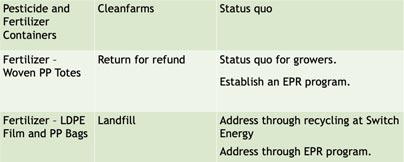
“Usually this is paid for through EPR levies or environmental handling fees,” said Ferguson. “One example is when you buy a jug of pesticide there is a built-in levy to formulating the end price. In Québec, farmers are now seeing eco-fees added to their bill when they buy bale wrap, twine and other farm plastics. The levies and eco-fees get passed on to Cleanfarms to collect and recycle these materials.”
Funded by the Ontario Ministry of Agriculture, Food and Rural Affairs, the researchers issued two reports. An interim report focused on the types and quantities of plastic used in production and packing the four crops chosen represented 74 per cent of the 8,000 acres of Holland Marsh production, as well as different production methods and different packing methods and

GH Flooring can’t be recycled but it can be sent to Emerald Energy in Brampton. Growers would have to arrange for pickup.
In the future, an EPR program for all Ontario greenhouse and hoophouse film modelled after the Cleanfarms pesticide container program would be the most comprehensive solution.
Some miscellaneous plastics such as onion crate covers, soil bags, salt bags, skid wrap -depending on the cleanliness of the product -- could go to Switch Energy once it was no longer serviceable. Switch Energy supplies customers with 15 bags. When bags are full, call for a pickup. The cost is $105 for the 15 bags.
As Ferguson demonstrates, plastics can be diverted from landfills. Of the 41 tonnes of plastic that are generated from producing these four crops, at least 7.8 tonnes of plastic will go to landfill.
materials. A final report focused on end-market solutions for plastic waste and the regulatory changes that could impact how produce is packaged and potentially recycled.
Holland Marsh growers have great solutions for some plastic waste and no good options for other plastic materials. Many of the plastics could be better addressed if it was done collectively as an EPR program.
“Seed pails get re-used which is fantastic,” said Ferguson, “It would be nice if there was a better solution for broken pails and excess lids. Adding seed pails to the Cleanfarms program seems like an easy solution because it is the same material as the pesticide jugs.”
Keller Bros collects and recycles seed trays – a great solution.
Greenhouse-grown cucumbers are grown in Rockwool blocks that are covered in plastic film. The Rockwool gets composted in Arthur, Ontario but the plastic goes to landfill. Grodan, the company that makes the blocks is very focused on creating sustainable solutions for its products. The hope is that Grodan will contact EFS Plastic recycling in Listowel, Ontario so that its plastic can be recycled too.
GH Film - Some greenhouse film suppliers will bale up the old plastic and send it for recycling. Sourcing from one of these suppliers is a great option. For GH growers that are left with the old film and for growers that are replacing their hoophouse cover, Switch Energy can take the plastic, but you would need to call and determine pricing and how it needs to be bundled.
“That’s a conservative estimate because I’m assuming that where there is an existing program all growers are using it all of the time,” said Ferguson.
“Greenhouse flooring, hoophouse film and the fertilizer packaging that isn’t recycled (e.g. 50 lb bags) are the plastics making up the majority of the 7.8 tonnes being landfilled. We do need to find solutions for these plastics.”
Options and solutions
Switch Energy is an option available to Ontario farmers right now for recycling film plastic such as hoophouse film and fertilizer bags.
Emerald Energy is owned by U-Pak. Company representatives are available to speak to any large grower or packing operation that uses a waste collection service. Estimate the cost is 3-10 per cent more than traditional waste removal service. But your plastic waste would become energy.
EFS Plastic in Listowel is a plastic recycler which wants more GH film. This option is a little trickier because plastic would have to be baled and delivered. The company works with Cleanfarms and is willing to work with farmers or organizations on a collective effort.
In Canada, there is an EPR facilitator in place through Cleanfarms. Holland Marsh Growers’ Association has a relationship with Cleanfarms because of the two past plastic projects.
“Holland Marsh growers are very aware that plastic is an issue for soil and water,” said Ferguson. “If a few more products such as fertilizer bags and hoophouse film can be addressed, then there’s a good sustainability story to tell on how your industry manages plastic responsibly.”
THE GROWER PAGE 10 –– MAY 2024 IN SEARCH OF SUSTAINABILITY
Production Plastic to Address
for Ag Plastics
of Production Plastic Used in the Holland Marsh
Solutions
Amount
Onions topped out as the biggest user of plastic of the major commodities grown in the Holland Marsh.
Ontario grape growers top $113M in farmgate value
Ontario grape growers had a better 2023 harvest than anticipated earlier in the year, earning $113.3 million in gross farmgate receipts. The best number of the last five years is one of the highlights of the report presented by the Grape Growers of Ontario (GGO) at its annual general meeting on April 3, 2024.
“As we reflect on the growing season of 2023, grape growers breathed a sigh of relief,” said Matthias Oppenlaender, GGO board chair. “We overcame the challenges brought by the winter weather disaster of 20212022, we navigated a surplus of supply and future policy uncertainties, and throughout all of this, our commitment to supporting Ontario grape growers remained steadfast.”

A warm September 2023 helped grapes mature and ripen, and growers were able to hang fruit well into October, but disease pressure was high and the erratic weather caused very uneven maturation. Growers’ patience and utilization of good viticulture practices ensured good grape stability and high-quality wines in 2023. In the end, there were 75,727 tonnes harvested.
The Canada-Ontario Grapevine Winter Injury Initiative delivered $6 million under the AgriRecovery program. The governments of Canada and Ontario also allocated $8 million from the Sustainable Canadian Agricultural Partnership fund, focusing on grapes, apples and tender fruit.
During 2023, Grape Growers of Ontario leadership was engaged in numerous industry and government meetings to respond to Premier Ford’s direction to
modernize the beverage alcohol industry. The provincial government has announced the following changes to be implemented which focus on support for local producers:
• To introduce legislation to eliminate the 6.1 per cent wine basic tax at the on-site winery retail stores
• Extending and enhancing the VQA Wine Support Program beginning in 2024-25 for up to five years
• Extending the Wine Marketing Fund for up to five years
• Continue to work with the LCBO to provide more programs, promotions, and strategies to support local economic development
• Setting up a wine and grape industry sector table as a future engagement forum to discuss opportunities afforded by the new alcohol marketplace

• Maintaining several existing marketplace guardrails and extending them to new retail stores, including the wine minimum pricing of $10.95 in grocery and convenience stores, shelf space requirements and the prohibition on trade spend
“This announcement is one of the most significant changes to our industry since prohibition,” reported Debbie Zimmerman, GGO CEO.
Source: Grape Growers of Ontario 2023 Annual General Report

THE GROWER MAY 2024–– PAGE 11 GRAPE PRODUCTION
The opportunity for agriculture in Canada’s new school food program

In early April 2024, the federal government announced its plans to invest $1 billion over five years in a new national school food program. Details on what this program will look like, where and how the funding will be used and how it will be rolled out over the next five years are yet to come.
If done right, however, this could represent a terrific opportunity for students, families, farmers and local food to make that “farm to school” connection that is such a critical component to protecting our domestic food production capacity.
Over the last year and a half,
the Ontario Fruit and Vegetable Growers’ Association (OFVGA) led by our program manager Dan Tukendorf, has been participating in consultations and roundtables over what a national school food program could – and should –look like.
This is due to our almost 20year involvement with the Northern Fruit and Vegetable Program, which we’ve been running for Ontario’s Ministry of Health since 2006.
The OFVGA, under Dan’s leadership, handles menu planning, procurement and distribution of more than three million servings of fresh fruit and vegetables to more than 80,000 students in more than 500 provincial and First Nation schools over a 20-week period from January to June every year. We’re proud that more than 60 per cent of that produce is grown in Ontario.
Dan also manages our Fresh from the Farm school fundraising program which was launched in 2013 and is open to all schools and registered day-care centres in Ontario. Students raise funds by selling bundles of fresh Ontario root vegetables, which include
potatoes, carrots, and onions, and bags of fresh Ontario apples.
To date, 2,200 schools have raised more than $1.9 million for school initiatives, selling 4.3 million pounds of fresh Ontariogrown fruit and vegetables and generating almost $5 million in local food sales.
Both programs support healthy eating, encourage better nutrition and support Ontario farmers through sales of Ontario produce, and it is our hope that this new national program will have the same objectives and goals.
School food programs do exist across Canada, but they’re a patchwork of provincial and territorial initiatives with varying levels of funding, facilities –Ontario elementary schools don’t have school kitchens or cafeterias for example – and often inequitable access.
The federal government is planning to negotiate individual funding agreements with each province, which will present new challenges in program design, offering and rollout.
Through the OFVGA programs, our team has gathered a significant amount of
experience in procurement, logistics and working with a wide range of partners. Here are what we’ve communicated to government as essential components of its new program:
Providing healthy food: Foods provided through this program should be healthy and nutritious. This means shying away from convenience foods such as hot dogs or pizza, and instead focusing on the healthy eating principles in Canada’s Food Guide. Research has proven the long-term links between nutrition and health, and this could provide new ways to teach young people about healthy eating.
Encouraging collaboration and recognizing diversity: This initiative will need collaboration and buy-in from school boards, municipalities, federal and provincial ministries and other stakeholders to be successful. It will also need the flexibility to serve a broad range of users, from ethnically diverse urban populations to remote and Indigenous communities. A one-size-fits-all program will not work.
Buying local: In the U. S., for example, food and nutrition programs are administered by the United States Department of Agriculture with funding provided through the Farm Bill, and actively encourage buying homegrown food products. This new program is also a real opportunity to support Canadian farmers and tie Canadian agriculture to the classroom and to future consumers with a program that has a strong local procurement policy. There are successful national school food program examples in many other countries, and we will be well served to learn from their experiences as we design Canada’s program. The potential impacts could go far beyond just ensuring kids don’t go hungry, encouraging healthy eating, supporting local food production and teaching the next generation of consumers about where their food comes from.
Alison Robertson is executive director of The Ontario Fruit & Vegetable Growers’ Association.

PAGE 12 –– MAY 2024 THE GROWER
STAFF Publisher: Ontario Fruit and Vegetable Growers’ Association Editor: Karen Davidson, 416-557-6413, editor@thegrower.org Advertising: Carlie Melara 519-763-8728, advertising@thegrower.org The Grower reserves the right to refuse any advertising. Any errors that are the direct result of The Grower will be compensated at our discretion with a correction notice in the next issue. No compensation will be given after the first running of the ad. Client signature is required before insertion. The Ontario Fruit and Vegetable Growers’ Association is the sole owner of The Grower. All editorials and opinions expressed in The Grower are those of the newspaper’s editorial staff and/or contributor, and do not necessarily reflect the view of the association. All rights reserved. The contents of this publication may not be reproduced either whole or in part without the prior written consent of the publisher. OFFICE 355 Elmira Road North, Unit 105 Guelph, Ontario N1K 1S5 CANADA Tel. 519-763-8728 • Fax 519-763-6604 The Grower is printed 12 times a year and sent to all members of the Ontario Fruit and Vegetable Growers’ Association who have paid $30.00 (plus G.S.T.) per year for the paper through their commodity group or container fees. Others may subscribe as follows by writing to the office: $30.00 (+ HST) /year in Canada $40.00/year International Subscribers must submit a claim for missing issues within four months. If the issue is claimed within four months, but not available, The Grower will extend the subscription by one month. No refunds on subscriptions. P.M. 40012319 ONTARIO FRUIT AND VEGETABLE GROWERS’ ASSOCIATION BOARD OF DIRECTORS 2023 MANAGEMENT COMMITTEE Chair Shawn Brenn, Waterdown Vice-chair Mike Chromczak, Brownsville Grapes Matthias Oppenlaender, NOTL Fresh Veg Joann Chechalk, St Anns Small fruit/Berries Morris Gervais, Springwater BOARD OF DIRECTORS Apples Brian Rideout, Chatham-Kent Fresh Veg other Joann Chechalk, St Anns Tender Fruit Dave Enns, Niagara-on-the-Lake Asparagus Mike Chromczak, Brownsville Grape Matthias Oppenlaender Fresh Veg muck Quinton Woods, Cookstown Potato Shawn Brenn, Waterdown Small Fruit/Berries Morris Gervais, Springwater Ginseng Glen Gilvesy, Tillsonburg Greenhouse Jan VanderHout, Dundas Greenhouse George Gilvesy, Tillsonburg Processing Vegetables Tracy Gubbels, Mount Brydges OFVGA SECTION CHAIRS Crop Protection Brian Rideout Environment and Conservation Jan VanderHout Labour Bill George Safety Nets Mike Chromczak Energy, Property, Infrastructure and Food Safety Brian Gilroy WEATHER VANE Bee Watch 2024. These creamsicle colours help the bees return to the correct colony in a bee yard. This helps ensure their foraging investment benefits their own colony, and it helps to prevent drift, the movement of bees among colonies. Each colony has a unique pheromone “odour,” which is shared by every bee in that colony. Guard bees are on duty at the entrances to inspect incomers and challenge any from other colonies. Foragers laden with resources can often beg their way into strange colonies, and lordly drones can come and go as they please.
EXECUTIVE DIRECTOR’S PERSPECTIVE
Photo by Glenn Lowson.
ALISON ROBERTSON
Excitement for biologicals builds with new product award

The agri-food sector nodded approvingly when AgriMarketing magazine named Stine’s ShortStature Corn its prestigious 2023 Product of the Year. After all, the promise of stronger, healthier corn plants owing to their sturdier short-stature nature has been building for years. And Stine’s has been a leader in bringing it to market.
But it was the crowning of the magazine’s 2023 New Product of the Year, AMVAC’s BioWake seed lubricant for corn and soybeans, that really caught the eye of growers. This is the first time a biological has won this prestigious award, and it’s bound to raise awareness of the many advantages of combining seed
lubricants and beneficial microbes.
Seed lubricants provide smooth seed flow during planting. They enhance seed coverage by preventing seeds from bridging and clumping, and they reduce static electricity and friction.
Biologicals don’t peter out after planting or through the growing season. And unlike traditional graphite or talc-based lubricants, they don’t emit dust that cause operator problems.
AMVAC marketing manager
Ted Walter says BioWake secretes molecules in the soil to then improve nutrient availability. It can enhance root growth and help battle abiotic stress.
Fewer than one-third of U.S. row crop farmers use biologicals. But more effort has been put on retailing, which along with product performance, is expected to increase the uptake.
“We are diving into a segment with corn, soybeans or cotton where biologicals are still slow to be adopted,” says Walter. “What will help drive that adoption with BioWake is the low use rate, convenient application and consistent performance with a high ROI.”
AgriMarketing heralds
biologicals as a new era for row crops, owing to three main advantages: plant health, soil health and operator safety. Ohiobased Locus AG, another seed lubricant manufacturer, says the combination of lubricants and biologicals eliminates additional steps in the planting, and saves farmers money.
“The financial advantages of investing in seed lubricants that include biologicals are particularly compelling, considering farmers’ inevitable purchase of seed lubricants,” the company explains on its website. “For a nominal added expense, farmers can consider purchasing combined seed lubricants and biologicals and enjoy the increased yield and ROI benefits that come with its use.”
AgriMarketing says biologicals’ staying power gives them a sustainability advantage. And these days, anything that can be shown to have an environmental edge, let alone superior performance and profitability, is a plus.
Marketing executive Walter says BioWake costs about $5$5.50 an acre. The company worked with large-scale retailers to use BioWake on more than 100,000 acres to launch its demo

program, which sparked sales on more than 300,000 acres last year. Walter expects product exposure and market awareness to drive sales in 2024 to more than one million acres.
Biologicals have traditionally been associated with specialty crops. But when they start being used widely to enhance row crop growth, everyone — including AgriMarketing — takes note. And more excitement is on the way.
BioWake has cited wheat and peanuts as its next targeted commodities, which is bound to further increase the market buzz.
All this begs the question: could sharp increases in biologicals being developed for row crops have a ripple effect on horticulture?
Maybe. As AgriMarketing reported, farmers are increasingly aware of biologicals. In horticulture, they’ve been used in foliar treatments but are still in their infancy in seed treatments. Some reports have connected them with onion- and carrot-seed exports to Canada.
Information is scarce as to their efficacy, but their promise could well lead to more research, and more products for growers.
Owen Roberts is a past-president of the International Federation of Agricultural Journalists and a communications instructor at the University of Illinois

MAY 2024–– PAGE 13 THE GROWER
COWBOY
URBAN
OWEN ROBERTS carrot seeds
CPMA announces 2024 board of directors
The Canadian Produce Marketing Association (CPMA) announces its Board of Directors for 2024-2025. Election results were announced during the 2024 CPMA Annual General Meeting. The CPMA Board of Directors represents a wealth of industry talent from across all stages of the supply chain.
NAME
Brody Powell
Brian Faulkner
George Pitsikoulis
Andrea Vandergrift
Robert Johnson
Bernard Coté
Daniel Terrault
Dan Martin
Jennie Coleman
Dave Pullar
Steve Bamford
Jozef Hubburmin
Jack Howell
Jerry Dzikowski
John Corsaro
Quinton Woods
Michèle McMillan
Hutch Morton
David Dubé
Simon Romano
Mimmo Franzone
COMPANY
Associated Grocers
BC Fresh Vegetables Inc.
Canadawide Fruit Wholesalers
Costco Wholesale Canada
Country Grocer Courchesne Larose Ltée
Cultures Gen V
EarthFresh
Equifruit
Federated Co-operatives Limited
Fresh Advancements
Fresh Direct Produce Ltd.
Fyffes North America, Inc.
Giant Tiger Stores Ltd.
The Giumarra Companies
Gwillimdale Produce Ltd.
Ippolito Fruit & Produce Ltd.
J.E. Russell Produce Ltd.
Krown Produce
Loblaw Companies Ltd.
Longo Brothers Fruit Markets
SECTOR
Wholesaler
Grower or Packer or Shipper
Wholesaler Retail
Wholesaler
Regional Retail
Grower or Packer or Shipper
Grower or Packer or Shipper
Grower or Packer or Shipper
Wholesaler
Wholesaler
Wholesaler
Grower or Packer or Shipper
Regional Retail
Grower or Packer or Shipper
Grower or Packer or Shipper
Grower or Packer or Shipper
Wholesaler
Wholesaler
Retail
Regional Retail

COMING EVENTS 2024
May 28-30 Grow your People Unconference, Queen’s Landing Hotel, Niagara-on-the-Lake, ON
May 30 International Potato Day
June 1 Garlic Growers Association of Ontario Field Day, Van Raay Farms, Dashwood, ON
June 11-13 GreenTech Amsterdam, RAI Amsterdam, Netherlands
June 19 Ontario Potato Board Industry Social Golf Tournament, Hockley Valley Golf Resort, Mono, ON
June 23-26 12th World Potato Congress, Adelaide, Australia
Aug 7 Nova Scotia Fruit Growers’ Association Orchard Tour, Kentville, NS
Aug 15-16 U.S. Apple Outlook Conference, Ritz-Carlton Hotel, Chicago, IL
Sept 10-12 Canada’s Outdoor Farm Show, Woodstock, ON
Sept 19-21 Quebec Produce Marketing Association 77th Convention, Fairmont Tremblant, Tremblant, QC
Oct 1-5 International Plowing Match & Rural Expo, Lindsay, ON
Oct 9-10 Canadian Greenhouse Conference, Niagara Falls Convention Centre, Niagara Falls, ON
Nov 1-10 Royal Agricultural Winter Fair, Toronto, ON
Nov 19-21 Alberta Potato Conference and Trade Show, Grey Eagle Resort & Casino, Calgary, AB
Nov 27-Dec 1 Canada’s Outstanding Young Farmer National Event, Sandman Signature Lethbridge Lodge, Lethbridge, AB
2025
Jan 14-15 Potato Expo, Las Vegas, NV
Feb 2 North American Strawberry Growers’ Association Annual General Meeting, Hawaii
Feb 19-20 Ontario Fruit and Vegetable Convention, Niagara Falls Convention Centre, Niagara Falls, ON
SCENE AT ONTARIO CROPS RESEARCH CENTRE

These celery starts were a welcome sight on the sidelines of the Grower Information Days held April 3 and 4 in Bradford, Ontario. Shawn Janse, station manager, Ontario Crops Research Centre, says that collaborative work is ongoing with seed companies, the crop protection industry, plant breeders and other scientists every year.
THE GROWER PAGE 14 –– MAY 2024 NEWSMAKERS
Try selling by listening

When you have the opportunity to meet in person with your customers, you want to get the most out of this valuable time. My experience – when I worked for a major retailer -- was that vendors talked too much about what they were doing and forgot to ask me what I was doing or what I needed.
I have been in many of these meetings and the best ones are more of a conversation when both people share experiences. Questions are one way to ensure this happens. When you insert some questions, you learn a lot and you can pause to let the customer talk. It’s a great method to relieve the stress of a timeconstrained appointment.
Consider this. If an equipment supplier tries to sell you a piece of equipment and they never ask anything about your business, what will you be thinking? You would probably not be inclined to buy from them because they really don’t understand your needs or what is happening in your business.
When you ask questions, it indicates you are curious and genuinely interested in your customer’s business. You will learn a lot and evolve your relationships.
Plan to ask questions
Questions take time to answer. Although you might think the answer is taking precious time away from your own pitch, the time is building a bridge of common understanding. Allow adequate time for that conversation.
You should also think of your meetings as a step in a journey. Ask questions that might be valuable to you in upcoming meetings. An example of this would be: What are your sellthrough targets for hardline items?
If they answer 90 per cent and when you have your next meeting you can report your results. You would say something like, “in our last meeting you indicated hardline sell through targets are 90 per cent, we were pleased to come in at 93 per cent.” You have set up part of the conversation for the next meeting.
Include an answer in your question
Retailers are not your sales and marketing department. You have to bring plans to get your products into the shopping cart and you should be knowledgeable about how to do this. You should also have an understanding of your customer’s sales estimates. You need to know what your customer expects your product to sell.
You could ask what their sales estimate would be. It is a fair question to ask. If you want to come across more knowledgeable and engaged in sales, you could throw out a number in your question. An example would be: “Based on our experience, we believe we will sell eight units per store per week. Is this a fair number, given your experience and expectations?”
When you do this, you show that you have thought about it.
Ask questions where you can predict the answers
It helps to get the people in the room to agree with you as opposed to trying to convince them or even worse just telling them. Asking questions where you know they will agree is one way to do this. If you have a product that appeals to health-conscious consumers you need to get your customer thinking the right way. An example would be: “We know health-conscious consumers are willing to pay a premium, are these consumers you are trying to attract to your stores?” One would expect, if you have done your homework that the answer is “yes”. Once they say yes then you can share how your product appeals to these shoppers and will be a draw to their stores.
Refer to their stores or their business in your question
When you ask questions, let retailers know you were in their stores or learning about their business. Retailers want to know you are interested in what they are doing. When you ask questions, you should refer to their business. An example of this would be: “When we were in your store ABC, we noticed new merchandising tables for apples. Is this something you will be rolling out across the entire chain? If it is, we might consider some modifications to our packaging.”
This confirms you are in their stores. You can also refer to their website on topics such as sustainability or local products.
All of these tactics will help engage your customers and build your relationships. We have provided four options on how to include questions in your next customer meeting. In a 30-minute
The 80/20 rule of active listening says that in any sales conversation, the sales person should spend 80% of the time listening and only 20% of the time talking. In the vast majority of cases, the customer doesn’t want to know what you think – he/she wants to relay thoughts, feelings and needs.”
~ JAMES BAKER, COMMUNICATIONS COUNSELLORmeeting, we suggest you ask at least four questions to engage your customer and help learn about their business.
Peter Chapman is a retail consultant, professional speaker and the author of A la Cart-a suppliers’ guide to retailer’s priorities. Peter is based in Halifax, N.S. where he is the principal at SKUFood. Peter works with producers and processors to help them get their products on the shelf and into the shopping cart.


MAY 2024–– PAGE 15 THE GROWER
NAVIGATOR
RETAIL
PETER CHAPMAN
“
BC growers urged to plan now for less water in the future
 MYRNA STARK LEADER
While Okanagan cherry, soft fruit and grape growers contend with getting through the 2024 growing season after another winter killing cold snap in January, science is saying now is the time for growers to be planning water use to adapt to what’s predicted over the next 30 years and through 2099. Warming temperatures, increased variability, a shifting growing season, as well as moisture which will fall as rain, not snow, and likely not in the seasons it has previously, mean change for growers. When it comes to the future of annual water volumes in the Okanagan, climate modeling predicts less. More efficient use won’t just be necessary, it will be demanded, particularly with continued urban development next door.


“We will be forced in the future to use less water,” says Andrew Moon, viticulturist at Tinhorn Creek in Oliver.
With more than 25 years of experience managing irrigation systems, Moon was one of three panelists sharing irrigation water strategies during February’s BC Interior Horticulture Show in Penticton.
Currently, BC is on the verge of one of the worst droughts this century. As of April 1, BC average snowpack, which feeds water reservoirs, aquifers and lakes, is 37 per cent below normal. It’s the lowest it has been since 1970. Typically by April 1, 95 per cent of annual snow pack has accumulated. In 2023, the snowpack provincial average April 1 was 88 per cent.
But no matter what this year brings, the panelists agree there’s room for improvement in watering systems. Better understanding
about how much water the soil and crop need is one easy opportunity, according to Ravi Dhaliwal. He grows about 14 acres of apples and cherries at Orchard Hill Estate Cidery between Oliver and Osoyoos.
“If every farmer would install two water sensors to see how much water they are using, that would be an easy start to better water management,” says Dhaliwal who did just that and discovered he was overirrigating some places.
Kelowna apple, cherry and pear orchardist Sam DiMaria took another approach to watering after seeing something tried by Washington grower and Cold Crown Nursery owner Dale Goldy.
Two years ago, after a heat dome scorched DiMaria’s apples, he installed overhead misters on two of the 52 acres he manages. It worked, mitigating sunburn on

the apple block by cooling the air around the apples and saved water.
“Misters compared to using conventional overhead irrigation, I’d say a 66 per cent savings in the water needed to cool the apples. It goes along with my regular drip irrigation,” says DiMaria. “With misters, the trees don’t go into stress when it’s really hot, like over 30°C. I’m sold on it, but cost is another story. I think it’s about the same cost as an under-tree micro sprinkler system. I tapped into an already existing drip system,” he explains.
“One of the drivers of change is going to be cost of water,” says Moon.
He’s gone back to overhead low flow, low pressure irrigation in some higher elevation grape blocks explaining that meter use, filtration systems and valve design have become more efficient.
“Even in drip, the technology has improved to emit water pressure more evenly whether crop is at the bottom or top of a hill,” says Moon.
No matter what irrigation system is used, Bruce Naka with Sound Water Advice urges growers to pay close attention to their entire system, frequently checking it from end to end.
“Even if you can’t replace your old system due to cost, most older systems can be improved,” says Naka.
Simple improvements include ensuring self-flushing fixtures are clean and pressure gauges work, checking that zone valves are shutting down and regularly examining every connection for leaks.
“You also need to ensure you know what (water) your crop needs at the beginning of the year, peak season and at year-end to improve your watering schedule,” adds Naka who says there is technology to help.
That could range from using flow-reading devices to analyze flow rate mistakes, using weather stations to help develop irrigation plans, to installing trunk, leaf and fruit sensors to monitor evapotranspiration. If there is good WIFI, he says smart irrigation controllers can easily operate at least two systems allowing water flow to be controlled from a phone or tablet, and enabling a grower to have one program for early and lateseason watering and another for times when peak flow is required.
“The technology like soil moisture sensors is there,” says DiMaria, “we just have to find the money to buy it and use it.”
The first step, Moon says, is to learn about your soils and each crop block, then really take time to plan the best irrigation system, commenting tongue in cheek, “You’ve got lots of time to do this, grape growers, because there will be few grapes this year.”
Tap into resources
Growers were encouraged to:
• use the BC Agriculture water calculator, an online tool developed in 2016 to estimate annual water demand based on soil, crop and irrigation type and land area
• use the BC Sprinkler Irrigation Manual to find information on soil water storage, plant rooting depth, available water storage capacity by soil type and peak evapotranspiration rates for locations across BC
• do an Environmental Farm Plan as some provincial flood risk and drought resilience programs through the Investment Agriculture Foundation require
one to be completed within the past five years.
Applications for the Extreme Weather Preparedness for Agriculture (EWP) Program opened January 23. Funded by federal, provincial, and territorial governments, there is $2 million available in 2024/25 to help producers increase on-farm resiliency for select extreme weather events but producers must cost share this program. The funding limit is $50,000.
THE GROWER PAGE 16 –– MAY 2024
FOCUS: IRRIGATION & WATER MANAGEMENT
Toro Transpira measures plant water consumption by direct plant sensing.
Bruce Naka has spoken at several Okanagan agricultural events about better water management
Myrna Stark Leader is a freelance agricultural journalist based in Kelowna, BC.
FOCUS: IRRIGATION & WATER MANAGEMENT
Waste not, wastewater
KAREN DAVIDSONFood producers have always needed to be careful managers of both water and soil. But today, those resources are more critical than ever as climate change is increasingly challenging how businesses protect the environment.
Not often appreciated is how much water is needed by beverage producers. Bench Brewing Company, a brewery fiercely committed to sustainability, recognized the impact its wastewater had on the local eco-system. The owners partnered with Econse Water Technologies for a solution that aligned with their goals and values.
“It takes a lot of water to make beer, so our water mantra has always been to conserve, recycle and reuse everywhere we can,” says Matt Giffen, founder of the craft brewery near Beamsville, Ontario. “We have not only eliminated our wastewater output completely, but we have also significantly reduced our overall water consumption.”
Not far away, Econse Water Technologies has its headquarters in Hamilton, Ontario with Derek Davy at its helm. By implementing its proprietary system at Bench, Econse helped their business achieve 100 per cent recycling of their wastewater. Upwards of 50,000 litres a day is reused for irrigating the brewery’s on-site hops field, apple orchard and neighbouring farms.
For that ground-breaking achievement, the two companies won the 2023 Water Canada Award for Wastewater. The publication is trusted by 35,000 professionals online.
“We truly feel that the Zero Wastewater Footprint project with Bench is the gold standard for affordable wastewater treatment,” says Davy. “It shows our commitment to driving sustainable practices—not just for breweries, but across a variety of industries.”
Vegetable solutions
After a decade of successful projects with municipalities and private businesses across Canada, Econse is bringing its expertise to agri-food producers in the Great Lakes area. Municipal and provincial regulations on water usage are pressuring vegetable farmers and greenhouse growers to find new solutions to handling wastewater.
Before the pandemic, Econse started working with the Holland Marsh Growers’ Association whose members manage 125 farms on 7,000 acres of low-lying land that drains into Lake Simcoe. While blessed with highvalue crops, these growers must


DAVY “
The system allows vegetable washers to recycle 100% of their washwater, protecting the environment and helping their business grow. ~
wash off the dark particles of soil before sending root crops to market. The time-worn issue is how to handle the wastewater without creating large settling ponds on high-value land. A project in the Holland Marsh at Hillside Gardens de-risked the technology in real time. “” need quote from Jody Mott.” Or Tim Horlings, chair, HMGA.
How wash water recycling works
Washing root vegetables is a water-intensive process. And farms are under scrutiny to limit excess phosphorus from soil entering water ways. The expert team of engineers at Econse has developed an automated, electromechanical system that separates liquids from solids. Specifically, the system removes suspended solids. In addition, the advanced system breaks down odours and colours, a benefit of particular value to growers who are dealing with beets, carrots and parsnips. The technology de-waters the captured solids back to mud for use in compost to help rebuild soil tilth.
“Vegetable washers can now easily recycle all their wash water. It is a closed loop process that eliminates discharging of any water into the environment. The technology recovers and prevents excess nutrients such as phosphorus from causing algae blooms in the lakes and rivers. Our goal is to provide tools that help farmers grow their business without growing their impact on the environment,” says Davy.
Other applications
Econse Water Technologies is now exploring potential collaborative project opportunities with Vineland Research and
Innovation Centre (Vineland) on how to treat and recover excess nutrients such as phosphorus in greenhouse wastewater.
“Vineland has been actively developing a suite of physical assets to expand our research into water,” says Evan Pilkington, senior business development advisor, Vineland. “I’m excited by the prospect of working with an innovative company like Econse to develop and test critical solutions that help the greenhouse industry to proactively tackle emerging water-related challenges.


MAY 2024–– PAGE 17 THE GROWER
The carrot washing line uses water that’s recirculated through a closed-loop system.
Derek Davy, (L) CEO, Econse Water Purification Systems, is shown with Ron Gleason, Hillside Gardens Ltd. They stand beside a bin holding mud, the end product of the de-watering process.
Grown in muck soils, carrots require lots of water to brush them clean for the end consumer. Photos by Marcella DiLonardo.
DEREK
FOCUS: IRRIGATION & WATER MANAGEMENT
Smart Farm irrigation research underway at Lethbridge College
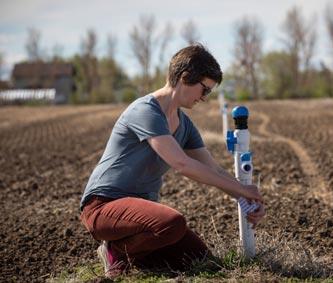


Lethbridge College will receive $1 million in infrastructure funding from the Alberta government to expand the capacity of its applied research in irrigation science.
The Alberta government’s Ministry of Technology and Innovation has designated the college as one of four post-secondary institutions to receive a portion of $3.6 million from Alberta’s Research Capacity Program College Fund.
Nathan Neudorf, Minister of Affordability and Utilities and MLA for Lethbridge-East, says, “Water and agriculture are critical to the economy and way of life in southern Alberta. Lethbridge College’s leadership in providing training on smart irrigation is a brilliant step towards a better future.”
The provincial grant is in addition to $1 million in federal funding that the college received in 2023 from the Canada
Foundation for Innovation (CFI). The combined $2 million from the provincial and federal governments will support smart irrigation infrastructure needs for the Mueller Irrigation Research Group at the Lethbridge College research farm, located just east of Lethbridge.
“Lethbridge College is taking the challenges of today and finding solutions,” says Kenny Corscadden, Vice President Research and Partnerships and Interim Vice President Academic. “Our Smart Irrigation Farm will undertake research to minimize water usage in our agricultural system in the face of future droughts and maximize crop productivity.”
The smart irrigation infrastructure at Lethbridge College’s research farm is the first of its kind among post-secondary institutions across Canada. These grants will enable the Mueller Irrigation Research Group to continue to expand its
capabilities, providing unique opportunities for students, researchers and industry partners.
“These grants will help us to increase the capacity of our group to do plot and field scale experiments on the LC research farm,” says Senior Applied Research Chair Dr. Willemijn Appels. “We’ll be able to purchase the latest irrigation technology and plant/soil sensing equipment to investigate the effects of management decisions regarding irrigation management, nutrient and land management on soils and crops in great detail. Our goal is to distill practical management strategies for precision agriculture in irrigation from this detailed work.”
The funding will be used to upgrade irrigation equipment on the research farm. The centre pivots and linear move systems will be outfitted with variable rate irrigation (VRI) technology, better

mapping systems and other equipment required to enhance site-specific irrigation management. The funding will also help provide agricultural equipment for plot and field experiments, lab equipment for sample analysis, and sensors to capture instant observations of plant, soil and weather conditions anywhere on the farm.
“The equipment will boost our capacity for laboratory work as well, which means that we will need to have less analysis done by third parties and can do more in house,” Appels says. “That’s great for our own research and student projects, and it will also increase our flexibility to work with industry.”
The new equipment will enable the college to develop and investigate precision irrigation management strategies and find new ways to optimize water use efficiency in Alberta’s irrigated agriculture industry for years to come.


THE GROWER PAGE 18 –– MAY 2024
Dr. Willemijn Appels, Senior Applied Research Chair, Mueller Irrigation Research Group at Lethbridge College, checking irrigation research equipment at the Lethbridge College research farm.
Irrigation canal at the Lethbridge College research farm.
GET MORE CROP FROM EVERY DROP Maximize Yields Reduce Costs Guaranteed! MaxH2O.com learn more at:
Irrigation infrastructure at the Lethbridge College research farm.
FOCUS: IRRIGATION & WATER MANAGEMENT
Boosting potato yields and quality with fertigation
KAREN DAVIDSON
Some Manitoba potato growers have been practising fertigation for a decade or more, testifying to reachable targets of 400 cwt/acre or more. Chad Berry is one of those practitioners on 2,500 acres of processing potatoes near Cypress River.
“Not everyone has embraced the concept of fertigation, but we’ve had measurable results using both soil and petiole tests,” says Berry. “It’s been a great management tool for us, pushing a little or pulling back fertilizer amounts of nitrogen and sulphur according to variable soils.”
He’s careful with nitrogen amounts, not to make the potato plant too vegetative on top, but rather reproductive under the ground. Sulphur plays a role in nitrogen stabilization and amino acid and protein production.
George Moir, Marginet Family Farm, is another grower using fertigation with 17 pivots on 1,400 acres of processing potatoes near Treherne.
At each pivot, he’s installed a tank for fertilizer and an Agri-Inject pump that meters nitrogen and sometimes sulphur at precise times of the growing season. The prescription for liquid fertilizer depends on weekly petiole tests that are sent through his agronomist to a North Dakota laboratory.
“What we’ve learned is to start spoonfeeding fertilizer near the end of


June, when the tubers are dime- or nickelsized,” says Moir. “It’s better to offer a sniff – about three to five gallons of liquid nitrogen per acre – versus eight gallons. It’s better for the tuber.”
Once the calendar turns to July, then nitrogen amounts are increased according to the results of the petiole tests. The idea is to provide just enough for what the plant needs.
“July is an intense month,” says Moir. “Every potato variety is specific in its needs, as we’ve learned through trial and
error.”
Quality has improved with this management practice. Fertigation affects the size of tuber and in turn the incidence of hollow heart and bruising. By the time August arrives, the fertilizer is turned off but irrigation continues, as needed until harvest.
Through experience, Moir aims for the sweet spot of just enough top, but a good set of potatoes underground. The potatoes grown with this method are followed into the lab to check for specific gravity results
and frying colour.
“A decade ago, we would be happy with 300 to 350 cwt/acre but those yields don’t cut it anymore,” says Moir.
The 2024 edition of Manitoba Potato Production Days had a panel of three growers and an agronomist comparing notes on fertigation.
“We never stop learning,” says Moir. “Every one of these panelists had a different story.”

MAY 2024–– PAGE 19 THE GROWER
Chad Berry’s fertigation set-up near Cypress Hills, Manitoba
George Moir’s Agri-Inject pumps are used on 1,400 acres of processing potatoes near Treherne, Manitoba. This is what the tubers look like when he starts fertigating. At this point, smaller amounts of liquid nitrogen – three to five gallons/acre -- are applied to the crop.
Irrigation calculator helps PEI farmers to use water more efficiently

Water is a limited resource, especially during droughty periods, which are becoming more frequent due to climate change. On Prince Edward Island (PEI), rainfall events are happening less often during the summer. So some island farmers use irrigation to supply crops with additional water, sourced from groundwater, a finite resource. This poses an important question on water usage – how can farmers know how much water their crops needs and when they need it?
It’s a science that Agriculture and Agri-Food Canada (AAFC)
research scientist, Dr. Yefang Jiang, has spent the last four years studying as part of the recently completed Living Lab – Atlantic project – a collaboration with farmers and scientists where research is completed on real farm fields to help increase adoption of environmentallyfriendly farming practices.
Dr. Jiang studied how scheduling supplemental irrigation, only when the crop needs it, impacted potato yields on several PEI farms from 2019 to 2022. His approach looked at moisture levels in the soil and which level provided the optimal
environment for increasing potato yield and quality.
“Less moisture in the soil means the potato plant can’t effectively pull water and nutrients from the soil and that reduces yield and quality,” says Yefang Jiang. “However, if soil moisture is too high, it can reduce yield and quality by damaging the potato root system. Finding the right balance of soil moisture helps potatoes grow and also reduces water usage.”
He found that irrigation scheduling wasn’t just determined by the moisture in the soil. Growers must factor in the growth stage of the potato crop, soil type, as well as the short-term weather forecast. To help PEI farmers determine when or when not to irrigate, Dr. Jiang designed an online calculator with help from Dr. Morteza Mesbah, Kristen Murchison and Scott Anderson from AAFC to reduce the risk of over-, or underirrigating potatoes by accounting for all these factors. Living Lab –Atlantic partner, Ryan Barrett, from the PEI Potato Board helped test and provided feedback on the calculator to the team.
The calculator, available on the East Prince Agri-Environment Association (lead Living Lab –Atlantic partner) website, allows farmers to enter the soil type on their farm, growth stage of their potato crop, the current soil moisture level taken by a soil

moisture meter, the seven-day rainfall forecast (in millimetres), as well as the efficiency of their irrigation system to provide water to the crop. For example, a lowpressure centre pivot with drop tubes applies water at 80 to 85 per cent efficiency and a highpressure pivot with impact nozzles is about 75 per cent efficient. The calculator then provides an exact amount of water to apply to the field in millimetres and inches, or indicates that no irrigation is necessary if the crop has all the moisture it needs. Dr. Jiang explains that adopting use of the calculator will be easy for PEI farmers.
“They just need a hand-held soil moisture meter to monitor every few days, watch short term weather forecast, and then use the calculator to determine whether to water or not,” says Jiang. “Some farmers might be using less water than they need, where others might be using more than they need. The calculator
The calculator will also help farmers increase their potato yield and quality as it provides information on the optimal moisture the crop requires at various growth stages. Jiang explains that he will work with four PEI farmers to collect more data to continually improve the tool. He is encouraging as many farmers as possible to start using the tool right away in order to use
science to support responsible water use.
Key take-aways:
• Dr. Jiang studied how scheduling supplemental irrigation, only when the crop needs it, impacted yield of potatoes on several PEI farms from 2019 to 2022. His approach looked at moisture levels in the soil and which level provided the optimal environment for increasing potato yield and quality.
• To help PEI farmers determine when to irrigate or when not to irrigate, Dr. Jiang developed a simple calculator to reduce the risk of over-, or under-irrigating potatoes.
• The calculator allows farmers to enter the soil type on their farm, growth stage of their potato crop, the current soil moisture level taken by a soil moisture meter, the seven-day rainfall forecast (in millimetres), as well as the efficiency of their irrigation system to provide water to the crop.
• The calculator then provides a recommendation of the exact amount of water to apply to their field in millimetres and inches, or indicates that no irrigation is necessary if the crop has all the moisture it needs.
Source: Agriculture and Agri-Food Canada
Irrigaton water cuts in Alberta
2023 allocations by purpose

The St. Mary River Irrigation District (SMRID) Board of Directors has set the water allocation for the 2024 year at eight inches of water per acre at the farm gate. This is half of what was initially announced a year ago (15 inches). SMRID will review the Irrigation Water Supply Forecast supplied by Alberta Agriculture and Irrigation and provide updates throughout the irrigation season.
“At this time, we are anticipating starting the irrigation
season in the second week of May 2024, subject to weather conditions,” says David Westwood, general manager, SMRID. “We will confirm the start-up date as we get closer to the start of irrigation season.” Irrigation in Alberta accounts for 44 per cent of allocations as per a 2023 government report. And in fact, the name of the ministry is Alberta Agriculture and Irrigation, reflecting the importance of water management in the province.
THE GROWER PAGE 20 –– MAY 2024 FOCUS: IRRIGATION & WATER
MANAGEMENT
Dr. Jiang at the PEI research site demonstrates supplemental irrigation project as part of the Living Lab-Atlantic.
VEGETABLE PRODUCTION
Ontario Processing Vegetable Growers
have earned a record farmgate value of $162M
Every year brings a unique mix of opportunities and challenges, and 2023 was no exception for the Ontario Processing Vegetable Growers (OPVG). The association’s 335 growers achieved a record farmgate value of $162 million with nine crops destined for canning, freezing or pickling at 13 food and beverage processors.
“Through it all, our work is to advocate for growers, promote the sector and ensure the long-term prosperity of this unique industry,” reported Keith Robbins, general manager, OPVG at the March 28, 2024 annual general meeting.
“There have been labour constraints that we collaborated with industry stakeholders to address,” said Robbins. “We navigated uncertainties with climate change, market fluctuations and supply chain disruptions – and the implications for business risk management. And we continue to be vigilant with compliance to evolving regulations.”
When it comes to key accomplishments for OPVG in 2023, there are four key areas
that stand out.
• grower advocacy work included negotiating prices, terms and conditions on behalf of growers to ensure fair compensation and sustainable practices. OPVG also continued to advocate with all levels of government on specific issues, i.e. seeking changes with PMRA on Ethrel (ethephon) for processing tomatoes and securing support during power outages at the processing plant.
• OPVG coordinated research initiatives to provide valuable insights to optimize crop yields and quality.
• OPVG’s marketing and promotion work actively promoted Ontario’s processing vegetables to boost market visibility.
• OPVG championed environmental stewardship to support eco-friendly practices to address issues such as crop protection regulations and sustainable farming.
Source: Ontario Processing Vegetable Growers’ 2023 Annual General Report


MAY 2024–– PAGE 21 THE GROWER

Blueberry twig blight survey

ERICA PATE & KATIE GOLDENHAR
Blueberry growers are familiar with twig blight, finding dead shoot tips, blighted flower clusters, and dark lesions on twigs during the growing season. While twig blight has often been associated with Phomopsis blight caused by Phomopsis vaccinii (syn. Diaporthe vaccinii), there can be other pathogenic culprits, which can be difficult to distinguish from one another.
There have been increased reports of Botryosphaeria stem blight, caused by Botryosphaeria dothidea, which is typically thought to be a southern disease and has only recently been reported as an issue in northeastern states. Identifying the pathogens responsible for causing twig blight is needed to inform research priorities and management practices.
During the 2023 season we visited 10 blueberry farms across the province and collected 50 symptomatic twig samples. The samples were sent to a diagnostic lab to identify the causal organism(s) (Fig. 1). Phomopsis vaccinii was found in 31% of the samples, followed by Pestalotiopsis/ Neopestalotiopsis spp. (27%), then Colletotrichum fioriniae (14%). In 28% of samples where pathogens were detected, more than one pathogen was present (data not
shown). This makes it challenging to determine which of the pathogens was the primary disease causal agent and requires more research to determine the main cause. In 22% of the symptomatic twig blight samples did not have any pathogen present.
Botryosphaeria stem blight was not detected in this survey, nor was the aggressive Neopestalotiopsis species that has been identified on strawberries.
The fungal pathogens identified in this survey have been associated with blueberry twig blight previously, although some have only recently been reported on blueberry, and information is limited on these pathogens.
Phomopsis twig blight (Phomopsis vaccinii syn. Diaporthe vaccinii) occurs in most fields at low levels, but Phomopsis can be severe in some years, likely due to regular rains during bloom. Spores are dispersed by rain in the spring, most often from bud break through bloom, and young tissue is the most susceptible to infection. Wounds from mechanical injury and winter injury can also lead to infection.
Susceptible cultivars include Duke, Jersey, and Bluecrop; Elliot and Bluetta are resistant cultivars.
Fungicides registered for Phomopsis on blueberry are listed on the Ontario Crop Protection Hub.
We have no guidelines on

management for Pestalotiopsis/ Nesopestalotiospsis twig blights, however, strategies similar to Phomopsis and anthracnose would reduce incidence of these pathogens. Fungi within the Pestalotiopsis genus are often secondary, infecting injured tissue from other diseases or insects, or winter jury.
Anthracnose shoot blight (Colletotrichum fioriniae) favours warm, wet weather. Optimal temperatures are 25°C with 8 hours of leaf wetness. Susceptible cultivars include Bluecrop and Coville. Anthracnose shoot blight can serve as the overwintering site for spores that can cause anthracnose fruit rot. To protect against anthracnose fruit rot, fungicides may be needed at bloom and post-bloom. Fungicides registered for anthracnose on blueberry are listed on the Ontario Crop Protection Hub. Choose products that will control anthracnose and Phomopsis
Seimatosporium lichenicola often occurs on wounded wood from mechanical injury or winter injury, and has not been associated with causing economically important disease in blueberries. There have also not been any reports of Phoma or Diplodia causing issues on blueberry.
Generally, wet and rainy springs are conducive to severe twig blight infections. When any

twig blight is identified growers should:
• Prune out and destroy diseases twigs and canes. Cut canes well below the lesion and close to the ground. Prune during dry weather.
• Avoid wounding plants. Stress (drought, frost, mechanical injury, other pests) can contribute to worse infections.
• Do not fertilize late in the season- this may lead to winter injury.
• Protective fungicides for anthracnose and Phomopsis should begin at budbreak.
Thank you to the participating growers for their support with this
project. This project was funded through the Sustainable Canadian Agriculture Partnership Plant Health Project.
Erica Pate is fruit crop specialist & Katie Goldenhar is pathologist - horticulture, Ontario Ministry of Agriculture, Food & Rural Affairs.
THE GROWER
PAGE 22 –– MAY 2024
Figure 1. Results from the 2023 blueberry twig blight survey.
Figure 2 Phomopsis twig blight
Figure 3 Pestalotiopsis
Frost protection options for strawberry growers
ERICA PATE
The last few years have seen strawberry growers irrigating through the night on multiple occasions to protect strawberry bloom. As we progress into the season it is time to review your options for frost protection before receiving that frost alert from your weather app.
Frost can kill strawberry flowers or injure them and cause misshapen berries. Critical temperatures for strawberries at different stages of development are found in figure 1.
Growers can use irrigation or row covers to protect strawberries.
Irrigation will offer more frost protection than row covers alone. If you need to irrigate make sure you have enough water to irrigate for a couple nights in a row if necessary. Use the dew point to estimate how quickly the temperature might drop, and to determine when to start irrigating (table 1). If the air is dry, then the dew point will be low. If the dew point is below 0°C (32°F), frost forms instead of dew. The lower the dew point, the sooner you should start to irrigate.
Make sure the ice freezing on the plants is clear. If the ice is cloudy or milky white the application rate is not fast enough to protect the bloom. Irrigation can be stopped once the ice begins to melt, usually after sunrise. If you don’t have sprinklers for frost protection, irrigating (with drip tape or travelling gun) before the frost event will help if the soil is dry. Irrigate before the soil cools; the plants should be dry at night.
Row covers reduce evaporative cooling and the rate of cooling under the cover. Row covers offer 1-3°C of protection, depending on the weight of the cover and manufacturer, which could provide enough protection depending on the stage of your crop and the temperature. Row covers can also be used to buy time on a frosty night. Two 1- ounce row covers will offer more protection than one 2-ounce cover.


Row cover + irrigation
If using a combination of row covers and irrigation you will need to measure the temperature under the row cover. Begin irrigating right over the row cover once the temperature reaches 0.6°C- 1.1°C under the row cover, and stop when plant temperature starts to climb.
Check out the recently updated ‘Irrigation for frost protection of strawberries’ page at www.ontario.ca/page/irrigationfrost-protection-strawberries for more information on characteristics of different frost and freeze events, factors affecting the risk of frost, dew point, irrigation rates, and other important considerations for frost protection.

Keep an eye on the forecast this spring and remember that fields are often a couple degrees colder at ground level than the forecast.

and twospotted spider mite and pear rust mite) along with control of pear psylla.
KEY BENEFITS:
Erica Pate is fruit crop specialist for Ontario Ministry of Agriculture, Food & Rural Affairs.

Excellent contact activity against adults, larvae and nymphs.
Starts working within minutes of application, meaning a reduction in mite damage
Improved formulation that is stable and an easy-to-use suspension concentrate.


MAY 2024 –– PAGE 23 THE GROWER ONTARIO BERRY NEWS
SCENE ON FACEBOOK
Barrie Hill Farms, Springwater, Ontario, April 18, 2024
broad spectrum mite control (including apple rust mite, McDaniel spider mite
Fig. 1. Critical temperatures of strawberries based on stage of development (Source: Perry and Poling, 1985).
offers
NOW FOR A LIMITED TIME: Nexter® SC will also be eligible $175 per jug instant grower rebate. Please speak with your Gowan representative for more information. $175 REBATE For More Information Visit ca.gowanco.com Nexter® is a registered trademark of Nissan Chemical Corporation. Always read and follow label diretcions. **Terms and conditions apply
critical temperature
starting temperatures
dew point Dew point Suggested starting air temperatures −1.1°C 0°C −1.7°C 0.5°C −2.8°C 1.1°C
1.6°C
2.7°C −5.5°C 3.3°C −6.7°C 3.8°C −8.3°C 4.4°C
Approximate
Suggested
for irrigation, based on
−3.8°C
−4.4°C
Bee Vectoring Technologies foliar biofungicide works on blueberries

Bee Vectoring Technologies
International Inc. is releasing strong spray trial results for the company’s proprietary Clonostachys rosea CR-7 (CR-7) biofungicide.
Data from the Michigan State University trial shows that when used on a blueberry crop, BVT’s CR-7 reduced early
disease infection (shoot strikes) and Monilinia (mummy berry) fungal disease by more than 90 per cent compared to the untreated plot, and was equally effective as the grower standard (the conventional use of chemical treatments) when used as a spray application.
“Last year we announced our
commercial collaboration and first sales order in the foliar application market,” said Ashish Malik, CEO of BVT. “These strong results support our work with partner BioSafe Systems and are in line with our plan to expand our addressable market. We are broadening the use of our proprietary biofungicide to a seed treatment, a spray application, a soil drench application and more – all in addition to the initial bee vectoring application.”
Dr. Tim Miles, extension specialist and leading expert on blueberry diseases at Michigan State University, led the 2023 trial on Berkeley blueberries, a variety highly susceptible to mummy berry. A technical grade CR-7 spray was applied to bushes from green tip to petal fall and compared to another plot sprayed with the grower standard.
“We can confidently conclude from the Michigan State University trial that BVT’s CR-7 controls fungal disease extremely well as a spray application,” said Dr. Mason Newark, field technical manager at BVT. “This trial demonstrates that CR-7 could be integrated into a pre-bloom or
Federal budget did not put spring in the step
Budget 2024 overlooks several significant measures that could have greatly supported the fruit and vegetable sector, such as a carbon tax exemption, financial protection against market volatilities, and the establishment of a Grocery Code of Conduct. Similarly, no funding was allocated for greenhouse agriculture or the Sustainable Agriculture Strategy, both essential for climate adaptation and sustainability.
Fruit and Vegetable Growers of Canada is particularly concerned about the rising costs affecting both growers and consumers. That’s the assessment of the Fruit and Vegetable Growers of Canada (FVGC) president Marcus Janzen.
“Our goal is clear: to ensure all Canadians have access to affordable, high-quality, Canadian-grown produce,” said Janzen. “Despite the omissions in the current budget, we continue to push for policy changes that will ensure the long-term viability of the fruit and vegetable sector and
contribute to food security for all Canadians.”
The organization is cautiously optimistic about several initiatives, such as the extension of the Advance Payments Program’s interest-free limit to $250,000 and the introduction of the New Canada Carbon Rebate for Small Businesses.
For its part, the Canadian Produce Marketing Association (CPMA) was pleased to see the inclusion of certain key supports, such as:
• A federal investment of $1 billion over five years to establish a national school food program;
• Federal funding under the new Canada Housing Infrastructure Fund to accelerate construction and upgrades of municipal waste infrastructure, which is critical to an effective transition to a circular economy;
• Significant investments in innovation and AI adoption to help foster the growth of critical sectors including agriculture; and


post-bloom spray program to extend disease control throughout the season.” Mummy berry, caused by the fungus Monilinia vaccinii-corymbosi, is a major blueberry pathogen that causes yield and quality loss. Primary infections, called shoot strikes, can result in bush dieback and can be a source for secondary infections later in the season. Fruit “mummification” is not evident in early stages of development, but as the fruit develops, infected berries turn pink or light brown and eventually shrivel up. These shriveled berries then provide inoculum for subsequent seasons, resulting in a perennial pest pressure if not managed proactively.
There are plans to repeat the trial in coming years. “Additional trials will provide useful insights as BVT develops expanded uses of CR-7 beyond bee vectoring and into more conventional use patterns to expand control into a full season biological program,” continued Dr. Newark.
Source: Bee Vectoring Technologies April 17, 2024 news release
• Funding of $39 million for Health Canada and Agriculture and Agri-Food Canada to maintain the pesticides regulatory system and support sustainable pesticide management.
“The fresh fruit and vegetable supply chain contributes nearly $15 billion to Canada’s GDP, and supports more than 185,000 jobs in rural and urban communities across the country. We also provide Canadian families with safe and nutritious food that is crucial to supporting their health and well-being,” said CPMA president Ron Lemaire. “We urge the government to further build on the efforts in Budget 2024 to make food a federal priority across federal departments, strengthen Canada’s food security and support a growing, resilient and sustainable fresh produce sector.”
Source: CPMA, FVGC April 17, 2024 news releases


PAGE 24 –– MAY 2024 MARKETPLACE WORKS advertising@thegrower.org 866-898-8488 x 221 EQUIPMENT THE GROWER FENCING POSTS AVAILABLE EQUIPMENT FOR ORCHARDS - NEW & USED 400-Gallon. Orchard Head. Electric. $27,500 500-Gallon. Orchard Head. Diaphragm Pump. Electric. $19,900 500-Gallon. Turning Hitch. Towers. Diaphragm Pump. Electric. $39,500 ZA300 Perfect Rotary Mower 9’’. Swing Arm. $8,000 Seppi SMO 200 Flail Mower. $12,500 Frost Machine – Contact for details. $29,000 EDM Hydraulic Booms. $11,700 EDM Front Mounted Tank with Boom Set Up. $12,900 EDM Bin Trailers. $13,500 200 & 300-Gallon Herbicide S/Steel Sprayers. $11,300 Vesco Pruners Available. Contact us for pictures or viewing. More units available. Service and Parts available for sprayers, wind machines and other equipment. Trade-In Welcome! Don’t Forget to Schedule Your Calibration! Unlock 10% or more in savings on chemicals. www.oves.ca sales@oves.ca Mobile 289 213 6855 SIGN-UP Treeform “V” spreaders treeformproducts@ gmail.com 519-270-0285
training made easier. BITS & BITES
Tree
BIN TRAILERS & HERBICIDE EQUIPMENT FROST PROTECTION


MAY 2024–– PAGE 25 MARKETPLACE WORKS advertising@thegrower.org 866-898-8488 x 221 CONTAINERS & PACKAGING SEED & ROOTSTOCK THE GROWER REFRIGERATION INNOVATION EFFICIENCY PERFORMANCE 519-983-6995 info@heye.ca Premium fruit and vegetable refrigerated cold storages DESIGN - SUPPLY - CONSTRUCT - MAINTAIN GROW TRAYS CLASSIFIED ADS Hortiblock® Trays Vegetable Production for Greenhouse and Field Transplants. ORDER ONLINE! Providing quality apple trees for 50 years. • Bench graft • 9 month bench • KNIP tree • Call to enquire about the new variety Wild Pink. Call sooner and get what you want with better savings . . . contract work available. BRIAN VAN BRENK 31760 Erin Line Fingal ON, N0L 1K0 5199026353 www.vanbrenk.ca brian@vanbrenk.ca NOW TAKING ORDERS FOR THE 2024 SEASON. Check out our new website crownbinandpallet.ca ROWN ROWN BIN & PALLET INC. Please, do not hesistate to contact us! Office: 519-599-1224 Mike’s cell: 519-270-1145 mike@crownbin.ca New FMC 4-lane weight grader, with 4-6 ft circular tables and washer $15,000. Call 905-5703395 Discovery Bluelight Optical Sorter, high resolution cameras designed to inspect fruits and vegetables, beans, lettuce etc, huge labor savings, like new perfect condition. Asking $275,000 OBO, 519-429-1183 CLASSIFIED ADS 519-763-6160 ext 221 @growernews LOGISTICS & TRANSPORT JUNE 2024 BOOK AD SPACE MAY 15, 2024 AD COPY DUE MAY 18, 2024 advertising@thegrower.org
No human health concerns after two years of water testing
Health Canada’s Pest Management Regulatory Agency (PMRA), along with Environment and Climate Change Canada (ECCC) and Agriculture and Agri-Food Canada (AAFC), began a two-year pilot water monitoring program in the spring of 2022. An initial review of the data received to date suggests that there are no concerns for human health at this time. Although pesticides were detected, the concentrations found are all below PMRA’s Human Health Reference Values.
This is good news from two perspectives. There is now a baseline of water testing in key agricultural areas. And significantly, there is no concern for human health.
“Establishment of a national water monitoring program has been a unanimous priority from all stakeholders to better understand realistic residue levels in the Canadian environment,” comments Chris Duyvelshoff, crop protection advisor, Ontario Fruit & Vegetable Growers’ Association. “The initial results are overwhelmingly positive. With more than 1200 samples analyzed to date from year one of the study, there hasn’t been a single sample that suggests a concern exists to human health. Although pesticide residues were detected as expected, the concentrations found were all below Health Canada’s established human health reference values.”
“The results are also very encouraging from an environmental perspective, with more than 99.9% of samples analyzed found to be compliant with environmental standards. Where exceedances did occur, they were largely based on a limited number of samples exceeding the levels of concern established for chronic (long term) concentrations. Concentrations above the chronic reference values in single samples or for short periods of time are not expected to cause harm.”
“Overall, these results validate that Health Canada’s standards are being met for human health and environmental protection from residues in water. Furthermore, it demonstrates that growers are using these products responsibly and are following label directions that mitigate the potential for residues to enter water. These results should be
reassuring for stakeholders across the board.”
Further background from PMRA
The main goals of the program are to:
• inform development of a larger national-scale program
• inform development of a water monitoring framework
• generate data to better inform future pesticide re-evaluations and special reviews by the PMRA
Water samples are being collected for the pilot program from surface water sites, including rivers, streams, wetlands, and lakes across Canada. In Year 2, some groundwater samples from wells are also being collected. These samples are being collected by ECCC, AAFC and additional local partners. Some sites are located on Indigenous traditional territory with collection of samples by members of Indigenous communities.
Samples are collected twice per week during the growing season at most sites, and less frequently at others. Samples during the winter months are collected at select locations.
The selection of sampling site locations was based on the following considerations:
• sites previously sampled for pesticides or other water parameters
• sites located in areas of intensive agriculture suggesting high pesticide use areas
• sampling sites with previous detection of pesticides
• sites with ease of access by sampling partners
In 2022-2023, water samples were collected from 89 surface water sites (See Figure 1 map).
Note that samples from three sites were not analyzed due to quality control issues and, therefore, Year 1 data are available for a total of 86 sites.
For 2023-2024, the PMRA is adding surface water and groundwater sampling locations by working with existing and additional partners. There are 84 confirmed surface water sites and four confirmed groundwater sites for Year 2 (see Figure 2 map).
Some additional groundwater and surface water sites are anticipated to be added in Year 2.
Laboratory analysis
A liquid chromatography (LC)


method developed at Health Canada’s Regulatory Operations and Enforcement Branch Pesticide Laboratory in Ottawa in 2021-2022 provides analysis of 185 current-use pesticides and two transformation products.
In developing the analytical methods, Health Canada considered all pesticides that are currently registered for outdoor use in Canada. The LC method
can measure approximately 75 per cent of these pesticides. Additional current-use pesticides and transformation products may be added in the future as additional methods are developed.
Year 1 (2022-2023)
Approximately 1300 samples were analyzed by Health Canada’s Pesticide Laboratory. A

subset of 195 samples collected in Ontario and Québec were also analyzed at the University of Guelph’s Agriculture & Food Laboratory for an additional five current-use pesticides plus six transformation products.
Continued on next page

THE GROWER PAGE 26 –– MAY 2024 CROP PROTECTION
FORTIFY YOUR CROPS, WEAKEN THEIR FOES
Figure 2: Water Monitoring Pilot Program for Pesticides, Year 2 (2023-2024)
Figure 1: Water Monitoring Pilot Program for Pesticides, Year 1 Sites (2022-2023)
No human health concerns after two years of water testing
Continued from page 26
Year 1 data are available for a total of 190 pesticides and eight transformation products. The full list of pesticides can be found on the Government of Canada Open Data portal.
Year 2 (2023-2024)
Samples will continue to be analyzed at Health Canada’s Pesticide Laboratory and a subset will also be analyzed at the University of Guelph. Additional laboratory capacity will be provided by the AAFC London Research and Development Centre. The AAFC method will provide results for a majority of the compounds analyzed by Health Canada’s Pesticide Laboratory.
Digging deeper into the data
Year 1 results of the pilot program are available to the public through the Government of Canada Open Data portal. At this link, the public can find:
• a list of pesticides that were analyzed
• concentrations of pesticides detected
• various water quality parameters (such as pH, temperature, and conductivity)
• details on sampling sites (such as the description and location)
The Water monitoring for pesticides dashboard provides:
• interactive data summaries to allow users to see
o how frequently pesticides are detected at the monitored sites
o concentrations of pesticides detected at the monitored sites
• a comparison of pesticide concentrations with PMRA’s Aquatic Life Reference Values (ALRVs) and Human Health Reference Values (HHRVs)
Data summary as of July 10, 2023
Nearly 1300 samples were analyzed in year 1 which included samples collected for field quality assurance purposes (i.e., replicates and field blanks). The results for a small number of samples were flagged by the laboratory for other quality control reasons. The results of quality assurance and flagged samples are not published to Open Data.
Data for Year 1 are now available online and consist of 1205 samples collected from 86 sites [Open Data portal] located in British Columbia, Alberta, Saskatchewan, Manitoba, Ontario, Québec, Nova Scotia and Prince Edward Island.
In total, 99 current-use pesticides and five transformation products were detected across the 1205 samples reported.
Human health
An initial review of the data received to date suggests that there are no concerns for human health at this time. Although pesticides were detected, the concentrations found are all below PMRA’s Human Health Reference Values.
Aquatic life
During an initial review of these data, the PMRA identified the following areas for follow-up:
• Fish:
o One fungicide was detected in a single sample at a concentration slightly higher than the PMRA’s short-term (acute) ALRV for this pesticide. Additional data for this pesticide will be closely followed to determine if this elevated level in a single sample
could cause harm at the population level.
o One herbicide was detected in three samples at concentrations higher than the PMRA’s long-term (chronic) fish ALRV.
Concentrations above the long-term (chronic) ALRV in single samples or for short periods of time are not expected to cause harm.
o One insecticide was detected in one sample at a concentration higher than the PMRA’s long-term (chronic) fish ALRV. Concentrations above the long-term (chronic) ALRV in single samples or for short periods of time are not expected to cause harm.
• Aquatic invertebrates:
o Five insecticides were detected at concentrations greater than the PMRA’s short-term (acute) ALRV for invertebrates.
Additional data on these insecticides will be followed closely to determine if these elevated levels could cause harm at the population level.
o Six insecticides and two herbicides were detected in some samples at concentrations higher than the PMRA’s long-term (chronic) ALRVs. Further data analysis is required to assess the duration of these exceedances relative to the specific endpoints used in the development of these ALRVs. Concentrations above the long-term (chronic) ALRV that are sporadic are not expected to cause harm to aquatic invertebrates.
• Aquatic plants and algae:
o Eleven herbicides were detected in some samples at concentrations higher than the PMRA’s ALRVs for aquatic plants. Unlike animals, because
aquatic plants do not move, they are at risk of effects (such as slower growth) when herbicide concentrations in the water around them remain higher than the ALRV over a period of time. PMRA will closely review these data to identify any possible risks and what might be needed to reduce risks to aquatic life.
Source: Health Canada
https://www.canada.ca/en/healthcanada/services/consumer-productsafety/pesticides-pest-management/ public/protecting-your-healthenvironment/programs-initiatives/ water-monitoring-pesticides/pilotprogram.html

MAY 2024–– PAGE 27 THE GROWER CROP
PROTECTION

MAY 2024–– PAGE 28 THE GROWER