Planning and executing -- that’s the heavy lifting for women farmers
KAREN DAVIDSON
Skilled. Articulate. Worthy.
Women farmers have always been a force in agriculture, but now their numbers are formalized in the Statistics Canada census of agriculture. At last count in 2021 – and soon to be updated – the numbers stand at a hair under 80,000.
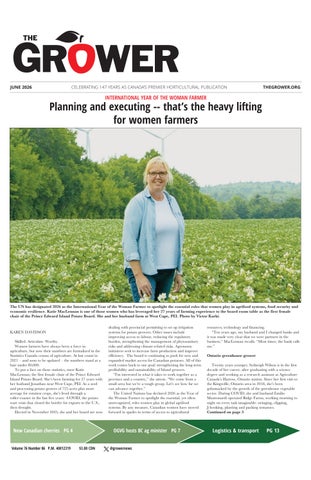
To put a face on those statistics, meet Katie MacLennan, the first female chair of the Prince Edward Island Potato Board. She’s been farming for 27 years with her husband Jonathan near West Cape, PEI. As a seed and processing potato grower of 725 acres plus more acreage for rotation crops, she’s lived through a roller-coaster in the last five years: COVID, the potato wart crisis that closed the border for exports to the U.S., then drought.
Elected in November 2025, she and her board are now
dealing with provincial permitting to set up irrigation systems for potato growers. Other issues include improving access to labour, reducing the regulatory burden, strengthening the management of phytosanitary risks and addressing climate-related risks. Agronomy initiatives seek to increase farm production and improve efficiency. The board is continuing to push for new and expanded market access for Canadian potatoes. All of this work comes back to one goal: strengthening the long-term profitability and sustainability of Island growers.
“I’m interested in what it takes to work together as a province and a country,” she attests. “We come from a small area but we’re a tough group. Let’s see how far we can advance together.”
The United Nations has declared 2026 as the Year of the Woman Farmer to spotlight the essential, yet often unrecognized, roles women play in global agrifood systems. By any measure, Canadian women have moved forward in spades in terms of access to agricultural
resources, technology and financing.
“Ten years ago, my husband and I changed banks and it was made very clear that we were partners in the business,” MacLennan recalls. “Most times, the bank calls me.”
Ontario greenhouse grower
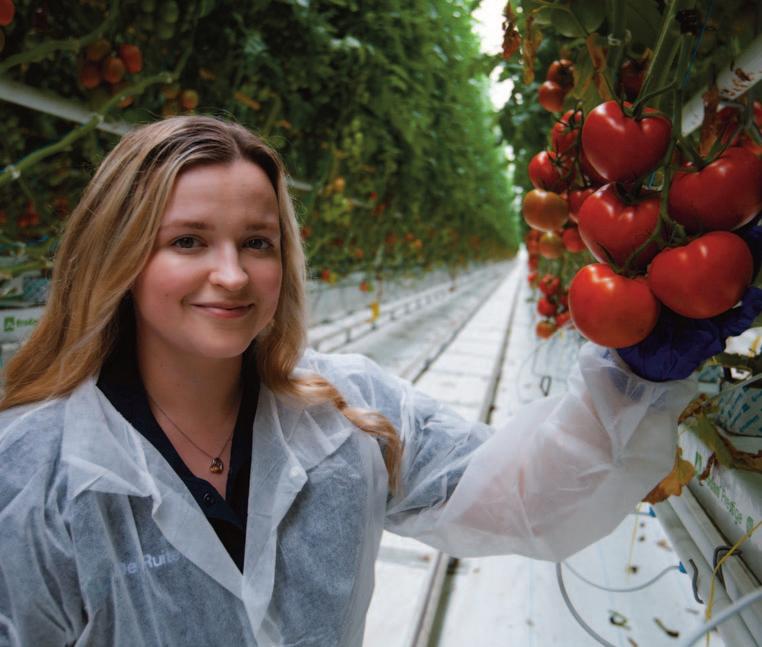
Twenty years younger, Sydneigh Wilson is in the first decade of her career, after graduating with a science degree and working as a research assistant at Agriculture Canada’s Harrow, Ontario station. Since her first visit to the Kingsville, Ontario area in 2018, she’s been gobsmacked by the growth of the greenhouse vegetable sector. During COVID, she and husband Emilio Mastronardi operated Ridge Farms, working morning to night on every task imaginable: stringing, clipping, J-hooking, planting and packing tomatoes.
Continued on page 3
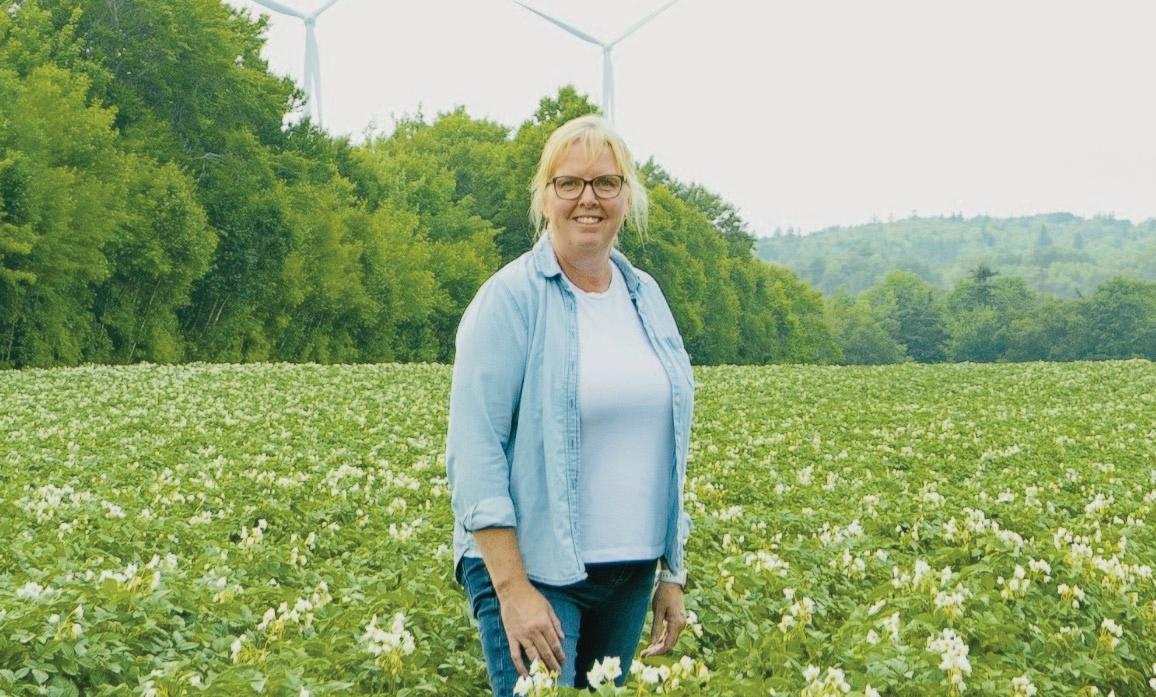
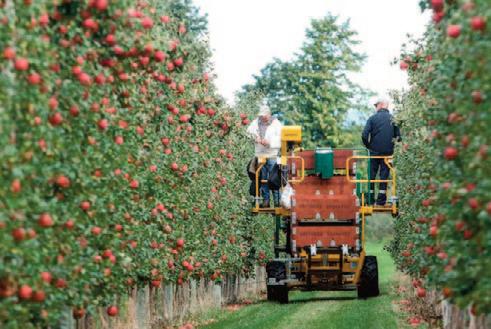
The UN has designated 2026 as the International Year of the Woman Farmer to spotlight the essential roles that women play in agrifood systems, food security and economic resilience. Katie MacLennan is one of those women who has leveraged her 27 years of farming experience to the board room table as the first female chair of the Prince Edward Island Potato Board. She and her husband farm at West Cape, PEI. Photo by Victor Karki.
AT PRESS TIME…
Support reaffirmed for CFIA’s science-based potato wart response
The recent soil detection of potato wart in Prince Edward Island (PEI) demonstrates that the annual national potato wart survey is working as intended, and the Canadian Food Inspection Agency (CFIA) is prepared with robust regulatory risk mitigation in place with the National Potato Wart Response Plan. Strong surveillance, involving thousands of samples taken across the country and appropriate regulatory measures, continue to mitigate risk and protect potato-growing regions in Canada and abroad.
The Fruit and Vegetable Growers of Canada (FVGC) and the Canadian Potato Council (CPC) support the CFIA’s National Potato Wart Response Plan and the continued use of science-based regulatory measures to help contain, control, and prevent the spread of potato wart. The response plan was developed through a rigorous process informed by current science, international standards, expert review and industrygovernment engagement.
It is important that this issue continues to be managed through science-based, risk-based regulation. As a regulated area, all potatoes grown in PEI continue to adhere to risk mitigation measures: fresh potatoes leaving the province are subject to strict safeguards, including washing to remove soil,
and application of a sprout inhibitor.
These measures are designed to address the primary pathways for disease spread, and are working well. The current system identifies risk and triggers the appropriate response based on the National Potato Wart Response Plan.
FVGC and CPC will continue to support CFIA, government and industry partners in implementing the National Potato Wart Response Plan and maintaining confidence in the safety of Canadian potatoes and Canada’s plant health system.
Source: Joint statement from the Fruit and Vegetable Growers of Canada and the Canadian Potato Council.
Alberta premier names new ag minister
Alberta premier Danielle Smith shuffled her United Conservative Party cabinet on May 21, 2026. The new minister of agriculture and irrigation is Tara Sawyer, who won a byelection in the riding of OldsDidsbury-Three Hills in June 2025. The former chair of the Grain Growers of Canada farms with her husband at Acme.
This is her first cabinet posting. RJ Sigurdson, who had been in the ministerial role since June 2023, is now the minister of affordability and utilities.
In memoriam
Robert K. Irving, 71, passed on May 19, 2026, the fifthgeneration of a Maritime business family. His father purchased a small, vegetable-processing operation at New Annan, Prince Edward Island in 1980. It grew into Cavendish Farms, the largest private-sector contributor to the island’s GDP and the fourthlargest French fry processing company in North America. The company operates plants in Alberta, Ontario and North Dakota, sourcing its potatoes from local growers. The Prince Edward Island Potato Board lauds his vision, discipline and long-term commitment that helped transform the processing potato sector.
NEWSMAKERS
The Canadian Produce Marketing Association (CPMA) hosted its 2026 Convention and Trade Show April 28-30 in Toronto, registering more than 4,600 attendees from 13 countries. Ontario Premier Doug Ford and Ontario agriculture minister Trevor Jones attended the opening ceremonies.
L-R: Pat Finnigan, New Brunswick minister of agriculture; Lianne Rood, MP for Middlesex-London; Steve Bamford, CPMA 2025-2026 chair; Ron Lemaire, CPMA president; Trevor Jones, Ontario minister of agriculture; Doug Ford, Ontario premier; Guisela Atalida Godinez Sazo, ambassador of the Republic of Guatemala to Canada; Carlos Manuel Joaquín González, ambassador of Mexico to Canada; Ivan Sierra, general consul of Mexico to Canada; Greg Morrow, Nova Scotia minister of agriculture.
Congratulations to the following individuals and companies who earned honours at this year’s event:
• Fresh Health Award – Canadawide Fruit Wholesalers Inc.
• Young Professional Award – Amanda Knauff, Taylor Farms
• Lifetime Achievement Award – Paul Catania Jr., Catania Worldwide
• The Packer’s Produce Person of the Year Award – Daniel Terrault, Gen V
Best Booth Awards
• Best Island Booth Award – DelFrescoPure
• Best Inline Booth Award– Bayshore Family Farms
• Best First-Time Exhibitor Booth Award – The Produce Counter
• People’s Choice Award – Equifuit
New Product Showcase Awards
• Best New Product Award – Arte salad, The Produce Counter
• Packaging Innovation Award – SUNSET Tomato Branch, Mastronardi Produce
• Organics Award – Earthbound Farm Beet Greens, Earthbound Farm
• Best Snackable Product Award – Apple Sticks, Martin’s Family Fruit Farm Ltd
The Canadian Grapevine Certification Network (CGCN-RCCV) held its annual general meeting on April 28, 2026, refreshing its leadership with nearly half of its board along with updates to bylaws. Here is the new board of directors: chair, Kevin Watson, Grape Growers of Ontario; vice-chair Mike Watson, British Columbia Wine Grape Council; treasurer, Mélanie Gore, Conseil des vins du Québec; secretary, Katarina Vucic, Grape Growers’ Association of Nova Scotia.
The Canadian Agri-Food Trade Alliance welcomes the appointment of its executive director, Michael Harvey, to the Government of Canada’s newly established Advisory Committee on Canada–U.S. Economic Relations, chaired by Minister Dominic LeBlanc Leaders from business, labour, and industry will meet ahead of the 2026 Joint Review of the Canada-United States-Mexico Agreement (CUSMA).
Berry Growers of Ontario has announced its 2026 board of directors. Chair Dan Colcuc is supported by vice-chair David Klyn-Hesselink. Directors are: Ann Marie Rochon, Alex Chesney, Victoria Spencer, Alexandre Henrie, Andrew Phillips, Dalton Cooper, Tyler Nightingale
The Ontario Food Terminal Board has welcomed Mackenna Roth, a cut flower farmer, Strathroy, Ontario to its board of directors. Her term is from April 9, 2026 to April 8, 2029.
After a thorough and highly competitive search, the University of Guelph has appointed Dr. Mazyar Fallah vice-president (Research and Innovation). Most recently, he’s served as dean of the College of Biological Science. He started his five-year term on May 25, 2026.
Planning and executing -- that’s the heavy lifting for women farmers
What’s your best recommendation for time management? “
Never have your office in your home. Home life matters!
~ KATIE MacLENNAN
Continued from page 1
Two years ago, her 360-degree view of greenhouse growing made her an attractive hire for a vegetable seed company that rents part of the farm for a demonstration house.
“More women are becoming involved in the very male-dominated greenhouse industry,” says Wilson. “In the past, these have been technical roles as integrated pest management specialists, but now we’re seeing more women in roles such as growers and labour managers/supervisors. On behalf of De Ruiter, I have a sales territory in Ontario that stretches to Ohio.”
By nature, women are collaborators, and that’s one area that’s mystified Wilson. “I come from a rural background where, in the case of a night emergency, the first person you call is your neighbour. They usually arrive in their pajamas and rubber boots. That’s not been the case in the greenhouse sector where your neighbours are your competitors.”
She’s been trying to change that attitude, so that growers aren’t repeating mistakes. A good example is the 2019 arrival of tomato rugose virus, a wake-up call that this was a community emergency deserving of a shared-responsibility
“ “
When farming you just need to do your best to accomplish what you need to. Something goes wrong constantly with farming and we just adapt on the fly.
~ SYDNEIGH WILSON
response. As a result of her prodding, her husband has become more of an open-door farmer.
Ridge Acres is undergoing a growth spurt in more ways than one. The farm is expanding from 18 acres to 29 acres. Now in her late ‘20s, she has an 18-month-old son and twins on the way.
“My perspective is to focus on what we can handle as a family,” she says. “My husband tends to load his plate heavy. Farming is our life, but life must also be cherished.”
British Columbia grape grower
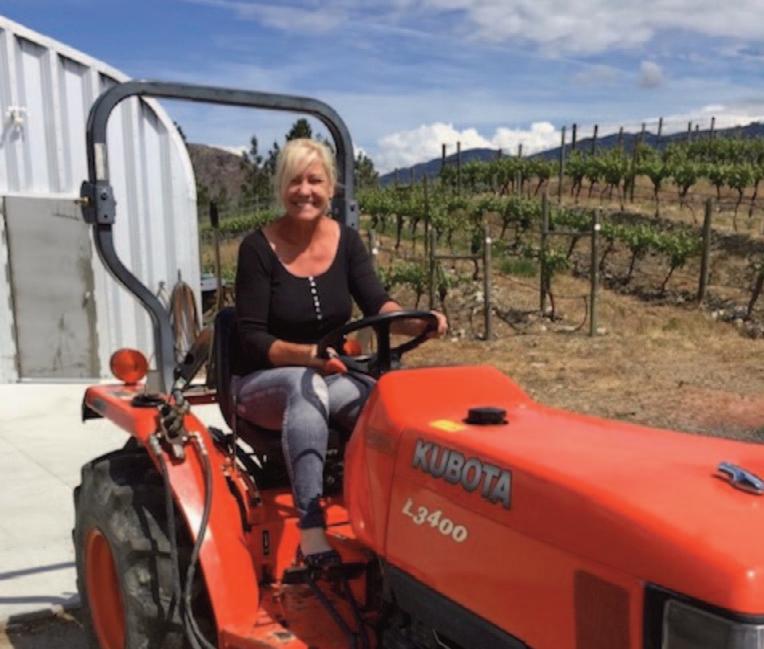
This is an approach shared by Heidi Lorch, voted viticulturist of the year in 2021 by the BC Grape Growers’ Association. Her peers have respected how she’s restored a vineyard near Okanagan Falls, British Columbia.
“I was raised on a dairy farm in Southwestern Ontario, so agriculture has always been in my blood,” says Lorch. “I went on to farm for 27 years myself, growing cash crops and running a commercial poultry operation with 35,000 birds. In 2019 I made the move to BC, wanting to try something new in horticulture. I enrolled in the viticulture program at Okanagan College right here
Get up early — and have a plan for your day! Did I mention, get an early start? Seriously though, going into each day with a clear plan makes an enormous difference. Farming doesn’t wait, so neither should you. ~ HEIDI LORCH
in Penticton, and from there I just jumped right into growing grapes — and I haven't looked back!”
Unlike third-world women farmers who face challenges in accessing land and financing, Lorch has not had that experience. “I have never encountered any challenges when it comes to purchasing land or equipment or sitting down with lenders. I have always been treated fairly and with respect as a business person. My experience has been a positive one from the start.”
Like many female farmers, Lorch has an agricultural degree majoring in field crops and livestock production from the University of Guelph. In British Columbia, she is a registered agrologist with the BC Institute of Agrologists. Decades of hands-on farming experience translated very well into viticulture. However there is no risk-free day.
“The challenges I face are really the challenges that farmers everywhere are dealing with — rising input costs for fuel, parts, and maintenance continue to put pressure on margins,” she says. “And finding reliable farm labour is an ongoing concern.”
The large percentage of women operators reflect trends in related agricultural sectors. Lorch points to
representatives in equipment sales, crop input recommendations, agronomy, and more.
“In my own experience, I have always felt respected and treated as a farmer and a business person, full stop,” says Lorch.
Canadian senator
There has never been a glass ceiling for PEI farmer Mary Robinson. Now 56, she has her own Wikipedia listing with provincial, national and international accomplishments. She’s been managing partner of her family’s sixth-generation farm for three decades, held the role of first female president of the Canadian Federation of Agriculture, was elected vice-president of the World Farmers’ Organization in May 2023 and was appointed to the Canadian senate in January 2024. She is an ardent advocate for the agricultural sector, rural development and environmental sustainability.
All of these role models display a healthy respect for time. They balance competing duties, take stock and advance their goals. With boots on the ground, no weight training is required.
Sydneigh Wilson partners with her husband Emilio Mastronardi at Ridge Farms, Kingsville, Ontario while working as a sales representative for a greenhouse seed company, specializing in tomatoes. Photo by Dax Melmer.
Recognized by her peers as viticulturist of the year in 2021, Heidi Lorch was honoured for transforming a neglected vineyard into a sustainable operation near Okanagan Falls, British Columbia. At Heidi’s Peak Estate Vineyard, she specializes in high-quality Gewurztraminer, Sauvignon Blanc, Pinot Blanc and Pinot Gris grape varietals.
CROSS COUNTRY DIGEST
BRITISH COLUMBIA
World Fresh Exports introduces new Canadian cherries
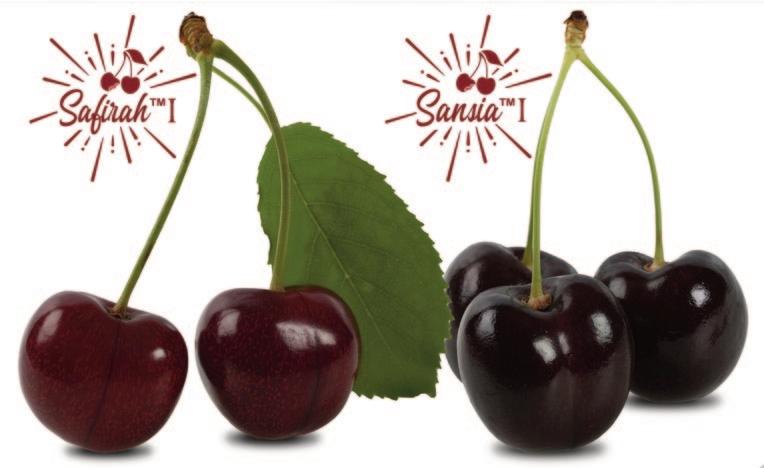
World Fresh Exports Inc. (World Fresh) is preparing to introduce an exceptional new generation of Canadian-bredand-grown dark sweet cherries to global markets, following its authorization to market the Sansia and Safirah cherry series worldwide.
Developed by Agriculture and AgriFood Canada’s (AAFC) renowned sweet cherry breeding program in Summerland, British Columbia, Sansia and Safirah cherries build on a legacy of Canadian cherry innovation that has shaped cherry markets around the world.
For World Fresh, the opportunity is a natural fit. “This is an incredibly exciting moment for us,” said Sarah Bistritz, World Fresh’s global sales and operations manager. “These cherries represent the very best of Canadian breeding and production, and we can’t wait to share them with our global customers.”
World Fresh has been authorized to market five new varieties that are organized into series, deliberately designed around harvest timing, a critical variable in sweet cherry production, logistics and retail performance.
The Sansia series comprises two mid-season dark sweet cherry varieties that harvest at Bing timing, providing superior size and eating quality in the heart of the
MANITOBA
cherry season. The Safirah series comprises two late-season dark sweet cherry varieties that offer valuable supplywindow expansion beyond Staccato and Sentennial cherry availability. The fifth yet-to-be named dark sweet cherry variety harvests at Regina timing and offers bestin-class firmness and shipping capabilities.
The Sansia and Safirah cherries emerge from AAFC’s prolific Summerland tree fruit breeding program, internationally respected for developing high-quality sweet cherries with strong commercial relevance. The program is responsible for some of the world’s most recognized dark sweet cherries, including Santina, Skeena, Lapins, Sweetheart, Staccato and Sentennial. The roll-out is being managed by AAFC’s long-standing global master licensee, Summerland Varieties Corp. (SVC)
“These new cherries continue a remarkable Canadian breeding tradition,” said Nick Ibuki, SVC’s business development manager. “World Fresh has an outstanding reputation for marketing premium cherries, so we’re delighted to see them introducing these exceptional new varieties to global markets as an Authorized Marketer.”
World Fresh’s hands-on approach from orchard to market positions the company
to showcase the full potential of these new cherries. With deep experience serving international customers and a strong focus on quality and execution, World Fresh is confident the Sansia and Safirah series will deliver throughout the supply chain.
“Our customers are looking for cherries that deliver on every level — size, flavour, firmness, consistency and timing,” Sarah Bistritz added. “Sansia and Safirah cherries check all of those boxes. They’re
remarkable cherries, grown by World Fresh’s best Canadian producers, and we’re thrilled to be taking them to the world.”
Source: World Fresh Exports Inc and Summerland Varieties Corporation May 4, 2026 news release
Peak of the Market Ltd.’s Farm to School Fundraiser raises $100,000
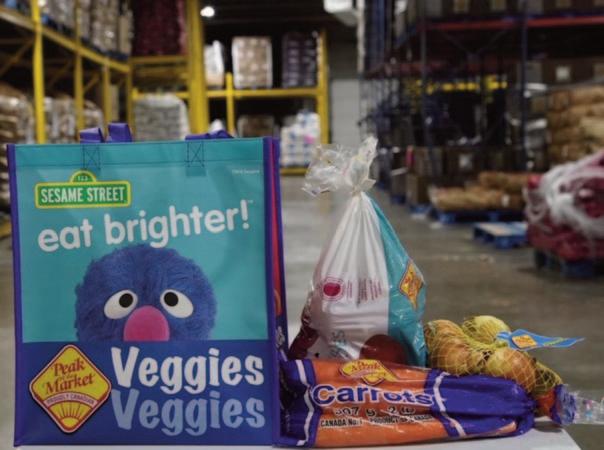
In the 2025–2026 school year, Peak of the Market Ltd.’s Farm to School program raised $100,000 for schools, daycares, and organizations across Manitoba. That’s more than 133,000 pounds of produce delivered.
Since 2011, schools and daycares have had the opportunity to sell Peak of the Market Ltd. vegetables through Farm to School and keep 50 per cent of their total sales for
infrastructure improvements, community initiatives, upgrades to equipment and technology, and more. The program also allows participants to donate produce bundles to local food banks. While the program ran in
Manitoba, Saskatchewan and Alberta in the past, in the 2025–2026 school year, the program operated exclusively within Manitoba.
“Farm to School continues to be a meaningful way for schools and daycares to raise funds while encouraging healthy eating habits,” said Pamela Kolochuk, CEO of Peak of the Market Ltd.
“We’re proud to see the impact the program is making across Manitoba and are excited to build on that momentum in the year ahead.”
Registration for fundraising in the 2026–2027 school year opened on May 15, 2026. Schools and daycares are encouraged to visit www.peakfarmtoschool.com for more information on how to participate.
“Calvin Christian School’s
collegiate campus has been participating in the Farm to School vegetable fundraiser for the past three years,” said Megan Verleih. “It’s very easy to administer, which we truly appreciate, and the 50 per cent profit makes it an excellent fundraiser for our school. We also value supporting local farmers and offering vegetables that are staples in most households. The best part is partnering with our local food bank throughout the year. Our families have been incredibly generous in purchasing bundles to donate, and it feels so good to raise funds for our school while also providing fresh vegetables to members of our community who need them most.”
Source: Peak of the Market May 11, 2026 news release
JAPAN JAPAN TOTO
5 POINTS
5 POINTS
5 POINTS
5 POINTS
4 POINTS
4 POINTS
4 POINTS
3 POINTS
3 POINTS
3 POINTS
3 POINTS
3 POINTS
2 POINTS
2 POINTS
2 POINTS
2 POINTS
GREENHOUSE GROWER
Savoura to acquire majority of assets of Productions Horticoles Demers
Canadian-based Savoura announced that it has entered into an agreement in principle to acquire the majority of the assets of Productions Horticoles Demers, following a Court-supervised investor solicitation process. The transaction remains subject to customary approvals, including those of regulatory authorities and the Court.
This transaction is intended to ensure the continuity of greenhouse operations in several key regions of Québec, preserve leading-edge horticultural expertise, and support quality jobs.
Productions Horticoles Demers expanded its facilities in 2021 from a 10-hectare facility with the incorporation of a 15-hectare greenhouse in Lévis, Quebec. Savoura has been growing tomatoes and strawberries in Québec for more than three decades, currently operates more than 96 acres (39 hectares), and is one of the largest greenhouse producers of organic tomatoes in North America. Its most recent expansion was in 2022.
Over the coming weeks, Savoura will
begin a structured and gradual transition process in collaboration with on-site teams in order to stabilize operations and identify short-term priorities.
“This agreement aligns with our vision for sustainable growth and food autonomy,” said Luc Prévost, president of Savoura. We are committed to preserving and growing the expertise developed by the teams at Productions Horticoles Demers, in a spirit of respect, collaboration, and excellence.”
Savoura is a Québec-based company specializing in the production and marketing of greenhouse tomatoes and strawberries for the Québec, Canadian, and North American markets. Committed to sustainable agriculture, the company has been growing organic tomatoes since 2011.
Driven by a sustained growth strategy, Savoura has completed several acquisitions since 2012 to increase its production capacity and strengthen its greenhouse expertise. The company also diversified its offering with the commercialization of strawberries grown in Danville, in Québec’s Eastern Townships, since 2017.
In 2023, Savoura invested $63 million to support its continued growth, bringing its total cultivated area across Québec to 39 hectares. The company is committed to innovation, quality, and food autonomy.
In 2025, Savoura undertook a major brand refresh and implemented new
How to improve shelf life of snacking cucumbers
KAREN DAVIDSON
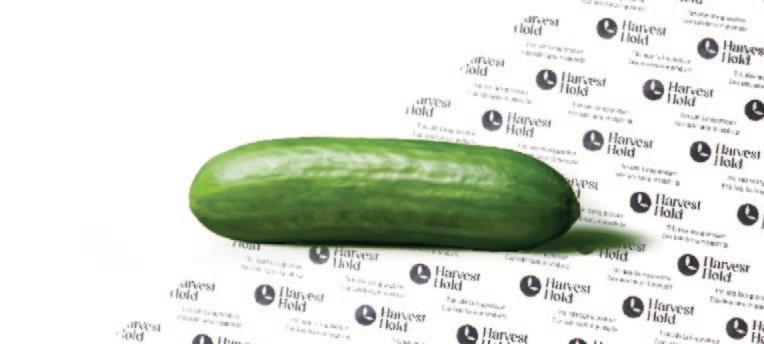
Technology launches are most successful with an understanding of the entire chain: grower to packer to retailer. That’s what Verdant Technologies has done, studying what happens with cocktail cucumbers. To date, their pilots show that HarvestHold Fresh sheets could help extend freshness by an extra four to six days.
HarvestHold Fresh is based on a humidity-activated delivery system to gradually release 1-methylcyclopropene (1-MCP), a proven technology that slows
marketing and commercialization strategies to further strengthen its market presence and enhance the visibility of the preferred brand among Québec consumers and customers.
Source: Newswire May 11, 2026 news release
the aging process. It’s been successfully used in broccoli in Canada and the U.S., eliminating the need for ice. Now the company is looking at a novel use in the snacking cucumber category.
According to Verdant’s director of marketing, Steven Oklesh, the category is still looking for acceptance by consumers. The four-to-six inch cucumber has more surface area than regular English cucumbers, therefore it’s more sensitive to temperature changes and aging. The product is best merchandized in a smaller grab-and-go bag where taste and texture can be experienced at peak of freshness.
“Consumers want freshness, but providing it consistently is harder than it looks,” says Oklesh.”
Cocktail cucumbers are highly sensitive to handling conditions. Mixed loads, temperature compromises and exposure to ethylene can shorten shelf life before the product reaches its destination. Greenhouse grower and marketer feedback suggests that virus pressure, crop susceptibility and geographical factors are making production less predictable which affects supply consistency, forecasting and cost control.
Oklesh points out that whether snacking cucumbers are grown in a high-wire or low-wire system makes a difference in shelf life. For instance, in a high-wire growing system with new vines, the grower could expect 30 days of shelf life. In contrast, in a low-wire growing system, the grower could expect 10 days. The grower can extend
shelf life by four to six days with HarvestHold sheets, a significant benefit to the entire chain.
Verdant Technologies is piloting its technology in Canadian greenhouses. The cucumber is picked into a bin containing one sheet. The bin is then shuttled into temperature-controlled storage where it may be held up to 24 hours or until the packer/marketer fulfills an order. The humidity is what prompts the sheet to release its 1-MCP. The sheet is removed once the bin goes to the packing line.
Verdant Technologies has discovered the last food mile determines the eating experience. Even when produce leaves the greenhouse in good condition, in-store handling can undo it. Produce team education is often limited. Display positioning matters. In a pilot project that placed cocktail cucumbers off cold, rather than in the cooler beside mini cucumbers, the results were shelf-life problems and eventual discontinuation.
Mini cucumbers, which already carry a high shrink rate, can be compared more to berries, herbs or cut fruit than traditional vegetables. Their thin skin leads to faster moisture loss. With standard English cucumbers, the typical shrink can be four to eight per cent. With mini, Persian and cocktail cucumbers, the typical shrink can range from eight to 15 per cent. With this market intelligence, Verdant Technologies is refining its understanding of the snacking cucumber category.
GREENHOUSE GROWER
BC ag minister’s delegation visits Ontario’s greenhouse vegetable growers
KAREN DAVIDSON
In the spirit of more inter-provincial collaboration, British Columbia’s ag minister Lana Popham led a group of BC leaders for a tour of greenhouse vegetable farms and marketers in the Kingsville and Leamington, Ontario area April 18-20, 2026. She brought representatives from the BC Greenhouse Growers’ Association (BCGGA); BC Vegetable Marketing Commission (BCVMC) and the BC Ministry of Agriculture and Food.
Aligning the schedules of such a large delegation does not happen overnight. Conversations have been ongoing for about 18 months to bring the trip to fruition.
“There were several BC Growers’ Association (BCGGA) board members, including myself, who felt that potential changes are needed in how the greenhouse sector operates in BC to encourage more growth in our sector compared to other greenhouse-growing regions in Canada,” says Armand Vander Meulen, chair BCGGA.
“We thought the best way to encourage our provincial ministry was to get them to see with their own eyes the nature of the Ontario industry. It’s the largest and fastest growing in North America.”
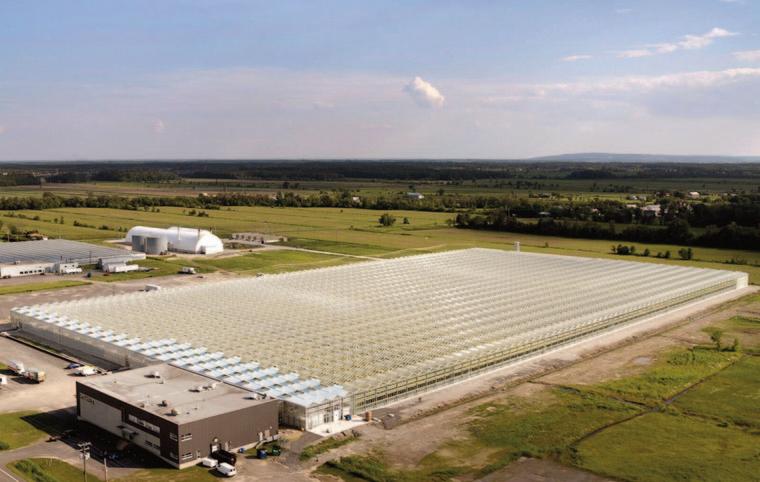
To that point, the Ontario industry has grown in the last 20 years from 1,500 acres to 4,500 acres with a 2025 total farmgate value of $2 billion. Of that total, $1.8 billion is earned from exports to the U.S. Aerial shots can’t replicate a visit in person. There’s nothing like viewing vast greenhouses by golf-cart or passing trailer loads of produce on local highways to market.
Key points in the fact-finding mission were to review governance of the Ontario Greenhouse Vegetable Growers (OGVG) board, the regulatory framework and the practical insights of growing tomatoes, peppers and cucumbers in Ontario.
“I don’t think we would have had the growth of the Ontario sector if it had been under a supply-managed model,” says Richard Lee, executive director, OGVG. Our success has been based on the U.S. market.”
OGVG collects comprehensive grower data on crop cycles that correspond with lighting levels and the growing environment. A year ago, for example, there was a threeweek period of low light levels that delayed maturation of the crop. Deep understanding of when crops are planted and pulled can be compared with retailer promotions. This analysis can help growers forecast market needs and improve grower returns.
OGVG also tracks production that uses supplemental
Front Row: L-R: Samuel Godfrey – chief of staff to the Honourable Lana Popham; Kelli Jo Whittaker, member relations and data integrity analyst, Ontario Greenhouse Vegetable Growers; Wes Shoemaker, chair, BC Vegetable Marketing Commission; Armand Vander Meulen, chair, BC Greenhouse Growers’ Association; Hon. Lana Popham, BC agriculture and food minister; Anju Gill – executive director, BC Greenhouse Growers’ Association; Rick Mastronardi, vice-chair, Ontario Greenhouse Vegetable Growers; Chris DelGreco, director, Ontario Greenhouse Vegetable Growers; Miriam Leardi, senior communications advisor, Ontario Ministry of Agriculture, Food and Agribusiness.
Back Row: L-R: Andre Solymosi general manager, BCVMC; Steve Peters, chair, Ontario Greenhouse Vegetable Growers; Brendan Byrne, chair, Farm Products Marketing Commission; Jos Moerman, chair BCCGA Direct and co-owner Sunnyside Produce Ltd.; Richard Lee, executive director, Ontario Greenhouse Vegetable Growers; Michelle Koski, BC deputy minister, agriculture and food; Zachary Blackburn, director of procurement, Mastronardi Produce; Ryan Puviraj, chief of staff, Ontario Ministry of Agriculture, Food and Agribusiness.
lighting, glass and poly structures along with heating sources. Such micro-level data, on a historical basis, gives credence to advocacy efforts and public-facing communications.
“Key takeaways are that through the OGVG, Ontario growers are well served in data collection/dissemination, research collaboration and trade promotion,” says Vander Meulen. “OGVG handles all these roles whereas they are done separately by BCGGA and BCVMC.”
Vander Meulen adds, “We both grow the same commodities/varieties in very similar growing systems, and are selling to the same retailer community. Differences are the incredible market intelligence that is available to Ontario growers which allows them to make – in my mind
– better and faster decisions to meet the needs of the North American market.”
“Growing year-round under lights is far more prevalent in Ontario,” notes Vander Meulen. “The diversity of specialty greenhouse crops, such as lettuce and strawberries, is also more mature in Ontario.”
The British Columbia greenhouse industry counts about 1,500 acres in production, the same size that Ontario was 20 years ago. Poised close to the western United States, it has future opportunities that could be realized with a different governance model. That’s what is under discussion now.
CROP STATUS
Ontario asparagus season delayed slightly by sub-zero frost event
KAREN DAVIDSON
Ontario’s fresh asparagus season was delayed with a cool late spring. In fact, a sub-zero frost event on May 3 froze the first picking.
“Some fields lost every spear that was emerged,” reports Mike Chromczak, Brownsville asparagus grower and chair of the Ontario Fruit & Vegetable Growers’ Association. “Most farms lost about 50 per cent of their crop however a few fortunate fields were spared. This will have an impact on the overall yield of the 2026 crop and a lasting production effect over the next couple of weeks, certainly until we see significantly warmer temperatures.”
Chromczak added that the Asparagus Farmers of Ontario
Celebrating 60 years of SAWP
This year marks the 60th anniversary of the Seasonal Agricultural Worker Program (SAWP). Between July 17 and August 3, the Ontario Fruit and Vegetable Growers’ Association encourages farms to organize a celebration with their workers. This document outlines a few suggestions, but feel free to get creative with your own ideas!
Simple ways to celebrate
• Host a BBQ or farm lunch
• Coordinate with other farms in the area to host a “neighbourhood” celebration
• Organize a friendly soccer game or dominoes tournament
• Bring ice cream or treats for your team
• Take a team photo with your workers
Why participate?
• Recognize the contributions of seasonal workers
• Share positive stories from Ontario farms
• Highlight the importance of the program to the fruit and vegetable sector
Share your celebration
Help celebrate 60 years of SAWP by posting your celebration online.
Step 1 – Take a photo or short video
Step 2 – Post on Facebook, Instagram, or X
Step 3 – Use the hashtag #SAWP60
Tag us:
X + Instagram: @mtamigrantwrkr Facebook: More than a Migrant Worker
What to post:
• Group photos with your farm team
• Moments from the celebration
• A short thank-you message
• Photos from a BBQ, meal, or game
Contact OFVGA for swag package
Email comms@ofvga.org with a request for a swag package to help you celebrate. Packages will be mailed while supplies last.
(AFO) is running an annual marketing campaign with new content development, collaborations with influencers, and social media initiatives (YouTube, Meta, Reddit etc.). There are also traditional media spots on the radio and in print as well as the longstanding partnership with Foodland Ontario. Retail displays are the most impactful tool to boost sales with sponsored contests to encourage produce managers to have the biggest and most impactful display possible.
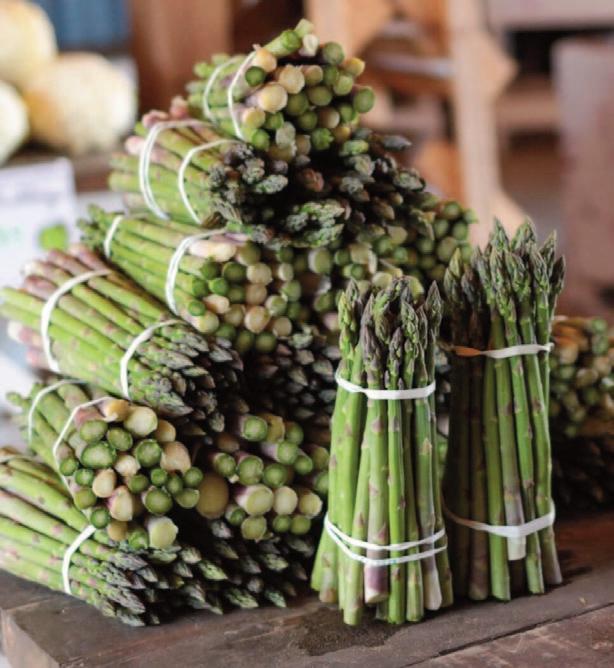
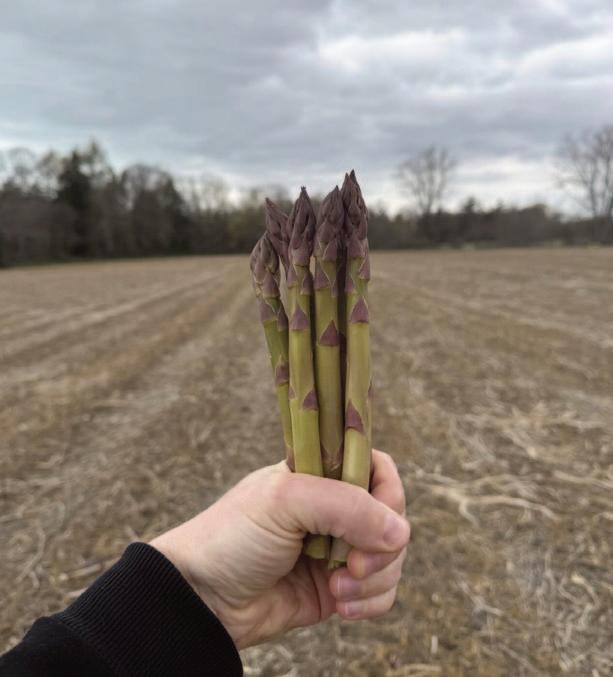
Before the frosts, production was forecast to be up with improved agronomic practices combined with Fox Seeds’ Millenium and Eclipse varieties outperforming acres planted to older historical varieties. A new variety, Guelph Equinox is welcomed by growers because it performs well on all soil types in commercial plantings in southern Ontario. It has built-in resistance to replant issues.
The variety is characterized by highly uniform diameter and straight spears with tightly closed tips and bracts even in hot weather. More than 80 per cent of its total production falls in the standard grading class of 11 to 17 mm. Growers are impressed that fern growth is robust and healthy into the fall months which allows for optimal crown storage for the cold winters in southern Ontario and Michigan.
The U.S. is an important export market says Chromczak.
“We are surveying our growers to get a better handle on how many pounds go to the U.S., but we know that threats of trade disruptions or tariffs would be detrimental to our industry,” he says.
Guelph Equinox
CROSS COUNTRY DIGEST
The Packer honours Daniel Terrault as Canadian Produce Person of the Year
Daniel Terrault, vice president of business development at Gen V, has been recognized by The Packer and the Canadian Produce Marketing Association as the 2026 Canadian Produce Person of the Year for his advocacy on critical issues. He was presented the award at the CPMA Convention and Trade Show on April 30 in Toronto.
Terrault’s peers describe him as ambitious and charismatic, passionate about his work and someone who truly wants the best for the industry and always seeks to understand the realities of every link of the supply chain.
Peers laud Terrault for his leadership and service to his community and the Canadian and Québec produce sectors. He is currently the president of the Québec Produce Marketing Association, and he has also served for many years on the CPMA board of directors.
As a part of his role at QPMA, Terrault has been instrumental in bridging the gap between Québec
growers and the North American market. He’s a connector who brings different parts of the supply chain together.
“We all benefit as an industry from his input, and [it’s] a big reason why he’s well deserving, as well as his involvement in the CPMA,” says George Pitsikoulis, president and CEO of Canadawide Fruit Wholesalers Inc. and the 2025 Canadian Produce Person of the Year. “As a director, as a member of different committees, he’s done amazing work.”
As a long-standing member of the CPMA board, Terrault has helped shape national policies on food safety, plastic packaging reduction and labour standards
“This dual leadership, provincial and national, is a defining feature of Daniel’s impact and underscores why his influence extends well beyond his own company,” says Jennifer Strailey, editorial director of The Packer, who presented the award to Terrault.
Before the buy-local movement, Terrault, who farms with his brother Sylvain and sister-in-law Chantal Desjardins, was a pioneer in showing that Canada could be self-sufficient in greenhouse-grown leafy greens. He helped transition Gen V into a multisite operation to ensure Canadian retailers could provide fresh, high-quality lettuce to consumers 365 days a year, even in the middle of a Québec winter.
He is also credited with providing the strategic financial vision to save one of Canada’s largest producers and help keep the company family-owned and locally managed.
Terrault has also been a key advocate of the living lettuce category, which has helped extend the shelf life of leafy greens and reduce food waste. He has also promoted the sustainability efforts of hydroponic growing, reducing water usage compared to field production. He has also pushed for the move toward high-tech
indoor growing systems.
Terrault played a key role in the transition from the brand Hydroserre Mirabel to the unified Cultures Gen V, which consolidated the brands Mirabel, VÔG, Diva and Serres Royales and created a powerhouse for year-round, Québec-grown organic vegetables and lettuce. He has also focused on the
Refreshed website is a practical tool for Québec apple growers
The Producteurs de pommes du Québec (PPQ) recently launched a redesigned website, marking an important update to its digital communications tool: producteursdepommesduquebec.ca/
This new iteration was developed with a clear objective in mind: to serve as a practical, day-to-day working tool for Québec apple growers. Jérǒme-Antoine Brunelle, PPQ general manager, explains that the content is now organized by major themes, including marketing, programs, tools and resources, communications, and organizational information. Improved search functionality and a fully responsive design adapted for mobile use aim to streamline access to information and
‘AgIntel’
launched
improve efficiency for producers operating in an increasingly complex business environment. It is only available in French for the time being.
While the PPQ website is publicly accessible and can inform anyone interested in the Québec apple sector, it is not intended as a consumer-facing platform. Consumer outreach and promotion remain the mandate of Québec’s dedicated public website, available in English: lapommeduquebec.ca/ en/, while the PPQ website focuses squarely on supporting growers with timely, relevant and structured information aligned with their operational realities.
The P.E.I. Federation of Agriculture (PEIFA) has announced that the federal and provincial governments will fund the development of AgIntel, a precision agriculture data platform designed by farmers for farmers. AgIntel automates data collection, analysis, and management, delivering information from farm fields and insights into decision making.
AgIntel uses an array of in-field sensors running on data-transfer technology that works in rural environments without 5G internet connectivity. Data is collected automatically, analysed for insights into water usage, fertilizer usage, and carbon sequestration, and then stored securely on behalf of the farmer who produced it.
PEI farmers are leaders in the adoption of best practices to reduce their environmental impact. By improving their ability to collect, analyse, and manage data, AgIntel will help farmers quantify those improvements and incentivize their further adoption, resulting in greater efficiency and profitability for Island farmers.
“The PEIFA is building digital infrastructure for Prince Edward Island farmers to help ensure the sustainability of our farms and farm families,” says Keisha Rose Topic,
next generation of Gen V and has helped integrate nephew Simon, niece Valérie and son Francis into leadership roles in the company.
On accepting the award, Terrault told the audience: “Just keep up the good work. It’s all healthy what we’re doing.”
Source: The Packer
president. “Farmers are always evaluating and adopting new technologies and this PEIFA initiative will ensure PEI farmers are working together to own the data that they are producing.”
Agriculture and Agri-Food Canada (AAFC) will contribute $499,400 under the Research and Innovation stream of the Agricultural Clean Technology Program to support the development of hardware and software required for the AgIntel platform.
The Research and Innovation Stream supports pre-market innovation including research, development, demonstration and commercialization activities, to develop transformative clean technologies and enable the expansion of current technologies.
AAFC and the PEI Department of Agriculture will also contribute $249,000 from the cost-shared Strategic Industry Growth Initiative, through the Sustainable Canadian Agricultural Partnership (Sustainable CAP). These funds will support the collection and analysis of soil samples from participating farms and the verification of PEIFA’s Low Carbon Cropping Initiative, which ensures AgIntel generates market-ready carbon credits for Island farmers when they reduce emissions and increase carbon
stored in their soils.
This funding will allow PEIFA to purchase 10 sets of sensor equipment for the 2026 growing season. Farmers are encouraged to contact Meagan Moynagh at the PEIFA if they are interested in participating or visit AgIntel.co to sign up for the project.
PRINCE EDWARD ISLAND
Jennifer Strailey, editorial director, The Packer, presents Canadian Produce Person of the Year to Daniel Terrault, Gen V. Photo by Christina Herrick.
Food prices may rise again, but growers aren’t cashing in
As global instability continues to push fuel prices higher, Canadians are once again hearing warnings about rising food prices.
And as that conversation starts again, it’s important to understand something clearly: when food prices rise, that does not mean farmers are making more money. In many cases, the opposite is true.
Fruit and vegetable growers are among the first to feel the impact of rising fuel costs because modern food production depends
heavily on energy. Diesel powers tractors, irrigation systems, refrigeration, and transportation. Fertilizer production is energy intensive. Packaging, shipping, and distribution all become more expensive when fuel prices surge.
Right now, diesel prices have climbed dramatically – up 53 per cent year over year according to comparisons by our team at the Ontario Fruit and Vegetable Growers’ Association (OFVGA) –while fertilizer costs are up 20 to 30 per cent year over year. Those increases hit growers immediately, often long before food even reaches a grocery store shelf.
Fresh produce farming already comes with significant uncertainty. Most of our crops are grown outdoors and are subject to weather, drought, disease and increasingly unpredictable growing conditions. Labour challenges and a complex regulatory environment are also ongoing hurdles for our sector, including for those businesses who grow their crops indoors, such as greenhouses.
Unlike many industries, farmers cannot simply pause production or quickly adjust prices to offset unexpected costs.
At the same time, growers are facing increasing pressure from how food is being purchased throughout the supply chain. We’re seeing purchasing practices shifting more and more financial risk onto farmers through additional fees, longer payment timelines, and contracts that require growers to commit to pricing long before they know what their costs for fuel, fertilizer, labour or transportation will be — or what kind of growing season lies ahead.
It’s a reality that growers are increasingly facing, and the result is a dangerous stacking of pressure at the farm level that also includes weather risk, supply chain volatility, and additional financial pressures – all while margins remain extremely tight. Meanwhile, consumers understandably see food prices rising and assume farmers must be benefitting. Unfortunately, we work in a global marketplace; if
our costs are too high, buyers will import what they need from lower-cost jurisdictions.
The share of the food dollar that returns to the farm remains relatively small, especially in fresh produce. That’s why this conversation matters beyond agriculture.
This is not simply about farm profitability. It is about Canada’s ability to continue producing food at home.
When domestic growers face mounting pressure and increasing uncertainty, production becomes more difficult and riskier. Over time, that means greater reliance on imported food and multinational supply chains at exactly the moment Canadians are becoming more concerned about affordability, availability, resilience and geopolitical pressures.
It can also mean a higher carbon footprint, for example, and very limited contributions back to our own economy.
To put it simply, food security starts at the farm.
If we want affordable, reliable
access to fresh food in Canada, we need a system where risk and reward are shared more fairly across the supply chain. Farmers cannot continue to be expected to absorb every new cost increase and every new layer of uncertainty alone.
No growers means no homegrown fruits and vegetables. The spin-off effect will be much larger, though, also impacting the sectors from suppliers to transportation and more all across the economy.
Ontario fruit and vegetable growers are proud to produce safe, high-quality food for Canadians. But if we want domestic food production to remain strong in the years ahead, we need to recognize that farmers are not driving food inflation — they are just expected to absorb it.
Mike Chromczak is chair, Ontario Fruit and Vegetable Growers’ Association.
MIKE CHROMCZAK
URBAN COWBOY
For market diversification, Guatemala says consider us
Canadian trade negotiators may feel their backs are against the wall when they begin discussions with their U.S. and Mexico counterparts this month. After all, these countries –particularly the U.S. -- are our traditional trading partners. There’s a lot to lose by less trade and less market access.
But in the background, a new scenario has developed. Prime Minister Mark Carney says the days of relying on the U.S. are over and that Canada is much better served by diversifying its trading partners.
Those are encouraging words to other countries who believe they have fruit and vegetables to offer Canada, and activity is starting to stir. Take Brazil, for example. In 2025, it exported almost $54 million worth of fruit – mainly mangoes, watermelon and grapes – to Canada. As well, officials at the Ontario Food Terminal report increased citrus shipments, especially lemons and oranges, arriving from Turkey.
And then there’s Guatemala.
Like Canada, Guatemala relies heavily on trade with the U.S. It’s interested in market diversification and sees potential in upping its game here.
Many natural advantages
Guatemala, a Central American country of 18 million people located just south of Mexico and west of Belize, is blessed with many natural advantages, including fertile soil, a favourable climate, access to
both the Pacific Ocean and to the Caribbean Sea, as well as a friendly trade environment.
And it’s no stranger to Canada. Guatemala already exports almost $400 million a year in goods to Canada. Exports to Canada increased by about 57 per cent between 2024 and 2025. But it’s not a one-way street -imports from Canada grew by approximately 51 per cent during the same period. Agriculture and agri-food products have played an important role in this growth, alongside manufacturing and industrial trade.
Guatemala has maintained an embassy in Canada since 1976.
In April, Minister of Foreign Affairs of Guatemala, Ambassador Carlos Ramiro Martínez, paid an official visit to Canada for bilateral meetings with Minister Anita Anand and MP Yasir Naqvi, Parliamentary Secretary to the Minister of International Trade. Discussions included the possibility of a future partial-scope agreement that could eventually serve as the foundation for a free trade agreement between Guatemala and Canada.
The same month, the Canadian Produce Marketing Association (CPMA) organized a trade mission to Guatemala with a delegation of Canadian importers and industry representatives, to explore business opportunities and strengthen commercial ties with Guatemalan exporters. Improved connectivity through direct flights between Montreal and Guatemala City operated by Air Canada has furthered trade potential.
And finally, this year, Guatemala was a first-time exhibitor at the CPMA annual trade show in Toronto in April, displaying homegrown specialty vegetables to a record 4,800 attendees.
Eight Guatemalan companies exhibit here
Eight Guatemalan fresh produce companies took part in
the show, including FairFruit, which owns and operates production facilities in Guatemala and Peru. The two countries are some 3,200 kilometres apart and sport complementary primary growing seasons (GuatemalaNovember to April, and PeruMay to November). So, there’s always something coming off the fields and ready for export.
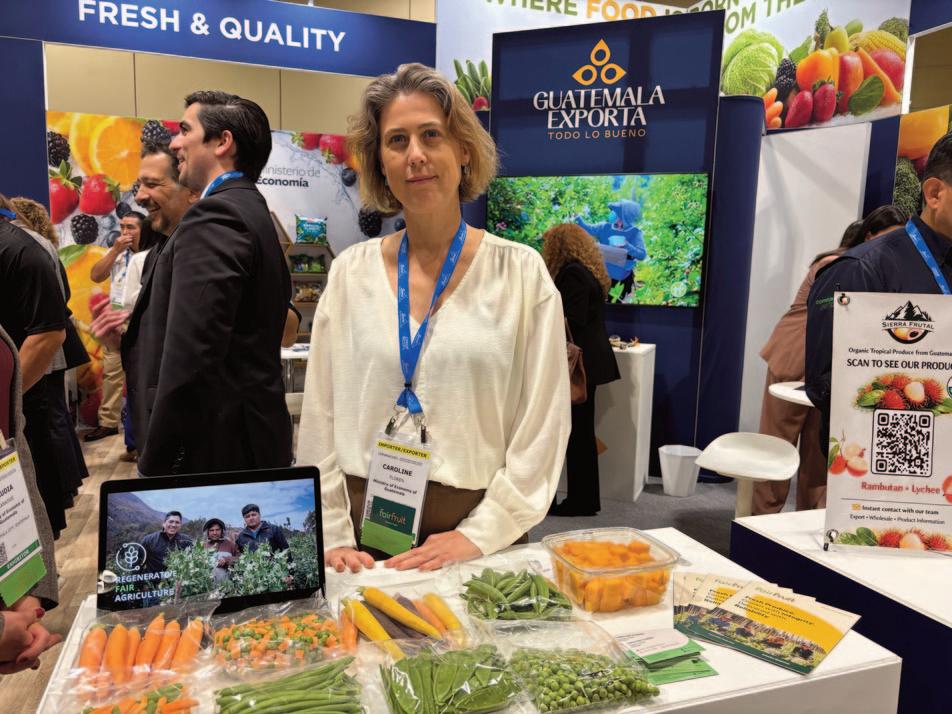
FairFruit’s portfolio includes both conventional and fair trade-certified French beans, peas, brassicas and mini- and coloured carrots, which were featured at its CPMA trade booth.
Evert Wulfrank, CEO of FairFruit USA, was effusive about the Canadian market potential, especially Ontario. He called the province a “priority market” because of the concentration of foodservice, retail, wholesale, and produce import activity. Toronto and Montréal also represent major commercial hubs, he said, with eastern Canada overall providing the most direct and
commercially viable route for introducing FairFruit’s produce to Canada.
“Building on a positive track record in the U.S. and Europe, we think the Canadian market offers [us] a large and growing urban consumer base of 40 million people and a thriving food retail market,” he said.
Addressing market gaps
To Wulfrank, FairFruit’s yearround French beans and peas “present a direct, dependable solution that addresses gaps in the Canadian market, backed by values that resonate with Canadian consumers. Our aim is to become a recognized, trusted supplier to the eastern Canadian fresh produce trade.”
Adds Caroline Floren, sales and operations manager at
FairFruit USA: “We are not just offering products – we are offering a fair partnership. Our goal is to become a trusted, consistent supplier for Canadian buyers and a long-term partner in their growth. The quality of our relationships matters more to us than volume at the outset.”
You may sense a bit of hyperbole in these statements. But measure the country’s enthusiasm for bilateral trade and market access here against the U.S. government’s hostility and disdain for Canada, and it’s clear why opening the door further to Guatemala is worth considering.
Owen Roberts is a Guelph-based agricultural journalist and a pastpresident of the International Federation of Agricultural Journalists.
advertising@thegrower.org
OWEN ROBERTS
Caroline Floren posed in the Guatemala booth, a first-time exhibitor at the Canadian Produce Marketing Association trade show in April 2026.
MORE THAN A MIGRANT WORKER
From Ontario fields to Jamaican homes: workers share stories of family, sacrifice and pride
BEN MURRAY & LILIAN SCHAER
When a few members of the Ontario Fruit and Vegetable Growers’ Association (OFVGA) team travelled to Jamaica this past February 2026, they weren’t there to observe from a distance. They were invited into the lives of the families who play an instrumental part in bringing Canada’s fruits and vegetables to harvest each year. That meant backyards and family kitchens, rivers where children play, and gardens that get tended year-round.
For the past five years, the OFVGA’s More than a Migrant Worker initiative has been documenting the stories of migrant farm workers on Ontario fruit and vegetable farms. Each story is different, but the same trends run through all of them: pride in where they come from, commitment to their families, and often a humbleness that leaves a lasting impression. The Jamaica trip brought those traits to the forefront yet again.
Denvil Anderson, McGregor’s Produce, Braeside ON
Denvil Anderson has been coming to Canada for 28 years, 18 of them at McGregor’s Produce in the Ottawa Valley. Back home, his world revolves around his grandchildren, who range in age from three to their early twenties.
“They’re spending time with me and I’m spending time with them, because I know in a few months they won’t see me,” he says, recognizing that the sacrifice is worth it knowing he’s able to create a better life for his family.
Farming shapes his life in Jamaica too. He grows everything
from cauliflower to yams, though his wife Rosemary might have him beat on dedication. You can find her in the garden nearly every day of the year and she keeps it thriving while Denvil is away in Canada.
After nearly three decades, his feelings about Canada are simple and sincere, “If it wasn’t good, I wouldn’t be back here. I wouldn’t be back 28 years. So it’s wonderful for me.”
Hugh Simpson, Top Meadow Orchards, The Blue Mountains ON
Hugh “Q” Simpson has worked at Top Meadow Orchards near Collingwood since joining the Seasonal Agricultural Worker Program (SAWP) in 2008. His arrival didn’t go quite as expected as he had no idea he’d be working on a farm. Instead, he thought he was coming to do construction, the same trade he often does back home as evidenced by the current addition of a second story onto his home.
It’s safe to say Q now knows more about apples than he ever imagined – and he’s taken that knowledge back to Jamaica, where he grafts plants for himself and his neighbours. He also keeps chickens, and cares for his massive garden. Canada taught him things he uses every day.
His motivation for making the trip year after year? His three sons. He hopes each of them will pursue secondary school and beyond, following the path they’re passionate about. And the chicken coop in Q’s backyard was started as a way to get his sons out of the house and off their phones – something very relatable to parents across the world.
COMING EVENTS 2026
June 1-7 Ontario’s Local Food Week
June 6 Garlic Growers of Ontario Field Day, Great Lakes Family Farms, Grand Bend, ON
June 9-11 GreenTech, RAI Amsterdam, NL
June 10 Niagara Agri-Food Golf Tournament, Willo-Dell Golf of Niagara-Thorold, ON
June 10 Bradford Vegetable Industry Golf Tournament, Harbour View Golf and Country Club, Gilford, ON
June 11 PAC Global Packaging Industry Golf Tournament, Nottawasaga Inn Resort & Conference Centre, Alliston, ON
June 13 Breakfast on the Farm, Binbrook, ON
June 13 Ontario Hazelnut Association Farm Tour, Nutcracker Ridge Farm, Uxbridge, ON
June 14 Ontario Agricultural Hall of Fame Induction Ceremony, Grand Way Event Centre, Elora, ON
June 23 4th Annual Ontario Potato Board Industry Social Golf Tournament, Hockley Valley Resort, Mono, ON
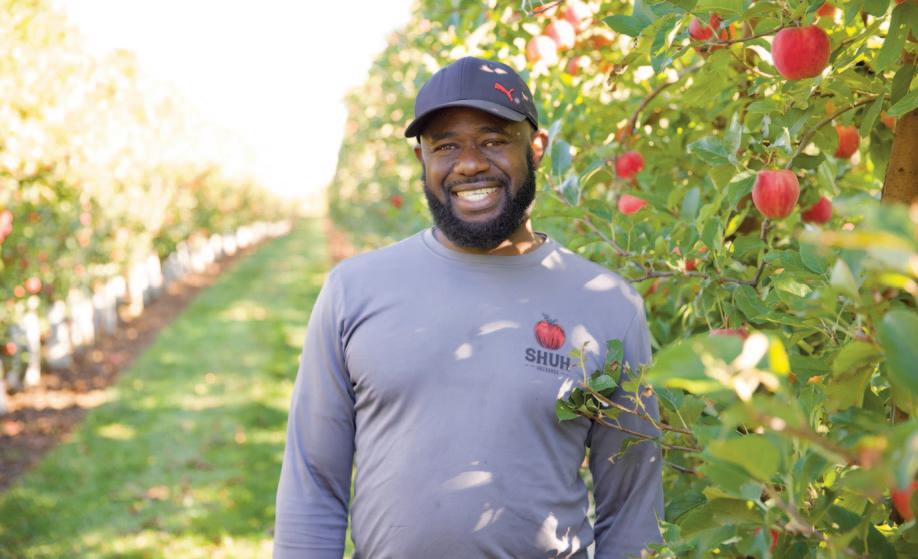
Dave Brown, Shuh Orchards, West Montrose ON
Then there’s Dave Brown, who works at Shuh Orchards, just outside of Waterloo. Dave’s face lit up while showing off the sign for his small community of Mason Yard, in the St. Mary parish of Jamaica and home to about 50 people.
About 100 metres behind his house runs a stunning river, where he mentioned that his kids and all their friends spend hours playing. Dave is currently building a large addition to the front of his place and proudly displayed a large Canadabranded sun umbrella in his yard – a reminder of where he spends more than half the year.
“The money from the Seasonal Agricultural Work Program is my main driver,” he said. “It helped to do the reno on the house. It helps with the kids going back to school. Anything I have to do, that savings is key.”
What all of these men share, beyond the work itself, is deep pride in where they come from. They still live where they grew up – deep roots in home and community that have never left them. Whether it’s Denvil’s grandchildren playing in the yard he built, Q grafting plants for his neighbours, or Dave adding to his home brick by brick, the work they do in Canada always finds its way back home.
As much as they love Canada, Jamaica truly is home.
Visit www.morethanamigrantworker.ca to watch full video interviews with these three men.
Ben Murray is communications advisor, Ontario Fruit &Vegetable Growers’ Association. Lilian Schaer is a freelance agricultural journalist.
June 24-25 British Columbia Agriculture Forum, Penticton Lakeside Resort & Conference Centre, Penticton, BC
July 9 Potato Growers of Alberta Annual Golf Tournament, Taber Golf Club, Taber, AB
July 9 Ontario Ginseng Growers Golf Tournament, Greens at Renton, Simcoe, ON
July 11 Saskatoon Berry Day, University of Saskatchewan Campus, Saskatoon, SK
July 15-17 Potato Sustainability Alliance Summer Symposium, Plover, WI
July 16 Federal-Provincial-Territorial Agriculture Ministers’ Meeting, Halifax, NS
July 19-22 International Fruit Tree Association Summer Study Tour, Hudson Valley, NY
July 25 Breakfast on the Farm, Cranbrook Farms, Brussels, ON
July 26 60th Anniversary of Jamaican TFWs, Strawberry Tyme, Simcoe, ON
August 1 Food Day Canada
August 5 Nova Scotia Fruit Growers’ Association Summer Orchard Tour, Kentville, NS
Aug 11-12 North American Strawberry Growers’ Association Summer Tour, Spokane, Washington
August 19 Potato Research Open Field Day, Elora Research Station, Elora, ON
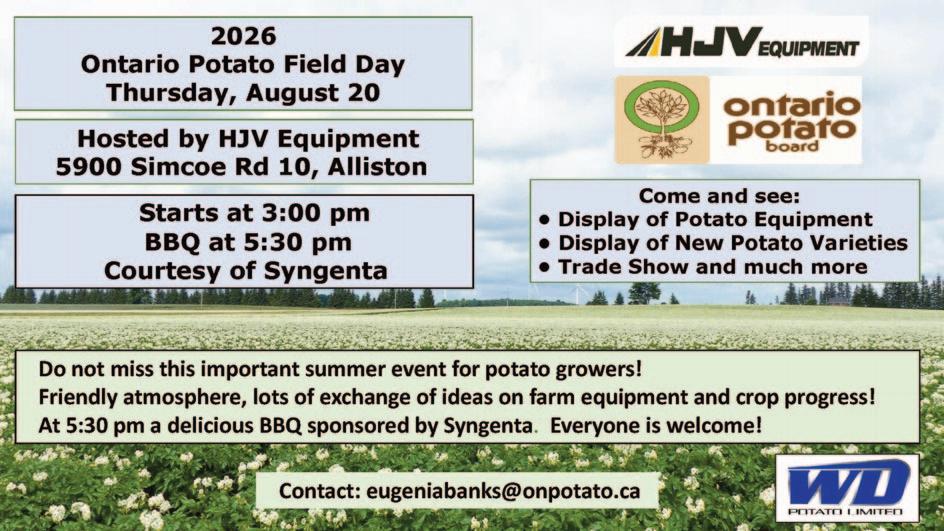
August 20 Ontario Potato Field Day, HJV Equipment, Alliston, ON
Aug 20-22 Québec Produce Marketing Association Convention, La Malbaie, QC
August 22 Budding and Grafting Workshop, USask Horticultural Field Lab, University of Saskatchewan, Saskatoon, SK
Sept 23 Ontario Produce Marketing Association Golf Tournament, Lionhead Golf and Country Club, Brampton, ON
Dave Brown, Jamaican seasonal agricultural worker at Shuh Orchards, West Montrose, Ontario.
Photo by Lauren Miller.
FOCUS:
LOGISTICS AND TRANSPORT
How Groupe TransWest is driving excellence in produce transport
KAREN DAVIDSON
Handle with care. That motto applies to highly perishable produce – and to transportation drivers.
A conversation with Pascal Gaudet, vice-president of sales and development, Groupe Trans-West, reveals the company’s commitment to recruiting and retaining experienced drivers for long-haul, full loads to all points in North America. Of 500 drivers, about 35 per cent are female, far above the industry average of 10 per cent. Many of the drivers operate in teams: husband and wife, father-and-son. This reduces stress on leaving a partner behind on long-haul trips.
“All drivers are treated with respect,” says Gaudet. “They have the ability to say when they’re available for the next trip. But in turn, we expect respect to be on time, no excuses. If a driver has a sick child, I would rather that the person be at home than compromising road safety.”
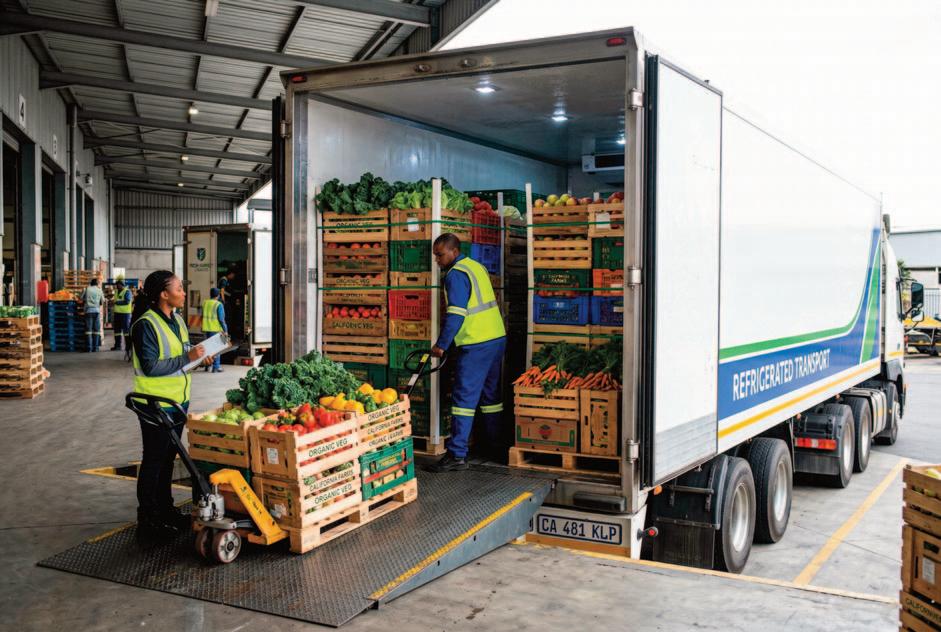
Headquartered in Lachine, Québec, the privately-owned, family-run company is run by CEO Réal Gagnon. Over the years, he has built Trans-West into a major refrigerated transportation player in Canada, earning the trust of major retail chains. The company operates not only in Québec, but Ontario and Alberta.
The company approach has resulted in 99 per cent efficiency in delivering a core basket of produce: blueberries, cranberries, lettuce, carrots, onions, potatoes and greenhouse vegetables. This score is measured by on-time pick-up, on-time delivery, temperature compliance and
cargo integrity. Over the years, Trans-West has grown to 400 refrigerated trailers and 200 trucks. About 60 to 65 per cent of business volume is produce, because of the company’s specialty in temperaturecontrolled transportation.
Cross-border operations move produce from Canada into the U.S. and return with produce from California, Arizona and Texas. Mexican produce is picked up at Nogales, Arizona and Laredo, Texas for the round trip home. South American imports are picked up at eastern ports in the U.S.
“A major industry trend is towards more pick-ups of produce originating in Mexico and South America,” says Gaudet.
“Historically, much of the produce came from California and Arizona, but due to climate change, droughts, water shortages and frosts, these growers have spread their risk by buying production capacity in Mexico and South America. We have the same clients, but we now see a broader diversification of produce origins.”
Technology today is central to cargo integrity. All trailers use GPS, telematics and remote temperature monitoring. Operations teams receive alerts and can adjust temperatures remotely. Temperature data can be downloaded and shared with customers. With these checks and balances, temperature claims are extremely rare.
Trans-West, however, bridges technology with the human element. Gaudet emphasizes the importance of the employee lifecycle – from recruitment and onboarding to compensation and benefits. Training includes reefer operation, temperature
Monitor: no lithium battery
Tive showcased its disruptive supply chain and cold-chain visibility technologies at the Canadian Produce Marketing Association Innovation Zone in Toronto, Ontario in late April 2026. Their hardware and cloud platforms allow growers and distributors to track perishable produce in real-time, monitoring temperature, humidity, shock, and location. One of the features is that there is no lithium in the battery.
verification, cargo inspection, sanitation, produce handling, issue escalation.
“Flexibility is heavily emphasized,” says Gaudet.
Beyond managing employees round the clock, Trans-West is facing a sudden competitive hurdle: fuel costs. Contracts acknowledge that fuel cost increases may arise from time to time. This situation is addressed through fuel surcharge formulas which are adjusted on a weekly basis. For example, a $5,000 base load could increase to $7,000 with a trip from Québec to California. It sounds like a lot of money but as Gaudet explains, the amount is split over 40,000 pounds of produce.
Longer-term, Trans-West does business in a highly competitive transportation industry that tolerates barely trained, recent immigrants to drive transports. Driver Inc, as it’s called in the industry, is a controversial business model in the Canadian trucking industry where carriers misclassify drivers as independent incorporated contractors rather than employees to avoid paying payroll taxes, benefits, and overtime.
Trans-West is lobbying for fair treatment. Gaudet is concerned about regulatory and payroll compliance practices, maintaining fair and consistent labour standards across the industry, ensuring proper driver training and qualification processes, road safety and public confidence. Last but not least, he says these bad actors are leading to increasing
oversight from shippers, industry associations and government bodies.
As Gaudet states, “We are a $100 million company that pays $5 million in provincial and federal taxes.”
Earlier this year, the Canadian Trucking Alliance (CTA) earned a pledge from the Council of Ministers Responsible for Transportation and Highway Safety to combat non-compliance with labour, tax and safety rules in the commercial trucking industry associated with the Driver Inc. model.
“CTA has been active on this file for a very long time and the acknowledgement by all ministers
that Driver Inc. is real and must be dealt with is helpful,” said Geoff Wood, CTA’s senior vice-president policy. “However, the proof will be in the actual efforts put forth across the country to get rid of Driver Inc. Everyone must be all in.”
Trans-West is all in. Gaudet concludes: “As shipper requirements continue to evolve, there appears to be increasing attention placed on transparency, operational accountability and carrier qualification standards across the transportation industry.”
L-R: Max Gorobets and Liam Blaney.
L-R: Pascal Gaudet, vice-president sales and development and George Pelekanos, business development, Groupe Trans-West, Lachine, Québec.
FOCUS: LOGISTICS AND TRANSPORT
The inside story of a reefer: how air moves
The reefer download shows a flat 36°F for the entire run, pickup to delivery. You open the trailer at the dock, pull a clamshell from three rows deep, slide in a probe, and it reads 48°F. The rejection email is already in your inbox.
So which number is wrong? Neither. The reefer temperature measures the air circulating back to the evaporator. Your probe is measuring the pulp temperature of the fruit. Two different readings, two different stories, and on a load where airflow can’t reach every pallet, they often disagree by a lot. And you’re the one footing the bill in the process.
That said, most of the causes are mechanical, physical, and procedural–and easily fixable once you can see them.
Why doesn’t the reefer set point match the product temperature?
Short answer: they’re measuring two different things, and the reefer was never built to tell you what the pulp is doing.
Part of the trouble is a vocabulary problem. Four different temperatures get treated
as one number on the dock, and they are not the same:
1. Set point: What you dialed in: an instruction, not a measurement
2. Supply air: The chilled air leaving the evaporator, on its way into the box
3. Return air: The air coming back to the unit after it has moved through the load
4. Product temperature: What a probe reads when you push it into the pulp
The reefer manages air. It can’t read the middle of a pallet three rows deep, and most units are built to keep cold products cold, not chase down heat the shipper sent in warm. So the trailer holds set point while a warm pallet in the nose takes hours to catch up, and hot spots build in dead zones the return-air sensor never sees.
That’s why one reading, stripped of context, sends you after the wrong problem. When air and pulp disagree, check the load, the precool, and the airflow before anyone blames the box.
How does air actually move through a refrigerated trailer?
Airflow is where most of the trouble hides, so it helps to picture the loop before worrying about what any sensor reads inside it. Cold air leaves the unit at the front top of the trailer, runs the length of the ceiling, drops over the load, picks up heat, and returns along the floor to the evaporator. Then the cycle starts again.
That loop only works, though, if the load gives the air somewhere to go, and a few common loading habits can shut it down:
• Pallets jammed against the walls choke the sides and pinch off the downward path.
• Product blocking the floor channels chokes the return and starves the evaporator of warm air to work on.
• A load stacked too tall crowds the ceiling and keeps supply air from reaching the rear.
Any one of those turns the back of the trailer into a dead zone, which is where the air chute earns its keep. A good chute carries cold air past the front pallets, and delivers it to the door end before it runs out of push. Without one, or with a shortened one, the rear of the load drifts warm for the entire trip while the temperature log still looks clean.
What are the most common reasons a sensor reads warmer or colder than expected?
Once the airflow picture is clear, the next question is what trips it up on real loads. Most discrepancies trace back to a short list of very fixable causes.
1. The trailer wasn’t precooled
The GCCA calls precooling a baseline practice, and for good reason. Loading cold products into a warm box transfers heat straight into the pallets before the doors close. Set point alone does not confirm precool. Someone has to verify the air temperature in the nose and the tail before the first pallet rolls in.
2. The load blocks its own airflow
Even a precooled trailer fails if the pallets strangle the loop. Products need gap space from the walls and a stack height that does not crowd the ceiling. Pallets touching the walls conduct outside heat into the product. Wall loading wrecks temperature uniformity, which is why the back corners so often read warm.
3. The unit is in the wrong mode
Good loading still loses if the reefer is run the wrong way. Sensitech recommends continuous mode for fresh perishables because it makes small adjustments and holds a tighter band. Fuel saver or cycle sentry means that temperatures may drift between cycles, creating hot spots or top freezing on sensitive cargo.
4. The trailer itself is the problem
Sometimes the equipment is the weak link. A torn air chute, a blocked return, a bad door seal, or a damaged wall panel will quietly undo everything else you did right. Don’t overlook this factor: FDA rules require transportation equipment to maintain a certain temperature.
5. Something happened on the road
Finally, when the hardware checks out, look at the trip itself. Sharp spikes, light events, and off-route door openings point to handling rather than mechanics. Extra stops, a long lunch with the doors cracked, a curious receiver who peeked early. Those finger-
prints show up in the data when you have the right visibility.
Where should I place a temperature monitor and how do I interpret it?
Finding the root cause is only useful if you are collecting the right data in the first place. Sensitech’s anchor recommendation is the rear pallet, right side facing the door, at eye level. The door end runs warmest, the spot is repeatable, and a receiver can retrieve the device without tearing the load apart.
How can I turn temperature alerts into a repeatable response process?
A good alert tells you a pallet is warming up. It doesn’t tell you who to call, what to say, or whether the driver can still do anything about it. That silence between the ping and the fix is where loads are lost, while the sensor and the software sit back, satisfied they did their jobs. Five steps keep that from happening:
• Write the SOPs before you need them: Put precooling, loading inspection, operating mode selection, and monitor placement into documented procedures your team follows on every load. A SOP you invent at 2:00 a.m. during a claim is not a sound SOP.
• Assign every alert type an owner and a next action: A temperature excursion, a door-open event, and a late-stage spike should each have a name attached—and a specific first move. Ambiguity is how products spoil in a parking lot while four people debate who calls the driver.
• Investigate with context, not just a number: Pull the lane, commodity, sensor placement, loading photos, reefer mode, door-open log, and trailer condition before drawing conclusions. A 48°F spike means one thing on a hot Phoenix dock and something very different on a mountain pass at night.
• Close the loop in writing: Document what happened, what the team did, and whether it worked. Patterns only show up when you can compare last Tuesday’s load to the one from three months ago—without relying on anyone’s memory.
• Let the system do the escalating: A workflow engine built on triggers, conditions, and actions can route the right alert to the right person, escalate when nobody responds, and skip the ones that do not need a human. Knowing why the reefer temperature and the pulp drifted apart only matters if the response happens fast enough to save the load.
Source: www.tive.com
FOCUS: LOGISTICS AND TRANSPORT
Don’t let inconsistencies in the BoL and the freight instructions cost you a load of fresh produce
Why is the Bill of Lading (BoL) particularly important in the ground transportation of produce?
The Bill of Lading (BoL) plays a crucial role in the transportation of commodities, but in ground transportation for the fresh produce industry, it becomes even more significant. Produce sellers, buyers, and transportation companies that haul these commodities know that the BoL serves as the legally binding contract of carriage between the carrier and its principal, whether that principal is the freight intermediary, the shipper, or the receiver.
What makes a produce BoL particularly important, and distinct from BoLs used in other industries, is that in the fresh fruit and vegetable trade, the shipper is the one who issues the BoL, often under tight shipping deadlines due to the perishable nature of the product. It is not created by the carrier or freight forwarder.
In transactions where the carrier is hired by the buyer or receiver—such as Free on Board (FOB) sales—the buyer provides
the carrier with all necessary transportation instructions and requirements; it is not the carrier who prepares the BoL, nor do they have any say over the information that goes on it until they receive it from the shipper. This means the carrier must ensure that the buyer’s instructions align with the BoL issued by the shipper.
The Fruit and Vegetable Dispute Resolution Corporation (DRC) has extensive experience handling produce disputes, including transportation claims. Sporadically, we find discrepancies between the BoL and the transportation instructions provided by the freight contractor, the shipper or the receiver. These conflicts often involve differences in carton counts, inconsistent temperature requirements, or other critical handling details.
What should be done when conflicting information appears on these documents?
If a driver fails to compare the BoL with the instructions received, the carrier will likely
default to the BoL, since it is the binding contract of carriage.
However, relying solely on the BoL may not lead to the best outcome, especially for time-sensitive or temperature-controlled produce shipments. Any inconsistency between documents should immediately prompt
communication—either with the freight intermediary, the shipper or, in the case of an FOB transaction, with the receiver who hired the carrier.
Clarifying differences early is essential. It helps prevent disputes, protects the carrier, and ensures shipment is handled in
accordance with the correct requirements—helping maintain product condition and reducing the risk of loss.
Source: Dispute Resolution Corporation
FOCUS: LOGISTICS AND TRANSPORT
Built for the journey: why corrugated packaging matters in produce logistics
SERGE DESGAGNÉS
Canada’s produce industry depends on more than strong harvests. It relies on a supply chain that can move fresh products efficiently, safely, and reliably from growers to processors, retailers, and consumers across the country and around the world. Packaging plays a central role in making that happen.
For decades, corrugated packaging has been a trusted solution throughout the produce sector because it is specifically designed to meet the demands of transportation, logistics, storage, and product protection. From greenhouse vegetables and berries to apples, onions, leafy greens, and processed foods, growers need packaging that can withstand long-distance shipping, changing temperatures, rapid handling, and increasingly complex distribution networks.
Corrugated packaging delivers on all fronts
Lightweight yet durable, corrugated boxes provide the strength needed to protect fresh produce during transport while helping maximize efficiency in
BITS & BITES
shipping and warehousing. Their stack strength and structural performance are especially important in today’s supply chain environment, where products may travel thousands of kilometres before reaching store shelves.
Ventilation and moisture resistance also make corrugated packaging particularly well suited for produce applications. Proper airflow helps maintain freshness and product quality, while customizable box designs allow growers and distributors to tailor packaging to specific commodities, shipping conditions, and retail requirements.
Equally important is consistency. Produce operations depend on packaging that performs reliably throughout every stage of the supply chain. Corrugated packaging supports automated handling systems, efficient palletization, traceability requirements, and high-speed distribution environments that are essential to modern food logistics.
For many growers, packaging is also part of the product presentation itself. High-quality graphics and print capabilities help strengthen branding and improve visibility at retail, while
A salute to Hannah Fraser
KAREN DAVIDSON
A tireless extensionist, Hannah Fraser is retiring end of May 2026 after 26 years serving Ontario farmers. Her official title is entomologist – horticulture with the Ontario Ministry of Agriculture, Food and Agribusiness. The Grower asked her for some observations.
“I’m really honored by your invitation to prepare a “going out” message about changes to crop protection over the last 30 years, though to be honest, it’s not a small undertaking. Since the 1990s, there has been a shift from simply “spraying smarter” towards a data-driven, networked
framework for intervention.
clean, uniform packaging supports consumer confidence in freshness and quality.
In produce supply chains, where freshness and product integrity are critical, corrugated packaging helps reduce spoilage and food waste by protecting products during storage, transportation, and retail handling. Industry research has shown that fit-for-purpose corrugated packaging can improve product stability, reduce damage during shipping, and strengthen supply chain resilience for food producers and retailers.
Corrugated packaging also aligns with growing sustainability expectations across the food sector. Corrugated boxes are made primarily from recycled content and renewable wood fibre, and are widely recycled into new packaging products through Canada’s established recycling system. That circular manufacturing model helps reduce waste while supporting domestic jobs and manufacturing capacity.
As retailers, consumers, and export markets place greater emphasis on sustainability and supply chain performance, packaging choices matter more than ever. Growers increasingly need solutions that not only
There have been big changes to the pesticide toolkit and how products are integrated into pest management programs. Insecticides have shifted from broad-spectrum, reactive control tools to more reduced-risk and target-specific chemistries. Mode of Action classification standardized insecticides and acaricides into numbered groups based on target site, enabling rotation strategies for resistance management. Risk mitigation and habitat support for pollinators. Biocontrol is the foundation for greenhouse IPM in Ontario. Systems designed around pest (and beneficial) biology. Automation that turns pest data into decisions and robotics
protect products, but also support operational efficiency, environmental objectives, and evolving market expectations. Canada’s corrugated industry continues to innovate alongside the produce sector, developing packaging solutions that help reduce food waste, improve transportation efficiency, and deliver products to market safely and effectively.
or drones to deliver these into site-specific actions. More digital tools. Advances in application technologies (and knowledge on how / where / when to use them effectively).
Understanding and adjusting to climate-driven changes in insect phenology, as well as forecasting risk. Preparing for and responding to invasive species -- that’s been a big one for me over the years. And figuring out the most effective way to deliver new information, so that all this useful knowledge gets incorporated into grower practice.”
Ontario’s horticultural community is grateful for her years of expertise and extends best wishes. The good news is that
Be vigilant for early-stage nymphs of the spotted lanternfly
Know the life cycle of this invasive pest which is in the early nymph stage May –July. Egg masses may be detected yearround. The Canadian Food Inspection Agency confirmed that 12 dead spotted lanternflies were intercepted in St. Catharines in March 2026.
The findings of the Canadian Food Inspection Agency (CFIA) are an important reminder that shipments (both plant and non-plant products) and transport vehicles and vessels are a highrisk pathway of spread for this hitchhiking invasive insect. Observations of spotted lanternfly (SLF) in Canada are posted on the CFIA’s website. There are no confirmed established populations in
Canada at this time.
What can you do?
1. Train your vineyard teams on the life stages of SLF. For May-July, keep an eye out for egg masses laid on flat surfaces and the early-stage nymphs. Informational resources are available online through the Invasive Species Centre and OMAFA.
Grape Growers of Ontario has info cards and posters in English available at the Board Office. OFVC presentations on preparing for SLF are posted HERE.
2. Familiarize yourself with the States that have established populations of the SLF, listed in the Current Status dropdown on the USDA’s SLF webpage.
3. Immediately inspect all shipments you
receive from an infested State for all SLF life stages (egg masses, nymphs and adults).
4. If you are travelling back from or have travelled through an infested State, check your car, camper, trailer, RV, and supplies before making the return trip.
5. Spot it? Snap it, catch it and report it.
If you think you have found the SLF or its egg masses:
a. Take a photo or video
b. Catch the insect or scrape the egg masses, and put it into a sealable container
c. Report it on CFIA’s SLF webpage.
Source: Grape Growers of Ontario May 8, 2026 newsletter
and Containerboard Association.
From field to retailer, corrugated packaging remains one of the most reliable and versatile tools supporting Canada’s produce supply chain.
Serge Desgagnés is executive director, Canadian Corrugated
Jason Lemay took over her duties officially in mid-May. He is stationed in Guelph, Ontario.
The long game: how spring weather affects your tomatoes and peppers
This spring, it seems as if it took longer than normal for the weather to warm up. With tomatoes going in the ground in mid-May, these transplants likely had to endure some chilly temperatures. What does this mean for the future of these plants and how they will produce?
It is well known that flowering, pollination, and fruit set of tomatoes and peppers can be adversely affected by temperature extremes and can cause abnormal fruit development, reduced growth and in some cases plant death. The effect of various temperatures during flowering and fruit set of peppers and tomatoes is shown in Table 1.
What you may not think about when you see blossoms and fruit developing, is that low temperatures experienced by the plant weeks before flower buds were visible, can also affect flowering, pollination and fruit set.
A tomato plant which
experiences temperatures below 15.5°C (60°F) for extended periods of time will begin to flower profusely. These flowers may remain open on the plant for several weeks, without fruit being formed. Larger flowers and increased branching of clusters can show up as a result of low temperatures experienced by the plant weeks before flower buds are visible.
However, temperature is not the only thing we need to worry about affecting our tender transplants. Field tomatoes and peppers are long-season crops with high water requirements.
An average tomato cultivar requires about 40 cm (15.7 in) of water over the growing season, with the need for moisture increasing until full fruit load is developed. The most critical time for moisture is during flowering, fruit set, and fruit sizing.
When tomatoes and peppers experience moisture stress:
• growth slows down
• fewer flowers develop, peppers drop more blossoms, and lower numbers of fruit are set
Table 1: The effect of temperature during flowering and fruit set of tomato and pepper.
Temperature
Tomato
Greater than 35°C (95°F)
18.5 – 26.5°C (65-80°F)
Less than 13°C (55°F)
Less than 10°C (50°F)
Pepper
Greater than 32°C (90°) day temp.
16°C (61°F)
Less than 15.5°C (60°F) or greater than 24°C (75°F) night temp.
Did you know . . .
Effect on flowering, pollination, fruit set
Reduced fruit set
Optimum for fruit set
Misshapen or cat-faced fruit may result
Poor fruit set
Pollen sterility occurs, flowers may drop
Optimum for flowering and fruit set
Poor fruit set
Daytime temperatures of 15.5°C (60°F) with night-time temperatures of 10°C (50°F), four to five weeks before a tomato cluster blooms, may result in misshapen or cat-faced fruit.
(lower yield)
• total soluble solids increase in tomatoes (higher soluble solids means higher recovery in the processing plant and generally improved taste of fresh or processed tomatoes)
• fruit size decreases (lower yield; may result in unmarketable fresh market fruit and greater harvest loss in mechanical harvesting of processing tomatoes)
• blossom-end rot increases, and loss can be significant in susceptible varieties (affected fruits are unmarketable; can lead to black specks and high mould counts in processed product. If severe, loads or fields of
Night temperatures of 7-10°C (45-50°F) during pepper flower development can cause the fruit to be smaller than normal, or somewhat misshapen.
processing tomatoes can be rejected)
• plant canopy temperature increases (an additional stress to the plant; associated with reduced transpiration and photosynthesis therefore reduced growth; at fruit temperatures above approximately 30°C, development of colour is inhibited)
Tomatoes are more tolerant of moisture stress than peppers. They can adjust their physiological processes to conserve water while maintaining some growth. In addition, early exposure to moisture stress makes the plant more tolerant of moisture stress later in the season. While this allows the tomato plant to survive where some crops, such as peppers, would suffer irreversible damage, prolonged water stress does reduce yield as the plant uses energy to make these adaptations.
Although the tomato plant can survive dry conditions, optimal yield and quality will not be achieved. Irrigation of tomatoes can result in higher and more consistent yields, better quality, larger fruit, less blossom-end rot, and less cracking.
Fields with good soil structure and higher organic matter will hold more moisture and allow roots to penetrate better. Compacted layers will limit the spread of roots. In tomato and pepper, 85 per cent of the root system is typically in the upper 30 cm of soil, but tomato roots can extend beyond one meter in depth, while peppers only reach
approximately 60 cm. Cover crops can be grown and the residue used to mulch the soil, reduce water loss, and moderate soil temperatures. However, this obviously requires advance planning and could have a detrimental effect in a wet spring.
In irrigated fresh market tomato and pepper production, plastic mulches can be used to conserve water. Minimizing tillage can also reduce moisture loss. Optimum seasonal evapotranspiration would be expected to be higher with current, higher-yielding varieties and production practices. Research conducted in the early 2000s on processing tomatoes in Ontario has shown yield increases of up to 81 per cent on a range of soil types with the use of properly scheduled irrigation. However, under dry conditions, irrigation is most critical on the lighter textured soils with low, waterholding capacity.
The take-home message here is that spring weather conditions can have long-term effects on your crop and have a significant impact on yields and fruit quality. It is important to plant at the appropriate time for your crop to minimize exposure to cool temperatures and irrigation can help avoid drought stress.
Amanda Tracey is vegetable crop specialist for the Ontario Ministry of Agriculture, Food and Agribusiness, based in Ridgetown, Ontario.
AMANDA TRACEY
Canadian growers need more than incremental red tape reform
In today’s geopolitical climate, Canadians are placing greater value than ever on reliable access to Canadian-grown produce. To meet those expectations, growers need access to the latest crop protection tools and innovations through a regulatory system that is timely, predictable, and science-based. Canada represents less than four per cent of the global market for crop protection products, meaning investment and access to new products is not always guaranteed. At a time when global supply chains are uncertain and trade barriers are rising Canada should be increasing access to innovation and avoiding unnecessary obstacles that risk leaving growers behind.
Bold change
This is why it has been encouraging to hear the federal government discuss the need for bold change to address Canada’s lagging agricultural productivity and reduce regulatory red tape. The Prime Minister’s messaging clearly signals his intent to move the government’s agenda to drive economic growth for Canada with urgency. That agenda is being echoed by the Minister of Health, Marjorie Michel, whose recent engagement with the agriculture sector, including her appearance at CropLife Canada’s Spring Dialogue Days event, is unprecedented. She has clearly signaled the need to modernize Canada’s pesticide regulatory system to ensure it is timely and encourages access to innovation for Canadian growers.
CropLife Canada has been advocating for a legislative mandate change that includes
Canada represents less than four per cent of the global market for crop protection products, meaning investment and access to new products is not always guaranteed.
~
PIERRE PETELLE
economic considerations in the Pest Control Products Act for some time now and we were pleased to see the government include this change as part of the implementation of its Spring Economic Statement. We believe that including economic and food security considerations will result in more pragmatic decisions that take into account agricultural realities.
Reforms for today
Today’s geopolitics are largely out of our control, but the Canadian agricultural innovation agenda is solidly within our purview to change. Crop protection innovations play a significant role in determining the success of the various crops we grow in Canada. Manufacturers want to bring new crop protection products to Canada with as many uses on the label as possible, including important minor uses for fruit and vegetable growers.
These minor use cases are often the first casualties of label restrictions or product losses, another reason why the industry needs a nimble regulatory system that encourages innovation and investment by having economic considerations as part of its process.
Real-world context
The Pesticide Regulatory Directorate (PRD), formerly the PMRA, of Health Canada has a
critical role to play in supporting on-farm productivity and the competitiveness of Canadian farmers through enabling access to safe and effective crop protection tools. Amending the mandate will allow the PRD to:
• Put risk in real-world context and have more options to consider before defaulting to product cancellation.
• Increase touchpoints with agronomists, farmers, and registrants to improve the credibility of decisions and reduce frictions with the value chain.
• Improve Canada’s standing as a reliable market for innovation and capital deployment.
• Allow Canada to better leverage foreign approvals where appropriate, reducing duplicative work and regulatory delays.
Canada has an opportunity to lead in agricultural innovation.
Bold action on red tape reduction, coupled with an expanded economic mandate is essential to ensuring Canadian growers can compete, thrive, and help feed Canada and the world.
Pierre Petelle is president and CEO, CropLife Canada.
Delayed innovation comes at a cost. A new study from AgbioInvestor and CropLife International shows that the average time-to-market for crop protection products globally is now 11.4 years, with development costs reaching approximately $307 million per product. While regulatory systems remain complex, this reflects a small decrease in approval timelines, indicating some positive industry and regulatory momentum. However, this means that products currently in development still won't be available until approximately 2037. Since patents are protected for 20 years in Canada, a company typically only has eight to ten years left on a patent once a product reaches the market.
If this situation continues, innovation may still struggle to keep pace with evolving environmental challenges, diseases, and pests that farmers face. Without timely access to cost-effective innovations, achieving zero hunger and adapting to climate change will remain difficult.
Now more than ever, it is critical that we have streamlined approvals for crop protection products around the world that both protect human and environmental health while also facilitating timely access for farmers to the tools they need.
Hon. Marjorie Michel, federal minister of health, spoke at CropLife Canada’s Spring Dialogue Days.
PIERRE PETELLE
Cimegra and Success insecticide labels granted emergency use for rutabagas
JOSH MOSIONDZ
The Pest Management Regulatory Agency (PMRA) recently approved Emergency Use Registrations (EUR) for Cimegra and Success insecticides for management of cabbage maggot on rutabaga in numerous provinces in Canada. These EURs for Cimegra and Success insecticides on rutabaga can be used only in Ontario, British Columbia, Alberta, Québec, Nova Scotia, New Brunswick, Prince Edward Island, and Newfoundland and Labrador from May 21st, 2026 until May 20th, 2027 (Cimegra) and May 17th, 2026 until May 16th, 2027 (Success).
Cimegra and Success insecticides are labeled for management of insects on a wide range of crops in Canada. Plans are underway to submit provincial User Requested Minor Use Label Expansion (URMULE) requests with the hope for full
Rutabaga Control of cabbage maggot
Abbreviated instructions for Cimegra insecticide
250 Apply 250 mL/ha1 of Cimegra insecticide post-planting as a drench banded spray, 10 cm on each side of the plant targeting the soil and base of plant to control cabbage maggot. For best results apply at peak egg laying. Use a minimum water volume of 1000 L/ha.
DO NOT apply more than 2 applications per year. Allow a minimum of 10 days between applications. Monitor pest population and reapply if necessary once thresholds are reached. Optimum application timing is based on field scouting. Begin applications when adult activity is observed in or near the field.
1 1.9 mL/100 m of row for 76 cm (30”) row spacing. For a different row spacing, adjust the product rate using the following equation: (row spacing (cm) / 90) x 2.3 mL = mL per 100 m of row.
NOTE: The use of Cimegra on rutabaga is intended only for domestic markets due to a lack of export MRLs being established in other trading partner countries. If exported, detection of residues on these crops could lead to rejection or destruction by the appropriate officials.
Abbreviated instructions for Success insecticide
Crop(s)
Rutabaga Suppression of cabbage maggot
273 - 546
registration in future field seasons. These EUR requests were initiated by participating provinces in response to the loss of chlorpyrifos applications in Canada following RVD2020-14 and the subsequent re-evaluation note REV2021-04 which created a lack of sufficient registered protective products to allow for effective protection from cabbage maggot on several crops in Canada, including rutabaga. This EUR was led by Québec in
Optimum application timing is based on field scouting. Begin applications when adult activity is observed in or near the field. Apply Success in soil drench at the rate of 273 mL/ha to 546 mL/ha (131 g/ha to 262 g/ha a.i,). For 76 cm (30-inch) plant row spacing apply Success at 6 mL to 12 mL per 300 linear metres (1000 linear feet). Do not make applications less than 4 days apart. Apply a maximum of 2 applications. Do not apply more than 1.1 L/ha of Success per year.
conjunction with other participating province’s provincial Ministries of Agriculture and their local growers’ associations.
The following is provided as an abbreviated, general outline only. Users should be making insect management decisions within a robust integrated insect management program and should consult the complete emergency use label before using Cimegra and Success insecticides.
Follow all other precautions,
restrictions, and directions for use on the Cimegra and Success insecticide labels.
For a copy of the emergency use label, Ontario growers may contact Josh Mosiondz, provincial minor use coordinator, OMAFA, Guelph (226) 971-3407, or Dennis Van Dyk, vegetable crops specialist, OMAFA, Guelph (519) 766-5337. Non-Ontario growers from participating provinces may contact their local provincial minor use coordinator or
3
provincial crop specialist(s). Alternatively, you may contact your regional supply outlet, BASF Canada (Cimegra) and / or Corteva Agriscience Canada (Success) representatives, or visit the PMRA label site
Source: Josh Mosiondz, provincial minor use coordinator, Ontario Ministry of Agriculture, Food and Agribusiness April 23, 2026 news release
Serifel biological fungicide to help manage powdery mildew on hops
The Pesticides Regulatory Directorate (PRD), formerly known as the Pest Management Regulatory Agency (PMRA) recently approved a minor use label expansion registration for Serifel biological fungicide for suppression of powdery mildew on hops grown in Canada. Serifel biological fungicide was already labeled for disease control on a wide range of crops in Canada. This minor use proposal was submitted by Agriculture & Agri-Food
Hops Suppression of Powdery Mildew (Podosphaera macularis [syn. Sphaerotheca macularis])
0.25 – 1.0 For powdery mildew, begin applications prior to infection and continue on 5- to 10-day intervals if conditions are favourable for disease development. Use the highest rate and the shortest interval when conditions favour high disease pressure. Under low-level disease conditions, the minimum application rates can be used while maximum application rates and the shorter spray intervals are recommended for severe or threatening disease conditions. Apply SERIFEL in sufficient water to ensure thorough coverage of foliage, bloom, and fruit. Thorough coverage is required for optimum disease control. Maintain agitation of product during the application process. The product mixture should be applied shortly after mixing. DO NOT store mixed suspensions of SERIFEL overnight. SERIFEL DOES NOT require a spray buffer zone.
Canada, Pest Management Centre (AAFC-PMC) as a result of minor use priorities established by growers and extension personnel.
the complete label before using Serifel biological fungicide.
Follow all other precautions, restrictions, and directions for use on the Serifel biological fungicide label carefully.
Source: Josh Mosiondz, minor use coordinator, Ontario Ministry of Agriculture, Food and Agribusiness April 21, 2026. Crop(s)
The following is provided as an abbreviated, general outline only. Users should be making disease management decisions within a robust integrated disease management program and should consult
For a copy of the new minor use label, contact your local specialty crops specialist, your regional supply outlet, or visit the PMRA label site
0 - SERIFEL can be used up to and including the day of harvest