What’s in 15 minutes of fame? The recent “Stronger Together” farmer rally in Osoyoos, British Columbia aims to find out.
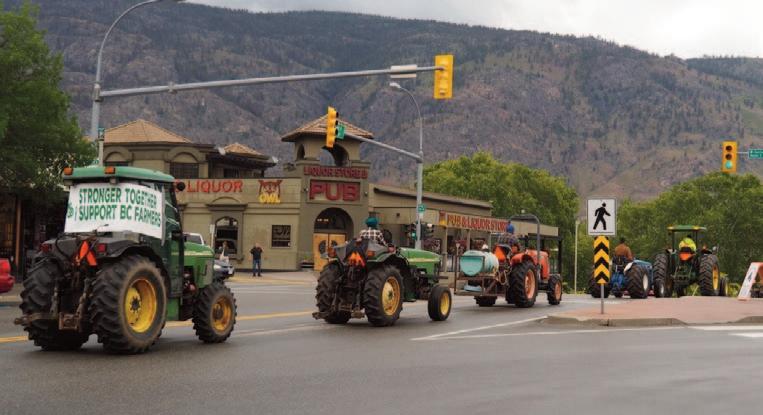
Fruit farmers, reeling from four years of weather extremes, conceived the pro-agriculture May 28th event to create TV and print headlines in the Lower Mainland. A worthwhile result would be low-interest loans or cash injections by the provincial government. Although the event coincided with Premier David Eby’s cabinet retreat in the southern Okanagan, and he gave interviews on the event sidelines, there’s no immediate cash relief addressing the January 2024 deep freeze that decimated grapes and tree fruits.
“I’m very worried about the toll that the last few years is taking on farmers,” says Sukhdeep Brar, vice-president, BC Fruit Growers’ Association (BCFGA). “I am worried about mental health in an industry that doesn’t like to talk
about mental health. Remember that 70 per cent of our members are Indo-Canadian. I am worried about the number of orchards going up for sale. I’m worried that there’s not a future in the Okanagan for my kids.”
The 38-year-old, second-generation farmer tends to 125 acres of cherries, peaches, apples and pears near Summerland, BC – also home, coincidentally, to an Agriculture and Agri-Food Canada research station and cherry breeding programs that have put BC on the global map. Brar points out that farmers have endured a heat dome of +40°C in 2021 and a deep freeze of -28°C in 2024. Fruit trees can only withstand so much adversity, before completely shutting down basic functions. While the provincial government’s announcement of a five-year, $70 million, enhanced replant program is appreciated, it’s not a realistic bridge to next year… or the year after.
“I’m not surprised that the BCFGA has rallied its members,” says Marcus Janzen, an Abbotsford, BC greenhouse grower and president of the Fruit and Vegetable Growers of Canada (FVGC). “Those members have a
long history of political engagement. Their rally is an expression of desperate times and how hard pressed they are to see a way forward.”
Looking at the Canadian situation more broadly, Janzen adds, “Climate policy and food security need to be in lockstep. Everything pivots on that. Europe is starting to realize that. North America is not immune to those realities.”
In British Columbia, the Agricultural Land Reserve, a concept put into law in 1973, protects thousands of acres of farmland. But modern agricultural buildings, whether outbuildings, greenhouses, or produce packing facilities, no longer match consumers’ collective memory of red barns and cattle grazing in the distance. The disconnect between city and agrarian communities continues to widen, offering most urbanites little real understanding of what’s at stake for Canadian food security.
Continued on page 3
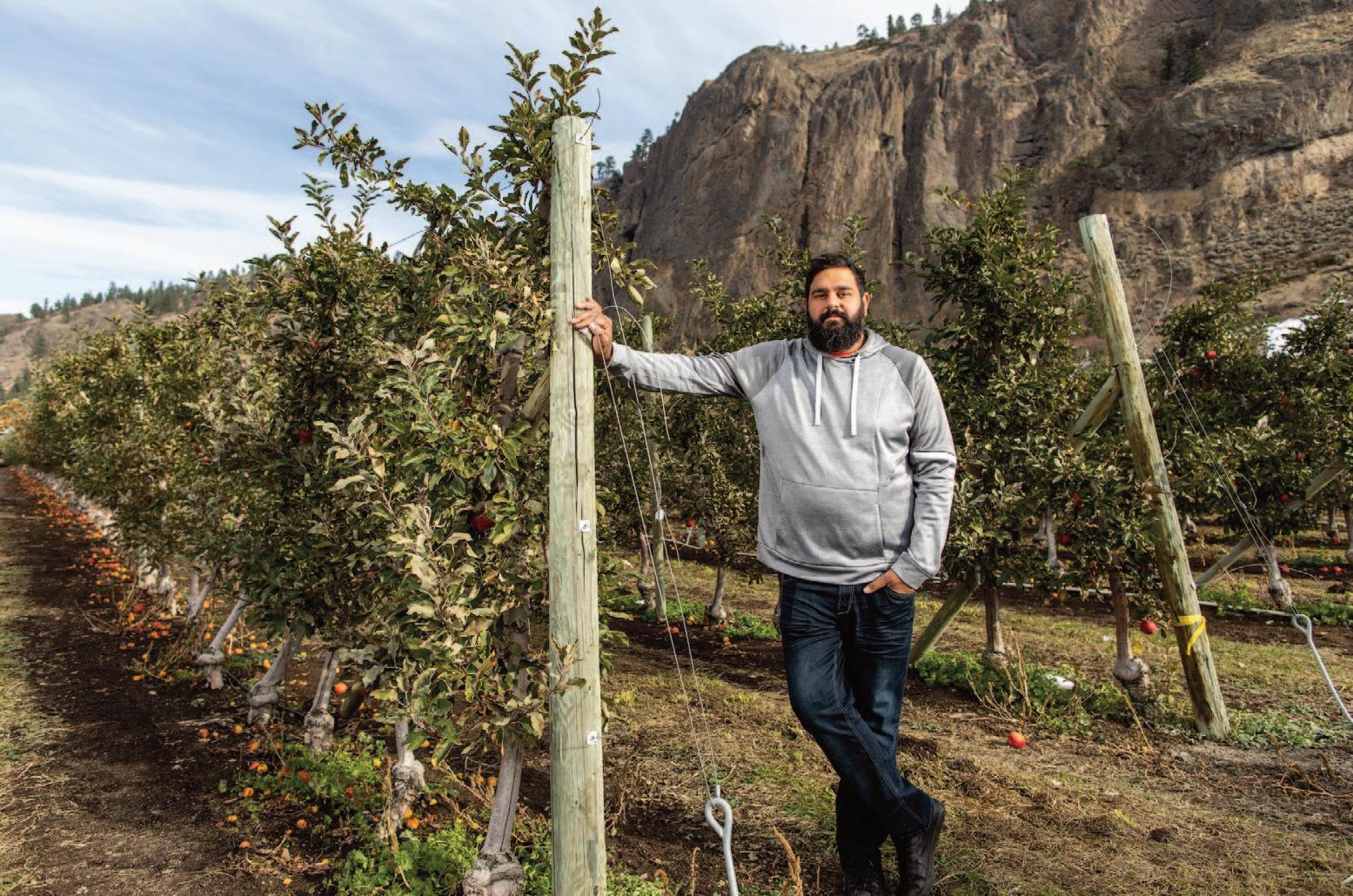
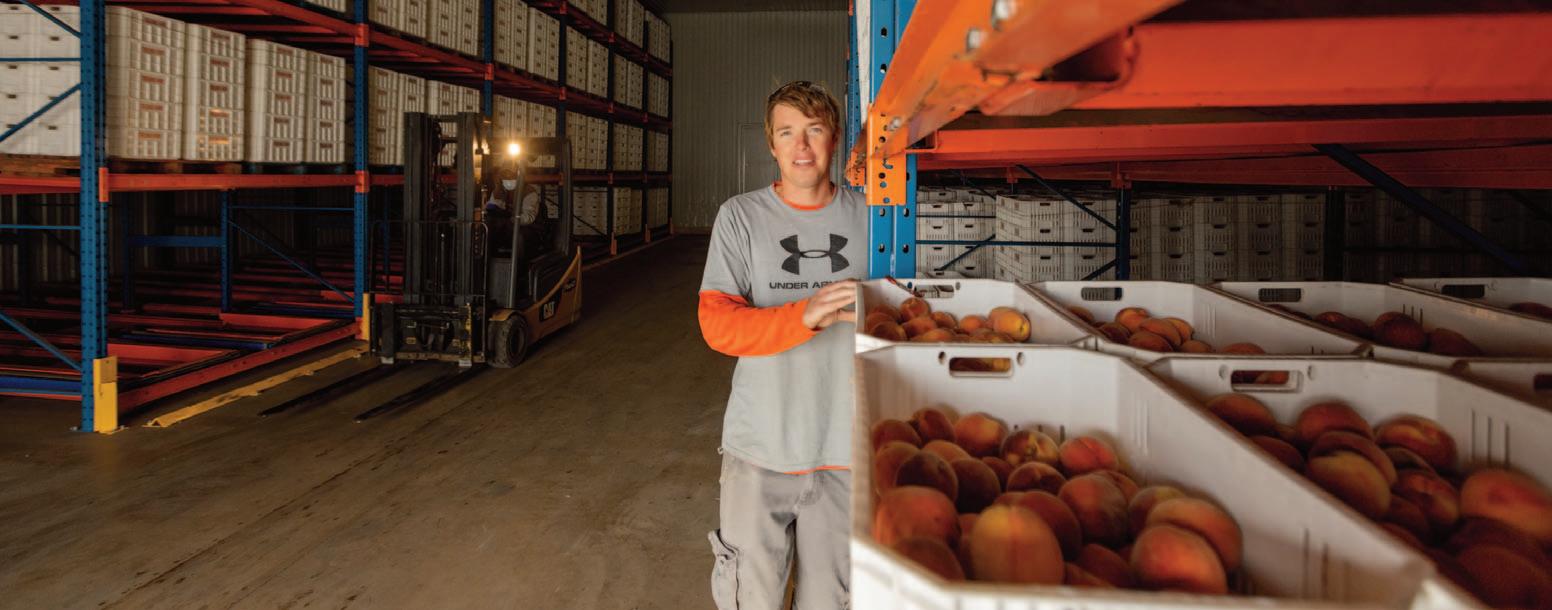
Sukhdeep Brar, a second-generation cherry, peach and apple grower, is learning another skill: standing up for his tree fruit industry in the face of climate change. Battered by several years of extreme weather, Brar is helping to rally the 180 members of the BC Fruit Growers’ Association as its vice-president. Their quest is for more financial assistance from the provincial government. This fall photo captures him in his Summerland BC apple orchard. Photo courtesy of Jeff Bassett.
AT PRESS TIME…
Waiting for Premier Ford’s mandate letter to new ministers
KAREN DAVIDSON
Rob Flack, a business owner in his previous life, is now the political head of Ontario’s Ministry of Agriculture, Food and Agribusiness (OMAFA). The MPP for Elgin-MiddlesexLondon hails from the heart of corn and soybean farming country. He was president and CEO of Masterfeeds when he left in 2022.
In a June 13th interview with The Grower, Hon. Flack says that the nomenclature change from the former Ontario Ministry of Agriculture, Food and Rural Affairs (OMAFRA) recognizes that the big business of exporting $25B in food products is the result of many small businesses.
“One out of every 10 jobs in Ontario is connected to agriculture,” says Flack. “Ontario has 15.5 million people, closing in on 16 million people. We had 800,000 people come to Ontario in 2022. The priority is to feed those people, house those people.”
His most recent posting was associate minister on the housing portfolio. Given that farmers have been prickly about land use in the Greenbelt and currently about potential development in Wilmot Township west of Kitchener, Hon. Flack will need to weigh conflicting needs.
“I will be advocating for balance on those needs, feeding
people, growing the processing sector.”
Rural affairs has been hived off to a separate stand-alone ministry, led by Lisa Thompson. She will be working closely with the ministry of municipal affairs and housing. Ministers will need to be nimble to interact with the ever-increasing numbers in cabinet, now 36, including a minister of red tape reduction.
Looking ahead, Rob Flack will be holding a roundtable on June 20 in Guelph to be briefed by stakeholders before he flies to Whitehorse, Yukon – the host for the federal-provincial-territorial agriculture ministers’ meeting on July 16-17.
From a horticultural perspective, the Ontario Fruit & Vegetable Growers’ Association would like to prioritize the labour file, plastics, grocery code of conduct, Pest Management Centre funding and strengthening effective business risk management programming during this time of historically high input costs and marketplace pressures.
CFIA seeks feedback on
Potato Wart Response Plan
The Canadian Food Inspection Agency (CFIA) recently launched a 60-day public consultation on a draft National Potato Wart Response Plan which proposes new measures to improve the processes the Agency uses to help contain, control, and prevent the spread of potato wart. This is the next step in its full
review of its approach for potato wart based on current science, international standards, and new technologies.
Proposed new measures would be applied to fields following the detection of potato wart and an investigation to restrict its potential spread. These measures include:
• the use of resistant potato varieties;
• increased soil analysis; and
• additional equipment cleanliness requirements.
The CFIA has continued to engage the Canadian Potato Council, the Prince Edward Island (PEI) Potato Board and the Province of PEI, and other industry stakeholders. The draft plan also incorporates recommendations from the International Advisory Panel on Potato Wart in PEI and input received during a consultation on three potato wart risk management documents earlier in 2024.
All feedback will be considered. Once the plan is finalized, a transition process for PEI growers impacted by potato wart will be developed to assist growers in moving from the current Potato Wart Domestic Long Term Management Plan to the new response plan. The final plan will apply to new detections of potato wart anywhere in Canada, other than Newfoundland and Labrador.
The CFIA welcomes input and questions on the draft plan until July 26, 2024.
https://shorturl.at/gNF95
NEWSMAKERS
Ontario’s premier Rob Ford shuffled his cabinet before the summer break, splitting the agriculture ministry into two. He has appointed Rob Flack to the ministry of agriculture, food and agribusiness (OMAFA). Lisa Thompson becomes minister of rural affairs. Flack, MPP (ElginMiddlesex-London) was formerly associate minister of housing. He has a farming background and currently raises Hereford cattle. He worked for Masterfeeds, beginning in 1979 as a sales trainee, where he rose in the ranks all the way to become president and CEO of the company in 1993. He retired from his role with Masterfeeds in 2022. MPP Thompson (Huron-Bruce) has served as agriculture minister since June 2021.
In the same news conference, it was announced that MPP Trevor Jones (Chatham-Kent-Leamington), currently associate minister of agriculture, food and rural affairs will become associate minister of emergency preparedness.
The University of Guelph has appointed Dr. Rene Van Acker to the role of vice-president, research and innovation for a five-year term. Growing up on a farm near Burford, Ont., Van Acker studied at the University of Guelph for his bachelor and master of science in crop science and weed science, respectively, before earning a PhD in crop weed ecology from the University of Reading in the U.K. He became a professor at the University of Manitoba, returning to University of Guelph in 2006. He has since gained 18 years of experience within the Ontario Agricultural College as department chair, associate dean and most recently as dean.
The Canadian Produce Marketing Association has announced that George Pitsikoulis will be the 2024-2025 chair. Pitsikoulis brings to this role comprehensive knowledge and experience having worked in the industry for more than four decades. Currently president and CEO of Canadawide Fruit Wholesalers Inc., a role he has held since the early 2000s, he is also deeply involved in the produce industry and community initiatives. He has served on several boards including the Fruit and Vegetable Dispute Resolution Corporation, the Québec Produce Marketing Association, and CPMA where he is still a member of its Executive, Marketing and Food Safety Committees.
Lawrence Hanson was appointed federal deputy minister of Agriculture and Agri-Food on June 3, 2024. He was promoted from the role of associate deputy minister of environment and climate change.
Best wishes to Katie Goldenhar who is now based in Kelowna, BC as the province’s plant pathologist. Most recently, she has been Ontario’s pathologist for horticulture.
Congratulations to Ryland and Lyndon Nakamura, Nakamura Farms, Taber, Alberta, recognized by Hostess-Frito Lay with the North American Grower of the Year award. It’s only the second time that this prestigious award has gone to a Canadian operation.
The Ontario Produce Marketing Association (OPMA) has appointed Amanda Knauff (Taylor Farms) to serve one year as its new board chair. Dan Tukendorf (Ontario Fruit and Vegetable Growers’ Association) will serve as vice chair; Steve Moffatt (North American Produce Buyers) as treasurer, and Adam Donikian (Sobeys Ontario) as past-chair.
The new directors joining the OPMA’s 2024 Board for three-year terms are Eric Biddiscombe from Algoma Orchards, Greg Ogiba from Mike and Mike’s and Frank Spagnuolo from the Burnac Produce Group. The OPMA Board thanks departing directors -Matt Quiring from Nature Fresh Farms and Marc Wall from Sandy Shore Farms -- for volunteering their time toward the industry and the association.
Rob Flack
Fruitless in the Okanagan
Continued from page 1
Janzen underscores the fact that Canada is one of the few democratic countries in the world that holds the potential to meaningfully increase its agricultural output. In relative terms, there’s a lot of arable land, fresh water and energy. If appropriate pro-agriculture government policies were in place to harness these natural assets, there would be economic and societal benefits to all Canadians.
Against this backdrop, there are common threads between the “stand up” movement in Canada and European protests, with farmers demonstrating from Brussels to Barcelona. But reading below the bylines, the driving forces are very different. In the European Union’s capital, farmers have railed against the Green Deal’s objective of being climate-neutral by 2050. Spanish farmers, for their part, have demanded increased irrigation resources from the Department of Climate Action. And in Poland, farmers are protesting the unintended consequences of grains pouring over their borders from Ukraine because the Russian war has blocked Ukraine’s historical Middle Eastern and African markets.
It would be naive to believe that climate policy, in and of itself, is responsible for
widespread uprising. What is common though is that farmers no longer give a hoot if their actions offend government. They are demanding respect for their heroic efforts to produce food, and to be fairly paid.
None of this surprises Tyler McCann, managing director, Canadian Agrifood Policy Institute (CAPI). In a May 2024 survey of 550 leaders in the agriculture and food sector, the existing policy and regulatory environment is identified as the number one risk by farmers and the rest of the value chain.
“These results speak to the frustration with governments, expectations not met and the lack of meaningful support,” says McCann.
The demographics underscore the resentment. The World Bank estimates that only six million (15%) of Canada’s 41 million population lives in rural areas. Federally, the Liberals have not understood rural Canada, failing to connect the dots between climate policy and food security. On the other side of the aisle, Conservatives have taken the rural vote for granted. And the public service lags at developing the capacity to really understand rural Canada, the resource backbone of the country.
“Sustainability,” says McCann, “is understood very differently by urban and rural Canada. And in turn, the policy risks
are amplified.” These are weighty statements given that CAPI is 65 per cent funded by federal government grants.
Several Canadian organizations, funded by a combination of government, private and philanthropy money, are tasked with raising agricultural awareness. Examples range from the Canadian Centre for Food Integrity to the University of Guelph’s Arrell Institute to (Ontario’s) Farm & Food Care. Given the monumental job at hand, all are under-resourced to effectively tell the story. More often than not, Canadians are better acquainted with the back stories of their sports heroes than the origins of their takeout food.
Turning to the elections currently playing out in Europe, and those on the horizon in Canada and the U.S., McCann forecasts a couple of rough years ahead with geopolitical turmoil adding to the pressures farmers are facing.
“In the Canadian context, there’s little we can do to restore global stability,” he says. “What we can do is protect more value domestically and strengthen our value chains. We need to have our own house in order.”
This requires policies that are more cohesive in terms of soil health, water management, and land use, while taking into account the impacts of ongoing climate change. Sound like a Rubik’s cube? Sukdeep Brar thinks so.
“My Punjabi cousins come here from the Lower Mainland, and they don’t know what a peach looks like on the tree. This is education I need to explain with my own family – how it all fits together.”
The Grower is “Digging Deeper” with Marcus Janzen, a greenhouse grower near Abbotsford, BC and president of the Fruit and Vegetable Growers of Canada. He comments on the effects of four years of extreme weather events in British Columbia’s Okanagan Valley and the broader consequences of climate policy on all Canadian farmers. This podcast is sponsored by Cohort Wholesale.
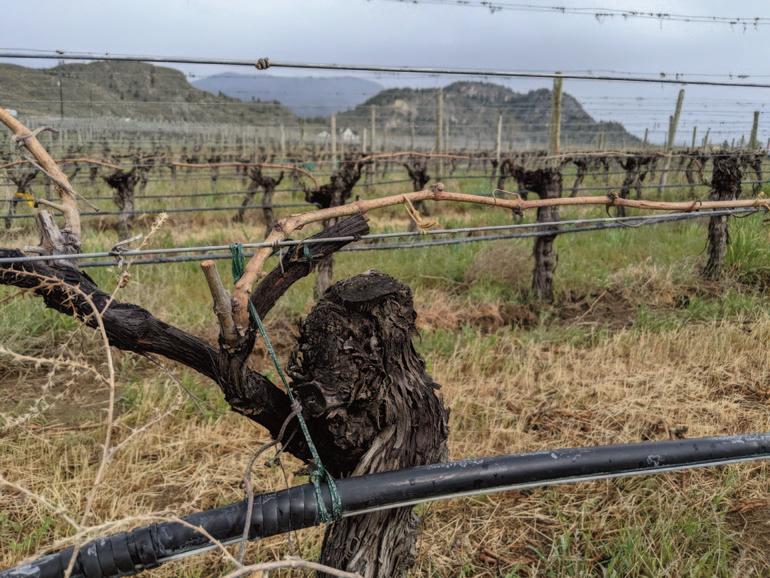
Grape vineyards suffered equally devastating effects with primary and secondary buds showing no signs of life in this April 27, 2024 photo taken south of Oliver, BC.
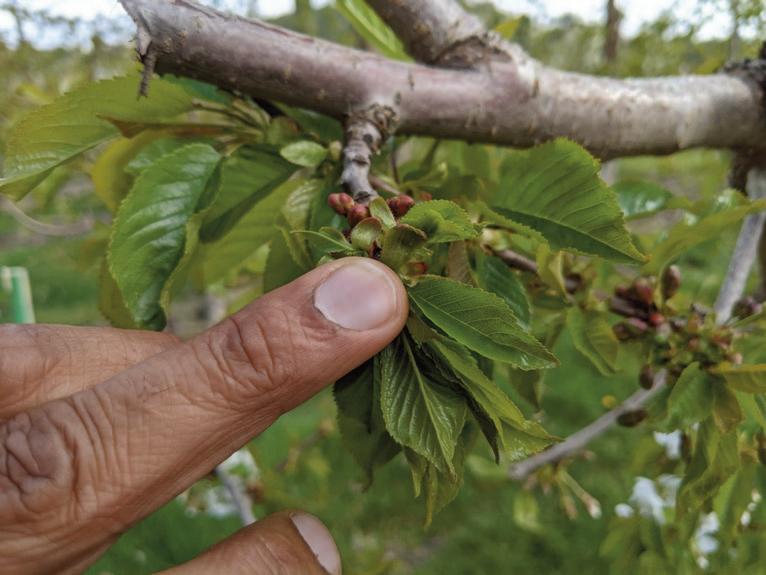
These buds are showing effects of the January deep freeze event of -30°C in Kelowna, BC that decimated a large portion of the Okanagan’s sweet cherry crop in spring 2024.
BC Premier David Eby did not speak at the rally, but met with farmers on the sidelines. Photo courtesy of Don Urquhart, Osoyoos-Oliver Times Chronicle.
British Columbia’s tree fruit farmers rolled into Osoyoos in a tractor parade in late spring to raise awareness for the agricultural sector. In a strategic confluence of events, BC premier David Eby was holding a retreat in the picturesque town. The messaging was pro-agriculture, not anti-government. Photo by Gail Nelson
CROSS COUNTRY DIGEST
BRITISH COLUMBIA
New report tracks BC tree fruit industry including maturity equivalence
The BC Ministry of Agriculture and Food has released a report that looks at trends in the tree fruit acreage in five regions across B.C.: North, Central, and South Okanagan, Similkameen, and Creston
NEWFOUNDLAND
Stone
Valley. The primary tree fruit grown in these regions are apple and cherries, with nearly 6,300 acres of apples and 5,100 of cherries. The vast majority (80.2%) of B.C.’s tree fruits are produced in the three Okanagan
regions with 27 per cent of tree fruit acreage in the Central Okanagan, 26.6 per cent in the North Okanagan, and 26.6 per cent in the South Okanagan.
Currently, there are approximately 6,300 acres of fresh eating apples produced in these five regions. Over the past 10 years, apple acreage increased until 2017 when it peaked and started to decline. By 2021, apple acreage was roughly equivalent to what it was in 2011. Apple acreage is highest in the Central and North Okanagan regions. However, while apple acreage is increasing in the North Okanagan, it is decreasing in the Central Okanagan region.
Cherry acreage has been increasing rapidly and steadily in the province over the last 10 years. In 2021, there were just over 5,100 acres of cherries. Like apples, the majority (88%) of the cherry acreage is in the three Okanagan regions, with 1,700 acres in the North, 1,350 in the Central, and 1,450 in the South
Okanagan regions. Cherry acreage is showing consistent growth in the North and Central Okanagan. These regions have shown an average yearover-year (YOY) growth of 11 per cent and 14 per cent respectively. The South Okanagan region has shown a much smaller, but still increasing growth rate, with an average YOY growth of 3.5 per cent.
This report also briefly examines the acreage of wine grapes in the province. Of the regions showing significant decreases in apple acreage, only the South Okanagan showed any significant increases in wine grape acreage during this period.
Interestingly, in the South Okanagan, decreases in the apple acreage started before any increases in wine grape growing. This suggests that the decrease in apple acreage may be independent of the increase in wine grape acreage in that region.
A useful section of this report addresses maturity equivalence.
burier assists in bed preparation for root crops
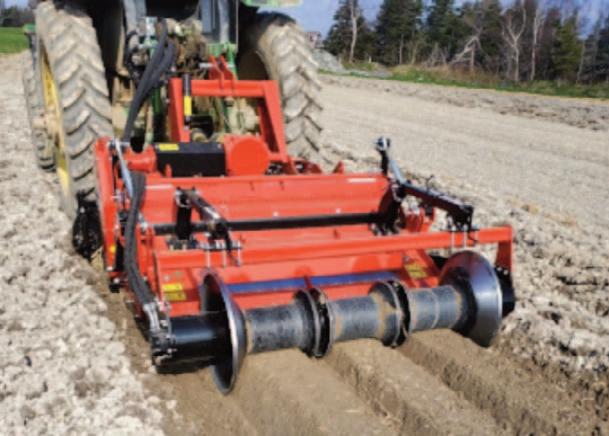
The stone burier and bed shaper separates the stones from soil, placing stones approximately 12 inches at the base of the seed bed while shaping one to four soil beds of varying sizes depending on the needs of the farmer and crop.
UNB’s
The presence of stones and boulders in Newfoundland soils makes growing horticultural crops a challenge for farmers, particularly for growing root crops such as carrots, parsnips, garlic, potatoes, and others. The stones are impenetrable to roots and bulbs, reducing yields and causing irregular-shaped crops or blemishes that reduce their marketability and storage quality.
St. John’s farmer Chris Lester approached Agriculture and Agri-Food Canada (AAFC) knowledge transfer coordinator, Peter Murphy, and agronomy technician, Wayne Molloy, about studying an intriguing solution to eliminating rocky fields – a stone burier and bed shaper reverse rotary tiller. The stone burier and
bed shaper equipment can attach to a traditional 150 horsepower or higher farm tractor. Its reverse rotary tiller separates the stones and soil, placing stones at the base of the seed bed about 12 inches below the soil surface while shaping one to four soil beds of varying sizes depending on the needs of the farmer and crop being grown. This allows the nutrient-rich soil to remain on the surface of the field, giving crop roots more room to expand.
The AAFC St. John’s Research and Development Centre purchased a stone burier and bed shaper in 2021 to begin studying the potential benefits of its use on Newfoundland soils as well as to provide demonstrations to local farmers wanting to see it
It takes several years for fruit trees to start producing fruit, and even more time to reach full maturity and production. For example, apple trees take, on average, eight seasons to fully mature. If trees are planted in 2020, they will not start to produce apples until 2022 and even then, they will only produce approximately 40 per cent of what they will produce by 2027. Before a crop reaches full maturity, the fruit output is measured as a percentage of the total potential yield; this measure is called the maturity equivalence. These are standardized across different varieties. For more detail, link here:
in action. Peter and Wayne tested the equipment on carrots and parsnips planted in one metre plots over the 2022 and 2023 field seasons.
“The yields were 30 per cent higher or more with the stone burier and bed shaper equipment than with conventional tillage. The quality and length of the carrots and parsnips were better – they were straighter and more marketable, with less damage for longer term storage,” says Peter. Learn more: AAFC researchers find stone burier and bed shaper equipment to be a rock-solid investment for Newfoundland farmers
Source: Agriculture and Agri-Food Canada
McKenna Institute announces $3.75M investment in digital agriculture
The McKenna Institute at the University of New Brunswick (UNB) has announced a $3.75 million investment from a partnership led by McCain Foods and other New Brunswick institutions that will change digital agriculture, progress regenerative farming practices and minimize the impact of climate change on farmland.
Over the next five years, McCain Foods is committing $2.76 million to create a project that imitates farming with regenerative agriculture practices, with the goal of increasing the uptake of more sustainable potato farming, globally. This digital model will act as a simulation for farmers, showcasing the environmental
and business impacts of regenerative agriculture. This investment aligns with McCain Foods’ commitment to implement regenerative agriculture across 100 percent of its global potato acreage by 2030.
“This investment will go a long way in supporting the future of New Brunswick’s agricultural landscape,” said Hon. Frank McKenna, founder of the McKenna Institute at UNB. “In this exciting partnership with McCain Foods, we look forward to enhancing research and innovation in the field of digital agriculture while exploring sustainable practices through digital solutions.”
Adding to McCain Foods’ substantial contribution, ResearchNB, the
Government of New Brunswick’s Department of Agriculture, Aquaculture & Fisheries, and the McKenna Institute are collectively contributing an additional $990,000.
This investment will enhance agricultural research at UNB by creating a “digital twin” of McCain’s Farm of the Future in Florenceville, NB. This commercial-scale research farm demonstrates sustainable farming practices, producing positive results on crop yield and quality while prioritizing soil health, water use, biodiversity and climate resilience. Work at the Farm of the Future will reduce the carbon emissions associated with farming while bolstering the resiliency and produc-
tivity of the farm.
“A key part of our effort to promote smart and sustainable farming is leveraging technology solutions to help us redefine the way we grow a potato,” says Max Koeune, President & CEO of McCain Foods. “This cutting-edge digital farm model will help potato farmers worldwide adopt practices that help regenerate soils, improve water management and biodiversity, and ensure a resilient farming operation.”
A Chair in Digital Agriculture at UNB will be established with $1.5 million of the contribution. The chair will oversee research initiatives that may include digital agriculture, crop simulation modeling, and Geographic Information Systems.
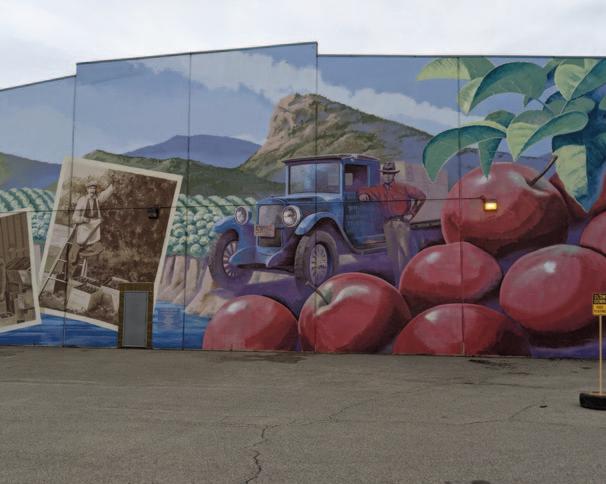
The history of the apple industry is celebrated in mural art in Summerland, British Columbia.
CROSS COUNTRY DIGEST
PEI potato growers welcome Filipino tour
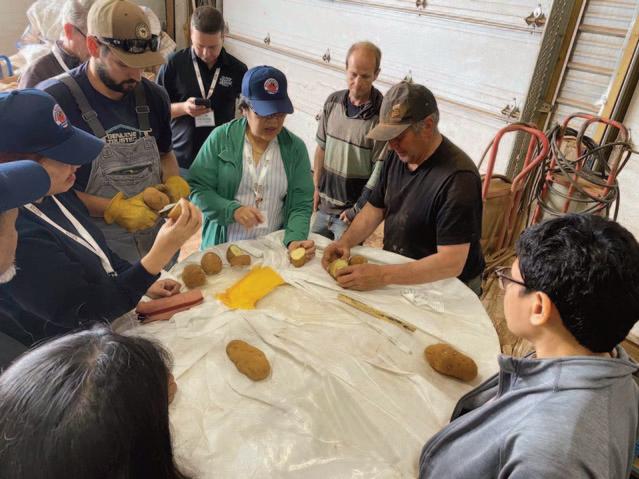
The PEI Potato Board recently welcomed a 15-member delegation from the Philippines, composed of farmers from the United Potato Producers of Benguet and Mountain Province (UPPBMP), senior executives from private industry, and the Undersecretary of the High Value Crops from Department of Agriculture. The group is on PEI with the goals of knowledge transfer, to continue working on a partnership formed several years ago and highlight fresh potatoes for processing and Island seed potatoes.
This relationship between The Philippines and the Prince Edward Island Potato Board was formed following a productive mission in 2019 which also saw farmers, a food processing companies, and the Philippine Department of Agriculture officials visit PEI to learn about our potato farming practices and our seed certification program. That mission resulted in a very successful program of seed sales to the Philippines.
The delegation is on PEI from June 9 to 15 and has a full schedule to tour potato farms, meet with agriculture businesses, meet with senior government officials and potentially source agricultural products produced in PEI. Most of the delegation are farmers as well as members of the largest potato farmers’ cooperative in the Philippines,
QUÉBEC
Group Export receives funds
To support Canadian agri-food companies in reaching foreign markets, Francis Drouin, Parliamentary Secretary to the Minister of Agriculture and AgriFood, has announced up to $5.5 million over three years to Group Export Agri-Food QuébecCanada through the AgriMarketing Program.
This investment will allow Group Export to provide support to companies entering a foreign market for the first time as well as those currently trading in foreign markets. The objectives of the project activities are to enable Canadian companies to promote their agri-food products abroad, to secure concrete sales and contracts in their target markets, and to increase the value of international agri-food exports in all categories of agri-food products.
Group Export’s project activities include facilitating business meetings, supporting attendance at trade shows, providing technical training, and organizing trade missions.
and are keen to expand their potato knowledge, understand ways to increase potato production, and learn about upand-coming ways to mitigate the effects of climate change.
“We wholeheartedly welcome the Filipino delegation to PEI once again,” says Donald Stavert, chair of the PEI Potato Board Seed Committee. “We take pride in the way we farm and produce potatoes and are encouraged to see interest in doing business together and to grow our seed
business relationship.”
This mission is also taking place during the 75th year of diplomatic relations between Canada and the Philippines. The Philippines is Canada’s second largest agri-food and seafood export market in the ASEAN and is increasingly positioning itself as a hub in the region.
Source: PEI Potato Board June 14, 2024 news release
PRINCE EDWARD ISLAND
GREENHOUSE GROWER
Mucci Farms expands westward with 32-acre greenhouse in California
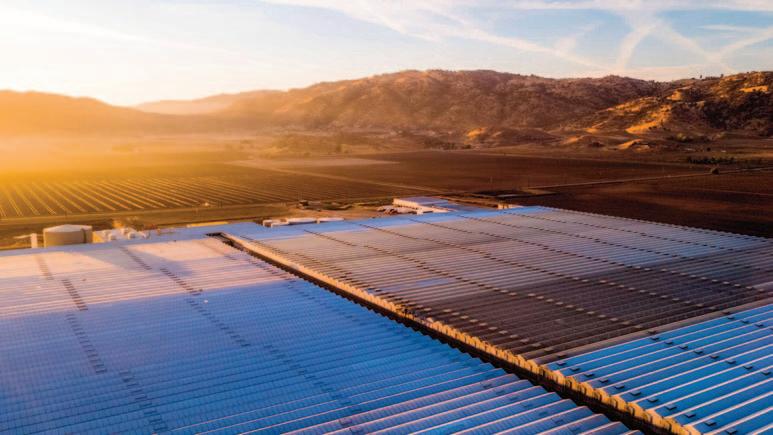
Mucci Farms continues to expand with the addition of a 32-acre greenhouse in Tehachapi, California. According to a June 4 news release, this move marks another step in Mucci Farms’ strategy to
enhance production capabilities and ensure accessibility to fresh produce across North America. In partnership with Cox Farms, a business entity of Cox Enterprises focused on greenhouse grown food and
agriculture, Mucci Farms is scaling operations to meet the growing demand for its products on the West Coast.
“Our focus has always been about expanding access and providing additional support and resources to our retail partners across the continent,” said Bert Mucci, CEO of Mucci Farms. “Our goal is to continue to scale operations to offer partners a national supply of greenhouse grown fruits and vegetables.”
“Cox Farms is committed to helping families access locally grown fruits and vegetables,” said Steve Bradley, president of Cox Farms. “Together with Mucci Farms, we aim to drive positive change in the industry while delivering on our promise of quality and environmental responsibility.”
This latest expansion into south-central California follows Mucci Farms’ successful entry into the region with its Camarillo
New varieties and innovative technologies shown at Bayer Tomato Demo House
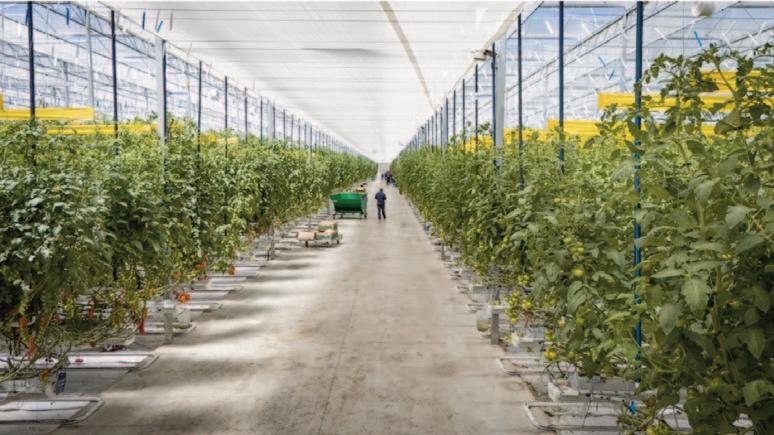
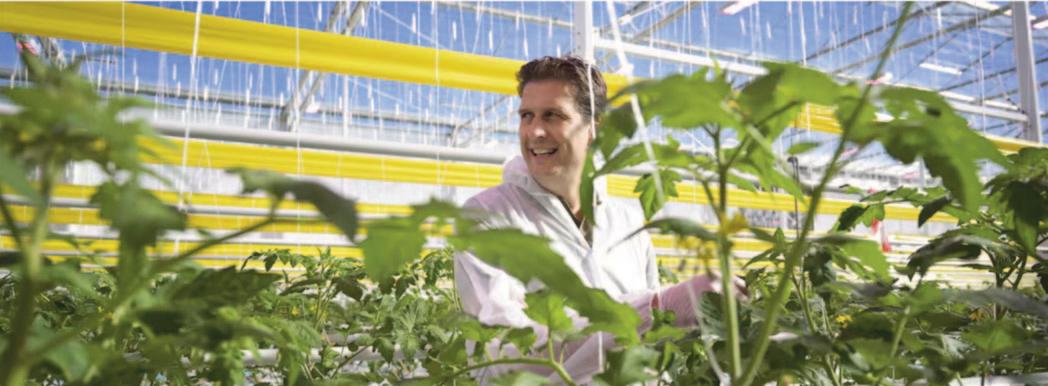
In late May 2024, Vegetables by Bayer opened the doors to its De Ruiter brand Tomato Demo House at Ridge Farms in Kingsville, Ontario. Growers, customers and buyers were invited to tour the facility and learn more about innovative seed technology that they could see, feel and taste. The week-long customer appreciation event was the perfect time to view varieties in action, as this is when the crop starts producing at the beginning of the season.
While touring the trials in the Demo House, attendees experienced the latest options in tomato varieties and toured examples of the latest innovation and sustainability in glasshouse production. Experts from Vegetables by Bayer’s De Ruiter brand were available to answer
questions about tomato varieties and ongoing trials. Additionally, an area was set up for tasting and sampling.
De Ruiter is excited about the prospects in their tomato pipeline. One particularly noteworthy addition is a cherry plum loose (grape) tomato hybrid that will deliver a great and flavourful experience to the industry, with anticipated Intermediate ToBRFV resistance*. This variety is currently slated to be commercially available starting in fall 2024. Growers attending the Demo House event had the opportunity to learn more about this new variety and look at the trial data from this year’s growing season. Additionally, growers could see how this variety was performing on the vine and were able to taste the excellent flavour it will offer
GreenTech awards in Amsterdam
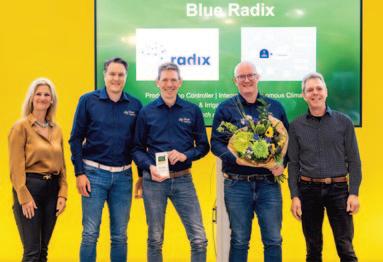
Congratulations to Koppert and Blue Radix who won top honours at the GreenTech Innovation and Concept Awards held in Amsterdam from June 11-13, 2024. Koppert won the Concept Award for Koppert’s Digital Assistant. Blue Radix won the Innovation Award for Integrated Autonomous Climate & Irrigation Control. Ronald Hoek, CEO, Blue Radix.
“Designed for the modern grower, Koppert’s Digital Assistant will be accessible via both text and speech on mobile and desktop devices, ensuring convenience of use,
regardless of the user’s location and preferred communication method,” said Koppert digital transformation manager, Gabriël van der Kruijk.
“Blue Radix has introduced a new component in Crop Controller: Strategy Optimizer. The goal is to help the grower focus on the crop cycle strategy and the cultivation process. Now, the day-to-day AIdriven, autonomous climate control will be even more aligned with the grower’s goals and targets,” Ronald Hoek, CEO and co-founder.
facility in 2021. The company’s presence now extends across key locations in the United States and Canada, including its U.S. headquarters in Huron, Ohio, which features a 72-acre greenhouse. It also has distribution hubs in San Antonio, Texas and Romulus, Michigan. Additionally, on the West Coast, Mucci Farms operates facilities in Camarillo, California, and Delta, British Columbia.
Mucci Farms remains steadfast in its mission to minimize food miles and champion environmentally conscious practices. Through strategic partnerships and investments in regional production facilities, the company continues to pave the way for a more resilient food system.
Source: Mucci Farms June 4, 2023 news release
consumers once it is in the market.
De Ruiter Seeds is committed to research and development, leveraging its expertise and deep understanding of consumer preferences at every stage of the development pipeline. The De Ruiter tomato portfolio offers 74 varieties for the glasshouse market in North America. The company’s goal is to deliver a high-quality product that meets the market’s current demands by working with growers to maximize essential agronomic traits that can help ensure a bountiful harvest.
“De Ruiter is committed to developing and producing high-quality seeds that fit the specific regional market, which have traits such as the taste, appearance and productivity our customers need for their businesses,” said Nicholas Guthrie, protected culture and processor customer marketing manager for Vegetables by Bayer. “The Demo House is open yearround for growers to directly experience the new varieties, commercial and pre-commercial, that De Ruiter offers. The main focus of our portfolio is to provide varieties that can further the success of our customers.”
The Demo House is hosted in an environment that employs the latest growing technologies to help produce a quality product for its customers and consumers. Ridge Farms uses specialized methods and techniques to help increase productivity and crop yields in their greenhouse while keeping sustainability in mind.
“The innovation used at Ridge Farms is impressive. It’s a natural collaboration, as their commitment to innovation demonstrates the same commitment De Ruiter has, to help ensure safe, reliable food is available to the consumer in an environmentally sustainable manner,” said Guthrie.
For more information about the Demo House or to schedule an appointment, go to https://www.vegetables.bayer.com/us/enus/resources/news/visit-our-new-tomatodemo-house1.html.
*HR = High Resistance. IR = Intermediate Resistance. To find out more about disease resistance and the applicable levels of disease resistance, visit www.worldseed.org, and view the “Definition of the Terms Describing the Reaction of Plants to Pests for the Vegetable Industry” paper in the Vegetable Resources section.
*Anticipated Disease Resistance (based on preliminary observations from trial results and/or observance of parent line resistance. Pending further data to confirm disease resistances for commercial product).
*Anticipated commercialization Fall of 2024. Experimental/precommercial varieties are being shown/described for demonstration purposes only and are not being offered for sale.
Koppert
Blue Radix
GREENHOUSE GROWER
Energy transition in Dutch horticulture not finished
The Dutch horticulture sector is experiencing robust financial development, according to researchers at Rabobank. However, there are concerns too. In the greenhouse horticulture sector, they are particularly concerned about the sector’s energy transition. Businesses cite grid congestion (an insufficient available capacity on the electricity grid) as the most pressing issue. In open field cultivation, transitioning to cultivation with minimal or no use of chemical crop protection is the biggest challenge, as revealed in a sector update.
No update is complete without a barometer reading. The Rabo Horticulture Barometer still rates the financial development of the sector as more than satisfactory. Researchers state that the pricing of most products is sufficient for profitable operations. When it comes to tomatoes, the pricing for specialties is slightly less favourable than for standard cluster tomatoes. For cucumbers, the economic results of the first cultivation are somewhat less than last year. According to the bank researchers, the financial results in food horticulture often closely correlate with energy management. Increases in the costs of energy, labour, and fertilizers are now leveling off.
In the public debate on energy, water, crop protection, and labour, the interconnectedness of the horticulture complex as a whole is hardly discussed, the bank’s researchers note. Lambert van Hooren and Arne Bac argue: “To be able to test their innovations in practice, the presence of primary production is crucial for developers of new varieties and technologies. Moreover, primary production is vital for the trade companies in vegetables, fruits, or flowers and plants. They combine the products of Dutch growers with imports from foreign colleagues, primarily for consumers in the European Union and the United Kingdom. This creates a complete assortment for supermarkets, specialized trade, or food service.”
The energy transition in horticulture is not finished
Greenhouse horticulture is aiming for climate-neutral cultivation by 2040. Stakeholders indicate this is possible if certain prerequisites are met. Now, greenhouse horticulture is being adjusted to accelerate the increase in CO2-emissions-levy-payments. Also, geothermal projects are experiencing delays due to lengthy procedures and updated regulations. For this reason, Rabobank conducted a survey among greenhouse growers to assess the state of the energy transition.
This survey reveals that in the past three years, greenhouse horticulture businesses have primarily invested in (additional) screening installations, LED lighting, geothermal connections, and solar panels. Nearly half of the businesses report achieving or expecting to achieve more than 20 per cent energy savings with these measures. Reasons for not investing in energy-saving measures vary greatly. Some businesses have favourable energy contracts, some can achieve sufficient savings with cultivation measures, or some are waiting for opportunities to connect to regional, area-specific initiatives.
Investments are also expected in the next three years, often including dehumidification as part of the investment
5% more attendees at GreenTech Amsterdam 2024
GreenTech Amsterdam was the epicenter of the horticulture industry from June 11-13 at RAI Amsterdam. Despite the challenges facing the industry, innovation continues to thrive, with numerous high-tech examples such as picking robots, automated sorting machines, and drones showcased on the show floor. The event saw a remarkable growth of 5% in visitor numbers compared to
2023, attracting more than 12,200 attendees. A total of 119 countries attended the trade show. The top five countries represented were the Netherlands, Germany, South Korea, United Kingdom and Canada.
Mariska Dreschler, director horticultureGreenTech Global said: “The horticulture industry is experiencing a mix of challenges and opportunities. The positive energy on
in (additional) screens and the introduction of The New Cultivation methods. Other investments that growers are interested in include heat pumps, electric batteries, and electric boilers. Especially with an investment in a heat pump, an electric battery seems indispensable, providing more buffering capacity for cost-effective use of the heat pump.
In the longer term, there is an interest in investments that are currently being researched. Sometimes these are investments with a long procedure time, such as those for wind turbines. The reasons for entrepreneurs to focus on saving energy vary, including cost savings, subsidy policies, customer demands, or regulations. However, there are also obstacles. Grid congestion is the main reason for not investing.
“When we combine the results of this survey with recent reports on the challenges in developing geothermal energy, we see that the goal of making Dutch greenhouse horticulture climate-neutral by 2040 still requires efforts from the sector and all stakeholders involved,” the researchers write. “This is not an easy task.”
Source: Rabobank May 23, 2024 report
the show floor was visible, with numerous new products launched. We received a record of 47 entries for the Innovation & Concept Awards. Striking was that more than 45 country official delegations attended to witness the latest developments and gain insights into current trends. Key discussion topics included AI, data, labour solutions, LED technology, and water/energy
efficiency. The booths of our 510 exhibitors from 40 countries showcased a wealth of machinery, robots, drones, and more. As GreenTech we are very proud to be the worldwide platform part of the industry where everything comes together and new insights are born.”
New federal plastics rules create more problems than they solve
In fall of 2020, the federal government launched the first phase of its plan to reduce waste by announcing its single use plastics ban. This ban targeted items such as plastic grocery bags, cutlery, stir sticks, ring carriers for beverage cans and flexible straws sold with beverage containers.
There was little if any impact to the fruit and vegetable industry in this initial round; the same cannot be said, however, for the second phase unveiled by the federal government in 2023.
Most prominent is the government’s pollution prevention plan notice which would set requirements for large grocery retailers to prepare and implement plans with an aim towards zero plastic waste from primary food packaging. Specific targets include selling at least 75 per cent of fresh fruits and vegetables in bulk or plastic-free packaging by 2026 and at least 95 per cent by 2028.
The government also proposed regulation to ban non-compostable PLU stickers, which will be phased in as voluntary by 2028 and mandatory by 2030 and is preparing a group two list of single-use plastic items that will also be banned.
Although all of these actions are currently on hold while the government appeals last November’s Federal Court decision that declared its labelling of all plastic manufactured items as toxic as both unreasonable and unconstitutional, that doesn’t mean the industry isn’t taking action.
The Ontario Fruit and Vegetable Growers’ Association (OFVGA) is working closely with Fruit and Vegetable Growers of Canada (FVGC) and the Canadian Produce Marketing Association (CPMA) to make
government aware of the serious concerns and challenges this raises for fruit and vegetable growers, the produce supply chain, the environment and Canadians from coast to coast to coast.
Food affordability and availability: In many cases, practical, workable alternatives to plastic packaging do not yet exist or are not affordable options. As well, bulk sales are not feasible for many types of fruits or vegetables due to their delicate nature and how quickly they can spoil, which will make it more complicated and more expensive for homegrown fruits and vegetables to reach consumers.
This means these new rules will have negative impacts on food availability and affordability, particularly in rural and remote regions where food is already expensive and food availability is often a critical issue. Canadians are already struggling with the lingering effects of high inflation and research by Deloitte shows
WEATHER VANE
this will only exacerbate the situation by increasing the cost of fresh produce by 34 per cent over current levels.
It is also estimated these new regulations will reduce fresh produce availability for Canadians by more than 50 per cent, and in their current form, will result in a near total elimination of value-added produce products -- bagged salads, for example – reducing market value by approximately $5.6 billion according to a study by Deloitte.
Food waste and climate change: plastic packaging is used to protect produce from harvest to home – think delicate berries –and to extend shelf life. Various studies show that reducing or eliminating this packaging will increase food waste by more than 50 per cent while also increasing the production and release of greenhouse gases by the produce supply chain by more than 50 per cent.
Food safety and health care:
There will also be an increased risk of food safety incidents and food-borne illness, and overall, these actions are expected to come with increased health care costs of more than $1 billion a year as Canadians reduce their fresh produce consumption.
Market research shows two-thirds of Canadians are concerned about the potential price consequences for fresh fruits and vegetables from these actions.
Simply put, fresh produce packaging is not a luxury; it’s critical to the sustainability of the global produce supply chain. And with hundreds of different crops, the fruit and vegetable industry needs a portfolio of sustainable packaging solutions – after all, what works for apples or peppers, doesn’t work for berries or lettuce, for example.
The industry has long been working on adopting more sustainable solutions, such as recyclable or compostable packaging. However, Canada’s recycling infrastructure is patchy
at best, differing between provinces and even municipalities, and isn’t well equipped to handle food-grade materials.
Work is also underway on developing biodegradable plastics and other innovative packaging options, but progress takes time and new solutions must be both practical and price competitive in order be adopted.
There are ways other than blanket bans that the government can use to encourage pollution reduction and make a positive difference for the environment. OFVGA will continue to work with FVGC and CPMA on this important file - zero plastic waste does not have to mean zero plastic use.
Jan VanderHout is a greenhouse vegetable grower in Waterdown and chair of the Environment and Conservation Committee, Ontario Fruit and Vegetable Growers’ Association.
“He is a fast and efficient harvester with skills in a variety of tasks,” says Christine Klyn-Hesselink. “In addition to his work harvesting berries and corn, Alberto has been a great help in constructing a variety of trellis systems. He is skilled with tools and equipment. Alberto is a
member of our team!” Photo by Christine Klyn-Hesselink.
Alberto Olivera Ortiz has been coming from Mexico to work in Canada under the Temporary Foreign Worker program for about 20 years. Half of that time has been at Fenwick Berry Farms, Fenwick, Ontario.
JAN VANDERHOUT
URBAN
Growers are anxious to spray with drones, but…
With increasingly fierce competition from nearly all corners of the planet, Canadian growers are anxious to have access to new technology. After all, technology uptake has long been one of their defining characteristics, and helps them compete against growers who enjoy larger economies of scale.
But while technology access is usually a solution, it’s also a problem when it comes to spraying pesticides -- including fungicides and herbicides -- with drones, other than for very limited applications for mosquito control.
Federal regulatory bodies are plodding along, working to
develop legislation that will permit drones’ use for crop pest and disease control. Currently, in Canada, drones piloted by licensed operators are approved only for uses such as micronutrient applications in field crops. The user must be onsite.
Why so cautious?
Well, even experts say a drone’s footprint is still not fully understood. Burgessville, Ontario’s Paul Van den Borre, who uses 10-litre drones for trial micronutrient applications as part of his sales function with Eco+, says drift can be a real problem.
“I’ve seen airplanes and helicopters spray, and they are pretty good at hitting the target,” he says. “From my experience, with drones it doesn’t take much of a wind to move your pattern and change what your drone’s trying to do. I have tools on my [conventional] sprayer that allow me to spray on windy days, but those tools aren’t there yet for drones.”
Health Canada, through the Pest Management Regulatory Agency (PMRA), reviews applications from chemical companies about specific products and how and where they can be used.
Drone information on Health Canda’s website, current as of June 2023, says this:
“The PMRA has not received any data to support the use of drones for pesticide application with active ingredients that require a drone-specific risk assessment. The PMRA has thus not yet characterized the hazards/risks posed to human health and the environment, or the value of the product, associated with the use of drones to apply these kinds of pesticides. For these pesticides that require a drone-specific risk assessment, once this information has been received and determined to pose an acceptable risk and have acceptable value, drones can then be included on the product label.”
PMRA is notoriously cautious. Some say it could take years for drone-applied pesticide use to be approved. But all that hasn’t stopped some retailers from marketing drones for pesticide applications, raising legal and ethical questions. Numerous reports are circulating of farmers using drones for pesticide applications, particularly units with big 70-litre payloads, despite risking fines from Transport
Canada.
Van den Borre and others in agri-business urge growers to obey the law. But he understands that the allure is significant.
Here’s why. First, drones don’t cause compaction in your fields or plots, from tires. And for the likes of pumpkins, melons, squash and potatoes where tram lines mostly don’t exist, the advantages of having machinery that can hover rather than drive across vines and fruit like conventional sprayers are huge. The same goes for hard-to-reach areas.
And then there’s the disease factor.
“Tire tracks give disease a big potential to spread,” Van den Borre says. “Drones help get rid of that problem.”
As well, convenience is key. Your own drone in your driveshed is immediately available when you need it. That’s unlike airplanes or helicopters for hire, especially in the summer when they typically head north to spray woodlands.
And finally, there’s the cost. Even though 70-litre payload arial sprayers can retail around $60,000, they’re still appreciably cheaper than a self-propelled sprayer.
Drones as sprayers aren’t just for large farms, or for boutique equipment companies. In May, Case IH announced the prelaunch of its first sprayer drone, in a 30-litre and 70-litre model.
“Mainly aimed at small- and medium-sized farmers, the drone can complement or even replace sprayers in certain situations,” the company said in a news release.
“The drone presents versatility for spraying and distributing solids, in addition to excellent application quality, uniformity of drops, and greater penetration into the plant canopy.”
So, equipment companies know the demand exists, as do crop protection companies. But it’s still a waiting game.
“Almost every pesticide company with a fungicide is working towards registration for drone applications,” Van den Borre says. “Farmers want this technology, and there’s nothing wrong with it when used correctly, but we just have to wait until approvals are given.”
Owen Roberts is a past-president of the International Federation of Agricultural Journalists and a communications instructor at the University of Illinois
OWEN ROBERTS
OFVGA proactively sharing horticulture’s story with government, public
BEN MURRAY and LILIAN SCHAER
The Ontario Fruit and Vegetable Growers’ Association (OFVGA) has long heard from growers how important it is to share the industry’s story with Ontarians and Canadians. For the last three years, this has become a priority for the organization, with activities focusing on both Temporary Foreign Workers (TFWs), as well as industry environmental and economic sustainability and preserving domestic food production.
More than a Migrant Worker and labour-focused communications
On the labour file, proactive and reactive communications includes news releases, engaging with authors and editors of articles related to the topic of TFWs, as well as the ongoing More than a Migrant Worker (MTAMW) communications initiative.
MTAMW, now well into its third year, continues to grow steadily and succeed in sharing the stories of the migrant farm workers who come to Ontario each year. This also includes highlighting the importance of Canada’s government-regulated Seasonal Agricultural Worker Program (SAWP) and Temporary Foreign Worker program to the public.
To date, the initiative has visited close to 30 farms and talked to more than 150 migrant farm workers from across the
vegetable industry an active participant in the public discourse on labour-related issues affecting the sector.
Strategic communications –sustainability and domestic food production
The OFVGA has been actively raising awareness about the investments growers are making in sustainable growing practices and emphasizing the significance of domestic food production, much like the efforts on the labour front.
Throughout the month of June, posters could be seen on GO Trains; monthly news releases have been circulated to the media, spotlighting topical themes and innovative techniques across various sectors of the fruit and vegetable industry. For instance, the June release focused on the beginning of strawberry season and the advancements of day-neutral strawberries.
province. These workers’ stories have been shared through the MTAMW website and social media channels to reach a broad audience across Ontario, Canada and even countries such as Mexico and Jamaica, where many of these workers come from.
Sponsored content work with political and national publications, including The Hill Times and Ottawa Citizen, have also helped MTAMW reach important audiences where knowledge of the SAWP and TFW program usually isn’t as strong. A recent example includes a piece in the Ottawa Citizen focusing on the value of the program to workers, what they must do to gain employment in Ontario, and how many appreciate the seasonality of the work which allows them to spend winters back home.
MTAMW, which at its heart is a celebration of the hardworking men and women who help produce our food, has also engaged in various forms of advertising to introduce these workers and their stories to new audiences. This includes full-page advertisements in LCBO’s Food and Drink Magazine in both 2023 and 2024, which reaches more than 500,000 people per issue.
OFVGA also actively responds to labour-related stories in the media, such as a news release commenting on the recent Senate committee recommendations for changes to Canada’s temporary foreign worker programs. This type of outreach helps raise awareness of the OFVGA as a source of relevant information and helps make the fruit and
COMING EVENTS 2024
July 9-11 Potato Sustainability Alliance Summer Symposium, Hoxton Chicago, Chicago, IL
July 16-17 Federal-Provincial-Territorial Agriculture Ministers’ Meeting, Whitehorse, Yukon
July 16-18 Fruit and Vegetable Growers of Canada Apple Working Group Meeting and Tour, Brossard, QC
August 3 Food Day Canada
August 7 Nova Scotia Fruit Growers’ Association Orchard Tour, Kentville, NS
August 7 BC Wine Grape Council AGM/Grower Day, Penticton Lakeside Resort & Conference Centre, Penticton, BC
Aug 15-16 U.S. Apple Outlook Conference, Ritz-Carlton Hotel, Chicago, IL
August 21 Ontario Potato Research Open House, Elora Research Station, Elora, ON
August 22 Ontario Potato Field Day, HJV Equipment, Alliston, ON
Sept 10-12 Canada’s Outdoor Farm Show, Woodstock, ON
Sept 19-21 Quebec Produce Marketing Association 77th Convention, Fairmont Tremblant, Tremblant, QC
Additionally, sponsored content articles with The Hill Times and iPolitics have helped the OFVGA reach a government audience and support existing policy and government relations work. A recent iPolitics article looked at the industry’s positive sustainability story while advocating for reduced red tape, a streamlined regulatory environment and funding for selfdirected risk management (SDRM).
Finally, the OFVGA has partnered with News Canada to distribute a variety of sustainability themed articles to numerous publications across Ontario. This has resulted in coverage by more than 25 outlets, including Ethnic Food and Drink and the Middlesex Banner community newspaper, reaching an audience of more than 800,000 people. Importance of local food production
With so much uncertainty around the world, local food production has never been more important. Despite its critical role, it has often been overlooked by policy-makers as a priority. Through a combination of government relations, communications activities and policy work, the OFVGA works hard to ensure local food production receives the attention it deserves in both government policies and everyday life.
For more information on the OFVGA’s communications initiatives, visit morethanamigrantworker.ca or ofvga.org.
Ben Murray is communications advisor, Ontario Fruit & Vegetable Growers’ Association (OFVGA). Lilian Schaer is a freelance agricultural communications professional
Oct 1-5 International Plowing Match & Rural Expo, Lindsay, ON
Oct 8-10 Fruit Attraction, Madrid, Spain
Oct 9-10 Canadian Greenhouse Conference, Niagara Falls Convention Centre, Niagara Falls, ON
Nov 1-10 Royal Agricultural Winter Fair, Toronto, ON
Nov 18-20 Fall Harvest Advocacy Event, Parliament Hill, Ottawa, ON
Nov 19-21 Alberta Potato Conference and Trade Show, Grey Eagle Resort & Casino, Calgary, AB
Nov 27-Dec 1 Canada’s Outstanding Young Farmer National Event, Sandman Signature Lethbridge Lodge, Lethbridge, AB
2025
Jan 14-15 Potato Expo, Las Vegas, NV
Feb 2 North American Strawberry Growers’ Association Annual General Meeting, Hawaii
Feb 5-7 Fruit Logistica, Berlin, Germany
Feb 18 Ontario Fruit & Vegetable Growers’ Association Annual General Meeting, Niagara Falls, ON
Feb 19-20 Ontario Fruit and Vegetable Convention, Niagara Falls Convention Centre, Niagara Falls, ON
Mar 11-13 Fruit & Vegetable Growers of Canada Annual General Meeting, Québec City, QC
April 8-10 Canadian Produce Marketing Association Convention and Trade Show, Montreal, Québec.
June 10-12 GreenTech Conference, Amsterdam
October 8-9 Canadian Greenhouse Conference, Niagara Falls, ON
RETAIL NAVIGATOR
Why the store flyer is at the heart of grocer communications
Read all about it! Decades ago, that phrase was used at street level to hawk newspapers. Fast forward, the grocery flyer, printed or digital, is still the most sought after barometer for what’s happening in the produce marketplace. For most conventional stores, the items in the flyer can represent 20-30 per cent of total weekly sales.
Yes, that’s a big number. When print media was a powerful tool, food stores learned quickly some hot deals would drive traffic into their stores. We used to create the flyer and send negatives to the printer each week. This was a very manual process that involved long lead times. As the technology evolved, digital took over and now the number of printed flyers is very small. Many consumers do not want printed flyers, retailers like the cost savings and regulators are trying to reduce the amount of paper being used.
With the evolution to digital, the store flyer allows grocers to be more nimble. Retailers continue to invest significant resources to create flyers, invest in gross margin and invest in labour to change prices and merchandising at store level to support the ad.
The flyers have several purposes:
Use item and price to drive store traffic
Grocers use the flyer to reinforce the positioning of the format. If the store wants to be known for quality perishables, then they will be in prominent positions with information about their origin and how they are better. They will try to reinforce this message every week.
Grocers also use this tactic to force merchandising execution at retail. Stores can become boring to shop and it has been proven that great displays can entice consumers to buy. The continuous change in featured items provides the store with the opportunity to freshen displays and cross merchandise.
Deliver year-over-year sales increases
When retailers are creating the plan for a specific week, they all review the sales dollars on flyer
For most conventional stores, the items in the flyer can represent 20-30% of total weekly sales. “ “
items in the previous year. If they invested a lot to drive significant sales on a few items, the merchants know they need a similar plan for the current year. Even if the sales were made up from a few items with significant discounts in the ad, they will be trying to deliver year-over-year growth.
Use digital to reach younger consumers
With the shift to digital distribution of flyers, we have seen a number of smart phone applications and websites to help consumers find the best deals and save time. Applications such as Flipp, Redflagdeals.com and save.ca are all examples of this new world.
Recently, Flipp shared its 10th annual Flyer readership study in Canada. The company outlines some of the contrasts between digital and print and share who is reading flyers.
The data in the study was generated from interviews of 4,200 Canadian consumers, who identified themselves as the primary grocery shopper in the household. Overall, 84 per cent of shoppers said they read flyers, which is down from 87 per cent in 2022 and 86 per cent in 2023. The biggest decreases were in Québec and Ontario, where the distribution of printed flyers has been reduced significantly.
It should be no surprise, the older the consumer is, the more likely they are to read a flyer and the more likely they are to use a printed flyer. Three-quarters of Gen-Z shoppers are using digital
flyers whereas only half of boomers are relying on the new medium.
Considerations for suppliers when their item is in the flyer
For category managers, selecting items for the flyer is an important job. Ad sales are significant and every department has to take their turn to drive traffic. Some produce items at the right time, with the right price, can win the week. Retailers believe there is a certain percentage of the market up for grabs every week. If they win the ad, they believe these consumers will shop their store first. They might go back to their regular store but if you can get them in the door, you can get them to buy more and perhaps convert them.
If your item is a commodity where retailers have a number of suppliers, they will select the item based on seasonality, pricing and what they call X factor. The item should be at its peak for taste and shelf life, and be what consumers want that time of year (ie. sweet corn in August). This perishable item should be priced right to get people to go across the street. The X factor is the sales lift. This is what they are looking for and it is incredible to see the change in volume for items when they are in the ad. Some can increase eight to 10 times (8X-10X) regular weekly movement.
If you are supplying a perishable commodity that’s selected for the flyer, understand that category managers will be looking for the best price and to ensure you have supply.
Communication is very important to ensure both parties agree about the volume required. This is a challenge for everyone in the value chain. Most retailers are working at least seven weeks out for item selection. If you know your item should be coming up in the ad and you have not received notification, ask your customer. You need to know and there is a much greater chance of disappointing them if you do not have the right lead time to prepare.
If you have a value-added, branded item you will need to submit it for a spot in the flyer. This process starts more than seven weeks out and you should include this in the marketing and sales plan you negotiate with your customer. You know best when it’s the most opportune time to promote the item. Do not wait for the category manager to figure it out. Explain why the item should be in the ad and remember that is about the customer, not your business. What will your item do for them? Most retailers require each block in the flyer to deliver a certain amount of sales.
Once your item is selected, confirm there is enough inventory to support the sales projection you and your customer are promoting in the ad. Make sure the inventory is flowing through the system properly to the stores. Ad stock does not sell in the warehouse. Visit the stores the week before and the week of the ad. Talk to them. Make sure the product is on display and help the employees at store level see the benefits of your products.
Weekly flyers are important to retailers
Every week retailers make significant investments in the flyer. Suppliers should monitor the ads and track the items in your department. Review the level of discounts and how often your items are there, compared to your competition. You can also compare the flyers from one customer to another to see what they are doing. With digital distribution, you can do all of this from your desk. It is a great task for someone learning your business. Let them summarize the information and report their findings to the group.
More than 80 per cent of consumers read flyers every week. You should too. Flyers continue to be at the heart of grocers’ communications with consumers.
Peter Chapman is a retail consultant, professional speaker and the author of A la Cart-a suppliers’ guide to retailer’s priorities. Peter is based in Halifax, N.S. where he is the principal at SKUFood. Peter works with producers and processors to help them get their products on the shelf and into the shopping cart.
PETER CHAPMAN
FOCUS: FARM BUSINESS MANAGEMENT
Croptracker manages all aspects of fruit growing, cooling and packing
of farm tasks including cold
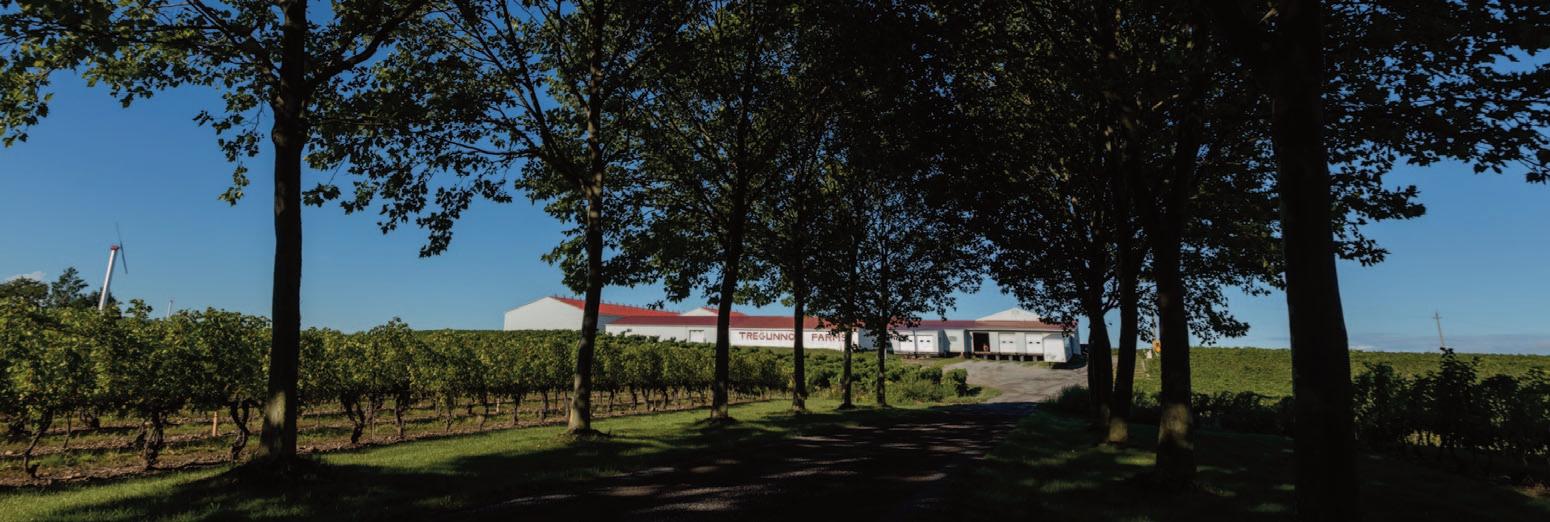
With 700 acres, located in Niagara-on-the-Lake, Tregunno Farms is an industry leader and the largest peach grower in Ontario. Tregunno Farms also grow wine and table grapes, nectarines and plums and has its own large cold storage facility and pack line to process its own fruit. They are members of Vineland Growers Co-op (Vineland) which markets and sells all their fruit across Canada.
Ryan Tregunno, who manages the fifth-generation family farm, has worked with Croptracker and Vineland Growers’ Cooperative to create an inventory tracking and transfer system between the farm and the sales team at the coop. Tregunno records all inventory available for sale using the shipping or packing module and a linked transaction feature in the order desk module. Vineland then uses its API subscription to receive and transfer inventory to Vineland’s Croptracker account.
Several other Ontario tender fruit growers use this same system to alert Vineland to what is available
for sale and ready to be shipped to customers.
Tregunno originally reached out to Croptracker to collaborate on an automated storage inventory tracking system in 2015. The result was a custom-built RFID tag tracking system with sensors at every door into cold storage to track the movement of bins in and out automatically. A custom reporting dashboard shows the inventory movement and availability is displayed in the pack house during the harvest season.
“Before Croptracker, I was just writing out recipe cards like handwritten cards as fruit came in, and as the fruit came out,” recalls Tregunno. “It was just an unbelievable amount of work just to manage making sure things won’t get mixed up and recipe cards wouldn’t blow off in the cold storage.”
Croptracker continues to maintain this automatic system on dedicated servers. Tregunno re-enables all his RFID tags for the season before harvest with this system, eliminating all man-
ual data entry at storage while still maintaining traceability and GAP compliance for cold storage practices.
“We really have a real-time picture of our storages and know that the first fruits going in are the first out and nothing’s getting lost,” says Tregunno. “We know the age of everything and we always strive for what’s picked today and packed tomorrow after cooling overnight. We can then get it out to the distribution centers as quick as possible. So that really helps us.”
Tregunno Farms uses Croptracker’s standard farm management system workflows as well. Croptracker records all the pesticide and fertilization applications using the Spray module. Total chemical use reports and the ability to create custom fertilization blends help with the farm’s sustainability goals as well as making audit processes more efficient.
All employee time is tracked using Croptracker’s Punch Clock module. All permanent and sea-
sonal employees are added to their account and assigned various pay rates depending on role and temporary foreign worker hiring program. Tregunno uses both the Punch Clock: Kiosk workflow and the Punch Clock: Hourly workflow to record time in the pack house and out in the field respectively. They adjust time records as needed, record holiday and break times and generate payroll reports from the Croptracker Punch Clock: Admin features.
During the summer, Tregunno Farms uses the Harvest module to record stone fruit inventory in the field. Peaches, nectarines and plums are harvested into totes and loaded onto pallets with the RFID tags attached so they can be tracked as they are moved into cold storage overnight. Once harvested inventory is cooled, it is packed on Tregunno’s own packline and completed inventory is shipped and flagged for sale at Vineland.
The Packing module is used to record grape harvest inventory
which is packed into retail containers in the field. The retail containers for the grape harvest are labelled using pre-printed product labels. When the filled containers arrive back at storage for cooling, the labels are scanned onto ‘pallets’ and pallet tags are printed, creating inventory that can be stored, and shipped for full traceability.
Table grapes are direct field packed. The labels are printed and applied to the outside of the box once the box is filled. “We do a bulk print usually a few hours ahead to make sure we don’t waste labels in case of a rain event,” says Tregunno.
Farm management software continues to automate and simplify tasks that contribute to food safety and maintain the cold chain.
Source: Croptracker summer newsletter
Tregunno Farms, Niagara-on-the-Lake, Ontario employs a Croptracker software management program that simplifies a number
inventory. Jourdan Tregunno is pictured in the holding storage. Photos by Glenn Lowson.
FOCUS: FARM BUSINESS MANAGEMENT
How the Supply Chains Act affects growers
SHANNON SOMMERAUER
The Supply Chains Act, formerly Bill S-211, An Act to enact the Fighting Against Forced Labour and Child Labour in Supply Chains Act and to amend the Customs Tariff, is aimed at increasing industry awareness, transparency and driving businesses to improve practices related to forced labour and child labour.
Bill S-211 received Royal Assent on May 11, 2023, and came into force on January 1, 2024. It contains two parts: reporting obligations and changes to the Customs Tariff. The reporting obligations in particular are important for growers to understand as they may apply to them.
The Supply Chains Act applies to any corporation, trust, partnership or other unincorporated organization whose activities include producing, selling or distributing goods in Canada or elsewhere, importing goods into Canada, or controlling an entity engaged in these activities. This includes domestic producers in Canada.
Additionally, the entity must either be listed on a stock exchange in Canada or have a place of business in Canada, do business in Canada or have assets in Canada and meet two of the following three criteria for at least one of its two most recent financial years:
1) $20 million or more in assets, 2) $40 million or more in revenue, 3) 250 or more employees.
If a growing operation meets these criteria, it is required to submit a report, both through a mandatory online questionnaire and in a pdf report of 10 pages or less, to Public Safety Canada. These reports must detail the steps, if any, taken during the previous financial year to prevent and reduce the risk that forced labour or child labour is used in the operations or its supply chains. For Canadian growers, this would include both internal labour practices as well as practices within the supply chains for things they might import, such as equipment, uniforms or other inputs.
It is important to understand that the Supply Chains Act does not require entities to undertake any specific steps to address child or forced labour and there is no determination of whether any steps taken are sufficient. Instead, the Supply Chains Act’s sole focus is on increasing transparency and requiring companies to report what steps (if any) they are taking. Employment and Social Development Canada (ESDC) is currently developing complementary “due diligence” legislation, manticipated to be out for public consultation later this summer.
This new legislation will outline the steps companies are required to take to address forced and child labour and will form the verification piece of the government’s efforts.
It is also important to note that all reports submitted under the Supply Chains Act will be made available to the public in two ways: in a prominent location on the obligated entity’s website and in an electronic registry on Public Safety Canada’s website. A summary of the information received through the reports will also be tabled in an annual report to Parliament by the Minister of Public Safety.
The first report deadline for obligated entities under the Supply Chains Act was May 31, 2024.
The key concern we have heard from members in the short timeline for implementation from the coming into force on January 1 to the first report deadline of May 31. There has also been a fair amount of confusion in terms of who is required to report, whether the Act applies to both domestic and imported products and what a report should look like. Public Safety only published initial guidance for industry days before Christmas 2023 which made it difficult for members to effectively prepare in advance.
It has also been difficult for industry members to delineate between the transparency requirements of the Supply Chains Act and the due diligence requirements yet to come under the new ESDC legislation. Especially because the reports must be made public, companies want to make sure that they are doing things correctly.
The Canadian Produce Marketing Association (CPMA) remains engaged with multiple federal departments including Public Safety Canada, ESDC, CBSA and Agriculture and Agri-Food Canada related to the government’s legislative and enforcement efforts to eradicate forced labour from Canadian supply chains. All agree that this is an important and necessary objective. Our focus is ensuring that government regulation and policy account for the complexity of the fresh produce supply chain, ensure clear guidance and reasonable timelines to enable effective implementation, and provide education and resources to supply industry compliance.
While Public Safety had intitally said they would not accept late reports, they have recently changed this position and will continue to accept reports.
In addition to calls and meetings with industry stakeholders, including at CPMA’s recent CGIM Working Group meeting, Public Safety Canada confirmed that the government will take an incremental approach to
“ “
The Canadian Produce Marketing Association and other stakeholders have been engaged with Public Safety Canada to urge them to take a more incremental approach and provide guidance to support industry compliance.
implementation and enforcement, with an initial focus on education to support compliance in the first year. However, while this expectation has been communicated to industry stakeholders verbally, Public
Safety has said they will not make an official public statement.
More information about the Supply Chains Act, its reporting requirements and further guidance can be found on the Public Safety Canada website.
Shannon Sommerauer is director, government relations, Canadian Produce Marketing Association.
Spotted wing drosophila management 2024
ERICA PATE
The Berry Growers of Ontario and OMAFRA have funded spotted wing drosophila (SWD) monitoring this year. Once SWD is active and there is ripe fruit present on your farm, it is time to spray. The list of products registered for SWD control is
below. However, remember that insecticide applications are not the only tool available!
• Picking regularly, every 2 days if possible, can be very effective
• Cool fruit as soon as possible after harvest
• Keep the field clean- remove any unmarketable fruit from the field and destroy it
• Prune the canopy and manage
water to reduce humidity and make the environment lass favourable for SWD
• Spray every 5-7 days, and re-apply after ½ inch of rain
• Renovate June-bearing strawberries as soon as possible! Stay tuned to the ONfruit.ca blog for regular spotted wing drosophila and other pest
Registrations for Spotted Wing Drosophila, June 2024
More information on these applications can be found on the Ontario Crop Protection Hub. Before applying any pest control product, always review the most current version of the product label.
management updates. Thank you to the multiple consultants for helping to monitor this season!
Cormoran
Acetamiprid 80 g/L and novaluron 100 g/L
Group 4A + 15 Reg. #33353
Entrust
Group
Exirel
Cyantraniliprole 100 g/L
Group 28
Reg. #30895
Use a surfactant, where permitted, for optimum control.
Harvanta 50SL
Cyclaniliprole 50 g/L
Group 28 Reg. #32889
Scorpio Ant and Insect Bait
For suppression only.
Spinosad 0.07%
Group 5 Reg # 33306
1 General Re-entry
Please note: this is a reference sheet and does not replace the labels. Continue to check the product labels for more specific instructions and uses. Spotted wing drosophila is a serious pest in Ontario and suppression products may not provide acceptable levels of control. Do not make
applications of Group 5 insecticides.
ONTARIO BERRY
2024 strawberry disease decision support system now available
ERICA PATE
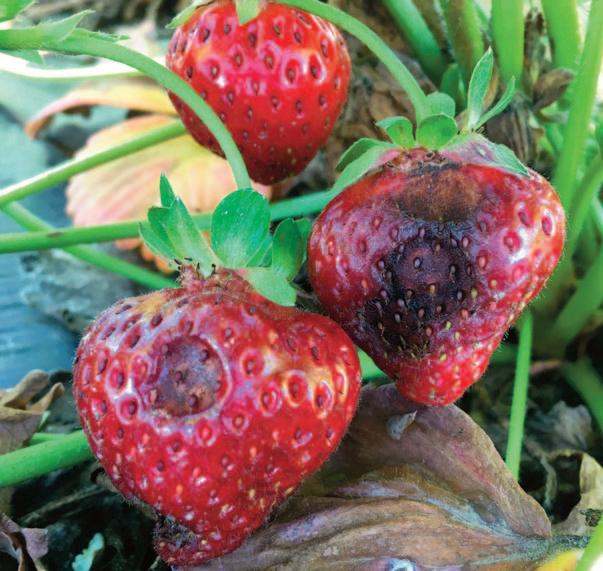
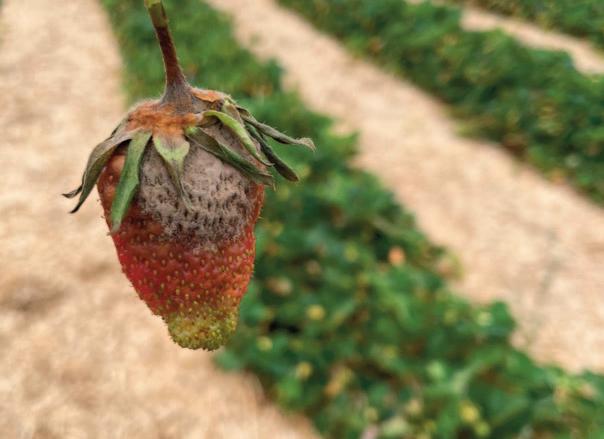
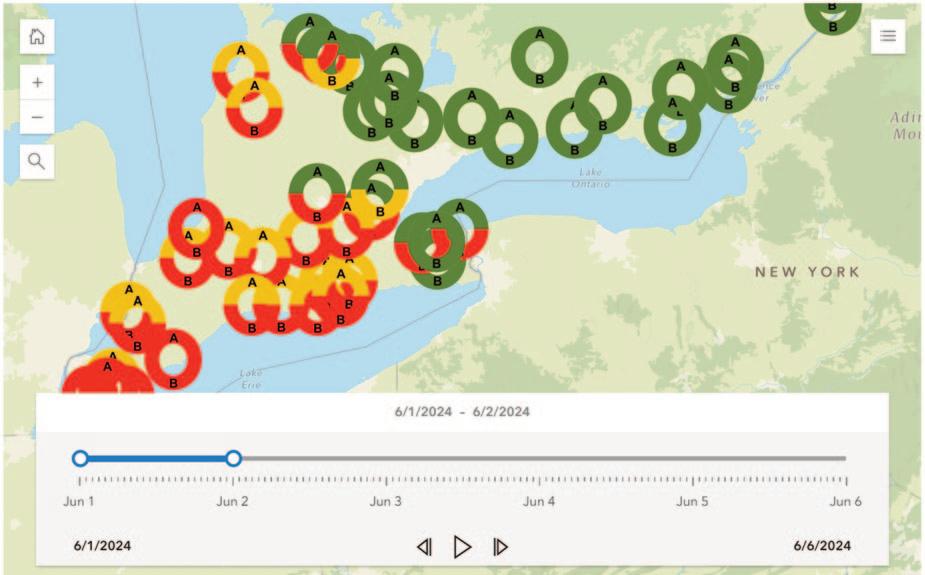
The fungal diseases, anthracnose (caused by Colletotrichum spp.) (Fig. 1) and Botrytis grey mould (caused by Botrytis cinerea) (Fig. 2), are the major fruit diseases in Ontario strawberries. By integrating a disease prediction model into management, growers can use fungicides more effectively to protect their crops through the season. In 2024, a map indicating anthracnose fruit rot and botrytis risk is available for growers to use to help assess the risk of disease epidemics from bloom to harvest (Fig. 3).
OMAFRA has partnered with Weather Source to provide OnPoint Weather. The locations on the map are based on agricultural production and use all nearby weather data and geography to provide accurate forecasting data.
The disease model used is based on the Florida Strawberry Advisory System (FLSAS) developed by W. Pavan et al.
This risk modelling tool is used to identify anthracnose fruit rot and Botrytis fruit rot risk based on leaf wetness and temperature data. For our calculations, leaf wetness is predicted based on relative
Figure 3. Example of the map indicating anthracnose (A) and botrytis (B) risk.
The Strawberry Diseases Decision Support System can be found on the ONfruit blog under the ‘Berries’ tab. The Strawberry Diseases Decision Support System includes a map indicating fruit infection risk across the province and a graph tracking risk through the season.
where permitted.
• Do not make more than 3 applications of fludioxonilcontaining products per year (Switch, Button, Miravis Prime, Scholar).
humidity that is adjusted to account for crop canopy. If the adjusted relative humidity is more than 90 per cent for the hour, it is considered as one hour of leaf wetness. The average temperature is calculated over the leaf wetness period, and this is used in the equations to calculate the infection risk index, from 0-1.
The 2024 strawberry anthracnose management suggestions are also available on the Onfruit blog. Anthracnose management suggestions include:
• Do not rely on group 11 fungicides for anthracnose control. Strawberry anthracnose has been confirmed resistant to FRAC group 11 fungicides.
• Wherever possible, include a group M fungicide in your program for resistance management and to expand the spectrum of disease control. Watch the REIs!
• During harvest, your options are more limited because of the longer REI and PHI intervals. Options include:
o Switch/Button (group 9+12)
o Miravis Prime (group 7+12)
o Diplomat (group 19)
o Inspire Super (group 3+9)suppression only
• Tank mix Diplomat and Inspire Super with compatible fungicides for additional control
• Work in older fields and/or diseased fields last.
Erica Pate is fruit crop specialist, Ontario Ministry of Agriculture, Food and Agribusiness.
Figure 1. Anthracnose fruit rot
Figure 2. Botrytis grey mould
Senate committee offers 25 recommendations to bolster Canadian soil health
Climate change, extreme weather events, pollution and urbanization are damaging Canadian soil, and are threatening food security, the environment and millions of livelihoods, according to a new report by the Senate Committee on Agriculture and Forestry.
Critical Ground: Why Soil is Essential to Canada’s Economic, Environmental, Human, and Social Health digs deep into the critical role of soil in mitigating
climate change, contributing to biodiversity and putting food on tables. The committee is urging the federal government to lead the way in protecting this vital national resource.
In 2022, agricultural and food product exports totalled nearly $93 billion. However, the committee heard that there is a lack of awareness of the value of soil, and that education is crucial to changing perceptions of farming in Canada.
The report highlights concerns from farmers, ranchers, producers and soil health experts about the unprecedented challenges to growing food. Floods, droughts, wildfires and the loss of farmland are among the many causes of soil degradation across the country.
The committee learned of many soil management practices that can help maintain soil health, but there is no “one-sizefits-all approach,” as soil and
Real Dirt on Farming in the Classroom released
Agriculture in the Classroom Canada (AITC-C) and Farm & Food Care (FFC) have released the next edition of The Real Dirt on Farming in the Classroom elearning resource. This innovative
partnership aims to provide Grade 7-12 students across Canada with the opportunity to explore key topics related to the agriculture and food industry. Designed as a comprehensive
educational tool, The Real Dirt on Farming in the Classroom offers students the chance to engage with a wide range of topics, including the diverse individuals working in the
climate vary across the country. It is also difficult to analyze soil health data because governments, academic institutions, organizations and industry groups do not have a common means of gathering and sharing this information. The committee is recommending long-term funding for soil mapping and data aggregation across the country.
The report makes 25 r ecommendations to the federal government to work with the Canadian agricultural and forestry sectors, as well as municipal, provincial, territorial and Indigenous governments, to tackle soil degradation and preservation aggressively.
• The Senate Committee on Agriculture and Forestry heard from 153 witnesses and received more than 60 written briefs and supporting documents from soil science researchers, agronomists, farmers, ranchers, foresters, environmental organizations, agri-businesses, industry groups and federal, provincial and territorial governments.
• In 2022, primary agriculture farms covered 62.2 million hectares, or 6.2% of Canada’s total land and generated $36.3 billion of GDP.
• Soil can absorb and store carbon, provide protection from flooding and drought, purify water and provide habitat for hundreds of organisms. Healthy soils produce food for Canadians and the world, and will help support Canada’s net-zero emissions targets by 2030 and 2050.
• Soil health is a global concern. The Food and Agriculture Organization of the United Nations estimates that 33% of the world’s soil is already degraded and over 90% could become degraded by 2050.
“Soil is often overlooked, yet it’s essential to all life,” says Senator Rob Black, chair of the committee. “It grows our food and purifies our air and water. We must act now to preserve this valuable national resource, which is increasingly susceptible to climate change, floods, droughts, wildfires and the loss of farmlands. Canadian soil was at risk 40 years ago when the Senate released its first report on soil health. We don’t have another 40 years.”
Source: Senate of Canada June 6, 2024 news release
agriculture and food industry, sustainable farming practices, the impact of climate change on agriculture, innovations in the field, animal welfare and much more.
Through multimedia content, interactive modules and case studies, students will have the chance to delve into the complexities of modern agriculture while gaining valuable insights into the importance of sustainable food production.
“Our partnership with Farm & Food Care has allowed us to create a dynamic educational resource to inspire and educate the next generation of agricultural leaders,” said Mathieu Rouleau, executive director of AITC-C.
“By providing students with access to accurate and engaging information about agriculture and food production, we can empower them to make informed food choices.”
“We’re so pleased to be able to work with AITC-C on this project. We’re often asked by
educators about how they can use our publication in their classrooms, but that’s not Farm & Food Care’s expertise. Using AITC-C’s national network ensures that this award-winning resource reaches a much broader audience,” said Kelly Daynard, executive director of Farm & Food Care Ontario.
First developed in 2021, this resource accompanied the fifth edition of The Real Dirt on Farming (RDOF) magazine. With the help of AITC-C’s provincial member organizations, this new e-learning resource will be available digitally along with the digital sixth edition of the RDOF magazine to classrooms across Canada.
For more information about the program or to access the e-learning resource, please visit bit.ly/3xX6ER8 and www.RealDirtonFarming.ca.
Source: AITC/Farm & Food Care Ontario May 22, 2024 news release
University of Guelph is building a data-driven scoring system to assess soil health. The Soil Interpretative Health Centre site has 18 lysimeters for taking soil core samples.
MARKETPLACE WORKS
advertising@thegrower.org
New FMC 4-lane weight grader, with 4-6 ft circular tables and washer $15,000. Also, Bartlett Fruit grader. Call 905-570-3395
Apple Bins: 5/8 plywood sides, 2x4 runners, in good condition. $85 each. Call Kevin at 905-807-9419.
PROPERTY FOR SALE: Grower Retail Garden Center. 10 Acres in Midland, Ontario. Located on major hwy accesszoned agricultural - well water. For full listing information visit https://shorturl.at/hqyCV or call 705- 526-9610
ROWN ROWN
crownbinandpallet.ca
Update on the PMRA’s re-evaluation and special review work plan
Every year, Fruit and Vegetable Growers of Canada (FVGC) provides a summary in its annual report on upcoming re-evaluation and special review
decisions that can impact the fruit and vegetable sector.
Since circulating our report in March, the Pest Management Regulatory Agency (PMRA) has published its 2024 /2025 workplan (Re-evaluation Note REV2024-01). Outlined below are relevant updates that are expected to impact upcoming regulatory decisions from July 2024 to April 2025.
1) Delays for final or proposed decision: Notable delays include final decisions for Chlorothalonil (delayed until March 2025) and Atrazine (delayed until JulySeptember of 2025). The proposed decision for Dicamba is now targeted for January 2025.
2) Delay to cumulative health assessment for organophosphates: The PMRA has delayed publication of its project plan for assessing cumulative health risks of organophosphates until October 2024. This document is expected to provide an anticipated re-evaluation timeline and scope for the PMRA’s assessment.
3) Proportional effort to apply to re-evaluations initiated from April 2024 onwards: The PMRA will be consulting on its proportional effort policy this summer and the outcome of this consultation will be used by the PMRA to prioritize and streamline re-evaluations that are expected to be initiated in the upcoming year.
N/A MILSTOP, SIROCCO Fungicide Cyclical Review
Vegetable crops in greenhouses, field cucurbits (cucumbers, melons, pumpkins, squash), stone fruits (peach, nectarine, apricot, plum, prune), greenhouse and field strawberries, greenhouse and field herbs and spices, mint, grapes (conventional and organic), artichokes, greenhouse lettuce and field peppers, apples
Pydiflumetofen Group 7 MIRAVIS, POSTERITY, A19649 Fungicide Special Review
Potato, root and tuber vegetables (crop subgroup 1a), tuberous and corm vegetables, leaves of root and tuber vegetables, bulb brassica leafy vegetables, brassica head and stem vegetables, fruiting vegetables, cucurbit vegetables, pome fruits, blueberries (lowbush) - sprouting year, peaches (crop subgroup 12-09b), cherries (crop subgroup 12-09a, stone fruits (crop group 12-09), greenhouse cucumbers, greenhouse peppers and greenhouse lettuce, sweet corn
Sulphur Group M KUMULUS, MICROWETTABLE, MICROSCOPIC WETTABLE SULPHUR, Fungicide Cyclical Review
field and greenhouse strawberry, field and greenhouse pepper, field and greenhouse cucurbit vegetables (Crop Group 9), field and greenhouse tomato, grape, greenhouse cucumbers, greenhouse lettuce, greenhouse fruiting vegetables, high and lowbush blueberry, strawberry
Dicamba Group 4 BANVEL Herbicides Special Review Blueberries (lowbush)
Nonylphenoxy polyethoxy ethanol N/A AGRAL 90, AG-SURF Surfactant Cyclical Review Non-ionic spreading agent for use with pesticides including those applied to fruit and vegetables
Proposed decision targeted for December 2024.
Proposed decision targeted for March 2025.
Proposed decision delayed until January 2025.
Proposed decision delayed until January 2025.
Proposed decision delayed until March 2025.
Additional details pertaining to specific actives are provided in the tables below.
Christina Turi is manager, plant health and crop protection., Fruit & Vegetable Growers of Canada
CHRISTINA TURI
Potatoes, field tomatoes, caneberries
Proposed decision delayed until February 2025
Update on the PMRA’s re-evaluation and special review work plan
Awaiting a Final Decision
Abamectin Group 6 AVID, AGRI-MEK Insecticide / Miticide Cyclical Review
Fosetyl aluminum Group PO7 ALIETTE Fungicide Special Review
Apples, ginseng, red/black raspberries, blackberries, cranberry, grapes, strawberries, lettuce, greenhouse lettuce in BC, spinach, onions, brassica head and stem vegetables (crop group 5-13) and brassica leafy vegetables (crop group 4-13b), greenhouse-grown brassica head and stem vegetable transplants (crop group 5-13), greenhouse-grown brassica leafy green transplants (crop subgroup 4-13b), kohlrabi, rutabaga, Belgian endive, highbush blueberries,
Group 3 FOLICUR Fungicide Cyclical Review Asparagus
THE GROWER’S FARM EQUIPMENT & MACHINERY AUGUST 2024 FOCUS
BOOK AD SPACE JULY 15, 2024
AD COPY DUE JULY 19, 2024
advertising@thegrower.org
Proposed to cancel all uses except on GH ornamentals due to health and environmental risks (PSRD2022-01).
Final decision delayed until March 2025.
Proposed to cancel all products and uses (PRVD2021-01).
Final decision targeted for August 2024.
Proposed acceptable for continued use with mitigation measures (PSRD2023-02)
Final decision is targeted for August 2024.
Proposed acceptable for continued use with mitigation measures (PRVD2021-08).