APRIL 2026
CELEBRATING 147 YEARS AS CANADA’S PREMIER HORTICULTURAL PUBLICATION
THEGROWER.ORG
ENERGY INFRASTRUCTURE
The greenhouse powerhouse lobbies for access to affordable hydro
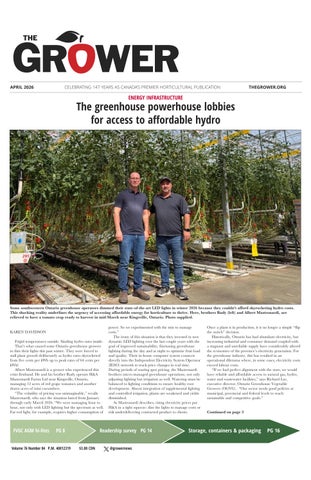
Some southwestern Ontario greenhouse operators dimmed their state-of-the-art LED lights in winter 2026 because they couldn’t afford skyrocketing hydro costs. This shocking reality underlines the urgency of accessing affordable energy for horticulture to thrive. Here, brothers Rudy (left) and Albert Mastronardi, are relieved to have a tomato crop ready to harvest in mid-March near Kingsville, Ontario. Photo supplied.
KAREN DAVIDSON Frigid temperatures outside. Sizzling hydro rates inside. That’s what caused some Ontario greenhouse growers to dim their lights this past winter. They were forced to stall plant growth deliberately as hydro rates skyrocketed from five cents per kWh up to peak rates of 64 cents per kWh! Albert Mastronardi is a grower who experienced this crisis firsthand. He and his brother Rudy operate H&A Mastronardi Farms Ltd near Kingsville, Ontario, managing 12 acres of red grape tomatoes and another dozen acres of mini cucumbers. “The volatility of pricing was unimaginable,” recalls Mastronardi, who says the situation lasted from January through early March 2026. “We were managing hour to hour, not only with LED lighting but the spectrum as well. Far-red light, for example, requires higher consumption of
FVGC AGM hi-lites
PG 8
Volume 76 Number 04 P.M. 40012319
power. So we experimented with the mix to manage costs.” The irony of this situation is that they invested in new dynamic LED lighting over the last couple years with the goal of improved sustainability, finetuning greenhouse lighting during the day and at night to optimize fruit load and quality. Their in-house computer system connects directly into the Independent Electricity System Operator (IESO) network to track price changes in real time. During periods of soaring spot pricing, the Mastronardi brothers micro-managed greenhouse operations, not only adjusting lighting but irrigation as well. Watering must be balanced to lighting conditions to ensure healthy root development. Absent integration of supplemental lighting and controlled irrigation, plants are weakened and yields diminished. As Mastronardi describes, rising electricity prices put H&A in a tight squeeze: dim the lights to manage costs or risk underdelivering contracted product to clients.
Readership survey PG 14 $3.00 CDN
@growernews
Once a plant is in production, it is no longer a simple “flip the switch” decision. Historically, Ontario has had abundant electricity, but increasing industrial and consumer demand coupled with a stagnant and unreliable supply have considerably altered the economics of the province’s electricity generation. For the greenhouse industry, this has resulted in an operational dilemma where, in some cases, electricity costs exceed labour costs. “If we had perfect alignment with the stars, we would have reliable and affordable access to natural gas, hydro, water and wastewater facilities,” says Richard Lee, executive director, Ontario Greenhouse Vegetable Growers (OGVG). “Our sector needs good policies at municipal, provincial and federal levels to reach sustainable and competitive goals.”
Continued on page 3
Storage, containers & packaging
PG 16
PAGE 2 –– APRIL 2026 THE GROWER
AT PRESS TIME… How the crude economy is central to fertilizer and fuel KAREN DAVIDSON Middle East geography is suddenly a riveting subject for Canadian farmers, as the U.S./Israeli attacks on Iran have resulted in restricted shipments of fertilizer and fuel. If you couldn’t pinpoint the Strait of Hormuz on a map before Feb 28, 2026, you can now. It’s the strategic waterway for about one-third of global fertilizer supplies. Natural gas represents about 80 per cent of the production cost of ammonia, an essential feedstock for manufacturing nitrogen fertilizers. With natural gas taps shuttered at present in the Gulf, prices of fertilizer are ratcheting up 30 to 40 per cent at a time that’s most sensitive for northern hemisphere farmers planting their crops. Although Canadian field growers have likely ordered their 2026 fertilizer supplies, senior economists at Farm Credit Canada recently provided some prudent counsel: “Communication during turbulent times such as these is crucial. Farmers may want to contact their crop input retailers to confirm they’ll have the tonnes they need this spring and work together on any backup plans which might include adjustments to crop mix, fertilizer rates and target yields. Early discussions with credit providers may be necessary as well should the need
arise as seeding approaches.” For greenhouse growers, the worry extends to a longer term consideration. In mid-spring, they will be looking to order watersoluble fertilizer supplies for 2027. That commodity originates with The Haifa Group, headquartered in Israel. It’s a global leader in providing liquid fertilizers to 100 countries for fertigation and foliar applications. One of their flagship products is potassium nitrate, water-soluble and free of sodium and chloride. Another is water-soluble NPK, enriched with micro-nutrients. For open-field crops and fruit trees, there’s a product formulated for nutrigation through drip lines. These are all products central to horticulture. Eight months out, if transportation is restricted and ports become congested, then transportation costs will spike. Beyond fertilizer, the most obvious worry is the surging price of fuel. Before the start of the war, the average price of gasoline in Canada was about 139.6 cents per litre, according to Natural Resources Canada. At press time, March 17, that has reached 167.7 cents per litre. The price of diesel has reached $212.2 cents per litre, a 40 per cent rise compared to a year ago. Diesel fuels not only tractors but irrigation pumps. Expect a hit to these costs for any crops that demand supplemental water.
Safeguard inquiry launched on frozen and canned vegetable imports On March 16, 2026, the Canadian International Trade Tribunal commenced a safeguard inquiry into imports of frozen and canned vegetables. If the Tribunal finds that there was a surge of imports that is causing or threatening to cause serious injury to Canadian producers of like or competitive goods, the Government of Canada is permitted to impose safeguard measures including tariffs, import quotas, or tariff-rate quotas. Parties wishing to participate must file Notices of Participation by April 2, 2026. “This is an important first step,” says the Canadian Association of Vegetable Growers and Processors. “Canada’s frozen and canned vegetable sector has been facing a sudden surge of low-priced imports that is disrupting the Canadian market. Temporary, rules-based safeguard measures will restore fair competition and allow Canadian growers and processors to compete on equal terms.” The Tribunal will hold a hybrid in-person and videoconference hearing commencing on June 15, 2026. It must report to the Minister of Finance by September 9, 2026. Source: Canadian International Trade Tribunal March 16, 2026 posting and Canadian Association of Vegetable Growers and Processors’ statement.
NEWSMAKERS OFVGA has elected new leadership. Asparagus and watermelon grower Mike Chromczak becomes chair and grape grower Matthias Oppenlaender becomes vice-chair. The are supported by board directors: Jan VanderHout and Steve Peters (both representing greenhouse), Glen Gilvesy (ginseng), Joanne Chechalk (fresh vegetable – other), David Enns (tender fruit), Morris Gervais Mike Chromczak (small fruit/berries), Chris Hedges (apples), Shawn Brenn (potatoes), Tracy Gubbels (processing vegetables) and Quinton Woods (fresh vegetable – muck). The Ontario Fruit and Vegetable Convention, Canada’s premier horticultural event, has announced that Kelle Neufeld will become its new general manager, effective May 1, 2026. With more than 12 years of experience in the agriculture sector, Neufeld brings a strong background in working with commodity boards and building collaborative relationships with growers, government and industry partners.
Kelle Neufeld
Farmers Markets Ontario announces that the 2025 Farmers’ Market of the Year is Metcalfe Farmers’ Market. Foreign Agricultural Resource Management Services (FARMS) held its annual general meeting on February 27. The 2026 board comprises: Robert Shuh, president, representing apples and apiary; Andy Vergeer, vice-president, representing tobacco; James Neven, representing greenhouse vegetable growers; Betty-Anne Gifford, representing nurseries, sod, ginseng; Jason Ryder, representing fresh vegetables; Philip Tregunno, representing fresh fruit. The British Columbia Cherry Association held its annual general meeting on March 6. The 2026 board of directors will be led by president Sukhpaul Bal supported by vice-president David A. Geen. Secretary is Graem Nelson. Treasurer is Erin Carlson. Directors at large are: Harman Bahniwal, Gino Boensch, Ben Donohue, Balpreet Gill, Harsh Khela, Simranjit Sandher, Neal Vander Helm. Greenhouse grower James Neven, Lynden, Ontario has been appointed to the Ontario Farm Products Marketing Commission for a two-year term effective March 5, 2026. He is the first greenhouse sector representative in the Commission’s history. The British Columbia Potato & Vegetable Growers’ Association has hired Jennifer Winning, who will be taking over the general manager’s role from Leisa Yee. Winning was the former executive director of the Artisan Farmers Markets Society, and has worked closely with communities across the Lower Mainland. Based in Ottawa, Melanie Anderson becomes executive director, Farmers’ Markets Ontario on April 1. She succeeds Catherine Clark who has retired after nine years in the role. Congratulations and best wishes to Bev Appleby, who is retiring from her role as executive assistant and corporate secretary to the Fruit and Vegetable Growers of Canada (FVGC). She has had a long and productive career in Canada’s fresh fruit and vegetable sector, with 25 years in produce. Before joining FVGC, she worked in the greenhouse sector and later with the Canadian Produce Marketing Bev Appleby Association (CPMA), where she was especially proud of her work helping launch Passion for Produce. She retires April 1, 2026.
APRIL 2026–– PAGE 3 THE GROWER
COVER STORY
The greenhouse powerhouse lobbies for access to affordable hydro
Big Marble Farms, Medicine Hat, Alberta has co-generation facilities that allow the sale of excess power back to the City of Medicine Hat, Alberta.
Continued from page 1 At risk are 4,487 acres of vegetable greenhouse production in Ontario. OGVG statistics break this down as 1,689 acres of tomatoes, 1,484 acres of peppers and 1,314 acres of cucumbers. While the sector recorded 6.5 per cent growth in 2025, business case analyses have trimmed expected growth this year to three per cent. Tackling these challenges head on, the Ontario Greenhouse Vegetable Growers highlighted their concerns at the annual general meeting of the Ontario Fruit & Vegetable Growers’ Association (OFVGA) held in February 2026. Three motions were brought forward at the meeting, then subsequently passed by delegates: • That OFVGA advocate for continued investment in natural gas infrastructure to ensure affordable, accessible and reliable fuel for agriculture, thereby enhancing competitiveness, supporting long-term investments and strengthening food production in Ontario.
• That OFVGA urge the Ontario government to investigate, develop and implement predictable, affordable agricultural electricity rates, including mechanisms to cap, stabilize or mitigate energy costs. • That OFVGA endorse and advocate for wider adoption of cogeneration technologies for on-farm generation opportunities, that provide regulatory certainty, fair grid access and appropriate compensation mechanisms that recognize the value of on-farm electricity generation, optimize the use of co-generation products. Co-generation is adopted by some Ontario greenhouse growers, but also in other jurisdictions. One example is Big Marble Farms, located in Medicine Hat, Alberta, which installed co-generation facilities six years ago. The farm uses 37 megawatts of power of which 12 megawatts are produced through their own co-generation facilities for 71 lit acres and nine unlit acres of tomatoes and mini cucumbers. As of February 2026, they can now sell back excess power to the City of Medicine Hat.
These yellow peppers are a spot of sunshine in a dark Ontario winter of surging hydro prices. Photo by Dax Melmer.
“This is not about making money at market rates of two to three cents per kilowatt,” explains Albert Cramer, Big Marble Farms. “Rather, with a contract with the city, it’s an assurance that we can manage our energy costs and co-generation costs.” Contrary to some assumptions, hydro power is not cheap in Alberta. It’s natural gas that’s cheap at $2/gigajoule and that’s what Medicine Hat uses to produce its own electricity for the municipality. Big Marble Farms is paying 11 cents/kWh for hydro, including delivery costs. Back in Ontario, electricity costs are but one item in a basket of concerns, all of which share a common theme: a new, much needed underground infrastructure network to deliver services. In the case of natural gas, for example, a delivery bottleneck exists that will only be solved by laying new pipe. Similarly, improved water access requires installation of additional watermains to unblock growth. Even though the fresh waters of Lake Erie lie within easy sight of many greenhouse growers, accessing it remains a dream on the horizon. Oddly, given grower anxiety over
unaffordable hydro, the greenhouse industry was surprised by the January 26, 2026 federal announcement that owners would be granted a 100 per cent capital cost deduction against income during the first operating year of new greenhouse builds. The prime minister’s text read: “To lower the cost of food production, we are introducing immediate expensing for greenhouse buildings. This allows producers to fully write off greenhouses acquired on or after November 4, 2025, and that become available for use before 2030. This measure supports increased domestic supply and investment in food production over the medium-term.” Although any additional federal support for the greenhouse industry is welcome, electricity pricing volatility and stretched natural gas and water infrastructure hamper the viability of any new construction. Alleviating risk for Ontario’s $2 billion a year greenhouse sector depends on support alignment between all three levels of government. To achieve less undermines both long-term economic prosperity and year-long food security in a world already in turmoil.
PAGE 4 –– APRIL 2026 THE GROWER
CROSS COUNTRY DIGEST BRITISH COLUMBIA
BCFGA back on track, new president elected MYRNA STARK LEADER With a labour focus and a presidential election race, turnout at the BC Fruit Growers’ Association (BCFGA) 137th annual general meeting in Kelowna was stronger than in recent years. About 170 members elected Summerland orchardist Deep Brar. Vice-president since 2023, Brar served as the public face of BCFGA following the devastating deep-freeze of 2024 that severely impacted fruit and grape crops. In his campaign speech, Brar highlighted the need for business risk management programs that work for horticultural crops. “AgriStability was designed for prairie provinces,” said Brar, noting the current reference margin of five years is problematic for perennial fruit growers. Brar has been involved in previous negotiations to bring critical foreign workers to BC. He says rising labour costs, growing regulations and the shrinking domestic labour pool remain key concerns. “I don’t want farming to stop with my generation,” said second-generation farmer Brar. “But if no one wants to continue farming, it’s going to become a real economic and food security issue in our province.” BCFGA is advocating for an exemption for agriculture from the provincial labour registry. Farmers must register first with
BC orchardists are employing several pruning strategies, depending on fruit variety and tree age. With little to no snow in the Okanagan, some pruning is ahead of schedule on what is looking like another heavier year for fruit. At this stage, it could be an early start to the 2026 growing season, pending unforeseen weather. Photos by Myrna Stark Leader.
Members of the 2026 BCFGA Board of Directors taken at the February 26 AGM. From left to right: Sukh Khun Khun, North director; Talwineder Bassi, South director; Deep Brar, elected 2026/27 president for two-year term; Nirmal Dhaliwal, North director; Tarnvir Sandher, North director and Ravinder Bains, South director, both elected to new two-year terms; and Avi Gill, elected 2026 VP. Absent: Parn Dhaliwal.
the province before moving forward with LMIA and federal approval for foreign workers. Processing delays are problematic. “As far as we know, the federal government is already collecting this information, so we need the two levels of government to coordinate and share information, with farmers’ approval,” says BCFGA executive director Adrian Arts. BCFGA members also prioritized labour-related resolutions including exempting temporary foreign worker housing from development charges and having the province develop a standardized, timely
and challenges. Findings will be shared with a new two-year contracted labour support specialist who will be developing a labour strategy across fruit and grape sectors. A cross-commodity panel of six growers with years of labour experience will help guide the work. Almost a year into his job, Arts says BCFGA must continually be building relationships with packers, partners, policymakers and elected officials. “If we’re having a big sticky thing with any level of government, I’m hoping that we have the relationships with public servants and the politicians to have conversations and outline why it’s causing problems, rather than becoming us versus them,” he says. BCFGA has struck a fruit packers committee with 10 packers. This development comes after growers’ rejection of an apple marketing commission in July 2025, originally recommended in the BC Tree Fruit Stabilization Plan of October 2021. On the market development side, BCFGA is working with the BC Investment Agriculture Foundation on funding for a major two-year marketing push to support the apple industry. BCFGA also plans four BCFGA-member meetings in 2026, aimed at strengthening grower unity. “I think it’s getting better,” says Arts. “The board can have heated debate and still come out as a unified voice and, more broadly, folks are starting to see that farmers have a strong voice rallying together.” Brar agrees that unity on issues increases the industry’s influence. “We showed that with the $10 million payout awarded to growers in 2025, paid by acre,” he said.
approval process for construction and placement of modular worker housing. To address challenges with strong fruit production last year and some labour issues, representatives of Jamaican, Guatemalan and Eastern Caribbean workers, along with organizations assisting with logistics, gave short presentations about their workers. A panel also discussed new apple thinning tools such as Brevis to help manage crop load, reducing hand thinning, another potential labour saving. At the meeting, attendees participated in smaller table discussions noting labour wins
Members approved a package of more than 25 existing resolutions guiding BCFGA’s work and passed three new ones calling for a group health insurance program, a farmer pension or retirement savings program, tax relief to reduce production costs, and improved availability, affordability, and adequacy of insurance for temporary farm worker housing. The 2025 operations report highlighted production tools and information sharing, nursery stock access, export supports, and formal complaints with CFIA over mislabelled apples at retail. Membership is back up to about 300 growers, along with about 20 new paid, non-voting business partners. BCFGA is anticipating some grants and has earmarked $100,000 to update the Production Guide. The 2026 small surplus budget projection doesn’t include potential proceeds from the sale of the test orchard land, listed at $13.9 million but, so far, attracting no buyer. As with any association, members want value for their fees. In his final president’s report, Naramata orchardist Peter Simonsen, elected in 2022, said there’s disappointment with pan-ag organizations such as BC Agricultural Council and the Fruit and Vegetable Growers of Canada. “Too often the individual voice of the farmers is forgotten,” he says. “We have begun working more closely with counterparts in Ontario, Québec, Nova Scotia and New Brunswick to advance the case for a national apple strategy grounded in the realities of perennial production.” Myrna Stark Leader is a freelance agricultural journalist based in Kelowna, British Columbia.
APRIL 2026–– PAGE 5 THE GROWER
CROSS COUNTRY DIGEST ATLANTIC CANADA
Hon. Heath MacDonald visits Atlantic Canada The first week of April 2026, the Honourable Heath MacDonald, Minister of Agriculture and Agri-Food, met with farmers, processors, industry partners, and provincial agriculture and agri-food stakeholders during his outreach to Nova Scotia, Newfoundland and Labrador, and Prince Edward Island. Throughout the week, the Minister continued advancing discussions on the Next Policy Framework (NPF) across numerous agriculture sectors in Atlantic Canada. The consultations, which took place in Truro, Nova Scotia, Conception Bay South, Newfoundland and Labrador, and Charlottetown, Prince Edward Island, gathered input to address challenges and opportunities to help shape the successor to the current Sustainable Canadian Agricultural Partnership, which ends on March 31, 2028. Minister MacDonald started
his outreach with a visit to Maritime Pride Eggs in Amherst, Nova Scotia. He then travelled to Newfoundland and Labrador for the first time in his role as Minister of Agriculture and AgriFood where he met with Minister of Forestry, Agriculture and Lands, Pleaman Forsey. The two discussed key priorities for the NPF and the Canada–United States–Mexico Agreement as well as how they can continue to support producers in achieving environmental sustainability and growing food self-sufficiency in the province. Minister MacDonald also visited the Community Food Sharing Association in St. John’s, whose mission is to collect and distribute food to 60 food banks across Newfoundland and Labrador. During this visit, the Minister highlighted an investment of up to $30 million for 235 approved projects across Canada under the Local Food Infrastructure Fund (LFIF).
PRINCE EDWARD ISLAND
PEI Potato Board introduces bursary for future leaders
The way in which potatoes are planted, grown, harvested and stored has changed dramatically over recent decades, as have the skills and talents required to operate the farm business itself. “As new practices, technologies and business models continue to emerge, the industry increasingly depends on skilled workers, fresh ideas and innovative thinking,” says Krista Shaw, director of stakeholder relations for the PEI Potato Board. “In recent years however, the supply of these talents is not keeping pace with demand.” To help address these challenges, the PEI Potato Board is launching the PEI Potatoes Future Leaders Bursary. As farm operations become more advanced, and as current farm ownership prepare to pass the farm to a younger generation, the need for skilled talent grows. PEI however, does not currently offer an agricultural degree or diploma program or many of the specialized trade programs that modern agriculture operations now
require. As a result, many students leave the island to pursue relevant agriculture education. This comes with additional costs and in some cases, new opportunities away from the farm resulting in some students opting not to return home. The bursary will award $2,000 to each successful applicant with up to five graduating high school students selected annually. Students interested in future careers in the industry are encouraged to explore fields such as agronomy, nutrient management, crop production, mechanical and electrical engineering and precision agriculture. Skills related to packshed operations, export logistics and irrigation technology are also becoming increasingly important. Applications are now being accepted until May 15, 2026. For more information, contact Krista Shaw at krista@peipotato.org Source: PEI Potato News Winter 2026
In Prince Edward Island, he also announced a federal investment for Agriculture and AgriFood Canada’s Youth Employment and Skills Program (YESP). As part of his outreach, Minister MacDonald visited popular local farm markets, including the Masstown Market in Debert, Nova Scotia, and Lester’s Farm Market in St. John’s, Newfoundland and Labrador. The Minister also toured egg and dairy processing facilities in and around St. John’s, including Lester’s Dairy Farm in St. John’s, Smallwood Farms in Clarkes Beach, and NL Dairy Co-operatives in Mount Pearl, to gain insights into how they supply local markets across the province. Source: Agriculture and Agri-Food Canada March 6, 2026 news release L-R: Pleaman Forsey, Newfoundland and Labrador, minister of forestry, agriculture and lands, Newfoundland and Labrador and Hon. Heath MacDonald, federal minister of agriculture and agri-food.
PAGE 6 –– APRIL 2026 THE GROWER
GREENHOUSE GROWER
Stronger together, provincial greenhouse vegetable associations unite KAREN DAVIDSON The Canadian greenhouse vegetable sector, now posting about $2.7 billion in sales as of 2025, is realigning its advocacy efforts under a new umbrella group: Greenhouse Produce Alliance of Canada. Until now, greenhouse growers from British Columbia, Alberta, Ontario and Québec met as a working group under the auspices of Fruit and Vegetable Growers of Canada. Dynamic growth of the controlled environment agriculture (CEA) sector and its unique requirements for energy, research and trade have sharpened lobbying needs at the federal level. In the last year, exports of tomatoes, peppers and cucumbers have increased by 8.5 per cent to reach $2.5 billion. Crops have diversified with growth in strawberries up 8.1 per cent, lettuce up 8 per cent in area. At the same time, expenditures are rising, particularly in gross yearly payroll. “We need more focus on consistent messaging on Parliament Hill,” explains Richard Lee, executive director, Ontario Greenhouse Vegetable Growers (OGVG).
“The carbon tax was a big challenge for us. Moving forward, it’s reminding politicians about sustainable growing practices and how important we are to domestic food security.” Lee expects that the new organization will dedicate funding to research initiatives through the University of Windsor AgUWin program. These research projects will aim to strengthen innovation, sustainability and productivity across Canada’s entire greenhouse vegetable sector, ensuring that the benefits of this work extend to growers nationwide. That’s where researchers are focusing on projects such as autonomous pollination robots and real-time pest detection. By April 2026, it’s expected that the new non-profit organization will be formalized. The alliance will be funded by each of the provincial greenhouse associations by a formula yet to be announced. The group has been meeting virtually every week for a year to hone the mandate and vision. The board of directors is chaired by Ontario’s George Gilvesy supported by vice-chair Armand Vander
Meulen from British Columbia. The group is comprised of: Albert Cramer, Rolling Acres Greenhouses, Alberta; Jan VanderHout, Beverly Greenhouses, Ontario; Jason Whitcher, Mastronardi Produce; Rick Mastronardi, TriSon Farms, Ontario, Charles Verdy, Gourma, Québec; Sylvain Terrault, Hydroserre Inc., Québec; Luc Prévost,
Savoura, Québec. Production by province, as of 2024 Ontario British Columbia Québec Alberta Other
72% 13% 9% 4% 2%
Bankruptcy protection announced for Québec greenhouse grower Les Productions Horticoles Demers Inc., Les Serres Demers Inc., Les Serres Olivier Inc., 9718656 Canada Inc., and Immeubles PHD S.E.C. each filed notices of intention (NOI) to make a proposal under the Bankruptcy and Insolvency Act between January 8 and 12, 2026, with PricewaterhouseCoopers Inc. appointed as proposal trustee. The debtors obtained court approval for interim financing, priority charges, a key employee retention plan, limited payments to critical suppliers, and a court-supervised investment and sale process. According to Insolvency Insider, the Demers group is a third-generation, family-owned agricultural business that entered greenhouse production in 1970 and expanded significantly under brothers
Jacques and Réjean Demers beginning in 1990. The group operates large-scale greenhouse and field production facilities in Lévis, Saint-Nicolas, and Drummondville, specializing in tomatoes and small fruits including strawberries, raspberries, and blackberries. As at the NOI filings, the business employed approximately 250 people, rising to about 350 during peak season, with between 210 and 310 temporary foreign workers housed through affiliated real estate entities. The consolidated asset base includes three major greenhouse complexes totaling more than 27 hectares and representing historical investments exceeding $110 million. According to the trustee, the group’s insolvency stems from a combination of
structural leverage and recent operational shocks. Demers accumulated significant secured and unsecured debt during expansion years, with financing costs that outpaced cash flow, particularly following pandemic-era emergency borrowings. Operationally, the business faced crop disease issues, including tomato rugose virus, which reduced yields and quality. These challenges coincided with falling produce prices over the past year, driven in part by increased imports and dumping into the Canadian market. Adverse weather conditions in late 2025 further reduced greenhouse productivity while increasing energy costs. By early January 2026, the group had exhausted liquidity and could no longer meet obligations as they came due.
On a consolidated basis, Demers reported total assets of approximately $97.2 million as at November 30, 2025, against total liabilities of about $119.6 million, resulting in negative equity of roughly $22.4 million. Secured debt totaled about $77.9 million, led by Desjardins, Investissement Québec, and Farm Credit Canada, with unsecured loans of about $9.0 million and trade payables to roughly 300 suppliers. The business generated approximately $36.8 million in revenue over the first 10 months of fiscal 2025 but recorded a net loss of about $7.4 million, reflecting compressed margins and elevated financing costs. Source: Insolvency Insider
APRIL 2026–– PAGE 7 THE GROWER
GREENHOUSE GROWER
GreenTech announces nominees for Innovation Award Mexico 2026 GreenTech’s new initiative is introduced to boost the efficiency, productivity, and sustainability of technologies in the industry in Mexico. “As members of the jury, we were impressed by the level and diversity of innovation among the nominees. The solutions presented address key challenges in protected horticulture - from crop protection and resource use efficiency to digital decision support tools and postharvest quality. These innovations clearly demonstrate how dynamic and visionary the sector is.” The winner will be announced during the opening ceremony on Tuesday 24 March. The exhibition is scheduled to take place at the Querétaro Congress Center (QCC), Mexico, from Tuesday 24 – Thursday 26 April 2026. Building on the strong impact of the GreenTech Innovation & Concept Awards in Amsterdam, this new prestigious prize is now being introduced. The award offers exhibitors the opportunity to showcase their latest developments to a broad audience. An independent jury assessed all entries based on creativity, scalability, and sustainability. Winning an award
provides industry recognition but also a powerful platform for further growth, both nationally and internationally. Nominees Innovation Award • Adaviv - Lean Cultivation Copilot: Uses AI and a smartphone camera to analyze crops without extra hardware. Improves work and productivity, even without an internet connection. • Bionomic - BioShield: Stable biological solution (without live microorganisms) that controls
‘Fusarium’ and ‘Rhizoctonia’ by inhibiting their growth. Ideal for IPM in horticultural crops. • OCS - Hydroponic System OCS: DWC-type recirculating system that saves 75% of water and more than 50% of energy. Ideal for lettuce and herbs, with a return on investment in approximately 3 years. • Sera Intelligence AG - GIP: AI platform that provides clear recommendations based on greenhouse data. Includes a hydroponic system that reduces water and energy use by 75%
while maintaining high productivity. • Verdant Technology HarvestHold Fresh: Extends the shelf life of mini cucumbers and cocktail cucumbers by up to 14 and 11 days. Reduces waste and integrates easily into existing packaging without additional equipment. GreenTech is proud that these will be showcased at the show floor. On our website the nominees can be found here: www.greentech.nl/americas/ exhibiting/innovation-award.
The jury of the GreenTech Americas Innovation Award 2026 consists of: • Félix Tarrats - CEICKOR • Jorge del Toro - Finka • Oscar Woltman - Phoenix Consulting • Frank Hoogendoorn Embassy of the Kingdom of the Netherlands in Mexico Source: GreenTech
PAGE 8 –– APRIL 2026 THE GROWER
FRUIT & VEGETABLE GROWERS OF CANADA ANNUAL GENERAL MEETING
Owning our future: national organization focuses on delivering for growers The Fruit and Vegetable Growers of Canada (FVGC) wrapped up its 2026 Conference and Annual General Meeting in Ottawa, bringing growers, government leaders, industry leaders, and partners together under the theme Owning Our Future. A major focus of this year’s AGM was FVGC’s ongoing strategic review, which is aimed at strengthening the link between member priorities and FVGC’s national influence. Discussions throughout the week reinforced a shared commitment to keep the organization focused, aligned, and ready to deliver results for growers in a rapidly changing operating environment. “Growers are navigating real risk every day, and the decisions made in Ottawa have real consequences on farms,” said Marcus Janzen, president of FVGC. “This week was about listening to members, shaping the future direction of FVGC, and ensuring effective collaboration as we move forward.” FVGC was pleased to welcome the Honourable Heath MacDonald, Minister of Agriculture and Agri-Food, and members of his staff at the Welcome Reception, where they connected directly with delegates. The Minister also invited FVGC’s Board and Working Group Chairs to a roundtable conversation on the Next Policy Framework for agriculture, held on March 12, 2026. Two panels anchored policy discussions at the Conference. On Monday, March 9, FVGC hosted Regulation, Risk, and Resilience: Bridging Federal Policy and Grower Experience, featuring senior federal officials from AAFC, CFIA, and
Marcus Janzen, president of Fruit and Vegetable Growers of Canada, addresses the 2026 annual general meeting.
Catherine Lessard, Québec, reports as chair of the Business Risk Management Committee.
PMRA alongside FVGC members to discuss how regulatory and policy decisions translate into day-to-day realities on farms. On Thursday, March 12, FVGC hosted Parliamentary Perspectives on Regulatory Reform, Food Security, and Competitiveness, bringing together MPs from multiple parties to discuss the AGRI Committee’s report on regulatory reform and how its key recommendations can be advanced for real results for growers. Coming out of the AGM, FVGC remains focused on advancing its policy priorities, including applying a food lens to federal decision-making, improving
Business Risk Management, ensuring labour stability, maintaining access to effective crop protection tools, supporting greenhouse investment, and protecting trade competitiveness for Canada’s fruit and vegetable sector. FVGC released its 2025 Annual Report at the Conference and AGM as well. The report is available on FVGC’s website. Members also elected FVGC’s Board of Directors for the coming term, including new representation to help guide the organization’s work ahead. The Board of Directors is as follows:
President – Marcus Janzen, BC 1st Vice-President – Russ Van Boom, AB 2nd Vice-President – Quinton Woods, ON Chair, Finance – Janet Parker, NS British Columbia – Ray Biln, Nirmal Dhaliwal Prairies – Dave Buhler Ontario – Shawn Brenn Québec – Pascal Forest, Jocelyn Gibouleau Atlantic – John Visser Source: Fruit and Vegetable Growers of Canada March 12, 2026 news release
Joanne Driscoll honoured for research and agronomy initiatives
L-R: Gerald Dykerman, Joanne Driscoll, Bev Appleby, Marcus Janzen. The Fruit and Vegetable Growers of Canada (FVGC) presented Joanne Driscoll, executive director, Prince Edward Island Horticultural Association, with the 2026 Doug Connery Award at its annual banquet in Ottawa. This award publicly recognizes persons who, during their association with the FVGC and Canada’s horticulture sector, have made outstanding contributions to the improvement and advancement of the industry. The award was created in 2012 in honour of the late Doug Connery, a past president and driving force behind FVGC who suffered an untimely passing in 2011. Joanne Driscoll has dedicated
her career to advancing Canada’s horticulture sector. After graduating from the Nova Scotia Agricultural College and McGill University’s Macdonald College, she began as a crop scout in Prince Edward Island and went on to become executive director of the PEI Horticultural Association. In this role, Joanne Driscoll has led important research and agronomy initiatives that address real challenges for growers and strengthen the productivity of the sector. She has also been a trusted advocate for producers navigating food safety, traceability, and regulatory requirements, including through her work with CanadaGAP.
APRIL 2026–– PAGE 9 THE GROWER
POTATO NEWS
Canadian potatoes greenlighted for export to Mexico The Canadian Food Inspection Agency (CFIA) has reached agreement with Mexico’s Servicio Nacional de Sanidad, Inocuidad y Calidad Agroalimentaria (SENASICA) on arrangements that will allow shipments of Canadian potatoes for consumption or processing to Mexico. This agreement will help expand market opportunities for Canada’s potato sector and support producers in exporting their high-quality products to international markets. The CFIA will work closely with the potato sector in the coming months as next steps are implemented. In October, the Honourable Heath MacDonald, Minister of Agriculture and Agri-Food, concluded a successful trade mission to Mexico where both countries agreed to enhance regulatory and technical cooperation under the Canada-Mexico 2025-2028 Action Plan to facilitate commercial ties. These discussions continued during the most recent trade visit in February 2026. “It’s amazing that when industry – Canadian Food Inspection Agency and Agriculture and Agri-Food Canada -- work together with passion, dignity, and concern for the industry moving forward on expanding our markets, it brings results,” commented Bill Zylmans, chair, Canadian Potato Council. Securing access to international markets for Canadian agricultural and agri-food products is a key priority for the
Government of Canada. Minister MacDonald’s engagements with Mexico underscore Canada’s commitment to strengthen agricultural ties, increase and diversify trade, and promote the Canada brand. The CFIA supports market access requirements with trading partners by providing guidance to growers and packing facilities with information on foreign import requirements, and verifies compliance with importing countries’ regulations through inspections. As Canada’s national plant protection agency, the CFIA also works with international partners to prevent the spread of invasive pests and diseases that could threaten crops, forests, the environment, and our economy. Quick facts • Potatoes play a vital role in Canadian agriculture, standing as the fifth largest crop after staples like canola, wheat, soybean, and corn. • In 2024 alone, potatoes contributed approximately $2.1 billion in farm cash receipts--a clear indication of their significance to the rural economy. • The value of potato and potato product exports grew by 2 per cent year-over-year to exceed $3.7 billion in 2024/2025, showcasing the strength, quality, and global appeal of Canadian-grown produce.
Potato Sustainability Alliance to host 2026 Summer Symposium in Plover, Wisconsin The Potato Sustainability Alliance (PSA) will host its fifth annual Summer Symposium on July 15-16, 2026, at the Food + Farm Exploration Center in Plover, Wisconsin. The annual event brings together potato growers, processors, allied industry partners, researchers, sustainability leaders, and students from across North America to explore the latest data, insights, and innovations that shape the future of potato sustainability. The PSA Summer Symposium serves as the cornerstone sustainability event for the potato industry, offering attendees a dive into the results of the PSA On-Farm Assessment, third-party verification updates, emerging sustainability trends, and collaborative strategies that strengthen the potato value chain. Interactive sessions, panel discussions, and networking opportunities create space for practical conversations grounded in real-world experiences. The 2026 Symposium will highlight insights from the 2025 assessment cycle and explore multiyear trends across soil health, water stewardship, biodiversity, greenhouse gas emissions, and community impact. Attendees will also hear updates on technology innovations, local grower learnings, and ongoing efforts to advance credible, data-driven sustainability reporting. “We believe sustainability progress happens when the entire value chain is at the table,” said Tracy Shinners-Carnelley, board chair of PSA and VP of research, quality and sustainability, Peak of
the Market. “The Summer Symposium creates a unique environment where growers, buyers, processors, and partners can share perspectives, learn from one another, and collectively define what meaningful potato sustainability looks like today and into the future.” PSA CEO John Mesko emphasized the importance of transparency and collaboration. “The Symposium is where data
meets dialogue,” Mesko said. “By sharing aggregated assessment results and verification insights, we help build trust across the supply chain while equipping growers and partners with practical tools to know more. Our goal is to ensure that potato sustainability is measurable, credible, and recognized across markets.”
Photo courtesy of Eugenia Banks. • Growers who are interested in shipping potatoes to Mexico and would like to understand next steps can contact their local CFIA office. Source: Canadian Food Inspection Agency March 12, 2026 news release
PAGE 10 –– APRIL 2026 THE GROWER
CANADIAN PRODUCE MARKETING ASSOCIATION
APRIL 28 - 30, 2026
Who and what to see at CPMA 2026 The CPMA Convention and Trade Show is a unique forum for produce industry leaders to enhance their business opportunities in Canada through an exceptional combination of education and networking opportunities. This year’s event is at the Metro Toronto Convention Centre. The trade show hours will be extended on April 29, open from 1 pm to 6:30 pm. Attendees include all major stakeholders in the produce supply chain, with many representing the retail, wholesale, and foodservice sectors. Keynote speaker Jim Carroll is recognized as the world’s leading futurist, trends and innovation expert, with a massive global blue-chip client list. Over the last 30 years, more than two million people have shared his insight at his events. His global client list gives him a front-row seat to the high-velocity change that is occurring as disruption takes hold of every industry and every organization. He has been invited in by
NASA (twice!) to share his insight on the future of the space industry; by Disney, to advise on new strategies for creativity and innovation; by the PGA of America for his thoughts on how to accelerate the golf industry; by Pfizer for insight on the future of medical science; by the World Bank for his thoughts on opportunities for economic development; and by the Wall Street Journal for his perspective on disruptive trends. He will be speaking at the delegates’ breakfast, April 29th. Learning Lounges provide an opportunity for connecting with trend-setters on the trade show floor. The schedule is: Wednesday, April 29 3 pm – 3:30 pm AI in action: implementation and supply chain resiliency AI in the agriculture supply chain uses data, machine learning, and automation to boost efficiency, cut waste, and increase transparency from farm to fork, optimizing everything from yield
forecasting and planting to logistics, sorting, and market prediction, creating smarter, more resilient food systems. There are also opportunities to enhance traceability, ensuring quality, fighting fraud, and empowering data-driven decisions to manage risks like weather or demand shifts, ultimately supporting sustainability and global food security. How is the industry delivering on the promise of AI and what are the potential pitfalls? This session will focus on pragmatic implementation including those already leveraging AI in their business. 3:45 p.m. – 4:15 p.m. Trade in 2026 – A return to stability or market shake-up? As the CUSMA/USMCA review approaches, and amid a constantly evolving global trade and tariff landscape, the fresh produce sector is seeing change in product movement, purchasing patterns, and target opportunities. As markets shift, the produce
SALES REPRESENTATIVE Area: Southern Ontario NORSECO is a proud Quebec-based company that has been active in the agricultural sector for over 90 years and is now one of Canada’s leading distributors of seeds, seedlings, and multi-cell trays for vegetables and flowers. The selected candidate will join a team of sales representatives in a pleasant environment. Reporting to the Sales Manager of Vegetable Division Main responsibilities and tasks • Present, promote, and sell Norseco’s products and services. • Analyze customer needs to offer the best choices. • Conduct research on potential new sectors/customers. • Monitor new products and experimental varieties in production at customer sites. • Travel to annual events and participate in exhibitions and conferences. Set up booths at various events to promote our products (approximately 2-3 trade shows per year). Required qualifications • College diploma in agricultural technology or relevant experience. • Experience in field or greenhouse vegetables and/or greenhouse crop management. • Ability to work under pressure and achieve goals. • Excellent communication skills. • Autonomy, dynamism, interpersonal skills, and initiative. • Computer skills: Microsoft 365 • Good stress management and good physical fitness. • Sales experience, an asset. Job characteristics • Status: full-time • Work location: home office and on the road • Cell phone and vehicle provided, plus expense allowance • Competitive benefits: group insurance, telemedicine, annual bonus, etc. • Salary: to be discussed based on experience and qualifications • Start date: as soon as possible
Jim Carroll, futurist
industry is focused on what will happen in target markets; will it be a return to stability under renewed trade agreements or are we in for a market shake-up? Industry representatives focused on global trade will share their experiences, expertise and expectations for the year ahead. Thursday, April 30 2:00 p.m. – 2:30 p.m. Building your personal brand What is your brand and how do you nurture and build it? Particularly for young professionals, your brand is important for both personal and business growth and success, but it may be a facet of your professional life you’ve not yet consciously considered. This session will explore the development of personal brand, its significance in your professional path and how to identify and fix any pitfalls along the way. 2:45 p.m. – 3:15 p.m. Leveraging influencers for business success The emergence of social media platforms has changed the way brands market themselves and how influencers play a major role in this. So how do produce
3:30 p.m. – 4:00 p.m. What’s in store in 2026? Each year brings new realities for those on the front line to consumers. With the continuing undercurrent of consumer concerns around product origin, cost, and more, retailers and foodservice operators need to find the balance between maintaining the product availability (and price) Canadians expect and adjusting to shifting trade realities. Add to this a supply chain with a new Code of Conduct, and challenges in production costs that also impact product availability. So, what is at the forefront of Canadian procurement focus? Retail and foodservice representatives from across Canada will discuss what 2026, and beyond, looks like in store.
NOW ACCEPTING
ORDERS FOR SPRING 2026 & 2027 AND TAKING PRE-BUD
ORDERS FOR 2028
WAFLER NURSERY
Growing Quality Bareroot Apple Trees We Can Now Ship to Canada!
ORDER TODAY! 877.397.0874 WAFLER NURSERY 10748 SLAGHT ROAD WOLCOTT, NY 14590 INFO@WAFLERNURSERY.COM WAFLERNURSERY.COM
Please submit your application by email to christian.chartrand@norseco.com Only the selected candidates will be contacted.
companies leverage influencers to differentiate their products, build brand trust and drive sales? What are the earmarks of successful engagement with influencers and how do you provide the best information and environment to ensure a partnership that results in benefits to your bottom line? Join a panel of Canadian influencers to learn more.
Scan for Current Inventory
APRIL 2026–– PAGE 11 THE GROWER
MORE THAN A MIGRANT WORKER
From Ontario to Jamaica: telling the whole SAWP story
Jamaican Minister of Labour and Social Security, Pearnel Charles Jr., speaks at the OFVGA scholarship launch. LILIAN SCHAER & BEN MURRAY For six decades, the Seasonal Agricultural Worker Program (SAWP) has connected Ontario fruit and vegetable farms with workers from across the Caribbean and Mexico. The program has become a cornerstone of Canadian horticulture and our food system, but it is also a story about the people, families and communities on both sides of that partnership. In 2026, as SAWP marks its 60th anniversary, the Ontario Fruit and Vegetable Growers’ Association (OFVGA) is working with the Jamaican Liaison Service (JLS) and the Jamaican Ministry of Labour and Social Services to help tell that story in a new way. Since 2021, OFVGA has been highlighting the people behind the program through the More than a Migrant Worker (MTAMW) initiative by visiting Ontario farms to interview SAWP workers – and the latest phase of the project takes MTAMW to Jamaica. Last spring, the JLS identified workers who would be willing to take part in a project to share their stories on camera, both in Ontario and at their homes in Jamaica. This included Denvil Anderson from McGregor’s Produce, Hugh “Q” Simpson from Top Meadows Orchards and Dave Brown from Shuh Orchards. OFVGA interviewed these workers at their farm jobs here in Ontario to capture their experiences in their own words about why they joined the program, what their work means to them and how it supports their families. Then, in February 2026, OFVGA travelled to Jamaica to reconnect with the same workers and visit them in their home communities. The trip was organized by the JLS, which helped coordinate travel, set up interviews and guide the delegation through a series of meetings and farm visits. The visits in Jamaica provided a
Hugh “Q” Simpson (right) with his wife and two sons.
Dave Brown.
“
Education is the one thing that can equalize and unlock potential. When you give a child that leg up, it helps not just that child but also their family and their community. ~ PEARNEL CHARLES JR.
powerful reminder of the program’s impact. Workers proudly shared the homes they had built, introduced their families and talked about the opportunities the program has created for their children. Education was a theme that came up repeatedly during interviews as workers spoke about how their earnings help pay for school fees, books and other costs that can make a difference for the next generation. That focus on education also played a role in another major milestone announced during the trip. While in Kingston, OFVGA participated in the launch of a new scholarship program for the children of Jamaican seasonal agricultural workers. The scholarship initiative, supported by a $10,000 contribution from OFVGA, will help 10 Jamaican students cover the costs associated with attending high school, including accommodation, transportation, books and uniforms. Jamaica’s Minister of Labour and Social Security, Pearnel Charles Jr., spoke at the launch event and highlighted the importance of education in creating opportunities for young people. “Education is the one thing that can equalize and unlock potential,” Charles said during the announcement. “When you
give a child that leg up, it helps not just that child but also their family and their community.” The scholarship program is also part of the broader recognition of SAWP’s long history. In 1966, Jamaica became the first country to send seasonal workers to Ontario farms, when 264 Jamaicans travelled to Canada to help with the apple harvest. That early partnership laid the foundation for what would become SAWP — one of Canada’s longest-running labour programs and a critical part of the horticulture sector. Today, more than 30,000 workers come to Canada through the program each year from countries including Jamaica, Mexico, Trinidad and Tobago, Barbados and several Eastern Caribbean nations. During meetings with Jamaican officials, it was clear that the program remains a national priority for the country. Government representatives described the significant economic and social benefits SAWP brings, not only to the workers themselves but to the wider communities they support. Throughout the visit, the pride workers feel in participating in the program was evident. Many expressed gratitude for the opportunity and excitement about sharing their stories as
Denvil Anderson (right) with his wife and grandson. Photos by Simon Brothers.
part of the project. Families also welcomed the chance to be involved, often speaking about how the program has helped them build homes, invest in their communities and support their children’s education. The material gathered during the trip will now become part of the ongoing More than a Migrant Worker campaign. Short documentary videos, articles and other content will be produced in the coming months, helping Ontario growers and the broader public better understand the human stories behind the program. A special thank you to Farm and Food Care Ontario and videographer Simon Brothers, who were instrumental in organizing and carrying out the project, which is also part of a broader effort to highlight the importance of SAWP during this milestone year. Additional content and events are planned throughout the year to recognize the program’s legacy and the partnerships that have sustained it for generations. For Ontario fruit and vegetable growers, those partnerships are essential. The workers who come through SAWP each year help plant, manage and harvest crops that Canadians rely on. At the same time, the program provides income and opportunities that support families and communities thousands of kilometres away. By sharing the stories of the workers themselves, both on Ontario farms and at home in Jamaica, we hope to shine a light on the true impact of the program. Because behind every harvest, there are people whose lives are shaped by that connection – and after 60 years, that partnership remains stronger than ever. Lilian Schaer is a freelance agricultural journalist. Ben Murray is communications advisor, OFVGA.
PAGE 12 –– APRIL 2026 THE GROWER
CHAIR’S PERSPECTIVE
Strengthening our voice for Ontario fruit and vegetable growers
MIKE CHROMCZAK It’s an honour to step into the role of chair of the Ontario Fruit & Vegetable Growers’ Association (OFVGA). I’m grateful for the confidence of the board and our members, and I look forward to working together at a time when the issues facing our sector have never been more important. My own farm is near Tillsonburg, where I’m the owner and operator of M&J Chromczak Farms Inc. I’ve been growing asparagus, watermelon and row crops there since 2011, thanks to
the incredible support of my family and the generations that came before me. Like many fruit and vegetable farms in Ontario, our farm also relies on seasonal labour. We employ about 30 Jamaican workers every year, who are an integral part of our farm business and our community. Over the past 10 years, since I first joined the OFVGA board, I’ve had the opportunity to participate in all five of OFVGA’s policy committees, each focused on key areas of our industry. Those committees are one of OFVGA’s core strengths. They bring together growers with deep experience in their sectors and connect them with staff, government and other stakeholders to tackle the greatest risks and opportunities facing our industry. Sometimes those issues arise one at a time — but more often they arrive all at once. Whether it’s labour, environmental regulation, business risk management or market challenges, OFVGA’s ability to
identify experts and engage decision-makers is critical to helping guide the best policy and actions for our sector. For many years, much of that work has focused on provincial policy, and this continues to be a priority for us. Increasingly, however, we are seeing the need to engage at the municipal level as well. Decisions around worker housing, health unit regulations, stormwater management and local by-laws can all have a direct impact on farm businesses. Helping municipalities better understand agriculture is an area where OFVGA’s work continues to expand. Our strong track record at the provincial level has also created opportunities to influence federal policy. That role will become even more important as discussions begin around the next national agricultural policy framework, which will come into effect in 2028. A key area is federal business risk management programs, which for too long have largely relied on the
resilience and fortitude of farmers to make the system work. But today, many growers feel we are reaching a breaking point. Growing fruits and vegetables in Canada has become demonstrably more difficult. Input costs are rising, regulatory requirements continue to grow, and competitors in other jurisdictions often operate with lower costs. At the same time, growers are expected to deliver a safe, high-quality food supply running on very slim margins while also facing widening competitiveness gaps with other jurisdictions. As Canada proceeds down a path of nation-building, it’s important for agriculture to be part of that movement. Now is the time to implement programs and policies that will help Canada keep its food security strong. It will take resources and investment from all levels of government, like we’ve seen with environmental priorities. Over the past decade, Canadians have increasingly supported
investments to protect the environment because they recognize the long-term benefits. Agriculture should be viewed through a similar lens. Farmers care deeply about the land and the environment, but maintaining a strong domestic food production system is just as critical. In today’s geopolitical environment, food security is national security. Now is the time to ensure all political parties understand the challenges facing fruit and vegetable growers and the policy changes needed to address them. Ontario growers have always demonstrated resilience and adaptability. With the right policies and investments in place, I’m confident our sector will continue to grow and play its vital role in feeding Canadians. Mike Chromczak, an asparagus and watermelon grower, is chair of the Ontario Fruit and Vegetable Growers’ Association.
WEATHER VANE
This greenhouse worker, Jose Manuel Perez, is inspecting the cucumber crop at Nature Fresh Farms, Leamington, Ontario. Photo by Dax Melmer.
STAFF Publisher: Ontario Fruit and Vegetable Growers’ Association Editor: Karen Davidson, 416-557-6413, editor@thegrower.org Advertising: Carlie Melara 519-763-8728, advertising@thegrower.org
The Grower reserves the right to refuse any advertising. Any errors that are the direct result of The Grower will be compensated at our discretion with a correction notice in the next issue. No compensation will be given after the first running of the ad. Client signature is required before insertion. The Ontario Fruit and Vegetable Growers’ Association is the sole owner of The Grower. All editorials and opinions expressed in The Grower are those of the newspaper’s editorial staff and/or contributor, and do not necessarily reflect the view of the association. All rights reserved. The contents of this publication may not be reproduced either whole or in part without the prior written consent of the publisher.
OFFICE 355 Elmira Road North, Unit 105 Guelph, Ontario N1K 1S5 CANADA Tel. 519-763-8728 • Fax 519-763-6604 The Grower is printed 12 times a year and sent to all members of the Ontario Fruit and Vegetable Growers’ Association who have paid $30.00 (plus G.S.T.) per year for the paper through their commodity group or container fees. Others may subscribe as follows by writing to the office:
$30.00 (+ HST) /year in Canada $40.00/year International Subscribers must submit a claim for missing issues within four months. If the issue is claimed within four months, but not available, The Grower will extend the subscription by one month. No refunds on subscriptions. P.M. 40012319
ONTARIO FRUIT AND VEGETABLE GROWERS’ ASSOCIATION BOARD OF DIRECTORS 2025 EXECUTIVE COMMITTEE Chair Vice-chair Potatoes Fresh Veg Muck
Mike Chromczak, Brownsville Matthias Oppenlaender, NOTL Shawn Brenn Quinton Woods, Cookstown
BOARD OF DIRECTORS Apples Fresh Veg other Tender Fruit Asparagus Grape Fresh Veg muck Potato Small Fruit/Berries Ginseng Greenhouse Greenhouse Processing Vegetables
Chris Hedges, Vanessa Joann Chechalk, St Anns Dave Enns, Niagara-on-the-Lake Mike Chromczak, Brownsville Matthias Oppenlaender Quinton Woods, Cookstown Shawn Brenn, Waterdown Morris Gervais, Springwater Glen Gilvesy, Tillsonburg Jan VanderHout, Dundas Steve Peters, St. Thomas Tracy Gubbels, Mount Brydges
OFVGA POLICY COMMITTEE CHAIRS Crop Protection Environment and Conservation Labour Safety Nets Property, Infrastructure, Energy and Food Safety
Matt Sheppard Jan VanderHout Bill George Chris Hedges Brian Gilroy
APRIL 2026–– PAGE 13 THE GROWER
URBAN COWBOY
The wind of change is finally blowing in favour of drones
OWEN ROBERTS The kid gloves worn to micro-manage and tightly regulate agricultural drone use in Canada are coming off – and not a minute too soon. A 30-day consultation by Health Canada opened in February 2026 to consider permitting drone operators to use the machines to apply pest control products, such as fungicides, already registered for conventional aerial application. Given the track record of such consultations and their overseers (i.e., Health Canada’s Pest Management Regulatory Agency), you’d expect a painfully sluggish process. And you’d be frustrated, but not surprised, if the regulators decided they needed yet another consultation before making up their minds. But the wind of change is finally blowing in drones’ favour. Producers’ discontented voices over unresponsive government agencies are being heard in Ottawa by a government eager to prove it means business and wants to support greater competitiveness -- Agriculture and Agri-Food Canada research cuts aside. At winter meetings in the nation’s capital, little doubt was left that the federal Liberals were pushing bureaucrats to take a more business-like approach to regulatory affairs – meaning, speed up the process. Turning point Canada has long prided itself in having an exemplary, watertight and globally unparalleled regulatory system. In the early days of biotechnology, that’s why activists wanted to make headway here against it – getting ubercareful, plodding Canadian regulators to go thumbs down on a new product or process would give it a black eye globally. Fast forward to 2026 though, and the world is in a different place. Jobs losses have climbed, the U.S. is threatening our sovereignty, and there’s a new war in the Middle East. A drone now represents more than aerial application technology: rather, it’s a poster child for competitiveness, not to mention for defense. Farmers in countries that compete with Canada, particularly the U.S., have had
their regulatory agencies look at drone applications in agriculture, and given them the green light. Those producers are enjoying the environmental and economic pluses of drones. So why not Canada? That’s a good question, says Paul Van den Borre of Burgessville, Ontario, an experienced drone applicator with Eco+ who uses drones for plot work with foliar micronutrients. “Rule-wise, not being on the same playing field as our competitors is like going into battle with one arm tied behind your back. It’s not only a matter of being competitive with the U.S., but also with Brazil and others.” However, he says because of stepped-up field tests with drones over the past 18 months by chemical and equipment manufacturers, as well as experience from other countries, a huge body of evidence has been amassed that has raised the level of confidence in drone-based applications. “A lot of questions have been answered about drone applications,” he says. “Drones are really just another tool in the toolbox.” Confidence in drones Organizations such as CropLife Canada agree. “Drone application for crop protection products has the potential to improve the efficiency and sustainability of Canadian farmer operations,” it says. “At a time when Canadian agriculture is poised to deliver significant economic and food security gains for the country, [we] continue to advocate for pragmatic, risk-based approaches to regulation that enable innovation and drive competitiveness while maintaining high standards for health and safety.” The latest wrinkle involves China. American producers are reeling after the Federal Communications Commission in December 2025 banned new foreign-made drones and their critical components. According to the commission, alien machines pose “unacceptable risks to the national security of the United States and to the safety and security of U.S. persons.” China is a world leader in drone production. Given the new agreement for cooperation between China and Canada, including canola and electric cars, could drones be an element in upcoming trade negotiations? And drones are just the tip of the iceberg when it comes to electric vehicles on farms. Bugs need to be worked out, but technology is marching forward, as are ChinaCanada relations. And finally, there’s a realistic
The Fruit and Vegetable Growers of Canada (FVGC) hosted a breakfast panel on March 12 called “Parliamentary Perspectives on Regulatory Reform, Food Security and Competitiveness.” Here, Sophie Chatel, parliamentary secretary to the minister of agriculture and agri-food, argues that legislation is needed to change the mandates for the Pest Management Regulatory Agency and the Canadian Food Inspection Agency to make food security and competitiveness the core of their mandate without compromise to food safety. On the left is Dave Epp, MP for Chatham-Kent-Leamington who pointed out that competitiveness is not just for growers. Regulators need to be challenged to be competitive with regulatory bodies of other countries. Speed is important. And he urged that benchmarks be established. On the right is Pascal Forest, a FVGC director from Québec. Other panel participants included Sébastien Lemire, MP Abitibi-Témiscamingue and Gord Johns, MP, Courtenay-Alberni. matter at hand: producers aren’t waiting for Ottawa’s blessing to use drones. “PMRA approval might be legitimizing what’s
already happening,” says Van den Borre. “It’s time to move ahead.”
Owen Roberts is a Guelph-based agricultural journalist and a pastpresident of the International Federation of Agricultural Journalists.
PAGE 14 –– APRIL 2026 THE GROWER
SURVEY DEADLINE: APRIL 15TH
COMING EVENTS 2026 April 1
Grape Growers of Ontario 78th Annual General Meeting, Club Roma, St. Catharines, ON
April 9
Farm & Food Care Ontario Annual General Meeting and Conference, Grandway Events Centre, Elora, ON
April 10-11 Maritime Wild Blueberry Growers’ Annual General Meeting, Hotel Beausejour, Moncton, NB April 15
Canadian Centre for Food Integrity Annual General Meeting, VIRTUAL
April 22
Garlic Production and Pest Management Workshop, OMAFA building, Conference Rooms 2 & 3, 1 Stone Road West, Guelph ON
April 28-30 Canadian Produce Marketing Association Convention & Trade Show, Toronto, ON May
Census of Agriculture
June 9-11
GreenTech, RAI Amsterdam, NL
June 13
Breakfast on the Farm, Binbrook, ON
June 14
Ontario Agricultural Hall of Fame Induction Ceremony, Grand Way Event Centre, Elora, ON
June 22-24 British Columbia Agriculture Forum, Penticton Lakeside Resort & Conference Centre, Penticton, BC June 23
4th Annual Ontario Potato Board Industry Social Golf Tournament, Hockley Valley Resort, Mono, ON
July 15-17
Potato Sustainability Alliance Summer Symposium, Plover, WI
July 16
Federal-Provincial Territorial Agriculture Ministers’ meeting, Halifax, NS
July 26
60th Anniversary of Jamaican TFWs, Strawberry Tyme, Simcoe, ON
August 1
Food Day Canada
August 5
Nova Scotia Fruit Growers’ Association Summer Orchard Tour, Kentville, NS
Sept 23
Ontario Produce Marketing Association Golf Tournament, Lionhead Golf Course, Brampton, ON
Sept 23-24 GreenTech North America, Philadelphia Convention Center, Philadelphia, PA Sept 28-Oct 1
Tri-National Agricultural Accord, Calgary, AB
Oct 6-7
Canadian Agri-Food Policy Institute, Exchange Conference, National Arts Centre, Ottawa, ON
Oct 7-8
Canadian Greenhouse Conference, Niagara Falls Convention Centre, Niagara Falls, ON
Oct 26-30
World Potato Congress, Naivasha, Kenya
Nov 6-15
Royal Agricultural Winter Fair, Toronto, ON
Nov 20
Ontario Produce Marketing Association Gala and Awards Ceremony, venue TBA, ON
Nov 23-25
Potato Growers of Alberta 60th Annual Conference and Trade Show, Red Deer, AB
Nov 26-29
Canada’s Outstanding Young Farmers National Event, Vancouver, BC
APRIL 2026–– PAGE 15 THE GROWER
PAGE 16 –– APRIL 2026 THE GROWER
FOCUS: STORAGE, CONTAINERS & PACKAGING
Pure Flavor shares the process on its major brand refresh
Editor’s note: In February 2026, greenhouse grower Pure Flavor based in Leamington Ontario, won a prestigious “Best in Class (Gold) award at the 2026 PAC Global Awards. That milestone triggered questions about went into the process of the rebranding. Julia Weber, vicepresident, marketing for Pure Flavor, provided the following answers. What motivated Pure Flavor® to do a rebrand? When was the last branding exercise? How old was the previous logo? Pure Flavor® has grown significantly over the past two decades, expanding its greenhouse operations across North America and offering a wider variety of fresh produce. As the company evolved, it became clear that the existing brand identity no longer fully reflected the vision, values, and direction of the business. The previous logo wordmark had been in use for more than 15 years. The rebrand was motivated by a desire to simplify the shopping experience, strengthen brand recognition, and offer something refreshingly different and unexpected in the produce category. The goal was not to abandon the brand’s history, but to present it in a clearer, more confident way that reflects how consumers shop today. How long did the process take? And what departments were involved beyond marketing? The rebrand was a multi-year strategic initiative, reflecting the scale and importance of updating Pure Flavor’s identity across every customer-facing interaction. While marketing led the creative direction and brand strategy, the process involved collaboration across the company, including executive leadership, sales, design, merchandising, operations, packaging, and customer insights teams. This broad involvement ensured the refreshed identity aligned with the company’s overall vision, was operationally feasible, and positioned the brand to resonate with both consumers and retail partners. By engaging multiple departments throughout the process, Pure Flavor® created a brand refresh that is visually compelling, strategically consistent, and ready for a seamless rollout from greenhouse to retail shelf. What is your new brand strategy in terms of mission, values, and messaging? The refreshed brand strategy centers on
How did you pick the typeface and font? Why? What’s the implicit messaging?
The rebrand was a multi-year strategic initiative, reflecting the scale and importance of updating Pure Flavor’s identity across every customer-facing interaction.
Typography was carefully chosen to support clarity, readability, and approachability. The selected typeface conveys a modern, confident, and fresh look, while remaining approachable for everyday shoppers. The goal was to create a visual language that feels contemporary and premium while communicating reliability, trust, and the quality of the produce inside. Who was involved in the final decision? Besides the marketing department?
clarity, trust, and simplicity. At its core, Pure Flavor® continues to stand for growing better produce through responsible greenhouse agriculture, now communicating the benefits of that more directly. The strategy emphasizes consistency and quality, ensuring that consumers and retailers can rely on dependable flavour and freshness yearround, while also prioritizing simplicity in the produce aisle so shoppers can quickly understand what they are buying. It also focuses on convenience for modern families. Products and packaging formats are designed for everyday cooking, snacking, and meal preparation, while also providing transparency in growing practices. The overall tone of the new identity is straightforward, approachable, and focused on what matters most to families: taste, reliability, and convenience. Did you identify a new target audience or demographic? We invested in extensive research to more deeply understand our target audience, ensuring every decision was guided by retailer feedback and grounded in consumer insights. What is your unique selling proposition? Pure Flavor’s key differentiators include year-round greenhouse growing across North America, delivering reliable flavour and high-quality consistency. We pride ourselves in offering innovative products and formats designed for everyday meals and snacking, and consistent supply for retail partners. The refreshed brand makes that promise easier to recognize on the shelf and across marketing channels, offering consumers a consistent, high-
quality experience with every purchase. What considerations were made in terms of packaging? Packaging was a critical part of the brand refresh, and multiple factors were considered to ensure it supported the overall brand strategy. The team focused on creating designs that appeal to consumers, communicate the quality of the produce, and align with the Pure Flavor commitment to responsible practices. At the same time, the packaging needed to function effectively in retail environments, supporting shelf visibility and consistency across locations. The goal was to produce packaging that is visually appealing, practical, and consistent with the refreshed brand identity, helping shoppers quickly recognize and understand the products while maintaining the integrity of the produce. Were there any trade-offs in this process? No. We worked hard to seamlessly integrate the new brand into what was already working. The simplicity of the design also created opportunities to improve sustainability. For example, our primary corrugate boxes now use a single ink colour with much less overall coverage. How many iterations of the new branding were made before settling on a final choice? What were your challenges? The process included three main design directions but only one fully represented Pure Flavor’s truest values and the future of the company.
Final decisions were made collaboratively with input from executive leadership, marketing leadership, sales and merchandising teams, and packaging and product development. This approach ensured the identity aligned with strategic objectives while remaining operationally feasible, setting the stage for a strong and consistent brand presence across all customer and retail interactions. Establishing a shared vision across the company was an important part of the process. What do you expect the life cycle to be of this new branding? The refreshed branding was designed as a long-term platform for growth, providing a flexible system capable of supporting new produce introductions, evolving packaging formats, expanded marketing channels, and continued retail partnerships. The goal is to maintain a consistent, recognizable brand presence for many years while leaving room for future innovation. Do you conduct consumer testing in both the U.S. and Canada? If so, what are the differences in response? Pure Flavor® regularly evaluates consumer feedback across North America. While priorities such as freshness, flavour, and convenience are consistent in both the U.S. and Canadian markets, subtle differences can occur in purchasing habits and merchandising preferences. Testing in both markets ensures the brand resonates broadly while supporting local retail strategies and meeting consumer expectations in each region.
APRIL 2026–– PAGE 17 THE GROWER
FOCUS: STORAGE, CONTAINERS & PACKAGING
Corrugated packaging: engineered to keep Canada’s produce safe and sustainable SERGE DESGAGNÉS While the federal government’s recent study, Estimating the Cost Implications of Reducing Plastic Packaging for Fresh Produce, offers helpful data on select cost scenarios, it is narrow in scope and far from an all-encompassing assessment of packaging sustainability and performance. Its limited focus on a subset of commodities and costs should not be mistaken for a complete picture of how packaging functions or what truly drives environmental and operational outcomes across Canada’s produce supply chain. Corrugated packaging already delivers measurable environmental, logistical and food safety benefits that too often go unrecognized in policy discussions. The corrugated and containerboard sector is an essential pillar of Canada’s economy and food system, employing more than 10,000 Canadians, and the broader paper packaging sector provides employment to more than 27,000 Canadians. From inputs arriving at the
farm to fresh produce landing on grocery shelves, almost everything ships in a box at some point along its supply journey. Corrugated boxes are the driving force behind product movement, protecting perishable goods, reducing damage, and minimizing food waste, one of the agricultural sector’s biggest sustainability challenges. Canada’s corrugated industry operates one of the country’s most successful circular systems. Boxes are manufactured with high recycled-fibre content and are widely recovered and recycled through established municipal and industrial streams. Fibrebased packaging already has a reliable, closed-loop recycling system that works with retailers and grocers across the country to supply old corrugated containers (OCC) back to mills to become new boxes engineered for specific purposes. This mature, domestic recycling infrastructure functions at a national scale without the need for government funding, keeps materials flowing back into production, diverts hundreds of thousands of tonnes of material from landfills each year, and supports jobs.
By contrast, other packaging materials are not part of a comparable broad recycling loop. Their circularity depends on closed logistics, consistent cleaning between uses, and return rates that vary by market. As the federal study notes, scaling another recovery and recycling system would require significant investment and coordination, and would likely need government funding to build and maintain the necessary recycling and cleaning infrastructure. Corrugated is also inherently clean, hygienic and safe for highly regulated sectors, such as food and pharmaceutical. Each box is newly made for its shipment, with no return logistics, no washing infrastructure, and no risk of cross-contamination from prior loads. In a sector where food safety is non-negotiable, that simplicity and reliability matter. Moreover, packaging transitions are not cost-neutral. Shifting formats can increase labour, handling and transportation costs that ripple back to growers and consumers. Corrugated boxes’ key attributes –lightweight, strong,
customizable and fully recyclable — keep costs and waste down while protecting quality throughout supply chains. Policy should be comprehensive and evidence-based, not material-biased. Corrugated packaging supports food safety, fits seamlessly into Canada’s recycling infrastructure, and underpins the movement of goods across the economy. For
Canadian growers and the resilience of our food supply chain, corrugated is not simply an alternative. It is essential. Any policy discussion must reflect the full picture. Serge Desgagnés is executive director, Canadian Corrugated and Containerboard Association.
PAGE 18 –– APRIL 2026 THE GROWER
FOCUS: STORAGE, CONTAINERS & PACKAGING
Estimate the functional sustainability and true costs of packaging KAREN DAVIDSON Fibre is good. Plastic is bad. Not so fast. For growers and packers, packaging decisions have become more complex now that Extended Producer Responsibility (EPR) legislation is rolling out in key markets in Canada. Ontario legislation, for example, went into force as of January 1, 2026. The EPR goal is to incentivize users to move to recyclable and sustainable packaging. But the diversity of Canadiangrown commodities means that growers must answer several questions for their individual operations. What factors beyond the EPR fee should be considered in calculating the true cost of packaging? Should you be materials-agnostic? And what to make of the recent federal appeals court decision that supports the government’s position of plastic manufactured items as toxic? Here’s where the packaging file stands according to Daniel Duguay, senior director, sustainability for the Canadian Produce Marketing Association (CPMA). He points out that regulatory actions are yet to be confirmed as a result of the Court of Appeal decision. Regulatory environment is unsettled Let’s go back to the recent legislative history. In 2023, the Canadian government proposed recycled content regulations that designated plastic manufactured items as “toxic” under the Canadian Environment Protection Act. An umbrella group, Responsible Plastic Use Coalition, objected, citing that the proposed law was unconstitutional and scientifically inaccurate. The Federal Court of Appeal heard the case in June 2024. It took 19 months, an unusual length of time, for the court to rule in January 2026, in favour of the Canadian government’s stance to do away with single-use plastics. “The fresh produce industry was surprised at this ruling,” explains Duguay, “because of the length of time it took and the relatively straightforward response from the Federal Court of Appeal.” In the near term, will the Responsible Plastic Use Coalition appeal the decision by end of March 2026? Question two: What will the Carney government do with this renewed authority on banning singleuse plastic or will it take a different approach from what was proposed in 2023? Question three: How will the federal government interact with provincial governments on recycling initiatives and ongoing deployment of EPR policies and programs? The ruling is clearly not helpful for anyone involved in the upcoming CUSMA negotiations. It’s well known that the U.S. government has flagged the zero plastic waste agenda as a potential barrier to trade, jeopardizing food safety, increasing food waste and hindering U.S. agricultural exports. Mexico has been relatively silent, although the recent January 2026 adoption of the federal Circular Economy Law in Mexico has clarified EPR messaging. Producer responsibility is no longer just about waste management but about full product-lifecycle accountability. The government is emphasizing gradual,
sector-by-sector implementation, flexibility in compliance pathways, and strong alignment with design for circularity, while industry and legal commentators stress regulatory uncertainty, data readiness challenges, and the risk of uneven sub-national implementation. Overall, the Mexican government is positioning EPR as a competitiveness and modernization tool, not just an environmental obligation. The Canadian situation “Given the current North American and global trade environment, it is critical that the court’s decision does not contribute to trade disruptions or result in negative impacts on food availability, affordability and the reliability of fresh produce supply chains,” wrote Ron Lemaire, president, CPMA, at the time of the court decision in January 2026. “Ongoing uncertainty has already hindered investments in innovative packaging solutions, waste mitigation strategies and other essential infrastructure, largely due to concerns that future federal plastics regulations could become overly restrictive or harmful to the fresh produce industry.” The key here is that whatever the EPR regulations are, producers must continue to consider the critical functional role that fresh produce packaging plays to enable sustainable fresh produce supply chains. Thanks to foundational work by the Sustainable Produce Packaging Alignment, a roadmap is published that characterizes packaging needs for numerous fruits and vegetables. Link and scroll to page 24: https://shorturl.at/zdexd Notable is the emphasis of varied produce packaging needs based on various groups of commodities: robust produce (e.g. beets, celery, squash); resilient produce (e.g. apples, asparagus, carrots); delicate produce (e.g. peaches, beans, tomatoes); highly perishable (berries); fresh-cut, highly perishable (e.g. leafy greens, bagged salad). When this diversity is analyzed, it’s clear that solutions are mixed. Cut lettuce, for example, needs more than a polybag – it needs modified atmosphere packaging. Berries, for another example, needs more than a fibre punnet – they need a barrier to moisture and some structural integrity to the box.
Paper packaging is common for potatoes because light causes greening.
Plastic stand-up punnets are popular for apples.
Functional sustainability The Sustainable Produce Packaging Alignment, an umbrella partnership organized by the CPMA and U.S.-based Western Growers’ Association concluded that functional sustainability should be the goal. In other words, let’s look at the entire life of the commodity from farmer’s field to consumer’s fork. That view of sustainability is much more holistic than end-of-life sustainability, whether the container is recyclable, reusable or compostable. Duguay points out that functional sustainability considers a number of factors. If a packaging choice requires more space on a transport and therefore more trucking to get the same amount of product to market, then the tally of greenhouse gas emissions will be higher. If the packaging results in fewer days of shelf life and the retailer can sell only 90 units out of 100 delivered, then those food waste costs need to be part of the equation. If
Berries benefit from rigid plastic containers for transport while the see-through plastic enables consumers to inspect freshness. the consumer can’t inspect the produce in packaging, then fewer units may be sold regardless of how sustainable the packaging is. “Anecdotal evidence of consumer behaviour shows that sales can plummet by up to 50 per cent if consumers can’t inspect the product for freshness and integrity,” says Duguay. The packaging decision is often in the hands of the procurement manager who may account for material costs and the new EPR fee. But the reality is that
packaging decisions are not just about cost, but rather return on investment across the totality of the supply chain – from field to fork. The total cost-of-ownership perspective is increasingly being recognized as a key consideration when looking at the best packaging decision. As 2026 unfolds, the CPMA will be working with members to develop tools to help better account for the total cost of ownership. This will help further balance upfront material costs against shelf life and food loss rates, as well as EPR fees.
APRIL 2026–– PAGE 19 THE GROWER
FOCUS: STORAGE, CONTAINERS & PACKAGING
Cascades invests $6.9M in Kingsey Falls uncoated recycled boxboard plant Cascades, the leader in environmentally responsible packaging and hygiene product manufacturing, has invested $6.9 million in its Kingsey Falls uncoated recycled boxboard manufacturing plant in Québec (Papier Kingsey Falls) to increase its equipment’s production capacity and product quality. Since September 2025, Cascades has installed several new pieces of equipment to improve sheet quality control. These investments will significantly improve the sheet’s properties to better meet the needs of the food packaging industry, including surface finish and printing requirements. This project is an important step in strengthening Cascades’ position in this market, driving its growth and ensuring its long-term competitiveness. “This project will enable us to increase our capacity and remain a valued partner for our customers,” said Hugues Simon,
president and CEO of Cascades. “It underscores our unwavering commitment to investing in our assets in Québec to accelerate our growth. I’d like to thank the employees who helped install this equipment. Their expertise and dedication have made this project a resounding success.” A key player in the packaging sector, Cascades offers a wide range of highperformance products with a low environmental footprint. For the past seven years, it has ranked among the world’s 100 most sustainable corporations, according to the prestigious Global 100 index produced by Corporate Knights. Founded in 1964, Cascades offers sustainable, innovative and value-added packaging, hygiene and recovery solutions. The company employs close to 9,000 talented people across a network of 60 operating facilities in North America.
Driven by its participative management, half a century of experience in recycling, and continuous research and development efforts, Cascades continues to provide innovative products that customers have
come to rely on, while contributing to the well-being of people, communities and the entire planet.
plastics – PET and HDPE – are sought after in the recycled market due to their recycled value. Manufacturers are interested in collecting HDPE products to reduce costs for pipes, furniture, composite deck boards and more. PET is prized for easy recycling. It breaks down at a low temperature and has minimal degradation during recycling. HDPE, with its density, makes it easy to recycle and has minimal degradation
during recycling. “As a sustainability-focused company, we understand the need to improve the plastic landscape,” says Lee. “First Genesis has addressed the challenge of hard-torecycle plastic films by introducing Genesis HDR2. This innovation is made with HDPE, boosting the recyclability of produce and food packaging without compromising strength, protection and affordability.”
Source: Cascades March 5, 2026 news release
Some plastics can be recycled KAREN DAVIDSON Who is on Team Paper? Who is on Team Plastic? Jonathan Lee, business development manager of First Genesis, asks a trick question. “I hope we can all be on one team,” he says. As growers navigate multiple choices in packaging, it’s worthwhile to understand why plastic has become so central to the produce sector. Plastics have durability, safety and hygiene, light weights, versatility and low costs. Four key kinds of plastic offer unique strengths. PET (Polyethylene Terephthalate) is known for transparency. PET is widely used in clear plastic containers for fruits, salads, and beverages, allowing consumers to easily assess produce quality. HDPE (High-Density Polyethylene) is prized for its durability and versatility. It is commonly found in milk jugs, produce bags, and rigid containers for fresh
produce. Its versatility allows it to be made into anything from large pieces of furniture to produce films like produce pouches. LDPE (Low-Density Polyethylene) has flexibility. Its lightweight nature makes it a top choice for plastic bags and films in grocery stores, ideal for packaging irregularly shaped items and reducing food waste. PP (Polypropylene) has unmatched clarity in film that makes it the go-to material for produce pouches, sharply displaying produce to catch the eyes of consumers. Despite the strides in plastic innovation, Canada’s recycling infrastructure struggles to keep pace with the sheer volume of plastic. The lack of standardization across municipalities and provinces makes it difficult for consumers. Not all plastics are created equally. As Lee points out, his company has collaborated with recyclers and manufacturers to discover that only two
PAGE 20 –– APRIL 2026 THE GROWER
FOCUS: STORAGE, CONTAINERS & PACKAGING
Optimum storage temperature for ‘Gala’ apples
‘Gala’ apples (Brookfield strain) were collected from a ReTain-treated orchard during the commercial harvest period in Norfolk County, Ontario (Figure 1). Internal ethylene concentration was less than 1 ppm at harvest and firmness averaged 20.8 lbs, soluble solids concentration (Brix) 10.6%, and starch 2.0 on the Cornell chart. All apples put into storage were considered marketable, free of disorders and disease. Boxes of ‘Gala’ were placed into 0.5 or 3 degrees C, or 9 degrees C and slow cooled down to 0.5 degrees C over 5 days. Controlled atmosphere storage was then established with 1.2 or 0.6% oxygen. Apples were stored for 8 months and then evaluated for quality after 1, 7, and 14 days at room temperature.
temperature having an effect. Slow cooling to 0.5 degrees C in 1.2% oxygen reduced the amount of browning to 8%, compared to 23 and 42% incidence with immediate cooling to 0.5 or 3 degrees C, respectively. This effect of temperature was not found in 0.6% oxygen, where only 11 to 17% of the apples had browning regardless of temperature. Some stem-end cracking also developed in storage and the highest incidence of 9% was found in 1.2% oxygen with immediate cooling to 0.5 degrees C. Regardless of oxygen concentration, apples cooled immediately to 3 degrees C had 5 to 6% cracking, while slow cooling to 0.5 degrees C significantly reduced cracking to 1%. There was no main effect of low oxygen on firmness, however apples stored at 3 degrees C were approximately one pound softer than those at 0.5 degrees C regardless of cooling rate (18 versus 19 lb). Internal ethylene concentration remained low (less than 1 ppm) throughout storage and subsequent shelf-life at room temperature. There was significantly higher soluble solids concentration in apples slow cooled to 0.5 degrees C and stored in 0.6% oxygen, compared to those in 1.2% oxygen at 3 degrees C (13 versus12.2%). Malic acid was significantly lower in apples held in 1.2% oxygen at 3 degrees C than those at 0.5 degrees C (396 versus 494 mg per 100 ml of juice), but this effect was not found in 0.6% oxygen. Results demonstrate that oxygen concentration must be considered when deciding the best storage temperature for 1-MCP-treated ‘Gala’ apples. Firmness can be sacrificed and browning increased by storage at 3 degrees C, especially as oxygen increases. Lower temperatures are always preferred for ‘Gala’ not treated with 1-MCP, to maintain fruit firmness and limit greasiness.
Results
Acknowledgements
Storage temperature had a significant effect on the percentage of clean marketable ‘Gala’ apples after 8 months in 1.2% oxygen (Table 1). Slow cooling to 0.5 degrees C with 1.2% oxygen resulted in the highest percentage of clean apples (91%), followed by immediate storage at 0.5 degrees C (73%) and 3 degrees C with the least (54%). This effect of temperature was not found in 0.6% oxygen, where 80 to 86% of the apples remained clean. Stem-end browning and internal browning were the major storage disorders (Figure 2), with significantly more developing in 1.2% than 0.6% oxygen and
Thanks to the Ontario Apple Growers, Norfolk Fruit Growers’ Association, Apple Marketers’ Association of Ontario, AgroFresh Inc., Pommes Philip Cassidy Inc., GRB Ag. Technologies Inc., and Storage Control Systems Inc., for their continuous support.
DR. JENNIFER DeELL Divergent temperature recommendations for controlled atmosphere storage of ‘Gala’ apples have been promoted in recent years throughout various growing regions. These have ranged from 0.5 to 3 degrees Celsius. Exact temperatures are dependent on several factors, such as use of plant growth regulators in the orchard or as postharvest treatments, and storage oxygen concentrations. Past research in Ontario found 1-2 degrees C to be optimum for long-term controlled atmosphere storage of ‘Gala’ when treated with 1-methylcyclopropene (1-MCP). This work was based on reduced internal browning in 1.5 or 2.5% oxygen regimes. The objective of this current study was to evaluate 0.5 versus 3 degrees C for storage of 1-MCP-treated ‘Gala apples in lower oxygen levels, 1.2 or 0.6%. These temperatures were chosen due to recommendations for their use outside of Ontario. In addition, slow cooling to 0.5 degree C was evaluated. Methodology
Table 1. Percentage of clean marketable apples and disorders in ‘Gala’ apples after 8 months of storage in 0.6 or 1.2% oxygen at 0.5 or 3 degrees C.
Oxygen (%)
Temperature (degrees C)
Clean (%)
Browning (%)
Cracking (%)
0.6
3
80 DE
17 BC
6B
0.5
83 CDE
13 BCD
2 CD
Slow to 0.5
86 BCD
11 CDE
1D
3
54 F
42 A
5 BC
0.5
73 E
23 B
9A
Slow to 0.5
91 ABCD
8 CDE
1D
1.2
Values within a column with the same letter are not significantly different at P <0.05.
Results demonstrate that oxygen concentration must be considered when deciding the best storage temperature for 1-MCP-treated ‘Gala’ apples.
Figure 1. ‘Gala’ apples for this study at harvest time.
Dr. Jennifer DeEll is fresh market quality specialist – horticulture crops, for the Ontario Ministry of Agriculture, Food and Agribusiness, Simcoe, Ontario.
Figure 2. Internal browning (left) and stem-end browning (right) in ‘Gala’ apples after 8 months of storage in 1.2% oxygen.
APRIL 2026–– PAGE 21 THE GROWER
FOCUS: STORAGE, CONTAINERS & PACKAGING
Fusarium dry rot research in Colorado potatoes DR. HAFIZ M. USMAN ASLAM I am a plant pathologist at Colorado State University’s San Luis Valley Research Center, where we work closely with growers to understand and manage diseases affecting potato production and storage. The San Luis Valley produces more than 90 per cent of Colorado’s potato crop, making storage diseases an important concern for growers in the region. In our recent research, we investigated the Fusarium species responsible for potato dry rot, one of the most economically important storage diseases of potato worldwide. Dry rot typically develops when Fusarium fungi infect wounded tubers during harvest, seed cutting, or handling, and symptoms often appear during storage as dry, sunken lesions accompanied by internal tissue decay. Under favourable conditions, the disease can cause substantial losses in storage and reduce marketable yield. Using both morphological characterization and molecular identification techniques, we
identified four Fusarium species associated with potato dry rot in the San Luis Valley: Fusarium sambucinum, F. solani, F. oxysporum, and F. clavum. One particularly important finding was the detection of Fusarium clavum, which to our knowledge has not previously been reported in the United States as a causal agent of potato dry rot. Pathogenicity tests revealed differences in aggressiveness among the species. Fusarium solani caused the most severe tuber decay in our trials. We also observed differences in cultivar susceptibility, with Soraya showing the highest susceptibility, followed by Russet Norkotah 278, while Canela Russet demonstrated relatively greater tolerance under the conditions tested. For growers and storage managers, the key takeaway is that dry rot management relies heavily on reducing tuber injury and maintaining proper storage conditions. Starting with clean, healthy seed, maintaining good sanitation during seed cutting, and minimizing bruising during harvest can significantly reduce infection risk. Proper wound healing after harvest, ideally
Dr. Hafiz M. Usman Aslam
around 55°F with relative humidity above 90 per cent and good ventilation, allows tubers to form protective tissue before long-term storage. After wound healing, storage temperatures should be lowered gradually to prevent condensation, and tubers are typically stored around 38-40°F depending on the intended market. Regular inspection of storage piles and removal of
Infected potato
heavily infected tubers can also help limit disease spread during storage. Understanding the diversity of Fusarium species affecting potato storage systems is important because different species can vary in aggressiveness and environmental adaptation. These findings highlight the importance of careful handling, proper wound healing, and wellmanaged storage environments
to reduce dry rot losses and maintain potato quality. This work was completed under the supervision of Dr. Mohamad Chikh-Ali, Program Leader of Plant Pathology at the San Luis Valley Research Center. Dr. Hafiz M. Usman Aslam is a postdoctoral plant pathologist at the San Luis Valley Research Center, Colorado State University.
PAGE 22 –– APRIL 2026 THE GROWER
Allium leafminer is confirmed in Ontario TRAVIS CRANMER, HANNAH FRASER, DENISE BEATON & JOSH MOSIONDZ Background & identification Allium leafminer (Phytomyza gymnostoma) has been confirmed in the Niagara region of Ontario as of November 21, 2025. Allium leafminer (ALM), is an invasive pest originally from Europe and has spread to several U.S. states including Pennsylvania (2015), New Jersey (2016), New York (2017), Maryland (2017), Delaware (2019), Massachusetts (2019), Connecticut (2020), Virginia (2021) and North Carolina (2023). The U.S. has de-regulated ALM at the national level, but California, Idaho, Oregon, and Texas regulate it under the Federally Recognized State Managed Phytosanitary Program (FRSMP). ALM can not be eradicated once it is established due to the inability to contain and because the presence of wild alternative hosts, such as wild leeks or ornamental Alliums serve as reservoirs. Allium leafminer larvae can cause damage to any Allium crop, however it poses the biggest threat to leeks and chives. In the northeastern United States, ALM has been found to have two generations per year, with activity in the early spring, a summer estivation or period of inactivity and then laying of eggs and feeding happening again in the fall. With these two periods of activity, the first period of activity mainly targets chives, overwintering garlic and transplanted leeks while the second period of activity mainly targets leeks and chives. (Figures 1-2). Ontario. Adults start laying eggs in April and larval damage occurs in April/May as well as September/October. Larvae cause damage by mining into the stalks, and / or bulbs of leeks, onions (dry bulb, green), garlic, shallots and chives and making affected parts of the crop unmarketable. Feeding on young plants results in distorted or twisted leaves, stunted growth, and wilting. Wounds created by the larvae are easy entry points for pathogenic fungi or bacteria. Very high rates of injury, including up to 100 per cent crop loss, have been reported, mainly in leeks. The larvae that mine the stalks are cream to yellow in colour, up to 8 mm (1/3 in.) in length, legless and lack a distinct head capsule (Figure 3A). They have two elongated lobes or projections at one end, which can help to distinguish them from seedcorn maggot larvae that tend to be
found at the base of the plant, unlike ALM which is generally found in upper parts of the plant. ALM larvae are easily distinguished from leek moth larvae which have legs, a defined head, and are yellow to greenish in colour, with small spots on each abdominal section (Figure 3B). There are often many ALM larvae on one plant versus leek moth where there are generally fewer than five. Pupae are reddish brown, 4mm long (~1/8 in.) and are found between the leaf sheaths in the same areas of the plant where the larvae feed (Figure 4). Plants that are wilted due to ALM can be pulled apart to reveal pupae and larvae feeding within the plant. The pest overwinters as pupae that remain in plant tissue, crop residue, or in the adjacent soil. Adult ALM flies are small, around 3mm-long (1/8 in.) with a grey and black body and a yellow head (Figure 5). Females create small punctures in the Allium leaf when they are laying eggs, and both males and females feed on the plant exudates that seep out from these wounds. These punctures (oviposition activity) leave spots that resemble thrips injury, but they are larger and generally follow a distinct line (Figure 6). Actionable steps if found and management options The ALM has been placed on the list of regulated pests by the Canadian Food Inspection Agency, which has implications to the movement of affected host plant material from infested areas. If you are in Ontario, and find what appears to be Allium leafminer damage, please report it to the CFIA by E-mailing cfia.surveillance-surveillance.acia @inspection.gc.ca or by calling your local CFIA office listed below. CFIA Plant Health Offices – Hours of operation: 8:00 am to 4:00 pm. • Barrie: 705-739-0008 • North Bay: 705-495-5995 • Belleville: 613-969-4131 • Ottawa: 613-773-8660 • Brantford: 519-753-3478 • St. Catharines: 905-937-7434 • Guelph: 226-217-1200 • Thunder Bay: 807-683-4370 • Hamilton: 905-572-2201 • Toronto: 647-790-1100 • Kingsville: 519-733-5013 • Walkerton: 519-881-2431 • London: 519-691-1300 The best method of scouting for ALM is looking for oviposition marks beginning in early April on chives or garlic and looking for oviposition marks (Figure 6). In the fall, look for wilting on fall leeks and pull apart
Figure 1. Pest activity calendar for Allium Leafminer on commercial Allium crops in Ontario. Adults start laying eggs in April and larval damage occurs in April/May as well as September/October. Commercial Allium crops grown in Ontario
Spring Larval Damage
Fall Larval Damage
Chives – Given that the crop is often propagated using divisions from existing clumps, mature plants are present and susceptible to spring and fall ALM damage
High
High
Garlic – Garlic plants may show some feeding damage in the spring, however some ALM may pupate in the cloves causing injury that looks similar to Fusarium.
Medium
Low
Leeks – Transplants often avoid spring damage. Leeks are most susceptible in the fall larva activity that occurs for a period of 6-8 weeks from mid-September to late-October.
Low
High
Onions & Shallots (seeded) – Seeded onion plants are small during the spring larval activity and are generally harvested and removed from the field by mid-September when the fall larval activity begins.
Low
Low
Onions (transplanted) – Transplanted onions may be in the field and large enough during spring larva activity. Transplanted onions are harvested prior to when the fall larval activity begins.
Medium
None
Figure 2. Risk of ALM damage to various commercial Allium crops grown in Ontario based on observations from Northeastern United States. Monitor chives and leeks closely and look for wilting, twisting or stunting.
Figure 3. Allium leafminer larvae (maggots) are cream to yellow in colour and lack legs and a distinct head (A) while leek moth larvae (caterpillars) are yellow to green, have legs and a defined head (B). Photos B. McAuley 2025 and T. Cranmer 2023. wilted plants to look for larvae or pupae. Plants are considered heavily infested when there are more than 20 larvae / pupae on a single plant (Ng, et. al., 2025). Once found, different
management strategies will vary in effectiveness. A breakdown of effectiveness for each management strategy is listed as chart on next page.
Continued on next page
APRIL 2026–– PAGE 23 THE GROWER
ON VEG NEWS
Allium leafminer is confirmed in Ontario Estimated Effectiveness
Management strategies
Use an exclusion net or floating row cover with a very fine mesh (such as ProtecNet 25g) and use hoops so that the net is not resting on the plants (Insects can land on the netting and sometimes lay eggs through the netting). The netting must be installed before flies emerge which is typically the third week of March for the first generation or early September for the second generation. Practise crop rotation and avoid planting any Allium in areas where ALM pupae may be overwintering from last year’s crop as the exclusion net or floating row cover will contain them with this year’s crop.
Very High
Rogue out / remove infested plants and destroy pupae and larvae by deeply burying plants or some other method of destruction such as burning.
High
Figure 4. Allium leafminer pupae are reddish brown and are found between the leaf sheath. A larvae (bottom right) is around double the length of the pupae. Photo T. Cranmer 2025.
Conventional insecticides show efficacy against ALM. Exirel (group 28) was proactively pursued as a minor use submission and was registered specifically for Allium leafminer on bulb vegetables (including chives, garlic, leek, onion & shallots) as of October 2022. Insecticides registered for management of thrips such as Agri-Mek (group 6) and Delegate (group 5) may also have some activity on ALM but are not specifically registered for ALM. Check the Ontario Crop Protection Hub for a full list of registered insecticides depending on what Allium you are growing (Chives, Garlic, Leeks, Onion, Shallots)
High
Organic insecticides such as Entrust (group 5), that is currently registered for suppression of thrips and leek moth on chives, garlic, leeks, onions and shallots, may offer some protection against ALM but is currently not specifically registered for ALM.
Medium
Delay planting or harvest early to avoid the fall larva damage period in leeks.
Medium
Crop rotation and control volunteer Allium species. The farther away next year’s crop is planted, the harder it will be for emerging ALM flies in the spring to find it. After harvesting an Allium crop, incorporate all crop residue and if it is possible to bury it deeply, fewer pupae are likely to survive.
Low
Metalized reflective plastic mulch has found to decrease the amount of damage but does not keep injury below economic thresholds (Lai et. al., 2023).
Low
Trap cropping using chives may be a way to concentrate ALM activity in one area and applying a chemical or physical management strategy to kill the eggs or larvae before they pupate. Work has been conducted in controlled environment settings to determine that chives may be the best trap crop for a field setting (Lai et. al., 2023) but actual efficacy will likely vary.
Unknown
Solarization with clear plastic may be effective at killing pupae but would require the area of solarization to be taken out of production for a month in the spring to kill overwintering pupae (Bhandari et al., 2023).
Unknown
Biocontrol or parasitism may be an option in the future if commercialized. Parasitic wasps Halticoptera circulus and Chrysocharis oscinidis have been found to lay eggs in pupae, but the rates of parasitism found were extremely low based on the number of pupae collected (Lingbeek et al., 2021).
Unknown
Continued from page 22 Factsheets and more information: Bekha, B., Lai, P., & Nault, B.A. (2023). NYSIPM Vegetable Pest Fact Sheet: Allium Leafminer Identification, Biology and Control. https://cals.cornell.edu/new-york-state-integratedpest-management/outreach-education/factsheets/allium-leafminer Bhandari, R., Lai, P., & Nault, B.A. (2023). Cornell CALS Fact Sheet Allium Leafminer Identification, Biology and Control. https://cals.cornell.edu/integrated-pest-management/outreach-education/fact-sheets/alliumleafminer
Figure 5. Adult Allium leafminer fly has a grey and black body with a yellow head. Photo L. Donovall, USDA APHIS.
Hoepting, C. (2024). A new Pest for the New Year in Western New York: Allium Leafminer is Here to Stay. Cornell Vegetable Program. https://cvp.cce.cornell.edu/submission.php?id=91 7 Lai, P., Grundberg, E.A., Rusinek, T., & Nault, B.A. (2023). Evaluation of reflective mulch and insect exclusion coverings for allium leafminer (Diptera: Agromyzidae) management in allium crops. Journal of Economic Entomology, 117(1), 259267. https://doi.org/10.1093/jee/toad235 Lai, P., Sandhi, R.K., & Nault, B.A. (2023). Allium leafminer (Diptera: Agromyzidae) host preference: implications for developing a trap cropping strategy. Frontiers in Insect Science, 3:1233130. https://www.frontiersin.org/journals/insect-
Figure 6. Oviposition scars on a young onion. Photo L. Barringer, Pennsylvania Department of Agriculture. science/articles/10.3389/finsc.2023.1233130/f ull Lingbeek, B., Roberts, D., Elkner, T., Gates, M., & Fleischer S.J. (2021). Phenology, Development, and Parasitism of Allium Leafminer (Diptera: Agromyzidae), a Recent Invasive Species in the United States. Environmental Entomology, 50(4) 878-887. https://academic.oup.com/ee/article/50/4/878/6287082 Ng, M., Higgins, G., & Shokoohi, A. (2025). University of Massachusetts Amherst Fact Sheet: Allium leafminer. https://www.umass.edu/agriculture-food-environment/vegetable/factsheets/allium-leafminer Travis Cranmer is vegetable crops specialist. Hannah Fraser is entomologist, horticulture.
Denise Beaton is crop protection specialist. Josh Mosiondz is provincial minor use coordinator. All work for the Ontario Ministry of Agriculture, Food and Agribusiness.
PAGE 24 –– APRIL 2026 THE GROWER
MARKETPLACE
advertising@thegrower.org 866-898-8488 x 221
WORKS SEED & ROOTSTOCK
REFRIGERATION
Providing quality apple trees for 50 years. • Bench graft • 9 month bench • KNIP tree • Call to enquire about the new variety Wild Pink. Call sooner and get what you want with better savings . . . contract work available.
BRIAN VAN BRENK 31760 Erin Line Fingal ON, N0L 1K0 5199026353 www.vanbrenk.ca brian@vanbrenk.ca
EQUIPMENT
Treeform “V” spreaders treeformproducts@ gmail.com
COMING UP IN THE GROWER
THE GROWER’S
THE GROWER’S
MAY 2026 BOOK AD SPACE APRIL 17, 2026 advertising@thegrower.org
JUNE 2026 BOOK AD SPACE MAY 16, 2026 advertising@thegrower.org
IRRIGATION & WATER MANAGEMENT
LOGISTICS & TRANSPORT
519-270-0285 Tree training made easier.
CLASSIFIED ADS 519-763-6160X
advertising@thegrower.org
APRIL 2026–– PAGE 25
THE GROWER
MARKETPLACE GROW TRAYS
TESTED, TRIED & PROVEN PUT THE LATEST INNOVATION IN HORTICULTURE TO WORK FOR YOU.
Hortiblock® Trays have Sealed Surface TechnologyTM (SST). The result? Improved plant growth, higher yields and a long service life.
BITS & BITES
Changes to housing requirements for TFWs in 2026 Employers are reminded of the following change to housing requirements for 2026. Effective Immediately – As per section 2.6 of the Seasonal Agricultural Worker Program (SAWP) contracts, all employer-provided housing must include, “… secure, exterior locking doors and windows…”. The Integrity Service Branch will be looking for this during inspections. To maintain consistency in farm worker housing in British Columbia for SAWP and Ag Stream, the housing inspection standard for Western Agricultural Labour Initiative (WALI) is being updated to include this wording. Employers are also reminded that the way doors and windows are secured must not violate any other regulations (e.g. Fire Code) or housing requirements (e.g. provide adequate ventilation). *From the 2026 SAWP contracts, section 2.6 – [The Employer agrees to] Provide secure exterior locking doors and windows on EMPLOYER-provided accommodations, with door keys or numeric code provided to WORKERS, at no cost to the WORKER. In the case of loss of keys, a
reasonable cost for replacement shall be agreed upon between the EMPLOYER and WORKER and shall not exceed $10.00. These rules apply to all Canadian employers in SAWP. Source: Western Agricultural Labour Initiative March 6, 2026 members’ note
Order online at CONTAINERS & PACKAGING
125TG_1:8 page print.indd 1
ROWN BIN & PALLET INC.
1/15/25 9:13 AM TAKING ORDERS FOR BINS AND BIN PARTS FOR 2026. The federal minimum wage rate is projected to be $18.10 as of April 1. Québec’s rate will move to
OUR WEBSITE HAS CURRENT PRICING, CROWNBINANDPALLET.CA
Please, do not hesitate to contact us! Office: 519-599-1224 Mike’s cell: 519-270-1145 mike@crownbin.ca
CLASSIFIED ADS For sale: 2 Row Ferris in plastic corn planter. With insecticide. Like new. 24 ft vegigator harvest aid, brand new belts. 519-9773335 Pear Trees for sale. Bosc, Golden Russet Bosc, Flemish Beauty and others. For availability and pricing write to, bill@stwilliamsnursery.com 2023 Turbo Mist 500gal tower sprayer, diaphragm pump in excellent condition. $30,000 . 705-443-7855 For Sale: Honey, frozen raspberries, frozen blackberries. Also, raspberry plants, blackberry plants, rhubarb plants and strawberry plants. Call David, 519-287-3013. For sale: 2 Row Ferris in plastic corn planter. With insecticide. Like new. 24 ft Vegigator harvest aid, brand new belts. 519-9773335
Minimum wages set to increase in five provinces and territories on April 1
Farm Equipment for Sale, The Blueberry Patch, 613 476 1309, Owner Retiring. 1 row Holland tomato/strawberry transplanter, rubber packing wheels, markers, trays and auto watering. New condition, $2000.00 + tax. Antique John Deere Model 50 Tractor, 33HP, 2-cylinder, row crop. Runs well, $5,000.00 + tax. 2023 John Deere model 2038R utility tractor, (30 PTO HP), loaded turf radial tires, 100 hrs, NEW, $30,000 +tax. One of a kind antique cider press, large, twin screw, blacksmith built, circa 1850. Operated in Prince Edward County. $1500.00 + tax. Irrigation System and trailer, PTO Rovatti pump 3K80/2, 40’ x5” intake and foot valve. 48x30, 2” Wade rain aluminum pipe, 24 sprinklers; 60x30x4” Wade rain aluminum pipe, hydrants and fittings; $12,000.00 + tax Hobby Farm for sale: Grafton area. 24 acres, 3 acres in apples. 905-377-5718
$16.60/hour as of May 1. British Columbia’s rate will move to $18.25/hour as of June 1. The following table shows current minimum wage rates for every province and territory, along with scheduled increases for 2026: Provinces
Current Rate
Next Raise Date
Projected New Rate
Increase
Federal
$17.75
April 1, 2026
$18.10
+$0.35
Nova Scotia
$16.50
April 1, 2026
$16.75
+$0.25
Prince Edward Island
$16.50
April 1, 2026
|$17.00
+$0.50
New Brunswick
$15.65
April 1, 2026
$15.90
+$0.25
Newfoundland & Labrador
$16.00
April 1, 2026
$16.35
+$0.35
Yukon
$17.94
April 1, 2026
$18.51
+$0.57
British Columbia
$17.85
June 1, 2026
$18.25
+$0.40
Quebec
$16.10
May 1, 2026
$16.60
+$0.50
Ontario
$17.60
October 1, 2026
~$18.00
+$0.40
Manitoba
$16.00
October 2026
TBD
TBD
Saskatchewan
$15.35
October 2026
TBD
TBD
Alberta
$15.00
Not Announced
N/A
N/A
Source: Immigration News Canada February 8, 2026
Read The Grower online, www.thegrower.org
PAGE 26 –– APRIL 2026 THE GROWER
CROP PROTECTION
The Canadian horticultural virome JONATHAN GRIFFITHS & AIMING WANG The study of plant viruses is a relatively new field. The first description of a pathogen smaller than a bacterium, Tobacco mosaic virus, was only reported ~125 years ago. The study of plant viruses is usually focused on obvious cases of disease and severe symptoms that can result in major crop losses. The of plant virology has advanced rapidly in the last decade, and virologists have moved from studying one virus infecting one plant to trying to understand all the viruses that can infect all plants within a field or a greenhouse. This is a vast amount of information, and the sum of all viruses within a plant or ecosystem is known as the virome. The advent of genomic sequencing has recently helped to identify hundreds of new plantinfecting viruses. Given these rapid changes in our knowledge and understanding of plant viruses, this article is intended to be a broad overview of viruses found in major horticultural crops in Canadian agricultural production systems and highlight areas for improved management. Viruses can cause many symptoms that result in reduced production. Major symptoms in crops include dieback, stunting, reduced vigour, decline, issues with graft compatibility, and myriad leaf symptoms including bleaching or chlorosis, wrinkling or distortions, shot holes, and more. Viruses can reduce fruit production through smaller fruit size, blemished or unmarketable fruit, ringspots or line patterns, aborted fruit and even crumbly fruit for certain berries. Viruses can accumulate over time, resulting in virus complexes (or co-infections) further exacerbating symptoms. Improved knowledge of viruses in agricultural ecosystems can inform growers’ choices for clean plant stocks and help to direct management and mitigation approaches, including targeting pathways of virus transmission, and targeted destruction of virus infected plants (i.e., rogueing). Some viruses have broad host ranges and can infect multiple different plant species, while others have more restrictive host ranges. Nepoviruses, such as
Tomato ringspot virus and Tobacco ringspot virus can cause issues in blueberries, grapes, apples, berries, and stone fruits. Pollen-spread Ilarviruses such as Prunus necrotic ringspot virus (PNRSV) and Solanum nigrum ilarvirus (SNIV) are surprisingly widespread in multiple crops including berries, stone fruits, and apples. Many new Luteovirus species have recently been described infecting apples, blueberries, and stone fruits. In many cases, the host range extends beyond the species stated in the virus name. Understanding the whole horticultural virome could help identify emerging threats and promote mitigation efforts that could impact multiple crop species. Here, we briefly discuss major viruses in different plant species. Key viruses of different crops Apples, comprising nearly one quarter of all Canadian fruit farmgate values, are popular fruits nationwide that can be infected with many different viruses. Many viruses that infect apples are described as latent (hidden, inactive or not causing obvious infection), including Apple chlorotic leaf spot virus, Apple stem pitting virus, and Apple stem grooving virus. While labelled “latent” many of these viruses can cause symptoms in certain cultivars or ornamental varieties and can still cause reduction in growth that is difficult to measure. Apples have been affected by “Rapid Apple Decline” which is characterized by sudden unexplained collapse and death of a tree, even with a full fruit set. While recent research has linked apple decline to extreme weather events, viruses could be contributing to this issue in complex ways. Recently, two new apple viruses have been described including Apple ilarvirus 2 (AIV2) described by Dr. Helene Sanfacon, a researcher at AAFC Summerland, BC, and Apple luteovirus 1 (ALV1). ALV-1 has been detected in most provinces while AIV2 appears to be restricted to certain regions in British Columbia. Another study published in the U.S.from 2020 described 17 potential new viruses infecting only six apple trees, emphasizing the wide range
L-R: Declining nectarine tree, grapevines infected with GRBV, and a tomato leaf and fruit infected with ToBRFV. of viruses that can cause issues in apple production. Blueberries have long suffered from virus infection, and Blueberry scorch virus (BlScV) was first detected in British Columbia in 2000, the severity of economic impact for the industry increasing substantially ever since. BlScV infection can cause vegetative and blossom necrosis and progressive loss of yield, and it may ultimately result in plant death. It is spread by aphids, and management consists of using virus-free planting stock, strictly controlling aphids, and rogueing infected plants when detected. Currently, there have been no major reports of BlScV in Eastern Canadian production regions. Vigilance to prevent introduction of this virus to other regions could help prevent disaster. Blueberry shock virus (BlShV) is an unrelated virus that can cause similar symptoms, but plants typically recover the following years. BlShV is spread through pollen, making it more difficult to control aside from planting varieties that are slow to become infected. Recently a novel Luteovirus, named Blueberry virus N, was described by a research group led by Professor Jim Mattsson at Simon Fraser University, adding to several other novel blueberry viruses described by researchers in the U.S. Tomato producers have had major issues with the newly emerged Tomato brown rugose fruit virus (ToBRFV), which is
estimated to have caused losses of nearly $100 million a year in Ontario alone. One of our recent studies suggests that multiple resistance-breaking mutations are present in Canadian isolates of ToBRFV and that this virus will continue to be a major issue in tomato production. Pepino mosaic virus is another ongoing issue. Although losses associated with this virus are not as severe, co-infection can exacerbate ToBRFV symptoms. Other berries. Strawberry decline, caused by multiple virus infections, can result in severe losses to growers. Aphid control has helped reduce virus transmission and promote plant health. Raspberry bushy dwarf virus causes crumbly fruit and reduced fruit firmness and yield in some raspberry varieties, and co-infection with other aphid- or pollen- transmitted viruses (e.g., Raspberry leaf mottle virus, Blackberry chlorotic ringspot virus) can exacerbate the impacts on production. Stone fruits. Tender fruits such as peaches, cherries, apricots, nectarines, and plums, all closely related Prunus species, are long-lived woody trees that can accumulate multiple viruses. Many viruses infecting cherries are regulated; for example the ongoing Plum pox virus quarantine and monitoring effort in Niagara, Ontario. Cherry leaf roll virus is another regulated pathogen with sporadic reports in British Columbia and Ontario. Ilarviruses such as PNRSV,
SNIV, and Prune dwarf virus are ongoing issues that are difficult to control. Grapes are somewhat notorious for having the highest number of potential viral pathogens, with more than 100 different viruses associated with this crop. Major viruses include Grapevine red blotch virus and Grapevine leaf roll associated virus 3. These viruses and more are being managed through clean plant programs and efforts to identify and control insect vectors. This is not an exhaustive list of all virus challenges faced by the Canadian horticulture sector, but a brief overview of some of the many viruses impacting producers. Each of our horticultural crops can be affected by one or more devastating pathogens, and virus complexes often result in more symptoms and economic losses than single infections. The use of virus-free planting material is a critical starting point. Once a plant is infected with a virus it cannot be eliminated, and the risk of spread to other plants can be high. Vector control can be important for some viruses such as BlScV, while genetic resistance offers the best hope for combatting other viruses such as ToBRFV. Research scientists Dr. Jonathan Griffiths and Dr. Aiming Wang work for Agriculture and Agri-Food Canada, London, Ontario.
APRIL 2026–– PAGE 27 THE GROWER
CROP PROTECTION
Phobos fungicide registered for use in low-bush blueberries Vive Crop Protection has announced the Canadian registration of Phobos™ FC360, a next-generation foliar fungicide designed to deliver enhanced disease protection and superior on-leaf performance for Canadian growers. Powered by Vive’s Allosperse Delivery Technology, Phobos FC360 contains Prothioconazole (Group 3 fungicide) and is labeled for use on key Canadian crops including canola, wheat (spring
and winter), barley, chickpeas, pulses, and other specialty crops including low-bush blueberries. As an easy-to-use foliar fungicide, Phobos FC360 is compatible with liquid fertilizers, micronutrients, and other crop inputs for streamlined tank mixes. Unlike competitive brands that can ridge and clump on the leaf surface, Phobos FC360 delivers uniform distribution across the leaf surface and reduced rain wash-off for total grower peace of
mind. “Canadian growers are looking for solutions that deliver consistent disease control without adding complexity to their spray programs,” said Wade Clarke, national business development manager, Canada, Vive Crop Protection. “Phobos FC360 brings a clear application advantage, stronger on-leaf retention, even coverage, and proven performance across Canada. We’re excited to provide
growers with another tool that helps protect yield potential and maximize the value of every acre.” Across multiple 2025 Canadian trials, Phobos FC360 delivered consistent disease protection and competitive or superior yield performance versus leading industry standards. • Low-bush Blueberry: Demonstrated stronger disease protection from Monilinia blight and rust and improved yield
performance compared to competitive standards in Nova Scotia trials. These results reinforce the value of improved deposition and retention on the leaf surface, particularly in regions prone to rainfall events and high humidity. Phobos FC 360 will be available across Canada for the 2026 growing season. Source: Vive Crop Protection March 5, 2026 news release
Zidua herbicide label expanded for carrots in muck soil JOSH MOSIONDZ The Pest Management Regulatory Agency (PMRA) has approved a minor use label expansion registration for Zidua herbicide for suppression of foxtail (yellow and green) and redroot pigweed in carrots grown in muck soil (soil organic matter >7%) in Canada. Zidua herbicide was already labeled for management of weeds on a wide range of crops in Canada. This minor use proposal was submitted by Agriculture and Agri-Food Canada’s Pest Management Centre as a result of minor use priorities established by growers
and extension personnel. The following is provided as an abbreviated, general outline only. Users should be making weed management decisions within a robust integrated weed management program and should consult the complete label before using Zidua herbicide. Follow all other precautions, restrictions, and directions for use on the Zidua herbicide label carefully. For a copy of the new minor use label contact your local extension specialist, regional supply outlet, or visit the PMRA label site www.hc-sc.gc.ca/cpsspc/pest/registrant-titulaire/toolsoutils/label-etiq-eng.php
Crop(s)
Carrots grown in muck soil (soil organic matter >7%)
Target
Suppression of foxtail (yellow and green) and redroot pigweed
Josh Mosiondz is minor use coordinator, OMAFA, Guelph, Ontario.
Rate (mL of product / ha)
Application Information
PHI (days)
180
Apply post- emergent at the 2-3 leaf stage of carrot growth. Apply to carrots grown on muck soil only (OM > 7%). Level and duration of weed suppression may be reduced in muck soils with higher organic matter content. Apply in a minimum water volume of 100 L/ha. DO NOT apply to carrots prior to the 2- leaf stage or beyond the 3- leaf stage or crop injury may occur. DO NOT apply to carrots grown for seed production. DO NOT feed, forage or graze livestock in treated fields. DO NOT harvest carrots for livestock feed use. Maximum 1 application per year.
45
APRIL 2026–– PAGE 28 THE GROWER
BITS & BITES
Peak of the Market donated more than 1.6M pounds of produce to Canadian food banks in 2025 Winnipeg-based Peak of the Market donated 1,622,528 pounds of vegetables ($5,711,000 in value) to food banks across Canada in 2025. As part of its commitment to community and sustainability, Peak of the Market donates produce that can’t be sold on store shelves but is still perfectly fine to eat. “Our mission is built entirely around vegetables, and ensuring people can access them is fundamental to who we are,” said Pamela Kolochuk, CEO of Peak of the Market. “We want our community to know that we have multiple ways of accessing vegetables through our donation programs to food banks, and also directly through the monthly pack outs we do in partnership with the Winnipeg Blue Bombers.” While Harvest Manitoba is the primary receiver of vegetable donations, every week to support individuals in need, Peak of the Market runs three community initiatives to help generate additional donations: • Farm to School, Peak of the Market’s annual school fundraising program. • Peak of the Market’s sponsorship with the Winnipeg Blue Bombers – matching
Packing parties take place in the Peak of the Market warehouse. Volunteers from various nonprofits and local businesses help pack the produce into boxes throughout the year. all donations to Harvest Manitoba. • Packing Parties in partnership with the Blue Bombers, where community groups and organizations volunteer at Peak of the Market to sort, pack, and deliver donations. Through Farm to School, students, daycares, and families who buy bundles of produce from Peak of the Market have the
option to purchase vegetables for local food banks. Last year’s participants helped move 21,383 pounds of produce to food banks across Manitoba. As part of its sponsorship with the Winnipeg Blue Bombers, fans attending the home games are encouraged to bring non-perishables or make cash donations directly to Harvest Manitoba. Peak
matches all food donations by weight and provides two pounds of produce for every dollar donated. During the 2025 CFL season, football fans donated more than the equivalent of 111,827 pounds, which Peak matched in vegetable donations to Harvest Manitoba. Donations wouldn’t be possible without support from Packing Party volunteers. In 2025, volunteers during Peak Packing Parties helped move more than 120,000 pounds of produce into the community. Volunteers range from community groups, local businesses, Peak staff, Winnipeg Blue Bomber Staff and even the Winnipeg Blue Bombers themselves, who spend one afternoon each month sorting, packing, and delivering boxes of fresh produce to groups in need. If your organization is interested in volunteering for a Packing Party, or if you’re a non-profit or school/school division in need of fresh vegetables, please contact Peak of the Market at info@ peakmarket.com to get started. Source: Peak of the Market March 2, 2026 news release
Micromus-System can deliver even earlier control of raspberry aphid Biobest’s latest research reveals the generalist aphid predator, Micromus angulatus, is active at temperatures as low as 12°C, so significantly earlier in the season than previously shown. This finding represents an important advance in early-season control of the large raspberry aphid (Amphorophora idaei), particularly in protected cropping systems. “By enabling earlier biological intervention, this discovery supports a reduction in crop residues, labour-intensive spray applications, and associated environmental impacts,” explains Dr Liam Harvey, global technical specialist at Biobest. “It also has wider implications for improving aphid management in other crops early in the season.” Persistent early-season threat The large raspberry aphid is a key pest in raspberry production, feeding on newseason growth and excreting honeydew that promotes sooty mould development. Posing a serious threat to crop health and yield, it can also act as a vector for damaging plant viruses, spreading them within the crop. “Historically, this pest has been effectively managed with conventional aphicides,” says Harvey. “However, the loss of authorization for key active
unreliable below 12°C and is significantly less effective at 8°,” Harvey explains. “In practical terms, this means predator activity can start as early as March/April.” Strengthening early-season IPM Early spring is a critical window. Aphid populations in protected raspberries can increase rapidly at this stage, and temperatures are too low for biological control to be effective. “Our findings challenge that assumption,” says Harvey. “MicromusSystem can be introduced early to target aphid fundatrices, females hatching in spring from overwintered eggs, helping suppress populations before they escalate.”
Micromus angulatus ingredients and reduced application limits for others have created significant challenges for growers.” While some synthetic pyrethroids remain effective, their use can considerably disrupt IPM programs while other actives come with an extended harvest interval, limiting flexibility. As a result, growers increasingly require reliable biological solutions that perform early in the season. Earlier activity than expected The challenge is particularly acute in protected raspberry crops, where aphid
eggs laid at the base of canes in autumn and hatch early the following season. Crops carrying residual populations into winter often face high aphid pressure from the start. Micromus angulatus, a robust brown lacewing predator, feeds on a wide range of aphid species and has been shown to develop at temperatures as low as 9–10°C. Previous field trials confirmed effective predation at approximately 15°C. “Research conducted in the lab and field has shown effective predation at 12°C, three degrees lower than previously believed. Predation becomes variable and
Implications for other crops Rather than relying on early chemical interventions, early-season introductions of Micromus-System have been shown to delay generational peaks and slow overall population development. “This is an exciting development, not just for raspberry aphid control, but for managing other aphid species in earlyseason crops such as strawberries,” Harvey concludes. Source: Biobest February 24, 2026 news release