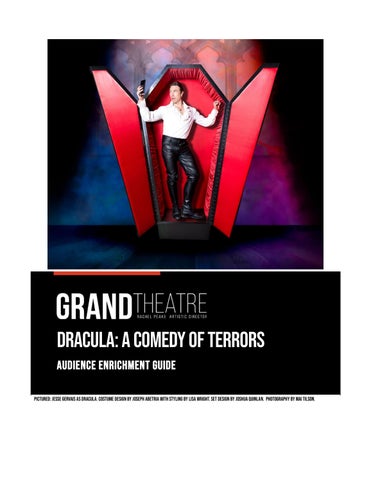
DRACULA: A COMEDY OF TERRORS AUDIENCE ENRICHMENT GUIDE Pictured: Jesse Gervais as Dracula. Costume Design by Joseph Abetria with Styling by Lisa Wright. Set Design by Joshua Quinlan. Photography by Mai Tilson.
By Gordon Greenberg and Steve Rosen DRACULA: A COMEDY OF TERRORS is presented by arrangement with Concord Theatricals on behalf of Samuel French Inc. www.concordtheatricals.com
GRANDTHEATRE AUDIENCE ENRICHMENT GUIDE
2
TABLE OF CONTENTS
TABLE OF CONTENTS ............................................................................................................... 3 HOW TO USE THIS GUIDE ........................................................................................................ 4 ABOUT THE SHOW – DRACULA: A COMEDY OF TERRORS ................................................ 5 Creative Team ........................................................................................................................... 5 Cast ........................................................................................................................................... 5 Audience Advisory .................................................................................................................... 6 Themes ..................................................................................................................................... 6 Characters and Casting ............................................................................................................ 6 Character Descriptions ............................................................................................................. 7 Character Map .......................................................................................................................... 8 Plot Synopsis ............................................................................................................................ 9 Behind the story .......................................................................................................................11 Fun facts about Dracula.......................................................................................................... 12 Evolution of Dracula for the stage .......................................................................................... 13 Creative Insights ..................................................................................................................... 13 PRE-SHOW & POST-SHOW DISCUSSION QUESTIONS ...................................................... 15
GRANDTHEATRE AUDIENCE ENRICHMENT GUIDE
3
HOW TO USE THIS GUIDE Set the stage for a powerful and entertaining live theatre experience! The Grand Theatre’s 2026/27 Season Audience Enrichment Guides are designed to deepen engagement and provide context for audiences, educators, and students – before and after visiting the Grand Theatre. Each guide contains a range of material such as: • Background information on the play and artists involved • Plot synopsis, character descriptions, themes, curriculum connections • Exciting insights specific to each production • Classroom activities and reflection questions
GRANDTHEATRE AUDIENCE ENRICHMENT GUIDE
4
ABOUT THE SHOW – DRACULA: A COMEDY OF TERRORS Creative Team Playwright – Gordon Greenberg Playwright – Steve Rosen Director – Krista Jackson Set Designer – Joshua Quinlan Costume Designer – Joseph Abetria Lighting Designer – Leigh Ann Vardy Sound Designer & Composer – John Gzowski Movement Director – Cameron Carver Associate Director* – Keith Fernandez Fight & Intimacy Director – Jennifer Dzialoszynski Dialect Coach – Jane Gooderham Stage Manager – Jordan Guetter Assistant Stage Manager – Lore Green Apprentice Stage Manager – Zoe Daca *Position funded by Canada Council for the Arts
Cast Mina Westfeldt / Dr. Van Helsing & Others – Constant Bernard* Dracula – Jesse Gervais Jonathan Harker & Others – Nathan Howe Lucy Westfeldt / Kitty & Others – Reena Jolly Dr. Westfeldt / Renfield & Others – Nora McLellan * Fight / Intimacy Captain
GRANDTHEATRE AUDIENCE ENRICHMENT GUIDE
5
“Sexy and campy with non-stop hilarity... you don’t want to miss this!” – Forbes “If you’ve been craving a break from the frights of real life, this campy, vampy romp is a scream!” – TimeOut NY
Drac is back – single, sexy, and he’s got a type. This fast-paced, gender-bending, quick-changing farce with fangs is guaranteed to quicken your pulse in between screams of laughter. A meek British realtor takes on a new and mysterious client, who just happens to be the most terrifying and bloodthirsty monster the world has ever known. The client's deep pockets? Irresistible. His attraction to the realtor's fiancée? Concerning. Meanwhile, three women – a doctor, a soil-enthusiast, and a failed flirt – navigate the men amongst them and find a way to stop all the bloody dying, no matter how dangerously sexy it is. Award-winning director Krista Jackson is known to Grand audiences for fast-paced and deliciously dark laughs (Fly Me to the Moon, The Lion in Winter). This London Made production of the world’s hottest take on its least honourable prince will leave you thirsty for more.
“It’s sexy, campy, satirical, and fun. The amazing Krista Jackson (Imago Theatre, Stratford Festival, and former Associate Artistic Director at the Grand) is directing this gorgeous production with a small, clever cast. Expect all the delight that Grand audiences love in a comedy, with a bass note of smart social commentary.” – Rachel Peake, Artistic Director
Audience Advisory
Themes
Age Recommendation: 13+
•
Adaptation, intertextuality (media literacy)
• • • • •
Voice, identity, & representation Transformation, growth, & moral/personal change Ensemble, collaboration, & community systems Genre, style, & theatrical convention Ethics, power, & social structures
Historical depictions of psychiatric hospitalization, sexism, simulated sex, mature themes (satire), stage violence. Production includes haze, fog, strobe, and blood effects.
GRANDTHEATRE AUDIENCE ENRICHMENT GUIDE
6
Characters and Casting One of the unique features of Dracula: A Comedy of Terrors is its use of dual role casting. The play is written for five actors who portray multiple characters throughout the story, often changing roles rapidly for comedic effect. This approach highlights the theatricality of the production and contributes to the fastpaced style of the show.
In this production, the actors are cast as follows: • • • • •
Nathan Howe - Prologue / Harker / Suitors / Bosun / Gravedigger Nora McLellan - Prologue / Wolf / Captain / Dr. Westfeldt / Renfield Reena Jolly - Prologue / Wolf / Lucy Westfeldt / Kitty Rutherford Constant Bernard - Prologue / Driver / Wolf / Mina / Van Helsing Jesse Gervais - Dracula
Character Descriptions Dracula A charismatic, vain, and irresistibly attractive vampire with the presence of a rock star. He is a narcissist who is bored with easy admiration and becomes obsessed with Lucy because she challenges him. Beneath his confidence is a lonely immortal searching for love. Jonathan Harker A prim, anxious, highly organized British real estate agent. He is devoted to Lucy but often ruled by fear and caution. Over the course of the play, he undergoes dramatic personal growth, becoming unexpectedly bold and adventurous. Engaged to Lucy. Lucy Westfeldt An intelligent, adventurous earth scientist who is frequently underestimated because of her beauty. Brave, curious, and independent, she yearns for excitement and meaningful purpose beyond conventional expectations for women. Engaged to Jonathan.
GRANDTHEATRE AUDIENCE ENRICHMENT GUIDE
7
Mina Westfeldt Lucy’s insecure younger sister. She feels overshadowed by Lucy’s beauty and accomplishments and desperately craves attention and affection. Despite her self-doubt, she occasionally reveals surprising courage and emotional depth. Dr. Westfeldt Lucy and Mina’s father. A pompous, self-important doctor who specializes in treating the criminally insane. He is often sexist, loud, and overconfident, but genuinely loves his daughters. Dr. Van Helsing A brilliant German doctor and vampire hunter. Strong, practical, intelligent, and fearless, she is a woman of action who often has to prove her competence to those who underestimate her. Renfield One of Dr. Westfeldt’s patients. Unstable and obsessed with eating insects, he is highly suggestible and eager to serve someone stronger than himself. Both comic and tragic, he becomes Dracula’s devoted servant. Kitty Rutherford A dotty kleptomaniac patient of Dr. Westfeldt, who works as a maid in his house. Lord Cavendish One of Lucy’s suitors, Scottish, and a bit of a dolt. Lord Worthington Another suitor for Lucy. Posh, entitled, and somewhat petulant, representing stereotypical upper-class British privilege. Lord Havemercy A wealthy and arrogant American suitor from Memphis who speaks and behaves like Elvis Presley. Loud. Confident and exaggerated for comic effect. Driver The Transylvanian carriage driver transports Jonathan to Dracula’s castle. Superstitious, dramatic, and eager to warn Jonathan about the danger ahead. Captain The seasoned captain of the doomed ship carrying Dracula to England. Professional and determined, he faces disaster with grim resolve. Bosun A sailor aboard the ship. Rough, practical, and humorous, he serves as a comic counterpart to the captain before meeting a tragic fate. Gravedigger A perpetually drunk cemetery worker who witnesses strange supernatural events. Comic relief with unexpected importance to the plot.
GRANDTHEATRE AUDIENCE ENRICHMENT GUIDE
8
Character Map
GRANDTHEATRE AUDIENCE ENRICHMENT GUIDE
9
Plot Synopsis Jonathan Harker, an anxious and overly cautious English real estate agent travels to Transylvania to finalize property purchases for the mysterious Dracula. Jonathan's journey to Dracula's castle is made even more unsettling by a superstitious Driver, who desperately tries to warn him about the dangers awaiting him in Transylvania. During his visit, he discovers that Dracula is not the frightening monster of traditional horror but an egotistical, seductive immortal who is desperately searching for a soulmate. When Dracula sees a photograph of Jonathan’s adventurous fiancée, Lucy Westfeldt, he becomes instantly obsessed with her and follows Jonathan back to England. In Whitby, Lucy lives with her father, Dr. Westfeldt, and her insecure sister, Mina. At Lucy and Jonathan's engagement celebration, several of Lucy's former suitors attend, including Lord Cavendish, Lord Worthington, and Lord Havemercy, providing comic relief. All three continue pursuing Lucy despite her engagement, highlighting her popularity and independence. Dracula arrives unexpectedly and begins pursuing Lucy. Mina, craving affection, becomes enchanted by Dracula and falls victim to his vampiric influence. As her health rapidly deteriorates, Dr. Westfeldt summons Dr. Van Helsing, who gradually realizes that a vampire has comes to Whitby. Also living in the Westfeldt household are two of Dr. Westfeldt’s patients – Renfield is manipulated into becoming Dracula’s devoted servant and accomplice; Kitty Rutherford, serves as the family’s maid and provides comic relief while contributing to the increasingly chaotic household. While Dracula continues trying to win Lucy’s heart, he secretly feeds on Mina and manipulates the unstable Renfield into becoming his servant. Mina is eventually transformed into a vampire, and the heroes uncover the truth: Dracula is responsible for the strange illnesses, disappearances, and attacks plaguing the town. The danger is linked to Dracula's arrival aboard a doomed ship bound for England. During the voyage, the vessel's determined Captain struggles to maintain order as crew members mysteriously disappear. His loyal Bosun serves as a practical and humorous companion as the situation worsens. Ultimately, both men fall victim to Dracula's presence, and the ship crashes ashore, bringing the vampire to England. As Mina's condition worsens and Dracula's influence spreads, Lucy, Jonathan, Dr. Westfeldt, and Van Helsing uncover the truth. Renfield's suspicious behavior, reports of bite marks on victims, and the strange events surrounding Dracula all point to a single conclusion: Count Dracula is a vampire. As the threat grows, Jonathan struggles with his own fears and insecurities, especially as Lucy becomes increasingly frustrated by his cowardess. Ironically, after being bitten by a vampire, Jonathan develops a newfound confidence and swagger, forcing him to confront the person he wants to become. The hunt for Dracula takes the heroes across London and eventually back to Withering Manor. During their search, they encounter a perpetually drunk Gravedigger, whose observations about strange supernatural events help point them toward Dracula's whereabouts.
GRANDTHEATRE AUDIENCE ENRICHMENT GUIDE
10
At Withering Manor, the heroes confront Dracula in a final showdown. Lucy rejects his proposal, explaining that true love requires selflessness rather than obsession. For the first time, Dracula understands that despite all his power, wealth, and immortality, he has never truly loved anyone. Realizing that he genuinely cares about Lucy and wants her happiness, he chooses to make the ultimate sacrifice. Understanding that Mina and Jonathan can only be freed from his curse through his death, Dracula allows Jonathan the opportunity to destroy him. Drawing upon the courage he has finally discovered within himself, Jonathan drives a stake through Dracula's heart, ending the vampire's reign and freeing everyone he infected. The play ends happily as Mina recovers, Drs. Van Helsing and Westfeldt become partners, and Lucy and Jonathan marry while expecting a child. However, in one final comic twist, the wedding minister is revealed to be Dracula, suggesting that the notorious vampire may not be quite as dead as everyone believes.
GRANDTHEATRE AUDIENCE ENRICHMENT GUIDE
11
Behind the story Bram Stoker Bram Stoker (1847-1912) was an Irish writer, theatre manager, and literary critic best known for writing Dracula (1897), one of the most influential horror novels ever published. He was born in Clontarf, a coastal suburb of Dublin, Ireland. Writing Dracula Stoker spent years researching folklore, history, travel accounts, and vampire legends before publishing Dracula in 1897. The novel tells the story of Count Dracula, a vampire from Transylvania who travels to England, and the group led by Van Helsing who attempts to stop him. The book is written through diary entries, letters, and newspaper reports, a style known as an epistolary novel. Stoker drew inspiration from many sources, including vampire folklore and historical references to Vlad the Impaler, whose name helped inspire Dracula. Legacy Bram Stoker’s novel was not an immediate bestseller and was outsold by another horror novel called The Beetle. However, its popularity grew over time, eventually establishing it as Stoker’s most celebrated work. Although he wrote numerous novels and short stories, Dracula became his masterpiece, leaving a lasting impact on Western popular culture and shaping the modern image of the vampire. Dracula has enjoyed wide popularity in its many adaptations for film, television, and the stage. These include the German silent film Nosferatu (1922), which was an unauthorized adaptation of Stoker’s tale, and the classic horror film Dracula (1931), which starred Bela Lugosi.
GRANDTHEATRE AUDIENCE ENRICHMENT GUIDE
12
Fun facts about Dracula • • • • • •
In Romanian, the word “Dracula” can mean both “dragon” and “devil”. Dracula has appeared in almost 300 films, making him one of the most portrayed fictional characters in movie history. Modern versions of Dracula have changed over time, from terrifying monsters to romantic or even comedic characters, such as in Dracula: A Comedy of Terrors. Van Helsing is reimagined as Jean Van Helsing, a female vampire hunter, giving the story a fresh twist. According to Bram Stoker’s novel, Dracula had a large moustache and could only fully transform at sunset. Bram Stoker’s novel was not an immediate bestseller and, when it was first released, was outsold by another horror novel called The Beetle.
Evolution of Dracula for the stage The first authorized stage adaptation of Dracula was written by Irish actor and playwright Hamilton Deane and premiered at the Grand Theatre in Derby, England, on August 5, 1924. Deane obtained permission from Bram Stoker’s widow, Florence Stoker, to adapt the novel for the stage. After touring England, the play reached London’s Little Theatre in 1927, where American producer Horace Liveright saw its potential. He commissioned journalist and playwright John L. Balderston to revise it for American audiences. The revised version opened at the Fulton Theatre on Broadway in October 1927 and starred Bela Lugosi as Count Dracula. The Broadway production became enormously influential and helped establish many elements now associated with vampires, including Dracula’s elegant aristocratic appearance, cape, and hypnotic charm. The play directly inspired the famous 1931 Universal film Dracula, which also starred Bela Lugosi. A major Broadway revival in 1977 starring Frank Langella won the Tony Award for best revival. 126 years later, Dracula: A Comedy of Terrors was written by Gordon Greenberg and Steve Rosen as a comic reimagining of Bram Stoker’s classic novel. Rather than creating a traditional horror adaptation, they wanted to blend Gothic horror with the style of theatrical comedies. After Greenberg and Rosen had success with another fast-paced, five-actor adaptation (Ebenezer Scrooge's Big [Your Town Here] Christmas Show!), they decided to tackle Dracula in a similar style. The writers became interested in using a small cast, rapid character changes, physical comedy, and theatrical storytelling to reinvent the famous vampire tale. The play was developed over several productions and workshops before reaching New York. It was developed at: Maltz Jupiter Theatre, Chicago Shakespeare Theater, Capital Repertory Theatre, Segal Centre. As the script evolved, Greenberg and Rosen transformed Bram Stoker’s dark Victorian novel into a 90-minute comedy with only five actors playing fifteen or more roles. They intentionally leaned into gender-bending casting, visible costume changes, self-aware humour, and exaggerated characterizations while preserving the basic plot of Dracula’s pursuit of Lucy and the heroes’ attempt to stop him. The show eventually premiered off-Broadway at New World Stages in 2023, where Greenberg also directed the production. Their version presents Dracula as a sexy, lonely, and narcissistic vampire experiencing a crisis, exploring themes of love, courage, and personal growth beneath the surface.
GRANDTHEATRE AUDIENCE ENRICHMENT GUIDE
13
Creative Insights About the Creators of Dracula: A Comedy of Terrors Gordon Greenberg and Steve Rosen’s Dracula: A Comedy of Terrors is a hilarious reimagining of Bram Stocker’s famous vampire tale. The play transforms the classic horror story into a joyful, laugh-out-loud theatrical adventure. Blending fast-paced comedy, mistaken identities, romance, and plenty of humour.
Gordon Greenberg Gordon Greenberg is an award-winning director, writer, and producer whose world spans Broadway, off-Broadway, London’s West End, television, and major regional theatres. His credits include Who’s Afraid of Virginia Woolf?, Guys and Dolls in London’s West End, the Broadway adaptation of Holiday Inn, The Heart of Rock and Roll, Piaf/Dietrich, Working, and Meet Me in St. Louis. He has also written for television, developed new musicals and plays, and serves as Co-Artistic Director of the Broadway Teachers Workshop. Educated at Stanford University, NYU, and RADA.
Steve Rosen Steven Rosen is a playwright, lyricist, actor, and comedian. He co-created the acclaimed musical The Other Josh Cohen, which earned multiple Drama Desk and Lucille Lortel Award nominations, and has written numerous stage and television projects, including Broadway Vacation. As a performer, he has appeared in the original Broadway casts of Monty Python’s Spamalot, The Farnsworth Invention, and Guys and Dolls, as well as recurring television roles on Law & Order: SVU and The Resident.
COMEDY OF ERRORS: Did You Know? The Comedy of Errors is a Shakespearean comedy of mistaken identity that uses confusion, humorous situations, and wordplay to entertain the audience. The play follows two sets of identical twins who were separated at birth and unknowingly meet in the same city, leading to a series of misunderstandings. Through these comic mix-ups, Shakespeare explores themes of identity, family, and appearance versus reality before ending with a happy reunion.
Poster for 1879 production on Broadway, featuring Stuart Robson and William H. Crane.
GRANDTHEATRE AUDIENCE ENRICHMENT GUIDE
14
PRE-SHOW & POST-SHOW DISCUSSION QUESTIONS What comes to mind when you think of Dracula or stories about vampires? How does this version of Dracula differ from traditional portrayals of the character? What deeper messages are hidden beneath the comedy?
GRANDTHEATRE AUDIENCE ENRICHMENT GUIDE
15