6 From the Place of the Unknown: Exploring Yeena Yoon’s Jewellery 12 The Magician, the Alchemist and the Assayer: Characters on Stage and at Cour t in Early Modern Europe
14 South House Silver Workshop Trust
16 The Outer Display and the Inner Beauty: A Pair of Cups by Miriam Hanid
19 Strike a Blow: Talking Metal with Simone ten Hompel, Juliette Bigley and Max Warren
22 Lost & Found: Upending Convention
27 The Last Turn of the Lathe?
The Uncer tain Future of Silver Spinning
Editor Eleni Bide
Assistant Editor
Katie Lissamore-Spooner
Correspondence
The Worshipful Company of Goldsmiths, Goldsmiths’ Hall, Foster Lane, London ec2v 6bn
Designed and produced by Christiechristie and Disegno Works christiechristie.cc disegnoworks.com
ISSN 0953-0355
62 Ar t in Circulation: Designing Coins THE COMPANY 2 Welcome
The Path to Making: Rauni Higson
Stalked by Leopards
Lab-grown luxury: Natural and Synthetic Diamonds 48 Growing Together: A Community Where Makers and Businesses Thrive 50 Forging Careers in Gold and Silver: The Goldsmiths’ Company Apprenticeship Scheme
The Science of Jewellery
Interwoven: Jewellery Meets Textiles 58 Wordsmithing: At the Crossroads of Jewellery and Language
66 The New Prime Warden 68 A Prime Warden’s Year
Company in Numbers
Membership Update
Committees List
Obituary
Militar y Affiliations and Related Partners
Archive
Object in Focus 33 The Ar t of Gold
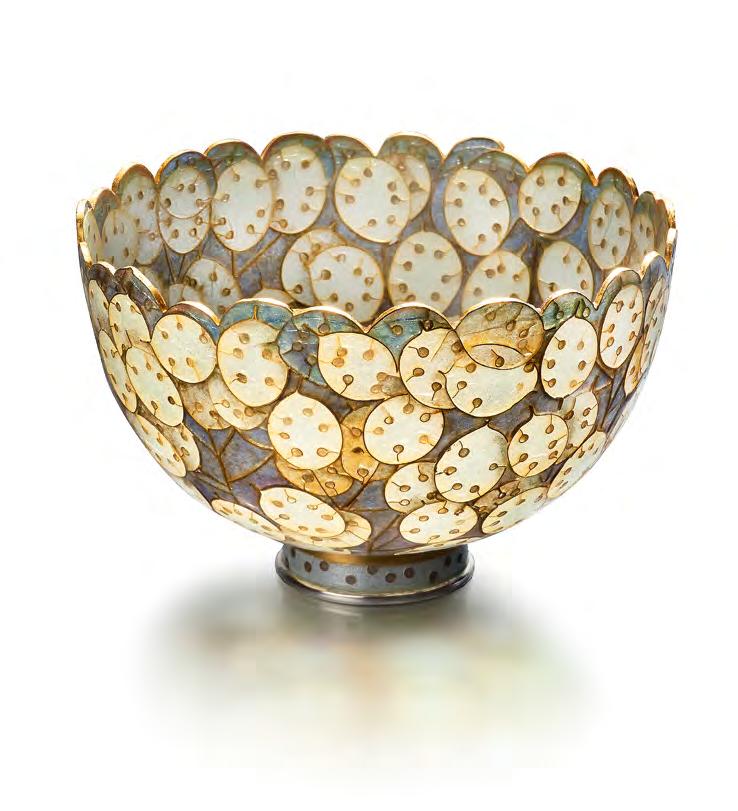
Front cover
The Honest Bowl, Alexandra Raphael, 2024, enamel, silver, gold. Raphael received The Jacques Cartier Memorial Award for this piece, which incorporates plique-à-jour enamel and 39ft of 24ct gold wire. Courtesy of The Goldsmiths’ Craft and Design Council.
RICHARD VALENCIA
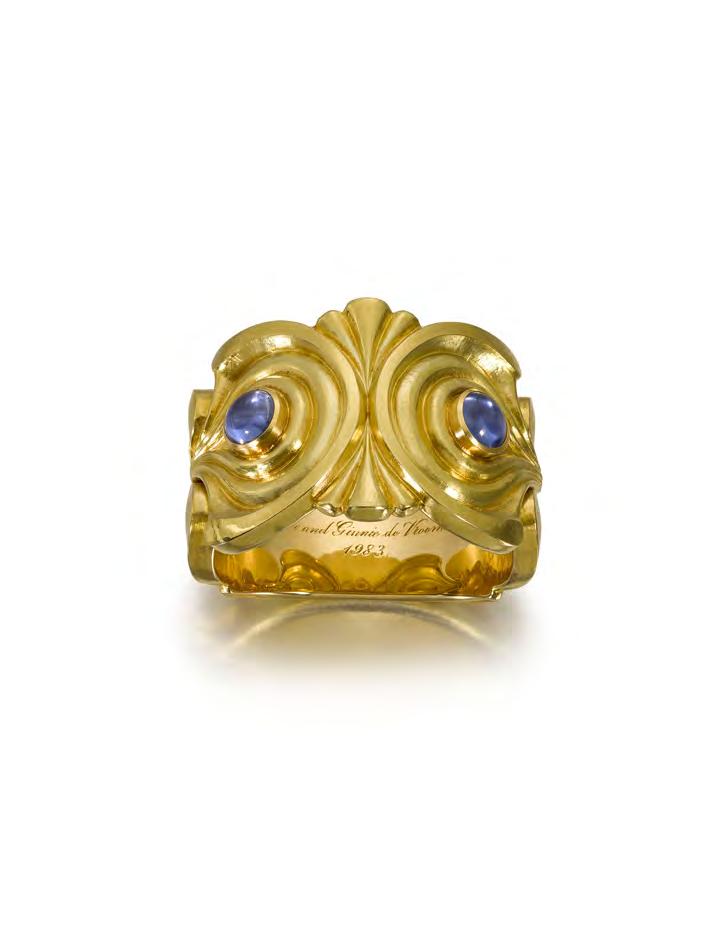
Title page
Aurum Bangle, Leo de Vroomen, 1982, 18ct repousse yellow gold, cabochon sapphire, designed by Ginnie de Vroomen.
The Goldsmiths’ Company Collection.
RICHARD VALENCIA
Back cover
Sconce, Hector Miller and Grant Mcdonald, 2024, sterling silver, gold, resin. Prime Warden’s commission of Rupert Hambro (2009–10), Goldsmiths’ Company Collection.
No part of this work may be reproduced, stored in a retrieval system or transmitted in any form or by any means, including copying and recording, without written permission from the copyright owner, application for which should be addressed to the Goldsmiths’ Company. Opinions expressed in The Goldsmiths’ Review are not necessarily those of the Editor or the Goldsmiths’ Company. Whilst every effort has been made to verify statements of fact by contributors, no responsibility is accepted for errors or omissions by them. Prospective users of techniques, materials or equipment described should take specialist advice on official safety precautions and regulations which apply to them. Both may vary from country to country.
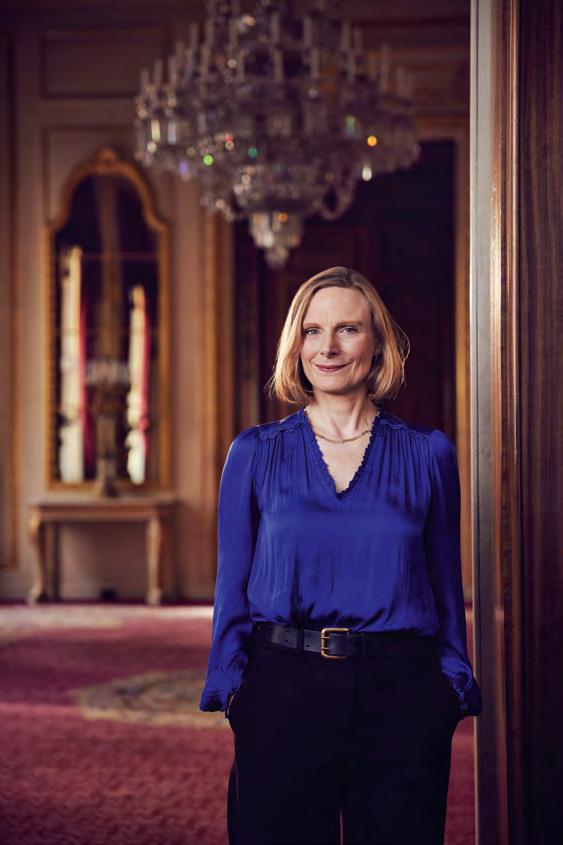
Annie Warburton CEO & Clerk
the stories that unfold in this year’s Goldsmiths’ Review are wonderfully diffuse. From ancient alchemy to our Apprentice of the Year, from synthetic diamonds to silversmithing in Sheffield, and from cutting-edge metallurgy in Massachusetts to youngsters in Bradford discovering the transformative power of words. Diverse as these narratives are, they are united by common values (golden threads, if you like) that are at the heart of the Goldsmiths’ Company: skills, craftsmanship, realising potential, and the power of community.
Silversmith Rauni Higson mbe is celebrated for her exceptional artistry in pieces often inspired by the natural world. Dazzling though Higson’s talent is, what shines through in Caroline Palmer’s profile of her is a dedication to nurturing the skills of emerging makers. Her generosity of spirit is matched by Rod Kelly (one of Higson’s own mentors) whose South House Silver Workshop is a sanctuary for developing new generations of silversmiths through intensive residential training. As Kelly tells Chris Mann, transmission of skills cannot be rushed. In these accelerated times, it’s a lesson we all need to hear.
Careful stewardship of skills is increasingly critical, particularly since silver allied trades joined the Red List of Endangered Crafts this year. Only a handful of silver spinners, for example, are currently active in the uk, yet the industry’s survival depends on their skills. Emma Crichton-Miller’s interviews with master practitioners reveal the precision of these all-too-often overlooked skills, as well as the jeopardy they face.
To meet such skills challenges, we continue to evolve, this year expanding our Apprenticeship Scheme to the West Midlands for the first time. It’s a timely move given that 2025 saw Birmingham receive prestigious World Craft City status in recognition of its global influence in jewellery making. Also in this region, the groundbreaking Goldsmiths’ Institute at Aston University Engineering Academy, a Goldsmiths’ Foundation Landmark Grant project, is uniting employers and educators to train the next generation of industry professionals. Such initiatives are transformational, as Katie LissamoreSpooner’s profile of Apprentice of the Year Sophie Chapman shows.
A more surprising story of transformation is craft’s potential in advanced engineering. Scientist Owain Houghton at Massachusetts Institute of Technology (whose Cambridge PhD was supported by the Goldsmiths’ Foundation) tells Eleni Bide how millennia-old metalworking techniques such as granulation and Japanese Mokume Gane have
contemporary applications, driving innovation in fields including aerospace and microelectronics.
Such dialogues with other fields run throughout this year’s Review. Yeena Yoon reflects on her journey from architecture to jewellery – a radical shift in scale but not in design thinking, she tells Rachel Church. Lina Iris Viktor’s site-responsive, lavishly gold-laden exhibition at the Sir John Soane’s Museum prompts Will Gompertz’s meditation on gold in contemporary art. Charlotte Dew unravels surprising interdisciplinary influences between textile techniques and jewellery, whilst Debika Ray delves into jewellery’s connections with the written word. Beyond words, the narrative power of silver was brought vividly to light by Adi Toch and David Clarke in their Goldsmiths’ Fair installation Lost and Found –prompting conversations, wonderment, laughter, and even gentle tears, as Martina Margetts discovers.
At Goldsmiths’ Hall, we’ve been reflecting on how we tell our story to connect with a wider world. January saw the launch of our new brand identity. In an enlightening and entertaining piece, Eleni Bide reveals how, drawing on the emblems in our coat of arms, the new designs celebrate our values and history. At their heart is our proud leopard’s head – a symbol of trust and authenticity.
The leopard leads a rich and fruitful year, as you will discover in our illustrated report at the back of this Review. Last year, our funded programmes and partners reached some 250,000 people. The evolution of our charity into the Goldsmiths’ Foundation is a significant milestone, marking a renewed commitment to supporting creative skills, training, and our craft and trade.
All this is possible only with our people. I extend heartfelt thanks to our members who give generously of their time and expertise on committees, boards and the Court of Assistants – volunteers all. I never fail to be humbled by your passion and dedication, and by our devoted staff team. Above all, I thank Prime Warden Ed Butler and his immediate predecessor Richard Reid for their leadership.
Though we may work in precious metals, our true treasure is skill. As a Company, our strength is in connecting people. In these fragmented times, the act of making – and the skill of bringing people together –gives hope. To work with our hands is to tend and care, to coax and transform raw material into something extraordinary and rare. Like craftspeople, it falls to each of us to apply our own skill and imagination as a transformative force for good. ✦
APPRENTICE TO FREEMAN
Sophie Chapman
Katie Lissamore-Spooner
JULIA SKUPNY
sophie chapman found her way onto the Goldsmiths’ Centre Foundation Programme after looking for a way to develop what she had already learned on an Art Foundation course. She was eager to build practical skills and deepen her craft knowledge, and an alternative to a university programme appealed to her. “I took to it quickly when I started and things were clicking into place,” she says. During the course, Chapman went for two work experience placements at Asprey, which she later found to be a suitable fit for her apprenticeship as part of the Goldsmiths’ Company Apprenticeship Scheme.
“It’s good to leave your comfort zone and gain your own sense of independence.”
Chapman’s main aim in selecting an apprenticeship was to find a company that had interesting and varied work, but also to find somebody with whom she would work well. She found that person at Asprey in master silversmith Tim Burtwell. “Tim was the perfect teacher for me,” she says. “We had such a great dynamic. I think it’s really important to get on well with your master – it makes the four years fly by.” Her apprenticeship at Asprey was an involved learning experience embedded in the workshop, where she learned from some of the most experienced silversmiths working in the trade. “Most of the team I worked with have now retired,” she says, “so it was a privilege to work with and learn from them firsthand.”
Chapman was awarded a Cellini Award for Excellence in Craftsmanship at the end of her foundation year and has continued producing fine works in silver. During her apprenticeship she won several awards from the Goldsmiths’ Craft and Design Council, in the categories of modelling, enamelling, smallworking, and chasing. Although she originally took up silversmithing Chapman was also drawn
to smallwork and the sheer variety of skills it had to offer. “It’s not just making trophies and silverware, or jewellery, there’s an in-between that suits me best,” she says. “When I first got into the industry, I didn’t know smallwork was an option.”
Her masterpiece, a 1:18 scale model of a 1991 Nissan Figaro, was a personal piece dedicated to her first car, and required her to work with precision and detail. Chapman bought the car at the beginning of her apprenticeship and the piece was on her agenda at an early stage. At the start of the project she worked hard to document every detail of the vehicle. “It was my first model and I wanted every detail to be accurate and completely to scale,” she says. It was the first project she managed from start to finish and “it tested every skill”. “I enjoyed making it from start to finish,” she says. “I was thrilled to see what I had been imagining come together.” She hopes to now revisit the process of making a model car, and create one with even more moving parts and details.
Since becoming a Freeman of the Goldsmiths’ Company, Chapman has joined Grant Macdonald Silversmiths, who are world leaders in bespoke objet d’art in silver and gold. “It’s complex work and I’m enjoying the new challenge,” she says. “It’s good to leave your comfort zone and gain your own sense of independence.” Taking on this new challenge has boosted Chapman’s confidence in her abilities, and her new position in the Grant Macdonald London workshop is working well. Winning the Apprentice of the Year award, meanwhile, gave Chapman a moment to celebrate her successes so far. She enjoyed the ceremony, as it gave her an opportunity to meet craftspeople outside of the Goldsmiths’ Company and the world of silverwork who also share her passion for working with materials.
Helen Dobson, Programme Manager (Education) at the Goldsmiths’ Centre, says: “Throughout her time on the Goldsmiths’ Centre Foundation Programme and the Goldsmiths’ Company Apprenticeship Scheme, Sophie demonstrated a quiet strength and determination, repeatedly winning awards, becoming Asprey’s first female silversmithing apprentice, and producing an exquisite masterpiece, despite her apprenticeship being hugely impacted by Covid. Sophie is definitely one to watch!” ✦
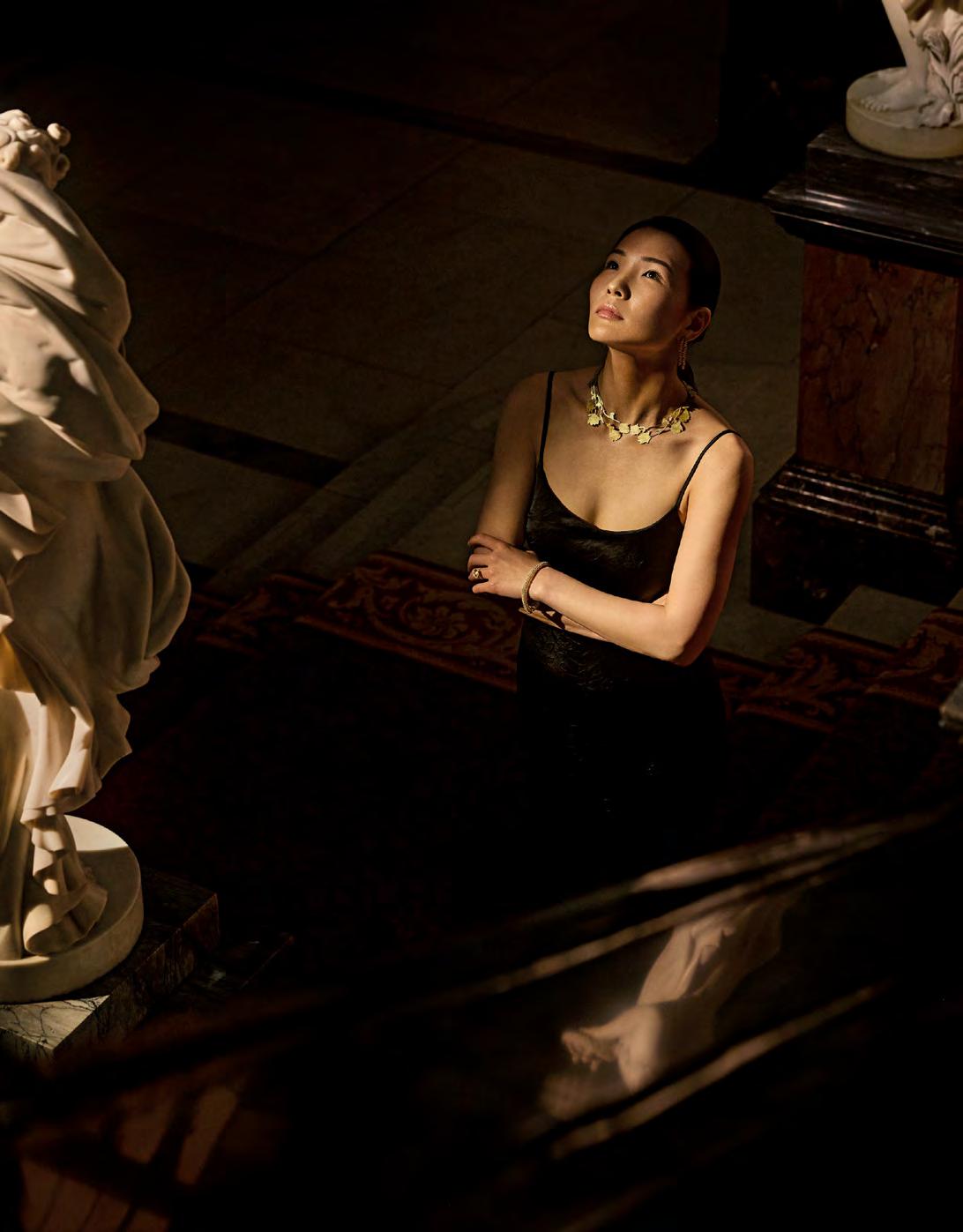
FROM THE PLACE OF THE UNKNOWN
Exploring
Yeena Yoon’s Jewellery
Rachel Church
From working on Zaha Hadid’s 2012 London Aquatics Centre to operating a small studio in the Goldsmiths’ Centre may seem like an unusual path into jewellery, but when speaking to Londonbased jeweller Yeena Yoon, it comes to feel like a natural transition.
as with many interesting contemporary jewellers, Yoon came to jewellery by a side route, taking all of her architectural training and sensibility and translating it to a smaller, more precious, form of art. Her jewellery – elegant pieces that combine hardstones such as jade and jasper with precious metals – both draws on and reacts against her architectural background.
From architect to jeweller
After receiving her first architecture degree in South Korea, Yoon moved to the uk and later found herself working in the studio of Zaha Hadid, one of the uk’s foremost architects. She describes herself as being an unusually lucky practitioner, only working on projects that were actually built and thereby escaping the fate of the ‘paper architect’. Although her initial strength was in design, working on the construction side of architecture allowed her to develop skills that have stood her in good stead as a jeweller.
As Yoon explains, “you get to have a really good understanding of construction, how to put things together, the mechanical and
structural aspects of things and, also, a sort of resilience in coordinating how you bring this enormous beast to reality. That requires a lot of experience and persistence. But material was my main focus – how do you put materials together, how do you get the proportions right in the design [stage], so that the door handles are detailed and echo something exciting?”
Architects must necessarily focus on material, which is one of the factors that led Yoon into jewellery. Needing a quick release of her creative juices after the long timelines and focused work of architecture, she tried various hobbies until an evening course in jewellery at Morley College turned her life around. Architecture is a serious business, surrounded by necessary regulations and where mistakes can prove fatal. As such, the playfulness and possibility to experiment offered by jewellery was deeply appealing, providing Yoon with the freedom to explore materials with a new creative speed.
As Yoon explains, “even if you don’t make something brilliant, you can melt it and remake it. There’s
that pure play of materials and engaging with the limitations of your own techniques”.
After the coup de foudre of Morley, joining the Goldsmiths’ Centre for its Setting Out programme was the moment when jewellery changed from a hobby to a new life’s work. While taking a sabbatical from architecture, a timely grant from qest (Queen Elizabeth’s Scholarship Trust) allowed Yoon to see what sort of craftsperson she ultimately wanted to become.
Uniting metal and stone
Yoon’s jewels use the most ancient of materials – precious metals allied with carved stones – but have a clear modernity. Decoration is used with careful thought, becoming an integral part of the design rather than a decorative flourish.
Although her work has its own distinctive language, it draws on the techniques of stone carving and metal wire work that Yoon learnt from Charlotte De Syllas and Giovanni Corvaja, two of the greatest living exponents of these arts. An open call for a masterclass with Corvaja in Italy, organised by the
diva Museum in Antwerp, gave Yoon her first taste of working with gold wire, something which she continues to explore in her jewellery today. Corvaja’s scientific and methodical means of teaching resonated with her and has proved an enduring fascination.
If working with metal often requires fire, speed and precision, stone carving represents a more open and instinctive art. Yoon describes stone carving as messy and time consuming, requiring an engagement with the material and its unique qualities. She notes that stone has a generous flexibility, but you can never rush it, or you will feel defeated by its nature. It fits into her deep interest in the idea of perfection and imperfection. How do you engage with the notion of perfecting a craft? Is that an illusion or a realistic ambition?
Learning through making
“When you’re trying something different, you’re always in the place of the unknown,” says Yoon. “I quite like that, but emotionally,
it’s always a challenging place to be as a maker.”
Yoon’s finished jewels have a spareness and clarity that belies their time-consuming creation. While the final jewels feel balanced and almost inevitable, their process of creation is one of constant iteration and experimentation. Each jewel represents a technical question that has been asked and answered, and which will sometimes be returned to later in order to try alternative solutions or to test a hypothesis.
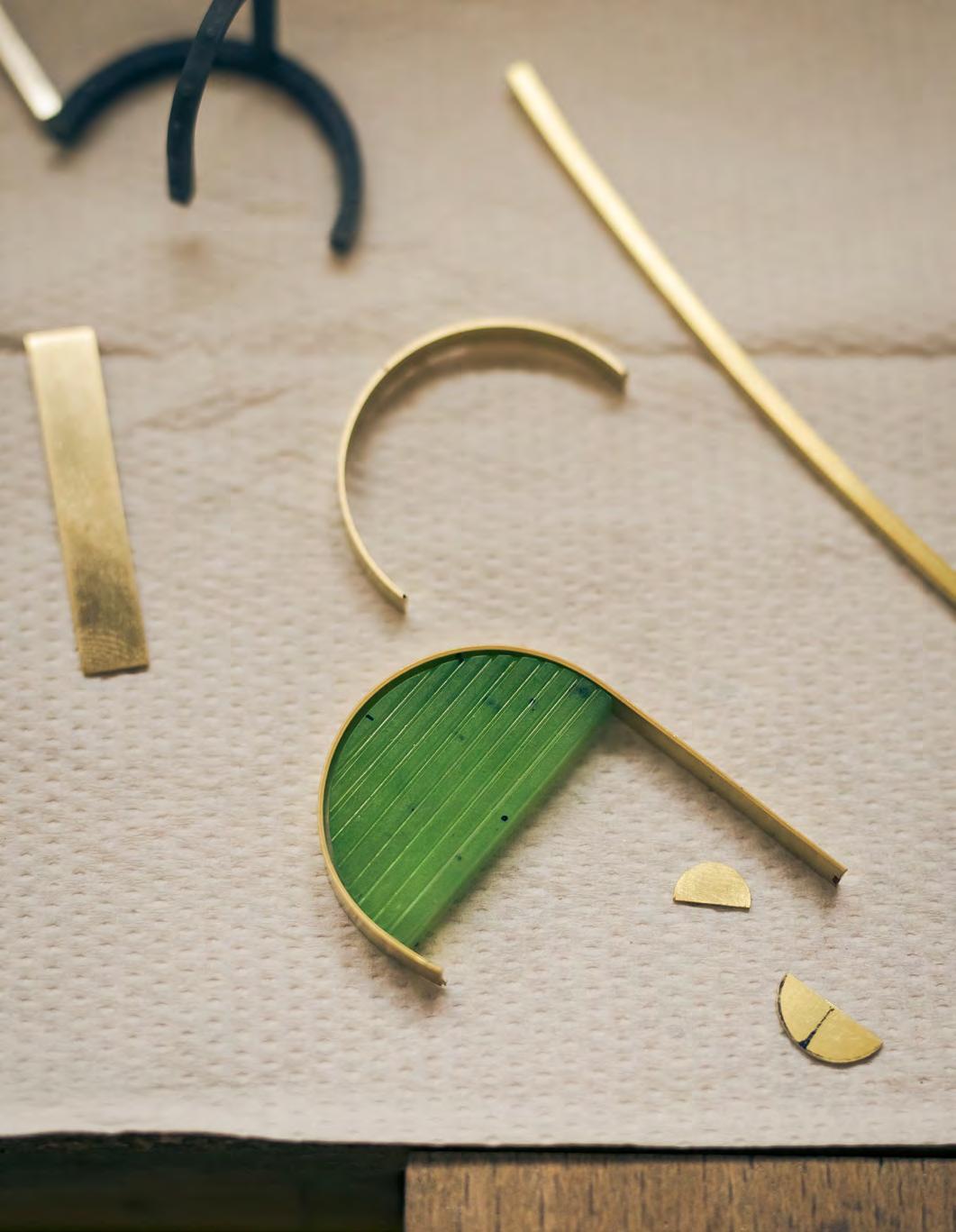
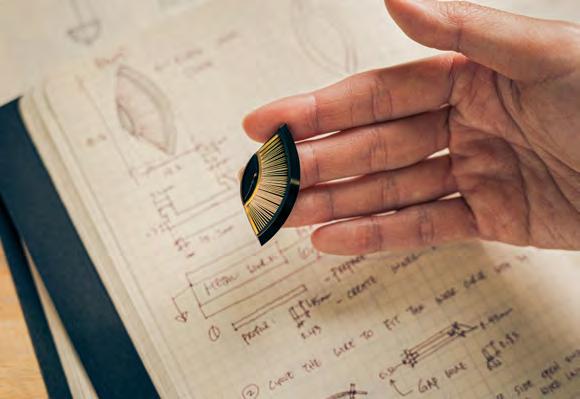
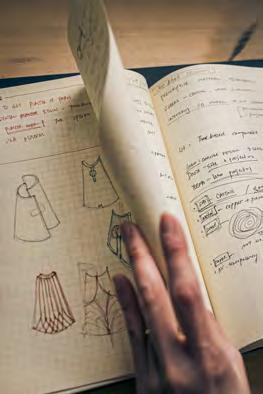
Yoon describes herself as being a designer who thinks through making, so her studio houses hundreds of paper models and sketches exploring different ways of working with space and volume to find a design which feels correct. Prototyping also helps to solve technical problems. How can a brooch pin be made secure, yet unobtrusive? Is there a better way to fix a wire or negotiate with a screw? Sketches and models are combined with careful technical notes, recording each metal alloy
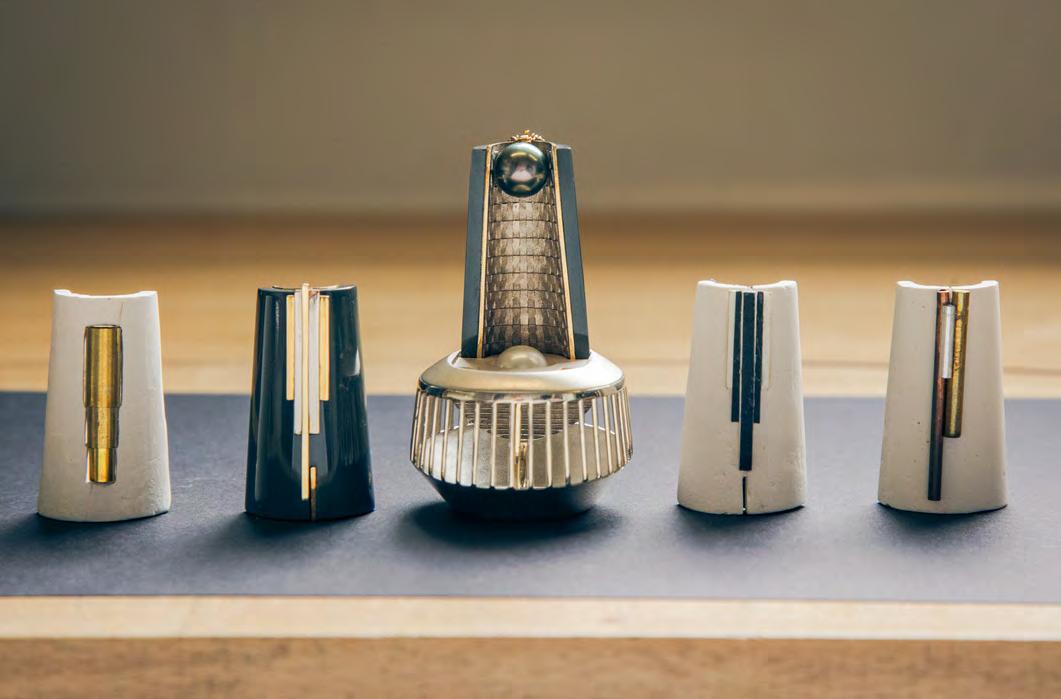
Previous Covet, Yeena Yoon, 2016, 18ct gold, jasper, Southsea pearl, sterling silver. Covet is an interchangeable jewellery piece that doubles as a sculptural object.
PAUL READ
Left
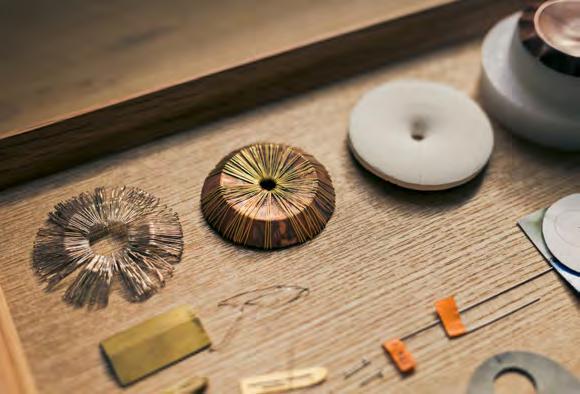
Components for Luna Brooch
PAUL READ
Opposite
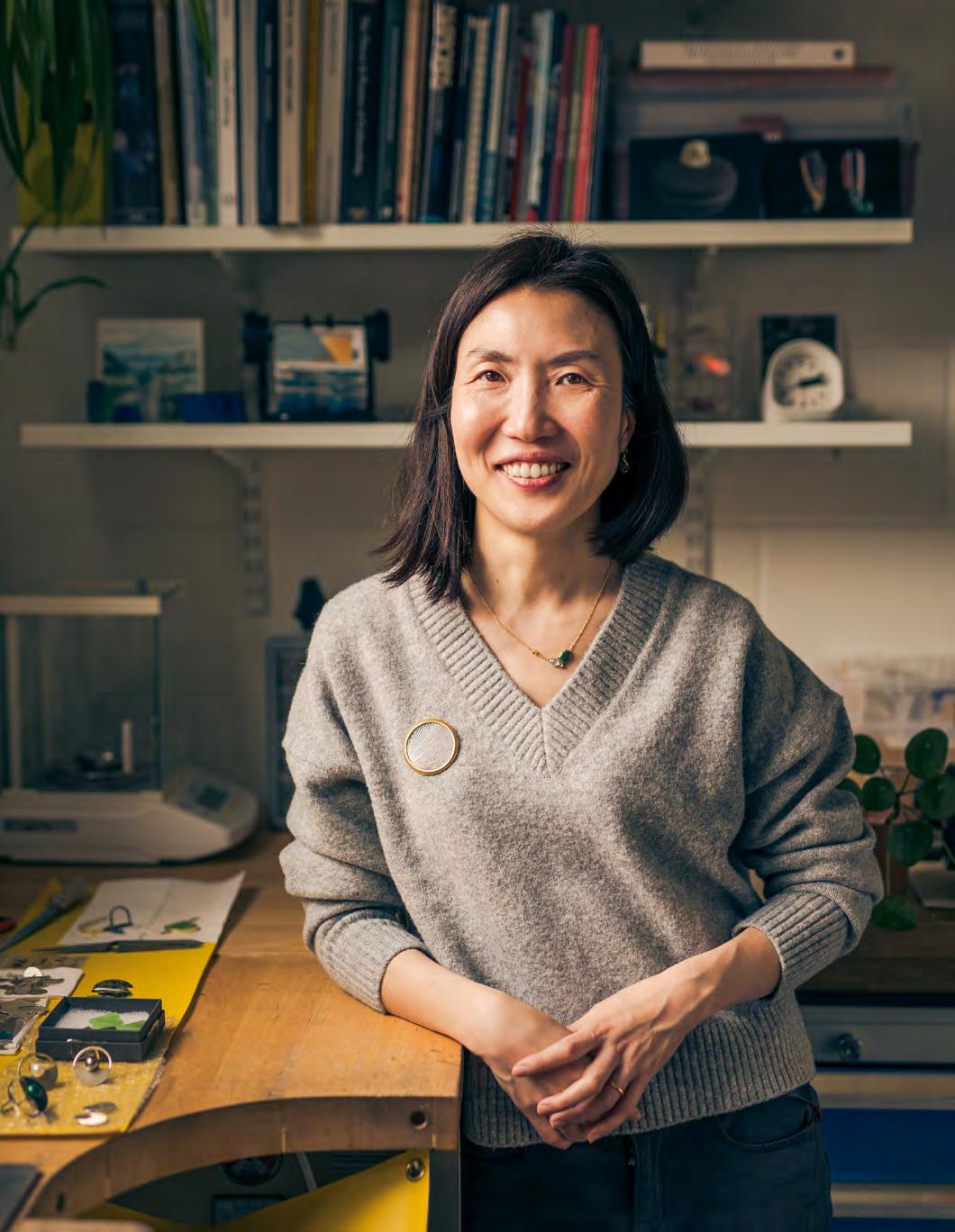
Yeena Yoon in her workshop.
PAUL READ
or design solution alongside an archive of silver mock-ups, samples, wires, screws and other materials.
Timeline pieces
Alongside more accessible earrings and rings, pieces in which her design language has been simplified, Yoon works on ambitious and technically challenging works, embracing new challenges. “I call them timeline pieces,” she says. “These timeline pieces are tools to make me grow, and I like that part of making and designing and thinking conceptually. I think that’s where my passion lies – bringing all my past skills and past studies together, trying to push for what I believe. It’s exciting.”
For her Sunrise Brooch, Yoon alloyed and drew her own gold wire, delicately stretched over the surface of a hand-carved black jade disc that is so beautifully finished that the onlooker is left puzzled as to how the effect was achieved.
Alongside the practical problem of making jewels that are functional, Yoon also engages with the question of beauty across the whole jewel. “I think the back really tells the effort someone has put into things,” she says. “The front is just the front, but when you see the back of something, you can tell the personality of the craftsperson and how they decided
to put things together, because that’s where the mechanical aspect meets with the creative part. That’s the most difficult part to be honest, because it’s not always easy to make the supporting elements beautiful, but I like that aspect of it.”
This attention to detail goes back to her architectural training, in which a building façade offers the main view, but has to hide all the essential services, just as the back of a brooch has to accommodate all of the pins, screws, or fixings which hold it together and make it work, while still remaining clean and beautiful. It gives the jewel’s wearer another surface to enjoy.
Transformations and interchangeability
Like traditional tiaras that can break down into necklaces, brooches and earrings, Yoon’s jewels often offer an element of transformation and can be engaged with in different ways. The Covet series makes jewels into miniature sculptures, with earrings set into dedicated bases that mean they can be displayed when not worn, rather than hidden in a jewellery case.
In Umbra, a natural octahedral diamond collected from the ocean bed became the inspiration for a pair of black jade earrings set in a hand-carved, faceted stand. The shape of the diamond is echoed and enlarged in the facets of the earring. They are designed for transformation. The upper part of the earring, made of jade faceted to resemble a rosecut diamond, can be unscrewed and connected to the diamond pendant to make a shorter pair of earrings.
Yoon’s clients enjoy this element of dexterity and the opportunity to engage with their jewellery. As she explains, many clients approach her wanting pieces to be transformable – adapting a brooch, for example, to wear as a pendant.
Some advice to a new jeweller
“I think trusting in oneself is the most difficult part as a young creative, knowing that you have something special to give,” says Yoon. “It comes by persevering and it comes bit by bit. You just keep expanding what is inside you and [try] not to get affected by external sources. You have to put in hours of effort, and not being swayed by
others is the most difficult thing when you’re a creative, especially in jewellery when you’re working by yourself.
“I feel very lucky that the majority of my youth was spent working in architecture where it is a group environment,” Yoon continues. “For any jewellers who start by themselves, it’s quite challenging. You need to understand that everyone is in the same state or has been. I think to keep going is the challenge and, also, when you do more and more of what you do, it starts to make sense and you grow and evolve because of that.”
As Yoon’s work evolves and grows, she is carving out her own place in the jewellery world, fusing stone and metal to create her own vision. Her work gives a preciousness to stones such as Blue John or tiger’s eye, shining a light on under-appreciated minerals. Each piece moves her practice on and helps to define her unique visual language. ✦
Solar: Escape to Stillness brooch and design, Yeena Yoon, 18ct gold, black jade. PAUL READ
PAUL READ
THE MAGICIAN, THE ALCHEMIST AND THE ASSAYER Characters on Stage and at Court in Early Modern Europe
Peter Oakley
in 1611 , William Shakespeare presented one of his most enigmatic plays: The Tempest. Key to the plot is Prospero, a powerful but tortured magician. Using the knowledge stored in his books, Prospero can commune with spirits and control elemental forces.
Much like Dr Faustus, the creation of Shakespeare’s contemporary Christopher Marlowe, the character of Prospero represents an exceptional individual whose single-minded drive for learning results in supernatural powers that come at an extreme cost. The lives of these two fictional characters can be interpreted as warnings of the consequences of transgressing the boundaries of socially acceptable learning. They are a dramatic equivalent of the early modern alchemist, a figure whose personal quest for spiritual enlightenment led to occult practices such as attempts to turn base metal into gold. This selfish behaviour contrasts with the sociality of the assayer, a metallurgical professional whose skill at assessing the purity of precious metals was seen as an essential support for rulers.
Prospero is widely considered to have been based on Elizabethan courtier John Dee. As a student, Dee is said to have devised stage machinery for a production that was so impressive it was thought to be magical. An avid bibliophile, Dee amassed one of the largest and most
eclectic libraries in Europe, applying his knowledge of mathematics to diverse fields, including navigation and astrology. He also dabbled in alchemy and later in life became obsessed with divination. Tutor to the young princesses Elizabeth and Mary, Dee survived Mary’s subsequent persecution of heretics to emerge as a valued courtier in Elizabeth’s entourage. He was even asked to identify an astrologically favourable day for Elizabeth’s coronation.
In the heady first years of the new Elizabethan reign, Dee placed his mathematical abilities in the service of New World exploration, drawing up maps of the Americas, as well as training ships’ captains in the use of instruments. But he became increasingly obsessed with holding séances, in which he believed he was communicating with angels through mediums. One of these interlocutors, the medium Edward Kelley, was to have a decisive effect on Dee’s career and reputation. In 1583 Dee and Kelley left England for the Continent. This was the start of a strange, random peregrination around the major cities of central Europe. During their travels Dee and Kelley held regular séances, were accused of being English spies, were tried for heresy by Catholic Church officials, and Kelley discovered a talent for alchemy that eclipsed his mediumistic abilities.
Eventually, Dee, who had grown disillusioned with the relationship, returned to England, whilst Kelley remained in Bohemia, feted and ennobled by the Emperor Rudolf II.
Dee returned to a very different English Court and country. The colonial project of the Roanoke settlement in North America had failed, while England had also just endured the threat of the Spanish Armada, surviving but at great social and financial cost. The earlier enthusiasm for pushing the boundaries of knowledge had given way to a growing fear of and antagonism towards mysterious or occult practices. This new zeitgeist was evident in the success of Marlowe’s play, The Tragical History of the Life and Death of Doctor Faustus (c.1592), in which the protagonist struggles with, and ultimately fails to control, the dire consequence of chasing the limits of learning. The play’s antihero was primarily based on Johann Georg Faust (c.1480–1540), a magician and alchemist from Württemberg, whose fate of being immortalised as a stage character was shared by Dee a decade later as Prospero.
Dee must have been an enigmatic figure lurking on the fringes of the Elizabethan court frequented by Shakespeare in the 1590s. Kelley, however, suffered an even worse reversal of fortune. After suddenly
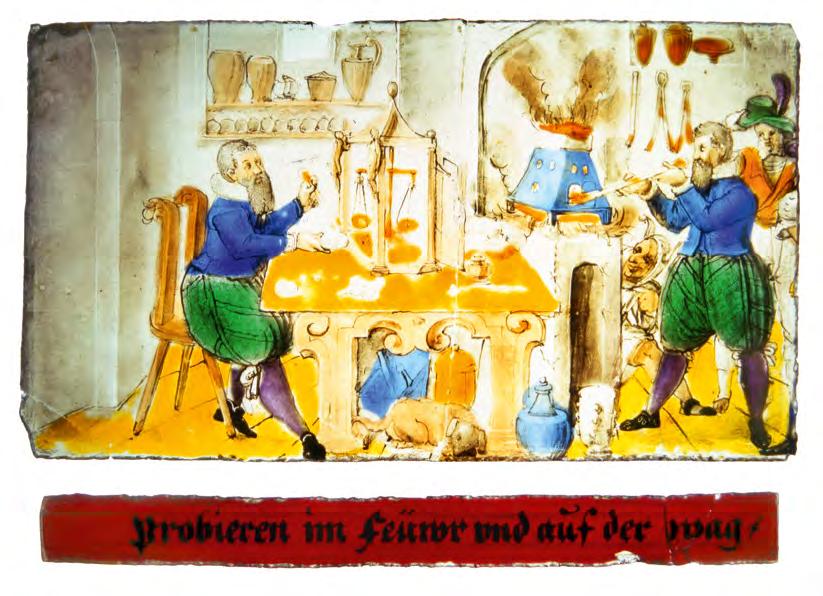
Propieren im Feüwr und auf der wag (assaying coins in Constance), attributed to Hieronymus Spengler (1589–1635).
ROSGARTEN MUSEUM CONSTANCE
falling from Rudolf’s favour, he spent most of that same decade imprisoned for his refusal to make gold on demand, eventually dying from injuries that he received during an escape attempt.
There is, however, a strange twist to Kelley’s story. During the years in which Kelley was favoured by Rudolf, the Emperor also employed Lazarus Ercker as master of the mint at Kutná Hora, close to Prague. Ercker was knighted by Rudolf in 1586 for his services and died in 1594, but his chief claim to immortality is as author of the Treatise on Ores and Assaying (1574), a magnificent technical exposition of assaying that still stands scrutiny today. It is tempting to imagine Kelley, the flamboyant alchemist and consummate showman, and Ercker, the pragmatic assayer and technical expert, squaring up to each other in Rudolf’s court, both unsure with whom their patron would ultimately side.
Dee, Kelley and Faust were all powerful, influential, but ultimately undisciplined magicians. By contrast, Ercker represented a new type of technical professional: the solidly dependable and reliable assayer. ✦
SOUTH HOUSE SILVER WORKSHOP TRUST
Chris Mann
Rod Kelly. JULIAN CALDER
half - way up the Shetland archipelago, roughly 300 miles north of Edinburgh, sits the coastal village of Brae, population around 750.
Historically, the people of Brae made their living from fishing the cool, deep waters off the west coast of Shetland, but looking out onto the waters of Busta Voe today, the inlet is home to a dozen or so ropegrown mussel farms. In the history of Shetland’s oldest industry, these innovative farms represent a relatively new addition – this slower, gentler, more sustainable form of aquaculture, which must have felt like a huge risk 30 years ago, now contributes close to £10m a year to the Scottish economy. The demands on the industry changed, and the fishers of Brae changed to meet them.
Across the bay, under towering red rock, plots of agricultural land containing small farmhouses, known as crofts, roll down to the sea. Sights such as this prompted silversmith Rod Kelly to fall under the spell of Shetland in 2005. “We were up here on holiday with our boys, found this little run-down croft house for sale and just got taken away with the whole thing,” he says. “Over the next eight years or so I renovated and restored it, undertaking most of the work myself. I’d come up quite often, bringing small pieces of silverwork and a few tools with me, and then sit in the living room doing a bit of decorative chasing. I didn’t have a torch, a bench or any of the tools you really need to be a silversmith. The more time I spent here, the more those things became necessities, not just for me, but so that others could visit, learn, and further develop their skills as silversmiths.”
In 2013 Kelly received a grant from the Shetland Islands Council to build what would become the South House Silver Workshop, and with the support of four trustees, he founded a trust to support the next generation of silversmiths through training, development, and mentorship in a residential setting. The space’s L-shaped timber and slate structure sits uphill from Kelly’s croft house. It contains a purposebuilt silversmith’s studio where up to six people can comfortably work and learn together, and a small self-contained apartment for the trust’s residential scholars, who stay in Shetland for a month or longer.
“ You can’t learn new skills in hours or days,” Kelly says. “Bombarding people with technique and instructions does not work. It takes time. Learning a craft and learning it well is a slow process. I have been able to make the pieces that I have over the last 40 years, not because
I’m smarter, or cleverer than anyone else, but because great silversmiths like John Bartholomew, Gerald Benney, and Ian Calvert spent time giving me a handson, practical, education in silversmithing. In higher education, courses like the ma that I attended at the rca [Royal College of Art] no longer exist, but through the Trust, and the scholarships that it offers, we’re passing on as much of that education as possible to the next generations of silversmiths.”
Through support provided by The Goldsmiths’ Foundation, The Goldsmiths’ Centre, The Clothworkers’ Company, The South Square Trust, The Radcliffe Trust, The Saunders Family, Argex Ltd and several anonymous donors, South House is able to offer intensive residential placements with Kelly in Shetland, or with silversmiths Brett Payne and Chris Perry, who are based in Sheffield. The scholarships cover raising, chasing, engraving, soldering, forging, hinge making and hammer work, along with discussions on design, marketing and selling. The programme includes accommodation, travel costs and a subsistence bursary, allowing recipients to focus entirely on their training without having to worry about the financial pressures of the outside world.
Since its inception in 2013, the Trust has helped to further the training of dozens of young craftspeople, including Alice Fry, Sheng Zhang, Mansi Depala and Loucinda Nims, who have all exhibited at Goldsmiths’ Fair. In 2025, the Trust will welcome 11 more scholars to Shetland and Sheffield, for the most in-depth transfer of silversmithing knowledge currently available outside of a traditional apprenticeship.
Despite the huge amount of work and effort that Kelly and his partners have put into the Trust, it’s clear that he is worried for the future of the trade and, at a time where the silver allied trades have entered the Red List of Endangered Crafts, he’s not the only one. As we wrap up our conversation and Kelly heads off to make another cup of strong builder’s tea, a burning question hangs in the air – have we done all that we could to embrace change? Have we taken the right risks, and made the right choices to ensure the future of silversmithing? Brae’s mussel farmers show how an industry can adapt and thrive. By sharing expertise, South House is helping new generations of silversmiths develop the skills upon which an imaginative approach to the future can be built, ensuring contemporary silver has a place on our grandchildren’s tables, next to those steaming bowls of Shetland mussels. ✦
The Outer Display and the Inner Beauty
Dora Thornton
A Pair of Cups by Miriam Hanid
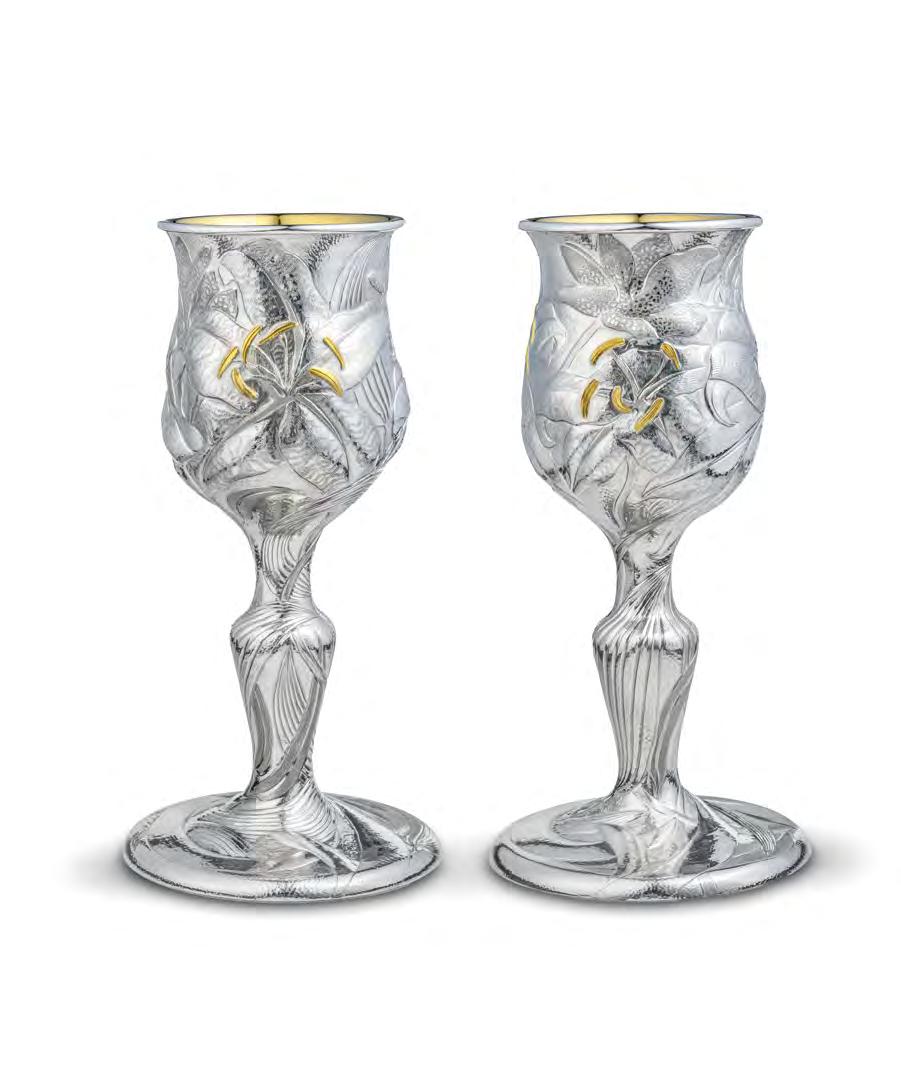
“Just working with silver as a material is enough to inspire me.” Miriam Hanid marvels at silver’s ability to express even the subtlest nuances of form, as seen in two of her latest pieces, a pair of wine cups made for Robert Hayes of the Goldsmiths’ Company Court of Assistants. The cups are beautifully adapted for use, with bell-shaped goblets on tall stems that sit comfortably in the hand. They are superbly decorated with Hanid’s signature technique of embossing and chasing, enhanced by engraving, with a design of freesias and stargazer lilies. There are subtle variations between the two cups, which are explained by the fact that one has been destined for the Company Collection from the start of the design process, while the other, customised to reflect domestic social life, is a private commission that will stay with Robert and his wife Suzette.
beyond celebrating excellence in design and technical skill, every work in the Goldsmiths’ Company Collection tells a story about people. This is particularly true of the Court Wine Cups, which are paid for by the Company and commissioned by Assistants for their own personal use whenever they lunch or dine at Goldsmiths’ Hall. A series dating back to 1957, these commissions express something of the lives and achievements of their patrons. The cups are nearly always collaborations between different specialists working to a single design. Perhaps more than any other category of work in the Collection, they express friendships within the world of silversmithing; the generosity of teachers and mentors; and the mutual respect between makers.
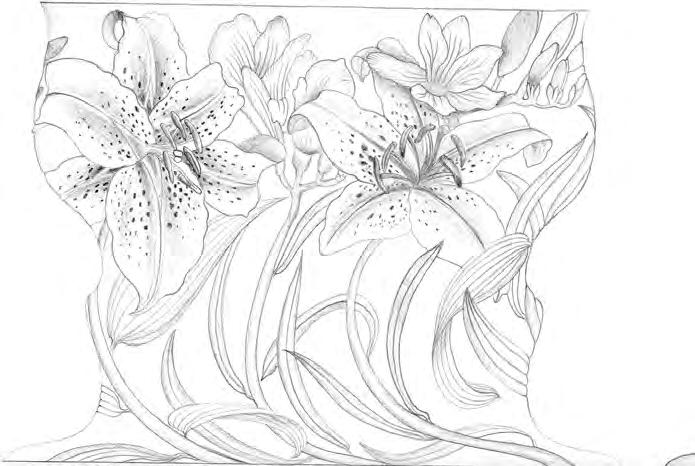
Hayes’s cups are testament to a friendship that began at Hanid’s stand at Goldsmiths’ Fair in 2013. That led him to commission a pair of silver beakers to commemorate his and Suzette’s wedding anniversary, chased with stargazer lilies and freesias that recalled Suzette’s marriage bouquet. Hayes asked Hanid to adapt this design, so full of feeling, to his Court Cup. She studied historic silver goblets in the Goldsmiths’ Company Collection, before working out the form using wooden models. Adapting the design was challenging. “The new Court Cups have more layers of flowers and stems twisting around each other and behind the flowers, with much less background space,” Hanid explains. “I suppose that is how I have come to think when designing – on an often more complex and involved level than before.” Hayes was also keen to include gilded details, to which Hanid responded. “I proposed just the small anthers of the lilies to be gilded, to add a tiny bit of colour and pick out those details, which
are the only engraved areas on the outside of the pieces,” she says. Each cup includes a chased open lily in its gilded interior, which is only visible during use. “This makes for a highly personal experience… It is a reflection of how there are two sides to human existence, the outer display and the inner beauty,” she explains. “The workings – the raw hammer and punch marks on the underside of the inner bowl… will never again be seen, only experienced by the maker at the time of making. Those hidden qualities are resonant too.”
The two goblets were expertly spun by Stefan Coe, soldered and pre-polished by Oscar Saurin, and gilded by Steve Wood. Meanwhile, their decoration pays homage to two of Hanid’s mentors, Rod Kelly who is based in Shetland and Malcolm Appleby whose atelier is in Grandtully in Scotland. Hanid led the engraving course hosted at Appleby's annual symposium in 2024, an event which, he says, “enables younger people to make connections with each other and share their skills and experiences of designing and making.” The subtle textures on flowers and stems were engraved with tools Appleby had
Previous Freesia and Stargazer Court Cup (left), with its pair, commissioned by Robert Hayes (right), Miriam Hanid, 2024, Britannia silver. The Goldsmiths’ Company Collection.
RICHARD VALENCIA
Below
Design drawing for Freesia and Stargazer Court Cup, Miriam Hanid, 2024.
GOLDSMITHS’ COMPANY ARCHIVE
given Hanid, and she was inspired by his “free-flowing and quirky” style of engraved lettering used for the ownership inscriptions on the foot of the cup, which she describes as “a creative work in itself”.
The commission made exceptional demands on Hanid. “This was the second major silver commission that I have completed since giving birth to my daughter,” she says. “Balancing family life with work commitments was particularly challenging this year due to illness, sleep deprivation and repetitive strain injuries. Once the finishing line was in sight, I was grateful and happy about all my achievements in 2024.”✦
STRIKE ABLOW
Frances Parton
Talking Metal with Simone ten Hompel,
Juliette Bigley and Max Warren
metal comes from the earth. It has been dug from rock and panned from rivers across the globe for thousands of years. Sometimes it exists in raw, unworked form; other times it is combined with other elements and must be chemically refined. Precious metals are endlessly recyclable, valued for their intrinsic worth above their decorative function. The gold jewellery around your finger or neck has probably existed in many previous forms. When metal has been refined or recycled and reaches the metalsmith, ready to be worked, it is usually in the form of a flat sheet, a blank disc, or else a length of rod or wire. At this point, the metal meets the mind of the metalsmith and the two are introduced via the tools in the metalsmith’s hands. How does the experience of shaping precious metals influence the maker and the work they create? This question was addressed in the Strike A Blow exhibition that Simone ten Hompel and I put together for Goldsmiths’ Fair 2024. Renowned metalsmith ten Hompel describes herself as an “excellent dyslexic” and considers metalsmithing to be her first language: she communicates through making. She uses the word “stuffness” to describe the varying characteristics of different metals, which all
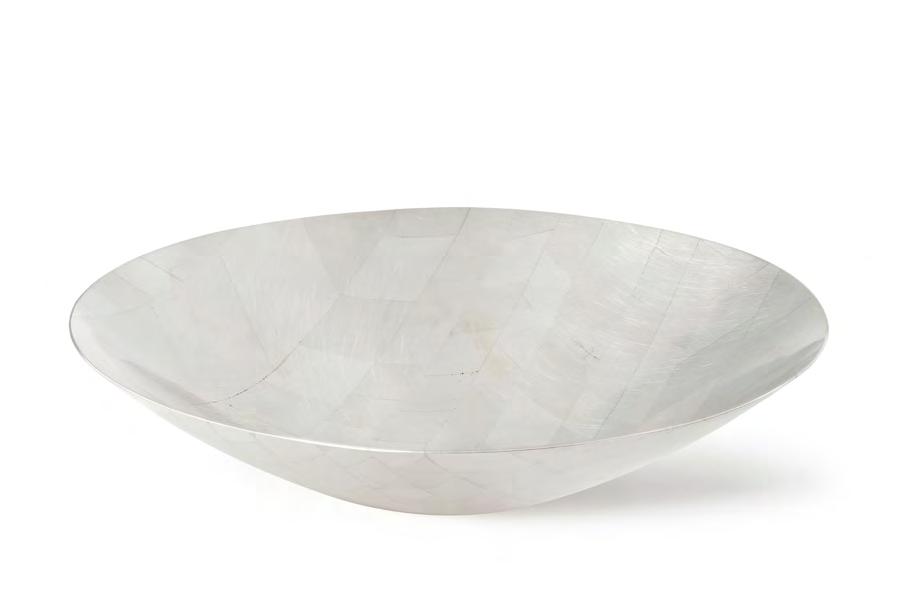
Previous New Seoul Bowl, Max Warren, 2024, sterling, Britannia and fine silver. Goldsmiths’ Company Collection.
CLARISSA BRUCE
Left
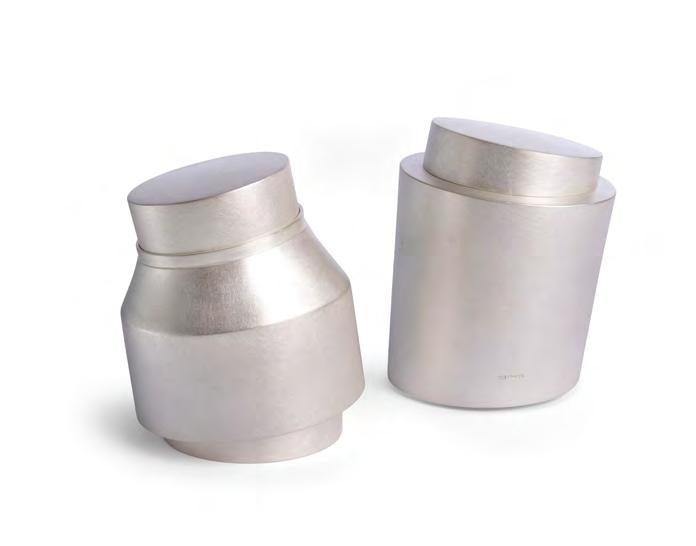
Two containers, Simone ten Hompel, 2024, sterling silver. Goldsmiths’ Company Collection. RICHARD VALENCIA
respond to heat and tools in their own way. Metals have their own voices, telling a maker how far they can be pushed, what they can be encouraged to do, and when they will refuse and split. In 2024, ten Hompel made a pair of sterling silver containers that the Goldsmiths’ Company bought for its Collection. The two objects are extremely eloquent: both stand at a slight angle with contrasting but related forms, beautiful matte exterior surfaces and white interiors. They appear to be locked in conversation with each other, mid-dialogue. Listen hard and we can hear an echo of the negotiation, the communication between metal, the “stuffness”, and ten Hompel’s hands, which transformed them from flat sheet into a pair of exquisite sculptural containers.
Juliette Bigley’s highly sculptural work is imbued with the significance of what she terms “the language of sensation”. This language is not only the system of communication a maker uses when shaping metal –the ability to wield a hammer with the right heft, to recognise when a metal has been heated to the required temperature by its colour – but it is also the language humans use when interacting with the physical world around us in any way. The Company recently acquired
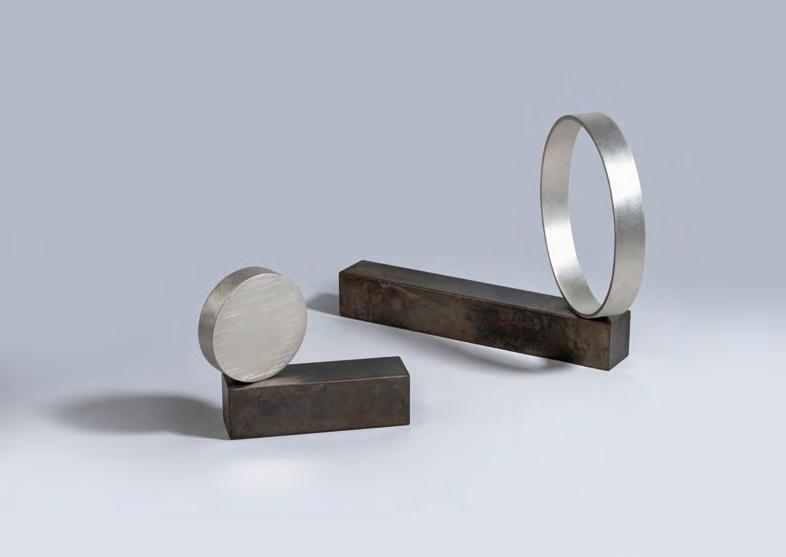
Conjunction: Two Circles, Juliette Bigley, 2022, sterling silver, patinated stainless steel. Goldsmiths’ Company Collection. RICHARD VALENCIA
Bigley’s Conjunction: Two Circles, a work in two parts: a sterling silver hoop fixed to a flat bar of patinated stainless steel, and a smaller disc fixed off-centre to another steel bar. Both silver elements are held with a pin so they can revolve on their bases. Bigley fluently describes her reasons for making: “I make to understand how the world fits together. The way in which our internal experiences interact with the physical world is the stuff of our lives… and yet we have very little understanding of how the material and immaterial aspects of our experience interrelate… Making, which by its nature combines idea with material, is a microcosm of this relationship, and is the focus of my practice.” Bigley’s experiences shaping metal interrogate our wider human experience as sensory beings in a material world, something which is particularly pertinent in our digitally driven age.
In 2023 the Goldsmiths’ Company acquired Max Warren’s Seoul Bowl. Warren constructed a flat sheet by soldering together small tiles of sterling silver, brass and copper, creating a rich geometric pattern of silver, red and orange before hand-raising it. The finished bowl, a glorious riot of colour, maximises the contrasting
visual and chemical properties of the different metals. It allows us to comprehend the distinctive blend of discipline and experimentation that characterises Warren’s making process. In 2024 the Company acquired a second bowl by Warren, New Seoul Bowl Similar in form to the first, it is made from tiles of sterling, Britannia and fine silver, and is part of Warren’s Precious Entropy research which explores purposeful tarnishing. When the piece was initially constructed, the different alloys were almost identical in colour, giving the bowl a homogenous surface; already, however, the tiles are changing in appearance, tarnishing at different rates due to the differing proportions of silver that each one contains. As time passes, however, a variegated pattern is emerging. In Warren’s own words, he has created “a material that moves from a uniform silver-white plane to a richly ornamented geometric surface in response to time and environmental conditions.” By embracing the contrasting chemical make-up of his materials and listening to the voices of the metals, he has made an object which will continue to evolve long after it has left his workshop and the touch of his hands. ✦
LOST & FOUND UPENDING CONVENTION
Martina Margetts
Goldsmiths’ Hall is freighted with history and significance. Last autumn its ground floor was infiltrated by uncanny presences, objects in metal by renowned silversmiths Adi Toch and David Clarke, each a Freeman of the Goldsmiths’ Company. Entitled Lost & Found, the exhibition offered a reorientation of how works in metal are appraised, and a reconsideration of the Company’s scope of engagement with contemporary practice.
the exhibition served as an intentional counterpoint to the annual Goldsmiths' Fair upstairs, where hallmarked jewellery and silver were for sale from 136 different makers across two weeks. Use, beauty, and highly polished skills and precious metals were the Fair’s core features. Toch and Clarke, by contrast, upended conventions of form, material and context to prompt conversations about the values and societal structures by which we live in the world. “All metals are precious,” Toch averred. “We’re all different equally,” added Clarke. They termed their presence at Goldsmiths’ Hall both an “intervention” and a “residency”, where they conducted conversations in several ways: with the visitors; between themselves as curatorial originators; between the works; and with the Goldsmiths’ Hall interior. The degree
Previous page
Left Spare Parts, David Clarke, 2013, pewter.
Right Whispering Vessel, Adi Toch, 2023, silver, copper, loose moonstones.
PAUL READ FOR
FAIR.
of both thoughtfulness and openmindedness applied to these endeavours made Lost & Found a landmark experience at the Hall.
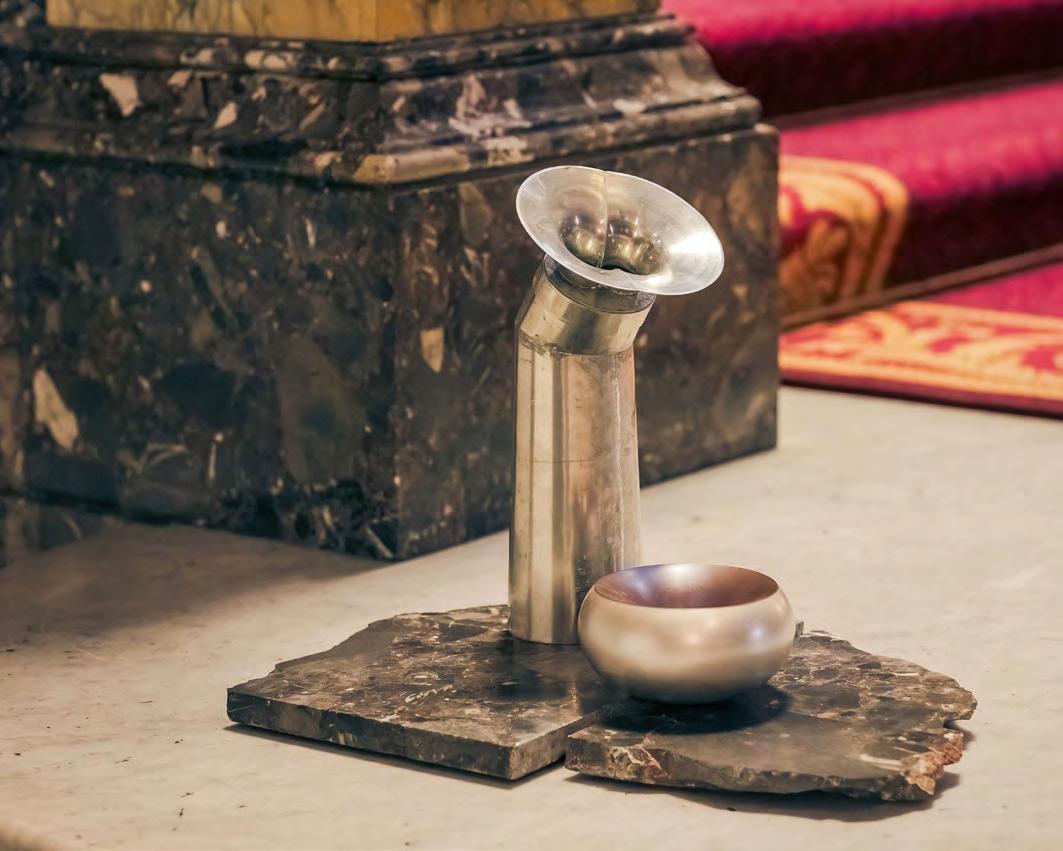
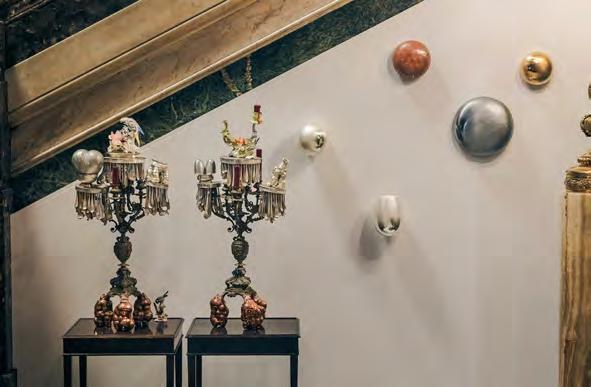
The entrance to Goldsmiths’ Hall is imposing – its grand staircase surrounded by marble floors and cases of silverware and jewellery from the Company’s collection –so it was only at second glance that visitors became aware of what Freud called ‘matter out of place’: objects which do not appear to belong in their interior location. Yet quickly they animated the space. At the foot of the staircase, an incongruous trumpet of industrial shape was paired with a whispering vessel. These were aural pieces, alluding to the tonal range of conversation and act of listening, by Clarke and Toch respectively. The former manipulated found industrial parts, while the latter employed refined smithing techniques – a hint that Clarke likes to fabricate a work intuitively, while Toch may take up to six months to achieve particular formal and surface effects. At the other side of the staircase were Clarke’s two candelabras, hilariously appended with found cutlery by way of decoration, which were contrasted with Toch’s plangent wall series of
opaque plump forms containing isolated areas of mirrored surface –a poetic response to Renaissance convex mirrors. Both the staircase and these works invited interaction on the part of the visitor, but to different ends: the former engaging the body in a transitory journey from A to B, the latter arresting the eye and mind in a quest for meaning.
The social life of peoples and things are concerns for both Clarke and Toch, who have dedicated their careers to metals as their material conduit. How we relate to each other – through families, societies, institutions and environments –and how objects speak to us are the key considerations that underpin their practices. Each of the silversmiths takes a different emotional approach – Clarke humorously disrupts norms, while Toch’s work is meditative – but both are alive to the fragilities of being human amidst the realities of the contemporary world. Their daily conversations with visitors bore witness to both laughing and crying, emotions generally held in check in august surroundings.
How were these responses achieved? Like a piece of immersive theatre, the choice of each location
Left
Pair far left: Holy Moly & Posh Totty, David Clarke, 2024, silverplate, ceramics, bronze, pewter, steel, wax, electroformed copper.
Group near left: Instruments of Reflection, Adi Toch, 2024.
Left to right: Protrusion, silver and gilding metal. Drop Vessel, Britannia silver. Leap Year, copper, buried in the earth for 29 days.
New Moon, oxidised Britannia silver. Gold Reflection, gold-plated copper.
PAUL READ FOR GOLDSMITHS' FAIR
Opposite
Left Shrouded, Adi Toch, 2024, silver-plated copper and soil.
Right Give & Take, David Clarke, 2023, silverplate and wax.
MORVARID ALAVIFARD
and arrangement of the works was a deliberate staging. There were no individual captions to the works or plan of navigation, offering an invitation to the audience to view the objects as actors and construct the drama. Sometimes visitors sat on the stairs, as if seated in the stalls, an unprecedented sight at the Hall. Visitors who waited in line for a ticket to Goldsmiths’ Fair realised that an adjacent line of anthropomorphic objects was entertainingly echoing their stance and behaviour. The objects, like the visitors themselves, were precious for their individual character rather than their displays of material worth. The value systems of life were in play here.
A group of works positioned to the left of the staircase extended the narrative. Sitting atop a highly polished ebonised grand piano, beneath a full-length portrait of King Charles III painted when he was Prince Charles, were two figurines by Clarke, cast in metal from 18thcentury Staffordshire ceramics with deliberate artlessness. These sat by Toch’s pair of mirrored vessels that reflected the portrait upside down, thereby suggesting an alternative perspective on hierarchies. The role of surface reflection appeared as
a striking leitmotiv in Lost & Found, variously creating a distortion, or an illusion, or a moment for thought. The experience of not quite knowing, seeing, or understanding was variously invoked, with an awareness of the fallibility of humans, the passage of time and the fading of memory.
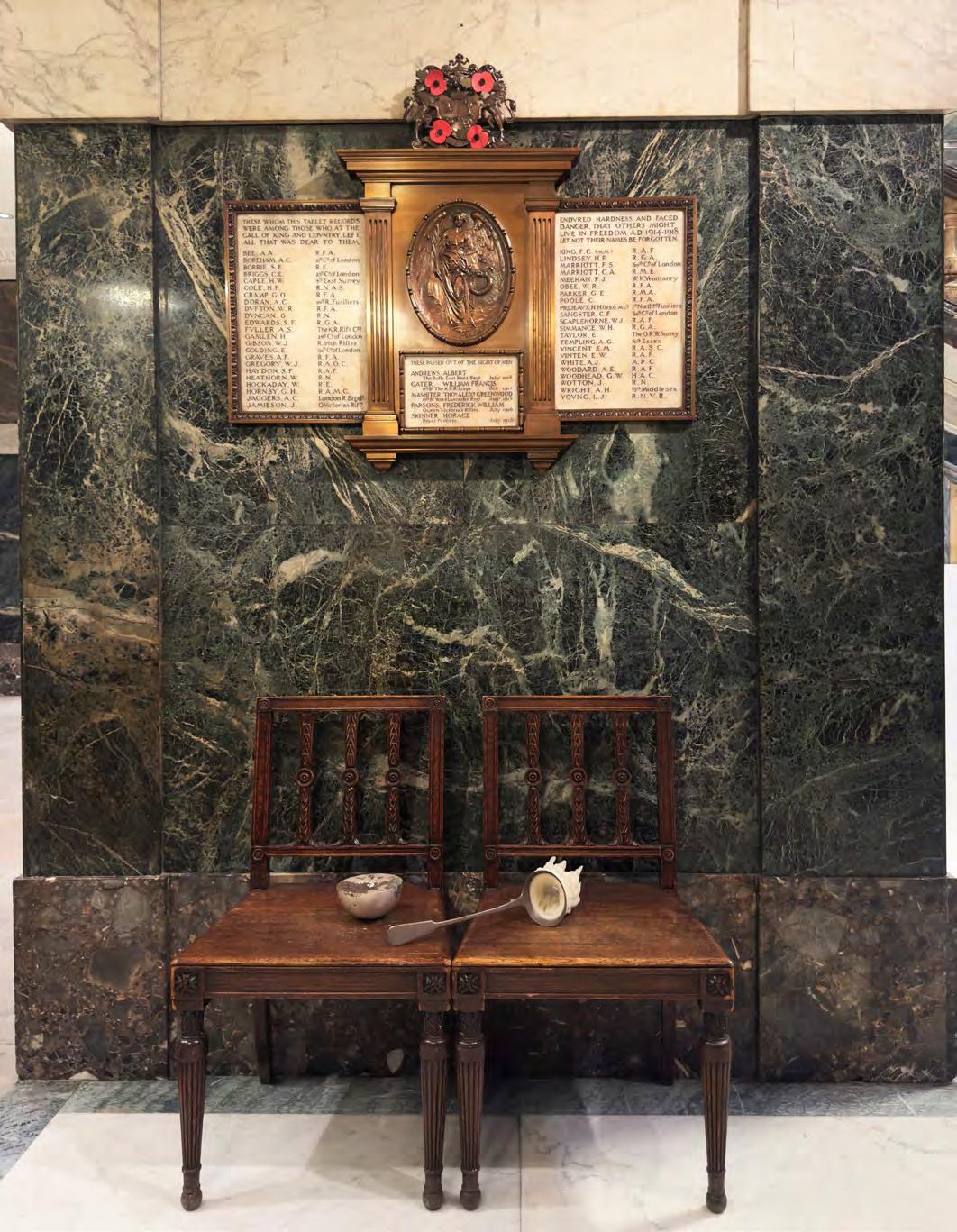
These thoughts resonated beyond the piano, where a wooden noticeboard revealed itself as a memorial to those associated with the Goldsmiths’ Company who had fallen in the First World War. Below the memorial inscription board were two occasional chairs, symmetrically formal in arrangement. Instead of a person on each seat, there was an object in repose. One was Toch’s bowl, encrusted with earth, the other was Clarke’s ladle, its handle and rim intact but without its bowl, in place of which was a solidified dripped mass of wax. It was lying on its side. One could not miss an association with a fallen soldier, whose life was coursing out and whose purpose had been lost. The prominence of the wax was important: the material is used in much of metalsmithing but never seen, as it is part of the process rather than the finished result. Instead of ubiquitous, lowvalue wax being overlooked, it
became the focus here of eloquently expressed memorial.
To the right of the staircase under an arch was a series of urns made by Toch. These were modest in size, rounded in form with spherical lids and rusted patination on their surface – the result of weeks spent buried in the ground. They were interspersed with Clarke’s keepsakes, worn leather cases and a corroded, salt-baked metal pot. A bench placed opposite enabled visitors to sit contemplating, and conversing about, the inevitability of death, with its varying circumstances and rituals across different faiths and cultures. Above the urns, a tarnished mirror captured a metaphorical reflection: seeing clearly is not possible when the politics, warfare and welfare of societies engender confusion and incomprehension.
Mirrors were, by contrast, crystal clear in an unexpected location: the Ladies’ and Gentlemen’s cloakrooms in the Hall’s basement. Imbibing the adventurous spirit of Lost & Found, these overlooked locations were chosen by members of the public for the second week, when some objects were moved around by Clarke and Toch in response to audience engagement. In the cloakrooms Clarke’s budgerigars,
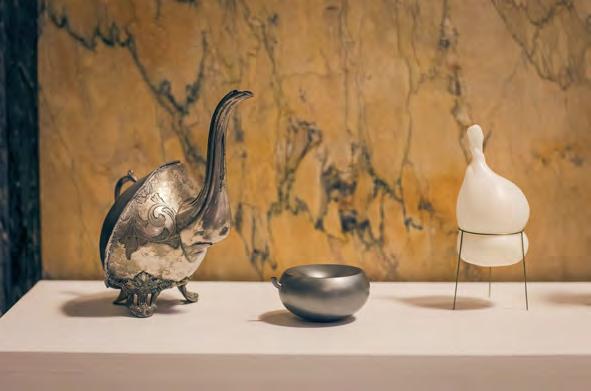
Left to right: Duckie, David Clarke, 2009, silverplate, lead.
Snouty, Adi Toch, 2019, oxidised Britannia silver.
Vessel on Stilts model, Adi Toch, 2020, blown plastic, stainless steel.
PAUL READ FOR GOLDSMITHS' FAIR
made from garish found china ornaments encrusted with exploded pewter, perched by the basins, one beside Toch’s bronze mirror and the other next to a flintstone found by Toch. Visitors could not fail to see themselves alongside the budgies, a native bird of Australia whose caged domestication might ruffle human sensibilities and hint at postcolonial themes.
On many levels, Lost & Found offered a compelling narrative about adaptation, Darwinian in its universal message that all life – and creativity – must evolve in order to thrive. Societies, institutions and natural environments never stand still. With inventive imagination and care, Toch and Clarke filled the space of Goldsmiths’ Hall with objects adapted from the traditions of silversmithing. Near the groundfloor arch, fragments of materials with different shapes, weights, geographical origins and timeframes gave visitors a sense of this evolving renewal and change that threaded its way through the whole exhibition. The Goldsmiths’ Company has concerned itself with the quality of silver and gold, with production, consumption, trade, institutional power and social hierarchies for centuries. As the Company now approaches its 700th anniversary in 2027, the fascinating question arises as to what the Company will exhibit, discuss and promote in relation to contemporary creators and their works as a response, in this current era, to the legacy of their forebears. ✦
Emma Crichton-Miller
Warren Martin at the lathe.
PAUL READ
when he was 16 , Stefan Coe was all set to study engineering at Brooklands Technical College in Surrey, when his Design Technology teacher, a trained silversmith, suggested he try silversmithing instead. Coe’s grandfather had been a metalsmith – a panel beater – so Coe applied for a yearlong apprenticeship funded by the Goldsmiths’ Company through the Sir John Cass School of Art and won one of two places. From there, he gained a further apprenticeship with Brian Fuller, a master silversmith who worked with the renowned Gerald Benney, thereby becoming part of a distinguished lineage. Three months into his apprenticeship, however, Coe was invited to choose whether he wanted to be indentured with Fuller as a silversmith, or with Fuller’s colleague Henry Pearce, whom Coe describes as “this old guy on a lathe”. Coe chose Pearce.
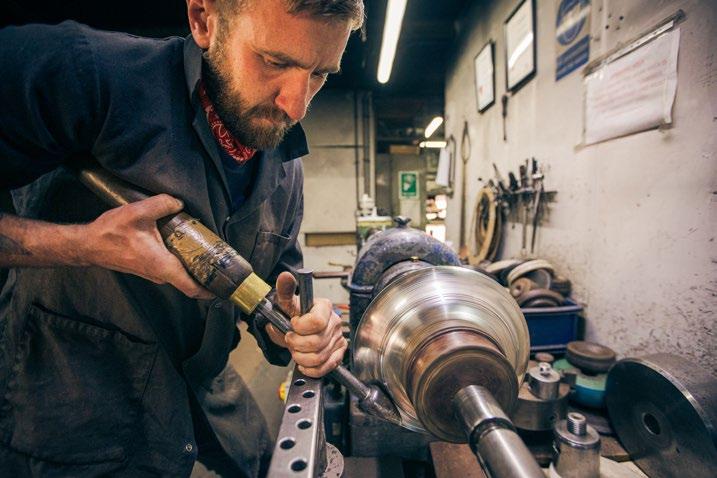
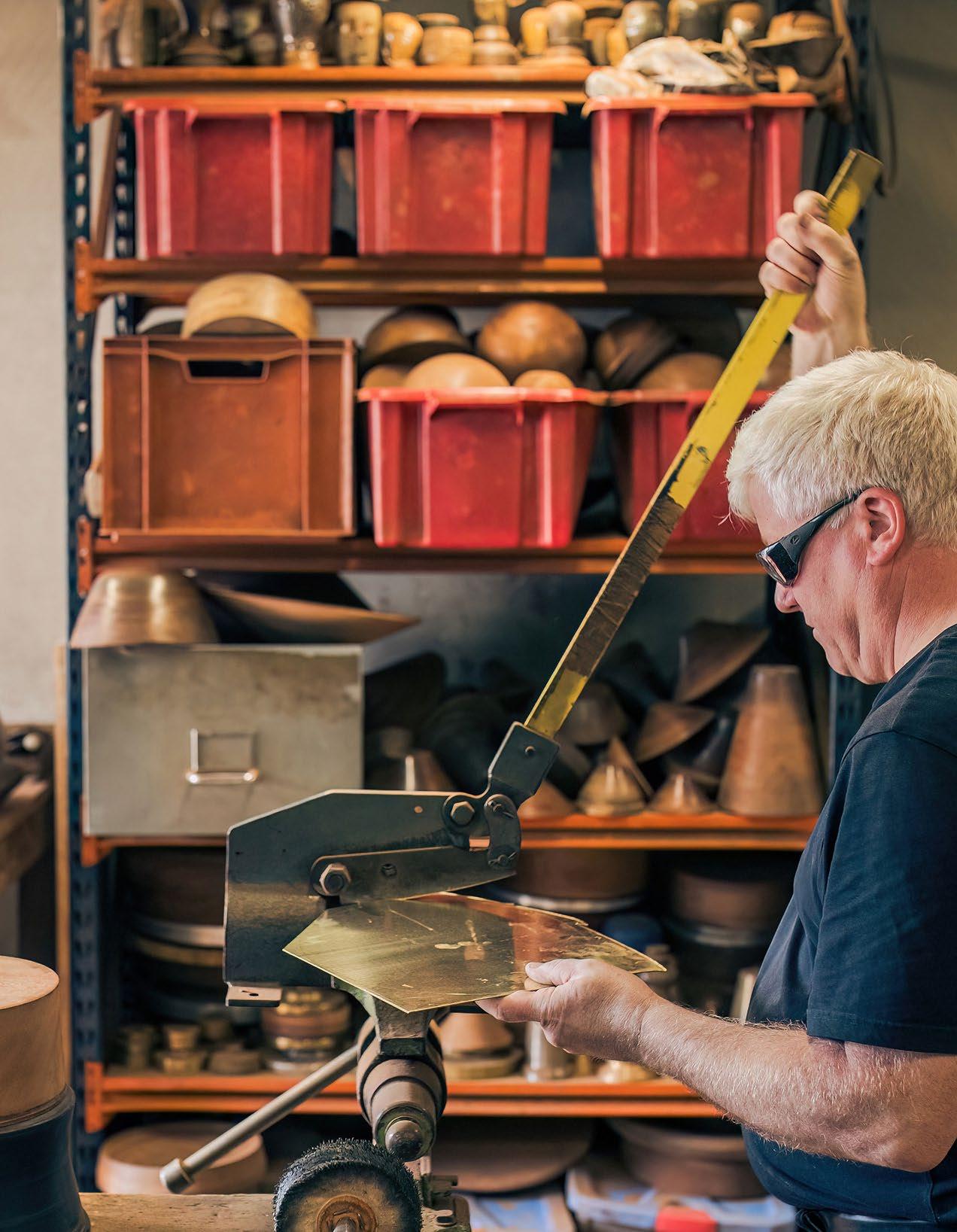
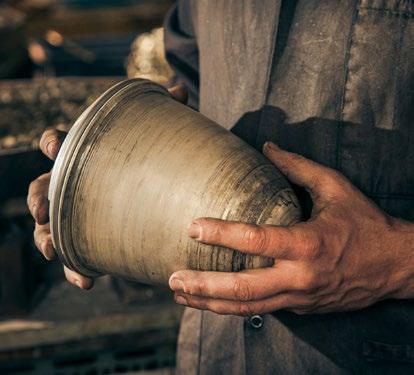
Pearce was a spinner. Trained as a silversmith, he had originally joined a company that lacked a spinner and so taught himself. Spinning is a technique that dates back to Ancient Egypt. Spinners shape a flat sheet of silver into a hollow form on a lathe, using a wooden, nylon, aluminium or steel former, known as a spinning chuck. It is, Coe testifies, a highly physical, highly precise, skilled craft. Spinning generates hollow forms that are uniform in thickness and symmetrical in form, with a smooth finish, in a fraction of the time it would take to achieve the same effect by hammering. The spun pieces can then be further worked to make trophies and other silver vessels, their surfaces chased, cut or enamelled, cutting down the time a silversmith needs to create their design. For Coe, it held instant appeal. “I found spinning intuitive and I was good at it,” he says. “Henry and I got on like a house on fire.”
Today, Coe is one of Britain’s most highly regarded spinners. He works with both precious and base metals with leading silversmithing companies and myriad individual makers, including Peter Wilson for Theo Fennell, Clive Burr, and master enameller Fred Rich. But spinning itself is in crisis. Most spinners are over 70 years old, and Coe is one of just eight full-time spinners known to still be active in the uk, with five others working part-time. The craft has recently been moved from the Heritage Crafts Critically Endangered List to its Red List.
The challenges are manifold. “We don’t have very good data, but we know that there is a skills shortage and ageing practitioners,” says Mary Lewis, executive director of Heritage Crafts. This matters because spinning is one of the essential allied trades – alongside plating, polishing, buffing, finishing and engraving –
“Without spinners’ production, silversmiths have nothing to assemble, buffers have nothing to buff, polishers have nothing to polish.”
which lie invisibly behind the prestigious craft of silversmithing. “Silver spinners hold up the entire silverware industry,” explains Warren Martin, who won the Heritage Crafts Precious Metalworker of the Year Award in 2024 for his contributions to the craft.
“Nearly all silverware produced by the trade is now spun. Without spinners’ production, silversmiths have nothing to assemble, buffers have nothing to buff, polishers have nothing to polish, chasers have nothing to chase, engravers have nothing to engrave.” Based in Sheffield, Warren is one of only two spinners under the age of 50 in the uk. “If we don’t spin the work, other craftsmen don’t have jobs,” he adds. “There is no other metal forming technique that can compete in a bespoke, one-off market.”
With a collapse in demand for silversmithing and rising competition from overseas, British companies can no longer afford to employ silver spinners or pay for their training. As Coe comments, in the 1960s and 1970s, when British silversmithing flourished, well-known companies such as Asprey or Garrard might have employed 50 or 60 silversmiths at the bench, supplied by one or two spinners. Even in the 1980s, 1990s and early 2000s, he explains, a lucrative Middle Eastern market made it financially viable to train spinners.
But 20 years later, Coe says that “even the largest company has only eight to ten people at the bench.” Many spinners have been forced to go freelance, working for multiple small companies or individual makers and creating in small batches, with tiny margins that would make training an apprentice, even with support from the Goldsmiths’ Company or other bodies, financially ruinous. Coe was lucky. Pearce was
Warren Martin. PAUL READ
at the end of his career and was prepared to allow his apprentice to simply observe him at work in the mornings, before teaching him in the afternoons. This radically reduced Pearce’s own productivity, while teaching added further costs.
“If [spinning] goes wrong, you can’t put it right, because of the speed of the procedure,” Coe says. “You have to start again.” Whereas a skilled silversmith can hammer out the errors of an apprentice raiser, a sheet of metal damaged in spinning has to be completely recycled. Training is also time consuming. “I can show anyone the basic principles of silver spinning in a short course but to learn the craft takes many years of practise.” Martin says. “Because it is a full body process the way you spin is dictated by your physical build which is why no two spinners spin in exactly the same way. I am only really starting to master the craft now, after over 40 hours a week of spinning for well over a decade.”
Coe has also observed that “people who go to university to study jewellery or silversmithing don’t want to come into trade,” as most students wish to pursue the more creative path of a designer-maker instead. But Martin did choose spinning. After his Metalwork and Jewellery Design course at Sheffield Hallam University, he undertook a dual apprenticeship at British Silverware in silversmithing and spinning. “I liked the immediacy of silver spinning. It is very like pottery,” he says. “I love the fluidity of the material, and seeing other shapes emerge as you go along.” He partly blames the decline of mainstream British silversmithing on a failure to update designs. “Many pieces produced in the trade are reproductions of designs which are hundreds of years old like Elizabethan dishes, Revere bowls and Georgian tankards”.
But there is hope. Lewis reports that the Heritage Crafts Association receives many enquiries from people looking for skills-based training. There are also ongoing conversations between the various sector bodies and the government about how to fund and structure apprenticeships. Angela Cork, the principal of Bishopsland Educational Trust, an organisation that is focused on silversmithing, reports that the trust is buying a second-hand lathe for its new campus in Oxfordshire and has already acquired “a wonderful collection of spinning chucks from David Alison, a retiring spinner based in Sheffield.” The team are also planning staff training to ensure Bishopsland can become “a centre for spinning, offering hands-on training and workshops led by expert practitioners, and creating teaching aids to spark interest and pass on crucial knowledge to the next generation.”
Cork has taken advice from Stuart Ray, a leading spinner based in Kent. Ray has been able to expand his business and take on a full-time apprentice supported by the Goldsmiths’ Company, Varis Prieditis, who was the winner of the Bronze Award for Polishing in the Goldsmiths Craft and Design Council Awards in 2019. Ray remembers beginning his own apprenticeship in 1990, only for the company who hired him to go into liquidation two years later. “All the patterns and tools went to Malaysia,” he says. Nevertheless, Ray persisted with different masters before setting up his own company 15 years ago. Now he runs a highly successful business supplying trophies – including the remade fa Cup in 2014 and the Six Nations Cup in 2015 – to companies such as Asprey, Garrard, Theo Fennell, Thomas Lyte and others. He also does a fair amount of teaching. “It is hard work,” he says. “We move from left to right with the metal. The lathe does not do the work – you have to ease it, to feel the metal.”
One maker who appreciates the work spinners do is silversmith and jeweller Jessica Jue. “Rather than starting with a flat sheet, I will get something spun into a simple form,” she says, describing the process behind some of her pieces. “You have to be very clear with your notes and sketches. It is a very different way of working from my usual fluid, organic, in the moment artistry.” Jue works with Coe, as does artist and metalsmith Adi Toch, who finds that the symmetry of a spun form can sometimes aid her process. Although she took a spinning course at The Cass many years ago, she was drawn more to hand-raising in her own practice. However, working closely with Coe on some projects has opened space for creative release. “Working with Stefan, whose spinning maintains an even gauge throughout and a refined surface, helps me achieve accuracy of form and can make a difference to the way I explore and experiment with new ideas.”
If spinning declines further, it will not just be Toch, Rich and Jue mourning the loss, but future generations of makers who will lose immediate access to this subtle and ancient technology. ✦
Warren Martin. PAUL READ
THE ART OF GOLD
Will Gompertz
artists are drawn to expensive materials like cats to cream. Vermeer liked nothing more than a dollop or two of semi-precious lapis lazuli (ultramarine) to give his pictures added radiance. Michelangelo insisted on only the best marble from Carrara to carve his 16th-century masterpieces. But the most expensive, the most glorious, the most blingy, the most precious of all materials an artist could possibly desire, has always been gold.
The ancients loved gold, as did the Byzantines. More recently, Gustav Klimt went through a lavish 10-year ‘Golden Period’ at the beginning of the 20th century, from which came his famous painting The Kiss (1907–1908), depicting two lovers wrapped in cloaks of golden thread, forever together in a field of gold.
Gold has never gone out of fashion with artists, whose appreciation of the malleable metal goes beyond its material qualities. Go to Piazza della Signoria in central Florence today and you will not only see Giambologna’s spiralling marble masterpiece Abduction of a Sabine Woman (1579-83), but also a giant golden statue by the contemporary artist Thomas J Price of a young woman looking at her iPhone. It is an act of artistic alchemy, using gold to transform the quotidian and mundane into the magnificent and marvellous.
Damien Hirst , the famous yba artist, explored similar territory when he used gold extensively at an auction of his work at Sotheby’s in 2008, where he took on the role of King Midas with his golden touch. Hirst presented his Golden Calf (with 18ct gold hoofs and horns) and golden Butterfly paintings. The sale generated over £100m in London, just as Lehman Brothers was going spectacularly bust in New York, causing a global financial crisis. Hirst’s use of gold to comment on commodification and commercialisation of art and culture could not have been better timed.
If Hirst is the Pied Piper of contemporary art, then Maurizio Cattelan is its Joker, with his infamous banana duct-taped to the wall (Comedian, 2019). But the Italian artist wasn’t laughing back in 2019 when his sculpture America (2016) was stolen from Blenheim Palace in Oxfordshire. The artwork consisted of a solid gold cast of a regular toilet, which the artist had installed in the stately home as part of an exhibition of his mischievous work. The golden loo had been properly plumbed to be used by visitors for its essential function. The work was a comment on the U.S. (going down the toilet) and the avaricious nature of capitalism, neither of which were on the thieves’ minds when they broke into
All photos
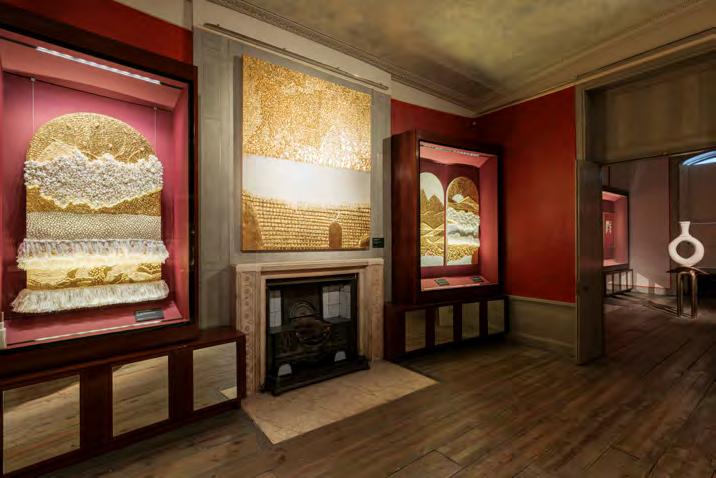
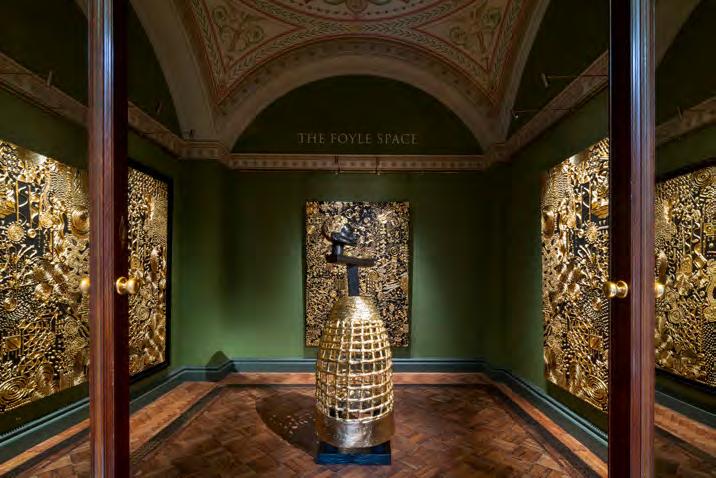
Installation for Mythic Time / Tens of Thousands of Rememberings by Lina Iris Viktor at Sir John Soane’s Museum.
GARETH GARDNER
Blenheim Palace and stole the toilet. America was never seen again.
While Hirst and Cattelan have used gold to raise questions about art and everyday life, Lina Iris Viktor, another contemporary artist working with gold, takes a more spiritual approach. She describes her stunning large-scale abstract canvases as ‘constellations’, which is exactly how they appeared to me when she exhibited them at Sir John Soane’s Museum last summer, of which I am proud to be director.
She chose to install a Constellations triptych in the small gallery behind the imposing cast of the ancient sculpture of Apollo Belvedere. The contrast between the Greco-Roman sun god and Viktor’s own mythical creations was mesmerising. Her huge canvases, primed with black paint and adorned with abstract shapes to which she had then applied 24ct gold leaf, made for an unforgettable display full of celestial symbolism, stretching back in time and space to ancient civilisations and distant deities.
It was a great honour to be able to host Viktor’s first monographic exhibition in a London museum. She had spent the previous four years immersed in Sir John Soane’s collection, in which she discovered many connections, not least a Romantic inclination and a penchant for the sublime. Soane would have admired Viktor’s exquisite technique of applying gold leaf to her artworks with such care and attention. Soane had started life as a builder’s labourer, leaving him with a life-long respect for all crafts and those who excelled at them. He, too, liked gold – particularly when it came in the form of the gold medal he received for being the best architecture student at the Royal Academy in 1776. It was a piece of gold that changed his life. He went from being a brickie on a building site to the finest architect of his age. He had, you might say, struck gold. ✦
THE PATH TO MAKING Rauni Higson
Caroline Palmer
There are a lot of hammers in Rauni Higson’s workshop. Rows of them set against the wall of an old, converted chapel in a remote part of Eryri (Snowdonia) once famous for its slate quarries. Now disused, they add an extra dimension of craggy wildness to the mountainous landscape glimpsed out of her studio’s big windows. There are stakes, too, of all shapes and sizes, and benches covered in both tools and works in progress. It is a scene of muscular industry. Of a life devoted to silversmithing.
Detail of processional cross for Metropolitan Cathedral of Christ the King, Rauni Higson, 2020. STEPHEN HEATON
it was a chance encounter that brought Higson from Birmingham in the 1990s – where she had completed a silversmithing degree begun in Finland, where her mother was born – to a derelict cottage in what was then a very economically depressed part of the country. “I had an idea to move to Snowdonia and when we came over the mountains [on the way to view the cottage] I was basically in tears before we had even arrived,” she says. “It was such a stroke of luck.”
Since setting up her business there, in the village of Talysarn in the Nantlle Valley in 1997, Higson has learned to climb those mountains and they in turn have inspired her work. Last year, for instance, the Victoria and Albert Museum bought Chockstones (I) for its permanent silver collection. Chockstones are the small stones that get wedged in a vertical cleft in a rock and Higson’s sculptural piece, inspired by her love of rocks and climbing, is a section of fissured rock face reimagined as a piece of contemporary sculpture. It represents how her identity in her work has deepened and developed during her years in Wales, along with her silversmithing practice. This culminated with an mbe in the 2025 New Year Honours list ‘for services to Silversmithing and to Heritage Crafts’. Higson refers to the path she has taken to develop those skills as “an immense privilege to have been inducted into this family; people who hold these skills together, all passed hand to hand. And I feel a responsibility to pass that on.”
During her time as Chair of Contemporary British Silversmiths, Higson pioneered its Skills Training Programme, which launched in 2017. She sees herself as being part of a fellowship of silversmiths who can support each other through continual development. “When I first set up, I had this feeling that I had only
“[Work] has to be personal and whatever makes sense to us individually as makers is the way that we will find our identity.”
scratched the surface of what there is to learn to become a silversmith. I was so hungry to learn more,” she says. “So I set myself a target that at the very minimum of every two years I would do some kind of professional development and I would just get in someone’s workshop and work with them and learn how to make a life in this business.”
One of her most “ transformational experiences” was the two weeks in 2001 she spent with artist metalsmith Brian Clarke while at his workshop in Ireland. “I was learning new skills and new techniques; Brian is very intuitive and I learnt so much from him about the value of that also,” she says. “It’s not just making the work, it’s how you can make it efficiently and how you can find people who might need it and how you can blend teaching and learning. The whole
picture really. It was a very mystic kind of experience.”
Higson took away from Clarke the understanding that work had to come from the heart. “It has to be personal and whatever makes sense to us individually as makers is the way that we will find our identity,” she says. “I went to Ireland feeling I had to get on a path and I realised I was already on that path. I just had to make it.” Clarke also introduced her to fold-forming, which has this “magical moment of reveal. It’s a very powerful way of getting from flat sheet to three-dimensional. It really echoes nature and natural forms because the technique mimics the growth patterns of plants.”
There are several other master craftspeople who have tutored Higson and to whom she is incredibly grateful: Michael Lloyd, Rod Kelly,
Detail of Chockstones (I), Rauni Higson, 2021, sterling silver. STEPHEN HEATON
HIGSON
Clive Burr, Christopher Lawrence and Cynthia Eid among them. She strongly believes that “the passing on of skills and techniques to future silversmiths is fundamental to the future of the industry,” and she gets “a great deal of joy” from passing her own skills on as part of this lineage. “Watching the light just go on in somebody when they get it –it feels as good to be on either side of the equation,” she says. “It’s just magic.”
In her studio is a copper jug she is currently making, the latest project of her ‘Teapottering’ group of fellow makers who get together twice a year in her workshop. “We all hang out and just do an interesting project. It started off with teapots, hence the name.” These days, Higson focuses on her silversmithing and has let the jewellery side of her business fade into the background. “I don’t like to close the door on it because I’ll probably make some pieces when I feel like it, but I’m now running a silversmithing business and I’m training,” she says. “I don’t have the capacity to do both [silversmithing and jewellery] well.”
When asked what of her recent work she is most proud of, Higson does not hesitate in referring to the processional cross and acolyte candles she made for Liverpool Metropolitan Cathedral, which she completed in 2020. It was a hugely challenging undertaking that took two years to complete. “I knew it was going to be tricky, but it was a real adventure,” she says. “The building is imbued with so much spirituality. I wanted to create something that embodied all of that, yet was not an iconography of suffering.”
The commissions keep on coming. At the moment she is working on a wall piece, which takes inspiration from the waterfalls of north Wales. “It’s going to be in bronze and silver.
It’s exciting, wall art is something I’ve wanted to do for a long time. I’m also making some dessert forks for someone who had a big set of cutlery from me some years ago,” she says. “I still feel like life is too short to be able to do and learn all the things I want to, just in this craft.” ✦
Below
Detail of processional cross for Metropolitan Cathedral of Christ the King, Rauni Higson, 2020.
STEPHEN HEATON
Opposite Rauni Higson in her workshop.
STEPHEN HEATON
STALKED BY LEOPARDS
Eleni Bide
to walk around Goldsmiths’ Hall is to be stalked by leopards. Passersby are tracked by feline faces above the door on Foster Lane and on the wrought-iron arch into the Company’s garden on Gresham Street. Once you are inside the building, leopards peer out from arches and carved tables and chairs. They consort with unicorns on carpets and are let loose in their thousands by the London Assay Office, which stamps the leopard’s head onto everything it tests and marks.
In Januar y 2025 the Goldsmith’s Company launched its new visual identity, leading with the big cat but also featuring a cast of supporting characters comprising animals, people and things. These updated designs celebrate its rich past, but also look forward to the future. They are part of a long tradition of metamorphosis which has seen the Company’s iconography evolve alongside its day-to-day work.
The leopard is the most recognisable emblem associated with the Goldsmiths’ Company, but it is not alone. The coat of arms features leopards alongside cups, buckles, unicorns and a half-maiden holding sets of tools. Each has its own special meaning.
The most ancient symbols are the objects – cups and buckles – which represent jewellery and silversmithing. These symbols were used by early medieval goldsmiths as a reference to their trade long before the Company was formally established, and which today survive as wax seals on documents.
They were joined by the leopard’s head in the earliest known versions of the Company’s coat of arms, dating to the late 15th century. The big cat was derived from the lions found in royal heraldry and was used as a stamp to guarantee the purity of gold and silverware when King Edward I passed the first hallmarking law in 1300. The (still charter-less) guild of goldsmiths was tasked with implementing this new system of consumer protection, and the symbol has been associated with the Company ever since. It is now recognised as the town mark for the London Assay Office. Although the old saying declares that ‘a leopard can’t change its spots’, the one belonging to the Goldsmiths’ has certainly metamorphosed over the centuries. Early examples show a beast with its tongue out, and until the 18th century it had a mane.
This medieval coat of arms seems to have been of the Company’s own devising, and it did not have official permission to use it. This needed to be granted by the
College of Arms and, in the late 16th century, the Company took steps to get its coat of arms properly recognised for the first time.
The achievement of arms confirmed by Clarenceux King of Arms on 8 November 1571 incorporated the familiar shield, but added unicorns as supporters, a crest in the form of a half-maiden on top of a helm (helmet), and a motto ‘Justitia virtutum regina’, or ‘Justice the queen of virtues’. These new elements each symbolised an aspect of hallmarking. The maiden holds a touchstone and a set of scales – both tools used to test, or assay, the composition of metal. The motto is another allusion to the practice of testing metal, while the unicorns have an association with purity, which hallmarking aims to guarantee: according to a cleric writing in the 13th century, the legendary beast could only be captured by a virgin, at whose feet it would lie in submission.
The grant of arms codified the elements and colours the Goldsmiths’ could use in their heraldry, but how they were expressed followed fashion. Not to be outdone by the changing leopard, at various points the half-maiden has been an Elizabethan lady or a classical goddess. The unicorns have appeared fierce or friendly, and the shield has been rendered with rococo flourishes and the angularity of art deco. The leopard’s head designed in 2009 was the first created to accommodate digital technologies, and is affectionately known as ‘roboleopard’. The latest iterations of these symbols were created by Steve Edge Design in consultation with the Company’s staff and members. They honour the history of these iconic figures while introducing a sense of playfulness, warmth and creativity.
Together, the symbolism found on the coat of arms tells the Company’s story. For nearly seven centuries it has cared for the interests of jewellers and silversmiths, and ensured industry standards through the practice of hallmarking. The leopards, unicorns, cups, buckles and maidens who dance across its surfaces are a testament to that commitment. ✦
Goldsmiths’ Company brand image designs by Steve Edge Design. THE GOLDSMITHS’ COMPANY
LAB-GROWN LUXURY
Joanna Hardy
Natural and Synthetic Diamonds
In my early years in the industry, diamonds were king. As a commodity, diamonds were never questioned or challenged as an investment, and thanks to De Beers’ highly successful marketing campaigns of the early 20th century, it was instilled in the psyche that romance and marriage can only be celebrated with a diamond.
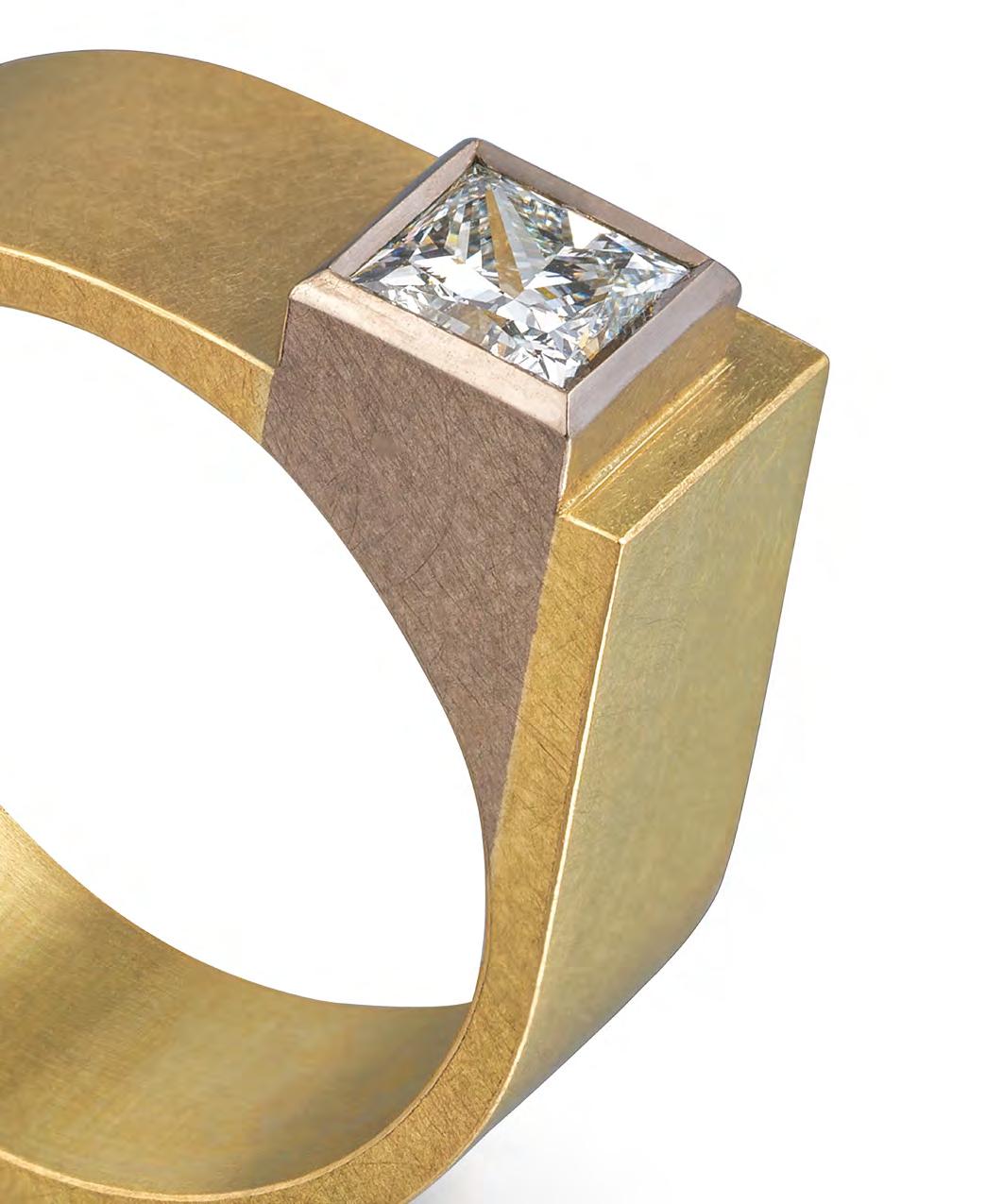
Opposite Two-tone corner ring, An Alleweireldt, princess-cut lab-grown diamond, 18ct gold. Shown at Goldsmiths’ Fair 2024. RICHARD VALENCIA
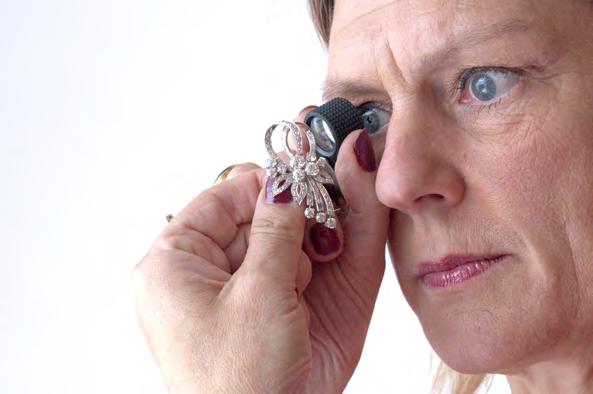
Right Joanna Hardy using a loupe to inspect diamonds. COURTESY OF JOANNA HARDY
my relationship with diamonds began in 1982 as a rough diamond valuer and sorter for the Central Selling Organisation, an arm of De Beers in Charterhouse Street, London, before moving to Antwerp to become a polished diamond dealer for J.C. Ginder. At this time, we sorted natural diamond crystals into 15,000 different categories, but never had to consider prefixing ‘diamond’ with the word ‘natural’, because all diamonds sold for jewellery were natural. The same cannot be said today. The recent rise of synthetic diamonds – also known as lab-grown diamonds, which are chemically identical to natural diamonds – has rocked confidence in this once-stable trade, bringing hesitation and excitement in equal measure. Synthetic diamonds have become big business – trade magazine Rapaport reported the value of the global synthetic diamond market in 2022 at us$24bn, growing to nearly US$60bn by 2032. Are they worth the hype?
Diamond has long been revered for its hardness, lustre and brilliance, properties that humans have poorly imitated for just as long using other gemstones and glass. Yet its crown amongst gems is a modern one. In 1947, copywriter Mary Frances Gerety coined the phrase ‘A diamond is forever’ for De Beers and it became one of the most successful slogans across 20th-century advertising. Diamonds became more desirable and so too did the market for convincing imitations. I remember in the 1970s and 1980s, diamonds were weakly challenged by cubic zirconia (cz), a synthetic gemstone made from zirconium dioxide as an affordable alternative to diamond. At first, cz’s appearance on the market was slightly troubling, but understanding its differences to diamond made it easy to distinguish
between the two. Similarly, synthetic moissanite was also used in jewellery as an alternative to diamond. It is easily detectable, if you know what to look for.
Meanwhile, scientists were working hard behind the scenes to create a diamond artificially. In 1954, General Electric achieved the first confirmed synthesis of diamonds under a secret project codenamed ‘Project Superpressure’. Scientist Howard Tracy Hall produced small diamond crystals using the High Pressure High Temperature (hpht) method, which mimicked the natural conditions under which diamonds form 150-700km deep within the Earth. Not long after, the Chemical Vapour Deposition (cvd) technique was developed, allowing diamond growth at lower pressures and temperatures as compared to hpht During the 1950s, technological improvements in these techniques led to the production of synthetic diamonds suitable for industrial purposes. None had yet produced crystals of gem-quality, however. When early gem-quality synthetic diamonds finally did enter the jewellery market, they were very small and often not of a good colour.
In the last five years, notable advancements in both hpht and cvd techniques have resulted in high-quality synthetic diamonds of all sizes that, when cut, can only be distinguished from natural diamonds with expensive detection machines. I have been grading and valuing diamonds for more than 40 years and I cannot tell the difference between a polished synthetic diamond and a polished natural diamond by eye or with my loupe –and there lies the threat to the natural diamond’s supremacy.
Technological advancements have facilitated the rise in popularity of synthetic diamonds in jewellery, but other factors have also been
co-opted into their clever marketing. Many people still subscribe to the idea that an engagement ring should be set with a diamond and, because synthetic diamonds have now improved greatly in quality, you can get a bigger and better stone at a fraction of the price of a natural one. The price difference between the two has increased dramatically over the last few years with increased production; wholesale prices for synthetic diamonds have dropped by 90 per cent since 2018. As a result, there is no second-hand market for synthetics, and the prevalence of synthetic diamonds, which are often undetectable, has also challenged the second-hand value of natural diamonds.
People have been led to believe that the mined diamonds of today have sustainability issues, both social and environmental, and synthetic diamond production is better for communities and nature. Like all mining, diamond mining has a chequered past, but today it is heavily regulated and contributes to community development and economic growth in most mining regions. In the production of synthetics, a few companies make synthetic diamonds by carbon capture from the atmosphere and use renewable energy, but tens of millions of carats a year are made in India and China using energy from fossil fuels and mined metals such as cobalt, iron, nickel, methane and/or hydrogen. Employment standards in some factories have also been criticised. Recent tariffs imposed on China and India by the us – the biggest consumer of synthetic diamonds, and where an estimated 50 per cent share of the bridal market goes to synthetic diamonds – may rush changes within the industry, but since wholesale prices are so low, the absolute cost increase per stone will remain modest for the
consumer. Inevitably, systems and regulations will evolve, and the production of synthetics will harness more sustainable methods.
While it is in vogue to set synthetic diamonds in jewellery to mimic the use of natural diamonds, the real value of the synthetic diamond lies in how it may completely transform technology. Day to day, iPhone screens and car windscreens coated in synthetic diamond would be impenetrable. The crystallised carbon of diamond is the best thermal conductor of any material known to man, and scientists are now looking at ways to use diamond to conduct electricity. In its pure form, carbon does not transfer electricity, but putting impurities inside the crystal can change its
electrical properties. These new properties of diamond could help to control the overheating of silicon microchips used in computers and other electronics, and, according to developer Diamond Foundry, synthetic diamond wafers could allow microchips to run at least twice as fast as their rated speed without heating up. Soon, we may not require silicon at all. Element Six, the technology arm of the De Beers Group, has announced a joint venture with Bosch to use synthetic diamonds to create quantum sensors that detect small changes in motion, as well as electric and magnetic fields, and which can be used to create devices for navigation, healthcare and more. The race is on for companies to benefit from the
Illustration of diamonds and other gems from A Treatise on Diamonds and Precious Stones; Including their history – Natural and Commercial, John Mawe (London, 1815).
GOLDSMITHS’ COMPANY LIBRARY
ground-breaking uses of synthetic diamond-based technology; it could transform how we interact with the modern world forever.
Polished synthetic diamonds will continue to be used in jewellery, though I see them mainly being used in fashion jewellery and accessories as manufacturing costs continue to decrease with time. While natural diamonds’ place in the market has been challenged, larger natural stones (5ct and bigger) of the top colours and with a high clarity will maintain their appeal to the highend consumer. From an antique jewellery perspective, the charm of old cushion-shaped diamonds cannot, in my opinion, be replicated, even though synthetic diamonds are now being cut in vintage styles. Personally, if I was going to spend money on diamond jewellery, I would want the stones to be natural, but if synthetic diamonds will encourage more jewellery wearing and buying, then that is good for the industry as long as we, the professionals, continue to support craftsmanship and educate the public about the merit of good design and hand skills. Diamond synthesis processes are evolving rapidly, and the sweeping marketing statements made to entice the consumer into spending their money in a particular market can be misleading. What we wear reflects our individuality, so there is space for both synthetic and natural diamonds, as long as there is a clear understanding of the facts. ✦
GROWING TOGETHER
A Community Where Makers and Businesses Thrive
Isabel Keim
just a stone ’ s throw from Hatton Garden, the Goldsmiths’ Centre hums with the tap of hammers on metal, the hiss of solder meeting flame, and the whirl of polishing motors. Within its walls, more than 130 jewellers, silversmiths and goldsmiths – from emerging businesses to established professionals – hone their craft, push boundaries of creativity, and benefit from a community built through collaboration.
Every day, these makers share ideas, expertise, and experiences, contributing to the Goldsmiths’ Centre’s training programmes – whether that is through training apprentices, teaching on the Jewellery Foundation Programme, leading short courses, or offering business advice. The Centre fosters this welcoming environment by providing subsidised workshops and coworking spaces, ensuring that makers have the support they need to succeed.
Below, we hear from some of the community members in their own words, as they share their journey of business growth within the Goldsmiths’ Centre.
Genevieve Schwartz
Founder of Genevieve Schwartz Jewellery Gold Member at the Goldsmiths’ Centre
Discovering a career as a maker I was always academic at school, so I studied Art History at Bristol. Afterwards, I did an internship with a jeweller, which had a profound effect on me, so I trained at the British Academy of Jewellery. I was designing for Astley Clarke during the pandemic, and working home alone gave me a boost to start my business. It was daunting at the beginning, but now I couldn’t imagine it any other way.
Growing my business and joining a community
I’ve done a number of courses: Getting Started Online, Spotlighting Getting Started, Shine, and Business Diagnostic and Advice. The Goldsmiths’ Centre supported me and gave me a structure to follow. My peers were singing the praises of Gold Membership so much that I joined too. Now I can see my business building and my customer volume going up.
I love meeting makers who are doing the same thing as me. I often go to the Goldsmiths’ Centre’s events and everyone is so friendly. It’s very easy to feel lost, especially when you’re running a business on your own, so having a community is vital. The Goldsmiths’ Centre has completely changed my business.
Exhibiting as part of the Trove collective Trove invites jewellers and silversmiths from the Centre to display their collections, and it gave me a proper
showcase for the first time. I remember one customer who had been talking to me about a ring and eventually decided to go ahead. She saw the ring in person at Trove and ended up buying it! The luxury shopping experience made all the difference for her.
Benjamin Hawkins
Founder of Benjamin Hawkins London Resident craftsperson at the Goldsmiths’ Centre
Growing up in Hatton Garden
My grandparents lived near Hatton Garden and, as a teenager, I had summer jobs sweeping the floors in jewellers’ workshops. I really enjoyed the whole environment, so on leaving school I applied to join the Foundation Programme at the Goldsmiths’ Centre.
There were nine people in my class, all with different backgrounds and skill sets. Although we only had a year learning and getting to know each other, we ended up collaborating together. Coming from school into this environment where there are hammers and flames, I was able to make anything with my hands – I was blown away.
Starting a business at the Goldsmiths’ Centre
After I finished, I rented a small studio at the Centre and got a loan to buy some tools. I would sell to my client, get paid for the commission, and then buy the materials I needed. This is how I’ve been able to grow the business. There are five of us now so it has grown relatively quickly, but there’s still lots to learn.
The Goldsmiths’ Centre has brought all of us small businesses together, which is a rare thing in the industry. At a time when there’s a lot of change happening, it’s a real anchor.
Teaching and learning through the apprenticeship
I had imposter syndrome at first: was I really ready to take someone on? But I’ve thoroughly enjoyed it. It’s a real learning curve: you’re interacting with someone all day every day, so you need to develop the soft skills necessary to mentor and teach. My apprentice Grace McNamara has reminded me of the importance of doing the work I really want to do, and she brings a lot back to the business.
Want to hear more from the Goldsmiths’ Centre community? Visit www.goldsmiths-centre.org/aboutus/our-impact to read their latest Impact Report and discover more about the charity’s work, along with additional stories from their community. ✦
FORGING CAREERS IN GOLD AND SILVER
The Goldsmiths’ Company Apprenticeship Scheme
Rae Gellel
amid the grandeur of Goldsmiths’ Hall, where chandeliers cast a warm glow over panelled walls and towering columns, nine young craftspeople stood shoulder to shoulder. Surrounded by loved ones, they marked a milestone – not just in their careers, but in the Goldsmiths’ Company Apprenticeship Scheme. It was October 2022 and, for the first time since the Goldsmiths’ Centre was established in 2012, the programme had welcomed apprentices from beyond London and the South East, with several of the newest recruits hailing from the Midlands. Fast-forward to today and four apprentices from that region are now a part of
the scheme, with applications from more employers warmly encouraged in the future.
“This was a pivotal moment,” says Helen Dobson, Programme Manager (Education) at the Goldsmiths’ Centre. “Over the past decade, we’ve worked hard to break down barriers to training and make this scheme accessible to as many people as possible. With online tools and the right support in place, there’s no reason why geography should stand in the way of opportunity.”
Facilitated by the Goldsmiths’ Centre and funded by the Goldsmiths’ Foundation, the scheme is the longestrunning, and one of the most respected, apprenticeships
Opposite Apprentice Esther Ilett hones their making skills during day release training at the Goldsmiths’ Centre.
in the industry. Since the Centre opened in 2012, 60 apprentices have completed their training in fields as diverse as lapidary, smallwork, silversmithing, polishing, enamelling, cad/cam, and jewellery design. In a trade where tradition and innovation walk hand in hand, it has become a vital conduit for passing down skills and knowledge to a new generation, and continues to evolve in step with the sector it serves.
This recent leap beyond the capital was made possible by a strong network of local employers in Birmingham. “Apprentices in the Midlands now feel just as much a part of the programme as those based in Hatton Garden,” explains Dobson. “That sense of belonging is vital. This scheme is about nurturing the trade – and the trade is national.”
For many apprentices, entry into the trade begins with the Jewellery Foundation Programme, which provides a baseline of skills and acts as a springboard into apprenticeships. Jos Skeates, Managing Director of the E.C. One jewellery workshop and a long-time employer of apprentices, including current apprentice Gemma Rogers, reflects on the value of this approach: “After completing the Foundation Programme, individuals have basic skills but remain open to learning. This balance is crucial, as it ensures they’re teachable while still bringing some knowledge to the table.”
Another cornerstone of the scheme is its Day Release programme, which provides 20 days of training each year for apprentices to step away from their benches to
learn together at the Goldsmiths’ Centre. This shared time not only allows them to build friendships and networks, but also broadens their exposure to new techniques and disciplines. “It’s about building wellrounded craftspeople,” explains Chris Oliver, Head of Professional Training at the Goldsmiths’ Centre. “Day Release not only introduces apprentices to skills they may not encounter in their own workplaces, but also fosters camaraderie and helps to break down the competitiveness that can sometimes exist in the trade. These connections can last a lifetime.”
In 2021, the Goldsmiths’ Centre piloted a new route into the scheme for employers who are not Goldsmiths’ Company Freemen – previously an essential requirement. The pilot, now formally integrated into the scheme, has opened the door for even more craftspeople to offer training, regardless of their affiliation. “This is about removing outdated obstacles,” adds Dobson. “We’re always listening, adapting, and refining – it’s what keeps the scheme modern and relevant.”
A powerful example of the scheme’s impact is the story of Alysha Strong, a diamond-setting apprentice under master craftsman Michael Summers, an employer who was among the first to take on an apprentice without Freeman status. In 2023, Alysha won the Goldsmiths’ Craft and Design Council’s Apprentice and Master Award for Circle of Life Pendant, a work that celebrates both her individual skill and the collaborative spirit of traditional training. “I get a real sense of pride when an apprentice excels,” says Summers. “Too many craftspeople hold everything in and never teach. I’ve always said: I’ll teach you everything I know. That’s how we keep the craft alive.”
Summers continues: “Unless you know someone, it can feel impossible to break into the trade. That’s why the apprenticeship scheme is so important. It gives young people access to high-level training that’s increasingly rare in today’s fast-paced world. Everything now is about speed and profit – how fast you can do it, not how well. But that’s not how I work, and it’s not how the Goldsmiths’ Centre works either. For us, it’s about doing the best job possible. That’s what the scheme is preserving: quality, craft, and skill.”
Each year the Company’s apprentice scheme helps a new cohort of talented people start their journey from Goldsmiths’ Hall to bustling workshops. Their progress makes the future of the trade brighter than ever. ✦
THE SCIENCE OF JEWELLERY
Eleni Bide
from his office in the Massachusetts Institute of Technology (mit), materials researcher Owain Houghton is thinking about the Tudor goldsmiths whose portraits hang thousands of miles away in Goldsmiths’ Hall. “They’d be astonished by what jewellers can do now,” he says, reflecting on the range of technologies available to contemporary metalsmiths. “I hope that in the next 50 years, we can push the boundaries in a way which means that people now would be just as astonished by what’s been achieved.”
As a scientist working at the cutting edge of metallurgy, Houghton is well-placed to talk about technological advances, but a connection to the Goldsmiths’ Company has also given him an appreciation for precious metal’s past. He was one of three students, along with Jamie Hogg and Ayush Prasad, whose PhDs at the University of Cambridge’s Department of Materials Science & Metallurgy were funded by the Goldsmiths’ Foundation (formerly the Goldsmiths’ Company Charity). Their discoveries have a range of applications, from aerospace to biomedicine, but Houghton’s studies related to a subject close to any goldsmith’s heart: creating an alloy of gold more resistant to scratching and wear. To do this, he investigated metallic glasses, whose ‘jumbled up’ atomic structure makes them particularly hard, but also easy to blow (like glass) and injection mould, potentially saving time in the manufacturing process.
Houghton is passionate about materials science and its ability to shape our everyday lives, but his PhD research would not have been possible without the support of the Goldsmiths. Funding was hugely important – the high cost of precious metal can prove a barrier to experimentation and discovery – but the connections the Company provided were also invaluable. The London Assay Office introduced him to the goldsmithing industry, helping him get to the renowned Santa Fe Symposium on jewellery manufacturing and meet people who were interested in the practical applications of his work. It also introduced him to Dr Chris Corti, a metallurgist whose work on jewellery is known around the world. According to Houghton, “Having someone like that, just to be able to call on when you are new to an industry, was incredible.”
Considering the needs of the luxury market made Houghton aware of the artistic as well as economic impact of technological advances. He references granulation and Mokume Gane as decorative techniques based on
Owain Haughton outside the Maclaurin Buildings, mit COURTESY OF OWAIN HAUGHTON
an understanding of metallurgy, and the interplay of goldsmithing and advanced engineering. “Many people in the science community… don’t realise that some of the techniques we now apply to aerospace were being used in jewellery thousands of years ago,” he says. For example, colloidal soldering techniques used in ancient Etruscan granulation are very similar to techniques now employed in microelectronics and avionics. His current research at mit reflects some of these themes. Working under Professor Gregory Olson, whose teams have been involved with designing materials for leading companies including SpaceX and Apple, Houghton is looking at a problem known as macro segregation, which creates chemical variations and defects across a casting. It is a well-known issue in the casting of precious metals, but the mit team are investigating what happens in steel ingots weighing hundreds of tonnes. The principles of designing a high-performance material for engineering applications are the same here as they are in the case of goldsmithing, and there might be something to learn from how the problem is understood in precious metals.
The mit project may be in the realm of critical infrastructure, but Houghton remains connected to goldsmithing. He has built a website, Science of Jewelry: Noble metals explained simply (www.jewelryscience. com), which aims to make metallurgy accessible and useful for makers, retailers and consumers. It’s a way of giving back to a community that supported him during his PhD research, and the website also facilitates the sorts of innovation and collaboration that are close to his heart. “I’m fortunate enough that, courtesy of the Goldsmiths, I’ve met the people who make jewellery, I’ve met the people who sell jewellery,” he says, highlighting that goldsmithing “sits at a nexus of many different types of skill, and each one is equally important.”
This mix of skills has a lot of potential, and Houghton is one of a number of scientists interested in what the future may hold for the sector. “I would love to see precious metal metallurgy start to lead the charge in transformative ideas for science and technology,” he says. We should prepare to be astonished.✦
INTE RWOV EN Jewellery Meets Textiles
At the start of 2025 the exhibition
Interwoven: Jewellery Meets Textiles brought together 40 objects from the last 40 years in the Goldsmiths’ Centre’s atrium, exploring jewellery that draws on textile techniques, materials and sensibilities.
Charlotte Dew
at the goldsmiths ’ centre , co-curator Gregory Parsons and I predominantly showcase jewellery and silversmithing, but we both come from textile backgrounds. Gregory trained as a textile designer and I have worked with a range of textile collections, in particular undertaking research into bannermaking. Our sensitivity to textile processes brought into focus the broad spectrum of ways in which contemporary jewellery draws from the textile realm.
In Interwoven, we displayed jewellery with textiles from the Crafts Council Collection. Quilted, woven and macramé installations, by artists Matthew Harris, Ann Sutton and Peter Collingwood amongst others, were chosen to help create a visual dialogue with jewellery and support
the exploration of links between the two disciplines. The techniques and designs by jewellers including Caroline Broadhead, Nora Fok, Gill Galloway-Whitehead and Ella Fearon-Low gained further emphasis against this backdrop. Visitors were encouraged to look closely. Their feedback showed that insight and inspiration came from highlighting the outcomes of an interdisciplinary approach to making.
Creating the exhibition required us to ask makers how and why they were looking to textiles:
Susan Cross: “Inspiration for my work comes from a deeply rooted interest in textiles, both in terms of borrowed techniques and a range of visual references. I grew up amongst women who were very
Opposite left
Sequin brooch, Sarah Pulvertaft, 2017, sterling silver, 18ct gold. Goldsmiths’ Company Collection.
CLARISSA BRUCE
Opposite right
Lenticular brooch, Andrew Lamb, 2012, 18ct red gold, sterling silver. Goldsmiths’ Company Collection.
CLARISSA BRUCE
Left
Interwoven exhibition display.
JULIA SKUPNY
skilled at making, whether this was dressmaking, knitting, crochet or embroidery, and so it is second nature to me to be continuing hand-making in this way.”
Caroline Broadhead: “I like things that are flexible and have a tactility. Textiles allow for colour and, as materials we wear close to the skin, have an important connection to us.”
Megan Brown: “I’m particularly drawn to methods that allow me to sculpt my jewellery into fluid forms.”
Teri Howes: “Using a crochet hook, hard metal is transformed into soft, sensuous curves, echoing fabric.”
We found three core ideas underpinning the jewellery in Interwoven: the desire to find new processes to manipulate metal; an urge to push the discipline in new directions, for example through the introduction of colour, greater scale and new materials; and the visual and narrative inspiration that textiles can bring. The exhibition demonstrated that looking outside their discipline pushes the work of jewellers in a myriad of exciting and beautiful directions. This prompted us to ask why collaboration is important to them:
Caroline Broadhead: “Through collaboration it is possible to verbalise and share ideas and to understand and take on board another's perspective – to let ideas develop and to see where they end up.”
Faye Hall: “I value collaboration in many forms. It can help me see my work differently and offer new challenges. As I work in my home studio, I need to get out of my own head, and a collaborative conversation or project is perfect for this.”
These answers reveal the value of collaboration in expanding ideas and giving makers greater perspective. Exhibitor Anna Gordon encourages this approach: “Don’t be insular. Be curious. Whether it's looking at historical objects or delving into some techniques, these things give you a new energy.”
The diversity of places to which the Interwoven exhibitors have looked is extensive. Independent research as well as being networked are equally as important:
Andrew Lamb: “I’ve long admired the artist Bridget Riley and often quote words by Clare Henry, who described her as an artist who ‘could always get her lines to billow and weave, spin and rotate, pull and tug, concertina and squeeze’ (The Scotsman, 2000). This idea resonates with me because she was so successful at creating the illusion of three-dimensions in 2D. As a maker, this reflects my hands-on approach to materials, applying ancient skills to ‘pull’, ‘squeeze’, ‘spin’ and ‘weave’ wire into threedimensional forms, striving to make each piece appear to come alive.”
Gilly Langton: “I wanted to add colour, and I didn't know how.
I looked for the right sort of material with resin enamel. But then I found this manufactured shock chord and started working with that. Combining the coloured elastic with silver gave me the result I was looking for.”
Caroline Broadhead: “When I was doing the cotton pieces in the 1970s, I had been on a fly-tying workshop. I was not particularly interested in fishing, but I was interested in the way that the flies were made, with different colours of threads, feathers, foils, etc.”
Caitlin Murphy: “I attended Bishopsland Educational Trust for two years and it was amazing to be with a network of makers. The ability to bounce ideas off one another was
Neckpiece, Caroline Broadhead, 1976, cotton, silver. Crafts Council Collection. TODD WHITE ART PHOTOGRAPHY
fantastic. Recently, I took part in Future Icons Selects, where I spoke with furniture makers, ceramicists and various textile artists. That multidisciplinar y group gave me lots of ideas for potential collaborations.”
The makers in Interwoven exude an attitude of embraced opportunity. When asked, they suggested that interdisciplinary work of this type can be supported in several ways:
Faye Hall: “We need more exciting projects to be involved with and more exhibitions of work that show people that creativity doesn’t need to fit into a set pigeonhole.”
“Don’t be insular. Be curious. Whether it's looking at historical objects or delving into some techniques, these things give you a new energy.”
Bottom Alpha
Andrew Lamb: “I remain driven by that sense of ongoing discovery, when time permits. I suppose one hurdle for any maker is finding that perfect balance between the financial side of business and creative development. Funding opportunities have been pivotal in supporting my practice and have provided time and space to experiment, take risks, and embrace the unexpected. It would be fantastic to see more opportunities where artists can work together to share processes and outcomes – especially if supported with time, financial backing, an enabling environment, or access to technology.”
Financial and technical support are of course important, and the work of organisations, cultural bodies and universities can help to underpin collaboration, but open-mindedness is the thing that lies at the heart of the wonderfully interdisciplinary approach to jewellery demonstrated in the exhibition. At the Goldsmiths’ Centre, all our work stems from our commitment to creativity, craft and community. It is reassuring to see these values being reflected in the approach of the exceptional makers we had the privilege of showcasing in Interwoven. Now, we look forward to continuing to help support this expansive and plural approach to making jewellery. ✦
Top Brooch, Faye Hall, 2024, 9ct gold vermeil, sterling silver, mother of pearl, oak, Formica, nylon, spinel, glass.
TODD WHITE ART PHOTOGRAPHY
Brooch, Caitlin Murphy, 2024, 18ct yellow, green and red gold, blue niobium.
TODD WHITE ART PHOTOGRAPHY
WO R DSMITHING
At the Crossroads of Jewellery and Language
Debika Ray
Words are the building blocks of language – poetry, prose, speeches –just as metal, cloth, wood and clay are the components that make up physical objects. The process of writing is, selfevidently, about communication, but that is also often true for craft – not least when it comes to making jewellery, objects that are designed to be worn and to express something about the wearer’s taste or personal history.
An Endless Rant on Craft, Jonathan Boyd, 2012, oxidised silver.
“i see the jewellery as a type of physical, concrete poetry,” says jewellery artist Jonathan Boyd, who is Head of Applied Art at the Royal College of Art in London. This year, Boyd completed his PhD, entitled I can’t even string a sentence together. Or, why wear words., in which he explained his fascination with language that began because he used to struggle to read. “There is something poetic about not understanding how language functions – it means you can pull it apart in a different way,” he says, explaining that it meant he was able to observe the physicality of script – whether linear, circular, helical, spiralling or linked – and the way in which its form relates to meaning. In his work, the words themselves come alive: a 6m-long brooch relays a conversation had with his flatmate and partner while watching Masterchef on tv, and was designed for people to cut sections out of it and change the meaning. A silver bracelet called An Endless Rant on Craft is cast with his own words, recorded one night in a pub, talking about the difference between craft, art, and design – representing a “never-ending, tedious, circular” discussion. What completes the work is the wearer and how they are perceived. “When you wear a bangle and your body moves, you catch a glimpse of those words but you never see the same reading twice.”
In recognition of the intimate connection between writing and making, the Goldsmiths’ Foundation announced this year that it would be funding 500 Writers, a three-year writing programme launched by the National Literacy Trust that aims to improve the literacy skills of more than 1,000 children living in disadvantaged communities across 21 primary schools in Bradford. “The funding will support children from disadvantaged communities to
“If you had to wear your story, what information would you choose to wear and what would you choose to omit?”
attend engaging, curated workshops at local arts, culture and heritage venues,” explains programme lead Ki-Li Watkins. “It will create a rich environment of experiences, inspiration and influences to fuel the children’s writing.”
Exploring the work of jewellery makers like Boyd, who incorporate language into their work, is a lesson in itself – revealing the many ways in which we speak to each other.
“Jewellery is a poetic art,” says Zoe Arnold, who started writing poetry when she first exhibited her work at the Goldsmiths’ Fair in 2006 and found that the process of making both language and objects is similar.
“The feeling is the same. The joy of inspiration is the same,” she says. Over time she has written books or bodies of text to inspire whole collections, as well as poems that inspired individual objects – for example, a set of rings that each represent a single line from the same poem. “I liked the idea that the wearers of the rings had a connection to the other wearers, even though they may never meet them.”
Arnold’s work taps into the emotional resonance of language. “The themes I explored are universal,” she says. “My poem
The Destiny of Flies, for example, is about humanity always trying to get to the light, but destined to dance a last dance on the windowsill.” It accompanied a set of gold fly rings set with diamond eyes, which are “a reminder to reflect on the important things in life when wearing one”. For Jo Pond, words are a way of revealing the deeper narrative behind her work: she welds together found and inherited objects, retaining the original patina, materiality and history while creating something new. “I felt that the making alone didn’t convey enough, as an object can be open to many interpretations,” she explains. The Rationed collection is an example: a set of brooches and other objects based on the wartime diaries of her grandmothers, which are displayed alongside snippets of text such as ‘Tuesday, 9 April 1940 – Ess came to doctors with me & he says we are definitely to have a little addition. Germany invaded Norway.’ Personal history is also central to the work of Siobhan Wallace, but in a starkly different way: on her rings, chains and earrings, she etches and engraves clinical phrases you might find in consumer genetic testing kit results, inspired by her own body data. A signet ring features the phrase ‘1% British’, instead of
a family crest; a dog tag says ‘motion sickness – highly likely’; a thick flat chain is emblazoned with the words ‘Alzheimer’s Detected’. “Imagine what life would be like if it was suddenly quantified into three-word sentences and percentages?” she asks. “If you had to wear your story, what information would you choose to wear and what would you choose
to omit?” While making the invisible visible, the brevity of her phrasing also leaves room for imagination. “We are a wealth of data, but we are often reluctant to know the information that already exists within us for fear of finishing our own story.”
For Steve Ali, both writing and making jewellery are ways of recording and retelling his experiences. The latter form of practice he found while living in a camp in Calais, after leaving Syria as a refugee in 2013, where he made pieces for friends out of nails and wires to pass the time. Inspired by Arabic calligraphy and the religious lessons of his childhood, his jewellery often depicts single words – one says ‘Iqra’, which means ‘Read’ in Arabic, the first word that was taught to the Prophet Muhammad by Archangel Gabriel. “A word went on to form a civilisation and ignite the pursuit of knowledge from Ancient Greece through to the Renaissance in Europe,” he says. “Another reads ‘Isbir’, ‘Which means ‘Be patient’ or ‘hang in there’, which I designed at the time things were difficult for me, and put out there for anyone who might find some solace in it during a difficult time.”
It is in the creative process, Ali says, that our perception of the world is shaped. “We are the stories we tell. Life isn’t shaped by what happens to us, but by how we perceive those moments once the real memory fades,” he explains.
“In the end, we’re left with feelings, which turn into stories as we try to make sense of the past and give it meaning. Jewellery, for me, is that same process in physical form.” ✦
Running Out of Time, Siobhan Wallace, 2020.
NATALIJA GORMALOVA
A RT IN CIRCULATION
Designing Coins
Chris Hall
Tears of Hope, Johnny Dowell (King Nerd), 2020. The proceeds from this coin were donated to nhs charities during the covid pandemic. COURTESY OF JOHNNY DOWELL
according to the Royal Mint, the uk’s official maker of British coins, there are more than 27bn coins in circulation in the uk. We know their size, shape and weight so well that we could identify them by touch alone, and even though cash usage has fallen significantly – and perhaps irreversibly – since the pandemic, our currency remains a powerful national symbol and an ever-present part of our culture.
As truly ubiquitous items, coins are things that we rarely, if ever, stop and scrutinise. There are landmark moments, such as the redesign of the £1 coin in 2017, and by now most of us will have started to get used to His Majesty King Charles III’s profile appearing on our loose change. But as a rule, the majority of people are unlikely to pause and consider the design work that’s gone into the pennies and pounds jangling in our pockets or accumulating in jars saved for a rainy day.
We’re missing out, though. Not only are the seven standard British coins an example of outstanding product design – the fragmented shield motif created by artist Matt Dent in 2008 won multiple awards –but they are also a canvas for great creativity that can celebrate everything from horticulture to science fiction. As political tokens, they can be cherished or subverted, and they are almost certainly the only realistic way in which anyone, at any time, can carry a whole gallery’s worth of graphic art and design about their person.
The impetus for a new coin can come either from the Royal Mint or from the Government, and the designs go far beyond the heraldic crests that spring to mind, with dozens of different commemorative coin designs commissioned every year. It is the Royal Mint Advisory Committee, a multidisciplinary group of experts, that oversees the process of bringing a new coin to life. “The idea of it was that it shouldn’t be civil servants who decide what coins and medals look like,” explains Kevin Clancy, director of the Royal Mint Museum and the committee’s secretary. “It should be artists and historians and lettering specialists and heraldic experts and a range of people who can bring a professional discipline to bear on an aesthetic thing.”
Established in 192 2, the committee holds the goal of “[raising] the standard of numismatic art in Britain,” and in practice operates not unlike a creative agency – albeit one with a finely-honed sense of patriotic responsibility. “Usually between two and five artists have been asked to submit multiple designs each,” says Dr Alexandra Harris, a professor of English Literature at Birmingham University and a specialist in cultural history who was appointed to the committee in 2023. “We might have whole spreads of designs for one theme, which is so interesting because
Annual Sets, 2025, honouring Queen Elizabeth the Queen Mother, the modern railway, the Royal Observatory, the Red Arrows and stories of the Second World War.
people offer such different imagery in response to the brief,” she continues. “The conversation then can vary from a sense of political purpose – ‘What should be the legend on a coin commemorating D-Day?’ – right up to: ‘Could we make the steam on this train feel more dynamic?’” Artists and craftspeople spanning a wide range of disciplines, from sculptors to furniture designers, are invited to submit their proposals, which are assessed anonymously by the committee. The King himself has been known to take a direct interest in the briefs for new coins and, on average, it takes around 18 months to go from a theme being approved to a coin being issued.
Recalling a recent personal favourite, the £2 coin that was issued to mark 200 years of the modern railway, Dr Harris says that coin design, creatively, can straddle a line between the artisanal and the mass-produced. “It uses advanced digital technology and yet somehow the effect of the smoke marries up with this very handmade feel of the rest of the design,” she says. It’s a point that Clancy picks up on too. “Stuart Devlin, who was Prime Warden of the Goldsmiths’ Company, was a member of this committee and a coin designer,” he says. “And he always spoke in favour of the amount of detail that a coin could carry, against another school of thought, which is that these objects should be logos, simplified; they should distill down whatever message it is they’re trying to convey. The engineers would tend toward that school of thought: if it’s too detailed, it might be more difficult to make. But Stuart was a silversmith, he knew how things
THE ROYAL MINT
were made, and he promoted the idea that there’s more detail possible in this medium than you might think.”
There are limitations on what can appear on a coin beyond the physical constraints, however. The committee has an intangible sense of what is appropriate, but also adheres to certain historic conventions: for example, that no living person should be represented on a coin. “The representation of a realistic likeness should be reserved for The Monarch,” says Clancy. Referring back to a recent series that celebrated musical icons, he explains that “showing someone like Freddie Mercury, that’s OK, but if you wanted to convey Elton John and celebrate his work, we have to find a way of doing that without showing him, and that can be quite tricky.”
Sometimes, however, the creative life of a coin extends beyond its minting – and then, all bets are off when it comes to following the rules. Artist and engraver Johnny Dowell, who has brought his customisation talents to brands including Leica, Dr. Martens and G-Shock, found his creative niche by engraving coins during his training at gunsmith James Purdey & Sons. “Those guns are sold for £200,000 plus,” says Dowell, who is also known by his alias King Nerd. “So before they let you on one of these, they need to know that you are ready. I was just engraving random coins that meant nothing at the time.
200 Years of The Modern Railway, £2 coin, front and reverse. 2025.
I would do things like the Queen eating a baguette or smoking a cigarette, and put them into circulation.”
Dowell’s work since leaving Purdey has taken many forms, but his coins remain some of the most sought after. “I wanted to create pieces of art on these coins where people would recognise what the canvas is, but the artwork that was on the canvas is not what they’re used to,” he says. Occasionally, his work grabs headlines. Following the assassination attempt on Donald Trump during his electoral campaign in 2024, Dowell returned to a design he’d made during Trump’s first term as President of the United States. “When he got shot, I was like, ‘Where’s that coin?’ I pulled out the coin and it took me literally 10 minutes to put a bullet on it and show it speeding through the air,” he says. “I put it out there, and almost immediately had about four people trying to buy it. I ended up selling it to – apparently –the fifth most successful real estate agent in America – something I literally threw in a drawer for four years.”
Dowell says he has no particular political motivations, but is drawn to the artistic potential of working in a medium that’s known the world over. “It’s the one thing we have in common,” he says. “Whether you are rich or poor, [coins] pass through everyone’s hands, thousands, millions of times around the world, and it’s just there.” ✦
THE ROYAL MINT
COMPANY NEWS
THE NEW PRIME WARDEN
Ed Butler
PAUL READ
“you have to know what good looks like from the start. In the words of Sun Tzu, tactics without strategy is the noise before defeat.” Ed Butler is talking about his experience of leading British forces in Afghanistan, but the lessons that he learned during a distinguished career in the military apply equally to rather quieter settings, such as the Goldsmiths’ Company. For him, an important part of ‘good’ is an engaged and active membership. “An organisation lives or dies by the quality of its people,” he explains. Having a clear, deliverable strategy is essential.
Now a highly respected specialist in risk and resilience, Butler spent the first part of his career a long way from the City. “I’m a country person rather than a city person at heart,” he says. “I had no idea what I was going to do when I left school, I liked the idea of the Army because it offered the outdoors and plenty of adventure.” On his smallholding in Herefordshire, where he lives with his wife Sophie and four dogs, the outdoors continues to offer respite from other duties. His bees and flock of Jacob sheep help him to switch off. “And,” he says, “chainsawing is a good way of relieving tension.”
Butler joined up at age 22 and spent the next 24 years as a serving soldier, earning awards including the Distinguished Service Order and leading at a high rank in some extremely challenging circumstances. “My time in the Army exceeded my expectations more than I could have imagined,” he says. “I was deployed all over the world, to Northern Ireland, to the first Gulf War, to the Balkans and a few undisclosed places in-between.” He achieved his career ambition at age 38 when he took command of 22 sas. Working with the very best of the British and worldwide military was an unbeatable experience, and Butler remarks that “nothing I ever have done professionally could compare to that”.
The events of 11 September 2001 transformed the security world and Butler was deployed immediately to Afghanistan, completing three tours in total. The last of these, in 2006, saw him lead all British forces – some 3,500 people – in very testing conditions. There was no clear strategy for Afghanistan, and none of the many different agendas in operation were achievable within the resources the government was prepared to commit to the campaign. Butler still thinks about the people who lost their lives serving on this tour and others. He describes his ‘Tommy Atkins test’, which he applied after any serviceman or woman under his command was killed: could he look their family in the eye and say ‘we did everything we could’ to prevent their death? In 2006, these conversations became much harder.
In 2008 Butler left the Army and began applying the knowledge he had gained in the commercial arena, first
as a partner in an early-stage risk advisory business before working in terrorism reinsurance. He now sits on a number of boards, advising on, amongst other things, the nuclear sector, security and resilience technology, and insurance. “I’ve spent 40 years in the risk business,” he reflects. “You need to know your boundaries and strike the right balance of risk and reward.” He feels these considerations apply very much to the Goldsmiths’ Company as a mediumsized enterprise with plenty of exciting opportunities ahead of it.
Many of these relate to people. Although he believes that the Company has come a long way in broadening the diversity of its community, there is still further to go. A career in the military taught Butler the importance of diversity of experience and its positive impact on decision-making. He has also seen how developing relationships with people from an early age can have a huge impact. Butler references the Goldsmiths’ Foundation’s schools project with Aston University as a particularly exciting example of this, which also links with his other great ambition for the Company: amplifying its social impact to secure the industry’s future and ensure a positive benefit to wider society.
The questions of how and why individuals engage with the Company are ones that Butler has asked himself. His late father, Sir Adam Butler, served as Prime Warden over the Millennium but, although the Goldsmiths’ Company had always been a part of Butler’s life, an invitation to join the Court at the relatively young age of 47 came as a surprise. He realised later that the offer was made because he could bring a different perspective. Despite counting the famous 18th-century silversmith Augustine Courtauld and the great collector Samuel Courtauld amongst his ancestors, Butler says that “sadly, I’m not artistic – I can just about draw stickmen – but I’ve always been fascinated by how craftspeople make these extraordinary objects.” This respect for the skills others can bring and a determination to harness different talents to drive the Company forward will be defining aspects of Butler’s year as Prime Warden.
Paraphrasing an sas saying, ‘the man is the Regiment, the Regiment is the man’, Butler believes that the future of the Goldsmiths is all about its people. “Our members, apprentices, silversmiths, jewellers and employees are our lifeblood, and we need to nurture them and have a strategy that delivers success for the next 700 years.”
ELENI BIDE
A PRIME WARDEN’S YEAR
Richard Reid
and
visit Bradford for the launch of the National Literacy Trust’s Goldsmiths’ 500 Writers programme. THE GOLDSMITHS’ COMPANY
Richard Reid
Annie Warburton
Describe a typical day in your year as Prime Warden:
One of the extraordinary things about being Prime Warden is that Goldsmiths’ Hall is one’s home for the year. Wandering around early in the morning and talking to our people as they are setting up for a new day is very important to me as it is the people who work here who are the fabric of the organisation – they make everything happen – and building up a rapport with them is key. I always make sure I go down and see Winston and the security team on the front desk, to check what else might be going on.
The work starts when I check in with Tamara [ea to the ceo and Prime Warden], who has been brilliant in organising Jane’s and my life here, and with Annie, our ceo. This last year has been really positive as there has been so much going on, and Annie and I speak all the time. By eleven o’clock I might meet some of my fellow Wardens, whose support has been critical for me. I’m very lucky that we’ve worked together for a long time now and there are always things to discuss.
The Goldsmiths’ Company is an extraordinary cultural institution. It is significant to its members, to the City of London and to the wider world, and how we manage it matters. As somewhere with a long history, we need to ask the question ‘why’, and make sure we learn from the past, change things when we need to, and leave the institution in a better position than when we found it. My predecessors have done a phenomenal job, and it’s a case of trying to keep up with them.
The afternoon might involve work with committees, and I’ve been really humbled by the level of expertise and the commitment that our members bring to all of these. They cover a lot of ground, from membership, to artistry in the Contemporary Craft Committee, and quality control in the Assay Office. An important task this year has been the transition from the Goldsmiths’ Charity to the Goldsmiths’ Foundation, which has modernised its governance and provided a renewed focus on vocational education and our craft, trade and industry. There has been great support from the Assistants, especially Lynne Brindley, to get this over the line.
Finally, there is likely to be an event in the evening, which is often a good opportunity to get to know more of the people who work here, our wider membership or promote the Company’s work elsewhere.
Do you think the Prime Warden has an ambassadorial role?
Yes, with a responsibility to let people know what we do and the impact we have, not just our financial firepower, but the talents we can bring to bear on so many things too. There is an adage in the financial world that for every £1 you put into social investment, you should be able to produce at least £4 in benefit to society. The value of the work we do is enormous. Our historic position and how it brings people together is also important. You don’t really realise that until you are doing the role, and suddenly you are at St Pauls, processing in front of 2,500 people at the United Guilds Service.
What have you particularly enjoyed doing?
Seeing the work of the Foundation’s partners, like the National Literacy Trust’s project in Bradford, has been very rewarding, as have events around the country, like Goldsmiths North in Sheffield. I’ve been honoured to give awards for the Goldsmiths’ Craft and Design Council and be with people at such a moment of joy and celebration. And the Centre has been very supportive in letting me talk to the apprentices and Foundation students. Being able to give life chances to more individuals and to promote the trade has been a real focus for me. My wife Jane has been able to come to some of these events too, and we’ve made good friends.
What are your highlights from a year as Prime Warden?
It’s been a packed agenda and we have achieved a lot. We started off finalising the new visual identity, and making sure it told the right story. There has been significant work on the strategy of the Assay Office, and of course on the Goldsmiths’ Foundation. I’m extremely pleased that we have established a plan for the old Assay Office space, thanks in no small part to my predecessor, Charles Mackworth-Young. This will provide us with a new, accessible space on the ground floor for exhibitions, activities for members, and public events. Finally, having Peter Taylor back at the helm of the Goldsmiths’ Centre has been fabulous. And above all working with Annie, who has driven everything we have done, has been terrific. A question which has focussed my mind throughout the past year has been, ‘How do we make sure the Goldsmiths’ keeps going forward for another 700 years?’ Leading it has been a huge responsibility but also a great honour.✦
COMPANY IN NUMBERS
FROM MEDIEVAL ENGLAND TO THE MODERN WORLD
The Goldsmiths’ Company is one of the Great XII livery companies of the City of London and received its first Royal Charter from Edward III in 1327. This medieval document, issued by the King, outlined our powers and responsibilities as the guild for those working with precious metals within the walls of the City. It paved the way for regulations which governed the way that our trade operated, set expectations for training and education, and guided our philanthropic responsibilities to the people and communities around us.
Over the last seven centuries, the City, the Company, and the Trade have evolved, yet, as we approach our 700th year, our purpose remains the same.
Through the London Assay Office, we test and assure the quality of precious metals and the nation’s coinage. Through the Goldsmiths’ Company Apprenticeship Scheme and our support for The Goldsmiths’ Centre, we provide education, training and mentorship to the next generation of master craftspeople. And through the Goldsmiths’ Foundation, we are helping to advance creative, technical, and vocational skills in the craft and trade of goldsmithing, silversmithing and jewellery, and the wider creative industries.
None of this would be possible without our members. They provide governance and direction, advice and support, and ensure that we stay true to our values and relevant in the modern world.
Out of our 1,600 active members, 55% work in our trade and 45% in other professions, from law and finance to technology, hospitality and the creative sector. Together, they bring expert knowledge and experience that is essential to running the Company today and securing its future for generations to come, just as our founding members did in 1327.
OUR HOME IN THE CITY
Twelve years after we received our first Royal Charter, 19 goldsmiths bought a merchant’s house in the heart of the medieval goldsmithery as a “common place” for the newly founded Company to meet and conduct business. This was the first Goldsmiths’ Hall. Like the City around it, the Hall has been torn down, rebuilt and repaired across the centuries, due to wear and tear, the changing needs of the Company, the Great Fire and, most recently, the Blitz. The building, which sits at the junction of Foster Lane and Greville Street in the City of London, is the third Goldsmiths’ Hall. Opened in 1835, it is the contemporary home of the Goldsmiths’ Company: a convening place for our members, the hub for our philanthropic and commercial activities, the repository of our history and heritage, and the home of the London Assay Office.
London Assay Office
The London Assay Office protects consumers by assaying (testing) and hallmarking objects made from precious metal, and ensuring the quality and accuracy of the nation’s coinage. The term ‘hallmarking’ takes its name from Goldsmiths’ Hall, the home of the London Assay Office since 1478. In 2024 more than 1.7 million items were hallmarked by laser or punch.
Library & Archive
Events
Our Hall offers a stunning location for events, welcoming tens of thousands of guests and visitors every year for weddings, dinners, parties, presentations, exhibitions and seminars. It regularly provides a stage for film and television productions and has played host to some of the biggest names in Hollywood and Bollywood!
Our Library and Archive contain more than 8,000 books and over 15,000 images, magazines, journals, films and special research collections focused on jewellery, silver, the allied trades, and hallmarking. It is also home to Company documents, accounts, and minutes spanning almost 700 years. The library is open to the public and plays a key role in research, education, and ongoing professional development in our industry.
Goldsmiths’ Fair
Collection
There are more than 11,000 objects in our world class Collection of art medals, studio jewellery, and antique and contemporary British silver. They are used for research and teaching, feature in exhibitions, and are loaned to cultural institutions. The silver is put to work at lunches and dinners, and the jewellery is worn to showcase the skills and creativity that run through our trade and craft.
Since 1983, Goldsmiths’ Fair has been the place to see, try, and buy the uk’s best independently made contemporary fine jewellery and silver, and meet the craftspeople who designed and created it. In 2024, the Fair welcomed more than 9,000 visitors to Goldsmiths’ Hall, served them 5,000 glasses of sparkling English wine, and saw them spend in excess of £3million with the 136 small British businesses exhibiting.
SEVEN CENTURIES OF CONSUMER PROTECTION
The Goldsmiths’ Company ensures the quality of precious metals through assaying and hallmarking at the London Assay Office, as well as testing the nation’s coinage for quality, accuracy and composition at the Trial of The Pyx. Instigated in the 13th and 14th centuries, these are two of the oldest forms of consumer protection still in use today.
Hallmarking
Hallmarking can trace its origins to the reign of Henry II, more than 840 years ago. It offers customers, retailers and the trade assurance that objects made from precious metals have been independently scientifically tested (assayed) and, through the marks that are applied (the hallmark), tells them what an object is made from, when it was made, who sent it to be hallmarked (the sponsor), and which of the four independent uk Assay Offices tested and marked it in line with the Hallmarking Act (1973).
In 2024, the London Assay Office tested and hallmarked more than 1.7 million articles. 1,516,962 were marked using a laser and 246,947 were marked using a punch.
On 1 January 2025, all four uk Assay Offices began using a new uppercase typographic alphabet for their date letters, with the first letter being an uppercase ‘A’.
The Trial of The Pyx
Goldsmiths and, latterly, The Goldsmiths’ Company have been responsible for upholding the quality of the nation’s coinage through rigorous independent inspection and testing as part of one of the uks oldest judicial processes, The Trial of The Pyx, since 1248.
The Trial fulfils a legal requirement under the Coinage Act (1971) to ensure that the coins produced by the Royal Mint are of the correct weight, size and composition. Having reviewed coins in circulation, in 2024 the Treasury decided that no new currency needed to be minted. As a result, for the first time in the Trial’s history, all 6,432 coins that were submitted in February 2025 for inspection by a jury of Goldsmiths’ Company Members were either collectible or commemorative and were largely made from precious metals.
The date letter, which tells you when an object was hallmarked, changes every year – with a new typographic alphabet issued every 25 years. To avoid confusion, we don’t use letters that look similar. In the last set this meant the omission of the letter ‘i’ and in the current set of the letter ‘j’. Each set features a new typeface, case, and shield shape to ensure that each letter can only indicate one specific year.
On 15 May 2025, following three months of scientific analysis by the London Assay Office, Chancellor of the Exchequer Rachel Reeves, who holds the title Master of the Royal Mint, received a positive verdict on all 6,432 coins from The King’s Remembrancer, Senior Master Cook of the Kings’ Bench Division of the High Court.
INVESTMENT IN THE FUTURE OF OUR TRADE AND CRAFT
For almost seven centuries the Goldsmiths’ Company has championed, and invested in, the future of our trade and craft and helped to nurture and develop the skills and creativity of generations of master craftspeople. The four main ways that we do this today are through Goldsmiths’ Company Apprenticeships; through our annual selling event, Goldsmiths’ Fair; through acquisitions and commissions for, and loans from, the Company Collection; and through charitable grants from our Foundation (which you can learn about on the next page).
Apprenticeships
There are records of more than 31,400 apprentices in our Archives, with the earliest entries in the 14th Century, and the most recent in the spring of 2025. Of our 1,600 active members, 261 received their Freedom of the Company by completing an apprenticeship. The modern Goldsmiths’ Company Apprenticeship is delivered by the Goldsmiths’ Centre. It connects Company members and the wider industry with talented young people and provides apprentices with practical hands-on training, unique educational experiences supported by the Company’s Library and Curatorial teams, and a myriad of opportunities to develop their professional skills and relationships, both in and out of the workshop. In their final year, apprentices spend around 300 hours producing a Masterpiece which shows the skills they have learned. They present this to the Wardens (senior members of our Board) on completion of their apprenticeship and are awarded their Freedom as members of the Company.
Goldsmiths’ Fair
Established in 1983, the Fair has launched, accelerated, and supported the careers and businesses of the uk’s leading contemporary jewellers and silversmiths and their colleagues in the wider trade. The Emerging Business Bursary, launched in 2024, reimagines the Fair’s longstanding support for early career makers in recognition of the different routes that lead craftspeople into the trade, with no restrictions based on age or formal education. The Bursary forms part of the £500,000 annual investment the Company makes in staging the Fair, with the goal of connecting craftspeople with consumers, collectors and institutions, and creating an environment where small businesses can thrive. In 2024, the Fair welcomed more than 9,000 visitors to Goldsmiths’ Hall, who spent over £3million with the 136 exhibiting craftspeople during the two-week event.
The Collection
There are more than 11,000 objects in our world class Collection of art medals, studio jewellery, and antique and contemporary British silver. It is a working collection, and pieces from it are displayed, loaned, put to work and worn, as well as being used to teach the next generation of makers. The oldest object in our Collection is more than 800 years old, and the most recent was hallmarked in 2025. One of the main ways that we show our support for contemporary makers is through commissions and acquisitions, with 72 new pieces joining the Collection in 2024–2025.
£3MILLION IN SUPPORT OF PEOPLE, SKILLS AND CREATIVITY
In Spring 2025, we reinvigorated our philanthropy with the launch of the Goldsmiths’ Foundation. Focussing on advancing creative, technical, and vocational skills, education and training, the Foundation supports partners in our industry and the wider creative sector to achieve personal, cultural and social transformation.
At time of writing, our Trustees are working to select the recipients of the Foundation’s inaugural grants programme. While this continues at pace, our commitment to fund existing grants – including our long-term commitment to the Goldsmiths’ Centre and to recipients of our multi-year Landmark programme –remains, with fantastic results being delivered by all our charity partners across the uk
A SNAPSHOT OF OUR FUNDED PARTNERS
The Goldsmiths’ Centre is an independent charity founded by the Goldsmiths’ Company in 2012 – our largest single direct investment in the future of our trade and craft. The charity exists to support the jewellery, silversmithing and allied industries through learning and professional development, and aims to close the industry’s skills gap so that creativity, craftsmanship and community can thrive.
LandWorks offers a supported route back into employment and the community for people in prison or at risk of going to prison. Alongside providing practical resettlement support and counselling, LandWorks offers experience in woodworking, vegetable growing, cooking, construction, landscaping, and arts and crafts. Building social skills, increasing self-worth, and encouraging self-responsibility, the aim is to holistically overcome the challenges that ex-offenders face.
The South House Silver Workshop Trust supports the next generation of silversmiths through training, development and mentorship during fully funded, month-long residential stays at workshops in Shetland and Sheffield (learn more on page 14).
HMS Prince of Wales is part of the Royal Navy’s twostrong fleet of Queen Elizabeth Class aircraft carriers, and one of four Goldsmiths’ Company military affiliates. In 2025, hms Prince of Wales received a grant to enhance the welfare and comfort of its 1,600 crew members during an 8-month deployment.
LANDMARK PROGRAMME GRANTS
St. Paul’s Cathedral is undertaking major restoration and conservation of its Cupola, Ball, and Cross. Rising from the Golden Gallery on top of the Dome, at 365ft high, the structure is an iconic symbol of the City of London. The project will raise awareness of heritage craft skills and train apprentices in skills in masonry, lead working and gilding.
St. Giles’ Peer Empowerment Programme will help more than 80 prisoners in five prisons to develop new skills and gain Level 3 qualifications in Advice and Guidance. This industry-standard qualification, alongside on-thejob training and pathways into placements, creates the basis for long-term, transformative change for those leaving prison.
The National Literacy Trust’s Goldsmiths’ 500 Writers programme aims to improve the literacy skills of disadvantaged children in Bradford by empowering teachers to deliver memorable cultural experiences and curated lessons. Following a highly successful first year the programme now aims to work with more than 1,000 pupils!
Goldsmiths Institute embeds skills and design-based training within Aston University Engineering Academy’s curriculum for 13–18 year olds. Driving interaction, training and talent pipelines between educators, learners, and employers, the Institute launched the uk’s first Jewellery T-Level in autumn 2024.
EIGHT GOLDEN FACTS
100 keys
Along with Company records spanning from 1334 to the present day, our Archives include more than 100 sets of unidentified keys, two truncheons, a gas mask, some charred timber, a bus conductor’s ticket machine, and one vintage bar of Lifebuoy soap.
7,500
candles
2,832 pieces of silver
From butter knives to teaspoons and pineapple forks, when you have a Hall capable of seating 230 people and five courses to serve, you need to use a lot of cutlery. Our main service contains 2,832 individual pieces of silver from our collection which are counted out, set, washed and dried by hand, and counted back in after every grand banquet.
When Goldsmiths’ Hall first welcomed members and guests in 1835, the City’s streets would have been illuminated by gas lamps, and the interior of the Livery Hall by candlelight. Electric lighting began to replace gas is the 1890s, and while the Company was quick to adopt the new technology, our chandeliers retained their candle-lit capabilities. Today, the chandeliers are candle-lit by request, with each of the four large chandeliers in the Livery Hall taking 54 candles, which are installed by our maintenance team with the aid of a cherry picker. In a typical year we get through more than 7,500 candles!
250,000 people supported through the Foundation
In medieval England, trade guilds like the Goldsmiths’ Company offered support to craftspeople and their communities through the giving of alms (financial relief). Philanthropic giving – which is first mentioned in the Company’s earliest minute book of 1334 – is at the heart of who we are and what we do, and in the last 12 months has enabled our charity partners to support the development of skills and progression for more than 250,000 people.
36,125 pages of sponsors marks
More than 95% of the London Assay Offices’ customers submit their work using a digital hallnote, with their account details and their sponsor mark being stored electronically. Alongside this live production system, all new sponsor marks are archived into our record books, which hold more than 36,125 pages of marks going back to 1697.
12 musical clock chimes
If you’ve visited Goldsmiths’ Hall in the last year, you may have noticed a tinkling melody emanating from the Drawing Room at the hours of twelve, three, six and nine. The source of these musical interludes is the large George Clarke chiming table clock, made in Leadenhall Street in the City of London, for export to the Ottoman Empire between 1725 and 1766. Of the eight antique clocks keeping time in the building, the Clarke is unique in its ability to play 12 different pieces of music. It does this through a cunning mechanism that combines a musical pin barrel, and a dozen or so tiny bells and hammers, with the tune chosen using a selector arm and helpful ‘track listing’ above the dial. It’s as close as were ever likely to get to having a jukebox in the Hall, but at 60 seconds of music per track, perhaps not ideal for dancing!
More than 140 leopards in Goldsmiths’ Hall
The leopard’s head has been associated with the Goldsmiths’ Company for seven centuries, so it is perhaps no surprise that when we launched a new Goldsmiths’ brand identity in 2025, we chose to lead with the leopard. Along with being present on every piece of jewellery and silver hallmarked in London, the Leopard is found throughout Goldsmiths’ Hall. On flags, furniture, and fireplaces, and in stained glass, carpets and the Portland stone and marble façades there are more than 140 leopards, from the ridiculous to the sublime!
45 new members
There are three ways for people to join the Company – through redemption, through patrimony, and by completing an apprenticeship. This year we welcomed 45 new members as Freemen. Two received their Freedom by completing a Goldsmiths’ Company Apprenticeship, and 43 went through a process of application and interview that is open to all.
MEMBERSHIP UPDATE
MEMBERS OF THE COURT OF ASSISTANTS
Mr Richard Reid Prime Warden until 22 May 2025
Brigadier Edward Butler cbe, dso, Prime Warden from 22 May 2025
Sir Edward Braham Second Warden from 22 May 2025
Miss Joanna Hardy frsa, fga, Third Warden from 22 May 2025
Miss Cassandra Goad fga, Fourth Warden from 22 May 2025
HM The King kg, kt, gcb (Honorary Assistant)
*Mr Richard Agutter
The Lord Bridges kcvo
Dame Lynne Brindley dbe, hon fba
Ms Victoria Broackes
*Mr Neil Carson obe, frsa
*Mrs Judith Cobham-Lowe obe, frsa
*The Lord Cunliffe
*Mr Martin Drury cbe, fsa
Mr Arthur Drysdale
Mr Thomas Fattorini
Mr Richard Fox
*Mr Michael Galsworthy cvo, cbe, dl
Mr Edward Harley cbe
Mr Robert Hayes
Miss Emma Himsworth kc
Ms Nicola Le Clair
Mr Grant Macdonald mbe
Professor Charles Mackworth-Young cvo
*Mr Hector Miller
Mr William Parente cbe, dl
Mr Michael Prideaux
Dr Timothy Schroder dlitt , fsa
Mr Jos Skeates
Mr Michael Wainwright
* Denotes Emeriti Assistants
ASSOCIATES
The following deaths were reported to the Company during the year, preceded by the year of admission.
1983 Bernd Munsteiner
The following have been enrolled as Associates of the Goldsmiths’ Company honoris causa:
Mr Christopher Winston Corti
Mr Dirk Allgaier
THE LIVERY
The following deaths were reported to the Company during the year, preceded by the year of admission.
1954 Cyril Charles Lucas
1980 Donald Michael Alan Scott
1981 The Lord Fellowes (Robert)
1984 Christopher John Walton
1985 The Lord Davies of Stamford (Quentin)
1987 Sir Robin Nicholson
2002 Dame Rosalind Joy Savill
2011 Julian Humphrey Prideaux
2017 Leonardus Johannes Maria de Vroomen (Associate 1983)
The following freemen were elected to the Livery and duly clothed during the year.
Mr John Robert Ball
Ms Bettina Börner
Mr Andrew Hamilton Chicken
Mr Tomasz Donocik
Miss Emily Du Luart
Ms Jane Deborah Ewart
Mr David Patrick Griffith-Jones
Ms Louisa Brigid Guinness
Ms Eliza Grace Higginbottom
Mrs Rebecca Hayley Joselyn
Ms Harriet Alice Kelsall
Mr William Oliver Lander
Mr Richard Anthony Lewis
Mr Wayne Victor Meeten
Mr Andrien Gereith Dominic Meyers
Mr Abdul Abdillahi Mohamed
Mr Dominic Christopher Ransome Newman
Mr Nigel Julian Prideaux
Dr Noorzaman Rashid
Ms Rachel Mary Sandby-Thomas
Ms Vanessa Anne Sharp
Mr Darren Eugene Sherwood
Mr James Robert Strawson
FREEMEN
New Freemen July 2024 to May 2025
BY SPECIAL GRANT
Julie Ann Bull Assay Office Laser Technical Supervisor, The Goldsmiths’ Company Assay Office
David Patrick Griffith-Jones Solicitor
Betty Delores Harrison Assay Office Assistant Supervisor, The Goldsmiths’ Company Assay Office, Heathrow
Manuela Erika Holfert Exhibition Designer & Coordinator, The Goldsmiths’ Company
Timothy Richard Hudson Teacher
Isabel Georgina Keim Head of Communications, The Goldsmiths’ Centre
Robin Gerard Lindsay Mackworth-Young Army Officer
Joseph James O’Brien Assistant Supervisor, The Goldsmiths’ Company Assay Office
Jack William Painter Hallmarker, The Goldsmiths’ Company Assay Office
Mithi Maya Thapa Rana Assay Office Assistant, The Goldsmiths’ Company Assay Office, Heathrow
Arnold Augustus Redwood Assay Office Assistant, The Goldsmiths’ Company Assay Office, Heathrow
Deborah Andrea Roberts Library Administrator, Hallmarking and Genealogical Research Officer, The Goldsmiths’ Company
Guy Rory Sanderson Headmaster
Benjamin Edward Bruno Schroder Company Director
Charlotte Emma Schroder Product Manager
Harriet Solidarność Le Messurier Scott Head of Goldsmiths’ Fair, The Goldsmiths Company
Philip John Spence Deputy Chief Executive, The British Library
George Anthony Michael Wainwright Jewellery Retailer
Honour Louise Frances Wainwright Retail and Marketing
BY REDEMPTION
Grace Abba Personal Assistant
Paul Michael Adaway Silversmith
Jonathan Andrew Blackhurst Risk Analyst
John Robert Browne Headteacher
Bibi Wingsze Cheung Designer
Ruth Ellen Crowell Wild Chief Executive Officer
Monique Georgina Lavinia Daniels Daw Jewellery Production Manager
Grahame Clive Davies Director of Mission and Strategy, The Church in Wales
Machteld Catharina de Waard Jeweller
Kerry Honor Gregory Gemmologist
Jorge Mario Agudelo Guzmán Goldsmith
Mahtab Hanna Jeweller
Christopher Michael Hayward Policy Chairman, Corporation of London
Rebecca Frances Howarth Digital Artist & Designer
William Spencer Hughes Jewellery Production Manager
Bruce Michael Josyfon Company Director, L & R Josyfon Ltd
Rebecca Maddock Jewellery Designer/Maker
Katherine Alice Payne Director of Operations, Goldsmiths North
Tomiko Ravn Jeweller
Rebecca Victoria Sellors Director, C W Sellors
Amerdeep Somal Board Chair, Law Society of England and Wales
Katie Ann Straker Paramedic
Michael Grant Summers Diamond Setter
Charlotte Mieneke Williams Antique Jewellery Specialist
Kathryn Lorraine Willis Jewellery Production Manager
Mary Carol Grace Woolton Author, Broadcaster
Sophie Louise Wootton Borruso Consultant for Cassandra Goad and Portrait Artist
BY SERVICE
Finn Anthony Hemmings
Goldsmith, late apprentice of Harriet Alice Kelsall (Harriet Kelsall Jewellery Design Ltd)
Luke James Potts
Silversmith, late apprentice Robert Jeffery Russell (Ottewill Silversmiths and Jewellers Limited)
BY PATRIMONY
Robert Stewart Maytag Madeley Private Banking, son of Richard Reginald Madeley (Assistant)
Juliette Charis Bretan PhD Student, daughter of Katherine Anne Bretan (Freeman)
BINNEY AWARD WINNER 2024
Robert Bray
COMMITTEES
ASSAY OFFICE MANAGEMENT BOARD
Mr Tom Franks – Chair
Mr Richard Agutter
Ms Justine Carmody
Mr Nick Claydon
Dr Timothy Schroder
Mr Richard Southall
Ms Geraldine Swanton
COLLECTIONS
Dr Timothy Schroder – Chair
Mr Arthur Drysdale
Mr Richard Edgcumbe
Miss Hazel Forsyth
Ms Kirstin Kennedy
Mrs Lucy Morton
Mr James Rothwell
Ms Nicola Whittaker
Mr Matthew Winterbottom
COMMUNICATIONS & MARKETING
Miss Cassandra Goad – Chair
Ms Kathryn Bishop
Ms Rachel Garrahan
Ms Louisa Guinness
Mr Andrien Meyers
Ms Karin Paynter
Mr Nigel Prideaux
Mr David Prideaux
CONTEMPORARY CRAFT
Mr Arthur Drysdale – Chair
Miss Georgina Agnew
Mrs Angela Cork
Ms Louise Dentice
Mrs Amanda Game
Miss Joanna Hardy
Mr Chris Knight
Mr Andrew Lamb
Dr Timothy Schroder
DIGITAL
Mr Doug Twining – Chair
Mr Tijs Broeke
Brigadier Edward Butler
Mr Nick Claydon
Dr Vanessa Lawrence
Mr Phil Merson
Mr Dominic Newman
Mr Sushil Saluja
FINANCE & RISK
The Lord Bridges – Chair
Mr Richard Agutter
Ms Nicola Le Clair
Ms Vanessa Sharp
FOOD & WINE
Sir Edward Braham – Chair
Ms Nicola Le Clair
Mr Paul Michael
Mr Joe Parente
GOLDSMITHS’ HALLMARKING AUTHENTICATION COMMITTEE
Dr Timothy Schroder – Chair
Miss Jane Ewart
Mr Gareth Harris
Mr Ian Irving
Mr Timo Koopman
Mr Tim Martin
Mrs Lucy Morton
Mr James Rothwell
Mr John Stirling
Mr Harry Williams-Bulkeley
HOUSE
Mr Richard Fox – Chair
Ms Victoria Broackes
Mrs Sophie Cunliffe
Mr Martin Drury
Miss Annabel Eley
Mr Henry Fraser
Mr Gareth Harris
Mr Paul Michael
Mr Nick Cox (Consultant Architect)
INVESTMENT
Mr Robert Hayes – Chair
Mr David Barnett
Mr Edward Harley
Mr William Hill
Sir Stuart Lipton
Ms Elizabeth Passey
Mr Charles Prideaux
Mr Philip Saunders
Mr Edward Wakefield
Mr Ed Winters
LIBRARY & ARCHIVES
Dame Lynne Brindley – Chair
Mr William Parente
Professor Charles Mackworth Young
Dr Justin Colson
Dame Diane Lees
Dr Tessa Murdoch
Professor Joanna Newman
Ms Elizabeth Passey
Mr Luke Schrager
Mr Oliver Urquhart-Irvine
MEMBERSHIP
Mr Thomas Fattorini – Acting Chair
Mr Alverne Bolitho
Mrs Joanna Clark
Miss Rebecca Joselyn
Mrs Judith Lockwood
Mr Andy Putland
Ms Rachel Sandby-Thomas
Mr Frederick Toye
Mr Gary Wroe
GOLDSMITHS’ CENTRE
BOARD OF TRUSTEES
Mr Michael Wainwright – Chair of Trustees
Mrs Gaynor Andrews
Mr Arthur Drysdale
Ms Rupa Lakha
Mr Alex Monroe
Mr Jos Skeates
Miss Arabella Slinger
Miss Arabella Slinger GOLDSMITHS’ FOUNDATION
BOARD OF TRUSTEES
Dame Lynne Brindley – Chair of Trustees
Mrs Blondel Cluff
Mr Nicholas Diggle
Mr Robert Hayes
Miss Emma Himsworth
Dame Diane Lees
Ms Karin Paynter
Mr Michael Prideaux
Mr Philip Saunders
OBITUARY
RICHARD MADELEY 22ND
JANUARY 1957 19TH MAY 2024
Richard Reginald Madeley, who entitled his memoir Tomorrow Never Waits, lived with irrepressible energy, adventure, and humour. This enthusiasm and zest for life affectionately earned him the nickname ‘Peter Pan’ from his children – a fitting tribute to a man who never grew old in heart or mind.
Born near Reigate in Surrey, Richard received his education at Marlborough House and Eton College, where he threw himself into all aspects of school life. In 1974, after finishing school and securing a reserved place with the Royal Marines as a Young Officer, he passed the arduous Commando Course and embarked on an active and varied military career.
His first operational tour was in West Belfast in 1978, during one of the most dangerous phases of the Troubles. Showing ambition to serve with the Special Forces, he attempted Special Boat Service (sbs) selection, which unfortunately eluded him, likely due to his youth and relative inexperience at the time. Later, in an unusual move for a Marine, he was seconded to the British Army of the Rhine with 1 Queen’s Regiment, developing specialised mechanised infantry skills along the Iron Curtain. In 1982, he was appointed Aide-deCamp to General Thompson, a prestigious posting, although was disappointed to miss action when the Falklands Task Force sailed south. Richard then became
Adjutant to 850 men, and returned to operational service with 42 Commando, serving in South Armagh, Northern Ireland. In 1987, following injuries sustained during 13 years of service, he accepted a medical discharge from the Marines – a setback he met with sadness, but also determination to embrace a new chapter.
Richard transitioned to civilian life in 1988 as a graduate trainee at Mercury Asset Management, part of SG Warburg, quickly rising to senior leadership. In 1996, he joined ubs as Managing Director and Head of uk Domestic Private Banking. He later became uk Private Banking Head at Deutsche Bank before co-founding Ryes Capital, a hedge fund risk management business. In 2005, Richard moved to JP Morgan as Managing Director and Senior Private Banker. In 2012, he became one of five founding partners of a new private merchant banking business at Edmond de Rothschild, where he remained until 2016. Thereafter, he informally retired from full-time office life, focusing on private advisory and fundraising work for the remainder of his career.
An exceptional sportsman, Richard had a lifelong passion for skiing, which saw him captain the Royal Navy and Combined Services ski teams, and break a world record heli-skiing in 1996. He was a pillar of the Goldsmiths’ Company ski team, and a regular competitor in Inter-Livery competitions. He also
competed with the London Stock Exchange team and Marden’s Club. Beyond business and sport, Richard devoted considerable time and energy to various charitable causes. He served as Trustee and was a committed supporter of the Clocktower Foundation, offering invaluable military and financial expertise to support the families of personnel of both the sas and sbs Richard joined the Goldsmiths’ Company as a Freeman in 1997, following family tradition, and progressed to the Livery in 2009. Elected to the Court of Assistants in 2017, he was on course to become Prime Warden in 2030 – a role he would have fulfilled with his characteristic energy and humour.
JULIA SKUPNY
Towards the end of his life, he expressed his sadness knowing he would be unable to complete this journey.
Richard was a devoted supporter of Company events, and a champion of new initiatives to develop the Company’s strategy and support the trade. He joined the Investment Committee in 2009 and, according to one of his contemporaries, “It was immediately apparent that he had clarity of vision, determination, a strong work ethic, and a good knowledge of the investment universe. Richard was a pleasure to have as a colleague. He was
not frightened of clarity when he expressed his views, but nor were they ill-considered or superficial. And behind the efficiency and the drive, lay a hinterland of humour and generosity that made him easy to work with.” Even in his final months, despite illness, Richard maintained an unwavering sense of duty, attending business and charity meetings, ensuring he left the roles in good standing.
Richard’s life was defined by courage, determination, humour, and an indomitable spirit. He leaves behind not only a great wealth of achievements, but also a host of
friendships and memories, both with the Goldsmiths’ and beyond. He will be deeply missed.
Richard is survived by his beloved wife Carol, his daughters Victoria and Alexandra, and his son Robert, along with four grandchildren. In July 2024, Robert became a Freeman of the Goldsmiths’ Company. Although Richard was unable to see his son Clothed into the Company, it is heartening to know that the Madeley name lives on – a legacy Richard would have been immensely proud of.
KLS ✦
MILITARY AFFILIATIONS AND RELATED PARTNERS
The Goldsmiths’ Company and Foundation are proud to work in partnership with the following organisations:
7 Rifles, A Company
HMS Prince of Wales
RAF Brize Norton
Finchley Sea Cadets
Design drawing for jewelled floral headpiece, Doris Zinkheisen, circa 1920–30. Goldsmiths’ Company Archive, Accession A90.
THE GOLDSMITHS’ COMPANY
OBJECT IN FOCUS
Live like a summer flower – Golden Mammary 01
huimin zhang was one of the winners of the Goldsmiths Fair Prize 2024, with Live like a summer flower – Golden Mammary 01. Her Mammary gland series was inspired by her close friend battling breast cancer. Zhang sought “to inspire my friend to bloom like summer flowers, reminding us that even brief lives can leave a lasting impact”. Using gold and her friend’s hair, she has created unique and beautiful breast flowers, which convey “that my friend is irreplaceable and brilliantly beautiful”.
Zhang is known for creating intricate, moss-like textures with handmade 0.08mm gold wire and has even invented a super-low temperature 22ct gold solder. Her unique style merges techniques of filigree, granulation and European gold and silver thread embroidery. This fusion of techniques reflects her commitment to preserving traditional craftsmanship.
Live like a summer flower –Golden Mammary 01, Huimin Zhang, 2023, 22ct gold, 18ct gold, human hair, silver. HUIMIN ZHANG
Zhang’s passion for collecting ancient Chinese precious metal jewellery led her to a desire to study ancient metalworking techniques in order to restore these treasures. She felt a connection to past artisans, experiencing their craft firsthand, transcending time. As she delved deeper, she discovered the beauty of combining traditional techniques from different cultures, realizing that despite using different tools, artisans can achieve similar effects with unique marks and characteristics. This understanding led her to believe that “the essence of a piece lies not only in its technical execution but also in the intangible thoughts and processes that resonate with the viewer on a soul level”.