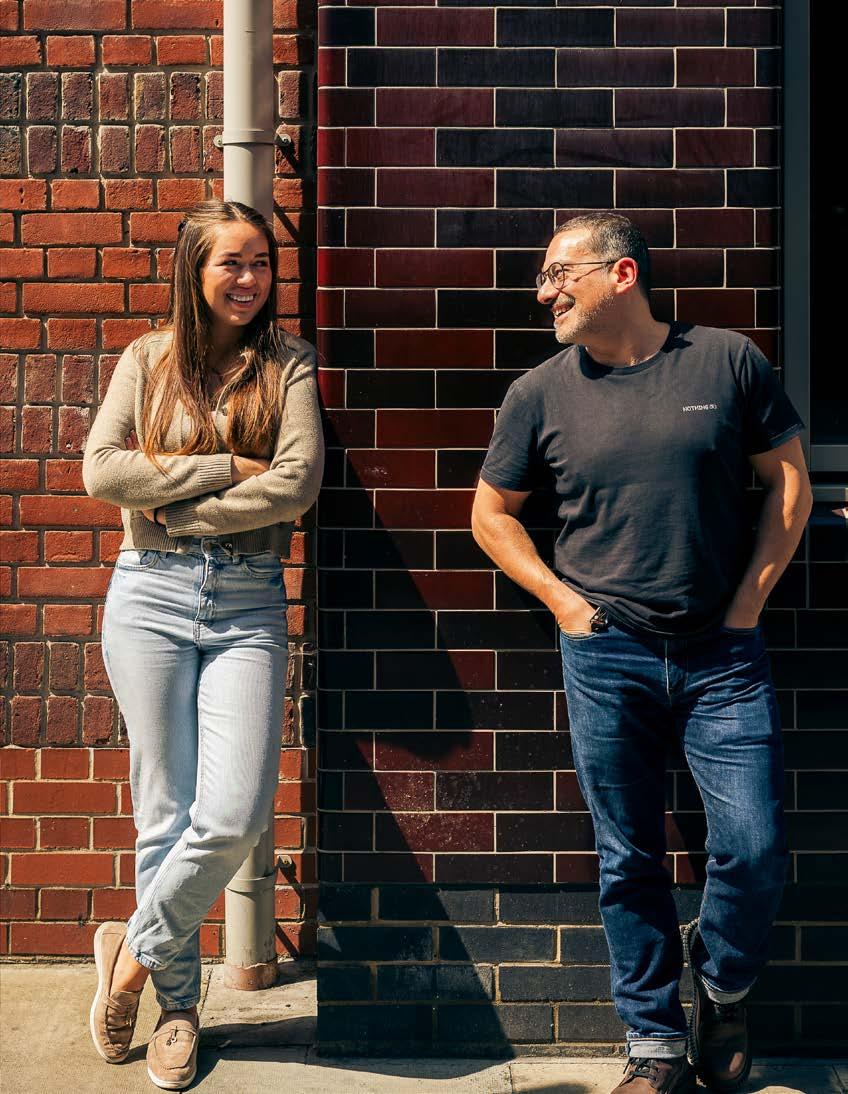
4 Apprentice to Freeman: Luke Potts & Finn Hemmings
6 The Goldsmiths’ Centre: A Handshake across Generations
10 Jewels for the Hall
12 Darren Sherwood and the Mechanics of Making
16 Spectrum of Innovation
20 Taking Shape: 100 Years of Company and Craft
24 The Culture of Cutlery Today
28 Heritage Regained (In a Manner of Speaking)
Editor Eleni Bide
Assistant Editor Katie Lissamore-Spooner
Correspondence
The Worshipful Company of Goldsmiths, Goldsmiths’ Hall, Foster Lane, London ec2v 6bn
Designed and produced by Christiechristie and Disegno Works christiechristie.cc disegnojournal.com/disegno-works
ISSN 0953-0355
Jewellery and Photography: A Shared Perspective 40 A Master of Colour and Form: Alan Craxford 44 Making and Memory: Maria Hanson’s Loss, Life & Love 46 Redefining Precious 48 Single Mine Origin Gold
52 Paper in Jewellery: The Subversive and the Subtle 56 Badges of Honour: A New Commission
58 Between Fragility and Opportunity
63 COMPANY NEWS
64 The New Prime Warden
66 A Prime Warden’s Year
68 Impact Report 2025–26
76 Masterpieces
78 Goldsmiths’ Giving and The National Saturday Club
80 Membership Update
82 Committees List
84 Object in Focus 30 Heroes of making: The Stone Setters
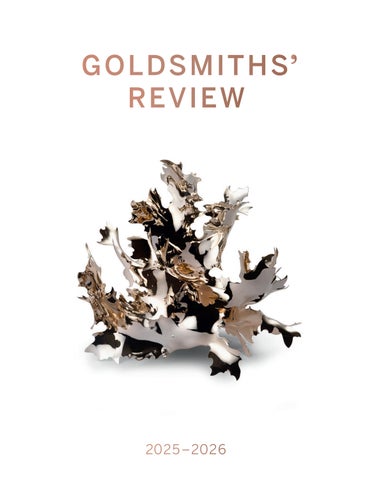
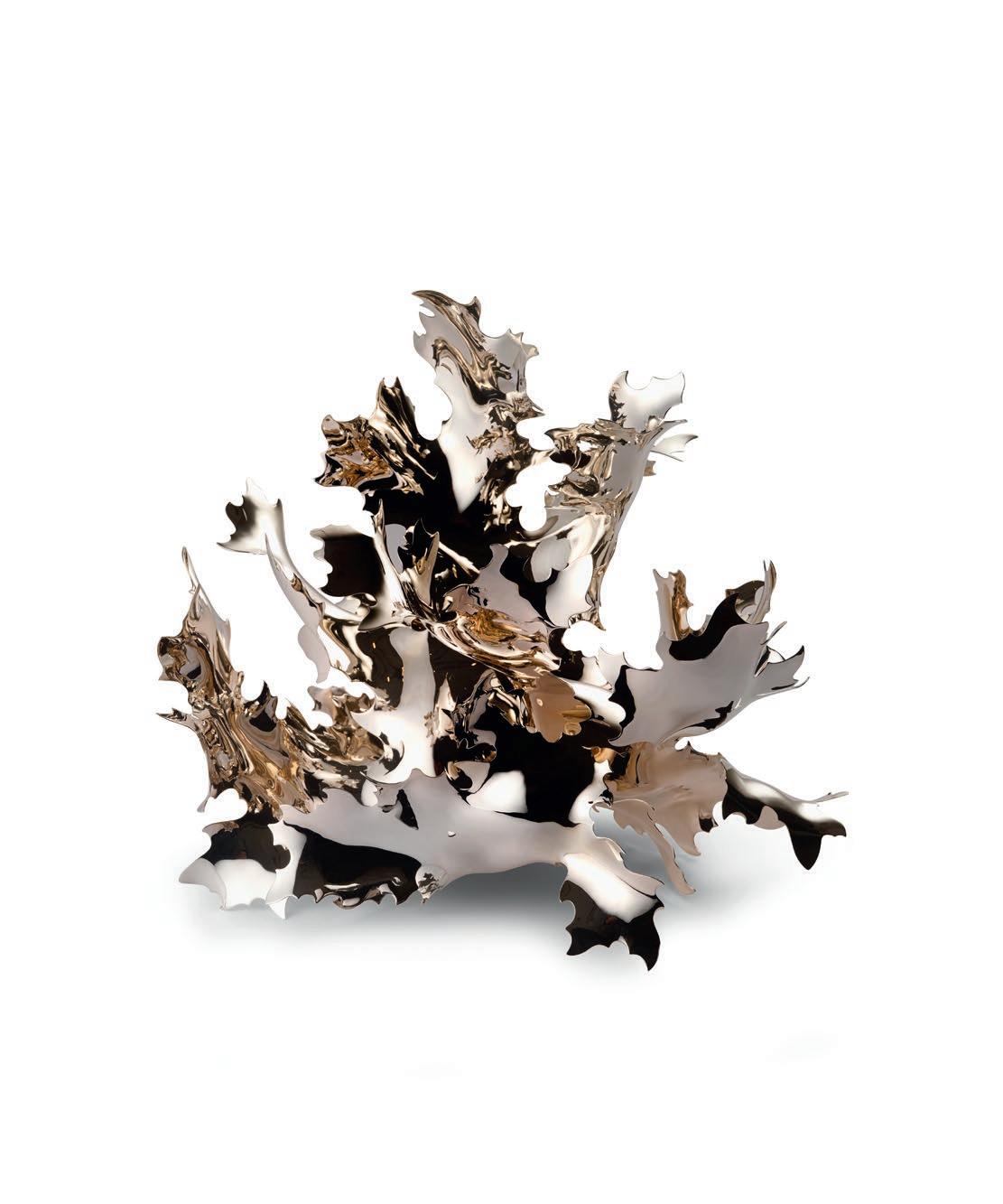
Front cover
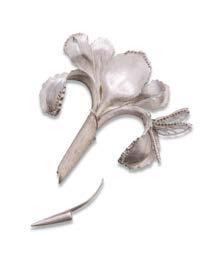
Acanthus, by Shinta Nakajima, 2025, sterling silver. This piece received numerous awards at the 2026
Goldsmiths’ Craft and Design Council Awards, including the Polishers (Senior): Gold Award for Kurt Calow and Ben Algar. Courtesy of The Goldsmiths’ Craft and Design Council.
RICHARD VALENCIA
Title page
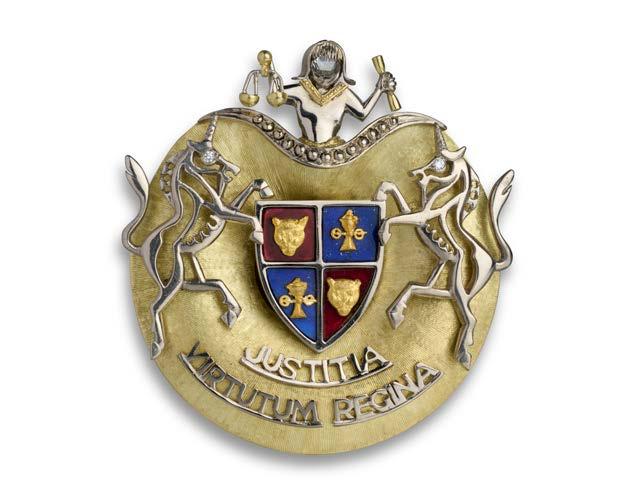
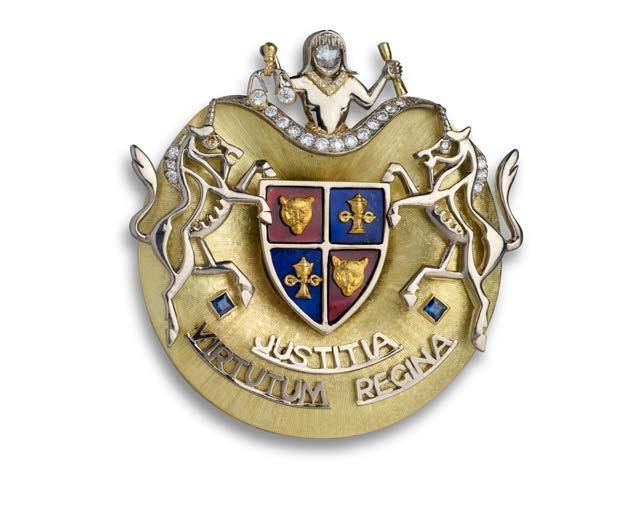
The Goldsmiths’ Company Apprentice of the Year Medal, by Maisie Sale, 2023, struck by Thomas Fattorini Ltd, 2024, silver, gold plate.
RICHARD VALENCIA
Back cover
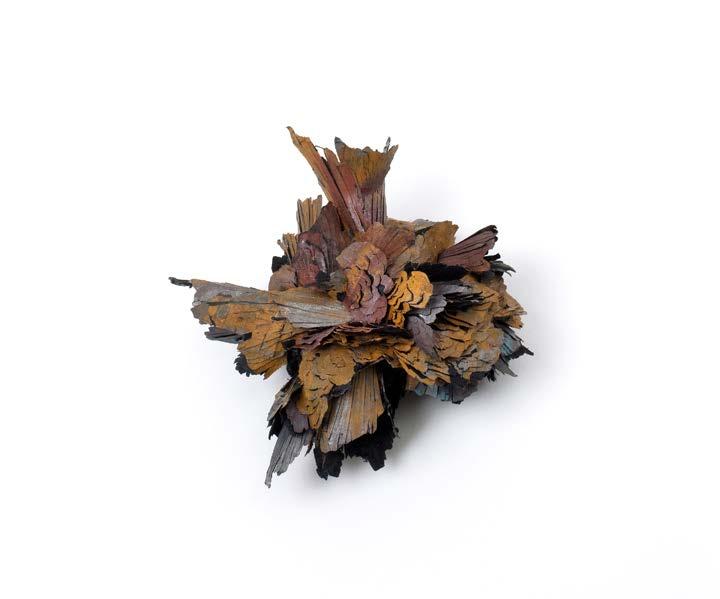
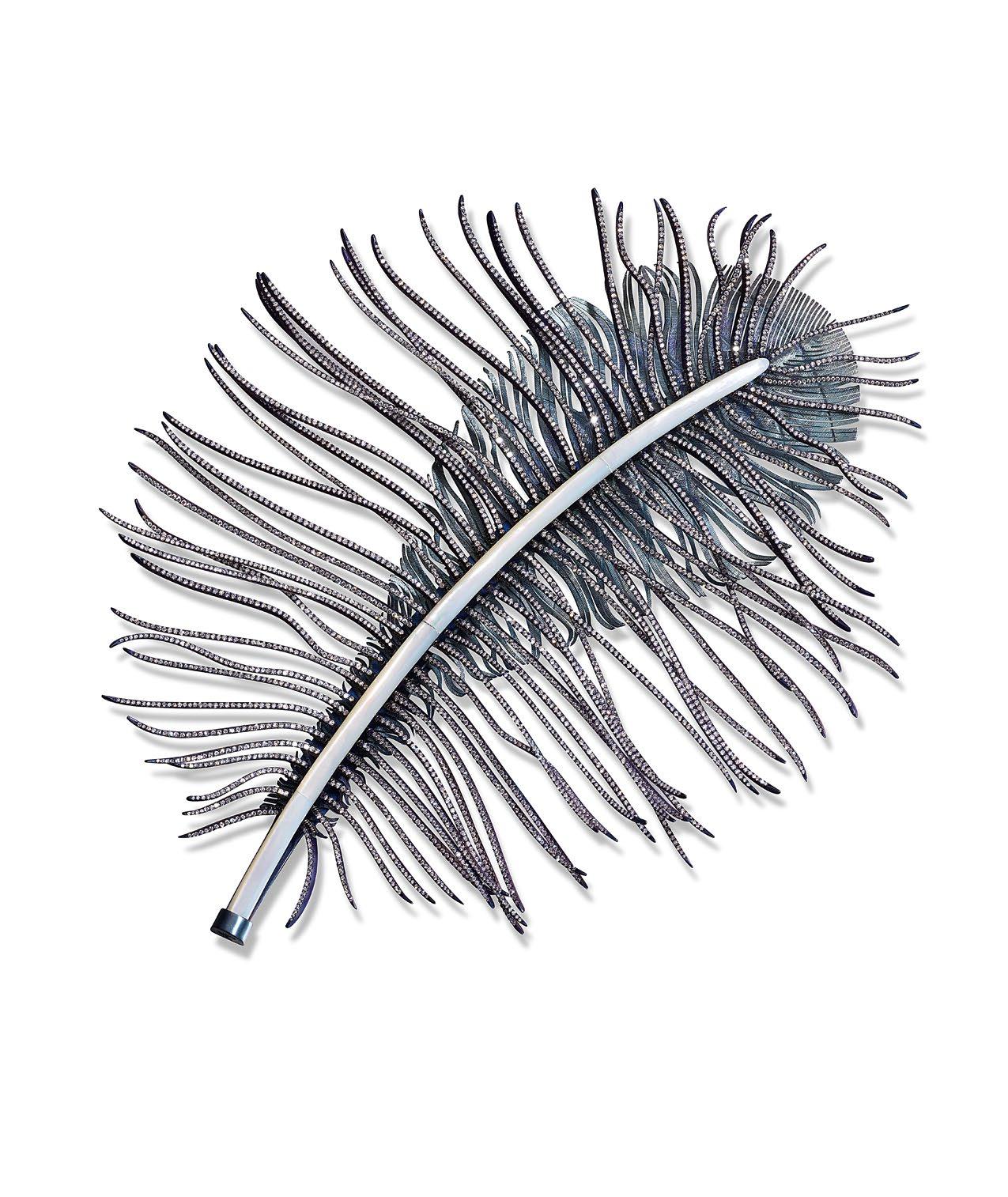
Downy Feather Brooch, by Janet Barber, 2026, titanium, mother of pearl centre quill, 18ct white gold spring alloy, diamonds. The pieced received seven awards including the Goldsmiths’ Company Award at the 2026 Goldsmiths’ Craft and Design Council Awards. Courtesy of The Goldsmiths’ Craft and Design Council.
No part of this work may be reproduced, stored in a retrieval system or transmitted in any form or by any means, including copying and recording, without written permission from the copyright owner, application for which should be addressed to the Goldsmiths’ Company. Opinions expressed in The Goldsmiths’ Review are not necessarily those of the Editor or the Goldsmiths’ Company. Whilst every effort has been made to verify statements of fact by contributors, no responsibility is accepted for errors or omissions by them. Prospective users of techniques, materials or equipment described should take specialist advice on official safety precautions and regulations which apply to them. Both may vary from country to country.
Annie Warburton CEO & Clerk
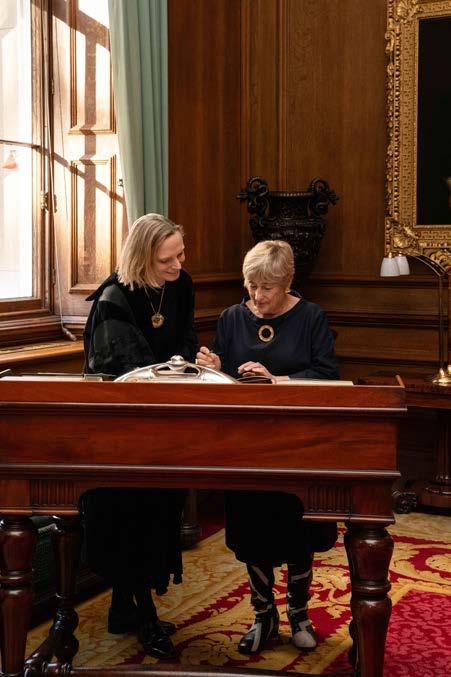
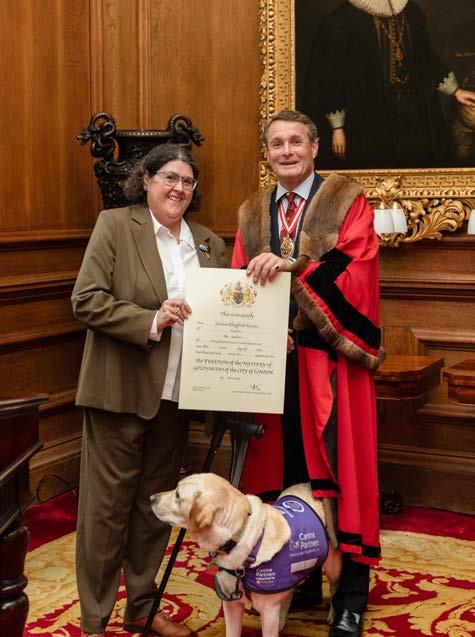
Annie Warburton guides Corinne Julius through her declaration at a Freedom Ceremony. JAYNE LLOYD
seek out the earliest records in Goldsmiths’ Hall’s archives and you will find reports of hallmarking, training apprentices and charitable giving. On the eve of our 700th anniversary, while the world around us has changed immeasurably, the Goldsmiths’ Company continues these same activities. Ours is not a relic, but a living tradition: with steady purpose, we evolve with the times. This year’s Review reflects the breadth of that tradition.
Skyrocketing gold and silver prices have dominated the year. Over and again, just as it seemed that they couldn’t climb higher, another price ceiling was smashed. The cost of raw materials is among the greatest challenges our industry faces. Makers and manufacturers are responding with innovation, as Rachael Taylor writes.
Meanwhile, as scrutiny of metal provenance increases, traceability matters more than ever – an issue that Betts Metal’s Single Mine Origin (smo) initiative seeks to tackle. Joanna Hardy reports on mines in Senegal and Western Australia that have accepted smo’s challenge of responsible production.
“Ours is not a relic, but a living tradition: with steady purpose, we evolve with the times.”
The cost of gold is not the only issue facing our industry. Continuity of skills and training new entrants for specialist roles, such as stone setting, is another. In 2012, the Goldsmiths’ Centre was set up to meet this challenge, alongside providing affordable workspaces and business support. The Centre’s Founding Director, Peter Taylor, retired this year, after 40 years in the industry. The legacy he leaves has not only opened routes for new entrants, but has also nurtured the culture needed to support them to thrive.
The positive impact of the Goldsmiths’ Centre is real, as profiles of two Young Apprentices of the Year illustrate. Jeweller Finn Hemmings and silversmith Luke Potts are at the start of a journey where technical precision underpins creative inventiveness. Twenty-five years into his career, jeweller Darren Sherwood, who perfected his craft at high jewellery houses before
founding his own brands, shows this principle at work. The common thread is how mastery of skill facilitates originality of voice.
Master jeweller, silversmith and hand-engraver Alan Craxford, with over 50 years in the trade, is renowned for his technical virtuosity. He is also an exceptional colourist, in whose hands colour takes on a philosophical, even mystical meaning. Melanie Eddy picks up this theme in her survey of a new generation of makers innovating in colour across traditional materials and unexpected ones, such as nano-ceramic plating, electronic waste and Formica.
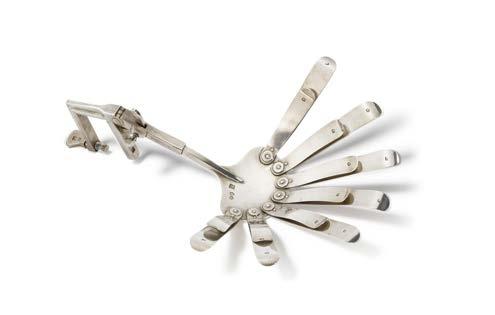
Colour, Eddy says, is a source of joy and we hope that the Company’s Collection is one too. The Collection records the Company’s history through objects, although gaps remain across the centuries. Timothy Schroder writes about a lucky find in an auction catalogue that filled one such gap. Social history unfolds through the Collection too. Charlotte Dew traces trends in contemporary cutlery back to the 15th century, while Robert Keirle highlights one of the Collection’s more intriguing pieces: a silver playing-card holder that may have started life as a prosthetic.
Until 1926, the Company collected only historic silver; that year marked a turning point, when it began to commission and exhibit contemporary work too. This year, we celebrate its anniversary with an exhibition spanning a century of silversmithing. Dora Thornton explains how the Company worked to stimulate design excellence, nurturing the careers of generations of silversmiths. As all these writers remind us, silverware can be functional, decorative or a display of wealth –and sometimes all three at once. Everyday objects sit alongside the strange and the spectacular.
Underpinning these stories is a commitment to valuing and celebrating human skill and imagination. The Goldsmiths’ Foundation is the modern manifestation of what, in the Middle Ages, took the form of charitable alms. Today, the Foundation focuses on funding training in jewellery, silversmithing and the creative industries, support needed more urgently than ever, as Fiona Thompson explains. The impact of this, and of all the Company’s work, is richly illustrated in the pages that follow.
None of this would be possible without our members who give time, expertise and generosity to our work. I give my thanks to you all. As the composer Gustav Mahler put it, tradition is not the worship of ashes, but the preservation of fire. That is what Goldsmiths’ does: we tend the flame of a living tradition. ✦
APPRENTICE TO FREEMAN Katie Lissamore-Spooner
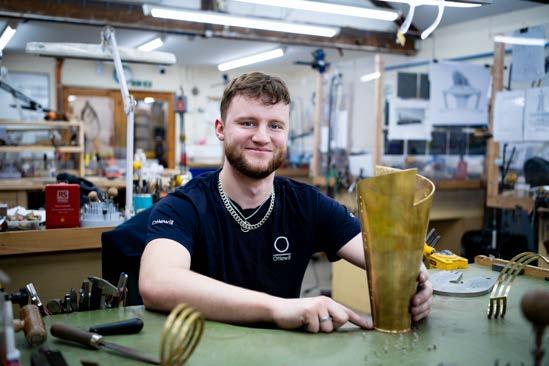
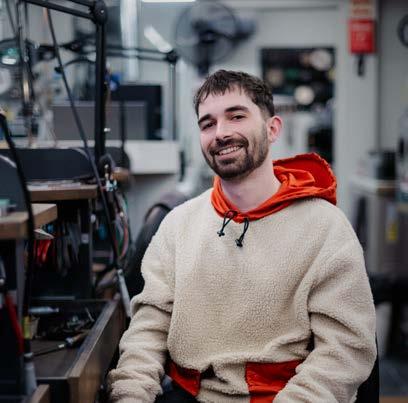
luke potts ’ s journey to silversmithing was based on a desire to have a practical, handson career. Although he was initially drawn to physiotherapy, a career quiz led him to finding the Goldsmiths’ Centre Foundation Programme, which was “pivotal” in narrowing down his choices of specialisms, especially with no prior experience of working with precious metals.
Potts, based at Ottewill Silversmiths and Jewellers in Kent, produced a vase and clock crafted out of Britannia silver, a piece that was awarded Gold for the Junior Silversmith’s Craft, and Silver in Handcrafted Silverware at the Goldsmith Craft and Design Council Awards in 2025. The design of the piece was discussed between Potts, his master Robert Russell, and the owner of Ottewill, Sanay Shah.
The design incorporates several complex skills, with the main body of the piece proving to be the biggest challenge – hand-raising a single disk of Britannia silver, which was Potts’s first time attempting such a feat. Winning the Apprentice of the Year award was unexpected
and came as a “nice shock” for Potts, who amidst working hard at his apprenticeship had forgotten that it existed. The combination of the gcdc and Apprentice of the Year awards, for Potts, shows his joint achievement in being skilled in the craft and a well-rounded individual.
Potts’s work remains focused on trophy making at Ottewill, and he is enjoying an increased amount of responsibility postapprenticeship and continuing to work in Ottewill’s workshop on an increasing number of jobs. Potts describes the relationship with his master as “getting on like a house on fire”, an important factor in a workshop where, sometimes, when working on the same trophy, master and apprentice would end up “bear hugging trophies to manipulate parts to fit, [with] larger trophies often requiring two people working in close quarters, so being able to get on with each other definitely helps.”
Potts would love to one day have his own apprentice and be able to have an impact on someone else’s career. ✦
JULIA SKUPNY
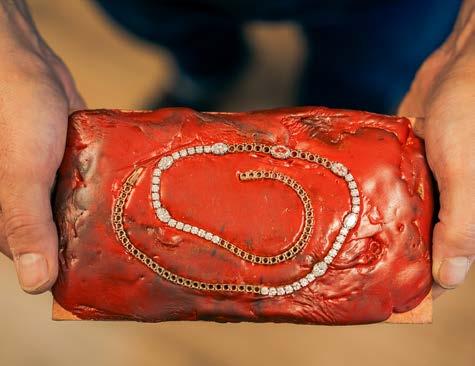
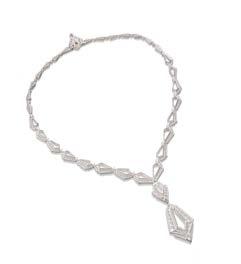
jeweller finn hemmings has built a career that is defined by creativity, technical skill and an admiration for the Art Deco style. Speaking about his recent masterpiece, an intricate Art Deco necklace, Hemmings describes the project as both a challenge and a highlight of his training. Although the piece was designed in collaboration with the head designer at Harriet Kelsall Jewellery, he was able to contribute to the final form, guided by an affinity for geometric Art Deco aesthetics.
The Art Deco necklace’s technical complexity presented Hemmings with significant challenges, particularly in engineering the clasp mechanism himself and working with mixed metals, platinum and 9ct yellow gold, which can be demanding when combined. Soldering the components of the pendant with precision was, he recalls, “exceptionally challenging,” but ultimately a rewarding experience.
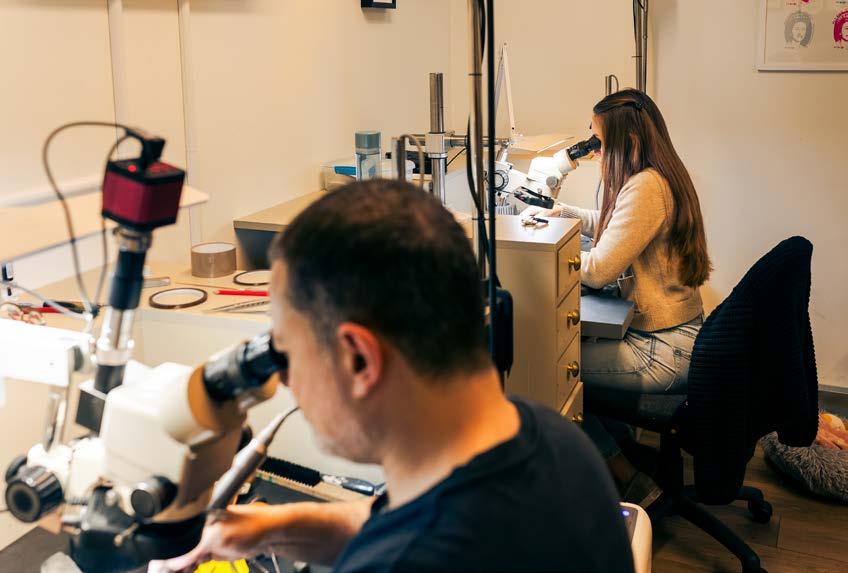
Hemmings is currently based at Harriet Kelsall, where he works three days a week in the workshop and two days focusing on cad design, a skill he initially taught himself. This dual role enables him to support the creation of bespoke pieces both digitally and at the bench, giving him a broad perspective on the craft’s contemporary and traditional demands. His workshop days vary widely, from handmaking engagement rings and pendants to assembling complex cast components and polishing finished work,
reflecting the studio’s commitment to seeing each piece through from initial conception to its completion.
Hemmings’s route into the jewellery world began unexpectedly. After leaving school before finishing his A-levels, he enrolled in an evening course “just to see if [he] enjoyed it,” a decision that soon sparked a full vocational pathway. He completed a foundation at the British Academy of Jewellery, secured an apprenticeship with Graff, and eventually continued his training with Harriet Kelsall after his original apprenticeship was disrupted by covid-19.
Among his strongest memories as an apprentice, Hemmings highlights creating his masterpiece and the friendships formed through day release training, where exposure to varied skills, including silversmithing, wax carving and chasing broadened his understanding of the wider trade. Winning Young Apprentice of the Year came as a shock, leaving him “shaking” with excitement when he received the news.
Looking ahead, Hemmings hopes one day to start his own company, carving out his place in the industry while continuing to gain valuable commercial experience in cad and jewellery design. For now, he remains energised by the opportunities and variety his current role provides, balancing traditional craftsmanship with the possibilities of digital creation. ✦
JULIA SKUPNY
THE GOLDSMITHS’ CENTRE
A Handshake across Generations
Kay Konecna
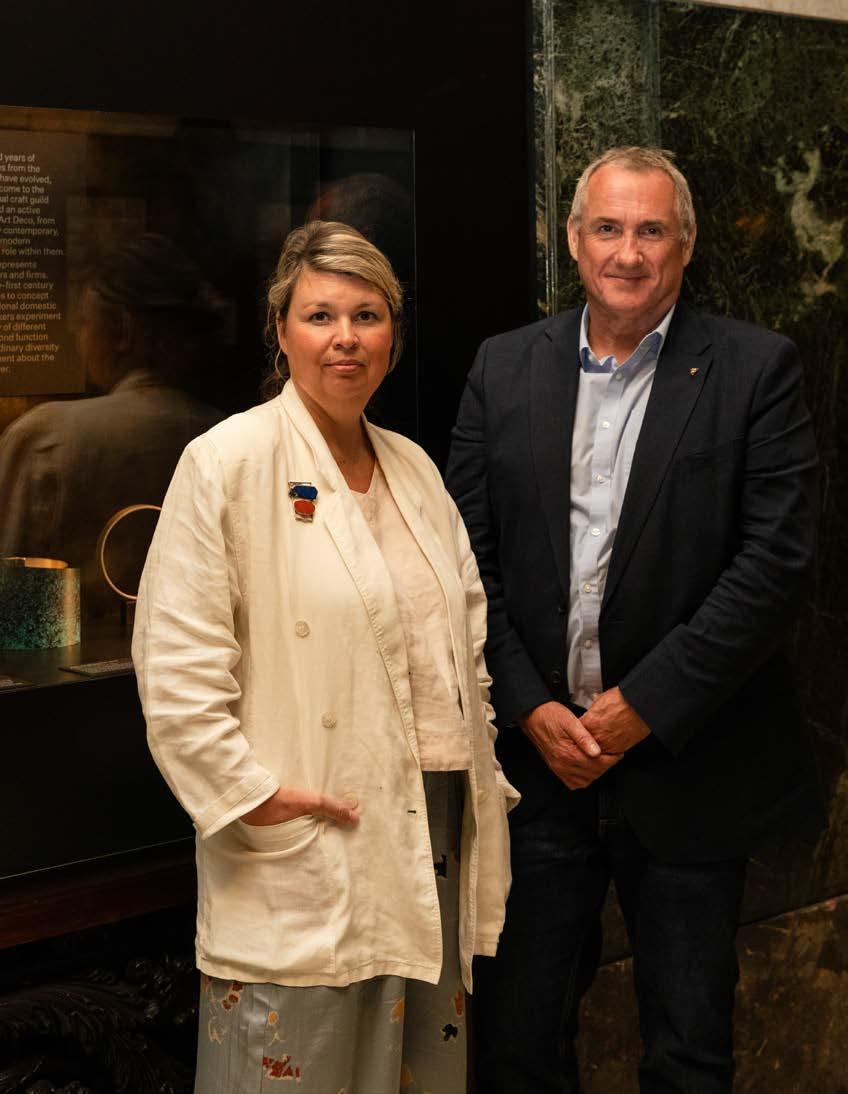
The first time Peter Taylor mbe, founder and former Director of the Goldsmiths’ Centre and Julia Balchin, the incoming Director, sat down together, they talked for hours. Both had dedicated their careers to helping young creatives thrive - he had spent over 40 years in the trade, whereas she, a fine artist, was new to the jewellery industry. Somewhere in those first hours, however, the conversation became an exchange of experience. The problems they had spent their careers trying to solve were, underneath the different materials and institutions, the same.
as the former principal of the Royal Drawing School, Balchin transformed a small but inspiring postgraduate drawing school, setup by the artist Catherine Goodman and HM the King in 2000, into one of the UK’s leading art schools – one that is deeply rooted in skillsbased arts education in a world of conceptualism. As a dyslexic child, Balchin had struggled in primary school. A teacher recognised her talent for drawing, however, and translated her visual stories into words. This act of recognising what she could do, rather than what she could not, always stayed with Balchin and
shaped both a career and a way of thinking about education that has, in turn, transformed the experience of hundreds of creative practitioners.
For Taylor, a working-class Birmingham native who had wanted to become a Goldsmiths’ Company apprentice at 17, only to discover that the opportunity was geographically out of reach, it was the kind of story he understood all too well. The Goldsmiths’ Centre, which he spent the better part of two decades building in Clerkenwell, only exists because he never forgot what it meant to stand on the wrong side of a door. He joined the Goldsmiths’ Company in 2002 and found a trade
Peter Taylor outside the Goldsmiths’ Centre.
already beginning to lose itself through the erosion of the conditions needed to sustain it. Affordable workspace in London was thinning. The polytechnics had become universities, taking with them the pathways through which young people transitioned from education into sustained bench practice. The UK’s precious metals industry was fragmenting as proximity between practitioners disappeared. London was pricing it out.
Taylor had written his answer to all of these issues in 1994, in a proposal for a building in Birmingham that never came to be. When the Goldsmiths’ Company gave him both the resources and the freedom to try again, however, his proposal was nearly identical: workshops, training, graduate development and a community of makers close enough to sustain each other.
What made it possible this time around was Stuart Devlin, the Chairman of the Craft & Industry Committee along with the other trade members of the Court of Assistants. Taylor has always recognised this: without Devlin’s and their support, the Centre would not exist. Devlin had spent his career building a reputation in British goldsmithing that meant something in rooms in which Taylor was still finding his footing, and he used it accordingly. Devlin championed the project, and the programme he cared most about, the Postgraduate Professional Design Programme, was the culmination of everything he wanted the Centre to become. On the day its first cohort was interviewed, Stuart had his first stroke. It is a measure of the person that, after his convalescence, he returned to the Centre to work with this cohort alongside his wife Carole.
Taylor’s deepest regret, 15 years later, is not anything that the
Centre failed to build, but how long it took: that Devlin did not get to experience what they had made together, to see it grow and to test the ideas he had brought to it. You learn something about a person from what they choose to regret. Taylor does not regret outcomes; he regrets the person who didn't get to inhabit them.
It is, perhaps, exactly what Balchin recognised when she arrived. Beneath the building lives a place that is structured, from its governance to its funding, around the question of what people need to flourish. In her eyes, they form a triangle: subsidised workspace, business development support and rigorous training, each making the others possible. You cannot educate someone in a craft that demands specialist tools, precious metals and years of accumulated skill, and then release them into a market not designed to receive them. If the distance between training and sustainable practice is too wide, talented people fall into it.
The Centre holds all three sides of that triangle simultaneously, and does so from a position of independence. It is not subject to the shifting qualification frameworks and funding cycles that have made creative education so unsustainable in the decades since the polytechnics disappeared. That independence is the only structural position from which you can remain genuinely responsive to the trade you exist to serve. That too is Taylor’s legacy: not just what the Centre offers, but the architecture of endurance.
In a similar vein, Balchin is careful with the word ‘heritage’ when talking about craft. Silversmithing has just been added to the Red List of Endangered Crafts, overseen by Heritage Crafts, and although Balchin understands why
people reach for heritage as a frame, she also understands what the frame costs. It positions a living practice as something already stepping out of the light, when it’s the future that is actually at stake. The ability to restore a historical object depends on the existence of someone who can do it. So does the ability to take an ancient technique somewhere entirely new. You keep craft alive the same way you keep any living thing alive: not by protecting it from change, but by ensuring it keeps growing, finding new practitioners, and being passed between hands that will do something that those before could not have imagined.
Taylor used to shake hands with apprentices and understands the particular significance of a handshake inside a 700-year-old institution built on the formal binding of apprentice to master. One of the things the Centre has changed, gradually, was that apprentices began to know each other. They had been isolated, each in a single workshop, learning a trade with their noses to the grindstone and no sense of the broader community they were entering. Now they have cohorts, networks that extend past their training years, shaping how they work and how they treat the people who come after them. If you train someone well, Taylor says, and treat them well, they are more likely to train and treat others well in turn.
The world and the trade have changed a great deal in the past 14 years since the Centre was built and, as with all living things, the Centre evolves and responds to the needs of those for whom it was set up – the future generation of makers and our trade. After hours of conversation between Taylor and Balchin, the result was clear: recognition, rather than handover, and a new chapter ahead. ✦
Julia Balchin and Peter Taylor. JAYNE LLOYD FOR THE GOLDSMITHS’ COMPANY
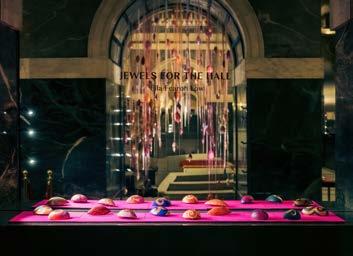
Pluvia Laetus, 2025, hand carved and painted balsa wood.
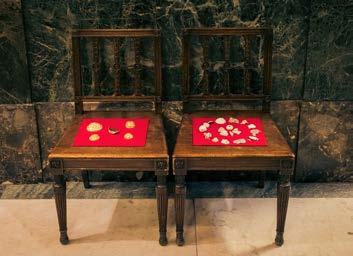
Offering with found objects, 2025, gilded plaster, shell, antique ceramic fragments.
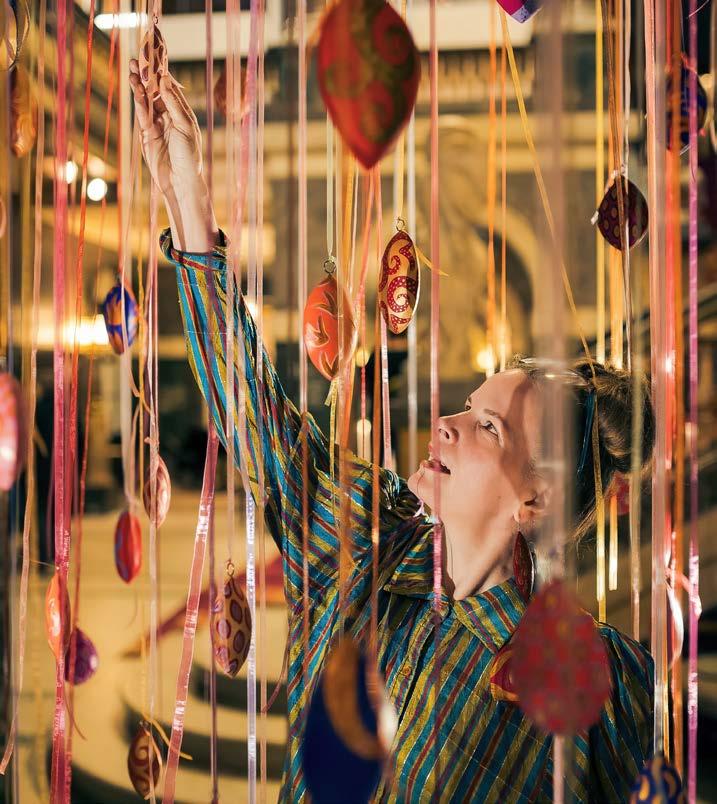
jewellery is often considered to be wearable sculpture, but for the 2025 Goldsmiths’ Fair Ella FearonLow flipped this idea to create sculptural installations to act as ‘jewellery for the hall’. While these Jewels for the Hall pieces drew on her recent explorations of miniature sculptural forms with wearable elements, the scale required by Goldsmiths’ Hall liberated her from jewellery’s most fundamental constraint: what can fit to the human body.
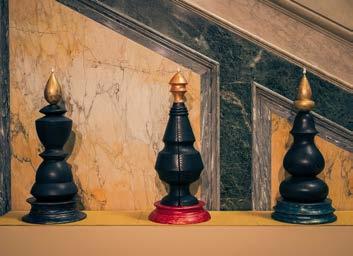
Instead, the physical experience centred on space, rather than touch. Pluvia Laetus immersed visitors in a shower of soft, painted lozenge forms suspended from an archway above a mirror. The size and presence of the largest objects in the installation, the Three Queens
and
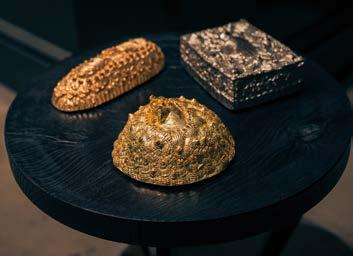
Offering – Xenia, The Four Seasons, Gold, Frankincense and Myrrh, 2025, gilded plaster.
ALL PHOTOS: PAUL READ
(inspired by the strength and character of the Queen chess piece), spoke to the marble figures that populate the Staircase Hall. Smaller objects suggested more intimate connections. The Dreamers, a series of carved Lucite brooches adorned with gold-leaf dreamscapes sat under glass domes, while the gilded Offering –carefully-placed plaster fragments cast from shells and Victorian detritus – exuded their own personalities. Fearon-Low used rich colours, including reds and golds, to ‘work with and against’ the dark tones of the Hall’s interior. She describes the projects as ‘like a physical poem for the Hall, both for what it is and what it represents: the home of a community, as status symbol and a piece of history.’ ✦
Opposite Ella Fearon-Low making finishing touches to Pluvia Laetus
Three Queens, by Ella FearonLow and Ash & Plumbe, 2025, ash
maple.
DARREN SHERWOOD AND THE MECHANICS OF MAKING
Salena Barry
“ i can ’ t switch off from the technical side of jewellery,” Darren Sherwood tells me as we chat over tea behind his showroom. The jeweller, who worked on pieces for houses from Garrard to Fabergé during his 25-year career, opened his own business in 2020. He shows me photographs of pieces he created for these houses, before bringing out examples drawn from his own brands, Mr Sherwood and Sherwood Jewellery. As we look through them, he explains the metals and precious stones involved. Yet he becomes most animated when describing the complex techniques and trial and error that underpin jewellery making. This clear delight in the mechanics of making is a through line in Sherwood’s career and shapes his aesthetic approach.
Sherwood, inducted as a Liveryman at the Goldsmiths’ Company in 2025, didn’t set out to become a jeweller, but found his path there through his love of art and design. As a secondary school art student, he enjoyed the draughtsmanship involved in creating an image more than the end result. From his first introduction to metalwork, he realised, “I can make things as fast as I can draw them.” From there, the decision was made to work in three rather than two dimensions. This interest in the technical aspects of the craft led him to pursue silversmithing after finishing his Foundation Year course at Central Saint Martins. While he enjoyed the expressive element of his studies, he found himself drawn to the exactitude of flawless execution. During this time, he set himself challenging design projects and savoured finding technical solutions to realise them. A key example is a chess set he designed to light up when different pieces were moved across its surface.
After his studies at Central Saint Martins and, later, Kent Institute of Art and Design, Sherwood secured his first role in jewellery at Griffin of London. His test assignment at the Mayfair shop was to create a four claw collet. Sherwood worked on this task from “half seven until eight at night – I don’t think I had lunch,” showing his would-be boss Mark Griffin his progress at each stage. As he finished, he realised that the curvature of the lower bezel was slightly off. When he tried to fix it, his day’s work shattered. Despite that, the master jeweller “somehow gave me the job,” he says laughing. Sherwood jokes that his knowledge of Star Wars and breakdancing, both admired by Griffin, helped land the position. His persistence and desire to learn, however, clearly left an impression. He can now make the same collet in 45 minutes. He spent six years at Griffin of London, where he was trained under the ex-Cartier jeweller, learning the techniques required for high jewellery. While there, he also became familiar with the work of houses such as Mikimoto and Boodles.
Opposite Sherwood in
This experience prepared Sherwood well for his next job at Graff. For eight years, he created necklaces, earrings and brooches in a workshop of more than 60 “of the best makers in London”. He worked alongside polishers, mounters and setters, absorbing their knowledge across all aspects of jewellery making. Working at Graff, unencumbered by cost or technical limitations, he soon became accustomed to working on complex million-pound pieces that were then sold to clients he would never meet. Despite the impersonal nature of this work, Sherwood honed his ability to execute ambitious designs that pushed his technical abilities further. From there, he went
Above Darren Sherwood’s workbench, including components for The Dapper Hound PAUL READ
his Purley studio. PAUL READ
on to work for Garrard, one of the oldest jewellery houses in the world, under Stephen Webster. “Steve’s a rockstar – he’s the main reason I got into jewellery,” Sherwood tells me. While in this workshop he got to work on more traditional pieces for Garrard, pushing the limits of his craft while realising Webster’s more avant-garde designs.
These two modes of working are mirrored in Sherwood’s own business, which he launched after almost 20 years spent working as a jeweller. He opened his storefront in 2020, just as covid-19 brought the high street to a halt. This forced him to build his business slowly and resourcefully, learning the practical realities of retail and self-promotion as he went. His current practice operates across two brands, Mr Sherwood and Sherwood Jewellery, which balance his experimental and traditional projects respectively.
For Mr Sherwood, he creates more lighthearted and sculptural pieces. These include The Dapper Hound, a brooch with a dog sporting
a billowing scarf and an ascot cap. Rendered in three dimensions, with textures of fur and fabric realistically sculpted using Zbrush and Matrix, the work he makes for Mr Sherwood allows him to experiment playfully with his 3D design and cad skills.
Alternatively, with the Sherwood Jewellery brand, which focuses on traditional pieces with a modernist flair, he uses his Mayfair skills to make accessible pieces for the local community. He shows me The Continuity Ring, a pearl ring that, when worn, appears to float away from the finger, but which is held back by a wispy band of pavé diamonds. “I wanted to set a pearl negatively, still show it off, and have it flat to the hand so it feels comfortable to wear.” To create this, Sherwood made more than 50 models in cad with a range of sizes and structures, before he found the one that met the criteria he had set out.
When Sherwood decided to work independently, he wanted to
Left
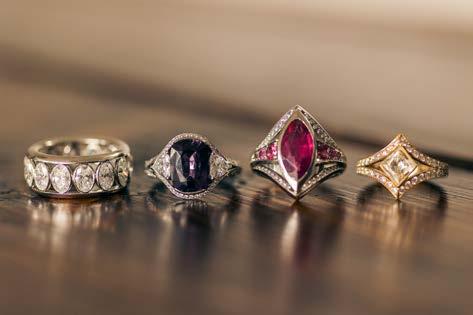
Rings by Sherwood set with diamonds, purple spinel, rubellite and tourmaline.
PAUL READ
Opposite
Winston cufflink, 18ct gold, silver, diamond.
PAUL READ
take the skills he’d sharpened at high jewellery houses and create unique pieces that speak to his clients’ individuality and everyday lives. “I don’t like the idea of people buying pieces and just leaving them in boxes, only wearing them on special occasions. I want people to have fun with my pieces and wear them because they fit their personality.”
Once locals become more aware of the possibilities of bespoke jewellery, he hopes to merge the brands and transition the shop into a boutique. While the early years of his career were shaped by perfecting technique within established systems for anonymous buyers, he now operates at a more intimate level. He designs, makes and sells his own work directly to customers. The shift from high-jewellery houses to independent practice has its challenges, but it allows him to get to know the people he creates for and take full ownership of his work, both in name and execution. ✦
DARREN SHERWOOD AND THE MECHANICS OF MAKING
SPECTRUM OF INNOVATION
Melanie Eddy
Façade earrings, by Agata Karwowska, silver with nano-ceramic coating.
AGATA KARWOWSKA
technology has always driven change in the realm of goldsmithing design and manufacture. From the advent of stone boring and polishing by our neolithic ancestors, to new applications of industrial processes, over millennia we have continuously striven for more sophisticated and appealing adornments for the body and home. Colour, alongside form and pattern, has always been at the heart of this. Today, we can see through contemporary approaches to jewellery and metalwork that an enthusiasm for colour continues to abound.
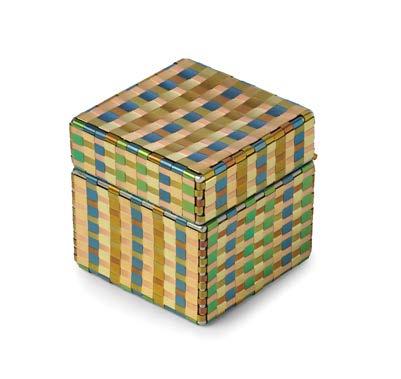
My first introduction to Caitlin Murphy’s work was hearing a description of her pieces from a setter who was enthusiastically describing their optical effects. The man, an industry veteran who was not easily impressed, was rapt. The weaving technique that Murphy has become known for was initially developed over lockdown, when the covid-19 pandemic forced her practice from university workshops back into her home. Here, she moved from first weaving paper, through to weaving recycled aluminium cans –the most accessible metal to her. Upon returning to university and more conventional metals such as brass, copper and steel, however, she felt hampered by the limited colour palette they offered. A masterclass by Alice Fry at the Bishopsland Educational Trust introduced her to niobium, the anodisation of which opened up an exciting colour palette that she soon expanded into other materials such as titanium and aluminium, progressing her colour palettes alongside the development of the optical illusions in her weaving techniques. A commission by the Goldsmiths’ Company led to tutelage in gold alloying with Patrick Davidson. The subtleties of gold
colouring created through alloying and the metal’s high ductility meant that it was an attractive counterpart to her explorations in anodising non-precious metals. The specificity and accuracy of both the colouring and weaving processes show how structure, order and precision underline the playfulness and responsiveness of these dynamic pieces, which Murphy creates at different scales to adorn the body and the home.
The advanced ceramics of the modern world have applications in electronics, aerospace and nuclear energy, but these materials also offer opportunities for contemporary jewellers. Ceramic technologies’ impact on jewellery is not new, however. Egyptian faience is a ceramic material with a characteristic bright turquoise colour that first appeared at the end of the fifth millennium bce and was traded globally, imbuing vessels, sculptures and jewellery with mystical and magical qualities. Whilst access to
recent advanced ceramic technology was initially the preserve of high jewellery maisons and impresarios, they are now being explored by contemporary jewellers such as Agata Karwowska and Xinyi Chen.
Karwowska, one of the first recipients of the Goldsmiths’ Centre Business Catalyst grants in 2022, saw how this technology could complement the aesthetic qualities of the precious metals she was using. Looking for a subtlety of approach that would enhance rather than compete with metal qualities, she used the grant to invest in nanoceramic plating equipment. The way Karwowska describes her application of colour through this process is much like the careful use of colour washes by a painter – layering colour to intensify tone without sacrificing luminosity. Her
Woven Box, by Caitlin Murphy, 2024, 18ct yellow, red and green gold.
RICHARD VALENCIA
COLLECTION: THE GOLDSMITHS ’ COMPANY
“It takes gumption and bravery to transgress the boundaries of tradition and strive for creative freedom.”
sensitivity to colour also extends to how it relates and aligns to skin tones, which is important in pieces that are worn close to the body. Dancing between the delicacy of a fine painter and the experimentation of a scientist, Karwowska’s processes allow her to create gradient colour palettes by controlling the voltage applied, and the layering and building of colour transparency and intensity. Her deftness with colour is not entirely surprising given that her creative practice spans painting, drawing and also sculpture, but Karwowska understands the challenge of incorporating colour into her jewellery pieces without overwhelming, creating tonal effects with materials, texture and light.
Chen’s practice was another shaped keenly by studying at university during a pandemic. Seeking colour to evoke joy in her work, her exploration of the precision of computer circuit boards and formal gardens, and the relationship between digital and physical worlds, led her to incorporate colourful e-waste components into her designs. Her signature approach with these components is to mount these ‘Intelligems’ much as one would precious gemstones. Nanoplating and industrial pvd processes (physical vapour deposition) are used to deposit thin films of one atom at a time onto the silver she uses for her mounts. Chen studied geology prior to jewellery design and transferred her passion for colourful gemstones forged
in the earth to the e-waste components she sources from various countries, including here in the UK, much as you would gemstones. This summer, her extraordinary pieces will be on view at the exhibition Crafted in Colour at the New Ashgate Gallery in partnership with the Goldsmiths’ Centre.
Emily Kidson discovered laminate samples, including the Formica brand, in the Materials Library Collections at Central Saint Martins during her earlier career as a librarian for the University of the Arts London. She began to explore and repurpose some old samples that were due for disposal and a world of colour was opened to her. She describes this as a lightbulb moment – while those samples no longer held much inherent value, Kidson could see their many creative possibilities. Her pieces capture the freedom of working with alternative materials: the laminate is variously transformed, cut into, burred, painted, sanded back, inlaid with precious metals and layered with wood. Though the Formica is the star component in many ways, carrying the colour her work has become known for, it is in Kidson's transformation of the material, in her making and spontaneous responsiveness to what it offers at the bench, that she has found her voice.
Despite being established within the world of high jewellery, Alice Cicolini is another designer questioning the prominence of
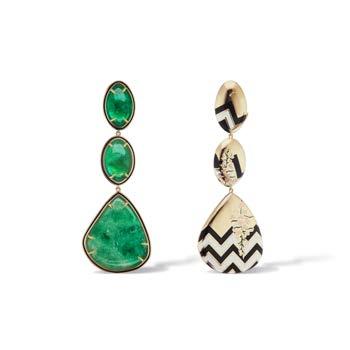
material value in relation to her creations. Her colourful, highly patterned designs initially employed vitreous enamel and the incredibly labour-intensive and skilled heritage enamel techniques of South Asia, such as meenakari. The design-led innovation that is at the core of her practice, however, led her to explore new approaches to develop this aesthetic. Cold enamel, or lacquer enamel, for example, is resin-based. The jewellery world has had a bit of a chip on its shoulder about its use, but this material offers astounding opportunities depending on how you work it. Cicolini, in collaboration with master craftsman Stanislav Reymer, is now exploring what this material can deliver that vitreous enamel cannot, as opposed to viewing it as a mere substitute for the latter. Through this, they have created their own distinct approach: innovative applications of the material where it is gently heated and applied by hand in thin polished and repolished layers, such that the colour is no longer bound by the metal frames and structures we typically associate with enamel jewellery. Thanks to Reymer and Cicolini’s alchemy, the material properties of lacquer enamel continue to develop beyond expectations, with expansive colours created to match the global colour standard, Pantone.
It takes gumption and bravery to transgress the boundaries of tradition and strive for creative freedom within the constraints of jewellery and metalwork. How cheering, then, to see the artists featured here not only charting new courses, but opening new landscapes for colour, inspiring other artists and inviting people to live with more colour in their homes and with their jewellery. ✦
Top left
Jaipur Muzo Wisteria
Chandelier Earrings, by Alice Cicolini, 14ct yellow gold, Muzo emeralds, lacquer enamel.
MUZO EMERALD COLOMBIA
Top right
Industrial Brooch, by Emily Kidson, 2024, oxidised silver, laminate, 18ct gold. RICHARD VALENCIA FOR GOLDSMITHS ’ FAIR
The Near and the Far, by Ane Christensen, 2025, sterling silver, copper, brass. RICHARD
COLLECTION: THE GOLDSMITHS’ COMPANY
VALENCIA
the goldsmiths ’ company exhibition and talks programme, Taking Shape, explores an extraordinary century in the relationship between the Company and the silversmiths’ craft, from 1926 to 2026.
From 1327, we have had a unique, living engagement with our craft, mostly through apprenticeships and hallmarking. From 1926, however, we began to promote contemporary silver, inspiring awareness of modern design through competitions, scholarships, talks and exhibitions. A working collection was founded to provide good modern models for patrons, makers and the trade. The crusade for contemporary design was a radical and sometimes controversial move that favoured designer silversmiths. Our exhibition explores advances in British silver design from 1926 into the present through the lens of outstanding pieces from our collection. They illuminate the Company’s ongoing commitment to both contemporary British designer silversmiths and the wider trade, and its emergence as a cultural institution.
Until 1926 the Goldsmiths’ Company collected only historic silver with a focus on the history of hallmarking. In 1925, King George V had challenged the Company to improve the designs of racing cups presented by the monarch at Ascot each year. The Company ran a national competition in January 1926, for which 90
firms and craftsmen provided 300 drawings, none of which pleased the King. But to stimulate further commissions, three of the winning designs were realised, with the intention of loaning them to museums and potential patrons. This was the beginning of the Plate Improvement Scheme: a collaboration with other institutions – from art schools to the Empire Marketing Board, the v&a and riba – promoting the latest in design.
Aware that France, Denmark and Sweden were leaders in international modernism and possessed superb craft skills, the Company’s Assistant Clerk George Hughes visited Paris in 1925 to see the Exhibition of Industrial Art. Here, he bought a prizewinning cup by Diane Adams, a student at the Central School, as the foundation of a collection which would be shown ‘with a view to exhibitions in various directions of representative modern work’, aimed at the public and the trade. At the same time, the Company opened membership to designers and makers such as hg Murphy, rmy Gleadowe, Bernard Cuzner and Harold Stabler. In 1938, the innovative Modern Silverwork exhibition was staged at the Hall and seen by 37,000 people in just six weeks. It was accompanied by a famous Underground poster by Edward McKnight Kauffer and even a television film.
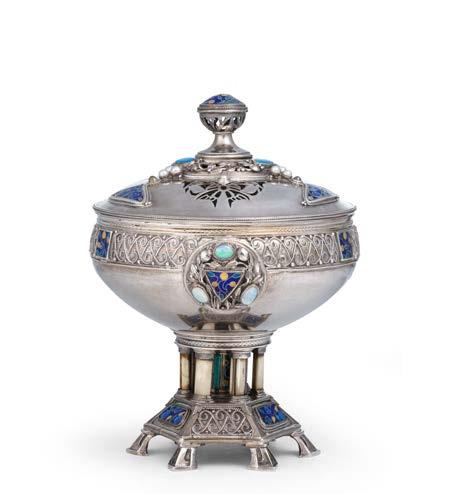
Cup and Cover, by Diane Adams, 1926–27, sterling silver, opal, pearl, citrine, ivory, enamel. RICHARD VALENCIA COLLECTION: THE GOLDSMITHS’ COMPANY
Our exhibition tells this story and takes it further. Pieces evocative of the Second World War such as the Garden Cup, awarded to ‘the best garden on a blitzed site’ sit in the Exhibition Room, remodelled in 1951 after bomb damage, and so itself a monument to postwar reconstruction. A pair of contemporary wall sconces commissioned by Rupert Hambro are sitespecific installations responding to that history. We also show the innovative trophy by Bernard Cuzner that marked the London Olympics in 1950, and the Coronation Cup of Elizabeth II, designed by Robert Yorke Goodden, an architect at the Festival of Britain and founding Professor of Silversmithing and Jewellery at the Royal College of Art. George Hughes’s son, Graham Hughes, took on the role of Art Secretary of the Company in 1951, developing relationships with brilliant Royal College of Art graduates including Gerald Benney, Eric Clements, David Mellor and Robert Welch. The Company shaped the careers of designer craftsmen such as Louis Osman, who designed the first pieces in two unique series of commissions, unbroken to this day, of Court Wine Cups and Prime Warden’s Commissions. Hughes made the collection into what he termed ‘the best ambassador our crafts have ever had’, with
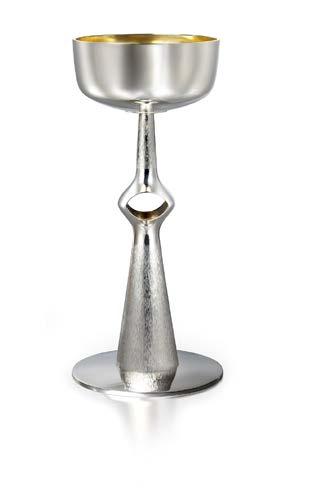
Chalice, by Gerald Benney, 1957–58, sterling silver, gold. RICHARD VALENCIA COLLECTION: THE GOLDSMITHS’ COMPANY
Benney’s Beetle Bowl displayed at international selling exhibitions. Iconic pieces by Benney and Welch, as well as Stuart Devlin, chart the development of a distinctive British modernist style in silver.
The story continues to the present day on the Contemporary Buffet in the Livery Hall, showcasing stunning commissions from leading silversmiths such as Angela Cork, Rod Kelly and Miriam Hanid. In the Front Hall we present a small selection of recent, forward-looking pieces. These represent striking, innovative responses to concept and form, as silversmiths question traditional types of domestic object such as jugs, vases and bowls, investigating spaces within and around them. Many makers also experiment with reflection, patination and the interplay of different metals, with work by Ane Christensen and Juliette Bigley moving beyond function to become sculptures for modern living. Despite the extraordinary diversity, there is a shared excitement about the expressive possibilities of working with silver and of taking the metal to its limits, which picks up on the energy and dynamism of the Art Deco pieces with which our astonishing collection of modern silver began just a century ago. ✦
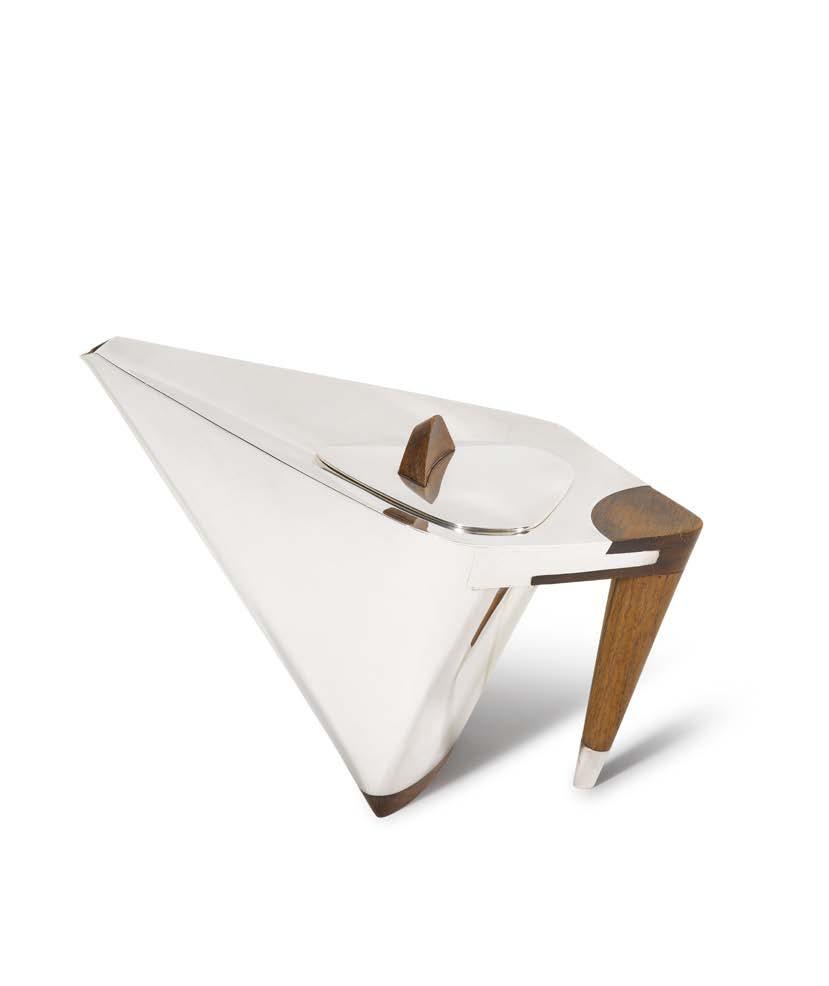
England Teapot, by Stuart Devlin, 1963–64, sterling silver, rosewood. RICHARD VALENCIA
COLLECTION: THE GOLDSMITHS’
THE CULTURE OF CUTLERY TODAY
Charlotte Dew
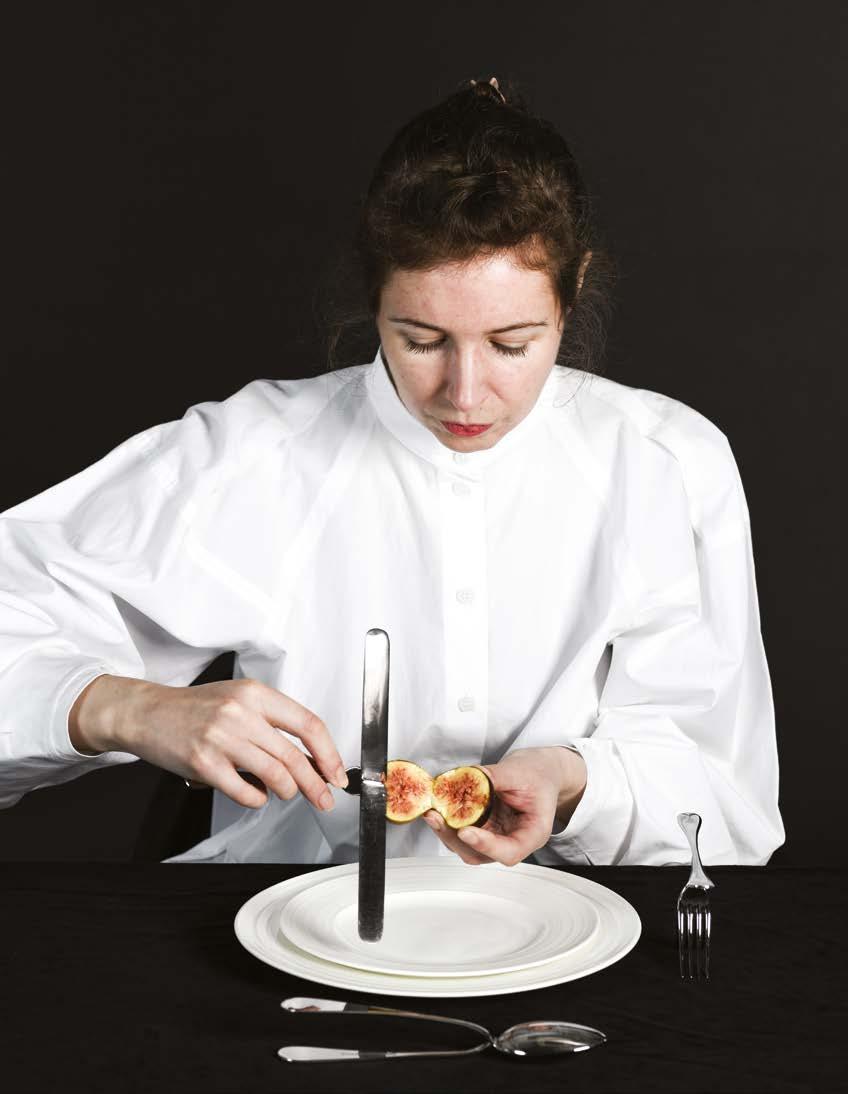
Glide, Nip and Splay –Ambiguous Implements Series,
by Rachael Colley, 2023.
CHELSEA ABBOTT
in 2026 the Goldsmiths’ Centre partnered with the London Cutlers’ Company to explore European knives, forks and spoons from 1425 to today, through the exhibition The Culture of Cutlery. The curatorial research that Gregory Parsons, Erin Sleeper and I undertook highlighted three trends in the design of contemporary cutlery: sustainability, accessibility and artistry. Explored here, each trend provides a perspective on an industry in which cutlery is made by designer-makers, silversmithing firms and manufacturers alike, for a broad spectrum of consumers.
Sustainability
During the exhibition making process, we realised that the sustainability agenda is driving cutlery innovation. In a bid to create easy to carry, attractive sets, and to avoid single-use plastics, companies such as Full Windsor and Black + Blum have developed travelling cutlery. In the case of Full Windsor, these utensils are manufactured in lightweight anodised aluminium, which can be produced in a broad colour range.
Identifying this trend also highlighted the link that can be made between contemporary portable cutlery and the personalised sets made and used during the medieval and Renaissance periods, before households had their own canteens of cutlery. Both historic and contemporary examples are often stored in a bespoke holder, made from textile, leather or, in the case of today, recycled plastics and other modern materials.
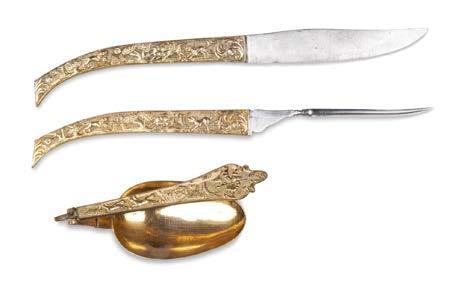
One travelling set in the Cutlers’ Company Collection, dating from the early-mid 18th century and made in Germany, comprises a folding knife, fork and spoon in a leather case. The handle decoration, which depicts
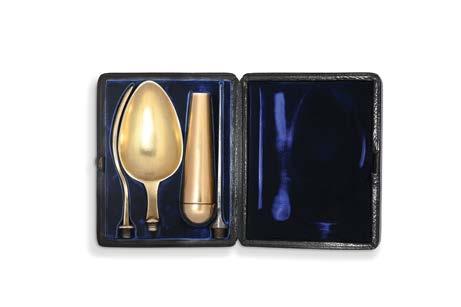
hounds hunting wild boar in the landscape, reveals the context of its use. Meanwhile, a set of campaign cutlery produced by Thomas Johnson of London in 1865, demonstrates the evolution of the travelling set for military use – in this instance, likely in the service of a higher-ranking individual, given the silk-lined case and its production in silver-gilt. A container for condiments is concealed in a handle that can be fitted to either the fork or spoon.
Whilst the materiality of these tools, made centuries-apart, is very different, they share the commonality of being the possession of an individual. With this comes greater personalisation, with purchasing or commissioning influenced by taste. This trend suggests the potential for market expansion in travelling cutlery as the pressure to use materials responsibly intensifies.
Accessibility
Examples of cutlery stood out to me in daily life much more readily, as the exhibition research developed. The most memorable discovery was made in a National Trust café. In the cutlery and serviette dispensary, I found chunky-handled knives, forks and spoons, available from Essential Aids, for visitors that find holding ‘standard’ cutlery challenging. Most of us take the ability to grip a tool for granted. In instances where this is challenging, specially designed utensils can significantly enhance the comfort and independence of the user.
Innovations in this area include London-based designer Simon Kinneir’s Leaven range, developed ‘to give extra sensory feedback beyond a reliance on sight’; Mickael Boulay’s Transitions tool, which
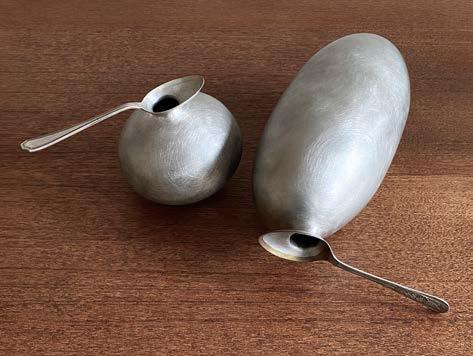
Blow Spoons, by David Clarke, spinning by A R Wentworth, from 2017.
COURTESY OF THE ARTIST
“Longer lifespans and our societal commitment to accessibility mean the demand for responsive designs is only likely to grow. ”
‘provides an on-ramp for people developing motor skills for the first time’; and Hop Design’s 3D-printed Font cutlery that ‘can be tailored to people with different accessibility requirement whilst maintaining a strong and cohesive aesthetic’. Michael Hoppe, founder of Hop Design, describes wanting to create cutlery that makes ‘everyone feel included around the dinner table’.
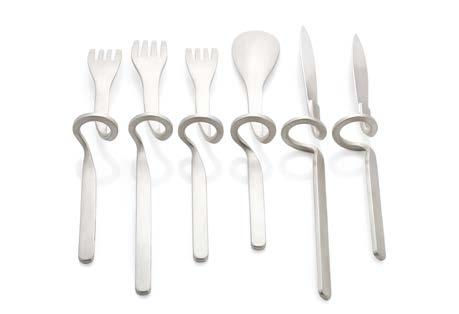
Accessibility is also one feature of Hui-Chaun Huang’s Extension of Body set, a winner of the Cutlers’ Company’s annual Contemporary Cutlery Design Competition. Through this competition, the livery company is commissioning a new place setting every year, over the course of 95 years, to finally be used in 2116 to mark its 700th anniversary. It is an ambitious project and one that is creating a fantastic snapshot of contemporary makers’ designs over this timespan. Huang’s winning cutlery, dating from 2024, allows each tool to be looped over a single finger, removing the need for a user to grip any of the utensils tightly. Longer lifespans and our societal commitment to accessibility mean the demand for responsive designs is only likely to grow.
Artistry
The Culture of Cutlery exhibition presented a selection of work by makers under the title ‘Experiment-
ation’. This brought together pieces that hover between the sculptural and the functional, and which ask thought-provoking questions about cutlery. The ‘experimenters’, who include David Clarke, Rachael Colley and Chris Knight, do not produce sets or canteens to be housed in a kitchen drawer or sideboard. Instead, they are making ideas solid, in silver and a range of other materials, such that they might be displayed and contemplated.
David Clarke has been making Blow Spoons since 2017. A selfprofessed provocateur, he is upfront about his disinterest in making something ‘traditional’: ‘I’m not designing practical functional cutlery; that does not interest me at all.’ To create a Blow Spoon, each of which is unique, Clarke takes a historic spoon and cuts away the bowl to leave a hoop. In so doing, he creates space to reimagine the discarded shape as an inflated ‘bulb’ of pewter. He describes the sculptures as ‘memory triggers; they take you to another place. A hoop on a handle, and you’re blowing big, fat, soapy bubbles. Marvellous, magical, greedy bubbles.’
Like Clarke, Rachael Colley manipulates ‘found’ objects: ‘industry seconds […] used and discarded stainless steel cutlery’ from Sheffield. This is the city where she works, teaches and has strong
connections. Taking these ‘spoils’, she cuts and welds them back together in playful combinations, creating poetic Ambiguous Implements. The results pose a challenge to the user and create a means of talking about Colley’s experience of eating as a sufferer of the autoimmune disease systematic sclerosis (ssc).
Chris Knight purposely avoids conformity. His Salad Knife and Fork (1997), with handles covered in spikes of silver, were designed as part of the Contemporary British Silversmiths (cbs) and Sheffield Museums project to create the Millennium Canteen. The concept for this piece sits within Knight’s broader interests as a maker:
‘I am motivated by the challenge of changing the visual language of function; how a handle is held, where it is positioned or ranked within the hierarchy of the functioning parts of an object.’
For these silversmiths, cutlery is their inspiration, drawn on to make sculptural objects. The work highlights a wider trend: the rise of sculptural silversmithing in the designer-maker sphere, in direct proportion to the diminished production of functional ware beyond commission-based work.
Reflections
As we collectively consider the future of the British silversmithing industry, each of these trends in cutlery design and production –sustainability, accessibility and artistry – emphasises the demand for choices that respond, in equal measure, to the values, sensibilities and needs of the market. ✦
Top Campaign Cutlery Set, by Thomas Johnson, 1865. THE GOLDSMITHS ’ CENTRE
Middle
Folding Knife, Fork and Spoon with Travelling Case, by maker unknown, c.1700–50, Germany, Cutlers’ Company Collection: Ref. CC55. THE CUTLERS ’ COMPANY
Bottom Extension of Body, by Hui-Chuan Huang, Cutlers’ Company Contemporary Cutlery Design Competition winner 2024. JULIA SKUPNY THE CUTLERS ’ COMPANY
HERITAGE REGAINED
(In a Manner of Speaking)
Timothy Schroder
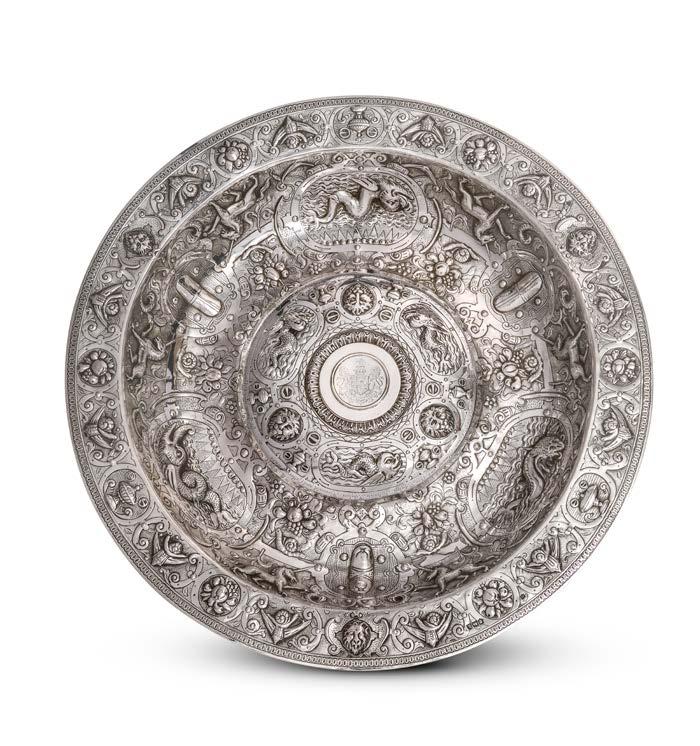
in early september last year I was idly scrolling through a forthcoming auction catalogue when I found myself staring at an object I immediately recognised. Or, rather, an impressively rendered copy of it. But its catalogue description as ‘an Edwardian silver charger […] the border chased with snails, lion masks and fruit, the body chased with unicorns, dolphins, chalices, foliage and fruit,’ missed the point that it was a copy of one that had once belonged to the Goldsmiths’ Company and which is now in a private collection, currently on loan to the v&a. Marked by Simon Owen and hallmarked for 1611–12, it was one of a pair of silvergilt ewers and basins commissioned by the Company, but which were sold off a generation or so later.
Institutionally owned plate was often sold when cash was short and new owners tended to erase existing marks of ownership, replacing them with their own. In this case, the Company’s crest or coat of arms was probably taken out from the centre and replaced by a new blazon. But it was impossible to erase all traces of the Goldsmiths, for the entire basin is chased with a range of ornament that proclaims the Company. At first sight it is typical of the fashionable style of the day, with relief ornament of sea monsters, fruit and strapwork. But closer examination reveals a different set of motifs: leopards’ heads, cups and buckles – the charges from the Company’s coat of arms – alternating with more conventional ornament around the rim and the central boss. Even more prominent are the three pairs of unicorns – the Company’s heraldic supporters – that are chased within the well of the basin. The significance of these would have been obvious when the dish belonged to the Company because they flanked shields with the Goldsmiths’ arms. These could not easily be removed and were instead defaced by working over the surface with a matting tool and chasing the centre with an abstract motif resembling an elongated fruit. Faintly legible traces of the arms, however, still remain.
The new owner of the ewer and basin was Sir Edward Radclyffe, second baronet (1589–1663), whose pricked arms are in the centre of the basin. At some stage thereafter the set changed hands again, although, on this occasion, the arms remained unchanged. Our copy, which was made by Lambert & Co of Covent Garden in 1905–6, is engraved with a different coat of arms, that of John St Aubyn, Baron St Levan (1829–1908) and his wife Elizabeth. As its inscription relates, it was commissioned by their nine siblings and siblings-in-law to mark their golden wedding anniversary.
Basin, 1905, marked for Lambert & Co., sterling silver. RICHARD VALENCIA
COLLECTION: THE GOLDSMITHS’ COMPANY
A copy of this precision would have required the original to be available for close study while it was made and how Lambert got access to this is not known. A hint of an answer, however, is perhaps to be found in an old photo album compiled by Lambert and which has recently been acquired by the Company. One of the photographs, uncaptioned, shows the basin with sets of unrelated neoclassical candlesticks to either side. Whether the object depicted is the copy or the original, it is impossible to tell, but the balance of probability leans towards the latter, since standing in front of the basin is its ewer and, as far as we know, no copy of the ewer was made. It is possible, therefore, that the original ewer and basin were lent to Lambert for an exhibition. What is beyond doubt, however, is that in commissioning Lambert, the siblings chose the ideal silversmiths, for the company had a reputation for making fine replicas of antique silver. In the latter part of the 19th century the firm was headed by George Lambert (d. 1901), who was a member of the Company and joined the Court of Assistants in 1878. In 1887, when he was Prime Warden, he gave us an outstanding copy of a James I steeple cup to mark Queen Victoria’s Golden Jubilee. But this was not his only gift to the Company. Some years earlier, he had presented an important group of early silver, including several Elizabethan communion cups and one of the few known complete sets of apostle spoons. These proved to be the catalyst for a period of systematic collecting of historic silver by the Company that culminated in the publication of John Carrington and George Hughes’s 1926 catalogue The Plate of the Worshipful Company of Goldsmiths Given that the Company would struggle to reacquire the original set were it ever to come on the market, it is very fitting that we should have secured such a fine surrogate, and the fact that it was Lambert who made it adds a further layer of meaning for us. We do not know if the silversmiths noticed the defaced coat of arms on the basin (and there is no hint of it on the copy) but had George Lambert still been alive when it was made, it is nice to think that he would have ‘twigged’ the origins of the original. ✦
HEROES OF MAKING The Stone Setters
Elisa Anniss
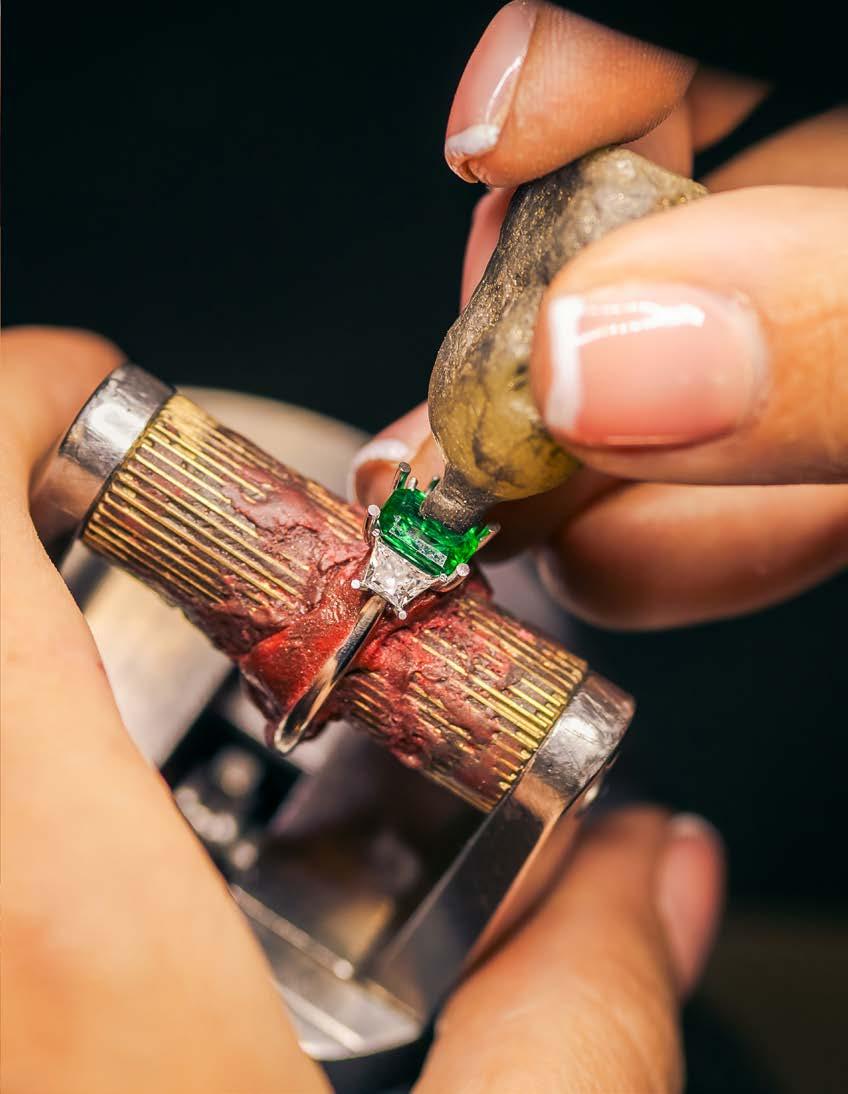
The universe of the stone setter is one of specialist tools and a certain vernacular that includes spit sticks and scorpers. Setters are divided between those who use their hands and those who use air tools, although there is a mutual respect between the two.
take sean sims , an experienced stone setter who teaches short courses at the Goldsmiths’ Centre. He uses scorpers, which are like mini chisels that fulfil the same role as an air tool by cutting the metal. Everything from micro, claw and rub-over settings, Sims does by hand. “It was how it was done five generations back in Victorian times,” he adds.
Sims started in 1985 as an apprentice in Hatton Garden at a time when the Job Centre played a pivotal role in placing teenagers in craft positions. Here, he worked in a large workshop that focused not just on jewellery, but also on objets d’art and statues. As a result, Sims is unfazed by the size of the pieces that he may be asked to work on.
Since the demise of large jewellery manufacturers in London, setters, many of whom are selfemployed, work hand in glove with mounters and independent jewellery designers who provide them with work. Sims, for instance, shares his workshop in the Goldsmiths’ Centre with two mounters. “It takes less time to set than to mount a piece,” he explains. “We have some shared customers, but working together, communicating, and sharing ideas helps.”
These days work is often posted to him from all over the UK, including from one regular customer in the Isle of Man. Other clients include Brooke Gregson and Ellis Mhairi Cameron. “Sean is incredibly talented – he's been an essential part of my work
A cover photo from Richard Farbey’s ba graduate collection, showing his cad and Sorry, Tomasz rings, and The Label Chain necklace.
JOSHUA HEAVENS ONABOWU
since 2019, when I first introduced diamonds into my designs,” says Cameron. “His depth of experience, plus his instinctive understanding of my erosive setting style, is [truly] invaluable. There is a real, genuine trust in our collaboration.”
Still, some setters are employed. Pragnell, the sixth-generation family jeweller, employs four full-time stone setters in its workshops in Stratfordupon-Avon and Leicester. According to its managing director, Charlie Pragnell, setters are recruited via trade publications and through word of mouth. The company also follows the tradition of the master/apprentice relationship throughout its organisation. “The process depends on the experience and ability of the apprentice […] even masters never stop learning,” he adds.
Usually, the setter behind a piece remains anonymous,but this isn’t the case for Tomasz Solinski. The Gdansk-born craftsman sets stones by hand and works alone from a small Hatton Garden workshop, where today a couple of hundred burrs are neatly lined up on his bench. “It’s through the process that you innovate and come up with your own way of approaching a setting,” he explains. Picking up a burr with a round head, he continues: “I use a round burr to create a line and make a hole for the stone.”
Solinski stopped using a microscope because he found that his eyes kept tearing up (one of the perils of being a setter) and he now uses magnifying goggles instead. An avatar of Solinski, depicted wearing head-mounted magnifiers while climbing out from a ring, is central to the apologetic piece entitled Sorry, Tomasz. It was created by Richard Farbey and set by Solinski as part of Farbey’s 2023 Central Saint Martin’s jewellery ba graduate collection, which won him the Brian Wood Memorial Medal.
A partially-set jewel held in shellac cement, Michael Summers Diamond Setting. PAUL READ
With this piece, Farbey raised the issue of how mounting and stone setting using cad impacts the role of craftspeople such as Solinski.
Niall Paisley, a setter for over 30 years who has also taught the craft at the Goldsmiths’ Centre for more than a decade, explains that he considers the introduction of air tools incorporating tungsten carbide (known for its extreme hardness) as probably being even more disruptive than cad to the world of stone setting.
“It allowed you to cut brighter, shinier lines into the metal,” he explains. “With an air tool, the body doesn’t need to adapt or have the strength to cut the metal. The air tool does it all for you. You put your foot on the pedal, and you guide the tool, and it cuts in the direction that you hold it in with no physical push necessary.” He adds that when setting by hand, there is a whole human element that must hold the tool, push and control it through the metal. “It's an entirely different approach to setting.”
He continues: “If you go back to the 60s, 70s, 80s or even 100 years ago, we only had our hands to hold those tools.” It was a very physical job. “When you first went to do your apprenticeship, your body physically had to grow. It wasn't just learning how to control a tool to get the results. You had this physical morphing of a jeweller, not just learning the techniques, but his or her physical body grew and changed as a result to be able to do this.” This physicality, he explains, led to more of a personal touch from the setter.
Today, Paisley teaches Foundation Programme students the differences between the two approaches and says the consensus is that setting the traditional way can allow for more “artistic license”.
However, the advent of the air tool has cleared the way for female setters to increasingly come to the fore and shake up what was once a male-dominated world. Take Alysha Strong, a 2021/21 graduate of the Goldsmiths’ Foundation Programme and apprentice to Michael Summers
Stone being set by Alysha Strong using a piece of beeswax, Michael Summers Diamond Setting.
PAUL READ
HEROES OF MAKING: THE STONE SETTERS
at Summers Diamond Setting. Strong is Summers’s first female apprentice. She started with him in his 300 sq. ft Hatton Garden workshop in 2021. “It’s been a fantastic experience – she’s great company, and I’ve been amazed to see what she’s capable of,” Summers says. Her spectacular Whispering Bloom Ring, featuring 703 stones that took 107 hours to set, was featured in the recent exhibition Apprentice to Masterpiece at The Goldsmiths’ Centre. In 2023, their professional relationship was recognised with the Apprentice and Master Award at the Goldsmiths’ Craft and Design Awards.
Summers started in jewellery at a setting company, spending time working at Graff as a setter in the 1980s. The turning point in his career came in 2012, when he travelled to Utrecht to learn micro pavé diamond setting under Jura, a Russian former engineer and jazz musician. Jura is widely credited with developing the air tools that allow stones to be set with precision under a microscope. “The techniques and equipment moved things forward for me to become well known and gave me an edge,” says Summers, who also sets traditionally. Today, his clients include independent jewellery designers and brands.
Above
The workshop of Michael Summers Diamond Setting, Hatton Garden. PAUL READ
Opposite Alysha Strong and Michael Summers. PAUL READ
Summers concedes, however, that using air tools isn’t everything and that he uses both methods in his work, concluding that “a lot of setters who may not have made the change are still highly regarded.” ✦
HEROES OF MAKING: THE STONE SETTERS
JEWELLERY AND PHOTOGRAPHY
A Shared Perspective Amanda Game
Materials, light and time are interwoven in the shared history of jewellery and photography, two disciplines intimately concerned with human identity.
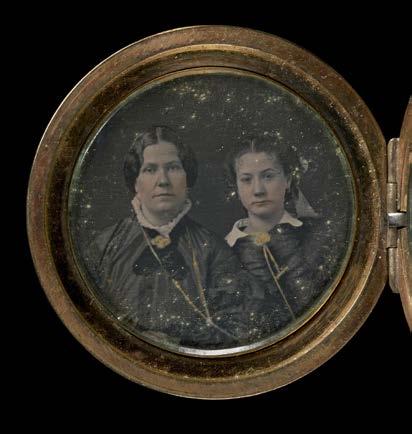
the photographic process may have a shorter history than jewellery (c.1839/140,00 years), but from its inception photography has been interested in recording human identities. As such, it was always going to be an ally of the jewel whose relationship to identity via body adornment has a deep history. The 19thcentury daguerreotype portrait collection held in Manchester’s John Rylands Institute, for example, offers a striking example of how jewellery and the then new art of photography were drawn to one another as precious expressions of the human.
Gilt locket containing a hand coloured daguerrotype of a mother and daughter, c. 1860s, copper sheet plated with silver (31 x 31 mm).
THE JOHN RYLANDS RESEARCH INSTITUTE AND LIBRARY, THE UNIVERSITY OF MANCHESTER
images proliferated with the technological development of photography, yet photographs that capture something of the mystery, and complexity, of the material jewel – as well as what wearing and handling it might feel like – remain scarce. In 20thcentury Europe, fashion photographers often led the way in creating memorable images that foreground the role of dress in creating multiple identities. However, the lens is less often focussed directly on the jewel. A remarkable early exception is a series of photographs by Swiss-born American artist Lucienne Bloch of Mexican artist Frida Kahlo. The latent possibilities of wearing jewellery to express identity is powerfully seen in this example of Kahlo biting her necklace, in which the jewel takes centre stage.
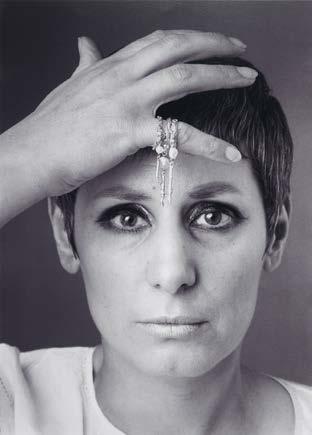
niemann ’ s 1968 portrait of artist jeweller Gerda Flöckinger wearing her own work offers a sense that a jewel, as much as a painting or sculpture, can be a complex articulation of human experience. It captures both the direct gaze of the artist and the intricacy and sensuality of the ring. The imagination and skill of both jeweller and photographer combine to highlight the jewel as a form of contemporary expression when worn.
julian
Gerda Flöckinger, by Julian Nieman, 1968, archival digital print.
JULIAN NIEMAN / NATIONAL PORTRAIT GALLERY, LONDON
Frida Biting her Necklace, by Lucienne Bloch, 1933, New Workers School, NYC, archival digital copy of original gelatin silver.
LUCIENNE ALLEN, OLD STAGE STUDIOS
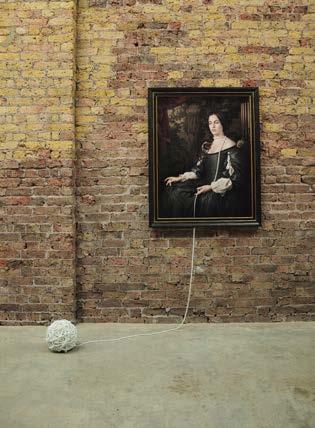
the above examples show photography’s debt to Western traditions of portraiture in which jewels are depicted to convey identity, most usually as evidence of the status and wealth of the sitter: the jewel as bankable asset. Contemporary London-based artist Maisie Broadhead uses her knowledge of photography to articulate and critique this historical relationship between portrait and jewel, particularly in the depiction of women, seen here in Ball and Chain. Her carefully staged image, created in the form of a digital C-type print, challenges the idea that either image, identity or jewel are stable things, and central to that is her understanding of the relationship between the art of jewellery and photography.
there are links through physical materials too, whether in silver-plated copper sheets; silver compounds used to coat light-sensitive film; or in the gold, silver, copper, manganese and other rare earths present in most mobile phones with camera capabilities. Whereas the physical qualities of precious materials are hidden assets in most digital tools, the ductile, malleable, corrosion-resistant qualities of gold have been central to the revelatory art of jewellery since c.4400 bce. Gold’s elemental origins through supernova nucleosynthesis in space, with additional deposits reaching earth through meteor showers (as scientists currently believe), give the element its rare physical properties and its mysterious, vivid connection to the deep time of the universe.
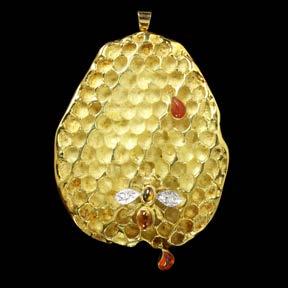
for any artist working with gold, these attributes offer opportunities for profound creative exploration, far beyond any narrow definition of luxury goods. John Donald’s 1969 Brooch/Pendant is cast directly from a honeycomb. This technique took Donald and his assistant two years to perfect, and the image of the pendant transmits this sense of time and care. It calls attention to the extraordinary natural properties of both gold and honeycomb, and through that to our relationship with a wider dynamic universe.
Ball and Chain, by Maisie Broadhead, 2016, digital C-type print, glass, pearl beads (1,085 x 835 mm).
MAISIE BROADHEAD
Brooch/Pendant, by John Donald, 1969, 18ct gold, diamonds, cabochon citrines, Mexican fire opals (83 x 55 mm).
VICTORIA AND ALBERT MUSEUM, LONDON
italian goldsmith Giovanni Corvaja is both scientist and artist. He creates many of his own gold alloys and has adapted and extended ancient techniques such as wire drawing and granulation that deepen understanding of the use of gold. His own striking image of his gold pendant builds on his technical mastery by experimenting with and adapting photographic tools to give depth and mystery to the image.
paul read ’ s photograph of London goldsmith Jacqueline Mina in her workshop reveals the dexterity and deep immersion of an artist who has enjoyed a 60-year dialogue with gold: her craftsmanship and artistry are articulated through the lighting on the artist’s face and hands.
huimin zhang ’ s Mammary Gland Ring of 2024 is captured in her own digital image. The magnification possible through the tetra-prism cameras of modern mobile phones calls attention to the human hand as both tool and location, and to the sensuality of the cupped flower form.
john berger comments that ‘what makes photography a strange invention – with unforeseeable consequences – is its primary materials are light and time.’ These are also the intangible materials of jewellery. Remarkable jewels, as well as their makers and wearers, reveal how deep understanding of both intangible and tangible materials can create powerful means of exploring human identity through time: photography is, as noted, an essential ally. ✦
Portrait of Jacqueline Mina in her studio, 2024. PAUL READ
Pendant with handmade chain, by Giovanni Corvaja, 2010, 18ct gold, 900 platinum and vitreous enamels (90 x 35 mm pendant and 540 mm chain). Photo taken using a Nikon digital D900 with a Hasselblad Zeiss macro lens adapted through a ring made by the artist. Private collection. GIOVANNI CORVAJA
Mammary Gland, by Huimin Zhang, 2024, 22ct gold, digital image taken on a Xiaomi M2102K1C (60 mm).
HUIMIN ZHANG
A MASTER OF COLOUR AND FORM
Alan Craxford
Janice Hosegood
alan craxford has spent more than 50 years doing something that the art world often needs reminding to value: making things with his hands and meaning it. Trained in the exacting traditions of jewellery, silversmithing and hand engraving, and before his enforced retirement, Craxford worked with precious metals and gemstones at a remove from fashion, trend or market anxiety. His pieces – whether intimate or ceremonial, restrained or richly wrought – carry the particular authority of objects that have been genuinely thought through.
What distinguished Craxford’s practice is not simply his technical command, although that is considerable, but the quality of attention he brought to bear on every stage of making. His engraving, for example, is not decorative embellishment, but a form of mark-making as considered as drawing: a slow, irreversible conversation between tool, metal and intent. Always abstract, his purpose with engraving is to enhance a detail or stone, or take the viewer’s eye on a journey and even to trick it with reflections and perceived movement.
Craxford’s love and commitment to detail is clearly evident in his use of colour. He has never treated gold and silver as neutral bases, but has allowed rose gold to enhance pink stones, yellow gold to intensify warmth, green gold to offer crispness against an earth-toned gem. His exploration, development and use of rhodium plating has gone far beyond the industry’s original intention of using this technology to brighten and disguise dull surfaces. Black rhodium has played a part in many of Craxford’s pieces, which use its ability to produce a dark, gunmetal-grey to near-black finish for a dramatic, edgy aesthetic, and superb colour contrast to stones with rich, strong tones.
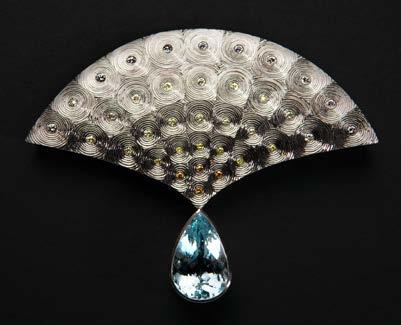
But Craxford’s interest, understanding and use of colour goes deeper still. This is evident when one realises that many of his colour combinations echo landscapes –sunsets, forests, oceans – giving his work a harmony that feels instinctively ‘right’, even when the colours are complex. One superb example is his Arctic Sunset Brooch, where he used a large, icy aquamarine drop from a fan shape carved in 18ct white gold, set with orange, yellow and white diamonds. Of this piece, Craxford says: “The brilliant aquamarine is perfectly cast, playing the ice it represents. The vivid orange diamonds play the sun as it is about to set, going down past the horizon, as the day slips into darkness.”
To take this thread even further, Craxford has an in-depth understanding and interest in alchemy. Present-day alchemy is less about turning metal into gold and more about transformation, symbolism and material exploration. He explains: “Alchemy’s association with turning base metals into gold, is a misunderstood halftruth. Essentially it is about the transformation that happens
SIMON B ARMITT
Above
Arctic sunset Brooch, 2007, 18ct white gold, aquamarine drop, orange, yellow and white diamonds.
SIMON B ARMITT
symbolically, inwardly within the unconscious world from which everyone sets out. It is not a magic trick that can be performed, but a process which gradually changes one’s inner values into something much more subtle and precious.”
In contemporary jewellery and silversmithing, this modern alchemy comes to emerge through innovative techniques, experimental processes and the reimagining of traditional materials. Makers manipulate metal with heat and chemical reactions to create unexpected textures, colours and forms, echoing the alchemist’s pursuit of change and discovery. This connection reflects a deeper philosophical approach, where craftsmanship becomes a process of personal and material
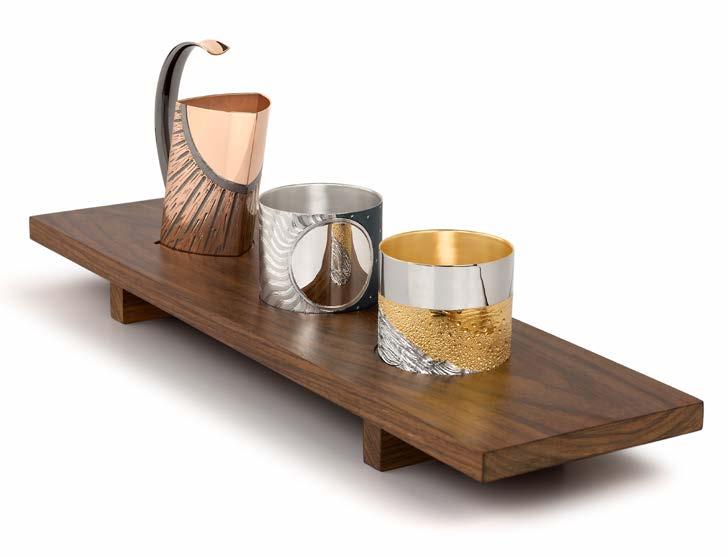
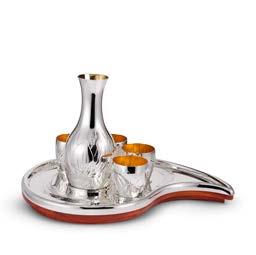
Opposite Whiskey and Water Set, 2014, silver, gilded, blue and black rhodium plated, red gold plated, Brazilian rosewood tray. Private collection.
Present-day alchemy is less about turning metal into gold and more about transformation, symbolism and material exploration.
transformation. As a result, contemporary jewellers and silversmiths act as modern alchemists, merging science, art and intuition to produce meaningful, expressive objects. In alchemy, colour is central to describing stages of transformation. Processes such as Nigredo (blackening), Albedo (whitening), and Rubedo (reddening) represent psychological and material progression toward completion or enlightenment. Colour becomes a language for change, not just appearance.
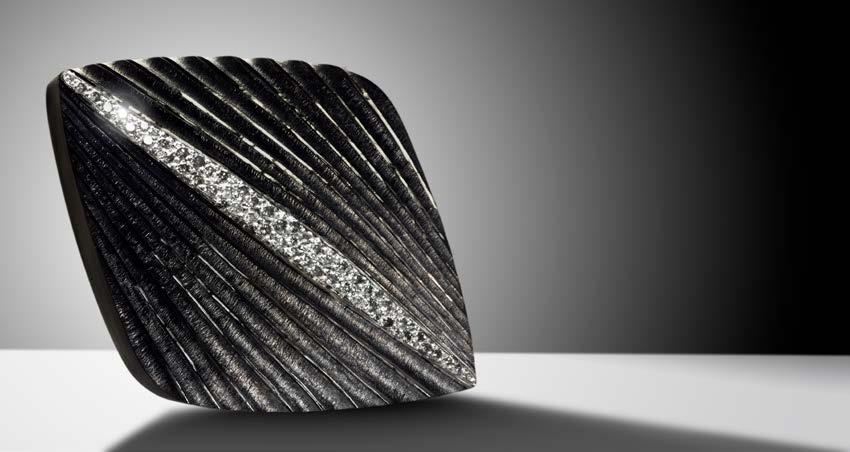
Three pieces in particular illustrate Craxford’s philosophical approach to alchemy. The first, his Comet Brooch, made in 2010. With a deeply carved surface, the silver has received a rich black rhodium plating that, with the play of light, moves from deepest black in the lowest parts of the engraving – the depths of outer space, perhaps –to shimmering lines at the peaks, emphasised by a flashing line of grey and white diamonds. He explains his approach to this piece,
saying: “I am attracted to anything cosmological. In this instance, it’s a comet which travels such vast distances. The light is shown in white diamonds fading slowly to grey towards the end of the ‘tail’. This is shown against the perfect blackness of space where the void contains so much potential.”
An early oval brooch from 1999 depicts Albedo, the whitening. Although it’s a modest piece at first glance, Craxford has once again used subtle layers in this seemingly
Comet Brooch, 2010, silver, black rhodium plated, grey and white diamonds. Private collection.
SIMON B ARMITT
single colour, even utilising the silversmith’s bête noire – fire stain. He has carved deep into the ‘stain’ to the unblemished whiteness below. Tiny circular abrasions on parts of the surface add contrast to the polished depths achieved by engraving, with the brooch framed in 18ct white gold and completed with an off-white oval diamond at its centre.
The final colour in the alchemical trio is perhaps the most crucial –rich, dark red has a fundamental connection to blood and the life that it supports. Craxford shares: “The Rubedo is also about passion and the power we have to electrify life, although that passion does not always need to be noisy or extroverted – like music. However, what it all needs is a heart, and here we return to blood, for heart, blood and passion are common to every human being.” Craxford’s magnificent Rubedo Pendant is
certainly a passionate piece. It has a large, rectangular garnet set in black rhodium-plated 18ct white gold. The setting around the stone has a highly polished finish, in contrast to the hand carved and matt surface of the pendant base. The peppering of tiny white diamonds add spotlights to the central focus of the deep blood red garnet.
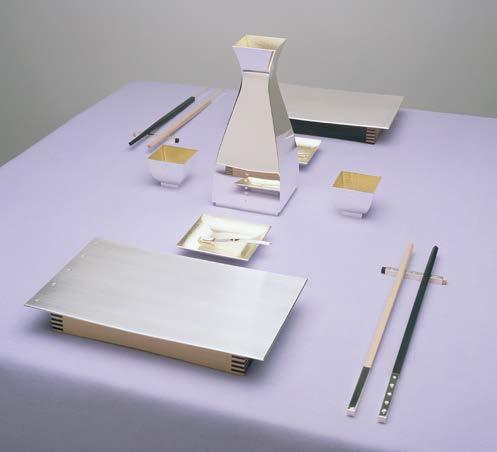
A perfect illustrative piece for Craxford’s love of alchemy is Alchemical Tres – a set of whiskey and water vessels on a rosewood tray. Using silver with black rhodium, yellow and rose gold plating, each cup or jug is richly engraved to add further depth to the surfaces. The subtle Japanese reference in its presentation takes us to another Albedo piece –his Sushi and Sake Set from 2005. Initially embracing his love of Japanese culture and design, and keeping the set – for him –
unconventionally simple, Craxford later embraced encouragement to add engraving to the Sake Jug Craxford’s jewellery and metalwork occupy a space where rigorous making and quiet contemplation are not merely compatible, but mutually dependent. The hand and the mind and the heart are never far apart in his practice – precision is not an end in itself, but the means by which something more elusive is reached.
In Search of the Blindingly Obvious by Alan Craxford is available through YouCaxton/Art Circus Publishers. ✦
Sushi and Sake Set, 2005, silver, lemon yellow gilding, maple and ebony wood. Private collection.
JOEL DEGEN
MAKING AND MEMORY Maria Hanson’s Loss, Life & Love
Frances Parton
“ jewellery is a very powerful vehicle for holding a memory.”
Twenty-two years ago, in 2004, jeweller Maria Hanson and silversmith Chris Knight faced the stillbirth of their first child, a son they named Thomas. Nineteen years later, in 2023, Hanson decided to make an object focused on that experience. The result, a long, sinuous silver neckpiece entitled Loss, Life & Love, recently acquired for the Goldsmiths’ Company Collection, is about memory and the passage of time. It addresses Hanson and Knight’s initial moments of irretrievable loss on Thomas’s death, but also how they have lived with that loss ever since. The necklace is a moving and eloquent expression of a personal tragedy; it embodies the power of making and shows us how Hanson has used that power to navigate such a traumatic experience. It is also a bridge from the specific to the universal, from Hanson’s own experience to that endured by many other people. It is a powerful invitation for others to add their own voice: it acts as a catalyst for conversation on the painful and often taboo subject of baby loss.
The necklace was commissioned from Hanson by curator Corinne Julius for her 2023 exhibition Memories are Made of This at Sarah Myerscough Gallery. When Hanson was invited to make a piece of jewellery related to memory, she immediately felt it was the right moment to make an object that acknowledged Thomas’s stillbirth. The necklace is entirely handmade and its structure maps the passing of time since Thomas’s death. Hanson hand-formed 999 individual silver links – she describes their making as “a labour of love” –and arranged them in connected stacks and rows of three. The numerical structuring is significant, in that it acknowledges Hanson’s continuing grief. Following Thomas’s death, Hanson and Knight had two subsequent children. Each time she is asked how many children she has, she answers “two”, whilst always thinking “three”.
Three additional tiny gold nuggets, arranged in a row across the necklace, symbolise Hanson’s three children. The number of links, 999, plus the three nuggets, equals
1002, which is the exact number of weeks that passed between Thomas’s stillbirth and the day Hanson was commissioned to make the necklace. Each link therefore represents a week in Hanson’s life, shaped by Thomas’s absence, but also the presence of her other two children. A single silver nugget, at the opposite end of the necklace to the gold ones, bears the hallmark and represents Hanson herself.
Hanson has had a long and successful career teaching metalworking and jewellery, but nonetheless found that the making of the necklace brought her an important reaffirmation of her own creative skill. “It allowed for a wonderful sense of reflection and contemplation that I hadn’t allowed myself to do for years.” Only once the necklace was finished did Hanson decide to weigh it. She did so, to find that it weighed exactly 333 grams. Symbolically, 333 is known as ‘the angel number’ and represents growth and creativity. Hanson shares that the moment she weighed the necklace was the only time during the entire making process that the emotion overwhelmed her and she broke down and cried.
Hanson acknowledges that creativity can be extremely helpful as part of the healing process. “The physical act of craft making can be very therapeutic. There is something about having the opportunity to engage the hand, the heart, the mind simultaneously in the physical process.” In the early weeks after Thomas’s stillbirth she and her husband found being able to make alongside each other key to coping: “the opportunity… of just being held, in the safety of our studio workshop space, and using the making process as a mechanism to work through that immense grief was really important.” Almost two decades later, when she came to make Loss, Life & Love, she again found the experience therapeutic: “I felt I was being gifted something, in a way, by having the opportunity to make this object that was allowing me to express something so important about this experience I have had in my life […] there was something about making the necklace that made me feel really hopeful.” ✦
Maria Hanson and Chris Knight. COULSON & TENNANT
REDEFINING PRECIOUS
Rachael Taylor
the impact of soaring precious metals prices looks a little different depending on who you talk to. For Pandora ceo Berta de Pablos‑Barbier, the fact that silver has more than doubled in price over the past year is so concerning that she describes it as “one of the biggest challenges” facing the business. It has led the Danish brand to stop using silver in much of its collections, switching instead to platinum plated base metal. For Somerset based jeweller Sia Taylor, who works exclusively in precious metals with no reliance on gemstones or other adornments, the “nightmare” of the similarly ascendant gold price, which hit a historic high of $5,634.80 per oz on 28 January (five years ago, it was $1,800 per oz), has been cause for pause. In a bid to avoid completely alienating her current clientele, she has begun to introduce lower carats of gold as her preferred 18ct moves out of reach for many.
Over in east London’s Green Street, home to a throng of jewellers selling 22ct gold jewellery to a primarily South Asian clientele, it is a very different story. Here, when gold prices rises, so do sales. “When the price is rising, there’s a fomo [fear of missing out] effect,” says Jayant Raniga, chief executive of PureJewels, which has a store on Green Street. “People are saying: ‘I better get my gold before it goes even more out of reach.’” The reverse is true when the price falls, he says: “It spooks people. They are thinking, ‘Where’s the floor? I better not buy now.’”
In his role as Director of the London Assay Office, Will Evans has a bird’s eye view of both sides of this story. The four Assay Offices (London, Birmingham, Sheffield and Edinburgh) are responsible for hallmarking all precious metal items sold in the UK, giving them an overview of what is in demand and what is not. “We’ve seen two impacts [of the high precious metals prices],” says Evans. “One is the high street retailers moving out of precious metals. Pandora is responsible for so much silver hallmarking in the UK, so for them to be moving into platinum plated base metal is a massive shift.” Evans said he has had discussions with other major national jewellery chains that are also considering replacing the silver currently used in vermeil jewellery with base metal.
“With this latest round of increases, hitting £100 [retail price] for a silver item is becoming a challenge,” says Evans. “Volume retailers at the lower end of the market are finding ways to avoid using precious metal, or using as much precious metal, because of the costs.” This is also a trend at the top end of the market, as the new Gold & Steel high jewellery collection from Bulgari demonstrates with its tubogas style steel jewels accented with 18ct gold and diamonds.
A few years ago, steel being presented as the pinnacle of luxury jewellery would have been impossible to imagine. Yet as designers flex creatively to hit certain price points, and shoppers adjust their expectations, we are seeing more and more unusual materials presented as fine jewellery. One such example is silversmith Alice Fry’s use of niobium, which she anodises to turn it into vibrant blue, purple or green hues. Her latest collection – a line of wedding bands with niobium laid over precious metal – signals the potential for a more mainstream application for this alternative material.
“The other side of [rising metals prices] is the boom in 22ct,” notes Evans, echoing what Raniga is seeing playing out on Green Street. While 18ct and 9ct gold hallmarking figures are declining in the face of cost pressures, 22ct is on the rise. In the first quarter of this year, UK Assay Offices hallmarked 114,000 18ct gold items and 113,000 22ct gold items. “There is a real closing of the gap between the two metal carats,” notes Evans, who says that such figures are unprecedented in recent times.
Raniga believes the increase in popularity of 22ct gold is not just restricted to the South Asian community. PureJewels supplied Ainsworth Jewellers in Blackburn – a traditional independent jeweller established in 1870 – with a wholesale collection of 22ct gold jewellery in October 2025. Raniga says that 80 per cent of the collection sold through, with “80 per cent of that to non Asian people”. He believes the high gold prices have a role to play: “As more and more people realise what good value 22ct jewellery is, everyone’s buying it.”✦
Sunrise Gold Rosettes pendant, by Purejewels, 22ct gold.
COURTESY OF PUREJEWELS
B.zero1 Gold & Steel ring, by Bulgari.
COURTESY OF BULGARI
Dawn earrings, by Sia Taylor, 14–22ct gold.
COURTESY OF SIA TAYLOR
Geology brooch, by Alice Fry, sterling silver and niobium with gilding and steel brooch pin.
COURTESY OF ALICE FRY
SINGLE MINE ORIGIN GOLD
Joanna Hardy
in the 40 years I have worked in the gemstone and precious metals trades, I have been fortunate enough to visit mines all over the world. Despite the amazing experiences I have had on these trips, I have never been able to reconcile myself to the destructive nature of mining; that is, until recently, when my opinion on mining – gold mining in particular –has begun to change. It is always easy to point a finger at what ‘bad’ gold production looks like, but the more useful question is: what could and, crucially, should ‘good’ gold production look like today?
With gold prices having risen by 50 per cent in the last year (and silver by a phenomenal 140 per cent), the urge to retrieve as much precious metal from the ground as possible is only increasing. In this climate, it becomes all the more important to search for and champion good producers. For many members of the trade, options for buying gold from bullion dealers range from Fair Trade and Fair Mined gold from artisanal miners, to gold from large-scale mines, or recycled gold. Each option comes with its limitations. Although the Fair Trade and Fair Mined initiatives have done much to improve the traceability of gold and combat the exploitation of small-scale producers, supply is sometimes irregular and amounts are small. Furthermore, much artisanal mining, even today, is illegal and miners often use mercury, which is extremely harmful, to extract gold from its ore. While mercury is not used by large-scale mining companies, these companies still range across their production standards. Their gold is also then sent to refineries that mix it with gold from other suppliers, such that it is impossible to know whether the gold you buy from your bullion dealer has come from a reputable mine.
Recycled gold holds a similar limitation: the provenance of the gold is unknown.
Luckily, for consumers concerned about traceability, there are a few good suppliers out there. One such company is Betts Metals, founded in 1760 in Birmingham and the oldest surviving precious metal refining and dealing business in the UK. In 2017, Charlie Betts founded the initiative Single Mine Origin (smo) Gold to give goldsmiths and jewellery manufacturers the opportunity to buy gold knowing exactly where it has come from. The premise is simple: source gold only from mining companies that uphold the highest standards for the welfare of their staff, community and environment, as well as for the gold they produce. In practice, even identifying these mines is a difficult exercise. Betts collaborated with a data gathering company to assess esg data at ‘mine level’ that was readily available from gold mining companies around the world. Yet while there are more than 1,300 gold mines worldwide, with some companies owning more than one mine, only 200 mining
Opposite Bellevue smo mine, Western Australia. BRENDAN CECICH
Above
Joanna Hardy with Kado Muir, Director of the Tjwarl Aboriginal Corporation, on whose land Bellevue smo mine is situated. BRENDAN CECICH
companies share processing data – the first test of their reliability. The second test was an assessment of work practices, including working conditions, gender diversity, carbon usage, water recycling and other environmental credentials. This exercise helped smo create the smo Environmental, Social & Governance (esg) Benchmark. Then came the task of building a relationship with the ‘best in class’ mining companies and refineries to see who would be open to a new way of doing business, as the real challenge requires a shift in mentality surrounding the fundamentals of gold processing: larger mining companies and
refineries must buy into the idea that gold from good producers must be processed separately all the way through the chain, from source to manufacturing, so that the consumer has complete confidence in where the gold has come from. smo challenges mining companies, refiners, dealers and craftspeople to do business differently. Three progressive mining operations have, at the time of writing, accepted smo’s challenge: the two Endeavour mines in Sabodala-Massawa, Senegal; Ity mine in Côte d’Ivoire; and Bellevue mine in Western Australia. I was lucky enough to visit Endeavour’s Sabodala in October 2025 and Bellevue in March 2026, and saw for myself how they extract and process their gold.
I have spent many years visiting gemstone deposits around the world, and come to know that these are generally small concerns when compared to gold and diamond mines, but it was still an eye opener to see large-scale mining that uses state of the art technology to extract and process gold with a sustainable focus. Sabodala’s open-pit mine is a huge hole compared to Bellevue’s underground roads, which wind down to approximately 1km-deep –your ears pop as your drive down! The mineralogy of the ore in each mine, and specifically how the gold occurs within it, determines the type of process used to extract the gold.
In Senegal, the gold occurs in microscopic particles surrounded by sulphides, which must be treated to release the gold. In artisanal mining, mercury has often been added to this crushed ore, thereby forming an amalgam with the gold, and heated to vaporise the sulphides and mercury and leave behind the gold. It is a simple and low-cost process, and one that is still widely used despite its low recovery efficiency
and extremely hazardous effects on both human health and the environment. At Endeavour’s Sabodala mine, a process called biox is used to separate the gold instead. Here, living bacteria are used to oxidise sulphide minerals, allowing cyanide to leach the gold onto carbon in the conventional carbon-in-leach (cil) process. Cyanidation is extremely effective at recovering small amounts of gold economically and, if used responsibly, carries minimum risk to the environment, something Endeavour monitors extremely closely – especially to protect the family of baboons whom I glimpsed in the distance from outside of the ‘gold room’ where gold ingots are poured. biox offers a safe and established processing method that has been in use for around 30 years, with 14 plants globally.
In Western Australia’s Bellevue mine, re-discovered in 2017, the gold is not locked within sulphides, but is close to them. If untreated, these sulphide minerals reduce the efficiency of gold recovery. Bellevue pretreats its ore to reduce the reactivity of the sulphides, allowing the gold particles to be recovered more easily. For the activated carbon supply needed in the cil process, Bellevue uses burnt coconut shells, a sustainable source of carbon, to absorb the gold. In 2025, Bellevue became the world's first net-zero-emission gold mine. It has four 212m-high wind turbines and a 27mw solar farm, which enables the mine to run on 90 per cent renewable energy across a month, or on 100 per cent renewable energy for more than four days.
The high standards of production at both Sabodala and Bellevue are upheld along the production chain. Through working with smo,
Opposite top Emefa Cole at the SabodalaMassawa smo mine, Senegal. ARCHIE BROOKSBANK
Bottom Bellevue smo mine, Western Australia. BRENDAN CECICH
their gold is fully segregated from other mines’ production when refined; it is independently audited and then traced by smo to make sure that, back in Birmingham, Betts and consumers know exactly which mine their gold is from. The goldsmith using smo gold is allowed to use the smo mark – the stamp of approval – on their work, which can be administered alongside a hallmark by all UK assay offices.
The jewellery market generates approximately one third of the world's gold demand, so the increasing number of consumers who want sustainably mined gold have significant leverage on overall gold production. Of course, no company is going to do business without making a profit, but money is not the driving force behind smo gold. Instead, smo goes that extra mile to partner with mines that are committed to further improving their esg standards so that, as consumers, we can have complete confidence in where and how that gold has been mined. Mining will continue, there is no way round that, but with smo’s ethos and example, there can be a way forward in showing what mining ‘good gold’ looks like. ✦
paper is perhaps the ultimate material of the everyday. Affordable and versatile, it is omnipresent in modern life, featuring in all manner of roles both utilitarian and decorative. It takes colour brilliantly and also pattern – either handdrawn, printed or as photographs –and may be cut and folded to form complex shapes that, regardless of their size, remain light in weight. These attributes combined to inspire paper costume jewellery in the 1960s; to bring it centre stage in the New Jewellery Movement’s championing of non-precious materials in the 1970s and 1980s;
and for its use to have continued to this day in work that imaginatively explores its physicality, and also thoughtfully addresses sustainability and recycling.
Graham Hughes, in his 2009 biography of David Watkins (b. 1940) and Wendy Ramshaw (1939–2018), describes Ramshaw wearing earrings she had made from the cut corners of £1 notes in 1960. These do not survive, but doubtless included superb engraved decoration in green courtesy of the Bank of England, and benefitted from the durability of the paper used for making banknotes. In
1966 Ramshaw and Watkins used paper for a range of fashion jewellery under the name Something Special Making a virtue of paper’s ephemeral nature, the jewellery was, they said, designed to be worn once then thrown away. Executed in vibrant prints, or more subtly in silver paper, these flat-pack designs were simply but cleverly packaged, with instructions for assembly and, where necessary, a few beads or inexpensive metal fixings. Although they were never intended as a serious statement, examples are now to be found in the collections of several major design museums, often
Untitled, by Attai Chen, 2010, paper, paint, coal, glue, linen. COURTESY OF ATTAI CHEN
alongside their book of cut-out paper jewellery from 2000.
A more serious purpose marked the adoption of paper by some jewellers of the 1970s and 1980s, whose work sought to subvert traditional expectations and redefine jewellery’s boundaries. Paper’s impermanence was an important factor, making it an ideal material to challenge the assumption that jewellery should be long-lasting. Its minimal intrinsic value argued a related point: Julia Manheim (b. 1949), working with newspaper in 1987, noted the satisfaction of ‘making something beautiful out of a material which is effectively worthless the day after it is produced.’
The Dutch jeweller Gijs Bakker (b. 1942), who had received a traditional goldsmiths’ training in Amsterdam, explored steel, aluminium and Perspex in the 1960s before turning to paper – initially glossy photographs – in around 1977. He laminated the photographs with clear pvc, in effect transforming paper into an acrylic and thereby fundamentally changing how to work with it. His first series of laminated jewels, Queens, consisted of photographs of diamond necklaces being worn by contemporary royalty. These images were trimmed into generous circles around the neckline, re-inventing the royal corsage as ironic, trompe l’oeil neckpieces. Many variants followed, including his Sportfiguren brooches of the mid1980s, which used grainy newspaper photographs of sporting moments, sometimes with a gemstone tennis ball or football added; and in the early 2000s his racing car brooches, with their series title I Don’t Wear Jewels, I Drive Them, borrowed from an Alfa Romeo advertisement.
The Swiss jeweller Otto Künzli (b. 1948) devised Postcard brooches in 1981, consisting of a thin acrylic
Top
COURTESY
COURTESY
Bottom King Solomon’s Ring, by Jeremy May, made from pages cut from a book. JEREMY MAY
OF JAGGEDART
Something Special range of paper jewellery, by Wendy Ramshaw and David Watkins, 1966.
OF DAVID WATKINS
frame, a pre-fabricated brass pin and elastic bands that securely held a postcard in place and allowed it to be changed easily. He followed these infinitely variable two dimensional brooches with ones that consisted of geometric chunks of hardfoam, neatly covered in sheets of patterned wallpaper. As was noted at the time, these pieces were not intended to be of commercial interest, but to provoke debate, to promote jewellery as an art form, and to liberate it from traditional values. The contemporary photographs of people wearing these pieces remain iconic images from the New Jewellery Movement.
A jewellery artist who embraced paper at this time for its aesthetic and tactile qualities, rather than as a material of dissent, is the Dutch maker Nel Linssen (1935–2016). She favoured industrially-produced reinforced paper, sometimes with a different colour on each side, for her
flexible collars and bracelets. These pieces typically consisted of densely threaded discs of identical size, folded to create a repeating pulse within an apparently solid cylindrical form. She was inspired by the structures and rhythms of plants, and her work has a gentle strength. Intuitive yet carefully calculated, it is subtle and intriguing, and in paper she found the perfect material for her work.
Paper was used with dramatic effect in the mysterious jewels created by the Jerusalem and Munich-trained artist Attai Chen (1979–2023). His delicate brooches and necklaces, with their juxtaposed billowing and splintered forms, rely on meticulous craftsmanship. Coloured, hardened and cut, paper is transformed beyond recognition in his work.
Old books have been given new life in jewellery that plays with the contrasting structures of binding
and pages, or which takes specific inspiration from their text and titles. For her Seanemone brooches, the Hungarian jeweller Flóra Vági (b. 1978) cut a horizontal section through the spine of a book, trimming the pages, staining and curling them back in on themselves, to create organic rippling forms that evoke a sea anemone’s tentacles moving with the tide. The printed word can be glimpsed within, but it is not part of her narrative and her books are not intended to be identifiable. In contrast, self-taught jeweller Jeremy May (b. 1976) enjoys the emotional connections that a particular title, phrase or binding carries with it. Text and language matter as he reads each book –for inspiration and to suggest the piece’s name – while the cavity from which he has carefully extracted his raw material becomes the jewel’s resting place within a case made from the actual book.
Thus, although paper was seldom seen in jewellery design until recent decades, it has played a key part in the debates that re-defined modern jewellery, and has subsequently established itself as a material of subtlety and beauty. A natural communicator of messages, it has also found aesthetic validation through extraordinary work by jewellers who have made it their material of choice.✦
Centifolia, by Otto Künzli, 1983, paper, hardfoam, steel. OTTO KÜNZLI
BADGES OF HONOUR A New Commission
Dora Thornton
when dame lynne brindley became our second female Prime Warden in 2020, she found that wearing her badge of office was “heavy, cumbersome and extremely uncomfortable… it scratched my neck and was definitely unsuitable for the variety of evening dresses I wore.” As such, when it came to deciding on her Prime Warden’s commission, she was keen to ‘future proof’ the Company in commissioning not one, but two new badges to mark the Company’s 700th anniversary.
One is for wear by Joanna Hardy once she is duly elected as Prime Warden in 2027. The other marks the appointment in 2024 of the first female Chief Executive and Clerk, Annie Warburton fcgi. Dame Lynne was clear as to what she was looking for: “It was obvious to me that, with more women coming onto the Court and with the appointment of a woman as Clerk, something different was needed – respectful to the past but giving much more flexibility.” She wanted the badges to be celebratory, fresh and informal, designed and executed by a woman so that they could be worn as brooches, hat badges or on a gold chain, rather than the conventional ribbon.
To meet these requirements, Hardy suggested the young and talented maker, Georgie Carton, who worked with mentoring from celebrated jeweller Tom Scott in his Soho workshop. Through dialogue with the women who would wear the badges, the pair designed two distinct but complementary contemporary jewels, with the Prime Warden’s being the more bejewelled. The Company is clearly communicated, as required of a badge, through a beautiful rendering of its arms, set against an undulating textured ground. The heraldic tinctures (colours) of the Company’s arms are rendered in plaques of lapis and
synthetic ruby, with tiny applied gold elements for the cups, buckles and leopard heads. The Company’s Latin motto, ‘justitia virtutum regina ’, which translates as ‘Justice, Queen of Virtues’, is worked in separatelycut white gold letters below.
The two makers note that “conventional techniques such as chasing and engraving were employed to impart movement and depth. Stone setting was used in a subtle manner to highlight and complement the design, with rose-cut diamonds incorporated for the demi-maiden’s face as the Company crest, following Joanna Hardy’s suggestion.” The unicorn supporters on the Company’s arms are rendered in openwork white gold that “offers visual intrigue and enables viewers to appreciate varying textures and finishes of the badge through the cutouts.” Both makers agree that “it was a great privilege to be entrusted with such a significant commission and we feel the design will stand the test of time.”
Meanwhile, Warburton says of her versatile badge, “It is a design that conveys gravitas worn lightly. Since wearing the contemporary badge by Georgie Carton, I feel far more myself as I fulfil my role as Clerk.” Warburton also speaks eloquently of the significance of this commission. “Dame Lynne Brindley, the first woman to be admitted to the Goldsmiths’ Company’s Court of Assistants, [is someone] I admire greatly,” she says. “Since taking up my role, I have learned, and continue to learn, from her. It is a real honour to be the first Clerk to wear this special badge, commissioned by Lynne with such thought and care. Made by a woman, commissioned by a woman, to be worn by women or men, this pair of badges speak of a livery company that, as it approaches its 700th anniversary, welcomes all.” ✦
Top Goldsmiths’ Company Badge for the Chief Executive and Clerk, by Georgina Carton, 2025, 18ct white gold, 18ct yellow gold, artificial ruby, lapis lazuli, diamond.
RICHARD VALENCIA
COLLECTION: THE GOLDSMITHS’ COMPANY
Bottom Goldsmiths’ Company Badge for the Prime Warden, by Georgina Carton, 2025, 18ct white gold, 18ct yellow gold, artificial ruby, lapis lazuli, diamond, sapphire.
RICHARD VALENCIA
COLLECTION: THE GOLDSMITHS’ COMPANY
BETWEEN FRAGILITY AND OPPORTUNITY
Fiona Thompson
Govanhill Baths Community Trust. STEVEN MCLAREN
In its first year, the Goldsmiths’ Foundation has put £3.5m behind a single conviction: craft skills and creative education are too important to leave to chance.
“ in the jewellery and silversmithing sector, the Goldsmiths’ Foundation sits squarely between fragility and opportunity,” says Michelle O’Brien, Director at the Foundation.
This fragility, she argues, is structural. Creative education has been hollowed out. Fewer young people take gcses in Art or Design & Technology, fewer teachers are coming through the pipeline, and vocational and technical courses have been cut across further and higher education.
The opportunity, by contrast, is unexpected, and is at least partly due to AI. “We’re seeing a new appreciation for handcrafted objects,” says O’Brien. “We’re also noticing a trend where parents want their child to have a trade that relies on skilled craft work and is therefore harder to automate.”
This is the terrain that the Goldsmiths’ Foundation is stepping into.
In spring 2025, the Goldsmiths’ Company reinvigorated its philanthropic activities and renamed the Goldsmiths’ Company Charity as the Goldsmiths’ Foundation. Independently governed by a new board of nine trustees, the Found
ation focuses on nurturing technical and vocational skills in jewellery, silversmithing and the wider creative industries.
The Foundation’s structure is crucial in helping it achieve this ambition. It is an endowed fund –a registered charity whose grantmaking is paid for almost entirely by the income from longterm investments built up over the course of generations.
Trustees are expected to use investment income for today’s charitable work while preserving capital for future beneficiaries. This allows the Foundation to commit roughly £3.5m each year to grants, providing a reliable source of funding to cultivate craft skills over time.
How can an organisation apply for one of these grants? The principal route is the Foundation’s open grants fund, which runs annually and invites applications from UKregistered charities working at the intersection of creativity and social change.
The Foundation looks for organisations that strengthen technical and vocational skills in underserved communities. It doesn’t fund individuals, capital projects
or the salaries of named posts. Trustees typically make decisions within four months of each round closing, and the Foundation also publishes its grants data through the 360Giving platform as part of its commitment to transparency.
Although the Foundation is only a year old, it follows a charitable tradition that goes back 700 years. “Livery companies were originally medieval trades guilds and charitable giving was central to their founding purpose,” O’Brien explains. “Today, we feel a responsibility to address broader social needs by supporting disadvantaged communities, the arts, heritage and social welfare.”
The Foundation channels that responsibility through three distinct funding strands. The first advances technical and vocational education in goldsmithing, silversmithing and jewellery. The second supports technical and vocational education in the wider creative industries. The third funds charitable activities in the City of London.
The first strand supports a variety of forwardthinking educational partners who provide jewellery and silversmithing skills and training. They include the Aston University
Goldsmiths Institute in Birmingham, the Bishopsland Educational Trust in Oxfordshire and the South House Silver Workshop Trust on Shetland.
In this strand, the largest grant goes to the Goldsmiths’ Centre, the most important physical hub for the trade in Britain. The Centre receives 70 per cent of its funding from the Foundation, which amounted to £2.4m this year. It occupies an awardwinning building in London’s Clerkenwell, near the Hatton Garden jewellery quarter, and combines stateoftheart skills training workshops with subsidised studio spaces for more than 120 makers and businesses.
The Centre offers a unique ecosystem where jewellers, goldsmiths and silversmiths can exchange ideas, skills and resources at every stage of their career.
“Practical training takes place alongside our tenants, workshops and business growth activities,” says Julia Balchin, Director of the Goldsmiths’ Centre. “So students can ask for advice from some of the most respected people in the business, from masters like Clive
Burr to rising stars such as Ellis Mhairi Cameron. Equally, resident craftspeople and makers can easily connect with upcoming talent.”
This ecosystem underpins the Centre’s recently redesigned Foundation Programme, which provides nine months’ intensive training for ten students each year.
“Support from the Goldsmiths’ Foundation enables us to offer our Foundation Programme fully subsidised,” explains Balchin, adding that this “breaks down barriers to entry for people who might otherwise find the industry inaccessible.”
The Centre also supports the 37 apprentices currently enrolled on the Goldsmiths’ Company Apprenticeship Scheme. Raphaël Moreau, who graduated from the Foundation Programme in 2024 and is now on the Apprenticeship Scheme, reflects on his experience: “I went into the Foundation Programme thinking jewellery was just jewellery. I came out knowing about setting, diamond mounting, chasing, engraving and more, and I was able to choose the path
Left Bishopsland Educational Trust. PETER FLUDE
Opposite
Hypha Studios. ADAM GALLIFORD
that suited me. It prepared me for workshop life and gave me a network of peers whom I can now call on when I need advice.
“In the workshop, I see different ways of tackling the same problem,” Moreau continues. “I sit next to someone with over 30 years of experience, constantly asking questions and getting feedback. That kind of tailored input is something you rarely get in a classroom.”
Against the backdrop of industry uncertainty, Moreau and his peers give Balchin cause for optimism.
“When I watch our students and apprentices working at the bench, I see their raw talent, honed skill, enterprise and the thirst to make,” she says. “I see the imaginative drive needed to overcome challenges.”
Balchin believes the Centre’s strong philanthropic partnership with the Foundation is key. “As two independent charities, both born of The Goldsmiths’ Company, we share dna. Working with a donor who really understands what we do and the challenges we face creates an opportunity for meaningful change and lasting impact.”
While the first strand of funding focuses on skills training in the jewellery and silversmithing sector, the second encompasses a broader range of creative arts. Through its inaugural grants programme, the Foundation awarded £750,000 in grant funding to 18 charitable craft organisations, all working with underserved communities.
BETWEEN FRAGILITY AND OPPORTUNITY
In Glasgow, a Foundation grant supports a ceramics project at the Govanhill Baths Community Trust, which sits in one of Scotland’s most diverse and economically deprived neighbourhoods. The Trust itself is a remarkable place, forged in protest. When the council proposed demolishing Govanhill’s Edwardian baths in 2001, the community staged the longest sitin in UK history and won.
The grant funds six masterclasses led by some of the UK’s leading ceramicists, as well as two paid training internships for people of colour. “We have members with various issues including autism, gender realignment, cancer and anxiety, but all are able to find their space and many say they find working with clay to be healing,” says Frances Diver, Ceramics Manager at the Trust. “The Goldsmiths’ Foundation grant has been genuinely transformative. United, we will pot!”
In Sheffield, a Goldsmiths’ Foundation grant supports The Drawing Shop, a project run by Hypha Studios – a charity that brings cultural events into vacant highstreet premises. In this case, it’s the old Wilko shop in Hillsborough. The shop opens for 15 hours a week, offering free sessions in drawing, painting, collage and bookbinding. It attracted more than 6,000 people in its first year.
“The high street shop location welcomes everyone, including people who wouldn’t ordinarily feel comfortable going into an arts institute,” says Chris Johns, the project’s driving force. “The Foundation’s support has allowed us to extend our outreach and run sessions with school groups from areas of high deprivation. Without that, many of these children wouldn't have access to any creative outlet as the school syllabus is so limiting.”
The third strand, around £125,000 in year one, gives trustees the discretion to fund charitable activities in the City of London, in line with the Company’s tradition of civic philanthropy. It tends to involve smaller grants of less than £10,000.
The Foundation’s grant to The Lord Mayor’s Appeal supports initiatives to make the Square Mile a more inclusive place to work. “We have a particular focus on skills building and breaking down barriers,” says Kate Finnis, Corporate Partners Manager at The Lord Mayor’s Appeal. “The Foundation’s grant has supported programmes including workshops to encourage young people to see the City as a viable career option.”
A grant to The Mansion House Scholarship Scheme funded eight fulltime scholarships for international students studying for financerelated Master’s degrees in the UK. “This year, the Scholars came from Brazil, Chile, Egypt, Greece, Laos, Nepal and Pakistan,” says Nicholas Westgarth, Secretary of The Mansion House Scholarship Scheme. “It’s part of the City’s continuing effort to strengthen its links as a global centre for business.”
One year on, the picture that emerges is of a Foundation putting its endowment to work in bold, creative ways.
“Starting something new is hard,” says O’Brien. “Laying the foundations for effective, impactled grantmaking has been the essential work of year one, from building processes and establishing partnerships to earning trust across the sector. But what has sustained me throughout is having a Trustee Board that is not only deeply committed, but genuinely brilliant.
“Year two is where we shift from building to delivering,” she continues, “which includes a growing grants programme, a published strategy and our first impact report. That report, in particular, will be the real milestone. Let’s see how well we can rise to the opportunity.”✦
Govanhill Baths Community Trust. STEVEN MCLAREN
COMPANY NEWS
Sir Edward Braham THE NEW PRIME WARDEN
edward braham is used to guiding institutions through significant moments – an important skill for the Prime Warden at the helm of the Goldsmiths’ Company as it turns 700 years old in March 2027. While this might seem like a daunting task, he sees the role as being in the service of the Company’s wider mission. “The Company should own the narrative,” he says. That narrative is built around its
PAUL READ
values: trust and integrity, craftsmanship and skill, care and quality, and belonging and fellowship. Braham is clear that thinking strategically about the coming century is just as important as celebrating the milestone birthday. “For a Company with such an important role, the Goldsmiths need a solid backbone,” he says. Braham’s time as a member has informed his approach. He joined the Goldsmiths in 1989 and found its relationship with Freemen to be “quite arms-length”. Today, however, Freemen are much more involved from the beginning, more willing to share ideas and to contribute. Braham is particularly pleased to see a growing commitment to the Company’s current giving programme. “In an organisation like ours”, he says, “it is just essential that members are seen to engage in the Company’s philanthropic work.”
A significant turning point in Braham’s understanding of the Company was joining the Board of Trustees at the Goldsmiths’ Centre in 2012, its first year of opening: “It introduced me to the challenges that the trade had in training and development and steadily connected me to people in the trade.” In areas of Company business where he has had less hands-on experience, inspiration has come from the work done by his fellow Assistants. He cites the efforts of colleagues, including Dame Lynne Brindley and Michael Prideaux, to change the Company’s approach to philanthropy through the Foundation, which he describes as a “fundamental shift in philosophy” aimed at increasing its impact. Working within the Company’s historic governance structure can sometimes be challenging, but Braham recognises that it gives access to the extraordinary breadth and depth of experience offered by its community. “The Chair does many things, but I would say at heart, you’re trying to help everyone fulfil their potential.”
This recognition of the power of teamwork stems from Braham’s extensive career in law and business. After gaining undergraduate and postgraduate law degrees at Oxford, he joined the corporate law firm Freshfields in 1985, going on to serve for 36 years. A specialism in mergers and acquisitions allowed him to develop a broad range of experience: according to him, “if there’s anything going on, you tend to know about it […] and if it’s really difficult you tend to be there when the decision is being made.” He went on to head Freshfields’ Global Corporate Practice Group and then led the firm for five years as its Senior Partner. Leading Freshfields required an understanding of the bigger picture and being comfortable with uncertainty. In 2020 he successfully oversaw a transformational
expansion into the U.S., which had been notoriously difficult for British law firms, and also had to deal with the vote to leave the European Union, which presented its own challenges. Braham realised that to navigate the post-Brexit landscape he needed a better understanding of government, which led to him being asked by the then Department for Business, Energy & Industrial Strategy to chair a working group to inform the ‘asks’ of the professional and business services sector in negotiations with the eu. He was nominated to the board of the Treasury in 2022 and extended by the new Labour Government.
A strategic perspective is also important in the not-for-profit sector, where Braham chairs the Charities Aid Foundation and The Lord Mayor’s Appeal, and is a member of the Global Commission on Modern Slavery and Human Trafficking. “I try and do things that you can leverage,” he says. “Doing a small number of things right can have a very big impact.” This kind of career can often be overlooked but, to his great surprise, he received a knighthood in the New Years Honours of 2025 for services to corporate law and business. He remarks that the staff at m&g plc, where he has been Chair since 2022, “rightly took it as recognition of them”.
Realising the potential of the Goldsmiths’ anniversary will be Braham’s principal focus and he’s already played an important part in one of the first things on the calendar: the opening of the new London Museum, scheduled for November 2026. He was a member of the Museum’s Campaign Board and sees how the Goldsmiths’ support for this nationally significant project will not only help the Museum tell the story of London, but also (through the Goldsmiths’ Gallery) tell the story of the goldsmithing trade. “What has emerged is a remarkable exhibition, which will be a destination in its own right,” with, he adds, “the benefit of getting our own treasures out of the vault and in front of people from around the world.”
Finding ways to make the most of your opportunities can happen at any scale. One of Braham’s private passions, wildlife photography, requires patience, planning and knowing when to take a chance. As the Company steps into its eighth century, he’s looking forward to helping it to make choices and take chances that will pay dividends in the future.
ELENI BIDE ✦
A PRIME WARDEN’S YEAR
Ed Butler
Jess Barnes and Xolani with Ed Butler at their freedom ceremony, 2025.
THE GOLDSMITHS’ COMPANY
Describe a typical day in your year as Prime Warden:
Since leaving the Army, serving as Prime Warden of the Goldsmiths’ Company has been one of the most absorbing and rewarding experiences I’ve had. We’ve very much made the Hall our home this year. My wife Sophie and I don’t live in London, so we might be in the Prime Warden’s flat three or four nights a week. Living above the shop has been a great way of getting to know our people.
Most days start early. If I can, I’ll head out for a run by the river and then it’s back to the Hall to catch up on emails. I always try to spend time talking to staff and walking around the building before the day properly gets going. Those informal conversations are often the most useful as they keep me connected with what’s really happening.
It’s been an exceptionally busy year, especially balancing my other advisory and charity work with Goldsmiths’ business. Lunch is usually something quick and simple, often a salad with Sophie, before the afternoon fills up with meetings and calls. We employ 145 people across the Foundation, the Company and the Assay Office, and the range of our work is huge. On top of this we’ve undertaken some ambitious projects. One of the biggest has been the conversion of the old Assay Office into an events and exhibition space. It’s been fascinating to see the build from the beginning. I’m excited about what it will finally look like and how it will bring us together more as a Company. Evenings are a different pace altogether. There’s often something in the diary, be it a Great Twelve dinner, a white-tie evening at Mansion House, or a members’ event or exhibition at the Centre. By the time we get back to the flat, usually around 11pm, we’re often completely exhausted.
What has helped you prepare for the role?
One of the strengths of the system is that you don’t step into this role cold. You have three years beforehand as a Warden, which gives you time to understand how everything works and, just as importantly, who the people are. That continuity really matters.
This year we’ve also brought in some fantastic new Assistants (Brett Payne, Rachel Sandby-Thomas, Doug Twining and Sir William Touche) who’ve already made a big impact. I’ve been especially pleased to see how well our move to open applications has worked across all tiers of membership. It’s something I care deeply about, and it’s brought in real talent and energy at every level.
What have you enjoyed doing?
If I had to pick the best part of the job, it’s undoubtedly the people. Sophie and I have loved meeting makers and craftspeople – people creating extraordinary jewellery and silver. The students on the Foundation Programme have been a real highlight. They often start off quite shy, but by the end of the year they’re full of confidence and rightly proud of what they’ve all achieved.
We’ve also travelled quite a bit, which has been important to me. Whether it’s events in Sheffield, York, Bristol or the Birmingham Assay Office, it’s been great to connect with members outside of London. The regional lunches I introduced have been a simple idea, but they’ve turned out to be an enjoyable way of bringing people together.
Some of the most meaningful moments have been the Freedom and Binding ceremonies. You meet people right at the start of their careers, often with their families and masters, and then see what they go on to create. It’s a powerful reminder of what the Company is really about: supporting the next generation of skilled craftspeople. One highlight was making both Jess Barnes and her dog Xolani Freemen at the same time!
What are you particularly proud of?
As Prime Warden, you’re just a ‘blip’ in a 700-year history! But within that, I hope I’ve helped move things forward, making it easier for members to get involved across the country, creating more opportunities to connect, and strengthening support for our charitable work. Very encouragingly, we’ve doubled the number of members giving to our charity through Goldsmiths’ Giving.
If you could meet a member from 20 years in the future, what do you hope they would tell you?
‘I remember when you interviewed me for the Freedom, and you asked why I wanted to join, and what I would give back. Without losing our traditions, the Company feels much more open and inclusive. And I’ve really enjoyed myself!’
What will you do more of once your year is over?
Spending more time with Sophie and our dogs, and being back at home with my Jacob sheep and the bees sounds perfect right now.
Describe the Goldsmiths’ Company in three words.
Inspiring, friendly, enduring.✦
IMPACT REPORT 2025-26
This has been a year of purpose and preparation. Against an industry backdrop shaped by rising precious metal prices and the ongoing adaptation of makers and designers to new techniques and market conditions, we have continued to deepen our support for a thriving trade while laying foundations for the most significant year in our recent history.
the handover from Richard Reid to Ed Butler as Prime Warden saw our focus on skills and training extend to greater ambitions for members’ philanthropy. Under Butler’s leadership, Goldsmiths’ Giving launched –a major initiative to generate funding for the training of 13-16 year-olds, in partnership with the National Saturday Club, investing directly in the future of the industry. Meanwhile, the Goldsmiths’ Foundation appointed its first Director, Michelle O’Brien; completed its inaugural grants round; and welcomed 200 guests to its Foundation Reception, bringing together charity partners from every aspect of its work.
Transformation of the new ground-floor exhibition space gathered pace, with major structural works completed ahead of its
reopening in 2027, creating new spaces for exhibitions, events and public engagement. The period also saw significant progress in digitising the Company’s library, archive and collections, with the launch of new commercial partnerships widening access to our historical record.
Through the London Assay Office, the Company continued to lead nationally on hallmarking policy and enforcement. Following the Government's announcement on the abolition of the British Hallmarking Council, the Company made substantive representations on the future of statutory oversight and the institutional architecture needed to sustain it. And across the year, the Company’s convening power – in civic life, in philanthropy, in culture and in the trade – has never felt more vital.
Our People
Membership continued to grow, with 52 new members welcomed into the Company –including 37 apprentices – growing the proportion of industry professionals within the membership (903 craft and industry, 772 other professionals).
The year saw an expansion and diversification of members’ events, from our walking float of 50 members at the Lady Mayor’s Show to our inaugural murder mystery evening and our well-established calendar of sporting fixtures, inter-livery competitions and visits to military affiliates.
Regional engagement took an important step forward. Members gathered for the annual Sheffield Hub lunch at Cutlers’ Hall in June, coinciding with Goldsmiths’ North. We launched our second regional hub in Birmingham, with a three-day programme bringing together members, industry partners, educators and emerging talent. A flagship dinner at Birmingham City University’s College of Food served as the centrepiece, alongside visits to Hockley Mint and the Jewellery Quarter, and curated access to the Goldsmiths’ Craft and Design Council Exhibition at
The Birmingham programme demonstrated the strength of regional engagement and the value of convening across the full ecosystem of the trade.
Birmingham Assay Office. The programme demonstrated the real value of convening across the full ecosystem of the trade, and the appetite for regional connection among our members.
1,675 Members
The Company’s programme of dinners took on a more purposeful character this year, with evenings in November dedicated to our civic role, those in December to philanthropy, and February to the creative industries – reflecting the breadth of the Company’s influence and the value of gathering with intention. As Prime Warden, Ed Butler invited memorable speakers, including a particularly moving address by his nephew, war artist George Butler, alongside contributions from Philip Mould, Harry Matovu KC and others. Four new Assistants were appointed following a call to the Court: Brett Payne, Rachel SandbyThomas, Sir William Touche and Doug Twining. The Company also paid tribute to acclaimed silversmith Grant Macdonald on his retirement from Court after 25 years of distinguished service.
Our Civic Role
November brought a historic moment for the City of London with the installation of Dame Susan Langley as the 697th Lord Mayor — the first to be styled Lady Mayor. Given that Langley is a Goldsmith, the occasion carried particular significance for the Company: Wardens attended the Silent Ceremony, and the Lady Mayor was presented with a silver hallmarking punch made at Goldsmiths’ Hall by Fred Wyver, bearing the date letter ‘A’ for 2025, encased in a London plane box.
Fifty Goldsmiths, in aprons proudly bearing the Goldsmiths’ leopard and carrying the Company’s banners, walked in the Lady Mayor’s Show in November – a visible demonstration of the trade’s place in the civic life of the capital. They were welcomed back to the Hall afterwards for a lively family event. The Company also co-commissioned a portrait of the Lady Mayor through a competition open to recent graduates. Josie Goddard, a graduate of the City and Guilds of London Art School, was selected for the commission – a fitting expression of the Company’s commitment to supporting new talent.
Reflecting the breadth of civic engagement across the year, employees and members also attended the Lord Mayor's Eid Al-Fitr dinner at the Guildhall.
The Opening of the Trial of the Pyx 2026 was held at Mansion House for the first time – an occasion that attracted coverage in The Times business section. Over £12m worth of coins, delivered by the Mint at 6.30am, were processed through the Opening and safely returned to Goldsmiths’ Hall for sampling and analysis.
The first successful prosecution for hallmarking offences online – a landmark moment for consumer protection in the trade.
Trust & Integrity: Assaying and Hallmarking
The year marked the return to the beginning of the alphabet, with the date letter ‘A’ for 2025. Following a strategic review, the London Assay Office published a renewed strategy, sharpening its focus in the context of a rapidly evolving trade landscape – one shaped by technological change, the growth of online commerce, and shifting patterns of hallmarking across metals. The Government’s announcement of the abolition of the British Hallmarking Council placed the London Assay Office at the centre of national debate about the future of hallmarking policy. The Office has taken a leading role in advising on new frameworks, drawing on its expertise and close knowledge of how the trade is actually changing.
Enforcement remained a priority. The “Stamping it Out” campaign– the London Assay Office’s programme of education and enforcement against hallmarking fraud –recorded two successful prosecutions this year, including what is believed to be the first successful prosecution for hallmarking offences committed online. The project’s impact was formally recognised when London Trading Standards received the British Hallmarking Council’s Touchstone Award in Blackpool in June.
Philanthropy: The Goldsmiths’ Foundation
The Goldsmiths’ Foundation moved into a new phase of its development this year, with the appointment of its first Director, Michelle O’Brien, and the completion of its inaugural grants round. Seventeen new partners were welcomed –ranging from the Scottish Crannog Centre Trust through to Bishopsland – with applicants invited to apply for grants of up to £50,000 for projects at the intersection of the creative industries and social change, focusing on craft, design, art or architecture.
The Foundation’s Landmark Programme continued to make significant impact. Its four core partners – St Paul’s Cathedral, Aston University (Goldsmiths Institute), St Giles Trust and the National Literacy Trust – reached 1,601 people over the year through their programmes.
A Foundation Learning and Evaluation Day brought partners together to share knowledge, and the Foundation Reception welcomed 200 guests from across every dimension of the Foundation’s work: those funded under the former Goldsmiths’ Company Charity, the London Museum, the Goldsmiths’ Centre, charities supported through Wardens’ grants and military affiliations. The gathering reflected one of
‘I left very inspired by your plans and energy. The Goldsmiths’ Company are one of our finest cultural institutions.’
— Brendan Barns, Chair of Culture, Heritage & Libraries Committee, City of London
the Foundation’s core values – not just grantmaking, but convening, sharing learning and building collective strength.
Connections with Scotland deepened this year, with the Foundation team undertaking a weeklong tour to build relationships with members, strategic partners and funded charities. Visits included Marchmont Silversmithing Workshops, Govanhill Baths Community Trust, Glasgow School of Art, Scottish Crannog Centre Trust, Malcolm Appleby’s studio, Edinburgh Assay Office, The Scottish Gallery and Hamilton & Inches – as well as conversations about future plans for a Scotland Selling Fair.
In November, the Company attended the Police Public Bravery Awards in Sheffield, where the Binney Medal was awarded to Leanne Lucas –the yoga tutor whose courageous intervention helped save young lives in Southport. It was, by all accounts, an extraordinarily moving evening.
The launch of Goldsmiths’ Giving –spearheaded by Prime Warden Ed Butler and developed in partnership with the National Saturday Club – marked a significant new chapter for the Company’s philanthropic ambitions, with a focus on funding training opportunities for 13–16 year-olds and securing the future pipeline of the trade.
Support for Craft and Trade: Skills and Training
The Goldsmiths’ Centre marked the end of a remarkable era with the retirement of Peter Taylor, its founding Director, after 13 years at the Centre and 24 years in service to the Company. Peter was honoured with the Outstanding Contribution to the Industry Award at the UK Jewellery Awards 2025 – a recognition warmly welcomed across the trade. Julia Balchin joined as Director at a time when the Centre embarked on a strategic review of its future, engaging more than 100 individuals and businesses to imagine what the Centre should become for the industry as it exists today.
The Fair Luxury Conference, programmed in collaboration with the Centre, brought together crucial voices from around the world nearly 10 years on from its first conference at the Centre in 2016. Speakers and panellists reflected on the intervening years’ impact across the mining of gold and gemstones, human rights and working conditions, carbon emissions, sustainable manufacturing and responsible communications.
Research, Networks and Advocacy
The Company commissioned the British Silversmithing Report 2026, authored by Karin Paynter – a foundational piece of evidencegathering to support intervention and investment in silversmithing across the UK. Its findings were published in June 2026. The Company contributed to the development of the City of London Cultural Strategy, which will
set out a bold vision for culture in the Square Mile over the next five years.
It also fed into the UK Jewellery, Silverware and Allied Crafts Roundtable’s sector planning work, and contributed to the Government’s Creative Industries Sector Plan as part of its Modern Industrial Strategy. A Heritage Crafts Taskforce, chaired by the Lady Mayor, Dame Sue Langley, brought together major players in contemporary and heritage craft to develop a cohesive approach to sector challenges around skills and education. Within this, the Goldsmiths’ Group was recognised as a leader among livery companies in its engagement with its own sector.
Showcasing to the Public: Culture and Exhibitions
The annual Goldsmiths’ Lecture was delivered by the Very Reverend Dr David Hoyle, Dean of Westminster, on the theme of ‘Living in History and the Here and Now’ – a reflection on how ancient institutions operate in the contemporary world that resonated strongly with the Company’s own position and sense of purpose.
Goldsmiths’ Hall hosted a succession of exhibitions that brought the collection and contemporary practice into dialogue. The Watkins + Ramshaw exhibition, dedicated to two innovators who transformed public perceptions of jewellery, served as the catalyst for the Company’s first study day, convening curators and scholars from London, Reading, Cambridge, Liverpool and Edinburgh with works by David Watkins and Wendy Ramshaw in their collections – sharing research, object knowledge and resources, and laying the groundwork for a new subject specialist network for contemporary jewellery.
Early Huguenot Silver, drawn from a long-term loan of distinguished pieces from the Schroder Collection, explored a dynamic chapter in the history of silversmithing – one in which the talents of immigrant craftspeople played a defining role. A presentation book from the Company’s collection featured in the celebrated Cartier in London: The Untold Story exhibition,
The Goldsmiths’ Fair welcomed more than 9,100 visitors – the highest attendance since 2018 – with exhibitor sales surpassing £3.1m, a record for on-site revenue.
and a sold-out lecture with Francesca Cartier Brickell brought together many former Cartier English Art Works craftspeople in an occasion described by attendees as deeply moving.
The Goldsmiths’ Fair welcomed more than 9,100 visitors, the highest attendance since 2018 and a 4.6 per cent increase on 2024. Exhibitor sales surpassed £3.1m, representing record on-site revenue. The launch of a new Awards Night in each week of the Fair, hosted by the Prime Warden and held in a packed Exhibition Room, drew a new, more diverse crowd from across adjacent industries – fashion, design, art and architecture – attracted in part by new awards partners including Adrian Sassoon, Louisa Guinness, New York City Jewelry Week and The New York Times
The Interwoven exhibition, curated by the Goldsmiths’ Centre and exploring the intersection of jewellery and textiles, was brought to Goldsmiths’ Hall as part of the Fair programme.
Goldsmiths’ North, sponsored by the Company for the second year, attracted 1,973 visitors over three days in Sheffield, cementing its place in the annual calendar. At Collect 2026, sales were robust, with the National Museum of Scotland acquiring its first works by Francisa Onumah from the stand.
The Goldsmiths’ Digital project continued to extend access to the Company’s collections and records. A new digital catalogue for archive collections was implemented with 8,450 records migrated, and the second commercial partnership went live with the launch of the historic Apprentice and Freedom Books on the Find My Past platform, opening the genealogical records to a global audience of researchers for the first time.
Preparations for 2027
Throughout all of this activity, the Company has had one eye firmly on 2027. Work on the new ground-floor space progressed significantly, with the major structural phase, including the transfer of the building’s load onto new steelwork, completed before Christmas. Coniston, the main contractor, has now moved on to the new public and members’ rooms, the gallery and the vault.
The temporary relocation of events – including the Trial of the Pyx to Mansion House, the Livery Dinner to Fishmongers’ Hall and the Goldsmiths Craft & Design Council Exhibition (gc&dc) to Merchant Taylors’ Hall – was managed with the generous support of fellow livery companies, and a spirit of anticipation for what the restored spaces will make possible.
2027 is the horizon towards which all of this effort points – a year in which the Company will mark 700 years of supporting the craft, the trade and the culture of goldsmithing in Britain. The groundwork laid in 2025–26, across philanthropy, culture, advocacy, digital access and civic engagement, reflects the Company’s confidence that the most important investment it can make is not in commemoration alone, but in the living vitality of the industry and communities it serves. ✦
GOLD SMI TH S’ IN NUM BERS
THE GOLDSMITHS’ COMMUNITY
a picture of who we are
1,675 Members
GOLDSMITHS’ GIVING
Donor growth
National Saturday Club
Inspiring the next generation Supporting
54 Art & Design clubs
Total
94,593 Four Landmark Projects reached
1,601 People this year
GOLDSMITHS’ CENTRE
Supporting the pipeline, from apprentice to master
People trained 1,994 in their last year, comprising:
37 Apprentices
1,947 Reached through talks and courses 10 Foundation Courses
79 Businesses supported
81
46 Gold Members Resident businesses employing 35 People
HALLMARKING
Protecting the trade, protecting consumers
1.6m
Items tested and marked this year
7,359 coins
Tested at Trial of the Pyx
Stamping It Out
119 Enforcement visits
GOLDSMITHS’ FAIR
Presenting the best of contemporary jewellery and silversmithing
9,108 Visitors this year
136
Exhibitors
Highest single day attendance in a decade
£3.1 Million In sales
ROI multiplier: Every £1 of support generates £4.70 in value for the industry 470%
COLLECTION
Curating world-class silversmithing and jewellery
11,125 Objects
960m
Of documents held in the Archive
DIGITAL ARCHIVE
Bringing our collections to a wider public
66,5K Items
1.29 TB
Transferred to the digital archive this year
7,254
Objects digitised this year
10,174 Cumulatively
MASTERPIECES
ALICE BAKER-RUSSELL
Japanese Garden-inspired Silver Drinking Set. Britannia silver and padauk wood. Chased and formed jug and beakers on a formed tray centrepiece.
Apprenticed to: Andrew Putland at Ottewill Silversmiths and Jewellers.
JOSH HOOK
Infinite Geometry Drop Necklace. Sterling Silver and 18ct white gold. Handmade graduated links with double drop pendant, one of which can be detached.
Apprenticed to: Dominic Walmsley at Dominic Walmsley Jewellery.
DANIEL BOLLARD
Chapel Royal at St James’s Palace Flagon Sterling silver, garnets and sapphires. Liturgical hand-raised and chased ewer.
Apprenticed to: Kevin Hart at Thomas Lyte.
LUCA ELEFTHERIADES
The Graff Swizzle Stick. 18ct white gold, vvs+ diamonds and azure sapphires. Historic drink mixer displaying channel, pavé, bezel and monocle setting.
Apprenticed to: Samuel Sherry at Graff Diamonds.
DANIEL RUSHBY
Roots and Wings Necklace. Recycled platinum, 18ct red smo gold, lab-grown diamonds, natural rubies, sapphires, garnets, amethysts, peridots and aquamarines. Bespoke designed, manufactured, finished and stone-set necklace with detachable pendant.
Apprenticed to: Peter Crump at Vipa Designs Ltd.
MEGAN RANDALL
First Flight Brooch to Pendant. Sterling silver. Dragonfly and iris chased brooch with removable flower.
Apprenticed to: Stephen Randall at Stephen J Randall.
ALYSHA STRONG
Whispering Bloom Ring. Sterling silver set with sapphires, smoky quartz, tsavorites and fancy orange diamonds. Double ring displaying pavé, rub-over, Georgian cutdown and claw settings. Apprenticed to: Michael Summers at Summers Diamond Setting.
PHOTOS: RICHARD VALENCIA
GOLDSMITHS’ GIVING AND THE NATIONAL SATURDAY CLUB
The Goldsmiths’ Company’s philanthropic work – now carried out through the newly established Goldsmiths’ Foundation – has always supported vocational skills, education and training in the creative industries. Goldsmiths’ Giving is something different: it is the Company’s personal member giving programme, through which today’s Freemen and Liverymen contribute directly to causes that reflect the Company’s values. For the past year, those contributions have had a single, clear focus that speaks directly to what the Goldsmiths’ Company has always valued most: craftsmanship, skill and the belief that access to creative education should not be a matter of luck.
National
Saturday Club
National Saturday Club offers free weekly creative education to young people aged 13 to 16. The programme is delivered every Saturday during term time at universities, colleges and cultural institutions across the UK
There are no fees and no auditions. Club members explore design-led thinking, develop practical skills, and gain access to professional environments and cultural spaces that many would not otherwise encounter.
Left
Art&Design Saturday Club.
NATIONAL SATURDAY CLUB
Below Masterclass at the Royal Ballet & Opera.
NATIONAL SATURDAY CLUB
The programme is specifically designed to reach young people who face barriers to creative education – those on free school meals, young carers, children from refugee and migrant families, those with special educational needs, and others outside the mainstream of extracurricular opportunity. This year, more than 80 per cent of nsc club members choosing Art & Design classes come from such backgrounds and, for the majority, the Saturday Club is their only out-of-school arts activity. The need for the programme has never been greater: Design & Technology gcse entries have fallen by 68 per cent in 10 years, steadily narrowing the pipeline on which our craft depends.
The programme’s own target was to run 51 Art & Design clubs this year. It has exceeded that, reaching 54 clubs across England and Scotland, with more than 80 industry Masterclasses being delivered by practitioners including Heatherwick Studio, the v&a, Arup, and the Royal Ballet & Opera.
Left and below National Saturday Club Masterclass with Liveryman Adam Jacobs.
NATIONAL SATURDAY CLUB
The partnership
In 2025, we established a three-year headline sponsorship of the National Saturday Club of £600,000. Its aim is straightforward: to put foundational creative skills in the hands of young people who would not otherwise have them, and to strengthen the talent pipeline that the trade and the wider creative sector will depend on for decades to come. As Lucy Kennedy, Chief Executive of the National Saturday Club, has put it, the partnership is enabling the Club to “grow our reach, deepen the quality of creative practice, and open the doors to world-class cultural experiences and educational institutions to young people across the UK.”
The Masterclass: April 2026
This April, the partnership produced one of its most fitting moments to date. Adam Jacobs, Liveryman and owner of Jacobs the Jewellers, travelled to Andover College to lead a Jewellery Designing Masterclass for National Saturday Club members, joined by his designer Caitlin Harper.
The session was rooted in the real world of the trade. Students were guided through the process of taking a client brief – with Harper as their customer – and then designing a necklace for them. Jacobs and Harper also spoke about their own routes into jewellery, sharing the experiences and decisions that have shaped their careers.
This was the first Masterclass led by a Goldsmiths’ Company Liveryman, and a vivid illustration of what this partnership can produce when members bring their expertise directly to young people.
Members who would like to give their own Masterclass at a National Saturday Club in spring 2027 are warmly encouraged to get in touch: goldsmithsgiving@thegoldsmiths.co.uk
Being a good ancestor
When members join the Company, they make a pledge: to contribute to its activities and to the funds of its Charity to the extent that they are able. In the words of past Prime Warden Ed Butler, philanthropy “is a defining part of what we were called to do”. Goldsmiths’ Giving is the most direct way to honour that commitment.
The campaign has made a strong start: gifts range from modest monthly contributions to a single anonymous donation of £10,000, and around 20 per cent of members are now giving. But the programme’s full ambition – more clubs, more Masterclasses, more young people with access to the kind of creative education that changes what they think is possible for them – depends on every member playing their part.
A regular monthly gift is the most valuable kind. It is what allows the programme to be planned with confidence, and what turns individual generosity into something lasting. Whether you can give £5 or £500 a month, the important thing is to start.
Scan to give via the Members’ Portal, or visit members. thegoldsmiths.co.uk/donations ✦
MEMBERSHIP UPDATE
MEMBERS OF THE COURT OF ASSISTANTS
Brigadier Edward Butler cbe, dso, Prime Warden until 20 May 2026
Sir Edward Braham Prime Warden from 20 May 2026
Miss Joanna Hardy frsa, fga, Second Warden from 20 May 2026
Miss Cassandra Goad fga, Third Warden from 20 May 2026
Mr Robert Hayes fourth Warden from 20 May 2026
HM The King kg, kt, gcb (Honorary Assistant)
*Mr Richard Agutter
The Lord Bridges kcvo
Dame Lynne Brindley dbe, hon fba
Ms Victoria Broackes
*Mr Neil Carson obe, frsa
*Mrs Judith Cobham-Lowe obe, frsa
*The Lord Cunliffe
*Mr Martin Drury cbe, fsa
Mr Arthur Drysdale
Mr Thomas Fattorini
Mr Richard Fox
*Mr Michael Galsworthy cvo, cbe, dl
Mr Edward Harley cbe
Miss Emma Himsworth kc
Ms Nicola Le Clair
*Mr Grant Macdonald mbe
Professor Charles Mackworth-Young cvo
*Mr Hector Miller
Mr William Parente cbe, dl
Mr Brett Payne
Mr Michael Prideaux
Mr Richard Reid
Ms Rachel Sandby-Thomas cb
Dr Timothy Schroder dlitt , fsa
Mr Jos Skeates
Sir William Touche bt
Mr Doug Twining
Mr Michael Wainwright
* Denotes an Emerita/Emeritus Assistant
ASSOCIATES
The following deaths were reported to the Company during the year, preceded by the year of admission.
2012 Nigel Brian Israel
1974 Pierre Schlevogt
THE LIVERY
The following deaths were reported to the Company during the year, preceded by the year of admission.
1969 Dr. Peter Cannon-Brookes
1990
Mr Edward Richard Pearce Edgcumbe
2000 Mr Nicholas Graham Fraser
1984 Professor Sir John Gurdon
1992 Mr John Richard Sclater
1967 Mr Robert Gordon Straker
1963 Professor Gerald Charles Whiles
NEW LIVERYMAN
The following Freemen were elected to the Livery and duly clothed during the year.
Ms Kathryn Ruth Bishop
Mrs Victoria Elizabeth Cornelius-Nori
Mr Thomas Kenric Franks
Mr Timothy Richard Hudson
Mr Philip John Spence
Mr George Anthony Michael Wainwright
Miss Honour Lousia Frances Wainwright
FREEMEN
New Freemen admitted from July 2025 to 20 May 2026
BY SPECIAL GRANT
Gaynor Rosemary Andrews Retired, Head of the School of Jewellery in Birmingham
Neil Anthony Vivian Coppin Assay Office Assistant, The Goldsmiths’ Company Assay Office
Nicholas Cox Architect
Corinne Susan Julius Journalist, Critic and Curator
Alice Fiona Baker-Russell late apprentice of Andrew John Putland
Daniel Anthony Bollard late apprentice of Kevin James Hart
Luca George Eleftheriades late apprentice of Samuel Peter Sherry
Joshua Gordon Hook late apprentice of Dominic John Walmsley
Megan Frances Randall late apprentice of Stephen James Randall
Daniel Luke Rushby late apprentice of Peter Clement Crump
Alysha Bluebell Zita Strong late apprentice of Michael Grant Summers
BY PATRIMONY
Jessica Elizabeth Barnes
Disability & Inclusion Lead, Sports Coaching, Daughter of Philip Edward Barnes (Freeman)
Elizabeth Hannah Booker Charity Director, Daughter of The Revd Peter David Watherston (Liveryman)
Jessica Isabel Ely Brand Manager (Pet Sector), Daughter of Andrew Paul Ely (Freeman)
Matthew Alexander Ely
Cloud Computing Specialist, it, Son of Andrew Paul Ely (Freeman)
Elise Amelia Rogers Full-time Student, daughter of David Rogers (Freeman)
BINNEY AWARD WINNER 2025
Leanne Lucas
COMMITTEES
ASSAY OFFICE MANAGEMENT BOARD
Mr Douglas Twining – Chair
Mr Richard Agutter
Ms Justine Carmody
Mr Nick Claydon
Mr Tom Franks
Mr Brett Payne
Mr Richard Reid
Dr Timothy Schroder
Mr Richard Southall
Ms Geraldine Swanton
COLLECTIONS
Dr Timothy Schroder – Chair
Mr Arthur Drysdale
Miss Hazel Forsyth
Ms Kirstin Kennedy
Mrs Lucy Morton
Mr James Rothwell
Ms Nicola Whittaker
Mr Matthew Winterbottom
COMMUNICATIONS & MARKETING
Miss Cassandra Goad – Chair
Ms Kathryn Bishop
Ms Rachel Garrahan
Ms Louisa Guinness
Mr Andrien Meyers
Ms Karin Paynter
Mr David Prideaux
Mr Nigel Prideaux
CONTEMPORARY CRAFT
Mr Arthur Drysdale – Chair
Miss Georgina Agnew
Ms Victoria Broackes
Mrs Angela Cork
Ms Louise Dentice
Mrs Amanda Game
Miss Joanna Hardy
Mr Chris Knight
Mr Andrew Lamb
Dr Timothy Schroder
DIGITAL
Mr Doug Twining – Chair
Mr Tijs Broeke
Mr Nick Claydon
Dr Vanessa Lawrence
Mr Dominic Newman
Mr Sushil Saluja
FINANCE
& RISK
Sir William Touche – Chair
Mr Richard Agutter
Ms Nicola Le Clair
Ms Vanessa Sharp
FOOD & WINE
Sir Edward Braham – Chair
Ms Nicola Le Clair
Mr Paul Michael
Mr Joe Parente
GOLDSMITHS’ HALLMARKING AUTHENTICATION COMMITTEE
Dr Timothy Schroder – Chair
Miss Jane Ewart
Mr Gareth Harris
Mr Ian Irving
Mr Timo Koopman
Mr Tim Martin
Mrs Lucy Morton
Mr Brett Payne
Mr James Rothwell
Mr John Stirling
Mr Harry Williams-Bulkeley
HOUSE
Mr Richard Fox – Chair
Ms Victoria Broackes
Mrs Sophie Cunliffe
Mr Martin Drury
Miss Annabel Eley
Mr Henry Fraser
Mr Gareth Harris
Sir Stuart Lipton
Mr Paul Michael
INVESTMENT
Mr Robert Hayes – Chair
Mr Edward Harley
Mr William Hill
Sir Stuart Lipton
Ms Elizabeth Passey
Mr Charles Prideaux
Mr Philip Saunders
Mr Ed Winters
LIBRARY & ARCHIVES
Dame Lynne Brindley – Chair
Dr Justin Colson
Dame Diane Lees
Professor Charles Mackworth Young
Dr Tessa Murdoch
Professor Joanna Newman
Ms Elizabeth Passey
Mr William Parente
Mr Luke Schrager
Mr Oliver Urquhart-Irvine
MEMBERSHIP
Mr Thomas Fattorini – Chair
Mr Alverne Bolitho
Miss Rebecca Joselyn
Mrs Judith Lockwood
Mr Andy Putland
Ms Rachel Sandby-Thomas
Mr Frederick Toye
Mr Gary Wroe
GOLDSMITHS’ CENTRE
BOARD OF TRUSTEES
Mr Michael Wainwright – Chair of Trustees
Mrs Gaynor Andrews
Mr Arthur Drysdale
Ms Rupa Lakha
Mr Alex Monroe
Mr Jos Skeates
Miss Arabella Slinger
Miss Arabella Slinger
BOARD OF TRUSTEES
Mr Michael Prideaux – Interim Chair of Trustees
Dame Lynne Brindley
Mrs Blondel Cluff
Mr Nicholas Diggle
Mr Robert Hayes
Miss Emma Himsworth
Dame Diane Lees
Ms Karin Paynter
Mr Philip Saunders
Detail from a sketchbook created by Michael Lloyd between 2015 and 2024, Goldsmiths’ Company Archive, Acc. No. A159. RICHARD VALENCIA
OBJECT IN FOCUS
Play Your Cards Right
Robert Keirle
this unusual contraption is a frequent talking-point for visitors to the Goldsmiths’ Company’s collection of antique silver. While still something of a mystery, this early 19th-century piece is a playing card holder, with seven adjustable clips and a clamp at one end to screw directly onto the gaming table.
Made in 1817, it was very possibly a prosthetic used by a veteran of the Napoleonic Wars. The injuries sustained during this 12-year conflict, in which more than 70,000 British servicemen were wounded, established a demand for prosthetic devices. While we often think of historic silver as either for fine dining or ceremonial use, an object like this reminds us that precious metal could be used to improve quality of life. It is bespoke, unexpected, and well-designed for convenience and comfort.
And why sterling silver? If just for practicality, why not aluminium or nickel or another base metal? We know
Playing Card Holder, by Benjamin Smith II and Benjamin Smith III, 1817, sterling silver.
CLARISSA BRUCE COLLECTION: THE GOLDSMITHS’ COMPANY
that silver has antiseptic properties suited for medical use, but this hand is ultimately a luxury. It reflects the wealth of its owner and exhibits a certain stylistic flair, especially in contrast to the more common, less sophisticated wooden false limbs and aids of the time.
It bears the rare joint maker’s mark of father-and-son London silversmiths Benjamin Smith II and Benjamin Smith III, which was only in use for two years. Interestingly, it does not feature the expected leopard’s head hallmark for the London Assay Office. The Collection also holds several earlier pieces marked individually for Benjamin Smith II, including four silver-gilt wine coolers, an inkstand and inkwell, and six wine coasters.
This unique object was kindly gifted to the Collection by Walter Willson in 1929. ✦