WELCOME
Leading change across our industry I am delighted that we are extending our networking and learning opportunities for members this year by combining the GMA Conference with the GMA Industry Awards event at Edgbaston Stadium, and expanding our roll-out of six GMA Connect events across the UK.
Our extensive industry research into the issues facing our members has also been instrumental in powering the GMA Fair Work Strategy, which was launched this year to help us better understand and support the ongoing challenges of recruitment, hours worked and rates of pay.
As we build on our successful Pitch Advisory Service programme, supported by the Football Foundation, the FA, Sport England and the Football Association of Wales, we have also joined other sports bodies and organisations in supporting Sport England’s retention of its vital statutory status in its guardianship role as a protector of green spaces.
THE GMA FAIR WORK STRATEGY, LAUNCHED THIS YEAR, WILL HELP US BETTER UNDERSTAND AND SUPPORT THE ONGOING CHALLENGES OF RECRUITMENT, HOURS WORKED AND RATES OF PAY
While attending the SFMA Conference in the US, it was a privilege to learn of the UK experts who are helping to deliver the 2026 FIFA World Cup –from equipment suppliers to grounds staff and agronomists – who represent incredible expertise within the UK sector. Many of these professionals will join us at SALTEX later this year to celebrate our 80th anniversary show.
Finally, I would like to recognise the incredible careers of David Withers, who has now joined the GMA Board, and Trent Bridge’s Steve Birks, both of whom have been vital assets in ‘making sport possible’ within our brilliant industry.
Geoff Webb, GMA CEO
GROUNDS MANAGEMENT
Editorial address: 28 Stratford Office Village, Walker Avenue, Wolverton Mill East, Milton Keynes MK12 5TW t: 01908 312511
GMA membership and general enquiries: t: 01908 312 511 / e:
membership@thegma.org.uk
Magazine subscriptions: Khatija Mgari t: 01908 312511 e: accounts@thegma.org.uk
Subscriptions: £30 UK / £50 Europe / £70 rest of world
Published on behalf of the Grounds Management Association by: Think, 65 Riding House Street, London, W1W 7EH t: 020 3771 7200
Editor: Karen Maxwell t: 07866 736597
e: editor@thegma.org.uk
Director of communications: Jennifer Carter e: jcarter@thegma.org.uk
Managing editors: Kirsty Surgeon Designer: Abbie Bunton
Client engagement director: Jack Watts
To advertise in this magazine: Ben Muschamp t: 07939 633601 e: bmuschamp@thegma.org.uk
BRIEFING FEATURES
7 INDUSTRY NEWS
The latest developments from across the grounds-care sector
9 GMA UPDATE
Edgbaston Stadium to host GMA Conference and Industry Awards; Connect events expand for 2026; GMA sets out Workforce Strategy to address sector staffing challenges; news from SALTEX 2025 as the GMA gears up for the 80th anniversary of the show
16 PAS UPDATE
GMA delivers bespoke, on-site learning to pitch contractor Landscape Services
18 BEST PRACTICE: BRENTFORD FC
How Tony Stones built his in-house grounds team and realised the club’s vision for the Premier League club
25 NGB UPDATE
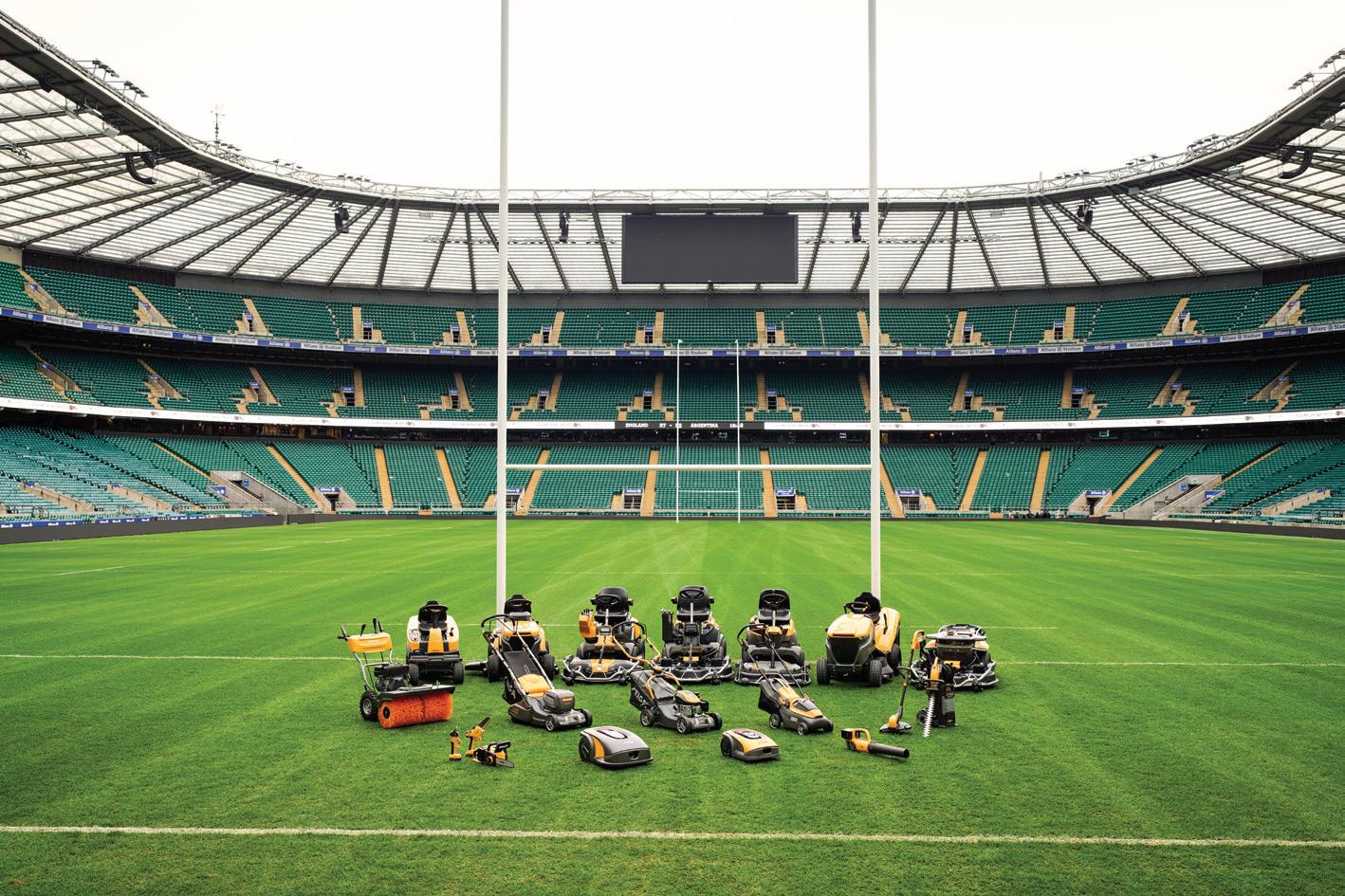
The Rugby Football Union has teamed up with STIGA to support grassroots rugby clubs, as well as the senior men’s team and the Red Roses
26 BEST PRACTICE: COMMUNITY SPORT
When Welshpool Town FC juniors lost their pitches, the community rallied to create new playing surfaces – with the help of the GMA and the Welsh FA
30 SPECIAL REPORT: DAVE WITHERS
The sales and supply guru brings his ‘customers first’ approach to the GMA board and the future of grounds care
50 60 SECONDS WITH…
Steve Birks on his award-winning career at Trent Bridge, his strategies for success and plans for retirement
TECHNICAL
33 BUILDING WATER RESILIENCE IN A CHANGING CLIMATE
We delve into new water-use strategies to boost turf performance in the face of climate change
36 MULTI-SPORT SYNTHETIC SURFACE STANDARDS
How the FIH and FIFA are developing pitches that can be used for both hockey and football
39 IN ACTION
Products and services used by NEC Birmingham, Towcestrians Sports Club, Bedford School, Hibernian FC, GVA Training School and Leigh Sports Village
43 MAINTENANCE TIPS
Spring operations
47 PRODUCT NEWS
Product news and launches from STIHL, Makita, Campey Turf Care, Howardson Group, GKB and Suståne
TRANSFORMING TURF AND TEAM
Since Brentford FC switched from contractor-based grounds maintenance to an in-house team, head of grounds Tony Stones has built a strategy that has helped the Premier League club to achieve its vision for excellence
BY COLIN HOSKINS, FREELANCE WRITER
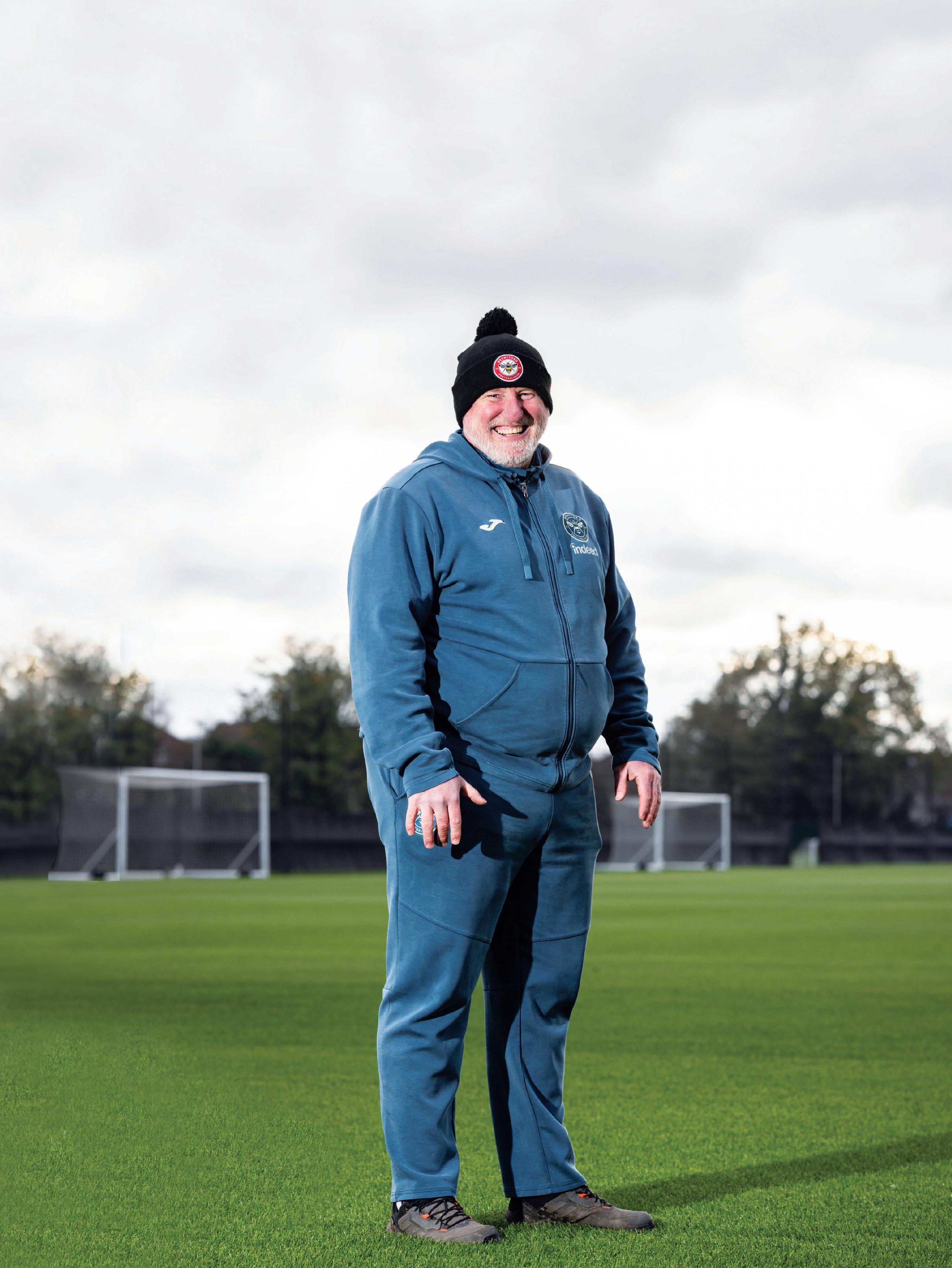
Tony Stones has had a very busy time since being appointed head of grounds at Brentford FC in April 2023. He’s implemented effective pitch maintenance and management techniques, established three new pitches at the training ground and instigated an ongoing recruitment campaign, as well as spearheading a substantial machinery and equipment investment programme.
His pitch improvement gains include the west London-based Premier League club’s Gtech Community Stadium and its first team training, academy and youth pitches in Osterley, near Heathrow (where three new pitches were constructed in 2024) as well as at the Wheatsheaf Park stadium in Staines-upon Thames – home to the club’s reserves (B team), U-18s and women’s teams.
I SAW THAT THE GOALMOUTH AREAS WERE QUITE WORN, SO ONE OF THE FIRST CHANGES I MADE WAS THE INTRODUCTION OF PRE-GERMINATED SEED. IT MADE AN IMMEDIATE DIFFERENCE
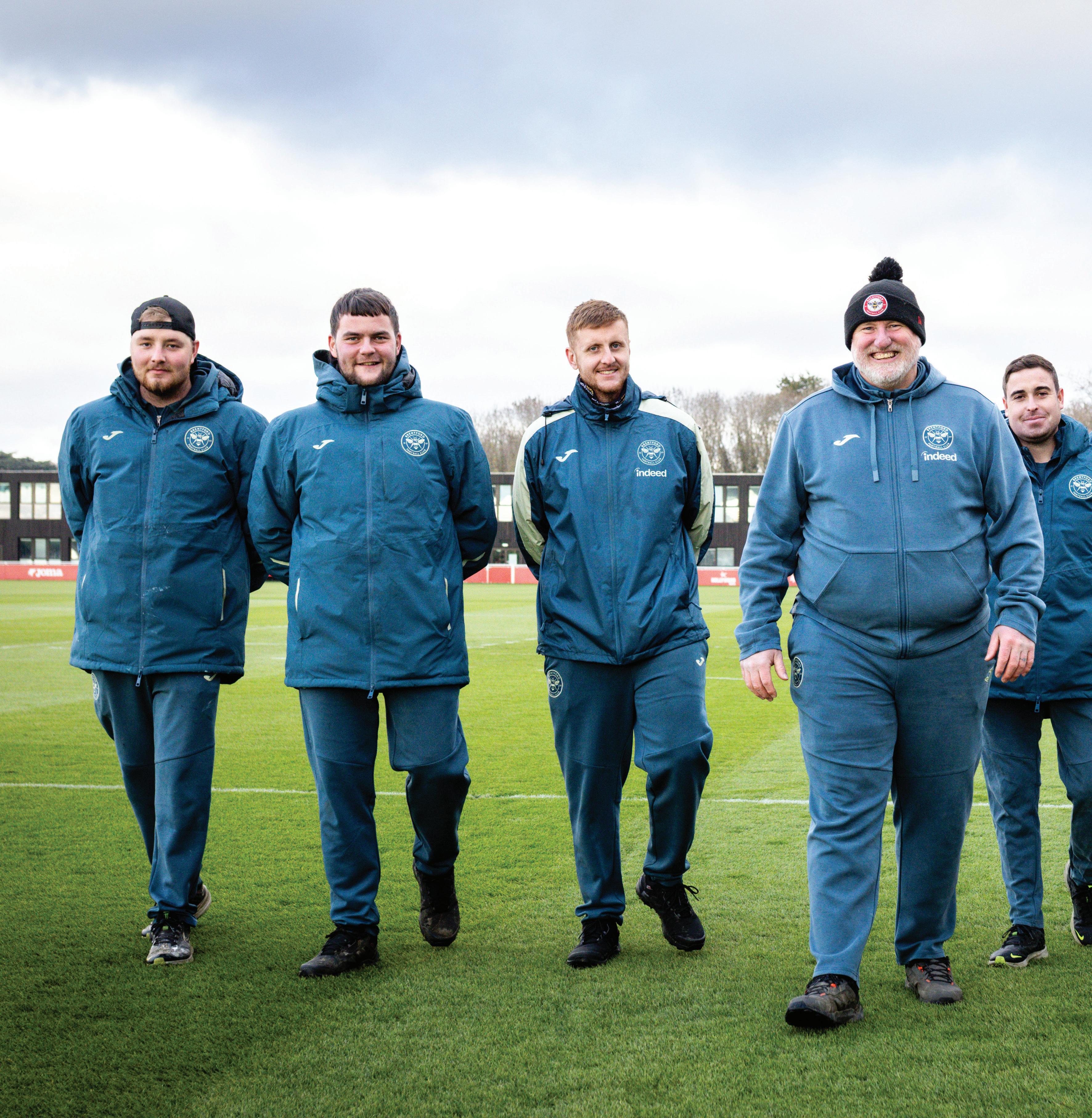
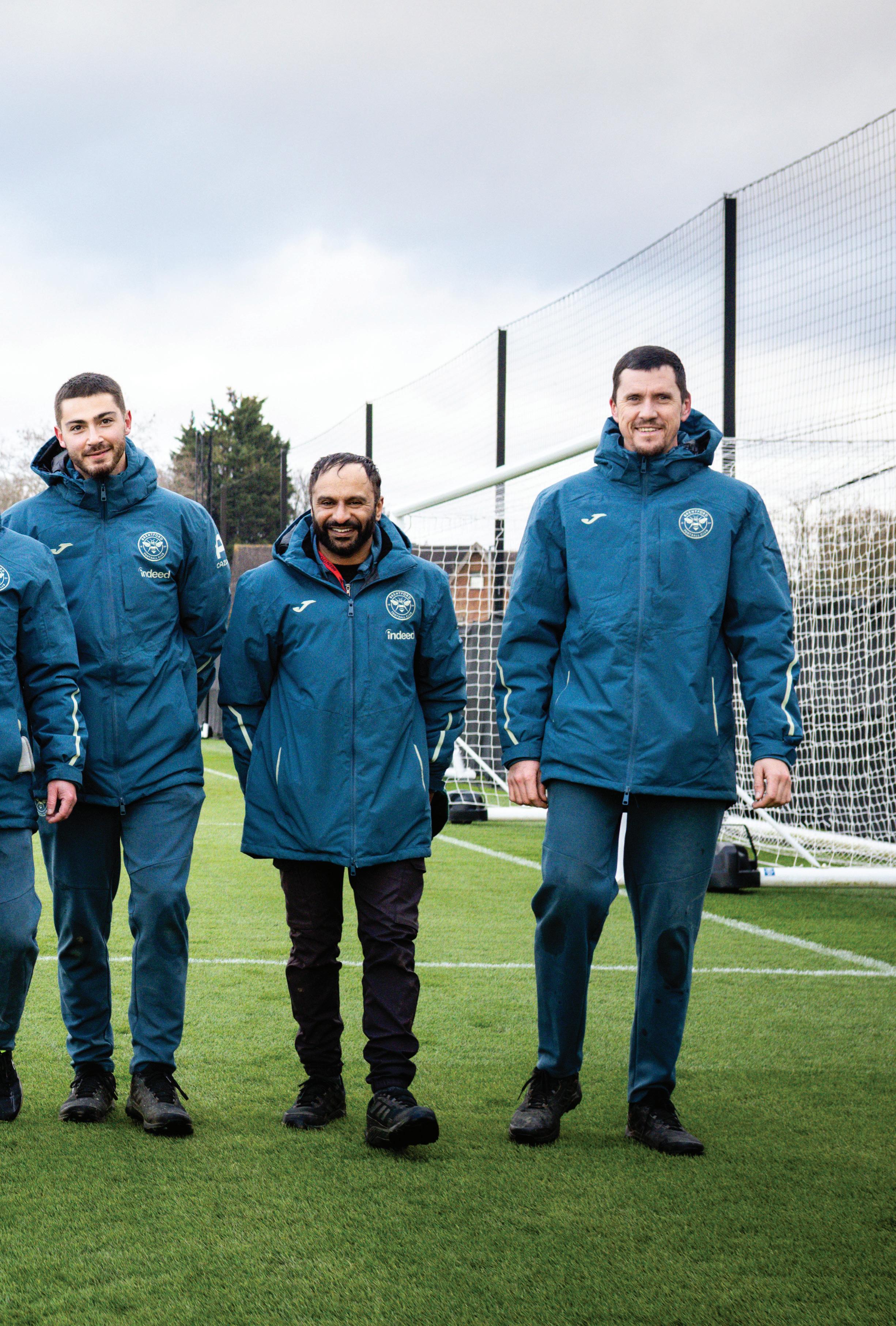
Left: Brentford FC’s grounds team: Conner Moore, Ronny Moody, Charlie Ryan, Tony Stones, Ben Fisher, Alex Richardson, Mazz Razaq and Justin Gray
His recruitment campaign has meant the number of grounds team members has expanded from three to 19 to cover the three sites. And his machinery installation programme has been characterised by the introduction of electric mowers for the stadium and training ground, as well as new aeration equipment, plus a set of leased machines including ride-on hybrid mowers for the academy pitches.
FROM RYE TO ROTATION
Improvements in pitch playability, wearability and aesthetics have always been Tony’s raison d’être – an in-built desire that in recent times has seen his considerable levels of experience and expertise utilised in consultancy roles at other London-based Premier League clubs. But the need to build a grounds team and equip them with appropriate machinery was driven by the fact that his appointment coincided with a decision by the Bees to switch from contractor-based grounds maintenance to using an in-house team.
Tony is committed to the “quest for improvement”
LIQUIDS ARE APPLIED TWO TO THREE DAYS BEFORE MATCHES ON THE DESSO GRASSMASTER STADIUM PITCH, IN PARTICULAR, TO GIVE THE PITCH ITS ‘MAKE-UP’ FOR THE TV CAMERAS
“When I took over, the plan was for me to observe and oversee pitch maintenance for two months while the contractor worked its notice, but I lasted only three days before I got involved,” says 49-year-old Tony. “I saw that the goalmouth areas were quite worn so one of the first changes
I made was the introduction of pre-germinated seed – Rigby Taylor’s R140, a tetraploid-diploid perennial rye, which responds excellently even in cool/cold weather – to speed up sward re-establishment. It’s something I’ve always done [including in his previous roles at Wembley Stadium and Stade de France] and it made an immediate difference.”
Other aspects of pitch improvement at the impressive Osterley site (named the Robert Rowan Performance Centre in honour of the club’s late technical director) include pitch rotation on the first team’s three training pitches: “We close down one pitch, in rotation, for six weeks after every 12 weeks’ use and the surface recovers well, even in winter,” he explains. “These pitches [and six others at the site, where there is a total of 14 pitches] are HERO hybrid surfaces – effectively double-stitched carpets – so this undoubtedly helps with their recovery. We also introduced granulated fertilisers instead of being heavily reliant on liquid feeding,
NEW MACHINERY AND EQUIPMENT
Brentford FC has made significant investment into new machinery and equipment for the stadia and training site, including:
A series of Dennis electric pedestrian mowers
Verti-Drain deep-tine aerators from Redexim
A Toro ProCore aerator
A fleet of leased John Deere machinery, including ride-on hybrid mowers
although liquids are applied two to three days before matches on the Desso GrassMaster stadium pitch, in particular, to give the pitch its ‘make-up’ for the TV cameras.”
PITCHING IN
Annual renovations are carried out at each site, with a contractor undertaking Koroing and sand application (Hewitt Sportsturf undertaking this at the stadium and Premier Turfing at the training ground). Tony says: “By using pre-germinated seed, we usually expect
to be mowing the new surfaces within eight days. All seeding and postrenovation maintenance – which has included the installation of new drains in some areas at Osterley – is carried out by Tony and his team. The training pitches are mowed to 24mm and the stadium is held at 21mm. Aeration is a regular key activity and we Clegghammer test each pitch every week.
“I am always tweaking the routines and pushing the boundaries in the quest for improvement. You could say I’m a member of the 1 per cent club: constantly seeking even the smallest gain to attain perfect playing surfaces.” Proof that his efforts are paying dividends is measured by the laudatory comments of his pitch users.
TEAM BUILDING
Tony has 16 pitches in his remit, as well as surrounding grass and landscaped areas at the training ground. As mentioned, he inherited a team of three full-time grounds people across all three sites and he has since been gradually
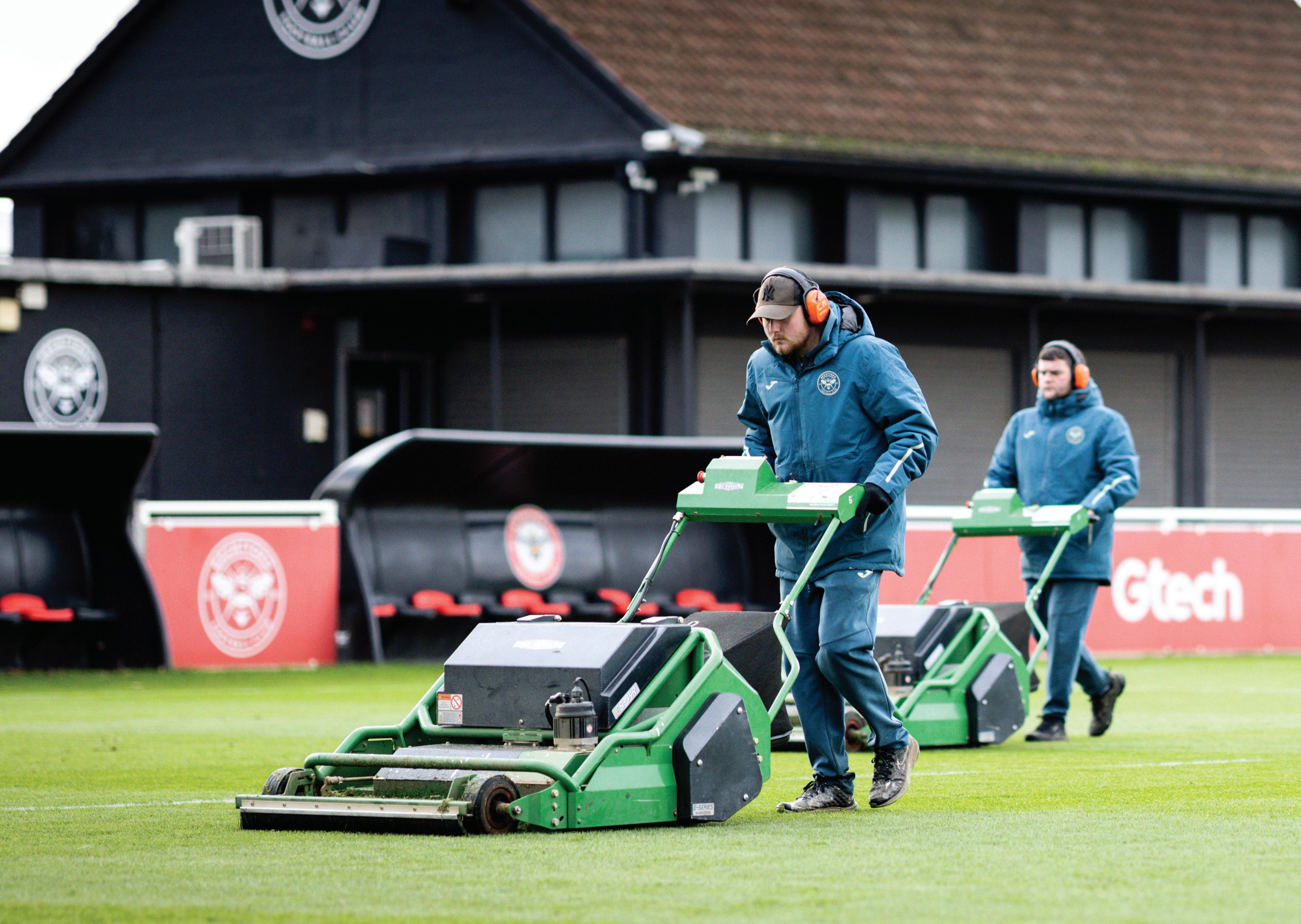
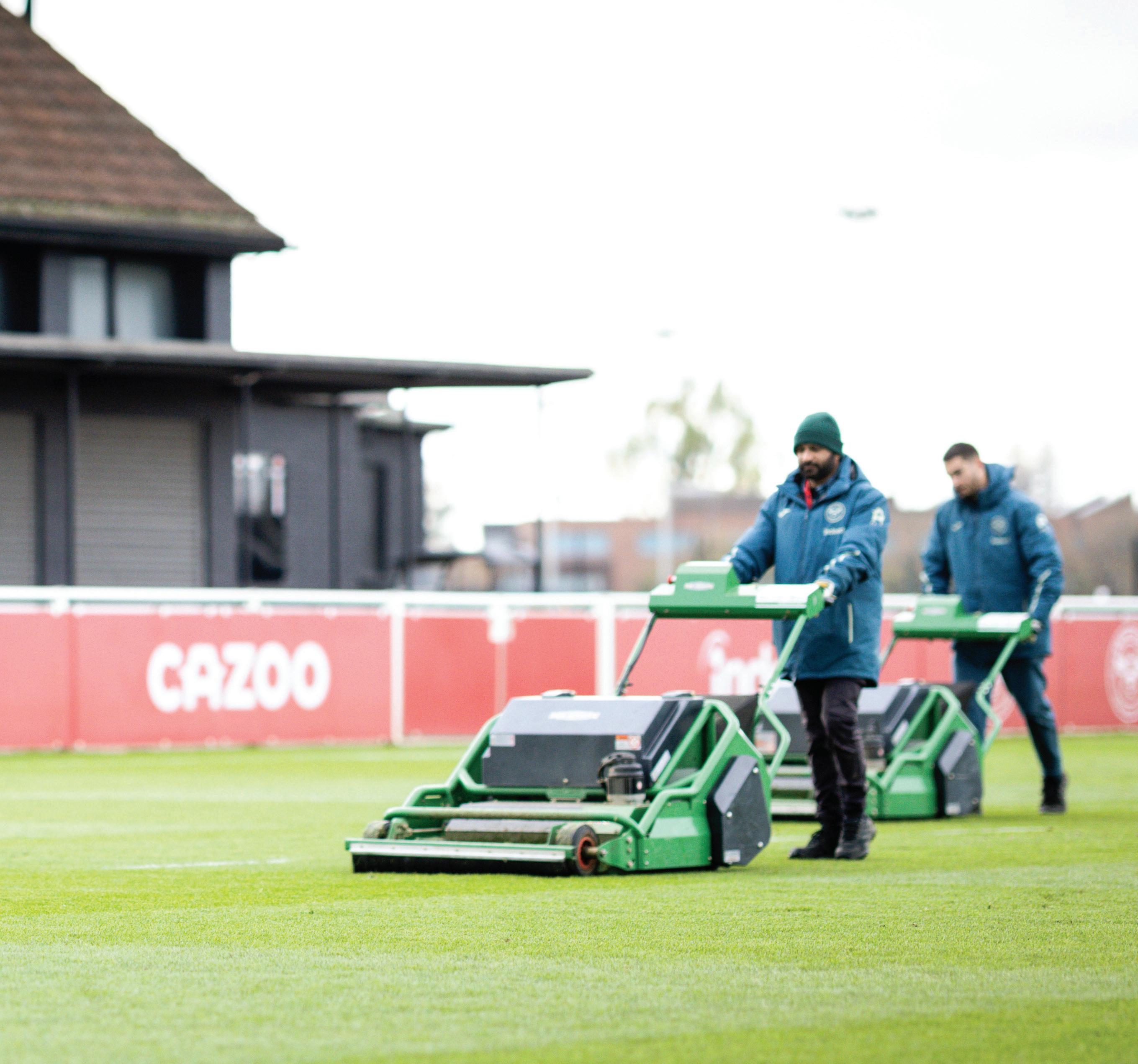
Left: The stadium and many of the other pitches are cut using electric pedestrian mowers
YOU COULD SAY I’M A MEMBER OF THE 1% CLUB: CONSTANTLY SEEKING EVEN THE SMALLEST GAIN TO ATTAIN PERFECT PLAYING SURFACES
building on that number, although he admits “finding people has not been easy”. That said, recruitment continues and it’s undeniable that staff welfare is a priority at the club. For example, electric mowers are more user-friendly, produce less noise and minimal vibration, and are kinder to the environment: “The stadium and many of the training ground pitches are always cut by the pedestrian mowers. Each member of the team has Bluetooth ear defenders so they can listen to music, perhaps, while they work – it also means they can be contacted by phone,” he says.
In addition, a specific working pattern is in place for the grounds team to ensure adequate breaks: work Monday to Wednesday – Thursday off; work Friday to Monday – Tuesday off; back in Wednesdays to Friday – weekend off, all on a four-week rota. They also have access to a smart facility for changing, showering, eating and relaxing. The team also has what must be the country’s largest machinery and equipment store, which measures 60m by 20m.
CORE VALUES
Ongoing training is also a feature, encouraging and helping staff scale the education ladder, with spraying courses and NVQ Levels 1 to 3 in grounds care, for example, on the agenda. In addition, each member of the team is fully conversant with every task that’s required on the pitches, so there’s always cover for maintenance routines.
The club’s mantra is one of being a community club where “everything we do is driven by our core values of togetherness, being respectful and progressive”. And it’s clear that those sentiments fully embrace the activities and wellbeing of Tony and his team. Their workload never ceases, especially with the club’s plan for an indoor pitch on the Osterley site as well as their incessant desire for continual improvements to the playing surfaces.
HYBRID PLAYING SURFACES
Brentford FC utilises two different hybrid playing surfaces at its sites:
DESSO GRASSMASTER (AT THE STADIUM)
The Desso GrassMaster model reinforces a natural grass pitch by vertically inserting 20 million polypropylene (PP) fibres into the soil equally spread over the entire playing surface. The 20cm-long PP fibres are injected 18cm deep so that 2cm remains above the surface. The PP fibres are inserted in a grid of about 2cm by 2cm. The grass roots entwine with the fibres and therefore grow deep and wide. The fibres give stability to a predominately sand-based structure by reinforcing the profile; provide an anchor around which the grass roots can entwine; and maintain the uniformity and even the level of the playing surface.
The GrassMaster pitch, showing the natural grass roots entwining with the polypropylene fibres
HERO (AT THE TRAINING GROUND)
A HERO surface is defined by having 5 per cent of the playing surface as artificial grass and 95 per cent as natural grass. Each fibre is 65mm tall, with 45mm in the profile and 20mm free in the natural grass. The underside of HERO is a reticulated grid, a structure that is 85 per cent open and therefore not characterised as a backing. The vertical fibres are anchored to this horizontal grid via knots. The fibres extend from each junction of the grid, so the symmetry of the grid is reflected in the symmetry of the fibres. This open construction creates an ideal growing environment for natural grass to thrive with no impediment to root growth.
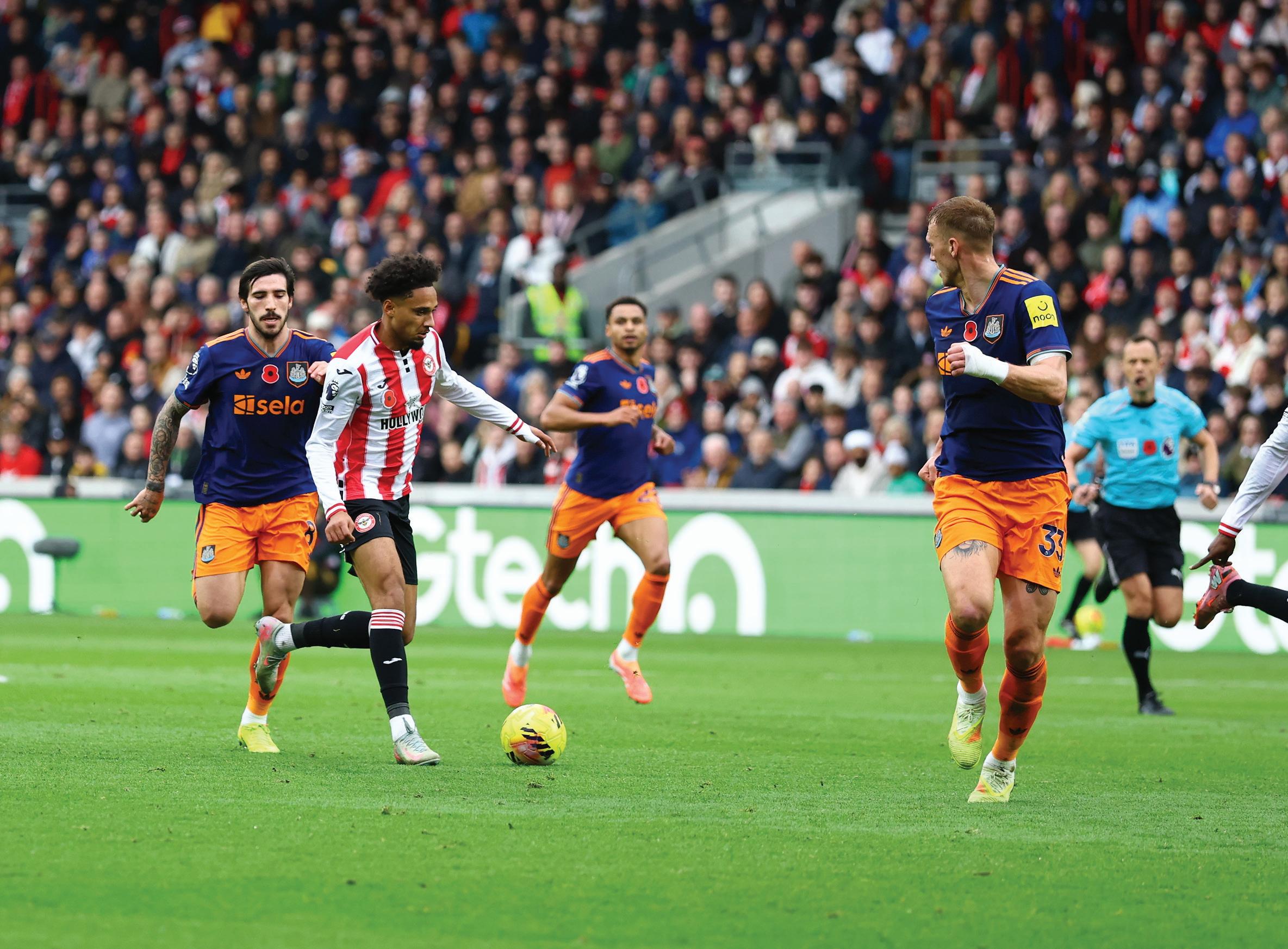
Brentford FC play Newcastle United on the stadium’s top-class pitch