
GTheettysburgian

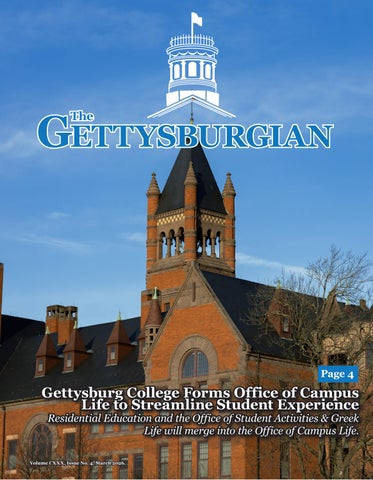
Gettysburg College Forms Office of Campus Life to Streamline Student Experience
Residential Education and the Office of Student Activities & Greek Life will merge into the Office of Campus Life. Page 4
A Note From the Editor: On Human Connection through Communication
By Sophie Lange, Managing Editor
It is hard to believe we are over halfway through the spring semester, and as a senior, I am certain I am not alone in saying that my time at Gettysburg feels far shorter than four years. In many ways, I feel as though I just got here, and yet, in less than two months, the Class of 2026 will walk through Pennsylvania Hall and emerge as graduates. As my final semester at Gettysburg draws to a close, I have come to realize that one of the greatest gifts I received from this institution is the power of communication. In many ways, the ability to communicate is the uniting factor among us all. Humanity has spent lifetimes developing spoken language, writing systems and, more recently, channels for digital correspondence across the globe. Initially, sure, these methods were born of necessity, but reducing them to such simplicity would diminish the wonders we have constructed through our desire to communicate our emotions and experiences with one another. Through this longing for human connection, we have created some of the most spectacular works of art and literature.
In my time at Gettysburg, I have discovered that I, too, have the ability to communicate with others, both effectively and confidently. Going all the way back to my First-Year Seminar (“Green Eggs and Government Cheese,” if you were wondering), I had to learn how to collaborate and compromise with my classmates during group projects, in both written and verbal contexts. At first, it was difficult, and I struggled to come out of my shell. Then, I joined The Gettysburgian as a contributing writer in October 2022, and thus began my discovery of the ways in which we can use the written word to connect with one another.
This past December, I presented my capstone on water quality in Adams County in front of an entire department of professors and peers in collaboration with one of my fellow environmental studies majors. If you had told me four years ago that I would be speaking in front of that many people, I would have laughed, but it is thanks to the support I have received from faculty and friends that I have been able to arrive where I am now — preparing to graduate with a Bachelor of Arts in Environmental Studies, Spanish and Public Policy.
In the fall, I will begin a new chapter of my life in Syracuse University’s Master of Public Administration program, where I will bring with me all of the opportunities and abilities afforded to me by my education at Gettysburg, with effective communication in a changing world being perhaps the most vital of them all. In this issue of The Gettysburgian, many of our stories explore how we use communication to connect with one another, including a spotlight on two community members who are studying art history at Gettysburg, a focus on the college’s latest design updates and a feature on WZBT Gettysburg, the college’s student-run radio station.
Yours Truly,

Sophie Lange Managing Editor

(Photo by Nicholas Lange)
By Ella Prieto, Editor-in-Chief
By Sophie Lange, Managing Editor
Jules Young, A&E Editor
Max Ferguson, Staff Writer
Caitlin Rubsamen, Sports Editor

Gettysburg College Forms Office of Campus Life to Streamline Student Experience
By Ella Prieto, Editor-in-Chief
Last semester, student staff of the Office of Student Activities and Greek Life (OSAGL) and Residential Education (ResEd) were alerted via email that the two offices were merging into an Office of Campus Life. It featured a forwarded email by Vice President for College Life Anne Ehrlich, where she stated, “This strategic integration reflects a fundamental truth about the student experience: students don't separate their residential life from their campus engagement, and neither should we. By bringing these teams together, we're creating a more seamless approach where living, engagement, and support are truly integrated. This unified structure will maximize our collective capacity to support the whole student.”
This merger was Ehrlich’s vision, as the previous college she worked at had one office for student activities and residential education. She believed a similar office would improve Gettysburg, and saw now as the time to act, as the College works on several initiatives to improve student experience.
The main goals for the merger are to streamline student experiences and reduce redundancies. In the past, students have often been bounced between OSAGL and ResEd for their needs; additionally, student leaders often undergo training in both offices, which can be repetitive. One Office aims to cut down on that, by creating a singular
place where students can be helped.
“I want a super vibrant Office where, if students feel like they need support, need community, need to have fun, they know they can go to that Office, and all their needs are going to be met,” said Ehrlich. “They will find their people, find their support system and find a social life that is as vibrant as the academic life on campus.”
Ehrlich also compared the merger to the creation of the Center for Student Success, which was a merger between the Office of Academic Advising and the Office of First Year Programming.
“What was happening is that students were going to Academic Advising because they were having trouble in a class, and they needed support. But then maybe the reason they were having trouble is that they were having a really hard time adjusting to living here,” Ehrlich explained. “So then they were being bounced around both offices, as they were trying to help with two issues that were essentially the same problem, just different sides. So, we merged the offices together, because we realized most classroom problems are somehow related to personal problems. We are trying to do a similar process with the Office of Campus Life.”
The thought process for Campus Life was that the two main ways students find community are through their residential experience and student activities, so making those feel more cohesive will increase student
belonging and community. Current projects spearheaded by OSAGL and ResEd, such as the Integrated Living Communities, will also now be easier to accomplish.
In recent months, the integration process has already produced changes at the College. OSAGL Director Jon Allen has been promoted to Associate Dean for Campus Life, while ResEd Director Danielle Phillips will serve as the Assistant Dean of the Office. Two employees have also been let go, one from OSAGL and one from College Life. Ehrlich elaborated on this decision, saying it was not solely because of the Campus Life merger.
“We have known for years that our student body is shrinking, and therefore, in some areas, our workforce has to shrink,” she explained. “In terms of realizing that we had the capacity to eliminate two positions in College Life, that happened over the course of conversations with leadership in each office. It was really, really hard to eliminate those two positions. That’s never going to be our preference. But this merger presented an opportunity that we couldn’t pass up, and it was the responsible thing to do.” Moving forward, the College is working to eliminate positions through employees voluntarily leaving, arranging initiatives such as the Voluntary Separation Incentive Program (VSIP). However, Ehrlich emphasized that critical positions, such as Campus
Safety Officers, will continue to be filled and maintained. She also assured that the College does not want to eliminate student employees, as those roles are needed by many to fund their education and provide work experience.
In the new Office, roles are being shifted to better serve students. Phillips, for example, will be taking on conduct processes, and current Associate Director of Paige Cook will supervise non-college house and upperclassmen residences while she continues to oversee social programming. The goal of these shifts is to strategically place responsibilities with the employees most capable of handling them while also maintaining a balanced workload for them, so they can best serve students.
Some students have expressed their worry over this change, not seeing the need for the merger and worrying it will make it more difficult to meet with staff members as they take on different roles.
“I would encourage people to have an open mind in experiencing the new Office of Campus Life,” replied Ehrlich to those concerns. “I have tremendous faith in Jon [Allen] and Danielle [Phillips] to create something that’s vibrant and exciting, and we will get lots of feedback along the way and make tweaks when needed.”
Allen and Phillips both expressed their excitement at the merger, reiterating the message of a more supportive space for the student experience.
“I want to be part of an office that can be a seamless resource for students and help students think about their experience more comprehensively. And to do that in a way that is responsible with resources and

as efficiently as possible,” said Phillips. “I think the biggest takeaway I have for students who are concerned is to engage with us. Ask us your questions.”
“The overarching goals are for everyone to find a community and to feel supported,” added Allen. “We are also helping other departments, hence our name of ‘Campus’ Life. That includes the scheduling pieces and the event support. We want to create a cohesive place where all of campus can find what they need to produce the best possible outcomes for their projects.”
The work for the Office of
(Photo William Oehler/The Gettysburgian)
Campus Life is still ongoing, as leadership works to finalize a mission statement, which they will then exhibit to stakeholders to get feedback on. The current timeline is for the Office to be finalized by the end of this semester, so staff can work throughout the summer to operate as one office by the start of the next academic year. Those with questions or concerns about the merger can be on the lookout for a survey sent from the Office for feedback or reach out to jallen@gettysburg.edu. ∎ 5 The
Hills and Hills and Even More Hills

By Isabella Rapucci, Guest Writer
ATHENS, GREECE—
When picking Greece as my study abroad location, I was shocked by how much of this countrywas uphill. Anywhere that I need to go, it is almost a 90 degree angle. Similarly, in my personal life I was overcoming a lot of mental hills, learning what it is like to pack up my life and move somewhere entirely foreign. These many hills and mountains began to hold a deeper significance for me, and I learned to hold a special place in my heart for what was at the top of these hills.
Leaving the US and all its familiarity behind me proved to be more difficult than I had originally thought. It was the first time I had ever left the country, let alone the East Coast. In all honesty, I was scared of leaving what I knew and giddy at the idea of experiencing an entire new sector of my life. It was a big step for me in my life, leaving what I know and leaping into the unknown. It was a big hump (pun intended) that I had to climb and overcome. When I arrived, it felt like freshman year all over again. I was in an unfamiliar place with unfamiliar people, and I felt like I was reverted back to my 18 year old self. Almost like an uphill battle, with no end in sight. But as the weeks passed on, I began to become more familiar with my surroundings, creating new connections. With every hill that I climbed in the city, I climbed a new one in my mind, creating a new version of myself with every mental mountain I overcame. Over the last almost two months, I have become a new version of myself that I never thought
was possible. I have finally created this new life for myself.
I have created memories that I will remember for the rest of my life, because I kept walking up that hill. I have made new friends out of Athenian locals, became closer with other Gettysburg students here with me, and created new connections with students from other universities. Because of my decision to climb that hill of going abroad, I have created memories that I will be sharing for the rest of my life. If I had stopped walking, I wouldn't have seen the beautiful and rewarding outcome of my life. There are many other, new mountains that I would like to climb during my time abroad, simply to see what is at the top. I urge those that intend to study abroad, that no matter where you go to give it a chance, It may seem daunting to jump into an entirely new life, but I promise that the rewards outweigh the fear. Going into it scared is better than not doing it at all.
Like the hills in Athens, studying abroad is full of hills but at the end of the day, the struggle of walking up the hills is worth it for the view. ∎


(Photos Isabella Rapucci/The Gettysburgian)
Theater Department Features World Premiere of “Twin Hearts,” by Susan Russell
By Jules Young, Arts & Entertainment Editor
On Thursday through Sunday, Feb. 26th to March 1st, the Gettysburg College Theater department put on the play “Twin Hearts,” written and directed by theater professor Susan Russell. This production was the world premiere of the show; a play about Helen Keller and her teacher, Anne Sullivan. The play was a fascinating take on the Helen Keller story, by having Keller and Sullivan be represented with equal importance. The play spanned across Sullivan’s life before meeting Keller, through Keller’s childhood, and into Keller’s young adulthood. Along the way, there were major themes of civil rights, specifically the tension between Sullivan, an activist, and Keller’s family, in that her father was an officer of the Confederate army.
“Twin Hearts” was mainly structured around real letters that were sent back and forth between Sullivan and the school for the deaf and blind she worked for in Boston. These letters had a place in the show in the form of monologues that placed the scenes in their historical context. Beyond that, Russell took creative liberty in exploring the relationships between characters that added a great deal of depth to the story.
Russell gave a speech on her play before the show began, describing some of the many iterations it had been through to make it to this point. She explained that it had been a passion project of hers for years. The play had been performed at its various stages of development, whether it be table reads or unofficial

stage performances, of which the actress who played Anne Sullivan was present in the audience for the Saturday night performance. Russell even said that at one point the play had even been a musical, some elements of which shone through the final, straight play version. Russell ended her speech by expressing that this is not the definitive version of “Twin Hearts,” and encouraged the audience to provide any feedback they may have for future edits.
The play featured Lee Repins ’26 as Anne Sullivan, who delivered a wonderful performance, taking on the hefty lead role with ease. Helen Keller’s role was taken on by three talented actresses, Aida Cunningham ’29 as older Helen, Julia Watts ’29 as the narrative voice of Helen, and Auri Sainer as child Helen. Other great performances were given by Keira Gorman ’29 and El Monzon ’26 as Michael and Julia Anagos, Sarah Louise Huebschen ’26 as Artemisa Gellman and Laura Bridgman, Christian Boruch ’28 and Olivia Van Tuyl ’27 as Captain Arthur Keller and Kate Keller, Maggie Fernald ’26 as
Viney, Eileen Li ’27 as Madame Legrand and Sherwood Jones as Uncle Frank. The entire cast put on a great show that truly brought Russell’s play to life. Overall, “Twin Hearts” was an engaging and enlightening depiction of the Hellen Keller story, one that focused not only on her achievements despite her disability, but how she came to be able to do so, and those who helped her along the way. The relationship of a person who is deaf and blind and the one who teaches them how to express themself is something incredibly special, and Russell captured that between Sullivan and Keller’s characters beautifully. ∎
(Photos Piper Pokorny/Owl & Nightingale Players)

Different Journeys, Same Destination: Two Gettysburg Community-Members' Auditing Stories
By William Oehler, Director of Photography
Schmucker 302 serves as host for two new students this semester, but neither shares a typical journey to Gettysburg, the College nor its classrooms. Don Wilcox and Joyce Wendler are two current community members auditing classes within the Art History department. While they may not have planned on ever taking any classes at the College, it always seemed that fate would bring them here.
Wilcox’s story begins during a high school trip down to Washington, D.C. He remembers stopping in the historic town center, but he and all his classmates were just itching to get to the main event of their trip; Gettysburg was simply a pitstop between them and the nation’s capital.
After going to seminary from 1972 to 1976, Wilcox became a Lutheran pastor and continued his work in pastoring in New York state until he retired in 2007. Within his three-decades long career, Wilcox received his master's degree from Temple University and lived in Israel for two years.
Although he received a bachelor's degree in electrical engineering and math, Wilcox was later drawn to the art world. During the first couple years of his retirement, Wilcox would think about what was next for him. He talked about a friend who happened to be an art historian. She was in Paris for a few months and invited him out to explore the city with her. Wilcox spent ten days in Paris being guided around the

city by an expert, dissecting every little detail of the art before him. This was one experience that propelled him into the world of art.
His trip to Paris along with his love of American and European impressionists like Claude Monet, gave him the inspiration to audit classes at the College. Wilcox described the process of registering saying, while it may have been lengthy, it was not difficult at all. Between the classes being free, the lack

of exams and the infectious enthusiasm of Professor Felicia Else, Wilcox has since audited three classes, and plans on more.
Beginning with Else’s Northern Renaissance class, he then shifted to the more general, Survey of Western Art course, and rounded his catalog out with the class he currently audits, Art of the Italian Renaissance. Wilcox wanted to be involved after his retirement. Being a part of a college town is one thing he appreciates. He cited the “access to intellect”
(Photos William Oehler/The Gettysburgian)
that the campus offers and all the opportunities for continued learning at the College, for both students and community members. He often attends lectures, plays, sports games and other campus events.
Wilcox’s Gettysburg story began with a childhood visit to the battlefields with no planned intention on settling in the area once retired. His move into the art world was equally unplanned, but just as lucrative. Wendler’s story has similar twists and turns, and even the affinity for the same museums.
Similarly to Wilcox, Wendler visited Gettysburg on a trip with a friend. However, Wendler was not as enthusiastic about her Civil War buff friend, though she was interested in the history. This was her first contact with what would eventually come to be her home. Wendler currently lives in the Amblebrook community just a few miles away from the College.
She first fell in love with art on a backpacking trip with a girlfriend in 1976. She went all over Europe and stopped in Italy and knew she needed to visit the Sistine Chapel in the Vatican City. She stared up at the ceiling and was enthralled. She referenced this experience as a main drive to audit the Italian Renaissance course.
After her trip around Europe, she returned stateside and worked as an educator for about thirty years. She instructed special education, kindergarten and early childhood students. She mentioned that her dream was always to teach. But she commented that she always wanted to go back to college as she had earned her associates degree with the lifelong intent on returning for a four-year degree. Only having moved to Gettysburg eight months ago, Wendler is a new member of the community, but she says it is the perfect location; between both her children in Western PA and
Phoenixville respectively. Originally from Plymouth Meeting PA, Wendler still has friends in the Philadelphia area whom she regularly visits. It was one of these friends who mentioned auditing classes at colleges (and whose whole family attended Gettysburg College). This was Wendler’s sign to head back to school.
Today, Wendler is also a student in Else’s Art of the Italian Renaissance course and has every intention of taking more classes. She has an art background in her family and has always been interested in documentaries and cinema. She mentioned maybe even adding Professor James Udden’s History of World Cinema, 1945 to the Present course when offered in the future.
Wendler shared a story in connection with her love of art and the artist George “Frolic” Weymouth. Weymouth was an American artist who organized the founding of the Brandywine River Museum in Chadds Ford PA. He was also commissioned to paint a portrait of Prince Philip, Duke of Edinburgh in 1995. It was this very painting that Wendler was invited to sneak a peek at when her friend, the house manager for Weymouth, unlocked the door to Weymouth’s work room,

and there stood the portrait, half finished.
Wendler and Wilcox both shared how the Brandywine River Museum was a shared gem in their lives. Wilcox’s first visit was serendipitous, having first planned to see the Delaware Art Museum. After taking a few wrong turns, and refusing to ask for directions, Wilcox ventured home, but he came to a stop light, and there was a sign pointing in the direction of the Brandywine. He decided it was an indication he should visit.
Both Wilcox and Wendler found their way to Gettysburg’s campus in similar ways; never having thought of art as an area of study, falling in love with it in the cradle of western art in Europe, and then choosing Gettysburg as their new homes. After taking just one of Else’s courses, both commented on how her innate passion and energy surrounding any form of art was all they needed to say yes to more classes.
For those looking for a little extra learning in their lives, and experiences similar to Wilcox and Wendler, you may access the audit application form on the Registrar’s home page. ∎

Broadcasting the Voice of Gettysburg Through Student-Run Radio
By Sophie Lange, Managing Editor
At the time of its first broadcast in 1949, the studentrun radio at Gettysburg College was known as “WWGC The Voice of the Campus” and was located on the third floor of the “Science Hall,” which has since been demolished. Until 1975, WWGC was a closed-circuit AM radio station and only transmitted to dorm rooms and dining halls through the existing power lines. During this time, it was financed by the students’ chest and advised by members of the college faculty. Then, the Board of Trustees granted approval for the radio’s transition to a full-service FM radio station, and WWGC became WZBT 90.3 FM after receiving its first FCC license for educational broadcast. By 1991, the station moved to its current studio located in the basement of Plank Gym. Since 2008, WZBT has operated 24/7 thanks to an automation system that allows the continual broadcast of music, even without the presence of a live DJ in the studio. Today, the station broadcasts on 91.1 FM from Gettysburg and on an online streaming platform at wzbt.org.
Currently, the station is run by two Co-General Managers: Dan Teodorescu ’27, who joined WZBT as a sophomore, and Charlotte Bruchey ’27, who joined at the beginning of her freshman year. Both Teodorescu and Bruchey became very involved with leadership opportunities very early in their time as DJs at WZBT.
Teodorescu became the News

Director shortly after his first all-DJ meeting, which involved producing an hour-long talk show about local news each week, before becoming the General Manager this past fall. When asked about his experience in the station’s leadership, he said, “It has been a lot of fun getting to know my fellow DJs and being there for them when there are technical difficulties. Although DJing is usually done alone in the booth, many DJs, especially recently, invite friends to sit in on their shows or even co-DJ. Despite radio typically being a solitary activity, we still form community and collaborate.”
Bruchey began assisting the Public Relations Director and the Music Director before becoming the Music Director herself in her second semester. She held that position until the spring of her
sophomore year, when she began training to become the station’s General Manager.
“Leadership roles are so accessible in WZBT, and they offer such a wide range of training and skills. You can find a way to access anything you may be interested in, and I have appreciated the variety of positions I’ve interacted with here,” Bruchey stated about her experience.
WZBT has created a strong community both on- and offcampus. In addition to the many call-ins from campus and community members that the station receives during live DJ shows, the station has even added a show run by DJ Captain Midnight, a member of the local community, on Thursdays from 9 to 11 p.m. Teodorescu described the show, known as “Land
A view from within WZBT's studio.
(Photo Alice Van Etten/The Gettysburgian)
ON AIR

Beyond the Sun,” as “an entrancing ambient and drone music show.”
Any student or faculty member at Gettysburg, as well as local community members, can have shows on the station, strengthening the diversity of what is broadcast on WZBT.
“Student engagement really depends on the show and what the DJ wants that to look like,” Bruchey explained. “Some DJs open their shows to their friends, and they can sit in while broadcasting. Other DJs, like me, send our streaming link to anyone and everyone, and encourage friends and family members from around the country to tune in… We do have some off-campus involvement, but it can be difficult to tell where exactly listeners are coming from unless they call in.”

“WZBT welcomes anyone and everyone who is looking to participate, and there is always a home for you here.”
-Charlotte Bruchey ’27
Both Teodorescu and Bruchey run their own radio shows. Teodorescu
runs “Good Vibrations with Dan” on Fridays from 6 to 8 p.m., which explores a new theme every week.
“Having a show is a great way for me to relax at the end of each week and start my weekend. It has become a part of my routine, and it is great to have some time set aside each week to take my mind off my life and focus on DJing,” he said.
Additionally, Teodorescu ran a weekly local news program, “The Gettysburg Update,” which was written, researched and broadcast entirely by himself. He credits his time as the News Director with helping him discover his passion for local politics. Since he began “The Gettysburg Update,” he has interviewed candidates running for the Gettysburg Borough Council and the Gettysburg Area School Board. Although the show is currently inactive, Teodorescu is hoping to conduct more interviews on the air in the future.
Bruchey’s show is called Common Condiment and runs on Thursdays from 6 to 7 p.m. “I absolutely love it. It was definitely nerve-wracking at first, and I was nervous about messing things up, but it’s turned into a very therapeutic hour of my week,” she explained. “I look forward to making my theme for the week and crafting my playlist around that.”
This semester, Bruchey has

expanded her programming to include more interviews and contextual information surrounding the music she selects for her shows. On March 19, she had the opportunity to interview the band Horseshoe on her show about their upcoming album release.
“It is exciting to engage with different aspects of the community and incorporate that into what I broadcast,” Bruchey said.
When asked what they want students to know about the station, Teodorescu and Bruchey both expressed that it is a welcoming community that gives its DJs a great deal of freedom in what they choose to broadcast.
While there are federal regulations and college policies that must be followed by all DJs on the station, Teodorescu explained that, “WZBT is a place on campus for free student expression. In addition to doing a music show, you may also do talk shows on the radio about a subject of your choice. During your music show, you are also free to talk about what you like during air breaks. No matter your music taste, interests, or opinions, your voice has a home at WZBT Gettysburg.”
Bruchey encouraged students with any interest in the radio to participate: “It’s so easy to get involved, and it’s a very low time commitment! WZBT welcomes anyone and everyone who is looking to participate, and there is always a home for you here. We stream all kinds of music, and each DJ tailors their show to their interests, making our programming unique each week. We have such an awesome community of DJs who come from all over campus, and we always have more space!”
New DJs are typically added at the beginning of every semester, and interested students should contact WZBT’s executive board at wzbt_exec@gettysburg.edu for more information on how to join. ∎
Technology in the WZBT studio, located in the basement of Plank Gym.
(Photo Alice Van Etten/The Gettysburgian)
Students Take Charge: After 7 Years, Gettysburg Athletics Welcomes Back the Student Athlete-Advisory Committee
By Caitlin Rubsamen, Sports Editor

Every National Collegiate Athletic Association (NCAA) school has the opportunity to run a Student Athlete Advisory Committee, or SAAC. At Gettysburg, the last time the student athletes had a formal committee on campus was in 2018, and at that time, it was called SAIL, Student Athletes in Leadership.
Junior field hockey member Maya Viscardi-Carelse ’27 found out what SAAC was last spring when talking to Gettysburg Athletics’ Strength and Conditioning Coach Reggie Overton.
“One day, I was talking to Reggie about events or resources I wished we had as athletes on campus. He asked me why I don’t just tell our SAAC, to which I said, ‘What is SAAC?’” said Viscardi-Carelse. “After I did my research and I learned what SAAC accomplished at other colleges, I knew I wanted that for our student-athletes at Gettysburg College.”
Viscardi-Carelse worked with Reggie Overton to re-establish Gettysburg College’s SAAC, with Viscardi-Carelse serving as the organization’s president and chair and Overton serving as the faculty advisor.
According to Viscardi-Carelse, SAAC’s core responsibility is to represent, advocate for, and enhance the student-athlete experience while serving as the official bridge between athletes and institutional leadership. At Gettysburg, SAAC is composed of highly motivated NCAA-sanctioned athletes
who have a passion for leadership and motivation to improve the studentathlete experience.
“We operate with a chair, vice-chair, and executive board. On the executive board, there is an event coordinator, social media coordinator, treasurer, and secretary,” said ViscardiCarelse. “In the next academic year, SAAC will be composed of the executive board as well as multiple subcommittees which every team will have a representative a part of.”
Outside of Viscardi-Carelse, Gettysburg’s current SAAC executive team is Abbie Gold ’26 (softball), Emma Ward ’26 (tennis), Eleanor Ragan ’28 (field hockey), Colleen Ragan ’28 (field hockey), Ray Zamloot ’27 (treasurer), and Ava O’Neil ’28 (secretary).

“I want studentathletes to genuinely want to be part of SAAC because they see its impact on their experience.”
-Maya Viscardi-Carelse ’27
At Gettysburg, SAAC is designed as a platform in which student-athletes have a voice to influence policy,

protect welfare, and enhance their overall college experience with the overarching goal of providing student-athletes the opportunity to enact change within.
“It is an organization built upon uplifting each other and working together to make sure our voices are heard from an institutional to national level,” asserted Viscardi-Carelse. “It also helps streamlining
Maya Viscardi-Carelse ’27 plays field hockey. (Photo Courtesy of Maya Viscardi-Carelse)


information for our student athletes to the administration. It unifies all our teams under a shared identity and strengthens campus presence and athlete visibility.”
In the 2025-2026 school year, Gettysburg SAAC has already organized several events on campus, including partnering with Men’s Soccer to create a campus-wide event to increase attendance at their conference game and having every team collect food donations for those in need in Adams County through South Central Community Action Programs (SCAAP) to create four full baskets at the holidays.
partnering with the Athletics Department to adjust the senior athlete recognition ceremony to the first annual all student-athlete awards ceremony, which will be called “The Gettys.”
In the future, ViscardiCarelse hopes to build off of this award ceremony and build lasting traditions within Gettysburg Athletics, hoping that the full importance of SAAC is understood across campus.
“I want student-athletes to genuinely want to be part of SAAC because they see its impact on their experience,” said Viscardi-Carlese.
to launch a Division III week competition this spring. The committee also has several interactive ideas for next year.
“We hope to have ‘The Orange & Blue Games’, which are a year-round competitions between all NCAA-sanctioned sports teams. The way to earn points will be through attending Bullet Pride games, D3 week, social media challenges, community service, and alumni outreach,” said Viscardi-Carelse.

This spring, SAAC will be
Outside of The Gettys, Gettysburg SAAC is planning
Ultimately, Gettysburg SAAC hopes to better Gettysburg student-athletes and the community, as well as establish SAAC as an organization with productive subcommittees that all work together as one effortlessly. ∎
The Gettysburgian
Food Baskets donated from SAAC to SCAAP for Adams County families in need during the holidays.
(Photo Courtesy of SAAC)
Members of SAAC cheering on Men’s Soccer at the campus-wide event they organized.
(Photo Courtesy of SAAC)
Gettysburg College Reshuffles Housing with New Independent Living Communities
By Sarah Daniels, News Editor
For the 2026-2027 school year, the new Independent Living Communities will be in their first pilot year for seniors only. These new communities will “provide independence similar to off-campus living with all of the conveniences of on-campus housing.”
These repurposed college housing units offer single bedrooms for groups, and a new outdoor space only accessible to residents will be installed over the summer. Social events can be hosted there while accessing regular campus resources like Campus Safety. Corner Cottage (currently Farm), Lau (currently Blue Note), Smith (currently Writing House), and Van Horn (currently in the Ice Complex) will be converted from their homes into these Independent Living Communities.
According to Gray Reid, Residential Life Coordinator, the College Houses will be moving around.
“Art House is relocating from Constitution Apartments to Hutchinson House for the upcoming year. Blue Note Jazz

House is relocating and merging with Harmony House. They are moving from Lau House to 209 N. Washington Apts. 5 and 6 for the upcoming year. Education House will no longer be available. Farm House is relocating from Corner Cottage to Bregenzer House for the upcoming year. Hillel House is relocating from Bregenzer House to Ice House G Apts. 201 and 202 for the upcoming year. Language House will no longer be available. Muslim Student Association (MSA) House is relocating from 209 N. Washington Apts. 5 and 6 to Apple Hall Apts. 203, 204, and 206 for the upcoming year. Writing House is relocating from Smith House to 209 N. Washington Apt 4 for the upcoming year.”
Danielle Phillips, the Director of Residential Education, has shared the intent of the program.
“It is the goal for the ILCs to provide a more independent residential experience for seniors. We have been talking to students and others about the role of off-campus housing for seniors, and as the number of students being released for off-campus housing is decreasing, we want to be able to provide a similar experience for senior students on campus. The structure of the ILC program, as well as which buildings were selected, is based on feedback from current students and other stakeholders related to what they are looking for in their
Residential Education can be found on the second floor of the College Union Building. (Photo William Oehler/The Gettysburgian)
senior-year living experience. The buildings selected are most able to provide what students are looking for in this experience.”
Moira Liles, current house leader for Farm House, which is moving to Bregenzer House (currently Hillel), spoke about her and her residents’ reactions.
“I’m excited. It’s a nice change, and change is inevitable. [College] Houses aren’t guaranteed any specific house or anything. Speaking for my residents, they are frustrated and feeling a lack of communication. They feel student opinions on the situation are not being listened to. There’s an overall feeling of lack of control, which is understandable. The anxiety is building up.”
“It is the goal for the ILCs to provide a more independent residential experience for seniors.”
-Danielle Phillips, Director of Residential Education
As Gettysburg College moves forward with its Independent Living Communities pilot program, the 2026-2027 school year will mark a significant shift in how senior students experience on-campus life. While administrators
emphasize that the changes are driven by student feedback and a desire to replicate the freedom of off-campus living, the widespread relocation of College Houses has left some residents feeling unheard. The
success of the ILC program may ultimately hinge on whether the College can bridge the gap between institutional goals and the concerns of the students it aims to serve. ∎

In recent years, Bregenzer House has been the home of Hillel House. With the reshuffling of theme housing, Farm House will be moving into Bregenzer House.
(Photo Alice Van Etten/The Gettysburgian)
Gettysburg Wrestling’s Gavin Pascoe Represents at NCAA Championships
By Caitlin Rubsamen, Sports Editor
On Friday, March 13, Gavin Pascoe ’27 traveled with Head Men’s Wrestling Coach Brad Brosius to Iowa to compete at the National Championship.
Pascoe punched his ticket to the championship after taking third in the Region IIII Wrestling Championship. He had five wins to secure the bronze finish.
This is Pascoe’s second NCAA Championship appearance. He fell in his two matches at least year’s tournament in weight class 157. He planned to take his past experiences and apply them to this season.
“I remind myself at the end of the day I’ve put in as much work as I could leading up to this and I just have got to let it fly and see where the results may go.”
-Gavin Pascoe ’27
“Seeing my opponents, their capabilities, and their quality of wrestling has definitely changed my attitude and effort that
I’ve put into this season specifically,” said Pascoe. “Seeing it from last year, I’m definitely in a better place than I was.”
Pascoe discussed how wrestling is very mental, and that he tries to remain calm and composed in preparation prior to wrestling.
“I remind myself at the end of the day I’ve put in as much work as I could leading up to this and I just have got to let it fly and see where the results may go,” said Pascoe.
In his return trip to the championship, Pascoe has set some goals and aspirations to improve upon his outcomes from last year’s championship.
“I’m just excited to perform better than I did last year and hopefully be up on that podium,” said Pascoe.
Pascoe went on the finish with two wins and two losses on the day competing yet again in the 157 weight class. His final placement is not known, however he improved upon his performance last year and ended his season with twenty wins and six losses. ∎

(Photo William Oehler/The Gettysburgian)
Postcard from Abroad: Habari kutoka Zanzibar! (Hello from Zanzibar!)
By Sarah Zwickel, Guest Writer
ZANZIBAR, TANZANIA—
I am currently in Zanzibar, Tanzania studying coastal ecology and natural resource management. This School of International Training (SIT) program is an immersive experience, where we connect with community members through the Kiswahili language and an extended homestay.
We are a small cohort of nine students, exploring the dynamic coastal environment of the Zanzibar Archipelago. Over the last month, we travelled across Unguja, the largest island in the archipelago, to better understand the impacts of tourism on local communities and how it affects Zanzibari livelihood practices.

This past week, we visited Chumbe Island, a Marine Protected Area (MPA) east of Unguja, dedicated to ecotourism and environmental education. There, we snorkeled, measuring reef fish diversity and toured the island, learning how the MPA promotes sustainable tourism. We swam with dolphins, visited a green sea turtle rehabilitation center, and toured a spice farm. With each activity, we explore the ethics and challenges of conducting research in the Global South.
Located in the tropics, Zanzibar is a biodiversity hotspot and is home to many endemic species. Tomorrow, we embark on another exciting adventure to Jozani-Chwaka Bay National Park to learn methods for


collecting data with forest species and, more importantly, see some super cool animals. At the top of my list is the Jozani running frog (Kassina jozani), which as its name suggests, does not hop like you might predict it runs instead.
More than the amazing wildlife I have seen so far this semester, the relationships I have procured with community members, my host mother, and my peers are what I value most. Our cohort has become a family, spending afternoons strolling through town trying to sniff out the best coffee shops and championing our many fixations, which include but are not limited to: dead insects, cowries, junk journals, Nutella buns and basil seed drinks (the perfect remedy for a hot day), birds, and fish.
As the semester progresses, we will continue to laugh, take in Zanzibari culture, eat delicious embe (mangoes), and investigate the unique flora and fauna of the Indo-Pacific coast. For three weeks in April, we will each perform a fieldbased independent research project on a topic of our choice in Zanzibar, concentrating on relevant environmental and social issues and proposing possible management strategies. For now, I will continue to grow and embrace this opportunity to explore Tanzania!
Ask me about all of the amazing insects I’ve seen.
Badaaye (Later), Sarah ∎
(Photos Sarah Zwickel/The Gettysburgian)
Swim Takes Home Combined 27 Conference Medals, Sending 8 Athletes to National Championship
By Max Ferguson, Staff Writer
The men’s and women’s Bullets swim teams travelled to Franklin and Marshall College’s Aquatic Center to compete in the Centennial Conference Swim Championships from Thursday, Feb. 19, through Sunday, Feb. 22. There, the teams brought home 27 conference championship medals, 13 of which were from the men’s team, and 14 from the women’s team. The men’s team finished as the Centennial Conference runnerups and the women’s team took third.
14 Bullets received all-conference honors over the weekend, of which 8 posted qualifying times to swim at the NCAA Division III National Championships held in Indianapolis, Indiana.
Conor Mangan ’28 took an individual silver medal in the 200-yard Individual Medley. His time was a personal best in the event, which also qualified him to swim at the events in Indy.
Ethan Keiner ’28 took individual silvers in the 50- and 100-yard freestyle events. Graham ’28 and Mangan ’28 were joined by Toby Winston ’29 and Connor Booth ’27 to break the 800-yard freestyle relay record, which had previously stood for thirteen years. The four earned silver in the event.
Graham ’28, Booth ’27, Keiner ’28 and Max McAlister ’26 collected another silver for the men in the 400-yard medley relay. The 400-yard freestyle relay rounded out the men’s

medals as Winston ’29, Graham ’28, Lorenzo Zullo ’26 and Keiner ’28 claimed silver.
The women also produced strong finishes across multiple events.
Valerie Lawton ’26 earned bronze medals in both the 50-yard freestyle and 100-yard freestyle, while Lanie McKenzie ’27 took bronze in the 200-yard Individual Medley. Bramley Hawkins ’26 added another bronze in the 100-yard butterfly after setting a program record in the prelims.
In the distance events, Ava Berry ’27 earned silver in the 1650-yard freestyle while Paige McKim ’27 followed with a bronze in the same race. Gettysburg also found success in several women’s relays
throughout the championship. Lanie McKenzie ’27, Maya Knoller ’26, Hawkins ’26, and Lawton ’26 opened the meet with a bronze medal in the 200-yard medley relay, while Mia Morreale ’26, Lawton ’26, McKenzie ’27, and Caitlyn Evans ’28 added another bronze in the 800-yard freestyle relay.
Among the awards won, Evan Graham ’28 was awarded Centennial Conference Swimmer of the Year. During the weekend, Graham ’28 took the gold medal in the 400-yard Individual Medley. In posting a time of 3 minutes and 53.45 seconds, he set a program, conference, and championship record. His time


Men’s team swimmers in the pool for the Centennial Conference championship. (Photo David Sinclair/Bullets Athletics)

qualified him for the national championship.
Mia Morreale ’26 took home two individual gold medals while contributing to the success of the women's conference performance. She took first place in the individual 200-yard backstroke and 400 yard Individual Medley. She also helped the Bullets bring home another two silver medals in relay events. Morreale, alongside McKenzie, Hawkins, and Knoller took second place in the 400-yard medley relay.

Morreale then swam with Delaney Reck ’27, Valerie Lawton ’26, and Morgan Puckett ’29 to take silver in the 200yard freestyle relay and closed the meet with a bronze in the 400-yard freestyle relay. Their times qualified the quartet to swim both events in the national championship. In the 200-yard backstroke, Morreale became the first Gettysburg Women’s swimmer to clock a sub-2-minute time in the event. Her time also set a conference record.
Graham ’28 and Morreale ’26
represent the ends of the winning culture that the Bullets swim team has fostered. Where Graham ’28 is set to debut at his first national championship, the event will mark Morreale’s last ever time in the pool in her collegiate career.
Morreale will leave behind several records after she graduates that she has set over her four years as a Bullet, and has mixed emotions going into NCAAs.
“It is a little nerve-racking because it is on a national stage and will be my final swim meet after almost a decade of competitive swimming,” said Morreale.
Graham, too, expressed some nerves. However, both athletes underpinned the excitement that came with this moment.
“Luckily, my coaches and I have been planning for this meet, so I feel prepared and ready to compete,” said Graham. “More than anything, I am excited to be in the NCAA environment and am excited to see how I can perform”. Both athletes were quick to give credit to their teammates and

staff who brought them to this moment.
When asked if she had any moment that she was most proud of, Morreale deferred to her teammates, saying, “I think what I am most proud of is not personal goals I have been able to achieve, but rather that I have been pushed and guided by my teammates to strive for those things. Everything I have accomplished would not have been possible without the support of the people I have had the pleasure of training side by side with every day. If I had to pinpoint one thing, I would say that I am most proud to have been part of a team like this one”.
Graham echoed the sentiment in stating, “I think our group of guys has really helped elevate everyone as a whole. I’m especially proud of the freshmen on the team and of how our captains have been able to shape a positive team mentality over the past few years. As for [Swimmer of the Year] itself, I owe a lot to my training partners and coaches; their support and guidance have been huge factors in my success”.
The eight qualifying swimmers for Gettysburg will look to make good on the supportive winning culture this team has when they take to the Indiana University Natatorium in Indianapolis from March 1821. There, they will not only be swimming in hopes of earning individual accolades, but also for their teammates who so clearly have supported one another all season. ∎
team swimmer on the diving block, preparing to swim.

Before the Rules Catch Up
By Omer Shamil, Opinions Editor
At Gettysburg, the conversation around artificial intelligence (AI) is no longer abstract. Students are already using AI in the quiet, ordinary ways that rarely make it into official policy drafting. Emails, testing ideas, clarifying assignments and sometimes pushing through late-night problem sets were the common themes discovered by the Student Senate session on AI.
But as that use becomes routine, something else has settled alongside it: uncertainty. What feels like responsible use in one classroom can raise questions in another, and for many students, the boundary between assistance and violation is not clearly defined, instead constantly shifting.
That tension surfaced clearly in a recent Student Senate session on AI, where students described a campus already shaped by these tools but not yet fully prepared for them.
A significant portion of students reported actively using AI for learning—studying, brainstorming, generating practice questions, coding and proofreading. Technology is not on the horizon. It is already embedded in how students work.
What emerged just as strongly, however, was not enthusiasm or resistance, but confusion. Students pointed to unclear and inconsistent expectations across courses, a lack of concrete examples and a growing anxiety around potential Honor Code violations. If anything, the message was less about whether AI should be used and more about the absence of a shared understanding of how it should be used.
The problem, in other words, is not access. It is coherence. It is within this context that Josh Wagner of the Innovation & Creativity Lab frames the purpose of Gettysburg’s AI lab. In his view, the issue is not simply that students are using AI, but that they are often doing so in isolation, without a common space to question, test or fully understand the tools they are engaging with.
“We saw a need to move the conversation beyond students sitting alone at a computer using ChatGPT to ‘help’ with homework,” Wagner said, describing the lab’s origin. Rather than treating AI as something to be quietly used or cautiously avoided, the lab aims to create a space where students can engage with it openly, collaboratively and critically. That distinction matters. The AI lab is not being presented as a repository of tools, nor as an endorsement of unrestrained use. It is, instead, an attempt to reframe how students encounter AI altogether: less as a shortcut, more as a medium for inquiry. Wagner situates this effort within the broader mission of the Innovation & Creativity Lab, which has long emphasized accessibility, experimentation, and interdisciplinary collaboration. The addition of the AI and Emerging Tech Hub expands that mission into a space that is rapidly reshaping both academic and professional environments. Part of that expansion is practical. Access to advanced AI tools is uneven, often determined by who can afford paid versions and who cannot. By providing shared
resources, the lab seeks to reduce that gap and allow students across disciplines to engage with the same technologies on more equal footing. But the deeper goal is cultural. Wagner emphasized that the most compelling uses of AI do not come from a single field, but from the intersection of many. A student analyzing data, a student generating visual ideas, and a student questioning ethical implications may all be using the same tool but arriving at entirely different conclusions about what it means. In that sense, the lab is not designed for a particular kind of student. It is designed for a particular kind of thinking one that is adaptable, collaborative, and comfortable with uncertainty.
That emphasis on uncertainty is not incidental. It points directly to the concerns raised in the Senate session, where questions of academic integrity and fairness remain central. Students identified cheating, unfair advantage, overreliance and the ethics of sourcing as ongoing worries, reflecting a broader unease about how AI fits into an academic system built on individual work and accountability.
Wagner does not sidestep those


concerns. He places them at the center of the lab’s purpose. “I believe these questions are not side conversations—they are central to the work,” he said. Through workshops, discussions and courseintegrated projects, the lab aims to create space for students to move beyond the most immediate question, whether they are allowed to use AI, and toward more difficult ones. “The goal is to help students move from simply asking ‘Can I use this?’ to asking ‘Should I? How? Why? What are the implications?’”
That shift, from permission to judgment, may be the most consequential part of the lab’s approach. It suggests that the challenge of AI is not only technical, but intellectual and ethical, requiring students to develop a sense of responsibility that cannot be outsourced to the tools themselves.
Still, a lab cannot resolve the broader uncertainty students described. It can model a way of engaging with AI, but it cannot, on its own, establish consistent expectations across classrooms or eliminate the ambiguity surrounding academic policies.
The Senate findings make clear that students are looking for something more stable: guidance that does not change from syllabus to syllabus, examples that feel concrete rather than abstract and a sense that goodfaith use will not be mistaken for misconduct. Without that clarity, even thoughtful experimentation can feel like a risk. That risk is not hypothetical. Students expressed explicit concern about being accused of violating the Honor Code, even in situations where expectations had not been clearly defined. In that environment, uncertainty does
not simply limit misuse; it can also discourage transparency, questions, and honest engagement.
At the same time, the conversation extends beyond the classroom. Some students raised concerns about career preparedness and the possibility that AI may reshape or replace entry-level roles. While those fears remain less immediate, they contribute to a broader sense that students are being asked to adapt to a changing landscape without a clear map.
“Emails, testing ideas, clarifying assignments and sometimes pushing through late-night problem sets were the common themes discovered by the Student Senate session on AI.”
-Omer Shamil ’27
Wagner’s response to that uncertainty is not to promise stability, but to emphasize adaptability. The skills he associates with the AI Lab— creative problem-solving, communication, risk-taking and the ability to work with evolving tools—are less about mastering a specific technology and more about navigating change itself.
In practical terms, the lab will host collaborative projects, workshops, guest speakers, and opportunities for students and
faculty to share their work. Students may experiment with generative text and image tools, explore data analysis, prototype new ideas, or rethink creative and research processes through the lens of AI. The direction of that work, Wagner noted, will remain shaped by student interest.
Looking ahead, he envisions the AI Lab as a central space for interdisciplinary exploration, one that evolves alongside the technology it engages with and remains responsive to shifting needs on campus. Its success, he suggested, will depend not only on what students create there, but on whether they feel empowered to question, challenge and shape the tools they are using.
That vision is ambitious. It also raises a larger question.
Gettysburg is no longer deciding whether AI belongs on campus. It is already here in study sessions, in drafts, in the small decisions students make every day about how to approach their work. The question now is what kind of academic culture will form around it.
Will AI remain a private workaround, unevenly understood and quietly negotiated between students and faculty? Or can it become something more deliberate—a shared space of experimentation, reflection and clearly defined responsibility? The emergence of the AI Lab suggests that the institution is beginning to engage with that question. Whether it can answer it in a way that feels coherent across the campus is something students are still waiting to see.

Photography
A Year of Alternate Magazine Covers
Compiled by Cassidy Haines, Magazine Editor


(Top photos Grace Jurchak/The Gettysburgian, bottom left photo William Oehler/The Gettysburgian, bottom right photo Alice Van Etten/The Gettysburgian)
The Crossword
By Cassidy Haines,
Magazine
Editor
Across
1. . ____ swimming is typically called artistic swimming now.
6. Have you ever been stung by a ___?
8. This prefix relates to African ancestry or culture; as a noun, you can find it on someone’s head.
9. Two words; this phrase is another way to say “exactly” or “that’s great,” but not left.
11. Not your farmer’s pig.
12. To bring something back to its former quality.
15. Something either ___, or ___ not.
18. A sheltered body of water often acting as a port.
20. This quality is a synonym for compassion or grace.
22. A copycat’s favorite pastime is to ____ those around them.
26. Seniors, can you believe it is almost time to ____?
29. The age-old question: to ___, or to follow?
30. It’s important to take time to feel ____ and relax, especially during midterms.

Down
1. Don’t tell anyone!
2. An air conditioner or a bowl of ice cream are great ways to beat the ___.
3. If life gives you these citruses, you don’t make lemonade: you make a colorful juice! (plur.)
4. The study of animal life including classifications, behaviors and ecosystems.
5. Which ____ do your professors teach in? Some teach in multiple!
7. The American way to gauge temperature.
10. If someone tells you to “____” their words, they really want you to pay attention.
13. Do you know which ____ is the brightest in the sky?
14. A rice-shaped pasta often served with ingredients like lemon or parmesan.
16. A nocturnal bird.
17. National Public Radio (abbr.)
19. If you feel stuck in place, you could say you’re in a ___.
20. Where you would find a sail attached to a boat.
21. If you come across a snake that is ____, you’d better be careful: it’s ready to strike!
23. For many people, their mornings start with an ____ going off.
24. The three letters at the end of your Gettysburg address.
25. If you want a different prize, you could always ____ with someone.
26. The Garthwait Leadership Center’s common nickname (abbr.)
27. The number one card in a deck.
28. East Asian Studies (abbr.)
The


Ella Prieto, Editor-in-Chief
Sophie Lange, Managing Editor
Cassidy Haines, Magazine Editor
Beatrice Slevin-Trigo, Assistant Magazine Editor & Lead Copy Editor
William Oehler, Director of Photography
Brandon Fey, News Editor
Omer Shamil, Opinions Editor
Jules Young, A&E Editor
Jenna Lanza, Social Media Manager
Caitlin Rubsamen, Sports Editor
Professor Jack Ryan, Advisor
Cover photo by Grace Jurchak, staff photo by Sofia Gutierrez / The Gettysburgian