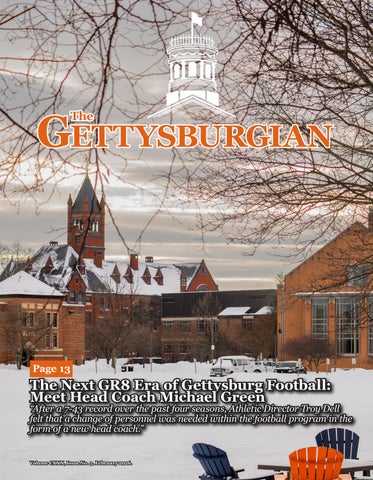
The Gettysburgian Spring 2026 Issue #1

Page 1


GTheettysburgian

Page 13

The Next GR8 Era of Gettysburg Football: Meet Head Coach Michael Green

“After a 7-43 record over the past four seasons, Athletic Director Troy Dell felt that a change of personnel was needed within the football program in the form of a new head coach.”

A Note From the Editor: On Melting Snow and Passing Time

Despite the snow on the ground here on campus, it’s somehow already spring semester — and for my fellow members of the graduating class of 2026, it’s already the spring of our senior year. Although sometimes I truly feel like we just embarked on our First Year Walk, it’s exciting (and, admittedly, more than a little bit nerve-wracking) to see the future ahead of all of us, uncertain as it may be.

With the coldest days of winter behind us, I’m eager to see what path the class of 2026 takes from Pennsylvania Hall in May and in the coming semesters for the rest of the classes. My time at Gettysburg has been absolutely invaluable, both in and out of the classroom. I know I will always feel grateful for the experiences I have had, even just this spring: from English department adventures in eighteenth-century literature to producing The Mercury and The Gettysburgian at the same time to planning my sorority’s spring philanthropy event, I’m thrilled to spend my final semester of college doing what I love most, as busy as my fellow students and I all are at this point.

At the time I’m writing this, we’ve just about hit the one-month mark of the semester, and before we know it, the snow will be melted, Stine Lake will be brought back to life and we won’t have to wear so many layers trekking around campus. Whether you’re already yearning for the spring sun or feeling like time is flying too quickly, you have to admit: it’s been an eventful academic year. From an interview with Gettysburg’s brand-new head football coach, Michael Green, to a muchanticipated update on the Stine Hall renovations, this month’s magazine will take you through some of the most recent happenings on campus. We also spotlight Adjunct Professor of Art & Art History Rebecca Duffy Stasiunas, and later, we examine the College’s relationship with mastery learning.

Stay warm, but look ahead for sunny days. Thank you for reading our latest magazine!

Magazine Editor

The Gettysburgian

(Photo
Sofia Gutierrez/The Gettysburgian)

By Ella Prieto, Editor-in-Chief

Compiled by Ella Prieto, Editor-in-Chief

Professor Rebecca Duffy Stasiunas

By Jules Young, Arts & Entertainment Editor

By Omer Shamil, Opinions Editor

Bruce Weber

Gallery Opening

By Cassidy Haines, Magazine Editor

By William Oehler, Director of Photography

Learning from Legacy: Gettysburg College's MLK Day Teach-In Explores King's Full Story

The first day of classes for the Spring Semester coincided with Martin Luther King (MLK) Jr. Day. As with every federal holiday, Gettysburg College students did not have off, which has been a point of contention for many. To help remedy this issue, the Public Policy, Africana Studies and Philosophy & Religious Studies departments, along with the Office of Diversity & Inclusion, the Office of Multicultural Engagement and the Center for Public Service, provided students with opportunities to learn about King’s life and legacy. While this was only the second year of programming, organizers hope for it to become a longstanding tradition.

“In 2025 (the first year we did this), MLK Day, Trump's second Inauguration, and our first day of classes happened together. It felt like a lot was going on and it felt a bit strange to pretend it was just an ordinary first day of classes,” explained Assistant Professor of Public Policy

Dr. Christopher Rick, a main organizer of the event.

“I learned about Gettysburg 1963 by Jill Titus, Associate Director of [the Civil War Institute], and thought it would be educational - and relevant - to my students to have them hear from Jill and Jane Nutter, a lifelong Gettysburg resident, about what life was like during the

Civil Rights Era. This year's events grew from that.”

The day kicked off with a “takeover” of Junction in the College Union Building from 10 a.m. to 2:30 p.m. Rick thanked the College’s Events Planning and Coordinating Committee (EPACC) and the Fred ’52 and Martha Mahan Great Questions Fund for logistical and financial support. He also recognized the previously stated partners.

“We gather to commemorate and learn from the consequential life and legacy of Martin Luther King, Jr.,” stated Rick. “We affirm [Gettysburg College’s] core values, some of which include the worth and dignity of all people and the limitless value of their intellectual potential, the commitment to a diverse and inclusive learning environment, the free and open exchange of ideas and the exploration of their ethical and spiritual dimensions...These values have not universally been held throughout our nation’s history, and indeed, are not universally held today. But we affirm, as one our core values, the power of a liberal arts education to help students develop sensitivity to the human condition, which is necessary, these values say, to enable students to realize their full potential for responsible citizenship.”

Rick then introduced Dr. Stephen Haynes of Rhodes College, who teaches religious studies and conducts research focusing on Jewish-Christian

relations, Dietrich Bonhoeffer and the biblical justifications for slavery and segregation.

Haynes holds a PhD in Religion and Literature from Emory University and a Master of Divinity from Columbia Theological Seminary.

Haynes’s talk, “The MLK We Know and Love, and the MLK We Don’t” dove into MLK’s legacy, discussing the aspects celebrated versus the aspects disregarded or hidden.

“I like the title because I really believe there are aspects of MLK’s life and legacy we don’t know, and if we did, we probably wouldn’t like,” explained Haynes. “And this is one of the ironies of having an MLK Day that is so universally participated in and celebrated because during King’s own life, he was not well liked, particularly by White people.”

Haynes elaborated that a 1968 Harris Poll had King’s public disapproval rating at nearly 75%. This was due to his more unpopular stances at the time, such as genuine equality, guaranteed minimum income and opposition to the Vietnam War.

Students from the Anti-Racist Collective (ARC) and the Black Student Union (BSU) took over from Haynes at 11 a.m., and followed a similar message with a presentation on the false dichotomy between Malcolm X and

King that transitioned into a bystander intervention workshop. President of ARC and BSU Denae Brown ’26 led the presentation, beginning with an overview of Malcom X and MLK. She worked through many of the common misconceptions regarding both men, particularly the belief that they were drastically different.

“When we think of these two characters, we sometimes pit

Regarding MLK, she developed on points Haynes had made in his speech, discussing his unpopularity during the end of his life and his broader mission to lift people out of poverty, which included fighting for fair housing and protesting the Vietnam War. X had a similar mission, and while he began his leadership in the Civil Rights Movement advocating for racial separation, his stance evolved

criminalized and widely disliked their lifetime,” said Brown. “...Reducing people to one narrative bears the harmful bias itself. When we flatten Martin Luther King and Malcom X into symbols instead of human beings, we practice the same kind of oversimplification that fuels prejudice. Today’s history oversimplifies leaders to make them easier to consume... this

them against each other, even though they fought for the same thing: the liberation of Black people. So, we will try to understand these two more, and not just as leaders, but as people themselves, because they were still human beings,” explained Brown.

after a pilgrimage to Mecca, where he embraced a more inclusive approach, focusing on the common struggle of all oppressed people, regardless of race or religion.

“I want to emphasize that both men were surveilled,

selective memory limits our understanding of resistance.” She then transitioned into the workshop, starting with a definition of racism to ensure all participants had a shared understanding of the word. Brown also gave

Lincolon Cemetery Project Association President Jean Green presenting to students. (Photo William Oehler/The Gettysburgian)

ways racism is enacted, such as microaggressions (everyday comments or behaviors that reinforce racial stereotypes), and internalized racism (when individuals accept negative messages about their own racial group, leading to self-doubt, policing identity and isolation). She also explained three levels of racism: individual (actions and behaviors of a single person), communal (regarding organizations and groups) and institutional (policies and practices in society and structures).

care transforms community values into lived action. Our call to action is to learn deeply, see people fully and choose courage over comfort every single day.”

Assistant Director of Scheduling and Event Support

John Rudy, ’07 took over for a Lunch & Learn on the Civil Rights Era in Gettysburg.

Gettysburg was a focal point of the era, with advocates on both sides highlighting its importance. Furthermore, 1963 was the 100th anniversary of the Battle. President Lyndon B. Johnson gave a speech in

Brown asserted the importance of speaking up when you notice any type of racism and concluded with a call to action: “Recognizing discrimination, whether subtle or overt, is the first step towards change. Bystander intervention is collective work. Speaking up, supporting your peers and intervening with

the town on Memorial Day of 1963, encouraging the nation to remember the promises of Gettysburg.

President of the Lincoln Cemetery Project Association

Jean Green and President and CEO of Gettysburg

History Andrew Dalton ’19 concluded the takeover with a talk entitled, “Segregated in

Death: Gettysburg’s Lincoln Cemetery.” They educated students about the all-black cemetery beneath a backyard in 311 York Street, as Black people could not be buried in the same land as White people.

“Isn’t that incredible?” remarked Green. “You’re dead, but you still are not recognized as a complete human being, so you have to be buried separately from your White comrades and neighbors.”

This was the final resting place for some of Gettysburg’s most prominent Black citizens. While many of the bodies and headstones were moved in 1906 to Lincoln Cemetery, some never were, and were only discovered during construction on the property. Green and Dalton emphasized the importance of remembering and preserving this history.

Reflecting on the day, Rick spoke on the lessons and knowledge bestowed upon students and the importance of having guest speakers with lived experiences and expertise to cover these topics.

“There's a recognition in these events that community members, students, and administrators have valuable lessons to teach us,” he elucidated. “My students have to hear from me 28 times this semester. I don't have the lived experiences or expertise in most things, and I want my students to learn about them from people who have those experiences or expertise.”

He also once again expressed his thanks to all those who assisted him: “I'm so thankful to everyone who helped the Teach-In be successful. I couldn't do this alone.” ∎

Assistant Professor of Public Policy Chris Rick introducing speakers. (Photo William Oehler/The Gettysburgian)

In the Footsteps of Franklin

As I walk from the abroad center each day to the bus stop for an 8 p.m. dinner with my host, I pass by a familiar name: Rue Franklin (Franklin Street), named after the polymath and founding father Benjamin Franklin. Franklin is one of the most iconic figures from my home city of Philadelphia, and I have found that he retains an enduring legacy in both the United States and France.

In early December 1776, Franklin passed through the city of Nantes, where I am currently studying abroad, while on his way to Paris after having landed in France. He had been sent by the Second Continental Congress to petition France for military assistance and diplomatic recognition of the colonies during the American War of Independence. Franklin’s tact for diplomacy secured a French alliance that was essential to the victory against Great Britain. He later became the first U.S. ambassador to France, and did considerable work negotiating loans, maritime law, and forging the historic Franco-American alliance.

250 years later, I am symbolically continuing Franklin’s work during my semester abroad as a Gilman Scholar with the U.S. Department of State. With this status, I am tasked to use my study abroad experience to represent the United States abroad (including promoting the semiquincentennial anniversary of independence in July), and completing a follow-on project upon my return.

In the spirit of the approaching milestone of the United States, I have used Franklin’s diplomatic voyage for inspiration as to how I can best complete these tasks while making the most of my semester.

Like Franklin, I have arrived in France with an elementary competence in the French language—far from fluency. This has been increasingly apparent, as I have been “discovered” as a native anglophone several times by locals who have noticed my poor

pronunciation and have tried to speak to me instead in English. I found this to be very frustrating, as I had initially come to Nantes with the intention of improving my French and trying to “blend in” with the local culture. However, my fear of making a mistake was causing me to limit my interactions and avoid complex conversations.

Franklin was known for his thick English accent while speaking French, and is said to have made several gaffes while speaking in public. Aware of this, he sought to use his errors to his advantage by embracing his role as an American traveler. He famously wore his frontiersman fur cap to official functions, and spoke confidently despite his linguistic faults. This approach made his errors appear more endearing than embarrassing, and gave him an exotic appeal.

Having reflected on this, I realized that I cannot represent the U.S. if I insist on “blending in” with the locals and become agitated when I fail to do so. I have found that when I am confident and direct in spite of my errors, many locals

have been happy to speak with me in French, and several have demonstrated an interest in the United States. These interactions have been much more dynamic, and have done far more to improve my learning.

In addition to his official correspondence, Franklin was able to garner public support for his cause by frequenting salons and scientific meetings, making allies across society. I have sought to do likewise by engaging with the history community at Nantes Université, and by signing up to help teach English and American history at a local high school. Both have given me the opportunity to highlight America’s 250th, and the contributions of figures like Franklin and Lafayette in making it possible.

Franklin’s example has encouraged me to fully embrace my abroad experience by pursuing my goals without limiting myself with fear of inevitable language errors. After all, he himself put it best: “well done is better than well said.”

The Cathédral Saint-Pierre et Saint-Paul in the center of Nantes. (Brandon Fey/The Gettysburgian)

Student Perspectives: Experiential Learning Opportunities

Riley Nolan ’26 - January Leadership Expedition through the Garthwait Leadership Center

This past January, I went to the Aysén Region of Patagonia in Chile with the Garthwait Leadership Center, where I participated in their January Leadership backpacking expedition. Over the course of the 8-day backcountry trip, we moved through mountain valleys, saw 1000-foot granite walls, waded in the second largest freshwater lake in South America, and immersed ourselves in a big, remote environment. The days were packed with sights and long mileage and I was consistently being physically pushed and challenged; I believe this was a good and empowering thing, because it helped me see what I’m actually capable of!

The natural beauty of the area was indescribable, but what arguably struck me more was the way this trip transformed my perception of myself and how I think about the world. With us were two guides, Mauricio and Martín, who grew up in the area and had travelled the Torres del Avellano before. While their knowledge was fantastic and thorough, their company was even more enjoyable as we laughed through our long days together. The connections we were able to make with them on the trip were so special, and made me reflect on how important people and relationships are for finding meaning in places. Our experiences in the local towns in the days following the backcountry portion of the trip only solidified this feeling. While I’ll always remember how beautiful the landscape was, it was the people and connections that deepened the expedition and helped me make meaning of the experience. ∎

Keefer Stiles ’27 - Orlando Brand Marketing and Business Strategy through Center for Career Engagement

Being able to go to Florida over winter break and escape the frigid temperatures is one thing, but being able to explore the theme parks in Florida is even better. However, the best thing about the trip was the experiential learning and forming connections with industry leaders and building skills to use professionally in a business mindset, but also applicable to any profession. Through the Orlando Brand Marketing and Business Strategy with the Center for Career Engagement and alumnus Greg Edelson ’87, the group of students spent a week learning from professionals in the industry, and exploring the sites to see, feel, and be immersed in when words appear as actions. One of the biggest lessons from the week was understanding what collaborative partnership is and how to be a good partner. The entire week should how foundational partnerships between companies can work to create these interactive experiences, and how supporting each other establishes long-term partnerships. This skill is compatible with any industry or occupation, even as a student working in a club or class project for school. An experience like this was made possible from Gettysburg College and provided meaningful advice and connections with industry professionals, that enhanced my college experience. ∎

From Chile to Morocco to New York City and plenty of places in between, Gettysburgians share their experiential learning journeys.

(Photos

Isabelle Stehle ’26 - Immersion Trip through the Center for Public Service

Getting to lead the immersion project to Morocco, focusing on Women’s Rights and Islamic Feminism, was an unforgettable experience! One of the best parts of the experience was being able to stay with host families. We were able to share meals, spend time together and be welcomed into their homes. When the Moroccan soccer team won the semifinals match of the African Cup, my host family took me out to celebrate in the streets of Rabat with the whole city, and we walked towards the parliament building where crowds were dancing, playing music and celebrating their team's win. To build on the trip's themes, we were able to talk to different professors and NGOs about the state of human rights and feminism in Morocco. Through these conversations, I have better developed my own definition of feminism and the importance of female agency regarding defining what it means to be an emancipated woman, especially cross-culturally. One of my proudest moments was watching my participants bond during the trip and seeing their growth and comfortability shift as we spent more time together. They asked interesting questions and always pushed to challenge what we were being told, and even what wasn’t being discussed such as menstrual and LGBTQ+ rights issues. I am even more grateful for our trip mentor, Dr. Yoko Nishimura for her constant support and enthusiasm for the trip. If you have the opportunity to go on an immersion project with the Center for Public Service (CPS) I highly recommend it!

Nicole Watson ’26 - Gender & Leadership Trip through the Eisenhower Institute

The Eisenhower's Gender and Leadership study trip allowed me to connect with various nonprofits and organizations in D.C., centered around three key themes: masculinity, women in power, and LGBTQ+ leadership. I am currently applying to graduate programs for International Development with a focus on gender, and this trip challenged me to uncover my own biases and approach topics with an open mind and a listening ear. We learned about the various ways nonprofits implement programs and solutions, as well as how they collaborate to reach broader audiences and effect more significant changes. Having open discussions with countless professionals and fellow Gettysburg students, I was able to hear everyone's perspectives and engage in meaningful conversations to grow as a student and as a leader. I am so grateful for this experience, and I believe it made me a more compassionate, open-minded, and curious leader. ∎

Cassidy Haines ’26 - W. W. Norton & Co. and Franklin & Marshall College through Center for Career Engagement

Riley

Over winter break, I was lucky enough to explore two job shadowing opportunities through the Center for Career Engagement’s winter experiential learning cycle. Thanks to the kind invitations from alumnae Katie Bolger ’18, who is the Media Editor for Communications and Humanities at publishing house W. W. Norton & Co. in New York City, and Anna Baldasarre ’14, who is the Associate Director of Annual Giving Marketing at Franklin & Marshall College in Lancaster, PA, I was able to learn so much about two entirely separate fields. When I went to Norton, I also joined fellow Gettysburgians Ella Beam ’26 and Alyssa Lanza ’28. During my day-trips, I spent time listening in on meetings, practicing a typical entry-level task and discussing career paths with plenty of staff from both places. One of the things I heard throughout both days was that, as a soon-to-be graduate of a liberal arts college, my experiences on campus and in the classroom are entirely marketable for a vast array of fields. Though educational publishing and college advancement do not have quite the same day-to-day routines, these experiences through CCE were essential in helping me figure out my next steps after graduation. I can’t recommend their job shadowing and site visit program enough, and I am still so grateful to have connected with Gettysburg graduates like this. ∎

courtesy
Nolan, Keefer Stiles, Isabelle Stehle, Nicole Watson and Cassidy Haines)

The Finished Stine Renovations: A New Era of First Year Housing

On Dec. 17, 2025, Stine officially reopened, with brand new furniture, bathrooms, and cooling systems. The dorm also features a new kitchen, trash room, and single stall bathrooms. The student body can finally see the long-awaited designs of the notoriously small first year dorm on campus lived out.

Residential Education and Gettysburg College have posted extensively about the renovations on both Instagram accounts, @gettysburgresed and @ gettysburgcollege, respectively. The post announcing the new renovations revisits the history while leaning into the future of the space.

“Stine is refreshed for a new generation, but will continue its legacy as a place where community, connection, and college memories begin!” ResEd’s Instagram account features many walkthroughs of the new space, with videos showing clean, sleek modern furniture against blue and orange walls and photo collages.

The Resident Coordinator (RC) Bishruti Rijal ’26 has noticed a change in the atmosphere of Stine since the building reopened: “[Residents] are excited. They love the new study rooms on the second and third floors, and they hang out more often in the common rooms. We didn’t have a kitchen before, and I’ve seen people cook by themselves or with friends, so it’s definitely increasing residents hanging out with each other. The residents love the single use bathrooms and the privacy

that gives them. Several non-Stine residents have said to me that they wish they lived here!”

Tour guide Marcy Zimmer ’27 spoke about the prospective student reaction and how she has adjusted her tours to emphasize Stine. “I stress the Stine renovations and

make sure that I really point out the photos posted outside the building. I emphasize the brandnew AC, which some prospective students have had concerns about in the past. As a tour guide, I am really proud to show it off to prospective students now.” ∎

Brand new common area (above) and kitchen space (below) in Stine.
(Photos William Oehler/The Gettysburgian)

Rebecca Duffy Stasiunas, Adjunct Instructor of Art History

Rebecca Duffy Stasiunas, a Gettysburg College alum of the class of 2016, began as an adjunct instructor during the spring 2026 semester, filling in for Professor Yan Sun during her sabbatical. Currently, she is teaching “Introduction to Material Culture - The Lives of Objects” and “Introduction to Asian Art”.

Professor Duffy Stasiunas is originally from Long Island, New York, but has spent most of her time between Pennsylvania and Delaware since first coming to Gettysburg College. She graduated from Gettysburg with a double major in Art History and History, and minors in East Asian Studies and Public History. She was also involved in the Center for Public Service, working with museum sites in Nicaragua and various Park Service sites through the Civil War Era Studies Program. She went on to do occasional work for the Park Service post graduation. After Gettysburg, she went on directly to get her master with the Winterthur program in American Material Studies at the University of Delaware. From there, she worked as the curator at the Reid House and Gardens in Newcastle, Delaware, and began her doctorate in Art History with the University of Delaware in 2022, which she has nearly completed. She was invited to teach for the semester by Professor Sun herself given their close relationship when Professor Duffy Stasiunas was a Gettysburg student. She commented on their “shared interest in material culture” and “shared interest in art from Asia,” though that is not currently Duffy Stasiunas’ area of study directly. Her expertise is in Latin American art history, though “objects coming out of [Latin America] are directly inspired and in conversation with aesthetics from South and East Asia,” melding

the two subjects quite seamlessly. When asked about her personal experience with art, she praised the college's requirement for Art History majors to take part in studio art classes. While it is not her expertise, she looked back fondly on her drawing classes with Professor John Kobleski and ceramics classes with Professor Tina Gebhart. Ceramics was of particular importance to her, because she was interested in the role of ceramics in her historical studies. She joked that, when she draws something on the board in class, she can no longer say “good thing my drawing instructor isn’t here,” because he is, in fact, still at Gettysburg College.

Professor Duffy Stasiunas has done some teaching before returning to

Gettysburg College this semester. She has primarily taught at larger public universities, such as the University of Delaware, in subjects such as intro to art history and art in the enlightenment. She remarked that “often [her classes]... involve material culture and science because that's where [her] interests are.” She has shifted her teaching style to be more interactive given the smaller class size. This has been enjoyable for her in the eagerness of her students to come to her “wanting to know how their professors are thinking, wanting to do better and wanting to learn more.”

So far, Professor Duffy Stasunas has greatly enjoyed her return to Gettysburg, and would be happy to continue if a position were to open to her.

(Photo
Sofia Gutierrez/The Gettysburgian)

Opinions

Between Them Classes

Walking across campus can feel like a fever dream. Some days, my head is entirely elsewhere. Mainly on what Servo will have for dinner, or whether I missed an assignment,on Moodle. I’m moving, but not really arriving anywhere. My attention keeps looping, pulled toward small urgencies that don’t feel small in the moment. Other times, though, something breaks through that haze. I look up. I notice where I am. The paths feel familiar, but not quite the same, and it’s hard to pinpoint why. It isn’t always one big thing, more like a collection of shifts you only register once you slow down enough to see them. Campus stops feeling like a backdrop and starts feeling like something in motion, even while you’re distracted enough to almost miss it. I’ve heard this feeling described before. When I was a freshman, I worked at the Alumni House, and some of the most memorable moments from that job came not from the work itself, but from the conversations that filled the space. Alumni would mention changes almost offhandedly, usually in the middle of something else. The library hadn’t always been where it is now. Penn Hall used to be a dormitory. Buildings I passed every day had once meant something entirely different.

What struck me wasn’t any single change, but how casually they spoke about them. There was no urgency, no sense of loss: just an awareness that time had moved things around. In those conversations, campus felt less fixed than I had assumed. The places I thought of as permanent were revealed to be temporary, reshaped and repurposed without much ceremony. Stine Lake came up often as a counterpoint. It was untouched by these shifts, oddly steady in a landscape defined by revision. It’s one of the few spaces on campus reisting that seems to resist reinvention, and I don’t intend to jinx it. Standing there, it became clear that constancy is the exception, not the rule, something you notice most when you start paying attention.

That perspective changes how you move through campus. Once you’ve heard how different things used to be, it becomes harder not to notice what’s shifting now. For students who have just arrived, much of campus feels fixed, like the way things have always been. But for those who have been here a little longer, change doesn’t

show up all at once. It settles slowly, almost invisibly, folded into routine. Most of the time, it isn’t disruptive. Classes still happen. Meals still get eaten. You adjust without thinking. The problem isn’t that these changes are dramatic, it’s that they’re easy to absorb without question. Over time, what once felt temporary starts to feel permanent, and what once stood out fades into the background of daily life. Noticing this isn’t about longing for an earlier version of campus but instead recognizing how quickly familiarity resets. Once that awareness sets in, it’s difficult to ignore the accumulation of small shifts that quietly reshape how we experience the place we move through every day.

Some of the most noticeable changes on campus are also the easiest to dismiss. The kind of updates that sound insignificant until you realize how often they shape your day. Take the new printing system. On paper, the fact that it remembers uploaded files for twenty-four hours doesn’t seem worth mentioning. But in practice, it quietly changes everything. There’s less scrambling, fewer reuploads, and a small but meaningful reduction in the low-level stress that follows you from class to class. What’s striking about changes like this is how quickly they become expected. Once something works better, it stops feeling like a choice and starts feeling like the baseline. The adjustment happens almost automatically. You don’t stop thinking about what shifted, you just move on, assuming this is how it’s supposed to be now. Individually, they feel minor. Collectively, they recalibrate what daily life looks like, and how easy, or difficult, it feels to move through it.

Not everything on campus benefits from being streamlined. Traditions like tailgates,

for example, resist efficiency by nature. They depend on people showing up, lingering longer than planned, and sharing space without a clear objective. Alumni return, students gather, and for a few hours the campus feels less scheduled and more collective. That sense of togetherness is fragile. Weather limits it, schedules interrupt it, and it doesn’t scale neatly or improve with redesign. Still, these moments matter precisely because they aren’t optimized. They remind us that community isn’t something that can be installed or updated. It must be experienced, and it’s easy to overlook until it starts to disappear.

Walking across campus, it’s easy to stay distracted. Most days, we’re focused on what’s next: the next class, the next meal, the next deadline. Change blends into that forward motion, absorbed before it’s fully noticed. By the time we pause long enough to recognize it, it’s already settled in. Gettysburg will continue to shift. Buildings will be renovated, systems will be updated, and spaces will be repurposed. That’s inevitable. What feels less certain is how often we stop considering what those changes mean for the way we move through campus and relate to one another. Community isn’t built in grand gestures or glossy improvements, but in the spaces and routines we share without thinking too much about them.

Somewhere in the middle of all that motion, Stine Lake remains. Quiet, unchanged, and easy to pass without stopping. Maybe that’s the point. Not everything needs to be reimagined to matter. Some things endure simply by being there, reminding us that attention, not innovation, is often what gives a place its meaning. ∎

(Photo William Oehler/The Gettysburgian)

The Next GR8 Era of Gettysburg Football: Meet Head Coach Michael Green

After a 7-43 record over the past four seasons, Athletic Director Troy Dell felt that a change of personnel was needed within the football program in the form of a new head coach.

Dell gathered a committee with two members of the Board of Trustees, two Athletic Department administrators, an Admissions representative, a member of the faculty, a representative from the College’s advancement team, and a representative from Marketing and Communications. In addition to this committee, a subcommittee consisting of approximately nine students, including this year’s 2025 team captains and representation from the football team’s freshman, sophomore, and junior classes, as well as an additional alumni and parent panel.

After reviewing over 150 applications, with between twelve and fourteen final candidates, the committee ultimately felt that Michael Green was the best fit to lead this program.

The committee was confident that Green checked all of the boxes that they hoped the next head coach would possess.

“His ability to articulate his vision, how he would build culture, how he would move the program from its current

state to a greater success incrementally, his ability to articulate a plan for recruiting, for building a staff out," said Dell. “All of those things were really important. For the alumni group, it was his ability to connect with them, and then the student athletes had the things that were important to them. We really feel like he checks all those boxes pretty well”.

Michael Green comes from fifteen years of playing and coaching experience at Hobart and William Smith in New York. He was looking for an opportunity to advance his career in a head coaching

position while also feeling like he had accessibility and opportunity.

“I was excited about the opportunity to come and coach in one of the most competitive athletic conferences in the country,” said Green. “I think the other big piece that stood out to me was the location for really strong recruiting. We’re in a really good area for recruiting, and I think it is what will allow us to be really successful here.”

Green steps into the role of head coach for the first time in his career, but he has a confident and powerful

Coach Michael Green is officially the head coach of the Bullets football team. (Photo Sofia Gutierrez/The Gettysburgian)

mindset that he feels will help him to find success in the position.

“I’ve always been an underdog. From going into college and being an undersized offensive lineman and working my way from a scout team player to a starter, captain, and AllAmerican, to then becoming a coach and doing it as a volunteer when I first started and doing whatever I could for the opportunity,” said Green. “I’ve just always been somebody that rolls up my sleeves and figures out a way to get it done and learns it, so I think my work ethic in terms of my background, and being able to come to Gettysburg as an underdog right now, our growth moving forward is everybody is going to count us out, so let's go out there and prove

them wrong.”

Proving everyone wrong is exactly what Green is planning to do, and for him, that starts with playing complementary football.

“What you do in all three phases has to go hand in hand. We’re gonna talk about each week how to put together the best plan to win the game,” said Green.

According to Green, the game is won at the line of scrimmage, so he plans to ensure those players understand the role they play in each game. In addition, Green will spend time this spring learning his players' styles and skill sets. From there, he hopes to further develop the talent already on this team.

This team has several strengths, including a strong

mindset, an understanding of standards, and a strong foundational culture that Green noted.

“The biggest thing that has stood out to me is the camaraderie of the team. The guys enjoy being around one another. When we bring recruits to campus, the recruits immediately feel that there is a family value within the team”.

As the Bullets prepare for their non-traditional spring season, Coach Green has been implementing his own philosophy within the program. On X, Coach Green will use the hashtag “#BeGreat”.

This mantra has dual meanings. The first is centered around holding oneself to the highest standards that you can in every area that you can, on and off the field.

“Whether we win or whether we lose, we are always going to talk about the standard of how we play and did we play for sixty full minutes, did we run with the ball, did we play fast, did we play hard for the entire game and did the other team know that we were competing that day. Win or lose, we’ve got to walk off that field and be proud of the efforts that we put in,” said Green.

The last three letters of “#BeGreat”, “eat”, stand for effort, attitude, and toughness, according to Coach Green. He wants to challenge his athletes to these three values on the

(Photo/The Gettysburgian)

field, in the classroom, in the weight room and in the community.

“Those three things we think take no talent to do. You can be a 4.0 student or a 2.0 student, but you can bring your best effort to class every day,” said Green. “As we talk about toughness, that is consistency and resilience”. The second meaning of “#BeGreat” is to #BeGr8, with the number eight. According to Green, this represents eight different areas that each player and member of the Gettysburg Football program will focus on for their holistic development as studentathletes.

“The first three focus on you: nutrition, sleep and mental health. The fourth is academics, the fifth is strength and conditioning development, the sixth is

football skills and knowledge, the seventh is social and community impact, and the eighth is career readiness,” said Green.

For this Bullets Football team, many of these eight categories the athletes have already been able to focus on, especially within the alumni network, in strength and conditioning, and by focusing on the individual. In fact, Green has been having his team attend winter teams’ competitions to show their support for fellow Gettysburg athletes.

“We’re going to be going out and supporting a variety of teams throughout the winter and spring. We want the other sports teams on this campus to know that we want the battlefield of Gettysburg to extend to every arena that we play in, and the football program is kicking that off

this winter and spring with supporting and making their arenas a hectic place to play at,” said Green.

As the team begins to prepare for their nontraditional season, Green discussed how they are going to be working a lot with teaching players to compete and discussing as a team what winning looks like.

“We’re gonna work on how to compete every day from now until we go and face off against Juniata in September. What does it take to win, and how do you find a way or make a way to win.”

Green and his Bullets will begin non-traditional practices shortly as they prepare for their 2026 campaign, hoping to compete, find ways to win, and #BeGreat. ∎

(Photo William Oehler/The Gettysburgian)

Schmucker Art Gallery Opening Curator Bruce Weber and "Making

Her Mark": Women Artists of Woodstock

On Wednesday, Jan. 28, the Schmucker Art Gallery welcomed independent scholar Bruce Weber for a dialogue and a reception to officially open his curated exhibition titled “Making Her Mark: Fifty Women Artists of the Historic Woodstock Art Colony.”

In addition to Weber’s work, the display was also supported by two student researchers from the Art History department, Adrianna Ashcraft ’26 and Audrey Blazsak ’27.

Introduced by the interim director of the Schmucker Art Gallery, Sarah Kate Gillespie, who shared that she and Weber have worked together in the past, Weber offered an explanation of what brought him to the Woodstock art colony. After

landed in Woodstock and later became a board member of the Historical Society of Woodstock (HSW), all while taking an interest in the history of the women’s art colony that developed nearby in Byrdcliffe. The HSW was

years of curating art at museums up and down the East Coast, Weber finally

founded in 1929, while the art colony was founded in 1902 and still exists today.

“The reason the historical society was founded was because [some members of the Byrdcliffe art colony] had just passed away, and people wanted to be able to archive it,” shared Weber. “Mostly artists founded it.”

This exhibit features works including “Hollyhocks” by Mary Dufrense Smith, “Space Station” by Grace Greenwood, “The Village” by Althea Spalding Odell, “Pine Grove Pleasure Park” by Dorothy Varían, and many more paintings, drawings and prints by the fifty featured women artists. Each piece is owned by the HSW today. These women artists were all students at the Art Student League’s Woodstock School of Landscape Painting, a recurring art program during the periods of 1906 through 1922 and 1947 through 1979.

Weber explained that the majority of the women artists also worked while staying in the colony, and many were mothers. He also described that some came from long lines of wealth, and one was even a silent film actress. Their artistic subjects vary just as much as their lives did, with portraiture, landscapes, still life designs and abstract art each finding a home in the exhibition.

“I wanted to get a mix of different stories and different lives,” expressed Weber.

During his lecture, Weber detailed the historic town of Woodstock and its relationship to the arts, going deep into the 1900s to discuss the transformation

of buildings like general stores into studios and galleries. He also shared more about some of the women artists in the exhibition, and he emphasized the difficulty of finding information about the art colony and its rotation of inhabitants.

“Women could truly be free to express themselves in the colony,” stated Weber.

To see the exhibition in person, the Woodstock art will be on display in the Schmucker Art Gallery until April 11, rounding out the spring semester. For more information or an exhibit schedule, check the gallery’s website or Instagram @schmuckerartgallery. ∎

Bruce Weber delivering his lecture to guests at the Schmucker Art Gallery. (Photos Sofia Gutierrez/The Gettysburgian)

Portrait of a Graduate: How Mastery Learning Interacts with Higher Education

The enduring sentiment of Gettysburg College’s education as “consequential” creates an objective for every professor and student alike; but how does this ideal exist beyond the classrooms of college, into the halls and schools that lead us to Gettysburg’s hallowed grounds?

In the 1950s, Benjamin S. Bloom, alongside a group of educators, formalized the idea of Mastery-Based Learning with Bloom’s Taxonomy. This classification laid out specific learning objectives for students to create clear, defined goals for learning. Bloom’s Taxonomy offered an alternative to traditional methods for understanding and reporting student learning and grades.

Today, the mastery learning movement has evolved to become a pedagogical philosophy in-place in many independent and public-school systems. One of the most prominent modern responses to answering the call for enhanced, more comprehensive grade reporting comes from Scott Looney in 2014 and his Mastery Transcript Consortium (MTC).

Since 2006, Looney has served as the Head of School at The Hawken School in Cleveland, Ohio. He created the MTC to give students an option when it comes to grading. In a press release, Hawken stated, “While receiving academic credit for

time in courses with letter grades serves some students well...we know that students are inherently different, and that traditional grading and crediting does not serve all learners well.”

Officially launched in 2017, the MTC began reporting Mastery Transcripts to institutions of higher education in 2021. Currently, more than four hundred public and private high schools report student learning using a version of the Mastery Transcript. The Transcript is broken down using competencies and skills as a primary way to deliver information, rather than classes and grades. This allows for a more authentic representation of the student to emerge, including their learning interests and style, and their school profile.

Theories in education, just like mastery, experience continual cycles of renaissance and retirement, or as Gettysburg College Professor Dave Powell calls them “zombie ideas.” Mastery learning is one of those theories. Its origins can be found in the early 1920s with Carlton Washburne’s work in the Winnetka, Illinois school system. Mastery became popular again with the inception of Bloom’s Taxonomy.

What does not change in every renaissance of mastery learning is its ability to disrupt the ideas of what education and learning can look like. Mastery at its core, offers a different way for students

and instructors alike to interact with both each other and the development of knowledge and skills. The ways in which that information and demonstration of learning is then interpreted is what controls education.

Powell identified the Grammar of schools as one way education is controlled, both by the public and politics. The Grammar of schools encompasses all the commodities in education. Grades, test scores, school rankings, or as Powell puts it, “the expectations that people have for what school is supposed to be or what it is supposed to look like.” This idea has allowed for two converse products to exist in American education. These expectations can be both policy like the 2002 act known as No Child Left Behind (NCLB), or they could be formed through the politics of parents, and what they deem fit for their child.

Grammar of schools solidifies outdated practices in the classroom, therefore making it difficult for transformative change to occur in favor of a student’s education. But it has also allowed for pockets of revolution to thrive. Teachers and administrators like Looney can manage new ideas and ways to work for students if they stay within the Grammar of their institution. No matter how small, change does occur. This is why the current 21st

century mastery rebirth is occurring.

The new pieces of Grammar brought forth through NCLB, centered around standards and standardised testing, have begged instructors to ask what more could be done for their students. Looney and his contemporaries who answered that call are showing what it means to work within the Grammar of schools and beyond.

Transcripts like those created by Looney and MTC are often morphed to fit the needs of any secondary school and their students; many refer to their transcripts as Portrait of a Graduate. The Pomfret School in Pomfret, CT uses an MTC template but customizes language and layout for their specific competencies and learning outcomes such as “Navigates a Situation Strategically” or “Leads and Collaborates with Humility.” Once a student demonstrates competence or mastery in a learning objective, this will be denoted in their learning record through specific assignments, classes, extra-curricular activities, or “tangible work samples associated with the skills they have developed.”

While MTC offers an alternative for students who succeed with individualized support and instruction, many schools allow for students to

report using either a Mastery Transcript, a traditional transcript–using A-F scales and credit hours– or pieces of both. Gettysburg College has long welcomed non-traditional forms of applications. Director of the Office of Admission, Mary Smith ’00, explained the College’s process when they encounter a Mastery or non-traditional transcript. Smith stated that a Mastery applicant will always have two Admission team-members working with their application. Both will read through the school profile, student profile, essay, recommendations, and any complexities that may arise. While Gettysburg College does accept any form of transcripts, it often does not encounter Mastery or other non-traditional versions.

Looking locally, Stone

Independent School in Lancaster PA uses projectbased learning with roots in mastery to develop student’s higher-order thinking. Using a Portrait of a Graduate model, based on Looney's MTC, Stone and Head of School Mike Simpson have always been interested in how to best serve students.

Simpson and Assistant Head of School Abby Kirchner were invited to some of the earliest meetings with Looney at Hawkens even before Stone was built. The meetings consisted of around 35 of the top independent schools in the country including Phillips Academy Andover, Phillips Exeter and The Putney School. Simpson described those first meetings as “incredibly important.” It was the first time that Simpson

(Photo Alice Van Etten/The Gettysburgian)

and Kirchner were validated and included in the important conversations they knew needed to be had.

Today, Stone Independent has defined itself as an institution willing to put the hard work into redefining what secondary education can do for its pupils. After spending about five years with the MTC, Stone decided to chart its own path while still having foundations in Looney’s work. What Simpson found challenging however was the structuring around assessments. “It was not the deployment of the transcript, but the design of the education” for Stone.

As a project-based school, Stone had to “work from the outside in.” Any new model of education such as mastery, “needs a definable structure that all fits in together.”

Without this structure, school incentives and their meaning, like grades on an A-F or 0-100 scale, become as Simpson described, arbitrary. In order to build structure into Stone’s design, Simpson and Kirchner “took [several] parts from different schools, that aligned and worked with each other.”

While Stone represents the push for change within the independent school system, Nathan Auck and the Utah State Board of Education (USBE) took Looney’s work and expanded it across public schools in their state. Starting in 2019 USBE partnered with MTC to see how they could scale a mastery-based learning and transcript design system.

During the 2022-2023 school year, a pilot program in Utah was deployed. In a brief that reported the program’s impact,

it was described as “a multiyear proof of concept to create a competency-based, valid, and equitable alternative to the traditional transcript.” This first step in Utah’s incorporation of MTC in their state education was heavily supported by Auck.

Auck previously served as USBE’s Science, Technology, Engineering, and Mathematics (STEM) Coordinator and its Personalized Competency Based Learning (PCBL) Specialist. Auck spoke of some catalysts that lead to Utah instituting it’s PCBL framework, “a traditional school system is not built to elicit critical thinking, it is not measured...but the vision that a number of systems across the state of Utah had was to have a more coherent approach to eliciting those outcomes, the knowledge, skills, and dispositions...”

Connecting Auck’s work with Powell’s idea of the Grammar of schools, Auck mentioned what worked well when rolling out PCBL in relation to parents and their expectations. “Those communities that did a good job of messaging the change and ensuring that all community members had agency in the decision...had an easier time helping all stakeholders understand what the shifts were about.”

Oftentimes, when schools make a change such as that made by USBE, communities do not understand the nuances that mastery grading brings to a student’s learner profile. Auck described this in relation to traditional

grading, “...A through F grades are really opaque ways to express what a student knows.” If a parent or community understands, rather, how mastery-based learning provides a clearer picture of what a student learned and the skills they developed, they will be more likely to support the change.

A conflict Auck saw when it came to transitioning from a mastery-based secondary education into higher education was based on professors’ disposition to sorting and traditional grading practices, “Educators have looked at educational research, they understand equity. They understand that the charge of public education is to support every kid in being successful, not as a sorting mechanism. And oftentimes, the identity of college professors has been predicated on this notion of sorting.”

He continued by expressing that most often, professors involved with the research and practice of education, understand how to make learning equitable, like mastery learning. But that professors purely trained in their field of expertise exhibit more reluctance towards progressive instruction.

On Gettysburg College’s campus, Professor Divonna Stebick experiences something similar in advocating for a practice she has begun using in many of her classes. Stebick also serves as the Director of the Office of Teacher Education and Certification (OTEC) and has been working with the concept of “ungrading” for many years.

Stebick describes ungrading as “not not grading but rather capturing your learning on a continuum.” she continued by asking, “what does learning actually look like when we stop reducing it to a letter or a number?” Instead of handing an A to a student because that is what they may have earned, it is more important to understand what they learned and how a student demonstrates that learning. Traditional grading does not offer explanation for what a student confidently learned, nor does it provide a demonstration of their synthesis of learning.

Ungrading has gained momentum over the past decade and eliminates the use of grades through letters or numbers, replaced with consistent detailed feedback in connection to course learning goals, much like mastery learning. While not within the construct of mastery learning, both share similarities. At their core, both pedagogical practices place the student and their learning at the center of their intentions.

Professor Stebick shared her interactions with both students and professors on campus when she talks about or champions her use of ungrading. Many responded with shock, never being offered the opportunity to not judge or be judged through a letter or a number. Stebick has spoken to both administrators and professors on campus to proliferate the use of ungrading at the College, but like Auck, Simpson, and Powell have alluded to, it is difficult to transform practices especially in education, when expectations influenced by

competition and judgement through opaque metrics.

Stebick is currently expanding use of ungrading in more classes in the coming semesters and

championed the practice by saying that the student “takes on the ownership and responsibility of learning... more so than doing an assignment or showing up in

order to get an A.” Stebick sees ungrading giving students the agency to explore and deepen their synthesis of knowledge. Ungrading fits within the bounds of mastery learning’s goal of making education focused on learning and student-centered practices. It offers a way for progressive instruction to work in tandem with higher education. However, the interaction between secondary and higher education begins when a student sends their application to a prospective institution.

How does Looney’s Mastery Transcript serve a high school student in ways that a traditional transcript cannot? Powell, who has a son currently working through the college application process commented “You see these endless statistics of the incoming class that say the average GPA is 4.5 and the average SAT is 1580, and you think, what does this actually tell us about the experience of these individuals?”

Powell continued by asking if every student has more or less the same profile with the same high achievements, then that becomes “the pure fixation... if that is the only thing I have to do to establish competency, then that is the only thing I am going to focus on.” The fixation being data points of test scores and grade point averages.

The traditional sense of American education serves those who thrive in the typical and who can achieve access to amenities that provide for privilege. Traditional assessments do not provide

students with opportunities to demonstrate learning or correction of learning if they fail the first time. Traditional, standardized testing, like the SAT, is not accessible to every student, and rewards those who are privileged enough to have access to tutoring.

So if a student is able to perform well on traditional assessments in school and get ‘good’ grades, and then pay for tutoring to perform well on a college entrance exam that produces a number to show a student’s worth as a learner; a student with a higher numerical value will gain access to what most Americans would consider a better college.

Not all learners are the same though. Enter mastery learning and Looney’s Mastery Transcript. According to Smith, Gettysburg College has been test optional for about fourteen years. This lowers the barrier of access to higher education significantly.

But the competition to meet an established benchmark still exists at any school. The Mastery Transcript replaces this arbitrary benchmark with qualifiable data. Insights into a student that tells an admission office what exact skills they have mastered, how they mastered it, and what they specifically did to master the skill.

As Looney expressed, mastery learning and the Mastery Transcript is not the only answer to changing how we think about education. Traditional practices still work for some students. Education is not a one-size fits all concept, and the way students are admitted into higher education should mirror this diversity. As Powell put it, the admission process should be centered around allowing students “to present themselves as they are, not as they think they need to be seen, but as they actually are.” ∎

(Photo William Oehler/The Gettysburgian)

The Crossword

5. The student organization focused on creativity, and named after the Latin word for art or skill.

7. The Greek god of the sun, medicine and music.

9. You hear with your…

10. Some say this is the best medicine.

11. Map, plot, graph…

13. The number before ten, on the air.

15. A semicircular space like the ___ in the library; from the Latin for “arch”.

16. Rage, fury, aggravation.

17. To find out with certainty or assurance.

19. Christmastime and the festivities around it are also called

20. Inside your iris.

21. Admiration, awe, fascination.

23. The newest single by Harry Styles.

24. By the power ___ed in me…

25. Movie, picture, broadcast.

26. “Can you paint with all the ____ of the wind?”

Down

1. Someone who uses a bow and arrows for sport is called a…

2. Related to money or value.

3. Modern Language Association (abbr.)

4. Did you ask someone to be your ____ for Feb. 14?

6. One of Shakespeare’s plays is titled “The ___ of Venice.”

7. Display, organize, sort.

8. Make sure you don’t ____ the cookies in the oven!

12. A holiday is a ____ occasion.

14. Emergency Alert System (abbr.)

17. More than enough.

18. The main or most important city in a region, or another term for wealth.

21. Once a week.

22. Antonym for always.

23. In addition.

Ella Prieto, Editor-in-Chief

Sophie Lange, Managing Editor & Features Editor

Cassidy Haines, Magazine Editor

Beatrice Slevin-Trigo, Assistant Magazine Editor & Lead Copy Editor

William Oehler, Director of Photography

Sarah Daniels, News Editor & Content Manager

Omer Shamil, Opinions Editor

Jules Young, A&E Editor

Jenna Lanza, Social Media Manager

Caitlin Rubsamen, Sports Editor

Professor Jack Ryan, Advisor

Cover photo by William Oehler, staff photo by Sofia Gutierrez / The Gettysburgian

Turn static files into dynamic content formats.

Create a flipbook