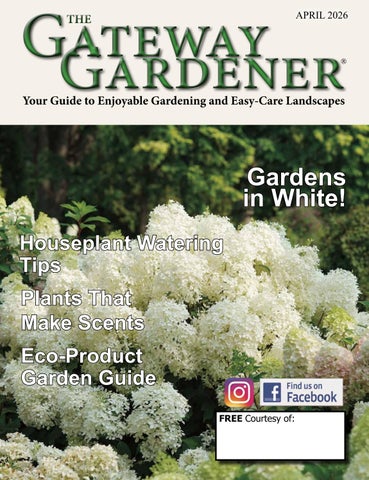
The Gateway Gardener April 2026

Page 1


®

From the Editor THE GatewayGardener

Columnists

Liz Byrde

Missouri Botanical Garden

Abby Lapides

Sugar Creek Gardens

Steffie Littlefield

Edg-Clif Winery

Scott Woodbury

Cacalia: Native Garden Design and Wilding

Samantha Zale Greenscape Gardens

Printing: Breese Publishing, Breese, IL

The Gateway Gardener® is published 7 times/year by Double Dig Communications, Inc. to promote enjoyable, successful gardening and livable landscapes in the St. Louis greater metropolitan area. The magazine is distributed free to the public at designated garden centers, nurseries, garden gift shops, lawn equipment rental, repair and sales establishments, and other locations supporting sound gardening, lawn and landscaping practices.

Please send letters-to-the-editor, questions, event announcements, editorial suggestions and contributions, photos, advertising inquiries and materials, and any other correspondence to:

The Gateway Gardener Magazine® PO Box 220853

St. Louis, MO 63122

Phone: (314) 968-3740

info@gatewaygardener.com www.gatewaygardener.com

everal years ago—maybe a decade or more if I admit how time flies these days—my wife Mary was thumbing through a magazine and came across an ad for a new hydrangea cultivar. It was one of those that blooms pink and white and thus is adorned with one of several dessert names. Strawberries ‘n Cream, Vanilla Strawberry, etc. Not a gardener is Mary, and she rarely comments on plants. So, when this one caught her attention, I had to get it! Alas, it has never quite attained the pink promised in the ad, either because of our summer heat or insufficient watering on my part—I don’t blame the plant. But when in its white stage, it is the most beautiful representation of white I have ever seen in the garden! It’s angel white! Because of that, I forgive it the lack of promised pink.

White can be striking, whether used in mass in what is often called a moon, or moonlight garden, or used as a resting spot for the eyes in an otherwise barrage of color. And one way to efficiently apply white is with shrubs. Shrubs instantly fill a space, and do so year after year. Many, especially the hydrangeas, bloom for long periods of time. You can check out some whiteblooming hydrangeas and other shrub species in guest columnist

Natalie Carmolli’s article beginning on page 4.

I’ve never planted plants in my garden intentionally for their scent, so it often catches me off guard when I’m walking through the yard and something pleasantly captures my olfactory attention. In late winter it might be the witch hazels, early spring the lilacs, or midsummer the coneflowers. What a more rewarded gardener I might be, I ponder, if I planted more purposefully for the sweet fragrances many plants offer up. Abby Lapides offers some suggestion in her article beginning on page 4.

When planting a new garden or filling holes in established gardens, we have many options. We can scatter seeds, plant small plugs, or go bigger with quart or even gallon sized specimens. Each has its own advantages and disadvantages, and level

of appropriateness for the situation. Since gardening can take a bite out of one’s wallet, it helps to understand when it makes sense to scale down a bit, and when it’s worth shelling out a bit more. Scott Woodbury attacks this dilemma as it relates to native plants, and offers his advice on how to make sound decisions on where to put your gardening dollars most efficiently on page 10.

Rounding out our April issue we have houseplant watering tips, a peak at the annual St. Louis Herb Society Sale, an intro to water gardening, and our annual Eco-Garden Product Guide with suggestions from our garden center partners on items that will help you make your sustainable gardening goals more achievable.

As I write this, it’s been a roller coaster spring of temperature extremes—shorts and t-shirts one day, jeans and sweatshirts the next, rinse and repeat. Let’s hope April settles a bit and provides us with some…

Good Gardening!

Plants that Make Scents

While viewing flowers is one of the great joys of home gardening, taking in their fragrance is just as rewarding. A beautifully scented garden enriches the experience of a home garden retreat, surrounding the space with a calm, inviting atmosphere. Below are some of my favorite fragrant flowers of the year, excellent performers that look stunning and smell even better.

‘Super Blue’ lavender, Lavendula, checks every box we want in a lavender and then goes a step further. It produces intensely

fragrant flowers and foliage, stands up to heat and cold, and blooms repeatedly when many traditional lavenders only offer a single flush. Even better, it shows improved tolerance to clay soils compared to older varieties. As with all lavenders, well-drained soil is essential, they do not tolerate wet feet. Beyond fragrance, Super Blue resists deer and rabbit pressure, is edible, and beloved by pollinators—a triple whammy for any garden. Sun.

‘Fragrant Angel’ coneflower, Echinacea, earns its reputation

Lavender
‘Super Blue’

Abby Lapides is owner and a speaker at Sugar Creek Gardens Nursery. She has degrees from the University of Missouri, and is a member of the Landscape and Nursery Association of Greater St. Louis. You can reach her at (314) 965-3070.

as the best white coneflower on the market. Crisp white petals radiate from warm orange cones, creating a clean, elegant look in the landscape. But the real surprise is its scent—a strong sweet fragrance that sets it apart from other coneflower varieties. In a 2018 Mt. Cuba Center trial, Fragrant Angel received the highest number of pollinator visits of any coneflower tested, including the most butterfly visits. Beauty, fragrance, and ecological value all in one plant. Sun.

Few flowers can compete with the fragrance of Dianthus, commonly known as pinks. The variety ‘Cherry Pie’ stands out with vivid red blooms and a strong clove-like scent that carries on warm days. Its flowers are held on long, slender stems perfect

cont’d on next page

for cutting and bringing indoors, allowing you to enjoy that spicy sweetness throughout your home. The tidy, low-growing foliage forms a slowly expanding carpet, making it as useful in the landscape as it is delightful to the nose. Like lavender, pinks need well drained soil. Sun.

Chocolate cosmos, Cosmos a. has long been a favorite for its unusual cocoa scent, and the improved variety ‘Cherry Chocolate’

Hydrangea arborescens

takes that appeal even further. It blooms more vigorously and for a longer season, producing cherry‑red flowers from early summer well into fall. Its rich chocolate aroma perfumes patios, borders, and containers. Compact, upright, and easy to grow in full sun.

While most of the famous fragrant plants are meant for full sun locations, many shade-loving plants can be just as aromatic. Jacob’s ladder Polemonium is a perfect example, offering soft blue flowers with a strong grape‑like scent. The variety ‘Heaven Scent’ is especially prized for its fragrance, though most forms carry that same appealing aroma.

Among shade plants, the Missouri native smooth hydrangea Hydrangea arborescens may be the most fragrant of all. When in full bloom, its honey-like scent drifts through the garden and draws in a wide variety of pollinators. Other excellent shade options include lily of the valley, wild sweet William, sweet woodruff, and the sweet spire shrub.

Flowers tend to be most fragrant in the morning or evening, when they’re actively attracting pollinators. They’re also especially aromatic right after a rainstorm, when humidity lifts their scent into the air. When choosing plants this spring explore with your eyes and your nose!

Polemonium ‘Heaven Scent’ Walters Gardens
Ann Lapides

Happy Houseplants 101 Watering the Correct Way

Watering is the most common reason houseplants fail— not usually because plants need water, but more often because they’re given too much of it. Learning how and when to water properly is essential for long-term plant health. In this article we will look at watering considerations for both beginners and advanced plant parents.

Beginners often rely on schedules, but plants don’t follow calendars. Instead, they respond to their environment. A simple and reliable method is the finger test: insert a finger a few inches into the soil. If it feels dry, it’s usually time to water. Judging the weight of the pot is another clue—dry pots feel noticeably lighter than freshly watered ones.

Overwatering doesn’t just mean watering too often; it means the roots stay wet for too long. Constantly saturated soil pushes out oxygen, causing roots to suffocate and rot. Yellowing leaves, mushy stems, and a sour soil smell are common signs. The way the soil is composed greatly affects the speed at which it dries out. Perlite and vermiculite are common additions that help improve drainage. Some soil mixes also contain moisture-control additives, which usually look like small beads. While these can be helpful in certain situations, they may hold onto moisture longer than desired, making it harder for the soil to dry out between waterings. This is especially noticeable in outdoor containers where rainfall adds to the watering schedule.

Advanced plant parents focus on how water moves through

soil. Factors like pot size, soil composition, light, humidity, and temperature all affect drying time. Plants also use water differently depending on their growth stage—actively growing plants need more water than dormant ones. The type of plant is another consideration when watering, especially in the winter. Plants like cacti and succulents typically have lower water needs. Flowering plants may need a little bit more frequent waterings since they are expending more energy into the blooms. Plants that need lower light typically also need less water in the winter, since the intensity of sunlight is lower.

Seasonal adjustments are crucial. Most houseplants slow down in winter, and many enter a period of dormancy that requires less frequent watering. Continuing summer watering habits year-round is a common cause of plant decline in the winter. A thorough watering is better than frequent sips. Water until excess drains from the bottom, flushing salts and ensuring roots receive moisture evenly. Empty saucers afterward to prevent standing water. If it is possible, sometimes it is good to bring the plant to the sink or tub to let the excess water drain before putting it back on the saucer.

The key mindset shift is learning to respond to the plant rather than following a routine. With time, watering becomes intuitive. Proper watering doesn’t just keep plants alive—it supports strong roots, resilient growth, and overall plant vitality. If you’re ever unsure, stop by your local garden center! A quick conversation can make all the difference!

Spring at Sherwood Forest Nursery

Evergreens, arborvitae, and landscape shrubs available now

From plant selection to full installation

Watering Tips

• Water plants according to need, not the calendar. Check soil moisture with finger or moisture gauge.

• Research water requirements of various plant and group them according to moisture preferences.

• Adjust watering according to the season. Most plants need more water in Spring and Summer months when actively growing; less in slowgrowth periods of Fall and Winter.

• Be alert to outward signs of moisture imbalance. Brown leaftips, yellowing or flagging leaves can all be signs of too much or too little water.

• Misting frequently, grouping plants together, and using a humidity tray can all benefit indoor plants in addition to watering.

2651 Barrett Station Rd.
Samantha Zale has degrees in Horticulture, Anthropology and Biomedical Science. Over the years she has worked at The Missouri Botanical Garden, garden centers, and The Webster Groves Parks Department. Now you can find her at Greenscape Gardens, where she is a content creator, Horticulturist, as well as their Retail Manager!”

Naturally Natives

What Size Plants Should I Buy?

With the price of plants going up and up, it pays to buy smaller container sizes. That’s a no-brainer for robust plants like New England aster, ironweed, obedient plant, and orange coneflower. A petite, 2 inch pot of these species grows fast and will begin blooming decently after one year of growth. By comparison, a small pot of yellow wild indigo or goat’s beard may get lost in the garden and take two-to-three seasons to get big enough to fill out and bloom nicely. Wild hyacinth, wild leek, Michigan Lily, and lead plant can often take even longer—three to four years because they develop more slowly.

Some people don’t mind the grow-in wait period. They often don’t have the will or wallet to pay higher prices for large containers either. Others can’t wait and feel like the price of a quart, gallon, or 3-gallon container is like buying time, the most valuable thing of all. This reminds me of the ancient Chinese proverb that goes something like this, “the best time to plant a tree is 20 years ago, the second best time is now.”

To help you plan your spring shopping list (and budget), I’ve organized

> Hear Grandpa Wayne’s Nature Tales

> Learn about birds, butterflies, and the hidden life of soil

> Create nature crafts

> Shop kids’ gardening tools & nature gear

common native landscaping plants into three lists according to their establishment rates. The first includes vigorous plants that lend themselves to starting with small containers (2-inch pots or plugs). The second list features plants with moderate growth rates (quart or gallon). The third comprises plants that are finicky and develop more slowly (gallon size or larger).

Quick-to-establish plants

(one year; suggested target: two-inch pots or plugs): Groundsels (Packera spp.), spiderworts (Tradescantia spp.), coreopsis (Coreopsis spp.), garden phlox (Phlox paniculata), most sedges (Carex spp.), Jacob’s ladder (Polemonium reptans), obedient plant (Physostegia spp.), blue flag iris (Iris virginica var. shrevei), blackeyed Susans (Rudbeckia spp.), sweet coneflower (Rudbeckia subtomentosa), mistflower (Conoclinium coelestinum), showy (Solidago speciosa), rough-leaved (Solidago rugosa), and cliff goldenrods (S. drummondii), greyhead coneflower (Ratibida pinnata), Ohio horsemint (Blephilia ciliata), sunflowers (Helianthus spp.), New England aster (Symphyotrichum novae-angliae), yarrow (Achillea millefolium), white sage (Artemisia ludoviciana), common milkweed (Asclepias syriaca), wild strawberry (Fragaria virginiana), wild bergamot (Monarda fistulosa), Helen’s flower (Helenium autumnale), river oats (Chasmanthium latifolium), ironweeds (Vernonia spp.), mountain mints (Pycnanthemum spp.), big bluestem (Andropogon gerardii), and switch grass (Panicum virgatum).

Moderate growth rate

(two to three seasons; suggested target: Quart MiniMuM or possibly gallons): Onions (Allium spp.), celadine/ wood poppy (Stylophorum diphyllum), wild sweet William (Phlox divaricata), Joe-pye (Eutrochium spp.), wild geranium (Geranium maculata), Virginia bluebell (Mertensia virginica), prairie coreopsis (Coreopsis palmata), wild petunias (Ruellia spp.), crested (Iris cristata) and copper iris (I. fulva), wild ginger (Asarum canadense), rose turtlehead (Chelone obliqua), blue stars (Amsonia spp.),

butterfly milkweed (Asclepias tuberosa), rose mallow (Hibiscus lasiocarpos), Culver’s root (Veronicastrum virginicum), cardinal flower (Lobelia cardinalis), blue lobelia (Lobelia siphilitica), poppy mallow (Callirhoe spp.), beardtongues (Penstemon spp.), blazing stars (Liatris spp.), Missouri evening primrose (Oenothera macrocarpa), aromatic aster (Symphytricum oblongifolium), prairie clovers (Dalea spp.), purple (Echinadea purpurea), yellow (E. paradoxa), and pale purple coneflowers (E. pallida) compass plant (Silphium laciniata), royal catchfly (Silene regia), rose verbena (Glandularia canadensis), Bradbury bee balm (Monarda bradburiana), rattlesnake master (Eryngium yuccifolium), southern prairie (Eurybia hemispherica) and sky blue asters (Symphyotrichum oolentangiense), skullcap (Scutellaria spp.), columbine (Aquilegia canadensis), fire pink (Silene virginica), pussytoes (Antennaria parlinii), Indian physic (Gillenia stipulata), little bluestem (Schizachyrium scoparium), sideoats grama (Bouteloua curtipendula), and cedar sedge (Carex eburnea).

slow growth rate/delicate first-year seedlings

(three to four years: suggested target: gallon MiniMuM or larger):

Blue- (Baptisia australis), white(B. alba), and yellow false indigo (B. sphaerocarpa, Indian pink (Spigelia marilandica), Solomon’s seal (Polygonatum biflorum), Solomon’s plume (Maianthemum racemosum), wild leeks (Allium tricoccum), leadplant (Amorpha canescens), American spikenard (Aralia racemosa), Michigan (Lilium michiganense) and bunchflower lily (Melanthium virginicum), goat’s beard (Aruncus dioicus), prairie dock (Silphium terebinthinaceum), prairie dropseed (Sporobolus heterolepis), ferns, woody vines, shrubs, and trees.

Lastly, you will find a handful of nurseries that offer bare root plants,

mail-order plants sold without soil or pots, and usually packed/shipped in peat moss. These plants tend to be inexpensive because they are field grown in long rows. Their sizes can vary, but they are usually the best buy for your money. Bare-root plants may be somewhat dormant and/or desiccated, because they typically are dug in the fall and stored in refrigeration through winter. They should be shipped in early spring while dormant, and then soaked in a bucket of water for several hours just before planting, to rehydrate the roots. However, if you want bare-root plants, ensure they are nursery-grown. In recent years, unscrupulous plant dealers have been selling rhizomes/root stock poached from the wild, severely degrading original habitat.

I hope these growth-rate tips help you navigate through the many plants and sizes available in catalogs and nurseries this spring. And I hope it saves you money, too.

Better get planting, y’all!

Scott Woodbury is the owner of Cacalia: Native Garden Design and Wilding, and he is a Grow Native! professional member. Find suppliers of native plants and seed, as well as landscaping services, at grownative.org.

Missouri Wildflowers

Nursery

9814 Pleasant Hill Rd Jefferson City MO 65109 www.mowildflowers.net mowldflrs@socket.net 573-496-3492, fax: 573-496-3003

Meet us at one of these locations in St. Louis. Give us your order at least 5 days before a sale, and we will bring it to the location.

Kirkwood Farmer’s Market, 150 East Argonne Dr. Kirkwood MO 63122. April 4, 11, 18, 25, May 23 & 30, 8 a.m. to 4 p.m.

Shaw Nature Reserve. 307 Pineton Loop Rd, Gray Summit MO 63039. “Ozark Flora Fest (& Native Plant Sale)” May 2, 10 a.m. to 2 p.m.

See www.shawnature.org. for the big change!

Five Oaks on Warson 1200 N Warson Rd, Olivette, MO 63132; Bring Conservation Home Native Plant Sale. May 17 (Sunday), 10 a.m. to 2 p.m.

Shop at our Nursery in Brazito, MO and Save 12 to 14 percent! DayTrip!

Anacharis
Robert Weaver

own ecosystem surprisingly fast. What matters most is the plants. When you choose the right ones, they do most of the work, quietly balancing the water and supporting the life that gathers around it.

plants run the show

A healthy pond needs a few key players. Pond plants are surprisingly easy to grow. Give them water, sunlight and a little space for their roots, and they settle in quickly.

A submerged oxygenator like Anacharis grows entirely below the surface, quietly helping keep the water clear. These plants release oxygen into the pond while absorbing excess nutrients that would otherwise feed algae.

Water lilies take center stage on the surface. Their broad floating leaves shade the water, keeping temperatures stable and naturally limiting algae growth. In summer, their flowers rise above the pond and open fresh blooms almost daily, adding color and movement to the garden.

Reliable perennials like Virginalis bloom year after year, while annual varieties like Blue Spider bring vibrant color during the peak season.

Along the edges, shallow water plants like the tall Taro and lowgrowing Creeping Jenny soften the transition between land and water, adding texture and dimension while helping filter

the pond.

Together, these plants create a balanced pond ecosystem and set the stage for an entirely new kind of activity in the garden.

an entire ecosysteM

Before long, visitors begin to arrive. Dragonflies first, usually, followed by frogs, birds and butterflies.

And that matters more than most people realize. Research shows that amphibians are declining worldwide, with the top cause being habitat loss. Backyard ponds are one of the simplest ways an ordinary gardener can help restore small pieces of lost habitat.

Joe Summers is owner of Chalily, which recently moved to 18944 St. Albans Rd in Wildwood and will open this spring. Follow us on social media for the latest updates. Get free shipping on all orders from Chalily.com or call 636.527.2001. Photos courtesy Chalily, except as noted.

Gardens

White!

Pantone® has named Cloud Dancer its 2026 Color of the Year, marking the first time a true white has taken the honor. According to Pantone, Cloud Dancer is a soft, luminous white that conveys calm, clarity, and quiet optimism.

It is described as a balanced shade that feels light and expansive, offering a sense of ease and openness in an often visually crowded world.

In the garden, white has always played an important design role.

White flowers and light foliage act as neutral pauses among colorful plantings, allowing brighter hues to stand out without overwhelming the eye. They also reflect light beautifully, adding brightness to garden spaces and outdoor living areas.

White flowering shrubs bring that effect to the landscape year after year. Unlike seasonal color, shrubs return reliably, standing up to the cold winters and warm summers common across much of the Midwest. While Pantone’s Color of the Year will inevitably change, the beauty and usefulness of white in the garden never goes out of style.

Here are six Proven Winners® ColorChoice® shrubs that capture the serene spirit of Cloud Dancer while thriving in USDA Zones 5–6, where many Midwest gardeners grow.

perfecto Mundo® double white reblooMing azalea

(USDA zone 6–9, H-W 2.5–3’/3–4’)

Perfecto Mundo Double White azalea brings refined elegance to the garden with lush, double white blooms in spring that reappear later in the season. The crisp flowers pair beautifully with colorful perennials or darker foliage, creating contrast while maintaining a soft, calming presence. In cooler microclimates, plant azaleas in a sheltered spot with morning sun and some afternoon shade to protect them from winter winds and summer heat.

Vanilla spice® suMMersweet (USDA zone 4–9, H-W 3–6’/3–5’)

This North American native shrub produces fragrant white flower spikes in summer that attract pollinators while brightening the garden during the warmest months. Vanilla Spice summersweet (Clethra alnifolia) tolerates heavier soils and occasional moisture, making it a practical option for many Midwest landscapes.

Fairytrail Bride® Cascade Hydrangea® (USDA zone 5–9, H-W 3–4’/3–4’)

Fairytrail Bride hydrangea hybrid features graceful arching stems lined with pure white blooms in late spring to early summer. Cold hardy and reliable across much of the Midwest, it works beautifully in the landscape or in large containers. Its cascading habit also makes it an excellent choice for hanging baskets, where the flowers can spill gracefully over the edges.

cont’d. on next page

Azalea
Perfecto Mundo® ‘Double White’
Cascade Hydrangea ‘Fairytrail Bride®’

from previous page

reMiniscent® creMa rose (USDA zone 4–9, H W 1.5 3’/2’)

Rose ‘Reminiscent® Crema’

Smooth Hydrangea

‘Incrediball Storm Proof™’

puffer fish® panicle hydrangea

(USDA zone 3–9, H-W 3–5’)

Reminiscent Crema rose combines classic beauty with modern garden performance. Fully double, creamy white blooms appear throughout the growing season on plants bred for improved disease resistance. In full sun and well-drained soil, it becomes a long-blooming highlight in mixed borders and garden beds.

incrediball storM proof™ sMooth hydrangea

(USDA zone 3–8, H W 3.5–4’/3–4’)

Incrediball Storm Proof smooth hydrangea produces massive white blooms held on exceptionally strong stems that stay upright through summer storms and heavy rain. This pollinator-friendly beauty thrives in full sun to part shade and returns reliably year after year.

With its rounded, cloud-like blooms, Puffer Fish panicle hydrangea brings softness and brightness to the garden in summer. The large white flower heads gradually age to green, adding subtle seasonal interest. Panicle hydrangeas are among the most dependable shrubs for Midwest gardens, blooming reliably even after cold winters.

why white belongs in eVery garden

White may be trending, but in the landscape it is always relevant. White flowers:

• Create visual breathing room among bold colors

• Brighten shaded areas and garden edges

• Reflect evening light for a soft glow outdoors

Pantone’s Cloud Dancer simply reminds us of what gardeners have long known: white is a powerful design element that brings balance, beauty, and serenity to the landscape.

Natalie Carmolli is a Shrub Expert for Proven Winners® Color Choice® Shrubs. Photos courtesy Proven Winners®.

The Cornucopia Corner

Herb Highlights at the SLHS Sale!

When someone says I’m going to “THE” Herb Sale, they really mean they are going to rush to the Missouri Botanical Garden on the last Friday in April by 9am to purchase some of the newest and hard to find herb plants. This sale is put on by the prestigious St Louis Herb Society not only as a fundraiser but to make the largest assortment of herbs available to their members and the community. So much hard work and planning goes into this sale that only those devoted to the use and education of herbs would make this part of their mission. Lucky St Louis for having this organization arranging a sale of over 7200 herbs and native pollinators including more than 150 varieties. You will be astounded. To illustrate the magnitude of this event I will highlight some of them here.

Basils are the most popular herb every year at the sale. Rutgers University has developed 4 different disease resistant basils. The Herb Society has carried Rutgers Devotion for the past 2 years. This year, they decided to try another, Rutgers Obsession. Everyone is excited about these, along with the other 12 Basils that will be for sale. You’ll find everything from Large Lettuce Leaf to Thai, Lemon, Blue Opal, Pesto Perputeo, Red Rubin and Spicy Globe. Wow and that’s not all. Also big sellers are the beautiful Rosemarys, of which there will be the 5 big names: Bar-b-que, Tuscan Blue ( new this year at the sale), Arp, Blue Rain and Hill Hardy. There will also be 12 Lavenders, 8 Sages and 9 different Thymes. Another new herb at the sale is French Sorrel, a personal favorite. I have grown this for years in my garden harvesting the tender leaves for salads and soups and stir fries. I just love the lemony taste. Cuban Oregano is another rare plant that an Herb Society member propagates just for this sale. You will find it with the other 5 oreganos!

The other important benefit of going to the sale is being able to speak with the Herb Society members on-hand to

Steffie Littlefield is a St Louis area horticulturist and garden designer. She has degrees from St. Louis Community College at Meramec and Southeast Missouri State and is a member of Gateway Professional Horticultural Association, Missouri Botanical Garden Members Board and past president of the Horticulture Co-op of Metropolitan St. Louis. She is part-owner of Edg-Clif Winery, Potosi, MO. www.EdgClif.com, and teaches a class on viticulture at SLCC-Meramec.

Shoppers stroll the aisles looking for their favorite herbs.

answer questions and help with selections. Where else can you ask about the differences in the 4 Eucalyptus varieties, find Vietnamese Coriander, get help deciding between German and Roman Chamomile or choose between 9 different Mints? They will also have a few gift items for sale and be giving away some books on herbs to special buyers.

To help you enhance your garden and the community the Herb Society will have a special selection of native plants specifically to attract pollinators to your garden. It is vital that we all help protect these insects and birds to promote a healthy environment. Here you can find just the right plant to add to your garden. So don’t miss your chance to experience this once-a-year event, mark your calendars

and bring a friend. I hope to see you there!

The 2026 sale will take place on Thursday April 23, 5-7:30 pm (for members of the Missouri Botanical Garden only): and Friday, April 24, 9 am until 5 pm or when the supply of available herbs had been exhausted (open to the public with free admission to the sale).

The 2026 sale will be located at the Missouri Botanical Garden in the west parking lot in front of the Jack C. Taylor Visitor Center. The sales area will be protected by a large tent.

Photos by Kelly Cato, Courtesy Missouri Botanical Garden.
Just a peek at some herbs available at past sales.
Happy herb shoppers with a wagon full of deliciousness!

Rolling Ridge Nursery

60 North Gore Ave.

Webster Groves, MO 63119

RollingRidgeNursery.com

2026ProductEco-Garden Guide

Mexican Butterwort Plants

Natural gnat control for your home! These incredible Mexican Butterworts will flourish on a bright windowsill and will trap small flying insects like fungus gnats, fruit flies, and springtails. Water with our RO water and you will be set!

Garden Heights Nursery

1605 S. Big Bend Blvd. Richmond Heights, MO (314) 645-7333 GardenHeights.com

Monstera Natural Wood Trellises

We’re excited to now carry beautiful natural wood trellises in the Garden Heights store! These modern trellises highlight the natural wood grain of each piece, making every one completely unique.

Designed to support your favorite vining houseplants without the need for ties, they offer a simple and functional way to help plants grow and climb naturally.

Planthaven Farms

6703 Telegraph Rd. Oakville, MO (636) 272-5005

O’Fallon and Olivette, too! PlanthavenFarms.com

Snake Plant

Snake Plant (Dracaena trifasciata) also know as mother-in-law’s tongue, is known for its natural airpurifying qualities. It’s also a great easy-to-care-for houseplant for beginners. It is drought tolerant, and thrives in indirect light conditions. Care should be taken around young children and pets, as it is toxic if ingested.

Greenscape Gardens

2832 Barrett Station Rd. Manchester, MO 63021 (314) 821-2440

GreenscapeGardens.com

Riverview Living Soils BioBase Fortified Plant-Based Compost

Not all compost is created equal. Bio-Base is a Missourimade soil amendment that goes beyond basic compost.

It’s built with premium plantbased compost and locally sourced Biochar, then enriched with beneficial microbes and natural ingredients like Alfalfa Meal and Malted Barley, the kind of inputs that keep your soil alive and working for your plants. The result is healthier soil structure, better water retention, and stronger plant growth over time. Use it in new garden beds, raised beds, native plantings, or simply spread it on top as a seasonal boost. Whether you’re starting from scratch or improving what you’ve got, Bio-Base helps your soil do more, naturally.

Sugar Creek Gardens

1011 N. Woodlawn Kirkwood, MO 63122 (314) 965-3070

SugarCreekGardens.com

Golden Alexander Purple coneflower attracts

butterflies, bees, and other pollinators with long-lasting, nectar-rich blooms. Seed heads remain through fall and winter, offering natural food for goldfinches and other songbirds. Its tough native roots allow it to thrive with little care once established, strengthening local habitats and adding beauty to sunny beds and borders.

O.K. Hatchery 109-115 Argonne Kirkwood, MO (314) 822-0083

Medina 20% Vinegar

Concentrated, plant-based solution designed for effective organic weed management. Safe and biodegradable, ti helps maintain a healthy, chemical-free garden and landscape.

Zicks Great Outdoors

16498 Clayton Rd. Wildwood, MO (636) 458-1445

ZicksGreatOutdoors.com

Pine Mulch

Zick’s is St. Louis’ supplier of pine straw mulch, sustainable and renewable. A beautiful natural mulch to use around shrubs and other garden beds, or as an extremely walkable garden path material.

Timberwinds

54 Clarkson Road Ellisville, MO 63011 636-227-0095

Timberwindsnursery.com

Riverview Living Soils

Made in Missouri! Riverview Living Soil Blends are designed to provide all of the nutrients and biology needed to promote vigorous and healthy growth from your plants.

Chalily

14430 Manchester Rd. Manchester, MO 63011 (636) 527-2001 Chalily.com

Chalily Spring Start-Up Kit

Get your pond running smoothly this spring with Chalily’s multi-stage Start-Up system. Safe for plants, fish, wildlife and household pets. Every ingredient is eco-friendly

and 100% natural. Start with the De-Sludger tablets to clear out the buildup that accumulated over winter. Then add the Kick-Starter liquid to seed your biological filter and get your pond looking clear in no time. All orders ship free from

Sherwood Forest Nursery

2651 Barrett Station Rd. (314) 287-6217

Espoma Organic Land & Sea Gourmet Compost

Revitalize your garden with this premium “surf and turf” soil amendment. By combining peat and humus with lobster and crab shells, this compost delivers a natural boost of calcium and nitrogen that standard mixes lack. It features Mycotone®, a proprietary blend of mycorrhizae that promotes 30% larger root systems and increased drought resistance. Perfect for establishing highyield vegetables, vibrant flowers, and hardy trees.

Hoffmann Hillermann

Nursery & Florist 2601 E. 5th Street, Washington, MO 63090

636-239-6729 www.hillermann.com

Bio-tone Starter Plus by Espoma Organic

Good to use with everything you plant, Bio-tone Starter Plus is the ultimate starter plant food! It’s a rich blend of the finest natural & organic ingredients and enhanced with beneficial microbes, humates

and mycorrhizae. Use this organic starter plant food when planting all flowers, vegetables, trees and shrubs to help produce large root systems very quickly. 100% natural and organic approved. Safe for people, pets and planet.

Forrest Keeling Nursery 44 Forrest Keeling Lane Elsberry, MO 63343

573.898.5029

ForrestKeelingNursery.com

Neonic-free Locally Grown Plants

Good for your garden. Great for bees. Neonic-free, locally grown plants — BEE-cause pollinators matter.

Town and Country Nursery Inc,

13941 S State Highway 94P.O. Box 132, Dutzow, MO 63342

636-433-2234

townandcountrynursery.com

Captain Jack’s Fruit Tree Spray

Provides insect and disease control for your home, garden

and orchard. Fruit Tree Spray acts as 4 garden products in one! As an effective biological fungicide, insecticide, miticide and nematicide, Captain Jack’s Fruit Tree Spray provides total control and protection against common garden issues. Approved for organic gardening and can be applied up to the day of harvest.

Boxes, Beds & More Granite City, IL (618) 931-1564

Locally Handmade Cedar Planters

Handcrafted cedar raised beds, window boxes and planter boxes made right here in the Gateway region. Extensive selection of sizes and shapes to fit your needs. Call us and let us make one just for you!

Shop your local independent garden centers and nurseries for these and other ecofriendly products to help you garden more sustainably!

Upcoming Events

Meetings,

Upcoming Events

Department. Planthaven Farms, 6703 Telegraph Rd., 63129.

May 2nd

Classes, Entertainment and More

Updates to this information are often posted on our online events calendar at www. GatewayGardener.com, so check there for the latest details.

Give us the details of your upcoming gardening, lawn or landscaping event and we’ll add it to our website and include it in our next issue. Deadline for printing in the June issue is May 1st.

How to reach us:

Mail: PO Box 220853, St. Louis, MO 63122

Email: info@gatewaygardener. com

GARDEN CLUBS AND PLANT SOCIETY MEETINGS

Interested in Joining a Garden Club or Plant Society? We have meeting dates, locations and contact information on more than 50 area garden clubs on our website at www. GatewayGardener.com. Don’t have access to the internet? Just call us at (314) 968-3740, or write us at PO Box 220853, St. Louis, MO 63122, and we’ll get the information to you. So share your joy for gardening and join a garden club or favorite plant society today!

FUN FOR KIDS

April 4th

9am-Children’s Garden Club. Edible Bowls. FREE. Preregistration is required on the St. Louis County website at https:// tinyurl.com/yc3v3pfj or by calling 314-615-4386. Sponsored by St. Louis County Parks

9am-Children’s Garden Club. Planter with Annuals and Planting the Garden. FREE. Pre-registration is required on the St. Louis County website at https://tinyurl.com/yc3v3pfj or by calling 314-615-4386. Sponsored by St. Louis County Parks Department. Queeny Park –CGC Nursery, 1675 S. Mason Rd. (Queeny Park East Entrance), St. Louis 63131.

PLANT SALES, GARDEN TOURS AND SHOWS

April 18th

8:30am-2pm—Webster Groves Herb Society Spring Herb Sale There will be a large selection of basic as well as hard-tofind herbs, heirloom tomatoes, peppers, strawberries, ground cherries, perennials, and natives. Experience the Webster Groves Herb Society tradition, and kick off the growing season with us! First Congregational Church of Webster Groves. 110 W. Lockwood (corner of Lockwood and Elm) Webster Groves. Cash, check, debt and credit accepted. Free admission and parking.

April 18th

10am-2pm—Missouri Prairie Foundation Native Plant Sale. A wide variety of native wildflowers, grasses, sedges, vines, shrubs and trees supplied by Grow Native! Vendors include Gaylena’s Garden, River City Natives, Ozark Soul Native Plants and Papillon Perennials. professional members available for purchase. World Bird Sanctuary, 125 Bald Eagle Rd., Valley Park, MO 63088. Cash or checks at all vendors, some also take credit cards.

April 23rd-24th

St. Louis Herb Society Sale. See details on pages 18-19.

April 24th

9am-4pm—St. Louis Community College Horticulture Program Spring Plant Sale. Annuals, veggies, perennials natives, and herbs. STLC Meramec, 11333 Big Bend Rd, Parking Lot K, Kirkwood, MO. Rain Date: April 25th, 9am2pm.

April 24th-25th

8am-6pm Fri., 8am-noon

Sat.—Webster Groves Garden Club Spring Plant Sale. Wide variety of plants grown in local home gardens, including natives and non-natives. Garden Club members on hand to answer questions. Proceeds support horticulture scholarships and other activities. Webster Groves Recreation Complex, 33 E. Glendale, Webster Groves.

April 25th

St. Charles Master Gardener Spring Plant Sale. Tomatoes, Peppers, Herbs, Annuals, Perennials and Natives. Admittance by reservation only. Sign up at stcharlescounty mastergardeners.com. MU Extension Office, 260 Brown Rd., St. Peters, MO

April 25th-26th

9am-3pm—Pollinator Plant Sale. Wide selection of native plants that benefit butterflies, bees, and other native pollinators. All plant proceeds benefit Project Pollinator, our community gardening initiative. Sophia M. Sachs Butterfly House, 15050 Faust Park Dr., Chesterfield, MO. Admission not required to shop the sale. More info at butterflyhouse.org/ projectpollinator.

May 1st-2nd

2-7pm Fri., 7am-noon Sat.— Plant and Rummage Sale 2606 Riley Paul Ct, O’’Fallon, MO 63368. Perennials, native plants, houseplants, gently used gardening items. Clean, gently used household items. Funds raised support community

projects of the O’Fallon Garden Club.

May 1st-2nd

Fri. Noon-8pm, Sat. 9am-5pm— The Gardeners of Florissant Annual Spring Plant Sale and Elks BBQ. Perennials, annuals, shrubs, shade plants, vegetables, herbs, hanging baskets and more! Indoors and climate controlled for your comfort. Easy loading from multiple doors. NEW LOCATION. Florissant Elks Lodge 16400 New Halls Ferry Rd., Florissant, MO 63031.

May 2nd

10a 2pm—Ozark Flora Fest and Native Plant Sale. Visit www.shawnature.org for the big changes in this event, formerly the Shaw Wildflower Market. Shaw Nature Reserve, 307 Pinetum Loop. Rd., Gray Summit, 63039.

May 2nd-3rd

8am 1pm Sat. Noon 3pm Sun.— Central Missouri Master Gardener Annual Plant Sale. 3 greenhouses full of tomatoes, peppers, hanging baskets, perennials (including natives), Master Gardener Greenhouses, 810 Sandstone, Jefferson City, MO.

May 9th 8:30am-noon—Webster Groves Women’s Garden Association Plant Sale. Hundreds of homegrown sun and shade perennials from Webster Groves Women’s Garden Association gardens, plus small container arrangements ready just in time for Mother’s Day. Profits go to support horticultural programs at WG schools and other community projects. parking lot of WG First Congregational Church located at Elm and Lockwood.

May 9th

8am-noon—Edwardsville Garden Club Spring Plant Sale Many varieties of perennials, houseplants, natives, vegetables,

annuals, herbs, garden art and books. St. Mary’s Catholic Church parking lot, 1802 ,Madison Avenue, Edwardsville, IL 62025.

May 9th

10am-2pm—Wild Ones Native Plant Sale. All your favorite native plants to boost your pollinator profile! Shaw Nature Reserve’s Ozark Flora Fest, 307 Pineturn Loop Rd., Gray Summit, MO 63039, at the front entrance.

May 17th

10am-2pm—Bring Conservation Home Native Plant Sale. Five Oaks on Warson, 1200 N. Warson Rd., Olivette, MO 63132.

CLASSES, LECTURES AND EVENTS

Forest ReLEAF April Events— Want to get your hands dirty planting trees. Visit Forest ReLeaf’s Event Page at www. moreleaf.org to learn more about our April events, including Public Potting (Apr. 4), O’Fallon Park Tree Planting (Apr. 11), Pear Buy Back (Apr. 21), public potting at City Tree Farm (Apr. 22) and Earth Day Festival Giveaway (Apr. 25).

April 4th

11am—Resurrection Garden. Using a shallow container we will create a symbolic Easter craft depicting the scene of the tomb and resurrection of Jesus. $40.00. Sign up at hhoffmannhillermann.com or call Hoffmann-Hillermann Nursery & Florist at 636 239 6729.

April 11th

11am—Bog Garden. Build your own carnivorous bog garden that mimics the plants natural environment to encourage healthier plants. $30.00. Sign up at hoffmannhillermann.com or call Hoffmann Hillermann Nursery & Florist at 636-239-6729.

April 11th

1:30pm—Plant Bingo. Laughter, friendly competition and the opportunity to win beautiful plants. Suggested donation: $20 at the door or online. Presented by the Madison County Extension Education Foundation. Proceeds support University of Illinois Extension programming such

as 4-H, Master Gardeners, Master Naturalists and Nutrition Education. (618) 344-4230, https:// givebutter.com/MCEEF2026Bingo Farm Bureau Auditorium, 900 Hillsboro Ave., Edwardsville, IL 62025.

April 18th

11am—Tea Garden. Create your own Tea Garden using a variety of herbs. You will learn how to care for and harvest fresh ingredients from this garden to make your own medicinal tea. $45.00. Sign up at hoffmannhillermann.com or call Hoffmann Hillermann Nursery & Florist at 636-239-6729.

April 25th

9am-1pm—Kirkwood Arbor Day Celebration. Two trees will be planted to celebrate the Kirkwood Library’s 100th Anniversary. There will also be a volunteer-based tree planting on West Rose Hill Ave. The celebration is run in conjunction with the Beer Run and Coffee Klatch. Activities for children and free bare-root trees will be available. Kirkwood Public Library, 140 E. Jefferson Ave., Kirkwood.

April 25th

11am—Decorative Porch Pot. Join us to plant a decorative sun/ shade porch pot accompanied with a wind chime pot stand. $60.00. Sign up at hoffmannhillermann. com or call Hoffmann-Hillermann Nursery & Florist at 636-239-6729

April 25th-26th

St. Louis Earth Day Festival

Celebrate Earth Day with great food, music and activities. Learn about sustainable products and practices from local businesses and organizations. Forest Park on the Muny grounds. Free and open to the public. Visit earthday-365.org for details.

May 9th

9am-3pm—Washington County in Bloom Flower Festival. Seed and plant swap. Craft and Plant booths, free kids activities, food trucks and more. Potosi Lion’s Club, 10386 Hwy 185, Potosi, MO. Visit WashCoMoInBloom.com for more info.

NEW LOCATION!

Friday, May 1st, 12pm-8pm and Saturday, May 2nd, 9am5pm

Florissant Elks Lodge 16400 New Halls Ferry Rd. Florissant, MO 630331

The Gardeners of Florissant

Annual Spring Plant Sale and Elks BBQ

Perennials * Annuals * Shrubs Shade Plants * Vegetables Herbs * Hanging Baskets Kids’ Area * Food and Drinks Indoors and climate controlled Easy loading from multiple doors

Plants are Pollinator Plants!

May 9th 10am-2pm

Turn static files into dynamic content formats.

Create a flipbook