![]()


Joyce Bruno & Robert Weaver
Publisher and Editor
Robert Weaver
Columnists
Liz Byrde
Missouri Botanical Garden
Abby Lapides
Sugar Creek Gardens
Steffie Littlefield
Edg-Clif Winery
Scott Woodbury
Cacalia: Native Garden Design and Wilding
Samantha Zale Greenscape Gardens
Printing: Breese Publishing, Breese, IL
The Gateway Gardener® is published 7 times/year by Double Dig Communications, Inc. to promote enjoyable, successful gardening and livable landscapes in the St. Louis greater metropolitan area. The magazine is distributed free to the public at designated garden centers, nurseries, garden gift shops, lawn equipment rental, repair and sales establishments, and other locations supporting sound gardening, lawn and landscaping practices.
Please send letters-to-the-editor, questions, event announcements, editorial suggestions and contributions, photos, advertising inquiries and materials, and any other correspondence to:
The Gateway Gardener Magazine® PO Box 220853
St. Louis, MO 63122 Phone: (314) 968-3740
info@gatewaygardener.com www.gatewaygardener.com


inter is behind us; the growing season has begun! It actually began in my yard back in January when the blooming native witch hazels inspired a precocious daffodil (an early blooming variety, ‘Rejnveld’s Early Sensation’ I’ve reported on before on this page) to pop open. It was a decision soon regretted, when it almost immediately and harshly was dumped on by a foot of snow and single-digit temperatures. Now it is being joined by its more judicious garden mates, the snow drops, winter aconite, hellebores and other, wiser daffodils. Soon the ephemeral woodland natives will make their brief appearance, and suddenly my blue jeans will once again sport the dirty wet knees of a new season underway. Welcome!
The houseplants are starting to stir again after mostly resting the last few months. I gave up on houseplants for decades, using the winter months to rest myself from the exhausting summer regimen. But circumstances bequeathed us nearly a dozen plants a few years ago, and we kept them, partly because of sentimental value; mostly because Mary offered to take on their care. They seem to appreciate her saving them from the compost bin and are thriving! This is in no small part due to the perfect place she has found for


them, overwintering in a corner by a bright south-facing window. Light—and the right amount—is a crucial element to the happiness of all plants. Too much or too little and they will turn crispy or pale. On page 8, Samantha Zale gives us a primer on keeping our houseplants happy and healthy with just the right light for their needs.
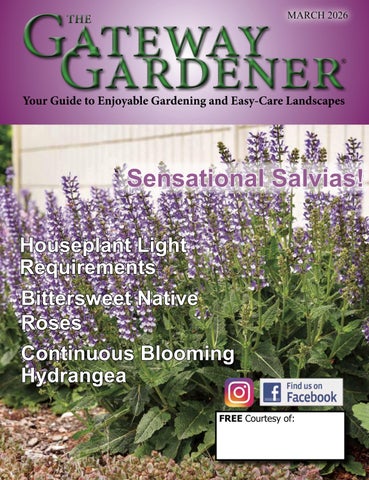
Keeping sages happy is much simpler. They are the George Hamilton of plants--give them all the sun they can get, baby! Abby offers to help us “get wise on sages” with the benefit of her own wisdom and years of discovering the many facets of the broad Salvia family that, if chosen “wisely”, will have your garden bursting with color for months upon end! Check them out beginning on page 4.
For a number of years, I volunteered with the Horticulture
Answer Service (HAS) at Missouri Botanical Garden, answering phone and email questions from gardeners with a problem. A Top 10 among most frequent issues was, “Why don’t my hydrangeas bloom?” Most often the answer was due to a late or early freeze killing the buds. (When it wasn’t that, it was an overzealous spouse tidying up the garden with ill-timed pruning.) Many hydrangeas form their flower buds on last year’s growth, so an unseasonal frost or hubby’s pruning passion kills or removes the buds before they can blossom. Guest contributor Natalie Carmolli, introduces us to a cleverly hybridized hydrangea that avoids disaster by producing a more cold-tolerant plant that also blooms on old and new wood. Read all about Let’s Dance Sky View Hydrangea on page 14. There’s much more in this issue—24 pages in all! So, if it’s still too muddy to get out in the garden, settle down with your copy. Your jeans’ knees will be dirty and wet soon enough!

By Abby Lapides

Growers’ rows prepare for a new season of sages, including the Mealycup Sage ‘Sallyfun Blue Lagoon’ shown here.
With their abundant flowers and rugged nature, sages anchor the sun garden. Most varieties fit into the trifecta of sun garden perfection: they’re ignored by deer and rabbits, thrive in drought, and flower heavily. Coming in cold hardy perennials or bold annuals, there’s a sage for every sunny spot. Read on to discover my top picks for sages that shine in St.

Louis gardens.
Salvia nemerosa - Woodland Sage. By far the most popular sage for the perennial garden, woodland sage blooms in waves for months with minimal maintenance. Considered the best woodland sage, ‘Blue By You’ stands out with tall plump spikes of blue flowers. ‘Rose Marvel’ produces showy pink spikes with larger


than normal flowers. To keep woodland sage reblooming all season long, shear spent flower stalks to the basal foliage.
Salvia pratensis – Garden Sage. Garden sage looks like woodland sage took a growth hormone. Garden sage only blooms
Abby Lapides is owner and a speaker at Sugar Creek Gardens Nursery. She has degrees from the University of Missouri, and is a member of the Landscape and Nursery Association of Greater St. Louis. You can reach her at (314) 965-3070.


once, but when it does, the display cannot be missed. ‘Azure Snow’ is a bicolor variety that stands out.
Salvia guaranitica - Anise Sage. A vigorous fast-growing annual, anise sage excels in St Louis. This type features large tubular flowers that hummingbirds regularly visit throughout the summer months. In a single season, anise sage can grow to 3’ tall and wide and excels in containers or the ground. A classic, ‘Black and Blue’ remains popular, but I personally love the hybrid ‘Wendy’s Wish’ for its magenta flowers. A new variety called ‘Hummingbird Falls’ has a weeping habit, perfect for hanging baskets.
Salvia greggii – Autumn Sage. Similar in appearance to anise cont’d on next page


sage but a little smaller, more drought-tolerant, and more coldhardy, autumn sage quickly forms into mounds with many vibrant flowers. While most autumn sage needs to be planted in a highly protected spot to come back year after year, a new variety, ‘Arctic Blaze Red’, is cold-hardy in St. Louis. All need well-drained soil, especially in winter, for best survival.
Salvia officinalis – Culinary Sage. While culinary sage remains a must-have for the herb garden, it also deserves a place in any ornamental garden. The fuzzy leaves provide the iconic Thanksgiving flavor, and it produces lilac flowers in the summer


beloved by bees. Varieties like ‘Tricolor’ or ‘Aurea’ add showy foliage in the garden, which can be challenging to find in sunny spots. Both excel as low-growing accents in a mixed perennial garden or an ornamental herb garden.
Salvia farinacea – Mealycup Sage. A beloved annual, mealycup sage blooms all summer long and tolerates drought and heat. The plump flower stalks bloom over bright green foliage. Many different varieties exist, and not all perform equally. ‘Sallyfun Blue Lagoon’ consistently performs well, staying upright and blooming vigorously throughout the summer with a clear blue hue. The Sallyfun line also produces an excellent showy white and a pale blue variety.
Other sages shine in St. Louis. The Missouri native S. azurea –blue sage – blooms later in the season with pale blue flowers. S. splendens – red sage – is an easy-care annual with flaming red flowers. S. elegans – pineapple sage – resembles anise sage, but its leaves smell like pineapple, and it only blooms late in the season.
Pollinators, especially hummingbirds, love all sages. All mentioned varieties have fragrant foliage and thrive in the sun. When planning your sun gardens, always add a sage or ten.


Photos and Text By Samantha Zale

Light is the foundation of houseplant care, yet it’s one of the most misunderstood aspects of keeping plants indoors—or outdoors for that matter. Without the correct light, even perfect watering and soil conditions won’t save a struggling plant. Understanding how light works in your home allows you to choose plants wisely and care for them confidently. In this article, we will look at a few points to consider for both beginners and advanced plant parents when it comes to light requirements for their houseplants.
For beginners, light is usually described as low, medium, or bright indirect. Low light means no direct sun and limited brightness. This often puts the plant in a space that is several feet from a window. Medium light is brighter but still indirect. This would put the plant near a north- or east-facing window. Bright indirect
light is abundant light without harsh sunbeams. Commonly this would be near south- or west-facing windows filtered by curtains. Direct light means the sun’s rays hit the leaves directly, which can be beneficial or damaging depending on the plant. In this context, direct sun can damage many houseplants due to the plant’s inability to thrive in direct sun, or has not been acclimated to it.
A simple way to assess light is to observe shadows. Sharp, defined shadows indicate bright light; soft shadows mean medium light; barely visible shadows suggest low light. Understanding this helps beginners avoid placing sun-loving plants in dim corners or shade-tolerant plants in scorching windows.

For advanced plant parents, light becomes more nuanced. Light intensity and duration both matter. Plants respond not only to brightness but also to how many hours of light they receive. Seasonal changes

are especially important—winter light is weaker and shorter, often requiring plant repositioning and supplementation. Gradual acclimation is key when moving plants, as sudden changes can cause leaf drop or sunburn. This is why it is important to bring plants in early enough in the fall to allow for the plant to acclimate adequately to the new spot. Some of the most notorious plants to make a stink when they come in for the winter are citrus plants. They are a plant that doesn’t like frequent change, and it is normal for them to drop a lot of leaves during this winter prep phase. But planning this move early, well before the first signs of frost, and finding a cozy spot that has bright indirect sun is ideal.
Common mistakes include assuming “low light” means no light, rotating plants too frequently, or believing artificial light is unnecessary. While many plants tolerate low light, none thrive in absolute darkness. Supplemental grow lights can dramatically improve growth, especially in winter or window-limited


Ultimately, understanding light simplifies every other aspect of plant care. When a plant receives appropriate light, watering becomes more predictable, growth is healthier, and problems are easier to diagnose. Light isn’t just a requirement—it’s the energy source that makes houseplants possible. For more detailed information about this topic, please visit your local garden center and talk to those folks. Happy Gardening!
2651 Barrett Station Rd. spaces.
A New Season Begins at
Bright Indirect Light
- Hoya
- Ficus
- Citrus
- Ponytail Palm*
- Cacti & Succulents
Medium Light
- Monstera
- Philodendron
- Pothos
- Spider Plant*
- Cast Iron Plant*
- Parlor (Bella) Palm*
Low Light
- Snake Plant
- ZZ Plant
- Peace Lily
- Dieffenbachia
- Chinese Evergreen
- Calathea (Prayer Plant)
* indicates plants that tolerate a wide range of light conditions.


Photos and text by Scott Woodbury


9814 Pleasant Hill Rd Jefferson City MO 65109 www.mowildflowers.net mowldflrs@socket.net 573-496-3492, fax: 573-496-3003
Meet us at one of these locations in St. Louis. Give us your order at least 5 days before a sale, and we will bring it to the location.
Kirkwood Farmer’s Market, 150 East Argonne Dr. Kirkwood MO 63122. April 4, 11, 18, 25, May 23 & 30, 8 a.m. to 4 p.m.
Shaw Nature Reserve. 307 Pineton Loop Rd, Gray Summit MO 63039. “Ozark Flora Fest (& Native Plant Sale)” May 2, 10 a.m. to 2 p.m. See www.shawnature.org. for the big change!
Five Oaks on Warson 1200 N Warson Rd, Olivette, MO 63132; Bring Conservation Home Native Plant Sale. May 17 (Sunday), 10 a.m. to 2 p.m.
Shop at our Nursery in Brazito, MO and Save 12 to 14 percent! DayTrip!
Thirty-five years ago, I attended a lecture on rose gardening in Washington, D.C. The speaker, Holly Shimizu, handed out lecture notes, printed on rosescented paper. I don’t remember the lecture, but I clearly remember the rose-geranium scent of her handouts.
A similar thing happened to me at an early 1980s showing of a John Waters movie, Polyester, where the audience followed along with scratch-and-sniff cards. In my mind, I still smell skunk, new car, dirty shoes, flatulence, and of course, roses, though the storyline has long since evaporated. For better or worse, smell has a way of sticking to my brain like glue.
For landscaping, native pasture rose (Rosa carolina) is a useful, low-growing (18 inches) native woody plant that gently weaves between other plants in a naturalistic garden. As expected, it has rose-pink petals, bright yellow anthers, and a scent that would please my grandmother. On the surface, it may seem old-fashioned, like floral hand soap

Scott Woodbury was the horticulturist at Shaw Nature Reserve for 30 years before stepping down from that position in June 2022. He then launched his own business called Cacalia: Native Garden Design and Wilding, and he is a Grow Native! professional member. Find suppliers of native plants and seed, as well as landscaping services, at grownative.org.

and intensive gardening. But in reality, it possesses traits of a modern working native plant—one that serves nature while minimizing labor in the garden. The sticking point (literally) is that it is thorny, or is perceived to be thorny. But I find it to have gentle prickles, more like a cucumber vine than a barbed rosebush. It has a natural tendency to meander through the garden, with long-spreading rhizomes that pop up in the gaps. In a fully-planted naturalistic garden (in full sun), it plays well with others.
Native species roses are primarily buzz pollinated (also called sonication), a type of pollination unique to bees, especially bumblebees (though not honeybees). The bees’ buzzy din and jerky “dance” are amusing and clunky

compared to the refined and delicate rose flower that it dances upon.
The remainder of native roses have stout, sharp barbs that make them tricky to handle, with one exception. Prairie rose (Rosa setigera) can be thornless. Seed-grown plants vary from plant to plant, with some being thorn-free. If you buy seed-grown plants, which one you end up with is luck of the draw. However, if you shop at the nursery, you may be able to hunt and find chance seedlings with few or no thorns. I’ve encountered them in nature and propagated one from cuttings, which exists on a trellis in the Whitmire Wildflower Garden at Shaw Nature Reserve.
Prairie rose is the most vigorous of the native species, with canes that reach 10 to 15 feet long in full sun. They are best trained on a trellis as a vine, because they are clumpforming. Left untrained, the stem tips hit the ground, root in, and hopscotch from place to place, creating an unruly thicket.
I love prairie rose grown as a vine, because they add vertical greenery; showy, fragrant flowers in summer; and bright red rose hips in fall and winter. They can be trained (on trellises) into a tall monolith or an arch. They can cont’d on next page


cover an ugly fence or unsavory view, especially in narrow spaces. Simple, inexpensive trellises can be made from 4 x 4 mesh hog panels stapled to wooden posts set in the ground. Rolling Ridge Nursery in Webster Groves sells premade hog panel trellises.
Perhaps the wickedest of plants ever to evolve in the Milky Way is swamp rose (Rosa palustris), with its multitude of needle-like thorns and rhizomes that form dense thickets.
It produces gorgeous flowers, rose hips, and red stems in winter. If you are a nesting bird, it’s the perfect place to hide your nestlings. Not even a dumb predator (or trespasser) would attempt to enter a fortress made of swamp rose. It seems like a lifetime ago that I tended a rose garden. I was fresh out of college, and pruned antique roses, which is kind of like picking wild blackberries. You need sturdy denim clothing and leather gloves to protect against hooked thorns that seem to grab you out of nowhere, and hold on tight. A long time ago, two paths diverged in a garden, and I picked the one tangled and thorny, and I am happier for it.
Wishing you happy gardening!

Friday, May 1st, 12pm-8pm and Saturday,
2nd,
5pm
Florissant Elks Lodge 16400 New Halls Ferry Rd. Florissant, MO 630331
The Gardeners of Florissant Annual Spring Plant Sale and Elks BBQ


By Liz Byrde

Early spring is a tricky time of year. With wild swings between gentle, thawing warmth, and cold slushy snow, it can start to feel like the winter will never truly end. If you’re feeling blue, try taking a one-minute nature break. This is a moment that you can take for yourself to intentionally reconnect with nature and the world around you. Even short moments in nature have a positive impact on our mood, our attention, and our stress levels. With the unpredictable nature of early spring, it can be hard to find the motivation to go outside. The good news is that even looking out a window or tending to a house (or office) plant inside counts toward building that connection.
If you can, though, give yourself the time to go outside. Take a deep breath of the sharp spring air and use all your senses to attend to the signs of the changing season.
Look for early spring ephemerals such as snowdrops, hellebore, and hyacinth. Blooming henbit and violet transform whole fields into washes of purple. Listen for the crescendo of birdsong as the songbirds start to return to their summer homes. In marshy places, redwing blackbirds begin to call, and frogs take up the chorus. Take note of the scent of spring, too: a mix of petrichor from the thawing ground and the sweetness of freshly blooming plants. When you can finally take off that heavy coat, feel the cool touch of spring zephyrs bringing promise of warmer days ahead. It only takes a minute to reconnect with the world. In that minute, you can feel yourself begin to thaw a little bit. You start to open up like the petals of an early crocus, shaking off the last of the frost and bringing warmth to everything around you.
Liz Byrde is the Therapeutic Horticulture Coordinator at Missouri Botanical Garden. She has been at the Garden for three years, and she holds a certificate in Therapeutic Horticulture from the North Carolina Botanical Garden. In her previous career, she was a speechlanguage pathologist. Her favorite shrub is a contorted filbert.


By Natalie Carmolli

Have you ever been frustrated by a hydrangea that seems determined not to bloom? You’re not alone. Sure, it was a boon to gardening when reblooming hydrangeas were introduced. But even with those, late frosts, unpredictable weather, and untimely pruning could often leave you wondering if you’d ever see flowers. Then, when a few blooms finally emerged, it was so late in the season there would hardly be time left to enjoy them!
But Let’s Dance Sky View® Continuous Blooming Hydrangea changed all that. This hydrangea doesn’t just rebloom, it produces a steady stream of lush mophead flowers from early summer through fall, even after frost setbacks. Better yet, it’s so easy to grow.
Why Let’s Dance sky VieW® Works so WeLL I used to grow this big, old-fashioned hydrangea that seemed to bloom only when the stars aligned. That’s because its flower buds formed only at the tips of last year’s growth, the “old wood,” which meant any damage to those buds left me bloomless. When remontant hydrangeas appeared, I was hopeful. They bloomed on old and new wood, but if (and when) the old-wood buds didn’t bloom, I still had to wait until the end of summer for flowers.
But Let’s Dance Sky View hydrangea is a combination of bigleaf and mountain hydrangea. Mountain hydrangeas naturally tolerate colder conditions and unpredictable weather better than
the showy bigleaf types. By combining the two species, we get mountain hydrangea resilience while still offering those full, gorgeous mophead blooms.
The result is a remarkably hardy hydrangea, reliable down to USDA zone 4, that is truly a continuous rebloomer.
the secret BehinD continuous BLooming Weather swings and pruning mishaps can sabotage even the hardiest rebloomers. What sets Let’s Dance Sky View apart is how and where it sets its flower buds.
Instead of forming buds only at the tips, it also forms them near the base of the stems. That means even if the upper buds are lost, those lower buds still bloom right on schedule. It’s like it has backup buds!
Also, the new wood blooms arrive faster. Reliable old wood blooming plus fast-developing new wood flowers equals real season-long color.
those Dreamy BLue FLoWers
Another fun surprise has been how quickly Let’s Dance Sky View blooms shift to blue. I used to amend my alkaline soil in spring and wait until the following year for the flowers to transition. With this hydrangea, I begin seeing soft blue tones in the same season.
Even without adjusting the soil, the color range is beautiful: icy


pink, soft lavender, gorgeous sky blue.
Why i LoVe groWing it
• Continuous color from early summer to fall Old-wood buds bloom dependably, and new wood forms flowers quickly.
• Beautiful, versatile color
Easily coaxed to blue, but equally lovely in pink or lavender.
• Compact, hardy, and dependable
Excellent performance in USDA zones 4–9. Neat 2–3’ height and 2–4’ spread fits easily into most gardens.
tips For success
• Light: Full to part sun, with morning sun preferred.
• Water: Deep watering 2–3 times per week, adjusted for heat.
• Soil: Moist, well-draining.
• Color control: Acidify soil for blue; maintain alkalinity for pink. A soil test helps.
more BLooms, sooner
If you’re tired of hydrangeas that keep you guessing, Let’s Dance Sky View is the solution. It flowers reliably from early summer through fall, shrugs off unpredictable weather, and delivers the sky-blue blooms gardeners dream about. You can find it at garden centers that carry Proven Winners® ColorChoice® Shrubs or online at ProvenWinners.com.
Natalie Carmolli is a Shrub Expert for Proven Winners® Color Choice® Shrubs. Photos courtesy Proven Winners®.

By Ronda Anson

Ideal top soil should contain 45% minerals, 25% air space, 25% water and 5% organic matter. Missouri soils typically have about 2.5 to 3 percent organic matter, which is okay for lawns, but vegetable gardens should have at least 4 to 6 percent organic matter and no more than 10 to 15%.
An ideal soil also contains the nutrients vegetables need to grow properly. Being annuals, they need more nutrients than perennials, lawns, and woody plants. But if we keep adding the same things year after year, we can begin to get excesses of some things that can be worse than too little. For example, excessive organic matter can lead to a soil that retains too much moisture and rots plants. Too much of a good thing is too much. So how do we figure out what we need to add to our vegetable garden soil? To achieve healthy soil for growing vegetables, there really is only one way — a Soil Test. And, no, it is NOT difficult. It is much easier than you think and less expensive. You can drop off your DRYsoil sample at your local Extension office. The price is usually around $30 and you should get the results in several weeks (they usually send the samples to the lab in batches). Or, whether you’re a Missouri resident or an Illinois resident, you can cut out the middle man and send your DRY sample to the University of Missouri Soil Testing Lab. It’s $15 per test and you should get the results in several days. To send your sample in yourself:
Collect your soil sample: This involves taking 5 or 6 small samples randomly around your garden – take more samples if it’s a big garden. A sample from only one spot won’t give you accurate results. Mix all of your small samples together (the soil needs to be fairly dry to mix it properly). DRY your sample by letting it sit out overnight spread out on a tray or something similar lined with newspaper or cardboard or other paper source to absorb any moisture left in the soil. Place 1 1/2 to 2 cups of air-dried soil (it must be DRY) in a Ziplock type baggy. Then, go online to the soil testing lab at the University of Missouri: (https://extension.missouri.edu/products-and-services/soil-
samples-submitted-directly-to-lab).
Follow the on-line instructions for paying and filling out the form. Print the form and place the samples, completed form and payment or proof of payment in a mailing / shipping container and mail to:
MU Soil & Plant Testing Lab
23 Mumford Hall, 1100 University Ave Columbia, MO 65211
To keep your garden soil healthy, get a soil test every 2 to 3 years because the nutrient levels in the soil will change as the nutrients are used up by plants or excesses are leached out. (See two samples of soil test results on page 18).
so, What Do get For your $15?
pH (a measure of whether your soil is acid, neutral, or alkaline). The pH for a vegetable garden should be 6 to 6.8.
Macronutrients (Phosphorus, Potassium, Calcium, Magnesium).
The soil test results will tell you if your rating of each nutrient is very low, low, medium, high, very high, or excess. You will need to amend the soil if the rating is low, very low, or medium. Ratings of high, very high, and excess mean do not add any of that nutrient; otherwise, levels can reach a point that adversely affects plant growth.
Micronutrients (Zinc, Iron, Copper, Mangenese, Sulfur, Sodium, and Boron). Until this year, a test that included micronutrients was an extra charge, but now micronutrients are included in the regular soil test.
Percent of organic matter. If the percentage is below 4%, you will need to add organic matter to your soil. Compost is usually best.
CEC. (Cation Exchange Capacity). This refers to the ability of the soil to retain nutrients and keep them from leaching out of the soil. The recommendations on the amounts of nutrients that
should be added to the soil depend on the CEC. Fertilizer and Limestone Recommendations. This section of your Soil Test Report will tell you what quantities of macronutrients and micronutrients to add to your soil — if any. Limestone will only be recommended to raise the soil pH if the pH level is too low (usually below 5.5), while sulfur will be the recommended to lower the pH if the pH level is high (usually above 7). Never add either limestone or sulfur without a test showing clearly that you need to adjust the pH. Otherwise, the pH can get so out of balance that you may be unable to grow the plants you want.
Note: A lot of information on the Internet and in books from areas of the country with acid soils recommend liming the soil every year. Don’t do it in the St. Louis area unless a soil test tells you to. Soils around here are generally only SLIGHTLY acidic — perfect for a vegetable garden. There are a very few pockets with a pH averaging well below 6 (acid) or above 7 (alkaline), but usually no pH adjustments are necessary around here. When the pH is out of range, plants cannot absorb the nutrients they need, even if the nutrients are available in the soil.
not stable in the soil. It is the one thing you will probably need to add every year. The amount depends on the percentage of organic matter in your soil and the cation exchange capacity. Luckily you don’t need to figure this out yourself, the Fertilizer and Limestone section of your Soil Test Report will tell you.

What your soiL test WiLL not teLL you
Nitrogen (a macronutrient). All plants need nitrogen, but this macronutrient is not indicated on a soil test because nitrogen is
Chemical weed killers in the soil. A soil test only checks for the items listed above. Tests for chemical weed killers are very expensive and are not always accurate at the low levels that will injure your plants. The only real solution is to avoid the problem. Weed killers have been showing up in straw, hay, manure, compost, and mulch. Garden mulch or soil that contain weed killers will kill your vegetable plants, because weed killers are simply plant killers. They don’t know the difference between a weed and a plant that you want. So, check the source of any top soil or organic amendments. Some sources test for weed killers in their products; others unfortunately do not.
If you have questions about soil smpling or any other gardening question, email them to STLmastergardenerHotline@gmail.com
Ronda Anson has been answering gardening questions since 1998. She started volunteering for the University of Illinois Extension, then later volunteered at the Missouri Botanical Garden Horticulture Answer Service and Plant Doctor Desk until Covid. She then volunteered for the University of Missouri Extension in St. Louis county until her retirement in December 2025.

Below are two examples of information supplied by a typical soil test provided by Missouri University Soil and Plant Testing Lab. The first is for soil in a vegetable garden. Note that because the soil tested to be sufficient in all tested chemicals, there are no recommendations for supplemental fertilization or addition of organic matter.Testing in this case alerts the gardener not to routinely apply fertilizer or pH adjustments that could result in an imbalance harmful to plants.
882-0623
https://soilplantlab.missouri edu/
Sample ID: VEG GARDEN Lab No: C2110134
In the second test from an area intended for turf, several recommendations are made as a result of the testing, or in the case of nitrogen recommendations, as helpful advice to the homeowner, though nitrogen itself is not tested.
In all cases the recommendations are provided in lbs. per 1000 sq. ft. Your local garden center professional can help you convert these recommendations into the proper amount and type of bagged fertilizer to purchase and apply in your circumstances.
Last Limed: unknown
Submitted by: Firm No. Outlet:
pHs 7.3 *************************************
Phosphorus (P) 103 lbs/a ************************************
Potassium (K) 683 lbs/a *************************************** *************
Calcium (Ca) 5704 lbs/a ***********************************
Magnesium (Mg) 696 lbs/a *********************************
Organic Matter: 5.6 %
Neutr. Acidity: 0.0 meq
CEC: 18.0 meq
Sample ID: FRONT SOUTH
Fertilizer & Limestone Recommendations (lbs/1000 sq ft)
23 Mumford Hall Columbia, MO 65211 (573) 882-0623
missouri.edu/
Crop Nitrogen (N): Phosphorus(P2O5) Potash (K2O) Zinc(Zn) Sulfur(S) LIME 1 vegetables 0.0 0.0
Lab No: C2012857
Comments: ---Some herbicide labels list restrictions based on soil pH in water Use the estimated pH in water of 7 8 as a guide to the label If you wish to have soil pH in water analyzed, contact your dealer or local Extension specialist listed below The soil should be tested every 2 to 3 years to determine the effects of your fertilization practices and to develop a new set of fertilizer and limestone guidelines.
Last Limed: unknown
Submitted by: Firm No. Outlet:
SOIL TEST RESULTS
pHs 6.8 *********************************
Phosphorus (P) 180 lbs/a ******************************************
Potassium (K) 215 lbs/a ***********************
Calcium (Ca) 6349 lbs/a ***********************************
Magnesium (Mg) 535 lbs/a ********************************
Organic Matter: 6.4 % Neutr. Acidity: 0.0 meq
CEC: 18.4 meq Fertilizer & Limestone Recommendations (lbs/1000 sq ft)
Crop Nitrogen (N): Phosphorus(P2O5) Potash (K2O) Zinc(Zn) Sulfur(S) LIME
5 fescue,blue,ryegrass(high)
15 oak, pin trees-medium acid loving
4 fescue,blue,ryegrass(avg)
Regional Specialist Phone MP 552 7/96
Comments: ---Some herbicide labels list restrictions based on soil pH in water. Use the estimated pH in water of 7.3 as a guide to the label. If you wish to have soil pH in water analyzed, contact your dealer or local Extension specialist li sted below.
The soil should be tested every 2 to 3 years to determine the effects of your fertilization practices and to develop a new se t of fertilizer and limestone guidelines.
***For high maintenance of fescue, blue, ryegrass, apply one pound of nit rogen per 1000 square feet at each of the following times Sept, Oct, Nov and May. If available, use a fertilizer containing about 1/2 the nitrogen in a slow release form. Continue applying recommended amounts of phosphate and potash annually. See MU Publi cation G6705, "Cool Season Grasses: Lawn Maintenance Calendar".
***The pHs is adequate for your lawn Application of lime is not recommended
***Do not apply sulfur to established lawns as sufficient amounts cannot be applied to lower pH without the possib ility of leaf burn.
***The soil pH is too high for trees-medium acid loving () (e.g. pin oak, holly, sweetgum) For lowering pH apply 23 pounds of finely ground sulfur per 1000 sq.ft. at least 6 months before planting, and work into soil if possible to be the most effective.
***For average maintenance of fescue, blue, ryegrass apply one pound of nitrogen per 1000 square feet in early September and again in early November or April-May. If available use a fertilizer containing about 1/2 of the nitrogen in slo w release form. See MU Publication G6705, "Cool-Season Grasses, Lawn Maintenance Calendar"

Updates to this information are often posted on our online events calendar at GatewayGardener. com, so check there for the latest details.
Give us the details of your upcoming gardening, lawn or landscaping event and we’ll add it to our website and include it in our next issue. Deadline for printing in May issue is April 1st.
How to reach us:
Mail: PO Box 220853 St. Louis, MO 63122
Email: info@gatewaygardener. com
March 7th
9-10am—Children’s Garden Club: Bouquets. FREE. Preregistration is required on the St. Louis County website at https:// tinyurl.com/yc3v3pfj or by calling 314-615-4386. Sponsored by St. Louis County Parks Department. Hosted by Baisch and Skinner, 2721 Lasalle St. 63104.
April 4th
9-10am—Children’s Garden Club: Edible Bowls. FREE. Pre-registration is required on the St. Louis County website at https://tinyurl.com/yc3v3pfj or by calling 314-615-4386. Sponsored by St. Louis County Parks Department. Hosted by Planthaven Farms, 6703 Telegraph Rd., 63129.
Through March 1st
9am-5pm—Missouri Botanical Garden Orchid Show. A once-a-
year opportunity to see hundreds of blooming orchids on display, plus enjoy the new, permanent living collections that surround the orchids in the new Emerson Conservatory. Included with Garden admission. Missouri Botanical Garden, 4344 Shaw Blvd., St. Louis, MO 63110.
March 4th
8am-4pm—Gateway Green Conference 2026. Natural resource industry professionals face the vital task of responsibly caring for our communities’ valuable environmental resources. Evolving research and environmental changes make it more important than ever to explore responsible stewardship practices, understand how to successfully manage emerging diseases and pests, and apply sustainable landscape practices to support our future. The conference provides a platform for sharing new ideas and research-based information as experts delve into three vital tracks: building sustainable landscapes, conservation stewardship, and tree care. Gateway Convention Center, Collinsville, IL. For more information and to register, go to https://tinyurl.com/mse6ycz9.
March 6th-7th
10am-8pm—36th Annual Midwestern Herb and Garden Show. Free classes, plants and herbs for sale, garden art, ceramics, books, herbal remedies, plus other programs, vendors and food concessions. FREE. Times Square Mall, Mt. Vernon, IL. (618) 242-3151.
March 7th
9am-noon—2026 Weekend Gardener. Join University of Illinois Extension for an enriching experience to explore the world of gardening with expert speakers and engaging discussions. Morning refreshments will be included,
followed by sessions. Participants will have the opportunity to attend one session during each time period, making it a flexible and tailored experience. For more information and to register, visit https://tinyurl.com/3v3wjtz3.
March 7th
11am—Gardening Class –Orchid Kokedama Open Terrarium. Make a fun, modern and unique terrarium. Staff will help you create an open terrarium with a miniature blooming orchid kokedama. Care tips will also be discussed. $50. Sign up on the events page at www. hoffmannhillermann.com or call 636-239-6729. Hoffmann Hillermann Nursery & Florist, 2601 E. 5th St., Washington, MO 63090.
March 11th
2pm—Virtual Program: A Weed by any Other Name. Presented by Partners for Native Landscaping. Explore edible and medicinal native plants that can transform our yards and community spaces into healing and nourishing landscapes. Registration required. For more details of the talks and for registration links, go to bit. ly/2026PNLWorkshop.
March 14th
11am—Gardening Class – Shake Your Shamrocks Planter. Create a cute planter to get your home ready for St. Patrick’s Day. Bring an old shoe and we will help you turn it into a festive shamrock planter. $35. Sign up on the events page at hoffmannhillermann.com or call 636-239-6729. HoffmannHillermann Nursery & Florist, 2601 E. 5th St., Washington, MO 63090.
March 14th
9am-noon—St. Charles Master Gardener Cool Season Plant Sale. Cool-season veggies and pansies. MU Extension St.
Charles County. 260 Brown Rd. St. Peters, MO.
March 21st
11am—Gardening Class –Dried Flower Mini Wreath. This wreath will make a perfect and delicate decoration for your home. We will use an assortment of dried flowers to make an adorable mini wreath. $25. Sign up on the events page at hoffmannhillermann.com or call 636-239-6729. HoffmannHillermann Nursery & Florist, 2601 E. 5th St., Washington, MO 63090.
March 25th
2pm—Virtual Program: Hillside Gardening—Strategies for Designing, Installing and Maintaining Native Plant Gardens on Slopes. Presented by Partners for Native Landscaping. Registration required. For more details of the talks and for registration links, go to https:// tinyurl.com/mse6ycz9.
March 28th
11am—Gardening Class –Succulent Twig Cross. This will make a beautiful and decorative piece to display for Palm Sunday and Easter. We will show you how to make a simple twig cross and attach live succulents onto it. $40. Sign up on the events page at hoffmannhillermann.com or call 636-239-6729. HoffmannHillermann Nursery & Florist, 2601 E. 5th St., Washington, MO 63090.
March 28th
8am-1pm—Central Missouri
Master Gardener Spring Plant Sale. Cold crops, including lettuce, broccoli, cauliflower, and more. We will also have a selection of early season annuals like pansy, tulip and hyacinth. Master Gardener Greenhouses, 810 Sandstone, Jefferson City, MO. Service dogs are welcome, but please leave pets at home or in the dog park.

By Robert Weaver

Children and their adult helpers plant fairy gardens with succulents at a Children’s Garden Club meeting at Rolling Ridge Nursery.
In 1998, Doug Wolter, then horticulturist for the St. Louis County Parks and Recreation Department, along with David Sherwood, then owner of Sherwood Forest Nursery, pulled together what was expected to be a one-off hands-on exhibit at the annual County Fair and Air Show. The plan was to create a setting where kids and their parents could get involved in a
gardening activity. “I figured children love to play in the dirt,” Wolter told South County Times correspondent Don Corrigan years later,” so why not get them into the garden. Children also lover to learn, especially if it’s fun, and that is what the club is all about.”
The success of that event led to the official founding of The


Children plant annuals in a repurposed canoe at the Queeny Park Children’s Garden Club garden.
Children’s Garden Club in 1999, and 27 years later, the Club is still engaging children in the fun of gardening. Sponsored by the St. Louis County Parks and Recreation Department and hosted at Queeny Park or by various garden centers around the region, the CGC has become a much-loved tradition for children and their families.
“I am honored to carry on the legacy that Doug and Sharon (Hoyt, recently retired Parks and Rec horticulture supervisor) have upheld with Children’s Garden Club all these years,” says Katelyn Gosik, Parks Dept. Horticulture Site Coordinator. “Not only is it inspiring as an educator, but as someone who values community and children’s access to natural spaces. Children’s Garden Club is geared towards children, but it really is for everyone! I have just as many discussions with parents and elders about plants and the natural world as I do with the

children.”
The Club meets from 9am-10am on the first Saturday of each month, except December and January. Children ages 2-14 are invited to attend but must be accompanied by a parent or other adult. Four times a year, the location is the “Children’s Garden Club Nursery” at Queeny Park. Other meetings are spread among several hosting nurseries and garden centers, including Planthaven Farms, Rolling Ridge Nursery, Greenscape Gardens, and Baisch & Skinner wholesale florist.
“Our goal with the program is to continue to inspire the
community to connect with nature by interpreting messages of conservation through hands-on activities,” says Katelyn. The programming we offer is seasonal and intentional, each session having a theme and conservation message. The importance of planting native is usually at the forefront of our programming as well. Not only does this make the content relevant to our climate, but it also benefits our ecosystem by restoring biodiversity for native animals as well!”
Activities at the Queeny Park location often revolve around the dedicated CGC vegetable garden at that site, including soil prep and planting and summer and fall harvests. Children get to take home produce in the summer and fall that they planted in the spring.
“We enjoy watching attendees harvest things like potatoes, carrots and other root vegetables from the garden then make that connection to where their food comes from,” says Gosik. “Or when we speak to an elder about growing native blackberries, they interact with our patch and become empowered and inspired to grow a few plants of their own!”
Activities planned for 2026 at the non-Queeny sites include Fairy Gardens, Bouquets, Edible Bowls, Gratitude in the Garden, and Birdfeeders.
All activities and materials are free, thanks to the hosting entities, but registration is required. To see a schedule of upcoming meetings and activities and to register, visit the website at https://stlouiscountymo.gov/st-louis-countydepartments/parks/programs/childrens-garden-club/


Patrick Garity receives his award from Teri SorgMcManamon, Deputy Director of the US Composting Council (left) and Linda Norris-Waldt, Executive Director (right).
At the recent COMPOST2026 trade show and conference hosted by the US Composting Council, Patrick Geraty, President of St. Louis Composting was named US Composting Council Volunteer of the Year!
For more than 20 years, Patrick has been a true champion of the USCC and the composting industry, playing an instrumental role in growing both the organization and the annual Composting Conference. From serving on boards to reviewing abstracts and consistently giving his time and expertise, his dedication has helped shape the industry as we know it today. Congratulations to Patrick and St. Louis Composting.
After 48 years, founder David Sherwood has retired from Sherwood Forest Nursery, passing the torch to Chris Rhodes, president of St. Louis-based TRC Outdoors
TRC Outdoors was founded in 2010 by Chris, who got his start taking care of neighborhood landscapes in the afternoons after classes at Chaminade Preparatory College. After graduating from DePauw University, Chris returned to St. Louis, gaining knowledge and experience working for several landscaping businesses, until starting TRC Outdoors.
Sherwood Forest Nursery will remain locally owned under its original name, with plans to expand its offerings to include professional design and maintenance services.
MU Landscape Services has received the Grand Award in the 2025 Professional Grounds Management Society (PGMS) Green Star Awards®, a national recognition for excellence in groundskeeping and landscape management.
The award was presented last fall at the PGMS Annual Conference in Louisville, Kentucky. The campus earned the top honor in the category for universities with more
than 500 acres. Entries were evaluated by a panel of 12 industry peers on six criteria: turf management, landscape design, safety, challenges, budget and sustainable practices.
Joe Kovolyan, director of Landscape Services, said the recognition reflects the team’s commitment to maintaining and enhancing the university’s outdoor spaces.

l to r: Blair Crosby, asst. dir. Landscape Operations; Jenna Sommers and Joe Kovolyan.
“To have the university recognized nationally by our industry peers was a huge goal, and to win the top award on our first attempt was only a fleeting thought when I started 16 months ago,” Kovolyan said. “This shows just how dedicated our staff are and proves Mizzou can compete with other leading institutions.”
Jenna Sommers, assistant director of the Mizzou Botanic Garden, said “We have always taken pride in the beauty of Mizzou’s campus, but to be recognized by peers and industry leaders makes this honor especially meaningful,” Sommers said. “It affirms our team’s dedication and the lasting value of maintaining a campus that inspires all who visit.”
The PGMS Green Star Awards recognize outstanding landscape maintenance across the nation in settings ranging from parks and commercial properties to universities.
In addition to the team honor, Kovolyan was individually recognized at the conference with the Walter Bonvell Ambassador Award. The award celebrates industry professionals who foster community and welcome all into the PGMS family.
Kovolyan has previously earned two national distinctions as well from PGMS. The President’s Award in 2018 and the Special Award of Distinguished Service in 2023. He also served as president of the organization in 2022.
Last fall, the St. Louis Audubon Society honored several members and organizations who have made special contributions to the society’s mission.
Outstanding Volunteer Winner: Kathy Dailey. This award recognizes an individual whose contributions go above and beyond expectations. Their contributions are inspiring to others, and they have demonstrated a lasting commitment to SLAS and its mission.
Outstanding Conservation Advocate(s): Glenn Meyer (Individual) and Forest ReLeaf (Organization). This award recognizes an individual, group, or organization for exceptional and sustained efforts in advancing conservation through outreach and community engagement. Their advocacy has strengthened our cause by raising awareness and/or building effective partnerships.
Outstanding Bird Protector: Don Ficken (Dark Sky Missouri). This award recognizes an individual for their exceptional contributions to bird conservation. It is intended to highlight the passion and the significant impact of the awardee’s efforts.
Outstanding Educator: Mark Glenshaw. This award recognizes an individual for leadership in developing and delivering conservation or bird-related education programs for the broader community on behalf of SLAS.
Outstanding Partner Organization: Missouri Master Naturalists (Great Rivers Chapter). This award recognizes a collaboration (individuals or an organization) that exemplifies the power of working together, generating outstanding outcomes and mutual benefits that surpass the capabilities of SLAS alone.
Lifetime Achievement Award: Linda Tossing. This award recognizes someone who has a long history of exceptional volunteer work with SLAS. They have demonstrated strong leadership skills and meaningful impact on the organization and the community.
The Society also paid special recognition to the late Gail Saxton for her many years of dedicated service to St. Louis Audubon Society and many other bird and conservation organizations in the metro area. Gail served on the Board of Directors, was Secretary of the organization, and a member of numerous committees over the years. Gail passed away last year.
The City of Kirkwood has announced its selection for Tree of the Year for 2026. It is Nyssa sylvatica, Black Gum or Black Tupelo. The Kirkwood Tree of the Year is an initiative inspired by Kirkwood Mayor Liz Gibbons and supported by the Mayor’s Kirkwood Tree of the Year Selection Committee, consisting of various employees in the City’s Parks and Public Services departments, foresters, and other professionals, citizens and individuals with knowledge of and interest in horticulture, arboriculture and the City’s valued urban canopy. According to their mission, “the annual selection of a featured tree serves to raise community awareness of the best trees suited for Kirkwood’s landscapes, share educational resources supporting best site


election, planting and stewardship practices, and encourage increased tree planting.”
The Black Gum tree, according to information provided by the City of Kirkwood is a medium size shade tree, slow to edium growth rate attaining a mature height of up to 30-50’. It is tolerant of a wide range of soil types, exhibits attractive dark green, glossy foliage during summer months, transitioning to color tones of yellow, orange, and scarlet red during the autumn season. It is one of the best trees for an earlyseason honey nectar sourc providing food for pollinators. The nutrient-dense fruit produced by female trees is the size of navy beans, ripening to dark blue in fall and are a favorite foot for many birds and other animals. It serves as the host plant for the black and white Hebrew moth.
Several named cultivated varieties are available at area nurseries, according to the City, including Afterburner, Forest Fire, Red Rage, Wildfire and others.
A free-to-the-public event offering more information and Black Gum trees was held on February 28th at the Kirkwood Performing Arts Center. Information will also be available at the City’s Arbor Day celebration April 25th at the Kirkwood Public Library.
(photos courtesy Guy Sternberg)