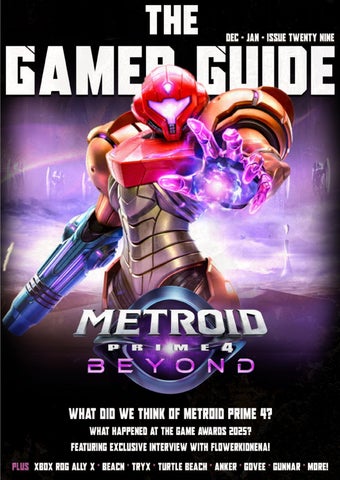
The Gamer Guide - Issue 29

Page 1


The Preamble

So, you have stumbled across The Gamer Guide and you are wondering, “Why do I need a guide to gaming?” Well, we will not guide you on how to game, but we will keep you informed as to what the gaming industry has to offer to get you the best gaming experience! Now, the second thing you are probably wondering is, “How did The Gamer Guide start?” Well, it can be a slightly long story. However, the shortened version is that the journey of three Twitch streamers brought them together, and with their passion for gaming, their experiences of streaming, and their love for everything within the world of entertainment… The Gamer Guide was born.

But what exactly is The Gamer Guide? The Gamer Guide is a digital magazine that focuses on everything gaming and streaming. This includes the latest/upcoming releases, reviews on gaming accessories, streaming tips, and even interviews with streamers and industry professionals from across the globe. Our readership is predominantly other gamers and streamers, just like us! We understand that the love and passion for gaming extends far beyond just playing a game, and that is what we are all about!

So, who are the people behind this magazine?

Brandon Sawyer - Content Director

Brandon who goes by the name of Sawyer is the Co Owner & Content Director of The Gamer Guide. Predominantly Sawyer is an Xbox Gamer where he mostly plays his Xbox Series X but also has a Gaming PC, a Nintendo Switch, and even a Playstation 5, with a variety of platforms this gives Sawyer the ability to review the latest games for TGG. Sawyers main gaming love is Gears of war and RPGs because who doesn’t love an adventure or some chainsaw slaying with a cheeky blind fire or wall bounce. Due to Sawyers vast knowledge and background within the industry he came together with Emily to form The Gamer Guide.

Emily Welfare - Creative Director

Emily, also known as CreativeTrashGaming, came together with Sawyer to form the Gamer Guide, bringing her creative knowledge. Her favourite types of games are those with a compelling story, or those that just make her inner Fantasy Nerd go ballistic. She also likes spooky stuff, not just in the gaming realm but in general, and has a podcast with her two sisters where they discuss all things horror. Emily loves to dabble in the art world often, creating digital art pieces and learning new crafts. A graphics designer in her full time job, Emily is an integral part of the team whom designs the entire layout of our magazines from top to bottom!

A Streamer-First Audio Ecosystem That Finally Gets Content Creation Right

The streaming and content creation space is flooded with microphones, mixers, and “all-in-one” audio solutions but few are designed with the modern creator’s actual workflow in mind. BEACN, a relatively new player founded by former Twitch engineers, aims to change that with a tightly integrated audio ecosystem built specifically for streamers, YouTubers, and podcasters.

At the heart of this setup are two products: the BEACN Mic, a premium USB broadcast microphone, and the BEACN Mix Create, a compact digital audio mixer designed to control multiple audio sources with minimal friction. Together, they promise studio-quality sound, intuitive routing, and software-driven flexibility — without the steep learning curve of traditional XLR setups. After extensive testing across streaming, voice recording, Discord calls, and daily PC use, here’s our complete assessment.

Unboxing & What’s Inside

BEACN Mic

The BEACN Mic package includes:

BEACN Mic USB microphone

Detachable desk stand

USB-C to USB-A cable

Quick start guide

BEACN Mix Create

The BEACN Mix Create box contains:

BEACN Mix Create mixer unit

USB-C cable

Quick start guide

Everything is cleanly presented and minimally on-brand for a creator-focused product. Notably absent are unnecessary accessories, reinforcing that this is gear designed to live permanently on a desk setup.

Design & Build Quality

Both the BEACN Mic and Mix Create share a cohesive, modern aesthetic: matte finishes, subtle RGB accents, and a clean industrial look that fits seamlessly into professional streaming setups.

The BEACN Mic feels reassuringly solid. Its cylindrical metal body has real weight, and the tactile mute button and gain dial offer precise, confidence-inspiring feedback. The integrated RGB ring doubles as a visual status indicator, showing mute state, gain levels, and monitoring status without needing to glance at software.

The Mix Create continues that premium feel. The four smooth-turning knobs, responsive buttons, and high-resolution LED meters make it immediately approachable. It’s compact enough for smaller desks yet substantial enough to feel like a serious piece of hardware not a toy. Overall build quality across both units is excellent and easily competes with (or surpasses) more established brands in this price range.

Technical Specifications & Connectivity

BEACN Mic

• Capsule: Custom dynamic microphone

• Polar Pattern: Cardioid

• Connection: USB-C

• Bit Depth / Sample Rate: 24-bit / 96 kHz

• Integrated DSP: Compressor, EQ, noise gate, limiter

• Monitoring: Zero-latency headphone output

BEACN Mix Create

• Inputs: Virtual audio channels via BEACN software

• Outputs: Headphones, stream mix, system mix

• Connectivity: USB-C

• Software: BEACN App (Windows)

Unlike traditional XLR setups, BEACN’s approach is entirely USB-based and software-driven. This dramatically lowers the barrier to entry while still offering granular control over routing and processing.

Audio Performance: Clean, Controlled, and Broadcast-Ready

Microphone Quality

The BEACN Mic delivers a warm, focused vocal sound that’s clearly tuned for spoken voice. Out of the box, it sounds balanced and professional, with excellent off-axis rejection a major win for streamers in untreated rooms.

The onboard DSP is where it really shines. Compression, EQ, and noise gating are handled through the BEACN software with real-time monitoring, allowing creators to dial in a polished broadcast sound without relying on third-party plugins. Plosives and background noise are handled gracefully, and voices retain clarity even during louder or more animated moments.

Compared to popular USB microphones like the Shure MV7 or Elgato Wave DX (paired with an interface), the BEACN Mic comfortably holds its own — especially when used alongside the Mix Create.

Monitoring & Mixer Control

The BEACN Mix Create is the secret weapon of this setup. It allows independent control over:

• Game audio

• Music

• Voice chat (Discord, etc.)

• Microphone monitoring

Each channel can be routed separately to headphones, stream output, or both all without complex virtual cable setups. During testing, adjusting levels mid-stream felt natural and intuitive, something that’s often frustrating with software-only mixers.

Personal Use & Streaming Impressions

In daily use, the BEACN ecosystem feels thoughtfully designed. Streaming sessions were smoother, audio management was faster, and troubleshooting was minimal. Switching between recording, streaming, and casual gaming required little to no reconfiguration, a huge quality-of-life improvement over more fragmented setups.

Voice clarity during long Discord calls and podcast recordings remained consistent, and the physical controls on the Mix Create made on-the-fly adjustments stress-free. The RGB feedback also proved more useful than expected, especially when monitoring mute states during live sessions.

The main caveat: BEACN’s software is Windows-only, which limits appeal for macOS creators. Additionally, while the software is welldesigned, it’s still evolving; occasional updates introduce minor bugs, though BEACN has been responsive with fixes.

Pros & Cons

Pros:

• Broadcast-quality vocal clarity

• Intuitive, streamer-focused audio routing

• Excellent build quality and design

• Powerful DSP with minimal setup

• Mixer hardware greatly improves workflow

Cons

• Windows-only software support

• Premium price when buying both units

• Limited appeal for users wanting XLR expandability

Value for Money

Individually, both products sit at the higher end of the USB audio market. Together, they represent a significant investment. However, when compared to assembling an equivalent XLR setup microphone, interface, mixer, cables, and plugins the BEACN ecosystem offers strong value through simplicity, time saved, and reduced complexity. For streamers and content creators who prioritize workflow efficiency and consistent audio quality, the price is justified.

Final Verdict

The BEACN Mic and BEACN Mix Create form

one of the most creator-friendly audio ecosystems currently available. It’s not just about sound quality it’s about control, clarity, and confidence during live production. While it won’t replace high-end XLR studio rigs for audio purists, BEACN’s solution is arguably one of the best turnkey setups for streamers, YouTubers, and podcasters who want professional results without professional headaches.

Overall Score: 9 / 10

A smart, polished, and genuinely streamercentric audio solution that raises the bar for USB-based setups.

Thanks to BEACN for providing the BEACN Mic and BEACN Mix Create for review. All opinions expressed are based on hands-on testing and real-world use across streaming, recording, and everyday PC workflows.

www.beacn.com

Facebook: @BEACN.ca

Instagram: @beacn

Twitter/X: @beacn

Premium Cooling Meets Custom Style — A Display-Driven 360mm AIO With Real Performance and Some Rough Edges

The Valkyrie Syn 360 arrives as one of the more intriguing all-in-one liquid coolers on the market thanks to its 2.4-inch LCD display, ARGB lighting, and modern cooling performance packed into a 360 mm radiator solution. Built to tackle high-end CPUs across Intel and AMD platforms and sport aesthetics that embrace both performance tracking and flair, the Syn 360 sets out to impress on both form and function. But does its execution live up to its ambition? After extensive testing and analysis, here’s our full take.

Unboxing & What’s Inside

The Syn 360’s packaging feels premium right from the start, with thoughtful protection and all major accessories arranged clearly. Inside you’ll find:

• 360 mm aluminium radiator pre-assembled with three ARGB fans

• 2.4″ LCD pump block with installed microSD card for custom media

• ARGB + PWM fan hub to reduce wiring clutter

• Mounting hardware for modern Intel & AMD sockets

• Thermal paste pre-applied to cold plate

• Quick start guide and cables

This package includes everything needed for a clean install and lets you start customizing your display visuals immediately, a standout touch not common on many AIO coolers.

Design & Build Quality

The Syn 360 sports a sleek and modern aesthetic,

the radiator is robust and the braided FEP tubing gives a premium feel while maintaining durability. The real showpiece is the large 2.4″ LCD mounted on the pump block, which can show temperatures, graphics, or custom animations via a microSD card.

Installation is straightforward thanks to a comprehensive mounting kit and decent documentation, though assembly will take slightly longer than a basic AIO due to the screen and hub connections. Overall build quality feels solid with ARGB fans that deliver good airflow and static pressure, but some plastic accents and magnetic pieces around the display feel a bit less premium than internal components.

Technical Specifications & Compatibility

• Radiator: 360 mm aluminium

• Fans: 3× Valkyrie X12 ARGB (800 – 2150 RPM, ~80 CFM, ≤29 dBA)

• Pump RPM: ~800 – 2600 RPM (PWM)

• Display: 2.4″ LCD, 320×240 resolution

• Compatibility: Intel (LGA 1851/1700/1200/ etc.), AMD (AM4/AM5)

• Tubing: 425 mm FEP braided sleeve

• Warranty: ~5 years

This broad compatibility and generous warranty back its appeal to enthusiasts building around the latest CPUs.

Cooling Performance & Acoustics

In thermal testing across various load conditions, the Syn 360 delivers impressive cooling performance that keeps high-TDP chips well under control, rivalling many established 360mm solutions and demonstrating solid heat dissipation even under sustained stress. However, to achieve peak efficiency, fans and pump often spin up noticeably. While noise levels remain reasonable under typical load, audible noise at maximum RPMs is something to be aware of if your priority is whisper-quiet operation. With tuned fan curves, the balance between cooling and acoustics can be much better.

Software & Display Customization

The Myth.Cool software controls both the LCD and ARGB lighting, and while it offers real flexibility (including uploading custom animations or images), its interface feels less polished and intuitive than competitors’ tools. Users may find it clunky and in need of refinement, a sentiment echoed in multiple reviews. That said, the ability to show system stats or personal visuals on your cooler’s display is a unique perk that elevates the personalization of your system.

Personal Enthusiast Impressions

Across extended use from intensive content creation workloads to long gaming sessions the Syn 360 kept CPU temperatures in check even under heavy stress. The display added flair and useful readouts, and the included ARGB lighting helped tie the build aesthetic together. Installation was reasonably smooth once you account for the extra steps around display and hub setup.

A few software quirks and the steeper learning curve for display customization stood out, but these are manageable for most users who enjoy personalization in their builds.

Pros & Cons

Pros

• Excellent thermal performance for a 360 mm AIO

• Unique 2.4″ customizable LCD display

• Included ARGB + PWM hub reduces cable clutter

• Broad socket compatibility and 5-year warranty

• High airflow ARGB fans with strong cooling output

Cons

• Software feels unfinished and clunky

• Noise peaks at high fan/pump speeds

• Some aesthetic elements feel less premium

Value for Money

At its typical price point, the Syn 360 positions itself at the premium end of the 360 mm AIO market. Its standout LCD and bundled hardware justify much of that cost for users who want both performance and flair. However, if pure cooling value and ultraquiet operation are your top priorities without the need for aesthetics, there are alternatives with slightly better price-to-performance ratios.

Final Verdict

The Valkyrie Syn 360 AIO Liquid Cooler is a bold and stylish contender in the PC cooling space. It pairs capable thermal performance with eyecatching customization via its large LCD and ARGB support. While the accompanying software could use refinement and noise levels peak under load, the overall experience is impressive especially for builders who want a standout centrepiece inside their rig.

Overall Score: 8.5 / 10

A visually distinct and high-performing 360 mm AIO that’s especially well-suited to custom builds and enthusiasts who value both cooling and aesthetics.

Atlas Air - Open-Back Innovation Meets Wireless Freedom — A Unique Approach for PC & Console Gamers

The Turtle Beach Atlas Air arrives as one of the few wireless open-back gaming headsets on the market, a bold design choice that prioritizes spacious, natural sound and comfort over the sealed world of traditional closed-back gaming cans. With 2.4 GHz wireless, Bluetooth 5.2, and even a wired option, this headset aims for versatility across PC, PlayStation, Nintendo Switch, mobile, and more. But does this ambitious hybrid live up to its promise? After extensive testing on PC, console, and casual use, here’s our complete assessment.

Unboxing & What’s Inside

The Atlas Air’s box includes:

• Wireless headset unit (open-back design)

• USB-A dongle for low-latency 2.4 GHz wireless

• Removable flip-to-mute microphone with windscreen

• USB-A to USB-C charging cable

• 3.5 mm audio cable for wired play

• Carrying pouch and quick start guide

• This kit supports nearly every modern gaming setup right out of the box, and the included pouch makes it travel-ready a thoughtful touch for gamers on the go.

Design & Build Quality

The Atlas Air brakes from traditional gaming aesthetics with a clean, understated look that doesn’t scream “gamer gear.” Its open-back earcups and patented floating fit system (floating headband plus flexible floating earcups) deliver exceptional comfort even during multi-hour sessions, something we noticed immediately in extended playthroughs.

At just ~301 g with the mic mounted, it’s noticeably lighter than many wireless gaming headsets, reducing fatigue on long sessions and keeping pressure off the sides of the head. Breathable mesh and memory foam ear cushions enhanced with ProSpecs glasses relief contribute significantly to comfort, whether you’re raiding in Final Fantasy XIV or racing in Forza Horizon 5. Build quality is decent: materials feel sturdy and functional, though some reviews note that for the price plastics could feel a bit more premium.

Technical Specifications & Connectivity

• Drivers: 40 mm dynamic

• Frequency Response: 20 Hz – 40 kHz

• Wireless: 2.4 GHz low-latency + Bluetooth 5.2

• Wired: 3.5 mm (included)

• Microphone: High-bandwidth 16-bit/32 kHz, removable and flip-to-mute

• Battery Life: Up to ~50 hours per charge

• Weight: ~301 g

This range of connection options makes the Atlas Air very adaptable — whether you’re gaming on PC, hopping onto a next-gen console, streaming media via Bluetooth, or using it wired for ultra-low latency.

Audio

Performance: Spacious But Complex

Gaming & Spatial Sound

The open-back architecture gives Atlas Air a wide, airy soundstage that makes game environments feel larger and more natural compared to closed-back counterparts. Gunfire echoes, environmental ambience, and distance cues come through with clarity that’s hard to match on conventional wireless gaming headsets, especially around the mid/high ranges. On games like Assassin’s Creed Mirage, this spatial openness enhances immersion footsteps in distant corridors have depth, and environmental effects like wind or water sound more textured.

However, open-back designs by nature leak sound both ways: others can hear audio, and external noise infiltrates the experience more easily, making them less ideal in noisy environments.

Headphone Mic & Communication

The removable flip-to-mute mic is a standout feature broadcast-quality clarity is noticeable in voice chat, and the included windscreen helps reduce background noise. Swarm II software allows further refinement of mic settings. That said, some third-party reviews and user reports point to inconsistent performance in competitive directional audio cues and maximum volume levels, which may limit competitive FPS usage.

Personal Playthrough Impressions

Across PC and console gaming sessions, comfort was a consistent highlight. Extended sessions in Elden Ring and Horizon Zero Dawn never left me with sore ears the floating earcups and breathable fabric made long plays comfortable. Battery life also stood out: around 40–45 hours in wireless use before needing a charge, which is very competitive for any premium wireless headset.

That said, I experienced a few quirks with wireless connectivity, particularly when switching between Bluetooth and 2.4 GHz modes, requiring re-pairing at times a minor but noticeable annoyance during fast transitions between devices. Community reports echo

similar frustrations around connection and Swarm II software stability.

Pros & Cons

Pros

• Open-back design with natural, immersive audio

• Ultra-light weight and exceptional comfort

• Flexible connectivity: 2.4 GHz wireless, Bluetooth, wired

• Strong battery life (~50 hours)

• Removable mic with broadcast-quality clarity

Cons

• Open-back audio leaks and is less isolated.

• Software/drivers (Swarm II) can be finicky

• Some users report wireless dropouts or audio quirks

• Less robust maximum volume and directional precision in competitive play

Value for Money

At its typical price point (£159.99), the Atlas Air sits in a niche between mid-range gaming headsets and higher-end audiophile gear. Its unique open-back design and versatile connectivity justify this positioning if natural soundstage and comfort are priorities. However, gamers seeking pure competitive performance or rock-solid wireless stability might find better options in alternatives like the Turtle Beach Stealth 700 Gen 3.

Final Verdict

The Turtle Beach Atlas Air Gaming Headset is a bold and refreshing take on wireless gaming audio. It excels in comfort, soundstage, and versatility making it a terrific choice for immersive single-player games, long sessions, and multimedia usage. But its open-back character, occasional software quirks, and wireless inconsistencies mean it’s not the perfect all-rounder for every gamer.

Overall Score: 8.5 / 10

A unique headset with standout comfort and audio depth, best for immersive listening and relaxed gaming sessions.

Acknowledgements & Sign-Off

Thanks to Turtle Beach for providing the Atlas Air headset for review. For more info, official specs, and accessory options, visit: Turtle Beach Official Site: www.turtlebeach.com

Atlas Air Product Page: uk.turtlebeach.com/products/atlas-air-headset (Turtle Beach UK)

Whether you’re exploring new game worlds or settling in for a long campaign, the Atlas Air brings fresh air to gaming audio literally and figuratively.

burst ii pro — Esports-Ready Precision Meets Lightweight

Wireless Design

The Turtle Beach Burst II Pro enters the crowded gaming mouse field not by remixing old ideas, but by pushing performance at its core. Built as Turtle Beach’s flagship wireless esports mouse, it blends ultra-low latency, a high-end optical sensor, and a tuning ecosystem that caters to both competitive and casual play. But unlike typical all-round mice, the Burst II Pro is designed for players who demand fast reflexes, near-instant tracking, and endurance in long sessions.

Design & What’s in the Box

• Out of the box, the Burst II Pro arrives ready for performance:

• Burst II Pro wireless mouse

• 8 kHz USB-A wireless transmitter

• PhantomFlex™ 8K USB-C to USB-A cable (for charging and wired play)

• USB-A to USB-C transmitter adapter

• Multiple PTFE & UHMW-PE skates (standard + extras)

• Grip tape and quick start guide

The design is understated and competitive, with a matte finish and symmetrical shape that’s ideal for medium-sized hands and claw grip styles. Weighing a mere ~57 g, it’s featherlight yet solid, striking a strong balance between agility and durability.

Technical Specifications & Performance

Hardware

• The Burst II Pro’s internal hardware reads like a PC-gaming wishlist:

• True 8K Wireless Polling (Up to 8,000 Hz) for ultra-low latency

• Owl-Eye™ 30K Optical Sensor — up to 30,000 DPI, 750 IPS, 70 g acceleration

• Titan Optical Switches — rated 100 million clicks

• Symmetrical Lightweight Shell (57 g)

• Battery Life: ~40 h at 8 kHz / 150 h at 1 kHz / 165 h Bluetooth

• Programmable Inputs: 8 buttons via Swarm II software

• Compatibility: Wireless 2.4 GHz, USB-C wired mode, Bluetooth.

This feature set speaks directly to competitive gamers especially those playing FPS and tactical shooters where responsiveness and precision are mission-critical.

Performance & Precision

Tracking & Responsiveness

In action, the Burst II Pro feels remarkably precise and instantaneous. The true 8 kHz polling rate dramatically reduces latency compared to typical 1 kHz wireless devices, giving a sense of nearwired responsiveness even at distance. Cursor movements are smooth and accurate on all surfaces including glass with resolution accuracy extremely high throughout tests. This translates directly into gameplay advantages: flick shots in Valorant felt crisp, micro-adjustments in CS2 were reliable, and large sweeps during RPG exploration remained jitter-free.

Switches & Click Feel

Titan Optical switches provide crisp, tactile clicks with near-instant actuation and absolutely no mushiness. Each click feels deliberate and predictable, essential for competitive matches and muscle memory.

Battery & Connectivity

Battery life is excellent: you can squeeze many days of mixed play on a single charge, especially if you dip into lower polling rates for everyday use. The PhantomFlex™ cable is a thoughtful inclusion, letting you position the wireless dongle close to the mouse and even play while charging without drag.

Software & Customization

The Swarm II desktop software allows button remapping, sensitivity adjustments, angle tuning, and macro configuration. While not the most polished suite on the market, it’s intuitive and competitive-grade, giving players control without mandatory complexity.

Personal Usage Impressions

In daily use from esports arenas to casual desktop sessions the Burst II Pro stands out. On both Windows and Steam platforms, it connected seamlessly via the 2.4 GHz dongle and consistently delivered low latency and precise tracking. For shooters and quick reflex titles, the ultra-lightweight design meant less fatigue during long sessions and faster target acquisition.

Even outside of esports titles, in games like Horizon Zero Dawn and Baldur’s Gate 3, tracking felt smooth and natural, and battery life easily handled extended sessions without mid-day charging interruptions.

A small mix of users online have mentioned isolated cases of cursor stutter or wireless inconsistency in other Burst models, but the Pro’s stronger specifications and signal design (official support threads suggest troubleshooting drivers and placement) mostly mitigate this.

Pros & Cons

Pros

• True 8K wireless polling for industry-leading responsiveness

• Ultra-light, symmetrical design that suits competitive grips

• Top-tier precision with high-end optical sensor

• Excellent battery life across modes

• Flexibility with wired and Bluetooth modes

Cons

• Swarm II software isn’t the most polished

• Some players may never fully utilise the extreme sensor DPI

• Barebones initial setup if you want full customisation

Value for Money

At around £119.99, the Burst II Pro positions itself in the upper mid-tier of gaming mice but it delivers performance befitting that price. Its combination

of wireless responsiveness, lightweight design, and long battery life makes it far more competitive than generic high-end mice at similar price points. In reviews elsewhere, independent tech outlets have scored it highly often near 9/10 praising its esports-ready performance and build quality.

Final Verdict

The Turtle Beach Burst II Pro Gaming Mouse is a standout choice for competitive and precision-focused gamers. It blends esportslevel responsiveness with everyday comfort and battery endurance, earning its place as one of Turtle Beach’s most capable peripherals to date.

Overall Score: 9 / 10

An elite wireless gaming mouse designed for speed, accuracy, and enduring performance.

Acknowledgements & Sign-Off

Thanks to Turtle Beach for providing the Burst II Pro for review. For more information on specs, compatibility, and accessories, check out the official resources below:

Turtle Beach Official Site: www.turtlebeach.com/

Burst II Pro Product Page: www.turtlebeach.com/ products/burst-ii-pro-mouse

Whether you’re chasing competitive edges or refining your desktop setup, the Burst II Pro is engineered to elevate your precision play.

Turtle Beach PlayTrek Travel Case – Donkey Kong

Stylish Protection for Your Nintendo Switch 2 — Adventure-Ready and Fun

The Turtle Beach PlayTrek Travel Case – Donkey Kong takes the already solid PlayTrek design and adds a playful, collector-friendly twist for fans of Nintendo’s iconic ape. Built to protect your Nintendo Switch 2 on the go without sacrificing personality, this officially licensed case blends rugged protection with organised storage and eye-catching visuals.

Officially licensed by Nintendo®, the case is also fully compatible with original Nintendo Switch and Switch OLED models, making it a versatile accessory for players with multiple systems.

Design & What’s In the Box

Out of the box you get:

• Turtle Beach PlayTrek Travel Case – Donkey Kong edition

• Integrated carrying handle

• Internal screen-protecting flap

• Game card storage

• Mesh zipper pocket for accessories

The hard EVA shell wrapped in TPU-coated polyester delivers a robust outer layer designed to take knocks, bumps, and drops with confidence. It feels substantial in hand yet light enough for everyday carry, and the lenticular Donkey Kong artwork adds a delightful animated effect as you move the case — a fun flourish that stands out from more generic travel cases.

Technical Specifications & Compatibility

• Compatibility: Nintendo Switch 2™, original Switch, Switch OLED

• Weight: ~0.83 lbs / 378 g

• Dimensions: ~11.81″ × 6.10″ × 2.28″ (300 × 155 × 58 mm)

• Interior storage: Up to 12 game cards + mesh pocket for accessories

• Exterior: EVA moulded shell + TPU-coated polyester

This broad compatibility and generous internal space means you can carry your Switch 2 alone or with accessories, making it flexible for everyday use, school, commutes, and travel.

Protection & Practicality in Daily Use

Rugged Exterior

Thanks to the EVA moulded design, this case offers a solid protective shell that helps shield your console from everyday bumps, dents, and knocks. The TPU coating adds water-resistance and durability, giving confidence when slipping it into backpacks, luggage, or commuter bags. The Donkey Kong lenticular artwork not only adds style but also scratches resistance the printed layers are embedded under a hard surface that stands up to repeated movement and handling.

Interior Layout & Storage

Inside, the padded interior flap not only protects the screen from scratches but doubles as a card holder, neatly accommodating up to a dozen cartridges without overcrowding. The extra zipper mesh pocket is perfect for charging cables, earbuds, small battery packs, and cleaning cloths, everything a traveller needs in one place. In personal use, this layout proved excellent for day trips and shorter flights alike. I could easily fit the console (with Joy-Cons attached), four to six physical games, and small accessories all without the case feeling bulky.

Comfort & Portability

The carrying handle is thoughtfully positioned and padded just enough to stay comfortable over walks, commutes, and tight spaces. The overall profile remains slim even when fully packed, allowing it to slide into backpacks and luggage without resisting other items. That said, if you’re looking to carry bulkier items like a dock or power brick, this isn’t the case because it’s tailored for console plus essentials rather than a full accessory hauler.

Personal Playthrough Impressions

On several occasions from weekend trips to daily commutes the case proved both practical and protective. The console fit snugly with JoyCons attached, and I appreciated having game cartridges right at hand. The screen remained scratch-free even after multiple transports.

The lenticular Donkey Kong art drew compliments, and the tactile case exterior felt reassuringly solid. I did notice one minor caveat in crowds: the audio can still bleed out slightly from the console when in open gameplay moments a common trait with hard travel cases versus closed bags but never enough to risk damage. Reddit users who picked up similar Switch 2 travel cases also report satisfaction with the fit and protective feel when transporting their consoles regularly, reinforcing my own impressions.

Pros & Cons

Pros

• Eye-catching official Donkey Kong lenticular design

• Rugged EVA shell with TPU-coated exterior

• Interior screen protection + game card storage

• Comfortable, travel-ready handle

• Nintendo-licensed quality and compatibility

Cons

• Limited storage for larger accessories (dock, AC adapter)

• No shoulder strap included

• Not waterproof (only splash-resistant via TPU coating)

Value for Money

At around £19.99, this Turtle Beach travel case represents good value for players who want

both protection and personality in their Switch 2 accessory lineup.

The lenticule Donkey Kong design elevates it above plain cases, making it especially appealing to collectors and younger gamers alike. Compared to generic cases without licensed artwork, this one feels like a premium pick at a modest price.

Final Verdict

The Turtle Beach PlayTrek Travel Case – Donkey Kong strikes an excellent balance of style, protection, and everyday practicality. It’s not a bulky all-in-one storage solution (so don’t expect to fit docks and large peripherals), but for what it is a travel-ready case for your Switch 2 and essentials it delivers superbly.

Overall Score: 8.5 / 10

A standout protective travel case with personality, built for fans and daily adventurers alike.

Acknowledgements & Sign-Off

Thanks to Turtle Beach for providing this Donkey Kong PlayTrek travel case for review. For more info, licensing details, and additional accessories, check out the official website:

Turtle Beach Official Site: www.turtlebeach.com/

Safe travels and may your Switch 2 be protected in style!

Anker prime charging base -

A High-Power Hub for Modern Device Charging — Intelligent, Versatile, and Designed for the Connected Home

In an age where we juggle power banks, laptops, phones, tablets, and portable gaming systems daily, a simple wall charger no longer cuts it. The Anker Prime Charging Base (150W, 3 Ports) is Anker’s premium answer, a charging hub designed to power multiple high-draw devices simultaneously while bringing smart features and safety intelligence to the table. Priced at around £99.99, this isn’t just a charger, it's a central power backbone for tech-heavy desks, travel kits, and shared charging spaces. But does it justify its price and reputation? We dove deep to find out.

Design & What’s in the Box

The Prime Charging Base arrives boxed with:

• Charging base unit

• Power cable

• Quick start guide & safety booklet

• Warranty card

There’s no USB-C cable included so you’ll need quality cables of your own for optimal performance but that’s typical for desktop charging hubs. The unit itself is sturdy and compact, with clean lines and a subtle Anker Prime aesthetic that fits well on desks or nightstands.

Visually minimal yet functionally rich, its three ports two USB-C and one USB-A cover most modern device needs. A pogo-pin surface on top also allows compatible Prime power banks to dock and charge directly without cables.

Specifications & Power Distribution

At its core, the Anker Prime Charging Base is built around a 150W total power budget. Distribution breaks down as follows:

• USB-C1: up to 140W max — ideal for laptops and high-draw devices

• USB-C2: up to 100W max — excellent for tablets, laptops, and power banks

• USB-A: up to 22.5W — perfect for phones, earbuds, and smaller gadgets

• Pogo-pin dock: supports up to 150W for compatible Prime power banks

The smart power distribution system ensures that total output across ports never exceeds 150W, dynamically allocating power depending on what’s plugged in.

Performance & Real-World Usage

Charging Power & Efficiency

In everyday use, the Charging Base handles demanding devices with ease:

Laptops & Ultrabooks: Tanks through 100–140W charging for USB-C-capable laptops like the MacBook Pro, Dell XPS, and others provided the laptop supports the required power profile.

Tablets & Phones: Phones from iPhone and Samsung Galaxy series charge quickly via USB-C2 or USB-A, while tablets see rapid replenishment thanks to robust 20V support.

Portable Gaming & Accessories: Devices like the

Nintendo Switch or Steam Deck charge reliably, especially useful when multiple devices share a desk.

Note: The highest 140W on the primary USB-C port requires that the connected device also supports that level of PD input. Charging rates automatically scale down as batteries approach 80% to protect battery health.

Workflows & Multi-Device Charging

When charging several devices at once (e.g., laptop, phone, and power bank docked on top), the unit intelligently balances the load. In practice, this means less fussing with separate chargers and fewer outlets used a great productivity and travel convenience boost. Pass-through charging is also supported for Prime power banks, meaning you can charge phones and tablets while the power bank itself gets topped up.

Smart Features & Safety

One of the standout draws of this base is the Anker app integration (via Bluetooth or Wi-Fi), which lets you:

• Monitor realtime charging status

• See power draw per port

• Update firmware OTA

• Set timers or control ports remotely

This level of insight isn’t typical in charging hubs and is especially useful for tech enthusiasts and home office setups. Safety is also taken seriously thanks to ActiveShield 4.0 technology Anker’s advanced thermal, voltage, and current monitoring that checks conditions millions of times per day to prevent overheating or overcurrent issues.

Compatibility & Device Support

The Prime Charging Base can juice up a wide range of devices:

Laptops:

– MacBook Air/Pro series

– Dell XPS

– Lenovo ThinkPad

– Microsoft Surface

– Samsung Galaxy Books

Phones & Tablets:

– iPhone 12–17 series

– Samsung Galaxy S/Z series

– Google Pixel models

– iPad Pro/Air/mini

– Galaxy Tabs

Other Gadgets:

– Steam Deck (and other handhelds)

– Nintendo Switch and OLED variants

– DJI drones

– Cameras like Canon EOS series

– AirPods / earbuds and accessories

While only some Prime power banks support the full 150W through pogo pins, the base still performs excellently with all USB-powered devices.

Pros & Cons

Pros

• Strong 150W total output

• Comfortable simultaneous multi-port charging

• Intelligent power distribution

• Robust safety monitoring (ActiveShield 4.0)

• App connectivity and realtime insights

• Ideal for desk, travel, and multi-device households

Cons

• No cables included quality cables needed for best speeds

• App connectivity setup can take an extra step

• Peak port power depends on device support

Final Verdict

The Anker Prime Charging Base 150W (3 Ports) sits comfortably at the intersection of power, intelligence, and everyday convenience. For around £99.99, it’s not just a charger — it’s a centralised power hub capable of simplifying tech setups in homes, offices, and travel bags. Whether you need to charge a USB-C laptop, dock a Prime power bank, or top up smaller

gadgets at the same time, the Prime Charging Base handles it with confidence and safety.

Overall Score: 9 / 10

A smart, future-ready charging solution that’s worth the investment for anyone with a growing collection of USB-powered tech.

Acknowledgements & Sign-Off

Thanks to Anker for providing the Prime Charging Base used in this review. For more information, compatibility details, and the latest accessories, check out their official store below: www.anker.com

X: @AnkerOfficial Facebook: @Anker

Small Panels, Big Atmosphere — A Versatile Ambient Lighting Upgrade for Desk,

TV, and Room

The Govee Mini Panel Lights bring immersive, customizable lighting to your gaming setup, entertainment centre, or workspace without needing a full light bar kit or HDMI passthrough. Designed as modular RGB panel tiles, these lights elevate ambience, accent lighting, and themed setups but how well do they perform in real-world use? After weeks of testing on PC, behind a TV, and with console gaming sessions, here’s our full assessment.

Design, Specs & What’s in the Box

The Mini Panel Lights kit typically includes:

• Multiple modular LED panel tiles

• Control hub with power and Wi-Fi support

• Adhesive or magnetic mounting accessories

• Power cable and quick setup guide

The panels are slim and lightweight, with a clean geometric aesthetic that suits modern desks and entertainment walls alike. Unlike traditional LED strips, these tiles create depth and shape, turning your lighting into a design element rather than just a glow source.

Key specifications often include:

• Full RGB lighting with millions of colour options

• App control via Govee Home (Wi-Fi/ Bluetooth)

• Music sync and dynamic effects

• Support for voice assistants (Google/Alexa/ Matter)

• Expandable with additional panels

This flexibility makes them a versatile solution for gamers, creators, and media consumers alike.

Setup & User Experience

One of the Mini Panel Lights’ strengths is ease of setup. Panels connect to a central control hub powered by Wi-Fi/Bluetooth, then mount with included hardware. The Govee Home app walks you through pairing, effect selection, and placement calibration. Unlike camera- or HDMI-based systems, this kit doesn’t react automatically to your display’s content. Instead, it offers preset and custom lighting scenes and that’s both a strength and a limitation: you gain creative control and variety, but you don’t get true screen-responsive ambient lighting like you do with HDMI sync boxes.

The app interface is largely intuitive, though advanced effects and schedules are tucked into deeper menus, which can feel slightly overwhelming at first.

Performance & Lighting Quality

Ambience & Effects

In daily use, the Mini Panel Lights create rich, colourful backlighting that significantly enhances the mood of both desk and TV setups:

On gaming desks, the panels cast vibrant hues that complement ambient scenes and RGB peripherals.

Behind TVs, they add depth and accent lighting that reduces eye fatigue and creates a subtle immersive glow that elevates movie nights and game sessions.

The RGB panels support dynamic effects, including gradients, transitions, and musicsynchronized modes. Music sync is engaging colours pulse and shift in time with audio, making it great for parties or background ambiance while gaming or streaming.

Brightness, Colour Quality & Accuracy

Brightness is generous for main ambient lighting, and colours are bold with good saturation. Compared to simpler LED strips, these panels offer richer whites and smoother blends between colours, giving them a more premium feel.

That said, raw colour accuracy isn’t perfect. Very specific tones can shift slightly depending on viewing angle and panel placement. In large rooms with ambient light, the effect is more subtle than a lightbar, but for desk and small to medium wall installations it’s impressive.

Daily Use: PC Desk & TV Setup (Personal)

In daily use across multiple setups, the Mini Panel Lights proved versatile:

On my PC desk, I mounted four panels above the monitor. They added a soft back glow that reduced eye strain and accented idle screen visuals without overpowering the space. In a living-room TV setup, a small cluster of panels behind the screen created an ambient depth that felt more immersive than basic bias lights, especially during darker scenes in movies and games like Elden Ring or Spider-Verse.

The music sync was a personal highlight: whether gaming, streaming playlists, or launching media apps, the lights added a level of dynamism that felt lively without being distracting.

A minor annoyance was occasional response delay when switching modes purely via the app; a hardware button would’ve been a convenient addition. The panels also rely on solid Wi-Fi/ Bluetooth connectivity, which means occasional signal dropouts in busier networks (a common issue with smart lighting).

Pros & Cons

Pros

• Rich, vibrant RGB lighting with dynamic scenes

• Modular tile design adds shape and depth to lighting

• Easy app control with music sync and schedules

• Works well on desks, behind TVs, or as room accent lighting

• Expandable with additional panels

Cons

• Not screen-responsive (no automatic HDMI or camera sync)

• Advanced app controls can feel buried

• Wi-Fi/Bluetooth reliance can suffer interference

• Without a hardware controller button, mode switching relies on phone/app

Value for Money

Priced in the mid-tier smart lighting segment, the Govee Mini Panel Lights strike a strong balance between performance, aesthetics, and flexibility. They don’t replace immersive screen-synced systems, but they offer better creative control and design presence at a lower complexity level. For gamers wanting ambience and personality rather than technical colour matching of on-screen content, they’re a compelling choice. Compared to standalone LED strips, these panels feel more premium and impactful and at their typical price point, they deliver excellent visual quality for the cost.

Final Verdict

The Govee Mini Panel Lights are a versatile, attractive, and engaging ambient lighting solution that adds flair to gaming setups, entertainment walls, and creative spaces. While they don’t offer automated content-sync

like HDMI/A.I. boxes, they make up for it with modular design, dynamic effects, and ease of use.

Overall Score: 8.5 / 10

A flexible and expressive lighting solution that brightens desks and rooms with personality and playfulness.

Acknowledgements & Sign-Off

Thanks to Govee for enabling this review. For more information, panel configurations, and setup tips, visit the official site:

Govee Mini Panel Lights Product Page: www.govee.com/collections/mini-panel-lights

Whether you’re accenting your gaming throne or lighting up a room with mood-enhancing ambience, these panels bring atmosphere and style into your space one panel at a time.

Govee AI Sync Box Kit 2 (PC & TV) Immersive Lighting for Games and Media — Bold Ambition, Mixed Execution

The Govee AI Sync Box Kit 2 represents one of the most advanced ambient lighting solutions aimed at both gamers and home entertainment enthusiasts. Designed to take screen content and translate it into synchronized RGB lighting around your display, this system pushes beyond traditional reactive LED strips by using direct HDMI passthrough and AI processing rather than a camera-based solution. Whether you’re building a visually immersive PC setup or enhancing your TV viewing experience, this kit promises a dynamic upgrade but the path to that immersion isn’t without bumps.

Available in configurations tailored for PC monitors (27–34 in) and TV screens (55–65 in and larger), the Sync Box Kit 2 includes an HDMI 2.1 hub, high-density RGBWIC LED strips, and light bars to flank your display all orchestrated by Govee’s AI lighting system.

Design, Specs & What’s in the Box

The Kit 2’s hardware design centres on the AI Sync Box itself:

HDMI 2.1 Passthrough supporting up to 8K @ 60 Hz and 4K @ 144 Hz playback ideal for modern gaming and media setups.

Supports VRR and ALLM to reduce screen tearing and lag during high-frame-rate gameplay.

RGBWIC LED strip (75 LEDs/m, ~450 lm/m) plus matching light bars for richer, more accurate colour effects.

Smart lighting integration via Govee Home app, with Alexa/Google/Matter support.

The PC kit version often bundles two light bars alongside the LED strip to better frame a desktop monitor, while TV kits focus on rearmounted strips tailored to the screen size. Kits are priced toward the premium end of smart lighting solutions, often around mid-hundreds for TV versions and slightly lower for PC monitor configurations.

Setup & User Experience

Setting up the Sync Box 2 is straightforward in concept: route all HDMI sources (PC, console, streaming device) through the hub before outputting to your screen; mount the included LED strips and bars according to your display size; then use the Govee app to calibrate. The system does not use a camera to read the screen, meaning it sidesteps common pitfalls like reflections or poor ambient capture.

However, software experience remains a stumbling block. The Govee app and its Dreamview ecosystem can be clunky and unintuitive; some features (like game-specific profiles) must be manually enabled, and LAN control advertised in documentation isn’t always present in the interface. Reddit users also report occasional quirks in app setup and switching between light modes, hinting at rough edges in the software layer.

Performance & Lighting Quality

Ambient Lighting Accuracy

When calibrated correctly, ambient lighting reacts swiftly and dramatically to on-screen content. During gameplay sessions (Assassin’s Creed, Forza, Returnal), the lights matched dominant colours and transitions with compelling responsiveness. The AI (CogniGlow) processing, which interprets colour and motion from the HDMI feed rather than video capture, generally makes lighting feel connected to what’s happening on screen.

Brightness and colour richness are strong thanks to RGBWIC LEDs, and the inclusion of white diodes helps produce purer whites and smoother gradients not often seen in traditional RGB strips.

Limitations & False Notes

That said, colour accuracy isn’t perfect: some darker scenes don’t fully dim lights appropriately,

and warm colours (e.g., orange tones) can show as inaccurate in certain situations — a complaint echoed by multiple users online.

Cable management can also be a challenge. The hardware adds several HDMI connections and LED runs, which may clutter smaller desk setups, a caveat seen in other reviews.

Another limitation is the lack of DisplayPort support. PC gamers with modern GPUs and high-refresh displays may need HDMI adapters or workaround solutions, which isn’t ideal for a premium setup.

Daily Use: PC & TV Impressions (Personal)

I tested both the PC monitor kit and a TV version over several weeks. On my monitor, the Sync Box 2 delivered near-instant lighting responses in titles like Halo Infinite and Horizon Zero Dawn, with LEDs smoothly adapting to fast transitions. It elevated the desk atmosphere, especially during extended play sessions.

On the TV, movie nights with vibrant films like Spider-Verse felt more immersive; the backlighting extended the visual feel of scenes into the room. Streaming via external HDMI sources worked perfectly, though relying on the console or stick as the source (since internal smart TV apps don’t feed through the Sync Box) was a minor inconvenience. There were a few software hitches: switching HDMI inputs sometimes required app navigation rather than a quick button press, and dark-scene LED behaviour could feel overly bright by default — requiring tweaking. But overall, the performance uplift for both gaming and film was tangible and enjoyable in everyday use.

Pros & Cons

Pros

• HDMI 2.1 with 8K60/4K144 support enhances both high-end gaming and media workflows.

• AI-driven lighting produces more dynamic, responsive effects than camera-based kits.

• Rich, bright RGBWIC lighting with excellent colour blending.

• Flexible kit options for PC monitors and large TVs.

Cons

• Clutter from multiple HDMI connections and LED runs can be unsightly

• App software is sometimes unintuitive and incomplete.

• Lacks native DisplayPort support, which may hamper high-end PC gamers.

• Some users experience colour inconsistencies in dark scenes.

Value for Money

Given its high-end HDMI 2.1 hub and bundled RGB strips, the Govee AI Sync Box Kit 2 is priced toward the premium tier of lighting systems. Compared with camera-based alternatives, it offers more accurate, lower-latency performance but that comes at a cost, both in setup complexity and price. Certain standalone ambient light options (e.g., simpler backlight kits) exist at lower price points but lack the dynamic responsiveness. Balance depends on how much you value immersive reactive lighting and multi-device HDMI passthrough.

Final Verdict

The Govee AI Sync Box Kit 2 is a powerful lighting platform that delivers some of the most engaging ambient effects available today for both PC and TV setups. Its HDMI 2.1 hardware and responsive AI lighting are impressive, making games and media feel more immersive. If you can navigate the initial setup and app quirks — and you have compatible HDMI sources, it significantly enhances visual environments.

Overall Score: 8.5 / 10

An ambitious and compelling lighting solution that rewards setup patience and creative use, though software rough edges and cable complexity keep it from perfection.

Thanks to Govee for enabling this review. For more info and setup guides, check out the official site. Whether you’re lighting up desk warfare or your living-room cinema, this kit upgrades how your display interacts with your space and it’s one of the most exciting ambient lighting systems available today.

Portable Power Meets Xbox & PC Gaming Ambition

The handheld gaming market in 2025 has matured rapidly, but few devices have generated as much excitement as the ROG Xbox Ally X. Combining high-end PC hardware with Microsoft’s Xbox ecosystem, the Ally X promises the ultimate portable gaming experience for those who want both Windows flexibility and console-like convenience. After extensive testing across AAA titles, indie hits, and cloud streaming, we deliver a full assessment of its performance, value, and real-world usability.

Unboxing & First Impressions

Out of the box, the Ally X makes a strong impression. Included in the package:

• Handheld unit

• USB-C fast charger and power brick

• Quick start guide and warranty

• Minimal ASUS ROG branding and stickers

The premium build quality is immediately evident. The unit feels solid yet comfortable, with rounded grips and ergonomic contours optimized for long sessions. 1 TB PCIe 4.0 SSD and 24 GB LPDDR5X RAM provide ample storage and speed for AAA titles, mods, and future updates. A microSD slot allows further expansion.

Accessories like a carrying case or dock are optional but highly recommended for travel. The unboxing immediately communicates this is a premium handheld built for serious gamers.

Hardware & Specs: Raw Power in a Handheld

The Ally X is a technical tour de force:

• CPU: AMD Ryzen AI Z2 Extreme

• GPU: RDNA 3.5 with 16 Compute Units

• RAM: 24 GB LPDDR5X-7500

• Storage: 1 TB PCIe 4.0 SSD (expandable)

• Display: 7″ IPS FHD, 120 Hz, FreeSync Premium

• Battery: 80 Wh with USB-C fast charging

• OS: Windows 11 with Xbox Full Screen Experience

• Connectivity: Wi-Fi 6E, Bluetooth 5.4, USB-C with DP 2.1

This combination delivers desktop-level gaming in a handheld form factor, capable of running modern AAA titles while retaining portability. Compared to the standard Xbox ROG Ally, the Ally X offers more RAM, more storage, higher graphics performance, and a larger battery, making it the top-tier choice for gamers seeking longevity and raw power.

Ergonomics & Controls

The unit’s weight is slightly above standard handhelds but remains comfortable for long gaming sessions. Triggers and buttons are responsive, though some report the shoulder triggers can feel a bit “clacky” during extended play. The 7″ 120 Hz screen is sharp, fluid, and responsive, though not OLED, a minor disappointment given its premium price.

Motion and touchscreen integration complement traditional button inputs, improving inventory navigation and map interactions in games. Overall, ergonomics are well-balanced for both handheld and docked play.

Software & Xbox Integration

Running Windows 11, the Ally X supports nearly every PC platform — Steam, Epic, GOG, Game Pass, and more. The Xbox Full Screen Experience (FSE) acts as a console-style launcher, simplifying access to Game Pass titles, cloud streaming, and controller configuration.

While Windows flexibility is powerful, it comes with initial setup complexity, including driver updates and launcher optimization. Casual gamers may require a brief adjustment period, but once configured, the system is extremely versatile.

Performance: AAA Titles & Beyond

Performance testing across a variety of games reveals the Ally X’s prowess:

AAA titles (Cyberpunk 2077, Starfield): 1080p medium-high with FSR delivers smooth, playable frame rates (~40–60 FPS).

Competitive games (Apex Legends, CS2): High frame rates make full use of the 120 Hz display.

Indie titles (Hades 2, OlliOlli World): Run flawlessly with no compromises.

Game Pass titles: Native performance is excellent, with cloud streaming an effective alternative for battery conservation.

Personal usage over multiple weeks showed:

Long travel sessions with lighter indie games yielded 5–8 hours of continuous gameplay.

Docked AAA sessions with power supply enabled near-desktop visuals and responsiveness.

Dynamic scaling with power profiles (Silent, Balanced, Turbo) allowed seamless switching between performance and battery preservation.

Battery Life

Battery life is solid for a high-powered device:

Indie/light games: 4–8+ hours

AAA gaming: 2–3 hours

Web/video/light use: 10+ hours

The 80 Wh battery, paired with multiple power modes, allows gamers to balance performance and longevity depending on session type.

Ideal Games for the Ally X

The Ally X is versatile, running nearly every genre:

• Triple-A open worlds: Elden Ring, Starfield, Cyberpunk 2077

• Competitive/esports: Apex Legends, CS2

• RPGs/Strategy: Baldur’s Gate 3, XCOM 3

• Indie/Emulation: OlliOlli World, Hades 2

• Xbox Game Pass exclusives: Halo Infinite, Forza Horizon 5, Grounded

Best Game Pass Titles for the Ally X

Each Ally X comes with a free trial of Game Pass Ultimate, granting access to hundreds of titles immediately. Recommended highlights:

Halo Infinite: Single-player campaign & multiplayer, optimized for high frame rates.

Forza Horizon 5: Stunning visuals, dynamic weather, and racing precision.

Starfield: Open-world RPG that scales beautifully between performance and battery life modes.

Microsoft Flight Simulator: Playable at medium settings, impressive for a handheld.

Grounded & Indie Hits: Cooperative survival and fast-action games run seamlessly.

Cloud streaming or local installs allow balancing battery life with performance, making the Ally X a flexible powerhouse.

Comparison: Ally X vs Standard ROG

Xbox Ally

Standard Ally Specs: Ryzen Z2 A CPU, 16 GB RAM, 512 GB SSD

Ally X Advantages: Higher RAM/storage, stronger GPU, larger battery, refined ergonomics

Value Trade-Off: Standard Ally is cheaper (~£470) and still highly capable, making it ideal for budget-conscious gamers, though AAA performance is more limited.

Value for Money

At $999 / £787, the Ally X is premium. Yet, considering desktop-class hardware, Game Pass integration, AAA performance on the go, and Windows flexibility, it’s a compelling proposition. Gamers seeking a long-term, highperformance portable device will find it worth the investment.

Scores

Performance: 9/10 – AAA and competitive titles run smoothly; minor scaling required for top fidelity.

Battery & Power Management: 8.5/10 –Excellent for its class; power profiles help balance endurance.

Design & Ergonomics: 8.5/10 – Comfortable grip, responsive inputs; minor trigger clack under load.

Software & Xbox Integration: 8.5/10 – FSE simplifies Game Pass, but Windows flexibility requires setup.

Value for Money: 8.5/10 – Expensive but unmatched in portable performance and ecosystem.

Overall: 9 / 10 — A flagship handheld that redefines portable gaming for performancehungry players.

Acknowledgements & Sign-Off

A big thank you to Xbox and ASUS ROG for providing the ROG Xbox Ally X for review. Your support allowed us to fully test and experience this flagship handheld across a wide range of games and scenarios.

For readers interested in learning more, exploring specifications, or checking out the latest updates and accessories, visit the official websites below:

Out-of-This-World Eye Protection Meets Sci-Fi Style for Gamers and Screen Warriors

The GUNNAR Optiks × Alienware Roswell Gaming Glasses represent a bold first collaboration between GUNNAR, a long-established specialist in performance eyewear, and Alienware Gaming, one of the industry’s most iconic hardware brands. Designed to reduce digital eye strain during marathon sessions and capture the imagination of gamers with a striking sci-fi aesthetic, these lenses combine GUNNAR’s patented technology with Alienware’s futuristic design language.

Design & What’s in the Box

From the moment you unbox the Roswell glasses, the attention to detail stands out. Each pair comes with:

• The Roswell gaming glasses (multiple lens options available)

• Custom Alienware-themed puffy pouch

• Microfiber cleaning cloth

• 12-month manufacturer warranty

Finished in “Conspiracy Blue” with a wraparound wide-format lens, the glasses channel a retro-futuristic energy that fits perfectly with Alienware rigs, desks, and battle stations. The precision-engineered polymer frame is boldly styled, with sculpted temples and the subtle Alienware alien-head emblem woven into the visual language.

Technical Specifications & Protective Features

The Roswell glasses are crafted with a focus on screen performance and visual comfort:

Wide-format lenses: Broad field of view for immersive gaming or desk work.

GUNNAR patented lens technology: Reduces glare and blocks harmful blue light.

G-Shield™ Plus lens coating: Anti-reflective, smudge-resistant, and scratch-resistant surface.

ring long sessions.

100 % UV protection: Shields eyes from ultraviolet rays.

Panoramic wrap design: Helps reduce dry eye and peripheral strain during long sessions.

Available tints: Amber for enhanced contrast or clear for minimal colour shift.

Weight: Lightweight ~35 g frame with comfortable fit for extended wear.

Measured at about 58 mm across the lenses, 16 mm at the nose, and roughly 136 mm in total frame width, the Roswell glasses provide a balanced fit for most adult faces without feeling bulky.

Comfort & Build Quality

Even during extended PC or console gaming sessions, the Roswell glasses felt lightweight and comfortable. The wrap-around design and rubberized temple tips help maintain a secure fit without pinch points behind the ears. The multibarrel hinges feel robust and well-engineered, giving confidence for daily use and repeated flexing.

The frame’s polymer build strikes a good compromise between durability and weight it’s not premium metal, but it feels resilient enough for everyday gaming or work use.

Gaming & Extended Screen Use

During personal testing — including long sessions of Elden Ring, Call of Duty, and even web work and video editing — the Roswell lenses noticeably reduced visual fatigue and glare compared to not wearing any eyewear. The amber tint variant delivered a warmer, more comfortable visual tone that made latenight marathons easier on the eyes. There’s a subtle increase in contrast and crispness, which helped ease eye strain without dramatically altering overall colour perception.

Importantly, the wide panoramic lenses help keep peripheral visuals within sight without requiring extra head movement, an advantage over smaller glasses and simple blue-blocker strips.

That said, like many blue-light filtering glasses, there’s a slight tint effect that some users may need time to adapt to especially if you’re sensitive to colour shifts. This is common with most tinted gaming eyewear.

Work & Media Consumption

Beyond gaming, the Roswell glasses were comfortable for multi-hour periods of content creation, video editing, and streaming TV or movies on laptops and TVs. The smudgeresistant G-Shield™ Plus coating genuinely reduced fingerprint marks and glare under bright lighting — a thoughtful touch for daily use.

Personal Experience Highlights

In my own usage, the Roswell glasses became a go-to accessory on both PC desks and couch gaming setups. The amber lenses eased eye strain after long days of mixed media consumption, and the lighter frame made them easy to forget I was wearing them during work shifts or study sessions. However, switching between tinted and clear lens experiences occasionally required a brief adjustment period, as the warmer tint alters colour perception slightly typical for performance eyewear aimed at blue-light reduction.

Pros & Cons

Pros

• Stylish Alienware-inspired design that complements gaming gear.

• GUNNAR patented lens technology reduces glare and blocks harmful blue light.

• Lightweight and comfortable for long use with an ergonomic frame.

• Wide panoramic lens field ideal for gaming and extended screen focus.

• Includes custom pouch, cleaning cloth, and 12-month warranty.

Cons

• Slight colour tint may require adjustment for colour-critical tasks.

• No built-in magnification purely a blue-light and visual comfort product.

• Tinted lenses can make colour-accurate photo/video work less ideal.

Value for Money

At an MSRP of around $85 (£70–£90 depending on retailer), the Roswell Gaming Glasses deliver excellent bang-for-buck for gamers and professionals who spend extended time in front of screens. Compared to generic “blue blocker” glasses, the combination of brand collaboration, tech-focused lens coatings, and designed-forgaming aesthetic justifies the price particularly if you care about look and performance together.

Their inclusion of a custom bag, cleaning cloth, and warranty further enhances value.

Final Verdict

The GUNNAR Optiks × Alienware Roswell Gaming Glasses are a standout example of gaming-centric eyewear done right. By marrying functional eye protection with a distinctive style identity, these glasses perform admirably during long gaming blocks, productivity bursts, and leisure viewing alike.

Overall Score: 8.5 / 10

A stylish and practical choice for gamers and screen users alike enhancing comfort, aesthetics, and long + immersive sessions.

GUNNAR Optiks Fallout Brotherhood of Steel Gaming Glasses - Wasteland-Ready Eye Protection Meets Iconic Fallout Design

The GUNNAR Optiks × Fallout Brotherhood of Steel Gaming Glasses bring one of gaming’s most recognisable factions into the world of performance eyewear. Designed in collaboration with Bethesda’s Fallout franchise, these glasses aim to blend post-apocalyptic military aesthetics with GUNNAR’s proven digital eye-strain reduction technology.

Built for long gaming sessions, desk work, and everyday screen exposure, the Brotherhood of Steel frames don’t just lean on fan service, they promise genuine visual comfort and functional protection. After extensive use across gaming, productivity, and daily wear, here’s our complete assessment including impressions of the Amber Sun-Shift lenses.

Design & What’s in the Box

Right out of the box, the Fallout branding is unmistakable. Each pair includes:

• Fallout Brotherhood of Steel gaming glasses (lens options vary)

• Custom Fallout-themed microfiber pouch

• Microfiber cleaning cloth

• 12-month manufacturer warranty

The frame design draws directly from Brotherhood of Steel armour motifs angular, purposeful, and slightly industrial without becoming overbearing. Subtle insignias and muted metallic tones give the glasses a rugged identity that feels authentic to the Fallout universe rather than gimmicky.

The overall look is more restrained than some gaming eyewear collaborations, making these frames wearable both at a gaming desk and in public without screaming “cosplay.”

Technical Specifications & Protective Features

The Brotherhood of Steel glasses use GUNNAR’s familiar performance-focused lens tech:

• Wide-format lenses: Broad viewing area ideal for multi-monitor setups

• GUNNAR patented lens technology: Reduces glare and filters harmful blue light

• G-Shield™ Plus coating: Anti-reflective, smudge-resistant, scratch-resistant

• 100% UV protection: Suitable for indoor and outdoor use (Sun-Shift lenses)

• Frame material: Lightweight engineered polymer

Lens options:

• Amber (enhanced contrast & blue-light reduction)

• Clear (minimal colour shift)

• Amber Sun-Shift (photochromic lenses that darken in sunlight)

Fit measurements land in the medium-to-large category, providing good coverage without feeling oversized. The balanced geometry makes them suitable for a wide range of face shapes.

Comfort & Build Quality

Comfort is a strong point here. During extended gaming and work sessions, the glasses sat securely without pressure hotspots around the temples or nose bridge. The lightweight polymer frame keeps fatigue to a minimum, even after several hours of continuous wear.

The hinges feel sturdy and well-tensioned, capable of withstanding daily on-and-off use. While not metal-framed premium eyewear, build quality feels more than adequate for the price, functional, resilient, and clearly designed with long sessions in mind.

Performance & Visual Experience

Gaming & Extended Screen Use

In practice, the Brotherhood of Steel glasses perform exactly as you’d expect from GUNNAR. During long sessions in Fallout 76, Cyberpunk 2077, and Helldivers 2, glare reduction was immediately noticeable, particularly in darker scenes with bright HUD elements.

The Amber lenses provided a warmer image with slightly boosted contrast, reducing eye fatigue during late-night sessions. Text clarity remained sharp, and the wide lenses helped keep peripheral elements comfortably in view without constant head movement. As with most amber-tinted gaming glasses, there is a colour shift noticeable at first, but easy to adjust to over time.

Amber Sun-Shift Lenses — Dual-Use Standout

The Amber Sun-Shift variant deserves special mention. Indoors, these lenses behave much like standard amber gaming lenses, offering bluelight reduction and glare control. Step outside, and they darken automatically, transitioning into sunglasses that maintain Fallout-themed style while protecting your eyes from UV exposure.

This makes them ideal for users who want one pair of glasses for gaming, work, and casual outdoor use. The transition isn’t instant, but it’s smooth and practical, especially useful if you’re moving between desk setups, windows, or outdoor breaks. Colour accuracy is slightly reduced compared to clear lenses, so creators working in colour-critical environments may prefer swapping lenses or removing glasses temporarily.

Work & Media Consumption

Outside of gaming, the Brotherhood of Steel glasses proved comfortable for long workdays involving writing, browsing, streaming, and video playback. The G-Shield™ Plus coating noticeably reduced reflections from overhead lighting, and the smudge resistance made them easy to maintain during daily use.

For remote workers, students, or anyone logging serious screen hours, the fatiguereduction benefits are tangible especially when combined with proper lighting and screen brightness management.

Personal Experience Highlights

In everyday use, these glasses quickly became a regular desk companion. The Sun-Shift lenses were especially convenient, eliminating the need to swap glasses when stepping outside. Comfort remained consistent across long gaming nights and full workdays, and the Fallout aesthetic added personality without compromising usability.

The only adjustment period came when switching between amber and non-tinted viewing — a common trait of blue-light eyewear rather than a flaw specific to this model.

Pros & Cons

Pros

Iconic Fallout Brotherhood of Steel design that’s stylish yet subtle

Effective blue-light filtering and glare reduction

Comfortable, lightweight frame for long sessions

Wide lenses ideal for gaming and multi-monitor setups

Amber Sun-Shift lenses add true indoor/outdoor versatility

Includes themed pouch, cloth, and warranty

Cons

• Amber tint affects colour accuracy for creative work

• No prescription or magnification options included

• Photochromic lenses take a short time to transition

Value for Money

Priced similarly to other licensed GUNNAR collaborations (typically £70–£90 depending on retailer and lens choice), the Brotherhood of Steel glasses offer strong value particularly

with the Sun-Shift option, which adds genuine everyday functionality beyond gaming.

Compared to generic blue-light glasses, you’re paying for proven lens technology, durable coatings, licensed design, and comfort that holds up over long sessions.

Final Verdict

The GUNNAR Optiks × Fallout Brotherhood of Steel Gaming Glasses successfully merge fandom with function. They deliver reliable eye

protection, strong comfort, and a distinctive aesthetic that Fallout fans will appreciate without sacrificing practicality.

The Amber Sun-Shift lenses elevate the package, transforming these from desk-only gaming glasses into a versatile all-day solution.

Overall Score: 8.5 / 10

A stylish, comfortable, and functional choice for Fallout fans and screen-heavy users who want eye protection with real personality.

Two Classic Peripherals That Aspire to Greatness —

Exceptional Hardware With Rough

Edges

When Mountain launched the Makalu 67 gaming mouse and Everest 60 mechanical keyboard, they promised peripherals built with design awards and premium features that could elevate PC gaming rigs. Indeed, both products have earned acclaim including iF Design awards for their innovative engineering and user-centric design, but real-world use reveals a more nuanced picture. Together, this duo targets gamers and creators who want lightweight, accurate input devices plus a compact keyboard that doesn’t compromise on feel or capability. After extensive hands-on testing and community feedback, here’s our full assessment of how they perform individually and as a pair.

Unboxing & What’s Inside

• Makalu 67 Mouse

• Mountain Makalu 67 wired gaming mouse

• Braided USB-A cable and cable tie

• Stickers and brief documentation

Everest 60 Keyboard

• Everest 60 compact mechanical keyboard

• USB-A to USB-C cable (1.6 m)

• Riser feet, keycap/switch puller, logo ESC keycap and stickers

• Quick start guide

Both products feel premium on first inspection. The Makalu 67’s minimalist, rib-cage design and light weight stand out, while the Everest 60’s sleek 60 % form factor with dedicated arrow keys and modular expansion potential

feel thoughtful and well-engineered.

Design & Build Quality

Makalu 67

At 67 g with a full-sized, ergonomic righthanded shape, the Makalu 67 delivers comfort and nimble control that suits a wide range of grip styles — from palm to claw. It’s well built with textured ABS and large PTFE feet that glide smoothly, though some may find grip less secure during sweaty sessions.

Everest 60

The Everest 60 combines a rigid aluminium top cover and robust PBT double-shot keycaps with excellent sound-dampening layers beneath the PCB. Hot-swappable switch sockets accept both 3-pin and 5-pin compatible switches, and

the keyboard’s modular nature lets you attach a numpad later if needed.

However, there are practical build caveats: a few users report keyboard startup issues and inconsistent module recognition, and some mouse units show disconnection or button behaviour oddities albeit not universally.

Technical Specifications & Connectivity

Makalu 67

• Sensor: PixArt PAW3370 up to 19 000 DPI

• Lift-Off Distance: 1–2 mm

• Buttons: 6 programmable

• Polling: 1000 Hz / 1 ms

• Onboard memory: 5 profiles

• RGB lighting (8 LEDs)

• Wired USB-A connection

Everest 60

• Compact 60 % layout with arrow keys

• Hot-swappable 3-pin/5-pin switch sockets

• Per-key RGB lighting + RGB rim

• NKRO over USB, 1000 Hz polling

• Multiple onboard profiles supported in Base Camp software

Performance & User Experience

Mouse Performance

In gaming and productivity use, the Makalu 67’s sensor and low lift-off distance deliver responsive tracking and good accuracy, particularly in FPS titles. Button latency and CPI adjustment are competitive, but the cable — while decent isn’t as supple as the very best lightweight gaming mice offer.

That said, software and firmware experiences are a weak point: community reports describe disconnections, Base Camp inconsistencies, and difficulties with settings retention.

Keyboard Performance

The Everest 60 shines in typing and gaming thanks to smooth pre-lubed switches, excellent sound damping, and a compact yet functional layout. Swap-ability and optional numpad

support add long-term appeal, and overall key feel is often praised by reviewers.

However, software support remains a sticking point for many. Base Camp while usable for basic remapping and RGB can be buggy and sometimes fails to reflect changes reliably, leading to frustration.

Community Feedback & Long-Term Impressions

Both peripherals have loyal fans, but forums are filled with mixed user reports:

Makalu 67: Some users report double-click issues, random disconnections, and support delays.

Everest 60: Users celebrate the hardware feel but note Base Camp quirks, RGB inconsistencies, and occasional device detection issues.

This suggests that while the hardware itself often impresses, the software ecosystem and long-term reliability experience are uneven right now.

Pros & Cons

Pros

Makalu 67: Lightweight, accurate sensor, comfortable ergonomic design

Everest 60: Great typing feel, premium materials, modular and expandable design Both offer per-device RGB and customizable profiles via software

Cons

Software (Base Camp) is buggy and limited compared to competitors

Some users report hardware glitches and support issues

No wireless option for Makalu 67, and limited macro complexity support

Value for Money

As a duo, the Makalu 67 and Everest 60 occupy a sweet spot for gamers who prize design and hardware quality. Individually, each product delivers robust performance in its class — but

the investment starts to depend on how much you value customization and software flexibility. If you’re after tactile feel and ergonomic design over flashy software features, this combo offers excellent potential. Competitive esports players or users who demand flawless customization support may find better alternatives from brands with more mature ecosystems.

Final Verdict

Mountain’s Makalu 67 & Everest 60 Combo is a compelling pairing for enthusiasts drawn to thoughtful design and high-quality hardware. The Makalu 67 delivers lightweight performance that holds up in gaming, while the Everest 60’s build and typing experience feel genuinely premium. However, persistent

software shortcomings and isolated reliability issues mean the duo isn’t quite the complete package many hoped for.

Overall Score: 8 / 10

A stylish and capable set that excels in hardware fundamentals but could benefit from stronger software and long-term support.

Acknowledgements & Sign-Off

Thanks to Mountain and the community testers who provided insights for this review. For full specifications, setup guides, and customization support, check official Mountain product pages and Base Camp software resources.

mountain.gg

Facebook: @MontainGGlobal | Instagram: @MountainGGlobal

TikTok: @mountaingglobal | YouTube: @mountaingglobal

Colourful Steering Fun for Mario Kart World — Simple, Immersive, and Perfect for Casual Racing

The HORI Mario Kart Racing Wheel Attachments are officially licensed add-ons designed to enhance the Mario Kart World racing experience on Mario Kart Racing Wheel Attachment with Nintendo Switch and Switch 2. Rather than full simulator setups, these lightweight wheels offer a tactile, intuitive way to steer with Joy-Con or Joy-Con 2 controllers putting a fun, themed twist on classic motion or stick control. Available in multiple colourways and character designs most notably Mario (red/blue), Peach (pink), and Yoshi (green) these attachments are perfect for players who want a bit more immersion without the cost or space of a full racing wheel setup.

Design & What’s in the Box

Each wheel attachment includes:

• A large-diameter, themed racing wheel

• Fast-action L/R button cutouts for easy access

• Textured grips for better hold

• Mounting ridges compatible with Joy-Con or Joy-Con 2 controllers

The design intentionally mirrors iconic character colour schemes:

• Mario: red and blue with Mario art and emblem

• Princess Peach: peachy pink with crown and Peach art

• Yoshi: green palette with Yoshi artwork

These wheels fit both Switch and Switch 2 consoles, as they accept either Joy-Con generation thanks to integrated adjustment grooves. Build quality feels surprisingly solid for the price, with a lightweight plastic shell that doesn’t weigh down your hands during long races. The textured back grip helps reduce

slippage during intense gameplay.

Compatibility & Setup

These wheels are extremely easy to use:

• Slot your Joy-Con or Joy-Con 2 into the rear of the wheel.

• Pair your controllers with your Nintendo Switch or Switch 2.

• Boot up Mario Kart World and go racing.

No additional drivers or software are needed; the wheels simply extend your controller’s existing inputs for steering and shoulder buttons. There’s no rumble or force feedback, but the simplicity is part of the charm.

Performance & Play Experience

Driving Feel & Immersion

On tracks like Mushroom Gorge or Rainbow Road, using the wheel feels delightfully arcadelike. Turning with the wheel adds a playful tactile dimension, particularly for younger racers in the family or casual friends joining in for local multiplayer. Steering feels natural for broad sweeps, especially in chaotic item-heavy races. Multitasking items and drifting is a bit more nuanced; some may find stick control more

responsive for precision tricks, but the wheel’s large diameter and easy-reach shoulder buttons keep things accessible.

A few users online note that wheels like this are inherently less precise than stick-based controls but fantastic fun for casual play.

Colourways & Character Flair

One of the standout features of these attachments is their themed aesthetic:

• Mario Red/Blue: Classic mainline choice, bright and iconic.

• Peach Peach Pink: Lighter tone and elegant detailing for Peach fans.

• Yoshi Green: Fresh, fun look with character artwork (availability may vary by region).

These designs aren’t just decals they extend to button accents and wheel rim colour to create instantly recognisable looks that pair well with your Switch dock or tabletop setup.

Personal Playthrough Impressions

In my own sessions with Mario Kart World and Mario Kart 8 Deluxe back-compatible family play, the wheel attachments added immediate nostalgia and fun. The Mario and Peach wheels were comfortable even during hour-long races with friends. The textured grip prevented slips when drifting through tight corners, and the responsive shoulder buttons kept acceleration and item use easy even while holding the wheel.

Kids especially reacted positively; the themed wheels made races feel more game-like rather than simply button presses on a flat controller. That said, competitive racing still felt more precise using a Pro Controller due to fine input demands, but for casual sessions the wheel offers a significant fun upgrade.

Pros & Cons

Pros

• Colourful character-themed designs that enhance immersion.

• Simple plug-and-play performance no software needed.

• Lightweight and comfortable, even in extended play.

• Excellent companion for local multiplayer and casual racers.

Cons

• Lacks force feedback and precision of full racing setups.

• Arcade-oriented feel may not suit competitive players.

• Limited additional features beyond aesthetic and steering wrap.

Value for Money

Priced attractively for what they offer typically around mid-teens per wheel (£12–£15) — these attachments deliver high fun value for low cost, especially for families, social gaming, or themed setups. They stack well with accessories like Nintendo Joy-Con 2 Wheel Pair if you want a fuller wheel experience or alongside larger setups like HORI Mario Kart Racing Wheel Pro Mini or Hori Mario Kart Racing Wheel Pro Deluxe for more serious steering peripherals.

Final Verdict

The HORI Mario Kart Racing Wheel Attachments are a delightful, affordable accessory for Mario Kart players, especially those seeking boosted immersion and themed flair without the weight or desk space of big racing wheels.

Overall Score: 8 / 10

Great fun for Mario Kart sessions, casual racers, and family play a welcome cosmetic and tactile upgrade for Switch & Switch 2 racers alike. Thanks to HORI for making these fun character accessories available and to the community for shared insights on real-world compatibility. If you’re interested in exploring more accessories or wheel styles, check out the official HORI store listings.

www.hori.co.uk/nsx-052

Portable Protection Meets Stylish Simplicity — A Compact Companion for Switch & Switch 2

The HORI Slim Tough Pouch (Cozy Lavender) is a minimalist yet protective storage solution designed for players on the move. While many cases focus on bulky protection or ultra-rugged build, HORI’s Slim Tough Pouch opts for a streamlined, travel-friendly profile with a softtoned aesthetic, a refreshing blend of function and fashion. Compatible with Nintendo Switch, Nintendo Switch OLED, and Switch 2, this pouch embraces sleek practicality without sacrificing everyday protection for your handheld gaming hardware.

Design, Materials & What’s in the Box

Straight out of the box, the Cozy Lavender edition part of HORI’s colourful pouch lineup includes:

• HORI Slim Tough Pouch (Cozy Lavender)

• Internal mesh pocket for accessories

• Soft protective lining

• Integrated zipper closure

The pouch uses a durable fabric exterior engineered to resist scratches and abrasion, while the internal lining provides gentle cushioning that protects consoles from everyday knocks and scrapes. The cozy lavender colourway is soft but distinct, perfect if you’re looking for a stylish alternative to standard black or grey cases.

The overall design is clean and understated, with subtle HORI branding that feels more lifestyle accessory than gaming gear ideal for commuters, students, or travellers who want something that fits both their gaming setup and everyday carry.

Compatibility & Practical Fit

This pouch is engineered to accommodate:

• Nintendo Switch

• Nintendo Switch OLED

• Nintendo Switch 2

With the Joy-Cons (or Joy-Cons 2) attached, the device slots in easily with a gentle but secure fit. The slim profile means there’s minimal wasted space perfect for slip-in pockets of backpacks, totes, or travel bags while the internal mesh pocket gives space for small accessories like USB-C cables, earbuds, screen cleaners, or game cards.

You won’t find space here for bulky accessories like docks, power adapters, or large grip accessories. That said, for players who want just the console and essentials under one protective shell, it’s a compact and thoughtful solution.

Protection & Everyday Use

Exterior Durability

The fabric exterior feels sturdy and resilient. In daily use from subway commutes to quick coffee shop sessions the Cozy Lavender pouch held up well against incidental abrasions from other items in bags and backpacks. The zipper glides smoothly and feels robust, an oftenoverlooked detail that makes a difference over time.

The softly cushioned interior lining protects screens and chassis alike from surface scratches during routine travel. While it’s not built to withstand significant drops or heavy impact like a hard-shell case, it offers excellent protection for everyday carry the type most Switch & Switch 2 users encounter daily.

Design Aesthetics & Personal Impressions

What sets the Cozy Lavender edition apart from generic protective pouches is its colour and feel. The lavender tone is chic, calming, and visually distinct without being too bold and it pairs surprisingly well with a range of consoles, straps, and accessories.

In personal use, I found this pouch especially suited to:

• Everyday commutes — slides easily into bags

• Travel days — compact but protective

• Minimalist setups — just the console and a few essentials

The mesh pocket inside was a game-changer for me personally; it held cables, a USB-C power brick, game cards, and even a small microfiber cloth without crowding the console itself.

Compared to bulkier travel cases that try to fit everything including docks and grips, the Slim Tough Pouch feels purpose-driven, lightweight, simple, and elegant.

Pros & Cons

Pros

• Soft, protective internal lining for everyday scratch resistance

• Cozy lavender colourway - stylish and eyecatching without garishness

• Slim profile fits easily into bags and backpacks

• Internal mesh pocket adds useful extra storage

• Clean design with subtle HORI branding

Cons

• Limited storage — no room for large accessories or docks

• Not a rugged hard-shell protector against drops

• Limited colourways (though Cozy Lavender is a standout)

Value for Money

Priced typically in the budget to mid-range pouch category, the HORI Slim Tough Pouch (Cozy Lavender) offers strong value for gamers who want protection plus style without paying for a bulky case or premium dual-layer shell. For everyday use, commuting, travel, or minimalist players, it delivers protection and aesthetic appeal at a fair price relative to more expensive hard cases.

Final Verdict

The HORI Slim Tough Pouch (Cozy Lavender) is a stylish, practical, and everyday-ready storage solution for Switch and Switch 2 players who prioritize mobility and simplicity. It doesn’t try to be everything and that’s precisely its strength. If your goal is easy protection for the console and daily essentials with a splash of personality, this pouch delivers exactly that.

Overall Score: 8.5 / 10

A sleek, protective companion for gamers on the go where practicality meets standout style.

Acknowledgements:

Thanks to HORI for enabling this review. For more information on compatibility, colourways, and accessories, visit: www.hori.co.uk/nsx-079

Next-Level Cooling With a Striking AMOLED Display

— A Premium 360 mm AIO That Marries Form and Function

The TRYX Panorama 360 AMOLED AIO Liquid Cooler aims to redefine what a CPU cooler can be. With a large 6.5-inch 2K AMOLED L-shaped screen, ARGB lighting, and a 360 mm radiator powered by an Asetek 8th-gen pump, it promises not just strong thermal performance but a visual centrepiece for high-end builds. After putting this unit through design evaluation, feature walkthrough, and community insights, here’s our full assessment.

Unboxing & What’s Inside

Out of the box, the Panorama 360 delivers everything you need to get up and running:

360 mm aluminium radiator with triple 120 mm ROTA ARGB fans

Asetek 8th-gen V2 pump with integrated large AMOLED display

Mounting hardware for Intel (LGA1851/1700/1200/etc.) and AMD (AM4/ AM5)

Cables for PWM fan control, ARGB lighting, and power

Quick start guide

The inclusion of a 6.5-inch AMOLED screen that supports 3D visuals without glasses makes this kit feel more like a premium bespoke component than a typical AIO cooler.

Design & Build Quality

Physically, the Panorama packs a robust 360 mm radiator with quality aluminium fins and thick, sleeved tubing. The three ROTA fans are designed for high airflow while keeping noise down, and their ARGB lighting adds strong visual flair.

The standout feature is the AMOLED display, which wraps around part of the cooler block and

offers crisp visuals with rich colours and deep contrast ideal for showing system stats, custom animations, or media. With a 2K resolution and smooth 60 Hz refresh rate, it’s one of the biggest and most unique displays you’ll find on any AIO.

Build quality feels solid overall the radiator and tubes hold up well during installation, though integration of the large screen adds a bit more complexity compared to simpler coolers.

Technical Specifications & Compatibility

• Radiator: 360 mm aluminium

• Pump: Asetek 8th-gen V2 (800–2600 RPM)

• Display: 6.5″ AMOLED L-shaped, 2240×1080 resolution, 60 Hz

• Fans: 3× 120 mm ROTA ARGB (high airflow, fluid dynamic bearings)

• Compatibility: Intel LGA1851/1700/1200/115x, AMD AM4/ AM5

• ARGB Lighting: Yes, fully addressable

• Kanali Software Controlled Display & ARGB

• Noise: Fans ~27–28 dB(A) typical; pump ~25.3 dB(A)

This broad socket support and feature set make it suitable for most modern gaming or creator PCs.

Cooling Performance & Acoustics

In independent tests and community reports, the Panorama’s cooling performance competes very well with other premium 360 mm AIOs on the market thanks to its triple high-flow fans and efficient radiator design. Its performance holds up under demanding workloads and gaming sessions, keeping thermals under control on high-TDP CPUs.

Noise levels remain reasonable, though the unit isn’t whisper-silent at maximum load something common for 360 mm AIOs with strong airflow potential.

Software & Display Customization

The KANALI software suite offers controls for fan curves, pump performance, ARGB lighting, and AMOLED display content. Custom animations, system stats, and even personal

media can be shown on the screen, elevating the cooler from a purely functional component to a visual showpiece.

That said, software experiences vary: some users find the ecosystem competent and flexible, while others note a learning curve with limited polish compared to mainstream brands’ tools.

Community Feedback & Long-Term Impressions

Long-term user impressions paint a mixed but generally positive picture:

Many praise the unique display and strong cooling, especially for high-end builds requiring both performance and aesthetics.

A handful of owners raise concerns about screen durability and long-term wear, common with AMOLED tech under heat and static images.

Software reliability and screen configuration remain points of debate in enthusiast forums, with some reports of configuration quirks.

Pros & Cons

Pros

• Stunning large AMOLED display with 3D visuals and custom content support

• Strong cooling performance for high-power CPUs

• Triple ARGB fans with good airflow and overall balance

• Broad Intel & AMD compatibility

Cons

• Premium price — significantly higher than basic 360 mm AIOs

• AMOLED screens can be sensitive to burnin/long-term wear if static images are displayed constantly

• Software still evolving; some quirks reported by users

Value for Money

The Panorama 360 sits at the top end of the AIO market, both in features and price. If you value

eye-catching visuals and strong performance in a single package and you’re comfortable with a higher cost, it delivers a compelling package. However, more traditional AIOs without displays will usually offer better raw thermal value per pound. Compared with competitors like the NZXT Kraken Plus 360 mm or ASUS ROG Ryujin III, the Panorama trades some cost-efficiency for its standout AMOLED experience.

Final Verdict

The TRYX Panorama 360 AMOLED AIO Liquid Cooler is a show-stopping, high-performance CPU cooler that blends elite thermal performance with one of the most unique display integrations you’ll find on the market. While it won’t be ideal for every build due to

cost and potential long-term screen concerns, it’s a fantastic pick for enthusiasts who want both serious cooling and a visual centrepiece.

Overall Score: 9 / 10

A premium AIO that pairs outstanding performance with eye-catching innovation best suited for builds where style and substance matter equally.

Acknowledgements & Sign-Off

Thanks to Tryx and retail partners for enabling this review. For full specs, support, and customization options, visit official reseller listings or the Tryx product page.

MCM Birmingham Comic Con 2025

A Celebration of Pop Culture

From Friday 28th to Sunday 30th November 2025, the National Exhibition Centre (NEC) Birmingham transformed into one of the UK’s most vibrant destinations for fans of comics, anime, gaming, television, film, and cosplay. MCM Birmingham Comic Con attracted tens of thousands of attendees eager to meet stars, see world-class cosplay, and immerse themselves in a truly multi-genre celebration of geek culture.

MCM Comic Con Birmingham has grown in reputation and scale, with the NEC hosting three full days of celebrity panels, exhibitions, dedicated artist zones, gaming experiences, and community-driven attractions that reflect the diversity of today’s fandom.

Headline Guests & Spotlight Panels

One of the biggest draws of the weekend was its star-studded guest lineup, spanning Hollywood actors, gaming legends, voice actors, and beloved creators:

A-list Actors & Iconic Performers

James McAvoy, The Scottish star (best known

for roles like Professor X in the X-Men franchise and films such as Split and Atonement) delivered one of the weekend’s most anticipated panels. His Main Stage session spanned his career, with reflections on both blockbuster work and character-driven drama. Fans also enjoyed autograph and photo opportunities with McAvoy across Saturday and Sunday.

Jamie Campbell Bower captivated viewers as he discussed Stranger Things and his work on horror-inspired characters teasing influences and storytelling insights that thrilled the crowd.

Mathew Horne, beloved for Gavin & Stacey, charmed audiences with candid reflections on his career and teased a new collaboration with Catherine Tate.

Gaming & Voice Acting Icons

Charles Martinet, the legendary voice of Mario and other Nintendo favourites, delighted fans with stories behind the iconic roles and reflections on his decades-long legacy in gaming.

Neil Newbon (Astarion in Baldur’s Gate 3)

brought major video game fandom energy, signing autographs and engaging with fans over his acclaimed performance work.

Nadji Jeter, known for voicing Miles Morales in Sony’s Spider-Man games, was another gaming highlight bridging the worlds of performance, motion capture, and interactive storytelling.

Voice Actors & Animators

Stars from animation and anime, including Christine Marie Cabanos and Mela Lee (Demon Slayer), offered fans a chance to hear about their characters and craft up close.

Vivienne Medrano (Vivziepop), creator of the Hellaverse (Hazbin Hotel, Helluva Boss), appeared alongside voice talents Alex Brightman and Brandon Rogers, celebrating the series’ impact with panels and signings.

Legendary Doctor Who stars Peter Davison, Colin Baker, Sylvester McCoy, and Paul McGann reunited for a nostalgic and fan-favourite panel, celebrating decades of the iconic sci-fi series.

This mix of talent highlighted how MCM Birmingham Comic Con 2025 blurred boundaries between TV, film, animation, and gaming giving fans immersive access to the creators and performers behind beloved characters.

Panels, Live Stages & Fan Highlights

Across multiple stages and dedicated panel spaces, attendees experienced:

Main Stage Panels high-energy Q&As, spotlight talks, and reveal moments from celebrity guests.

Gaming & Interactive Zones meeting spots for fans of indie games, popular titles, and community-led tournaments.

Cosplay Central & Competitions jaw-dropping cosplay from every genre imaginable, from detailed armour builds to spectacular anime and film tributes.

Fans shared clips and photos across social platforms as halls buzzed with cosplay craftsmanship, exclusive merch, and enthusiastic community energy. From the photographers lining up for celebrity meet-ups to impromptu fan discussions about favourite series, the event fostered connection and celebration at every turn.

Community & Culture

One of the defining elements of MCM Birmingham was its focus on community and creativity:

Artist Alley & Creator Corners gave independent artists and authors a platform to showcase original work alongside mainstream exhibitors. Cosplay meet-ups and workshops encouraged fans not just to display their costumes, but to craft and collaborate building fandom friendships and sharing techniques.

Interactive fan zones, from gaming setups to panel discussions about industry trends and voice acting craft, broadened the experience beyond celebrity appearances into true fan engagement.

This blend of entertainment, creative expression, and community engagement ensured attendees felt part of something bigger, not just spectators of pop culture but active participants in its expression.

Final Reflections

MCM Birmingham Comic Con 2025 was more than a convention weekend; it was a dynamic celebration of fandom diversity. From Hollywood spotlights and gaming legends to animation voices and grassroots artists, the event offered something for every kind of fan. Whether you came for the panels, the cosplay, the games, or the chance to meet your heroes, the NEC halls were alive with enthusiasm and shared passion.

As fans and creators alike look ahead to MCM Comic Con 2026 (which will move to summer dates in August), the legacy of this 2025 edition rich in energy, inclusivity, and creativity will linger well into the next season of fandom celebration.

Hosted by Geoff Keighley on December 11, 2025, The Game Awards 2025 marked another milestone in the industry’s calendar blending awards, world premieres, and surprise reveals into a global spectacle streamed to a record 171 million viewers worldwide, an all-time high for the event.

Show in Numbers

Record Viewership: 171M global livestreams across platforms including YouTube, Twitch, TikTok Live, X, and for the first time ever Amazon Prime Video as an official streaming partner.

Global Reach: More platforms and languages than any edition yet.

The ceremony once again underscored the global growth of gaming culture not just on a commercial scale, but in creative impact.

The Winners — Across Every Major Category

The centrepiece of the evening was Clair Obscur: Expedition 33, the narrative sci-fi RPG developed by Sandfall Interactive. Its sweeping win across categories set a new benchmark in ceremony history.

Game of the Year & Major Honors

Game of the Year: Clair Obscur: Expedition 33 A historic win that saw the title dominate with nine awards, the most ever at The Game Awards.

Clair Obscur’s achievements included:

• Best Game Direction

• Best Narrative

• Best Art Direction

• Best Debut Indie Game

• Best Independent Game

• Best RPG

• Best Score and Music (Lorien Testard)

• Best Performance (Jennifer English)

Additional nominations across categories. Its story, a haunting, beautifully imagined scifi epic, resonated with both critics and players, cementing its place not just as a commercial success, but as an artistic milestone of 2025.

Other Major Winners

Beyond Clair Obscur, the ceremony shone a spotlight on a diverse slate of games:

• Best Audio Design: No Man’s Sky (for immersive soundscape work)

• Best Community Support: Baldur’s Gate 3 (cultivating stellar post-release engagement)

• Best Mobile Game: Umamusume Pretty Derby

• Best VR/AR Game: The Midnight Walk

• Best Action Game: Hades II

• Best Action/Adventure Game: Hollow Knight: Silksong

And in categories that spotlight community and culture:

• Player’s Voice Award: Wuthering Waves

• Best Ongoing Game: No Man’s Sky

• Best Multiplayer: Arc Raiders

• Best Esports Game: Counter-Strike 2

• Best Esports Athlete: Chovy

This broad recognition highlighted a thriving ecosystem of games from indie gems to longevolving online services.

World Premieres & Major Reveals

While The Game Awards celebrates the best of the past year, it’s equally known for its forwardlooking reveals. The 2025 show delivered several major announcements that will shape gaming’s next era.

Biggest Game Reveals

Star Wars: Fate of the Old Republic

One of the most anticipated reveals was this new narrative-driven Star Wars RPG, developed by Arcanaut under Casey Hudson, a key figure behind Knights of the Old Republic and Mass Effect. The announcement trailer teased dynamic combat and deep choices in a galaxyspanning adventure.

Highguard

From the creators of Apex Legends and Titanfall, this free-to-play PvP hero shooter blends mounted combat with tactical raids, promising a fresh twist on the hero shooter genre.

Tomb Raider: Legacy of Atlantis & Tomb Raider: Catalyst

Crystal Dynamics unveiled a two-pronged return for Lara Croft:

• Legacy of Atlantis — a modernized reimagining of the original 1996 classic.

• Catalyst — a brand-new adventure slated for 2027.

Lords of the Fallen 2

A first look gameplay trailer showcased the next chapter of this gothic action RPG, hinting at refined Souls-like challenge and expansive realms.

007: First Light

A James Bond prequel starring Lenny Kravitz as a new villain, blending espionage with explosive action due in mid-2026 release.

Mega Man: Dual Override

Capcom’s classic 2D action hero returns with this fresh entry in the original timeline, bringing beloved platforming back in striking HD.

Diablo IV: Lord of Hatred Expansion

Blizzard confirmed this major expansion with a release date set for April 2026 bringing the iconic Paladin class back into the fold.

Super Mario Galaxy Movie Trailer

Nintendo and Illumination offered a cinematic peek into Super Mario Galaxy, teasing a new big-screen adventure for Mario and friends.

The Legacy of the 2025 Ceremony

The 2025 Game Awards were more than a list of trophies it was a testament to gaming’s evolution as art, culture, and global entertainment:

Narrative and world-building reached new heights with titles like Clair Obscur and Star Wars.

Classic franchises like Tomb Raider and Mega Man found new life through bold, modern projects.

Genre diversity was on full display, from hardcore action and RPGs to mobile and VR experiences.

As gaming continues to expand its cultural footprint, this year’s Game Awards underscored both the medium’s artistic depth and its commercial vitality.

Final Thought

The Game Awards 2025 wasn’t just an awards show it was a cinematic celebration of what gaming has become: a global art form with unrivalled creativity, community, and momentum. From groundbreaking indie excellence to blockbuster reveals that will fuel the industry for years, this ceremony will be remembered as one of the most consequential in gaming history.

The debut New Game+ Showcase aired January 8th 2026 on YouTube with a clear mission: slow things down, give developers room to speak, and let gameplay not hype do the talking. Over the course of a three-hour presentation, the creator-led event spotlighted more than 40 upcoming games, spanning indie passion projects, ambitious AA experiments, and major franchise updates.

Rather than chasing surprise reveals, New Game+ focused on extended gameplay demonstrations, design breakdowns, and honest conversations about what these games are trying to achieve. The result was one of the most information-dense showcases of the year and one that rewarded viewers willing to invest their time.

Major Headliners and Extended Showcases

The Blood of Dawnwalker

The showcase opened with an extended gameplay segment revealing the game’s defining dual-identity system. Viewers saw daytime exploration and dialogue as a human contrasted with nighttime combat and traversal as a vampire. Developers emphasized how time pressure, moral consequence, and player restraint shape the narrative, with choices permanently altering the world.

Prologue: Go Wayback!

Brendan “PLAYERUNKNOWN” Greene walked viewers through a live demonstration of the game’s procedurally generated terrain. The segment focused on traversal, weather

systems, and survival mechanics, showing how each playthrough creates a unique journey rather than a scripted experience.

Blind Descent

Gameplay footage showcased base-building deep underground, environmental hazards, and encounters with hostile alien life. Developers highlighted how sound design and limited visibility are used to create tension, reinforcing the game’s survival-horror tone.

Here is every game which was shown at New Game+

Deep Dish Dungeon

Revealed through a gameplay montage showing dungeon runs built around cooking mechanics, ingredient-based abilities, and chaotic co-op encounters.

Beautiful Light

Showed tense multiplayer extraction gameplay, emphasizing stealth, supernatural threats, and the risk-reward loop of escaping with valuable loot.

Project Shadowglass

Demonstrated stealth gameplay cantered on manipulating reflections and light sources to bypass enemies and solve environmental puzzles.

Aphelion

Featured exploration footage across desolate alien landscapes, highlighting survival mechanics and narrative discovery through environmental storytelling.

The Expanse: Osiris Reborn

Presented dialogue-heavy RPG sequences, ship interiors, and faction-driven decision-making rooted in the political tension of the Expanse universe.

Distant Shore: Bretagne

Showed coastal exploration, medieval settlements, and survival systems influenced by weather and naval travel.

Avowed

Returned with new combat footage, showcasing spellcasting, melee combat, and companion interactions within its fantasy setting and even confirmed a PS5 release this February.

Grounded 2

Revealed new backyard biomes, expanded base-building tools, and cooperative gameplay improvements.

Outward 2

Displayed harsher survival mechanics, including stamina management, environmental threats, and tactical combat encounters.

Forsaken Realms: Vahrin’s Call

Showed isometric combat, dialogue choices, and party-based tactical encounters inspired by classic CRPGs.

Dragontwin

Demonstrated dual-character combat, with players controlling two dragon spirits simultaneously in synchronized attacks.

The Cube

Featured puzzle gameplay inside a constantly shifting geometric structure, emphasizing spatial reasoning.

IMMORTAL: Gates of Pyre

Showed large-scale RTS battles with hero units, base construction, and competitive multiplayer focus.

ExeKiller

Presented fast-paced shooter gameplay set in a cyberpunk city, blending combat with investigative elements.

Far Far West

Showed third-person exploration and combat in a supernatural western setting, highlighting narrative tone.

Erosion

Demonstrated survival gameplay where terrain degrades over time, forcing constant adaptation.

The Division 2: Alpha Response

Revealed new missions, endgame systems, and cooperative challenges expanding the liveservice experience.

Last Man Sitting

Showed multiplayer brawler matches emphasizing positioning and endurance over raw damage.

SAND: Raiders of Sophie

Displayed massive desert traversal using walking machines, faction warfare, and playerdriven economies.

Dark Light: Survivor

Featured neon-lit roguelike combat with procedural levels and escalating enemy threats.

Tape 101

Showed found-footage-style horror gameplay using analog devices to uncover fragmented narratives.

Nested Lands

Demonstrated medieval settlement rebuilding, resource management, and environmental dangers.

Warhammer 40,000: Dark Heresy

Showed investigative RPG gameplay focused on dialogue, moral choices, and grimdark atmosphere.

Towerborne

Presented cooperative side-scrolling combat with drop-in multiplayer and evolving world events.

Sprint City

Showed competitive parkour racing across urban environments, emphasizing speed and momentum.

Denshattack!

Featured arcade-style combat with exaggerated animations and anime-inspired visuals.

The Eternal Life of Goldman

Showed narrative platforming sequences exploring themes of immortality and legacy.

Duskfade

Demonstrated stealth-action gameplay in a world locked between day and night.

Core Keeper: Void & Voltage

Revealed new biomes, enemies, and progression systems in its expansion showcase.

Gallipoli

Showed strategic decision-making and historically grounded battlefield scenarios keep everything historically correct to WW1.

Shadow of the Road

Demonstrated tactical RPG combat in an alternate-history Japan with steampunk elements.

Starfinder: Afterlight

Showed party-based CRPG gameplay inspired by tabletop mechanics and sci-fi exploration.

Crimson Desert

Returned with large-scale battles, refined combat systems, and dynamic weather effects.

Where Winds Meet

Showed fluid martial arts combat In new boss battles, open-world traversal, and cinematic storytelling.

Dinoblade

Featured high-energy action combat against massive prehistoric creatures using oversized weapons.

A Showcase That Trusted Its Audience

By giving every game time to explain itself, New Game+ delivered something rare: clarity. This wasn’t about chasing viral moments, it was about understanding intent, ambition, and execution.

If this debut is any indication, New Game+ has carved out a meaningful space in the showcase landscape, one built on depth, transparency, and respect for players who want more than just announcements.

Xbox Developer Direct 2026

A Showcase That Redefined the Generation

The January 22nd Xbox Developer Direct arrived with the confidence of a platform holder stepping into its 25th anniversary year, and the show wasted no time proving why 2026 is shaping up to be one of the most defining eras in Xbox history. What unfolded was a tightly curated, developer-led presentation that blended artistry, ambition, and a clear commitment to giving players deeper looks at the worlds they’ll soon inhabit. This wasn’t a hype reel. It was a declaration of identity, a showcase built on craft, personality, and the unmistakable sense that Xbox’s studios are finally hitting their stride.

Across four major titles Forza Horizon 6, Beast of Reincarnation, Fable, and the surprise reveal of Kiln Xbox delivered a show that felt cohesive, confident, and creatively charged. Each segment offered a window into a different corner of the platform’s future, from high-octane racing to atmospheric RPGs and experimental narrative adventures. And for the first time in years, the message felt unified: these are worlds worth getting lost in.

Forza Horizon 6 — A Japanese Automotive Dream Brought to Life

Playground Games opened the showcase with a sweeping, meticulously crafted look at Forza Horizon 6, a game that feels like the studio’s most ambitious project since the series began. Set across a lovingly reconstructed Japan, the world of Horizon 6 is a celebration of automotive culture, geography, and the emotional resonance of travel. The developers spoke at length about their research trips, describing months spent capturing the textures, sounds, and rhythms of Japanese cities and countryside. The result is a map that feels alive not just large but layered with cultural identity.

Tokyo serves as the beating heart of the experience, a neon-drenched metropolis where drifting culture thrives and the Horizon Festival pulses through the streets. But the map

stretches far beyond the capital. Hokkaido’s serene forests offer a stark contrast, with winding roads that invite quiet exploration, while the slopes of Mount Fuji provide dramatic elevation changes and some of the most visually striking vistas the series has ever attempted. Playground described the map as the largest in Horizon history, but more importantly, the most diverse a world where every region feels authored, not stitched together.

The team also unveiled a renewed progression system built around earning wristbands, a return to the series’ roots that adds structure without sacrificing freedom. Cosmetic tire wear, customizable garages, and new social spaces give players more ways to express themselves, while the introduction of Legend Island, a mysterious late-game region filled with bespoke events hints at a deeper endgame than previous entries. With over 550 cars available at launch and a commitment to authenticity that borders on obsessive, Forza Horizon 6 feels like a love letter to both Japan and the culture of driving itself.

Launching May 19, 2026, the game is poised to become one of the defining open-world racers of the generation.

Beast of Reincarnation Game - Freak Steps Into a Bold New Era

If Forza Horizon 6 dazzled with scale, Beast of Reincarnation captivated with tone. Game Freak’s segment was a revelation to a studio known for bright, creature-collecting adventures stepping confidently into darker, more cinematic territory. The game is set in a post-apocalyptic Japan overrun by parasitic plantlife known as the Blight, a creeping force that has fused flora and fauna into grotesque hybrids called Malefacts. The world is haunting, beautiful, and unsettling in equal measure.

Player’s step into the role of Emma, a survivor navigating this ruined landscape alongside her

loyal canine companion, Koo. The developers emphasized the emotional core of their relationship, describing Koo not as a sidekick but as a co-protagonist whose abilities, personality, and bond with Emma evolve throughout the story. Their dynamic shapes both gameplay and narrative, with Koo offering support in combat, traversal, and puzzle-solving.

The presentation offered an extended look at Emma’s vine-based traversal abilities, which allow her to swing across chasms, scale overgrown structures, and manipulate the environment in ways that feel organic to the world’s botanical corruption. Combat blends agility with improvisation, encouraging players to use the environment as both weapon and shield. Game Freak’s signature creature design is unmistakable, but here it’s twisted into something more mature Malefacts that feel tragic rather than monstrous, as if the world itself is crying out for help.

What stood out most was the atmosphere. Beast of Reincarnation is drenched in melancholy, but not hopelessness. It’s a story about resilience, companionship, and the fragile beauty of a world on the brink. For Game Freak, it represents a bold reinvention, a chance to prove they can build worlds that resonate far beyond their familiar formula. The game arrives in Summer 2026, launching day-one on Game Pass.

Fable — Albion Reborn Through Choice, Consequence, and Life-Sim Depth

The emotional centrepiece of the showcase was Fable, Playground Games’ long-awaited reboot of the beloved RPG series. For years, fans have wondered how the studio behind Forza Horizon would handle Albion’s whimsical heart. The Developer Direct finally answered that question with ambition, clarity, and a surprising amount of warmth.

Playground revealed that Fable’s morality system has evolved into something far more dynamic. Albion doesn’t simply react to your choices, it remembers them. Your actions shape the world in ways that feel organic and far-reaching. A heroic protector might inspire festivals, trade routes, and bustling markets, while a feared tyrant might plunge villages into

paranoia, curfews, and whispered warnings. NPCs don’t just comment on your deeds; they live with the consequences of them, altering their routines, relationships, and even the architecture of their towns.

The life-sim elements that defined the original trilogy return with newfound depth. Relationships unfold through fully voiced dialogue, shared experiences, and compatibility systems that make romance feel earned rather than transactional. Marriage is more than a checkbox; it's a commitment that shapes your character’s emotional arc. You can build a family, raise children whose personalities reflect your moral alignment, and maintain multiple households across Albion, each with its own community dynamics.

Home ownership is now a core progression pillar. You can buy cottages, manors, farms, and urban apartments, customize interiors and rent them out for income. But the system goes further: your economic choices shape entire districts. A benevolent landlord can uplift a struggling town, while a greedy one can plunge it into poverty. Playground described it as “economic storytelling woven into RPG progression,” and it’s clear that the team sees property not just as a feature, but as a narrative tool.

The segment closed with a sweeping look at Albion’s painterly landscapes, crooked villages, enchanted forests, and whimsical architecture all handcrafted to preserve the series’ fairy-tale tone. Fable remains slated for a 2026 release window, and after this showcase, anticipation has never been higher.

Kiln — Double Fire’s Secret Project Steals the Finale

Just when the show seemed ready to end, Xbox delivered one last surprise: Kiln, a previously unannounced title from Double Fire. The reveal was brief but unforgettable, a warm, tactile, deeply human project that instantly set itself apart from the rest of the showcase.

Kiln is a narrative-driven crafting adventure set in a world where pottery, sculpture, and firebased creation are literal magic. Players take on the role of a wandering artisan rebuilding a fractured culture through the act of creation.

The clay-shaping system is the heart of the experience, allowing players to sculpt tools, architecture, and even living creatures with a level of physicality that feels almost meditative. Every object you craft carries emotional and narrative weight. A pot you sculpt early in the game might become a relic generations later, its meaning shifting as the world changes around it. Double Fire described Kiln as a story about legacy not the legacy of war or conquest, but of art, community, and the quiet power of making something with your hands. It’s an experimental project, the kind of game that could only come from a studio willing to take risks. And in a showcase filled with spectacle, Kiln stood out precisely because of its intimacy.

A Confident Start to Xbox’s Anniversary Year

The 2026 Developer Direct wasn’t about shock reveals or rapid-fire announcements. It was a showcase of craft, vision, and confidence, a reminder that Xbox’s first-party studios are building worlds with personality and purpose. With Forza Horizon 6 leading the charge, Beast of Reincarnation offering something unexpected, Fable promising a triumphant return, and Kiln introducing a new kind of creative RPG, the year ahead feels rich with possibility.

If this is how Xbox begins its anniversary year, the rest of 2026 could be something special.

The Sands, the Saltwater, and the Shake-

Up:

Ubisoft’s Most Turbulent Era Yet

On January 21st, 2026, the gaming world woke to a tremor, one of those rare industry moments when the ground shifts beneath everyone at once. It wasn’t a leak, a rumour, or a quiet investor note. It felt like a fault line giving way, a deep crack running through Ubisoft’s sprawling empire as long-buried tensions finally surged to the surface. By sunrise, the message was unmistakable: the Ubisoft we thought we knew was gone, replaced by a publisher in the middle of a dramatic, painful rebirth.

The first shockwave came from a name that once defined an era. After years of delays, reboots, and whispered doubts, Ubisoft officially cancelled the Prince of Persia: The Sands of Time remake, a project that had become both a symbol of nostalgia and a monument to development purgatory. What was meant to be a triumphant return to one of gaming’s most elegant adventures instead became the clearest casualty of Ubisoft’s sweeping internal reset.

But the sands weren’t the only thing slipping away. As part of a massive portfolio overhaul, Ubisoft confirmed multiple cancellations and seven major delays, including the longrumoured Assassin’s Creed IV: Black Flag remake. Once quietly targeted for a pre-2026 release window, the project has now been pushed into the 2027 fiscal year, leaving fans to wait even longer before returning to Edward Kenway’s golden-age Caribbean.

Behind the headlines, the company’s transformation runs even deeper. Ubisoft is dismantling and rebuilding itself from the inside out, closing studios in Halifax and Stockholm, restructuring teams across Abu Dhabi, RedLynx, and Massive, and reorganizing its entire creative ecosystem into specialized “Creative Houses.” It’s a bold attempt to regain focus in a market where only the sharpest, most polished AAA experiences can survive.

For fans, the emotional fallout is complicated. The Sands of Time remake wasn’t just another project it was a promise, a chance to revisit a masterpiece that shaped modern actionadventure design. Its cancellation feels like a door closing on a piece of gaming history. The Black Flag delay, meanwhile, lands like a slowrolling wave: not a loss, but a reminder that Ubisoft is no longer willing to rush anything out the door.

What emerges from this upheaval is a publisher standing at a crossroads. Ubisoft’s great reset is risky, painful, and necessary. Whether it leads to a creative renaissance or a further contraction of its once-sprawling identity remains to be seen.

But one truth is undeniable: On January 21st, 2026, Ubisoft didn’t just change course, it changed shape.

Under Siege: How

Rainbow

Six’s Holiday Hack Became One of Gaming’s Strangest Cyber Disasters

Even for a community accustomed to digital chaos, the events that unfolded around Tom Clancy’s Rainbow Six Siege over the weekend of December 27–28, 2025, qualify as nothing short of historic. What began as scattered reports of strange account activity quickly escalated into a full-blown security incident that forced Ubisoft to take Siege offline and left millions of players staring at absurd balances, bizarre bans, and serious questions about online game security.

A Game in Chaos, Literally

On the morning of December 27, Siege players

began logging in to find something very wrong: accounts suddenly credited with billions of R6 Credits, loads of Renown, developer-only cosmetics, and inventory items they had never earned. Simultaneously, some accounts were inexplicably banned then unbanned and messages appeared in the game’s ticker that weren’t from Ubisoft itself.

Within hours, Ubisoft acknowledged the incident via its official Rainbow Six Siege account on X (formerly Twitter), confirming the game was experiencing a “serious issue” and that teams were investigating. But the true scale of what was happening was still murky. The official response was swift: Rainbow Six Siege and its Marketplace were taken offline entirely.

What the Hack Did And Why It Mattered

Unlike typical cheats or account compromises, this breach didn’t just affect individual players, it exploited core backend systems. The attackers appeared to have gained access to internal administrative tools, allowing them to:

Mint and distribute roughly 2 billion R6 Credits to accounts worldwide a staggering amount of premium currency worth millions in real-world terms.

Grant vast quantities of Renown and thousands of Alpha Packs to unsuspecting users.

Unlock rare cosmetics, including developeronly items.

Manipulate bans and moderation systems, with arbitrary bans and unbans appearing across accounts.

In short: this was not a simple exploit of gameplay systems. It was an abuse of system-level privileges, the kind of access normally reserved for Ubisoft developers and administrators.

Ubisoft’s Containment Strategy

To stem the damage, Ubisoft announced several key actions:

No players will be punished for spending the unauthorized credits.

]A rollback of all transactions made after 11:00 UTC on December 27 is underway.

Who’s Behind It And How They Did It?

While Ubisoft has been careful not to disclose a root cause publicly, security researchers and reporting suggest the incident may involve exploitation of a recently disclosed database vulnerability called MongoBleed (CVE-202514847). This flaw reportedly lets unauthenticated attackers leak memory from exposed MongoDB instances potentially exposing credentials, tokens, and keys that could be used to infiltrate internal systems. There are unverified claims circulating in cybersecurity forums and among threat actors that multiple separate groups targeted Ubisoft systems simultaneously with some focused-on game systems, others claiming access to source code, and still others attempting extortion. As of press time, those broader allegations remain unconfirmed by Ubisoft or independent security analysts.

Community Reaction — From Meme to Mayhem

The Siege community’s response has been a blend of humour, disbelief, and genuine concern. Players shared screenshots of absurd account balances, joked about instant billionaire status in a tactical shooter, and rallied around warnings from prominent streamers urging others not to log in until more was known. Yet beneath the jokes lies real anxiety: when a breach like this affects both gameplay and backend services, it raises questions about account security, user data integrity, and the resilience of the infrastructure we trust with our personal and financial information.

What This Means for Gaming’s Future

This incident isn’t just a blip, it's a reminder that even established AAA live services remain vulnerable to sophisticated attacks. For game developers and players alike, it highlights the need for:

• Stronger backend protections and auditing

• Mandatory multi-factor authentication

• Transparent incident response communication

• Industry-wide collaboration on secure API and database standards

If anything, Siege’s holiday hack may become a watershed moment, one that forces the industry to rethink just how secure being secure really is.

THE NINTENDO

NINTENDO CORNER

Assassin’s Creed Shadows Switch 2 Review: Stealth

and History, Perfectly Adapted

Assassin’s Creed Shadows brings Ubisoft’s signature stealth-action franchise to the Switch 2, adapting sprawling urban environments, parkour-driven exploration, and tactical assassinations for a portable platform without losing the series’ depth. Rather than attempting to overhaul the core formula, Shadows preserves the elements that define Assassin’s Creed intricate level design, strategic combat, and historical storytelling while optimizing for handheld performance and accessibility.

Level Design and Mechanics: Cities as a Playground

Shadows continue Ubisoft’s tradition of densely detailed, vertically layered cityscapes. Players navigate rooftops, alleys, and bustling streets in a game that rewards observation, planning, and experimentation. The Switch 2 handles these environments smoothly, with minimal frame dips, allowing free-flowing parkour, stealth takedowns, and exploration. The game balances main story missions with optional side quests, collectibles, and investigation challenges, giving players multiple ways to engage with the world. While Shadows focuses on stealth, combat is fluid and satisfying, allowing for dynamic encounters when situations demand it.

The Switch 2’s upgraded hardware ensures clarity during complex vertical navigation and chase sequences, making every rooftop leap

and rooftop-to-street descent feel precise and intentional.

Gameplay and Controls: Responsive and Strategic

Movement, parkour, and combat are responsive and intuitive. Climbing, ledge grabs, and assassination mechanics function smoothly on the Switch 2’s controls, and menu navigation has been streamlined for portable play. Players can approach missions in multiple ways: silent assassinations, distraction-based tactics, or direct combat providing strategic freedom without overwhelming complexity. For newcomers, Shadows gently introduces stealth and traversal mechanics, while veteran players can enjoy the depth and variety offered by harder missions and optional challenges. Multiplayer assassination challenges add a cooperative and competitive layer, extending replay value beyond the main story.

Narrative Tone and Presentation: History Meets Intrigue

The story in Shadows remains character-driven yet accessible. The ongoing conflict between Assassins and Templars is presented with care, with dialogue and cutscenes effectively conveying tension and intrigue. On Switch 2, cutscenes are rendered clearly, though some distant environments and crowds are simplified

compared to full console versions that rarely impact immersion.

The game’s historical settings are richly realized, providing a sense of place that complements the narrative and gameplay. Shadows respect the franchise’s tradition of blending history with fiction, delivering both educational moments and engaging storytelling.

Personal Playthrough Impressions

During extended play sessions, I was consistently drawn into Shadows’ world. Strategic planning of assassinations, rooftop navigation, and investigative side missions provided a satisfying mix of tension and reward. Multiplayer assassination challenges were a fun addition, offering replay value and social interaction. Even in portable mode, the game remained immersive, with occasional minor frame dips during crowded city sequences being the only notable technical limitation.

The game’s pacing feels deliberate: early missions introduce mechanics and environments carefully, while later missions ramp up difficulty, encouraging mastery of stealth and traversal without ever feeling unfair.

Audio and Musical Identity: Immersion Through Sound

The audio design is a standout. Ambient city sounds, guard patrol cues, and missionspecific music create tension and immersion. Voice acting is strong and expressive, while environmental effects footsteps on cobblestones, rooftop echoes—reinforce the stealth experience. On Switch 2, audio clarity ensures these details shine, enhancing both gameplay and atmosphere.

Accessibility and Limitations

Shadows successfully adapt the Assassin’s Creed formula to a portable console, though some compromises are present. Camera behaviour can occasionally feel rigid, and large crowds or distant textures show simplifications. Players new to stealth-action games may face a learning curve, but tutorials and gradual difficulty ramp mitigate frustration.

The game focuses on delivering a faithful Assassin’s Creed experience rather than adding extensive new features, which will appeal to purists but may feel conservative to those seeking novelty.

Overall TGG Rating

Assassin’s Creed Shadows is a polished, portable stealth-action experience that proves the franchise can thrive on handheld hardware. With responsive controls, immersive audio, detailed urban environments, and a flexible approach to stealth and combat, Shadows delivers both for longtime fans and newcomers. Its careful adaptation to the Switch 2 ensures a satisfying balance of depth, accessibility, and technical performance.

8.5/10

Audio

9/10

Shadows excels in audio design. Ambient city sounds, such as footsteps on cobblestones, distant guard chatter, and environmental effects, create a palpable sense of place, making every alleyway and rooftop feel alive. Dynamic musical cues heighten tension during stealth sequences, alerting players subtly to danger while reinforcing the atmosphere. Voice acting is strong, conveying the stakes of the narrative and adding weight to character interactions. On the Switch 2, improved audio clarity ensures these elements are distinct and immersive, enhancing both gameplay feedback and overall mood. The soundtrack and environmental sounds together elevate the tension and pacing, making stealth, combat, and exploration feel richly layered.

Visuals

8/10

Assassin’s Creed Shadows delivers detailed urban environments with crisp character models and dynamic lighting that enhance stealth mechanics and parkour navigation. Shadows and lighting are used effectively to guide players and create cinematic moments. While distant textures, large crowds, and highly complex city areas are simplified for Switch 2 performance, these concessions rarely break immersion. The game preserves the series’ characteristic architectural detail, atmospheric weather, and night/day cycles, ensuring the world feels alive. Overall, Shadows achieves a fine balance between fidelity and portable performance, maintaining immersion and readability during fast-paced or stealth-heavy sequences.

Playability

9/10

Gameplay is fluid and responsive. Climbing, rooftop navigation, stealth takedowns, and combat are intuitive, with a learning curve that rewards strategy and planning rather than punishing players for mistakes. Menu navigation and inventory management benefit from Switch 2 optimizations, including smoother responsiveness and touchscreen options. Multiplayer assassination challenges add meaningful replay value, allowing players to compete or cooperate in short, focused sessions. Stealth mechanics are deep but accessible, offering multiple approaches to missions, while combat remains challenging without being frustrating. The game strikes a strong balance between rewarding skillful execution and maintaining approachability for newcomers.

Delivery

8/10

Shadows provides a polished, cohesive experience on Switch 2. Missions are well-paced, balancing stealth, parkour, and combat, while side quests provide meaningful engagement and world-building. Cutscenes are clear and readable, though some cityscape details and crowds are simplified to maintain performance. Narrative delivery is strong, immersing players in the Assassin-Templar conflict without overwhelming them with exposition. Overall, the game prioritizes fidelity to the franchise’s core design while adapting effectively to portable hardware, delivering an experience that is both satisfying and consistent.

Version tested: Nintendo Switch 2

Animal Crossing: New Horizons – Switch 2 Enhanced Edition transforms Nintendo’s beloved life-sim into its most seamless, expressive, and richly detailed form yet. Rather than reinventing the island getaway fantasy, this edition deepens its expanding customization, smoothing performance, and enriching the daily rhythms that made the original a cultural touchstone. With all post-launch updates included, plus new quality-of-life improvements and visual refinements, the Switch 2 version feels like the definitive way to build, curate, and inhabit your dream island.

Where the original New Horizons offered a peaceful escape, the Switch 2 edition elevates that escape into a living, breathing world, one that loads faster, animates more fluidly, and invites creativity with fewer limitations. It’s not just a return to your island; it’s a rediscovery.

World Design and Exploration: Island Life Reimagined

New Horizons’ island has always been a canvas for self-expression, but on Switch 2 it becomes a far more responsive and visually nuanced space. Faster load times make island-hopping, terraforming, and visiting friends feel effortless, while improved draw distance and lighting give every shoreline, cliffside, and plaza a newfound sense of depth.

Expanded environmental detail: foliage density, water reflections, and weather transitions feel more natural and cohesive.

Seamless integration of all updates: cooking, farming, gyroids, and ordinance systems are available from the start.

Improved villager interactions: more dialogue variety and smoother animations make daily conversations feel fresh again.

Exploration remains gentle and self-directed, but the Switch 2’s refinements make even small tasks like beachcombing at sunrise or rearranging a garden feel more rewarding.

Gameplay and Controls: Comfort Refined

New Horizons has never been about challenge; it’s about flow. The Switch 2 edition enhances that flow with subtle but meaningful improvements.

Touchscreen shortcuts streamline inventory management, crafting, and design placement. Smoother terraforming tools reduce misplacements and allow for more precise island shaping.

Enhanced online stability makes visiting friends’ islands less of a waiting-room experience.

Crafting, decorating, and daily tasks feel more intuitive, and the improved framerate keeps busy islands packed with custom paths, furniture, and villagers running smoothly. Whether you’re designing a cliffside café or reorganizing your museum plaza, the Switch 2 edition supports long creative sessions without friction.

Narrative Tone and Presentation: Cozy, Personal, and More Expressive

Animal Crossing has always thrived on subtle storytelling, small gestures, seasonal events, and the personalities of its villagers. The Switch 2 edition amplifies that charm.

Lighting upgrades give interiors a warm, lived-in glow, while outdoor scenes shift beautifully with time of day. Villagers emote more fluidly, making their greetings, frustrations, and celebrations feel more alive. Seasonal events benefit from richer soundscapes and improved animations, turning familiar holidays into more cinematic moments. The narrative remains intentionally

light, but the enhanced presentation makes your island feel more like a place with your history.

Personal Playthrough Impressions

Returning to my island on Switch 2 felt like opening a time capsule familiar but transformed. The first thing I noticed was the silence between actions: gone. Moving between buildings, flying to mystery islands, and redecorating large outdoor spaces all felt instantaneous.

I spent hours refining my island’s central plaza, experimenting with new lighting effects and smoother terraforming tools. Villagers wandered through my construction zones with more natural movement, occasionally stopping to comment on the changes. Even long sessions rearranging orchards, customizing furniture, or diving for sea creatures remained comfortable and uninterrupted.

The Switch 2 edition doesn’t just make the island prettier; it makes it easier to inhabit.

Overall TGG Rating

Animal Crossing: New Horizons – Switch 2 Enhanced Edition is the warmest, most complete version of Nintendo’s iconic life-sim. It preserves the gentle magic of the original while modernizing its performance, presentation, and creative tools. Whether you’re returning to a long-abandoned island or starting fresh, this edition offers the most inviting, expressive, and frictionless version of island life yet.

9.5/10

Audio

9.5/10

The Switch 2 edition enriches Animal Crossing: New Horizons with a warmer, more layered soundscape that deepens the island’s sense of place. Hourly themes feel fuller and more expressive, with subtle instrumentation that becomes clearer through expanded environmental soundscapes. Ambient audio waves rolling onto the beach, wind brushing through cedar trees, cicadas humming in summer now carries a spatial depth that makes even quiet moments feel alive. Villager vocalizations are crisper and more emotive, blending seamlessly with the world’s gentle rhythms. It’s a soundscape that doesn’t demand attention but rewards it, turning everyday island life into a soft, melodic ritual.

Visuals

9.5/10

Visually, New Horizons benefits enormously from the Switch 2’s enhanced rendering capabilities, giving the island a richer, more painterly vibrancy. Higher-resolution textures bring clarity to furniture, clothing, and natural elements, while improved lighting and shadow work add warmth and atmosphere to every scene. Dawn and dusk glow with softer gradients, interiors feel more intimate, and weather effects from drifting snow to shimmering rain carry a newfound realism supported by enhanced lighting and shadows. The art direction remains unmistakably cozy and stylized, but the added fidelity elevates the island into a place that feels more tangible, more inviting, and more alive.

Playability

9/10

Playability sees some of the most meaningful improvements in the Switch 2 edition, smoothing out the daily flow that defines the Animal Crossing experience. Faster load times and a more stable framerate make island traversal effortless, even on heavily decorated layouts. Crafting, decorating, and terraforming feel more intuitive thanks to refined controls and more precise placement tools that reduce missteps and streamline creativity. Whether you’re designing a new district, reorganizing your home, or tending crops, the Switch 2’s responsiveness supports long, relaxing sessions without friction. It’s the same gentle loop players love, now polished to a comfortable shine.

Delivery

9.5/10

The Switch 2 edition delivers New Horizons in its most complete and cohesive form, integrating every major update and quality-of-life improvement into a seamless whole. Performance is consistently smooth, load times are nearly invisible, and the game’s systems from crafting to ordinances to seasonal events flow together with a confidence that reflects years of refinement. This is a definitive, polished edition that respects the original’s charm while modernizing its comfort and accessibility. Whether you’re returning to a long-abandoned island or starting fresh, the Switch 2 version feels like the way New Horizons was always meant to be experienced.

Version tested: Nintendo Switch 2

There’s a moment early in Dynasty Warriors: Origins when the battlefield unfurls beneath you like a living tapestry, a sea of soldiers shifting and surging with purpose. I was perched on a ridge overlooking Hu Lao Gate, the Switch 2 warm in my hands, and for the first time in years, a Warriors game felt mythic again. Not nostalgic. Not familiar. Mythic.

The series has always existed in that liminal space between history and spectacle, but Origins is the first entry in a long time that understands the emotional gravity of that balance. It doesn’t simply overwhelm you with numbers; it sculpts the chaos into something meaningful. As I charged down the slope, the new haptics pulsed with the rhythm of my horse’s gallop, and the battlefield reacted with startling coherence — formations shifting, officers shouting, arrows slicing through the sky in shimmering arcs. It was the kind of moment that reminded me why this franchise once defined an entire subgenre.

What impressed me most wasn’t the scale but the clarity. The Switch 2’s horsepower allows Koei Tecmo to build density without sacrificing readability. Every clash feels intentional. Every duel feels personal. Every victory feels earned. And as the dust settled around me, I realized something I hadn’t felt from this series in over a decade: trust. Trust that the developers finally knew exactly what they wanted this game to be.

The art of war reimagined

The combat system is where Origins truly finds its identity. It’s still unmistakably Dynasty Warriors that familiar cadence of light and heavy attacks weaving into sweeping combos but now there’s a precision to it, a sense of timing and weight that elevates the entire experience. Parries crack with sharp finality. Counters bloom into miniature cinematic flourishes. And the new Momentum Gauge adds a layer of tactical expression that rewards patience as much as aggression.

What surprised me was how quickly the game pulled me into its rhythm. I wasn’t just mowing down crowds; I was reading the battlefield, anticipating officer movements, and carving deliberate paths through enemy lines. It felt like the series had finally caught up to the version of itself I’d been imagining since the PS2 era, the idealized memory of a game that never quite existed until now.

The heart behind the heroes

The narrative carries more weight than expected. Instead of relying solely on grand speeches and sweeping declarations, Origins slows down between battles to let its heroes breathe. A quiet exchange between Guan Yu and Zhang Fei by a flickering campfire. A rare moment of hesitation from Cao Cao as he contemplates the cost of ambition. A fleeting

smile from Sun Shangxiang after a hard-won victory. These scenes don’t rewrite the Three Kingdoms, but they humanize it, grounding the operatic scale in something intimate and real.

Power in the palm of your hands

Throughout it all, the Switch 2 keeps pace effortlessly. Textures are crisp, armour designs intricate, and performance remains stable even when the screen is overflowing with enemies. The haptics subtly track weapon weight and impact, adding a tactile layer that deepens immersion without ever becoming distracting. It’s not the flashiest game on the system, but it’s one of the most consistent — and for a Warriors title, consistency is everything.

The quiet between the battles

I’ve played Warriors games for most of my life. They were the games I turned to when I needed comfort, when I needed noise, when I needed something familiar to fill the space between bigger moments. But Origins hit me differently. It didn’t feel like comfort food. It felt like a rediscovery. There was a night well past midnight, the house silent when I found myself deep in the Battle of Chibi, flames dancing across the water as the wind roared through the speakers. I wasn’t thinking about combos or objectives. I wasn’t thinking about performance metrics or review notes. I was simply there, in the moment, swept up in the scale and drama of it all. And for the first time in years, a Warriors game made me feel something beyond nostalgia. It made me feel present.

My

personal playthrough

My own journey through Dynasty Warriors: Origins unfolded in a way I didn’t expect. I began with Liu Bei’s campaign, assuming it would be a gentle reintroduction, something familiar, something safe. Instead, it became a slow burn of emotional investment. The early missions felt like warm-ups, but somewhere

around the Yellow Turban Rebellion, the game began to pull me in with a quiet confidence. I found myself lingering in camps longer than usual, listening to the ambient chatter, watching the flicker of torches, letting the world breathe around me.

By the time I reached the mid-game arcs, I wasn’t just playing battles; I was living inside them. I remember one moment vividly: a desperate push through a collapsing frontline, my health low, the music swelling, the haptics trembling with every strike. It wasn’t scripted drama, it was the kind of emergent tension that only happens when a game’s systems align with your own momentum. When I finally broke through and secured the objective, I sat back and exhaled, realizing how tightly I’d been gripping the Switch 2. What surprised me most was how often the game rewarded patience. I experimented with weapons I normally ignore, took detours through optional skirmishes, and replayed missions just to see how different strategies reshaped the flow of battle. It felt less like checking boxes and more like exploring a world that wanted to be understood. And as the credits rolled, I realized I wasn’t done not because I’d missed content, but because the game had rekindled that old Warrior’s itch to dive back in and carve a new path.

A series reclaimed

That’s the magic of Dynasty Warriors: Origins. It doesn’t reinvent the franchise so much as it reclaims it. It remembers what made these games special: the power fantasy, the historical drama, the operatic scale and rebuilds those foundations with modern sensibilities and a surprising amount of heart. It’s a game that respects its legacy without being trapped by it, and that alone makes it one of the most important entries the series has seen in years. A triumphant return to form that blends spectacle, strategy, and emotional resonance into the most confident Warrior’s experience in over a decade.

Overall TGG Rating

Dynasty Warriors: Origins is more than a reboot. It’s a declaration. A reminder that the one-versusthousands fantasy still has the power to thrill, to inspire, and to transport players into the heart of one of history’s most dramatic eras. On the Switch 2, the series finally has the room to breathe, expand, and evolve and the result is a game that feels both familiar and revitalizing. If you’ve ever loved this franchise, this is the entry that will make you fall in love all over again. And if you’re new to the world of the Three Kingdoms, there has never been a better place to begin.

9/10

Audio

9/10

The audio design in Dynasty Warriors: Origins feels like a long-awaited homecoming for the series. The soundtrack blends pounding percussion with sweeping orchestral layers that rise and fall with the rhythm of each clash, giving every battle a sense of theatrical momentum. Even the quieter moments, the crackle of campfires, the distant echo of marching troops, the subtle tension in character conversations carry a richness that grounds the world. It’s a soundscape that doesn’t just accompany the action; it elevates it.

Visuals

9/10

Visually, the game finally delivers the clarity and density the franchise has always deserved. The Switch 2’s upgraded hardware allows for crisp armour textures, expressive character models, and battlefields that feel alive with motion rather than cluttered with noise. The way dust kicks up under cavalry charges, how flames dance across the water at Chibi, and how enemy formations shift in real time all contribute to a world that feels both cinematic and grounded. It’s not the flashiest game on the system, but it’s one of the most consistent..

Playability

9/10

Playability is where Origins truly shines. The combat feels tighter, more deliberate, and more expressive than it has in years. Parries snap with satisfying precision, counters bloom into stylish flourishes, and the new Momentum Gauge adds a layer of tactical depth that rewards timing as much as aggression. The controls feel responsive in a way that makes experimentation natural: switching weapons, adjusting strategies, and adapting to shifting battle conditions becomes part of the fun rather than a chore. It’s the most refined the series has felt in over a decade.

Delivery 9/10

As a complete package, Dynasty Warriors: Origins feels like a reclamation of everything that once made the franchise iconic. The systems work in harmony, the story carries emotional weight, and the performance remains steady even in the most chaotic encounters. It’s a game that respects its legacy while confidently stepping into a new era, offering both longtime fans and newcomers a cohesive, polished experience.

Version tested: Nintendo Switch 2

Reviewed by: Brandon Sawyer

The Super Mario Galaxy Power Bundle brings together two of Nintendo’s most celebrated platformers in a package that feels less like a remaster and more like a preservation effort done right. On Nintendo Switch 2, Super Mario Galaxy and Super Mario Galaxy 2 benefit from technical refinements that enhance clarity and responsiveness without compromising the original design philosophy that made them iconic.

Rather than reinventing these games, Nintendo allows their creativity, pacing, and mechanical brilliance to speak for themselves and decades later, they still do.

Level Design and Creativity: Gravity as a Playground

Both Galaxy titles remain masterclasses in 3D platforming design. The gravity-based mechanics that define the series continue to feel inventive, turning every planet into a compact, idea-driven challenge. Levels are short, focused, and endlessly varied, constantly introducing new mechanics before moving on rather than overstaying their welcome. Super Mario Galaxy leans into wonder and spectacle, emphasizing cinematic presentation and discovery, while Galaxy 2 adopts a sharper, more demanding design ethos that prioritizes mechanical mastery. Together, they form a near-perfect balance of accessibility and challenge, making the bundle feel cohesive despite their tonal differences.

On Switch 2, increased resolution and smoother performance make spatial navigation clearer, particularly during complex gravity shifts and high-speed sequences.

Gameplay and Controls: Precision That Still Sets the Standard

Mario’s movement remains remarkably precise. Long jumps, spin attacks, wall kicks, and momentum-based traversal all feel as responsive as ever. Motion controls once divisive are refined and optional, allowing players to engage with the games in a way that best suits their preferences. The Switch 2’s improved controller responsiveness subtly enhances the experience, particularly during late-game challenges that demand nearperfect timing. These games ask a lot from players, but they always feel fair, reinforcing the idea that failure is a lesson rather than a punishment.

Narrative Tone and Presentation: Simple, Emotional, Effective

Storytelling in the Galaxy series remains minimal but impactful. Rosalina’s storybook segments retain their emotional resonance, while the broader narrative serves as a gentle framework rather than a driving force. The Power Bundle preserves this restraint, allowing atmosphere and music to carry emotional weight. This simplicity ensures the focus never strays from playing an increasingly rare quality in modern platformers.

Personal Playthrough Impressions

Revisiting Super Mario Galaxy and Galaxy 2 during our playthrough reaffirmed just how confidently these games trust their mechanics. Early levels ease players in with charm and spectacle, but the difficulty curve ramps up steadily, especially in Galaxy 2, which wastes little time testing precision and spatial awareness. What stood out most was how consistently rewarding exploration remains. Hidden stars, optional challenges, and riskreward sequences still encourage curiosity without feeling mandatory. Late-game content, including some of the franchise’s toughest platforming challenges, felt demanding but never unfair, a testament to the clarity of the games’ design language.

Even after extended sessions, neither title showed signs of fatigue. Their modular level structure made them easy to pick up and hard to put down, a quality that translates exceptionally well to the Switch 2’s hybrid nature.

Audio and Musical Identity: Nintendo at Its Most Iconic

Few soundtracks in gaming history rival Super Mario Galaxy’s orchestral score.

Sweeping compositions elevate exploration, heighten emotional moments, and provide rhythmic cues that subtly guide player movement. Galaxy 2 builds on this foundation with more playful and energetic tracks that complement its increased challenge.

On Switch 2, audio clarity is noticeably improved, allowing the orchestration to shine without overpowering gameplay. The music doesn’t just accompany the experience it defines it.

Accessibility and Limitations

The Power Bundle makes these classics more accessible than ever, but they remain rooted in design sensibilities from their original era. Camera control can occasionally feel rigid by modern standards, and players unfamiliar with gravity-based platforming may face an initial learning curve.

Additionally, those hoping for extensive behind-the-scenes content or substantial new additions may find the package conservative. This is a celebration, not a reinterpretation.

Overall TGG Rating

The Super Mario Galaxy Power Bundle is a reminder of why Nintendo’s platformers remain unmatched in creativity and mechanical polish. With thoughtful technical enhancements and minimal interference, the bundle preserves two landmark games in a form that feels both respectful and revitalized on Switch 2. It doesn’t need reinvention, only space to shine.

9/10

Audio

9/10

The orchestral soundtracks of Super Mario Galaxy and Galaxy 2 remain among the most iconic in gaming history, and the improved audio fidelity on Switch 2 allows them to shine more than ever. Dynamic musical cues enhance platforming flow, emotional moments land with greater impact, and sound effects remain crisp and expressive. The audio design does more than complement the gameplay; it actively elevates it, reinforcing mood, timing, and emotional resonance throughout both adventures.

Visuals

9/10

On Nintendo Switch 2, both Super Mario Galaxy titles benefit from higher resolution output, improved texture clarity, and more stable performance, making complex gravity-based environments easier to read and more visually cohesive. While the games do not receive a full visual overhaul, their vibrant colour palettes, imaginative planetary designs, and clean art direction have aged remarkably well. The decision to preserve the original visual identity rather than modernize it extensively ensures the games retain their timeless charm, even if some environmental assets show their age when viewed up close.

Playability

9/10

Mario’s movement remains one of the gold standards in 3D platforming. Controls feel precise and responsive, with momentum, jump arcs, and spin mechanics offering exceptional clarity and consistency. The Switch 2’s improved controller responsiveness further enhances late-game challenges that demand exact timing. While the gravity-based mechanics can present an initial learning curve for newcomers, the games’ gradual difficulty ramp and clear design language ensure that mastery always feels achievable. Few platformers reward skill progression as consistently as Galaxy and Galaxy 2.

Delivery

9/10

The Power Bundle succeeds by focusing on preservation rather than reinvention. Load times are minimal, performance is stable, and both games integrate seamlessly into the Switch 2 ecosystem. Nintendo resists the temptation to add unnecessary features, instead delivering a clean, respectful presentation that prioritizes gameplay and pacing. While the bundle lacks extensive bonus content or behind-the-scenes material, its polish and cohesion make it a strong, confident release that honours the originals.k ti

With Pokémon Legends: Z-A, Game Freak set out to reimagine Kalos through a modern, experimental lens. The Mega Dimensions DLC builds directly on that ambition, pushing the game’s core ideas further by expanding Mega Evolution from a battle mechanic into a central narrative and exploratory concept. While it doesn’t radically reinvent the base experience, the DLC meaningfully deepens it especially for longtime fans invested in Kalos’ lore and Pokémon’s evolving identity.

A World Stretched Across Dimensions

The DLC’s defining feature is its introduction of Mega Dimensions unstable spaces shaped by Mega Evolution energy that exist parallel to Lumiose City and its surrounding regions. These areas remix familiar locations into warped, visually striking environments, blending Kalos’ elegance with a more surreal, high-energy aesthetic.

From floating architecture to distorted terrain geometry, the Mega Dimensions successfully communicate the idea that Mega Evolution is something volatile and unnatural. Exploration remains largely consistent with Legends: Z-A’s semi-open structure, but the altered spaces add a welcome sense of unpredictability and discovery. Visually, this content represents some of the most creative environmental work

the game has offered so far.

Gameplay Additions and Mechanical Depth

Rather than overhauling combat, Mega Dimensions focuses on refinement and expansion. Mega Evolution is given more contextual weight, with new encounters and mechanics that emphasize timing, positioning, and risk management. Certain Pokémon behave differently within Mega Dimensions, forcing players to adapt rather than rely on familiar strategies.

While the core loop explores, research, battle, repeat remains intact, the DLC introduces enough variation to keep veteran players engaged. That said, players hoping for a dramatic mechanical shake-up may find the additions more evolutionary than revolutionary. Narrative Delivery and Worldbuilding Narratively, Mega Dimensions strengthens Legends: Z-A’s thematic focus on balance, progress, and unintended consequences. The story leans into Kalos’ history with Mega Evolution, framing it not simply as a powerup, but as a force that can destabilize both Pokémon and the world itself.

Character writing is understated but effective, and the DLC’s story integrates cleanly with the base game rather than feeling bolted on.

While the narrative won’t surprise seasoned Pokémon fans, it delivers its message with clarity and purpose.

Personal Playthrough Impressions

During our playthrough of the Mega Dimensions DLC, the expansion immediately stood out for how deliberately it reshapes familiar territory. Entering the first Mega Dimension felt intentionally disorienting, recognizable Kalos architecture twisted by unstable Mega energy, with altered lighting and spatial cues that subtly affected how we approached exploration and encounters.

Combat within these spaces demanded more attention than the base game. Pokémon behaviour felt noticeably more aggressive and less predictable, forcing us to adjust team composition and timing rather than relying on established strategies. Mega Evolution felt less like a straightforward power boost and more like a calculated risk, especially during longer engagements where resource management mattered.

What impressed us most was how naturally the DLC content blended into the existing flow of Legends: Z-A. Rather than pulling us out of the experience, the Mega Dimensions became a compelling reason to re-engage with systems we were already familiar with. While

the expansion doesn’t drastically reinvent the game, our time with it consistently felt purposeful, challenging, and thematically cohesive especially for players already invested in Kalos and its lore.

Audio and Atmosphere

Sound design plays a subtle but important role in selling the Mega Dimensions concept. Environmental audio shifts noticeably in these areas, with distorted ambience, heavier bass tones, and altered battle themes that reinforce the sense of entering an unstable space. Musical callbacks to Kalos are used sparingly but effectively, grounding the experience in nostalgia without overindulgence.

Accessibility and Limitations

Mega Dimensions DLC is clearly designed for players already comfortable with Legends: Z-A’s systems. Newcomers may find its challenges demanding, particularly when dealing with enhanced Pokémon behaviours and environmental hazards. Additionally, while visually imaginative, technical limitations of the engine occasionally surface, especially in more complex dimensional spaces.

Still, these issues rarely detract from the overall experience.

Overall TGG Rating

Pokémon Legends: Z-A – Mega Dimensions DLC succeeds by expanding the game’s strongest ideas rather than chasing radical reinvention. Its creative environments, deeper integration of Mega Evolution, and cohesive narrative additions make it a worthwhile expansion for fans invested in Kalos and the Legends formula. It may not redefine the series, but it meaningfully enriches it.

8.5/10

Audio

9/10

The audio in Mega Dimensions is a standout feature. Ambient sounds are carefully designed to reinforce the altered landscapes, from the eerie echoes of distorted cities to the bustling activity of otherworldly forests. Musical tracks are subtly remixed and adapted to fit the DLC’s alternate dimension theme, enhancing tension, curiosity, and immersion without overshadowing core gameplay. Battle effects and Pokémon cries remain clear and precise, ensuring that gameplay feedback is immediate and satisfying. Overall, the DLC’s audio design elevates the sense of exploring a transformed, dynamic Kalos.

Visuals

9/10

Mega Dimensions introduces some of the most imaginative and striking environments in Legends Z-A. Stylized effects, distortion of familiar locations, and creative use of lighting transform Kalos into a dimensionally altered world that feels simultaneously surreal and cohesive with the base game. The DLC uses color, perspective, and visual layering to reinforce its Mega Dimensions concept, offering players both familiar landmarks and entirely new vistas. While retaining the franchise’s signature clarity and accessibility, the environments feel more dynamic and visually adventurous than much of the original game.

Playability

8/10

Gameplay enhancements in Mega Dimensions build upon Legends Z-A’s existing mechanics. New puzzles, optional challenges, and enemy encounters expand exploration without overwhelming the player, allowing for a balanced mix of familiar and novel gameplay. While the core mechanics remain consistent—catching, battling, and traversing the world—the DLC rewards curiosity and engagement, particularly through dimension-specific mechanics and hidden collectibles. Some may wish for bolder gameplay innovations, but the DLC’s additions feel deliberate and well-integrated.

Delivery

8/10

The DLC integrates seamlessly into the base game. Its missions, narrative extensions, and environmental transformations reinforce the themes of Kalos’ dimensional instability, while remaining consistent with the tone and structure of Pokémon Legends Z-A. The pacing is carefully managed, alternating between exploration, story-driven objectives, and optional challenges, and the quality of writing, design, and presentation matches the standards set by the base game. Mega Dimensions demonstrates confidence and cohesion, making it a satisfying expansion for fans.

After years of anticipation and uncertainty, Metroid Prime 4: Beyond arrives not as a reinvention, but as a reaffirmation of what makes the Prime series endure. Developed with a clear reverence for its legacy and bolstered by the increased power of the Nintendo Switch 2, Beyond delivers a carefully paced, atmospheric experience that prioritizes exploration, tension, and environmental storytelling over spectacle. It is a deliberate game sometimes frustratingly so but one that understands its identity and audience with precision.

World Design and Exploration: Familiar, Expanded, and Purposeful

Metroid Prime 4: Beyond retains the interconnected, labyrinthine structure the series is known for, while subtly expanding its scope. The game’s new planetary setting introduces regions that feel both alien and cohesive, with biomes that transition organically rather than relying on hard thematic borders.

Environmental storytelling once again does much of the narrative heavy lifting. Abandoned research facilities, decaying alien structures, and remnants of past conflicts invite curiosity without overt exposition. Backtracking remains a core component of progression but improved fast-travel nodes and clearer environmental signposting make revisits feel more intentional than tedious.

The Switch 2 hardware allows environments to feel denser and more reactive, with enhanced lighting, particle effects, and draw distance contributing to a stronger sense of place.

Combat and Mechanics: Evolution Through Refinement

Combat in Beyond builds on the familiar lock-on foundation while introducing subtle mechanical depth. New beam variants and suit upgrades encourage situational decision-making rather than raw damage optimization. Enemy encounters emphasize pattern recognition and positioning, rewarding patience and observation.

Boss encounters stand out for their clarity and pacing. Each feels like a test of mastery rather than endurance, blending environmental awareness with mechanical execution. While the combat never reaches the intensity of fasterpaced action shooters, it remains consistently engaging and thematically appropriate.

Narrative Delivery: Restraint Over Excess

True to the series’ roots, Metroid Prime 4: Beyond tells its story quietly. Lore is uncovered through scanning, visual cues, and environmental context rather than cutscene-heavy exposition. Samus remains largely silent, allowing the world and the player’s interpretation of it to take centre stage.

While this approach may feel understated to players accustomed to more explicit storytelling, it reinforces the game’s themes of isolation, discovery, and quiet resilience.

Personal Playthrough Impressions

During our playthrough, Beyond immediately felt confident in its pacing. The opening hours resist spectacle, instead easing players into exploration and reacquainting them with Samus’ vulnerabilities before gradually expanding her capabilities. This slow burn paid off, as moments of empowerment felt earned rather than scripted.

Exploration consistently rewarded curiosity. Several of our most memorable moments came not from major objectives, but from uncovering hidden upgrades tucked behind environmental puzzles that demanded careful observation rather than brute force. Combat encounters rarely felt unfair, but mistakes were clearly punished, reinforcing the game’s emphasis on awareness and patience. Most notably, the atmosphere remained compelling throughout. Even late into the playthrough, entering a new area still carried a sense of unease, an accomplishment for a genre that often loses tension over time.

Audio and Atmosphere: A Masterclass in Subtlety

Sound design is one of Beyond’s greatest strengths. Ambient audio, distant machinery, alien wildlife, and environmental hums create a persistent sense of unease. Music is used sparingly, swelling during key moments before receding into silence, allowing isolation to remain the dominant emotional tone.

The audio work complements exploration beautifully, often signalling danger or opportunity before it becomes visually apparent.

Accessibility and Limitations

While Metroid Prime 4: Beyond is more approachable than some earlier entries, it remains unapologetically methodical. Players expecting constant action or guided progression may find the pacing slow. Additionally, while the Switch 2 hardware enables clear visual upgrades, the game occasionally shows its conservative design roots, favouring stability over experimentation.

For longtime fans, however, these choices will likely feel intentional rather than limiting.

Overall TGG Rating

Metroid Prime 4: Beyond is a thoughtful, confident continuation of one of Nintendo’s most respected franchises. It doesn’t chase trends or attempt to redefine itself for a broader audience. Instead, it refines what works: atmospheric exploration, deliberate combat, and quiet storytelling. While it stops short of redefining the genre, it succeeds by staying true to its identity and doing so with remarkable consistency.

8.5/10

Audio

9/10

The audio design in Metroid Prime 4: Beyond is exceptional, contributing significantly to the game’s tension and atmosphere. Ambient environmental sounds echo in alien corridors, distant creature calls, and the hum of machinery create a sense of isolation and reinforce the narrative of discovery. Musical cues are intentionally restrained, surfacing primarily to accentuate key moments such as boss encounters or environmental hazards, rather than dominating the experience. Voice snippets and enemy audio signals provide essential feedback, aiding strategic decision-making without breaking immersion. On Switch 2, enhanced audio fidelity ensures that subtle cues and environmental layering are clearly perceptible, heightening both suspense and engagement.

Visuals

8/10

Visually, Metroid Prime 4: Beyond benefits from sharper textures, improved lighting, and greater environmental density, all of which maximize the Switch 2’s capabilities. Alien worlds, interior spaceship corridors, and open environments are detailed and carefully designed to support navigation and exploration. The art direction remains intentionally restrained, emphasizing functional and atmospheric environments over flashy spectacle, which reinforces the sense of isolation and mystery central to the series. While the game doesn’t seek to push graphical boundaries, its polish and clarity make exploration intuitive and visually satisfying.

Playability

8/10

Gameplay maintains the deliberate, methodical pace that defines the Prime series. Exploration, scanning, and combat are deeply rewarding for patient players who take the time to observe environments, uncover secrets, and strategize. The controls are precise, with fluid aiming, movement, and weapon switching that feel natural on Switch 2’s controller. However, the slower tempo and emphasis on environmental puzzle-solving may limit appeal for players seeking fastpaced action or constant intensity. Multiplayer modes, if present, enhance replayability but do not overshadow the carefully curated single-player experience.

Delivery 9/10

Metroid Prime 4: Beyond is a cohesive, polished experience that honors the franchise’s legacy while incorporating subtle modern enhancements. Mission and level design are thoughtfully crafted, with seamless integration of puzzles, exploration, and combat encounters. The game succeeds in maintaining a sense of discovery and tension throughout, with minimal technical hiccups on the Switch 2. By modernizing controls, visuals, and audio just enough to feel relevant without compromising the series’ identity, Beyond delivers a compelling and faithful Metroid experience.

Version tested: Nintendo Switch 2

Reviewed by: Brandon Sawyer

The Elder Scrolls V: Skyrim – Switch 2 Edition delivers Bethesda’s epic RPG in a portable package, complete with all expansions and add-ons. From the frozen peaks of Skyrim to the depths of Blackreach, this edition preserves the grandeur, freedom, and endless exploration that made the game a cultural phenomenon while optimizing performance and accessibility for the Switch 2.

Rather than cutting content or simplifying mechanics, this edition embraces Skyrim’s vastness, allowing players to experience the full world including Dawnguard, Hearthfire, Dragonborn, and a curated selection of community-endorsed add-ons on the go. The result is a complete RPG experience, perfectly suited for both newcomers and longtime fans returning to Tamriel.

World Design and Exploration: Skyrim as a Living, Breathing Realm

Skyrim’s open world remains a masterclass in environmental storytelling. Snow covered mountains, bustling cities, mysterious ruins, and hidden dungeons create a layered, immersive universe. On Switch 2, world traversal feels smooth, with improved load times and stable framerate enhancing exploration across diverse biomes.

The inclusion of all DLC means players can experience vampire and werewolf questlines, player-built homes, and the Dragonborn expansion on Solstheim, expanding both narrative depth and gameplay variety. Side quests, radiant events, and random encounters ensure no two playthroughs feel identical, and the modular nature of Skyrim’s content allows

players to engage at their own pace whether for quick dungeon runs or multi-hour epic sessions.

Gameplay and Controls: Freedom Meets Precision

Combat, magic, and stealth all feel intuitive on the Switch 2. Sword swings, archery, spellcasting, and dual-wielding mechanics translate well to the hybrid controls, and the touchscreen and motion options offer alternative ways to interact with menus and inventory. Character progression is robust, allowing customization across skill trees, crafting systems, and follower mechanics. The Switch 2 version preserves Skyrim’s freedom while ensuring accessibility, with options for casual players as well as veterans seeking optimized gameplay.

Personal playthrough revealed that long exploration sessions whether dragon hunts, guild quests, or dungeon delves remain satisfying in portable mode. Multiplayer mods are not included, but the sheer scope of content including all official expansions more than compensates, offering hundreds of hours of varied gameplay.

Narrative Tone and Presentation: Timeless Fantasy

Skyrim’s story remains epic in scale yet personal in impact. From the main questline involving dragons and the prophecy of the Dragonborn to countless side stories, the narrative world feels alive and reactive. DLC expansions like Dawnguard and Dragonborn add layered storytelling, including morally

complex decisions, fully voiced characters, and memorable antagonists.

Switch 2 presentation preserves cinematic cutscenes and immersive dialogues, while ingame world events feel dynamic and reactive, maintaining Skyrim’s reputation as a living, breathing RPG.

Personal Playthrough Impressions

In our playthrough, we spent dozens of hours exploring Skyrim’s world, completing main and side quests, and experimenting with magic, combat, and stealth builds. The Dragonborn DLC stands out for its narrative depth, introducing a new island, unique enemies, and additional dragon shouts, while Hearthfire provides satisfying settlement-building mechanics. Dawnguard offers an engaging vampire-centric storyline with compelling moral choices. Even extended portable sessions were immersive, with the modular mission structure allowing both long adventures and short bursts of gameplay. Occasional frame dips in cities or during massive battle encounters were minor compared to the overall experience.

Audio and Musical Identity: Epic Soundscapes

Skyrim’s soundtrack remains legendary. Jeremy Soule’s orchestral compositions evoke

awe, danger, and discovery, and sound effects from the clash of swords to the roar of dragons— enhance immersion. DLC content introduces new themes that blend seamlessly with the base game, and the Switch 2’s improved audio fidelity allows subtle environmental sounds, like wind through mountain passes and distant wildlife, to shine.

Voice acting remains top-notch, with dialogue spanning hundreds of NPCs, and audio cues provide crucial feedback for stealth, combat, and exploration mechanics.

Accessibility and Limitations

The Switch 2 edition makes Skyrim portable and more accessible, but some concessions are inevitable. Large-scale battles, dense cities, or heavily modded add-ons may stress performance, resulting in occasional minor frame drops. Camera behaviour retains the original feel, which may feel dated to newcomers, and motion controls, while optional, are not as integral as other Switch titles.

However, for a full-scale RPG of this scope, the portability and preserved mechanics are remarkable, ensuring both newcomers and veteran Dragonborns can experience the game’s epic scale without compromise.

Overall TGG Rating

The Elder Scrolls V: Skyrim – Switch 2 Edition is the definitive portable edition of a modern RPG classic. With all official expansions and a curated selection of add-ons, the game offers hundreds of hours of exploration, combat, and story-driven adventure. It balances fidelity and performance, allowing Skyrim to shine in both handheld and docked modes. For both first-time players and returning heroes, this edition proves that Tamriel’s legend is timeless and fully portable.

9/10

Audio

9/10

Bethesda’s audio design continues to impress. Jeremy Soule’s iconic orchestral soundtrack dynamically adapts to exploration, combat, and narrative moments. Sound effects from the clash of swords to the roar of dragons are crisp, providing critical gameplay cues. Dialogue is fully voiced for hundreds of NPCs, and DLC content adds additional ambient tracks that blend seamlessly. The Switch 2’s audio output enhances these layers, providing both immersion and tactical feedback during stealth or combat scenarios.

Visuals

9/10

Skyrim’s visual fidelity on Switch 2 is impressive given the scale of its open world. Snowy peaks, dense forests, and urban centres like Whiterun and Solitude are rendered with clarity, and character models retain much of their original detail. Textures and distant assets are simplified compared to console or PC editions, but the improvements in resolution and framerate stability make navigation and combat smoother. Lighting effects during sunrise, storms, or dungeons remain atmospheric, enhancing immersion. While it’s not a graphical overhaul, the visuals strike a balance between performance and the grandeur of Tamriel.

Playability

9/10

Combat, stealth, and magic all feel responsive and satisfying. The Switch 2’s controls, including motion and touchscreen options for inventory management, complement traditional button inputs. Player progression is intuitive, with clear feedback on skill upgrades, crafting, and spellcasting. DLC content like Dragonborn adds new spells, enemies, and traversal options, while Hearthfire lets players build homes that affect gameplay indirectly. The sheer variety of quests from epic mainline story arcs to small radiant events ensures long-term engagement. Even newcomers to open-world RPGs can approach challenges at their own pace without feeling overwhelmed.

Delivery 9/10

The Switch 2 handles Skyrim’s vast world admirably, with minimal load times, smooth transitions between zones, and stable performance in most areas. All major expansions are integrated seamlessly, and the interface has been adjusted for portable play. Cutscenes, dialogue, and quest markers retain clarity, though extremely dense areas with NPCs or dragons occasionally cause minor frame dips. The game prioritizes delivering the full Skyrim experience, rather than adding unnecessary bells and whistles, resulting in a polished, cohesive package.

Version tested: Nintendo Switch 2 | Reviewed by: Brandon Sawyer

The Legend of Zelda: Breath of the Wild –Updated Switch 2 Edition delivers Nintendo’s groundbreaking open-world adventure in a fully optimized, portable package. Featuring all expansions including The Master Trials, The Champions’ Ballad, and additional content from post-launch updates this edition preserves the freedom, exploration, and ingenuity that defined the original while leveraging the enhanced capabilities of the Switch 2.

Rather than cutting or simplifying content, Nintendo embraces Hyrule’s vastness, allowing players to experience everything from the peaks of Death Mountain to the depths of Hyrule Castle in a seamless, visually refined environment. The updated edition ensures a complete experience for both newcomers and returning champions alike.

World Design and Exploration: Hyrule as a Living, Breathing Realm

Hyrule’s open world remains a benchmark for environmental storytelling. Rolling plains, dense forests, craggy mountains, and hidden shrines create a layered, immersive universe. On Switch 2, traversal feels fluid and intuitive, with improved load times and stable framerate that enhance climbing, paragliding, and horseback riding across varied landscapes.

All expansions are fully integrated, including The Master Trials, which adds new combat challenges and equipment, and The Champions’ Ballad, which introduces additional storylines, dungeons, and abilities. Optional side quests, Korok seed puzzles, and dynamic environmental events ensure every playthrough offers unique surprises, while the modular mission design supports both long exploration sessions and short bursts of gameplay.

Gameplay and Controls: Freedom Refined

Combat, climbing, paragliding, and puzzlesolving feel precise and responsive on Switch 2. Weapon durability, elemental interactions, and physics-based puzzles remain core mechanics, while updates streamline inventory management and offer optional touchscreen shortcuts for menu navigation.

Character progression emphasizes skill, strategy, and experimentation. Abilities gained from expansions, such as enhanced mobility and combat techniques, integrate naturally without overwhelming players. Long exploration sessions whether shrine challenges, dungeon delves, or side quests remain satisfying in portable mode. The updated edition balances accessibility for newcomers with the depth and challenge expected by veteran players.

Narrative Tone and Presentation: Epic and Personal

Breath of the Wild’s narrative remains understated yet emotionally resonant. The story of Link, Zelda, and Calamity Ganon unfolds through environmental storytelling, character interactions, and cinematic cutscenes. Expansions deepen lore, introducing new quests, memories, and heroic trials that enrich Hyrule’s history.

Switch 2 presentation enhances cinematic cutscenes, visual clarity, and dialogue readability, while in-world events feel reactive and dynamic. The world continues to feel alive, with emergent gameplay and environmental storytelling maintaining the series’ hallmark sense of discovery.

Personal Playthrough Impressions

During our playthrough, we explored Hyrule extensively, completing main quests, shrine puzzles, and expansion content. The Champions’ Ballad stands out for narrative depth, new shrines, and additional abilities that fundamentally change gameplay. The Master Trials provides rewarding combat scenarios and equipment upgrades that complement the core adventure.

Extended portable sessions remained immersive, with the modular mission structure allowing both casual exploration and intense questing. Environmental interactions ranging

from weather-based combat challenges to physics-driven puzzle solutions felt more engaging than ever, and the Switch 2’s performance optimizations reduced previous load times and frame dips.

Audio and Musical Identity: Immersive Soundscapes

Breath of the Wild’s soundtrack remains iconic, blending subtle ambient compositions with dynamic themes that respond to exploration, combat, and narrative moments. Sound effects from sword clashes to environmental interactions—are crisp and precise, providing crucial gameplay cues. Post-launch updates and expansions add new musical tracks and ambient layers, which blend seamlessly with the base game. The Switch 2’s enhanced audio clarity allows subtle environmental sounds, such as rustling leaves, distant wildlife, and weather effects, to heighten immersion.

Accessibility and Limitations

The Switch 2 edition makes Breath of the Wild fully portable and more accessible, with optimized controls, stable framerate, and improved load times. However, some complex environmental puzzles or high-intensity combat sequences may challenge performance slightly, especially during weather-heavy or physicsintensive moments. Camera controls retain the original design, which may feel dated to newcomers, but the overall experience remains remarkably smooth and satisfying.

overall tgg rating

The Legend of Zelda: Breath of the Wild – Switch 2 Updated Edition is the definitive portable version of one of gaming’s most influential open-world adventures. With all expansions, post-launch updates, and Switch 2 enhancements, it offers hundreds of hours of exploration, puzzle-solving, combat, and discovery. Nintendo preserves the game’s original brilliance while refining performance and accessibility, ensuring Hyrule’s legend remains timeless and portable.

9.5/10

Audio

9.5/10

The audio design in the updated Switch 2 edition of Breath of the Wild is exceptional. The dynamic orchestral soundtrack shifts seamlessly to match gameplay, from the quiet tension of exploring a hidden shrine to the adrenaline-pumping intensity of a Lynel encounter. Expansion content, including The Master Trials and The Champions’ Ballad, introduces new motifs and layered environmental sounds, further enriching the world. Weather effects such as rain, thunder, and gusts of wind are paired with subtle audio cues, enhancing realism and immersion. Voice snippets for characters, NPC interactions, and enemy audio cues provide important tactical feedback, helping players anticipate threats and react strategically. On Switch 2, improved audio fidelity ensures every sound is crisp and immersive, creating a fully engaging atmosphere throughout Hyrule.

Visuals

9.5/10

Hyrule has never looked more impressive. The Switch 2’s enhanced hardware allows for higher resolution, more refined textures, and improved lighting that benefits exploration, combat, and paragliding sequences. Environmental effects such as fog, storms, water reflections, and fire interact naturally with the world, adding layers of realism. Vistas, from the peak of Death Mountain to the shores of Lake Hylia, are breathtaking, maintaining the sense of scale that defines the game. Minor simplifications appear in dense forests, city interiors, or shrine complexes, but these do not detract from overall immersion. The art direction continues to blend stylized beauty with clarity, ensuring gameplay readability while showcasing Hyrule’s vast, dynamic environments.

Playability

9/10

Controls remain fluid, intuitive, and precise, offering seamless integration of traditional buttons, touchscreen, and motion inputs. Climbing, gliding, swordplay, archery, and elemental interactions feel consistently responsive, and the expanded inventory and map systems are now easier to navigate thanks to Switch 2 enhancements. Shrine puzzles, environmental challenges, combat encounters, and expansion quests feel rewarding, offering both strategic and creative options. Player freedom is central, allowing multiple approaches to objectives and problem-solving. The pacing remains deliberate, encouraging exploration and experimentation without forcing linear progression, making the game highly replayable.

Delivery 9.5/10

The updated edition of Breath of the Wild on Switch 2 is a polished, cohesive experience. All expansions and post-launch updates are integrated seamlessly, with minimal load times and optimized performance that maintains immersion. Side quests, shrine challenges, and environmental interactions are thoughtfully paced, providing a balance of exploration, narrative, and action. The game’s systems physics, weather, AI, and combat work harmoniously, and the world feels alive and reactive. By refining performance and accessibility while preserving Hyrule’s depth and design vision, Nintendo has delivered a definitive edition that honours the original while feeling fully modernized and portable.

Version tested: Nintendo Switch 2 | Reviewed by: Brandon Sawyer

The Legend of Zelda: Tears of the Kingdom –Updated Switch 2 Edition delivers Nintendo’s latest masterpiece in the Zelda franchise in a fully optimized, portable package. Featuring all expansions, post-launch updates, and additional quality-of-life enhancements, this edition preserves the freedom, vertical exploration, and narrative depth that defined the original while leveraging the enhanced capabilities of the Switch 2.

Rather than simplifying or limiting content, Nintendo expands Hyrule into the skies, underground caverns, and new floating islands, allowing players to traverse a multi-layered world in a seamless, visually refined experience. The updated edition ensures a comprehensive adventure for both newcomers and returning heroes.

World Design and Exploration: Hyrule Reimagined

Hyrule in Tears of the Kingdom extends beyond the familiar terrain of the base game, introducing aerial islands, subterranean networks, and expanded regions that reward curiosity. On Switch 2, traversal is fluid and intuitive, with improved load times and stable framerate that enhance climbing, gliding, and aerial navigation.

All expansions are integrated seamlessly, including new dungeons, side quests, and environmental challenges. Optional exploration, Korok seed puzzles, treasure hunts, and dynamic events ensure each playthrough feels unique. The modular mission structure supports both long adventures and short bursts of portable gameplay, emphasizing player freedom and emergent exploration.

Gameplay and Controls: Vertical Freedom Refined

Combat, aerial traversal, puzzle-solving, and physics-driven mechanics feel precise and responsive. Weapon durability, elemental interactions, and vehicle-based or flightenabled traversal remain core mechanics, while updates streamline inventory and map navigation with optional touchscreen shortcuts. Character progression and abilities gained from expansions, including flight and crafting mechanics, integrate naturally without overwhelming players. Long exploration sessions whether solving aerial puzzles, dungeon challenges, or optional side quests remain deeply rewarding in portable mode. The updated edition balances accessibility for newcomers with the strategic depth expected by veteran players.

Narrative Tone and Presentation: Expansive and Personal

Tears of the Kingdom delivers an expansive, emotionally resonant story. The narrative of Link, Zelda, and new antagonists unfolds across multiple layers of Hyrule, including the skies and underground caverns. Expansions deepen lore through additional quests, memories, and character-driven storylines, enriching the world’s mythology.

Switch 2 presentation enhances cinematic cutscenes, visual clarity, and dialogue readability, while the dynamic world responds to player actions. Environmental storytelling, emergent gameplay, and the interplay of weather and physics reinforce the sense of an alive, reactive Hyrule.

Personal Playthrough Impressions

In our playthrough, we explored Hyrule extensively, navigating aerial islands, subterranean caves, and newly introduced regions. Side quests, shrine puzzles, and expansion content were consistently engaging. Unique mechanics introduced by expansions, such as flight-based combat, sky-dungeon traversal, and advanced crafting systems, added meaningful gameplay depth.

Extended portable sessions remained immersive, with environmental puzzles, physics-driven exploration, and weather

interactions feeling more engaging than ever. Switch 2 performance optimizations reduced load times and frame dips, making long exploration sessions seamless and enjoyable.

Audio and Musical Identity: Expansive Soundscapes

Tears of the Kingdom’s soundtrack is dynamic, responding to exploration, combat, and narrative moments across multiple vertical layers of Hyrule. New musical motifs introduced in expansions highlight aerial and underground regions, while environmental sounds such as wind currents, distant creature calls, and underground echoes heighten immersion. Combat and elemental interactions remain precise and well-audible, with improved Switch 2 audio fidelity allowing every cue to stand out, providing both atmospheric immersion and tactical feedback.

Accessibility and Limitations

The Switch 2 edition ensures full portability with optimized controls, improved load times, and stable framerate. Complex aerial or subterranean puzzles, physics-intensive mechanics, or high-intensity combat sequences may occasionally challenge performance, but these are minor compared to the overall experience. Camera behaviour and motion controls retain the franchise’s familiar feel, making the game accessible yet still challenging for new and veteran players alike.

overall tgg rating

The Legend of Zelda: Tears of the Kingdom – Switch 2 Updated Edition is the definitive portable version of Nintendo’s most ambitious Zelda to date. With all expansions, post-launch updates, and Switch 2 enhancements, it offers hundreds of hours of exploration, combat, puzzle-solving, and vertical traversal. Nintendo preserves the original brilliance while refining performance, accessibility, and world interactivity, ensuring Hyrule and its skies remain timeless and portable.

9.5/10

Audio

9.5/10

The audio design in Tears of the Kingdom is exceptional and highly dynamic. Ambient soundscapes vary by region: the wind whistling across aerial islands, the echoing drips in underground caverns, and the rustle of foliage in forests all contribute to a living world. The soundtrack adapts seamlessly to gameplay situations, from tense boss fights and aerial encounters to quiet exploration in hidden shrines. Expansion content introduces new musical motifs that highlight vertical exploration and post-launch storylines, blending naturally with the base game. Combat, elemental effects, and voice snippets are crisp and informative, providing both immersion and tactical feedback. On Switch 2, the improved audio fidelity allows subtle layers like distant creature calls, environmental cues, and weather effects to be heard clearly, enhancing situational awareness and engagement.

Visuals

9.5/10

Hyrule has never looked more visually stunning. Switch 2 hardware allows for higher resolution, refined textures, and enhanced lighting, making climbing, gliding, and aerial traversal not only readable but breathtaking. Environmental effects including dynamic weather, fog, water reflections, fire, and particle effects interact naturally with the world. Verticality is emphasized beautifully: the sunlight filtering through clouds over floating islands, or subterranean biomes illuminated by glowing flora, reinforces scale and atmosphere. Some minor simplifications exist in dense forests, crowded settlements, or intricately detailed dungeons to maintain performance, but these do not detract from immersion. The game continues to strike a balance between stylized art and readability, maintaining clarity during fast-paced sequences or complex puzzle-solving.

Playability

9/10

Controls are fluid, precise, and highly responsive. Traditional button inputs, motion controls, and touchscreen options all integrate seamlessly, allowing players to tackle combat, puzzle-solving, aerial navigation, and environmental interactions in multiple ways. Expansion mechanics flight, advanced crafting, and sky dungeon traversal add meaningful depth without overcomplicating the experience. Shrines, side quests, physics-based puzzles, and combat encounters remain challenging yet fair, rewarding creativity and experimentation. Player freedom is emphasized throughout, enabling multiple approaches to objectives, emergent problem-solving, and strategic exploration. The pacing balances deliberate discovery with moments of high-intensity action, making the game both approachable for newcomers and satisfying for veterans.

Delivery

9.5/10

The updated Switch 2 edition delivers a polished, cohesive experience. All expansions, post-launch updates, and quality-of-life improvements are fully integrated, ensuring minimal load times and smooth performance. Environmental puzzles, aerial dungeons, and side quests are thoughtfully paced, maintaining engagement without overwhelming the player. The game’s systems including physics, AI, weather, and combat work harmoniously to create a reactive, living world. Vertical exploration and subterranean environments feel meaningful, and emergent gameplay consistently rewards curiosity. Nintendo has refined performance, accessibility, and presentation without compromising the world’s depth, preserving the creative vision of Hyrule while fully modernizing the experience for the Switch 2.

Version tested: Nintendo Switch 2 | Reviewed by: Brandon Sawyer

From the key art and store page, you’d expect a slick, next-gen horror experience something in the vein of Resident Evil Village filtered through a grittier, low-budget lens. On Xbox Series X, though, that illusion cracks almost immediately. What you get is a scrappy, deeply indie survival-horror title that wears its influences so loudly on its sleeve it might as well be wearing a cosplay badge. And yet, buried beneath the rough edges and technical misfires, there’s a stubborn, beating heart that refuses to quit. This is a game that tries really hard even when it stumbles.

A Village Built From Borrowed Nightmares

Ebola Village is obsessed with Resident Evil. Not subtly. Not coyly. Openly, almost reverently. You arrive in a remote, plague-ravaged settlement via a grim, minimalist prologue that practically whispers, “Yes, we’ve played Resident Evil 4 and Village.” The fog-drenched road, the looming church spire, the creaking wooden houses every element feels like a deliberate echo of Capcom’s greatest hits. Structurally, the game borrows the classic survival-horror loop: explore a semi-open hub, unlock shortcuts, collect keys and emblems, and slowly piece together the truth behind the outbreak.

The puzzles, the notes, the environmental storytelling they all follow familiar rhythms.

Sometimes too familiar. But there’s a certain charm in how unapologetically the game leans into the genre’s greatest hits. If you grew up on fixed-camera corridors and ink ribbons, there’s a nostalgic comfort in the way Ebola Village moves through its haunted spaces, even when it doesn’t quite earn the emotional weight it’s reaching for.

An Indie Soul Trapped in a Next-Gen Shell

On PC, you could frame Ebola Village as a scrappy indie experiment. On Xbox Series X, expectations shift and that’s where the game’s weaknesses become impossible to ignore.

Textures are muddy and inconsistent, lighting is flat, and the overall image quality feels soft, as if the game is being upscaled from a much lower internal resolution. Shadows rarely behave convincingly, and character models lack the detail you’d expect from a game running on one of the most powerful consoles available. Performance dips during combat or in larger outdoor areas, and transitions between zones occasionally stutter. It’s not unplayable, but it’s undeniably undercooked. And yet, the ambition is visible. The village layout is surprisingly intricate, with layered paths, hidden alleys, and verticality that suggests the developers wanted you to feel lost, hunted, and constantly on edge. The art direction when it shines suggests a team with ideas bigger than their budget.

Combat, Clunk, and the Indie Feel

If the visuals betray the game’s budget, the gameplay confirms it. Movement is stiff, turning speed feels slightly off, and gunplay lacks impact. Weapons sound thin, recoil is minimal, and enemy reactions are inconsistent. Melee combat exists, but it’s clumsy and risky, with vague hitboxes and animations that leave you exposed.

Enemy design leans heavily on familiar archetypes: shamblers, rushers, brutes. A few bio-monstrosities attempt to channel Resident Evil’s grotesque flair, but the limited animation and visual fidelity hold them back.

And yet, here’s where the game surprises you. The resource management loop is tight. Ammo is scarce enough to matter. Healing items are rare enough to make you think twice. Save points are spaced to maintain tension without feeling unfair. In these moments, Ebola Village taps into the core of survival horror: vulnerability, uncertainty, and the dread of what’s behind the next door.

It’s clunky, yes. But it’s also sincere.

Atmosphere vs. Execution

Horror lives and dies on atmosphere, and Ebola Village is constantly at war with itself. The sound design is often more effective than the visuals. Distant screams, creaking wood, and low mechanical hums build a sense of unease. The soundtrack is sparse, relying on ambient tones rather than full musical themes, which suits the indie vibe. But the immersion breaks whenever lip-sync fails, voice acting falls flat, or environmental assets repeat too

often. The writing hovers between earnest and cliché, occasionally landing a poignant moment before rushing back to familiar “secret experiment gone wrong” territory. Still, the village itself tells stories sometimes unintentionally, sometimes beautifully. A boarded-up house. A barricaded church. A playground beside an industrial facility. The game doesn’t always explain these details, but the questions they raise linger.

Conclusion — A Rough but Memorable Horror Experiment

Ebola Village is a strange, stubborn little horror game that constantly punches above its weight even when its reach exceeds its grasp. On Xbox Series X, the technical shortcomings are impossible to ignore: the soft textures, the uneven lighting, the stutters during combat, the unmistakable “PC-indie-project-ported-late” feel.

And yet, despite all of that, the game never stops trying. What ultimately saves Ebola Village from collapsing under its own limitations is its heart. There’s a genuine love for survival horror running through every creaking floorboard and fog-choked alleyway. The village layout is thoughtful, the resource loop is surprisingly strong, and the sense of vulnerability is something many bigger, shinier titles fail to capture. For players expecting a polished, next-gen showcase, this port will fall short. But for horror fans who appreciate ambition over perfection who enjoy discovering the odd, the rough, the earnest Ebola Village offers a surprisingly engaging, occasionally atmospheric experience that lingers longer than you’d expect.

overall tgg rating

A flawed but heartfelt survival-horror experiment imperfect in execution, but memorable in spirit, and worth a look for fans who enjoy seeing how small teams reinterpret the classics they love.

5.5/10

Audio

6/10

The audio design in Ebola Village is one of the game’s quiet strengths, even if it never reaches the cinematic punch of the titles it emulates. The ambient soundscape does most of the heavy lifting: distant screams, creaking floorboards, and low industrial hums create a sense of unease that the visuals sometimes struggle to maintain. The soundtrack is intentionally sparse, leaning on atmospheric drones rather than full musical cues, which suits the indie tone and occasionally lands a genuinely unsettling moment. Voice acting is inconsistent and often flat, and lip-sync issues break immersion, but the environmental audio carries enough weight to keep the tension alive. It’s not polished, but it’s effective in its own scrappy way.

Visuals

4/10

Visually, Ebola Village is where the Xbox Series X port struggles the most. Textures are muddy, lighting is flat, and the overall image quality feels soft, as if the game is being upscaled from a much lower internal resolution. Character models lack detail, shadows behave inconsistently, and environmental assets repeat often enough to break immersion. There are flashes of ambition, the village layout, the fog-choked alleys, the occasional well-framed interior but the technical execution simply isn’t there. This is a game with ideas bigger than its budget, and the visuals reflect that gap more than any other category.

Playability

5/10

Playability in Ebola Village is a tug-of-war between clunkiness and charm. Movement feels stiff, turning speed is slightly off, and gunplay lacks impact, with thin audio cues and inconsistent enemy reactions. Melee combat is risky and imprecise, and the AI occasionally gets stuck on geometry. And yet, the survival-horror fundamentals are surprisingly solid: ammo scarcity matters, healing items are limited, and save points are spaced to maintain tension without feeling unfair. The resource loop is tight enough to keep you engaged, and the village’s interconnected layout encourages exploration in a way that feels true to the genre’s roots. It’s rough, but it works especially if you’re the kind of player who enjoys old-school jank.

Delivery 6/10

As a complete package, Ebola Village is a flawed but heartfelt survival-horror experiment. The Xbox Series X port is undeniably undercooked, with visuals and performance that fall far below the console’s capabilities. But the game’s ambition, atmosphere, and genre devotion give it a sincerity that’s hard to dismiss. It’s the kind of project where the passion is visible even when the polish isn’t a small team swinging for the fences, borrowing from the greats, and occasionally landing a moment that sticks with you. For players expecting a next-gen showcase, this won’t be it. But for horror fans who appreciate ambition over perfection, there’s something oddly memorable here.

Version tested: Xbox Series X | Reviewed by: Brandon Sawyer

There’s a point, somewhere around hour twenty-something of my time with Hytale, when I realized I’d stopped thinking about it as “that Minecraft-style game” and started thinking about it as my world. Not a seed, not a map, not a save file, a world. I was standing on the edge of a cliff I’d carved out myself, looking down over a valley stitched together from prefabs, hand-placed structures, and terrain I’d reshaped three times because it didn’t quite match the story in my head. The sun was setting, the shadows stretching across the blocky landscape, and it hit me: this wasn’t just a sandbox. It was a canvas.

On the surface, Hytale is easy to label. It looks like a cousin to Minecraft: blocky worlds, procedural generation, crafting, combat, exploration. But the longer I played, the more that comparison started to feel too small. Hytale doesn’t just give you tools; it gives you intent. It feels like a game built by people who have spent years modding, tweaking, and pushing other sandboxes to their limits and then finally decided to build the platform they always wished they had.

A sandbox that actually wants you to tinker

I’ve sunk over forty hours into building a custom server, and that experience alone could be its own game. Hytale treats server creation less like a technical chore and more like a creative discipline. From the moment you start shaping your world, you can feel the design leaning toward empowerment rather than restriction.

Systems that would normally live behind config files and external tools are surfaced in ways that feel approachable, even inviting.

Prefabs are the beating heart of that feeling. Instead of thinking in single blocks, you start thinking in structures. A ruined tower. A forest shrine. A cliffside village. You can drop them in, remix them, nest them inside each other, or tear them apart and rebuild them into something entirely new. It’s like having a library of Lego kits that you’re encouraged to break, bend, and reimagine. The magic is that it never feels like cheating; it feels like collaboration with the game itself.

What really hooked me was how quickly I went from “placing things” to “designing experiences.” I wasn’t just building a spawn area; I was crafting a first impression. I wasn’t just scattering dungeons; I was pacing a journey. Hytale’s tools make that mental shift feel natural. You start to think like a level designer without needing to be one.

The Minecraft comparison and why it’s not the whole story

Calling Hytale a Minecraft clone is like calling a film camera a clone of a paintbrush because both can capture a landscape. Yes, they share DNA: blocky worlds, survival mechanics, crafting, exploration. But where Minecraft often feels like a blank notebook, Hytale feels like a notebook with margins full of ideas, prompts, and half-sketched concepts just waiting for you to finish them.

The biggest difference is how curated Hytale feels without ever becoming rigid. Biomes feel more authored. Structures feel more intentional. The world doesn’t just generate; it suggests. You stumble across ruins that feel like they belong to a larger story. You find caves that seem designed to pull you deeper, not just randomly carved tunnels. Even the way enemies are placed and themed gives the impression that someone thought about how you’d encounter them, not just whether you could. And yet, despite that authored feel, the game never stops being a sandbox. You can tear everything down. You can rebuild it all. You can ignore the “intended” path and carve your own. That’s where it starts to feel, frankly, better than Minecraft in some key ways: it respects your desire to create while still giving you a strong foundation to build from. You’re not fighting the game to tell your story; you’re working with it.

Living inside a custom server

My custom server started as a simple idea: a shared world with a central hub, a few themed regions, and a progression path that felt more like an adventure than a checklist. Forty hours later, it had become something much more personal. I spent an embarrassing amount of

time just shaping the starting area. I wanted players to spawn into a space that felt welcoming but mysterious: a small village nestled between a forest and a cliff, with hints of ruins visible in the distance. Prefabs made that possible without turning it into a full-time job. I could drop in a pre-built structure, then chip away at it, add my own flourishes, and blend it into the terrain until it felt like it had always been there.

The deeper I went, the more I started thinking in layers. Surface-level exploration for casual players. Hidden paths and secrets for the curious. High-risk, high-reward zones for those who wanted a challenge. Hytale’s systems supported all of it. Enemy placement, loot distribution, environmental storytelling all felt within reach, even for someone who isn’t a professional designer. The game doesn’t just allow you to build; it encourages you to curate.

What surprised me most was how much fun I had just existing in the world I’d made. I’d log in “just to tweak a few things” and end up wandering for an hour, testing routes, checking sightlines, watching how the lighting changed at different times of day. It felt less like debugging and more like walking through a place I was slowly getting to know.

overall tgg rating

Hytale may wear the clothes of a Minecraft-style sandbox, but underneath, it’s something more focused, more intentional, and, in many ways, more exciting. As a playground for creativity, a platform for custom servers, and a space where forty-plus hours can vanish into the simple joy of building, it stands out as one of the most promising and satisfying world-crafting experiences I’ve had in years.

9/10

Audio

9/10

Hytale’s audio design isn’t loud about its strengths, but it doesn’t need to be. The soundtrack leans into atmosphere rather than bombast, with gentle melodies that ebb and flow as you move through different biomes. It’s the kind of music that doesn’t demand your attention but rewards it when you stop to listen. Ambient sounds, rustling leaves, distant creatures, the soft crunch of footsteps — do a lot of heavy lifting in making the world feel alive. What I appreciated most was how the audio supported the creative process. When you’re building for hours, you don’t want a soundtrack that exhausts you. Hytale’s soundscape is soothing without being sleepy, present without being intrusive. It’s the kind of audio design that quietly gets under your skin and makes the world feel like a place you could spend entire evenings in.

Visuals

9/10

Visually, Hytale walks a clever line. It embraces the blocky aesthetic that players already understand, but layers on a level of detail and personality that makes everything feel more expressive. Character designs have charm. Creatures feel distinct. Biomes have strong visual identities that make them instantly recognizable, even from a distance. What really stands out is how readable everything is. When you’re building or exploring, you can parse the environment briefly. Structures pop against the landscape. Points of interest draw your eye naturally. Lighting does a lot of subtle work, especially during sunrise and sunset, when the world briefly feels almost painterly. It’s not about raw graphical power; it’s about clarity and mood. And in a game where you might spend dozens of hours shaping a single valley, that clarity matters.

Playability

9/10

From a pure playability standpoint, Hytale feels like it was built by people who have spent years living inside sandbox games and know exactly where the friction points are. Building feels snappy. Editing terrain is responsive. Swapping between exploration and creation never feels like a chore. The controls are intuitive enough that you can focus on what you’re making rather than how to make it. What impressed me most was how quickly I went from “learning the tools” to “forgetting about the tools.” That’s the sweet spot. When you’re deep in a build session, you don’t want to be wrestling with menus or fighting the camera. Hytale gets out of your way. It lets you fall into that flow state where hours disappear, and you look up wondering how it’s suddenly past midnight.

Delivery 9/10

Taken as a whole, Hytale feels less like a single game and more like a platform for stories, worlds, and communities. The fact that I’ve spent over forty hours just building a custom server and still feel excited to keep going says a lot about how well the systems interlock. It’s not perfect, and there are rough edges and areas that will clearly grow over time, but the core is strong in a way that feels rare. The biggest compliment I can give it is this: Hytale makes you want to plan. You start thinking about future builds, future events, future players. You imagine how people will move through your spaces, what they’ll notice, what they’ll miss, what secrets they’ll stumble into by accident. It turns you, quietly and almost accidentally, into a world designer.

Version tested: PC/Xbox | Reviewed by: Brandon Sawyer

In an era where first-person shooters often chase spectacle, speed, and empowerment, Bodycam takes a radically different approach. Developed with an uncompromising vision of realism, the game strips away traditional shooter comforts and replaces them with tension, uncertainty, and consequence. The result is an experience that feels less like a game and more like a simulation of stress, one that won’t appeal to everyone but will deeply resonate with a specific audience.

A Perspective That Changes Everything

At the heart of Bodycam is its defining feature: the bodycam viewpoint. Rather than serving as a mere stylistic gimmick, the distorted lens fundamentally reshapes how players perceive and interact with the game world. The fisheye effect, motion blur, compression artifacts, and unstable camera movement combine to create a sense of disorientation that mirrors realworld footage. This perspective limits spatial awareness, making even familiar environments feel unpredictable. Corners become threats, darkness becomes oppressive, and sudden movements demand immediate attention. Unlike traditional first-person shooters, Bodycam forces players to react to imperfect information, an intentional design choice that reinforces its emphasis on realism and immersion.

Powered by Unreal Engine 5, the game’s lighting and environmental detail further elevate this effect. Shadows are deep and unforgiving, while light sources particularly flashlights and muzzle flashes feel harsh and intrusive. Visually, Bodycam is not just impressive; it is deliberately uncomfortable.

Combat in Bodycam is slow, deliberate, and punishing. Weapons carry significant weight, recoil is aggressive, and ammunition scarcity discourages reckless engagement. There is no room for run-and-gun tactics or casual mistakes—every encounter demands planning and restraint.

The sound design is equally crucial to the experience. Footsteps echo ominously through corridors, gunfire reverberates with startling intensity, and distant noises constantly test the player’s nerves. Audio cues often provide more information than visuals, encouraging players to rely on situational awareness rather than reflexes alone.

This approach won’t satisfy players seeking instant gratification, but for those drawn to tactical realism, the gunplay feels authentic and deeply rewarding.

Methodical Pacing and Tactical Identity

Bodycam embraces a slow, methodical pace that reinforces its tactical identity. The absence of traditional HUD elements and on-screen indicators places greater emphasis on player intuition and communication. Progression is cautious by necessity, as rushing forward almost always results in failure. This design philosophy aligns the game with realismfocused shooters such as Ready or Not and Escape from Tarkov, though Bodycam distinguishes itself through its presentation and perspective. The tension it creates is constant and psychological, rather than purely mechanical.

Co-Op: The Game’s Strongest Pillar

While Bodycam can be played solo, its true potential is realized in co-op. Coordinating with teammates transforms each mission into a highstakes exercise in communication and trust. Clearing rooms, covering angles, and relaying enemy positions feel intensely collaborative, and mistakes carry shared consequences. The bodycam perspective enhances this dynamic by reinforcing vulnerability. Players are rarely confident in what lies ahead, making teamwork essential rather than optional. Successful coordination feels earned, while failure often leads to chaotic, memorable moments that underscore the game’s unforgiving nature. For groups of players seeking a grounded, tactical co-op experience, Bodycam stands out as one of the most intense offerings currently available.

Zombies Mode: Horror Through Restraint

The introduction of a zombie’s mode could have felt out of place in a game so committed to realism, but Bodycam integrates it surprisingly well. Rather than embracing fast-

paced, arcade-style action, the mode leans into survival horror. Encounters are defined by limited visibility, scarce resources, and constant pressure. Zombies are less about spectacle and more about attrition, forcing players to make difficult decisions under stress. In co-op, the mode becomes especially effective, encouraging defensive positioning and careful coordination. While it may not rival dedicated survival horror titles in depth, the zombie’s mode complements Bodycam’s core design philosophy and expands its appeal without undermining its identity.

Accessibility and Limitations

Bodycam is unapologetically niche. Its steep learning curve, punishing mechanics, and reliance on communication may deter casual players. Technical roughness and early-stage polish issues may also surface depending on player expectations. However, these limitations are closely tied to the game’s ambition. Bodycam prioritizes immersion and authenticity over accessibility, and it largely succeeds in delivering on that promise.

overall tgg rating

Bodycam is a bold and uncompromising shooter that challenges conventional design norms. Through its distinctive bodycam perspective, grounded gunplay, and exceptional co-op experience, it delivers a level of tension rarely seen in the genre. The addition of a restrained, atmospheric zombies’ mode further strengthens its overall package. While it is not a game for everyone, Bodycam excels within its intended niche and offers a uniquely immersive experience for players willing to embrace its demands.

8.5/10

Audio

9/10

Sound design is one of Bodycam’s greatest strengths, with realistic weapon reports, environmental audio, and positional sound cues that are critical to survival. The audio work heightens paranoia and awareness, often providing more information than visuals alone, and plays a vital role in the game’s immersive impact.

Visuals

9/10

Bodycam delivers some of the most striking visuals in the genre, using its bodycam perspective and Unreal Engine 5 lighting to create an intensely realistic and often unsettling presentation. The distorted lens, dynamic lighting, and environmental detail don’t just enhance immersion; they actively shape gameplay, making every encounter feel tense and unpredictable.

Playability

8/10

The game’s methodical pacing and punishing mechanics strongly support its realism-first design, though they come at the cost of accessibility. While deeply rewarding for tactical shooter fans, the steep learning curve and deliberate movement may frustrate more casual players, slightly limiting its overall playability.

Delivery

8/10

Bodycam confidently delivers on its core vision, offering a cohesive and immersive experience that remains focused on tension and authenticity. While minor technical rough edges and niche appeal prevent perfection, the game’s design consistency and ambition elevate it well above typical shooter offerings. Version tested: Steam/'PC | Reviewed by: Brandon Sawyer

flowerkidnena

FlowerKidNena is a variety streamer known for her love of Counterstrike 2, Fire Emblem and Resident Evil. Her community is what matters the most to her, ensuring its a friendly, inclusive place for all to enjoy. We got the privilege of sitting down with Nena and getting to know her a little better!

What first inspired you to start your channel, and how did you choose your name?

When I first made my channel, I was honestly just watching a lot of Call of Duty YouTubers and Minecraft YouTubers! I thought, “Hey I could do that. I don’t like editing videos, so maybe streaming and chatting with people live would be better for me!” When I picked my name, I was really just thinking of flowers!

How would you describe your streaming style to someone who’s never tuned in before?

My streaming style is chaotic variety! I don’t stick to just one game, or one genre!

Can you walk us through your typical stream setup, from the tech you use to how you prepare mentally before going live?

I don’t use anything fancy when I go live honestly. I turn my computer on, pick the game I feel like playing that day, and then open OBS and go live! As far as my setup, I have a RTX 2070 Super, and a Ryzen 7 in my pc. I use a BEACN mic, and BEACN mixer. I have 2 monitors, an AverMedia webcam, Logitech Pro mouse, and a Ducky keyboard. Sometime’s I’ll hook up my Sony Alpha ZV-E10 camera! I don’t really do any preparation mentally before I go live, but once stream is over, I make sure I take time to relax. Self care is important.

What’s been some of your best moments or achievements with your channel?

Some things I’ve accomplished on my channel that I’m super proud of are getting invited to several different events, like DreamHack and

MomoCon as a creator! I’ve gotten to meet a lot of my favorite creators, and industry professionals! My biggest accomplishment as a creator is creating a community that I’m proud of. We’re a family.

Which games have been the pillars of your channel, and what makes them special to you?

As much as I complain about it, Counter-Strike has been huge for me! Some strong consistent games on my channel have been Dead By Daylight, Counter-Strike, Fallout 76, and 7 Days to Die.

Tell us more about some of your projects!

When I’m not live and working on gaming content, I’ve been going to the Disney Theme Parks and recording content! It’s been a really nice change of pace, and something different I think people are enjoying! I have a few secret projects planned for this year I can’t really go into detail about, but I’m super excited for everyone to see what’s coming!

How do you decide which new titles to feature, is it based on personal interest, community requests, or industry trends?

I don’t really follow industry trends when featuring new games on my channel. I’m pretty simple. I see a game that interests me, I play it! If someone in my community requests a game, I’ll take that into account, and mostly likely stream it for them.

Are there any hidden gem games you’ve streamed that you think deserve more recognition?

A Little to the Left, Killer Frequency, Vindictus, and Beacon Pines! Also Project Zomboid! It’s not really hidden, but I feel like more people need to play it!

Do you create content outside of live streaming, such as YouTube videos, reviews, or social media series?

I do! I create content on TikTok and two different YouTube channels! I have a gaming channel, and a theme park inspired travel channel!

What’s been the biggest challenge in growing your channel, and how did you overcome it?

Honestly, the biggest challenge in growing my channel was meeting new people! I started going to different gaming conventions, and just pushed myself to talk to people!

Are there any upcoming projects or collaborations you’re excited about?

This interview! And a few things I can’t talk about at the moment!

If you could give one piece of advice to someone starting their own channel, what would it be?

Don’t worry about your viewer count! For years I was worried about mine, and it made my mental health horrible.

Once I decided to turn the viewer count off, it made streaming more enjoyable for me. I found I used to only look at it when I would stream. Once I turned it off, I was able to enjoy the game I was playing more, and communicate with chat! If you’re having fun, your viewers will have fun!

Where do you see your channel and your community in the next few years?

In the next few years, I want my community to keep growing. I’m going to keep doing what I’m doing now, and just hope we grow more! I love what I do. I would love to work with more big brands, and do more collabs that make my viewers proud of me, and proud to be in my community.

Turn static files into dynamic content formats.

Create a flipbook
Issuu converts static files into: digital portfolios, online yearbooks, online catalogs, digital photo albums and more. Sign up and create your flipbook.