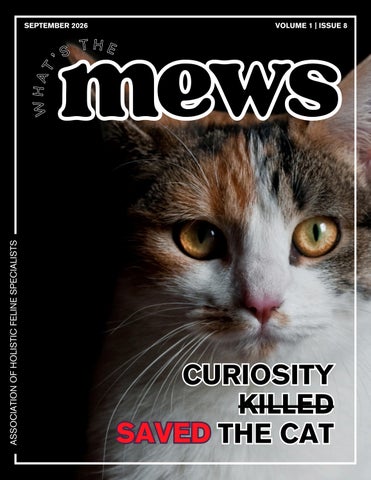
mews
SEPTEMBER 2026
T HH EE T S ’
VOLUME 1 | ISSUE 8
mews
W H AT
T A H W
’S
STSILAICEPS ENILEF CITSILOH FO NOITAICOSSA
CURIOSITY KILLED SAVED THE CAT
YOUR VOICE BELONGS IN THE CONVERSATION What’s The Mews Magazine is accepting article submissions from feline professionals, educators, advocates, creatives, and cat lovers with something meaningful to share. You do not have to be an experienced writer. If you have knowledge, a story, or a perspective that could educate or inspire, we want to hear from you. All articles are reviewed by the What’s The Mews Editorial Staff. No AI articles are permitted. To submit your article or photos, please contact: Mercedes Schenk HolisticFelines@gmail.com www.WhatsTheMews.com
W H AT
THE
mewscolumnists
’S
MERCEDES SCHENK CFMG Editor and Writer of What’s The Mews Magazine, Cat Groomer
ALEA MAROSE
SYDNEY BEERS CFMG
Owner and Groomer of Purrr Luxury Cat Grooming in Minnesota
Certified Feline Master Groomer and MagnoliaRune Cattery
LEXUS RAMIREZ
MICHELLE PELEGRINO
DC ROBERTS
Michigan Clover Maine Coon Cattery and TICA Breeder
Belcanto Cattery of Long Island, NY and CFA Breeder
EnchantedLanders TICA Cattery and Highlander Enthusuiast
What’s The Mews is a free-distribution publication created for the benefit of the feline community. All contributors generously volunteer their time and expertise without compensation, offering professional insight to support feline-centered care. The magazine is funded by the Association of Holistic Feline Professionals and is protected by applicable intellectual property and copyright laws.
TABLE OF CONTENTS IDK, ASK YOUR MOM
08
Mercedes Schenk CFMG DON’T JUST SAY IT, SLAY IT
12
Alea Marose PRETTY KITTENS, UGLY BUSINESS
18
Mercedes Schenk CFMG CURIOSITY SAVED THE CATS
36
Association of Holistic Feline Specialists WHY DO WE BREED? Sydney Beers CFMG
42
IDK, ASK YOUR MOM
pg. 7
As a child who was constantly chastised for asking what the adults referred to as too many questions, I find it to be bittersweet karma that I now have a child who questions nearly everything she sees, hears, or is told. Okay, let’s be so for real. All three of them do it. “Can’t we just--” Who decided that?” “But why?” “Do we have to?” “Why can’t we--” I think as adults it is so easy to become trapped in this mindset of it is what it is. To some extent, we didn’t make it this far without developing routines, beliefs, and approaches that have served us well enough. Afterall, if something is comfortable there’s no real reason to question it. Sometimes I catch myself becoming defensive, not because she’s being disrespectful, but because she’s pushed just beyond the edge of what I actually understand and reason. It sits in this uneasy space where curiosity meets exposure: the moment I realize I’ve been treating inherited explanations as knowledge. I find myself even in the simplest of conversations having to re-evaluate my own opinions, intelligence, and even observations. I’m telling you, parenting is a whole different kind of self-reflection dunked in a reality check. Did you accept certain things as fact
simply because they were always presented to you that way? Have you actually interrogated their origins, given yourself the opportunity to critically think, or did you simply defer the mental load and tell the kids to go ask their mom? Curiosity is interesting when you really stop to think about it. We love it when it looks like innovation, intelligence, or creativity. We encourage people to ask questions and challenge what they’ve always been told. Until of course, we are the ones being questioned. And phew. Is that not an unexpected emotional experience. When we start feeling some kind of way about it, that’s when curiosity starts to feel a lot like disrespect. As adults, we end up in this difficult position of trying to determine whether someone is genuinely attempting to understand us or simply challenging us because they can. Are they asking because they want more information, or are they rejecting the answer because it is not the one they wanted? Are they questioning the rule, or are they questioning whether we have any authority to make it in the first place? Honestly sometimes it’s both. There are moments when my children’s questions are thoughtful and surprisingly perceptive. There are also moments when their “why” is less of an invitation to elaborate, and more of an opening statement in the courtcase they’re preparing before me. If you’ve met my kids, you’ll laugh at the accuracy of that joke. Still, even the questions that make me want
pg. 8
to send them directly to their father force me to consider whether I actually have an answer. Is this a rule because it serves a purpose or its an easy way out? Is this something I know to be true, or something I have repeated so many times that it now feels true? Am I teaching them how to think, or am I asking them to stop thinking because I am tired of explaining myself? Parenting puts you in the strange position of wanting to raise independent thinkers while also needing them to put their shoes on because we should have left the house ten minutes ago. I want them to question what they are told. I want them to recognize when something does not make sense and feel confident enough to say so. I just do not necessarily want them practicing those skills on me before I have had coffee. That is where curiosity becomes uncomfortable. It is easy to admire from a distance. It is much harder to appreciate when it asks us to explain ourselves, reconsider something familiar, or admit that we do not know nearly as much as we thought we did. So the question really becomes, how do we know when curiosity is inviting growth, and when it’s simply inviting conflict? Well I‘ll ask you what I ask my kids. “What exactly do you want out of this conversation?” Not every question is asked for the same reason. Some quesions come from a genuine
desire to understand. They leave room for the possibility that the answer might change the way we think. Those conversations are exciting because everyone walks away having learned something. Some questions, well, some questions don’t really feel like questions at all. They are conclusions disguised as curiosity. They’re asking with the hope that if they keep pulling at that thread long enough, they’ll get you to unravel and down to the answer they wanted in the first place. As business owners, I think it’s safe to say you’ve experienced both pretty regularly. One client asks, “Why does my cat need a bath?” because they truly want to understand how skin, coat, and overall health work together. Another asks the exact same question because they’re hoping to take off a percentage of the overall groom price. The words are identical, but the intention isn’t. And because as business owners we can’t just brush them off and say, “Um go ask your mom,” we have to practice some good ol’ discernment. Discernment by definition is “the ability to judge well, see what is hidden, and tell the difference between truth and falsehood.” I’m not sure how most people develop discernment, but I’m sure its a skill set accumulated over time through various different experiences whether cultivated through meticulous practice or you know,
pg. 9
childhood trauma.
Curiosity should challenge us. It should make us uncomfortable sometimes. Curiosity forces us to ask whether we’ve accepted something simply because we’ve always believed it. Each advancement in feline care has happened become someone asked, “Could there be a better way?” If no one questioned old ideas, we’d still believe that cats groom themselves well enough to never need our help. But curiosity also asks something of the person doing the questioning. It requires a willingness to be changed by the answer. Otherwise, we’re not really searching for truth but validation. That is the discernment our profession requires. We have to remain willing to challenge why we believe what we believe, even when those beliefs are built on years of education and experience. Expertise should give us a stronger foundation for answering questions, not make us feel exempt from them. We should continue examining our methods, seeking better information, and changing course when the evidence gives us a reason to.
And I guess this next part is my own truth I have to speak out loud, as a parent and as a business owner. We cannot become so frustrated by the questions we hear repeatedly that we stop answering them altogether. What feels obvious, outdated, or even ridiculous to us may be the first time someone else has ever thought to ask. A question does not have to be sophisticated to deserve a thoughtful answer. Sometimes the questions that irritate us most are also the clearest reminders of how much misinformation still exists and how much education remains to be done. But that responsibility can become exhausting. It is not always fair that the mental load falls on one person to determine what someone is really asking, correct the misinformation behind it, manage their reaction, protect the relationship, and somehow remain endlessly patient through all of it. Maybe that’s the real lesson in all of this. Curiosity and boundaries are not mutually exclusive. We should never stop asking questions, just as we should never stop being willing to answer them. Our responsibility is to educate as much as professionally grow. As parents, we might shake our head in exasperation and say, “Go ask your mom.” But as professionals, we simply smile and say, “Please refer to my policies.”
MERCEDES SCHENK CFMG
SCHEDULE
S A T U R D A Y
1 7
Awakening Your Whole Self
8:30am - 9:30am
with Yogis Diona Peltcs
Adaptive Grooming for Chronic Pain
10:00am - 11:30am
with Dr. Janelle Schenk
The Future of Holistic Feline Care
12:30pm - 2:00pm
Moderated Panel
Injury Prevention for Groomers
2:30pm - 3:30pm
with Dr. Janelle Schenk
S U N D A Y
1 8
Tending Your Digital Garden
8:30am - 9:30am
with Mercedes Schenk CFMG
Burnout + Compassion Fatigue
10:00am - 12:00pm
with Dr. Jennifer Mandigo
UnMasking Success
1:00pm -2:30pm
with Dr. Noelle Young
Building Bridges
3:00pm - 4:30pm
Moderated Panel
M O N D A Y
1 9
Calling Back Your Energy
8:00am - 9:00am
with Yogis Diona Peltcs
Filling Your Cup
9:00am +
break out activities + networking
10
October 2026 17th - 19th
Holistic Feline Summit
Something transformative is coming to the Feline Industry, and it’s happening in Sedona, Arizona this fall! Due to popular demand, we have decided to open a few more spaces for those individuals ready and eager for a weekend not just of education, but wholeperson wellness. This isn’t just another groomer conference or expo, but a retreat for the mind, body, and career. We’re gathering in one of Sedona’s most breathtaking and restorative resorts at Modern Mountain to blend professional growth with personal renewal. Come learn, reconnect with yourself and your craft, and rediscover your passion for the work you do. Join other individuals from all over the country for networking, socializing, and simply basking in one of our nation’s most powerful metaphysical sites. Spaces are extremely limited, and this will be the last opportunity we have to open ticket sales. Tickets were sold out November of 2025, so don’t wait too long as they are expected to go fast. This year’s lineup includes powerful sessions with field professionals such as Dr. Janelle Schenk OTD, Dr. Jennifer Mandigo PsyD., Dr. Noelle Young, and Mercedes Schenk CFMG.
11
DON’T JUST SAY IT, SLAY IT
pg. 13
I couldn’t imagine a world where I didn’t work for myself. My first job, at 16 years old, I worked at a dog grooming, boarding, and daycare center, in the middle of farmland, Minnesota. Surrounded by absolute squares. I was a teenager finding my own style. That style just happened to be goth, or “alternative”. My boss had a STRICT dress code. Even our earrings couldn’t be too big. No makeup other than mascara. At the time I had a nose stud piercing, and even that was severely pushing it. When I was hired, I was my natural blonde hair color. As I started to find my style, I started experimenting with different hair colors. First, I colored it an auburn-type of color. When I showed up to work that next morning, my manager made me put a hat on and tuck ALL of my hair in. When I got new piercings, I had to have clear ones with a bandaid over them. Then I slowlyyy started stretching my ears, hoping if I did it slow enough, no one would really notice. Well, by the time I was 18, my boss absolutely did notice. She cornered me in the break room and told me I’m not allowed to show my face or talk to clients, and that my ears were “NOT CUTE.” That’s when I made the promise to myself, one day, I will work for myself and never make someone who comes in or works for me feel the way she made me feel for expressing myself.
I quit the very next day. From then on, I worked at multiple salons, daycares, pet stores, vet clinics, etc with little to no issues, but always felt like the black sheep. I turned that feeling into inspiration to be the most professional and kind groomer and pet professional that always did a good job. That way, no one could use my appearance or style as an excuse to judge my work ethic. Turns out, that worked to my benefit. Clients who at first were hesitant, became requests. It taught people to not judge a book by its cover. It also created a space for me to attract the clientele that I (mostly, let’s be real) wanted. The turning point for me was when I worked at a dog grooming salon grooming both dogs and cats, and my coworkers had COUNTRY MUSIC on (vomit) EVERY DAY. At that point I was already working on opening my own salon, but having my ears almost bleed every day gave me that little extra push. When I created my outline for my business plan and got really serious about it, my business partner and I really wanted to create a vibe. OUR vibe. Where we could really express our little gothic alternative selves and attract the clients we wanted to be in our space. We were sick of conforming. We knew it might take a little longer than a “mainstream aesthetic” salon to make money, but having our aesthetic was more important and we were willing to wait. Also, this was a cat only grooming business. If I had to guess,
pg. 15
I’d say at least 50% of cat owners are a little on the alternative side as well. At least in the Twin Cities, they are. That was also a factor in deciding where to have our house call map, and then have our home base salon. We knew the Twin Cities people were special and would probably appreciate our style even more than the people of the surrounding suburbs. And we were right. We stayed true to ourselves while also being the most professional, kind, and knowledgeable groomers. With starting any cat grooming business, you have to put the hard work in. Like going around to vet clinics with cards, passing around brochures at cat shows, having booths at cat expos, even going around to apartment complexes with posters. We just hoped and hoped that the right clients would seek us out. And they sure did! Now we can really push into the aesthetic because the people expect it and love it. And that couldn’t make my teenager heart any happier. Remember, stay true to yourself and your style. Express yourself. If you are a great groomer, that will shine through. Own it, and slay that shit.
ALEA MAROSE
You didn’t choose this work because it was easy. You chose working with live animals as challenging as cats because you have passion, brilliance, and refuse to settle for “good enough” when it comes to the way we interact with them. That level of dedication deserves special distinction, on a global level. The Association of Holistic Feline Specialists is compromised of individuals who are actively changing the narrative on feline care across the globe. This isn’t just about joining a club and printing out a piece of paper. It’s about committing to excellence and telling the world that you choose to be held accountable in an unregulated industry. And that they should too. We are where passion meets credibility. Memberships include: Certificate of Recognition, documenting official association as an AFHS Member and the professional pledge and code of ethics you’ve chosen to conduct yourself AHFS Directory Listing as Holistic Feline Professional so individuals can find you and the services you provide First access to educational summits and exclusive invitation to annual symposiums Discounted Classes/Seminars The Association of Holistic Feline Specialists is a non profit organization. 100% of Membership dues sustains our organization, including Pussy Talk the Podcast and our monthly free educational magazine “What’s The Mews”. Cats don’t have a voice in the standards we set, but they live with the results of them. This work is bigger than any one professional, and the cats who depend on us deserve more than individual effort, they deserve a unified standard, a collective commitment, and professionals who choose to stand together to do better. Are you ready to give it to them??
JOIN THE AHFS TODAY WWW.WHATSTHEMEWS.COM
AHFS MEMBERSHIP $60 Annually Discounted Events + Classes Online Directory Listing
MAGAZINE DONATION We are a free distribution magazine so that information is accessible for everyone.
PRETTY KITTENS, UGLY BUSINESS
I had, undoubtedly, what I can only describe as the absolute worst experience with a local breeder. The kind of traumatic experience where it keeps you up at night with your mind racing over all the things you wish you would have said or done differently. The kind of ordeal where words like
disrespectful and unprofessional stop even coming close, because somewhere along the way, the behavior crossed a line into something manipulative, intimidating, and outright abusive. The kind of situation where I could easily rally the village and go after them with pitchforks and torches blazing.
18
pg. 19
But this isn’t the 17th Century, and as satisfying as that fantasy may be in the moment, I still believe there is something more useful to be done with anger than simply letting it burn. Even in our darkest moments, we must have enough optimism to believe there can be something learned. For me, that means doing what I have always tried to do: advocacy through education. Admittedly, this is a little embarrassing for me. I work with cats professionally and am involved in the cat fancy. I attend shows, know breeders, and have purchased from incredible catteries as well as kennels before so I knew what was expected in this kind of interaction. This wasn’t some kitten I found through a questionable ad on the internet, it was someone I met at a CFA Show with mutual connections. She was kind to me in person, and all those little pieces of information stacked together made me feel safe. So when things started to feel strange, I explained them away. I should have known better, and perhaps inside I did which is why I waited to tell my colleagues what was going on until after it was too late. Because I fell in love with that kitten before I even met him and they used that against me. I don’t want to spend this article dissecting text messages or asking another breeder to decide who was right or who was wrong (even though everyone I showed it to said it was
wack). That doesn’t teach anyone anything. What I want to do, is dissect the contract. Because yes, I signed it, admittedly with a 102 degree fever and a double dose of NyQuil, but I signed. So I sat down with a few CFA and TICA breeders, and handed them the contract. Not to ask, is this breeder terrible, but to ask, what does this actually mean, is this normal, and what should buyers expect to see in a well written breeder contract.
THE HEALTH GUARANTEE The contract states: “Purchaser has forty-eight (48) hours from shipping date to have the kitten vet-checked for pre-existing life-threatening congenital or medical conditions.“ It specifically limits the language to preexisting, life threatening conditions discovered within that window. So what happens to something congenital that isn’t immediately life threatening? What about an infectious disease that was incubating before the kitten came home but didn't produce symptoms until day four? Q: When you see a 48 hour provision like this, what is the difference between requiring a veterinary exam within 48 hours and only guaranteeing the kitten's health for 48 hours? TICA registered breeder and Highlander enthusiast DC Roberts of EnchantedLanders
pg. 20
shares, “For me personally, I require a veterinary examination within 72 hours of pickup. That does NOT mean my kitten is only guaranteed healthy for 72 hours. Those are two completely different things.”
defects that simply cannot be detected during that first 72-hour vet check.
Across the United States, Maine Coon preservation breeder and enthusiast Lexus Ramirez of Michigan Clover Maine Coon’s elaborates:
Any congenital defects that are lifethreatening or cause any sudden death, or any illness that was not disclosed that is found at that vet appointment. Health is the top priority, and if it came from my cattery, then I will 100% back my health guarantee.”
“There is a massive functional difference between the two. Requiring a vet exam within 72 hours is a tool to establish an undisputed health baseline, while the 72-hour limit on illness coverage is a boundary against environmental exposure. Once a kitten leaves a cattery, the breeder cannot control what environments or pathogens they encounter. Because the stress of moving can cause hidden or dormant illnesses to flare up, a strict timeline is necessary. Requiring a vet exam within 72 hours ensures that if a kitten is sick with something contracted at the cattery, it is caught immediately before the buyer exposes the kitten to other pets or public spaces, which automatically voids that portion of the contract. However, a 72-hour health guarantee does not mean the breeder washes their hands of the animal on day four. It means acute or contagious illnesses are capped at 72 hours, resulting in an immediate refund if a vet proves the illness came from the cattery. Meanwhile, long-term accountability is maintained through a separate 1-year health guarantee that covers congenital or genetic
Q: What would you expect a strong health guarantee to cover beyond that initial veterinary examination?
EnchantedLanders’ DC Roberts adds, “I also believe breeders should provide some type of complimentary pet insurance for the first 30 days when available. I personally provide a 30-day complimentary insurance trial because unexpected illnesses, accidents, and veterinary expenses can happen during that transition period. Pet insurance and a breeder’s health guarantee are also two different things. Many catteries, including mine, do not guarantee against every common or treatable illness such as parasites, upper respiratory infections, fungal infections, diarrhea, or similar conditions. A kitten can unfortunately pick something up at any given time, and the stress of moving, traveling, changing environments, and being exposed to new animals can also play a role. There is a big difference between a common, treatable illness and a serious congenital, hereditary, or life-threatening condition that the breeder specifically guarantees against.
pg. 21
CFA Breeder, Persian and Exotic enthusiast Michelle Pelegrino of Belcanto Cattery answers “This is probably a breed to breed basis. Some breeds, like Folds and Manx have some weird stuff that rears its head down the line, speaking from an Exotic and Persian standpoint. First, most health guarantees will be regarding congenital issues that are fatal or will prevent the cat from living a healthy life. Congenital issues, meaning from birth, does NOT mean inherited. These kittens should be replaced, particularly if they need to be euthanized or die naturally from a defect. I've also seen in my vet practice a couple of young cats that come in with lymphoma. Again, not inherited, nobody's fault, but things like that do not discriminate and even a 1 year old can get it. Heart issues are tricky because cats get heart issues. This is probably why most health guarantees are only until 2-3 years of age. Lifestyle, diet and a just being a cat are reasons for heart issues. 20% of all cats (breeder cats, dumpster cats) will have heart issues in their lifetime. So it's hard for a breeder to gage when it stops being their responsibility, but again 2-3 years seems like a fair amount of time for something a cat was born with to rear its head. Now as an addendum to that, I have a clause
in my contract about brachy cats in general, because there are things I can't avoid. While I try my damn best to breed open nostrils, as a cat ages the face pulls in more and they can get snorty as older cats. They also tear, which gets into their nose creases and can also get all over your walls...so I try to set myself and my cats up for success by being transparent about the fact that yes, we have all signed on for a flat face cat and this is what we get.” Q: From a breeder's perspective, when a document calls something a “health guarantee,” what should actually be guaranteed? Michigan Clover answers, “The health guarantee should include any congenital defects.” EnchantedLanders agrees by stating, “No breeder can realistically promise that a living animal will never become sick.” “Things that can't really be heath guaranteed” Michelle Pelegrino explains, “are colds, poop parasites, ear infections, eye ulcers etc...these things should NOT be present when kittens are handed over. If they are, that breeder better make it right asap. But stress, diet, well water vs filtered water, other animals, candles and smells in a new home (even carpet) can cause all sorts of weird stuff in kittens and puppies, so thats considered out of our control.” The next sentence of the clause reads: “The kitten may be replaced with similar quality, at the Sellers discretion if a lifethreatening health issue is discovered within 48 hours.”
pg. 22
The word that jumped out to me wasn’t replacement. It was may. The kitten may be replaced, and even that remedy remains at the seller’s discretion. There is no language here promising reimbursement for veterinary expenses, refund option, not even an absolute promise of replacement. Q: Does wording like “may be replaced at the seller’s discretion” give the purchaser meaningful protection, or would you want to see the available remedies more clearly defined? Michigan Clover answers, “More defined, with a time period. For example, I have up to a year to provide a replacement kitten of comparable size and quality, or if the issue warrants a refund, then we do a refund. If it’s at the seller’s discretion, then you never know when you can get that kitten. I’d personally want it in writing, with first pick of the litter.” DC Roberts states, “I don’t believe every covered health issue should automatically mean, “Give me the kitten back and I’ll give you another one.” Families become attached to these kittens. They are not merchandise. A good contract should clearly explain what options are available if the family wants to keep and treat their kitten rather than surrendering them for a replacement. I do treat this case by case [but it hasn’t] occurred yet though. I do have that they must be returned BUT things can be done differently if chosen given the circumstances and situation. The same clarity should apply to deposits and payments. To me, a nonrefundable deposit
and payments means a buyer cannot simply change their mind after I have held a kitten for them and expect that money returned. That is completely different from the breeder being unable or unwilling to complete the transaction. The contract should explain what happens in BOTH situations.” Which brings us to our next portion of the contract:
THE DEPOSIT Initially, I was told:
Then one day, I was told that in order to reserve him I would have to pay the full 50% deposit on him. I sent her the entire amount requested and inquired about the contract.
pg. 23
A contract was not delivered to me until exactly a month later. At this point, the language was extremely alarming but she had given me less than 12 hours to sign the contract or else I forfeited my reservation of this kitten. A non refundable deposit itself didn’t concern me. Breeders reserve kittens, turn away other buyers, and deserve some type of protection when a purchaser simply changes their mind. What I had never really stopped to ask though was...non refundable, no matter what? Because there is a significant difference between I changed my mind and don't want the kitten anymore and the breeder is no longer willing to sell me the kitten. Q: What should “nonrefundable deposit” mean in a fair breeder contract, and should a contract specifically state what happens to that deposit if the breeder, rather than the buyer, ends the transaction? “Yes,” says Michigan Clover Maine Coons. “And personally, I think the deposit should be refunded, and this should always be explicitly
stated in the contract. Legally and ethically, a “non-refundable” clause only protects the breeder if the buyer defaults or changes their mind. If the breeder cancels the sale or cannot fulfill their end of the bargain, keeping the money is considered a breach of contract unless stated otherwise in the contract. A non-refundable deposit means that the money you pay to reserve a kitten or a spot on a waiting list will not be given back to you if you change your mind, back out, or fail to complete the purchase. I think a good contract will specify if the deposit can at least be moved to a future litter if the current one does not yield the right kitten for you or life happens.” EnchantedLanders shares, “If a breeder is unable to provide the kitten they chose, they must have something in their contract like I do on replacing within 2 years. Michelle Pelegrino quickly notes, “Mine are refundable. Period.” Q: When should a buyer receive and review the full contract: before paying a deposit or after? “That is up to the buyer”, Belcanto adds. “I’ve done both.” “I have my contract available 24/7 on my website so that future families can view it and decide on their own if my cattery is the right fit.” shares Lexus Ramirez, “The contract should be seen prior to sending a deposit. I don’t have families sign contracts until the day of pickup, when the contract will
pg. 24
be in full effect.” “I believe families should know and understand the important terms of the contract before becoming financially committed.” concludes EnchantedLanders. “Nobody should find out about major restrictions, financial penalties, or important health terms after they have already paid substantial money.” Q: Under what circumstances, if any, do you think it is reasonable for a breeder to keep the kitten, retain the entire amount a buyer has paid, and then sell that kitten to someone else? “I don’t think under any circumstances that a breeder should keep the payment for a kitten if no kitten is being sent home with the buyer.” says Michigan Clover Maine Coons. DC Roberts adds, “As far as a breeder keeping the kitten, keeping everything the buyer has paid, and then turning around and placing that same kitten with someone else, there would need to be very specific circumstances and very clear contractual language for me to consider that reasonable. There ARE circumstances where I would cancel a placement; threats, harassment, fraud, dishonesty, serious animal-welfare concerns, major contractual violations, or something that genuinely makes me believe that placing my kitten in that home is no longer safe or appropriate.”
RESPECTFUL AND PROFESSIONAL This is an expectation to be held by both parties, regardless. My contract stated: “The Purchaser agrees that communication shall remain respectful and professional throughout the transaction.” Keep in mind, that another section allows the contract to be cancelled for material breach for any provision. When respectful is not as clearly defined as “the balance is due on Friday, it leaves a lot of room for cultural interpretation and subjectivity. Q: Do subjective expectations like “respectful” and “professional” belong in a contract when violating the contract can have financial consequences? If they do, how should that language be written so both parties know what behavior would actually constitute a breach? “Subjective terms such as “respectful” and “professional” become a problem if violating them can cost someone their kitten and thousands of dollars without explaining what actually constitutes a violation.” responds EnchantedLanders. “Asking questions, disagreeing with a breeder, or advocating for yourself should not automatically become a contractual breach. “ “No,” states Lexus Ramirez, “highly subjective words like ‘respectful’ or ‘professional’ do not belong in a legally binding contract when a violation carries financial consequences. Because these terms are highly subjective
pg. 25
[they] do not belong in a legally binding contract when a violation carries financial consequences. Because these terms are defined differently by everyone, courts often view them as “void for vagueness.” If a contract is broken based purely on a subjective feeling, the resulting financial penalty will rarely hold up in small claims court. However, behavioral boundaries can be included if they are translated into objective, measurable actions and clear communication protocols. If a buyer and seller cannot maintain an adult-to-adult conversation, the contract should outline exactly how communication will be handled and what specific behavior constitutes a breach. For example, [my contract states in] Section X: Conduct and Communication Protocols: Communication: In the event that verbal communication between the Breeder and Buyer becomes unconstructive or strained, either party may invoke the right to require that all future communications be conducted exclusively via email to ensure a clear written record. Prohibited Conduct: The use of profanity, documented verbal or written threats, extortion, or defamatory statements intended to bully, insult, or intimidate the other party is strictly prohibited. Engaging in this conduct constitutes a material breach of this contract.
Remedy for Breach: If the Buyer commits a breach of this section, the Breeder may terminate the contract and retain the deposit as liquidated damages. If the Breeder commits a breach of this section, the Breeder must terminate the contract and refund the Buyer’s deposit in full within X days.” Q: As a reputable breeder, what behaviors would cause you to cancel a contract? “I’ve canceled twice (and refunded)”, shares Belcanto Cattery. “The first one, the buyer emailed me back my contract with actual corrections...like her version of what she wanted instead. The second, I canceled (and refunded) because the woman said it wasn't my business what happened to the cat if she couldn't keep her. Like she could rehome it as she saw fit because she owned her. I was like....ummmmm ma'am, while I respect your choices, I need to know if the cat leaves your care. So no.” Lexus Ramirez breaks it down simply, “Bullying, harassment, name-calling, false allegations, etc.”
pg. 26
READING THE EMPTY SPACES The most revealing part of going through the contract wasn’t necessarily reading what it said, but what it didn’t. I had spent so much time reading the threats that I never stopped to ask whether the responsibilities on the other side were just as clearly defined. The contract tells me exactly what happens to me if I breach it. But what happens when the breeder does? Q: When you read a breeder contract, what obligations should you expect to see placed on the breeder, not just the buyer? “Transparency!” says Belcanto. “Transparency about everything. Temperament, health, vaccine status, parents, siblings. The more info someone has the better. They know if you’re a good fit they know if the cat is a good fit. Why set anyone up for failure by holding any info back? Why? What is there to hide? Please read it all. Siblings weights and exams, all of it.”
Q: What should a well written contract promise regarding health records, genetic testing, registration paperwork, illness before transfer, and what happens if the breeder cannot complete the sale? “A well-written breeder contract must protect both the buyer’s financial investment and the animal’s welfare by removing all guesswork. To be considered legally robust and ethical, a contract should promise the following specific terms across these five key areas, for example [here is another portion of my contract:] Health Records & Medical History The contract must guarantee absolute transparency regarding the kitten’s veterinary care up to the exact moment of transfer. Itemized Medical Records: Provision of physical or digital records detailing the exact dates, dosages, and brands of all vaccinations and deworming treatments administered. Microchip Identification: The microchip number and clear, step-by-step instructions on how to transfer the registration to the buyer. Genetic Testing & Long-Term Health Guarantees Ethical contracts focus on preventing and managing hereditary conditions. The agreement should promise:
Michigan Clover’s Lexus Ramirez expects to see “Health, proper documentation, proper vaccinations, proper health testing on parents, etc.”
Parental Genetic Clearances: Written proof that the sire (father) and dam (mother) have had the promised health testing done.
pg. 27
Congenital Health Guarantee: A replacement or refund guarantee covering severe, lifealtering hereditary defects. Fair Remedies: A clear process if a genetic defect is diagnosed by a vet. A fair contract allows the buyer to keep their pet and receive a full or partial refund or veterinary cost reimbursement up to the purchase price, rather than forcing them to return the kitten. Registration Paperwork To verify the pedigree and legitimacy of a purebred animal, the contract must establish strict paperwork rules: Explicit Registration Type: A clear statement specifying whether the animal is sold with Limited Registration (pet-only home, no breeding rights) or Full Registration (with breeding rights). Guaranteed Delivery Timeline: A promise that the official registration applications will either be handed over at pickup or when alteration is done. Spay/Neuter Contingencies: If papers are withheld until proof of spay or neuter is provided, the contract must explicitly state the age deadline for the procedure and the exact timeline for releasing the papers once proof is received. Protocol for Illness Before Transfer If a kitten falls ill or suffers an injury while still in the breeder’s custody, the contract must place the financial and decision-making burden on the breeder by promising:
Immediate Notification: A mandate that the breeder must inform the buyer immediately if the animal shows signs of illness, requires medication, or experiences an injury before pickup. Buyer Choice Options: The buyer must be granted the contractual right to choose their preferred remedy: Delaying pickup until a licensed veterinarian certifies the animal is completely recovered. Selecting a different available kitten from the same litter. Canceling the transaction entirely for a 100% refund of all funds paid, including the deposit. Remedies if the Breeder Cannot Complete the Sale If the breeder is unable or elects not to fulfill the contract, the buyer must be protected from financial loss. No Forced Rollovers: The breeder cannot unilaterally force the buyer to accept a kitten from a future litter. A cash refund must be presented as a default option unless the buyer signs an agreement to wait for a future pairing.” Q: Can what is missing from a contract sometimes tell you more than the clauses people immediately recognize as “red flags”? What omissions would make you stop and ask questions? Yes!” states Michigan Clover. “Yes, absolutely. What a breeder leaves out of a contract is often far more revealing than a glaringly bad
“There are a lot of ways to do something right. I’ve spent my 5 years of breeding adjusting and evolving my ways, and I am sure I will evolve more as I go. The most important thing is no matter how someone breeds, or what their contract says, that buyer and seller trust one another.” - Michelle Pelegrino of Belcanto Cattery
pg. 29
clause. A malicious or deeply restrictive clause is an obvious red flag, but omissions are “silent red flags.” They often signal that a breeder is either inexperienced, trying to avoid long-term accountability, or leaving a loophole open so they can change the rules later if something goes wrong. Personally, I would question if there’s no return-tobreeder clause, if there’s not a list of reasons or scenarios where it would be okay for the buyer to cancel due to the breeder’s fault, no option to keep the kitten if a genetic defect occurs, etc. “I think lack of acknowledgement about congenital issues is a big one,” says Belcanto Cattery “or health guarantees less than 2 years. People with cats particularly should acknowledge they need routine vet care like a dog, grooming, particularly wellness exams as cats hide things. No declawing is a big one.” “A contract shouldn’t be pages of everything the buyer is required to do while saying almost nothing about what the breeder is required to do.” EnchantedLanders concludes. If I can read an entire contract and know exactly what happens to the buyer if they do something wrong, but I still can’t figure out what happens if the breeder fails to fulfill their obligations, I’m going to have questions.” And sometimes the biggest question really ends up being, “is it time to find a different breeder?”
MERCEDES SCHENK CFMG
MIKLY MOON PERSIANS CFA REGISTERED CATTERYNUMBER #324048 SINCE 2023 Anabel Martini - 520/358-2112
Tucson, AZ
CAT OR KITTEN CONTRACT BREED: PERSIAN
SEX: MALE
SIRE:
GC Beaubarr Love Bug Of Milky Moon
DAM:
CH I-Catcher's Petunia Of Milky Moon
COLOR: RED TABBY DOB: 4/27/2026
EYE COLOR: COPPER
PURCHASER: Mercedes Schenk EMAIL: HolisticFelines@gmail.com
TELEPHONE: _ (602) 758-7280__
COMPANION/NEUTERED PET: Yes PRICE & TERMS: Price of the Cat/Kitten is $1,600.00 (USD). A $800.00 non-refundable deposit to be made by the seller by purchaser via Zelle. The remaining $800.00 (USD) balance is to be paid in person in cash at time of transport/pickup by purchaser on an agreed upon date.
SALES AGREEMENT 1. The purchaser accepts the responsibility of caring for this kitten and providing properly for its welfare. It is understood that this is a live animal and no living creature is considered to be perfect. The purchaser agrees to provide sanitary living conditions, correct diet and adequate veterinary care, including vaccinations (boosters). 2. Seller is selling a healthy kitten that has been vaccinated twice for FVRCP, and guaranteed to be PKD negative. Seller has also dewormed the kitten. Purchaser has forty-eight (48) hours from shipping date to have the kitten vet-checked for pre-existing life-threatening congenital or medical conditions. The kitten may be replaced with similar quality, at the Sellers discretion if a life-threatening health issue is discovered within 48 hours from shipping date as stated above. Seller makes no guarantees regarding cat/kitten’s physical growth/future development after Purchaser takes possession of the kitten/cat. 3. Contagious Diseases After Transfer. The Breeder is not responsible for any illness, disease, injury, or condition acquired after the kitten leaves the Breeder’s care, including those resulting from exposure to other animals, environmental factors, stress, or the Buyer’s management and care practices. 4. Seller is selling a pet that is spayed/neutered. a. The Seller agrees that the kitten will not leave the cattery until: i. The Seller's veterinarian determines the kitten is healthy enough for release; Spaying of the kitten will be administered by the seller. ii. The kitten has been neutered; and the veterinarian has approved the kitten following the required post-operative recovery period (2 weeks). iii. The Purchaser acknowledges that veterinary recommendations shall control the release date. 5. Seller is selling a pet that is vaccinated. Initial vaccinations will be administered by the seller. a. The Seller agrees that the kitten will not leave the cattery until: i. The Seller's veterinarian determines the kitten is healthy enough for release; ii. Required vaccinations have been completed; iii. The Purchaser acknowledges that veterinary recommendations shall control the release date.
6. Proper Care and Welfare. The Buyer agrees to: a. Keep the cat as an indoor-only companion. b. Provide routine and emergency veterinary care as needed. c. Provide appropriate food, fresh water, shelter, and general care. d. Treat the cat humanely and never neglect, abuse, or abandon the animal. 7. The estimated pickup or delivery date is tentative and may change based on the kitten's health, vaccination schedule, neuter surgery, recovery period, veterinary recommendations, weather conditions, transportation availability, or other circumstances affecting the kitten's welfare. a. The Seller shall determine when the kitten is medically ready to leave for its new home. The Purchaser acknowledges that all stated dates are estimates and not guarantees. 8. If the Purchaser intends to exhibit the kitten in CFA shows, the Purchaser shall obtain the Seller's prior written approval before naming, registering, or publicly promoting the kitten under any name associated with Milky Moon Persians. 9. The Purchaser agrees that communication shall remain respectful and professional throughout the transaction. 10. The Purchaser acknowledges that breeding practices and business policies vary among breeders. By signing this Agreement, the Purchaser accepts the policies of Milky Moon Persians and understands that comparisons with other breeders do not modify this Agreement. 11. The Seller shall determine when the kitten is ready for release. The Purchaser must pick up the kitten within fifteen (15) calendar days of the designated release date. Failure to do so shall constitute a material breach of this Agreement. In such event, the Seller may cancel this Agreement, retain all deposits and payments made by the Purchaser, and offer the kitten for sale to another purchaser without any refund. 12. This Agreement, together with any written communications specifically referenced by the parties prior to signing, constitutes the complete agreement between Seller and Purchaser. No verbal statements or prior discussions shall modify this Agreement unless made in writing and signed by both parties. 13. If the Purchaser materially breaches any provision of this Agreement before the kitten is transferred, the Seller may cancel this Agreement. In such event, all deposits paid shall be forfeited to the Seller as liquidated damages, and the Seller shall have no further obligation to complete the sale. 14. Reservation and Acceptance of Terms: By signing this Agreement, Purchaser acknowledges that they have reviewed all terms of sale, have had the opportunity to ask questions, and voluntarily agree to proceed under the policies of Milky Moon Persians. 15. Purchaser’s signature indicates full agreement of all the above conditions and Purchaser will not attempt to hold Milky Moon Persians responsible for any and all problems and or costs, legal or otherwise that might arise in connection with this kitten. This agreement will be governed, construed, and enforced according to the Laws of the State of Arizona, USA without regard to its conflict of laws rules.
__________________________________ Signatureof Purchaser
___________ _________ ______ Date
Anabel Martini Signatureof Seller (Milky Moon Persians)
07/06/2026________ Date
O C T O B E R
2 0 2 7
SCHEDULE
S A T U R D A Y
1 6
The Science of Sustainable Grooming
8:30am - 10:00am
with Dr. Janelle Schenk OTD, OTR/L
Technical Tune Up
Conference Room
10:30am - 12:00pm
with Mel Brink, CFMG and NCGI Certifier
The Paranormal Purrade
Conference Room
12:30pm - 1:45pm
Creative Cat Grooming + Costume Contest
Main Stage
Creative Grooming: Color + Cuts
2:00pm - 4:00pm
with Alexandria Korb CFMG + SeAndria Duckworth CFMG
Conference Room
The Price Is Right: Groomer Gameshow
4:30pm - 5:30pm
with Lynn Paolillo CFMG and NCGI Certifier Mercedes Schenk CFMG
Main Stage
The Witching Hour
7:00pm - 9:30pm
Attendee Costume Party
S U N D A Y
Fiesta Room
1 7
Build a Better Boarding Business
8:00am - 9:00am
with Mel Brink, CFMG and NCGI Certifier
Smooshy Faced Masterclass
Conference Room
9:30am - 12:30pm
Conference Room
with Lynn Paolillo CFMG and NCGI Certifier
Reserved Time Slot
12:30pm - 1:45pm
TBA
Feline Feline
SUPERSTITIOUS GROOMING CONVENTION
Main Stage
The Feline Superstitious Open Sponsored by Ryan’s Pet Supplies Raffle Winners Announced
Can You Handle It?
Main Stage
4:30pm - 6:30pm
with assorted Certified Feline Master Groomers
M O N D A Y
2:00pm - 4:00pm
Conference Room
1 8
Feline First Certification Course with Mercedes Schenk CFMG + The Association of Holistic Feline Specialists
8:00am - 2:00pm
The Association of Holistic Feline Specialists is proud to announce the arrival of what the feline industry has been waiting for! A cat exclusive grooming convention featuring feline first education, professional development, and industry connection. The El Zaribah Shrine is conveniently located approximately three miles from Phoenix Sky Harbor International Airport, or about a seven to ten minute drive depending on traffic. The surrounding area offers a wide range of hotel accommodations, from luxury properties to budget friendly options. The venue has also generously offered secured overnight parking for registered RV guests. Weekend Education Pass Tickets are $350 and include Saturday + Sunday classes and the Saturday Night Social. The Feline First Certification Course is a separate $220 ticket as there is limited seating. Can You Handle It? is a professional panel exploring practical ways to safely and comfortably handle cats during grooming. Educators will demonstrate and discuss table, lap, and floor grooming, along with techniques for working with wiggly cats, senior cats, medically fragile cats, and cats with challenging temperaments. Attendees will have opportunities to ask questions and learn from the perspectives of several experienced feline groomers. The Price Is Right: Grooming Gameshow is an interactive cat grooming game show where audience members compete in a series of educationally impactful games. Uncover hidden expenses, challenge unsustainable pricing habits, and determine what your feline grooming appointment should truly cost. You may not win a new car, but you might finally stop giving away your time for free.
33
Become A Vendor Bring your brand straight to the heart of the cat lover community, where cat lovers and professionals alike come eager to discover, learn, shop, connect, and celebrate everything feline.
VENDOR BENEFITS
AMOUNT
FULL BOOTH SETUP PROVIDED Your 10x10 vendor space will be fully assembled with pipe and drape, one table, and two chairs so you can walk in, merchandise your booth, and be ready for attendees.
INCLUDED
WEBSITE VENDOR FEATURE + DIRECT LINK Your business will be featured on the event website with your logo and a direct link, giving attendees an easy way to find, learn about, and shop with you before and after the convention.
INCLUDED
PRE EVENT SOCIAL MEDIA FEATURE We will introduce your business to our audience before the event through dedicated vendor promotion designed to help attendees recognize your brand before they ever reach the vendor floor.
INCLUDED
CLIMATE CONTROLLED + SECURED VENUE Keep your booth set up secured overnight between event days without packing everything away. The venue will be secured overnight so vendors can return the next morning ready to open. Did we mention the whole thing is air conditioned?
INCLUDED
OPTIONAL ELECTRICAL ACCESS Need power for your display, equipment, or checkout set up? Electrical access can be added to your booth in advance for an additional flat fee. Vendors will have access to set up Saturday morning at 7:00am. Floors close Sunday at 5:00pm, with a breakdown time between 5:00pm and 7:00pm. Each
$60
T his c o uld b e y o u ! !
10x10 space is $350 for the entire weekend. A non refundable deposit of $150 is required to secure your space, with final payment due May 1, 2027. A $50 credit may be applied to vendors who donate items to the raffle.
El Zaribah Shrine 552 N 40th St in Phoenix, AZ October 16 + 17, 2027
35
Contact Lauren Finn, CFMG | Sponsorship & Vendor Coordinator | info@catconciergemi.com | 248-792-1236
www.WhatsTheMews.com
CURIOSITY SAVED THE CATS Genetic testing has become increasingly common in pet ownership. Today, a commercial cat DNA test costs roughly anywhere between $70 to $150, with results available usually within just a couple of months. Depending on what panel you purchase, the testing is surprisingly broad. Some tests can identify genetic markers associated with inherited conditions such as polycystic kidney disease (PKD) and hypertrophic cardiomyopathy (HCM). Others provide information about ancestry and breed, and identify physical traits such as coat color, hair length, and even blood type for transfusion compatibility. This kind of information was once largely limited to researchers and veterinarians. Now, breeders can use genetic testing to help make more informed breeding decisions and everyday cat owners can order a test simply because they want to know more about the cat living in their home. Funny enough, the easiest part is getting the result, the harder part is understanding exactly what the results mean or how it impacts your cat. For example, what exactly is the test measuring? How certain is the result? Does finding a disease-associated mutation mean a cat will actually develop that disease? Are you signing yourself up for anxiety or true prevention? Does that DNA test accurately tell
pg. 37
you what breed your cat is? How much of what we see physically can be traced back to one gene, and how much is far more complicated? Those questions were at the center of geneticist Leslie A. Lyons’ 2012 review, “Genetic Testing in Domestic Cats,” published in Molecular and Cellular Probes. The paper examined the growing number of genetic tests available for cats and the many ways they were already being used, including veterinary medicine, breeding programs, physical trait identification, population genetics, species identification, parentage testing, and even forensic science. At the time the review was published, approximately 35 genes containing more than 50 known mutations had already been associated with feline disease or physical characteristics. This number alone showed how quickly researchers were beginning to move from simply observing inherited traits and diseases to identifying some of the genetic changes behind them. Now nearly a decade later, obviously some of the specific numbers in the review are understandably dated. However, the questions it raises are even more relevant. Genetic testing has become easier to access, testing panels have expanded, and much larger feline genetic databases now exist. A 2022 study examining more than 11,000 cats also found evidence suggesting that genetic screening may have helped reduce the frequency of certain disease-associated
variants within some pedigreed cat populations. The science has moved forward considerably, but one point has remained remarkably consistent:
CURIOSITY SAVED THE CATS
Feline genetic testing didn’t begin with cheek swabs and commercial testing panels, in fact, some of the earliest genetic studies examined chromosomes themselves. Domestic cats normally have 38 chromosomes, consisting of 18 pairs of autosomes and one pair of sex chromosomes. A chromosome is basically a tightly packed bundle of DNA. Your DNA contains genes, which are the instructions your body uses to build and run itself. An autosome is simply a type of chromosome. Early cytogenetic testing (testing that looks at a cell’s chromosomes themselves) allowed researchers to identify large chromosomal abnormalities, including abnormalities involving the sex chromosomes. Lyons describes how unusual male tortoiseshell and calico cats became particularly interesting subjects because orange coloration is associated with the X chromosome. Chromosome analysis eventually demonstrated that some of these males possessed unusual chromosomal arrangements, including mosaic or chimeric XX/XY cell populations.
pg. 39
Now, modern genetic testing can examine changes on a much smaller scale. Rather than simply determining whether a chromosome is present, missing, duplicated, or structurally abnormal, researchers can search for deletions, insertions, rearrangements, and substitutions involving individual pieces of DNA. So instead of counting chromosomes, we are now able to read individual DNA changes. That improvement in resolution is what transformed genetic testing from an interesting laboratory technique into a practical tool for veterinarians and breeders.
FROM KNOWLEDGE COMES POWER Genetic testing can prevent disease. Polycystic kidney disease provides one of the clearest examples of what a useful feline genetic test can accomplish. PKD causes cysts to form in the kidneys and has historically been particularly important in Persian cats and breeds with Persian ancestry. A landmark 2004 study identified a mutation in the feline PKD1 gene associated with the disease. At that time, the researchers estimated that approximately 38 percent of Persian cats worldwide were affected, making PKD one of the most prominent known inherited diseases in cats. The researchers identified the mutation in 48 affected cats and found no unaffected cats carrying that mutation within the population they studied. Once a causative mutation can be reliably identified, breeders are no longer restricted to
watching pedigrees and waiting to see whether disease appears. Breeders can now determine a cat's genetic status before making a breeding decision.
A POSITIVE RESULT IS NOT A DIAGNOSIS PKD also illustrates why genetic testing can appear deceptively simple. When researchers identify a strong relationship between a particular mutation and a disease, it is tempting to assume that every genetic disease follows the same pattern. But that’s just not true. Hypertrophic cardiomyopathy, or HCM, demonstrates the problem particularly well. In 2005, researchers identified a mutation in the MYBPC3 gene associated with familial HCM in Maine Coon cats. The mutation changes a single DNA base and alters the resulting cardiac protein. However, subsequent research demonstrated that the relationship between the mutation and disease is not perfectly predictable. Some Maine Coons carrying the A31P mutation do not develop clinically detectable HCM, while HCM also occurs in cats that do not possess that particular mutation. Lyons therefore explains that the result functions more appropriately as information about risk than as a guaranteed diagnosis. This concept is called penetrance. A mutation with complete penetrance would be expected to produce its associated condition whenever the relevant genotype is present. A mutation with incomplete penetrance does not produce
detectable disease in every animal carrying it. Okay, and I know this is super science heavy but that difference matters. A genetic test may tell us that a cat possesses a particular DNA variant, but the biological meaning of that result depends on the variant. Some variants strongly predict a physical trait or disease. Others alter probability. Some may interact with additional genes, age, environment, or biological factors that researchers do not yet completely understand. Progressive retinal atrophy and pyruvate kinase deficiency are two more examples discussed in the review. Even when cats carry genetic variants linked to these diseases, they may not all be affected in the same way. Some develop symptoms earlier, some later, and some may have such mild symptoms that they are barely noticeable. Genetic testing can tell us a lot, but it cannot always predict exactly how a disease will affect an individual cat. It can also tell us a lot more than just who might get sick. DNA can also help identify an individual cat, confirm parentage, determine biological sex, distinguish between species, and even contribute to forensic investigations. One study examined mitochondrial DNA from 1,394 cats representing 25 populations around the world and 26 breeds. Researchers found enough genetic variation among those cats for mitochondrial DNA to have useful forensic value. Because cats constantly shed hair, that
genetic material can be transferred to clothing, furniture, vehicles, and other objects. In the right circumstances, DNA from cat hair can help investigators connect evidence to a particular cat, household, or population. It is a surprisingly practical reminder that genetic information is not limited to disease screening or breeding decisions. The same DNA that can tell us something about a cat’s health can also help establish identity and relationships...or who the murderer was. As genetic testing becomes easier to access, it is also important to remember that simply having a test available does not automatically make the result useful. Lyons cautioned that genetic tests are not perfect. Accuracy depends on the test itself, the quality of the laboratory, whether the genetic variant has been properly studied, and how the result is interpreted. It may seem logical to remove every cat carrying an undesirable recessive variant from a breeding program, but genetics is rarely that simple. This is especially true in hybrid breeds such as Bengals and Savannahs, whose wild ancestry can affect how tests designed for domestic cats perform. Eliminating too many cats based on a single result can also reduce genetic diversity, so responsible breeding decisions should consider the disease, inheritance pattern, overall health, pedigree, and the population as a whole.
ASSOCIATION OF HOLISTIC FELINE SPECIALISTS
WORKS CITED Boeykens, Freya, et al. “Classification of Feline Hypertrophic Cardiomyopathy-Associated Gene Variants According to the American College of Medical Genetics and Genomics Guidelines.” Frontiers in Veterinary Science, vol. 11, 2024, article 1327081. https://doi.org/10.3389/fvets.2024.1327081. Grahn, Robert A., et al. “Feline Mitochondrial DNA Sampling for Forensic Analysis: When Enough Is Enough!” Forensic Science International: Genetics, vol. 16, 2015, pp. 52–57. https://doi.org/10.1016/j.fsigen.2014.11.017. Grahn, Robert A., et al. “Feline Non-Repetitive Mitochondrial DNA Control Region Database for Forensic Evidence.” Forensic Science International: Genetics, vol. 5, no. 1, 2011, pp. 33–42. https://doi.org/10.1016/j.fsigen.2010.01.013. Lipinski, Monika J., et al. “An International Parentage and Identification Panel for the Domestic Cat (Felis catus).” Animal Genetics, vol. 38, no. 4, 2007, pp. 371–377. https://doi.org/10.1111/j.13652052.2007.01632.x. Lyons, Leslie A. “Genetic Testing in Domestic Cats.” Molecular and Cellular Probes, vol. 26, no. 6, 2012, pp. 224–230. https://doi.org/10.1016/j.mcp.2012.04.004. PubMed Central, https://pmc.ncbi.nlm.nih.gov/articles/PMC3541004/. Lyons, Leslie A. “Genetic Testing: Practical Dos and Don’ts for Cats.” Journal of Feline Medicine and Surgery, vol. 26, 2024, pp. 1–13. https://doi.org/10.1177/1098612X241303603.
WHY DO WE BREED
Why do we keep creating new cat breeds? Why do we breed at all? It’s a question I’ve been asked more than once, and honestly, it’s something I’ve thought about myself. The answer isn’t as simple as, “Because we can.” For ethical breeders, it goes much deeper than that.
A lot of people think breeders are just trying to create something new or unusual. But that’s really not the goal. Preservation breeding is about protecting healthy bloodlines, preserving the traits that make a breed unique, and making sure those traits are still here for future generations. A preservation
42
pg. 43
breeder’s goal isn’t simply to produce kittens it’s to protect, improve, and preserve a breed for the generations that come after us. Every breed we know today started somewhere. Someone saw something special and thought, “This is worth preserving.” Then they spent years sometimes decades health testing, learning genetics, working with mentors, and making thoughtful breeding decisions. It wasn’t about the next litter. It was about the next generation. Without preservation breeders, many of the breeds we know and love today wouldn’t stay true to what they were originally developed to be. So why do we breed cats? For me, it’s about preserving everything that makes a breed special. Every breed has a standard. Think of it as a roadmap. It helps breeders and judges understand what makes a breed unique and gives us something to work toward. But no matter the breed, health and temperament should always come first. The traits we breed for aren’t random. They’re carefully selected over generations. Whether it’s a certain ear shape, coat, body type, or personality, every trait has a purpose. Just as important, ethical breeders work hard to maintain healthy genetic diversity within a breed. We use health testing, study pedigrees, and make careful breeding decisions that help reduce the risk of inherited diseases while protecting the future of the breed.
At the end of the day, every breeding decision should answer one simple question: “Will this make the next generation healthier and stronger than the last?” If the answer is no, then it’s probably not the right breeding decision. For me, temperament is just as important as structure. A cat should not only meet the breed standard but also be confident, social, and a wonderful companion. Those qualities matter just as much as appearance. Another question I get asked is, “Why do you show your cats?” Don’t get me wrong I love bringing home a ribbon. But that’s never been the biggest reason I show. Especially with newer breeds, showing is one of the best ways to learn. Judges compare our cats to the breed standard and give us honest feedback. They’ll tell us what’s working, what could be stronger, and what we should continue improving. That feedback helps breeders make better decisions for future generations. No cat is perfect, and that’s okay. Every cat has strengths, and every cat teaches us something. Every show is another opportunity to learn and continue moving the breed in the right direction. One thing I’ve learned is that nobody becomes a good breeder overnight. We all learn from people who’ve spent years sometimes decades building and protecting these breeds. Good mentors make better breeders, and I’m
code of ethics I will prioritize the wellbeing, safety, and overall health of the cats in my care. I will strive to always conduct myself with honesty, integrity, and transparency. I will treat all cats with compassion, patience, kindness, and respect.
I will continue to seek knowledge and resources that will contribute to my skills and abilities, so that I may safely and better serve the cats in my care.
pg. 45
incredibly grateful to be learning from people who care deeply about doing things the right way. The Highlander is a perfect example of why preservation breeding matters. This breed completely stole my heart. They have this incredible wild look, but then you meet one and realize they’re goofy, affectionate, curious, and always want to be involved in whatever you’re doing. They truly have the look of the wild with the heart of a loving house cat.
As someone who’s just beginning my own preservation breeding journey with Highlanders, I know I have a lot to learn, and honestly, I hope that never changes. Every conversation, every mentor, every show, and every generation teaches me something new. At the end of the day, that’s what preservation breeding means to me. It’s about respecting the breeders who came before us, making thoughtful decisions today, and helping ensure these amazing breeds are around for future generations to enjoy.
The Highlander was first developed in 1993 by preservation breeders who wanted to create a cat with that striking wild appearance while remaining completely domestic. They carefully worked to preserve naturally curled ears, a naturally bobbed tail, a strong, muscular body, and the outgoing, affectionate personality the breed is known for today. One of the biggest myths I hear is that Highlanders have bobcat or lynx in them. They don’t. Highlanders are 100% domestic cats. Their wild appearance comes from generations of thoughtful selective breeding not from wild cat ancestry. After years of dedication, the Highlander was introduced to TICA in 2005. Then, in 2025, after more than two decades of work by passionate preservation breeders, the breed earned Championship status. That achievement represents years of teamwork, learning, and a shared commitment to preserving this incredible breed.
SYDNEY BEERS CFMG