DEPOT DISPATCH
THE FOOD DEPOT NEWSLET TER WINTER 2025
NORTHERN NEW MEXICO’S FOOD BANK
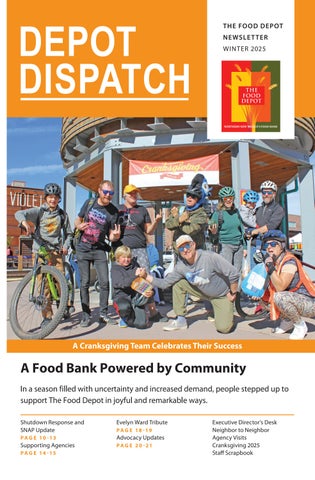
A Cranksgiving Team Celebrates Their Success
A Food Bank Powered by Community In a season filled with uncertainty and increased demand, people stepped up to support The Food Depot in joyful and remarkable ways. Shutdown Response and SNAP Update
Evelyn Ward Tribute
PA G E 10 -13
Advocacy Updates
Supporting Agencies
PAG E 20 -21
PA G E 14 -15
PA G E 18 -19
Executive Director's Desk Neighbor to Neighbor Agency Visits Cranksgiving 2025 Staff Scrapbook
PAG E 2 – T H E F O O D D E P O T. O R G
Want to Get Involved?
The Food Depot Board & Staff
Donate You can make a monetary donation: Online: thefooddepot.org Over the phone: 505-510-5890
BOARD Thomas Jensen, President • V. Brian D'Andrea, Vice President • Penny Rodriguez, Treasurer • Scott Bunton, Secretary • Bill Sveum, Ph.D., Member at Large Noah Berke • Rubina Cohen • Steven Coleman Mary Ferguson • Sandra Mitiko Higaskino-Greene Barbara Houser • Len Rand • Rachel Rogers Deborah Trouw • Andrea Vigil
STAFF Julie Aboud Scott Alexander Amber Anastasion Juan Aniceto Andrew Aragon Robyn Archuleta Nathalie Beltran Kayla Bostic Amanda Bregel Ole Bye Elier Chacon Jill Dixon Jacob Tharp Eralie Fernando Garcia Zamir Crispin Garcia Atom Green Cecilia Gutierrez Dave Halerz Russell Johnson Manuel Lovato Samuel Madrid-Huerta Wayne Martin Vilma Martinez
NORTHERN NEW MEXICO’S FOOD BANK
Diana Moncada Louie Montano Ashlynn Montoya Pauline Montoya Catherine Nolte Enrique Munoz Noris Jakobe Platero Aaron Rodriguez Diego Salinas James Sanchez Jerome Sanchez Maria Sanchez Sal Sandoval Fred Santistevan Michael Silva Cathy Sisneros Amanda Smith Sigifredo Caslilas Varela Shairy Vargas Alma Vega Jerry Vigil Jerry Wagner
The Food Depot is a 501(c)(3) nonprofit, non-partisan, and equal opportunity employer.
Advocate You can make a difference by advocating for food security in New Mexico by following us on social media @thefooddepot or by visiting thefooddepot. org/advocacy. Volunteer The Food Depot is in need of volunteers! Repack food at the Santa Fe warehouse or volunteer at a food distribution. Learn about our many opportunities and join our team at thefooddepot.org/ volunteer.
Give volunteering a try on the weekends! Weekend shifts require no formal application. Kids are welcome! Go to thefooddepot.org/ volunteer to sign up for a weekend shift.
PAG E 3
the typical joy found in our daily work. As November 1st arrived, we certainly felt fearful. However, that fear quickly shifted to make room for gratitude.
Representing New Mexico's food banks at Governor Michelle Lujan Grisham's SNAP press conference on Oct. 29, 2025
From the Executive Director's Desk October began with a moment of euphoria. I spent most of October 1st perched in the House gallery, filled with gratitude as I listened to New Mexico representatives defend SNAP and share stories of visits to food pantries. The passing of funds for SNAP and support for hunger relief across the state was a testament to our growing advocacy program. A few weeks later, the floor dropped from beneath our feet. A freeze to SNAP? This was incomprehensible. My nervous system returned to the early days of the pandemic as I feared for our clients, their families, and the pantries that relied on The Food Depot. We began to mobilize a robust network-wide response, even as I hoped the news would change. The fear and uncertainty that comes with an emergency can overshadow
During a time of such uncertainty, people showed up to steady The Food Depot. Volunteers filled extra shifts, food drives spread across Santa Fe, and people gave their precious financial resources. To every person who wrote a check, picked up a food drive barrel, or bagged pinto beans, your contribution is appreciated. Your support steadied the food bank when so much felt uncertain. In times of crisis, people often ask how we will respond, and my answer rarely changes: food banks will step up, just as we have before and will again. This responsiveness is only possible because of you, and I want to thank you for keeping The Food Depot strong. As we step into 2026, I am grateful for the community that surrounds The Food Depot and know we are ready to face whatever comes next, together.
PAG E 4 – T H E F O O D D E P O T. O R G
ng Celebrati
eighbor N o t hbor g i e N
2 0 25
Neighbor to Neighbor
Food Drive
The 2025 Neighbor to Neighbor Fund Drive (N2N) was an incredible success, raising $677,000, or 2.7 million meals, for Northern New Mexico. More than 100 neighborhoods, businesses, and community groups contributed to this effort, united by their commitment to building a stronger community. One such team is TOKo Santa Fe, an Asian-leaning Modernist-style boutique on W. Marcy Street. Since opening seven years ago, TOKo owner Jill Heppenheimer has lived the philosophy of “giving together.” The community created at TOKo consistently supports Girls Inc., International Folk Art Market, and The Food Depot. TOKo has participated in N2N since 2021 and has been the top business contributor several times, including the $12,000 raised in 2025. “We give as a group,” shares owner Jill Heppenheimer. “Our ‘TOKo Circle’ of supporters includes staff, friends, and customers. We give together because we are connected as a circle, as a
Edelle, Kathleen, and Pat, all members of the TOKo Santa Fe team, celebrate their first place win.
community, and make a difference together.” Robin Schneider, a TOKo team member, shares the same passion. “People should not go without food,” she says. “It’s the most essential thing. You can’t do anything without food. Giving together makes everyone stronger and more aware of the issues. We have conversations and learn. The more you know, the more power you have to give your money, your time, or your knowledge.” Meeting basic needs is one of the primary reasons Jill and her staff began supporting The Food Depot. “The richest country in the world should not have so many hungry people. It’s an abomination,” she says. The TOKo Circle has truly embodied its name, providing more than 120,000 meals through their N2N contributions.
PAG E 5
To learn more about TOKo and explore their sustainable and stylish fashion, visit tokosantafe.com or call (505) 470-4425.
Pickleball Club members bag apples during one of their monthly volunteer shifts.
The Santa Fe Pickleball Club also took home a N2N trophy in 2025. While Pickleball may cause many to think of courts and competition, the ~500-member club embraces a broader mission. “We are more than Pickleball,” says volunteer coordinator Amy Alford. “We are part of the community, and we don’t just say that, we live it.” Club members volunteer in elementary and middle schools across Santa Fe and run a “Pickleball for Parkinson’s” program. Since 2021, they have also volunteered at least once a month at The Food Depot’s warehouse. “The shifts fill up fast.
Everyone wants to come,” Amy laughs. Amy discovered Pickleball only four years ago and loves the social connection it brings. When she learned about N2N in 2024, she knew it would be a perfect fit. In their first year competing as a “community group,” the Pickleball Club won second place. In 2025, they set their sights on the first-place trophy. During N2N, Amy and fellow club members shared information about The Food Depot at monthly social gatherings and through their app. “The Food Depot helps us build community,” Amy explains. “When we are on the court, things are moving quickly and it’s hard to get to know each other. At The Food Depot, we can give back, learn more about each other, and fundraise as a community.” Their efforts paid off. In 2025, the Santa Fe Pickleball Club raised $15,000 from 115 individual donations, equal to 60,000 meals. They earned the first-place Community Group trophy and an award for the most individual donations. For Amy, the motivation is simple. “I love Santa Fe, and volunteering is especially important on the community level,” she says. “That’s where you can make the biggest difference.”
Love Pickleball? Learn more about the club at santafepickleballclub. com.
PAG E 6 – T H E F O O D D E P O T. O R G
(Left) Pantry leaders Joanna Johnston and Lauren Porras; (Right) Campus Cupboard is filled with pantry staples, meals, and a wide variety of fresh foods, some of which are grown by the SFCC agriculture program!
Visit Campus Cupboard at Santa Fe Community College A recent study of 91 colleges and universities found that the majority of the 74,000 students surveyed experience food or housing insecurity. Even more concerning, fewer than half seek support from campus resources. The Campus Cupboard at Santa Fe Community College (SFCC) is working to change this. “I used a lot of these resources when I was younger,” shares G, one of four student employees. “This motivates me to create a space where people feel comfortable. I’ve gotten to know people well, and that relationship makes people want to come back.” The welcoming atmosphere is purposeful. A coffee station greets students. Holiday decorations brighten the space. Food is displayed neatly, with photos showing what
produce and ready-to-eat meals are available each week. The pantry is 100 percent choice-based, supported by large fridges and freezers for fresh food. Guidelines for shelf-stable items help ensure fairness, but students can take what they need based on family size and dietary needs.
The Campus Cupboard and its neighboring resource closet, The Exchange, are free services for students, staff, and faculty open five days a week. About 900 students are enrolled at the Campus Cupboard, and more than 100 stop by to shop each week. Students can pick up a snack five days a week.
PAG E 7
Joanna Johnston oversees both programs as the Student Resource Coordinator, a role shaped by her own experience. “I used the pantry a lot when I went to SFCC. So much that they offered me a student work job,” she laughs. “But then my perspective widened. I saw need on so many levels, whether it’s period products, readyto-eat meals, or fresh food.” Joanna now connects students to immediate resources and broader wraparound services in Santa Fe. Supporting Joanna is Lauren Porras, the Campus Cupboard & Exchange Coordinator. With experience in food service and social work, she is enthusiastic about the position. “I love what I do,” she says. “I love food and supporting my community. Seeing that small impacts make big changes is amazing.” Lauren recently introduced popular Cooking Kits, which provide all the ingredients for a single recipe, such as Hearty Bean Chili. “We invite SNAP-Ed to demonstrate the recipe, then students take a kit home,” she explains. She and Joanna have also launched satellite “Campus Cupboard Cabinets” in buildings across SFCC, including the fitness center, adult education building, nursing building, and welcome and advising areas. These satellite cabinets expand food access outside regular pantry hours. As a new site in The Food Depot’s Diaper Depot program, SFCC has
Students can visit every day for a snack and shop for groceries weekly.
SFCC distributes diapers through The Food Depot's Diaper Depot program.
recently started distributing diapers at The Exchange to students and their families. “We receive the majority of our food from The Food Depot, but the Campus Cupboard is the work of many organizations,” Joanna explains. “We receive household items from Kitchenality, produce from the Santa Fe Farmers Market and Food Recovery Network, and funding from the SFCC Foundation. This is a real effort from the community to support our students.”
Support the SFCC Campus Cupboard! A donation to the SFCC Community Foundation
can be directly applied to the Campus Cupboard. https://foundation.sfcc. edu/give-now/
PAG E 8 – T H E F O O D D E P O T. O R G
Visit Raton Hunger Pantry Almost a decade before The Food Depot opened, a group of dedicated volunteers in Raton, NM worked to ensure their community had steady access to groceries. The Raton Hunger Pantry operated in the basement of the First Presbyterian Church and was supported entirely by volunteers and local donors, especially the town’s congregations. For decades, the community sustained twice monthly distributions that provided boxes of pantry staples to 50 households. Volunteers purchased food at the local grocers and unloaded each carload by hand. By 2022, the pantry was in a state of flux. Many long-time volunteers had moved or passed away, and the organization had lost its nonprofit status. Raton’s Lighthouse Church stepped in to stabilize operations and supply volunteers, including Daniel Griego Jr., who soon became pantry director. In September 2023, Daniel was busy unloading groceries from his vehicle when two visitors approached and introduced themselves as staff from
Daniel Griego Jr. sits in a full room of food at the pantry’s permanent home. The new building boasts cold storage and shelving.
The Food Depot. They had heard about the pantry and hoped the food bank could offer support. Soon after, Raton Hunger Pantry became The Food Depot’s newest partner agency.
“The Food Depot has been a blessing,” Daniel shared during a visit in June 2024. “Before, we were spending $3,500 each month on food. Now we spend around $100.” With consistent resources, the pantry expanded produce offerings and wraparound services. Household counts nearly doubled. Reinvigorated, Daniel began planning for a new building and working to reestablish nonprofit status.
PAG E 9
(Left) The pantry in June 2024 after partnering with The Food Depot. (Right) The pantry in Sept. 2023.
Forty years and thousands of distributions later, the Hunger Pantry now has a permanent home at 430 North Second Street. The space provides smoother drive through service and offers cold storage for protein and produce. Three monthly distributions now serve between 1,200 and 1,500 individuals. The Food Depot delivered nearly 100,000 pounds of food in FY25. “I think about having to buy from the store if The Food Depot does not have what we need,” Daniel said, “but we have not had to. The variety has been great.” Under Daniel’s leadership, the pantry has significantly broadened its mission and secured 501(c)(3) status. The new space includes a Community Closet where people can access clothing and household items at no cost. The pantry participates in The Food Depot’s Diaper Depot program and has strengthened its community response to needs. During the SNAP delay in November, volunteers served more than five hundred families.
The Hunger Pantry’s new home at 430 North Second Street in Raton, NM.
Providing for the community is a calling for Daniel, who is completing his Theology degree at Liberty University. “If someone is hungry, I am going to help them as much as I can.”
The Food Depot is honored to partner with Raton Hunger Pantry, an example of the progress that can happen when local nonprofits and regional food banks collaborate to end hunger.
The new location includes space for diapers, a clothing closet, and administrative tasks.
PAG E 10 – T H E F O O D D E P O T. O R G
Feeding Northern New Mexico during an Unprecedented Government Shutdown
Jill Dixon speaks with Chris Jansing on MSNBC Reports on October 28, 2025 At midnight on October 1, 2025, the federal government entered what would become the longest shutdown in American history. At the time, it was unclear how deeply the shutdown would affect federal food programs or how quickly conditions would change. Within weeks, however, a political standoff would place unprecedented strain on food banks across the country, including The Food Depot. The Supplemental Nutrition Assistance Program, known as SNAP, keeps food on the table for millions of Americans, including more than 450,000 people in
New Mexico. In its 60 year history, SNAP had never been fully halted. However, On October 18th, the United States Department of Agriculture announced the unthinkable.
SNAP benefits would be delayed for households beginning November 1st. For The Food Depot, the implications were immediate and staggering. More than 31,000 households across the food bank’s nine county service area rely on SNAP. A delay on November 1 meant that more than 2.5 million meals could be lost.
P A G E 11
With only two weeks to prepare, The Food Depot sprang into action. Food purchases are typically planned months in advance. Now, the food bank had days. Scott Alexander, Director of Warehouse Operations and Procurement, immediately began increasing food orders to prepare for the anticipated surge in need. “We ordered three months of food in just a couple of weeks,” he explained. “We focused especially on shelf stable pantry items that would last as long as needed.” As inventory increased, staff across departments began meeting to plan how to respond. Current distribution sites, many of which had already seen rising attendance in September and October, were adjusted to support more households expected in November. Hours were extended at Food Mobile sites and at high volume drive through distributions, including Siler Road and Los Alamos. The Food Depot’s network of hunger relief partners also needed to prepare. More than 80 nonprofit agencies rely on the food bank for food, diapers, and other resources to support church pantries, shelters, community centers, and community based programs. “We knew agencies were anxious too and would want to stock their shelves,” explained Jacob Tharp Eraile, Product Distribution Specialist.
Volunteers pack pantry boxes during extra November shifts.
“We increased their ability to order food almost immediately. Overnight, our food orders quadrupled. Agencies that ordered every week, and agencies that had not ordered in months, all needed larger deliveries.” Before items are loaded onto trucks, every flat of canned goods or box of dry pasta is pulled by hand from warehouse shelves and built into pallets by staff. As demand surged, food bank employees were pulling anywhere from 6,000 to more than 40,000 pounds of food per shift.
PA G E 12 – T H E F O O D D E P O T. O R G
Shutdown Response and SNAP Update continued...
Enrique Munoz Noris unloads eggs for TSA Agents at the Santa Fe Regional Airport.
“We distributed more than 205,000 pounds of dry items in just the first two weeks of November,” Jacob shared. “That was more than twice the amount we distributed in early October.” As operational demands grew, The Food Depot also worked to raise public awareness and inform decision makers about what was at stake. Executive Director Jill Dixon spoke with local and national media outlets almost daily, including MSNBC, NPR, and BBC World News, to explain the real world impact of SNAP delays on New Mexican households and food banks. “There are a lot of misconceptions about SNAP and about people who come to food distributions,” Jill said. “Media gave us the opportunity to explain the true cost of a SNAP delay, both for families and for the systems that support them.” The Food Depot often reminds the public that for every one meal
provided by a food bank, SNAP provides nine. As November approached, anxiety increased for staff, partner agencies, clients, and state leaders alike. Even with increased food purchases and expanded distributions, replacing millions of SNAP-funded meals was impossible. Leaders from New Mexico’s five food banks met with state officials in the final days of October to explore potential solutions as tensions mounted. On October 29, New Mexico state leadership announced a critical intervention. Standing outside a John Brooks grocery store in Albuquerque, Governor Michelle Lujan Grisham unveiled a SNAP bridge program to support households during the delay. SNAP recipients would receive approximately one third of their typical monthly benefit at the start of November. The program was a testament to the leadership and creativity of the New Mexico Health Care Authority, which found a solution when many other states could not. When November began, uncertainty remained. Families did not receive their full federal SNAP allocation on November 1, and messaging from the federal government continued to shift. Many households did not know when benefits would resume or how long the disruption would last.
PA G E 13
Cars enter the line at an emergency SNAP distribution in Rio Arriba County. Congresswoman Teresa Leger Fernández visits the Food Mobile during the federal government shutdown.
“We wanted to make sure people knew they could come to us and receive food,” said Russell Johnson, Director of Programs. “Emergency distributions in key areas supported households where SNAP enrollment was highest.” Emergency SNAP distributions in San Miguel and Rio Arriba Counties served nearly 2,000 households and more than 5,600 individuals, distributing over 100,000 pounds of food in just the first ten days of November. Regular distributions in early November saw attendance increase by 100 to 200 households at many sites, with some locations experiencing a 70 percent rise. Because food orders had been placed quickly in mid October, not a single distribution ran out of food. Meeting this moment would not have been possible without the community. As demand surged, The Food Depot added volunteer shifts on Saturdays and Sundays, which quickly filled. Volunteers packed pantry boxes of dry goods
used at drive through distributions and repacked tens of thousands of pounds of pinto beans to ensure staple foods were available. Individuals and businesses dropped off food and financial donations, and food drive barrels across Santa Fe filled rapidly. After weeks of instability, the federal shutdown ended and SNAP benefits were fully restored.
In just two months, The Food Depot invested $500,000 to purchase food, staff emergency distributions, deliver increased orders, and sustain operations during the crisis. “When there is a crisis, food banks step up,” said Jill Dixon. “We support our community no matter the challenge. I am proud of our state leadership, food bank staff, volunteers, and supporters who came together to make sure people had food on the table when it mattered most.”
PA G E 14 – T H E F O O D D E P O T. O R G
Every week, trucks leave The Food Depot’s warehouse to deliver dry goods, fresh produce, and healthy protein to nonprofit agencies across Northern New Mexico. Nonprofit organizations rely on their regional food bank not only for food, but for the systems that allow pantries to operate safely and consistently. Much of this work happens behind the scenes. Moving food at scale requires warehouse space, staff, refrigeration, transportation, and coordination. Providing this infrastructure is one of The Food Depot’s core responsibilities.
Hunger-Relief Partnerships When a nonprofit becomes a partner agency of The Food Depot, it gains access to food and operational support that would be difficult to manage independently. As the regional food bank, The Food Depot Jacob Tharp Eralie organizes inventory for partner agencies and programs.
Wayne Martin pulls a pallet of food for an agency order.
is responsible for helping partner food pantries operate reliably. This includes delivering food at no cost, providing staff support and technical guidance, and helping secure essential equipment when possible. Partner agencies vary widely in size and location, from large pantries serving thousands of households to small, rural programs supporting only a few families each week. Regardless of scale, each partner relies on the same delivery and storage system to keep food moving.
Brighter Days Pantry To better understand how this system works, consider a hypothetical partner agency called Brighter Days Pantry.
PA G E 15
In 2024, Brighter Days paid approximately $14,000 in shared maintenance fees. That support covered more than: • 2,400 miles driven in refrigerated trucks • 24 to 30 deliveries • 450,000 pounds of food delivered over the year, at a cost of about 17 cents per pound Manuel Lovato unloads a delivery at a partner agency in Santa Fe.
Brighter Days is located about 100 miles from The Food Depot’s warehouse and serves approximately 200 households each month. The pantry hosts a drive through distribution every other Saturday, totaling 24 to 30 distributions each year. Twice a month, a Food Depot truck arrives the day before distribution. Pallets of food are unloaded directly into the pantry, making it easier for volunteers to pack grocery boxes with dry goods, produce, and protein.
Shared Maintenance Fees Partner agencies of The Food Depot pay a shared maintenance fee, which is not a fee for food. Instead, it helps cover a portion of the costs required to store, transport, and deliver food safely, including warehouse operations, refrigeration, staffing, fuel, and delivery. This fee structure is standard among food banks nationwide.
Reducing Costs for Partners In 2025, Brighter Days continued serving its community, ordering more than 305,000 pounds of food by October as demand increased. At the same time, the shared maintenance fee dropped significantly, to about 6 cents per pound. This reduction reflects successful advocacy at the state level to secure funding for food banks. The additional funding helps The Food Depot absorb a greater share of operational expenses. In 2025, costs were reduced for partner agencies while maintaining exceptional service. By lowering costs for nonprofit partners, The Food Depot strengthens the entire hunger relief network and allows local organizations to focus more of their time and resources on serving their communities. This is part of a continued series to explore the movement of food in and out of The Food Depot warehouse.
PAG E 16 – T H E F O O D D E P O T. O R G
Celebrating Cranksgiving! For the last 17 years, a food drive unlike any other has brought a day of fun and friendly competition to cyclists in Santa Fe.
Ov
Team BayWa r.e. Solar Systems celebrates their win for fastest large team.
er
7 16
s particip rider ate di
n
k sg an Cr iving 2025.
Cranksgiving, a food drive and scavenger hunt on two wheels, challenges riders to navigate city streets, urban trails, and grocery store aisles in search of specific ingredients for a holiday meal. Prizes are awarded to teams for speed, total pounds collected, team size, and spirited looks.
Cranksgiving 2025 was the most successful year on record. A total of 167 riders participated, purchasing and transporting 2,928 pounds of food from local stores back to the Railyard on their bikes and backs. In addition, teams donated funds to purchase 306 turkeys, chickens, and hams. The Oscar Mayer Wienermobile added an extra dose of fun this year, serving as the pace car for the race. The event is made possible through collaboration with several local companies, most notably BTI International, a bicycle parts distribution company, and BayWa r.e., a renewable energy developer. Both BTI and BayWa have supported
The Food Depot and Cranksgiving for many years, serving as event organizers and the creative force behind the scavenger hunt. Thank you to the riders, teams, sponsors, and organizers who continue to make Cranksgiving a joyful and meaningful annual tradition.
More than 300 turkeys were purchased with Cranksgiving donations.
P A G E 17
Generosity in Action Thank you for everything you made possible this year, from food drives and fundraisers to the gifts that sustained our work during the shutdown. The photos on this page represent only a few of the generous partners who held food and fund drives this fall, a brief look at a much larger story of a community united around a hunger-free future.
Donated 7,500 meals
Ranch House matched customers donations, providing 12,000 meals.
Lensic Theater fund drive provided 25,000 meals.
Indivisible Santa Fe organized a city-wide food drive, collecting more than 5,000 lbs of food.
Century Bank held their annual food drive, a holiday tradition!
PAG E 18 – T H E F O O D D E P O T. O R G
The ribbon cutting for “Pet Amigos”, which became Food 4 Pets.
Remembering Evelyn Ward Food 4 Pets Founder Northern New Mexicans lost a dear friend on August 21, 2025.
Evelyn Dawn Ward was a woman of remarkable vision, steady determination, and deep generosity. As the founder of the Food 4 Pets program, Evelyn was a devoted advocate for people and their animal companions. She lived a life defined by service to her family at The Food Depot.
Born in Santa Fe in 1936, Evelyn was a true renaissance woman. She was an accomplished jazz musician who played with bands at a young age and studied music in college. While working as a nighttime police dispatcher, she was offered a position as a police detective, beginning a 25 year career in law enforcement in Arizona. She returned to Santa Fe in 1978. Back home, Evelyn opened the Independent Artists Gallery and co-owned Tribes Coffee House. She believed strongly in creativity and community. In 2000, Evelyn stepped fully into her role as an animal protector. During the Cerro Grande Fire, she coordinated with the Española Humane Society and the Santa
Fe Animal Shelter to house more than 700 displaced pets. Evelyn also researched and purchased all 75 acres of fencing for the Santa Fe Animal Shelter’s Animal Care Campus, which remains in use today. Evelyn was known as a woman of few words, but her actions carried lasting weight. In the early 2010s, she told Sherry Hooper, The Food Depot’s former Executive Director, that the food bank needed a pet food program and she would lead the effort. True to her word, Evelyn designed, developed, and operated the program, which officially launched in 2014 as “Pet Amigos”. She was especially committed to rural access, ensuring pet food reached many communities without a local humane society. Today, Food 4 Pets continues to distribute dog and cat food monthly at mobile food pantries in places such as El Rito, Bernal, and Pecos. Her own backyard reflected the same care, serving as a small sanctuary with fountains for birds. She deeply loved her dogs and cats, Eber, Axel, and Rose, and delighted in sharing stories about them.
Evelyn says hello to a client’s pet during a food distribution.
PA G E 19
Evelyn celebrates a birthday with Sherry Hooper and food bank friends.
Evelyn’s service extended beyond pet food. She served as chairwoman of VOAD-NNM, which brings together volunteer organizations during disasters to support both people and animals. Trained as a ham radio operator, she championed the installation of a HAM radio tower at The Food Depot and helped establish lasting emergency communication networks through Santa Fe Amateur Radio Emergency Services. She frequently encouraged preparedness among friends, gave out emergency kits, and led disaster trainings across the state in partnership with FEMA. Evelyn often referred to The Food Depot as her family, and we were honored to feel the same. Though she passed peacefully at the age of 89 in her Santa Fe home, her legacy lives on in every bowl filled, every animal cared for, and every community made stronger because she chose to show up, face hardships head-on, and lead with her heart.
PAG E 20 – T H E F O O D D E P O T. O R G
Advocacy is Always in Season Food insecurity does not pause between legislative sessions or election cycles, and neither does The Food Depot’s advocacy work. Decisions made at every level of government shape whether people can afford groceries, access benefits, and build stable lives. This fall, food bank staff stayed engaged on multiple fronts, responding to immediate threats while also pushing for long term solutions.
Mexicans. The Food Depot moved quickly to educate state lawmakers around changes in eligibility and work requirements that would have a destabilizing impact on households before the end of 2025. As awareness grew, Governor Michelle Lujan Grisham called a special legislative session on October 1st. Advocacy efforts by The Food Depot and fellow food banks helped secure critical funding in House Bill 1 that filled gaps left by federal budget reconciliation and stabilized SNAP. Funds included resources for food banks, staffing for the Income Support Division, SNAP benefits for seniors and lawfully permanent residents, and support for workforce development.
A Vote to End Hunger
NM food bank leadership gathers at the Roundhouse for the Special Session in October.
Responding to Changes in SNAP Federal budget reconciliation over the summer of 2025 introduced large adjustments to SNAP that would impact more than 55,000 New
Local elections also play a powerful role in shaping food security. This fall, The Food Depot focused on helping community members engage with decisions that affect their daily lives. Staff shared nonpartisan voting information at food distributions and encouraged participation in municipal elections. In early September, The Food Depot also partnered with the League of Women Voters of Santa Fe County to host a nonpartisan mayoral candidate forum, the first
PAG E 21
shared information at distributions, encouraged participation for the city’s wage survey, and showed up to advocate at city council meetings alongside community partners. A full warehouse listens to mayoral candidate Michael Garcia during the League of Women Voters forum.
event of its kind held at the food bank. More than 250 community members gathered at the Siler Road warehouse to hear Santa Fe’s eight mayoral candidates speak directly about issues that matter to local households. The event created space for informed civic engagement and reinforced the food bank’s role as a trusted community resource beyond emergency food distributions.
On November 12th, the Santa Fe City Council voted 5-2 to raise wages in Santa Fe, a change expected to benefit more than 9,000 workers.
As Executive Director Jill Dixon shared during public testimony, “People who are working hard deserve to be able to make ends meet.”
Raising the Minimum Wage Advocacy also means addressing the root causes of food insecurity. Since 2021, The Food Depot has supported efforts to raise the minimum wage as a proven strategy to end hunger, especially for children. As the cost of housing, utilities, and groceries continues to rise, wages are not keeping pace. In August 2025, Santa Fe Mayor Alan Webber introduced legislation to raise the city’s minimum wage to $17.50 beginning in January 2026 and to tie future increases to housing costs, a first in the United States. The Food Depot joined Somos Un Pueblo Unido and other workers’ rights organizations to support the proposal. Food bank staff
Jill Dixon and board member Scott Bunton attend the signing of the Living Wage Ordinance.
Together, these efforts reflect advocacy that is responsive, sustainable, and rooted in community needs. Each conversation, vote, and policy change moves Northern New Mexico closer to a truly food-secure future.
Sign up for our advocacy newsletter! Visit thefooddepot.org/advocacy
PAG E 22 – T H E F O O D D E P O T. O R G
A Board President's Approach to Giving A Donor Advised Fund, often called a DAF, is a charitable investment account created for the purpose of supporting nonprofit organizations you care about. Once a donor sets up a DAF through a sponsoring organization, such as Fidelity, they can contribute assets like cash or stock. Donors receive an immediate tax deduction when the contribution is made, and can recommend grants to nonprofits over time.
“Giving through a DAF is really easy to do and reduces taxes,” says Tom Jensen, President of The Food Depot’s Board of Directors.
Tom frequently supports The Food Depot through a Donor Advised Fund and encourages others to consider this form of giving. While he has served on the food bank’s board since 2018, Tom has been donating to The Food Depot since the late 1990s. “I have always been impressed by the efficiency of donations given to The Food Depot,” Tom says. “A significant portion of your gift goes directly to clients.” Because DAF giving is both simple and flexible, Tom also uses his account to support other local nonprofits, including Española Humane, where he adopted his cat, Willie, and Kitchen Angels. “I’m on the board because I like supporting the staff through our support of Jill Dixon,” Tom explains. “The Food Depot has an important mission. I was taught my whole life to do unto others as you would have them do unto you. I have been very fortunate in my own life, and now I want to give back to the community that has supported me.” Donor Advised Funds offer a simple way to support The Food Depot throughout the year. To learn more or make a gift, contact your DAF provider or connect with our development team at (505) 510-5890.
PAG E 23
Members of The Food Depot Board of Directors celebrate The Food Mobile trailer launch with guest Sherry Hooper
The Food Depot Staff Scrapbook Diego Salinas, Elier Chacon, and Ralanda Shroulote distribute food at Picuris Pueblo
Diana Moncada loads bread into truck s during a chilly morni ng distribution
Staff members welcome Rusty Kohler from Golden Spread Community Pantry for a tour of The Food Depot
at the Santa Fe Community Convention Center. Buy tickets today at thefooddepot.org!
Souper Bowl 2026 is January 31st
Save the Date!
NORTHERN NEW MEXICO’S FOOD BANK
The Food Depot 1222 A Siler Road Santa Fe, NM 87507
NON-PROFIT ORG. U.S. POSTAGE PAID SANTA FE, NM PERMIT NO. 366