Brain Matters Summer 25/26

Page 1


Brain Matters

Neuroscience and mental health advancements from The Florey

Summer 2025/26

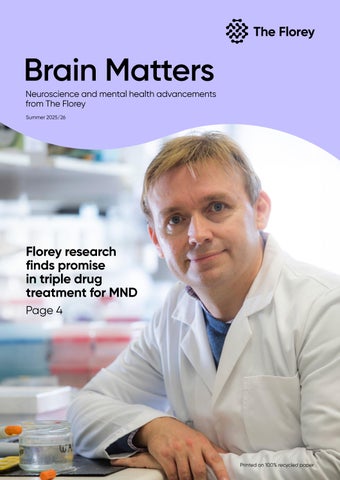
Florey research finds promise in triple drug treatment for MND

Page 4

Director’s update

I’m pleased to share this latest edition of Brain Matters and would like to sincerely thank everyone who supported our summer appeal. Your generosity plays an essential role in enabling our researchers to continue their vital work.

This year, our appeal focused on research-led approaches to stroke rehabilitation. In this edition, we highlight the work of TAILOR and Connect as well as the Young Stroke Service, which are embracing digitally-enabled healthcare to improve health outcomes for stroke survivors. Programs such as these

demonstrate our commitment to translating research into practical, real-world solutions that support recovery and independence.

Across the Institute, your support is helping advance important discoveries. Over the past year, our researchers published significant findings in motor neurone disease (MND) research, identifying the potential of a triple-drug combination treatment for MND. A recent Florey study has also identified the potential for a commonly used heart medication to reduce the risk of sudden unexpected death in epilepsy (SUDEP). Together, these findings offer genuine hope and help accelerate progress towards new treatments.

While much work remains, these advances reflect the strength of collaboration between researchers, clinicians, and our community. Thank you for your continued support, and I hope you enjoy this edition. I look forward to more important research advances in 2026.

Digitally enabled healthcare for young people

The Young Stroke Service (YSS), based at The Florey, has launched a new digital platform for young stroke survivors and their health professionals.

The platform has been developed to improve access to services and tailored care, and help young stroke survivors navigate the many challenges they face in recovery.

They can use the platform to:

• access YSS services

• get involved with young stroke research

• take the Unmet Needs Survey to better understand their recovery

The YSS is funded by a Medical Research Future Fund Grant. The development of the digital platform is a key milestone of the grant.

“Young people with stroke face distinct challenges as they return to work, study, parenting, and independence. Too often, their needs are overlooked,” says Professor Vincent Thijs, co-lead Investigator for the YSS.

“This platform helps close those gaps by giving survivors a way to help us understand their many unmet

needs. I am extremely proud our team has achieved this milestone.”

Stroke services do not always cater to young stroke survivors, despite young people having to live with the impact of stroke for longer.

Since its launch in 2023, the YSS has supported over 400 young Australians in Victoria and South Australia, helping to target common gaps in care.

This has included getting people back to work or driving, helping stroke survivors with memory and cognitive problems, and learning more about their stroke.

Professor Thijs hopes the digitallyenabled tool will help empower young stroke survivors with their own recovery.

“Young stroke is a rapidly increasing global health concern, and without targeted support, many younger survivors will fall through the cracks.

“By giving young people access to trusted information and practical tools, we’re helping them regain control and rebuild their futures.”

By 2050, there will be an estimated 142,000 young Australians living with stroke.

Developed in collaboration with various partner organisations, the YSS

digital platform has been designed and built by leading stroke experts and shaped by people with lived experience of stroke.

This collaborative approach ensures the platform reflects the real needs, challenges and priorities of younger stroke survivors, as well as their families and support networks.

Currently, the YSS is operating as a pilot program, translating years of research into practical support. Efforts are underway to secure the long-term sustainability of the YSS and to extend support for more young stroke survivors across Australia.

Professor Peter van Wijngaarden Executive Director of The Florey
Professor Vincent Thijs

Pioneering a new way to deliver personalised care at home

Stroke survivors are benefitting from a new style of rehabilitation developed by Florey and La Trobe University researchers.

The home-based TAILOR and Connect rehabilitation program focuses on helping stroke survivors regain function through working on tasks that truly matter to them. By combining telehealth with state-ofthe-art video motion capture and sensors, the program uses technology to pinpoint the best therapy for each individual and tailor it to their needs.

To the casual observer, Michelle Course, 38, appears fit and well. But the left side of Michelle’s body has been affected by a stroke she had two years ago, making everyday activities challenging.

After her stroke, Michelle had to stop working and move in with her parents for support. The mother of a boisterous 7-year-old, Michelle is determined to regain her independence through TAILOR and Connect.

“My rehabilitation is my full-time job now,” she says. Michelle is working

towards key goals such as improving her writing, fastening her own buttons, buttering bread, and opening and closing containers.

These tasks may seem mundane, but for Michelle they are a critical part of her recovery from that lifechanging morning.

“I woke up with a thunderclap headache. Once that subsided, I was dizzy and vomiting, but I just thought it was vertigo and tried to sleep it off.”

Michelle went back to bed not realising she’d lost the use of the left side of her body. She awoke about eight hours later and phoned her mother who noticed her slurred words and immediately called an ambulance.

Professor Leeanne Carey, head of the Neurorehabilitation and Recovery research group at The Florey and La Trobe University researcher, created the innovative program.

“One in four people experience a stroke which may lead to enormous challenges in their ability to sense, move, think, engage and participate in valued activities,” Professor Carey says.

Traditional stroke rehabilitation has looked for a single solution to a complex problem. Typically, a stroke survivor is discharged from hospital or residential rehabilitation and faces having to travel to many appointments, which can be extremely fatiguing.

Professor Carey says the TAILOR and Connect approach allows people like Michelle to receive evidencebased therapy tailored to their

unique goals and everyday activities, remotely in their own homes.

“Our baseline assessment includes the use of video motion capture and motion sensors which are analysed by clinicians, assisted by artificial intelligence. We capture them doing what is important to them in real-time.

“While some stroke survivors do have access to best-practice therapies, one of the things that makes our program different is the use of technology to help pinpoint the best therapy for that individual and tailor it to their needs.”

She says an individual’s goals might involve activities such as pruning roses, making children’s school lunches, or typing on a keyboard.

“We provide survivors with an extensive rehabilitation program that they work on at home, during and between therapy sessions. People are hugely motivated to work on their goals in their own time because the goals are so meaningful to them.

“With the program delivered in their own homes via telehealth, therapists can continually reassess the person with stroke through further video analysis in real-time.”

Funded by an Australian Government Ideas Grant, the program is being trialled in New South Wales, South Australia, and Victoria. Professor Carey encourages stroke survivors aged 18 and over who had a stroke 3-18 months ago to apply.

“We know there is a real need for a program like this and would love to hear from you.”

Professor Leeanne Carey
Michelle Course

Florey study finds promise in MND drug treatment

Innovative laboratory research performed at The Florey has identified a combination of three drugs that, with further clinical research, may have potential for the treatment of motor neurone disease (MND).

MND, also known as amyotrophic lateral sclerosis (ALS), causes progressive paralysis, taking away the ability to move, speak, swallow and breathe. Patients receiving current treatments and care live an average of two to three years. The only approved drug known to extend life, riluzole, prolongs survival by about three months.

In a significant development, Florey researchers have discovered a triple combination of riluzole, an antiinflammatory drug, and a medication developed to treat dementia was 6.5 times more effective than riluzole alone at prolonging the survival of nerve cells in the laboratory.

The research, led by Associate Professor Chris Bye and Professor Bradley Turner and published in Nature Neuroscience, is the first to validate a laboratory model that mimics MND.

Skin cells generously donated by people affected by MND were converted into motor neurones, the nerve cells affected by the disease. These nerve cells showed features of the disease in the lab, dying earlier than similar cells derived from healthy volunteers. The nerve cells were used to screen a wide range of drugs that have already been approved for human use, alone and in combination. The model paves the way to better understand MND and develop new treatments.

Associate Professor Bye says MND is difficult to study because its causes are complex and not fully understood.

“About 10 per cent of cases have a known genetic cause. Our focus is on finding treatments for the 90 per cent of ‘sporadic’ or unexplained cases. To do this, we built a library of stem cells donated by 100 people with sporadic MND, including FightMND founder and AFL great Neale Daniher. In the lab, we turn these stem cells into motor neurons to imitate the disease process and to test potential treatments.”

Associate Professor Bye says the research team tested more than 100 drugs previously tested in MND clinical trials and found the motor neurons in the laboratory responded as they did in patient trials; most failed.

“We took the only three effective drugs and tried them in combination,

finding that they were 6.5 times more effective than riluzole alone.”

Although Associate Professor Bye cautions that the combination treatment needs to be tested in a clinical trial before drawing firm conclusions, he says: “Our model appears to mimic aspects of the disease process in people with MND and paves the way for a new generation of research and therapeutic development.”

Professor Turner says the drug screening platform, developed at The Florey and funded by FightMND, aims to reduce the heartbreak associated with the high failure rate in MND drug research.

“Drugs are traditionally developed in the lab, tested in mice, and if they show promise, they might make it to human trials. Since the discovery of riluzole over 30 years ago, more than 170 drugs for sporadic MND discovered with this approach have failed in clinical trials. With our platform, we can test drugs directly on patient motor neurons from across the MND population for the first time. We have genuine hope that this new approach will, over time, lead to new treatments for people with MND.”

The team is now working to get the combination treatment to clinical trials.

FightMND’s Director of Programs and Cure Research, Dr Bec Sheean,

From left: Katherine Lim, A/Prof Chris Bye, and Dr Elizabeth Qian

says the FightMND Drug Screening Platform at The Florey is a critical piece of the puzzle in the mission to find effective treatments for MND, and emphasises the importance of research collaboration.

“Thanks to the partnership between The Florey, Victorian Government, FightMND, Balcon Group and Stafford Fox Medical Research Foundation, as well as the invaluable participation of individuals living with MND, this platform is transforming drug discovery. The Florey’s pioneering work using this technology represents a major advancement in modelling the disease in the lab. These achievements give us genuine hope and accelerate the path to clinical trials, bringing us closer to a solution for people living with MND.”

Common heart medication could be key in SUDEP prevention

A new Florey study, published in Epilepsia, has found a common heart medication called atenolol shows promise in reducing the risk of sudden unexpected death in epilepsy (SUDEP).

SUDEP is a devastating and poorly understood outcome for thousands of people living with epilepsy each year. The cause of SUDEP remains largely unknown, and there is currently no effective method to predict or prevent it.

What is known is that SUDEP often occurs during sleep and certain factors, such as frequent seizures and seizures beginning at a young age, can place a patient at increased risk.

Led by Professor Christopher Reid and Dr Ming Soh, the study found atenolol, a medication commonly used for blood pressure control, significantly improved survival in mice with epilepsy and heart rhythm problems.

The researchers studied genetic mouse models of epilepsy and long-QT syndrome, a condition that affects the heart’s electrical rhythm. Compared to mice with normal hearts, they found mice with abnormal heart rhythms were much more likely to die suddenly after experiencing epileptic seizures. When treated with atenolol, however, their survival rates improved dramatically, despite the frequency and severity of their seizures remaining the same.

Lead researcher Professor Christopher Reid says the discovery marks an important step in understanding and reducing the risk of SUDEP.

“We now have strong evidence that protecting the heart during seizures can reduce the risk of sudden death. With further support, we can take this from the lab to the clinic and help save lives.”

Looking ahead, the team plans to expand their research by testing atenolol in other severe epilepsy models and exploring the underlying mechanisms of SUDEP. They are particularly interested in understanding how seizures affect heart function and the autonomic nervous system, which regulates unconscious processes such as heart rate and breathing. The researchers also intend to investigate how the presence of heart conditions and other important physiological changes may increase susceptibility to SUDEP. These studies could help clinicians determine which patients are most at risk of SUDEP and how best to protect them.

“Our study opens a new door to SUDEP prevention by targeting the heart. It is also a powerful reminder that protecting the heart may be just as important as treating the brain in epilepsy,” says Dr Ming Soh. This breakthrough was made possible by generous support from Australia’s Medical Research Future Fund, the National Health and Medical Research Council, CURE Epilepsy in the United States, and philanthropic donations.

Dr Ming Soh
Professor Bradley Turner

Florey study tackles ‘missing puzzle piece’ in brain cancer research

Florey researchers have partnered with neurosurgeons at Royal Melbourne Hospital (RMH) to lead a critical study investigating how the brain influences brain cancer growth, and vice-versa.

Adult gliomas are incurable primary brain cancers, which infiltrate neural networks, the vast, interconnected populations of nerve cells that transmit electrical signals in the brain. Gliomas are unique among cancers in that they arise, and grow, within these networks.

Medical research has historically focused on the most aggressive type of brain cancer, glioblastoma, with comparatively less research undertaken on other lessaggressive glioma types.

Published in Nature Neuroscience, a Florey-led study has illustrated that neuron excitability is altered in different glioma tumour grades. Neurons within the more aggressive high-grade gliomas had greater excitability, leading to greater cancer growth.

With no cure and little change to standard glioma treatment for 30 years, the findings of the study allow researchers to begin to unravel the influence of the brain microenvironment on cancer growth. Having observed differences between the excitability of neurons and

differing clinical progression of the disease, future research will focus on how the brain directs cancer growth.

“Glioma is a devastating diagnosis,” says Professor Lucy Palmer, head of The Florey’s Neural Network Group.

“This study highlights that we need to understand more about the brain’s role in brain cancer, and exactly how it provides a microenvironment that promotes cancer growth. By creating a greater understanding of this relationship, we can better understand which drugs could better treat the disease.”

The study was performed in collaboration with neurosurgeons Professor Kate Drummond and Dr Heidi McAlpine at RMH and made possible with funding from the National Health and Medical Research Council and The Brain Cancer Centre, founded by Carrie’s Beanies 4 Brain Cancer.

Professor Drummond says the research “harnessed the power of collaboration” in the Melbourne Biomedical Precinct.

“Within minutes, live brain tumour tissue is transferred from the operating room at RMH to be studied in the lab at The Florey.

“My patients deeply appreciate the opportunity to contribute to world-leading research, and our findings may transform future treatments.”

Florey spin-out

advancing autism and dementia treatments

Meizon Innovations, a Florey spin-out, is advancing transformative discovery at the forefront of autism and dementia research. With a mission to extend and enhance patients’ quality of life, the company is developing novel early-intervention treatments for some of the world’s most complex neurological conditions.

Founded in 2018 by The Florey’s Dr Wah Chin Boon, alongside Liz Feretimos and Professor Albert Frauman, Meizon Innovations is focused on delivering innovative therapies for individuals living with autism spectrum disorder (ASD) and dementia. The company’s scientific advisors

Dr Wah Chin Boon
Professor Lucy Palmer

Honouring Danielle’s fighting spirit

At 19 years old, Danielle Hardi was diagnosed with glioblastoma multiforme (GBM), an aggressive and fast-growing brain tumour in adults.

Described by her family as an “all-rounder”, Danielle was active in sport and excelled at school. Her many achievements reflected her passion for learning, sports and social justice.

During her senior year of high school, Danielle began to suffer from constant nausea, vomiting, dizziness, and impaired motor skills. After she received a diagnosis of GBM, Danielle was given six months to live.

Thanks to successful medical and surgical treatment, she lived another five-and-half years, and refused to let her diagnosis interfere with anything in life. She dedicated her time to her friendships, family, and career in healthcare.

With a passion for travelling and experiencing new places and cultures, she travelled across North America and Europe with friends and family.

include The Florey’s Professor Ashley Bush and Professor Anne-Louise Ponsonby.

At the end of 2025, the company was unanimously awarded the Consensus MedTech Award, recognising the team’s development of MO8, a potential therapy for ASD.

“This award reflects two decades of groundbreaking research at The Florey and highlights the global potential of our innovation to impact an estimated 75 million people with ASD worldwide,” says Dr Wah Chin Boon.

MO8 is an investigational oral therapy designed to improve quality of life for people living with ASD.

ASD affects how a person communicates, behaves, and interacts with others, and how they experience the world. Individuals with ASD may face challenges with social interaction and communication, alongside restricted or repetitive behaviours. Despite its prevalence, there are currently no effective treatments that address the core symptoms of ASD.

MO8 aims to alter activity in the brain’s amygdala, a region critical to social behaviour and emotional processing, which is reported to be hypoactive in individuals with autism. In pre-clinical studies, MO8 was

Everything she did in the final months of her life showed her persistent and fighting spirit. Danielle lost her battle on 9 August 2024, after living with dignity, perseverance, and hope.

Danielle often expressed wanting to be a part of enacting positive change for young people affected by brain cancer or disease. She lived a life of generosity, and her wishes were to donate to institutes that support important causes close to her heart.

In honour of her wishes, her family have chosen to support The Florey’s research, to help others affected by brain and mental health conditions.

“Our family will continue to honour Danielle’s legacy to make a difference through research and care for people’s brains,” says Beverley Hardi, Danielle’s mother.

The Florey is grateful for this visionary gift and inspired by Danielle’s tenacity, as we undertake vital brain research.

found to promote brain cell connectivity and improve core ASD-related behaviours, including communication challenges and repetitive behaviours.

The treatment has the potential to support greater independence while preserving each individual’s unique personality, identity, and special talents.

While early stage research is promising, further studies are needed to demonstrate its therapeutic potential.

Meizon Innovations is also advancing DL33, a novel therapeutic candidate targeting neurodegenerative disease. DL33 has shown promise in reversing cognitive decline in mouse models of Alzheimer’s disease and Niemann-Pick Disease Type C (NPC), a rare and severe form of childhood dementia.

To date, Meizon Innovations has raised more than USD $10 million. The team is set to complete toxicology studies for both MO8 and DL33, with the goal of commencing Phase 1 clinical trials.

With a strong scientific foundation, growing recognition, and a robust development pipeline, Meizon Innovations is poised to play a meaningful role in shaping the future of neurological care.

Danielle Hardi

Supporter Survey

Thank you to the hundreds of donors and supporters who took the time to respond to our 2025 Supporter Survey and tell us about their interests, thoughts and wishes for the future.

This valuable information helps us better understand our donors and what matters to them. Thank you also to those

who generously gave gifts or indicated they were willing to support The Florey. It was particularly pleasing to hear from supporters who have included The Florey in their Will or expressed an interest in doing so.

We look forward to connecting with you on how you can support The Florey in 2026.

Florey Society Luncheon

It was fantastic to see Florey Society supporters connecting with each other and Florey staff at the annual Florey Society Luncheon at University House in November.

Our guests were treated to an inspiring talk on stroke recovery from Dr Emily Ramage, who shared insights into how the timing and amount of stroke rehabilitation, along with factors such as stroke type, the environment and genetics, can impact stroke outcomes.

These insights also help to facilitate better treatments to address the devastating effects of stroke. Dr Ramage’s research explores ways to optimise stroke recovery by meeting individual rehabilitation needs, especially in younger adults. Dr Ramage is recognised as a Future Leader by the World Stroke Organisation and an Emerging Leader by the International Stroke Recovery and Rehabilitation Alliance.

Most of us know someone living with a neurological or mental health condition. Dementia, Parkinson’s disease, depression and schizophrenia are among the many conditions researched at The Florey.

Discovery science is key to unlocking the mysteries of the brain. Leave a gift in your Will to help find answers to diseases that affect one in five Australians.

To request our Gifts in Wills guide or to speak to us about your wishes, please contact Nola Wilmot, Gifts in Wills Manager on 03 9035 9710 or email nola.wilmot@florey.edu.au

Subscribe to The Florey mailing list

Stay in the loop on the latest breakthroughs, news, events and more

Acknowledgement of Country The Florey acknowledges the Traditional Owners of the land on which we work, the Wurundjeri people of the Kulin Nation. We pay our respects to their Elders past, present and emerging. The Florey is committed to the aims, principles and actions of marra ngarrgoo, marra goori: The Victorian Aboriginal Health, Medical and Wellbeing Research Accord.

Dr Emily Ramage speaking at the luncheon

Turn static files into dynamic content formats.

Create a flipbook