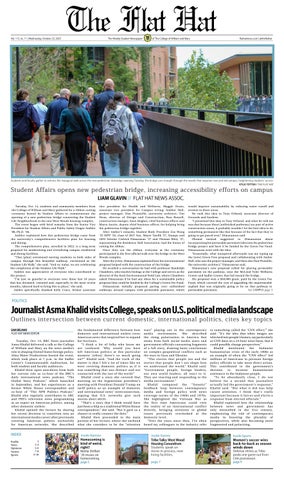
Vol. 115, Iss. 11 | Wednesday, October 22, 2025
The Flat Hat The Weekly Student Newspaper
of The College of William and Mary
flathatnews.com | @theflathat
Students and faculty gather to witness the inaugural walk across the new pedestrian skybridge; opening Tuesday, the bridge cuts straight through the woods that separate new and old campus, heightening students' access.
KYLIE TOTTEN / THE FLAT HAT
Student Affairs opens new pedestrian bridge, increasing accessibility efforts on campus LIAM GLAVIN // FLAT HAT NEWS ASSOC.
Tuesday, Oct. 14, students and community members from the College of William and Mary gathered for a ribbon-cutting ceremony hosted by Student Affairs to commemorate the opening of a new pedestrian bridge connecting the Student Life Neighborhood to the new West Woods housing complex. The event began with brief remarks from the Senior Vice President for Student Affairs and Public Safety Ginger Ambler ’88, Ph.D. ’06. Ambler explained how this pedestrian bridge came from the university’s comprehensive facilities plan for housing and dining. The comprehensive plan, unveiled in 2022, is a long-term proposal for modernizing and revitalizing campus residential and dining facilities. “That [plan] envisioned moving students to both sides of campus through this beautiful walkway, envisioned as the Student Life Walk,” she said. “And so, today, we are celebrating the completion of the Student Life Walk.” Ambler was appreciative of everyone who contributed to the project. “I’m just so grateful to everyone over these last 10 years that has dreamed, visioned and, especially in the most recent months, labored hard to bring this to place,” she said. Amber specifically thanked Kelly Crace, former associate
vice president for Health and Wellness; Maggie Evans, associate vice president for Campus Living; Ambler Hall, project manager; Dan Pisaniello, university architect ; Tim Dean, director of Design and Construction; Ron Russell, construction manger; Sean Hughes, chief business officer and Marra Austin, deputy chief business officer, for helping bring the pedestrian bridge together. After Amber’s remarks, Student Body President Zoe Wang ’25 MPP ’26, class of 2027 Sen. Mayer Tawfik ’27, Stamps and 1693 Scholar Cedrick Dimaranan ’27 and Thomas Riley ’27, representing the Residence Hall Association, had the honor of cutting the ribbon. Once they cut the ribbon, everyone at the ceremony participated in the first official walk over the bridge to the West Woods complex. After the event, Dimaranan explained how his environmental proposal helped with the construction of the bridge. He recalled a conversation he had with professor Randolph Chambers, who teaches biology at the College and serves as the director of the Keck Environmental Field Lab, where Chambers asked Dimaranan if he had any ideas for a sustainable policy proposal that could be funded by the College’s Green Fee Fund. Dimaranran initially proposed paving over unfinished walkways around campus with permeable pavement, which
would improve sustainability by reducing water runoff and erosion in these areas. He took this idea to Tony Orband, associate director of Grounds and Gardens. “I presented this idea to Tony Orband, and what he told me was that because these [unfinished pathways] are part of active construction zones, it probably wouldn’t be the best idea to do something permanent like that because of the fact that they’re going to get paved over,” Dimaranran said. Obrand instead suggested to Dimaranran about incorporating his permeable pavement idea into the pedestrian bridge project and have it be funded by the Green Fee Fund. Dimaranran went with the idea. “Essentially, what transpired afterwards was me typing up the [new] Green Free proposal and collaborating with Amber Hall, who was the project manager, and then also Dan Pisinello, the university architect,” Dimaranran said. Dimaranan’s new proposal called for placing permeable pavement on the pathway, near the McLeod Tyler Wellness Center and Sadler Center, that led toward the bridge. His proposal won a $60,000 grant, paid by the Green Fee Fund, which covered the cost of upgrading the impermeable asphalt that was originally going to be on that pathway to See CAMPUS page 3 permeable pavement.
POLITICS
Journalist Asma Khalid visits College, speaks on U.S. political media landscape
Outlines intersection between current domestic, international politics, cites key topics SAM BELMAR FLAT HAT NEWS EDITOR
Tuesday, Oct. 14, BBC News journalist Asma Khalid delivered a talk at the College of William and Mary on the news media’s role in shaping United States foreign policy. Alma Mater Productions hosted the event, which took place at 7 p.m. in the Sadler Center’s Commonwealth Auditorium, for both student and faculty audiences. Khalid drew upon anecdotes from both her current role as co-host of the BBC’s daily international news podcast, “The Global Story Podcast,” which launched in September, and her experiences as a former White House correspondent and co-host of “The NPR Politics Podcast.” Khalid also regularly contributes to ABC and PBS’s television news programming as an expert on American politics, among other domestic outlets. Khalid opened the lecture by sharing her recent decision to transition into an international media career after previously covering American politics exclusively for American networks. She described
INDEX Profile News Opinions Variety Sports
the fundamental difference between how domestic and international outlets cover American news that inspired her to expand her horizons. “I think a lot of folks who know me are confused: ‘Why would you have left American politics at this particular moment [when] there’s so much going on?’” Khalid said. “And the truth of the matter is that I felt a lot of times like we were covering domestic politics as if it was something that was distinct and not connected with the rest of the world.” Khalid cited a stor y she covered that morning on the Argentinian president’s meeting with President Donald Trump on tariff policy as an example of domestic and international news’ interconnection, arguing that U.S. networks give such stories short shrift. “That’s a story that I think would have just been a blip as a traditional White House correspondent,” she said. “But it gave us a chance to really connect the dots.” Khalid then proceeded to the main portion of her lecture, where she outlined what she considers to be the “attention
Inside Opinion
2 3-4 5-6 7-8 9-10
Homecoming is kind of weird, right? Mollie Shiflett '26 muses on homecoming. page 5
wars” playing out in the contemporary media environment. She described the rising polarization in America that stems from both social media users and government officials consuming fragments of a full story, drawing hasty conclusions on complex geopolitical conflicts such as the wars in Gaza and Ukraine. “ The stories that people see and the stories that people don’t see shape how we understand the world,” Khalid said. “G overnment people, foreign leaders, our own world leaders, all react to it. They are reacting and responding to the media environment.” Khalid compared the “frenetic ” feedback loop between contemporar y media and foreign polic y with news coverage norms of the 1960s and 1970s. She highlighted the Vietnam War as the first time Americans could view the reality of an international conflict directly, bringing attention to global issues previously overlooked at the domestic level. “Over the years since then, I’ve often heard my colleagues in the industry refer Inside Variety
Tribe Talks: West Wood Housing Conundrum Students speak on move-in process, new living facilities. page 7
to something called the ‘CNN effect,’” she said. “It’s the idea that when images are televised into people’s homes, say particularly as CNN does on a 24-hour news basis, that it could possibly change perspectives.” Khalid mentioned the Sudanese humanitarian crisis of the early 1990s as an example of when the “CNN effect” led millions of Americans to pressure foreign policy officials to take more direct action. This contributed to the government’s decision to increase humanitarian assistance to the Sudanese people. “ To b e abundantly clear, I do not b elie ve for a s e cond that j ournalists actually le d the g overnment ’s resp ons e,” Khalid said. “ But what it did was help curate attention. I think that ’s really imp or tant b e caus e it forces and elicits a resp ons e from ele cte d officials.” Khalid explained how the relationship between news and government has only intensified in the 21st century, emphasizing the role of contemporary media in boosting the plurality of perspectives, while also becoming more fragmented and polarizing.
Inside Sports
Women's soccer wins back-to-back as season winds down Defense shines as Tribe peaks one game out from CAA postseason. page 9
“
“
newsinsight news insight
News Editor Sam Belmar News Editor Molly Martin News Editor Lila Reidy News Editor Madigan Webb fhnews@gmail.com
THE FLAT HAT | Wednesday, October 22, 2025 | Page 2
THE BUZZ
I believe in the incredible entrepreneurial capacity of human beings, in the creativity of human beings, in the goodness of human beings. Letʼs go fight.
̶ former Secretary of State John F. Kerry
FLAT HAT NEWS BRIEF
Student Assembly tables Food For All Continues Act, plans collaborations with other university student governments
Tuesday, Oct. 14, Sen. Jason Zheng ʼ26 tabled the Food for All Continues Act, which he introduced to the Senate the previous week. Voting for the bill ̶ which restocks the Food Hall at Sadlerʼs pantry, allocating up to $800 from the SA Reserves ̶ takes place Tuesday, Oct. 21. Zheng also tabled the Reallocation and Additional Support for In-House Labs Act, which remains unchanged since its proposal Oct. 7. If the bill passes, $11,650 of the already funded $22,000 will be reallocated toward in-house lab testing. The Student Health Center also requested an additional $10,000. The executive gauged interest in sponsoring an elections law bill again. The executive aims to identify chief patrons for legislation providing free menstrual products by early November. It also plans to collaborate with other student governments, including the University of Virginiaʼs Student Council. Sen. Mayer Tawfik ʼ27 said the seat designated for the Virginia Institute of Marine Science will be reallocated, citing a lack of interest in the senator position. The role was also presented at the Graduate Council meeting that evening. MADDIE MOHAMADI / FLAT HAT OPERATIONS COORDINATOR
A THOUSAND WORDS
COURTESY IMAGE / DARIA LESMERISES Lesmerises chose to run for SA president after the final information session, to help other students love the College as much as she does.
Daria Lesmerises ’29 reflects on Student Assembly election, her plans as class of 2029 president
Lesmerises describes decision to attend the College, run for SA freshman president, campaign goals
ENNA CARBONE // THE FLAT HAT
MOLLY MARTIN / THE FLAT HAT
CORRECTIONS The Flat Hat wishes to correct any fact printed incorrectly. Corrections may be submitted in email to the editor of the section in which the incorrect information was printed. Requests for corrections will be accepted at any time.
THE FLAT HAT ʻSTABILITAS ET FIDESʼ | ESTABLISHED OCT. 3, 1911 Org #101 P.O. Box 8795, Williamsburg, VA 23187
Editor flathat.editor@gmail.com Managing flathat.managing@gmail.com Executive flathat.executive@gmail.com Magazine editor@flathatmagazine.com News fhnews@gmail.com Sports flathatsports@gmail.com Copy flathatcopy@gmail.com
Opinions fhopinions@gmail.com Variety flathat.variety@gmail.com Photos flathatphotos@gmail.com Online flathatonline@gmail.com Advertising flathatads@gmail.com Graphics flathat.art@gmail.com Ombudsman flathat.ombuds@gmail.com
Ethan Qin Editor-in-Chief Mona Garimella Managing Editor Megan Rudacille Executive Editor Alexandra Nakamitsu Digital Media Editor Maddie Mohamadi Operations Coordinator Sam Belmar News Editor Molly Martin News Editor Lila Reidy News Editor Madigan Webb News Editor Abby Borgeson Variety Editor Abigail Furcy Variety Editor Ben McLoughlin Sports Editor Charles Vaughan Sports Editor Mollie Shiflett OpinionsEditor Nora Yoon Opinions Editor Taiga Lewis Videos Editor Liam McMahon Videos Editor Skyler Cole Data Editor Sophia Burgess Copy Editor Maddie Cassidy Copy Editor Chloe Cohen Copy E ditor Sawyer Cohen Copy Editor Annabelle Glassman Copy Editor Veda Kalidindi Copy Editor Lorelei Kelly Copy Editor Caris Kyte Copy Editor Zoë Jones Copy Editor Eden Leavey Copy Editor Clare Pacella Copy Editor Julia Peavey Copy Editor Nate Ross Copy Editor Irene Straw Copy Editor Rebecca Fuchs News Assoc. Editor Margaret Norsworthy-Edghill News Assoc. Editor Robin Perdue News Assoc. Editor
Abhayprad Jha Data Editor Audrey Gunnlaugsonn Social Media Editor Karis Koutsourelakis Social Media Editor Michael Gabriel Graphics Editor Hannah Yang Graphics Editor Kimberly McCann Photos Editor Kylie Totten Photos Editor Hans Sirotniak Podcast Editor Eric Sohn Podcast Editor Alisha Khodabocus Copy Chief Susannah Poteet Chief Staff Writer Daniel Choi Business Manager Sam Harrington Webmaster
Clare Gifford News Assoc. Editor Jonah Peters Photos Assoc. Editor Shannon Raymond News Assoc.Editor Vien Nguyen Photos Assoc. Editor Ella Greene Chief Features Writer Kenza Houhou Videos Assoc. Editor Nina Argel Variety Assoc. Editor Siddhita Krishnan Videos Assoc. Editor Emma Beelner Variety Assoc. Editor Jack Pegler Videos Assoc. Editor Emma Halman Variety Assoc. Editor Aveek Sur Videos Assoc. Editor Skylar Hartgerink Variety Assoc. Editor Max Grill Chief Sports Writer Sofia Hurlbert Variety Assoc. Editor Jolena Goldkuhle Sports Assoc. Editor Hannah Sawyer Variety Assoc. Editor Eamonn McAloon Sports Assoc. Editor Lorenzo Short Variety Assoc. Editor Asa Ostrow Sports Assoc. Editor Avi Joshi Chief Opinions Writer Sydney Witwer Sports Assoc. Editor Lana Altunashvii Opinions Assoc. Editor Ethan Auclair Ombuds Assoc. Editor Elizabeth Brady Opinions Assoc. Editor Naomi Linde Ombuds Assoc. Editor Alexandra Hill Opinions Assoc. Editor Mira Deni Data Assoc. Editor Eva Jaber Opinions Assoc. Editor Sheoli Lele Opinions Assoc. Editor Andrew Henrickson Data Assoc. Editor Isabella McNutt Opinions Assoc. Editor Yana Gleiman Data Assoc. Editor Matthew Prenata Opinions Assoc. Editor Camila Anderson Social Assoc. Editor Richard Childress Photos Assoc. Editor Madeline Marriott Social Assoc. Editor
Daria Lesmerises ’29 is the newly elected Student Assembly president of the class of 2029 at the College of William and Mary. The announcement was made Thursday, Sept. 25, by the College’s Student Assembly Independent Elections Commission. Lesmerises is an out-of-state student from Westerville, Ohio. In high school, her dad encouraged her to explore colleges outside of the state, specifically on the East Coast. “We came and toured here. I really liked the campus, and I liked the vibes of it. But I heard that the food and the dorm situation was very bad from TikTok. So, I kind of decided I wouldn’t probably go here. But then I still applied,” Lesmerises said. It was only after coming to the Day for Admitted Students for the class of 2029 that she decided to commit to the College. “I loved it so much, and I found that the food was actually better than before, and the dorm situation was fixed,” she said. “So, I committed on the spot during admitted students’ day because I loved the campus so much and I love the people so much.” Lesmerises decided to run for class president after going to the last information session about SA. She saw the ability that the president position and the SA senate held in making important decisions for the class and the College, and the impact these positions could bring served as motivation for her to join the election. “I figured I should run because I’m always like, ‘I love William and Mary so much.’ I just want to make it as great as it can be,” she explained. “I had done a lot of leadership roles in high school. I was a student council president. I had done a statewide leadership program. I was drum major. I was like, any club I could lead, I basically tried to.” The idea to make the College as great as it can be was a part of Lesmerises’s campaign that she incorporated into her Instagram posts, highlighting her goals as president. These include a Second Sunday on Sunken, College dorm tour videos, accessible educational information on campus recycling and borrowable umbrellas at the Sadler Center. “I’m really hoping to make sure that the class of 2029 is aware of all the bills that we’re passing and how we’re trying to help them out,” she said. “Whenever we pass a bill, it’s for like
the good of the class at least or like the good of the school in general. So, whenever we do something like that, I want to make sure that everyone’s aware of it and then can do what they can with that bill because it’s meant to help them.” A part of this transparency is Lesmerises’s call for the class of 2029’s opinions and ideas for SA. “I would encourage people right now at least to either reach out on my personal Instagram, my daria4prez Instagram, or any of the senators’ Instagrams or we have our like class of 2029 Senate Instagram and that’s wmsa2029,” she said. “Coming up in those newsletters that I send out every two weeks-ish. I’m going to add in a Google form that’s going to be like, if you have any ideas, feel free to share them, and then it’ll be in the newsletter every week from then on, and we’ll all, the senators and I, will all look at that.” Lesmerises reflected that her campaign and the process of running up to the election day were fun, as it connected her friends and built friendships with the other candidates. “We would, like, text each other and be like, what are you posting? And then it was just like a fun bonding experience, even though we were going against each other,” she said. Even though the election was fun and very exciting at times, Lesmerises said there were challenges during the campaign. “I got pretty busy with schoolwork as we went out with the campaign, so it was pretty hard to stay consistent every day, posting something. And I thought that might mess up my campaign because I got busy with school, and I was a little worried about that, she said Now as president, Lesmerises puts a collaborative and enthusiastic spirit into her further role as she hopes to bring the class of 2029’s voice into action. “I love William and Mar y. I’m like Tribe Pride, William and Mar y is awesome. And then also that like I’m super approachable. Like, I love saying hi to ever yone. I’ll say hi to you whether we’ve met 50 times or one time. So just like say hi to me if you want, if you have any bill ideas, come up to me and say hi. Or if you just like, just wave at me and I’ll wave back. But yeah, I just, I love it here and I’m tr ying to do the best that I can to make sure ever yone has a great experience.”
Wednesday, October 22, 2025
Page 3
THE FLAT HAT
ACADEMICS
Former Secretary of State John Kerry visits College as Blue Horizons Fellow
Kerryʼs collaboration with Batten School for Coastal Marine Sciences centers climate crisis, federal policy
ROBIN PERDUE ASSOCIATE NEWS EDITOR
We d n e s d a y, O c t . 1 5 , t h e Co l l e g e o f Wi l l i a m a n d M a r y h o s t e d a Fi r e s i d e C h a t w i t h fo r m e r S e c r e t a r y o f S t a t e J o h n F. K e r r y a s t h e i n a u g u r a l e v e n t fo r t h e B l u e H o r i z o n s Vi s i t i n g Fe l l o w s Pr o g r a m , m o d e r a t e d b y D e a n o f Wi l l i a m & Mar y School of Marine Science and Director of the Vi r g i n i a I n s t i t u t e o f M a r i n e S c i e n c e D e r e k Ad a y. T h i s p a s t J a n u a r y, t h e Co l l e g e a n n o u n c e d 2 0 2 5 a s t h e Ye a r o f t h e E nv i r o n m e n t , p r o m o t i n g i nv o l v e m e n t i n t h e e nv i r o n m e n t a n d s u s t a i n a b i l i t y p r o g r a m a n d e nv i r o n m e n t a l a c t i o n i n t h e b r o a d e r c o m m u n i t y. T h i s e v e n t m a r k s a n o t h e r s t e p i n t h e Co l l e g e’s e f fo r t t o d e e p e n i t s c o m m i t m e n t t o s a fe g u a r d i n g t h e c l i m a t e. C o l l e g e Pr e s i d e n t K a t h e r i n e R o w e p r o v i d e d o p e n i n g remarks regarding the impor tance of hosting Blue Horizons and opened the event with a brief introduction t o K e r r y. “ We l c o m e t o t h e l a u n c h o f t h e B l u e H o r i z o n s Fe l l o w s e r i e s ,” R o w e s a i d . “ Yo u a r e t h e o n e s w h o w i l l g e t t o say you were here when this began, and it is going to b e a p o w e r f u l s e r i e s . I t i s g o i n g t o l a s t fo r d e c a d e s. Lo o k i n g b a c k , w e h a v e p r e p a r e d o u r g r a d u a t e s t o l e a d i n addressing the greatest challenges of their time over more t h a n t h r e e c e n t u r i e s. A m o n g t h e d e f i n i n g c h a l l e n g e s o f t h e 2 1 s t c e n t u r y, I w i l l p r o p o s e t o y o u t h a t e n s u r i n g t h e h e a l t h a n d s t a b i l i t y, p r o s p e r i t y o f t h e w o r l d ’s c o a s t l i n e s i s g o i n g t o b e a m o n g t h e m o s t i m p o r t a n t .” R o w e l i s t e d K e r r y ’s a c c o l a d e s f r o m h i s t i m e s e r v i n g a s S e c r e t a r y o f S t a t e u n d e r fo r m e r U n i t e d S t a t e s Pr e s i d e n t B a r a c k O b a m a . D u r i n g O b a m a’s a d m i n i s t r a t i o n , K e r r y p u s h e d fo r e nv i r o n m e n t a l p o l i c y a n d c o n t i n u e d h i s a d v o c a c y u n d e r fo r m e r Pr e s i d e n t J o e B i d e n a s t h e n a t i o n’s f i r s t p r e s i d e n t i a l e nv o y fo r c l i m a t e c h a n g e. “ Fr o m 2 0 1 3 t o 2 0 1 7 , S e c r e t a r y K e r r y g u i d e d t h e s t r a t e g y o f n u c l e a r n o n p r o l i fe r a t i o n ,” R o w e s a i d . “ H e c o m b a t t e d extremism, and he helped think through the impact of e nv i r o n m e n t a l c h a n g e a n d t h e s t r a t e g i e s o f r e s i l i e n c e that we would need in negotiating it. He successfully led a n d n e g o t i a t e d t h r o u g h t h e Pa r i s c l i m a t e a g r e e m e n t .” Aday began the fireside chat with some prepared questions. “ Yo u w e r e r e c e n t l y i n B u s a n , S o u t h K o r e a , a t t h e O u r O c e a n C o n fe r e n c e, a n d y o u s a i d , ‘ T h e r e’s n o s e p a r a t i n g
the challenge of the oceans or the solutions to the climate c r i s i s. T h e y ’r e o n e a n d t h e s a m e, e q u a l l y e x i s t e n t i a l , a n d t h a t ’s w hy t h i s w o r k i s s o i m p o r t a n t t o m e,’” Ad a y s a i d . “ I t s e e m s l i k e w e’r e f a c e d e v e r y d a y w i t h n e w, p o t e n t i a l l y e x i s t e n t i a l c h a l l e n g e s. Te l l u s a l i t t l e b i t a b o u t w hy y o u’r e leaning into ocean issues and what you think the most p r e s s i n g i s s u e s a r e fo r u s t o w o r k o n ? ” Kerr y began with a brief histor y of how international policy has been dealing with the climate crisis. He was a d r i v i n g fo r c e i n t h e i n t e r n a t i o n a l c o r r e s p o n d e n c e t h a t l e d t o t h e f i n a l d r a f t i n g o f t h e Pa r i s Ag r e e m e n t i n 2 0 1 5 , and personally signed the agreement in 2016 at the United Nations General Assembly Hall. Pr e s i d e n t D o n a l d Tr u m p w i t h d r e w t h e U n i t e d S t a t e s from the agreement in 2017, and since then Kerr y has b e e n a d v o c a t i n g fo r c l i m a t e a c t i v i s m a n d w o r k i n g t o r e e s t a b l i s h t h e U n i t e d S t a t e s’ l e a d e r s h i p s u r r o u n d i n g t h e c l i m a t e c r i s i s. “So where are we?” Kerr y said. “Barely a nation, let alone a corporation, that signed up to do things is doing w h a t t h e y s a i d t h e y w e r e g o i n g t o d o. A n d s o w hy a m I h e r e, w i t h r e s p e c t t o o c e a n s ? Fo r t h i s s i m p l e r e a l i t y : y o u cannot solve the problem of the climate crisis without r e s p e c t i n g a l l o f t h e l a w s o f p hy s i c s w i t h r e s p e c t t o t h e o c e a n a n d b i o l o g y a n d c h e m i s t r y, a n d y o u c a n n o t s o l v e the problem of the ocean without dealing with emissions a n d t h e w a r m i n g o f t h e p l a n e t .” K e r r y c o n t i n u e d w i t h a l i g h t h e a r t e d a n e c d o t e. “J u s t t o m a k e s u r e I w a s g o i n g t o c o m e h e r e t h i s a f t e r n o o n a n d t a l k t o y o u o n a n e v e n fo o t i n g, I w e n t t o C h a t G P T i n t h e c a r. A n d I s a i d t o C h a t G P T, ‘ I s c l i m a t e change a hoax?’ And I want to announce to all of you here i n Vi r g i n i a , i t c a m e b a c k r e s o u n d i n g l y. N o t o n l y i s i t n o t a h o a x , i t ’s a m a j o r s c i e n t i f i c c h a l l e n g e a n d a f f i r m e d b y 9 7 % o f a l l t h e s c i e n t i s t s i n t h e w o r l d . S o I h o p e y o u fe e l b e t t e r, i t ’s n o t a h o a x ,” K e r r y s a i d . Ad a y t h e n s e g u e d i n t o h i s n e x t q u e s t i o n , a s k i n g K e r r y to tell the audience what he wishes they could understand a b o u t t h e r e a l i t i e s o f c l i m a t e c h a n g e. “A s y o u h a v e d o n e t h i s t h i n g, a s y o u’ v e d o n e t h e t r a v e l i n g a n d y o u’ v e r e a l l y b e c o m e d e e p l y k n o w l e d g e a b l e a b o u t t h e s e i s s u e s, i t o c c u r s t o m e t h a t a t s o m e p o i n t y o u m u s t h a v e s a i d t o y o u r s e l f, ‘ I f p e o p l e o n l y k n e w.’ A n d s o my q u e s t i o n i s, f i n i s h t h a t s e n t e n c e.” Kerr y concisely and immediately answered that most
people do not know the truth behind the climate crisis. “ I f p e o p l e o n l y k n e w t h e t r u t h ,” h e s a i d . “ I t ’s t h a t s i m p l e, fo l k s . W h a t i s t h e p r o b l e m o f c l i m a t e c r i s i s ? I t i s t h a t w e h u m a n b e i n g s c o n t i n u e t o b u r n fo s s i l f u e l w i t h o u t c a p t u r i n g t h e e m i s s i o n s. T h a t ’s t h e w h o l e p r o b l e m .” Ad a y p r e s e n t e d h i s f i n a l q u e s t i o n t o K e r r y a b o u t h i s h o p e s fo r t h e f u t u r e o f c l i m a t e p o l i c y. “ Te l l u s , w h a t g i v e s y o u h o p e ? Yo u’r e c l e a r l y p a s s i o n a t e and enthusiastic about this. What brings that passion a n d e n t h u s i a s m fo r a b e t t e r t o m o r r o w ? ” “If you really take the data, look at the data, think about i t , w e a r e s o p r i v i l e g e d i n t h e U n i t e d S t a t e s . We a r e s o s p o i l e d i n s o m a ny w a y s t h a t w e c a n g o o u t a n d s a y w h a t w e w a n t a n d n o t b e i m p r i s o n e d fo r i t , a n d m a k e c h a n g e h a p p e n ,” K e r r y s a i d . “A n d w h a t ’s h a p p e n i n g n o w o n t h e s t r e e t s w i t h I C E , i t ’s a n a b e r r a t i o n , i t ’s n o t A m e r i c a . B u t w e’ v e m a d e p r o g r e s s , a n d I t h i n k t e c h n o l o g i c a l l y w e’r e n o w o n t h e e v e o f a v a s t n e w s e t o f p o s s i b i l i t i e s fo r a l l c o u n t r i e s , fo r e v e r y b o d y t o s h a r e, fo r p e o p l e t o c o m e t o g e t h e r m o r e e f fe c t i v e l y.” While Kerr y acknowledged the current state of the n a t i o n m a y i m p l y o t h e r w i s e, w i t h m a s s d e p o r t a t i o n s a c r o s s t h e c o u n t r y, h e h o p e s t h a t o v e r a l l , A m e r i c a n s recognize they are fairly privileged and will inspire potential change in climate policy in the coming years. “ T h i s i s a b i g m o m e n t fo r a l l o f y o u , n o m a t t e r w h a t s t a g e o f l i fe y o u’r e i n , t o f i g h t fo r t h o s e v a l u e s a r o u n d w h i c h w e’ v e o r g a n i z e d o u r l i v e s a n d w h i c h p e r m i t m e t o s a y, i n 2 0 2 5 , t h a t r e a l l y, w e’ v e m a d e p r o g r e s s . A n d t h e r e i s n o t o n e s i n g l e c h a l l e n g e, w i t h t h e e xc e p t i o n o f a v o l c a n o o r a n a s t e r o i d o r a n e a r t h q u a k e, t h a t w e l o o k a t t h a t i s n o t , a s Pr e s i d e n t K e n n e d y t o l d u s , ‘ h u m a n - c r e a t e d .’ A n d i f i t ’s h u m a n - c r e a t e d , i t ’s h u m a n c h a n g e a b l e,” h e s a i d . K e r r y h o l d s a b e l i e f t h a t A m e r i c a n s w i l l f i g h t fo r change to help address the climate crisis and uncover new ways to address it. “ S o I b e l i e v e i n t h a t ,” K e r r y s a i d . “ I b e l i e v e i n t h e incredible entrepreneurial capacity of human beings, in the creativity of human beings, in the goodness of h u m a n b e i n g s . Le t ’s g o f i g h t .” To c l o s e t h e e v e n t , R o w e p r e s e n t e d K e r r y w i t h a n honorar y award to recognize his role as the inaugural fe l l o w fo r t h e B l u e H o r i z o n s , c e r e m o n i a l l y m a r k i n g t h e c o m m e n c e m e n t o f t h e i n i t i a t i v e.
CAMPUS
Hughes envisions that skybridge will bring campus community closer Cedrick Dimaranran ʼ27 designed environmental green fee proposal adopted for bridge construction CAMPUS from page 1
Dimaranran was optimistic about the bridge, specifically as it relates to improving accessibility on campus. “ This bridge allows us to help with the accessibility of people who may not be able to make it down the winding asphalt trails through the woods that have different gradients and different slopes that make it difficult to traverse,” he said. Wang also shared how she thought the new pedestrian bridge would improve the students’ lives. “ Well, I think it ’ll get students who are
living in West Woods to class faster,” she said. Wang thought the bridge could do a good job in connec ting West Woods complex to the rest of the campus. “I hope it ser ves as a connec tion point for students who are living in West Woods to the old campus and to the rest of the university,” she said. Hughes came to watch the ribboncutting. He explained how his role as the Chief Business O fficer to the College helped with the projec t. “Par t of what the Chief Business O fficer oversees is facilities and construc tion, so we built it and [are] happy to suppor t Ginger in
KYLIE TOTTEN / FLAT HAT
Senior Vice President for Student Affairs and Public Safety Ginger Ambler spoke at the skybridge opening ceremony.
opening it,” he said. Hughes went on to explain how he envisioned the bridge contributing to the communit y at the College. “One, I think it ’s a really pic turesque spot on campus,” he said. Hughes talked about the func tionalit y of the bridge in improving transpor tation around campus. “ I t c u t s d ow n t h e t ra n s i t t i m e fo r t h e s e 93 9 b e d s b a c k to S a d l e r,” h e s a i d. “An d I t h i n k i t ’s a p ro to t y p e o f s o r t s fo r h ow we m i g ht m ove p e o p l e a ro u n d c a m p u s els e w he re a s we l l.” Hughes mentioned how the universit y
would tr y to create more of these bridges in other places where they might be needed. “If you look in the comprehensive plan, we have another bridge shown t h a t d r o p s n e x t t o t h e l i b r a r y a s w e l l ,” h e s a i d . “ We ’ l l b e d o i n g m o r e o f t h e s e w h e r e i t m a k e s s e n s e .” Hughes finished his thoughts by expressing gratitude for students being patient as these projec ts continue to develop around the College. “ We’re really excited to open the remainder of the projec t, and we appreciate the student body ’s patience as we get there,” he said.
KYLIE TOTTEN / FLAT HAT
Dimaranran and student government leaders cut the ribbon to officially open the West Woods skybridge last week.
POLITICS
Khalid highlights feedback loop between news media, government Khalid emphasizes role of reliable news-gathering practices in swaying U.S. foreign policy decisions POLITICS from page 1
Khalid cited the nationallytelevised interview between Fox News anchor Brett Baier and Ukrainian President Volodymyr Zelenskyy in February, following his tumultuous Oval Office meeting with Trump. She used the example to illustrate the national media’s continued influence on both Americans’ perceptions of foreign policy and the government’s decisions on major global issues. “When the numbers came in for that interview, it was a Friday night [and] over six million people watched it,” Khalid said. “It was watched more than any other network that night. And [Zelenskyy] knew what he was doing. He knew that he was not only speaking to President Trump, but he
was going to be able to speak to an American audience that he needed to win over.” Khalid addressed the positive aspects of democratizing news through citizen-driven reporting on less visible topics in the mainstream media such as the war in Gaza. She highlighted an NPR story she produced about an American family from Boston who visited family members in Gaza, but then became stranded there after Oct. 7, 2023. Khalid emphasized how NPR’s live phone call interview with the family’s mother, in which she pleaded for assistance from the government, shed light on the overlooked crisis of Americans trapped in Gaza and prompted action from the White House. “I legitimately don’t think people
knew that there were Americans inside of Gaza that were in this predicament,” Khalid said. “Her family’s story ended up being pulled on a number of other news outlets, [and] I believe we were the first major American news outlet to air her story. As a result, many times in the White House press briefing room, the Biden administration was asked: ‘What are you doing to get these people out?’” Khalid commented that c i t i z e n - l e d re p o r t i n g f r o m i n s i d e G a z a , s h a re d o n s o c i a l m e d i a p l a t fo r m s, we n t s o f a r a s t o influence political strategy in the 2 0 2 4 p re s i d e n t i a l e l e c t i o n . “ There is no world in which President Trump would have actively engaged in Michigan with the Arab American population if it
had not been for this war,” she said. “I also covered his campaign in 2016, and this was a marked shift from how he campaigned to cour t these voters. And it ver y much was in response to what we were seeing, and what we were seeing was largely on social media.” At the same time, Khalid recognized how the role of journalists in the social media era has begun to shift from that of a “mirror and a megaphone” to a “competition for moral framing.” She cautioned that while a plurality of perspectives is necessary, the global supply of well-researched, accurate news has become a rarer commodity. “Perhaps this sort of democratization of news could be an opportunity, but it has also sown a lot of chaos,” Khalid said. “Because
if anyone and everyone can shape the story, then the question that has been on my mind is: ‘Who is responsible for the truth?’” Khalid closed her talk by emphasizing the central role of news reporting in shaping U.S. foreign policy. When done effectively, she said that robust journalism can bring little-known issues to the forefront of the national conscience in a matter of hours. “ The media may not really set foreign policy directly, but I do believe it helps define the emotional map that policy follows,” she said. “And so if attention is the new currency, if it’s really the power — which I kind of believe it is nowadays — then we all have a stake in how it’s spent and how we choose to spend our attention.”
THE FLAT HAT
Wednesday, October 22, 2025
Page 4
CAMPUS
College’s Amnesty International chapter highlights banned books
Earl Gregg Swem Library, Amnesty International recognize consequences of limiting speech MOLLY MARTIN AND REBECCA FUCHS THE FLAT HAT
From Oct. 5 to 11, the College of William and Mary’s chapter of Amnesty International, in conjunction with Earl Gregg Swem Library, commemorated Banned Books Week. According to Amnesty International, this recognition aims to highlight cases across the world that demonstrate human rights violations as a consequence of limiting the written or spoken word. One of this year’s featured case studies examined the crackdown on freedom of expression and the revocation of student visas on U.S. college campuses as retaliation for peaceful protests or published work. The College’s chapter of Amnesty International attempted to bring attention to the American situation through a week of campus advocacy efforts, like passing out informational pamphlets to students in the Sadler Center. Bronwen Kubiak ’27, a double major in government and Chinese culture and language, serves as the group coordinator for the College’s chapter of Amnesty International. She remarked that the response from the campus community was largely positive, noting many students feeling unsure about what comes next in terms of federal policy towards free expression on campuses. “I would say the general response from the student body, from what I’ve seen, has been pretty positive, because I know that in this current climate that we’re in, a lot of people are feeling
afraid, a lot of people are feeling unsure of what is coming next,” Kubiak said. “Which is why it’s really important for us to be visible in this moment, to let the broader community know that we are willing to stand up and fight for our rights on this campus and that this movement does exist at William and Mary.” Kubiak further remarked that, although the nation is less than a year into President Donald Trump’s term, it feels as though widespread campus censorship is causing the country to regress — a trend that is evident in the U.S.’s rare inclusion on Amnesty’s list. “The fact that the government, and this is just more of my personal opinion at this point, but the fact that the government is in a position right now where it is not — we’re basically regressing faster than we’ve made progress, that is the scary thing,” Kubiak said. “And that we’re not even a year into the current administration, and we are regressing much faster than we can possibly kind of defend at this point.” While Amnesty International’s campus outreach tends to focus on free speech censorship, Banned Books Week also allows students the opportunity to reflect on censorship in general that occurs across American classrooms. An infographic created by the Dean of University Libraries Carrie Cooper noted that 2,452 unique titles were challenged in 2024, the third-highest ever recorded. Further, top challenged titles include “All Boys Aren’t Blue,” “Gender Queer,” “The Bluest Eye” and “The Perks of Being a Wallflower” — all of which largely deal with issues of sexuality and race. While many politicians and advocates for banning books
argue they wish to protect people, namely children, from being exposed to sensitive topics, Eira Johnson ’26 remarked that censorship tends to do more harm than good. “I’m a history major, and what I tend to see is any time information is covered, it’s not with good intention,” Johnson said. “It’s not, it’s never about protecting people. No matter how many times people say that, it’s never about protecting them.” Remi Naranjo shared a similar sentiment after attending the event. He feels that even books where the message is inherently hateful, like in Adolf Hitler’s “Mein Kampf,” should still be accessible to readers so they can learn from them, not to endorse the ideas, but to understand how such ideologies take root and recognize the dangers they pose. “I feel like while we think that Hitler’s Mein Kampf has bad arguments, I’m glad that he wrote it because we can argue those bad arguments, we can show why it’s a bad book,” he said. Associate Teaching Professor and Director of Strategic Initiatives Alexandra Joosse shared her passion for bringing more eyes to literature that has received censorship for political reasons. She reflected that banning books goes against the nature of human social life. “Generally speaking, I don’t think we as a society will be any better for suppressing voices, shutting down voices, and that’s what banning books does,” Joosse said. “We’re picking topics, and we are saying we don’t want that topic written about or we don’t want people to read about that. And that is not how we are built as humans.”
POLITICS
Students protest interest meeting of Turning Point USA’s new chapter
Silent protestors hold signs quoting Charlie Kirk, Turning Point members defend clubʼs mission LIAM GLAVIN FLAT HAT NEWS ASSOC.
Monday, Oct. 20, College of William and Mary students gathered in the lobby of Chancellor’s Hall to protest the new Turning Point USA chapter ahead of its interest meeting. Since Charlie Kirk’s assassination Sept. 10, Turning Point reported a rise in student involvement nationally, with new chapters opening at schools across the country. The protestors stood silently beside the entrance to the interest meeting, holding up signs with quotes from Charlie Kirk, who co-founded TPUSA with Bill Montgomer y in 2012. Grace Carryer ’27 participated in the protest outside of the TPUSA interest meeting. She held a posterboard that read “WE DON’T TOLERATE HATE HERE,” and explained why she decided to participate. “Turning Point USA represents a lot of hateful ideas and ideologies, and we want to make sure that marginalized communities on campus feel safe here,” Carryer said. “Part of doing that is making groups that perpetuate [these ideas] feel uncomfortable existing here.” Carryer explained the signs that the protestors brought. “We brought quotes that Charlie Kirk has said, mostly on his own show, just to point to some of the hate that some of the modes of repression that he contributed to,” Carryer
said. “We have quotes on racism, transphobia, Islamaphobia, sexism and misogyny.” Carryer elaborated that the strategy of the protest was to peacefully demonstrate what they felt were the flaws of TPUSA’s ideology. “We are not trying to make people feel unsafe, and that’s why we’re not being loud or inciting any sort of violence,” Carryer said. “Really, we’re trying to meet students with the ideology that they’re perpetuating and make sure that they understand what being a part of the club means to other students here.” As the protestors stood outside before the meeting, Young Republicans President and Chairman of the Virginia College Republicans Philip Vayntrub ’27 recorded a video with his cell phone confronting the protestors, which he posted on the Virginia College Republicans’ X account. Vayntrub denounced the protestors and asked if they condemned attorney general candidate Jay Jones ’10, referencing unearthed text messages from Jones that depict violence against the former 57th Republican Speaker of the Virginia House of Delegates, Tobb Gilbert and his family. Jones has since apologized for those messages. “Do any of you denounce Jay Jones?” Vayntrub said. As of Oct. 20 at 11:15 p.m., Vayntrub’s X post has 156.8 thousand views, 9.3 thousand likes, 339 comments and 2.1 thousand reposts. William and Mary Police Department officers stood outside the classroom before
the meeting. During the interest meeting, Olivia Keller ’28 led the discussion and began by discussing the goal behind opening a new TPUSA’s chapter at the College. “Our mission is to defend and promote conservative values and to challenge the narrative and stop brainwashing through open dialogue,” Keller said. Keller went on to talk about future planning for the club, sharing some of Kirk’s quotes and Bible verses. He then handed the floor to Kevin Lincoln, who attended the meeting on behalf of TPUSA’s national chapter and currently serves as a USA Field Representative for the Old Dominion territory. Lincoln mentioned possible collaborations with the chapter, including with the Virginia Delegate of the 62nd district, Nick Freitas. Lincoln, mentioning the late Kirk, described what he saw as the goal of this new chapter. “At the core, what Charlie wanted to do is to cultivate and capture the hearts and minds of young people, right?” he said. “So that’s our goal. That’s our mission.” Lincoln also addressed the outside protestors, noting that he hopes they will be able to draw in new attendees. “I genuinely hope, I really hope, and pray that some of those students of the Socialist Club, or whatever they are, that they come and join us, right?” he said. “Because we’re not exclusive. That’s very important.” Lincoln continued with his thoughts on
the protestors. “You want to bring people in — we don’t want to push people away,” he said. “We don’t want to scare them away. We’ll let them do that themselves.” After the meeting, Kirby Lino ’29, who attended the interest meeting, mentioned how his life experiences brought him into conservative political leanings. “I grew up in a very liberal area with the only conservative family, so I kind of had to become a very political person to defend what my family believed in, and then I came to believe it in my own right for my own reasons,” he said. Lino mentioned that what he appreciated about Kirk was how, in Lino’s mind, he sought to break down barriers that would usually exist in spaces otherwise hostile to conservative views, such as on college campuses. “That [hostility] happens in a lot of places, especially these college campuses,” he said. “Charlie was trying to, at the very least, break down that barrier so that even if people disagree, they could talk about their disagreements in a civilized manner.” Lino explained how he hopes other people, even when he might be expressing opinions that they would disagree with, will also extend him civility. “That’s what I always say to people about Charlie or my beliefs, you don’t have to agree with me,” he said. “Just understand that I’m not evil.”
POLITICS
Virginia election preview, candidates vie as Youngkin ineligible for reelection College Office of Civil and Community Engagement encourages student political participation
SAM BELMAR AND MOLLY MARTIN THE FLAT HAT
Tuesday, Nov. 4, the commonwealth of Virginia will hold elections to select the state’s next governor, along with the lieutenant governor, attorney general, members of the House of Delegates and various local officials. Incumbent Gov. Glenn Youngkin is ineligible to seek re-election, as the Virginia Constitution prohibits governors from serving consecutive terms. This year’s election cycle is expected to be contentious, reflecting heightened political tensions at both the state and national levels amid ongoing debates about higher education policy, immigration raids, tariff policy and more in Washington, D.C. under the Trump administration. As a part of the College of William and Mary’s Vision 2026, the Office of Civic and Community Engagement has placed a special emphasis on encouraging students to fulfill their civic duty by participating in the upcoming election. Their initiatives this semester have emphasized voter education and engagement through providing resources to help students register, understand ballot issues and find their polling locations.
“The right to vote is fundamental to our nation, and W&M has a team devoted to voter engagement led by a dedicated group of students, faculty and community members, with advice and support from the Williamsburg Voter Registrar’s Office,” a press release from W&M News said. The CCE also recently launched the civic scorecard initiative for students to asynchronously keep track of their involvement. The special focus on civic skills and engagement comes in advance of the nation’s 250th anniversary and the College’s pre-designation of 2026 as the Year of Civic Leadership. The Office of Strategic and Cultural Partnerships also received $2.8 million from the U.S. Department of Education to fund teacher training, with a focus on developing civic knowledge and leadership skills in Virginia youth. Provost Peggy Agouris remarked on the initiative’s relevance to the College’s broader civic efforts leading into 2026. “This grant underscores William and Mary’s commitment to innovative scholarship in service to the nation,” Agouris said. “‘We the Teachers’ is a model of how leading research universities can advance
civic learning by combining deep historical knowledge with cutting-edge pedagogy to empower educators. As a cornerstone of W&M’s Vision 2026 initiative, it reflects the vital role of academic excellence in serving every citizen.” To further increase student engagement ahead of the upcoming election, campus political organizations have been participating in registration efforts. Young Democrats President Adrian Ryan ’27 highlighted the group’s ongoing outreach in an email to The Flat Hat, noting that they have helped register over 100 students at their tabling events. “Our organization hosts a voter registration table every Monday and Wednesday for three hours in the Sadler Atrium,” Ryan said. “So far, we have registered slightly over 100 students and look forward to registering more as Election Day draws nearer.” Ryan explained that this election is of particular importance to his organization. With rising tensions in D.C., Ryan feels this election could help protect many of the causes the Young Democrats advocate for, such as the right to funding for education. “Numerous issues are of the
utmost importance to us this election cycle, including but not limited to: curbing federal overreach, protecting [and expanding] reproductive rights, quelling gun violence, addressing affordability issues and protecting democracy,” Ryan said. “As students at an institution of higher learning, we believe that protecting education funding is also critical.” Not all organizations on campus are taking partisan stances on ballot issues. Organizations like the Young Independents are instead focusing on stimulating campus conversations regarding political topics through debates. Young Independents Issues Director Hunter Steele White ’27 mentioned in an email to The Flat Hat that, while they do not advocate for particular policies, the club does have members who are actively participating in campaigns. “ Young Independents does not officially endorse any candidate nor support any specific policies in this c ycle. We are a debate organization, so we don’t typically engage in specific voter advocac y,” White said. “ That said, many of our members are quite active on the campaign trail,
and we’re proud of our club’s commitment to debate about the issues on campus.” RJ Kloecker ’27 is involved in several political groups on campus that have held voter registration events this semester. He expressed his belief in the necessity of student involvement in the political process, especially in the upcoming election cycle. “There are so many organizations that have come and tabled on campus, such as the League of Women Voters and the Young Democrats, that I think is really important,” Kloecker said. “And that they’re mobilizing students to make sure that they’re registered to vote and are aware of the upcoming elections.” Kleocker also touched on students’ recent push for increased civic engagement, encouraging others to become active participants in shaping local and state political issues while embodying the College’s ethos. “There’s a myriad of issues they want to bring attention to, especially since we’re a college of thinkers and doers,” he said. “And I guess the College likes to portray us as change makers, so we really want to live up to that.”
opinions JOINT COLUMN
Leisure is lost: The case against streaming services Avi Joshi and Vaughn Mitchell THE FLAT HAT
GRAPHIC BY DAVID OMITOGUN / THE FLAT HAT
We don’t claim to know much about sports. In fact, most of the entertainment we get from watching sporting events never comes from the game itself. It comes from ironic commentary, frivolous banter and a careful distance we use to buffer ourselves from those who actually have a stake in what’s on the screen. As reporters poignantly announce the play-byplay with smooth delivery, we find humor in a certain overconfidence to do the same. It’s a painfully awful yet deliberately crafted sportspeak, still hollow but substantive enough to give the impression we may just know what we’re talking about. Truth is, we have no fantasy teams in need of restructuring, nor parlays we should’ve been smarter about. Between the howls of excitement and arguments-turned-shouting matches we hear, there’s one thing that we and those who take sports more seriously can agree on: streaming is expensive, and pirating is convenient. In no way do we wish to idolize piracy as the catch-all solution in this piece, nor is it an admission of guilt. We intend to provide commentary on how streaming services fundamentally undermine our sources of entertainment, and to partially vindicate those who would otherwise feel guilty looking elsewhere to watch their favorite sports, movies and shows. One of the most common leisurely activities is now refactored into irrationally designed bundles of subscriptions, ad-saturated slop behind arbitrary paywalls and a loss of individual ownership over media. We’d like to start here: have you ever had a professor save you the inconvenience of buying a textbook by posting their photocopied version of the text on Blackboard? Fair use exists in a grey area here, and we model this analogy for an important reason: the price you’d pay for that
textbook is already exorbitantly high for the content you need from it. It seems permissible to distribute and read ‘pirated’ content in this case, not only because you are a student who pays tuition but also because it functions as an extension and manifestation of your own learning. In the context of streaming services, your purpose is now vested as an extension and manifestation of your own leisure, something that is unfortunately harder to access these days. You might ask, “Well, what’s actually wrong with using certain streaming platforms like Netflix or Disney+ to consume media?” What was once a novel and practical idea — a monthly payment to streaming services of your choice for access to a wide range of diverse content — has become, or perhaps has always been, an authoritative, constrictive tool to access content. It seems that currently, in order for someone to be able to enjoy any form of media, they must buy into all the major streaming services. One could argue this is not true and sticking with one to two providers would do anyone just fine. Yes, maybe, but we feel that owning your media is slowly becoming an archaic idea. When was the last time you heard someone mention a DVR? When was the last time you opened a DVD case and slid it into a fresh DVD player? Streaming services have killed the spirit of finding and exploring diverse content through paywalls, irritating terms of service changes and blatant company-over-consumer decisions as it relates to your monthly payments. You, subject to your own budget constraint, are feeling the pressure now more than ever. When ordinarily you could open Netflix and trust your family plan to suffice away from home, you’re now met with an “unrecognized WiFi network” notification, leaving you stranded with
COMIC
Willy and Mary #15 COMIC BY MICHAEL GABRIEL / THE FLAT HAT
a subscription that no longer delivers the way it used to. KPMG’s Media Consumer Survey from 2023 found that more than a third of those surveyed have canceled a subscription directly due to price hikes, and on the other side, around 80% would be willing to stick with a streaming service for at least six more months in order to eventually get a lower price. The problem is, as long as platforms can pitch exclusivity and decentralize content (this movie here, that series there), you’re no longer only buying access; now, your secondary investment lies in anticipation. There is a first-order anticipation that the show you love to watch will remain on that platform (e.g., the unfortunate move of “The Office” from Netflix to Peacock failed to meet those expectations), and a second-order anticipation that maybe platforms will come around and meet you halfway with quality content reflective of the price you pay. We don’t want to sound pedantic when we say that these services do not care about you; we know you know this. We further understand the advent of pirated content as being your leisure of last resort, and we see younger people flocking more to ‘shady’ websites from a desire to take control of what kind of content they consume. It sounds subversive and disruptive, because it is. But ultimately, so long as streaming giants routinely get away with raising subscription prices and adding tiers for privileges on their platform, this under-thehood market mechanism will persist. It is laughable for streaming services to point fingers when they’re attached to the same hand that squeezes harder on the general public. We won’t exactly say how you ought to spend your money (or if you should spend it at all) on sourcing entertainment in this way. Whether or not you share a password or take on risky redirects is a personal choice, and you need not feel guilty about however you deal with the specific conditions you’re under. Where you stand depends on where you sit. Accordingly, living in a time that fetishizes the crudely personal aspect of your finances, some bigger questions need to be raised if you put your money in the hands of streaming services. Where has the community gone that comes with a visit to the movie theater or sharing a DVD? If I buy into the idea of streaming services, is choice disguised as restriction or the other way around? And if I don’t get any marginal value by paying more next month, who really stands to gain? Avi Joshi ’26 is an English major. He is a member of the Alpha Tau Omega fraternity, eats a lot of food and plays the drums. Contact him at asjoshi@wm.edu. Vaughn Mitchell ’27 is a data science and economics double major. He is a member of Alpha Tau Omega and Google Developer Student Club. His favorite color is orange, and he has a Level 12 Town Hall. Contact him at vmitchell01@wm.edu.
Opinions Editor Mollie Shiflett Opinions Editor Nora Yoon fhopinions@gmail.com // @theflathat
THE FL FLAT HAT | Wednesday, October 22, 2025 | Page 5
STAFF COLUMN
Homecoming is kind of weird, right? Mollie Shiflett
FLAT HAT OPINIONS EDITOR
RICHARD CHILDRESS / THE FLAT HAT
This article is going to be short yet pointless. Unfortunately, every once in a while you agree to write an article, because we have a quota we need to hit, and then days go by and you realize that you have nothing you want to write about, not even an inkling of an idea. Normally, when I say I’m going to write an article, I have an idea by Tuesday or Wednesday, and a draft by Friday. As I write this it’s Saturday morning and I’m sitting at work. So it’s crunch time and I need to lock in, but I can’t because I’m at work — I work at the Sadler Center’s Information Desk. Normally, I have time to get a little something done while I’m at work, especially at 10:30 a.m. on a Saturday, but not this morning. The answer to why I can’t get anything done on this particular Saturday should be obvious: it’s Homecoming. So, when faced with a crippling writer's block and chained to my spot in Sadler for the next two hours, I’m left with only one solution: write about Homecoming. After all, I just need to sit back and experience this chaos, no thinking required. Of course, I can’t not think for too long. I have to figure out a point to this article, there needs to be an opinion (I’m a section editor, I’d know.) So ... opinions about Homecoming. I’m gonna be honest, nothing is coming to me right off the bat, other than that I have a love/hate relationship with Homecoming. It’s nice to see all my old friends again (although, to be fair, I think homecoming is less for people that just graduated than for anyone else), but other than that it kind of feels like “Invasion of the Body Snatchers,” where everything you know has kind of just been taken over (although people showing up for Homecoming are easier to spot than actual body snatchers would be). It just kind of feels like living your life and going to work, and then the person who used to have your job comes to visit. It’s not a bad thing, but it’s just kind of weird. Some people walked by me at work and they were
calling Boswell by the name it used to be called (which, honestly, I don’t remember). But that’s my point : the mixing is all just a little crazy. I was standing in Wawa this morning with two people from the class of ’05, one from the class of ’85 and a few from the class of ’70. The average age of people in that Wawa about doubled from its normal age. And I can’t park anywhere. That’s probably where most of the hate in the love/ hate comes from, because for two to three days I cannot get anywhere or park anywhere on this campus, and you pull up to College or Paul’s Deli and the median age is, like, 45 years old. I don’t discriminate against anyone who wants to have a good time, but there’s a reason why they’re ‘old’ stomping grounds, you know? It’s just kind of weird to have your entire world be taken over for a whole weekend. Maybe it will feel less weird when I’m on the other side of it. But if I had to guess, I’d say it probably won’t, because everyone has kind of a picture in their minds of how campus is, and I feel like when I come back and not everything is the same I’m going to get a case of a disconnect. I can only imagine that the new dorms and Integrated Science Center 4 and all the construction are throwing a bunch of people off. But maybe it would be weirder if I got back here and nothing had changed, because then the fact that I didn’t recognize anyone would make it weirder. I think Homecoming just comes down to being two parallel experiences of a stranger being in your house. One from the viewpoint of the new owners, one from the viewpoint of the old. But I guess time will tell. Mollie Shiflett ’26 is a double major in history and linguistics, not that she knows what to do with that. She is captain of Women’s Club Soccer Gold for the College of William and Mary and is an avid fan of most sports — except golf. Email Mollie at mrshiflett@ wm.edu.
THE FLAT HAT
Wedneday, October 22, 2025
GUEST COLUMN
Jay Jones stands for political violence
STAFF COLUMN
Page 6
Eva’s Apple #11: Man’s Worst Enemy Eva Jaber
Padraic Wasinger
FLAT HAT OPINIONS ASSOC.
THE FLAT HAT
GRAPHIC BY MICHAEL GABRIEL / THE FLAT HAT
COURTESY IMAGE / WIKIMEDIA COMMMONS
Bringing the national conversation around political violence to Virginia is the Democratic candidate for attorney general: Jay Jones. I encourage everyone to see firsthand the texts where Jones spells out his fantasy of violence against his colleague and of death for his colleague’s children. Justifiable, according to him, because violence motivates a change in politics. The revelations continue to build with another allegation by a fellow lawmaker. According to Delegate Carrie Coyner, Jones allegedly said in 2020, “Well, maybe if a few of them died, that they would move on, not shooting people, not killing people,” referring to police officers dying in the line of duty. Jones vehemently denies this claim. Jay Jones’ standards are clear. He would never try to solve social issues by encouraging police deaths. Leveraging the death of his political opponents’ children, however, remains a viable tool for advancing his agenda. By not stepping down from this race, he is demonstrating his ignorance and is missing the political moment. At a time when half the country is still reeling from the loss of Charlie Kirk, and when assassins are emboldened to target elected officials — this is when Jones decides to take a stand for violence? His statements will follow him through any office, affirm aspiring assassins, destroy his working relationship with Republicans and bring political violence to our backyard. If he ever enters the office of the
STAFF COLUMN
Attorney General, this scandal will hang as an albatross around his neck. Republicans across the country seized the moment to demand he drop out. Similarly, the Virginia Fraternal Order of Police has called for his exit from the race. However, Virginia Democrats are showing a lack of principle in this regard. Recently, Abigail Spanberger rightfully noted, in reference to Charlie Kirk and Melissa Hortman, that “the vilification and the anger felt towards those who disagree with us can sometimes have dire and horrible and fatal consequences.” Spanberger said this, of course, before faced with a Democrat candidate who vilifies those who disagree with him. In neither withdrawing her support, nor calling for him to drop out, Spanberger has deprived her prior statement of its meaning and proved her hypocrisy. Jones’ website states that, as attorney general, he will ensure the “Commonwealth embraces every family — no matter who you are or where you come from.” His remarks about his political opponents warrant an addendum: unless you come from across the aisle, in which case, I will piss on your grave. To make such a statement publicly, however, would spell the end of any campaign.
Padraic Wasinger ’28 is double majoring in economics and Russian language and literature. On campus he is involved with Club Rowing and Club Triathlon.
If you’re a loyal reader, you may recall that I have a dog named Pretzel who wholeheartedly (and inexplicably) hates my guts. Unless I’m actively feeding her mozzarella, she could not care less about my happiness and well-being. In fact, she’s the literal opposite of an emotional support dog. She derives joy from breaking my spirit. She barks at me when my mom tells me she loves me. She brings stuffies and bones nearly within my reach just to get my attention so, when I reach for them, she can bring them to someone else and side-eye me maliciously while the recipient of her gift gives her belly rubs of gratitude. She doesn’t come to the door when I get home. She ... it doesn’t matter. You get the point. Now you have context for the question of the week, which is as follows: “How do I get my dog to like me?” I realize that I’ve never exposed who asked the question of the week. I primarily preserve anonymity to keep my column a safe space for all readers and question-askers. But my brother asked this question, and this column is a safe space for everyone except Kareem Jaber (or “Walmart Kareem Abdul-Jabbar,” if we’re using his Christian name). The question I was originally going to answer was “Hi Eva, six or seven?” in a special brainrot edition of Eva’s Apple, but Kareem insisted that even satirically entertaining such a lexicon would tank my flourishing columnist career. If my fan base ever wants “Eva’s Apple 11: What the Sigma?” to see the light, I need you to send in persuasive arguments that I should leak
it in my next issue. Anywho, whether Kareem was really trying to insure me against aura debt or just wanted his five seconds of fame via my column, we’ll probably never know. And with that, I give you “Eva’s Apple 11: Man’s Worst Enemy.”
The question I was originally going to answer was “Hi Eva, six or seven?” in a special brainrot edition of Evaʼs Apple, but Kareem insisted that even satirically entertaining such a lexicon would tank my flourishing columnist career. Nobody knows better than Kareem how genuine and extreme Pretzel’s hatred for me is. You can understand, then, how messed up it is that he asked me this question. Like Pretzel, Kareem is praying on my downfall. He deliberately asked a question he thought I wouldn’t be able to answer. Lucky for you, dear reader, I have a vivid imagination. Close your eyes with me (don’t actually — just pretend — otherwise, you won’t be able to read on), and picture a world in which I have a dog named Breadstick (which is what I wanted to name my doggo). Even though our relationship started off rocky, Breadstick now loves me
more than anyone and anything. How did I get my imaginary dog to like me? Well, Breadstick is just a figment of my generative mind, and she cannot truly love me if I don’t love myself. So, to get Breadstick to like me, I had to fall absolutely and madly in love with my own personality. Here’s how to do it: Step one: Devise a plan. Everybody knows that the inside of books are direct reflections of their covers. You want your sense of self to be bioluminescent. What’s the logical course of action? You have to literally glow. Step two: Do your research. With a quick Google search, you’ll learn that the chemical reaction that gives glow sticks their desired look is called chemiluminescence. These fancy words bore you, so it’s time for a creative rhetorical maneuver. “Chemiluminescence” rhymes with that band Evanescence, which sings that song “Bring Me to Life.” Who was also brought to life, allegedly? Frankenstein’s monster. What else did Frankenstein’s monster do? Get on a boat. Step three: Boat. I don’t care where you find it. Steal if you must. Step four: Commit a crime. All good boat stories end in a crime and a cover-up. I’ll let you pick, but don’t do anything I wouldn’t do. Step five: Success. Breadstick is a total freak. She respects you for being brave enough to break the law for the love of the game. You’re loved. You’re respected. You’re wanted (in both the social and legal sense of the term). If that can be enough for you, that’s more than enough for lil ol’ Breadstick. So, there you go. A clear and direct answer to a malicious question. Still, I would be remiss if I signed off without giving some real, applicable advice to my dear brother. Before worrying about getting your dog to like you, why don’t you start with getting your sisters to tolerate you. How ’bout that? Okie, divas. Keep asking me stuff (unless you’re Kareem — get a life, man), and I’ll see you in two weeks.
Eva Jaber ‘28 (she/her) is a prospective English or international relations major. She is a member of the Cleftomaniacs, an a cappella group, an ESL tutor and hopes to encourage peace-minded advocacy on campus. Contact her at ehjaber@wm.edu.
The Forgotten value of old media Carson Burch THE FLAT HAT
GRAPHIC BY ISABEL VOLDEN / THE FLAT HAT
I would like to discuss media near and dear to my heart, beginning with the Sunday comics. When I was a child, my dad would begin every Sunday by reading the Virginian-Pilot, our local newspaper down in Chesapeake. When he was done, he would give me the comics section to read — in fact, some of my first memories of reading anything were of
reading the Sunday comics. “Peanuts,” “Garfield,” “Zits” and more were all parts of my childhood I am acutely familiar with (“Calvin and Hobbes” is something I also love, but I can’t say I grew up with it as our newspaper never carried it in my lifetime). To this day I still love what would be published, and have even picked up a few new favorites: the black comedy of “Pearls
Before Swine” is something that didn’t resonate with me as a kid but gets more than a few laughs out of me now. Why do I bring this up? Well, whenever I talk to people my age and I mention this staple of my childhood, I find that no one has a similar memory. In fact, I have only met one person at this college who even knows what a Sunday comics page is. It’s been this way for as long as I can remember; when “The Peanuts Movie” came out in 2015, I recall my dad saying he read something about the creators being worried it would fail because kids back in those days didn’t know who Charlie Brown was (a situation which is surely worse now). I even felt a small amount of joy to see the football gag parodied in a cartoon headlining an opinion piece in this newspaper about Joe Rogan, simply because the football gag was an iconic part of my childhood that I find an increasing number of people in my demographic don’t recognize. I notice this trend with a lot of things. I’m a big sucker for older media, but a lot of the things I personally like and enjoy are things that many of my peers are unaware of. Another good example is with “Star Trek”: I’m a big fan of the original series and its spin-offs, but when I began getting into the franchise in middle school, all of my peers had either never heard of it or assumed it was a rip-off of “Star Wars” (it’s not, at all). Likewise, a lot of my
Why do I bring this
up? Well, whenever I talk to people my age and I
mention this staple of my childhood, I find that no
one has a similar memory. references to older movies are ones that people my age often don’t get. This may sound Boomer-esqe, but I think it’s kind of a shame. There’s a lot of value to be found in this kind of stuff. Take “Pearls Before Swine”; sometimes (more often than not) the images form a cheap joke about censorship on the comics page, some facet of our cultural life or a pun. This by itself is fine: the jokes are often funny. However, occasionally, the comic will transcend this and include something poignant and emotionally resonant — something that hits even harder when you don’t expect it. This point is even better-illustrated with the older “Star Trek” shows. Many aspects of them have not aged well, but on the whole these shows still constitute good television. “Deep
Space Nine” is one of my favorite TV shows because it can be funny, serious and poignant ranging from episode to episode, and that makes it a joy to watch and rewatch. Likewise, “The Next Generation” managed to produce highly entertaining television which retains relevance to our own day, with Captain Picard’s speech in the episode “The Drumhead” both being a brilliant piece of writing and also immensely relevant. I’d even go so far as to say his warning on the dangers to a free society posed by demagogues pretending to be heroes saving the public from immense threats is, if anything, more true now than when it was written in the early 1990s. So, with this in mind, dear reader, what do I advise? Try checking out a piece of old or old-fashioned media. Not only is it a good idea to be more literate about things you’ll see referenced in our popular culture in the present, but you may find something of a diamond that shines as bright, if not brighter, than what you could find today. Just ask your parents or grandparents about things they like, or at least did when they were your age. It may set you down a path to discovering something you’ll fall in love with.?
Carson Burch ’27 is considering a government major. He likes reading about historical and current events, as well as dinosaurs. Contact him at ceburch@wm.edu.
variety
Variety Editor Abby Borgeson Variety Editor Abigail Furcy flathat.variety@gmail.com // @theflathat THE FLAT HAT | Wednesday, October 22, 2025 | Page 7
T R I B E TA L KS : W E S T WO O D S HOUSING CONUNDRUM Students speak on move-in process, new living facilities ADITI ALLAM // THE FLAT HAT
GRETTA ANDERSON / THE FLAT HAT
Fe w t h i ngs unite the Colle g e of Wi lliam and Mar y’s stu d e nt b o dy like housing-relate d hor ror stor ies. For the re si d e nt s o f Pine and Oak Halls in the new West Wo o ds h ou si ng c o mplex , the hor ror this s emester involve d bu g s, c o n st r uction w orkers and a shuttle that no one rea l ly t r u ste d . After weeks of creative temporary housing at the Woodlands Hotel, Richmond Hall and the Green and Gold Village, students in Pine and Oak Halls have finally unpacked and settled into their permanent dormitories. B e f o r e m o v i n g i n t o P i n e Ha l l , K r i s t i n B r a c h t ’ 2 9 said she endured classic GGV moments on her allg i r l s f l o o r o f t h e j a n k y b u t b e l o v e d d o r m G r i f f i n D. T h i n g s i n G r i f f i n D, c l a s s i c a l l y , n e v e r w o r k e d . “ We ’d b o m b a r d t h e m w i t h e m a i l s f o r t h e m t o c o m e f i x o u r A / C ,” B r a c h t s a i d . Sh e a l s o des cr ib e d her and her f lo or mates’ futile atte mp t s to us e the kitchen. “We saw like six cockroaches on the floor, and they were all scurr ying around and we were like, ‘Okay, I guess we’re not baking our cookies.’ We ate the raw dough,” Bracht said. If all that wasn’t enough, she learned through the grapevine that some of her neighbors weren’t super conventional. “I didn’t know this, and they didn’t advertise this at all, but apparently the construction workers were living in Griffin A , which is insane,” Bracht said. “There’s a specific stair well that was blocked off because they didn’t want you to interact with the construction workers, I guess.” The girls had seen the workers hanging out in the lounge and assumed they were just really dedicated to the cause. The College helped with most of the mid-week move between dorms, which began before fall break for Pine residents, but Bracht said she still had her own furniture walk of shame. “When we did it specifically, D Chi was throwing a party. We were walking past an active D Chi on-campus frat party as I was carr ying my ottoman,” Bracht said. Bracht is now among the rest of the GGV sur vivors, along with, apparently, the construction crew. She found herself appreciating even the lows of living in Griffin. “ There were like 16 girls on my floor, and now I know them all really, really well,” Bracht said. “I don’t think that would have happened if I just started out in Pine.” Now finally moved in, she enjoys the added entertainment of sophomore neighbors. “There’s no upperclassmen on my floor, but I’ll see some hotties in the elevators, which is pretty fun,” Bracht said. Baseball players and new Pine residents, Tyler Kelly ’28 and Jamie Laskofski ’28, weren’t as aware of the dormitor y’s demographics. “ There’s freshmen there?” Laskofski said. Th e ro o m mate pair sp ent the first few w e eks of the s e m e ste r l i v ing more comfor tably at the Williamsburg Wo o d la n d s Hotel — a ten-minute dr ive or a humbling h ou r- l o ng wa l k f rom ca mpus. “ I wa s l u cky I had a car b e caus e the freaking p e ople o f Wo o d la n ds had to shuttle bus to campus e ver y day, a n d t hat ju st s ound e d l ike t he most annoy ing th ing,” L a sko f ski sa id. As athletes, Laskofski and Kelly said living near Kaplan Arena now is prime real estate. They’re also excited for more team playdates. “ I c a n j u s t w a l k o v e r t o s o m e b o d y ’s d o r m a n d hang out with them now, which is a million times b e t t e r t h a n i t w a s a t Wo o d l a n d s ,” K e l l y s a i d . Laskofski agreed on the benefits of finally living on-campus near his teammates. “ W e a l l w a l k t o g e t h e r, a n d i t ’s k i n d o f l i k e a l i t t l e h a p p y g r o u p t h a t w e h a v e ,” L a s k o f s k i s a i d . Pine’s attached new dining hall, which will eventually connect to the dorm, seemed promising to Kelly, who was happy about the prospect of not having to get dressed to grab a meal. “ You don’t have to go outside. You can just walk down, if it’s cold, in a T-shirt and shorts to just get a bite to eat,” Kelly said. Laskofski, on the other hand, was more sentimental
about losing Commons Dining Hall. “ The new dining hall better be freaking unbelievable because I don’t really want to lose Caf,” Laskofski said. “I walk in there and they know my omelet order.” Football players and roommates Sam Braidwood ’28 and Michael Kabban ’28 were placed in Richmond Hall and moved into Oak Hall the week after fall break. They’ve since enjoyed complaining about both dorms. They said Richmond’s other residents included spiders and other unwelcome insects. “There was a black widow above my bed before I w a s a b o u t t o g o t o s l e e p ,” B r a i d w o o d s a i d . Kabban agreed that Richmond had its issues. “ L ots of spiders. The ro oms w e re b ig, bu t t h e y w e re really moldy and dir t y. I pro bab ly w ou l d n ’ t wa nt my kids living in there,” Kabba n sa i d . “ We e n d e d u p was h ing ou r ha nds in t h e bat htu b.” While the College provided a complimentary moving service between dorms, the baseball players opted to move themselves in. “ I ju st put all my stu ff in a cou p le o f bag s, th re w i t in my car, just move d in the next day , a n d t h e n ki n d o f ca l l e d it a day ,” La skof ski sa id. Kabban and Braidwood, on the other hand, had a bit more faith in the College’s movers to help them out between practice and class — and came to regret it. “My refrigerator got ver y, ver y scratched up in the moving p ro c e s s, w h i c h i s re a l l y d i s a p p o i n t i n g ,” Ka b b a n s a i d . And when they finally got to Oak? “ Ye a h, w e g o t c a t f i s h e d l i k e a m o t h e r f — e r,” B ra i d w o o d s a i d . Kabban went into more detail on his grievances. “ They lied to us multiple times about when the dorm was going to be done. They weren’t honest about the pictures of the dorm. They tried to hide what the dorm looked like until right before it was done,” Kabban said. As members of the football team, Braidwood and Kabban have been the subjects of multiple dormitor y moves during their time at the College. “We’ve had to move seven times in the past year and a half,” Braidwood said. He felt even the living conditions with their brothers in the Sigma Pi fraternity house would have b e e n b e t t e r. O a k w a s n ’ t t h e h o m e t h e y ’d b e e n l o o k i n g f o r w a r d t o. “ I can’t sle ep w ithout my f e e t h i tt i ng t h e ro o f,” Kabban said. “ W e l i v e d i n P l e a s a n t s , w h i c h w a s arguably the worst dorm, bottom of the barrel, and I would genuinely rather stay in Pleasants t h a n w h e r e w e ’ r e a t r i g h t n o w .” Kabban was passionately nostalgic about his freshman housing in “P-block.” “ They spent way too much effort and money destroying and getting rid of Pleasants when they could have been spending the manpower and the money actually finishing our dorms for people to genuinely have a decent place to live,” Kabban said. Kabban’s favorite aspect of Oak was actually not the absence of spiders. “We got free acai bowls,” Kabban said. “ That was kind of tough. We love acai.” Other students expressed excitement over Oak and Pine’s beautiful study rooms and bright common areas. For Bracht, the shiny new dorms are the light at the end of the tunnel. She traded in a broken A/C and cockroaches for clean kitchens and a skybridge. “I kind of earned Pine,” Bracht said. “I kind of went through the rough part to get to the good part.”
COURTESY IMAGE / CATALINA BUMP
KYLIE TOTTEN / THE FLAT HAT
KYLIE TOTTEN / THE FLAT HAT
KYLIE TOTTEN / THE FLAT HAT
THE FLAT HAT
Wednesday, October 22, 2025
Page 8
Bridging gaps in ideology New club fosters connections, builds relationships across political lines ANNA WOOD // FLAT HAT VARIETY ASSOC. The College of William and Mary’s new pedestrian bridge is not the only structure closing gaps on campus. Bridge William and Mary, a new student organization, has recently emerged with a goal of bridging the gap between ideological differences among students. In the wake of heightened political polarization in the United States and across college campuses, a team of passionate undergraduate students collaborated to charter a chapter of Bridge at the College. Bridge William and Mary hopes to serve as a productive and welcoming outlet for students who wish to engage across divides. It is a place where members strive to value arguments for their merits rather than judging others for their character. “It’s a national organization. Their mission is basically to get young people to have empathetic and productive conversations, and their further aim is so that there’s young leaders in American democracy who can fix what’s going on right now and be able to have those conversations,” Bridge president Ylva Oppold ’26 said. While some might assume that an organization of this nature mirrors existing political or debate clubs on campus, vice president of marketing Nicole Hagopian ’26 defined what sets Bridge apart from typical political organizations.! “We have four rules for every conversation that happens and it is: listen to listen rather than to respond, address the statement not the person, don’t interrupt or have side conversations and don’t generalize,” Hagopian said.! With a space where norms of discussion are strongly enforced, the club aims to provide a more comfortable setting for students to listen and learn about current political debates in a safe, respectful manner. Vice president of events Emma Fix ’26 was motivated to become involved in the organization after reading works that explored polarization more deeply. “I read ‘The Identity Trap’ by Yasha Monk,
COURTESY IMAGE / NICOLE HAGOPIAN
which is about political extremism on both sides and how political polarization drives that, and then also ‘The Coddling of the American Mind,’” Fix said. “I feel like most people have the almost nostalgia for Mitt Romney and Obama and other Republicans, where politicians are able to have peaceful debates and they’d stick to talking about policy rather than going at
each other personally.” Executive board members additionally expressed the ways in which this organization can uniquely benefit students at the College through serving as a medium of conflict moderation in the political sphere on campus. “There’s not really any other club that is as bipartisan as we are, where we are holding space
to have these conversations. And I think the key distinction is like we’re not a debate club and we’re also not affiliated with a political party,” Fix said. As for what future events might look like, the club will establish weekly meeting times for large discussions on a broad range of political topics. Additionally, executive members hope to collaborate with other campus organizations. “So Bridge, during our training, showed us what other schools have done. We’re going to take inspiration from that, probably,” Oppold said. “One of the chapters did a debate between Young Democrats and College Republicans, and the Bridge exec moderated that.” Exec members also strive to host more lighthearted events to juxtapose the more formal discussions. “There’s also ‘Pie a Politician,’ which is more of a fundraising thing where you put on whatever face of a politician and people can fight you,” Oppold said. Ultimately, members are very eager to see new faces at meetings and want to encourage all who are interested to consider joining.!! “Come to our meetings even if you don’t want to contribute to the conversation just yet. Just listen and see how things work, and we want to hear everyone. This is supposed to be a safe place,” Hagopian said. Executive board members emphasized the importance of understanding and collaboration in creating a better future on campus and beyond. “We can only work towards better solutions for everyone if we can find common ground because, fundamentally, everybody wants each other to have a good life, and we can’t really do that if we are constantly biting each other’s throats over our stances on everything,” Fix said. “Empathy is definitely needed. I think if people talk to each other and listen to each other they would see that they share a lot of the same values.”
Showgirl or show’s End? “The Life Of A Showgirl” album causes controversy, mixed opinions CAROLINE PIRSCH // FLAT HAT VARIETY ASSOC. “Good thing I like my friends cancelled,” Taylor Swift sings in “CANCELLED!” off her new album, “The Life of a Showgirl.” What Swift likely didn’t expect, though, was to be cancelled herself over the album. Swift released “The Life of a Showgirl” Oct. 3 to much fanfare, with eight different vinyl versions and three talk show appearances. However, many of Swift’s fans, nicknamed “Swifties,” have criticized Swift for the quality of the album itself lacking in comparison to the elaborate era. TikTok users have
nicknamed “The Life of a Showgirl” as “The Life of Capitalism” due to the expansive marketing.! “The Life of a Showgirl” is a sharp turnaround from Swift’s previous album, “The Tortured Poets Department,” which had more melancholy lyrics and production. However, some Swifties have pointed out that the new album marks a return to Swift’s more popfocused, fun albums.! Addy Al-Saigh ’27, the president of the College of William and Mary’s Taylor Swift Club, explained
GRAPHIC BY SOPHIE FRANK / THE FLAT HAT
that despite her impression of the album as different from “The Tortured Poets Department,” it wasn’t a bad switch. “Some of the songs, at first listen, let me down a little bit,” Al-Saigh said. “And then, as I kept listening to them, I realized, okay, wait, I actually like this. I thought it was really fun.” Campbell Tidwell ’27 mentioned that she typically dislikes most of Taylor Swift’s albums at first, and “The Life of a Showgirl” was no exception. However, the album has grown on her in the weeks since its release.! ! “I think she just becomes too big of a public figure and people get sick of it,” Tidwell said. “It’s kind of a phase and with this album, true critiques of it will come out later.” The main distinction between Swift’s previous albums and “The Life of a Showgirl” has been the lyricism. Both Tidwell and AlSaigh mentioned the song “Eldest Daughter” as having a chorus that included pop culture language, coming across as cringeworthy rather than cool. While Al-Saigh has continued to skip the song, Tidwell came around to the song as an intentional satire to Swift being a quintessential millennial. Leah Perlman ’28 has been a longtime fan of Swift and noticed a switch in how she approaches album releases over the past few years. “I hate how she has abandoned lyricism and music being the priority in favor of an intentionally crafted and marketable ‘era’ being the first thing, and the music is afterthought,” Perlman said. Perlman cites albums since “Midnights” as the beginning of Swift’s era-focused approach, where the songs began feeling like “advertisements” rather than pieces of art that could stand alone. For
previous albums, the marketing for an album followed the natural aesthetics of the songs. “The songs were clearly a creative outlet for personal expression, then after everything was written, she curated the era,” Perlman said. “The Life of a Showgirl” marks a departure from Swift’s usual depth in lyrics despite the publicity for the album, where Swift stated it would be a mixture of the best parts of her previous albums.! Although some of Swift’s fans have critiqued her based on the quality of the album, the backlash has taken a political turn. Some critics have highlighted a piece of Swift’s merchandise, a silver necklace with lightning bolts referencing her song “Opalite.” They see the symbol as mirroring Nazi imagery, namely the SS’s lightning bolt insignia. The merchandise was pulled from Swift’s website recently following the backlash. Al-Saigh referenced criticism of another song, “Wi$h Li$t,” for its heteronormative lyrics. Users across social media have begun referring to Swift as a “tradwife.” Swift sings about not wanting a fancy life, just settling down with her loved ones and building a family in the lines, “I just want you / Have a couple kids, got the whole block looking like you.” Swift has been a role model for young girls for years, with a mixture of breakup songs and songs addressing the specific issues women face throughout their lives. With her recent engagement to Kansas City Chiefs player Travis Kelce, her music has become less relatable to many girls, drawing accusations of Swift moving closer to traditional values. Meanwhile, Tidwell disagreed with linking political values to Swift’s increasingly domestic lifestyle.
“If you’re not interested in learning the full context in which an artist has written a song, then maybe you need to think twice before critiquing that song, especially if you are assigning political views to it that don’t align with what the artist’s public political views are,” Tidwell said.! Tidwell’s main issue with “The Life of a Showgirl” isn’t the content of the album, it’s what is missing. Swift has not spoken about political events since her endorsement of Kamala Harris in September 2024. Tidwell referenced Swift’s lack of action in comparison to artists such as Hayley Williams, whose recent release “True Believer” commented on the continued racism and traditional beliefs in the American South.! “The Life of a Showgirl” focused prominently on Swift’s relationship with Kelce and her dynamics with other female artists in the industry. However, Tidwell thinks Swift’s status as a white billionaire puts her in a position where her political opinions may draw controversy, but would give credibility to activists speaking against the same issues.! “She is in a place where she could safely do that, and that’s not gonna get her fired,” Tidwell said. “I think it’s just what you’re willing to give for what’s right.” However, a common idea among Swifties is that while the release of “The Life of a Showgirl” doesn’t reflect well on Swift’s discography, personal critiques have crossed the line. “People can so easily forget that celebrities are real people, especially one of Taylor’s status,” Al-Saigh said. “Have your opinions about the album. If you don’t like it, that’s fine. But trying to make this woman a villain is not what we should be doing.”
sports
THE FLAT HAT | Wednesday, October 22, 2025 | Page 9
WOMENʼS SOCCER
Women’s soccer wins back-to-back as season winds down Defense shines as Tribe peaks one game out from CAA postseason
CHARLES VAUGHAN AND EAMONN MCALOON THE FLAT HAT
William and Mary women’s soccer (6-6-4, 4-2-2 CAA) posted its first back-to-back wins of the season over the weekend, soaring into second place on the Coastal Athletic Association South Division leaderboard. Thursday, Oct. 16, the Tribe beat Northeastern (3-7-5, 2-4-2 CAA) 3-0 before scoring a 1-0 win over Monmouth (10-5-1, 5-3 CAA) Sunday, Oct. 19. Both victories came at Martin Family Stadium. With one home game left in the season, the Green and Gold is 6-1-1 in Williamsburg.
CAROLYN REID/ THE FLAT HAT
The Tribe conceded 0 goals in its last two games at home.
The Tribe’s defense powered it to both wins. Across the two games, William and Mary let up zero goals and just four total shots on goal, outshooting its opponents by a combined margin of 40-7. Senior defender Nora Green-Orset was named the CAA Co-Defensive Player of the Week after scoring a goal against Northeastern and helping to hold Monmouth without a shot on goal. Freshman forward Ellie Leffer was named the CAA Rookie of the Week after recording the decisive goal against the Hawks. Although Thursday’s game was played with a chill in the air, William and Mary started red-hot. According to Tribe head coach Julie Shackford ’88, her squad was looking forward to the cool weather after playing under the “100-degree” sun all season. “It was beautiful,” Shackford said. “It was perfect soccer weather.” WillIam and Mary’s enthusiasm was evident in its play. The Tribe dominated Northeastern from the opening whistle, attempting nine shots on goal in the first half to the Huskies’ zero. In fact, Shackford’s group did not allow the visitors to get off a shot of any kind during the opening period. An offensive barrage led by senior forwards Ivey Crain and Sheridan Brummett left Northeastern with little room to breathe; the Huskies rarely found themselves on the attack. Northeastern
junior goalkeeper Eliza Teplow was forced to make 11 saves on the day. The visitors managed to stay afloat for the better part of the first half, but the Tribe’s pressure paid off in the 28th minute. Streaking into the left side of the goal box, Crain controlled a pass from senior midfielder Madison Moon and flipped it over Teplow’s head, giving William and Mary a 1-0 lead. Less than a minute later, Brummett doubled her team’s advantage, deflecting a left-footed shot off a defender and into the net. Over the course of the game, William and Mary outshot Northeastern 26-3 and 14-3 on goal, its largest margin against a conference opponent since it beat Hampton 7-0 in Oct. 2023. In evaluating her team’s play, Shackford praised its patience, which she said led to high-quality opportunities. “I mean, I think we were really patient with the ball tonight, you know, and I think we didn’t rush things and force things, which we tend to do sometimes,” Shackford said. “I think we were really patient with the ball, and we moved it really quickly.” The onslaught didn’t end in the first half. Although Northeastern finally managed to attempt a shot after the break, William and Mary continued to please the hearty homecoming weekend crowd. In the 47th minute, GreenOrset tapped in a corner kick that rolled through the Northeastern backline, putting the Tribe up 3-0. 43 uneventful minutes later, William and Mary had secured its third consecutive win over the Huskies. The Tribe then looked ahead to Monmouth, a team that entered Sunday’s game riding a fivegame winning streak during which it outscored opponents 13-2. Shackford identified the prolific Monmouth offense, including senior forward Summer Reimet, the conference’s second-leading scorer with nine goals, as a point of emphasis for the Tribe. According to Shackford, William and Mary’s goal was to “lock down on their front three, who’s been pretty prolific all season long, to keep the ball, make them move and hopefully fatigue them a little bit.” With the skies clear, the wind blowing hard, and a number of Monmouth fans in the stands, the stage was set for the Tribe to take on the CAA North Division-leading Hawks. Having lost just one away game all season, Monmouth was unintimidated by the Martin Family Stadium crowd. Its spirit was made apparent when it quickly won a corner kick that was handled by freshman goalkeeper Gwen Doughty. She was instrumental in defending multiple dangerous crosses the Hawks generated out of the gate. Midfielders Moon and junior Lindsay Wilson consistently battled for possession in the middle of
the field, which helped the Tribe get the ball out of its own half and into Monmouth’s. Their efforts led to a number of chances by Crain and Moon herself, but none ended in goals. Soon after, Reimet began causing problems for the Tribe’s defense. Although none turned into anything substantial, she ran loose to the top of the box several times. The Green and Gold’s preparation for Reimet was evident, as she was often put in one-on-one situations with William and Mary senior defender Leila Greene, who began shutting Reimet down. Containing the Hawks’ offense was key to kickstarting the Tribe’s offense. Towards the end of the first half, William and Mary began generating chances at a high rate. Greene, who Shackford described as the Tribe’s “best player” of the day, made a substantial impact on both sides of the field, leading transitions from defense to offense and vice versa. Greene’s efforts allowed forwards Leffler and Crain to start getting to work. Both began putting the ball in dangerous areas — Crain had multiple crosses that were barely defended by Monmouth’s defense. William and Mary attempted four shots in the last six minutes of the first half, but none found the back of the net. The Tribe exited the locker room hungry for a lead, but a revitalized Monmouth made clear that it was not going to give up. Multiple times, the Hawks worked their way into William and Mary’s half of the field, but junior defender/midfielder Molly Widderich recorded multiple critical headers to halt the visitors’ chances. The Hawks’ resurgence was short-lived. Led by Crain, William and Mary exhausted the
Monmouth defense in an effort to beat sophomore goalkeeper Alex Scott, who made six saves on the day. Freshman midfielder/defender Ella Ledwith was seemingly the first to every loose ball in the midfield — she was a key player in William and Mary’s resurgence. In the 78th minute, the Tribe scored at last. Freshman midfielder Mia Abbey played a through ball to Leffler, who tapped it past Scott for her third goal of the season. A late shot by Monmouth flew awry, and William and Mary ran the clock out on its victory. Shackford attributed her team’s success to its tenacity, which she said prevented it from getting discouraged while waiting for a breakthrough. “They stayed persistent, defensively locked in the whole time, and I think they always have confidence that they’re going to get one,” Shackford said. At 6-6-4 and 4-2-2 in conference play, William and Mary now sits second in the CAA South, trailing North Carolina Wilmington (11-3-2, 7-01 CAA) and leading Charleston (8-6-2, 4-3-1 CAA) and Elon (9-2-4, 3-2-2 CAA). The top three teams in each division advance to the conference tournament, while the top two host games — depending on next weekend’s results, the Tribe has a chance to do so. William and Mary’s final game of the regular season is against last-place Hampton (5-10-1, 0-70 CAA) Sunday, Oct. 26, at Martin Family Stadium. Despite the Pirates’ record, Shackford described them as “much-improved” and does not believe her squad will overlook the matchup. “I don’t think this team is gonna take their foot off the gas,” Shackford said.
CAROLYN REID/ THE FLAT HAT
After a slow start to the season, the Tribe now sits in a promising spot at 2nd in the CAA North. It faces Hampton on Sunday.
FIELD HOCKEY
William and Mary field hockey overwhelmed by Virginia on Senior Day No. 3 Cavaliers net five in Williamsburg, Green and Gold falls to 1-12 on the year KATIE KILGALLEN THE FLAT HAT Sunday, Oct. 19, William and Mary field hockey (1-12, 0-3 CAA) celebrated Senior Day and took on No. 3 nationally ranked Virginia (11-1, 5-1 ACC) at Busch Field in Williamsburg, Va. The Cavaliers started slow, remaining scoreless through the first quarter despite controlling possession and game pace. In the 17th minute, the Cavaliers finally broke through with a strong push shot from UVA sophomore forward Catalina Quinteros. Out of the halftime break, the Cavaliers continued playing with intensity, switching from a sidelinedriven attack to utilizing passing into the top of the circle. This proved successful for Virginia in the 31st
minute when graduate student midfielder Suze Leemans perfectly placed an aerial shot to bring the score up to 2-0. The Cavaliers continued to dominate, scoring again in the 38th minute on a reverse sweep from the baseline by freshman midfielder Rylee Dennis — earning her first collegiate goal. Virginia scored two more times in the 40th minute, one coming off a corner shot from freshman forward Frederique Vernooij and another goal from Quinteros after a chip shot off the baseline. However, the Tribe rallied back, gaining momentum and earning its first major scoring opportunity just before the end of the third quarter. The team came out of the break controlling gameplay with the chance to put its offensive schemes
KIMBERLY McCANN/ THE FLAT HAT
The Tribe celebrated Senior Day on Sunday, honoring six graduating members of the team.
to work, energizing the crowd at the potential for a senior day goal. In the 55th minute, the Tribe had its best chance of the day. A long pass up the sideline rolled to junior midfielder/ forward Sam Daly behind Virginia’s defense. Finding herself in a 1-on-1 situation, Daly’s shot was kicked away by Cavalier junior goalkeeper Emma Giesting, preserving her clean sheet on the day. Ultimately, the Tribe fell short with a final score of 5-0, unable to get on the board after the Cavaliers’ four-goal run of the third quarter. UVA outshot William and Mary 25 to 5. Despite the result on the scoreboard, Tribe head coach Tess Ellis saw the game as a strong showing and execution of gameplay. She was pleased with the team’s ability to “hold a [No. 3] in the country in the first 30 minutes” and their persistence despite being down. Ellis also believes the Cavaliers’ ability to adjust their game strategy contributed to the Tribe’s struggles in the third quarter. “They changed their system a little bit,” Ellis said. Penalties were a big factor in the match, with the Tribe spending five minutes man down. In the 27th minute, junior forward Josie Mae Gruendel received a green card for dangerous play. In the 39th and 41st minutes, senior midfielder Emme Schwartz and Gruendel received green and yellow cards, respectively. Ellis described this impact. “[When] you’re playing with ten players, it gets a little hard to keep up with the speed of the game. They have one free player,
KIMBERLY McCANN/ THE FLAT HAT
Although the Tribe has already been eliminated from postseason play, it will play Hofstra next.
which killed us sometimes,” she said. Sunday’s game also served as an opportunity to recognize seniors for their commitment to the program over their careers. Fans attended a brief ceremony at the start of the game, recognizing each senior’s career achievements and plans. The Tribe recognized six graduating players: senior defender Amelia Morgan, senior forward Natasha Browning, graduate student defender Ellie Taylor, senior defender Eme Schmittel, senior midfielder Erin Griffin and Schwartz. All six players recognized made a start in the game and helped the Tribe get off to a positive start in the first quarter. Postgame, Ellis reflected upon their impacts on the program. “They’ve really stepped up to the challenge and put that load on their back to say, we’ve sort of got to get
the next generation up and running so we can be successful to win another championship,” Ellis said. Ellis also acknowledged the difficulty of transitioning from being a part of a Coastal Athletic Association championship-winning team in 2023 to a young team trying to find their identity. While the Tribe is on the back half of their schedule and out of CAA playoff contention, a number of crucial matches remain: conference play against Hofstra (7-8, 0-3 CAA) and Drexel (9-6, 2-1 CAA), and a rivalry match against Richmond (96, 4-1 A10). Ellis is optimistic that the Tribe’s difficult schedule up to this point — facing four national top 25 teams — will have prepared it to play tough and continue to persevere, a trait she believes is embedded in the Green and Gold’s field hockey program.
sports
THE FLAT HAT | Wednesday, October 22, 2025 | Page 10
WOMENʼS BASKETBALL
Tribe celebrates homecoming with Kaplan banner-raising
With season around corner, womenʼs basketball commemorates CAA title
CHARLES VAUGHAN FLAT HAT SPORTS EDITOR KIMBERLY McCANN/ THE FLAT HAT
Saturday, Oct. 18, William and Mary womenʼs basketball celebrated its 2024-2025 campaign, raising two banners commemerating its Coastal Athletic Association title and its NCAA Tournament berth, both the first in program history.
CHARLES VAUGHAN FLAT HAT SPORTS EDITOR
With its season right around the corner, William and Mary women’s basketball immortalized the achievements of its 20242025 campaign with a banner-raising in Kaplan Arena Saturday, Oct. 18. In front of a number of fans and alumni, many of whom were in Williamsburg for the homecoming weekend, William and Mary President Katherine Rowe, Director of Athletics Brian Mann, Tribe head coach Erin Dickerson Davis and others spoke at the event, which honored last year’s Coastal Athletic Association champions. To begin the afternoon, Mann recounted William and Mary’s run through the CAA Tournament, which clinched the first March Madness berth in the history of either basketball program. The Tribe went on to battle High Point in a play-in game held in Austin, Texas. It defeated the Panthers 69-63, setting up a matchup against the No. 1 seed Texas Longhorns in their own arena. “This is a lucky opportunity for us to get together and celebrate what was a magical, magical run,” Mann said. “Ten days, five wins, Virginia to D.C. to Texas to back, and television sets all over the country, and social media all over
the world.” Although William and Mary’s winning streak came to an end against Texas, Rowe spoke about how the team’s run electrified the school’s fanbase as alumni flew into Austin from across the country. “The alumni who traveled out said, ‘I promised myself that I would be there for that win,’” Rowe said. “‘And so I’m here from the U.K. I’m here from Seattle. I’m here from St. Louis. I’m here because I was not going to miss this win.’” Dickerson Davis expressed her gratitude to a number of parties, including the school’s administration, its student and alumni body and her coaching staff, but her highest words of praise were saved for her team. “You are amazing players,” Dickerson Davis said. “You did this. You carried this program with pride and passion. You believed that it was hard, and you led with your hearts. You showed the world what William and Mary basketball is all about: trust, resilience, intensity, belief, and excellence. You made everybody watching proud to wear green and gold. And you didn’t just change the season. You changed the standard moving forward, and all those sacrifices you made propelled you into the rafters. Congratulations, ladies. You have made the history book.”
Dickerson Davis proceeded to lead the crowd in a countdown as pieces of black cloth fell from the ceiling, unveiling two new banners that commemorate William and Mary’s conference title and NCAA Tournament bid. The ceremony concluded with the presentation of championship rings. Nearly every player from the 2024-2025 squad was represented, including star guard Bella Nascimento ’25, whose parents accepted her ring in her place. William and Mary now looks ahead to its next season, which begins against Davidson on Thursday, Nov. 6, at John M. Belk Arena in Davidson, N.C. Although the banners ensure the team’s accomplishments will be hard to forget, the Tribe must turn its attention to a roster that loses six seniors. According to junior guard Cassidy Geddes, the knowledge of what the program is capable of has only made the roster transition go more smoothly. “I think it’s also helped that all of our newcomers that have come in, they watched [the CAA title],” Geddes said at CAA Media Day, Oct. 2. “They experienced it from the outside, and so we were able to kind of feed into that hunger to get it for them, for them to go and experience that. So I mean, it’s really just been a seamless transition into the motivation for this year.”
FOOTBALL
William and Mary scores thrilling victory over conference foe Elon
For second consecutive game, Tribe stages comeback, makes late fourth-down stop
CARA KING AND CHARLES VAUGHAN THE FLAT HAT
Saturday, Oct. 17th, William and Mary (43, 3-1 CAA) scored a thrilling 26-21 victory over Elon (4-4, 2-2 CAA) on homecoming weekend at Zable Stadium in Williamsburg, Va. Despite a challenging first half, the Tribe dominated the third quarter and completed an impressive comeback that improved its home record to 4-0. “You know, we’re not trying to go into the half with the deficit, but we keep finding a way to come back and overcome,” William and Mary head coach Mike London said after his team’s second consecutive comeback victory. “And that’s a very, very, very good football team.” The Phoenix posed a significant challenge to the Tribe. Elon entered Saturday’s matchup with a 2-1 conference record that placed it in the upper echelon of the Coastal Athletic Association standings. It also sported one of the league’s top ground offenses, averaging 190.3 rushing yards per game. On the day, the visitors outgained the Tribe 161-70 on the ground, including 13143 in the first half. This advantage allowed Elon to build an early lead. After both teams went threeand-out to start the game, the Phoenix used runs from redshirt freshman quarterback Landen Clark and junior running back Jimmyll Williams to advance deep into Tribe territory. With 8 minutes, 42 seconds left in the first quarter, Elon redshirt sophomore receiver Zimere Winston took advantage of a coverage bust to stroll into the end zone untouched. In response, sophomore quarterback Noah Brannock led William and Mary to the visitors’ goal line, but an uncharacteristic offsides penalty forced the Tribe to settle for a field goal. Less than four minutes later, another open receiver found the end zone for Elon, leaving the homecoming
crowd stunned. William and Mary’s response came in the form of graduate student receiver Deven Thompson, the team’s premier deep threat. After junior quarterback Tyler Hughes gave the Tribe great field position with a scramble into the Elon red zone, he tossed a pass in the direction of Thompson, who was setting up position in the corner of the end zone. William and Mary’s tallest receiver high-pointed the ball and came down with a highly contested catch, cutting his team’s deficit to 14-10. London praised Thompson, who finished the afternoon with 81 receiving yards and two touchdowns, for his ability to make gamechanging plays down the field. “[Thompson] has got the height, he’s got the arm strength, he’s got the vertical ability,” London said. “You know, something you want to say, ‘You’ve gotta stop this guy from catching it.’ And he’s proven time and time again that ‘Put me in the game, throw the ball to me, I will get it.’” Despite Thompson’s touchdown, William and Mary entered halftime down 14-10, a problem that was immediately rectified by another Thompson touchdown, this time a 39-yard strike from Hughes. According to Thompson, he made the grab despite the fact that the defender managed to get his hand on the ball. “It did hit his hand, but I just had control of it with my left hand and pinned it with my right,” Thompson said. “So basically it was just, I pinned it on his helmet.” Thompson, who averages a team-high 18.21 yards per reception, described his routerunning mindset as “see ball, get ball.” “Whoever is the quarterback, whoever it is once I see that ball, I feel like it’s 50-50,” Thompson said. “But to me, it’s 80-20. I want to go get that, you know?” William and Mary expanded on its 17-14 lead later in the quarter, when Elon fired a snap through the end zone for a safety, senior receiver Damian Harris took a pass 40 yards
to the Phoenix 6-yard line and Hughes ran for a touchdown. London lauded the Tribe’s defense, which made several mistakes in the first half but recovered to shut out the Phoenix in the third quarter. “[The first-half touchdowns were] two blown coverages,” London said. “Guys that got the initial call didn’t see the additional parts of what’s important. So, you know, we’ll get that corrected, but to be able to come back, and then be resilient. And then just down the stretch, man, defensively, they played awesome.” However, the battle was not yet won. A Clark score set up a dramatic final drive during which Elon attempted to erase its 2621 deficit, advancing to the William and Mary 45-yard line before stalling out. The game came down to an attempted fourth-and-7 conversion — one that sophomore linebacker Clayton Dobler snuffed out by recording his second sack of Clark. Dobler said the final play was the culmination of a game-long effort to chase down the mobile Clark, who finished with a team-high 83 rushing yards. “We had just had a third down, and we’re trying to get after the quarterback,” Dobler said. “A big emphasis the entire game because the quarterback was such a strong runner — we had to do a lot of speed-topower on the edge and keep him contained, and we had been struggling with that. I know towards the end of the game, I was really trying to focus on compressing the pocket, and then I was able, on that fourthdown stop, to compress it and then he tried to escape outside.” London and Dobler both acknowledged the noisy homecoming crowd of 12,841 — the largest Zable has seen this season. “Words can’t describe the win, the way we won, who we won against, and the crowd that’s out there,” London said. “We go to the student section all the time now, you know?
ETHAN DE GUIA/ THE FLAT HAT
Hughes (6) prepares to connect with Thompson (7).
And so it’s all those things, you know, make it great for our players to experience that kind of love and that kind of noise, that kind of energy.” William and Mary’s next game is Saturday, Oct. 25, at Wildcat Stadium in Durham, N.H. The Tribe will take on New Hampshire (4-4, 2-2 CAA), a team that has lost to the CAA’s elites but will nevertheless present the Green and Gold with a test. If William and Mary wins, it will move closer to the top of the conference standings, but London said his squad is thinking about nothing but the next game right now. “The goal is always to win a championship,” London said. “We’ll have opportunities, perhaps, to play postseason, but the main goal right now is to watch the film from this game and make the necessary corrections, because it doesn’t get any easier. You know, UNH is a really, really good football team as well, so it doesn’t get any easier.”