Community celebrates Williamsburg Bray School opening, tours to be offered in Spring 2025
LORENZO SHORT AND PEERAWUT RUANGSAWASDI // THE FLAT HAT
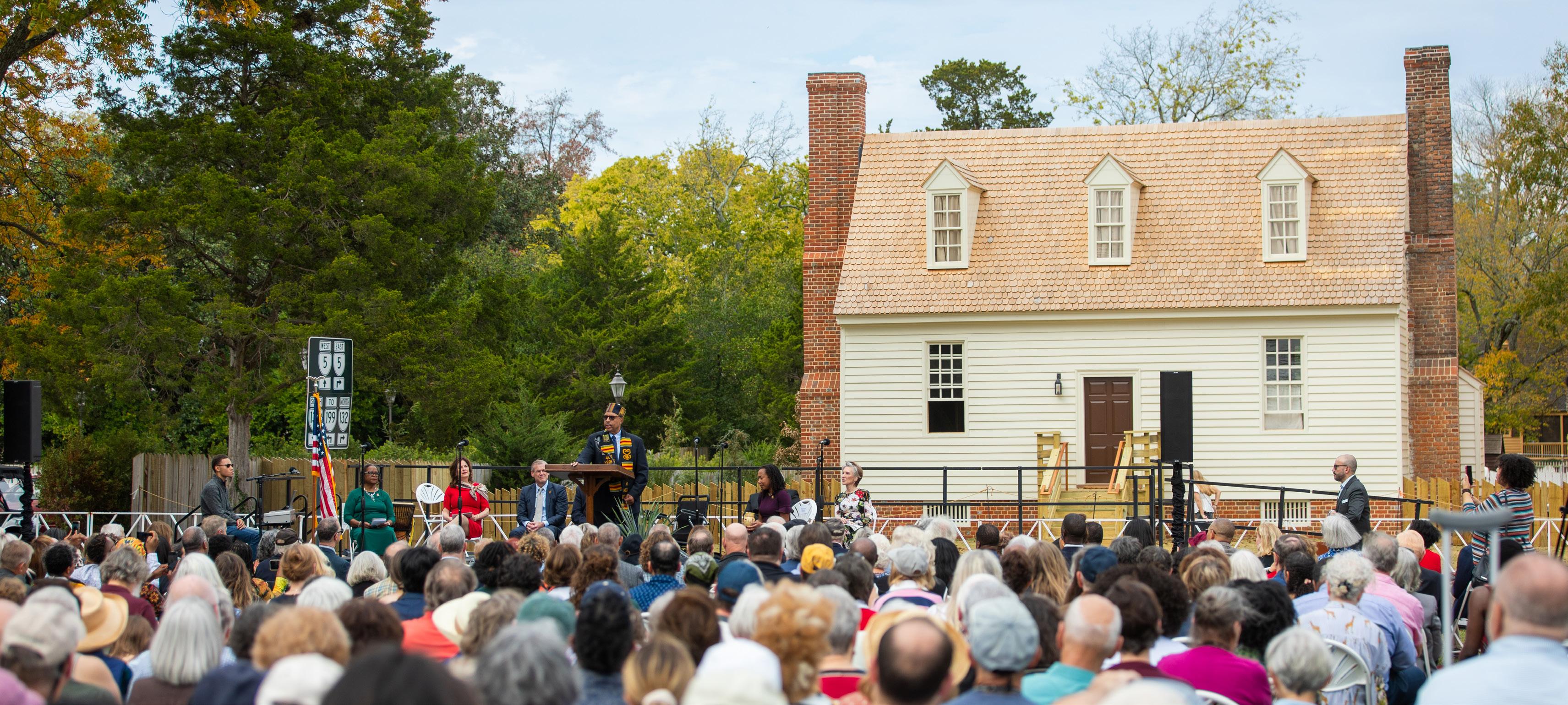
Over a year after Colonial Williamsburg moved the Williamsburg Bray School from its Brown Hall site to its current location on the corner of Nassau and Francis Street, people from all walks of life gathered to witness the school’s dedication ceremony.
Established in 1760 by the Associates of Dr. Bray, the Bray School is the oldest surviving school for free and enslaved Black children in the United States.
At the start of the ceremony, the audience participated in a roll call activity, where organizers and children from the Bray School descendant community’s children choir sang “Sit Down.” Attendees were asked to stand up for the duration of the song then sit down when a word that describes them, like “mother” or “child,” comes up.
Following the activity, President and CEO of the Colonial Williamsburg Foundation Cliff Fleet ’91, M.A. ’93, J.D. ’95, M.B.A. ’95, State Sen. Mamie Locke, Del. Cliff Hayes, College of William and Mary President Katherine Rowe and Chair of the
Colonial Williamsburg Foundation Carly Fiorina gave remarks.
Apart from remarks, former associate director at the National Museum of African American History and Culture Rex Ellis also delivered a libation.
“I had a sanctified moment this morning,” Ellis said. “It wasn’t because Robert Carter Nicholas came to me. It wasn't because Benjamin Franklin, who was a supporter, came to me. It wasn't because Ann Wager, [who] spent all of her life teaching our ancestors. It was because of the knowledge that came about from who was there. I believe it was the parents, I believe it was the mothers, I believe it was the fathers, I believe it was the brothers, I believe it was the sisters, who wanted to say, ‘Here are my legacies. Here is why I existed.’”
Ellis then led the crowd in the libation, uttering “ashe” after pouring water into the plant each time.
The Yoruba word describes “power,” “authority,” “command,” “energy” or “life.”
“Today, this is a day of history. It's
a day to remember scholars, a day to remember the challenge of slavery and a day to remember the resiliency of people,”
Secretary of the Smithsonian Institution
Lonnie Bunch L.H.P. ’24 said in front of a huge crowd gathered on the field before the Bray School. “And it's a day to remember that we have to embrace our history, no matter how complex or how contradictory.”
Bunch, who served as the keynote speaker, is no stranger to history. After serving as the founding director for the National Museum of African American History and Culture from 2005 until 2019, when he became the first African American secretary of the Smithsonian Institution.
“At a time of extreme partisanship, we need not fear our history, but embrace the past and realize how much better we are made by that knowledge,” Bunch added. “And the fact that what the past tells us is that America is a work in progress and that there is a possibility to live up to the ideals of our founding fathers and mothers.”
Director of the William and Mary Bray School Lab Maureen Elgersman Lee shared her reflections on the event in an email to The Flat Hat.
“As director of the William & Mary Bray School Lab, I could not have been more pleased with the turnout across all the events that made up the day,” Elgersman Lee wrote. “Friday represents the meeting of an important milestone, but it equally marks the start [of] a new chapter of research and public engagement, including through genealogy and oral history, that will continue to build on the hard work we've put in thus far. There is still so much work to do on the intersections of race, religion, and education in the late 18th century-and we are excited for what lies ahead.”
Presidential Liaison for Strategic Cultural Partnerships and Professor of Hispanic Studies Ann Marie Stock echoed Elgersman Lee’s sentiment.
Raft debate marks return after four-year hiatus, physics professor wins
Winner Josh Erlich, Jessica Paga, Jennifer Stevens, Joshua Gert argue
Monday, Oct. 28, William and Mary’s Raft Debate returned to the Commonwealth Auditorium after a four-year hiatus, drawing nearly 1,000 attendees eager to experience a lively academic showdown filled with humor and intellectual exchange. Three professors from different academic disciplines competed for the one-person life raft, aiming to prove their field’s value in saving humanity.
Arts and Sciences Assistant Dean for Graduate Studies Trey Mayo Ph.D. ’22 served as both judge and emcee, while a Devil’s Advocate challenged everyone’s cases, arguing that no one should leave the island for humanity.
Since its inception in the 1960s, the Raft Debate has been a beloved campus tradition. Faculty representatives from across disciplines compete, often with humor and creativity, to demonstrate their academic field’s necessity in the survival of civilization.
Associate professor of classical studies Jessica Paga began by asserting that humanities provide
the foundation for civilization by fostering a sense of connection and happiness.
“The thing that brings us together is community,” Paga said.
Professor of physics Joshua Erlich, representing the sciences, emphasized the role of scientific progress in combating global challenges like climate change and advancing public health.
“There’s a reason you remember the names Albert Einstein, Marie Curie, Charles Darwin and Shantá Hinton,” Erlich said. “You remember their names because of the great work that they’ve done.”
Associate professor of psychological sciences Jennifer Stevens advocated for the social sciences, highlighting their role in improving quality of life through insights into human behavior.
“If we are to save humanity, it feels so obvious we must save ourselves, and the social sciences, being the study of ourselves, quickly becomes the only choice,” Stevens said.
To demonstrate her point, Stevens performed a “La La Land”inspired dance, drawing laughter and applause from the audience.
The Devil’s Advocate, Leslie and Naomi Legum Distinguished Professor of Philosophy Joshua Gert, encouraged the audience to consider the importance of balanced academic discourse.
“The sad truth is, if we are going to have academic disciplines at all, we need all of them working together, and that is no longer an option,” Gert said.
In the rebuttal round, Paga referenced Socrates’ trial and its consequences for Athens as a cautionary tale about the danger of rejecting a humanist approach. According to Paga, determining the winner was about ensuring humanity not only survives, but thrives.
“Choose the option that actually makes you happy, the thing that you actually really want to do with your life, with the amount of time you have left here,” Paga said.
Erlich countered Paga’s argument by illustrating the practical ways science enables
modern society to thrive, arguing that scientific innovation provides the foundational tools that civilization relies on.
“Without me, you don’t survive. You need to vote for me for your kids and for your future,” Erlich said.
Citing research on altruistic behaviors in rats, Stevens built on Paga and Erlich’s arguments.
She asserted that social sciences bridge scientific understanding and human fulfillment, equipping people with knowledge to live enriched lives both individually and collectively.
“We need to understand how humanity can build a culture of community and support and belonging,” Stevens said.
In response, Gert critiqued the contributions of each discipline, suggesting that while the sciences often create crises they must later solve, the humanities and social sciences focus primarily on interpreting behavior rather than actively ensuring survival.
“Advanced study in the absence of other fields of study presents the greatest danger,” Gert said. “Let people thrive. Keep these guys on
the island.”
Following these exchanges, the audience posed questions on discipline-specific strengths. Paga explained that even infrastructure has roots in the humanities, stemming from early societal needs for order and public health.
Stevens responded to questions about psychology’s replicability, defending its scientific rigor despite occasional critiques. When asked how they’d maintain sanity on the raft, Paga proposed storytelling, citing Homer’s Iliad. Stevens pointed to cognitive-behavioral strategies, while Erlich confidently asserted that his knowledge of astronomy could guide him back to civilization.
Audience responses varied widely, from laughter and applause to thoughtful nods, reflecting the debate’s engaging nature and the audience’s investment in the discussion.
Olivia Webster ’26 believes that collaboration between all three disciplines would be necessary for survival.
news insight
I think William and Mary has a history of people who will continuously speak up, who continuously try to hold their admin accountable, who continuously show up for these committees, and thatʼs never going to die.
Students head to the polls
Tuesday, Nov. 5, students at the College of William and Mary will head to the polls to cast their votes in local and federal elections, including the 2024 United States presidential election between Democrat Vice President Kamala Harris and Republican former president Donald Trump.
On the ballot in Williamsburg, three seats on the city council are up. Meanwhile, voters will also pick the next representative for Virginiaʼs first congressional district. The incumbent for that seat is Republican Rob Wittman, who is running for another term against Democrat Leslie Mehta.
For the senate, incumbent Democrat Tim Kaine LL.D. ʼ06 is running for another six-year term against Republican Hung Cao. College President Katherine Rowe addressed the college community regarding the election in a campus-wide email.
“As we process the election results, please engage in ways that matter to you,” Rowe wrote. “Check in with friends and teammates. Use the universityʼs resources for support as you are moved to. I am proud of the ways William & Mary people continue to forge community across differences ‒ and participate fully in our pluralistic democracy. Vote, vote, vote, William & Mary!”
Devaughn Henry, fre department volunteer, canvasser, activist, begins role as new 2028 class president
Henry describes adjustment to position, previous experiences be fore time at College
Since class election results were announced Sept. 26, Devaughn Henry ’28 has been working hard in his new role as president of the College of William and Mary’s class of 2028. He meets three times a week with his class senators: every Sunday, Monday and Tuesday.
Henry opened up about the large quantity of work that being a class president entails, but enjoys the results he has seen so far.
“It’s a lot of work,” Henry said. “Really time consuming, but it’s rewarding.”
Henry spoke about how there are still many protocols he needs to learn so he can offer the greatest number of opportunities to student peers, but enjoys the learning process.
“My favorite part about being president is the meetings,” Henry said. “Just learning and immersing myself in that, and being able to suck in as much knowledge as I can.”
He’s currently pursuing a myriad of activities, including the first Class of 2028 gathering slated for Nov. 21.
“This coming month of November, we’re working on our first class event, which is a s’mores event for freshmen on the Sunken Garden,” Henry said. “It’s still in the works, but everything’s pretty much almost done.”
In the future, Henry hopes to partner with local businesses to plan town-wide events for students at the College. He is currently working out the logistics of the holiday community tree lighting ceremony, aiming to reduce participation costs for students as much as possible.
“I’m in contact with representatives from Colonial Williamsburg to try to partner with them for their annual tree lighting ceremony,” Henry said. “I’m trying to work it out so it’s a free event for students.”
Henry is also looking ahead to the College’s 332nd charter day, with the Class of 2028 taking on the responsibility of preparing the Student Assembly bill for the celebration.
“The class of 2028 just took on the role of creating the bill for charter day, which is in February,” Henry said. “And the Green and Gold bash. We’re ready for it.”
Henry aims to make freshman year as exciting as possible for the class of 2028, prioritizing inclusivity and opportunity for all students.
“My goal as president is to make our freshman year as rewarding as possible and as inclusive as possible,” Henry said. “To offer the most amount of opportunities for everyone in our class. And just accomplish anything that I can.”
Henry explained that the bills he’s working on will take some time to develop. In the meantime, he’s focused on gaining widespread support for his initiatives among faculty and staff.
campaigns. Early in the 2024 primaries, he served as a phone banker for the Haley campaign.
Haley aligned with Henry’s values the best in comparison to the presidential candidates at the time: Joe Biden and Donald Trump.
“I didn’t want to vote for two 80-year-old candidates,” Henry said. “I just felt like this wasn’t a place we needed to be in as a country. It’s not very reflective of the population of our country as a whole.”
Henry most recently did canvassing and phone banking for the Harris campaign. Henry strongly believes in exercising the right to vote and encourages students to do so.
“You never realize how much your vote counts until you miss that opportunity,” Henry said. “You could be that one deciding vote that changes the election dramatically. I don’t think a lot of people really understand the value of their vote, thinking it doesn’t matter. In actuality, voting is the most basic right that many people die for.”
Being a Black student, Henry feels that it is especially important to vote since past generations were not able to exercise their constitutional right.
“As a Black person, the civil rights movement was not that long ago,” Henry said. “My great grandparents weren’t able to vote. I want to exercise my rights and take part in the American dream.”
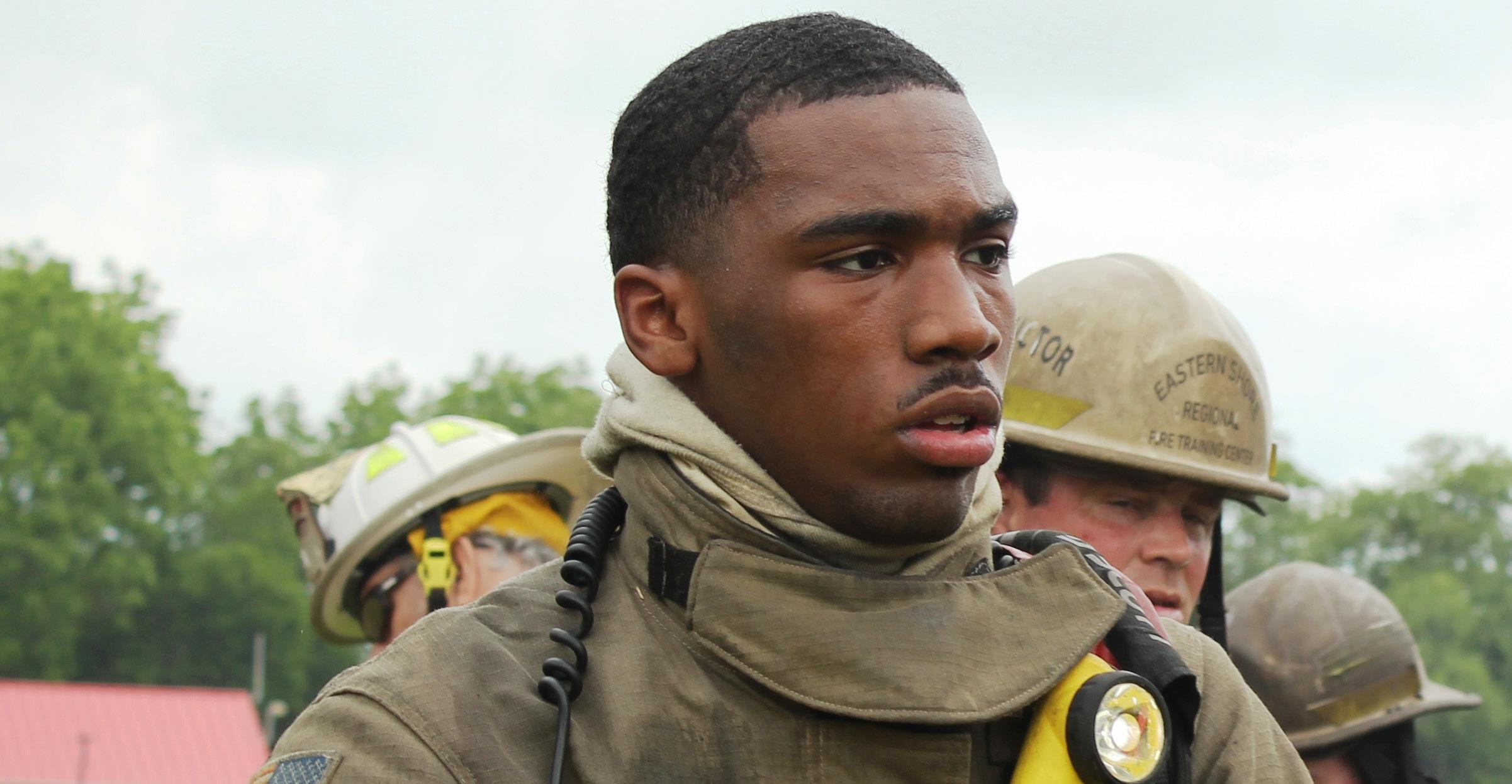
Serving the people also inspired Henry to become involved in his local fire department. He loves the adrenaline rush he gets when going on calls and has been volunteering there for over three years.
“The first couple calls I went on, that adrenaline rush that you get and the feeling that what you’re doing can save someone’s life and you’re helping someone,” Henry said. “You’re getting them through the toughest times they might have experienced, and I really enjoyed that.”
Henry plans on submitting an application to join the Williamsburg Fire Department as a volunteer firefighter.
On campus, Henry is a part of the WMSURE program. Every Wednesday, the program hosts workshops that cover a wide range of topics. Henry finds the workshops to be especially helpful as he looks into internships and summer research opportunities.
“The most recent one we had was on internships and summer research,” Henry said. “And it was really interesting because they were very helpful in starting our search for summer internships.”
In the spirit of student engagement, Henry emphasized that students can reach out to him directly as well as submit questions through his upcoming newsletter to the class of 2028.
ʻSTABILITAS ET FIDESʼ | ESTABLISHED OCT.
“Most of the bills that I’m working on right now are going to take time,” Henry said. “And they’re popular among the freshman class, but among faculty and staff they’re not very popular. So I know there’s going to be some struggle in doing that.”
Outside of student politics, Henry recently had the opportunity to volunteer for both Kamala Harris and Nikki Haley’s presidential
“The best way to contact me is in our newsletters, I do put my phone number and email on there, so those are always welcome,” Henry said. “But in our next upcoming newsletter, the class of 2028 will have a Google form where they can fill out any questions or concerns. One of the representatives will get back to you within a week.”
Bray School event widely attended by community members
Members of the Descendant Community, student attendees describe sentiment over renovations
Presidential Liaison for Strategic Cultural Partnerships and Professor of Hispanic Studies Ann Marie Stock echoed Elgersman Lee’s sentiments.
“It was so gratifying to see our community come together for this momentous occasion,” Stock wrote in an email to The Flat Hat. “We’ve accomplished a great deal through partnership and collaboration and are well poised to tackle the next phase of this important work.”
Anthropology major Neya Alper ’27 participated in the Colonial Williamsburg Field School in the summer, working at the Bray School at its Brown Hall location. She was given the opportunity to tour the building prior to renovation and greatly appreciated the
momentous occasion.
“It was really great, I really enjoyed the keynote address, I thought it was really well written, it was just really moving,” Alper said.
Member of the Descendant Community and Williamsburg resident Jacquelyn Gardner was especially moved by the legacy of the schoolchildren that was honored at the ceremony.
“I was so inspired by this program today because to think that those children had an opportunity, the Black children who were enslaved and those who were free, to go through school, to learn skills, to be independent of their parents for a little while, to be in school,” Gardner said.
Gardner and her husband are both members of the prominent First Baptist Church
in Williamsburg. Gardner’s husband, Dennis, grew up on Nicholson Street and would walk to the church as a child, which was demolished in the 1950s. He hopes that people will come to view the school’s history diferently after the ceremony.
“But I am hoping that more people will come to see this history in a new light, not just remember the negative things about slavery, but to remember that it was part of the history that we are all involved in,” Gardner said.
Bufalo, New York native John Henshaw and his family frequently vacation in Williamsburg with their eight-year-old son. He expressed that attending the event allowed them to appreciate this rare piece of history together.
NAOMI LINDE // THE FLAT HAT
FLAT HAT NEWS BRIEF
COURTESY IMAGE / DEVAUGHN HENRY
Henry has worked at his local fire department for over three y ears and plans on joining the Williamsburg Fire Department as a volunteer.
PEERAWUT RUANGSAWASDI / THE FLAT HAT
PLUMAS pushes College to end contract with Nike after labor condition concerns
President Rowe states that College Nike products are not produced in inhumane factory plant
MONA GARIMELLA FLAT HAT NEWS EDITOR
Friday, Oct. 18, members of the Political Latinx Union for Movement and Action in Society delivered a petition to College of William and Mary President Katherine A. Rowe requesting the College to terminate its licensing contract with Nike, citing inhumane working conditions in a factory in Bangkok, Thailand, called “Hong Seng Knitting.”
In an email to the organizers, Rowe later stated that the College carefully reviewed their inventory and found that the school’s licensed Nike products do not come from this plant.
The Students for International Labor Solidarity — a group consisting of students from various colleges in America interested in advocating for unjust global labor conditions — reached out to Angie Téllez-Sandoval ’25 and Isabela Ortiz Caso ’25 about the specific situation in Bangkok.
“A Worker Rights Consortium (WRC) investigation has identified violations of worker rights and universities’ labor standards at Hong Seng Knitting Co., Ltd. (‘Hong Seng’), including wage theft, coercion of workers to facilitate that theft, and retaliation against workers who resisted,” stated a 2021 Worker Rights Consortium assessment on the Hong Seng Knitting Co., Ltd. in Bangkok that sparked the efforts of Tellez-Sandoval and Ortiz Caso.
In a petition sent out to the student body on social media on Oct. 17, PLUMAS reiterated these worker violations as reasons for their request for the College to end its agreement with Nike.
“We respectfully urge the university to terminate its licensing contract with Nike and demand accountability for these labor rights violations. Doing so will demonstrate William & Mary’s commitment to ethical practices and ensure that our apparel is produced in conditions that align with our values of fairness, respect, and human dignity,” the letter read.
For Téllez-Sandoval, she saw hope
POLITICS
in the College’s termination of its contract with Nike since it was a smaller commitment and profit compared to other schools’ agreements with the company.
“We have a licensing contract with Nike. Compared to other schools like UT schools and the University of Michigan — they don’t have licensing contracts, they’re full on sponsored. We’re sponsored by Under Armour. So that’s a whole different company. But our licensing contract essentially allows Nike to have the ability to print William Mary stuff, like we make cups, t-shirts, all that things. So it’s a lesser contract, so I also knew that it was something that we could put pressure on the administration and they’d be more willing to budge because, you know, Nike isn’t giving them billions of dollars to wear their merch. They simply have a smaller contract with us,” she said.
When delivering the petition to Rowe, the
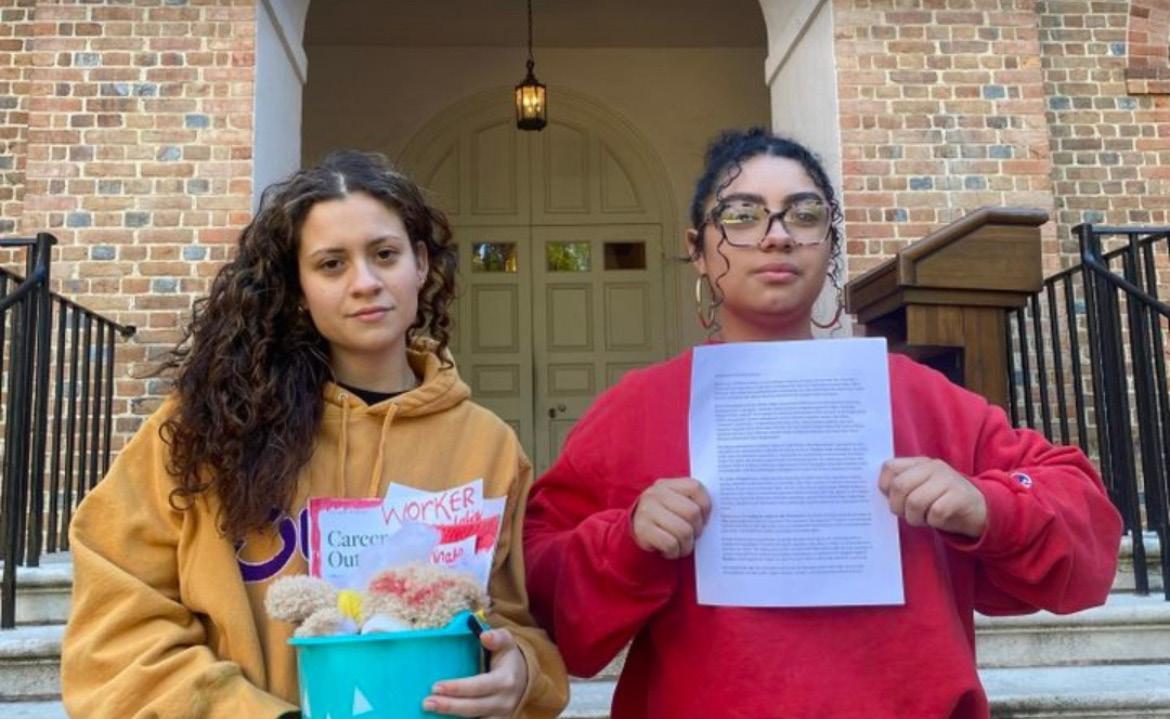
two strategically gave her a “boo basket” as well. “Protesting for workers rights or anything like literally anything else is like performative arts, and using that as a way to have that shock factor of like, ‘Oh my God, what is this? Like, what am I being handed? I really need to look into it.’ That was kind of the whole point of it, particularly with Halloween time and getting the value of what’s important,” Ortiz Caso said.
Téllez-Sandoval reiterated the signifcance of the basket.
“When I frst thought of the idea, it was like a play on when you give someone a boo basket and usually it’s given as a form of afection. It’s supposed to show them that you care. We too have a relationship with our college, and a relationship with our president. So this is kind of representative of that relationship that we have with them. Like we want to alert them like, ‘Hey, you should really pay attention,’” Téllez-Sandoval said.
Inside the basket, the organizers put pamphlets
from all around campus criticizing the College’s hypocrisy, as well as a teddy bear without an arm to represent the inhumane working conditions.
“The teddy bear had an arm sown out, but that’s also to symbolize inhumane working conditions and also particularly with this petition, it has to do a lot with like workers under Nike in one of their like manufacturing companies in Thailand and not just like unsafe working conditions, but also it has to do a lot with like immigration as well, because they just refuse to pay for another like a bunch of workers who don’t live in Thailand, but of course, like aren’t immigrating to be able to work and provide for their families, too. So that’s a huge disadvantage,” Ortiz Caso said.
In delivering the petition to Rowe, TéllezSandoval expressed that she hoped for a productive conversation with the administration understanding the rationale behind the petition.
“I hope the administration sees this as this isn’t like bashing William and Mary completely. Right? This isn’t about, like we hate the administration. We want ethical clothing. We want to know that when we wear William and Mary, that even the clothing and the history of our clothing isn’t embedded in labor violations and literally histories of colonialism and things like that. We want to know that at the very least, knowing that already the history we have, at the very least, our clothing can be held to a standard of our code of conduct,” she said.
“I am reaching out to respond to the petition delivered to my office on October 18. This is a matter that William & Mary takes very seriously, as a member of the Worker Rights Consortium for nearly two decades. I can confirm that William & Mary licensed products are not produced at Hong Seng Knitting. Upon receiving your letter, my office reached out to our Trademark Licensing Administration to investigate the facts of this matter,” Rowe wrote.
Young Democrats, College Republicans debate contested issues of election
Event moderated by professor Larry Evans, students from both sides share policy opinions
ALEX NAKAMITSU AND SARAH DEVENDORF THE
FLAT HAT
Wednesday, Oct. 30, the William and Mary College Republicans and Young Democrats faced of in a debate, discussing matters of the U.S. economy, immigration, foreign policy and abortion rights.
The “economy” portion focused mostly on Trump’s tarifs and bringing manufacturing jobs back to the United States. There was also disagreement over how immigration and undocumented individuals afect the economy, which transitioned into the next portion. The main point of debate was the amount of crime committed by undocumented immigrants and the issue of mass deportation.
On foreign policy, both sides were asked about their views on the Russia/Ukraine and Middle East conficts, as well as U.S.-China relations. The College Republicans were also asked to defend Donald Trump despite many of his former military advisers denouncing another Trump term. On abortion rights, the College Republicans attempted to back up
their view of every state deciding the law for themselves. There was extensive back and forth between the moderator and the College Republicans on this issue.
This long-awaited debate came after a several year hiatus of the event. The two clubs came together to defend their respective parties’ candidates ahead of the upcoming Nov. 5 presidential election.
James Schilk ’26, a government and public policy major, and Philip Vayntrub ’27, a history major, represented the College Republicans. Frank Herman ’28, a history major, and Phillip Matijevic ’27 stood in for the Young Democrats.
Additionally, Newton Family Professor of Government C. Lawrence Evans from the government department acted as the moderator for the event. Other organizers of the event included Fletcher Nunnelley ’25, a member of the College Republicans, who acted as the decorum ofcer, and Young Democrats President Brenna Gelormine ’25 was the time keeper.
The debate lasted for roughly two hours, with 30 minutes at the end being allotted for
an audience question and answer segment.
The debate kicked of with Evans asking the two sides why, despite every reliable indicator proving otherwise, Americans still feel as though the economy is doing poorly.
“Unemployment is down 4%. Infation is down around the same, 4%. Price of gas apparently is going to go nationally, on average, below $3 sometime in the next couple of months or so. Looking at my 401k’s, they’re doing pretty well. The stock market’s humming along. Objectively, the United States economy is doing better than any of our Western counterparts. So the question becomes, why not leave the old guy in charge? Why do we need a new president?” Evans asked.
The Young Democrats approached the question by highlighting President Joe Biden’s actions while in ofce that have benefted the economy, while criticizing Trump’s proposed tarifs on foreign imports.
“What is very important to understand is that in the past four years, the Biden administration has passed a lot of massive investments that take a lot of time to be implemented,” Matijevic said.
He pointed to the passing of the Infation Reduction Act of 2022, the CHIPS and Science Act of 2022 and the Bipartisan Infrastructure Deal of 2021. He argued that these bills, signed into law by President Biden, have the potential to have great benefts to the economy, but take time to see outcomes.
At the same time, Matijevic warned of the dangers of Trump’s plan of increasing tarifs on imported goods. If elected, Trump claims he would impose a 10-20% blanket tarif on all imported goods, 60% for goods coming from China, hoping to shift manufacturing jobs to the United States.
Matijevic argued that this plan would only hurt the U.S. economy.
“I mean, every single economist — not every single one — but a large number of them are saying that it’s actually going to cause a GDP decline of 8% and it’s also going to increase infation,” Matijevic said. “So the real question is why should we take their path?”
When the College Republicans were given the foor to speak, they argued that the Trump tarifs would bring key industries back to the United States.
“China is making our medicine. It’s making our computers. It’s making our cars. Everything that makes life worth living here other than, you know God, you get from China,” Vayntrub said. Vayntrub also claimed that the current housing crisis is partly contributing to the feelings of fnancial stress among everyday Americans.
“Home prices have reached 20% and the cost of all goods is up 8.5%. Families are paying $3500 more this year, this is 2022, for basic sets of goods. That’s not good,” he said. Aside from the general sentiments surrounding the economy, the two sides discussed Medicare and Social Security, raising taxes and the efects of immigration on the economy.
The College Republicans attacked the issue of immigration by citing a crisis at the southern border and heightened crime.
On this topic, Vayntrub made a remark which generated jeers from the audience, “But I ask you, what percent of illegal immigrants committed crimes in the United States? Because I’d actually tell you it’s 100%.”
Hunger-Free Campus Act gains support at Virginia colleges in advance of state legislature vote Food insecurity deemed the ʻinvisible epidemicʼ of higher education, bill seeks to address the issue
Friday, Oct. 18, the University of Virginia Community Food Pantry hosted Virginia State Senator Creigh Deeds and Delegate Amy Laufer to discuss food insecurity on college campuses. Following this initiative, the College of William and Mary’s Food for All organization is slated to welcome Virginia State Senator Mamie Locke and Delegate Amanda Batten this November to emphasize the same issue and promote the bill’s passage in the General Assembly.
Food insecurity is often deemed the “invisible epidemic” of higher education. According to the U.S. Government Accountability Ofce, over one-third of college students nationwide face food insecurity and hunger. However, little legislation has been enacted to address this issue. Colleges across Virginia are uniting to advocate for a solution with the Hunger-Free Campus Act. The Hunger-Free Campus Grant Program aims to alleviate food
insecurity for college students by ofering fnancial support to institutions to establish basic needs services. In this system, institutions would apply for funding through detailing how they would use the money to address food insecurity on their campuses. The Virginia Council of Higher Education for Virginia would then be responsible for approving the requests.
Student groups from several universities including UVA and James Madison University have already organized visits with state legislators, held campus tours and conducted letter-writing campaigns to build awareness and support for the bill.
In an email to the Flat Hat, Laufer provided a statement regarding the bill, emphasizing the urgency of addressing student food insecurity with new programs.
“Food insecurity is one of the most pressing challenges facing Virginia,” Laufer wrote to the Flat Hat. “College students, as young adults
who are juggling the responsibilities of being a student while living and working independently for the first time, are uniquely vulnerable to experiencing food insecurity and yet have few resources available to help them. Accessible school-based initiatives, including food pantries and meal voucher programs like the ones I have been fortunate to learn about and tour, are vital to tackling the problem of student hunger.”
For students, access to essential resources such as food and housing is a foundational component of academic success. Hunger and related insecurities can have severe consequences, including higher dropout rates, mental health struggles and diminished academic performance. Students experiencing food insecurity are 3.5 times more likely to leave school compared to their food-secure peers.
Advocates argue that establishing a Hunger-Free Campus Act is not only a compassionate move but also
an investment in the state’s economic future yielding a stronger workforce and reducing dependency on social services over time.
The push for Virginia’s Hunger-Free Campus Act has encountered obstacles, primarily due to budgetary concerns. In its most recent iteration, the bill was amended to replace its grant allocation with a State Council for Higher Education for Virginia-led study of food insecurity at public universities.
This change stripped shortterm funding from the legislation, prompting disappointment among advocates and students who hoped for more immediate support.
Funding concerns have long been a challenge for advocates. According to the College’s Food for All organization, many college food pantries, including their own, operate without formal institutional support, relying on student leaders
and community donations.
This lack of stable funding leaves student-run pantries struggling to keep up with rising demands and limits their ability to expand services. Food for All President Allisyn Lam ’25 explained why students need the state’s help when dealing with food insecurity.
“When students graduate, a lot of these clubs or programs die out if they don’t have strong leadership to keep it going,” Lam said. “Having a staf person here would be essentially somebody who’s going to be here for a long time, a lot longer than students are, and it would be their job to kind of do the work that we’re doing, because at the end of the day, we’re also students.”
This isn’t the frst time students at the College have pushed for reform surrounding food insecurity. However, the lack of data surrounding university hunger has long been a barrier to enacting new policies.
Executive Director of UVA’s food pantry Eleanor Steiner shared why
there has historically been a shortage of information around the issue.
“There is an incredible amount of stigma, and people don’t talk about it,” Steiner said. “So you’re not talking about it, so then people don’t know about it, and then that issue just blows up more and more. There is also this perception that’s like, ‘I’m not in need enough, I’m not food insecure enough, like I only had to skip one meal, but I knew I was going to get it.’” Lam explained that students often don’t realize how big of an issue food insecurity is on campuses.
“It’s your classmates, it’s your research partners, it’s your mentors, it’s your bigs and littles,” Lam said. “There’s no one description that fits for all people who are food insecure. So you never really know until you kind of sit down and listen to people’s stories. It’s truly impactful what we’ve seen change, but we still know there’s so much more that needs to be done.”
COURTESY IMAGE / PLUMAS
Students Angie Téllez-Sandoval ʼ25 and Cindia Romero Araujo ʼ27 delivered PLUMASʼs first letter to President Rowe alongside a “boo basket.”
MADIGAN WEBB THE
CAMPUS
Charles Center hosts talk with Defense News reporter Noah Robertson ’19
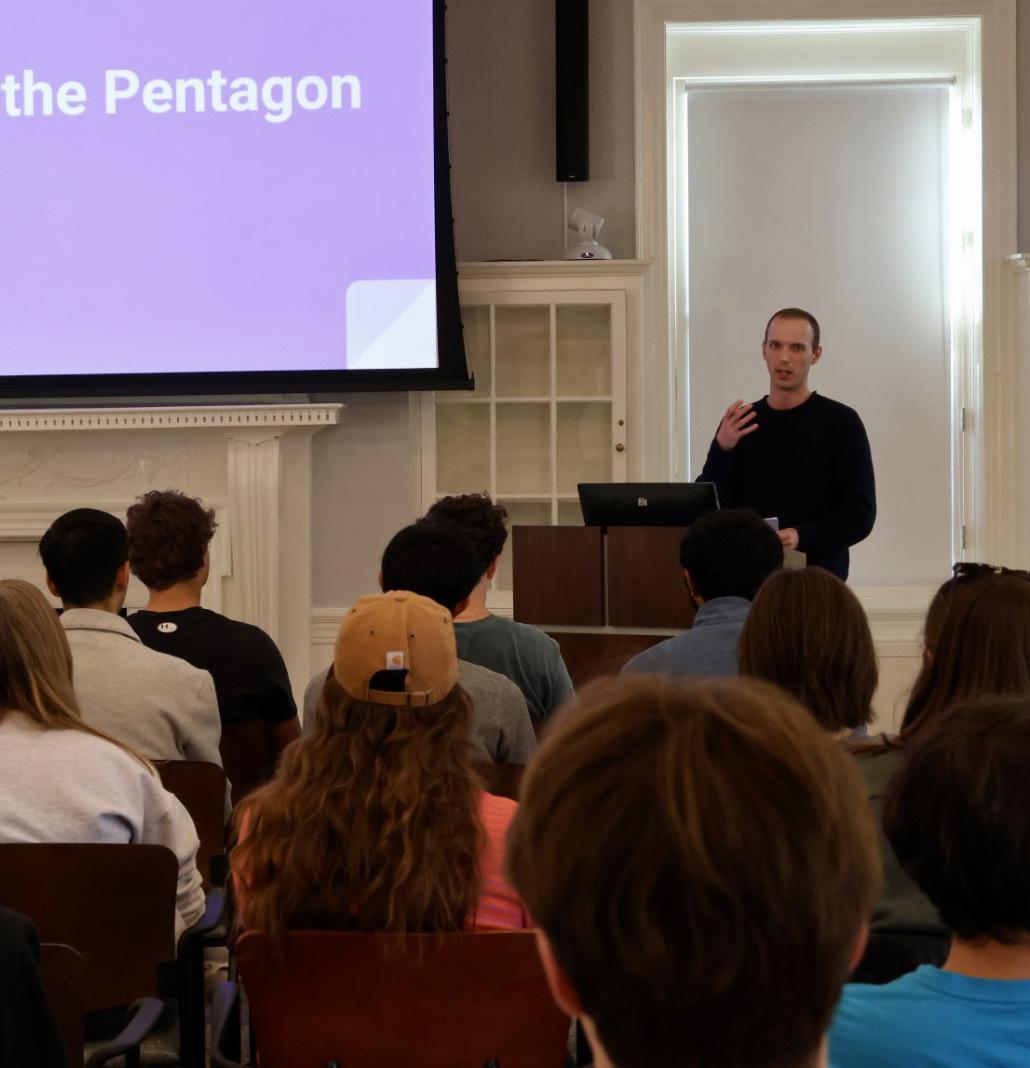
Monday, Oct. 28, the Roy R. Charles Center hosted a community talk with Defense News reporter Noah Robertson ’19 at Blow Memorial Hall. As a Sharpe Journalism Seminar alum and former member of Te Flat Hat, Robertson returned to share details about his journalism career covering national defense.
Robertson opened his presentation with a frsthand account from a Ukrainian city devastated by the Russian military. Visiting in 2022, he witnessed the aftermath of a town turned frontline, ofering the audience a rare glimpse into his work in global confict zones.
Robertson touched on similar stories throughout his talk. Whether going overseas to Ukraine or conversing with U.S. Secretary of Defense Lloyd J. Austin III, Robertson underscored the importance of full immersion in his reporting. He also shared his experience tagging along on helicopter rides, sitting in on Pentagon press conferences and covering the Tokyo Olympics.
Robertson explained that despite the riveting nature of his reporting, working at the Pentagon can be much more mundane than overdramatized Hollywood portrayals let on. Robertson showed photos of his ofce space, highlighting the relatability of personal desk memorabilia, printed ofce memes and the food court with a Starbucks and Popeyes.
“It’s not very exciting,” Robertson said. In that same vein, Robertson shared what the head of the Pentagon Press said to new employees on their frst day.
“Welcome to the Pentagon, it’s disappointing,” he said.
However, Robertson’s journey to becoming a Pentagon reporter was far from mundane.
He credited the College for equipping him with connections that made his journalism career possible, including a valuable mentor he met through the Sharpe Journalism Seminar.
“Te person who helped me get an internship at the Christian Science Monitor, that led me to spending four years there, actually teaches the Sharpe Journalism Seminar,” Robertson said. “So without that seminar, I actually would have never been able to meet her, would never have been able to get the internship, and would have never gotten the slew of experiences that came from that.”
Robertson attained a plethora of writing skills as an undergraduate that
POLITICS from page 3
Additionally, Vayntrub argued that the millions undocumented individuals puts a strain on the U.S. welfare system and that Vice President Kamala Harris has not given this issue enough attention during her campaign.
Matijevic, an immigrant himself, described the rhetoric surrounding immigrants coming from the Republican Party as “disgusting.” He also accused Trump himself for contributing to this issue by killing a bipartisan border security bill, which Matijevic claims he did to have a relevant campaign issue.
“Donald Trump killed the bill because he knew that if it was canceled, he would not have an election issue to be reelected,” he said.
Vayntrub described this bill as “a lie.”
“I mean, it’s mentioned in debates constantly,” Vayntrub said. “And I want to remark on it right here. This bill is a lie. It’s like naming something the Clean Water Act, and then all it does is fund Israel and then let more sewage into the lake. That’s fundamentally what it is.”
The conversation shifted to the issue of deportation. The College Republicans expressed support for mass deportation of all undocumented individuals, including
he still uses today, preparing him to work in such a dynamic feld.
Te thing I got most attached to was just trying to be deliberate with the words that I used. Who I can credit that to was a professor named Sharon Zuber, who taught my intro English capstone class. It was helpful learning from her not only to be very critical of the words that I use, but also to get to the point fairly clearly,” Robertson said.
In addition to English, his second major in government helped supplement him with policy knowledge that has proved useful on the job.
“I learned how to write when I was an English major, and learned about a lot of the stories that I think through when I’m writing now. It’s some fction texts, some of those are nonfction texts, but that was helpful for me. And with government, I learned a lot of policy nuances. And there’s
Deferred Action for Childhood Arrivals recipients.
This caused a great deal of back and forth between Vayntrub and Schilk and Evans.
“Are you gonna deport all the DACA students and all the DACA folks, all the kids who came here as minors and are still here? Are you going to deport all of them?”
Evans said.
“I think that what’s going to happen is that anyone that came with legal permission is gonna be allowed to stay, and any one without legal permission is going to be asked to leave,” Schilk said in response.
The Young Democrats responded again with their strategy of attacking Trump’s actions on immigration while he was in office and dispelled the myth that immigrants commit crimes at a rate higher than citizens.
“If you look at the situation that Donald Trump left us, he claims to have lowered immigration, but the immigration rate rose during his tenure and all he did was lower legal immigration by taking it from 60,000 visas issued to people applying, one down to 1000,” Herman said.
The foreign policy portion of the debate included the war between Ukraine and Russia, the conflict in the Middle East, and U.S.-China relations.
The College Republicans took a non-
CAMPUS from page 1
“Labs and hands-on learning are critical, but a balance of felds keeps us well-rounded,” Webster said.
Associate professor of history and former raft debate winner Andrew Fisher commented on the unique merits of the humanities. He suggested that while science and technology offer practical applications, social sciences provide ethical and historical guidance, balancing progress with perspective.
“It provides the long view — understanding where humanity has thrived or faltered,” Fisher said.
Julie Walters ’25 added that psychology’s intersection with both science and humanities is particularly valuable to survival.
“Psychology bridges science and humanity, making sense of human behavior,” Walters said.
Jack Rizzo ’25 remarked that the debate was a highlight of his diverse and interdisciplinary student experience at a liberal arts institution such as the College.
“I’ve never felt more school pride,” Rizzo said.
Rizzo added that he hopes to see more disciplines included in future debates.
“I want to see some business school representation,” Rizzo said.
Executive Assistant to the Dean of Arts and Sciences Erica MacLeod collaborated with student coordinator Ukamaka OzedWilliams ’25 to bring back the beloved tradition for the first time since the pandemic.
According to Ozed-Williams, despite the raft debate’s popularity and decades-long history, publicity was the biggest challenge in organizing the event.
“We lost an entire generation,” Ozed-Williams said. “When I asked people, nobody knew what it was.”
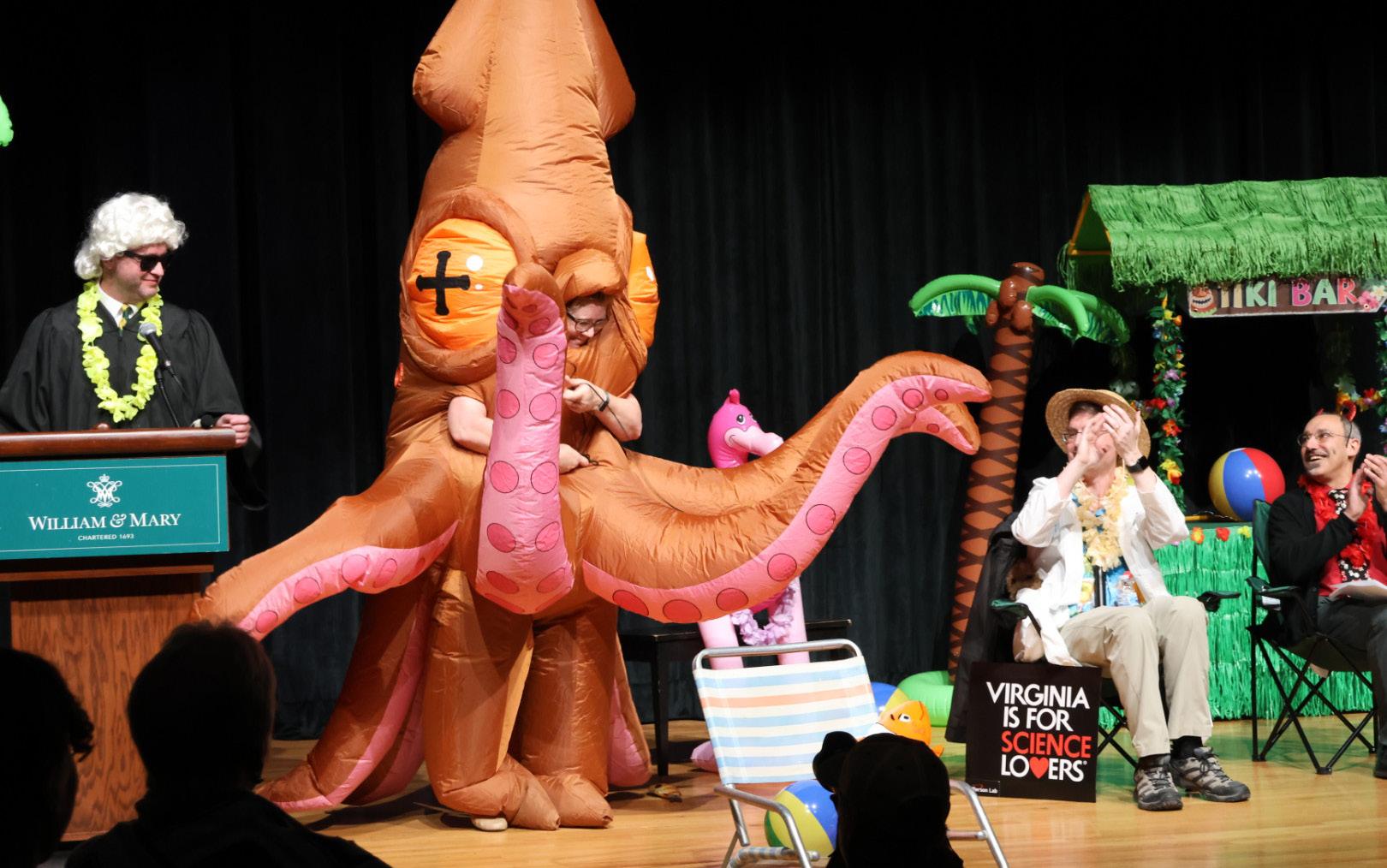
MacLeod’s creative flair included props like an inflatable squid and a tropical-themed set. As OzedWilliams looks toward future raft debates, she encourages other students to join her in preserving this tradition.
no replacement for that, for being focused on Washington. So now I’m on the Pentagon beat rather than a general political writer or something like that,” he said.
Professor Emeritus of Government and International Relations Sue Peterson attended Robertson’s talk. After having him as a student, Peterson recognized his impressive abilities, much like other audience members she spoke with during the presentation.
“Noah was an excellent student,” Peterson said. “During the middle of the talk, the woman sitting next to me leaned over and asked, ‘Is this guy really 26 years old?’ And I said, ‘Oh no, he was like this when he was here. I mean he was always just super smart and articulate. So you knew he was kind of destined for great things.’”
Robertson then stressed changes to U.S. foreign policy. He explained that in past years, Americans used to rank foreign policy among their lowest priorities, but ever since confict arose in places such as Ukraine, Lebanon and Gaza, overseas events became more of a dire concern for citizens and government.
Robertson then underscored the importance of voting as a civic responsibility and chance to make one’s voice heard.
Tis is your opportunity to make your voice known,” Robertson said.
Despite the centrality of foreign policy in his reporting, Robertson emphasized how the stories he covers are ultimately about everyday people. He discussed the common practice of reporting on far-away people’s lives from the security of Washington D.C. newsrooms, which prioritize abstract policy over concrete human interaction.
“Part of it is access,” Robertson said. “When you’re reporting on a confict, it’s much easier to report on that from the safety of Washington than it is to actually go to a place like Gaza or Ukraine. Tese are places that are removed from our day-to-day, and therefore very difcult to get to, so part of it is logistical. Te second is our mentality reporting on this stuf D.C. is an area where we’re close to the center of these decision-makers rather than the people who are impacted by the decisions being made.” Robertson encouraged aspiring journalists to connect people and policy, leading to more full-bodied and fair reporting.
“I would urge you to think about them as connected,” Robertson said. “Te people, the policy, the bridge between them and the way we are alive.”
interventionist stance on Ukraine/Russia and the Middle East, while at the same time arguing for the U.S. military capabilities to focus more on China.
“Fundamentally, the war in Russia is a war in Europe that concerns Eastern Europe. It does not benefit us in any material way. It does not benefit our national security in any way,” Vayntrub said.
The College Republicans repeatedly argued that the conflicts that are taking place overseas should be of no concern to the United States. On the other hand, the Young Democrats expressed support for the United States continuing aid, both financially and militarily, of Ukraine.
“It’s vitally important that the United States maintains its alliances for the welfare of American citizens. Ukraine is not some random country with a sovereign nation. It’s an American ally,” Herman said.
There was notable tension among the audience when Evans changed the topic to the conflict and humanitarian conflict in the Middle East. The Young Democrats responded first, supporting Harris despite controversy throughout her campaign on her stance on the issue.
“I do believe Harris will be better on this because unlike Donald Trump, she has been pro ceasefire, whereas Trump has been contacting Benjamin Netanyahu and
sabotaging ceasefire talks. There have been Israeli and Palestinian hostages that have not been released because of those two men who wish nothing but to have power,” Matijevic said.
Schilk continued with the College Republicans non-interventionist view.
“The point is that both candidates are very clearly pro-Israel. But I think what I think the difference here is about weakness in strength. And we’ve seen in the BidenHarris administration, they are completely unable to restrain Israel in any meaningful way. It’s not possible. Joe Biden, all he can do is make a bad phone call and then continue to drop billions of dollars in aid for Israel. Fundamentally, what Trump wants is peace, because our greatest strategic adversary is not Iran but China. China is where our orientation should be focused,” Schilk said. Evans switched the topic to Trump’s fitness to have such immense power over the United States military. He cited how multiple high level military officials who served under the first Trump term have expressed concern over the possibility of a second one. The College Republicans suggested that this is merely a way for them to avoid coming to justice after “betraying” Trump while he was in office.
GUEST COLUMN
Immigrant women face many obstacles — timely access to maternal health shouldn’t be one of them
Elections provide a vital opportunity for marginalized voices to be heard. While common issues such as border security, inflation and taxes dominate this election cycle, a critical crisis affecting millions of women is being severely overlooked: immigrant maternal health. Despite high healthcare spending, the United States continues to lag behind other developed nations, with higher rates of maternal mortality and health complications being reported. Concerningly, women in the United States are three times more likely to die during childbirth than those in countries like France, Canada and the United Kingdom, even though the U.S.'s per capita healthcare spending surpasses these nations. A new report reveals that one in three U.S. counties lacks a single obstetric clinician, severely limiting access to care for many women. This gap in care is particularly concerning for vulnerable populations like immigrants who have the lowest rates of pre and postnatal care, highlighted by the fact that 43% of immigrant women do not visit a healthcare worker in the year leading up to pregnancy. These trends are important because immigrant women comprise 16% of the United States labor force, and negative health outcomes affecting a significant portion of the labor force must be addressed to prevent economic problems. These problems are not speculative either, as an analysis by the Commonwealth Fund calculated in 2019 that through a child's fifth birthday, the cost of maternal and child morbidity for U.S. births was 32.3 billion. If the health of these women improves, we will likely improve not only their lives but the production rates of the United States, making it an important, yet seemingly neglected, economic issue.
The reasons for these frightening trends are multifaceted. First, migrant women in the United States face signif-
icant barriers to healthcare, largely due to unmet social and economic needs that disproportionately affect them and predispose them to lower-quality care. They are more likely to live in poverty compared to U.S.-born women, which places them at a distinct disadvantage. They lack reliable transportation, leading to fewer prenatal and postnatal medical visits, putting them at higher risk for maternal complications. The absence of regular care during these critical stages can have serious long-term effects on their health. Additionally, many migrant women, particularly those who are undocumented, are more likely to be uninsured, further limiting their ability to access necessary medical services. This is particularly problematic due to the severe debt certain medical treatments can cause for people if they are uninsured. The fear of debt further deters immigrant women from seeking care, because it could make their poor economic situation even worse. This lower quality of care, and likelihood for seeking care, not only results in poorer health outcomes but also affects their ability to work and diminishes their overall quality of life, perpetuating a cycle of disadvantage.
The cultural situation of immigrant women is uniquely shaped because they are a melting pot of different cultures and beliefs. Immigrant women in the United States come from everywhere, including Mexico, Haiti and even European countries like Portugal. Despite the various cultural backgrounds of these women, they all share a common thread: the profound impact that institutional changes can have on their lives. Due to cultural factors, such as mistrust in the healthcare system and inability to properly communicate with healthcare workers, immigrants are at an increased risk of maternal health complications. This leads to a neglect of prenatal and postnatal care as they are unlikely to trust healthcare workers and therefore follow their advice or
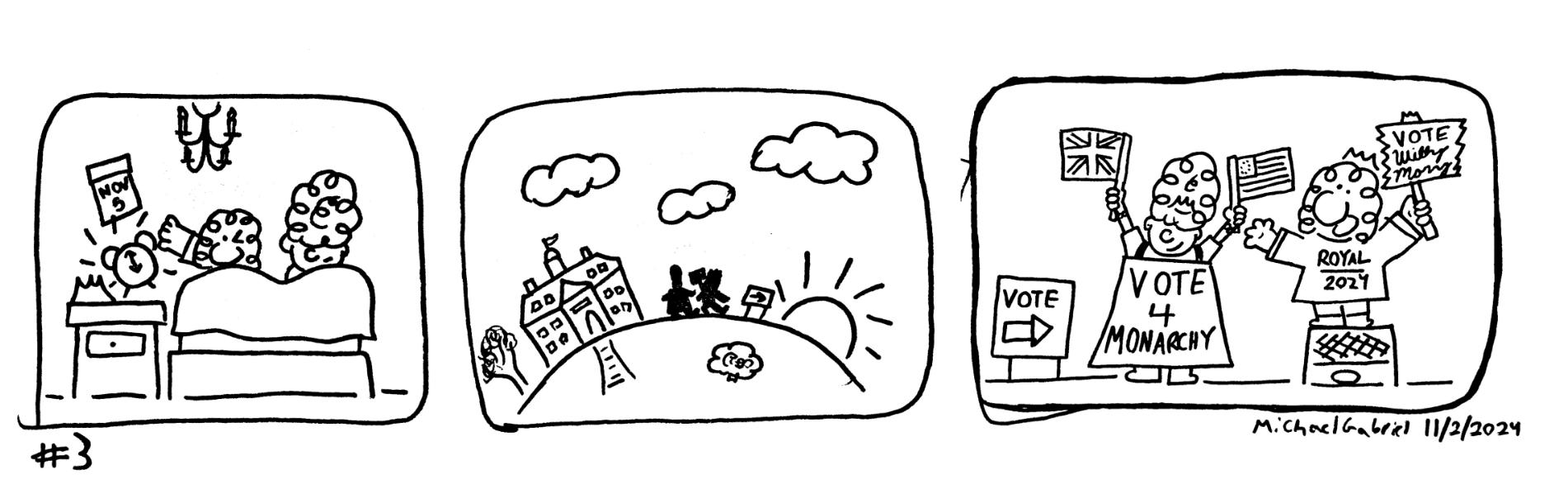
Willy and Mary #3
visit regularly. Language barriers can also arise between immigrant women and U.S. healthcare providers. These language barriers significantly impact access to quality healthcare, as it is challenging to receive comparable care when unable to communicate efficiently. In one specific study, Portuguese immigrants were asked about the language barrier in healthcare and were quoted as saying “It’s not the same as communicating in your language. So, sometimes you are not sure you understood everything.” These problems can be in part solved by institutional changes that provide funding for translators in medical settings. Funding for translators would not only mitigate the language barrier, but it would also increase trust in the healthcare system because patients are more likely to trust healthcare workers when a professional translator is present.
These alarming disparities in maternal health care, detailed through socioeconomic hardships, cultural barriers and alarming neglect at border camps, make the upcoming election a critical juncture for lawmakers. This is because, with an upcoming election, legislation can be enacted to help decrease the severity of this problem by expanding pre and postnatal care. For example, new legislation which modifies the 2002 Children's Health Insurance Policy unborn child ruling and allows for an expansion of care could provide crucial aid to immigrant populations. Legislation at the state level could also have meaningful impacts on maternal health, such as legislation in the state of Texas. Texas is a poor performer in maternal health metrics, and therefore legislation expanding child care, like the Texas House Bill 12(H.B), which relates to the duration of services provided under Medicaid, could have very positive effects on maternal health outcomes. Along with this legislation that addresses the healthcare barrier, having trained translators would help decrease cultural distrust, as proper communication would increase satisfaction rates, leading to more visitations, and aid the rates of women attaining pre and postnatal care. If proper legislation is enacted, the entire country could benefit due to the economic ripple effects, such as increased workforces and decreased healthcare costs. This makes the upcoming election even more crucial, because the right candidate will recognize these issues and address them when elected. All of this culminates in a very important upcoming period of legislation, which if treated seriously, these women can get the help they deserve and relief from the socioeconomic and cultural barriers that currently exist in healthcare.
PabloTroop’26isapre-medkinesiology major with a minor in chem. He is a member of Sigma Pi fraternity. Contact himatptroop@wm.edu
Julius Nyerere Odhiambo is a kinesiology professor at the College of William andMary.Contacthimatjnodhiambo@ wm.edu.
STAFF COLUMN
Election Day behind screens
As election day looms closer, the atmosphere in the United States feels charged, almost electric — yet distinctly unnerving. Living overseas, I spent years observing the chaos of election cycles through the lens of morning news, podcasts and social media; however, I never fully grasped the palpable tension until I found myself living here during this critical time. The hype, the outrage, the celebrity endorsements — it all seemed like a distant spectacle until I became a participant in this high-stakes drama. In these final days leading up to the election, the weight of anticipation feels suffocating. Conversations become fraught with unspoken rules. Among friends, family and colleagues, there’s an unspoken agreement to tread lightly around political discussions. We’ve all witnessed how quickly dialogue can spiral into heated arguments. It’s as if we’re all tiptoeing through a minefield, anxious to avoid triggering explosive reactions.
But the irony is striking: while we shy away from expressing our beliefs face-to-face, our online personas tell a different story. Social media platforms become arenas for unfiltered opinions, where individuals feel empowered to voice their political leanings without the constraints of real-world interactions. Behind screens, people share passionate posts, memes and articles that reflect their true sentiments, often with little regard for the potential fallout in their actual lives.
This dichotomy highlights a broader societal issue: the increasing polarization that defines our political landscape. It seems we are more comfortable shouting our opinions into the void of cyberspace than engaging in meaningful discourse with those around us. The anonymity of the internet allows for a certain freedom, but it also fosters a culture of division, where understanding and nuance are sacrificed
for the sake of partisanship.
As we navigate this tumultuous period, it’s essential that we recognize the toll constant exposure to electionrelated chaos can take on our mental health. The barrage of headlines, celebrity endorsements and polarizing social media posts can feel overwhelming. Stress and anxiety bubble up as we watch the country grapple with issues that affect us all — issues that often seem overshadowed by the spectacle of the election itself. In this tense atmosphere, we must remind ourselves of the value of open dialogue. While avoiding contentious topics may seem like the safest route, it ultimately stifles the opportunity for connection and understanding. We must strive to create spaces where we can engage with differing perspectives without fear of reprisal. Yes, it’s difficult. Yes, it may lead to uncomfortable conversations. But it’s in those moments of vulnerability that we can foster empathy and bridge the divides that seem to grow wider with each election cycle. You should still post, tweet and share your opinions because it’s still important to express your opinion. But we should talk about them too — without having to engage in a screaming match or shed a tear of frustration.
As the countdown to election day continues, let us take a deep breath. Instead of retreating into our corners — hiding behind our screens and personal beliefs — let’s challenge ourselves to engage in real conversations. It’s time to step out of the shadows of social media and into the light of dialogue, where we can express our views while still being open to the perspectives of others. After all, democracy thrives not just on our right to vote, but on our ability to listen, learn and grow together, even in the midst of chaos.
IsabellaMcNutt’27isagovernment and history double major, and she is a memberofAlphaChiOmega.Sheloves traveling,readingandmusic.Emailher atimmcnutt@wm.edu.
FLAT HAT OPINIONS ASSOC.
Isabella McNutt
GRAPHIC BY EMNET ABRAHAM / THE FLAT HAT
THE FLAT HAT
Pablo Troop and Julius Nyerere Odhiambo COURTESY IMAGE / WIKIMEDIA COMMONS
COMIC BY MICHAEL GABRIEL / THE FLAT HAT
Double meaning of “SA”
Nina Argel THE FLAT HAT
Our generation thrives on acronyms. As kids who grew up with technology and social media, these shortcuts are everywhere, simplifying and adding personality to our everyday language. But at the College of William and Mary specifically, we seem to love acronyms. From the ISC to LDOC, learning the abbreviated campus lingo is practically a rite of passage. While acronyms are convenient, they can also be misinterpreted when there are other meanings associated with the same acronym — some of which can be triggering for certain people.
This brings me to one of the campus’s most prominent acronyms: “SA.” For most, it’s short for “Student Assembly,” but this acronym is easily associated with “sexual assault.” This double meaning is one that I’ve come to experience misinterpreted firsthand. First, as a new student wondering what the “SA” logos stood for, and now as a Student Assembly senator. While I’m proud to be a part of SA, I can’t help but feel that this acronym could use a rebrand.
Like most first-years, I was unaware of all of the College’s student-body-specific lingo when I first arrived on campus. I didn’t even know that “the Commons” was actually called Caf, and I had no idea what “PBK” was. So while thrown into the absolute chaos that was Orientation — disoriented by both fatigue from the sudden influx of daily steps, as well as the obscenely high temperatures that week — I was caught off guard by the big green and gold “SA” logo I saw everywhere. I remember thinking, “Is that about sexual assault or some Title IX thing?” Like I said, it could’ve been the fatigue or the heat skewing my interpretation of that logo, but the fact that I thought the same thing at every club fair or occasional encounter with the logo seemed kind of concerning. If I thought this every time I saw the acronym, how many members of the student body associated “SA” with the meaning of “sexual assault” instead of the College specific meaning “Student Assembly?”
Of course, I eventually learned that it stood for “Student Assembly,” which is incredibly ironic because I have just recently joined it. I absolutely love serving as a senator — getting the hang of making changes and how the College works as a whole — but one specific change that I would love to see is the changing of this acronym. “SA” became more widely known as an abbreviation for sexual assault fairly recently, largely through the increased reinforcement of this meaning via social media and the internet. This was especially seen on platforms such as Instagram and TikTok, where creators began to use this acronym while discussing personal experiences and awareness.
According to Psychology Today, social media has made an impact on how Generation Z communicates. From the common brevity of content to the quick efficiency of a direct-message, it’s obvious that our generation enjoys speedines, which is why the colloquial nature of abbreviations makes sense. And with the internet acting as an epicenter for ideas, the spread of an idea — like sexual assault’s association with “SA” — can easily continue to reach larger audiences and establish meanings.
Specifically in the Class of 2028, I have seen the constant connection made between sexual assault and the acronym “SA.” Turns out, lots of my peers have the same assumptions about the same letters. Especially during the first month of school, I would come across conversations that both sounded like a broken record and a reflection of my own thoughts. “Is ‘SA’ about sexual assault?”
After joining Student Assembly, the conversations about “SA” proliferated, but under different circumstances; now, I was receiving concerns as a senator, not only as a listening friend. The shift to receiving concerns as a Senator highlighted just how pervasive this shared misunderstanding has become. What began as a passing association in students’ minds became a recurring conversation — one that made me think deeper about campus culture and problems that go unspoken.
The association between “SA” and “Student Assembly” might seem minor to some, but it can trigger many, especially sexual assault victims. On a campus where students and staff work to foster a supportive, welcoming environment, I believe that it’s important to make sure that everyone feels safe — even if it comes down to acronyms. Addressing this student concern, no matter how small it may appear, isn’t just a value I hold as Senator, but also as a member of the William & Mary student body, and I would love to see the change.
“I’m a senior and senioritis is already kicking in, how do I deal with it?” Right now, you’re probably wondering why there is a comma separating the two independent clauses in that question instead of a semicolon, dash or a comma-conjunction pair. ‘Adam made a punctuation error? But in the past his handle of punctuation conventions had always been impeccable! Sure, his pieces were poorly organized and generally all over the place, but he had always possessed a truly awe-inspiring command of the structural machinery undergirding the English language. I always looked forward to reading his Apple to come face-to-face with bold yet tasteful (also sometimes described as entertaining yet edifying or original yet timeless) applications of the period, comma and their many quirky friends! Without that, why would I read this stuff? Without that, where will I turn?’ Fear not! The grave error was not my decision. You see, that is how the question was submitted. Word for word. Character for character. My first instinct upon reading it was simply to ignore it, because it was likely submitted as a cruel practical joke; someone had likely sent it in on a dare or something, knowing the breaking of such a fundamental and easy-to-get-right rule would make my blood boil. My second instinct, upon reluctantly conceding that beneath the travesty of the prose was a truly valuable question, was to put it in the article with a correction (e.g. semicolon in for comma) imposed. That way I wouldn’t need to waste so much space (this) talking about the small comma-shaped elephant in the room. However, I am a journalist, and I take my job very seriously. To alter the question in any way would be a disgusting overstep, killing the sacred bond of trust that presently connects us all. So, the question is to be left unadulterated.
STAFF COLUMN
Instead of viewing that as a regrettable circumstance — a state of being to which we must quietly resign ourselves amid a halfhearted reference to tied hands — I choose to view it as an opportunity. A learning experience for the young man who made the mistake. As you all know, I normally keep the identity of those asking the questions a secret here at Adam’s Apple to promote open dialogue without fear of retribution or embarrassment for the inquisitors. However, in this case I feel that the lesson can be more effectively communicated to the young man if he feels, for lack of a better phrase, called out. Without the pang of shame that accompanies him reading his own name in the next paragraph, without the rush of blood right now preparing its voyage to his cheeks, how could we guarantee that his behavior would change? Without revealing his identity to that majority of my readership whose writing does serve as compelling evidence that they at one point attended a middle school, how will you be able to help me hold him accountable to his sins?
His name is William Eisen, though he goes by the nickname “Will.” Whether he goes by this nickname because he is not able to spell his actual name is something about which we can only speculate. To those who know him, you may be shocked and disappointed to learn about this side of him; isn’t he the brilliant Monroe Scholar applying to chemistry PhD programs? I’m truly sorry to have to break the news of his near illiteracy like this. All I ask is that the next time you see him, you politely but firmly explain that his words have the potential to effect great changes in our society, but only if they are comprehensible.
If you do not know him, know that you know many like him. Maybe it isn’t a clause-separating issue for the Wills in your life so much as a dangling-participle issue. Maybe it is a subject-verb agreement issue. Heck, even I have been known to egregiously split an infinitive now and again. My point is that we all can do more to encourage each other and ourselves to better uphold the grammatical principles which serve as the lifeblood of effective communication. Will simply has more to do than most. Much more.
Lest you think that Will’s habits have no effect on your life, I would like to call to mind a recent troubling trend. When Will came to this campus in the Fall of 2021, the College of William and Mary was somewhere in the 30s on the US News and World Report national universities ranking. After three-plus years of his poor grammar, we are now tied for 54. Is it because he has made us all dumber? Is it because he unknowingly had a conversation with someone on the ranking committee who left said conversation with a poor impression of the College? I don’t know. I’ve taken enough stats to know that technically correlation isn’t causation, but golly gee this one is tough to explain away.
The College has had a strong academic reputation for the last 331 years, and we cannot let Will single-handedly ruin that.
Biking: An underrated option, but in need of improvement
“I’ll beat the brakes off you!” shouted the man driving the gray Subaru. Seconds before, he had gone straight through the stop sign at the corner of South Boundary and Francis Street, causing me to slam on my bike’s brakes and skid to a stop in front of his car. That he had come within feet of hitting me didn’t matter: He was furious that I had dared to shout at him for his reckless driving.
I’m leading with this anecdote (from just a few weeks ago) not because it’s emblematic of my experiences biking in Williamsburg, but because it was so atypical. For the most part, my daily bike rides to campus are one of the highlights of my day. They provide me with time to reflect before class, help me to appreciate the town’s beautiful scenery and architecture, and most importantly, allow me to avoid a long walk. However, there are some negative aspects of this biking experience, which not only dampen my enjoyment of it, but also place me and my fellow cyclists in danger.
The primary downside of biking around campus is the local bike lanes, which may be surprising: After all, Williamsburg has relatively decent bike infrastructure, sporting a Bronze rating from the American League of Cyclists. However, these lanes are largely unprotected, meaning that cars are a constant threat. Additionally, on many streets, especially Richmond Road, the lanes double as parking spots, meaning that they are fre -
quently filled with parked cars — often illegally. In other areas around campus, bike lanes are often blocked by school maintenance vehicles and tour buses, or by cars edging out into the street (especially at the blind corner on James Blair Hall). All of this means that bicyclists are forced to move in and out of the road, which is extremely dangerous in and of itself, eliciting a consistent complaint from drivers.
Friends who bike tell me theyʼve been honked at, cut off and in one case, even been run off the road.
The other major issue is the attitude which I invoked at the beginning of this piece: a lack of respect for biking. While my own anecdote is quite negative, I believe that it’s representative of a larger problem. Friends who bike tell me they’ve been honked at, cut off and in one case, even been run off the road. To be clear, the vast majority of drivers here are courteous, respectful and safe; I can’t count the
number of times I’ve been waved on by a friendly face. However, those drivers who are hostile to cyclists are a very real danger and one that must be addressed. There are relatively simple fixes for many of these issues. For example, if the school clarified its parking rules for maintenance vans, or if the city enforced parking restrictions more strictly, we would see many fewer blocked bike lanes. Other issues would require infrastructural investment, including the implementation of different parking rules and protected bike lanes. Still other issues, including anti-bike sentiment from drivers and bad biking practices from cyclists, require strengthened education, which organizations such as the College of William and Mary’s Bike Alliance and the town’s many bike clubs seek to provide. For these positive changes to happen, however, those of us who bike will need to take accountability. It isn’t fair to ask for widespread reforms to the laws of the road while refusing to adhere to them. Biking on sidewalks or the wrong way in bike lanes is not only antisocial, but it is actually more dangerous than biking on the road, according to the Bike Alliance. Similarly, speeding through Sadler Terrace is unlikely to win bikers any friends on campus. However, I believe that these issues can be improved either through better infrastructure (in the case of the first two) or through education (in the case of the latter).
Biking is a relatively safe, convenient method of transportation on and around campus; it is one I intend to continue utilizing, and one which is growing in popularity as more students adopt it as a means of getting to class. However, that does not mean it is perfect; as demonstrated above, biking around campus has significant drawbacks, but they are very much solvable. I hope that those with the ability to do so — student leaders, school administration and the city of Williamsburg — will recognize the area’s potential to transform from an above-average biking community into a spectacular one.
Damien Kanner-Bitetti ’25 is an EnglishmajorandAmericanstudies minorfromArlington,VA.Inadditionto the Flat Hat, he is a member of Club B Soccer, Jewish Voice for Peace, a librarian for the Meridian Coffeehouse and a DJ for WCWM. Email him at dskannerbitett@wm.edu.
Damian Kanner-Bitetti FLAT HAT OPINIONS ASSOC.
Adam Jutt FLAT HAT OPINIONS ASSOC.
GRAPHIC BY CATHERINE STORKE / THE FLAT HAT
GRAPHIC BY CATHERINE STORKE / THE FLAT HAT
GRAPHIC BY CATHERINE STORKE / THE FLAT HAT
Im-paw-sibly Fun
AMP hosts Puppies & Pumpkins event with furry friends, games on the Sunken Garden, helps students destress
Friday,
to find some time to decompress after midterms season.
The event was hosted in collaboration with the Heritage Humane Society, a Williamsburg based non-profit whose stated mission is to serve as compassionate stewards of animals that are in transition from being strays or being surrendered to being given forever homes.
The Puppies & Pumpkins event was specifically organized by AMP’s Special Events Committee, a group in charge of bringing new and never-before-seen events to the College. AMP Special Events Committee Chair Hailey Fisher ’27 shared the inspiration behind the day’s theme, noting that the committee’s intention was to merge festive fall elements with something new and exciting.
“Our goal as a committee was to have something that was fall themed and festive, but also a little bit stress relieving at the end of the week — something that people could walk onto Sunken and just pop in to enjoy,” Fisher said. “I love that we get to see students enjoy all different types of events.”
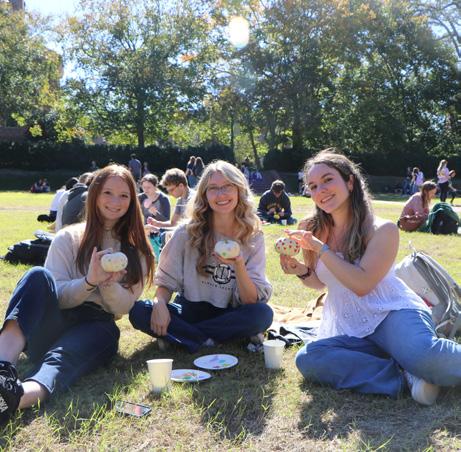
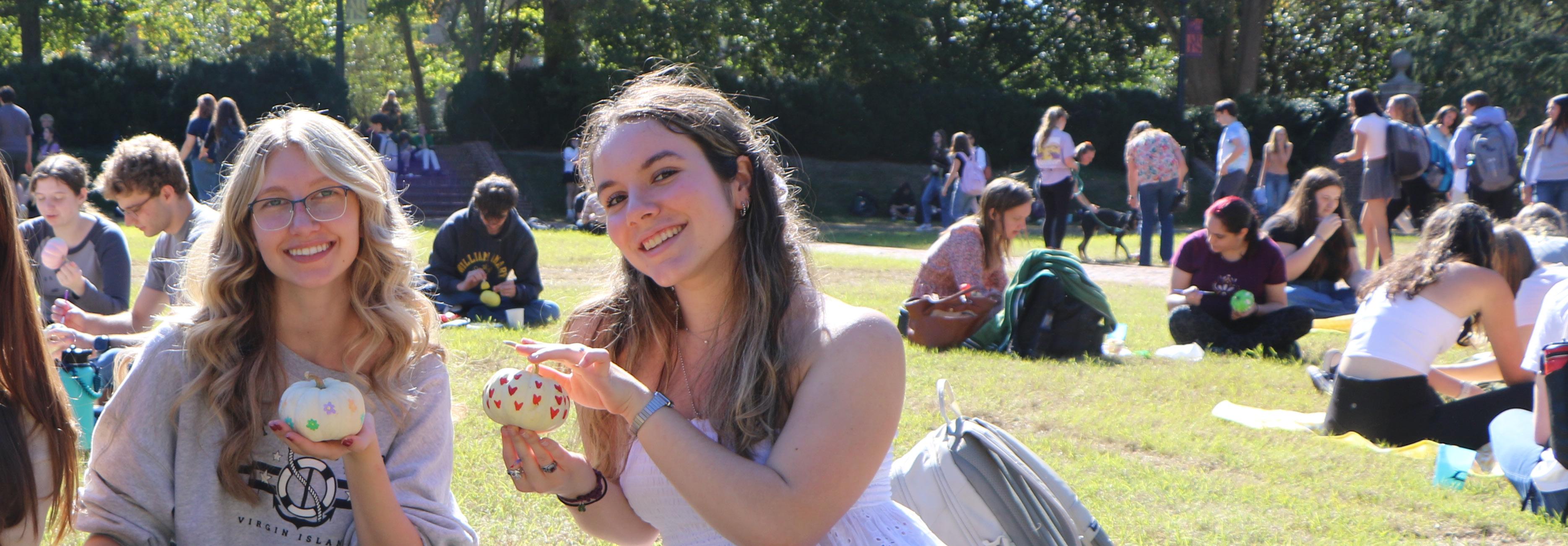
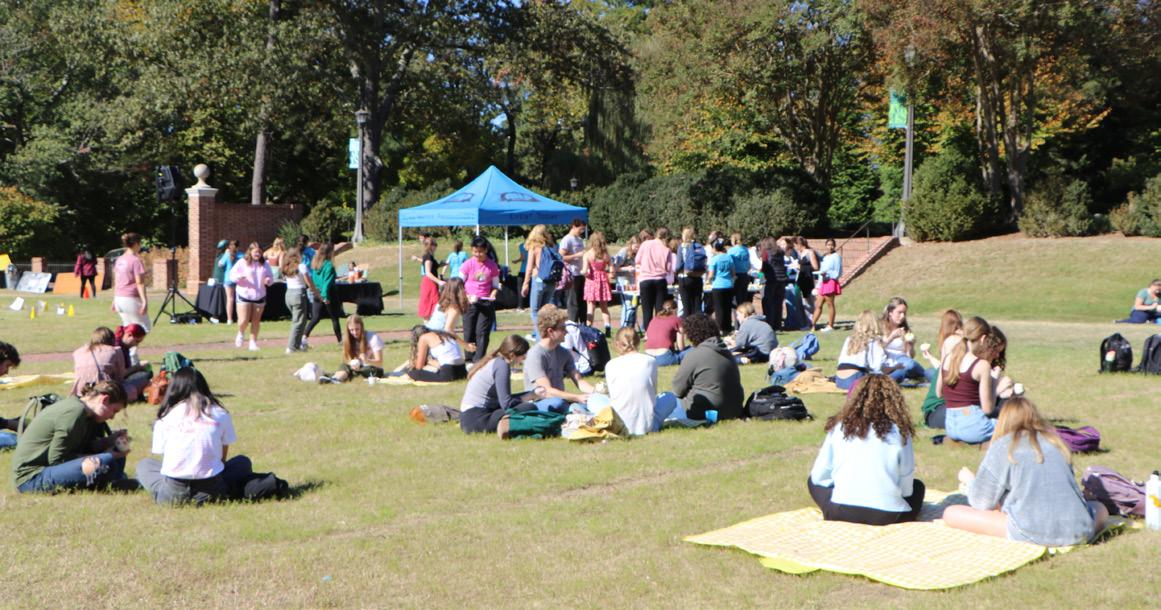
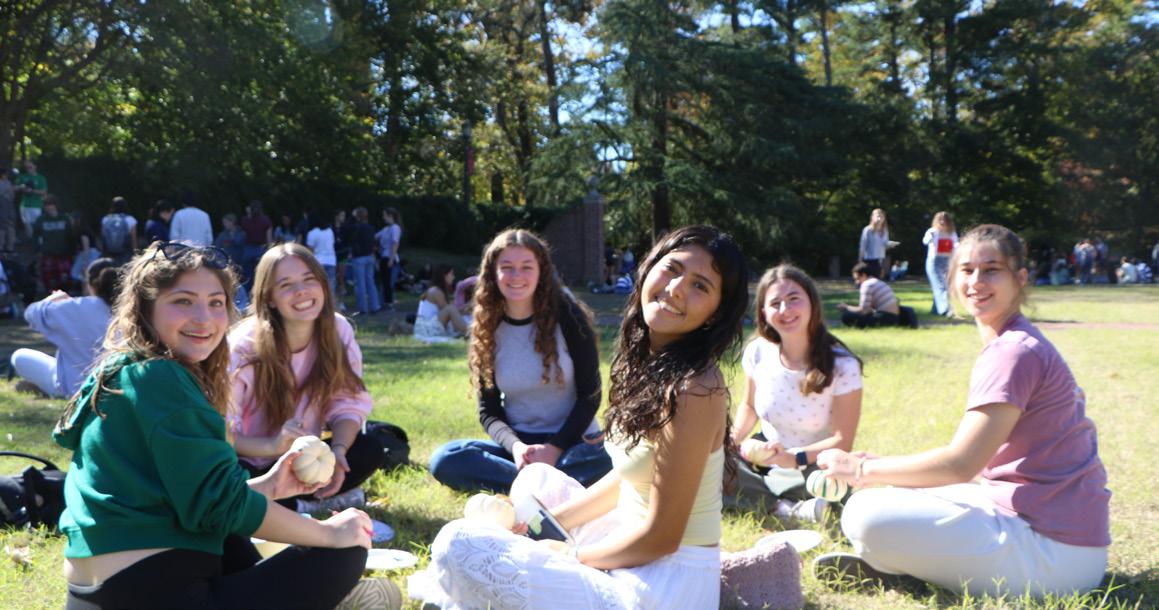
All across the Sunken Garden, students gathered on picnic blankets with their friends and peers to enjoy an afternoon of pumpkin painting. AMP supplied attendees with a wide selection of pumpkins and art supplies, like a rainbow of paints and an assortment of brushes, for them to decorate. Participants decorated their pumpkins with a variety of designs, with some opting for small Halloween-themed cartoons and motifs and others decorating their pumpkins with images that reflected their own personalities.
Many students participated in the cake walks, or competitions often involving dancing where the winner is given a cake as a prize. This took place throughout the entirety of the event, and it included various desserts and sweet treats like cookies, pumpkin pies and other cakes which were spread on display for students to compete for. Music flowed through the air, leading students to dance and play with their friends all throughout the afternoon.
En
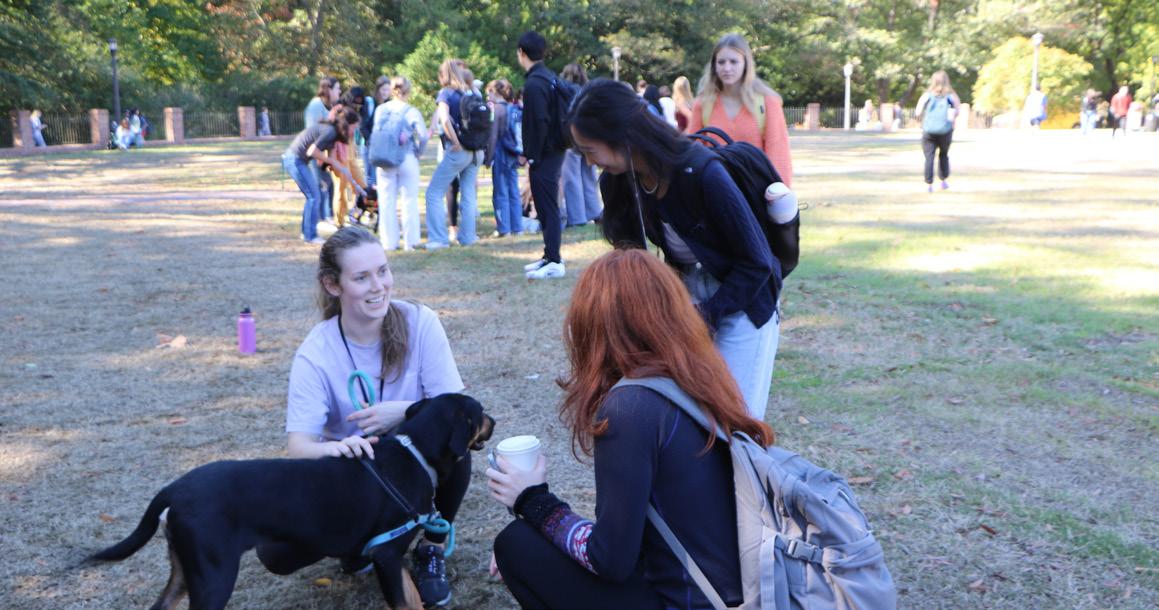
According to many attendees, however, the real stars of the show were the variety of dogs playfully running around, including the well-known corgis that pay weekly visits to the College’s Earl Gregg Swem Library. Border Collies dashed across the area, while sleepy labradors welcomed the affection of excited students. Several of the puppies were also dressed in Halloween costumes.
One little dachshund named Max, sporting a College cypher collar, quickly became a crowd favorite. His owners designed personalized matching graphic T-shirts with photographs of him, adding a touch that students expressed as memorable. But for many at the event, Max wasn’t the only dog who made it so enjoyable.
“I really liked all the puppies,” attendee Sunny Kuregov ’28 said. “I thought it was really cute and it made me smile a lot.”
Many participants expressed that they felt the event was more than just a fun afternoon — it was a way to relax and support their own mental health during a time of high academic pressure. Kuregov spoke to how the event made her feel, following her first busy midterm season at the College.
“I’ve been spending a lot of time, even just earlier today, thinking about my midterms and studying for them,” Kuregov said. “It was just a really nice opportunity to get out in the sunshine and take a break.”
Kuregov additionally reflected on how she feels that events like the Puppies & Pumpkins event impact the greater student body.
“I think they’re really great for boosting morale around campus,” Kuregov said. “I think that I would definitely attend more of them, because it got us out of the routine of just class and dorm. It was a good opportunity to meet people and have fun and take a break.”
Attendee Nina Olshansky ’28 reflected on the effects she felt these AMP community events have on the College community as a whole.
“I really like when there’s lots of things to do on campus, because it makes campus feel bigger and more full of life,” Olshansky said. “I think they’re one of the best things campus has to offer.”
Altogether, the event was deemed a success by both attendees and those who organized it, with several attendees confirming their excitement and willingness to attend similar events in the future.
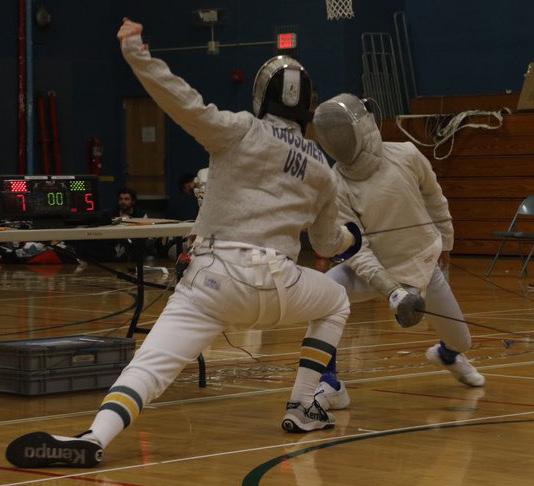
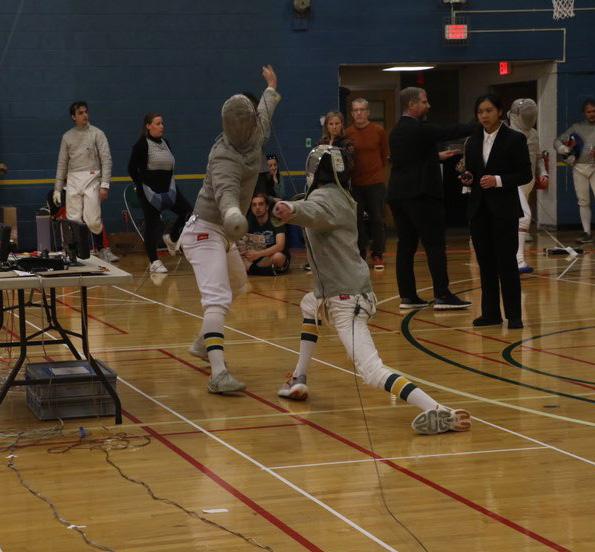
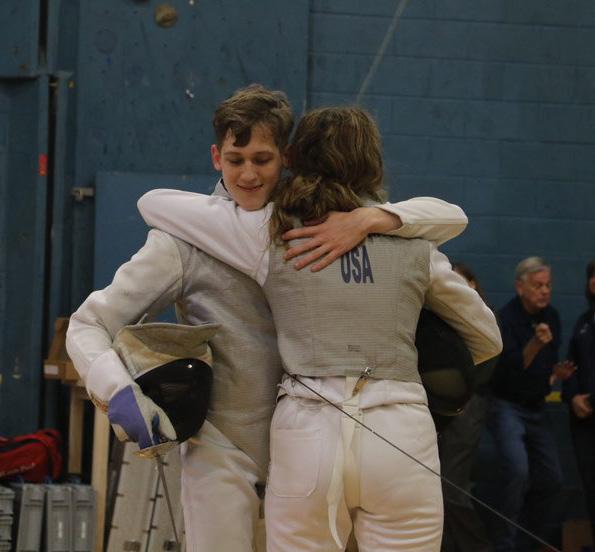
The College of William and Mary is one of the oldest universities in the nation, so it seems only fitting that the College’s clubs have histories almost as long and complex as that of the school itself. The College’s Fencing Club was first established in 1924, making it one of the oldest club sports on campus. Since the club’s founding, members have participated in several competitions across the four collegiate leagues they take part in.
The club practices every day in Unity Hall from 3 p.m. to 6 p.m. and invites all students, regardless of their experience with fencing, to participate in practices and competitions.
Fencing Club President Debbie Ho ’26 first joined the club as a freshman, and now that she is a member of the club’s executive board, she hopes to see growth not only in the club, but in the sport of fencing as a whole.
“We are the most consistently active fencing club in Virginia, and one of our goals is to keep this momentum going and keep the fencing community in Virginia thriving,” Ho said.
As mentioned, the team’s fencers compete in four different collegiate leagues: the Mid-Atlantic Collegiate Fencing Association, the Southern Intercollegiate Fencing Association, the National Intercollegiate Women’s Fencing Association and the United States Association of Collegiate Fencing Clubs. This year, the women’s team is looking to defend its SIFA title, and the team as a whole is going out to defend its titles in NIWFA and USACFC.
The club also attends different tournaments throughout the year, including the Virginia Cup Tournament, where the club has been the reigning champion for the last 10 years. The tournament is held every spring and allows different Virginia colleges, including University of Virginia, James Madison University, George Mason University, Virginia Tech, Liberty University and more, to fence against one another in a large-scale competition.
It is involvement like this that initially gained the club a reputation among fencers nationwide, and it is one of the things
that drew new member Ash Kelley ’28 to the College in the first place. Kelley had 12 years of fencing experience before coming to the College, and she decided to continue her commitment to the sport with the Fencing Club.
“The fencing club that I went to before I came to William and Mary had a lot of people who came here and then joined the fencing club here,” Kelley said. “I heard about the club through them, and that was actually part of the reason that I came here, because I knew that there was a fencing program here large enough that people hundreds of miles away had heard of it.”
The team’s reputation is an important aspect of the club, and it is something its members work to maintain. Ultimately, however, the executive board’s main goal this year is to create a welcoming environment where members can continue to learn and practice the sport while also meeting new people and making friends.
“As a member of exec, I hope to give members of the fencing club as many opportunities to fence and improve their skills as possible, and create a safe and welcoming environment where everyone from beginners to experienced fencers can enjoy the sport together,” Ho said.
Practices are directed by co-captains Connor Cassidy ’25 and Nolan Coughlin ’25, who lead members through warm ups, conditioning and footwork drills. Following this, fencers break into groups according to their fencing weapon — either foil, épée or sabre — and are then led by different specific weapon coaches.
“Since I’ve joined the club here, I switched weapons from épée to sabre and basically changed the whole way I invested myself in the sport,” club social chair Elizabeth Lawless ’27 said. “Changing weapons was like starting from scratch, but due to the support of my teammates, I’ve learned so much, and I’m always ready to improve myself more.”
Spending three hours a day, five days a week practicing together allows members of the club to get to know each other well, but on top of this, the club also hosts events outside of practice. As the social chair for the organization, Lawless helps
plan such events throughout the season.
“Being on the fencing team has really shaped my experience at William and Mary; I’ve made my closest friends here, and I’ve truly found my community with this club,” Lawless said.
“It’s made my time here a really happy one, and I’m excited to continue that as I continue my education here.”
Members’ favorite events throughout the year include the beginning-of-year picnic, which welcomes new members to the team and allows all members to share stories and get to know each other. There is also the club’s formal, secret Santa during Christmas time and the team’s own version of Friendsgiving: Flicksgiving.
As well as hosting fun events, the team also has several longstanding traditions to honor different past-members of the team. After every practice, the team has dinner together, a custom which was started after the passing of coach Pete Conomikes and member Benjamin Gutenbergin in 2007. Another club tradition is, prior to the team’s annual Troy Cullen Memorial Halloween Open Tournament, watching Cullen’s favorite movie, “Who Killed Captain Alex,” in remembrance of member Troy Cullen, who passed away in 2022.
“There are so many amazing people, and I don’t know how many of them I ever would have found without this, because there’s such a wide range of people in the club, but it brings everyone together by giving us one thing we can all relate to,” Kelley said. “We’re all together, and we all get to know each other, and there are so many wonderful traditions.”
When Ho first came to the College, she found a community within the Fencing Club, and she, along with the other members of the executive board, hopes to continue leading a space that promotes healthy competition,
“The
KYLIE TOTTEN // THE FLAT HAT
Oct. 25, Alma Mater Productions invited students at the College of William and Mary to unwind and rejuvenate with pumpkin painting, puppy petting and a cake walk on the Sunken Garden. This event, aptly named “Puppies & Pumpkins,” encouraged students across the College
ROBIN PURDUE // THE FLAT HAT
NEW LEAF, NEW PAGE
Fallen Acorn Bookshop replaces Mermaid Books in Colonial Williamsburg
A short walk of the campus of the College of William and Mary, tucked away in Colonial Williamsburg down an unassuming brick staircase under the Kilwins Chocolate, Fudge, and Ice Cream Shop, is a long-vacant storefront that has just reopened for a new business: Te Fallen Acorn Bookshop. Te new bookstore opened Sept. 18, and according to owner Shea Cintron, is proud to be the only independently owned seller of new books in the Williamsburg area.
Hailing from Jacksonville, Florida, Cintron previously worked as a midwife and owned a birth center and home birth practice. She and her family relocated to Williamsburg in 2020 when her daughter, stationed at nearby Langley Air Force Base in Hampton, had her frst child. Although originally intending to open another birth center in Virginia, Cintron instead made a long-term dream of hers a reality.
“I had a midwife partner, and her and I, when we retired — we’re both readers — we always made jokes that we were going to open a bookstore, and they’re not going to wake us up at night when we’re tired and grumpy,” Cintron said.
Te Fallen Acorn’s location previously housed Mermaid Books, another local bookstore which closed its doors in 2020. Te space, located on Prince George Street alongside quintessential Williamsburg staples such as Aromas and Te Peanut Shop of Williamsburg, remained available for lease until Cintron expressed interest earlier this year. Cintron commented on her experience operating in this unique location.
“Some people walk down like, ‘We were intrigued that there’s these stairs, we weren’t sure what we were going to open the door to,’” Cintron said. “Other people know Mermaid Books, and it’s funny, those people, I’m getting mixed reactions from them. Some people want it to be Mermaid and it’s not. It’s very diferent.”
Such diferences include the store’s stock: Mermaid Books ofered a selection of used books, while Te Fallen Acorn instead works to sell new ones. Cintron also described the comprehensive physical renovations the space underwent in the process of opening her business, which included ripping out large, old book-holding cubbies, replacing asbestos foors with tile and adding an AC system.
Shoppers at The Fallen Acorn now open its lower-level door to teal-painted walls and bookshelves and black-and-white patterned floors. Behind the wooden checkout counter is a
painted mural featuring leaves, acorns and the shop’s name. Tis name draws inspiration from Miriam Young’s “Miss Suzy,” a picture book from Cintron’s childhood that follows a squirrel and features acorn illustrations.
Cintron is a mother of fve, and her husband is the owner of a landscaping business. So far, the shop has mainly been run by herself, along with her family and her son’s girlfriend. Regardless, Cintron described the comparatively lower stress of running this business in light of her previous career.
“You’re 24/7 when you’re taking care of pregnant women and babies, and then you’re up sometimes two or three times in a row at night,” Cintron said. “So, this is chill, I’ve got this.”
Nonetheless, learning the unique skill set of bookselling was daunting for Cintron, and it involved plenty of research and online courses on bookstore operation. She specifcally noted the risk associated with the high cost of buying books from suppliers, coupled with uncertainty as to which volumes will sell, as an intimidating challenge.
“Tat wasn’t something I’ve ever done except buy books for myself,” Cintron said. “Buying for other people is very diferent, and then going into genres that I might not necessarily read and hoping people want to read what I picked, there’s a learning curve in that.”
To connect with the Williamsburg community, Cintron has prioritized spotlighting local authors such as Sara Raasch, who signed copies of her books at the shop, which now are featured in a dedicated display. Cintron hopes to host live author events in the future, as well as form book clubs to expand the store’s community.
Meanwhile, Williamsburg’s small-town environment and other local businesses have already begun to embrace Te Fallen Acorn. Cintron described a regular customer who works at the nearby Merchants Square Wine Bar expressing her love for the store and encouraging patrons to stop by. She named this as one of her favorite enthusiastic customer interactions.
“You can really see real readers when they come in, because they’re just really excited, and they stay, and they talk and they want to talk to me about books,” Cintron said.
Along with word of mouth, foot trafc brings many customers into Te Fallen Acorn. Sofa Valle ’25 came upon the shop incidentally
through a sign posted outside Kilwins, which she observed a few times before her curiosity got the best of her.
“I’ve seen the sign to come downstairs and I was like, ‘Okay, the stairs seem intimidating,’” Valle said. “I couldn’t imagine there’s such a quaint little corner in here. It’s lovely.”
Catherine Kaufman, a Virginia Beach resident, was visiting Williamsburg with family when she was likewise drawn down the stairs by her love for bookstores. Kaufman browsed the mystery section and had picked out a copy of “Te Scarlet Letter.”
“I like the little sections of the creepy stuf and the classics,” Kaufman said. “Having diferent versions of the classics in pretty covers is nice.” Kaufman and Valle both praised the cute, quaint atmosphere of the shop. Valle did note the limitations associated with the store’s small size, however, specifcally expressing her desire for a larger classics section.
“It is a little limited in its variety, but I really appreciate that they make an efort to display beautiful books. It is something that attracts people in, very clearly,” Valle said.
As a student at the College with easy access to the location, Valle said she could see herself stopping by more often in the future.
“I think that it is an incredible escape from campus, something completely diferent from the experience that Swem provides,” Valle said.
With the unique demographics of Williamsburg, given Williamsburg’s role as both a college town and a tourist destination, Te Fallen Acorn indeed sees a wide range of customers. Cintron observed the shop is busier with tourists on weekends, while it sees more students and locals on weekdays. Ultimately, Cintron hopes to welcome all potential clientele and learn to adapt to customer interests as she goes.
“I hope to build a community of readers — because readers are my people — and a place that people feel safe and people see themselves seen in the characters and the writers,” Cintron said.
Te Fallen Acorn is open six days a week, being closed on Monday. It is open on Tuesday through Friday from 11 a.m. to 7 p.m., Saturday from 9:30 a.m. to 7:00 p.m. and Sunday from 12 p.m. to 5 p.m. Interested readers can trek down the stairs at 421 Prince George Street or shop online at https://www.fallenacornbooks.com/.
LET’S GET PHILOSOPHICAL
ELLA GREENE // THE FLAT HAT Ethics
Whether they be casual or competitive, based on critical thinking or creativity, student clubs at the College of William and Mary are at the center of campus life. Te College’s Ethics Club blends these characteristics into a tight-knit community that loves to learn, think and debate together.
Te Ethics Club forms and prepares teams that compete at regional and eventually national competitions, debating cases on ethical grounds.
Tese competitions allow students to engage in conversations about difcult topics.
Despite their technically competitive nature, these competitions are not hinged on winning and losing. Instead, teams’ priorities are to have the strongest, most well-structured and well-presented arguments.
At the College, Ethics Club is a newcomer. It was founded in his freshman year by Bernardo Jimenez ’26, who enjoyed the club in high school.
“We came in ffth place in nationals my senior year of high school, so I’m not going to pretend I randomly found Ethics Bowl or something,”
Jimenez said. “I did it in high school, and there wasn’t a team here, so I just signed up, and I actually went to the frst virtual regional by myself and made it to nationals.”
Not wanting to compete at nationals alone, the following year Jimenez recruited another ethics enthusiast, Sam Roach ’25, after sharing a class together.
“We were in an ethics class together where the professor didn’t lecture, he just argued with the students,” Roach said. “He’d give a really divisive reading and
then he’d beat the entire class in an argument every day, and I would always fercely argue with him, so I guess Bernardo was like ‘Oh, this kid can argue.’”
Te two quickly established a strong partnership. Both being philosophy majors, the partners have a thorough understanding of philosophical ideas and are able to build on each other’s ideas quickly in competitions.
“I’ve never had a better chemistry with someone
impressive by the fact that most teams consist of upwards of fve members each and a faculty coach. However, Roach believes their unique team situation ultimately helps them out.
“We ofset it by understanding the Bowl well, and the dynamics of the Bowl, and by being more conversational in a way that makes us more appealing,” Roach said.
Te pair’s focus has since shifted towards growing the Ethics Club beyond their duo. Te frst step was getting the club established as a Recognized Student Organization at the College, which was their main
After information sessions and tryouts, the club rst three passionate new members this semester, who make up their own competitive team. New member Grifn Bennett-Nguyen ’28 was not expecting to be involved in an Ethics Club after not enjoying the intense competition of traditional
“I had no clue what to expect when I showed up, but Sam and Bernardo did a really great job of onboarding us and showing us how everything was rst couple of clubs and practices,” Bennett-Nguyen said.
A philosophy major is not a requirement to participate in Ethics Club; Jimenez and Roach believe that anyone can learn the skills eir new members refect this idea.
“I’m probably going to major in math or physics, so philosophy is kind of a complete aside for me, but getting to learn about the frameworks and applications has been pretty interesting,” Bennett-Nguyen said.
Jimenez and Roach are also excited about the diferent challenges that come with onboarding new members. Instead of just organizing and preparing for their own cases, they are learning how to coach a new team to success.
While other schools are often mentored by a faculty member, Jimenez and Roach have tried to use their position as peers to create a dynamic learning environment for their new members. Tey said this process involves using mock cases, which allows for constant feedback to new members while maintaining the collaborative, friendly atmosphere that makes the College’s Ethics Club special.
Tis feedback is as careful and nuanced as the arguments themselves; Jimenez and Roach carefully pick out details to help new members improve. Tey ofer encouragement and advice on how to transition between speakers during their presentations, address commentary or questions from opponents and maintain confdence and composure throughout.
Witnessing new members’ growth in confdence and public speaking skills makes Jimenez proud.
“It’s been nice to see them sort of come into their own, as they learn what we do, how to talk, how to formulate the cases and stuf like that,” Jimenez said.
Even though the environment is one of learning, Ethics Club also prioritizes a relaxed atmosphere for its members. Coaches and new members engage in discussion about cases while cracking jokes and building camaraderie.
Tis hard work has a focus: Building the confdence and skills of new members will allow them to apply their skills at the upcoming Mid Atlantic Regional Bowl. Because of the bowl’s structure, only one team from the College can advance to the national level, so the trio team of new members are prioritizing learning as much as they can from the experience so they know what to expect in the future.
“It’s kind of liberating, because there’s not much pressure on us. We just kind of want to go there and have some fun and see how we stack up against the competition since this is our frst competition,” Bennett-Nguyen said.
Even with the competition looming, it is not too late to join Ethics Club. Send in an email at ethicsclub@wm.edu if you’re interested in joining this tight-knit, collaborative group.
MEGAN RUDACILLE // FLAT HAT VARIETY EDITOR
GRAPHIC BY THOMAS SMITH / THE FLAT HAT
MEGAN RUDACILLE / THE FLAT HAT
sports
Green and Gold swept in weekend series against Hofstra
Hofstra came into Friday’s match as part of a four-way tie atop the CAA, averaging 17.55 points per set and 13.02 assists per set.
Friday, Nov. 1 and Saturday, Nov. 2, William and Mary women’s volleyball (8-15, 4-10 CAA) lost to Hofstra (15-8, 11-3 CAA) in a Coastal Athletic Association matchup at Kaplan Arena in Williamsburg, Va.
The Tribe entered the match off the back of a loss to North Carolina Wilmington, when senior setter Amy Schwem earned her 2000th career assist. Head coach Ryan Adams gifted Schwem a golden ball before Friday’s game. “She’s been around for a long time,” Adams said. “She’s been a pivotal part in us getting better over the years. So, it’s just a huge accomplishment and it’s exciting.”
The first set began with back-and-forth action. The Tribe led the Pride only twice in the set, once off a kill by sophomore opposite Katherine Arnason — who led the team in scoring on the day — to make the score 3-2. From there, however, the Tribe relinquished the lead. The Green and Gold kept a tight game with several emphatic plays, including a sprawling block by junior middle blocker Olivia Esposito to even the score at 10-10. Esposito added another booming kill to bring the scores within one at 12-11, though the Pride ended the game with relative ease, outscoring the Green and Gold 13-10 to take a 1-0 set lead.
The second set also gave the Pride some challenges. The Green and Gold jumped out to a quick 4-2 lead, spearheaded by a massive block by Arnason on the first play of the set. Afterward, it was another back-andforth battle, with the Tribe leading by two at 14-12 before Hofstra turned things around and grabbed a 20-16 lead. The Tribe evened things up at 21-21 off a wide-open kill by sophomore outside hitter Audrey Brcka. However, Hofstra pulled away for the final time to take set two at 25-22.
The final set of day one was all Hofstra. After another close start, the Pride quickly jumped to a 13-6 lead before a Tribe timeout. From there, the Tribe only mustered up another four points, with the Pride going on a ninepoint scoring run to end a disappointing day. Hofstra junior outside hitter Izadora Stedile led day one in scoring, earning a total of 12.5 points. Arnason led the home side with nine kills and two blocks. Schwem added another 14 assists to her tally. Hofstra outpaced the Tribe in almost every category, leading in kills at 50-31, service aces at 3-2 and set assists at 48-29. Both teams tied in blocks at 6.0 apiece.
Set one on Saturday kicked off with another close start. Sophomore middle blocker Amber Jarecki-Meyers earned her first kill of the season, and each side traded blows in a tight 10-10 opening. Brcka also recorded two aces early on, her first two of the year. The Tribe would then race to a 1813 lead off of multiple Hofstra errors before squandering the advantage and giving up seven straight points. This momentum swing proved pivotal for the Pride, and the visitors retained the lead for the rest of the set, triumphing at 25-21.
The following set saw much of the same, with both teams playing close before the Pride picked the Tribe apart. Led by a service ace from Hofstra freshman rightside hitter Constanza Perez Sain, the Pride backed the Green and Gold against a wall to end the second set, scoring another seven unanswered and cruising to a 25-15 win.
In the third and final set of the day, Hofstra took an early 2-0 lead and never looked back, powered by a six-point run. Perez Sain added one more kill to her impressive day on the final play, sealing the Tribe’s 25-18 defeat.
“I think we fought hard and well throughout the whole thing,” Adams said after Saturday’s loss. “They’re a good team, and they have a lot of strong attackers.”
Junior opposite Nicole Smith led the Tribe with 9 total points on day two, and Arnason picked up another 8.5. Brcka’s two aces proved to be the Tribe’s only two on the day. Schwem added another 14 assists, with senior setter Bella Easton tallying another 11 for the Green and Gold. Perez Sain paced the Pride in total points, earning 13.5, while Hoftstra senior setter Beatriz Alves earned 23 assists.
The Tribe once again trailed in team statistics, earning 31 kills to Hofstra’s 48, 27 digs to Hofstra’s 41 and two aces to Hofstra’s nine.
The Tribe looks to get back in the win column against Elon (5-22, 2-16 CAA)
“Every
Tribe ends 2024 on high note, beats Stony Brook 2-0 at home
Despite win, William and Mary fails to qualify for
Saturday, Nov. 2, William and Mary men’s soccer (5-10-1, 3-41 CAA) defeated Coastal Athletic Association rival Stony Brook (310-3, 0-6-2 CAA) 2-0 at Kenneth P. LaValle Stadium in Stony Brook, N.Y. Saturday’s win could not have come at a better time for the Green and Gold, who had gone 0-5-1 since its last win Sept. 28 against North Carolina Wilmington (5-84, 4-4 CAA). Despite its recent struggles, William and Mary wasted no time taking control of the Seawolves on its own turf. Less than two minutes into the first half, junior midfielder Diogo Branco fired off the first shot of the match at the Stony Brook goal. Despite missing high, the early aggressive play from Branco set the tone
for the Tribe offense for the rest of the match. In the next six minutes, William and Mary took two more shots, one courtesy of junior midfielder Webb Kosich and a second by Branco. After two unsuccessful shots from Stony Brook, Branco finally found the back of the net. Branco scored the Green and Gold’s first goal of the match in the 29th minute, thanks to an assist from freshman midfielder Thor Sigurjonsson. The goal marked Branco’s second of the season and second of his collegiate career. Sigurjonsson’s assist was also his second of his impressive freshman campaign, where he has started all 14 of the Tribe’s games this season.
The Green and Gold continued pushing forward as the first half came to a close but was unable
to scratch another goal across despite taking three more shots on the Seawolves’ goal. Looking to close the gap heading into the break, Stony Brook nearly tied the game in the 43rd minute, but a diving save from Tribe graduate student goalkeeper Cole McNally preserved the 1-0 William and Mary lead going into halftime. In the beginning of the second half, William and Mary took the defensive. Stony Brook rattled off two shots within 60 seconds of each other, but both failed to find the back of the Green and Gold net. Following an unsuccessful Seawolf corner, William and Mary turned to the offensive, quickly making its way up the field. After some crafty ball movement across the pitch, junior forward Sam Delgado
buried the Tribe’s second goal of the day, this time courtesy of a Branco assist. Delgado, a Rutgers transfer, has scored in five games during his first season with the Green and Gold. Despite both team’s offenses going cold in the last 30 minutes of Saturday’s match, both teams’ players were just heating up. In the 15 minutes following Delgado’s goal, the Tribe and the Seawolves committed three fouls each, as highlighted by a Stony Brook yellow card in the 69th minute. Following more missed shots from both teams, William and Mary picked up a yellow card of its own, courtesy of sophomore midfielder Alexandros Katsari-Hoefer in the 85th minute. With less than a minute left, Stony Brook graduate student midfielder Trevor Harrison received a red card and was thrown out of the match. Despite the physicality in the latter half of the second, William and Mary closed out its fifth shutout win of the season. The Tribe outmatched the Seawolves in nearly every aspect of the match, taking 14 shots compared to Stony Brook’s 11. The Green and Gold had two more corners and committed two fewer fouls. Despite an overall disappointing season, William and Mary ended its 2024 campaign on a high note. The Green and Gold finished eighth in the CAA, falling two places short to qualify for the CAA championships. With multiple starters returning next season and a new recruiting class on the way, there is no doubt that William and Mary
back better than ever next year.
Saturday, Nov. 9 and Sunday, Nov. 10 at Schar Center in Elon, N.C.
weekend is another opportunity to get better, so we’re just looking forward to competing,” Adams said.
RICHARD CHILDRESS/ THE FLAT HAT
The Tribe defense was unable to respond to Hofstraʼs serves,
men’s soccer will be
RICHARD CHILDRESS/ THE FLAT HAT
William and Mary, who is 4-10 in interconference play, currently sits in eighth place in the Coastal Athletic Association.
RICHARD CHILDRESS/ THE FLAT HAT Freshman outside hitter Devereaux Hoxsie finished Saturdayʼs game with five kills, raising her season total to 65 in 2024.
sports
Head coach Brian Earl enters frst season with optimism
improve offensive pace of play, introduces
After a rocky 2023-2024 season, William and Mary men’s basketball turned to the Ivy League for a change in coaching.
Men’s basketball head coach Brian Earl arrived on campus in spring 2024. An Ivy League lifer, Earl starred for Princeton in the ’90s, winning the conference’s Player of the Year award in 1999 and parlaying his college success into a brief professional basketball career in England and Germany. After a stint in the banking world, Earl returned to the court in 2007, when his alma mater hired him as an assistant coach. In 2016, he was named head coach at Cornell, where he remained for eight years, winning a conference Coach of the Year award in 2022 and leading the Big Red to a 54-30 record during his final three seasons in Ithaca, N.Y.
In March, Earl decided to leave the Ivy League for the first time in his college basketball career. His destination? A William and Mary program that hasn’t recorded a winning season since 2020, hasn’t won a conference championship since 2015 and hasn’t appeared in an NCAA Tournament in its 119-year history. Money was a potential factor in the move — including bonuses, the College is paying Earl an annual base salary of $450,000 — but his departure from the strong foundation he built at Cornell nevertheless prompted surprise from many national basketball analysts.
The coach is aware of the skepticism. He has faced questions about his decision from the moment he stepped foot in Williamsburg, Va., starting at his introductory press conference. But Earl has remained steadfast in his message: William and Mary is a place where he can apply the lessons he learned in the Ivy League to a program that is brimming with potential.
“I understand, at this point, having been a player in that league and having coached guys in that league, that William and Mary has always been an institution that is basically Ivy League,” Earl said at the Coastal Athletic Association Media Day. “You recruit the same type of character kids. You recruit kids that are self-motivated on the court and in the classroom.”
William and Mary was a natural fit for Earl.
“It wasn’t a big step away from my background, and it checks a lot of the same boxes that Princeton, Cornell and the Ivy League schools check,” he said. “So, it felt comfortable, and it was just the right move for me and my family at the time.”
At the time of his hiring, Earl said he was “enthusiastic about the prospects” at William and Mary.
“There are so many things here I was wowed by,” Earl said. “I lost my poker face when I walked into Kaplan.”
Perhaps the opportunity that most excites Earl is that of the scholarship. Schools in the Ivy League are allowed to offer financial aid only if it is need-based — that is to say, not based on athletic or academic merit. While at Princeton and Cornell, Earl would often be put at recruiting disadvantages against rival schools that could cover the entire cost of players’ tuition. He faces no such hurdle at William and Mary, as the men’s basketball team is allowed to offer up to 13 full scholarships per season, the norm for most Division 1 programs.
“ ”
I’ve always had a good relationship with Coach Earl. He’s always had his players’ best interests in mind.
-
Monday, Nov. 4, William and Mary men’s basketball (1-0, 0-0 CAA) defeated Dickinson (0-1, 0-0 Centennial) 84-36 at Kaplan Arena in Williamsburg, Va.
The victory marked head coach Brian Earl’s
marquee newcomers
Earl has already put his newfound resources to use, bringing in nine new players over the offseason. Freshmen guards Isaiah Mbeng, Luke Kinkade, Colin Ndaw and Ryan Jackson, Jr. make up the incoming first-year class, which consists of members from as close as Maryland and as far as Senegal.
The rest of the Tribe’s newcomers are transfers drawn from a diverse range of backgrounds. Junior guard Kyle Frazier and junior guard Kyle Pulliam hail from Division II Belmont Abbey and Division II St. Thomas Aquinas, respectively. Junior forward Finn Lally, formerly of Trinidad State, is the first junior college transfer to sign with the men’s basketball team in nearly 20 years. Graduate student forward Malachi Ndur comes from Brown, while graduate student forward Keller Boothby transferred from Cornell after spending four seasons under Earl.
“I’ve always had a good relationship with Coach Earl,” Boothby said. “He’s always had his players’ best interests in mind.”
Boothby said his decision to continue his basketball career at William and Mary stemmed from this strong relationship and Earl’s “basketball philosophies.”
Earl said Boothby possesses a “vast knowledge” of his fastpaced, up-tempo system, the implementation of which will usher in a new era in William and Mary’s stylistic history.
Under former head coach Dane Fischer, the Tribe was known for slowing down the game and extending possessions. According to basketball analytics website kenpom.com, the Green and Gold ranked among the nation’s 70 slowest teams in both 2022-2023 and 2023-2024, the final two seasons of Fischer’s tenure in Williamsburg.
In contrast, Earl is a proponent of a high-octane offense predicated on three-pointers and layups. Last season, his Cornell team took 48.6% of its shots from behind the threepoint line while shooting 67.4% at the rim. Both numbers ranked among the nation’s top 10. According to kenpom. com, each of Earl’s final three Big Red teams ranked top 25
first win in his Green and Gold debut. After spending seven seasons as Cornell’s head coach, Earl accepted the position in spring 2024.
The first half saw explosive offensive energy from the Tribe.
Just 19 seconds into the matchup, senior guard/forward Gabe Dorsey opened the scoring with a three-pointer from the top of the paint.
nationally in tempo, emphasizing off-ball movement and transition offense while running a press defense at one of the country’s highest rates. Although most of the Tribe’s roster is unfamiliar with Earl’s style of play, the veteran Boothby has shortened the team’s learning curve.
“I kind of view myself as the player-coach, kind of like the intermediary between the coaching staff and the players,” Boothby said. “I’m the go-between because I’m familiar with the system. So, Coach will come to me and be like, ‘What are the guys seeing? How do they feel about what we’re doing?’”
Along with Boothby, much of the task of installing the new system will be placed on the returning upperclassmen: senior forward Caleb Dorsey, junior guard Chase Lowe, senior guard Matteus Case, senior forward Noah Collier, junior forward Nick Evans, senior guard/forward Gabe Dorsey (a preseason All-CAA first-team selection) and junior guard Miles Hicks. Recruited by Earl during his high school basketball career, Lowe received a preseason All-CAA honorable mention. Gabe Dorsey also earned a spot on the All-CAA Preseason First Team.
Both Earl and his players believe the transition is going smoothly.
“I feel like we played at a much slower pace last year, so the biggest adaptation for me has just been being able to play fast,” Caleb Dorsey said. “It’s a simple transition, but I think a major one, and I think that [we’ll] be pretty fun to watch this year just with that change.”
As he does every year, Earl plans to tweak his system to align with the skills of his roster. Over the summer, Earl described the Tribe’s defense — the team’s Achilles’ heel last season — as a “work in progress.” Most importantly, the new-look squad must prove it has squashed the memory of the 2023-2024 campaign, the third-losingest season in program history.
Nevertheless, Earl leads the Tribe into a new era with optimism, armed with a talented returning core, a promising group of newcomers and an exciting style of basketball. He’s at William and Mary for a reason — that much he has made clear.
Dorsey continued his offensive streak with another three and a layup in the second and third minutes, respectively.
Despite several offensive efforts from the Red Devils, the Green and Gold continued dominating. After Dickinson freshman guard Andrew Cerullo put the away team on the scoreboard in the fifth minute, graduate student forward Keller Boothby immediately responded with a three-point jumper.
Though the Red Devils began picking up the pace in the final 10 minutes of the half, Dickinson ultimately failed to shake the Tribe’s lead. After the halftime buzzer, William and Mary led 42-19, shooting 33.3% from behind the arc and 48.3% from inside the paint. Dorsey led in scoring for the Tribe, racking up 13 total points.
Senior forward Noah Collier started the second half with a fast break layup and a free throw, extending William and Mary’s lead to 45-19. With 16 minutes, 58 seconds remaining in the game, junior guard Isaiah Edmond converted a free throw for the Red Devils. Less than a minute later, a layup from Dickinson senior guard Brandon Wiercinski narrowed the deficit to 45-22.
The Tribe continued capitalizing on its offensive play in the second half.
Following a 24th-minute layup from junior forward Finn Lally, junior guard Kyle Pulliam and
Dorsey scored back-to-back threes in the 25th minute. With 12:55 left on the clock, junior guard Kyle Frazier’s three-point jumper put the Green and Gold ahead at 56-22.
William and Mary continued firing on all cylinders in the final 10 minutes of the game.
After freshman guard Isaiah Mbeng successfully converted two free throw points, senior forward Caleb Dorsey’s jumper extended the Tribe’s lead to 72-29 in the 32nd minute. Less than a minute Later, Mbeng responded to a Dickinson free throw with a three-pointer.
The Tribe ended the night with a 84-36 victory. Dorsey led in scoring with 16 points, followed by Mbeng (11) and Pulliam (10).
As a transfer student, Pulliam appreciates Tribe basketball’s tight-knit community.
“It’s been a blessing to find a place with this much culture,” Pulliam said. “Everybody is close with each other and plays for each other.” Earl expressed anticipation toward facing formidable opponents and furthering the team’s development throughout the season.
“We’ve got to make sure we understand the process,” Earl said. “It’s not about the wins and the losses yet.”
The Tribe looks to secure another early season win Friday, Nov. 8
against Radford (0-1, 0-0 Big South) at Donald N. Dedmon Center in Radford, Va.
MADDIE MOHAMADI
FLAT HAT SPORTS EDITOR
JULIANA GOMIEN / THE FLAT HAT
Brian Earl begins his time in Williamsburg, Va. as the 32nd menʼs basketball head coach in program history. Prior to his career at William and Mary, Earl coached at Cornell.
RYAN GOODMAN / THE FLAT HAT
Tribe senior guard Matteus Case recorded eight total points and two rebounds on the day, shooting 3 for 5 from the field.