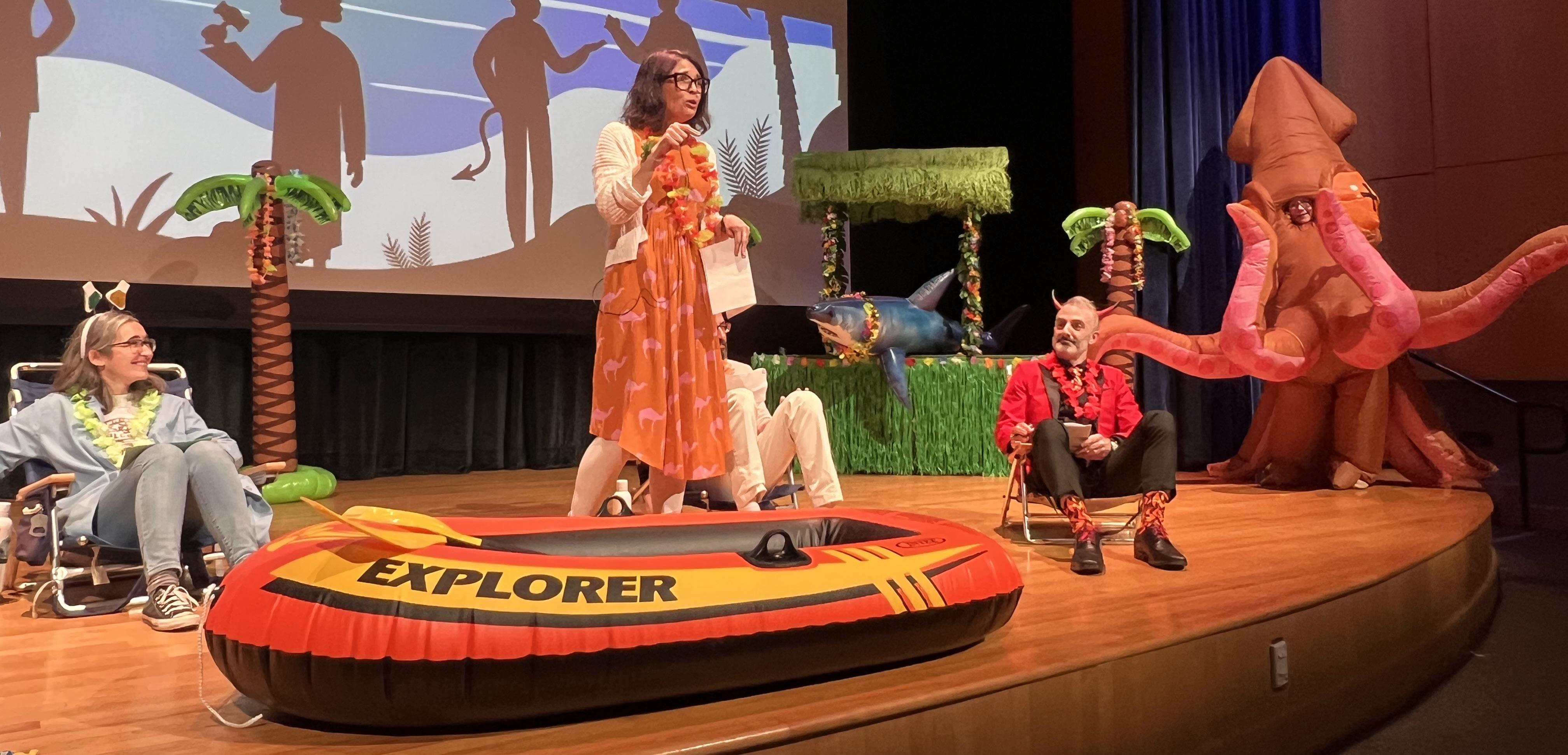
Tuesday, Oct. 28, the College of William and Mary held the annual Raft Debate in the Sadler Center’s Commonwealth Auditorium, with a concurrent livestream that audiences could watch from Tidewater A. The event consists of a simulation in which three disciplines — the natural sciences, social sciences, and humanities — are shipwrecked on an island, with each discipline represented by a faculty member of the College.
Only one of these representatives can escape on a small raft, so they must argue their case to an audience. The simulation also includes a Devil’s Advocate who makes the case that no one should escape the island. The Devil’s Advocate can also be voted as a winner. Additionally, a judge presides over the affairs. At this Raft Debate, the supporters for each academic area made as much noise as possible and had their applause measured by a dosimeter — whoever’s supporters made the most noise would win.
Class of 1952 Distinguished Associate Professor of Anthropology and Asian and Middle Eastern Studies Andrea Wright argued for the social sciences; Walter G. Mason Associate Professor of Religious Studies Andrew Tobolowsky spoke on behalf of the humanities; Assistant Professor of Chemistry Isabelle Taylor debated for the natural sciences; Assistant Teaching Professor of Philosophy Jonah Goldwater served as Devil’s Advocate and Assistant Dean for Graduate Studies, School of Computing, Data Sciences and Physics Trey Mayo Ed.D. ’22 served as the judge and emcee.
Another notable participant was Amy the Squid, a woman dressed in a squid costume who received laughter and cheers
upon her arrival. Flower wreaths were available at a table outside the auditorium, and the stage was decorated to resemble an island, including inflatable palm trees, beach chairs and more.
Mayo’s introduction for the Raft Debate praised the event and referred to the Better Arguments project.
“What you will see tonight will also tie in with the principles of the Better Arguments project, by learning how to express our viewpoints, engage in constructive counterarguments and make room to transform — and, perhaps, have a little fun along the way,” Mayo said.
After explaining the debate’s structure, Mayo then introduced the debaters. The event began in earnest with up to seven minute arguments from each debater.
Taylor went first. She began by citing products of science, such as the internet. She used scientists’ ability to conduct experiments for evidence as a point in their favor, and portrayed her opponents as lax on proof.
“In literature, if your novel fails, you just call it postmodern and say nobody understands you,” Taylor said.
Taylor also argued for scientists’ humility, saying that they acknowledge uncertainty and improve from failure. Then, to make a point about scientific curiosity, Taylor held up a sign with “FAFO” written on it and related the story of Hennig Brand, an alchemist who discovered phosphorus while trying to create gold by boiling urine.
Taylor furthered her case by equating scientists with
superheroes, referencing Marie Curie and many Marvel characters.
“I'd say if you want to bring back a discipline that's gonna save humanity, let it be the discipline that is run by superheroes,” Taylor said. “Look at Marie Curie. She was the mother of radioactivity. She discovered two elements and a little bit of a more sound method than Henning Brand. And she did it all while glowing in the dark. And look at the Marvel Cinematic Universe, right? It's full of scientists, superheroes. I mean, Tony Stark: engineer, Iron Man, Bruce Banner: scientist and the Hulk.”
Taylor concluded by again emphasizing curiosity and humanity’s betterment through science.
“So in conclusion, I’m going to tell you that humans need to keep doing science, not just for the sake of innovation and survival, but for meeting that human need to ask questions about the universe,” Taylor said.
Soon after, she ended by throwing candy to the audience after announcing high-fructose corn syrup as a product of her discipline.
Wright spoke next, and included both praise for and digs at the natural sciences and humanities, including references to musical artists and astronomy. She then pivoted to explaining why the social sciences mattered most.
“But the thing is, social sciences are the linchpin. It is the thing that makes what we do at universities make sense,” Wright said.
See CAMPUS page 3
Monday, Oct. 27, three political organizations at the College of William and Mary went headto-head in a mock debate about public violence in the United States. The College Republicans and Young Independents hosted the event at 6:30 p.m. in James Blair Hall for their semesterly debate. This semester, they also invited the Liberal Student League and the Young Democrats, although the Young Democrats declined to participate.
The debate was organized into four initial rounds of speeches, with one speaker from each organization per round. Each speaker got three minutes to make their argument, then they could answer up to three questions from the audience.
Traditionally, a fifth round comprised of resolutions, or finishing statements, from each
organization closes the debate; however, a room occupancy time constraint cut the debate short at 8 p.m. No official resolutions came from the night.
A coin toss determined that an LSL member would speak first.
He, like several others, first tried to define public violence within the context of American society. Throughout the night, public violence was used interchangeably with political violence.
Unfortunately, incidents of recent public violence were not difficult to find. Speakers frequently referenced the shooting of Charlie Kirk, nationwide United States Immigration and Customs Enforcement raids, the Jan. 6 Capitol attack, the Charlottesville white supremacist riots and the 2021 Black Lives Matter protests in their arguments.
Attendees generally agreed on three principal factors contributing to the cause and rise

of public violence: mixed reactions to violence from the current presidential administration, the influence of the Internet and the role of foreign actors in encouraging polarization.
Another LSL speaker criticized inconsistent responses to political violence from the White House and the way in which President Donald Trump seems to play to his own agenda.
“For example, President Trump blamed the dangerous rhetoric of the radical left for the death of Charlie Kirk, but we also saw him pardon the January 6th rioters, which establishes a precedent that violence is only worth condemning if it goes against one’s own agenda,”
YI member Vanessa Walrath ’27 said.
Abigail Bennett ’27 instead argued that violence in America transcends politics altogether and is rather a cultural issue.
“So, ultimately, my argument tonight is that violence in the

United States is not a policy issue, and, more importantly, not a partisan issue,” Bennett said. “This is built into the very fabric of American culture.”
Bennett framed the United States as a world outlier for its high public violence rate relative to its national income classification. She explained that, compared to other high-income countries, the United States has a grossly high incident rate and has made minimal progress over the decades. She attributed this stagnation to the country’s foundational values.
“I propose that we abandon the foundation,” Bennett said. “If the foundation is individualism and personal liberties over the prioritization of people, then I think it's worth abandoning.”
Regardless of political affiliation, almost every participant at the debate expressed grave disdain for the vast majority of public violence acts. One speaker advocated
that the individuals committing political violence are oddballs at the outskirts of their party and are not the norm in the United States, nor are they necessary for a functioning democracy.
“That's what’s so great about democracy,” LSL member Joseph Favale ’26 said. “We don't need violence to change our leadership.”
While the discussion remained largely respectful, occasional partisan jabs were thrown. The LSL and the YI tended to blame the right for extremist violence, while the WMCR debaters pointed to the left.
“No one on the right has ever, in terms of a broad culture, celebrated anything like this,” WMCR member Philip Vayntrub ’26 said regarding national reactions to Charlie Kirk’s death. “[Public violence] has a source, and that source is, regrettably, the left.”
READ MORE AT FLATHATNEWS.COM
Iʼd say if you want to bring back a discipline thatʼs gonna sav e humanity, let it be the discipline that is run by superheroes.
̶ Assistant Professor of Chemistry Isabelle Taylor
Monday, Nov. 3, the College of William and Mary announced that it will serve as the primary academic advisor for a new United States nuclear-powered submarine production facility slated to be located in Hampton Roads, Va. In a press release, the College shared that several academic departments will provide industry-specific insights into matters pertaining to national security, international order, technological development and workforce growth in service of defense operations.
Provost Peggy Agouris celebrated the Collegeʼs contributions to national security, highlighting the role of higher education in making well-informed policy decisions.
“William & Maryʼs designation as the U.S. academic home for the AUKUS initiative underscores the vital role of higher education in advancing innovation and security,” Agouris said. “This Center of Excellence brings together dedicated expertise to address complex global challenges and prepare the next generation of leaders who will shape the future of maritime defense and technology.”
The strategic site, one of three to be developed globally as part of the trilateral security alliance between Australia, the United Kingdom and the U.S., will be designated an “AUKUS Center of Excellence.” The other two AUKUS centers will be located in Sheffield, U.K. and Adelaide, Australia.
Isha Alaina Tubera ’26 reflects on time at Posse, Underground, Student Assembly, research opportunities
LILA REIDY // FLAT HAT NEWS EDITOR
Isha Alaina Tubera ’26, co-editor-in-chief of Underground Magazine, is anywhere but beneath the surface of the College of William and Mary. She serves as Student Assembly senator for the class of 2026, a position that she was newly appointed to this year. As a Posse Scholar, her posse was fundamental to her campus experience. Tubera also participates in a research lab, Nutritional Epidemiology and Food System Analytics.
Tubera explained what it means to be a Posse Scholar.
ʻSTABILITAS ET FIDESʼ | ESTABLISHED OCT. 3, 1911
Org #101 P.O. Box 8795, Williamsburg, VA 23187
flathat.managing@gmail.com
flathat.executive@gmail.com
“I’m part of Posse 2, so when I rst arrived, there were only Posse 1 and 2, and no one knew what Posse was or who the scholars were,” she said. “It’s a unique position to be in, since Posse was so new to campus, there was an ‘uno cial’ expectation to de ne what being a Posse Scholar looks like at William and Mary. For those who don’t know what the Posse Foundation is, it’s a nonpro t organization that provides full-tuition scholarships to student leaders across the country with Posse-partnered schools, focusing on empowering student leaders to reach their potential.”
She outlined how her time as a Posse Scholar has shaped her experience on campus, highlighting the relationships she made along the way.
“Re ecting four years later, Posse and its presence have grown so much since my rst year, which has been very beautiful to witness,” Tubera said. “I’m incredibly grateful to be surrounded by student leaders in my Posse who ful ll their mission and dedicate their time to making an impact on campus in their own ways. I continue to be inspired by those in Posse 2 and the Posse scholars on campus — your hard work, your passion, your drive do not go unnoticed.”
Tubera holds the position of co-editor-in-chief of Underground Magazine with Camille Batts ’26 after the publication’s inactivity in 2024.
Tubera highlighted what her role consists of, emphasizing the magazine’s intention of being an inclusive space for marginalized voices.
“Its mission and purpose as a literary arts magazine for marginalized communities on campus, to promote and uplift marginalized creative voices, were too important to let this organization remain inactive,” she said. “So, my role as co-editor-in-chief over the past two academic years might look a little di erent from other roles, since we had to essentially start from the ground up. Camille and I were both on Underground exec prior to its inactivity, so we still had our previous CEICs and executive team members’ information to help guide us with the process of reviving it — hence our rst issue back’s title being ‘Reawakening’ — but we had lost all of our funding and had to learn how to navigate those processes and reestablish ourselves and our presence on campus and within the MCO community.”
She spoke further about her time on the Underground as a whole.
“Being part of Underground has been an incredibly transformative experience, not only in my role as coeditor-in-chief but also by introducing me to new opportunities, such as becoming media council chair,” she said. “I love my executive team, our general body members, how far Underground has come since last fall, and I’m so excited to see what the future holds.”
Tubera re ected on the inclusive space that the magazine fosters on campus for all identities to celebrate their diversity. She spoke about why this acceptance is more important now than ever.
“With our political climate, it’s essential to curate this space where we can discuss our issues as people of color, as members of the LGBTQ+ community, and any other identity that is held, where there is no judgment,” she said. “But it’s also equally essential to curate a space where we can celebrate who we are and our life experiences, because there is resistance to oppressive power through joy.”
e Underground works to extend this celebration of identities into the greater community; Tubera outlined the publication’s collaboration with other multicultural organizations on campus.
“In the past two years, we’ve taken pictures at various MCO events, including LASU’s cultural showcase, NAISA’s Powwow, FASA’s Philipino Culture Night and BSO’s Stompfest.”
Tubera mentioned her contentment with how the magazine operates internally with the same inclusivity.
“ e beautiful thing about Underground is its collaboration with our general body, making it a magazine for the people, by the people,” she said. “In addition, one’s involvement is highly exible. People can choose to model, attend a general body meeting, help with page layout or choose to submit. Even with our submissions, we will take any form of artistic expression, because who are we to put guidelines on what art looks like?”
When re ecting on her overall time at the College, Tubera realized her favorite memories were with friends.
“I will say, it really is the little things, like getting ready together in my dorm for an event, cooking together, staying up all night to talk, reminiscing and laughing at inside jokes that will always bring a smile to my face,” she said.
As a kinesiology major with a concentration in public health and a minor in lm and media studies, Tubera describes her plans for after graduation.
“I plan to work or continue research for up to two years, then return to school for a master’s in public health with a concentration in epidemiology,” she said. “However, I am keeping my options open for any opportunity that follows grad school, whether that be me continuing my education or research, resuming work at a health department, or something entirely new; whatever is meant for me will come to me.”
Speakers reflect on public service careers, AIʼs role in availibilty of misinformation, encourage student engagement
MADIGAN WEBB FLAT HAT NEWS EDITOR
Tuesday, Oct. 21, the College of William and Mary Geopolitics of Technology Initiative hosted Davison M. Douglas Professor of Law
Margaret Hu and former Deputy Director of the National Counterterrorism Center Russell Travers ’78 to analyze the future of law, policy and national security in the wake of arti cial intelligence advancements. e GeoTech Initiative is a student-led research project in collaboration with the Yale Policy Institute, focusing on the impacts of technology in Indo-Paci c geopolitical competition. GeoTech Talk Lead Chloe Cohen ’27 moderated the discussion.
e speakers began by re ecting on their backgrounds in public service.
Aside from teaching at the College of William and Mary Law School, Hu is also Director of the Digital Democracy Lab at the Law School and author of the casebook “AI Law and Policy.” She previously worked as special policy counsel in the Civil Rights Division of the U.S. Department of Justice.
“When I entered the Civil Life Division of the U.S. Department of Justice, my rst day was Sept. 10, 2001,” Hu said. “So it was the day before 9/11, and the terrorist attacks, and immediately, they asked for volunteers for a post-9/11 task force, which I volunteered for. And what I saw in the 10 years that I spent in the Justice Department was the rise of AI systems and data collection, aggregation storage and analysis for counterterrorism purposes, and for the use of border security.”
Travers served as the deputy director and acting director of the National Counterterrorism Center and later moved to work as National Security Council deputy homeland security advisor under the Biden administration.
“We are way too siloed in basically everything in this country, and the notion of doing interagency e orts really interested me,” Travers said. “Between the National Counterterrorism Center and a few tours of the
CAMPUS
National Security Council at the White House, that has largely de ned the last 20 years of my career. I would go back and do it all again in a heartbeat.”
Travers explained that increasing technology usage correlates with increasing data that national security agencies have to process.
“Even something that was just dealing with terrorism threats had grown to about 10,000 cables a day, about 16,000 names in those cables that we were having to process as a relatively small center to evaluate for threat,” Travers said. “And so we’ve got to the point where large language models are not optional when it comes to processing information. ey are imperative.”
Travers continued by highlighting the negative impacts of AI, namely the spread of false information through deepfakes.
“As a country, we’re not very good at dealing with how you look at information and determine whether it’s good, better and di erent,” Travers said. “I mean, there’s studies of the last 10, 15 years where young people, college-educated students have a very di cult time distinguishing between misinformation, disinformation and malinformation. And now you overlay onto that AI deep fakes, and you have introduced a whole new level of complexity, of which we are not prepared.”
Hu views the spread of deepfakes and misinformation as implicating national security and democracy at large.
“I think that we’re having di culty processing information in a way that our founders never intended,” Hu said. “Enlightenment depends on being able to know what is evidence-based reasoning. If we don’t have a sense of knowing where to get to evidence-based reasoning, I think that that also puts us in a very complicated place, not only with national security, but our entire democratic form of the way that we govern.”
Travers furthered Hu’s concerns about AI impeding democratic ideals by acknowledging how technology rms are making deals with the U.S. Immigration and Customs Enforcement to aid in deportations, creating tension with the Fourth Amendment. e ability of technology to compile just unheard of amounts of
information and sell it to ICE in a way that they can use to apprehend individuals ostensibly under reasonable suspicion standards, and then deport them is pretty scary,” Travers said. “ ere have been, at latest count, 170 Americans that have been wrapped up in this. Irrespective of what you think about how immigration is being handled, Americans are losing out on due process because of this.”
Celia Schaefers ’28, the GeoTech Initiative open research call lead, enjoyed that the talk challenged the typical industry narrative.
ey brought up the fact that even in this AI arms race, going faster with less regulation doesn’t necessarily mean a better outcome or more AI infrastructure,” Schaefers said. “It just means that we’re skipping maybe foundational steps. I think that showing people that we can slow down and still be really strong is important.”
Anushka Pujara ’28 admired Hu’s emphasis on the Constitution.
“I really like that she went with the democratic side of it and then explained why she thought that that was so important, especially now,” Pujara said. “And she kept rooting it back to history, which I really enjoyed.”
When asked about advice for students seeking to work as public servants during the expansion of AI, Hu encouraged them to follow the U.S. founders’ groundwork by prioritizing innovation without sacri cing democratic values.
“Whatever career that you pursue, AI will be a part of it, whether you want it to be or not,” Hu said. “But I think you have to contextualize that knowledge of these AI systems within the broader goal and the broader ambitions of our founders. So I think we all have a responsibility to be democratic stewards of the AI world that we inherited.”
Travers acknowledged the mounting challenges in the public sector but encouraged students to get involved.
“I am tremendously worried right now about civil service,” Travers said. “But I will tell you that I also believe this would be a wonderful time for young people to get into government, because there’s going to be a lot to x.”
Debaters allowed three-minute rebuttals, audience members participate in following Q&A round
CAMPUS from page 1
Wright emphasized human interaction and communication in her discipline, particularly in reducing enmity and establishing understanding between people. She tossed in ated beach balls into the crowd, one of which resembled a globe, to symbolize the social sciences’ ability to introduce diverse perspectives and new possibilities for humans, while also recognizing the similarities shared by all.
“But what we learn is, there are things that are similar about people all over the world, right? We all laugh, we all cry, we make families, we love, we all grieve,” Wright said. “And so by doing this, we’re able to move towards things like world peace through this view of science.”
Her nal point revolved around critical thinking and curiosity. She concluded by stating that the social sciences could create an improved, inclusive future for humanity, and that the social sciences would also aid and course correct the other disciplines, citing vaccine hesitancy and patriarchal messaging in Taylor Swift’s songs.
“So there are these really important questions that social sciences do, and what these questions allow us to do together is imagine big, beautiful new worlds!” Wright said.
Tobolowsky was next. While navigating a brief mishap with his PowerPoint, Tobolowsky made the case that the College’s charter emphasized the humanities as critical for students and that the discipline had historical importance.
“If this debate were taking place on stage in an auditorium at the College of William and Mary, rather than on a desert island, I imagine I would begin by referring to its original charter, which has this to say: ‘on the subject of its purpose, that the youth may be ply, educated in good letters,’” Tobolowsky quoted from the Charter. “It has been proposed to establish a certain place of universal study or perpetual college of divinity, philosophy, languages and other good arts and sciences.”
Soon after, the PowerPoint began. He rst paraphrased an Abraham Lincoln quote to explain the situation and his stance. He then referenced science ction, such as shows like “Battlestar Galactica,” to argue that people versed in the humanities are the best suited for leadership in disasters and hard times, whereas the other disciplines are unsuitable or create such disasters. His other points included the humanities as being able to maintain resilience thanks to stories.
“What is likely to give you more fortitude for the journey? e heroic tales of adventure and survival that are the humanist stock and trade, or doing the quadratic equation or whatever?” Tobolowsky asked.
Tobolowsky emphasized the ability of humanists to succeed in other areas and bene t society, including by referencing statistics about humanities majors and academic performance. In his conclusion, he stated that the humanities could su ce without the other disciplines.
“In the beginning was the word, and the word was everything, the one thing we cannot do without. If it were all we had, it would be enough,” Tobolowsky said.
He concluded with a screenshot from ChatGPT in support of his argument.
Goldwater, the Devil’s Advocate, went last. He began by saying that students at the College would prove their critical thinking abilities by considering him.
He referenced how, in the past, the Devil’s Advocate asserted that all three disciplines were needed to avert humanity’s doom, so no one could leave on the raft. He continued by making the case for each discipline to bene t from being on the island.
For the natural sciences, he emphasized opportunities for chemical, physical and biological research, such as chemists discovering medicines from organisms. For the social sciences, Goldwater highlighted the ability to run controlled experiments, understand social structures and avoid ethics committees.
“Run a real-life Lord of the Rings scenario,” Goldwater said.
For the humanities, he promoted a lack of judgment and ChatGPT on the island, the peacefulness of the environment and new opportunities for philosophers, artists and theologians, such as vistas to take inspiration from for artwork. Goldwater’s nal point was the phrase “ignorance is bliss” — that is, humanity will only su er in misery under the three disciplines.
He said that science leads to feelings of lacking purpose and joy, that the social sciences develop a vision of a depressingly cruel and unchangeable society, and that the humanities create uncertainty about reality while history reveals past horrors. His ultimate point was that human beings will nd happiness without these disciplines.
“So, my friends, keep everyone on the island. It’s a win-win,” Goldwater said. “You’ll keep the disciplines where they will excel, and you’ll keep them the heck away from the rest of us, where we can live in bliss, free from the havoc one loan discipline would wreak. Oh, and don’t forget, you’re free critical thinkers. So friends, let the disciplines be themselves and save yourselves. Let no one o the island.”
After the initial arguments came the three minute rebuttals from each debater. Taylor acknowledged the other disciplines’ bene ts but stated that she would commit acts of vengeance on humanity if she lost, perhaps working in tandem with the other losers. She ended by holding up the “FAFO” sign as a symbol of what she could enact, but stated that she would prefer helping humanity, and promised to bring candy back if she returned.
“What happens when you burn the scientist? ey become the villain. All right? So you know you’re gonna give me a lot of time to plot the destruction of humanity,” Taylor said.
Wright rst criticized the notion of “FAFO” sans social sciences as dangerous, and then used Pakistan as an example of the consequences of undervaluing social science in favor of other disciplines. She concluded by saying that the social sciences allow for an understanding of human diversity and the ability to develop a path towards our desired future.
“Social science helps us understand and imagine a better future,” Wright said. “So if we want to build this future together, we need to take seriously social science.”
Tobolowsky rst pushed back on stereotypes of humanists before using the example of a tech billionaire unknowingly recreating buses as an example of narrow perspective from a lack of engagement with the humanities. He nished by returning to the idea of humanists as leaders in di cult times, with skills in areas like communication, able to guide humanity in a way that the other disciplines cannot.
“So if you want somebody whose major selling point is that they won’t annihilate all of us if they get o the island or somebody preaching
togetherness, I think that’s beautiful,” Tobolowsky said. “But if you want somebody to help this society get back on its feet and not reinvent the bus, you want the humanities.”
Goldwater responded to the other disciplines by saying that science could be dangerous given the potential for vengeance, that the social sciences were intrusive in people’s lives and that the humanities could live more tranquilly away from society.
His last point involved portraying the disciplines as a trio that should not be separated, comparing them to children, toys and baby animals, and saying that such a separation would be an injustice. “ ese three, they’ve come so far together. Are you going to split them up?” Goldwater said. “ ink of a family of puppies, a litter of kittens, whatever a group of piglets is called, you’re gonna separate them from each other.”
Student leaders Rebecca Fuchs ’26 and Yuhan Yue ’26 helped pass microphones to audience members for the question and answer session that followed. e rst round allowed one question per debater. Taylor was asked about her trustworthiness given potential vengeance against mankind, Wright about how social sciences will conduct research without the other disciplines, Tobolowsky about the television series “Lost” and weaknesses in these humanist leaders and Goldwater about what to do if the disciplines re-emerge o the island.
en came the lightning round, which was less structured and allowed for a range of questions to be asked. ese included the Devil’s Advocate announcing that he signed a Non-Disclosure Agreement, which he said in response to an inquiry about whether he wanted science to stay on the island so the world would be destroyed per the Devil’s desires.
After the question and answer session, Executive Producer of the Raft Debate Erica MacLeod arrived on stage with a pizza box from Mellow Mushroom. She poked fun at each discipline and implied support for the Devil’s Advocate. She also gave thanks to the students who attended the Raft Debate and announced that there would be pizza in Tidewater A after the event. e pizza box she was holding contained pineapple on pizza.
As a prelude to the end of the debate, Mayo used his dosimeter to conduct a vote on pineapple on pizza: the yays won. MacLeod expressed displeasure at this result before reminding the audience to eat pizza after the debate.
To end the debate, Mayo rst gave thanks to several people, including student leaders Fuchs and Yue, before announcing the nal vote.
“You will have 15 seconds to make as much noise as you can for the contestant who you think should get on the raft to save humanity,” Mayo said.
After each discipline’s supporters had their turn, there was applause for all the debaters, then more thanks given — including for Amy the Squid — and an informal drumroll.
Goldwater was announced as the winner, and he climbed into the raft afterwards, pretending to paddle the craft away.
Afterwards, three student attendees expressed their thoughts on the event to e Flat Hat.
READ MORE AT FLATHATNEWS.COM
SA increases study abroad accessibility for senators, passes Mentorship and More Act, approves budget workshop
SUSANNAH POTEET CHIEF STAFF WRITER
Tuesday, Oct. 28, Sen. Jason Zheng ’26, Sen. Ryan Silien ’28 and Sen. Neha Baskar ’29 introduced the Bolstering Ethics of Election Fairness Act Part Three.
e act aims to make changes to inconsistencies in the Code of the Student Assembly regarding the Independent Elections Commission.
If passed, the changes will clarify election result appeal processes, such as stipulating that candidates have 48
hours after being noti ed of the decision to submit an appeal to the Review Board. In an additional change, the Review Board will now be required to convene within one week to hear the appeal.
Sen. Jason Zheng ’26 introduced e Rave Guardian Incentive Act. If passed, the act would allocate $100 for a ra$e incentivizing students to download the Rave Guardian app. e app acts as a replacement for the blue light system and connects app users to emergency communication resources.
Sen. Ryan Silien ’28 introduced the Let My Students Go (Abroad) Act. e
bill seeks to amend the requiremnts for information sessions in the Constitution of the Student Assembly and better support students studying abroad.
“ e problem that this bill seeks to address is that if you want to go abroad for one spring semester, you are not eligible to serve in the senate for four semesters,” Silien said.
e 2024-2025 Student Assembly Senate passed the Let My Senators Go (Abroad) Act. However, the act was vetoed by then-President Terra Sloane ’25, due to the lack of senate attendance in correlation with the large impact the
bill would have. Silien largely disagreed with Sloane.
“I think this is a great initiative to expand access to the Senate, and I’m looking forward to the discussion,” Silien said.
e Senate passed e Mentorship and More Act. e act provides refreshments funding for a Nov. 13, 2025 mentoring event, from 5 p.m. until 7:30 p.m. in the Raymond A. Mason School of Business. e event will feature an admissions panel, a student panel and a networking event for undergraduate students to
connect with graduate students and learn from their experiences. e act was sponsored by Class of 2026 President Debbie Ho ’26,
College spent an estimated $13,500 daily on rebates for students, at least $1500 daily for shuttles
ANDREW HENRICKSON FLAT HAT DATA ASSOC.
Right before the beginning of the 2023-24 academic year, the College of William and Mary announced its plans for a $700 million dollar construction project that would renovate or replace 80% of the College’s current housing over the course of ten years, spanning over three phases. Phase one of the project began in July 2023, kickstarting the construction of new housing for the College. This $320 million dollar plan included the renovation of Old Dominion and Monroe Halls and the construction of ve new dorms: four located at the old location of Yates Hall and one adjacent to Lemon and Hardy Halls. “West Woods 1” would take the location of Yates, including four new halls named Oak, Maple, Poplar and Pine. Cedar Hall is located near Lemon and Hardy.
The construction was projected to be completed before the beginning of the fall 2025 semester, housing incoming freshmen, transfers and returning students. After extensive work to develop the new buildings, spanning over two years, the College abruptly shared before the beginning of the fall 2025 semester that residents planning
to live in Cedar, Pine and Oak Halls would be relocated to alternative housing until the completion of the construction. As of Oct. 2025, all students put in alternative housing have been placed in their originally intended dorms of Oak, Poplar, Pine and Cedar.
The new residence halls house around 1,200 students across the five dorms. Poplar and Maple, the two smallest dorms, house 120 and 150 students, respectively. Cedar and Pine house 270 and 500 students, respectively. Cedar and Pine are both housing for first-year students, and half of Pine provides housing for returning undergraduate students.
The absence of the Pine, Cedar and Oak Halls left around 900 students without housing for the fall semester. First-year students received priority for being relocated to on-campus housing, with the Green and Gold Village and Richmond Hall being utilized to temporarily house students.
Around 500 freshmen were relocated to these halls, leaving around 400 upperclassmen to either live in Richmond Hall or o -campus at the Williamsburg Woodlands Hotel. Assuming Richmond Hall received half rst-year, and half returning students, around 300 students were forced to live in hotel rooms until the construction was completed. This setback has proved to be quite a cost for the College.
The College shared that the relocation would come cost-free to the students a ected, providing some monetary support to the students as well. The College issued a credit of $22.50 for each day the students lived in the hotel or an alternative dorm at the end of the fall semester, accounting for half the cost of the rent for their given room.
This means that per night, the College spent around $90 for a standard double. In addition to this, the College provided a free shuttle service from the hotel to the Sadler Center, provided by the Williamsburg Chau eur Service. The Flat Hat did not nd a concrete price for a day rental of a shuttle bus; however, local competitor services quote approximately $1500 to $3000 a day for the service of a shuttle bus.
For 300 students, the College must have rented approximately 150 rooms in the hotel. Per student, the College spent around $74 per student for students in Woodlands, accounting for the stipend, hotel cost and shuttle service. It also spent $13,500 a day on the stipends of $22.50 for the 600 other students living in alternate dorms. In a day, the College spent around $35,750 a day to accommodate all the students a ected by the delays.
Students previously relocated moved into their new dorms around
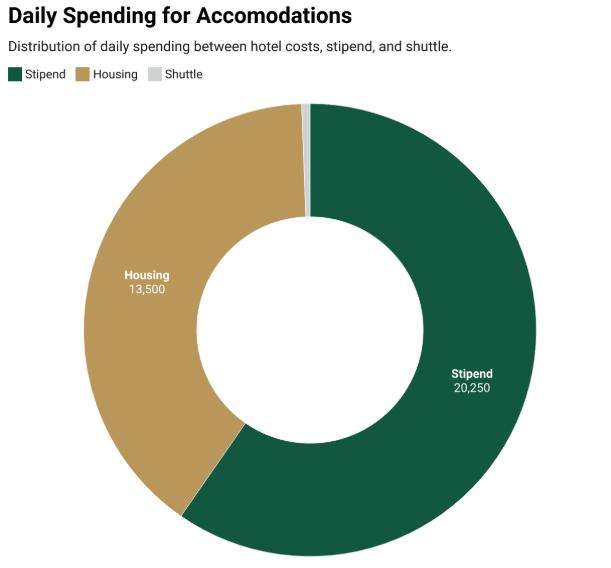
Oct. 14th, making their temporary stay around 51 days. Knowing this, the College has spent roughly $1,820,700 accommodating students for the construction delays.
The Flat Hat spoke with Carlos Juarez ’27 about his experience living in the Woodlands Hotel, when at the time, he had not yet moved into his now dorm. He explained that despite some initial camaraderie after moving in, living in the hotel was very “low vibes.”
“It was very inconvenient due to the location, and I spent a lot of my time on campus or with friends who lived in a better location,” Juarez said.
After living on campus for the past two years, and planning to live on campus again in his third year, he stated he felt “more distant from campus” in a social sense and missed the atmosphere and ease of living. However, Juarez did express his gratitude at the time for how the College had dealt with the situation.
“I’ll be happy when I move into the new dorms, it’ll be worth it in the end,” Juarez said at the time of the situation.
Data Science major experiences strongest average growth in popularity since 2016
The College of William and Mary prides itself on its academic rigor and liberal arts curriculum, which allow its students to pursue a wide range of elds and hone in on their passions. Students can choose to explore popular STEM majors or, just as easily, a less-traveled path like French and Francophone studies. But what are students at the College drawn to the most, and how has it changed over time?
The growth and decline of majors re$ect societal shifts, technological advances and the school’s evolving reputation in di erent disciplines. In a world of developing technology, it is understandable that some of the most popular majors are in scienti c and technological disciplines such as biology, psychology, computer science, data science, and neuroscience. Part of this could also be because of their potential salaries upon entering the workforce. As Forbes Advisor highlights, the sciences were among the highest salary earners in recent years. The combination of a variety of careers, dynamic disciplines and high
incomes is a possible factor for those majors’ higher enrollment numbers at the College.
It is also no surprise that international relations is one of the most popular majors at the College. The school ranks among the top 20 undergraduate universities to study international relations and is the third-best school for international relations in the Commonwealth of Virginia. Its enduring growth highlights the program’s longevity and sustained reputation that continues to attract new students.
The liberal arts curriculum also helps to explain why social sciences majors — such as government and economics — and humanities majors — such as history and English — continuously rank among the highest enrollments. Through these classes, students are equipped with excellent critical thinking, research, communication and reasoning skills that can be utilized in a plethora of careers.
There are some majors, though, that are slowly starting to have a bigger presence amongst the student body. A deeper dive into this study analyzed the growth rates of majors and revealed surprising insight into which programs have
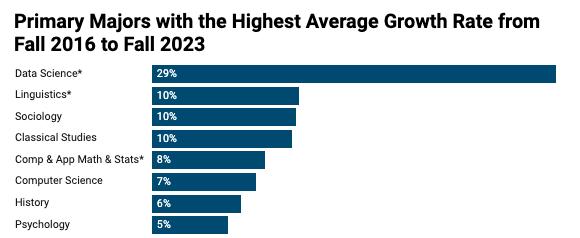
expanded the most.
The data science major had the largest average growth rate. As arti cial intelligence evolves, data science has gained steady momentum, and students have begun to shift away from computer science. The U.S. Bureau of Labor Statistics predicted an incredibly fast growth rate of 34% for data scientists over the next 10 years. College students love nothing more than a growing job market, and the major’s growth
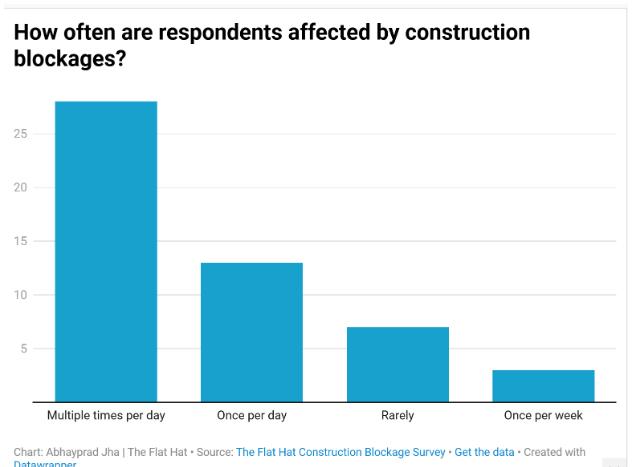
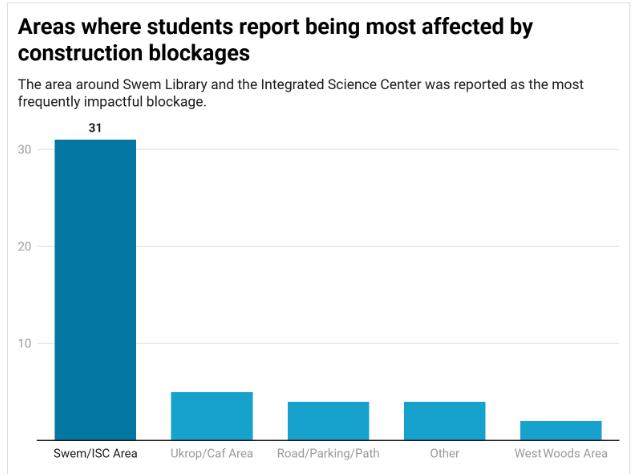
As construction continues to reshape the College of William and Mary’s campus, students must adjust to altered walkways, fenced-off zones and rerouted paths across heavily trafficked academic corridors. To understand how these detours affect daily routines, The Flat Hat conducted a construction blockage survey, gathering 50 student responses on the frequency of blockages, the most affected areas and whether students feel the disruption is justified by longterm improvements.
Current work spans several high-traffic campus regions, most prominently the corridor between Earl Gregg Swem Library and the Integrated Science Center. Additional
construction sites lie near Jamestown Road and residential areas in the southern portion of campus, leading to continued foot traffic bottlenecks. The data suggests that, for most students, construction interruption has become a routine part of campus travel, rather than an occasional inconvenience.
Survey responses indicate consistent disruption. More than half of students said they encounter construction blockages multiple times per day, and nearly one quarter reported hitting detours once per day. Only a small portion of respondents said they rarely see closures.
Students most frequently cited the Swem Library and Integrated Science Center zone as the most difficult area to navigate, reflecting its role as a central pedestrian corridor. Secondary clusters of reported disruption were located near Commons Dining Hall, Jamestown Road corridors and West Woods.
When asked to rate the College’s handling of construction blockages on a scale from 1-10, respondents indicated an average of 6.2 out of 10, suggesting a mixed but generally patient reception. While detours add time to commutes, many respondents appear to view the issue as manageable when weighed against
future improvements.
Two-thirds of students said they believe the construction will ultimately be worth the inconvenience, while one-third disagreed.
Hannah Lewis ’29 said she encounters construction daily on her way to class, but she does not view the detours as significantly disruptive.
“I do not really see it as much of a nuisance, but it is something
“So
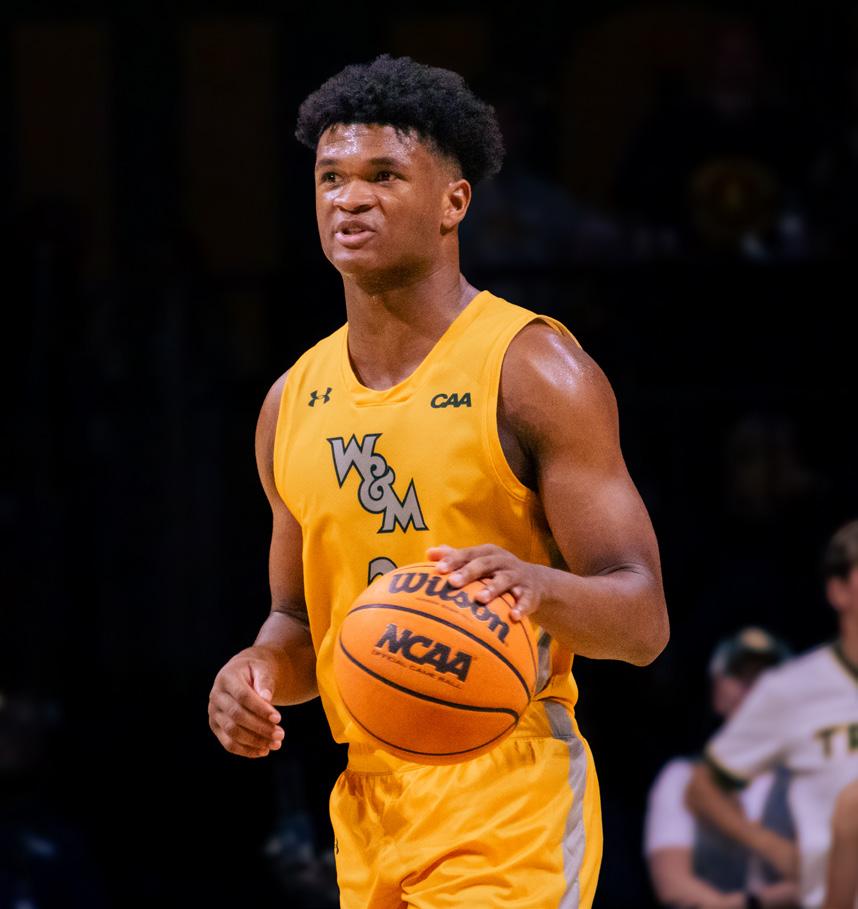
In the volatile landscape of modern college basketball, William and Mary senior guard Chase Lowe is an anomaly.
The last few years have been anything but stable for the Tribe men’s basketball program. In spring 2024, former head coach Dane Fischer was fired after his squad posted its fourth consecutive losing record. His exit prompted a significant talent exodus, with four of William and Mary’s top eight contributors graduating or hitting the transfer portal. New head coach Brian Earl managed to retain several key players and mount a winning 2024-25 campaign, but the Tribe continued to suffer further turnover, losing its three leading scorers over the summer. Including William and Mary’s current roster, 36 players have passed through the program since 2022.
It is remarkable that any of Fischer’s recruits remain with William and Mary, let alone one whose well-rounded statistical profile makes him an attractive target for other schools, but Lowe is still here, preparing for his fourth season with the Green and Gold. The longesttenured member of the Tribe alongside senior guard Miles Hicks, Lowe has seen it all. Now facing his final college campaign, he’s ready to lead William and Mary to its first-ever National Collegiate Athletic Association Tournament by any means necessary.
“As far as personal goals, this might sound crazy, but the only thing I’m really concerned about is going to March Madness, going to play in the tournament, whatever my role looks like,” Lowe said. “I think I bring experience to the team, and I think I bring leadership, and I think I can make my teammates play better. But as far as my main goal for the season, it’s going to be to make it to March Madness.”
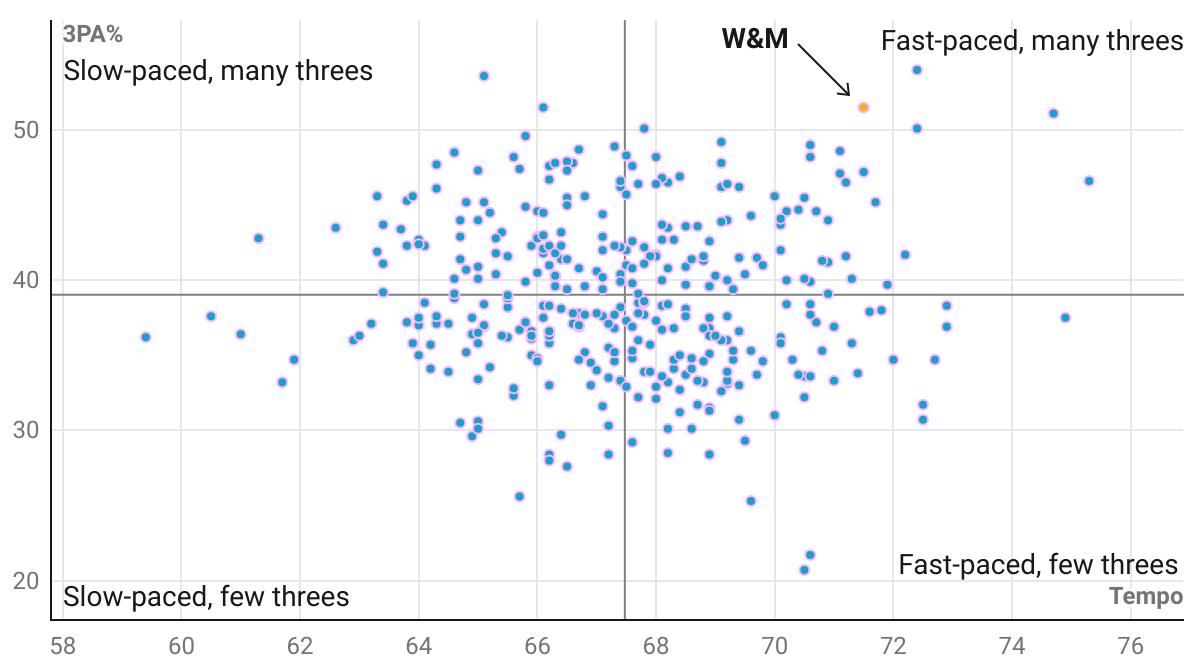
with a loss to Delaware in the conference tournament, but the campaign was good to both the Tribe and Lowe. After averaging 3.3 points per game in his first season and 12.5 in his second, Lowe adopted less of a scorefirst role during his third season, sporting averages of 8.4 points, 5.2 rebounds and 3.1 assists per outing. He credits Earl’s highoctane, up-tempo system with putting him in positions to succeed.
“I think coach Earl has done a great job of bringing in guys that can really score the ball,” Lowe said. “That makes my job really easy because I’ll be able to find them.”
Although Lowe was not satisfied with every aspect of William and Mary’s performance, emphasizing the team’s poor showing in road games, he was ultimately pleased by the outcome of the regular season.
It would be inaccurate to claim Lowe has never considered transferring — in fact, he says the possibility “definitely” crossed his mind upon the firing of Fischer, with whom he enjoyed a “very close relationship.” However, the Tribe’s hiring of Earl, a former Cornell coach who once extended an offer to a high-school-aged Lowe, reassured the guard he was in the right place.
“I had a conversation with [William and Mary Director of Athletics] Brian Mann when it happened, and he assured me that he was gonna try to find the best coach to bring in for this program,” Lowe said. “Sure enough, a couple days later, he hired Brian Earl.”
Earl’s first year on the Tribe sideline was an unambiguous success. William and Mary went 17-15 and 11-7 in Coastal Athletic Association play, posting a 12-2 record at Kaplan Arena. The Green and Gold eventually flamed out
“For starters, it was the first winning record that I’ve had during my time here,” Lowe said. “So that was something of a step in the right direction. We played very well at home.”
However, that step in the right direction was offset by a summer in which many of the Tribe’s most productive players departed Williamsburg. Guard Gabe Dorsey ‘25, William and Mary’s leading scorer and one of the greatest three-point shooters in school history, graduated. Forward Noah Collier, who averaged 12.2 points per game before suffering a season-ending injury in February, transferred to La Salle. Guard Matteus Case, the Tribe’s third-leading scorer, graduated. Guard Isaiah Mbeng, a CAA All-Freshman team selection and William and Mary’s leader in assists, transferred to East Carolina. Also leaving were graduate student forwards
want to exercise their right to transfer,” Lowe said. “So that wasn’t much of a surprise to us that we had a guy — we had a couple guys — hop in the portal, and we had a couple guys graduate too. That’s all I have to say. I wish nothing but the best for those guys.”
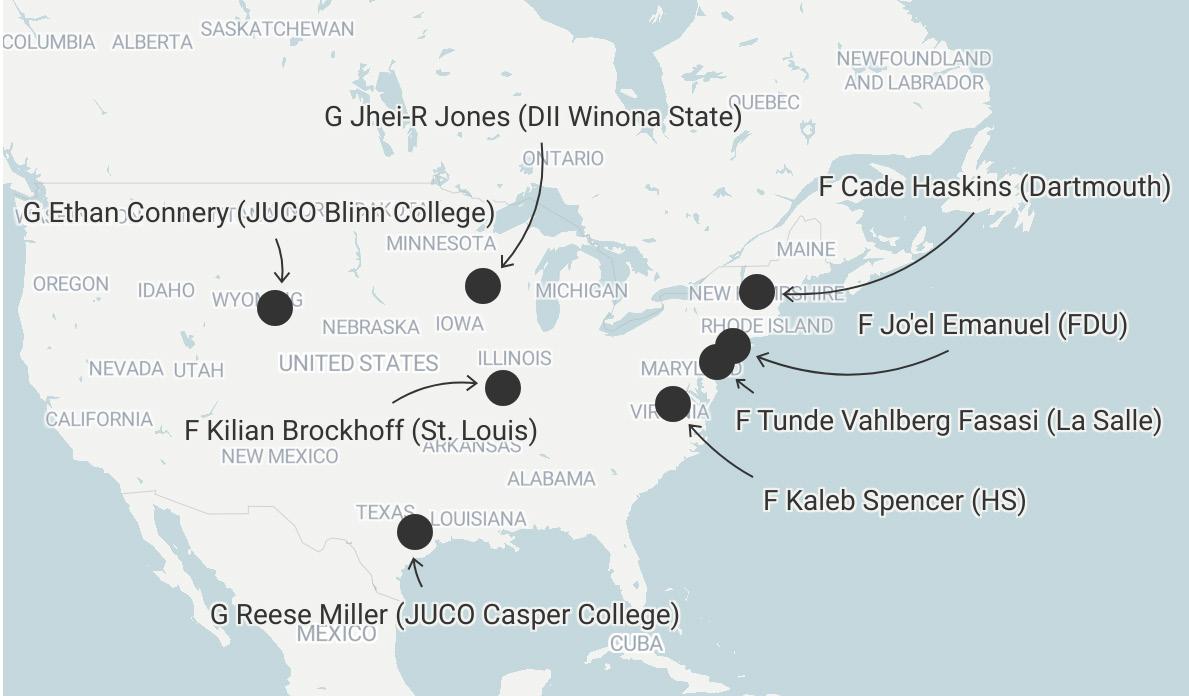
Rather than panicking over the departures of their teammates, Lowe says the returners spent the offseason making the Tribe’s newcomers — of whom there are many — feel at home. Although they were not involved in the finer details of a roster-building process that eventually brought eight new faces to Williamsburg, the returners met numerous potential recruits on their visits to William and Mary and managed to convince every one of them to commit to the Tribe. Upon the recruits’ arrivals, the new-look team quickly established a sense of camaraderie.
“[We] certainly wanted to make them feel welcome,” Lowe said. “We spent a lot of time together on and off the court. We would go fishing and go to College Creek. So it’s already a very tight-knit group, and I’m glad to be a part of it.”
With its roster established, William and Mary finally turned its attention to the season ahead, which promises to be a continuation of the success the Tribe achieved in Earl’s first year. During October’s CAA Media Day, William and Mary was picked to finish fourth in the conference. Although the expectations surrounding the team are the loftiest they have been in recent memory (previously, Lowe had never seen the Tribe picked higher than seventh in the CAA), the senior feels no pressure. With 89 career games under his belt, Lowe is ready to help William and Mary meet and exceed its preseason projections.
“[The expectations don’t] stress me out at all,” Lowe said. “I have 14 other teammates that I know have my back, and I have their backs. I know I have coaches that I believe in, that believe in me. So no, I don’t feel any pressure.”
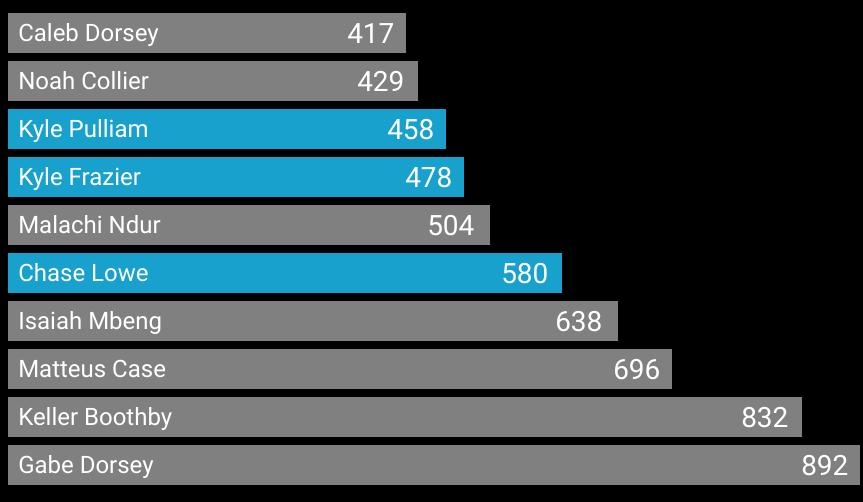
The veteran, who says he “knows all the teams in the conference like the back of [his] hand,” singled out Charleston and UNC Wilmington as opponents he’s particularly looking forward to battling. With an injured Lowe sitting out one of the games, the latter program swept the Tribe last year. On the court, he expects to serve as a “facilitator” and a “pass-first guard,” spraying assists to the array of potential shooters assembled by William and Mary’s coaching staff.
But, most importantly, Lowe is prepared for the off-court role he’s been tasked with assuming. Again referencing the Tribe’s nextman-up mentality, he says the culture of the program makes leadership easy.
“There are no 20-point scorers or any ball hogs in our system,” Lowe said. “It’s the next-man-up mentality, and guys are very selfless in this program. So I’m
be a

of that.”
The date was March 8, 2025, and William and Mary women’s basketball was in trouble.
The Tribe had just concluded the regular season by suffering an 18-point defeat to Campbell, marking its seventh loss in eight games. After starting Coastal Athletic Association play hot, the Green and Gold underwent a monthlong skid that dragged it down the league leaderboard, bringing its overall record to 11-18 and its conference record to 8-10. With neither momentum nor optimism on its side, William and Mary was doomed at the CAA tournament — at least, from an outsider’s perspective. Inside the locker room, the mentality could not have been more different.
“There was a lot of motivation throughout the team to turn it around,” junior guard Cassidy Geddes recalled. “I think the big moment that most of the team remembers was the bonfire we had at one of our teammates’ houses, and we kind of just sat there. We really just were imagining, like, what if we won the first game? What would happen then? What if we won the second game? We had it planned out, especially because it was pretty much all the teams we had just lost to in the prior two weeks. And then, like, what would happen if we won the championship?”
The Tribe did not have to wonder for long. In one of the most memorable runs in the history of William and Mary athletics, Geddes’ squad rumbled through the tournament bracket as a No. 9 seed, knocking off Hofstra, North Carolina Agricultural and Technical, Drexel and Campbell en route to claiming the first March Madness bid for either of the Tribe’s basketball programs. Immediately, the Tribe mounted a frantic turnaround to Austin, Texas, balancing exam preparation with film study.
“Right when we won, I remember them being like, ‘We’re coming back to Williamsburg,’” Geddes said. “‘Wash your clothes in four hours, pack it up, and we’ll be in Texas.’ And then that went by so fast.We were there, and we all still had school. It was kind of coming up near midterms. I remember most people, if they weren’t watching film or playing basketball, were all [with] computers out, studying so hard.”
A 69-63 victory over fellow No. 16 seed High Point in a playin game served as a triumphant conclusion to William and Mary’s magical two weeks. Although the Tribe eventually lost to No. 1 seed Texas, hundreds of alumni descended on Austin to cheer on the Green and Gold; the team was mobbed by teary-eyed fans upon its return to Williamsburg; players were given standing ovations in class.
anomaly. What better way to do that than win another CAA title, perhaps this time as a No. 1 seed?
“I still think there’s big motivations for this upcoming season, because we didn’t play throughout the whole season how we wanted to,” Geddes said. “I mean, we lost seven of our last eight games heading into that tournament. So I think we still have a lot to prove, you know, to show that it wasn’t a fluke.”
William and Mary has its work cut out.
Although the Tribe avoided significant transfer portal losses over the offseason, with its only notable defector being junior forward Kayla Rolph, it saw four seniors graduate, including star guard Bella Nascimento ‘25. Nascimento led the team in scoring last year and averaged 19.6 points per postseason game, dropping 33 in William and Mary’s conference championship win over Campbell. The Tribe also lost center Kayla Beckwith ‘25 and forwards Rebekah Frisby-Smith ‘25 and Anahi-Lee Cauley ‘25, who left Williamsburg with a combined 348 games of experience under their belts.
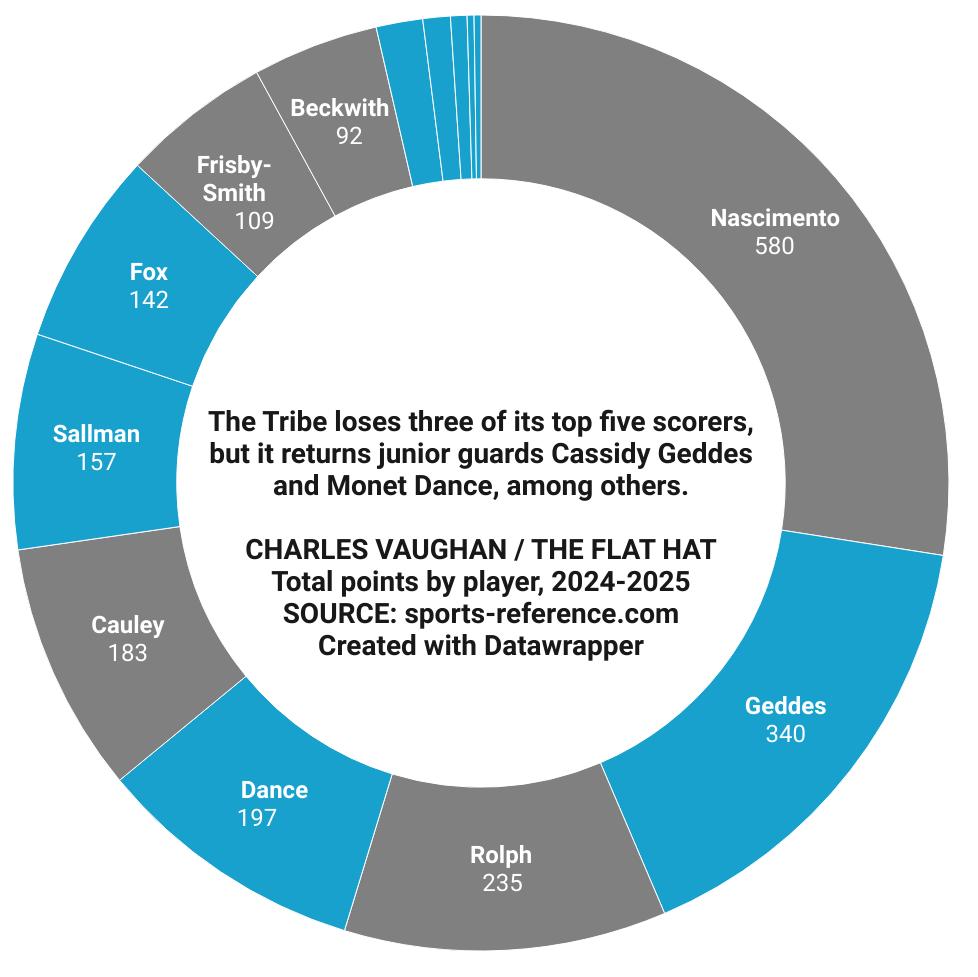
For Geddes, it wasn’t quite enough. Although she averaged 12.3 points, three rebounds and 2.5 assists per game during William and Mary’s Cinderella run and describes her March Madness experience as “surreal,” she also remembers the Tribe’s regular season winning percentage of 37.9%. Aware that William and Mary isn’t traditionally known as a “basketball school,” Geddes wants to make sure the world knows its postseason success was no
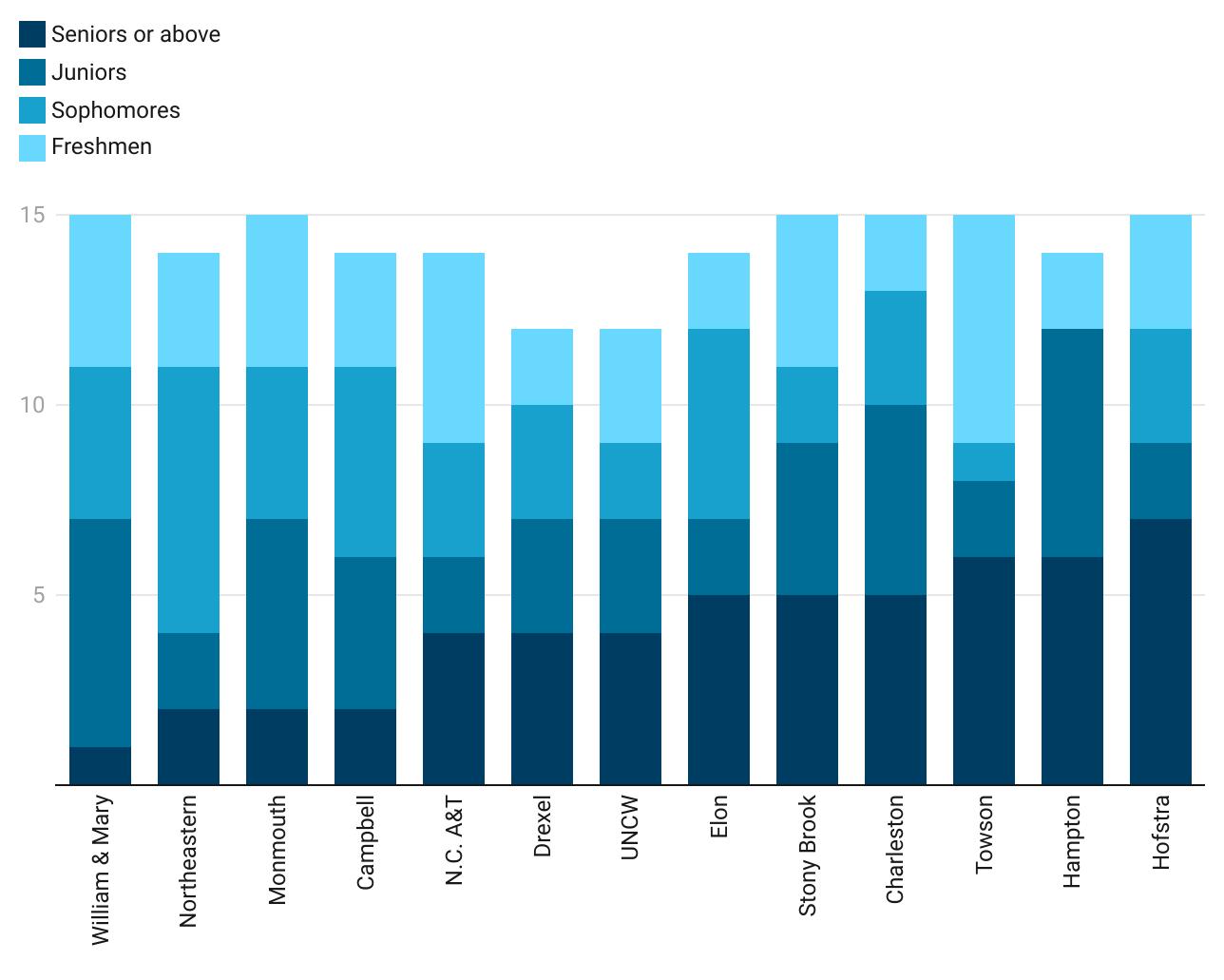
Now, the Green and Gold possesses one of the youngest rosters in the CAA, with guard Alexa Mikeska standing as its lone senior. Along with Mikeska and junior guard Monet Dance, much of the team’s leadership duties lie on the shoulders of Geddes, a preseason AllCAA selection. At CAA Media Day, William and Mary head coach Erin Dickerson Davis described Geddes as a “brilliant” leader; the compliment was returned by Geddes, who credited Dickerson Davis with influencing her leadership philosophy.
“Coach E was the coach who believed in me and brought me here,” Geddes said. “Everything that she’s taught me, especially about leadership — I feel like she expects so much out of me, but there’s never been pressure to hit certain numbers or anything. I
mean, the biggest thing she expects from me has always been leadership and just bringing the drive that I have and trying to uplift others.”
Geddes also praised the rest of William and Mary’s staff, along with Sugar Rodgers, her former position coach who left Williamsburg last spring for a role with the WNBA’s Golden State Valkyries. According to Geddes, Rodgers helped catalyze not just her basketball development but her character development. Using the lessons she’s learned from her mentors, Geddes has established a leadership style of her own.
“I think I had seen a lot of rowdy leaders, and I knew that that wasn’t me, but I did need to incorporate a more vocal style of leadership,” Geddes said. “I know that I’ve always been centered on work ethic first. If I can’t do it, I don’t really feel as confident speaking for others. So I think always being in a position to try and do the right thing at practice and be in the right position and the right spots has helped me feel more confident leading my teammates and encouraging others to get to our common goal.”
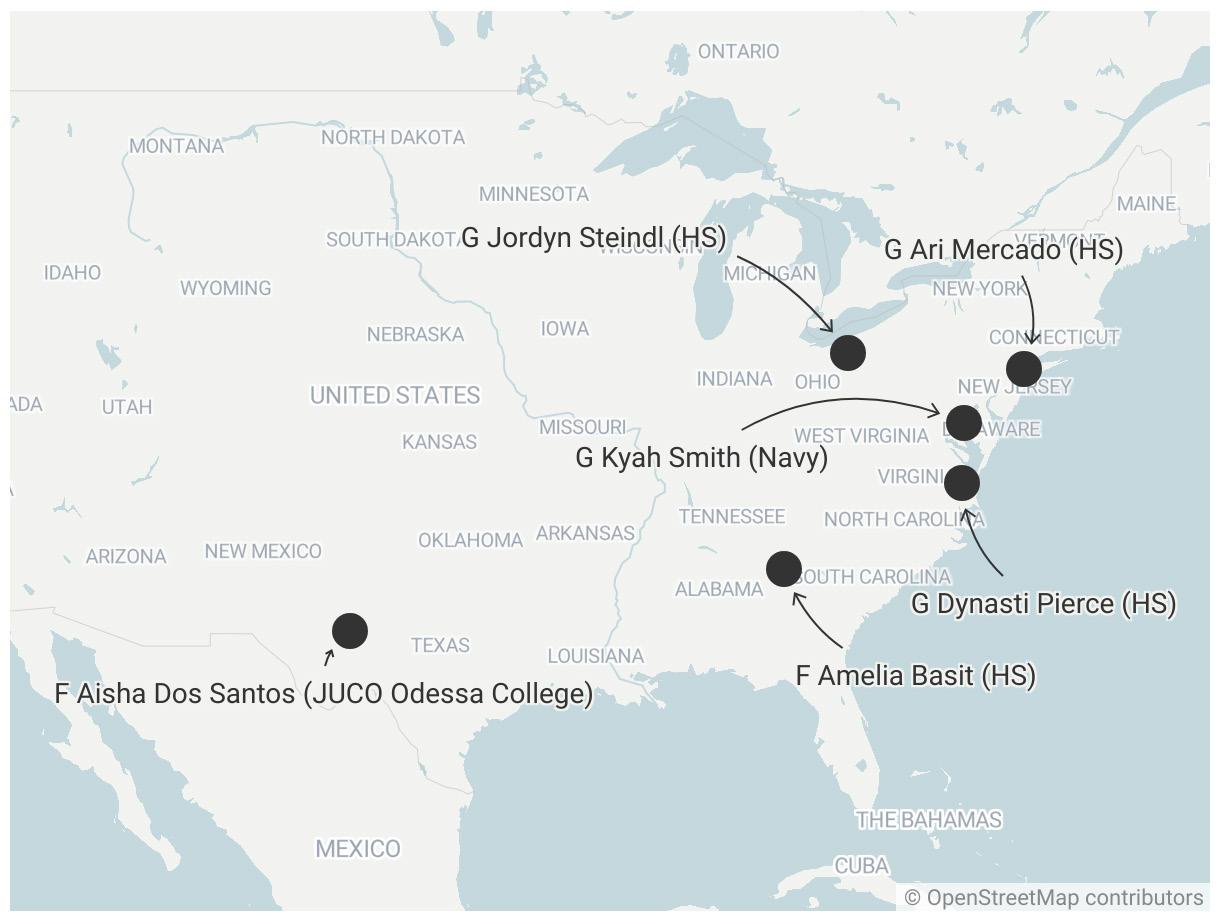
Geddes’ leadership abilities were put to the test over the summer as the Tribe was tasked with building team chemistry, welcoming six newcomers into its midst. With two exceptions — junior guard Kyah Smith, a Navy transfer who was named the Patriot League Rookie of the Year in 2024, and junior forward Aisha Dos Santos, a junior college transfer — all are true freshmen. To help the rookies get acclimated to the life of a college basketball player, Geddes and her teammates coordinated with men’s basketball to plan cross-program activities, hoping to build bonds capable of carrying the newcomers through otherwise lonely winters.
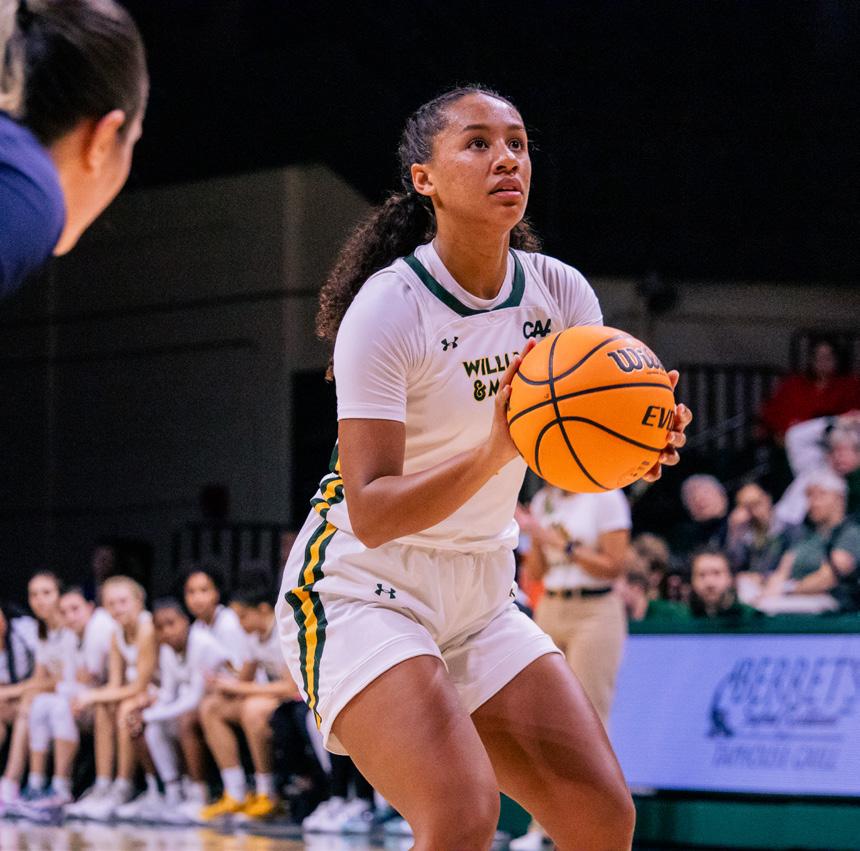
“We’re one of the only sports that’s here all summer, all winter break, and a lot of times it’s just us on campus,” Geddes said. “So I think we did a good job of planning stuff just to have fun. You know, when you’re here, and you’re only doing basketball, it kind of can just get hard sometimes. So doing things with them, going to College Creek, a lot of that stuff our teams did together, and I think that kind of helped build bonds and have friends outside of maybe your specific team when it’s cold, and it’s winter, and there’s no one else here and we’re only getting four days for Christmas break.” Dickerson Davis designed William and Mary’s non-conference schedule with her squad’s youth in mind. Last year’s squad entered CAA play sporting a 3-8 record and reeling from a 50-point loss to Maryland. Wanting to avoid a similar outcome, Dickerson Davis scheduled slightly weaker opponents, intending to prepare the Tribe for the conference slate. Geddes has
goals for this

Thursday, Oct. 30 to Sunday, Nov. 2, the College of William and Mary’s dance department held their Dancevent showcase in the Glenn Close Theatre in Phi Beta Kappa Memorial Hall.
Dancevent presents a combination of original works created by College dance faculty and students annually. Faculty, guest artists and Orchesis Modern Dance Company members performed in this year’s showcase.
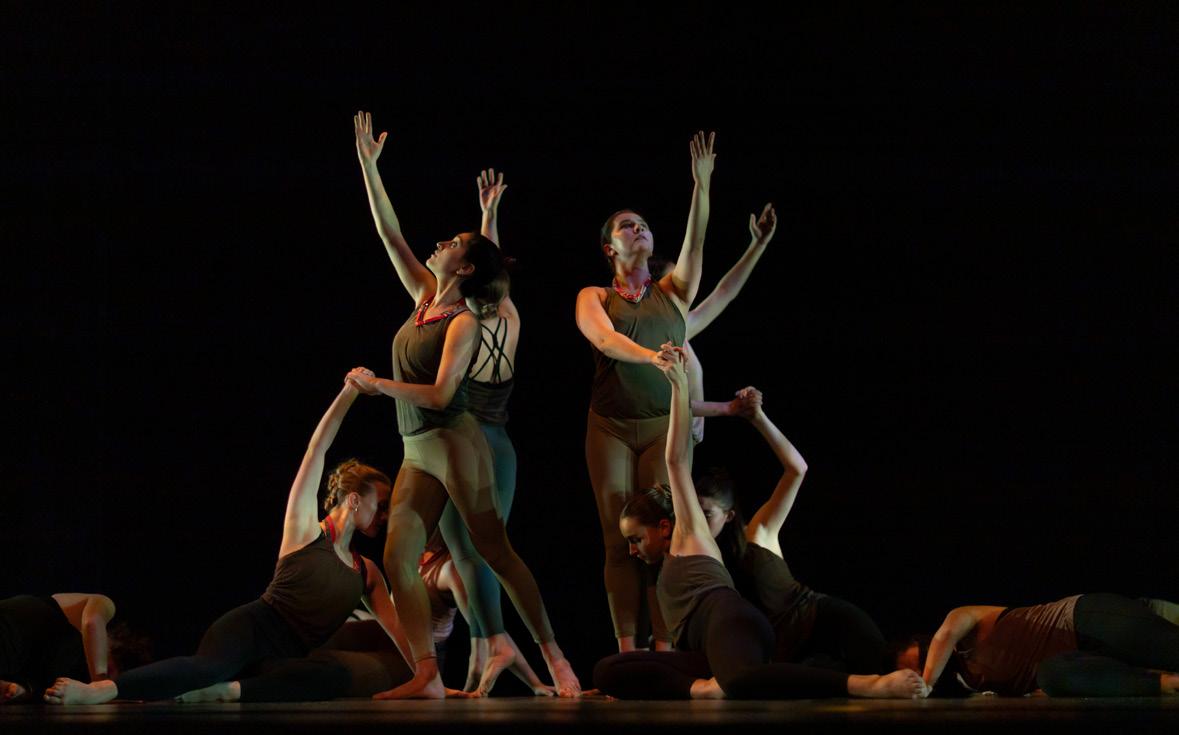
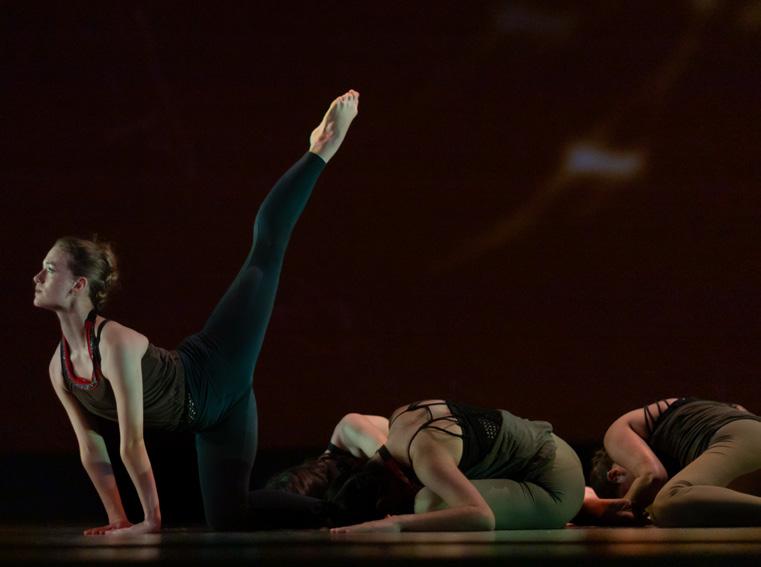
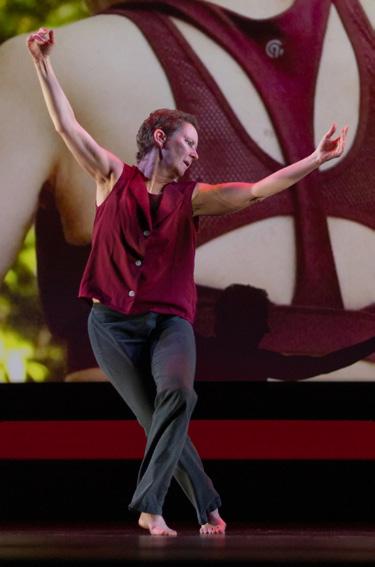
The event included six performances in the style of modern dance that told unique stories, leaving audience members captivated. Each dance lasted approximately 15 minutes and included a wide array of different technical visuals, including fog, flashing lights and video projections.
Professor of dance and department chair of theatre and performance Joan Gavaler choreographed two dances for the event.
Gavaler’s first piece, “Hemispheres,” featured a group of talented dancers and music composed by Casey Lenhart ’22. During the audience question-and-answer section of the show, Gavaler explained that the piece was inspired by Jill Bolte Taylor’s novel “Whole Brain Living.” Taylor suffered from a stroke that caused her to lose functionality in her brain’s left hemisphere and, since then, her work has centered around intimately learning the personalities of her brain’s hemispheres. Her novel explores the four different regions of our brains, which Taylor personifies as four characters, and their various functionalities.
To represent neurological processes in the performance, Gavaler, with the help of assistant teaching professor of theatre Mark Williams, displayed images of neurons and the brain on the screen behind the dancers during “Hemispheres.” The performance also included various voiceovers recorded by the dancers themselves, meant to symbolize the thoughts and characteristics of each distinct brain region.
“The dancers were able to improvise and they did a great job,” Gavaler said. “I built a bunch of images and gave them some movement and then sort of crafted the idea of how these neurons formed and reformed in different parts of the brain.”
Gavaler choreographed and performed her second piece, “Within Time,” as a solo. Gavaler juxtaposed mantras of passing time and nature to create a piece that expressed the demanding aspects of everyday life and the desire to break free from the shackles of commitments and stress.
Gavaler also explained the relationship between the two pieces she choreographed.
“We all seemed to be dealing with themes of an inner energy and the need for calm and peace from a lot of different perspectives,” Gavaler said.
Professor of dance Denise Damon Wade also choreographed two performances for the show: “Not Yet” and “Waves of Warning.”
“Not Yet” took the form of a video, featuring one main
character and three dancers. The piece was filmed in Cape Charles inside of a building being renovated. Through the use of a video, Wade sought to show fellow colleagues and students the various ways art can be expressed and portrayed.
The purpose of the piece was to raise awareness of Parkinson’s disease, Alzheimer’s disease, and ALS. These pervasive diseases bring constant battles for many, yet a cure has not emerged to prevent their destruction.
Wade’s second piece, “Waves of Warning,” took inspiration from a concert she had seen that dealt with themes of rising sea levels and the iconic Four Horsemen. Wade decided to augment those ideas in a dance featuring post-apocalyptic characteristics.
“We need to pay attention to the environment, to people around us, to those we work with, those we don’t work with, those we live with and those that are different than we are,” Wade said. “Let’s get together and try to make a new world, a better one.”
Wade further described her hopes for the audience’s takeaway from the dance.
“Artists are important in times like these,” Wade said. “Artists talk about social issues. I just want them to look at this and say, look how different they are, but look at what they’re talking about.”
Julianne Abenoja ’26 portrayed the Black Horseman in “Waves of Warning.” She described the strengths of Orchesis as a student group.
“Whatever you want to study in college, what career you want to have, it’s one of the creative outlets that we all share,” Abenoja said. “And so we all have bonded together because of that. It’s really fun to just be able to still be creative while also pursuing other things.”
Professor of dance Leah Glenn choreographed the other two dances featured in the event: “Conversations (Kitchen Table Talk)” and “Felled Tree Ascending.”
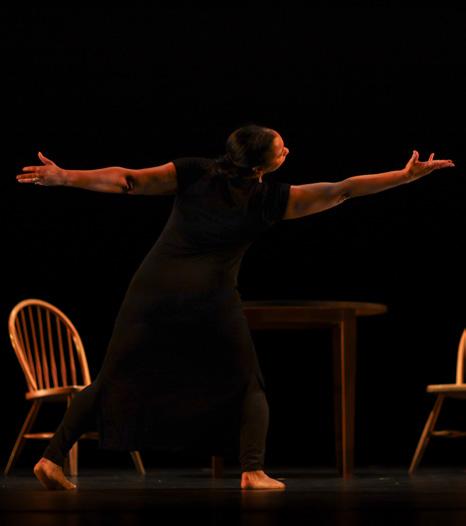
“Conversations (Kitchen Table Talk)” was a duet featuring Glenn herself and visiting dancer Shannon Mockli from University of Oregon. Glenn said the piece was inspired by kitchen table conversations that leave egos behind, focus on listening intently and take winning off the table. These conversations are about truly seeing and hearing the other person.
Glenn’s husband crafted the table used in the dance, which featured an intricate design.
“Felled Tree Ascending” was a group number featuring intense, dramatic music composed by Zoë Keating. According to Glenn, the piece represents the idea that trees, portrayed by the dancers, have a bound existence. The trees’ presence is felt, and they eventually realize their own agency and come together as a community.
Audience members said they were captivated by each
and every dance, and left with a larger appreciation for the performing arts.
“As I was watching, I was like, this is really interesting,” Avi Dabas ’28 said. “It’s really interpretive, really good storytelling and deep meanings behind it. So, if there was something I would take away, it would just be a new interest in modern dance. I would definitely come back.”

Marine Science Society brings together aquatic aficionados, pro vides research opportunities
For students at the College of William and Mary who are fascinated by all things under the sea, the Marine Science Society offers a welcoming space to explore their interests and connect with like-minded people. Whether you are a biology major, a geology lover or a sea creature enthusiast, this club combines curiosity with community.
Co-Presidents Struan Baker ’26 and Allison Thorne ’26 have been with the club since their freshman year. Interested in studying geology and environmental science, Baker was immediately drawn to the club. At one of his first events, he recalls the excitement of seeing a big touch tank filled with sea creatures.
“That was my hook right there,” Baker said. “I was coming back every day after that.”
Thorne, who started as social media manager before becoming co-president, emphasized the importance of finding a community on campus.
“Marine Science Society started out as a very social club and grew into a more academic, pre-professional club over time,” Thorne said. “Struan and I have been trying to keep some of that social aspect alive, as well as keeping it as informational as possible. It was a really nice way to make connections with other like-minded people and also learn about everything you could do on a college campus.”
Club member Madelyn Shelton ’29 shared
her excitement for joining the Marine Science Society.
“On Admitted Students Day, I remember meeting Chris Hines, and he was so enthusiastic, and I was hooked,” Shelton said.
“I was so excited at the club fair, I ran up and I was there for like 20 minutes.”
From presentations about summer internship opportunities to playing marinethemed Jeopardy games to discussing aquatic horror movie monsters, these club meetings are never dull. They often begin with a short crash course video made by the outreach chair, highlighting a current marine science issue or topic and sparking curiosity and discussion among members. Club member Aidan Dowdy ’28 commented on the fun, laidback atmosphere.
“There are no dues for the club, which I think is a big plus,” Dowdy said. “It’s just a very chill group of people who all kind of have the same interests.”
One of the club’s signature events is its marine-themed bake sale, which shares what the club is all about and raises money for trips throughout the year. Last year’s Halloween bake sale featured cupcakes with a fish skeleton design made of sprinkles. Members are already eagerly planning this year’s theme.
“We’re thinking about doing it in November, closer to winter break, and having marine snow-themed cupcakes,” Thorne said. “We like to have them a little educational.”
The variety of club excursions is another highlight, drawing in current members as well as interested students across campus.
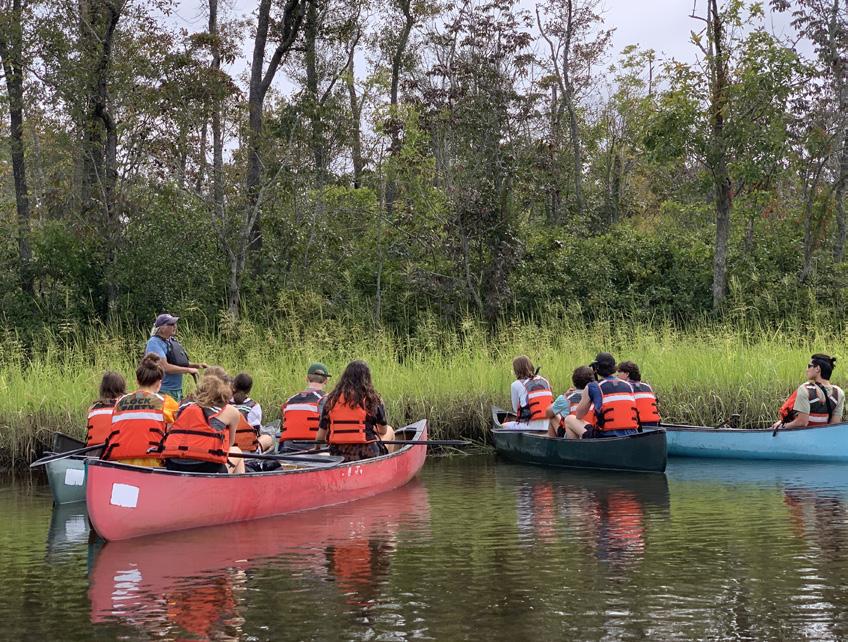
“In the past, we’ve gone whale watching, we go to aquariums, we’ll go kayaking or canoeing, so we do a wide range of stuff that people really look forward to,” Baker said.
“That pulls a lot of people outside of just our general membership, too.”
The Marine Science Society also plans annual field trips to the Virginia Institute of Marine Science. These trips serve as a gateway for students to connect with faculty and explore potential research opportunities.
“VIMS is really the motivation for a lot of things we do,” Baker said. “We try to get students plugged into that if it’s something they want, we try to make those connections and help build those relationships.”
Dowdy expressed his enthusiasm for more frequent trips to VIMS.
“I’ve only been to the VIMS campus once,” Dowdy said. “I think it’d be cool to go there more and get to know the different professors and people doing research there.”
Shelton echoed a similar sentiment.
“I would love to go to VIMS because I’ve never been. It’d be cool to go as a group because, I mean, if I just walked in there, I’d be like, what am I looking at? What’s going on?” Shelton said.
The club is making other future plans as well. One exciting initiative is a coastal marine science major application workshop, which is designed to help students navigate the process of applying to the new degree program.
“We’re hoping to try to get some of the students who were accepted into the small cohort to help students with their applications as the cohort increases,” Thorne said.
The Marine Science Society does not shy away from discussing how current political issues are affecting marine science.
“It’s been a little bit hard to avoid what’s going on in the current presidential administration just because it has had such a dramatic impact on organizations that fund marine science research,” Thorne said. “A lot of our club members like research, and the club members who don’t like research like policy, so we’re all pretty impacted by it.”
To navigate these challenges, the club emphasizes adaptability and resilience.
“We’re pushing people to try what they can, see what sticks and not be discouraged by what’s going on right now,” Baker said. “Keep applying for the major, applying for the research project, because that’s what’s important at the end of the day.”
At its core, the Marine Science Society is about forming an inclusive and
welcoming community.
“I remember the first meeting, I was hesitant to come because I didn’t know anyone,” Shelton said. “ But I remember, afterwards, I called my mom, and I was like, ‘I’m so glad I went.’ I love to be a nerd about stuff, and it just feels nice to have a connection to a different group of people.”
Dowdy had similar thoughts.
“I met one of my really good friends, Edward, through the club. We got to do a field course over the summer together, and we’re both going to be applying to the major together, which definitely helped and strengthened the friendship,” Dowdy said.
“It’s not all academic, we hang out a lot too.”
The club’s leaders hope that all newcomers walk away from their first meeting with this feeling.
“It’s nice to geek out every Thursday at 7 p.m. in Chancellors [Hall] 123.” Baker said.
“We hope that people come in and have a good time and can build a sense of community, and then take that and pursue things that we have available on campus, pursue things at VIMS and be able to make the most of what they have here.”
Despite common misconceptions, the Marine Science Society is not just for biology majors.
“For incoming students that are joining the club, I want to stress that it’s not just biology,” Dowdy said. “All the processes that happen on land can happen in the water.”
Baker stressed a similar point, emphasizing his geology background as evidence.
“We just want people to come, even if they’re remotely interested in marine science,” Baker said. “We’re happy to have them.”
As the club continues to grow, leaders and members alike are committed to creating a space for students to explore marine science from whatever angle they choose, whether it be geology, biology or chemistry.
“More people are always welcome. We just need to know if we need a bigger room,” Thorne said.
Mint Theatre performs nostalgic adaptation of “The
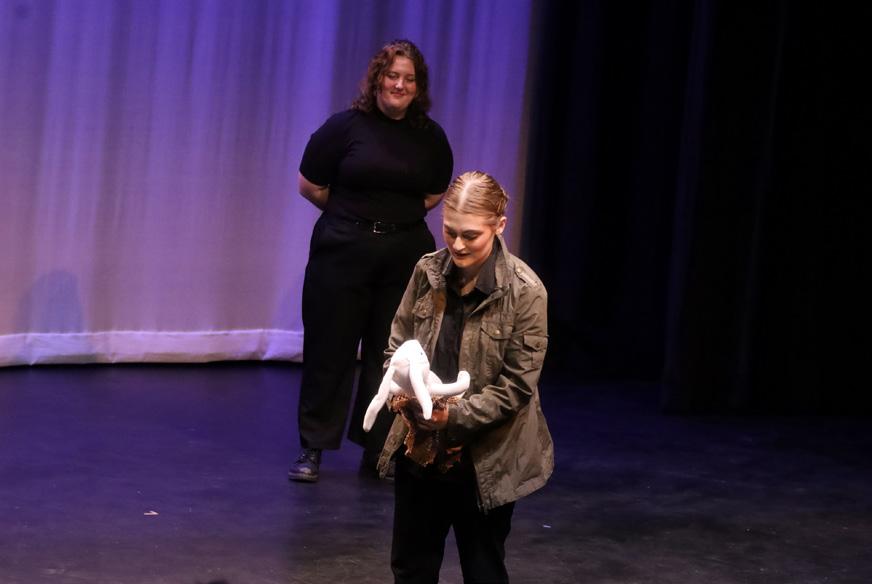
“The Miraculous Journey of Edward Tulane,” a classic children’s novel by Kate DiCamillo, tells the story of a selfish toy rabbit made of porcelain learning to love as he passes through the hands of different owners. The story is well known for its emotional depth and themes of compassion and personal growth.
The tale was recently transformed into a theatrical production by the Mint Theatre Company, a student theater organization at the College of William and Mary. The adaptation was performed Friday, Oct. 24 through Sunday, Oct. 26 in the Studio Theatre of Phi Beta Kappa Memorial Hall.
Director Maddox Kromash ’26 crafted the
Saturday, Oct. 25, from 5 to 6:30 p.m., the College of William and Mary’s Japanese American Student Association held an educational presentation and matcha tasting in the Sadler Center. e event, titled “Culture in a Cup: e Miseducation of Matcha,” was a collaboration with on-campus cafe Town Center Cold Pressed. JASA members gave a presentation on the origin and cultural signi cance of matcha and a live demonstration of a matcha tea ceremony. After the presentations, the organizers served two types of matcha for tasting.
JASA president Ourania Michael ’26 spoke about the philosophy of the tea ceremony and what it meant to its original creator, Sen no Rikyu, during the presentation.
“This philosophy focuses on finding beauty in the imperfect things or the incomplete things, and it’s a symbol that everything in life is temporary and it will eventually perish,” Michael said. “So the idea is that the tea ceremony just serves as a slight pause in your day to just sit back and relax and enjoy the matcha, and it delights your body and your mind.”
In addition to the history and significance of matcha and the tea ceremony, the presenters highlighted misconceptions about matcha.
“Matcha originates from China, not Japan. And although it’s popularized in Japan, it’s important to recognize where the tradition of matcha started from, which I think isn’t really represented nearly as much,” Michael said.
JASA social chair Sara Wilson ’28 further emphasized the importance of correcting this misconception.
“We just want everyone to give
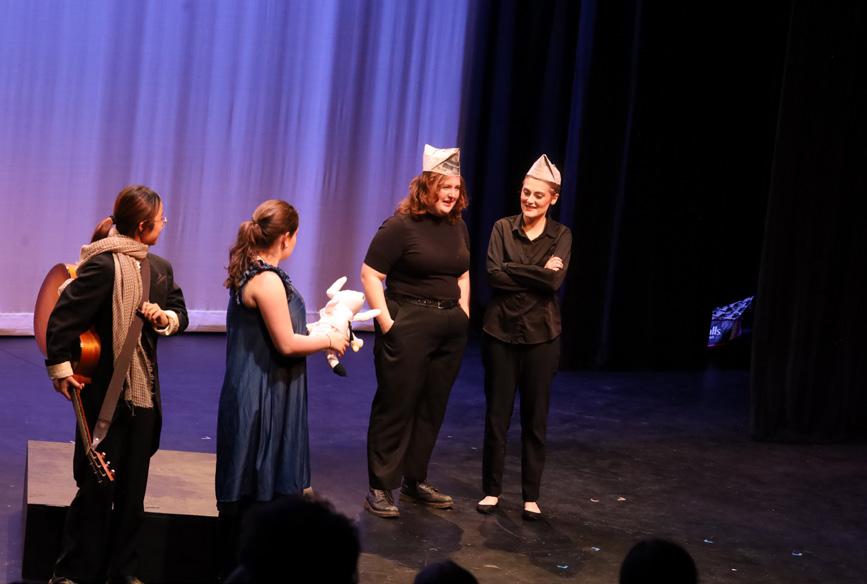
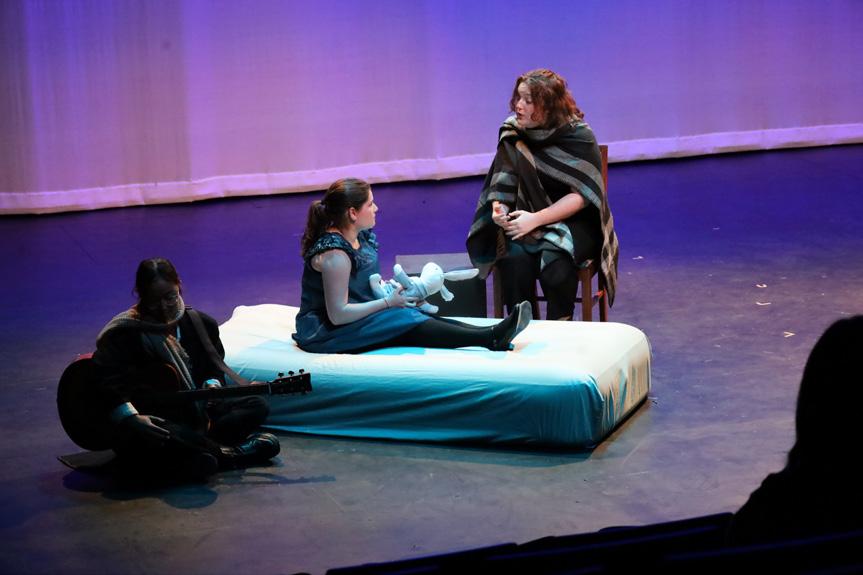
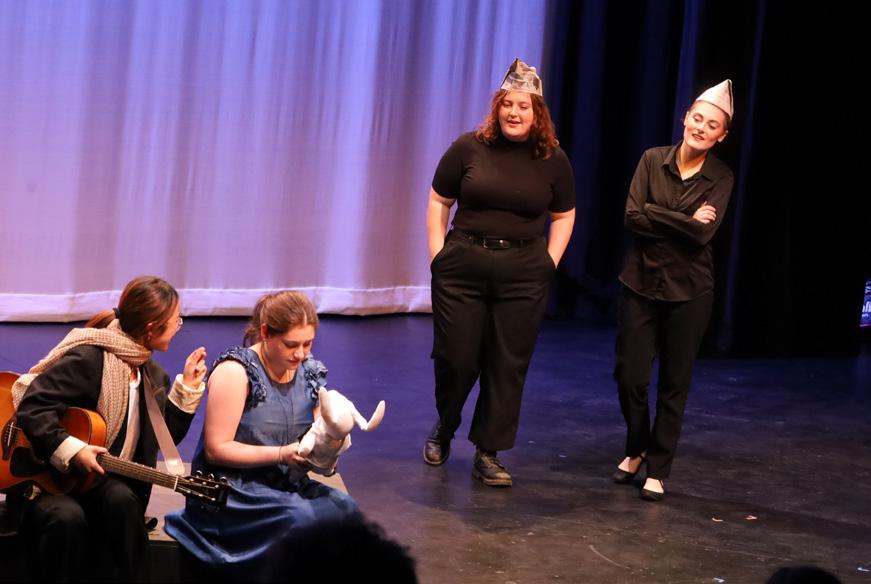
play in a way that is both imaginative and captivating. The adaptation balanced the whimsy of a children’s story with emotional realism that appeals to an older audience.
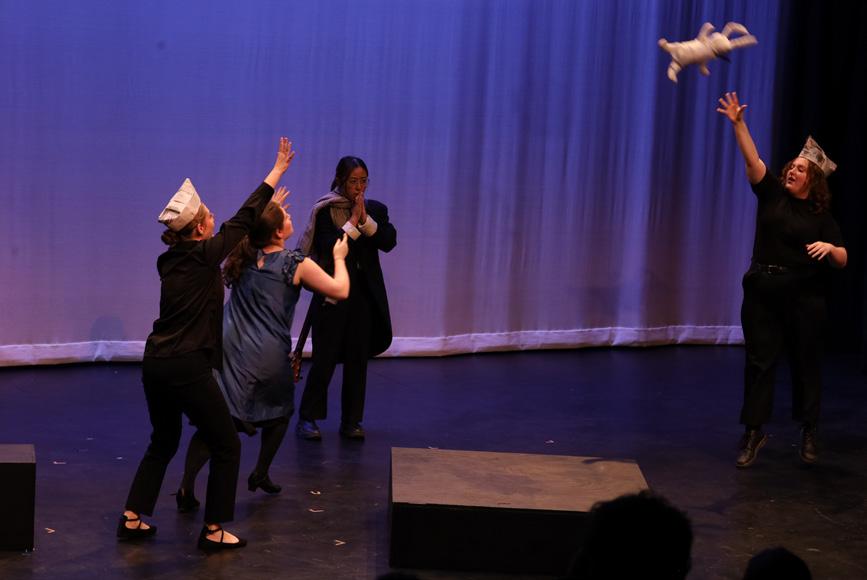
The decision to use a small cast of only four members was a bold but effective choice, making the production feel more personal and intimate. Each actor was required to take on multiple roles, showcasing their versatility and deep understanding of the story’s themes.
The small ensemble approach also allowed the audience to feel more connected to the performers, emphasizing the personal nature of Edward’s journey.
The play begins with the introduction of
credit where credit is due when they enjoy the westernized or Americanized matcha,” Wilson said.
Michael further explored the westernization of matcha.
“There’s just a lot of misrepresentation, especially on social media, specifically matcha lattes. Although matcha lattes are really good and they’ll be served today, calling matcha lattes as matcha itself is misrepresentation,” Michael said. “In Japan, a majority of people drink matcha in a traditional way with just water and no added sweeteners.”
The event’s tea ceremony demonstration included aspects of Japanese culture, contributing to JASA’s goal of ensuring the Japanese roots of matcha are understood and appreciated. Presenters explained each step of the traditional tea ceremony.
“First, the guests will take off their shoes before being ushered into the waiting room of the tea house. And then they’re greeted with a silent bow from the house and have to ritually purify themselves before entrance into the Tatami mat room, so that would entail rinsing their hands and their mouths with some water at a stone basin,” Wilson said.
Along with describing the traditional ceremony, organizers traditionally prepared the matcha served during the event, using tea ceremony equipment and hot water.
Attendees tasted two types, Wakaki and Ikuyo, to compare the lighter and bitter strains of matcha. At the end of the event, Cold Pressed served its matcha lattes and pastries. Before tasting, JASA members explained the distinction between
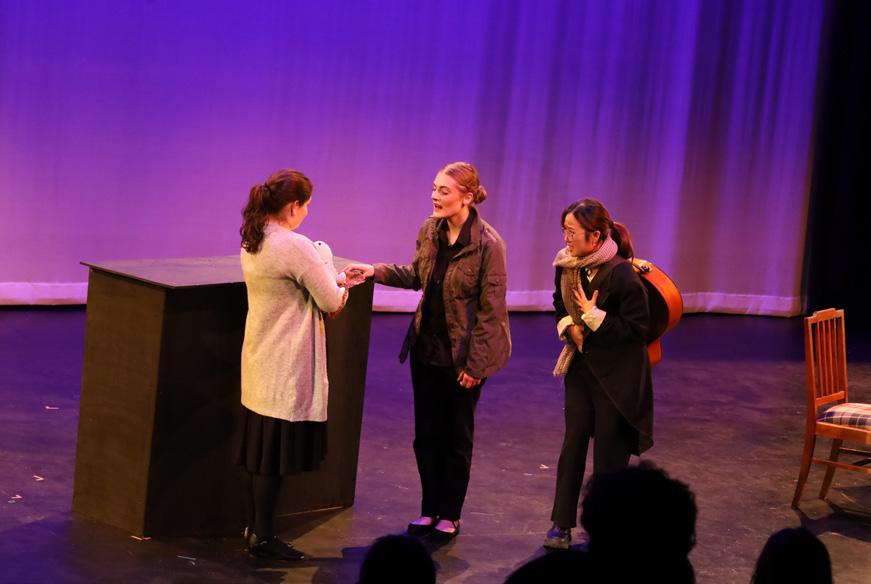
Edward, a beautiful toy rabbit owned by a young girl who adores him. Dhanbee Suh ’27 quickly portrayed Edward as being wrapped up with his appearance and material possessions. He does not care about the ones who love him, because he is overly focused on himself and is too consumed by his own reflection to understand what love truly means. Suh captured this early arrogance with subtle humor.
As the story progresses, Edward is separated from his first owner and begins on his unexpected journey through the hands of different people, from a fisherman and his wife to a young boy and his dying sister. Every encounter changes Edward’s perspective on love. Edward faces difficult and emotional situations. Throughout his journey, Edward experiences joy, companionship, sadness and even heartache. Through embracing these emotions, he learns the importance of love but wants to never love again. Edward realizes that love is not always about happiness, but also about the courage to open one’s heart, even when loss is inevitable. He is scared to love because he knows that love is not always easy. The play’s overall message is an impactful one: Opening your heart can lead to pain, but life is meaningless without love.
Suh’s intriguing performance managed to instill the real and raw emotions of Edward into the crowd through music and selfreflection. Through expressive body language and subtle facial expressions, Suh managed to highlight the complexities of Edward’s internal struggles. Suh has the ability to make an inanimate object feel human. By the end of the play, Edward is an entirely new rabbit. He does not think the way he once did, because he has known love.
Suh made this clear through her powerful performance. Edward’s role was played so well that it had the audience laughing and crying. Suh’s musical talents added another layer of depth. By playing the guitar multiple times throughout the production, Edward’s emotions were heightened.
The other members of the cast also delivered impactful performances through the vessels of multiple characters. Their transitions between characters were smooth and easy to follow.
Another important aspect to the production was the technical design. The set, though minimalist, used its pieces in a symbolic way. For example, the use of a bed produced a clear
the two matchas so attendees could accurately compare them.
“Wakaki translates to ‘young,’ and it’s characterized by a hint of sweetness. It’s more refreshing, and it’s lighter. It’s prepared at Usucha, which translates to ‘light tea.’ So, it’s good if you like a short aftertaste and a softer fragrance,” Michael said. “And then the second one is Ikuyo, which means ‘generations,’ and it’s more balanced of sweetness and umami. However, it’s a little bit more bitter than the other matchas, and it has a way stronger aroma.”
Attendees found the matcha tasting very useful to get a sense of traditional matcha and tea ceremonies.
“I’ve never tasted the distinction between them before, and I never knew that there was a distinction. So learning about that and getting to really engage with that was really interesting,” attendee Catherine Jones-Painter ’29 said.
With matcha’s rising popularity on social media, learning about the origins was important to attendees as well.
“I’m a big matcha lover; however, I understand that there’s a lot of history behind it, and as a white person enjoying matcha, I feel like I should probably be educated about the stuff and the history behind it,” Jones-Painter said.
The organizers shared this sentiment, as the importance of understanding the history of matcha was considered a key takeaway.
“It’s totally okay to prefer or like a matcha latte that’s got all those additives in it as long as you know the roots of it,” Wilson said.
JASA presenters emphasized matcha’s cultural significance,
picture of the sick girl. The lighting and sound design complimented the simplicity. The quiet ticking of a clock added to the show without distracting from the performance. These subtle choices helped create an atmosphere that was focused on Edward’s inner transformation.
Reactions from the audience were very positive. Ava Canade ’28 attended the show to support her roommate, who worked as its stage manager. Canade felt that the adaptation of a children’s book based on love and friendship into a theater production was exciting.
“The story sounded interesting,” Canade said. Canade shared that she was so captivated by the first performance that she came again for a second viewing, noticing new details each time.
“It was really cool to see tweaks the cast made and just get to see it again, and get to see it for a second time and kind of pick out new little bits of their performance,” Canade said.
Another student, Madison Danese ’28, said that, though she went into the play knowing very little and had not read the children’s book before, she was able to get a deep understanding of the story.
“Though it was kind of minimalistic, they really painted the picture in a really beautiful way,” Danese said.
Danese’s thoughts emphasized director Kromash’s vision to stage the show in an intimate way through a small theater and minimal props. This staging allowed for deeper connection with the audience. It felt as though the audience were part of Edward’s journey, not simply watching it.
The connection between the cast members themselves was also clear on stage.
“It was cool getting to work with a student director and all the other actors,” cast member Gwendolyn Butler ’29 said.
The cast members had to play multiple roles, and Butler was impressed that her fellow actors were able to put so much energy and time into each different character.
“Every single one of these actors really threw themselves into the heart of their character,” Butler said.
Mint Theatre Company’s successful production was all to do with its talented cast, director and stage workers. This production of “The Miraculous Journey of Edward Tulane” was more than a simple adaption of the beloved children’s book. It successfully conveyed the message of what it means to love and lose and choose to keep going.
which is necessary for acknowledging matcha’s history as well.
“Matcha is known for its simplicity and its purity, and it’s not only deeply embedded within Japanese history, but also its significance comes with the creation of the tea ceremony,” Michael said.
The event’s collaboration with Cold Pressed made it unique, as attendees paid for their tickets with dining dollars. A representative from the cafe served specialty desserts.
“Cold Pressed was very helpful and generous in logistical support, providing supplies. We selected which powdered matcha to order, and then we bought that ourselves,” Wilson said. “But the pastries, everything else, the means of selling the tickets on GrubHub, Cold Pressed made that very convenient
and easy for us, and we’re very appreciative of that.”
Turnout and attendee participation were both high for the event, making it enjoyable for both organizers and attendees.
“I am more than happy with how the turnout was. We ended up overbooking a little bit, so it was very exciting. At rst we were nervous just because not a lot of people have heard of JASA because we’re a younger club. It’s only our third school year,” Wilson said.
Attendees enjoyed the educational aspect of the presentation in addition to the tasting and treats.
“I’m always one of those people who just wants to learn more about everything, so I saw this event and I was like, ‘Oh my gosh, a thing that I like and a chance to know more,’” Jones-Painter said.

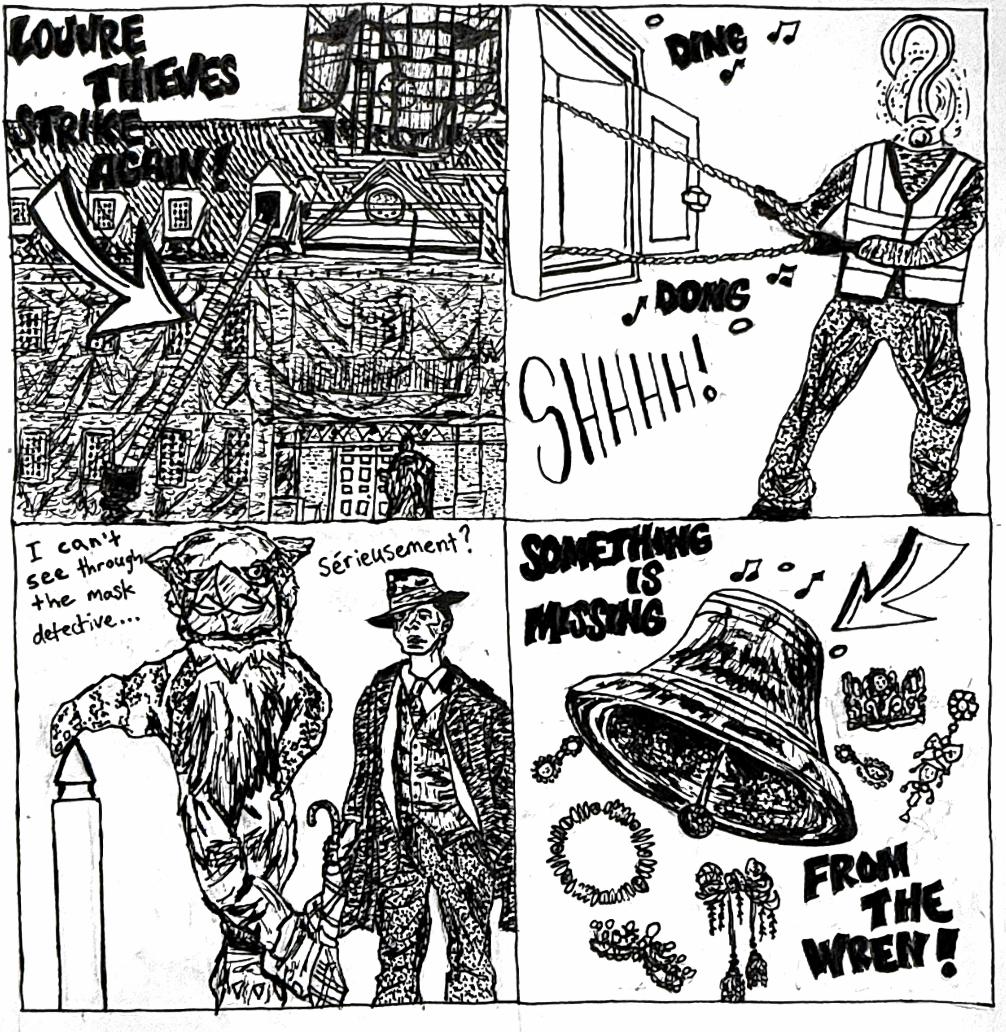
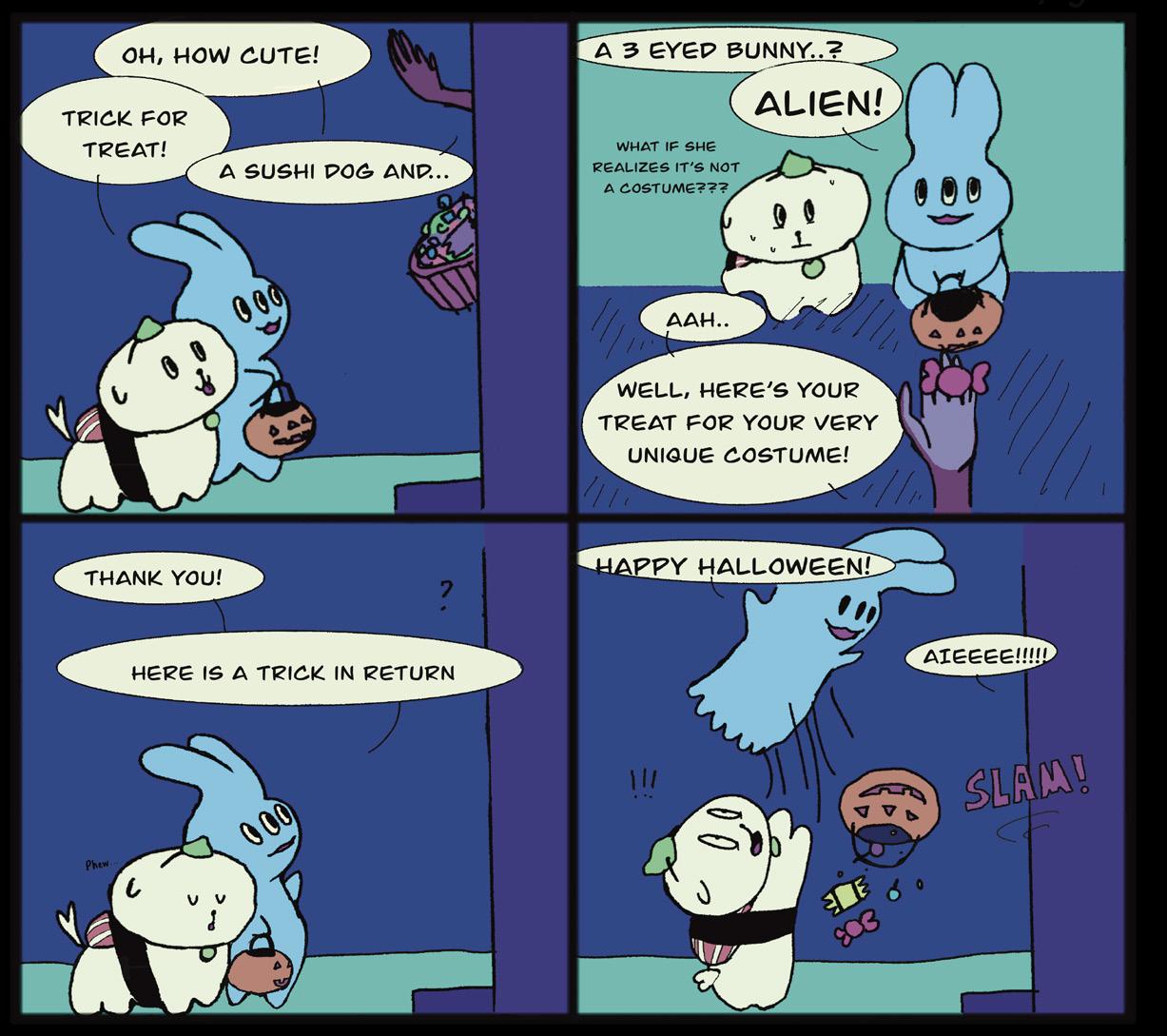


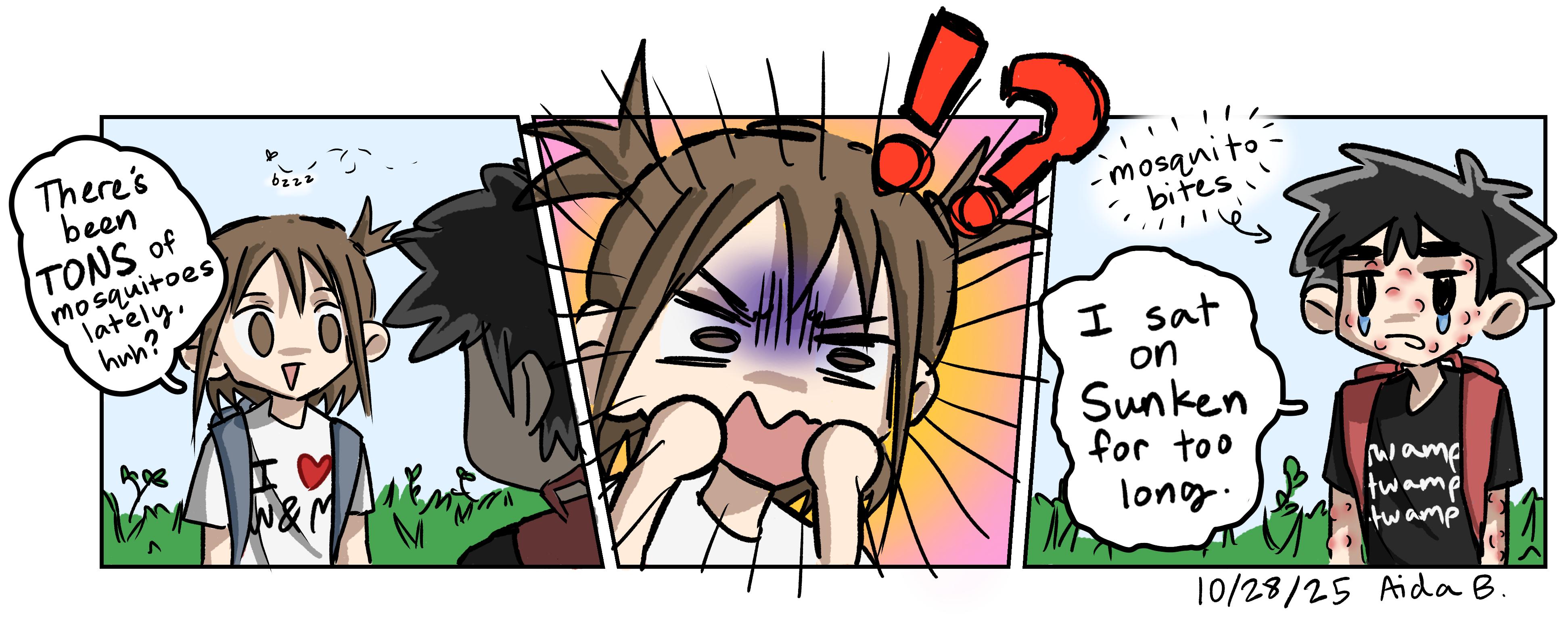
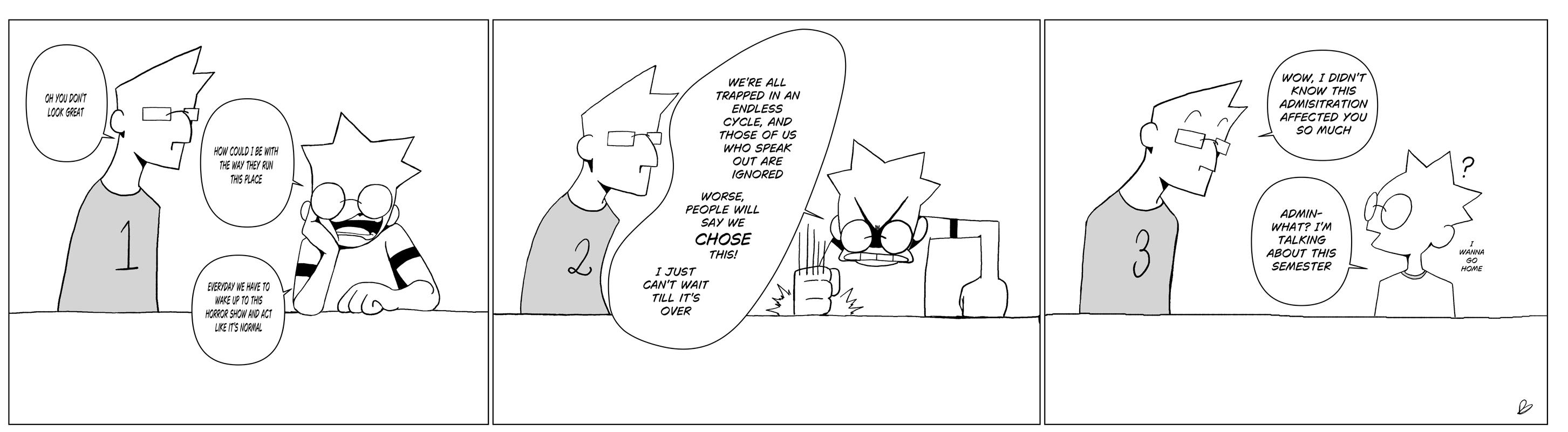
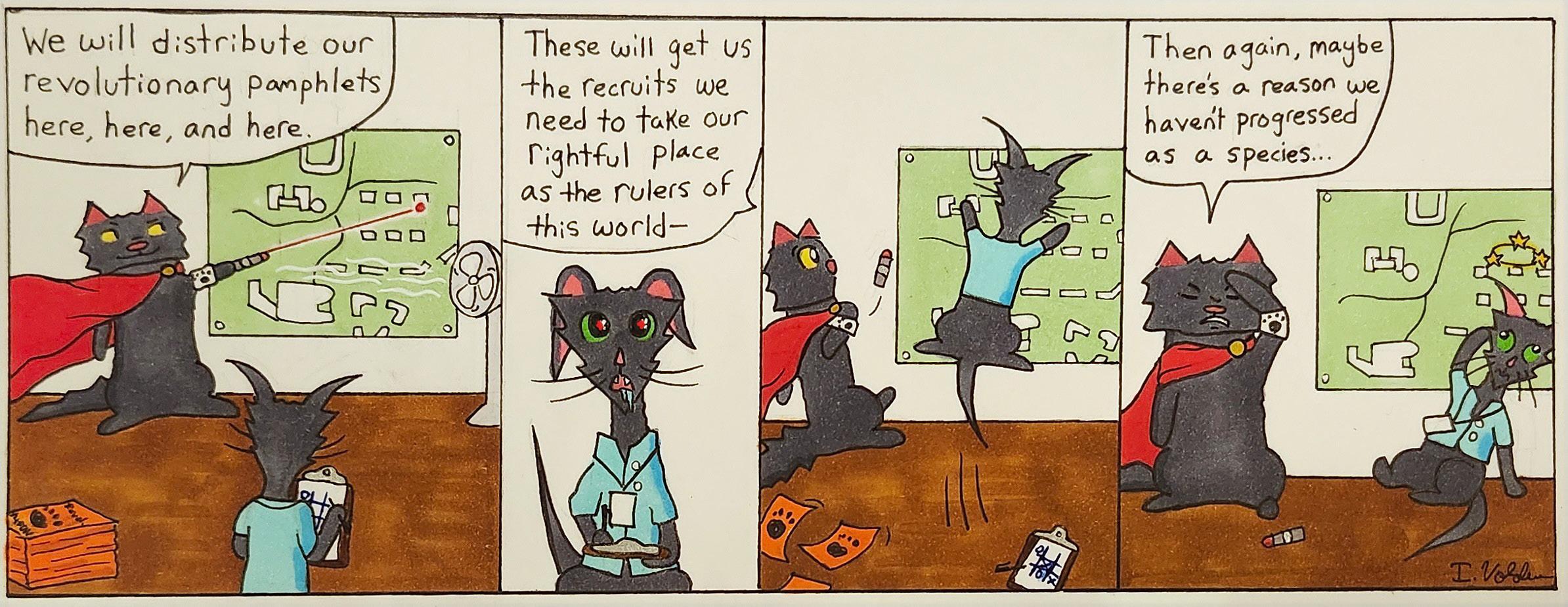

Our country and community feel burnt out. Recent political developments have left many of us feeling exhausted, demoralized and eager to disengage.
In the past year, we’ve lived through a tumultuous and overwhelming time, fraught with assassinations, political turmoil and the unraveling of established democratic norms. The President's flurry of executive orders and questionable policies, an intentionally overwhelming strategy, has worsened the sentiment. We must not succumb to political burnout. Doing so diminishes our ability to hold our elected officials to account. Today, tuning out or disengaging from our democratic system, tempting as it may be, is downright dangerous. We must remain informed
and engaged, especially with the current kakistocracy in Washington. Above all, we must vote this year. We all have the unique opportunity to rebuke the current administration for the first time when we vote in November. This opportunity is a rare electoral privilege: only Virginia and New Jersey will hold elections with national implications this year. It also carries enormous responsibility. An overwhelming rejection of the current administration will only materialize if we vote to elect qualified representatives to Richmond who will work to insulate us from those currently in Washington. All College of William and Mary students, faculty, local alumni and community members can — and should — contribute to this essential effort by voting in Virginia.
We are all eligible to vote in this year’s election, regardless of home state, because we are Williamsburg residents. Students who missed the deadline to register to vote should vote via a provisional ballot on Election Day at their polling place. Provisional ballots count the same as normal ballots, pending the verification of a student’s identification and voter eligibility.
Our votes will prove most consequential in Virginia, especially in Williamsburg. This year, Virginia’s statewide races — for governor, lieutenant governor and attorney general — are among the most competitive in the country and hold the most national significance until the 2026 midterm elections. Williamsburg is home to one of the closest Virginia House of Delegates races this year. The 2023 race with the same candidates was decided by just 667 votes out of 35,637. Similarly slim margins are expected this year.
We should also vote in Williamsburg regardless of where we plan to vote in the 2026 midterm elections. All students can vote in Williamsburg this year and elsewhere next year. To do so, they should simply change their registration to their home state following Election Day. In most states, this process is simple and straightforward.
The entire College community must vote in this year’s election. The ballot is the best way to safeguard our country and community. Though this year’s elections are not for federal office, they mark our country’s first significant opportunity to rebuke the current administration. We must overcome our political burnout and seize this opportunity. AdrianRyan’27isaninternational relationsmajor.HeistheCollege ofWilliamandMary’s Young Democrats’ President. Contact him atagryan@wm.edu.
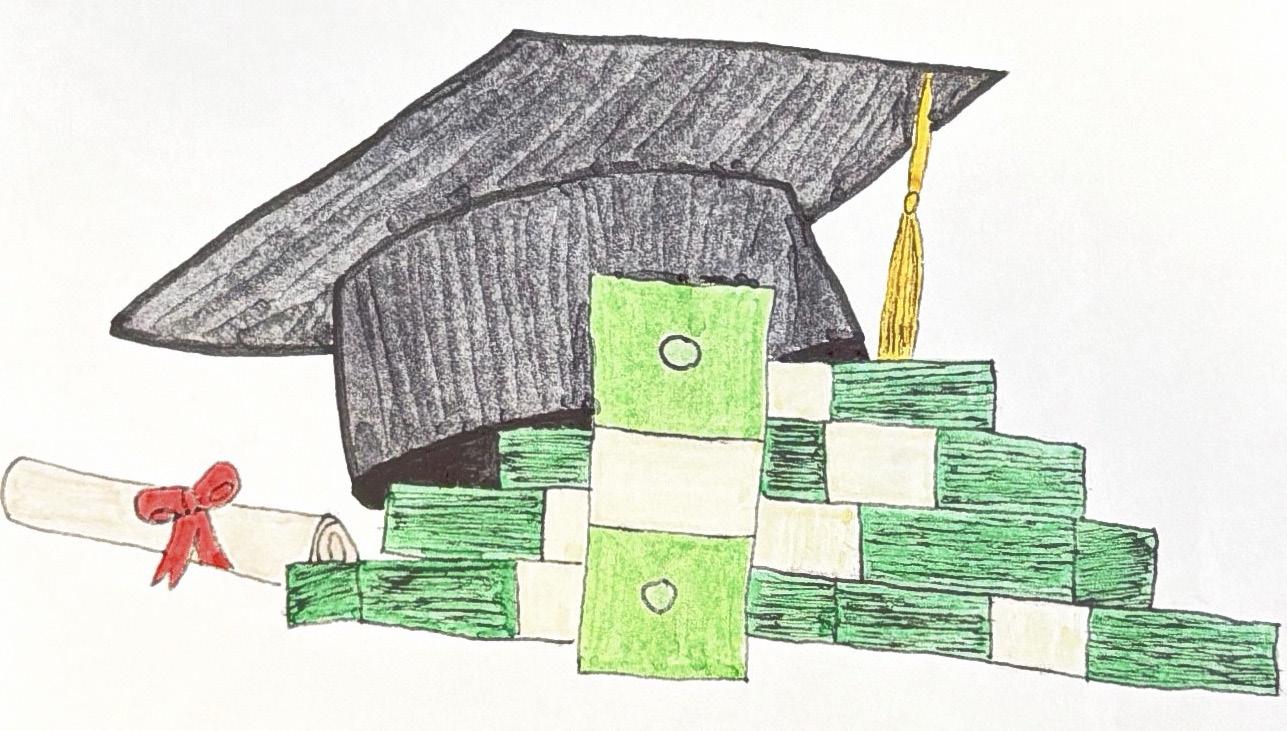
Equal opportunity in education is a joke. To be fair, I don’t have all of the data on this that I need to make a blanket statement about equal opportunity in all aspects of higher education, but I am familiar with one specific area, which — in my opinion — is a pretty good case study for this: law school.
I didn’t go into law school applications/the law school process expecting it to be cheap — let’s be clear — but the amount that they charge for everything is ridiculous. I honestly believe that if the Law School Admission Council could charge me for the air I was breathing while I took my LSAT, they would have. Hell, maybe they did, they don’t tell you what the fee is for.
I was doing the math with one of my friends, and when all is said and done, I will be spending over $1,600 on taking the LSAT and applying to law school: $200 for access to practice tests, $70 a month for a subscription that helps you break down and prepare for the LSAT, $248 for registering for the exam, $215 for the LSAC’s transcript reporting service and $45 every time they send that transcript and letters of recommendation to a school you’re applying to, on top of the application fee that that school charges. And sure, there are discounts and fee
waivers and things you can apply for, but the fundamental point is that learning, especially in a field which is so important to how our society functions, should not be so hard to get into from a financial point of view. I’m not trying to present this as if I’m the first person to ever discover that school is expensive; I’m definitely not, but since a new season of applications is upon us, it probably bears repeating.
And obviously, this cost is not just unique to law school. Applications to the Graduate School at Duke University are $105. It’s $75 for graduate programs at Virginia Tech. It all adds up. If you want to be a doctor, it costs $345 to register for the MCAT, $175 to apply to the first school and $45 for every subsequent application. It’s a racket.
I understand that education is a business in this country — and we can argue about whether or not that’s a good thing — and there are fee waivers and things to help those who can’t afford to pay all of these fees, but the fundamental issue is people go into these graduate and professional programs, just like they went into undergrad, because they wanted to make themselves better. But, most of the time, it feels like the education business is punishing people for wanting to continue learning or do something that will
help people. The idea of education is that it is necessary to society; it creates informed citizens and contributors. It seems a little ridiculous then that society can’t get out of its own way to make higher education accessible to everyone who wants it.
And obviously, it’s not just the cost of applying that’s prohibitive. The average cost of going to law school is $138,000, encompassing three years of education. The average cost of going to medical school is $59,000 a year for what is usually a four-year degree. And then, when you finish and are ready to take on the world with your new degree, the debt you’ll graduate with from law school is about $140,000 and more than $200,000 for medical school. Even getting a master’s degree can leave you with $90,000 in debt. Probably the vast majority of people going to undergrad don’t necessarily plan on continuing their education, but those who do shouldn’t have to bankrupt themselves on top of their already expensive undergrad degrees. We live in a society that likes to say that if you work hard and do well, you can do whatever you want, but in many cases, that’s not actually true. The high costs in every facet of these graduate and professional degrees (especially when you take it in tandem with the cost of undergrad) doesn’t just limit some people’s post-grad plans, but it also limits us as a society because this system doesn’t seem like it always rewards those who deserve it the most, but those who can pay for it.
MollieShiflett’26isadoublemajor inhistoryandlinguistics,notthatshe knowswhattodowiththat.Sheis captainofWomen’sClubSoccerGold fortheCollegeofWilliamandMary andisanavidfanofmostsports— exceptgolf.EmailMollieatmrshiflett@ wm.edu.

After a fun, chaotic and mildly mysterious Halloweekend, I only have one question: Do I really need to quote “Mean Girls” to you?
Picture this: It’s a cold, spooky night. You and your friends have been planning your Halloween looks for weeks, no, months, for this. The costume Pinterest boards have been made, the Amazon carts are overflowing and the group chat has been renamed something seasonally appropriate. Tonight’s look is inspired by Chappell Roan’s “Red Wine Supernova” lyric, “I’ve got a wand and a rabbit.” Your friend is the magician, top hat and all, and you’re the bunny. And because you’re a college girl on Halloween, your outfit includes that same corset that every girl in her 20s owns in at least one color. You make TikToks, you take pictures, you get compliments all night. It’s fun. Then, you know your night isn't over, so you decide to hit the frats, and as you’re walking past Fraternity Row, you overhear someone say, “I’m so sick of girls ruining Halloween by being Playboy Bunnies.”
The best part? You weren’t even a Playboy Bunny. Every year, like clockwork, the Bunny discourse returns. Suddenly, people have deep thoughts about corsets, ears and fishnets. And if you’ve ever cracked open a copy of Gloria Steinem’s “I Was a Playboy Bunny,” you know those critiques aren’t entirely baseless. There’s valid history and context there. But here’s the thing: My red lipstick and bunny ears on Halloween aren’t a symbol of patriarchal oppression. They’re just ... a costume.
The criticism always sounds the same: Girls are “ruining” Halloween
by turning every costume into a “sexy” version. Sexy princess. Sexy superhero. Sexy Abraham Lincoln (Yes, it exists.)
This isn’t about the Playboy Bunny, and for the record, that wasn’t your costume anyway. It’s about the broader discomfort people still have with women taking control of how they present their own bodies. When women make a costume sexy, people rush to analyze it: Is it objectifying? Is it empowering? Is it feminist enough?
What gets lost in that discourse is the simple truth that women don’t need to justify their choices. Making a costume sexy doesn’t erase your intelligence, self-respect or feminist credibility. Sometimes you just want to look hot while holding a Solo cup. In contemporary feminism, one of the central ideas is the concept of bodily autonomy and freedom of choice, meaning that you should do whatever you d— well please. So, criticizing someone for their outfit feels outdated at best and hypocritical at worst. You can and should wear as much or as little as you want. You can be a ghost in a sheet or a vampire in a mini skirt. Both are valid ways of participating in the same tradition: dressing up to feel confident and having fun. You can be sexy, scary, funny or all three at once.
Even the supposedly “original” costumes (Louvre robbers, TV show characters, pirates and fairies) are recycled every year, or will be. We all gravitate toward the same ideas because we want the same feeling: to look good, feel confident and capture a moment of self-expression. Halloween is not a test of creativity or political purity. It’s a night of performance, of play, of transformation. If that means putting on a corset and bunny ears, so be it.
So if you see a girl this Halloween dressed as a sexy angel, devil or, heaven forbid a bunny, here’s a radical idea: Just let her have fun.
As Cady Heron wisely said in “Mean Girls,” “In girl world, Halloween is the one night a year when a girl can dress like a total sl— and no other girls can say anything about it.” And honestly? That’s how it should be.
Isabella McNutt ’27 is a government and history double major, and she is a member of Alpha Chi Omega. She loves traveling, reading and music. Email her at immcnutt@ wm.edu.
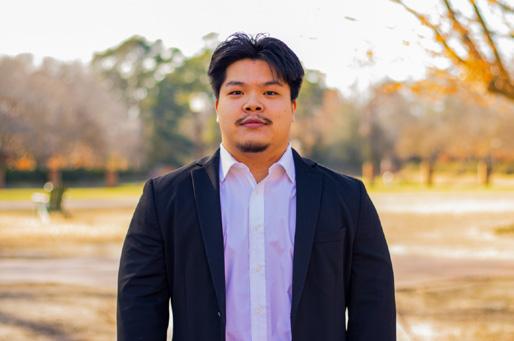
Eva Jaber FLAT HAT OPINIONS ASSOC.
Seeing as this is the 12th issue of my advice column, I thought I’d usher in our question of the week with a quote from Shakespeare’s “Twelfth Night”: “O time, thou must untangle this, not I. / It is too hard a knot for me t’untie.”
I actually have no idea what the context of this quote is because I haven’t read “Twelfth Night” and don’t care to check right now. But, as someone who the genetic lottery both cursed and blessed with a sentient head of wavy/curly/frizzy hair, what I do know is the feeling of a knot too hard to untie. Although, unlike this Shakespeare quote, leaving my hair’s tangles to time doesn’t really fix anything; it kinda just makes it worse. So, with that, I give you the question of the week:
“What hair care products do you care to share?”
Something truly refreshing about this question-asker is that they took my own positionality as a writer with complex biases and lived experience into account, asking me to only share advice that I feel compelled to broadcast to my readers. How thoughtful. I don’t feel like answering your question. I use the Suave kids 3-in-1 shampoo, conditioner and body wash, except I use it as an 8-in-1. I also use it to dress my salads, brush my teeth, shine my shoes, make the floor all slippery so I can skate around the dorm in my socks and waterlog the string instruments of my enemies.
Still, I know some of you readers won’t stand for me expressing my agency through art. I don’t understand why you can’t handle my lack of interest in engaging with your questions. You ask too much of me. Aren’t two masterpieces a month enough for you? You know what they say, I guess ... if you give a mouse a cookie, it’ll ransack your pantry and then eat through your plastic tupperwares that hold your Trader Joe’s peanut butter cups like a little racoon until you call animal control on them, but then, when the animal control guys get there, they accidentally take you instead because you were trying out a new hairstyle and they con-
fused you for a larger-than-average Yorkshire Terrier with human-like tendencies. I really can’t win. Anyway, back to the task at hand. I’ve decided to leave the decision between writing a boring answer to your question or pouring my heart out on this page up to chance. If I get heads, I’m writing about my hair care routine. If I get tails, I’m writing a smear piece about someone in my a cappella group. I can’t say the name of my group or else our PR chair will frame me for a serious white-collar crime, but it starts with a W and ends with “illiam and Mary Cleftomaniacs.” Alright; time to flip this coin. I got heads. Rules are a construct, though, and I’d rather write the smear piece.
My a cappella group is a circus, and two members of the executive board, 6ndrew and 7aty (I’ve unrecognizably altered their names to preserve their privacy.), are the ringmasters. But, anyone familiar with circuses knows that the person who actually has the most power isn’t the figurehead; it’s always the contortionist. If the apocalypse came around, the person who can fold themselves into a cabinet is gonna fare a whole lot better than some guy in a tailcoat and a dumb hat.
But who, you ask, is the figura tive contortionist in your favor ite satire advice columnist’s a cappella group? Well, there’s someone in this group who has been stretching the rules
Daniel Choi FLAT HAT BUSINESS MANAGER

When I first came to the College of William and Mary as an international student, I sat down at transfer orientation and asked the person next to me where he was from. “NoVa,” he said. I paused. “No, I mean, where in Virginia?” He laughed. “Yeah, NoVa.” As a person who was new to Virginia, it took me a few days and one confused Google search to learn that “NoVa” was not a town or a specific city, but an entire ecosystem. It is Northern Virginia, the flashing suburbia orbiting beside Washington D.C. Since then, I have realized that saying you are from NoVa is not just about geography; it is a lifestyle flex that makes you ‘different’ from other Virginians.
In Williamsburg, the best place to have fun on a Saturday afternoon might actually be the Food Lion on Richmond Road. It is where students wander through aisles of snacks they will never finish, buy a bunch of Nyquil to survive flu season and go just to feel like they have gone somewhere. Target comes close: you buy fluorescent lights and $5 candles for the comfort of routine. Beyond that, options thin fast. There is Busch Gardens, of course, but that is a fullday commitment and a $90 decision that requires courage, sunscreen and an Uber group chat.
Entertainment here is slow yet deliberate. You plan your fun the way you plan your midterms: carefully with a budget. Williamsburg’s energy is quaint, colonial and a little sleepy, like it still believes that joy should be earned and not found on every corner.
Then there’s Tysons Corner in NoVa, where it is the opposite pole of the Virginia experience. A place where parking garages have their own ZIP code, escalators hum like background music and every square foot competes to outshine the last. NoVa kids describe Tysons the way New Yorkers describe the city. It is just there, ever-present, always ready for something to do.
Where Williamsburg has brick sidewalks and candlelight tours, Tysons has
of the hair care game for far too long. Whenever I’m like, “Hey, [redacted], your hair looks really wonderful today; I was wondering if you could tell me what products you use,” he’s always like “No, Eva, I actually cannot divulge that information, and also even if I wanted to, there would be no information to divulge because I was just blessed with hair that air dries like this and also I hate you.” I might be paraphrasing a little, but you get the idea.
Here are real quotes that were actually said to me about this guy. If The Flat Hat ethics people ask me for the interview transcripts, please say I lost them.
“People think that when [redacted] says he likes to beatbox he means vocal percussion, but he actually means ‘beetbox,’ which is his hobby of emptying boxes of germinated weedy beet seeds into other people’s gardens to replace their plant diversity with homogenous rows of beetroot. It needs to stop.”
“[Redacted] once told me he was passionate about conservation and, when I said that I was too, he asked if I could prove it by conserving my vocal energy for someone who actually cares.”
“[Redacted] has been lipsynching this whole time.” My advice to my readers is that hair care is self care, and the best way to take care of you
is to vanquish your enemies. I am using my platform to form a legion that will work to make my hair look better in comparison by straightening the curls of this evil person, whom I will cryptically refer to as 6ack 7yles. What’s one way that people get straighter hair? They get keratin treatments. We need to manufacture circumstances for this guy that are identical to a keratin treatment to flatten his wavy locks. Here’s the plan: everyone on this campus needs to pitch in to sneak 6ack 7yles as much biotin-rich food as possible in order to promote keratin synthesis. If we take down this giant in the William and Mary hair game, there’ll be
LED signage and matcha cafes. You can spend hours people-watching, shopping and debating whether to get all you can eat sushi or Korean BBQ (my favorite) for lunch
— and still leave with the feeling that you missed half of the options. Tysons is what I call Virginia’s ‘unofficial’ cultural capital.
Half-mall, half-metropolis, where bubble tea meets bureaucracy, and everyone is in a hurry to have fun.
In NoVa, entertainment feels infinite. Movie theaters are humongous, escape rooms come with cinematic soundtracks and every highway exit hides a fusion restaurant. It is a version of Virginia that is constantly plugged in, and it is where “let’s hang out” does not require planning but just proximity.
Spending more than two years here in Williamsburg, my idea of ‘fun’ has recalibrated. Coffee at Aromas becomes an event.
Ice cream at Baskin Robins is like a plan.
A walk through Colonial Williamsburg at sunset counts as therapy. You start to appreciate how luxurious quiet can feel and how laughter carries farther when there is no traffic drowning it out.
Meanwhile, NoVa pulses at a different BPM. It is the rhythm of shopping-mall jazz, of late-night bubble tea runs, of group photos under neon restaurant signs. Where Williamsburg values charm, NoVa values momentum. One looks backward with nostalgia; the other looks forward with caffeine.
Both are Virginia, just tuned to different frequencies
Every state has its regional quirks. North vs. South California, Chicago vs. “the rest of Illinois,” but Virginia’s split feels especially cinematic. You can drive three hours and move decades in vibe. One side is suburban velocity; the other, historical stillness. What I have learned, though, is that neither is better. They simply mirror the people who live there. NoVa’s endless energy is what makes it ambitious and modern. Williamsburg’s calm is what makes it reflective and grounded. Between Food Lion’s comfort and Tysons’ chaos, Virginia somehow captures both edges of American life: the hustle and the hush. So, no. You cannot see all of Virginia in a weekend. But if you ever find yourself wondering where the state’s personality lives, start by asking someone where they are from. If they answer “NoVa,” you will know what to expect: speed, lights and a Starbucks on every block. If they say “Williamsburg,” clear your schedule. You are about to rediscover the art of slow life..
DanielChoi’26isaGovernment majorwithaminorinMarketing.He enjoysexploringnewrestaurantsand writingfoodreviews,oftenduringhis travelswheneverhefindsfreetime,blendingthoseexperiencesintohiswriting. Onweekends,youcanfindhimgolfing, tryingnewcoffeeshopsortryingdifferentteas,ordiscoveringuniquefragrancesfromaroundtheworld.Contacthim atdychoi@wm.edu

In 2020, the College worked with local Indigenous peoples to develop a Land Acknowledgment statement. The statement represents an important step towards recognizing Indigenous peoples, but its misapplication renders it frequently performative.
“William & Mary acknowledges the Indigenous peoples who are the original inhabitants of the lands our campus is on today – the Cheroenhaka (Nottoway), Chickahominy, Eastern Chickahominy, Mattaponi, Monacan, Nansemond, Nottoway, Pamunkey, Patawomeck, Upper Mattaponi, and Rappahannock tribes – and pay our respect to their tribal members past and present,” reads the College of William and Mary’s website.
When used in relevant contexts, the statement serves as a reminder that the history of the College is intertwined with Indigenous history and displacement. For example, the Land Acknowledgement prefaces Convocation, Commencement and the Provost’s New Faculty Welcome. The statement’s integration into speeches about the College situates the College’s connection to Indigenous communities as something fundamental and important.
However, when the statement is used in contexts where it does not feel relevant, it instead comes off as performative. For example, the statement is printed on the Office of Residence Life and the Office of Sustainability’s webpages, and read at The Flat Hat’s “Someone You Know” training. It is listed on the website of William and Mary High School Model United Nations, an undergraduate-run conference. It is also featured on the website of the Innovative Library Classroom, another conference hosted by the College, and on the Tag Day website. Tag Day celebrates private donations to the College. In these places, the Land Acknowledgement is brought up only to be quickly dismissed. Visitors to the Office of Residence Life and the Office of Sustainability’s webpages scroll past the statement to find the information they are looking for; the “Someone You Know” training transitions to focus on sexual violence immediately after the reading of the acknowledgement. When it does not appear relevant to the subject at hand, the College’s Land Acknowledgement exists simply to fulfill a requirement of political correctness and,
ultimately, to be dismissed. This is not to say that Indigenous issues have no relevance to Residence Life, sustainability, sexual violence, or the rest of the topics mentioned above. If the Land Acknowledgement was accompanied by discussion of how Indigenous peoples are connected to the topics above, the acknowledgement could be one part of a larger effort to raise awareness of Indigenous concerns. The “Someone You Know” training could include information about the increased sexual violence risks faced by Indigenous women. The Office of Residence Life could discuss how they support Indigenous students or remind residents about the history of the land they are living on. The Office of Sustainability could bring up how Indigenous land practices relate to their work. The bottom line is that in order for the Land Acknowledgement to be meaningful, it must be part of a larger effort to educate students about, and connect with, the Indigenous community. Unfortunately, the College presents the Land Acknowledgment not as a first step, but as an end.
The College’s webpage about the acknowledgement reads, “Acknowledgement promotes awareness of and respect for Indigenous culture, ending the history of silence and exclusion that has resulted in Indigenous disadvantages today.”
This is a problematic statement. Acknowledgment alone cannot possibly end the long history of prejudice that has led to Indigenous disadvantages. This is especially true when acknowledgement is brief and does not lead to meaningful discussion.
The College’s treatment of the Indigenous community is uniquely important because its history is deeply intertwined with that of Indigenous peoples, and not always in a flattering way.
During the first half of the 18th century, the College was home to the Brafferton School, which gave Indigenous boys an English and Christian education. Hesitant Indigenous leaders were incentivized to send their children to the school in exchange for not having to pay yearly tribute to Virginia, and were also coerced using military power.
Additionally, the College has a history of caricaturing Indigenous peoples. In 1916, the College’s sports teams adopted the logo of an Indigenous man carrying a tomahawk
and knife. From the late 1930s to 1942, a pony with a rider in Indigenous clothing was used as a mascot at sports games. From the 1960s to 1970s, the College used a Indigenous caricature as a logo. In 1978, the College’s logo became WM with two feathers. In 2006, the National Collegiate Athletic Association forced the College to do away with this logo because of the feathers, a decision the College tried to appeal.
Indigenous history — and exploitation — is inextricably connected to the history of the College, so outreach to Indigenous communities and discussion of Indigenous issues should be equally connected to the College’s present.
The College has made efforts to achieve this goal and has partnered extensively with Indigenous communities. The Brafferton Legacy Group, composed of Indigenous alumni affiliated with the tribes whose children attended Brafferton, was formed to advise the College, honor the Indigenous people who attended Brafferton, and reach out to others historically connected to Brafferton. The Muscarelle commissioned Indigenous artists and displayed artifacts from Brafferton. The Native Studies minor was formed to connect students with Indigenous history and culture. The College has hosted speakers discussing Indigenous issues, as well as a delegation from Indigenous tribes. The American Indian Research Center works to expand knowledge about Indigenous culture and history, and engages with descendant communities. In recognition of the 2025 Indigenous Peoples day, the college is hosting an Indigenous People’s Feast focusing on sustainable practices. The College is also currently working with Virginia tribes to create a plan for repatriating human remains and cultural objects.
This is only a fraction of the work the College has done to center Indigenous groups and further Indigenous research. But the performative use of the Land Acknowledgment does not highlight or contribute to this effort. In contexts not about the College as a whole, the Land Acknowledgement should either not be presented, or should be thoroughly connected to the matter at hand. Additionally, instead of hailing the Land Acknowledgement as a solution to Indigenous erasure, the College should highlight the tangible actions it has taken to increase Indigenous visibility, and emphasize that the work is ongoing.
Rather than meaninglessly centering the Land Acknowledgement, if the College and the College’s organizations instead emphasize relevant research, advocacy, and service, the Land Acknowledgement can shine as one part of a campus that is deeply connected with the Indigenous community.
LuciaReyes 29isaprospective psychologymajorandcreativewritingminor.Sheenjoyswriting,reading, playingTheSims,andlisteningtothe rockandindiemusic.Oncampus,she isinvolvedinBestBuddies,Cheese Club,andOrientalTeaClub. Contact herat lareyes@wm.edu
“Was that the greatest special teams game in NCAA history?” a reporter asked William and Mary head football coach Mike London after the Tribe’s (5-4, 4-2 CAA) 37-7 win over Albany (1-8, 0-5 CAA) Saturday, Nov. 1, at Zable Stadium in Williamsburg, Va. “I’ll tell you what!” a smiling London replied, weighing the question.
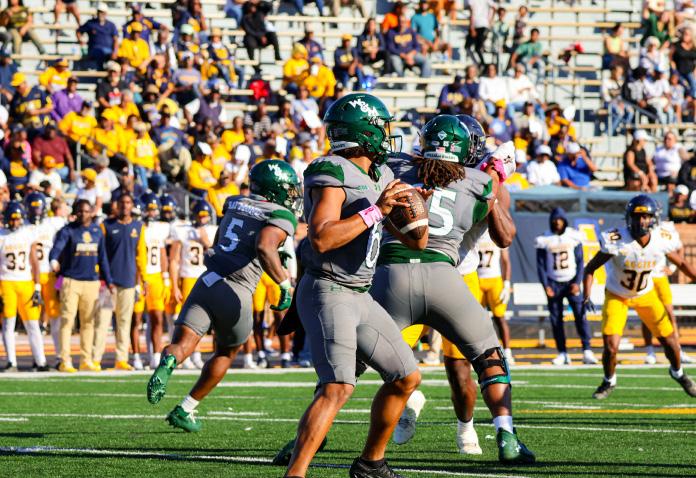
Although the Tribe coach ultimately did not go that far, instead describing his team’s performance as “really significant and really neat to watch,” no one would have faulted him for speaking in absolutes. William and Mary dominated its opponent in the third phase, using a fake field goal to score the game’s opening touchdown before blocking three Albany punts for safeties. At the end of the first quarter, sophomore running back Josh Miller burst past a mass of Great Danes and swatted the ball through the back of the end zone. On the visitors’ next drive, sophomore linebacker Stephon Hicks did the same. Midway through the third quarter, freshman linebacker Xavier Dillard improbably repeated the feat.
According to Hicks, who is now tied for the Football Championship Subdivision lead in blocked kicks with three, William and Mary’s punt coverage unit did nothing out of the ordinary, simply obeying the playmaking philosophy preached by Tribe special teams coordinator Darryl Blackstock.
“They were back at the one [yard line], the two [yard line], so we just wanted to come after it,” Hicks said. “They had a bunch of open lanes, and as long as everybody does their job, somebody’s gonna come free.”
When asked why Albany failed to adjust its game plan after the first block, Hicks did not have an answer.
“I thought they would make a change,” Hicks said. “But they didn’t.”
All the better for the Tribe, which accumulated six points from safeties, a mark nearly high enough to win the game on
its own — only a garbage-time touchdown prevented the Great Danes from being shut out. William and Mary’s three blocked punts and three safeties were both one shy of tying FCS singlegame records. The blowout took shape during the Tribe’s first drive of the afternoon, when London and offensive coordinator Winston October caught the Great Danes off guard with a gutsy red zone playcall. After Albany won the toss and elected to defer, William and Mary mounted a methodical campaign down the field, a 13-yard rush by junior quarterback Tyler Hughes carrying the Green and Gold deep into opposing territory. However, graduate student running back Tariq Sims was swallowed in the backfield on second and goal, a negative play that eventually forced the Tribe to settle for a field goal — or so it seemed.
Redshirt freshman holder Joey Tomasso received the snap at the 12-yard line, but he did not tee the ball up for graduate student kicker Keegan Shackford. Instead, Tomasso hit the ground running, dashing around a sea of blockers for a William and Mary touchdown. Although London was secretive about what exactly prompted him to call the fake, he indicated that the Tribe had exploited a weakness it identified on film.
“[Albany] just so happened to line up in a formation we practiced against,” London said. “To get down that close and have first downs to continue on and then not have a chance to score — I just thought, ‘We’re already down there.’”
Thursday, Oct. 30, No. 2 seed William and Mary women’s soccer (7-7-4, 5-2-2 CAA) threw the kitchen sink at No. 3 seed Elon (11-2-5, 4-23 CAA) during its Coastal Athletic Association playoff opener, outshooting the Phoenix by an 18-11 margin and generating eight corner kicks to its opponent’s three. It was not enough. Crippled by a fourth-minute goal, the Tribe suffered a 1-0 loss at Martin Family Stadium in Williamsburg, Va., bringing to an end one of the program’s best campaigns of the decade.
“We all walked off thinking there probably wasn’t much more we could have done,” William and Mary head coach Julie Shackford ’88 said. William and Mary rode a three-game winning streak into the evening, its imposing backline having shut out opponents for the final 282 minutes of the regular season. However, Elon interrupted the Tribe’s run of defensive dominance in immediate fashion. Following an opening stretch that yielded nothing but an off-target shot by freshman midfielder Mia Abbey, William and Mary was called for a foul near midfield. From her team’s half of the field, Elon sophomore defender
Jessica Hill powered a free kick towards the mass of bodies congregated in the Tribe’s penalty area.
Improbably, the ball made its way through the scrum, bouncing over heads and past feet until three players stood between it and the goal: freshman keeper Gwen Doughty, senior defender Nora Green-Orset and Elon senior midfielder Ashlee Brehio. In the hope that her cleats would beat Doughty’s gloves to the ball, Brehio dashed towards the net. By mere inches, she won the race.
Before it could find its rhythm, William and Mary was saddled with its first deficit since Oct. 10, a hindrance Shackford said put the Tribe on edge and affected its composure during the opening period.
“It’s hard when you go down early,” Shackford said. “You know, I think that really hurt a little bit mentally, at least through parts of the first half.”
However, the emotional effects of Elon’s early goal were reflected in neither the box score nor the Martin Family Stadium crowd, which remained vocal and supportive. For most of the first half’s remainder, William and Mary controlled the ball, outshooting the Phoenix 8-7 and creating several promising opportunities. In the 18th minute, senior forward Ivey Crain came agonizingly close to
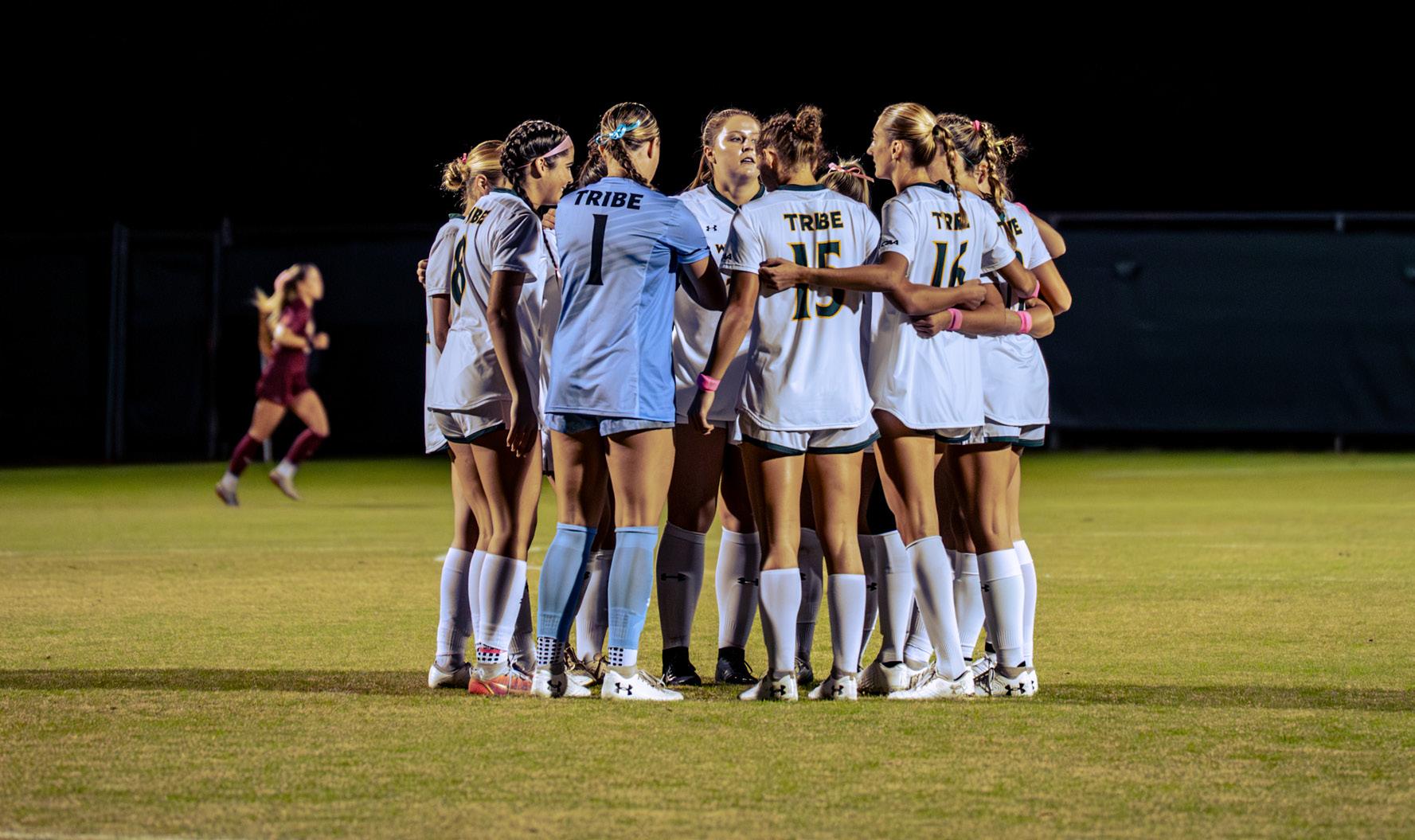
Monday, Nov. 3,William and Mary men’s basketball (1-0, 0-0 CAA) started its season off on the right foot, beating Georgian Court (0-1, 0-0 CACC) 110-63 in its season opener in Kaplan Arena in Williamsburg, Va. Monday night’s game marked the Green and Gold’s fifth consecutive season-opening game at home, and increased the team’s impressive homeopening record to 19-4 over its last 23 home openers.
The Tribe enters the 2025-26 season hopeful following its promising season last year, one that welcomed head coach Brian Earl to Williamsburg — and showed his immediate impact on the court. In his first season with the College, Earl led the Green and Gold to a 17-15 overall record, including an impressive 11-7 record against Coastal Athletic Association opponents that earned the Tribe a double bye in the CAA tournament last March.
William and Mary’s fast-paced offense looks to continue its success heading into this season, despite looking drastically different than it did the year before. Only seven players on this year’s roster are returning to Williamsburg, and three key players — Gabe Dorsey ’25, Caleb Dorsey ’25 and Matteus Case ’25 — graduated and are now playing professionally overseas.
To revamp heading into this season, the Green and Gold took full advantage of the transfer portal, bringing seven new players home to Kaplan Arena. Among them, graduate transfer guard Cade Haskins, graduate transfer forward Jo’el Emanuel and graduate transfer guard Jhei-R Jones are expected to play major roles in the future of this season’s team,
expanding on the impressive successes each has already accomplished throughout their collegiate careers.
Even with the roster changes, the Tribe opened the season fourth in the CAA preseason poll, the team’s best preseason rank since 2018.
With all of the excitement heading into its first game, the Green and Gold wasted no time getting rolling on Monday night. After losing the opening tip and getting a strong defensive stop on the Lions’ first possession, the Tribe’s scoring started with a smooth inside finish from junior forward Tunde Vahlberg Fasasi, courtesy of a slick pass from senior guard Chase Lowe. Georgian Court bounced back with two mid-ranges of their own, but after a crafty layup by junior forward Kilian Brockhoff and two Lowe free throws, the Tribe pulled out to a 9-6 lead with just over 16 minutes left in the half. After the Green and Gold’s full-court trap defense forced an immediate turnover, the Lions were forced to call their first timeout of the half.
Following the timeout, both teams struggled to score. Solid defense and sloppy ball handling on both sides kept the score knotted at 11-6 for over a minute of play, leading to a second Lion timeout.
The Tribe ended that scoreless streak with a bang. After a loose ball gave the Green and Gold possession under its own basket, Emanuel slammed an alley-oop from Jones, giving William and Mary a 13-6 lead. In the following two possessions, the Tribe kept its foot on the gas, converting another layup before senior forward Finn Lally drilled his first three of the season.
Georgian Court continued to scrap its way back with two contested layups of its own, cutting the
lead to six with just over 12 minutes left in the half. However, the Tribe’s full-court defense struck again, leading to another Tribe three, this time courtesy of senior guard Kyle Pulliam. After another Tribe steal, a Lowe layup extended the Green and Gold’s early lead to 27-12.
With just under eight minutes left in the half, William and Mary’s offense seemed to be completely overpowering the visiting Lions. Within 40 seconds, the Green and Gold converted on two easy layups by Haskins and Emanuel, pushing the lead to 19.
As the half continued, one aspect of the Tribe’s game stood out the most — its passing. Almost every basket in the first half was assisted on, and, paired with Earl’s signature fast-paced offense, the visiting Lions looked helpless on the court.
As the first half drew to a close, the Green and Gold’s defense continued to propel the home team further out ahead. Heading into the break, an 11-5 Tribe run sent both teams into the locker room with a 56-26 William and Mary lead.
After the break, the Tribe showed no sign of slowing down. Following a mid-range make from Pulliam, another Lowe layup and a contested three from Haskins, the Green and Gold lead extended to 33 with just under 18 minutes left in the half. Less than two minutes later, an emphatic dunk from sophomore guard Ryan Jackson Jr. sent Kaplan into a craze, forcing Georgian Court to call its first timeout of the half.
Captains Cassidy Geddes and Chase Lowe preview a season full of change for both of the Tribeʼs basketball teams
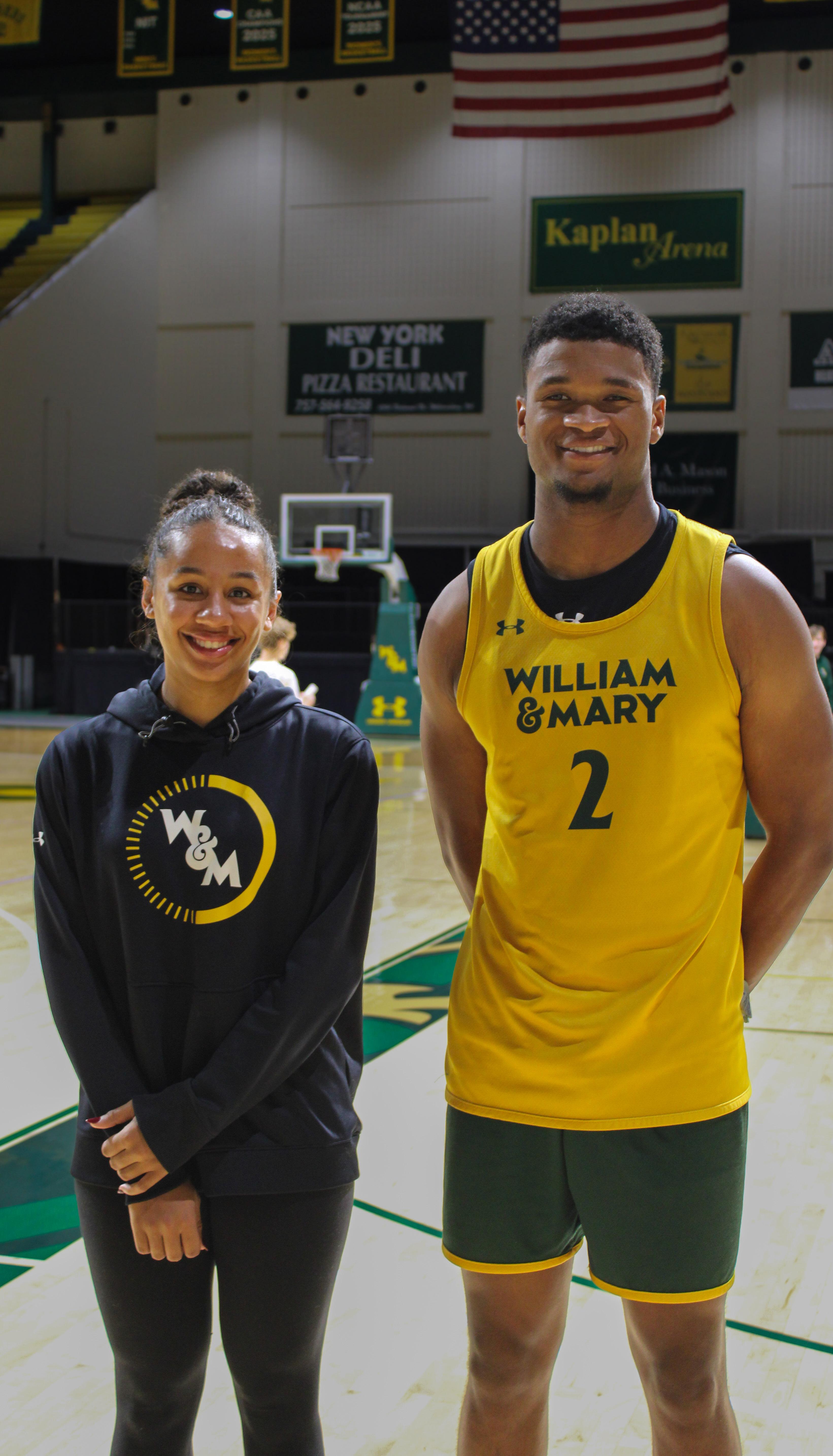
Lowe interview p. 6
Geddes interview p. 7
Men’s opener recap p. 13