Campus prepares for new PATH registration system replacing Banner 9
Registrar describes next steps, students express fears
CHLOE COHEN AND PEERAWUT RUANGSAWASDI
FLAT HAT NEWS
Wednesday, Feb. 14, College of William and Mary Associate Provost and University Registrar Alana Davis sent out a campus-wide email announcing a new registration system, CourseLeaf’s PATH, which will replace the previous Banner 9 software.
More than a week later, Tuesday, Feb. 27, Davis sent out another email with more comprehensive information on the new system.
“Beginning in spring 2024, all students will register for fall 2024 courses via PATH,” Davis wrote. “This registration system is not part of Banner and allows you to build a registration cart and prioritize your course selections outside of a timed environment. An introduction to the PATH registration system and resources about building a registration cart can be found on the University Registrar PATH webpage. PATH is available to use now to search for courses. Summer and fall classes are now viewable.”
With the new system, PATH will allow students to build their registration cart ahead of time, without having to be present for a designated time slot. According to the College’s guide to PATH, the system will retain existing registration priorities, including social classes.
Davis said in an interview with The Flat Hat that the College’s switch to PATH was in part caused by concerns with Banner’s capabilities and student wellness.
When a major system crash during course registration temporarily impeded course registration, Davis said the College divided students into “Green” and “Gold” groups with designated 15-minute registration windows.
The College intended for the halving system to ease the strain course registration imposed on the Banner system. However, the College also recognized that tight registration windows could be potentially anxiety-inducing for students.
“It is very stressful. You have 15 minutes and it feels like basically 15 seconds to go through and get the courses that you want. We hear the phrase ‘Hunger Games’ on a regular basis. And that’s not an environment that we want for students. That’s not student-friendly. That’s not conducive to a healthy learning environment. And so we want that process to be a little more comfortable, a little less stressful for students,” Davis said.
Davis hopes that PATH will achieve that ease by replacing Banner’s tight registration windows with a week-long cartbuilding period, during which students may add or remove classes from their cart at any point.
The PATH system brings additional changes to the registration process, including an algorithmic component. In addition to drafting their ideal schedule, students are able to assign up to two alternatives for each of their first-choice classes.
With Banner, students had to receive instructor permission prior to enrolling into select courses.



RYAN
Professors, students protest, speak at SJPʼs second walkout of semester
CLARE GIFFORD // CHIEF STAFF WRITER
Editor's Note: The Flat Hat has decided to honor the requests of several sources and keep their identities anonymous out of protection for their safety and wellbeing.
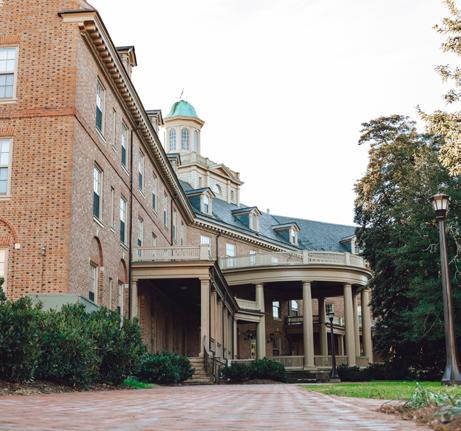
Friday, March 1, the College of William and Mary’s chapter of Students for Justice in Palestine held its second “Walkout for Palestine” of the semester.
Approximately fifty students convened on the Sadler Center Terrace for two opening speeches followed by a march around campus with three designated spots for professor and student speakers.
An SJP-affiliated leader commenced the walkout with a reflection on the recent violence in Gaza.
“When I first used my voice here, I spoke of war crimes in Gaza that were without precedent,” the SJPaffiliated leader said. “Yet, since then, what was once unimaginable has now become a harrowing reality.”
Another SJP leader remarked in their speech that the College is complicit in the conflict through its continued economic practices.
“Our school is involved in a global genocide, and I don’t say this without evidence,” the SJP-affiliated speaker said. “I do not say this without backing. We have financial complicitness in what’s happening, but that also means we have the potential to end that financial complicitness to contribute to a global movement for change.”
After sharing updates on the conflict and reiterating the SJP’s goal for Palestinian liberation,
SJP members rehearsed chants with the crowd before beginning their march out of the Sadler Center.
“We want justice, you say ‘how?’ End the siege on Gaza now!” one of the various chants went.
Along the march route, associate professor of anthropology and Director of Asian and Middle Eastern Studies Andrea Wright delivered a speech in support of the walkout. In her reasoning for her participation, she underscored the importance of solidarity for continued activism.
“I came today largely because I think it’s important for us all to come together, when we see injustices, to speak out,” Wright said.
Wright commented on the scale of the conflict.
“It seems to me as though, like the current crisis in Gaza, regardless of political orientated positions, or what we think about the past or the future, what’s happening right now is horrifying. So many children died and so many civilians have been killed. And then the specter of famine — that people are beginning to die of famine,” Wright said.
Other participants expressed a similar reason for attending the walkout. One participant felt there was a lack of solidarity between the SJP’s mission and the greater College community’s attitudes. The group, which the Community Values and Restorative Practices office put on probation in December 2023, hosted this event after an earlier demonstration Thursday, Feb. 8.
“Why I decided to come to this afternoon is that I feel like this school, the administration — there’s a culture around just not caring and being complicit to what is going on in Palestine as well as militarism and stuff like that,” one participant said. “And I want to help change that narrative and make people aware of what’s going on. They can’t ignore it.”
Associate professor of anthropology William Fisher echoed this sentiment, noting the general reluctance to discuss the Middle Eastern conflict in the classroom.
“The sort-of sine qua non of relevant education is to be able to bring the issues of the day into the classroom,” Fisher said. “And the fact that so many faculty are apparently afraid to talk about what’s going on, even in a broader sense, shows the degree of intimidation from whatever quarter that people are feeling. I would like more people to talk about what’s going on and to make that part of what we do.”
Fisher also cited his previous experience at the College and expressed his desire for increased awareness of the conflict.
“I would like more people to talk about what’s going on and to make that work [part] of what we do. And I’ll say one thing, I was here during the economic crisis of 2008, and it was as if nothing was happening outside the university. And I was maybe so aware of how we could build the bubble that I tried to avoid in all my classes,” Fisher said.
with ‘Echoes of Impact’ after two years Organization hosts seven student speakers for presentation line up with diverse stories, topics
Thursday,Feb.29, TEDxWilliamandMary
hosted its frst event since 2022 in the Sadler Center’s Commonwealth Auditorium. Following the “Echoes of Impact” theme, the showcase highlighted a series of seven 10-minute talks that covered an array of topics from fostering inclusivity in the flm industry to proposing an alternate calendar system.
TED, a nonproft media organization, made the event possible by granting TEDxWilliamandMary’s student-run team a free license to independently plan in line with the “Ideas Worth Sharing” ethos. The 2024 committee, composed of Jack Hayes ’24, Dean Waters ’25, Alisa Yang ’25, Sowmya Bendapudi MBA ’24, and visiting assistant teaching professor of Theatre, Speech and Dance Michele
King, among others, began planning the event last spring.
Refecting on the selection process, club co-President Waters underscored the stif competition each speaker faced for a spot and the resulting quality of the fnal lineup.
“We had 60 applications originally, and we narrowed that down all the way to seven,” Waters said. “So, the seven speakers who spoke tonight are the best out of all 60.”
The lineup featured various members of the College’s community, including Adeline Steel ’26, Icarus Landaker ’27, Jason Zheng ’26, Jazzy Lorenz ’27, Josh Farris M.Ed. ’25, Tatiana Coleman ’25 and Tom Sherman ’11.
Host Shehryar Waheed ’24, a member of the marketing team, began with an explanation of the theme.
“In a world that is constantly changing, where our decisions resonate through time and space, we
fnd ourselves surrounded by echoes of impact, the lasting efects of our choices,” Waheed said. “Tonight, our speakers will delve into a part of this theme and shed light on the profound implications of the choices we make, and how they create echoes.”
Landaker gave the frst talk of the night: “Making our Mark — Student Advocacy.” In their talk, Landaker highlighted their work as a prominent queer rights activist in the face of the Virginia Department of Education’s model policies for the treatment of transgender students.
“Privacy, dignity and respect,” Landaker said. “That is what they promise students. Yet that is exactly what they have proposed to take away.”
Landaker concluded with a message of hope for their continued queer rights activism and for their peers. Zheng then took the stage to share his insights on

the responsibility of individuals that hold titles in his talk, “Good Leadership is a Service.”
Coleman, whose talk titled “Make it About Them” paid tribute to her parents’ unwavering support throughout her life. She shared her journey of discovering her passion for flm.
“I fnd it beautiful when everyone has an opportunity to have a voice,” Coleman said. “It took me some time to realize it growing up, but then I found creative writing. But then, I found flm.”
After a difcult freshman year, Coleman recalled the instant community she felt after joining the flm club at the University of St Andrews in her second year of the Joint Degree Programme. Despite leaving the program, this community inspired Coleman to create the WeMake Filmmakers’ club at the College, which now has its own screening at the Ampersand Film Festival.
Following Coleman, Farris emphasized the impact of faculty support in times of personal struggles in “Love Today, Liberate Tomorrow.”
Farris is currently a Master of Education candidate at the College with numerous publications and serves as an educational public speaker for various school districts and state agencies.
In the evening’s ffth talk, College alumnus Sherman, now a founder, inventor and community builder, proposed an update to the Gregorian calendar rooted in science, “Timing is Everything: How Small Moments Last a Lifetime.”
While he pondered the concept of time while at the College, Sherman cited that he began taking his research on time more seriously once graduated. He then argued against the flawed logic of our current calendar.

Inside Variety Adam's Apple #2 Adam Jutt '25 gives advice on living with problematic roommates-among other things. page 6 INDEX Profle News Opinions Variety Sports 2 3-4 5-6 7-8 9-10 Inside Opinions Inside Sports Supporting Black entrepreneurship Black student organizations host event uplifting Black businesses, entrepreneurs. page 7 The Mo Show: Coming to a ring near you Junior defensive tackle Momen Zahid joins WWE's "Next In Line" program. page 10 T HE F LAT H AT Vol. 114, Iss. 2 | Wednesday, March 6, 2024 The Weekly Student Newspaper of The College of William and Mary flathatnews.com | @theflathat
GOODMAN / THE FLAT HAT
ORGANIZATIONS SEE TEDXWILLIAMANDMARY ON PAGE 4 SEE PATH REGISTRATION ON PAGE 4
CLARE GIFFORD CHIEF STAFF WRITER GRAPHIC BY MONA GARIMELLA / THE FLAT HAT
TEDxWilliamandMary returns
STUDENTS CONTINUE SUPPORT FOR PALESTINE
Digital humanities is this idea of applying technology to the social sciences and then using social sciences to analyze how we use these technologies.
FLAT HAT NEWS BRIEF
WMPD recovers pistol in Daily Grind
Wednesday, Feb. 28, the College of William and Maryʼs Chief of Police Don Butler sent out a campus-wide email stating the College of William and Mary Police Department recovered an unattended pistol in a bathroom of the Daily Grind after a student reported the weapon to the department.
Monday, March 4, Butler wrote in a follow-up campus-wide email that the department made an arrest.
“The charges included one count of reckless handling of a firearm and one count of carrying a concealed weapon. Additional charges may be forthcoming. The individual is banned from campus,” Butler wrote of the individual, who is currently facing two misdemeanor counts.
According to Butler, the weapon was not used and no one was injured.
“It is against university policy for any member of our campus community (staff, faculty or students) ̶ other than law enforcement ̶ to be in possession of a weapon on university property, in any buildings, or any outdoor area to which access is restricted to members of the university community and invited guests, or while attending any university events or university sanctioned events,” Butler wrote.
Director of News and Media Suzanne Clavet provided the Collegeʼs reaction to the incident in an email to The Flat Hat.
“The safety of our community is a priority. As Chief Butler said in his message, we are thankful that the weapon wasnʼt used and grateful for the quick action of the student in reporting this to authorities,” Clavet wrote.
Butler said possession of guns on university campuses violates Virginia Code.

started
Geopolitics of Technology Initiative co-founder, co-president spearheads disciplinary research
VIVIAN HOANG // THE FLAT HAT
If there was one thing that Andy Shufer ’25 came to the College of William and Mary to nerd out over, it would be international relations. Yet as he neared the completion of the major, he described feeling lost in the vastness of the feld and struggled to pinpoint exactly what drew him so deeply to IR.
It was not until he took courses like Hacking Chinese Studies with Assistant Professor of Chinese Studies Paul Vierthaler and science and technology studies with professor of English and American studies Elizabeth Losh that he found a niche that combined his passions for social change and technology policy: digital humanities. He even turned the subject into his own self-designed major.
“Digital humanities is this idea of applying technology to the social sciences and then using social sciences to analyze how we use these technologies,” Shufer said.

ANNA
Te
Now, Shufer paves the way for other students to interact with the digital humanities as the co-founder and co-president of the Geopolitics of Technology Initiative, a student-run research lab centered on technology policy and ethics.
To launch Geo-Tech, as it is more commonly nicknamed, Shufer teamed up with his childhood friend Pranav Pattatathunaduvil, a junior at Yale University, in 2022. Te two frst sought assistance from the College’s Global Research Institute Senior Research Scientist Eric Brown, who now serves as the lab’s faculty advisor. With Brown’s help, the pair successfully applied for funding through the GRI’s Student Innovation grant program.
Geo-Tech currently functions as a cross-collaboration between the College’s GRI and Yale’s Policy Institute, with Shufer and Pattatathunaduvil leading a core team of nine paid students from the College, Yale and the University of Chicago.
While the initiative was built as a research opportunity, Shufer shared that a much more important aspect of it is the space it provides: a community of student engagement and practice.
“I think it’s a unique opportunity for me to be able to build a research lab and a research experience that is inclusive, that is very purposefully a community where our goals are not just to complete our research, but also to try to make sure that the students we engage with get the most personal gains out of it that they want,” Shufer said. “Our focus is always to not extract value out of our students, but rather for this to be something that they fnd community in, right?”
Shufer’s goal of creating a more impactful and hands-on research opportunity for undergraduate students stems from his prior experiences with professor-led research at the College and his resulting desires to change the way students are involved in research. He argued that the institutional structure of undergraduate research often makes it difcult for professors and students to both beneft from collaborative research.
“I feel like it’s often over-emphasized at the school how important research is, and I think research is important, but it often in practice manifests as you kind of doing menial tasks for a data set, or you kind of just reading things for a professor even if it doesn’t really contribute to the fnal product,” Shufer said. “I really understand it from their point of view because it’s hard to really fnd a good way to provide meaningful experiences to students as a research lead. So it’s a really weird process where you’re engaging with research, but not really.”
Now that Shufer has taken on the role of a research lead himself, he discussed how he aims to provide Geo-Tech researchers with more direct, tangible forms of involvement, such as published research with authorship credit and networking opportunities.
“A lot of what we tried to do was fnd ways to achieve intermediary success for students,” Shufer said. “So, often, that is their own publication, their own work to show of, their own ability to meet new people and stuf like that, and a lot of that came with speaker events. Last year, I spent a lot of time working on building a website for the research lab and using that as a place where people could publish things.”
As a team, the lab spent last year studying China’s development fnance and produced a fnal report that members presented to a panel of policy ofcials from India, Australia, Japan and the United States that Brown facilitated. Shufer explained that these experts were meant to represent the Quadrilateral Security Dialogue that Geo-Tech members were conducting their research for, so it was especially valuable to receive insights from the very policymakers they set out to infuence.
“It was really cool because I think they came with an intention to just help us and be like, ‘Hey, we want to engage with students, and we’re going to try to be as helpful as possible,’” Shufer said. “And so they gave a lot of interesting ideas for what we can do next for research, like what is important to them in their jobs, and it was just a really good way to put it to practice.”
Tis year, Geo-Tech expanded its focus and is now divided into three diferent research teams, with Shufer leading the Biases in Artifcial Intelligence cohort to investigate the ways in which AI may replicate and steepen social inequalities.
“I’m really interested in AI because it’s a refection of how our own
lab runs, where you look at all these academic research labs that are focused on AI development, and you realize how the structures of these research initiatives afect how the AI is developed, how it bakes in structural inequalities into these systems and that are refected within how these academic systems exist,” Shufer said. “It’s something that so deeply afects how people like to organize as a community and how we interact with each other, and I feel like in the policy world, it’s something that’s really deeply misunderstood.”
Tis intentional practice of refecting on internal biases within the lab also defnes Geo-Tech’s biotechnology research team led by Kate Carline ’26, Shufer says.
Andy Shufer ’25 combines geopolitics with computer science A THOUSAND WORDS
“She is researching how academic biotech research happens and the problems with it, so if our whole focus is on how academic labs run, then we ourselves cannot replicate these problematic behaviors that we do fnd,” Shufer said. “And so that has been a major focus of we literally studied structures of power — we shouldn’t recreate them.”
Shufer, who also serves as the deputy director of the College’s Asian American Student Initiative, conveyed the necessity of incorporating racial and ethnic studies as well as sociology into technology studies. He says his three major infuences of his coursework under his selfdesigned digital humanities major, research with GeoTech and community organizing with AASI taught him that the realms of humanities and science should not be seen as mutually exclusive, but rather interdependent.
“Tere’s the sense that science and technology should be separated from the messy politics and human emotion of it all,” Shufer said. “If not, it’s something that can optimize the human emotion. But rather, both of these, like my major and my research, recognize that these things are not only intertwined, but depend on each other and how we understand them fully.”
He further advocated for a more expansive, creative view of technology, which was the impetus for GeoTech’s launch of the Science and Technology Scholars Essay Contest. Applicants were asked to use any form of writing, like science fction or poetry, to capture the future of technology for a cash prize.
“A lot of our focus on research is also just trying to push for as much creativity with how we engage with these topics because often the technology policy world is very focused on like improving efciency and trying to utilize technology to improve how the government runs, but technology studies is such a rich feld that includes so many diferent philosophical topics, but also felds such as Afrofuturism, which is a really important thing within how ethnic studies and technology studies interact. And all of these things are really creative ways of looking at technology that often is missing in policy,” Shufer said.
More broadly, he also strives to demystify technology so that everybody, regardless of their disciplinary background, can have the confdence to engage with technology and work toward a more equitable society.
“I think people often see technology as really magical and [say] ‘Wow, this is crazy,’ but in reality, a lot of the things that occur behind the scenes with technologies are all things that are accessible and important and political,” Shufer said. “And so it’s more about just getting people to care about these things, feel like they have the confdence to navigate these things and be able to exercise their own creativity and make the world a better place.”
Another goal Shufer says he and Pattatathunaduvil are looking to better fulfll this year is facilitating more external events. In the past, the two have hosted virtual speaker events with ofcials from the U.S. Department of State, National Security Council and Japanese embassy intended for only Geo-Tech members. Tis year, they plan to launch the Geopolitics of Technology Forum, a national conference in Washington, D.C that will take place April 12. Shufer credits Pattatathunaduvil for conceiving the vision for this ambitious project and collaborating with Georgetown University students to bring it to life.
With an expected panelist lineup of over 10 signifcant technology policy ofcials like the deputy secretary of the Ofce of the Special Envoy for Critical and Emerging Technology, he anticipates that students from all over the country will fy to the nation’s capital to attend.
“Te point is so that the students can meet each other, but also create a space where students are able to talk to speakers and make those connections,” Shufer said.
By pioneering these types of student engagement initiatives, Shufer ultimately hopes to empower students to model this leadership and have the courage to launch their own research projects within GeoTech for years to come.
“I think longevity is not something that can be guaranteed, but it is something that we want to try to work on because longevity is a symptom of us having succeeded at making students feel confdent and empowered enough that they can start their own research projects as well,” Shufer said.
“ “ THE BUZZ THE FLAT HAT | Wednesday, March 6, 2024 | Page 2 News Editor Peerawut Ruangsawasdi News Editor Charlotte Castle News Editor Mona Garimella fhnews@gmail.com CORRECTIONS
correct
fact
Corrections may be submitted in email to the editor of the section in which the incorrect information was printed. Requests for corrections will be accepted at any time. news insight
Flat Hat wishes to
any
printed incorrectly.
̶ Andy Shufer ʻ25
ARNSBERGER / THE FLAT HAT
RYAN GOODMAN / THE FLAT HAT
Andy Shufer ʻ25, co-founder and co-president of the Geopolitics of Technology Intiative,
the organization with his friend at Yale University.
T HE F LAT H AT ʻSTABILITAS ET FIDESʼ | ESTABLISHED OCT. 3, 1911 Org #101 P.O. Box 8795, Williamsburg, VA 23187 Editor flathat.editor@gmail.com Managing flathat.managing@gmail.com Executive flathat.executive@gmail.com Magazine editor@flathatmagazine.com News fhnews@gmail.com Sports flathatsports@gmail.com Copy flathatcopy@gmail.com Opinions fhopinions@gmail.com Variety flathat.variety@gmail.com Photos flathatphotos@gmail.com Online flathatonline@gmail.com Advertising flathatads@gmail.com Graphics flathat.art@gmail.com Ombudsman flathat.ombuds@gmail.com Anna Arnsberger Editor-in-Chief Ethan Qin Managing Editor Agavni Mehrabi Executive Editor Ryan Goodman Digital Media Editor Emma Henry and Sarah Davendorf Co-Operations Coordinators Peerawut Ruangsawasdi News Editor Charlotte Castle News Editor Mona Garimella News Editor Miles Mortimer Variety Editor Megan Rudacille Variety Editor Maddie Mohamadi Sports Editor Max Grill Sports Editor Avi Joshi Opnons Editor Mollie Shiflett Opinions Editor Abhayprad Jha Data Editor Lisa Coleman Data Editor Karis Koutsourelakis Social Media Editor Catherine Storke Graphics Editor Juliana Gomien Photos Editor Laura Holt Podcast Editor Crystal Wang Copy Chief Clare Gifford Chief Staff Writer Taiga Lewis Videos Editor Annabelle Glassman Copy Editor Sawyer Cohen Copy Editor Chloe Cohen Copy Editor Veda Kalidindi Copy Editor Caris Kyte Copy Editor Shannon Raymond News Assoc. Editor Sam Belmar News Assoc. Editor Akash Nayak News Assoc. Editor Isen Lee News Assoc. Writer Betsy Mahoney News Assoc. Writer Lila Reidy News Assoc. Writer Molly Martin News Assoc. Writer Hannah Sawyer Variety Assoc. Editor Emma Halman Variety Assoc. Editor Lorenzo Short Variety Assoc. Editor Skylar Hartgerink Variety Assoc. Writer Jane Valadakis Variety Assoc. Writer Christina Wu Variety Assoc. Writer Aggie Rigo Saitta Variety Assoc. Writer Catalina Campos Chief Features Writer Sheoli Lele Opinions Assoc. Editor Adam Jutt Opinions Assoc. Editor Tessa Catalano Opinions Assoc. Editor Lana Altunashvili Opinions Assoc. Editor Damien Kanner Bitetti Opinions Assoc. Editor Isabella McNutt Opinions Assoc. Editor Elizabeth Brady Opinions Assoc. Editor Sedra Olabi Photos Assoc. Editor Anna McClellan Photos Assoc. Editor Cynthia Wu Photos Assoc. Editor Elliott Lee Chief Sports Writer Adia Elcockl Ombuds Assoc. Editor Cora Snyder Data Assoc. Editor Yana Gleiman Data Assoc. Editor Alisha Khodabocus Fact Checker, Webmaster Assoc. Editor Maddie Cassidy Fact Checker John Powers Chief Opinions Writer READ MORE AT FLATHATNEWS.COM PEERAWUT RUANGSAWASDI / FLAT HAT NEWS EDITOR Matthew Berthoud Webmaster Anna Saal Standards Editor Conor Downey Business Manager
International maritime ofcers visit College, Virginia Marine Institute of Science
Navy, military officers from various countries have lunch at Commons Dining Hall, meet with students
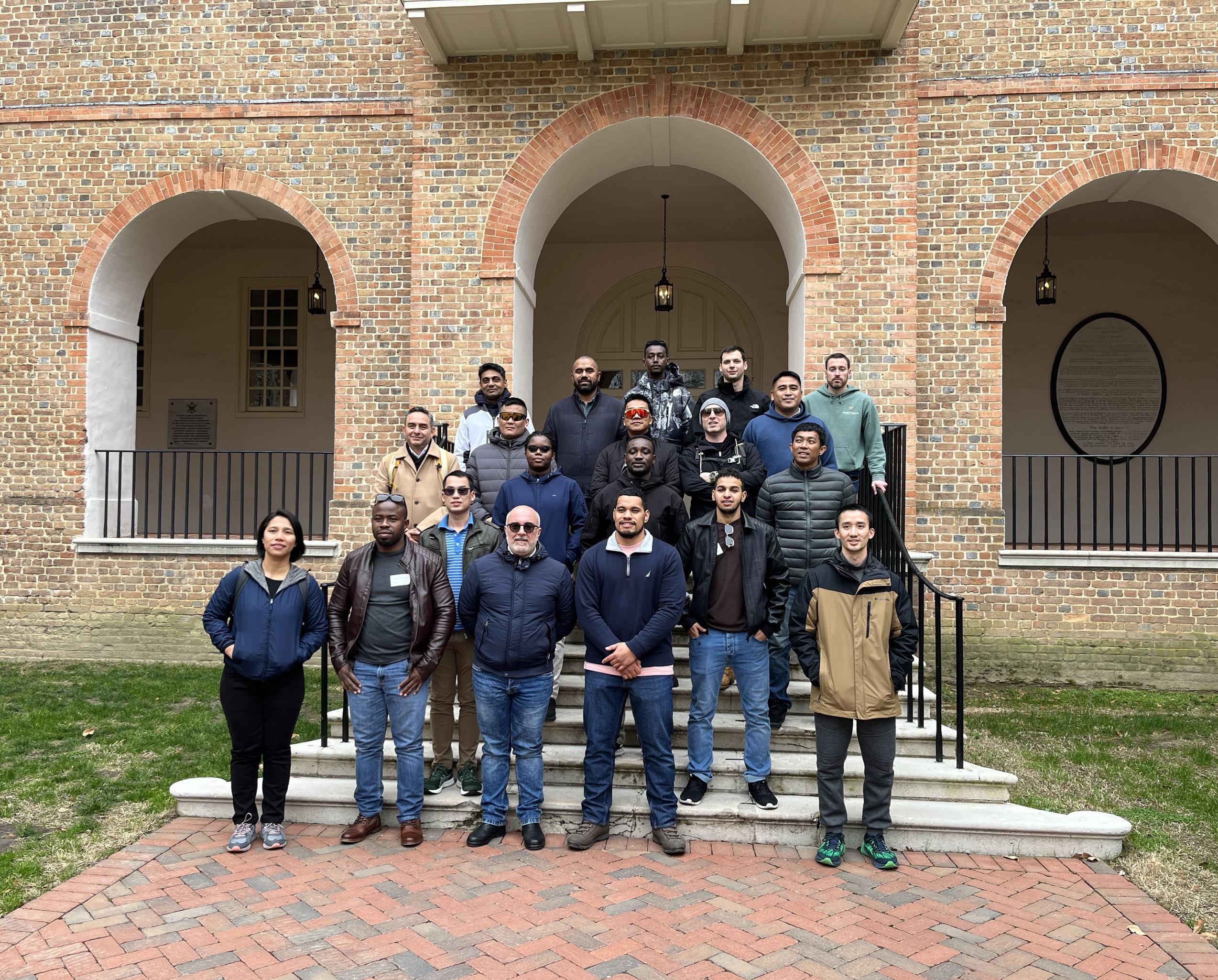
Friday, March 1, the College of William and Mary Whole of Government Center of Excellence and the Reves Center for International Studies hosted a lunch and conversation at Commons Dining Hall between students, faculty and staf, as well as participants and instructors of the International Maritime Ofcers Course at United States Coast Guard Training Center in Yorktown, Va. IMOC is a triannual 12-week program that provides international Navy and Coast Guard ofcers professional military education and American cultural experiences to foster friendship, partnership and cooperation with the United States. Tis is the 71st iteration of the program.
In the fourth week of IMOC-71, 20 ofcers from 13 countries visited the College and the Virginia Institute of Marine Science across two days.
A diverse group of ofcers from around the world are assigned to participate in IMOC. Tis cohort’s represented countries included Argentina, Benin, Djibouti, Fiji, Italy, Malaysia, Malta, Mauritania, Mozambique, the Philippines, Sri Lanka, Tailand and Tonga.
USCG Lt. Mack Marcenelle is one of the people who help lead the program.
“Te purpose of IMOC is to bring in all of our international partners from all over the world to learn everything Coast Guard,” Marcenelle said.
IMOC participants study a wide range of topics relevant to partner countries, including maritime safety and law enforcement, as well as crisis and disaster responses, taught by subject matter experts in the United States. In addition to receiving training and lectures in Virginia, the cohort also traveled to USCG bases in North Carolina.
Later in the curriculum, IMOC participants will travel to major East Coast cities, including Boston, New York, Philadelphia and Washington, D.C., as well as the United States Naval and Coast Guard Academies.
“It’s an immersion experience,” Marcenelle said. “Outside of coming here to learn everything Coast Guard, they’re learning about the U.S. government, history, fnancial institutions and our educational institutions, which is where William and Mary comes into play.”
IMOC cohorts have visited the College for over fve years through partnership with the WGC. Te center provides mid-career public policy professionals and military ofcers in federal, state and local agencies practical training on interagency collaboration, complex national security and other public policy problems. Additionally, the WGC has collaborated with the North Atlantic Treaty Organization to support the William and Mary
Global Innovation Challenge for the last four years and the 2023 NATO Youth Summit.
During their visit, IMOC-71 visited academic buildings, research labs and VIMS, where faculty presented on scientifc support for spill planning and response, unreported and unregulated illegal fshing, cybersecurity, cost-beneft analysis and resource constrained decision-making as well as tools for national infuence and entrepreneurial thinking.
One of the participants, Armed Forces of Malta Lt. J.G. William Buttgieg, refected on his visit to the College.
“We had some pretty interesting lectures,” Buttgieg said. “You can see that people are proud to be here and they want to give the best to their students. I’m very impressed.”
He also discussed the natural beauty and rich history in Hampton Roads and expressed excitement over future parts of the curriculum.
“I’m really looking forward to our East Coast trip,” Buttgieg said. “We’ll visit other U.S. Coast Guard bases and also landmarks [like] the White House and the Statue of Liberty. You hear a lot about these things and see it on television, but being able to go there and even get the local history as well. I’m really looking forward to it.”
In addition to the luncheon held at the Caf, IMOC-71 will also have luncheons during visits to the USNA and USCGA. Marcenelle addressed the merit of these interactions between ofcers and college students.
Tere are international students attending both of those schools,” Marcenelle said. “We fnd it to be extremely fruitful because the students are usually a little bit younger and our ofcers are typically a little bit older. So there’s some shared camaraderie coming from similar countries. It’s a little bit of a comfort piece where they get to speak the language that they’ve had back home. Tey get to talk about some good stories from things they’ve gotten to experience since they’ve been in the U.S. and some diferent cultural things that they’ve had to overcome.”
Brennen Micheal ’24, one of the students who attended the luncheon, spoke to ofcers from Sri Lanka. Micheal said he looked forward to meeting them since he worked on the Sri Lanka desk at the United States Indo-Pacifc Command in Hawaii last summer. He also spoke with ofcers from Djibouti, Fiji and Italy.
“Overall, I really enjoyed it,” Micheal said. “It was really interesting and such a cool experience. I got to hear about their program, why they’re here, and some of their impressions of the U.S. as well.”
Although their time in the United States is temporary, ofcers like Buttgieg are eager to apply what they have learned with senior ofcers upon returning to their respective countries.
“It’s [about] building bridges and sharing the knowledge,” Buttgieg said.
Citizens’ Climate Lobby hosts 2024 Mid-Atlantic Regional Conference
Climate group brings in speakers from Virginia Commonwealth University, Wesley Foundation to two-day conference
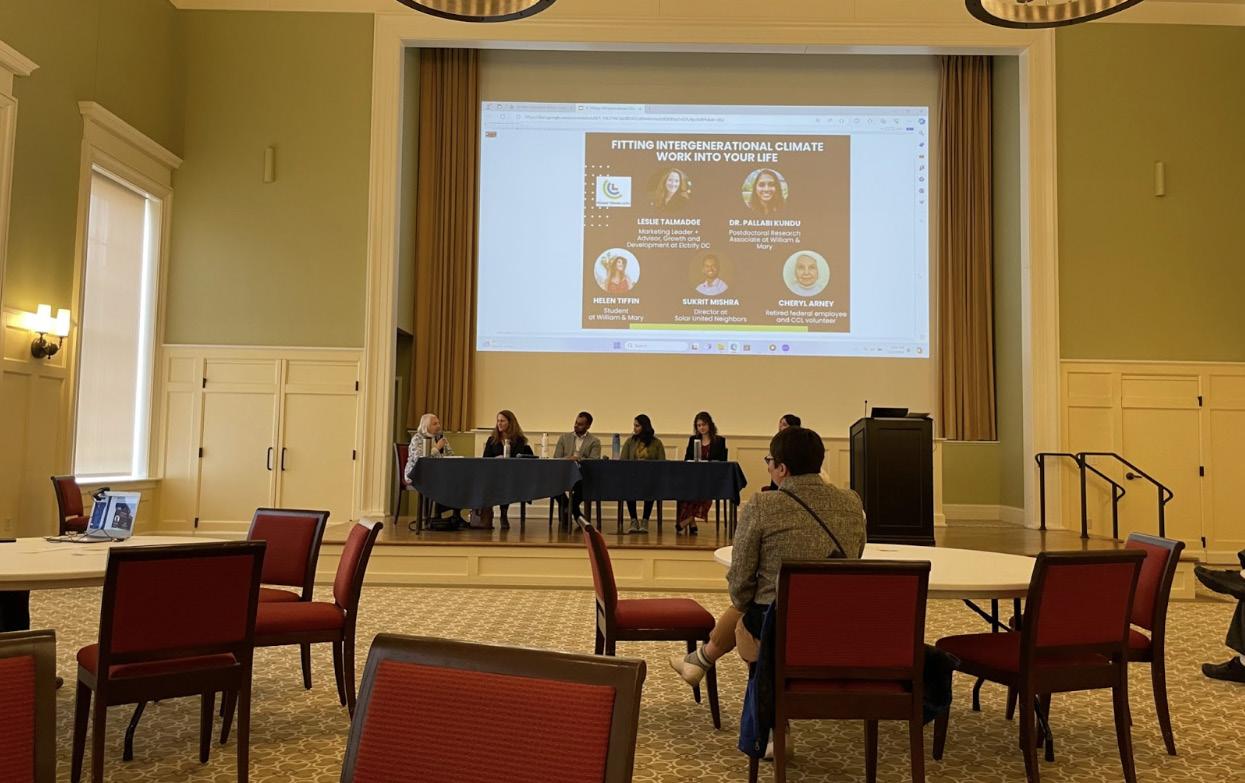
Saturday, Feb. 24 to Sunday, Feb. 25 the Citizens’ Climate Lobby at the College of William and Mary hosted the 2024 Citizens’ Climate Lobby Mid-Atlantic Regional Conference at the Raymond A. Mason School of Business. Titled “Climate Legacy and Inheritance: Uniting Generations for Action,” the conference featured a series of back-to-back talks and interactive sessions focused on intergenerational collaboration in climate change activism.
CCL-WM is one of 400 chapters in the United States of the international grassroots organization. The core mission of CCL is to slow climate change
by fostering relationships with members of Congress and securing their votes for pro-climate policies.
“We believe that democracy works and that climate change is a nonpartisan issue,” CCLWM’s mission statement states. “In action, this means showing our members of congress that addressing climate change is important to their constituencies. We call this building ‘political will.’”
Sabrina Fu, CCL regional coordinator for the MidAtlantic, approached CCL-WM last summer about hosting the annual conference after Chapter Outreach Chair Emily O’Keefe ’24 successfully launched the Carbon Fee and Dividend Movement.
“Our William and Mary chapter of CCL is probably the most active
CCL chapter in a college,” CCLWM President Corina Chang ’25 said. “And so that’s why they reached out to us. Especially since we had a bunch of momentum from the Carbon Fee and Dividend Movement last spring. I said yes, because I thought it would be really exciting and a once in a lifetime opportunity for me.”
The conference drew primarily retired individuals associated with CCL who were eager to learn how they could support younger generations in combating climate change. Kate Heavner, a freshman environmental studies major at Virginia Commonwealth University, attended the conference to better educate herself in the field.
“I was super interested in any opportunities to both do networking and learn about what other organizations are doing about the climate,” Heavner said. “And just trying to get more experience and knowledge in the political side, but also the implementation side.”
CCL-WM Vice President and Outreach Organizer Helen Tiffin ’26, moderated the Plenary Talk. She spoke with a panel comprising three individuals with varying religious and political backgrounds including Princella Talley, a writer and former CCL diversity outreach coordinator; Max Blalock, the campus minister for the Wesley Foundation at William and Mary; and Bob Inglis, the executive director for republicEN.org and a member of the CCL advisory board who joined virtually via Zoom.
Tiffin addressed the conference’s
notion that intergenerational collaboration is necessary to sustain climate work efforts for as long as it takes. She then asked the panel in order to have this collaboration, what values were imperative to be able to bridge generations and different backgrounds.
Talley advocated in her responses for individuals to first check their own privilege and bias to better understand another’s perspective.
“Bias sometimes can be with good intention and favorable, just as it can be negative,” Talley said. “So sometimes I think we should approach things with grace and cautious leniency to accept that people are people and if we’re not building that human connection from a place of being able to say ‘I’m not perfect, neither are you, let’s still have these conversations,’ then we are not going as far to be as far as we could in this movement.”
Their conversation steered towards the emerging barrier of politically-associated semantics that often halt meaningful discussions, particularly in regards to climate change. However, through a personal anecdote of providing students sanctuary against a hate group, Blalock underscored the power of community in helping overcome these barriers.
“Students would come over and say, ‘I just experienced this with them over there, but I come over here and its music and its joy and its community,’” Blalock said. “And that’s what I think is so important in this. We want to offer an example to people of which kind of community
and which kind of people you want to be associated with and who we want to continue to live with.”
Later, Olivia Parker ’27 and Noa Rudisch ’27 led a two-anda-half hour workshop titled “Introduction to Intergenerational Climate Advocacy” in the main room as attendees dispersed into one of three options. Seminars on “Using Media for Climate Engagement” and “Working Toward Intergenerational Group Leadership” were held for an hour each in the neighboring rooms.
Additionally, the conference offered nontraditional workshop in both the morning and the afternoon called “Healing Our Communities.”
The guided “Racial Healing Circle Experience” discussion was designed to mediate some of the current intergenerational tensions surrounding climate change.
“Well, the theme is intergenerational climate action, and my first instinct when I think of that theme is how a lot of younger people have sort of a grudge against older generations for creating the problem,” Chang said. “And older generations also have a similar grudge towards younger people for being overly consumerist and things like that.”
According to Chang, the guided meditation and much of the conference’s itinerary were designed, in part, to heal a gap between older and younger generations for the longevity of climate work.
READ MORE AT FLATHATNEWS.COM THE FLAT HAT Wednesday, March 6, 2024 Page 3
CAMPUS CLIMATE
CLARE GIFFORD CHIEF STAFF WRITER JOSEPH WEHMEYER THE FLAT HAT CLARE GIFFORD / THE FLAT HAT
COURTESY IMAGE / WHOLE OF GOVERNMENT CENTER OF EXCELLENCE Officers visit
Sir
Building. Countries represented included Argentina, Benin, Djibouti, Fiji, Italy, Malaysia, Malta, Mauritania, Mozambique and Thailand. COURTESY IMAGE / WHOLE OF GOVERNMENT CENTER OF EXCELLENCE Citizensʼ Climate Lobbyʼs conference hosted speakers from Virginia Commonwealth University in two-day event at the College.
the
Christopher Wren
Senate passes five new bills, confirms new Data and Analytics secretary
Senators sponsor
Tuesday, Feb. 27, the Senate of Student Assembly of the College of William and Mary met and discussed multiple bills and approved a new secretary of Data and Analytics. This meeting was the last chance for senators to propose new legislation that would be approved before spring break, with only six meetings left in the 331st session.
Blaze Banks ’25 was nominated for the role of secretary of Data and Analytics and attended to speak to the Senate for a vote to fill the vacancy created by Deputy Secretary of Data and Analytics Varsha Gollarhalli ’25 after she left the secretary-level role to become the deputy secretary.
Banks presented his qualifications of being an international relations major and having interned at a think tank this previous summer. He spoke about his efforts to increase sustainability through the Williamsburg Area Transit Authority bus Qualtrics survey, and other initiatives he wanted to work on through the new position.
Following questions about his extracurricular involvement, the Senate voted unanimously to confirm him for the position.
The Senate discussed six new bills, starting with a The Providing Resources and Opportunities for Enhanced Student Development (PROFESsionals) Act, sponsored by Sens. Marshea Robinson MBA and Shalini Kumar MBA.
The bill proposes group training for pursuing certification in the business field. It also requests $27,000 from SA Reserves to support two comprehensive group training opportunities (40 hours each) for students, both undergraduate and graduate, preparing them for the Project Management Professional or Certified Associate in Project Management certifications.
The next bill was The Paws for Stress Act, sponsored by Sen. Sophia Tammera ’24. This bill seeks to provide $1,500 for an outdoors therapy cat event, with $800 allocated for “cat-related expenses” and $700 for croissants and coffee for attendees. The bill states the event seeks to lower stress levels at the College.
“To enhance student well-being through therapeutic cat interactions,” the bill’s purpose statement states.
This initiative, if passed, would take place two weeks after Spring break at the Crim Dell.
The Women’s Wellness For All Act, sponsored by Sen. Soleil Garnett ’24, aims to provide $3,350 for the Women’s Wellness for All event, which would invite speakers from Norfolk State University and the McLeod Tyler Wellness Center.
The Supporting the Business Law Review Spring 2024 Symposium Act, sponsored by Sen. Connor O’Neill J.D. ’25, aims to fund the Law School’s Spring Symposium with $8,000 from SA Reserves.

The chamber next discussed the American Sign Language Act, sponsored by Class President Yannie Chang ’25. This bill seeks to collaborate with the American Sign Language club to raise awareness of deaf culture and the deaf community, providing $2,600 for an event raising awareness with the club.
The event would be held at the Brinkley Commons Wednesday, April 3.
The Bridging Resources for Access to Crutches and other Equipment Act, sponsored by Class President Zoe Wang ’26, aims to provide $1,000 to subsidize the students’ cost of medical equipment for unforeseen injuries.
“WHEREAS, this would be test pilot program to investigate if it would be sustainable and beneficial for Student Assembly to fund the subsidization of durable medical equipment every year,” part of the bill reads.
The Senate passed five bills in old business.
The Funding Iftar Act III, sponsored by Sen. Laayba Tanoli ’26, Secretary of the Senate Sen. Hazel Vineet ’25 and Sen. Hashir Aqeel ’25, provided $7,047 to fund break fast meals during the month of Ramadan.
Class President Nico Giro-Martin ’27 expressed his support for the bill.
“It’s a student need that needs to be met, and we should fill that gap,” he said.
The Senate passed the bill with ‘Yes’ votes from all
senators voting except Sen. Connor Cheadle J.D. ’25, who voted ‘No.’ Class President Mia Tilman ‘24, Sen. Daniel Bess ‘24 and Sen. Chelsea (CJ) Roberts M.Ed. did not vote.
The Annual Review of the Organization Budget Allocation Committee and Process Act, sponsored by Chair of the Finance committee Sen. Matt Swenson ’26, passed with near-unanimous approval, with Tammera abstaining.
Swenson’s bill codified changes to the SA code that lowered the quorum needed for an OBAC meeting. Currently, the group often has to reschedule meetings because they do not have enough people to reach their quorum to vote on budgets.
The bill also formally codified new changes to the budgeting process for Recognized Student Organizations, such as formally requiring organization members to attend budget training sessions.
The Supporting the 2024 Voting Rights Restoration Summit Act, sponsored by O’Neill and co-sponsored by Cheadle, provided $2,000 for an event at the Law School that will discuss voting rights restoration and contain a keynote speech given by Richmond Mayor Levar Stoney, who is running for governor of Virginia. The event is slated to be held at the Law School on Thursday, March 21.
This bill highlighted an event that the Student Bar Association planned for the Law School students as well as undergrads.
Chang said the bill senators should support this bill as it also benefits undergraduate students.
“Not super sure how this is different from undergrad events. A benefit from this is that this is a good space for grads and undergrads to collaborate,” Chang said.
The Senate moved on to The Syllabus Access Resolution, sponsored by Sen. Mayer Tawfik ’27. The bill formally called on the University Registrar to allow professors to attach syllabi directly to their course descriptions. This bill passed unanimously.
The last bill passed was The QTPOC Formal Act II, sponsored by Swenson, Sen. Matthew Hwang ’25, Vineet and Chang. This bill provided $1,725 for a formal held by the Queer Trans People of Color organization, which is taking place on Thursday, April 11.
SA President Sydney Thayer ’24 said that the Department of Data and Analytics is collecting question suggestions for an omnibus survey, an initiative that Banks mentioned.
The Senate is planning an Earth Day Bash on Saturday, April 20, creating a student sustainability council and a comprehensive guide on sustainability for the entire school. SA’s efforts to increase sustainability also include hosting a sustainability forum.
Davis highlighted that PATH does not impede students’ autonomy and ownership of their schedules.
“You have control over what you want it to prioritize for you. There is an automated component to it in the sense that it will run in a formation. So say you’re the first person to be processed. It’ll do the best possible outcome for number one, number two, number three, number four, number five, number six, number seven, you know, kind of all the way through. And then it goes backwards the other direction,” Davis said.
Davis also elaborated on that process.
“So, person who’s number one isn’t number one every time. You know, it does the snake formation. And at every instance, it’s running through the choices that you’ve made and the priorities and trying to create the best possible options for you. So you still have control over what you want your options to be,” she said.
Students will also be able to modify their schedules directly during a secondary add/drop period. Independent of add/drop, PATH will run a waitlist for certain courses. The waitlist feature will
ORGANIZATIONS
replace override requests, which students used to send to professors whose classes had reached capacity.
PATH will also offer new course search features. Students can now filter courses by excluding certain blocks of time (“Excluded Time/Day”) or cost of additional course materials (“No- or Low-Cost” courses whose materials cost under forty dollars).
According to Davis, PATH will give the College far more data on students’ course preferences. While Banner did not document unsuccessful registration attempts, PATH’s priority and alternative carts will show the College which courses students truly want to take.
“It doesn’t mean we’re going to see that everybody put a certain course down as the first choice, and then we’re going to be able to add 17 sections of it and guarantee that everybody gets that class as a first choice. What it does, though, is allow us to make informed decisions about courses where there might need to be shifts, where a few seats might make a real difference somewhere,” Davis said. Students reacted to the announcement of the PATH software.
“I’m an arts and science major, so I really hated Banner and how hard
it was to get on a waitlist,” Lilly Shee ’26 said. “I’m glad about that aspect of PATH. But, I think it’s easier to use Banner. I’m very interested on what will happen, but also generally have no clue what’s going on.”
Conner Small ’25 discussed the pros and cons of Banner 9.
“Like the cons are: it’s very intense the morning of and very stressful. Pros: I would say if you’re fast enough, you get the classes you want,” Small said.
Small reflected on his previous experiences with Banner.
“I’ve tried to order the ones I should sign up for first to get the classes that are most important to me,” Small said.
This strategy allowed him to generally get the classes he wanted in prior semesters. Small also listed his concerns with the new PATH system.
“I’ve heard this new system, somebody else is going to choose for you,” Small said. “And that makes me worried that because I only need so many classes that I’m not going to get ones that I need, and it would just waste the credits.”
However the PATH system uses a computer algorithm to choose classes, not another person.
Davis said that ideally students should
still be able to meet their requirements, such as the College curriculum, otherwise known as COLL. The PATH system, she said, does not affect course availability.
“Part of that will come down to how students prioritize things in their course — in their carts. If you have something that you need, it should be prioritized high. And you ensure that this is a thing that I’m going to need here. Course availability in and of itself isn’t going to change,” Davis said.
The College is working to ease the transition from Banner 9 to PATH through email communications and informational tutorials directed towards students and advisors. The Office of the University Registrar will host Zoom sessions, table in the Sadler Center and Starbucks and remain accessible during registration week. Students will be able to ask questions and view demos on using the PATH system.
The College added an implementation timeline for PATH on its website. The College formally launched the system on Wednesday, Feb. 14. All undergraduates will be able to use PATH to register for fall 2024 courses from Wednesday, March 27 to Tuesday, April 2.
TEDxWilliam&Mary 'Echoes' importance of kindness around campus
calendar system, Marketplace staff assisting with medical episode
“Now, I think we all can agree that the Gregorian calendar is massively flawed,” Sherman said. “Starting a new month midweek is like starting a new day midhour. How long is a month? No one knows.”
The penultimate speaker, Steel, shifted the comical
mood to a more heartwarming one with a story of two College Marketplace staff, Gloria and Joanne, helping her through a diabetic episode. Their unmistakable kindness inspired Steel and her talk on “Making Small Choices Towards a Kinder World.”
Lorenz, goalkeeper for women’s soccer and double major
in public policy and business marketing, rounded off the night with “The PACT within IMPACT.”
Neel Davuluri ’25, who came to support Coleman, left the event moved by Steel’s call for greater kindness to College staff and the general public.
“I liked [Steel’s] a lot,” Neel said. “It made me see how
important it is to appreciate dining staff and just staff at William and Mary.”
The event’s success gave some attendees, like Colin Murphy ’25, a renewed sense of commitment to drive positive change in their committees and beyond.
“It was really cool listening to both current students
in grades above me and grades below me,” Murphy said. “Listening to graduate students, alumni. I think it really embodies the echo, of we keep bringing people back and these voices are now being spread to us and the responsibility for us to make echoes that will spread to the future.”
THE FLAT HAT Page 4 Wednesday, March 6, 2024
REIDY FLAT HAT NEWS ASSOC.
put desired
their
await system generated
STUDENT ASSEMBLY
LILA
Students will
classes into
registration cart,
schedule
CAMPUS
PEERAWUT RUANGSAWASDI / THE FLAT HAT Senators meet in the Sadler Center James Room to propose bills
discuss new
Student Assembly
bills for cat therapy, womenʼs wellness, medical equipment PATH registration aims to alleviate 'Hunger Games' scramble for classes
Speakers
CAMPUS from page 1
PATH REGISTRATION from page 1
GUEST COLUMN
Why you should work in person this summer

With each passing day, a palpable dread and anticipation builds among those in the student body still seeking the elusive summer internship — especially at the College of William and Mary.
For the last three years, the College has topped Princeton Review’s list of the best public universities for internships, which is based on student ratings of accessibility for internship placement at their respective schools.
Suffice it to say, both students and the administration care about internship placements — and they should. Internships provide an incredible opportunity for students to practice both hard and soft career skills, build connections and figure out their workplace and industry preferences. It is important, however, that students do not jump at opportunities where conditions are less than ideal.
While many summer internship programs in cities such as Washington, D.C. renewed inperson operations in 2023, lingering effects of the COVID-19 pandemic remain visible in the workplace, often to the detriment of students and recent graduates. Notably, virtual and hybrid work
models became normalized, even for full-time jobs. According to a recent report by the National Association of Colleges and Employers, fully-remote and hybrid job positions now outnumber fully in-person ones.
Don’t get me wrong, remote work flexibility has legitimate benefits. When utilized effectively, it can help employees attain a better work-life balance. Parents can be more available to their children if working from home. Employees can save both time and money lost in their commutes each day. For new hires or interns, hybrid or remote availability can increase accessibility to organizations that may otherwise be inaccessible due to location.
But these benefits are mostly appreciated by employees who have already settled into their roles in their respective companies or communities. Part-time and full-time employees tend to view remote work options much more favorably than interns do.
This makes sense.
Working from home could provide some much-desired flexibility for those who have settled into a career or city. But what about students looking to discover their workplace preferences and gain those vital skills needed to secure a job after graduation?
While the arguments for or against
remote work vary among industries and individuals, interns and new hires have the most to lose in this development.
For interns and entry-level employees, in-person experiences are crucial to prepare for life after graduation.
Moreover, it is significantly harder to build relationships with colleagues and learn skills through osmosis when the majority of workplace interactions are virtual. According to the same NACE report, more students prefer in-person work to hybrid or virtual options. It’s easy to understand why.
According to a 2022 Glassdoor study, 70% of interns viewed remote work negatively, due to an absence of interactions with colleagues and mentors. While remote work flexibility has notable benefits, it should be an exception, not the norm, especially in light of a company's future hires.
As the pandemic has faded out of focus, many employers have issued return-to-office mandates, citing productivity concerns. The future of inperson work for many firms remains uncertain, however, as companies try to strike a balance that is satisfactory to their current employees.
If returning to the office turns out to be a truly irreconcilable difference between employers and employees, companies should make concerted efforts to bolster onboarding programs for new interns and hires to ensure they’re not left behind. Good onboarding has made the difference for me everywhere I have worked. That process is invariably made more difficult when in-person communication and interactions are taken out of the equation.
Working from home could unknowingly and inadvertently stunt the professional development of Generation Z, despite the very real benefits it gives some tenured employees.
For College undergraduates who are looking for internships this summer but are unsure if they could actually live in the place they would want to work, the Office of Career Development & Professional Engagement offers funding to help make such opportunities possible. Additionally, for students looking to work in Washington, D.C., the William & Mary Washington Center has programs to study and work in the city year-round.
Sometimes remote work makes sense for students, but the intangible benefits of in-person placements should not be forgotten. Consider this when choosing your next internship or job.
Joseph Wehmeyer ‘24 is a government major. Most recently, he worked an in-person internship through the William and Mary Washington Center. Contact him at jswehmeyer@wm.edu
It’s time to stop validation epidemic
Christina Wu
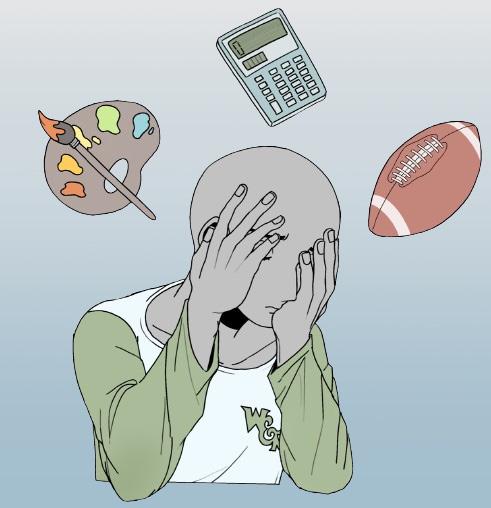
Think back to the last time you felt obsessed with something. Was it about grades and academics? A sports game? A competition that you needed to win? Now think about what you were feeling at that time. Were you stressed? Overthinking every detail? Planning out the worst possible scenario that the situation could devolve into? I assume that most college students have felt this type of obsession before, and to the extreme level that borders on being unhealthy. However, this phenomenon isn’t best defined by obsession, but rather by validation. It’s the driving force behind most of the anxiety and fear that we experience at each turn of events because it’s often the reason why we act in such extreme ways.
As I sat reflecting on a recent Sunday evening, reeling hard from the loss of an academic competition that weekend, I came to think about validation. This singular feeling has twisted my entire life at times, forcing me to adopt feelings created through irrational thoughts and flawed judgements. Overthinking, insecurity and shame were the most likely products of this negative spiral, leaving me questioning what was even real and what wasn’t. Was my performance that weekend really as terrible as I remembered, or had my perception simply been warped from constantly holding everything up to a mold of perfection? Did I, myself, truly think badly of my performance, or did I simply adopt this mindset after I misinterpreted the expressions and words of others, causing me to overthink my actions? Why had this arbitrary activity even elicited such a powerful reaction from me, given that it had no tangible effect on my life as a student, or even just as a regular human?
Coming to the College of William and Mary has allowed me to see the extent and severity of how much our student community constantly seeks validation. Even after just one semester here, I quickly learned that self-imposed pressure was a
humming undercurrent in almost every student’s life in some way.
Learning about the concept of the “twamp” was a silly joke to me at first, but when I found myself staying at Earl Gregg Swem Library later into the night, spending less and less time with friends and pushing myself to the limit to satisfy the urge to always be occupied, I realized that I’d become the very butt of the joke. It was disheartening, but even then, I felt a sort of twisted pride in knowing that I’d at least upheld a “productive” stereotype, if nothing else.
This brings me to discussing the question of “why?” It’s normal to feel anxious about something. In fact, it’s a good thing, because it signals that you truly care about whatever you’re stressed about. The issue is why we obsess about performing our best in all aspects, and why perfection is the standard instead of just trying your hardest? I find that comparison is the culprit for unrealistic expectations and should undoubtedly be avoided.
As we continue finding our place in this community, it’s important to remember that there are always people supporting us. Whether it’s your friends, your family, a mentor or even just a classmate, there will always be people who will receive you with open arms no matter what you have done. Some will be upfront about their support in casual, open ways, but there are others silently rooting for you in the background, as well — some of whom you may not even know about. No mistake is too large to be forgiven, and no failure is too severe to overcome.
Seeking validation shouldn’t come from achieving the arbitrary and varying standards of success defined by other people. You shouldn’t aim for an “A” on an exam because your friends got one and you would be embarrassed to tell them otherwise. Nor should you overwork yourself for an activity just so you can hear others tell you that they’re proud of you. Instead, try seeking introspective reflection as to your own true values. What is important to you, personally? Everyone hails from different backgrounds and has a unique story, so think about what you genuinely want for yourself in the future. Finding pure self-validation requires casting off the shadow of expectations of outsiders, and with this process of unlearning comes healing and growth. Ease off of the pressure and remember to relax.
Christina Wu ’27 is a prospective government major. She plays the cello and is a member of the Mock Trial team. Contact her at cwu06@wm.edu.
Fuzzy 63: Fuzzy and Blues meet special guest stars Kim & Elise
COMIC BY ARIANNA STEWART / THE FLAT HAT

opinions THE F L AT HAT Opinions Editor Mollie Shiflett Opinions Editor Avi Joshi fhopinions@gmail.com // @theflathat | Wednesday, March 6, 2024 | Page 5
STAFF COLUMN
FLAT HAT VARIETY ASSOC.
GRAPHIC BY SOLYANA FESEHA / THE FLAT HAT
THE FLAT HAT
Joseph Wehmeyer
GRAPHIC BY SYEDA SAFDAR / THE FLAT HAT
COMIC
We need better stuff
Elizabeth Brady FLAT HAT OPINIONS ASSOC.

Has anyone else noticed that things have gotten worse? Not just global politics, social divisions or political unrest (those too), but that physical things, objects, products have gotten worse? If you’ve ever worn a sweatshirt from the 80s or used that toaster that your parents got for their wedding, you can kind of feel the tactile difference in quality between it and products for sale now.
There are a lot of reasons for this: the globalization of trade, the outsourcing and devaluation of labor, the quickening of trend cycles and so forth. I do a lot of thinking and writing about things from a very sociological lens, which means trying to figure out why things happen from a cultural standpoint. But there’s a very chicken-and-egg relationship between the recent decrease in the longevity of our items and the “disposability culture” that has made us okay with them. This is not something I think is interesting enough to write about, so instead I’m going to talk about iPhones.
Apple Inc. has been at the forefront of direct-tomarket tech device innovation for a long time. The release of the first generation iPhone in 2007 fundamentally changed the way citizens of wealthy western countries live their lives. As of now, the most recent model is the iPhone 15, which operates on the iOS 17.3.1 software. Fast-rate updates to consumer technology are not in and of themselves suspicious. Apple operates on the cutting edge of technology, as it always has. What is concerning is the way Apple specifically ages out their old technology to make way for new models. This phenomenon is called planned obsolescence, which occurs when producers specifically design their products with shortened lifetimes in order to encourage the sale of new products. Apple has come under legal fire in the past for intentional hardware and software incompatibilities on newer models of the same products (and labor rights violations, but that’s another story).
Everyone knows that this is the case, and everyone knows a story of an “old” (five year old) phone randomly shutting down on them. It’s become the norm that the things we buy inevitably need to be replaced, and the acceptable life cycle of our products has shortened in our cultural perspective. We either expect or accept that our stuff won’t last as long as it used to — that it’s just not as good.
Something about all of this gives me a bad and itchy feeling. Should we not expect that our $800 pieces of technology will last for longer than a hamster? Not only is planned obsolescence expensive, but it’s also wasteful, irresponsible and coercive.
Consumer rights legislation is extremely underdeveloped in this area because of how difficult it is to prove that planned obsolescence is actually planned, not just the byproduct of development and innovation. Because of the naturally exponential rate of technological development, it is easy for producers to make the case that their technology is naturally aging out at faster rates. However, purposeful incompatibilities, unrepairable natural wear or excessively financially burdensome innovation could prove intent.
At this point, regulation and legislation of planned obsolescence is in its early days. The EU and other consumer rights organizations are attempting to create protections, but much work needs to be done in this area. A landmark case that creates precedents for reasonable product lifetimes could go a long way in ensuring our stuff is better.
In the meantime, although shifting market responsibility entirely to consumers is often a narrow and largely unproductive approach to creating better product markets, we do have the power to make change based on where we put our money. There’s only so much we can do, but we need to think about where we’re putting our purchasing power. Content creators like Jennifer Wang are teaching their followers about how to find quality products with real longevity and exposing the true lack of good stuff available for the average consumer. It would be extremely privileged for me to just tell everyone to buy better (usually more expensive and less accessible) stuff, but if you are able, I would encourage readers to research what makes stuff good, and how to find the best stuff at a price that works for you.
Good stuff is good stuff, and everyone deserves the best.
ElizabethBrady’25isapublicpolicymajor andanEnglishminor,andsheisamemberof AlphaChiOmega.Shelovesart,musicandmovies.Emailherateabrady@wm.edu.
Adam’s Apple #2: Living with someone annoying

Here we are. This column has lived to see a second issue. I wasn’t sure that it would, but here we are. I think that my doubt stemmed from an underestimation of my editor-inchief, Anna Arnsberger ’25. I was worried that she wouldn’t see the appeal of a column like this. I was worried she would have concerns about the viability of the column given some of its more unorthodox characteristics, i.e. the fact that there was little to no advice in it. Or the fact that every (rare) sentence of actual advice came with a parenthetical caveat expressing my lack of confidence in the advice. Or the fact that on multiple occasions in the article, I addressed her directly, begging her not to shut it down. Et cetera.
Anna, apparently, had no such concerns. And while some may suggest that her lack of concern is itself concerning, that her legacy as EIC of a reputable paper will be forever tarnished by her condoning of my work, I say: huzzah! We are here to stay.
Okay, let’s drop the façade. We have been ignoring the elephant in the room. We have been acting as if something that needs an explanation doesn’t need an explanation. I appreciate your disinclination to make a scene, your willingness to follow my lead regarding the whole “are we or aren’t we going to talk about it” dance, but I can’t take it anymore. I know it’s not a conversation we want to have, but it’s a conversation we need to have. I’ll say it: the column is called Adam’s Apple, and I’m not sure how I feel about that.
I have only ever referred to these articles as “my column,” or “this column,” but never by its Christian name. Why? Well, when I sent the last issue to the editors, it was not named Adam’s Apple. It did not have a name. I had not thought to give it one. When I went to the Flat Hat website following its online publication, it did have a name. That name was “Adam’s Apple.” For those wondering, yes. I did go to the Flat Hat website for the exclusive purpose of reading my own article. No, I did not click on or read any other articles. We’ve all done it.
I should mention that I did have a chance to exercise more control over the name of my column. On February 19 at 8:55 pm, one of the two opinions editors, Avi Joshi ’26, texted me the following:
“Any ideas on what you want to call your advice columns? We have come up with the ‘Jutt Hut’ so far.”
I did not see that text until much later that night, at which point I responded: “Oh dang missed this lol did you go with Jutt Hut?”
If you can’t infer it from my message, I was hoping the answer was no. I was REALLY hoping the answer was no. Avi did not respond, so I had to wait until it was published to see what they had gone with, which proved to be — of course — Adam’s Apple. My first reaction was ecstasy, so much so that I texted Avi again: “I’m down with Adam’s Apple!”
Adam’s Apple is much better than Jutt Hut. However, in the hours and days that followed, I began to think less about Adam’s Apple as an alternative to Jutt Hut and more about Adam’s Apple on its own. More specifically, I tried to figure out what it means.
Here is what I KNOW so far: 1) My name is Adam. 2) An “Adam’s Apple” is the bump on the throat.
Lifting
weights,
Here are theories about other possible connections: 3) Apples symbolize school and knowledge, so “Adam’s Apple” is a metaphor for Adam’s knowledge, hence the connection to the advice column. 4) The throat is integral to speaking, and when I give you advice it’s almost like I’m speaking to you.
Was that third and/or fourth point intentional? Is there a different connection to advice that is eluding me? I don’t know. So, to bring things together, the reason I seem hesitant to refer to this column as “Adam’s Apple” stems (pun-intended) from my lack of confidence about the various entendre at play. Over time, I will get more comfortable with it. That’s enough of that.
The question I picked to answer this week comes from a junior here at The College. To protect his identity, let’s give him a fake name: Peyton Thomas Hayes.
The question he asked (once again, questions are solicited via Instagram Story, though they can be submitted however you want. Email, text, taping a piece of paper to someone who works for The Flat Hat, etc.) is as follows:
“I am living with someone (let’s call him A) that just gets on my nerves, how do I deal with him?”
Thanks for asking, Peyton! I think this is a problem that a lot of people will be able to relate to. Having someone in your life who rubs you the wrong way is always tough, but that difficulty is magnified 100-fold when you share the same living space as them! I also live with someone I don’t get along with (let’s call him P), so I think I have some hard-earned tips you’ll want to hear.
Assume you’re in the wrong. We’ve all heard it said that ‘on average you’re the problem half the time,’ but in your case, Peyton, I think it would be beneficial to approach EVERY dispute with the assumption that you made the mistake. That might seem like a weird mentality to adopt, but I think it would be appropriate here. That jerk P I mentioned gets angry at me a lot, just like you get mad at A, but when the facts are all laid out it always becomes clear that P was in the wrong. Look at the man in the mirror!
Do some chores around the place once in a while. Maybe A seems cold to you because while he almost always takes out the trash and W does all the dishes, you almost never do anything for the good of the apartment. Don’t adopt a ‘holier than thou’ attitude to A if you have literally never helped anyone other than yourself.
To everyone else reading this, that might seem like an unusually pointed piece of advice, one that would require knowledge about the specific type of apartmentmate Peyton is. Let’s just say I have done enough of these columns that I’ve picked up the ability to glean a lot about a person just from the way they ask a question, and in this case I’m VERY certain Peyton is a poor apartment-mate. Living with someone is a two-way street!
Appreciate that A is probably under a lot of stress. Maybe there is a reason he isn’t always the nicest: maybe he is stressed about classes, research and/or the new advice column he runs at The Flat Hat, or something. I know I said that my tips are based on my experience with P, my apartment-mate who bugs me — but this one isn’t: P doesn’t have enough going on in his life to be stressed — I mean we’re talking zero responsibilities, aside from leaving dishes on the counter, apparently. He’s not abrasive for some sympathetic reason. He’s just unlikeable. A bad person. I imagine A has quite a bit more going on in his life than P, so you should extend him quite a bit more grace. A little perspective goes a long way!
Smelling better certainly couldn’t hurt! I’ll admit it; sometimes I’m not the nicest to P. I’m not a full-blown jerk like he is, but sometimes I’m less than kind. If he valued personal hygiene a bit more, however, I’m sure I’d snap at him less. Just something to think about!
Remember, A could definitely beat you in a fight. You might think that because you are bigger than A you could take him if need be, but that’s not true. He’s quick. He’s scrappy. He’s been practicing boxing in the Midtown gym. One of these days, you’ll get into an argument with him, but instead of backing down he’ll start swinging. And once he starts swinging, trust me: you’re hitting the floor. Heed my warning!
Hope those tips make sense, P! I mean, Peyton. To everyone else reading this, hopefully you learned something, too.
See you in two weeks.
-Adam (of Adam’s Apple)
AdamJutt’25isamathandeconomicsmajorfromCincinnati,Ohiowhowrites articlessometimes.Contacthimatadjutt@wm.edu.
lifting spirits: getting over gym anxiety
Isabella Mcnutt FLAT HAT OPINIONS ASSOC.
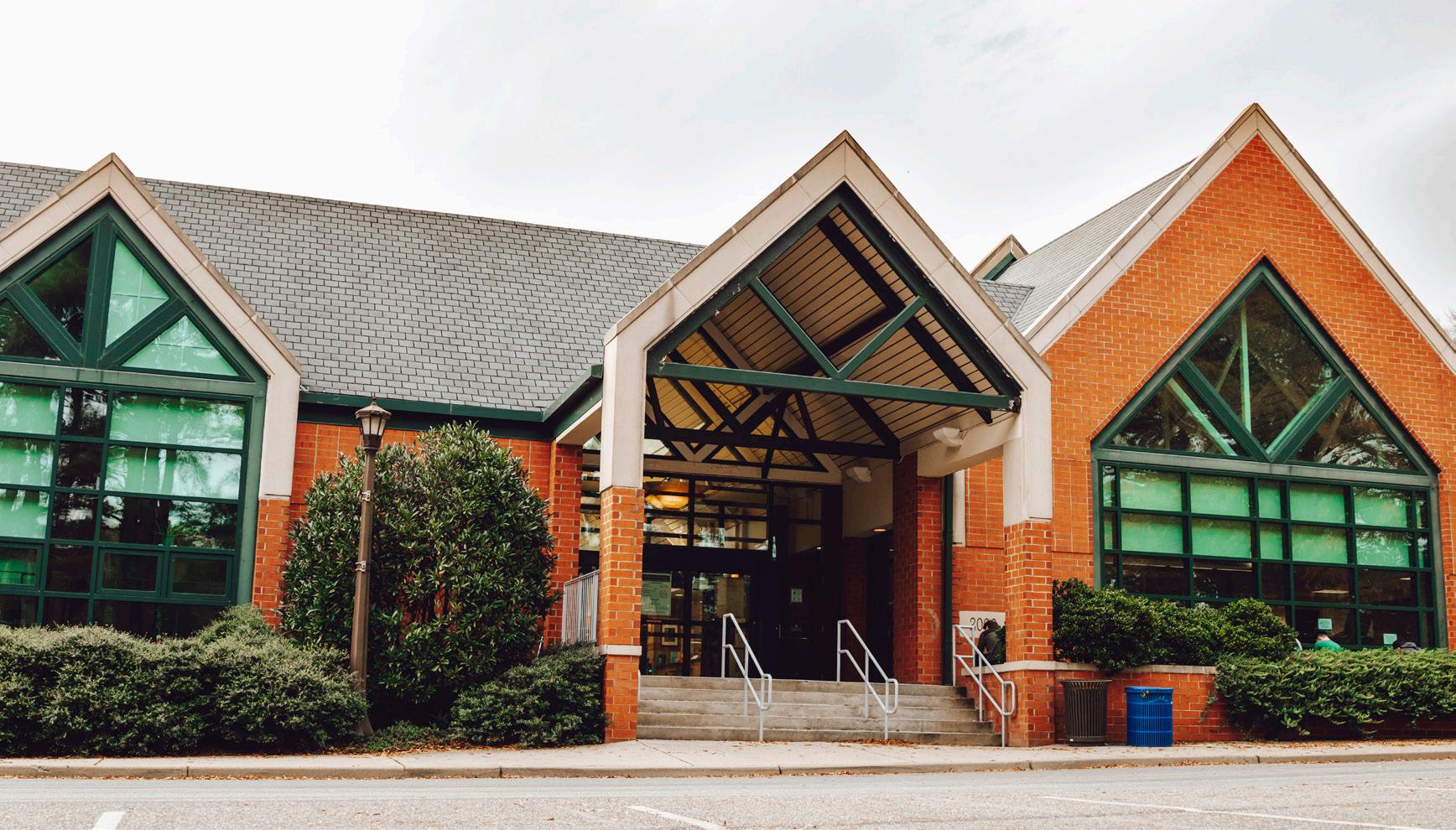
The gym is absurd. It is this big, intimidating building filled with people performing goofy movements, lifting and putting down heavy blocks to look a certain way. I mean, think about the awkward motions of an ab workout; how you contort your body on a mat on the ground for a good 20 minutes. Or running on a treadmill for hours not going anywhere at all. There are so many complex machines and countless things you can do with the free weights that it becomes too overwhelming to even start. You can’t even ask for help because everyone is isolated by their wireless headphones, so locked in to what they are doing. There are no interactions because, by its nature, the gym is a space where you can only workout your body. As a newbie, it is so easy to get caught up in the intimidation and
feel so incredibly small in this mechanic environment where people carry out these incredibly calculated routines. Yet, fitness is intensely personal and it requires vulnerability. It takes time and energy to find the most perfect workout that makes you feel good. There is no universal workout that molds you into being the most fit person in the world. Discovering what is best for you requires an insane amount of self-awareness and the courage to look silly and laugh it off while you figure it out. Fitness is a constant battle of trial and error as you figure out how to use what you know about yourself and tips from strangers on the internet to find the perfect routine.
But even this isn’t that straightforward, as there are so many so-called “experts” on social media that you don’t even know who
to listen to, especially when they all say different things. The worst part is once you do figure it out, as time passes, your body will change and you will have to figure it out all over again. Everyone thinks their answer is the right answer, which makes you feel dumb and overwhelmed.
Not listening to these jacked and successful people seems so wrong because they must have the answers, especially if they look like that. But no one should be telling you how to workout your body, because it is your personal vessel. What’s even more absurd about the gym is that you are expected to perform these incredibly personal exercises in front of a building full of people. It’s like walking around with your deepest, darkest secret displayed on your forehead for everyone to see. It just makes no sense. The human body itself is a personal space. It holds your biggest insecurities, but you are supposed to go to the gym and put all of this on display for others to see?
The truth is that no one is really looking at you. It takes too much energy to figure out what you are doing, let alone be bothered with anyone else’s goofy, somewhat embarrassing workout.
Even though the gym is absurd, there is no reason to be scared of it since no one really knows what they are doing.
So if you want to work out, don’t let the big, intimidating building stop you — just brush past and remember everyone looks silly when they are working out.
Isabella McNutt ’27 is a international relationsandhistorydoublemajor,and sheisamemberofAlphaChiOmega. Shelovestraveling,basketballand music.Emailheratimmcnutt@wm.edu.
THE FLAT HAT Wedneday, March 6, 2024 Page 6
STAFF COLUMN
STAFF COLUMN
STAFF COLUMN
Adam Jutt
FLAT HAT OPINIONS ASSOC.
JAMIE HOLT / THE FLAT HAT
GRAPHIC BY MOLLIE SHIFLETT / THE FLAT HAT
JAMIE HOLT / THE FLAT HAT
Supporting Black entrepreneurship
Black Student Organization, E.S.S.E.N.C.E.
host event in Sadler uplifting, increasing exposure to Black businesses, entrepreneurs
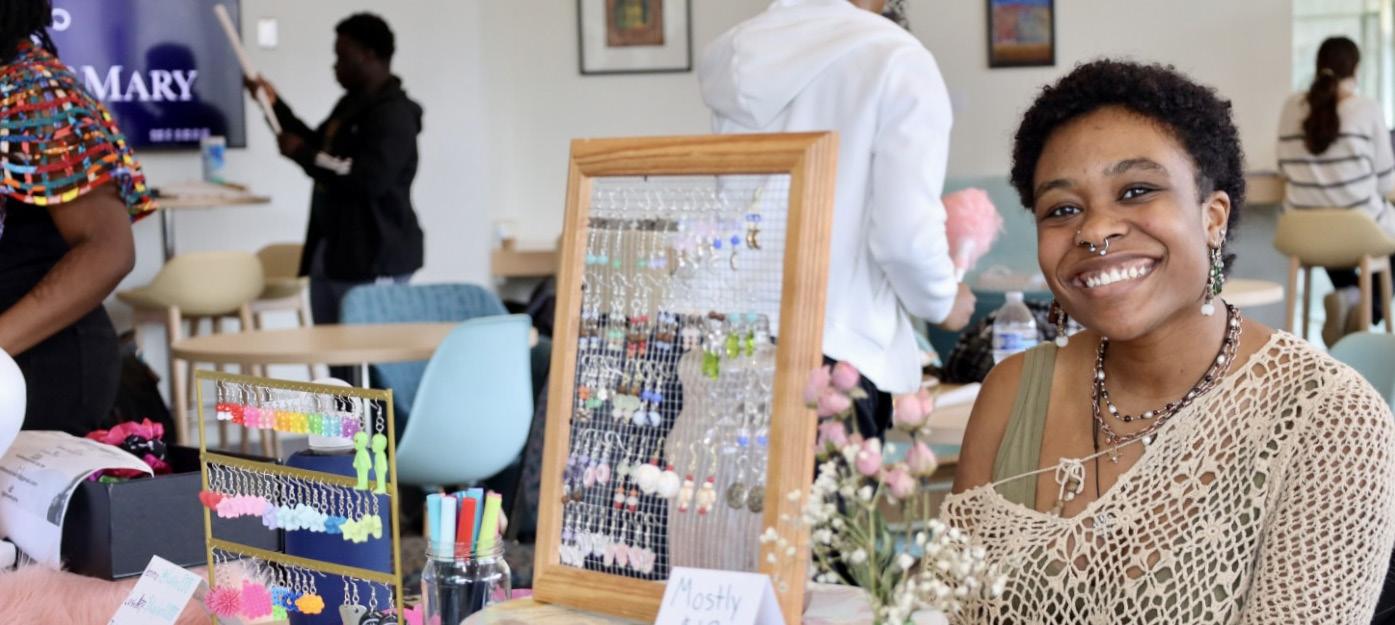
Saturday, Feb. 24, the College of William and Mary’s Black Student Organization and Educating Strength and Sisterhood by Executing a Nurturing Community of Empowerment co-hosted their third annual “Stepping into Black Excellence” Black Expo to uplift Black entrepreneurship in recognition of Black History Month. Throughout the afternoon, seven students and local vendors set up shop in The Slice, offering customers a variety of handmade items from hair care products to jewelry. Complimentary popcorn and cotton candy freshly made by BSO executive board members were also available for attendees to snack on as they shopped.
E.S.S.E.N.C.E. Event Coordinator Lauren Payne ’24 explained that the decision to hold the event in The Slice was intentional to give the event high visibility and invite all members of the community to join — especially those beyond their immediate social networks.
Payne explained how event organizers hoped that the open setup and general popularity of The Slice would entice student passersby to join in the festivities, even if they may not be involved in Black organizations on campus and may doubt whether or not the expo was intended for them.
“Sadler’s the only way to get other people to know that they’re welcome to see this and participate in any way they can,” Payne said.
BSO President Breyonna Rock ’24 echoed this sentiment, driving home the point that the event is most successful when students of all backgrounds are in attendance and participating.
“It’s so nice when it’s not just people from our community, but from everywhere,” Rock said.
For BSO Treasurer Ethan Miller ’25, it is this aspect of communitybuilding that truly gives meaning to the Black Expo.
“Community: that’s what [the Black Expo] brings first and foremost,” Miller said. “It brings hope, it’s building strength for our people, for the people here because some of them didn’t know they could get the chance to sell, to make their own business, to participate one day in the future as well. It might inspire them to go find their own passion and get started here.”
Rock noted that providing this all-encompassing opportunity for vendors to display their goods was ultimately the core focus for event organizers. According to Miller, one way BSO aimed to accomplish
this goal was by waiving registration fees and taking care of pre-event set-up at the convenience of the vendors.
“There’s no pressure that they have to come pay, set up. They’re just able to come enjoy themselves. It’s a community event first,” Miller said. “And there is no reason to charge people you want to actually come and enjoy themselves.”
Rock further described the benefits that vendors receive by participating in these small business showcases.
“[The vendors] get the exposure of interacting with more students, and that way the students can reach back out to them in the future, like, ‘Hey, do you have this?’ or ‘Oh, I love this product. I would like to get something else like that,’” Rock said. “I think that in itself is a very big plus and very exciting.”
This sentiment rang particularly true for Anaya Temple ’25, who said she was able to build her own small earrings business, Nykalu, by selling her products during similar events hosted by BSO or the African Cultural Society.
“Because of these events, I’ve been able to grow my business,” Temple said. “Like I went from just having my earrings across a table to now having a tablecloth and a [spinning display] and business cards.”
Raven Pierce ’23, M.Ed ’26, another vendor at the expo, similarly testified to the benefits of events like the Black Expo for budding Black business owners. Pierce expressed that this event was a simple and accessible way for her to debut her two businesses, Raeted Art LLC and Natural Hair by Rae, to the college community.
“This is actually my first expo of this kind,” Pierce said. “I really think it’s important to empower the community — the Black community — to showcase all of our unique talents and skills. For me, sometimes it is hard to advertise and market myself, so opportunities like this have made it so much easier.”
Payne continued to underscore the value of events at the College centered on Black entrepreneurship, highlighting how they shed an important light on the many Black businesses both at the College and in the larger Williamsburg area that she feels are usually left in the dark when it comes to exposure to the general public.
“It’s always really interesting because everyone gets really surprised
at the number of people that we have that end up signing up and registering,” Payne said. “They’re just surprised at either the number of students that are Black entrepreneurs or the number of Black entrepreneurs that are local as residents. I think we tend to think that we don’t have a residential population in the Williamsburg area, but, I mean, as I found through my research, like with the Black Histories Project, there is a group here that would love to be a part of things, so it’s really nice. I think that’s the most beautiful thing.”
In addition to providing Black-owned businesses with the crucial exposure and visibility they may struggle to gain otherwise, Rock made it clear that the Black Expo also positively impacts its customers as well as its vendors.
“I think for the participants, like the people who are coming out, it’s not only the community aspect and the feelings of it, but also just like having these pieces of jewelry or art pieces when they go home, and they can reflect on it like, ‘Oh, I got this cool bracelet from the Black Expo in 2024,’ and they can remember the experience,” Rock said.
Echoing Rock’s sentiment, attendee Deeka Abdi ’27 reflected that she enjoyed her time at the Black Expo and will return to this event next year if the tradition continues.
“It was really nice,” Abdi said. “I got to get a lot of cool stuff that I wouldn’t have normally gotten on my own.”
Event organizers, vendors and attendees alike praised the Black Expo as a universally beneficial venture that facilitates creative expression, community bonding, student entrepreneurship and cultural sharing and celebration.
“I love events like this,” Temple said. “I like being able to see all the different creative people, all their small businesses, and I like that these events give so many college students the ability to have support in their small businesses.”
For those looking to attend the Black Expo next year, or similar entrepreneurial events run by Black student organizations on campus, Payne leaves them with one final piece of advice.
“Hopefully, people will see how special [the Black Expo] is to these people,” Payne said. “Even if you can’t buy something, just talk to [the vendors] and let them just get out their frustrations with being an entrepreneur or their achievements and accomplishments.”
In comedy group Please Don’t Destroy’s sketch with Dakota Johnson this January, Ben Marshall asks Johnson in regards to her recent film, “Madame Web,” “What’s her superpower? Is it whispering in monotone?”
Directed by S.J. Clarkson, “Madame Web” follows Cassandra Webb (Dakota Johnson), a paramedic who struggles with her newfound clairvoyance as she seeks to protect three teenage girls (Sydney Sweeney, Isabela Merced and Celeste O’Connor) from a villainous force.
Clarkson’s inexperience is apparent. “Madame Web” is her first feature film, although her recent TV credits include “Succession,” “Anatomy of a Scandal” and an unaired “Game of Thrones” prequel pilot. Clarkson co-wrote “Madame Web” with Claire Parker as well as Burk Sharpless and Matt Sazama, who also worked on “Morbius” (2022), which was most famous for its fictional tagline “It’s Morbin’ Time!” Most of the exposition in “Madame Web” is through dialogue, as if the writers made an outline, saw their salary, and decided it was good enough for what they were being paid. Actually, that’s probably what happened considering the film’s $80 million budget, which positions it as one of the more economical superhero blockbusters.
The script is choppy and lazy, and there is little characterization that allows the audience to truly connect with any of the characters. But really, Dakota Johnson might as well have been playing herself: unaffected, cynical and completely
deadpan. When asked how her clairvoyance works, Cassie replies, “It just happens,” and no further explanation is ever presented. When Cassie discovers the truth about her mother, she simply says in her signature monotone, “You did it… you did it…”
The quote, “When you take on responsibility, great power will come,” is repeated twice, in case we missed it the first time. Sound familiar? Meant to connect “Madame Web” with the wider SpiderMan universe, this tagline lacks the snappiness of the original and is delivered by an unnamed spiderperson whose significance is never fully established.
Still, I don’t think Clarkson is the one to blame for the ineptitude of “Madame Web.” The failure of “Madame Web” reflects the wider corporate culture of Hollywood and its rapid loss of creativity. It is clear this film was made to piggyback off of the wider Marvel Cinematic Universe (specifically SpiderMan) success, in an attempt to establish yet another pointless franchise. Similar to pink-washing for profit, the film’s female leads reflect a significant increase in Hollywood’s push for diversifying its casts without exploring the actual implications of diversity.
Sweeney’s talent is well known from her role in “Euphoria,” but it is somehow continuously overlooked when she is cast in shallow roles like Julia Cornwall, an aloof schoolgirl who is a stickler for rules and easily wooed by boys. Anya Corazon (Isabela Merced) is book smart and savvy, burdened by the recent deportation of her father.
Mattie Franklin’s (Celeste O’Connor) rebellious
nature predictably stems from her wealthy parents’ neglect. Their characters have no real depth, and the directors try too hard to exemplify their Gen-Z quirks, because apparently, we think we’re too cool for high-fives now.
The girls’ banter is hollow and their sisterhood is never fully utilized. The film had potential to explore how women learn to become vulnerable with each other in an unscrupulous world, yet there is not a moment of real connection in the movie, and their interactions are reduced to throwing popcorn and giggling. At one point, Mattie and Julia dance atop a diner table to Britney Spears “Toxic.”
But being cliché is not the film’s biggest problem. Ezekiel (Tahar Rahim), the film’s villain, is equally hollow. Supposedly a mysterious power that has haunted Cassie for a generation, he ultimately poses no real threat. His motivations are boring and we never understand why it’s so important to keep his cause alive. Good villains earn sympathy, but “Madame Web” never gives a reason why we should care about Ezekiel.
There is a rare moment of tenderness between Cassie and the girls when she teaches them CPR, but moments like these are ruined by the interjection of useless scenes and characters, like the computer lady assisting Ezekiel, who can magically do anything and everything. Clarkson has some good directorial bits, like the repeated imagery of webs, broken glass and umbrellas to symbolize fate and time, but it is frustrating to see how her style is obliterated by the hackneyed elements these
superhero blockbusters demand.
Lousy movies can still be fun. Recent films like “Cocaine Bear” (2023) and “Bullet Train” (2022) have received similar criticisms of being empty and nonsensical, but have become instant cult classics and performed well at the box office. “Madame Web,” on the other hand, has a shaky foundation on top of the floundering “Venom” franchise and “Morbius.” The film itself lacks any tension, humor or excitement, and there is nothing purposeful driving the plot, which is also strangely rushed. Supporting actors like Adam Scott and Emma Roberts are well-loved and usually delightfully charming, but here, their deliveries were dry. I wouldn’t be surprised if this film was made purely for tax purposes. It seems everyone — from the actors and the producers to the set designers and editors — put the least amount of effort they could before taking checks and leaving.

| Wednesday, March 6, 2024 | Page 7
THE FLAT HAT Variety Editor Miles Mortimer Variety Editor Megan Rudacille flathat.variety@gmail.com // @theflathat
variety
VIVIAN HOANG // THE FLAT HAT
Lastest Sony Picutures flick, Madame Web, being panned by many as artistically lacking merit Reel Talk: Madame Web
mark
misses
SCARLETT RUAN // THE FLAT HAT
GRAPHIC BY EMNET ABRAHAM / THE FLAT HAT
SEDRA
OLABI / THE FLAT HAT
GROWING
GREEN THUMBS
Botany Club provides relaxing reprieve, connection with nature
LORENZO SHORT // FLAT HAT VARIETY ASSOC.
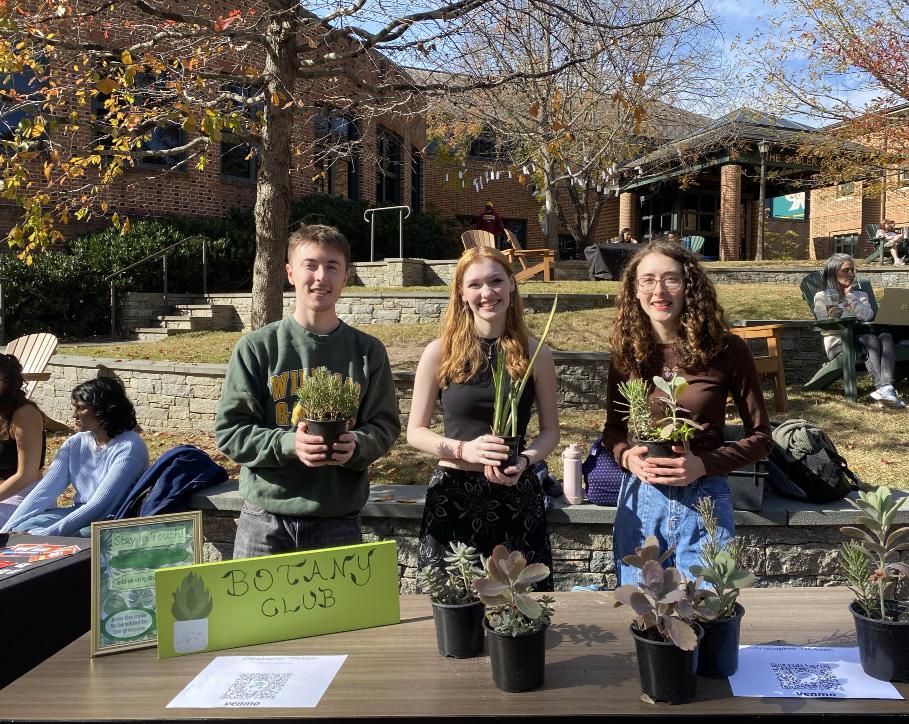

Taking time to engage with the natural world is considered by many to be important, especially for a college student with a strenuous schedule. It’s because of this that the College of William and Mary’s Botany Club aims to provide students with the space to learn and grow both fguratively and literally.
Te club works to provide a relaxing space for students to hone their gardening skills and grow their botanical knowledge, while taking a break from their ever-present schoolwork. As a military child, Botany Club Secretary Cassandra Hanson ’26 explained that while she has had many changes throughout their life, gardening has remained a grounding activity.
“I’m a very big plant person,” Hanson said. “I garden at home with my dad, we’ve gardened since I was a kid, we’ve had gardens everywhere we’ve moved. Tat’s been a pretty consistent thing that we do and a way to have some kind of consistency in the unstable moving situation.”
Te club ofers new experiences for new members, like AJ Bucy ‘27, while also accommodating students who are experienced gardeners.
“Before joining Botany Club, I actually was not good at taking care of plants,” Bucy said. “I wanted to get into [botany] in college because I really like being surrounded by plants and nature.”
Many people can be intimidated by gardening due to a self-proclaimed lack of a “green thumb.” Just like anything, however, caring for plants takes practice, which Bucy shared is not as difcult as some may think.
“Really, water them enough; I feel like people think that they are, but they’re not. So I think that’s very important. And then providing them with sunlight. Plants are really easy to care for if you do those two things,” Bucy said.
Club meetings help inexperienced members grow familiar with skills like proper watering, propagating and replanting. However, perhaps one of the most alluring prospects for new members is the club’s authorized
access and frequent usage of the Integrated Science Center greenhouse, which is sometimes the reason students start attending the meetings.
Botany Club Treasurer Chris Tillotson ’26 was already familiar with gardening at home, where he and his family grow vegetables and herbs. It was on a Green and Gold Day that he frst caught sight of the greenhouse and was given a tour of it by a professor.
“Tat’s when I decided I had to fnd my way back there at some point when I actually came to school,” Tillotson said.
While the greenhouse reels in new members, the club strives to keep its attendees returning with varied and interesting botany-themed events.
“The scavenger hunt we did was by far one of my favorite [events],” Hanson said. “It was a really creative one for us, and I think it was really engaging for everyone because it was also kind of a competition, which I think everyone loves.”
Te club is led by co-presidents Jacqueline Zimmerman ’24 and Celeste Phillips ’24, who both have an extensive knowledge of plants which is shared through events like the scavenger hunt and informational nature walks.
“We do nature walks where we just go for a walk around campus and look at the local nature. I know Jacqui is really well-versed in what grows locally,” Tillotson said.
Perhaps the club activity most visible to the campus community is the end-of-semester plant sale, in which the organization sells some of the plants they have spent the semester propagating in greenhouse and garden meetings. Tese sales raise funds that allow the club to provide materials and host future events without charging members dues. Tillotson said this lack of fees helps to keep the club fun and engaging while also being relaxing and low-commitment, as Botany Club seeks to remain a sanctuary for students involved in other clubs that have grown increasingly involved and taxing.
“I think Botany club is a great space to relax and kind of get away from the hectic school life or whatever’s going on in my life, and just focus on relaxing and enjoying yourself,” Tillotson said.
“I think one of the strengths of Botany Club is that it’s more low-key. So you aren’t required to do a lot. I see a lot of other clubs around me and they try to do too much. It’s a burden on exec and on the members who really just want to show up and have fun with things. And as long as we maintain that core part, I think we’re fne. I don’t think there’s much that needs to change.”
Tis important aspect is recognized and appreciated by others in the Botany Club as a welcome change of pace.
“It’s a very comfortable, come-andgo-as-you-please type of club, which I think is really relaxing and important while being here, because it doesn’t put stress on you,” Bucy said. “You can just go and have fun for the day and be around plants.”
Many students are very aware that adequate relaxation time is important but also struggle to step away from their schoolwork. But this club, which meets on Sundays at 2:00 p.m. in the ISC 1 lobby, seeks to provide their members with a much needed break.
“It’s something to look forward to. It also gives me a designated time to take a break,” Hanson said. “It’s really just for people who are looking for a break and just want to enjoy some plants, and that’s about it. It’s not much more than that, and I don’t think it needs to be.”
Bucy refected on how Botany Club also provides students with a much needed reprieve from screen time and the opportunity to connect with nature.
“Being at school can be hard and stressful, so being away from technology and sometimes mass groups of people is nice when you’re in Botany Club, because you can really just focus on nothing but the plants,” Bucy said.
In the end, Bucy emphasized that Botany Club hopes to share a connection and love for the natural world with new members regardless of their prior experiences with gardening.
“I really think you should give it a try,” said Bucy. “If you’re not sure if you’re going to like it, come to the events anyway, because you never know unless you try it. And that’s with every club, but especially with botany, because it’s something that you can learn from for the future.”
TAKING A LOOK AT BANNED BOOKS
English department holds second annual Banned Book Jam for Black History Month
“The thought that leads me to contemplate with dread the erasure of other voices, of unwritten novels, poems whispered or swallowed for fear of being overheard by the wrong people, outlawed languages flourishing underground, essayists’ questions challenging authority never being posed, unstaged plays, canceled films — that thought is a nightmare. As though a whole universe is being described in invisible ink.”
This quote from Nobel laureate and Pulitzer Prize winner Toni Morrison fell over the Tucker Theater, sitting with the audience as it listened to excerpts read from banned books written by Black authors.
Friday, Feb. 23, the College of William and Mary’s English department put on its second Banned Book Jam, in celebration of Black History Month. Faculty members and students read passages from a variety of texts that have been challenged publicly, including “The Color Purple” by Alice Walker, “Between the World and Me” by TaNehisi Coates, “Beloved” by Toni Morrison, “Go Tell It on the Mountain” by James Baldwin and “The Souls of Black Folk” by W.E.B. Du Bois.
English Department student assistants Abby Paras ’24 and Shawna Alston ’25 planned the event together. Paras explained they wanted to expand on the concept behind the first Banned Book Jam that was held this past October.
“We kind of took that idea and we put our own spin on it for Black History Month, especially because so many books by Black authors have been banned specifically for the fact that they talk about race, Blackness, issues of racial injustice as they pertain to Black people in America,” Paras said. “So, because there are so many options to choose from, we thought that this would be a really interesting way to kind of celebrate the work of Black authors while also bringing attention
to the kind of themes that are banned among literature in the U.S.”
Morrison’s novels regularly circulate the American Library Association’s annual list of the top 10 most challenged books. Alston chose to read a passage from Morrison’s Beloved, on behalf of the College’s Black Poet Society.
“I know most college students who took honors English classes had to read either ‘Beloved’ or ‘Song of Solomon’ when they were in high school,” Alston said. “And if they didn’t, they’re familiar with other people who read ‘Beloved’ in high school. I chose ‘Beloved,’ one because it’s just a really good book, but also because it’s something that almost all of us are familiar with, and because almost all of us are familiar we’ll pay more attention to the fact that it’s getting banned.”
Assistant Teaching Professor of English Addie Tsai was the first reader of the event, delivering an excerpt of “The Color Purple.” As a preface, Tsai made sure to make mention of how informative reading this book was during their childhood.
In a similar vein, Reeves Wilder ’25, reading on behalf of the College’s Gallery Literary Magazine, presented her passage from “Beloved” with her personal sentiment towards the impact of the novel.
“I think ‘Beloved’ is just one of those iconic books that when you read it, you think to yourself, ‘Why is this banned? Why do people not want you to read this in high school?’ because it’s so formative,” Wilder said. “But for me personally, it was one of the first books that I read in high school that made me fall in love with English again, because for a long time, I felt in English class, really unfulfilled, by the way it was run by the school. And when I read ‘Beloved,’ I really felt the love of literature coming through the book.”
According to a report conducted by Pen America, 30% of banned books in America include either characters that are people of
color or themes related to race and racism.
Speaking to this point, Alston views the Banned Book Jam as an opportunity to demonstrate the way that these mass book bans disproportionately target books that are written by and about marginalized groups.
“Having an event where everyone can read a book by a Black person that has been banned can kind of exhibit the monstrosity of the fact that almost all of the books being banned are about Black people,” Alston said.
Alston emphasized that by acknowledging that a book written by a Black person has been banned and reading it in context, the work itself becomes that much more relevant.
“Acknowledging that you’re reading a banned book contextualizes it as we read it, because now you’re trying to understand why the book is banned,” Alston said. “You’re trying to understand what about this book is so offensive? And nine times out of ten, it’s just the fact that it’s about Black people, or just the fact that it’s about queer people, or the fact that it’s about indigenous people. Like there’s no real reason other than the subject matter or the author even. I do also think that sometimes we should just read these books for what they are, and that is really, really good books. And we shouldn’t let racist lawmakers determine our engagement with these books.
But I’m more leaning to the fact that reading them as ‘banned books’ can teach us about our systems and where our laws are, where our policymakers are, and where we are as a society that we are banning books strictly because they are by and about Black people.” Paras also viewed the event as an opportunity to counteract the effect that banning books can have on students that are a part of marginalized groups.
“There are going to be a lot of Black students, Black queer students, Black female students, things like that, who are going to want to be reading these books and see that
representation,” Paras said. “And by banning these, it’s kind of almost in a way letting these students know that they’re alone or there’s something wrong or something is bannable about them and about their experiences.”
Chair of the English Department Brett Wilson introduced his reading from “The Souls of Black Folk” by summarizing the essence of the goals that Paras and Alston had for the event.
“It’s so important to celebrate Black books and Black knowledge and the pain and the joy that are always part of what Black people pour out into words, and these are the words that can never be silenced, must never be silenced,” Wilson said. “We’re gathered here today to fight back against the notion of banning things that make people uncomfortable.”
Wilder agreed that the messages of certain institutions must be challenged when they actively work to suppress the voices of diverse people.
“If you just accept what an organization or what people in power tell you without critically thinking on your own, then you aren’t able to assess why this has been recognized as obscene or inappropriate for high schoolers, and I guess it’s just important to garner those critical thinking skills for yourself,” Wilder said.
The Banned Book Jams, from the perspectives of organizers and attendees alike, provide a space for students at the College to challenge the notion that the ability for a book to provide representation for its readers should be deemed controversial. Paras and Alston hope to plan more jams later this semester to celebrate other marginalized communities, such as during Pride Month and Asian Pacific Islander History Month. According to Alston, the presence of books written by Black authors matters not only for people of color, but also for the wider literary landscape.
“Nine times out of ten, if you read a good book, you’ve read a good book by a Black person,” Alston said.
COURTESY IMAGES / CASSANDA HANSEN
THE FLAT HAT Wednesday, March 6, 2024 Page 8
EMMA HALMAN // FLAT HAT VARIETY ASSOC.
sports
Gabe Dorsey breaks program record for most three-pointers scored in season Tribe overpowers Hampton, ends nine-game losing streak
MADDIE MOHAMADI FLAT HAT SPORTS EDITOR
Saturday, March 2, William and Mary men’s basketball (9-22, 4-14 CAA) defeated Hampton (8-23, 3-15 CAA) 85-73 at Kaplan Arena in Williamsburg, Va. The Senior Day victory broke the Tribe’s nine-game losing streak, placing the team in 14th place of the Coastal Athletic Association standings.
Offensively, William and Mary fired on all cylinders, shooting 66.7% at the free throw line and 42.9% from behind the arc.
Sophomore guard Trey Moss led in scoring, recording his sixth 20-point game of the season. Junior guard/forward Gabe Dorsey followed close in second, scoring 19 points. With five three-pointers, Gabe Dorsey broke a William and Mary record for three-pointers in a season.
“I’m very appreciative of the work that I put in coming to fruition,” Gabe Dorsey said. “It feels great to be able to do something like that on a day like this, our last home game.”
Graduate student guard Sean Houpt also scored five three-pointers, racking up 16 total points for the Tribe.
“There’s always a little bit of that on Senior Day, where your seniors always seem to provide a spark, whether it’s hitting big shots or making a big momentum play,” head coach Dane Fischer said. “Sean got us going today with that and had a really efficient day.”
William and Mary junior forward Caleb Dorsey opened scoring nine seconds into the game with a converted free throw. Barely over a minute later, Caleb Dorsey assisted sophomore guard Chase Lowe, whose layup extended the Tribe’s lead to 3-0. After receiving a pass from Lowe less than a minute
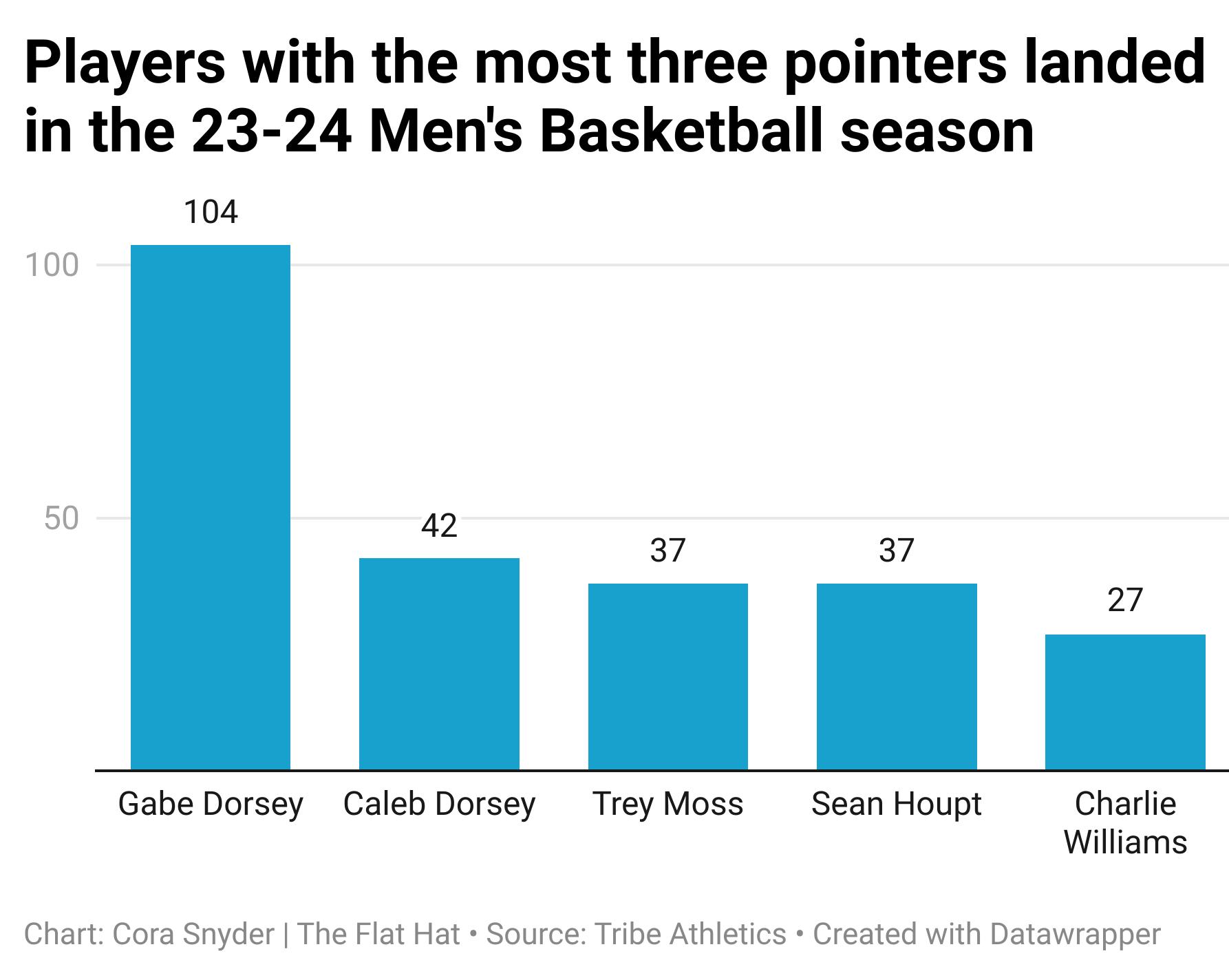
LACROSSE
later, Houpt knocked down a three.
With 16 minutes, 49 seconds remaining in the first half, Houpt scored his second threepointer of the night, assisted by Gabe Dorsey. Just under a minute later, Hampton senior guard Tedrick Wilcox Jr. finally put the Pirates on the board with a made free throw. In the next 60 seconds, Hampton sophomore guard Trey Thomas’s jump shot and junior forward Ja’Von Benson’s hook shot narrowed the score to 9-5.
Assisted by Caleb Dorsey, Houpt’s third three-pointer of the matchup came in the eighth minute. Following a free throw from Hampton senior guard Dan Banister Jr. and another jumper from Thomas, Lowe passed to sophomore forward Charlie Williams, whose three extended the Tribe’s lead to 18-12.
With just under 10 minutes remaining in the first half, Williams assisted Houpt’s fourth three-pointer. Following a layup from Benson, Williams’s converted free throw increased the Tribe’s winning margin to eight points.
The remaining five minutes of the first half saw impressive plays from the Tribe.
Assisted by Williams, junior guard Matteus Case’s layup in the 16th minute increased the Tribe’s lead to 32-19. Roughly a minute later, Gabe Dorsey responded to a layup from Benson with a three-pointer of his own, assisted by Lowe.
Houpt converted a free throw point with 13 seconds left in the first half to maintain the Green and Gold’s lead. Ten seconds later, Hampton junior guard Jordan Nesbitt scored a three, and the Pirates ended the first half down 43-35.
The Tribe continued to capitalize on its offensive opportunities in the second half.
“I thought the second half was really key,” Fischer said. “I thought our guys really responded well coming out to start the second half.”
With a three-point jump shot assisted by Moss, Caleb Dorsey opened scoring in the second half. After receiving a pass from his brother, Caleb Dorsey scored another threepointer less than a minute later, putting the Tribe up 49-35. Assisted by Lowe, Gabe Dorsey scored his second three-pointer of the matchup with 17:49 remaining in the game. Less than two
minutes later, the dynamic duo struck again, with Lowe assisting Gabe Dorsey for his third three of the game.
Following a layup from Benson, Houpt’s fifth three-pointer came in the 25th minute, assisted by Williams yet again.
Gabe Dorsey extended the Tribe’s lead to 65-52 in the ninth minute of the half with another three-pointer assisted by Lowe. Under a minute later, Dorsey converted two free throws, and Williams passed to Lowe, whose layup increased the Green and Gold’s lead to 15 points.
Though the Pirates managed to narrow the Tribe’s lead to five points with 7:19 left in the game, William and Mary’s offense continued to dominate.
Assisted by Caleb Dorsey, Gabe Dorsey scored his fifth three-pointer with just over five minutes left in regulation. In the 37th minute, Moss’s three-point jumper followed by a converted free throw boosted the Tribe’s lead to 81-71. With 1:37 left in the matchup, Moss’s hook shot and another converted free throw cemented the Tribe’s victory.
Though Wilcox managed to rack up two more points for the Pirates with 17 seconds left in the game, the Green and Gold secured the 85-73 win.
Fischer emphasized the team’s strong offensive play.
“Offensively, we had a mindset of just sharing the ball and moving it,” Fischer said. “I thought we came out of the gates today and got some really good stuff offensively early.”
Going into the CAA tournament, both Gabe Dorsey and Fischer viewed the victory as a fresh start for the Tribe.
“We flipped the script around heading into the tournament and gained a little bit of momentum for our team,” Gabe Dorsey said. “We have a new season ahead of us, and we can really turn this around and make a new run at this.”
Friday, March 8, William and Mary men’s basketball will face North Carolina A&T (7-24, 5-13 CAA) in the first round of the Coastal Athletic Association tournament at the Entertainment and Sports Arena in Washington, D.C.
Green and Gold defeats East Carolina in hard-fought win
Offense dominates in fourth quarter, scoring six goals in last 11 minutes
Saturday, March 2, William and Mary women’s lacrosse (3-3) beat East Carolina (3-3) 19-12 at Martin Family Stadium at Albert-Daly Field in Williamsburg, Va.
Junior midfielder Paige Gilbert was a dominant offensive force for the Tribe, opening the scoring and giving the Green and Gold an early lead just under two and a half minutes in. ECU answered quickly with a goal, but the Tribe stayed strong on the attack. Gilbert found the back of the net for her second goal of the day, assisted by junior attack Ainsley Huizenga.
A goal from sophomore midfielder Lauren Rothstein
extended William and Mary’s lead to two. Both defenses held strong for just under four minutes, 30 seconds until Huizenga scored again to put the Tribe ahead 4-1.
ECU graduate student midfielder Ellie Bromley and sophomore midfielder Kayla Wilkes both scored unassisted in the final four minutes of the fourth quarter, narrowing the Green and Gold’s lead to 4-3.
The Pirates tied the score at the beginning of the second quarter, but another scoring run by the Tribe extended its lead back to three.
Gilbert scored two more goals in the second quarter, with senior attack Olivia Gladstein and freshman midfielder Finley Hoffman each scoring their first of the day. ECU junior attack Leah
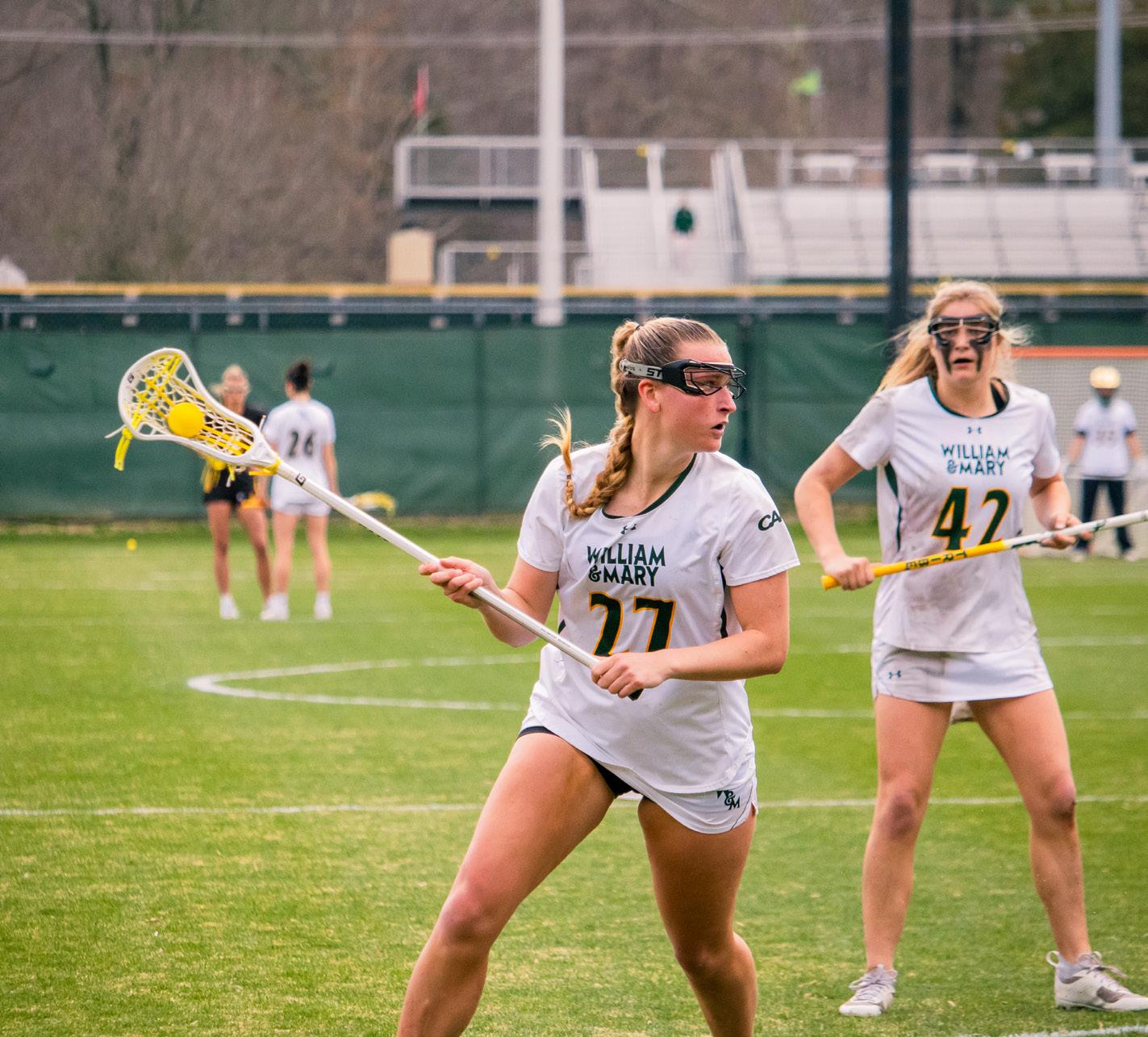
Bestany converted a goal with just 9 seconds remaining in the first half to keep the deficit at three, with the Tribe leading 7-4.
ECU capitalized on its offense to start the second half, scoring two early goals to even up the score at 8-8. William and Mary sophomore midfielder Maresa Moyer scored to take back the lead, followed by Gilbert recording her fifth goal of the night to extend the Tribe’s lead to two. The score equalized again with 6:32 remaining in the third quarter until sophomore midfielder Kate Draddy scored for the Tribe, giving the home side back its lead at 12-11.
William and Mary dominated in the fourth quarter.
Huizenga scored again less than a minute in, and despite an answering goal from Pirates junior midfielder Emily Stratton, the Tribe’s offense took control through the end, scoring six goals in the last 11 minutes of play.
The Tribe ended the game on a high, with a goal from freshman attack Piper Kienzle in the last two seconds of play with an assist from sophomore attack Sydney Witwer. The Tribe secured the 19-12 win.
Defensively, sophomore goalkeeper Marin Wilhelm made her first career start in goal for William and Mary, playing all 60 minutes and recording 10 saves for the day. With a respectable shot percentage of .678, the Tribe controlled draws 19-15. Gilbert’s contributions were massive for the Green and Gold: Her six goals marked a career high and tied her for William and Mary’s 11th-best single-game performance in program history.
William and Mary will host Maryland (4-1) March 6 at Martin Family Stadium at Albert-Daly Field in Williamsburg, Va.
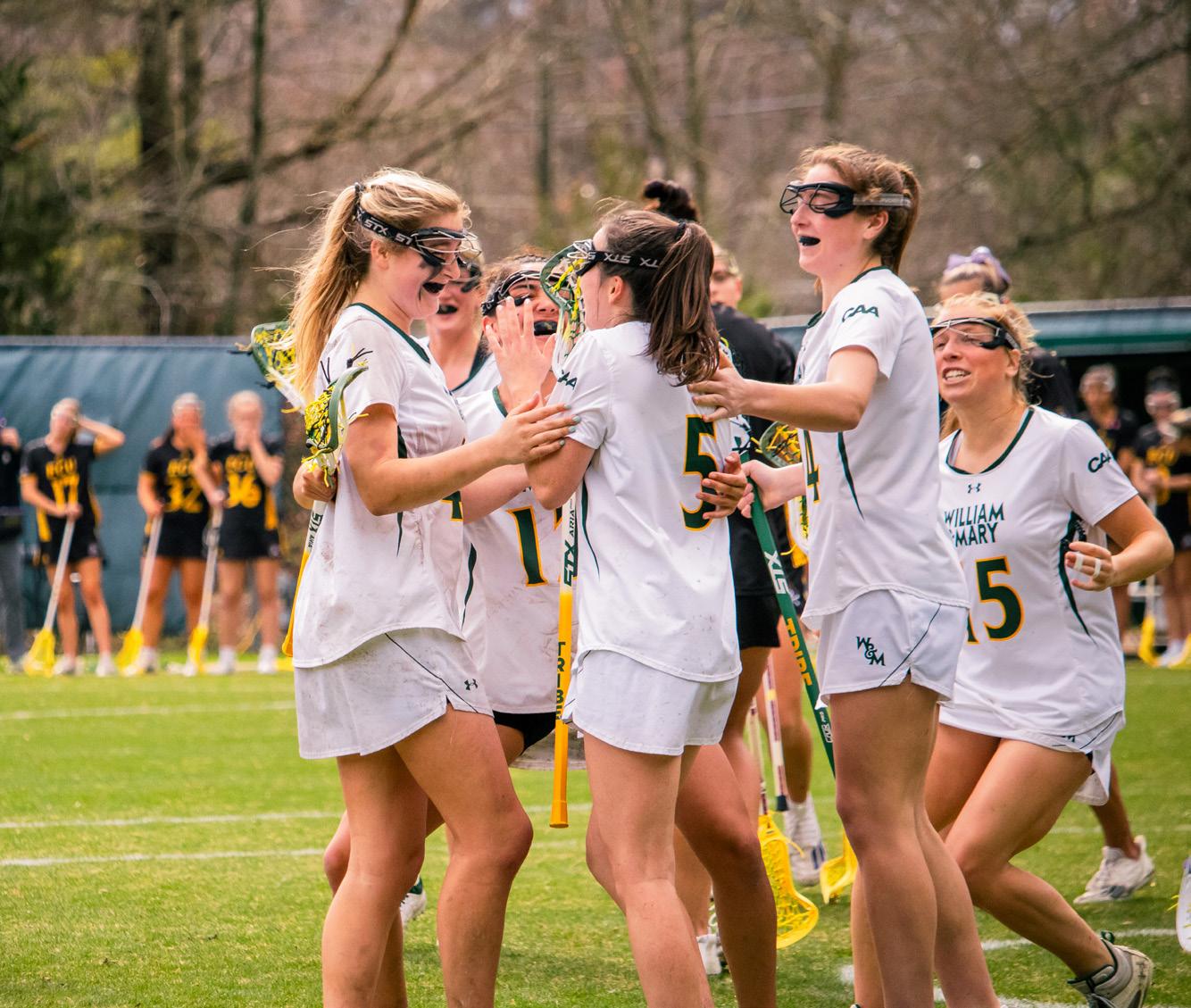
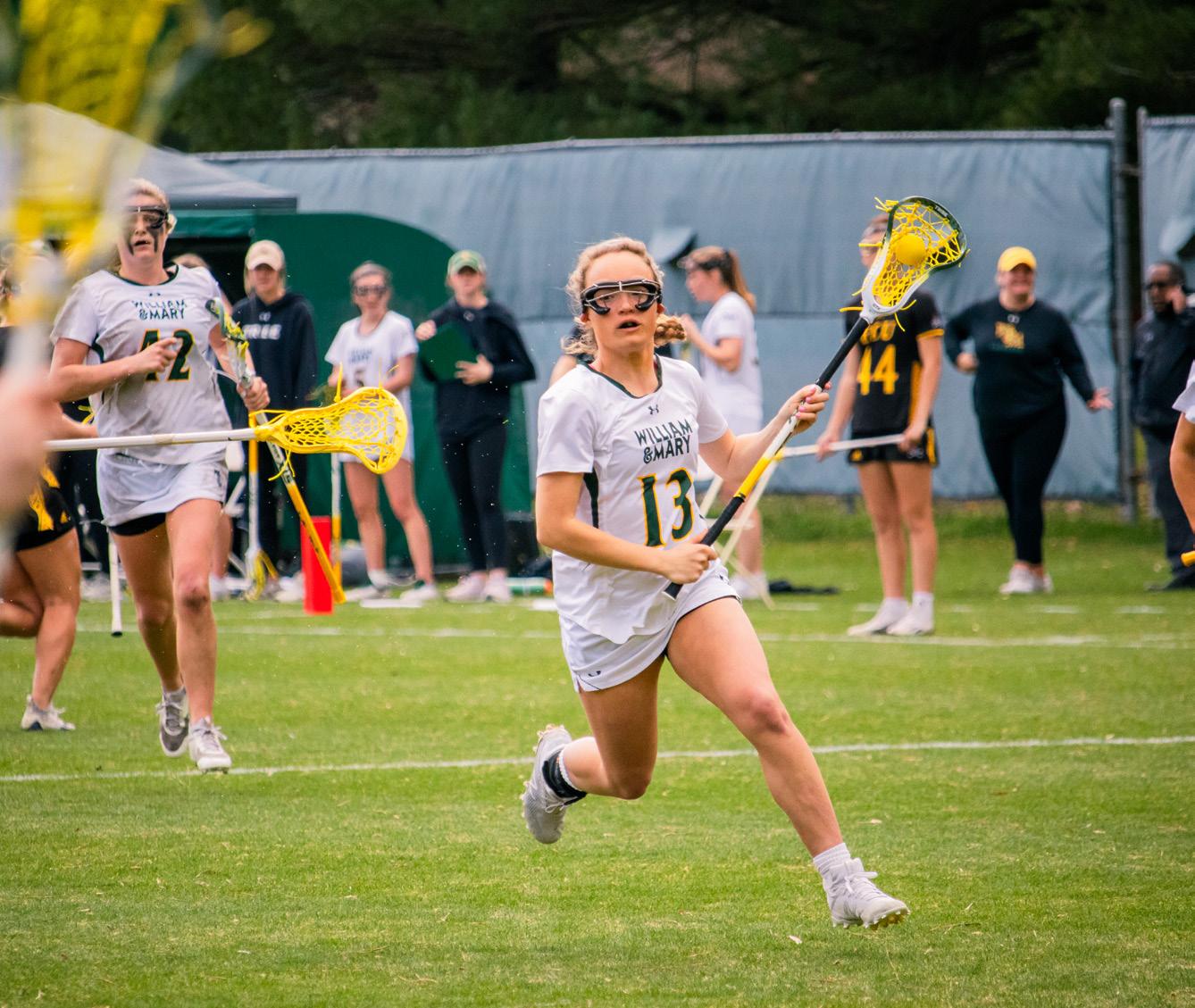
MENʼS
BASKETBALL
| Wednesday, March 6, 2024 | Page 9 THE FLAT HAT
LACI MILLER FLAT HAT SPORTS ASSOC.
RYAN GOODMAN / THE FLAT HAT RYAN GOODMAN / THE FLAT HAT Junior attack Ainsley Huizenga scored the second-most points for the Tribe with three goals.
sports
Introducing ‘Te Mo Show’: William and Mary’s frst WWE star
Junior defensive tackle Momen Zahid joins WWEʼs ʻNext In Lineʼ program
The College of William and Mary has a rich history of producing professional athletes and worldwide entertainers. Tribe alumni have made their marks in multiple professional sports leagues, including the Major League Baseball, National Basketball Association and National Football League, and earned recognition for excellence on screen and stage.
However, the Green and Gold has never produced someone who’s combined sport and stage at the same time, especially in a ring.
That is, until now.
Momen Zahid is a junior defensive lineman on the William and Mary football team. In 25 career games, Zahid recorded 14 tackles and four and a half sacks. Off the field, the Virginia native is completing a biology degree while minoring in data science.
Dec. 7, 2023, Zahid announced on his Instagram that he would be partnering with the World Wrestling Entertainment as part of their “Next In Line” program. The program, which recently selected its fourth class of recruits, partners with 14 collegiate athletes from around the country to create the foundation for the future of the WWE.
Going into his junior year, Zahid admitted this unusual partnership was not on his radar.
“Somebody had reached out to me on
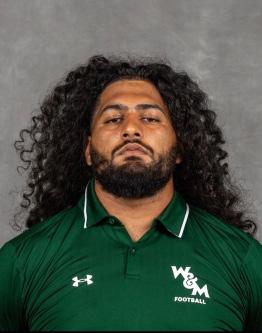
Instagram, and I thought it was a fake account,” Zahid said. “Then I checked, and they had like half a million followers.”
The WWE has a roster of all collegiate athletes, and they spend months screening individual teams for players they think could fit their physical and personal standards. As a six feet five inch tall football player, Zahid believes he met the criteria.
“I think obviously [they] look for the
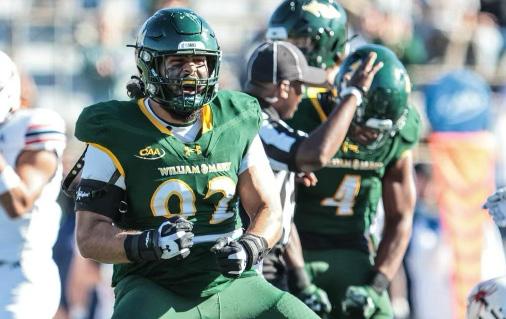
physique, because they need big guys,” Zahid said.
More importantly, however, the recruiting process was centered on an athlete’s character.
“I think it was mostly they were trying to get an idea of who we are and if we align with their vision,” Zahid said. “Now we’re representing their brand.”
As an avid WWE fan in his youth, Zahid originally thought the possibility of working with the organization was too good to be true. After rounds of interviews over Zoom and on the phone, Zahid thinks his past connections to the WWE as a kid were what really made him stick out among the thousands of other potential athletes.
One of Zahid’s favorite WWE memories occurred when he was in Pakistan visiting his cousin.
“I remember I was in the mountains in Pakistan,” Zahid said. “They were playing WWE in the mountains, and I was like, ‘It is so crazy… like, they have that here!’”
The program, which formed in response to the National Collegiate Athletic Association allowing players to sign name, image and likeness deals, is primarily focused on developing the future talent of the WWE.
“They like who they’ve recruited, and they want to teach us about the business and the ins and outs,” Zahid said.
Partners also gain access to the WWE’s facilities, highlighted by its primary training center in Orlando, Fla. Athletes also fly out to some of the organization’s biggest events throughout the year.
Due to a shoulder injury, Zahid has not yet seen the facilities.
“After I recover, they’re planning on having me go over, but I plan on checking out the training facility and stuff sometime in the summer,” Zahid said.
The training included in the program is extensive, covering both the business side of the organization and the physical act of wrestling.
“They teach you about the ins and outs of the business, like how it works,” Zahid said. “They’ll show you acting classes — it’s a lot of behind-the-scenes stuff.”
Ultimately, the “Next in Line” program aims to promote its collegiate athletes to full-time partners with the WWE.
Zahid explained the benefits of becoming a partner.
“If I’m still interested and they’re still interested, you have a much easier avenue to sign a contract,” Zahid said. “There’s not as many impediments to actually joining and
signing a contract down the road because they know who you are and have developed you.”
Despite already partnering with the WWE, Zahid still has three years of NCAA eligibility and is primarily focused on finishing his degree. Regardless, he remains optimistic and excited about his future with wrestling.
“The way I’m looking at it right now is it’s a crazy opportunity,” Zahid said. “So finish through my undergrad, get my degree, and then I’m going to take this WWE thing wherever I can and see how far I can get with the opportunities there.”
Zahid also acknowledged that a great deal can happen between now and when he graduates. Football is an injury-filled sport, and long-term plans can change at a moment’s notice. Regardless of how his life changes from now until then, he feels extremely grateful and fortunate to be in the situation he is in.
“It’s just a crazy blessing, and I’m going to take advantage of it if I can,” Zahid said. “I think even if it doesn’t pan out, even though I really hope it does, I get to be like, ‘Hey, I used to be in the WWE.’”
Whether he’s on the field, in a biology lab or in the ring, William and Mary is witnessing just the beginning of what the Mo Show will offer.

Green and Gold makes strong splash during CAA Championships
Womenʼs team takes third,
Wednesday, Feb. 28 to Saturday, March 2, William and Mary swimming competed in the 2024 Coastal Athletic Association Championship at the Hampton Aquaplex in Hampton, Va. The Tribe saw notable standout performances from many athletes, including multiple recordbreaking performances.
On Wednesday, the Tribe enjoyed success across the board in the 200-yard medley relay. For the women’s team, sophomore Caroline Burgeson, sophomore Sophia Heilen, junior Ellie Scherer and senior Kat Vanbourgondien finished with an impressive time of 1:39.32. They
closely followed the North Carolina Wilmington team, which clinched the victory for this matchup. The time recorded by the Tribe was the second best in program history, closely following a record set by Vanbourgondien, Scherer, Heilen and Katie Stevenson in 2023.
For the men’s team, graduate student Conor Sokolowsky, sophomore Brock Rempe, senior Kent Codding and freshman Aiden Bond recorded a time of 1:26.51, the second-best time in program history. They closely followed the record time of 1:25.52 and notched a second-place finish for the Green and Gold.
In the 800-yard free relay event, the team of freshman Sarah Dunham, junior Devin Genderson, freshman
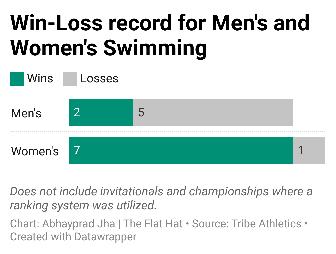
Flynn Truskett and freshman Lauren Tucker recorded a time of 7:23.81.
The men’s relay team of freshman David Yune, freshman Colin Mamaril, sophomore Will Glass and Sokolowsky recorded a time of 6:36.91. Both relay teams placed fifth on the leaderboard to end the contest.
In the 500-yard free finals event on Thursday, Tucker swam a time of 4:57.87 and placed eighth. For the men, Glass swam in the consolation finals, and placed seventh place with a time of 4:31.42.
In the 200-yard IM final, Scherer swam an impressive time of 1:58.96, earning her the CAA gold medal. This time moves Scherer to the second best time in program history, trailing Heilen’s time of 1:58.38.
On the men’s team, Sokolowsky recorded a time of 1:46.59 and finished fourth in the finals.
In the 50-yard free finals, Burgeson finished in sixth place. Truskett, Dunham and freshman Zoe Arakelian placed first, fifth and eighth, respectively, in the consolation finals. On the men’s side, Bond finished second with a time of 19.79, an impressive time for his debut performance in the CAA tournament. In the consolation finals, sophomores Alex Valliere and Logan McDonald recorded fourth and sixth place finishes for the Tribe.
The next event was the 400yard medley relay. The Tribe women clinched first place with an incredible time of 3:37.62. This was a record-breaking finish for the Green
meet before NCAA Championships
and Gold, and is now the second fastest time in program history. The relay included Vanbourgondien, Scherer, sophomore Lindsay Juhlin and Burgeson. For the men, the Tribe placed fifth in the final thanks to Sokolowsky, Rempe, Codding and Bond. This event concluded the competition for the day.
Friday, the day began with the 100yard fly finals. For the women, Juhlin placed second with a time of 53.10. Heilan followed with a time of 53.89. Juhlin’s time places her fifth of all time for the Tribe, and Heilan’s places her ninth of all time.
On the men’s side, McDonald, senior Gavin Lamoureux and Codding placed third, fourth and fifth, respectively, in the consolation finals.
For the 400 IM finals, freshman Kaitlyn Conover-Emmert and Tucker placed fourth and seventh in the consolation finals. As for the men’s team, freshman Zach LeMay, freshman Thor Dyke and graduate student Jono Bennett placed third, fourth and fifth in the consolation finals.
In the 200-yard freestyle finals, Dunham placed fifth in the consolation race. Bond placed third in the finals for the men’s team. Bond’s recorded time of 1:36.88 places him seventh of all time for the Tribe. Scherer collected another first-place medal in the 100-yard breaststroke finals. Finishing with a time of 1:00.84, Scherer beat her own previous record of 1:00.90. She
continues to hold the fastest time in program history for this event. Juhlin finished fourth in the finals for the Tribe, finishing with the 12th-best time in program history.
On the men’s side, both Rempe and McDonald swam in the finals. Rempe placed fifth, followed by McDonald in sixth. These times are record-breaking performances and are the first and second fastest in program history.
In the 100-yard back finals, Vanbourgondien placed third and freshman Julie Addison placed eighth. In the men’s consolation finals, Sokolowsky, sophomore Bryce Rouzie, Codding, junior Micah Lowe and senior Aaron Tingley placed first, second, fourth, fifth and eighth, respectively.
In the 200-yard free relay, the Tribe placed fourth for the women, led by Burgeson, Truskett, Dunham and freshman Meghan Rourke. For the men’s team, the Tribe also placed fourth with a team of Bond, Valliere, McDonald and Lamoureux.
On the final day of the CAA Championship, the Tribe recorded an impressive showing.
In the 1650-yard freestyle, sophomore Kelsey Katt finished in sixth place with a time of 17:03.10, Tucker finished in seventh with a time of 17:03.78 and sophomore Kiersten Dagg placed ninth with a time of 17:13.17. For the men, Glass placed eighth with a time of 15:48.09.
PROFILE
| Wednesday, March 6 2024 | Page 10 THE FLAT HAT
SWIMMING
MAX GRILL FLAT HAT SPORTS EDITOR
menʼs finishes fifth in final
COURTESY IMAGE / MOMEN ZAHID Zahid thought the Next in Line program was too good to be true when they initially reached out to him earlier last semester. COURTESY IMAGE / MOMEN ZAHID Zahid looks forward to seeing WWE facilities this summer. COURTESY IMAGE / MOMEN ZAHID
SYDNEY WITWER THE FLAT HAT
READ MORE AT FLATHATNEWS.COM
