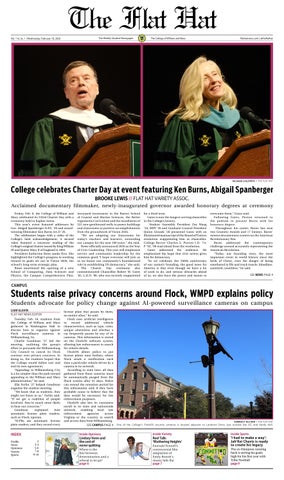
College celebrates Charter Day at event featuring Ken Burns, Abigail Spanberger
Acclaimed documentary filmmaker, newly-inaugurated governor awarded honorary degrees at ceremony
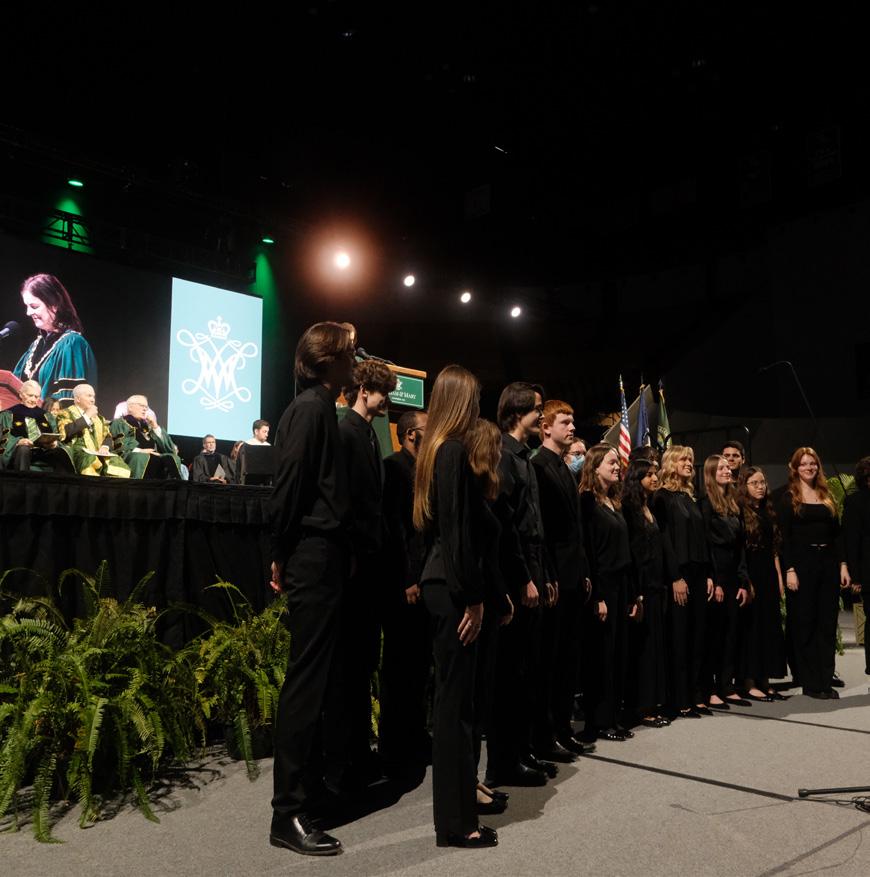
Friday, Feb. 6, the College of William and Mary celebrated its 333rd Charter Day with a ceremony held in Kaplan Arena.
This year’s event featured addresses by Gov. Abigail Spanberger D.P.S. ’26 and awardwinning filmmaker Ken Burns Art.D ’26.
The celebration began with a video of the College’s land acknowledgement. A second video featured a voiceover reading of the College’s original charter issued by King William III and Queen Mary II of England in 1693.
President Katherine Rowe spoke first. She highlighted the College’s progress in working toward its goals set out in Vision 2026, the school’s long-term strategic plan.
Rowe mentioned the opening of a new School of Computing, Data Sciences and Physics, the Campus Comprehensive Plan,
increased investment in the Batten School of Coastal and Marine Sciences, the Better Arguments Curriculum and the installation of 531 new geothermal wells to power buildings and classrooms as positive accomplishments from the groundwork of Vision 2026.
“We are adapting our classrooms for today’s teachers and learners, stewarding our campus for the next 100 years,” she said.
Rowe officially announced 2026 as the Year of Civic Leadership. This year will emphasize service and community leadership for the common good.“I hope everyone will join us as we honor our community’s foundational role in establishing US democracy,” she said.
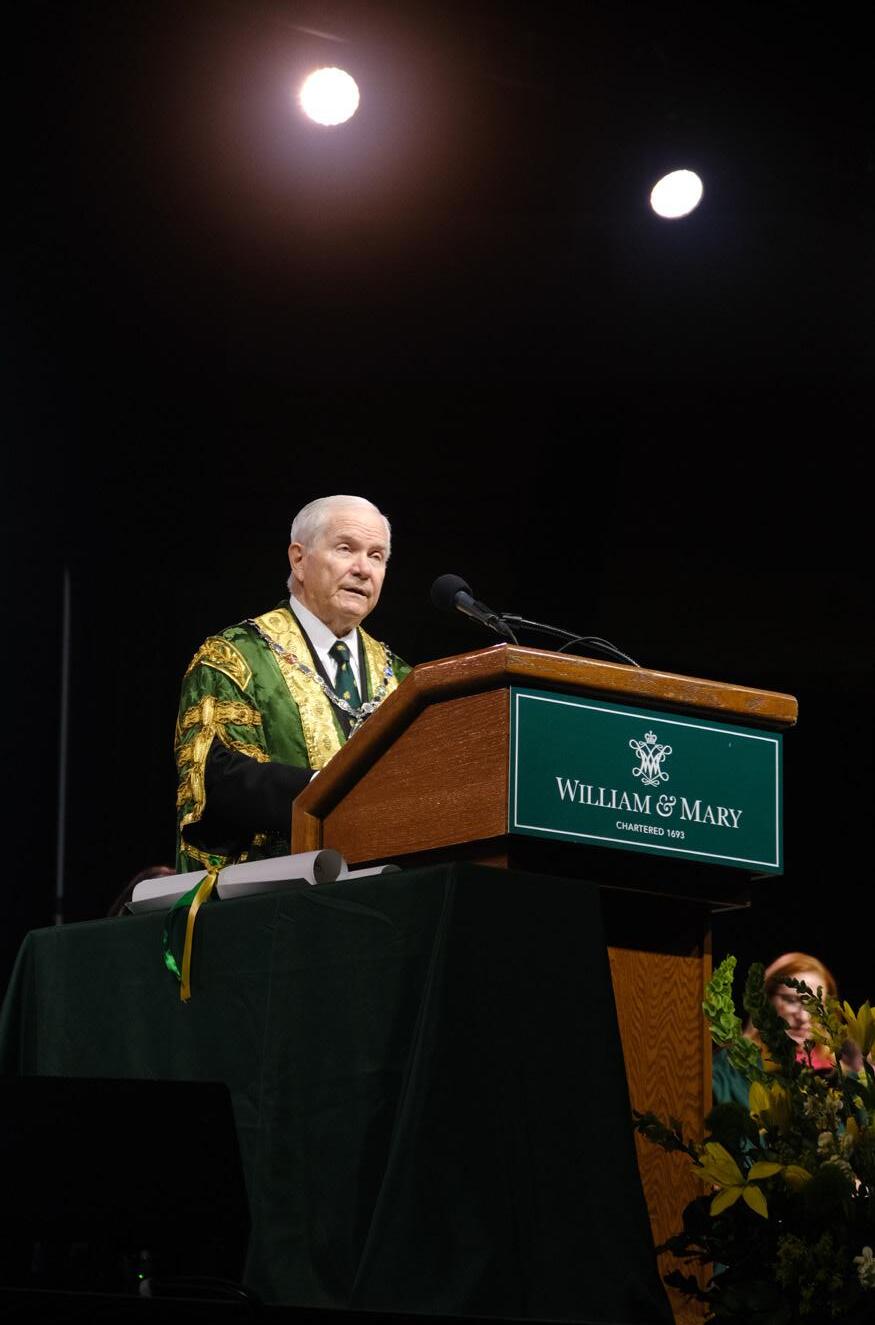
The Charter Day ceremony also commemorated Chancellor Robert M. Gates ’65, L.H.D. ’98, who was recently reappointed
for a third term.
Gates is now the longest-serving chancellor in the College’s history.
Student Assembly President Zoe Wang ’25, MPP ’26 and Graduate Council President Quinn Girasek ’26 presented Gates with an illuminated manuscript of the Board of Visitors resolution reappointing him as chancellor.
College Rector Charles E. Poston J.D. ’74, P ’02, ’06 read aloud from the resolution. Gates addressed the audience. He emphasized the hope that civic action gives him for democracy.
“As we celebrate the 250th anniversary of our nation’s founding, the good news for America is that even though we have a lot of work to do, and serious obstacles ahead of us, we also have the power and means to
overcome them,” Gates said.
Following Gates, Poston returned to the podium to present Burns with his honorary degree.
Throughout his career, Burns has won two Grammy Awards and 17 Emmys. Burns’ newest documentary centers on the American Revolutionary War. Burns addressed the contemporary challenge around accurately representing the American Revolution.
“Today, our founding story, the most important event in world history since the birth of Christ, runs the danger of being smothered in fife and truck treacle, bloodless, sanitized, youthless,” he said.
Students raise privacy concerns around Flock, WMPD explains policy
Students advocate for policy change against AI-powered surveillance cameras on campus
Tuesday, Feb. 10, students from the College of William and Mary gathered in Washington Hall to discuss how to organize against Flock surveillance cameras in Williamsburg, Va.
Charlie Goodman ’27 led the meeting, outlining the group’s effort to persuade the Williamsburg City Council to cancel its Flock contract over privacy concerns. In doing so, the students hoped that the College would follow suit and end its own agreement.
“Appealing to Williamsburg City is a lot simpler than the path toward appealing to the William and Mary administration,” he said.
Ella Forlin ’27 helped Goodman organize the student meeting.
“We know that as students, they might not listen to us,” Forlin said.
“If we get a coalition of people involved, they’re much more likely to hear our concerns.”
Goodman explained how automatic license plate readers, such as Flock, operate.
“ALPRs are automatic license plate readers, and they record every
license plate that passes by them, no matter what,” he said.
Flock uses artificial intelligence to record additional vehicle characteristics, such as type, color, unique alterations and whether a car frequently passes by any of its cameras. This information is stored on the FlockOS software system, allowing law enforcement to search for vehicle details.
FlockOS allows police to put license plates onto hotlists, where Flock sends a notification each time a particular vehicle drives by a camera in its network.
According to state laws, all data gathered from these cameras must be automatically purged from the Flock system after 21 days. Police can extend the retention period for this information only if they have probable cause to believe that the data would be necessary for law enforcement purposes.
FlockOS also lets its customers enroll in its state and nationwide network, enabling local law enforcement agencies across Virginia or the country to search and access data from Williamsburg.
BROOKE LEWIS // FLAT HAT VARIETY ASSOC.
RICHARD CHILDRESS / THE FLAT HAT
The College of William and Mary
KIMBERLY M C CANN / THE FLAT HAT
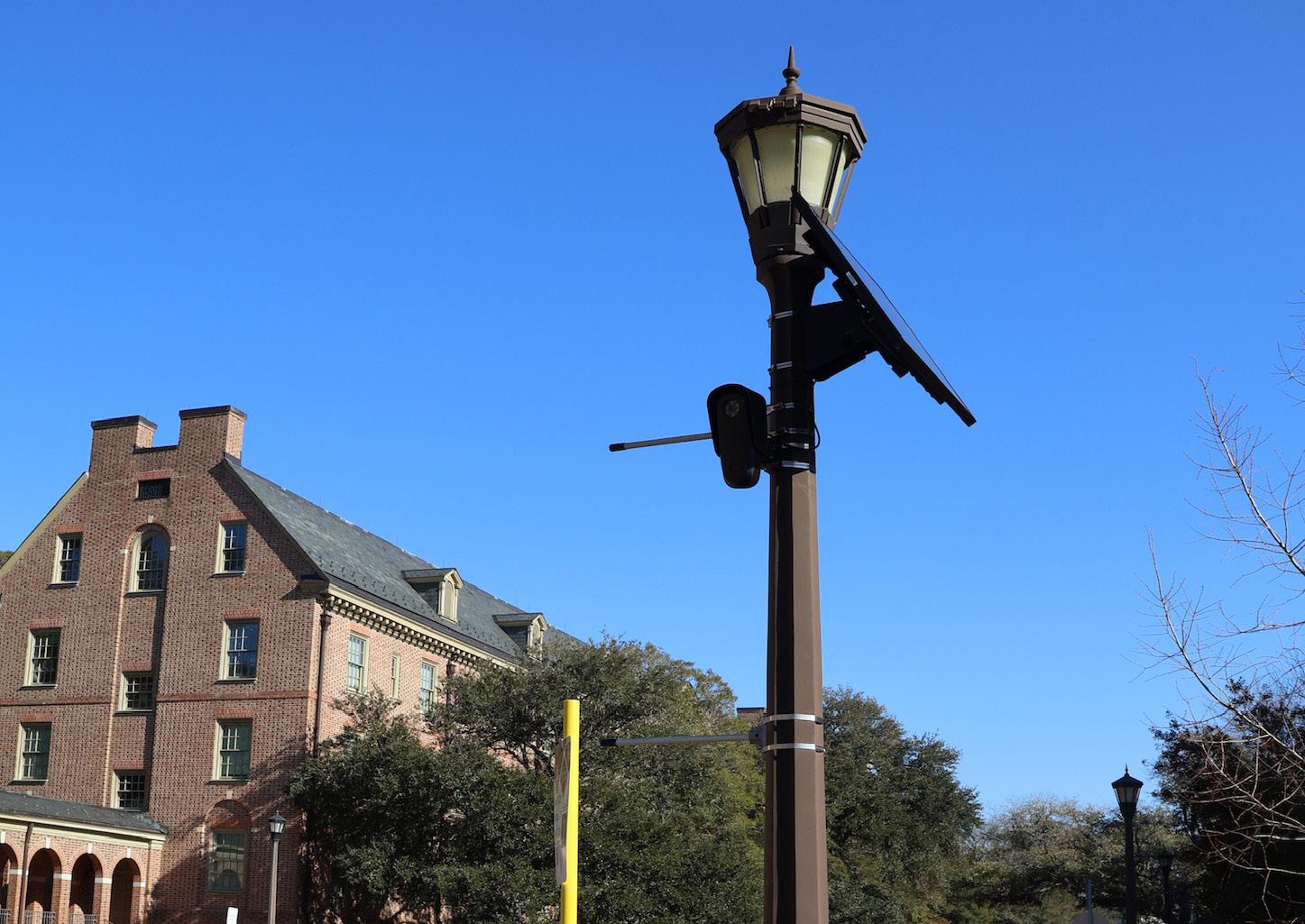
One of the College's FlockOS security cameras is located adjacent to Landrum Drive, just outside the ISC and Hardy Hall.
news insight
The value of higher education is not just preparing people to g et a job, it is preparing them for life and to be part of the democracy.
-- Chancellor Robert M. Gates
Tuesday, Feb. 10, Sen. Mackenna Wyckoff ʼ28 addressed the chamber with the Student Assembly Organization Budget Allocation Committeeʼs third quarterly finance report of the fiscal year. OBAC provides funding for initiatives and activities of Recognized Student Organizations on campus. This past quarter, OBAC allocated $36,272, with 92 organizations receiving funding, contributing to a total of $146,000 in allocations for this fiscal year.
The Senate passed the Old Campus Access to Sustainable Infrastructure Strategy (OASIS) Act, sponsored by Sen. Nicholas DeSante ʼ26. The bill will allocate $10,875 in funding from the Student Assembly reserve to procure and install water bottle filling stations and materials for installation in James Blair Hall, Washington Hall and Tucker Hall. An amendment was introduced that would have limited the proposal to funding a filling station only in James Blair Hall rather than all three proposed buildings. DeSante responded by underscoring the discount SA would receive for installing multiple fountains. The amendment did not pass. Class of 2028 President Devaughn Henry ʼ28, Sen. Jenny Wang ʼ29 and Sen. Christine Hwang ʼ28 raised questions regarding the proposed installation of the water fountains. READ MORE AT FLATHATNEWS.COM NiCOLE
Jason Zheng ’26 awarded annual James Monroe Prize, reflects on campus leadership contributions
T HE F LAT H AT
ʻSTABILITAS ET FIDESʼ | ESTABLISHED OCT. 3, 1911 Org #101 P.O. Box 8795, Williamsburg, VA 23187 Editor flathat.editor@gmail.com Managing flathat.managing@gmail.com Executive flathat.executive@gmail.com
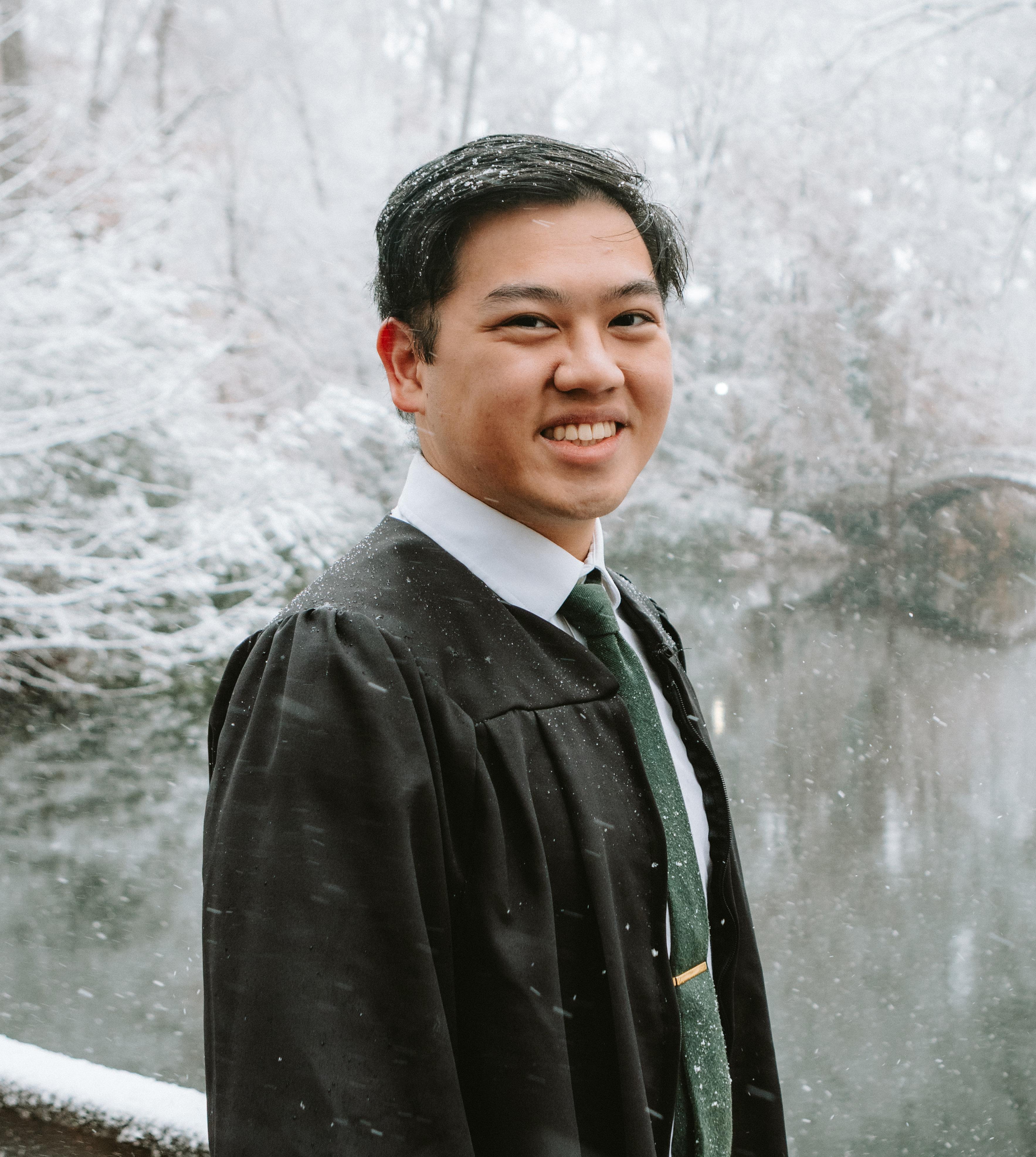
Friday, Feb. 6, the College of William and Mary hosted its annual Charter Day celebration, honoring the recipients of the Thomas Jefferson Award and the James Monroe Prize in Civic Leadership. This year, Jason Zheng ’26 was awarded the Monroe Prize on account of his extensive leadership both at the College and in his local community.
Established in 2005, the Monroe Prize highlights a student who exemplifies leadership, initiative, character and an unwavering dedication to addressing community needs.
“When I think about this prize itself, I recognize that it’s not mine alone,” Zheng said. “I think that’s one of the biggest things that I thought about, especially when it comes to the recognition side of it, because it’s the product of my communities, it’s the product of my friends who have been my biggest cheerleaders, it’s the product of my family who’ve been incredible role models.”
Zheng’s passion for civic engagement aligns with the College’s initiatives for the 2026 Year of Civic Leadership, including the Democracy Scholars Program. Zheng recalled a conversation with associate teaching professor of government Rebekah Sterling, who is launching the program.
“I think that will also be an incredible addition to our campus community,” Zheng said. “Democracy isn’t something that’s just about the government. It’s about civic contributions.”
Zheng also helped develop the Better Arguments framework at the College, an initiative that helps foster civil dialogue.
Zheng’s fervor for civic contribution stems from his childhood in Virginia Beach, Va., where his parents owned a small restaurant.
“I’m grateful to be from Virginia Beach. That’s one of the biggest cities in Virginia. And that has always been a place where people have looked out for each other,” Zheng said. “So for me, civic leadership has always been about giving back.”
Today, Zheng is a Student Assembly senator, a law research fellow and a Sharpe Community Scholar. He also works as a resident assistant, a teaching assistant, a representative to the Student Conduct and Appeals Board, the director of the College’s Courageous Leadership Institute and more.
As a Student Assembly senator, Zheng proposed six of the twelve bills passed last year, particularly championing food security.
“A lot of work that I’ve done has been very focused on that advocacy-based work of what students need,” Zheng said.
Zheng also served as the associate commissioner for the Independent Elections Committee his freshman year.
“Most of what I did at the time was really helping create the framework for us to do ranked-choice voting,” Zheng said.
Zheng became the chair of the IEC his sophomore year. Afterward, he served as a member of the Review Board, helping uphold the Student Assembly Code.
Zheng said Class of 2026 President Debbie Ho ’26 influenced his decision to run for senator at the end of his junior year.
“If it wasn’t for her encouragement, I don’t think I would have considered running at all,” Zheng said. “I think that level of confidence she had in me and what I could help accomplish on this campus meant so much that I was willing to at least put my name in the hat for candidacy.”
Zheng encouraged other students to consider running for Student Assembly.
“I think student government can be a vehicle for a lot of good, especially when it comes to how we think about our community, how we can serve others,” he said. “William and Mary is a small campus, but more often than not, the school requires and encourages us to help each other out a little more.”
Outside of the College’s bounds, Zheng has spearheaded efforts to increase voter registration, combat food insecurity and assist individuals facing eviction. All of this work has prepared him for a future in law and public policy.
“The work that I see myself doing after graduating is very much focused on serving communities in the public sector,” Zheng said.
Zheng said he often feels hesitant when applying for awards such as the Monroe Prize or other kinds of recognition.
“I think the big thing is it never hurts to try. And that’s something I tell a lot of my friends,” Zheng said. “And regardless of whether or not you think your work is worth talking about, I think it always is putting a spotlight on what you’re doing and having at least somebody know that you’re doing something that is meaningful to you.”
Zheng also urged people to remain optimistic while encouraging improvement and growth.
“I think you can always find ways to participate and to help in the right places,” Zheng said. “I think it’s very easy to get caught up in the big ideas that everything is, for lack of better words, going horribly, and that there’s more reason to be pessimistic than optimistic.”
NATE ROSS / THE FLAT HAT
MELANIA FRYE // FLAT HAT NEWS ASSOC.
FLAT HAT NEWS BRIEF
COURTESY IMAGE / LUKAS RICHARDSON
Zheng serves as a Student Assembly senator, is a Sharpe Community Scholar and works as both a resident and teaching assistant.
Zheng describes fervor for civic leadership, insipiration for community advocacy efforts
College holds Remembrance Tribute, recognizes history of enslaved labor
Community gathers to honor contributions of Africans and African Americans exploited throughout College history
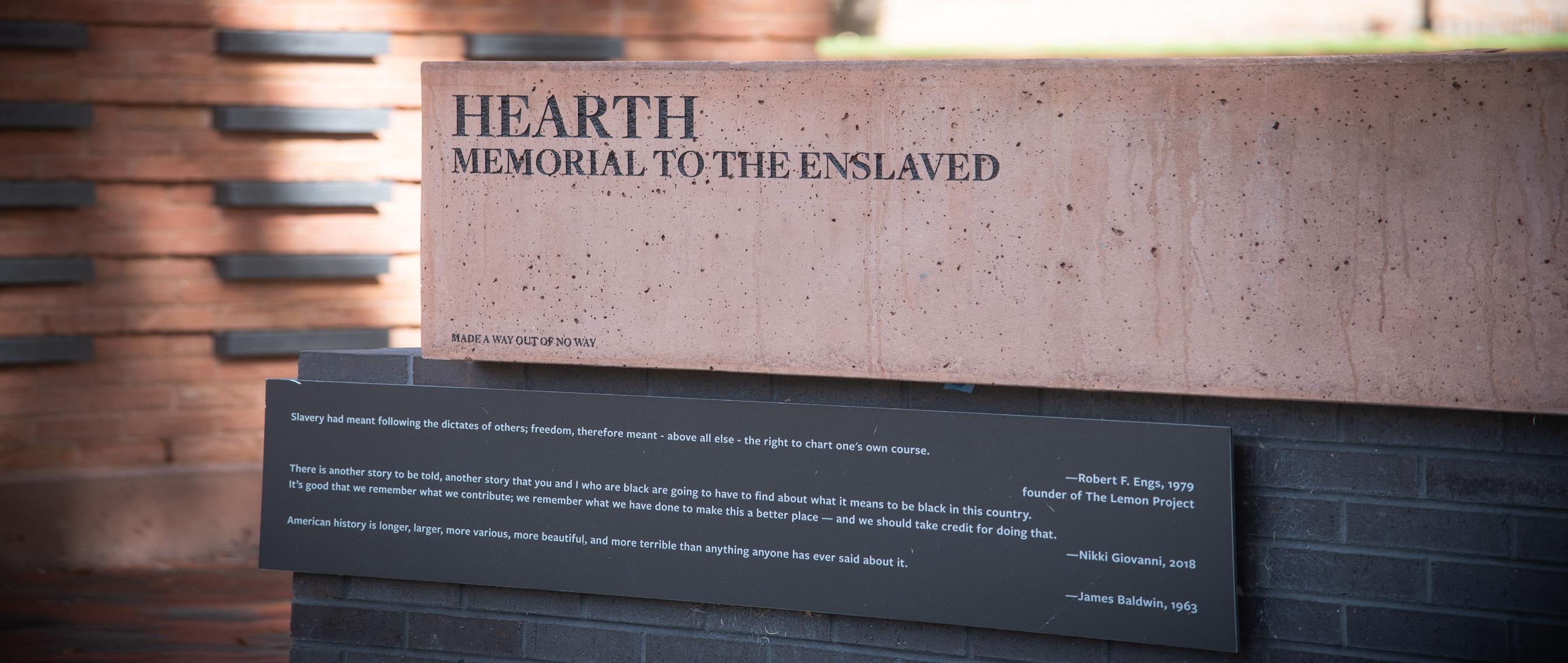
Friday, Feb. 6, the College of William and Mary held a morning and afternoon Charter Day Ancestral Remembrance Tribute at the Hearth: Memorial to the Enslaved.
The tribute recognized the enslaved people who were exploited by the College and honored the history of contributions made by African and African American community members.
Interim Robert Francis Engs Director of the Lemon Project Jajuan Johnson delivered the welcome and introductions.
“As we observe Charter Day, we commit to telling fuller truths, to learning from
difficult histories and to building a future rooted in justice and dignity,” Johnson said. “May this memorial remain a place of reflection, reconciliation and resolve, where memory becomes action and remembrance becomes responsibility.”
Victor S. Haskins, music instructor and Arts Quarter Music Series director, performed first, playing a trumpet solo.
Professor of theatre and Africana studies Omiyemi Greene ’00 delivered the ancestral blessing.
“What I was doing in my role as an IfáOrisa priest (or, in my specific case, as an initiate of Ifá and Yemoja) was opening the way for the ritual of libation and the
subsequent invocation, or the calling of names of persons enslaved by William & Mary,” Greene wrote in an email. “I chose to speak in Yorùbá when chanting the two Odù, because it’s always more effective in ritual proceedings to use the ‘mother tongue’ if you know it.”
Greene defined the term “Àse” used throughout the tribute.
“Àse means the divine power to make things happen,” Greene said. “When I used it in the context of the ancestral blessing, it was meant to mean ‘May the things spoken manifest.’” The audience and organizers of the tribute then performed the invocation.
As the names were spoken, both known and unknown, Greene placed water onto the ground from a pot — the libation.
Following the invocation, Frances L. and Edwin L. Cummings Professor of English and Africana Studies Hermine Pinson gave the second performance, titled “New Ring Shout,” after a cosmogram.
The final section of the tribute included statements and flower offerings from various departments and student organizations.
Greene then delivered concluding remarks. She thanked event contributors, emphasizing Facilities Management, and focused on actions College community members can take to honor the enslaved.
Samantha Koranteng ’27, second vice president of the National Association for the Advancement of Colored People on campus, attended the tribute.
“It’s Charter Day, the 333rd year, and it’s the third year that they’re holding this event,” Koranteng said. “I just really want to come out and show my support as being on different executive boards for different organizations that are impacting and involved in the community.”
Koranteng spoke to the tribute’s success.
“I do think it does a good job,” Koranteng said. “I would like a little more contribution from the school as a whole, but it does help to have a serving place for all these events that we want to do to uphold the Black community around campus.”
Dativa Eyembe ’26 represented the Black Poets Society at the event.
“I’m an Africana [studies] major, so there’s a way that the discipline asks you to be available to communal things, communal ways of coming together,” Eyembe said.
Eyembe explained that this availability is fundamental to the study, which was born out of protest in the 1960s.
“There’s a way we have to appreciate what it takes to have a community like this and how to show up as often as you can, even when it’s inconvenient,” she said. Eyembe said that the tribute was beautifully executed.
“I think that everyone who is here is here out of a dedication and a commitment that I really appreciate out of our community,” she added. “It really gives me a lot of hope to see us come out and support one another — not only one another, but also honoring those who came before us.”
Eyembe believes the College can continue improving how it remembers its use of enslaved labor and the Black community.
“My answer’s always going to be that there’s always more, but that doesn’t mean that we don’t appreciate what we’re doing now,” Eyembe said.
Faculty hold conversation on advice for successful management as part of Collegeʼs Charter Day celebration
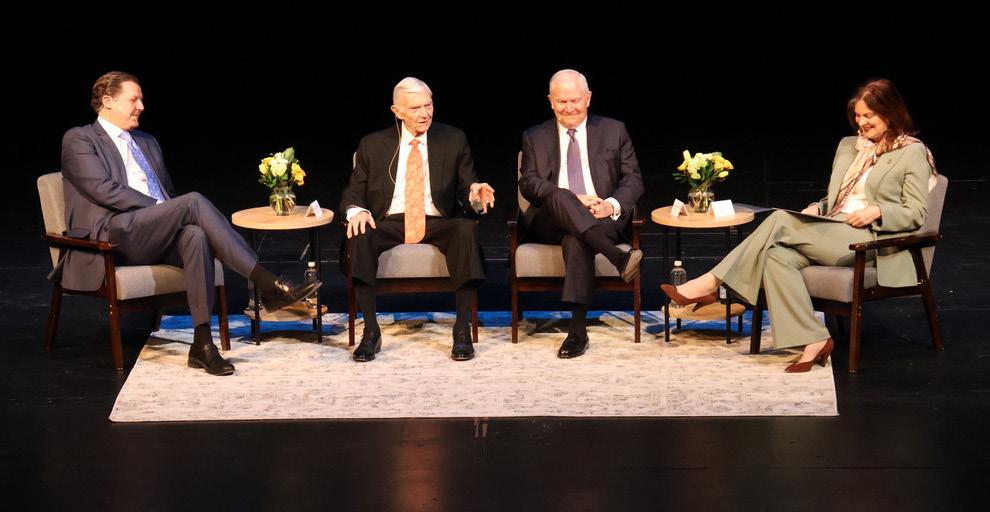
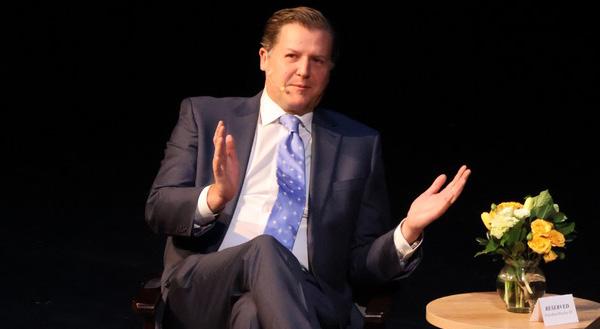
Thursday, Feb. 5, students, alumni and community members gathered in the Glenn Close Theatre to hear College of William and Mary President Katherine Rowe moderate a discussion with College Chancellor Robert M. Gates ’65, L.H.D. ’98, President Emeritus W. Taylor Reveley III and Longwood University President W. Taylor Reveley IV on leadership in higher education.
Part of the College’s Charter Day celebration, the conversation centered around the release of Michael Nelson’s ’71 new book, “How College Presidents Succeed: Lessons in Leadership from Three Generations of Reveleys.”
In his work, Nelson describes lessons from three generations of Reveleys, who all became presidents of prominent Virginia universities. Gates wrote the foreword for the novel.
“The lesson that meant the most to me and also characterizes what I have tried to do was how do you preserve and enhance the traditions that make a university great and that have led to greatness,” Gates said. “And at the same time, get rid of those things, the ‘barnacles’ I call them, that grow up on institutions that become obstructions to the future, to change and to adaptation.”
Reveley IV explained what leadership looks like from immediate and long-term perspectives.
“It takes some good, heartfelt perspective to keep everything weighed in the scales appropriately,” he said. “To be thoughtful pretty deeply about the long run and not just what is right around the corner; what you can do together to make sure that an institution is strong, not just a year from now, a decade from now, but a century from now.”
Gates highlighted how leaders can navigate changes in organizations introduced by the use of social media and online platforms.
“I think particularly if you are leading an
agenda for change, what the president has to be is present,” he said. “You have to use all the different platforms that are available to you, but on a campus, I really believe that the physical presence of the president makes a huge difference.”
Rowe asked Reveley IV how he leads others when the path is unclear to him.
“I have been lucky with regards to the decision-making because it is a lot easier when you have got people you trust and love to bounce the decisions off of,” Reveley IV said. “It works the best when you have got a chance to talk it through with people that have that wisdom and experience themselves.”
Reveley III, the College’s 27th president, discussed leading the College through 2008 and 2018.
“I tried to make clear to these students, and to everyone else, there would be a lot of change in the country going forward, and you needed to be resilient,” he said.
Shifting to the present, Gates emphasized how education strengthens citizenship.
“The importance of the humanities is in giving us a sense of who we are as people, and as a people, as Americans,” he said. “So the value of higher education is not just preparing people to get a job, it is preparing them for life and to be part of the democracy.”
Reveley III expanded on Gates’ answer, identifying the supportive role institutions have during times of extreme change.
Reveley IV said he views education as a means of support.
“There will be institutions to facilitate that liminal experience and turn a teenager into an American citizen,” he said. “That’s what American colleges and universities have always been great at, and I think so long as we keep that as a north star, things will work out, one way or another.”
CAMPUS
CAMPUS
SACHI
KIMBERLY MCCANN / THE FLAT HAT
Several departments and student organizations delivered speeches and brought flower offerings to recognize the individuals being honored.
GABRIELLE RYAN THE FLAT HAT
KIMBERLY MCCANN / FLAT HAT
Nelsonʼs new book discusses the importance of leadership through accounts of four generations.
JUSTIN SHERLOCK / THE FLAT HAT
The Hearth: Memorial to the Enslaved was designed and built to create a lasting tribute to the memory of the enslaved people who built the university.
College acknowledges Flock Concerns, open to working with students
While Virginia law prohibits the sharing of Flock data across its nationwide system, it allows local police departments to determine whether to share their data within the state network.
The College is a part of the statewide Virginia Flock sharing program, according to Chief of William and Mary Police Don Butler.
Goodman said law enforcement’s ability to make warrantless searches on the FlockOS system within the retention period is a key privacy issue.
Goodman highlighted other issues with the network, noting that accountability for Flock use is left solely to individual police departments. Goodman suggested this could open opportunities for abuse.
“[Flock] doesn’t do any proactive audits, so they really don’t know their own system is being used,” he said.
Under the Flock statewide sharing system, the misuse of data by one police department could compromise the data of every other department that also shares its information, per Goodman.
“All counties have access to all other counties, so it [only] takes one police officer to make a mistake,” he added.
Forlin encouraged others who were also worried about Flock
to email College leaders and Williamsburg City Council members to express their concern.
“Even if you don’t necessarily feel comfortable talking about this at length, it’s worth sending an email,” she said.
A William and Mary Police Department policy explains the College’s intent in implementing Flock cameras around campus.
“The LPR network is intended to mitigate known threats, deter crimes, and assist in protecting the personal safety and property of the university community,” the policy states.
To ensure its actions are consistent with university standards and the law, WMPD has an internal audit policy that requires the deputy chief or a designee to perform an internal audit of the College’s Flock use at least once every 30 days.
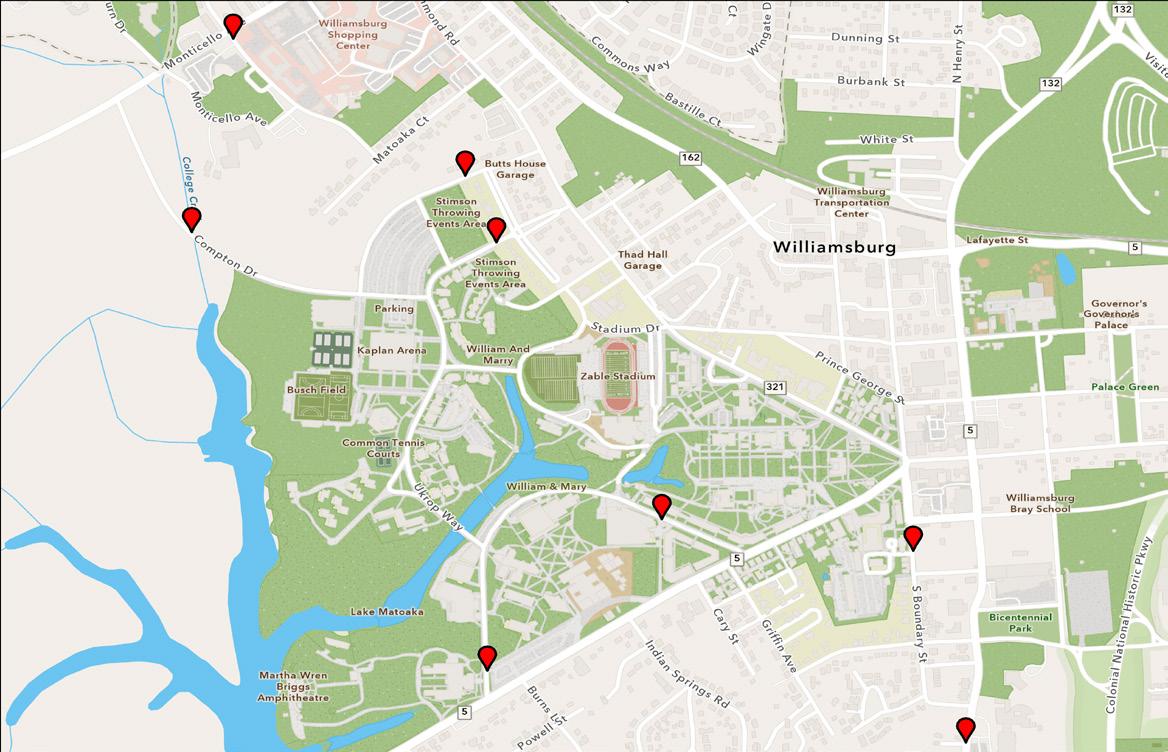
Through a Freedom of Information request, The Flat Hat obtained the agreement between Flock Safety and the College. The request also contained related documents detailing the WMPD policy regarding the cameras and their locations around campus.
Virginia law prohibits Flock from accessing the data of its customers without their prior request. However, the contract requires the College to consent to Flock using its data.
Flock requires that the College specifically allow the company to collect, anonymize and use its information for developing its software and artificial intelligence models. The agreement allows the company to use this data for training its models without direct input from the College.
Virginia law allows local law enforcement to share its information to other police agencies for investigations into state crimes, missing persons or human trafficking cases.
For sharing data to the databases of federal agencies or out-ofstate law enforcement, police can only provide their information if required by a court order.
The statute does not extend to civil investigations. Since the law only allows sharing related to criminal investigations, Virginia police departments are not permitted to share their data with Immigration and Customs Enforcement operations, which involve civil cases.
An investigation from the Virginia Center for Investigative Journalism at WHRO found nearly 3,000 federal immigration enforcement FlockOS searches over 12 months across two Virginia localities, the Town of Bridgewater and
Mecklenburg County.
These findings suggest ICE had at least some access to local Virginia police department data before the law regulating Flock was signed.
Other reporting finds that ICE has accessed Flock data for immigration enforcement through other federal agencies.
Last July, ABC 8News reported that the Bureau of Alcohol, Tobacco, Firearms and Explosives used Flock data in Richmond, Va. for federal immigration enforcement without the permission of local police.
Butler said the College has not shared its data with any federal law enforcement agencies.
“We’re very careful about how we vet those requests,” Butler said. “We’ll talk through it to make sure it’s legally sound to do so, within our policy and the values of the university and the police department.”
As a matter of general policy, the College does not cooperate with Immigration and Customs Enforcement, Butler mentioned.
Butler added that Flock cameras only collect public license plate information and that the College uses Flock solely for law enforcement purposes.
Assistant Vice President of Public Safety Cliff Everton ’96 acknowledged that Flock was using anonymized customer data to develop and train its AI software. He noted that it is not an uncommon thing for technology companies to do.
“I would say that that’s what every company does to enhance their algorithms,” he said. “That would be something that you would want to take up with the company.”
Everton elaborated that the data Flock uses for training its models is not tied to any personally identifiable student information.
Everton said he is open to the idea of the College opening a Flock transparency portal once all Flock cameras are operating. He stressed that the College does not see its use of Flock as violating any rights around privacy.
“These cameras are on public roads, in locations where there’s no reasonable expectation of privacy,” he said.
Everton appreciates how members of the community have come to him with genuine concerns about Flock.
“That’s the American way,” Everton said. “We should be asking these questions.”
NEWS from page 1
With his new documentary, Burns hopes to tell a complete story of the American Revolution that stays true to historical events.
“I am interested in the power of an authentic history,” Burns said. “I am interested in its many varied voices, not just the voices of the old topdown version of our past that will try to convince
us that American history is only the story of great men.” Burns emphasized the importance of studying American history.
“Without a knowledge of [our] past, how can we possibly know where we are, and most importantly, where we are going?” Burns said.
Burns cautioned against the notion that history repeats itself.
“No event has ever happened twice, ‘it just rhymes,’ as Mark Twain is supposed to have said,” Burns said. “But maybe, thanks to several Virginians and other patriots, there was something new under the sun on July 4th, 1776.”
Burns concluded with a piece of advice to audience members.
“Do something that will last and be beautiful,” he said.
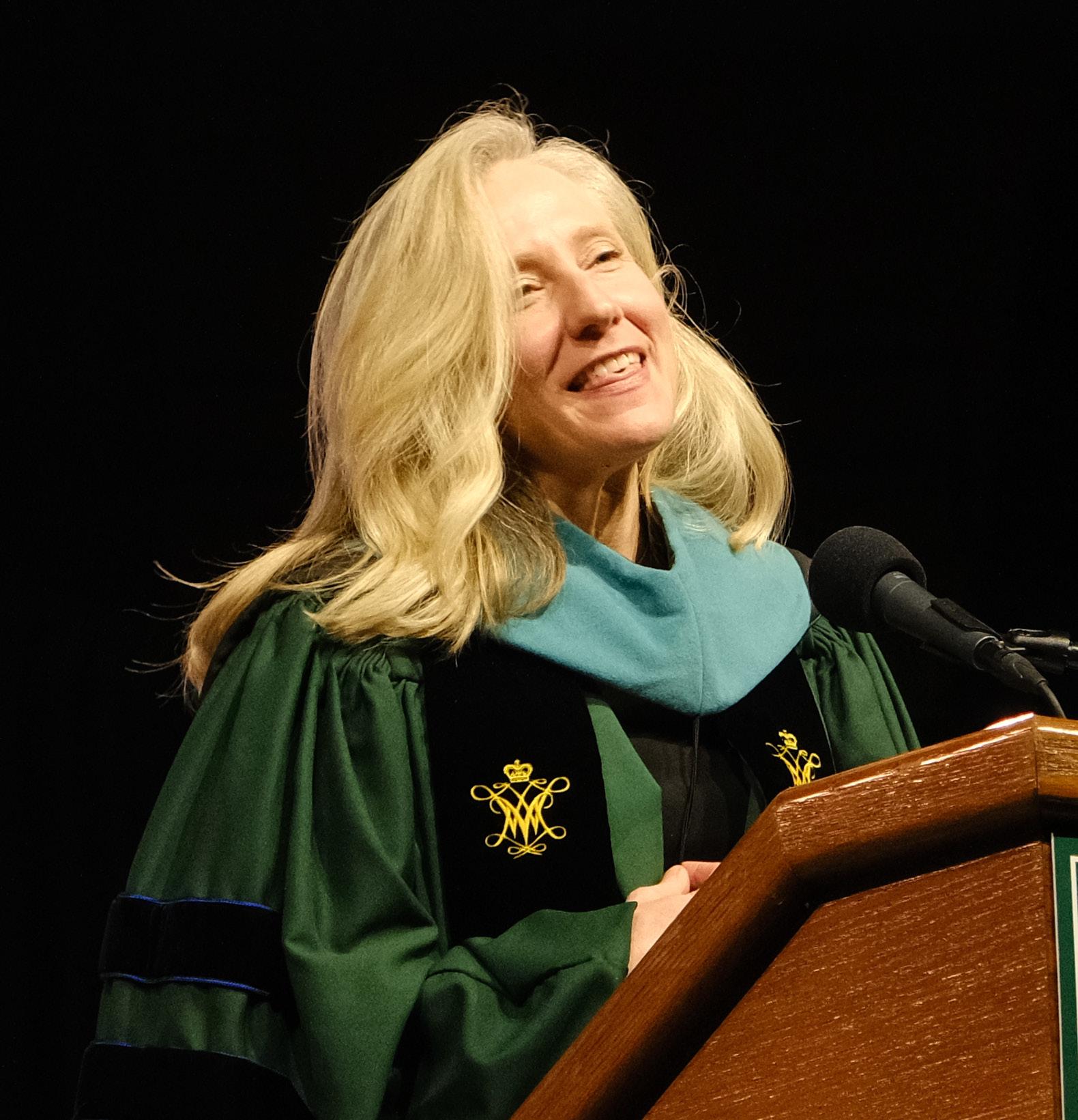
Gov. Abigail Spanberger addressed the crowd next. This past November, Spanberger was elected the first female governor of the Commonwealth of Virginia.
Before her inauguration, Spanberger served for six years in the U.S. House, representing Virginia’s seventh Congressional District. She also spent eight years as an officer in the U.S. Central Intelligence Agency.
Spanberger expressed hope that the country will overcome its challenges.
“We have always found a way forward,” she said. It isn’t always easy or quick, but we have made our way.”
Spanberger discussed Virginia’s history with gender inequality. She described how progress has not always been easy, but that things have nonetheless improved for women.
“In the face of great opposition, progress was made,” she said.
One of Spanberger’s first legislative priorities as governor is to push for a referendum that repeals an anti-same sex marriage amendment in the state’s constitution.
“When passed, this constitutional amendment will guarantee marriage equality in our Commonwealth,” Spanberger said. “It won’t just enshrine the right of same sex couples to marry, it will remove the ban on same sex marriage that was put on our constitution in 2006.”
Spanberger described civic leadership as important to overcoming challenges facing the country.
“Civic leaders choose to connect across differences, reason with care and act with integrity,” she said. “That’s a road map for how we get through times like these.”
Crossword puzzle
GAMES
ANDREW HENRICKSON / THE FLAT HAT
Flock surveillance cameras operate around campus by William and Mary.
RICHARD CHILDRESS / THE FLAT HAT
RICHARD CHILDRESS / THE FLAT HAT
Gates described the hope that civic leadership gives him.
The Botetourt Chambers Singers sang ʻHappy Birthday.ʼ
Bowls: Big, better and just what the new dining hall needs
William and Mary’s housing waitlist problem
Salmon bowls. Mediterranean bowls. Yogurt bowls. Pasta bowls.
The list goes on. Bowls aren’t a food group — yet. But with their quick-serve nature and nutritional benefits, they’re rapidly reshaping the food industry.
If you haven’t experienced this firsthand, with that acai bowl for breakfast or ramen bowl for dinner, consider the astounding surge of bowl outlets after 2019. They’re versatile, customizable and flavorful. Think of Remy in “Ratatouille” experiencing the gustatory pleasure of eating strawberries and cheese at the same time. Now imagine that experience tenfold. It’s this appeal that continues to draw customers to chains like Cava, Sweetgreen and Chipotle.
The coming opening of the College of William and Mary’s new dining hall represents the perfect opportunity to bring this trend to campus.
But first, it’s worth examining what’s missing from campus dining now. If you ask The Princeton Review, it’s a lot — enough to secure their current No. 5 spot on their “Campus Food Not So Tasty” list of dining halls across the United States. Students at the College have voiced their frustrations with food variety, quality and dining experience as a whole. Meanwhile, peer institutions have achieved student satisfaction with their globally-inspired cuisines, short wait times and build-your-own stations. Over Thanksgiving break, I had the opportunity to experience a day of eating at the University of Massachusetts Amherst, which is
consistently ranked highly (No. 1 by The Princeton Review) for its dining program. What I noticed wasn’t its friendly employees, flexible hours or cleanliness, qualities that William and Mary dining has, but how it made an average trip for lunch feel like a culinary experience due to the sheer variety of options — from beef dumplings to bread pudding to tandoori salmon — available at different food stations.
As a premier institution of higher education, the College should achieve just as great of a reputation for its dining. With undergraduates paying a whopping total of $3,365 a semester for two years for the unlimited meal plan, it’s expected that the food isn’t just ‘better than it was before.’
Today’s college students don’t just want food served cafeteriastyle: they want control over what they eat. Self-serve bowl stations would facilitate this and provide a solution to repetitive dishes. Now, how would this work? Well, it’s simpler than you might think. Replace long wait times and stations with absent attendants with an easier experience, with ingredients periodically restocked by employees and a daily-rotating theme to enhance the station. These themes would be inspired by cultural cuisines from around the world (think Thai, Peruvian, French), fast food chains (like Olive Garden’s never-ending pasta, Chili’s Triple Dipper or Raising Cane’s box
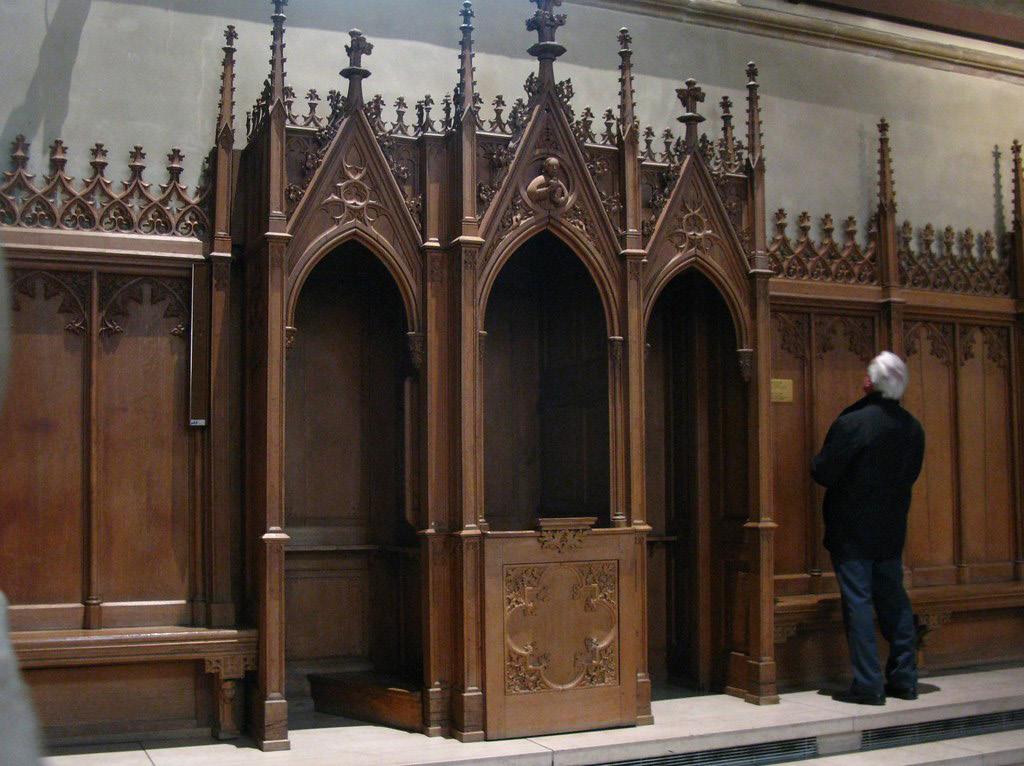
Every Sunday at Mass, I find myself struck repeatedly by one line in the Confiteor prayer. Right in the middle of the prayer stands this line: “What I have done, and what I have failed to do.” An admission of guilt. A plea. A confession. We say the Confiteor to acknowledge sin, not just through our actions, but also through our neglect, omissions and dereliction of moral duty.
I write this to confess my dereliction of moral duty. I am guilty of one of the deadly sins set forth by Pope
Gregory I. I am slothful, conciliatory in my criticism and apathetic to those who are quashed under the boot of our government. I have not, to the best of my ability, sought to prevent or warn of sinful behavior in our politics. I have willingly turned a blind eye or kept my mouth shut on matters I consider blasphemous and morally rotten for the advancement of myself and others. I have failed again and again to serve those our God calls us to serve, even in my wholly insignificant power. The sick, the meek and the poor. I have
combo) and holidays like Chinese New Year and Earth Day (which could feature sustainable ingredients). The great thing about bowls is that they can support all of this variety and customization and still look aesthetically pleasing. To-go bowls, which would be available at the station, would be a convenient and nutritionally dense option for athletes or students with packed classes who can’t sit down for a meal.
Not only will the implementation of a self-serve bowl station be more convenient, but it will also reduce student anxiety around asking workers for modifications. For someone like my roommate, who often refrains from eating a made-to-order dish because she doesn’t want to ask for it to be made red-meat-free, this would be immensely useful. Having the option to adjust the portions of and choice of ingredients will prevent food waste and improve student satisfaction with their final meal.
The question remains of whether this is feasible, and to that I would say yes. As long as sanitization and cost considerations are prioritized, along with proper nutrition and ingredient labels, the self-serve bowl station should be entirely manageable-and worth the investment.
Of course, it will take some creativity and resourcefulness to execute this vision, but imagine the result: a dining experience students look forward to, not just tolerate. That’s something to strive for.
Ella Grimes ’29 is a a prospective philosophy major. Contact her at evgrimes@wm.edu
A
not condemned men and women who profess the Gospel and the mercies of God, but spit in the faces of his children. I have been afraid to call this government what it is. Authoritarian. Incoherent. Murderous. Sinful. I by no means posit that my expression of outrage at my own inaction and the actions of others is meant to elevate me morally above the consequences of this administration. I am not more sinless, nor more holy nor more of an American by writing some little opinion piece.
I write as I am, an inconsequential student who cannot stomach the idea of not acting at a time when I feel that the tenets of my faith and the foundations of the country I love are under incredible strain. My only goal is to encourage you, dear reader, to look inward and ask yourself if you have done all that is possible in your conscience to prevent political and moral evil on our shores. Truthfully, all of us, especially my fellow Christians, are profoundly guilty of cherry-picking in our politics. We excuse sinful behavior if it’s advantageous to our worldview. Many Christians are willing to look past a man who cannot, for the life of him, name his favorite Bible verse.
At roughly 4:30 p.m. Thursday, Feb. 12, 290 students received an email from MyRoom saying they were wait-listed. They would not be allowed to participate in room selection nor be guaranteed oncampus housing for the next year. I am one of those people.
Adding to the frustration was the seemingly random designation of who received a time slot, as this determination completely ignored roommate groups. Some roommates received time slots, while others didn’t; it was random by all appearances. Furthermore, as described in the email, “If you are planning to live with a roommate who is not wait-listed, they will not be able to hold a space for you or pull you into their room while you are on the waitlist.” The way that people on the wait-list are assigned to rooms removes all choice over where and with whom they are put. At that point, why go through the process of requesting housing with a roommate if those wishes just get flat-out ignored?
The email also states that the waitlist has no ranks, and that housing assignments go randomly to the 290 unlucky students. The same Feb. 12 email provides no timeline beyond the statement that in past years all wait-listed students have been given a room by the end of July. This being said, the email protects itself from liability by stating that it cannot guarantee wait-listed students a spot on campus.
Moreover, all correspondence from Residence Life prior to the housing contract deadline said, “Residence Life does not anticipate a significant waitlist for the 202627 academic year.” This outlines exactly what I think .
ResLife wants: as many students living on campus as possible. Who wouldn’t want even more money with which to ignore
Who has been found guilty in court of sexually assaulting women. Who has been married thrice. Many of his supporters seem to worship him as a golden calf. Some evangelical leaders even go so far as to call him “the Second Coming.” Yet, so many have been willing to overlook the moral failings of this President because “God works with imperfect instruments.”
We have seen the consequences of that cherry-picking, both on the state of governance and on the state of the Christian faith in America. Decrying the murder of Charlie Kirk but silently watching the brutal killings of Renée Good and Alex Pretti. Advocating for the protection of Christians abroad while targeting our immigrant community, the most religious group in the United States. While we strike northern Nigeria to “save Christians,” we are dragging immigrants out of our own churches. We say we will protect the hollowedout middle class, but we shutter hospitals and rob families of food assistance. Claiming to be pro-life while actively ramping up extralegal killing and the use of the death penalty. Even so-called victories like the overturning of Roe v. Wade have resulted only in the expansion of state control, while the number of abortions increases.
student needs? All of this language saves the College of William and Mary from a guarantee of giving students more affordable housing than off-campus options, while at the same time encouraging students to remain on the waitlist.
The natural next step, in my humble opinion, was to be a Karen. So I went to the ResLife office. My question was simple: “There’s nothing I can do to control where or who I end up with, correct?”
The response: “Yes.” Upon further inquiry, there is an option, but only after you get taken off the waitlist: switching rooms. However, this option requires all students involved in the move to be in agreement, which is reliant on many factors out of a student’s control. It’s plain unfair to put students in this position, especially given the promises that their housing worries would dissipate with the opening of the West Woods housing complex. Not to mention the fact that the Green and Gold Village still stands! I say put the new freshman into GGV as a rite of passage, but that is an opinion for a different time.
Almost 300 students are in an incredibly difficult position, causing anxiety and concern, and there is nothing they can do about it. They just have to sit around and wait, or pursue a more expensive off-campus option, likely requiring a longer lease. The carefully framed language of correspondence from ResLife gives you confidence that the waitlist will not be an issue, right up until you get put on it. Then it becomes a world of worry, as people scramble to figure out where they will live next school year. All students want is transparency and assistance to alleviate worries over on-campus housing, not to be left anxious for months. Is that too much to ask?
What we are doing is harming our country and our collective faith. We are not acting with moral and intellectual consistency. We spent decades warning each other that the growth of government would replace God’s law, yet cheer with glee as this president’s government tramples on the Constitution and Bill of Rights. We allowed God to become a partisan instrument. With this hypocrisy, how can we be trusted? We are not living by our values, so how can we claim to represent those values in the political arena? Perhaps religious justification of our own politics is truly impossible without embracing overwhelming moral contradiction.
I fear we have fallen deeply into worshipping false gods, whether they be political parties, ideologies or cults of personality. I am as guilty as anyone else. This era is the strongest indictment of our lives that the way Christians have pursued politics in America has left us far from God and far from the nation our founders intended for us to have.
I am sure many reading this with indignation or antipathy will dismiss this as either moral grandstanding or as evidence of the faults of organized religion. I have no qualms with those who do, but for those of us who are
wrestling with the depravity of politics from a Christian background, there is an arduous future for us. You and I have erred greatly; the Lord and the nation know it. And while our sins will be forgiven and our derelictions forgotten, the lasting impact of our duplicity results in the mortal suffering of the innocent. It is not just sufficient to confess to my sin. There must be an act, a penance, to rectify its worldly consequence. So, I will, to the best of my ability, warn of sinful behavior in our politics. I will not turn a blind eye to things I know to be blasphemous. I will not fail again to serve those our God calls us to serve, even in my wholly insignificant power. I will refuse the work this administration has offered me and will not exploit this sin for career advancement. I will call out men and women who profess the Gospel and the mercies of God, but spit in the faces of his children. I will not be afraid to call this government what it is. Authoritarian. Incoherent. Murderous. Sinful. And to you, and the Lord our
Ella Grimes
GRAPHIC BY ISABEL VOLDEN / THE FLAT HAT
confession
THE FLAT HAT Hunter White
GRAPHIC BY GRETTA ANDERSON / THE FLAT HAT COURTESY
Lindsey Vonn and the cost of never quitting
Ava Gravina FLAT HAT OPINIONS EDITOR
At the College of William and Mary, persistence and perfectionism are often embedded within our twamp culture. The connection between this striving for perfection and the injury-filled comeback story of Lindsey Vonn may not seem obvious at first. Yet Vonn’s return to the slopes feels less like a distant Olympic tale and more like a familiar mindset for students here. For those unfamiliar with Vonn, she is widely considered one of the greatest alpine skiers in history, with 84 World Cup victories and three Olympic medals. If that doesn’t impress you, I don’t know what does. But her latest comeback raises a key concern: at what point does determination become a refusal to let go?
After reportedly retiring in 2019, Vonn surprised many fans by making a return to the slopes. Yet her comeback clearly did not go her way. Just days before the Olympics, at the World Cup downhill race in Switzerland, Vonn completely tore her ACL, an injury that would have made most rational people step away from the Olympics. Yet many students here share the same impulse that drove Vonn forward, continuing to push themselves to their breaking points when success feels just within reach.
She was determined not to give up; she wouldn’t, and she was intent on proving that she could still compete at the highest level. And I can’t blame her for not being ready to step away. I know the feeling of needing to finish what you started.
There is no doubt that Vonn is fearless, resilient and driven — qualities many students here recognize in themselves. From the age of 3, she has been skiing. It is all she’s ever known. And she was the first American woman to win gold at the 2010 Winter Olympics. When she made her big 2026 return, it’s remarkable that she raced just 9 days after fully tearing her ACL, despite the obvious risks. Most people would be struggling to walk with an unstable knee, but she’s an elite athlete accustomed to pushing her physical limits and she claimed that she felt ready to return. While she was given the go-ahead, she was told to race at her own risk, and she ultimately chose to, although it may not have been the wisest decision.
At 41 years old, she lined up Sunday, Feb. 8, to race at the Milano Cortina Olympic Games. For a moment, she looked strong, carving confidently through the course. Then, just 13 seconds into her run, disaster struck. Her right arm got tangled up with a pole, sending her into a tumultuous crash that left her splayed out on the race course in extreme pain. Her long-awaited comeback ended not in triumph, but in another devastating injury.
Vonn’s legacy was never in question. As a skier myself, I am amazed at how fearless she is racing, yet this failed comeback shows just how important it is to recognize when perseverance does more harm than good. Yet Tom Brady, a beloved football quarterback, received far less criticism than Lindsey Vonn, even though he, too, chose to keep playing well beyond what many expected, motivated by the same passion for his sport.
While Vonn will always be known for her skiing accomplishments, will fans mainly remember her for her tragic crash at the 2026 Olympic Games? Meanwhile, the spotlight remains fixed on her fall rather than on her teammate, Breezy Johnson, who won the gold medal in the women’s downhill. Clearly, Vonn was unable to step aside, resulting in her tragic downfall and leaving no space for the next generation to shine. Perhaps winning is not the hardest part. For athletes and students alike recognizing when it is time to step away is.
Ava Gravina ’28 is a psychology and English major at William and Mary. She swims with Club Swim and writes for the school’s pop culture magazine, The DoG Street Journal. She is from outside Boston and enjoys spending time with friends, baking, reading psychological thrillers and watching rom-coms. You can contact her at acgravina@wm.edu.
Honorary degrees: What’s the point?
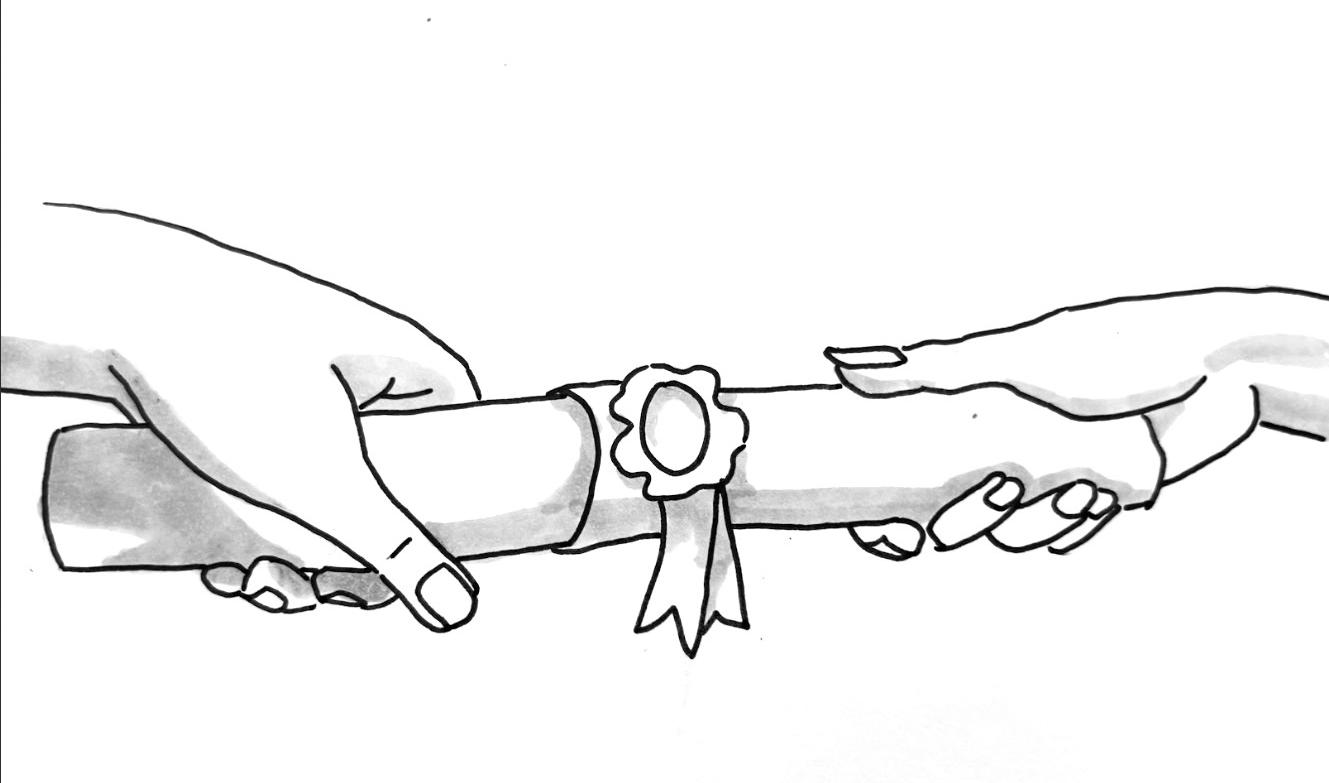
On Charter Day, Feb. 6, 2026, the College of William and Mary bestowed honorary degrees upon Gov. Abigail Spanberger D.P.S. ’26 and filmmaker Ken Burns Art.D. ’26. While it was beneficial to the William and Mary community to have these speakers come to campus, the practice of handing out honorary degrees is largely ceremonial and self-serving. This is characteristic of Charter Day’s superficial nature. Spanberger and Burns both have very impressive accomplishments that deserve to be honored, and there is much to be gained from inviting such figures to speak to the college community. However, honorary degrees minimize the accomplishments they are meant to honor. Honorary degrees are awarded to a wide variety of people and seem to have no concrete meaning. The College’s website says only that they are given to “distinguished individuals.” These degrees indicate that a person has done some unspecified admirable thing and little else. The list of honorary degree recipients at the College highlights this. When football players, politicians, professors, philanthropists, chefs and opera singers are all winning the same award, that award cannot be particularly meaningful. This year’s recipients, Spanberger and Burns, have incredibly different achievements and legacies. One is the first female governor of Virginia,
and one is a renowned filmmaker. Giving them the same award situates them in comparison with each other and dismisses their unique contributions to society. It would be much more appropriate to honor Spanberger and Burns with awards tailored to their achievements. Or perhaps, if the goal is to attract speakers to Charter Day, they could be given a Charter Day award. Further, the idea of an honorary degree minimizes the very concept of a degree. Degrees are academic qualifications earned through years of study. An honorary degree is a worthless one. Most recipients of honorary degrees already possess degrees from the institutions they chose to attend. They have no use for a ceremonious degree from an institution they often have little or no connection with. As noted on the College’s news page, Spanberger attended the College transferring to the University of Virginia. If Spanberger had wanted a degree from the College, she would have earned one. Rather than awarding Spanberger a meaningless degree, the College should have given her an award related to her accomplishments. Additionally, Charter Day itself is both grandly ceremonial and wildly misrepresented. Charter Day is the anniversary of the College being given its royal charter. The webpage refers to it as the College’s birthday. But what is Charter Day really about? Fancy robes and
Eva’s Apple #16: Valentine’s-themed scheme
Eva Jaber
FLAT HAT OPINIONS ASSOC.
Disclaimer: If you received a LinkedIn-themed valentine from a stranger Friday, Feb. 13, that stranger was me. By reading on, you waive any right to sue me or The Flat Hat for involving you in a quasi-social experiment or suggesting in any way that you were a cog in a larger plan to win me a corporate sponsorship and a free cup of coffee. Okay, love you. Now that we got that out of the way, I want to welcome you to a special Valentine’s Day edition of Eva’s Apple! By the time this issue gets to you, the holiday will be behind us, but love is still very much in the air as I write the 16th issue of my satire advice column. Dear reader,
you know that I love to try new things out with this column. You also know that I would never ask you to do anything that I wouldn’t do or haven’t already done myself. So, for the first time ever, I will be writing this issue in real time as I test out my own advice. Let me paint you a picture. I am
typing this on my phone in my bed right now. Across the room, there is a basket of valentines addressed to no one in particular. I have carefully taped a QR code to my LinkedIn profile and the message “HAVE AN EPIC VALENTINE’S DAY. CONNECT WITH ME ON LINKEDIN PLS” to each one. Don’t worry, dear reader. It will all make sense in a moment.
You see, the question of the week is as follows:
“eva, how do i perfect my coffee order?”
The key to perfecting one’s coffee order is to try as many different menu items as possible at as many different cafes as you can. I don’t know about you, but my wallet can’t support an eightdollar latte every day. So, the logical solution is to trick someone into footing the bill.
I’m going to bed now. When I wake up, my plan will commence. Good morninggggg! Let’s get right to business. The grand plan? Find a way to make a whole swath of people follow me on LinkedIn to skyrocket my status as an entrepreneurial internet persona and thus accrue a couple hundred brand deals to fund my coffee-tasting expedition. It’s go time.
I’m now typing this onehanded on my phone, while my other hand holds a basket chock-full of LinkedIn valentines. Some of them have bookmarks and stickers. Others are cupcake themed. There are a couple that come with matching squishies. Did I drop a
bag for this? Maybe. But don’t you worry. The 16 episodes of “Shark Tank” I’ve watched this week have taught me a thing or two about return on investment.
I’m handing these valentines to strangers on Sunken Garden.
I’m giving them to people I’ve never talked to in class. I gave a valentine to my boss. I gave one to President Rowe. I am green, gold and on the grind.
It’s now early in the evening on this fine Valentine’s Day. The LinkedIn requests are rolling in.
A couple companies have reached out to me with deals to the tune of a couple hundred thousand dollars, but I signed an NDA, so I can’t say who. You just have to trust that this plan I’ve laid out is foolproof. Still, you would have to wait another year for Valentine’s Day to come along again, so I suggest you try it for a different, upcoming holiday. For example, March 11 is World Plumbing Day. You could give out plungers with your LinkedIn written on the handle. The possibilities are endless!
Get that cash in your account, that coffee in your mouth and that caffeine in your system.
Haters may say that we wouldn’t need corporations to pay for our bougie cappuccinos if we had a companion — a valentine — to foot the bill. To that, I say you are silly. You are weak. You are short-sighted.
Did you know that the National Retail Federation expects consumer spending to reach $29.1 billion dollars this Valentine’s
speeches? The administration of the College patting itself on the back?
Special food in the dining halls?
Celebrating accomplishments?
Charter Day seems to be a little bit about all these things, but mostly about pomp. A certain degree of ceremony befits a 330-year-old institution and makes the day feel special. But it does not seem like much substance is under the pageantry of Charter Day, besides the desire to reward donors and raise money. A better Charter Day could include focused awards for impressive figures from whom the College community can learn. A better Charter Day could invite these figures to engage personally with the community and with the academic departments related to their work. It could celebrate the achievements of faculty and students. It could celebrate all the people, from administration to the dining halls to building services, who do behind-the-scenes work to make the College succeed. A better Charter Day could be wonderfully ceremonious and celebratory, but simultaneously purposeful and enriching. Lucia Reyes ’29 is a prospective psychology major and creative writing minor. She enjoys writing, reading, playing The Sims and listening to the rock and indie music. On campus, she is involved in Best Buddies, Cheese Club and Oriental Tea Club. Contact her at lareyes@wm.edu.
Day? You know what you could buy with that kind of money? You could buy the Mona Lisa two times over (about $20 billion) and still have enough money to spare to rent out Madison Square Garden in its entirety for an evening (upwards of $150,000) and fill every seat with a life-sized ice sculpture of that Norwegian biathlete who used his post-win interview to publicly beg for his ex to take him back (about $40 million). Then, you would STILL have enough money to buy about 77,911 Tesla Cybertrucks and melt them down into replicas of Olympic medals to give to each of the aforementioned ice sculptures. My point? Valentine’s Day is a sham made up by Big Charma to get you to channel your emotions toward consumerism and pining after some chuzz when you could really be accruing capital, making waves and drinking the perfect cup of joe. Enough about you. Let’s get back to me. I will be spending the next two weeks hopping between Williamsburg coffee shops to spend the exorbitant amount of cash that just fell into my hands. Are you jealous? You look jealous. Preorder those plungers, and I’ll see you in two weeks. Eva Jaber 28 (she/her) is a prospective English or international relations major. She is a member of the Cleftomaniacs, an a cappella group, an ESL tutor and hopes to encourage peace-minded advocacy on campus. Contact her at ehjaber@wm.edu.
STAFF COLUMN
GRAPHIC BY AIDA BEKELE / THE FLAT HAT
Lucia Reyes FLAT HAT OPINIONS ASSOC.
GRAPHIC BY GRETTA ANDERSON / THE FLAT HAT
GRAPHIC BY MICHAEL GABRIEL / THE FLAT HAT
Melodia Creates Chords, Culture
Eastern European music ensemble offers folk music opportunities to students
As the semester begins to ramp up, it’s more important than ever to make
A popular source of balance at the College of William and Mary is joining one of its impressive number of diverse musical ensembles, including Melodia, the College’s Eastern European Music Ensemble.
“It’s a club and also a one credit class that’s focused on the production and performance of music throughout Eastern Europe,” treasurer Dunn Johnson ’28 said.
By enrolling in Melodia for two semesters, students can earn their Creative and Performing Arts Proficiency. Even if students join for that purpose alone, the ensemble quickly steals the hearts of new members.
“There was someone in my hall that was in Melodia,” music librarian Evan Biller ’28 said. “She convinced a few other people in my hall, including me, to join Melodia for that semester, and it’s a decision I will never regret.”
Melodia blends vocals, instrumentation and choreography, catering to students of all different academic, cultural and musical backgrounds.
“I don’t have any formal music background, which is pretty funny,” president Darya Streke ’28 said. “However, Melodia is not the most intense. If you’re a vocalist, you don’t have to have a background in singing. We just have to try our best, and usually it works out.”
The ensemble allows all its members to vote on music for the next concert cycle, which Biller and instrument director Leo Ivanova ’28 then use to create arrangements.
“I have some arranging experience,” Biller said. “I’ve
taken up arranging as a hobby within the past year or two, so this is a chance for me to test my abilities in this position and make sure that I make the best music that’s best for the ensemble as a whole.”
Ivanova, who picked up the accordion during his time in the ensemble, has made sure that the arranging team is prepared going into this semester.
“We actually started over winter break, because we wanted to have enough music for people to play in the first couple weeks,” Ivanova said.
During the weekly two-hour rehearsal, the ensemble uses their time efficiently to ensure they have the opportunity to learn music and hear the progress they make.
“The vocalists are in one room, the instrument players are in another. And then we meet in the last 30 to 40 minutes,” Streke said.
Melodia’s executive board works hard to make rehearsal flow smoothly.
“It’s a lot of work, but it’s nice work,” Ivanova said. “We get to play music at the end of the day.”
The ensemble also offers the opportunity for learning new, Eastern European folk music-specific instruments. Students can borrow these instruments through the Russian department. Johnson was particularly excited about this opportunity when he joined.
“I’m part of the Russian department and [Melodia] was recommended to me, and I said I wanted to learn how to play an instrument as well,” Johnson said. “So I saw it as
just a good combination of all of my interests.”
Through his time in the ensemble, Johnson has learned how to play the balalaika.
“The best comparison would be a Russian ukulele of sorts,” Johnson said. “It has three strings, with two strings of the same note. So it’s E-E-A. And it’s played via just strumming it very quickly.”
While offering an exciting space for ensemble members to learn new skills, Melodia is also full of musicians who have found a place to expand on and combine their existing skills into Eastern European music.
Biller has brought his trumpet skills from experience with five other music ensembles to Melodia, where he has enjoyed learning a different style of music.
“I wasn’t too educated in terms of folk music in general,” Biller said. “Before joining this ensemble, I had never listened to a lot of Eastern European music. Joining this ensemble has really widened my worldview.”
Biller’s favorite song from previous semesters in Melodia offered a unique opportunity to blend his jazz experience with folk music.
“It had this trumpet feature in the beginning where the trumpet would play this kind of opening thing, and then it had this whole section in the middle where it was basically improvisation,” Biller said.
If playing music or singing doesn’t sound exciting, Melodia’s newest offering might. Streke has worked over the last year to start a dance section. Streke’s previous experience in figure skating informs her choreography.
“I am a choreographer on the ice,” Streke said. “I choreographed Christmas shows, and it just felt like second nature because the Russian style of dances have a lot of commonalities, with the fists on the hips and posture and such.”
The choreography process moves quickly, especially given the limited rehearsal time in the ensemble.
“I choreograph the entire thing in my head and I video it in my room, and then I teach it for an hour on a random Sunday,” Streke said. “We have three to four practices, so it only takes three to four hours to learn a dance and to make it look presentable.”
Ivanova encourages anyone who’s interested to try Melodia out.
“There’s just really nothing to lose here, and we as an ensemble try to support people as much as possible if they want to continue,” Ivanova said.
Melodia’s spring semester performance is scheduled for April 26 at 3 p.m., so make sure to stop by if you’re interested in hearing and seeing what they are working on.
Reel Talk: ‘Wuthering Heights’
Emerald Fennellʼs controversial remake of Emily Brontë classic falls flat
The 2026 adaptation of Emily Brontë’s “Wuthering Heights” opens with a staged hanging designed to be jarring and psychologically loaded. The scene almost primes viewers into a world desensitized to violence and trauma, following Brontë’s original themes.
As the film continues, viewers observe the eerie and vast moors against the interiors of Wuthering Heights and Thrushcross Grange estates, creating contradictory, but striking settings. The camera beautifully captures stars Jacob Elordi and Margot Robbie’s longing glances.
Yet, as the story unfolds, the symbolic weight of the hanging scene falls flat. The hanging is referenced again, but its connection between Catherine and the book’s deeper, more emotional arc gets lost. The boldness of the beginning scenes give way to a more digestible story between main characters Catherine Earnshaw and Heathcliff’s tragic romance.
Directed by Emerald Fennell and starring Robbie as Catherine and Elordi as Heathcliff, “Wuthering Heights” chose ambitious Hollywood figures for the film’s ambitious aesthetic.
The risks appear to have paid off commercially, grossing over $26 million worldwide within its first 24 hours in theaters.
Critics, however, find the storyline borders on a more lush romance, similar to Netflix’s “Bridgerton,” with a period setting made to feel ‘campy’ by the modern soundtrack.
Fennell’s creative freedom in regards to the storyline has been quite controversial.
The rest of the article contains spoilers.
Like many earlier adaptations, the 2026 version focuses exclusively on the first half of Brontë’s novel: Heathcliff and Catherine’s childhood bond and Catherine’s ultimate decision to marry Edgar Linton. The second generation – Hareton, Cathy Linton and Linton Heathcliff – and their traumatic storylines described in the second half of the novel are absent.
In Brontë’s text, Heathcliff’s trauma turns into a long game of manipulation that spans decades. Without the second generation, the story becomes a tragic romance instead
of a revenge story. Several critics note that compressing such a layered novel into a singular love story takes away much of its intellectual depth.
The film’s marketing leaned into sensual imagery, and the trailer featured hypersexualized flashes that created early traction for the movie. In the final cut, these moments are common but surprisingly brief, arguably more present for shock-value than essential to the narrative. They
and emotional weight.
While Catherine retains her complexity in this adaptation, Heathcliff arguably loses much of his own.
In Brontë’s novel, Heathcliff is an obvious outsider, described as dark-skinned. This distinction is central to his psychology and alienation as Hindley Earnshaw abuses him due to social prejudice and class hostility. All of these elements fuel his rage and desire for revenge, which impacts all elements of is unmistakably white, which the public has criticized since the original casting release. He is portrayed as impoverished and emotionally neglected rather than racially lm could have commented on systemic prejudice, but instead opts for more generic cruelty that
Robbie leans into Cathy’s selfishness, volatility and social ambition. At times, it’s hard to sympathize with her as a tragic heroine, but Catherine in Brontë’s original work is not a tragic angel either. This film adaptation made her prideful while displaying her social aspirations as she plots her alliance with Edgar Linton. Her death scene, however, which included a montage of childhood scenes with Heathcliff, appears to be one of the character’s more sympathetic moments. Their relationship from youth to end gives the movie its climax
as if the film missed an opportunity to explore race, class and belonging, which could have deepened its modern relevance. While physically fitting the brooding romantic archetype, Elordi’s portrayal has been described as subdued and dull. Brontë’s Heathcliff is more manipulative and frighteningly volatile. Whether this stems from the actors’ performance or deliberate choices is debatable, but the difference is noticeable.
An almost unnoticed shift in the adaptation
lies in Nelly Dean’s character. In the film, Nelly acts as a direct influence on Catherine and Heathcliff’s separation.
In a key scene, she is aware Heathcliff is listening and deliberately frames Catherine’s words negatively, after Catherine had admitted to loving Heathcliff more than Linton.
In both the movie and the book, Catherine tells Nelly that marrying Heathcliff would “degrade her socially,” but Heathcliff overhears only part of her confession. The film redistributes the blame from Catherine’s choice and Heathcliff’s ego to impulsive decisions and Nelly’s deliberate manipulation. While Nelly influences events and narrates the entire storyline in the movie, the film makes her much more complicit and even includes a scene of her receiving Catherine’s forgiveness on her deathbed. This adjustment arguably adds to an overall tragic story that romanticizes Heathcliff and Catherine’s story even more.
Catherine and Heathcliff’s dynamic is also completely reshaped. In Brontë’s original text, Catherine and Heathcliff never even have a confirmed physical affair after her marriage. Their connection is emotional and obsessive, and their tension is psychological. Their initial separation is completely their own, stemming from pride, ego, social ambition and class dynamic.
By making Nelly a plot catalyst and leaning into heavy graphics, the film loses the novel’s original, internally-driven plot. Brontë’s novel is deemed a classic, and it continues to inspire. If “Wuthering Heights” is reduced from a generational story into a streamlined tragic romance, is that simply the cost of translating a dense novel into a two-hour film? Or is it reflective of a broader cultural preference for marketable appeal over intellectual challenge? Film as a medium requires compression and most subplots do not survive, but Brontë’s novel was never meant to be easily digested.
COURTESY IMAGE / DARYA STREKE
ELLA GREENE // FLAT HAT VARIETY ASSOC.
ADITI ALLAM // FLAT HAT VARIETY ASSOC.
GRAPHIC BY / FIONA DEMPSEY
Reel Talk: A House of Dynamite
Why every leader of nuclear-armed states should watch Katherine Bigelow’s new film
CHARLOTTE TRODDEN // THE FLAT HAT
Tisarticlecontainsspoilersfor“Te House ofDynamite“
Katherine Bigelow’s newest film, “A House of Dynamite,” has generated quite a bit of conversation in the political mediascape. Telling the story of a potential nuclear threat to the United States, the movie lends an eye to diplomatic responses to a DEFCON 1 situation, the highest U.S military readiness level. Controversially, Bigelow elected to end “A House of Dynamite” moments before the intercontinental ballistic missile made impact, leaving viewers with a slew of unanswered questions. Some critics find this choice to be sloppy and cliché, but I would argue that Bigelow’s ambiguous conclusion creates an important discomfort, the very kind that leaders across the globe have lost sight of.
Following multiple storylines, the movie first brings us to an Alaskan missile defense base led by Major Daniel Gonzalez. As the Intercontinental Ballistic Missile passes overhead, the National Guard attempts to shoot it down with missiles of their own, ultimately failing after two tries. Gonzalez goes through psychological torture following the misfire; he morphs from a composed and vigilant officer to a trembling man, vomiting on his knees out of sheer overload. Even as one of the most powerful people
in the nation, Gonzalez is unable to stop the inevitable horror of a nuclear weapon, a realization that does not come until it’s too late.
After dodging Gonzalez’s retaliation attempt, the ICBM continues to approach its final destination — Chicago. A national security crisis quickly unveils, driving Secretary of Defense Reid Baker to suicide. As he fails to evacuate his estranged daughter from Chicago, Baker casually strolls off a rooftop while boarding a helicopter. In the heat of the film this moment gets swept under the rug, but I think it’s one of the more psychologically telling scenes.
Amidst all the protocols, preparations and plans, Baker is left helpless. His untimely death served as a final grasp at controlling the uncontrollable. We watch his face turn from anguish to acceptance as he realizes that the fate of his daughter, and Chicago itself, is out of his hands. Like Gonzalez, his character serves as a representation of just how overwhelming and unpredictable nuclear weapons are. Both men snap in less than an hour, their minds unable to comprehend the weight of what is about to happen. Gonzalez and Baker’s vicious breakdowns feel jarringly realistic. When asked, “Who got it right?” in predicting the future of nuclear deterrence, New York Times White
House and National Security Correspondent David Sanger answered, “historians.” “A House of Dynamite” may not have explicitly referenced nuclear threats of the past, but characters’ harrowing emotional journeys form strong connections to that of WWII President Truman.
Aug. 10, 1945, President Truman met with Secretary of War Henry Stimson. Their conversation marked the president’s first full report on damages to Hiroshima, including photos of carnage and before-and-after images of the city. In an instant, Truman’s attitude visibly changed from pride to horror. Simon further explained that the first hour following detonation saw 100,000 deaths, with more to come from radiation exposure.
Aug. 9, the day preceding Stimson’s report, Truman issued a second nuclear bomb on Nagasaki. Together, the two explosions killed about 200,000 innocent Japanese citizens.
As the only individual with authority to use nuclear bombs, Truman was responsible for the “hell on earth” that was unleashed in Japan. This knowledge haunted him, and he experienced a decline in physical health shortly following his meeting with Stimson. At the time, the U.S. was preparing for a third nuclear attack, although it never came.
“A House of Dynamite” acts as a standalone piece, but I see ghosts of history’s only nuclear war in the characters’ psyches. Gonzalez, Baker and Truman, three well-respected, powerful men, mentally deteriorate as they lose agency to an incomprehensibly destructive weapon. Whether intentionally or not, Bigelow draws on the past to inform her characters’ — and transversely, our own — internal narratives. We shield ourselves with facades of control, as if advertising ‘big red buttons’ will prevent the inhumane horrors that they truly represent. If it were up to me, I would mandate that every leader of a nuclear-armed state watch “A House of Dynamite.” Bigelow is able to evoke a sickening discomfort in viewers using nothing more than raw emotion, the kind we can’t access ourselves. Our world relies on nuclear deterrence, and its fallible promises prevent any form of emotional assessment. “A House of Dynamite” forces us to confront the grueling human response to slaughtering 10 million civilians, a realization that may have prevented Truman’s hand in a third strike in 1945. Ending the movie before detonation denies us closure; as the credits roll, we are left with nothing more than a gut-wrenching feeling and unanswered questions.
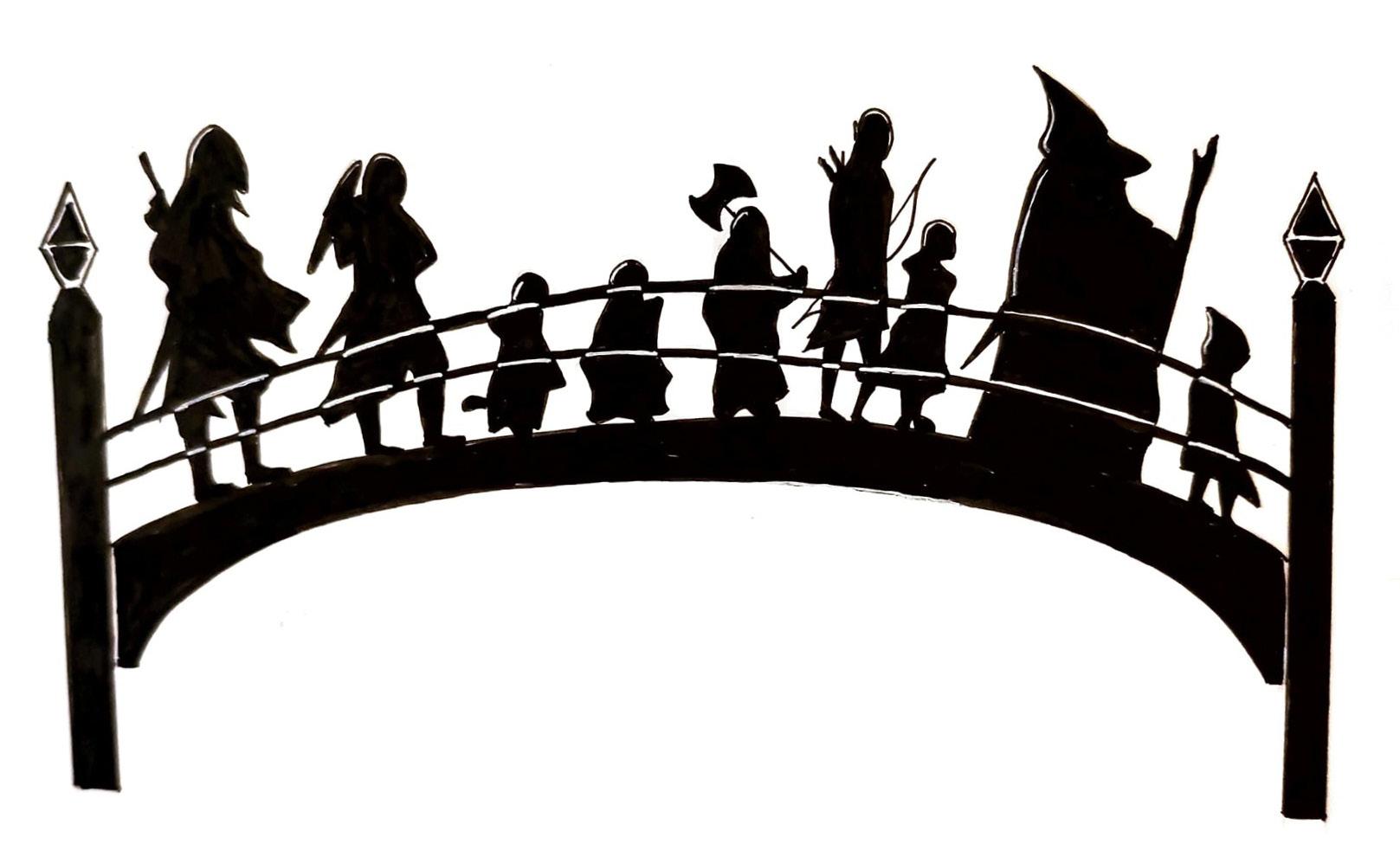
Hobbit Holes
Tolkien Society provides welcoming literary community, space for intellectual curiosity
In the life of a college student, the relentless queue of assignments and readings can make time feel a bit too orderly. That being said, sometimes going down a rabbit hole and learning something new, and totally random, can be a necessary and truly exhilarating reprieve. It is in this space that Tolkien Society, like many other clubs at the College of William and Mary, thrives.
The College’s Tolkien Society, begun in 2013, strives to provide a space for literary lovers to discuss all things Tolkien. J.R.R. Tolkien was a professor at Magdalene College Oxford, author of the famed series “The Lord of the Rings” and a famous Christian apologist. Tolkien’s pervasive influence on modern fantasy cannot be understated, expressed Anna Gillespie ’26.
“Tolkien is the father of modern fantasy,” Gillespie, queen of Tolkien Society, said. “Also, his stories are great, and they’re amazing, and if you know a l ot of modern fantasy, they might surprise you because they don’t follow many of the tropes of modern fantasy.”
But don’t let the conventionality of their label fool you, because as their leadership titles hint, the Society is anything but normative. With titles like herald (secretary), queen (president) and mayor (vice president), this group sounds more
l ike a fantasy version of a Scottish medieval court than an undergraduate club.
“If you want to know about fantasy, you have to read Tolkien, because that’s where pretty much everyone gets their starting point.”
This warm and welcoming group of Tolkien fans have sparks alight at their meetings, preferred editions of “The Silmarillion” wholly unfurled through their wild and passionate literary debates.
The club does everythi ng from conducting reasoned death tournaments of their favorite Tolkien characters (excluding of course, the author, and the deities of Tolkien literature), to user-friendly “Lord of the Rings” movie nights and Tolkien trivia.
Members explained the death tournament, a March Madness-style bracket, where
each club member nominates a Tolkien character to compete.
“They have a minute to say, ‘No, no they would totally win if they were dropped in a gladiator style arena, and only had what they had only what was on them,’” herald Phebe Gentlesk ’27 said.
For every meeting, there’s a new theme determined by its members, from the procession of fantasy characters in Tolkien’s books, to romance in Tolkien. Material never dries up in Tolkien-land for Tolkien Society. It’s the members themselves that share a vivacity and passion that keeps the club going down the hobbit hole.
“I love just the atmosphere,” mayor Tabatha Tarman ’28 said. “You wouldn’t think it from hearing the name Tolkien Society, but I have cried laughing in these meetings.”
The Tolkien Society executive committee emphasizes that at its core, Tolkien’s literature represents something modernity desperately needs: a world in which flawed characters are accepted, and fantasy is founded.
“If you read the books or watch the movies you will see the importance of hope, action and perseverance,” Tarman said.
Gentlesk, another beloved reader of “The Lord of the Rings,” and Tolkien’s other works, agreed.
“Even just reading Lord of the Rings, or
watching the movies, it’s such a hopeful series at the end of the day. It’s just going through tough things, and celebrating. ‘It’s no bad thing to celebrate a simple life’ is one of the quotes from the books. It’s just so heartwarming for me, it’s something to take comfort in at the end of the day,” Gentlesk said.
Tolkien Club members emphasize that whatever your background or level of experience, they can be a forum of Tolkien for you.
“If you’re interested in the Lord of the Rings in any capacity, you can show up, and we’ll be like, ‘Oh great! Another fresh face,’” Tarman said.
For anyone who wants to go down hobbit holes, Tolkien Society meets every Monday at 8:00 p.m. in James Blair Hall 213.
“The kindness and friendship between the Ring is beautiful. You see all those things, and the compassion they have for people who ever fail.”
GRAPHIC BY ISABEL VOLDEN / THE FLAT HAT
BROOKE LEWIS // FLAT HAT VARIETY ASSOC.
GRAPHIC BY ISABEL VOLDEN / THE FLAT HAT
sports
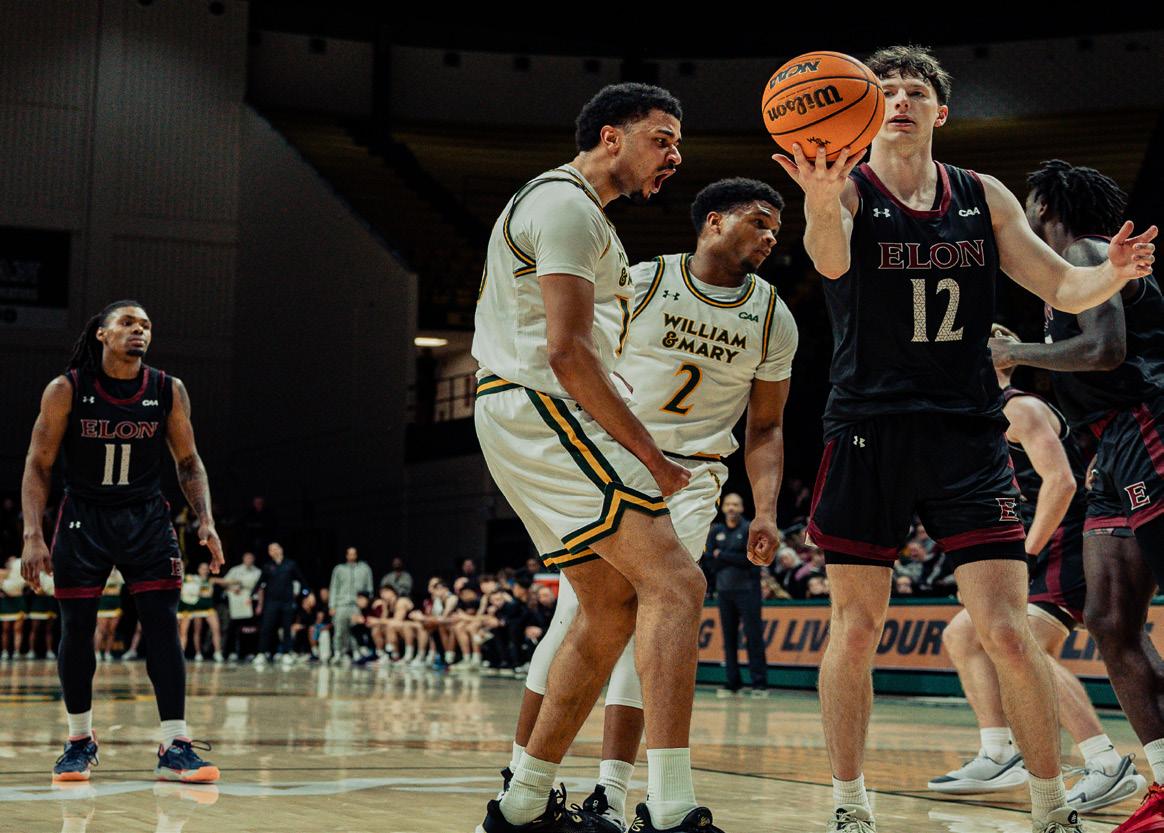
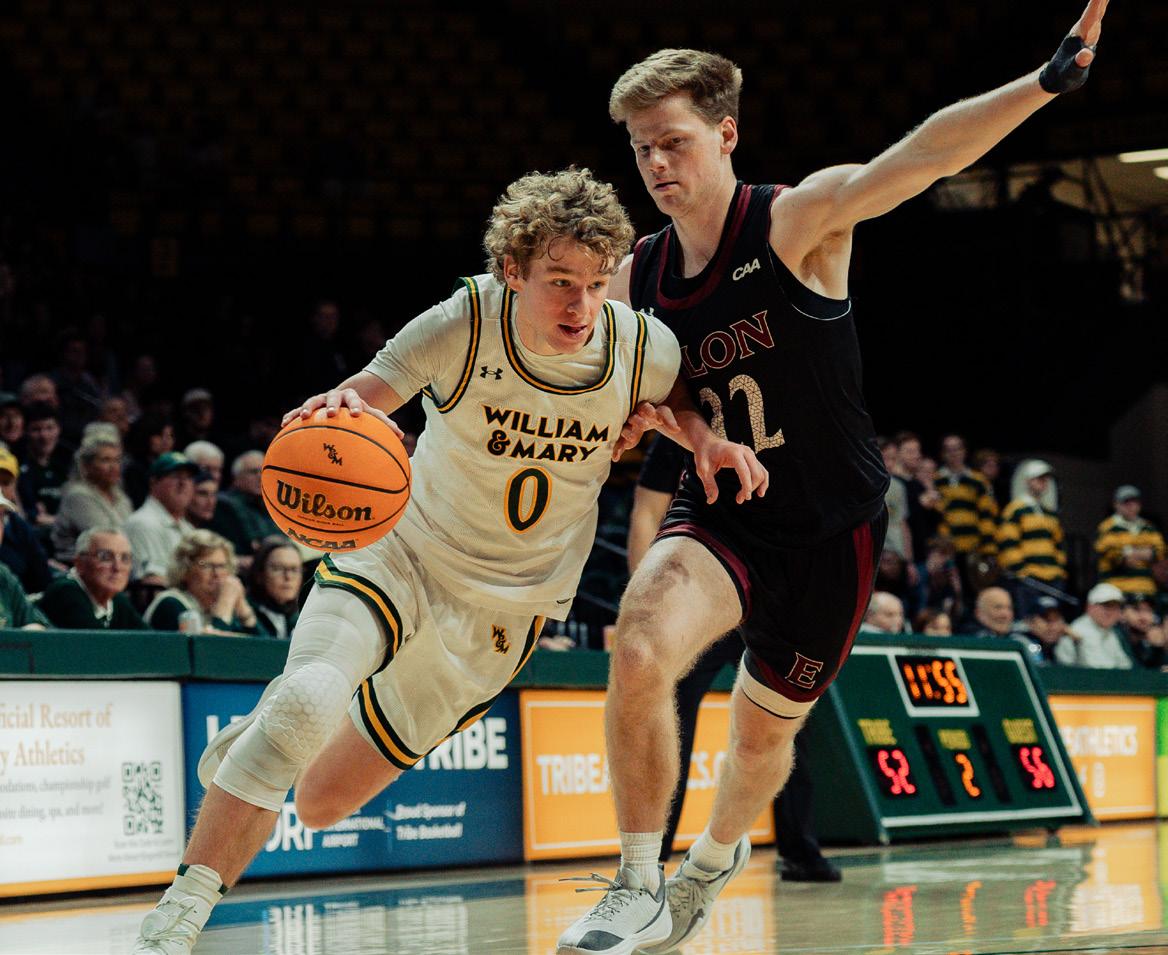
Tribe suffers heartbreaking Valentine’s Day defeat
BEN McLOUGHLIN
OPERATIONS COORDINATOR
Saturday, Feb. 14, William and Mary men’s basketball (16-10, 7-7 CAA) fell dramatically to Elon (14-13, 6-8 CAA) at Kaplan Arena in Williamsburg, Va. The loss sent the Tribe down to seventh in the Coastal Athletic Association rankings with four games before the conference tournament begins.
Thursday, Jan. 29, the Phoenix defeated the Tribe in a nail-biter at the Schar Center in Elon, N.C. The hosts bounced back from a 12-point deficit and won by only three points. Saturday’s matchup at times seemed like the opposite, with the Tribe now the ones staging a second-half comeback. This time, however, the hosts’ poor shooting and unprecedented strong individual performances from Elon players proved too much to overcome.
The Phoenix offensive game plan on Saturday afternoon centered largely on getting the ball to graduate student forward and 20.2-pointsper-game scorer Chandler Cuthrell, who entered the matchup as the third-highest scorer in the CAA.
“Make sure we’re helping each other a lot,” Tribe head coach Brian Earl said when asked about the team’s plan on corralling Cuthrell, who scored 18 points in the previous meeting between the teams in January.
The Tribe executed this plan relatively well in the first half, limiting Cuthrell to only four points and forcing him to the bench with foul trouble. However, the Elon offense fired on all cylinders, and guards found open three-point looks. Elon sophomore guard Bryson Cokley,
a 12-points-per-game scorer, torched the Tribe for four threes in the period, tacking on two free throws for a 14-point half.
For the Tribe, senior guard Kyle Pulliam was a bright spot in the first half. The 6’4” Maryland native excelled, creating his own shot off the dribble as well as converting catch-and-shoot threes and scoring 13 on the half on 4-5 shooting from the field.
As a whole, however, the Tribe was sloppy and indecisive on the offensive end to start the game. While the two teams shot similar percentages, the Tribe’s possessions were often cut short by careless turnovers. Elon finished the half with seven steals, mostly following bad passes from experienced Tribe players. The hosts turned the ball over nine times in the half, in contrast with Elon’s three. The Phoenix also tacked 12 first-half points from Tribe turnovers, and the halftime score saw Elon leading 43-36.
At the half, Earl emphasized the turnover issue when talking to his team.
“Just don’t turn it over, sometimes it’s as simple as that,” Earl said. “I’m not sure guys need to be reminded that turnovers kill.”
Elon looked to put the Tribe down for good at the beginning of the second half. Leaning on Cuthrell, back from foul trouble, the visitors sprinted out to an 11-point lead with 16 minutes, 37 seconds remaining.
The Tribe rallied back and strung together a series of possessions en route to a 15-3 scoring run over 6 minutes. A much-needed three from Pulliam saw the 5,000 Kaplan faithful jump to their feet, spurring the energy of their team.
After a slow first half, junior forward Tunde Vahlberg Fasasi found his rhythm on offense, finishing two strong layups through contact at the rim, in addition to a massive block on the defensive end.
The final 10 minutes of play saw neither team lead by more than three points in an extremely tense, back-and-forth contest. Graduate student forward Jo’el Emanuel was effective for the Tribe, adding 13 points off the bench as well as seven rebounds. Senior guard Chase Lowe played his role as the squad’s glue guy, connecting with many cutting teammates on pinpoint assists and converting a steal into a fast-break layup.
The Tribe failed to find an answer for Cokley, who added three more three-pointers in the second half, taking his total to seven for the game. The Elon sophomore guard went 6-6 from the free-throw line down the stretch.
With the second half winding down, two free throws from Emanuel leveled the game at 76 with 1 minute,15 seconds remaining. The Tribe defended well on the ensuing possession, forcing an Elon timeout with 4 seconds on the shot clock. However, a perfectly drawn up inbound play saw Cuthrell lay it in, giving his team the lead with
‘I had to make a way’: Jah’Kei Chavis is
46 seconds remaining.
After Fasasi’s three-point attempt clanked off the rim and found its way into Cuthrell’s hands for the rebound, it looked as if the Phoenix would have a chance to ice the game at the line. Emanuel, however, ripped the ball away and finished through contact, bringing the Tribe level again with 30 seconds to go.
Elon put the ball in the hands of Cokley, who already had 26 points in the afternoon. After dribbling the clock to 5 seconds, he made his move. A screen switched Fasasi onto the guard as he side-stepped on the right wing and hit a falling-away three to give Elon the lead for good. Junior guard Reese Miller’s attempt as time expired could only find the rim, and the Tribe lost a heartbreaker on Valentine’s Day.
“He makes shots, he’s a good player,” Earl said of Cokley, who got 29 for the Phoenix on the day. “Cokley took his moment to shine, and we didn’t have many answers for him.”
With only four games remaining in CAA regular season play, William and Mary sits at sixth in the rankings, two spots outside the double-bye that the top four enjoy. The squad faces Campbell (12-14, 6-7 CAA) Thursday, Feb. 19, a team that bested the Tribe at their first meeting at Kaplan.
“We’re a little thin, a little beat up,” Earl said of his squad, referencing recent injuries. “We get to play Campbell again. We make sure we learn from the past mistakes and just take one possession at a time.”
ready to create his legacy
Ex-Hampton sophomore running back sets goals high for 2026
After losing its top two rushers from the 2025 season to eligibility limits and the transfer portal, William and Mary football (7-5, 6-2 CAA) found itself in need of reinforcements in the offensive backfield.
While it is unlikely that the Tribe will replace 1,451 rushing yards and 19 touchdowns with just one player, Hampton transfer running back Jah’Kei Chavis is set to take on part of that responsibility.
Chavis’ arrival in Williamsburg marks a full-circle moment, after the Tribe played a role in his recruitment coming out of high school.
“William and Mary was trying to get me, but I guess they didn’t have enough spots for running backs,” Chavis said.
For Chavis, the road to William
and Mary football was motivated by his family and his continued desire to improve.
Coming out of Armstrong High School in Richmond, Va., Chavis followed a familial pipeline of highlevel football players.
“My uncles and cousins, they all played football and [were] taking the college route and getting into school for free,” Chavis said.
It was not just the rich tradition of football success in his family that propelled him to play college football, but a more difficult reality.
Chavis recalled a conversation between him and his mother when it became clear that his best path to a college education would come via football.
“I just had to make a way and go hard,” Chavis said.
So after recording over 1,200 rushing yards and 19 touchdowns as a high
school senior on his way to being named All-Metro Player of the Year, Chavis committed to Coastal Athletic Association rival Hampton.
Even with a positive season on a personal level, racking up a teamleading 354 yards on the ground, Hampton football as a whole suffered another disappointing season, finishing 2-10 and winless in CAA play. This led to the firing of head coach Trent Boykin and his staff.
Outside of the departure of the staff that drew Chavis to Hampton in the first place, Chavis’ general dissatisfaction with the position he found himself playing impacted his transfer decision.
“The running back group was great, but there were so many running backs on scholarship, and we have to try and get everyone in,” Chavis said.
He also questioned how anyone in the running back room could gain a rhythm if touches were so sporadic over the course of a game.
Despite his departure from Hampton, Chavis was grateful for the lessons he learned and the guidance he received from his fellow teammates during his year there.
“I had two upperclassmen ahead of me who led us freshmen. I give them credit as well,” Chavis said.
Once Chavis officially reentered the portal, William and Mary coaches invited him to campus for a visit.
“I committed as soon as I saw the campus,” said Chavis. “The team, the coaches, they all greeted me like a brother, like a family.”
On the field, Chavis has found two main inspirations in his position: Detroit Lions running back Jahmyr Gibbs and NFL hall-of-famer Barry Sanders. Chavis said both players are similar in style to him as downhill, physical running backs. Additionally, the coaching staff has shown him clips of Gibbs and Sanders in some of their first meetings.
With the freshman-to-sophomore year jump in college being considered one of the most important times in a player’s development, Chavis has already identified his reading of the game and patience as areas for development.
Chavis also looks to improve off the field and in the locker room. He hopes to help build a collective environment of trust among all players as a leader, no matter their position or role.
With all of this in mind, Chavis has no doubt about what it will take to see out his development and reach his lofty goal of 2,000 all-purpose yards next season.
“It all starts from here, stacking days and putting the work in,” he said.
” “
The team, the coaches, they all greeted me like a brother, like a family.
Junior Tunde Vahlberg Fasasi helped bring the Tribe back in the second half.
JACOB TOBMAN FLAT HAT SPORTS EDITOR
COURTESY IMAGE / JAHʼKEI CHAVIS Chavis had no doubts choosing the Tribe once in the portal.
JAMIE
- Running back JahʼKei Chavis
sports
Sophomore infielder looks to build on success after CAA honors Tribe baseball star Jamie Laskofski looks on bright side for season
For the more than 200,000 National Collegiate Athletic Association Division I student-athletes who competed during the 2024-25 season, the journey to college athletics has played a defining role in shaping who they are — not just as athletes, but as people. William and Mary sophomore infielder Jamie Laskofski is no exception.
Laskofski is coming off a stellar rookie season, in which he earned Coastal Athletic Association All-Rookie and Second Team All-CAA honors. He also led all CAA freshmen in runs (54), hits (77), stolen bases (12) and batting average (.360). This season, Laskofski looks to build on his strong performances while continuing to develop.
Growing up, Laskofski knew he liked the competition and rush of the sport. From a young age, he set his mind on competing at the collegiate level — a dream he turned into a reality through hours of training and unwavering dedication.
Laskofski credits his interest in baseball to his father, who coached him until he was 14. Laskofski’s father also played baseball at William and Mary, surrounding his son
in Green and Gold garb since he was a little leaguer.
“After he stopped coaching me, I started using him as an outlet to talk to him about everything I’m going through baseball-wise,” Laskofski said. “He went through the same process with recruiting and playing in college.”
Just as his father once guided his journey, Laskofski now hopes to provide that same support for his younger brother as he navigates the recruiting process.
When it came time to decide on a college, Laskofski knew he wanted to attend a school that matched him both academically and athletically — something William and Mary could uniquely offer.
“I like to compete a lot, so just going to school where you can compete and get a really good education is very important for me,” he said.
Laskofski also noted that being a legacy gave him unique insight into the Tribe community and what to expect when on campus.
“My older sister goes here, so I knew if I were to go here as well, I would have two to three years with her at college, and that’s always a plus having someone you know by your side,” Laskofski said.
Laskofski emphasized balance, particularly between athletics and academics during the baseball season.
“Balance comes in waves,” he said. “For example, there will be a week where there are a bunch of assignments and a bunch of essays and homework, and you have to be willing to set time aside to prioritize that, and then there are other weeks where it is light, and you can relax and reset,” Laskofski said.
It took Laskofski time to strike that exact balance, with his teammates playing a crucial role in the process. Through conversations, Laskofski realized that many of his teammates have different time management strategies.
While Laskofski has had his fair share of success throughout his career, he has also faced setbacks, natural in a sport like baseball, where games come quickly one after another. Laskofski said he has learned to move
forward rather than dwell on past mistakes.
“Not everything is going to go how you want to every time you play, and just because one bad thing happens, it doesn’t ruin your chances at having a good future,” he said. “It’ll all work out eventually if you keep doing the right thing.”
Through countless highs and lows on both personal and team levels, Laskofski has learned to carry a positive attitude into each day.
“I’ve learned that every day is a new day, and every day you wake up and the sun still comes up,” he said.
Laskofski was clear about his goal for the team this season.
“Last year, we made the playoffs even though we weren’t projected to due to injuries,” he said. “I believe that if we keep our eyes on the goal of making the playoffs this season, everything will fall into place.”
holds of late Towson comeback in crucial Kaplan win
Tika Sallmanʼs career high leads Tribe to third win in its last four Tribe
Sunday, Feb. 15, William and Mary women’s basketball (14-11, 7-6 CAA) defeated Towson (14-11, 7-6 CAA) 75-70 at Kaplan Arena in Williamsburg, Va.
Sunday’s win marked the Tribe’s second victory over Towson this season. Just nine days before, the Green and Gold defeated the Tigers 52-51 on the road in a matchup that featured seven lead changes and a late defensive stop to secure the win. That victory also marked the Tribe’s first win against Towson since 2020.
The Tribe started the game slowly, not only finding itself down early but also in foul trouble, recording five in the first quarter alone. However, the Tribe picked up momentum
midway through the first quarter, finding itself with a four-point advantage heading into the second quarter after a three-pointer from junior guard Monet Dance.
Throughout the second quarter, the Tribe built on its slim lead, thanks to a strong defensive performance. The Tribe press forced the Tigers into contested shots, completely stalling their offensive rhythm.
“We just wanted to play our game. We wanted to make it about us. We know that Towson is a good team,” Tribe head coach Erin Dickerson Davis said.
“All we wanted to do is make sure that we were coming out with urgency.”
The Tribe was highly efficient with its possessions, shooting 75% from the field in the second quarter. The Tigers lacked an answer for junior center Tika Sallman, who was highly effective in the paint. The Tribe also capitalized on Towson’s sloppiness, outscoring the Tigers 11-2. Ultimately, these factors culminated in the Tribe jumping out to a 43-26 halftime lead.
“Hitting shots, playing together, the energy was amazing,” Dance said. “It was really nice.”
After the half, the Tribe continued capitalizing on its offensive play, dominating in the paint and forcing Towson turnovers. The Tribe ended the third quarter up 20 points, appearing to have secured the win.
Despite facing a sizable deficit with only 10 minutes remaining in the matchup, Towson continued fighting. The run started as Tigers senior guard India Johnston scored an early bucket off a turnover, which helped shift the momentum. The Tigers continued chipping away at the Tribe’s lead, cutting it all the way down to five and forcing the Tribe into a 7-minute field goal drought.
The Tribe’s three-quarter cushion ultimately held off Towson’s late comeback. A last-minute steal by senior guard Alexa Mikeska sealed the game for the Green and Gold.
Johnston ended with a season-high 31 points and 10 field goals in the effort for Towson.
Dickerson Davis applauded her team’s
preparation before Sunday’s game.
“We had a really good day of practice yesterday,” Dickerson Davis said. “I think we prepared how we played today.”
Dickerson Davis also highlighted her players’ ability to work together, noting the integration of team-building activities into its workout schedule — something she also sees as key in the run-in for this season.
For Sallman, Sunday’s game also marked a significant milestone. She ended the outing with a double-double and a careerhigh 25 points.
“My teammates never gave up on me, and they just kept pushing me and motivated me every time,” Sallman said. “I think that’s really helping me and
helped me a lot [with] how I performed today.” Sallman also thanked the coaching staff for their encouragement after she faced earlyseason injuries.
Looking ahead, the Tribe will face Monmouth (168, 9-4 CAA) and Drexel (15-8, 8-4 CAA) in a crucial doubleheader at home next weekend.
Dickerson Davis stressed the importance of the remaining conference games and taking each matchup one at a time.
“I did not realize we won three of our last four. It’s always the next game,” Dickerson Davis said. “I’m just very proud of where we are, and I believe that we can continue on this streak.”
COURTESY IMAGE / JAMIE LASKOFSKI
Laskofski found success after learning how to balance athletics and academics.
COURTESY IMAGE / JAMIE LASKOFSKI
a freshman, Laskofski helped lead the Tribe to the CAA conference playoffs.
ETHAN DE GUIA / THE FLAT HAT Junior guard Kyah Smith played 29 minutes in the win over Towson.
ETHAN DE GUIA / THE FLAT HAT
Dickerson Davis hopes the Green and Gold will carry its mometum into the last six games of the regular season.
COURTESY IMAGE /JAMIE LASKOFSKI
In 2025, Laskofski learned both CAA All-Rookie and Second Team All-CAA honors.