

SYK, Innocence Club examine intersection of criminal justice system, sexual violence
Discussion focuses on key Innocence Project exonerations, advoc acy campaigns, future for collaborations
Thisarticlecontainsdiscussionsofsexualassault.
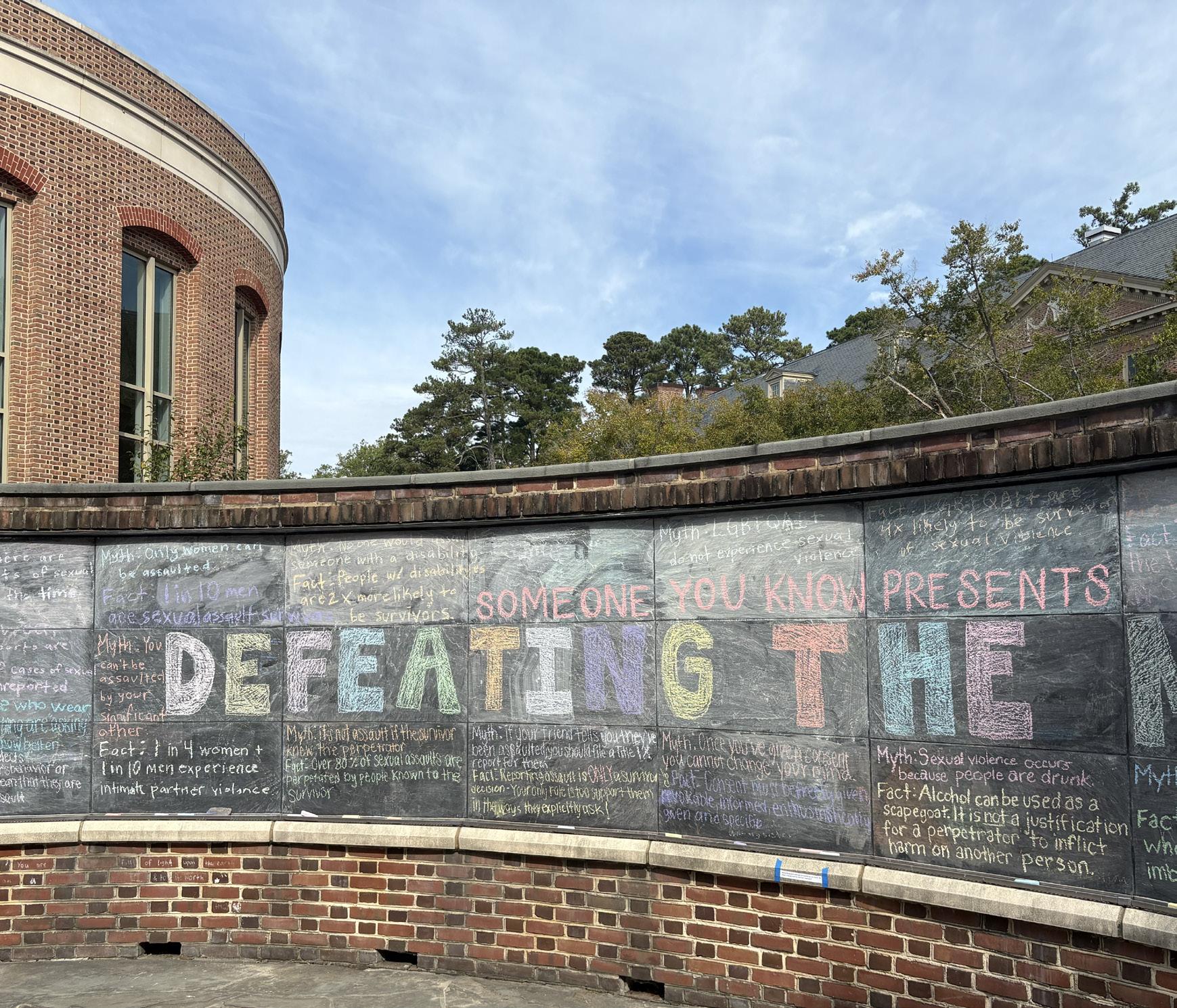
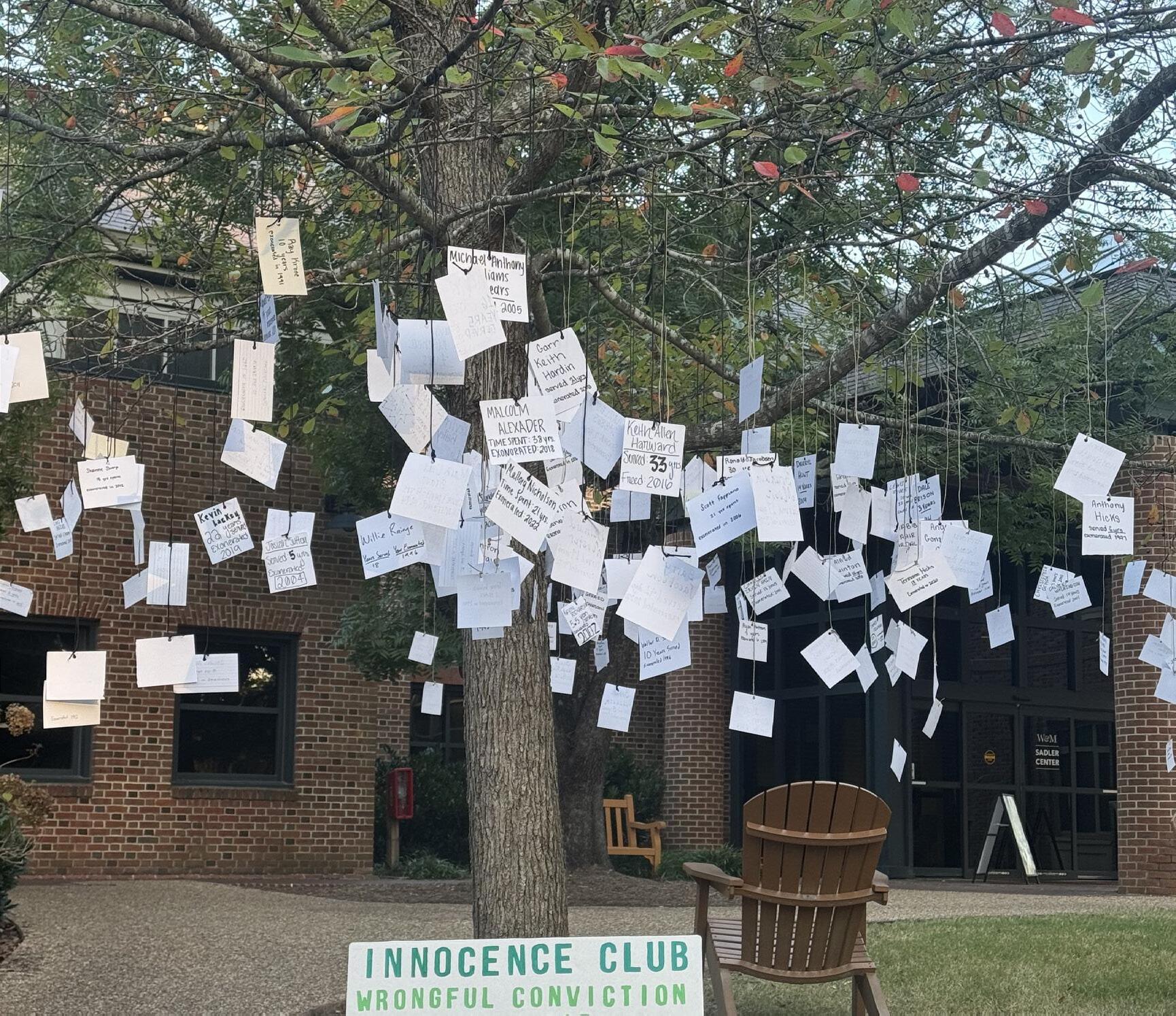
Wednesday, Nov. 19, the Innocence Club and Someone You Know held the event “Beyond Justice,” an educational talk focused on reshaping understandings of the American incarceration system and its relationship to sexual violence.
The Innocence Club is the College of William and Mary’s undergraduate branch of the nationwide Innocence Project nonprofit. The nonprofit works to exonerate those incarcerated with false convictions, advocating for proper DNA testing and other forms of post-conviction relief.
Someone You Know is a peer-based organization working to prevent sexual violence through education and advocacy. The organization presents to clubs on campus on a range of issues, including how to support survivors of sexual violence, the importance of bystander intervention and healthy masculinity, analyses of violence-supportive culture and guides for the Title IX process.
The presentation featured a history of the American incarceration system and key exoneration cases. After the presentation, attendees discussed how the criminal justice system and sexual violence are interconnected.
A key focus of the event was the importance of racial justice in the carceral system. Black Americans represent 14% of the U.S. population, yet make up 41% of the prison and jail populations nationwide.
Terrence McDuffie ’27, president of the Innocence Club, presented on the lives of two wrongfully convicted Black men, Levon Brooks
and Kennedy Brewer. Both men were convicted of perpetrating sexual violence, despite forensic evidence to the contrary.
The two case examples portrayed how sexual violence sentencing and punitive measures can cause harm in society when the human dignity of each person is not respected, and the justice system relies on racial biases.
Erin Reiley ’27, recruitment chair for SYK, spoke about organizing an event focused on the intersectionality of sexual and gender-based violence and the justice system.
“Something that’s particularly pertinent in sexual violence advocacy right now is how sexual and gender-based violence interacts with the carceral and punitive systems,” Reiley said. “That’s something that a lot of people aren’t super educated on beyond basic concepts.”
Reilly noted that in her role at SYK, she hopes that further collaborations will expand knowledge across campus of the effects of sexual and gender-based violence on all groups of people.
“We really want to broaden that education and experience that people have with it, especially considering how sexual and gender-based violence affects people differently based on different facets of their identity coming from marginalized groups — sexuality, race, etc.,” Reiley said. “We want to spread our advocacy to as many avenues of campus as we can, and working with the Innocence Club is a great opportunity for that.”
It was important to several Innocence Club organizers to collaborate with SYK because of their goal to broaden education about the carceral system.
Sydney Shoulders ’26, outreach education chair for Innocence Club, emphasized the need to shift conceptions of sexual and gender-based violence to one that encompasses incarcerated survivors.
“There are a lot of narratives about what a perfect survivor looks like, and that person is not typically someone who is incarcerated,” Shoulders said. “It’s really important to think about harm happening in places where we don’t want to think about it.”
Over the past semester, Innocence Club has worked to highlight various legal inequities in the United States justice system. Saturday, Nov. 8, the club partnered with the College’s Fighting for Immigrant Rights and Equity Club for a collaborative UndocuAlly training.
“Immigration is not a criminal offense, yet in this country right now we are treating it as though it is one,” Shoulders said. “I think it’s important to, if for no other reason, just say that and make a space for that and talk about why exactly it’s wrong.”
Ava Reed ’28, programming chair for SYK, spoke on the importance of understanding those connections and the difficulty in transitioning from punitive measures to restorative justice.
“When you’re talking about restoring justice, it’s not something that automatically makes you feel good,” she said. “Sometimes you want to inflict a type of harsh punishment onto someone else, and it’s an understandable human emotion.”
Reed explained that while it might be instinctive to punish those who commit serious offenses harshly, it is important to remember that the human dignity of those involved needs to be upheld.
“However, that doesn’t negate the fact that
human dignity needs to be at the utmost standard for both the survivors and those who are incarcerated,” Reed said.
For Reed, this way of thinking is not limited to just the incarceration system; it is a mindset for understanding justice. Reed parallels the injustices stemming from a focus on punitive measures with the problems within the Title IX process.
Title IX is a federal law that prohibits sex-based discrimination in education programs and activities that receive federal financial assistance. This prohibits sex-based discrimination, specifically sexual harassment and assault, at almost all universities in the United States.
At the College, the Title IX office in the Department of Compliance and Equity stipulates adherence to both the Title IX and Discrimination policies. If policies are violated, students and staff can submit a report to initiate a preliminary investigation of any potential discrimination.
After the evaluation has started, survivors of sexual and gender-based violence or harassment can receive supportive measures. Later on in the process, punitive and disciplinary measures can be put in place.
For Reed, the current system of support for Title IX is not enough. Reed underlined the need for more transparency and a focus on restorative justice in the procedure — for the good of both the survivor and perpetrator.
“Stop stigmatizing the conversation about it, and start hiring more people to be in the Title IX process,” Reed said. “I feel that in a university, if they wanted to, they would. It’s not something that they care enough about.”
Students reported food insecurity, delayed federal benefits, stalled services as campus groups stepped in
Wednesday, Oct. 1, the federal government shut down for 43 days — halting services and cutting of aid to millions of families, including students at the College of William and Mary who suddenly found themselves struggling to meet basic needs.
The shutdown, caused by a congressional budget impasse, left federal agencies without funding. Newton Family Professor of Government C. Lawrence Evans explained that the federal government faces strict deadlines for passing bills to fund government programs.
“If [appropriations bills] don’t pass by the last day of September, then in theory, the discretionary portions of the federal government are no longer
funded and need to shut down,” Evans said.
For Mara Cox ’26, a geology major, the impact was immediate and physical.
Their Supplemental Nutrition Assistance Program benefts expired in August, and with the shutdown blocking their ability to reapply, Cox found themselves rationing groceries and skipping meals.
“I stopped eating much out of fear of when I would be able to purchase groceries again,” Cox wrote in an email to The Flat Hat. “I began to panic and not be able to think clearly.”
It was not the first time they had faced food insecurity, but this time felt lonelier.
“It was a really scary and shameflled moment to be an independent adult but not know where my next meal would come from,” they said.
Cox’s story is not unique. As the

shutdown dragged through October and November, students across campus experienced delays in federal benefts, disruptions in food access and uncertainty about where to turn for help.
According to Evans, the issue goes deeper than budgeting.
“Shutdowns have been kind of on the table as a possible strategic ploy really since [Newt] Gingrich’s era in the mid-1990s,” he said. “This has just continued and gotten worse over time as the parties have moved apart.”
The shutdown did not just disrupt federal aid; it revealed cracks in the College’s own safety nets, too. With no clear direction from leadership, students stepped in to support each other.
One of the most visible responses came from Food for All, a student-run mutual aid group that operates two

pantries on campus.
It is built for discretion — no ID checks, no sign-in sheets, no questions. Students can walk in, grab what they need and leave. That anonymity, Food for All President Rachel Touse ’26 said, is intentional.
“Since we’re students, it makes certain things really difcult, like having a bank account or fguring out leadership turnover every year,” Touse said.
Unlike other Virginia schools where staf help oversee pantry operations, the system at the College is entirely student-led — a model that brings both fexibility and strain.
Where Food for All ofered staple supplies and anonymity, the Wesley Foundation served something warmer.
To sustain the eforts of organizations like FFA, students turned to more formal institutions, including their own student government.
Sen. Jason Zheng ’26, chair of the Senate Policy and Student Rights Committee, introduced S.B. 333-07: Food for All Continues Act — a bill allocating $800 to Food for All to help restock pantry shelves during the shutdown.
“Food access is a human right,” Zheng wrote in an email. “Disruptions — whether federal furloughs, climateinduced disasters or supply chain breakdowns — almost always hit vulnerable households frst and fastest.”
“We have our food rescue program,” Wesley Student President Helen Tiffin ’26 said. “If there’s an event on campus, we’ll take the food that’s left over and keep that in our free food fridge on top of our large group leftovers.”
SEE POLITICS PAGE 4

However, that doesnʼt negate the fact that human dignity needs to be at the utmost standard for both the survivors and those who are incarcerated.
Saturday, Aug. 2, 2025, Williamsburg police arrested 76-year-old George Thomas West for allegedly filming in a Colonial Williamsburg public bathroom over the span of 29 years. West now awaits his next hearing Jan. 16, 2026, at the Williamsburg/James City County General District Court.
Officers later obtained multiple search warrants from the Criminal Investigations Bureau, finding evidence suggesting West had been engaged in unlawful filming since 1996 and reportedly videotaped “thousands” of men. Charged with one count of disorderly conduct and 16 counts of illegal filming of another person, a combined 17 class one misdemeanors, West could face up to 17 years in prison if found guilty on all counts. West was granted bond Aug. 11 and is not currently in jail. He lived in Gloucester County, Va., commuting 40 minutes on Saturdays for his alleged unlawful filming. West had been a deacon at the Union Baptist Church in Hayes, Va., but was removed from the position Aug. 17 following a vote by the church body. Westʼs sentence has yet to be decided. The original hearing was scheduled for Nov. 18, but the case received a continuance to allow the prosecution to continue gathering evidence, and for Westʼs lawyers to further prepare his defense. NATE ROSS / FLAT HAT COPY EDITOR
A THOUSAND WORDS
Te Flat Hat wishes to correct any fact printed incorrectly. Corrections may be submitted in email to the editor of the section in which the incorrect information was printed. Requests for corrections will be accepted at any time.
ʻSTABILITAS ET FIDESʼ | ESTABLISHED OCT. 3, 1911 Org #101 P.O. Box 8795, Williamsburg, VA 23187 Editor flathat.editor@gmail.com Managing flathat.managing@gmail.com Executive flathat.executive@gmail.com

Samantha Korff ’26 reflects on time as Vox club president, political research experiences
Korff describes fulfillment found from Vox community, listing clubʼs fundraising efforts
LILA REIDY // FLAT HAT NEWS
Though Samantha Korff ’26 is involved in many areas of campus, she is most committed to reproductive rights at the College of William and Mary. Majoring in government with a minor in Latin American studies, she participates in the Global Scholars Program at the Global Research Institute, Pi Beta Phi and data work for the U.S. Democratic Erosion Event Dataset. On top of that, she is president of Vox: Planned Parenthood Generation Action club, which has remained an important pillar of her time at the College.
As the current president of Vox, she and her executive team advocate for sexual health information. Korff outlined the club’s efforts to promote this information in the community.
“Vox does fundraising, education and electoral work to advance reproductive justice, an advocacy framework focused on our collective rights to have children, not have children and parent the children we have in safe and sustainable communities,” she said. “We do a lot of programming around abortion access and comprehensive sexual health education, but this work is also about immigrant rights, racial justice, LGBTQ+ rights, affordable living, criminal justice reform and pretty much every other issue that helps people lead free and dignified lives.”
She continued by placing the club’s efforts in a national political context.
“Given recent federal policy rollbacks around reproductive healthcare, increasing pregnancy criminalization across the U.S. and widening inequities in health outcomes, this sort of intersectional activism is now more important than ever,” Korf said.
Vox was established at the College as an advocacy group for reproductive justice, but Korff detailed how it has grown into more than that.
“On campus, we fundraise for organizations like the Hampton Roads Reproductive Justice League, our local abortion fund, the National Latina Institute for Reproductive Justice and the Black Mamas Matter Alliance,” she said. “We meet weekly to talk about different facets of reproductive justice; our last few meetings have covered global sex ed, gender politics and STI myths. We also just wrapped up a busy election cycle, so we spent much of this semester helping elect pro-reproductive rights candidates up and down the ballot in Virginia.”
While highlighting the group’s work, she underscored her own responsibilities as ITS leader.
“As club president, I oversee our exec board, organize our larger-scale advocacy events and coordinate with our liaisons at Planned Parenthood Advocates of Virginia,” she said. “More importantly, though, my role is to delegate. I have to make space for others to take on responsibility, learn through trial and error and develop in their positions so that when I graduate, the organization can continue to grow.”
Korff advocated for the community that Vox has fostered as an organization, and what she enjoys within the group.
“What I love about Vox is the people it brings together,” she said. “Our members are curious, funny and deeply committed to
EDITOR
the communities they belong to. I feel incredibly lucky to spend my Monday nights with them. Some of my favorite memories at W&M come from tabling with friends, playing reproductive justice trivia and hosting a pro-contraceptives rally on Sunken with a 20-foot IUD and free Plan Bs.”
Korff continued to recognize the impact that this club has had on her.
“Vox has easily been the most fulfilling part of my college career,” she said. “I’m exceedingly grateful for the time I’ve spent here and for the people I’ve met: in particular, the exec members who came before me and pushed me to delegate more, ask for help when I need it and not take myself too seriously.”
Korff has also worked as a research assistant with the U.S. Democratic Erosion Event Dataset for the past year. She highlighted her efforts within the job, contextualizing the work within an American political landscape.
“The project feels especially important now, given renewed public attention on the quality and stability of American democracy,” she said. “But what’s often missing from conversations about backsliding in the American context is recognition that political elites have been weakening democratic accountability mechanisms long before 2016, and not just at the national level. Voter suppression, attacks on the judiciary and repression of civil society have been happening at the state and local levels for decades now, and their effects have disproportionately undermined the political power of communities that had little to begin with. So much of it has flown under the radar.”
The project works to engage both scholars and the public by pulling data and making it accessible to a wide audience. Korff continued to explain the greater meaning behind the work she does at U.S. DEED.
“This project aims to fill part of that knowledge gap for both scholars and the public,” she said. “We’re generating an eventbased dataset tracking instances of democratic erosion at the state and local levels from 2008 onward. We catalogue every time a public official engages in corruption, a court raises barriers to voting, a legislature politicizes the education system and a host of other actions that threaten the people, groups and systems meant to hold power to account.”
Korff ended on a proud note, discussing work that she has done and is currently working on, creating a sense of appreciation for the project as a whole.
“Last semester, I helped code erosion events in Texas,” she said. “That was a lot; there’s been aggressive gerrymandering, attacks on the authority of localities and state-conducted violence against protesters. Over the summer, I led a research team coding events in Wisconsin, which has been a national leader in undermining its civil service. That felt really relevant given the ongoing hollowing out of the federal workforce. Now, I’m working on data quality and validation, helping ensure the dataset is as accurate and robust as it can be. It’s been a great experience to be so involved in research as an undergraduate.”
Board establishes peer group of comparable institutions, allowing College to track key performance indicators
Wednesday, Nov. 19 to Friday, Nov. 21, the College of William and Mary’s Board of Visitors convened for its second meeting of the 2025-26 academic year in Blow Memorial Hall, approving two new bachelor’s degree programs in applied artifcial intelligence and bioengineering, and raising in-state and out-of-state tuition at the William and Mary Law School by 2.5% and 5% respectively.
In addition to the Board’s eight standard committees meeting, each dean of the College’s six major schools — the College of Arts and Sciences, the Law School, the Batten School of Coastal and Marine Sciences, the School of Education, the School of Business and the School of Computing, Data Sciences and Physics — delivered presentations to the Board on their strengths and challenges while taking into account the rise of artifcial intelligence. Board members then participated in a Q&A session with each dean for roughly 45 minutes.
The Board also established a peer group of comparable institutions to enable the College to track key performance indicators by comparing them to both in-state and out-of-state competitors. The committee on administration, buildings and grounds also passed resolutions approving land exchanges with the City of Williamsburg and greenlighting the demolition of old buildings at the Batten School.
Academic afairs chair Laura Rigas ’01 opened the special session featuring the College’s major deans, called the omnibus session, with a statement recognizing the Board’s willingness to take on a new format to familiarize themselves with the College.
“The idea was to sort of level up all of our knowledge as board members so that we could start with more of a strategic posture for this conversation today,” Rigas said.
Each school’s presentation focused on fve key tenets of current and future operations: their mission statement, what success looks like, their criteria for success, the greatest opportunities and challenges they’re facing and special preparations in the age of AI. Rigas also explained that the order of presentations was determined based on the age of each school, walking board members through the histories of each
major school.
Rigas also thanked Rector Charles E. Poston J.D. ’74, P ’02, ’06 for a letter he submitted to the Board in October formally calling for a revision of the College’s COLL curriculum and a strengthening of posttenure faculty. She also celebrated an anonymous $1 million donation made in Poston’s name, who is retiring this year.
“I wanted to congratulate [Poston] on the incredible gift of $1 million, which was donated anonymously in his name to create an endowment for law school scholarships,” Rigas said.
Academic affairs vice chair AnnaMaria DeSalva ‘90 contextualized the omnibus session, which she said fits into the College’s mission of working toward achieving national preeminence, under four central drivers of success: student value, academic excellence, reputation and career outcomes. DeSalva stressed the need to critically analyze the broader higher education context when planning for the College’s future.
“Really thinking about the strategic context: where are we in this moment and for the next fve to ten years?” DeSalva said. “What battlefelds are we in and how does that lead to our choices?”
Dean of the College of Arts and Sciences Suzanne Raitt opened with a brief history and mission statement of her school, which opened in 1693, the same year as the College. She then moved on to a current snapshot of the school, highlighting the U.S. News and World Report’s 2025 rankings for undergraduate teaching, released in September.
“The US News and World Report ranked William and Mary’s undergraduate education as number two among public universities,” Raitt said. “For many years, ever since I came here, we’ve been stuck at number six, which is a good place to be stuck at. But something happened last year, and we rose pretty signifcantly.”
Raitt cited the increasing number of peer-reviewed publications by faculty and students, reaching 999 in 2024, as evidence of Arts and Sciences’ forward strides. She also highlighted the College’s increase in credit-bearing applied learning experiences.
“We believe all of our students need to do something that gives them professional or hands-on skills,” Raitt said. “We want those experiences to be transcripted, so that when an employer looks at a transcript, they
know the applicant has done this. We need to be able to support our students in having these experiences over the summer.”
In addition to the challenge of allocating sufcient resources to every student in need, Raitt touched on ways that she envisions Arts and Sciences incorporating AI into their curricula. She highlighted that AI makes new projects possible, like studying monarch butter fy population decline via genome data.
“AI is not about sitting in front of a computer,” Raitt said. “AI is about approaching a problem in a way that is efective, that allows you to solve the problem and be efcient.”
Vice Rector Ardine Williams asked Raitt whether she had considered shaping the COLL curriculum based on feedback from employers on the skills they desire most. Raitt agreed with the proposition, highlighting the need to prepare students for unknown workforce demands in an environment where employers are often equally uncertain.
Board member Robey W. Estes, Jr. ’74, P ’06 inquired about potential changes to the school’s budget and stafng in response to the incorporation of AI. Raitt stressed that while AI will allow the College to reduce the number of administrators to utilize resources better, humans will still be needed for high-level department management tasks.
Finally, Raitt announced the opening of a new living and learning community in fall 2026 called the Democracy Scholars, where students focused on civic engagement initiatives can live together and participate in structured activities while earning academic credit.
“That’s the kind of public service-oriented training we give our students so that they’re always thinking about the greater good and about the public good,” Raitt said.
Dean and Trustee Professor of the School of Law A. Benjamin Spencer presented next to the Board. He highlighted the school’s mission of producing “
“Optimizing our ranking and our national standing is critical to putting our law students in the best possible position to secure positive career placement outcomes,” Spencer said.
See BOARD OF VISITORS page 4
Food for All has seen rising demand at Sadler pantry since before shutdown, students expressed anxiety POLITICS
from page 1
“Food access is a human right,” Zheng wrote in an email. “Disruptions — whether federal furloughs, climate-induced disasters or supply chain breakdowns — almost always hit vulnerable households frst and fastest.”
According to Zheng, the need for increased food access on campus was growing even before the shutdown. In fall 2023, the Sadler pantry saw 88 visits, while the Wesley location served 145 students. One year later, that number climbed to over 250. Zheng further explained that without the support of the Student Assembly, Food for All would have lacked the means to provide essentials to its patrons.
“Moreover, Food for All does not qualify for OBAC funding, which meant that without Student Assembly support, the organization would not have any stable campus-based mechanism to cover operational needs, such as restocking essential goods — and the fact that Food for All distributed over $1,500 in food and hygiene products per semester — made Student Assembly funding essential to ensure the continuity of basic needs
in supporting all students, staf, and faculty alike,” Zheng wrote.
Te $800 helped bridge that gap. Beyond canned goods and pasta, the group also stocks toiletries, period products and ready-to-eat snacks.
Tose are the things people don’t always think to donate,” Touse said. “Outside funding really helps us fll in those gaps.”
From mid-October to mid-November, the group collected 1,753 lb. of food — its largest drive yet.
For some students, the shutdown ofered a window into how much dysfunction they were willing to accept or challenge.
Hunter Steele White ’27, a government and religious studies major and chancellor of the Teodore Roosevelt Society, expressed moral urgency.
“Shutdowns are a frightening political tool,” he said. “I think we’ll continue to see shutdowns as long as our leadership isn’t focused on unifying the American people.”
White believes the government shutdown did little to fx the problems legislators hoped it would address. Instead, he believes this political move harmed the American people.
Te shutdown didn’t accomplish anything
meaningful,” White said. “All I know is that people are hurting.”
Robert Ryder ’26, a senior double majoring in computer science and English, and a former Teodore Roosevelt Society executive member, said the moment mostly reafrmed what he already suspected.
“I think it confrmed a lot of the cynical impulses I had before,” Ryder said. “I didn’t see much of the personal efects.”
He recalled a trip to Roosevelt Island during fall break, only to fnd it closed.
“I thought to myself, well, s—, this changes my plans, doesn’t it?” he said.
Still, Ryder resisted disengagement.
“Maybe there’s opportunity,” he said. “I have a lot of hope, even within the brokenness.”
Tat hope, he added, is rooted in the very dysfunction others decry.
“Te more broken the system is, the more room there is for our generation … to come in and fx it,” Ryder said. “Tat’s kind of exhilarating.”
For Tifn, that realization came quietly, not through a missed beneft or a protest, but a blank Zoom screen.
She had signed up for a Peace Corps webinar,
for personalized research experiences among students and faculty.
Monday, Nov. 17, to Friday, Nov. 21, Executive Director of the Andrew W. Marshall Foundation Melissa Flagg visited the College of William and Mary as a visiting fellow for the Global Research Institute. Flagg addressed undergraduates and participated in a series of talks, including a freside chat with Vice Provost for Research Alyson Wilson and another with Director of Te GeoTech Initiative Kate Carline ’26.
For the past twenty years, GRI has served as a hub for student and faculty research on campus, though it has not
had a permanent home. Tat will change in 2026 once the GRI hub, along with the Institute for Integrative Conservation and the Whole of Government Center of Excellence, moves into the newly renovated Robert M. Gates Hall on North Boundary Street.
According to GRI Director Mike Tierney, the upcoming move has breathed new life into the Institute and inspired him to lead its new visiting fellow tradition. Ideally, in the future, visiting fellows would stay on campus for one week at a time, conceding more time
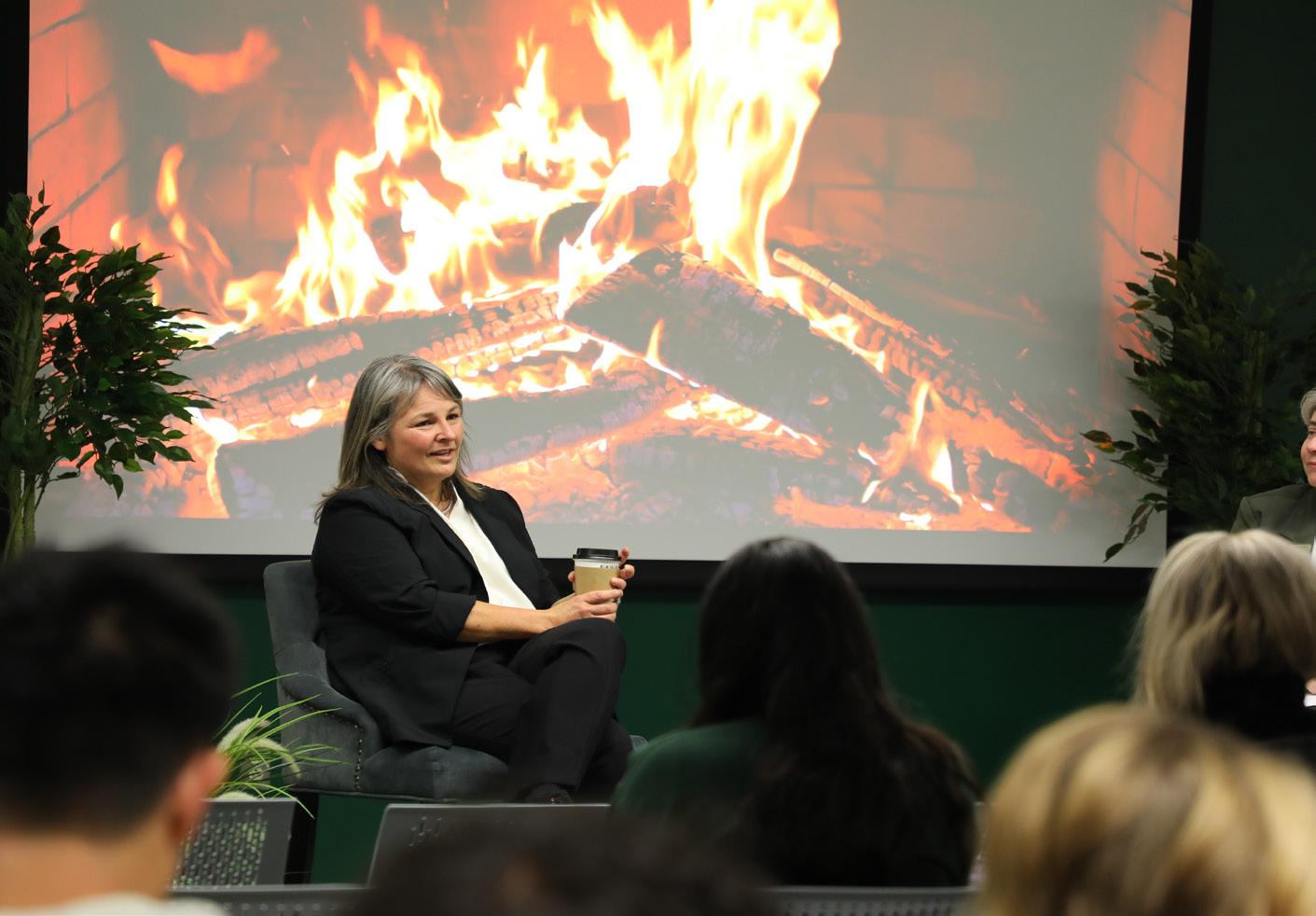
“In GRI 2.0, we will have visiting fellows, practitioners that come and are in residence at William and Mary for a week to work with students, to work with faculty and to engage with university leadership to think about how we can do more applied research at William and Mary,” he said.
Tierney noted that the visiting fellow tradition, which will include a fireside chat, is only part of an even broader transformation of the College’s research landscape.
“Tis is really the second in a series of conversations that the GRI is hosting about the future of the university,” Tierney said. “Te Global Research Institute is transforming itself into a research incubator and a research accelerator for the university.”
Wilson, a statistician and expert on nuclear weapons with extensive experience in the applied research sector, sat down with Flagg, the current executive director of the Andrew W. Marshall Foundation and senior advisor to the Center for Security and Emerging Technology at Georgetown, to discuss the shifting dynamic of federal funding, the possibilities of Artifcial Intelligence and the role of research universities in the future.
Te visit was Flagg’s frst to the College and ofered an opportunity to engage directly with international relations scholars and students interested in her interdisciplinary work.
part of a long-anticipated application process. Te screen stayed dark.
“It wasn’t until ten minutes in that I realized the government’s shut down,” she said. “No one’s on the other side of this.”
What followed was a wave of delays: background checks, visa processing and fnancial aid.
“It’s already a stressful and uncertain time,” Tifn said. “And this added just another thing to hold.” Tat moment of pause did not lead her to bitterness. Instead, it led her back to Wesley, where she leads with quiet resolve.
“Part of radical love and radical solidarity is loving your MAGA neighbor, too,” she said.
Te group’s pinned Instagram post echoes that same commitment.
“Please know that you are beloved and not alone. Te best thing we can do in this moment is to love our neighbors — especially our neighbors who are most marginalized. Wesley will continue to embrace our campus community with radical love, reconciliation, and justice for all — more so than ever before,” the post read.
“I joined the Phage lab with [Chancellor Professor of Applied Science] Margaret Saha,” Flagg said.
“Last night, we had a dinner that actually brought people both from international relations and synthetic biology all having dinner together. It’s been really incredible. It’s really challenged me to be able to move between those topics and to pattern-match and see how they coexist and how they afect each other.
And so it’s given me maybe another opportunity to refect on the nature of interdisciplinary as well.”
While completing her doctoral degree in pharmaceutical chemistry, Flagg envisioned herself conducting pharmaceutical research in Panama.
But after an unpleasant experience pursuing that opportunity, Flagg decided she wanted to strike out on a career in academia.
“I came back to Arizona,” Flagg said.
“I fnished my Ph.D., obviously, but I also decided, ‘I’m out. I’m done. I’m going to be a bartender in St. Tomas.’
I have a friend who lives there. She’s a pharmacist. She’s going to help me get a job. I went to bartending school for a week. I was like, ‘Tis is it. Tis is what I’m doing.’”
As fate would have it, one of her former undergraduate professors reached out, ofering her a year of postdoctoral work. Eventually, she encouraged her to apply for a policy fellowship with the American Association for the Advancement of Science. She would move to Washington, D.C. in 2001 to
start in that capacity, with the goal of working on sustainable development in Africa and Latin America at the United States Department of State.
However, during the frst week of her starting at the State Department, the Sept. 11 attacks took place.
“It was like, ‘Well, we’re not going to be working on sustainable development now,’” Flagg said.
Wilson opened the conversation by touching on the rapidly shifting relationship between the federal government and research universities, especially since the return of the Trump administration. In these shifts, she argued that the critical importance of scientifc research within university settings has been uniquely challenged.
“I think it is a really interesting moment because we are clearly transitioning to something, but that future isn’t written yet, right?” she said.
“So we have a foot on either side of the fence, and you don’t get a lot of rewards or incentives to be the one authoring the future in the current system. But you also don’t want to be the person who didn’t evolve fast enough.”
At the State Department, Flagg said her supervisor disliked working with the military, which meant she was the one attending meetings with the armed forces. She explained how international science collaboration evolved in response to heightened national security concerns.
explain it one way, but ALEKS explains it a different way, and then it doesn’t really match.”
Before the start of the 2025-26 academic year, the Studio for Teaching and Learning Innovation at the College of William and Mary held a workshop on adopting Artificial Intelligence policies for courses. As AI becomes more advanced and applicable, STEM professors in particular have begun to integrate AI into their courses.
At the College, STLI provides generative AI resources for professors. Some programs that STLI has already approved include Microsoft Copilot, Adobe Firefly and Blackboard Learn AI Design Assistant. Other AI resources, such as ALEKS, are required for certain STEM courses, like Chemistry 103: General Chemistry I.
CHEM 103 teaching assistant Samantha Orr ’25 highlights the benefits of this program, where Gradescope autogrades multiple-choice and short-answer questions.
“It saves me from having to grade 200 problem sets 12 times a semester, which is really convenient for me,” Orr said.
While generative AI provides valuable homework resources for these classes, there are also concerns, such as environmental impacts and accuracy.
“I feel like sometimes it misses the mark, like relating to professor-specific questions,” Orr said. “A professor may
BOARD OF VISITORS
Some syllabi state that this program often makes mistakes, which may impede its ability to take full responsibility for grading.
“I don’t think it should ever take the place of human touch,” Orr said. “I think it can speed up the process, like with grading, but I still think you should always have a person looking back over it and double-checking.”
Some computer science students find that generative AI decreases the workload at the expense of their learning.
Computer science student Chloe Toda ’29 explains how students view utilizing AI for assignments.
“It could be useful for other projects in the future if we actually knew what we were doing as opposed to just having the code doing it for us,” Toda said.
However, there are some benefits to using AI for coding.
“Sometimes it’s helpful to have AI generate certain test cases that you might not think of that will actually break your code,” Toda said.
Integration exists at varying degrees. Chemistry, for example, uses AI for the majority of its homework model. STEM-related COLL classes, on the other hand, have a different relationship with these materials, discouraging the use of AI for writing.
Assistant teaching professor Kelly Hallinger, who teaches
a biology COLL 150 course, stated that the College is providing resources to all of these professors regardless of the course model.
“I attended a workshop run by the Studio for Teaching and Learning Innovation before the semester started, and one of the topics that was covered at that workshop was adopting an AI policy for your class,” Hallinger said.
STLI is just one example of how AI policies are becoming more commonplace in STEM courses. This year, it became mandatory for syllabi to include an AI policy. Some people view this as a negative shift from other traditional sources of insight and education.
“Take it with a grain of salt,” Toda said. “Go to real people for help instead of relying on AI all the time.”
There is a concern that students may overutilize AI.
“If we don’t teach students its limitations and we don’t teach them how to use it appropriately, then they’re going to use it anyway, but without oversight and guidance,” Hallinger said.
Even though AI is being used in this context for learning, it is still a new tool, and some argue that traditional materials should not yet be abandoned.
“I think that when you’re learning foundational skills, it’s important that you go through all of that struggle of the process yourself,” Hallinger said.
Spencer addressed that the College’s firstt ime Bar Exam pass rate decreased last year from 92.96% to 83.63%. He explained that the dip was due to an undisclosed topic appearing on the exam nationwide, similarly hurting other law schools’ outcomes.
“All schools in Virginia suffered in that year, but that pain was not shared equally across the country,” Spencer said. “I can elaborate further on that. We have taken measures to intervene with the first-time Bar pass rate. For the class of 2025, for which data was not available at the time this was prepared, that is now at 93.25%, so that has rebounded.”
Spencer cited the law school’s need to “significantly grow non-J.D. tuition revenue” long-term in order to alleviate the financial burden on J.D. tuition. He explained that J.D. revenue currently represents a large proportion of the law school’s total budget after the College lost a majority of its L.L.D. students. In response to that drop, Spencer led the creation of an online master of legal studies program, which has so far amassed 70 students and which he said has already begun to replace some of that lost revenue.
“We are a J.D. tuition-dependent institution,” Spencer said. “Our LLM revenue, which was fairly robust in the late 2010s, declined precipitously because it was over-dependent upon China and Saudi Arabia for students. Those two cohorts completely disappeared through COVID and the geopolitics of the past five years.”
Finally, Spencer addressed the rising demand for lawyers who are well-versed in AI, leading him to incorporate AI-related assignments into the law school curriculum.
“The bottom line here is that AI is certainly not going to replace lawyers, but lawyers who can use AI will replace those who don’t,” he said. “The other thing from a law school administrator perspective is that AI provides augmented productivity that enables one lawyer to do the work that was previously done by two,
three or four.”
However, Spencer shared that the decreasing demand for legal services across the board has led him to shrink the number of J.D. students admitted to the law school. Notably, the law school class size has decreased to 183 in 2025 from 230 in 2020.
“You may hear in higher education, particularly on the undergraduate side, that the imperative is to grow enrollment,” Spencer said. “That is not an imperative in the law school context. We want modest enrollment that’s appropriately sized for the market that students are graduating into to make sure they have opportunities for success.”
Dean of the Batten School of Coastal and Marine Sciences Derek Aday focused his presentation on positioning the College as a national leader in coastal resilience, becoming a “premier destination” for students and postgraduate researchers studying the existential challenges facing coastal communities and ocean systems.
Aday underscored the school’s heavy contribution to the College’s total research output, which he said propelled the College toward receiving an R1 designation in February.
“We function in this school like an R1 university and always have,” Aday said. “And it is good for us to be attached to an R1 university, [as] that brings additional recognition, visibility and opportunities for our faculty, our staff and our students.”
In addition to producing “top-tier, jobready graduates” and investing more funds in undergraduate applied-learning experiences, Aday discussed the school’s growing role as an expert advisor on state and nationwide policy outcomes.
“We get a lot of testimonial requests in Richmond, and increasingly, we’re getting testimony requests in Washington D.C.,” Aday said. “It’s because we do that science translation that is so important to policy development.”
Amid the school’s success, Aday addressed the major challenge of maintaining its high
Feb. 21, which closed campus operations for days.
Tuesday, Nov. 18, numerous students protested the proposed budget cut for the Ninth Annual Sankofa Gala. Allison Robinson-Wilson ’26, president of the Minority Pre-Law Association, and a member of Alpha Kappa Alpha Sorority, publicly spoke out against the budget cut.
Te Ninth Annual Sankofa Gala Act proposed changing the catering and food budget from $6,700 in 2025 to $4,500 for 2026.
Te Gala, held each spring semester, brings together African American students and professors to celebrate their accomplishments. Since its peak attendance in 2024 with 300 guests, the number has started to decline. In 2025, 115 people attended. However, the sharp decrease in attendance was likely due to a snowstorm Feb. 19 and 7 inches of snow
However, what Robinson-Wilson spoke out against was a budget cut that would lower the food budget from $4,500 to $3,000 — a 55.2% decrease from the previous year.
“It is an unfair, unjustifiable and improper comparison to argue that any description of low attendance is the product of poorly organized events and not external factors,” RobinsonWilson said.
Robinson-Wilson also addressed a comment from Sen. Ryan Silien ’28, chair of the Finance Committee.
“He said, and I quote, ‘Food isn’t integral to the event.’ Te thing I want this body to understand is that food is necessary to celebrate Black community and Black progress,” Robinson-Wilson said. “Food is ultimately a human right and is a symbol, a beacon, of how many members of the Black community have engaged with their history, positionality
research output in a federal funding climate that has already endured science-related drawbacks. Because the school normally relies on federal funding for 50% of its operating budget, Aday has already begun making financial adjustments.
“There’s this pragmatic piece, which is that we’ve seen about a 75% reduction in new federal funding this year, so that’s a big hit for our budget,” Aday said. “The other piece I really want to avoid here is a disruption in this momentum. This charge forward that we have — and this ambition to be nationally recognized and pre-eminent and to stay focused on that strategy — takes a lot of time down in the weeds now to keep programs going and to keep people employed.”
Aday shared that the Batten School’s use of AI is centered on enhancing scientific modelling efforts related to environmental forecasting. Along with other schools, Aday aims to encourage ethical AI use in classroom settings to boost learning outcomes.
“We’re launching this year a new Center of Excellence in Environmental Forecasting,” Aday said. “This is where to take the flood model, sea level rise, storm surge, water quality issues, fisheries issues, and we’re building what will be a nationally-recognized forecasting center with some of the best models out there. And we’re just now at the point that we’re building AI into them to enhance those models.”
Board member Stephen J. Huebner ’76, P ’09 asked whether Aday had considered corporate outreach efforts to establish new revenue-generating partnerships that could potentially replace lost revenue from the federal government. Aday said the school has already started collaborating with the private sector, but that such revenue would likely not be able to match the federal funds on which the Batten School relies.
Aday also expressed an interest in starting a “four-plus-one” accelerated graduate degree program at the school, allowing students to enter the workforce more quickly.
“Right now, a typical master’s degree in the
and hope for the past 250 years.”
Robinson-Wilson connected the budget cuts to the signifcance of food in African American history.
“It is the food that slave owners did not want. It is the food that segregation has tried to prohibit. It is the food of taking nothing and turning it into something great,” Robinson-Wilson said.
Silien informally proposed the budget cut during a Finance Committee meeting. Although not ofcially introduced into session, many students on campus felt Student Assembly support for the African American community on campus was waning.
In a later discussion about the bill, Silien responded to RobinsonWilson’s comments.
“If I may, I want to say thank you to Ms. Wilson for coming and speaking on behalf of this bill,” Silien said. “I mean, this is an incredible event that the Student Assembly does, and it is incredibly important to be having,
especially right now.”
natural sciences is about three years, so that puts you at seven years for a bachelor’s and a master’s,” Aday said. “If we could get that to five, that would be a real win and would feed into national pre-eminence.”
Dean Robert C. Knoeppel of the School of Education centered his presentation on maintaining the College’s status as a “center of educational change” in the Commonwealth of Virginia, while also boosting community impact.
He described the school as a “nationallyrecognized program,” citing a letter from the Council for the Accreditation of Educator Preparation received Tuesday, Nov. 20, which bestowed full accreditation in school psychology to the College.
Knoeppel also highlighted the school’s 100% placement rate of graduates directly into teaching positions in 2024, followed by a 97% placement rate in 2025. He also shared that research expenditures have doubled since 2020, from $6.9 million to $13.7 million.
Knoeppel said the statistics attest to the school’s contribution to the College’s R1 designation, underscoring that they are the largest producer of doctoral degrees.
“It was a remarkably successful year for us, and when we think about educator preparation, we know that our students are prepared and ready to go into the field.”
Knoeppel emphasized that the school must play a role in filling a rising demand for teachers across the state, equipping students with the skills to be effective educators.
“This is a really challenging time in education,” he said. “There’s a huge [educator] vacancy rate in the state. It’s gotten better in the last two years, but the average vacancy rate in Virginia was about 7.5% and it’s now just shy of 4%. But here on the peninsula, it’s over 11% in many of the school divisions. And I want to point out that ‘vacancy rate’ means that jobs are open.”
Silien continued by explaining the Organization Budget Allocation process and the high rate at which SA funds events.
“Our OBAC guidelines — as a reminder, OBAC is the organization that funds clubs, clubs that have food events — cap it at $5 per person. So already, we’re seeing that Student Assembly funds events at a much higher level,” Silien said.
Silien further noted that the proposed gala budget would exceed the $5-perperson guidelines set by OBAC.
“With the bill as it stands right now, with an estimate of attendance, we’re funding at $32, $33, which is quite a lot, especially with the conversations we’ve been having about reserves this year,” Silien said.
Numerous students felt that support for the celebration should not be put at risk solely to save money. Among such students is Dativa Eyembe ’26, an
Africana Studies major who attended the meeting.
“It’s hard to hear that things like that are at risk, in that kind of way,” Eyembe said. “I think that’s why many of us are here — to speak out on that. We want to show our support.”
Robinson-Wilson further highlighted the importance of celebrating Sankofa, which allows Black students the opportunity to dress up and celebrate all their accomplishments.
“Sankofa is the only event where Black students are allowed to come, dress up, celebrate and relax,” RobinsonWilson said. “It is a continuous symbol of how far we have come at William and Mary with respect to our achievements as people and our community.”
Many senators emphasized the importance of balancing saving SA’s fnancial reserves with actively supporting the College’s community.
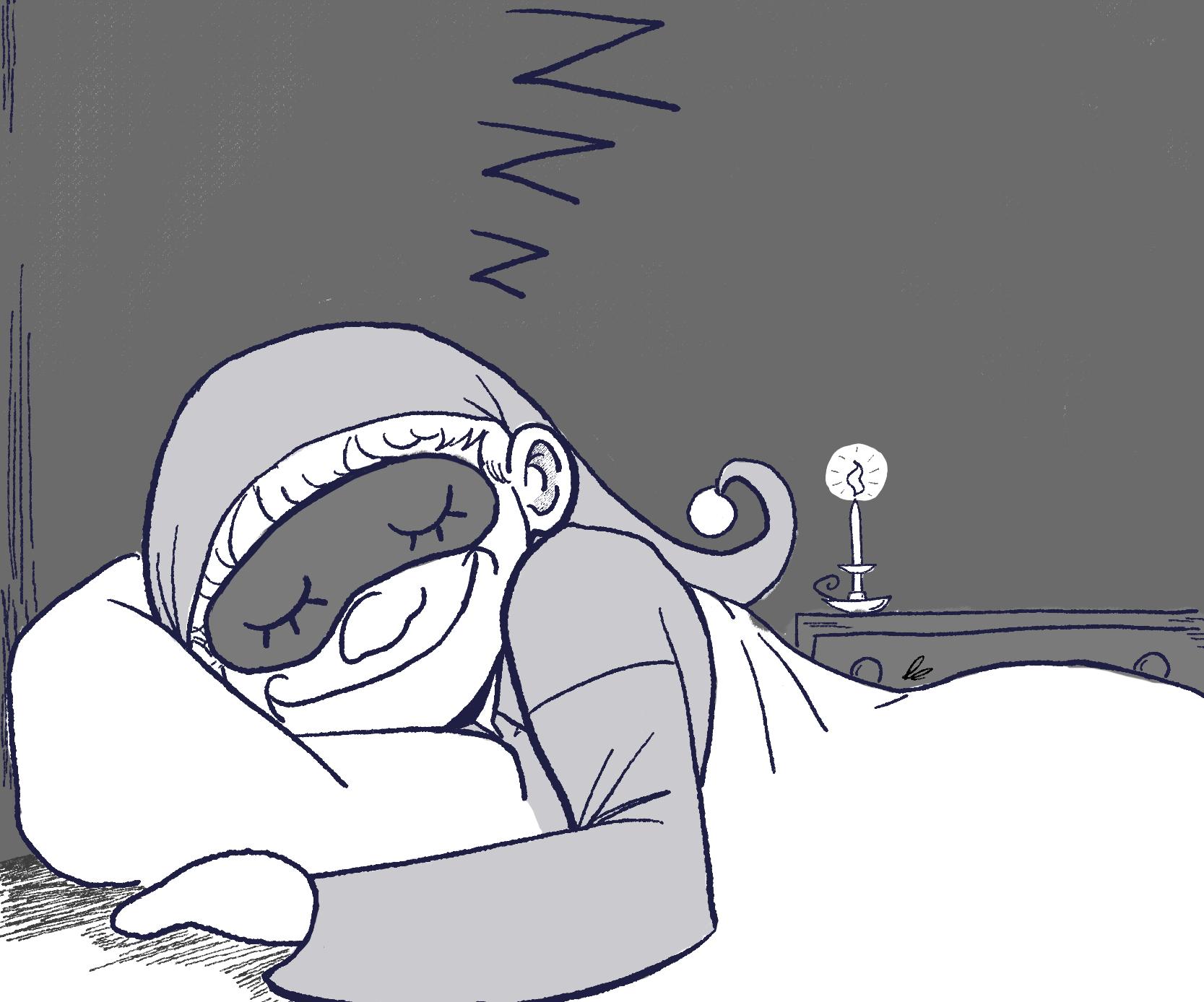
We’ve all been there — 3 p.m. hits and you just can’t seem to keep your eyes open. Maybe you’re done with classes for the day, so you head back to your room, drop your bags on the floor and crawl into bed. Then, the age-old question arises: to set an alarm, or to not set an alarm?
Setting the alarm is a brave act of self-restraint. In choosing to wake yourself up, you are escaping sloth’s grasp at the price of enjoyment. You may be gambling on the amount of rest you ultimately get, but at least you’ll be able to sleep later on tonight, right?
On the other hand, not setting an alarm liberates you from the pressure of cramming good sleep into a time restraint. You are telling the world that you do not conform to typical ideas of night and day. Different types of naps are good for different scenarios. But which is best for actually maximizing your energy during the day and your sleep quality at night?
Let’s review …
Our shortest nap is the power nap. It should last around 10 to 20 minutes, and it’s best for increasing energy levels immediately upon waking up. Its brevity minimizes the risk of interfering with your sleep at night. These are great if you’re short on time, or just need a quick pick-me-up to continue your day.
A drawback to the power nap, however, is in its brief duration. Knowing you only have 20 minutes to rest can cause stress and inhibit your body from fall -
ing asleep. In this case, simply closing your eyes and trying to sleep is still a good tool for recovery. While falling asleep is ideal, the main goal is to increase energy, which resting (even while awake) will do.
Next, with a longer runtime, we have the recovery nap. Maybe you were up late last night studying, or you had trouble falling asleep. The recovery nap functions as a replacement for sleep loss. These naps should last for 90 minutes in order to complete every stage of the sleep cycle.
One caution to take with the recovery nap is the timing. Because this nap is longer, you’ll want to take it in the early afternoon. Napping for long periods of time too close to nighttime will only further disrupt your sleep, creating a vicious cycle of sleep deprivation and recovery napping.
The best nap for increased energy is a bit contradictory in concept. Called a “coffee nap” or “caffeine nap,” the idea is that you consume caffeine of some sort (ideally, a cup of coffee or tea rather than a supercharged energy drink) and then sleep for 20 minutes. This gives the caffeine enough time to start working immediately upon waking up.
Again, it’s important to be careful with the caffeine nap. You want to do this earlier in the day so as to prevent the caffeine from disrupting your sleep at night.
Lastly, we have my favorite type of nap: the appetitive nap. The appetitive nap is a nap taken for enjoyment, rather than energy: a nap for the sake of napping. Is there anything better than getting cozy in bed, putting on some quiet music, and just letting yourself float freely from your worldly responsibilities? These naps can help with relaxation and mood (and are probably a better mental break than doomscrolling on TikTok). Though sleep experts advise to keep these naps within 30 minutes, I believe we shouldn’t limit enjoyment.
Most importantly, for the appetitive nap, listen to your body. If at 30 minutes you naturally wake up feeling rested and relaxed, you’re probably better off ending your nap. If you knock out for two hours … well, you probably needed the sleep.
These are just four types of naps among many that exist. It’s best to assess your scenario when determining which nap is best for you — how much sleep did you get last night, will this affect your sleep tonight and what are you trying to get out of this nap?
Complexities aside, naps should always be enjoyable and restorative. Good night and sweet dreams!
Kelsea Smith ’29 (she/her) is a prospective English major.
On campus she is involved in club rowing. She enjoys being outside, listening to music and trying new coffee shops. Contact her at ksmith07@wm.edu
The trash-sorting robot in Sadler reveals more about us than our waste GUEST

If you’ve walked into Sadler Dining Hall recently, you’ve likely been greeted by the College of William and Mary’s newest campus sentinel: a trash-sorting robot stationed by the entrance, equipped with a small camera and an expressionless devotion to sustainability. Before you even swipe in, the machine scans whatever you’re holding with the intensity of a TSA agent convinced your yogurt cup could be a national security threat. It whirs, blinks and flashes soft green approval or red disappointment. It’s earnest. It’s eager. And depending on whom you ask, it is either a revolutionary leap in campus environmentalism or an expensive way to tell students, once again, that compostable plastics rarely are.
I’m not opposed to the robot, truly. If anything, it has a certain charm, like a Roomba that reads Foucault and now polices disciplinary regimes of waste disposal. But its presence raises a larger and more pressing question: Why are universities, ours included, so quick to invest in technological spectacle before establishing whether the technology actually works?
Let’s assume full faith in the machine. It identifies compostable material with machine-vision precision, reduces contamination rates and prevents students from tossing entire takeout boxes into the nearest bin as an act of environmental improvisation.
The problem is that we don’t know any of this.
We have no published data on accuracy, no contamination metrics, no comparison to human sorting and no sense of cost versus impact. Institutions often use technology as a shorthand for progress; something shiny, camera-equipped and ‘AI-adjacent’ that signals environmental virtue without demanding the structural work of behavior change.
It’s the sustainability equivalent of installing a smart thermostat in a drafty house. An admirable gesture, yes, but a wrong fix.
And this isn’t just about compost. Universities nationwide have embraced the logic that technology equals improvement through predictive advising algo -
rithms, automated mental health apps, attendance scanners, plagiarism detectors and now a machine that analyzes your trash with greater scrutiny than your academic transcript.
But campus problems are in general are rarely technological.
Students don’t mis-sort waste because they need a robot to instruct them. Students mis-sort waste because compostables versus recyclables is genuinely confusing, signage is inconsistent, they’re rushing or they don’t believe that one misplaced wrapper will doom the climate.
A robot can alert, correct or glare (in its gentle, LED way), but it cannot build a sustained environmental culture. It cannot educate. It certainly cannot substitute for institutional transparency. And relying too heavily on tech can obscure the need for human-centered solutions: clearer messaging, betterdesigned signs, trained student workers or five minutes of compost education at orientation. These interventions are not glamorous but, unlike the robot, they actually might work.
The College truly cares about sustainability, and that’s commendable. But sustainability is not an aesthetic; it is a practice rooted in consistent human behavior, structural support and measurable outcomes.
A trash-sorting robot can contribute to that vision only if it’s part of a broader ecosystem that includes education, accessible information and visible accountability. Without that, the robot becomes less a tool and more a campus mascot — a symbol of environmental aspiration rather than environmental progress.
The irony is that a sustainability tool lacking transparency risks becoming yet another form of waste. The robot’s existence isn’t the issue. Our relationship to innovation is.
Technology can advance sustainability, but it must be grounded in clarity and human-centered design. Before we invest in increasingly elaborate gadgets, we should ask the simpler questions: What problem are we solving? Does technology solve it better than education? Would a well-designed sign be more effective?
Until then, the Sadler robot will continue its lonely vigil. Scanning coffee cups, interrogating snack wrappers and doing its best to make sense of our compost habits.
Frankly, it has my sympathy. Many of us are trying to make sense of human behavior, too.
RhysRunnels‘29isaprospectiveinternationalrelationsmajorintheStAndrews JointDegreeProgramme.BesidesThe FlatHat,heisamemberoftheStudent AssemblySenate,SwimClubandIgnite GlobalHealthLab.Helovesrunning, readingandspendingtimewithfriends. Contacthimatrtrunnels@wm.edu


Contentwarning:thisarticlediscussesbodyimageanddisorderedeating.
As a teenage girl, I will be the first to admit that I care about how I look. A couple of weeks ago, my mirror shattered, and it was more of an inconvenience than I’d like to admit. And while I try to keep this obsession at a low, and, more importantly, healthy level, it seems like everyone and everything on the internet is dead set on encouraging otherwise.
A couple of years ago, “body pos -
itivity” was the primary focus of health discussions. The goal of the movement was to encourage equal treatment of all individuals, regardless of opinions, and to promote selfconfidence. After radicalizing to an outright justification of unhealthy lifestyles in the name of positivity, I’ve noticed a stark shift in public conception of health. Society has reverted to 2000s standards, now with further reaching indoctrination.
A couple of weeks ago, Disney+
started airing Serena Williams’ ad campaign for Ro, a GLP-1 medication similar to Ozempic. In a 30-second video, Williams argues against the “cheat code” perspective on GLP-1 medication and boasts that the process helped her lose 31 lb. I know nothing about her personal weight loss journey or individual reasoning for using and promoting Ro, but I find it striking that one of the world’s greatest athletes — not to mention female athletes — is the face of weight loss medication. She may have genuine health concerns that justify the necessity of the medication, but no real explanation is featured within the advertisement beyond a mention of postpartum weight loss. As someone who couldn’t even conceptualize being as strong an athlete as she was, I have a lot of trouble not internalizing this message. The first thing that Google suggests upon searching her name is “Serena Williams ... weight loss.” If Serena Williams, one of the greatest tennis players to date, with 23 Grand Slam singles titles, is reduced to solely an image of weight loss, how can I maintain a positive image of my own health?
It has reached a point where it’s truly inescapable. Every single time I open my phone, I am bombarded with skinny
With America rapidly approaching its 250th year, I think of the founders of this country who had ambition and hope for a fresh start after dealing with Great Britain’s tyrannical rule. With the creation of documents such as the Declaration of Independence, the Constitution and the Bill of Rights, the founders were quite revolutionary (no pun intended) for their time. Although they are still viewed as such, many questions have been raised: how are they upheld in a contemporary American society, or how applicable are such documents to all folks in the United States? Meanwhile, numerous critics have discussed the misconstrued handling of these documents and this country, which would make the founding fathers quite literally roll in their graves.
Let’s begin with these sacred principles, which are the foundation of America. The Declaration of Independence famously states in the preamble (which Thomas Paine wrote first in “Common Sense”), “We hold these truths to be self-evident that all men are created equal.” Did Thomas Jefferson write this with women or any minority in mind? Obviously not. If he meant everyone in America, we wouldn’t have had to continuously advocate for basic human rights among these groups, which are still being challenged and questioned to this day by the politicians in power. In the 21st century, the right to life, liberty and the pursuit of happiness is an unstable construct to many folks in this country, especially the farther you stray from the privileged, white male, which all the document signers were.
The Bill of Rights includes our inalienable rights, which are granted to us in this country. Yet, we find ourselves reflecting on the suppression that is actively occurring ... again. Rights like freedom of speech, freedom of the press and power to petition the government are some of these rights being breached among numerous citizens. Many extremist CEOs and billionaires buying social media platforms is detrimental to citi -

zens who have opposing views. Several peaceful protests have become violent or have been painted as ‘violent,’ which has led to unnecessary deployment of the National Guard. These are just a few of the violations of these inalienable rights that undermine these rights and the people of the United States.
The Constitution is supposed to be a live, updated document. It is not; it hasn’t been updated in over 30 years. This would make Thomas Jefferson quite literally rage if he found out this constitution isn’t being updated, but instead is on a ventilator. Plus, there have been major decisions passed, such as Roe v. Wade, which could’ve been an addition to the Constitution, and if it was, we wouldn’t be nearly fifty years behind on reproductive rights now. However, the process to get an amendment is extremely difficult; while it was a wellthought-out clause, this could lead to a reason why Congress doesn’t even bother. Even then, with its amendments, how does a supposedly lively document change with the times? Put shortly, it slowly adjusts. Amendments like the 13th and the 19th, abolishing slavery and allowing women to vote, should’ve been in America’s foundations, and not thought of as, “Well actually, maybe that IS a good idea.”
The discussion of this country goes hand-in-hand with the discussion of these documents. They interlink
with one another; some may propose that the politicians in power may have something to do with these shortcomings, or how has the system of this country gotten to this point?
Has it always been this way, or did we eventually get here by some particular reasoning or person? Politicians, of course, aren’t your guardian angels. Nor our political parties. George Washington advised not to create a two-party system; yet we did, and we are as polarized as ever. And when politicians mishandle the land of the law for their benefit, it becomes a crucial issue for their constituents. Whether it be any form of manipulating amendments to benefit politicians, suppression or outright ignoring them, these actions reflect politicians’ inability to help the American people.
In 250 years, the United States has experienced quite a bit of change. However, the founding fathers intended for their successors to uphold what they wrote as the country’s foundational law. Yes, I like being here, and yes, I will criticize her and work towards a better, more guided America in the future so that the next generations will be in a better place than we are now (or I hope so, at least).
Thelma Kestner ’29 is an international relations majorandhistoryminor.
SheisinvolvedinYoung Independents,VinylTap, WCWM, Theodore Roosevelt SocietyandPhiMu.Contact herattekestner@wm.edu.
propaganda, whether it’s ab workouts with “guaranteed results in weeks” or the latest new diet, my algorithm is filled with people telling me that something about my body is wrong. Many creators, whether knowingly or not, advertise disordered eating or discuss food in ways that discourage finding balance. Even the TikTok shop advertisements are posted by clearly chosen body types, so even if I don’t engage with beautyfocused content, it’s still forced down my throat, reinforcing an unrealistic body standard. Further, the plastic surgery industry has grown both rapidly and covertly, leaving individuals unable to distinguish between a product of a really good ab routine or a liposuction.
So, despite my best efforts to prioritize real health, exercise and food for fuel, I find myself caught up in obsessive patterns viewing a thin body as the ultimate standard, regardless of what that means for actual health. Disordered habits, which I know are objectively unhealthy and for the most part ineffective, call out to me in my darkest spirals. Whether I try to avoid the content or not, it shows up as an inescapable message haunting everything I do, and I’m sure I can’t be the only one.
Despite the 180 flip on body posi -
tivity, it’s controversial to even say you want to be skinny, despite everyone advertising that you should be. Admitting that the constant media objective has had an impact on my impressionable mind is often received as a fatphobic comment, rather than a byproduct of the unavoidable messaging that lurks throughout my daily life. Discussion on this topic requires a careful balance of calling out the culture without admitting your place in it so as not to offend or trigger anyone. It has grown so taboo that we’ve normalized this new custom.
This sweepingly invasive content is pushed for a single reason: Everyone is trying to sell us something. Whether it’s a weight loss medication, meal and workout plan, or a set of beliefs that provide them with power, creators have an agenda that they intend to sell, fearmongering and degrading the viewer into buying into this set of values — values that keep corporations in power by constructing insecurities and selling the solutions.. Abby Crespin ‘29 is a prospective history major and sociology minor, on a pre-law track (hopefully!), and a member of Delta Gamma sorority. Abby enjoys skiing, thrifting and unnecessarily overthinking.

Christmas music is good. I’m the first person who would agree with that — putting on a playlist to bake festive cookies, listening to the ever-present speakers in the mall and choosing the perfect soundtrack for your holiday meal are all delightful. However, it’s also limited. As good as our favorite holiday songs are, there’s only so many of them that we hear regularly. After a few days in the peak of the holiday season, it can start to feel like you’re just listening to the same songs; songs that are undeniably classics, but that also sometimes get old. There’s only so many “Jingle Bells” and “Silver Bells” and all the other bells songs I can hear before I start desperately looking for some variety, and I’m sure I’m not the only one who feels that way. It can get upsetting, but the good news is that it doesn’t have to! There’s a lot more out there than what we think of and what’s on the Spotify Christmas hits playlists. Let me encourage you to open your minds and ears this holiday season and look for some new songs that might just end up being your favorites.
First, and most importantly, I have a special place in my heart for the sad indie Christmas genre, and if I have one goal in writing this, it’s to get everyone to appreciate it too.
Take Phoebe Bridgers, for
example. Beginning in 2017 through 2022, she released a holiday single each year. Some, like “Have Yourself a Merry Little Christmas” and “Silent Night,” are subdued and stripped covers.
Where she really shines, though, are the originals, like “Christmas Song” and “If We Make It Through December.” With simple piano backing and those always-perfect Phoebe vocals, her sad singles provide the perfect contrast to cheery department store music.
But you might be saying, “Christmas isn’t supposed to be sad!” And yes, this is true. But in addition to the holiday season being a time of happiness and joy, it’s also a time of nostalgia, especially for people like us growing out of our childhoods. And what better way to enjoy nostalgia than with some slightly sad holiday music?
These sad tunes might not be the best soundtrack for excited baking or present wrapping. However, they’re perfect for an early morning walk in the cold with a warm mug of coffee, relaxing on your couch working on a holiday craft or staring out the window at falling snow (or in my case as a Floridian, pretending there’s falling snow).
It’s not just Phoebe Bridgers who excels in this subgenre. I’d also highly recommend Peach Pit’s “Did I Make You Cry on Christmas
Day?” as well as Bleacher’s “Merry Christmas, Please Don’t Call” for some more good sad holiday vibes. And, of course, “White Winter Hymnal” by Fleet Foxes is perfect for a slightly unsettling winter day.
It might sound a bit nonsensical, but trust me. When you’re feeling the Macy’s music fatigue, check out some indie Christmas originals. Related to these, you don’t have to turn all the way to original songs to get away from some of the overplayed hits. Instead, finding a different-style cover can be just as refreshing. One of my favorites is Sufjan Steven’s “Silver and Gold” album (which does include a few originals in addition to many covers).
If you’re not sold on the slightly depressing vibe, Lucy Dacus has a wonderful cover of “Last Christmas,” and the Shins’ version of “Wonderful Christmastime” is also great. They’re a bit more upbeat, trading out the keys for electric guitars and drums, but still offer some variety.
Lastly, I may be slightly biased as a Swiftie since, like, forever, but if there’s one song for that college-age, home-for-the-holidays nostalgia, it’s “tis the damn season” from Taylor Swift’s “evermore” album. There’s nothing like staring out the airplane or train window making that journey home with this song as the soundtrack.
Overall, this holiday season, if you’re getting tired of the classics, don’t let it ruin your spirit entirely. Instead, turn to something else: originals, covers, whatever strikes your fancy. You won’t regret it.
LindsayLuberecki‘29is aprospectivechemistryand Englishdoublemajor.She isfromSarasota,Fla.and enjoysspendingtimewith friends,listeningtorock musicanddrinkingiced coffees.Oncampus,she’s involved in Global Medical Brigades,VoxandCheese Club. You can contact her at laluberecki@wm.edu.

Thursday, Nov. 20, was opening night for the College of William and Mary theatre department’s fall musical, “The Scarlet Pimpernel,” directed by professor of theatre Laurie J. Wolf.
The musical opened with lead actress Mia Cummings ’28, who played Marguerite St. Just, accompanied by elaborate costumes and stage design. As she gestured out into the crowd to the male lead, Kiran Behr ’27, who played her fiancé Sir Percy Blakeney, the spotlight revealed his character out of the darkness, hinting at how the play would continue to toy with the audience’s expectations.
“The Scarlet Pimpernel” was written by Frank Wildhorn and with book and lyrics by Nan Knighton, which are based on the classic novel by Baroness Orczy. Taking place during the Reign of Terror period of the French Revolution, the play follows the exploits of British aristocrat Percy Blakeney, who is married to French actress Marguerite St. Just, as he leads his band of men to rescue innocents from the doomed fate of the guillotine. Hiding his identity under the guise of the “Scarlet Pimpernel,” Blakeney must deal with the consequences that his double life has on his marriage. He also has to work to evade Citizen Armand Chauvelin, who is a cunning French agent determined to continue subjugating people to the guillotine and seeks to eliminate the elusive Scarlet Pimpernel who stands in his way. Guided by its dynamic score, the story weaves together themes of romance, comedy and intrigue to tell a story of grand adventure and trickery that had the audience at the edge of their seats.
The audition process for the musical began back in September, with monologue, dance and singing components.
Brennan Gordon Metz ’28, who played Chauvelin, spoke on his audition experience and working with his cast members.
“There was a real energy to the people that ended up getting casted between everyone when we do the scenes together, which looking back is crazy because now, we’re all just like a family,” Metz said.
Once the cast was confirmed, the show moved forward with an ensemble of 14. Rehearsals ranged from 10–12 hours a week, and then amped up to full days in the Glenn Close Theatre the weekend prior to opening night.
Jonathan Aspin ’27, who played Armand St. Just, Marguerite’s younger brother, said visualizing the set while it was being built was a challenge for him during the preparation process.
“When you have a play that is so intricate about a multi-level
set and you don’t have those multi-levels for about a month and a half of the rehearsal time, you begin to really want that set up, which, our brilliant stage crafters were spending time building it,” Aspin said. “So we all understood, of course, but I think the biggest challenge was just being able to properly visualize what this will all look like in a proper stage setting when we were originally just in the rehearsal room.”
Actors had different experiences preparing for their different roles. Some found their roles to be a kindred spirit while others had to play with the complexity of how their character could be reinterpreted.
For Abby Brown ’27, who played Marie Grosholtz, Marguerite’s best friend, and worked as the dance captain, the role of Marie felt like an extension of Brown’s own personality.
“I really love how headstrong and set in her beliefs she is,” Brown said. “She isn’t scared to back down from a challenge or scared to back down from an ideal or anything. And I am very passionate about my beliefs and don’t necessarily back down just because someone says I have to, so I feel like we align on those levels a lot.”
Metz, on the other hand, found his character Chauvelin to be more of a challenge to adapt to as he strived to portray the tortured villain.
“It is such a wildly tragic character in my eyes, and the way it’s been played before, I had a problem with how it read in the text. I thought there was something there that hadn’t been explored yet, and that was the softer, childlike individual who is affected differently by things,” Metz said.
Chauvelin’s villainy, along with many of the other characters of the play, tied into the play’s running theme of deception. Chauvelin starred in one of the standout songs “The Riddle,” which emphasized an individual’s multiple identities. Metz emphasized one of the lyrics in this number.
“I think the most important thing that this character says, is that ‘we all have so many faces, the real self often erases,’” Metz said.
The plot of the play itself even feeds into this idea of distrust, with a shocking plot twist at the end. The audience, who had been lulled into a false sense of security of being “in” on the characters’ secrets, gasped at the surprising ending.
As they reflected on the months of work and preparation, the actors echoed each other in their sentiments about how the play’s successful execution was due to the hard work put in both on stage by the cast and behind the scenes by the crew and designers.
“I mean, everyone puts the work in,” Aspin said. “Truly, if any of us were to be sick during this process, we’ve said to each other, we would be screwed. It’s a 14-person cast for a show that’s kind of built for more like 38, so everyone is putting in so much work.”
With such a tight-knit cast for an elaborate production, everyone truly complemented each other on stage. Each character had at least one or two interactions with each of the others, fostering the synergy between actors.
“I couldn’t imagine different people playing different people in this show,” Metz said. “It has been a blessing to have a cast like this. They’re all so talented, hardworking, positive, supportive. Everybody on this cast loves each other. And it has been a privilege to be with such a talented and loving group of people who all care about this show so deeply.”
Brown reflected on her own experience working on the show.
“I hope that the audience realizes how much of a labor of
love it is for all of us, because I don’t think that there has been one moment from anyone who has been like, ‘dang it, we got to go to our rehearsal, man. We got to run the show again.’ This is exactly where we want to be. We love it so much. And I also hope that the audience takes away that it’s obvious all the hard work that we’ve put into it and just how genuinely so excited we are for people to see it,” Brown said.
As the audience gave actors a standing ovation upon their final bows, it was clear the audience could feel the actors’ excitement about their opening night, and that the hours of labor and love made for a successful show.



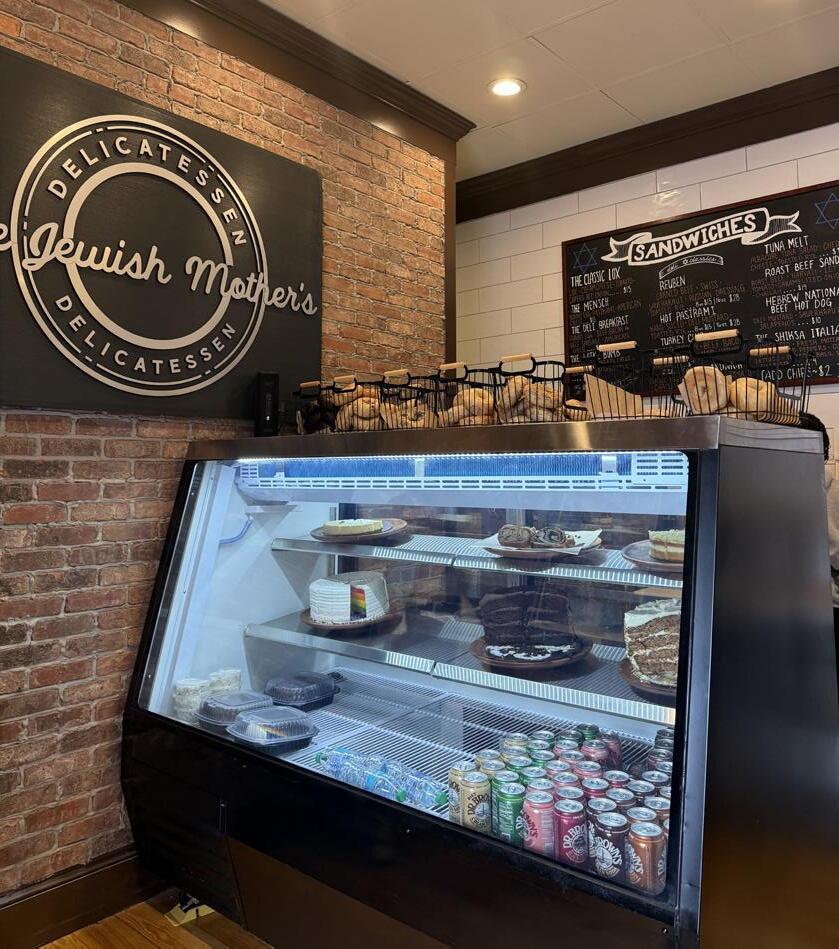
As the leaves begin to fall and the air gets crisp, warming comfort food is a must.
Located just off of Colonial Williamsburg’s Merchants Square is Jewish Mother’s Delicatessen, which strives to create food that feels comforting and familiar, even if you have never had it.
In just over a month in business, the Jewish Mother’s Deli seems like it’s going to be a go-to for students at the College of William and Mary.
On a chilly Thursday afternoon, my friend and I decided to go to the new Jewish Mother’s Deli to escape dining hall lunch.
As we walked in, we both immediately felt comforted by the warm and cozy yet modern atmosphere.
Although it’s a tiny space, you need a minute to take it all in. As I stepped inside, I smelled the unmistakable aroma of bagels. Once we were greeted, my eyes were immediately drawn to the pastry case, with the beautiful, mouth-watering cakes. Just above that were seven wire baskets full of fresh bagels.
On the back, white-tiled wall were chalkboard menus that overwhelmed you in the best way possible. With so many delicious-sounding items, it took me a few minutes longer than normal to decide on my order.
I finally chose a hot pastrami sandwich and a cup of Matzah ball soup. My friend decided on the deli breakfast sandwich and joined me in ordering the soup.
After ordering, I got distracted by the small, clean, open kitchen that was next to the counter. While waiting for our food and watching the staff in the kitchen, we quickly understood that each meal is made to order, specifically for the customer. It’s the personal aspect mixed with the distinct menu that makes this place so special.
After receiving our food, I had the opportunity to speak with Samantha Triano, the manager of Jewish Mother’s Deli.
“We’ve noticed that a lot of families will come in that are from Williamsburg, and we want it to be a place where locals almost feel like they’re at home,” Triano said. “They’re
coming in and they’re getting their mom’s soup and their mom’s sandwiches.”
Owner Sid Hall knows a thing or two about the restaurant business, as he also owns Waypoint Seafood and Grill, Water Street Grille and Riverwalk Restaurant. Hall also recently opened Ember, a steak and seafood Asian-fusion restaurant, in Merchants Square.
Hall grew up in Williamsburg, but his family is from New York City. Coming from a Jewish background, Hall always wanted to open a deli where he could serve comforting, traditional foods. You can tell that he loves and values the memories evoked by this food.
After speaking with Triano, my friend and I found a table in Merchants Square and dug into our delectable lunch.
I first bit into the hot pastrami sandwich, and, boy, did it exceed my expectations. The sandwich felt like a warm hug. It was simple, made with just mustard and pastrami on toasted rye bread, but it was a perfect comfort meal.
Next, I took a spoonful of the Matzah ball soup, which was the perfect thing to warm me up on this chilly fall day. The soup was brothy and nutritious with two large dumplings, carrots, onions, celery and noodles — the right thing if you’re in need of some nourishment.
My friend thought their deli breakfast sandwich was delicious. It was another simple delight: a fresh bagel, a runny egg, cheese and meat of your choice. What’s
fascinating about their bagels is that they are shipped in from Brooklyn, N.Y., nearly every day. This adds to the special New York feel of the deli.
As a student, I am so excited that there is a new place to get quality comfort food, which is exactly the reaction Triano hoped for.
“When I was going to college, there was always that one spot that you always went to,” Triano said. “You always knew that every morning you would always go to that one place, and it was the spot that all students always talk about. That’s what we want to be known for.”
Later that day, I had the chance to talk to Kyra Taube ’29, who shared about her visit to the Jewish Mother’s Deli.
“I’m always looking for places to eat that aren’t the dining hall, and I come from a Jewish family, so that’s sort of food I grew up with,” Taube said.
I am already planning my next lunch at the deli and want to try one of their bagel sandwiches next time. And, of course, a slice of chocolate cake would be a perfect addition.
Overall, Jewish Mother’s Deli is a perfect addition to Williamsburg. It has a homey, welcoming feel with a specific but simple menu. It’s a small space with a bounty of quality, distinct food. If you’re willing to try something new and need the satisfaction of simple, comforting food served in a cozy, modern storefront, take a trip to Jewish Mother’s Deli. You will be happy you did!
When they are not rushing between lectures and labs, students at the College of William and Mary fnd time to join a wide range of clubs and participate in various recreational activities. One organization allows a combination of the two — a sense of community and the opportunity to shoot pool beneath the Sadler Dining Hall.
Union Central in the Sadler Center ofers students a place to relax and play various board games, video games and, of course, pool.
“If you just sit and watch at Union Central, you will see hundreds and hundreds of diferent people play pool,” president Parker White ’27 said.
Cue Club was frst founded in 2023 by Vice President Nick Vaughan ’26. Vaughan cited the sense of community at Union Central as her inspiration.
“It was me and another student who has now since graduated who were kind of hanging around the tables for, that would’ve been the fall and spring there. But specifcally in the fall, we were like, ‘wow, there is such a community,’” Vaughan said. “It was kind of a ragtag, if you will, community of folks who are knowing each other, recognizing each other and engaging in the space together.”
However, Vaughan spent her next year in Scotland as part of the St Andrew’s Joint Degree Programme, causing the club to fzzle out. Tat is, until she, alongside White, revived the billiards-centered community in the fall of 2025.
“One of, if not the biggest part of my college experience is the friends I’ve made through Cue Club,” White said. “Tat’s what drives me to do this whole thing — I want other people, especially underclassmen, to have the same experience, because it was so important for me.”
Te club opens its doors to members of all levels, creating a community of diverse experiences that encourages learning from one another.
“Cue Club is a chill, open space where people can learn how to play pool, or just play pool with other people who have the same passion,” club member Julia Beverley ’26 said. “If there was one word I’d use to describe it, it’s chill.”
Every Tuesday at 7 p.m., people gather in Union Central for an evening of gameplay. One aspect of club meetings is a “teaching table” led by Vaughan.
“People just walk in like, ‘I don’t know how this works’ or ‘I want to fgure out this’ or ‘I want to get better at this,’ and Nick will walk you through the steps you can take and just how to be better,” White said.
Additionally, more experienced members can compete in mini-tournaments at Tuesday meetings.
Te other table is a ‘King of the Hill’ free-play table where everyone puts their name in a queue,” White said.
“Te frst people in the queue go, they play, winner stays on and loser gets of.”
During these meetings, Cue Club’s executive board seeks to work out how to move forward and establish themselves during the club’s early stages.
“It all comes back to whether folks are excited around what we’re trying to design, if it’s things that people are actually interested in,” Vaughan said. “And so far, I think that’s been a pretty emphatic yes.”
Tis enthusiastic outlook has created lasting friendships between club members.
“It’s composed of all my friends, and I have the best time with them whenever we play pool,” Beverley said.
As close member relationships are at its core, Cue Club hopes to offer a space free from the prejudices that infiltrate typical pool communities.
“Tat’s another reason why this community here is so important, because we can create a space that’s entirely devoid of those lingering legacies of that kind of misogynistic, older male-dominated space that bars, and by extension, pool, sometimes tend to be,” Vaughan said. “We can totally just get rid of that entirely.”
Due to the club’s recent establishment, White and Vaughan
have been working hard to bring new members of all ages to these meetings.
Tere are a couple members of the club who are older or they’re veterans and stuf like that, and something I’ve learned from them is that they don’t always feel comfortable joining a lot of student orgs,” White said. “And so [we’re] trying to reach out to them and get something done, and just expanding the amount of people who show up to play pool. Because the more people we have, the more stuf we can do.”
With more and more new faces, Cue Club hopes to expand beyond their Tuesday gameplay.
“It’s important, having diferent events and not only focusing on pool, but maybe a more social event outside of Union Central,” Beverley said. “I think it would be cool to go to Corner Pocket.”

Te Corner Pocket is a pool hall in Williamsburg that would allow Cue Club to join a local league and play against other teams. Tey even have a playof session,” Vaughan said. “If, theoretically, you did really well, you’d get to play in Vegas on national TV.”
Within the College, Union Central hosts an open doubles and singles tournament each semester, which many club members partake in.
“I think just that energy of being at a pool tournament surrounded by everyone that’s completely invested is my favorite memory,” Beverley said. In the future, Cue Club plans to emulate these tournaments in their own events.
Beyond expanding club activities, Vaughan believes strongly in expanding access to pool to those with physical disabilities. Specifcally, she wants to bring the inclusive nature of the billiards community she found at St Andrew’s to the College.
“If accessibility is what we believe in, and it was, we took it very seriously that everyone should have a place at the table,” Vaughan said. “How do we challenge and shift how the game is played so that more people can come engage with it?”
While they work to bring about new opportunities and experiences for their members, Cue Club’s executive board is excited to see where the future might lead them.
“Some of the folks have changed, some people have left, some new people have rolled around,” Vaughan said. “But there’s still kind of this je ne sais quoi about hanging out at the tables and you see somebody who rocks up and maybe you don’t know him, but all the other tables are full, so they ask if they can play with you. And, of course, you say yes.”
Cue Club is always willing to hear from potential new members. Join them at Union Central on Tuesdays or email cueclub@wm.edu to join the GroupMe and get playing!
After barely staying awake in classes, trekking across campus to the dorms and spending a number of hours in Earl Gregg Swem Library that no one is proud to admit, one singular question can easily plague hundreds of students; what should I have for dinner? While the answer may seem obvious — cough cough dining halls cough cough — do dining halls really satisfy student hunger? Do they ofer enough nutritious options for students? Do students really want dining hall food to end of their already crappy day? What prevents students from trying out homemade food?
Students at the College of William and Mary have a variety of dinner options, spanning from regular old Sadler to frozen Trader Joe’s meals, to local Williamsburg restaurants, to making food from scratch.
Let’s start with the frst and probably most common option: the dreaded dining halls. Te College has two dining halls, Sadler and Commons Dining Hall (known afectionately by students as Caf).
“I usually end up going to Caf because I have a lot of extracurriculars and I just have to grab it on the way there,” Riya Gupta ’29 said.
While the dining hall is often the easiest option for students, the dining hall is not always reliable and can come with sacrifces, especially for students with dietary restrictions. One issue students have with dining halls currently is the inefcient labeling system for students with food restrictions.
“I have celiac, so I can’t eat gluten. All the TVs in the dining halls right now only have the label for vegetarian or vegan,” Meredith Parrington ’29 said. “I have to go online, but if the online menu’s down, then I can’t fgure out what’s gluten-free or not.”
Continued inconveniences within the College’s dining halls have students anxiously waiting to see if there will be improvements in the new dining hall. Te College is planning to open this new dining hall in the West Woods complex in January 2026. While actively watching the glass-lined dining hall being built, hope for the new dining hall is slim. Students are worried that within the shiny new complex there will still be the stagnant food options and quality.
“I think it’s going to be the same quality food. I
don’t think it’s gonna change any of that. But yeah, I’m excited,” Austin Zhou ’29 said.
If students are not picking up plates at Sadler of Caf, there are also local spots in Williamsburg that spark their interest. A common spot for students to grab a quick dinner is the classic Chick-Fil-A.
Since Chick-Fil-A is included in the Dining Dollars program, it is easy to justify going to dinner outside the dining hall.
Another student favorite is the family restaurant Oishii Japanese Ramen & Hibachi Grill.
Nestled behind Sorority Court, Oishii is a Japanese-style restaurant that ofers many Japanese comfort foods for an afordable price. If students
were to visit Oishii, here are a few student favorite recommendations: Spicy tonkatsu ramen, beef teriyaki with fried rice and pork tonkatsu with white rice. However, since Oishii is not included in the Dining Dollars plan, many students may stray away from spending their real money on dinner.
Outside of the dining hall and local restaurants for dinner, students always have the option to make their own dinner. Te majority of dorms offer some sort of kitchen area. Te question is, why aren’t more students making their own dinner? Is it because it takes too long? Maybe ingredients cost too much?
The presence of a kitchen doesn’t always

correlate to the frequency of cooking. Most commonly, students in older dorms, such as the Botetourt Complex, are more hesitant to cook in their kitchens because of lack of cleanliness and functionality. Te frst time that I went to the Gooch kitchen, there were not one, but two cockroaches,” Gupta said. Aly Eller ’28 added that kitchen location in the dorm can provide an added inconvenience.
“I love to cook. In DuPont, it’s a little hard because our kitchen is in the basement,” Eller said. However, even students who are in the oldest dorms on campus can manage making their own meal. Eller previously lived in the Green and Gold Village and still managed to cook for herself.
Students who use their dorm kitchen usually do not cook from scratch, but rather make elevated college classics, such as ramen. One common college elevated dinner students are making is Trader Joe’s frozen food. Trader Joe’s frozen food ofers both a healthier alternative to dining hall food and a fast way to make a fulflling and tasty dinner. “Trader Joe’s is the best place because they have frozen stuff
‘Very
Over Thanksgiving break, William and Mary women’s basketball (2-4, 0-0 CAA) split a pair of games, falling 64-53 to a sharp-shooting Howard (6-3, 0-0 MEAC) Sunday, Nov. 23, before defeating Tennessee State (1-6, 0-0 OVC) 64-53 Saturday, Nov. 29. Despite the loss to Howard, junior guard Cassidy Geddes delivered the best performance of her career at Burr Gymnasium in Washington, D.C., posting her first-ever double-double with 17 points and ten rebounds for the Tribe.
William and Mary entered the contest looking to snap a two-game losing streak, but early offensive struggles and 22 turnovers proved costly against the Bison.
The Green and Gold opened the game with strong energy but found itself unable to convert on offense, hitting just two of 13 field goal attempts in the first quarter. After nearly seven minutes without a bucket, freshman forward Amelia Basit scored William and Mary’s first points of the afternoon, finishing a layup off a feed from junior guard Kyah Smith at the 2 minute, 36 second mark. The Bison controlled the pace early, capitalizing on Tribe defensive lapses and scoring efficiently to build a 19-8 lead. Geddes knocked down two free throws in the final seconds of the quarter, slightly narrowing the margin heading into the second.
The Tribe’s momentum shifted midway through the second quarter as the visitors mounted a 7-0 run fueled by defensive intensity and improved movement on offense. Freshman guard Dynasti Pierce knocked down a threepointer at 5:19, cutting Howard’s lead to 23-15 and injecting life into the William and Mary bench. Sophomore forward Natalie Fox anchored the defense with a block and multiple rebounds, while Geddes added a crucial tip-in at the 3 minute mark. Despite turnovers and foul trouble, the Tribe pieced together a strong end to the half, highlighted by a Geddes jumper with 37 seconds left. The Green and Gold outscored the Bison 17-16 in the period, trimming the deficit to 35-25 at the break.
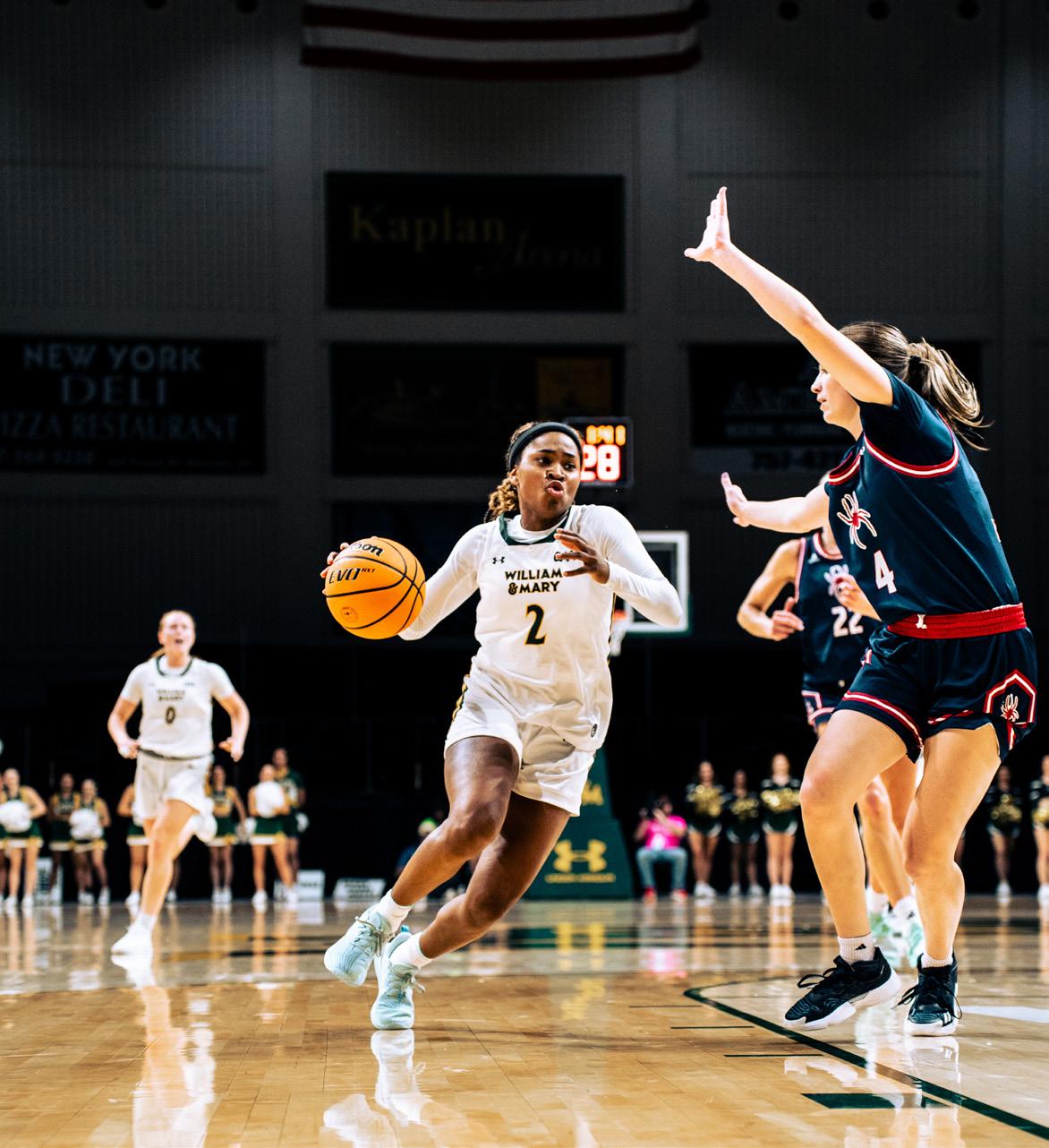
The third quarter proved to be the most competitive stretch for the Tribe. William and Mary attacked the paint with urgency, opening the period on a 10-4 run. Geddes continued her offensive surge, knocking down a three-pointer at 6:05 that energized the visitors and cut into the Bison’s lead. Junior guard Monet Dance followed with a strong drive and layup at the 1:25 mark, bringing the Green and Gold within striking distance. However, Howard freshman guard Emma Nuquay responded with a momentum-shifting three-pointer with 11 seconds remaining. Once again, William and Mary outscored Howard 16-13 in the quarter, but the Tribe still trailed 48-41 heading into the final period.
The fourth quarter began with another push from the Green and Gold. Smith opened the scoring with a layup at 9:42, and Dance converted a three-point play less than a minute later, tightening the score once again. Every time the Tribe threatened, however, Howard had an answer. The Bison capitalized on William and Mary turnovers and earned critical points at the free throw line, slowly extending their lead back into the double digits. Smith buried a late threepointer at 1:35, but the deficit proved too large to overcome as Howard sealed the 64-53 win.
Despite the loss, several Tribe players posted standout performances. Fox dominated the boards with 13 rebounds, continuing her strong streak of interior play. Dance added 12 points, while Smith contributed nine points and four assists.
“Howard was a top-14 in the country mid-major, which we knew would be a tough opponent, but an opponent that would definitely prepare us for [Coastal Athletic Association] play come the end of December, early January,” head coach Erin Dickerson Davis said.
Six days later, William and Mary captured its first nonconference road win since 2023, defeating Tennessee State 64–53 at the Gentry Center Complex in Nashville, Tenn. Dance led the way with a season-high 22 points, including a perfect seven-of-seven performance at the free-throw line, powering a strong second-half surge for the Tribe.
The Tribe forced 26 TSU turnovers, converting them into 26 points that proved decisive in a tight game.
William and Mary set the pace of the early game behind two blocks and three steals from Fox. Dance ignited the offense at the 6:42 mark, drilling a fast-break three-pointer that pushed the visitors ahead. Both teams struggled to generate consistent scoring throughout the opening frame, but the Tribe’s defensive pressure held firm as it carried an 11-6 lead into the first quarter.
Tennessee State responded early in the second quarter, briefly reclaiming the lead before William and Mary mounted a 6-0 run. Dance’s layup at 2:23 capped the spurt and nudged the visitors back in front, 19-18. However, the Tigers closed the half strong, stringing together a 6-0 burst of their own to enter halftime with a 24-19 advantage in a low-scoring, defensive battle.
The tide turned in the third quarter as the Tribe found its rhythm on both ends. Junior guard Aislinn Gibson drilled a critical three-pointer at the 4:16 mark to give William and Mary a one-point lead, and the Green and Gold continued to chip away by attacking the paint and earning trips to the free-throw line. The Tribe converted 11 of 14 free throws in the period, a mark that proved crucial during a tightly contested stretch. Fox delivered a key sequence late in the quarter, finishing a layup and sinking the ensuing free throw at 1:07 to tie the game at 40. The score would settle at 43-43 entering the fourth.
William and Mary seized control early in the final quarter. Dance’s layup at 9:42 tied the score once more, sparking a run of efficient offensive possessions. Senior guard Alexa
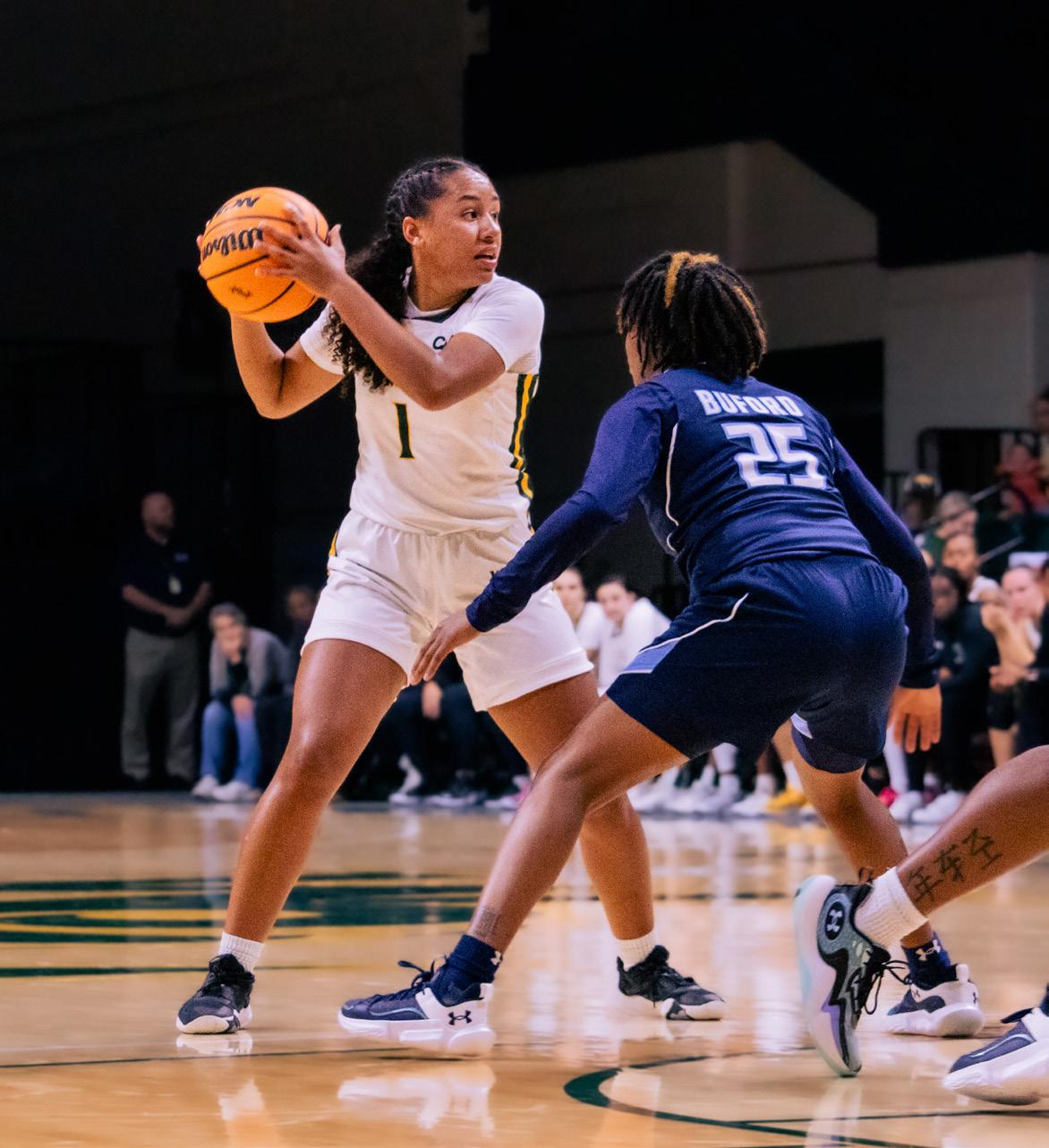
Mikeska and Fox added critical baskets, while the Tribe continued to dominate on the offensive glass and convert second-chance opportunities. Dance delivered the defining play of the quarter at 6:16, finishing through contact for a three-point play that put William and Mary in front for good.
From there, the Tribe’s depth and defense closed the door. Geddes and Pierce added timely scoring, while Pierce’s defensive effort — including two late blocks — helped hold the Tigers to just ten points in the fourth quarter. Behind suffocating pressure, strong rebounding and clutch execution, William and Mary secured the 6453 victory.
Dance’s 22 points led all scorers, while Mikeska turned in a standout two-way performance with nine points and four steals. Fox added 11 points, five rebounds, two blocks and two steals in a balanced showing.
Dickerson Davis compared the playstyles of Howard and Tennessee State, noting that both teams “pressured us, they pressed us, they played fast and in transition … so being able to play against a very talented, very veteran Howard team definitely prepared us for Tennessee State.”
The Tribe coach went on to express pride in her team, which secured its first Division I victory of the season against the Tigers.
“Despite all the adversity, I think it was very meaningful for our team and something that we’ll continue to take with us to end this non-conference,” Dickerson Davis said.
For her squad to extend its win into a winning streak, Dickerson Davis said it will have to start converting its triples, as it is shooting just 20.1% from beyond the arc this season.
“We have really good three-point shooters on this team, which is why we keep shooting them, because we know that this team is capable of making the three,” Dickerson Davis said. “I think we’re just trying to figure out how to get them out of their heads a little bit, how to relieve some of the pressure.”
The Tribe now turns its attention to Wednesday’s matchup against Wake Forest (9-0, 0-0 ACC) at Lawrence Joel Veterans Memorial Coliseum in Winston-Salem, N.C.
Saturday, Nov. 22, William and Mary football (7-5, 6-2 CAA) faced Richmond (7-5, 3-4 Patriot) for the Capital Cup in its final game of the season. William and Mary dominated the first half, leading 14-0 at halftime, but struggled to maintain that pace in the second half, resulting in their first Zable Stadium loss of the season.
During the first half of the matchup, Richmond struggled both offensively and with penalty yards. This allowed the Tribe to dominate the first quarter. Junior quarterback Tyler Hughes scored on a three-yard run following a Richmond muffed return on the Tribe’s punt after a three-and-out. The play gave the hosts a 7-0 lead that lasted until the second quarter, when Tribe graduate student running back Rashad Raymond ran in a touchdown after a pass-interference call against the Spiders. Entering halftime up 14, William and Mary’s lead disintegrated into a sevenpoint deficit by the end of the third quarter, with Richmond scoring its first touchdown with 10 minutes, 1 second left on the clock. After the touchdown, the Spiders
were able to throw the Tribe off track and gain momentum. The visitors took the lead with 4:57 remaining in the third when they pushed deep into Tribe territory. The Spiders scored a six-yard touchdown, tying the game 14-14.
The Green and Gold struggled to stop the Spiders, who converted multiple thirddown attempts to keep drives alive. Near the end of the third quarter, following a Tribe punt, Richmond senior wide receiver Quanye Veney broke off a 25-yard run, the longest for his team of the afternoon. The subsequent play saw Spiders senior quarterback Kyle Wickersham rush 15 yards up the middle of the field for a touchdown. With 2:14 left in the third, Richmond took a 21-14 lead.
In the fourth quarter, the Tribe tried to regain control of the game and steal back their momentum, but numerous penalties worked against them. The team struggled to contain Wickersham, who finished the day with 73 yards on the ground and 128 in the air, adding a rushing and two passing touchdowns.
With 11:07 left in the fourth quarter, Hughes scored on a seven-yard rush, tying the game once more, this time at 21 each. Despite the Tribe’s attempts to
take the lead, Richmond’s defense kept the Spiders ahead. Richmond scored its final touchdown with 1:56 left, raising the score to 28-21. The Tribe lost its shot at the Capital Cup title when it turned the ball over on downs during a final attempt to tie, allowing the Spiders to run out the clock with a seven-point lead.
While this was a hard way to end the season, eliminating William and Mary’s chance of being considered for the Football Championship Subdivision playoffs, head coach Mike London was proud of the team and the hard work they put in all season, as evidenced by his postgame comments.
“The life aspect of you lose a game, you know it is what it is, but we have to address it, correct it, you know, do what we need to do to make things better for us, the crew, all those things and I want to thank you guys who have showed up every week and the students and the fans and parents,” London said. “It was tough to see a bunch of those seniors go, but that’s a maturation process that happens when you come to college and you go onto your next opportunity, next location.”
London expressed gratitude to the seniors for the hard work they have put
in throughout their time with the Tribe football program. He enjoyed seeing them walk with their loved ones and being recognized for their hard work, which he considers a testament to their leadership.
“I’m grateful and indebted to them [the seniors] in terms of when we first got here, first class of guys actually brought in, the winning seasons and all those things,” London said. “They matter, but when you’re playing a game like this, this matters a lot too.”
Despite the loss, Tribe football plans to take its lessons from Saturday’s matchup into spring training and the offseason. The team plans to travel around and continue to engage and embrace alumni, supporters and fans, as well as the overall support for the program.
“I love this group, I love the team and it’s just one of those things. It’s tough, but at the same time, I love where we are as a program and as a team and opportunities to keep chasing championships here,” London said.
William and Mary football is entering the offseason with a positive mindset and eagerness to explore new opportunities in both the Patriot League and the chance to play for this great cup once more.
ADITI ALLAM AND NICOLE ZAJAC
William and Mary men’s basketball (7-2, 0-0 CAA) never let the moment escape it Sunday, Nov. 30, outlasting a strong push from in-state rival Old Dominion (3-6, 0-0 Sun Belt) to stay unbeaten at Kaplan Arena. The Tribe improved its home record to 3-0 and extended its winning streak to five games with an 8875 victory over the Monarchs. Behind career-best nights from junior forwards Tunde Vahlberg Fasasi and Kilian Brockhoff, the Green and Gold shot 50% from the field and continued one of the program’s strongest starts in recent years.
On the big screen, highlights of past clashes between William and Mary and Old Dominion played on loop, inspiring an energy that carried into the game’s opening minutes. After ODU claimed an early lead behind a quick basket, triples from Vahlberg Fasasi and graduate student forward Cade Haskins put the Tribe back in front.
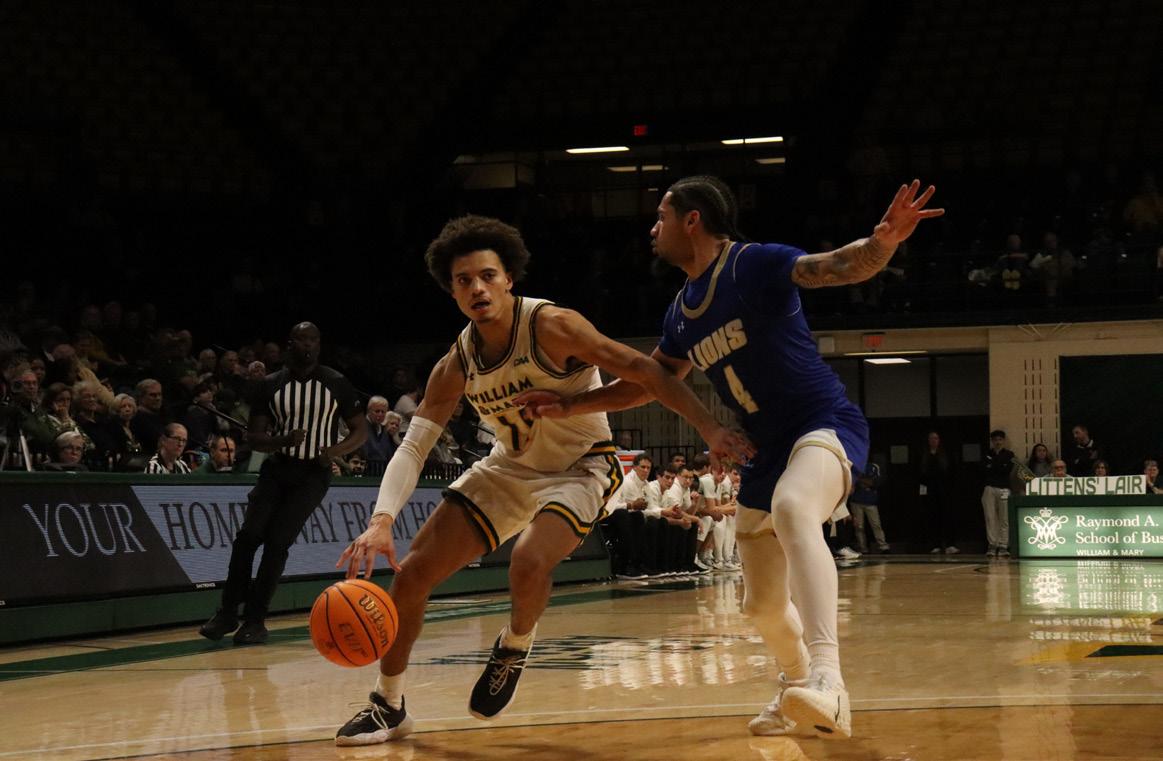
The first major turning point came midway through the half, when graduate student forward Jo’el Emanuel erupted for an electrifying, one-handed block at the rim, a momentous play that brought both benches to their feet. On its very next defensive possession, William and Mary executed a perfect mid-paint double team, forcing a turnover that it converted into points on the offensive end. The sequence shifted the tone of the half, giving the Green and Gold control.
MENʼS BASKETBALL
Minutes later, Brockhoff absorbed a hard foul in the lane, went down and took several seconds to gather himself before rising to hit two free throws. The resilient moment exemplified the physical grit that William and Mary leaned on throughout the afternoon against the Monarchs.
As the half progressed, the Tribe embraced its identity: shared offense, disciplined spacing and rim pressure. In total, the Green and Gold racked up 17 assists on 31 made field goals, a statistic head coach Brian Earl quickly pointed to after the win.
“In college basketball, there’s a lot of individualism,” Earl said. “So us climbing towards the top of a statistic that says we play for each other makes me happy.”
That connectivity kept the Monarchs off balance and produced a steady rhythm of interior scoring, part of the Tribe’s 42 paint points for the afternoon. By halftime, William and Mary led 39-29.
When the teams returned from the locker room, ODU delivered its largest blow of the afternoon, quickly trimming the deficit to 45-43, the closest the Monarchs got since the opening minutes. However, William and Mary responded with its most complete stretch of the night.
At 11:37, Haskins buried a rhythm three from the right wing, a timely, stabilizing shot that immediately halted the ODU run. On the next Tribe scoring trip, Emanuel attacked a seam for a strong finish at the rim, restoring breathing room. Later, Brockhoff sealed his defender deep in the paint and scored through contact, one of several interior finishes that helped him reach a career-high 21 points.
While the Tribe’s offense kept its lead intact, it was the defense that broke ODU’s momentum for good. Rotations tightened, gaps closed and passing lanes constricted. William and Mary turned 16 Monarch turnovers into 20 points.
“Everyone played defense as a team,” Vahlberg Fasasi said. “Being in gaps and not making it a one-on-one game on the defensive.”
With the lead back to double digits, Vahlberg Fasasi, who finished with 25 points, repeatedly attacked ODU closeouts for drives, mid-range pull-ups and finishes in traffic. He credited his teammates for catalyzing his career performance.
“The way we play, my teammates finding me, me finding my teammates — that’s how we score all our points,” Vahlberg Fasasi said.
With newcomers, transfers, and underclassmen taking
on major minutes, adaptability has become essential to the Tribe’s success. Earl specifically highlighted the versatility of Emmanuel, who finished with 16 points.
“Jo’el’s great,” Earl said. “We’re asking him to do something he’s comfortable with, and he hasn’t said a word about it. We want him to dribble the ball up the court, and that’s crazy.”
On a day when William and Mary piled up paint points, free throws and interior buckets while making just 22.7% of its triples, Earl said he was unbothered by his team’s three-point shooting percentage.
“In the end, I don’t care,” Earl said. “I like watching threes go in, and I like watching twos go in, and today was mostly twos.”
In the closing minutes, the Tribe’s control of the game sharpened rather than slipped. After ODU’s last meaningful push fizzled out inside the five-minute mark, William and Mary strung together a sequence of high-percentage looks. Emanuel and Brockhoff each secured tough rebounds through traffic, while Fasasi hunted late-clock drives to keep the margin stable. By the two-minute mark, the Monarchs were forced into hurried perimeter shots and the Tribe sealed an 88–75 victory.
The Tribe’s turnaround is quick, as William and Mary heads to Pittsburgh, Pa. to take on Duquesne (5-2, 0-0 A10) Tuesday, Dec. 2 at UPMC Cooper Fieldhouse.
Earl emphasized the importance of carrying Sunday’s success forward without getting too wrapped up by the win.
“It’s important not to get too high or too low after a win or loss,” Earl said. “So we just keep doing what we do.”
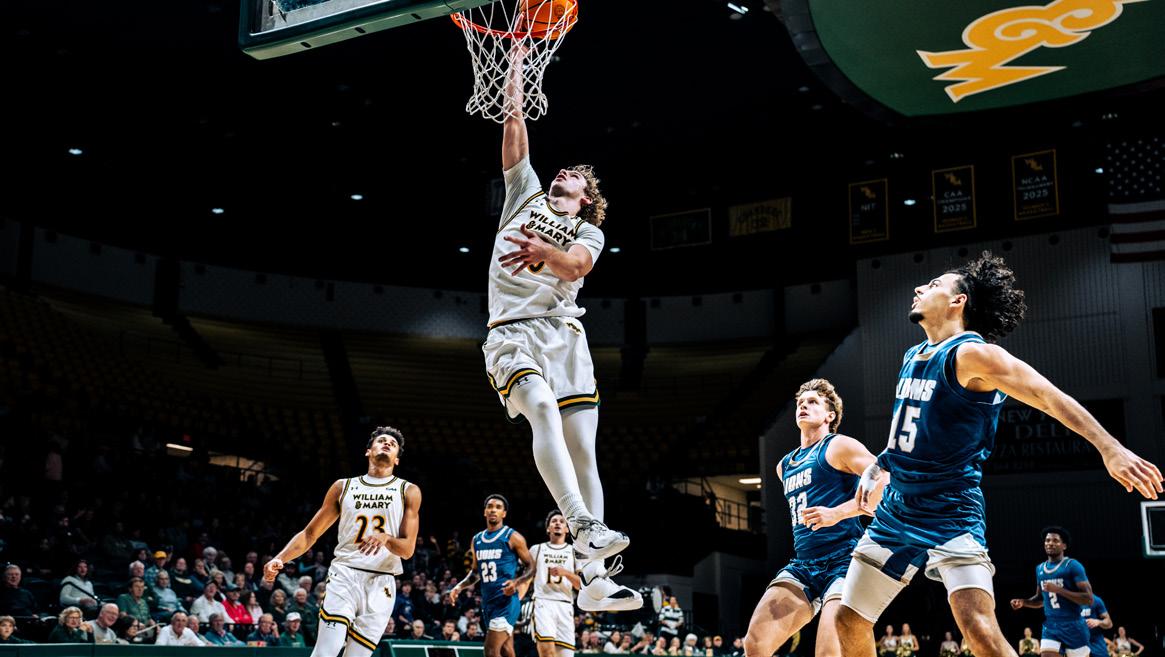
Over the past week, William and Mary men’s basketball (7-2, 0-0 CAA) claimed two commanding victories over Texas El Paso (3-4, 0-0 Mountain West) and Abilene Christian (5-3, 0-0 WAC) Monday, Nov. 24, and Tuesday, Nov. 25, respectively. The Tribe defeated the Miners 74-63 and Wildcats 92-58. The Tribe played both games at the Adams-Jenkins Complex of Edward Waters University in Jacksonville, Fla., as a part of the Jacksonville Classic.
“That tournament was a good place for us to get away as a team and play on sort of a neutral court, which is hard to do in college basketball these days,” Tribe head coach Brian Earl said when asked about the team’s performances in Jacksonville.
In the Tribe’s game against the Miners, junior guard Reese Miller tied as the leading scorer with 16 points, shooting 5-7 from the field and 2-4 from three. Miller also produced three assists on the day. Senior guard Kyle Pulliam added his own 16 points, going 6-11 from the field and collecting five rebounds. Their combined 32 points made up a considerable portion of the Tribe’s total scoring, with the next highest scorer being senior guard Chase Lowe with nine points, the longest tenured member of the team.
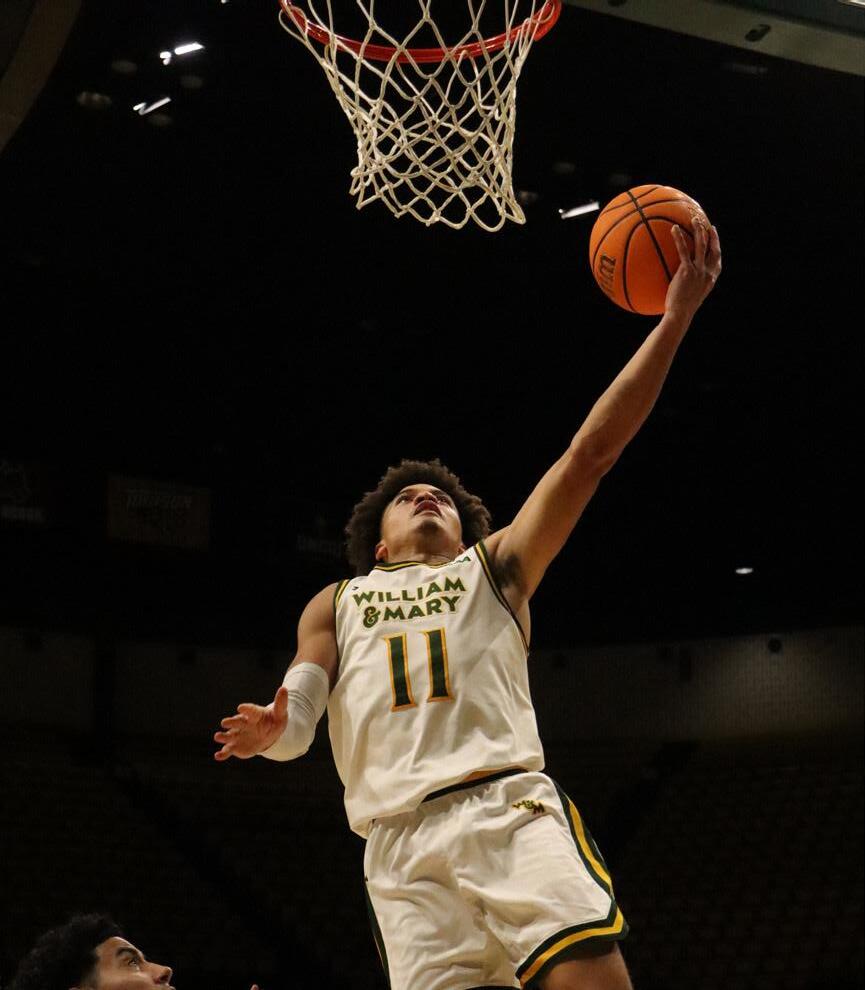
The Tribe started red-hot, going on a 13-0 run to start the game, with Miller scoring seven straight points over the initial six minutes. Senior guard Cassius Brooks finally broke the Tribe’s unanswered scoring, going on to score seven of UTEP’s first nine points.
The Tribe maintained their lead all the way through halftime, with sophomore guard/forward Ryan Jackson Jr. capitalizing on a Tribe run that pushed the lead to 2412 with a powerful dunk. The Tribe led 35-23 going into halftime, shooting 46.7% from the field and 33.3% from three, while holding the Miners to 32% from the field and 16.7% from three.
The second half was much closer, as the Miners outscored the Tribe 40-39. They would come within one point of the Tribe following a 12-2 run. The near-comeback swing consisted of a corner three from junior forward David Tubek, five points from junior guard Caleb Blackwell, and finally a layup from junior forward Kaseem Watson. However, the lead was soon again lengthened by a timely 13-4 run by the Tribe, with Lowe contributing four points and an assist.
Blackwell led the Miners with 13 points, followed closely by Watson and Brooks, who each contributed 11. Junior forward Elijah Jones, with 10 points and five rebounds, and senior forward Jamal West Jr., with nine points and five rebounds, were also major contributors.
UTEP’s early deficit proved too much to overcome before time elapsed, with the Tribe cementing their victory with a comfortable 12-point lead by the final minute of the game. The Tribe shot 49.1% from the field and 37.5% from three-point range in the game, improving their averages from the first to the second half. By comparison, the Miners shot 36.9% from the field and 20% from three.
Coming off the double-digit win on Monday night, the Tribe carried that momentum and produced a dominant performance against the Wildcats of Abilene Christian the next night.
William and Mary played the game without Miller, who exited in the previous game with an injury. The transfer was coming off a 16-point performance as the Tribe’s leading scorer.
Matters got worse when Pulliam left the
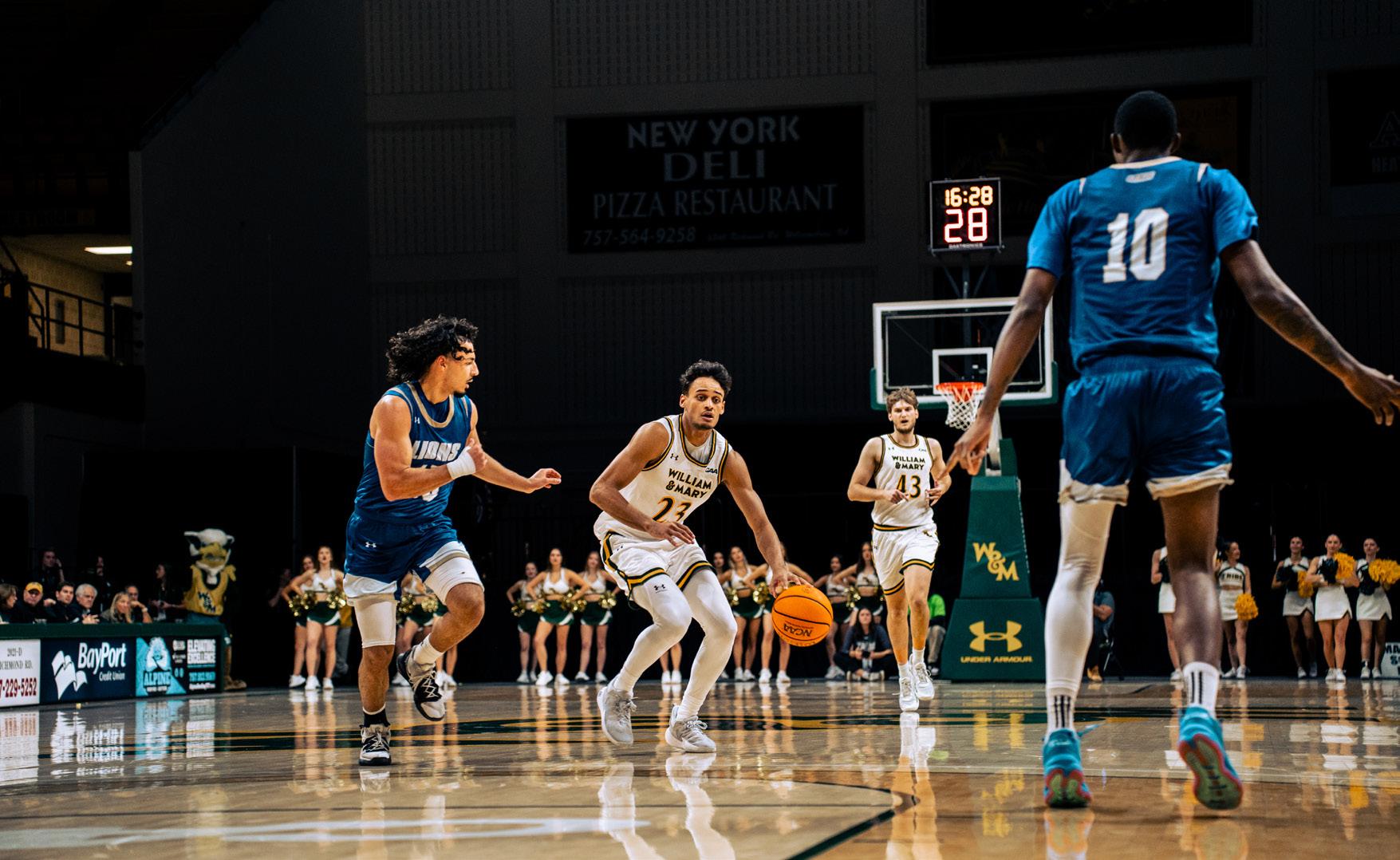
game due to injury after only two minutes in.
“We played some pretty physical teams, and so we paid a bit of a price for it with a couple of guys going down,” Earl said after the games.
The physicality in the game would not stop the Tribe for long, as Jackson Jr. and junior forward Kilian Brockhoff exploded for back-to-back fast breaks, forcing an ACU timeout. This was followed by a quick break jumper by graduate student guard Jhei-R Jones. The Green and Gold was getting down the court quickly, and the Wildcats were paying the price.
Brockhoff and junior forward Tunde Vahlberg Fassi would keep up the momentum, as Brockhoff hit a three, followed by another fastbreak score for the Tribe, this time courtesy of Vahlberg Fassi. Graduate student forward Cade Haskins would jump in on the action, going on a five-point run himself.
The Wildcats stayed in the game by slowly chipping away at the Tribe’s lead, aided by some timely three-pointers by junior guard Yaniel Rivera. The Tribe led by seven at the half.
The second half was a masterclass put on by Tribe basketball. It would start with a 10-1 run led by Jones, who provided a constant stream of fast breaks for the Tribe. The Wildcats were unable to handle the
fast-paced basketball Brian Earl is known for. William and Mary’s defense also forced five turnovers in the second half and turned 21 turnovers into 21 points throughout the game.
The Tribe would go on to crush the Wildcats’ comeback hopes in the second half, outscoring the team by 27, while shooting a remarkable 76.9% from the field and 50% from three. Simultaneously, they held their opponents to a mere 32.26% shooting in the second period.
Haskins would be the Tribe’s leading scorer on the day, finishing with 20 points, while playing 26 minutes. His efforts were closely followed by his teammates, as the Tribe boasted an impressive six double-digit scorers and 32 points off the bench.
The Tribe’s shooting percentage on the day was the best it has had all season. More impressive is the fact that it happened at a neutral site, far from Kaplan Arena. Coach Earl said the team is “a good road team” that “likes being on the road,” a different tune from William and Mary’s team last year, which posted a 4-11 road record.
“It was good to get those two tough wins against physical teams out there and then be able to get back home,” Earl said.
Coming off these