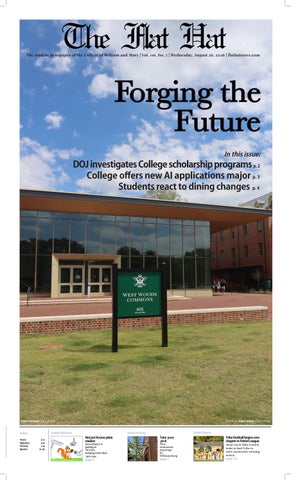
The Flat Hat
The student newspaper of the College of William and Mary | Vol. 116, Iss. 7 | Wednesday, August 26, 2026 | flathatnews.com
Forging the Future In this issue:
DOJ investigates College scholarship programs p. 2 College offers new AI applications major p. 3 Students react to dining changes p. 4
NAMAN MISHRA / THE FLAT HAT
2-4 5-6 7-8 9-10
Inside Sports
Inside Variety
Inside Opinions
Index News Opinion Variety Sports
GRAPHIC BY ROBIN PERDUE / THE FLAT HAT
Not just license plate readers Surveillance is getting to be a lot, helping more than just cops page 5
Take your pick
New restaurant openings in Williamsburg page 7
Tribe football begins new chapter in Patriot League
Head coach Mike London looks to lead Tribe to sixth consecutive winning season page 10
THE BUZZ
“
“
newsinsight news insight
News Editor Liam Glavin News Editor Naman Mishra News Editor Robin Perdue fhnews@gmail.com
THE FLAT HAT | Wednesday, August 26, 2026 | Page 2
[The applied AI major will] provide multiple pathways for students to develop technical knowledge while exploring the ethical, societal and human dimensions of one of the most -- CDSP Director of Communications and Marketing Randy Ready transformative technologies of our time. FLAT HAT NEWS BRIEF
Department of Justice launches Title VI investigation of College programs, scholarships
The United States Department of Justice is investigating the College of William and Maryʼs scholarships and student support for potential civil rights violations, according to a letter sent Monday, Aug. 17 from Harmeet Dhillon, assistant attorney general for the Civil Rights Division. The letter, addressed to University Counsel Carrie Nee, says the Collegeʼs W&M Scholars program and certain scholarships granted by the Law School and School of Education are examples of “educational benefits that may include unlawful racial criteria.” The DOJ has not yet reached any conclusions about the programsʼ violation of Title VI of the Civil Rights Act of 1964, which prohibits discrimination based on “race, color, or national origin” in programs and activities receiving federal financial assistance, Dhillon wrote. If the DOJ concludes the College is violating Title VI and the school does not cooperate with subsequent demands, formal action may be taken, according to the letter. A statement on the Collegeʼs website says it is reviewing the information. This is an ongoing story with more coverage coming soon. MADDIE MOHAMADI / FLAT HAT MANAGING EDITOR
A THOUSAND WORDS
COURTESY IMAGE / SOPHIE KENNEDY Outside of Student Assembly, Kennedy works to advocate for sexual violence prevention and is involved in multiple facets of campus like Greek life.
NAMAN MISHRA / THE FLAT HAT
CORRECTIONS
Kennedy discusses impact of leadership roles on community-building, personal fulfillment
The Flat Hat wishes to correct any fact printed incorrectly. Corrections may be submitted in email to the editor of the section in which the incorrect information was printed. Requests for corrections will be accepted at any time.
THE FLAT HAT ʻSTABILITAS ET FIDESʼ | ESTABLISHED OCT. 3, 1911 Org #101 P.O. Box 8795, Williamsburg, VA 23187
Editor flathat.editor@gmail.com Managing flathat.managing@gmail.com Executive flathat.executive@gmail.com Magazine editor@flathatmagazine.com News fhnews@gmail.com Sports flathatsports@gmail.com Copy flathatcopy@gmail.com
Opinions fhopinions@gmail.com Variety flathat.variety@gmail.com Photos flathatphotos@gmail.com Online flathatonline@gmail.com Advertising flathatads@gmail.com Graphics flathat.art@gmail.com Ombudsman flathat.ombuds@gmail.com
Mona Garimella Editor-in-Chief Maddie Mohamadi Managing Editor Megan Rudacille Executive Editor Nate Ross Copy Chief Kylie Totten Digital Media Editor Ben McLoughlin Operations Coordinator Molly Martin Operations Coordinator Robin Perdue News Editor Liam Glavin News Editor Naman Mishra News Editor Emma Beelner Variety Editor DevYani Thakare Variety Editor Cara King Sports Editor Jacob Tobman Sports Editor Michael Gabriel Opinions Editor Ava Gravina Opinions Editor Liam McMahon Audio/Visual Editor Kenza Houhou Audio/Visual Editor Adelyn Skerik Copy Editor Clare Pacella Copy Editor Eden Leavey Copy Editor Elise Whitfield Copy Editor Emma Newill Copy Editor Irene Straw Copy Editor Jonathan Larkin Copy Editor Julia Peavey Copy Editor Kelsea Smith Copy Editor Kreilys Garcia Flores Copy Editor Lindsay Luberecki Copy Editor Lorelei Kelley Copy Editor Ruby Trainor Copy Editor Sophia Paradowski Copy Editor Madigan Webb Chief Staff Writer Lila Reidy News Assoc. Editor Melania Frye News Assoc. Editor Nicole Zajac News Assoc. Editor Rebecca Fuchs News Assoc. Editor Sam Belmar News Assoc. Editor Sachi Pallem News Assoc. Editor Shannon Raymond News Assoc. Editor Susannah Poteet News Assoc. Editor Abigail Furcy Chief Variety Writer Aamnah Malik Variety Assoc. Editor
Student Assembly Vice President Sophie Kennedy outlines public service work, commitment to helping others
Eric Sohn Audio/Visual Editor Andrew Henrickson Data Editor Betty Yemane Social Media Editor Evie Corr Social Media Editor Kimberly McCann Photos Editor Isabel Editor Graphics Editor Gretta Anderson Graphics Editor Maeve Meyer Games Editor Ethan Auclair Ombudsman James Abruzzo Business Manager Sam Harrington Webmaster
Aditi Allam Variety Assoc. Editor Anna Wood Variety Assoc. Editor Brooke Lewis Variety Assoc. Editor Callie Laubacker Variety Assoc. Editor Ella Greene Variety Assoc. Editor Emma Beelner Variety Assoc. Editor Juliana Nelson Variety Assoc. Editor Maggie OʼKieffe Variety Assoc. Editor Patricija Pupine Variety Assoc. Editor Skylar Hartgerink Variety Assoc. Editor Skyler Cole Variety Assoc. Editor Tessa Darke Variety Assoc. Editor Nora Yoon Chief Opinions Writer Abigail Crespin Opinions Assoc. Editor Alexandra Hill Opinions Assoc. Editor Carson Burch Opinions Assoc. Editor Cate Woodrum Opinions Assoc. Editor Charlotte Trodden Opinions Assoc. Editor Ella Grimes Opinions Assoc. Editor Eva Jaber Opinions Assoc. Editor Geronimo Ritcheson Opinions Assoc. Editor Isabella McNutt Opinions Assoc. Editor Lana Altunashvili Opinions Assoc. Editor Lucia Reyes Opinions Assoc. Editor Teddy Friesz Opinions Assoc. Editor
Carolyn Reid Photos Assoc. Editor Ethan de Guia Photos Assoc. Editor Jonah Peters Photos Assoc. Editor Alina Schueman Videos Assoc. Editor Darius Bagherian Videos Assoc. Editor Enna Carbone Videos Assoc. Editor Jack Pegler Videos Assoc. Editor Landon Miles Videos Assoc. Editor Olivia Ives Bailey Videos Assoc. Editor Piper Gilly Videos Assoc. Editor Siddhita Krishnan Videos Assoc. Editor Sophie Frank Videos Assoc. Editor Virginia Fife Videos Assoc. Editor Sabry Tate Videos Assoc. Editor Westley Jacanin Chief Sports Writer Eamonn McAloon Sports Assoc. Editor Henry OʼConnor Sports Assoc. Editor Katie Killagen Sports Assoc. Editor Ellie Laanisto Ombuds Assoc. Editor Naomi Linde Ombuds Assoc. Editor Rhys Runnels Ombuds Assoc. Editor Lauren Singer Social Assoc. Editor Hannah Sawyer Social Assoc. Editor Mira Deni Data Assoc. Editor Sienna Rankins Data Assoc. Editor
LIAM GLAVIN // NEWS EDITOR Sophie Kennedy ’27 got her start in Student Assembly as a freshman — when she narrowly lost the class of 2027 presidential election to current SA President Nico GiroMartin ’27. “Even though I lost to Nico, he’s the best person to lose to,” Kennedy said. Instead of viewing the loss as a setback, Kennedy — who now serves as SA vice president — said it ultimately gave her a strong foundation for future involvement. Following the 2023 election, Kennedy said Giro-Martin convinced her to accept an appointment for one of the two vacant class of 2027 senator positions. She won reelection her sophomore year and ser ved another term as senator. While Kennedy studied abroad in Spain in fall 2025, she continued her SA work as an undersecretar y for Health and Safety. She highlighted protecting diversity programs on campus and helping fund menstrual product initiatives for students. “It’s really empowering to know that we get to make sure that students feel comfortable and safe on campus,” she said. Kennedy said she and Giro-Martin stayed in touch throughout her time abroad. He then decided to recruit her as his running mate for the 2026 spring elections. Kennedy said she was initially nervous about running for vice president. “I’ve seen great people who I adore and respect be torn to pieces,” she said. “And that is on both sides of the ticket.” Despite these reser vations, Kennedy said she felt ser ving students at a higher level was an opportunity she could not refuse. “It was worth a shot to make a change,” she said. Running unopposed, Giro-Martin and Kennedy won their election and began their work toward the end of last spring. She said their administration over the summer has focused on planning for the upcoming school year. As vice president, Kennedy has confronted growing privacy concerns surrounding new artificial intelligencepowered surveillance tools operating on campus. Right before she took office, students overwhelmingly approved two referendums on Flock and ZeroEyes. The referendums
called on the College of William and Mary to end its relationships with these companies, arguing they intrude on student privacy. Kennedy said she plans to continue holding conversations with administrators to address these concerns. “With recent developments and other college towns and cities, I’m interested to see how it’ll go at William and Mary,” she said. “I think that there will be more open dialogue.” Kennedy said she is also committed to ser ving the campus community outside of SA . During her freshman year, she was vice president of the Randolph Community Council. She also ser ves part-time for the College as a Student Leadership Development worker, trains with the College’s sWiM Club and helps the College’s Panhellenic Council as a recruitment counselor. Kennedy said these involvements have shaped her leadership style and desire to serve students across campus. “I love being able to help people through their experiences,” she said. In her spare time, Kennedy supports sexual violence education and prevention efforts as a member of Someone You Know. Kennedy is also a student representative for the College’s Hazing Prevention Coalition. As a public policy major and psychology minor, Kennedy has spent recent summers exploring her interest in health policy. She has interned at the Academy of Managed Care Pharmacy, the Association of Clinicians for the Underserved and the American Society of Clinical Oncology. Kennedy characterized these experiences as continuations of her desire to help others. She expressed particularly strong support for the ASCO’s mission. “Everyone knows someone who’s had cancer or who has died of cancer,” she said. “Being able to work and support the oncologists who are doing that work has meant so much to me.” Kennedy said she is interested in healthcare but is willing to work anywhere that supports her mission of service. “I think that I’ll be happy anywhere,” she said. Kennedy expressed optimism for the future. “I’m super excited to see where ever yone is 20 years from now,” she said. “I know ever yone’s going to be successful.”
THE FLAT HAT
Wednesday, August 26, 2026
Page 3
CAMPUS
College launches applied AI major, learning opportunities for students Chair of Data Science Dan Runfola touts new major, pathways for students to develop technical knowledge
NAMAN MISHRA FLAT HAT NEWS EDITOR
The College of William and Mary’s School of Computing, Data Sciences & Physics will offer a new major in applied artificial intelligence this fall. It will provide students with the skills to utilize AI technology tools in the workplace and their personal lives. A press release by the College said the major fits into the school’s goal of expanding AI programs. “[The applied AI major will] provide multiple pathways for students to develop technical knowledge while exploring the ethical, societal and human dimensions of one of the most transformative technologies of our time,” it said. Adina Allen Term Distinguished Associate Professor of Data Science and Chair of Data Science Dan Runfola said the major was designed to be a second major for students not in AIrelated fields. “We really want to attract students that may not necessarily think that AI is for them and be able to give them a learning experience where they can learn what they could do with these tools,” he said. Runfola said the new applied AI courses will focus more on the usage of AI tools, rather than the technical skills behind the development of AI programs. “Imagine the difference between learning how to build a bike and ride a bike,” he said. “Applied AI is how to ride a bike. Data science, computer science, those are about how to build the bike. It’s almost like two different skill sets in that regard.” Runfola said applied AI courses will require very little
preexisting knowledge from students and all necessary programming skills will be taught. “You’ll learn a tiny bit of math, but just enough to be able to assess the quality of these AI outputs,” he said. “We are not depthbased in either programming or math.” Runfola said a high proportion of jobs across disciplines require some ability to utilize AI tools. He said he believes the major will be a valuable resource as students look for work after graduation. “Almost 58% of employers right now are saying they’re assigning individuals tasks that use AI and AI skills,” he said. “We want William and Mary students to come out with a commanding knowledge of how to use these things.” CDSP Director of Communications and Marketing Randy Ready explained the College’s three levels of AI proficiency: literacy, fluency and mastery. He said students could gain AI literacy by taking basic courses on AI usage. “AI literacy — that’s where you’re looking at taking individual courses like the AI music course, or we have some different minors,” he said. Ready said the goal of the major is to get students involved in the next level of AI proficiency: fluency. “The AI fluency is more [what] this applied AI degree [offers],” he said. “So it’s a higher level than what those minors would offer, but it’s also less than the AI mastery, which is really technical.” Runfola said the major is built around three key courses: Reasoning with Generative AI, Designing AI Agents and Agentic Coordination. Beyond this core coursework, Runfola said he hopes to develop
courses that will target students’ specific fields and teach department-specific AI integration methods. Runfola provided examples of new and soon-to-launch AI-integrated courses in the music and government departments. He said these courses would be taught by professors in those departments, not by data science professors. “We want students to understand how AI is used in their discipline as much as we want them to understand the general underpinnings of how these tools can be used,” he said. Runfola said he hopes his department will allow more students to engage with events and programs in the CDSP field. One of these is the joint colloquium between data science and computer science. “Last year, we had some really impressive talks on AI applications to satellite and remote sensing, earthquakes, water and water security — how you could use AI in those contexts,” he said. “A lot of very applied topics.” Runfola also mentioned the student-led AI Club, which launched in spring 2025, as well as a hackathon, as ways to engage students in the school’s new AI-focused programs. “And many of the students that were involved [in those opportunities] were not programmers,” he said. “They were interested in environmental science and other types of topics.” Runfola believes new generative AI tools will make AI applications more accessible to students than ever before. “Generative AI has opened up the door to being able to use these tools to a much, much wider range of students,” he said. READ MORE AT FLATHATNEWS.COM
STUDENT ASSEMBLY
Student Assembly discusses AI-powered campus survellience, growing concerns
Vice President Sophie Kennedy, senators share student privacy concerns about Flock, ZeroEyes operating on campus LIAM GLAVIN FLAT HAT NEWS EDITOR
Last semester, students at the College of William and Mary approved referendums calling on the school to end its relationship with artificial intelligence-powered surveillance companies Flock and ZeroEyes. Student Assembly Vice President Sophie Kennedy ’27 said she has met with College administrators to address these concerns. “In the conversation of privacy versus security, I’m someone who, on a college campus, tends to lean more towards the privacy side and agreeing with some of the students,” she said. “I also have really tried to educate myself on Flock and ZeroEyes because it’s a concern that I personally hold.” Kennedy acknowledged that she and other students may disagree with College administrators on this issue. But she said she believes they operate in good faith. “Even though I walk away still feeling like we disagree, I always feel like it’s a productive conversation and we’re trying to get something out of it,” she said. Kennedy said the moderated public safety conversation with the Office of Public Safety was an effective way to communicate student concerns before the end of the semester. She expressed a willingness to continue scheduling events about public safety and AI-powered surveillance initiatives based on students’ requests. “If we have more time, we can plan something even better because I know that there’s always feedback and always room for improvement,” she said. “We’ll see what students want next semester.” Sen. Danny Otten ’23 Ph.D. ’27 said he learned about ZeroEyes from a friend who obtained the College’s agreement with the company through a public records request.
He quickly became concerned with potential privacy and security vulnerabilities. Otten sponsored a ZeroEyes referendum bill, which passed the SA Senate following an hours-long debate. Students voted on the referendum after the spring SA elections and overwhelmingly called on the College to cancel its ZeroEyes agreement. Otten said he is worried about ZeroEyes recording personally identifiable information, specifically the faces of students and community members. The company can do this when the software detects a potential weapon and ZeroEyes captures the security camera footage of the possible threat. “It’s essentially just giving away a ton of information about the school and our community for nothing in return,” he said. Otten said he does not see AI-integrated security systems as inherently bad. He acknowledged how they could be used for safety. The College argues its use of AI-powered surveillance systems has improved community safety. During the moderated public safety conversation, William and Mary Police Department Chief Don Butler said the College solved two crimes using Flock technology. Regardless, Otten said he believes ZeroEyes is especially poor at safeguarding student privacy and stopping threats. “The way ZeroEyes specifically bills itself and works makes it more or less guaranteed, as far as I can tell, that it’s not going to do anything,” he said. With the required signatures to present the issue on the spring election ballot, Otten said he hoped to dissuade senators who wanted to amend or delay his ZeroEyes referendum bill. Thus, during the meeting before the vote, he threatened to submit the referendum irrespective of whether the senate voted down or delayed his bill.
NAMAN MISHRA / THE FLAT HAT
Sen. Danny Otten has helped lead efforts in SA about addressing AI-powered surveillance concerns among students.
NAMAN MISHRA / THE FLAT HAT
Despite privacy concerns, the College has argued Flock has helped detect crime and has continued using the cameras.
He also said he would communicate SA members’ votes to the hundreds of students who signed his petition. “I think there may have been a bit of an overreaction because technically, all those votes are public if you look at the Student Assembly [Google] Drive,” he said. Class of 2029 President Daria Lesmerises ’29 and Sen. Mayer Tawfik ’27 accused Otten of blackmailing them into supporting his bill. Other members also expressed discomfort with Otten’s threats and refused to lend support to his measure unless he backtracked. Otten eventually retracted his threats during the meeting and later apologized. “I may have failed to recognize that I had a lot more knowledge and investment than the other senators did, so talking about releasing all their votes to students may not have played well with them,” he said. Lesmerises clarified the comments she directed toward Otten during that meeting. She said she supports the content of the ZeroEyes referendum bill and shares student concerns about AI-powered surveillance on campus. “I do not believe ZeroEyes or Flock have a place on William and Mary’s campus and I share the same concerns that Danny (and the majority of the campus) have on these issues,” Lesmerises wrote in an email. She said her main issue with Otten’s strategy was that his original bill would have afforded students only a few days — and senators very limited time
— to learn about the issue before voting. Lesmerises said she was concerned that Otten’s message to students could have lacked important context. She said she and other representatives mostly agreed with the bill’s content but only wanted to delay it briefly to allow students and SA members more time to educate themselves about the issue. Tawfik said in an emailed statement that he agreed with Otten’s advocacy efforts but that he still believes Otten's actions amounted to blackmail. He added that Otten’s threats during the meeting were a “bad faith” and “dubious” weaponization of senators’ voting records. “I welcome transparency and the publication of voting records, but I do not welcome attempts to manipulate our institutional safeguards towards a rushed and improperly conducted referendum,” he wrote. Tawfik also said Otten misrepresented opposing arguments and excluded key information in his communications. Kennedy acknowledged the existence of internal SA disagreement. However, she said she views SA as more united than divided on addressing student privacy and AI-powered campus surveillance. “I think that when we’re talking about the broad scheme of things, we do all have the same goal,” she said. “It’s just about reminding ourselves of what’s in the best interest of students.” READ AT FLATHATNEWS.COM
STUDENT ASSEMBLY
Student Assembly to fill two class of 2029 vacancies through special election
Former Sens. Rhys Runnels and Riya Budhrani depart, SA encourages students to run for filling roles NAMAN MISHRA FLAT HAT NEWS EDITOR
The class of 2029 Student Assembly Senate delegation faces two vacancies for the 334th session following the departures of Sens. Rhys Runnels ’29 and Riya Budhrani ’29. Runnels’ seat is vacant due to his participation in the Joint Degree
Programme between the College of William and Mary and the University of St. Andrews, which requires him to study abroad in Scotland for two years. Runnels was not on the ballot in the March SA elections. However, no candidate ran to replace him, leaving only three of the four seats filled. Budhrani, who was reelected in March, announced in June that she
would be transferring to the University of Pennsylvania. She said she found her time in SA deeply valuable, and she plans to continue to participate in student government in Philadelphia. “One of the biggest things I will carry with me is understanding that leadership is ultimately about the people you're serving,” she said. To fill these vacancies, SA will hold
a special election in the fall, said Independent Elections Commission Chair Meagan Kenney ’27. Kenney said candidates seeking to run this fall must follow standard SA rules and procedures before getting placed on the ballot. “The special nature of this election is just the fact that it is happening in the fall,” she wrote in an email.
“The procedures, election timeline, requirements, and responsibilities of candidates of the class of 2029 are the same for the class of 2030.” When reached for comment, Director of Student Leadership Development Anne Arseneau ’89 M.A.Ed ’92 provided a statment on the special election. READ MORE AT FLATHATNEWS.COM
Wednesday, August 26, 2026
THE FLAT HAT
Page 4
CAMPUS
Students react to West Woods dining delay, Sadler dining changes
Students raise concerns over mobility, financial access, transparency with new retail dining hub BROOKE LEWIS FLAT HAT VARIETY ASSOC. AG Yurkutat ’29 was looking forward to eating at the Food Hall at Sadler their sophomore year. As a student with medical accomodations, Yurkutat said they chose to live in Old Dominion Hall for the 2026-27 school year because of its proximity to their classes and the dining hall. Those plans changed this summer, however. Tuesday, July 21, the College of William and Mary announced that the Sadler dining hall will transition from an all-you-can-eat dining hall to a food retail hub. Monday, Aug. 3, the College also announced a delay in completing the West Woods Dining Hall, leaving Commons Dining Hall as the main all-
these changes. “I honestly think the best option would be to try to have at least a small unlimited swipe option or just a regular swipe option available at Sadler,” Yurkutat said. Charles Kerr ’27 works for the College’s Limited Mobility Shuttle Service. Kerr said he felt the decision to transform Sadler into a food retail hub went against his perception of what students actually wanted. “From most interactions I had on campus, people [were really just] asking for Wawa or other local restaurants to accept our dining dollars,” he said. Kerr expressed concern that the change would make the socioeconomic gap between students more apparent. He said he thinks the Sadler transition
NAMAN MISHRA / THE FLAT HAT
The opening of the West Woods Dining Hall was delayed shortly before the start of the fall semester.
responded to The Flat Hat’s questions. Madeline Adler ’29 expressed a mixed reaction about Sadler transitioning into a food retail hub. Adler said she was excited about having a variety of new retail options on which she could spend her dining dollars. But when she heard Sadler’s all-you-can-eat dining was closing without replacement to provide for these new options, she said she was frustrated. “I like the idea of having more options for retail, but not if it’s going to be taking up the space of the regular dining hall,” Adler said.
Adler added she is worried about how the recent dining changes will impact her ability to receive affordable and healthy food on campus, especially when her full course load and busy schedule may prevent her from cooking or grocery shopping. Adler said she hopes the College will engage more frequently with students when it comes to major changes. “[They should also] maybe wait more and think things through [more] before affecting such major change on our day-to-day lives,” she said.
NAMAN MISHRA / THE FLAT HAT
The restructured Food Hall at Sadler includes retail food options available for purchase using Dining Dollars.
you-can-eat dining hall on campus. Yurkutat expressed frustration with Sadler changing into a food retail hub. They said they wish the College provided students with more specific information about the proposed change before making the switch. Yurkutat also expressed frustration with how these dining changes were announced after students had already made their oncampus housing selections. They said this created mobility issues, since they had already prepared for the upcoming semester assuming they would have close access to their classes and an all-you-can-eat dining hall near the center of campus, whether it be Sadler or West Woods. Yurkutat said they hope the College will consider more ways it can accommodate students with mobility issues impacted by
could limit food options for students living far from Commons who cannot afford supplemental meals. As a driver for the Campus Limited Mobility Shuttle Service, Kerr echoed Yukurat’s concern about how the changes around campus may impact the quality of life for students with mobility issues. “[The shuttle service] only runs Monday through Friday, 7:30 a.m. through 5 p.m., so students with disabilities [who need assistance outside of that time] have to either Uber or make the trek across campus through West Woods,” Kerr said. The Flat Hat contacted Director of Marketing Adam Poling for comment on Yurkurat and Kerr’s accessibility concerns about the recent dining changes on campus. At the time of publishing, Poling has not
NAMAN MISHRA / THE FLAT HAT
The West Woods Dining Hall, when open, will serve as the sole all-you-can-eat dining facility on campus.
CROSSWORD MAEVE MEYER FLAT HAT GAMES EDITOR
Vertical:
1. Mythical movie 2. Walk through the Wren 3. Cluster of insects 4. Colombian currency 6. Allow 7. Electric shock 10. Friends in ʻThe Office,ʼ perhaps 12. Aftereffect 13. Appear again
Horizontal:
3. Secretly survey 5. Delayed 6. Football coach (show) 7. Debated detector 8. Withdraw window 9. Programming course (abbr.) 11. Club convention 14. Try 15. Sadler section 16. Weaverʼs tool 17. “Iʼll pay”
Check our Instagram @theflathat for answers at the end of the week!
opinions STAFF COLUMN
Eva’s Apple #22: Season of the schticks EVA JABER
FLAT HAT OPINIONS ASSOC.
GRAPHIC BY GRETTA ANDERSON / THE FLAT HAT
I went to a Noah Kahan concert this summer, and he said something that really resonated with me. Before jumping into one of his sad songs, he gave a spiel along the lines of “Most people go into the entertainment business to make people happy. Screw that. I’m gonna make you guys cry.” That really got me thinking. I’ve now entered my third academic year of writing this column. Why do I do this to myself and others? For those of you who are new here, my name is Eva, and this is my satire advice column. I have the privilege of reading questions submitted by my peers, and instead of giving them the empathetic insight they deserve, I essentially make fun of them. Am I ... a campus villain? Or am I like a Kahan-esque figure who uses dark humor and emotional vulnerability to create a cathartic space of self-reflection for my fellow students? Tragically, I think it’s the former. But let me explain what differentiates me from Noah Kahan in case you’re having some trouble identifying it. The guy is a whole foot taller than me. Scientifically speaking, the taller someone is, the more surface area they have for the diffusion of their spite. I’m five feet tall, so my spite is far more concentrated than people like Mr. Kahan. While he has the opportunity to make art that finds a productive outlet for his complex emotions, I’m forced to settle on a release valve for my distilled malice. Every time someone tells me that they don’t like “Shark Tank” or that they prefer some other inferior shoe brand to Skechers, I feel the need to remind them that I took Taekwondo classes for two and a half weeks when I was seven and that my belief in pacifism does not extend to circumstances in which someone is being annoying.
The bottom line is that this column serves no altruistic purpose beyond making me less of a community nuisance by giving me a platform for what would otherwise be unsolicited advice. With that, let us turn to someone who solicited some advice from me. The question of the week: “Hey Eva, I hope you had a fabulous summer! How do you develop your voice as a writer?” I’ll give you readers one thing: Your questions have been getting kinder and kinder! Ever since I wrote that issue about how none of the greedy question-askers on this campus ever address me by name, I have felt so much more respected. I did have a fabulous summer, dear question-asker, and I hope you did as well! Now, let’s chat about developing a writer’s voice. Usually, I offer a multipoint plan, but this question only has a one-word answer (a nd a 594- w ord e xplana tion). Consistenc y. The way to develop your writer’s voice is consistenc y. O nce something feels unique to you, just stick with it. The beauty is that for something to be consistent, it doesn’t even have to be good. It just has to be distinct and constant. For example, many have described my tone in this column to be cold, unfriendly and “undeser vedly self-appraising,” whatever that means. That’s good. That’s a brand. The way I write this column is the way I write my emails to professors, my essays for class, my texts to friends and my fan mail that I send to the Sadler mailroom for myself to score aura points with the people who work there. Is my tone always situationally appropriate? No. Is it consistent? You betcha. “But Eva,” you ask, “How can you be consistent with your writing style to develop a voice if you haven’t found something that sets you apart?” Dear reader, there’s an easy solution. The step that comes before being consistent is finding your brand. This, conveniently, also has a simple secret sauce. You need a shtick. You know, like a bit or a gag that you wholeheartedly commit to for an extended period of time. If you
stick to a shtick enough, the act you’re keeping up will just become your personality by force of habit. Then, boom. Your shtick is your brand, and your brand on paper becomes your writer’s voice. Don’t know where to start? I’ll leave you with a few potential shticks that you can use to develop a habitual writer’s voice: Tie everything you write back to some random and unrelated historical reference like Alexander Fleming’s discovery of penicillin in 1928. Stupa para tu buttom gelato baboy bee-do (translation: write entirely in Minionese from now on) Heartlessly declare war on Oxford commas. (Wait ... never mind — that’s The Flat Hat’s thing.) Overuse any catchphrase. It doesn’t matter which one. Consider using one from corporate America like “let’s circle back” or “we need to maximize our return on investment.” Go back through anything you write and throw in some ęDQÿR݃ DƚFHĖWV WR JLYH \RXU WH[W ă OLWĠO۳ V|াHWLQƢ VSĉFL۰O capitalize nothing except your own name. CAPITALIZE EVERYTHING EXCEPT THE NAMES OF YOUR ENEMIES. Str ucture ever ything you write like it’s a Gordon Ramsay beef Wellington recipe. Write an article in its entirety, and then replace at least thirty important nouns, adjectives and verbs with blanks like this _____. Turn to the person immediately beside you and make them play Mad Libs with your work. Don’t write anything at all. The blank page becomes a mirror that reflects the writer ’s voice that the reader wanted to see most. Alr ight. You can’t sue m e if you take my advice and fail your first assigned paper of the year. L ike Noah Kahan said , “I’m not here to make people happy. Summertime’s over. It’s shtick season, baby.” See you in two weeks. Eva Jaber ’28 (she/her) is a prospective English or international relations major. She is a member of the Cleftomaniacs, an a cappella group, an ESL tutor and hopes to encourage peace-minded advocacy on campus. Contact her at ehjaber@wm.edu.
STAFF COLUMN
Symplistic myths and their consequences CARSON BURCH
FLAT HAT OPINIONS ASSOC.
COURTESY IMAGE / PICYRL
Every now and again, I find myself scrolling through websites like Reddit. And in the process, I expose myself to the common discourse surrounding the important issues of our time. While some opinions are reasonable, even if I personally disagree with them, other takes baffle me. Since I have also heard them from other people offline —both people with political/media followings and people in the streets — I think it is worth examining why they are wrong, why people spread them and why the abrogation of civic responsibility this encourages is dangerous for democracy. A particularly pernicious and common trend is blaming foreign aid for bankrupting the United States. This is a common narrative the populist right spreads to justify the Trump administration’s destruction of the U.S. Agency for International Development and contempt for supporting our overseas allies, but it
what politicians and media influencers do. Both big-name figures and anonymous accounts then spread these falsehoods to hordes of upvotes from people looking to be lied to. Why do these narratives matter? For starters, if you couldn’t tell by my commentary, I think that these false narratives prevent citizens from engaging with difficult or inconvenient facts that we don’t want to acknowledge. I’ve written about the problems of Americans failing to take responsibility for their political behavior and engaging in organized reality denial, has appeal in populist spaces more and the trend of falsely attributing major generally. This is not true: The 2024 social problems to the wrong sources is foreign aid budget (the version imple- a pernicious combination of these two mented before the demolition of our trends. It both prevents us from acknowlmain aid agency) ultimately came out edging the ways in which we might be to $86 billion, which sounds like a lot complicit in our own national nightmare until you realize that federal spending while also leading us to accuse it of other that year amounted to $6.8 trillion people who might not even deserve it. and left behind a deficit of nearly $2 Because of our inability to properly trillion. The actual biggest drivers of analyze societal problems, we will conspending are those associated with tinue to elect demagogic leaders who supporting our own citizens, namely promise us that everything we want can Social Security and Medicare, and we be done easily with no consequences for will not get our fiscal house in order ourselves. For instance, with regards to until we realize this. foreign aid, our leaders can tell us that But acknowledging that would they can easily pay for universal healthmean admitting that the policy deci- care or further tax cuts by simply spendsions required to avert a coming fis- ing less on aid programs that don’t matecal catastrophe would be ones that rially benefit American citizens. Because Americans would have to actually the public believes this to be true, it will make sacrifices to implement. Since lap up these claims without thinking critthat is a difficult realization while ically and elect these leaders gleefully. blaming foreigners is easy, that is When it becomes apparent that these
Opinions Editor Ava Gravina Opinions Editor Michael Gabriel fhopinions@gmail.com // @theflathat THE FL FLAT HAT | Wednesday, August 26, 2026 | Page 5
STAFF COLUMN
Flock: Not just license plate readers LIAM GLAVIN
FLAT HAT NEWS ASSOC.
If you’ve been around campus recently, you may have noticed license plate cameras positioned around high-traffic roadways. These are Flock cameras. They are the artificial intelligence-powered license plate readers at the center of a national debate around privacy. Students at the College of William and Mary have voiced their opposition to Flock operating on campus. They’ve raised privacy concerns, arguing the technology is overly intrusive. Students have also voted on a referendum, overwhelmingly calling for the College to end its relationship with Flock. The College has acknowledged student privacy concerns about Flock, but it declined to stop using the technology. The Office of Public Safety has repeatedly argued that Flock is an effective public safety tool. They’ve disclosed two campus crimes solved with the technology during a public safety conversation, arguing the cameras make our community safer. Williamsburg police have also responded to community concerns about Flock, indicating they plan to continue using the technology. When privacy concerns are brought up about these cameras, I’ve heard a recurring response from those in favor of implementing Flock. They claim Flock is not intrusive. These individuals argue that the cameras are merely license plate readers, statically recording public-facing vehicle information. During last semester’s moderated public safety conversation, Chief of the William and Mary Police Department Don Butler made a similar argument. He claimed that anyone could simulate a Flock camera by sitting on the side of the road and recording license plates that drive by. “What I can tell you is what we’re talking about [with Flock] is [recording] license plates and vehicles in public,” he said. “If you drove here tonight and parked out there, any number of people in this world can do that same thing right now.” Flock cameras are not just license plate readers. They are a far more sophisticated surveillance technology that allow police to meticulously track the location of any vehicle that may cross through a given jurisdiction. While Flock records license plate and vehicle information, its cameras also document exactly where and when your car drives past a camera. Flock’s hotlist system allows police to take this information and put together the precise locations and timestamps of how a vehicle may interact with multiple cameras across a designated area. Given that we are talking about dozens, and sometimes hundreds, of these cameras being accessible to police, Flock allows law enforcement to paint fairly detailed movement patterns for any vehicle based on its interactions with its cameras. This kind of tracking is not that dissimilar to police placing a continuous GPS tracker onto every single vehicle that may drive through a community, and law enforcement can do all of this without a warrant. While Virginia law limits the use of this kind of tracking to situations where law enforcement have reasonable suspicion of a crime being committed, actual enforcement is mostly left up to individual police departments. We can see this lack of external
enforcement embodied in a recent Virginia State Crime Commission report. According to the document, numerous police departments across Virginia report ignoring our statewide laws regulating Flock cameras and have faced zero serious repercussions for doing so. The real limits on how police can use the Flock system appear then to mostly be those they place on themselves. Perhaps unsurprisingly, this kind of ineffective outside control on the use of Flock technology has led to rampant abuse. There have been dozens of recorded instances of officers around the country using Flock to stalk exwives, former girlfriends and other romantic interests. Police have also used the system to pervertedly surveil a woman traveling across state lines to get reproductive healthcare. Law enforcement officers have even gone so far as to utilize Flock technology to stalk immigrants, with information from Flock cameras being accessible to U.S. Immigration and Customs Enforcement. These recorded instances illustrate how Flock has been and can be used as a creepy mass surveillance and stalking tool by law enforcement officers around the country. Flock has responded to the rampant police abuse of its technology by shortening its standard data retention period to seven days and rolling out a universal audit assistance tool. This is a farce. States and localities still have the freedom to extend their data retention periods. There have also been no independent evaluations of Flock’s audit assistance tool and whether it can genuinely curb police abuse. Flock’s audit system is furthermore inherently simple to circumvent, with law enforcement officers easily able to lie about why they are requesting data. Flock supporters tend to deflect when I bring up these arguments. They usually point to my phone and argue the tracking from it is not dissimilar to Flock. I argue Flock is far more intrusive. Our phone location data is not readily accessible inside police departments around the country with seemingly lackluster protections that aren’t enough to stop law enforcement from using it for perverted purposes or to stalk people. I have had multiple discussions with the Office of Public Safety and Williamsburg police about Flock. I have also looked over their audit policies dealing with use of the system. While I do see them operating in good faith, I don’t think that’s enough. When an AI-powered mass surveillance system such as Flock is as easy to abuse as we’ve seen across the countr y, the question of this abuse coming to campus or our community is not a question of whether it will, but when. All it takes is one person. All it takes is one officer to break policy and use these cameras for the per verse and creepy pursuits that they were seemingly designed for. The College and local police need to do more to assure students and Williamsburg residents that this AI-powered mass surveillance technology won’t be and isn’t being abused in our community. If they don’t, I don’t see how their continued use of Flock is conducive to building trust. Liam Glavin ‘27 (he/him) is a government major from Falls Church, Va. He loves running, reading and spending time with friends and hopes to instill values of political and civic engagement across the community. Contact him at ljglavin@wm.edu.
claims were lies promoted by con-men for their own self-aggrandizement, we will have already missed substantial chances for meaningful change as we wasted time and effort on populist pandering rather than problem solving (in this case, reforms to entitlements to reduce expenditure and/or increase the taxes that fund these programs).
Carson Burch ’27 is a government major from Chesapeake, Virginia. He is a member of the History Club, Public Policy Club, Lutheran Students’ Association and Theodore Roosevelt Society. Outside of his studies and social life, he enjoys reading about historical and current events in addition to dinosaurs.
GRAPHIC BY ISABEL VOLDEN / THE FLAT HAT
READ MORE AT FLATHATNEWS.COM
THE FLAT HAT
Wednesday, August 26, 2026
STAFF COLUMN
There is no ‘the’ college experience AVA GRAVINA FLAT HAT OPINIONS EDITOR
GRAPHIC BY GRETTA ANDERSON / THE FLAT HAT
August. Back-to-school season. Shopping. Anticipation. Emails. Stress. Move-in. Goodbyes. College. Whether you are an underclassman or an upperclassman, backto-school season is mostly the same. Yet, there is one stark difference: one is just beginning, while the other is creeping toward the end. For both, one question can become all-consuming: Did I make the most of my college experience? Here at the College of William and Mary, we are constantly reminded that those who come here belong here, and I am certainly not here to dispute this. It feels good, in fact, reassuring, to be told as a freshman that you belong. Yet, if there is one phrase I have heard repeatedly, from my dad especially, it is, “college is what you make of it.” At first, I simply understood this as a challenge to be involved, put yourself out there and grow as an individual. But I think this notion challenges the idea that you have to have “the” college experience. What if there is not one? Maybe the college experience has become something students feel like they are supposed to secure: finding their people quickly, joining countless clubs, studying abroad, staying busy, landing internships and somehow maintaining a perfectly balanced social and academic life. Instead of seeing college as something they are supposed to experience and live through, students can begin to see it as something they have to achieve. And if college is something we have to achieve, then it is easy to wonder who is doing it better than you. There is no true measurement, though, for whether someone is “doing college” better. In a world that prides itself on quantifying
success, this can be difficult to understand. It can be empowering to hear, “college is what you make of it,” but what happens if you feel like you are not making the most of it? You may not have a big friend group, you may not know what you want to major in, you may not get the internship or classes you wanted and you may even spend a Friday night alone in your room. It becomes easy to look around at everyone else, questioning whether you are doing college wrong and whether what you are doing is enough. Freshmen may look at upperclassmen and assume they have everything figured out; meanwhile, upperclassmen look back and wonder if they did enough with the time they had. And this is where the idea of “making the most of college” becomes complicated. Is “the most” synonymous with “more?” We have already made “better” synonymous with “more.” Just because an experience is meaningful to someone does not mean it has to be meaningful to someone else. That is what having your own college experience means: There is no one college experience. At the College, you can be an English major, a chemistry major or both. You can conduct research, write for a school publication, play a sport, join student organizations, focus on academics and do a mix of the above. You may have a huge group of friends, or you may have a few close friends. And none of these experiences is more “William and Mary” than another. If there is no single way to be a William and Mary student, there cannot be one way to experience William and Mary. Maybe “college is what you make of it” is permission to choose what matters to you, even if it does not look like what matters to someone else. August. Back-to-school season. Shopping. Anticipation. Emails. Stress. Movein. Goodbyes. College. Freshmen are arriving, upperclassmen are returning and everyone has their own expectations for the year. Maybe before asking whether we are making the most of college, we should ask what “the most” is supposed to mean.
Ava Gravina ’28 is a psychology and English major at William and Mary. She swims with Club Swim and writes for the school’s pop culture magazine, The DoG Street Journal. She is from outside Boston and enjoys spending time with friends, baking, reading psychological thrillers and watching rom-coms. Contact her at acgravina@wm.edu.
Page 6
STAFF COLUMN
Farewell to physical Tribe Cards MICHAEL GABRIEL FLAT HAT OPINIONS EDITOR
GRAPHIC BY MICHAEL GABRIEL / THE FLAT HAT
With the recent introduction of the digital Tribe Card, I’ve begun to feel sentimental about my physical card. I know only the incoming freshmen have been required to set up their digital Tribe Cards, but with many of my friends in the other grades also making the transition, the future doesn’t seem too bright for our little plastic friend. That said, let’s go back to a time before I knew what a Tribe Card was. It was the summer before my freshman year, and I was getting ready for my job as a camp counselor when it hit me. Shoot, I forgot to take my photo for my school ID. I quickly got my phone out and had my dad snap a photo of me. I was in my kitchen, so the lighting was really warm and made my face look red, not to mention that my hair was also a mess and I hadn’t shaved. What resulted was quite a horrendous photo, but I was in a rush, so I just submitted it. Fast forward to freshman orientation. It was Late Night at the Rec and we had all been waiting for ages for our school ID card: the Tribe Card. When I finally got to the table, I gave them my name, they filed through the boxes, pulled out my card and handed it to me. It was then when I saw how warped my already poor picture had turned out. I laughed. I laughed even harder when I saw some of my friends’ pictures: cropped prom photos, blurry senior portraits, impromptu photos in front of the kitchen fridge, you name it. Some were stretched length wise, others were stretched width
wise and some were even stretched both ways (don’t ask me how). I remember my freshman hall’s Orientation Aides showing us their Tribe Cards, worn down and yellowing. You could see that they too had issues with their pictures. It became, unintentionally of course, one of the best ice breakers. “Oh, let’s see how messed up your photo is. It can’t be worse than mine!” Whatever the photo looked like, we all knew that we were more or less stuck with that picture for the rest of college because no one would want to pay another fee just to change the picture. Now with the digital cards, all you have to do is go into settings and change your picture. It’s as simple as that, and there goes one of the easiest ice breakers. For practicality’s sake, the digital card makes sense. People always carry their phones with them anyways. It’s just one less step. No one has to awkwardly fiddle with their wallet as they fail to grab their card. It’s seamless. But you’d be surprised how much you can talk about while you reach for your card in Commons Dining Hall or The Rec. It’s a small window of time, but day after day, those little chats with other students or school employees can become something bigger. Obviously, no one is stopping you from making small talk if you tap in with your phone, but it’s the need to fill that awkward silence that usually pushes people to break the silence and talk. It’s a little thing that you’d prob-
ably never think about. The last point I’ll make is just the concept of keeping things in your life separate. A lot of people will have their bank cards on their phone’s digital wallet and their dorm key in an attachment on the back of their phone. Even before the digital Tribe Card, people would carry their physical cards on the back of their phone. This way, all they would have to carry around with them all day was their phone. It’s a catchall for their life. Now, when I walk around, I usually carry my wallet, my keys and my phone all separate. Pretty typical. However, sometimes I’ll leave my phone charging in the dorm or forget my keys in my bag, and those little changes in my routine end up changing my entire day. I find value in being able to leave the dorm with just my wallet and keys. If I were to transition to the digital card, I would lose that freedom. I would need my phone to eat at Caf, get into my dorm or even get into the Flat Hat office in Sadler. As you can probably infer, I want to maintain that freedom. If you’ve read any of my past pieces, you may have gotten the impression that I am a little stuck in the past. While I don’t necessarily disagree with that assumption, I will say that this situation is a little different. The physical Tribe Card is by no means perfect, and at the end of the day it is just a piece of plastic, but I can’t help but think about the little things that made it special. I think it is vital that we don’t ignore the little things in our lives, because however small they are, they can still have significant impacts on our lives. Whether you keep your physical card or make the jump over to the digital one, remember that. And to the physical Tribe Card, goodbye old friend. You will be missed.
Michael Gabriel ’28 is a history major. Besides writing and editing opinion pieces, he contributes an issue of his Willy and Mary comic almost every edition. He is a big baseball fan, likes the outdoors and is always happy to talk to anyone about anything. Contact him at mdgabriel@wm.edu.
Nora’s Reading Nook #4: ‘Dark Tales’
STAFF COLUMN
NORA YOON CHIEF OPINIONS WRITER
GRAPHIC BY ISABEL VOLDEN / THE FLAT HAT
When you sit down with a new book and a cup of coffee in an idyllic cafe, you sometimes hope to feel connected to the world at large — brought into the universal human experience by an intelligent arrangement of plotlines and words that transmits something unspeakable but true: feelings that were latent inside you until you suddenly feel them shining back at you in a book. Through the reaches of literary exertion,
long-dead writers — along with those still living — can affect you, using their powers of expression and intuition to make you feel like the whole world is humming with the stark reality of peace and coherence. And sometimes a new book can grin as it awakens and induces buried feelings of dread and terror through the same devices. “Dark Tales” by Shirley Jackson is one of the latter books. Though I’d read
COMIC
Willy & Mary #21 COMIC BY MICHAEL GABRIEL / THE FLAT HAT
(along with probably most American middle-schoolers) Jackson’s famous short story “The Lottery,” I’d never really heard of her work until this year when my favorite artist, Mitski, released a list of influences for her recent album; one of them was a Jackson’s novel, “We Have Always Lived in the Castle.” When I went to the bookstore to find the novel, it was unfortunately absent, so I instead opted for a collection of Jackson’s short stories, “Dark Tales.” I opened it up to such lovely, warm titles, like “Paranoia,” “The Possibility of Evil” and “Jack the Ripper.” Somehow, even these titles failed to warn me just how disturbing and sad the contents were. Even with a relatively mild one, like “The Good Wife,” Jackson opens the story with a domestic scene only to callously reveal that the titular “Good Wife” is kept under lock and key by her obsessive, cowardly husband. “The Bus” follows the horribly dismal and cruel world of an old woman trying to get home, laughed at and degraded by everybody she meets. In others, like “The Beautiful Stranger” and “The Summer People,” while nothing much
happens in the ordinary, domestic settings, one feels that something is terribly wrong by the reticent description that Jackson gives to her subjects. And yet, in stories like “The Beautiful Stranger,” where a woman feels a sense of alienation from the charade of domestic bliss with her husband and children, there are moments of shocking grace. The story closes with the woman exiting a cab to her suburban home, only to realize — or not realize — that she cannot recognize the house in front of her: “The evening was very dark, and she could see only the houses going in rows, with more rows beyond them and more rows beyond that, and somewhere a house which was hers, with the beautiful stranger inside, and she lost out here.” Alienation and loneliness are piercing themes throughout most of the stories; this unshakeable and glib sense of isolation envelops the characters of stories like “The Bus,” or in a particularly affecting story, “Louisa, Please Come Home,” where Louisa, a college girl, runs away from home and returns years later on a whim. Upon meeting her family, however, they insist that she’s
an impostor, looking to collect reward money, and after a moment of incredulity, Louisa accepts this new reality and apologizes for wasting their time before leaving. And again, Jackson mercilessly twists the knife, ending the story with the absurd reality that the story posits: My mother still talks to me on the radio, once a year, on the anniversary of the day I ran away. ‘Louisa,’ she says, ‘Please come home. We all want our dear girl back, and we need you and miss you so much.’ Finally, in a select few stories (“The Story We Used to Tell,” “A Visit” and “The Man in the Woods”) Jackson’s imagination overcomes her tendency toward realism; elaborate, fantastical settings exaggerate the usual gothic settings of her work. In these works, physical magic begins to leak into the rational world: people entranced by a painting find themselves falling suddenly into it and are trapped until committing dark acts to escape; intricately tiled rooms in a New England mansion somehow illustrate one of the mansion’s visitors decades before she enters; a young man traveling through the woods accepts a
meal in a cabin and binds himself to challenge the patriarch of the estate in violent battle. Jackson is perhaps at her most powerful here, released from the constraints of logic and allowing the emotional instinct towards darkness to create the story’s world according to its own rules. The result feels dangerously real, entrancing and intoxicating while touching on a deep fear of the ultimate fragility of our worlds. In “Dark Tales,” you cannot escape from this fundamental weakness of human life, as Jackson demonstrates again and again, that every comfort and familiarity can be stripped away, and everyone can be made to feel alone and afraid.
Nora Yoon ’27 is a Chemistry major. They enjoy writing poetry for the campus literary magazine, The Gallery and reading whatever books have a good vibe to them. They also like sitting by large bodies of water, drinking lots of coffee and overthinking movies, songs and things in general. Contact them at giyoon@wm.edu.
variety
Variety Editor Devyani Thakare Variety Editor Emma Beelner flathat.variety@gmail.com // @theflathat THE FLAT HAT | Wednesday, August 26, 2026 | Page 7
Take Your Pick
New restaurant openings in Williamsburg, many replacing longtime staples MEGAN RUDACILLE // FLAT HAT EXECUTIVE EDITOR
MEGAN RUDACILLE / THE FLAT HAT
MEGAN RUDACILLE / THE FLAT HAT
While some things in Williamsburg will forever remain in the 18th century, it’s safe to say one facet of this little historic town has changed plenty over the past few months: the culinary scene. This year has seen a plethora of new restaurant openings within walking distance of the College of William and Mary’s campus: music to food-loving students’ ears. Lately, it seems everywhere you turn in Williamsburg there are new restaurants popping up to replace former dining establishments. And with abundant changes to on-campus
dining this year, these off-campus spots for grub may be just the escape some students are searching for. Students may have already noticed some new restaurants springing up during the spring semester. Mil Amores Taqueria, a more affordable Mexican cuisine option from the owners of Maria Bonita, opened March 19, replacing longtime Williamsburg staple Culture Cafe next to Brickhouse Tavern. A higher-end Latin cuisine option, Don Chido, opened March 20 on Prince George
Street. The restaurant took over the former location of The Hound’s Tale gastropub after it relocated to Settler’s Market shopping center in January. Don Chido serves elevated tacos, tapas and cocktails, according to its website. Just down Prince George Street, Ricky’s Wine Bar & Restaurant replaced The Hound’s Tale Barkery in early April, maintaining the former bar’s open-air seating, dog-friendly patio and live music while offering an aperitivo-style menu of wine, cocktails and small plates. This summer brought some additional new restaurant openings you might have missed if you were away from the ‘Burg. K’Bolá Cuban Restaurant & Bar Location: N Henry Street, behind DoG Street Pub (11-minute walk from Sadler Center) Prices: $23 to $40 per entree Google rating: 4.7/5 stars After relocating from a space in New Town, this restaurant held a soft opening July 9 for its new Merchant Square location. K’Bolá prides itself on authentic flavors. Its owners immigrated from Cuba to the U.S. in 2006 before opening their first location in 2020, according to the website. The menu includes empanadas, yucca fries, sandwiches, meat entrees, desserts like flan and Cuban rice pudding, and coffee drinks. The restaurant also offers Happy Hour deals from 4-6 p.m. daily. Seven Hills Turkish & Mediterranean Cuisine Location: Prince George Street, behind Sorority Court (8-minute walk from Sadler Center) Prices: $10 to $40 per entree
Google rating: 4.8/5 stars Following months of renovations, Seven Hills formally announced their opening on Instagram July 18. Its location was home to A Chef ’s Kitchen until 2022, when the restaurant closed down following the chef ’s death. The space now boasts a modern vibe with colorful LED lighting, exposed brick and greenery climbing the walls. Its menu includes appetizers served with pita, wraps, sandwiches, Turkish flatbreads, kebab and desserts like baklava. To learn more about this restaurant, read about our reviewer’s dining experience. Naz’s Halal Food Location: Midtown Row (20-minute walk, 6-minute drive from Sadler Center) Prices: $6 to $13 per entree Google rating: 4.6/5 stars This halal chain opened a location in Williamsburg July 25. Naz’s Halal originated as a New York City food truck and maintains that quick and easy dining style in its brickand-mortar locations. The menu includes wwvarious meat options served over rice, on a gyro or on a salad, as well as fast food staples like burgers and wings. Among the assortment of most popular menu items are chicken over rice, seasoned fries and a Philly cheesesteak. For Midtown residents, this could be the perfect quick stop for a quick bite on the way to or from campus.
Reel Talk: The Odyssey Nolan delivers sentimental, thought-provoking adaptation of Homerʼs epic poem CARSON BURCH // FLAT HAT OPINIONS ASSOC.
As someone who loves classical mythology (I even took a class on the subject in community college), I was very excited when I saw that Christopher Nolan was directing a film adaptation of Homer’s epic poem “The Odyssey.” I have long believed that Graeco-Roman epics provide a lot of potential for truly spectacular movies, and Nolan is a brilliant director who I believed to be capable of bringing the most famous of them all to life. My anticipation was rewarded by an excellent movie that brought together the spectacle and sentimentality of cinema into a great experience, and it is worth seeing. The best demonstration of this is in the movie’s excellent creation of spectacle, especially in its first half. Classic scenes from the poem, such as the encounter with Polyphemus the Cyclops, the transformation of Odysseus’s men into pigs by the sorceress Circe and the navigation of boats between Scylla and Charybdis are all brought to life in vivid, stunning moments of cinema. Other moments not in the poem itself, but associated with its characters, such as the sack of Troy, are also given a similar treatment. Even as someone who has read large excerpts of the original poem and knew exactly where things were going, I found myself thrilled by the viewing experience. The practical effects are simply stunning, and the score works to bring out the tension in recreations of some of the most famous scenes in Western literature wonderfully. The second half of the movie features less of these antics, but it does demonstrate another thing that makes the movie worth seeing: sentimentality and emotion. These elements are present early on as the strain of Odysseus’s absence combined with the suitors’ antics wears down on his
wife Penelope and son Telemachus (Anne Hathaway’s performance as the former is the best piece of acting in the film). The return of Ithaca’s king is similarly a great moment, with the joy of Odysseus’s beloved dog Argos to see his master right before his own death especially working for me. The subsequent realization of Telemachus that
his father is home also plays out very well. When Odysseus finally reunites with his beloved Penelope, he delivers a monologue that spells out the movie’s core themes: the corrosive effect of violence and treachery on civilization itself. Throughout the movie, “Zeus’s Law” is continually gestured toward, with its violation being essentially
GRETTA ANDERSON / THE FLAT HAT
a crime against the order of civilization and the natural world. In the film’s climax, Odysseus expresses horror at how the Greeks’ behavior in Troy constituted a grave violation of such rules, something which is now spreading throughout the world as marauding bands of “sea peoples” ride the waves and attack cities. While not present at all in the original poem and despite it also setting up perhaps the film’s only problem, this notion is nonetheless very powerful and provides a thought-provoking idea to linger after seeing the movie. These strengths all combine to create what will probably be one of the best movies to be released in 2026, but this does not mean the movie is without flaws. Namely, the ending suffers from a bit of tonal confusion. Odysseus’s slaughter of the suitors is kept from Homer’s original, but the movie undercuts its added message condemning violating essential rules with violence by concluding with the hero slaughtering dozens of men in his own home. While I don’t find this as much of a problem as some other viewers have (I see it as comeuppance for the suitors having violated the rules with their own disrespect towards Odysseus and his family), I do think it creates a small tension in the film’s overall tone that prevents it from achieving true perfection. Despite the minor tonal whiplash, Nolan has followed up 2023’s “Oppenheimer” with another brilliant addition to his filmography. I expect his “Odyssey” to be remembered as an overall triumph of 2020s blockbuster cinema, and it leaves me anticipating whatever his next movie may be. See it in theaters while you still can, and if you miss it, I hope you catch it on streaming. It is definitely worth a watch.
Page 8
THE FLAT HAT
Wednesday, August 26, 2026
reel talk: horrifying romance Queer bashing in ʻLeviticusʼ and scared straight by ʻObsessionʼ NORA YOON // CHIEF OPINIONS WRITER
Falling in love can be a scary thing. Interestingly, two movies this summer demonstrate opposite aspects of this experience for queers and straights alike. In “Leviticus,” two teenage boys resisting their affection for each other are haunted and stalked by an entity that takes on the other’s appearance. In “Obsession,” a mysterious One Wish Willow grants a man’s wish for his friend to love him more than anyone else in the world, with terrifying results. “Leviticus” asks: What are the consequences of suppressing and hating oneself for loving someone else, for religious reasons or otherwise? “Obsession” asks a different question: What if you got everything you thought you wanted in a romantic relationship, in all its ugly reality? Though they share some of the same core anxieties, the movies’ approaches to romantic love with all its terror are almost opposite. In “Leviticus,” the enemy becomes Ryan and Naim’s (the two main characters) avoidance of love and respective self-hatred, materialized as the violent, malicious entity brought on by an institution: a Christian faith healer who, through a gruesome and visceral ritual where the boys froth at the mouth and seize, induces the entity to follow and hunt them, taking the form of the person they desire most. Though the movie doesn’t fill out the world in a totally convincing way (that is, the world and the characters themselves don’t feel very convincing or interesting besides their relationship to the horrifying entities), the emotional core, centering on these entities, does make for a really satisfying movie. While I don’t want to spoil the major
plot points, the way that Ryan and Naim connect and avoid each other makes those moments of connection especially resonant; we see the cost of avoiding and hating that connection clearly as physical violence. “Obsession,” on the other hand, plays out another type of avoidance: Bear, in perpetual cowardice, continually avoids confessing his feelings to his close friend Nikki. After being given a direct chance by Nikki to reveal his feelings, Bear instead refuses again and afterwards, in a bout of frustration, uses a toy purporting to make any wish come true and wishes for Nikki to love him “more than anyone else in the f—ing world.” She appears again, but markedly different; behaving with sudden, surly girlishness and then snapping out of it to ask “Wait a minute, what the f–k?” before snapping back into the cartoonish affection. For the rest of the movie, as Bear ignores more and more obvious evidence that the One Wish Willow worked, the audience sympathizes with Nikki bound into the unnatural and horrifying position of seeing herself used as an object to her supposed friend. While there are an abundance of misreadings of Nikki’s portrayal as just a crazy girlfriend, what makes the movie so terrifying is moral revulsion at Bear’s total lack of regard for Nikki, revealed in how little he does to reverse the wish once he confirms that it’s worked. And like “Leviticus,” the film’s climactic ending feels hauntingly earned, not just out of relief but with an emotional valence as well: the audience cares deeply about the feelings of Nikki, who we see emerge briefly throughout the movie before again being suffocated by
the wish. Despite having feelings for her, we see with clear eyes how self-serving Bear’s obsession for Nikki really is. No matter the cost to her, even when begged during a moment of Nikki’s lucidity, he will do everything to preserve the affection he has forced on her and nothing to save the person he supposedly loves. This makes all the movie’s violence and jumpscares more unnerving; we see them as the same consequences as the moments of affection that Nikki shows Bear after the wish. Loving someone else is essentially loving another, distinct person; Bear’s obsession with Nikki, as we are forced to watch in gruesome detail, is entirely selfish in its end of making Bear happy, no matter how painful to Nikki. While one could speculate about why two relatively young directors made such similar movies about romantic love, for horror fans (even new ones like myself ), it was exciting to see emotional drama and visceral horror blended together in both. It’s also interesting that the queer horror movie emphasized so much the connection despite the adversity of queer romantic love, while the heterosexual romance exploited the power imbalance and disconnect between two people to the same effect. Curry Barker, the director of “Obsession,” has talked about how another relatively recent emotionhorror, “Hereditary,” helped to shape his sensibility on how horror films can communicate to an audience and really get inside them. As someone who thoroughly enjoyed both movies, I hope to keep seeing horror films that share this conviction.
GRAPHIC BY EMNET ABRAHAM / THE FLAT HAT
Penne For Your Thoughts: Seven Hills Restaurant New eatery brings authentic Turkish flavors to Prince George Street EMMA BEELNER // FLAT HAT VARIETY EDITOR
Williamsburg’s dining scene has a new destination for Turkish and Mediterranean fare, right next to the heart of campus: Seven Hills, which opened Saturday, July 18 on Prince George Street. Named for the seven hills of Istanbul, Turkey, the restaurant brings traditional dishes to a city better known for its pancake houses and colonial taverns than for kebabs and mezze. For students like me, craving something beyond the usual Cheese Shop and Oishii rotation, it might just be the perfect fit. From the minute you walk into Seven Hills’ intimate dining room, you are greeted by friendly waitstaff, the warm scents of cumin and sumac and a pastry case filled with baklava, including chocolate and walnut variations. Even the restaurant’s sounds feel thoroughly authentic as Turkish music softly plays over the buzz of waiters and kitchen staff conversing in the language. I arrived at Seven Hills at around 7:45 p.m. on a Thursday expecting an easy walk-in given that it was a relatively late dinner hour on a weeknight. However, I
EMMA BEELNER / THE FLAT HAT
was met with a packed dining room and an estimated twenty-minute wait. While my dining companion and I were seated after closer to ten minutes, I’d recommend a reservation in hindsight, especially if visiting on a weekend. Though the smallersized dining room may have exacerbated our wait time, it was more than worth it thanks to the cozy atmosphere it offered, coupled with ambient lighting and exposed brick walls that fit right in with typical Williamsburg aesthetics. While Seven Hills’ service moves at its own pace, it is in a way that makes you want to slow down too. Our server was friendly and attentive without constantly checking in on us, giving us the space to enjoy our meal at our own pace. Frequent check-ins have their place, but there’s something to be said for service that lets you savor each dish and the company you’re with without ever feeling rushed. We started with drinks, and, in a joint effort to try as many Turkish dishes as possible, my dining companion ordered an “original” flavor Turkish soda while I had the Turkish coffee. To the typical American
palate, the soda title was a bit misleading, as we were served an imported Beypazaribrand drink that resembled more of an unflavored sparkling water. However, it was still plenty refreshing and a nice respite from our spicy main courses. My Turkish coffee came in a small traditional coffee cup and a matching saucer called a kahve fincanı and was accompanied by a warning from our waiter to avoid drinking the coffee grounds at the cup’s bottom. Turkish coffee is traditionally prepared in a small, long-handled pot called a cezve and heated, with a dash of sugar, until a foam forms and the remaining grounds settle at the bottom of the pot. This process creates a very strong, very caffeinated concoction that our waiter warned me was, in his words, “not my favorite.” As an avid lover of dark roast black coffee, however, I deeply enjoyed its bitter, smoky notes and intense, unfiltered espresso bean flavor and drained the small cupful in a flash. As we moved on to entreés, my dining companion and I decided to ask our waiter for recommendations due to our admittedly limited knowledge of Turkish cuisine, and we were enthusiastically advised to order the beyti kebab. We also tacked on an order of sucuk pide from the flatbreads section of the menu. From the second the beyti kebab made its way to our table, I knew that I was in for a satisfying meal thanks to its bright colors and clean presentation. Beyti kebab, as I learned, is a classic Turkish dish featuring ground lamb wrapped in lavash, a type of flatbread, and smothered in tomato sauce and yogurt. The lamb was moist and tender with a deliciously warm spice of cumin and paprika. On top was a bright and garlicky tomato sauce that complemented the flavors of the lamb and a yogurt sauce that perfectly cut through the fatty, savory meal. I so enjoyed the beyti that, upon having my first bite, I exclaimed to my companion that it was one of the best things I’d tasted all summer.
Our second entreé, the sucuk pide, was tasty as well but certainly less notable than the beyti. The dish consisted of a boat-shaped, pizza-like dough topped with melted, stretchy mozzarella cheese and sucuk sausage with a surprisingly spicy kick that cut through the cheese’s richness. While it lacked some of the complexity of the beyti, it was still a plenty satisfying dish for anyone who enjoys a little spice. Overall, Seven Hills is a spot that will easily make you lose track of time thanks to its combination of bold flavors, familysized portions and laid-back atmosphere. For a restaurant that has only recently opened its doors, Seven Hills already feels confident in what it wants to be and lets its food, atmosphere and hospitality speak for themselves. We left replaying the flavors of the meal out loud to each other and wishing we’d left room for baklava.
EMMA BEELNER / THE FLAT HAT
sports
THE FLAT HAT | Wednesday, August 26, 2026 | Page 9
PROFILE
Davin Dzidzienyo set to return to field for Tribe
Two-time team captain looks to expand leadership responsibilities for 2026 season JACOB TOBMAN FLAT HAT SPORTS EDITOR
A student-athlete earning consecutive all-conference accolades yet still making a lasting mark off the field is rightfully hard to fathom. In the case of William and Mary fifth-year defensive lineman Davin Dzidzienyo, however, it is easy to see how. Prior to Tribe football’s 2026 campaign, Dzidzienyo was not only named a preseason first-team all defensive lineman in the Patriot League, but also a nominee for the 2026 Allstate American Football Coaches Association Good Works Team. The award highlights student-athletes who make meaningful contributions on the field, in the classroom and in the community. Dzidzienyo’s community service in both the Williamsburg, Va. and Washington, D.C. areas has taken him to schools, food banks, youth football programs and local football teams. Following a breakout 2024 campaign, Dzidzienyo was on track to establish himself as one of the Coastal Athletic Association’s premier defensive linemen. That trajectory was backed up by his selection to the 2025 Preseason AllCAA Team. But just four games into his senior season, it all came to a halt due to a season-ending injury during the Tribe’s 34-7 home win over Charleston Southern. In the weeks following his injury and the confirmation that his season was truly over, Dzidzienyo gave himself space to work through the emotions he was feeling at the time: frustration,
COURTESY IMAGE / TRIBE ATHLETICS
Dzidzienyo saw his 2025 campaign come to an abrupt end in week four.
COURTESY IMAGE / TRIBE ATHLETICS
Dzidzienyo will be looking to replicate his production from the 2024 season.
sadness and disappointment. “I gave myself a one or two week period to sort of just feel however I wanted to feel, to just feel those emotions,” Dzidzienyo said. With his sights set on a comeback, Dzidzienyo said he immediately shifted his mindset toward his recovery in a positive manner. Dzidzienyo added that another element of his recovery was maintaining his role as team captain without setting the physical tone on game days. “My biggest thing when I got hurt was still trying to be a positive light to the team and not be that guy who is just moping around,” he said. “Even when I had surgery, I was still in the building every day, still in every meeting and every practice.” Heading now into his second season as a captain for head coach Mike London, Dzidzienyo has carved out a distinct approach to his leadership. “I try to talk to everybody and get a good connection with everybody so people know it is coming from a place of love,” Dzidzienyo said. “Some teammates you might have to talk to a little softer than others, and that comes with building those interpersonal relationships.” Dzidzienyo’s leadership has been especially impactful within the defensive line group, defensive line coach Keenan Carter said. “If the guys have questions on how I want things done, they can ask Davin [Dzidzienyo],” Carter said. Dominique Graham, a strength and conditioning coach who has worked with Dzidzienyo since the eighth grade, echoed a similar sentiment. “Davin [Dzidzienyo] is someone who leads by example, holding himself to the same standard that he sets for his teammates,” Graham said.
Graham added that Dzidzienyo’s coachability has made his job seamless. After spending the majority of the 2025 season and the subsequent offseason in recovery, Dzidzienyo said he looked forward to stepping back onto the field with his teammates. “It felt good to have that camaraderie again and to just be with the guys again,” he said. Carter and London will likely also be looking for Dzidzienyo to quickly return to his pre-injury level, magnified by the losses of linebacker Luke Banbury M.S. ’26, defensive end Justin Krueger and outside linebacker Jorden McDonald ’26, who terrorized opponents’ backfields with a combined 19 tackles for loss and six sacks. For Football Championship Subdivision programs like William and Mary, conversations surrounding top players being recruited by Football Bowl Subdivision teams via the transfer portal are common. The Tribe was particularly affected by this last offseason, seeing three all-conference players — including Krueger — make the switch. Dzidzienyo, who attracted attention from FBS programs following his breakout junior season, never entertained leaving Williamsburg. He said it all came back to the culture and support he has felt throughout his time with the Tribe. “It just really feels like home for me,” Dzidzienyo said. “If I feel that right now, why would I go chase that somewhere else?” As William and Mary prepares for its inaugural season competing in the Patriot League, Dzidzienyo said his sights are set on securing his second conference title, having won a CAA championship in 2022 as a redshirt freshman. “I am not really worried about any individual things because that stuff will come as long as we win,” he said.
COURTESY IMAGE / TRIBE ATHLETICS
Defensive line coach Keenan Carter praised Dzidzienyoʼs leadership abilities.
MENʼS SOCCER
Tribe menʼs soccer bounces back with win against Radford
Sophomore Alex Garrison leads attack with two second-half goals MADDIE MOHAMADI FLAT HAT MANAGING EDITOR
Sunday, Aug. 23, William and Mary men’s soccer (1-1, 0-0 CAA) defeated Radford (0-1, 0-0 Big South) 4-1 at Martin Family Stadium at Albert-Daly Field in Williamsburg, Va. The win marked the Tribe’s first of the season, following a 6-5 home loss to Longwood (1-0, 0-0 Big South) Thursday, Aug. 20. William and Mary senior goalkeeper Diego Garciarena faced multiple tests in the first half, with Radford holding an 8-5 advantage in shots — including three on target. The Highlanders opened with possession and hit the ground running. Just over five minutes in, Radford freshman forward Brice Hall drilled a shot to the right side of the net
from the box, forcing Garciarena into his first intervention of the match. The Highlanders continued applying pressure to Garciarena and the Tribe defense. After Hall tested his luck once more, Radford junior forward Owen Gaisford forced another Garciarena save in the 16th minute, sending the ball to the bottom center of the goal. After withstanding the early pressure from the Highlanders, the Tribe finally broke through in the 26th minute. Sophomore defender Michael DiOrio floated a cross from the right side of the box, and freshman forward Brown Huffard headed the ball into the back of the net. Now with a 1-0 advantage, William and Mary started picking up the pace with attempts
KIMBERLY McCANN / THE FLAT HAT
Norrisʼ team has scored nine goals across the first two games of the season - six against Longwood and three against Radford.
from sophomore forward Alex Garrison and senior defender Evan Rabush. However, the momentum did not last long. Just as the Tribe appeared poised to take a 1-0 lead into halftime, Radford junior midfielder Hugo Roman let the ball fly from far outside of the Tribe penalty area. While Garciarena attempted another save, the ball deflected off his hand into the back of the net with just 18 seconds remaining. “It was a tough moment,” Tribe head coach Chris Norris said. “We thought we had sort of weathered their storm in the first half.” Norris said the locker room conversation centered on keeping the mood positive — a shift that carried into the second half. Defensive adjustments and strong performances off the bench helped the home team regain control. In the 52nd minute, Garrison pounced on a poor defensive header from the Highlanders, firing the ball into the back of the net to put the Tribe back on top. Having helped the Tribe regain its advantage, Garrison went searching for yet another goal. Less than 15 minutes later, he dribbled past Radford junior defender Mauricio Jimenez, drilling the ball into the corner of the net. With two goals, Garrison doubled his scoring total from last season. “We wanted to find him an opportunity tonight, and he was able to carry that form from training over, which was really important,” Norris said. Up two goals, the Tribe fired on all cylinders. In the 79th minute, freshman midfielder/ forward Aidan Gatchell chipped the ball past Radford senior goalkeeper Ben Miller. Gatchell closed the scoring with his first goal repping the Green and Gold, sealing the 4-1 victory. “To get contributions from multiple
KIMBERLY McCANN / THE FLAT HAT
The Tribe return to action on Thursday away at George Mason.
players, to score nine goals in our first two games, it’s just so far ahead of where we were last year,” Norris said. “That part’s really encouraging.” The Tribe will hit the road Thursday, Aug. 27, to face Virginia foe George Mason (0-1 A-10) at George Mason Stadium in Fairfax, Va.
sports
THE FLAT HAT | Wednesday, August 26, 2026 | Page 10
FOOTBALL
Tribe football begins new chapter in Patriot League
Head coach Mike London looks to lead Tribe to sixth consecutive winning season CARA KING FLAT HAT SPORTS EDITOR
A new era has officially dawned for William and Mary football as it begins its inaugural season in the Patriot League. While the switch brings new foes and unfamiliar territory, the Tribe’s primary objective remains unchanged: to establish a dominant physical presence and compete for championships. Head coach Mike London made it clear that while the competition may look different for the Tribe, the team’s overarching identity will not. “We want to take this to a national stage and have our Williamsburg family say, ‘That’s my team, that’s what it’s all about,’” London said at the Patriot League’s 2026 media day. This mindset trickles down the entire program. “We want to start strong,” junior middle linebacker Harrison Johnson said. “We want to be a fast and physical defense, we want to be calculated and smart, but we also want to run to the ball like our hair is on fire.” Despite the change in conference, coaches said Tribe leadership remains a point of consistency. This season’s captains are fifth-year defensive lineman Davin Dzidzienyo and senior tight end Sean McElwain.
ETHAN DE GUIA / THE FLAT HAT
The Tribe enters the Patriot League off the back of a 7-5 finale season in the CAA.
ETHAN DE GUIA / THE FLAT HAT
Tribe football begins its season on the road against No. 7 ranked Villanova.
“My captains are outstanding leaders, and some of the other guys defensively that have played have opportunities as well,” London said. Prior to the 2026 campaign, the Patriot League took immediate notice of the Tribe’s talent, honoring several players on the Preseason All-Patriot League Team. Headlining the defensive selections is Dzidzienyo. Coming off of a season-ending injury in 2025, Dzidzienyo’s return to the game brings an immediate boost to the Tribe’s pass rush and locker room leadership. Joining him on the preseason honors list are McElwain, who posted 12 receptions for three touchdowns in seven games and 186 yards, and senior defensive back Bryce Barnes, who secured the secondary with 34 tackles, a forced fumble and three pass breakups. The last William and Mary athlete recognized for their performance is junior linebacker Stephon Hicks, who led the nation with four blocked punts throughout the 2025 season — including one against Hampton that was returned for a touchdown and one against Albany that the Tribe converted to a safety. On the team level, the Tribe was selected third in the preseason Patriot League poll, tied with local rival Richmond. The Green and Gold also garnered seven votes in the nationwide coaches poll. Despite high honors in the preseason, London said he is ensuring his team does not get ahead of itself and focuses on the task at hand. “We are worried about just us,” London said. “You have to play your way into the opportunity to be in contention and talk about being relevant for championship play and postseason play.”
London also emphasized the importance of commitment amid constant player movement through the transfer portal. “We are going to concentrate on the ones who decided to stay and compete for championships with the skillset they have,” he said. The Tribe knows that its success this season will come from the team as a whole, not just individual players across the roster. “The new guys are integrating really well, [and] we have a really tight-knit culture here where we are all family,” Dzidzienyo said. The Tribe officially kicks off its 2026 campaign on the road against Villanova Friday, Aug. 28. Villanova — also making its Patriot League debut — is coming off a 12-3 record in the Coastal Athletic Association. Last season, the Wildcats reached the Football Championship Subdivision playoff semifinals but fell to Illinois State 30-14. Villanova was voted as the No. 1 preseason team in the Patriot League, placing seventh in the FCS-wide coaches preseason poll. London said he understands the challenge that lies ahead in the opener. “We are excited about where we are and where we are headed,” he said.
ETHAN DE GUIA / THE FLAT HAT
Head coach Mike London highlighted the leadership of his returning players.
TRACK AND FIELD
Tribe track and field welcomes new program director Adam Smith joins William and Mary ahead of 2026-27 season KATIE KILGALLEN FLAT HAT SPORTS ASSOC.
Friday, July 3, William and Mary Director of Athletics Brian Mann announced the hiring of Adam Smith as the Tribe’s newest director of track and field and cross country. Smith becomes the Tribe’s fourth program director, succeeding Alex Heacock ’09, who spent the past 10 years at the helm and is transitioning to an assistant athletic director role. As program director, Smith oversees all team operations, including coaching and staff hiring. Smith brings a wealth of experience and expertise in distance running to the Tribe. He had a successful collegiate career at the University of North Carolina at Chapel Hill,
MADDIE MOHAMADI / THE FLAT HAT
Tribe track and field hopes to continue to break records.
serving as team captain and winning an Atlantic Coast Conference championship in the indoor medley relay before starting his coaching career as a volunteer. In 2012, Smith moved to Syracuse University to be an assistant coach for the cross country team. In 2015, under his leadership, the program won its first men’s national championship in 64 years. From 2018 to 2022, Smith stepped away from the collegiate scene to help found the Reebok Boston Running Club. The group quickly became a premier destination for professional distance runners, including Olympians Justyn Knight and Amy-Eloise Neale. Smith spent the past four years as the associate head cross country coach and assistant track and field coach at the University of Mississippi. During his tenure, his teams achieved three top25 championship finishes and earned numerous National Collegiate Athletic Association championship qualifications. “I wasn’t planning on leaving Ole Miss — that was a great place down there, and I was fortunate to be part of a really special program and help build something,” Smith said. “But when this job came open, I did everything I could to get it.” Smith noted William and Mary’s tradition of academic and athletic excellence as a major factor in his decision to lead the Tribe. “You don’t get many chances to get the best of both worlds,” Smith said. “William and Mary is an incredible academic institution, and it’s obviously got a history of being a really good athletic place as well.” He also said the school’s location and supportive administration create a compelling environment for prospective student-athletes, bolstering future recruiting efforts. “This was an opportunity where I felt like you could be really successful recruiting studentathletes to accomplish what they need to in the classroom and on the track,” Smith said.
Smith said his vision for the program focuses on continuing the rich tradition of distance running success established by his predecessors. He added he believes building a dominant distance group will drive success in track and field conference championships by generating substantial point totals, ultimately elevating the Tribe’s national profile. “William and Mary has such a history of being a really great distance program, so that’s really the first priority, getting the distance group back to the regional and national level, to the level I believe we should be,” Smith said. “[We are] doing everything we can to be a distance power.” As he transitions to Williamsburg, Va, Smith said he is thankful for the current student-athletes. “This locker room is pretty good already,”
he added. “There’s some really good bones in there, and they’ve embraced my vision and my dreams.” Smith said an early priority is building trust. “They were recruited by somebody that wasn’t me, and so it’s an important part of this process,” Smith said. “I’ve got to do everything I can to earn their trust and do that the right way.” Smith has already started structuring his staff around these goals, announcing assistant coaches Chris Fox and Shannon Malone Wednesday, Aug. 19. Fox previously served as the head coach at Syracuse and co-founded the Reebok Boston Running Club. Malone joins the Tribe after serving as an assistant coach at Boston College and competing as a collegiate cross country runner. Additional staff announcements are expected before the season begins in September.
COURTESY IMAGE / ALLISON MCDONALD
Smith highlighted the way that the current student-athletes have embraced his message since his appointment.