Board of Visitors raises tuition, fees after public hearing, discusses teaching, public safety, athletics
Wednesday, April 22, to Friday, April 24, the College of William and Mary’s Board of Visitors met for its final meeting of the 2025-26 academic year in Blow Memorial Hall. The Board held several committee meetings regarding topics such as admissions, faculty teaching, student health and wellness, public safety and athletics. The Board also held a public hearing on a potential tuition increase, inviting students to comment.
The Board later voted to increase tuition by 2.9% while also raising fees, housing and dining rates. Public Hearing on Undergraduate Tuition
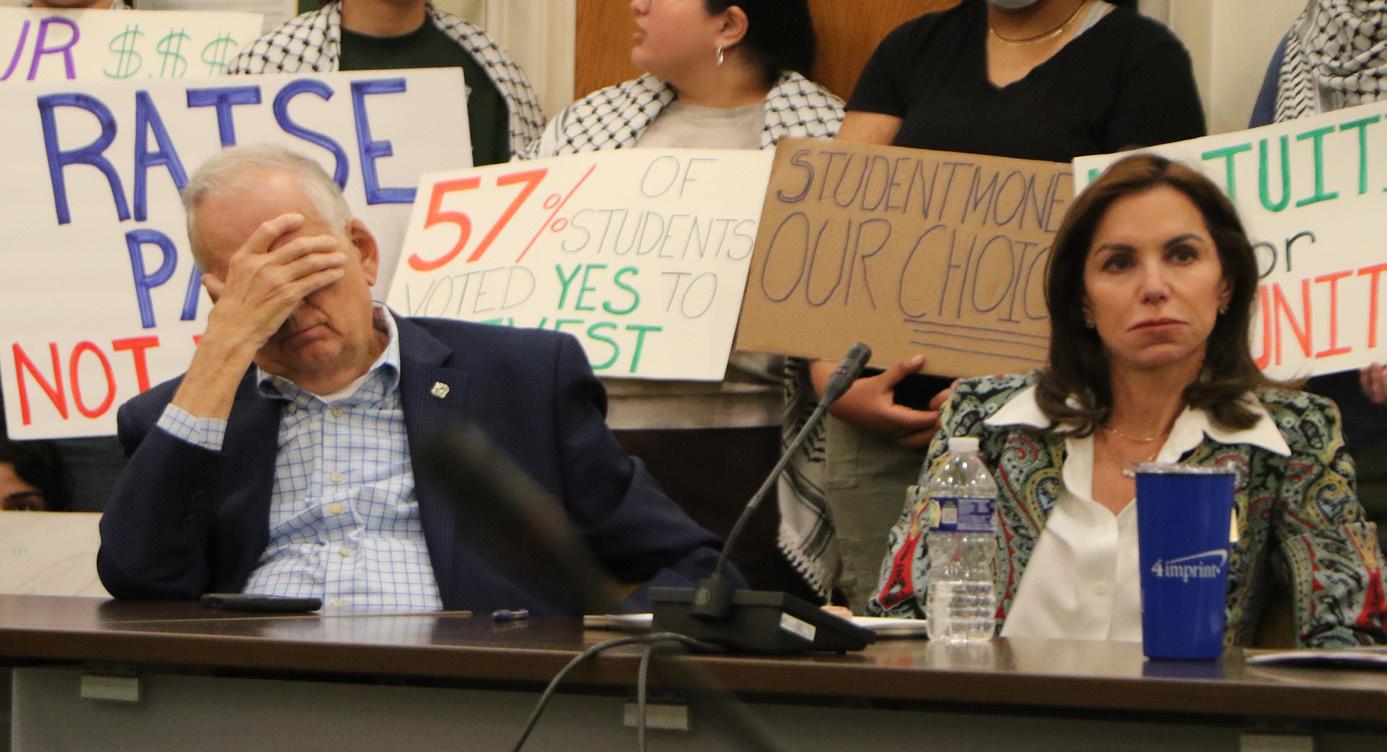
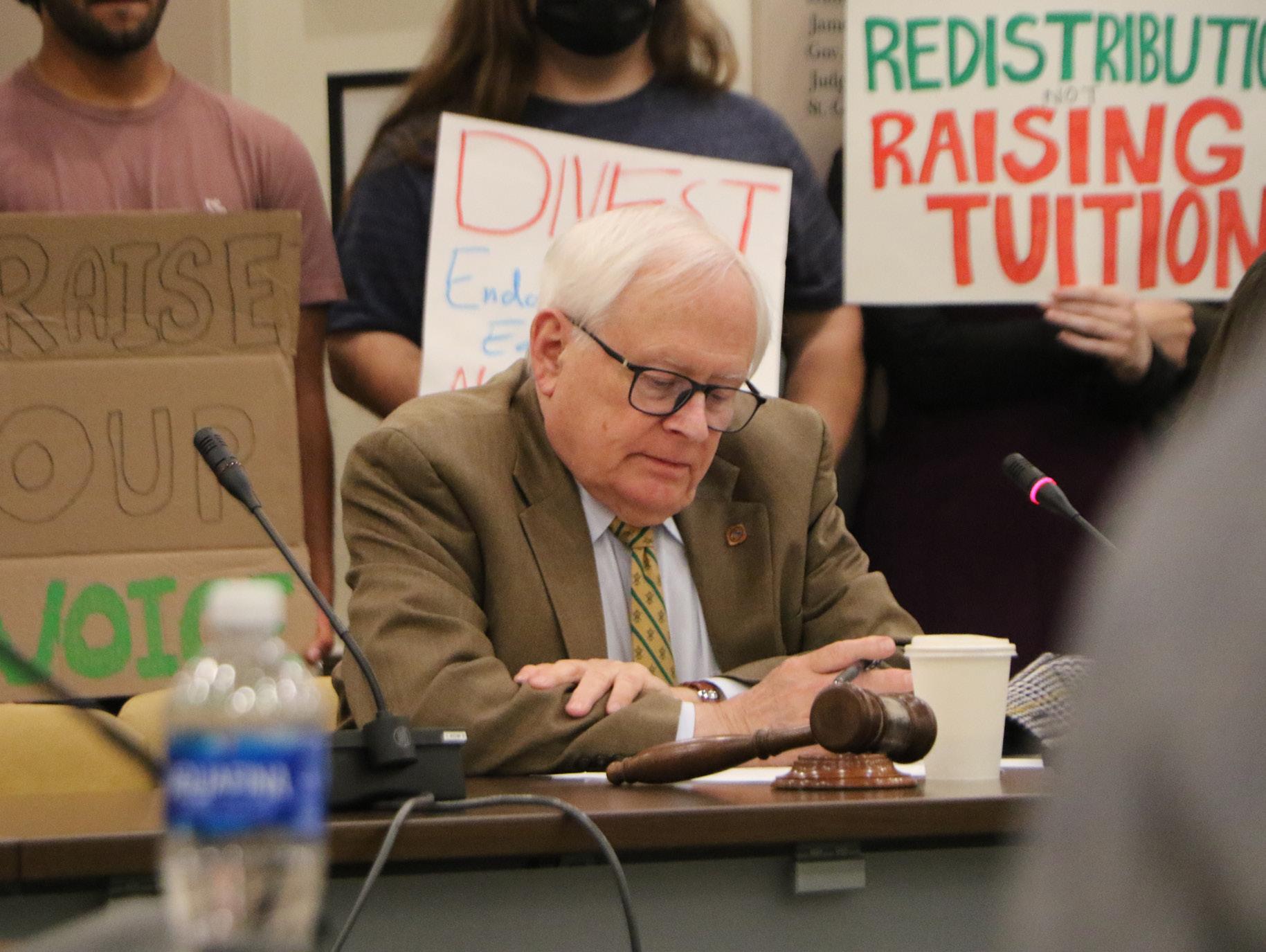
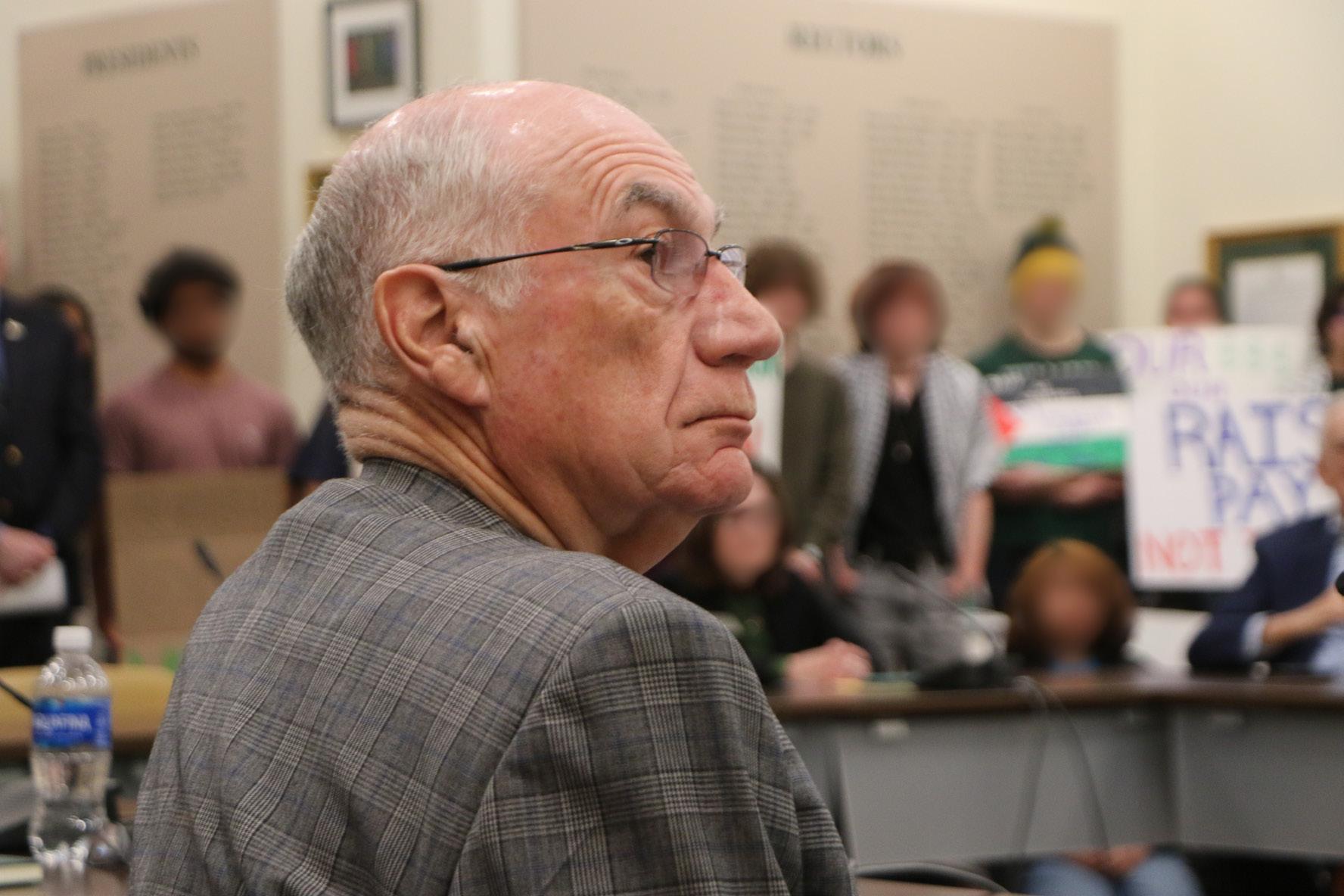
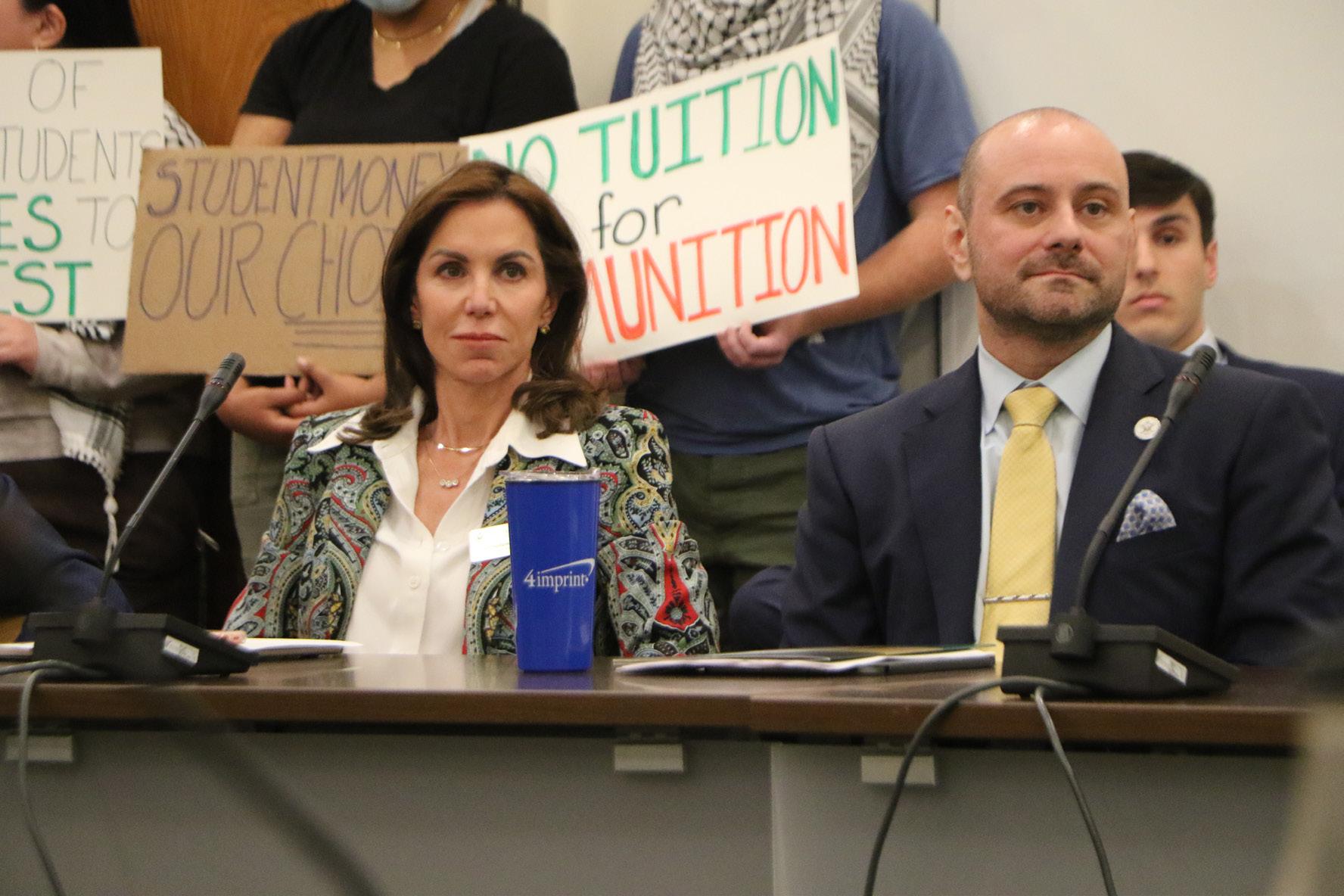
Thursday, April 23, the Board of Visitors held a public hearing on undergraduate tuition. Student protesters gathered in the room for the meeting, silently holding signs calling on the Board not to adopt a tuition increase and to divest from Israel.
Rector Charles E. Poston J.D. ’74, P ’02, ’06 opened the meeting by reminding Board members about the considerations they must weigh for undergraduate tuition.
“Our responsibility as a board is to weigh what it costs to deliver an excellent education within our commitment to make that education accessible and affordable,” he said. “The hearing directly from students, family, faculty, staff and members of the public is essential for that work.”
Executive Vice President Mike Todd presented the College’s budget and the tuition and fees proposal.
Todd explained that the College relies on money from students for a significant portion of its funding.
“Our tuition, fees, auxiliary revenues — all of these — drive the operation budget,” he said. “Nearly 70% of our operating budget is derived from student dollars.”
Todd outlined the proposed tuition increase, which would range between 0% and 3.5%. He explained how a 3.5% tuition increase would amount to around $1.6 million in new revenue for the College, raising costs for in-state students by $671 and for out-of-state students by $1,571. On the other hand, keeping tuition flat would decrease the College’s revenue by $5.1 million.
Todd also discussed the proposed range for an increase in mandatory student fees. He explained that a 4% fee increase would generate roughly $1.6 million in new revenue for the College, increasing costs for in-state students by $292 and for out-of-state students by $316. Declining to raise fees would not generate any new revenue for the College.
Todd said that the proposed increase in costs for students would not account for financial aid, so actual costs may vary.
Todd concluded his presentation, and the floor was opened for public comment.
Charles McDaniel ’28 spoke first. He said he was unhappy with the College spending money on things he did not feel were necessary for students, such as Flock cameras or the implementation of Oscar, a system that uses AI image analysis to provide instructions on sorting trash.
“I don’t understand why I need an AI to tell me what my trash looks like,” he said. “We need to be focusing on [students’] education and not surveilling them.”
After the meeting, Executive Director of Media Relations at the College Suzanne Clavet contacted The Flat Hat and explained that the Oscar system was a part of a pilot program on campus. She said that no student fees or tuition dollars were used for the trash cans and that they were paid for with an Aramark sustainability grant.
McDaniel also expressed frustration with the West Woods housing delay and the upcoming closure of the Commons Dining Hall. He said that he was upset about graduating early because of the College’s high tuition cost.
“This summer, I’m staying here and I’m taking an online class that I’m paying thousands of dollars to take because I cannot graduate on time,” he said.
McDaniel asked the Board not to raise costs for students.
“I implore you to leave our tuition alone, to divest from death and to stop paying for the Flock cameras,” he said.
Lara Waldron ’26 said that the College’s
College commemorates 1976
high tuition cost has placed a financial strain on her family.
“It is a financial burden for me to continue attending this institution, and that burden has increased in the past years, especially [since] the economic situation of this country has changed for all of us,” she said.
She said that she hopes the College takes student feedback into consideration before raising tuition.
“It is our money and our time, years of our lives,” Waldron said. “So we need this to be our choice as well, if tuition is raised.”
Maria Haddad ’26 called on the College to use the endowment to lower costs for students, rather than raising tuition.
“The focus should be on education,” she said.
Haddad expressed frustration with how there is only one tuition hearing per year for students to voice their opinions.
“I do not understand the lack of transparency,” she said.
Grace Carryer ’27, president of the College’s Young Democrats club, came to the public hearing to protest. Wearing a keffiyeh, a Palestinian cultural scarf, and holding a sign that said “RAISE PAY, NOT TUITION,” they explained that they are concerned about a tuition increase hurting the ability of lower-income students to study at the College.
“There are a lot of students who are extremely smart who choose not to come here because of the price,” they said.
Carryer said that they want their tuition dollars to be spent more on financially supporting professors and other campus workers.
“I want my tuition dollars to be used to support the people in my community,” they said.
Student Assembly President Nico GiroMartin ’27 said that he attended to hear directly from students.
When asked about the protesters who attended the meeting, Giro-Martin said that he appreciated students voicing their budgetary concerns.
“A beautiful aspect of these public hearings
is allowing anyone to come, especially the protesters,” he said. “They had their full right to protest. It was nice to see students be confident in a space with people who have power.”
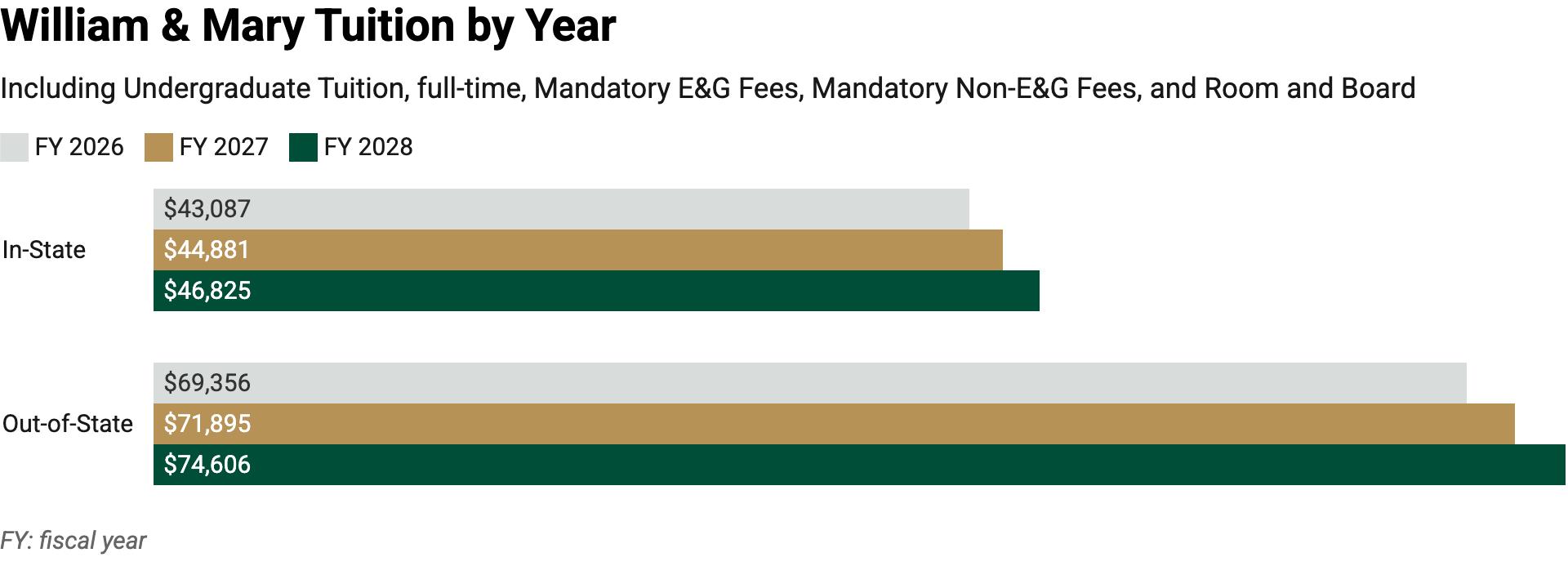
Friday, April 24, the Board voted to increase tuition by 2.9% in 2027 and 2028. Fees were increased by 2.6% for 2027 and by 3.5% for 2028. Housing and dining prices will be increased by 6.5% and 6.0% in 2027 and 2028, respectively. These changes will increase the total cost of attendance from $43,087 in 2026 to $46,825 in 2028 for in-state students and from $69,356 to $74,606 for out-of-state students.
Committee on Academic Affairs
Thursday, April 23, the Committee on Academic Affairs heard presentations from Vice Provost for Enrollment Strategy Lisa Keegan, professor of psychological science and Provost Liaison for Academic Innovation Joshua Burk, professor of law and Associate Provost for Faculty Affairs and Development Iria Giuffrida and Provost Peggy Agouris.
Keegan provided information regarding the College’s most recent admissions cycle, which she said signaled strong enrollment.
“I’m delighted to share that we’re in a very strong position with respect to enrollment right now,” she said. “We are 79% of our way to meeting our class pool of 1,650.”
Keegan said that the College has seen an increase in deposits from both in-state and out-of-state students, as well as students from underrepresented groups.
“We’re running ahead in deposits in both inand out-of-state,” she said. “Out-of-state is up about 7%. We’re up 4% overall.”
Data provided by Keegan stated that total first-year applications were 3.21% higher than the previous year, with 6.8% and 17% increases in Early Decision I and II, respectively. Applications from international students declined by 32%, and those from first-generation students increased by 7.6%.
Argentine coup anniversary with guest speaker Global Research Institute, Reves Center, Hispanic studies department host Dr. Alicia Partnoy
Wednesday, April 22, human rights activist and author Alicia Partnoy delivered a lecture in Washington Hall commemorating the 50th anniversary of the 1976 coup in Argentina. Te lecture was sponsored by the Global Research Institute, the Reves Center for International Studies and the Hispanic studies department at the College of William and Mary.
Partnoy worked as an associate professor of modern languages and literatures in Spanish at Loyola
Marymount University in California, where she currently holds emeritus status. Partnoy was a university student and young mother in Bahía Blanca, Argentina in 1976 when a military coup overthrew President Isabel Perón, suspending the constitution and closing congress.
Visiting assistant professor of Hispanic studies Matias Oviedo delivered opening remarks. He described how the military junta changed Argentine society.
“Hundreds of books were blacklisted and millions were burned, sometimes in large public spectacles,” Oviedo said.
Oviedo also noted how some activists became the targets of political violence.
“Tey would become known as the ‘disappeared,’ taken to illegal and secret detention centers where they would be tortured, and most would be murdered and their bodies thrown into the ocean or buried in mass graves,” he said.
Partnoy was a survivor of these political purges.
“I was very, very lucky. My daughter was with me. She was a year-and-a-half when I was arrested,” she said. “I was very lucky that I got her back.”
Partnoy spent time incarcerated
at Te Little School, a concentration camp where she was blindfolded, starved and beaten.
Oviedo explained how eforts by the United States helped in Partnoy’s eventual release.
“With support from President Carter, the Inter-American Commission on Human Rights of the Organization of American States conducted a visit to Argentina in 1979,” Oviedo said.
“National and international pressure forced the release of a number of political detainees by the junta, and Dr. Partnoy was among them.”
After her release, Partnoy moved to
the United States and raised awareness about the disappearances caused by the junta.
“[Partnoy] published ‘Te Little School: Tales of Disappearance and Survival [in Argentina],’” Oviedo said. “It brought worldwide attention to this human rights violation and has been used as evidence against perpetrators.”
During the lecture, she recognized students involved in Argentine archival declassifcation. Some students in the audience were congratulated for their work on the project.
SEE CAMPUS PAGE 4
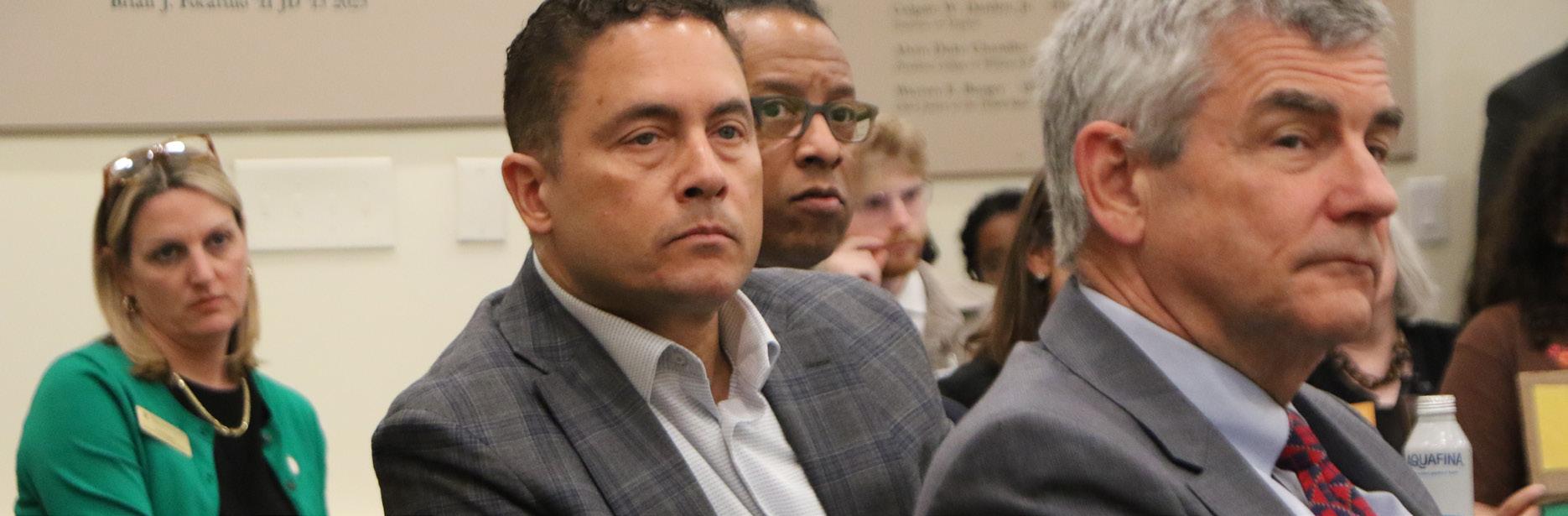
LIAM GLAVIN, NAMAN MISHRA AND MADDIE MOHAMADI // THE FLAT HAT
GRAPHIC BY ROBIN PERDUE / THE FLAT HAT
BOBBY MOLLAN THE FLAT HAT
PHOTOS BY LIAM GLAVIN AND NAMAN MISHRA / THE FLAT HAT
news insight
A lot of the recollections, memoirs and books that these survivors write have a lasting impact. The works that people leave behind, whether itʼs art or literature, have a las
Monday, April 27, the Colonial Williamsburg Foundation Board of Trustees announced that President and CEO Cliff Fleet ʼ91, M.A. ʼ93, J.D. ʼ95, M.B.A. ʼ95 has retired. Carly Fiorina, former CEO of Hewlett-Packard and a presidential candidate in the 2016 Republican Party primary, was appointed as the next president effective immediately.
Fleet, who has served as president since 2020, stated he decided to retire for “personal reasons.”
Fleet appreciated his time at the Foundation.
“Leading the Foundation has been the honor of a lifetime,” Fleet said in a press release. “We have made enormous progress over the past few years thanks to the dedication of an extremely gifted leadership team, talented staff, devoted Board of Trustees, and the heartwarming generosity of donors.”
Chief Development Officer of the Foundation Sani Silvennoinen described his optimism for Fiorinaʼs presidency.
“I have worked closely with Carly for several years and am excited to continue working with her in this new role at the Foundation,” Silvennoinen said.
Fiorina described her gratitude for Fleetʼs tenure and service to the Foundation.
“The Board is grateful for Cliffʼs tireless service to the Foundation,” Fiorina said. “He has made a profound impact on the long-term trajectory of the institution which will benefit future generations. The Board and I look forward to continuing the Foundationʼs important and consequential work, particularly as we prepare for both the July 4 and Centennial celebrations.”
Fiorina has served as the Foundationʼs Board of Trustees Chair since 2020 and on the board since 2017. Fiorina is also the national honorary chair of VA250, which is planning events to celebrate the countryʼs semiquincentennial.
A THOUSAND WORDS
New Student Assembly Senator Terrence McDuffie discusses passion for justice, equity, service
SACHI PALLEM // FLAT HAT NEWS ASSOC.
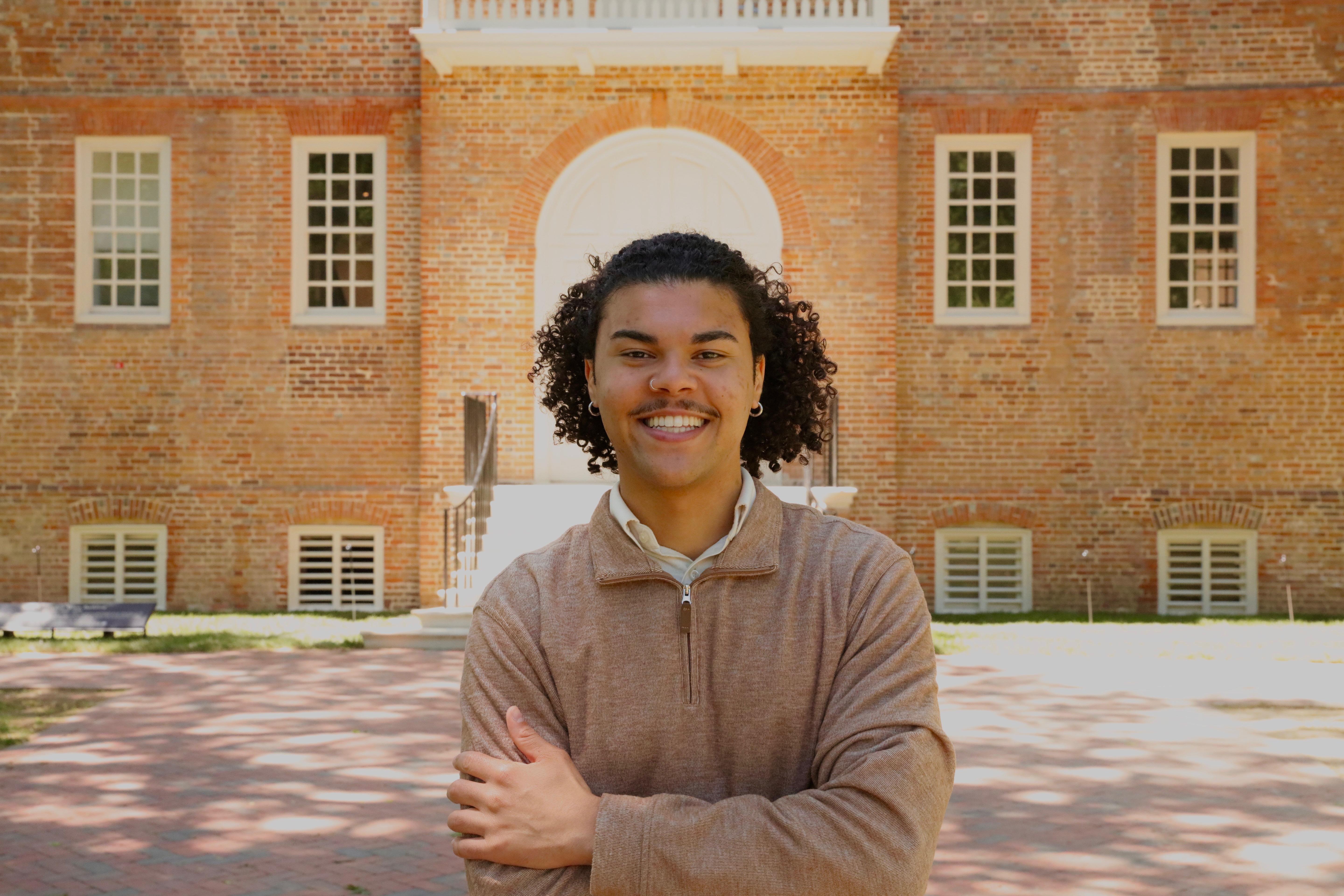
Terrence McDuffie ’27, an Africana studies and sociology double major on the pre-law track at the College of William and Mary, serves as president of the Innocence Club. He is a Posse and James Monroe Scholar, the founder and director of the Posse Scholar Ambassador program and was a City Research Scholar.
McDuffie’s commitments reflect his passion for racial justice and community outreach.
“William and Mary was essentially given to me on a silver platter through Posse, and I’m so grateful for that,” McDuffie said.
When he arrived in Williamsburg, Va., McDuffie was drawn to the College’s Innocence Club due to his interest in criminal defense and knowing a friend in the organization. Now, as president, McDuffie enjoys the task of preparing discussions between members.
“I would make those slides, and then I would facilitate conversations, delegate those slides to exec members to present on and then facilitate discussion among general body members,” he said.
McDuffie said he merges dialogue about criminal justice with race to provide a broader perspective.
“Overall, my approach was really to talk about wrongful incarceration through the lens of how racism played a role within that,” McDuffie said. “Really, talking about touching base with critical race theory and delving into the history to serve as a context for where we are now with all of that and how it is that Black communities are disproportionately facing wrongful convictions because of this history that is there.”
To fulfill the Innocence Project’s mission to “free the innocent, prevent wrongful convictions, and create fair, compassionate, and equitable systems of justice for everyone,” the Innocence Club directs advocacy, education and fundraising efforts.
“We were raising money for No Kids in Prison, which is a nonprofit organization that advocates keeping kids out of prison and pushing a more rehabilitative approach,” he said. “Ultimately, people are products of their environments, and kids are the most susceptible to that.”
McDuffie also explained how he views criminal justice issues in the United States.
“People are growing more conscious, but it is just so difficult to find an avenue that could actually work because the system was built to harm people,” he said.
McDuffie’s time as a City Research Scholar with the Village Initiative began after interning with the Local Black Histories Project, jointly run by the initiative. The organization describes itself as “a grassroots, 501c3 organization dedicated to equity and justice in the Williamsburg-James City County Schools and community.” As a part of these efforts, McDuffie helped create the documentary “Displaced from the Birthplace of America.”
The film explores the history of the Black business sector and community hub called the Triangle Block, its destruction
by the City of Williamsburg in the 1970s and Black citizens’ response to this loss and discrimination.
McDuffie discussed Williamsburg residents’ reactions to the film’s extended trailer.
“So many people always come to us afterwards and say, ‘I had no idea. I’ve been here for all my life. I had no idea that this happened,’” he said. “Even if it’s just one person that’s being like, ‘I’m getting enriched, I’m becoming enlightened from this information,’ the job is done.”
McDuffie explained why he wanted to raise awareness about this topic.
“We have to be respectful of the people who were here before us, who are here right now and who are going to be here after us,” he said. “And there is this isolation in race, class and access.” Along with conducting archival research, McDuffie especially valued the community work he accomplished, such as speaking with residents to understand their stories of displacement.
“There’s this one woman. Her mom had a business in the Triangle Block, and her home right across the street,” he said. “[The] City bought out the business, destroyed that property, and she’s living across the street, seeing something that a Black woman did in the ’50s and ’60s on her own, being literally taken right in front of her eyes.”
McDuffie described the impact of these conversations.
“While it might not be the first involvement I think of when people ask me what I’m involved in, upon reflection, it is my most impactful, my most meaningful involvement,” he said. “As I’m talking about it, I’m feeling the emotions coming up.”
On campus, McDuffie is also a class of 2027 senator for Student Assembly, a returning Orientation Aide Director and co-outreach chair for International Minimart. As a firstgeneration student himself, McDuffie hopes to use these efforts to support fellow first-generation students and students of color.
This summer, McDuffie will work alongside his advisor and sociology professor Amy Quark on topics related to the “Displaced” documentary. McDuffie will also intern under Director of Restorative Justice and Diversion Services Rev. Grace Woodward in the Commonwealth Attorney’s Office. His work will center on victims’ rights and combine accountability with rehabilitation for offenders.
“I get to work in a space where we’re presenting alternatives and rehabilitating the people who are committing these acts and hopefully putting them on a path to recognizing, ‘This is the harm that you’ve done. Can you sit here and come to terms with that, focusing on the person that you impacted and then go from there to recognize, grow from there and be put on a better path?’” McDuffie said.
NAMAN MISHRA / THE FLAT HAT
FLAT HAT NEWS BRIEF
Colonial Williamsburg Foundation President, CEO Cliff Fleet announces retirement
Community gathers for ribbon-cutting ceremony, commemorates ISC4
Rowe describes completion of ISC4 as significant milestone for College, expanded research opportunities
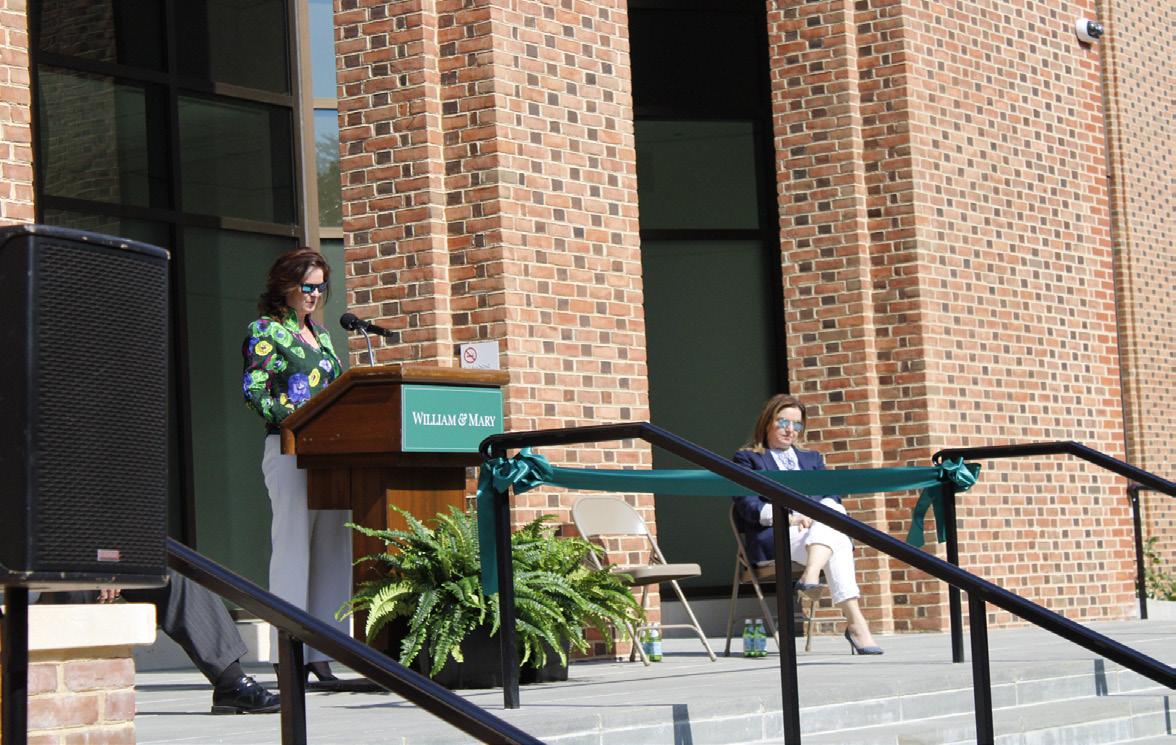
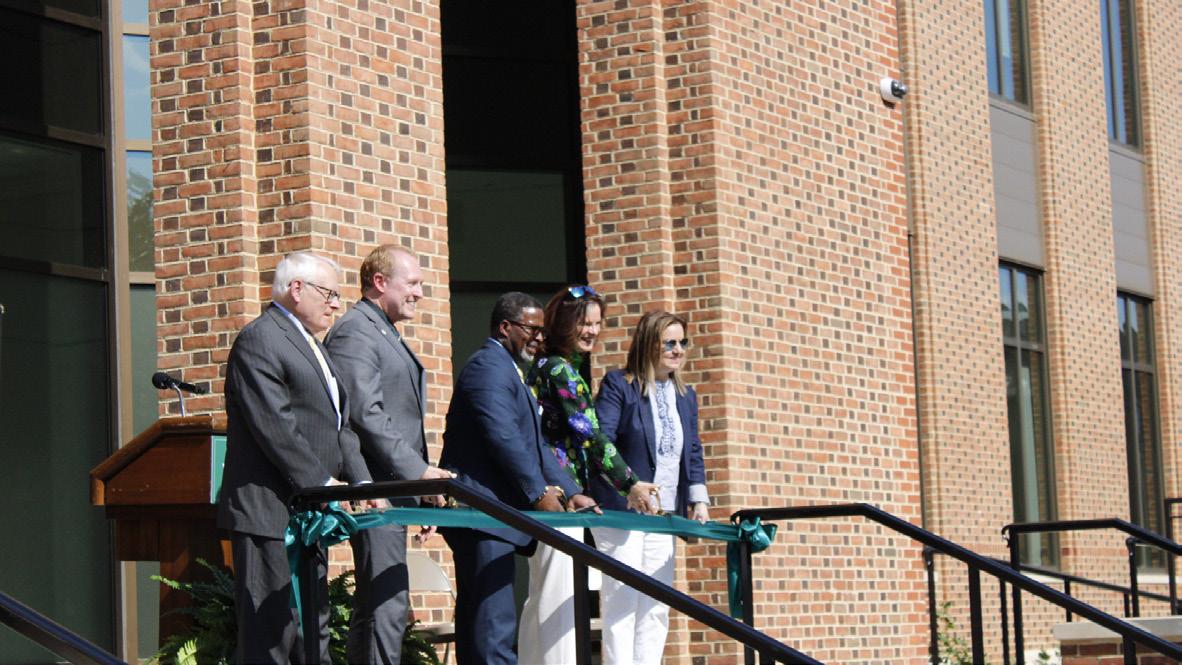
Thursday, April 23, members of the College of William and Mary community gathered outside Integrated Science Center 4 for a ribbon-cutting ceremony.
Speakers included inaugural Dean of the School of Computing, Data Sciences & Physics Douglas Schmidt ’84 M.A. ’86, College Rector Charles E. Poston J.D. ’74, P ’02, ’06, College President Katherine Rowe and Provost Peggy Agouris.
“This building was designed to foster exactly that kind of interdisciplinary engagement that defines our school, and by an extension, all of William and Mary,” Schmidt said. “It’s a place where ideas will be tested, partnerships will take root, and our students will be prepared to lead, question and innovate in ways
that only William and Mary graduates can lead.”
After opening remarks, Poston described the building’s opening as a significant milestone in the College’s history.
“The work happening here — from theoretical physics to cutting-edge data science — is a powerful engine for this R1 university,” he said. “It exemplifies the high level of research and teaching that defines William and Mary.”
Poston emphasized ISC4’s role in connecting undergraduates with faculty members and research opportunities. He explained that the space will invite students to engage with emerging technologies.
Rowe echoed this sentiment, sharing that six years ago, Student Assembly leaders advocated for stronger programs in computer science, data science and data analytics.
“What we are affirming is exactly what that student proposal said, that the ability to think critically with data, with numeracy, is one of the essential liberal arts of the 21st century,” she said.
Rowe also said that the commonwealth of Virginia provided $102 million in funding to construct ISC4. The building includes an applied research center, an 8,000-square-foot makerspace, classrooms, labs and more.
“Our students and faculty now have an environment and the infrastructure to pursue questions that just don’t fit neatly into a single field,” Agouris said. “The discoveries made here will matter beyond the campus, to the Commonwealth, to industry, to the broader scientific community.”
Agouris highlighted the space’s role in supporting a variety of disciplines.
“The best way of creating an environment where lots of ideas flourish is to put people from different areas in the same building and give them space to innovate,” she said. “And so, while this is the home of CDSP, its reach is campus wide.”
Professor of government John McGlennon
Following Schmidt’s concluding remarks, Rowe invited Virginia Delegate Cliff Hayes Jr. to join the speakers in cutting the ribbon.
“We are so grateful for the General Assembly’s support, and you [Hayes] have been such an incredible champion of STEM at William and Mary,” Rowe said.
After the ceremony, Chair and Sidney P. Chockley Professor of Computer Science Evgenia Smirni, who has worked at the College for 29 years, refected on the department’s changes.
“When I came, it was a small department focusing mainly on teaching,” she said. “The department has since become like a research powerhouse, but of course, our strength and quality of teaching are still palpable.”
Since becoming department chair four years ago, Smirni said ISC4’s opening felt like a long-term vision coming to life.
delivers lecture on Virginia history
McGlennon discusses redistricting referendum, gerrymandering, experience teaching government at College
Thursday, April 23, the College of William and Mary hosted Class of 1935 Professor of Government John McGlennon for a talk regarding Virginia’s electoral system and unique history in Chancellors Hall. The event was arranged by the College’s chapter of the NAACP.
Chair of the Political Action Committee Dakota McCoy ’27 spoke about motivations for hosting the event.
“When the NAACP chapter hosted the Election Day watch party, we noticed a lot of people in attendance did not know their delegate and did not know their representative. Yet, they voted for these people,” McCoy said. “We wanted to have an event and something that people could take home with them — a pamphlet — that would tell people who their representatives are and what they’re supposed to be doing.”
McGlennon has taught government at the College since 1974. He ran for the U.S. House of Representatives twice, served on the James City County Board of Supervisors for 29 years and described himself as a member of the NAACP for life.
”I’ve enjoyed my involvement with our local chapter quite a bit over the years and really have found it to be a great organization,” he said. He began his talk by describing how he started his career during former President Richard Nixon’s call for impeachment amidst the 1974 Watergate scandal. He compared this to the current demands for what would be President Donald Trump’s third impeachment
“It’s been an interesting ride, just seeing the way things have developed,” he said.
McGlennon spent much of the talk interpreting the 2026 Virginia redistricting
STUDENT ASSEMBLY
amendment, which allows the state to redraw its congressional districts outside the standard cycle. He provided context for the referendum vote. The amendment was a direct response to redistricting moves in Republican-led states after Trump pushed Texas to redraw its congressional map outside of the census to add five Republican seats. California Gov. Gavin Newsom responded by placing a redistricting measure on the ballot for voters to approve.
McGlennon pointed out a key difference in California from the redistricting done by Texas’s legislature.
“In California, the governor said, ‘No, we’re going to do it differently. I’m going to go to the legislature and ask them to put this on the ballot, and we’re going to go ahead and have an election for the voters to decide if they want to do this,’” he said.
Virginia’s Democrat-led government followed California’s lead, and voters approved the measure. They produced a new map with 10 districts likely to elect Democrats and only one likely to elect a Republican.
While McGlennon said this is not an accurate representation of Virginia’s government or population, he acknowledged the practicality of the decision.
“It is the only way we can get a fair balance nationally to offset what’s happening in these other states,” he said.
Virginia’s constitution makes this process especially difficult. Unlike most states, Virginia requires a proposed constitutional amendment to pass the legislature twice before going to voters. That same process had previously produced an independent bipartisan redistricting commission, which the new amendment temporarily suspends until the 2030 census.
McGlennon explained the hesitation of some
Democratic voters who had supported the original bipartisan commission but remained uncertain about partisan gerrymandering.
“That sort of restrained some Democratic enthusiasm, caused a little bit of a depression of the Democratic vote, primarily among suburban voters who were really very supportive of a kind of fairness notion,” he said.
In regular candidate races, Virginia Democrats typically win by far larger margins, McGlennon said. Gov. Abigail Spanberger won the governor’s race last year by around 15 points.
Though there was a slim margin in Tuesday’s results, McGlennon drew a greater conclusion.
“The election really became framed on the question of, ‘Do you really want Congress to continue to just let Donald Trump do everything he wants to do?’” he said. “And on that basis, Virginians said no.”
After the election proceeded, a judge in Tazewell County, Va., sought to block certification of the result. McGlennon said the Virginia Supreme Court is expected to issue a final ruling on the objection by Monday, April 27.
“It’s very unlikely they would now turn around and say, ‘Oh, well, too bad,’” he said. “We know that 3 million-plus voters turned out to cast their ballots. We know that they made a decision.”
A student mentioned seeing mailers urging a “no” vote by claiming the redistricting would strip political power from Black voters. McGlennon answered the question of unequal representation by walking the room through a history of Black voting rights and representation, starting with the Voting Rights Act of 1965.
In the immediate post-VRA era, a district needed to be roughly 65% Black for an African American candidate to possibly win. McGlennon argued that this no idea longer holds, and this was the logic that Republican
mailers exploited.
“What we know about the way people vote is that racial polarization is not as strong as it was in that time period,” he said.
Under the new map, City of Williamsburg Rep. Jennifer McClellan’s district stretches to Danville and contains a Black population of around 45%. McGlennon said McClellan is still overwhelmingly likely to win reelection. Virginia currently has two Black congressional representatives who are both expected to win.
McGlennon explained how a broader shift in how Americans vote has made this possible, stating that white voters today are less likely to vote against a candidate simply because of their race.
“I’m white, they’re Black, so what? What’s their stand on the policy issues that I care about?” McGlennon said.
He pointed to Virginia’s last election cycle as proof. The Republican candidate for governor was an African American woman. The state elected Ghazala Hashmi, a Muslim American, as lieutenant governor and Jay Jones ’10, an African American graduate of the College, as attorney general.
“When you look at the nature of representation, it’s changed so much over time,” McGlennon said.
McGlennon also traced Virginia’s unique governmental structure back to its colonial roots. Virginia was built as a social hierarchy that had plantation owners at the top. This hierarchy was reinforced by its political system.
Colonial history’s application to the present was important to McCoy.
“I like that [McGlennon] touched on Virginia’s unique electoral system,” she said.
Senate begins 334th session, considers Flock camera transparency resolution
Senators consider funds for new APO golf cart, changes to referendum election rules, coffee for Orientation Aides
Tuesday, April 21, the Student Assembly Senate held confirmation hearings for several positions in the SA Cabinet.
Noa Rudisch ’27 was appointed as secretary of sustainability. Tom Chesnut ’27 was confirmed as attorney general. Lyndsie Beavers ’28 was confirmed as the secretary of diversity and inclusion, and Eesha Kulkarni ’27 was appointed as the secretary of student experience.
Sen. Quinn Clancey ’27, historian of the senate, introduced the OA Appreciation Act IV. If passed, the bill will allocate $1,500 from Student Assembly Reserves to host a coffee bar for Orientation Aides during orientation week.
Clancey also introduced the Bolstering Ethics of Election Fairness Act Part V. The bill comes after multiple major
referendums on campus surveillance and free expression.
The Firewall For Freedom and Flock referendums were submitted via student petitions to SA. The current code allows for students to submit petitions within 21 days of the general election. Clancey argued that this time frame was not sufficient for the Independent Elections Commission to verify the accuracy of claims made on the referendum ballot, as petitions were submitted days before the general election.
The BEEF Act Part IV, which senators unanimously passed on Tuesday, March 3, struck these deadline stipulations for submitting signatures for a referendum.
Chair of the IEC Meagan Kenney ’27 addressed the chamber with her concerns regarding the amendments.
“We had to put them on the ballot without time to verify the language of them, to make sure it wasn’t biased. There’s no time to verify signatures,
but we were obligated by code to put them on the ballot,” she said. “So that’s something that we’d like to avoid in the future, because without this clearly defined timeline, we cannot really guarantee a fair, neutral and unbiased referendum in the election.”
The new bill aims to clarify the language in the SA Code to fix the issues of the BEEF Act Part IV. The BEEF Act Part V will amend the Code to say that referendums must be submitted at least 21 days before the general election.
“The [SA] Elections Commission should retain discretionary oversight for the wording of ballot questions to ensure neutrality and to revise or reject language that is misleading or biased,” the bill states. “Advance submission is necessary for the Elections Commission to have proper time to place a well-informed, unbiased referendum on the ballot.”
Clancey explained that the goal of the new elections bill is to further
clarify elections processes.
“Clarity is really the name of the game here,” he said.
Class of 2029 President Daria Lesmerises ’29 introduced the CART Act. The bill allocates funding for Alpha Phi Omega, the College’s gender-inclusive service fraternity, to purchase a new golf cart for its campus escort service.
Campus escort provides students with daily free golf cart rides from 9 p.m. to 12 a.m. APO has appeared before the senate before to discuss the worsening quality of thew golf carts and the need for repairs.
The bill, if passed, would allocate $3,500 to purchase a used golf cart.
SA senators also overwhelmingly passed a resolution calling on the administration to cancel its contract with Flock, the surveillance system that uses automatic license plate readers to record identifable vehicle information.
Students have raised privacy cocerns regarding Flock technology.
The Deflock William & Mary Resolution, sponsored by Sen. Neha Baskar ’29, calls for increased transparency from the administration regarding the purchase of the contract and to deactivate the cameras already installed throughout campus. The legislation follows a referendum in which students voted overwhelmingly in the affirmative for Flock cameras to be removed.
All but one senator — Chair of the Senate Sen. MacKenna Wyckoff ’28 — voted for the bill.
In a statement to the Flat Hat, Wyckof wrote that she sees the technology as important for student public safety.
“I believe that the referendum on March 26th ballot concerning Flock was biased in language, nor did it offer perspectives from both sides of the issue, therefore the results were biased as many people were making an uninformed choice,” Wyckoff wrote.
MADDIE MOHAMADI FLAT HAT MANAGING EDITOR
MADDIE MOHAMADI / THE FLAT HAT ISC4 will expand STEM and research opportunities for students at the College.
MADDIE MOHAMADI / THE FLAT HAT Rowe discussed the role student advocacy played in the creation of ISC4.
CAMPUS
Partnoy describes impact of political advocacy in Argentine coup
Human rights advocate details tragedy, resistance under military rule, importance of memory
CAMPUS from page 1
“Thank you. It’s work for justice, for truth, for memory,” she said.
Much of the talk focused on the importance of creating records as a form of justice.
“I tell people today, if you are a victim of a kidnapping by ICE [U.S. Immigration and Customs Enforcement], if you survive, document what you see,” Partnoy said. “And you guys are doing it on Instagram, on Facebook.”
Partnoy read excerpts from books, poems and other accounts of the experiences of military regime survivors.
“March 30, 5 p.m., they call together, their screams muffled. They go, as always, these mothers,” she read in one account. “Three thousand they take. Six mothers they arrest, held at gunpoint. People screamed.”
The junta made sure to erase records and locations
BOARD OF VISITORS
associated with the crimes, Partnoy said. Thousands of records relating to political prisoners were purposefully destroyed in attempts to cover up the regime’s crimes against humanity. Many victims have yet to be found.
“During the time of President [Jorge Rafael] Videla in Argentina, they demolished the place where I was kept,” Partnoy said.
Still, progress is being made to memorialize the experiences of survivors.
“Now [The Little School] is marked as a place of memory. There is a memorial for the mothers who gave birth there, right there at the school,” Partnoy said.
Partnoy’s friends, who were also imprisoned, have not been forgotten, either.
“This is in the town where my friends were born, Graciella and Sulma,” Partnoy said. “In these small towns, they created satellite universities. This one, in general, has only two
classrooms, one with the name of Graciella and one with the name of Sulma.”
Partnoy finished the lecture by speaking about her daughter. “I could see my daughter. I could see her through a glass and speak to her through a microphone. I couldn’t touch her for this time,” she said. “On the plane, she kept asking me, ‘Are you sure you know how to take care of me?’”
Partnoy reconnected with her daughter, and the two recently wrote a book together outlining their experiences.
Ted Van de Verg ’27 was in attendance and spent a semester studying abroad in La Plata, Argentina. He noted the influence that recording memory can have.
“The biggest takeaway is that a lot of the recollections, memoirs and books that these survivors write have a lasting impact,” he said. “The works that people leave behind, whether it’s art or literature, whatever it is, does have a lasting impact on memory.”
Board of Visitors discusses admissions, athletics, student wellness
Administrators, faculty, student panel present information on various topics, detail community goals
Keegan said that the College has made efforts to attract more out-of-state students through scholarships and financial aid and that these programs have seemed to be effective thus far.
“I’m actually thrilled to see that we are running so far ahead in out-of-state deposits,” she said. “Part of that is a test pilot that we’re doing with some modest merit scholarships and also our out-of-state financial aid strategy.”
Burk then presented the findings of a report of the College Curriculum, the College’s general education structure. The 2025-26 academic year marked 10 years since its initial launch. The COLL Review Group completed a phase of data collection from students, faculty and alumni to gather feedback on the program.
Burk said that most of those surveyed held positive views of the COLL curriculum with regard to the College’s commitment to a rigorous, interdisciplinary liberal arts education.
“Faculty agreed that COLL is important for delivering a comprehensive liberal arts education,” he said. “For alumni, 92% agreed that COLL broadened their educational experience and found the COLL requirements to be relevant and comprehensive. 79% of current students agreed that COLL contributed positively towards their education.”
not always clearly communicated.
According to the College’s data, only 57% of students found the domain and attribute labels in the COLL curriculum to be clearly defined.
Burk said some students also complained about the high number of credits required by the COLL curriculum.
“They may be in high-demand majors, majors that require a lot of credits, and trying to fit in the COLL curriculum in addition to that was challenging for some students,” he said.
68% of student respondents said there were too many COLL requirements, according to the College.
Most students also found advising to be unhelpful in understanding COLL.
“One thing that came out was issues with advising,” Burk said. “Both alumni and current students talked about how advising was not as helpful as they would have liked in terms of supporting them in choosing their COLL courses.”
Burk said that the COLL system is clearer than the general education requirements of peer institutions.
“If we want to compare ourselves to peer institutions, what we saw is, overall, William and Mary is doing a good job with the COLL curriculum in terms of being a relatively simple system for people to understand, but also being able to describe the goals,” he said.
Burk said that COLL builds valuable skills among students with opportunities not found at many peer institutions.
“It’s designed to support student outcomes after they leave William and Mary by building skills such as writing and communication,” he said. “In comparison to some of the other institutions that we looked at, we were well-positioned in terms of what our core curriculum is delivering.”
Burk also relayed anecdotes shared by community members praising the program.
Moving forward, Burk noted some opportunities for development in the COLL curriculum. One example is improving the numbering or labeling of courses, which is
The College is also actively seeking ways to incorporate new technological developments and associated skills.
“The working group thought a fair bit about, ‘Do we need something regarding AI?’” he said. “But even more broadly, thinking about emerging technologies, we want a curriculum that’s nimble enough to be able to go with technologies — even things that we might not be able to imagine right now.”
Giuffrida then presented on the College’s post-tenure development program.
Giuffrida said the assessment and support of faculty on the tenure track is a primary goal for the College.
“Faculty are at the heart of the pursuit of
Mary,” she said. “Annual reviews are really at the core of how all of our peers relate in terms of assessing the development of their scholars.”
Based on a review of 25 peer institutions, Giuffrida developed a Faculty Development Framework to structure the development of faculty support. Part of this framework is creating personalized networks between faculty members.
“What I suggest in the report is that we create perhaps some fast tracks for faculty that prefer more of a one-to-one rapport rather than working in bigger groups,” Giuffrida said. “Some faculty members may be teaching new topics, new subjects, and they need a little bit of one-to-one attention to be able to really leverage their skills.”
Giuffrida said another goal is to support faculty research.
“My plan is to collaborate closely with the vice provost for research to make sure that they dovetail development in research, such as how to write grants, or how to improve the success rates in this climate that has become even more competitive than it was before,” she said. “Having faculty be familiar with the processes is really important, and this supports both the research output as well as the general public development overall.”
Giuffrida said she believes such programs will allow the College to attract and retain high-quality faculty.
Lastly, Agouris presented on the College’s goals to maximize the impact and quality of faculty teaching, as well as recent developments.
Agouris said that the typical course load for faculty has remained relatively stable over recent years. She noted that the proportion of classes taught by non-tenure-eligible faculty has increased over the past several years, and the proportion taught by tenure or tenureeligible faculty has decreased.
“You see a little bit of uptick on how much we rely on teaching faculty versus the tenureeligible faculty,” she said. “This has to do with the fact that we are expecting the [tenured] faculty to be much more proactive in terms of research and have activities that are not only in the classroom. And that really brings us to relying more on teaching faculty, which I think is great.”
Agouris also said that the College’s studentto-faculty ratio has decreased from 13-1 to 11-1 in recent years. The proportion of classes with fewer than 20 students has decreased from 53.2% to 45.5% since the 2019-20 academic year, and the proportion with 50 or more students has increased from 6% to 9.4%.
“Almost all of our classes, like 90% of our classes, are either small, less than 20, or medium, less than 50, which is an important thing to remember,” she said. “This is what really is an additional distinctive advantage of William and Mary — that we are not throwing people in huge classrooms.”
The average load of credit hours per faculty member at the College is 274, slightly above the median of peer institutions at 258. Agouris
“We are in a good spot,” she said. “That means our faculty are producing more than a lot of our peers, but they’re not overwhelmed, so they have additional length of time for activities that are related to research and service, and we really appreciate that.”
Overall, Agouris said she believes the College has effectively managed its faculty workload without unnecessarily hiring additional staff.
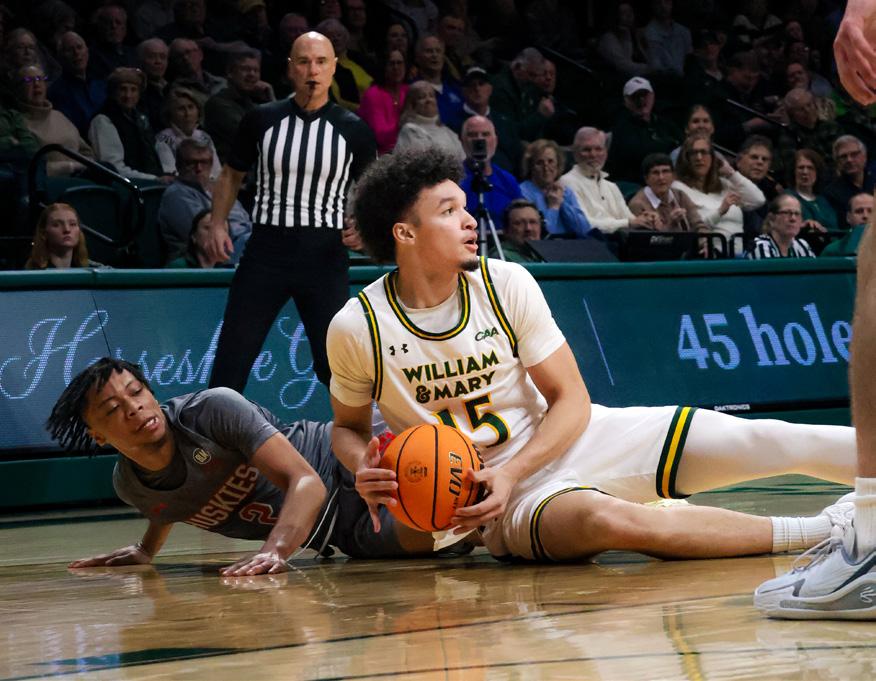
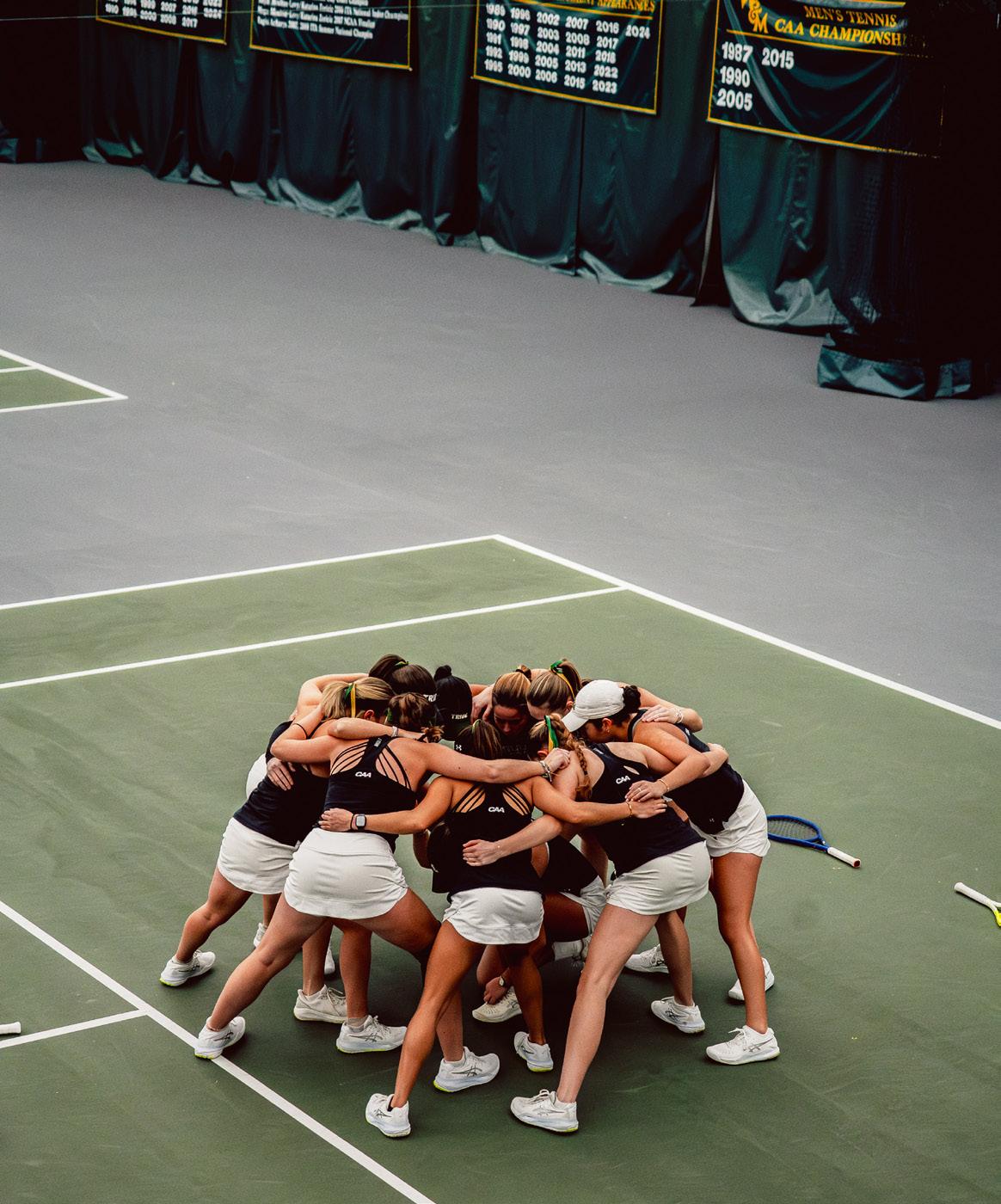
“The undergraduate class sizes are really very reasonable for a public institution,” she said. Committee on Athletics Thursday, April 23, the Committee on Athletics heard presentations from Director of Athletics Brian Mann, Interim General Manager for Athletics Larry Pulley ’74 and professor of data science and Presidential Liaison for Strategic Initiatives Anthony Stefanidis. Mann opened by recognizing members of the College’s athletics community for their accomplishments this spring.
“On the court, on the floor, in the pool, but certainly in the classroom and in the community, our student-athletes continue to excel and represent us very well,” he said.
Mann updated the committee on the new Mackesy Sports Performance Center, which opened its doors to the College’s athletics community on Friday, Feb. 6.
“I can’t think of a better way to describe it to you than it is alive, that our student-athletes, coaches and staff are in there at all hours of the day,” Mann said. “They are not only getting better as athletes, they’re building culture, they’re creating relationships, they’re caring for themselves in a better way.”
Mann also said $6 million in gifts will help modernize Kaplan Arena, with improvements in seating, concession areas, hospitality spaces and media broadcast capabilities.
“What’s so important about this is, because of the Mack and the new spaces we have, we will be able to host more events, more gatherings for all different parts of campus in our community,” he said.
Additionally, Mann shared staffing updates with the committee.
Lindsey Brinza, the inaugural Associate Athletics Director for Sports Medicine, was hired in late March and will officially join the College on Sunday, May 10. Brinza will be responsible for overseeing student-athlete health, mental performance and care coordination.
“We are pushing forward with a more dynamic, integrated care model for our student-athletes, under Lindsey’s guidance and leadership, as a way for us to meet the needs of our student-athletes now,” Mann said.
Mann then pivoted to the national landscape of university athletics, highlighting four key changes: a recent White House executive order, National Collegiate Athletic Association “ghost transfer” penalties, Division I Cabinet eligibility shifts and proposed eligibility concepts.
NAMAN MISHRA / THE FLAT HAT
The Board heard comments from students regarding affordability, budgeting and divestment before voting to increase tuition.
B OARD OF VISITORS from page 1
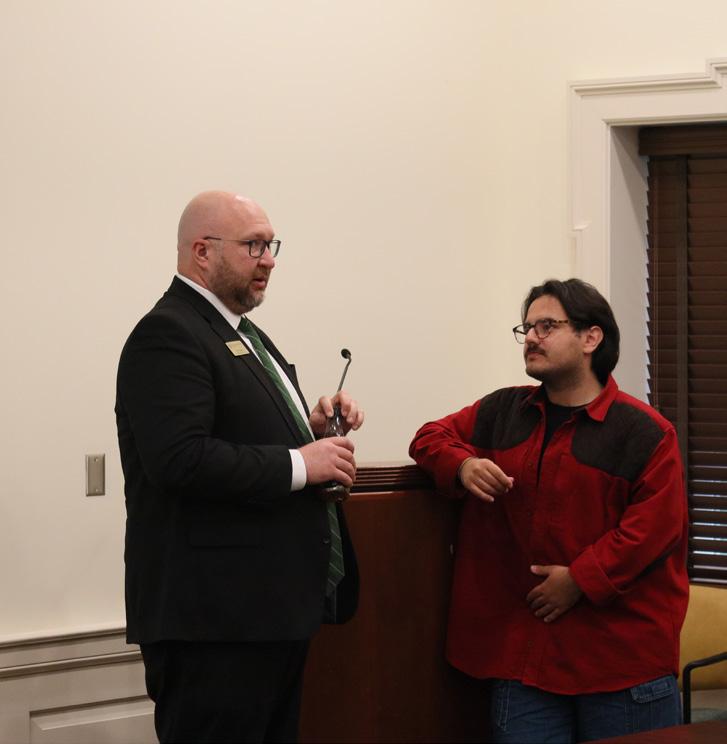
NAMAN MISHRA / THE FLAT HAT
The Board sought to balance affordability with a sustainable funding model when deciding on tuition changes.
ANDREW HENRICKSON / THE FLAT HAT
By 2028, the total cost of attendance will increase by $3,738 for in-state students and by $5,250 for out-of-state students.
STAFF COLUMN
Why are you going so fast?
I used to run track. I know, I know. Running, for fun? Who would ever do such a thing? Trust me, I ask myself the same question.
Track boggles my mind, not just because it involves people running on purpose, but because it shows an incredibly wide range of what humans are capable of. At the same meet, you have people hurling weights (that’s shot put), leaping into a sand pit (long jump) and flying into the air (that’s Superman — sorry, pole-vaulting).
Athletes in each of these events have one goal: to push their body and mind to their limits. I do not have statistical proof, but I anticipate track is ranked high on the list of “Sports That Make People Throw Up.” It is not uncommon to see athletes (particularly the runners) cross the finish line, weave for a few steps in a way that would definitely not convince any police officers of sobriety and collapse onto the turf.
Is this healthy? Probably not. But who am I to say?
What’s curious is that sprinters who race the 100-meter dash and distance runners who do the two-mile event look remarkably similar after finishing. They are weak-kneed, wobbly, strained, exhausted. Every muscle worked to the point of exhaustion, they stumble to a resting spot and sip a Gatorade in between pants. Their throats burn; their eyes sting with sweat. They are depleted.
The key to running is pacing. A sprinter in the 100-meter dash leaves the starting line going almost as fast as they possibly can. A runner in the mile race wants a start that puts them in a solid position, but not one that destroys their energy for the rest of the race. They settle into a rhythm they can maintain, then apply the rest of their stores to a final lap. They are aware of their limits and where they can push those boundaries. They have a “race pace” that fits the event in mind.
Ideally, students treat their academ-
ic life as a “distance race.” Like an experienced runner, they carefully plan how far they will run by a certain time. They set off with a steady, yet determined pace. As they run, they aim for a zone between too easy and too difficult.
This is how I think of my friends who are excellent at time management. They make a calendar at the beginning of the semester. They outline their essays in advance, check in with professors during office hours and maybe even have time for a second draft. They study and tackle assignments in small steps.
Then, there are the sprinters. On occasion, I am one of them. These are the people who check the assignment instructions within a day of a big deadline. As they realize they misheard their professor’s request for a 10-page paper as a four-page one, their life flashes before their eyes. The last week of fun and awesome appears before them: scrolling on Instagram reels during their Earl Gregg Swem Library “study session,” watching all of “The Twilight Saga,” going online shopping for socks with College of William and Mary President Katherine Rowe’s face on them. So many regrets!
A sprint, on occasion, can be a reasonable strategy. Hours on end in Swem? Not my ideal afternoon. Sometimes, though, circumstances call for a solid 100-meter dash.
The problem is when we are always sprinting. When we are always present when the Swem closing announcement plays (oh, the horror!), when we are always buzzing with caffeine and stress, when we are always fighting the clock.
Like an evil version of whack-amole, another assignment pops up as soon as one is completed. We are always three steps behind where we should be, and we cannot rest until everything is done.
Full speed ahead can only go on for so long.
Heck, even distance runners cannot keep going indefinitely.
No one can run forever.
With this truth in mind, it is nice to have a finish line in sight. For many students, the end of finals is that finish line. For the seniors, it’s graduation. Together, we cross our fingers and hope we can make it. Complete projects, nail presentations, pass exams. Soon, a carefree summer will be in our grasp!
The terrible reality is that, for many people, summer is not carefree. Summer is internships, familial obligations, jobs, financial considerations, classes, worries. Summer can be fun, but it is not always a break.
At a campus coffee shop, I overheard a snippet of someone discussing their post-grad plans. They are starting
GUEST COLUMN
work almost immediately after graduation. They said something along these lines: “When do we ever get a break? It’s going to be like this for the rest of my life.”
In a race, the goal is burnout. The goal is to have just enough energy to cross the finish line. The goal is to have nothing left. Seriously, my middle school cross country coach used to say, “Your mind quits before your body does,” in an attempt to inspire a group of tweenagers to run faster.
But is that the goal of school? Of work? Of life?
No one can run forever, yet we try. We move at an unsustainable pace. Whether sprinters or distance runners, our legs tire, our motivation drains and our steps feel heavier.
If responsibilities keep flying at you like bugs on the highway, it is essential to try a back road. When life is going splat into your windshield, it is time to pull over somewhere safe and let the engine cool, so nothing weird and smoky starts to happen under the hood.
If the world won’t rest, we can choose to. We can replenish ourselves before getting flat tires. We can move at a pace we can keep up, not with a superhuman display of willpower, but with enjoyment and ease.
Check the fuel gauge before you need to push your car up a hill. Stop at the gas station often. Downshift. Put your vehicle in park. The road is long, and speeding is not the most effective way to get to your destination. The Burnout Police are very vigilant about people exceeding the speed limit!
I understand this is an oversimplification. Academic work is never the only thing people have on their plates or on their minds. It’s not always possible to have a “full cup,” but there are small ways to add a few drops to it. This is not a race. We are not runners (unless you are, in which case, I have nothing). We do not have to break any records, especially not at the price of tearing a hamstring or getting shin splints. We can step off the track and explore some wooded trails. We can stretch. We can recover. We can breathe. We can look up at the funny shapes in the clouds and think, “Isn’t this crazy, this thing called life?”
Alexandra Hill ’28 is a prospectiveEnglishmajorandcreativewriting minor. She does research at the IIC Conservation GIS lab and is a member of Vox. When she’s not submitting her columns late, you can find her yapping, daydreaming or dancing really badly. Contact her at abhill@wm.edu.
Junior year: The bitter reality
Isabella McNutt FLAT HAT OPINIONS ASSOC
There’s something uniquely disorienting about being a junior in college. You’re no longer new enough to feel uncertain about where you belong, but you’re not yet at the point where everything is ending. You exist in this strange, fragile in-between: grounded, comfortable and yet increasingly aware that the life you’ve built is temporary. Half of my friends are seniors. The other half are graduating in the fall, already beginning to drift into whatever comes next. And then there are the few who are just stepping into their senior year, lucky, maybe, because they still have time, but also unlucky, because they’re about to realize just how fast that time disappears.
This year feels perfect in a way that almost doesn’t make sense. For the first year, no one is
moving, no one is studying abroad, no one is missing from the routines we’ve built. For once, everyone is here, fully present, fully available. There’s an ease to everything; my friends come over without hesitation, filling the room with noise and laughter like it’s second nature. Plans don’t require planning. Someone suggests a sunset drive, and within minutes, we’re all ready. Someone mentions ice cream, and suddenly we’re on our way. It’s effortless, almost instinctual, like we’ve all learned how to exist in each other’s lives without barriers.
These are the moments people talk about when they describe college, the ones that don’t feel monumental at the time, but somehow become everything when you look back. Sitting on the floor, talking about nothing and
everything. Late-night drives with no destination. The kind of laughter that feels like it could go on forever. It’s not just the big memories, it’s the ordinary nights that somehow feel extraordinary simply because of who you’re with. And yet, underneath all of it, there’s this quiet, persistent sadness.
It’s hard to explain because nothing is actually wrong. In fact, everything feels right. But maybe that’s exactly why it feels the way it does. There’s a subtle awareness, always in the background, that this version of life has an expiration date. That the ease, the closeness, the spontaneity — it’s all temporary.
I can’t be the only one who feels like there’s a ticking clock on college life as we know it. Not just the academic timeline, but the emotional one. The countdown on living within walking distance of your closest friends. The countdown on being able to call someone at a moment’s notice and know they’ll say yes. The countdown on a life where your world feels small in the best possible way. Yes, I have another year. One more year to do everything I’ve been meaning to do. One more year to fully lean into this place and the life I’ve built here. I can go to my favorite spots a hundred more times. I can take long walks in every season, watching how familiar places change with time. I can sit through sunsets that blur into one another and still feel new every time. I can say yes to things I would have once overthought or turned down. But even with all that time, I know something won’t be the same.
Inclusion for who?
COURTSEY IMAGE / AARON JORBIN
Conversations around inclusion at the College of William and Mary often emphasize representational diversity, but equity and inclusion are equally central to traditional DEI frameworks. As a visibly neurodivergent and non-traditional student, I have repeatedly encountered barriers to meaningful inclusion in student life at the College. Queer organizations off campus often have explicit mandates to support populations such as people living with HIV, intersex and other gender nonconforming people. However, unlike other institutions I have attended, the queer organizations on campus are often student-driven rather than universityinitiated. Ideally, this allows for more student autonomy. But without admin oversight and clearly defined standards, this structure risks sidelining vulnerable communities — such as intersex people and people living with HIV — whose needs are less recognized.
To understand how this plays out in practice, it is important to look at how W&M Pride Committee is organized. W&M Pride operates as a coalition of three student organizations — oSTEM, Drag & Drop, and Lambda Alliance — working in concert with Student Assembly to organize events celebrating LGBTQ+ pride throughout the month of April. In my experience serving on the pride committee, there was often a lack of long-term thinking and a distinct lack of decorum.
One consequence of this lack of planning is the creation of barriers for disabled students. I observed instances where cross-talk and frequent interruptions made it difficult to fully express perspectives related to disability and intersex inclusion. While often unintentional, cross-talk can function as a structural barrier to participation, particularly for neurodiverse folks. This is especially striking during Autism Acceptance Month, when institutions signal support but may not always implement basic accommodations. At a minimum, campus organizations should ensure structured and uninterrupted public comment periods. Communication access is not something that should be considered a privilege; it should be universal. Robert’s Rules of Order is in practice at my local Sisters of Perpetual Indulgence chapter, a collective of drag artists engaged in community service and activism. W&M Pride could also be informed by disability activism, which has emphasized the inclusion of a wide range of disabled folks and their communication needs.
More structure, such as the recognition of speakers, would allow people under the plus umbrella — for example, intersex individuals
Because it was never just about the places; it was always about the people. And next year, the people will be different. Some will be gone completely, scattered across cities and time zones, building new lives that no longer overlap with mine in the same easy way. Others will still be here, but things will shift. Schedules will get busier. Priorities will change. The effortless togetherness we have now will start to require effort.
“Come over” won’t always be so simple. “Are you free?” won’t always have the same answer. That’s what makes this moment so bittersweet. It’s not just that it’s good, it’s that I know, in real time, how good it is. There’s no distance or nostalgia softening the edges. I’m fully aware of it while I’m living it, which somehow makes it more meaningful and more fragile at the same time.
Being a junior means standing in the middle of something beautiful and already feeling the weight of its ending. It means holding onto moments a little tighter, staying out a little later, saying yes a little more often, not out of obligation, but out of an understanding that this is finite.
But maybe that awareness isn’t something to fear.
Maybe it’s a gift.
Because not everyone gets to recognize a good thing while they’re still in it. Not everyone gets to live a moment and know, this matters, this is special, this is something I’ll carry with me forever. There’s something powerful about being present enough to feel both the joy and the ache at the same time.
— to suggest events that not only acknowledge but actively celebrate the full diversity of the community.
However, this pattern is not limited to face-to-face discussions. It also concerns the internal policing of queer expression within the community itself. In a recent Lambda Alliance Discord discussion, public statements by members of the group implied that wearing leather attire at a campus event constituted a violation of “consent.” These respectability politics are not unique to any single organization. Historically, the Mattachine Society, one of the first gay rights groups in the United States, centered the voices of white cisgender gay men over the voices of drag queens and transgender people who were considered less palatable by its leadership.
However, this use of consent language risks distorting its meaning, reducing it from a framework for ethical engagement to something more ambiguous. Consent has a specific meaning: it refers to agreement to participate in an interaction. It is not a tool for regulating who is allowed to exist or be visible. In an era where states are increasingly criminalizing transgender people and drag artists for their mere presence in public space, this misuse of consent language should give all of us pause.
This nebulously defined use of consent continues in formal standards articulated by affiliated groups themselves. Drag & Drop’s “Sexual & Consensual Conduct” guidance states that “upon entering the space, [the] audience is consenting to your performance,” framing consent as something automatically granted through mere presence rather than actively given in interaction. It conflates consent with expectation — what one might reasonably anticipate viewing at an event. The same document further complicates this framework by banning “kink” performances, regulated largely through attire, while simultaneously permitting strip routines with executive approval. This creates a contradiction in practice: a person fully clad in leather could be prohibited, while a more minimally clothed performer is permitted. It also ignores the history of how drag itself was prohibited under obscenity laws.
The result is not a coherent standard, but a set of rules that are selectively legible and unevenly applied. This also erases the leather community, which has been a significant fundraiser for queer and AIDS service organizations.
If W&M Pride and its affiliated organizations are serious about inclusion, they should define clearly articulated and fairly enforced written standards. These standards should not only be informed by student input but also by subject-matter experts in queer history and established best practices in accessibility.
So maybe the answer isn’t to dwell on the ticking clock, but to let it sharpen everything instead of dimming it. Let it make the laughter louder, the conversations deeper, the memories more intentional. Let it push you to reach out first, to make the plan, to show up, even when it would be easier not to. Say “yes” to the sunset drive. Stay for one more song. Go get the ice cream, even if it’s late. Sit a little longer in the moments that feel ordinary because one day they won’t be.
Because the truth is, this chapter doesn’t lose its meaning just because it ends. If anything, it gains meaning because it does. And while it won’t be the same next year, and it’s not supposed to be, that doesn’t mean it’s over. The friendships, the memories, the version of yourself you’ve built here, they don’t disappear. They evolve. They stretch into new places, new routines, new versions of life. So, instead of mourning what’s coming to an end, maybe the challenge is this: to live so fully in this moment that when it does pass, you don’t feel like you missed it. To let it be bittersweet, not because you’re losing something, but because you had something worth missing in the first place.
Isabella McNutt (she/her) ’27 is a government and history double major, and she is a member of Alpha Chi Omega. She loves traveling, reading and music. Email her at immcnutt@wm.edu.
GRAPHIC BY MAISIE CURTIN / THE FLAT HAT
STAFF COLUMN
GRAPHIC BY GRETTA ANDERSON / THE FLAT HAT
Eating local: Pancakes and so forth
I have always been a proponent of eating local. Being from Brooklyn, N.Y., I am very fortunate to have grown up with a wide variety of convenient, local restaurants all within walking distance or a quick train and car ride away. Yes, when out with friends, Chickfil-A or McDonald’s were always places we’d stop, but we were just as likely to go and grab a pie from Nino’s Pizza or roast beef sandwiches from Roll-N-Roaster, both local, independently-owned restaurants that don’t hurt the wallet too much. All that to say, wherever I go, I always like to support a local restaurant. This past weekend, I had the pleasure of visiting the Outer Banks, N.C. for the first time. The beach was nice, the weather held up well enough, and overall, I really did have a fun time. On the morning we were leaving, my friends and I had been deciding on what to get for breakfast. Rather than pick up some food from Wawa and hit the road, we all decided that we would rather get a uniquely OBX breakfast. We ended up pulling into the parking lot of Stack ’em High Pancakes and So Forth, a pancake house in Kill Devil Hills, N.C.
The appeal of any chain restaurant, store or gas station is consistency. Whether you are at a McDonald’s in Florida, New York or Montana, the Big Mac will taste the same, the restaurant will look the same and the drive-through will more or less operate the same, too. Local restaurants, on the other hand, offer a unique look into, well, the local area, and Stack ’em High sure did deliver.
The interior was painted a variety of bright colors with quips and proverbs written on the ceiling beams, door fringes and any other imaginable piece of empty wall space. There were pictures, maps and other OBX memorabilia dotted all over the walls. The actual layout of the restaurant was unique, too. Rather than sitting down and then ordering, we waited in a line where we admired the aforementioned décor, read the extensive menu (who knew
there were so many ways to prepare a pancake?), picked out our beverages, watched the grillmen prepare stacks upon stacks of pancakes, and then ordered and paid for our food, which would be brought out to us when we sat down. It was a unique atmosphere that I can’t say I have ever experienced before, but it definitely made the whole experience a memorable one. It also didn’t hurt that the pancakes were phenomenal.
After we placed our orders at the register, out of curiosity, I asked the cashier if the place was family owned. Gesturing to a wall of black and white photos, she told me that her father-in-law, an immigrant from Greece, first opened the restaurant and that it was still operated by the family today.
According to the restaurant’s website, Perry Kiousis and his wife, Kiki, the founders of the restaurant, immigrated to the United States in the 1960s, entering the restaurant business and learning English by listening to customers and practicing with each other. The couple eventually founded Stack ’em High in 1981, along with an additional location in nearby Kitty Hawk, N.C., a couple of years later. They then passed the businesses along to their sons, Nick and Steve, and their families, who operate the locations today.
As a Greek American, this was exciting to learn because many of my family members, including my Pappou (grandpa), shared similar stories. Coming to the United States with little to no education or ability to speak English, the restaurant business was very attractive to Greek immigrants. They opened restaurants, diners and pancake houses across the United States, incorporating American mainstays, like pancakes, with tastes of home like gyros and pastitsio while employing countless family members or friends in need of work. Whether or not the families still operate the restaurants today, it was this industry that opened the gates for them and their children to all sorts of other industries.
Understandably, as college students, it isn’t possible to eat out locally all the time. Often, fast food or sit-down chains are not only more convenient but also more affordable. However, if you can take the time to try one of the many local restaurants in Williamsburg, Va. or any in your hometown, I encourage you to do so. Regardless of the ethnic background of the owners, when you eat local, you are supporting the dream of a family, not a corporation. You are supporting the dream of an individual who took a risk to provide a service for your community. And hey, if you ever visit the Outer Banks, I know a really good pancake spot! Michael Gabriel ’28 is a history major. Besides writing and editing opinion pieces, he contributes an issue of his Willy and Mary comic almost every edition. He is a big baseball fan, likes the outdoors and is always happy to talk to anyone about anything. Contact him at mdgabriel@wm.edu.
Resume culture: Fishing for a role
Everyone knows that students at the College of William and Mary are ambitious and driven. In fact, Forbes recently named the College among the “New Ivies,” a designation widely shared on students’ Instagram stories. This recognition reflects a broader awareness of the College’s reputation and the expectations that come with it. In a school full of students preparing to be competitive in the job market, what is less openly talked about is how deeply resume culture has shaped student involvement itself. At the College, student organizations are spaces for community, leadership, passion and friendships. But increasingly, participation in clubs — especially leadership roles — has also become tied to how it will look on a resume. Executive positions, in particular, are not only about genuine interest or contribution to a community, but also about signaling ambition and achievement. While many students are genuinely passionate about their organizations and want to lead them well, it would be naive to pretend that career outcomes are not a concern for many college students. However, it is also difficult to ignore how this resume incentive shapes student behavior, reinforcing the way students naturally think about how their experiences
translate into internships and future jobs.
Leadership roles in student organizations at the College are often highly competitive.
For many students, building a strong involvement begins as early as freshman year, as they take on roles across fraternity and sorority life, club sports, academic and cultural organizations, service groups, on-campus jobs, research labs and the performing arts, often balancing multiple commitments at once. The goal is not only to contribute meaningfully to a club but also to secure roles that will stand out to future employers.
At the same time, some organizations may favor students who are more extroverted, already well-connected or simply better at navigating networks. In other cases, leadership becomes influenced by friendships rather than qualifications alone. As a result, students who might be equally capable can be overlooked.
This creates a subtle tension within campus life. On one hand, students are encouraged to “get involved” and take initiative.
On the other hand, meaningful leadership opportunities are limited, and they often carry expectations about how students should present themselves to be competitive.
The reality is that the job market is increasingly difficult for students entering
it. Internships are competitive, entry-level roles require experience and students face pressure for their resumes to stand out. It is therefore not surprising that leadership positions in clubs become highly valued. Even when students are genuinely passionate about these organizations, the pressure to translate every experience into something “resume-worthy” can still shape how they choose to participate.
When involvement becomes closely tied to resume-building, participation can shift from being rooted in community and shared interest to being driven by performance and positioning. Clubs can begin to feel like spaces where students are constantly aware of how their involvement will be perceived externally.
This pressure is not created by any single group of students, but is the result of broader academic and professional expectations shaping campus life. Students are simply trying to navigate a competitive environment. It is not a novel idea that incentives influence behavior. But acknowledging the role of resume culture does not diminish the importance of student organizations at the College; it simply helps us understand the pressures that shape how students participate in them. As we head into summer, it is worth considering what student life would look like if student organizations placed greater emphasis on belonging and on creating spaces where students can contribute and make a difference in what they enjoy, even as resume culture continues to shape how students approach involvement. AvaGravina’28isapsychologyand EnglishmajoratWilliamandMary.She swimswithClubSwimandwritesforthe school’spopculturemagazine,TheDoG StreetJournal.SheisfromoutsideBoston andenjoysspendingtimewithfriends, baking,readingpsychologicalthrillersand watchingrom-coms.Youcancontacther atacgravina@wm.edu.
Eva’s Apple #21: Mosquito mania
What’s nine plus 10?! Twentyone. My column is officially older than I am. She can drink wine in the United States. She can buy a house in Mississippi. She can adopt a child. I wonder how many more issues I have left to write before my column becomes a living, breathing entity of its own. It can already do stuff that I can’t do. It won’t be long before it starts to exercise that right autonomously. I think what I’m doing is creating the opposite of artificial intelligence. I have been so organically generative that my brain child has grown its own consciousness. I have conceived a sentient being all by myself.
In “Jekyll and Hyde” and “Frankenstein,” the birth of a motherless child is seen as a divine injustice. Lucky for us, the name “Eva” essentially translates to “giver of life.” I am a mother. My mother, a grandmother. My grandmothers, great-grandmothers. And so on. After a summer’s rest, I will be back to raising this child. Will she continue to grow while I’m gone? When we get back after this summer, will my column just write itself? I guess we’ll have to wait and see. Alright. I might as well write this thing while I still can. The question of the week is as follows:
“I currently have approximately 48 mosquito bites. What do I do?”
You know how humans are allegedly made up of 60% water? My
makeup is different. I’m 60% DEET. You know, that ingredient in bug repellent? If I were a boy, my mom would have named me N,N-diethylmeta-toluamide. When I was in Vietnam last summer, my friend Lisa introduced me to Soffell and Remos, which are these bug sprays and bug creams that I swear were heaven sent. In two months, I only got THREE bug bites. Did I have chemical burns from the sheer quantity of bug repellent on my skin? Unimportant. When I have kids, I’m naming the first one Soffell and the second one Remos. But this dear reader isn’t asking how to prevent bug bites. They want to know how to deal with the fallout of a rendezvous with a mosquito. I gotchu. Earlier today, someone asked me if I was familiar with the show “Shark Tank.” They didn’t know who they were dealing with. It got me thinking about how many mosquito-related products have gone on “Shark Tank” over the years. From a gadget that suctions out the irritant from mosquito bites to bat houses for natural mosquito control, it seems the investment show has covered all the mosquito-related ground in the entrepreneurship space. But they missed one thing: the golden solution to dealing with mosquito bites. What if the money to be made here isn’t from relieving the irritation from bug bites, but instead embracing it? As summer quickly approach-
es, it’s time to reckon with the sad truth that Soffell and Remos aren’t available in big-box retail stores in the United States At some point this summer, you’re going to get a mosquito bite. You might even get like, I dunno, 48. When you do, you have to turn your misery into money.
Capitalize off of the pain. Below, I’ve detailed a step-by-step business plan to turn the irritation into art:
1. First, you have to attract as many mosquitoes as possible. There are a lot of ways to do this.
Mosquitoes tend to like people with Type O blood. Find out all of your friends’ blood types and ditch everyone who’s Type O. They’re going to attract all the mosquitoes instead, and you can’t have that happening.
Mosquitoes also don’t really like Type A blood, so try to surround yourself mostly with people who fit that profile. Once you’re primed to be the most attractive candidate for mosquitoes in your circle of friends, boost your chances of getting bitten by eating as many bananas as possible, covering yourself in lactic acid (moisturizer works fine) and camping out near standing water. It’ll all make sense in a second.
2. Now, you know how people are obsessed with animals who make their own art, like dogs and elephants who paint or cats who scratch clay on the pottery wheel? Why are mosquitoes any different? Once you’re covered in mosquito bites, itch them a bit to get them all red and bumpy. Then connect the dots using a tattoo gun.
People thought the only constellations on our planet were in space, but we can make our own on our skin. We can turn blemishes into beauty.
3. It’s time to turn this art into income. Did you know that only female mosquitoes bite people? You got tattoo patterns made entirely by women! You’ve got a femaleowned small business on your hands. The internet says that about 25% of tattoo artists are women. How many of those female tattoo artists are insects? None. You’re about to disrupt an entire industry.
4. Okay, so you’ve got the concept art. You’re incredibly itchy and uncomfortable, but that doesn’t mat-
ter. No pain, no gain. Now, the business plan commences. People are always more inclined to buy something on impulse if it’s a limitededition item. Even if you can crank out 50 tattoos a week, you should limit supply to increase demand. We’re talking one client a year. Sell that one tattoo for an exorbitant amount of money. You’ll get the biggest bang for your buck that way. 5. The only challenge here is finding someone willing to pay that much money for the tattoo. You have to generate hype to increase interest. The most important things are a good name and getting actors on a payroll to pretend that they like and want your product. The business name should be something witty and edgy, like “Sucker Punch Designs” or “Itch Slap Ink.” Sidebar, but wouldn’t “Ink Inc.” also make a great name for a tattoo company? Okay, never mind, I looked it up, and that’s been done already. Back to business. Remember those friends with Type A blood who you surrounded yourself with to become a mosquito magnet? They owe you one for protecting them from blood-borne illness. Guilt them into being your brand ambassadors. After a couple years of this gambit, you should be one of the most desired and least accessible performance artists/inked-up geniuses in the world. If you’ve got a summer internship lined up, quit. This is a much better idea. Thank me later. I’ll see you after this summer. If my writer’s voice has completely changed and it seems like this column is being written by an autonomous, supernaturally-conceived creature, we’ll all have to join forces to save humanity from the monster my ambition and ingenuity have created. But we’ll cross that bridge when we get there! HAGS! Eva Jaber ’28 (she/her) is a prospective English or international relations major. She is a member of the Cleftomaniacs, an a cappella group, an ESLtutor and hopes to encourage peace-minded advocacy on campus. Contact her at ehjaber@wm.edu.
Eva Jaber FLAT HAT OPINIONS ASSOC.
STAFF COLUMN
GRAPHIC BY MICHAEL GABRIEL / THE FLAT HAT
Ava Gravina FLAT HAT OPINIONS EDITOR
GRAPHIC BY ISABEL VOLDEN / THE FLAT HAT
GRAPHIC BY MICHAEL GABRIEL / THE FLAT HAT
MICHAEL GABRIEL / THE FLAT HAT
FLAT HAT OPINIONS EDITOR
Michael Gabriel
Reel Talk: ' Iron Lung ' vs. ' FNAF
Why Markiplierʼs ʻIron Lungʼ does horror and cinematography
I’ll admit it. I’m about three months late to discussing Markiplier’s film “Iron Lung” (four in regards to “Five Nights at Freddy’s 2”). I’ve been fairly busy with my academic and social life, and I haven’t considered these films until recently. However, with my Intro to Film and Media Studies course drawing to a close, I have been thinking back to these movies and how the contrast between both films’ quality, especially regarding the horror element (both films are in the horror genre), could offer a lesson for students at the College of William and Mary, especially future filmmakers.
“Iron Lung” was directed and selfdistributed by Mark Fischbach, aka Markiplier, a gaming YouTuber and filmmaker, and it is set in the aftermath of an event known as the “Quiet Rapture.” All the stars and habitable planets of the known universe disappear, leaving survivors to search for the remaining resources, such as, presumably, in the depths of a moon covered in human blood, which serves as the flm’s setting.
“Iron Lung” is a surprisingly good flm, featuring a strong element of horror. Te flm is specifically atmospheric in its plot, which, while certainly slow and limited due to its taking place in a single setting (a submarine in the ocean of blood), builds up throughout the film’s duration.
Our protagonist Simon (played by Markiplier) feels increasingly isolated and despondent until the last third of the film, when the horror pays off in truly gory and horrifying ways. I won’t spoil the film for those who haven’t seen it, but I highly recommend watching the film once it becomes available on streaming services.
“Five Nights at Freddy’s 2” was directed by Emma Tammi and based on the eponymous game series created by Scott Cawthon.
While I feel that an explanation for the movie is less needed than for “Iron Lung”
GERONIMO RITCHESON // FLAT HAT OPINIONS ASSOC.
due to the popularity of the FNAF franchise, I will say that it involves the protagonists
exploring an abandoned Freddy Fazbear’s Pizza restaurant while fending off possessed animatronics. While I feel that “Five Nights at Freddy’s 2” addresses some problems from the previous film, “Five Nights at Freddy’s” from 2023, it also introduces a lot of problems of its own, such as liberties taken on the source material, generic dialogue and character development and an overall cheesy atmosphere for the entire film.
All of these converge onto the biggest problem of the film for me: the lack of actual horror. While “Five Nights at Freddy’s 2” does feature bigger scares than the last film, it barely lives up to the games’ reputation as a horror franchise, with the cheesy atmosphere, in particular, undercutting what could have been terrifying moments. While the film could be enjoyed with company in a “so bad it’s good” vibe, I personally found it too cheesy to be enjoyable. Ultimately, with me being more conscious about filmography and what it takes to have a clear cinematographic character, I’ve noted how “Iron Lung” has more of such a character than “Five Nights at Freddy’s 2.” With its setting in a submarine and little beyond that besides flashbacks, Simon’s limitations in a fairly dark and rusting interior require more resourceful filmmaking.
This constraint highlights a level of attention to detail that is lacking, or at least not as apparent, in the Easter egg-laden spectacle that is “Five Nights at Freddy’s 2,” which mainly concerns itself with characters going place to place to prevent villain William Afton from killing innocent people with his animatronics.
What I feel that future filmmakers, including students at the College, could take away from these films is to pay attention to the mise-enscène, or elements of the film in each frame, and cinematography to determine what kind of character their films will have.
Patriarchal Machine
Theater departmentʼs “Machinal” investigates feminine autonomy in 1920s
Thursday, April 23 to Sunday,
April 26 in Phi Beta Kappa Memorial Hall’s Glenn Close Theatre, the College of William and Mary’s theater and performance department held performances of the play “Machinal,” directed by visiting assistant teaching professor Bryan Schmidt. This expressionist play was originally written in 1928 by American playwright and journalist Sophie Treadwell and is based on the true story of Ruth Snyder, a woman executed earlier that same year for murdering her husband. Treadwell’s work deals with themes of societal control and the objectification of women in the 1920s. Its title, which translates to “mechanical” in French, exposes the dehumanizing, industrial and machine-like nature of the time period. The play follows the life of Helen Jones, portrayed in the College’s production by Allison Monfalcone ’28, as she navigates deeply ingrained systems of industrial and patriarchal capitalism.
Audience member Dorian Roberts ’27 was very impressed with the production, which left them
awestruck and in goosebumps. They spoke on the play’s primary message.
“The biggest focus is definitely the experience of women at this time and what they really experienced in such a male-dominated world and the pressures they are put under and what that can drive some people to do, really painting such a really raw but really real picture of what women can experience,” Roberts said. The play tells its story through nine “episodes,” each representing a distinct phase in Helen’s life. The show opens in a bustling office with constant phone calls and endless paperwork. It is here we are introduced to Helen’s work as a stenographer, and where we meet the boastful and overbearing businessman and boss George H. Jones, portrayed here by Brennan Gordon Metz ’28. In order to secure financial and societal stability for herself and her mother, whom she is tasked to support, Helen begrudgingly agrees to marry Mr. Jones. Teir transactional marriage leaves Helen in a constant state of
unease and uncertainty, though her crumbling mental state goes completely unnoticed by her selfindulgent husband. Helen then gives birth to their only child, a little girl, yet feels no connection to the baby and remains mentally alienated.
However, in a rare moment of happiness and pleasure for Helen, she engages in a clandestine affair with the endearing yet noncommittal Richard Roe, played by Jonathan Aspin ’27. It is with him that she believes she finally knows the feeling of true love. Following their brief connection, and Helen’s learning of his murderous past in Mexico, the seeds of her own crime are planted.
Helen then murders her husband, Mr. Jones, and is subsequently put on trial. Ultimately, an affidavit from Mr. Roe solidifies her culpability and leads to her confession and eventual execution by electric chair.
Despite the differences between the contents of each episode, Treadwell weaves them together through a common theme of isolation and alienation. Though Helen is almost never physically alone, she is unable to escape a perpetual sense of drowning and suffocation caused by the stifling societal demands of 1920s America. It is this discontent and dissatisfaction that brings Helen to cling desperately to any fleeting shreds of freedom, both of which she hopes to find in the death of her husband.
While speaking on the actors’ performances, Cai Luzak ’27 was impressed with their subtle approaches.
“I thought it was really clever. Te performances really anchored it for me,” Luzak said. “I really appreciated the depth that the actors brought to their performances. I felt like it was really, really nuanced portrayals in a show that often hinges on being really mechanical.”
The play’s dark themes demanded maturity and commitment to character from its cast of 12. The set
also enhanced the story through a rotating platform that represented a different room each time it was turned. This mechanism allowed audience members to be engulfed into Helen’s world, briefly glimpsing what life looked and felt like for a woman living in the 1920s. Additionally, the persistent presence of fog on the stage represented Helen’s gloomy sense of isolation, and the stage lighting expressed each character’s emotions.
Chloe Smith ’28 was deeply affected by the show’s somewhat uncomfortable subject matter.
“I thought overall it was very incredible, and I also feel very sick and anxious after watching it,” Smith said.
Smith believed one of the play’s main messages was about femininity, as well as the pressures of the patriarchy and the roles that women are confined to. They felt this was exemplified in the opening episode, “To Business.”
“The first one really stood out to me whenever it was just everyone speaking at once, a bunch of different things going on, and then slamming the papers on their desk,”
Smith said. “I felt sick just watching that scene, and so I think it set the tone very well.”
For Luzak, the most powerful scene was the closing sequence before Helen’s execution, titled “A Machine.” The episode features chanting from a priest in the moments leading to Helen’s death, which Luzak felt captured lots of emotion, especially regarding her abuse and trauma.
Despite being written nearly 100 years ago, Treadwell’s writing remains an impactful piece for young people today and works to remind us of the dangers of oppressive gendered systems. Its raw portrayal of mental isolation and fabricated human connection encourages audience members to hold on to their independence, freedom and humanity while rejecting societal standards that subjugate women and keep them subordinate to men.
If you didn’t get a chance to catch this performance, the theater and performance department has a number of upcoming shows this fall semester including Anna in the Tropics, Danceevent and Reefer Madness.
MAGGIE OʼKIEFFE // FLAT HAT VARIETY ASSOC.
KYLIE TOTTEN / THE FLAT HAT
GRAPHIC BY ISABEL VOLDEN / THE FLAT HAT
KYLIE TOTTEN / THE FLAT HAT
Fighting stress culture
How mental health student organization Active Minds makes its impact on campus and beyond
On a campus known for driven and ambitious students, stress can quickly take on a life of its own. Students carry more than just heavy course loads and extracurricular commitments. Many also shoulder the burdensome expectation that they should be handling it all effortlessly. The College of William and Mary’s chapter of Active Minds is trying to break this pattern by offering a place where students can talk openly about mental health and find a community that pushes back against the idea that exhaustion is something to brag about.
Vice President Erika Nielsen ’27 described the group’s mission.
“We’re trying to mobilize youth and young people to get in the conversation to change the conversation surrounding mental health,” Nielsen said.
That mission is reflected not only in the group’s programming, but also in the way its members view the role they hope the organization plays on campus.
Part of a larger network, the College’s chapter of Active Minds has elected new leadership that is focused on building up membership and strengthening its presence on campus. The group is notably welcoming and accepting of all members, with no formal dues or membership commitments. Instead, it aims to provide an experience customizable to the needs of each individual.
“There’s a need and a demand for mental health support on campus,” Nielsen said.
That accessibility is central to the group’s identity. Rather than having rigid or demanding participation requirements, Active Minds allows students to engage at their own pace. For some, that may mean attending a speaker event or one of the chapter’s more social gatherings. For others, it may mean simply stopping by to see what the group is about.
To support this goal, the group tailors its activities and speaker opportunities to the interests of its members. The Out of Darkness Walk, held in partnership with the College’s chapter of Alpha Tau Omega and the American Foundation for Suicide Prevention, stood out as one of the group’s favorites.
TESSA
speakers. It’s nice hearing about cutting edge research and the everyday practices that we can use coming out of their work,” Patil said.
That combination of research and practical advice reflects the group’s broader approach of active engagement with mental health topics that feel both relevant and applicable to daily student life. For Patil, joining Active Minds meant more than involvement in a
we’re almost competing with each other about how stressed we are, and while we really want to strive to be as productive and thriving as possible, it’s not always about who’s doing the most,” Nielsen said.
Students often juggle research, extracurricular activities, jobs and demanding coursework. This tension suggests a campus culture in which overcommitment can become normalized or even expected.
we’re doing,” Nielsen said.
While a student’s mental health journey begins long before they come to college, the culture and dialogue surrounding mental health on campus play a vital role in shaping both internal and external attitudes. Though the College makes admirable strides toward combatting the mental health crisis, an exceptional amount of pressure lingers on campus, particularly revolving around stress culture. Active Minds members are satisfied with the mental health services provided by the school, though members acknowledged that demand continues to outpace the number of available providers. Nielsen mentioned another difficulty.
President Jia Patil ’29 said guest lectures are also especially valuable because of what they offer.
“I really enjoyed our guest professor
pressure and competition as some of the biggest mental health challenges students face at the College.
Nielsen echoed that perspective, talking about academic competition at the College.
“I think stress culture is a big one because
CROSSWORD
academic success or community involvement.
“As William and Mary students, we often hold ourselves to such a high standard and it’s really important to take care of ourselves alongside doing all of the wonderful things
“It’s not always easy to know what the resources are,” Nielsen said.
During freshman orientation, she said, students are flooded with information, and the details about support services can get lost. For some students, that makes it hard to know where to turn if support is needed later.
With the direction of the group’s faculty advisor Carina Sudarsky-Gleiser, the director of the Counseling Center, the organization works to both complement the College’s efforts and fill in the remaining gaps.
One of the club’s recurring collaborations is called “Get in the Friend Zone,” an event held at least once a semester in conjunction with the Counseling Center. As a familiar favorite, the relaxed nature of this event reaffirms the low pressure commitment to the club. It provides a space for students to make authentic connections, often through food, conversation and a shared sense of community without judgement or expectation.
This kind of programming reflects one of Active Minds’ clearest strengths, according to members. The club does not treat mental health as something that only matters in moments of crisis. Instead, it creates small, practical spaces where students can build support systems before times come when they may be needed most. Rather than acting as just another club to add to an already busy student schedule, Active Minds represents a space that views mental health not as an afterthought, but as a central part of campus life. In doing so, Active Minds not only supports individual students, but also works to reshape how the campus as a whole thinks about stress culture and what it means to practice wellness.
DARKE // FLAT HAT VARIETY ASSOC.
GRAPHIC BY MAISIE CURTIN // THE FLAT HAT
Led by Tribe alumna, Ballin AI enters college basketball space
Nyla
Pollard brings together basketball recruiting, AI in new startup
During her time at William and Mary, four-year starter and standout women’s basketball alumna Nyla Pollard ’21 saw a need for tools to help aspiring college athletes. So she took it upon herself to help develop Ballin AI.
Ballin AI is a startup founded by Pollard and three other former college basketball players. Using artificial intelligence, the platform analyzes game film to help athletes match their statistics to schools that fit them both athletically and personally. From a coaching perspective, the software allows recruiters to identify players and evaluate current teams.
Since its founding in 2023, Ballin AI has built a strong
network, with companies supporting student-athletes and their transitions to collegiate sports. This includes a pilot partnership with Nike, Pollard said.
Pollard started toying with the idea of Ballin AI during her freshman year. Pollard described her teammate — who was also her roommate — as an incredible athlete. However, due to the system and play of the program, her opportunities on the court were limited.
“I remember thinking, after seeing her not having the best experience both athletically or emotionally, that there has to be a better way to connect the right high school player to the right college program,” Pollard said. “She could have gone somewhere and had an incredible career, but instead, she chose to come here, and this just wasn’t the right fit.”
With the recent rise of the transfer portal and name, image and likeness, the college recruiting process has changed greatly from Pollard’s time as a college athlete. As a result, she has had to learn how to manage these shifts and changes in the recruitment process.
As the recruitment process has evolved, it has become increasingly difficult to recruit high schoolers versus a transfer portal player, Pollard noted.
“The process in itself consists of completely different experiences,” she said.
Despite these changes in the recruitment process, Pollard hopes every athlete, whether directly out of high school or a transfer, will take advantage of the resources provided by Ballin AI.
After 20-win season, Brian Earl faces complete rebuild in year three Tribe men’s basketball roster depleted by portal exits
With the window for National Collegiate Athletic Association men’s basketball players to enter their name into the transfer portal closed, men’s basketball head coach Brian Earl and his staff have a clear picture of the challenge on their hands.
The Tribe’s three leading scorers from the 2025-26 season — junior guard Reese Miller (12.1 points per game), junior forward Tunde Vahlberg Fasasi (11.9 points per game) and junior forward Kilian Brockhoff (10.7 points per game) — have all entered the transfer portal and announced their new schools.
Miller will be returning to his native Texas
to join Texas at El Paso, Fasasi will be joining fellow Mountain West Conference school New Mexico and Brockhoff will be joining Eastern Michigan.
The departures do not stop there, however.
Sophomore guard Ryan Jackson Jr. — who led the Tribe in shooting percentage at 65.1% while improving his scoring average from 1.6 points per game in his freshman campaign to 7 points per game in the 2025-26 season — has also entered and will be joining Miller at Texas at El Paso.
These portal entries place the Tribe’s roster in an increasingly perilous situation, given the fact that the team also lost eight players to graduation and eligibility limits.
Graduating seniors include three-year starter and guard Chase Lowe and guard Kyle Pulliam, who was one of four Tribe players to average a double-digit point tally in the 202526 season. Graduate student Jo’el Emanuel also proved to be a valuable contributor off the bench.
These departures leave just two remaining players from the 2025-26 season: sophomore guard Colin Ndaw and junior guard Ethan Connery.
Earl and his staff have been quick, however, to fill the gaps left by the outgoing production. The Tribe has already received six commitments from the transfer portal: Nilavan Daniels, Tre Blassingame, J.T. Roland, Sta š Sivka, Jesse McIntosh and Josh Baldwin.
Diogo Branco leaves Tribe men’s soccer with no regrets
William and Maryʼs Portuguese midfield standout embarks on new journey
Branco emphasized the talent of his teammates at FC Porto.
“I [was] playing with guys that in the coming years ended up going professionally,” he said.
one specific midfielder, however, who has always stood out to Branco: Italian football manager Andrea Pirlo.
In the world of National Collegiate Athletic Association men’s soccer, it is rare to find players with a resume containing some of Europe’s most storied clubs — like FC Porto and SC Braga — along with years of experience in Portugal, one of the most accomplished football nations.
However, William and Mary men’s soccer has enjoyed the talent of senior midfielder Diogo Branco over the past four seasons.
Branco has been immersed in the game for as long as he can remember, starting at just four years old.
Throughout his youth in Portugal, Branco played for four clubs: Rio Ave FC, FC Porto, SC Braga and FC Familicão.
“Some are playing Champions League, some are playing Europa League, playing at the highest level.”
Despite his accomplished youth career on the pitch, Branco’s commitment to high-level academics never wavered.
“[Academics] was something that my parents were very clear [about] since the beginning,” Branco said.
Branco recalled what his parents told him about the need to succeed in school.
“If you actually do not pay attention in class and take this seriously, we are not going to be here supporting,” he said.
At his final stop in Portugal, FC Familicão, the prospect of playing at the collegiate level in the United States became a real possibility for Branco.
“I [knew] I wanted something else, and America started showing up to me as an opportunity,” said Branco, who also stressed the importance of receiving a good education in the U.S.
Branco’s recruitment process narrowed down to two institutions: William and Mary and the New Jersey Institute of Technology.
In the end, William and Mary’s coaching staff and historic reputation drew Branco to Tribe men’s soccer.
“William and Mary showed a lot of interest, and I believe that is important,” Branco said. “The College is one of the oldest in the United States, [and] it is indeed a special place.”
On the field, Branco featured largely as a midfielder for head coach Chris Norris ’95, a position that gave him a plethora of footballing icons off which to model his game. There is
“[Pirlo] is a very smart player, [he] is able to read the game like no one else, he is not physical, and I am not a physical player either,” Branco said.
Throughout his four years at William and Mary, Branco has balanced Division I athletics with his finance courses.
“There is a lot of thinking about games, ‘How can I improve?’” Branco said. “Handling this pressure is something that I was thankfully able to develop.”
Branco has also embraced this pressure.
“A lot of people say that pressure is a privilege, and I really go off that,” he said. “It is a privilege to be able to have these two things you need to manage.”
Over the past four years, Branco has grown both as a player — recording four combined goals and assists in the 2025 season, matching his total from his first three seasons — and as a leader.
“I have always tried to more than play for myself, try to play for the team, try to make others better,” Branco said.
Despite a positive experience playing in the U.S., Branco said he has found it difficult leaving his family and friends behind in Portugal.
“I really miss [my family], my girlfriend, it has not been the easiest thing,” Branco said. “In the end, it pays off; it is an extra effort that you have to put in.”
Another reality of Branco’s time at William and Mary is the expiration of his student visa. With a now deeply fostered love of life in the U.S., Branco has done everything in his capacity to secure a post-graduation job in the country but has had no success.
“It has been like the past year, past two years, very difficult,” Branco said.
Despite this setback, Branco remains positive. “My idea is to go to a firm that has a presence here in America, then be able to come here,” Branco said. “For me, this is where I want to be, [and] William and Mary gave me that.”
With his accomplished collegiate soccer career ending, Branco only had one word to describe his journey: luck.
“It would not be hard work, it would not be perseverance, if luck is not on your side, it is going to be
The current group of transfers reflects the roster-building approach that Earl has taken thus far in his time at William and Mary, with McIntosh and Sivka bringing international experience and Roland coming from the
Division II ranks. While the 2026-27 season will be Earl’s third at the helm, for all intents and purposes, he is starting fresh as he looks to lead the Tribe to its first NCAA tournament appearance.
JACOB TOBMAN
tough for you,” he said.
JACOB TOBMAN FLAT HAT SPORTS EDITOR
ETHAN DE GUIA / THE FLAT HAT Branco made a stop at FC Porto during his youth career.
COURTESY IMAGE / DIOGO BRANCO Branco recorded three goals and five assists across four seasons
LIZZIE NOWELL / THE FLAT HAT
After one season in Williamsburg, in which he averaged 10.7 points per game, Kilian Brockhoff entered the transfer portal.
LIZZIE NOWELL / THE FLAT HAT Jackson Jr. is another key contributor who entered the portal.
sports
Saturday, April 18, William and Mary men’s tennis (10-13, 1-3 CAA) saw its season come to a close with a 4-0 defeat at the hands of No. 2 seed Elon (8-12) in the semifinals of the Coastal Athletic Association Championship at the Mackesy Tennis Center at the Millie West Courts in Williamsburg, Va.
Despite an impressive run to the final four, the Tribe failed to sustain its momentum against a sharp Elon team that advanced to the CAA Championship final.
The match began with doubles play, where Elon wasted no time in seizing control.
The Phoenix’s top pair edged William and Mary’s No. 1 duo of junior Oliver Hague and sophomore Gur Trakhtenberg in a tight 7-6 (7-2) tiebreak, then secured the doubles point outright with a 6-3 win over freshman Dylan Chou and senior Albert Hansen at No. 2. The No. 3 match, featuring junior Nikita Bortnichek and sophomore Theo Nilsson, was left unfinished, with Elon leading 6-5 as the doubles point had already been decided.
Elon carried that momentum directly into singles play, closing out the match in efficient fashion with three straight-set victories. At No. 1, senior Veljko Krstic was dominant against Trakhtenberg, winning 6-1, 6-2 to give the Phoenix an immediate advantage. At No. 6, sophomore
Charles Pilet dispatched Hansen 6-3, 6-1. Sophomore Rafael Ymer secured the victory for Elon with a 6-4, 6-3 win over Hague at No. 2, sealing the 4-0 result. Three additional singles matches at No. 3, No. 4 and No. 5 were left unfinished at the time of the clinch.
For Tribe head coach Jeff Kader, the challenge at hand came to no surprise.
“We played them earlier on in the year and thought that they were really solid,” he said. “They matched up really, really well with us, so we knew that it was going to be tough.”
Kader also saw his team’s inability to close out the doubles point as a crucial moment in the match, giving Elon an early lead.
“We had some leads in doubles. And I think to start off the match, having those leads and not capitalizing on them, that was probably the biggest thing,” Kader said. “We talk about in sports all the time how momentum can kind of change the outcome of matches.”
Despite the loss, Kader expressed nothing but admiration for the team.
“We got a little unfortunate with some injuries. There was about a five-week span where we didn’t have what ended up being our full lineup,” Kader said. “There were a couple of times where it looked like we might not even make the conference tournament. Even heading into that last weekend, things were a bit up in the air.”
Kader said he was especially proud of the way his team persevered through these setbacks.
“They competed hard and showed a great bounce-back mentality,” he said. “As a coach, that’s the biggest thing you want to see … no quit in the team.”
With the result, William and Mary closed out the 2026 season at 10-13 overall, finishing with a strong-stretch run that saw the Tribe win three of its final four matches. That run included a historic 4-0 quarterfinal victory over No. 3 seed Campbell on Friday, April 17, the program’s first-ever CAA tournament win.
Sunday, April 19, William and Mary women’s tennis (14-7, 6-1 CAA) saw its season come to a heartbreaking close, falling to topseeded Elon (16-4, 4-3 CAA) in the CAA Championship at the McCormack-Nagelsen Tennis Center in Williamsburg. Tied at 3-3, the match hinged on the final court, where the Tribe’s push for an 11th consecutive CAA title game appearance fell short by one win.
The match opened with doubles. The Phoenix secured victories at No. 1 and No. 3 doubles, with the No. 2 match left unfinished. Despite a strong showing from freshman Alexia Gonzalez-Galino and sophomore Mira Kernagis, Elon clinched the doubles point through wins at the top and bottom courts.
William and Mary responded with an elevated performance in singles play, winning three matches to level the score at 3-3 and set up a dramatic finish. Kernagis was the first to deliver for the Tribe, posting a dominant 6-1, 6-0 victory over junior Alexis Nyborg at No. 4 singles. Gonzalez-Galino followed with an equally commanding 6-0, 6-2 win over senior Madison Cordisco at No. 6.
The pivotal contribution came from Tribe junior Francesca Davis at No. 2 singles, who rallied from a first-set loss to defeat junior Simone Bergeron in a three-set thriller (6-3, 6-4, 6-4). Davis’
tournament
gritty comeback leveled the match at 3-3, setting the stage for the deciding court.
Elon, however, countered with wins at No. 1 and No. 3 singles, as sophomore Cornelia Kack defeated senior Sia Chaudry and junior Mariana Reding topped freshman Tilda Larsson.
With the match on the line at No. 5 singles, freshman Rebeka Svabikova faced off against Elon sophomore Lisa Kranec in a grueling back-and-forth battle. Svabikova split the first two sets with Kranec before the Elon standout pulled away in the third-set tiebreak to clinch the title. The Tribe’s 4-3 defeat mirrored an earlier meeting between the two teams this season.
Despite the loss, the Tribe closed out another impressive campaign, finishing 14-7 overall and 6-1 in conference play as CAA runner-up. This spring marked the Tribe’s sixth consecutive CAA regular season title contention finish, extending the team’s streak of 11 straight championship match appearances.
“Obviously, it was disappointing not to be able to bring home the championship, but I am extremely proud of how the girls competed on Sunday and throughout the tournament,” head coach Jessica Giuggioli said. “We came up short on Sunday, but I do think that everyone competed till the end. We will learn from it and have more experiences going to it next year.”
After two seasons at Providence, Daniels is ready to emerge as leader Nilavan Daniels looks to step into larger role with Tribe
To say that William and Mary men’s basketball has faced a difficult offseason in the transfer portal would be an understatement. With significant departures — including junior guard Reese Miller, junior forward Tunde Vahlberg Fasasi and junior forward Kilian Brockhoff — head coach Brian Earl and his staff are actively searching for players to fill the outgoing production. Ultimately, the Tribe was lucky enough to land its hands on sophomore guard Nilavan Daniels.
I offers.
“I took a post-grad year at Linkier in Branson, Mo., and then was there for eight months,” Daniels said.
Daniels then found his home at Providence, where he played as a point guard.
“I have loved my last two years here,” Daniels said. “I think the school is really great.”
Coming from a Catholic high school, Providence’s Catholic environment appealed to Daniels.
“It is a very tight-knit community, and I feel like I’ve built great relationships here,” he said.
while holding myself accountable, of course, but also encouraging them and bringing a team to a shared common goal,” Daniels said.
Despite his success on the court, Daniels said he has faced discrimination due to his South Asian identity.
“I have experienced racist comments on the court from fans and from players,” Daniels said. “It is disappointing being told that you cannot be good at basketball because you look a certain way.”
However, Daniels remains committed to blocking as much outside noise as possible.
he said. Upon entering the transfer portal, Daniels found himself compelled to call William and Mary his new home. He said the Tribe checked his boxes in terms of coaching staff, team dynamics and academics.
Daniels looks forward to building a strong relationship with the rest of the team.
“I do not have Twitter, I value my self-esteem too much to read through those comments,”
“They had a want for me, and I had a want for what they emulated in their program,” Daniels said. “I think it’s a very free-flowing system. They don’t need me to play one-on-one to score, but rather trust in my teammates, make the right play and allow the game to come to us as one unit.”
It is disappointing being told that you cannot be good at basketball because you look a certain way.
- Nilavan Daniels
“ ”
Daniels’ love for basketball stretches
Daniels earned the title of conference player of the year and made the all-state team. However, he faced a setback when he did not receive any Division
As an athlete, Daniels has felt supported by the Providence community. As Daniels started to play more, he felt touched by the packed-out arenas and electric energy.
“It was much more fulfilling to me to feel that I could actually impact the team on the court, and we won Big East games with me on the court, which helped my confidence,” Daniels said.
During his time at Providence, Daniels learned to live independently outside the comfort of home.
“You have to grow up a bit, you have to go to class on time, you have to practice on time, eat, etcetera,” he said.
Daniels’ limited role during his time at Providence also taught him how to adapt to new — and sometimes difficult — circumstances.
“I went from being the guy in high school to being the 15th man on a college team,” Daniels said. “I have been through every situation, [and] I think I am prepared for every situation.”
Daniels described himself as a nitty-gritty athlete who prefers to play with no agenda.
“I am very coachable,” Daniels said. “I’m willing to make those diving plays for a loose ball or take charge. I take this game very seriously.”
Daniels recognizes his shooting ability, whether it is off the dribble or in catch-andshoot situations. During the 2025-26 season, he recorded a 47.6% three-point shooting clip.
Daniels believes that he has what it takes to be a natural-born leader.
“The Lord’s given me the ability to really speak to teammates and hold people accountable
CARA KING FLAT HAT SPORTS EDITOR
COURTESY IMAGE / NILAVAN DANIELS
Despite facing discrimination throughout his basketball career, Daniels has managed to block out all the noise.
ETHAN DE GUIA / THE FLAT HAT
Tribe womenʼs tennis fell just short of a return to the NCAA tournament.